3. Krzysztof Marchlak: The Birth of the Photographer
Kris Krzysztof Marchlak was born in 1987. He is an assistant professor at the Institute of Painting and Art Education of the University of National Education Commission in Cracow, Poland. Between 2007 and 2012, the artist studied at the Academy of Fine Arts in Kraków, at the Faculty of Painting, where he completed a degree in Art Education within the field of visual arts. In 2018, Marchlak obtained his PhD in Fine Arts at his
alma mater, with his dissertation supervised by Professor Zbigniew Bajek. Marchlak has authored several dozen solo exhibitions and participated in a several group exhibitions in Poland and abroad. He is a painter and photographer, laureate of one of the most significant photographic competitions in Poland,
Wystaw się w CSW (Exhibit Yourself at the Centre of Contemporary Art) 2022, where he received the Director’s Award of the Centre of Contemporary Art Znaki Czasu in Toruń. His most recent solo exhibition entitled
Sleeping Beauty was presented in the Cracow Museum of Contemporary Art MOCAK between April and September 2025. Marchlak’s artistic explorations revolve around issues related to the physicality of the body as well as themes connected with LGBTQ+ communities (
Plińska 2022;
Głusiec 2023). The artist deliberately uses the pseudonym Kris—a gender-neutral name that combines the Polish name Krzysztof, which can be difficult to pronounce abroad, with the more internationally sounding name Chris. He chose it because for many years he has lived between Milan and Kraków with his long-term Italian partner, Davide. As recounted by the artist: “At first, it was a kind of difficult situation for me to imagine—for two countries, traveling, organizing your life requires a little different manoeuvring. But we found that it was worth a try, because we were really good together. Going to Milan or around Italy, we visited various places” (
Plińska and Jankowski 2025).
In an interview conducted by Elżbieta Wiącek and published in 2021, Marchlak spoke about the series that marked his debut in working with the photographic medium—
I Would Give You My Heart (
Pascal 2023). This series of portraits, developed between 2018 and 2021, was first exhibited at the Off Frame Gallery in Kraków in 2019. The idea for
I Would Give You My Heart came to Marchlak after returning from one of his trips to the United States (
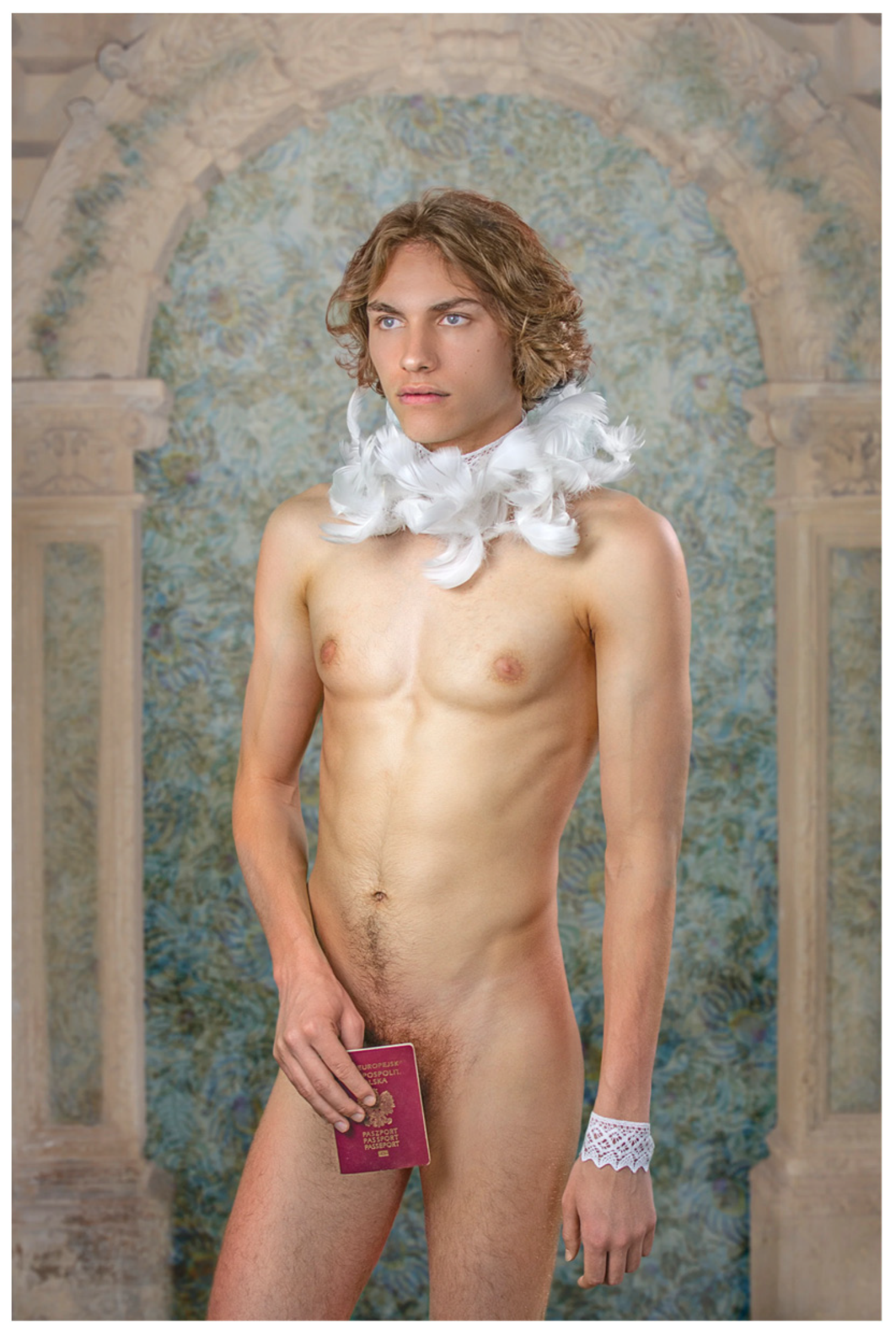
Wiącek 2021, p. 131). On a whim, he “dressed” himself in pieces of plastic wine-bottle packaging he had received at a duty-free shop at the airport, built a set from floral gift-wrapping paper, and undressed for a photograph. He covered his genitals only with a passport containing his American visa—functioning here as a kind of entry pass to another, supposedly “better” world. Soon afterward, the artist decided to develop the series further, inviting friends to participate and later issuing an open call on the social media platform Instagram. It was also during this time that he began experimenting with digital painting.
Marchlak’s debut photography series, according to his own words, draws inspiration from the work of David LaChapelle—a photographer, producer, and film director who achieved international fame for his colourful, surreal portraits of contemporary celebrities. What undoubtedly connects the two artists is LaChapelle’s characteristic approach of incorporating iconographic motifs from early modern religious paintings to reinterpret them from a contemporary perspective. As recounted by Marchlak: “There was one event, one exhibition, that really got me hooked on photography. It was David LaChapelle’s exhibition in Venice, at Casa dei Tre Oci. I felt as if I were seeing something for the first time. These were large-scale photographs of incredible quality and colour, with amazing compositions—on the one hand light, and on the other, carrying a certain interpretive weight. David LaChapelle draws deeply on allegorical and symbolic representations from the world of art history, so perhaps all of this somehow connects together” (interview conducted in November 2024).
4. Italian Renaissance and Mannerist References in Marchlak’s Work
A particularly compelling solution appears in Marchlak’s photograph from
I Would Give You My Heart where the model is posed against a white marble arcade, positioned at the very centre of the image (see
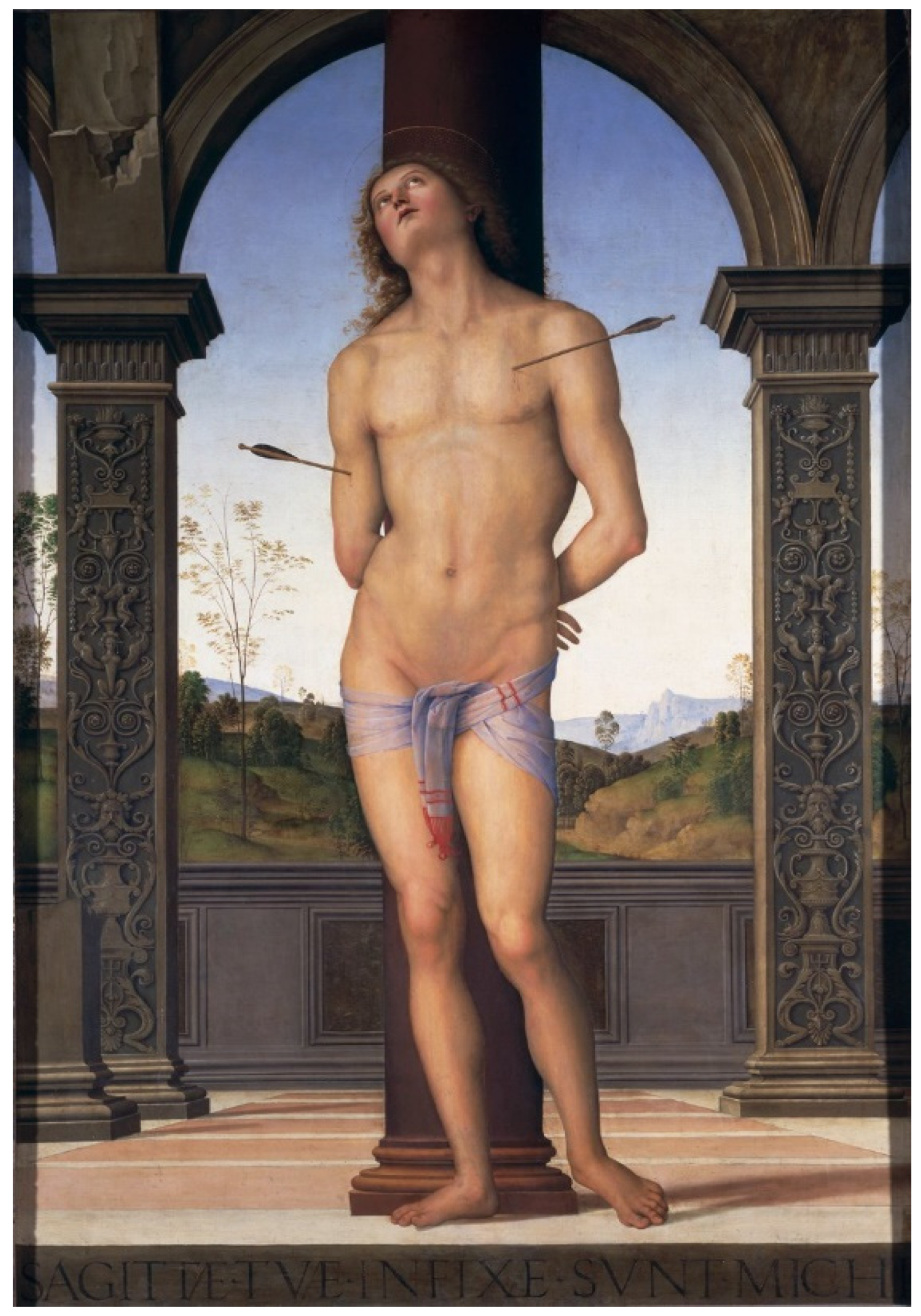
Figure 1). Both the architectural motif and the wallpaper backdrop—dissolving into a bluish-grey mist between the columns—command the viewer’s attention. The photograph invites iconographic associations with a subtle, painterly, and delicately suffused representation of St. Sebastian from the Quattrocento, attributed to Il Perugino (Pietro di Cristoforo Vannucci detto Il Perugino,
The Martyrdom of Saint Sebastian, ca. 1475–1500, oil on panel, Louvre; see
Figure 2).
As Alicja Jakubowska observes, in Perugino’s painting the arcade in the background is presented as a stylized ruin with broken fragments of a pillar and arch, thereby reflecting the artist’s ambition to imbue his art with classical ideas (
Jakubowska 2023, p. 338). A composition recalls the earlier treatment of the subject by Andrea Mantegna, who depicted St. Sebastian in a style profoundly informed by classical antiquity as well as by the artist’s study of Roman history and architecture (ca. 1456–1457). Interestingly, in Perugino’s painting depicting the martyrdom of St. Sebastian, unlike in Mantegna’s work, there is no trace of physical pain affecting the protagonist. Even the number of arrows piercing the body of the martyred St. Sebastian is strikingly limited, and they do not visibly wound or deform the saint’s body. According to Alicja Jakubowska, the reason is that the scene depicted by the artist embodies the Platonic triad of the good, the true, and the beautiful: the almost nude, ideally proportioned body of the saint, which, like the body of the crucified Christ, is covered only by a loincloth, becomes a reflection of his spiritual beauty and, at the same time, of the beauty of the Creator (
Jakubowska 2023, p. 338).
Among the formal correspondences linking Marchlak’s image with Perugino’s panel are the closed composition, a comparable chromatic palette, the slender and refined modelling of the youth’s body, the contrapposto stance, and the deployment of linear perspective. The resonance of Marchlak’s series with Renaissance and antique traditions extends well beyond Perugino’s
Sebastian. Of particular relevance is the Quattrocento revival of antique sculptural ideals—the slender, contrapposto male figure derived from Praxitelean and Polykleitan prototypes—reintroduced into the visual culture of the period through both religious and mythological iconographies (
Fabiański 2023, p. 106).
As recounted by Marchlak: “Such references to classical art appear in my work because I am also a trained painter, so perhaps all of this is deeply rooted within me. Still, I believe that when building an image based on an imaginary realm that is culturally embedded in us, it brings us closer to certain—I wouldn’t say hidden, but rather implicit—meanings that are not shown directly. Through cultural codes we are able to perceive certain associations; we look at one image and it evokes another—and that has always been what interested me most in art” (interview conducted in November 2024).
The model is portrayed against a constructed stage design—digitally generated photographic backdrops that evoke patterned wallpaper emerging from the mist. Depicted in contrapposto, Marchlak’s model gazes boldly at the viewer, evocative of an ancient statue of a victorious athlete represented in triumphant male nudity (
Boardman 1985). His pose explicitly references the classical canon. However, unlike Greek statuary of the Classical period, the model’s genitals are obscured by a passport held in his hands. This official document assigns to him a specific gender, identity (name and surname), nationality, age, and right of mobility. The model’s absent, contemplative gaze may suggest that while the document imposes restrictions, it simultaneously stimulates the imagination of life in another, unconstrained world, beyond imposed categories.
Another example is Marchlak’s 2023 photographic series Silent Sculpture, which stands as a compelling exploration of Renaissance linear perspective, drawing on classical models transmitted through early Italian Renaissance painting. The series was produced within the framework of my aforementioned, visual research project. I participated in the Marchlak’s photographic sessions with model Sebastian Siuta and documented the process collaborating closely with cinematographer Igor Kawecki.
The shoot took place in Kraków’s decommissioned Main Post Office. Constructed between 1887 and 1889 by Friedrich Setz in the Northern Neo-Renaissance style, the building underwent significant alterations between 1931 and 1936 under Fryderyk Tadanier: two additional floors were added, the dome and historicist detailing removed, and replaced with crystalline Art Deco motifs. While most modernist interventions were later lost, a 1990s restoration reinstated the dome and added postmodernist elements.
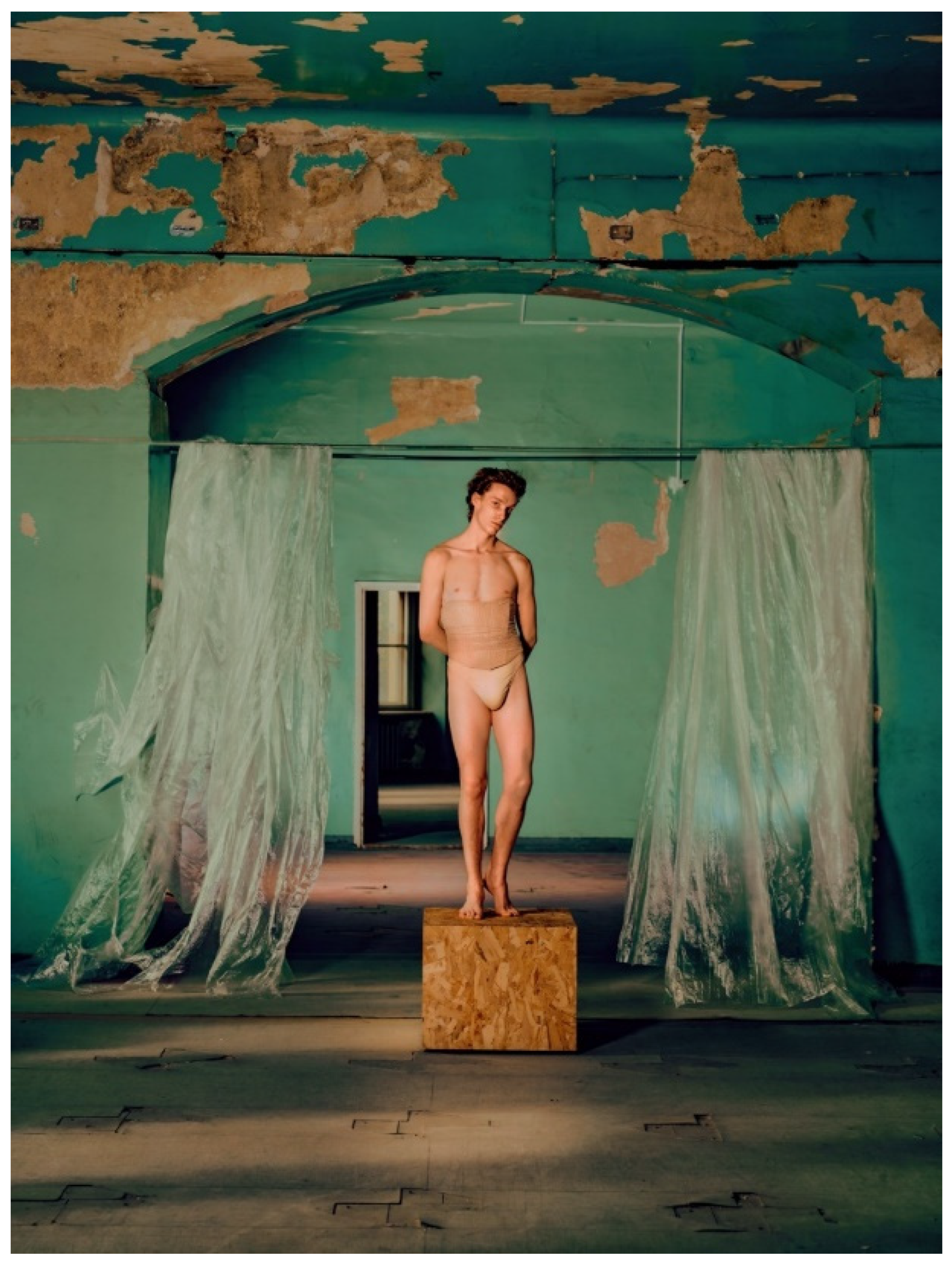
Marchlak’s photo session produced the
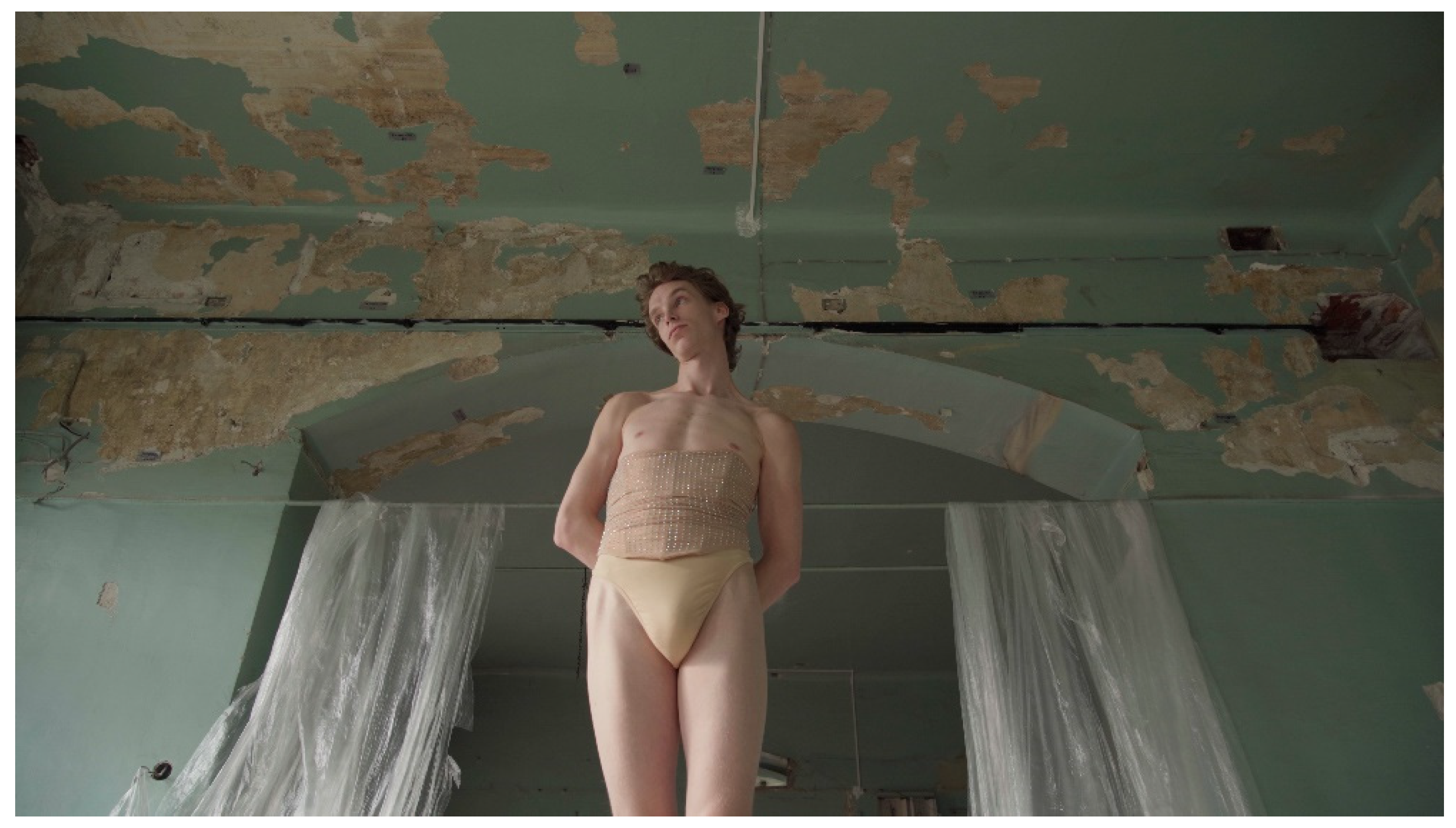
Silent Sculpture series. One portrait situates the model within the disused second floor of the Main Post Office, still bearing Neo-Renaissance features (see
Figure 3). Positioned in contrapposto at the centre of the frame atop a pedestal, he directly references Perugino’s Renaissance St. Sebastian, itself inspired by the classical
Diadoumenos. The arch above the model’s head recalls an ancient arcade, reinforcing the Renaissance lineage of the composition. Like Perugino’s St. Sebastian, Marchlak’s figure is depicted against ruins; however, these are contemporary, the peeling walls of a disused public building evoke the atmosphere of a decayed Renaissance palace. As recounted by the artist: “I met Sebastian at the premiere of the show at the New Proxima Theater. And I remember seeing him outside, when we went out to smoke a cigarette, and then we started talking. I was planning to make a photo inspired by the figure of St Sebastian and met the real Sebastian, who, on the one hand, completely visually matched the entirety for me, his personality too, but even the name matched” (
Plińska and Jankowski 2025).
The photograph engages with the iconography of St. Sebastian, linking Christian martyrdom to the Classical male nude and, in contemporary reading, to queer culture. Marchlak’s model wears flesh-coloured underwear and a self-fashioned crystal-embellished corset instead of the traditional loincloth (see
Figure 4). This attire signals both societal constraints imposed upon the body and the model’s fluid traversal of gender norms. Amidst the ruins, Sebastian resembles a sculptural figure, embodying vulnerability and resilience within a hostile environment. “And in fact, the style of this particular photograph combines a classical depiction of the figure (…) with reflections on the contemporary suffering of people from social minorities” (interview conducted in November 2024). Nevertheless, the photograph captures Sebastian before any assault, juxtaposing the harmony of his body with the surrounding decay. It presents a triumph of the timeless beauty of the non-binary human form, and the enduring power of the human figure in art.
As recounted by Marchlak: “When preparing for this photo, I thought about what that Sebastian character looks like today. And I came to the conclusion that, actually, with social media development, with being able to attack people on the Internet so easily, for various reasons, we in fact, while being such haters, let’s call it that, we are actually hurting the people we attack, even if not directly. Still, in the very photo of Sebastian that was being created, there is no situation of injury. There is no situation of direct transfer from the iconography of the figure of Sebastian, who is pierced by arrows. I stated that this contemporary Sebastian is more a reference, also to such an attack, maybe not physical, more symbolic-verbal. And I concluded that we would show Sebastian in the role of St. Sebastian, who is sort of expecting, or is even not expecting, he is exposed to fire” (
Plińska and Jankowski 2025).
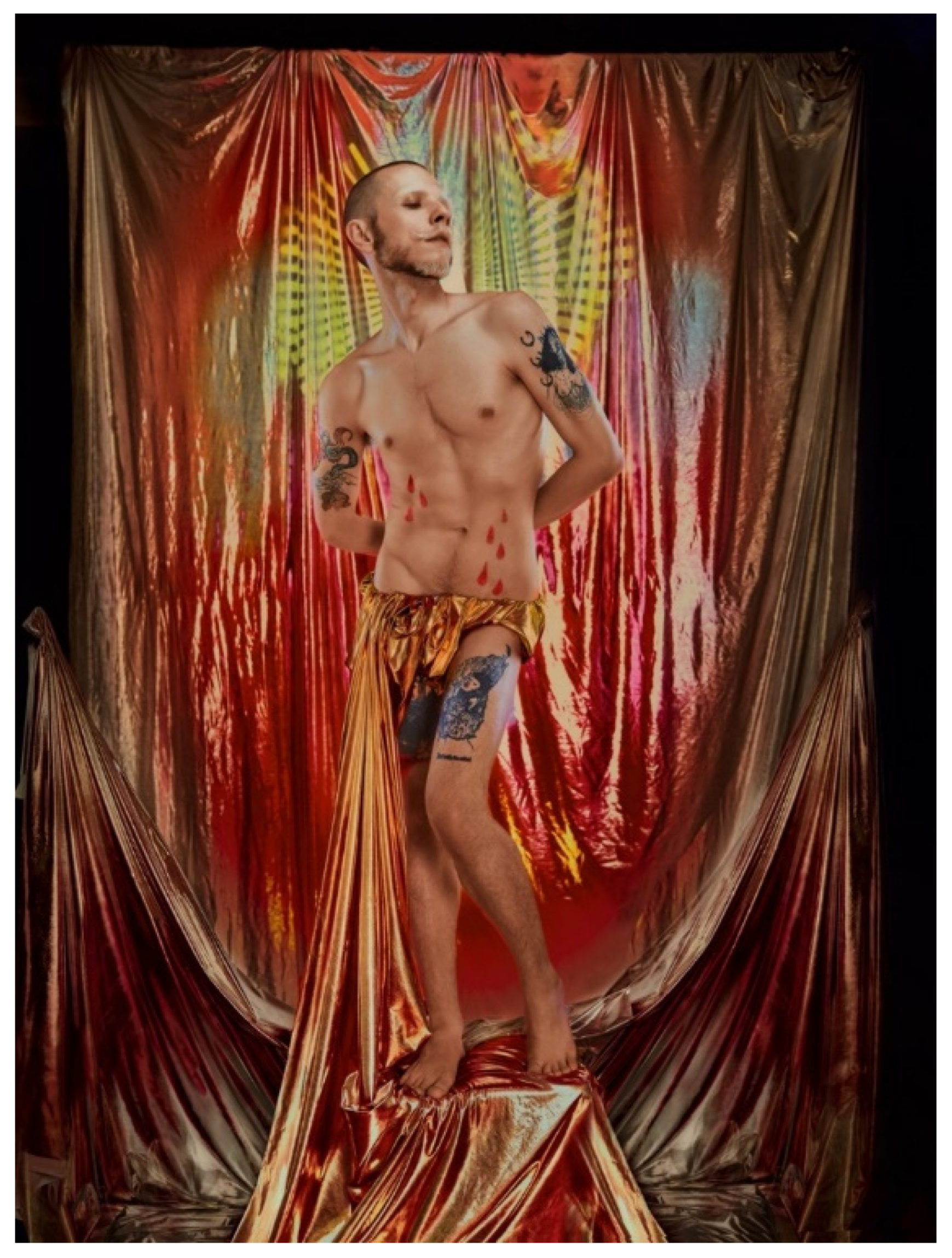
Another example to which I would like to draw attention is Marchlak’s 2025 photograph
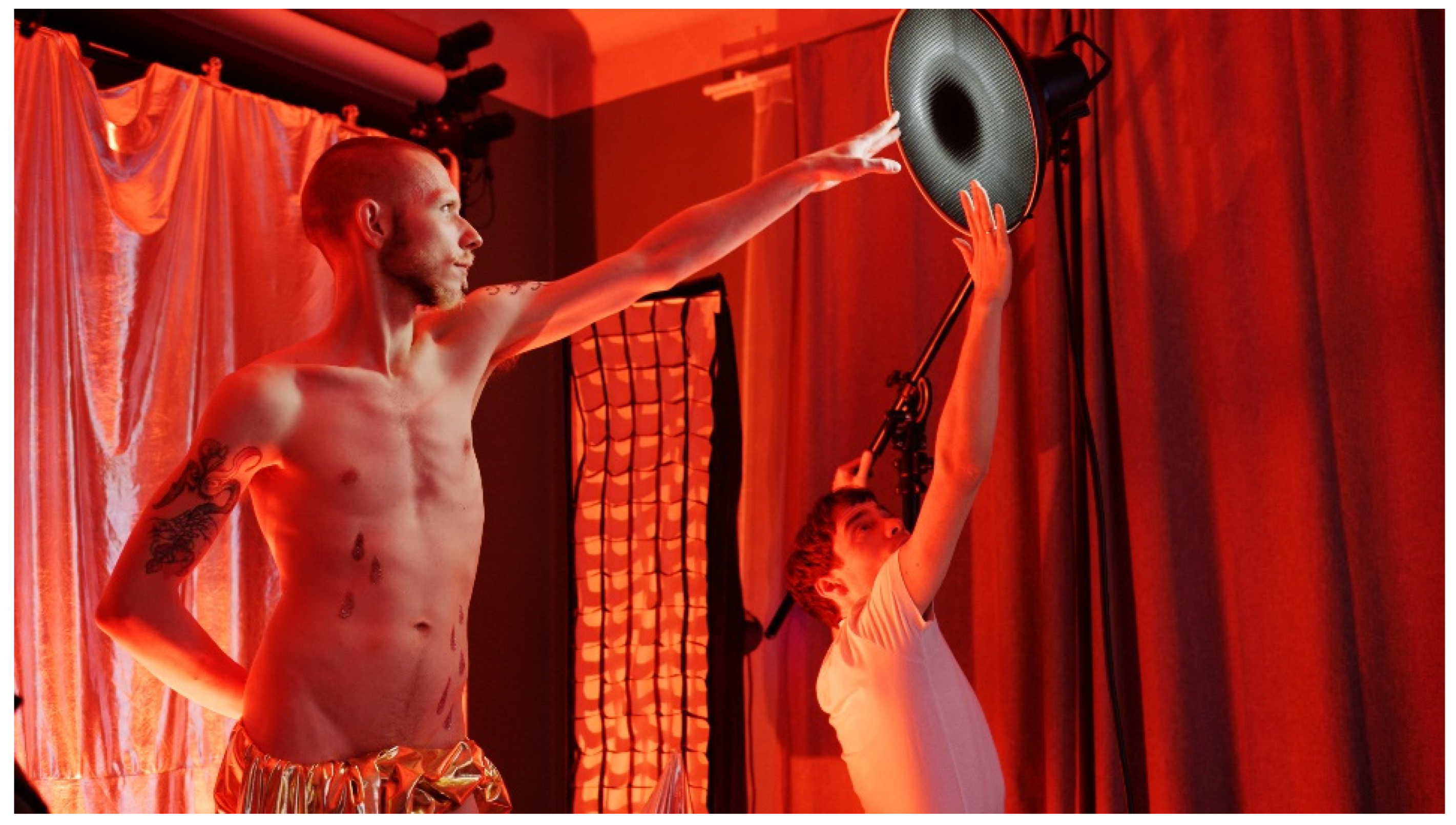
Sebastian, created with model Kajetan Kazanowski (see
Figure 5). The photo session that produced the image was co-produced and documented by myself together with cinematographer Wojciech Jankowski in December 2024.
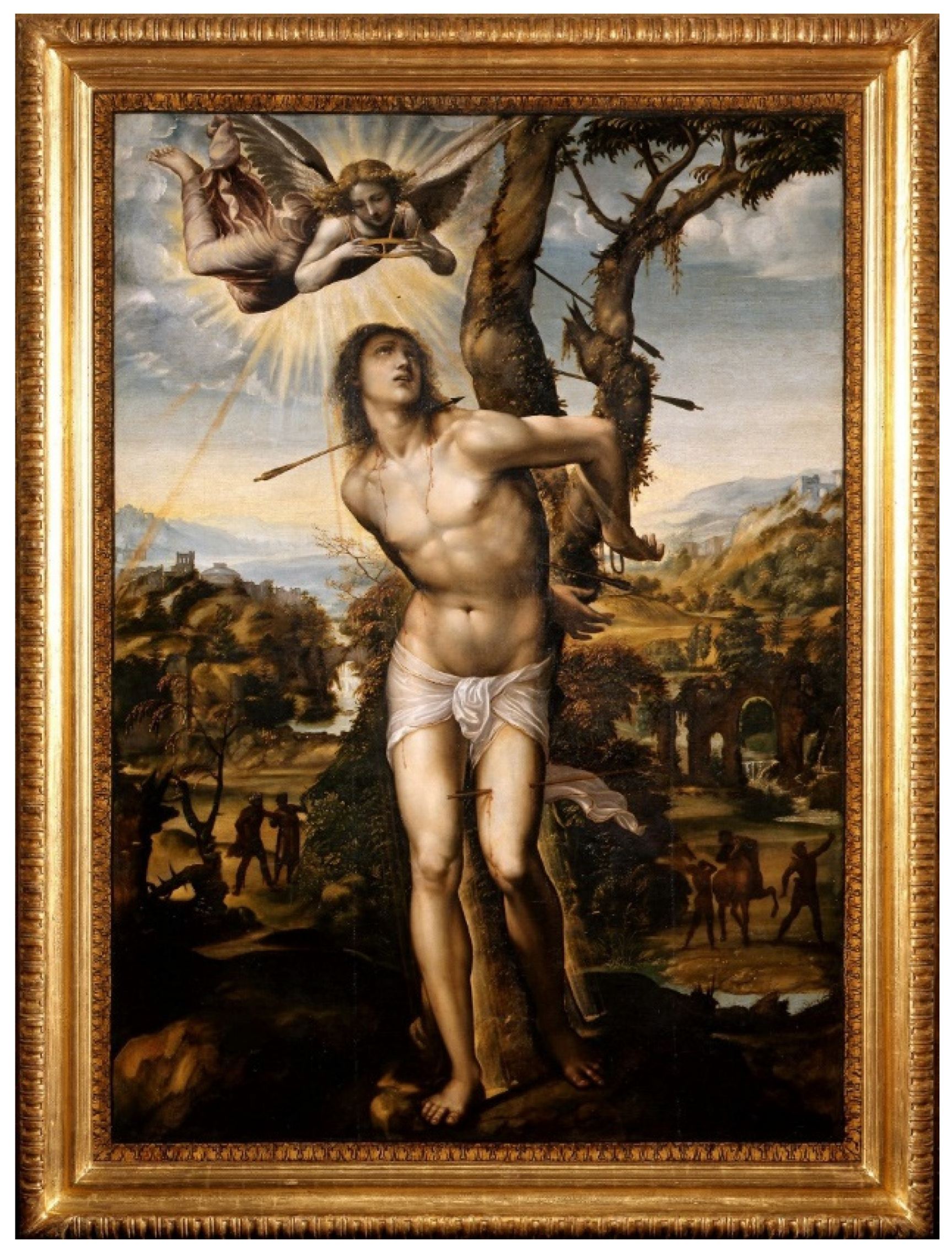
The photograph in question somehow recalls Il Sodoma’s painting of S.t Sebastian (Giovanni Antonio Bazzi detto il Sodoma
St. Sebastian’s Processional Gonfalon: Martyrdom of St. Sebastian, oil on canvas, 1525, now in the Uffizi, see
Figure 6): the slender, beautiful body of Marchlak’s model—his genitals covered only with a golden loincloth—is slightly twisted to the right, with his hands tied behind his back. Yet unlike Sodoma’s painting, Marchlak’s Sebastian is not pierced by arrows. Instead, his skin is covered with ink-coloured tattoos that resemble a polychromatic decorative pattern. The skin is also marked with a few glittering drops of red paint, suggestive more of body make-up than of human blood.
As Bette Talvacchia has underlined, according to the hagiographic narratives, St. Sebastian did not meet his death from the arrows that pierced his vulnerable flesh. And yet, in Sodoma’s rendering, he appears with an arrow embedded in his neck—a wound from which no mortal could survive. Sodoma’s Sebastian lifts his eyes heavenward. His beautiful face expresses suffering, with tears in his eyes and a single tear trickling down his cheek. The martyr’s gaze ascends towards the angel, who, radiant in glory, emerges from the clouds to bear witness to his sacrifice. Thus it seemed only fitting that Sebastian must have been spared by a divine miracle (
Talvacchia 2010, p. 228). By choosing to depict precisely the moment of miracle, Sodoma infused the iconography of Saint Sebastian’s martyrdom with another dimension: no longer merely a meditation on the Platonic triad, but a testament to the salvation of the suffering human flesh.
In Marchlak’s reading Sebastian does not appear to suffer—at least not visibly. His face remains calm and distant. Although no angel descends from the heavens to comfort the martyr, a radiant, yellowish-golden halo of light glows around his head. The impression that something extraordinary is unfolding before the viewer’s eyes is reinforced by the colours: the gleaming golden loincloth covering the model’s genitalia, and the draped curtain in shades of red and silver placed both in front of him and in the background.
The use of colours suggests that the image does not directly replicate Sodoma’s painting style. To achieve this colour palette, Marchlak used both red and yellow lighting, as well as a smoke machine in his studio. As recounted by the artist: “There are also some things that I don’t fully control. For example, when we work with smoke on a photo shoot, I want to use some form of blurring or hiding certain areas. (…). It also introduces such a more spiritual character” (
Plińska and Jankowski 2025, see
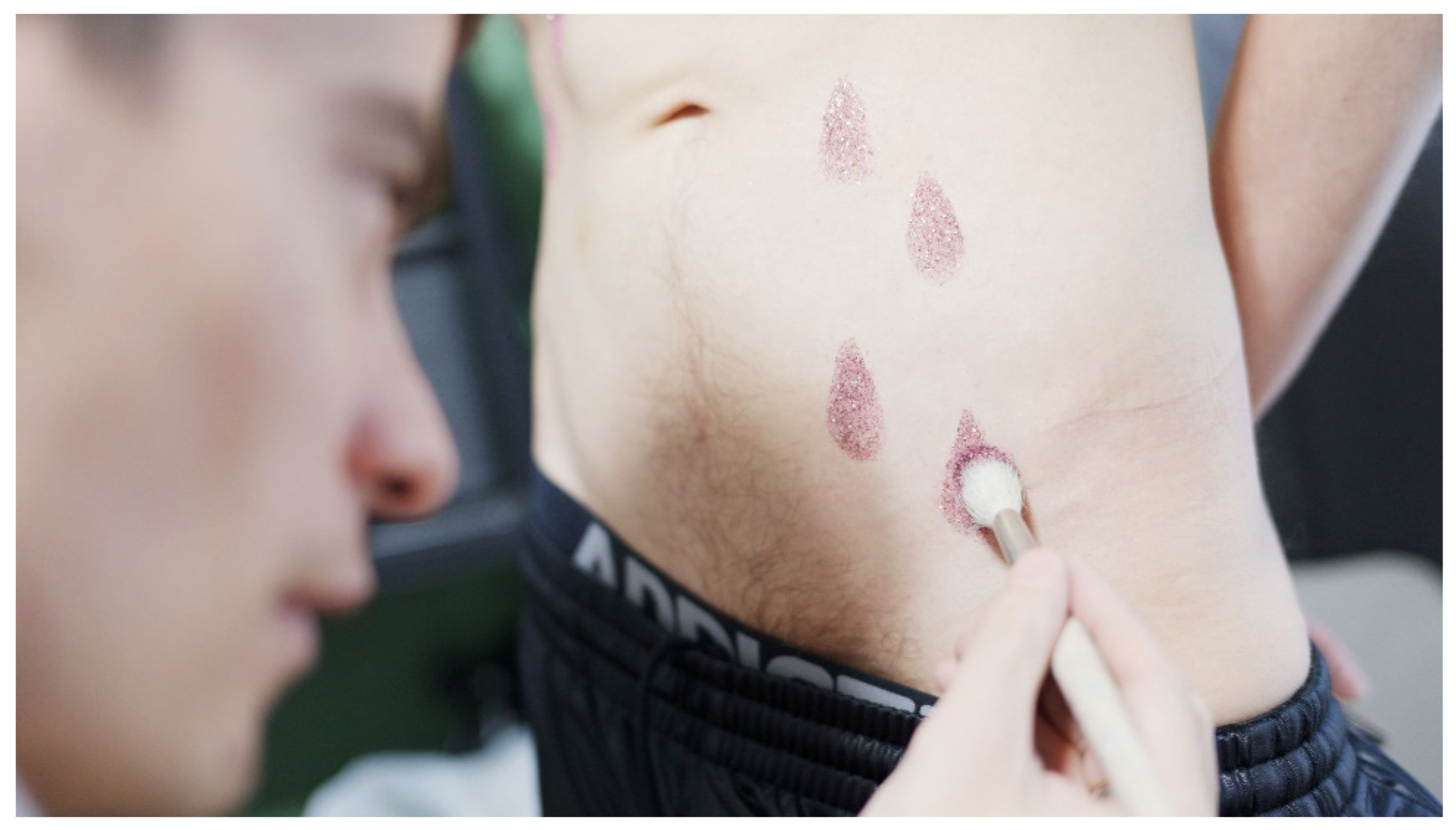
Figure 7). The shimmering red tones of the background resonate with the glittering drops of blood or paint on Sebastian’s belly (see
Figure 8), while the silver hues accentuate the golden shades of his skin and the glow of the loincloth. As in Sodoma’s painting, the colours remain soft and the modelling of the body is executed with great delicacy.
The crucial question, then, is what exactly the viewer encounters in this depiction. Are we confronted with a contemporary St. Sebastian, still enduring the torments of martyrdom yet, through divine intervention, beginning to experience relief? Or do we witness Sebastian already transformed into an altar image—a potent simulacrum designed to elicit responses? This distinction gains resonance when recalling Paul the Deacon’s
Annals of the Lombards, which recount that during the 7th century plagues in Italy, particularly in Rome and Pavia, the epidemics ceased only after the inhabitants erected altar in honour of St. Sebastian in the Basilica of St. Peter in Chains and entrusted themselves to his protection (
Paul the Deacon 1995, p. 309). In this context, the saint’s image is not merely representational; it is efficacious, mediating relief and inspiring reverence.
Yet the viewer might also read the scene differently: as a contemporary performance, featuring an actor, a nightclub entertainer, or a sex worker in the window of a red-light district—awaiting clients or revelling in the attention of an incomplete performance. What kind of insight does the interpretation offer on contemporary queer culture? Might the “male gaze,” as theorized by
Mulvey (
1975), operate in the objectification and commodification of the queer male body, particularly for youth who navigate the pressures of both self-expression and economic survival?
Marchlak appears to deliberately destabilize the boundary between these two possible readings of his work (
McNealy 2021). His work appears to be inspired as much by the Mannerist painting of Sodoma as by the contemporary creations of French duo Pierre et Gilles (Pierre Commoy and Gilles Blanchard), whose art lies at the intersection of painting and photography. Pierre et Gilles have been collaborating for nearly forty years, sharing both their personal and professional lives. Their graceful and sensual portraits depart from realism through the use of an unusual technique—they hand-retouch their photographs with paint. The duo often draws on mythological motifs and themes borrowed from art history, as well as popular religious imagery, retro-style postcards, Hollywood films, and other mass-produced works of visual pop culture.
5. Conclusions
Mikołaj Baliszewski argued that during the Renaissance the study of the male body—stimulated by the rediscovery of Roman copies of ancient Greek statues—increasingly led Italian artists to explore themes with distinctly homoerotic undertones, often under the guise of religious subjects. As he observes, such an impression is difficult to resist when confronted, for example, with Perugino’s depiction of the martyrdom of St. Sebastian, whose body remains untouched by a single arrow (
Baliszewski 2023, p. 135).
As Oswyn Murray recounts, in ancient Greek culture as early as the Archaic period, homoeroticism was a normative aspect of the male warrior world (
Murray 2000, p. 278). Love between an adult man and a younger male—necessarily of the same social class—was inscribed within the framework of upbringing. Expressions of love in the symposium context were often idealized, more concerned with courtship than consummation, and closely connected to other aspects of young men’s lives, such as athletics. As Murray stresses, this love—frequently described as unfulfilled—was less about sexual satisfaction and more about the pursuit of an ideal of pure beauty (
Murray 2000, p. 279).
According to Baliszewski, until the upheavals caused by events such as Savonarola’s dictatorship in Florence—which significantly affected, among others, Botticelli’s artistic production—the Italian elites of the 15th century tolerated a certain openness towards nudity in ancient art. As Monika Muszyńska remarks, sculptural representations of nude, ideally slender, youthful male bodies, usually modelled on Praxitelean Greek prototypes, were common decorative motifs in the aristocratic Roman gardens of antiquity (
Muszyńska 2023, p. 352).
Despite the Renaissance fascination with rediscovered antiquity—with its aesthetic ideals and philosophical concepts—Bette Talvacchia observes that associations between depictions of St. Sebastian and homoeroticism did not arise in the fifteenth or sixteenth centuries (
Talvacchia 2010, p. 242). Only in the nineteenth century were visual representations of St. Sebastian construed as homoerotic by figures such as Oscar Wilde. By then, the saint’s religious function had largely receded, and it was primarily the formal qualities of his corporeality that attracted attention. For this reason, it is problematic to characterize the Renaissance paintings of Perugino or Sodoma (despite the suggestive epithet attributed to the latter by Giorgio Vasari) as “queer” without risking anachronism.
According to Talvacchia, the recurrence of plague in Italy was the decisive factor that stimulated the rapid development of St Sebastian’s iconography in the 15th century, when images of the saint—invoked as a protector against pestilence—were frequently commissioned and created (
Talvacchia 2010, p. 230). She further argues that the assimilation of Apollonian qualities into representations of St. Sebastian—a pagan archer god—derived not merely from formal borrowing but from the conception of the Christian martyr as embodying beauty in equal measure to virtue and heroism (
Talvacchia 2010, p. 233). In Homeric tradition, Apollo’s arrows possessed the power to bring plague upon the Greeks. By contrast, Sebastian was pierced by analogous arrows—subsequently becoming his iconographic attribute—yet, aided by divine intervention, he survived. By this analogy, he came to be understood as a powerful intercessor against pestilence, his body figured as paradoxically transgressive: beautiful like a deity, vulnerable to wounding, yet ultimately resistant to death.
In Kris Marchlak’s reading, the physical stance of Saint Sebastian—his triumphant, defiant posture, inherited from Classical antiquity and transmitted through Italian Renaissance and Mannerist painting—embodies a persistent form of resistance. The contemporary Saint Sebastian’s body resists not the assault of Roman officers nor the devastating forces of plague, but the repressive power relations that seek to define and control queer identities.
In this light, Marchlak’s Saint Sebastian can be read as a radical inversion of the Foucauldian spectacle (
Foucault 1991). Whereas the condemned body in early modern punishment was exposed to affirm sovereign power, Sebastian’s exposed body undermines that hierarchy by transforming vulnerability into dignified visibility. His elevation is no longer a sign of submission to authority, but a reversal of moral order in which the victim assumes a position of ethical superiority. The gaze that seeks to dominate now encounters composure, serenity, and poise—qualities that render the spectacle of suffering morally unstable (
Foucault 1991, p. 9). In this reversal, exposure becomes not a mechanism of control but a medium of resistance: the saint’s body refuses degradation, asserting its own autonomy through the calm visibility of pain. Marchlak’s contemporary Sebastian thus embodies a paradoxical sanctity of the visible, in which to be exposed is not to be humiliated, but to reclaim moral and political agency.
In Foucauldian terms, Sebastian’s posture stages a counter-performance to biopolitical control—it is a body aware of its own surveillance, yet one that converts exposure into power by revealing the mechanisms of that control. Marchlak’s contemporary Sebastian thus embodies the paradox of queer resistance: the capacity to inhabit and simultaneously subvert the very structures of oppression. His stance becomes a performative act of reclamation—an articulation of how the queer body resists through dignified exposure and the refusal to be diminished.