Review

Recent Advances and Future Prospects of Bayesian Operational Modal Analysis: Identification Algorithms, Uncertainty Computation, and Applications

Department of Bridge Engineering, School of Transportation, Southeast University, Nanjing 211189, China
*
Author to whom correspondence should be addressed.
Buildings 2026, 16(9), 1807; https://doi.org/10.3390/buildings16091807
Submission received: 23 March 2026 / Revised: 28 April 2026 / Accepted: 28 April 2026 / Published: 1 May 2026
(This article belongs to the Special Issue Recent Advances in Structural Health Monitoring)

Abstract

Bayesian operational modal analysis (OMA) provides a probabilistic framework for identifying modal parameters of structures under ambient excitation while quantifying identification uncertainty. By casting modal identification as a Bayesian inference problem, it enables systematic incorporation of modeling assumptions, measurement noise, and data limitations, thereby addressing fundamental shortcomings of conventional OMA methods. This paper presents a comprehensive review of Bayesian OMA, covering its theoretical foundations, representative identification algorithms, uncertainty quantification and management, and practical applications. Emphasis is placed on frequency domain Bayesian formulations, fast Bayesian FFT-based identification algorithms, treatment of multi-setup and asynchronous data, closely spaced modes, and recent advances in both computational acceleration and capturing environmental variations. Developments on uncertainty laws are synthesized to elucidate the fundamental limits of achievable identification precision and their implications for uncertainty management and test design. A range of applications is reviewed to demonstrate how Bayesian OMA methods support robust modal identification and long-term structural health monitoring under operational and environmental variations. Finally, key challenges and future research directions are discussed to facilitate further methodological development and engineering adoption of Bayesian OMA.

1. Introduction

Large-scale civil engineering structures (bridges, buildings, towers, etc.) may suffer from natural disasters such as earthquakes and strong winds during their service life, which seriously threaten the safety and durability of the structures themselves. The structural health monitoring (SHM) technology can provide an approach to assess the health condition of a structure in real time [1,2,3]. Recent years have witnessed substantial advances in SHM, including Bayesian and probabilistic inference methods [4,5,6], techniques for addressing environmental effects and variability [7,8], data-driven and machine-learning-assisted approaches [9,10], and new efforts for damage detection and estimation [11,12]. These developments have further reinforced SHM as a powerful tool for structural performance evaluation and damage assessment. In the applications of SHM, modal properties serve as crucial indicators for subsequent assessment, diagnosis, and decision-making.
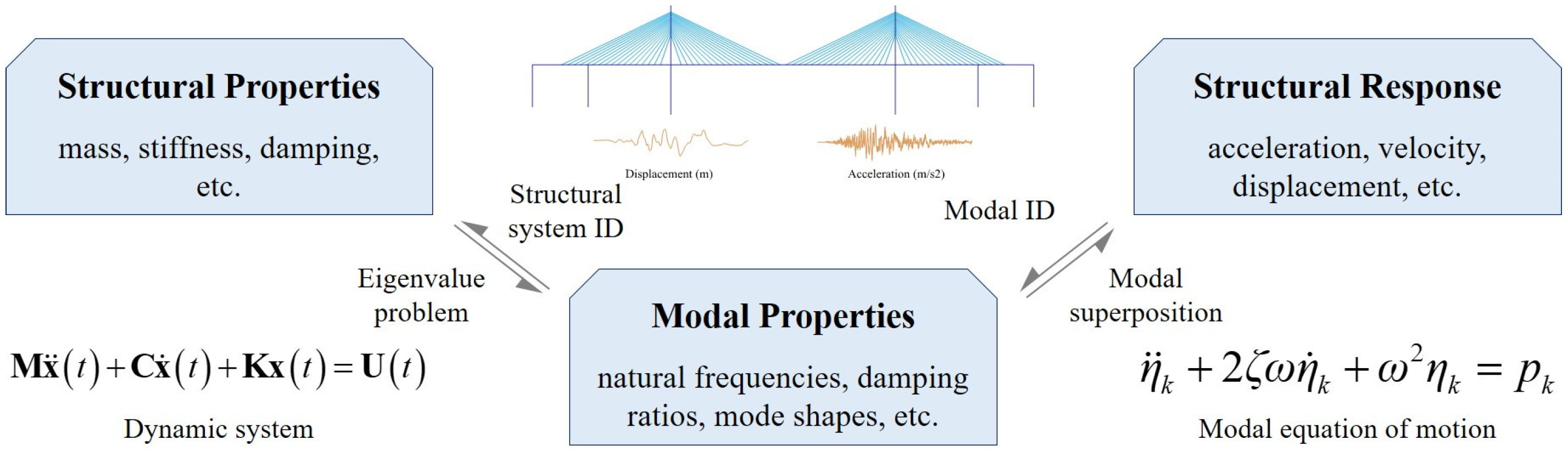
The modal properties of a structure can be identified from an ambient vibration test, also called operational modal analysis (OMA) [13,14,15]. Specifically, modal identification focuses on extracting the modal properties, including natural frequencies, damping ratios, and mode shapes, from the measured vibration data of a structure. Modal identification is the basis of structural system identification, which aims at extracting the structural properties. As depicted in Figure 1, these are ‘forward problems’ and ‘reverse problems’ in structural dynamics. Modal identification has received a great deal of attention in the engineering field, as it allows providing prerequisite information for many practical applications, like model/reliability updating [16,17,18,19,20], damage detection [21,22,23,24], vibration control [25,26], and optimization of structural design [27,28,29].
The excitation is assumed to be ‘broadband random’ in the ambient vibration test, rather than measured, and is normally referred to as ‘ambient’. Compared with free or forced vibration tests, ambient vibration testing is significantly more economical, as it allows vibration data to be collected while the structure is under ‘operating conditions’ and without substantial intervention [30,31]. As a result, an increasing number of field tests have been conducted under ambient excitation, in which the input is not measured directly and is instead represented by a stochastic model. This output-only testing condition has motivated the development of appropriate methods for extracting modal information from random response data without measured input information. Various types of methods have been proposed and applied successfully, covering time domain [32,33,34,35,36], frequency domain [37,38,39], and time-frequency domain [40,41,42,43,44]. However, the identification effectiveness of conventional OMA is highly dependent on the selection of sample statistics, which may result in not fully exploiting all the information from the ambient vibration data. Meanwhile, four types of uncertainties are faced [14]: statistical errors due to the limited data, measurement errors introduced by the noise, inherent uncertainties due to the unknown broadband excitation, and systematic biases triggered by incompatible model assumptions. Although the first two types of problems can be mitigated by increasing the amount of data and improving the quality of the equipment, the unpredictability of the unknown excitation perpetuates uncertainty in the results, and the modeling error can cause a direct bias in the parameter estimation. Neglecting to quantify these uncertainties may undermine the reliability and explanatory power of identification results. This creates an urgent need to introduce new techniques to improve the situation.
Motivated by the above considerations, a Bayesian approach is employed to explicitly address the uncertainty, considering its unique perspective on the system identification [45,46]. Here, modal identification is viewed as an inference problem. Given the measured data and modeling assumptions, the probability is a measure of the relative rationality of identification results. Thus, the goal of modal identification turns out to be the determination of the posterior probability density function (PDF) of modal parameters. In recent years, Bayesian approaches in modal and system identification have evolved into several representative research lines, including Bayesian time domain approaches [47,48,49], Bayesian spectral density approaches [50,51,52,53,54], fast Fourier transform (FFT)-based and related fast frequency domain methods [55,56,57,58], and Bayesian system identification formulations and extensions [59,60,61,62]. Compared with non-Bayesian approaches, Bayesian formulations provide a rigorous and probabilistically coherent framework for quantifying uncertainty in the parameters of interest, since the posterior inference is performed conditional on the adopted assumptions regarding the system model, ambient excitation, measurement noise, and prior information. It should be noted that the practical advantage of Bayesian OMA may diminish under severe model mismatch or weakly informative data, such as short records, low signal-to-noise ratio (SNR), pronounced non-stationarity, or multiple closely spaced modes with strong modal coupling, and these limits are currently understood only partially and mainly under idealized or asymptotic conditions rather than through universally accepted quantitative thresholds [14,31,58]. Nevertheless, computational and practical issues are equally significant and need to be reliably addressed before applying this approach.
This paper presents a systematic review of Bayesian OMA, focusing on probabilistic formulations for ambient vibration test and their role in modal identification and uncertainty quantification. Specifically, Section 2 outlines the theoretical foundations of Bayesian OMA, followed by a review of representative identification algorithms in Section 3, with emphasis on frequency domain formulations and recent advances in both computational efficiency and considering environmental variations. Section 4 synthesizes developments on uncertainty laws and their implications for identification accuracy and uncertainty management. Section 5 reviews significant applications of Bayesian OMA in SHM and related engineering problems. Section 6 and Section 7 summarize the main findings and discuss current challenges and future research directions.

2. Bayesian Inference Framework

The Bayesian approach explicitly acknowledges the limitations of conventional OMA. In this way, Bayes’ theorem is employed to provide a fundamental approach for processing the valuable information of measured data and making inferences about the parameters in a way that is consistent with modeling assumptions and probabilistic logic. An introduction to Bayesian probability knowledge can be found in some previous works [63,64,65,66,67]. Following these, Beck [68] elaborates on the Bayesian perspective with a background of structural system identification.
Note that not all inference problems must be solved by the Bayesian approach. However, the Bayesian approach has more advantages than non-Bayesian approaches in dealing with problems with identifying and quantifying uncertainty; problems with identifying results that depend strongly on fundamental assumptions, and that need to be screened for quantitative effects.

2.1. Bayes’ Theorem

Bayes’ theorem is named after the mathematician Thomas Bayes [69]. What is now widely discussed and implemented as Bayesian probability was actually pioneered and popularized by the mathematician Pierre-Simon Laplace [70,71]. According to Bayes’ theorem [72,73], for events A and B,
p B A = p A B p B p A
Here, the term p B A denotes the probability of event B occurring conditional on event A occurring, i.e., the posterior probability; the term p A B denotes the probability of event A occurring conditional on event B occurring, i.e., the likelihood function; the term p B is the prior probability of event B; the term p A is the marginal probability of event A. It is non-trivial when there is no easy way to use information about A to answer a question about B. Since the roles of event A and event B can be swapped via Bayes’ theorem, turning this question into one about A given B.

2.2. Bayesian Modal Identification Framework

For the general problem with n degrees of freedom (DOFs) and damping modeled by a viscous term, the equation of motion is given as
M x ¨ t + C x ˙ t + Kx t = U t
where x ¨ t , x ˙ t and x t are the acceleration, velocity, and displacement of the structure, respectively; M , C and K are the n × n mass, damping, and stiffness matrix of the structure, respectively; U t is the external excitation at time t.
The Bayesian approach was introduced into the dynamics of structures by Beck and Katafygiotis earlier, thereby establishing the famous basic theoretical framework of Bayesian system identification [39,74]. Here, a specific description is presented. Let θ be a set of modal parameters identified from the measured acceleration response datasets D . In the work of modal identification for an assumed structural dynamics model, θ primarily comprise natural frequencies, damping ratios, mode shapes, power spectral density (PSD) matrix of modal forces, and PSD of the prediction error. D is usually considered the acceleration time histories of a structure. Using Bayes’ theorem,
p θ D = p D θ p θ p D
The description and explanation of each term in Equation (3) are provided in Table 1, which highlights that different Bayesian OMA formulations primarily differ in how the likelihood function is constructed and evaluated, while sharing a common probabilistic inference structure.
It should be specifically noted here that the posterior PDF p θ D . The ‘posterior’ means that it is after considering the information from D ; ‘posterior PDF’ encapsulates all information of θ , which can be inferred from D on a consistent basis with the associated modeling assumptions. Here, instead of inferring a single value of θ from the data D , the Bayesian approach actually aims at obtaining the PDF of θ . In practical applications, the probable values that θ may take are those with a high posterior PDF value, the identification uncertainty about θ is associated with the spreading of the posterior PDF. The two can be quantified by the mean and covariance matrices, respectively, in terms of ‘descriptive statistics’ associated with the posterior PDF.
Furthermore, there are several issues that should be considered when employing a Bayesian approach to address problems associated with system identification:
(1) Prior distribution: The assignment of the prior needs to be based on available history data. If the prior is too subjective or insufficient information, it may cause a bias in the identification results. In Bayesian OMA formulations, a non-informative prior is adopted due to the fact that modal identification is a typical globally identifiable problem, especially for high SNR scenarios. The posterior is often dominated by the likelihood rather than the prior [14].
(2) Modeling assumptions: The formulation of the MLF p D θ needs to be based on modeling assumptions. The physical/logical modeling of the system prediction and its discrepancy with measured data (named prediction error) is involved here.
(3) Descriptive posterior statistics: The determination of the mean and covariance matrices of θ for the purpose of interpretation and decision-making. This is primarily a computational problem.
Bayesian OMA methods have been in service for a long time owing to their numerous strengths. Below is a review of some favorite Bayesian OMA techniques in both the time domain (Section 2.2.1) and frequency domain (Section 2.2.2).

2.2.1. Bayesian Time Domain Approaches

For addressing the problem of modal identification of structures under ambient excitation, Bayesian time domain approaches provide an available framework for estimating the most probable values (MPVs) of modal parameters and quantifying their associated uncertainties directly from response data, overcoming the limitations of traditional methods that only yield point estimates. Initially developed by Yuen and Katafygiotis for stationary data [47], this approach was later extended by them to handle the challenges of non-stationary responses, such as those induced by earthquakes or wind gusts [75]. Despite its strengths, the previous Bayesian time domain approaches face the high computational burden, convergence difficulties, and poor robustness when applied to large-scale civil engineering structures. To address these issues, Yin et al. [49] present a novel Bayesian framework for time domain operational modal analysis (BTOMA). This enhanced method incorporates Bayesian regularization, parameterized priors, and a setup parallelism strategy, improving computational efficiency, robustness, and reliability for structures with both well-separated and closely spaced modes.
Specifically, the BTOMA framework is constructed upon a probabilistic model of free vibration responses. For the ith channel, the response is given by the following modal superposition principle:
y i t = j = 1 N t ϕ j i e 2 π ξ j f j t A j sin 2 π f ¯ j t + B j cos 2 π f ¯ j t
where f j , ξ j , and ϕ j i denote the natural frequency, damping ratio, and mode shape component of the jth mode, respectively; A j and B j are unknown coefficients associated with the jth mode, which depend on the initial conditions; N t is the number of measured modes; f ¯ j = f j 1 ξ j 2 1 / 2 is the jth damped natural frequency. By stacking all measurement channels, the measured free vibration response vector at time point m for setup k can be written as
y k m = D k m , θ M a k
where D k m , θ M is the modal information matrix determined by the modal parameter set θ = f T , ξ T , φ T T ; a k is the unknown coefficient vector.
The likelihood function is constructed under the assumption that the prediction errors are independently and identically distributed Gaussian. For all setups, the joint likelihood is as follows:
p D 1 : M θ , β , M = β 2 π M N N ¯ o / 2 exp β 2 E 1 θ
where β is a hyperparameter representing the reciprocal of the variance of the prediction error; N and M are the number of time points and target pairs; N ¯ o = k = 1 K N o k , with N o k being the number of measurement channels; E 1 θ is the measure-of-fit function, which is given by
E 1 θ = k = 1 K m = 1 M G z ^ 1 : N k m , s , θ ; M z ^ 1 : N k m + s 2
where   z ^ 1 : N k m and   z ^ 1 : N k m + s denote the stacked response vectors; s denotes the time step.

2.2.2. Bayesian Frequency Domain Approaches

Within the Bayesian frequency domain framework for ambient modal identification, two major methodological streams have emerged based on the statistical characterization of spectral quantities, namely the Bayesian spectral density approach (BSDA) [50] and the Bayesian FFT approach [56]. Both aim at joint estimation of modal parameters and their uncertainties, yet differ in their computational strategies and scalability.
For BSDA, it enables the identification of the optimal values of the updated modal parameters and the calculation of their uncertainties based on the statistical properties of an estimator of the spectral density. BSDA faces challenges such as high-dimensional optimization, ill-conditioning when dealing with high SNR measurements, and difficulties in handling multiple measurement setups. To address these issues, Yan and Katafygiotis [52,53,54] propose another two-stage fast BSDA for ambient modal analysis. Focusing on the cases of separated modes and closely spaced modes, they develop a variable separation technique that cleverly decouples the modal parameters to be identified into spatial variables (e.g., mode shape components) and spectrum variables (e.g., natural frequencies, damping ratios, PSD matrix of modal forces, and PSD of the prediction error). In the first stage, the spectrum variables are identified and their uncertainties are computed by a ‘fast Bayesian spectral trace approach (FBSTA)’ using only the sum of the auto-spectral densities of all measured DOFs; in the second stage, the spatial variables and their uncertainties are extracted by a ‘fast Bayesian spectral density approach (FBSDA)’ using the information of the entire spectral density matrix.
Specifically, in the general BSDA formulation, the likelihood function of the modal parameters λ is derived from the summed spectral density matrix S sum = S k sum ( k = k 1 , , k 2 ) over frequency band k 1 Δ f , k 2 Δ f . Based on Bayes’ theorem, the posterior distribution is proportional to the following likelihood function:
p S sum λ = κ 0 k = k 1 k 2 C k λ n s exp t r C k 1 λ S k sum
where κ 0 is a normalizing constant; n s is the number of DOFs of the Wishart distribution; modal parameters λ include natural frequency f s , damping ratio ς s , PSD of the modal excitation S f s , PSD of the prediction error s μ s , and mode shape ψ s ; C k λ is the covariance matrix. Assuming a non-informative prior, it is convenient to write Equation (8) in terms of the negative logarithm of the likelihood function (NLLF) as
L B S D A λ = n s k = k 1 k 2 ln C k λ + k = k 1 k 2 t r C k 1 λ S k sum
which must be minimized to identify the most probable modal parameters. However, solving this high-dimensional problem directly is computationally prohibitive.
For the general Bayesian spectral trace approach (BSTA), the corresponding NLLF is
L B S T A λ = 1 2 k = k 1 k 2 ln 2 π n s t r C k 2 λ + k = k 1 k 2 t r S k sum n s t r C k λ 2 2 n s t r C k 2 λ
where · represents the real part of one complex function.
The spectrum variables and spatial variables can be decoupled completely after rearranging Equation (10) [52].
In the first stage of the two-stage FBSDA, the spectrum variables are estimated using FBSTA, which exploits the trace statistic of S k sum . For the case of separated modes, the NLLF of FBSTA is given by
L F B S T A λ = 1 2 k = k 1 k 2 ln 2 π n s Λ k 2 + 2 s μ s Λ k + n o s μ s 2 + k = k 1 k 2 t r S k sum n s Λ k + n o s μ s 2 2 n s Λ k 2 + 2 s μ s Λ k + n o s μ s 2
where Λ k = S f s β s k 2 1 2 + 2 β s k ς s 2 1 with β s k = f s / f k ; n o denotes the number of measured DOFs.
For the case of closely spaced modes, the NLLF of FBSTA is given by
L F B S T A λ = 1 2 k = k 1 k 2 ln 2 π n s t r Θ k 2 + 2 s μ t r Θ k + n o s μ 2 + k = k 1 k 2 t r S k sum n s t r Θ k + n o s μ 2 2 n s t r Θ k 2 + 2 s μ t r Θ k + n o s μ 2
where Θ k = α Λ k α T with α being a condensed set of coordinates and Λ k being the theoretical PSD matrix of the modal response; s μ denotes the PSD of the prediction error with n m modes existing within the specified frequency band.
The NLLF of BSTA corresponding to Equation (10) is the foundation of Equations (11) and (12), which are central to the first stage of obtaining the spectrum variables.
In the second stage of the two-stage FBSDA, the spatial variables are extracted through FBSDA. For the case of separated modes, the NLLF of FBSDA is given by
L F B S D A λ = n s n f n o 1 ln s μ s + n s k = k 1 k 2 ln s μ s + Λ k + s μ s 1 k = k 1 k 2 t r S k sum ψ s T k = k 1 k 2 1 + s μ s / Λ k 1 S k sum ψ s
where n f = k 2 k 1 + 1 .
For the case of closely spaced modes, the NLLF of FBSDA is given by
L F B S D A λ = n s n f n o n m ln s μ + n s k = k 1 k 2 ln E k + s μ 1 j = 1 n s k = k 1 k 2 Y j k Y j k s μ 1 j = 1 n s k = k 1 k 2 Y j k B I n m s μ E k 1 B T Y j k
where n m min n m , n o ; E k = Θ k + s μ I n m ; Y j k denotes the FFT of the jth measured response at frequency f k ; B denotes the mode shape basis.
The NLLF of BSDA corresponding to Equation (9) is the foundation of Equations (13) and (14), which are central to the second stage of obtaining the spatial variables.
For the Bayesian FFT approach, by using the statistical properties of the FFT, this method can not only obtain the optimal values of the updated modal parameters but also calculate their uncertainties from the joint probability distribution. However, the difficulty of computation seriously hinders its further development and application, even for a moderate number of measured DOFs [56]. In order to address the problems faced in the Bayesian FFT approach, Au [56,57,58] proposes a fast Bayesian FFT approach for ambient modal identification. Focusing on well-separated modes, Au transforms the parameter identification problem into an objective function containing only four parameters to be optimized (i.e., natural frequencies, damping ratios, PSD matrix of modal forces, and PSD of the prediction error). This method achieves analytical computation of the posterior covariance matrix, thereby enhancing computational speed and stability. It is worth noting that an associated analysis shows that FBSDA can be considered as a linear superposition of a fast Bayesian FFT approach incorporating multiple sets of measurements.
Without loss of generality, let D = x ¨ j j = 0 N 1 denote the measured acceleration response datasets obtained from a structure with n DOFs, modeled as a stationary stochastic process. Its scaled FFT F k at frequency f k = k / N Δ t (Hz) is given by the following:
F k = 2 Δ t / N j = 0 N 1 x ¨ j e 2 π i j k / N
where i 2 = 1 ; N is the number of data points per channel; Δ t is the sampling interval. Typically, the FFTs F k are obtained for identifying the modal properties within a selected frequency band, which should cover the resonance band of the modes of interest.
Consider the selected frequency band dominated by m contributing modes with natural frequencies f i i = 1 m (Hz) and damping ratios ζ i i = 1 m . The scaled FFT F k is modeled as within the band
F k = i = 1 m Φ i η ¨ i k + ε k
where Φ i is the mode shape of the ith mode in the selected band; ε k is the scaled FFT of prediction error, which is assumed to be independent and identically distributed (i.i.d.) among different DOFs with a constant PSD S e in the resonance band; η ¨ i k is the scaled FFT of the ith modal acceleration, which satisfies the vibration equation of the corresponding structural system in the frequency domain as
η ¨ i k + 2 ζ i ω i η ˙ i k + ω i 2 η i k = p i k
where ω i is the ith angular frequency ( ω i = 2 π f i , rad/s); p i k is the scaled FFT of the ith modal force, which is modeled as a stationary stochastic process with a constant PSD in the resonance band. It is worth noting that the Gaussian assumption in Bayesian OMA is best viewed as a practically useful approximation for the prediction error or scaled FFTs within a selected resonance band, especially for long data records, rather than as a universally exact description of real SHM data [14,56]. When clear non-Gaussian effects are present, the likelihood or error model should be adapted accordingly.
Substituting η ¨ i k = i ω k η ˙ i k = ω k 2 η i k , β i k = ω i / ω k (frequency ratio) into Equation (17) and rearranging yields
η ¨ i k = 1 β i k 2 i 2 ζ i β i k 1 p i k
Substituting Equation (18) into Equation (16) gives the mean and covariance matrices of F k :
E F k = 0
E F k F k T = Φ H k Φ T + S e I n = E k
where Φ = Φ 1 , Φ 2 , , Φ m ; H k is the theoretical PSD matrix of modal acceleration:
H k = d i a g h k S d i a g h k T
where S is the PSD matrix of modal forces; h k is the vector of modal frequency response function whose ith entry is given by
h i k = 1 β i k 2 i 2 ζ i β i k 1
In the context of Bayesian modal identification, for sufficient data, the prior p θ is slowly varying compared to the MLF p D θ . As a result, the posterior PDF p θ D can be considered to be proportional to the MLF:
p θ F k = p θ D p D θ = p F k θ
For multiple modes, the PDF of F k given modal parameters θ can be denoted as
p D θ = p F k θ = k N 0 , E k = π n N f k det E k 1 × exp k F k T E k 1 F k
where N f denotes the number of FFT points in the selected band; θ comprise f i i = 1 m , ζ i i = 1 m , S , S e , and Φ . Without loss of generality, assuming a non-informative prior, the parameters θ would be obtained by maximizing the MLF p D θ , theoretically equivalent to minimizing the NLLF
L θ = n N f ln π + k ln det E k + k F k T E k 1 F k

3. Identification Algorithms

Recognizing the superiority of Bayesian inference in dealing with modal and system identification, methods for various scenarios have been continuously refined. Specifically, Section 3.1 introduces the work in terms of setup data classification, Section 3.2 introduces the work in terms of mode problem classification, Section 3.3 presents the improved accelerating algorithm utilizing the Fisher information matrix (FIM), Section 3.4 presents the modal identification methods considering the environmental effects, and Section 3.5 summarizes the main computational issues associated with these representative Bayesian OMA methods. Table 2 highlights that the algorithmic developments in Section 3 extend the fast Bayesian FFT approach to address increasing levels of data, mode, computational, and operational complexity. It also lists the key features and representative studies for the corresponding identification algorithms.

3.1. Classification for Setup Data

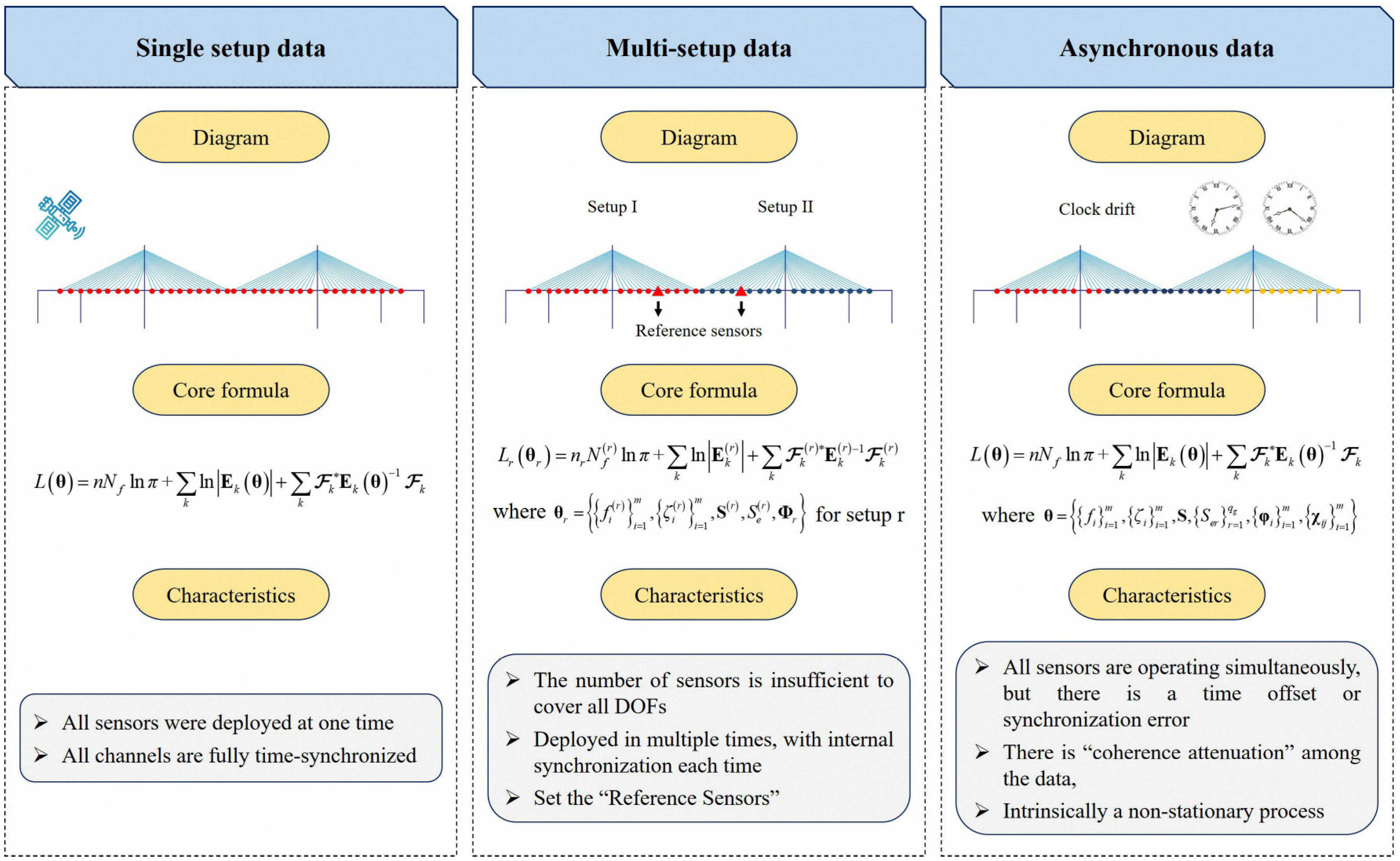
This section introduces the corresponding Bayesian formulations for the representative data configurations using a fast Bayesian FFT approach. Specifically, as shown in Figure 2, it covers synchronous data from a single setup, data acquired from multiple setups, and asynchronous data from a single setup [14]. For each configuration, Figure 2 presents a schematic sensor arrangement, the corresponding core formulation, and its main characteristics. This comparison helps clarify how differences in measurement configuration influence the Bayesian modeling and subsequent modal identification procedure.

3.1.1. Single Setup Data

For the case of single setup data, it assumes that the data at different DOFs are measured in a synchronous manner during the same time span.
Let x j j = 0 N 1 denote ambient vibration data obtained from a structure with n DOFs, modeled as a stationary stochastic process. Its scaled FFT F k at frequency f k = k / N Δ t (Hz) is given by:
F k = 2 Δ t / N j = 0 N 1 x j e 2 π i j k / N
For the modal parameter set θ , applying Bayes’ theorem yields the posterior PDF of θ given F k as
p θ F k = p F k 1 p F k θ p θ
The MLF is the joint PDF of F k given modal parameter set θ . Assuming a long data duration, F k are independent at different frequencies and follow a (circularly symmetric) complex Gaussian distribution. The MLF is then given by
p F k θ = k p F k θ = k π n E k θ 1 × exp F k E k θ 1 F k
where E k θ = E F k F k θ is the theoretical PSD matrix.
Suppose the selected band is dominated by m vibration modes, the scaled FFT F k is then modeled as within the band
F k = i = 1 m φ i h i k p i k + ε k
where φ i is the partial mode shape of mode i; h i k is the transfer function:
h i k = 2 π i f k q 1 β i k 2 2 ζ i β i k i   q = 0 1 2 acceleration   data velocity   data displacement   data
Consequently,
E k θ = i = 1 m j = 1 m h i k h j k S i j φ i φ j T + S e I n = Φ H k Φ T + S e I n
where the partial mode shape matrix Φ = φ 1 , φ 2 , , φ m ; the (i, j) entry of H k is h i k h j k S i j and S i j is the modal force cross PSD.
For convenience in analysis and computation, the posterior PDF of θ can be expressed as
p θ F k p F k θ = exp L θ
where L θ is the NLLF:
L θ = n N f ln π + k ln E k θ + k F k E k θ 1 F k

3.1.2. Multi-Setup Data

For the case of multi-setup data, such a strategy of performing multiple setups aims to identify a mode shape with more DOFs than the available number of synchronous data channels. Each setup covers different parts of the structure while sharing some common reference DOFs.
Let φ i n × 1 be the ‘global mode shape’ of the ith mode covering all DOFs of interest. Assuming that there are q setups, each one covers a possibly different set of DOFs. For setup r (r = 1, 2, …, q), it covers n r measured DOFs in the setup. Considering that some DOFs are measured in more than one setup, n < r = 1 q n r . In multi-setup problems, it is assumed that the data measured within the same setup are synchronized, while those measured across different setups are not. This means that, except for mode shapes, the natural frequencies, damping ratios, ambient excitations, and sensor noise properties across different setups need not be the same.
Let F k r be the scaled FFTs of ambient vibration data x j r j = 0 N r 1 in setup r, D = F k 1 , F k 2 , , F k q be the full measured data. Assuming that the prediction errors and modal forces in different setups are independent, and given a uniform prior, the posterior PDF p θ D can be expressed as follows:
p θ D r = 1 q p F k r θ
Assuming long data duration for each setup, F k r are i.i.d. complex Gaussian, whose corresponding PDF is given by
p F k r θ = π n r N f r k E k r 1 exp k F k r E k r 1 F k r
where
E k r = Φ r H k r Φ r T + S e r I n r
where Φ r denotes the local mode shape matrix; H k r denotes the Hermitian matrix.
Accordingly, the NLLF L θ is given by
L θ = r = 1 q L r θ r
where
L r θ r = n r N f r ln π + k ln E k r + k F k r E k r 1 F k r
where θ r = f i r i = 1 m , ζ i r i = 1 m , S r , S e r , Φ r for setup r.

3.1.3. Asynchronous Data

For the case of asynchronous data, the measured data are not fully synchronized, in contrast to single-setup data. Asynchronous data is intrinsically a non-stationary process, making it generally difficult to model. Zhu and Au [76,77,78,79] propose an empirical approach to model this as a stationary process with imperfect coherence in the modal response.
Assuming that the whole measurement array comprises q g groups, synchronization is maintained only within each group of data channels. Let φ i n × 1 be the ‘global mode shape’ of the ith mode covering all DOFs of interest; u i r be a part of φ i measured by the rth group with n r DOFs, i.e., φ i = u i 1 , u i 2 , , u i q g T ; ξ i k r be the scaled FFT of the ith modal response for Group r. Accordingly, the scaled FFT F k of asynchronous data is modeled within the band
F k = i = 1 m u i 1 ξ i k 1 , u i 2 ξ i k 2 , , u i q g ξ i k q g T + ε k = i = 1 m u i ξ i k + ε k
Imperfect synchronization between the q g groups is modeled by
E ξ i k r ξ j k s θ = h i k h j k S i j χ i j r s
where χ i j r s is a coherence factor. Assuming that χ i j r s and S i j are constant within the selected frequency band, i.e., they do not depend on the frequency index k.
Correspondingly, the theoretical PSD matrix E k θ is given by
E k θ = i = 1 m j = 1 m h i k h j k S i j u i χ i j u j T + d i a g S e r I n r r = 1 q g
where χ i j is a q g × q g matrix with the (r, s) entry χ i j r s ; d i a g S e r I n r r = 1 q g is a block-diagonal matrix formed by S e r I n r r = 1 q g .
Under a given assumption [14,78], F k are still complex, Gaussian, and independent at different frequencies for long data. Given a uniform prior, the posterior PDF of θ is still given by
p θ F k p F k θ = π n N f k E k θ 1 exp k F k E k θ 1 F k
Accordingly, the NLLF L θ is given by
L θ = n N f ln π + k ln E k θ + k F k E k θ 1 F k
where θ = f i i = 1 m , ζ i i = 1 m , S , S e r r = 1 q g , φ i i = 1 m , χ i j i = 1 m .

3.2. Classification for Mode Problem

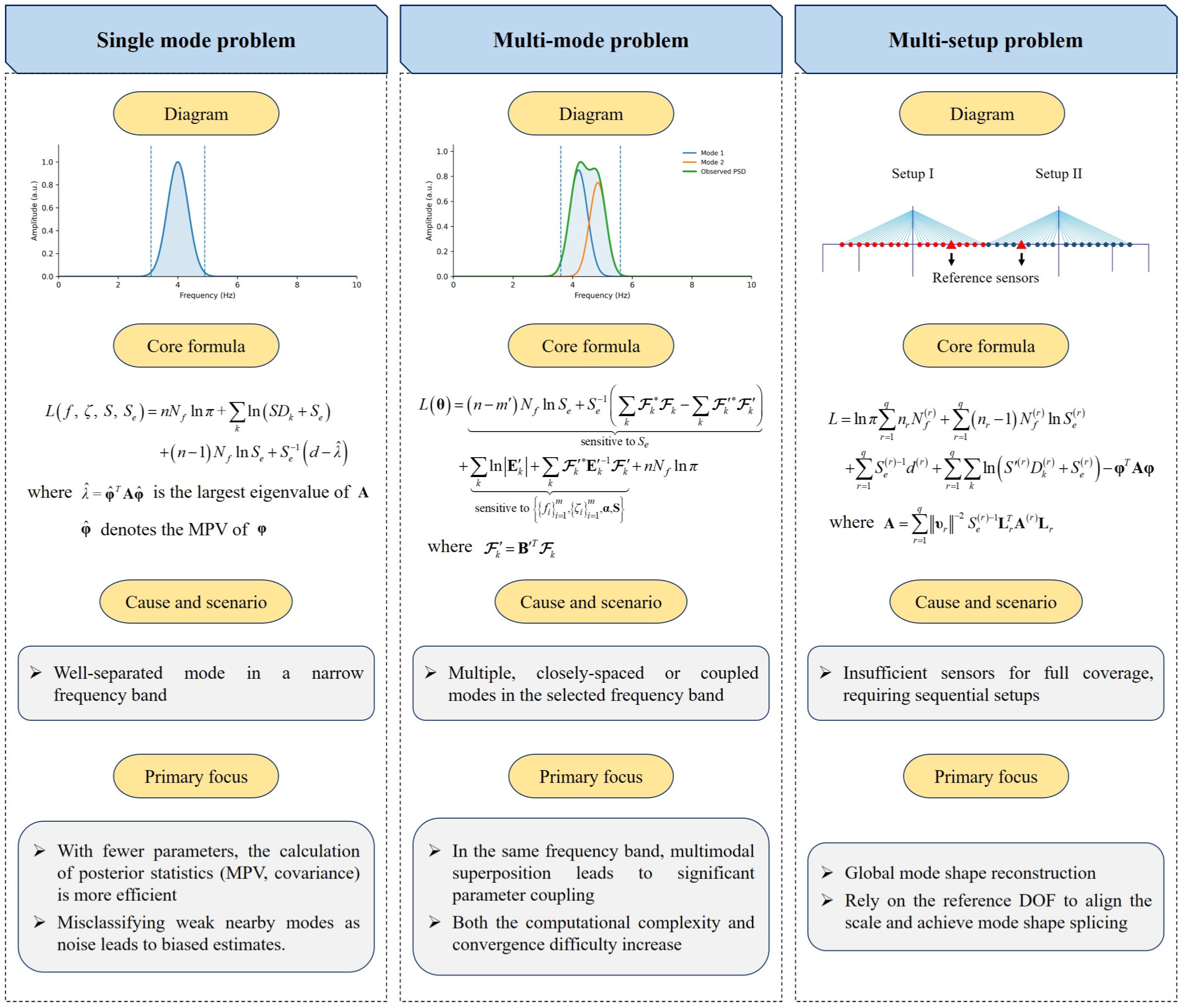
This section introduces the representative computational scenarios encountered in determining the posterior statistics of modal parameters under Bayesian OMA. These specific issues are compared in Figure 3, including the single-mode, multi-mode, and multi-setup cases [14]. For each case, Figure 3 provides a schematic illustration, the corresponding core expression, the circumstances under which the case typically arises, and the primary computational focus. This comparison highlights why different inference strategies are required when the identification problem involves well-separated modes, multiple (possibly close) modes, or data collected from multiple setups.

3.2.1. Single-Mode Problem

In the single-mode problem, the efficient methods for calculating the posterior MPV and covariance matrix of modal parameters in Bayesian OMA with data collected in a single setup are discussed. It is assumed here that the mode of interest is well-separated from other modes, thus dominating the selected frequency band. A detailed presentation of the algorithm can be found in [56].
Recall the problem context from Section 3.1.1. Assuming a single mode in the selected frequency band, E k of Equation (31) can be given by
E k = S D k φ φ T + S e I n
where
D k = 2 π f k 2 q 1 β k 2 2 + 2 ζ β k 2     q = 0 1 2 acceleration   data velocity   data displacement   data
Through flexible processing [56], the determinant and inverse of E k is given by
E k = S D k + S e S e n 1
E k 1 = S e 1 I n S e 1 1 + S e / S D k 1 φ φ T
Substituting Equations (46) and (47) into the NLLF L θ yields
L θ = n N f ln π + k ln S D k + S e + n 1 N f ln S e + S e 1 d φ T A φ
where
A = k 1 + S e / S D k 1 D k
D k = Re F k F k d = k F k F k
Only the term φ T A φ , in Equation (48), is related to the mode shape φ at this time. Minimizing L θ with respect to φ under norm constraint φ T φ = 1 , it follows from matrix theory that the MPV of φ corresponds to the eigenvector associated with the largest eigenvalue in the matrix A . The largest eigenvalue of A is positive since D k is positive definite. Then, the MPV of the remaining four parameters f ,   ζ ,   S ,   S e can be obtained by minimizing the following equation:
L f ,   ζ ,   S ,   S e = n N f ln π + k ln S D k + S e + n 1 N f ln S e + S e 1 d λ ^
where λ ^ = φ ^ T A φ ^ is the largest eigenvalue of A , and φ ^ denotes the MPV of φ .

3.2.2. Multi-Mode Problem

In a multi-mode problem, the efficient methods for calculating the posterior MPV and covariance matrix of modal parameters in Bayesian OMA with data collected in a single setup are discussed, and the general case of multiple (possibly close) modes in the selected frequency band is considered. Detailed presentation of the algorithm can be found in [57,58]. But such an algorithm may converge slowly or even fail under some challenging conditions. It is also cumbersome for computer implementation. To address these issues, Li and Au [80] propose an expectation–maximization (EM) algorithm that treats the modal response as a latent variable.
Recall the problem context from Section 3.1.1. Through flexible processing [14,57], E k can be given by
E k = B E k 0 0 S e I n m B T
where E k = α H k α T + S e I m and the detailed explanation of B = B , B can be found in [57].
Accordingly, the determinant and inverse of E k can be given by
E k = B E k S e I n m B T = S e n m E k
E k 1 = S e 1 I n S e 1 B I m S e E k 1 B T
Substituting Equations (53) and (54) into the NLLF L θ yields
L θ = n N f ln π + n m N f ln S e + S e 1 k F k F k + k ln E k S e 1 k F k B I m S e E k 1 B T F k
For the modal parameter set θ = f i i = 1 m , ζ i i = 1 m , S , S e , φ i i = 1 m , after determining the most probable mode shape basis [14], the remaining parameters for the given B comprise f i i = 1 m , ζ i i = 1 m , α , S , S e . The quadratic term of the NLLF in Equation (55) is then regrouped as
L θ = n m N f ln S e + S e 1 k F k F k k F k F k sensitive   to   S e + k ln E k + k F k E k 1 F k sensitive   to   f i i = 1 m , ζ i i = 1 m , α , S + n N f ln π
where F k = B T F k .

3.2.3. Multi-Setup Problem

In a multi-setup problem, the efficient methods for Bayesian OMA using data from multiple setups performed in different time periods and possibly covering different sets of DOFs are discussed. Here, an algorithm is considered that utilizes data from multiple setups to identify global mode shape, following a Bayesian approach and assuming a single mode within the selected frequency band. More details can be found in [81,82,83,84,85].
Recall the problem context from Section 3.1.2. Considering a single mode in the selected frequency band, E k r of Equation (36) can be rewritten as through flexible processing [14]:
E k r = S r D k r υ ¯ r υ ¯ r T + S e r I n r
where S r is the modal force PSD of Setup r; D k r is the dynamic amplification factor; υ ¯ r is the normalized counterpart of the local mode shape υ r in Setup r, and υ r = L r φ with L r being a selection matrix and φ being the global mode shape.
Accordingly, the determinant and inverse of E k r can be given by
E k r = S r D k r + S e r S e r n r 1
E k r 1 = S e r 1 I n r 1 + S e r / S r D k r 1 υ ¯ r υ ¯ r T
Substituting Equations (58) and (59) into the NLLF L r yields
L r = n r N f r ln π + k ln S r D k r + S e r + n r 1 N f r ln S e r + S e r 1 d r υ ¯ r T A r υ ¯ r
where
A r = k 1 + S e r / S r D k r 1 D k r
D k r = Re F k r F k r             d r = k F k r F k r
Substituting υ ¯ r = L r φ / υ r and Equation (60) into the NLLF L yields
L = ln π r = 1 q n r N f r + r = 1 q n r 1 N f r ln S e r + r = 1 q S e r 1 d r + r = 1 q k ln S r D k r + S e r φ T A φ
where
A = r = 1 q υ r 2 S e r 1 L r T A r L r

3.3. Accelerating Algorithm

Although the fast Bayesian FFT approach has substantially reduced the computational burden of Bayesian OMA, its performance may deteriorate in the presence of very closely spaced modes or highly coherent modal forces, where the NLLF becomes strongly non-convex, and the classical fixed-point updates can require many iterations or even fail to converge. To address this limitation, after understanding the mathematical structure of FIM for modal parameters, Zhu et al. [86] propose an efficient method based on Newton-type iterations that enhances computational efficiency and convergence robustness within the Bayesian OMA framework.
The core of this method lies in the adoption of the Fisher scoring approach using asymptotic FIM. According to Newton’s method [86,90], the parameter update is given by Δ θ i = H i 1 g i , where H i and g i denote the Hessian matrix and gradient of NLLF at the current iteration point, respectively. However, directly using the Hessian matrix may encounter numerical instability issues. The key choice in the Fisher scoring approach is to use the FIM J i as an expected substitute for the Hessian, thereby ensuring that the update direction always points to a descending direction. Then, the move is
Δ θ i = J i 1 g i
where J i = E θ 2 L | θ = θ i .
Based on an analytical investigation of the eigenvalues and eigenvectors of asymptotic FIM [86,91], the iteration move is decomposed into two characteristic principal directions, i.e., Type 1 move (mode shape update) and Type 2 move (global parameter update). Type 1 move updates only the mode shapes and is orthogonal to the subspace spanned by the current mode shape estimates. It accounts for the curvature of the NLLF specific to the mode shape manifold. The update formula for Type 1 move eliminates the need for matrix inversion and is given by
Δ 1 Φ = Q Re F k Z k Re H k 1
where Φ is the mode shape matrix; Q = I n Φ ¯ Φ ¯ T Φ ¯ 1 Φ ¯ T with Φ ¯ being the normalized counterpart of Φ ; Z k is the complex conjugate transpose of Z k with Z k = Φ ¯ T Φ ¯ + S e H k 1 1 Φ ¯ T F k and H k being a Hermitian matrix.
Type 2 move involves updates to all modal parameters. In this step, the mode shape components move within the established subspace. This captures the complex correlation structure intrinsic to close modes. This move is given by
Δ 2 θ = i = 1 n c 1 λ i 2 v i 2 v i 2 T L ¯ θ
where λ i 2 and v i 2 are the Type 2 eigenvector and eigenvalue, respectively; n c = m + 1 2 + m m 1 with m being the number of modes; L ¯ / θ is the gradient of NLLF with respect to modal parameters θ .
To improve computational efficiency and reduce computer coding overheads/bugs, compact expressions for the gradients of the NLLF with respect to the mode shape matrix and modal force PSD matrix are derived. Additionally, to enhance the applicability of the proposed method under low SNR conditions, a hybrid strategy is adopted. This means that the Fisher scoring approach is used to rapidly approach the vicinity of the MPV, followed by the P-EM algorithm [80,92] as a ‘backup’ to refine estimates if the asymptotic assumption holds weakly. Comparative studies using synthetic, laboratory, and field data demonstrate that this FIM-based method reduces computational time by an order of magnitude compared to existing algorithms, while maintaining superior convergence robustness for closely spaced modes and high modal force coherence.

3.4. Modal Identification Considering Environmental Effects

Existing works have demonstrated that environmental factors such as traffic loads, temperature, humidity, and wind speed can influence the modal properties of structures [93,94,95,96,97,98]. Commonly, in conventional OMA methods, it is challenging to distinguish changes caused by environmental variations from those resulting from structural damage or performance deterioration. This may cause bias in the identification results of modal parameters obtained through OMA techniques, leading to misjudgments in structural performance assessment. Among the Bayesian approaches developed to address this issue, an important and representative research line is the fusion model framework proposed by Zhu et al. [87,88,89]. Rather than providing an exhaustive coverage of all possible Bayesian OMA strategies under environmental and operational variations, this section focuses on this major line of work because it offers a coherent probabilistic treatment of modal properties and environmental effects within a unified framework. Specifically, the fusion model integrates a structural dynamic model with a data-driven model, thereby explicitly accounting for the influence of environmental variations on the structure and enabling robust modal identification under environmental and operational variations.
Initially, Zhu et al. [87] introduce a Bayesian framework to integrate the environmental effect into a classic structural dynamic model in the form of a Gaussian process (GP) model. Specifically, the environmental effect is embedded into the modal equation of motion via an additive stiffness-correction term:
η ¨ k + 2 ζ ω η ˙ k + ω 2 η k + δ i η k = p k
where η ¨ k , η ˙ k and η k are the modal responses; ω , ζ , and p k are the angular frequency, damping ratio, and modal force, respectively; the term δ i represents an environment-dependent coefficient, modeled as a GP with a squared-exponential covariance function:
p δ ψ , T = N m , K ,           K i , j = σ f 2 exp T i T j 2 2 l 2 + σ n 2 Δ i j
Here, m and K are mean and covariance functions, respectively; T denotes environmental inputs; ψ = σ f 2 , l 2 , σ n 2 is the set of hyperparameters. Using Bayes’ theorem and the Monte Carlo method [87], the MLF with GP prior is given by
p D θ , ψ , T p θ = p θ p D θ , δ p δ ψ , T d δ = p θ 1 V j = 1 N p D θ , δ j p δ j ψ , T
While this method, termed FM-MCI, successfully reduces bias in parameter identification, it relies on Monte Carlo Integration to approximate the intractable integral, which incurs a significant computational burden when processing large-scale monitoring datasets.
Subsequently, to address the computational inefficiency inherent in FM-MCI, Wu et al. [88] propose an enhanced inference strategy utilizing Taylor approximation and the EM algorithm. The frequency domain response is approximated via a first-order Taylor expansion:
F k = p k 1 β k 2 i 2 ζ β k δ j k m j , k j p k 1 β k 2 i 2 ζ β k 1 + δ j k 1 β k 2 i 2 ζ β k
where F k denotes the FFT of modal acceleration Y at frequency f k ; β k = ω / ω k 2 with ω k = 2 π f k ; δ j k = ω j E / ω k 2 with the environmental effect coefficient ω j E following a Gaussian distribution N m j , k j ; ω E = ω j E j = 1 N d with N d being the number of independent datasets. The mean and covariance matrices of the MLF can then be elegantly obtained through the derivation in Section 3.1 of [88].
In the E-step of the EM algorithm, this method (termed FM-TA) computes the expected log-likelihood function, which replaces the computationally expensive integral. The objective function to be maximized is decomposed into two parts:
Q θ , ψ θ , ψ t = E log p Y θ , ω E + E log p ω E ψ , T
Here, the first term represents the expected log-likelihood of the measured data, conditioned on the environmental latent variables ω E , while the second term represents the expected log-likelihood of ω E governed by the GP. By maximizing this function Q θ , ψ θ , ψ t , FM-TA avoids heavy numerical integration, significantly reducing computational time while yielding more concentrated identification results than FM-MCI in approximating true values of modal parameters.
However, one limitation of the previous model lies in treating the environmental effect as a direct input that operates independently of the structural vibration state. It fails to account for a potential coupling effect, where the environmental variations and the structural responses jointly affect the modal properties of a structure in an interconnected manner. Finally, further extending the fusion concept, Xu et al. [89] propose a Bayesian modal identification framework that specifically considers the coupling effect of structural responses and environmental variations.
Specifically, an environmental impact term (EIT), denoted as h x ¨ t , E , is formulated as a unified function of both the structural acceleration and environmental variables. The governing equation of motion is thus generalized to:
M x ¨ t + C x ˙ t + Kx t + h x ¨ t , E = U t
where x ¨ t and E denote the structural acceleration and environmental variables, respectively. Their frequency domain expressions are η ¨ k and E k , respectively.
The EIT is modeled as a GP whose inputs combine modal acceleration and environmental data, i.e., x c e = η ¨ k , E k . Accordingly,
h x c e , ψ ~ G P m x c e | ψ , K x c e , x c e | ψ
Using Bayes’ theorem, the MLF is given by
p A k θ , ψ , E k = p A k θ , h k p h k ψ , η ¨ k , E k d h k
where A k are the FFTs of measured data; h k = h x c e , ψ .
Here, a Gaussian-type approximation [99] is adopted to analytically derive the MLF without resorting to brute-force numerical integration. The relevant parameters are inferred using the EM algorithm. The results reveal that the method proposed by Xu et al. [89] can effectively consider the coupling effect of structural responses and environmental variations on the modal properties of the structure, thereby providing robust modal identification results under different environmental and operational conditions.
Collectively, these studies represent a significant progression from establishing the fusion framework to optimizing its computational calculations and refining its physical interpretability. This provides a practical approach for long-term SHM under actual operational conditions.

3.5. Computational Issues

Although the above developments have substantially improved the practicality of Bayesian OMA, computational issues remain central to the implementation of these methods. In general, Bayesian modal identification requires the determination of posterior MPVs and the associated posterior covariance matrix through repeated evaluation and optimization of NLLF. The resulting computational burden depends strongly on the number of measured DOFs, the number of contributing modes, the measurement configuration, and the complexity of the adopted probabilistic model.
For well-separated modes, the main computational issue in the original Bayesian FFT formulation lies in the high-dimensional optimization and posterior covariance evaluation, which become impractical when the number of measured DOFs increases. This motivates the development of a fast Bayesian FFT approach, where the mathematical structure of NLLF is exploited to reduce the number of parameters requiring numerical optimization and achieve efficient computation. For multiple (possibly close) modes, the computational difficulty becomes more severe because of stronger modal coupling, increased nonlinearity, and possible convergence problems, which motivate the use of mode shape bases, EM-based solvers, and FIM-driven accelerating strategies. For multi-setup and asynchronous data, the likelihood function becomes larger and more complicated because global mode shape consistency, cross-setup bookkeeping, and imperfect synchronization or coherence modeling must be handled simultaneously. Dealing with problems concerning environmental variations, the introduction of latent variables, the GP model, and Monte Carlo Integration or coupling mechanism further increases inference cost, especially when the number of environmental variables, monitoring datasets, and structural DOFs becomes large.
Overall, the reviewed methods show a clear progression from direct but computationally demanding Bayesian formulations toward more structured and scalable inference strategies. Nevertheless, computational scalability remains a major challenge, particularly for large-scale monitoring systems, multiple modes using measured data from multiple setups, and Bayesian OMA under environmental and operational variations.

4. Uncertainty Quantification and Management

In recent years, uncertainty laws have emerged as a theoretical foundation that quantifies and relates the identification uncertainty of modal parameters to the measured data and test configuration in a Bayesian OMA framework [14,100,101]. Unlike error estimates associated with specific algorithms, uncertainty laws are asymptotic analytical relationships that describe how uncertainty behaves under conditions such as long data duration and high SNR. They provide guidance for both quantification and management of identification uncertainty.
This section synthesizes key developments in uncertainty laws with emphasis on Bayesian inference for OMA, organized into the quantification (Section 4.1) and management (Section 4.2) of uncertainty.

4.1. Uncertainty Quantification

In Bayesian OMA, the modal parameters θ are treated as random variables, and the corresponding identification uncertainty is quantified by the posterior covariance matrix C D given the measured data D [58]. The credibility of uncertainty quantification has not been established through a single universal benchmark, but rather through a combination of theoretical consistency, controlled synthetic data verification, appraisal against laboratory/field data trends and scatter, and counter-checking of the numerical implementation [14,31,101,102]. Accordingly, the quantified uncertainties should be interpreted as model-consistent uncertainty measures conditional on the adopted assumptions, rather than universally exact error bars for all practical situations.
Under regularity conditions and with sufficiently long data, the posterior PDF can be approximated by a Gaussian distribution with a covariance matrix
C D = θ 2 L θ , D 1
where θ 2 L θ , D denotes the Hessian matrix of NLLF with respect to θ .
In terms of the asymptotic relationship, the posterior covariance matrix C D is equal to the inverse of the FIM J θ [86,91,102]:
C D J θ 1
The FIM is initially defined in the context of classical statistics (non-Bayesian), indicating the degree of difficulty in estimating parameters. It is later applied in OMA under the Bayesian framework [102]. Given that the scaled FFT data follows a complex Gaussian distribution, and based on standard results in multivariate statistics [103], it follows that the entry of FIM with respect to modal parameters x and y is equal to
J x y = t r k E k 1 E k x E k 1 E k y
where E k x denotes the partial derivative of E k in Equation (44) with respect to parameter x. The long data asymptotic expressions for each modal parameter, i.e., f , ζ , S , S e , and φ , are summarized in Table 3 ( N f , e k = S e / S D k , φ = 1 ).
Up to this point, the computational strategies for determining the posterior covariance matrix C D have been developed for different types of data, such as single-setup data [56], multi-setup data [84], and asynchronous data [77].

4.2. Uncertainty Management

Identification uncertainty management refers to the use of uncertainty laws to plan, optimize, and control test configurations such that desired precision levels are achieved [104]. One approach is to derive the closed-form expressions that relate the posterior coefficient of variation (c.o.v. = standard deviation/MPV) of modal parameters to test configurations and environmental factors.
The foundational work by Au [100] derives the zeroth-order laws for well-separated modes under the assumption of long data duration and small damping. It establishes the asymptotic expression for the posterior c.o.v. of each modal parameter. The detailed results of uncertainty laws, including all modal parameters, are shown in Table 4. To account for noise measurement, Au et al. [105] extend these to the first-order laws by incorporating the modal SNR γ = S / 4 S e ζ 2 . Then the posterior c.o.v. δ x 2 for modal parameter x is derived and summarized in Table 5. Here, ν = S e / S , b = tan 1 κ + κ / κ 2 + 1 , N c is the data length and κ is the bandwidth factor.
For large structures requiring multiple setups, Zhang et al. [84] establish a foundational computational framework by deriving analytical Hessian expressions and addressing the singularity arising from the global mode shape norm constraint. They demonstrate that the posterior covariance matrix is evaluated within the non-singular subspace via eigenvalue decomposition as
C = i = 2 n θ λ i 1 w i w i T
where n θ denotes the number of modal parameters; λ i and w i denote the eigenvalue and eigenvector of the Hessian matrix. Building upon this, Xie et al. [106] advance the field by deriving the uncertainty laws with multiple setup data under the stated asymptotic conditions, revealing that the posterior covariance matrix of global mode shape follows the closed-form expression
C φ φ J + ,         J = i k i L i T I ν ¯ i ν ¯ i T L i
where the superscripted ‘+’ represents a pseudo-inverse; the matrix J aggregates local setup information weighted by precision factors k i , thereby enabling the theoretical decomposition of uncertainty into local and global components; ν ¯ i is the normalized counterpart of the local mode shape ν i ; L i is a selection matrix. This provides a theoretical limit for the achievable precision, which is critical for optimizing sensor deployment strategies.
To advance the uncertainty quantification and management of close modes, Au and Brownjohn [91] reveal that the identification uncertainty of mode shapes decomposes into two principal directions, i.e., Type 1 (orthogonal to the mode shapes), which is dismissible at high SNR, and Type 2 (within the mode shape subspace), which persists even for noiseless data and correlates with all modal parameters. Subsequently, Au et al. [107] further derive the closed-form analytical asymptotic expressions for the remaining uncertainty of modal parameters under a wide-band assumption. Validating these laws, Au et al. [108] demonstrate their applicability to field data and proposed empirical correction factors for finite bandwidth conditions, providing a complete framework for predicting identification precision limits. Furthermore, Zhu and Au [109] extend this framework to the general case with multiple (possibly close) modes and multiple setups, successfully addressing the ‘modal entangling’ phenomenon inherent in close modes. By deriving the analytical expressions for the posterior covariance matrix, the uncertainty can be accurately and efficiently quantified without resorting to the finite difference method.

5. Applications

Following the overview of Bayesian OMA theory, identification algorithms, and uncertainty quantification and management, this section reviews representative applications to show how these methodological developments can support practical inference and decision-making. Rather than presenting isolated case studies, the discussion emphasizes the methodological insights underlying system parameter identification, physics-data fusion mechanism under environmental variations, robustness enhancement for long-term field deployment, and field testing techniques for different full-scale structures under complex working conditions.
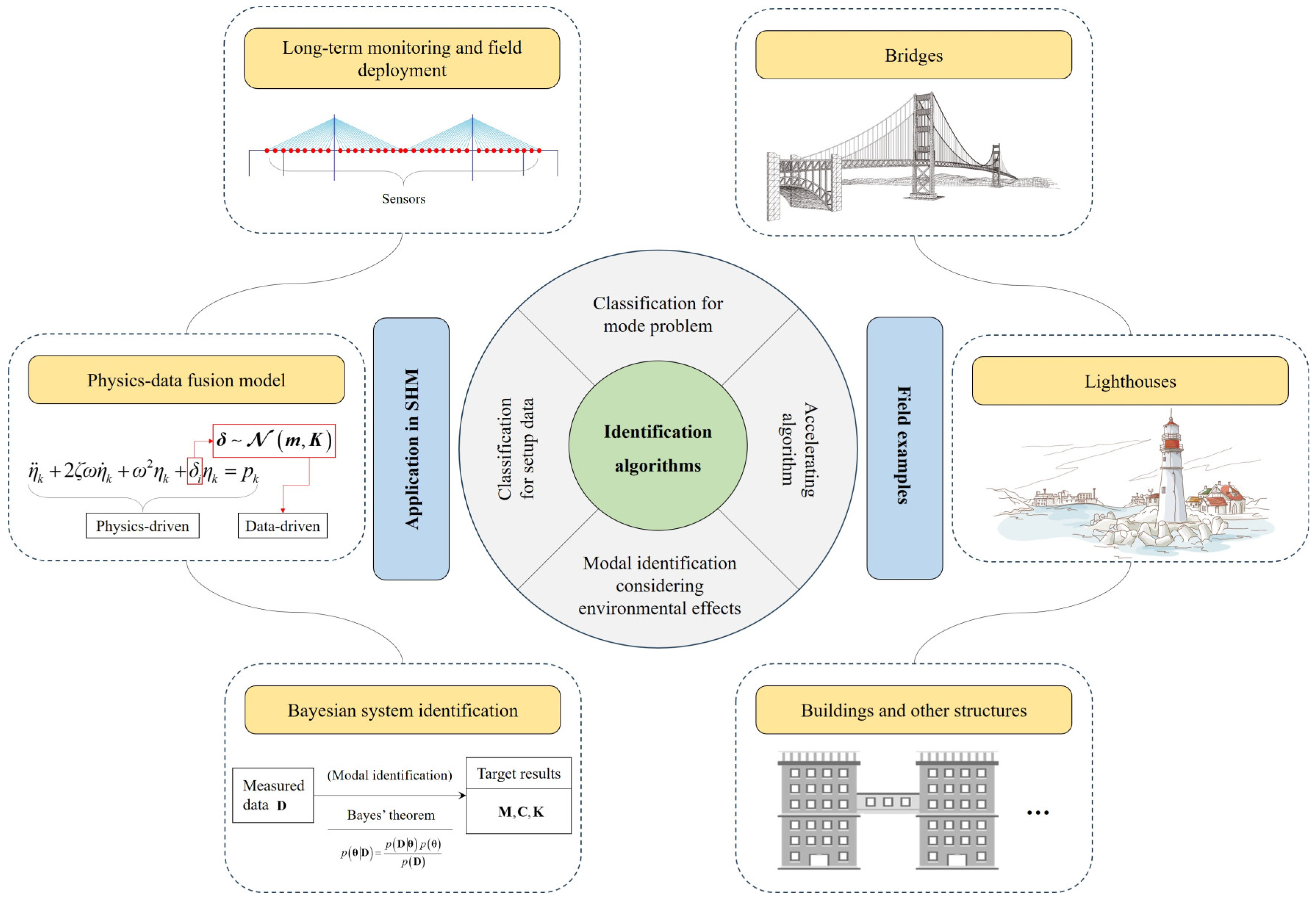
Figure 4 presents a methodological roadmap linking the identification algorithms reviewed in Section 3 to representative theoretical and practical application scenarios discussed in this section. On the methodological side, this roadmap includes computational strategies for different measurement configurations and modal scenarios, accelerating algorithms, and identification methods that account for environmental effects. On the application side, it covers application-oriented theoretical developments, such as Bayesian system identification, physics-data fusion models, long-term monitoring and field deployment, as well as field implementations on full-scale structures, including bridges, lighthouses, and buildings. Figure 4 is intended to show how the reviewed methods can be selected and combined according to the characteristics of practical engineering situations.
Specifically, Section 5.1 describes the developments of these application-oriented theoretical aspects, while Section 5.2 illustrates their practical realization in full-scale structures and complex operational conditions.

5.1. Application in Structural Health Monitoring

Bayesian OMA has been widely employed for system identification with an emphasis on statistically consistent uncertainty quantification. Au [110] first clarifies the statistical meaning of Bayesian posterior covariance by establishing its connection to frequentist trial-to-trial dispersion through second-order expansions of the log-likelihood, thereby providing a rigorous foundation for uncertainty interpretation in Bayesian system identification. To enable practical uncertainty evaluation in constrained and multi-setup problems, Au and Xie [111] subsequently developed a constrained-Hessian theory that allows efficient Gaussian approximation of posterior uncertainty around the MPVs. A major methodological advance has been achieved by Au and Zhang [59,60], who have developed a fundamental two-stage formulation for Bayesian system identification. Derived rigorously from Bayes’ theorem, the two-stage framework separates the identification problem into estimation of intermediate parameters, such as modal properties, and subsequent inference of structural parameters. Subsequent studies further strengthen the two-stage framework by addressing statistical and modeling limitations: Zhang et al. [112] introduce a Gaussian discrepancy model and conduct an identifiability analysis to account for the mismatch between the two stages, while Zhu and Au [113] incorporate model error into an equivalent Bayesian formulation and derive an EM algorithm for joint estimation of structural parameters, model error, and uncertainty. To improve numerical robustness and scalability, Zhu et al. [114] introduce Fisher-information-based updates and eigenvalue sensitivity analysis, and for real-time applications, Yuen et al. [62] propose a self-calibrating Bayesian identification paradigm with evidence-driven model adaptation.
On the other hand, physics-data fusion models have been developed to address a fundamental limitation in many SHM applications, namely that training data are often obtained from OMA and therefore inherit heterogeneous identification uncertainty and environmental variability. Zhu and Au [91] introduce Bayesian data-driven formulations that propagate OMA-induced uncertainty into learning and inference, thereby preventing modal estimates with large uncertainty from exerting disproportionate influence on model training. Extending this idea, Zhu et al. [87] and Xu et al. [89] propose a Bayesian physics-data fusion model that integrates structural dynamics with a probabilistic representation of environmental effects, enabling reliable identification of modal parameters under varying operational conditions. To improve computational efficiency for modal identification, Wu et al. [88] reformulate environmental effects as latent variables and combine Taylor approximations with an EM algorithm, achieving faster convergence and enhanced numerical stability. These developments demonstrate how physics-data fusion extends Bayesian OMA beyond parameter estimation, offering a novel way to couple physics-driven models and data-driven models, incorporating environmental variations within a unified Bayesian framework.
From both field testing and computational perspectives, the reported results in these studies [87,88,89] also illustrate the methodological progression within this research line. In the relevant example reported for the fusion model-based formulations, the FM-TA method from [88] reduces the average computation time from 295.39 s to 87.96 s relative to the FM-MCI method from [87], while maintaining comparable identification capability, mainly because the intractable Monte Carlo integration is replaced by the Taylor approximation and EM algorithm. Reported results from another Bayesian OMA method [89] further suggest that, although identification accuracy may remain acceptable under moderate increases in structural complexity, the computational cost can grow rapidly with the number of DOFs and may become prohibitive for structures with higher dimensionality. Therefore, the available evidence should be interpreted as indicating a clear trend toward improved computational tractability, rather than as a strict head-to-head benchmark across all methods, since the data settings, model assumptions, and implementation environments differ among studies. This further highlights that computational scalability remains a key issue in Bayesian OMA under environmental and operational variations.
Beyond modeling and inference, several methodological developments have focused on enabling robust Bayesian OMA in long-term and field-monitoring scenarios. For time-varying structures, Yang et al. [115] formulate long-term tracking as a Bayesian model selection problem with evidence-based optimal partitioning, and further introduce quasi time-invariant models that constrain only target parameters while allowing auxiliary terms to vary, thereby improving physical interpretability and reducing spurious detections [116]. Reliable Bayesian inference also critically depends on accurate noise characterization. Zhu et al. [117] demonstrate bias in classical huddle tests and propose a theoretically unbiased multi-sensor calibration method applicable to arbitrary sensor orientations, while Ma et al. [118] develop efficient noise-modeling strategies for general covariance structures in frequency domain Bayesian OMA. In addition, frequency band selection, which is often treated heuristically in practice, is placed on a principled footing by Au [119] through Bayesian evidence-based model validation, revealing the trade-off between mode misidentification and estimation precision. Together, these studies address temporal variability, data quality, and modeling selection that are essential for translating Bayesian OMA methods into reliable tools for practical SHM.

5.2. Field Examples

In the application of Bayesian OMA methods for full-scale bridge structures, low frequency, lightly damped modes, limited data length, and strong environmental variability pose significant challenges to reliable modal identification. An important methodological milestone has been achieved by Brownjohn et al. [120,121], who derive closed-form Bayesian uncertainty laws that relate the uncertainty of identified modal parameters, particularly damping ratios, to data length, modal SNR, and frequency bandwidth. These results provide quantitative guidance for uncertainty-informed test design and are validated using ambient vibration measurements from long-span bridges such as Baker Bridge and Jiangyin Yangtze River Bridge. Building on this foundation, Zhu et al. [122] extend Bayesian uncertainty management to multi-setup testing by integrating uncertainty laws with Bayesian multi-setup inference, and demonstrate a practical workflow for consistent uncertainty quantification using full-scale data from Rainbow Bridge. Bayesian inference is subsequently applied to bridge monitoring under extreme and transient excitations/environmental variations, including the seismic response analysis of long-span bridges [123] and the prediction of the relationship between temperature and modal parameters [124], illustrating its robustness under non-stationary conditions. At the component level, Feng et al. [125] develop a Bayesian time domain approach for identifying stay-cable damping while accounting for ambient excitation and measurement noise, and validate the proposed method using field data from Sutong Yangtze River Highway Bridge. Collectively, these studies demonstrate how Bayesian OMA enables uncertainty-consistent identification and decision support in complex bridge monitoring scenarios.
Beyond bridges, Bayesian OMA has proven particularly effective for structures exhibiting closely spaced modes and strong geometric symmetry, exemplified by offshore rock lighthouses. Brownjohn et al. [126,127] develop uncertainty-aware Bayesian formulations to resolve paired horizontal modes and quantify directionality of mode shapes in quasi-axisymmetric lighthouse towers, thereby enabling reliable interpretation of modal properties under extreme wave loading. The proposed method is validated through field vibration testing of Victorian-era granite lighthouse towers and subsequently extends to long-term monitoring of Wolf Rock lighthouse, where Bayesian OMA is used to track closely spaced modes with quantified uncertainty and to inversely estimate breaking-wave impact forces from measured responses [128]. In addition, Bayesian OMA methodologies have been generalized to a wide range of other structural systems, including multi-storey buildings using roving or asynchronous multi-setup data [129,130], wind-excited super-tall buildings through Bayesian estimation of modal force spectra [131], monopole telecoms structures under ambient excitation [132], and rail structures using two-stage Bayesian inference for crack detection with ultrasonic guided wave measurements [133]. These applications collectively illustrate the versatility of Bayesian OMA as a unified framework for modal identification and uncertainty quantification across diverse structural typologies.

6. Conclusions

This paper has presented a systematic review of Bayesian OMA, encompassing its theoretical basis, identification algorithms, uncertainty quantification and management, and applications. Unlike conventional OMA techniques that primarily yield point estimates, Bayesian OMA formulates modal identification as a probabilistic inference problem, in which modal parameters are treated as random variables, and their associated uncertainties are quantified through posterior probability distributions. This formulation provides a coherent and transparent treatment of statistical uncertainty, modeling assumptions, and data limitations inherent in the ambient vibration test.
From a methodological standpoint, the Bayesian framework offers a unifying foundation for both time domain and frequency domain approaches. Among these, frequency domain Bayesian formulations, particularly the fast Bayesian FFT approach, have demonstrated strong advantages in computational efficiency and robustness for large-scale civil engineering structures. The development of variable separation strategies, EM-based solvers, FIM-based acceleration techniques, and constructive efforts considering environmental effects has substantially reduced computational cost and improved convergence behavior, enabling practical Bayesian inference even for multi-setup data, closely spaced modes, and environmental variations. A distinctive feature of Bayesian OMA is the establishment of uncertainty laws, which provide asymptotic and analytical relationships between identification uncertainty, data characteristics, and test configurations. These laws go beyond algorithm-specific error estimates by revealing fundamental limits on achievable identification precision. Their extension to scenarios including multi-setup data, asynchronous data, and close modes provides a rigorous theoretical basis for uncertainty quantification and management, as well as for uncertainty-informed test planning and sensor deployment. The applications outlined demonstrate that Bayesian OMA has matured into a versatile framework capable of addressing most practical problems and challenges in SHM. By integrating a physics-driven model with a data-driven model incorporating environmental effects, Bayesian OMA enables robust modal identification under long-term operational and environmental variations. Successful implementations on bridges, lighthouses, buildings, and other complex systems highlight its effectiveness in resolving closely spaced modes, tracking time-varying behavior, and supporting higher-level inference tasks such as system identification and performance assessment.
Overall, Bayesian OMA establishes a coherent link between modal identification, uncertainty quantification and management, and engineering decision-making. The developments reviewed in this paper illustrate a clear progression from foundational theory to efficient algorithms and finally to large-scale field applications, underscoring the growing role of Bayesian methods in modern structural dynamics and SHM.

7. Challenges and Future Directions

Despite the significant progress reviewed above, several important issues remain open and continue to motivate further development of Bayesian OMA. These issues arise from both theoretical and practical considerations, including computational scalability, modeling realism, uncertainty quantification under non-ideal conditions, and broader engineering deployment. The following discussion highlights representative challenges and outlines several directions for future research.
(1) A primary challenge lies in computational scalability. Although fast Bayesian FFT-based approaches, EM-based solvers, and FIM-driven accelerating algorithms have greatly improved efficiency, real-time or near-real-time Bayesian inference for large-scale monitoring systems with dense sensor networks remains demanding. Future research should focus on exploiting sparsity and parallel or distributed Bayesian inference strategies to further enhance scalability.
(2) Another important issue concerns modeling assumptions. Many existing Bayesian OMA formulations rely on idealized conditions such as stationarity, broadband excitation, linear structural behavior, and Gaussian noise. In practice, ambient excitation may be partially coherent or non-stationary, and structural responses may exhibit nonlinear or time-varying characteristics under varying environmental conditions. Extending the Bayesian OMA framework to accommodate these effects while maintaining the traceability and interpretability of modeling analyses remains an open research direction.
(3) Uncertainty laws, although well established in asymptotic regimes, require further refinement for finite data and low SNR conditions that are common in field testing. Bridging the gap between asymptotic theory and finite sample behavior would enhance the reliability of uncertainty quantification and management, particularly for damping estimation, low-frequency modes, and short-duration tests.
(4) Another promising but still insufficiently developed direction is the integration of existing modal identification technologies with data-driven or machine learning approaches. Recent works based on physics-data fusion models (Section 3.4 and Section 5.1) have shown that both identification uncertainty and uncertainty propagation introduced by data-driven models due to environmental effects should be strictly considered in subsequent modeling and inference. Although the current fusion model framework has demonstrated its capability to provide robust modal identification under environmental and operational variations, further work is needed to improve its generalizability, computational efficiency, uncertainty quantification under environmental effects, and online deployment in long-term monitoring.
(5) Finally, broader engineering adoption of Bayesian OMA methods requires further advances in automation and standardization. Issues such as automated frequency band selection, model validation, mode tracking, and uncertainty reporting remain active research topics. Developing user-friendly tools and practical guidelines that embed Bayesian OMA principles into routine monitoring workflows will be essential for its wider implementation.
In summary, Bayesian OMA has evolved into a rigorous and powerful framework for modal identification, uncertainty quantification, and management under complex working conditions. Continued advances in computation, modeling, uncertainty theory, and practical implementation will further strengthen its role in SHM.

Author Contributions

Conceptualization, Y.Z. and W.X.; methodology, Y.Z. and W.X.; validation, Y.Z.; formal analysis, Z.G.; investigation, W.X. and Z.G.; data curation, W.X. and Z.G.; writing—original draft preparation, W.X. and Z.G.; writing—review and editing, Y.Z., Z.G. and W.X.; supervision, Y.Z.; funding acquisition, Y.Z. All authors have read and agreed to the published version of the manuscript.

Funding

This research was funded by the National Natural Science Foundation of China (Grant number 52208150) and the SEU Innovation Capability Enhancement Plan for Doctoral Students (Grant number CXJH_SEU 25185). The financial support is gratefully acknowledged.

Data Availability Statement

The raw data supporting the conclusions of this article will be made available by the corresponding author on request.

Conflicts of Interest

The authors declare no conflicts of interest. The funders had no role in the design of the study; in the collection, analyses, or interpretation of data; in the writing of the manuscript; or in the decision to publish the results.

References

  1. Johnson, E.A.; Lam, H.F.; Katafygiotis, L.S.; Beck, J.L. Phase I IASC-ASCE structural health monitoring benchmark problem using simulated data. J. Eng. Mech. 2004, 130, 3–15. [Google Scholar] [CrossRef]
  2. Brownjohn, J.M.W. Structural health monitoring of civil infrastructure. Philos. Trans. R. Soc. A Math. Phys. Eng. Sci. 2007, 365, 589–622. [Google Scholar] [CrossRef]
  3. Ou, J.; Li, H. Structural health monitoring in mainland china: Review and future trends. Struct. Health Monit. 2010, 9, 219–231. [Google Scholar]
  4. Rocchetta, R.; Broggi, M.; Huchet, Q.; Patelli, E. On-line bayesian model updating for structural health monitoring. Mech. Syst. Signal Process. 2018, 103, 174–195. [Google Scholar] [CrossRef]
  5. Rogers, T.J.; Worden, K.; Fuentes, R.; Dervilis, N.; Tygesen, U.T.; Cross, E.J. A bayesian non-parametric clustering approach for semi-supervised structural health monitoring. Mech. Syst. Signal Process. 2018, 119, 100–119. [Google Scholar] [CrossRef]
  6. Wang, H.; Zhang, Y.-M.; Mao, J.-X.; Wan, H.-P.; Tao, T.-Y.; Zhu, Q.-X. Modeling and forecasting of temperature-induced strain of a long-span bridge using an improved Bayesian dynamic linear model. Eng. Struct. 2019, 192, 220–232. [Google Scholar] [CrossRef]
  7. Deraemaeker, A.; Worden, K. A comparison of linear approaches to filter out environmental effects in structural health monitoring. Mech. Syst. Signal Process. 2018, 105, 1–15. [Google Scholar] [CrossRef]
  8. Sarmadi, H.; Entezami, A.; Salar, M.; De Michele, C. Bridge health monitoring in environmental variability by new clustering and threshold estimation methods. J. Civ. Struct. Health Monit. 2021, 11, 629–644. [Google Scholar] [CrossRef]
  9. Sun, L.; Shang, Z.; Xia, Y.; Bhowmick, S.; Nagarajaiah, S. Review of bridge structural health monitoring aided by big data and artificial intelligence: From condition assessment to damage detection. J. Struct. Eng. 2020, 146, 4020073. [Google Scholar] [CrossRef]
  10. Chen, Z.-W.; Ruan, X.-Z.; Liu, K.-M.; Yan, W.-J.; Liu, J.-T.; Ye, D.-C. Fully automated natural frequency identification based on deep-learning-enhanced computer vision and power spectral density transmissibility. Adv. Struct. Eng. 2022, 25, 2722–2737. [Google Scholar] [CrossRef]
  11. Giagopoulos, D.; Arailopoulos, A.; Dertimanis, V.; Papadimitriou, C.; Chatzi, E.; Grompanopoulos, K. Structural health monitoring and fatigue damage estimation using vibration measurements and finite element model updating. Struct. Health Monit. 2019, 18, 1189–1206. [Google Scholar] [CrossRef]
  12. Zhu, Y.-C.; Cantero Chinchilla, S.; Meng, H.; Yan, W.-J.; Chronopoulos, D. Damage detection, quantification, and localization for resonant metamaterials using physics-based and data-driven methods. Struct. Health Monit. 2023, 22, 3338–3355. [Google Scholar] [CrossRef]
  13. Ivanović, S.S.; Trifunac, M.D.; Todorovska, M.I. Ambient vibration tests of structures—A review. ISET J. Earthq. Tech. 2000, 37, 165–197. [Google Scholar] [CrossRef]
  14. Au, S.-K. Operational Modal Analysis; Springer: Singapore, 2017; ISBN 978-981-10-4117-4. [Google Scholar]
  15. Hasani, H.; Freddi, F. Operational Modal Analysis on Bridges: A Comprehensive Review. Infrastructures 2023, 8, 172. [Google Scholar] [CrossRef]
  16. Alvin, K.F.; Robertson, A.N.; Reich, G.W.; Park, K.C. Structural system identification: From reality to models. Comput. Struct. 2003, 81, 1149–1176. [Google Scholar] [CrossRef]
  17. Yang, T.; Fan, S.-H.; Lin, C.-S. Joint stiffness identification using FRF measurements. Comput. Struct. 2003, 81, 2549–2556. [Google Scholar] [CrossRef]
  18. Ren, W.-X.; Peng, X.-L. Baseline finite element modeling of a large span cable-stayed bridge through field ambient vibration tests. Comput. Struct. 2005, 83, 536–550. [Google Scholar] [CrossRef]
  19. Yuen, K.-V.; Beck, J.L.; Katafygiotis, L.S. Efficient model updating and health monitoring methodology using incomplete modal data without mode matching. Struct. Control Health Monit. 2006, 13, 91–107. [Google Scholar] [CrossRef]
  20. Goller, B.; Broggi, M.; Calvi, A.; Schuëller, G.I. A stochastic model updating technique for complex aerospace structures. Finite Elem. Anal. Des. 2011, 47, 739–752. [Google Scholar] [CrossRef]
  21. Teughels, A.; Maeck, J.; De Roeck, G. Damage assessment by FE model updating using damage functions. Comput. Struct. 2002, 80, 1869–1879. [Google Scholar] [CrossRef]
  22. Yuen, K.-V.; Au, S.K.; Beck, J.L. Two-stage structural health monitoring approach for phase I benchmark studies. J. Eng. Mech. 2004, 130, 16–33. [Google Scholar] [CrossRef]
  23. Lam, H.F.; Yin, T. Statistical detection of multiple cracks on thin plates utilizing dynamic response. Eng. Struct. 2010, 32, 3145–3152. [Google Scholar] [CrossRef]
  24. Zhu, H.; Li, L.; He, X.-Q. Damage detection method for shear buildings using the changes in the first mode shape slopes. Comput. Struct. 2011, 89, 733–743. [Google Scholar] [CrossRef]
  25. Jones, C.A.; Reynolds, P.; Pavic, A. Vibration serviceability of stadia structures subjected to dynamic crowd loads: A literature review. J. Sound Vib. 2011, 330, 1531–1566. [Google Scholar] [CrossRef]
  26. Díaz, I.M.; Pereira, E.; Reynolds, P. Integral resonant control scheme for cancelling human-induced vibrations in light-weight pedestrian structures. Struct. Control Health Monit. 2012, 19, 55–69. [Google Scholar] [CrossRef]
  27. Júlio, E.N.B.S.; Da Silva Rebelo, C.A.; Dias-da-Costa, D.A.S.G. Structural assessment of the tower of the university of coimbra by modal identification. Eng. Struct. 2008, 30, 3468–3477. [Google Scholar] [CrossRef]
  28. Lepidi, M.; Gattulli, V.; Foti, D. Swinging-bell resonances and their cancellation identified by dynamical testing in a modern bell tower. Eng. Struct. 2009, 31, 1486–1500. [Google Scholar] [CrossRef]
  29. Idehara, S.J.; Dias Junior, M. Modal analysis of structures under non-stationary excitation. Eng. Struct. 2015, 99, 56–62. [Google Scholar] [CrossRef]
  30. Au, S.-K.; Zhang, F.-L. Ambient modal identification of a primary–secondary structure by Fast Bayesian FFT method. Mech. Syst. Signal Process. 2012, 28, 280–296. [Google Scholar] [CrossRef]
  31. Au, S.-K.; Zhang, F.-L.; Ni, Y.-C. Bayesian operational modal analysis: Theory, computation, practice. Comput. Struct. 2013, 126, 3–14. [Google Scholar] [CrossRef]
  32. James, G. The natural excitation technique (NExT) for modal parameter extraction from operating structures. J. Anal. Exp. Modal Anal. 1995, 10, 260. [Google Scholar]
  33. Juang, J.-N.; Pappa, R.S. An eigensystem realization algorithm for modal parameter identification and model reduction. J. Guid. Control Dyn. 1985, 8, 620–627. [Google Scholar] [CrossRef]
  34. Lardies, J. Modal parameter identification based on ARMAV and state–space approaches. Arch. Appl. Mech. 2010, 80, 335–352. [Google Scholar] [CrossRef]
  35. Reynders, E.; Pintelon, R.; De Roeck, G. Uncertainty bounds on modal parameters obtained from stochastic subspace identification. Mech. Syst. Signal Process. 2008, 22, 948–969. [Google Scholar] [CrossRef]
  36. He, Y.C.; Li, Z.; Fu, J.Y.; Wu, J.R.; Ng, C.T. Enhancing the performance of stochastic subspace identification method via energy-oriented categorization of modal components. Eng. Struct. 2021, 233, 111917. [Google Scholar] [CrossRef]
  37. Liu, X.; Luo, Y.; Karney, B.W.; Wang, Z.; Zhai, L. Virtual testing for modal and damping ratio identification of submerged structures using the PolyMAX algorithm with two-way fluid–structure Interactions. J. Fluids Struct. 2015, 54, 548–565. [Google Scholar] [CrossRef]
  38. Brincker, R.; Zhang, L.; Andersen, P. Modal identification of output-only systems using frequency domain decomposition. Smart Mater. Struct. 2001, 10, 441–445. [Google Scholar] [CrossRef]
  39. Beck, J.L.; Katafygiotis, L.S. Updating models and their uncertainties. I: Bayesian statistical framework. J. Eng. Mech. 1998, 124, 455–461. [Google Scholar] [CrossRef]
  40. Nagarajaiah, S.; Basu, B. Output only modal identification and structural damage detection using time frequency & wavelet techniques. Earthq. Eng. Eng. Vib. 2009, 8, 583–605. [Google Scholar] [CrossRef]
  41. He, Y.-C.; Li, Q.-S. Time–frequency analysis of structural dynamic characteristics of tall buildings. Struct. Infrastruct. Eng. 2015, 11, 971–989. [Google Scholar] [CrossRef]
  42. Huang, N.E.; Shen, Z.; Long, S.R.; Wu, M.C.; Shih, H.H.; Zheng, Q.; Yen, N.-C.; Tung, C.C.; Liu, H.H. The empirical mode decomposition and the Hilbert spectrum for nonlinear and non-stationary time series analysis. Proc. R. Soc. Lond. A Math. Phys. Eng. Sci. 1998, 454, 903–995. [Google Scholar] [CrossRef]
  43. Yang, J.N.; Lei, Y.; Pan, S.; Huang, N. System identification of linear structures based on Hilbert–Huang spectral analysis. Part 1: Normal modes. Earthq. Eng. Struct. Dyn. 2003, 32, 1443–1467. [Google Scholar] [CrossRef]
  44. Yang, J.N.; Lei, Y.; Pan, S.; Huang, N. System identification of linear structures based on Hilbert–Huang spectral analysis. Part 2: Complex modes. Earthq. Eng. Struct. Dyn. 2003, 32, 1533–1554. [Google Scholar] [CrossRef]
  45. Muto, M.; Beck, J.L. Bayesian Updating and Model Class Selection for Hysteretic Structural Models Using Stochastic Simulation. J. Vib. Control 2008, 14, 7–34. [Google Scholar] [CrossRef]
  46. Huang, Y.; Shao, C.; Wu, B.; Beck, J.L.; Li, H. State-of-the-art review on Bayesian inference in structural system identification and damage assessment. Adv. Struct. Eng. 2019, 22, 1329–1351. [Google Scholar] [CrossRef]
  47. Yuen, K.-V.; Katafygiotis, L.S. Bayesian time–domain approach for modal updating using ambient data. Probab. Eng. Mech. 2001, 16, 219–231. [Google Scholar] [CrossRef]
  48. Yuen, K.-V. Bayesian Methods for Structural Dynamics and Civil Engineering, 1st ed.; John Wiley & Sons: Hoboken, NJ, USA, 2010; ISBN 978-0-470-82454-2. [Google Scholar]
  49. Yin, T.; Yuen, K.-V.; Zhu, H.-P. A novel Bayesian framework for time-domain operational multi-setup modal analysis: Theory and parallelization. Eng. Struct. 2025, 322, 119167. [Google Scholar] [CrossRef]
  50. Katafygiotis, L.S.; Yuen, K.-V. Bayesian spectral density approach for modal updating using ambient data. Earthq. Eng. Struct. Dyn. 2001, 30, 1103–1123. [Google Scholar] [CrossRef]
  51. Beck, J.L.; Yuen, K.-V. Model Selection Using Response Measurements: Bayesian Probabilistic Approach. J. Eng. Mech. 2004, 130, 192–203. [Google Scholar] [CrossRef]
  52. Yan, W.-J.; Katafygiotis, L.S. A two-stage fast Bayesian spectral density approach for ambient modal analysis. Part I: Posterior most probable value and uncertainty. Mech. Syst. Signal Process. 2015, 54–55, 139–155. [Google Scholar] [CrossRef]
  53. Yan, W.-J.; Katafygiotis, L.S. A two-stage fast Bayesian spectral density approach for ambient modal analysis. Part II: Mode shape assembly and case studies. Mech. Syst. Signal Process. 2015, 54–55, 156–171. [Google Scholar] [CrossRef]
  54. Yan, W.-J.; Katafygiotis, L.S. An analytical investigation into the propagation properties of uncertainty in a two-stage fast Bayesian spectral density approach for ambient modal analysis. Mech. Syst. Signal Process. 2019, 118, 503–533. [Google Scholar] [CrossRef]
  55. Yuen, K.-V.; Katafygiotis, L.S. Bayesian Fast Fourier Transform Approach for Modal Updating Using Ambient Data. Adv. Struct. Eng. 2003, 6, 81–95. [Google Scholar] [CrossRef]
  56. Au, S.-K. Fast Bayesian FFT Method for Ambient Modal Identification with Separated Modes. J. Eng. Mech. 2011, 137, 214–226. [Google Scholar] [CrossRef]
  57. Au, S.-K. Fast Bayesian ambient modal identification in the frequency domain, Part I: Posterior most probable value. Mech. Syst. Signal Process. 2012, 26, 60–75. [Google Scholar] [CrossRef]
  58. Au, S.-K. Fast Bayesian ambient modal identification in the frequency domain, Part II: Posterior uncertainty. Mech. Syst. Signal Process. 2012, 26, 76–90. [Google Scholar] [CrossRef]
  59. Au, S.-K.; Zhang, F.-L. Fundamental two-stage formulation for Bayesian system identification, Part I: General theory. Mech. Syst. Signal Process. 2016, 66–67, 31–42. [Google Scholar] [CrossRef]
  60. Zhang, F.-L.; Au, S.-K. Fundamental two-stage formulation for Bayesian system identification, Part II: Application to ambient vibration data. Mech. Syst. Signal Process. 2016, 66–67, 43–61. [Google Scholar] [CrossRef]
  61. Yuen, K.-V.; Huang, K. Identifiability-Enhanced Bayesian Frequency-Domain Substructure Identification. Comput.-Aided Civ. Infrastruct. Eng. 2018, 33, 800–812. [Google Scholar] [CrossRef]
  62. Yuen, K.-V.; Kuok, S.-C.; Dong, L. Self-calibrating Bayesian real-time system identification. Comput.-Aided Civ. Infrastruct. Eng. 2019, 34, 806–821. [Google Scholar] [CrossRef]
  63. Jeffreys, H. Theory of Probability, 3rd ed.; Oxford University Press: Oxford, UK, 1961. [Google Scholar]
  64. Jaynes, E.T. Probability Theory: The Logic of Science; Cambridge University Press: Cambridge, UK, 2003. [Google Scholar]
  65. Box, G.E.P.; Tiao, G.C. Bayesian Inference in Statistical Analysis; John Wiley & Sons: Hoboken, NJ, USA, 2011. [Google Scholar]
  66. Garrett, A.J.M. Review: Probability Theory: The Logic of Science, by E. T. Jaynes. Law Probab. Risk 2004, 3, 243–246. [Google Scholar]
  67. Robert, C.P.; Chopin, N.; Rousseau, J. Rejoinder: Harold Jeffreys’s Theory of Probability Revisited. Stat. Sci. 2009, 24, 191–194. [Google Scholar] [CrossRef]
  68. Beck, J.L. Bayesian system identification based on probability logic. Struct. Control Health Monit. 2010, 17, 825–847. [Google Scholar] [CrossRef]
  69. Bayes, T. An essay towards solving a problem in the doctrine of chances. Biometrika 1958, 45, 296–315. [Google Scholar] [CrossRef]
  70. Stigler, S.M. Laplace’s 1774 memoir on inverse probability. Stat. Sci. 1986, 1, 359–363. [Google Scholar] [CrossRef]
  71. Stigler, S.M. Statistics on the Table: The History of Statistical Concepts and Methods; Harvard University Press: Cambridge, MA, USA, 2002. [Google Scholar]
  72. Leonard, T.; Hsu, J.S.J. Bayesian Methods: An Analysis for Statisticians and Interdisciplinary Researchers; Cambridge University Press: Cambridge, UK, 2001. [Google Scholar]
  73. Chiachio-Ruano, J.; Chiachio-Ruano, M.; Sankararaman, S. Bayesian Inverse Problems; CRC Press: Boca Raton, FL, USA; London, UK; New York, NY, USA, 2021. [Google Scholar]
  74. Katafygiotis, L.S.; Beck, J.L. Updating models and their uncertainties. II: Model identifiability. J. Eng. Mech. 1998, 124, 463–467. [Google Scholar] [CrossRef]
  75. Yuen, K.; Beck, J.L.; Katafygiotis, L.S. Probabilistic approach for modal identification using non-stationary noisy response measurements only. Earthq. Eng. Struct. Dyn. 2002, 31, 1007–1023. [Google Scholar] [CrossRef]
  76. Zhu, Y.-C.; Au, S.-K. Bayesian operational modal analysis with asynchronous data, part I: Most probable value. Mech. Syst. Signal Process. 2018, 98, 652–666. [Google Scholar] [CrossRef]
  77. Zhu, Y.-C.; Au, S.-K. Bayesian operational modal analysis with asynchronous data, Part II: Posterior uncertainty. Mech. Syst. Signal Process. 2018, 98, 920–935. [Google Scholar] [CrossRef]
  78. Zhu, Y.-C.; Au, S.-K. Spectral characteristics of asynchronous data in operational modal analysis. Struct. Control Health Monit. 2017, 24, e1981. [Google Scholar] [CrossRef]
  79. Zhu, Y.-C.; Au, S.-K. Bayesian modal identification method based on general coherence model for asynchronous ambient data. Mech. Syst. Signal Process. 2019, 132, 194–210. [Google Scholar] [CrossRef]
  80. Li, B.; Au, S.-K. An expectation-maximization algorithm for Bayesian operational modal analysis with multiple (possibly close) modes. Mech. Syst. Signal Process. 2019, 132, 490–511. [Google Scholar] [CrossRef]
  81. Au, S.-K. Assembling mode shapes by least squares. Mech. Syst. Signal Process. 2011, 25, 163–179. [Google Scholar] [CrossRef]
  82. Au, S.K.; Ni, Y.C.; Zhang, F.L.; Lam, H.F. Full-scale dynamic testing and modal identification of a coupled floor slab system. Eng. Struct. 2012, 37, 167–178. [Google Scholar] [CrossRef]
  83. Au, S.K.; Zhang, F.L. Fast Bayesian Ambient Modal Identification Incorporating Multiple Setups. J. Eng. Mech. 2012, 138, 800–815. [Google Scholar] [CrossRef]
  84. Zhang, F.-L.; Au, S.-K.; Lam, H.-F. Assessing uncertainty in operational modal analysis incorporating multiple setups using a Bayesian approach. Struct. Control Health Monit. 2015, 22, 395–416. [Google Scholar] [CrossRef]
  85. Zhang, F.L.; Au, S.K. Probabilistic Model for Modal Properties Based on Operational Modal Analysis. ASCE-ASME J. Risk Uncertain. Eng. Syst. Part A Civ. Eng. 2016, 2, B4015005. [Google Scholar] [CrossRef]
  86. Zhu, Z.; Au, S.-K.; Li, B. Accelerating convergence in Bayesian operational modal analysis with Fisher information matrix. Mech. Syst. Signal Process. 2023, 186, 109894. [Google Scholar] [CrossRef]
  87. Zhu, Y.-C.; Wu, S.-H.; Xiong, W.; Zhang, L.-K. Bayesian operational modal analysis considering environmental effect. Mech. Syst. Signal Process. 2025, 223, 111845. [Google Scholar] [CrossRef]
  88. Wu, S.-H.; Zhu, Y.-C.; Pan, Z.-H.; Di, H. An efficient expectation-maximization algorithm for Bayesian operational modal analysis with physics-data fusion model. Mech. Syst. Signal Process. 2025, 237, 113144. [Google Scholar] [CrossRef]
  89. Xu, W.; Zhu, Y.-C.; Wu, S.-H.; Song, X.-D. Bayesian operational modal analysis considering the coupling effect of both structural responses and temperature variations. Mech. Syst. Signal Process. 2025, 241, 113580. [Google Scholar] [CrossRef]
  90. Deuflhard, P. Newton Methods for Nonlinear Problems: Affine Invariance and Adaptive Algorithms; Springer Science & Business Media: Berlin/Heidelberg, Germany, 2011. [Google Scholar]
  91. Au, S.-K.; Brownjohn, J.M.W. Asymptotic identification uncertainty of close modes in Bayesian operational modal analysis. Mech. Syst. Signal Process. 2019, 133, 106273. [Google Scholar] [CrossRef]
  92. Berlinet, A.; Roland, C. Parabolic acceleration of the EM algorithm. Stat. Comput. 2009, 19, 35–47. [Google Scholar] [CrossRef]
  93. Worden, K.; Farrar, C.R.; Manson, G.; Park, G. The fundamental axioms of structural health monitoring. Proc. R. Soc. A Math. Phys. Eng. Sci. 2007, 463, 1639–1664. [Google Scholar] [CrossRef]
  94. Worden, K.; Cross, E.J. On switching response surface models, with applications to the structural health monitoring of bridges. Mech. Syst. Signal Process. 2018, 98, 139–156. [Google Scholar] [CrossRef]
  95. Zhu, Y.-C.; Au, S.-K. Bayesian data driven model for uncertain modal properties identified from operational modal analysis. Mech. Syst. Signal Process. 2020, 136, 106511. [Google Scholar] [CrossRef]
  96. Zhu, Y.-C.; Xiong, W.; Song, X.-D. Structural performance assessment considering both observed and latent environmental and operational conditions: A Gaussian process and probability principal component analysis method. Struct. Health Monit. 2022, 21, 2531–2546. [Google Scholar] [CrossRef]
  97. Zhu, Y.-C.; Zheng, Y.-W.; Xiong, W.; Li, J.-X.; Cai, C.S.; Jiang, C. Online Bridge Structural Condition Assessment Based on the Gaussian Process: A Representative Data Selection and Performance Warning Strategy. Struct. Control Health Monit. 2024, 2024, 5579734. [Google Scholar] [CrossRef]
  98. Zeng, H.; Zhu, Y.-C. A Dynamic Dimension Reduction Method for Structural Health Monitoring Data Based on Sparse Bayesian Inference. Struct. Control Health Monit. 2025, 2025, 5560897. [Google Scholar] [CrossRef]
  99. Girard, A. Approximate Methods for Propagation of Uncertainty with Gaussian Process Models. Ph.D. Thesis, University of Glasgow, Glasgow, UK, 2004. [Google Scholar]
  100. Au, S.-K. Uncertainty law in ambient modal identification—Part I: Theory. Mech. Syst. Signal Process. 2014, 48, 15–33. [Google Scholar] [CrossRef]
  101. Au, S.-K. Uncertainty law in ambient modal identification—Part II: Implication and field verification. Mech. Syst. Signal Process. 2014, 48, 34–48. [Google Scholar] [CrossRef]
  102. Au, S.-K.; Li, B. Posterior uncertainty, asymptotic law and Cramér-Rao bound. Struct. Control Health Monit. 2018, 25, e2113. [Google Scholar] [CrossRef]
  103. Tong, Y.L. The Multivariate Normal Distribution; Springer Science & Business Media: Berlin/Heidelberg, Germany, 2012. [Google Scholar]
  104. Xie, Y.L. Uncertainty Quantification and Management in Operational Modal Analysis with Multiple Setups. Ph.D. Thesis, University of Liverpool, Liverpool, UK, 2018. [Google Scholar]
  105. Au, S.-K.; Brownjohn, J.M.W.; Mottershead, J.E. Quantifying and managing uncertainty in operational modal analysis. Mech. Syst. Signal Process. 2018, 102, 139–157. [Google Scholar] [CrossRef]
  106. Xie, Y.-L.; Au, S.-K.; Li, B. Asymptotic identification uncertainty of well-separated modes in operational modal analysis with multiple setups. Mech. Syst. Signal Process. 2021, 152, 107382. [Google Scholar] [CrossRef]
  107. Au, S.-K.; Li, B.; Brownjohn, J.M.W. Achievable precision of close modes in operational modal analysis: Wide band theory. Mech. Syst. Signal Process. 2021, 147, 107016. [Google Scholar] [CrossRef]
  108. Au, S.-K.; Brownjohn, J.M.W.; Li, B.; Raby, A. Understanding and managing identification uncertainty of close modes in operational modal analysis. Mech. Syst. Signal Process. 2021, 147, 107018. [Google Scholar] [CrossRef]
  109. Zhu, Z.; Au, S.-K. Uncertainty quantification in Bayesian operational modal analysis with multiple modes and multiple setups. Mech. Syst. Signal Process. 2022, 164, 108205. [Google Scholar] [CrossRef]
  110. Au, S.-K. Connecting Bayesian and frequentist quantification of parameter uncertainty in system identification. Mech. Syst. Signal Process. 2012, 29, 328–342. [Google Scholar] [CrossRef]
  111. Au, S.-K.; Xie, Y.-L. Calculation of Hessian under constraints with applications to Bayesian system identification. Comput. Methods Appl. Mech. Eng. 2017, 323, 373–388. [Google Scholar] [CrossRef]
  112. Zhang, F.-L.; Au, S.-K.; Ni, Y.-C. Two-stage Bayesian system identification using Gaussian discrepancy model. Struct. Health Monit. 2021, 20, 580–595. [Google Scholar] [CrossRef]
  113. Zhu, J.-X.; Au, S.-K. Bayesian two-stage structural identification with equivalent formulation and EM algorithm. Mech. Syst. Signal Process. 2024, 209, 111025. [Google Scholar] [CrossRef]
  114. Zhu, J.-X.; Zhu, Z.; Au, S.-K. Accelerating computations in two-stage Bayesian system identification with Fisher information matrix and eigenvalue sensitivity. Mech. Syst. Signal Process. 2023, 186, 109843. [Google Scholar] [CrossRef]
  115. Yang, Y.; Zhu, Z.; Au, S.-K. Bayesian dynamic programming approach for tracking time-varying model properties in SHM. Mech. Syst. Signal Process. 2023, 185, 109735. [Google Scholar] [CrossRef]
  116. Yang, Y.; Zhu, Z.; Au, S.-K. Tracking time-varying properties using quasi time-invariant models with Bayesian dynamic programming. Mech. Syst. Signal Process. 2025, 223, 111546. [Google Scholar] [CrossRef]
  117. Zhu, Z.; Au, S.-K.; Wang, X. Instrument noise calibration with arbitrary sensor orientations. Mech. Syst. Signal Process. 2019, 117, 879–892. [Google Scholar] [CrossRef]
  118. Ma, X.; Zhu, Z.; Au, S.-K. Treatment and effect of noise modelling in Bayesian operational modal analysis. Mech. Syst. Signal Process. 2023, 186, 109776. [Google Scholar] [CrossRef]
  119. Au, S.-K. Model validity and frequency band selection in operational modal analysis. Mech. Syst. Signal Process. 2016, 81, 339–359. [Google Scholar] [CrossRef]
  120. Brownjohn, J.; Au, S.-K.; Li, B.; Bassitt, J. Optimised ambient vibration testing of long span bridges. Procedia Eng. 2017, 199, 38–47. [Google Scholar] [CrossRef][Green Version]
  121. Brownjohn, J.M.W.; Au, S.-K.; Zhu, Y.; Sun, Z.; Li, B.; Bassitt, J.; Hudson, E.; Sun, H. Bayesian operational modal analysis of Jiangyin Yangtze River Bridge. Mech. Syst. Signal Process. 2018, 110, 210–230. [Google Scholar] [CrossRef]
  122. Zhu, Z.; Au, S.-K.; Brownjohn, J.; Koo, K.Y.; Nagayama, T.; Bassitt, J. Uncertainty quantification of modal properties of Rainbow Bridge from multiple-setup OMA data. Eng. Struct. 2025, 330, 119901. [Google Scholar] [CrossRef]
  123. Ni, Y.; Zhang, F.L.; Xia, Y.X.; Au, S.K. Operational modal analysis of a long-span suspension bridge under different earthquake events. Earthq. Struct. 2015, 8, 859–887. [Google Scholar] [CrossRef]
  124. Ni, Y.C.; Alamdari, M.M.; Ye, X.W.; Zhang, F.L. Fast operational modal analysis of a single-tower cable-stayed bridge by a Bayesian method. Measurement 2021, 174, 109048. [Google Scholar] [CrossRef]
  125. Feng, Z.; Zhang, J.; Xuan, X.; Wang, Y.; Hua, X.; Chen, Z.; Yan, W. Bayesian time domain approach for damping identification and uncertainty quantification in stay cables using free vibration response. Eng. Struct. 2024, 315, 118477. [Google Scholar] [CrossRef]
  126. Brownjohn, J.M.W.; Au, S.K.; Wang, X.; Zhu, Z.; Raby, A.; Antonini, A. Bayesian operational modal analysis of offshore rock lighthouses for SHM. In Proceedings of the 9th European Workshop on Structural Health Monitoring, Manchester, UK, 10–13 July 2018. [Google Scholar]
  127. Brownjohn, J.M.W.; Raby, A.; Au, S.-K.; Zhu, Z.; Wang, X.; Antonini, A.; Pappas, A.; D’Ayala, D. Bayesian operational modal analysis of offshore rock lighthouses: Close modes, alignment, symmetry and uncertainty. Mech. Syst. Signal Process. 2019, 133, 106306. [Google Scholar] [CrossRef]
  128. Brownjohn, J.; Raby, A.; Bassitt, J.; Antonini, A.; Zhu, Z.; Dobson, P. Wolf Rock Lighthouse Long-Term Monitoring. Infrastructures 2024, 9, 77. [Google Scholar] [CrossRef]
  129. Xie, Y.-L.; Zhu, Y.-C.; Au, S.-K. Operational modal analysis of Brodie Tower using a Bayesian approach. In Proceedings of the 2nd ECCOMAS Thematic Conference on Uncertainty Quantification in Computational Sciences and Engineering, Rhodes Island, Greece, 15–17 June 2017. [Google Scholar]
  130. Zhu, Y.-C.; Xie, Y.-L.; Au, S.-K. Operational modal analysis of an eight-storey building with asynchronous data incorporating multiple setups. Eng. Struct. 2018, 165, 50–62. [Google Scholar] [CrossRef]
  131. Au, S.-K.; To, P. Full-Scale Validation of Dynamic Wind Load on a Super-Tall Building under Strong Wind. J. Struct. Eng. 2012, 138, 1161–1172. [Google Scholar] [CrossRef]
  132. Jimenez Capilla, J.A.; Au, S.-K.; Brownjohn, J.M.W.; Hudson, E. Ambient vibration testing and operational modal analysis of monopole telecoms structures. J. Civ. Struct. Health Monit. 2021, 11, 1077–1091. [Google Scholar] [CrossRef]
  133. Zhan, J.-Z.; Yan, W.-J.; Wu, W.; Yuen, K.-V.; Chronopoulos, D. Two-stage Bayesian inference for rail model updating and crack detection with ultrasonic guided wave measurements and advanced wave propagation simulation. J. Sound Vib. 2025, 599, 118914. [Google Scholar] [CrossRef]
Figure 1. Forward and backward problems in structural dynamics.
Buildings 16 01807 g001
Figure 2. Comparative diagram of different data configurations using a fast Bayesian FFT approach.
Buildings 16 01807 g002
Figure 3. Comparative diagram of different mode problems using a fast Bayesian FFT approach.
Buildings 16 01807 g003
Figure 4. Methodological roadmap linking the reviewed identification algorithms to representative application scenarios.
Buildings 16 01807 g004
Table 1. Unified Bayesian formulation for OMA.
ComponentPhysical InterpretationRole in Bayesian OMA
p θ One’s knowledge of parameters θ prior to the measurementPrior distribution
p D Normalizing integral independent of the parameters to be inferredNormalizing constant
p D θ A probabilistic description of the probable values of D given θ Marginal likelihood function (MLF)
p θ D An encapsulation of all information about θ that can be inferred from D based on consistent modeling assumptionsPosterior probability density function (PDF)
Table 2. Classification of fast Bayesian FFT-based identification algorithms in Bayesian OMA.
Problem ConcernMethod CategoryKey FeaturesRepresentative Studies
Measurement setupSingle setup dataFully synchronized data[14]
Multi-setup dataGlobal mode shape assembly[14]
Asynchronous dataImperfect coherence modeling[76,77,78,79]
Mode problemSingle modeWell-separated modes[56]
Multi-modeClosely spaced modes[57,58,80]
Multi-setupGlobal mode shape identification[81,82,83,84,85]
Computational efficiencyAccelerating algorithmNewton-type iterations, FIM[86]
Operational and environmental variationsAttention to environmental effectsPhysics-data fusion model, GP[87,88,89]
Table 3. The entry J x y in FIM with respect to modal parameters x and y.
y f , ζ S S e φ
x
f , ζ k D k 2 D k 1 x D k 1 y 1 + e k 2 Sym.
S S 1 k D k D k 1 y 1 + e k 2 S 2 k 1 + e k 2
S e S 1 k D k 1 y 1 + e k 2 S 2 k D k 1 1 + e k 2 S e 2 n 1 N f + k e k 2 1 + e k 2
φ 000 2 k 1 + e k 1 e k 1 I n φ φ T
Table 4. The detailed results of zeroth-order laws.
Parameter xZeroth Order Law δ x 0 2 Data Length Factor B x κ
f ζ 2 π N c B f κ B f κ = 2 π tan 1 κ κ κ 2 + 1
ζ 1 2 π ζ N c B ζ κ B ζ κ = 2 π tan 1 κ + κ κ 2 + 1 2 tan 1 κ 2 κ
S 1 N f B S κ B S κ = 1 2 tan 1 κ 2 κ 1 tan 1 κ + κ κ 2 + 1 1
S e 1 n 1 N f
φ n 1 ν ζ N c B φ κ B φ κ = tan 1 κ
Table 5. The detailed results of the first-order laws.
Parameter xFirst Order Law δ x 2 First Order Coefficient a x κ
f δ x 2 δ x 0 2 1 + a x γ 1 ζ 0 ,   N f a f κ = 4 κ tan 1 κ tan 1 κ κ κ 2 + 1
ζ a ζ κ = 4 κ 2 + 1 3 tan 1 κ 3 κ + tan 1 κ tan 1 κ 3 κ 2 + 1 κ 2 tan 1 κ tan 1 κ + κ 2
S a S κ = 2 + 2 3 κ 2 tan 1 κ 2 2 tan 1 κ 2 b κ 8 tan 1 κ b 8 κ tan 1 κ + 4 3 κ 2 + 4
Disclaimer/Publisher’s Note: The statements, opinions and data contained in all publications are solely those of the individual author(s) and contributor(s) and not of MDPI and/or the editor(s). MDPI and/or the editor(s) disclaim responsibility for any injury to people or property resulting from any ideas, methods, instructions or products referred to in the content.