The Mediating Role of Organizational Culture in Resource Repurposing and the Transition from Industry 4.0 to 5.0: Evidence from the Architectural, Engineering, and Construction Industry



Abstract
1. Introduction
2. Literature Review
2.1. Contextualizing the Knowledge Gap
2.2. The Evolution of Industry 4.0 and Industry 5.0
2.3. Theoretical Underpinnings of Research Goals
- The role of organizational culture in comprehending and illustrating the connection between Industry 4.0 and Industry 5.0.
- 2.
- The development of an interrelation model to analyze the influential variables in adopting Industry 4.0 and 5.0 concepts.
- Technological Innovation: How Industry 4.0 technologies, such as automation, 3D printing, AR, and IoT, are affecting construction operations.
- Human–Machine Collaboration: Industry 5.0 emphasizes the importance of hu-man participation in decision-making, personalization, and creativity.
- Organizational Culture: How these new paradigms are integrated and impacted by values, teamwork, leadership, and flexibility.
- 3.
- Reflecting on the role of the human factor in adopting technology in the AEC industry.
3. Theoretical Positioning and the Conceptual Model
3.1. Organizational Culture
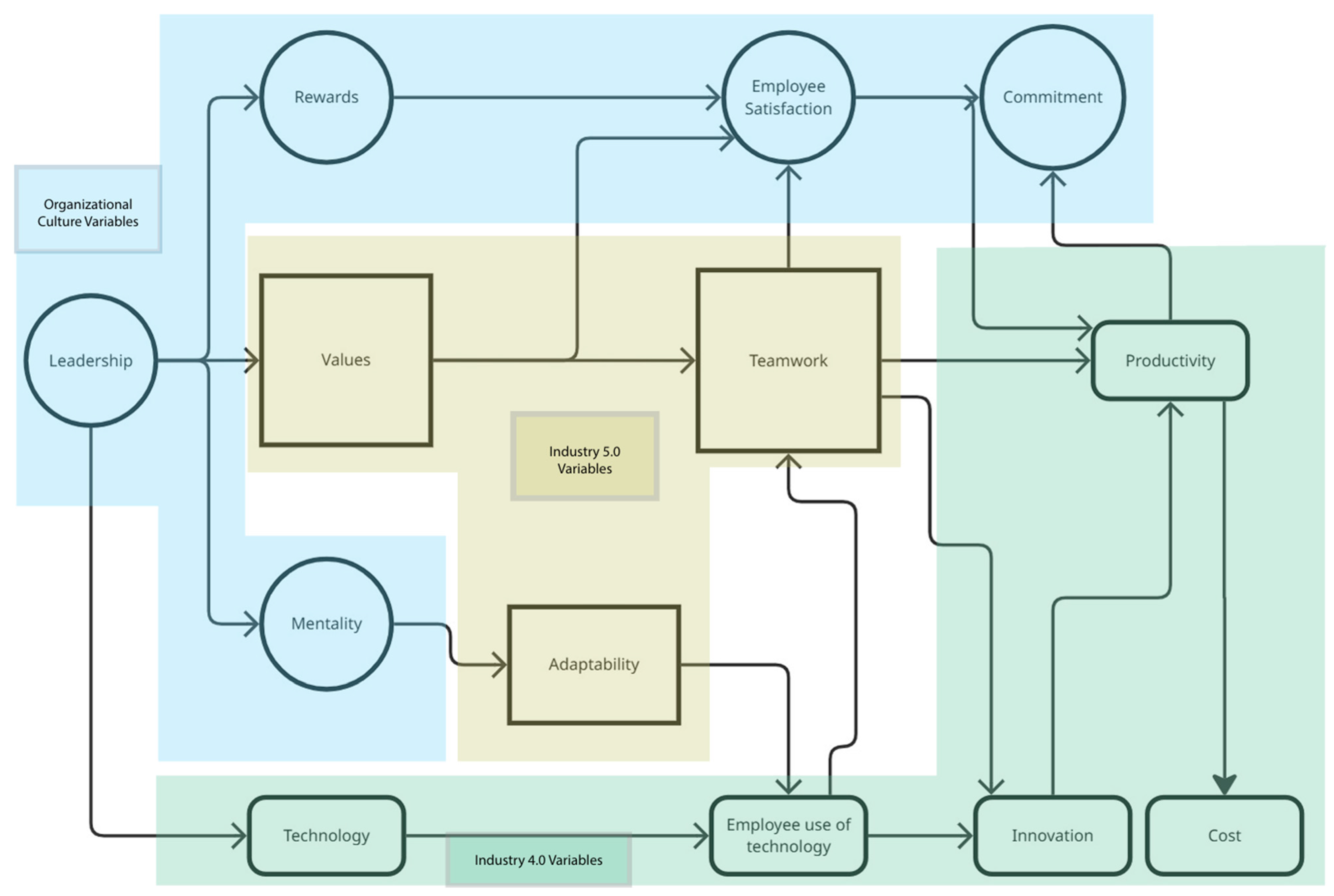
3.2. Main Factors of the Industry 4.0 and 5.0 in the AEC
3.3. Integration of the Resource-Based View (RBV) and the Technology Acceptance Model (TAM)
4. Research Method
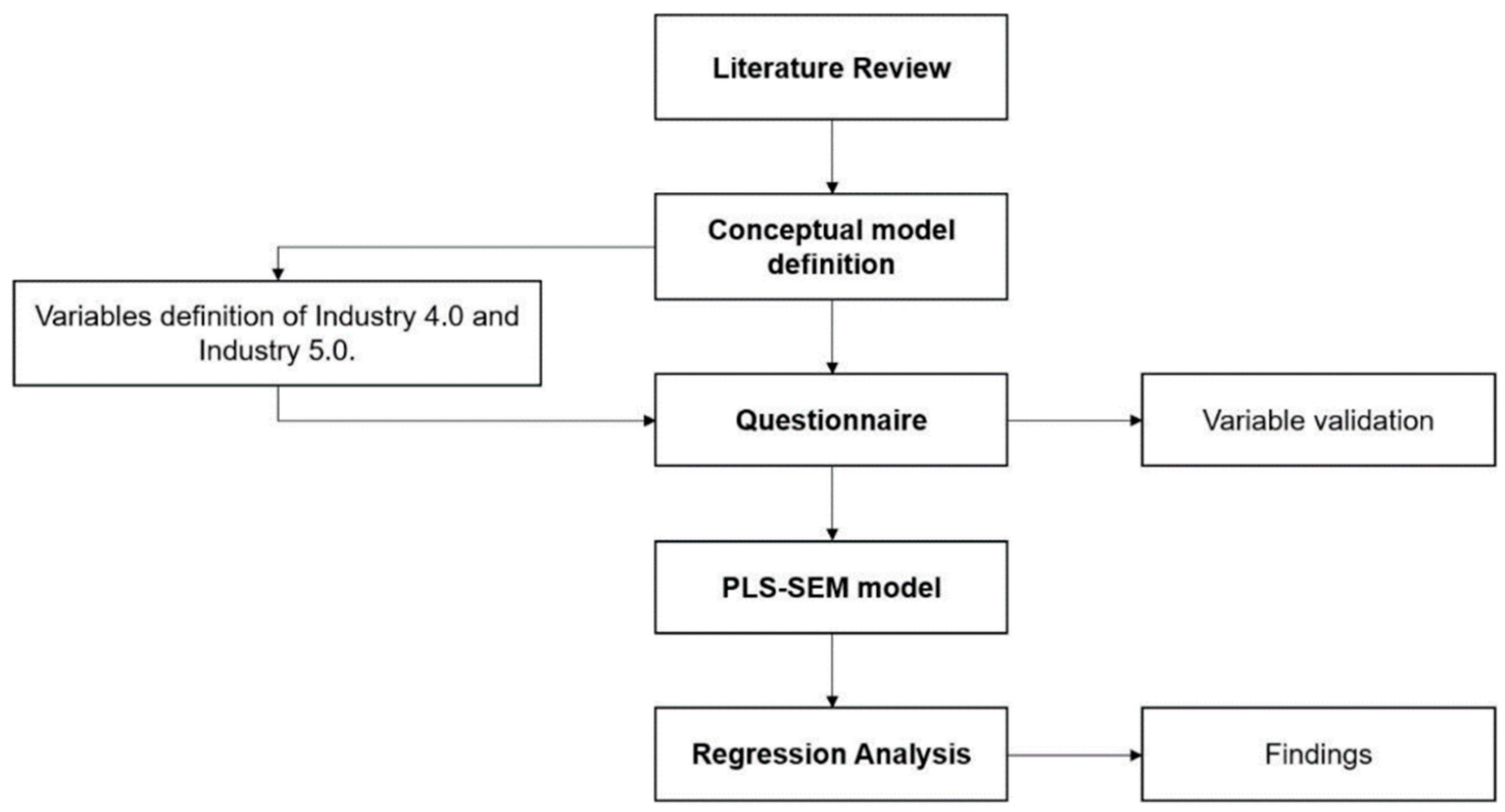
4.1. Overall Approach
4.2. Validation and Critical Analysis
4.3. Questionnaire Survey Definition
4.4. Sample and Data Collection
4.5. Data Analysis
5. Analysis of Results
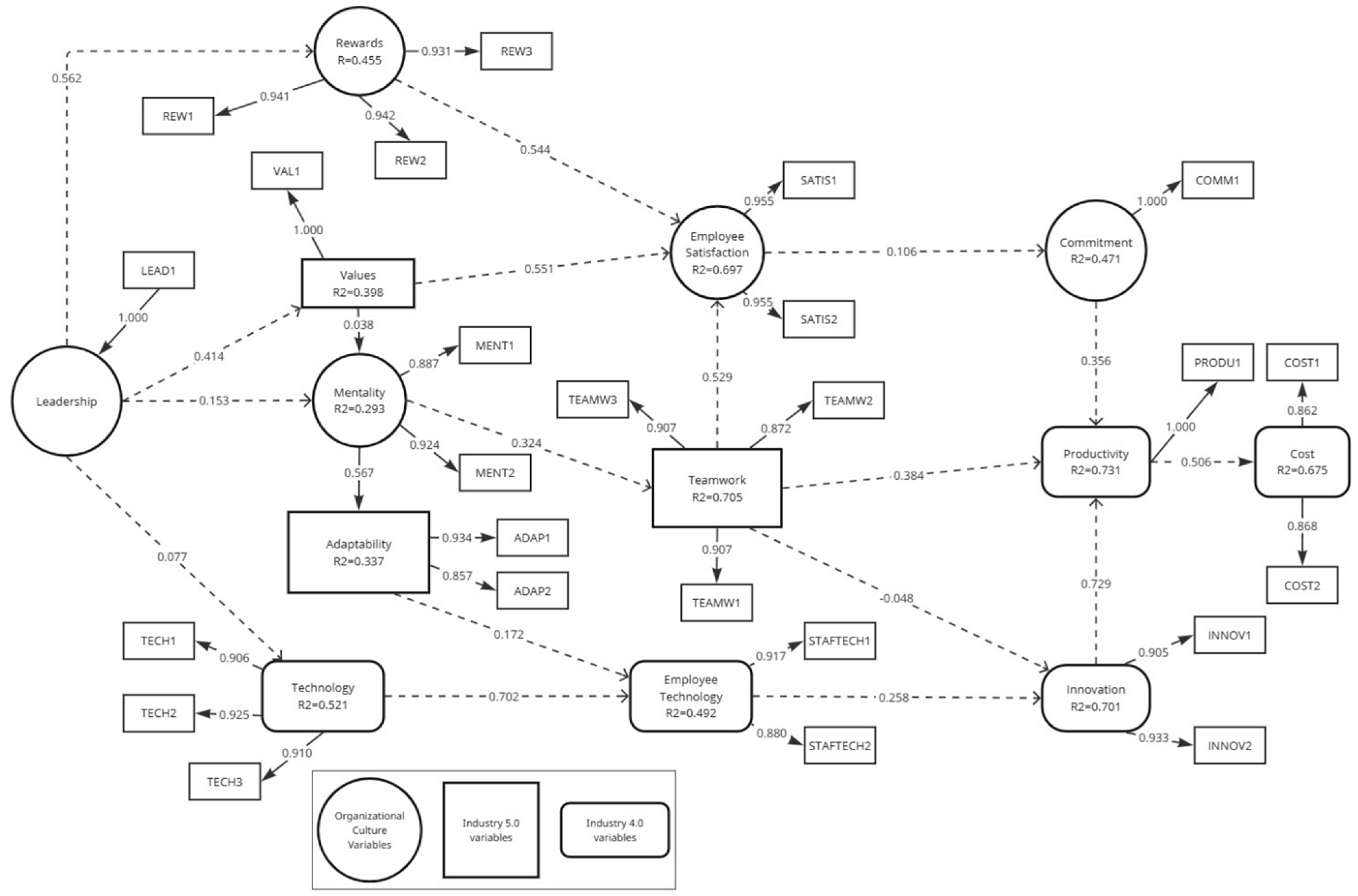
5.1. Measurement Model
5.2. Structural Model

6. Discussion
7. Conclusions
Author Contributions
Funding
Institutional Review Board Statement
Informed Consent Statement
Data Availability Statement
Acknowledgments
Conflicts of Interest
References
- Azeem, M.; Ullah, F.; Thaheem, M.J.; Qayyum, S. Competitiveness in the Construction Industry: A Contractor’s Perspective on Barriers to Improving the Construction Industry Performance. J. Constr. Eng. Manag. Innov. 2020, 3, 193–219. [Google Scholar] [CrossRef]
- Cillo, V.; Gregori, G.L.; Daniele, L.M.; Caputo, F.; Bitbol-Saba, N. Rethinking Companies’ Culture through Knowledge Management Lens during Industry 5.0 Transition. J. Knowl. Manag. 2022, 26, 2485–2498. [Google Scholar] [CrossRef]
- Leng, J.; Sha, W.; Wang, B.; Zheng, P.; Zhuang, C.; Liu, Q.; Wuest, T.; Mourtzis, D.; Wang, L. Industry 5.0: Prospect and Retrospect. J. Manuf. Syst. 2022, 65, 279–295. [Google Scholar] [CrossRef]
- Yang, K.; Sunindijo, R.; Wang, C. Identifying Leadership Competencies for Construction 4.0. Buildings 2022, 12, 1434. [Google Scholar] [CrossRef]
- Sadikoglu, E.; Ozorhon, B. Modeling the Organizational Agility in the Architecture, Engineering, and Construction (AEC) Industry. IEEE Trans. Eng. Manag. 2024, 71, 3906–3919. [Google Scholar] [CrossRef]
- Khin, S.; Kee, D.M.H. Factors Influencing Industry 4.0 Adoption. J. Manuf. Technol. Manag. 2022, 33, 448–467. [Google Scholar] [CrossRef]
- Lu, Y.; Zhang, X. Corporate Sustainability for Architecture Engineering and Construction (AEC) Organizations: Framework, Transition and Implication Strategies. Ecol. Indic. 2016, 61, 911–922. [Google Scholar] [CrossRef]
- Ince, F. Transformational Leadership in a Diverse and Inclusive Organizational Culture; IGI Global: Palmdale, PA, USA, 2022; pp. 188–201. [Google Scholar]
- Hadi, A.; Cheung, F.; Adjei, S.; Dulaimi, A. Evaluation of Lean Off-Site Construction Literature through the Lens of Industry 4.0 and 5.0. J. Constr. Eng. Manag. 2023, 149, 03123007. [Google Scholar] [CrossRef]
- Ghobakhloo, M. Industry 4.0, Digitization, and Opportunities for Sustainability. J. Clean. Prod. 2020, 252, 119869. [Google Scholar] [CrossRef]
- Cañas, H.; Mula, J.; Díaz-Madroñero, M.; Campuzano-Bolarín, F. Implementing Industry 4.0 Principles. Comput. Ind. Eng. 2021, 158, 107379. [Google Scholar] [CrossRef]
- Har, L.L.; Rashid, U.K.; Te Chuan, L.; Sen, S.C.; Xia, L.Y. Revolution of Retail Industry: From Perspective of Retail 1.0 to 4.0. Procedia Comput. Sci. 2022, 200, 1615–1625. [Google Scholar] [CrossRef]
- Tunji-Olayeni, P.; Aigbavboa, C.; Oke, A.; Chukwu, N. Research Trends in Industry 5.0 and Its Application in the Construction Industry. Technol. Sustain. 2024, 3, 1–23. [Google Scholar] [CrossRef]
- Maskuriy, R.; Selamat, A.; Maresova, P.; Krejcar, O.; David, O.O. Industry 4.0 for the Construction Industry: Review of Management Perspective. Economies 2019, 7, 68. [Google Scholar] [CrossRef]
- Guo, W.; Lu, W.; Cao, W.; Zhang, L. Understanding the Effect of Contractual Complexity on Regulatory Focus in Construction Projects: The Moderating Role of Organizational Culture. Constr. Manag. Econ. 2024, 42, 992–1011. [Google Scholar] [CrossRef]
- Rahimian, F.P.; Goulding, J.S.; Abrishami, S.; Seyedzadeh, S.; Elghaish, F. Industry 4.0 Solutions for Building Design and Construction; Routledge: London, UK, 2021. [Google Scholar]
- Olsson, N.O.E.; Arica, E.; Woods, R.; Madrid, J.A. Industry 4.0 in a Project Context: Introducing 3D Printing in Construction Projects. Proj. Leadersh. Soc. 2021, 2, 100033. [Google Scholar] [CrossRef]
- Peráček, T.; Kaššaj, M. Strategic Management of Urban Services Using Artificial Intelligence in the Development of Sustainable Smart Cities—Managerial and Legal Challenges. Sustainability 2026, 18, 582. [Google Scholar] [CrossRef]
- Torkanfar, N.; Azar, E.R.; McCabe, B. Toward Industry 5.0: A Conceptual Model for Blockchain’s Impact on Interorganizational Trust in Construction Project Management. Proj. Manag. J. 2025, 57, 188–204. [Google Scholar] [CrossRef]
- Ikudayisi, A.E.; Chan, A.P.C.; Darko, A.; Adedeji, Y.M.D. Integrated Practices in the Architecture, Engineering, and Construction Industry: Current Scope and Pathway towards Industry 5.0. J. Build. Eng. 2023, 73, 106788. [Google Scholar] [CrossRef]
- Li, K.; Griffin, M.A.; Xia, M. How Do Workforce Adaptability and Reskilling Initiatives Drive Innovations: The Case of Western Australian Construction Industry. Constr. Manag. Econ. 2025, 43, 746–763. [Google Scholar] [CrossRef]
- Ouchi, W.G.; Wilkins, A.L. Organizational Culture. Annu. Rev. Sociol. 1985, 11, 457–483. [Google Scholar] [CrossRef]
- Chen, S.; Lin, N. Culture, Productivity and Competitiveness: Disentangling the Concepts. Cross Cult. Strateg. Manag. 2020, 28, 52–75. [Google Scholar] [CrossRef]
- Jiang, K.; Lepak, D.P.; Han, K.; Hong, Y.; Kim, A.; Winkler, A.-L. Clarifying the Construct of Human Resource Systems: Relating Human Resource Management to Employee Performance. Hum. Resour. Manag. Rev. 2012, 22, 73–85. [Google Scholar] [CrossRef]
- Fassio, C.; Kalantaryan, S.; Venturini, A. Human Resources and Innovation: Total Factor Productivity and Foreign Human Capital. SSRN Electron. J. 2015, 43, 1–41. [Google Scholar] [CrossRef]
- Moshood, T.D.; Adeleke, A.Q.; Nawanir, G.; Mahmud, F. Ranking of Human Factors Affecting Contractors’ Risk Attitudes in the Malaysian Construction Industry. Soc. Sci. Humanit. Open 2020, 2, 100064. [Google Scholar] [CrossRef]
- Liu, S.-F.; Fan, Y.-J.; Luh, D.-B.; Teng, P.-S. Organizational Culture: The Key to Improving Service Management in Industry 4.0. Appl. Sci. 2022, 12, 437. [Google Scholar] [CrossRef]
- Hwang, B.-G.; Ngo, J.; Teo, J.Z.K. Challenges and Strategies for the Adoption of Smart Technologies in the Construction Industry: The Case of Singapore. J. Manag. Eng. 2022, 38, 05021014. [Google Scholar] [CrossRef]
- Taj, I.; Zaman, N. Towards Industrial Revolution 5.0 and Explainable Artificial Intelligence: Challenges and Opportunities. Int. J. Comput. Digit. Syst. 2022, 12, 285–310. [Google Scholar] [CrossRef]
- Alaloul, W.S.; Liew, M.S.; Zawawi, N.A.W.A.; Kennedy, I.B. Industrial Revolution 4.0 in the Construction Industry: Challenges and Opportunities for Stakeholders. Ain Shams Eng. J. 2020, 11, 225–230. [Google Scholar] [CrossRef]
- Najafzadeh, M.; Abbasianjahromi, H.; Zomorodi, S. Industry 4.0 and Construction Contract Management: A Bibliometric Survey. J. Leg. Aff. Disput. Resolut. Eng. Constr. 2024, 16, 03124001. [Google Scholar] [CrossRef]
- Ghobakhloo, M.; Fathi, M. Industry 4.0 and Opportunities for Energy Sustainability. J. Clean. Prod. 2021, 295, 126427. [Google Scholar] [CrossRef]
- Guo, D.; Li, M.; Lyu, Z.; Kang, K.; Wu, W.; Zhong, R.Y.; Huang, G.Q. Synchroperation in Industry 4.0 Manufacturing. Int. J. Prod. Econ. 2021, 238, 108171. [Google Scholar] [CrossRef]
- Gürdür Broo, D.; Kaynak, O.; Sait, S.M. Rethinking Engineering Education at the Age of Industry 5.0. J. Ind. Inf. Integr. 2022, 25, 100311. [Google Scholar] [CrossRef]
- Deal, T.E.; Kennedy, A.A. Corporate Cultures: The Rites and Rituals of Corporate Life. Bus. Horiz. 1983, 26, 82–85. [Google Scholar] [CrossRef]
- Karim, S.; Qamruzzaman, M.D. Corporate Culture, Management Commitment, and HRM Effect on Operation Performance: The Mediating Role of Just-in-Time. Cogent Bus. Manag. 2020, 7, 1786316. [Google Scholar] [CrossRef]
- Irfan, M.; Alaloul, W.S.; Ghufran, M.; Yaseen, G.; Thaheem, M.J.; Qureshi, A.H.; Bilal, M. Analyzing the Impact of Organizational Culture on Social Sustainability: A Perspective of the Construction Industry. Environ. Dev. Sustain. 2022, 26, 1103–1133. [Google Scholar] [CrossRef]
- Al-Abbadi, G.M.; Agyekum-Mensah, G. The Effects of Motivational Factors on Construction Professionals Productivity in Jordan. Int. J. Constr. Manag. 2022, 22, 820–831. [Google Scholar] [CrossRef]
- Hamza, M.; Shahid, S.; Bin Hainin, M.R.; Nashwan, M.S. Construction Labour Productivity: Review of Factors Identified. Int. J. Constr. Manag. 2022, 22, 413–425. [Google Scholar] [CrossRef]
- Di Nardo, M.; Yu, H. Special Issue “Industry 5.0: The Prelude to the Sixth Industrial Revolution”. Appl. Syst. Innov. 2021, 4, 45. [Google Scholar] [CrossRef]
- Van Tam, N.; Quoc Toan, N.; Tuan Hai, D.; Le Dinh Quy, N. Critical Factors Affecting Construction Labor Productivity: A Comparison between Perceptions of Project Managers and Contractors. Cogent Bus. Manag. 2021, 8, 1863303. [Google Scholar] [CrossRef]
- Monson, F.K.S. Unveiling the Strategic Resource Dimension: A Bibliometric and Systematic Review of the Resource-Based View and Its Application to Corporate Governance. J. High Technol. Manag. Res. 2024, 35, 100516. [Google Scholar] [CrossRef]
- Mailani, D.; Hulu, M.Z.T.; Simamora, M.R.; Kesuma, S.A. Resource-Based View Theory to Achieve a Sustainable Competitive Advantage of the Firm: Systematic Literature Review. Int. J. Entrep. Sustain. Stud. 2024, 4, 1–15. [Google Scholar] [CrossRef]
- Nnaji, C.; Okpala, I.; Awolusi, I.; Gambatese, J. A Systematic Review of Technology Acceptance Models and Theories in Construction Research. J. Inf. Technol. Constr. 2023, 28, 39–69. [Google Scholar] [CrossRef]
- Addy, M.N.; Addo, E.T.; Abdulai, S.F.; Kwofie, T.E.; Aigbavboa, C.O.; Adade-Boateng, A.O. E-Procurement Acceptance in the Ghanaian Public Sector: An Application of an Extended Technology Acceptance Model (TAM) in the Construction Industry. J. Eng. Des. Technol. 2026, 24, 494–515. [Google Scholar] [CrossRef]
- Jain, M.; Soni, G.; Verma, D.; Baraiya, R.; Ramtiyal, B. Selection of Technology Acceptance Model for Adoption of Industry 4.0 Technologies in Agri-Fresh Supply Chain. Sustainability 2023, 15, 4821. [Google Scholar] [CrossRef]
- Petrova, K.; Spatenka, J. The Denison Organizational Culture Survey (DOCS): Empirical Review of a Digital Organizational Cultures’ Effectiveness. Ad Alta J. Interdiscip. Res. 2022, 12, 198–203. [Google Scholar] [CrossRef]
- Forcael, E.; Puentes, C.; García-Alvarado, R.; Opazo-Vega, A.; Soto-Muñoz, J.; Moroni, G. Profile Characterization of Building Information Modeling Users. Buildings 2022, 13, 60. [Google Scholar] [CrossRef]
- Becker, J.-M.; Cheah, J.-H.; Gholamzade, R.; Ringle, C.M.; Sarstedt, M. PLS-SEM’s Most Wanted Guidance. Int. J. Contemp. Hosp. Manag. 2023, 35, 321–346. [Google Scholar] [CrossRef]
- Mooi, E.; Sarstedt, M.; Mooi-Reci, I. Market Research—The Process, Data, and Methods Using Stata; Springer Texts in Business and Economics; Springer: Singapore, 2018. [Google Scholar]
- Tannia, E.M.; Veronica; Deniswara, K. Evaluation of the Use of Digital Accounting in Managing Financial Data in MSMEs in Indonesia. In Proceedings of the 2025 International Conference on Informatics, Multimedia, Cyber and Information System (ICIMCIS), Jakarta, Indonesia, 3–4 December 2025; pp. 236–241. [Google Scholar]
- Chin, W.W. The Partial Least Squares Approach to Structural Equation Modeling. Mod. Methods Bus. Res. 1998, 295, 295–336. [Google Scholar]
- Bentler, P.M.; Huang, W. On Components, Latent Variables, PLS and Simple Methods: Reactions to Rigdon’s Rethinking of PLS. Long Range Plan. 2014, 47, 138–145. [Google Scholar] [CrossRef]
- Henseler, J.; Hubona, G.; Ray, P.A. Using PLS Path Modeling in New Technology Research: Updated Guidelines. Ind. Manag. Data Syst. 2016, 116, 2–20. [Google Scholar] [CrossRef]
- Han, Y.; Li, J.; Cao, X.; Jin, R. Structural Equation Modeling Approach to Studying the Relationships among Safety Investment, Construction Employees’ Safety Cognition, and Behavioral Performance. J. Constr. Eng. Manag. 2020, 146, 04020065. [Google Scholar] [CrossRef]
- Chin, W.W.; Marcolin, B.L.; Newsted, P.R. A Partial Least Squares Latent Variable Modeling Approach for Measuring Interaction Effects: Results from a Monte Carlo Simulation Study and an Electronic-Mail Emotion/Adoption Study. Inf. Syst. Res. 2003, 14, 189–217. [Google Scholar] [CrossRef]
- Zeng, N.; Liu, Y.; Gong, P.; Hertogh, M.; König, M. Do Right PLS and Do PLS Right: A Critical Review of the Application of PLS-SEM in Construction Management Research. Front. Eng. Manag. 2021, 8, 356–369. [Google Scholar] [CrossRef]
- Liu, G.; Li, K.; Zhao, D.; Mao, C. Business Model Innovation and Its Drivers in the Chinese Construction Industry during the Shift to Modular Prefabrication. J. Manag. Eng. 2017, 33, 04016051. [Google Scholar] [CrossRef]
- Hair, J.F.; Ringle, C.M.; Sarstedt, M. PLS-SEM: Indeed a Silver Bullet. J. Mark. Theory Pract. 2011, 19, 139–152. [Google Scholar] [CrossRef]
- Tenenhaus, M.; Amato, S.; Esposito Vinzi, V. A Global Goodness-of-Fit Index for PLS Structural Equation Modelling. Proc. XLII SIS Sci. Meet. 2004, 1, 739–742. [Google Scholar]
- Becker, J.-M.; Ismail, I.R. Accounting for Sampling Weights in PLS Path Modeling: Simulations and Empirical Examples. Eur. Manag. J. 2016, 34, 606–617. [Google Scholar] [CrossRef]
- Duarte, P.A.O.; Raposo, M.L.B. A PLS Model to Study Brand Preference: An Application to the Mobile Phone Market. In Handbook of Partial Least Squares; Springer: Berlin/Heidelberg, Germany, 2010; pp. 449–485. [Google Scholar]
- Henseler, J.; Schuberth, F. Partial Least Squares as a Tool for Scientific Inquiry: Comments on Cadogan and Lee. Eur. J. Mark. 2023, 57, 1737–1757. [Google Scholar] [CrossRef]
- Hair, J.; Alamer, A. Partial Least Squares Structural Equation Modeling (PLS-SEM) in Second Language and Education Research: Guidelines Using an Applied Example. Res. Methods Appl. Linguist. 2022, 1, 100027. [Google Scholar] [CrossRef]
- Cheah, J.-H.; Roldán, J.L.; Ciavolino, E.; Ting, H.; Ramayah, T. Sampling Weight Adjustments in Partial Least Squares Structural Equation Modeling: Guidelines and Illustrations. Total Qual. Manag. Bus. Excell. 2021, 32, 1594–1613. [Google Scholar] [CrossRef]
- Henningsson, M.; Sundbom, E.; Armelius, B.-A.; Erdberg, P. PLS Model Building: A Multivariate Approach to Personality Test Data. Scand. J. Psychol. 2001, 42, 399–409. [Google Scholar] [CrossRef] [PubMed]
- Rymarczyk, J. Technologies, Opportunities and Challenges of the Industrial Revolution 4.0: Theoretical Considerations. Entrep. Bus. Econ. Rev. 2020, 8, 185–198. [Google Scholar] [CrossRef]
- Forcael, E. Lean Construction 4.0 and Society 5.0, How Close Are They? In Proceedings of the 32nd Annual Conference of the International Group for Lean Construction (IGLC32), Auckland, New Zealand, 1–7 July 2023; pp. 1280–1292. [Google Scholar]
- Olsen, A.-M.; Møller, A.M.; Lehmann, S.; Kiethon, A.V. Mechanisms Linking Individual and Organizational Culture Change through Action Research: Creating Change Agents for Organizational and Food Safety Culture Development. Heliyon 2023, 9, e13071. [Google Scholar] [CrossRef]
- Al Idrus, S.; Ahmar, A.S.; Abdussakir. The Effect of Organizational Learning on Market Orientation Moderated by Job Satisfaction. Cogent Bus. Manag. 2018, 5, 1475048. [Google Scholar] [CrossRef]
- Carvalho, R. Climate Change, Urban Planning and Environmental Migrants. Jurid. Trib. Rev. Comp. Int. Law 2025, 15, 757–770. [Google Scholar]



| Author(s) & Year | Key Findings | Contribution to Literature |
|---|---|---|
| Azeem et al. [1] | Identified barriers to construction performance. | Establishes the baseline for industry competitiveness challenges. |
| Cillo et al. [2] | Culture must be rethought through knowledge management. | Links Industry 5.0 transition to organizational culture. |
| Leng et al. [3] | Industry 5.0 builds on 4.0 by adding human–machine collaboration. | Defines the technological vs. human evolution path. |
| Yang et al. [4] | Leadership is a core competency for Construction 4.0. | Identifies specific leadership traits needed for digital shifts. |
| Variable | Measures |
|---|---|
| Leadership | X1: Acceptance of leadership by employees and colleagues. X2: Impact of leadership on project goals and objectives. |
| Rewards | X1: An evaluation of the degree of employee incentives and rewards. X2: Assessment of incentive programs concerning employee dedication and performance. X3: Assessment of the impact of the employee’s incentives and rewards on productivity. |
| Commitment | X1: Level of employee commitment in the company. |
| Mentality | X1: Perception of the average mentality of the worker in the company. X2: Perception of workers’ attitude towards work. |
| Teamwork | X1: Promotion of teamwork in the company. X2: Evaluation and perception of employee teamwork. X3: Frequency of employees in teamwork in solving problems. |
| Adaptability | X1: The extent to which the company can adapt to evolving technology and work procedures. X2: Employees’ degree of flexibility regarding new work practices. |
| Employee satisfaction | X1: Perception and level of employee satisfaction. X2: Employee satisfaction with the tasks. |
| Values | X1: Quality of values promoted within the company and among employees. |
| Cost | X1: An assessment of the business’s ability to cover project costs. X2: The degree of cost efficiency of the company. |
| Technology (AI, Cloud Technology, 3D, Virtuality) | X1: Level of investment in augmented reality, cloud computing, 3D printing, and AI technology. X2: The extent to which initiatives employ technology and how that affects their goals and objectives. X3: The extent to which employees have every technological tool they need to succeed. |
| Employee use of technology | X1: Employees’ degree of technology usage for project solutions. X2: Employee technology use: availability and efficiency. |
| Innovation | X1: Innovative ideas and methods proposed by employees and managers. X2: Support for fresh concepts or suggestions from employees, supervisors, or managers. |
| Productivity | X1: Productivity level of employees in conformity with the managers’ stated goals and objectives. |
| Category | Sample Size | Percentage | |
|---|---|---|---|
| General Sample size | 120 | 100.0 | |
| Gender | Male | 93 | 77.5 |
| Female | 27 | 22.5 | |
| Education level | Primary school or below | ||
| Middle School | |||
| High school | |||
| College or University | 120 | 100.0 | |
| Job position | Construction business owner | 24 | 20.0 |
| Management personnel | 71 | 59.1 | |
| Director | 25 | 20.8 | |
| Years of experience | 0–10 | 64 | 53.3 |
| 10–20 | 44 | 36.6 | |
| 20–30 | 12 | 10.0 | |
| ADAP1 ► Adaptability | 0.934 |
| ADAP2 ► Adaptability | 0.857 |
| COMM1 ► Commitment | 1.000 |
| COST1 ► Cost | 0.862 |
| COST2 ► Cost | 0.868 |
| INNOV1 ► Innovation | 0.905 |
| INNOV2 ► Innovation | 0.933 |
| MENT1 ► Mentality | 0.887 |
| MENT2 ► Mentality | 0.924 |
| PRODU ► Productivity | 1.000 |
| REW1 ► Rewards | 0.941 |
| REW2 ► Rewards | 0.942 |
| REW3 ► Rewards | 0.931 |
| SATIS1 ► Employee Satisfaction | 0.955 |
| SATIS2 ► Employee Satisfaction | 0.955 |
| STAFTECH1 ► Employee Technology | 0.917 |
| STAFTECH2 ► Employee Technology | 0.880 |
| TEAMW1 ► Teamwork | 0.907 |
| TEAMW2 ► Teamwork | 0.872 |
| TEAMW3 ► Teamwork | 0.907 |
| TECH1 ► Technology | 0.906 |
| TECH2 ► Technology | 0.925 |
| TECH3 ► Technology | 0.910 |
| VAL1 ► Values | 1.000 |
| LEAD1 ► Leadership | 1.000 |
| LEAD2 ► Leadership | −0.334 |
| Evaluation of the Measurement Model | Evaluation of the Structural Model | |||||
|---|---|---|---|---|---|---|
| Criteria | Reliability of the item | Construct reliability | Convergent reliability | Discriminant reliability | β | |
| >0.7 | >0.7 | AVE > 0.5 | >0.1 | >0.2 | ||
| Adaptability | Mentality | Innovation | Leadership | Employee Satisfaction | Technology | Rewards | Values | Employee Technology | Teamwork | Productivity | Commitment | Cost | |
|---|---|---|---|---|---|---|---|---|---|---|---|---|---|
| Adaptability | 1.000 | 0.581 | 0.552 | 0.201 | 0.038 | 0.036 | 0.033 | 0.015 | 0.005 | 0 | −0.056 | −0.087 | −0.13 |
| Mentality | 0.581 | 1.000 | 0.585 | 0.151 | 0.023 | 0.05 | 0.053 | 0.022 | 0.028 | 0.084 | −0.114 | −0.129 | −0.12 |
| Innovation | 0.552 | 0.585 | 1.000 | 0.113 | 0.115 | 0.014 | 0.039 | 0.028 | 0.062 | 0.002 | 0.093 | 0.013 | −0.01 |
| Leadership | 0.201 | 0.151 | 0.113 | 1.000 | 0.021 | 0.077 | −0.013 | 0.214 | 0.095 | 0.02 | −0.096 | −0.02 | 0.092 |
| Employee Satisfaction | 0.038 | 0.023 | 0.115 | 0.021 | 1.000 | 0.661 | 0.694 | 0.731 | 0.605 | 0.653 | 0.482 | 0.609 | 0.524 |
| Technology | 0.036 | 0.05 | 0.014 | 0.077 | 0.661 | 1.000 | 0.659 | 0.64 | 0.701 | 0.532 | 0.474 | 0.613 | 0.582 |
| Rewards | 0.033 | 0.053 | 0.039 | −0.013 | 0.694 | 0.659 | 1.000 | 0.569 | 0.575 | 0.488 | 0.352 | 0.438 | 0.468 |
| Values | 0.015 | 0.022 | 0.028 | 0.214 | 0.731 | 0.64 | 0.569 | 1.000 | 0.545 | 0.553 | 0.489 | 0.599 | 0.508 |
| Employee Technology | 0.005 | 0.028 | 0.062 | 0.095 | 0.605 | 0.701 | 0.575 | 0.545 | 1.000 | 0.554 | 0.589 | 0.591 | 0.549 |
| Teamwork | 0 | 0.084 | 0.002 | 0.02 | 0.653 | 0.532 | 0.488 | 0.553 | 0.554 | 1.000 | 0.541 | 0.57 | 0.499 |
| Productivity | −0.056 | −0.114 | 0.093 | −0.096 | 0.482 | 0.474 | 0.352 | 0.489 | 0.589 | 0.541 | 1.000 | 0.564 | 0.506 |
| Commitment | −0.087 | −0.129 | 0.013 | −0.02 | 0.609 | 0.613 | 0.438 | 0.599 | 0.591 | 0.57 | 0.564 | 1.000 | 0.492 |
| Cost | −0.127 | −0.115 | −0.009 | 0.092 | 0.524 | 0.582 | 0.468 | 0.508 | 0.549 | 0.499 | 0.506 | 0.492 | 1.000 |
| Variable | R-Square |
|---|---|
| Adaptability | 0.410 |
| Commitment | 0.724 |
| Cost | 0.692 |
| Employee Satisfaction | 0.481 |
| Employee Technology | 0.510 |
| Innovation | 0.739 |
| Mentality | 0.290 |
| Productivity | 0.692 |
| Teamwork | 0.704 |
| Technology | 0.571 |
| Rewards | 0.660 |
| Values | 0.394 |
| Variable | Cronbach’s Alpha |
|---|---|
| Leadership | 0.749 |
| Adaptability | 0.721 |
| Cost | 0.732 |
| Employee Satisfaction | 0.903 |
| Employee Technology | 0.764 |
| Innovation | 0.817 |
| Mentality | 0.783 |
| Commitment | 0.867 |
| Productivity | 0.711 |
| Teamwork | 0.877 |
| Technology | 0.901 |
| Values | 0.794 |
| Rewards | 0.805 |
| Overall Cronbach’s Alpha Value | 0.925 |
| Variable | AVE |
|---|---|
| Leadership | 0.818 |
| Adaptability | 0.837 |
| Cost | 0.749 |
| Employee Satisfaction | 0.912 |
| Employee Technology | 0.808 |
| Innovation | 0.845 |
| Mentality | 0.821 |
| Commitment | 0.854 |
| Productivity | 0.796 |
| Teamwork | 0.802 |
| Technology | 0.835 |
| Values | 0.722 |
| Rewards | 0.885 |
Disclaimer/Publisher’s Note: The statements, opinions and data contained in all publications are solely those of the individual author(s) and contributor(s) and not of MDPI and/or the editor(s). MDPI and/or the editor(s) disclaim responsibility for any injury to people or property resulting from any ideas, methods, instructions or products referred to in the content. |
© 2026 by the authors. Licensee MDPI, Basel, Switzerland. This article is an open access article distributed under the terms and conditions of the Creative Commons Attribution (CC BY) license.
Share and Cite
Romo, R.; Forcael, E.; Moreno, F.; Orozco, F. The Mediating Role of Organizational Culture in Resource Repurposing and the Transition from Industry 4.0 to 5.0: Evidence from the Architectural, Engineering, and Construction Industry. Buildings 2026, 16, 1796. https://doi.org/10.3390/buildings16091796
Romo R, Forcael E, Moreno F, Orozco F. The Mediating Role of Organizational Culture in Resource Repurposing and the Transition from Industry 4.0 to 5.0: Evidence from the Architectural, Engineering, and Construction Industry. Buildings. 2026; 16(9):1796. https://doi.org/10.3390/buildings16091796
Chicago/Turabian StyleRomo, Rubén, Eric Forcael, Francisco Moreno, and Francisco Orozco. 2026. "The Mediating Role of Organizational Culture in Resource Repurposing and the Transition from Industry 4.0 to 5.0: Evidence from the Architectural, Engineering, and Construction Industry" Buildings 16, no. 9: 1796. https://doi.org/10.3390/buildings16091796
APA StyleRomo, R., Forcael, E., Moreno, F., & Orozco, F. (2026). The Mediating Role of Organizational Culture in Resource Repurposing and the Transition from Industry 4.0 to 5.0: Evidence from the Architectural, Engineering, and Construction Industry. Buildings, 16(9), 1796. https://doi.org/10.3390/buildings16091796