Policy Pathways to Digitalization: A Qualitative Comparative Analysis of China’s Construction Industry

Abstract
1. Introduction
2. Literature Review
2.1. Policy-Driven Digital Transformation in Construction
2.2. The Perspective of Configuration Analysis of Policies
2.3. Multi-Level Perspective Theoretical Framework
3. Quantitative Analysis of the Digital Development Policy of the Construction Industry Based on the LDA Model
3.1. Case Selection
3.2. Application Process of the LDA Model
3.2.1. Data Cleaning
3.2.2. Corpus Construction
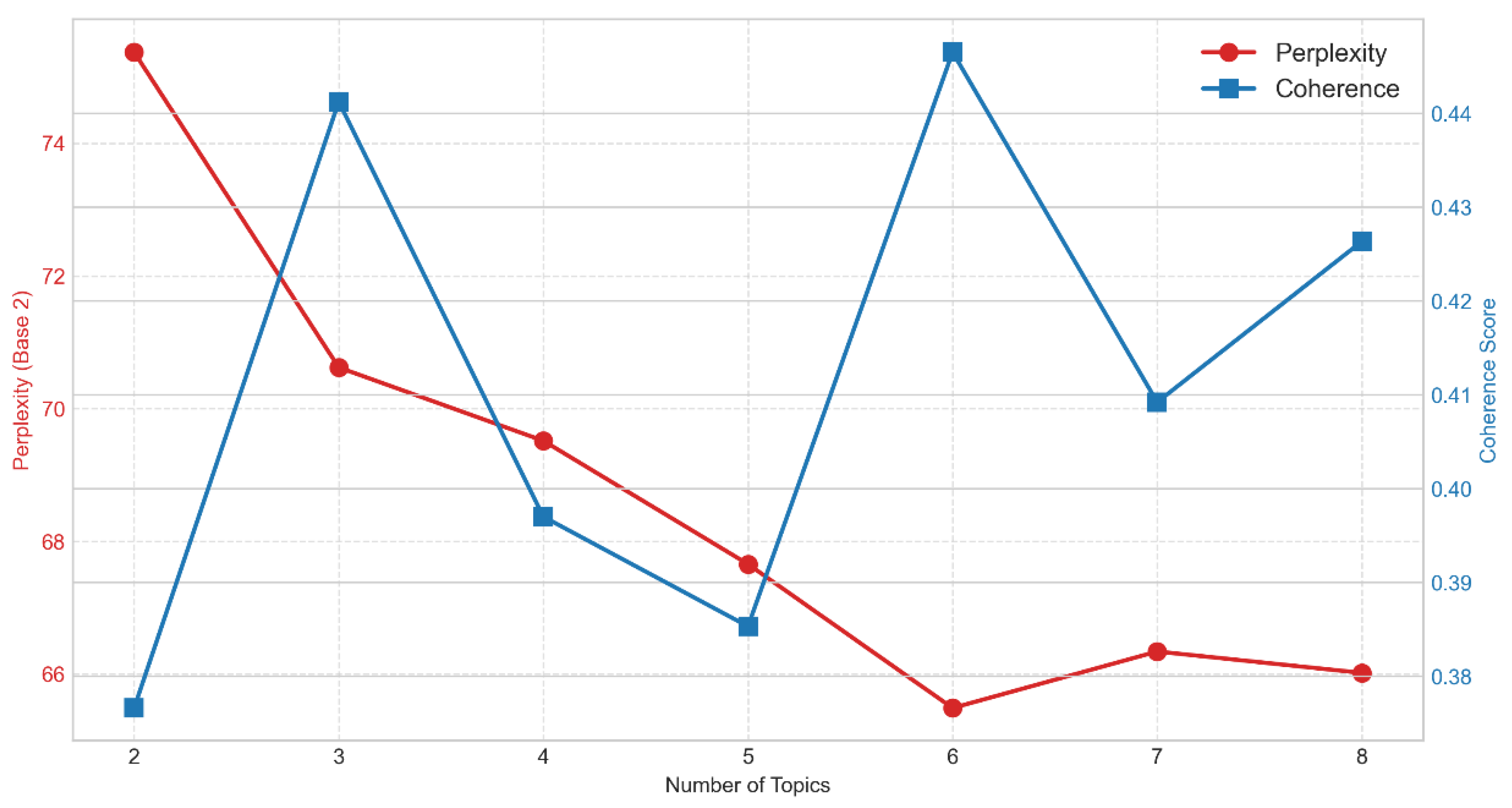
3.2.3. Determining the Number of Topics
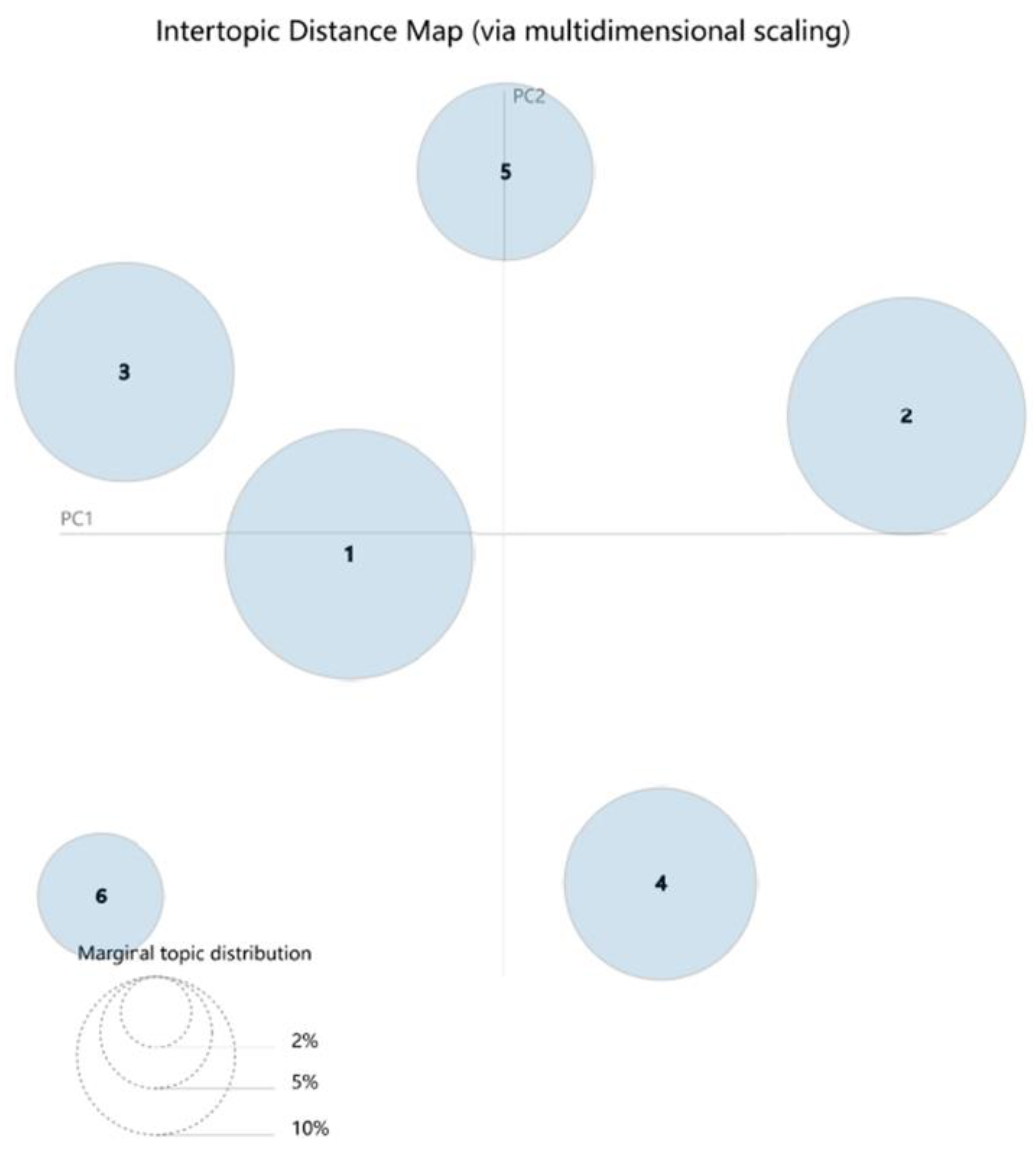
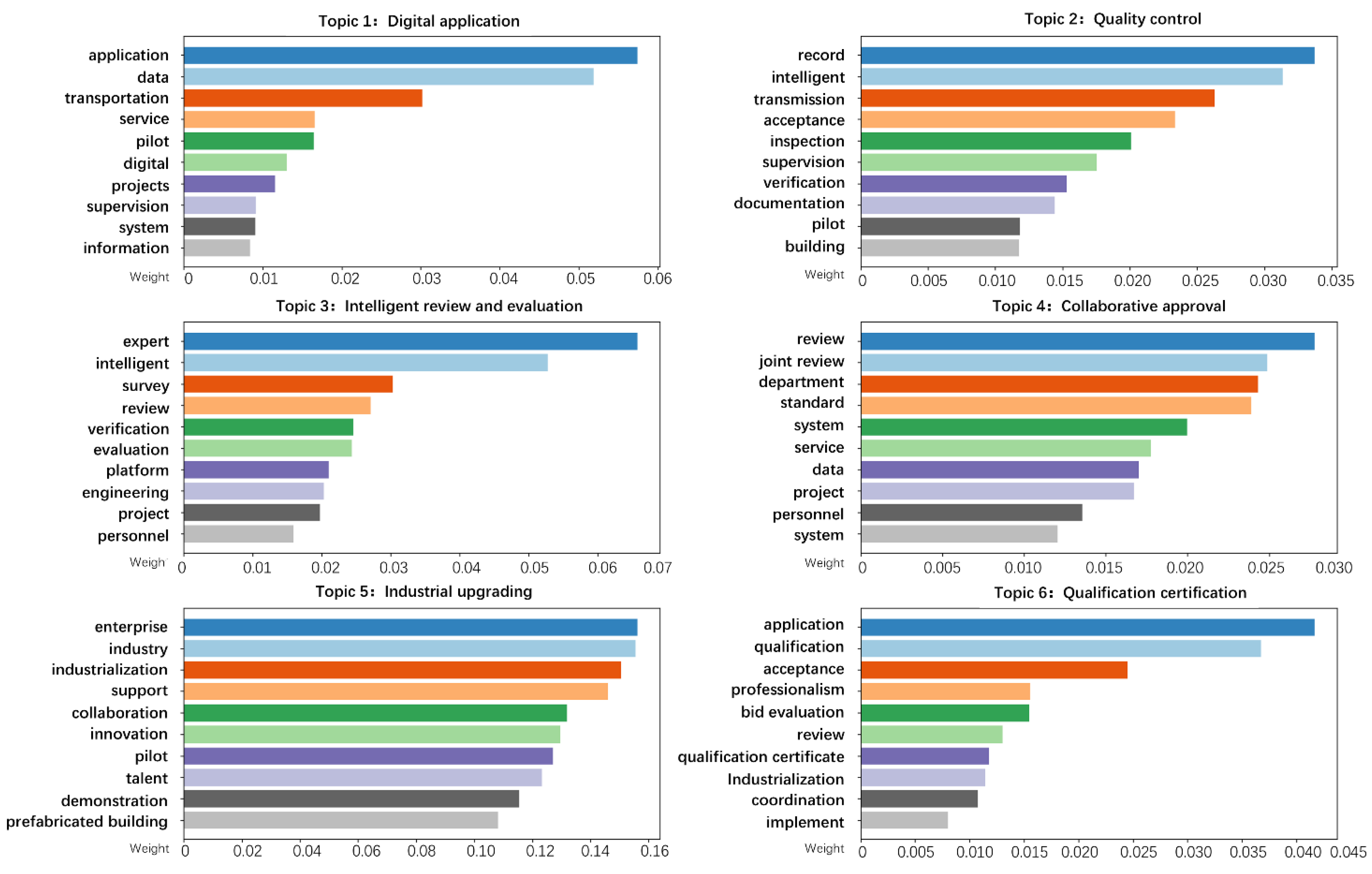
3.2.4. Topic and Cluster Word Visualization
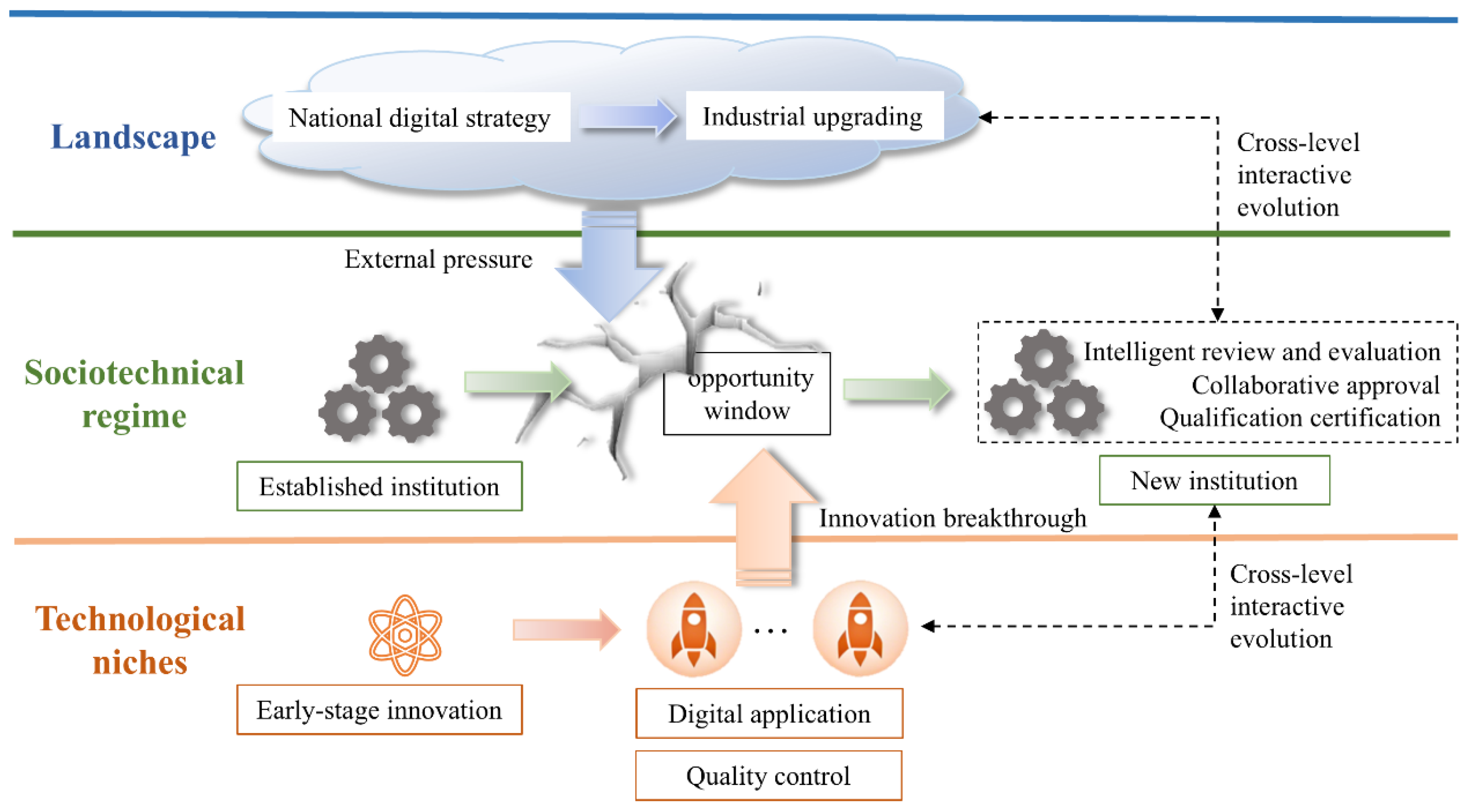
3.3. Policy Tool Analysis from the MLP
4. Analysis of Policy Instrument Combinations Based on fsQCA
4.1. Variable Selection and Calibration
4.1.1. Outcome Variable
- Input Indicators: Determined by each province based on the floor area of newly started prefabricated buildings and the proportion of such floor area to the total newly constructed floor area in the previous year. Regions with 30 million square meters or more, or a proportion of 30% or higher, are assigned 5 points; regions with less than 5 million square meters are assigned 3 points; and the remaining regions are assigned 4 points.
- Output Indicators: Points are earned based on the number of “BIM technology demonstration application projects, smart construction sites, intelligent construction pilot projects, intelligent quality projects” in each province, as well as the “pilot cities for digital management reform throughout the entire life cycle of engineering construction projects” and “national intelligent construction pilot cities” announced by the Ministry of Housing and Urban-Rural Development.
- Innovation Indicators: Points are accumulated based on the number of authorized patents related to building digitalization approved in each province.
4.1.2. Condition Variables
4.1.3. Variable Calibration
4.2. Analysis of Necessity
4.3. Conditional Configuration Analysis
4.3.1. Configuration Paths for High-Level Architectural Digitalization Development
- (1)
- Technology-talent driven type. Solution 1 combines a strong niche-level digital technology application (A1) with active restructuring of talent qualification systems at the regime level (E1), forming a “technology implementation and talent support” synergy. Guided by the national intelligent construction strategy (landscape), Shangxi Province established an intelligent construction evaluation system. This included creating an expert database and providing full lifecycle technical templates to enhance micro-level diffusion. Simultaneously, it implemented a talent training system through university-enterprise collaboration to cultivate compound talents with both digital and engineering skills. This pathway reflects the MLP logic of “landscape guidance, niche innovation, and institutional adaptation”, advancing the industry’s digital development.
- (2)
- Foundation-governance linkage type. Solutions 2 and 3 mainly depend on the systematic enhancement of internal governance at the institutional level. They create a closed-loop structure where niche-level digital technology applications (A1) are supported by institutional arrangements for quality control (B1), collaborative approval (D1), and qualification certification (E1). This fosters endogenous transformation even when the dominant industrial ecology (~F1) is not yet fully developed. For example, Shandong Province strives for comprehensive coverage of intelligent construction scenarios across its 16 cities. It has established a complete chain system integrating “technology application, process supervision, and approval collaboration”, actively promotes BIM and IoT for quality and safety oversight, and develops intelligent supervision platforms to improve multi-department coordination. This setup demonstrates how institutions can proactively embed grassroots innovations within a stable environment and propel regional digital growth through standardization and process re-engineering, supporting a gradual “institution-led, niche-embedded” transformation model.
- (3)
- System-ecology Leading Type. Solution 4 is driven by the development of an industrial ecosystem at the landscape level (F1). It systematically combines institutional elements—such as intelligent review, collaborative approval, and qualification certification—while empowering niche-level technological applications (A1). This establishes a three-tier linkage of “ecological leadership, institutional coordination, and technology implementation”. For example, Shanghai’s digital transformation plan explicitly guides the development of an intelligent construction system covering R&D, standards, scenarios, and enterprise clusters. Within this framework, advanced technologies like BIM, construction robots, and digital twins are integrated throughout the engineering process. This pathway represents an advanced form of construction digitalization, evolving from scattered pilots towards systematic, ecological, and large-scale development.
4.3.2. Configurational Pathways of Low-Level Architectural Digitalization Development
- Factor-deficient type. Solution 1 corresponds to a configuration based on A1~B1~C1~E1~F1, characterized by the presence of digital application (A1) alongside the absence of quality control (~B1), intelligent review (~C1), qualification certification (~E1), and industrial upgrading (~F1). This “single-point advancement with systemic absence” pattern reflects micro-level technological innovation that lacks both institutional adaptation and strategic guidance at the landscape level. Here, the lack of regime-level instruments (~C1, ~E1) is not just a passive gap but an active causal factor: without institutional rules to standardize and legitimize niche innovations, technological experimentation remains fragmented and fails to scale. Therefore, it does not progress from isolated experimentation to a recognized practice.
- Case evidence shows that such policy arrangements, which focus on promoting technology without adequate institutional coordination, often lead to disconnections between digital initiatives and the existing institutional environment. This mismatch hinders synergistic effects and significantly reduces the practical effectiveness of the technology. The pattern demonstrates how a lack of cross-level coordination within the MLP framework obstructs digital transformation.
- 2.
- System-mismatched type: In solutions 2, 3, and 4, this type is based on D1*~A1*~C1*~F1, which indicates collaborative approval (D1) combined with the absence of digital application (~A1), quality control (~B1), intelligent review (~C1), and industrial upgrading (~F1). While these policy designs emphasize collaborative approval to streamline governance, they generally lack the necessary supporting environment. This includes deficiencies in digital infrastructure, quality assurance systems, intelligent review capabilities, and a clear focus on industrial upgrading. In this setup, the lack of niche-level technological foundations (~A1, ~B1) acts as a key constraint: collaborative approval mechanisms cannot function effectively without the digital infrastructure and data interoperability supplied by niche-level tools.
- This configuration represents an attempt at proactive adaptation at the institutional level. However, due to weak technical capacity in the technological niches and insufficient ecological pressure at the landscape level, the institutional innovation lacks a solid foundation for implementation. The result is a structural mismatch characterized by “top-level promotion, mid-level inertia, and bottom-level weakness”.
4.4. Robustness Test
5. Research Discussion and Limitations
5.1. Research Discussion
5.1.1. High-Level Architectural Digitalization Development in the Construction Industry
5.1.2. Low-Level Architectural Digitalization Development in the Construction Industry
5.2. Research Limitations
6. Conclusions
- (1)
- Policy tools are grouped into three categories aligned with MLP. Six thematic instruments were identified, corresponding to technology application (niche level), management norms (regime level), and industrial ecology (landscape level). This classification provides a practical link between policy analysis and socio-technical transition theory.
- (2)
- There is no single policy tool to promote high-level or low-level digital development. The necessity analysis indicates that, regardless of whether any individual tool exists, the results cannot be reliably determined.
- (3)
- High-level development follows three equifinal pathways. The “technology-talent driven”, “foundation-governance linkage”, and “system-ecology leading” each achieve high digital development through different combinations of cross-level policy interventions. This demonstrates that multiple causal routes exist, and success depends on contextual alignment rather than a single optimal model. Low-level development results from configurational misfit. The “factor-deficient” and “system-mismatched” explain low-level performance. These configurations reaffirm the logic of the high-level pathways, showing that the same tools can fail when used in isolation or in mismatched combinations.
- (4)
- Effective policy mixes require coordination across different levels. In all successful setups, digital technology uses consistently depend on supporting conditions at the regime or landscape levels. This highlights that policy design should go beyond isolated actions towards integrated strategies that align technological, institutional, and ecological aspects.
- (5)
- Theoretical logic extends beyond the empirical context. The empirical evidence is derived from China’s provincial policies; thus, although the specific configurations mirror local institutional conditions, the core mechanisms (equifinality, cross-level coordination, and configurational misfit) are conceptually applicable to other contexts where governments aim to coordinate industry-wide digital transformation.
Author Contributions
Funding
Data Availability Statement
Conflicts of Interest
References
- Liu, Q.; Ma, Y.; Xu, S. Has the development of the digital economy improved the efficiency of China’s green economy? China Popul. Resour. Environ. 2022, 32, 72–85. [Google Scholar]
- He, Q.; Qian, L.; Duan, Y.; Li, Y.K. Current Situation and Barriers of BIM Implementation. J. Eng. Manag. 2012, 26, 12–16. [Google Scholar]
- Li, H.; Sun, Y.; Zhang, J.; Liu, D.; Han, Z.; Li, Y. Critical Uncertainty Analysis of the Application of New-Generation Digital Technology in China’s Construction Industry—A Study Based on the LDA-DEMATEL-ISM Improvement Model. Appl. Sci. 2024, 14, 57. [Google Scholar] [CrossRef]
- Zhang, N.; Ye, J.; Zhong, Y.; Chen, Z. Digital Transformation in the Chinese Construction Industry: Status, Barriers, and Impact. Buildings 2023, 13, 1092. [Google Scholar] [CrossRef]
- Glass, J.; Bygballe, L.E.; Hall, D. Transforming construction: The multi-scale challenges of changing and innovating in construction. Constr. Manag. Econ. 2022, 40, 855–864. [Google Scholar] [CrossRef]
- Andreas, B.; Fernie, S.; Dainty, A. Understanding policy and change: Using a political economy analysis framework. Constr. Manag. Econ. 2021, 40, 865–883. [Google Scholar] [CrossRef]
- Zhang, J.; Chen, M.; Ballesteros-Pérez, P.; Ke, Y.; Gong, Z.; Ni, Q. A new framework to evaluate and optimize digital transformation policies in the construction industry: A China case study. J. Build. Eng. 2023, 70, 106388. [Google Scholar] [CrossRef]
- Xia, X.; Liu, L.; Wang, Z. A Progressive Policy Evaluation Framework for Construction Digitalization in China: Evidence from Wuhan. Buildings 2025, 15, 1925. [Google Scholar] [CrossRef]
- Xing, M.; Cao, J.; Cao, D. Impacts of Policy Mix Comprehensiveness on BIM Implementation: Moderating Effects of Environmental State and Response Uncertainty. J. Constr. Eng. Manag. 2023, 149, 04022171. [Google Scholar] [CrossRef]
- Lerognon, V.; Hochscheid, E.; Halin, G.; Poirier, E.A. Evaluating the impact of public policies supporting digital transformation in the construction sector: Towards a systematic evaluation framework. In Proceedings of the Smart and Sustainable Built Environment 2025 (SASBE2025), Lille, France, 3 November 2025. [Google Scholar]
- Chen, Y.; Yang, Y.; Luo, L.; Ding, C. Impacts of BIM policy on the technological progress in the Architecture, Engineering, and Construction (AEC) industry: Evidence from China. J. Asian Archit. Build. Eng. 2024, 23, 1997–2011. [Google Scholar] [CrossRef]
- Mitera-Kiebasa, E.; Zima, K. BIM Policy Trends in Europe: Insights from a Multi-Stage Analysis. Appl. Sci. 2024, 14, 4363. [Google Scholar] [CrossRef]
- Li, W.; Tan, S.; Liu, X.; Wang, Z.; Li, G. Dentifying the effective and ineffective configurations of the mandatory waste management policy in China: A qualitative comparative analysis. J. Environ. Plan. Manag. 2024, 67, 3003–3025. [Google Scholar] [CrossRef]
- Zhang, J.; Guo, J. A study on synergistic development of urban digitalization and greening under the diffusion of low-carbon pilot policies. Sci. Rep. 2025, 15, 32945. [Google Scholar] [CrossRef] [PubMed]
- Yang, Y.; Zhang, S.; Hua, Y.; Wang, H. Mapping the digital transformation of AEC industry: Content analysis of digital public policy in China. Dev. Built Environ. 2025, 21, 100621. [Google Scholar] [CrossRef]
- Bressers, H.T.A.; O’Toole, L.J., Jr. The Selection of Policy Instruments: A Network-based Perspective. J. Public Policy 1998, 18, 213–239. [Google Scholar] [CrossRef]
- Acciai, C.; Capano, G. Policy instruments at work: A meta-analysis of their applications. Public Adm. 2021, 99, 118–136. [Google Scholar] [CrossRef]
- Wang, K.; Guo, F.; Zhang, C.; Schaefer, D. From Industry 4.0 to Construction 4.0: Barriers to the digital transformation of engineering and construction sectors. Eng. Constr. Archit. Manag. 2022, 31, 136–158. [Google Scholar] [CrossRef]
- Hughes, O.E. Public Management and Administration: An Introduction; Red Globe Press: London, UK, 2015; p. 288. [Google Scholar]
- Schneider, A.; Ingram, H. Behavioral Assumptions of Policy Tools. J. Politics 1990, 52, 510–529. [Google Scholar] [CrossRef]
- Lowi, T.J. American Business, Public Policy, Case-Studies, and Political Theory. World Politics 1964, 16, 677–715. [Google Scholar] [CrossRef]
- Rothwell, R. Reindustrialization and technology: Towards a national policy framework. Sci. Public Policy 1985, 12, 113–130. [Google Scholar] [CrossRef]
- Howlett, M.; Ramesh, M. Studying Public Policy: Policy Cycles and Policy Subsystems. Am. Political Ence Assoc. 2009, 91, 548–580. [Google Scholar]
- Mcdonnell, L.M.; Elmore, R.F. Getting the Job Done: Alternative Policy Instruments. Educ. Eval. Policy Anal. 1987, 9, 133–152. [Google Scholar] [CrossRef]
- Xie, M.; Qiu, Y.; Liang, Y.; Zhou, Y.; Liu, Z.; Zhang, G. Policies, applications, barriers and future trends of building information modeling technology for building sustainability and informatization in China. Energy Rep. 2022, 8, 7107–7126. [Google Scholar] [CrossRef]
- Zhou, S.; Wu, S. A Study on the Development Trend of China’s Information of Construction Industry: A Perspective of Public Policy Analysis. In Proceedings of the ICCREM 2017, Guangzhou, China, 10–12 November 2017; pp. 395–404. [Google Scholar]
- Jin, X.; Shen, G.Q.P.; Wang, Q.-c.; Ekanayake, E.M.A.C.; Fan, S. Promoting Construction Industrialisation with Policy Interventions: A Holistic Review of Published Policy Literature. Int. J. Environ. Res. Public Health 2021, 18, 12619. [Google Scholar] [CrossRef]
- Chang, R.-d.; Soebarto, V.; Zhao, Z.-y.; Zillante, G. Facilitating the transition to sustainable construction: China’s policies. J. Clean. Prod. 2016, 131, 534–544. [Google Scholar] [CrossRef]
- Luo, T.; Xue, X.; Wang, Y.; Xue, W.; Tan, Y. A systematic overview of prefabricated construction policies in China. J. Clean. Prod. 2021, 280, 124371. [Google Scholar] [CrossRef]
- Adekunle, S.A.; Aigbavboa, C.O.; Ejohwomu, O.; Adekunle, E.A.; Thwala, W.D. Digital transformation in the construction industry: A bibliometric review. J. Eng. Des. Technol. 2021, 22, 130–158. [Google Scholar] [CrossRef]
- Berlato, M.; Binni, L.; Durmus, D.; Gatto, C.; Giusti, L.; Massari, A.; Toldo, B.M.; Cascone, S.; Mirarchi, C. Digital Platforms for the Built Environment: A Systematic Review Across Sectors and Scales. Buildings 2025, 15, 2432. [Google Scholar] [CrossRef]
- Zhang, A.; Zhang, C.; Munir, H.; Seuring, S. Circular Economy Policies in China and Europe: A Systematic Literature Review. Circ. Econ. Sustain. 2025, 5, 5581–5612. [Google Scholar] [CrossRef]
- Asmawa; Hakim, A.; Hermawan; Hayat, A. Transforming Public Policy in Developing Countries: A Comprehensive Review of Digital Implementation. J. ICT Stand. 2024, 12, 337–364. [Google Scholar] [CrossRef]
- Zhang, S.; Yu, G.; Qu, Y.; Chen, L. Explaining Enterprise Litigation Success with fsQCA: The Role of Local Economic Environment, Policy Preferences, Case Complexity, and Party Capability. SAGE Open 2024, 2024, 1–18. [Google Scholar] [CrossRef]
- Hu, X.; Yu, S.; Fang, X.; Ovaere, M. Which combinations of renewable energy policies work better? Insights from policy text synergies in China. Energy Econ. 2023, 127, 107104. [Google Scholar] [CrossRef]
- Rihoux, B.; Ragin, C.C. Configurational Comparative Methods: Qualitative Comparative Analysis (QCA) and Related Techniques; Sage: Thousand Oaks, CA, USA, 2009. [Google Scholar]
- Furnari, S.; Crilly, D.; Misangyi, V.F.; Greckhamer, T.; Fiss, P.C.; Aguilera, R.V. Capturing Causal Complexity: Heuristics for Configurational Theorizing. Acad. Manag. Rev. 2021, 46, 778–799. [Google Scholar] [CrossRef]
- Ragin, C.C. Redesigning Social Inquiry: Fuzzy Sets and Beyond; University of Chicago Press: Chicago, IL, USA, 2010. [Google Scholar]
- Liu, D.; Lei, X.; Liu, W.; Huang, Y.; Zhang, J.; Bu, R.; Liang, L.; Wu, L. Demand for information literacy skills among engineering management postgraduates in the era of intelligent construction. J. Asian Archit. Build. Eng. 2025, 12, 1–19. [Google Scholar] [CrossRef]
- Wang, S.; Xiong, H. What factors influence innovation efficiency in integrating digitalization and low carbonization within the construction industry? A configuration analysis based on fsQCA. PLoS ONE 2025, 20, e0316249. [Google Scholar] [CrossRef] [PubMed]
- Chen, X.; Yang, N. How does business environment affect firm digital transformation: A fsQCA study based on Chinese manufacturing firms. Int. Rev. Econ. Financ. 2024, 93, 1114–1124. [Google Scholar] [CrossRef]
- Sun, L.; Shu, H. Rural E-commerce Ecosystem Development Paths Amid Digital Business Enabling Agriculture: A fsQCA Based on CAS Theory. SAGE Open 2025, 15, 2158. [Google Scholar] [CrossRef]
- Rogge, K. OECD (2015) System innovation: Synthesis report. Environ. Innov. Soc. Transit. 2017, 22, 90–91. [Google Scholar] [CrossRef]
- Geels, F.W. A socio-technical analysis of low-carbon transitions: Introducing the multi-level perspective into transport studies. J. Transp. Geogr. 2012, 24, 471–482. [Google Scholar] [CrossRef]
- Hwang, S.-A.; Çetin, S.; Visscher, H.; Straub, A. Advancing energy renovations through digitalisation: A critical review of EU policies and instruments. Energy Build. 2025, 336, 115627. [Google Scholar] [CrossRef]
- Bakhuis, J.; Kamp, L.M.; Barbour, N.; Chappin, É.J.L. Frameworks for multi-system innovation analysis from a sociotechnical perspective: A systematic literature review. Technol. Forecast. Soc. Change 2024, 201, 123266. [Google Scholar] [CrossRef]
- Fiss, P.C. Building Better Causal Theories: A Fuzzy Set Approach to Typologies in Organization Research. Acad. Manag. J. 2011, 54, 393–420. [Google Scholar] [CrossRef]
- Sabatier, P.; Mazmanian, D. The Implementation of Public Policy: A Framework of Analysis. Policy Stud. J. 1980, 8, 538–560. [Google Scholar] [CrossRef]
- Jayasena, H.S.; Thurairajah, N.; Perera, B.A.K.S.; Siriwardena, M. Promotion of diffusion of innovation: A study of BIM adoption in construction industries. In Proceedings of the 35th Annual ARCOM Conference; Leeds Beckett University: Leeds, UK, 2019. [Google Scholar]
- Homsy, G.C.; Liu, Z.; Warner, M.E. Multilevel Governance: Framing the Integration of Top-Down and Bottom-Up Policymaking. Int. J. Public Adm. 2019, 42, 572–582. [Google Scholar] [CrossRef]
- Teladia, A.; van der Windt, H. Lights, Policy, Action: A Multi-Level Perspective on Policy Instrument Mix Interactions for Community Energy Initiatives. Energies 2025, 18, 2823. [Google Scholar] [CrossRef]
- Geels, F.W.; Schot, J. Typology of sociotechnical transition pathways. Res. Policy 2007, 36, 399–417. [Google Scholar] [CrossRef]
- Blei, D.M.; Ng, A.Y.; Jordan, M.I. Latent dirichlet allocation. J. Mach. Learn. Res. 2003, 3, 993–1022. [Google Scholar]
- Sarta, A.; Durand, R.; Vergne, J.-P. Organizational Adaptation. J. Manag. 2021, 47, 43–75. [Google Scholar] [CrossRef] [PubMed]
- Ma, M.; Wu, X.; Wang, X. A literature review of enterprises’ digital transformation based on the LDA topic model. Technol. Anal. Strateg. Manag. 2025, 10, 1–18. [Google Scholar] [CrossRef]
- Chen, J.; Zeng, Q. A multi-level perspective on technological advancement in China’s natural gas industry. Energy Res. Soc. Sci. 2025, 120, 103877. [Google Scholar] [CrossRef]
- Thomas, G.; Santi, F.; Fiss, P.C.; Aguilera, R.V. Studying configurations with qualitative comparative analysis: Best practices in strategy and organization research. Strateg. Organ. 2018, 16, 482–495. [Google Scholar]
- Verweij, S.; Noy, C. Set-Theoretic Methods For The Social Sciences: A Guide To Qualitative Comparative Analysis. Int. J. Soc. Res. Methodol. 2013, 16, 165–169. [Google Scholar] [CrossRef]
- Pappas, I.O.; Papavlasopoulou, S.; Mikalef, P.; Giannakos, M.N. Identifying the combinations of motivations and emotions for creating satisfied users in SNSs: An fsQCA approach. Int. J. Inf. Manag. 2020, 53, 102128. [Google Scholar] [CrossRef]
- Du, Y.; Kim, P.H. One size does not fit all: Strategy configurations, complex environments, and new venture performance in emerging economies. J. Bus. Res. 2021, 124, 272–285. [Google Scholar] [CrossRef]
- Ming, Z.; Yunzhou, D. The Application of QCA Method in Organizational and Management Research: Positioning, Strategy, and Direction. J. Manag. 2019, 16, 1312–1323. [Google Scholar]
- Cao, J.; Yu, C.; Wu, Y. Policy Instrument Preferences and Optimization Strategies: Based Text Analysis of Provincial-Level Education Digitalization Policy from China. Educ. Sci. 2024, 14, 539. [Google Scholar] [CrossRef]



| Topic Level | Topic Classification | Topic Number | Topic Name | Concept Definition |
|---|---|---|---|---|
| Landscape | Industrial ecology | 5 | Industrial upgrading | It involves industrial digital upgrading and collaborative innovation. It refers to promoting collaborative and innovative development of the construction industry chain, and facilitating the upgrading of prefabricated construction, industrialization, and intelligence. |
| Sociotechnical regime | Management norms | 3 | Intelligent review and evaluation | It involves technical review and evaluation. It refers to establishing a digital system for expert review, survey, and design verification, as well as performance evaluation, to enhance the efficiency and accuracy of review and assessment. |
| 4 | Collaborative approval | It involves multi-departmental collaborative approval. It refers to establishing a digital workflow for joint review and parallel approval by promoting cross-departmental data sharing and business process reengineering, significantly optimizing the approval process for engineering projects. | ||
| 6 | Qualification certification | It involves qualifications and standards. It refers to establishing market access and evaluation standards compatible with digital capabilities by recognizing and managing the digital qualifications of enterprises and professionals. | ||
| Technological niches | Technology application | 1 | Digital application | It involves data application, leveraging technologies such as big data and IoT to build a platform for the construction industry, enabling data-driven, intelligent construction. |
| 2 | Quality control | It involves the whole-process quality management of the project. It refers to establishing a digital quality supervision system that covers key links such as design, construction, and acceptance, using information technology to achieve whole-process quality traceability and early risk warning, ensuring systematic control of project quality. |
| Policy Topic | Keywords |
|---|---|
| A1 Digital application | BIM, Building Information Modeling, cloud computing, cloud platform, Internet of Things, IoT, big data, data mining, artificial intelligence, AI, digital twin, Construction Information Modeling, CIM, smart construction site, intelligent construction, digital transformation. |
| B1 Quality control | Material traceability, material tracking, quality traceability, construction monitoring, process supervision, on-site monitoring, completion acceptance, acceptance filing, engineering acceptance, operation and maintenance, safety investigation, safety supervision. |
| C1 Intelligent review and evaluation | Intelligent review, automated review, digital review, online review, digitized review, informatization of review, digitalization of review. |
| D1 Collaborative approval | One-stop service, parallel approval, collaborative approval, engineering construction project approval management system, approval system, approval platform, collaborative approval, joint approval, online approval. |
| E1 Qualification certification | Qualifications, certifications, certificates, credentials, work permits, bidding bonuses, excellence evaluations, and training. |
| F1 Industrial upgrading | Prefabricated construction, assembly, green building, energy-saving building, ultra-low energy consumption building, intelligent construction, construction robot, robotic construction, new industrialization of construction, modern industrialization, industrial chain collaboration, industrial chain integration. |
| Conditions | Consistency | Coverage | ||
|---|---|---|---|---|
| High-Level Architectural Digitalization Development (Y1) | Low-Level Architectural Digitalization Development (~Y1) | High-Level Architectural Digitalization Development (Y1) | Low-Level Architectural Digitalization Development (~Y1) | |
| A1 | 0.686 | 0.683 | 0.555 | 0.581 |
| ~A1 | 0.482 | 0.477 | 0.591 | 0.615 |
| B1 | 0.690 | 0.719 | 0.562 | 0.615 |
| ~B1 | 0.527 | 0.488 | 0.640 | 0.623 |
| C1 | 0.621 | 0.504 | 0.700 | 0.598 |
| ~C1 | 0.643 | 0.748 | 0.552 | 0.675 |
| D1 | 0.785 | 0.877 | 0.504 | 0.592 |
| ~D1 | 0.365 | 0.266 | 0.738 | 0.565 |
| E1 | 0.651 | 0.647 | 0.592 | 0.618 |
| ~E1 | 0.580 | 0.573 | 0.610 | 0.633 |
| F1 | 0.707 | 0.687 | 0.587 | 0.600 |
| ~F1 | 0.518 | 0.527 | 0.611 | 0.654 |
| Configuration Variables | Solution 1 | Solution 2 | Solution 3 | Solution 4 |
|---|---|---|---|---|
| A1 | ● | ● | ● | ● |
| B1 | ⊗ | 🞄 | 🞄 | 🞄 |
| C1 | 🞄 | ⊗ | ⊗ | |
| D1 | ⊗ | ● | 🞄 | 🞄 |
| E1 | ● | ⊗ | ● | 🞄 |
| F1 | ⊗ | ⊗ | ⊗ | ● |
| Raw Coverage | 0.212 | 0.152 | 0.169 | 0.184 |
| Unique coverage | 0.101 | 0.023 | 0.036 | 0.052 |
| Consistency | 1.000 | 0.854 | 0.833 | 0.930 |
| Solution coverage | 0.567 | |||
| Solution consistency | 0.825 | |||
| Configuration Variables | Solution 1 | Solution 2 | Solution 3 | Solution 4 |
|---|---|---|---|---|
| A1 | ● | ⊗ | ⊗ | ⊗ |
| B1 | ⊗ | ⊗ | ⊗ | |
| C1 | ⊗ | ⊗ | ⊗ | ⊗ |
| D1 | ● | ● | ● | |
| E1 | ⊗ | ⊗ | 🞄 | |
| F1 | ⊗ | ⊗ | ⊗ | ⊗ |
| Raw Coverage | 0.291 | 0.220 | 0.214 | 0.164 |
| Unique coverage | 0.132 | 0.029 | 0.026 | 0.037 |
| Consistency | 0.875 | 0.779 | 0.835 | 0.956 |
| Solution coverage | 0.713 | |||
| Solution consistency | 0.803 | |||
Disclaimer/Publisher’s Note: The statements, opinions and data contained in all publications are solely those of the individual author(s) and contributor(s) and not of MDPI and/or the editor(s). MDPI and/or the editor(s) disclaim responsibility for any injury to people or property resulting from any ideas, methods, instructions or products referred to in the content. |
© 2026 by the authors. Licensee MDPI, Basel, Switzerland. This article is an open access article distributed under the terms and conditions of the Creative Commons Attribution (CC BY) license.
Share and Cite
Wei, J.; Liu, F. Policy Pathways to Digitalization: A Qualitative Comparative Analysis of China’s Construction Industry. Buildings 2026, 16, 1772. https://doi.org/10.3390/buildings16091772
Wei J, Liu F. Policy Pathways to Digitalization: A Qualitative Comparative Analysis of China’s Construction Industry. Buildings. 2026; 16(9):1772. https://doi.org/10.3390/buildings16091772
Chicago/Turabian StyleWei, Jielin, and Fengtao Liu. 2026. "Policy Pathways to Digitalization: A Qualitative Comparative Analysis of China’s Construction Industry" Buildings 16, no. 9: 1772. https://doi.org/10.3390/buildings16091772
APA StyleWei, J., & Liu, F. (2026). Policy Pathways to Digitalization: A Qualitative Comparative Analysis of China’s Construction Industry. Buildings, 16(9), 1772. https://doi.org/10.3390/buildings16091772