Article

Architectural Making Knowledge in Digital Tectonics: A Processual Onto-Methodological Reading
Faculty of Architecture, Department of Architecture, Yıldız Technical University, Istanbul 34349, Turkey
*
Author to whom correspondence should be addressed.
Buildings 2026, 16(9), 1768; https://doi.org/10.3390/buildings16091768
Submission received: 6 April 2026 / Revised: 23 April 2026 / Accepted: 26 April 2026 / Published: 29 April 2026
(This article belongs to the Section Architectural Design, Urban Science, and Real Estate)

Abstract

Digital tectonics is often discussed through design–production integration, computational form generation, and digital fabrication, yet frameworks that systematically explain how architectural knowledge is constituted in process remain limited. This study addresses that gap by approaching digital tectonics not as an instrumental or formal design approach, but as a knowledge regime. Methodologically, it combines a conceptual–genealogical approach with an onto-methodological reading strategy grounded in Deleuze’s ontology of becoming and De Landa’s assemblage methodology and develops a core reading matrix. The study shows that knowledge in digital tectonics intensifies across potential setup, the productive threshold, behavioral stability, and feedback. Within this model, architectural making knowledge is understood not as a fixed content represented in advance, but as an operative process that concentrates decision-making within production and is reorganized through feedback. The article concludes by proposing an analytical reading model that redefines digital tectonics not merely as a technical or formal category, but as an onto-methodological problem field in which architectural knowledge is constituted in process.

1. Introduction

Digital tectonics is widely discussed through design–production integration, computational form generation, and digital fabrication. Yet the question of how architectural making knowledge operates across process itself remains less clearly articulated in the literature [1,2]. This article addresses that gap by approaching digital tectonics not as a merely instrumental or formal category, but as a processual knowledge regime. To do so, it combines a conceptual–genealogical strategy with an onto-methodological framework developed along the Deleuze–De Landa axis and proposes a core reading matrix for tracing how knowledge intensifies, stabilizes, and reorganizes within digital tectonic production.

1.1. Literature Review

Architectural knowledge has long been shaped by the tension between theory and practice, representation and making. Under contemporary conditions of production, however, knowledge becomes visible not only as content carried by drawings, models, or concepts, but also as an operative process organized within production itself. This shift is especially significant in digitally mediated tectonic processes, where knowledge no longer remains confined to an epistemic plane but increasingly operates through feedback, interaction, and behavior within process [1,2].
The literature on digital tectonics is often organized around two broad tendencies: one emphasizes design–production continuity and direct translation into construction, while the other foregrounds process, materiality, performance, and relational organization. Yet this binary framing does not fully capture the diversity of positions in the field, because digital tectonics is discussed not only through production technologies but also through questions of material reorganization, representation, and knowledge. For this reason, the present study reorganizes the literature into four analytical clusters that clarify both the strengths and the limitations of existing approaches [3,4]. Recent overviews of digital fabrication and digital tectonics likewise indicate that the field has expanded beyond isolated technical applications into a broader discussion of design integration, fabrication workflows, and the conceptual implications of digitally mediated production [5,6].
A first cluster reads digital tectonics through the direct articulation of digital representation and physical construction. Within this line, components, joints, assembly, and production chains become central, and the tectonic significance of digital processes is located at the point where virtual configurations are translated into material construction. This approach is valuable because it makes design–production continuity visible and shows that digital tectonics is not merely a representational domain, but also a regime of production tied to processes of making [7,8]. Studies on continuous digital workflows between design and fabrication further reinforce this position by showing that fabrication knowledge increasingly feeds back into design development, especially through detailing, element variation, and the refinement of production logic [9].
A second cluster focuses on the form-generating power of computational tools and on the possibilities of optimization, simulation, and new expressive repertoires. While this literature clarifies the formal capacities of the digital, it also risks reducing digital tectonics to a matter of style or representation, thereby limiting its explanatory power at the level of process. In this respect, digital tectonics may become stabilized as a formal repertoire unless the relation between tool, materiality, and production is kept analytically open [10,11].
A third cluster shifts attention from form to process by foregrounding uncertainty, negotiation, tolerance, performance, and feedback within digitally mediated production. This literature is especially important for the present study because it shows that knowledge is produced not only in representation, but also through encounters, adjustments, and behavioral responses that emerge during making. Within this cluster, tolerance is particularly significant, since it reveals how decisions intensify at thresholds rather than merely compensating for deviation [12,13]. Related research on robotic design and fabrication has also shown that production knowledge emerges through iterative interaction among material behavior, sensing, and fabrication control rather than through one-way execution alone [14,15]. Similarly, recent work on materially informed and tolerance-aware robotic production suggests that architectural production must increasingly be understood through negotiated materialization and adaptive process control rather than precision alone [16,17].
A fourth cluster frames digital tectonics as an ontological and critical problem rather than only a technical one. Here the key issue is whether digital processes reinforce representation, displace materiality, or reorganize it. Tectonic theory becomes especially important in this context because it situates digital tectonics within a longer debate on the meaning of making and the production of architectural knowledge, showing that tectonics cannot be reduced to structural correctness alone [18,19].
Beyond these four clusters, the literature on making knowledge in architecture is also crucial because it treats design and making as specific modes of knowledge production rather than as mere applications of prior theory. This matters here because it allows architectural making knowledge to be discussed not only through final products, but also through decisions, trials, and adaptations internal to process [20].
This study builds on that insight through the Deleuze–De Landa axis, which provides both a process-ontological and an analytical ground for reading digital tectonics as an operative field of relations. Taken together, the literature reviewed here indicates the need for a more explicit analytical model for reading how architectural making knowledge operates across process in digital tectonics. At the same time, the expanded state-of-the-art also shows that, although design-to-fabrication integration and robotic production have been increasingly studied, fewer works provide an analytical framework for explaining how architectural making knowledge is organized across these processual conditions [5,6]. The four analytical clusters identified in the literature, together with their main contributions and limitations, are summarized in Table 1.

1.2. Research Gap, Aims, and Questions

Although digital tectonics has been widely discussed through tools, formal generation, and production technologies, fewer studies explain how architectural making knowledge is constituted across process as an operative and decision-binding regime. This study addresses that gap by approaching digital tectonics not as an instrumental or purely formal design approach, but as an onto-methodological problem field in which architectural making knowledge is reorganized in process. Its aim is therefore to develop an operative reading framework capable of identifying where knowledge intensifies, how decisions are bound, and how process is reorganized through feedback in digitally mediated tectonic production.
Architecturally, this problem becomes most visible in design-to-production situations where geometric intent can no longer be treated as self-sufficient, but must be reworked through detailing, tolerance setting, fabrication logic, and constructional feasibility. What is at stake in digital tectonics is therefore not only the production of complex form, but the redistribution of architectural decision-making across model, material, workflow, and implementation. More specifically, the present study addresses a specifically architectural problem: how making knowledge becomes operative when the architect’s role is extended from the composition of form to the coordination of buildability, adjustment, and feedback across production. Digital tectonics is thus approached here not simply as a technical extension of design, but as a field in which architectural knowledge is materially tested, negotiated, and reorganized in process [3,8].
To address this problem, the article is organized around three research questions:
(i)
At which moments does architectural making knowledge intensify in digital tectonic production, and through which mechanisms does it operate?
(ii)
Through which organizational roles does this knowledge emerge and stabilize in process?
(iii)
How does a combined Deleuze–De Landa framework make the processual operation of architectural making knowledge analytically legible?
In this article, “knowledge” does not refer to an abstract epistemological category in general. It refers specifically to architectural making knowledge as it operates within digital tectonic production. The central concern is therefore not to define knowledge in universal terms, but to explain how decision, making, material organization, and feedback become constitutive of knowledge in architectural production.
The working proposition of the study is that, within digital tectonic production, architectural making knowledge does not remain merely representational or epistemic. Rather, it is constituted within process through the singularization of potentials and the relational capacities of heterogeneous components. In this sense, digital tectonics is approached not as a field of completed forms, but as a regime in which knowledge becomes analytically legible through becoming, assemblage, and feedback.

1.3. Contribution and Scope of the Study

The contribution of this study is threefold. Theoretically, it redefines digital tectonics as a processual knowledge regime rather than a merely technical or formal category. Methodologically, it combines a conceptual–genealogical strategy with an onto-methodological framework developed along the Deleuze–De Landa axis. Analytically, it proposes a core reading matrix that identifies four moments through which architectural making knowledge becomes legible in process: potential setup, the productive threshold, behavioral stability, and feedback.
This study is conceived as a theoretical and conceptual inquiry. It does not rely on primary empirical data, project-based case analysis, or quantitative performance verification. Instead, it develops an analytical framework through a selected corpus of secondary sources in order to explain how architectural making knowledge is organized in process and at which thresholds it concentrates decision-making. In this sense, the article relates tectonic theory to digital tectonics through a conceptual–genealogical reading, develops an onto-methodological framework along the Deleuze–De Landa axis, and proposes a core reading matrix that can be applied analytically to different digitally mediated production scenarios.
In this respect, the framework is intended not only to reinterpret digital tectonics at a theoretical level, but also to support architectural readings of those moments in which design knowledge becomes operational—when details are resolved, tolerances are negotiated, component relations are coordinated, and production feedback leads to revision. Its relevance to architecture lies in showing that the decisive content of design is not exhausted in representation, but continues to be produced where material behavior, fabrication constraints, sequencing, and acceptable performance reorganize decisions.
The scope of the article is therefore deliberately limited. It does not attempt to produce a comprehensive empirical typology of digital tectonic practices, nor does it claim to verify the model through a single case. Its purpose is to establish a transferable interpretive framework that can clarify the processual constitution of architectural making knowledge while remaining open to future empirical application and comparative testing.

2. Materials and Methods

This section explains the design of the study, the corpus on which it is based, and the analytical procedure developed through that corpus. It first defines the research design and corpus construction, then outlines the conceptual–genealogical strategy and the onto-methodological framework, and finally develops the conceptual-historical grounding and the core reading matrix through which the model becomes analytically operational. Accordingly, the section does not merely present a sequence of steps, but establishes the methodological logic through which digital tectonics can be read as a processual knowledge regime.

2.1. Research Design and Corpus Construction

This study is conceived as a theoretical and conceptual inquiry rather than a project-based case analysis or a primary empirical investigation. It develops its argument through a selected corpus of secondary sources that makes it possible to discuss digital tectonics as a knowledge regime. The corpus is organized into three clusters: texts on tectonic theory and architectural knowledge, studies on digital production and digital tectonics, and literature on architectural research and methodology.
Three criteria guided the construction of this corpus. First, priority was given to studies that discuss digital tectonics through process, production organization, and feedback rather than through tools or form alone. Second, the corpus privileged texts that relate tectonics to the meaning of making and to the production of architectural knowledge, so that digital tectonics could be situated within a broader architectural debate rather than reduced to a technical subset of computation.
Third, particular emphasis was placed on works that foreground tolerance, uncertainty, and negotiation as threshold conditions in digitally mediated production. This final criterion was important because it allowed the corpus to support not only the conceptual argument of the article, but also the methodological transition from literature review to analytical model. In this way, the research material was constructed so that digital tectonics could be read not only through what is produced, but through how architectural making knowledge is constituted and becomes methodologically legible in process.

2.2. Conceptual–Genealogical Strategy

In this study, the conceptual–genealogical strategy traces the main concepts clustered around digital tectonics and architectural making knowledge, including tectonics, threshold, tolerance, feedback, and behavior. Rather than presenting a linear history, it follows how these concepts emerge, shift, and become operative in architectural discourse.
In this sense, the strategy seeks to show how concepts that now appear natural or self-evident were historically produced. It therefore examines not only changes in meaning, but also the discursive, practical, and technical conditions through which these concepts became associated with architectural production, design tools, and practices of making. In this respect, genealogy produces critical distance by showing that conceptual placements now treated as self-evident were historically constructed rather than naturally given [21,22].
At the same time, the strategy is oriented toward a history of the present: it does not isolate concepts from practice, but follows the relations among concept, word, and operation through which architectural terms become actionable. For this reason, concepts such as tectonics, digital tectonics, threshold, tolerance, and feedback are traced here not only through their theoretical definitions, but also through the practical arrangements and making relations in which they gain methodological force [23,24].
This strategy operates through three stages. First, it identifies the conceptual fields in which tectonics and the digital are separately and jointly constituted. Second, it maps how concepts such as threshold, tolerance, and feedback are repositioned within architectural knowledge. Third, it connects these traces to the Deleuze–De Landa framework so that concepts can function as analytical instruments rather than isolated definitions. In this way, genealogy becomes an operative methodological bridge rather than a descriptive survey [25,26].
At this point, Deleuze and De Landa clarify the direction of the genealogical reading. Deleuze’s virtual–actual continuum provides the ontological ground on which knowledge is not fixed in representation, while De Landa’s concepts of assemblage and capacity render that ground analytically legible through the relational organization of heterogeneous components. The function of genealogy here is therefore not to replace ontology, but to prepare the conceptual field through which ontology becomes methodologically operational [25,26].
Examples of genealogical reading in tectonic discourse show that tectonics can be analyzed not only formally, but also through the meaning of making and the production of knowledge. In this respect, Frampton’s reading of modern architecture as a tectonic genealogy remains an important reference for the present study, because it demonstrates how tectonics can be interpreted through construction, assembly, and the meaning of making rather than through form alone. This point is methodologically important for the article, since it legitimizes the movement from tectonic theory toward digital tectonics without reducing that movement to a merely technical analogy [19,27].
In this study, the conceptual–genealogical strategy is designed to produce two outputs. First, it establishes the historical-conceptual placement of the terms required to explain the shift from representation to process in digital tectonics. Second, it provides the bridge through which those terms can be translated into the core reading matrix developed later in the article. This keeps the section within the logic of Materials and Methods while preserving the theoretical density required by the study.

2.3. Onto-Methodological Framework

This section establishes the onto-methodological framework through which architectural making knowledge can be read as a processual organization rather than as represented content. Its aim is to clarify the theoretical apparatus through which the operation of concepts becomes legible in digitally mediated production. In this study, the knowledge at issue is not an abstract epistemological category in general, but architectural making knowledge as it operates within digital tectonic production; for this reason, the section combines a methodological positioning with an architectural interpretation of making knowledge.
The framework rests on two complementary lines. Ontologically, the study draws on Deleuze in order to understand knowledge through becoming, the virtual–actual continuum, and singularization rather than through fixed essences. Methodologically, it turns to De Landa in order to translate this ontological ground into an analytical language of assemblage, capacity, and relational organization. In this way, the framework approaches digital tectonics not through fixed forms alone, but through the process by which potentials become temporarily stabilized under specific conditions. Ontology and method are therefore held together rather than treated as separate explanatory layers [25,26].
A Deleuzian reading also makes clear that the virtual–actual relation should not be understood as a flat opposition between two separate domains. Rather, it operates through a field of intensities, encounters, and topological transitions in which the actual emerges through the selective stabilization of potentials. This is important for the present study because it strengthens the claim that digital tectonics should be read through processual transformation rather than through representational completion [28,29].
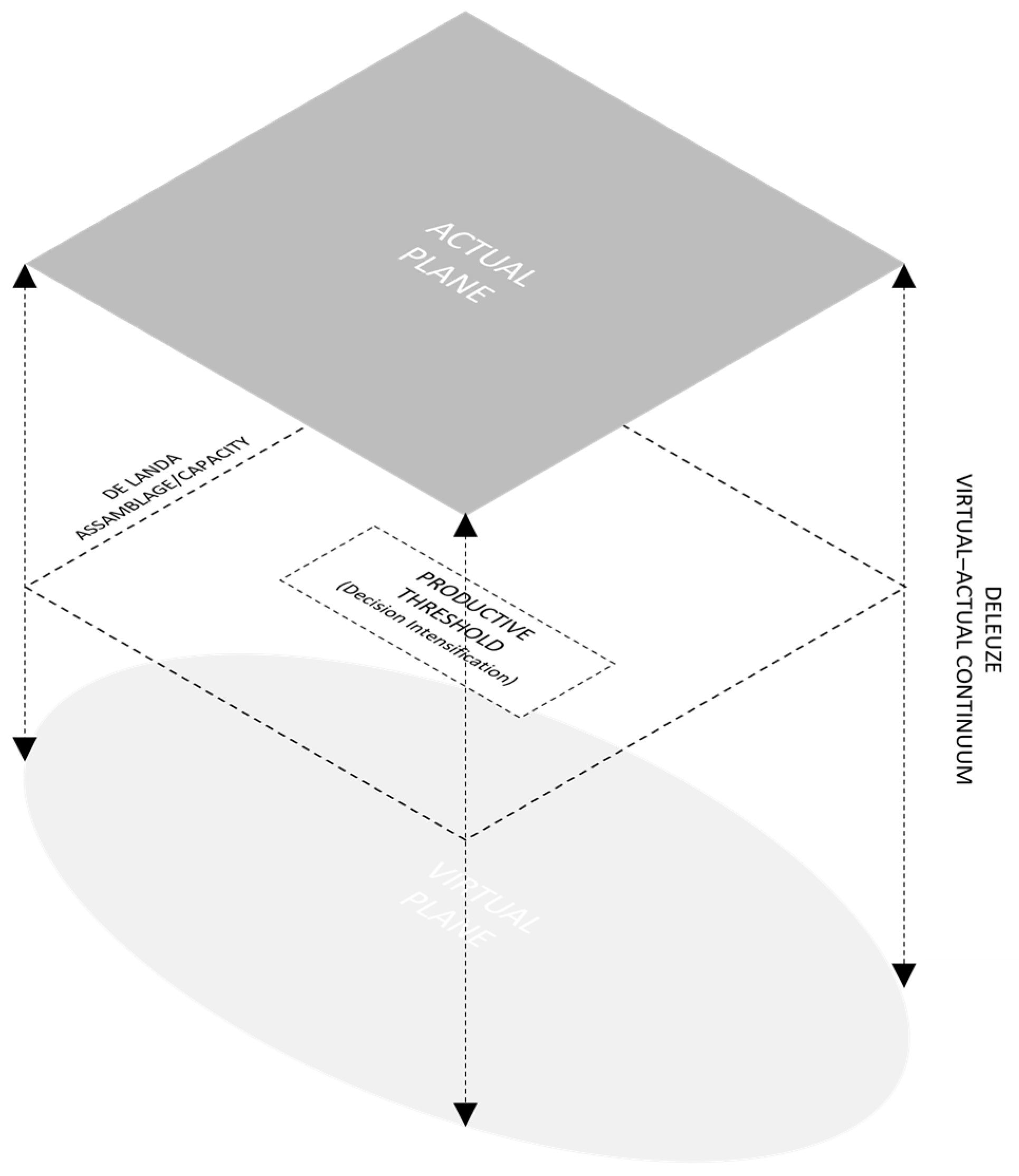
Within this framework, digital tectonics is approached not through resulting form alone, but through the process by which potentials become temporarily stabilized under specific material, technical, and organizational conditions. What matters here is not only what architectural components are, but what they can do within changing arrangements of relation and capacity. This is why architectural making knowledge is read less as something completed in representation than as an operation that intensifies at different moments across process. Figure 1 and Table 2 support this translation by clarifying both the virtual–actual continuum and the analytical intersections between tectonic assembly logic and assemblage methodology. In addition, readings of the actual–virtual relation in architecture and of the concept as an operative tool reinforce why the model treats knowledge as processually active rather than representationally given [30,31].
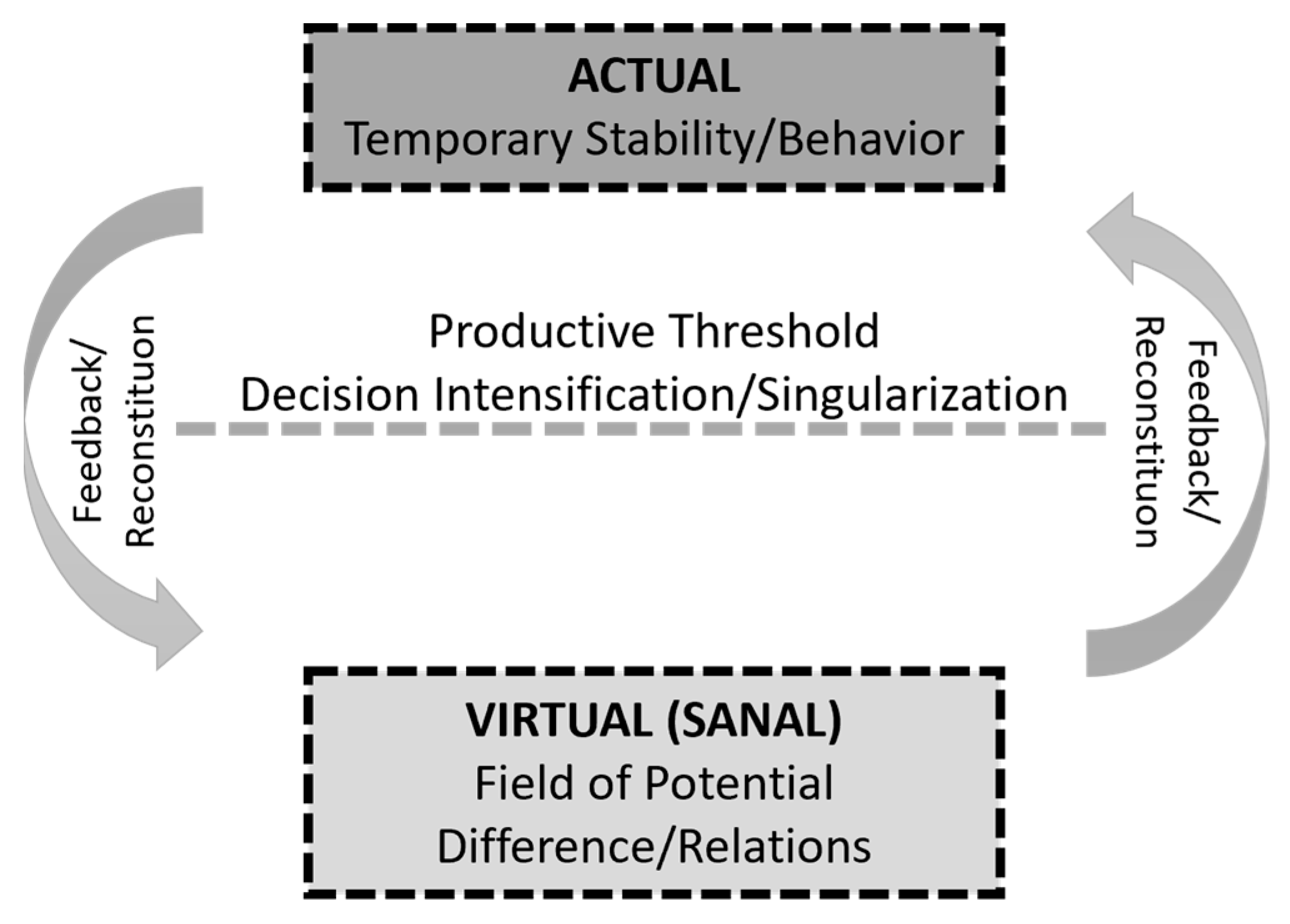
The concept of threshold becomes decisive at this point, because it marks the productive zone in which potential is transformed into decision and organized through assemblage relations. Tolerance and feedback are among the principal domains in which this transition becomes visible in practice. The relation among Deleuze, De Landa, threshold, and feedback is schematically summarized in Figure 2. In this sense, the onto-methodological framework establishes the theoretical basis for reading digital tectonics as a field in which knowledge is constituted through process rather than completed in representation; threshold and tolerance are therefore not auxiliary notions, but central analytical operators for the model [13,26].

2.4. Conceptual-Historical Grounding of the Model

This subsection grounds the model conceptually and historically by relocating digital tectonics within a longer discussion on making, representation, and the production of architectural knowledge. Rather than treating digital tectonics as an isolated technical field, it reads it as a problem field whose contemporary form can only be understood through the historical transformation of tectonic thought, the shift from representation to process, and the threshold logic that connects making, feedback, and assemblage. Accordingly, the subsection functions as the bridge between the methodological framework and the analytical instrument by clarifying why digital tectonics must be read within longer tectonic debates rather than as a self-contained technical novelty [18,19].

2.4.1. The Tectonic Line and the Meaning of Making

Tectonic thought has developed in architectural theory as a line of inquiry that cannot be reduced to the question of how a building stands up. Rather, it opens onto discussions of the meaning of making, the legibility of construction, and the ways in which architectural knowledge is constituted. At a foundational level, the historical transformation of the figure of the tektōn already shows that making has never been a merely technical residue within architectural thought, but a site where the status of knowledge is negotiated. This longer history matters here because digital tectonics inherits, rather than replaces, this problem of how making is recognized as knowledge within architecture [18,32].
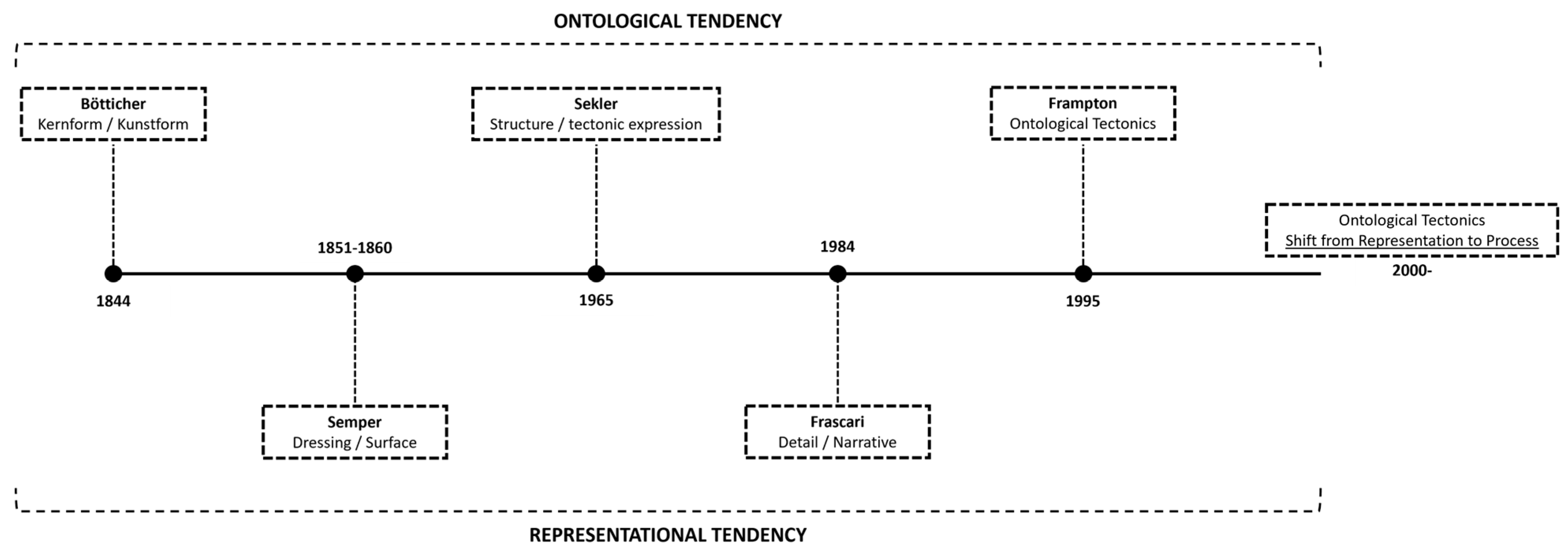
Tectonic discourse should therefore be understood not as a single doctrine, but as a historically transforming field in which the relation among making, construction, and architectural meaning is repeatedly reformulated. At its earlier stages, this field already linked making to questions of articulation, expression, and the status of construction, rather than reducing tectonics to structural necessity alone. In this longer genealogy, Semperian interpretations of dressing and surface are especially significant because they show that tectonic meaning may be constituted not only through structural truth, but also through the expressive mediation of material assembly [18]. Frampton’s later reformulation remains a decisive modern node within this line, since it reconnects tectonics to the meaning of construction and clarifies that making must be read as a mode of architectural knowledge rather than as a merely technical residue [19]. Read in this way, the tectonic line extends from early formulations of making toward contemporary reinterpretations under changing conditions of materiality, transfer, and operation, which is why digital tectonics should be approached not as a rupture from tectonic thought, but as one of its contemporary reorganizations [32,33]. This historical line is schematically summarized in Figure 3.
This tectonic line also makes it possible to understand digital transformation not as a rupture from tectonic thinking, but as a reorganization of it under new conditions of materiality, operation, and transfer. In this respect, contemporary discussions of portable and everyday tectonics are important because they show that tectonic thought can persist through changing scales, contexts, and operative arrangements rather than through a single historical formula [33,34].

2.4.2. From Representation to Process in Digital Tectonics

The tension opened by tectonic thought through the meaning of making reappears under digital transformation as a tension between knowledge fixed in representation and knowledge produced within process. Digital environments do not simply accelerate this tension; they reorganize where decisions intensify and how representation, materiality, and production are related. In this sense, digital transformation should be understood neither as a pure victory of representation nor as the disappearance of materiality, but as a reconfiguration of the conditions under which making knowledge operates. This is why digital tectonics cannot be reduced either to formal novelty or to technical execution alone [4,11].
This study positions itself between these poles by construing digital tectonics as an operative regime in which architectural making knowledge shifts from representation to process. Research on direct translation and process change by digital means is important here because it shows that the decisive issue is not only what is modeled, but how decisions are redistributed across workflows, assembly, and production chains. The contrast between these two regimes is retained in Table 3, which should therefore be read not as a rigid binary, but as an analytical comparison clarifying the redistribution of decisions in digitally mediated production [3,8].
The significance of this shift becomes especially clear once tolerance and feedback are understood not as secondary corrections but as constitutive conditions of making. Under digital transformation, knowledge no longer closes in representation but is rebound at thresholds where feasibility, adaptation, and material negotiation are decided. In this respect, tolerance is not simply a residual technical issue, but one of the main indicators through which the model becomes processually legible [13,35].

2.4.3. Threshold, Feedback, and Assemblage

The central concept for discussing digital tectonics along the axis proposed in this study is the threshold. Here, threshold is not merely a boundary separating two domains, but a productive zone of transition in which potentials are bound into decisions and temporary stabilizations. Tolerance makes this threshold especially visible because it is not simply a margin of error, but one of the constitutive conditions of feasibility in making. Under this view, threshold names the point at which potential becomes decision and decision becomes materially negotiable within process. Assemblage becomes important here because threshold decisions are not produced by a single parameter alone, but by the temporary coordination of heterogeneous components such as geometry, material behavior, substructure, fabrication constraints, and sequencing. In this sense, threshold and feedback become analytically legible as assemblage conditions through which architectural making knowledge is bound, adjusted, and reorganized in process. Figure 4 continues to show the position of the productive threshold within the cycle, while tolerance clarifies why threshold should be read as a constitutive rather than secondary condition of making [26,35].
Feedback is the second determining domain of this threshold logic. Digital tectonics is not constituted through one-way transfer, but through measurement, adjustment, deviation management, and recalibration. For this reason, making knowledge should not be conceptualized as a subject located at the center of the cycle, but as an immanent axis reorganized through encounters among material behavior, workflow, and production conditions. The four processual roles of making knowledge are synthesized analytically in the core reading matrix presented in the following subsection, where threshold and feedback are converted into a transferable reading instrument [2,12].

2.5. Analytical Instrument: The Core Reading Matrix

The analytical instrument of this study is the core reading matrix, developed in order to read digital tectonics not through resulting form alone, but through the processual organization of knowledge. The matrix approaches architectural making knowledge not as a central subject, but as an immanent operational logic that establishes relations, concentrates decisions, produces temporary stabilizations, and is reorganized through feedback.
The matrix is built on the assumption that architectural making knowledge intensifies across four moments in digital tectonic processes: potential setup, the productive threshold, behavioral stability, and feedback. These moments are understood not as a linear design-to-production sequence, but as a cycle reconstituted through feedback. In this sense, the productive threshold becomes especially important because it marks the point at which decisions are bound within making; the schematic summary of the model is retained in Table 4. The matrix therefore translates the conceptual-historical discussion of the previous subsection into an explicit analytical instrument.
The onto-methodological ground of this instrument rests on the combined operation of Deleuze’s virtual–actual continuum and De Landa’s concepts of assemblage and capacity. At this stage, the matrix renders visible the moments at which knowledge intensifies in digital tectonics and the mechanisms through which it operates, while the preceding conceptual-historical grounding explains why this instrument is necessary and how it should be read. In this way, Section 2 concludes by converting the article’s theoretical argument into a transferable reading model.
This matrix can be used as a short interpretive guide for reading digitally mediated design-to-production processes in architecture. First, it identifies how the initial problem field is established through relations among geometry, material behavior, component logic, production parameters, and performance demands. Second, it locates the productive threshold at which these relations are bound into feasible decisions concerning detailing, tolerance setting, sequencing, and coordination. Third, it reads behavioral stability not as the exact realization of an initial representation, but as the temporary operability achieved when a system performs within acceptable material, geometric, and procedural limits. Finally, it follows feedback through checking, deviation, recalibration, and revision, thereby clarifying how architectural making knowledge is reorganized as design intent is tested against fabrication and implementation conditions.
The matrix should be read both row by row and across the cycle. Each row identifies a process moment, specifies the status that architectural making knowledge assumes at that moment, locates its architectural operative correspondence, and clarifies the mechanism through which it becomes operative in production.

3. Findings

This section presents the findings generated through the core reading matrix and the feedback-based process cycle. It shows where architectural making knowledge intensifies in digital tectonics and how it operates across potential setup, the productive threshold, behavioral stability, and feedback. Accordingly, the findings do not simply describe a sequence of stages, but clarify the processual distribution of architectural making knowledge within digital production.

3.1. Reading the Productive Threshold: The Cyclical Operation of the Matrix

Table 5 shows that, in digital tectonics, architectural making knowledge is organized not as a linear transfer but as a cyclical operation reconstituted across four moments. Within this framework, digital tectonics should be read not merely as the use of computational tools, but as a regime of making in which representation, production, materiality, and decision are continuously reorganized in process. This formulation also clarifies why digital tectonics exceeds a tool-based definition and must be read through processual organization.
Architecturally, this cyclical organization becomes most visible in design-to-production situations where geometric definition must be coordinated with detailing, jointing, tolerance setting, sequencing, and constructional feasibility. In such contexts, architectural making knowledge operates not only through formal intention, but through the continuous adjustment of relations among geometry, material behavior, production logic, and assembly order. The matrix therefore helps explain how design decisions remain active beyond representation and become operative within production.
The first moment of the matrix, potential setup, is the stage at which architectural knowledge does not yet produce a fixed solution, but instead defines the problem field, relational tensions, and possible orientations. At this moment, knowledge operates less as the representation of a ready-made form than as the establishment of a field of possibilities among actors, materials, production constraints, and performance demands. Potential setup should therefore be understood as a constitutive field that determines the ground on which subsequent decisions become possible, rather than as a preliminary phase external to making [2,26].
The second moment, the productive threshold, is the decision-intensifying node that makes the central finding of this study visible. Relations opened up within the field of potential are bound here; some options are eliminated, while others become feasible and producible. At this threshold, tolerance, assembly, calibration, and production sequence cease to function as secondary technical details and instead become constitutive realities of making. This is why the threshold must be read as a site of negotiation rather than as a neutral passage between design and implementation [12,13].
The third moment, behavioral stability, refers to the temporary stabilization acquired in the production process by decisions bound at the threshold. Stability here does not mean a final or closed form, but a workable balance among material, geometry, assembly logic, and production procedure. It is therefore a temporary order that emerges through testing and adjustment within process rather than a fixed end state. In this sense, stability is not closure, but condition-dependent operability [2,12].
The fourth moment, feedback, shows that knowledge in digital tectonics does not implement a closed plan, but reorganizes itself through measurement, adjustment, deviation, and encounter during production. Feedback therefore marks not the end of the process, but the beginning of a new potential setup. The iterative loop between the digital and the physical demonstrates that architectural knowledge is not a fixed representation, but a continuously adjusted processual order. This processual view of feedback is what allows the model to move beyond linear production logic [2,3].
When these four moments are read together, it becomes clear that, in digital tectonics, architectural knowledge operates not as a fixed representation or singular design intention, but as an organizational logic distributed across process and intensified at thresholds. In this sense, the productive threshold is not merely one stage among others, but the decision-intensifying node of the entire cycle. Table 5 makes this cyclical logic analytically explicit and clarifies why digital tectonics should be understood as a knowledge regime rather than as a mere production technique.

3.2. Principal Clusters of Findings

Architectural making knowledge in digital tectonics should be understood as a distributed organizational logic rather than as a linear design–implementation sequence. What becomes decisive is not form alone, but the points at which material behavior, geometry, production constraints, assembly logic, and performance demands are translated into workable decisions. Tolerance, joints, sequencing, calibration, and prototyping are therefore better understood as operational sites of decision rather than as secondary technical matters [2,13].
Accordingly, digital tectonics is better understood as an adjustable regime for organizing architectural knowledge than as a technique of formal innovation alone. What the model makes visible is that knowledge is reproduced through coordination, temporary stabilization, and digital–physical feedback rather than completed at a single design moment. Its significance lies in rendering the redistribution of architectural agency across process analytically legible [2,13].

3.3. Illustrative Application of the Core Reading Matrix

To clarify the analytical portability of the proposed framework, Table 6 translates the core reading matrix into a digitally coordinated design-to-production scenario. In this way, the matrix is not presented only as an abstract theoretical construct, but as an interpretive aid for reading how architectural making knowledge becomes legible within production. Operationally, the table follows a four-step sequence that tracks how knowledge moves from problem framing to feasibility decision, temporary operability, and feedback-based recalibration.
A useful architectural example is the digitally coordinated production of a non-standard envelope or secondary support system in which geometry, detailing, fabrication, and installation must be continuously aligned. In such a scenario, the design model does not function simply as a final representation to be executed, but as a working field in which panel dimensions, connection logic, tolerance allowances, substructure relations, and sequencing requirements are progressively resolved. The productive threshold becomes visible precisely when geometric intention encounters the practical demands of fabrication and assembly, requiring decisions about feasible jointing, permissible deviation, alignment, and constructional order. At this point, the architectural problem is no longer whether a digital geometry can be represented, but how it can be resolved into coordinated decisions concerning panel subdivision, substructure alignment, joint tolerances, and installation logic. The framework thus makes it possible to read design not as a completed formal intention, but as a staged decision chain in which buildability is progressively negotiated across model, fabrication, and assembly. Seen in this way, the architect’s role extends from formal composition to the active coordination of feasible relations among geometry, material behavior, and production order [2,13].
Behavioral stability is achieved not when every component reproduces an ideal geometry without discrepancy, but when the assembled system performs within acceptable structural, geometric, and operational limits. Feedback then emerges through mock-up testing, dimensional checking, fabrication adjustment, and on-site recalibration, showing that architectural making knowledge is constituted not by one-way implementation, but by iterative coordination across design and production [2,3].
This brief application does not turn the article into a project-based case study. Rather, it demonstrates how the matrix can be used to read digitally coordinated production scenarios in a more explicit way. In this sense, the value of the model lies not in replacing empirical analysis, but in clarifying where knowledge intensifies, how decisions are bound, and how production is reorganized through feedback [12,13].

4. Discussion

This section discusses the findings in relation to the principal debates in the literature on digital tectonics. Its aim is to clarify what gap the proposed reading fills, how it repositions existing discussions, and under which theoretical conditions its contribution should be understood. It therefore proceeds through four steps: contribution to the literature, interpretation along the Deleuze–De Landa axis, scope and limitations of the model, and openings for future research. Accordingly, the discussion does not merely restate the findings, but situates them within the wider theoretical field from which the article emerged.

4.1. Contribution to the Literature on Digital Tectonics

The principal contribution of this study lies in proposing an analytical framework for reading how architectural making knowledge is organized in process in digital tectonics. Rather than approaching the field mainly through formal innovation or computational production alone, the model clarifies where making knowledge intensifies, how decisions are constituted at thresholds, and how process is reorganized through feedback. In this way, digital tectonics is repositioned as an onto-methodological problem field rather than a merely technical one; the contribution of the article lies precisely in shifting attention from outputs to organizational conditions of knowing and making [2,13].
One way in which the study contributes is by extending the literature that reads digital tectonics through translation, assembly, and production continuity between the physical and the virtual. That line has made visible the relation between the digital model and physical construction through components, joints, and production chains, yet it has often not explained through an explicit analytical model how this continuity transforms the status of architectural knowledge. This continuity has also been discussed through design-to-fabrication workflows in which detailing, element variation, and production knowledge feed back into design development, further demonstrating that digital tectonics cannot be reduced to representation alone [9]. The present study shifts the emphasis from technical translation to the moments at which knowledge produces decisions within the cycle, and thus strengthens the analytical reading of digital–physical continuity [3,8].
The article also offers a critical correction to approaches that reduce digital tectonics to the relation between tool and form. The capacities of digital tools for form generation, optimization, and simulation are important, yet this approach risks stabilizing tectonics at the level of a formal repertoire. By contrast, the present study positions digital tectonics as a process regime that explains the thresholds at which decisions are constituted and the relational arrangements within which making knowledge operates. In this respect, the article shifts the debate from stylistic capability to processual constitution [10,11].
A further contribution of the study lies in establishing an intermediate plane between ontological–critical inquiry and production-oriented literature focused on process and materiality. By placing the concept of the productive threshold at the center, the article connects conceptually strong but operationally limited critiques with process-rich accounts of production, craft, and material negotiation. Recent studies on robotic design and materially informed fabrication reinforce this mediation by showing that process knowledge emerges through iterative interaction among material behavior, sensing, fabrication control, and tolerance-aware adjustment rather than through one-way execution [14,16]. It is at this point that the study’s analytical model becomes most visible as a mediator between theory and production discourse, especially between critical reflections on materiality and process-based accounts of making [4,12]. The model therefore also clarifies how digitally coordinated production keeps architectural agency active beyond the moment of formal design definition [2,8].

4.2. Interpreting the Findings Along the Deleuze–De Landa Axis

The findings show that, in digital tectonics, architectural making knowledge operates not as a fixed design content, but as a relational structure constituted and reorganized in process. Read along the Deleuze–De Landa axis, they indicate a process logic in which potentials are singularized at thresholds and behavior emerges through relations among heterogeneous components. The findings therefore reinforce the article’s claim that digital tectonics should be interpreted less as a field of finished objects than as a field of operative relationality [25,26].
In light of the findings, potential setup may be reinterpreted through Deleuze’s virtual field. It is a plane of multiplicity that does not yet produce a fixed form, but instead establishes tensions, orientations, and possible relations. Knowledge appears here not as a ready-made content, but as a field of possibilities opened among material, geometry, data, and production conditions. This reading also explains why the article treats potential setup as constitutive rather than preliminary. At the same time, it aligns with interpretations that map the actual–virtual relation in architecture as an active field of construction rather than an abstract background [25,30].
The productive threshold may in turn be read as the node where Deleuze’s logic of singularization intersects with De Landa’s concept of capacity. Relations dispersed across the field of potential intensify at this threshold under conditions of tolerance, feasibility, and assembly. In this sense, the threshold is not a neutral intermediate step, but a productive field in which some possibilities are eliminated, others are bound, and heterogeneous components are transformed into workable capacities. This is also the point at which the article’s process ontology becomes most directly legible as a reading of making conditions [13,26].
Behavioral stability can be interpreted more clearly through De Landa’s concepts of emergence and capacity. Stability here does not mean the fixation of a final and unchanging form, but a temporary stabilization arising when certain components become workable under certain conditions. The interaction among material, geometry, assembly sequence, tolerance, workflow, and production procedure therefore produces not an essential order, but a situated behavior. This is why stability in the article is treated as condition-dependent operability rather than closure. In a Deleuzian sense, this also means that stability should be understood as a selective actualization rather than a finalized state [26,28].
Feedback, finally, can be explained both through Deleuze’s non-closing regime of becoming and through De Landa’s understanding of assemblage as open to recomposition. The production process is therefore not the one-way implementation of a predetermined plan; through testing, measurement, deviation, correction, and recalibration, knowledge is reproduced at every stage. Feedback marks not the end of the process, but the beginning of a new potential setup. In this respect, the findings show why digital tectonics should be understood through cycles of reorganization rather than linear implementation. This interpretation is strengthened by readings that treat concepts not as static labels, but as tools that continue to operate across process [2,31].

4.3. Scope, Applicability, and Limitations of the Model

The proposed model is an analytical framework developed in order to render visible how architectural making knowledge is constituted in process in digital tectonics; however, its scope and limitations must be stated explicitly. First, the model does not propose an empirical classification encompassing the full diversity of digital tectonic practices. Its aim is not to gather all production examples under a single typology, but to develop a theoretical instrument for reading how knowledge is organized across potential setup, the productive threshold, behavioral stability, and feedback. In this sense, the article offers an interpretive frame rather than a totalizing taxonomy of digital production.
Second, although the decision to center the Deleuze–De Landa axis provides a strong explanatory ground, it also introduces a deliberate theoretical limitation. This approach powerfully clarifies becoming, relational constitution, capacity, and reorganization in architectural knowledge, yet it may place historical, institutional, economic, or labor-related determinations in a secondary position. The model should therefore be understood as a selective interpretive lens rather than an exhaustive explanatory system. This limitation is important to state explicitly, since the article privileges process ontology over a full socio-technical explanation of production.
Third, the portability of the proposed model does not imply a claim to universal validity. Portability means that the cycle–matrix reading can be adapted to different narratives of digital tectonics, different project processes, and different production scenarios. The model should therefore be understood not as a closed schema that operates identically in every case, but as an interpretive apparatus capable of recalibration according to context.

4.4. Openings for Future Research

The model developed in this study opens several directions for future research. One direction is the comparative application of the cycle–matrix reading to different digitally mediated production scenarios, including robotic fabrication, adaptive assembly, and feedback-based construction workflows. Such applications would make it possible to test more explicitly how the productive threshold operates under different material and organizational conditions, and would help situate the model more directly within contemporary cyber-physical production research. In particular, future studies could compare how threshold decisions shift across different fabrication logics, levels of automation, and tolerance regimes [2,12].
A second direction concerns the extension of the model toward empirical studies. Although the present article does not rely on project-based case analysis, future work could use the matrix to read specific design-to-production processes and to compare how decision-making is redistributed across tolerance, assembly, calibration, and feedback. In that sense, the framework may serve not only as a theoretical model, but also as a guide for structured empirical interpretation, especially in studies that seek to connect design reasoning with production organization. This also means that the model could be tested against concrete cases without giving up its current theoretical scope [20,36].
A third direction lies in broadening the discussion beyond the current theoretical lens. Future research may place the cycle–matrix model in dialog with questions of labor, institutional organization, economy, and sustainability in order to examine how processual making knowledge is shaped not only by ontological and methodological relations, but also by wider socio-technical conditions. This would also help balance the current model’s deliberate emphasis on process ontology with broader determinations of practice. In this respect, the next step is not to abandon the model, but to place it in productive dialog with other explanatory frameworks.
Beyond its research applications, the model may also support teaching in architecture by providing a structured way to trace how design intent is transformed through detailing, tolerance, assembly, and feedback across design-to-production processes. In this sense, the matrix can be used not only as an analytical framework for scholarship and practice, but also as a pedagogical device for explaining how architectural making knowledge becomes operative in digitally mediated production [20,36].

5. Conclusions

This article has argued that digital tectonics should be understood not merely as a matter of design–production integration, computational form generation, or digital fabrication, but as a processual knowledge regime in which architectural making knowledge is constituted within production itself. By combining a conceptual–genealogical strategy with an onto-methodological framework developed along the Deleuze–De Landa axis, the study has proposed a core reading matrix for explaining where knowledge intensifies, how decisions are bound, and how process is reorganized through feedback. In this way, the article has repositioned digital tectonics from a predominantly technical discussion toward a problem field concerning the processual constitution of architectural knowledge [1,25].
The findings have shown that architectural making knowledge in digital tectonics intensifies across four moments: potential setup, the productive threshold, behavioral stability, and feedback. Within this cycle, the productive threshold has emerged as the decisive node because it marks the point at which potential is transformed into decision, feasibility is negotiated, and knowledge becomes operative within making. Viewed in this way, digital tectonics has been redefined not primarily as a technique of formal production, but as an onto-methodological problem field that renders visible the processual constitution of architectural knowledge through threshold, stabilization, and reorganization [13,26].
The contribution of the article therefore lies in offering an analytical model that connects tectonic theory, digital production, and architectural knowledge within a single interpretive framework. Rather than closing the discussion, the proposed model opens a basis for future work that can test, adapt, and expand the cycle–matrix reading in different digitally mediated production scenarios. At the same time, the model offers architecture a way of reading how decisions concerning buildability, tolerance, coordination, and revision continue to shape making knowledge beyond the formal definition of a design proposal. For this reason, the framework may also be used in architectural teaching as a guide for reading how design decisions are reorganized through production. Its value lies less in producing a closed doctrine than in making the organization of making knowledge analytically legible across process.

Author Contributions

Conceptualization, methodology, investigation, resources, data curation, writing—original draft preparation, writing—review and editing, visualization, M.K.; validation, formal analysis, supervision, project administration, funding acquisition, S.K. All authors have read and agreed to the published version of the manuscript.

Funding

This research received no external funding.

Data Availability Statement

The original contributions presented in this study are included in the article. Further inquiries can be directed to the corresponding author.

Acknowledgments

This article was derived from the first author’s doctoral research at Yıldız Technical University. During the preparation of this manuscript, the authors used ChatGPT (OpenAI) for language editing and wording refinement. The authors reviewed, edited, and verified all outputs and take full responsibility for the content of this publication.

Conflicts of Interest

The authors declare no conflicts of interest.

References

  1. Doucet, I.; Janssens, N.; Doucet, I. Transdisciplinary Knowledge Production in Architecture and Urbanism: Towards Hybrid Modes of Inquiry; Urban and Landscape Perspectives; Springer: Dordrecht, The Netherlands; New York, NY, USA, 2011; ISBN 978-94-007-0104-5. [Google Scholar]
  2. Menges, A. The New Cyber-Physical Making in Architecture: Computational Construction. Archit. Des. 2015, 85, 28–33. [Google Scholar] [CrossRef]
  3. Jabi, W. Digital Tectonics: The Intersection of the Physical and the Virtual. In Proceedings of the Annual Conference of the Association for Computer-Aided Design in Architecture (ACADIA); Williamson, S., Beesley, P., Chang, N., Eds.; Association for Computer-Aided Design in Architecture: Fargo, ND, USA, 2004. [Google Scholar]
  4. Picon, A. Beyond Digital Avant-Gardes: The Materiality of Architecture and Its Impact. Archit. Des. 2020, 90, 118–125. [Google Scholar] [CrossRef]
  5. Gamal, A.; Nashaat, B.; Shahda, M.M.; Nosier, S.R. Ten Questions Concerning the Integration of Digital Fabrication Techniques into the Architectural Design Process. Archit. Eng. Des. Manag. 2024, 20, 120–149. [Google Scholar] [CrossRef]
  6. Velasco, V.E.S. Digital Fabrication: An Outlook from Digital Tectonics. In Proceedings of the Blucher Design Proceedings, Medellín, Colombia, 18–20 November 2020; Editora Blucher: São Paulo, Brazil, 2020; pp. 3–8. [Google Scholar]
  7. Caneparo, L. Digital Fabrication in Architecture, Engineering and Construction; Cerrato, A., Ed.; Springer: Dordrecht, The Netherlands, 2016; ISBN 978-94-017-7993-7. [Google Scholar]
  8. Shelden, R.; Tectonics, D. Economics and the Reconfiguration of Practice: The Case for Process Change by Digital Means. Archit. Des. 2006, 76, 82–87. [Google Scholar] [CrossRef]
  9. Larsen, K.E.; Schindler, C. From Concept to Reality: Digital Systems in Architectural Design and Fabrication. Int. J. Archit. Comput. 2008, 6, 397–413. [Google Scholar] [CrossRef]
  10. Schumacher, P. Tectonism in Architecture, Design and Fashion: Innovations in Digital Fabrication as Stylistic Drivers. Archit. Des. 2017, 87, 106–113. [Google Scholar] [CrossRef]
  11. Leach, N. There Is No Such Thing as a Digital Building: A Critique of the Discrete. Archit. Des. 2019, 89, 136–141. [Google Scholar] [CrossRef]
  12. Veliz Reyes, A.; Jabi, W.; Gomaa, M.; Chatzivasileiadi, A.; Ahmad, L.; Wardhana, N.M. Negotiated Matter: A Robotic Exploration of Craft-Driven Innovation. Archit. Sci. Rev. 2019, 62, 398–408. [Google Scholar] [CrossRef]
  13. Kolarevic, B. Why We Need Architecture of Tolerance. Archit. Des. 2014, 84, 128–132. [Google Scholar] [CrossRef]
  14. Nahmad Vazquez, A.; Jabi, W. Investigations in Robotic-Assisted Design: Strategies for Symbiotic Agencies in Material-Directed Generative Design Processes. Int. J. Archit. Comput. 2017, 15, 70–86. [Google Scholar] [CrossRef]
  15. Ercan Jenny, S.; Lloret-Fritschi, E.; Gramazio, F.; Kohler, M. Crafting Plaster through Continuous Mobile Robotic Fabrication On-Site. Constr. Robot. 2020, 4, 261–271. [Google Scholar] [CrossRef]
  16. Mitterberger, D.; Derme, T. Digital Soil: Robotically 3D-Printed Granular Bio-Composites. Int. J. Archit. Comput. 2020, 18, 194–211. [Google Scholar] [CrossRef]
  17. Brugnaro, G.; Figliola, A.; Dubor, A. Negotiated Materialization: Design Approaches Integrating Wood Heterogeneity Through Advanced Robotic Fabrication. In Digital Wood Design; Bianconi, F., Filippucci, M., Eds.; Lecture Notes in Civil Engineering; Springer International Publishing: Cham, Switzerland, 2019; Volume 24, pp. 135–158. ISBN 978-3-030-03675-1. [Google Scholar]
  18. Wu, N.-W.; Fu, C.-C. Atectonic Expression from Theory to Practice: From Semper’s Bekleidung to Empirical Projects. J. Asian Archit. Build. Eng. 2014, 13, 9–16. [Google Scholar] [CrossRef]
  19. McQuillan, T. On the Grounds of Modern Architecture: An Interview with Kenneth Frampton. Archit. Hist. 2016, 4, 20. [Google Scholar] [CrossRef]
  20. Ammon, S. Why Designing Is Not Experimenting: Design Methods, Epistemic Praxis and Strategies of Knowledge Acquisition in Architecture. Philos. Technol. 2017, 30, 495–520. [Google Scholar] [CrossRef]
  21. Foucault, M. Language, Counter-Memory, Practice: Selected Essays and Interviews; Cornell University Press: Ithaca, NY, USA, 2019; ISBN 978-0-8014-0979-0. [Google Scholar]
  22. Testini, F. Genealogical Solutions to the Problem of Critical Distance: Political Theory, Contextualism and the Case of Punishment in Transitional Scenarios. Res Publica 2022, 28, 271–301. [Google Scholar] [CrossRef]
  23. Elden, S. Necessary, but Not Sufficient: Geography, Territory and the History of Ideas. Dialogues Hum. Geogr. 2014, 4, 320–323. [Google Scholar] [CrossRef]
  24. Voet, C. Between Looking and Making: Unravelling Dom Hans van Der Laan’s Plastic Number. Archit. Hist. 2016, 4, 1. [Google Scholar] [CrossRef]
  25. Frichot, H.; Loo, S. Deleuze and Architecture; Deleuze Connections; Edinburgh University Press: Edinburgh, Scotland, 2013; ISBN 978-0-7486-7465-7. [Google Scholar]
  26. De Landa, M. Deleuze, Diagrams, and the Genesis of Form. Am./Am. Stud. 2000, 45, 33–41. [Google Scholar]
  27. Katona, V. Reconsidering the Tectonic. On the Sacred Ambivalence of the Tectonic in the Light of Martin Heidegger and Relevant Theoretical Studies on Architecture. Period. Polytech. Arch. 2011, 41, 19–25. [Google Scholar] [CrossRef]
  28. Protevi, J. Adding Deleuze to the Mix. Phenom. Cogn. Sci. 2010, 9, 417–436. [Google Scholar] [CrossRef]
  29. Cockayne, D.G.; Ruez, D.; Secor, A.J. Thinking Space Differently: Deleuze’s Möbius Topology for a Theorisation of the Encounter. Trans. Inst. Br. Geogr. 2020, 45, 194–207. [Google Scholar] [CrossRef]
  30. Redyantanu, B.P.; Yatmo, Y.A.; Atmodiwirjo, P. Mapping The Actual-Virtual in Architecture Exhibition. Arch. Des. Res. 2023, 36, 45–61. [Google Scholar] [CrossRef]
  31. Teal, R.; Loo, S. A Pedagogy of the Concept: Rereading an Architectural Convention through the Philosophy of Deleuze and Guattari. Int. J. Art Des. Educ. 2018, 37, 211–220. [Google Scholar] [CrossRef]
  32. Holst, J. The Fall of the Tektōn and The Rise of the Architect: On The Greek Origins of Architectural Craftsmanship. Archit. Hist. 2017, 5, 5. [Google Scholar] [CrossRef]
  33. Rashid, M.; Ara, D.R.; Abdalla, S.B. Transferable Tectonics: Rethinking Building Technology in the Arabian Gulf Cities. City Territ. Archit. 2025, 12, 3. [Google Scholar] [CrossRef]
  34. Hvejsel, M.; Beim, A. Everyday Tectonics?—Clarification of Concepts. In Structures and Architecture: Beyond Their Limits; Da Sousa, P., Ed.; CRC Press: Boca Raton, FL, USA, 2016; ISBN 978-1-138-02651-3. [Google Scholar]
  35. Baudoin, G. A Matter of Tolerance. Plan J. 2016, 33–46. [Google Scholar] [CrossRef][Green Version]
  36. Salama, A.M. Methodological Research in Architecture and Allied Disciplines: Philosophical Positions, Frames of Reference, and Spheres of Inquiry. Int. J. Archit. Res. 2019, 13, 8–24. [Google Scholar] [CrossRef]
Figure 1. The virtual–intensity–actual continuum and the conceptual schema of the “threshold”.
Buildings 16 01768 g001
Figure 2. Onto-methodological relational diagram: the Deleuze–De Landa–threshold–feedback nexus.
Buildings 16 01768 g002
Figure 3. Principal nodes in the line of tectonic theory and the ontological/representational tension: a timeline/genealogical diagram.
Buildings 16 01768 g003
Figure 4. Position of the productive-threshold node within the process cycle (conceptual diagram).
Buildings 16 01768 g004
Table 1. Expanded classification of the principal approaches in the literature on digital tectonics.
Approach ClusterFocusContribution/Limitation According to the StudyReferences
Digital–physical articulation/direct translationEstablishing the relation between the digital model and physical construction through components, joints, assembly, and the production chainMakes design–production continuity visible, but often leaves knowledge at the level of technical integration[7,8,9]
Tool–form-oriented approachThe capacity of computational tools to generate form, optimization, simulation, and new repertoires of expressionClarifies the formal and representational power of digital tectonics, but risks relegating the processual intensification of knowledge to a secondary position[10,11]
Process/performance/feedback-oriented approachReading digital tectonics through uncertainty, tolerance, negotiation, material behavior, performance, and feedback-based productionConstitutes knowledge within process and renders visible the concentration of decisions at thresholds, as well as the behavioral nature of making knowledge[12,13,14,15,16,17]
Ontological–critical inquiryQuestioning what digital tectonics produces not only technically or formally, but also in terms of materiality, representation, and regimes of knowledgeStrengthens the conceptual ground, but often remains at a critical level without producing an operative reading model[18,19]
Table 2. Points of intersection between tectonic assembly logic and assemblage methodology.
Tectonics (Part/Assembly)Assemblage Methodology
Unit: Part–joint–detail; logic of articulationUnit: Heterogeneous components; relational arrangement
Type of relation: “Configuration” and legibility through assembly/connectionType of relation: Reconstructable ties established through external relations
Focus of reading: The meaning and legibility of construction (tectonic poetics)Focus of reading: Capacity—what it can do/what it can be subjected to (affecting/being affected)
Stability: Structural and tectonic stability; coherence of jointsStability: Stabilization; temporary order; balancing of the relational network
Transformation: Strategies of expression within the ontological/representational tensionTransformation: Coding–reorganization; negotiation and feedback at thresholds
Table 3. Comparison between the representation-centered regime of knowledge and the process-centered regime of knowledge.
Axis of ComparisonRepresentation-Centered Regime of KnowledgeProcess-Centered Regime of Knowledge
Location of knowledgeConstituted in representationConstituted in process
Logic of decision-makingDetermined in advanceAdjusted at the threshold
Relation to materialityVariation is treated as a problemVariation is accepted as constitutive
Criterion of successAccuracy and correspondenceStabilization and adaptation
Process logicProduct-orientedCyclical
Table 4. Schematic summary of the core reading matrix: four processual moments and the primary function of making knowledge within process. (Note: The symbol ↺ indicates cyclical return and process reorganization through feedback).
Process MomentPrimary Function of Making Knowledge
Potential SetupEstablishing the problem/relations
Productive ThresholdBinding decisions and adjusting the threshold
Behavioral StabilityProducing acceptable stability
FeedbackReorganizing/updating
Table 5. Core reading matrix for the processual organization of architectural making knowledge in digital tectonics. (Note: The symbol ↺ indicates cyclical return and process reorganization through feedback).
Process MomentPrimary Function Undertaken in ProcessStatus of Architectural Making KnowledgeTectonic Operation (Mechanism)Onto-Methodological Correspondence (Deleuze + De Landa Together)Conceptual Meaning
(1) Potential SetupEstablishing the problem field and relationsArchitectural making knowledge is constituted not as a fixed solution, but as a field of relations and tensions.Field/flow formation: mapping flows of force/relation among material, geometry, production conditions, and possible arrangementsDeleuze: a field of virtual potentials. De Landa: the capacity space of the components becomes defined.Problem field
(2) Productive ThresholdBinding decisions and adjusting feasibilityArchitectural making knowledge intensifies into an organizing decision and crystallizes into a feasible order.Crystallization/thresholding: binding tolerance, assembly, jointing, production sequence, and feasibility decisionsDeleuze: the threshold toward which potential moves in the direction of singularization. De Landa: order is constituted through the negotiation of constraints and possibilities within assemblage.Decision-bound configuration
(3) Behavioral StabilityProducing temporary operability and adjustmentArchitectural making knowledge acquires a temporary stability that generates condition-dependent behavior.Stabilization/adjustment: material, geometry, production procedure, and assembly relations gain a temporary orderDeleuze: singularization/stability at the actual level. De Landa: stabilization; the temporary balance of relations.Temporary operability
(4) FeedbackReconstituting and updating the processArchitectural making knowledge reorganizes itself through behavioral and performance findings.Reorganization: updating the order through testing, prototyping, scanning, deviation, assembly adjustment, and revisionDeleuze: a new potential constitution through repetition/difference. De Landa: redistribution of relations and the field of capacities through feedback.Process reorganization
Table 6. Interpretive translation of the core reading matrix into an architectural design-to-production scenario. (Note: The symbol ↺ indicates cyclical return and process reorganization through feedback).
Process MomentStatus of Architectural Making KnowledgeArchitectural Operative CorrespondenceProcessual Mechanism
Potential setupKnowledge as problem framingGeometry/material system/component relationsRelational setup
Productive threshold Knowledge as feasibility decisionJointing/tolerances/substructure coordination/sequencing Decision binding
Behavioral stability Knowledge as temporary operabilityAssembly fit/acceptable performance/operative coherenceStabilization and adjustment
Feedback ↺Knowledge as recalibrated production intelligenceMock-up/checking/fabrication adjustment/on-site revisionReorganization and feedback
Disclaimer/Publisher’s Note: The statements, opinions and data contained in all publications are solely those of the individual author(s) and contributor(s) and not of MDPI and/or the editor(s). MDPI and/or the editor(s) disclaim responsibility for any injury to people or property resulting from any ideas, methods, instructions or products referred to in the content.