Article

Study on the Mechanical Properties of TBM Crossing Composite Strata with Large Longitudinal Slopes

1
School of Highway, Chang’an University, Xi’an 710064, China
2
China Communications First Highway Survey and Design Institute Co., Ltd., Xi’an 710075, China
3
School of Civil Engineering, North Minzu University, Yinchuan 750021, China
4
School of Science, Xi’an University of Architecture and Technology, Xi’an 710055, China
5
Xi’an Geotun Engineering Technology Co., Ltd., Xi’an 710061, China
6
Xi’an Changda Highway Engineering Testing Center Co., Ltd., Xi’an 710064, China
7
The Engineering Design Academy of Chang’an University Co., Ltd., Xi’an 710064, China
*
Author to whom correspondence should be addressed.
Buildings 2026, 16(9), 1754; https://doi.org/10.3390/buildings16091754
Submission received: 9 January 2026 / Revised: 6 February 2026 / Accepted: 11 March 2026 / Published: 29 April 2026
(This article belongs to the Section Building Structures)

Abstract

Relying on the Dujiangyan Irrigation Project, the Siguniang Mountain Rail Transit project, and the Balang Mountain No.1 Large Longitudinal Slope Tunnel Project, this paper systematically studies the mechanical response of the surrounding rock and support structure induced by TBM tunneling in composite stratum by using the methods of indoor test, similar model test and numerical simulation. In model tests with different rock dip angles (0°, 10°, 20°, 30°), the main findings are as follows: (1) The maximum settlement of the arch crown reaches −4.89 mm (monitoring surface 2, 20° dip angle), the displacement of the arch waist is smaller than that of the arch crown, and the deformation of the soft rock section is more significant. (2) The peak radial surrounding rock pressure generally occurs at a distance of 5 cm from the tunnel wall, with the highest pressure in the soft rock area of the arch waist reaching 16.807 kPa (monitoring surface 4). (3) The lining stress increases with the increase in rock dip angle, and the stress distribution on the same monitoring surface shows as arch waist > arch crown > arch shoulder, with the maximum stress concentrated in the soft rock area of the arch waist. Then, the finite difference method is used for numerical simulation to analyze the convergence deformation mechanism in the composite formation. The results indicate a strong consistency between the simulated displacement/stress patterns of the surrounding rock and lining structure and the experimental data. The research results provide a theoretical basis and experimental reference for the design and construction of similar projects.

1. Introduction

Tunnel boring machines (TBMs) have been applied widely in civil and construction engineering due to their advantages in terms of rapid advance and safe operation; e.g., in favorable ground conditions, an encouraging advance rate can be up to 10 m/h [1]. Nevertheless, one of the most difficult scenarios for mechanized tunneling is driving a tunnel boring machine (TBM) in mixed-face ground, and driving TBMs in mixed/changing ground is inevitable [2]. The stability and bearing capacity of composite strata are difficult to predict compared to strata possessing homogenous mechanical properties due to the significant difference in mechanical properties between the soft upper and hard lower layers [3,4,5]. And large longitudinal slope tunnels greatly increase the difficulty of analyzing the stability and bearing capacity of the geological strata. Therefore, it is crucial to investigate the mechanical properties of tunnels with large longitudinal slopes in composite strata—specifically, the inherent laws of stress redistribution, deformation coordination, and structural force transmission—during tunneling. These mechanical properties cannot be directly measured, but are comprehensively reflected by the mechanical responses of the surrounding rock (e.g., radial displacement, surrounding rock pressure) and lining structure (e.g., stress distribution, strain accumulation). Thus, this study takes the mechanical response of the surrounding rock–lining system as its research object in order to reveal the core mechanical properties of the coupled system.
Composite rock layers are composed of rock layers with two or more lithologies [2]. Domestic and foreign scholars have conducted extensive research on the fracture evolution laws of composite rock layers with lateral isotropy and alternating soft and hard rock types. Tien et al. formulated transversely isotropic rock-like materials and studied the failure modes of transversely isotropic rock-like materials through uniaxial compression tests [6]. The failures were divided into tensile splitting along the structural plane, tensile failure intersecting with the structural plane, and slip failure intersecting with the structural plane. Cheng et al. studied the anisotropic characteristics of strength and deformation of soft–hard composite rock layers through uniaxial compression tests, and concluded that when the dip angle of the rock layer increases from 0° to 90°, the peak stress, peak strain, and elastic modulus show a trend of first decreasing and then increasing [7]. Yang et al. studied the fracture evolution of composite rock layers with alternating soft and hard layers under different lateral pressures using CT scanning technology [8]. The study found that the deformation of composite rock layers is not coordinated, and the failure mode is closely related to the dip angle. composite rock–concrete [9,10,11,12] and rock–coal rock [13,14,15,16] also have similar composite lithological structural characteristics, and scholars at home and abroad have done a lot of work in this area.
Moreover, tunnel stability analysis is being employed currently via theoretical methods [17,18,19,20,21,22,23,24,25,26], numerical simulations [27,28,29,30,31,32,33,34,35,36,37,38] and physical model tests, as well as via deep learning [37] and field investigations [39]. With the advantages of intuitiveness, reality and safety, physical model tests have been widely applied in geotechnical engineering [39,40,41,42,43,44,45,46,47,48,49,50,51,52,53,54], and remarkable research results have been achieved in tunnel engineering and in reviews on the effects of rock layer on the stability of wedges [51].
However, there is also limited research on the mechanical response of surrounding rock during excavation of large longitudinal slope tunnels. Li et al. established a logarithmic spiral–ellipsoid failure model using discrete element simulation to analyze the face stability of shield tunnels in sandy cobble strata, and concluded that the failure zone expands under uphill slopes while it contracts under downhill slopes [52]. Weng et al. investigated the influence of longitudinal slope and steady seepage on tunnel face stability in soft clay through centrifuge tests and numerical simulation, showing that both active and passive limit support pressures vary significantly with slope angle [55]. Yang et al. adopted FLAC3d to simulate the response of surrounding rock and segment structures during TBM construction in large-slope tunnels, revealing that the vertical displacement of surrounding rock exhibits a pattern of crown settlement and invert uplift, with internal forces in segments increasing notably when crossing fault zones [56]. Liu et al. proposed an analytical method considering longitudinal slope angle to evaluate the horizontal response of adjacent piles induced by shield tunneling, and found that pile displacement and bending moment peak as the shield arrives at the pile side and are further aggravated with increasing slope angle [57]. An et al. studied the influence of tunnel face shape (vertical, inclined, and curved) and inclined shaft angle on face stability using the strength reduction finite element method, and concluded that curved faces are the least stable, inclined faces are the most stable, and face stability decreases with increasing shaft inclination [58].
Different from horizontal tunnels, the presence of large longitudinal slopes fundamentally alters the stress state and deformation mechanisms of surrounding rock during tunnel construction, posing a critical challenge to structural stability. Based on this problem, this study relies on the rare Balangshan No. 1 Tunnel (12% large longitudinal slope) and focuses on soft–hard composite strata. Through physical model tests and FLAC3d numerical simulation, this study establishes the coupling mechanism of large longitudinal slope and rock dip angle, quantifies the sensitivity relationship between dip angle and tunnel component displacement/stress to clarify the mechanical properties of the system under the coupled effects of large longitudinal slopes and composite strata, and identifies the arch waist and crown as key support control zones. These novel findings go beyond prior studies that separately analyze slope or dip angle effects, providing a quantitative basis for dynamic support design (e.g., local reinforcement in soft rock high-dip-angle sections) and filling the gap in engineering design methods for large longitudinal slope composite strata tunnels.

2. Project Overview

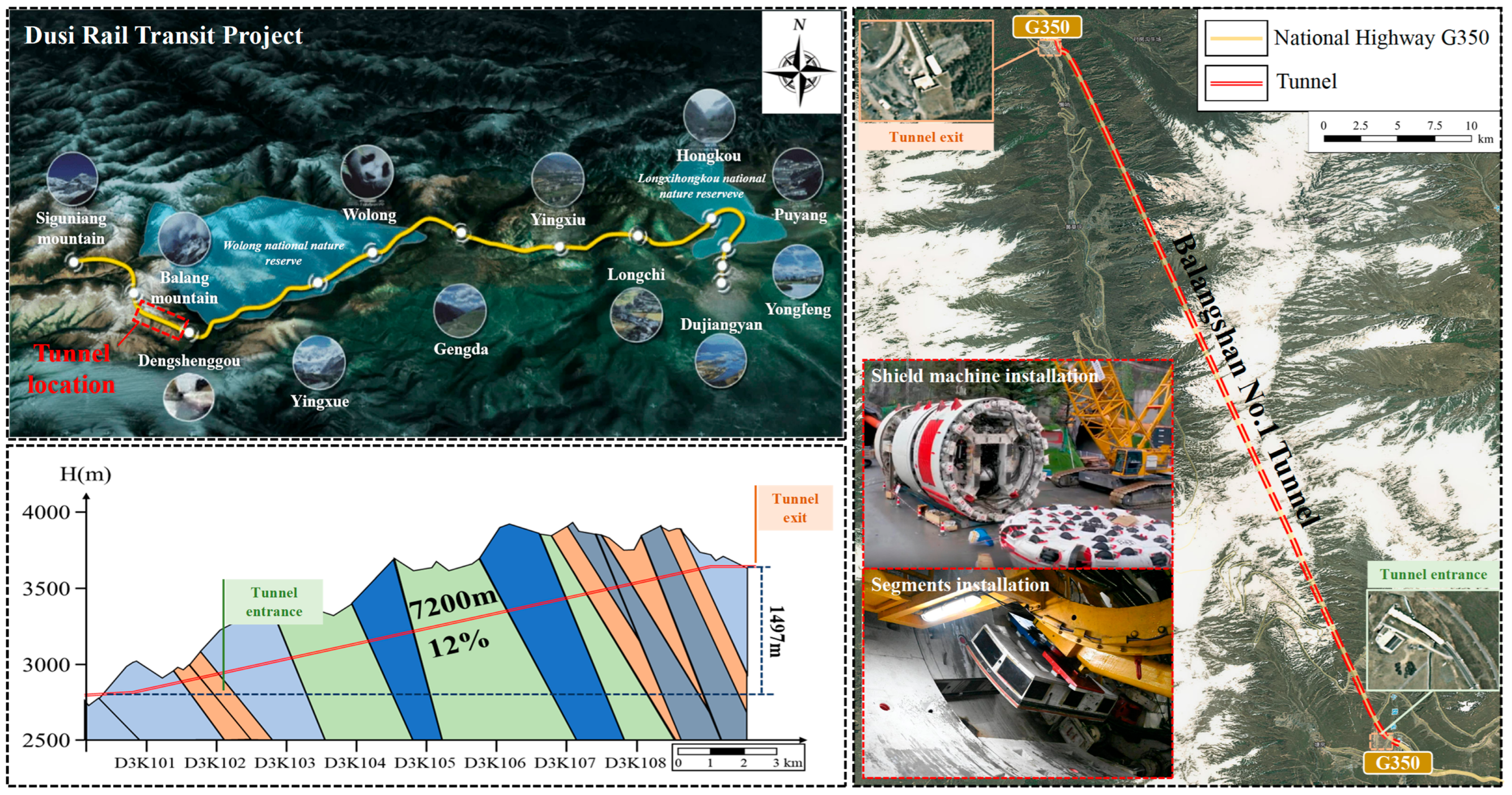
The Balangshan No. 1 Tunnel adopts a left and right track construction structure, with a total length of 7988.59 m (maximum burial depth 545 m, minimum 33 m) for the left track and 7882.273 m (maximum burial depth 545 m, minimum 20 m) for the right track. The maximum longitudinal slope of 12% is rare in China The project is located in the northern section of the Qionglai Mountains on the western Sichuan Plateau (altitude 2750–4300 m), crossing U-shaped glacial valleys and steep cliffs. The strata from top to bottom include 12 types of cover layers such as artificial fill and ice water accumulation layers, and the bedrock is sandstone slate interbedded with limestone lenses (shown in Figure 1). The bedrock in the tunnel site area is Triassic strata, and the tunnel passes through two sets of strata, T2Z (Zagunao Formation) and T3ZH (Jurassic Formation), both of which are mainly interbedded with sandstone and slate. Integrating surface structural mapping, borehole core discontinuity surveys, and geomechanical testing (including rock/rock mass P-wave velocity measurements per GB/T 50218-2014 [59]), the rock mass quality index (BQ) was determined as 307.15~352.15 for T3ZH and 201.77~256.97 for T2Z. Applying the Chinese Standard for Engineering Rock Mass Classification (GB 50218-2014), these BQ values correspond to 16.2% Class III, 68.6% Class IV, and 15.2% Class V surrounding rock, with the latter two grades dominating the composite strata section. The study section selected for this research spans from mileage D3K104 + 260 to D3K104 + 278, located in the transition zone between hard rock and soft rock. Specifically, the segment from D3K104 + 260 to D3K104 + 269 is classified as Grade III surrounding rock, while the segment from D3K104 + 269 to D3K104 + 278 is classified as Grade IV surrounding rock. The tunnel adopts a composite lining structure with an inner contour diameter of 5.5 m and a reserved deformation of 15 cm. The standard ring width of the pipe segment is 1.5 m and the thickness is 0.35 m, reflecting the technical challenges of designing tunnels in complex strata with high longitudinal slopes.
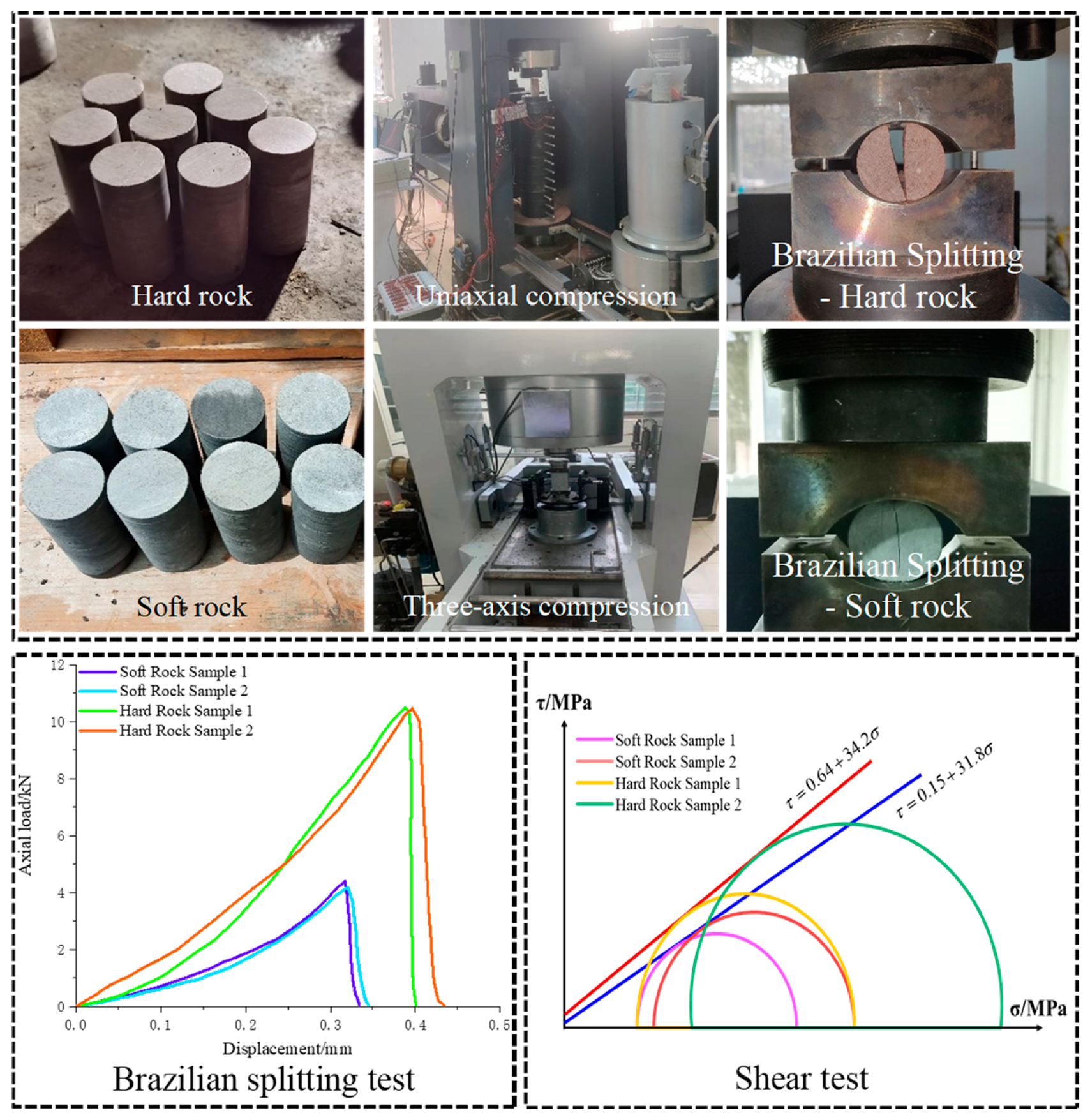
In addition, detailed measurement data of key physical and mechanical parameters of soft and hard rocks in the tunnel site area were obtained through indoor compression and shear tests on the rock samples obtained from on-site sampling, as shown in Figure 2 and Table 1, providing basic data support for the matching of mechanical properties of similar materials.

3. Physical Model Test

3.1. Composition and Proportioning of Similar Material

Firstly, the similarity relationship between surrounding rocks was derived. According to existing literature [5,43,58,60] on similar model experiments, the most suitable similarity ratio is between 20 and 50. Based on the existing equipment dimensions in the laboratory and considering various factors, combined with the actual working conditions of the Balangshan No. 1 Tunnel site, in order to make the experiment easier to operate and to improve accuracy, the geometric similarity ratio parameter CL = 30 was ultimately selected and the similarity ratio of physical quantities of surrounding rock is shown in Table 2.
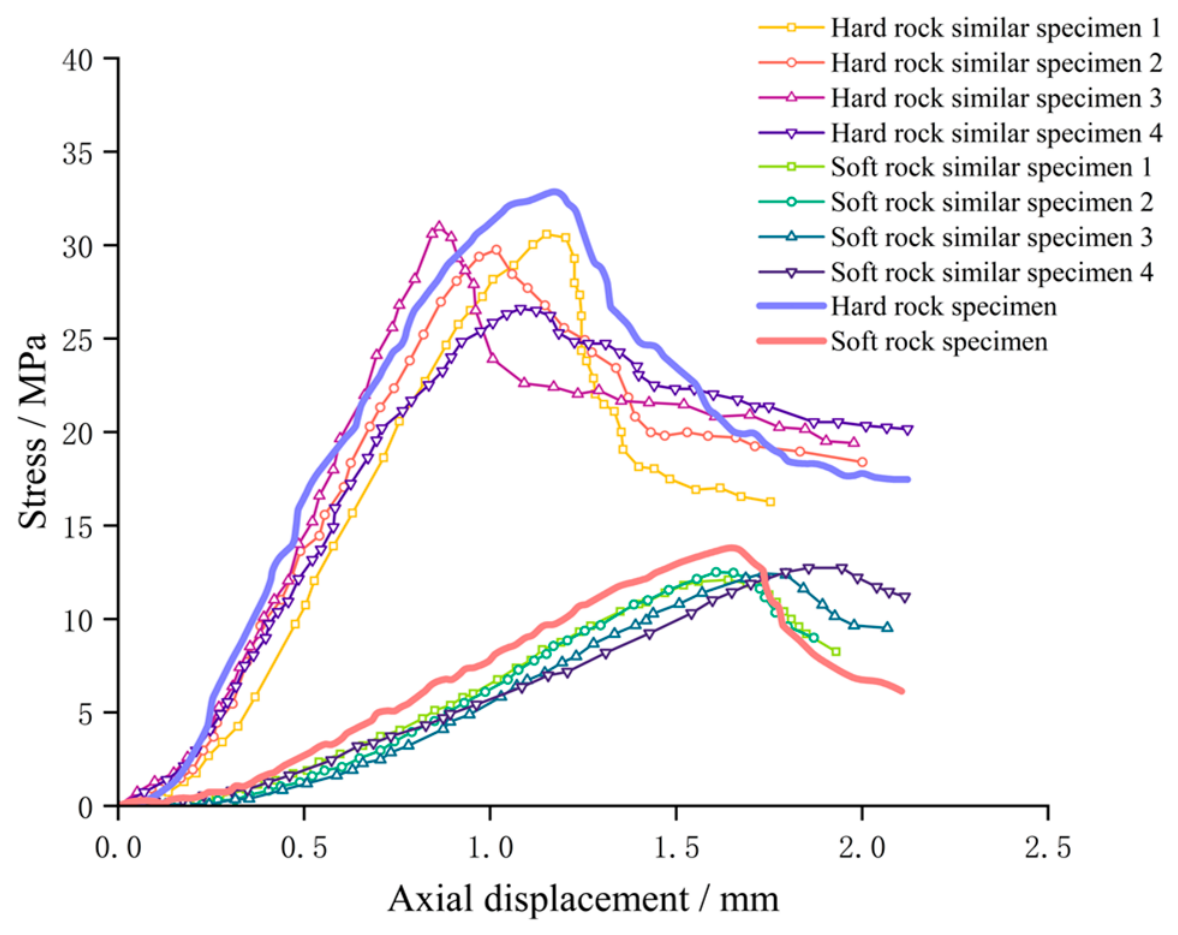
This article focuses on the proportionate design of physically similar materials for tunnel surrounding rock. Based on the similarity ratio criterion of surrounding rock mechanics parameters, barite powder quartz sand was selected as the aggregate to regulate density and elastic modulus, and gypsum Vaseline was used as a binder to regulate cohesion. Based on the characteristics of hard rock and soft rock, a range of mix proportions was screened through pre-testing to prepare differentiated mix proportion samples (Figure 3). Using elastic modulus, bulk density, internal friction angle, and cohesion as key control parameters, the mechanical response characteristics of materials with different ratios were measured using direct shear test and uniaxial compression test systems, providing an experimental basis for constructing similar materials that quantitatively match the mechanical behavior of the prototype surrounding rock.
According to different mix ratio parameters, the final mix ratio of hard rock materials was determined as follows: barite powder:quartz sand:gypsum:Vaseline:water = 5.6:1.2:0.8:0.45:0.45; the mix proportion of similar surrounding rock in soft rock was barite powder:quartz sand:gypsum:Vaseline:water = 4.8:0.6:0.8:0.38:0.45. According to the determined mix ratio, 3 samples each of similar materials for hard rock and soft rock were prepared separately, and the comparison between the experimental parameters for determining the mix ratio of soft rock and hard rock and the mean of physical parameters of similar surrounding rock material, as well as the errors at the original rock scale, are shown in Table 3.

3.2. Similar Model Test System

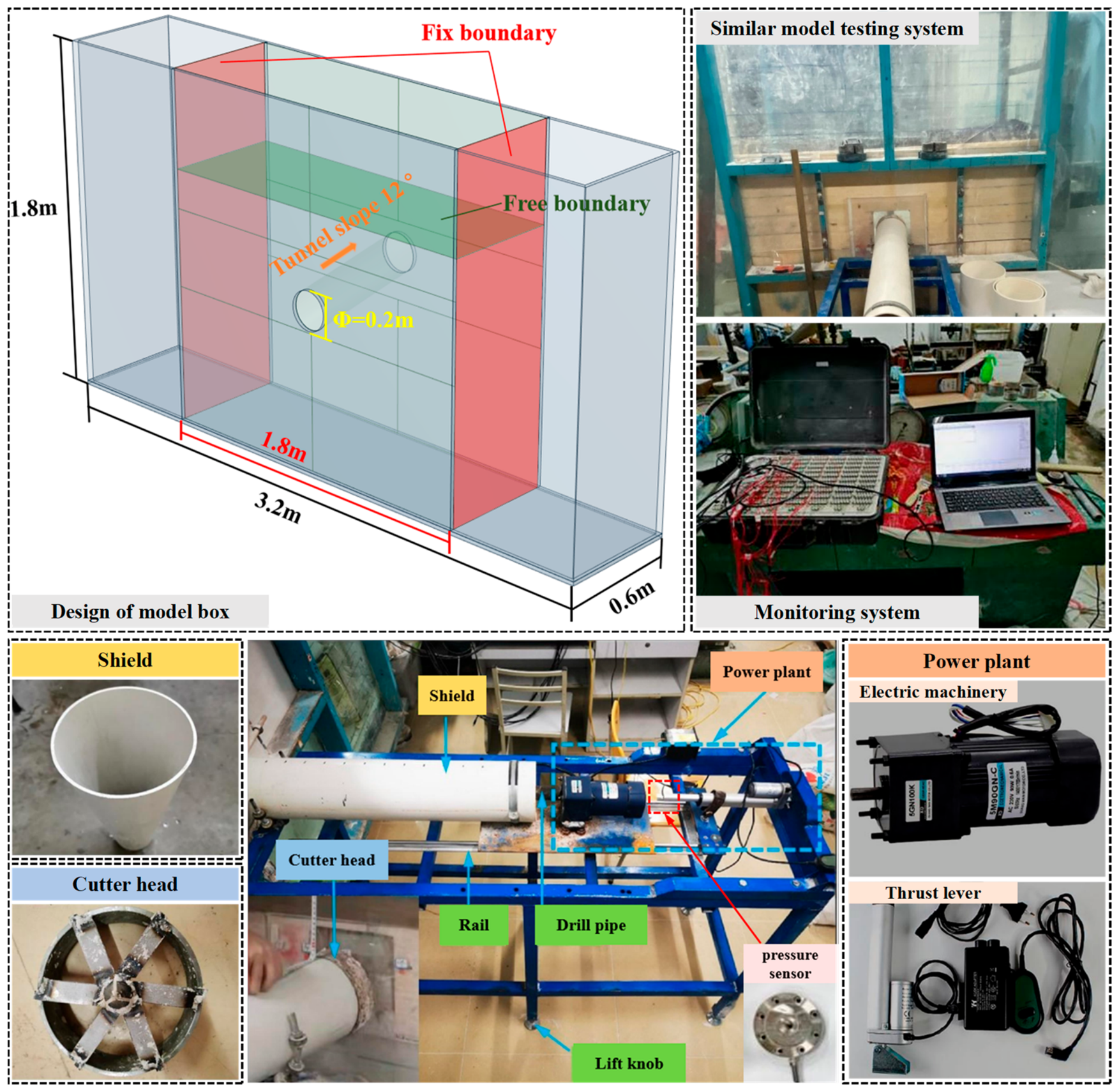
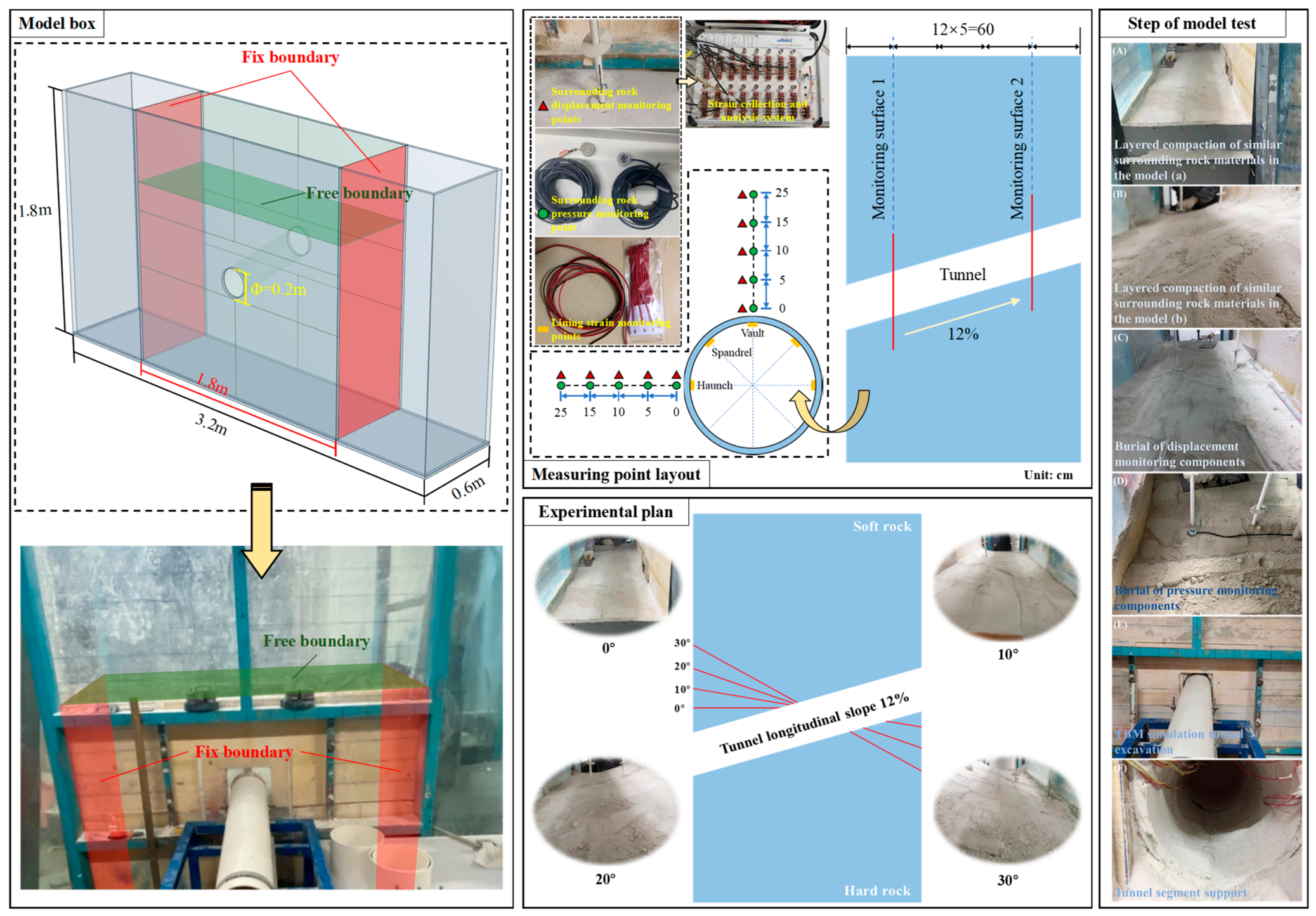
The model test box is mainly made of a high-strength channel steel structure and steel plate. According to the Saint-Venant principle, the surrounding rock within three times the diameter of the tunnel is significantly affected by tunnel excavation. When the depth of the surrounding rock is greater than three times the diameter, the surrounding rock outside the range is less disturbed and the boundary effect can be ignored. In order to meet the requirements of the similarity ratio in the above experiment, a model box with dimensions of length x width x = 1.8 m × 0.6 m × 1.8 m was selected for the experiment. To avoid test errors caused by surface friction, anti-friction devices were installed at the top and bottom of the model box, which consisted of two layers of steel plates and smooth round steel bars between the plates, with lubricants applied to the surfaces of each steel plate. The hydraulic stress loading system consisted of hydraulic jacks, hydraulic pumps, weighing sensors, multi-channel digital transmitters, reaction beams, pressure plates, and other components (Figure 4).
The construction parameters of the shield machine mainly included the opening rate of the cutter head, jacking speed, jacking force, and cutter head torque. It was difficult for these parameters to reach a similarity relationship at the same time. Among them, jacking force ( J ) was the main controlling factor, and it was calculated according to Formula (1) and Formula (2) [60]. And due to the large longitudinal slope of the tunnel, the weight of the shield part becomes the thrust resistance, making it more difficult to control the top thrust of the shield. Then, a semi-automatic excavation device called a micro-shield machine was invented.
J = K 0 γ h
K 0 = 1 s i n ( ϕ )
where J is the jacking force on the tunnel face, K 0 is the coefficient of the lateral earth pressure at rest, γ is the unit weight of rock, h is the cover depth of the tunnel’s central line, and ϕ is the internal friction angle of rock.
The main components of the micro-shield machine include the cutter head, shield, guide rail, power unit, and platform. The diameter of both the cutter head and shield is 20 cm, which is consistent with the simulated tunnel contour dimensions. It was made of steel after heat treatment and was divided into six blades with an outer diameter of 15.9 cm, and the opening rate was about 64.8%. The guide rail is equipped with dual tracks, with a length of 1.2 m. The power device includes a spin device and a push device. The spin device is connected to the cutter head through a tunneling rod, providing torque to drive the cutter head to rotate and cut rock. The rated power is 90 W, and the maximum speed is 1400 r/min. In this test, rotation rate was 10 rpm. The thrust lever was an electric telescopic thrust lever (24 V). The telescopic travel was 15 cm and the maximum thrust could be 1000 N to meet the similarity relation; telescopic speed was 12 mm/min, and thrust could be adjusted. The whole system was driven by the thrust lever, for which it was necessary to provide enough thrust. After calculation and considering the weight of the electric machinery, thrust of 912~997 N was appropriate for tunnel excavation due to the steep slope of the tunnel. Thrust was accurately controlled through pressure sensors fixed on the push device. The micro-shield machine could consider ground loss caused by rock excavation and greatly avoid the disturbance of manual excavation with respect to test results.
The micro-shield machine’s design prioritizes core parameters governing surrounding rock stability. Matched parameters include: (1) Thrust: calculated via Formulas (1) and (2) [60] considering 12% slope resistance, with an optimal range of 912~997 N to meet CL = 30; (2) cutterhead opening rate: 64.8% (consistent with prototype); (3) rotation rate: 10 rpm (within practical TBM range); (4) tunneling cycle step: scaled to 5 cm/cycle. Unmatched parameters include: (1) Torque: indirectly matched via thrust (independent scaling impractical); (2) advance rate: 12 mm/min (adjusted for test efficiency). This response integrates the micro-shield machine design logic from similar authoritative studies [60], clarifies parameter scaling rationale, and quantifies potential biases, ensuring the test design’s rigor and traceability.

3.3. Similar Model Test Plan

The experiment kept the large longitudinal slope of the tunnel unchanged at 12% under various working conditions. The upper part was soft rock and the lower part was hard rock. The route passed through many geological layers, among which it is inevitable to pass through soft and hard composite strata with different relative positions. The thickness of the overlying strata of the tunnel at different positions of the route will also change. According to geological exploration data, the range of rock dip angle variation is 0°~30°. Based on this, four working conditions were set for the composite formation with inclination angles of 0°, 10°, 20°, and 30°, aiming to study the displacement and pressure changes in the surrounding rock and the internal force changes in the lining pipe section under different working conditions.
In practical engineering, the designed width of TBM segments is 1.5 m, which means that the excavation depth per cycle is 1.5 m. According to the similarity ratio, the excavation depth for model tests is 5 cm. The total tunneling length of the tunnel is 60 cm, which can be carried out continuously in 12 stages of excavation. The experiment adopted a thrust control mode, and the total thrust applied during each excavation step was the core control parameter. The thrust value was pre-set based on the prototype ground pressure and similarity ratio calculated using Formulas (1) and (2) within the range of 912–997 N, and closed-loop feedback control was performed through pressure sensors integrated into the thrust device to ensure the similarity of stress levels in the palm face support. Secondly, the excavation process is simultaneously constrained by geometric displacement (5 cm per step). After reaching the predetermined displacement, the propulsion stopped and entered the “stress redistribution and monitoring stage”. This stage lasted for about 30 min. We determined through pre-experimental observation that during this period, the rate of change in the displacement of key points in the surrounding rock (such as arch settlement) recorded by the data acquisition system decreases to <0.01 mm/min, indicating that the deformation of the surrounding rock has basically stabilized and reliable static data collection can be carried out. After the stable period is over, manual slag removal is carried out, and then the next step of excavation begins.
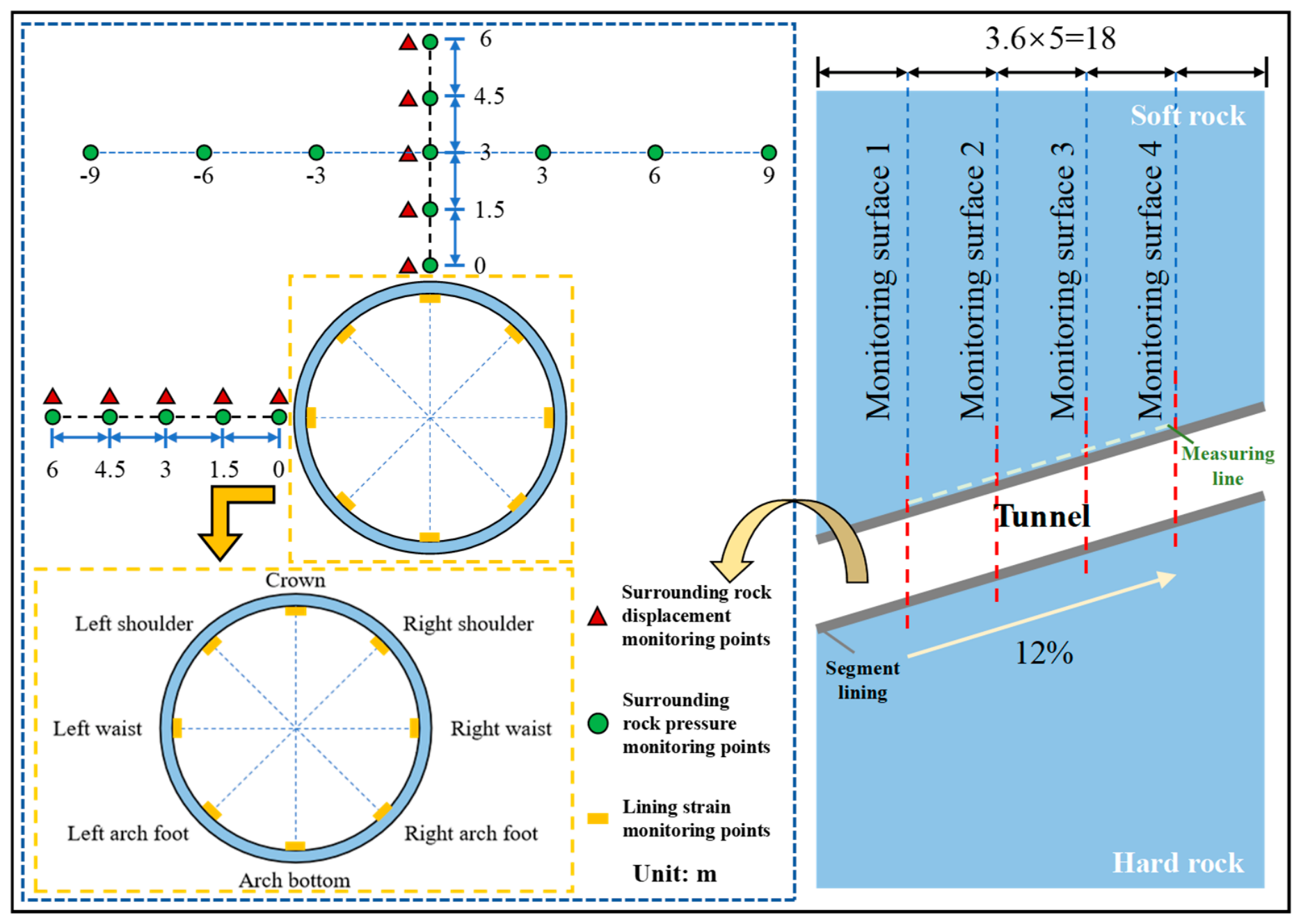
Based on the similarity ratio of the model, two cross-sections of 12 cm and 48 cm were selected as typical monitoring surfaces for hard and soft rocks. The layout of monitoring points for rock pressure, deformation, and lining strain is shown in Figure 5. The monitoring points for rock deformation were arranged at distances of 0 cm, 5 cm, 10 cm, 15 cm, and 20 cm from the outside of the tunnel arch crown and arch waist.

4. Experimental Results

4.1. Deformation of Surrounding Rock

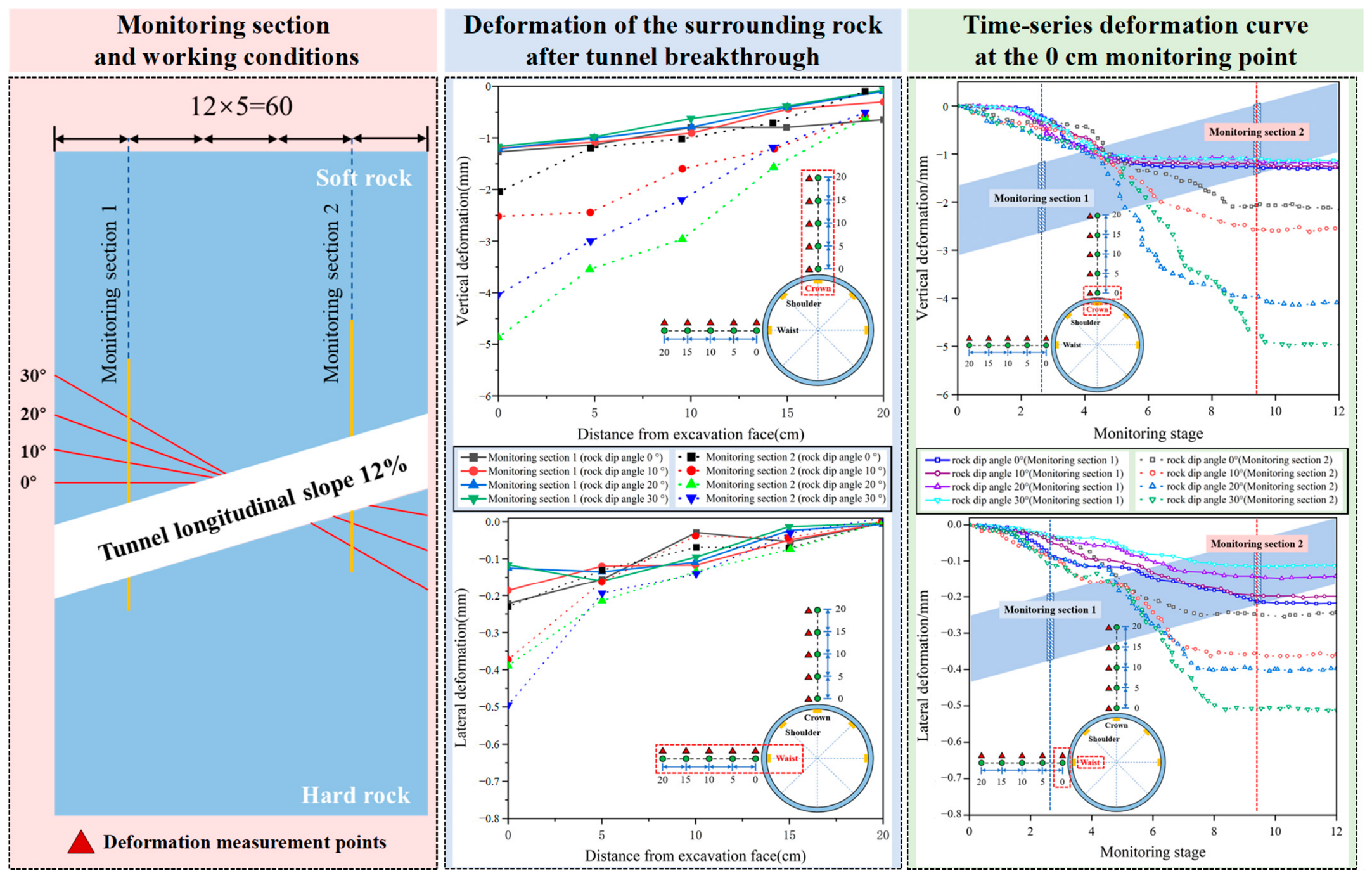
As shown in Figure 6, in the scenario where the dip angle of composite strata aligns with the tunnel center axis, this study systematically investigated the influence mechanism of rock layer dip angle variations on tunnel surrounding rock deformation through physical model tests (similarity ratio CL = 30), utilizing multipoint extensometers installed at the crown and haunch (with a model spacing of 5 cm corresponding to an actual distance of 1.5 m). The results demonstrate that the radial settlement of the surrounding rock exhibits a monotonically decreasing trend with increasing depth, yet settlement values at monitoring surface 2 are consistently higher than those at monitoring surface 1, and this discrepancy significantly widens as the rock layer dip angle increases. Specifically, at a dip angle of 0°, the tunnel’s longitudinal slope governs the deformation behavior, resulting in a shallower burial depth and smaller settlement at monitoring surface 2, whereas as the dip angle rises to 10–30°, the difference in physical and mechanical properties between soft and hard rock (where hard rock possesses strong deformation resistance and soft rock is prone to yielding) gradually becomes the dominant factor, with increased hard rock thickness at monitoring surface 1 enhancing surrounding rock stability, while increased soft rock thickness at monitoring surface 2 exacerbates deformation, thereby highlighting the critical impact of strata dip angle on tunnel excavation response.

4.2. Pressure of Surrounding Rock

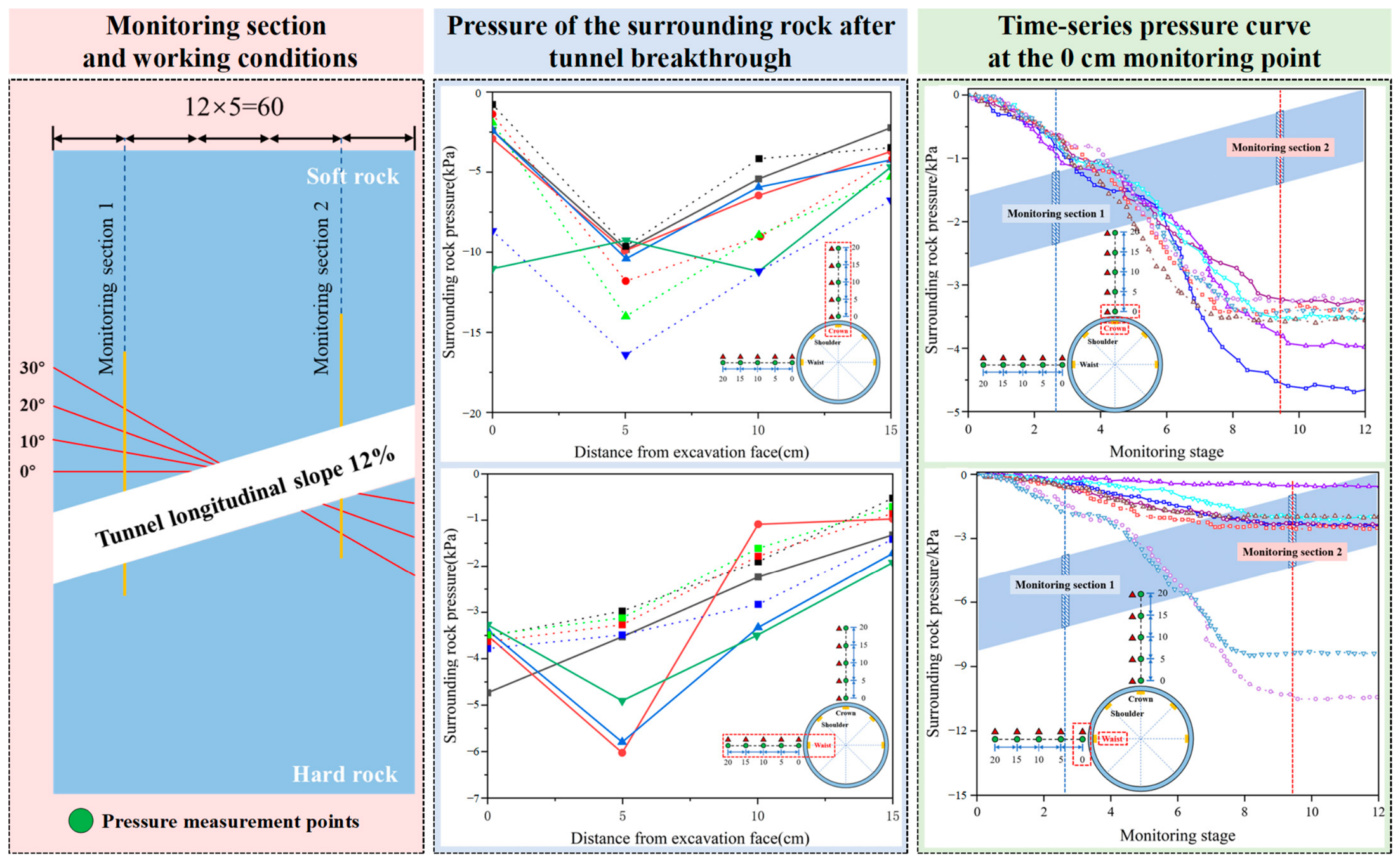
This study utilized electrical resistance earth pressure cells (similarity ratio CL = 30) and radially deployed monitoring points at the crown and haunch at distances of 12 cm (monitoring surface 1) and 48 cm (monitoring surface 2) from the tunnel portal with a spacing of 5 cm to systematically measure the depth distribution pattern of surrounding rock pressure in composite strata following TBM excavation (shown in Figure 7). The results demonstrate that the surrounding rock pressure generally exhibits a trend of first increasing and then decreasing with radial depth, with peak values predominantly concentrated within the 5 cm region from the tunnel wall, which stems from the coupling effect of surrounding rock loosening and unloading near the tunnel due to excavation disturbance and rock squeezing in the far-field region. Furthermore, pressure values at monitoring surface 2 (soft-rock dominated) are significantly higher than those at monitoring surface 1 (hard-rock dominated), and as the rock layer dip angle increases, deep pressure at monitoring surface 1 shows an increasing trend while shallow pressure decreases, whereas deep pressure at monitoring surface 2 gradually decays, highlighting the synergistic control mechanism of the differences in physical and mechanical properties between soft and hard rock and the strata dip angle on pressure distribution.

4.3. Internal Force of Supporting Structure

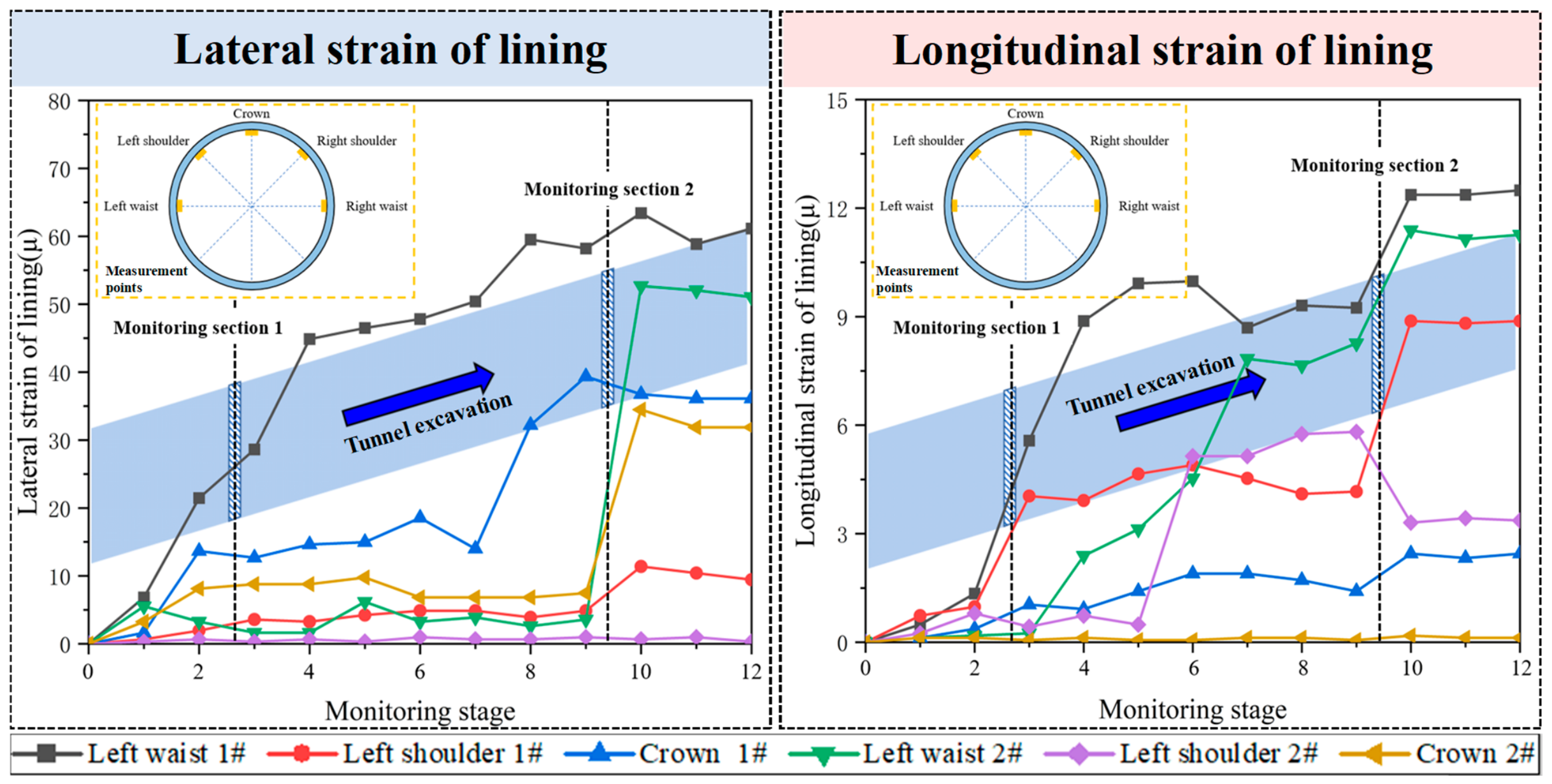
This study, based on a scaled model test (similarity ratio CL = 30), systematically monitored the full-process strain response of tunnel linings during TBM excavation by deploying strain gauges at the crown, spandrel, and haunch of the lining at distances of 12 cm (monitoring surface 1) and 48 cm (monitoring surface 2) from the tunnel portal using a quarter-bridge compensated strain acquisition system (shown in Figure 8 and Table 4). Due to experimental errors and malfunctions, some data is missing, and the missing data is represented by “/” in Table 4. The results at similar experimental scales indicate that lining strain accumulates progressively with increasing excavation distance, exhibiting significant abrupt changes as the excavation passes the monitoring surfaces, with transverse strain consistently exceeding longitudinal strain (e.g., the transverse-to-longitudinal strain ratio at the left haunch reaches 4.75:1), and the haunch showing the most prominent deformation (transverse strain magnitude: haunch > crown > spandrel). Furthermore, as the surrounding rock dip angle increases from 0° to 20°, lining stress demonstrates a nonlinear increasing trend (e.g., the longitudinal stress at the crown of monitoring surface 1 increases from 19.3 kPa to 56.6 kPa), where monitoring surface 1 (closer to the portal) experiences greater stress amplification than monitoring surface 2 due to more pronounced surrounding rock squeezing effects near the portal, thereby highlighting the synergistic control mechanism of strata dip angle and surrounding rock properties on tunnel structural safety and providing a critical mechanical basis for optimizing lining design and deformation control in longitudinal slope tunnels within composite strata.
All in all, in horizontal tunnels, gravitational stress (g) acts mainly radially, with longitudinal stress being secondary. However, the 12% longitudinal slope reorients the stress vector, decomposing it into radial (g·cosθ) and axial (g·sinθ) components—for θ = 12°, the axial component accounts for about 21% of total stress, creating a persistent longitudinal stress gradient. This gradient is amplified in composite strata: The upper soft rock deforms more than the lower hard rock, leading to a 192% increase in crown longitudinal stress (Monitoring Section 4) as dip angle rises from 0° to 20° (vs. 181% for lateral stress). Steeper slopes enhance downslope soft rock yielding, transferring more axial load to the lining.
Lateral stress is dominated by radial surrounding rock pressure, but the large slope causes asymmetric loading: upslope hard rock provides rigid support, while downslope soft rock undergoes significant plastic flow. This concentrates lateral stress at the downslope haunch—lateral stress here (33.02–50.067 kPa, Monitoring Section 1) is 2.3–5.8× higher than at the shoulder (5.718–11.505 kPa). In contrast, longitudinal stress is governed by frictional shear forces from the inclined rock self-weight, leading to more pronounced nonlinear growth with dip angle than with lateral stress.
The lining acts as a finite-length cylindrical shell: Near-portal sections (Monitoring Section 1, hard-rock dominated) have stronger end constraints, limiting longitudinal deformation and concentrating stress locally. Mid-tunnel sections (Monitoring Section 4, soft-rock dominated) have weaker constraints, allowing more uniform longitudinal stress. This constraint-dependent pattern is unique to large-slope tunnels—horizontal tunnels typically have symmetric boundaries and uniform longitudinal stress [5].

5. Numerical Simulation

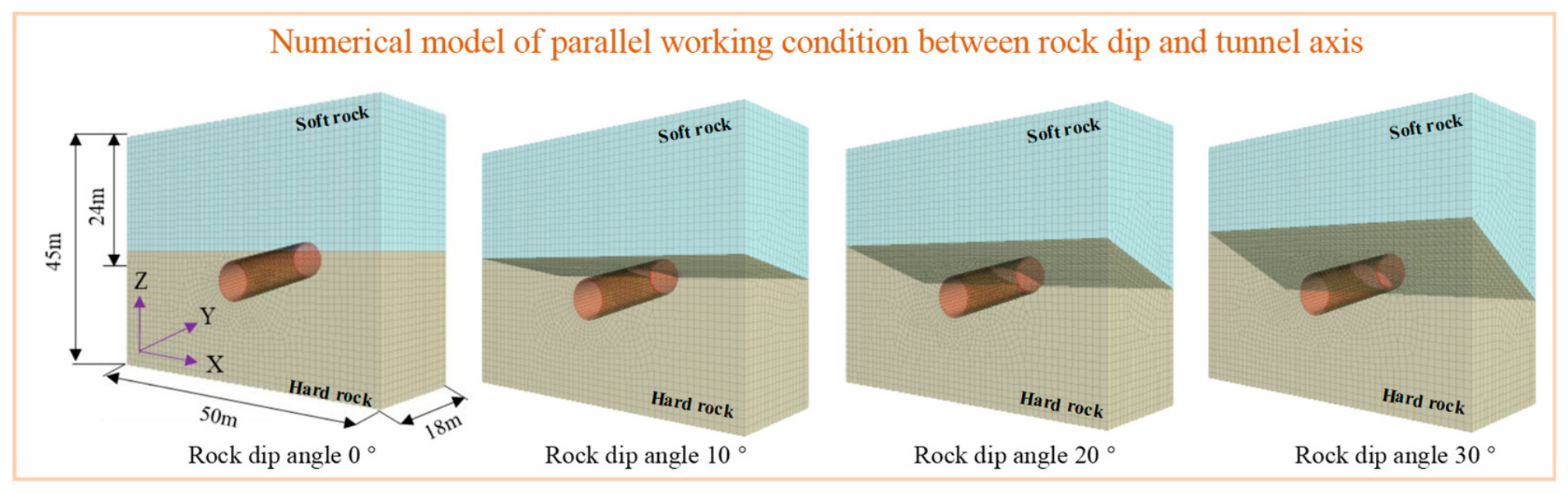
This study used FLAC3d to establish a three-dimensional numerical model of a large longitudinal slope composite strata TBM tunnel (50 m × 18 m × 45 m), with a tunnel structure with an inner diameter of 5.5 m and a lining thickness of 0.35 m. The model used hexahedral elements for element division to balance computational accuracy and efficiency. During meshing, a uniform seed spacing of 1 m was set in the length, width, and height directions. This uniform distribution strategy ensures adequate resolution in critical areas while effectively controlling the model size and computational cost. The outer boundary of the surrounding rock in the numerical model is controlled by displacement boundary conditions, with constraints perpendicular to the surrounding rock boundary. That is to say, the X-direction displacement constraint is applied to the left and right sides of the tunnel surrounding rock boundary, the Y-direction displacement constraint is applied to the front and rear working face surrounding rock of the tunnel, and the Z-direction constraint is applied to the bottom, with no constraint on the top surface, which is a free surface. The surrounding rock of the tunnel adopts the Mohr Coulomb constitutive model, which is established using the radcylinder command and endowed with solid element attributes. The M-C model is selected for three key reasons: (1) Its parameters (cohesion c and internal friction angle ϕ) are directly obtainable from indoor shear tests on on-site rock samples, ensuring physical authenticity; (2) it effectively captures the shear failure mechanism of composite strata, which is the dominant failure mode in our study; (3) it balances computational efficiency and engineering accuracy, suitable for large-scale 3D simulations of multiple working conditions. This selection is consistent with the recommendations for tunnel engineering in composite strata [61]. Based on existing research [5,62], modeling shield tunnel segments using shell elements can effectively simplify the simulation while maintaining computational accuracy. Therefore, in this study, the segment lining was established using the shell command. To facilitate tunnel excavation, the shield tunnel model is simplified. The physical and mechanical parameters of the surrounding rock and pipe segments in the numerical model are obtained through indoor experiments and tunnel geological survey reports. The focus was on analyzing two types of working conditions: parallel/vertical axis of rock dip angle (Figure 9). In the numerical simulation of tunnel excavation, to accurately represent the actual support effect of the TBM on the tunnel face and the influence of its thrust, an equivalent stress method was adopted. Based on calculation and analysis, an equivalent support pressure of 0.5 MPa was applied to the tunnel face. Based on indoor experiments and geological data, the mechanical parameters of the surrounding rock lining were set (Table 5).
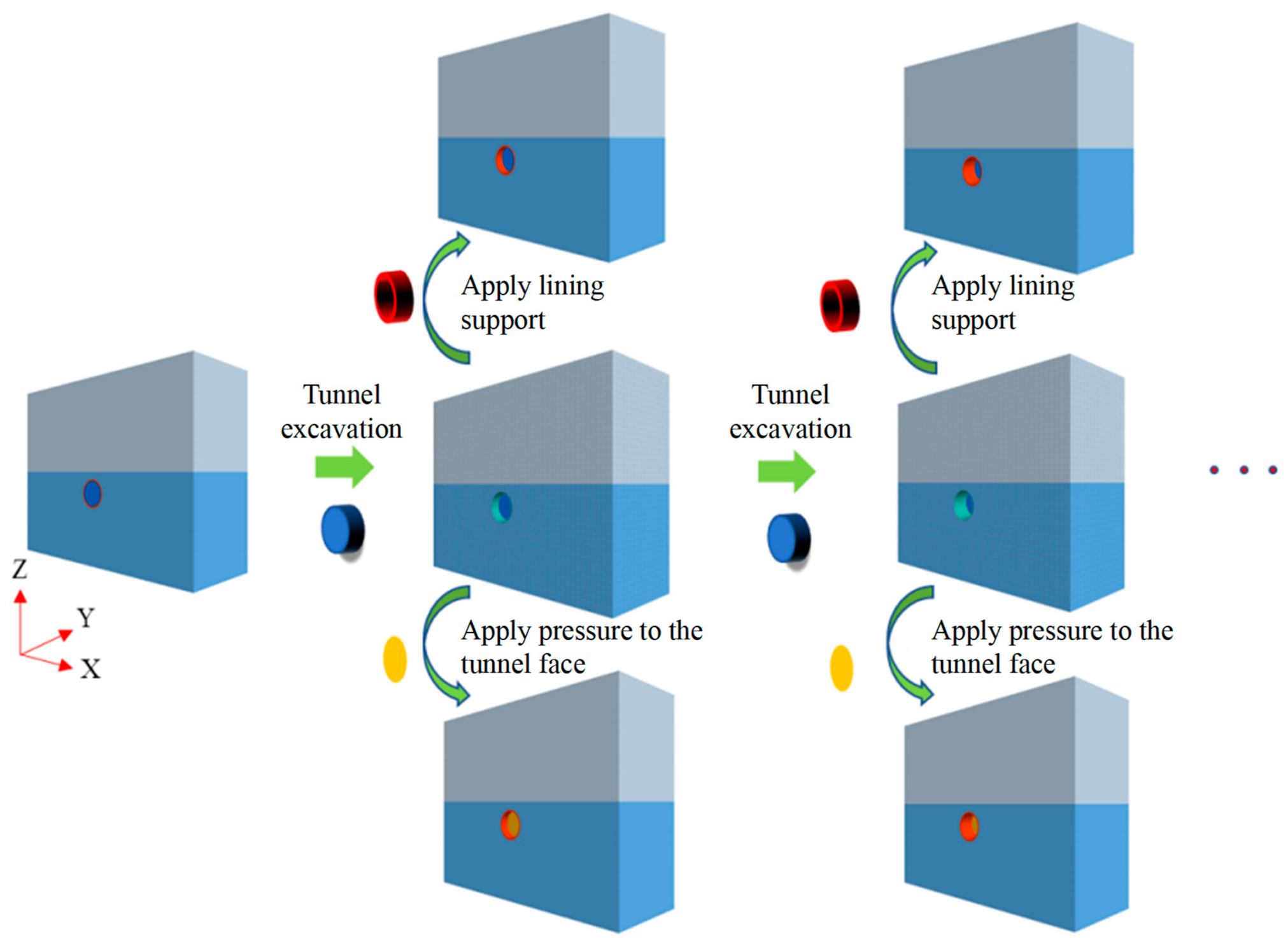
The numerical model of the tunnel excavation process is consistent with the actual working conditions, with a footage of 1.5 m per cycle and a model tunnel length of 18 m (Figure 10). Therefore, a total of 12 excavation steps are set. When using numerical simulation software for calculations, excavation of rock and rock engineering such as tunnels and foundation pits are generally implemented using “birth and death elements”. After the model is established, the self-weight stress field balance is first carried out. During the TBM tunneling process, the null command is used to remove the rock within the tunnel range and apply pipe lining. Due to the cutting and pushing effects of the rock breaking roller on the tunnel face, it is necessary to simultaneously apply stress to the front face instead of the cutter head to prevent the collapse of the front rock. Therefore, the excavation process of tunnels via TBM can be regarded as follows: the excavation of the tunnel is achieved by removing commands, then the lining structure of the pipe segments is activated to support the tunnel, and finally pressure is applied to the face of the tunnel to simulate the support of the cutter head. Repeat the above steps to achieve the overall excavation support of the tunnel.
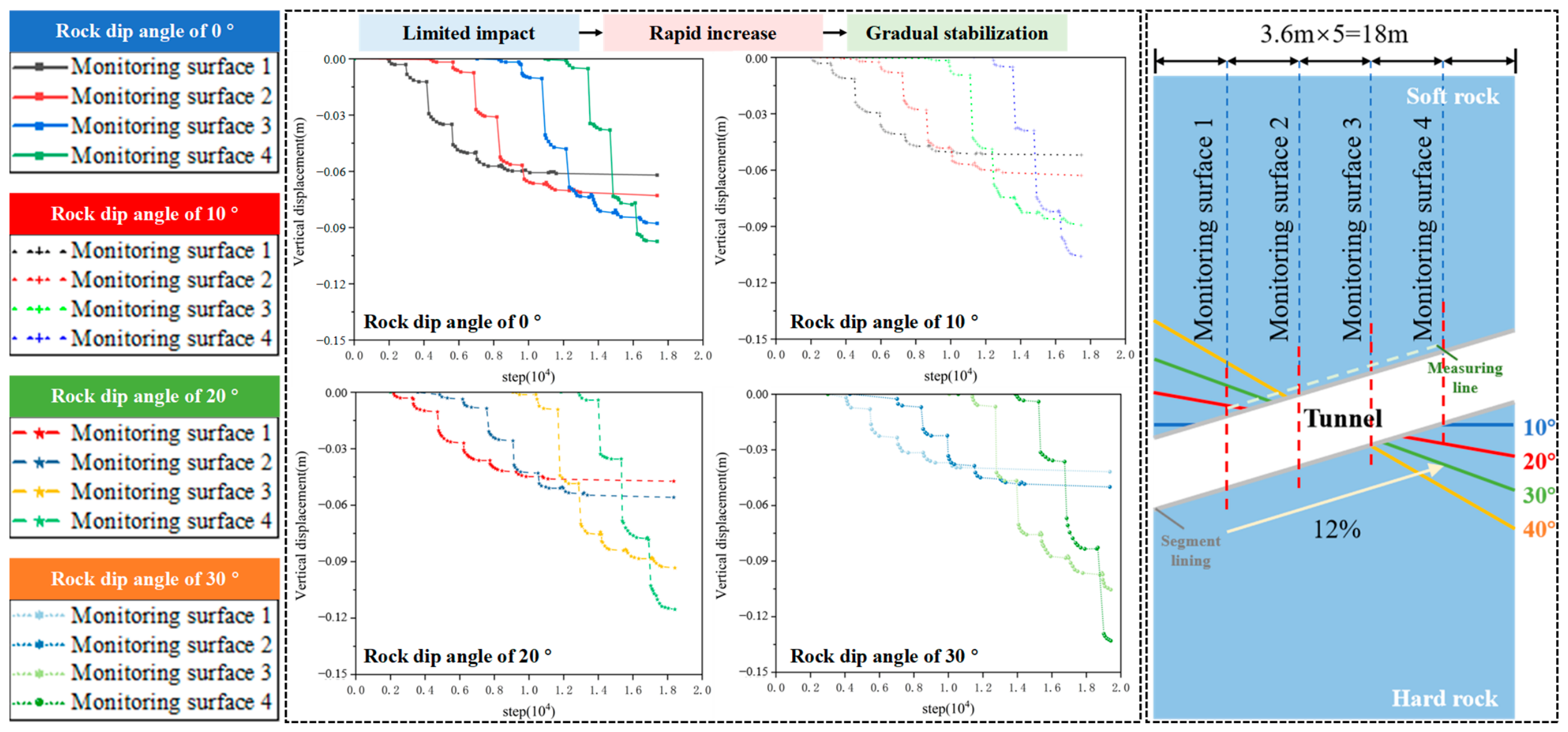
Four longitudinal monitoring surfaces were set up (3.6/7.2/10.8/14.4 m from the entrance), and monitoring surface 1 (hard rock) and monitoring surface 4 (soft rock) were selected as typical fault monitoring surfaces. Horizontal/radial monitoring points were set up for the arch crown, radial monitoring points for the arch waist, and internal stress monitoring points for the lining (Figure 11). By comparing the deformation of surrounding rock and the evolution of internal forces of lining at an inclination angle of 0–30°, the coupling mechanism of “lithology inclination angle” revealed by model experiments is verified, with a focus on analyzing the control mechanism of contact pressure spatial heterogeneity on structural response.

6. Numerical Results

6.1. Comparison Between Numerical Simulation and Model Test Results

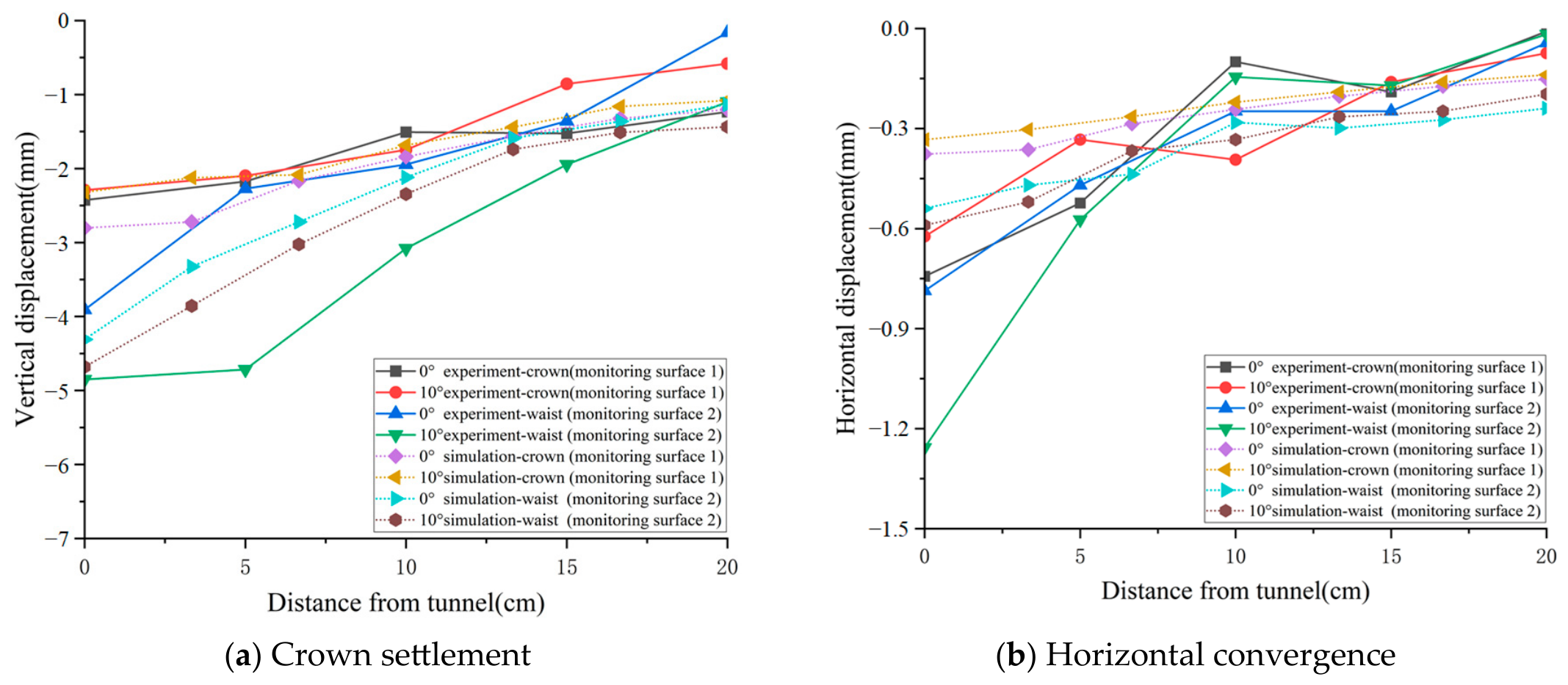
To verify the consistency between similar model test results and numerical simulation outcomes, we selected the working conditions of 0° and 10° rock stratum dip angles (to avoid data redundancy) to compare the vault and haunch displacements at the corresponding monitoring surfaces of the tunnel, using the scale of model experiments as a unified benchmark (as shown in Figure 12). From the data, the settlement monitoring values of the test are generally larger than those of the simulation, which is caused by delayed excavation support, insufficient compaction, and disturbance to the surrounding rock by the micro-shield machine; the vertical vault settlement decreases as the surrounding rock depth increases: for Monitoring Section 1, the displacement decreases with increasing dip angle due to the presence of hard rock above the vault, while for Section 2, the settlement increases with increasing dip angle as the soft rock area above and below the tunnel expands. The test results follow the same trend as the simulation but have deviations affected by external factors; the radial surrounding rock at the tunnel haunch has uniform lithology, and the displacement also decreases with depth.
R M S E = 1 n i = 1 n ( X t e s t , i X s i m , i ) 2
where X t e s t , i = test value, X s i m , i = simulation value, and n = number of groups under different operating conditions.
To quantify the difference between model experiments and numerical simulation results, Root Mean Square Error (RMSE) is selected as the evaluation metric. This metric can effectively reflect the overall bias level and is more sensitive to larger errors. The calculation formula for RMSE is shown in Equation (3) below. The calculation results indicate that the RMSE of surrounding rock displacement is generally at a low level. Among them, the maximum RMSE of arch crown settlement is 0.26 mm, which occurs under the working condition of a rock dip angle of 10° and a measuring point 15 cm away from the tunnel wall, on monitoring surface 2. The maximum RMSE value of the horizontal displacement of the arch waist is 0.21 mm, which occurs under the working condition of a rock dip angle of 10° and a measuring point distance of 10 cm from the tunnel wall, on monitoring surface 2.
It can be seen that although the test monitoring data fluctuates significantly due to the high difficulty of installing dial indicators at the haunch, the overall trend is consistent with the simulation, and the results of the two methods are basically consistent.
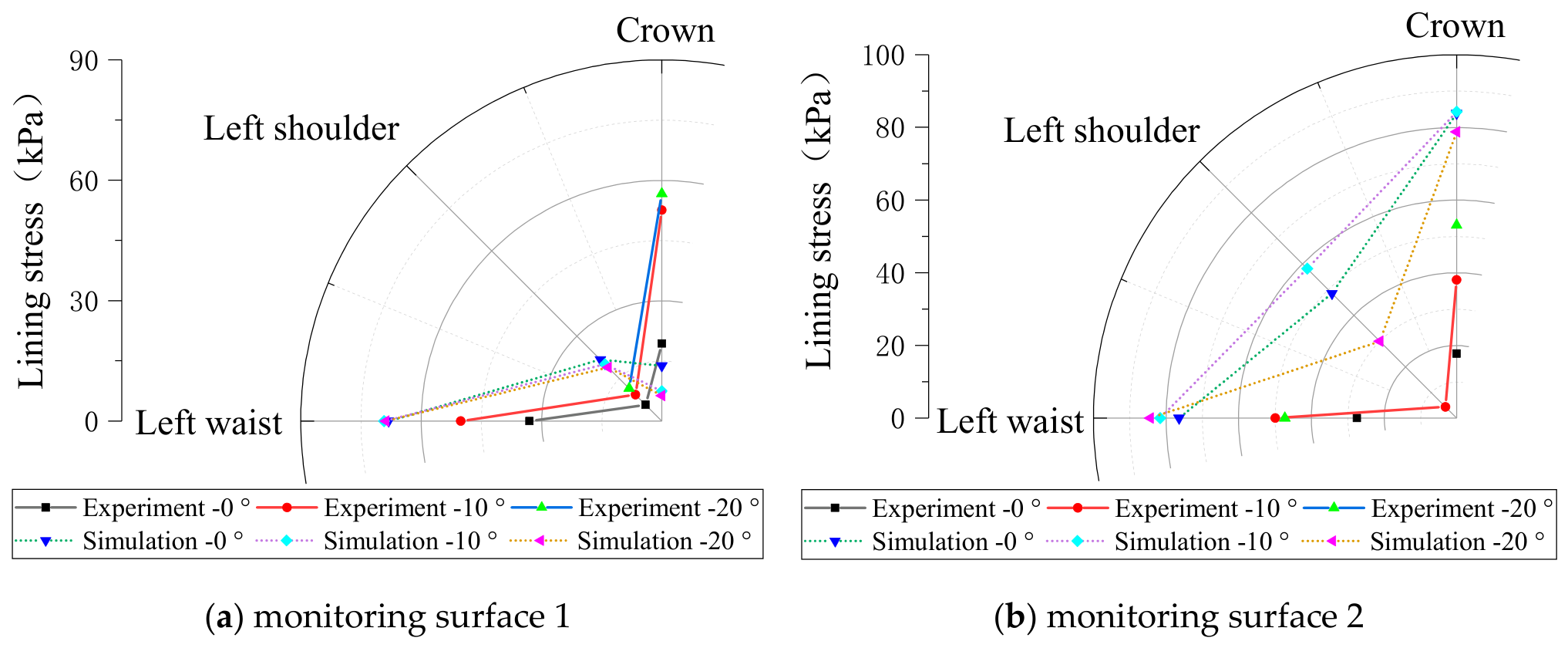
Similarly, the RMSE calculation results of lining stress are also in a lower range. Among them, the maximum RMSE of the lining stress in Monitoring Section 1 (hard rock section) is 3.32 kPa, and the maximum RMSE of Monitoring Section 4 (soft rock section) is 5.01 kPa; both occur under the condition of a rock dip angle of 30°. Despite limitations in the experimental setup (including instrumented locations and some missing data) and the general tendency of measured stresses to be slightly lower than simulated values, the physical tests and numerical simulations show strong agreement in the fundamental patterns of lining stress distribution (shown in Figure 13). Both approaches consistently demonstrate that stress follows the spatial order of “waist > crown > shoulder” and increases with the rock layer dip angle. This consistency validates the reliability of the numerical simulation method and supports its application in further parametric studies.
Based on the physical model similarity ratio (CL = 30), the experiment results have been converted to prototype scale: The maximum vault settlement is 14.67 cm (4.89 mm × 30 = 146.7 mm), which remains below the designed 15 cm reserved deformation limit, indicating that the current support system can adequately accommodate deformation in key control zones such as the arch waist and crown. Although complete field monitoring data from the completed Balangshan No. 1 Tunnel are not yet available for direct validation, the prototype-scale results have been cross-verified with numerical simulations, confirming their reliability. Future work will involve collecting actual tunneling monitoring data to further validate these control zones and optimize support design parameters, thereby enhancing the practical applicability of the findings.

6.2. Displacement Distributed Longitudinally Along the Tunnel

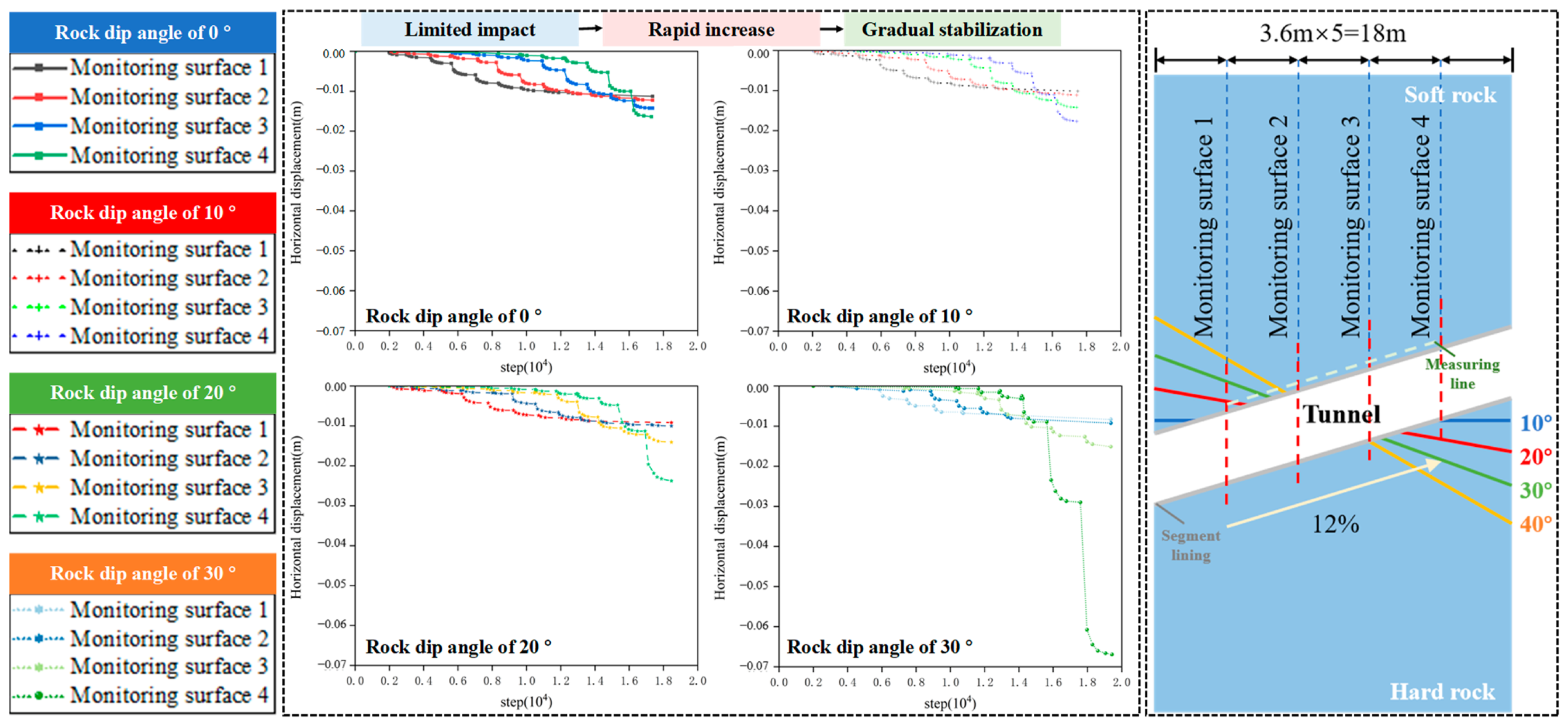
This study is based on displacement data from four monitoring surfaces ranging from monitoring surface 1 to monitoring surface 4 (Figure 14 and Figure 15). The monitoring results of the crown shown in Figure 14 revealing the deformation law of surrounding rock under parallel axis conditions in composite strata: The crown settlement exhibits a distinct spatiotemporal evolution during excavation. Approximately 78% of the total settlement occurs within a 4.5 m zone (equivalent to six excavation steps) ahead of the monitoring surface, accompanied by a pronounced near-field displacement gradient—each 1 m closer to the monitoring surface results in a 23% increase in settlement. Furthermore, the longitudinal slope induces cumulative displacement along the tunnel axis, leading to a 42% greater final settlement at monitoring surface 4 compared to Section 1, which reflects the superimposed deformation mechanism in downstream surrounding rock. Additionally, varying the rock dip angle produces a differentiated response: At a 30° dip, settlement decreases by 15% at Section 1 and Section 2 (hard rock zones) but increases by 22% at Section 3 and Section 4 (soft rock zones). This confirms that displacement distribution is jointly controlled by rock dip angle and spatial position, providing a dual-factor model that incorporates rock geometry for predicting deformation in large longitudinal slope tunnels.
Based on the monitoring data analysis shown in Figure 15, this study shows that the lateral displacement of the arch waist follows a spatiotemporal evolution similar to that of the crown settlement, but its zone of influence extends further—covering up to nine excavation steps, which is 50% wider than that of the crown. Furthermore, as the rock layer dip angle increases, the lateral displacement response across monitoring surfaces 1–4 exhibits clear gradient differentiation. While the displacement increments for surfaces 1–3 remain within 12%, surface 4 shows a sharp increase of 38% at a dip angle of 30°, forming a pronounced displacement gradient zone. This pattern indicates that the boundary zone between soft and hard rock (monitoring surface 4) is mechanically sensitive to changes in inclination, and its abrupt displacement shift is closely associated with the stiffness contrast across the rock interface. These findings provide a basis for identifying key control zones in the support design of tunnels within composite strata.

6.3. Displacement Distributed Radially Along the Tunnel

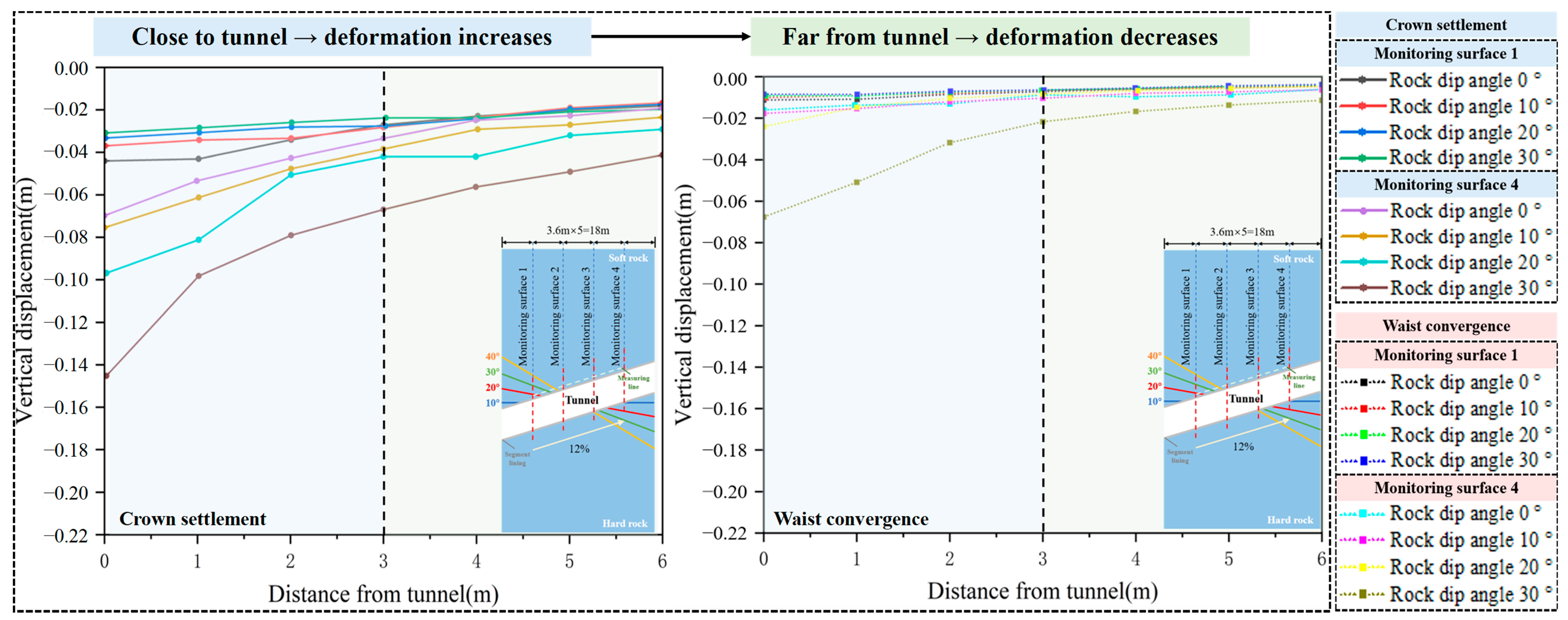
Grounded in tunnel engineering practice within composite strata, this study selected monitoring surface 1 (hard-rock-dominated zone) and monitoring surface 4 (soft-rock-dominated zone) as representative cross-sections to systematically investigate the depth evolution patterns of radial surrounding rock displacement at the crown and haunch under varying rock layer dip angles (shown in Figure 16). The results demonstrate that while surrounding rock displacement exhibits a monotonically decreasing trend with increasing depth, the influence mechanism of dip angle significantly diverges. In monitoring surface 1, displacement decreases with increasing dip angle with a stable disturbance range (dip angle effects weaken beyond 4 m), highlighting the dominant role of hard rock’s deformation resistance. Conversely, in monitoring surface 4, displacement shows nonlinear growth with increasing dip angle (particularly within the 20–30° range) with continuously expanding influence extent, reaching a maximum crown settlement of 0.13 m, attributed to intensified stress redistribution caused by the coupling of soft rock’s deteriorated physical and mechanical properties with dip angle. Simultaneously, crown settlement values consistently exceed horizontal displacement at the haunch, revealing spatial heterogeneity in surrounding rock deformation along the tunnel longitudinal axis.

6.4. Displacement Distributed Laterally Along the Tunnel

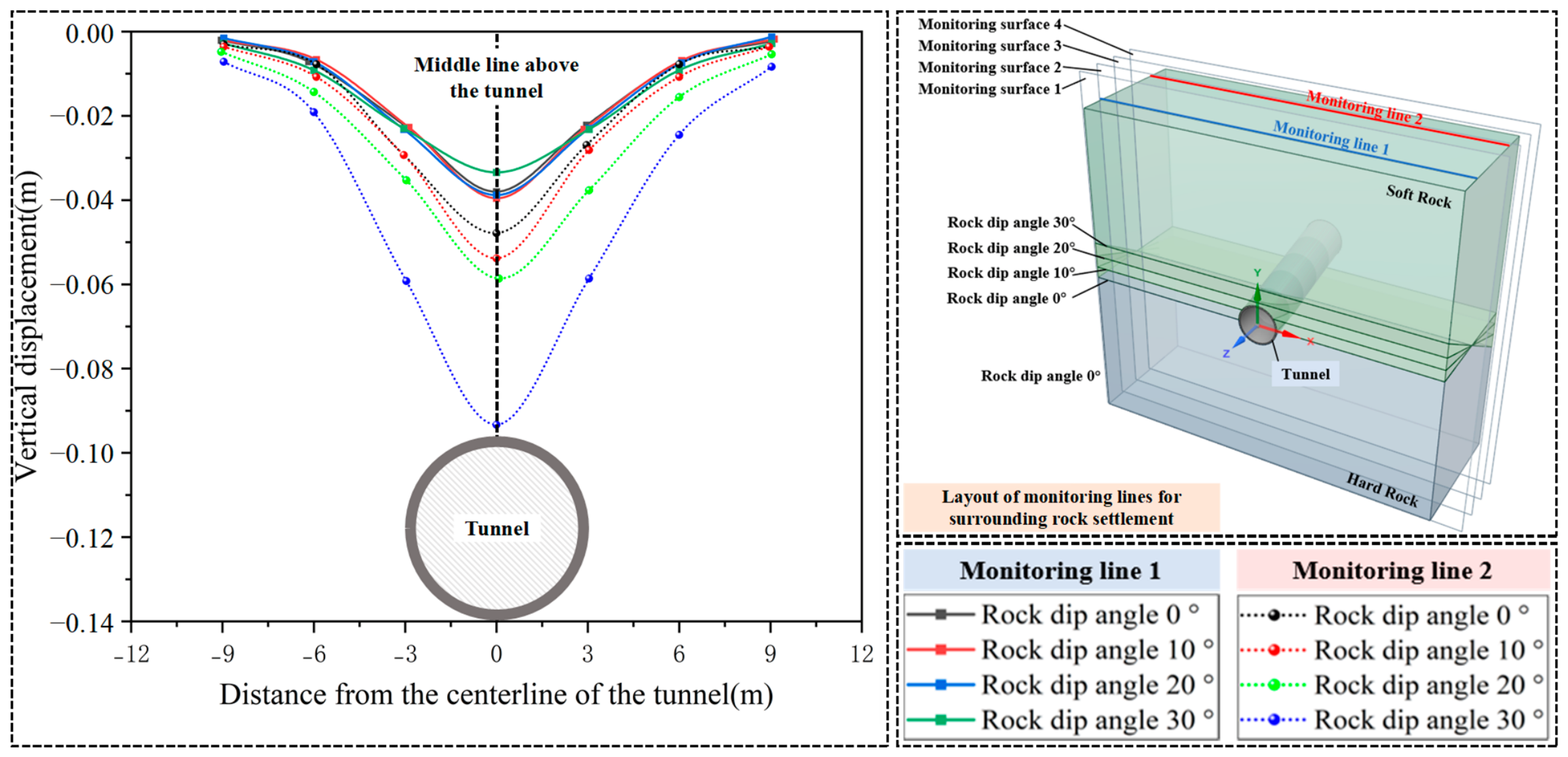
To study the distribution law of lateral surrounding rock settlement above different monitoring surfaces and its variation with rock dip angle, relevant data on monitoring surfaces 1 and 4 were extracted based on numerical simulation results (shown in Figure 17). The results demonstrate that settlement follows a symmetrical “V”-shaped attenuation pattern along the tunnel centerline, yet the influence of dip angle exhibits significant divergence between the hard-rock-dominated zone (monitoring surface 1) and soft-rock-dominated zone (monitoring surface 4). In monitoring surface 1, settlement remains virtually unchanged with increasing dip angle within the 0–20° range (curves nearly overlapping), with only a marginal 0.053 m reduction in near-field settlement (within 3 m) observed when the dip angle reaches 30°. Conversely, in monitoring surface 4, settlement shows nonlinear growth with increasing dip angle (maximum centerline settlement increases from −0.481 m to −0.930 m with progressively expanding increments), accompanied by widening of the settlement trough and extension of the disturbance zone beyond 9 m, thereby highlighting the synergistic effect of soft rock’s deteriorated mechanical properties and high-dip-angle-induced stress redistribution.

6.5. Mechanical Response of Surrounding Rock

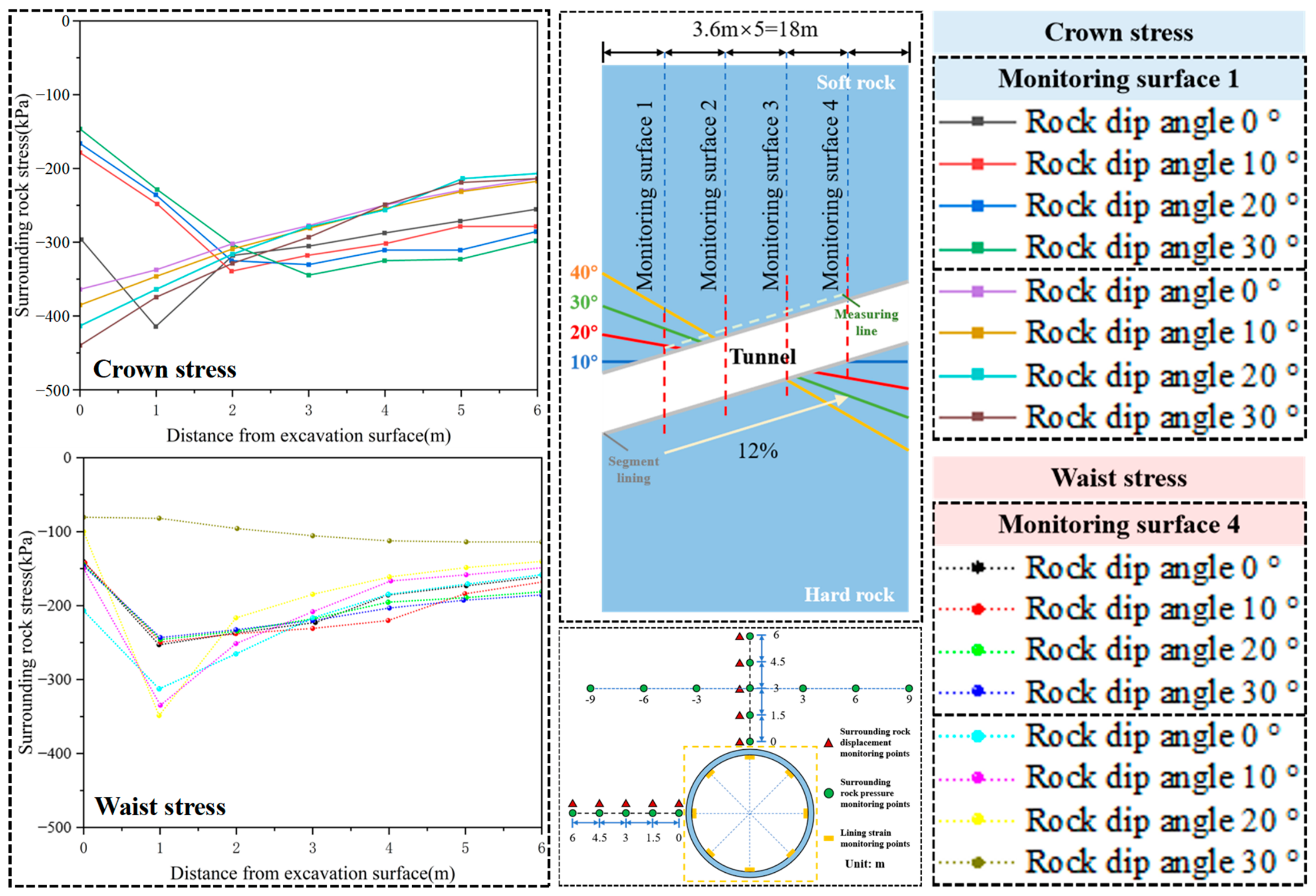
This study is based on the rock stress data of monitoring surfaces 1 (hard rock area) and 4 (soft rock area) (Figure 18), which show that in the hard rock zone, the vertical stress above the tunnel crown initially increases to a peak before decreasing with depth, with the maximum stress occurring approximately 1 m from the tunnel wall. At a dip angle of 30°, this peak stress increases by 22% compared to the 0° condition, and its location shifts deeper as the inclination rises. In contrast, stress in the soft rock zone generally decreases with depth but exhibits a noticeable stress reversal near a critical depth of 3–4 m; overall stress levels in this zone are about 15% higher than those in the hard rock area. The stress response at the arch waist further demonstrates the coupling effect of lithology and dip angle: Stress in the hard rock zone increases monotonically with dip angle, whereas the soft rock zone shows a distinct inflection point at about 1 m in depth, accompanied by greater stress variability. This comparison indicates that stress evolution in hard rock is governed primarily by structural stiffness, displaying stable gradient behavior, while in soft rock, plastic flow leads to stress redistribution at critical depths. These findings confirm that rock stress paths are differentially controlled by the combined influence of lithological contrast and dip angle.

6.6. Mechanical Response of Lining Structure

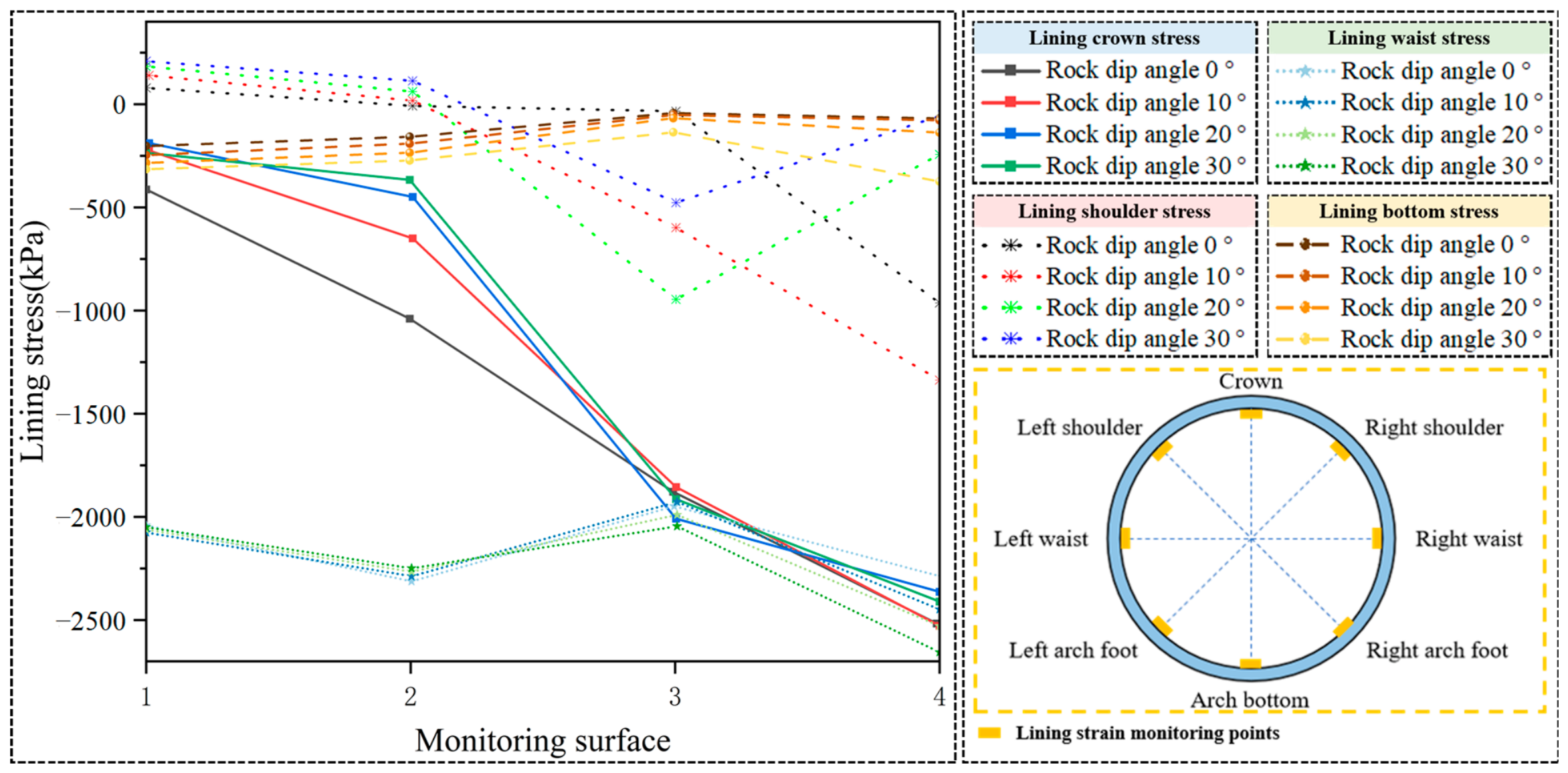
Based on numerical simulation results (shown in Figure 19), this study systematically investigated the spatial distribution characteristics of tunnel lining stress along the axial direction in composite strata and its response mechanism to rock layer dip angles. Since the rock layer dip direction aligns with the tunnel center axis, the deformation and stress of the surrounding rock and lining induced by TBM excavation are symmetrical about the tunnel centerline, thus only one side of the centerline needs to be analyzed in data processing. By deploying monitoring surfaces 1 to 4 along the tunnel axis (covering the transition zone from hard rock to soft rock), the stress evolution patterns at the crown, spandrel, haunch, and invert were quantitatively analyzed. The results demonstrate that lining stress exhibits significant spatial heterogeneity and dip angle dependency: The haunch bears the highest stress, more sensitive than the crown, spandrel (with stress ranging from 500 to 1800 kPa), and invert, where crown stress generally increases along the axis but dip angle effects weaken in the near-portal zone (monitoring surface 1) with stress remaining stable at 0–20°. In the soft-rock-dominated zone (monitoring surface 4), haunch stress shows nonlinear growth with increasing dip angle, spandrel stress exhibits axial increase at low dip angles and first increases then decreases at high dip angles, whereas invert stress displays monotonic increase, confirming that the haunch and crown are examples of a critical control zone—a mechanism originating from the lithology-dip angle coupling effect that drives lining stress redistribution by regulating the contact pressure distribution of the surrounding rock.

7. Discussion and Conclusion

7.1. Comparative Analysis of the Literature

(1) Comparison with Slope Tunnel Studies (Homogeneous Media)
Liu et al. [57] analyzed a 10% slope tunnel in homogeneous sandstone using centrifuge testing. Their data show a 15.3% increase in crown settlement per 5° slope increment. Our model reveals a steeper trend (22.1% per 5°) for composite strata, confirming that lithological contrast amplifies slope sensitivity by 44%. Crucially, both studies identify the arch waist as the maximum displacement zone under slopes >8%, validating this as a universal slope-tunnel response pattern.
(2) Comparison with Composite Strata Studies (Level Tunnels)
Yang et al. [5] have confirmed that alternating soft and hard strata can lead to inconsistent deformation and anisotropic failure modes of surrounding rocks. This study is highly consistent with this consensus and further clarifies that under large longitudinal slope conditions, the dominant deformation of soft rock (upper part) is significantly amplified, becoming a key factor controlling overall displacement and lining stress. At the same time, the peak rock pressure found in this study occurs at a certain distance from the tunnel wall (5 cm at the model scale), which is consistent with the description of the relevant mechanism of stress transfer and “arch effect” caused by stiffness differences in composite strata.

7.2. Conclusions

This study focuses on the mechanical properties of TBM tunneling in composite strata with large longitudinal slopes and systematically reveals these properties by analyzing the mechanical response laws of surrounding rock and lining through physical similarity simulation and numerical simulation (FLAC3D). The research results clarified that the arch waist and arch crown constitute key support control zones, with significant stress concentration and significant control via the dip angle and lithology differences of the strata. This conclusion provides a quantitative basis for the dynamic support design of large longitudinal slope tunnels, supporting the adoption of local reinforcement support in soft rock areas and high inclination sections to achieve more accurate force control and engineering safety improvement. The mechanical response of the surrounding rock–lining system is the concrete manifestation of the system’s mechanical properties, and the main quantitative findings are as follows:
(1) The radial displacement of the surrounding rock decreases monotonically with depth, with crown settlement significantly exceeding haunch horizontal displacement (crown-to-haunch displacement ratio ranging from 1.2 to 12.4), highlighting spatial heterogeneity in deformation along the tunnel longitudinal axis. Surrounding rock pressure generally exhibits an initial increase followed by a decrease with depth, peaking within 5 cm from the tunnel wall (model scale), attributed to the coupling effect of excavation-induced surrounding rock loosening and unloading near the tunnel and far-field rock squeezing. Lining stress demonstrates nonlinear growth with increasing rock layer dip angle (a 27% increase at 30° dip angle compared to 0°), with minimal stress difference between soft and hard rock layers, yet consistently following a spatial distribution order of arch waist > arch crown > arch shoulder, where the haunch serves as the critical zone for stress concentration.
(2) Comparative analysis between FLAC 3D numerical models (covering 0–30° dip angle scenarios) and physical test data shows that experimental surrounding rock deformation values are slightly higher than simulation results, while lining stress values are lower. However, both exhibit high consistency in deformation-depth profiles, stress–dip angle evolution trends, and spatial distribution patterns. This consistency validates model reliability, confirming that numerical methods can effectively replicate the mechanical response mechanisms of TBM excavation in composite strata, thereby providing theoretical support for engineering predictions.
(3) Rock layer dip angle exhibits significantly higher sensitivity on waist displacement than crown displacement (haunch displacement increases by 128% at 30° dip angle compared to 0°, while crown displacement increases by less than 20%). Displacement values in the soft rock zone (monitoring surface 4) are 228% higher than in the hard rock zone (monitoring surface 1), and the disturbance range expands with increasing dip angle. Surrounding rock stress depth distribution shows lithological differentiation: Stress in the hard rock zone first increases and then decreases (peak at 5 cm from tunnel wall), while in the soft rock zone it decreases monotonically. Dip angle has minimal impact on crown stress but significantly drives haunch stress. The spatial ordering of lining stress is waist > crown > spandrel > shoulder > bottom, clearly identifying the waist and crown as the core control zones for structural safety.

7.3. Limitations and Prospects

While this study, integrating physical modeling and numerical simulation, has elucidated key mechanical behaviors of TBM tunneling in composite strata with large longitudinal slopes, certain limitations should be acknowledged to guide future work:
(1) Simplifications in Physical Modeling and Material Similitude: The simulant materials, though matching key mechanical parameters, cannot fully replicate the jointed, fractured, and anisotropic nature of in situ rock masses. Furthermore, while the thrust of the micro-TBM was scaled as the dominant parameter, dynamic operational factors such as cutterhead rotation speed and torque were not strictly scaled, which may introduce bias in simulating transient excavation disturbances.
(2) Assumptions in Numerical Modeling: The numerical analysis, based on continuum mechanics and the Mohr–Coulomb criterion, is suitable for macro-response prediction but has limited capability in capturing potential progressive de-bonding or slip at the composite interface. Additionally, the perfect bond assumed at the lining–rock interface may not fully represent potential voids or non-uniform contact conditions in practice.
(3) Scope of Investigated Conditions: This work focused on a specific set of rock dip angles (0–30°) and a fixed longitudinal slope (12%). However, real-world scenarios may involve steeper dips, more complex multi-layered strata, or dynamic seepage fields. The mechanical responses under these extreme or coupled conditions warrant further investigation.
Building upon these limitations, the following directions are proposed for future research:
(1) Advanced Multi-Field Coupled Simulation: Develop refined numerical models that integrate seepage–stress coupling and damage evolution at lithological interfaces, validated against field monitoring data.
(2) Extended Parametric Studies: Systematically investigate the influence of a wider range of longitudinal slopes, rock dip angles, and thickness ratios of soft-to-hard rock on tunnel stability to formulate more comprehensive design guidelines.
(3) Intelligent Prediction Methods: Leverage data from this and future studies to build machine learning models for the rapid and intelligent prediction of tunnel deformation and support requirements under varying geological and construction conditions.

Author Contributions

J.L. (Jinke Li): writing–original draft, writing–review and editing, and conceptualization; J.L. (Jinxing Lai): data curation and validation; J.L. (Jigang Li): data curation and validation; Z.Z.: supervision, validation and data curation; X.S.: investigation and supervision; W.Z.: investigation and supervision; T.L.: investigation and supervision; S.Y.: writing–review and editing and supervision. All authors have read and agreed to the published version of the manuscript.

Funding

This work was jointly supported by the Key R&D Program of Ningxia Hui Autonomous Region (2026BEG02054), National Natural Science Foundation of China (No. 52278393, 52078421), General Project of the Natural Science Basic Research Program of Shaanxi Province (Youth Project) (2024JC-YBQN-0519), and the Natural Science Basic Research Program of Shaanxi Province (2023-JC-QN-0381).

Data Availability Statement

The data used to support the findings of this study are available from the corresponding author upon request.

Conflicts of Interest

Author Jigang Li was employed by the company China Communications First Highway Survey and Design Institute Co., Ltd. Author Tong Liu was employed by the company Xi’an Geotun Engineering Technology Co., Ltd. Author Shengtuan Yi was affiliated with the company Xi’an Changda Highway Engineering Testing Center Co., Ltd. and The Engineering Design Academy of Chang’an University Co., Ltd. The remaining authors declare that the research was conducted in the absence of any commercial or financial relationships that could be construed as a potential conflict of interest.

References

  1. Barton, N. Tunnelling in Jointed and Faulted Rock; Balkema: Rotterdam, The Netherlands, 2000. [Google Scholar]
  2. Tóth, Á.; Gong, Q.; Zhao, J. Case studies of TBM tunneling performance in rock–soil interface mixed ground. Tunn. Undergr. Space Technol. 2013, 38, 140–150. [Google Scholar] [CrossRef]
  3. Huang, M.; Li, Y.; Shi, Z.; Lü, X. Face stability analysis of shallow shield tunneling in layered ground under seepage flow. Tunn. Undergr. Space Technol. 2022, 119, 104201. [Google Scholar] [CrossRef]
  4. Ma, S.; Duan, Z.; Huang, Z.; Liu, Y.; Shao, Y. Study on the stability of shield tunnel face in clay and clay-gravel stratum through large-scale physical model tests with transparent soil. Tunn. Undergr. Space Technol. 2022, 119, 104199. [Google Scholar] [CrossRef]
  5. Yang, S.Q.; Tao, Y.; Xu, P.; Chen, M. Large-scale model experiment and numerical simulation on convergence deformation of tunnel excavating in composite strata. Tunn. Undergr. Space Technol. 2019, 94, 103133. [Google Scholar] [CrossRef]
  6. Tien, Y.M.; Kuo, M.C.; Juang, C.H. An experimental investigation of the failure mechanism of simulated transversely isotropic rocks. Int. J. Rock Mech. Min. Sci. 2018, 43, 1163–1181. [Google Scholar] [CrossRef]
  7. Chen, J.L.; Yang, S.Q.; Chen, K.; Ma, D.; Li, F.Y.; Wang, L.M. Uniaxial experimental study of the acoustic emission and deformation behavior of composite rock based on 3D digital image correlation (DIC). Acta Mech. Sin. 2017, 33, 999–1021. [Google Scholar] [CrossRef]
  8. Yang, S.Q.; Yin, P.F.; Huang, Y.H.; Chen, J.L. Strength, deformability and X-ray micro-CT observations of transversely isotropic composite rock under different confining pressures. Eng. Fract. Mech. 2019, 214, 1–20. [Google Scholar] [CrossRef]
  9. Dong, W.; Wu, Z.M.; Zhou, X.M.; Wang, N.; Kastiukas, G. An experimental study on crack propagation at rock-concrete interface using digital image correlation technique. Eng. Fract. Mech. 2017, 171, 50–63. [Google Scholar] [CrossRef]
  10. Zhong, H.; Ooi, E.T.; Song, C.M.; Ding, T.; Lin, G.; Li, H.J. Experimental and numerical study of the dependency of interface fracture in concrete-rock specimens on mode mixity. Int. J. Rock Mech. Min. Sci. 2014, 124, 287–309. [Google Scholar] [CrossRef]
  11. Dong, W.; Song, S.Z.; Zhang, B.S.; Yang, D. SIF-based fracture criterion of rock-concrete interface and its application to the prediction of cracking paths in gravity dam. Bull. Eng. Geol. Environ. 2019, 221, 106686. [Google Scholar] [CrossRef]
  12. Selçuk, L.; Aşma, D. Experimental investigation of the rock-concrete bi materials influence of inclined interface on strength and failure behavior. Int. J. Rock Mech. Min. Sci. 2019, 123, 104119. [Google Scholar] [CrossRef]
  13. Chen, Y.L.; Zuo, J.P.; Liu, D.J.; Wang, Z.B. Deformation failure characteristics of coal-rock combined body under uniaxial compression: Experimental and numerical investigations. Bull. Eng. Geol. Environ. 2019, 78, 3449–3464. [Google Scholar] [CrossRef]
  14. Chen, S.J.; Yin, D.W.; Jiang, N.; Wang, F.; Zhao, Z.H. Mechanical properties of oil shale-coal composite samples. Int. J. Rock Mech. Min. Sci. 2019, 123, 104120. [Google Scholar] [CrossRef]
  15. Chen, Z.B.; Yang, S.L.; Li, L.H.; Zhang, L.F. Support working resistance determined on top-coal caving face based on coal-rock combined body. Geomech. Eng. 2019, 19, 255–268. [Google Scholar] [CrossRef]
  16. Chen, Z.B.; Pan, W.D.; Li, X.Y.; Sun, W.B. Numerical simulation on strata behaviours of TCCWF influenced by coal-rock combined body. Geomech. Eng. 2019, 19, 269–282. [Google Scholar] [CrossRef]
  17. Carranza-Torres, C.; Reich, T. Analytical and numerical study of the stability of shallow underground circular openings in cohesive ground. Eng. Geol. 2017, 226, 70–92. [Google Scholar] [CrossRef]
  18. Fraldi, M.; Guarracino, F. Evaluation of impending collapse in circular tunnels by analytical and numerical approaches. Tunn. Undergr. Space Technol. 2011, 26, 507–516. [Google Scholar] [CrossRef]
  19. Park, D.; Michalowski, R.L. Three-dimensional roof collapse analysis in circular tunnels in rock. Int. J. Rock Mech. Min. Sci. 2020, 128, 104275. [Google Scholar] [CrossRef]
  20. Pierre, C.; Jean-Francois, C. Shallow tunnels in cohesionless soil: Stability of tunnle face. J. Geotech. Eng. 1994, 120, 1148–1165. [Google Scholar]
  21. Sun, Z.Y.; Zhang, D.L.; Fang, Q.; Dui, G.S.; Tai, Q.M.; Sun, F.W. Analysis of the interaction between tunnel support and surrounding rock considering pre-reinforcement. Tunn. Undergr. Space Technol. 2021, 115, 104074. [Google Scholar] [CrossRef]
  22. Su, X.L.; Lai, J.X.; Zhou, F.; Ding, Z.Y.; Qiu, J.L.; Zhang, J.W.; Zhao, C.J. Failure mechanism and comprehensive countermeasures of the inclined shaft in water-rich fractured strata: A case study. Ain Shams Eng. J. 2026, 17, 104076. [Google Scholar] [CrossRef]
  23. Qiu, J.L.; Qiang, L.; Su, X.L.; Lai, J.X.; Chen, Y.H.; Sun, H.; Yang, J.D. Venturi-like effect of transient water storage on the performance response of shallow tunnel. Rock Mech. Rock Eng. 2026. [Google Scholar] [CrossRef]
  24. Yang, X.L.; Huang, F. Collapse mechanism of shallow tunnel based on nonlinear Hoek-Brown failure criterion. Tunn. Undergr. Space Technol. 2011, 26, 686–691. [Google Scholar] [CrossRef]
  25. Zhang, X.; Ou, X.; Yang, J.; Fu, J. Deformation Response of an Existing Tunnel to Upper Excavation of Foundation Pit and Associated Dewatering. Int. J. Geomech. 2017, 17, 04016112. [Google Scholar] [CrossRef]
  26. Wang, S.Y.; Song, Z.P.; Wei, K.; Zhang, Y.W.; Ma, P. Calculation model of pipe-mud frictional resistance of pipe-jacking based on mud pressure and permeation characteristics. Arch. Civ. Mech. Eng. 2026, 26, 55. [Google Scholar] [CrossRef]
  27. Azam, G.; Hsieh, C.W.; Wang, M.C. Performance of strip footing on stratified soil deposit with void. Int. J. Rock Mech. Min. Sci. Geomech. Abstr. 1991, 28, A379. [Google Scholar] [CrossRef]
  28. Badie, A.; Wang, M.C. Stability of spread footing above void in clay. J. Geotech. Eng. 1984, 110, 1591–1605. [Google Scholar] [CrossRef]
  29. Fortsakis, P.; Nikas, K.; Marinos, V.; Marinos, P. Anisotropic behaviour of stratified rock masses in tunnelling. Eng. Geol. 2012, 141, 74–83. [Google Scholar] [CrossRef]
  30. Hsieh, C.W.; Wang, M.C. Bearing Capacity Determination Method for Strip Surface Footings Underlain by Voids. Transp. Res. Rec. 1992, 90–95. Available online: http://onlinepubs.trb.org/Onlinepubs/trr/1992/1336/1336-012.pdf (accessed on 8 January 2026).
  31. Hu, X.; Fu, W.; Wu, S.; Fang, Y.; Wang, J.; He, C. Numerical study on the tunnel stability in granular soil using DEM virtual air bag model. Acta Geotech. 2021, 16, 3285–3300. [Google Scholar] [CrossRef]
  32. Tang, J.Z.; Zhou, F.; Lai, J.X.; Qiu, J.L.; Xu, Z.M.; Zhao, W.C.; Qin, Y.W. Degradation-Induced Disaster Mechanisms and Prevention–Control Technologies in High-Geothermal Tunnels: A State-of-the-Art Review. Tunn. Undergr. Space Technol. 2026, 171. [Google Scholar]
  33. Yan, Y.F.; Lai, J.X.; Wang, Z.C.; Shi, X.H.; Liu, C. Study on the In-situ Stress Characteristics and Causes of Large Deformation Failure in Soft Rock Tunnels in Southwest China. Tunn. Undergr. Space Technol. 2026, 174, 107697. [Google Scholar] [CrossRef]
  34. Liang, Y.; Chen, X.; Yang, J.; Zhang, J.; Huang, L. Analysis of ground collapse caused by shield tunnelling and the evaluation of the reinforcement effect on a sand stratum. Eng. Fail. Anal. 2020, 115, 104616. [Google Scholar] [CrossRef]
  35. Wang, M.; Du, Y.H.; Lai, J.X.; Qiu, J.L.; Ma, E.L.; Sun, H.; Shi, X.H. Mechanical properties of novel prefabricated inverted arch in NATM tunnels: Insights from numerical experiment and in-situ tests. Tunn. Undergr. Space Technol. 2026, 171, 107476. [Google Scholar] [CrossRef]
  36. Wang, Z.C.; Zhao, B.T.; Xie, S.H.; Lai, J.X.; Qiu, J.L.; Li, J.Y. Mechanical Responses During Loess Tunnel Construction Resulting from Groundwater Level Changes due to Injection Well Leakage. Tunn. Undergr. Space Technol. 2026, 172, 107568. [Google Scholar] [CrossRef]
  37. Wang, J.; Fang, Q.; Huang, J.K.; Zheng, G.L. Multiple-branching hierarchical fusion network for tunnel blasting excavation shape prediction using measurement while drilling data. Tunn. Undergr. Space Technol. 2026, 171, 107479. [Google Scholar] [CrossRef]
  38. Liu, T.; Xie, Y.; Feng, Z.H.; Luo, Y.B.; Wang, K.; Xu, W. Better understanding the failure modes of tunnels excavated in the boulder-cobble mixed strata by distinct element method. Eng. Fail. Anal. 2020, 116, 104712. [Google Scholar] [CrossRef]
  39. He, S.Y.; Lai, J.X.; Zhong, Y.J.; Wang, K.; Xu, W.; Wang, L.X.; Liu, T.; Zhang, C.P. Damage behaviors, prediction methods and prevention methods of rockburst in 13 deep traffic tunnels in China. Eng. Fail. Anal. 2021, 121, 105178. [Google Scholar] [CrossRef]
  40. Li, S.C.; Wang, Q.; Wang, H.T.; Jiang, B.; Wang, D.C.; Zhang, B.; Li, Y.; Ruan, G.Q. Model test study on surrounding rock deformation and failure mechanisms of deep roadways with thick top coal. Tunn. Undergr. Space Technol. 2015, 47, 52–63. [Google Scholar] [CrossRef]
  41. Lin, Q.; Lu, D.; Lei, C.; Tian, Y.; Gong, Q.; Du, X. Model test study on the stability of cobble strata during shield under-crossing. Tunn. Undergr. Space Technol. 2021, 110, 103807. [Google Scholar] [CrossRef]
  42. Lü, X.; Zeng, S.; Zhao, Y.; Huang, M.; Ma, S.; Zhang, Z. Physical model tests and discrete element simulation of shield tunnel face stability in anisotropic granular media. Acta Geotech. 2020, 15, 3017–3026. [Google Scholar] [CrossRef]
  43. Meguid, M.A.; Saada, O.; Nunes, M.A.; Mattar, J. Physical modeling of tunnels in soft ground: A review. Tunn. Undergr. Space Technol. 2008, 23, 185–198. [Google Scholar] [CrossRef]
  44. Sun, Z.; Zhang, D.; Fang, Q.; Dui, G.; Chu, Z. Analytical solutions for deep tunnels in strain-softening rocks modeled by different elastic strain definitions with the unified strength theory. Sci. China Technol. Sci. 2022, 65, 2503–2519. [Google Scholar] [CrossRef]
  45. Qin, Y.W.; Liu, F.Y.; Lai, J.X.; Qiu, J.L.; Tang, G.C.; Zhao, W.C. Longitudinal soil arch evolution in cobble tunnels using shallow tunnelling method: Experimental and DEM insights. Tunn. Undergr. Space Technol. 2026, 173, 107635. [Google Scholar] [CrossRef]
  46. Li, J.K.; Lai, J.X.; Su, X.L.; Qiu, J.L.; Liu, T.; Sun, H. Dynamic Evolution Mechanism of Stress-Strain in Composite Rock Formations with Different Angles During TBM Excavation. Bull. Eng. Geol. Environ. 2026. [Google Scholar]
  47. Xue, Y.; Zhou, B.; Li, S.; Qiu, D.; Zhang, K.; Gong, H. Deformation rule and mechanical characteristic analysis of subsea tunnel crossing weathered trough. Tunn. Undergr. Space Technol. 2021, 114, 103989. [Google Scholar] [CrossRef]
  48. Guo, E.D.; Hu, H.R.; Lai, J.X.; Zhang, W.H.; He, S.Y.; Cui, G.H.; Wang, K.; Wang, L.X. Deformation analysis of high-speed railway CFG pile composite subgrade during shield tunnel underpassing. Structures 2025, 78, 109193. [Google Scholar] [CrossRef]
  49. Li, J.K.; Lai, J.X.; Su, X.L.; Qiu, J.L.; Sun, H.; Yang, J.D. Analysis of macro-micro mechanisms and influencing factors of composite rock failure under excavation disturbance. Eng. Fail. Anal. 2026, 186, 110702. [Google Scholar] [CrossRef]
  50. Fan, H.B.; Liu, T.; Zhang, S.Y.; He, H.J.; Zhu, Z.G.; Zhu, Y.Q.; Gao, X.Q. Effects of Jet-Grouting Piles on Loess Tunnel Foundation with Centrifugal Model Tests. Int. J. Geomech. 2023, 23, 04022298. [Google Scholar] [CrossRef]
  51. Mostafaei, H.; Behnamfar, F.; Alembagheri, M. Nonlinear analysis of stability of rock wedges in the abutments of an arch dam due to seismic loading. Struct. Monit. Maint. 2020, 7, 295–317. [Google Scholar] [CrossRef]
  52. Li, S.H.; Ye, F.; Zhang, C.F.; Liu, C.; Wang, L.X.; Hu, R.Q.; Han, X.B. Stability analysis of shield tunnel face in sandy pebble strata considering the route slope angle. Eur. J. Environ. Civ. Eng. 2024, 28, 2116–2137. [Google Scholar] [CrossRef]
  53. Liu, X.G.; Tan, W.H.; Xu, S.L.; Niu, D.T. Evaluation of dynamic response for freeze-thaw damaged RC beams subjected to impact loading. J. Struct. Eng. 2026, 152, 04025233. [Google Scholar] [CrossRef]
  54. Liu, X.G.; Zhang, H.M.; Lei, Y.G.; Gao, N.; Lv, Y.; Niu, D.T. Effect of non-uniform freeze-thaw damage on the stress-strain curves of concrete under repeated loading. Constr. Build. Mater. 2025, 472, 140892. [Google Scholar] [CrossRef]
  55. Weng, X.L.; Sun, Y.F.; Yan, B.H.; Niu, H.S.; Lin, R.G.; Zhou, S.Q. Centrifuge testing and numerical modeling of tunnel face stability considering longitudinal slope angle and steady state seepage in soft clay. Tunn. Undergr. Space Technol. 2020, 101, 103406. [Google Scholar] [CrossRef]
  56. Yang, G.F.; Hu, H.R.; Huang, X.L.; Luo, H.; Si, G.; Chen, Y.H.; Qiu, J.L. Response characteristics of surrounding rock and segment structure of large longitudinal slope tunnel. Electron. J. Struct. Eng. 2024, 24, 39–44. [Google Scholar] [CrossRef]
  57. Liu, W.Z.; Wang, M.Y.; Luo, G.J.; Lu, W.H.; Xiao, H.B. Horizontal response of existing pile induced by adjacent shield tunnelling with large longitudinal slope. Tunn. Undergr. Space Technol. 2024, 153, 106036. [Google Scholar] [CrossRef]
  58. An, Y.L.; Li, J.H.; Zhao, D.; Yue, J. Analysis of the influence of the tunnel face shape and the inclination of the inclined shaft on the tunnel face stability. J. Rail Way Sci. Eng. 2020, 17, 2612–2617. (In Chinese) [Google Scholar] [CrossRef]
  59. GB 50218-2014; Standard for Engineering Classification of Rock Mass. Ministry of Housing and Urban-Rural Construction of the People’s Republic of China: Beijing, China, 2014.
  60. He, S.Y.; Lai, J.X.; Li, Y.; Wang, K.; Wang, L.X.; Zhang, W.M. Pile group response induced by adjacent shield tunnelling in clay: Scale model test and numerical simulation. Tunn. Undergr. Space Technol. 2020, 120, 104039. [Google Scholar] [CrossRef]
  61. Çetindemir, O. Nonlinear constitutive soil models for the soil–structure interaction modeling issues with emphasis on shallow tunnels: A review. Arab. J. Sci. Eng. 2023, 48, 12657–12691. [Google Scholar] [CrossRef]
  62. Zhu, W.; Huang, Z.R.; Liang, J.H. Studies on shell-spring design model for segment of shield tunnels. Chin. J. Geotech. Eng. 2006, 28, 940–947. (In Chinese) [Google Scholar] [CrossRef]
Figure 1. Geographical location and large longitudinal slope diagram of the tunnel site area.
Buildings 16 01754 g001
Figure 2. Obtaining physical and mechanical parameters of rocks.
Buildings 16 01754 g002
Figure 3. Comparison of similar rock strength and original rock strength at the original rock scale.
Buildings 16 01754 g003
Figure 4. Model box and TBM excavation device.
Buildings 16 01754 g004
Figure 5. Similar lining pipe segment production process and step of the similar model test.
Buildings 16 01754 g005
Figure 6. Monitoring data from surrounding rock deformation.
Buildings 16 01754 g006
Figure 7. The variation law with respect to surrounding rock pressure.
Buildings 16 01754 g007
Figure 8. Tunnel lining strain under horizontal rock conditions.
Buildings 16 01754 g008
Figure 9. Establishment of numerical models.
Buildings 16 01754 g009
Figure 10. TBM tunneling process diagram.
Buildings 16 01754 g010
Figure 11. Schematic diagram of numerical model monitoring layout.
Buildings 16 01754 g011
Figure 12. Comparison between experimental and simulation results with respect to surrounding rock deformation.
Buildings 16 01754 g012
Figure 13. Comparison between experimental and simulation results with respect to lining stress.
Buildings 16 01754 g013
Figure 14. Curve of crown settlement with excavation steps for each monitoring surface.
Buildings 16 01754 g014
Figure 15. Curve of waist displacement changing with excavation steps.
Buildings 16 01754 g015
Figure 16. Displacement of surrounding rock varies with the dip angle of the rock layer.
Buildings 16 01754 g016
Figure 17. Distribution of surrounding rock settlement at the surface monitoring lines.
Buildings 16 01754 g017
Figure 18. Stress at the measuring point of the surrounding rock.
Buildings 16 01754 g018
Figure 19. Stress in different parts of tunnel lining.
Buildings 16 01754 g019
Table 1. Physical and mechanical parameters of surrounding rock in the tunnel site area.
Type of Rockγ (kN/m3)E (GPa)Rc (MPa) φ (°)c (MPa)σt (MPa)
Hard Rock22.03.4129.4334.20.645.27
Soft Rock21.31.8212.4531.80.152.24
Note: γ—gravity; E—elastic modulus; Rc—uniaxial compressive strength; φ —internal friction angle; c—cohesive force; σt—tensile strength.
Table 2. Similarity ratio of physical quantities of surrounding rock.
Parameters of Rockγμ φ c σ δ L
Similarity criterion C γ = 1 C μ = 1 C φ = 1 C c = C σ C σ = C γ C L C δ = C ε C L C L = 30
Similarity coefficient11130303030
Note: γ—gravity; μ—Poisson’s ratio; φ —internal friction angle; c—cohesive force; σ —stress; δ —displacement; L—geometric dimensions.
Table 3. Comparison of physical parameters between prototype rock and similar materials.
Type of Rock γ (kN/m3)Error Rate (%) E (GPa)Error Rate (%)
IndicatorMeanSDMeanSD
Hard rockSimilar rock21.60.31.820.1240.0189.09
Original rock22.03.41
Soft rockSimilar rock21.10.20.940.0590.0112.75
Original rock21.31.82
Type of Rock c (kPa)Error Rate (%) φ (°)Error Rate (%)
IndicatorMeanSDMeanSD
Hard rockSimilar rock20.510.83.8633.71.141.46
Original rock64034.2
Soft rockSimilar rock5.100.72.0032.30.951.57
Original rock15031.8
Note: γ —gravity; E —elastic modulus; φ —internal friction angle; c —cohesive force; mean—arithmetic mean; SD—standard deviation.
Table 4. Stress statistics with respect to different parts of the pipe lining.
Monitoring FacePart of TunnelTunnel Lining Stress
Rock Formation 0°Rock Formation 10°Rock Formation 20°
Longitudinal StressLateral
Stress
Longitudinal StressLateral
Stress
Longitudinal StressLateral
Stress
1Waist5.98833.0206.46350.0679.173/
Shoulder4.2855.7185.6839.2826.98011.505
Crown1.15619.327/52.5822.42356.644
2Waist6.10627.42010.21249.87711.78047.264
Shoulder1.593/1.8574.3104.377/
Crown/17.7408.80138.0096.99753.124
Table 5. Physical and mechanical parameters of surrounding rock and lining.
Material ρ (g/cm3) c (kPa) φ (°) E (GPa) μ
Hard rock2.2064034.23.410.22
Soft rock2.1315031.81.820.28
Segment2.40--33.50.20
Note: ρ —density; c —cohesive force; φ —internal friction angle; E —elastic modulus; μ —Poisson’s ratio.
Disclaimer/Publisher’s Note: The statements, opinions and data contained in all publications are solely those of the individual author(s) and contributor(s) and not of MDPI and/or the editor(s). MDPI and/or the editor(s) disclaim responsibility for any injury to people or property resulting from any ideas, methods, instructions or products referred to in the content.