The Impact of Tourism Experience in Museum Agglomeration Areas on City Image Promotion


Abstract
1. Introduction
1.1. Background and Purpose
1.2. Literature Review
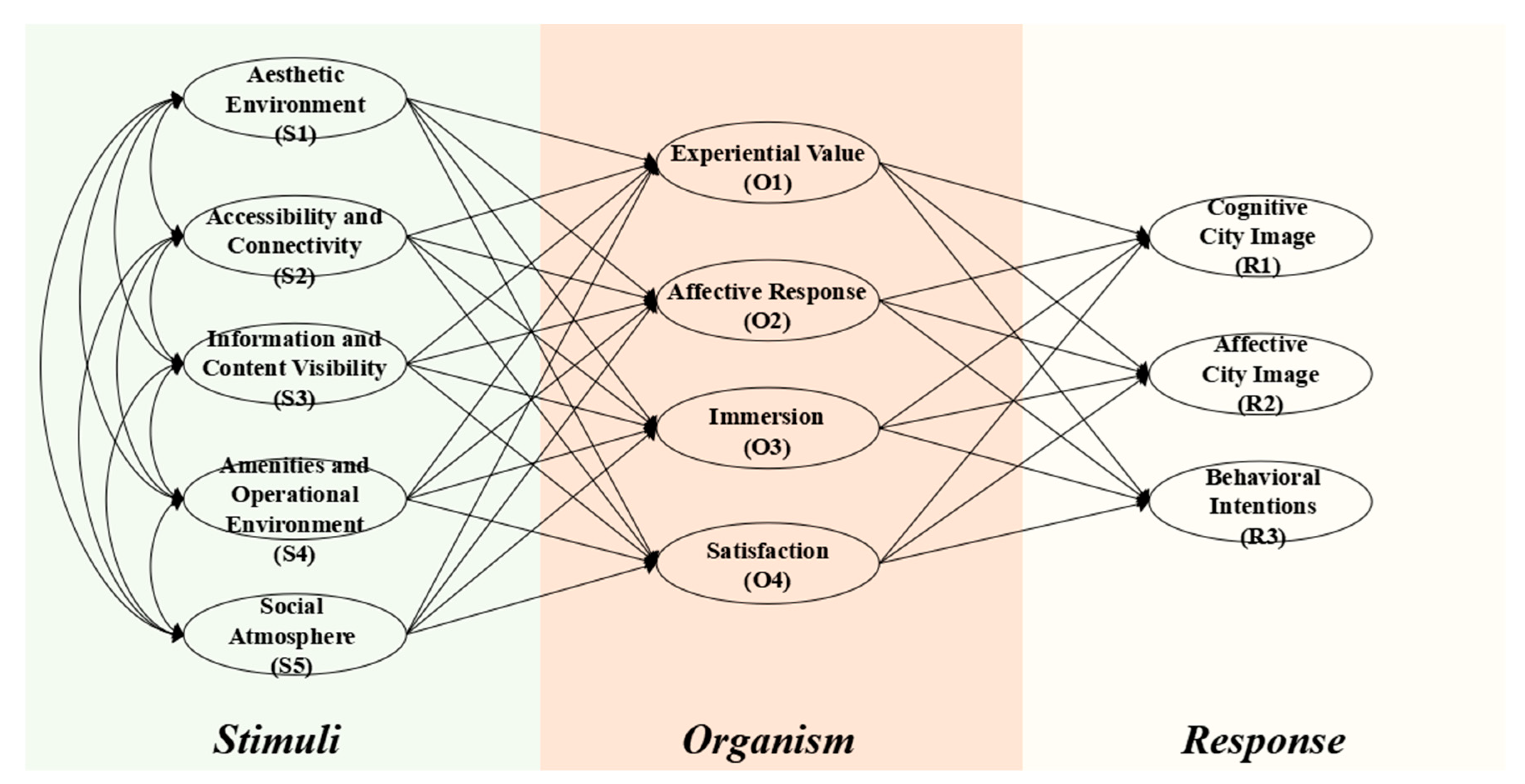
1.3. Measurement Model Specifications
2. Materials and Methods
3. Results
3.1. Respondent Profile
3.2. Reliability Test
3.3. Measurement Model Validity (CFA)
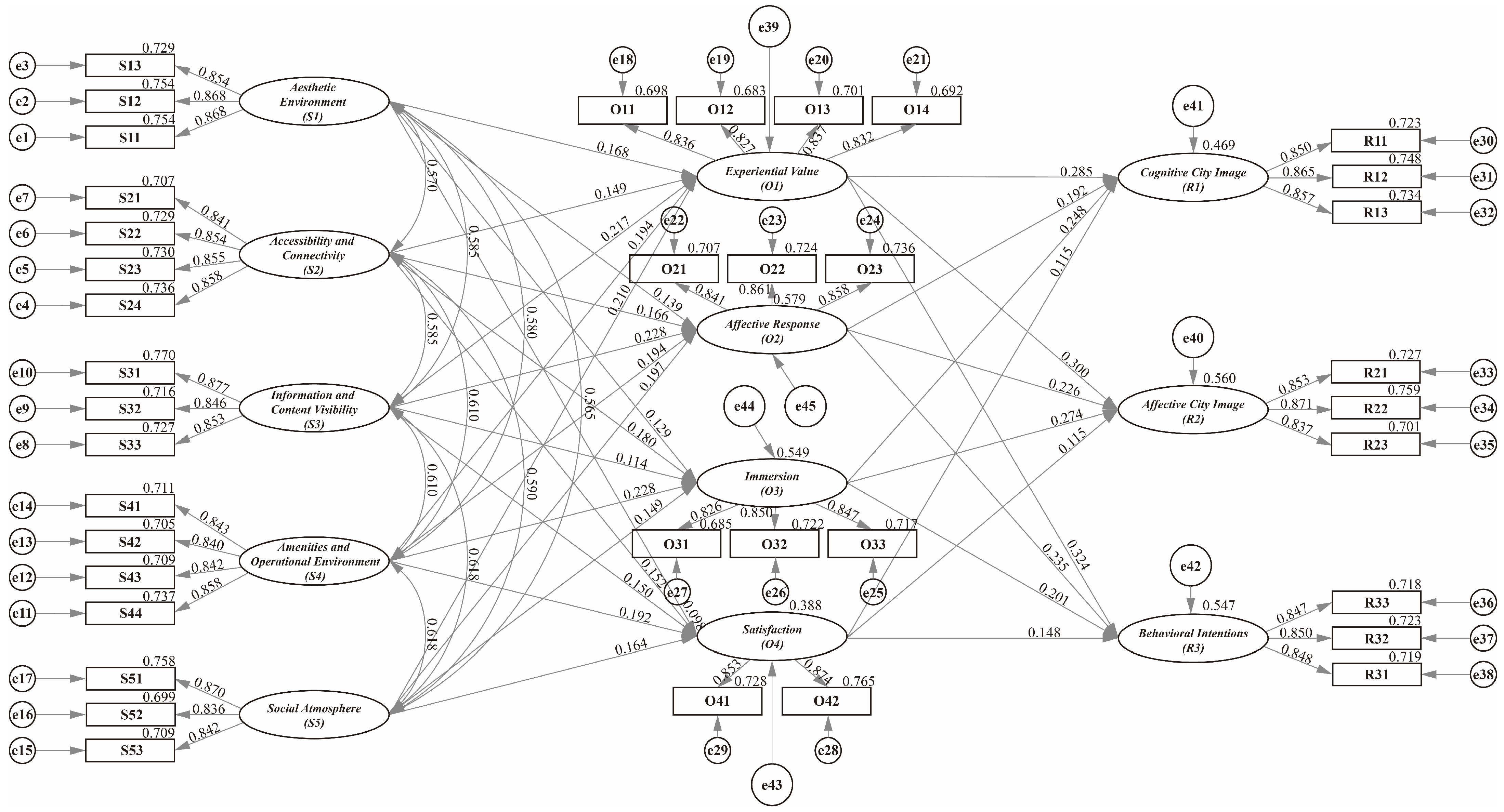
3.4. Structural Model Fit
3.5. Validation of Effects Along S–O–R Pathways
4. Discussion
4.1. Formation of Tourism Experience in Museum Agglomeration Areas and the Mechanism of Spillover into City Image
4.2. Implications for Planning, Operations, and Urban Marketing
5. Conclusions
Author Contributions
Funding
Institutional Review Board Statement
Informed Consent Statement
Data Availability Statement
Conflicts of Interest
References
- High, S. Beyond aesthetics: Visibility and invisibility in the aftermath of deindustrialization. Int. Labor Work.-Class Hist. 2013, 84, 140–153. [Google Scholar] [CrossRef]
- Berger, S.; Wicke, C. Introduction: Deindustrialization, heritage, and representations of identity. Public Hist. 2017, 39, 10–20. Available online: https://www.jstor.org/stable/26421012 (accessed on 11 December 2025). [CrossRef]
- Jansson, A. The negotiated city image: Symbolic reproduction and change through urban consumption. Urban Stud. 2003, 40, 463–479. Available online: https://www.jstor.org/stable/43084205 (accessed on 11 December 2025). [CrossRef]
- Nas, P.J. Cities Full of Symbols: A Theory of Urban Space and Culture; Leiden University Press: Leiden, The Netherlands, 2011. [Google Scholar]
- Michelson, A.; Paadam, K. Destination branding and reconstructing symbolic capital of urban heritage: A spatially informed observational analysis in medieval towns. J. Destin. Mark. Manag. 2016, 5, 141–153. [Google Scholar] [CrossRef]
- Schafer, T.S. Symbols, sentiments, and stories: Urban culture and social problems. Sociol. Compass 2017, 11, e12496. [Google Scholar] [CrossRef]
- Redaelli, E.; Stevenson, D. Arts in the city: Debates in the Journal of Urban Affairs. J. Urban Aff. 2022, 44, 456–470. [Google Scholar] [CrossRef]
- Grodach, C. Museums as urban catalysts: The role of urban design in flagship cultural development. J. Urban Des. 2008, 13, 195–212. [Google Scholar] [CrossRef]
- Giebelhausen, M. The Architecture of the Museum: Symbolic Structures, Urban Contexts; Manchester University Press: Manchester, UK, 2003. [Google Scholar]
- Popescu, L.; Albă, C. Museums as a means to (re) make regional identities: The Oltenia museum (Romania) as case study. Societies 2022, 12, 110. [Google Scholar] [CrossRef]
- Zhao, X.; Lee, J.; Hong, K. A comparative analysis of museum accessibility in high-density Asian cities: Case studies from Seoul and Tokyo. Buildings 2023, 13, 1886. [Google Scholar] [CrossRef]
- Polomarchuk, A.; Fainshtein, E. Internal Connection Intensity as Logistic and Marketing Indicator of Museum Clusters Performance. In International Conference on Marketing and Technologies; Springer Nature: Singapore, 2024; pp. 79–95. [Google Scholar] [CrossRef]
- Zhao, K.; Cao, X.; Wu, F.; Chen, C. Spatial pattern and drivers of China’s public cultural facilities between 2012 and 2020 based on POI and statistical data. ISPRS Int. J. Geo-Inf. 2023, 12, 273. [Google Scholar] [CrossRef]
- Nuccio, M.; Ponzini, D. Cities and urban studies: Four perspectives on art museums. In Visiting the Art Museum: A Journey Toward Participation; Springer International Publishing: Cham, Switzerland, 2023; pp. 27–46. [Google Scholar] [CrossRef]
- Bai, H.Y.; Kim, J.H. A multi-dimensional analysis of the J museum cluster in urban renewal and marketing: A case study approach. Asia-Pac. J. Converg. Res. Interchange 2024, 10, 145–159. [Google Scholar] [CrossRef]
- Bernini, C.; Galli, F. Networking and spatial interactions: What contributes most to increasing museums’ attractiveness? Pap. Reg. Sci. 2023, 102, 1215–1233. [Google Scholar] [CrossRef]
- Antonić, B.; Djukić, A.; Marić, J. Micro-museum quarter as an approach in the culture-led urban regeneration of small shrinking historic cities: The case of Sombor, Serbia. Heritage 2023, 6, 6616–6633. [Google Scholar] [CrossRef]
- Jiang, Z. Exploring the spatial dynamics of cultural facilities based on multi-source data: A case study of Nanjing’s art institutions. Open Geosci. 2023, 15, 20220532. [Google Scholar] [CrossRef]
- Cerisola, S.; Panzera, E. Cultural cities, urban economic growth, and regional development: The role of creativity and cosmopolitan identity. Pap. Reg. Sci. 2022, 101, 285–303. [Google Scholar] [CrossRef]
- Zahrah, F. City branding dimensions, strategies, and obstacles: A literature review. J. Bina Praja 2023, 15, 101–109. [Google Scholar] [CrossRef]
- Koukoulis, K.; Koukopoulos, D.; Tzortzi, K. Connecting the museum to the city environment from the visitor’s perspective. Appl. Comput. Inform. 2022, 18, 221–234. [Google Scholar] [CrossRef]
- Koutsoumpela, A.; Metaxas, T. Museums and urban sustainability: A comparative study of Athens and Singapore. Heritage 2025, 8, 397. [Google Scholar] [CrossRef]
- Aguspriyanti, C.D.; Benny, B.; Christine, V.; Fernando, D.; Tan, A. Between architecture, story, and place identity: A narrative approach for creative placemaking in museum design. J. Arsit. Terracotta 2023, 5, 13–22. [Google Scholar] [CrossRef]
- Casais, B.; Poço, T. Emotional branding of a city for inciting resident and visitor place attachment. Place Brand. Public Dipl. 2023, 19, 93–102. [Google Scholar] [CrossRef]
- Kowaas, R.; Syamsia, J.C.; Mandagi, D.W. The antecedents of an effective city branding: A comprehensive systematic review. J. Ekon. 2023, 12, 2178–2186. Available online: https://ejournal.seaninstitute.or.id/index.php/Ekonomi/article/view/3231 (accessed on 27 December 2025).
- Tran, N.L.; Rudolf, W. Social media and destination branding in tourism: A systematic review of the literature. Sustainability 2022, 14, 13528. [Google Scholar] [CrossRef]
- Oyama, Y. Spatial city image and its formative factors: A street-based neighborhood cognition analysis. Cities 2024, 149, 104898. [Google Scholar] [CrossRef]
- Stylidis, D. Exploring resident–tourist interaction and its impact on tourists’ destination image. J. Travel Res. 2022, 61, 186–201. [Google Scholar] [CrossRef]
- Wang, D.; Zhang, B.; Wu, Y.; Zhang, X. Generational homogeneity and heterogeneity in city image perception: An explorative study of Guangzhou. Place Brand. Public Dipl. 2023, 19, 128–142. [Google Scholar] [CrossRef]
- Lobo, C.; Costa, R.A.; Chim-Miki, A.F. Events image from the host-city residents’ perceptions: Impacts on the overall city image and visit recommend intention. Int. J. Tour. Cities 2023, 9, 875–893. [Google Scholar] [CrossRef]
- Jebbouri, A.; Zhang, H.; Imran, Z.; Iqbal, J.; Bouchiba, N. Impact of destination image formation on tourist trust: Mediating role of tourist satisfaction. Front. Psychol. 2022, 13, 845538. [Google Scholar] [CrossRef]
- Zhou, Q.; Pu, Y.; Su, C. The mediating roles of memorable tourism experiences and destination image in the correlation between cultural heritage rejuvenation experience quality and revisiting intention. Asia Pac. J. Mark. Logist. 2023, 35, 1313–1329. [Google Scholar] [CrossRef]
- Chau, K.W.; Davies, S.N.; Lai, L.W.; Lennon, H.C. Museums for ex situ tangible heritage conservation: A neo-institutional analytical and empirical economic analysis. Land Use Policy 2023, 127, 106561. [Google Scholar] [CrossRef]
- Wu, D.; Yang, X. Multiplicities and heterogeneity: Reconceptualizing creative clusters as assemblages. J. Urban Aff. 2025, 1–21. [Google Scholar] [CrossRef]
- Siu, N.Y.M.; Zhang, T.J.; Kwan, H.Y. Reference effects and customer engagement in a museum visit. Int. J. Contemp. Hosp. Manag. 2022, 34, 482–508. [Google Scholar] [CrossRef]
- Pioletti, A.M.; Castiblanco Jimenez, I.A.; Vezzetti, E.; Monaci, M.G. The emotional responses in an art craft and heritage museum: Profiling visitors and understanding visitor satisfaction. J. Herit. Tour. 2025, 20, 828–847. [Google Scholar] [CrossRef]
- Liu, Q.; Sutunyarak, C. The impact of immersive technology in museums on visitors’ behavioral intention. Sustainability 2024, 16, 9714. [Google Scholar] [CrossRef]
- Yang, Y.; Liu, S.; Song, X. The co-creation of museum experience value from the perspective of visitor motivation. SAGE Open 2023, 13, 21582440231202118. [Google Scholar] [CrossRef]
- Cotter, K.N.; Fekete, A.; Silvia, P.J. Why do people visit art museums? Examining visitor motivations and visit outcomes. Empir. Stud. Arts 2022, 40, 275–295. [Google Scholar] [CrossRef]
- Korea.net News. Visits to Royal Palaces and Jongmyo Shrine Reached Record High of 17.81 Million Last Year. Available online: https://www.korean-culture.org/koreanet/view.do?seq=1053514&utm_source (accessed on 19 March 2026).
- Zhao, X.; Moon, J. Analysis of urban spatial accessibility of museums within the scope of Seoul. Buildings 2022, 12, 1749. [Google Scholar] [CrossRef]
- Rosa-Jiménez, C.; Gutiérrez-Coronil, S.; Márquez-Ballesteros, M.J.; García-Moreno, A.E. Relating spatial quality of public transportation and the most visited museums: Revisiting sustainable mobility of waterfronts and historic centers in international cruise destinations. Sustainability 2023, 15, 2066. [Google Scholar] [CrossRef]
- Wan, Y.K.P. Accessibility of tourist signage at heritage sites: An application of the universal design principles. Tour. Recreat. Res. 2024, 49, 757–771. [Google Scholar] [CrossRef]
- Huang, W.J.; Li, M.; He, J.; Chan, W.K. Conflicts and interactions in urban tourism: Use of urban public space by residents, tourists, and migrant domestic workers in Hong Kong. Tour. Manag. 2024, 105, 104960. [Google Scholar] [CrossRef]
- Galluccio, C.; Giambona, F. Cultural heritage and economic development: Measuring sustainability over time. Socio-Econ. Plan. Sci. 2024, 95, 101998. [Google Scholar] [CrossRef]
- Heo, J.Y.; Lee, J.H. A chronological review of the expansion of the museum’s role in relation to spatial changes. Buildings 2025, 15, 1952. [Google Scholar] [CrossRef]
- Jin, A.; Ge, Y.; Zhang, S. Spatial characteristics of multidimensional urban vitality and its impact mechanisms by the built environment. Land 2024, 13, 991. [Google Scholar] [CrossRef]
- Pilegaard, A. Capturing interfaces between museum architecture and exhibition design: A critical inquiry into museum space concepts. Mus. Manag. Curatorship 2024, 39, 630–646. [Google Scholar] [CrossRef]
- Ashrafi, S.; Garbutt, M.; Kapalova, A. Beyond the art museum: A phenomenological-hermeneutic account of everyday aesthetics. J. Aesthetic Educ. 2023, 57, 54–72. [Google Scholar] [CrossRef]
- Gutwill, J.P.; Chien, H.Y.; Lani, S.; Winterheld, H.; Miller, L.; Garibay, C. Creating middle ground: Transforming outdoor informal learning landscapes. Curator Mus. J. 2022, 65, 869–886. [Google Scholar] [CrossRef]
- Doğan, E.; Jelinčić, D.A. Changing patterns of mobility and accessibility to culture and leisure: Paradox of inequalities. Cities 2023, 132, 104093. [Google Scholar] [CrossRef]
- Lee, J.H.; Kim, Y.S. Rethinking art museum spaces and investigating how auxiliary paths work differently. Buildings 2022, 12, 248. [Google Scholar] [CrossRef]
- Koustriava, E.; Koutsmani, M. Spatial and information accessibility of museums and places of historical interest: A comparison between London and Thessaloniki. Sustainability 2023, 15, 16611. [Google Scholar] [CrossRef]
- Montalto, V. Can cultural participation enhance proximity tourism? Insights from a resident profiling study. J. Place Manag. Dev. 2025. ahead-of-print. [Google Scholar] [CrossRef]
- Chen, X.; Chen, Z.; Xiao, L.; Zhou, M. A novel sentiment analysis model of museum user experience evaluation data based on unbalanced data analysis technology. Comput. Intell. Neurosci. 2022, 1, 2096634. [Google Scholar] [CrossRef]
- Glaser, M.; Hug, L.; Werner, S.; Schwan, S. Spatial versus normal audio guides in exhibitions: Cognitive mechanisms and effects on learning. Educ. Technol. Res. Dev. 2025, 73, 169–198. [Google Scholar] [CrossRef]
- Falk, J.H. Making the case for the value of museum experiences. Mus. Manag. Curatorship 2022, 37, 455–470. [Google Scholar] [CrossRef]
- Matrouk, R. Exploring the role of urban design development in enhancing and promoting tourism of historical sites: The case study of Amman Citadel. Athens J. Tour. 2024, 11, 125–146. [Google Scholar] [CrossRef]
- Melton, A. Comfort and connectivity: The museum as a healer. Mus. Soc. Issues 2013, 8, 6–21. [Google Scholar] [CrossRef]
- Fan, J.; Shi, Z.; Liu, J.; Wang, J. Space efficiency of transit-oriented station areas: A case study from a complex adaptive system perspective. ISPRS Int. J. Geo-Inf. 2025, 14, 20. [Google Scholar] [CrossRef]
- Cerquetti, M.; Cutrini, E. Structure, people, and relationships: A multidimensional method to assess museum resilience. Nonprofit Volunt. Sect. Q. 2023, 52, 130–152. [Google Scholar] [CrossRef]
- Rozman Cafuta, M. Framing the tourist spatial identity of a city as a tourist product. Int. J. Tour. Cities 2024, 10, 39–52. [Google Scholar] [CrossRef]
- Hayat, D.T.; Ibrahim, B. Sustainable heritage management: A literature review. Manag. Risk Decis. Mak. Times Econ. Distress Part A 2022, 108A, 181–194. [Google Scholar] [CrossRef]
- Li, P. Cultural communication in museums: A perspective of the visitors experience. PLoS ONE 2024, 19, e0303026. [Google Scholar] [CrossRef] [PubMed]
- Feng, W.; Zeng, F.; Li, F.; Feng, J. Social media envy and its influence on tourists’ variety-seeking behavior in destination choices. J. Travel Res. 2025, 65, 1588–1607. [Google Scholar] [CrossRef]
- Erić, Z.; Mickov, B. Museum as an educational tool: The models of experimental educational practices in European art museums. J. Mus. Educ. 2025, 1–12. [Google Scholar] [CrossRef]
- Li, J.; He, M.; Yang, Z.; Siu, K.W.M. Anthropological insights into emotion semantics in intangible cultural heritage museums: A case study of Eastern Sichuan, China. Electronics 2025, 14, 891. [Google Scholar] [CrossRef]
- Illsley, W.R.; Almevik, G.; Westin, J.; Aavaranta Hansén, J.B.; Fornander, E.; Hallgren, E.; Lagercrantz, W.; Vasileiou, P. The edutainment scan: Immersive media and its deployment in museums. Mus. Manag. Curatorship 2025, 40, 18–35. [Google Scholar] [CrossRef]
- Reinert, V.; Quadros, C.B.D.; Patrício, G.A.; Reinert, P.S.; Kuhn, T.L. Meanings of leisure and its impacts on the experience of escapism, personal fulfillment, and use of spaces. Tur. Visão Ação 2025, 27, e20841. [Google Scholar] [CrossRef]
- Li, J.; Zhou, L.; Wei, W. Analyzing factors influencing learning motivation in online virtual museums using the SOR model: A case study of the National Museum of Natural History. Information 2025, 16, 573. [Google Scholar] [CrossRef]
- Dewinter, H.; Goethals, T.; De Backer, F.; Vandermeersche, G.; De Wilde, L. Chasing happiness? The meaning of wellbeing-oriented cultural heritage interventions in museums and cultural heritage institutions. Cult. Trends 2025, 1–19. [Google Scholar] [CrossRef]
- Shi, T.; Chen, Y.; Wang, Z. Designing 3D mapping projections for art museums based on ‘re-contextualization’: A case study of The Night of Museum. Cogent Arts Humanit. 2025, 12, 2492426. [Google Scholar] [CrossRef]
- Shi, W.; Ono, K.; Li, L. Cognitive insights into museum engagement: A mobile eye-tracking study on visual attention distribution and learning experience. Electronics 2025, 14, 2208. [Google Scholar] [CrossRef]
- Li, Y.; Yang, R.; Zou, J.; Xu, H.; Tian, F. Human-centric virtual museum: Redefining the museum experience through immersive and interactive environments. Int. J. Hum.-Comput. Interact. 2025, 41, 8426–8437. [Google Scholar] [CrossRef]
- Wang, N.; Jia, C.; Wang, J.; Li, Z. Identifying key factors influencing immersive experiences in virtual reality enhanced museums. Sci. Rep. 2025, 15, 31990. [Google Scholar] [CrossRef]
- Chang, S.; Suh, J. The impact of digital storytelling on presence, immersion, enjoyment, and continued usage intention in VR-based museum exhibitions. Sensors 2025, 25, 2914. [Google Scholar] [CrossRef]
- Shi, M.; Deng, L.; Zhang, M.; Long, Y. How telepresence and perceived enjoyment mediate the relationship between interaction quality and continuance intention: Evidence from China Zisha-ware Digital Museum. PLoS ONE 2025, 20, e0317784. [Google Scholar] [CrossRef]
- Redaelli, E.; Hansen, L.E.; Djupdræt, M.B. Museums as public spaces in the city: Insights from Aarhus, Denmark. Cities 2025, 159, 105778. [Google Scholar] [CrossRef]
- Sangchumnong, A. Causal factors relationship of tourism experience influencing customer loyalty via the perceived service value, attraction image and overall service quality satisfaction for the museum tourist attractions: Evidence in Thailand. Asian J. Bus. Res. 2025, 15, 240194. [Google Scholar] [CrossRef]
- Siefkes, M.; Pfeiffer, J.A. Exploring digital exhibitions: Typologies, design strategies, and visitor engagement. Mus. Worlds 2025, 13, 170–176. [Google Scholar] [CrossRef]
- Badurina, A.; Zadel, Z.; Rudan, E. Analysis of the experiences of visitors the museum offer of tourist destination. Heritage 2025, 8, 425. [Google Scholar] [CrossRef]
- Kebede-Twumasi, L. Look back to live ahead: Connecting the power of museums and journalism for a stronger democracy. Public Humanit. 2025, 1, e36. [Google Scholar] [CrossRef]
- Li, X.; Wang, P.; Zhou, J.; Zhao, J. Exploring the impact of musealization on spatial vitality and tourist experience in the historic center of Macau. Buildings 2025, 15, 2512. [Google Scholar] [CrossRef]
- Fang, Q.; Ko, W. Beyond satisfaction: Authenticity, attachment, and engagement in shaping revisit intention of palace museum visitors. Sustainability 2025, 17, 8803. [Google Scholar] [CrossRef]
- Ding, Y.; Sun, J.; Leung, X.Y.; Liu, S. Museum experience and revisit intention: The impact of multitasking. Tour. Rev. 2025. ahead-of-print. [Google Scholar] [CrossRef]
- Costa-Feito, A.; Rodríguez-Santos, C.; González-Fernández, A.M.; Marques dos Santos, J.P. The emotional paradox of short promotional videos in urban tourism: Cognitive and affective responses in decision-making under stress or joy. J. Travel Tour. Mark. 2025, 42, 708–723. [Google Scholar] [CrossRef]
- Alexander, C. A City is Not a Tree. Architectural Forum. 1965. Available online: https://www.transportxtra.com/rudi/intelligence-education/design-classics/45959/a-city-is-not-a-tree (accessed on 15 March 2026).
- Arora, R. Validation of an SOR model for situation, enduring, and response components of involvement. J. Mark. Res. 1982, 19, 505–516. [Google Scholar] [CrossRef]
- Reimer, A.; Kuehn, R. The impact of servicescape on quality perception. Eur. J. Mark. 2005, 39, 785–808. [Google Scholar] [CrossRef]
- Holbrook, M.B.; Hirschman, E.C. The experiential aspects of consumption: Consumer fantasies, feelings, and fun. J. Consum. Res. 1982, 9, 132–140. [Google Scholar] [CrossRef]
- SoJump Platform, Online Survey Tool. Available online: https://www.wjx.cn (accessed on 15 October 2025).



| S–O–R | Latent Variables | Observed Indicators |
|---|---|---|
| MAAs environment (stimulus) | Aesthetic Environment (S1) | (S1-1) Atmosphere of architecture, streets, and landscape [78] (S1-2) Visual integrity [43] (S1-3) Attractiveness of remaining outdoors [53] |
| Accessibility and Connectivity (S2) | (S2-1) Convenience of public transportation and walkability [41] (S2-2) Continuity of circulation between facilities [48] (S2-3) Clarity of wayfinding [43] (S2-4) Perceived travel burden [62] | |
| Information and Content Visibility (S3) | (S3-1) Ease of accessing exhibition information [57] (S3-2) Effectiveness of interpretation and storytelling [72] (S3-3) Support for visit planning [64] | |
| Amenities and Operational Environment (S4) | (S4-1) Adequacy of amenities [58] (S4-2) Perceived safety and comfort [71] (S4-3) Smoothness of operation [81] (S4-4) Convenience of usage procedures [58] | |
| Social Atmosphere (S5) | (S5-1) On-site vitality [59] (S5-2) Comfort in coexisting with others [71] (S5-3) Potential for cultural interaction [60] | |
| Internal state of tourism experience (organism) | Experiential Value (O1) | (O1-1) Value for time and money [65] (O1-2) Educational value [66] (O1-3) Entertainment value [68] (O1-4) Escapist value [69] |
| Affective Response (O2) | (O2-1) Excitement/interest [67] (O2-2) Comfort/stability [71] (O2-3) Impression/inspiration [72] | |
| Immersion (O3) | (O3-1) Concentration [73] (O3-2) Experiential immersion [74] (O3-3) Experiential flow continuity [76] | |
| Satisfaction (O4) | (O4-1) Fulfillment of expectations [79] (O4-2) Evaluation of experience quality [81] | |
| Spillover to city image (response) | Cognitive City Image (R1) | (R1-1) Perceived identity of urban culture [78] (R1-2) Perceived attractiveness of cultural and tourism resources [80] (R1-3) Perceived visitor-friendliness [83] |
| Affective City Image (R2) | (R2-1) City favorability [81] (R2-2) City familiarity [83] (R2-3) Perceived city vitality [78] | |
| Behavioral Intentions (R3) | (R3-1) Intention to revisit the city [81] (R3-2) Intention to recommend the agglomeration area [79] (R3-3) Intention to explore cultural activities [86] |
| Category | Frequency | Ratio | |
|---|---|---|---|
| Gender | Male | 512 | 49.4% |
| Female | 524 | 50.6% | |
| Age group | 18–24 | 272 | 26.3% |
| 25–34 | 249 | 24.0% | |
| 35–44 | 262 | 25.3% | |
| 45 and older | 253 | 24.4% | |
| Number of visits to MAAs in Seoul in the past 3 years | 1 | 404 | 39.0% |
| 2 | 298 | 28.8% | |
| 3 or more visits | 334 | 32.2% | |
| Category | Mean | Min | Max | Range | Maximum/ Minimum | Variance | Cronbach’s Alpha | |
|---|---|---|---|---|---|---|---|---|
| Aesthetic Environment (S1) | Item mean | 4.092 | 4.052 | 4.115 | 0.063 | 1.015 | 0.001 | 0.898 |
| Item variance | 1.203 | 1.178 | 1.220 | 0.042 | 1.036 | 0.000 | ||
| Inter-item covariance | 0.897 | 0.879 | 0.909 | 0.030 | 1.034 | 0.000 | ||
| Inter-item correlation | 0.745 | 0.733 | 0.761 | 0.028 | 1.038 | 0.000 | ||
| Accessibility and Connectivity (S2) | Item mean | 4.112 | 4.085 | 4.128 | 0.043 | 1.011 | 0.000 | 0.914 |
| Item variance | 1.135 | 1.086 | 1.173 | 0.088 | 1.081 | 0.001 | ||
| Inter-item covariance | 0.824 | 0.801 | 0.843 | 0.042 | 1.052 | 0.000 | ||
| Inter-item correlation | 0.726 | 0.708 | 0.744 | 0.035 | 1.050 | 0.000 | ||
| Information and Content Visibility (S3) | Item mean | 4.126 | 4.097 | 4.158 | 0.061 | 1.015 | 0.001 | 0.894 |
| Item variance | 1.119 | 1.103 | 1.147 | 0.043 | 1.039 | 0.001 | ||
| Inter-item covariance | 0.826 | 0.800 | 0.843 | 0.043 | 1.053 | 0.000 | ||
| Inter-item correlation | 0.738 | 0.723 | 0.749 | 0.026 | 1.036 | 0.000 | ||
| Amenities and Operational Environment (S4) | Item mean | 4.123 | 4.110 | 4.135 | 0.025 | 1.006 | 0.000 | 0.910 |
| Item variance | 1.099 | 1.035 | 1.142 | 0.106 | 1.103 | 0.002 | ||
| Inter-item covariance | 0.786 | 0.746 | 0.816 | 0.070 | 1.095 | 0.001 | ||
| Inter-item correlation | 0.716 | 0.700 | 0.728 | 0.029 | 1.041 | 0.000 | ||
| Social Atmosphere (S5) | Item mean | 4.110 | 4.098 | 4.125 | 0.026 | 1.006 | 0.000 | 0.886 |
| Item variance | 1.133 | 1.096 | 1.163 | 0.068 | 1.062 | 0.001 | ||
| Inter-item covariance | 0.817 | 0.778 | 0.838 | 0.060 | 1.077 | 0.001 | ||
| Inter-item correlation | 0.722 | 0.696 | 0.742 | 0.046 | 1.066 | 0.000 | ||
| Experiential Value (O1) | Item mean | 4.146 | 4.131 | 4.159 | 0.028 | 1.007 | 0.000 | 0.903 |
| Item variance | 1.060 | 0.977 | 1.125 | 0.148 | 1.152 | 0.004 | ||
| Inter-item covariance | 0.740 | 0.704 | 0.775 | 0.071 | 1.100 | 0.001 | ||
| Inter-item correlation | 0.699 | 0.681 | 0.707 | 0.027 | 1.039 | 0.000 | ||
| Affective Response (O2) | Item mean | 4.119 | 4.101 | 4.146 | 0.044 | 1.011 | 0.001 | 0.889 |
| Item variance | 1.129 | 1.099 | 1.158 | 0.059 | 1.054 | 0.001 | ||
| Inter-item covariance | 0.822 | 0.810 | 0.831 | 0.021 | 1.025 | 0.000 | ||
| Inter-item correlation | 0.728 | 0.726 | 0.731 | 0.005 | 1.007 | 0.000 | ||
| Immersion (O3) | Item mean | 4.118 | 4.094 | 4.145 | 0.051 | 1.012 | 0.001 | 0.882 |
| Item variance | 1.127 | 1.112 | 1.150 | 0.037 | 1.034 | 0.000 | ||
| Inter-item covariance | 0.805 | 0.791 | 0.814 | 0.023 | 1.030 | 0.000 | ||
| Inter-item correlation | 0.714 | 0.709 | 0.718 | 0.009 | 1.013 | 0.000 | ||
| Satisfaction (O4) | Item mean | 4.020 | 4.013 | 4.027 | 0.014 | 1.004 | 0.000 | 0.857 |
| Item variance | 1.339 | 1.317 | 1.361 | 0.044 | 1.033 | 0.001 | ||
| Inter-item covariance | 1.004 | 1.004 | 1.004 | 0.000 | 1.000 | 0.000 | ||
| Inter-item correlation | 0.750 | 0.750 | 0.750 | 0.000 | 1.000 | 0.000 | ||
| Cognitive City Image (R1) | Item mean | 4.062 | 4.054 | 4.074 | 0.020 | 1.005 | 0.000 | 0.894 |
| Item variance | 1.212 | 1.194 | 1.240 | 0.047 | 1.039 | 0.001 | ||
| Inter-item covariance | 0.893 | 0.886 | 0.904 | 0.018 | 1.021 | 0.000 | ||
| Inter-item correlation | 0.737 | 0.726 | 0.743 | 0.017 | 1.024 | 0.000 | ||
| Affective City Image (R2) | Item mean | 4.133 | 4.116 | 4.161 | 0.045 | 1.011 | 0.001 | 0.891 |
| Item variance | 1.138 | 1.082 | 1.174 | 0.092 | 1.085 | 0.002 | ||
| Inter-item covariance | 0.832 | 0.802 | 0.852 | 0.051 | 1.063 | 0.001 | ||
| Inter-item correlation | 0.731 | 0.716 | 0.747 | 0.031 | 1.043 | 0.000 | ||
| Behavioral Intentions (R3) | Item mean | 4.120 | 4.089 | 4.138 | 0.049 | 1.012 | 0.001 | 0.887 |
| Item variance | 1.138 | 1.122 | 1.149 | 0.027 | 1.024 | 0.000 | ||
| Inter-item covariance | 0.822 | 0.819 | 0.827 | 0.008 | 1.010 | 0.000 | ||
| Inter-item correlation | 0.723 | 0.722 | 0.724 | 0.001 | 1.002 | 0.000 | ||
| Relationships | Estimate | AVE | CR | ||
|---|---|---|---|---|---|
| Observed Indicator | Path | Latent Variable | |||
| S1-1 | ← | Aesthetic Environment (S1) | 0.868 | 0.745 | 0.898 |
| S1-2 | ← | 0.868 | |||
| S1-3 | ← | 0.854 | |||
| S2-1 | ← | Accessibility and Connectivity (S2) | 0.858 | 0.726 | 0.914 |
| S2-2 | ← | 0.855 | |||
| S2-3 | ← | 0.854 | |||
| S2-4 | ← | 0.841 | |||
| S3-1 | ← | Information and Content Visibility (S3) | 0.853 | 0.738 | 0.894 |
| S3-2 | ← | 0.846 | |||
| S3-3 | ← | 0.877 | |||
| S4-1 | ← | Amenities and Operational Environment (S4) | 0.858 | 0.715 | 0.910 |
| S4-2 | ← | 0.842 | |||
| S4-3 | ← | 0.840 | |||
| S4-4 | ← | 0.843 | |||
| S5-1 | ← | Social Atmosphere (S5) | 0.842 | 0.722 | 0.886 |
| S5-2 | ← | 0.836 | |||
| S5-3 | ← | 0.870 | |||
| O1-1 | ← | Experiential Value (O1) | 0.836 | 0.694 | 0.901 |
| O1-2 | ← | 0.827 | |||
| O1-3 | ← | 0.837 | |||
| O1-4 | ← | 0.832 | |||
| O2-1 | ← | Affective Response (O2) | 0.841 | 0.723 | 0.887 |
| O2-2 | ← | 0.851 | |||
| O2-3 | ← | 0.858 | |||
| O3-1 | ← | Immersion (O3) | 0.847 | 0.709 | 0.879 |
| O3-2 | ← | 0.850 | |||
| O3-3 | ← | 0.828 | |||
| O4-1 | ← | Satisfaction (O4) | 0.874 | 0.746 | 0.854 |
| O4-2 | ← | 0.853 | |||
| R1-1 | ← | Cognitive City Image (R1) | 0.850 | 0.735 | 0.893 |
| R1-2 | ← | 0.865 | |||
| R1-3 | ← | 0.857 | |||
| R2-1 | ← | Affective City Image (R2) | 0.853 | 0.729 | 0.890 |
| R2-2 | ← | 0.871 | |||
| R2-3 | ← | 0.837 | |||
| R3-1 | ← | Behavioral Intentions (R3) | 0.847 | 0.720 | 0.885 |
| R3-2 | ← | 0.850 | |||
| R3-3 | ← | 0.848 | |||
| Diagonal (AVE) | S1 | S2 | S3 | S4 | S5 | O1 | O2 | O3 | O4 | R1 | R2 | R3 |
|---|---|---|---|---|---|---|---|---|---|---|---|---|
| S1 | 0.745 | |||||||||||
| S2 | 0.570 | 0.726 | ||||||||||
| S3 | 0.585 | 0.585 | 0.738 | |||||||||
| S4 | 0.580 | 0.583 | 0.610 | 0.715 | ||||||||
| S5 | 0.565 | 0.590 | 0.621 | 0.618 | 0.722 | |||||||
| O1 | 0.168 | 0.149 | 0.217 | 0.194 | 0.210 | 0.694 | ||||||
| O2 | 0.139 | 0.166 | 0.228 | 0.194 | 0.197 | 0.000 | 0.723 | |||||
| O3 | 0.129 | 0.180 | 0.214 | 0.228 | 0.149 | 0.000 | 0.000 | 0.709 | ||||
| O4 | 0.098 | 0.152 | 0.150 | 0.192 | 0.164 | 0.000 | 0.000 | 0.000 | 0.746 | |||
| R1 | 0.000 | 0.000 | 0.000 | 0.000 | 0.000 | 0.285 | 0.192 | 0.248 | 0.115 | 0.735 | ||
| R2 | 0.000 | 0.000 | 0.000 | 0.000 | 0.000 | 0.300 | 0.226 | 0.274 | 0.115 | 0.000 | 0.729 | |
| R3 | 0.000 | 0.000 | 0.000 | 0.000 | 0.000 | 0.324 | 0.235 | 0.201 | 0.148 | 0.000 | 0.000 | 0.720 |
| Square root of AVE | 0.863 | 0.852 | 0.859 | 0.846 | 0.850 | 0.833 | 0.850 | 0.842 | 0.864 | 0.857 | 0.854 | 0.849 |
| χ2/df | RMR | RMSEA | GFI | CFI | NFI | TLI |
|---|---|---|---|---|---|---|
| 1.462 | 0.032 | 0.021 | 0.953 | 0.990 | 0.970 | 0.989 |
| Relationships | Estimate | S.E. | C.R. | p Values | ||
|---|---|---|---|---|---|---|
| O1 | ← | S1 | 0.168 | 0.032 | 4.797 | 0.000 *** |
| O2 | ← | 0.139 | 0.034 | 3.844 | 0.000 *** | |
| O3 | ← | 0.129 | 0.035 | 3.470 | 0.000 *** | |
| O4 | ← | 0.098 | 0.046 | 2.299 | 0.021 * | |
| O1 | ← | S2 | 0.149 | 0.033 | 4.241 | 0.000 *** |
| O2 | ← | 0.166 | 0.035 | 4.575 | 0.000 *** | |
| O3 | ← | 0.180 | 0.037 | 4.805 | 0.000 *** | |
| O4 | ← | 0.152 | 0.047 | 3.549 | 0.000 *** | |
| O1 | ← | S3 | 0.217 | 0.037 | 5.759 | 0.000 *** |
| O2 | ← | 0.228 | 0.039 | 5.840 | 0.000 *** | |
| O3 | ← | 0.214 | 0.041 | 5.320 | 0.000 *** | |
| O4 | ← | 0.150 | 0.052 | 3.266 | 0.001 ** | |
| O1 | ← | S4 | 0.194 | 0.035 | 5.256 | 0.000 *** |
| O2 | ← | 0.194 | 0.037 | 5.110 | 0.000 *** | |
| O3 | ← | 0.228 | 0.039 | 5.795 | 0.000 *** | |
| O4 | ← | 0.192 | 0.050 | 4.267 | 0.000 *** | |
| O1 | ← | S5 | 0.210 | 0.038 | 5.547 | 0.000 *** |
| O2 | ← | 0.197 | 0.040 | 5.047 | 0.000 *** | |
| O3 | ← | 0.149 | 0.041 | 3.709 | 0.000 *** | |
| O4 | ← | 0.164 | 0.053 | 3.571 | 0.000 *** | |
| R1 | ← | O1 | 0.285 | 0.042 | 7.214 | 0.000 *** |
| R2 | ← | 0.300 | 0.037 | 8.079 | 0.000 *** | |
| R3 | ← | 0.324 | 0.039 | 8.562 | 0.000 *** | |
| R1 | ← | O2 | 0.192 | 0.041 | 4.911 | 0.000 *** |
| R2 | ← | 0.226 | 0.036 | 6.163 | 0.000 *** | |
| R3 | ← | 0.235 | 0.038 | 6.302 | 0.000 *** | |
| R1 | ← | O3 | 0.248 | 0.040 | 6.416 | 0.000 *** |
| R2 | ← | 0.274 | 0.035 | 7.532 | 0.000 *** | |
| R3 | ← | 0.201 | 0.036 | 5.501 | 0.000 *** | |
| R1 | ← | O4 | 0.115 | 0.032 | 3.304 | 0.000 *** |
| R2 | ← | 0.115 | 0.028 | 3.539 | 0.000 *** | |
| R3 | ← | 0.148 | 0.029 | 4.472 | 0.000 *** | |
| S1 | ↔ | S2 | 0.570 | 0.036 | 13.949 | 0.000 *** |
| ↔ | S3 | 0.585 | 0.036 | 14.079 | 0.000 *** | |
| ↔ | S4 | 0.580 | 0.036 | 14.094 | 0.000 *** | |
| ↔ | S5 | 0.565 | 0.035 | 13.648 | 0.000 *** | |
| S2 | ↔ | S3 | 0.585 | 0.034 | 14.118 | 0.000 *** |
| ↔ | S4 | 0.583 | 0.035 | 14.179 | 0.000 *** | |
| ↔ | S5 | 0.590 | 0.034 | 14.106 | 0.000 *** | |
| S3 | ↔ | S4 | 0.610 | 0.035 | 14.506 | 0.000 *** |
| ↔ | S5 | 0.621 | 0.034 | 14.481 | 0.000 *** | |
| S4 | ↔ | S5 | 0.618 | 0.034 | 14.537 | 0.000 *** |
| Relationships | Total Effect | Total Indirect Effect | |||
|---|---|---|---|---|---|
| Predictor (S) | Mediator (O) | Outcome (R) | |||
| Aesthetic Environment (S1) | O1 | → | R1 | 0.048 | 0.118 |
| O2 | → | 0.027 | |||
| O3 | → | 0.032 | |||
| O4 | → | 0.011 | |||
| O1 | → | R2 | 0.050 | 0.128 | |
| O2 | → | 0.031 | |||
| O3 | → | 0.035 | |||
| O4 | → | 0.011 | |||
| O1 | → | R3 | 0.054 | 0.128 | |
| O2 | → | 0.033 | |||
| O3 | → | 0.026 | |||
| O4 | → | 0.015 | |||
| Accessibility and Connectivity (S2) | O1 | → | R1 | 0.042 | 0.136 |
| O2 | → | 0.032 | |||
| O3 | → | 0.045 | |||
| O4 | → | 0.017 | |||
| O1 | → | R2 | 0.045 | 0.149 | |
| O2 | → | 0.038 | |||
| O3 | → | 0.049 | |||
| O4 | → | 0.017 | |||
| O1 | → | R3 | 0.048 | 0.146 | |
| O2 | → | 0.039 | |||
| O3 | → | 0.036 | |||
| O4 | → | 0.022 | |||
| Information and Content Visibility (S3) | O1 | → | R1 | 0.062 | 0.176 |
| O2 | → | 0.044 | |||
| O3 | → | 0.053 | |||
| O4 | → | 0.017 | |||
| O1 | → | R2 | 0.065 | 0.193 | |
| O2 | → | 0.052 | |||
| O3 | → | 0.059 | |||
| O4 | → | 0.017 | |||
| O1 | → | R3 | 0.070 | 0.189 | |
| O2 | → | 0.054 | |||
| O3 | → | 0.043 | |||
| O4 | → | 0.022 | |||
| Amenities and Operational Environment (S4) | O1 | → | R1 | 0.055 | 0.171 |
| O2 | → | 0.037 | |||
| O3 | → | 0.057 | |||
| O4 | → | 0.022 | |||
| O1 | → | R2 | 0.058 | 0.187 | |
| O2 | → | 0.044 | |||
| O3 | → | 0.062 | |||
| O4 | → | 0.022 | |||
| O1 | → | R3 | 0.063 | 0.183 | |
| O2 | → | 0.046 | |||
| O3 | → | 0.046 | |||
| O4 | → | 0.028 | |||
| Social Atmosphere (S5) | O1 | → | R1 | 0.060 | 0.153 |
| O2 | → | 0.038 | |||
| O3 | → | 0.037 | |||
| O4 | → | 0.019 | |||
| O1 | → | R2 | 0.063 | 0.167 | |
| O2 | → | 0.045 | |||
| O3 | → | 0.041 | |||
| O4 | → | 0.019 | |||
| O1 | → | R3 | 0.068 | 0.169 | |
| O2 | → | 0.046 | |||
| O3 | → | 0.030 | |||
| O4 | → | 0.024 | |||
Disclaimer/Publisher’s Note: The statements, opinions and data contained in all publications are solely those of the individual author(s) and contributor(s) and not of MDPI and/or the editor(s). MDPI and/or the editor(s) disclaim responsibility for any injury to people or property resulting from any ideas, methods, instructions or products referred to in the content. |
© 2026 by the authors. Licensee MDPI, Basel, Switzerland. This article is an open access article distributed under the terms and conditions of the Creative Commons Attribution (CC BY) license.
Share and Cite
Lu, Y.; Zhang, H.; Liu, H.; Gao, S.; Zhao, J.; Zhao, X. The Impact of Tourism Experience in Museum Agglomeration Areas on City Image Promotion. Buildings 2026, 16, 1542. https://doi.org/10.3390/buildings16081542
Lu Y, Zhang H, Liu H, Gao S, Zhao J, Zhao X. The Impact of Tourism Experience in Museum Agglomeration Areas on City Image Promotion. Buildings. 2026; 16(8):1542. https://doi.org/10.3390/buildings16081542
Chicago/Turabian StyleLu, Yao, Hang Zhang, He Liu, Shan Gao, Jinghao Zhao, and Xiaolong Zhao. 2026. "The Impact of Tourism Experience in Museum Agglomeration Areas on City Image Promotion" Buildings 16, no. 8: 1542. https://doi.org/10.3390/buildings16081542
APA StyleLu, Y., Zhang, H., Liu, H., Gao, S., Zhao, J., & Zhao, X. (2026). The Impact of Tourism Experience in Museum Agglomeration Areas on City Image Promotion. Buildings, 16(8), 1542. https://doi.org/10.3390/buildings16081542