A Comparison of Human Capabilities and Large Language Models for Knowledge Representation with Ontologies of Non-Destructive Testing in Bridge Engineering


Abstract
1. Introduction
- Problem statement 1: The manual creation of ontologies by diagnostic experts is extremely time-consuming and costly due to the high technical complexity of nondestructive evaluation (NDE) in bridge construction. This hinders the comprehensive digitization of diagnostic processes toward machine-interpretable data.
- Problem statement 2: There is still a lack of reliable research on whether automated AI methods, such as LLMs, can fulfill the complex interrelationships and requirements for logical consistency and technical precision in safety-critical domains, such as bridge construction.
- RQ1: To what extent are LLMs able to correctly categorize and structure the multi-layered entities and influencing parameters of NDT in bridge construction and to logically define dependencies?
- RQ2: Can LLMs with the current performance formalize existing explicit knowledge in a subject-specific engineering domain better in an ontology automatically than an experienced specialist engineer can do manually?
2. Related Works
2.1. Ontologies in the Operation Phase of Bridge Structures
2.2. Use of Large Language Models in the Construction Industry
3. Methodology
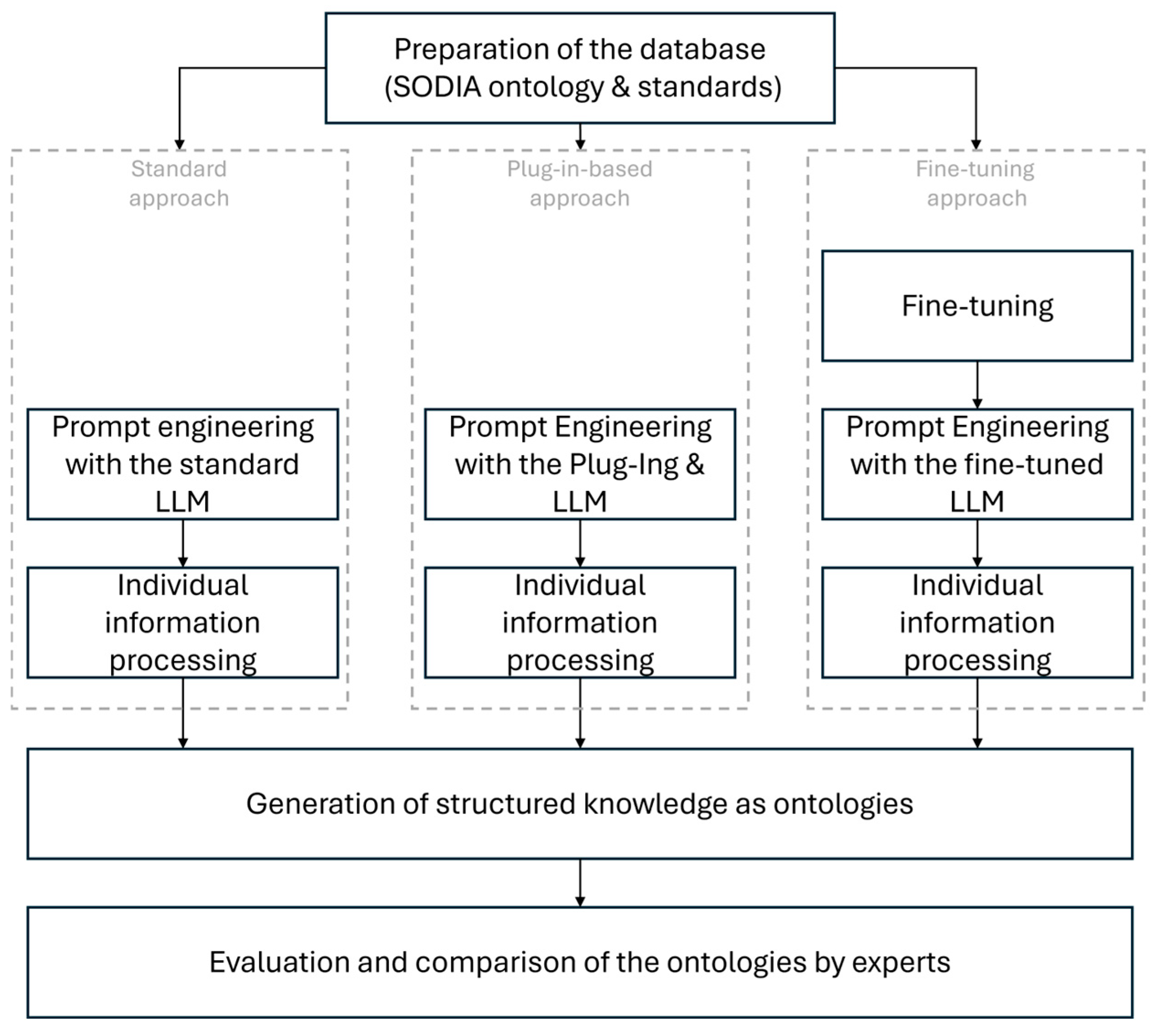
- Standard approach: The standard LLM OpenAI GPT-3.5 and OpenAI GPT-4.0 are used.
- Plug-in-based approach: Extension of OpenAI GPT-3.5 with the “Sider AI” [58] tool to test the added value of external tools in knowledge extraction.
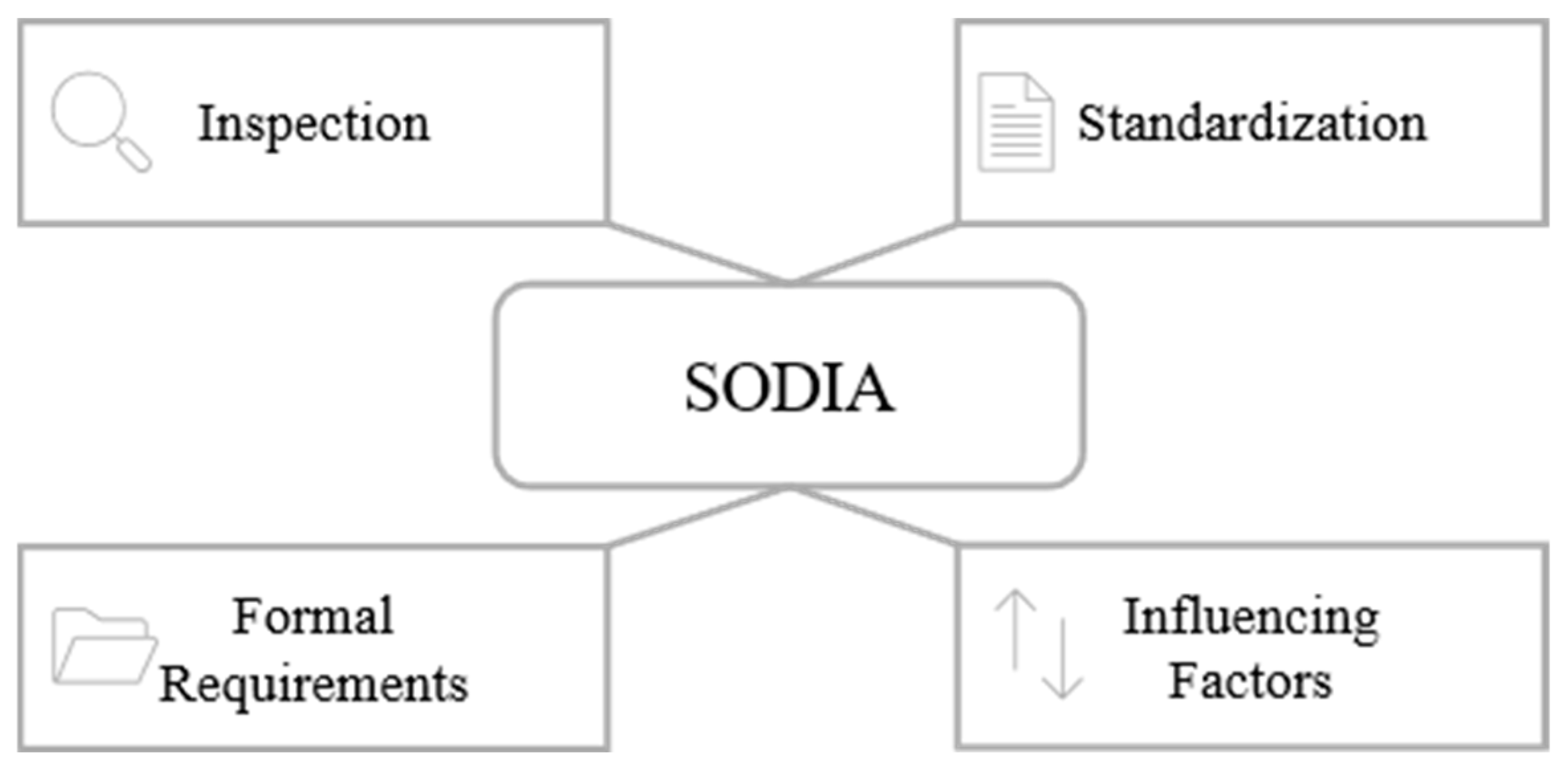
4. Introduction to the Research Base: SODIA Ontology
5. LLM Approach
5.1. General Information About the Approaches
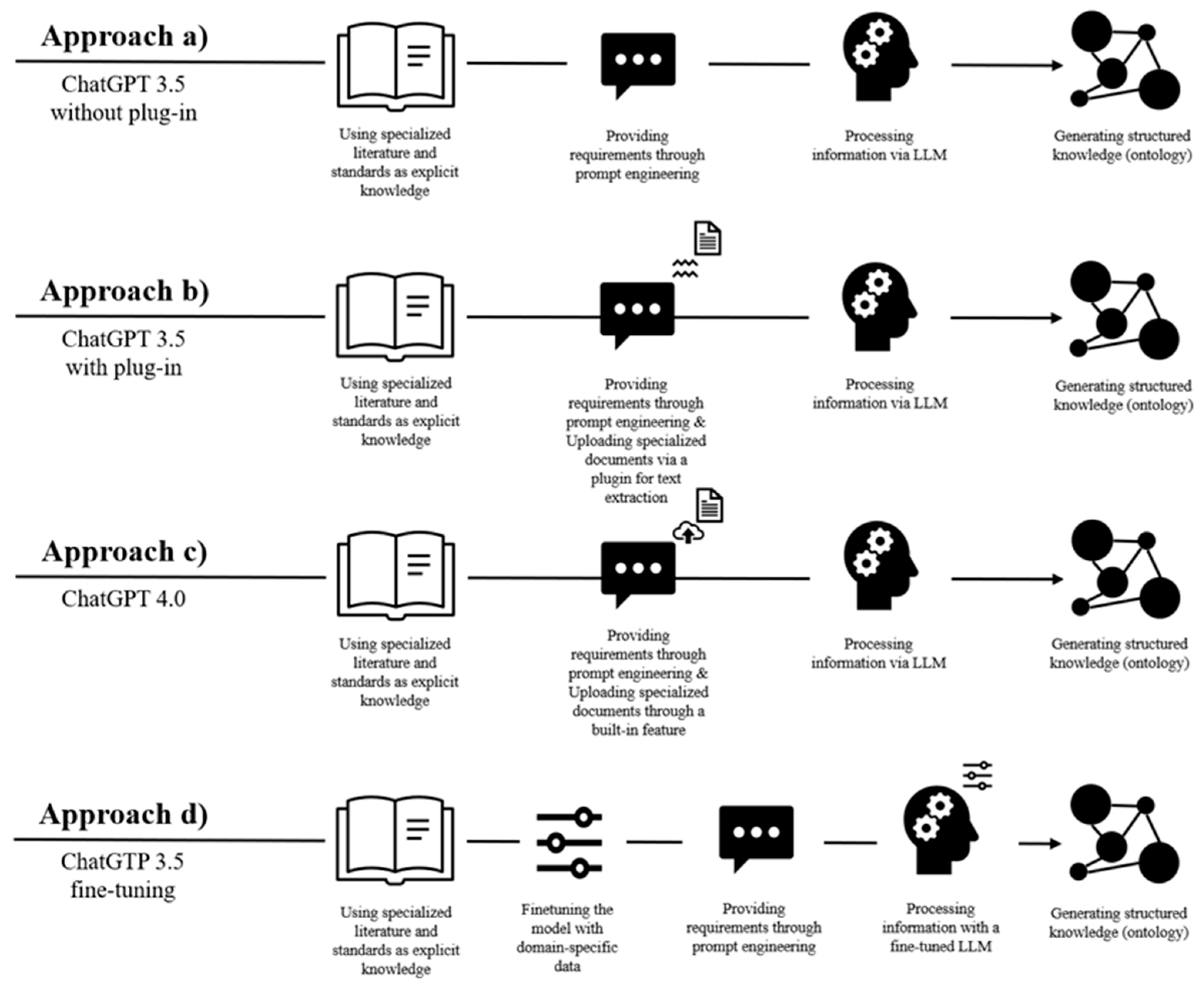
- Approach (a)—ChatGPT 3.5 without plug-in: This is the standard version of ChatGPT 3.5 [82,83], employed in subsequent prompt engineering (see Section 5.3) without integrating any additional documents or applying fine-tuning.
- Approach (b)—ChatGPT 3.5 with plug-in: This approach extends (a) by employing the “Sider” plug-in [84] to integrate the explicit knowledge base (i.e., the relevant documents) directly into the LLM environment. Through this plug-in, ChatGPT 3.5 processes more domain-specific content on structural diagnostics and can refine its responses accordingly.
- Approach (c)—ChatGPT 4.0: This approach uses ChatGPT 4.0, which allows direct integration of text documents into its web-based interface. As with (b), the explicit knowledge base is incorporated to enhance the model’s domain-specific understanding of structural diagnostics.
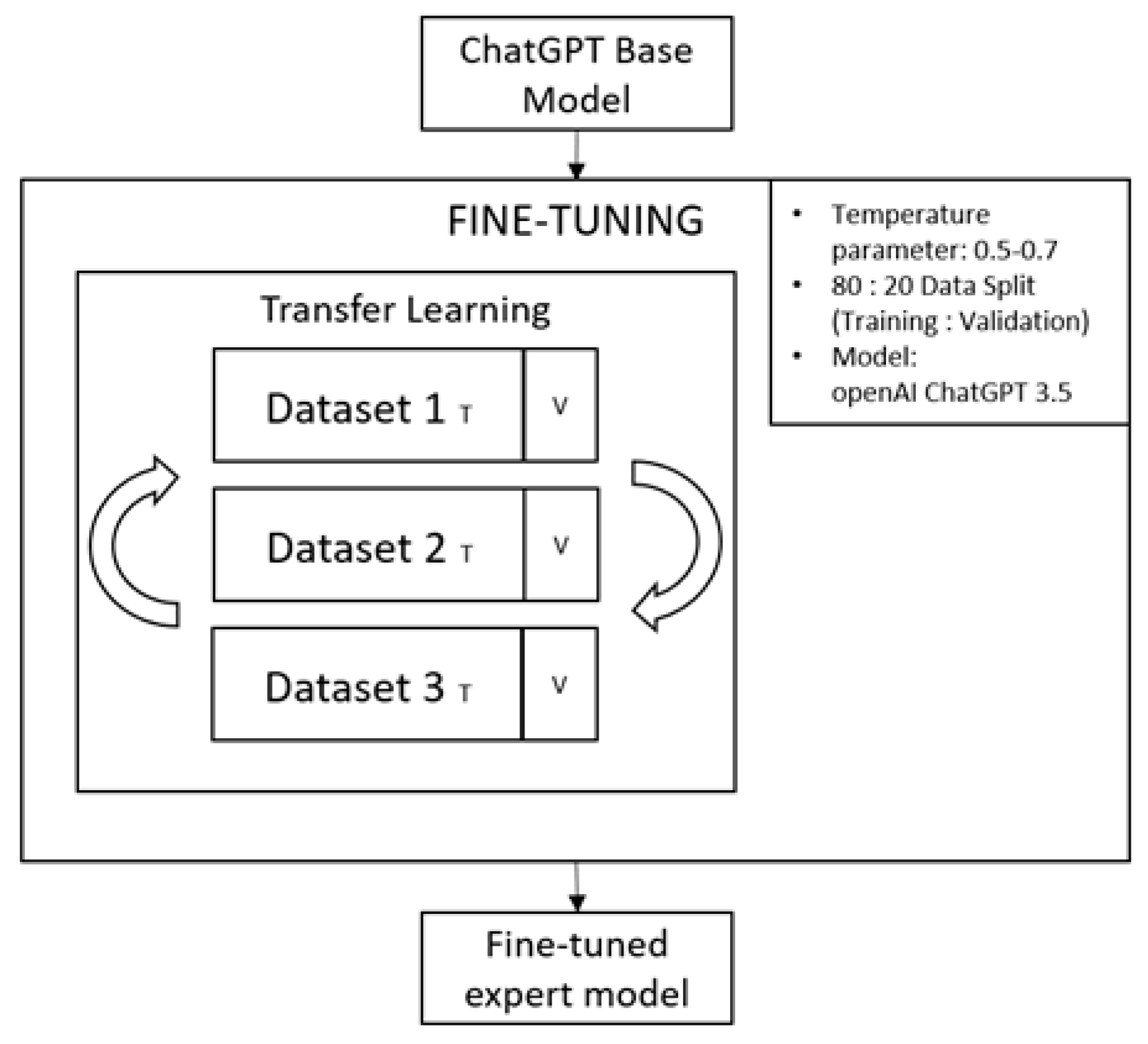
- Approach (d)—ChatGPT 3.5 fine-tuning: This final approach utilizes a fine-tuned ChatGPT 3.5 on the dual knowledge base (combining both explicit and implicit knowledge). The fine-tuning steps, standardized prompt engineering procedure and subsequent generation of the LLM-based ontology are detailed in Section 5.2 and Section 5.3.
5.2. Fine-Tuning the LLM
5.3. Prompt Engineering
- 1. Non-destructive inspection methods, sorted by measurement techniques
- 2. Corresponding inspection tasks
- 3. Required access to structural elements for each inspection method
- 4. Influencing factors
- 5. Necessary documents/materials
- 6. Stakeholders
- 7. Standards/legislation
- 8. Additional key points”
6. Quality Assessment
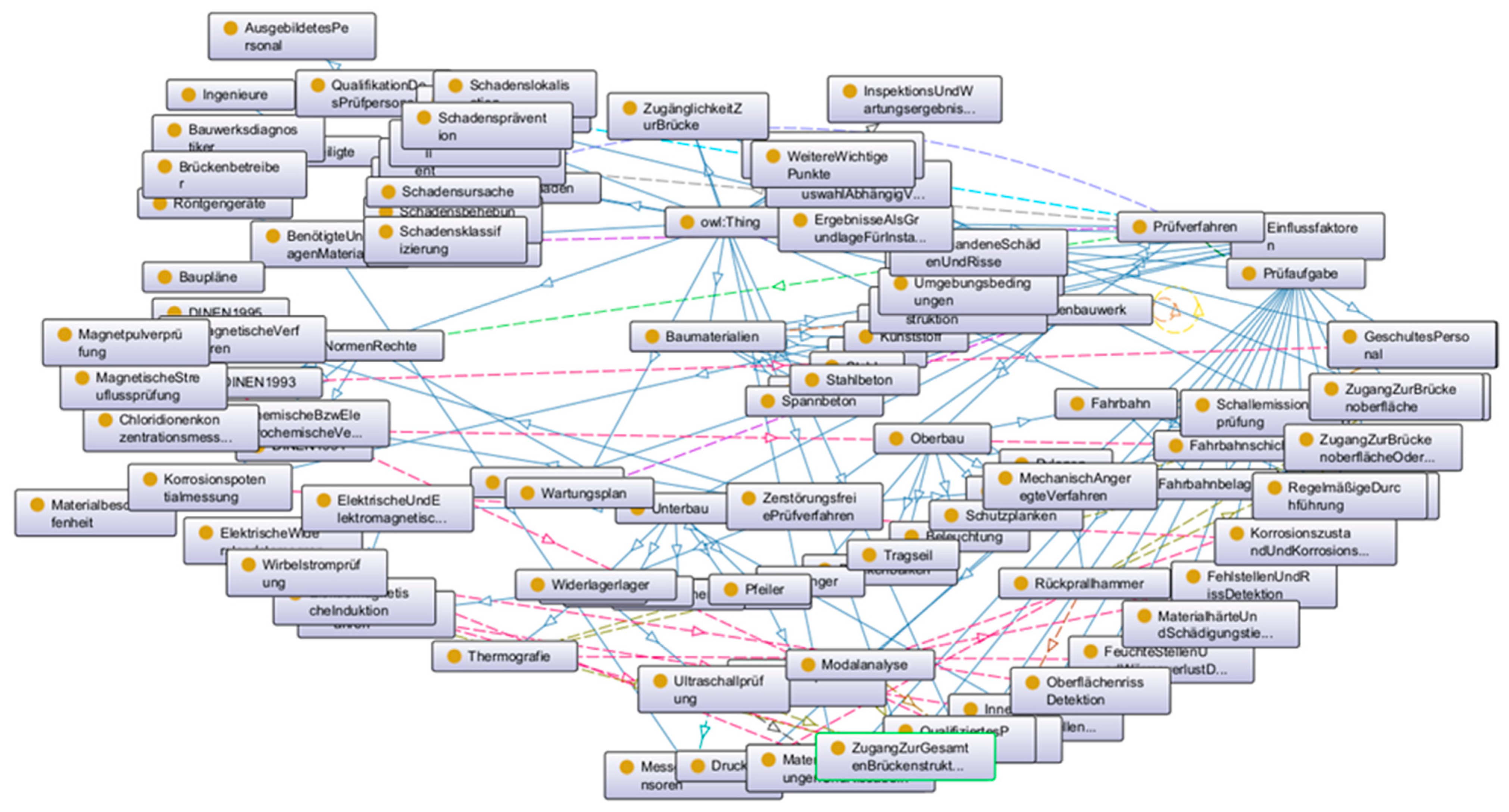
- ChatGPT 3.5 without plug-in:The ontology created uses many meaningful and correct terms. However, the LLM occasionally invents terms. The ontology is written in a consistent language. In addition, some of the object and data attributes are not appropriately named or are incorrect. Furthermore, the system generates too many object properties. The practicality of the ontology is considered average. The hierarchical structure of the ontology is appropriate, practical, and acceptable. However, some hierarchical classifications are very arbitrary and technically incomplete.
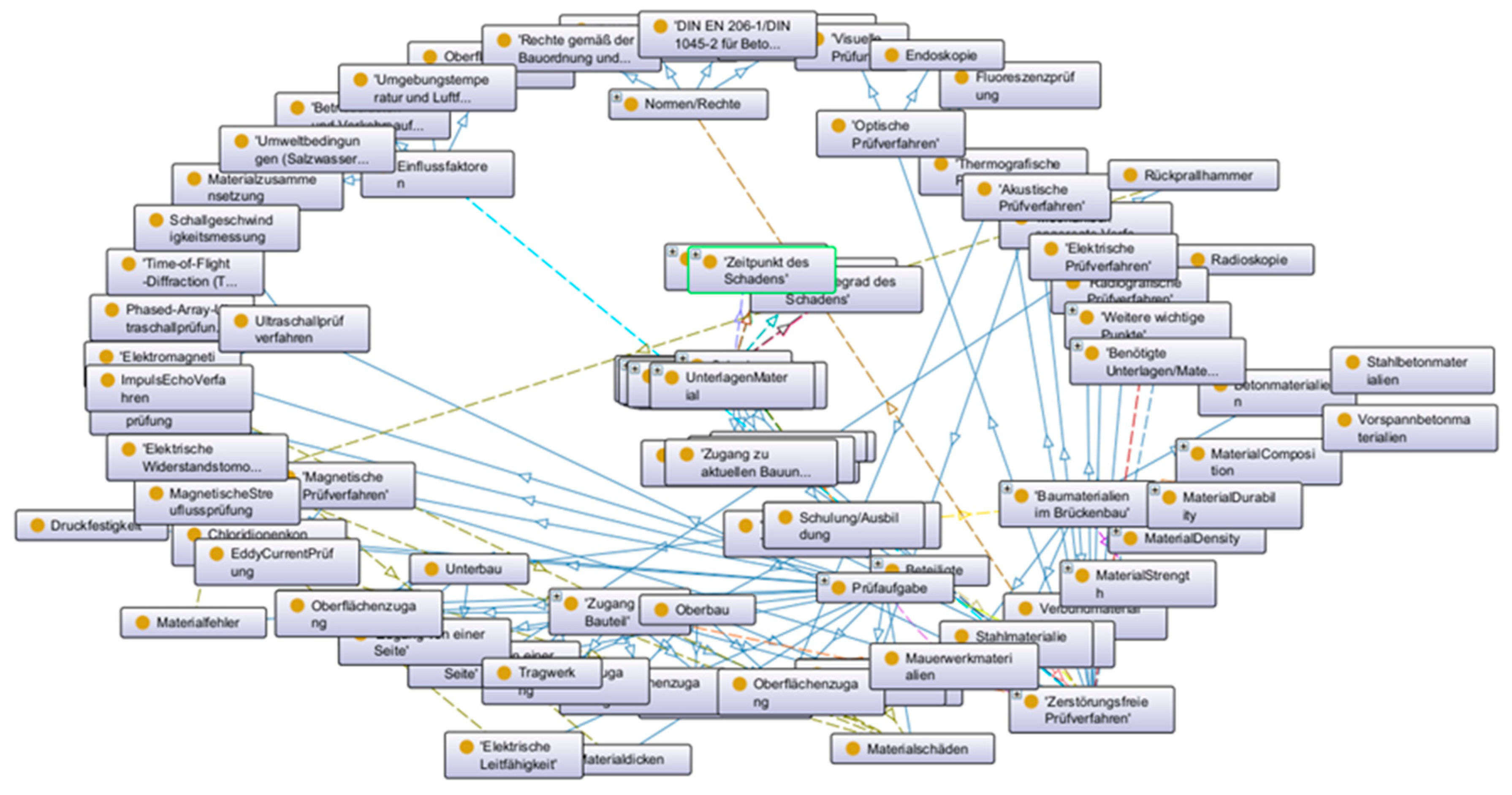
- ChatGPT 3.5 with plug-in:Many meaningful and correct terms are used. However, the LLM occasionally invents terms and does not name them consistently. Synonyms or other spellings are often used. In addition, the language used is not consistent. A serious error is the switching between English and German when naming the individual classes. With regard to the properties, the data properties are selected as unsuitable and impractical. Furthermore, too many object properties are generated that are not suitable for the field of non-destructive testing. This results in rather average practicality for the engineer. The hierarchical structure is considered better than in the previous version, “ChatGPT 3.5 with plug-in.” In addition, the classes, data, and object properties are more deeply structured.
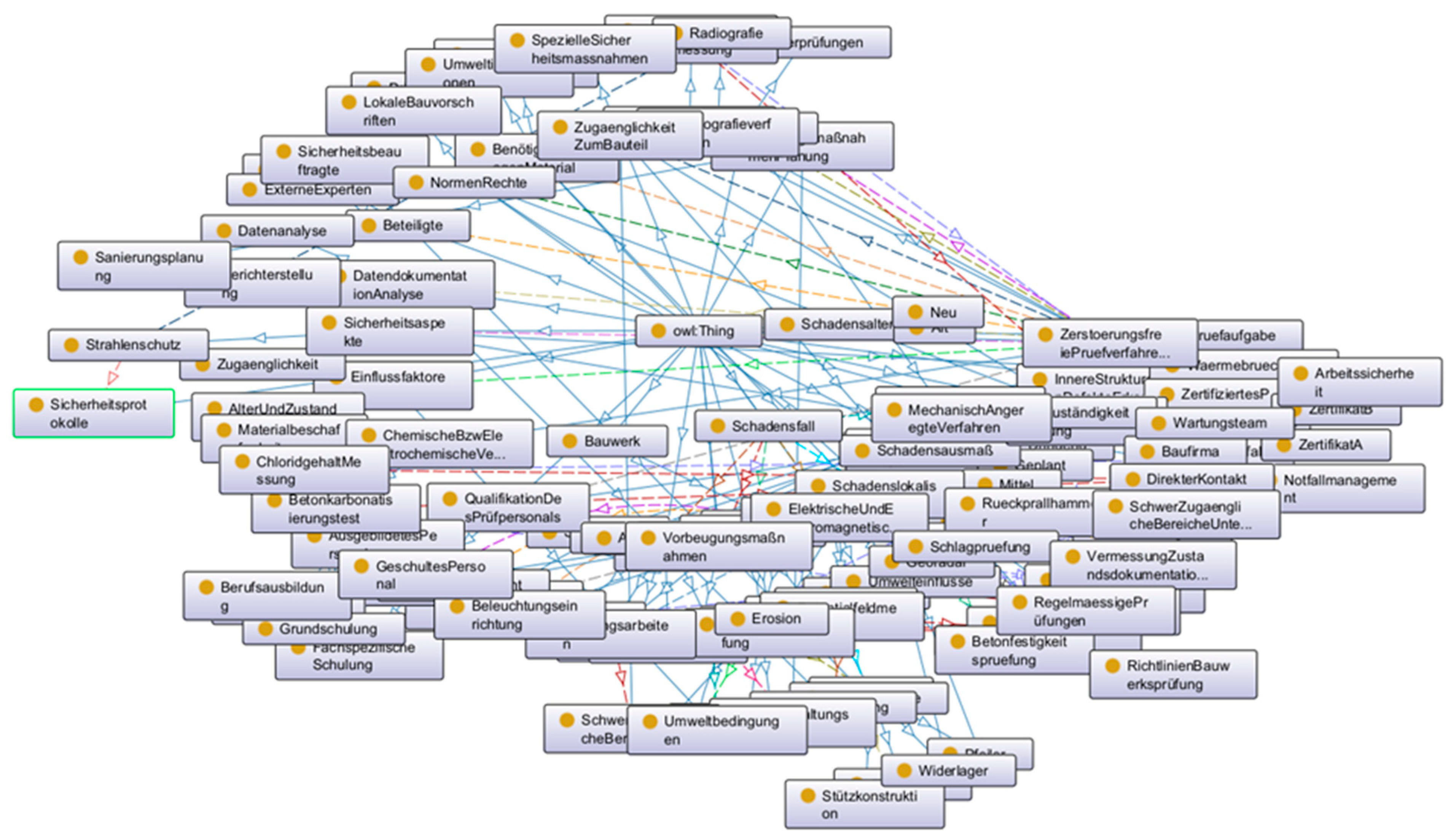
- ChatGPT 4.0:The ontology created by ChatGPT 4.0 performs significantly better than that of its two predecessors, “ChatGPT 3.5 with plug-in” and “ChatGPT 3.5 without plug-in.” The completeness of the classes, objects, and data properties is considered comprehensive and effective. However, in direct comparison to the class and data properties, too many object properties are generated in this version. In addition, there is a lack of consistent naming. Synonyms and, in some cases, different spellings are used selectively. Practicality is considered good, so an application that creates added value for the economy is considered feasible. According to the experts, the structure of the ontology is appropriate, but there is a lack of generic structure in some specific subject areas. In this context, the system could structure the ontology even more deeply.
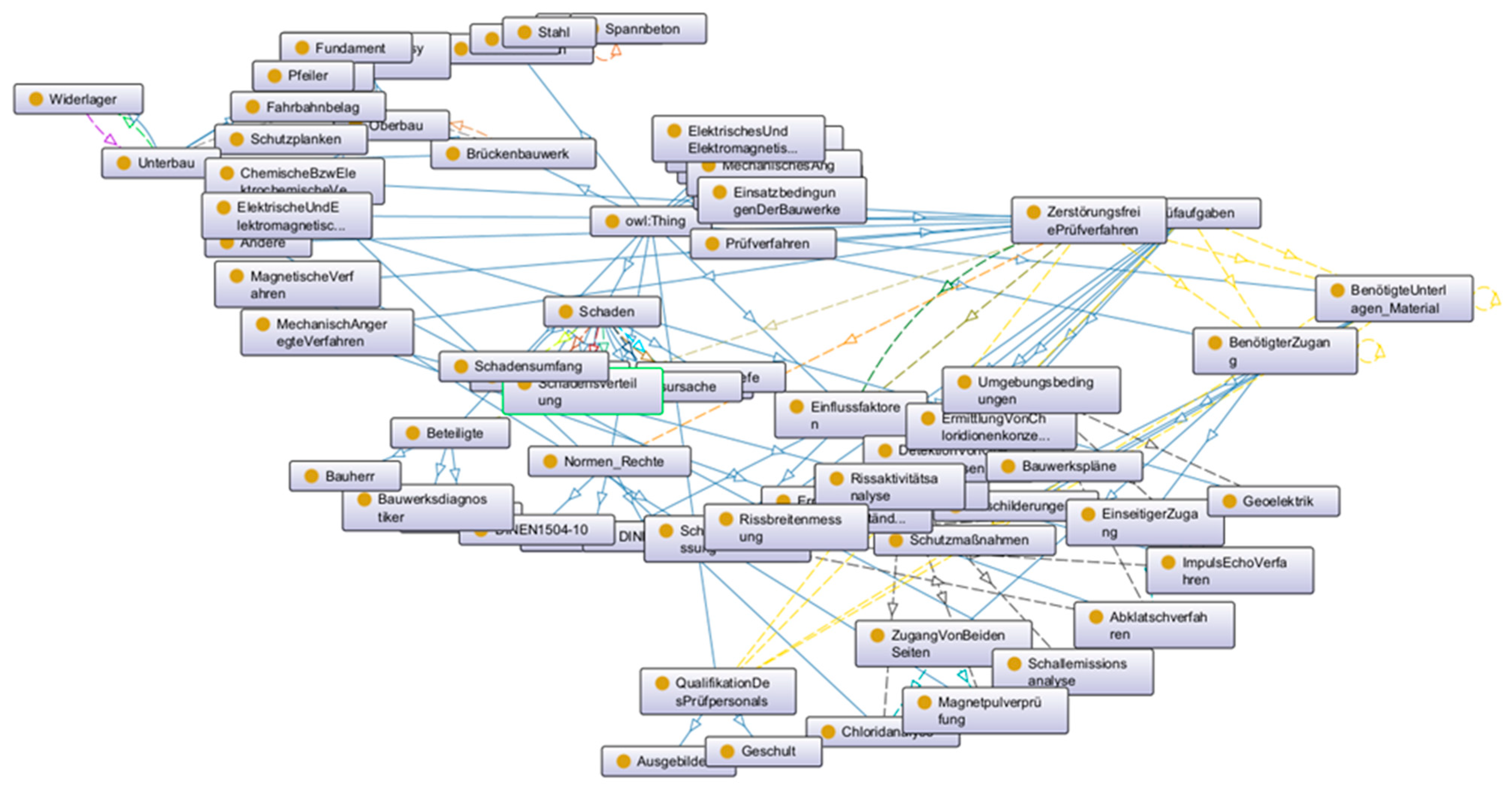
- ChatGPT 3.5 fine-tuning:The ontology generated by ChatGPT 3.5 fine-tuning is considered incomplete. It only includes a very small number of generic classes related to NDT and related fields. In addition, it contains too few object properties and only a few relevant data properties. Most data properties are not correctly defined. Furthermore, the ontology contains invented content that is not based on real technical content. The ontology is practically unusable and is considered critical. The structure of the ontology is very simple and global. There are too few links. Nevertheless, the existing structure is acceptable. The practicality is considered good, so that an application that creates added value for the economy is considered feasible. According to the experts, the structure of the ontology is appropriate, but there is a lack of generic structure in some specific subject areas. In this context, the system could structure the ontology even more deeply.
- SODIA ontology:The SODIA ontology was not generated by an LLM, but is based on human thought and was developed in articles [9,17]. The ontology is classified as complete and of sufficient quality. All relevant classes related to the discipline of NDT and related topics are covered. The defined object and data properties are sufficient in number and consistently correctly named. The practicality is rated as good to very good, although this also depends on the end user’s objectives. The structure is considered sound and comprehensive.An examination of the individual scores indicates that no ontology received the highest score of 6 Pt. in any quality criterion. In addition, a score of 5 Pt. was only awarded three times. These points are all assigned to Ex-No.1. In the further evaluation of all experts, all ontologies are rated as moderately suitable (scoring 3 or 4 Pt.) or unsuitable (scoring 1 or 2 Pt.). For an overall comparison of the quality criteria in which the ontologies under consideration differ, the mean values for each quality criterion are calculated for each ontology (see Table 6).
- All approaches of ChatGPT 3.5 are accompanied by hallucinations of the system. The LLM invents new parameters that do not exist for the definition of classes and object attributes, such as new methods and tools in the field of structural diagnostics or non-existent standards.
- All approaches of ChatGPT 3.5 automatically generate more data properties than object properties when creating ontologies.
- All approaches of ChatGPT 3.5 use synonyms and different spellings when naming classes, object properties, and data properties.
- All approaches of ChatGPT 3.5 structure ontologies generically and only up to a second level. All ontologies lack further depth in the definition of dependencies.
- The ontology of ChatGPT 4 most closely resembles the human-generated ontology, both in terms of completeness and practicality. Only in terms of structuring is the human-generated ontology even more specific and meaningfully linked.
7. Discussion
8. Conclusions
Author Contributions
Funding
Data Availability Statement
Acknowledgments
Conflicts of Interest
Appendix A



| Prompt of the User: User: Now classify all listed test procedures as respective subclasses. |
| Answer: ChatGPT: Here is the extension of the ontology to sort all listed test procedures as respective subclasses:turtle Copy code @prefix: <http://example.org/ontology#>. # Continuation of ontology with specific test procedures :Georadar rdf:type owl:Class; rdfs:subClassOf:ElektrischeUndElektromagnetischeVerfahren. :Wirbelstromprüfung rdf:type owl:Class; rdfs:subClassOf:ElektrischeUndElektromagnetischeVerfahren. :Betonradar rdf:type owl:Class; rdfs:subClassOf:ElektrischeUndElektromagnetischeVerfahren. :MagnetischeFlussdichte rdf:type owl:Class; rdfs:subClassOf:MagnetischeVerfahren. :Metalldetektion rdf:type owl:Class; rdfs:subClassOf:MagnetischeVerfahren. :Karbonatisierungstests rdf:type owl:Class; rdfs:subClassOf:ChemischeUndElektrochemischeVerfahren. :ChloridgehaltMessung rdf:type owl:Class; rdfs:subClassOf:ChemischeUndElektrochemischeVerfahren. :Potenzialfeldmessung rdf:type owl:Class; rdfs:subClassOf:ChemischeUndElektrochemischeVerfahren. :Thermografie rdf:type owl:Class; rdfs:subClassOf:AndereVerfahren. :Endoskopie rdf:type owl:Class; rdfs:subClassOf:AndereVerfahren. This supplement assigns the remaining test methods from the previously created list to the corresponding subclasses, such as ground-penetrating radar, eddy current testing, concrete radar, magnetic flux density, metal detection, carbonation tests, chloride content measurement, potential field measurement, thermography, and endoscopy. Each of these methods is assigned to a higher-level category based on its method or area of application. |


References
- Hartung, R.; Schönbach, R.; Liepe, D.; Klemt-Albert, K. Automatized Parametric Modeling to Enhance a data-based Maintenance Process for Infrastructure Buildings. In Proceedings of the 37th International Symposium on Automation and Robotics in Construction (ISARC), Kitakyushu, Japan, 27–29 October 2020; Osumi, H., Ed.; International Association for Automation and Robotics in Construction (IAARC): Oulu, Finland, 2020. [Google Scholar]
- Jäkel, J.-I.; Klemt-Albert, K. BIM-models of bridges in the operational phase: Use cases, phase model and reference architecture. ce/papers 2023, 6, 701–710. [Google Scholar] [CrossRef]
- Hartung, R.; Naraniecki, H.; Klemt-Albert, K.; Marx, S. Konzept zur BIM-basierten Instandhaltung von Ingenieurbauwerken mit Monitoringsystemen. Bautechnik 2020, 97, 826–835. [Google Scholar] [CrossRef]
- Naraniecki, H.; Hartung, R.; Marx, S.; Klemt-Albert, K. Zustandsprognose von Ingenieurbauwerken auf Basis von digitalen Zwillingen und Bestandsdaten. Bautechnik 2022, 99, 173–181. [Google Scholar] [CrossRef]
- Niederleithinger, E. NDE 4.0 in Civil Engineering. In Handbook of Nondestructive Evaluation 4.0; Meyendorf, N., Ida, N., Singh, R., Vrana, J., Eds.; Springer International Publishing: Cham, Switzerland, 2022; pp. 937–949. ISBN 978-3-030-73205-9. [Google Scholar]
- Schickert, M.; Artus, M.; Koch, C. Integration and Visualization of NDE Data in Digital Building Models—A conceptual view. E-J. Nondestruct. Test. 2022, 27. [Google Scholar] [CrossRef] [PubMed]
- German Concrete and Construction Engineering Association. DBV-Merkblatt “Anwendung Zerstörungsfreier Prüfverfahren im Bauwesen” (Engl. Application of Non-Destructive Testing Methods in the Construction Industry’); Deutscher Beton- und Bautechnik-Verein E.V.: Berlin, Germany, 2014. [Google Scholar]
- Arndt, R.; Voigt, C.; Fritsch, C.; Eric, E.; Burkhardt, J. Digital Building Diagnostics. E-J. Nondestruct. Test. 2022, 27. [Google Scholar] [CrossRef]
- Jäkel, J.-I.; Heinlein, E.; Klemt-Albert, K. Formalisation of Knowledge About Non-Destructive Testing Methods For Bridge Structures Based on The Development of The Sodia Ontology. In Proceedings of the Creative Construction Conference 2024, Praha, Czech Republic, 29 June–2 July 2024; Budapest University of Technology and Economics: Budapest, Hungary, 2024. [Google Scholar]
- Voigt, C.; Fritsch, C.; Hackel, T. Digitalisierung der Bauwerksdiagnostik zur realitätsnahen Bewertung von Ingenieurbauwerken. In 2. Fachkongress Digitale Transformation der Verkehrsinfrastruktur: Fachtagung über Planung, Bau, Betrieb, Unterhalt, Rückbau von Brücken, Tunneln, Schienen, Straßen, Wasserwegen Digital; 1. Auflage; Krieger, J., Ed.; Expert Verlag Ein Imprint von Narr Francke Attempto Verlag: Tübingen, Germany, 2023; ISBN 978-3-8169-3554-4. [Google Scholar]
- Morgenstern, H.; Raupach, M. A Novel Approach for Maintenance and Repair of Reinforced Concrete Using Building Information Modeling with Integrated Machine-Readable Diagnosis Data. Constr. Mater. 2022, 2, 314–327. [Google Scholar] [CrossRef]
- Morgenstern, H.; Raupach, M. Predictive BIM with Integrated Bayesian Inference of Deterioration Models as a Four-Dimensional Decision Support Tool. CivilEng 2023, 4, 185–203. [Google Scholar] [CrossRef]
- D’Amico, F.; Bianchini Ciampoli, L.; Di Benedetto, A.; Bertolini, L.; Napolitano, A. Integrating Non-Destructive Surveys into a Preliminary BIM-Oriented Digital Model for Possible Future Application in Road Pavements Management. Infrastructures 2022, 7, 10. [Google Scholar] [CrossRef]
- Lo, A.; Jiang, A.Q.; Li, W.; Jamnik, M. End-to-End Ontology Learning with Large Language Models. arXiv 2024, arXiv:2410.23584. [Google Scholar]
- Schuler, P.-C.; Mirboland, M.; Voigt, C.; Koch, C. Using Linked Data Containers for BIM based structural inspection workflows. In Advances in Information Technology in Civil and Building Engineering—Proceedings of the 20th Conference of the International Society for Computing in Civil and Building Engineering 2024—Volume 3: Construction Management, Montreal, Canada, 25 August 2024–28 August 2025; Francis, A., Miresco, E., Melhado, S., Eds.; Springer Nature: Cham, Switzerland, 2024. [Google Scholar]
- Funk, M.; Hosemann, S.; Jung, J.C.; Lutz, C. Towards Ontology Construction with Language Models. arXiv 2023, arXiv:2309.09898. [Google Scholar] [CrossRef]
- Jäkel, J.-I.; Heinlein, E.; Morgenstern, H.; Kim, H.; Klemt-Albert, K. System- and Data-integrated linking of digital 3D models of existing bridge structures with Knowledge Graphs of non-destructive diagnostic methods. J. Inf. Technol. Constr. 2025, 30, 603–630. [Google Scholar] [CrossRef]
- Pauwels, P.; Krijnen, T.; Terkaj, W.; Beetz, J. Enhancing the ifcOWL ontology with an alternative representation for geometric data. Autom. Constr. 2017, 80, 77–94. [Google Scholar] [CrossRef]
- Pauwels, P.; Costin, A.; Rasmussen, M.H. Knowledge Graphs and Linked Data for the Built Environment. In Industry 4.0 for the Built Environment; Bolpagni, M., Gavina, R., Ribeiro, D., Eds.; Springer International Publishing: Cham, Switzerland, 2022; pp. 157–183. ISBN 978-3-030-82429-7. [Google Scholar]
- Pauwels, P.; Terkaj, W. EXPRESS to OWL for construction industry: Towards a recommendable and usable ifcOWL ontology. Autom. Constr. 2016, 63, 100–133. [Google Scholar] [CrossRef]
- Hamdan, A.-H. Ein Ontologiebasiertes Verfahren zur Automatisierten Bewertung von Bauwerksschäden in Einer Digitalen Datenumgebung; 1. Auflage; Institut für Bauinformatik, Fakultät Bauingenieurwesen, TU Dresden: Dresden, Germany, 2023; ISBN 978-3-86780-728-9. [Google Scholar]
- Hamdan, A.-H.; Kozak, T. Bridge Topology Ontology. Available online: https://alhakam.github.io/brot/ (accessed on 3 January 2025).
- Ren, G.; Ding, R.; Li, H. Building an ontological knowledgebase for bridge maintenance. Adv. Eng. Softw. 2019, 130, 24–40. [Google Scholar] [CrossRef]
- Wu, C.; Wu, P.; Wang, J.; Jiang, R.; Chen, M.; Wang, X. Ontological knowledge base for concrete bridge rehabilitation project management. Autom. Constr. 2021, 121, 103428. [Google Scholar] [CrossRef]
- Hamdan, A.-H.; Taraben, J.; Helmrich, M.; Mansperger, T.; Morgenthal, G.; Scherer, R.J. A semantic modeling approach for the automated detection and interpretation of structural damage. Autom. Constr. 2021, 128, 103739. [Google Scholar] [CrossRef]
- Hamdan, A.; Scherer, R.J. A generic model for the digitalization of structural damage. In Life Cycle Analysis and Assessment in Civil Engineering: Towards an Integrated Vision; Caspeele, R., Taerwe, L., Frangopol, D.M., Eds.; CRC Press: London, UK, 2019; ISBN 9781315228914. [Google Scholar]
- Hamdan, A.-H.; Bonduel, M. Damage Topology Ontology. Available online: https://alhakam.github.io/dot/ (accessed on 3 January 2025).
- Schuler, P.-C.; Stark, Y.; Mirboland, M. (Eds.) Informationsintegration in der Betriebsphase von Bauwerken: Eine Diagnostikspezifische Ontologie im ICDD; Technische Universität Hamburg, Institut für Digitales und Autonomes Bauen: Hamburg, Germany, 2024. [Google Scholar]
- Tsialiamanis, G.P.; Wagg, D.J.; Antoniadou, I.; Worden, K. An Ontological Approach to Structural Health Monitoring. In Topics in Modal Analysis & Testing; Dilworth, B., Mains, M., Eds.; Springer International Publishing: Cham, Switzerland, 2021; Volume 8, pp. 51–59. ISBN 978-3-030-47716-5. [Google Scholar]
- Li, R.; Mo, T.; Yang, J.; Jiang, S.; Li, T.; Liu, Y. Ontologies-Based Domain Knowledge Modeling and Heterogeneous Sensor Data Integration for Bridge Health Monitoring Systems. IEEE Trans. Ind. Inf. 2021, 17, 321–332. [Google Scholar] [CrossRef]
- Jäkel, J.-I.; Heinlein, E.; Mackenbach, S.; Klemt-Albert, K. BIM-based deconstruction of bridge structures using digital 3D-models and information containers. In Proceedings of the International Conference of Smart and Sustainable Built Environment (SASBE 2024), Auckland, New Zealand, 7–9 November 2024. [Google Scholar]
- Taiwo, R.; Bello, I.T.; Abdulai, S.F.; Yussif, A.-M.; Salami, B.A.; Saka, A.; Zayed, T. Generative AI in the Construction Industry: A State-of-the-art Analysis. arXiv 2024, arXiv:2402.09939. [Google Scholar]
- Saka, A.; Taiwo, R.; Saka, N.; Salami, B.A.; Ajayi, S.; Akande, K.; Kazemi, H. GPT models in construction industry: Opportunities, limitations, and a use case validation. Dev. Built Environ. 2024, 17, 100300. [Google Scholar] [CrossRef]
- Ghimire, P.; Kim, K.; Acharya, M. Opportunities and Challenges of Generative AI in Construction Industry: Focusing on Adoption of Text-Based Models. Buildings 2024, 14, 220. [Google Scholar] [CrossRef]
- Zhen, Y.; Bi, S.; Tang, S.; Lu, X.-t.; Pan, W.-q.; Shi, H.-p.; Chen, Z.-r.; Fang, Y.-s.; Wang, X.-m. LLM-Project: Automated Engineering Task Planning via Generative AI and WBS Integration. In 2024 IEEE 14th International Conference on CYBER Technology in Automation, Control, and Intelligent Systems (CYBER), Copenhagen, Denmark, 16–19 July 2024; IEEE: Piscataway, NJ, USA, 2024; pp. 605–610. ISBN 979-8-3315-0605-6. [Google Scholar]
- Prieto, S.A.; Mengiste, E.T.; García de Soto, B. Investigating the Use of ChatGPT for the Scheduling of Construction Projects. Buildings 2023, 13, 857. [Google Scholar] [CrossRef]
- Parsafard, P.; Elezaj, O.; Ekundayo, D.; Vakaj, E.; Parmar, M.; Ahmad Wani, M. Automation in Construction Cost Budgeting using Generative Artificial Intelligence. In Proceedings of the 14th International Conference on Industrial Engineering and Operations Management, Dubai, United Arab Emirates, 14–16 November 2023; IEOM Society International: Southfield, MI, USA, 2024; ISBN 979-8-3507-1734-1. [Google Scholar]
- Pu, H.; Yang, X.; Li, J.; Guo, R. AutoRepo: A general framework for multimodal LLM-based automated construction reporting. Expert Syst. Appl. 2024, 255, 124601. [Google Scholar] [CrossRef]
- Chen, L.; Silvennoinen, H.; de Wolf, C.; Hall, D.; van Mele, T.; Block, P. Towards Automated Building Life Cycle Assessments: A Novel Approach Using Large Language Models and the COMPAS Framework. In Proceedings of IASS Annual Symposia; International Association for Shell and Spatial Structures (IASS): Madrid, Spain, 2024. [Google Scholar]
- Gao, Y.; Gan, Y.; Chen, Y.; Chen, Y. Application of large language models to intelligently analyze long construction contract texts. Constr. Manag. Econ. 2024, 43, 226–242. [Google Scholar] [CrossRef]
- Wong, S.; Zheng, C.; Su, X.; Tang, Y. Construction contract risk identification based on knowledge-augmented language models. Comput. Ind. 2024, 157–158, 104082. [Google Scholar] [CrossRef]
- He, Y.; Tang, Y.; Chen, T. A Study on Large Language Model-Based Approach for Construction Contract Risk Detection. In ICBDDM 2024: 2024 International Conference on Big Data and Digital Management, Shanghai, China, 16–18 August 2024; ACM: New York, NY, USA, 2024; pp. 136–141. ISBN 9798400710278. [Google Scholar]
- Kong, F.; Ahn, S. Use of Knowledge Graphs for Construction Safety Management: A Systematic Literature Review. Information 2024, 15, 390. [Google Scholar] [CrossRef]
- Lee, J.; Ahn, S.; Kim, D.; Kim, D. Performance comparison of retrieval-augmented generation and fine-tuned large language models for construction safety management knowledge retrieval. Autom. Constr. 2024, 168, 105846. [Google Scholar] [CrossRef]
- Uhm, M.; Kim, J.; Ahn, S.; Jeong, H.; Kim, H. Effectiveness of retrieval augmented generation-based large language models for generating construction safety information. Autom. Constr. 2025, 170, 105926. [Google Scholar] [CrossRef]
- Karnouskos, S. The Relevance of Large Language Models for Project Management. IEEE Open J. Ind. Electron. Soc. 2024, 5, 758–768. [Google Scholar] [CrossRef]
- Nyqvist, R.; Peltokorpi, A.; Seppänen, O. Can ChatGPT exceed humans in construction project risk management? Eng. Constr. Arch. Manag. 2024, 31, 223–243. [Google Scholar] [CrossRef]
- Pokhrel, R.; Parajuli, S. Transforming Structural Engineering: Examining the Opportunities and Risks of ChatGPT and Other Large Language Models. Int. J. Eng. Technol. 2023, 1, 204–222. [Google Scholar] [CrossRef]
- Zhu, Y.; Zhao, G.; Liu, H.; Sun, D.; He, Y. Refining Bridge Engineering-based Construction Scheme Compliance Review with Advanced Large Language Model Integration. In Proceedings of the BDIOT 2024: 2024 8th International Conference on Big Data and Internet of Things, Macau, China, 14–16 September 2024; ACM: New York, NY, USA, 2024; pp. 297–305. ISBN 9798400717529. [Google Scholar]
- Chen, X.; Zhang, L. Revolutionizing Bridge Operation and Maintenance with LLM-based Agents: An Overview of Applications and Insights. arXiv 2024, arXiv:2407.10064. [Google Scholar] [CrossRef]
- Ferdousi, R.; Hossain, M.A.; Yang, C.; Saddik, A.E. DefectTwin: When LLM Meets Digital Twin for Railway Defect Inspection. arXiv 2024, arXiv:2409.06725. [Google Scholar]
- Gao, Y.; Xiong, G.; Li, H.; Richards, J. Exploring bridge maintenance knowledge graph by leveraging GrapshSAGE and text encoding. Autom. Constr. 2024, 166, 105634. [Google Scholar] [CrossRef]
- Bellan, P.; Dragoni, M.; Ghidini, C. Process Knowledge Extraction and Knowledge Graph Construction Through Prompting: A Quantitative Analysis. In Proceedings of the SAC ‘24: 39th ACM/SIGAPP Symposium on Applied Computing, Avila, Spain, 8–12 April 2024; Hong, J., Park, J.W., Przybyłek, A., Eds.; ACM: New York, NY, USA, 2024; pp. 1634–1641. ISBN 9798400702433. [Google Scholar]
- Kommineni, V.K.; König-Ries, B.; Samuel, S. From human experts to machines: An LLM supported approach to ontology and knowledge graph construction. arXiv 2024, arXiv:2403.08345. [Google Scholar] [CrossRef]
- Zhang, B.; Carriero, V.A.; Schreiberhuber, K.; Tsaneva, S.; González, L.S.; Kim, J.; de Berardinis, J. OntoChat: A Framework for Conversational Ontology Engineering using Language Models. arXiv 2024, arXiv:2403.05921. [Google Scholar] [CrossRef]
- Prasad, D.; Pimpude, M.; Alankar, A. Towards Development of Automated Knowledge Maps and Databases for Materials Engineering using Large Language Models. arXiv 2024, arXiv:2402.11323. [Google Scholar] [CrossRef]
- Durmus, D.; Rožanec, J.; Carbonari, A.; Giretti, A.; Turk, Ž.; Grobelnik, M. Potential of Large Language Models for Ontology Development in Construction Domain. In Proceedings of the Creative Construction Conference 2024, Praha, Czech Republic, 29 June–2 July 2024; Budapest University of Technology and Economics: Budapest, Hungary, 2024. [Google Scholar]
- Wang, B.; Min, S.; Deng, X.; Shen, J.; Wu, Y.; Zettlemoyer, L.; Sun, H. Towards Understanding Chain-of-Thought Prompting: An Empirical Study of What Matters. arXiv 2022, arXiv:2212.10001. [Google Scholar]
- Ding, N.; Qin, Y.; Yang, G.; Wei, F.; Yang, Z.; Su, Y.; Hu, S.; Chen, Y.; Chan, C.-M.; Chen, W.; et al. Parameter-efficient fine-tuning of large-scale pre-trained language models. Nat. Mach. Intell. 2023, 5, 220–235. [Google Scholar] [CrossRef]
- Han, Z.; Gao, C.; Liu, J.; Zhang, J.; Zhang, S.Q. Parameter-Efficient Fine-Tuning for Large Models: A Comprehensive Survey. arXiv 2024, arXiv:2403.14608. [Google Scholar]
- Li, Q.; Fu, L.; Zhang, W.; Chen, X.; Yu, J.; Xia, W.; Zhang, W.; Tang, R.; Yu, Y. Adapting Large Language Models for Education: Foundational Capabilities, Potentials, and Challenges. arXiv 2024, arXiv:2401.08664. [Google Scholar] [CrossRef]
- Wei, J.; Wang, X.; Schuurmans, D.; Bosma, M.; Ichter, B.; Xia, F.; Chi, E.; Le, Q.; Zhou, D. Chain-of-Thought Prompting Elicits Reasoning in Large Language Models. arXiv 2022, arXiv:2201.11903. [Google Scholar]
- Gangemi, A.; Catenacci, C.; Ciaramita, M.; Lehmann, J. Modelling Ontology Evaluation and Validation. In The Semantic Web: Research and Applications; Hutchison, D., Kanade, T., Kittler, J., Kleinberg, J.M., Mattern, F., Mitchell, J.C., Naor, M., Nierstrasz, O., Pandu Rangan, C., Steffen, B., et al., Eds.; Springer: Berlin/Heidelberg, Germany, 2006; pp. 140–154. ISBN 978-3-540-34544-2. [Google Scholar]
- Cristani, M.; Cuel, R. A Survey on Ontology Creation Methodologies. Int. J. Semant. Web Inf. Syst. 2005, 1, 49–69. [Google Scholar] [CrossRef]
- Wilson, R.S.I.; Goonetillake, J.S.; Indika, W.A.; Ginige, A. A conceptual model for ontology quality assessment. Semant. Web 2023, 14, 1051–1097. [Google Scholar] [CrossRef]
- Bravo Contreras, M.C.; Hoyos Reyes, L.F.; Reyes Ortiz, J.A. Methodology for ontology design and construction. Account. Adm. 2018, 64, 134. [Google Scholar] [CrossRef]
- DIN 1076; Ingenieurbauwerke im Zuge von Straßen und Wegen (Engl. DIN 1076—Engineering Structures in Connection with Roads-Inspection and Test): Überwachung und Prüfung. Deutsches Institut für Normung e.V.: Berlin, Germany, 1999.
- DIN EN 12504-2; Prüfung von Beton in Bauwerken—Teil 2: Zerstörungsfreie Prüfung—Bestimmung der Rückprallzahl; Deutsche Fassung EN 12504-2:2021. Deutsches Institut für Normung e.V.: Berlin, Germany, 2021.
- DIN EN ISO 9712; German Concrete and Construction Engineering Association. Zerstörungsfreie Prüfung—Qualifizierung und Zertifizierung von Personal der zerstörungsfreien Prüfung (Engl. Non-Destructive Testing—Qualification and Certification of Non-Destructive Testing Personnel). Deutsches Institut für Normung e.V.: Berlin, Germany, 2022.
- Walther, A.; Hasenstab, A. Zerstörungsfreie Prüfverfahren zur Bestimmung von Materialparametern im Stahl- und Spannbetonbau (Engl. Non-Destructive Testing Methods for the Determination of Material Parameters in Reinforced and Prestressed Concrete Construction). In Bauphysik-Kalender 2012; Fouad, N.A., Ed.; Wiley: Hoboken, NJ, USA, 2012; pp. 157–202. ISBN 9783433029862. [Google Scholar]
- Horn, K. Bauwerksanalyse (Engl. Structural Analysis); Frauenhofer IRB Verlag; Beuth Verlag GmbH: Stuttgart, Germany; Berlin, Germany; Wien, Austria; Zürich, Switzerland, 2020; ISBN 978-3-8167-9482-0. [Google Scholar]
- Taffe, A.; Hillemeier, B.; Walther, A. Verifizierung moderner zerstörungsfreier Prüfverfahren an einem Abbruchbauwerk (engl. Verification of modern non-destructive testing methods on a demolition structure). Beton Und Stahlbetonbau 2010, 105, 813–820. [Google Scholar] [CrossRef]
- Flohrer, C. Orten der Bewehrung und Messen der Betondeckung. In Bauphysik-Kalender 2004; Cziesielski, E., Ed.; Ernst und Sohn: Berlin, Germany, 2004; Chapter C1, Section 2.8; pp. 370–379. [Google Scholar]
- Taffe, A. Regelwerke in der Bauwerksdiagnose (Engl. Regulations in Structural Diagnostics). In Proceedings of the Fachtagung Bauwerksdiagnose 2014, Berlin, Germany, 13–14 February 2014. [Google Scholar]
- Pak, C.-I. Optimierung des Remanenzmagnetismus-Verfahrens zur Stahlbruchortung in Bauwerken—Theoretische Weiterentwicklung (engl. Optimization of the Remanence Magnetism Method for Steel Fracture Detection in Structures–Theoretical Further Development). Ph.D. Thesis, Technische Universität Berlin, Berlin, Germany, 2010. [Google Scholar]
- Bundesministerium für Verkehr und Digitale Infrastruktur. Richtlinien für die Erhaltung von Ingenieurbauten (RI-ERH-ING) (Engl. Guidelines for the Maintenance of Engineering Structures RI-ERH-ING). 2020. Available online: https://www.bast.de/DE/Publikationen/Regelwerke/Ingenieurbau/Erhaltung/RI-ERH-ING.html (accessed on 27 January 2025).
- Merkblatt B 02: Merkblatt zur Zerstörungsfreien Betondeckungsmessung und Bewehrungsortung an Stahl- und Spannbetonbauteilen (Engl. Code of Practice for Non-Destructive Concrete Cover Measurement and Reinforcement Location on Reinforced and Prestressed Concrete Components (Code of Practice B02); Deutsche Gesellschaft für Zerstörungsfreie Prüfung: Berlin, Germany, 2014.
- Merkblatt B 03: Elektrochemische Potentialmessungen zur Detektion von Bewehrungsstahlkorrosion (Engl. Electrochemical Potential Measurements for the Detection of Reinforcement Steel Corrosion—Code of Practice B03); Deutsche Gesellschaft für zerstörungsfreie Prüfung: Berlin, Germany, 2021.
- Merkblatt B 04: Ultraschailverfahren zur Zerstörungsfreien Prüfung im Bauwesen (Engl. Ultrasonic Methods for Non-Destructive Testing in the Construction Industry—Code of Practice B04); Deutsche Gesellschaft für zerstörungsfreie Prüfung: Berlin, Germany, 2018.
- Merkblatt B 10: Merkblatt über das Radarverfahren zur Zerstörungsfreien Prüfung im Bauwesen (Engl. Leaflet on the Radar Method for Non-Destructive Testing in the Construction Industry—Code of Practice B10); Deutsche Gesellschaft für zerstörungsfreie Prüfung: Berlin, Germany, 2008.
- Merkblatt B 12: Korrosionsmonitoring bei Stahl- und Spannbetonbauwerken (engl. Corrosion Monitoring for Reinforced and Prestressed Concrete Structures—Code of Practice B12); Deutsche Gesellschaft für zerstörungsfreie Prüfung: Berlin, Germany, 2018.
- Roumeliotis, K.I.; Tselikas, N.D. ChatGPT and Open-AI Models: A Preliminary Review. Future Internet 2023, 15, 192. [Google Scholar] [CrossRef]
- Alto, V. Modern Generative AI with ChatGPT and OpenAI Models: Leverage the Capabilities of OpenAI’s LLM for Productivity and Innovation with GPT3 and GPT4; Packt Publishing: Birmingham, UK, 2023; ISBN 9781805122838. [Google Scholar]
- Sider: ChatGPT Sidebar + GPT-4o, Claude 3.5, Gemini 1.5 & AI Tools. Available online: https://sider.ai/en (accessed on 8 January 2025).
- Auger, T.; Saroyan, E. Overview of the OpenAI APIs. In Generative AI for Web Development; Auger, T., Saroyan, E., Eds.; Apress: Berkeley, CA, USA, 2024; pp. 87–116. ISBN 979-8-8688-0884-5. [Google Scholar]
- Strangmann, T.; Purucker, L.; Franke, J.K.H.; Rapant, I.; Ferreira, F.; Hutter, F. Transfer Learning for Finetuning Large Language Models. arXiv 2024, arXiv:2411.01195. [Google Scholar] [CrossRef]
- Lu, W.; Luu, R.K.; Buehler, M.J. Fine-tuning large language models for domain adaptation: Exploration of training strategies, scaling, model merging and synergistic capabilities. arXiv 2024, arXiv:2409.03444. [Google Scholar] [CrossRef]
- Chen, B.; Zhang, Z.; Langrené, N.; Zhu, S. Unleashing the potential of prompt engineering in Large Language Models: A comprehensive review. arXiv 2023, arXiv:2310.14735. [Google Scholar] [CrossRef]
- Amatriain, X. Prompt Design and Engineering: Introduction and Advanced Methods. arXiv 2024, arXiv:2401.14423. [Google Scholar] [CrossRef]
- van Buren, D. Guided scenarios with simulated expert personae: A remarkable strategy to perform cognitive work. arXiv 2023, arXiv:2306.03104. [Google Scholar] [CrossRef]
- Hamdan, A.-H.; Kozak, T. Building Material Definitions (BMAT). Available online: https://alhakam.github.io/bmat/ (accessed on 29 January 2024).
- Noy, N.F.; McGuinness, D.I. Ontology Development 101: A Guide to Creating Your First Ontology. Comput. Sci. 2001. [Google Scholar]


| Pos. | Name (German Titles Have Been Translated into English) | Source |
|---|---|---|
| 1 | DIN 1076—Engineering structures in connection with roads—inspection and test | [67] |
| 2. | Non-destructive testing methods for the determination of material parameters in reinforced and prestressed concrete construction | [70] |
| 3. | Structural analysis | [71] |
| 4. | Verification of modern non-destructive testing methods on a demolition structure | [72] |
| 5. | Non-destructive testing—Qualification and certification of NDT personnel (ISO 9712:2021); German version: EN ISO 9712:2022 | [69] |
| 6. | Testing concrete in structures—Part 2: Non-destructive testing—Determination of rebound number; German version: DIN EN 12504-2:2021 | [68] |
| 7. | Measurement of the concrete cover and localization of the probation | [73] |
| 8. | Regulations in structural diagnostics | [74] |
| 9. | Optimization of the remanence magnetism method for steel fracture detection in structures—theoretical further development | [75] |
| 10. | Guidelines for the maintenance of engineering structures (RI-ERH-ING) | [76] |
| 11. | Application of non-destructive testing methods in the construction industry (DBV Guideline) | [7] |
| 12. | Code of practice for non-destructive concrete cover measurement and reinforcement location on reinforced and prestressed concrete components (Code of practice B02) | [77] |
| 13. | Electrochemical potential measurements for the detection of reinforcement steel corrosion (Code of Practice B03) | [78] |
| 14. | Ultrasonic methods for non-destructive testing in the construction industry (Code of practice B04) | [79] |
| 15. | Leaflet on the radar method for non-destructive testing in the construction industry (Code of practice B10) | [80] |
| 16. | Corrosion monitoring for reinforced and prestressed concrete structures (Code of practice B12) | [81] |
| Approach | File Size of Chat [KB] | File Size of Ontology [KB] | Axioms [pcs.] | Logical Axioms [pcs.] | Classes [pcs.] | Object Properties [pcs.] | Data Properties [pcs.] |
|---|---|---|---|---|---|---|---|
| ChatGPT 3.5 without plug-in | 100 | 40 | 457 | 193 | 106 | 27 | 29 |
| ChatGPT 3.5 with plug-in | 957 | 39 | 527 | 269 | 112 | 41 | 41 |
| ChatGPT 4.0 | 66 | 26 | 444 | 259 | 135 | 35 | 23 |
| ChatGPT 3.5 fine-tuning | 26 | 15 | 226 | 127 | 73 | 19 | 7 |
| SODIA | analog | 498 | 3974 | 2367 | 253 | 88 | 109 |
| Pos. | Name of the Quality Criteria | Description of the Quality Criteria |
|---|---|---|
| 1. | Completeness | The completeness of an ontology refers to the representation of all relevant aspects, correlations and the subject area of structural diagnostics in data properties and object properties. |
| 2. | Practicability | The practicability of an ontology considers the proximity and relevance to the industry of formalized and represented knowledge for possible use in operational projects. |
| 3. | Structure | The structure of an ontology focuses on the logic and meaningfulness of the hierarchical structure as well as defined dependencies and restrictions between individual classes, objects and parameters. |
| Points [Pt.] | Descriptions |
|---|---|
| 1 Point [Pt.] | Very unsuitable |
| 2 Points [Pt.] | Unsuitable |
| 3 Points [Pt.] | Partly unsuitable |
| 4 Points [Pt.] | Partly suitable |
| 5 Points [Pt.] | Suitable |
| 6 Points [Pt.] | Very suitable |
| Expert-No. (Ex-No.) | Approach | Quality Criteria | Average Value [Pt.] | ||
|---|---|---|---|---|---|
| Completeness [Pt.] | Practicability [Pt.] | Structure [Pt.] | |||
| Ex-No. 1 | ChatGPT 3.5 without plug-in | 2 | 3 | 5 | 3.3 |
| ChatGPT 3.5 with plug-in | 3 | 3 | 3 | 3.0 | |
| ChatGPT 4.0 | 4 | 4 | 4 | 4.0 | |
| ChatGPT 3.5 fine-tuning | 2 | 2 | 2 | 2.0 | |
| SODIA | 5 | 4 | 5 | 4.7 | |
| Ex-No. 2 | ChatGPT 3.5 without plug-in | 2 | 1 | 1 | 1.3 |
| ChatGPT 3.5 with plug-in | 1 | 1 | 1 | 1.0 | |
| ChatGPT 4.0 | 3 | 3 | 3 | 3.0 | |
| ChatGPT 3.5 fine-tuning | 2 | 1 | 3 | 2.0 | |
| SODIA | 2 | 2 | 2 | 2.0 | |
| Ex-No. 3 | ChatGPT 3.5 without plug-in | 3 | 2 | 2 | 2.3 |
| ChatGPT 3.5 with plug-in | 2 | 3 | 3 | 2.7 | |
| ChatGPT 4.0 | 2 | 3 | 4 | 3.0 | |
| ChatGPT 3.5 fine-tuning | 2 | 3 | 3 | 2.7 | |
| SODIA | 4 | 4 | 3 | 3.7 | |
| Approach | Completeness [Pt.] | Practicability [Pt.] | Structure [Pt.] | Average Value [Pt.] | Ranking |
|---|---|---|---|---|---|
| ChatGPT 3.5 without plug-in | 2.33 | 2.00 | 2.67 | 2.33 | 3 |
| ChatGPT 3.5 with plug-in | 2.00 | 2.33 | 2.33 | 2.22 | 4 |
| ChatGPT 4.0 | 3.00 | 3.33 | 3.67 | 3.33 | 2 |
| ChatGPT 3.5 fine-tuning | 2.00 | 2.00 | 2.67 | 2.22 | 4 |
| SODIA | 3.67 | 3.33 | 3.33 | 3.44 | 1 |
| Approach | Standard Deviation (s) | Standard Error (SE) | Margin of Error | 95% Confidence Interval (CI) |
|---|---|---|---|---|
| ChatGPT 3.5 without plug-in | 1.00 | 0.58 | ±2.48 | [−0.18, 4.78] |
| ChatGPT 3.5 with plug-in | 1.08 | 0.62 | ±2.68 | [−0.45, 4.91] |
| ChatGPT 4.0 | 0.58 | 0.33 | ±1.44 | [1.89, 4.77] |
| ChatGPT 3.5 fine-tuning | 0.40 | 0.23 | ±1.00 | [1.23, 3.23] |
| SODIA | 1.37 | 0.79 | ±3.40 | [0.07, 6.87] |
Disclaimer/Publisher’s Note: The statements, opinions and data contained in all publications are solely those of the individual author(s) and contributor(s) and not of MDPI and/or the editor(s). MDPI and/or the editor(s) disclaim responsibility for any injury to people or property resulting from any ideas, methods, instructions or products referred to in the content. |
© 2026 by the authors. Licensee MDPI, Basel, Switzerland. This article is an open access article distributed under the terms and conditions of the Creative Commons Attribution (CC BY) license.
Share and Cite
Jäkel, J.-I.; Heinlein, E.; Sengupta, J.; Kim, H.; Klemt-Albert, K. A Comparison of Human Capabilities and Large Language Models for Knowledge Representation with Ontologies of Non-Destructive Testing in Bridge Engineering. Buildings 2026, 16, 1395. https://doi.org/10.3390/buildings16071395
Jäkel J-I, Heinlein E, Sengupta J, Kim H, Klemt-Albert K. A Comparison of Human Capabilities and Large Language Models for Knowledge Representation with Ontologies of Non-Destructive Testing in Bridge Engineering. Buildings. 2026; 16(7):1395. https://doi.org/10.3390/buildings16071395
Chicago/Turabian StyleJäkel, Jan-Iwo, Eva Heinlein, Joy Sengupta, Hongjo Kim, and Katharina Klemt-Albert. 2026. "A Comparison of Human Capabilities and Large Language Models for Knowledge Representation with Ontologies of Non-Destructive Testing in Bridge Engineering" Buildings 16, no. 7: 1395. https://doi.org/10.3390/buildings16071395
APA StyleJäkel, J.-I., Heinlein, E., Sengupta, J., Kim, H., & Klemt-Albert, K. (2026). A Comparison of Human Capabilities and Large Language Models for Knowledge Representation with Ontologies of Non-Destructive Testing in Bridge Engineering. Buildings, 16(7), 1395. https://doi.org/10.3390/buildings16071395