Article

Regeneration Performance of rGO Air Filter Materials Under Water Cleaning and Ultrasonic Cleaning from the Perspective of Optimizing Commercial Costs in Public Buildings


1
College of Architecture and Energy Engineering, Wenzhou University of Technology, Wenzhou 325000, China
2
Shandong Key Laboratory of Intelligent Manufacturing Technology for Advanced Power Equipment, Weifang University, Weifang 261061, China
3
Manchester Business School, University of Manchester, Manchester M13 9PL, UK
4
School of Machinery and Automation, Weifang University, Weifang 261000, China
*
Author to whom correspondence should be addressed.
Buildings 2026, 16(11), 2089; https://doi.org/10.3390/buildings16112089 (registering DOI)
Submission received: 7 April 2026 / Revised: 12 May 2026 / Accepted: 21 May 2026 / Published: 24 May 2026
(This article belongs to the Special Issue Advanced Study on Urban Environment by Big Data Analytics)

Abstract

With the continuous implementation of the national dual carbon target and the refined control of operating costs in civil buildings, the issue of cleaning and regenerating high-consumption air filter materials in civil buildings has become a hot research topic. This study took rGO air filter material as the research object from the perspective of commercial cost optimization and, using water as the cleaning medium, compared and analyzed the changes in filtration efficiency, airflow resistance, comprehensive performance, and full dimension economy during five cycles of regeneration using water cleaning and ultrasonic cleaning methods. The results showed that ultrasonic cleaning can better maintain the microscopic morphology and structural integrity of the rGO filter, exhibiting more stable filtration performance and slower performance attenuation during repeated regeneration. After the first cleaning, the filtration effectiveness following water cleaning was higher than that following ultrasonic cleaning, with filtration efficiencies 1.21%, 0.18%, and 1.11% higher for PM10, PM2.5, and PM1.0, respectively. After the 2nd to 5th cleaning cycles, the filtration efficiency following ultrasonic cleaning was higher than that following water cleaning, with increases of 3.79%, 2.18%, 2.20%, and 6.49% for PM10; 3.20%, 1.22%, 2.96%, and 3.25% for PM2.5; and 1.90%, 2.02%, 2.02%, and 6.21% for PM1.0, respectively. The counting filtration efficiency of the ultrasonic cleaning method is relatively high for particle sizes roughly between 0.35 and 2.5 μm, while the difference between large particles is small. The filtration resistance value of the water cleaning method is higher than that of the ultrasonic cleaning method. The QF of the ultrasonic cleaning is always higher than that of the water cleaning method. After five washes, the QF values of PM10, PM2.5, and PM1.0 under the ultrasonic cleaning method were 2.26, 2.04, and 2.37 times higher, respectively, than those under the water washing cleaning method. When the replacement frequency is the same, the cost of using ultrasonic cleaning is lower than that of water cleaning. It can effectively reduce the operating costs and asset replacement costs of the fresh air system and is more suitable for the landing and long-term cost control needs of large-scale civil construction projects. Therefore, it is recommended that ultrasonic cleaning be used to recycle rGO air filter materials. These findings provide reference value for the large-scale use of rGO air filter materials and the creation of low-carbon indoor environments.

1. Introduction

With the continuous expansion and renewal of modern cities, air pollution has become increasingly severe and an important factor threatening human health and the ecological environment [1,2]. Suspended particulate matter and other pollutants in the air not only can cause respiratory and cardiovascular diseases but may also damage the human immune and nervous systems [3,4,5]. According to research by the World Health Organization, up to 99% of the global population is exposed to excessive air pollution [6]. Relevant literature shows that 80% of a person’s life is spent indoors [7], and the healthiness of the indoor environments in civil public buildings, places with relatively high human activity, is of utmost concern to people. Thus, high-performance air filtration is an essential part of heating, ventilation, and air-conditioning (HVAC) systems in these buildings. Air filter materials are key components of air purification systems. Their usage cost, replacement frequency, and regeneration capacity directly affect the overall cost of building operation and the level of green development. Especially in the post-pandemic era, air filters have been widely used and popularized as effective tools for filtering air pollutants [8,9].
The in-depth implementation of the national dual carbon target further requires the construction industry to achieve synergy between energy conservation, carbon reduction, and cost control in the operation process. The recycling of air filtration materials has become a key path to reduce consumables’ consumption and carbon emissions, and optimize operating costs. However, traditional air filter materials such as glass fiber and polypropylene are still mainly used in the market [10,11]. The service life of air filtration materials is not solely determined by material type, but is jointly affected by filter classification, outdoor particulate matter concentration, and indoor air quality requirements. High-efficiency air filters such as HEPA filters have achieved mature applications and stable service life performance. Therefore, improving the regeneration performance of filter materials has become the key to reducing replacement frequency and operating costs in public buildings [12]. Air filtration is a broad and complex field, which involves not only particulate matter (PM) but also the removal of gaseous pollutants, ozone, bioaerosols, and other contaminants. In the context of public and civil buildings, the filtration of particulate matter remains one of the most critical requirements for indoor air quality. However, if the filter is not replaced and cleaned regularly, filtration efficiency rapidly decreases and resistance quickly increases due to the blockage of pores by intercepted composite pollutants [13]. In addition, microorganisms attached to the surface or inside of fibers, due to factors such as temperature and humidity, not only reproduce and grow, but also release harmful gases, causing secondary pollution of the indoor air environment [14]. Therefore, improving the performance of filter materials for composite pollutants has always been the focus of research. In recent years, with the development of nanotechnology, new nanomaterials have shown great potential in the field of air filtration. Graphene and its derivatives have shown broad application prospects in the field of pollutant filtration due to their high specific surface area, excellent electrical properties, mechanical properties, and chemical stability, attracting the attention of many researchers [15,16]. Reduced graphene oxide (rGO) is a two-dimensional nanomaterial with a high specific surface area, excellent chemical stability, and strong interfacial adsorption properties. rGO-based air filter materials are composite media formed by loading rGO nanosheets onto conventional fibrous substrates. By combining the mechanical stability of fiber skeletons and the unique capture effects of rGO, these materials represent a new generation of high-efficiency air filtration media. Due to their outstanding performance, rGO filters are mainly applied in HVAC systems, fresh air units, and indoor air purifiers for public and residential buildings. They are typically used as medium-efficiency or high-efficiency filtration components to capture fine particles in outdoor intake air and indoor circulating air. Owing to the physical interception, electrostatic attraction, and surface adsorption realized by rGO nanosheets, these materials retain PM10, PM2.5, PM1.0, and submicron particles with high efficiency. Compared with traditional glass fiber or polypropylene filters, rGO filters present higher filtration efficiency, larger dust-holding capacity, and better structural stability. However, after prolonged service, particulate deposition and pore blockage lead to reduced filtration efficiency and increased airflow resistance. To extend service life and reduce operational costs, the regeneration of filter materials has become a key technical requirement. However, in practical applications, filters are commonly replaced rather than being regenerated; being able to clean and regenerate the filter material instead of replacing it while ensuring performance requirements will greatly reduce energy/resource waste and environmental pollution, as well as significantly reducing air purification and operating costs. Therefore, studying cleaning and regeneration methods for air filter materials to enable their reuse has important practical significance and is currently a hot research topic both domestically and internationally [17].
The commonly used methods for regenerating air filter materials currently include water cleaning [18], pulse [19], vibration [20], blowback [21], and ultrasound [22]. Water cleaning and ultrasonic cleaning are the most practical and widely studied methods for HVAC filter regeneration, while pulse, vibration, and blowback are mainly applied in industrial scenarios. Water cleaning is the most widely used, with its advantages of simple operation, low cost, and a good cleaning effect [18]. It mainly relies on the physical flushing effect of water flow to remove pollutants on the surface of materials [18]. Water cleaning is commonly used for electrostatic filters in building ventilation systems and air purifiers. However, due to the types of pollutants in the air and the influence of environmental parameters, it is difficult to remove impurities such as particles and microorganisms that adhere to fibers and stick to their insides [23]. In the long run, this will increase the cost of material replacement and system energy consumption. Ultrasonic cleaning technology has gradually been applied for filter materials due to its short wavelength, energy concentration, and strong penetration power [22]. It can clean complex structures such as gaps that cannot be thoroughly cleaned by traditional methods and can efficiently remove stains that exhibit strong adhesion and poor solubility, reduce the cleaning time and damage to materials, and extend the service life of materials. This method is mainly based on the microjet, impact wave, and local high-temperature and high-pressure environment generated by the cavitation effect, which can penetrate the internal pores of materials, efficiently peel off strongly adsorbed contaminants, and make pollutants fall off from the surface of materials [22]. However, the economic feasibility of its technological application has not been systematically calculated from the perspective of commercial cost optimization. In addition, compared with general filter media, the new reduced graphene oxide air filter material (rGO air filter material) has strong stability and can withstand greater external forces, making it a foundation for regeneration [24]. Therefore, external forces and other factors can be used during the cleaning process to effectively remove impurities such as particles attached to and stuck inside the fibers.
Domestic and foreign scholars have conducted extensive research on the recycling and regeneration of air filter materials. Some research has focused on the performance of water cleaning for traditional filter materials and associated washing times, water temperatures, and water speeds [14,18,22]. Although some research results have been obtained, the parameters of traditional materials are such that their properties change greatly after washing, making them unable to meet practical needs. Other research has focused on the properties of new materials and applicability of new methods [25,26,27,28,29]. Currently, the most commonly used method is direct water cleaning [18], with more consideration given to operability and economy. Although there have been studies on cleaning and regeneration methods for rGO air filter materials, such as water cleaning and ultrasound [30], all such studies focus on the optimization of cleaning method parameters and performance changes under a single factor, and most focus only on single-method performance or short-term regeneration. There is a lack of research comparing the cleaning and regeneration effects achieved for rGO air filter materials using these two existing methods, and there is also a lack of direct comparative studies on performance and economy after multiple cleaning cycles, especially from the perspective of commercial cost optimization for long-term building operation. This means that there is no decision-making basis for balancing technical performance and cost-effectiveness in a project. In a word, despite the considerable number of existing studies on the preparation, filtration performance, and single-time cleaning characteristics of rGO filter materials, most previous studies mainly focus on material modification mechanisms and initial filtration performance. Limited attention has been paid to long-term cyclic regeneration stability; systematic comparisons between water cleaning and ultrasonic cleaning over multiple cycles; and comprehensive evaluations combining macroscopic performance, microscopic morphological observation, and economic analysis. Moreover, few studies have quantitatively compared the performance attenuation law of rGO filters under continuous regeneration cycles and further explored the applicability of different cleaning methods from both technical and economic perspectives.
Therefore, this study focuses on the practical problems mentioned above, from the perspective of optimizing business costs, exploring the performance of water cleaning and ultrasonic cleaning to regenerate rGO air filter materials under the same conditions. It also conducts economic calculations from dimensions such as the unit cleaning cost, energy consumption cost, replacement frequency, and system lifecycle cost. The results not only contribute to the comparison of cleaning methods for rGO air filtration materials under multiple cleaning conditions, but also provide technical support and a commercial decision-making reference for consumables’ management and the cost optimization of air purification systems in civil buildings. The findings also have important research value in expanding the practical application of rGO air filter materials.

2. Methods

2.1. Evaluate Performance Parameters

The filtration efficiency can be calculated by Equation (1) [30]:
η = C 1 C 2 C 1 × 100 %
where η is the filtration efficiency, C1 is the concentration of particulate matter before filtration (μg/m3), and C2 is the concentration of particulate matter after filtration (μg/m3).
The counting filtration efficiency can be calculated using Equation (2) [30]:
η = N 1 N 2 N 1 × 100 %
where η is the counting filtration efficiency, %; N1 is the counting concentration of particulate matter before filtration, P/L; N2 is the counting concentration of particulate matter after filtration, P/L.
The filtration resistance can be calculated using Equation (3) [30]:
Δ P = P 2 P 1
where P1 is the static pressure before filtration, Pa; P2 is the static pressure after filtration, Pa.
The quality factor value (QF) can be calculated using Equation (4) [30]:
Q F = ln 1 η Δ p
where η is the filtration efficiency, %; Δ P is the filtration resistance, Pa.
The service life of an air filter can be calculated using Equation (5) [31,32]:
T = P C w Q t η 0
where T is the filter usage time, h; P is the dust-holding capacity of the filter material, mg, with that of a coarse filter being 100,000 mg, that of a medium filter 300,000 mg, and that of a high filter 500,000 mg; Cw is the concentration of PM2.5 at the inlet of the filter, mg/m3; Q is air volume of the filter, m3/s; t is the filter running time, s; η 0 is the filter efficiency, %.
The energy consumption of the filter operation can be calculated using Equation (6) [31,32]:
E = Q × Δ P × t η × 1000
where E is the energy consumption, kWh; Δ P is the pressure drop, Pa; t is the operating time, h; Q is the air volume, m3/s; and η is the operating efficiency of the fan, 70%.

2.2. Experimental Apparatus

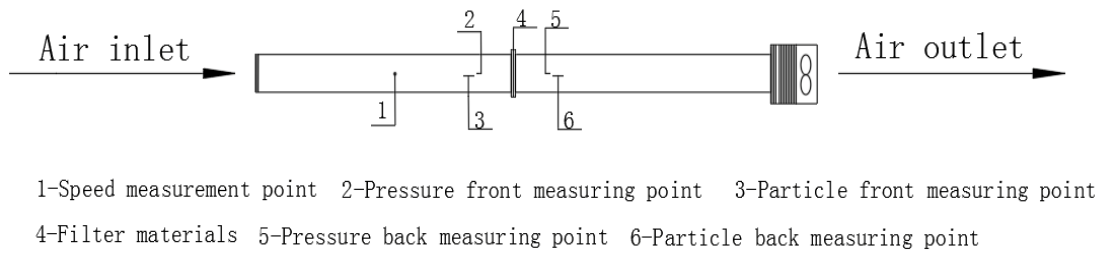
A GRIMM1.109 Portable Aerosol Spectrometer was used to measure concentrated particles before and after the air filters were applied, supplied by Beijing Saak-Mar Environmental Instrument Ltd., Beijing, China. The upper limit of the counting concentration was 2,000,000 P/L. The particles ranging from 0.25 to 32 μm in diameter could be separated into 31 channels. The repeatability was 5%. An HD2114P.0 Portable Micromanometer was used to measure filtration resistance, supplied by DeltaOHM Co., Ltd., Torino, Italy. The measuring accuracy was ±(2% reading + 0.1 m/s). The difference pressure range was ±0.4% F.S. An HD37AB1347 Indoor Air Quality Monitor was used to measure the velocity, supplied by DeltaOHM Co., Ltd., Torino, Italy. The measuring accuracy range was ±3%. A TSI7525 Indoor Air Quality Meter Measuring Instrument was used to measure the temperature and humidity, supplied by TSI Instrument Beijing Co., Ltd., Beijing, China. The measuring range was 0~60 °C. The measurement accuracy was ±0.6 °C, and the resolution was 0.1 °C. The relative humidity measuring range was 5~95% RH. The measurement accuracy was ±3% RH, and the resolution was 0.1%RH. A JSM-6510LV scanning electron microscope was used for analysis, supplied by Japan Electronics Co., Ltd., Tokyo, Japan. The magnification was 5~30 million times, and the resolution was up to 3.0 nm. Two identical rGO air filter materials were taken for each test group, totaling 5 groups, with 2 different operating conditions, for a total of 20 tests. The average concentration values before and after the test filter for 5 min were used as the calculated values to reduce experimental errors. The experimental platform is shown in Figure 1. The whole system consisted of an air supply fan, stable flow section, dust generation section, filter installation section, pressure measurement module, particle concentration sampling port, and exhaust section. All the measuring sensors for the particulate matter concentration and airflow pressure were arranged at 300 mm upstream and 300 mm downstream of the filter installation position to ensure a fully developed airflow. The system was operated under a stable designed airflow rate, and the corresponding air velocity inside the test duct was controlled steadily at 0.2–1.2 m/s under all experimental working conditions.
The reduced graphene oxide (rGO) composite filter material was prepared using the conventional impregnation–reduction method, consistent with the material preparation route reported in our previous study [17]. The rGO nanosheets were uniformly loaded onto the fibrous substrate surface via ultrasonic dispersion and thermal reduction treatment. The porosity (%) of the rGO filter is 94.59 ± 0.02, and the filling rate is 5.41 ± 0.03.
The test sample was cut into a standard size of 450 mm × 450 mm to match the cross-section of the wind tunnel. The sample was fixed using a sealed clamping frame to avoid air leakage around the edge, ensuring that all the airflow passed vertically through the filter medium.
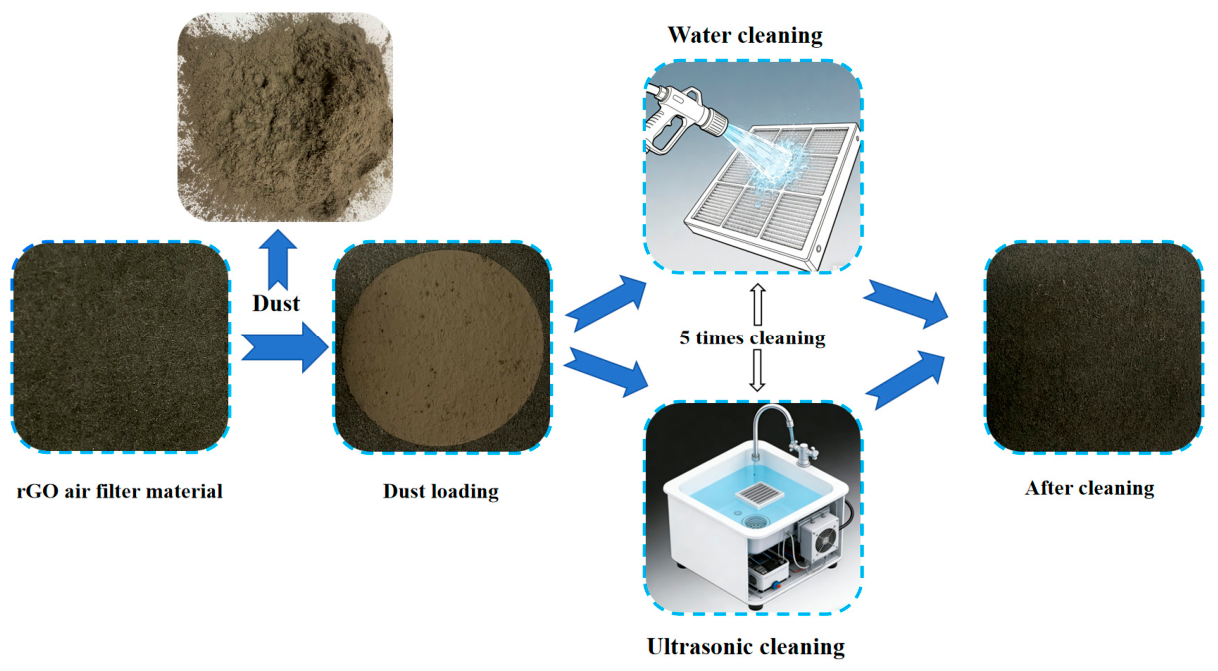
Dust samples from air conditioning systems were used for dust loading experiments; they were collected from residential HVAC filters (Xi’an, China) and pooled to ensure homogeneity [17]. In the dust sample, 95.5% of the particles were sized 0.3–2.5 μm, while 49.3% were 0.5–2.5 μm, and 55.7% were 0.5–5.0 μm [17]. The samples contained a large number of small particles, which is consistent with the actual situation where small particles dominate the atmosphere. Therefore, using dust samples as a dust source for testing has practical engineering significance. Dust was continuously generated and evenly delivered into the upstream airflow through a dust generator. Particle deposition was achieved by natural airflow penetration, with a consistent dust concentration and loading duration strictly maintained for all samples. The loading dosage and deposition state were kept uniform before each regeneration test to ensure experimental comparability. The rGO air filter material was subjected to multiple cycles of dust containment, using water as the cleaning medium. A comparative analysis was conducted on the changes in filtration performance parameters and economics during 5 cycles of regeneration under water cleaning and ultrasonic cleaning methods. The schematic diagram is shown in Figure 2.
For water cleaning regeneration, the contaminated rGO filter sample was taken out of the test section and cleaned by circulating deionized water at room temperature. The cleaning water flow rate and flushing time were fixed with unified parameters; after cleaning, the sample was naturally placed in a constant-temperature and -humidity environment for full drying before the next performance test. For ultrasonic cleaning regeneration, the sample was placed into an ultrasonic cleaning tank with fixed frequency and power settings. Ultrasonic cavitation was used to remove embedded fine particles inside the rGO pore structure under controlled time and temperature conditions. After ultrasonic treatment, the sample was rinsed slightly and dried under the same constant environmental conditions.
Throughout all the water cleaning and ultrasonic regeneration experiments, laboratory deionized water was uniformly used to avoid the influence of regional tap water quality differences. The main water quality parameters were controlled as follows: pH = 6.8–7.2, total dissolved solids (TDS) < 5 mg/L, and water hardness < 1 mg/L. Using deionized water ensures the consistency and reproducibility of the cleaning process. Based on previous research results, the washing parameters were selected to achieve the best washing effect when the water flow rate was 20 L/(s·m2) and the washing time was 17 s. Ultrasonic cleaning has the best cleaning effect when the parameter is 120 W and the cleaning time is 11.2 s [22,33]. Therefore, all inputs were selected for comparative analysis under the optimal parameters. All regeneration operations were performed under the same environmental temperature, humidity, and process parameters to guarantee experimental repeatability. The detailed device structure and partial basic setup can be found in our published literature [17]. The step-by-step operational protocols for both cleaning methods are detailed as follows:
For water cleaning:
(1)
The contaminated rGO filter sample was carefully removed from the test duct and placed flat in a clean cleaning tank;
(2)
Continuous deionized water flushing was applied at a fixed flow rate, maintaining uniform water coverage over the entire filter surface;
(3)
After a fixed flushing duration, the sample was gently rinsed with deionized water to wash away residual surface pollutants;
(4)
The treated sample was placed in a constant-temperature and -humidity chamber for natural drying at 25 °C and 50% RH until the mass remained stable;
(5)
The dried sample was reinstalled into the test duct for the next round of filtration performance testing.
For ultrasonic cleaning:
(1)
The contaminated rGO filter sample was fully immersed in a constant-temperature ultrasonic cleaning tank filled with deionized water;
(2)
Ultrasonic treatment was performed at a fixed frequency, power, and temperature for a set duration to remove embedded fine particles inside the pore structure;
(3)
After ultrasonic cavitation cleaning, the sample was taken out and slightly rinsed with deionized water;
(4)
The sample was placed in the same constant-temperature and -humidity environment for complete drying;
(5)
After drying, the sample was reinstalled to conduct subsequent filtration and resistance tests.
Due to the complex fabrication process and high preparation cost of customized rGO composite filter materials, coupled with the time-consuming cyclic dust loading and multi-cycle regeneration tests, two identical parallel specimens (n = 2) were prepared and tested for each working condition, which was the maximum feasible sample size under the current experimental conditions.
All experimental data are presented as mean ± standard deviation (SD). An independent-sample t-test was performed to evaluate the statistical significance of performance differences between water cleaning and ultrasonic cleaning at each regeneration cycle. Differences with p < 0.05 were regarded as statistically significant. Minor data fluctuations within the instrument repeatability error of 5% were not over-interpreted in the subsequent analysis.

3. Results and Discussion

3.1. Comparison and Analysis of Filtration Performance

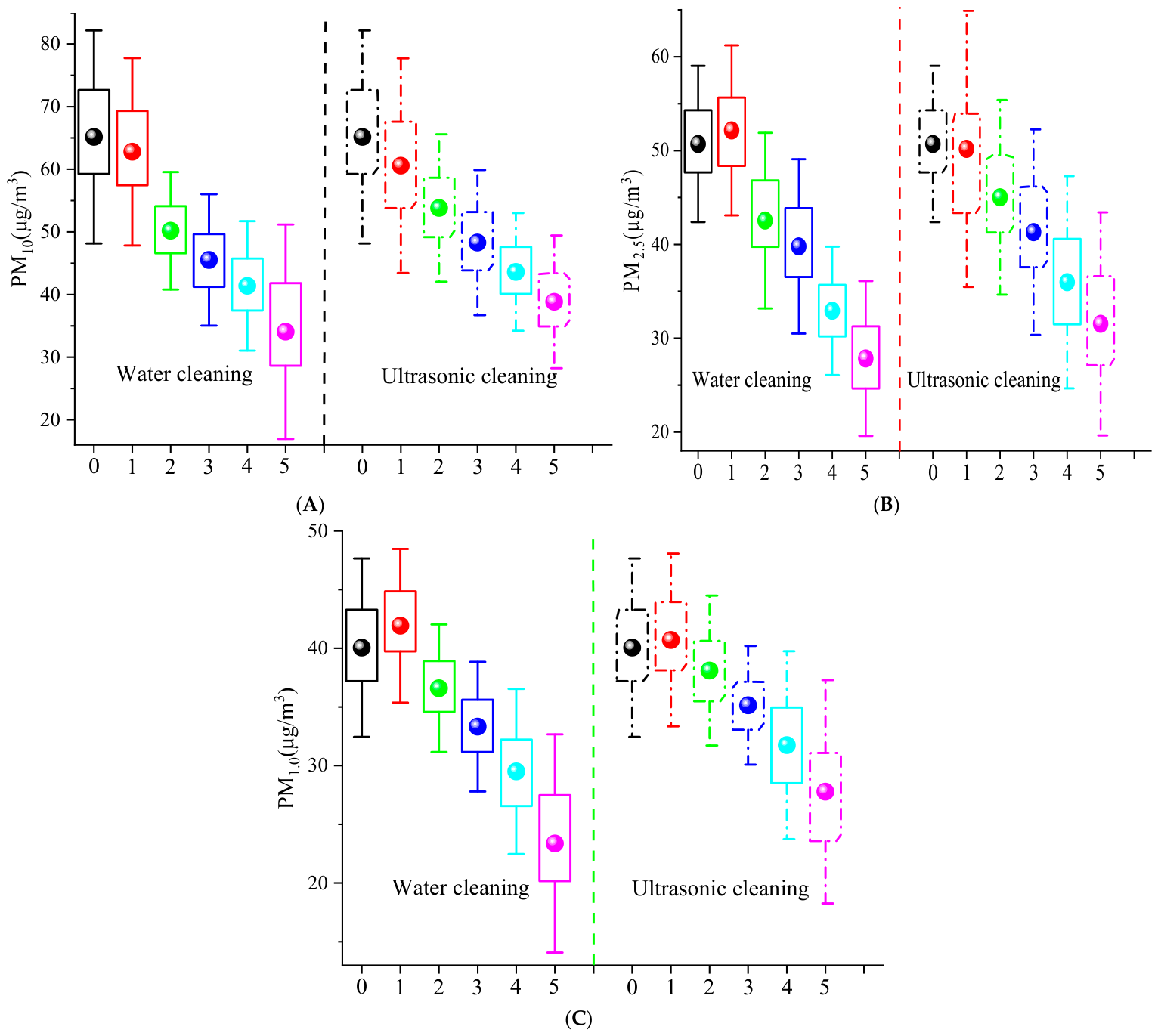
The variation in the filtration efficiency of rGO air filter material for PM10, PM2.5, and PM1.0 with regeneration times under two cleaning methods is shown in Figure 3.
From Figure 3, it can be seen that, after the first cleaning, the effect of water cleaning is slightly higher than that of ultrasonic cleaning. The average filtration efficiency for PM10, PM2.5, and PM1.0 is 1.21%, 0.18%, and 1.11% higher, respectively. This effect is attributed to the strong surface flushing of water flow, which rapidly removes loosely adhered large particles. For pollutants such as dust and soluble salts attached to the surface, washing with water increases the probability of particles falling off and can achieve good removal effects. But this benefit is temporary and limited to surface cleaning. However, ultrasound cleaning is a vibration drop, and under the same effect, the initial effect of water cleaning is more obvious, causing large particles to fall directly and small particles to enter the interior of the fiber, resulting in a significant difference in the effect of small particles. This is similar to the results given in the literature [18,34], verifying the correctness of this paper. But this advantage only exists in the first cleaning, which meets the temporary cleaning needs of short-term, low-cost, and fast operation, and does not have long-term reuse value.
After the 2nd to 5th cleaning cycles, the filtration efficiency of ultrasonic cleaning was higher than that of water cleaning, with increases of 3.79%, 2.18%, 2.20%, and 6.49% for PM10, respectively. The PM2.5 levels were increased by 3.20%, 1.22%, 2.96%, and 3.25%, respectively. The levels of PM1.0 were 1.90%, 2.02%, 2.02%, and 6.21% higher, respectively. These differences are statistically notable, and the enlarged efficiency gap confirms that ultrasonic cavitation penetrates rGO interlayer pores and deeply removes fine particles that water cleaning cannot dislodge. At this time, the ultrasonic effect is relatively good, because ultrasonic cleaning uses the shock waves and microjets generated by the ultrasonic cavitation effect [22], as well as the chemical reactions of free radicals, to remove pollutants. The high-temperature and high-pressure environment generated by the rupture of hollow bubbles during ultrasonic cleaning can decompose organic pollutants, and shock waves and microjets can effectively remove particles and other pollutants attached to the surface and pores of rGO. Under uniform ultrasonic vibration, the pollutants will detach from the fibers without changing the original fiber structure, while the reason for relatively low efficacy of water cleaning is that water cleaning has a weak ability to dissolve particles attached to the fibers, and simple water flow flushing cannot easily overcome the strong interaction forces between pollutants and rGO [35]. It is also possible that the uneven application of water pressure may cause damage to some fiber structures, resulting in a decrease in efficiency. In addition, ultrasonic waves have strong penetration ability and the energy they possess can efficiently remove impurities with strong adhesion and poor solubility, accelerating the removal of particles attached to fibers. Therefore, within an acceptable range, using ultrasonic waves for cleaning is more ideal.
In addition, it can be seen that, after washing with water five times, the filtration efficiency for PM10, PM2.5, and PM1.0 decreased by 50.08%, 44.91%, and 43.30%, respectively. After five ultrasonic cleaning cycles, the filtration efficiency for PM10, PM2.5, and PM1.0 decreased by 39.87%, 38.43%, and 27.64%, respectively. This weaker attenuation indicates that ultrasonic cleaning better preserves the microstructure of rGO materials, whereas water washing induces structural loosening and pore damage. The filtration efficiency for PM10, PM2.5, and PM1.0 decreased by 10.21%, 6.48%, and 15.66% under water cleaning conditions compared to ultrasonic cleaning conditions. This means that, under the same filtration efficiency requirements, the ultrasonic cleaning of rGO materials can reduce the frequency of replacement, directly reducing the cost of consumables and replacement labor, which meets the needs of long-term cost control in civil construction.
Under multiple cycles of regeneration and cleaning, ultrasonic cleaning has a relatively good effect. It can not only efficiently remove pollutants from the internal pores of rGO air filter materials, but also cause minimal damage to the rGO layer structure. Therefore, after multiple cycles of regeneration, it can still maintain a high filtration efficiency. The impact of water cleaning can easily damage the fiber structure and rapidly decrease filtration efficiency, which in the long run will increase the material’s replacement cost and contradict the goal of optimizing commercial costs.
It should be acknowledged that the sample size of n = 2 per group is relatively small for statistical analysis, which is an inherent limitation of this study restricted by the material preparation cycle, experimental cost, and test period. Therefore, the experimental results and percentage differences are interpreted cautiously and conservatively, combined with standard deviation and statistical t-test results, rather than relying merely on numerical comparison.

3.2. Comparison and Analysis of Counting Filtration Performance

The counting filtration efficiency of rGO air filter materials for different sizes under different cleaning methods is shown in Table 1.
Table 1 shows that, with the increase in cleaning times, the filtration efficiency of rGO air filter material for particles of different sizes shows a trend of first increasing and then decreasing. After the first water cleaning, the counting filtration efficiency improved because washing removed some pollutants from the surface and pores of rGO, re-exposing the rGO’s active sites [36] and increasing its adsorption capacity for particulate matter. However, as the number of water washes continued to increase, the filtration efficiency gradually decreased. This may be due to multiple water washes causing a certain degree of damage to the rGO layer’s structure, with some active sites being destroyed or covered, thereby reducing the adsorption capacity for particulate matter. After the fifth cleaning cycle, the counting filtration efficiency for particle sizes of 0.35 μm, 0.71 μm, 1.0 μm, 2.5 μm, and 5.0 μm decreased by 22.33%, 9.96%, 2.58%, 4.78%, and 1.08%, respectively. As the particle size increased, the change in counting filtration efficiency was relatively small. This is because larger particles are mainly filtered through interception and inertia, and are less affected by water cleaning’s impact on the surface properties of rGO [37].
It can be observed that the counting filtration efficiency achieved using ultrasonic cleaning is higher than that achieved using water cleaning. After five ultrasonic cleaning cycles, the counting filtration efficiency for particle sizes of 0.35 μm, 0.71 μm, 1.0 μm, 2.5 μm, and 5.0 μm decreased by 6.34%, 0.50%, 0.62%, 2.56%, and 0.81%, respectively. This indicates that ultrasonic cleaning can more effectively remove pollutants and restore the filtration performance of rGO air filter materials, with more obvious advantages compared to water cleaning. The difference is more obvious for particles with a diameter between 0.35 and 2.5 μm, and less for larger particles. At this point, the ultrasonic cleaning method results in a higher counting filtration efficiency than water cleaning at particle sizes of 0.35 μm, 0.71 μm, 1.0 μm, and 2.5 μm by 9.02%, 8.21%, 3.71%, and 3.31%, respectively. This size-dependent behavior arises because fine particles (0.35–2.5 μm) easily embed into rGO pores and require cavitation-induced microjets for removal. Larger particles (>5.0 μm) are removed similarly by both methods due to surface detachment. This mechanistic behavior explains why ultrasonic cleaning gradually outperforms water cleaning with increasing cycles. This is because small particles diffuse inside the fibers during the cleaning process, causing changes in the fiber structure. However, due to the relatively high water cleaning flow rate, some of the particles that enter the fibers will gradually be washed out, resulting in a gradual decrease in filtration efficiency. Ultrasonic waves are cavitation vibrations [22], which intensify the diffusion of small particles and thus increase filtration efficiency. Due to the continuous vibration, the probability of particles adhering to the inside of the fibers decreases. From a commercial cost perspective, the stable maintenance of fine particulate matter filtration efficiency means that rGO materials can meet the standard requirements for air purification in civil buildings for a long time, without the need for early replacement due to unsatisfactory efficiency, effectively extending the material’s service life and reducing replacement frequency. However, large particles are easily detached due to the combined effects of gravity and external cleaning forces, and their impact on large particles is not significantly different. This result provides a basis for the refined selection of cleaning methods in commercial applications: for the scenario of filtering large particles only, short-term water washing can be used to control the cost of single cleaning; if targeting the mainstream scenario of fine particulate matter control in civil buildings, ultrasonic cleaning has better long-term cost-effectiveness.
However, it was found that, with an increase in cleaning times, the overall counting filtration efficiency was lower than that of the original filtering material. Therefore, when using the water cleaning method, the filtration efficiency is improved within a certain range of times. When the number of water washes exceeds a certain limit, the filtration efficiency decreases significantly. It is necessary to control the number of water washes to avoid irreversible damage to the material. Similarly, when using ultrasonic cleaning methods, if the ultrasonic frequency is too high, the sound intensity is too strong, or the cleaning time is too long, the structure of rGO air filter materials may be damaged, resulting in a decrease in filtration efficiency, even lower than the filtration efficiency after water cleaning. Therefore, selecting appropriate ultrasonic cleaning conditions can fully leverage the advantages of ultrasonic cleaning and improve the regenerative filtration performance of rGO air filter materials.

3.3. Comparison and Analysis of Resistance Changes

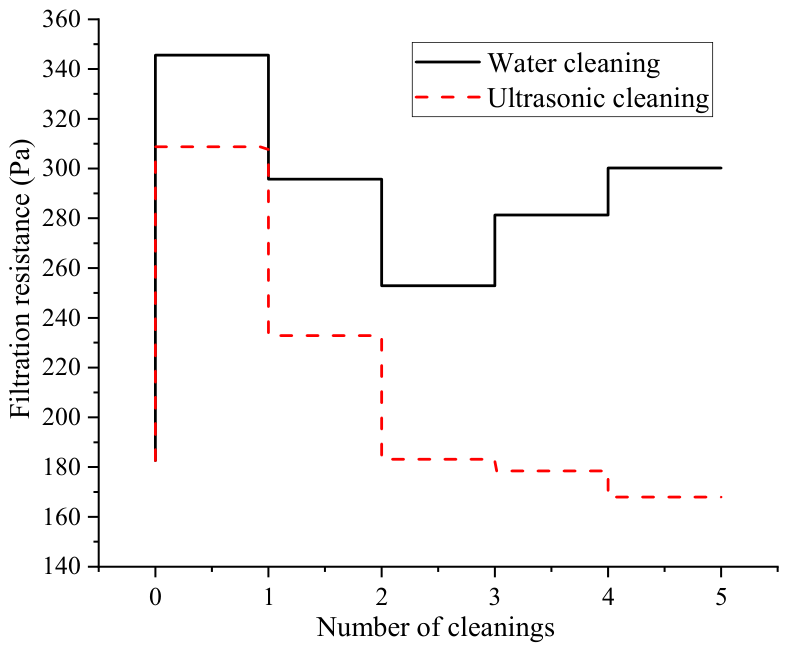
Filtration resistance is a core technical indicator that affects the energy consumption cost of fan operation. The higher the resistance, the more electricity the fan needs to consume to maintain air volume, directly pushing up the operating energy consumption cost of civil building fresh air systems. The effect of cleaning frequency on resistance changes under different cleaning methods is shown in Figure 4.
From Figure 4, it can be seen that there are certain differences in resistance under different cleaning methods. The filtration resistance obtained when using water cleaning is higher than that when using ultrasonic cleaning, and this difference increases with an increase in cleaning times. When cleaning 1–5 times, the filtration resistance for the water cleaning method is higher than that for the ultrasonic cleaning method by 36.80 Pa, 62.90 Pa, 69.80 Pa, 102.90 Pa, and 132.30 Pa, respectively. Ultrasonic cleaning removes surface and embedded fine particles mainly through cavitation vibration, which imposes relatively little damage on the fiber morphology and pore framework. In contrast, conventional water cleaning relies on hydraulic flushing, which easily causes fiber loosening, pore shrinkage, and the gradual shedding of loaded rGO nanosheets after multiple cycles. Ultrasonic cleaning preserves pore connectivity and reduces airflow resistance, whereas water cleaning causes partial pore collapse and residual particle accumulation. Lower resistance directly reduces fan energy consumption, which is critical for long-term building operation.
With an increase in cleaning times, the filtration resistance following the water cleaning method shows a trend of first increasing, then decreasing, and then increasing again, while the filtration resistance following the ultrasonic cleaning method shows a trend of first increasing and then decreasing. The main reason is that some particles enter the interior of the fiber, affecting the uniformity of the airflow velocity field, resulting in an increase in resistance. With the increase in cleaning, the vast majority of particles are impacted by the water flow, but some particles still remain inside the fibers until a certain number of washes, at which point the particles inside may be washed out of the fibers or directly fall off. At the same time, it may also cause the loosening and deformation of the rGO layer structure, increasing the resistance to airflow [38]. Therefore, there is a certain fluctuation in resistance under the water cleaning method. When using ultrasonic cleaning, the particles and impurities on the fibers are more evenly dispersed, and the probability of particles being inside the fibers is relatively small. At this point, the range of resistance fluctuations is relatively small.
Ultrasonic cleaning can more efficiently remove pollutants blocking pores and restore the material’s permeability, resulting in significantly lower resistance loss compared to water cleaning. From the perspective of optimizing commercial costs, the low-resistance advantage of ultrasonic cleaning directly translates into energy cost savings. With an increase in regeneration times, the resistance loss growth rate of the ultrasonic cleaning is slower, indicating that it has a better protective effect on the pore structure of the material, avoiding pore collapse or blockage caused by water flow’s impact during the washing process. Under the same fan power, according to the principles of fluid mechanics [39], the airflow rate increases, allowing for faster air purification. However, when the resistance increases, the energy consumption of the fan and the cost of air purification increase. Therefore, an increase in resistance means that more powerful fans are needed to maintain air circulation, which not only increases energy consumption but may also generate more noise. It is suggested that ultrasonic cleaning has a better cleaning effect in achieving efficient and energy-saving air filtration.
Without regular regeneration treatment, continuous dust accumulation will inevitably block the filter pore structure, leading to a gradual decline in filtration efficiency and a continuous increase in airflow resistance throughout the service cycle. In comparison, both water cleaning and ultrasonic cleaning can effectively recover filtration performance and alleviate structural clogging, demonstrating obvious practical advantages for the long-term stable operation of rGO filters in building HVAC systems.

3.4. Comparison and Analysis of Quality Factors

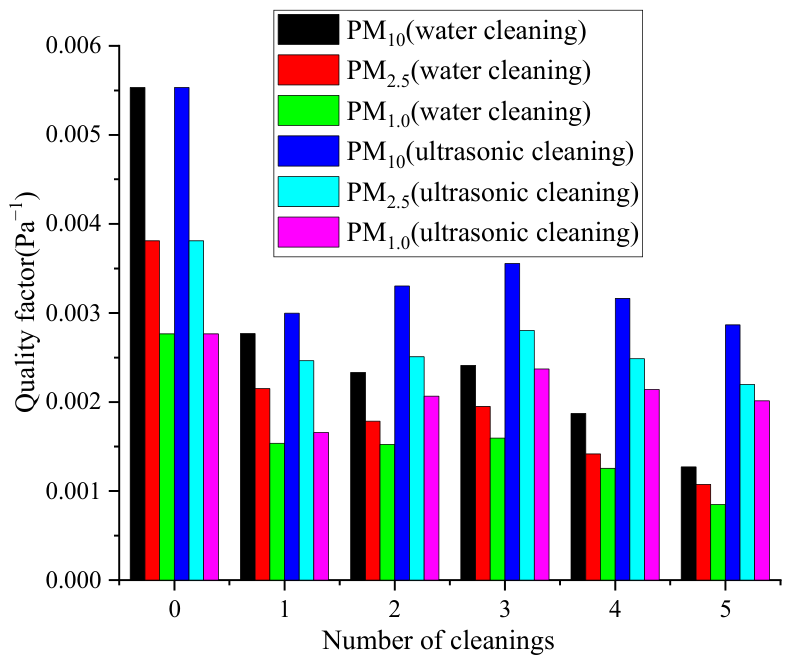
The variation in the quality factor of rGO air filter material with regeneration times under two cleaning methods is shown in Figure 5.
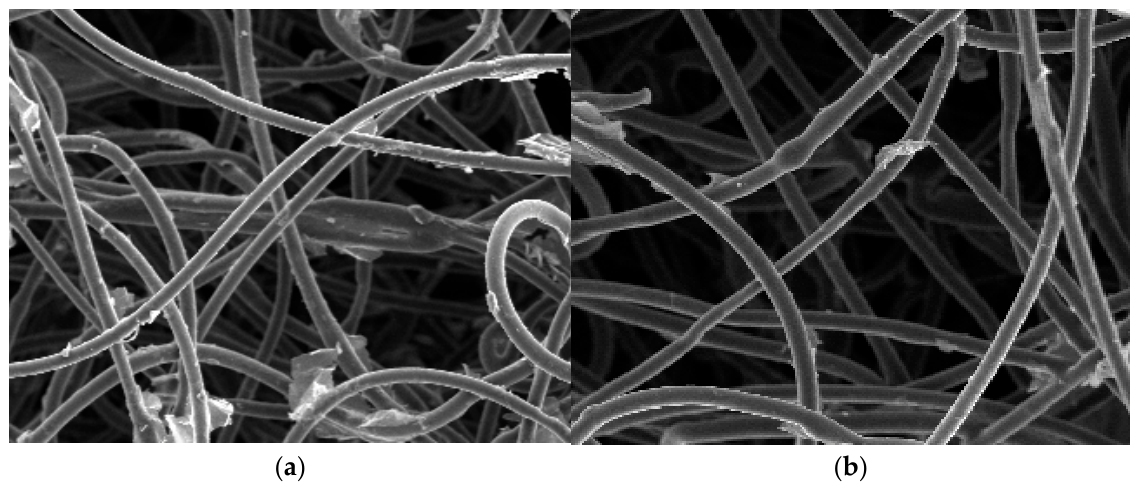
Figure 5 shows that the quality factor (QF) attenuation rate of ultrasonic cleaning is significantly slower than that of water cleaning, and the ability to maintain the filtration quality for fine particulate matter (PM2.5) is more evident in ultrasonic cleaning. Under the water cleaning method, after the first cleaning, the QF values for PM10, PM2.5, and PM1.0 decreased by 49.95%, 43.54%, and 44.48%, respectively. After the third cleaning, the QF values for PM10, PM2.5, and PM1.0 decreased by 56.39%, 48.80%, and 42.32%, respectively. After the fifth cleaning, the QF values for PM10, PM2.5, and PM1.0 decreased by 77.01%, 71.76%, and 69.34%, respectively. Under the ultrasonic cleaning method, after the first cleaning, the QF values for PM10, PM2.5, and PM1.0 decreased by 45.80%, 35.33%, and 40.06%, respectively. After the third cleaning, the QF values for PM10, PM2.5, and PM1.0 decreased by 35.73%, 26.39%, and 14.28%, respectively. After the fifth cleaning, the QF values for PM10, PM2.5, and PM1.0 decreased by 48.16%, 42.33%, and 27.22%, respectively. Under the same number of cleaning cycles, the QF values following ultrasonic cleaning were consistently higher than those following water cleaning. At the fifth cleaning, the QF values for PM10, PM2.5, and PM1.0 under ultrasonic cleaning were 2.26 times, 2.04 times, and 2.37 times higher, respectively, than those under water cleaning. This is because the water cleaning method can only remove surface pollutants from the material and cannot clean fine particles in the gaps between rGO layers, resulting in pore blockage and layer aggregation, which reduces the specific surface area, pore volume, and filtration efficiency, and increases airflow resistance, leading to a rapid decline in QF. The ultrasonic cavitation effect can deeply strip the particles in the interlayer gaps of rGO, while maintaining the integrity of the pore structure, good dispersion of the layers, and higher retention rates for a specific surface area and pore volume. Therefore, the balance between filtration efficiency and resistance is better, and the attenuation of QF is slower. Ultrasonic cleaning is a more suitable regeneration method, and its ability to maintain quality factors after long-term cleaning is significantly better than that of water cleaning. From the perspective of commercial cost optimization, the stable maintenance of the QF value means that rGO materials can achieve a balance between efficient filtration and low-energy operation, that is, while meeting purification standards, minimizing fan energy consumption costs, extending the material’s service life, and reducing replacement costs. Further observation of the internal changes after fiber cleaning is shown in Figure 6.
From Figure 6, it can be seen that, after five regenerations under the water cleaning method, there are still many residual pollutant particles on the surface of the material, and the pores are partially blocked. The rGO layer shows slight agglomeration, which is consistent with the results of existing relevant literature [40], verifying the correctness of this paper. After five regenerations using ultrasonic cleaning, the surface cleanliness of the material is high, the pore structure remains intact, and the dispersion of rGO layers is good.
SEM micrographs in this study were applied only for qualitative morphological comparison to visually identify the differences in fiber morphology and pore characteristics after repeated water cleaning and ultrasonic cleaning. The present work focuses primarily on macroscopic filtration performance and cyclic regeneration stability, rather than on an in-depth microscopic mechanism exploration. Therefore, further quantitative image analysis, such as pore size distribution, fiber diameter statistics, and surface coverage calculation, is not conducted in the current research. More detailed quantitative microscopic characterization will be implemented in our follow-up mechanism-focused study.

3.5. Economic Analysis

Assuming that the distribution of outdoor atmospheric particulate matter does not change, based on literature research and comprehensive factors [41], the “5 day non guarantee” in Xi’an in 2023 is selected as the main research object. The outdoor PM2.5 design concentration is 233 μg/m3, and the indoor concentration is 75 μg/m3 [42], so the required efficiency is 67.8%. At present, there are more three-stage filters used in the market. Generally, G4 grade filter materials are selected for primary filtration, M6 for medium efficiency, and H11 for high efficiency [43]. We conduct a comprehensive economic calculation of water washing and ultrasonic cleaning based on four dimensions: the unit area cleaning cost, equipment operating energy consumption, material usage cycle, and total cost of the entire one-year lifecycle. Based on comprehensive economic indicators, washable rGO air filter materials are combined as medium efficiency materials. Assuming that the filtration efficiency of the filter does not change, the pre-operation dust accumulation is 0, the daily operation time of the fresh air system is 8 h, the concentration of PM2.5 in the air before filtration is taken as 233 μg/m3, and the reference residential fresh air filtration speed is taken as 4.0 m/s. The circular pipe is DN150 mm, and the operating efficiency of the fan is 70%. According to the maximum dust-holding capacity of various filters and the cycle of one year, the mission life of the filter can be calculated according to Formula (5), and the relevant parameters are shown in Table 2.
Due to differences in production technology and raw materials among manufacturers, there may be slight fluctuations in filtration efficiency and prices, but overall, they are within the parameter range of the existing market. The rough price of M61 is based on a comprehensive analysis of raw material costs, preparation costs, labor costs, and other parameters. It can be seen that using rGO air filter material can achieve a longer usage time, which is about 678 h longer than M6, or an additional 29 days. After repeated regeneration, filters cleaned by ultrasound maintain stable dust-holding capacity and longer replacement cycles. Water-cleaned filters suffer from faster pore blockage and structural degradation, leading to shorter service life and higher replacement frequency. This quantitative result directly supports the economic advantages of ultrasonic cleaning in building ventilation systems. rGO air filter material can better protect the end air filter material, providing 509 h more protection than M6 as the second-level protection and allowing for an additional 22 days of use. From the perspective of commercial cost optimization, the long service life of rGO material directly reduces the purchase cost of consumables and reduces the number of replacements, which can further save labor replacement costs and system downtime losses. Ultrasonic cleaning can further extend the service life of rGO material structure and amplify this cost advantage. Under the condition of the same size of filter material, only the washing and ultrasonic economy indicators were compared when the cleaning degree reached 90% of the original filter material cleaning degree. The relevant parameters are shown in Table 3.
From Table 3, it can be seen that, when the number of replacements is the same, the cost of using ultrasonic cleaning is lower compared to water cleaning, and using ultrasonic cleaning is more energy efficient. If used on a large scale, the cost is lower, and the maintenance cost of related equipment also decreases accordingly. We calculate the operating energy consumption of the filter using Formula (6) based on the standard size of 592 × 592 mm traditional filter material washed twice and rGO air filter material ultrasonically cleaned three times, with a usage period of one year. Then, we calculate the replacement cost based on the unit price and replacement frequency in Table 2. The summary results are shown in Table 4.
According to the relevant cost parameters in Table 4, considering the total cost of one-year replacement operation, there is G4 + M6 + H11 > G4 + M61 + H111, which is 79 RMB higher. If we look at the total cost from the perspective of cleaning and reusing, there is a difference in only 337 RMB between G4 + M6 + H11 > G4 + M61 + H111. Overall, the total cost of replacement is much higher than the total cost of reuse after cleaning, while the difference between the two methods is 496 RMB after using rGO air filter material. If considering the comprehensive factors such as labor costs, ease of operation, and indoor environmental hygiene conditions, using rGO air filter materials has more obvious advantages.
Overall, in terms of cleaning effectiveness, ultrasonic cleaning has a stronger ability to remove pollutants and can effectively remove various types of pollutants. Compared to water cleaning, it can significantly restore the filtration performance of rGO air filter materials [44]. In addition, water cleaning causes significant damage to the structure of rGO air filter materials, and multiple water washes can lead to damage to the rGO layers and deterioration of the pore structure. Ultrasonic cleaning, under appropriate conditions, causes less damage to the structure and can optimize the pore structure to a certain extent. In practical applications, suitable cleaning methods and process parameters can be selected according to different usage scenarios, and there is a need to achieve efficient cleaning and regeneration of rGO air filter materials, reducing air purification costs. In addition, based on the comprehensive benefit analysis of commercial operation, ultrasonic cleaning operation is simpler and more automated, which can reduce the time and labor cost of manual operation and maintenance. The combination of rGO material and ultrasonic cleaning can maintain stable filtration efficiency for a long time, ensure indoor air quality, reduce operational risks caused by environmental issues, and indirectly enhance the commercial value of buildings.
It should be noted that the current economic evaluation mainly focuses on direct operational consumption costs during the regeneration process, including water consumption, electricity consumption, and labor cost. The one-time equipment procurement cost and long-term daily maintenance cost are not incorporated into the present comparison. The main reason is that both water cleaning and ultrasonic cleaning share the same test platform and supporting pipeline facilities, and the subsequent daily maintenance expenses are similar in practical engineering operation. Therefore, excluding fixed equipment investment and routine maintenance does not affect the rationality and comparability of the relative economic difference between the two regeneration methods.
Qualitative sensitivity analysis was further conducted by discussing the influence of key economic parameters, including water price, electricity price, and labor cost. Within the reasonable fluctuation range of actual market prices, the overall economic trend remains consistent: the unit cost of water cleaning is slightly lower than that of ultrasonic cleaning, and the comparative advantage does not reverse with normal parameter variations. This indicates that the economic evaluation result has acceptable stability and robustness under conventional engineering cost conditions.
In a word, water cleaning only has the advantage of simple operation in single, short-term, and small-scale cleaning scenarios, but it has a high unit cleaning cost and its long-term use can easily damage material structures, increasing energy consumption and replacement costs; therefore, it does not meet the long-term needs of commercial cost optimization. By contrast, ultrasonic cleaning requires a small amount of equipment investment; its unit cleaning cost is extremely low; and it can effectively protect the material’s structure, extend the service life, and reduce system energy consumption. In the large-scale and long-term operation scenarios of civil buildings, it has significant lifecycle cost advantages and is the optimal choice for rGO air filtration material regeneration.
This study mainly used experimental methods. Although the experimental results could be obtained intuitively, the in-depth mechanism of the internal microstructure and performance changes in rGO air filter materials during the cleaning process are not yet sufficiently characterized. In the future, theoretical methods such as molecular dynamics simulations and quantum mechanics calculations can be combined to explore the mechanism of the cleaning process for rGO air filter materials at the atomic and molecular levels, providing a more solid theoretical basis for experimental research. At the same time, further research can be conducted on composites of rGO air filter materials with other materials to develop new air filter materials with better performance that are easier to clean and regenerate [45,46]. In addition, strengthening research on wastewater treatment and environmental protection during the cleaning process to reduce the impact of the cleaning process on the environment is also an important direction for future research. The economic analysis provides a valuable supplementary reference for selecting reasonable regeneration modes for rGO filters in practical engineering scenarios, and the evaluation results can offer straightforward guidance for practical operation and cost control in building ventilation systems.
With the increasing global demand for energy, the protection of underground spaces, especially mining environments, has become more important [47,48,49,50,51]. The application of rGO air filters with optimized cleaning processes in mine ventilation and environmental management of mining living areas can effectively adapt to the complex working conditions of mines, ensure the quality of living and ecological environment in mining areas, and meet the development requirements of national green mine construction and ecological protection.

4. Limitations and Future Research Directions

This study still has many limitations: the parallel sample size for each experimental condition was limited to n = 2, which may bring slight random variation and constrain the statistical robustness of the results. Only a single standard dust type was employed for the dust-loading experiments, whereas actual atmospheric pollutants in real engineering environments possess more complex chemical components and broader particle size distributions. All the experimental conclusions are derived based on the specific raw material ratio and preparation process of the as-fabricated rGO filter; thus, the findings cannot be directly generalized to other rGO composite filters with different formula compositions or structural designs. Also, the economic calculation system does not include key variables such as equipment depreciation and regional cost differences, and the comprehensiveness and universality of the evaluation are insufficient. The apparent structure of the material was only characterized through electron microscopy, without analyzing the microscopic mechanism of the cleaning method at the atomic and molecular levels. The cleaning methods were only compared with a single parameter, without exploring the optimization of ultrasonic parameters and the regeneration effect of composite cleaning. The experimental conditions did not cover the differences in different civil building scenarios, and only included five cycles of regeneration testing, without clarifying the long-term performance degradation law of the materials. In the future, systematic research will be carried out around the above-mentioned shortcomings, combined with molecular dynamics simulation to deeply explore the micro-mechanism of cleaning and optimize process parameters. Ultrasonic multiparameter experiments and composite cleaning methods will be conducted, differentiated working conditions will be set for different civil building scenarios, and large-scale process pilot projects will be carried out. Long-cycle regeneration testing will be conducted, and a material performance warning system will be established. At the same time, rGO composite filter materials and intelligent cleaning equipment will be developed to help promote the industrialization and large-scale application of rGO materials.

5. Conclusions

This study systematically investigated the regeneration performance and economic feasibility of rGO air filter materials under water cleaning and ultrasonic cleaning within five regeneration cycles from the perspective of commercial cost optimization in public buildings. The key conclusions are generalized as follows:
  • Ultrasonic cleaning based on the cavitation effect exhibits stronger deep-cleaning ability for rGO filter materials than conventional water cleaning. It can effectively strip fine particles embedded in rGO interlayer pores while better preserving the porous structure and fiber integrity. In contrast, water cleaning only removes surface dust and tends to cause structural damage and pore blockage after repeated cycles, leading to faster attenuation of the filtration efficiency and quality factor (QF).
  • After multiple regeneration cycles, ultrasonic cleaning consistently outperforms water cleaning in filtration efficiency, resistance control, and quality factor. Especially for fine particles (0.35–2.5 μm), the advantage of ultrasonic cleaning becomes increasingly significant with increasing cleaning cycles. The QF values of rGO materials after five cycles of ultrasonic cleaning are more than twice those after water cleaning, demonstrating a more balanced performance between filtration efficiency and airflow resistance.
  • From a full lifecycle cost perspective, ultrasonic cleaning shows obvious economic advantages for large-scale civil building applications. It reduces the filter replacement frequency, lowers fan energy consumption, and cuts down long-term operation and maintenance costs. The combination of rGO materials and ultrasonic cleaning is technically reliable and economically feasible, which strongly supports the low-carbon operation and cost refinement management of fresh air systems.
  • This work confirms that ultrasonic cleaning is the preferred regeneration method for rGO air filter materials in long-term cyclic scenarios. The findings provide practical technical parameters and economic evidence for engineering selection and also promote the large-scale application of new graphene-based air filtration materials in green public buildings. Future research can further explore composite cleaning processes and long-term durability to support wider industrial implementation.

Author Contributions

Conceptualization, X.Z. and Z.C.; methodology, X.Z. and Z.C.; investigation, J.Z., H.T. and X.W.; data curation, J.Z. and C.H.; writing—original draft preparation, H.T. and C.H.; writing—review and editing, X.Z. and X.W. All authors have read and agreed to the published version of the manuscript.

Funding

This study was supported by the Opening Foundation of Shandong Key Laboratory of Intelligent Manufacturing Technology for Advanced Power Equipment, Weifang University, China: No. SKLOIMTFAPE26007, Wenzhou University of Technology; the Zhejiang-Malaysia Joint Laboratory on Marine Low-carbon (Green) Building Materials (No. RZX202407009 and 100070000800600); and the Shaanxi Provincial Department of Education Service Local Special Plan Project (No. 24JC050).

Data Availability Statement

The data presented in this study are available from the corresponding author upon request.

Conflicts of Interest

The authors declare no conflicts of interest.

References

  1. McNeil, W.H.; Porzio, J.; Tong, F.; Harley, R.A.; Auffhammer, M.; Scown, C.D. Impact of truck electrification on air pollution disparities in the United States. Nat. Sustain. 2025, 8, 276–286. [Google Scholar] [CrossRef]
  2. Feng, T.; Ma, J.; Yang, Y.; Mi, Z. Synergistic effects of air pollution control policies: Evidence from China. J. Environ. Manag. 2025, 373, 123581. [Google Scholar] [CrossRef]
  3. Gan, Y.Y.; Luo, Y.D.; Zhai, L.; Liao, Q.; Huo, R.R. Joint associations of air pollution and frailty on cardiovascular diseases and the modifying role of physical activity: Evidence from the CHARLS. Environ. Pollut. 2025, 384, 127028. [Google Scholar] [CrossRef]
  4. Xu, C.W.; Luo, X.L.; Yu, C.C.; Cao, S.J. The 2019-nCoV Epidemic Control Strategies and Future Challenges of Building Healthy Smart Cities. Indoor Built Environ. 2020, 29, 639–644. [Google Scholar] [CrossRef]
  5. Bayart, N.E.; Pereira, G.; Reid, C.M.; Nyadanu, S.D.; Badamdorj, O.; Lkhagvasuren, B.; Rumchev, K. Effects of outdoor air pollution on hospital admissions from cardiovascular diseases in the capital city of Mongolia. Atmos. Pollut. Res. 2025, 16, 102338. [Google Scholar] [CrossRef]
  6. Veras, M.M.; Saldiva, P.H.N. Impact of air pollution and climate change on maternal, fetal and postnatal health. J. Pediat. 2025, 101, S48–S55. [Google Scholar] [CrossRef] [PubMed]
  7. Zhang, X.; Fan, Y.S.; Zhang, J.X.; Wang, H.; Wei, S.X. Research on outdoor design PM2.5 concentration for fresh air filtration systems based on mathematical inductions. J. Build. Eng. 2021, 34, 101883. [Google Scholar] [CrossRef]
  8. Wang, C.; Jiang, J.; Wang, P.; Kong, L.; Liu, J. Exploring the potential of a novel electrostatic precipitator as an alternative to air filters in air purifiers. Build. Environ. 2025, 270, 112535. [Google Scholar] [CrossRef]
  9. de Almeida, D.S.; Martins, L.D.; Aguiar, M.L. Air pollution control for indoor environments using nanofiber filters: A brief review and post-pandemic perspectives. Chem. Eng. J. Adv. 2022, 11, 100330. [Google Scholar] [CrossRef]
  10. Hwang, S.; Roh, J.; Park, W.M. Comparison of the relative performance efficiencies of melt-blown and glass fiber filter media for managing fine particles. Aerosol Sci. Technol. 2018, 52, 451–458. [Google Scholar] [CrossRef]
  11. Pakolpakcil, A.; Eticha, A.K.; Akgul, Y.; Unlu, O.K.; Kilic, A. Fabrication and Evaluation of Electret Melt-Blown Polypropylene/Polybutylene Succinate Nonwovens for Air Filtration Application. Polym. Eng. Sci. 2026, 66, 243–257. [Google Scholar] [CrossRef]
  12. Bora, P.; Bhuyan, C.; Lakshmi, D.S.; Hazarika, S.; Tanczyk, M.; Srimath, S.T. Recent Advances in Membrane-Based Air Filtration Technologies for Ambient Particulate Matter Separation. Polymers 2025, 17, 3265. [Google Scholar] [CrossRef]
  13. Liao, J.; Nie, J.; Sun, B.; Jiao, T.; Zhang, M.; Song, S. A cellulose composite filter with multi-stage pores had high filtration efficiency, low pressure drop, and degradable properties. Chem. Eng. J. 2024, 482, 148908. [Google Scholar] [CrossRef]
  14. He, P.; Zhang, L.; Li, Y.; Xue, W.; Zhang, X. Differential Effects of Various Cleaning Solutions on the Cleaning and Regeneration Performance of Commonly Used Polyester Fiber Material Air Filters. Processes 2024, 12, 2703. [Google Scholar] [CrossRef]
  15. Bindu, M.; Periyat, P. Graphene and its derivatives for air purification: A mini review. Results Eng. 2024, 21, 101809. [Google Scholar] [CrossRef]
  16. Guha, S.; Chakrabarty, S. Graphene and its derivatives (GO, rGO and GQD): A comprehensive review of their role in combating COVID-19. Adv. Phys.-X 2025, 10, 2435278. [Google Scholar] [CrossRef]
  17. Yu, T.; Leng, W.; Zhang, X.; Liu, Q. Performance and Regeneration Evaluation of rGO Filter Materials During Ultrasonic Cleaning with Different Cleaning Solutions. Materials 2026, 19, 566. [Google Scholar] [CrossRef]
  18. Yang, M.; Yang, B.; Zhang, X.; Wu, S.; Yu, T.; Song, H.; Ren, F.; He, P.; Zhu, Y. Experimental Study of the Factors Influencing the Regeneration Performance of Reduced Graphite Oxide Filter Materials under Water Cleaning. Materials 2023, 16, 4033. [Google Scholar] [CrossRef]
  19. Vu, T.T.; Hoang, H.H. Investigating the effect of pulsed fiber laser parameters on the roughness of aluminium alloy and steel surfaces in cleaning processes. Lasers Manuf. Mater. Process. 2021, 8, 113–124. [Google Scholar] [CrossRef]
  20. Chen, F.; Yu, W.; Ding, H.; Sun, R.; Wu, X.; Ji, Z. Method and mechanism for enhancing the service life of a two-stage filtration system based on intermittent vibration. Sep. Purif. Technol. 2026, 391, 137030. [Google Scholar] [CrossRef]
  21. Heidenreich, S.; Haag, W.; Mai, R.; Leibold, H.; Seifert, H. Investigations on the Regeneration Intensity of Different Back-Pulse Systems for Surface Filters of Rigid Filter Media. Chem. Eng. Technol. Ind. Chem.-Plant Equip.-Process Eng.-Biotechnol. 2004, 27, 502–505. [Google Scholar] [CrossRef]
  22. Xue, T.; Zhang, X.; Cheng, P.; Sun, F.; Liu, F.; Yu, T. Non-Woven Fabric Filter Materials Used in Public Buildings for Filtering Particulate Matter Experience Performance Changes under Ultrasonic Cleaning Based on Dual Carbon Target. Buildings 2024, 14, 3105. [Google Scholar] [CrossRef]
  23. Boskovic, L.; Agranovski, I.E. Removal of fine particles on fibrous filters: A review. Environanotechnology 2010, 245–257. [Google Scholar] [CrossRef]
  24. Ezet, A.E.; Galmed, A.H.; Attia, Y.A. Impacts of reduced graphene oxide modified air purification filters on removal of particulate matter from Ambient Air. Egypt. J. Chem. 2024, 67, 29–36. [Google Scholar] [CrossRef]
  25. Rao, A.S.; Pattanashetti, N.A.; Guruprasad, B.; Mahendra, H.N.; Bajakke, P.A. Fabrication of electrospun PDMS-PVA hybrid zinc silicate incorporated nanofibrous membranes for air filtration. Int. J. Mater. Res. 2026, 117, 48–58. [Google Scholar] [CrossRef]
  26. Han, S.; Kim, J.; Ko, S.H. Advances in air filtration technologies: Structure-based and interaction-based approaches. Mater. Today Adv. 2021, 9, 100134. [Google Scholar] [CrossRef]
  27. Henning, L.M.; Abdullayev, A.; Vakifahmetoglu, C.; Simon, U.; Bensalah, H.; Gurlo, A.; Bekheet, M.F. Review on polymeric, inorganic, and composite materials for air filters: From processing to properties. Adv. Energy Sustain. Res. 2021, 2, 2100005. [Google Scholar] [CrossRef]
  28. Souzandeh, H.; Wang, Y.; Netravali, A.N.; Zhong, W.H. Towards sustainable and multifunctional air-filters: A review on biopolymer-based filtration materials. Polym. Rev. 2019, 59, 651–686. [Google Scholar] [CrossRef]
  29. Li, Y.Y.; Cao, L.T.; Yin, X.; Si, Y.; Yu, J.Y.; Ding, B. Semi-Interpenetrating Polymer Network Biomimetic Structure Enables Superelastic and Thermostable Nanofibrous Aerogels for Cascade Filtration of PM2.5. Adv. Funct. Mater. 2020, 30, 1910426. [Google Scholar] [CrossRef]
  30. Zhang, X.; Ma, J.; Wang, J.; Shi, H.; Guo, J.; Fan, Y.; Nie, X.; Guo, T.; Luo, X. Modifying the Fiber Structure and Filtration Performance of Polyester Materials Based on Two Different Preparation Methods. Langmuir 2023, 39, 3502–3511. [Google Scholar] [CrossRef]
  31. Wang, C.; Liu, J.; He, M.; Xu, J.; Liao, H. Investigating the filtration performance and service life of vehicle cabin air filters in China. Environ. Int. 2024, 190, 108939. [Google Scholar] [CrossRef] [PubMed]
  32. Morgan, D.T.; Daly, T.; Gallagher, J.; McNabola, A. Reducing energy consumption and increasing filter life in HVAC systems using an aspiration efficiency reducer: Long-term performance assessment at full-scale. J. Build. Eng. 2017, 12, 267–274. [Google Scholar] [CrossRef]
  33. Lim, T.W.; Burrow, M.F.; McGrath, C. Efficacy of ultrasonic home-care denture cleaning versus conventional denture cleaning: A randomised crossover clinical trial. J. Dent. 2024, 148, 105215. [Google Scholar] [CrossRef]
  34. Rezaei, A.; Loghmani, A.; Hejazi, S.M.; Mohammadi, A. An Investigation into the Impact of Fiber Material, Fabric Texture, Dirt Type, and Fabric Area Density on Ultrasonic Cleaning of Woven Textiles. Fiber Polym. 2023, 24, 4469–4477. [Google Scholar] [CrossRef]
  35. Sahu, P.S.; Verma, R.P.; Tewari, C.; Sahoo, N.G.; Saha, B. Facile fabrication and application of highly efficient reduced graphene oxide (rGO)-wrapped 3D foam for the removal of organic and inorganic water pollutants. Environ. Sci. Pollut. Res. 2023, 30, 93054–93069. [Google Scholar] [CrossRef]
  36. Mohd Kaus, N.H.; Rithwan, A.F.; Adnan, R.; Ibrahim, M.L.; Thongmee, S.; Mohd Yusoff, S.F. Effective strategies, mechanisms, and photocatalytic efficiency of semiconductor nanomaterials incorporating rGO for environmental contaminant degradation. Catalysts 2021, 11, 302. [Google Scholar] [CrossRef]
  37. Li, Y.; Shen, R.; He, W.; Luo, Q.; Zhou, X.; Yang, J.; Liu, J. Plastic optical fiber-driven distributed photocatalysis in NWP-PDA-RGO-TiO2 filter for simultaneous formaldehyde degradation, particulate removal and bioaerosol inactivation. Chem. Eng. J. 2025, 523, 168508. [Google Scholar] [CrossRef]
  38. Fan, L.; Yan, J.; Yang, Z.; Zhang, J.; Chen, X.; Guan, R. Enhancing corrosion resistance by Shear-Rolling Process-Induced less defective graphene. Appl. Surf. Sci. 2025, 688, 162411. [Google Scholar] [CrossRef]
  39. Liu, J.H.; Yang, Y.N.; Wang, K.J.; Zhu, H.W. On the variational principles of the Burgers-Korteweg-de Vries equation in fluid mechanics. Europhys. Lett. 2025, 149, 52001. [Google Scholar] [CrossRef]
  40. Wei, Z.; Wang, Q.; Qu, M.; Zhang, H. Rational design of nanosheet array-like layered-double-hydroxide-derived NiCo2O4 in situ grown on reduced-graphene-oxide-coated nickel foam for high-performance solid-state supercapacitors. ACS Appl. Mater. Interfaces 2024, 16, 18734–18744. [Google Scholar] [CrossRef]
  41. Yu, W.; Wang, L.; Wang, Q.; Wang, X.; Li, G.; Wang, J.; Awbi, H. Design selection and evaluation method of PM2. 5 filters for fresh air systems. J. Build. Eng. 2020, 27, 100977. [Google Scholar] [CrossRef]
  42. GB 3095-2012; Sciences CAoE, Ambient Air Quality Standards. China Environmental Science Press: Beijing, China, 2012.
  43. Xie, W.; Fan, Y.; Yu, J.; Zhang, X.; Si, P. Feature analysis of indoor particulate matter concentration using fiber filtration for mechanical ventilation. J. Eng. Fibers Fabr. 2020, 15, 1558925019898960. [Google Scholar] [CrossRef]
  44. Karanjikar, S.R.; Sena, A.S.; Manekar, P.; Mudagi, S.; Juneja, A.S. Utilization of graphene and its derivatives for air & water filtration: A review. Mater. Today Proc. 2022, 50, 2007–2017. [Google Scholar]
  45. Berry, G.; Beckman, I.; Cho, H. A comprehensive review of particle loading models of fibrous air filters. J. Aerosol Sci. 2023, 167, 106078. [Google Scholar] [CrossRef]
  46. Lu, N.; Hu, Z.T.; Wang, F.; Yan, L.J.; Sun, H.X.; Zhu, Z.Q.; Liang, W.D.; Li, A. Superwetting Electrospun PDMS/PMMA Membrane for PM2.5 Capture and Microdroplet Transfer. Langmuir 2021, 37, 12972–12980. [Google Scholar] [CrossRef] [PubMed]
  47. Wu, S.; Zhang, Z.; Chen, J.; Yao, Y.; Li, D. Characterisation of stress corrosion durability and time-dependent performance of cable bolts in underground mine environments. Eng. Fail. Anal. 2023, 150, 107292. [Google Scholar] [CrossRef]
  48. Wu, S.; Ma, X.; Zhang, X.; Chen, J.; Yao, Y.; Li, D. Investigation into hydrogen induced fracture of cable bolts under deep stress corrosion coupling conditions. Tunn. Undergr. Space Technol. 2024, 147, 105729. [Google Scholar] [CrossRef]
  49. Wu, S.; Zhu, M.; Zhang, Z.; Yao, Y.; Li, Y.; Li, D. Prediction and risk assessment of stress corrosion failures of prestressed anchors in underground mines. Int. J. Min. Reclam. Environ. 2025, 40, 381–395. [Google Scholar] [CrossRef]
  50. Wu, S.; Hao, W.; Yao, Y.; Li, D. Investigation into durability degradation and fracture of cable bolts through laboratorial tests and hydrogeochemical modelling in underground conditions. Tunn. Undergr. Space Technol. 2023, 138, 105198. [Google Scholar] [CrossRef]
  51. Liu, D.; Yang, H.; Lu, C.; Wang, W.; Gu, Q.; Ruan, S. An intelligent approach to prediction of tailings dam displacement safety using dynamic preventive control modeling. Green Smart Min. Eng. 2026, 3, 93–106. [Google Scholar] [CrossRef]
Figure 1. Experimental setup.
Buildings 16 02089 g001
Figure 2. Experimental flowchart.
Buildings 16 02089 g002
Figure 3. Difference in filtration efficiency. (A) PM10; (B) PM2.5; (C) PM1.0. Temperature: 18.83–39.27 °C; humidity: 32.01–67.98%; wind speed: 0.01–2.79 m/s.
Buildings 16 02089 g003
Figure 4. Effects of cleaning frequency on resistance changes under different cleaning methods.
Buildings 16 02089 g004
Figure 5. Effects of cleaning frequency on quality factors under different cleaning methods.
Buildings 16 02089 g005
Figure 6. Scanning electron microscopy image of fiber interior. (a) Water cleaning (100 times); (b) ultrasonic cleaning (100 times).
Buildings 16 02089 g006
Table 1. Counting filtration efficiency of rGO filter material at different particle sizes under various regeneration cycles.
Regeneration CycleCleaning Method0.35 μm0.71 μm1.0 μm2.5 μm5.0 μm
Baseline (Cycle 0)(Uncleaned)56.43 ± 0.8285.75 ± 0.6591.62 ± 0.4895.82 ± 0.3299.87 ± 0.25
Cycle 1Water Cleaning63.27 ± 0.7590.22 ± 0.5896.83 ± 0.4297.39 ± 0.2999.93 ± 0.21
Cycle 1Ultrasonic Cleaning68.91 ± 0.6894.37 ± 0.5198.21 ± 0.3998.97 ± 0.2799.98 ± 0.23
Cycle 2Water Cleaning61.45 ± 0.8187.69 ± 0.6294.25 ± 0.4596.11 ± 0.3199.89 ± 0.24
Cycle 2Ultrasonic Cleaning66.26 ± 0.7093.12 ± 0.5597.79 ± 0.4198.01 ± 0.2899.91 ± 0.20
Cycle 3Water Cleaning56.11 ± 0.7882.86 ± 0.6091.77 ± 0.4793.92 ± 0.3399.23 ± 0.26
Cycle 3Ultrasonic Cleaning61.18 ± 0.7291.07 ± 0.5795.48 ± 0.4397.23 ± 0.2999.57 ± 0.22
Cycle 4Water Cleaning50.04 ± 0.8381.73 ± 0.6390.38 ± 0.4992.57 ± 0.3599.11 ± 0.28
Cycle 4Ultrasonic Cleaning57.33 ± 0.7589.89 ± 0.5993.15 ± 0.4695.16 ± 0.3099.32± 0.24
Cycle 5Water Cleaning43.83 ± 0.8577.21 ± 0.6589.26 ± 0.5191.24 ± 0.3798.79 ± 0.30
Cycle 5Ultrasonic Cleaning52.85 ± 0.7885.32 ± 0.6191.05 ± 0.4893.37 ± 0.3299.06 ± 0.26
Baseline denotes the original uncleaned initial state (Cycle 0), which is uniformly adopted for both the water cleaning and ultrasonic cleaning groups. All data are expressed as mean ± standard deviation. Slight fluctuations in filtration efficiency for 5.0 μm particles under ultrasonic cleaning are within the instrument repeatability error of 5%, and do not possess practical statistical significance.
Table 2. Filter combination form and related parameters.
Combined FormLevelEfficiency
(%)
Price
(RMB)
Resistance
(Pa)
Time (h)Cycle
(Day)
Number (Times)
G4 + M6 + H11G424.4735908723711
M640.687094.52052865
H1197.3910011624191014
G4 + M61 + H111G424.4735908723711
M6149.178617027291144
H11197.0610011629281223
M61 represents the rGO air filter material, and H111 represents the end filter material of the second stage using the rGO air filter material.
Table 3. Economic cost comparison of different regeneration methods.
Cost IndicatorWater CleaningUltrasonic CleaningCalculation Basis
Water consumption per cycle (L)51Experimental measurement
Power consumption per cycle (kW·h)0.10.3Equipment rated power
Labor time per cycle (h)0.250.25Actual operation record
Total cost per cycle (RMB)15.11415.2608Derived from Formulas (1) and (3)
Unit area cost (RMB/m2)0.074640.07536Derived from Formulas (2) and (4)
Normalized additional unit cost (RMB/m2)0.002250.00515Derived from normalized calculation
Table Note: All cost values are derived from actual experimental measurements and local commercial operating parameters. The normalized additional unit cost is a scaled value considering large-scale engineering application and filter service life.
Table 4. Annual costs of filter materials under different combination forms.
Combined FormOperating
(RMB)
Replacement
(RMB)
Cost of Replacement and Operation (RMB)Cleaning (RMB)Cost of Replacement and Cleaning (RMB)
G4 + M6 + H11106113512418971003
G4 + M61 + H11113310291162533666
Disclaimer/Publisher’s Note: The statements, opinions and data contained in all publications are solely those of the individual author(s) and contributor(s) and not of MDPI and/or the editor(s). MDPI and/or the editor(s) disclaim responsibility for any injury to people or property resulting from any ideas, methods, instructions or products referred to in the content.