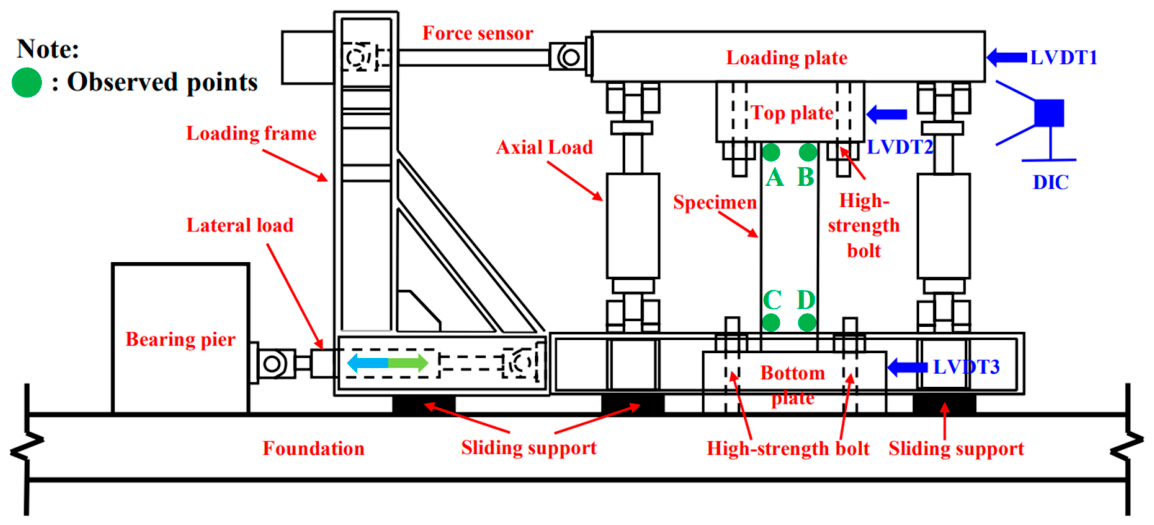
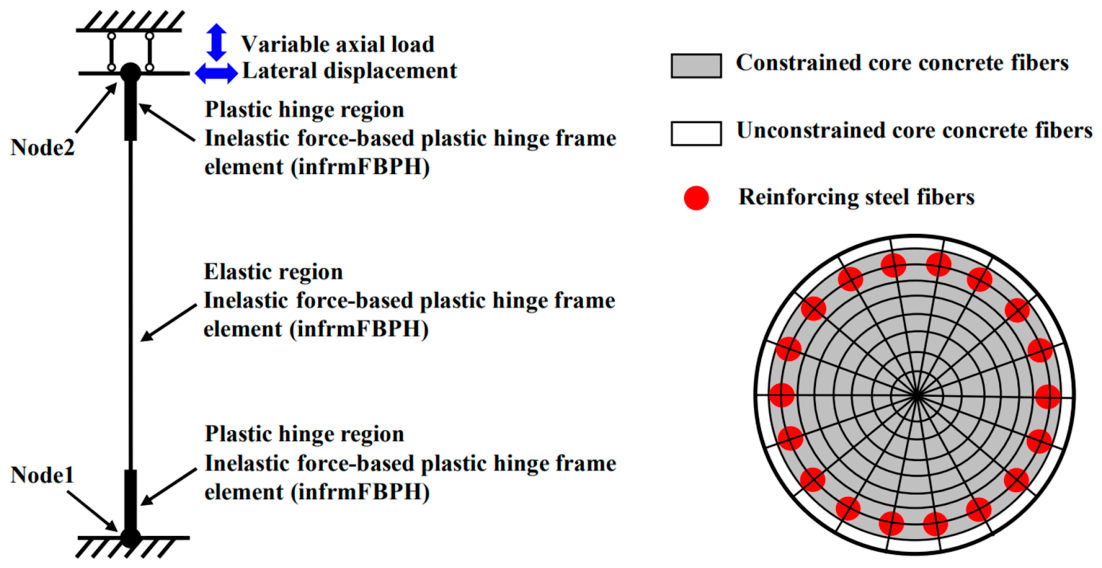
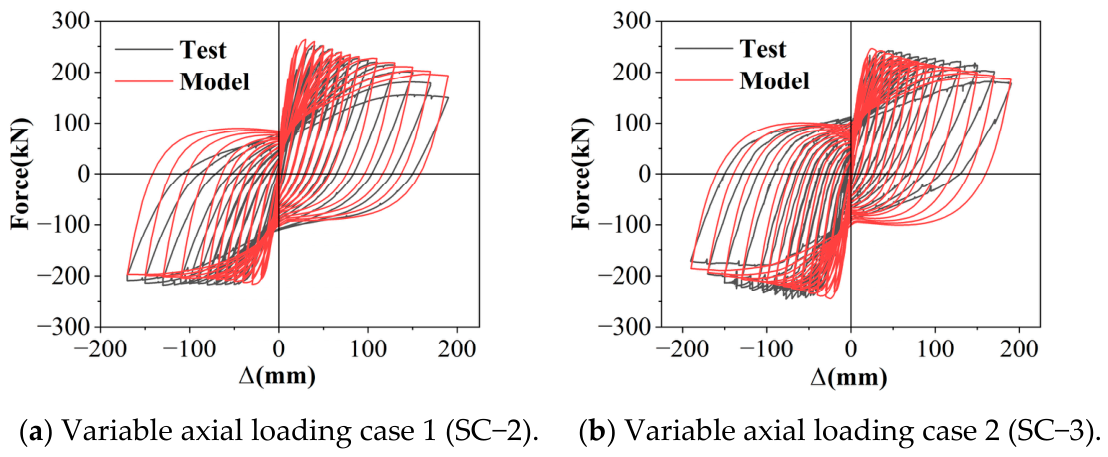
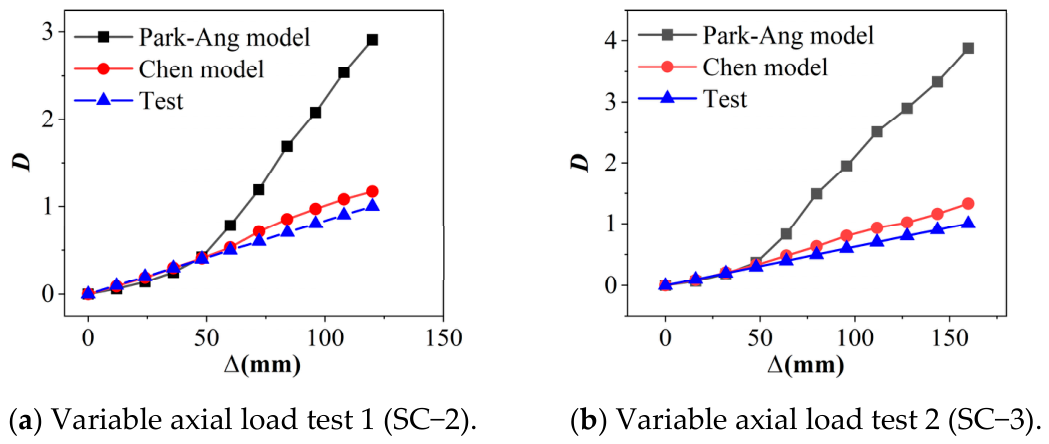
1. Introduction
Reinforced concrete (RC) columns are the core load−bearing members of building and bridge structures. Under seismic action, they are subjected to the coupling effect of axial force, bending moment and shear force, and their seismic performance directly determines the overall safety of structures [
1,
2,
3]. Vertical ground motion, overturning effect, and
P−Δ effect of gravity load will induce dynamic fluctuations of axial force, which significantly change the failure modes, hysteretic characteristics, and damage evolution laws of RC columns, and aggravate stiffness degradation and load−bearing capacity attenuation. It is an important inducement leading to seismic damage of RC structures [
4,
5,
6,
7,
8,
9]. However, traditional damage models are difficult to adapt to the working conditions of variable axial load. Therefore, constructing a special damage model that can reasonably characterize the damage accumulation process of RC columns under variable axial load is the key to realizing refined seismic performance assessment of structures, and has important engineering and theoretical value.
In the field of structural seismic damage assessment, the two−parameter damage model proposed by Park and Ang [
10] has become a classic method for damage assessment of RC members under constant axial load. Extensive subsequent improvements have focused on refining parameters based on experimental data [
11,
12,
13,
14,
15,
16]; among these, the simplified model proposed by Chen [
17] significantly reduced the difficulty of parameter acquisition and enhanced engineering practicability, serving as the prototype for the present study.
However, recent years have witnessed a significant paradigm shift towards data−driven and machine learning (ML) techniques in concrete mechanics. According to a comprehensive review by Li et al. [
18], advanced ML models, including ensemble methods (e.g., Random Forest, XGBoost) and deep learning algorithms, have demonstrated remarkable capabilities in capturing complex nonlinearities. Additionally, probabilistic frameworks are increasingly employed to quantify uncertainties in material properties and loading conditions.
Despite the high accuracy of these modern approaches, they often operate as “black boxes” lacking explicit physical interpretability and direct links to established design codes. Therefore, physics−based deterministic models, such as the Chen model and its derivatives, remain indispensable for engineering practice, where understanding failure mechanisms is as crucial as prediction accuracy.
The establishment and parameter calibration of existing two−parameter damage models are all based on quasi−static test data under constant axial load [
19,
20,
21], without considering the coupled damage effect induced by variable axial load, leaving a significant research gap. Variable axial load dynamically alters the cross−sectional stress state of RC columns and the interaction between reinforcement and concrete, resulting in nonlinear characteristics of damage accumulation [
22,
23,
24]. Although Guo et al. [
25] and Guo et al. [
26] attempted to incorporate variable axial load into performance analysis, they failed to establish a quantitative correlation between variable axial load and damage indices from the perspective of the damage evolution mechanism. Directly applying the fixed−parameter model under constant axial load may lead to systematic deviations in the assessment of variable axial load conditions, with noticeable errors in the large displacement stage [
27,
28,
29].
Scholars worldwide have gradually paid attention to the effect of variable axial load on the seismic behavior of RC columns: Abrams [
30] first verified that axial load variation would alter the flexural performance of RC columns, and Saadeghvaziri [
31] established a nonlinear numerical model for RC columns under variable axial load. Galal and Ghobarah [
9], as well as Esmaeily and Xiao [
22], quantified the influence of laws of variable axial load on hysteretic characteristics and damage accumulation rate through experimental tests. In China, Chen et al. [
32] systematically investigated the effects of amplitude, frequency, and phase of variable axial load via quasi−static tests, and the proposed equivalent axial compression ratio method provided a new perspective on the analysis of variable axial load conditions. Chen and Lei [
33,
34], together with Yang and Bai [
27], also verified the aggravating effect of variable axial load on the damage of RC columns and bridge piers through experiments. In the field of numerical simulation, the constitutive model of confined concrete proposed by Mander et al. [
35] and the cyclic constitutive model of reinforcement proposed by Menegotto and Pinto [
36] have provided reliable support for the fiber finite element simulation of RC columns under variable axial load [
37,
38,
39], and have been widely applied in relevant numerical analyses.
Despite the fact that existing studies have confirmed the significant effects of variable axial load, there is still a lack of a dedicated damage model adapted to variable axial load conditions at present. The weight parameters of traditional models are fixed, which cannot adjust the contribution ratio of deformation and energy dissipation according to the dynamic changes in axial compression ratio [
29,
34]. Meanwhile, the coupled damage effect of axial load fluctuation−horizontal deformation induced by variable axial load has not been effectively incorporated into the damage characterization system [
22,
23], which makes it difficult to meet the requirements of refined engineering assessment [
40,
41]. The influence of axial force on stiffness degradation is not limited to conventional reinforced concrete (RC) but also extends to advanced composite structures. For instance, Jafari et al. [
42] recently demonstrated that in slender steel fiber−reinforced concrete (SFRC) columns, the fluctuation of axial load significantly amplifies second−order (
P−Δ) effects, which in turn reduces flexural rigidity and accelerates stiffness degradation at the onset of buckling failure. Their parametric study further revealed that the impact of variable axial loads on structural performance is highly sensitive to load eccentricity and slenderness ratio. These findings underscore that the dynamic interaction between axial force and lateral deformation is a universal mechanical phenomenon, yet its quantitative characterization within damage models remains inadequate, particularly for scenarios involving variable axial loads. In contrast to existing adaptive modifications, which are often case−specific or empirically adjusted, the novelty of this study lies in establishing a unified and physically motivated extension of the classical two−parameter framework. Based on quasi−static tests and fiber finite element simulations [
32], a dynamic quantitative relationship between the weight parameter and axial compression ratio is proposed, enabling the damage model to explicitly account for the previously neglected coupling effect between axial compression level and damage evolution. The universality of the model is verified through full factorial combination working conditions, and quantitative correlations between the damage index and stiffness/load−bearing capacity degradation are established, providing a simple and practical solution for the seismic performance assessment of RC columns under variable axial load [
43].
4. A Damage Model Considering the Effect of Variable Axial Load
4.1. The Improved Damage Model
Aiming at the inherent limitations of traditional two−parameter damage models under variable axial load conditions, this study conducts improvements on the basis of the Chen model, which features a concise form and clear physical meaning. The core improvement idea is to overcome the restriction of fixed weight parameters, establish a quantitative functional relationship between the weight parameter and the axial compression ratio, and realize the dynamic and adaptive adjustment of the weight parameter with the axial compression ratio, thus enabling accurate characterization of the damage evolution law of RC columns under variable axial load.
The improved damage model retains the core form of a linear combination of the displacement term and energy term of the Chen model, and replaces the fixed weight parameter
β in the original model with a function
β(
n) that changes dynamically with the axial compression ratio
n. This model can be adapted to different axial compression ratio conditions, and is particularly suitable for variable axial load scenarios where the axial compression ratio fluctuates in real time. The core expression of the improved damage model is given by
where
β(
n) is a function of the axial compression ratio
n. Specifically,
denotes the maximum displacement attained historically during cyclic loading,
represents the ultimate displacement under monotonic loading,
signifies the cumulative hysteretic energy dissipation up to the current displacement, and
is the energy dissipation at failure under monotonic loading. In the numerical implementation,
n is taken as the real−time axial compression ratio under varying axial force, and
and
are updated incrementally at each analysis step. This formulation not only inherits the advantages of the Chen model, but also can reasonably reflect the influence of the dynamic change in the axial compression ratio on damage evolution.
4.2. Determination of Model Parameters
Referring to the damage definition in relevant experimental studies, the damage index is defined as D = 1 when the load−bearing capacity of the member drops to 85% of the peak load. Based on the original constant axial compression ratio of 0.2, six additional working conditions (0.1, 0.15, 0.25, 0.3, 0.4, and 0.5) were designed with the specimen’s geometric dimensions, material parameters, and lateral loading protocol unchanged, forming seven analysis working conditions in total.
Finite element simulations of monotonic and cyclic loading were conducted for the seven conditions, and the key parameters (
,
,
and cumulative hysteretic energy dissipation at
D = 1) were extracted and substituted into Equation (2) to back−calculate the corresponding
β values for each axial compression ratio, with the results shown in
Table 2. It can be seen that
β presents a significant nonlinear decreasing trend with the increase in axial compression ratio, further supporting the need for a variable
β in traditional models. The dynamic fluctuation of variable axial load can be decomposed into a combination of instantaneous constant axial compression ratios, so the
β(
n) function fitted based on constant axial compression ratio conditions can realize real−time dynamic adjustment of weight parameters under variable axial load.
With axial compression ratio
n as the independent variable and
β as the dependent variable, nonlinear regression analysis was performed on the scatter data, revealing a significant exponential function relationship between them, with the fitted formula as follows:
The proposed function is formulated as a semi−empirical relationship, combining physical motivation with numerical calibration. The goodness of fit = 0.928 indicates that the proposed exponential function effectively captures the quantitative relationship between the axial load ratio and the weighting parameter . From a physical perspective, the decreasing trend of with increasing axial load ratio reflects a transition in the damage mechanism: under low axial load, ductile flexural behavior allows cumulative energy dissipation to contribute significantly to damage progression; under high axial load, the P−Δ effect intensifies, and failure tends to occur abruptly after only a few deformation cycles, making the ultimate deformation capacity the dominant factor while the contribution of energy dissipation diminishes. The exponential form naturally describes this nonlinear, accelerating shift.
Notably, this functional form exhibits broad compatibility with different material descriptions. Although the Mander and Menegotto–Pinto models are adopted here, the proposed damage index is conceptually independent of specific constitutive laws. Alternative material models may affect quantitative predictions, but due to the normalized formulation, the calibrated β(n) function and overall model calibration are expected to remain largely unchanged.
4.3. Validation of the Damage Model
To verify the rationality, applicability, and accuracy of the improved damage model, the model was first validated against experimental data from two representative RC column specimens. However, considering the limited amount of available experimental data, comprehensive validation across broader engineering scenarios is necessary. Therefore, to supplement the experimental verification, 36 additional validation cases covering common engineering parameter ranges were designed via full factorial combination [
49,
50,
51]. To ensure the universality of the validation results, the specimen geometry, material constitutive models, and lateral loading protocol were kept unchanged, while key parameters were varied as follows: variable axial compression ratio (0.2 ± 0.1, 0.3 ± 0.1, 0.4 ± 0.1, 0.3 ± 0.2; 4 levels), shear−span ratio (3.5, 4.0, 4.5; 3 levels), and reinforcement ratio (1.64%, 1.84%, 2.04%; 3 levels).
The multi−condition validation results of the 36 working conditions showed that the improved model had an overall average relative error is 4.44% in damage calculation. The Root Mean Square Error (RMSE) was introduced to evaluate the dispersion of prediction errors, and the results indicate that the error distribution is uniform without abrupt changes. High calculation accuracy was maintained under both constant axial compression and variable axial compression conditions with different amplitudes. Specifically, the average error was 3.11% under low−amplitude variable axial compression (0.2 ± 0.1), 4.83% under medium−high amplitude (0.3 ± 0.1, 0.4 ± 0.1), and 5% under large amplitude (0.3 ± 0.2). Changes in shear−span ratio and reinforcement ratio had no significant effect on the calculation accuracy, and the model maintained stable performance under both low/high shear−span ratio and low/high reinforcement ratio conditions, covering the conventional design parameter range in engineering practice.
Due to space limitations, six representative sets of data were selected from the total 36 working conditions and are summarized in
Table 3. The damage indices calculated by the improved model were highly consistent with the reference values from finite element simulation, reasonably reflecting the nonlinear damage accumulation characteristics of RC columns under variable axial load, with the relative errors of damage indices at key displacement nodes (initial damage, damage development, ultimate displacement) all controlled within a reasonable range. For the significant differences in ultimate displacement of members under different working conditions, the model could capture the rapid damage accumulation under small ultimate displacement, and describe the slow and stable damage evolution in the later stage under large ultimate displacement without accuracy degradation at the large displacement stage. Even under the complex, large−amplitude variable axial compression conditions, the calculation error did not increase significantly, supporting its adaptability for damage assessment of RC columns under variable axial load.
The above validation results demonstrate that the improved damage model effectively overcomes the limitations of traditional two−parameter damage models and can reasonably describe the cumulative damage evolution law of RC columns under variable axial load with different axial compression ratios, shear−span ratios, and reinforcement ratios, demonstrating reasonable rationality and engineering applicability.
This satisfactory performance is attributed to the state−dependent formulation adopted by the model. Variable axial load is treated using the current axial compression ratio
n, where cumulative damage is captured by the integral term ∫ dE, while the instantaneous damage evolution rate is governed solely by the current state via
β(
n), without explicitly tracking full load path history. The extensive validation presented in
Table 4 and
Table 5 demonstrates that this simplification is sufficiently accurate within the investigated parameter range.
The proposed function is validated for axial compression ratios between 0.1 and 0.5. Extrapolation beyond this range is not recommended due to shifts in failure mechanisms. For n < 0.1, although members exhibit larger hysteretic energy dissipation due to enhanced ductility, the damage mechanism shifts from compression−driven concrete crushing to tension−controlled behavior governed by reinforcement low−cycle fatigue and bond−slip. Since the proposed damage index relies on flexural energy dissipation to quantify damage progression, the model fails to capture this shift, leading to unreliable predictions (potentially overestimating damage) outside the validated range. For n > 0.5, members enter a compression−dominated regime where failure shifts to brittle shear or compressive crushing. In such cases, failure occurs abruptly with minimal accumulation of flexural hysteretic energy. Consequently, the model significantly underestimates the actual damage, leading to dangerously non−conservative predictions. Users should exercise caution when applying the model outside the validated range.
5. Effects of Damage Index on Load−Bearing Capacity Degradation and Stiffness Degradation
It has been verified that the improved damage model can reasonably characterize the damage evolution law of RC columns under variable axial load, while traditional models exhibit significant calculation deviations. Therefore, based on the damage indices calculated by the improved model, this section establishes the quantitative correlation between the damage index and the load−bearing capacity degradation as well as stiffness degradation of RC columns, so as to achieve the damage−based prediction of mechanical performance degradation.
5.1. Effect of Damage Index on Load−Bearing Capacity Degradation
The load−bearing capacity degradation of RC columns under variable axial load is essentially the gradual deterioration of the skeleton curve induced by the coupling of cyclic loading and dynamic axial load fluctuation. Existing studies mainly characterize load−bearing capacity degradation of such members based on the stiffness attenuation in the hardening stage [
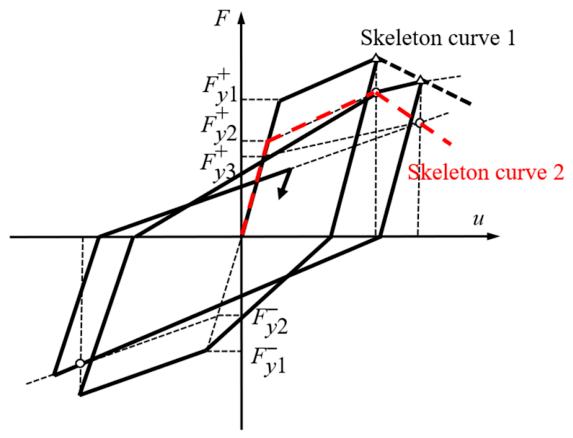
52]. The shape adjustment of the skeleton curve directly reflects the continuous reduction in the member’s load−bearing capacity, as presented in
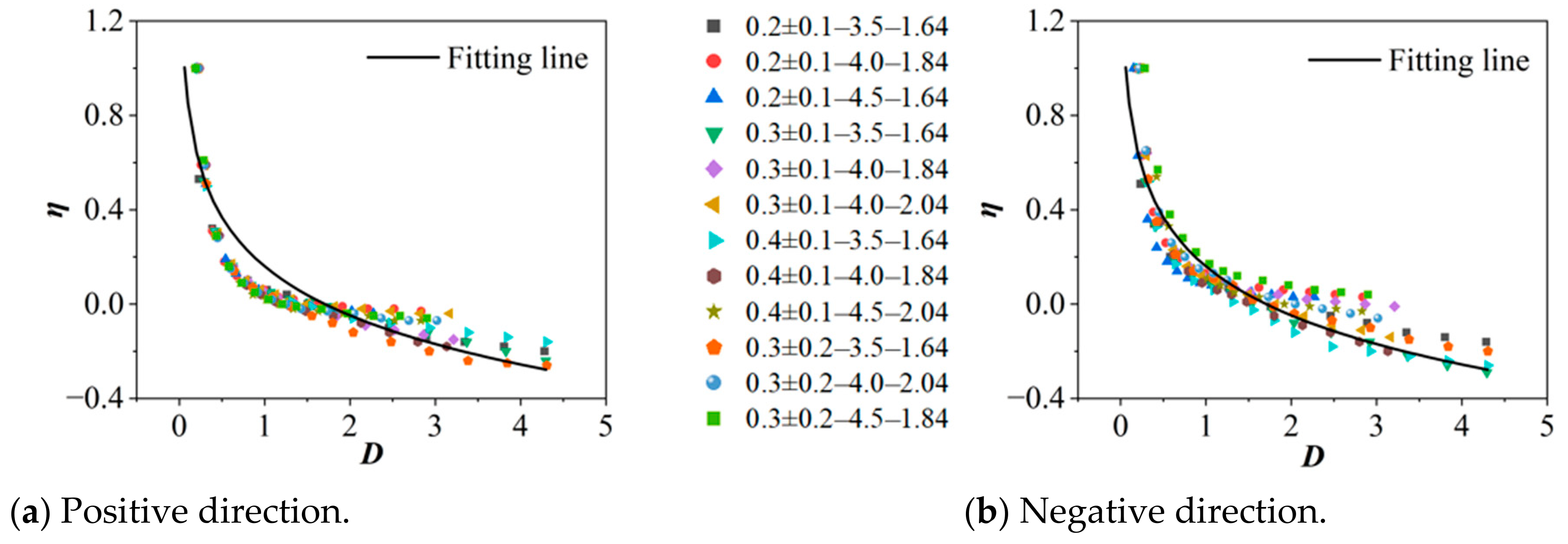
Figure 8. There is a significant intrinsic correlation between the attenuation degree of hardening stage stiffness and the cumulative damage of the member. Referring to this research idea, the load−bearing capacity degradation coefficient
η is defined to characterize the load−bearing capacity attenuation law of RC columns under variable axial load, with its expression given by
where
is the tangent slope of the load−bearing capacity hardening stage of the member under a certain cyclic loading, and
is the slope of the line connecting the yield state to the peak load state; the superscripts ± represent the positive and negative loading directions, respectively.
To establish the quantitative correlation between the damage index and load−bearing capacity degradation, 12 groups of typical variable axial load working conditions were selected for data analysis. Combined with the results of quasi−static tests and finite element simulation data, it can be seen that the peak load of the member exhibits a regular reduction during cyclic loading. According to the measured test data, the peak load reduction coefficient of RC columns under cyclic loading with variable axial load is 0.96. The tangent slope of the load−bearing capacity hardening stage, the yield−to−peak stage slope, and the corresponding damage indices D calculated by the improved model were extracted from each typical working condition for correlation analysis. The results show that when the damage index D is greater than the damage index at the yield of the member, the load−bearing capacity degradation coefficient decreases in an obvious logarithmic law with the increase in the damage index, and the degree of load−bearing capacity attenuation in the positive and negative loading directions is basically consistent without obvious asymmetry.
Based on the simulation data of the 12 groups of typical working conditions (
Figure 9), logarithmic regression fitting was carried out to establish the quantitative functional relationship between the load−bearing capacity degradation coefficient and the damage index:
where
; otherwise, the member is not loaded to the yield point, and no obvious hardening stage exists.
The overall accuracy statistics of the fitting data set show that the correlation coefficients
of the fitting formula in the positive and negative directions reach 0.810 and 0.824, respectively, which can effectively characterize the intrinsic correlation between the damage index and load−bearing capacity degradation, and realize the quantitative calculation of the subsequent peak load−bearing capacity attenuation based on the damage index, namely,
5.2. Effect of Damage Index on Stiffness Degradation
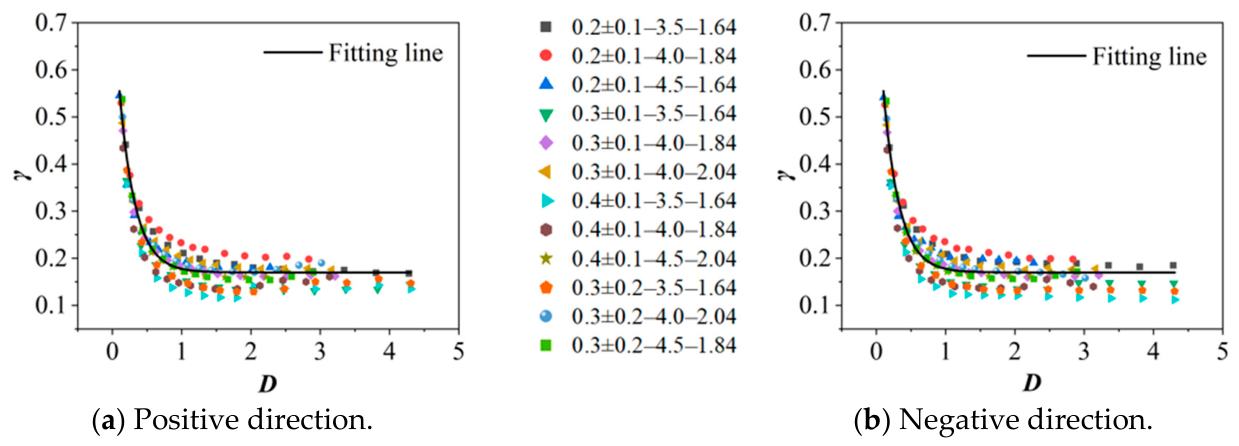
Based on the same 12 groups of typical variable axial load working conditions, the intrinsic correlation between the damage index and the stiffness degradation of members was further investigated. Under the coupling action of variable axial load and cyclic loading, the stiffness degradation of RC columns has a close quantitative relationship with the development of cumulative damage, and the attenuation law of unloading stiffness can be reasonably described by the damage indices calculated by the improved model. Referring to the findings of existing research [
53], the stiffness degradation coefficient
γ is defined to characterize the attenuation degree of the unloading stiffness of circular RC columns, with its expression given by
where
is the unloading stiffness at the first unloading of a certain displacement amplitude, and
is the initial stiffness of the member; the superscripts ± represent the positive and negative loading directions, respectively.
The unloading stiffness, initial stiffness under each cyclic loading, and the corresponding damage indices D calculated by the improved model were extracted from the finite element simulated hysteretic curves of the 12 typical working conditions for systematic statistical analysis. The results show that the forms of stiffness degradation in the positive and negative loading directions are highly consistent, and the attenuation degrees are basically similar. When the damage index D approaches 0, the stiffness degradation coefficient γ approaches 1, indicating that the member has almost no stiffness attenuation at this stage. With the continuous increase in the damage index D, γ decreases nonlinearly with a gradually slowing attenuation rate, and the overall variation characteristic conforms to the exponential function law.
Based on the data analysis results of the 12 groups of typical working conditions (
Figure 10), nonlinear regression fitting was carried out to establish the quantitative functional relationship between the stiffness degradation coefficient and the damage index:
This formula is applicable to the post−yield stage of the member (, where is the damage index at the yield of the member). To ensure no obvious stiffness degradation of the member before yielding, when , is set to , and the stiffness degradation coefficient at this time, meaning the unloading stiffness is equivalent to the initial stiffness without obvious stiffness degradation before the member yields.
This fitting formula achieves correlation coefficients
of 0.905 and 0.891 in the positive and negative loading directions, respectively, which can effectively characterize the intrinsic correlation between the damage index and stiffness degradation, and realize the quantitative calculation of unloading stiffness based on the damage index, namely,
5.3. Validation of the Degradation Formulas
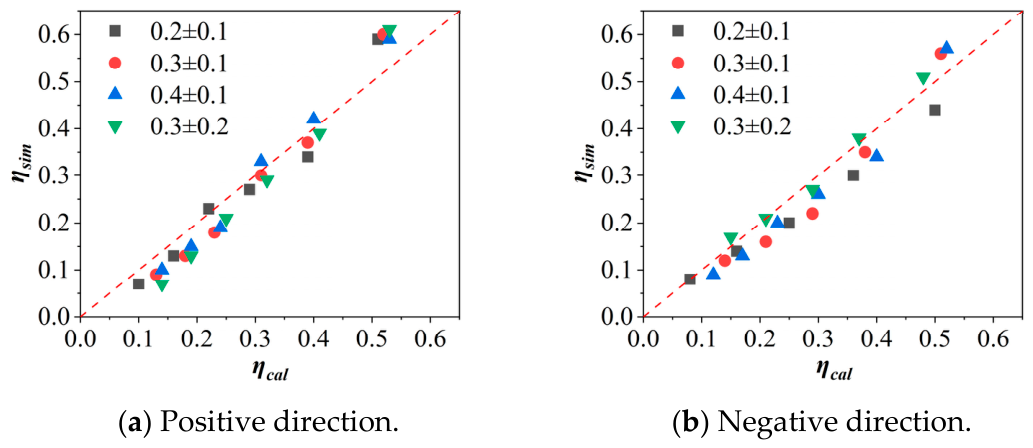
To verify the calculation accuracy and engineering applicability of the proposed load−bearing capacity degradation formula (6) and stiffness degradation formula (9), 15 groups of independent working conditions that were not involved in the formula fitting were selected as the validation data set from the 36 full−factorial validation working conditions of RC columns under variable axial load. The validation data set covers all levels of variable axial compression ratio, shear−span ratio, and reinforcement ratio, ensuring the universality and objectivity of the validation results. In the validation process, only the data of the post−yield stage of the members (
) were selected for quantitative comparison and analysis with the formula calculation results, as presented in
Figure 11.
The positive and negative damage indices of the validation data set were substituted into the load−bearing capacity degradation formula (6) one by one to calculate the calculated values of the load−bearing capacity degradation coefficient . Correlation analysis was then conducted between the calculated values and the simulated values , which were obtained from the tangent slope of the hardening stage and the slope of the yield−to−peak stage extracted from the finite element hysteretic curves.
The validation results show that the overall correlation coefficient between the calculated and simulated values of the load−bearing capacity degradation coefficient is 0.926, with the correlation coefficients of the positive and negative loading directions being 0.927 and 0.924, respectively. Even under the complex working conditions of large−amplitude variable axial compression (0.3 ± 0.2), the formula maintains satisfactory predictive accuracy without obvious overfitting. All data points are evenly distributed on both sides of the y = x reference line, indicating that the load−bearing capacity degradation formula (6) can effectively reflect the logarithmic relationship between the increase in damage index and the load−bearing capacity degradation coefficient, and can predict the load−bearing capacity degradation characteristics of circular RC columns under variable axial load.
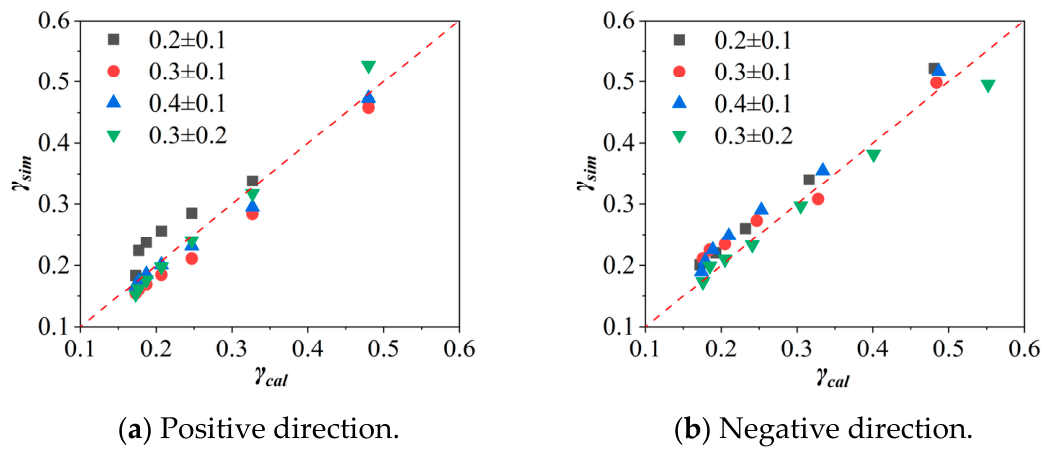
Likewise, using the identical validation method for the load−bearing capacity degradation formula, the positive and negative damage indices
of the post−yield stage in the validation data set were substituted into the stiffness degradation formula (9) to calculate the calculated values of the stiffness degradation coefficient
. Correlation analysis was performed between these calculated values and the simulated values
, which were derived from the unloading stiffness and initial stiffness extracted from the finite element hysteretic curves in this study, as presented in
Figure 12.
The results demonstrate that the overall correlation coefficient of all validation data points reaches 0.935, with the correlation coefficients of the positive and negative loading directions being 0.937 and 0.929, respectively. All calculated and simulated values are closely distributed on both sides of the y = x reference line without obvious deviations and stage errors. This indicates that the stiffness degradation formula (9) can reasonably characterize the intrinsic correlation between the damage index and the attenuation of unloading stiffness, and can effectively predict the stiffness degradation law of RC columns under different parameter working conditions.
6. Conclusions
This study focuses on the damage assessment and mechanical performance degradation of RC columns under variable axial load. A validated fiber finite element model was built based on quasi−static tests to analyze the limitations of traditional two−parameter damage models. An improved model considering the dynamic effect of axial compression ratio was proposed, and the quantitative correlations between damage index and stiffness/load−bearing capacity degradation were established. The rationality and engineering applicability of the proposed model and formulas were verified via multiple working conditions, with the main research conclusions as follows.
(1) The traditional Park–Ang and Chen two−parameter damage models show systematic deviations in damage assessment of RC columns under variable axial load and cannot reasonably characterize their damage evolution, as they are based on constant axial compression, with fixed weight parameters and a single damage characterization form, leading to noticeable errors in the large displacement stage.
(2) The weight parameter β of the Chen model has a significant exponential negative correlation with the axial load ratio n. The fitted β(n) function enables dynamic adjustment of the weight parameter with the axial load ratio. The improved model retains the merits of the Chen model, overcomes the fixed−parameter limitation, adapts to different axial load ratio conditions, and is thus suitable for damage assessment of RC columns under variable axial load.
(3) Validated by 36 full−factorial combination working conditions, the improved model has satisfactory accuracy and promising generality within the investigated ranges in damage calculation, with an overall average relative error of only 4.44% and an RMSE of 4.97%, indicating uniformly distributed errors without abrupt changes. It maintains stable calculation accuracy under variable axial compression of different amplitudes, various shear−span ratios, and reinforcement ratios, covering the conventional engineering design parameter range.
(4) The stiffness and load−bearing capacity degradation of RC columns under variable axial load have clear quantitative correlations with the damage index: the stiffness degradation coefficient decays exponentially with the damage index, and the load−bearing capacity degradation coefficient decreases logarithmically, with both fitting formulas having a correlation coefficient over 0.81 and consistent attenuation laws in positive and negative loading directions. These formulas realize damage index−based quantitative prediction of mechanical performance degradation, providing a quantitative basis for the seismic performance assessment of RC columns under variable axial load.
(5) The proposed model and the established degradation formulas provide a quantitative framework linking damage assessment with structural performance deterioration. Once the damage index D is calculated, the corresponding degradation of instantaneous mechanical properties can be quantitatively evaluated. This relationship may provide a basis for the future development of damage−dependent restoring force models capable of considering structural damage evolution under variable axial loads, thereby offering potential applications in rapid post−earthquake performance assessment and performance−based seismic evaluation. However, the present study mainly focuses on the development and preliminary validation of the damage model itself, rather than the direct prediction of complete skeleton or hysteretic responses. Further validation using broader independent experimental datasets is still required to establish generalized restoring−force prediction capabilities.
Finally, it should be noted that due to the high technical complexity and substantial experimental costs associated with conducting quasi−static tests of RC columns under continuous variable axial load paths, the scarcity of publicly available experimental datasets makes it impractical to conduct comprehensive uncertainty quantification or probabilistic assessment. In addition, the current validation framework is still primarily based on experimentally calibrated finite element simulations with consistent constitutive assumptions and modeling strategies. Consequently, while the Average Relative Error and RMSE were introduced to assess the central tendency of predictions, comprehensive uncertainty quantification and sensitivity analyses were not included in this study. The proposed β(n) function and the improved damage model demonstrate satisfactory predictive performance and robustness primarily within the investigated parameter ranges. Nevertheless, the applicability of the model is explicitly restricted to circular, flexure−dominated RC columns under quasi−static cyclic loading. Future research will focus on incorporating more diverse cross−sectional geometries, high−performance material properties, and a broader spectrum of axial load histories and will continue to conduct further physical experiments to verify the effectiveness of the model, while utilizing independent experimental datasets to further validate and enhance the generalizability of the proposed model.