1. Introduction
According to the classification by Rowe and Kuan [
1], Chinese architecture in the first half of the 20th century exhibited four primary trends under the impact of Western influence. These include: (1) the International Style, which introduced orthodox modernism to China; (2) Chinese Revival architecture, which utilized reinforced concrete to replicate traditional curved roofs; (3) New-national architecture, a modernized approach developed by Western-educated Chinese architects that evolved from Chinese Revival architecture; and (4) the systematic research on traditional architecture led by Liang Sicheng and the Society for Research in Chinese Architecture. This framework provides a comprehensive basis for analyzing the cultural and technical transitions of the period. Following the designation of Nanjing as the capital in 1927, a decade of relatively stable construction ensued in central China (1927–1937). As the new capital, Nanjing’s urban development embodied aspirations for both national revival and a metropolis. Its city planning and architectural practices served as an ideal testing ground for exploring the fusion of modernization and localization in Chinese architecture. The Chinese Revival architecture was officially designated as the dominant expression of the capital’s image at this period.
However, Nanjing’s grand vision was ultimately left unfulfilled, and the city’s architectural landscape did not see a widespread adoption of the International Style or the radical Modern Movement then burgeoning in Western Europe. On this point, relevant scholars have reached a consensus on the study of Nanjing’s capital construction [
2,
3,
4].
In the 1930s, while architecture in Nanjing emphasized a traditional Chinese appearance under the combined influence of nationalism, political will, and other factors, its materials and construction techniques rapidly aligned with modern construction technologies. In practice, architects adopted varying approaches to handling the modern and the traditional, presenting a diverse and complex process [
5]. Lai conducted an in-depth study of how the Sun Yat-sen Mausoleum used Beaux-Arts principles to emulate Chinese palatial architecture in its expression of Chinese Revival architecture and pointed out the mausoleum as the promoter of this style [
6]. In another study on the National Central Museum in Nanjing, Lai argued that it represented a different approach: its designers, Xu Jingzhi and Liang Sicheng, grounded in a profound understanding of authentic Chinese traditional architecture, integrated the tectonic logic of Liao and Song dynasty architecture into modern construction technologies, rather than merely adhering to formal revivalism. This approach diverged from the revivalist conventions that focused on imitating the external forms of traditional buildings [
7,
8]. New-national architecture, evolved from Chinese Revival architecture, is represented by the Ministry of Foreign Affairs building. This type of architecture reduced traditional features to symbolic motifs, giving rise to a new vocabulary that excluded the curved roof [
9].
Other scholars have also examined the characteristics of Nanjing architecture during this period from multiple perspectives. Zhou Qi conducted detailed case studies of administrative buildings that prominently embodied Chinese Revival architecture during the capital construction period [
10]. Cody, Nancy, and Atkin explored how Chinese architects influenced by Beaux-Arts principles utilized traditional Chinese architecture to create new design paradigms [
11]. Chen traced the creative trajectories of architects in Nanjing, arguing that the government’s nationalist narrative and architectural institutional systems sparked culturally rooted design enthusiasm among overseas-educated Chinese architects [
12]. Yikuan Han and Zhaoyi Wang pointed out from a structural perspective that the structural choices in Chinese Revival architecture were the result of balancing structural logic, spatial efficiency, and economic considerations [
13]. Existing research has provided comprehensive discussion of the political and social context of Nanjing architecture in the 1930s, along with case studies of important representative works. Chinese-language studies have offered more detailed examinations of different building types from this period, with research focus gradually expanding from stylistic analysis to other aspects such as technology and design methods. These articles contribute to the understanding of the complex architectural modernization process in the capital city of Nanjing.
Building on previous studies, this research seeks to define a precise central argument: to investigate how early modern architecture in China, represented by 1930s Nanjing, resolved the contradiction between modernity and nationality to achieve a distinct localized practice. Taking the National Goods Bank (Nanjing) as a case study, the paper analyzes its design intent, spatial organization, decorative techniques, and construction. The study explores how architectural “localization” was realized through the integration of modern functional requirements with traditional architecture forms, thereby providing a new perspective on the dissemination of modernism in a non-Western context. The significance and originality of this research is twofold. First, as the designers of the building’s recent restoration, the authors gained exclusive access to primary constructional evidence. This differs from previous studies that often relied on socio-historical observations by outsiders. Second, as one of the few well-preserved extant works by Xi Fuquan, the National Goods Bank building serves as a New-national architecture specimen that fully embodies the architect’s modernist design philosophy in both concept and practice.
In the context of this study, modernity refers specifically to the state-led modernization of Nanjing’s urban and architectural landscape between 1927 and 1937. It encompasses the adoption of Western structural systems and functionalist planning, serving as a counterpoint to the expression of nationality. Furthermore, the term “modern architecture” in this study specifically denotes the avant-garde architectural movement and style that became prevalent in Europe during the 1920s. In the Chinese context, this influence was primarily manifested through the International Style.
The paper proceeds as follows:
Section 2 introduces the research methodology, including historical analysis and case study approaches.
Section 3 reviews the tensions between modernity and national identity in Nanjing, as well as the emergence of New-national architecture resulting from these conflicts.
Section 4 presents the construction background of the case and the architect’s international educational experience, both of which played a key role in moving the building away from Chinese Revival architecture.
Section 5 analyzes the case’s modern and localized features in detail, focusing on four aspects: spatial organization, decoration, structure, and materials.
Section 6 concludes the paper by summarizing the main arguments and highlighting the value and significance of Nanjing’s architectural modernization efforts in the 1930s.
2. Materials and Methods
This study adopts a historical and empirical research approach, including historical research, archival investigation, and on-site survey (
Table 1).
First, historical research provides the foundation for this study. To ensure data reliability, the paper relies on primary archival sources and contemporary professional publications from the early 20th century. Key documents include the Capital City plan: Nanjing (1929) issued by the Technical Commissioners’ Office for National Capital Planning. This study analyzed the design practice of architect Xi Fuquan through the professional journal The Builder (Jianzhu Yuekan) and The Chinese Architect (Zhongguo Jianzhu). These materials provide an official explanation for the development of Nanjing architecture towards ethnic forms after 1927, as well as architectural drawings and design explanations for the cases mentioned in this article.
Second, archival investigation plays an irreplaceable role in this study. The National Goods Bank building in Nanjing was constructed between 1935 and 1936 and underwent major renovations in 1946, 1999, and 2021–2024. Due to alterations and structural reinforcements over the years, much of the building’s original condition is no longer directly observable. Therefore, accessing original design drawings and construction records through archival research is a crucial means of obtaining reliable information. The archives referenced in this study include: (i) an article written by the architect of the building in the professional journal The Chinese Architect in 1936, and (ii) restoration archives from 1947 and 1999, including blueprints, provided by the building’s owner- held by the Postal Savings Bank of China (Nanjing Branch). These valuable materials provide a solid foundation for restoring the building’s technical details and its original construction condition.
Third, the on-site survey (conducted 2021–2023) provides empirical validation for this research. The authors utilized total stations, laser distance meters and steel tape measures to measure the building’s exterior dimensions and internal spatial layout. The original positions of the structural members were obscured by later section enlargement reinforcements. These positions were verified by comparing current measurements with the 1937 original design drawings and the 1999 reinforcement drawings. This verification measurement allows for reconstruction of the initial structural framework of the building. Moreover, an integrated rebar scanner (HC-GY61T) was employed to detect the internal reinforcement distribution. These verification-based investigations fill the gap between archival records and the current physical state, providing empirical support for the analysis.
To explicitly identify New-national architecture, this paper refers to the summary of New-national architecture provided by Chinese scholars [
10], which define this style as a synthesis of modern logic and traditional motifs. The general standards are as follows:
- (1).
Modern Core: The architecture utilizes modern construction technologies, rational plan compositions, and functionalist forms, moving away from the structural logic of traditional timber frames.
- (2).
Abstracted Exterior Decoration: Traditional features are abstracted and applied to specific portions of the façade. Unlike Chinese Revival architecture, it rejects the literal simulation of traditional timber structures (such as curved roofs) with modern materials.
- (3).
Traditional Interior Artistry: Interiors frequently employ traditional elements like traditional ceilings and colored patterns (caihua). While localization exists across all dimensions, the decorative system remains the most salient marker distinguishing this style from pure Western modernism.
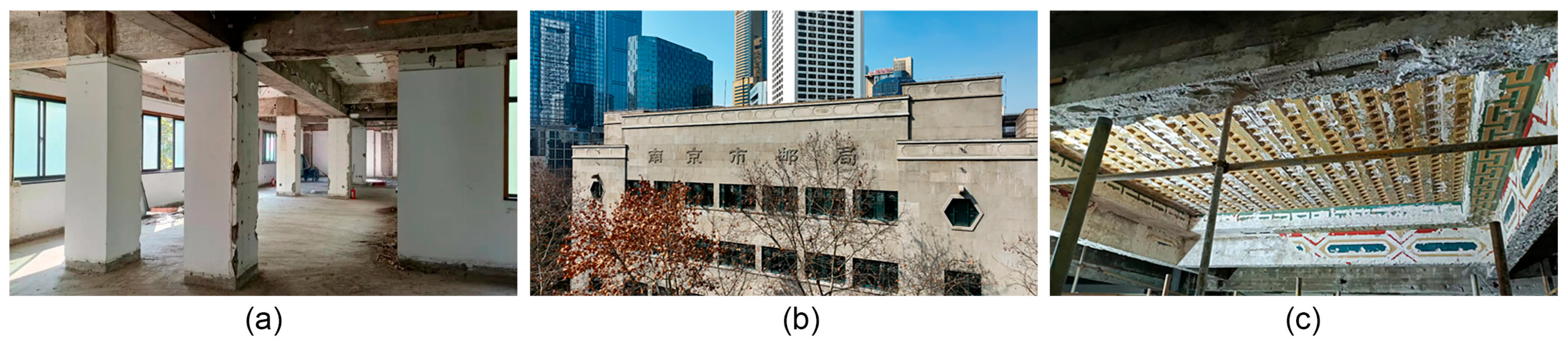
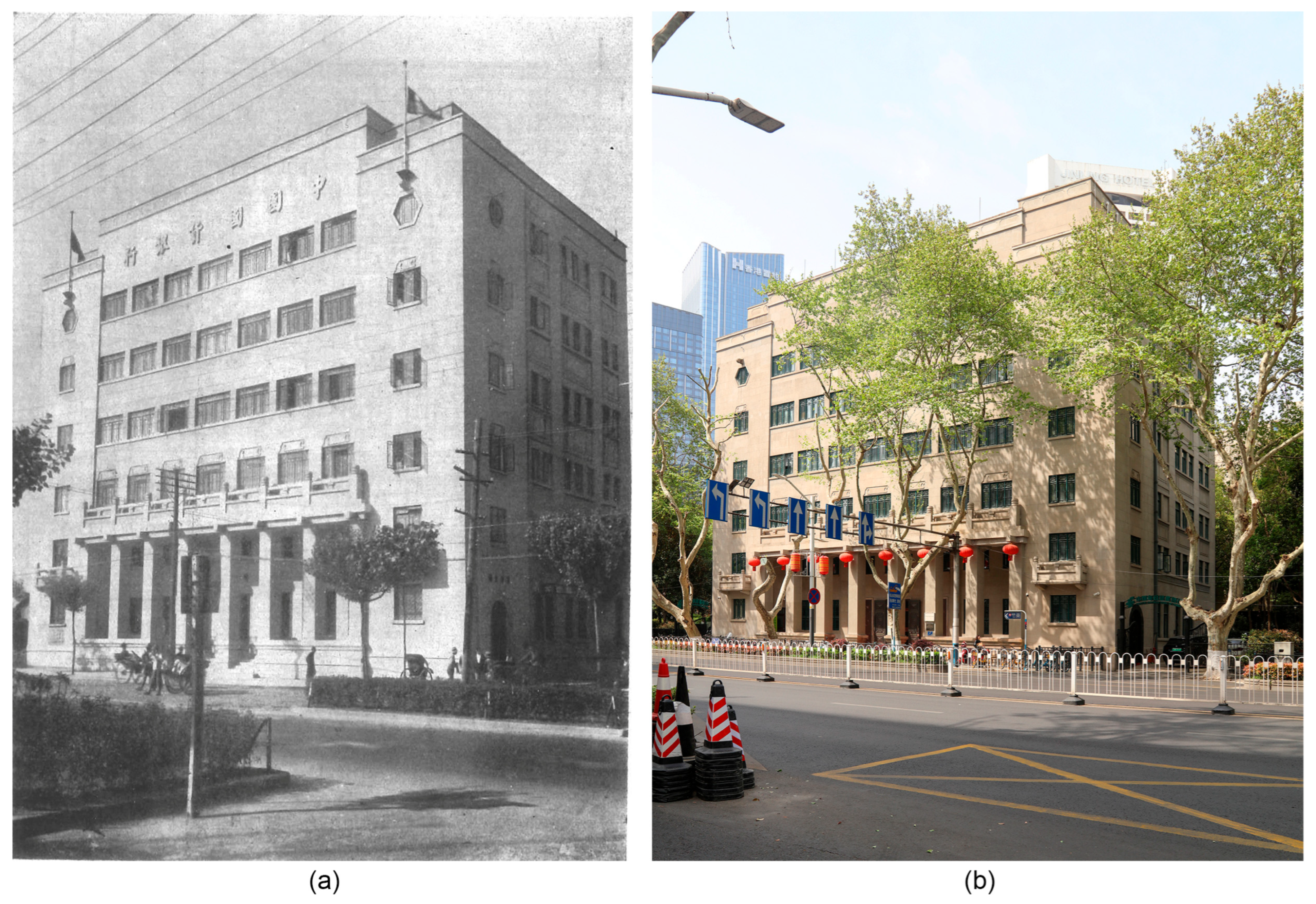
As a representative example of New-national architecture, the National Goods Bank building demonstrates a precise correspondence to these criteria (
Figure 1):
- (1).
Spatial and Structural Logic: The building adopts a reinforced concrete frame and an efficient, function-driven layout. It reflects the technical rationality of modernism while providing a flexible interior for banking operations.
- (2).
Exterior Symbolic Expression: The façade integrates simplified traditional elements onto a modern, flat-roofed volume, such as rectangular motif with plum-blossom corners along the parapet. The symbols serve as visual markers of national identity without compromising the building’s modern form.
- (3).
Interior Cultural Continuity: The ceiling of the main banking hall is adorned with traditional caihua patterns. This localized treatment preserves a specific “Chinese flavor”.
Since New-national architecture is frequently compared with Chinese Revival architecture,
Table 2 summarizes their respective characteristics. New-national architecture more directly incorporates the spatial composition and construction technologies of Western modern architecture. They appeared more frequently among ordinary urban public buildings, such as commercials. Conversely, Chinese Revival architecture was predominantly adopted for administrative and monumental buildings.
3. Background: The Contradiction Between Modernity and Nationality in Nanjing (1927–1937)
On 1 January 1912, the provisional government of the Republic of China was established in Nanjing, but the capital was subsequently relocated to Beijing in February. In April, the Nationalist government headed by Chiang Kai-shek was founded in Nanjing, once again designating this ancient southern Chinese city as the capital of a new regime. Although Nanjing had experienced glorious urban development in its history, by this time the city had become severely deteriorated after years of warfare. It lacked systematic municipal infrastructure and was filled with dilapidated shacks and impoverished residents [
14]. The government urgently needed to transform Nanjing into a modern capital to consolidate its authority and gain international prestige.
From 1928 to the end of 1929, the Nationalist Government produced three sets of urban plans for Nanjing: the
Grand Capital Plan (1928), the
Capital City Plan: Nanjing (1929), and the additional plans approved by the Capital Construction Committee (1929–1933) [
15]. Among them, the most significant was the
Capital City Plan: Nanjing released in December 1929 under the leadership of Sun Ke. It was largely influenced by Western modern urban planning, particularly those from the United States [
16].
The spatial vision for Nanjing drew upon the capital cities such as Paris, Tokyo, Washington D.C., New Delhi, and Ankara. The city was envisioned to possess the essential elements of major capitals, including but not limited to high-standard road systems, urban drainage, and efficient functional zoning [
17]. In addition to referencing these global examples, the
Capital City Plan: Nanjing directly involved American consultants: Henry Murphy, Ernest Goodrich, and their assistants Irving Moller and Theodore McCrosky. Many of the participating technical officials and engineers were also educated in Europe or the United States. Ultimately, the
Capital City Plan: Nanjing adopted the latest theories of modern urban planning, forming a comprehensive spatial planning to transform Nanjing into a modern capital. It addressed 28 aspects including population, transportation, zoning and implementation, while emphasizing the study of new Western technologies to meet modern living requirements [
18].
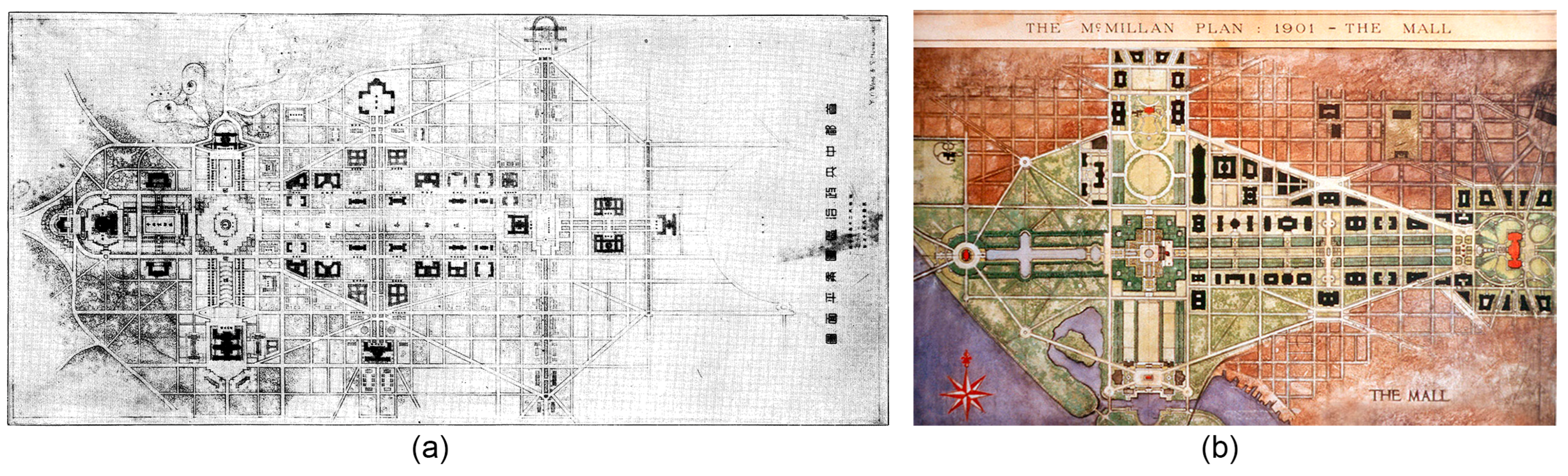
However, while aligning closely with Western models, the
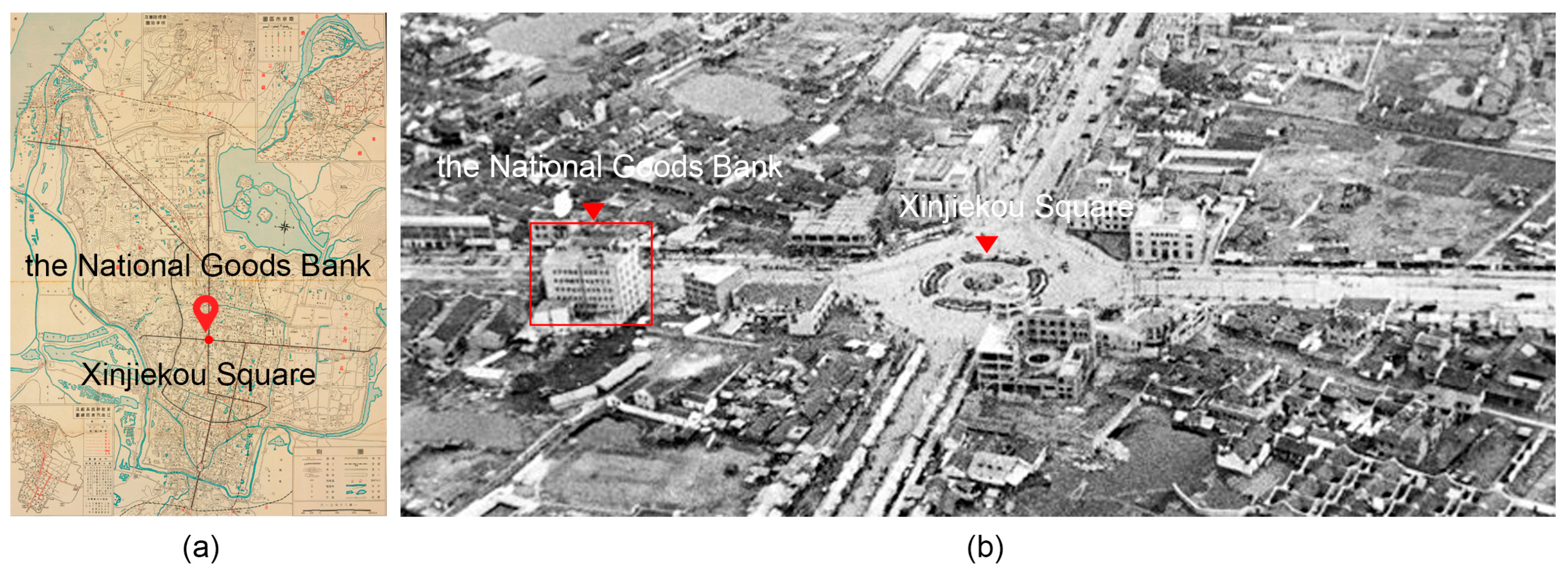
Capital City Plan: Nanjing simultaneously emphasized the expression of Chinese national identity in architecture. For instance, the masterplan for the central administrative zone bore significant resemblance to the 1901 plan of Washington, D.C., yet it was praised for advocating Chinese traditional forms in architecture [
13,
17] (
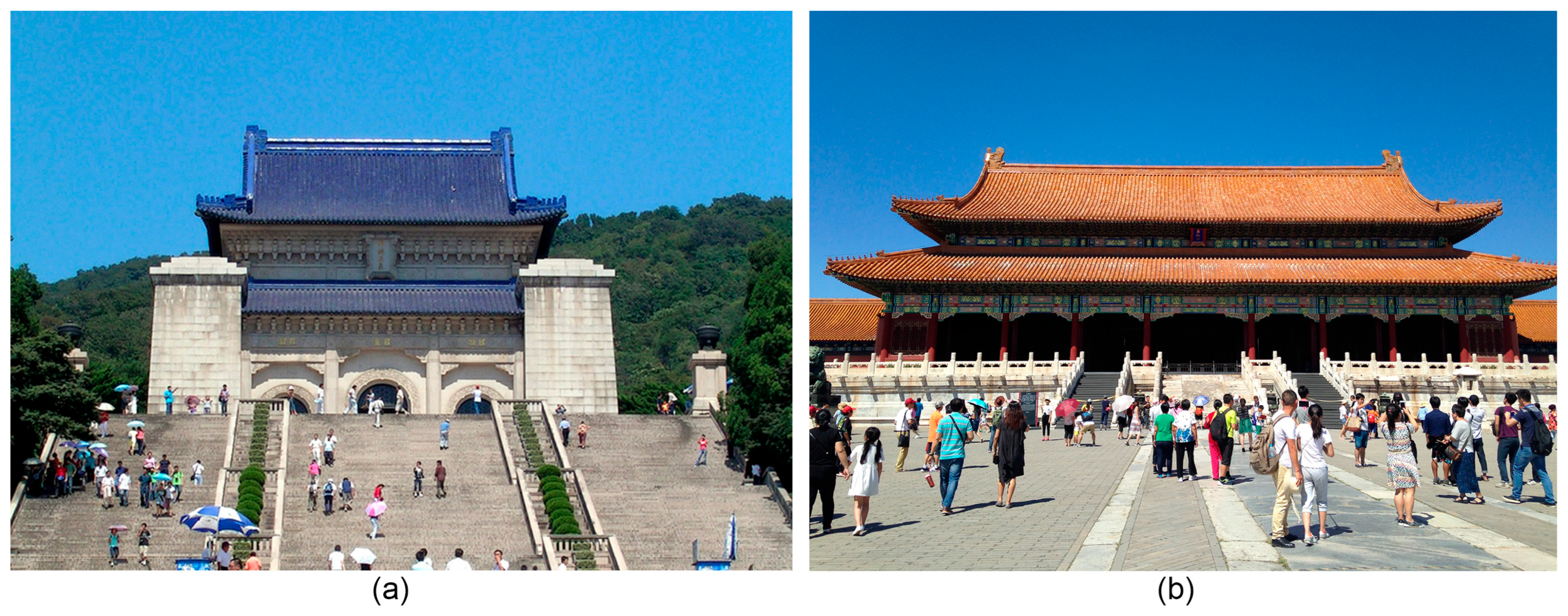
Figure 2). In fact, the plan explicitly mandated that all administrative and major public buildings adopt Chinese Revival architecture. These buildings were required to feature traditional Chinese symbols such as the curved palace-style roofs,
dougong (interlocking wooden brackets), and other ornamental elements evoking historical imagery (
Figure 3). Technologically, they were constructed using the most advanced reinforced concrete structures available at the time, symbolizing the capability of the new nation [
19]. As a result, Chinese Revival architecture flourished in Nanjing throughout the 1930s. Although only Zhongshan Road and a few government buildings from the original plan were completed after 1930, this architectural style later spread to other major cities under Kuomintang control, including Shanghai and Guangzhou.
The Nationalist government sought to underscore national identity in capital construction for two main reasons. On one hand, it aimed to legitimize the new nation. By adopting the curved roof of traditional Chinese palaces, the Nanjing government attempted to present itself as the rightful heir to Chinese history, fostering a sense of national identity among the people and positioning Nanjing as the true political center in place of Beijing. Thus, Nanjing insisted on preserving traditional forms of Chinese architecture in a modern city. Traditionally, curved roofs in Chinese architecture not only express a hierarchical system, but also have practical functions, including efficient rainwater drainage, load distribution of wooden roof trusses, and managing lighting and adapting to climate through raised eaves. In Chinese Revival architecture, although these functions were still effective to some extent, the transition to reinforced concrete buildings meant that curved forms were no longer an inevitable choice for roof structures. Curved roofs were a subtle architectural element that mediated between modern practicality and traditional aesthetics. In this context, Chinese Revival architecture utilized curved roofs as important cultural symbols, aiming to express the localized modern identity in the constantly evolving social and political landscape of China in the 1930s.
On the other hand, the preference for this style also stemmed from the prior successes of the planners. Before taking part in the
Capital City Plan: Nanjing in 1928, Henry K. Murphy had already designed several missionary university campuses in China, such as the College of Yale-in-China in Changsha (1914), Fukien Christian University (1919), Ginling Women’s College (1918–1923), and Yenching University (1919–1927). These campuses were designed in Chinese Revival architecture with grand curved roofs and were widely recognized as successful examples. Murphy firmly believed in his own eclectic architectural philosophy, and he brought this approach into the capital planning of Nanjing [
20]. Another important precedent was the Sun Yat-sen Mausoleum (1928–1929), designed by Murphy’s assistant Lü Yanzhi, a Cornell-educated Chinese architect. The mausoleum combined reinforced concrete structure with the spatial sequence and outward appearance of traditional Chinese commemorative architecture. After Sun’s remains were moved to the mausoleum on 1 June 1929, its national impact reached the peak [
6], and Chinese Revival architecture became the officially endorsed architectural identity of the capital.
By the 1930s, however, professional architects in China began to question Chinese Revival architecture. Tong Jun (also known as Tung Chuin), a Chinese architect educated at the University of Pennsylvania, criticized such buildings as superficial surface decorations applied to massive structures [
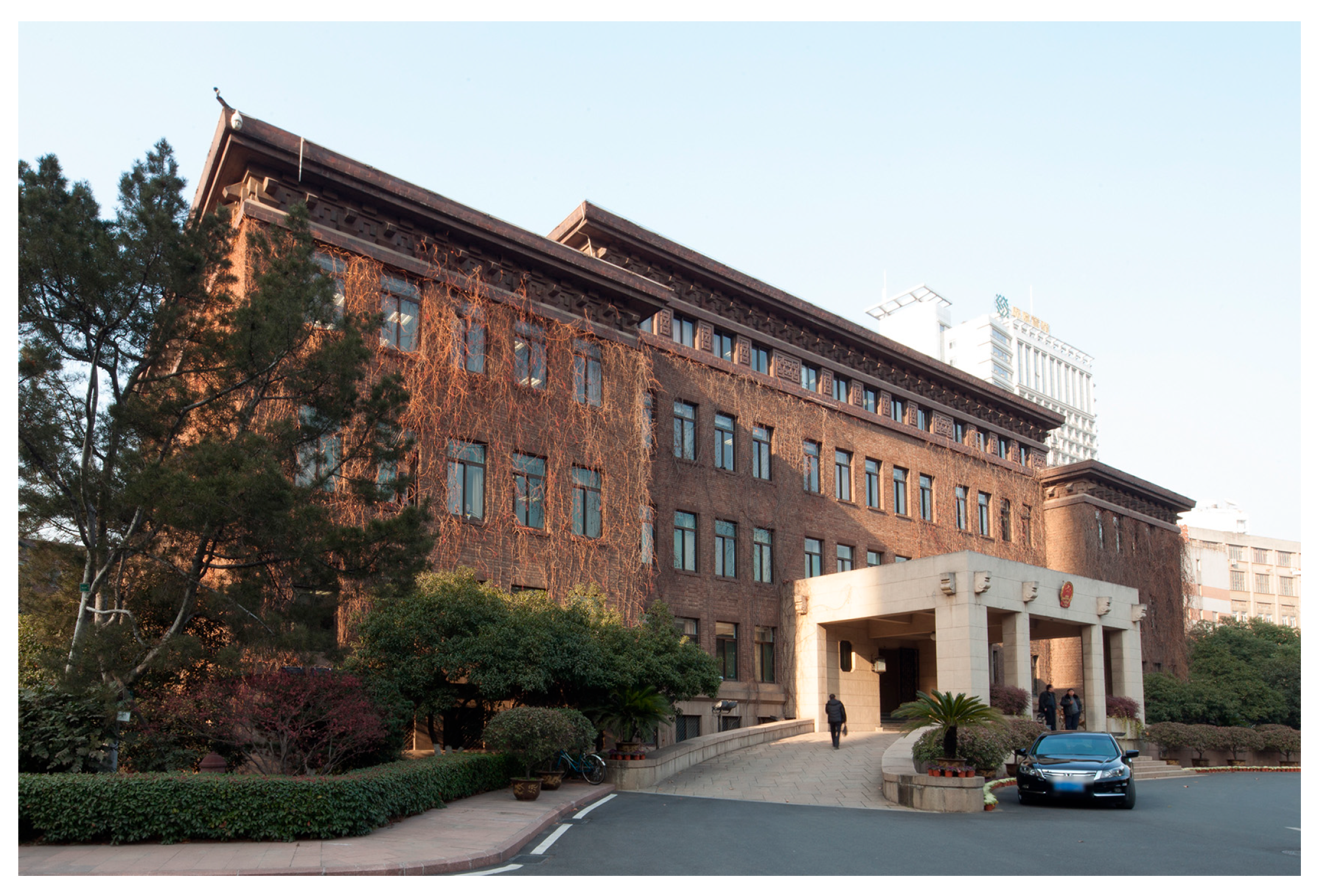
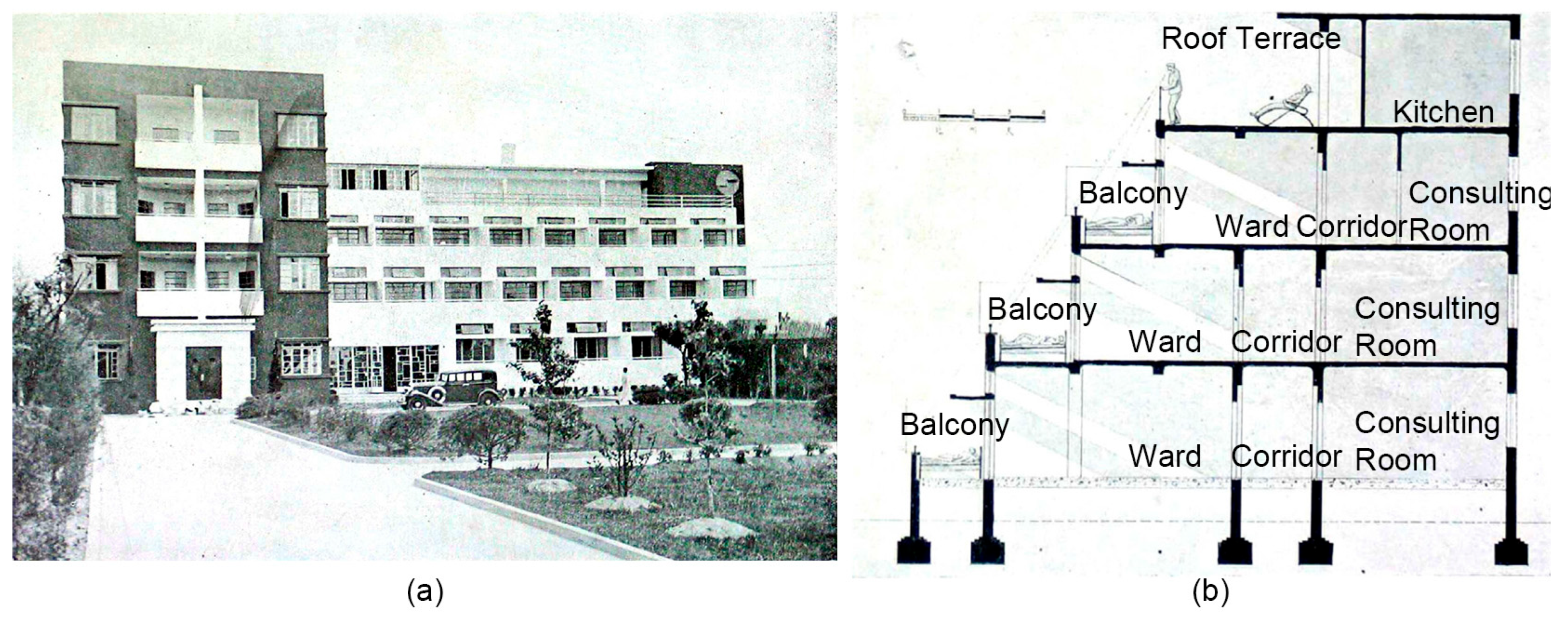
21]. The shortcomings of Chinese Revival architecture were evident: it was expensive, time-consuming, and the structural logic of the curved roof was inconsistent with the rest of the building. Most notably, the iconic “grand curved roof” was achieved at the cost of structural and spatial efficiency, resulting in wasteful use of both materials and space. Confronted with the conflict between national form and rational construction, a more practical and economical approach to architectural nationalism emerged. Chinese architects who received training in Europe and the United States were exposed to the International Style at that time. Some architects attempted to combine these modernist principles with traditional Chinese elements to form a national identity distinct from Chinese Revival architecture. They did not continue to imitate historical forms but explored the use of modern construction techniques and functionalist logic to interpret the national characteristics in architecture. This trend of exploration has prompted the emergence of New-national architecture. New-national architecture adopted flat roofs, and reinforced concrete structures were no longer subordinated to the demands of the curved roof. Traditional elements such as
dougong were simplified into abstract decorative components on the façade (
Figure 4). This approach represented a compromise between tradition and modernity. And by the late 1930s, it gained official recognition as a distinct category within “orthodox” architecture that bridged the national and the international.
In retrospect, the capital construction undertaken by the Nationalist government in Nanjing revealed an ongoing contradiction between modernity and national identity [
22]. On one hand, the government introduced rational and scientific production methods to create a modern urban space and guide the public toward a new way of life. On the other hand, despite employing modern materials and construction technologies, the formal expression of the capital’s architecture remained highly conservative. Consequently, the urban landscape of Nanjing between 1927 and 1937 did not present a singular image of either traditional revivalism or Western-inspired modernism; instead, it emerged as a hybrid landscape of diverse architectural languages.
5. Architectural Analysis
Before the twentieth century, financial institutions in traditional Chinese society, such as
piaohao (remittance shops) and
qianzhuang (native banks) facilitated private lending and mortgage transactions but did not develop into banks in the Western sense. Therefore, the concept of a bank remained foreign to Chinese society. After Western financial systems entered China in the early 1900s, banks began to spread from international financial hubs like New York and London into Shanghai’s Bund and Tianjin’s concession areas and eventually extended into inland cities [
32].
This new building type brought with it a new spatial paradigm. Lacking a domestic architectural precedent, Chinese banks fully adopted Western spatial models. After Nanjing became the capital of the Republic of China, an influx of domestic and foreign capital led to a boom in bank construction in the 1930s, particularly in the core of the city.
No matter what style their appearance followed, bank buildings tended to adopt reinforced concrete construction, which represented the most advanced building technology of the time. Bank owners were willing to invest in such structures to demonstrate both their financial strength and a forward-looking institutional identity.
5.1. Architectural Composition and Spatial Logic
The technical logic of the National Goods Bank building begins with its measurement system. Evidence from early drawings and on-site surveys reveals that the building adopted the imperial system for both construction and material selection. During the early twentieth century, as China integrated various construction standards from the West and Japan, these units often conflicted with the traditional Chinese measurement unit’s chi (1 chi = 33.33 cm). In this design, the lack of deliberate unit conversion underscores the direct transplantation of Western construction technology. The structure and layout of the building were constructed entirely according to the scales of British units.
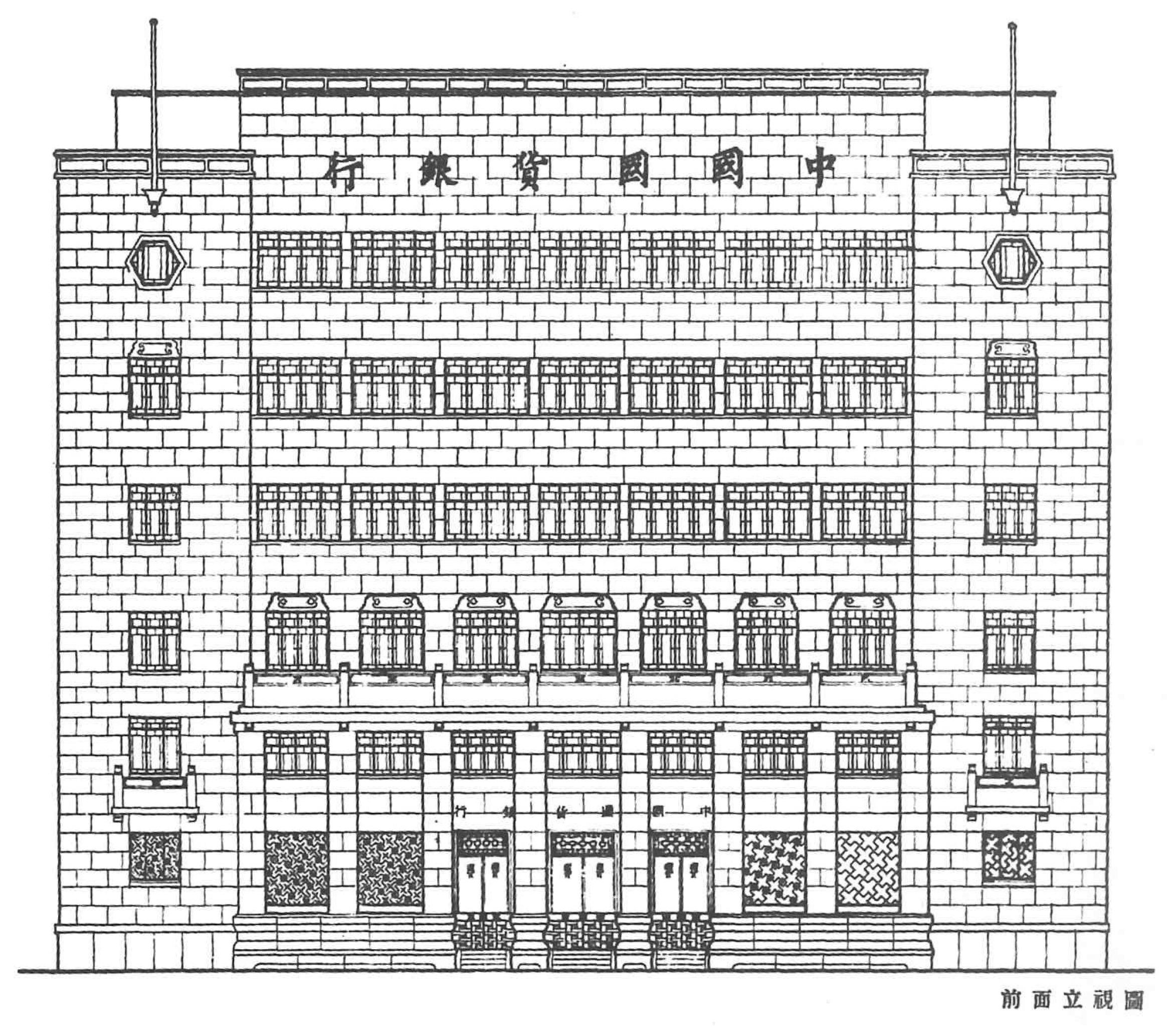
In terms of overall composition, the structural grid is organized into clear compartments, with five bays in width and four bays in depth (
Figure 8). This determines the rhythm of external openings and internal partitions. The main facade of the building, the east facade, is divided into three longitudinal parts by five bays. The visual main body is composed of a colonnade in the middle, forming the main entrance. The stairwells and offices on both sides correspond to the interior, slightly protruding from the middle part, and are balanced and symmetrical in composition (
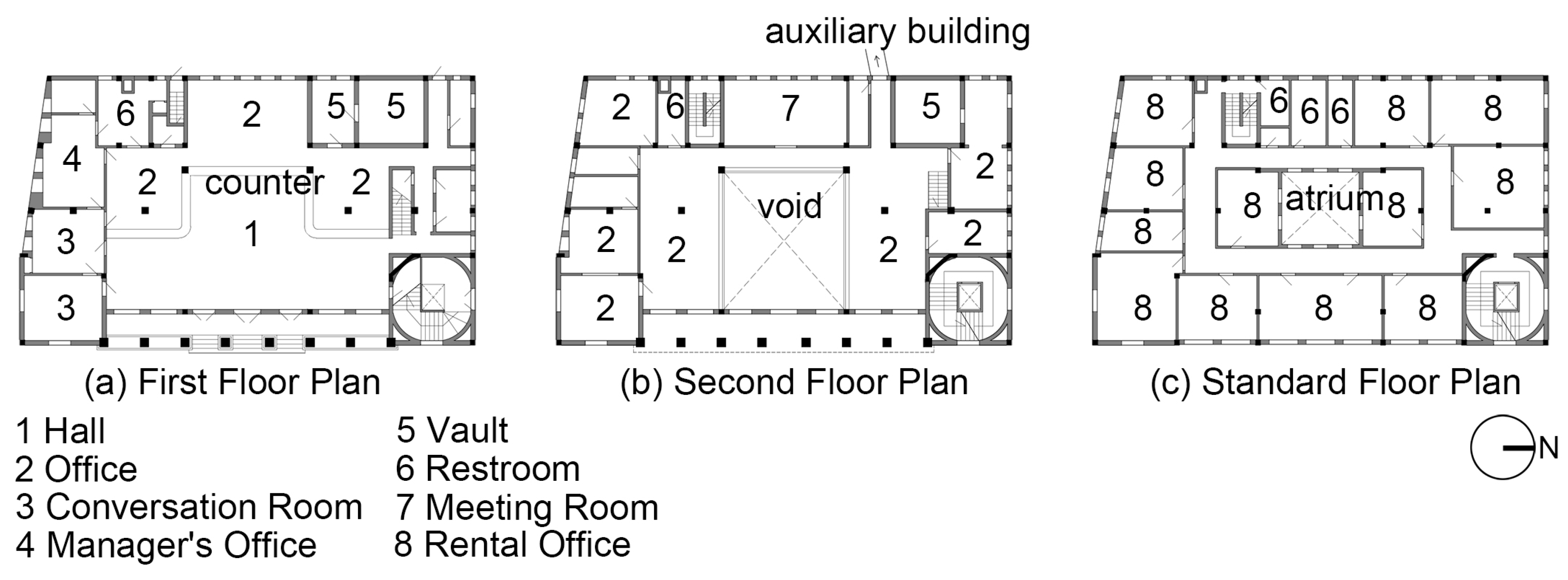
Figure 9). However, due to the trapezoidal shape of the site, the architectural plan is not symmetrical. The circulation patterns are designed around a central void, ensuring efficient movement and logical access to different functional zones (
Figure 10).
Moving from the structural framework to main services, the spatial design prioritized rationality. The first two floors were devoted to banking operations, featuring a double-height banking hall at the core. The architects placed the counters—the heart of the bank’s service—at the center of this hall to ensure direct circulation. Surrounding the hall are the manager’s offices and meeting rooms, while more enclosed services, such as the vault and restrooms, are relegated to the west side for security and privacy. There is a skylight composed of glass bricks above the counters, which further optimizes the space by introducing soft natural light into the deep interior.
Compared with traditional Chinese architecture, the building offered markedly improved lighting and ventilation. By contrast, in traditional Chinese architecture, windows were often made of small wooden frames due to the limited strength of materials and the prevailing emphasis on privacy, which made interiors very dark. Benefiting from the high-strength reinforced concrete structure and the use of steel-framed windows, the National Goods Bank building incorporates large window openings, allowing natural light to reach every corner of the interior.
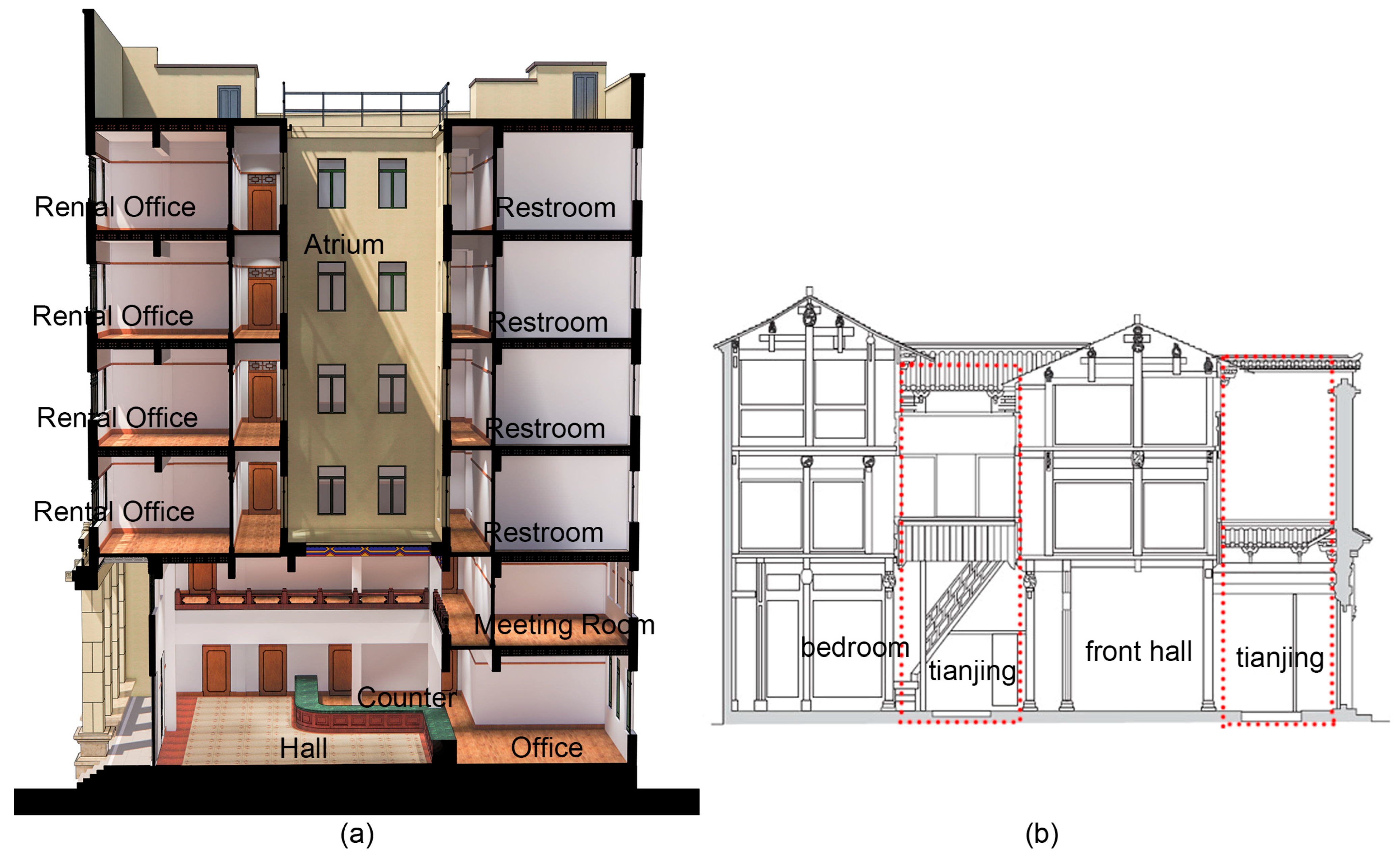
Another aspect of the building’s design is the use of a central atrium, which shares functional similarities with the traditional Chinese
tianjing (sky-well). In traditional Chinese residences, the
tianjing is a fundamental element that reflects the ancient cosmological concept of “heaven as round, earth as square” and serves to define spatial hierarchy and privacy. Beyond these symbolic and social roles, it is primarily used to regulate ventilation and natural lighting within enclosed layouts [
33,
34,
35].
To address the lighting demands of the National Goods Bank building’s bottom two floors, the architects hollowed out the central portion of the third to sixth floors, channeling light into the banking hall below (
Figure 11). While there is no direct evidence to confirm a deliberate historical link between these features and traditional prototypes, the spatial treatment demonstrates a similar functional logic in utilizing a central vertical opening to resolve environmental and lighting needs.
The same logic also applied to the upper floors of the building. At the beginning of the 20th century, Chinese architecture was influenced by modern construction technology and adopted reinforced concrete and steel systems, overcoming the structural limitations of traditional Chinese wooden structures. This technological transformation has significantly expanded the vertical height and horizontal span of buildings, as they are no longer limited by the natural size and load-bearing capacity of wooden components. However, this often led to a shortage of natural lighting in central areas. The central atrium was utilized to organize the rental offices on the third to sixth floors around it, skillfully resolving the ventilation and natural lighting issues for the rooms located in the center of the floor plate.
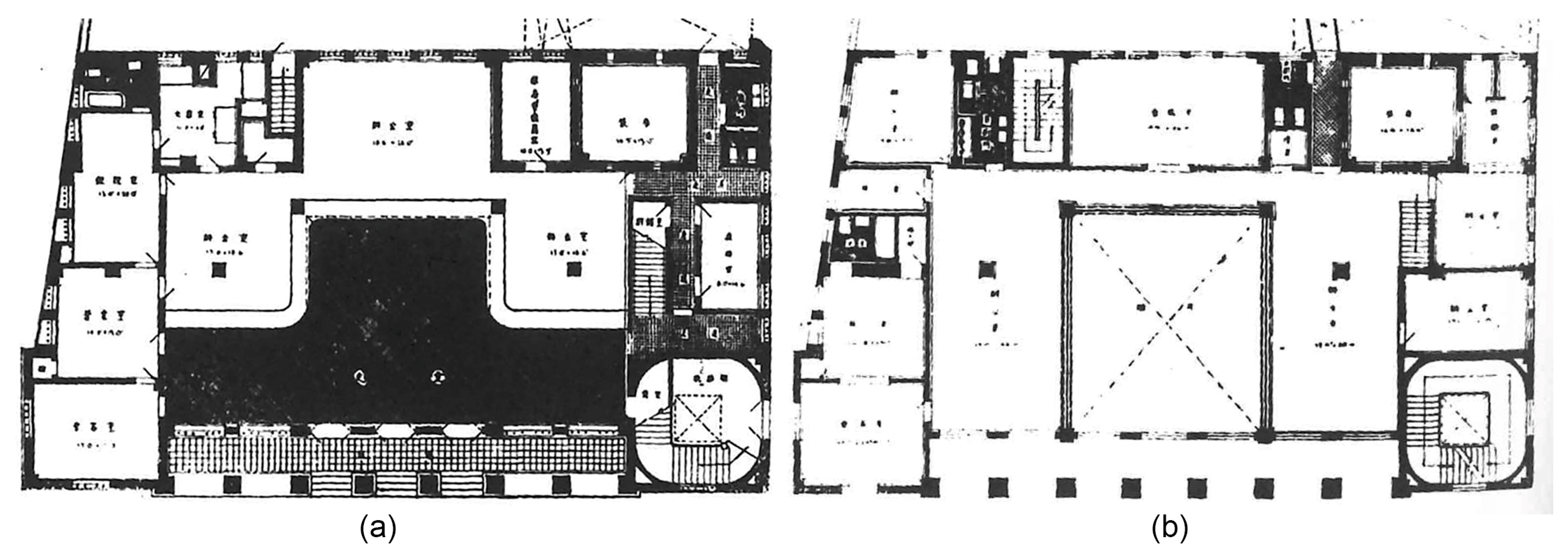
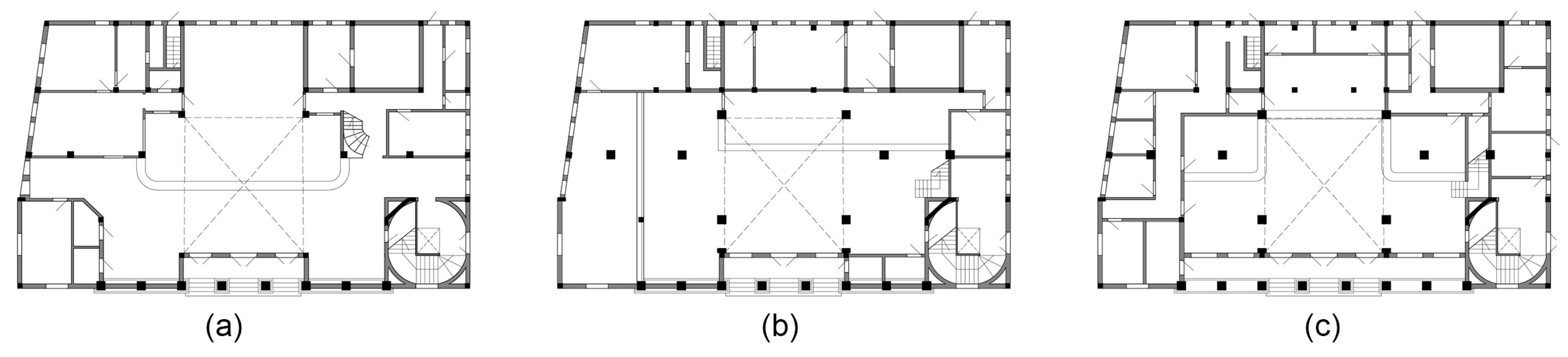
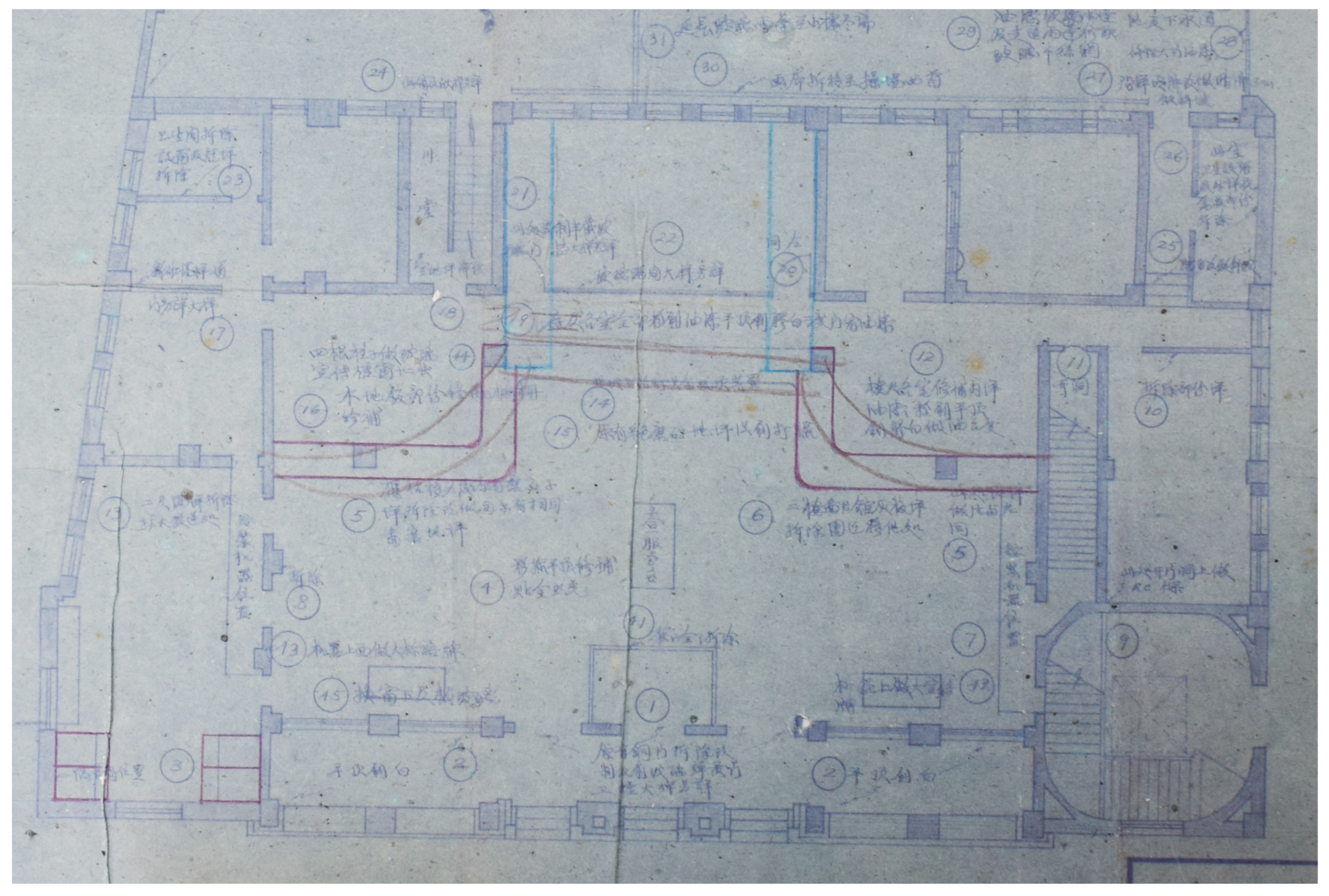
In terms of temporal adaptability, the floor plan of the National Goods Bank building also demonstrates a high degree of flexibility. Restoration records from the archives of the Postal Savings Bank of China (Nanjing Branch) indicate that the interior has undergone at least three systematic reorganizations: a major renovation in 1947, a structural reinforcement and decoration project in 1999, and the most recent restoration between 2021 and 2024. A comparative analysis of the floor plans from these three periods reveals how the internal partitions and functional spaces were altered while the structural frame remained intact (
Figure 12).
During the Japanese occupation of Nanjing from 1938 to 1945, the building was requisitioned for use by the military police. Due to a lack of archival records, it is unclear how the interior was altered during this period, but the structural frame itself remained intact. The first postwar intervention occurred in 1946, when the bank modified the banking hall: the shape of counters and the location of the staircase were changed, and interior rooms were reorganized (
Figure 13). The second intervention took place in 1999, when the building’s new owner, the Postal Savings Bank of China, reconstructed the floor layouts on all levels following a thorough structural reinforcement. Although sealing the hall’s skylight raised debates over heritage authenticity, the renovation’s responsiveness to new banking functional requirements highlighted the technical adaptability of the framed structure. The third intervention was carried out between 2021 and 2024, during which the hall’s counters and skylight were restored to their 1936 configuration, the added exterior porch was removed, and interior rooms were again adjusted to accommodate new functional needs. This latest restoration not only maintained the building’s usability but also reconstructed its cultural memory. Over the span of ninety years, the National Goods Bank building has repeatedly adapted to the demands of different eras. This continuous process demonstrates the spatial flexibility provided by its reinforced concrete frame structure, which allowed the building to respond dynamically to changing functional needs over time.
In summary, the spatial logic of the National Goods Bank building represents a sophisticated model of localized modernism, where Western technical systems were not merely transplanted but strategically adapted to the Chinese context. While the reinforced concrete frame provided the necessary structural flexibility for the building’s ninety-year cycle of functional evolution, its internal organization reveals a deeper dialogue with indigenous spatial wisdom. The building’s atrium exhibits a functional resonance with the traditional Chinese tianjing. Although the introduction of the atrium may not have been a deliberate imitation of historical forms, this spatial strategy—utilizing a vertical opening to resolve lighting and ventilation issues—demonstrates a localized approach to modern architecture. The localization of the National Goods Bank is not confined to stylistic motifs but is deeply rooted in a pragmatic spatial strategy.
5.2. Transplantation and Adaptation of Traditional Chinese Decorations
5.2.1. Facade: Traditional Chinese Decorations Created with Cement Mortar and Concrete
As previously mentioned, the National Goods Bank building in Nanjing adopted modernist principles in its design concept and spatial organization. However, its decorative scheme confronted the challenge of integrating traditional motifs into a structural system of reinforced concrete and cement techniques.
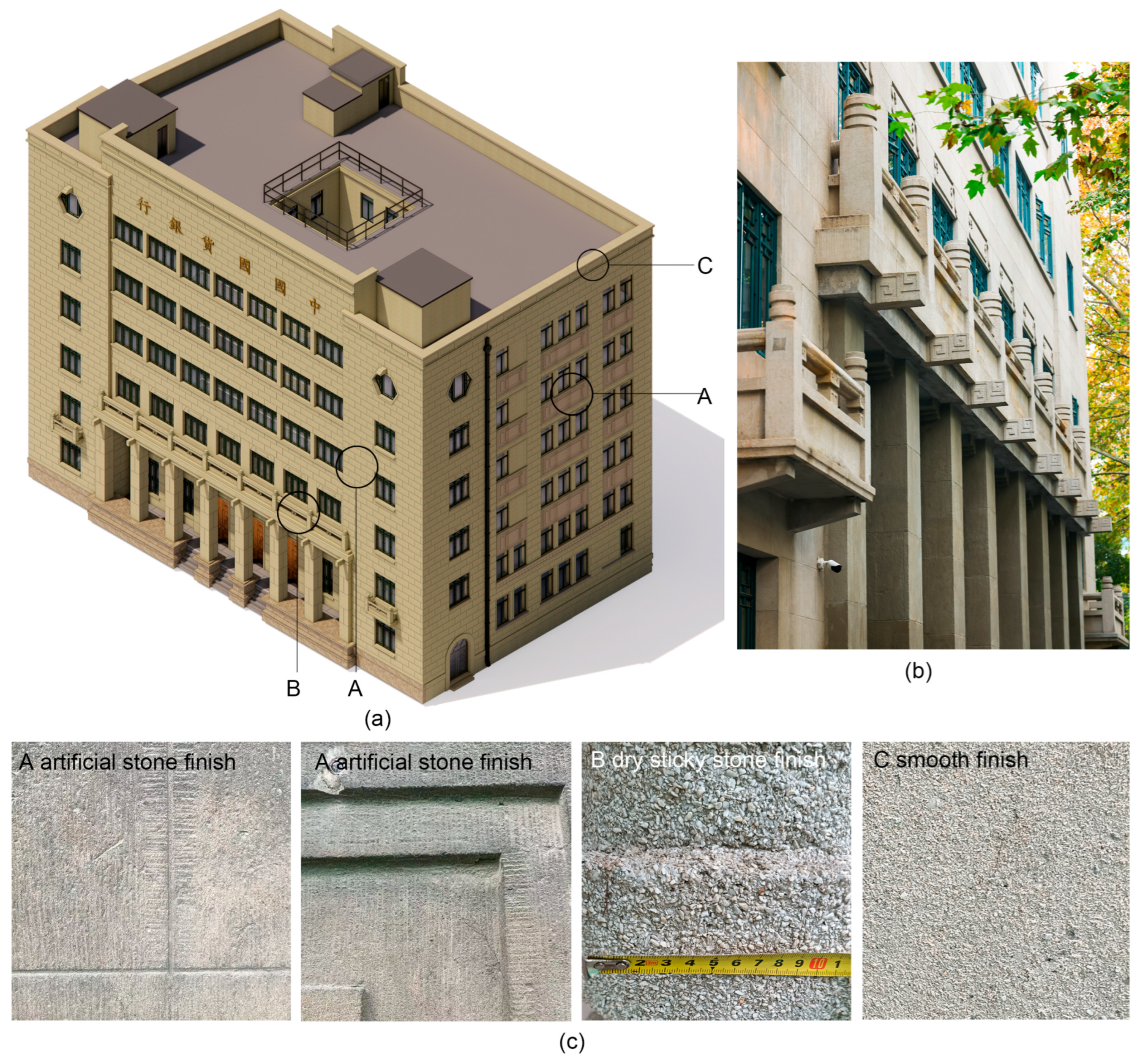
The first challenge lay in the modern reinterpretation of traditional forms. The decorative emphasis and visual focus were concentrated at the entrance, where seven two-story square concrete columns formed a colonnade and the recessed doorway created a porch-like space reminiscent of classical architecture (
Figure 14b). At the base, plinths of granite from Suzhou were carved to resemble the lotus pedestal of traditional architecture. At the tops of the columns, components with carved patterns were shaped using concrete and cement mortar. They were derived from traditional timber architecture, particularly the
shuatou (nose) and
queti (sparrow brace) elements beneath the eaves and reinterpreted here as abstract cultural symbols. Above the colonnade and beneath the second-story windows on both sides, concrete balconies projected outward, their railings decorated with simplified patterns derived from traditional Chinese motifs (
Table 3).
This process of abstraction preserved the symmetry of the façade, imparting a classical character, while details remained infused with Chinese decorative traditions.
In other parts of the building, the architect also incorporated simplified traditional motifs. Above the window lintels and beneath the second-story sills on the north and south façades, stylized
ruyi-head motifs were employed. It is an ornament that can be traced back to the Song and Liao dynasties (10–13 century) and later became common in the Qing dynasty (17–20 century), symbolizing good fortune and peace. Along the parapet, a continuous rectangular motif featuring plum-blossom corners encircled all façades, while at the top of the cast-iron downpipes, round iron plates bore the Chinese character
shou (longevity). In addition, at the top of the main façade, the two flagpole bases were shaped entirely in
yun (cloud) motifs. Together, these details drew on widely used auspicious symbols from traditional architecture [
36].
The second challenge involved the innovation of materials. In traditional Chinese palatial architecture, exterior walls were finished with sticky-rice lime mortar (a mixture of sticky rice soup and slaked lime), which was spread evenly over the wall surface and then painted [
37].
Decorative elements were realized through carvings in wood, stone, or brick. By contrast, the National Goods Bank building employed cement as the facing material for its exterior walls, making use of cement’s inherent plasticity and adhesiveness to form decorative patterns directly (
Figure 14). The building’s façades employed three cement techniques, producing a variety of surface textures.
- (1).
Artificial stone finish: A layer of cement mortar was scored with vertical chisel marks to imitate the texture of natural stone. This treatment was applied to the main façade as well as the south and north façades, which conveyed a sense of solidity and financial strength.
- (2).
Dry sticky stone finish: Small stones were embedded into the cement layer to create a delicate texture on curved elements. This method was used on balcony railings and flagpole bases.
- (3).
Smooth finish: The most common technique, which is characterized by its flat surface, applied on the west façade, parapets, and large flat decorative surfaces.
The exterior decorative system of the building employs cement mortar and concrete to transform traditional Chinese architectural forms and ornamentation into symbolic elements, fundamentally differing from the form-driven approach of Chinese Revival architecture.
5.2.2. Interior: Skylight and Caihua Pattern
In traditional Chinese architecture, ceilings were a focal point for interior painted decoration. Especially during the Ming and Qing dynasties, important buildings such as imperial palaces and temples featured highly elaborate and exquisite-colored patterns. After the 1920s, significant buildings in Nanjing, such as the Sun Yat-sen Mausoleum, also emulated this Qing-style practice by applying painted ceilings in key interior spaces like entrance halls.
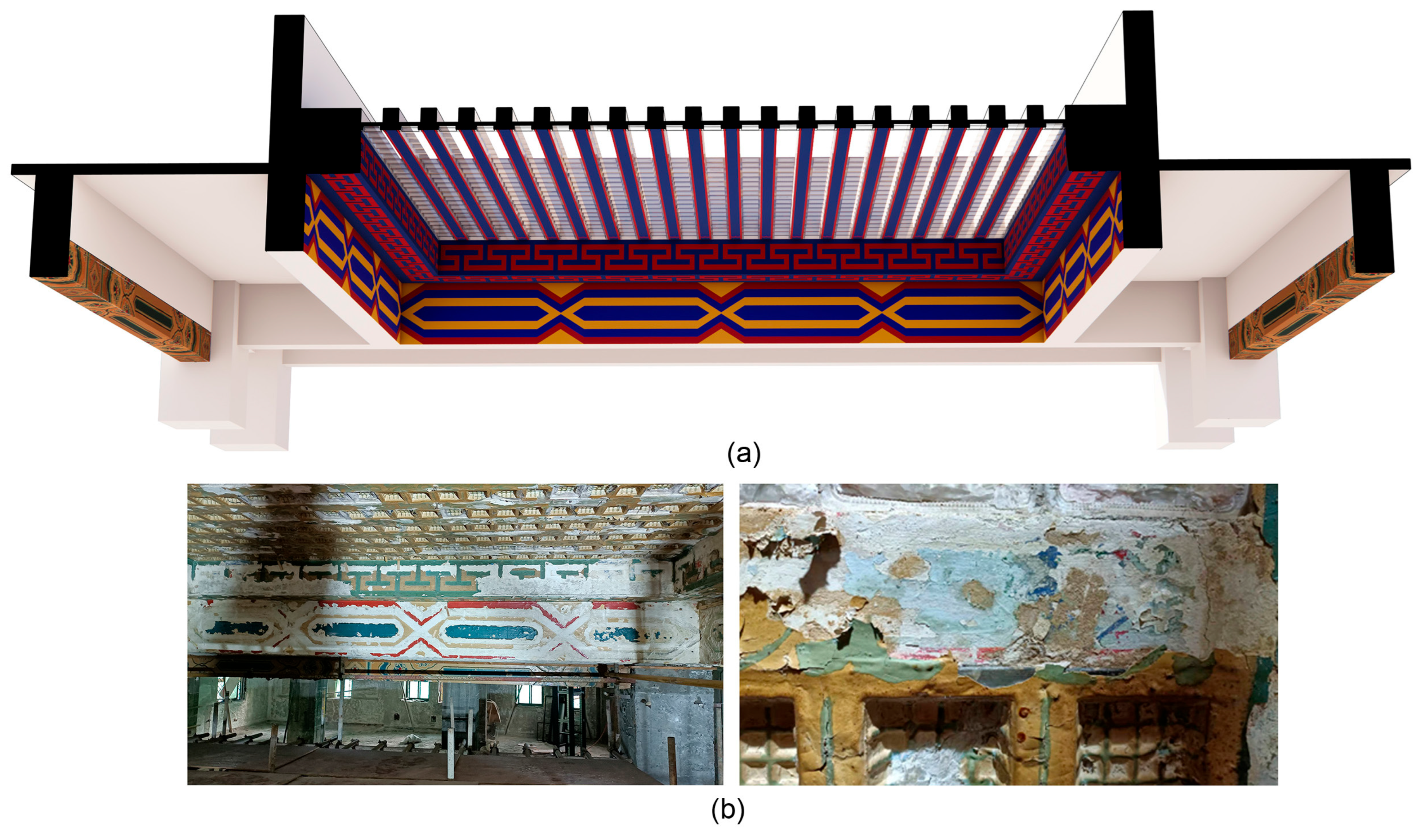
During the restoration work from 2021 to 2024, painted decoration on the ceiling of the hall was uncovered. The hall was originally roofed with a skylight: reinforced-concrete beams, cast in an inverted L-shape, framed the perimeter, while concrete rib beams were laid across them, with glass bricks inserted between the ribs to admit daylight. Examination revealed raised T-shaped motifs on the upper ends of the inverted L-beams. In traditional symbolism, these motifs conveyed the idea of “continuous prosperity without end.” Both the T-shaped patterns and the rib surfaces feature two decorative layers: an earlier layer (red and blue, presumably from 1936) and a subsequent one (yellow and green, presumably added during the 1999 skylight enclosure renovation). On the underside of the rib beams, zigzag patterns were found, resembling a simplified intermediate portion of the painted beam (
zao tou) in the dragon’s pattern (
hexi caihua) (
Figure 15).
In terms of technology, traditional Chinese colored patterns used a special plaster (clay, lime, siccative oil, and fabrics strips) to cover the wooden components and then applied mineral pigments and gold foil to depict patterns. The process was very complex [
38]. Beyond its decorative function, the painted patterns also served to protect the underlying timber from decay. In reinforced concrete buildings, however, such protective function is unnecessary. Consequently, the building no longer followed traditional methods and instead employed oil paint to create colored patterns.
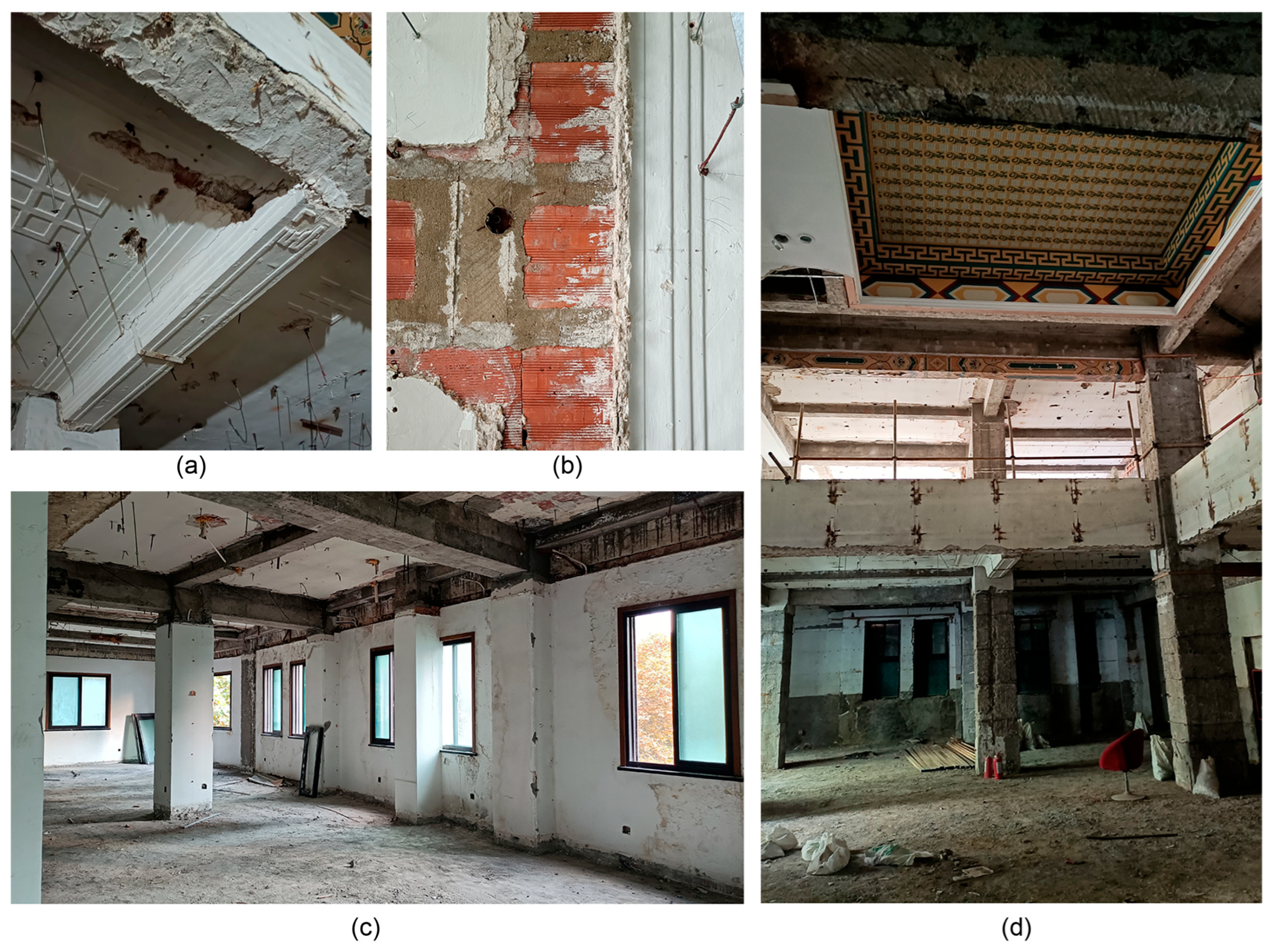
The interior walls and ceilings of the building were leveled with hemp cuts and lime plaster (a lime putty mixed with hemp fibers). On the sides and undersides of the beam, raised patterns were formed using the hemp cuts and lime plaster. Colored patterns on the skylight were directly executed in oil paint on top of this layer, while ordinary rooms were finished with a white lime wash coat (
Figure 16).
The decorative expression of the National Goods Bank Building demonstrates that the architect regarded the features of traditional timber architecture as cultural symbols. Unlike Chinese Revival architecture, it was not bound to formal elements such as curved roofs or dougong.
In conclusion, the decorative system serves as the most explicit expression of the building’s localization. In contrast to Chinese Revival architecture, which sought formal historicism, the core of this localization strategy lies in two aspects: first, the semiotic abstraction of traditional elements (such as queti and ruyi-head motifs) from their original timber structures, which preserves the building’s modern rational logic; second, the pragmatic use of modern materials (such as cement mortar and oil paint) to reinterpret traditional intentions. This shift from structural imitation to symbolic abstraction proves that New-national architecture was a conscious evolution, utilizing modern construction technologies to carry cultural narratives.
5.3. Application of the Reinforced Concrete Frame Structure
In the early 20th century, concrete architecture was introduced to Nanjing by Westerners, primarily in industrial factories along the Yangtze River, but it did not become mainstream. It was not until 1927, amid the wave of constructing the political landscape of the new capital under the Nationalist Government, that reinforced concrete structures emerged as the preferred choice for large-scale buildings in Nanjing. At this moment, Chinese architects returning from overseas began to take the lead in the design of the capital, bringing with them Western building techniques and concepts. They embraced reinforced concrete structure almost without hesitation, partly because its structural logic resonated with that of traditional Chinese architecture: both relied on a supporting framework with walls added afterward [
39]. Due to cost constraints, many concrete buildings in Nanjing adopted mixed structures (reinforced concrete frame with brick masonry) or single-direction frames to economize on materials. Pure frame structures were reserved for major projects, among which the National Goods Bank building was a notable example.
5.3.1. Foundation
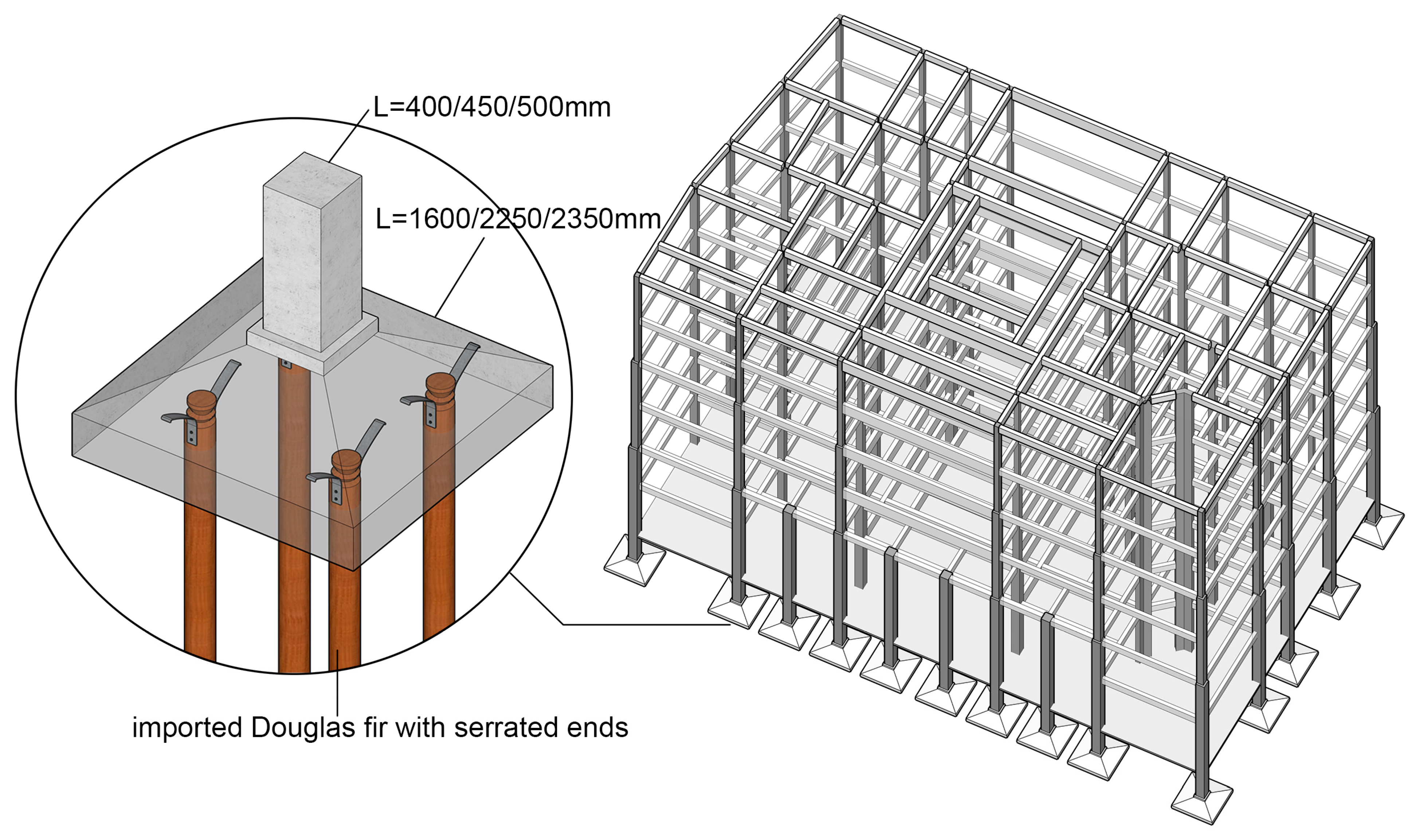
The foundation of the National Goods Bank building was constructed with pile foundation. Following structural reinforcement in 1998, all framework components were strengthened by enlarging their cross-sections. Through on-site excavation and historical record analysis, the original foundation conditions at the building’s hall were determined. The reinforced concrete pile cap of the hall has dimensions of 1600 × 1600 mm, 2250 × 2250 mm and 2350 × 2350 mm, with a buried depth of 2.35 m. The corresponding column dimensions above were 400 × 400 mm, 450 × 450 mm and 550 × 550 mm. Below pile caps, timber piles made of imported Douglas fir from North America were driven into the soil to enhance stability. In a comparable project by the same contractor in the same year, the Shanghai Stadium, wooden pile tops were serrated and embedded into concrete [
40], and it was highly probable this building would use the same technique (
Figure 17).
5.3.2. The Frame Structure
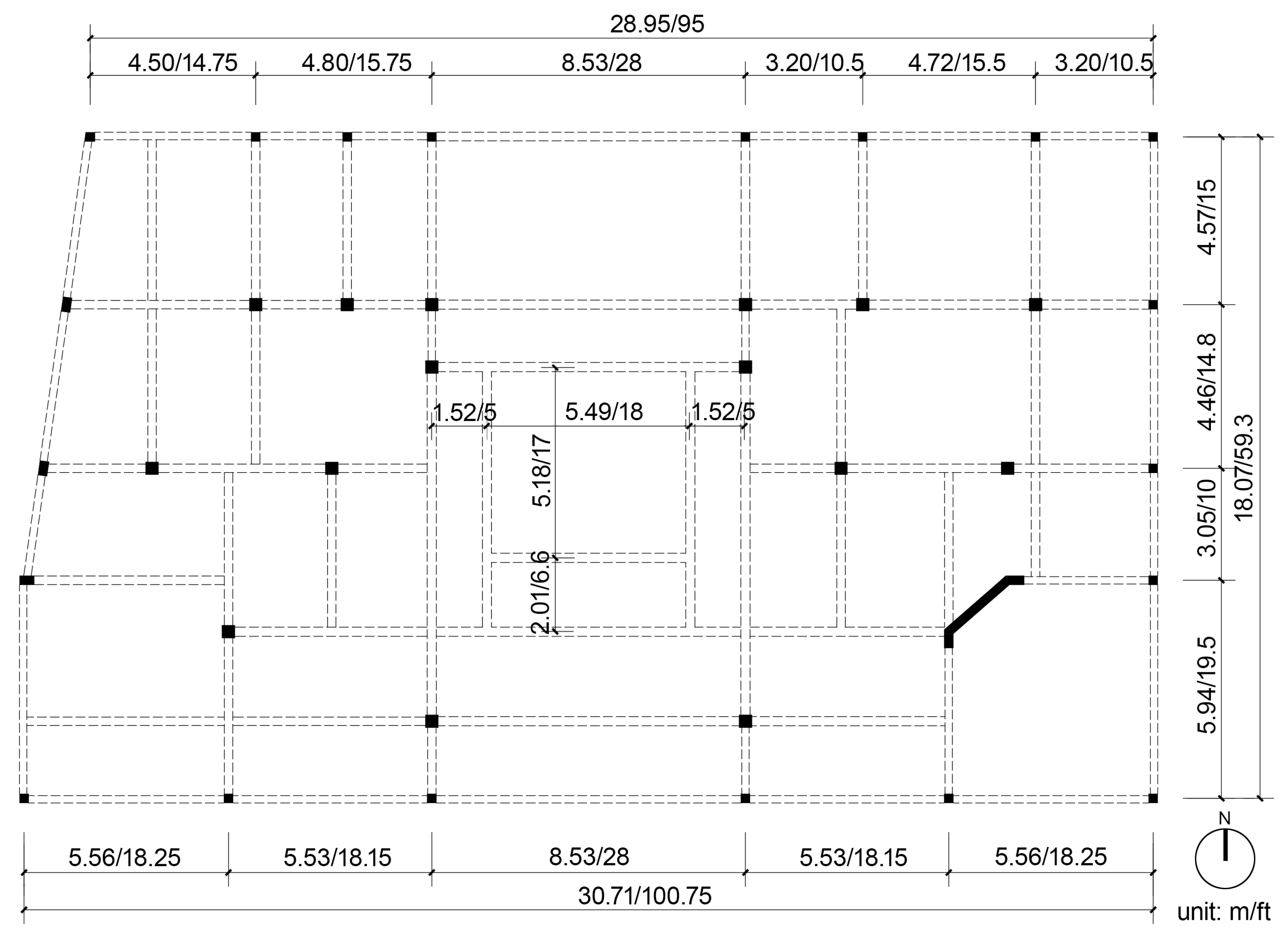
The upper structure of the building adopted a pure frame structure system. The building had a floor plan of 30.7 × 18.07 m (100.75 × 59.3 ft), consisting of four longitudinal spans and several transverse spans. The spacing of the spans was irregular: the minimum span was 1.7 m (5.6 ft), while the largest span, located at the center of the main hall, reached 8.7 m (28.5 ft). The remaining spans ranged between 2.7 and 4.6 m (8.8–15 ft) (
Figure 18). The story heights also varied: the first floor measured 4.2 m (13.8 ft), the second floor was only 2.8 m (9.2 ft), and the upper four floors were each 3.6 m (11.8 ft).
The concrete columns of the building adopted a variable cross-section design, with the column dimensions gradually decreasing along their height. Taking the center column and the north edge column in the hall as examples, their original dimensions are listed in
Table 4. In the early introduction of reinforced concrete in civil architecture, the size of components was often constrained by the need to conserve materials [
41]. As a result, the dimensions of the edge columns were smaller than those of the central columns on the same floor. Since seismic performance was seldom considered in Chinese reinforced concrete buildings before 1950, frequent changes in column sections would lead to large changes in stiffness. The concrete beam heights were essentially consistent at the same locations on each floor: 0.75–0.8 m for the maximum 8.7 m span, and 0.4–0.55 m for spans under 5 m. This is generally aligned with the design principles of a framed structure.
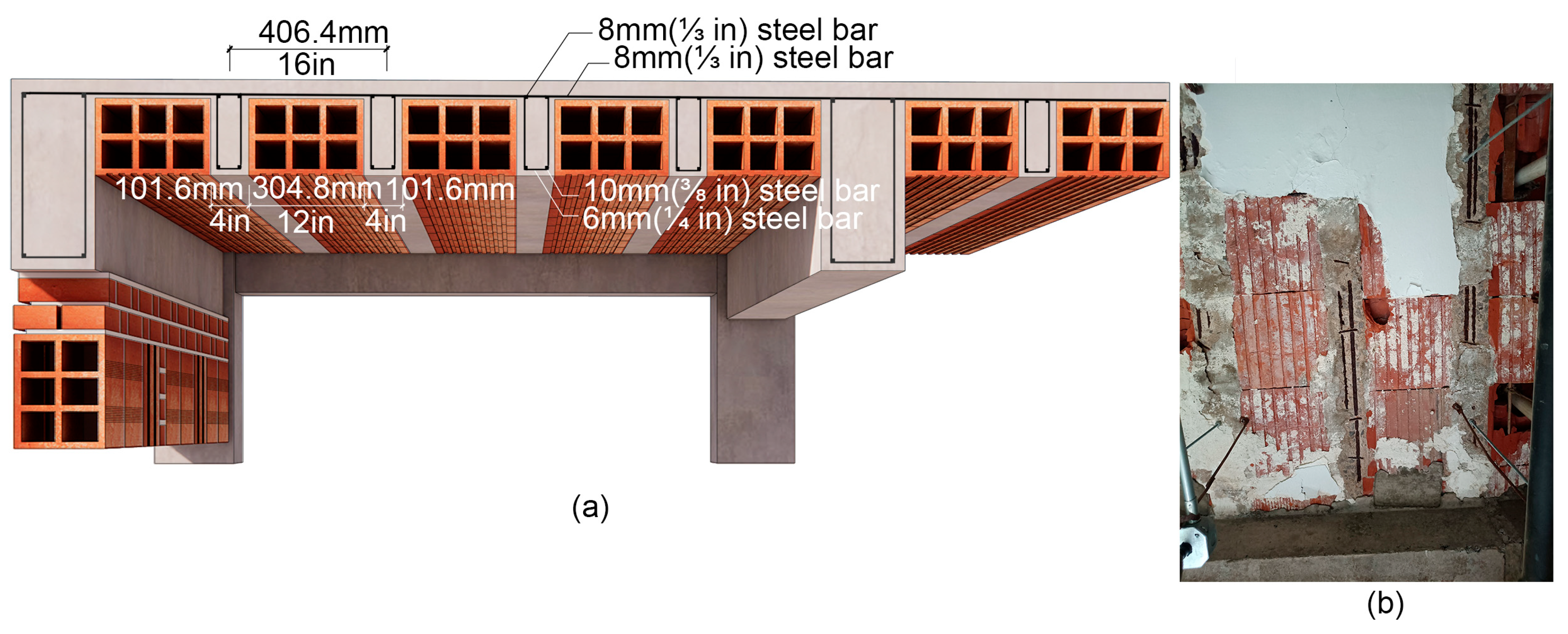
The most distinctive feature of the building is its hollow brick-reinforced concrete composite slab, which is formed by placing hollow bricks (12 × 12 × 8 in/30.48 × 30.48 × 20.32 mm) between reinforced concrete ribs. During the tying of the rib reinforcement, the hollow bricks were pre-positioned on the formwork, serving as the formwork between the ribs. When the concrete was poured, the sides and top surfaces of the hollow bricks were encased, with an additional 2-inch (approximately 50 mm) thick reinforced concrete layer cast over the top. This approach not only reduced cement consumption and floor weight, but also improved sound insulation, thermal performance, and fire resistance (
Figure 19).
Such a composite floor slab was introduced into China together with reinforced concrete technology in the mid-to-late 1920s. In practice, architects could choose whether to include main beams and whether to arrange the cross ribs. The National Goods Bank building retained the use of main beams and adopted single-direction ribs. On the roof, three layers of asphalt and two layers of oil felt were laid above the composite slab, meeting both waterproofing and thermal insulation requirements. In the absence of large-scale concrete pouring equipment at the time, this represented a practical construction method that could balance functional requirements and performance.
The structural system of the National Goods Bank building exemplifies how a globalized technical framework can be reconciled with regional practical demands through targeted localization. While modern construction technology was almost universally adopted in 1930s Nanjing, this case underscores a distinct adaptive strategy: the prioritization of material efficiency to meet stringent local economic requirements. By refining the design of columns and floor slabs to achieve optimal performance with minimal consumption, the architect ensured that the Western reinforced concrete frame remained viable within the Chinese context. Furthermore, the alignment between the frame’s “skeleton-and-skin” logic and traditional timber structures facilitated its rapid integration. Ultimately, this illustrates that localization in the structural dimension is not a departure from modernism, but a pragmatic optimization that aligns advanced technology with the specific material and economic realities of the period.
5.4. Materials and Property: Steel, Cement and Machine-Made Bricks
Another important factor behind the widespread reinforced concrete frame structures in Nanjing during the 1930s was the development of the building materials industry. The principal materials—steel, cement, and machine-made bricks—were closely tied to Western technology.
In the process of material introduction, China’s steel industry was highly underdeveloped in the early 20th century, so the steel in construction had to be imported from European countries such as Germany, the United Kingdom, and Belgium [
42]. All the steel used in the National Goods Bank building was imported.
Historical records indicate that the longitudinal bars in the concrete columns consisted of two sizes of corrugated square bars: 0.65 in (16.51 mm) and 0.7 in (17.78 mm), while the concrete beams incorporated four sizes: 0.65 in (16.51 mm), 0.7 in (17.78 mm), 0.8 in (20.32 mm), and 0.85 in (21.59 mm). According to tests conducted in 1999, the 0.65 in bars had an average yield strength of 250–260 MPa, an average tensile strength of 330 MPa, and an elongation of 29–31%. These properties were comparable to the steel bars of the same period, all of which were low-carbon hot-rolled bars.
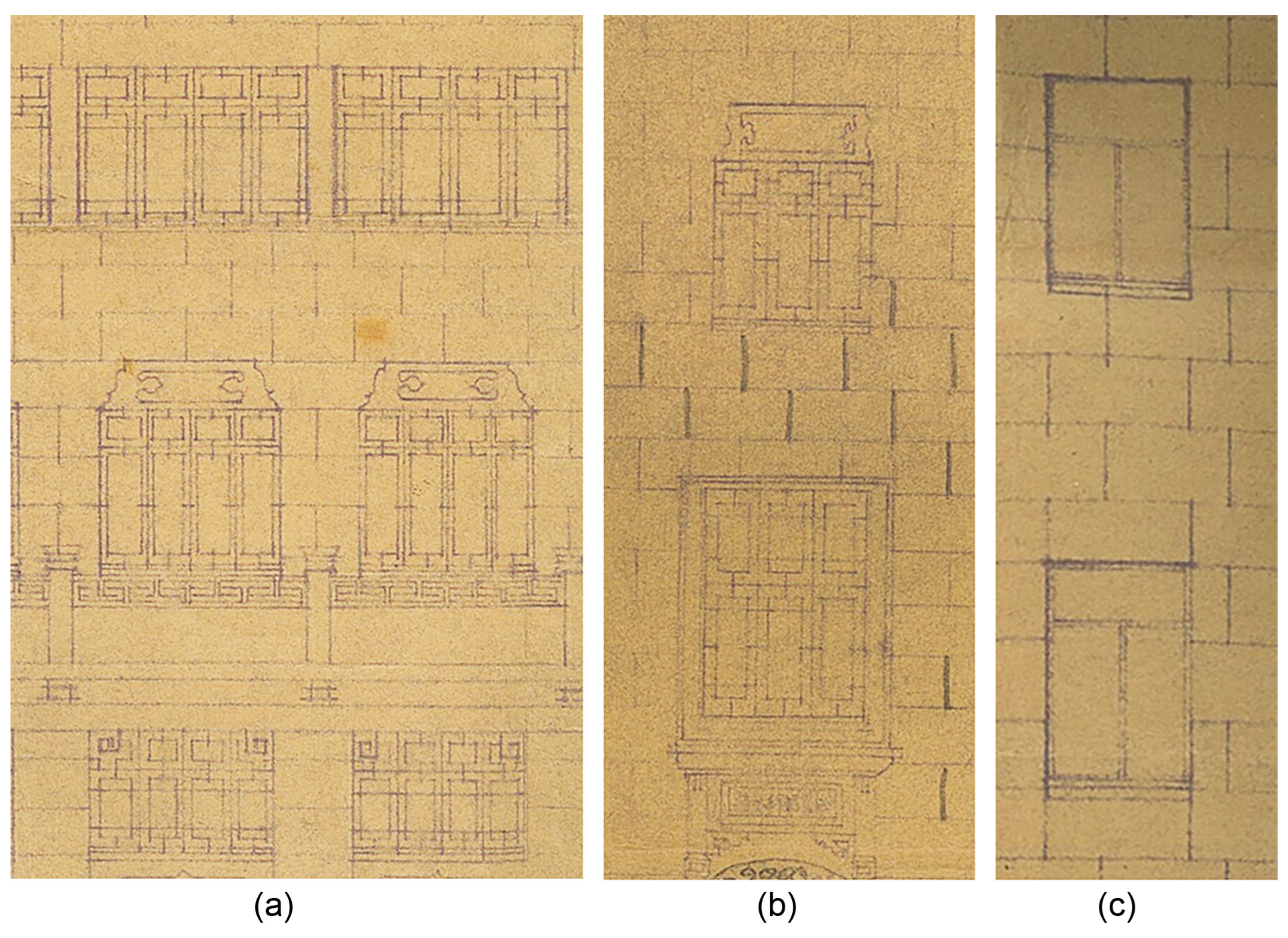
Another area where steel was used in the building was the windows. Although the original windows were replaced during subsequent renovations and are no longer extant, their design patterns are documented in the 1947 archival drawings (
Figure 20). Steel-framed windows appeared relatively late in Nanjing and were more technically complex than traditional wooden windows, relying heavily on imports [
43]. These windows had larger openings with fewer subdivisions, improving interior lighting and ventilation. On the street-facing eastern façade, the windows were divided in a decorative pattern inspired by traditional Chinese latticework. On the other façades, standard casement windows were used, giving the building a novel external appearance.
Unlike steel, which relied entirely on imported products, the main component of concrete, cement, had been introduced to Nanjing with production technology after the 1920s. In 1921, the China Cement Plant was established in Longtan Town, a suburb of Nanjing, equipped with German machinery for cement production. By 1929, it had become the second-largest cement plant in China, and its products fully met the standards of the Shanghai Municipal Engineering Bureau. This made cement a relatively accessible material after 1930. According to the 1933 building regulations published by the Nanjing Public Works Bureau, the standard concrete was to be mixed in a 1:2:4 ratio (cement: sand: aggregate), with a compressive strength requirement of 13.73–13.79 MPa [
44]. Test results from 1999 indicated that the concrete beams and columns of the building had a compressive strength between 15.2 and 15.9 MPa, meeting the government’s requirements of the time. In addition to its use in concrete, cement mortar was also applied as a finishing layer on the building’s exterior façades.
Machine-made bricks were another important material introduced through Western technology. Beginning in the 1920s, Nanjing’s brick and tile industry gradually shifted from handicraft to industrialized production, driven in parallel by the huge market demand during the capital construction period. Especially after 1927, numerous machine-brick factories emerged, introducing continuous brick kiln technology from Germany, the United Kingdom, and other countries [
45]. These factories directly replicated mature foreign production methods. Compared with handmade gray bricks produced in traditional Chinese kilns, machine-made bricks offered more consistent quality, higher efficiency, and a greater variety of types.
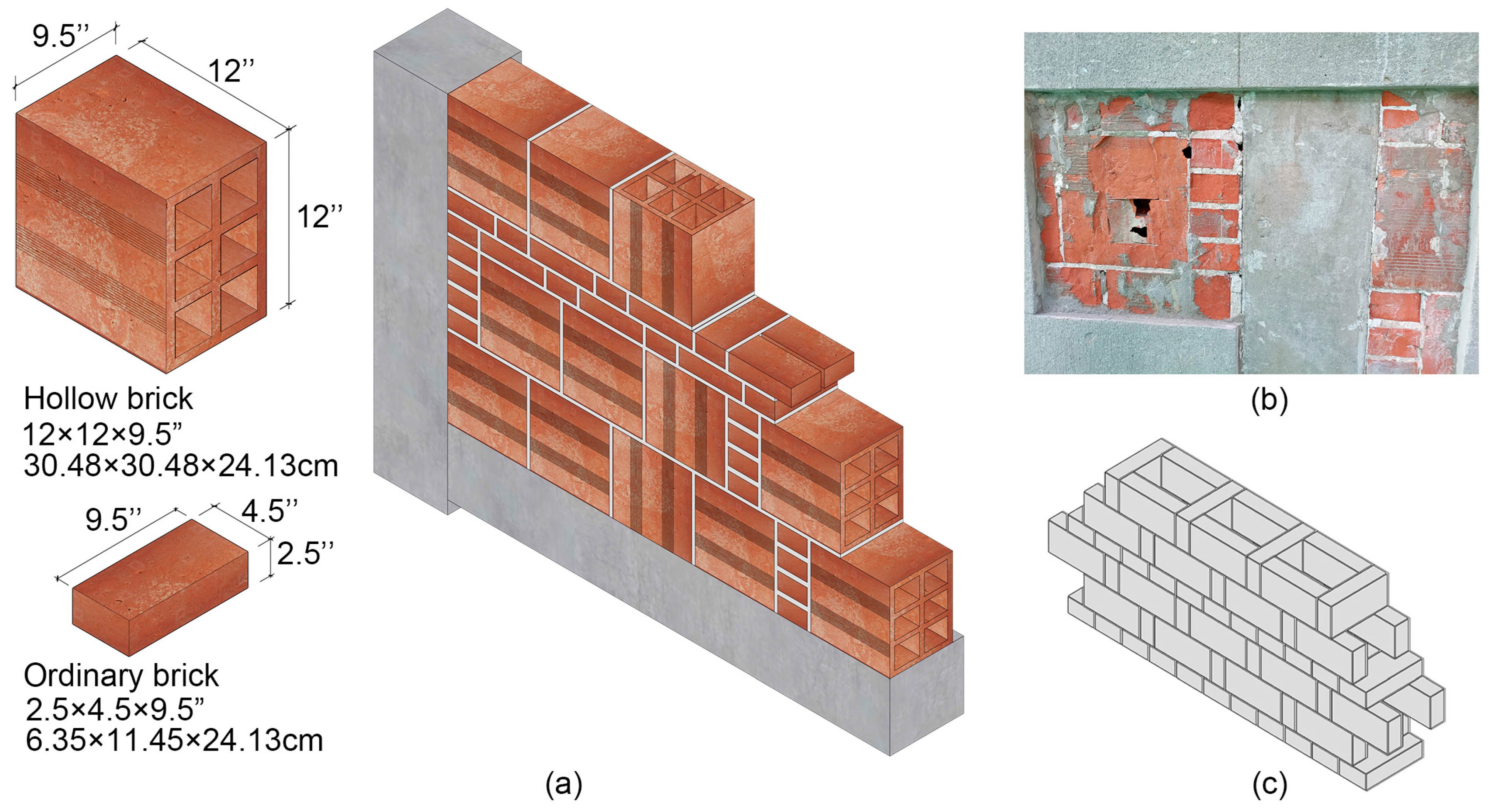
The walls of the National Goods Bank building utilized mechanized bricks, including hollow bricks measuring 12 × 12 × 9.5 inches (30.48 × 30.48 × 24.13 mm) and regular bricks measuring 9.5 × 4.5 × 2.5 inches (24.13 × 11.43 × 6.35 cm). These two types of bricks were mixed in construction. In large wall sections, every two layers of hollow bricks were interspersed with two layers of regular bricks laid in an English bond (
Figure 21). This combination not only reduced structural weight but also provided excellent insulation and fireproofing properties. This method was somewhat like the traditional Chinese hollow wall (
kongdou qiang) construction technique. Traditionally, a
kongdou qiang wall is a lightweight wall system where bricks are laid on edge to form internal cavities, typically used in low-rise buildings. This arrangement saves material, reduces structural weight, and improves thermal performance. Unlike the National Goods Bank building, traditional
kongdou qiang walls created cavities through masonry methods, whereas this building utilized industrialized machine-made hollow bricks to form the voids. Although the logic and starting points of the two construction systems differed, they ultimately achieved similar functional results.
Due to insufficient time for technological iteration, the production of domestic building materials in China remained highly consistent with the original foreign technologies. The materials used in the National Goods Bank building were either directly imported, as in the case of steel, or produced by replicating Western techniques, such as cement and machine-made bricks. While the industrial logic of material production was derived from the West, the practical application of these materials revealed distinct traces of indigenous construction. A primary example is the use of machine-made hollow bricks, which reflect traditional kongdou qiang wall masonry habits to achieve material efficiency and thermal performance. Although the adoption of high-performance materials rendered the building essentially aligned with Western modern architecture, the localized refinement in their application illustrates a pragmatic adaptation to the local construction environment. The functional convergence allowed the building to achieve excellent adaptability performance through an industrialized technical framework.
7. Conclusions
In summary, the National Goods Bank in Nanjing epitomizes the localized adaptation of modern architecture during the 1930s. The significance of this case study lies in two aspects.
On one level, it supplements the study of the New-national Architecture in public buildings constructed during the Nanjing capital-building period (1927–1937), situating the case within the broader context of the dissemination of modern architecture in China. Existing scholarship has primarily focused on government buildings with strong political symbolism and monumental public works—such as the Ministry of Railways, the Ministry of Foreign Affairs, the Sun Yat-sen Mausoleum, and the National Central Museum—while giving relatively little attention to other types of urban public buildings. The National Goods Bank (Nanjing) building, as a bank structure with clearly modern functional requirements, was simultaneously shaped by the complex political and cultural atmosphere of the capital-building project. Its inherent contradictions compelled it to seek an active synthesis of modern and traditional approaches. This study thus shows how modern architecture was locally adapted through ordinary urban buildings, rather than only through state monumental projects.
On another level, this research reconstructs the construction details of the building through archival materials and on-site investigation. Previous studies on Nanjing’s architecture in the 1930s have mostly focused on form and symbolic meanings, often overlooking construction technology. Yet the transmission of technology constituted a crucial dimension of the dissemination of modern architecture in China, with reinforced concrete techniques generating revolutionary spatial transformations. By addressing these dimensions, this study fills a gap in the existing scholarship.
Although contemporary architectural practice in China has largely moved beyond the superficial application of national symbols, the National Goods Bank in Nanjing remains an important material witness to the city’s modernization. Its historical significance cannot be overlooked. The eclectic decorative strategy continues to offer a methodological guide for the modern translation of traditional architecture. In a globalized context, expressions of national identity do not necessarily rely on the mere collage of formal symbols but should be realized through a deep dialogue between technological systems and cultural logic. Future research should further investigate the construction processes of other buildings in New-national architecture and compare them with contemporaneous examples in Shanghai, Guangzhou, and other cities. Such comparative studies will help illuminate the multiple trajectories and expressive modes through which modern architecture was introduced into China.