Article

Data-Driven Urban Color Governance for Digital City Planning: A Machine Learning-Assisted Framework Using Street View Images in Jiading District, Shanghai

1
Department of Architecture and Environmental Art, Shanghai Urban Construction Vocational College, Shanghai 201415, China
2
East China Architectural Design and Research Institution, Shanghai 200002, China
3
Department of Smart City Management, Shanghai Construction Management Vocational College, Shanghai 201702, China
4
Shanghai Scientific Technology Development Branch of Arcplus Group PLC, Shanghai 200041, China
*
Author to whom correspondence should be addressed.
Buildings 2026, 16(10), 2009; https://doi.org/10.3390/buildings16102009
Submission received: 16 November 2025 / Revised: 27 April 2026 / Accepted: 3 May 2026 / Published: 20 May 2026
(This article belongs to the Special Issue New Challenges in Digital City Planning)

Abstract

Urban color plays a fundamental role in shaping the visual character and cultural identity of cities. Yet in many contexts, current practices remain fragmented, with color analysis often disconnected from planning implementation and governance. To address this issue, this study proposes a decision-support framework and a method for urban color evaluation and planning that integrates street view imagery, machine learning algorithms, and a parameter-based decision-support system. Using 430,000 street view images of Jiading District, Shanghai, we developed a computational model to systematically map building color characteristics in terms of hue, saturation, and brightness at both building and neighborhood scales. A multi-dimensional criteria framework encompassing the macro-environment, building characteristics, and micro-context is developed to guide automatic color scheme generation and evaluation for both existing and new buildings. The findings extract dominant color features and reveal spatial clustering patterns across Jiading District. The platform evaluates color schemes for new developments and generates color schemes for existing buildings, thereby linking urban color analysis with planning recommendations. This study presents a digital decision-support tool for urban color governance that integrates SVI, semantic segmentation, and rule-based reasoning. It shows how large-scale visual data can be organized and translated into structured references for planning practice, offering a more systematic and measurable support tool for urban color assessment.

1. Introduction

Color design is a crucial component of the urban environment. The color of building façades is a fundamental element of the urban landscape [1]. Of all the factors that influence visual information, color accounts for the largest percentage [2,3]. It shapes residents’ environmental perceptions [4] and determines the overall aesthetic impact of urban spaces [5]. Beyond its visual role, urban color contributes to shaping the visual identity of a city [6] and exerts significant effects on individuals’ emotions, feelings [7,8,9], and psychological well-being [10]. In environmental psychology, color is known to elicit strong emotional and cognitive responses. Research indicates that urban color affects people’s emotional experiences directly or indirectly by shaping daily activities and fostering social interaction [11]. Consequently, modeling urban color is a critical dimension of urban design when planning city spaces [12].
Earlier attempts to measure urban appearances were conducted on a larger scale [13]. Human auditors were sent to the field to observe and record cities’ appearances [14]. Similarly, early urban color research tended to remain at the level of broad theoretical exposition. Relevant studies collected subjects’ evaluations of architectural color from the perspective of visual perception [15] and subjective evaluation [16]. Nevertheless, such approaches face inherent limitations, namely small sample size and labor-intensive processes [13].
Urban planning is undergoing a profound digital transformation where machine learning, automation, and decision-support systems are increasingly involved. Concepts such as “digital twins” [17] can dynamically interpret and respond to urban form data. Online street view images (SVIs), offering wide coverage of the built environment, provide a new opportunity for this topic [18,19]. Meanwhile, deep learning is advancing significantly and enabling powerful new applications across urban analytics, such as image classification, image segmentation, object detection, and speech recognition [20]. The integration of web images and computational techniques makes it possible to judge urban environments based on large-scale automatic evaluation [21,22], enabling extensive quantitative analysis of urban colors [23]. Recent studies have increasingly sought to capture the real-world experience of built environments and to analyze patterns of urban aesthetics by combining them [24,25,26]. Nevertheless, such tools remain scarce in the specific domain of urban color governance. A persistent challenge lies in bridging the gap between high-level planning objectives and on-the-ground design outcomes. While visual analytics provide insights, translating these into actionable planning instruments remains a practical challenge.
This study addresses the gap by proposing an application-oriented decision-support framework that integrates SVI analysis, rule-based planning logic, and expert refinement to assist in urban color governance. The framework organizes large-scale visual information and translates existing planning principles into analytical references. We incorporate multi-scale contextual factors—including regional context and building typology—into an algorithmic system that can recommend base, auxiliary, and accent colors, thus supporting urban color governance in a systematic way. The contribution of this work lies in operationalizing existing techniques within a planning workflow that links color extraction, coordination rules, and scheme evaluation.
Using Jiading District in Shanghai as a case study, the objectives are as follows:
  • To extract dominant color features from large-scale image data and identify spatial clusters.
  • To establish a criteria framework aligning color strategies with planning guidelines and to propose a quantitative method for evaluating and designing building colors.
  • To apply the system in urban color governance, providing planners with semi-automated color design suggestions.
This work exemplifies the integration of digital technology and governance mechanisms. It contributes to the emerging framework of data-driven design governance in which municipal authorities can leverage digital tools not only to monitor but also to implement aesthetic recommendations (analogous to how some cities use image recognition to enforce signage or zoning rules). In this context, urban color planning can benefit from intelligent platforms that combine perception-based data, regulatory parameters, and algorithmic evaluation.
The remainder of this paper is organized as follows: Section 2 reviews the literature on urban color planning and digital approaches; Section 3 presents the conceptual framework and the case background; Section 4 presents the spatial distribution of colors in Jiading District, develops the district-level color contextual reference framework, and reports the results of two empirical cases; Section 5 discusses the pathways positioning urban color governance within the digital city framework; and Section 6 outlines potential research directions and concludes the research.
This study makes three main contributions: First, it integrates SVI, semantic segmentation, and a context-based framework into a single operational platform. This responds to a common limitation in urban color planning, where data analysis, design generation, and regulatory review have typically been disconnected processes. Second, it translates abstract color coordination recommendations into a computational model, thereby bridging the gap between visual analytics and actionable governance instruments. Third, it extends the digital city discourse by demonstrating how data-driven techniques can incorporate aesthetic dimensions into urban management, with implications not only for China but also for other countries seeking scalable and adaptive models of visual planning.

2. Literature Review

2.1. Façade Color and Human Perception

While urban color planning is central to cohesive city design, it remains a contested field balancing aesthetic uniformity with local distinctiveness. The pastel façades of Havana and the whitewashed vernacular of the Mediterranean illustrate how materials, climate, and heritage determine dominant hues. Although formal guidelines have been operationalized in cities like Busan and Guangzhou to maintain harmony [27,28], such top-down standards frequently face criticism for neglecting contextual sensitivity, often leading to neutral, monotonous streetscapes as developers adopt safe palettes. Consequently, robust color plans should integrate heritage and environmental cues while accounting for human experience, given that color influences mood, stress, and well-being [29].
The psychological impacts of color in architecture have been extensively studied. Research by Chiu et al. [30] underscores the restorative potential of low-saturation and simpler colors, which are perceived as more comfortable and emotionally stabilizing. Conversely, high-brightness and high-chroma exteriors are frequently associated with emotional disturbance and visual fatigue. Warm hues (reds, oranges, yellows) are traditionally used to evoke energy in active areas, whereas cool hues (blues, greens) are associated with calmness and relaxation, supporting low-stress environments [31]. These effects are often mediated by the specific spatial context of the built environment.
Classical color theory is vital for architectural practice. Color in architecture fulfills both aesthetic and functional roles. It can define a building’s identity, enhance its spatial characteristics, and establish harmony with its surroundings [32]. Principles such as analogous, complementary, and triadic color schemes help organize color combinations and enhance visual order. Applying these theories at the urban scale ensures streetscapes are engaging without overwhelming observers.
Ultimately, façade colors serve both functional and social roles. Thoughtful color choices establish identity, encourage pride, and signal safety. Studies show that the use of coordinated colors can uplift the identity of the neighborhood, increase the popularity of the area, and provide deep connections to surroundings [33]. Advancements in SVI and deep learning [34] now allow for the quantification of these complex distributions, providing data-driven insights that can bridge the gap between abstract theory and actionable planning recommendations.

2.2. Urban Color Planning and Visual Governance

Urban color planning is regarded as an instrument for ensuring color consistency in expanding regions and enhancing a city’s image [35]. Early theoretical foundations emerged in the 1960s, notably in European “color geography” approaches. Scholars in post-war Europe analyzed city palettes and emphasized the harmony of urban compositions. By the late 1960s, many European cities began to formally address facade color in urban design practice [36,37]. The goal has generally been to capture and preserve local visual identity rather than impose uniformity. As noted by scholars, effective planning “does not mean unifying urban buildings into one color, but rather providing guidelines for color use to enable color harmony in the urban area” [12].
Beyond aesthetics, design guidelines provide the statutory and practical frameworks necessary for shaping public spaces [38]. Accordingly, designers, policymakers, and the public increasingly recognize the importance of managing building appearances [39]. Color design is thus considered not only at the building scale but also in relation to its surrounding environment, aiming to ensure continuity, integrity, and diversity across districts [40]. In addition, urban color conveys sociocultural meanings: processes of historicization, ethnicization, and commercialization dynamically alter chromatic expressions over time [41]. Consequently, color governance must transcend the individual building scale to address broader contextual integration. While environmental colors can establish baseline references for new developments and conservation efforts [42,43], translating these abstract cultural dimensions into measurable spatial parameters remains a methodological challenge.
Globally, many cities have developed local color guidelines reflecting environmental context and cultural heritage. For instance, colonial towns or historic districts often adopt palettes sanctioned to preserve character (e.g., pastel schemes in Havana, white-washed walls in Mediterranean cities). Similarly, heritage cities such as Macau explicitly integrate color into planning: Zhang et al. [44] argue that the composition of environmental colors “epitomizes the unique characteristics of a historic and cultural city” and must be managed to sustain urban identity. In many jurisdictions, color control is now formalized in planning regulation. In China, this regulatory shift is evident as national planning guidelines now explicitly require built environment color considerations, and China’s 2017 Urban Design Management Measures even mandate “requirements for building style and color design” in key areas. Comparable building color coordination recommendations exist internationally through UNESCO guidelines and heritage conservation codes.
Despite these formalized frameworks, implementation challenges remain. Scholars note a chronic disconnect between high-level color regulations and on-the-ground outcomes. Li et al. [45] observe that in Changsha (China), strict color regulations can be “overly rigid” or lacking flexibility, failing to account for resident experience. Consequently, developers adopt risk-averse neutral palettes to guarantee compliance, leading to urban monotony. Furthermore, many urban color plans lack clear operational guidance for architects and insufficiently link regulation to measurable outcomes [38].
In China, color planning is often embedded in detailed control plans and local design guidelines, yet it rarely employs quantitative evaluation methods or adaptive design mechanisms. This has led to challenges such as over-standardization, weak visual responsiveness, and difficulty in translating guidelines into practical solutions [28]. Conventional color planning still relies on subjective surveys and localized sampling—often with paint swatches or in situ colorimeter readings [12]. This manual approach limits scalability and makes dynamic, citywide management practically impossible. The literature therefore reveals a longstanding methodological void, highlighting the need for systematic, scalable, and digital-aided methods for urban color planning and governance.

2.3. Digital and Data-Driven Approaches to Visual Planning

Urban color status analysis has typically treated individual buildings as a basic unit, collecting comprehensive data on hue, proportion, and composition. However, as the spatial scope extends to entire districts or citywide scales, this localized approach suffers from a profound scalar mismatch. Conventional planning instruments such as manual color charts or prescriptive palettes not only lack perceptual precision but also fail to capture dynamic spatial contexts. As a result, the connection between color, space, and governance remains weak, limiting the evidential support for planning decisions.
Over the last decade, digital methods have begun transforming visual planning. Researchers are increasingly applying remote sensing, GIS, and image analysis to quantify the visual features of urban environments, including city color. The rise in SVI has revolutionized how urban environments are perceived and studied. As Biljecki and Ito [46] note, SVI is now “an entrenched component of urban analytics”.
Researchers have employed large-scale image datasets from platforms such as Google Street View to analyze visual comfort, greenery, enclosure, and spatial character [24,45]. These images capture the human-eye-level perspective, offering valuable insight into what people actually see and experience in urban spaces. Image analysis has been increasingly applied to quantify urban color. For example, Zhong et al. [12] extracted the dominant façade color across Shenzhen using Baidu SVI, while Han et al. [47] identified architectural color clusters in Tianjin through image segmentation.
Coupled with deep learning, this wide-coverage visual data enables the automated evaluation of urban environments [25]. Early computer vision studies focused on classifying urban scenes or parsing them into constituent objects and background elements [48,49]. Subsequent studies recognized still images of urban buildings [50]; evaluated the sky visibility, tree cover, and building shading [51]; and improved the accuracy of panoramic segmentation [52] and semantic segmentation [53]. This technical leap has facilitated the simulation of subjective human perception [54] and enabled frameworks like CEP–KASS [55] to quantitatively examine the relationship between urban street color environments and residents’ emotional perceptions. These studies consistently emphasize that machine learning and semantic image analysis can move color planning from qualitative fieldwork to quantitative analytics.
Leveraging online map street view data and deep convolutional neural network architectures, these approaches enable the precise processing of massive datasets into structured color characteristics. As these methods have matured, scholars have utilized them to construct color harmony evaluations [56], quantify color attributes [23], extract color characteristics and construct color quantification indices [57], and map detection targets into the HSV color space [58]. However, most current applications remain predominantly descriptive rather than prescriptive. While technical analysis enhances the coordination and control of urban colors [59], fully realizing data-driven color governance requires moving beyond mere quantification to integrate these digital insights into operational, closed-loop decision-support systems.

2.4. Addressed Gaps in Current Research

In summary, the relationship between color and authenticity in built environment aesthetics has been theorized through multiple contrasting perspectives, yet it remains interpretive and context-dependent rather than governed by a single normative framework. Existing studies have established strong foundations in data-driven methods of urban color analysis, particularly in automated color extraction and single-attribute evaluation. However, they tend to remain fragmented, typically addressing isolated stages of the workflow. Consequently, a notable gap remains in the absence of integrated, closed-loop governance frameworks that connect the full process: from data acquisition and feature quantification to rule encoding, scheme generation, and compliance evaluation.
This study addresses that gap by operationalizing urban color coordination recommendation within a unified decision-support platform. By linking large-scale visual analytics with codified planning criteria, the proposed framework bridges the divide between digital evidence and practical governance tools. In doing so, it provides a replicable model for cities seeking to align visual identity management with digital planning systems. Furthermore, integrating psychological, cultural, and computational insights is vital for evidence-based urban color planning, ensuring that aesthetic, social, and well-being objectives are met in an evidence-based and operational manner.

3. Materials and Methods

3.1. Conceptual Framework and Working Steps

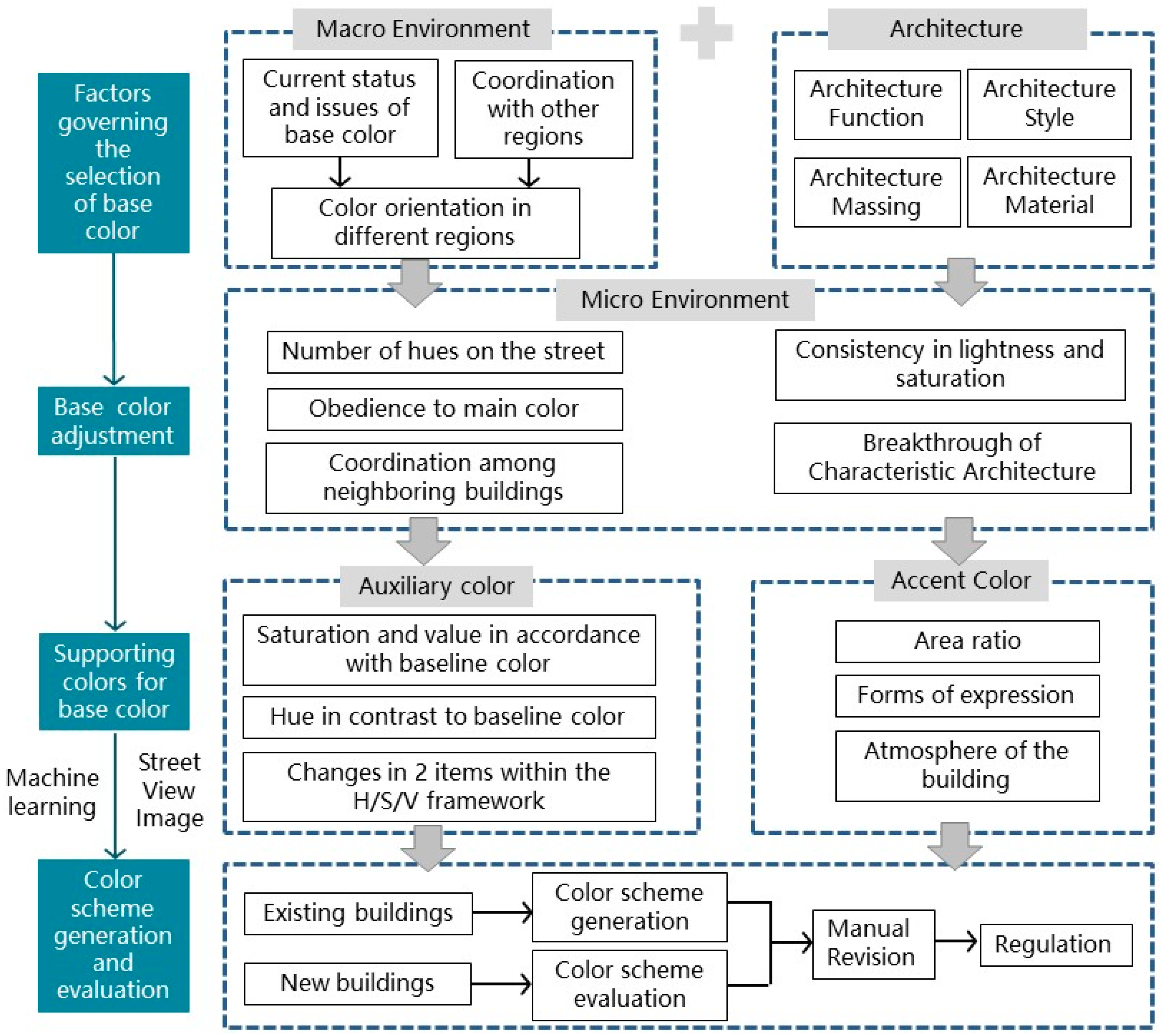
This study develops a data-driven framework for urban color analysis and planning support. The conceptual workflow (Figure 1) integrates three modules: (1) data-driven color extraction and mapping from SVI; (2) the formulation of a color coordination reference framework synthesizing quantitative data and planning policy; and (3) a digital platform for automated scheme generation and evaluation. The process is iterative, with expert judgment refining both the framework parameters and the final output of the platform.

3.2. SVI Collection and Processing

All SVIs used in this study were obtained from Baidu and Tencent Maps in 2019. SVIs provide a pedestrian-scale representation of the built environment, allowing building façade colors to be captured. This study relies on aggregated patterns derived from large image datasets rather than on isolated visual instances. This aggregation reduces sensitivity to potential anomalies and supports robust district-scale color analysis. Sampling points and coordinates were obtained every 50 m to 100 m along the road network, covering the urbanization area of 260 km2. A total of 430,000 images were obtained. Each image was geo-tagged and manually filtered for visibility and building content.
The images were processed following 3 steps: image recognition, color rendition, and base color identification.

3.2.1. Image Recognition

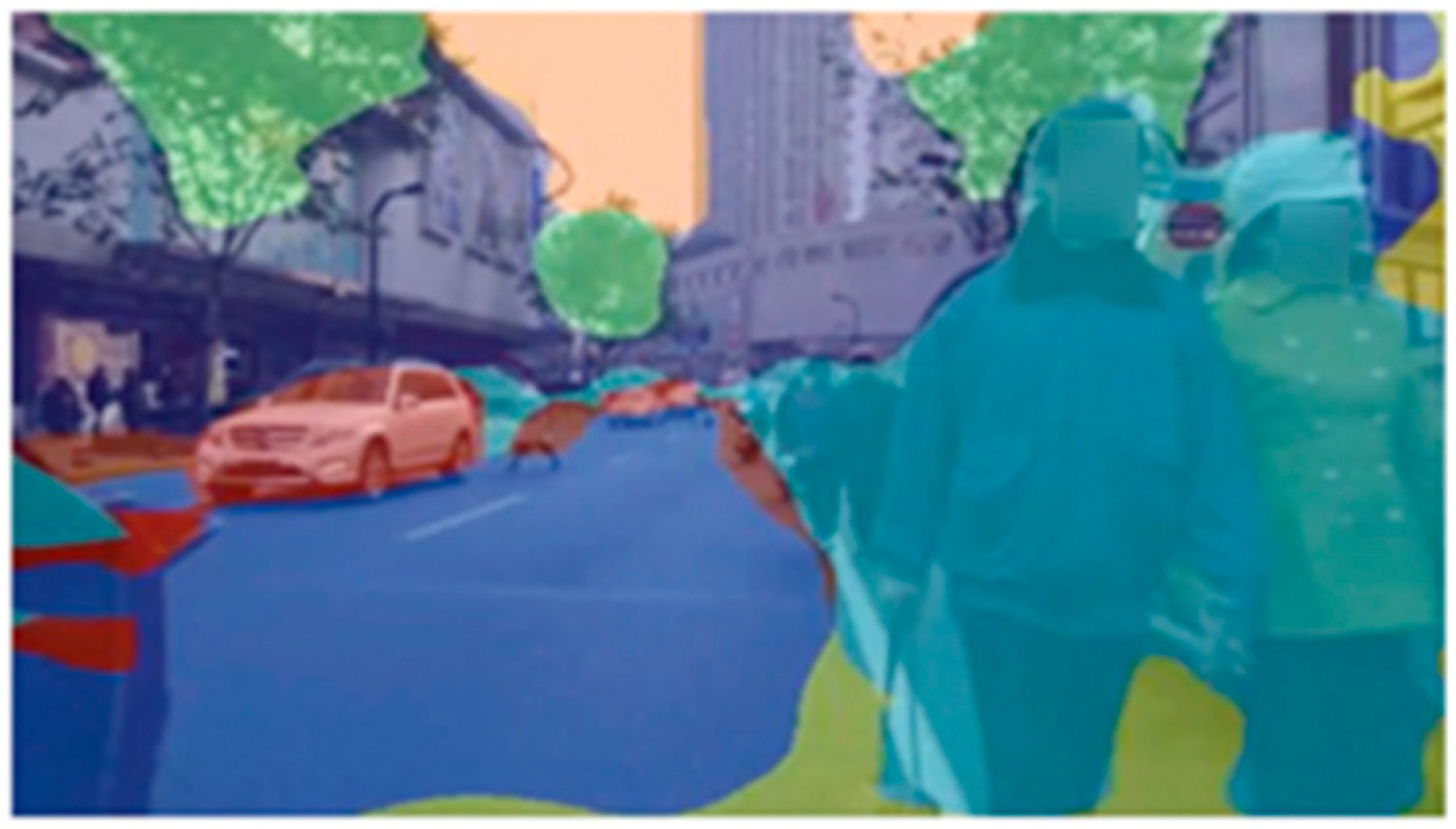
To ensure semantic consistency and analytical clarity, major spatial elements in SVIs were first defined according to urban design and visual perception principles. These elements included buildings, vegetation, pedestrians, vehicles, street furniture, and commercial signage (Figure 2), with each category assigned a corresponding semantic label to support subsequent analysis. Based on this semantic framework, a two-stage deep learning pipeline was employed to extract building elements from SVI.
A two-stage deep learning pipeline was employed to extract building elements from SVIs. First, the YOLOv8 object detection model was used to identify buildings and generate bounding boxes delineating their spatial extent. A subset of 5000 images was manually annotated using LabelMe v5 to support model development, with a 60/20/20 split for training, validation, and testing. The model achieved a mean Average Precision (mAP) of 0.88, indicating a generally reliable level of detection performance for the purposes of this study.
The detected bounding boxes were then used as spatial prompts for the Segment Anything Model (SAM), which performs prompt-based pixel-level segmentation. This cascading detection–segmentation approach facilitated the generation of building masks in an efficient manner. The segmentation results were evaluated with an Intersection over Union (IoU) of 0.85 and a Dice score of 0.92, suggesting reasonable agreement with manually annotated references. The resulting mask matrices were subsequently used for image segmentation and quantitative analysis. Following building segmentation, the proportion of building pixels relative to the total image area was calculated for each SVI. This proportion was defined as the building visibility ratio (V), representing the degree to which buildings dominated the visual field at a given location. Given the study’s focus on architectural appearance and urban color governance, it was necessary to only retain images with sufficient visual exposure of buildings. Therefore, images with extremely low building visibility were excluded. The 10th percentile of V is 0.098, meaning 90% of images with meaningful architectural content have V > 0.098. A threshold of V > 0.098 was adopted to exclude images in which buildings occupied only a marginal portion of the visual scene and were therefore unlikely to provide meaningful architectural color information. This threshold was selected empirically based on the distribution of V values and visual relevance considerations.

3.2.2. Color Rendition and Illumination Compensation

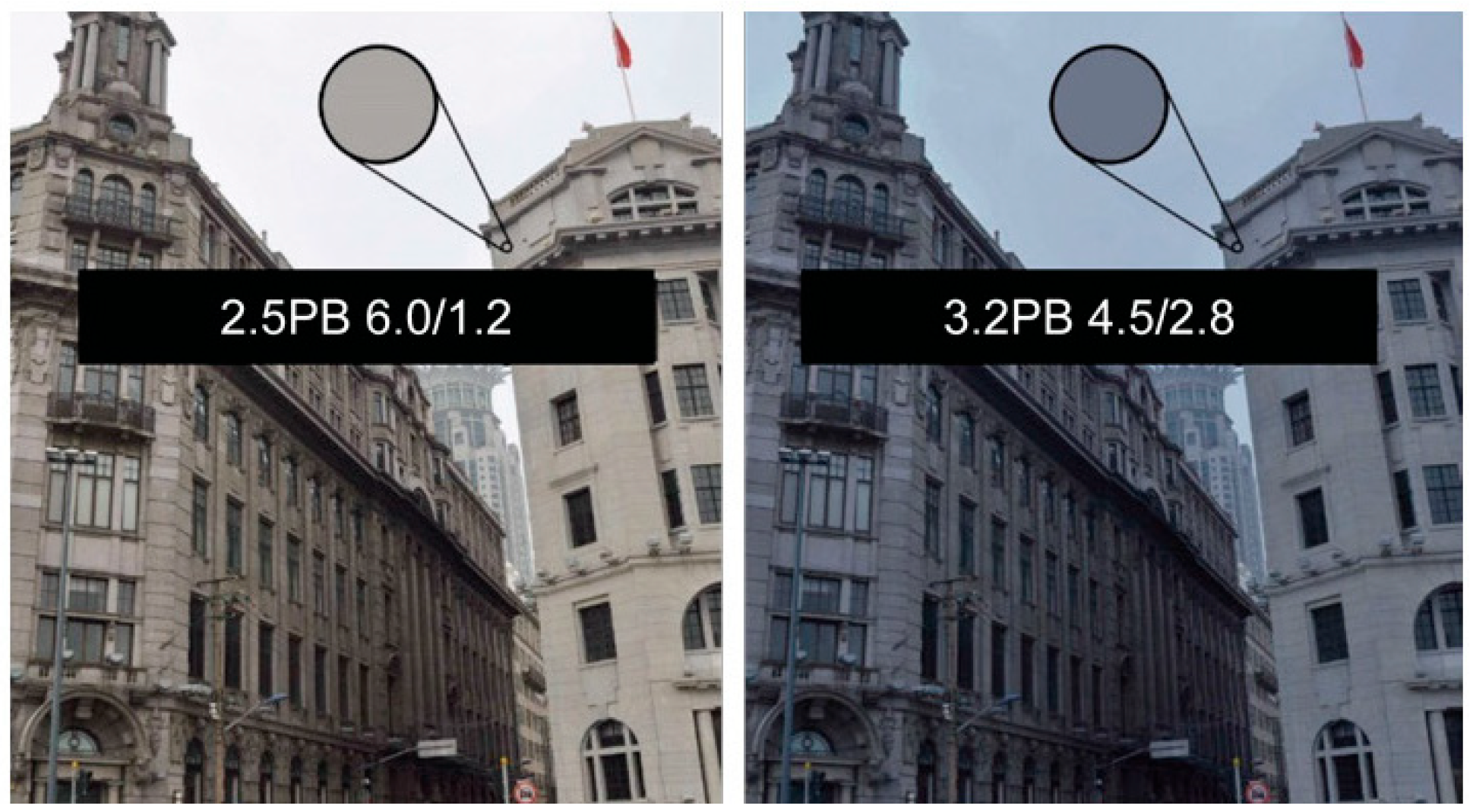
Images were converted from RGB to the perceptually more uniform HSV color space. To mitigate illumination variations (Figure 3), an automatic white balance (AWB) correction based on the Gray World assumption was applied to the segmented building areas using OpenCV 4.10. This process aimed to reduce lighting-induced chromatic variance and improve comparability across the large dataset, rather than to restore absolute, ground-truth material colors. A neutral gray reference was used, and gain parameters were calculated to construct a correction matrix, normalizing colors to a standard color temperature condition.

3.2.3. Base Color Identification

Following image segmentation and color restoration, pixel-level color information was extracted from each SVI. For each image, the HSV of all pixels was parsed and represented as coordinate vectors within the HSV color space. Following Yu et al. [54], who showed that mid-range color complexity and dominant chromatic characteristics are associated with improved perceptual outcomes, this study adopted the median-cut algorithm to extract a moderate number of colors from complex urban scenes. The median-cut method is widely used for color quantization, as it partitions the color space into balanced subsets and identifies representative colors while reducing the influence of extreme values. This makes it suitable for capturing the dominant chromatic features of heterogeneous SVIs. In this process, the image color distribution was treated as a rectangular volume (VBox) in color space and recursively partitioned along the dimension with the greatest variance. Among the resulting VBoxes, the one with the largest product of volume and pixel count was selected, and its representative HSV was defined as the dominant color of the image.
To further aggregate chromatic information at the spatial level, the study area was divided into regular grid cells of 50 × 50 m. Each grid cell contained an average of 2 images. Within each grid cell, the dominant colors of all associated images were collected and summarized to characterize the local chromatic environment. A k-means clustering algorithm (with k = 3 determined by the elbow method applied to a sample of grids) was used on the combined H, S, and V values to derive a single representative HSV triplet for the grid cell, forming the districtwide urban color map.
This method is data-intensive, efficient, and cost-effective, and is capable of rapidly summarizing and extracting the color composition of urban districts, enabling spatial analysis, and generating a geographic information database of building colors. It significantly improves the efficiency of color data collection and is applicable to large-scale built-up area planning and renewal, as well as benchmarking color cases for specific functional districts.

3.3. Building Color Coordination Reference Framework Setting

This study explores a color coordination framework integrating planning regulations with key contextual factors such as building function (e.g., residential vs. commercial), building height, architectural style, and surrounding chromatic conditions. These factors collectively influence architectural color expression and are closely associated with the five dimensions of local color—dominant colors, color complexity, color harmony, average saturation, and average value—as identified by Xue [41].
The framework translates higher-level planning goals into operational color parameters through a triangulation process, with a clear hierarchy to balance data-driven objectivity, regulatory compliance, and professional judgment.
Quantitative baseline (the empirical anchor): By employing computer vision algorithms to systematically extract features from SVIs [18,61,62], this study analyzed approximately 430,000 images to provide empirical distributions of HSV, thereby identifying prevailing chromatic patterns and outliers across the district. These statistical results provide an empirical reference for parameter calibration rather than directly prescribing design rules.
Policy codification (the regulatory intention): Relevant planning documents, including the Shanghai Municipal Building Color Quantitative Indicators Report (2019) and Jiading District planning guidelines, were systematically reviewed. Both numerical thresholds and qualitative directives (e.g., preferences for low-saturation tones in specific areas) were extracted and translated into structured rule components. This acted as a top-down regulatory filter, aligning the empirical data with established governance objectives and city-character requirements.
Evidence-based Expert Calibration (the human-in-the-loop synergy): Three iterative workshops were held with a panel of 12 experts, including urban planners, architects, color designers, and local government officials from the Jiading Planning Bureau. This stage was designed as a human-in-the-loop calibration. Experts were presented with statistical visualizations derived from the SVI data. Their role was to interpret and calibrate these data-driven distributions into implementable parameter ranges. Disagreements were resolved through structured discussions and majority voting based on documented evidence, ensuring that the final governance rules were both evidence-based and contextually sensitive.
Previous studies indicate that dominant hue and chroma enhance wayfinding and place identity, while color coordination and complexity influence perceived safety and comfort. In addition, dominant chroma has been shown to positively affect serviceability and sense of place [63]. Research also suggests that aesthetic preference is maximized at intermediate levels of color complexity, supporting the use of bounded parameter ranges rather than extreme values [64]. Accordingly, this study adopts flexible palette envelopes responsive to street geometry and environmental context, whereby recommended schemes fall within empirically supported ranges, and prohibited schemes refer to those that deviate substantially from these ranges and may undermine visual coherence or perceptual quality. The resulting thresholds (e.g., 70% frontage contribution, 90° hue difference, and 5% accent area) are therefore normative planning parameters derived from local regulations and expert consensus, contextualized by the district’s empirical color data.
The framework’s factors are detailed below.

3.3.1. External Environmental Factors and Macro-Context

Based on Shanghai’s master plan indicating a dominant orange hue (H ≈ 41–42), Jiading’s base hue range is recommended as 40 ≤ H ≤ 45 for regional coordination.

3.3.2. Recommendations Based on Building Function/Style/Height

Building function (residential, commercial, public) and architectural style (modern, traditional Chinese, etc.) are not inferred from SVIs in this workflow. This information is imported from official urban planning GIS databases and parcel land-use records into the platform. The recommended and prohibited ranges in Section 4.2.2, Section 4.2.3 and Section 4.2.4 are the direct output of the expert/policy triangulation process described above, considering the psychological and typological needs associated with each category. Architectural style is tagged manually for sampled buildings by experts familiar with Jiading’s urban fabric, creating a reference library used to assign style-based rules.

3.3.3. Workflow

The workflow consists of four stages (Figure 1):
  • Setting of base color recommendations
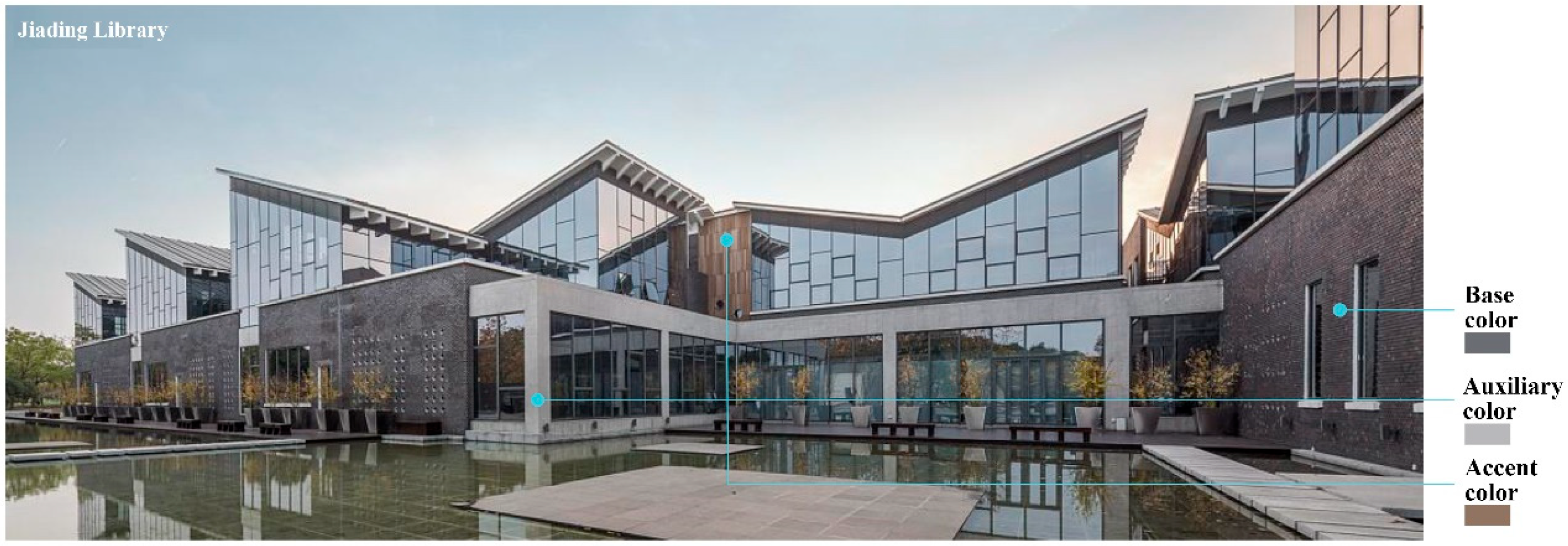
Based on the macro-environment and the building’s intrinsic characteristics, a base color palette is selected. Base colors are typically applied to the main façade (including curtain walls but excluding ordinary windows) (Figure 4), covering approximately 70–85% of the surface.
The color coordination reference framework for base colors incorporates both external and internal factors. External environment primarily involves upper-level planning requirements for the parcel’s color guidance, as well as regional color conditions, inter-district coordination, and color zoning. Internal factors are associated with the characteristics of the building itself, including function, architectural style, massing, and materials (Section 4.2.2, Section 4.2.3 and Section 4.2.4 show the recommendations related to internal factors for Jiading District).
2.
Micro-context adjustments to base colors
Streetscape context is incorporated through micro-context adjustment rules, which account for relationships between adjacent buildings and the overall chromatic structure of the street environment. These include considerations such as the number of hues along a street frontage, the relative dominance of colors across parcels, and the degree of chromatic harmony between neighboring buildings. Visual preference exhibits an inverted U-shaped relationship with the target variable: it increases initially and declines once the variable exceeds a critical threshold [65]. Concerning the relationship between adjacent parcels, if parcel A contributes less than 10% of the street frontage and parcel B contributes more than 70%, then the dominant color of parcel A should be selected from within parcel B’s palette. The hue difference between adjacent buildings should be less than 90° (ideally around 30°) and should strictly not exceed 120°. Special or heritage buildings may be treated as exceptions, with original features preserved and surrounding landscapes coordinated.
3.
Derivation Basis of Color Parameter
The ranges in the saturation, hue and value of the base color were established through a three-tiered triangulation process: quantitative analysis of the 430,000-image dataset to establish empirical baselines; textual coding of policy documents to extract mandated thresholds; and iterative expert workshops to reconcile data insights with planning intent. This hybrid approach ensures that parameters are both evidence-based and aligned with governance objectives.
4.
Color matching principles
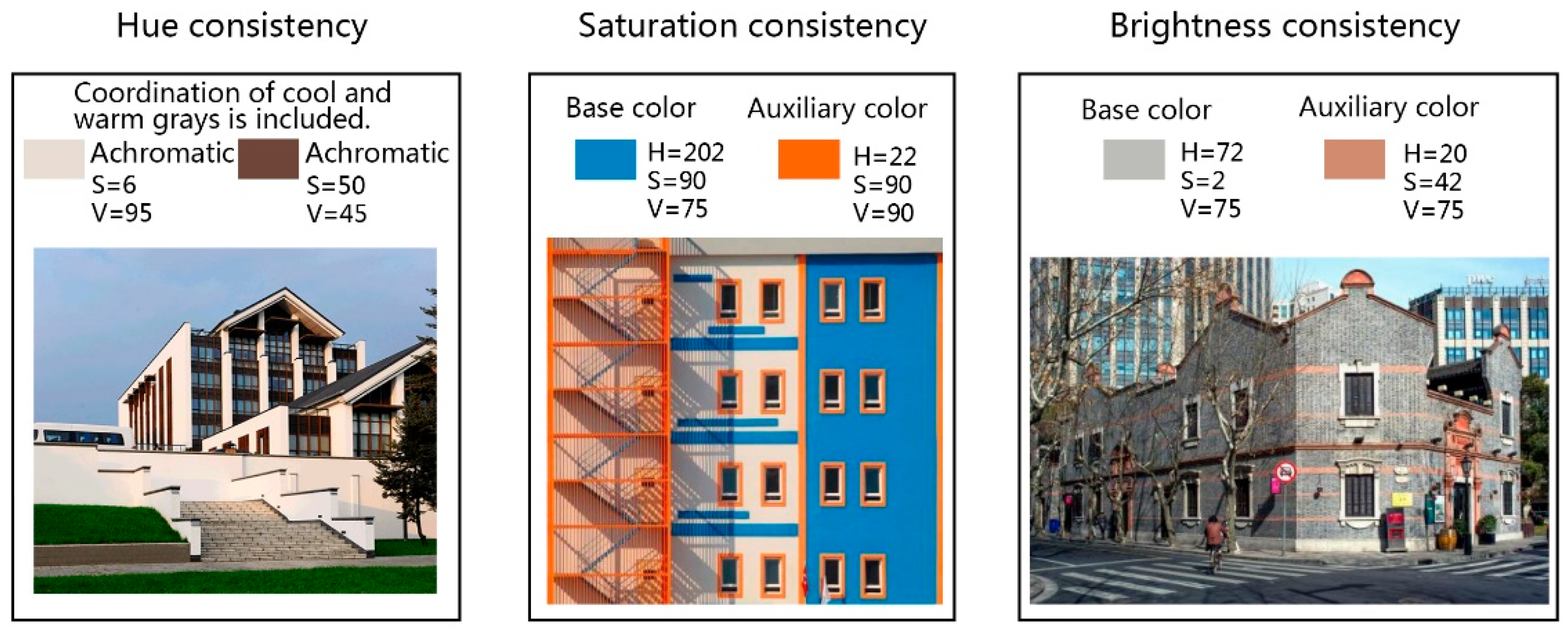
Based on the base color, auxiliary and accent colors are paired (Figure 4). The area of auxiliary colors is smaller than that of the base color—generally used for wall coordination and similar elements, with no more than two colors allowed. They typically cover 20–40% of the building façade (excluding glass). No more than two auxiliary colors are allowed. The combination should follow the principles of contrast, unity, and harmony. The hue of the auxiliary color should contrast with that of the base color, while maintaining consistency in either brightness or saturation when the hues are similar. Among hue, brightness, and saturation, at least one element should remain consistent to ensure visual coherence.
Accent colors are limited to small areas, typically applied to entrances, signage, cornices, or other architectural highlights. The palette can be more diverse and expressive, but the overall visual effect should remain coordinated. The total area of accent colors should not exceed 5% of the façade surface.
In this study, planning considerations were informed by Jiading’s local building color coordination recommendations and color planning guidelines, including target hue ranges, saturation limits, and contrast ratios. Based on these parameters, a rule-based color scheme generation module was built to provide automated recommendations for new developments and renovations. Users may select target building types or spatial zones to generate optimized color palettes consistent with policy criteria.

3.4. Digital Platform Development

A quantitative analysis platform for building color is developed to support two planning scenarios: (1) color scheme generation for existing buildings undergoing façade renovation, and (2) color scheme evaluation for new development proposals. For existing buildings, the platform provides data-informed color scheme generation. Using supervised deep learning techniques trained on architect-designed and planning-approved building elevation datasets, the system suggests context-sensitive combinations of base, auxiliary, and accent colors within predefined parameter ranges. These generated schemes serve as preliminary design references and are subsequently refined and finalized by designers.
For new developments, the platform functions as an evaluation tool. Instead of generating schemes autonomously, it assesses color proposals submitted by architects or developers against established coordination criteria and the surrounding urban color environment.
The core of quantitative analysis platform consists of:
A rule-based inference engine that applies the coordination framework (Section 3.3) to parcel attributes (function, style, and location from QGIS 3.44).
A supervised deep learning module for color scheme generation, primarily used for existing building renovation scenarios. A Generative Adversarial Network (GAN) is trained on a dataset of 1500 architect-designed, planning-approved building elevation images and their associated color palettes. It is an auxiliary color-suggestion component. To improve model robustness, data augmentation techniques—including random cropping, flipping, and brightness adjustments—are applied to the training set.
The GAN adopts a conditional generation framework, in which input features include semantic label maps of building type, site character, façade representations (e.g., walls, windows, and decorative elements), and material attributes (e.g., paint, stone, glass and curtain walls), as well as associated contextual attributes such as building function style categories derived from external datasets. The generator utilizes a U-Net-based architecture with skip connections to preserve spatial hierarchies, producing candidate color combinations in HSV space. The discriminator employs a PatchGAN structure that, by evaluating local image patches rather than the full image to improve sensitivity to color texture consistency, assesses the plausibility of generated schemes against the distribution of approved designs at the patch scale. Training is conducted using an Adam optimizer with a learning rate of 2 × 10⁻⁴ and a batch size of 16. Instance normalization is employed in the generator. The objective function combines a standard binary cross-entropy adversarial loss with an L1 reconstruction loss (λ = 100) to ensure pixel-level fidelity and adherence to predefined color parameter ranges.
The output of the model is a set of candidate color schemes (base, auxiliary, and accent colors) which are subsequently filtered and adjusted according to the rule-based parameter framework described in Section 3.3. In this sense, the GAN module does not operate as an independent design generator, but as a supportive tool that proposes plausible color combinations within a controlled planning context. Final scheme selection and refinement remain subject to designer and planner judgment.
An evaluation module, designed for new development projects, assesses externally proposed color schemes. This module scores proposed schemes against the framework’s rules and calculates harmony metrics with the surrounding color environment (extracted from nearby SVIs). The resulting evaluation scores are visualized as radar charts and presented through an interactive interface designed to support planning authorities in decision-making. The resulting evaluation scores are visualized as radar charts and presented through an interactive interface.
For both applications, the platform incorporates contextual analysis of the surrounding streetscape. In the case of evaluation, the system quantifies factors such as hue harmony, tonal consistency, and color distribution, and compares them with predefined criteria. The assessment is conducted from two complementary dimensions: the building’s intrinsic color characteristics and its coordination with the surrounding environment. Specifically, intrinsic color evaluation considers the selection of base, auxiliary, and accent colors; overall harmony; and proportional balance among color components.
The platform is designed with a flexible data-ingestion mechanism, allowing future updates with more recent or multi-source imagery.
While the individual components of the platform are established techniques, the methodological novelty of this study lies in the systemic integration of large-scale computer vision analytics with a localized, rule-based urban planning governance logic. Unlike previous studies that focus solely on descriptive color mapping, this framework translates raw visual data into actionable planning interventions through a closed-loop analysis–evaluation–generation workflow.

3.5. Case Background

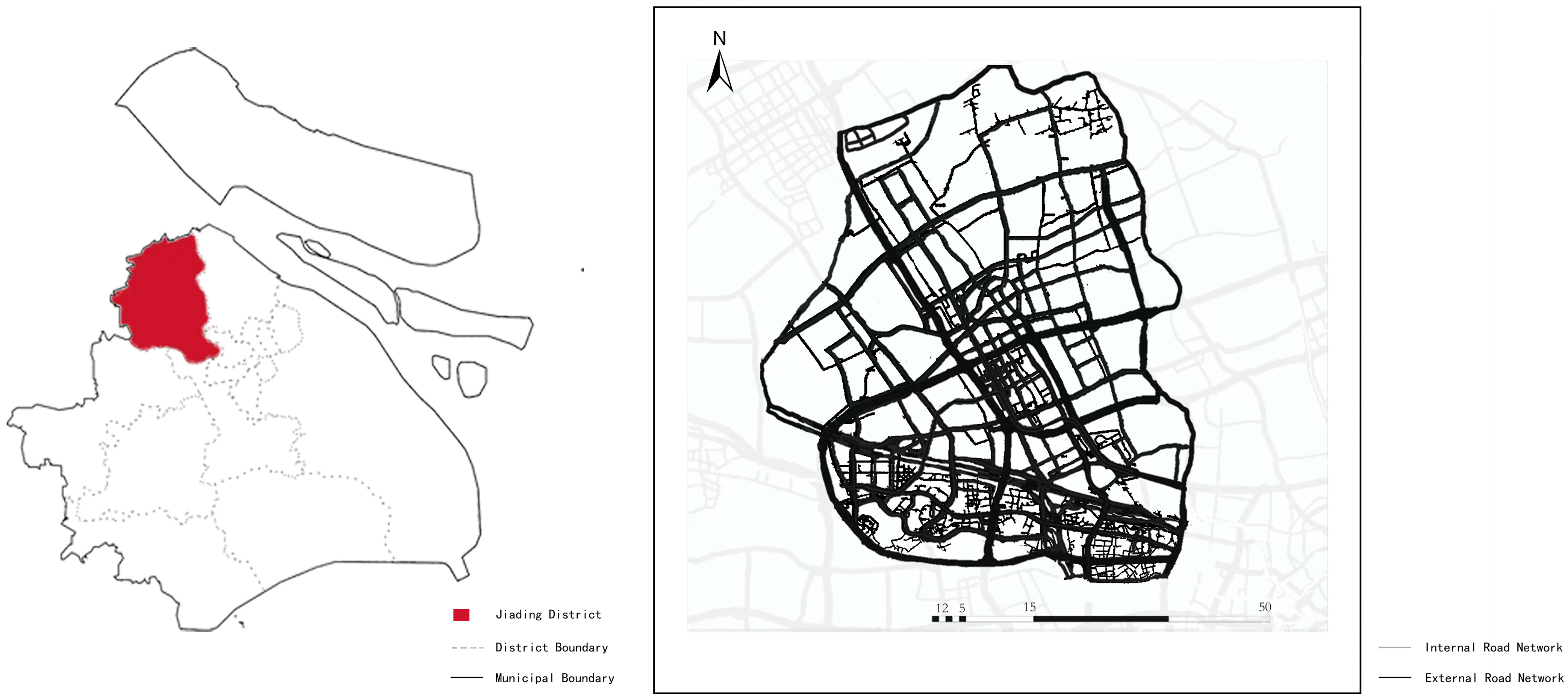
Jiading District is located in the northwestern part of Shanghai (Figure 5). It serves as a critical land gateway and transportation hub linking Shanghai with the Yangtze River Delta and inland regions. Covering an area of 463.55 square kilometers, the district administers three subdistricts and seven towns, along with one administrative committee and one industrial zone. By the end of 2024, Jiading’s permanent resident population had reached 1.89 million.
From the perspective of the overall urban image, Jiading District is characterized by a large geographic area and a diverse set of functional zones. These urban clusters are both continuous and independent. Development and construction activities are extensive and spatially dispersed, which complicates the formulation of unified color coordination recommendations. Color planning in Jiading must therefore balance the differences and unique characteristics of various spatial subzones with the overall coherence of the district’s visual identity, while also coordinating improvements in the existing built environment—making planning and management particularly challenging.

4. Result

4.1. Color Spatial Distribution Analysis

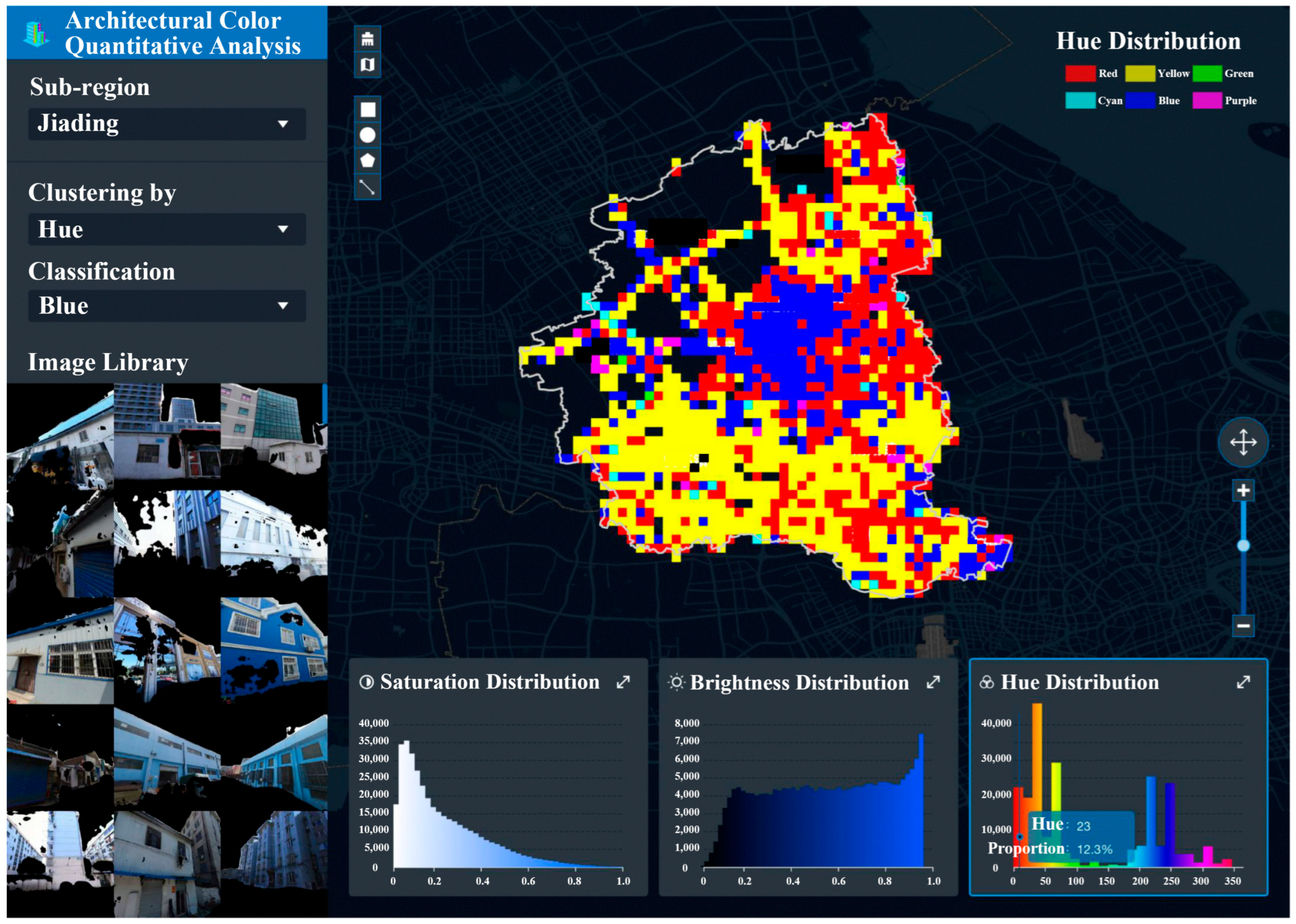
Through Jiading District’s building color quantitative analysis platform (Figure 6), a total of 430,000 images were processed and visualized as color distribution points, which were then aggregated into spatial distribution maps and statistical histograms of hue, saturation, and brightness.
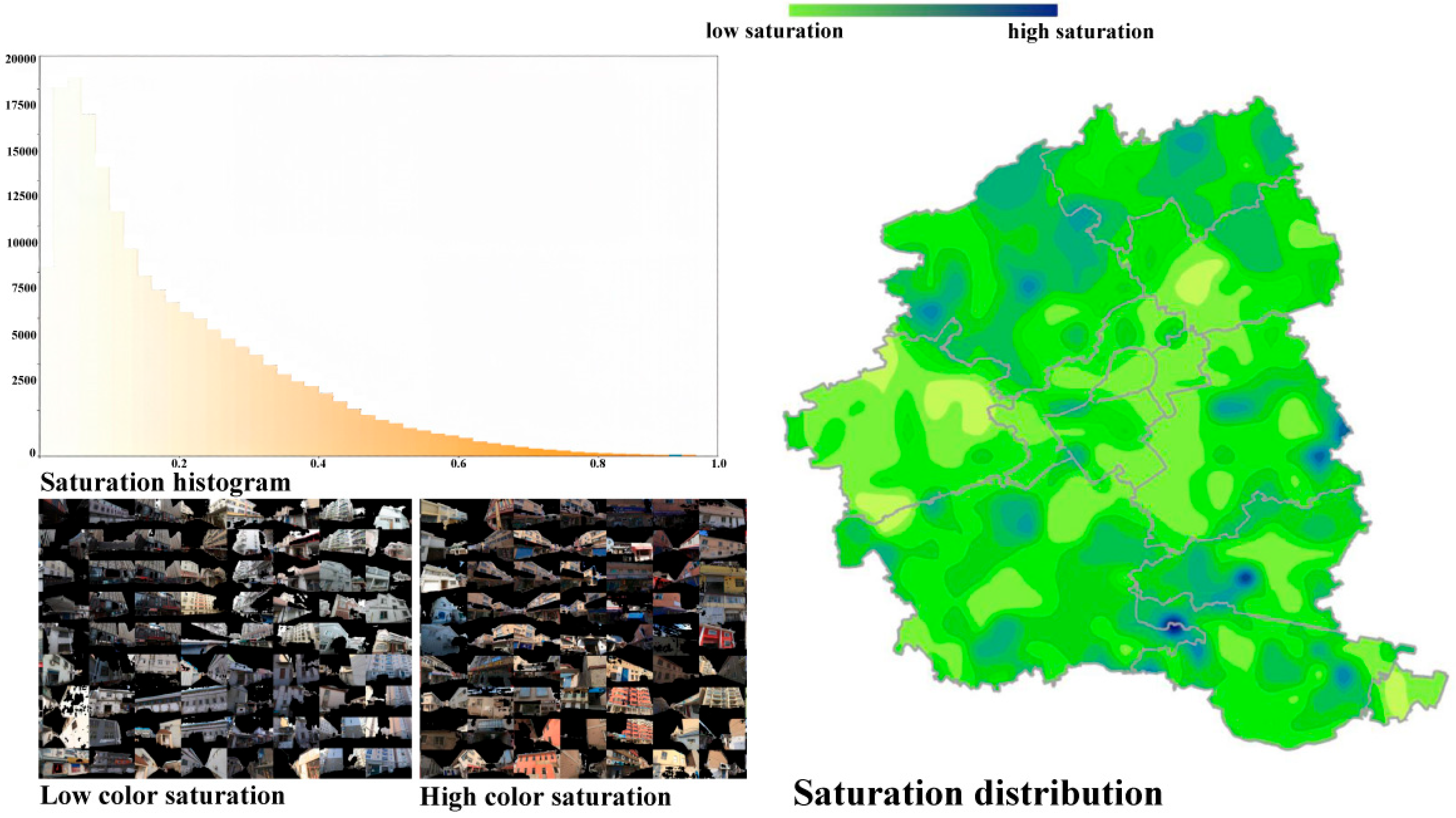
The analysis reveals that the overall building colors in Jiading District are of low saturation, with the vast majority falling within the range of S = 0–20%. As shown in Figure 7, buildings with low-to-medium saturation are concentrated in the central areas, which are highly urbanized, functionally mixed areas, including Jiading Old Town, Jiading New Town, Zhenxin Subdistrict, Xuhang Town, and the central–western part of Malu Town. By contrast, high-saturation buildings are distributed along the district’s periphery, such as eastern Malu Town, western Nanxiang Town, western Jiangqiao Town, and the northern industrial zone. This is largely due to the fact that these buildings were constructed at an earlier time, when there was no established awareness of planning control, allowing for a greater degree of individual expression in color selection. Certain nodes exhibit excessively high overall saturation, forming “hotspot buildings” that are highly coupled with the city’s functional structure. In contrast, lower-saturation zones are primarily associated with single-function residential, commercial, and industrial park uses (Figure 7).
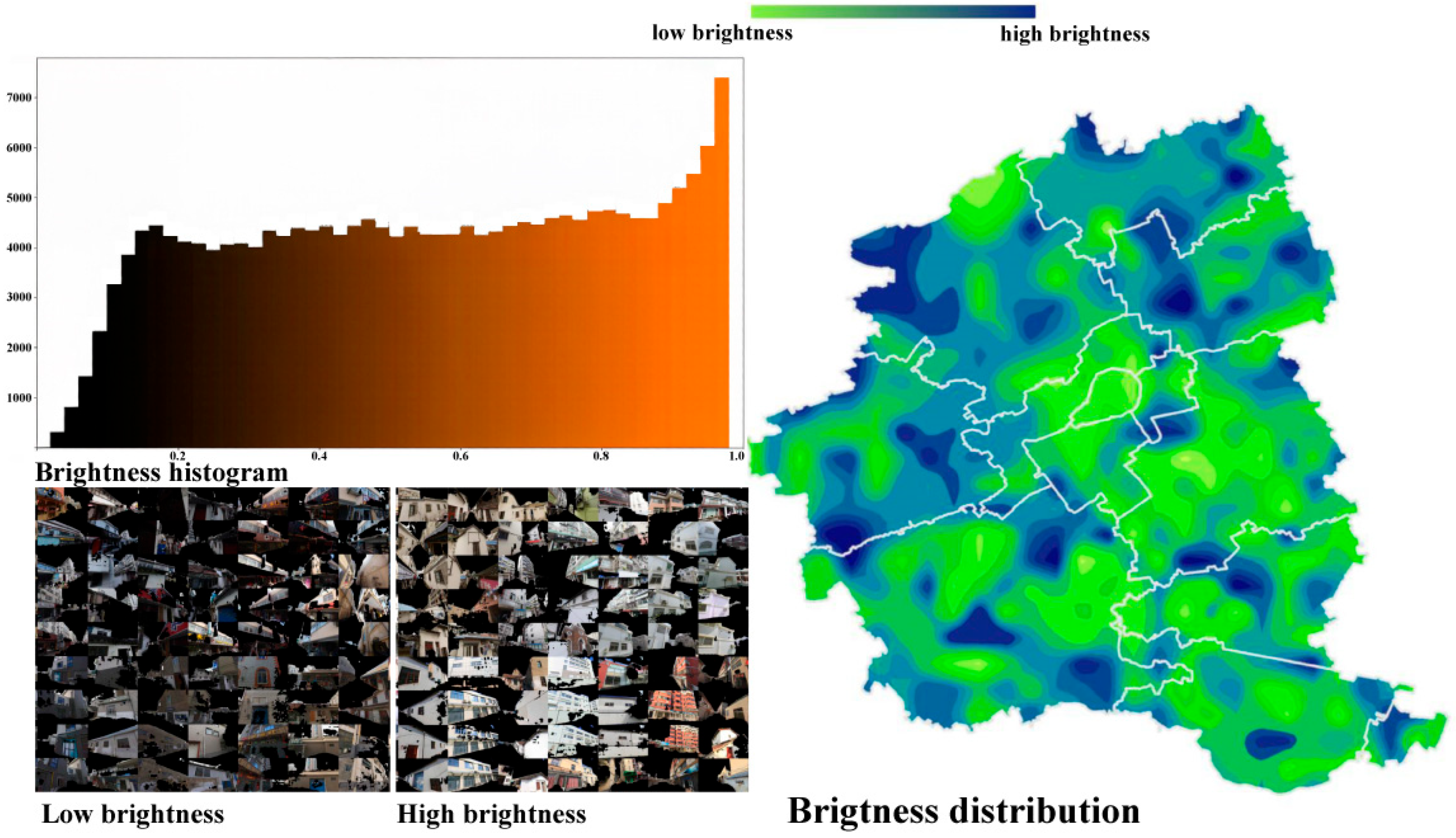
Regarding brightness (Figure 8), distribution of building colors in Jiading District is predominantly medium-to-high, supporting a bright and legible urban visual environment. No strong spatial clustering or continuous regional pattern is observed. The lowest-brightness buildings are located in the western and northwestern parts of the district, a result of the extensive farmland and forests adjoining the urban boundary.
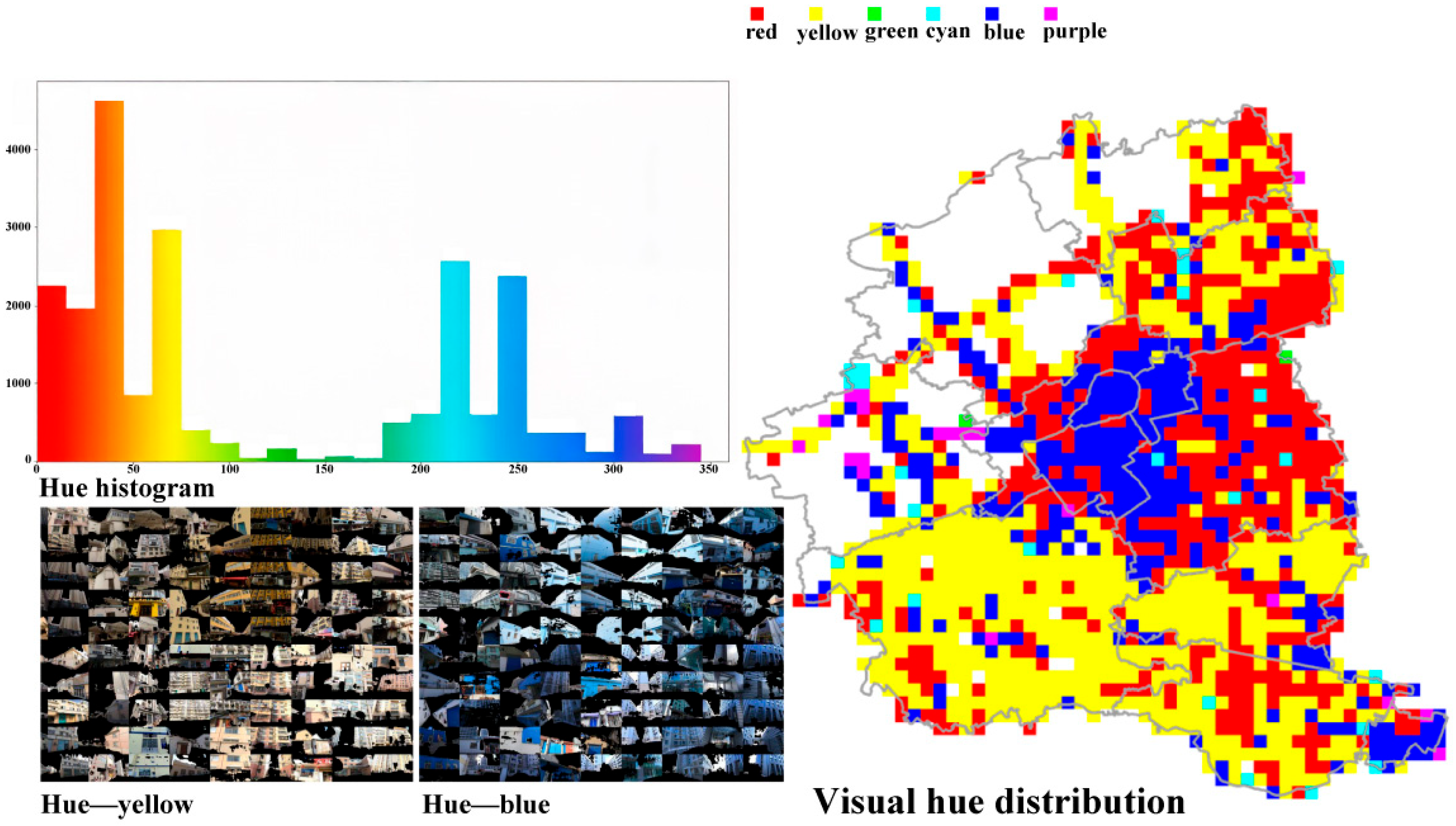
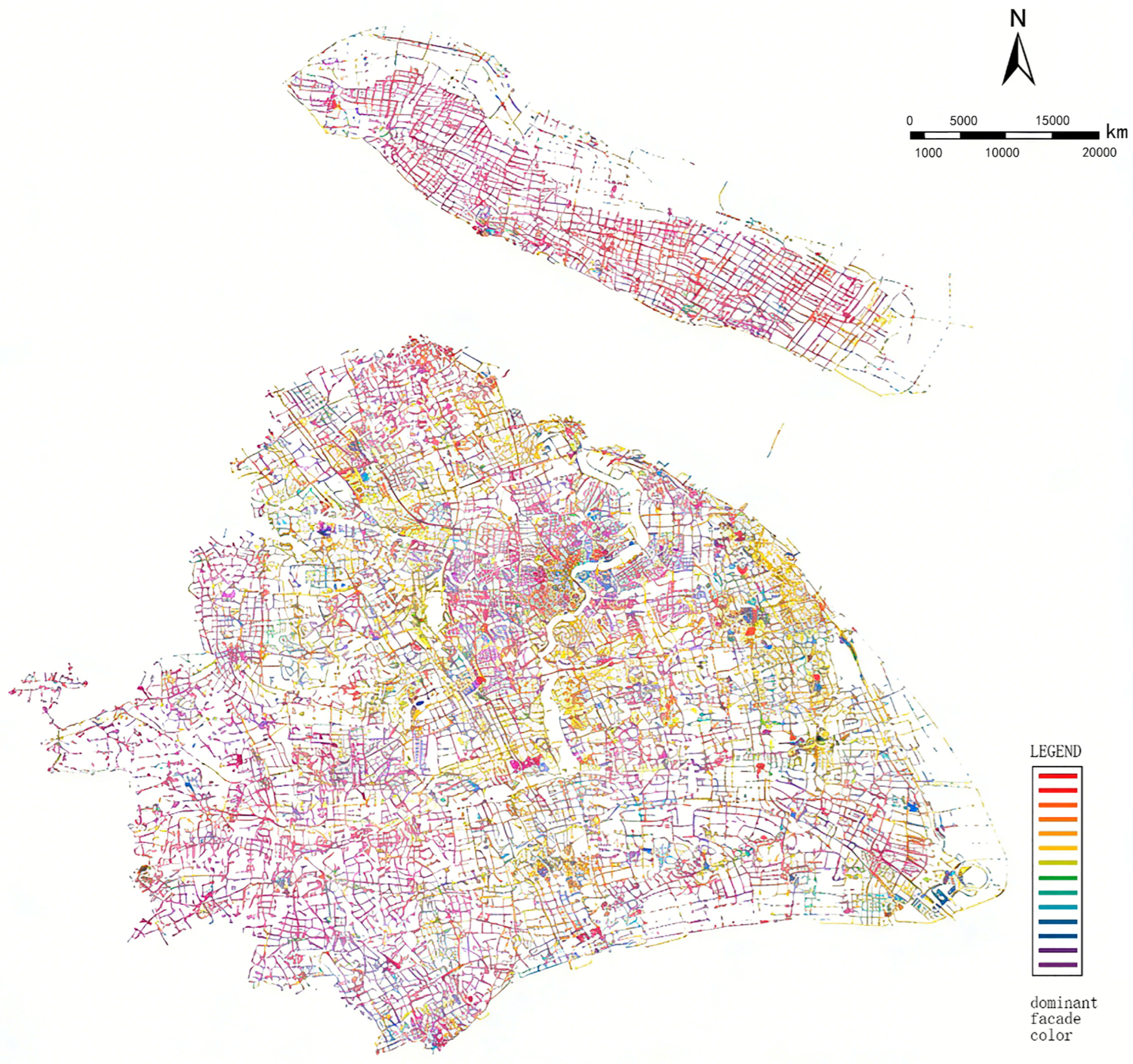
In terms of hue (Figure 9), Jiading District exhibits a coordinated pattern of warm–cool mixing with relatively balanced spatial coverage. The dominant hues are orange-yellow (H = 45–60) and blue (H = 180–220). This differs from Shanghai’s central urban area, which often features a single dominant hue for residential functions. In contrast, Jiading’s reputation as an “International Automobile City” has led to the clustering of office and industrial functions, resulting in two clearly dominant hues in terms of color appearance. Business, office, and industrial areas, such as Jiading New Town, Old Town, and Anting Town, are primarily characterized by blue tones, which convey a modern, calm, and professional atmosphere. In contrast, residential-dominated areas are mainly defined by yellow hues, which align with perceptual preferences for warmth, comfort, and safety. This spatial separation of hues directly reflects the district’s functional zoning patterns.

4.2. Color Coordination Reference Framework of Jiading District

4.2.1. External Environmental Factors

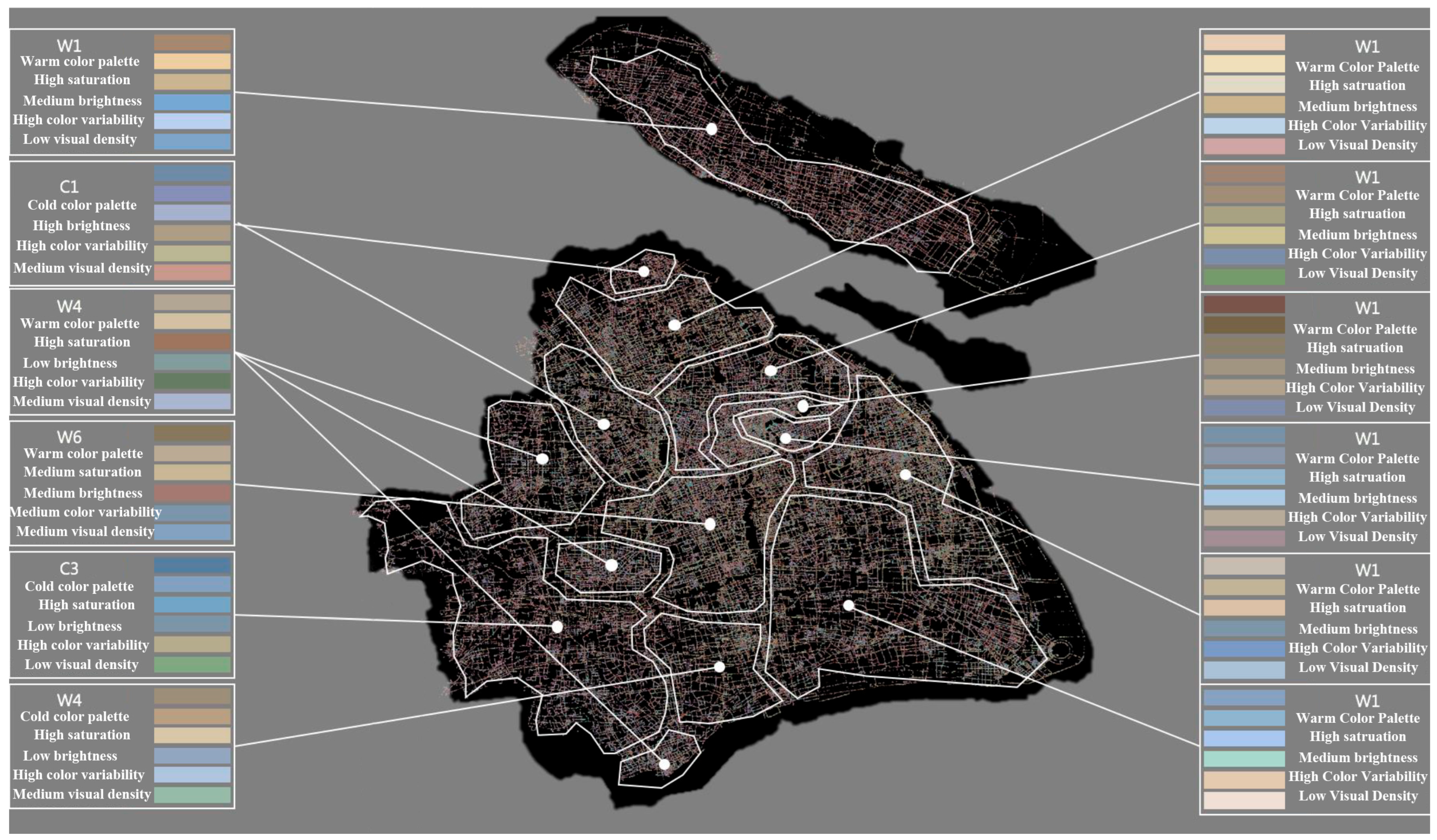
External environmental factors primarily involve the color recommendations proposed by higher-level planning on the parcels where buildings are located. According to existing sources [63], Shanghai’s dominant hue is orange (Figure 10). Specifically, Jiading, Fengxian, Chongming, Minhang, Songjiang, Qingpu, and Huangpu districts have a dominant hue of H = 41; Xuhui, Yangpu, Changning, and Pudong New Area are characterized by H = 42; Jing’an, Hongkou, Baoshan, and Putuo also adopt orange hues; while Jinshan is defined by a blue hue (Figure 11).
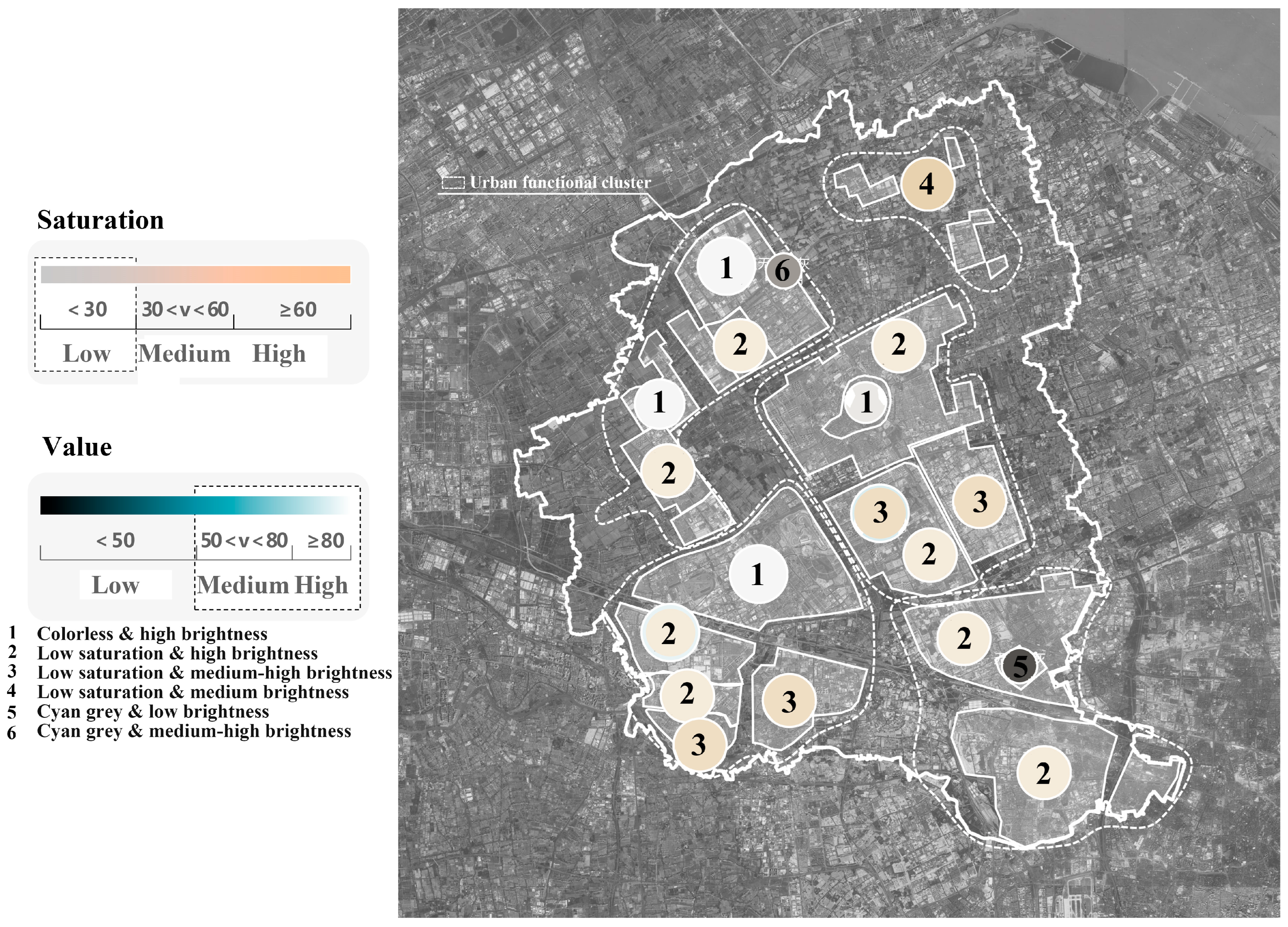
Jiading District’s dominant hue is suggested to coordinate with that of Shanghai as a whole and with neighboring districts. Accordingly, an orange palette in the range of 40 ≤ H ≤ 45 is recommended. Considering both the current color distribution characteristics within Jiading and the need for coordination with surrounding districts, a color zoning plan is proposed for its subdistricts and towns (Figure 12): in the southeastern sector, low-saturation tones with high or medium-high values may be utilized; conversely, the western sector may be inclined to favor achromatic high-value tones. Meanwhile, the northeastern sector is likely to adopt low-saturation, medium-value tones. This strategic approach to color selection aims to enhance the visual coherence and aesthetic quality of the urban environment.

4.2.2. Recommendations for Building Colors from the Perspective of Function

Building functions and regional contexts shape users’ psychological needs, and color plays a key role in expressing place identity—defined in urban visual intelligence as “a place’s unique or common attributes” that facilitate visual recognition [44]. Residential buildings often use warm tones to convey comfort and safety, while commercial and office buildings favor soft neutrals to reduce fatigue and stress. Public buildings adopt targeted palettes for specific users—for example, vibrant colors in kindergartens to stimulate children, and blues and greens in hospitals to promote calm and relaxation.
  • Residential Buildings
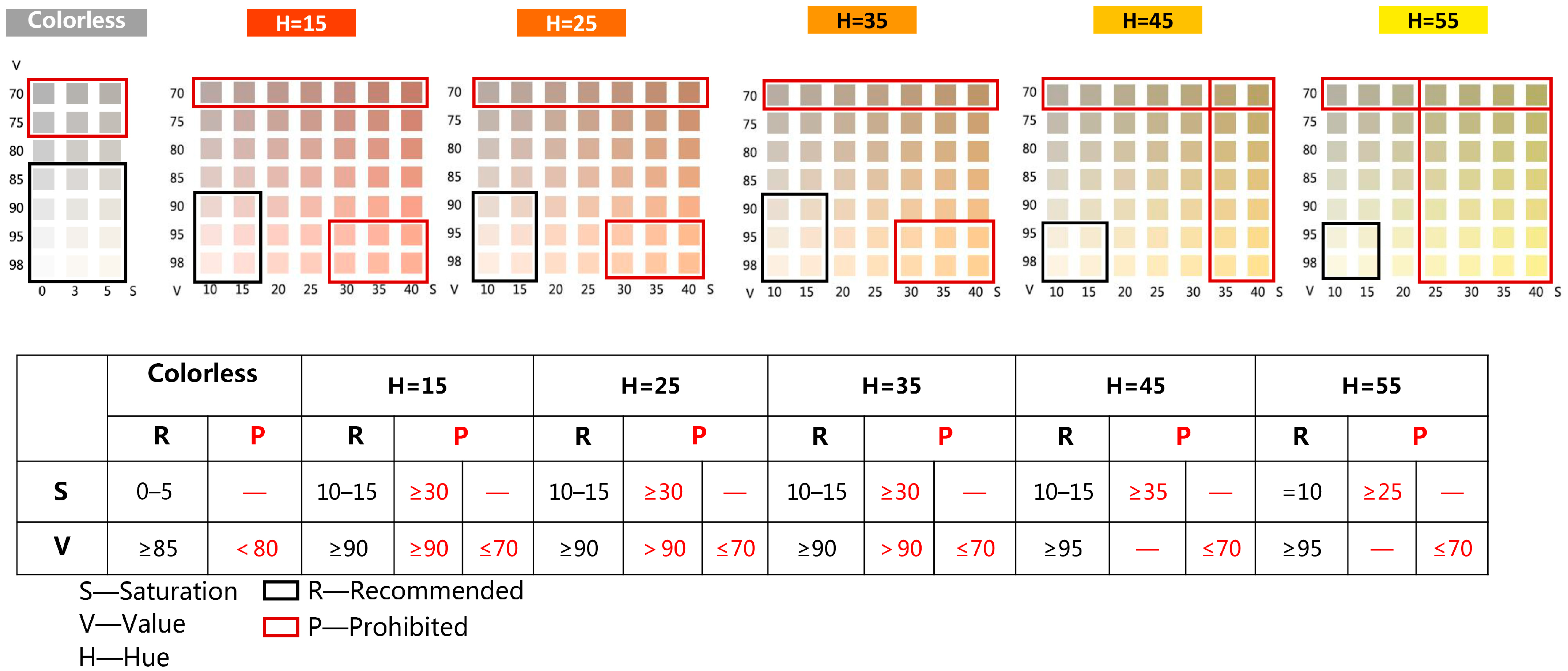
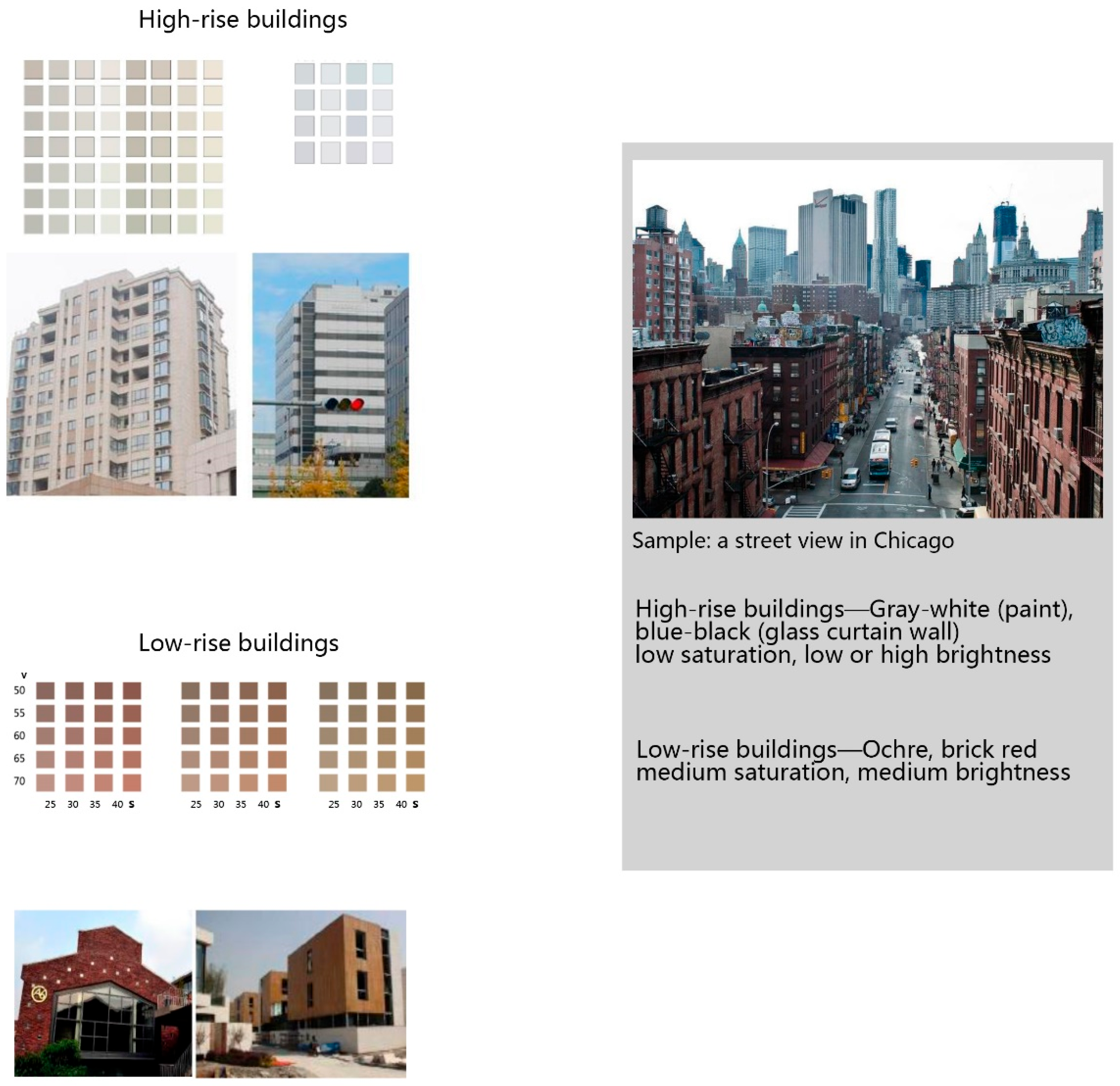
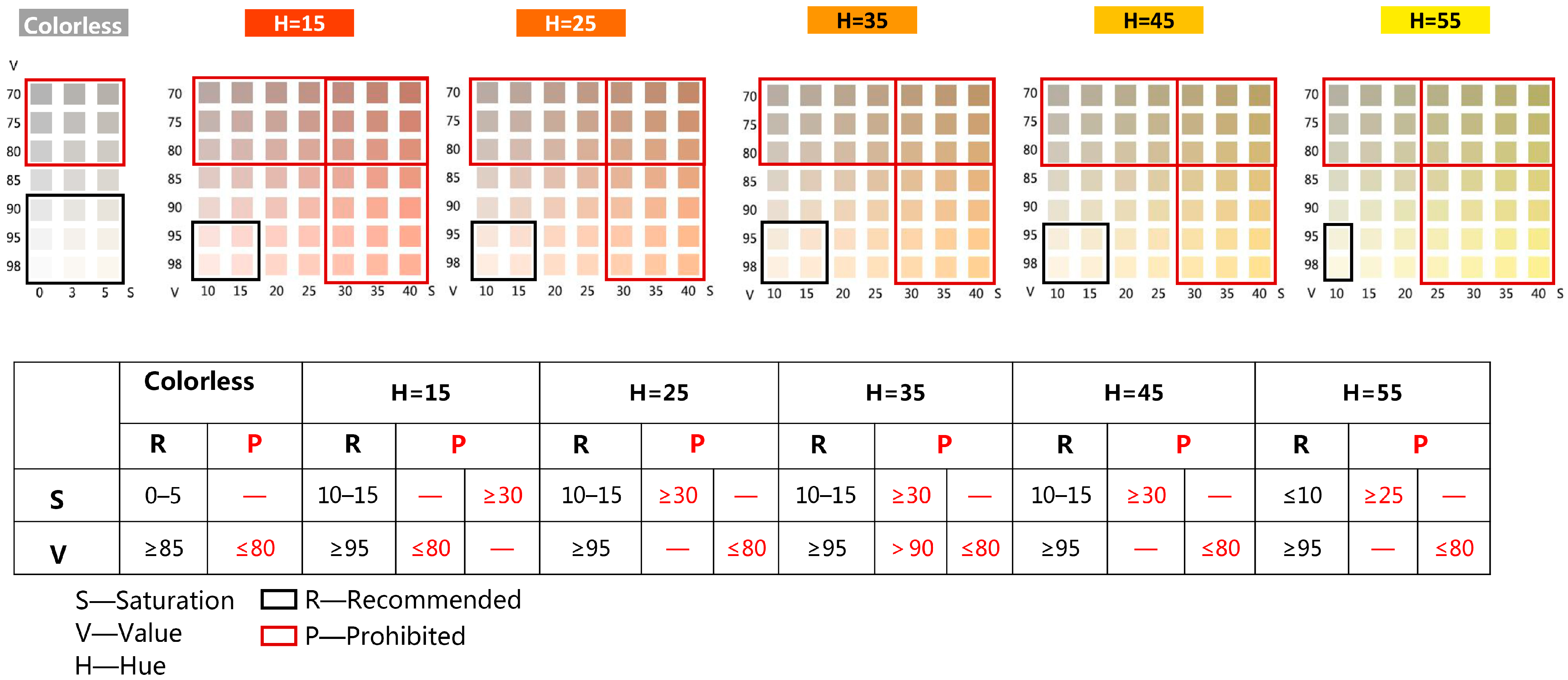
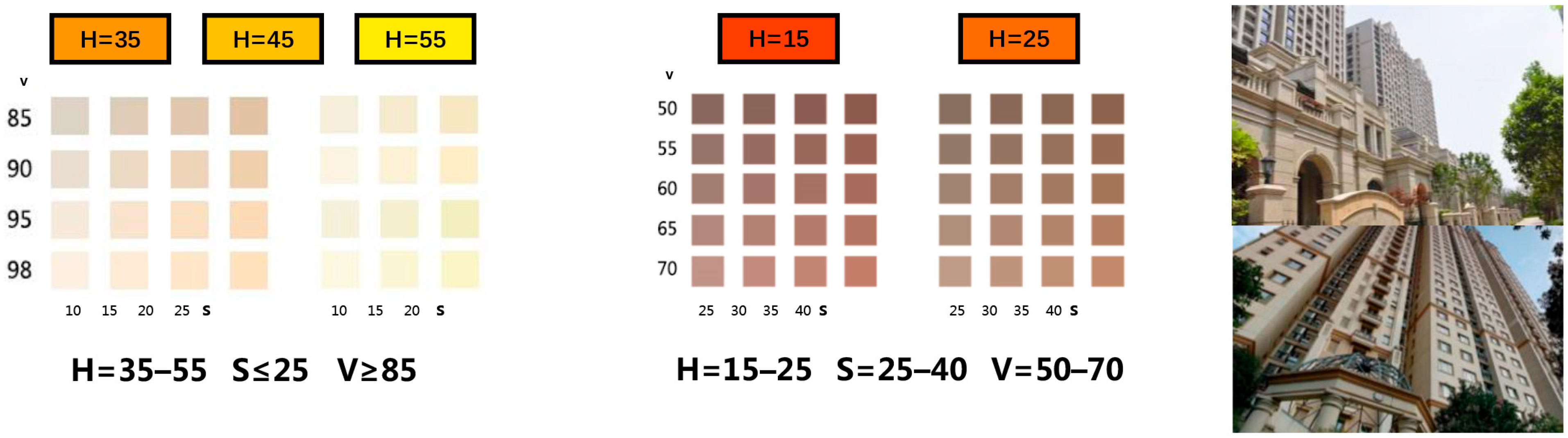
    • High-rise residential buildings (Figure 13): High-value, low-saturation, and warm-toned colors are recommended to evoke comfort, warmth, and tranquility. In contrast to low- and mid-rise housing, high-rises might use lower saturation and higher brightness. The use of medium-to-high-saturation, low-value colors, as well as blue, green, and purple hues is discouraged.
    • Low- and mid-rise residential buildings (Figure 14): A palette of medium-to-high value, medium-to-low chroma, and warm-toned colors is advisable. These structures may employ a broader palette, with slightly higher saturation and slightly lower value depending on architectural style. However, combinations of medium saturation and high brightness or low saturation and medium-to-low brightness are advised to be refrained from.
  • Commercial and Office Buildings (Figure 15)
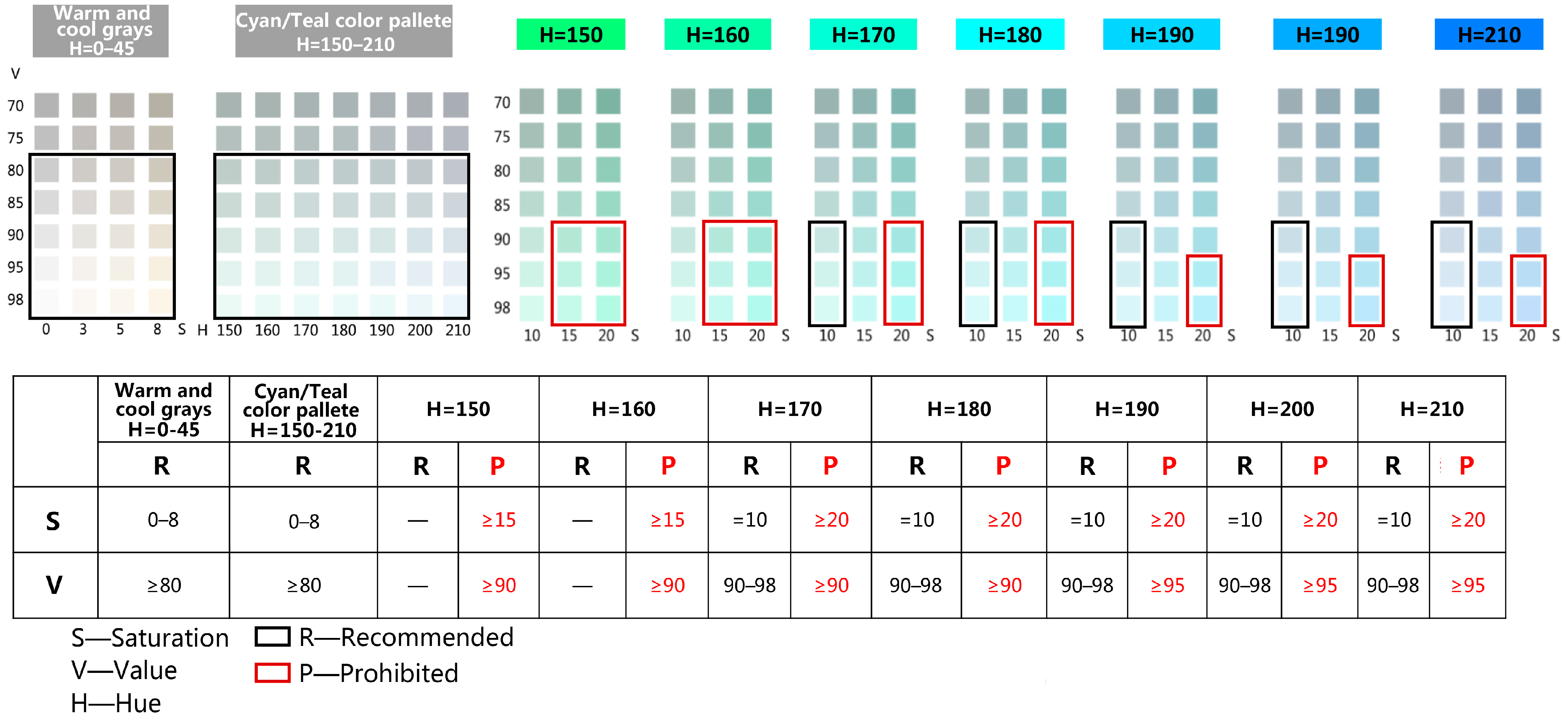
    • High-rise commercial/office buildings: Achromatic or low-saturation, high-brightness gray tones, and either cool-gray or warm beige-gray are recommended, such as white, light gray, pale blue, or light beige-gray. The use of medium-to-high-saturation colors with extreme values is discouraged.
    • Low- and mid-rise R&D and office buildings (including existing industrial buildings): Achromatic or low-saturation, high-brightness gray tones, and either cool-gray or warm beige-gray are advisable to adopt. Alternatively, medium-to-high-saturation and medium-brightness colors such as bluish-gray or gray-red may be appropriate. However, medium-to-high-saturation colors with high brightness are recommended to be avoided.
  • Public Service Buildings (Figure 16)
    • Schools and cultural/exhibition facilities: It is recommended that the design reflect traditional culture by adopting low-saturation and medium-to-high-brightness or medium-saturation and medium-to-high-brightness colors with a restrained and dignified character.
    • Kindergartens: A relatively broad palette is advised, with base colors emphasizing freshness and brightness, such as white, achromatic, or low-saturation high-brightness tones.
    • Concert halls and theaters: The aim is to convey refinement and elegance by favoring achromatic or low-saturation and high-brightness colors.
    • Sports facilities: Given their large scale, it is advisable to adopt lively, vibrant, achromatic or low-saturation and high-brightness colors to highlight energy and vitality.

4.2.3. Recommendations for Building Styles

Color differences across architectural styles are influenced less by users’ psychological needs than by the choice of building materials. For example, European architecture often relies on natural stone in varied hues, creating a visual character that feels calm and solid. In contrast, traditional Chinese architecture typically uses timber, gray bricks, and tiles, producing a restrained palette that emphasizes simplicity and harmony with the natural environment.
  • Modern Architecture
Modern buildings are encouraged to utilize a relatively broad color palette, with a preference for gray-white, bluish-gray, light blue, and light beige tones. However, the use of pink-purple hues and bright colors with both high saturation and high brightness is discouraged.
2.
Traditional Chinese Architecture
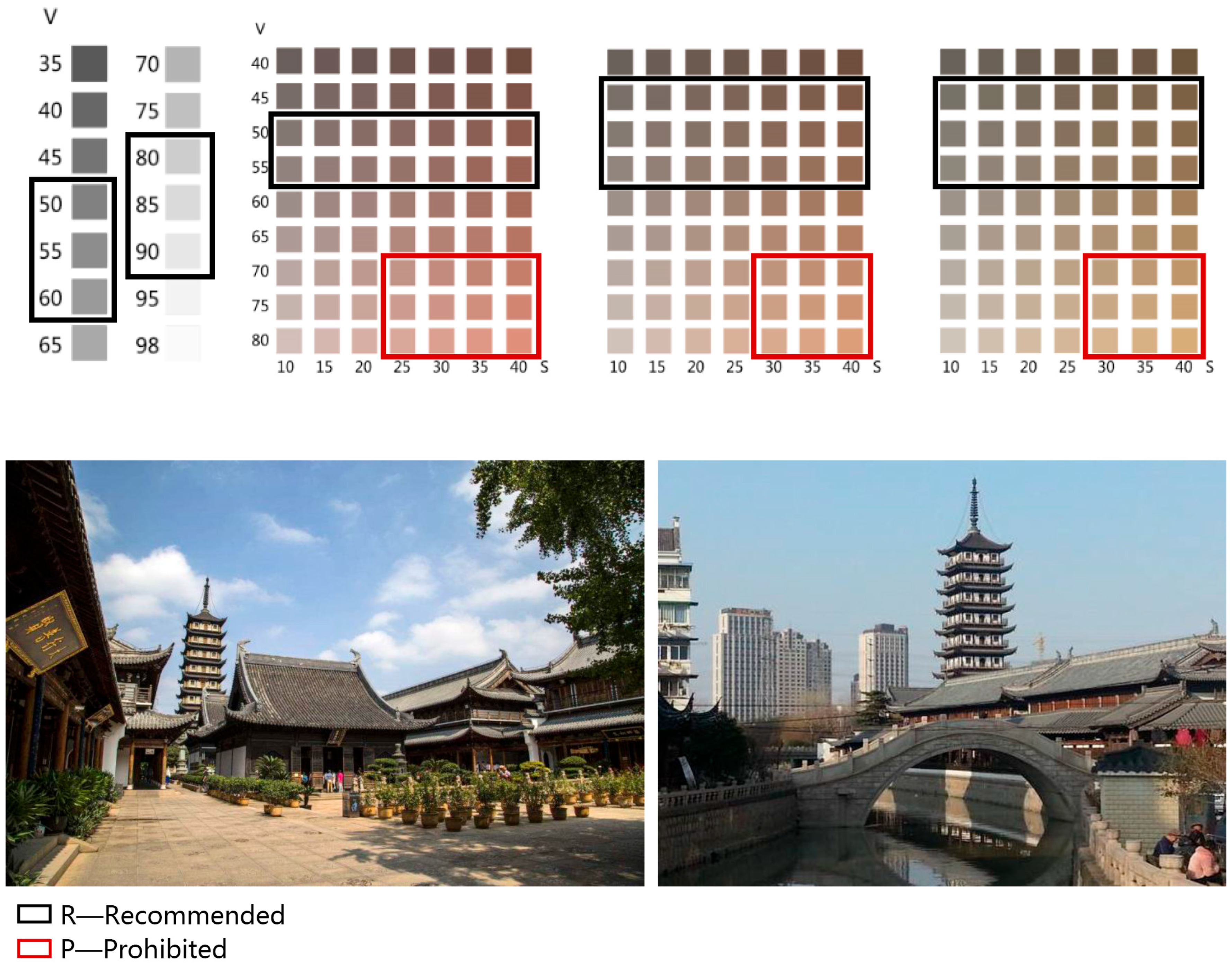
In Jiading District, traditional Chinese architecture is represented primarily by Guyi Garden and Qiuxia Garden. The surrounding built environment and color schemes are encouraged to align with these landmarks. Constructed during the Ming and Qing dynasties, both gardens embody an image of elegance, restraint, and simplicity. Building colors largely reflect the natural tones of materials, with gray-white and bluish-gray roofs and main structures complemented by ochre and light brown accents. The use of high-saturation, high-brightness colors that are inconsistent with the historic character is discouraged (Figure 17).
3.
European-style Architecture
Modified European-style buildings in Jiading are generally residential or commercial in function. Their colors are dominated by low-saturation, high-brightness warm tones such as light gray and light beige, along with dark red tones such as brick red and reddish-brown. Bright colors with high saturation and high brightness are discouraged (Figure 18).
4.
Neo-Chinese Architecture
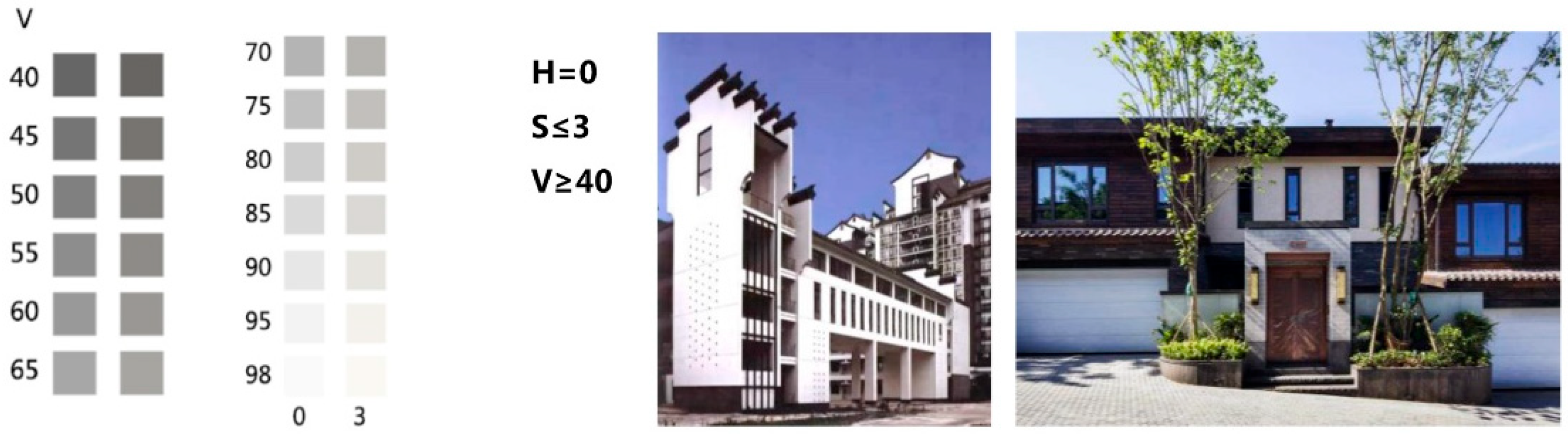
Neo-Chinese buildings are advised to utilize achromatic or low-saturation gray palettes at the extremes of the value spectrum, including bluish-gray, light gray, and white, forming both warm and cool gray tonalities (Figure 19).

4.2.4. Recommendations for Building Massing and Height

Building scale and height also influence color selection, as color can function as a subtle regulatory tool. To reduce the visual heaviness of large-scale or high-rise buildings, designers often use low-saturation or high-value colors to create a sense of lightness, or apply color segmentation to break up continuous facades. In contrast, low-rise or small-scale buildings typically use medium-to-low-value colors with moderate saturation to enhance visual grounding and convey stability.
  • Building Massing and Material
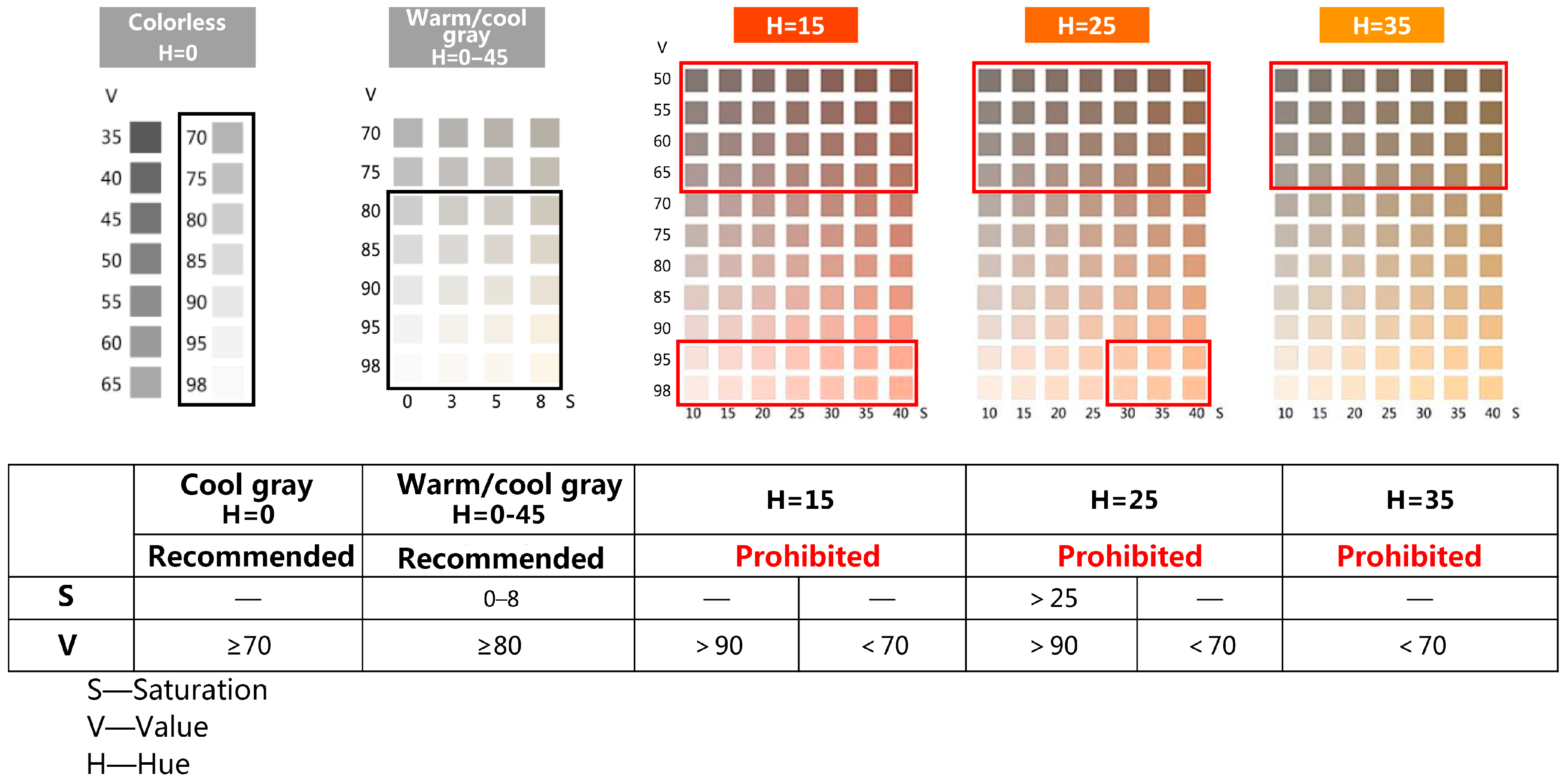
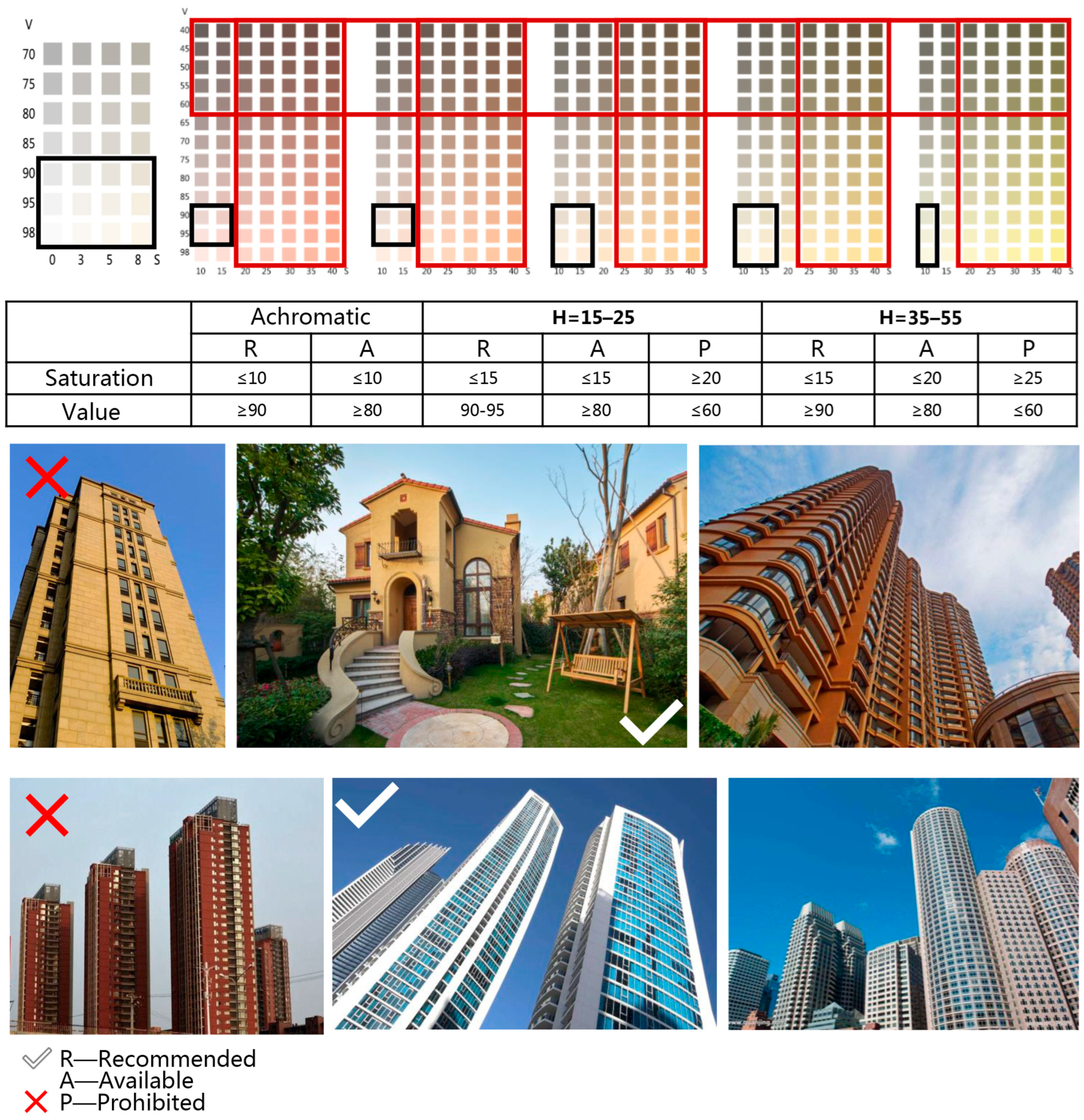
The area effect of color refers to the phenomenon in which the perceived impact of a color varies with the size or massing of a building. For example, applying high-saturation or low-value colors on high-rise or large-scale buildings can easily evoke feelings of anxiety and oppression. Conversely, colors with medium-to-low chroma and medium value may appear harmonious and comfortable on small-scale buildings, but become discordant with the environment when used on large-scale structures (Figure 20).
Accordingly, the proportion of solid façade on large buildings should not exceed 70%, in order to avoid expansive surfaces of high-saturation or low-value colors. Where solid surfaces exceed 50%, light-toned, medium-to-high-value colors are recommended. Large-scale buildings are encouraged to utilize achromatic or low-saturation, medium-to-high-brightness colors to evoke a sense of lightness, avoiding excessive visual heaviness or multicolored facades, while medium-to-high-saturation and medium-to-low-brightness colors are discouraged. Small-scale buildings (e.g., low-rise or mid-rise) may accommodate a wider range of color options.
The use of mirrored glass and high-saturation, low-transparency glazing is advised to be limited. Additionally, excessively bright glazed tiles, low-quality materials, or high-saturation metal panels are not recommended.
2.
Building Height
High-rise buildings are encouraged to primarily use achromatic or low-saturation, medium-to-high-brightness colors (with high brightness being dominant), concentrated at both ends of the brightness scale (mainly high-brightness, with a small proportion of low-brightness).
Low-rise buildings, by contrast, may employ a richer palette that incorporates low-brightness, medium-saturation tones. Overall, the guiding principle is: “light and bright for high-rise, steady and subdued for low-rise.” (Figure 21).

4.2.5. Auxiliary Colors and Accent Colors (Figure 22)

  • Auxiliary Colors
Once the base color is determined, the selection of auxiliary colors should consider two factors: proportion and coordination. No more than two auxiliary colors should be used, covering 20–40% of the building’s façade (excluding glass). They are typically applied to wall details, roofs, windows, or plinths. Coordination with the base color is achieved through the principles of contrast, unity, and harmony.
Figure 22. Consistency in saturation, value and hue for base color, auxiliary color, and accent colors.
Buildings 16 02009 g022
  • Contrast: The hue of auxiliary colors is recommended to differ from that of the baseline, with three possible modes:
    ·
    Adjacent hue contrast: Moderate contrast with a hue difference of 60–90°, achieving unity with subtle variation.
    ·
    Contrasting hue contrast: Stronger contrast with a hue difference of around 120°, producing a striking and energetic effect.
    ·
    Complementary hue contrast: The strongest form of contrast, with a hue difference of 180°, leaving a powerful visual impression in a short time.
  • Unity (dual-element unity): When hues are similar (difference within 15° for same hues, or around 30° for analogous hues), one additional element—value or chroma—may be beneficial to maintain consistency. This produces a simple, calm effect. Neutral colors may also be inserted to enliven the atmosphere or to create value and purity contrasts, for instance by using gradual value transitions to introduce variation.
  • Harmony (single-element coordination): One element—hue, value, or chroma—might ideally remain constant, while the other two vary, which could help in achieving visual balance.
2.
Accent Colors
Accent colors might benefit from thoughtful consideration regarding placement, coordination, and proportion. Their application is advised to remain within 5% of the façade surface area, typically reserved for entrances, signage, cornices, or similar features. While the use of diverse accent colors is acceptable, it is important to maintain an overall composition to avoid clutter. Excessive or disorganized accent colors, such as from storefront advertisements, may be best to refrain from.

4.3. Scheme Generation of Old Buildings and Scheme Evaluation of New Buildings

To demonstrate the application of the proposed methodology, two case studies were selected in Jiading District: neighborhoods six and seven of Yingyuan Residential Area located in Xincheng Road Subdistrict, and the kindergarten located on parcel C05–06 in Jiading New Town. These cases illustrate the operational feasibility of the proposed platform by showing how it can generate and evaluate color schemes under specific planning conditions. They are intended as descriptive demonstrations of workflow implementation.

4.3.1. Platform-Generated Color Scheme

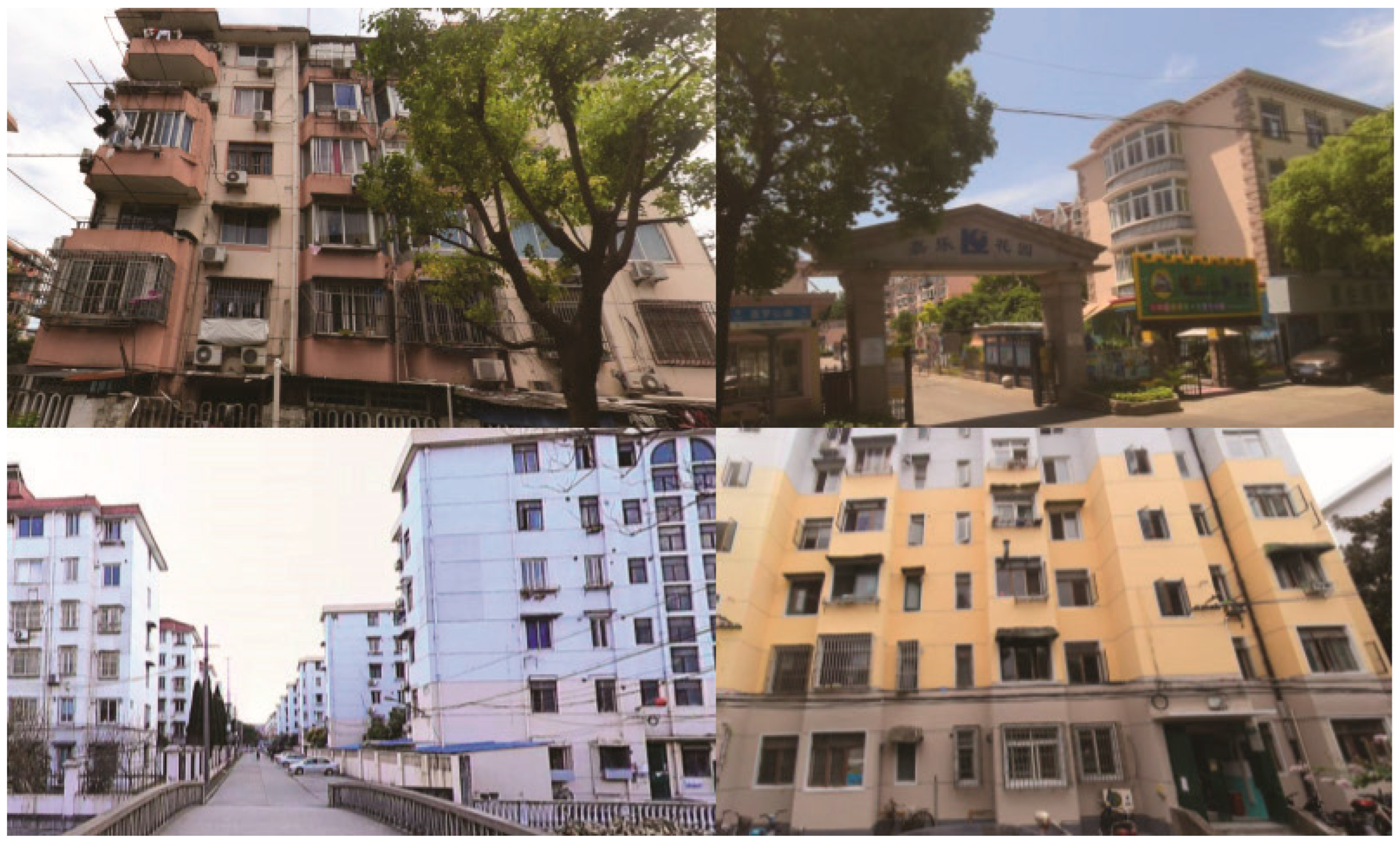
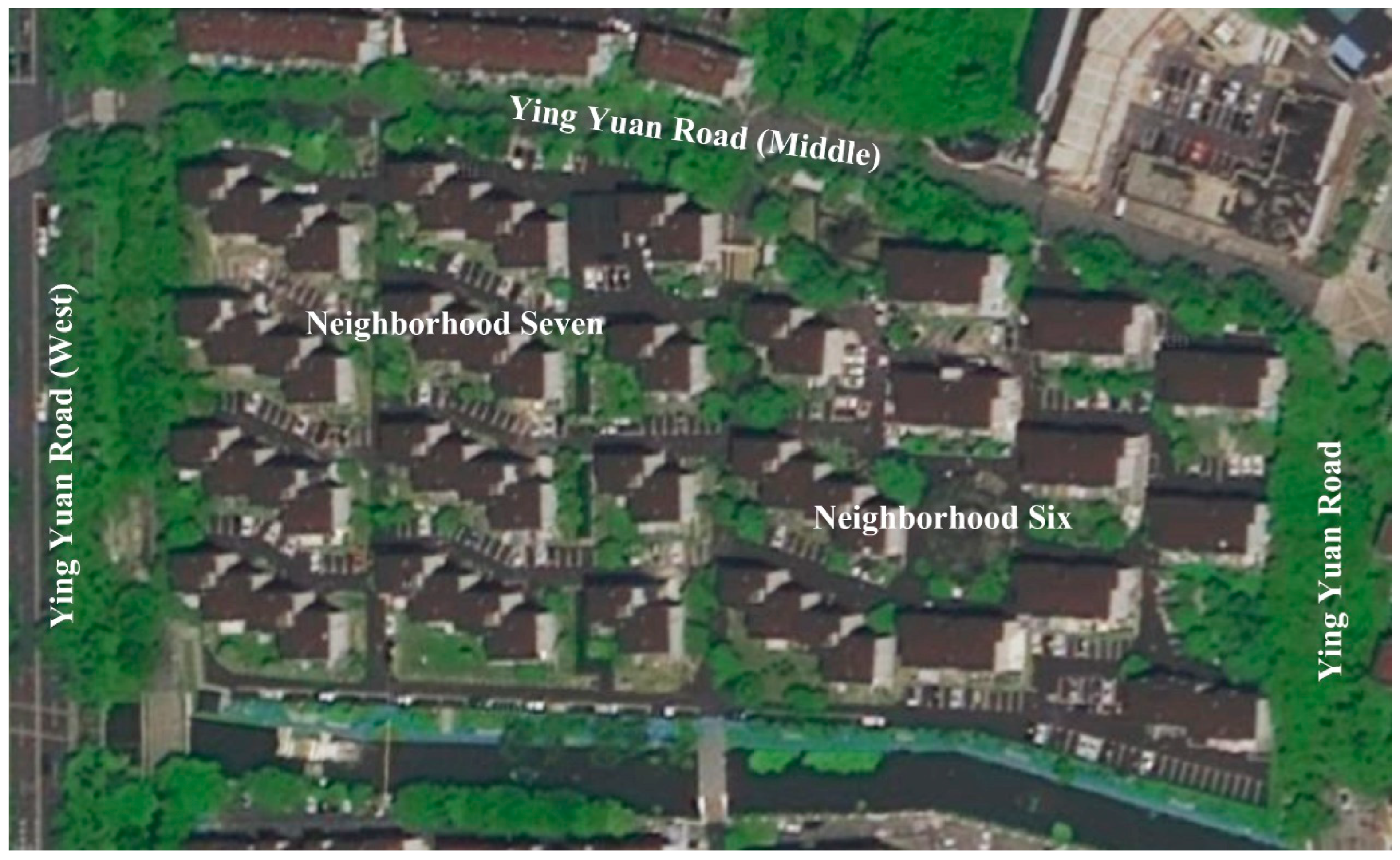
Neighborhoods six and seven of Yingyuan Residential Area are situated in the sub-center color zone designated as a residential community color cluster (Figure 23). The color zoning for this area is low-saturation, high-brightness tones. The site consists of residential buildings in modern architectural style, with mid-rise massing. The surrounding conditions are as follows (Figure 24):
  • West boundary: Yingyuan West Road;
  • East boundary: Yingyuan Road;
  • North boundary: Yingyuan Middle Road;
  • South boundary: Meishui.
Regarding the color environment of adjacent parcels: the block immediately to the south has a dominant light blue hue (with red roofs), while the other three directions are dominated by warm hues. However, the overall saturation of these warm tones is relatively low, characterized primarily by light yellow hues (Figure 23).
Based on the above conditions, two building color schemes are generated through the platform (Table 1).
  • Scheme 1: The base color adopts a high-value, high-saturation warm tone, resembling a bright red-brick finish. The auxiliary color is a high-value, low-saturation light tone, represented by light stone-textured paint. The accent color appears at the balcony air-conditioning units, rendered in a low-value, low-saturation dark tone.
  • Scheme 2: The base color is a high-value, low-saturation hue, expressed as a very light coffee tone, essentially achromatic. The auxiliary color is again a high-value, low-saturation light tone. The accent color is identical to Scheme 1, located at the balcony air-conditioning units and presented in a low-value, low-saturation dark tone. Scheme 2, with its high-value, low-saturation base color (H38, S4, V98), closely aligns with the identified “low-saturation, high-brightness” color zoning for this sub-center area, demonstrating context-aware generation.

4.3.2. Color Scheme Evaluation of New Buildings

The kindergarten on parcel C05–06 in Jiading New Town is a newly developed project located within the sub-center color zone in the modern commercial color cluster. The color zoning for this area is low-saturation, medium-to-high-brightness tones. The site serves as a public building (educational function) in modern architectural style, with a low-rise, small-scale massing. The site boundaries are as follows:
  • North: G1503 Shanghai Ring Expressway;
  • West: blue-line water body;
  • South: Hongde Road;
  • East: Aksu Road.
The surrounding color environment is as follows: to the east, Yuanxiangfang Xinyuan residential complex is in light beige; the west, south, and north are dominated by water bodies and green spaces.
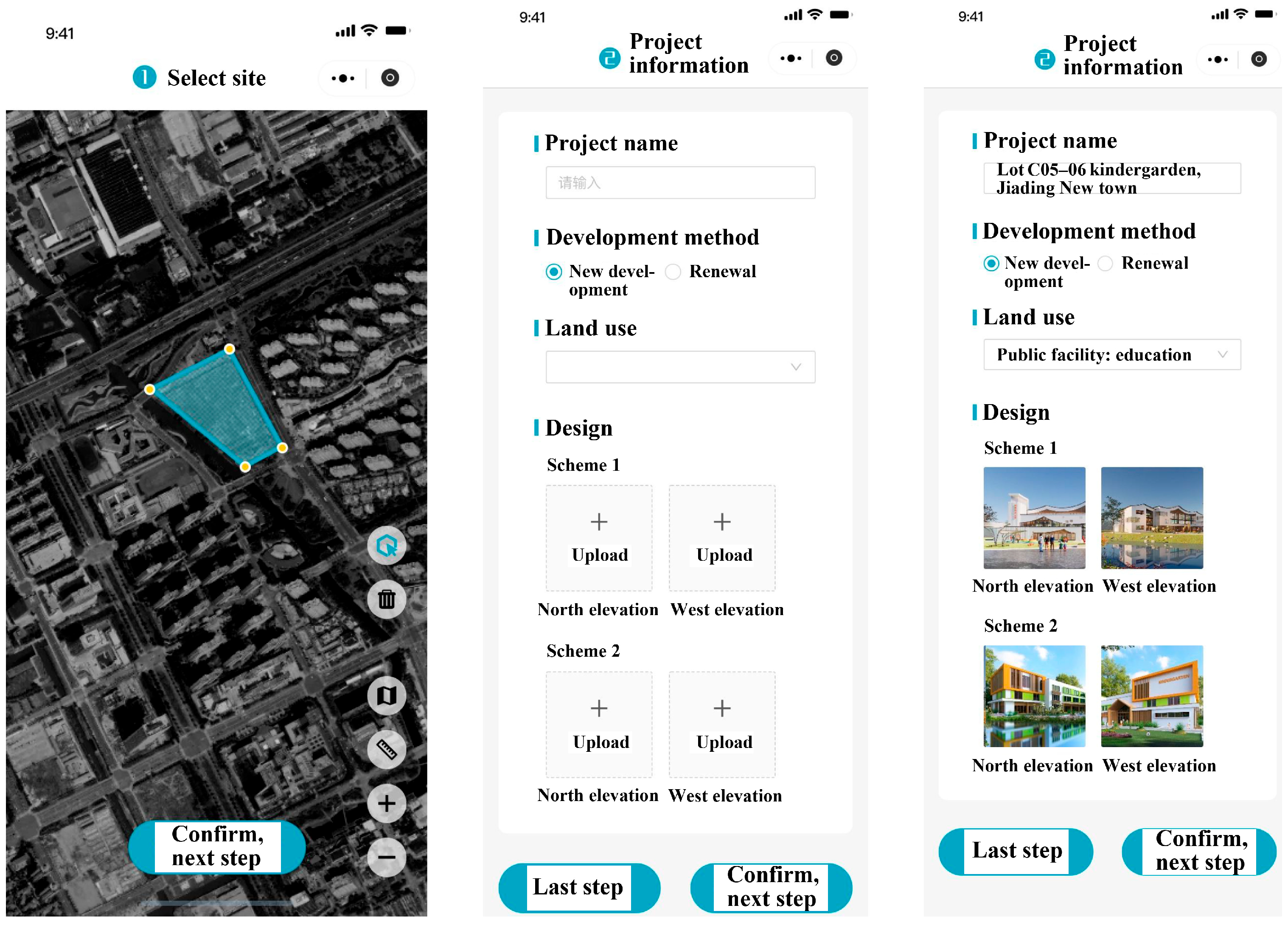
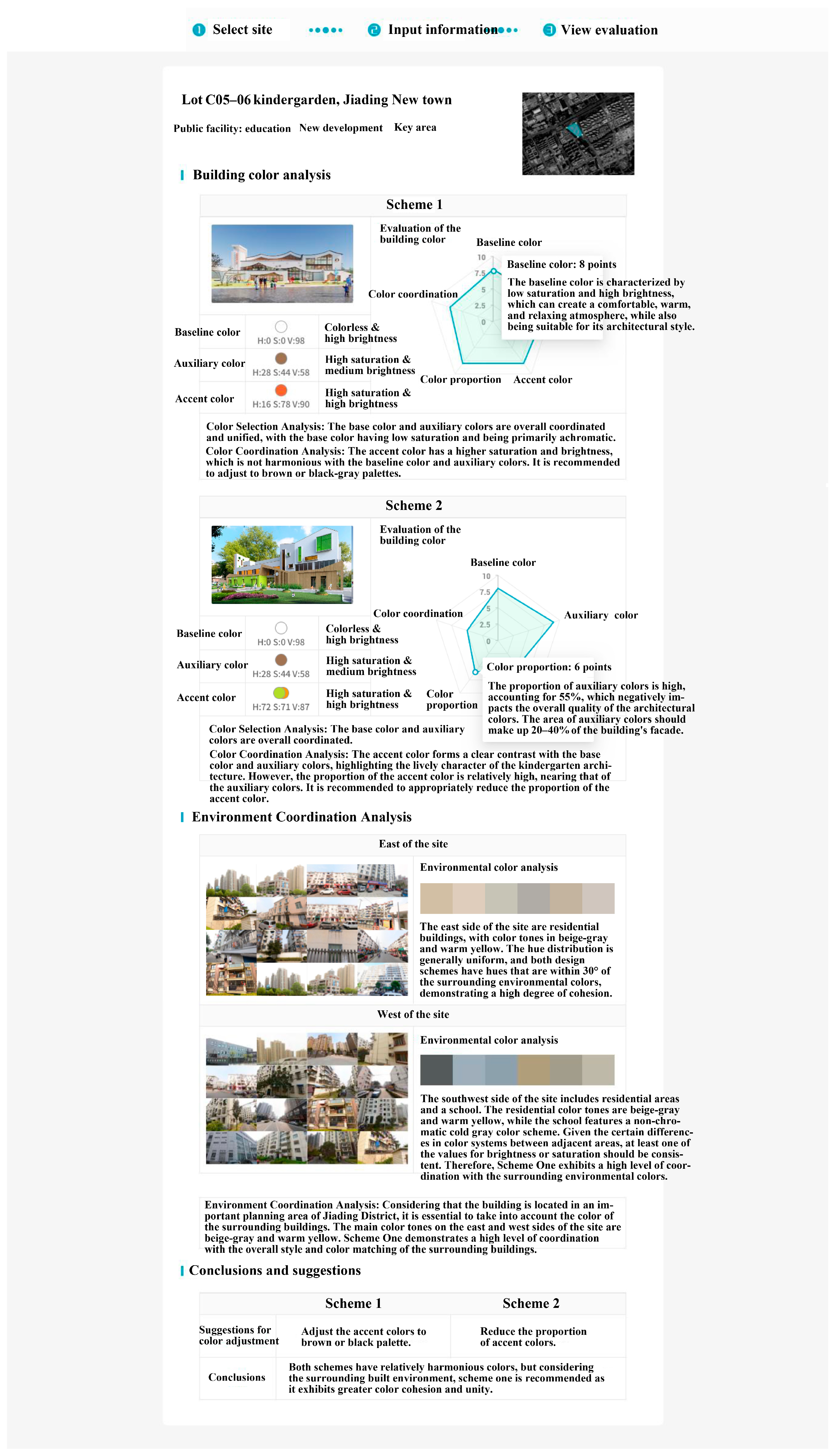
The design institute has prepared two alternative schemes. The building’s functional attributes, style, and massing; the color environment of surrounding developments; and the rendered elevations of both schemes were uploaded to the platform. The platform then generated results on both the color characteristics of the proposed building itself and the coordination with surrounding environments (Figure 25).
  • Scheme 1: The base color (H0, S0, V98) is achromatic and high-saturation; the auxiliary color (H28, S44, V58) is medium-saturation with high brightness; and the accent color (H16, S78, V90) is high-saturation with high brightness. The intrinsic color score of Scheme 1 is relatively balanced. Scores for baseline, auxiliary, and accent colors, as well as color proportion, all exceed 8, with no notable weaknesses. The only slightly lower score is in color coordination, suggesting insufficient harmony in the use of accent colors, whose saturation appears somewhat high.
  • Scheme 2: The base color (H0, S0, V98) is achromatic and high-saturation; the auxiliary color (H28, S44, V58) is medium-saturation with high brightness; and the accent color (H72, S71, V87) is high-saturation with high brightness. The auxiliary color accounts for 55% of the surface. The intrinsic color score of Scheme 2 reveals weaknesses in color coordination and color proportion. Specifically, the auxiliary color accounts for 55% of the palette, creating excessive contrast.
The environmental color analysis shows that residential buildings to the east adopt beige-gray and warm yellow hues, while those to the southwest are also beige-gray and warm yellow, and the nearby school employs achromatic cool-gray hues. For both schemes, the hue distance from the surrounding environment is within 30°, indicating a reasonable degree of visual compatibility (Figure 26).

4.3.3. Manual Correction

To validate the practical effectiveness of the platform’s outputs, a blinded expert evaluation was integrated into the review process: five experts (with 5–15 years of urban color planning experience, unrelated to the study team) scored the platform-generated and manual schemes on five dimensions (contextual coordination, color harmony, compliance, aesthetics, practicality) without knowing the source.
The evaluation adopted a two-tier hierarchical framework. The first tier comprised three fundamental dimensions:
(1)
Contextual coordination—the degree to which the color scheme aligns with the surrounding urban environment, historical context, and functional character;
(2)
Color harmony—the selection and proportional arrangement of primary and secondary colors in terms of hue, saturation, and brightness;
(3)
Compliance—adherence to local color guidelines and zoning requirements.
Each of these three dimensions was assessed on a binary pass/fail basis. A scheme that failed any of the three dimensions was immediately flagged as “requiring revision” and did not proceed to the second tier.
The second tier comprised two enhancement dimensions:
(4)
Aesthetics—the overall visual appeal and subjective impression of beauty;
(5)
Practicability—implementation feasibility, including material availability, maintenance costs, and real-world construction constraints.
Only schemes that passed all three fundamental dimensions proceeded to this tier, where they were evaluated using a five-point scale (1 = very poor, 2 = poor, 3 = fair, 4 = good, 5 = excellent), with the option for experts to provide qualitative comments.
The scoring process was conducted independently by each expert in a controlled environment, with schemes presented in random order to mitigate order effects. Borderline cases for “pass/fail” determinations were clearly defined, and a reason check-box was provided for “fail” decisions. The mean correlation coefficient between each expert’s scores and those of the other experts was calculated, allowing for re-evaluation and score adjustment.
The expert review confirmed that 142 out of 156 chromatic conflicts identified by the platform were valid, representing a precision rate of 91%. In terms of efficiency, the platform completed color scheme generation and compliance evaluation for 100 parcels in 4 h, while the traditional manual process for the same workload required approximately 14 working days, representing a 96% reduction in processing time.
For the platform-generated color schemes of Yingyuan Residential Area, expert judgment and discussion yielded the following conclusions:
  • Scheme 1: The differences in hue and saturation between the base and auxiliary colors are too large, resulting in insufficient harmony. The color of the building plinth is overly light, failing to convey a sense of stability, while the accent color is too low in value.
  • Scheme 2: The hues are more consistent, and the base color is easier to coordinate, producing a stronger overall sense of harmony. The auxiliary color pairing is also relatively appropriate. However, the accent color again has excessively low value.
Between the two options, Scheme 2 is preferred, with the recommendation of slightly increasing the value of the accent color. In addition, neighborhood four of Yingyuan Residential Area to the south is found to have color inconsistencies and is recommended to undergo updating. If the northern and eastern buildings are not slated for renovation, Scheme 2 should incorporate subtle warm yellow tones to achieve better coordination with the surrounding context.
For the platform-analyzed color schemes of the kindergarten on parcel C05–06 in Jiading New Town, expert assessment reached the following conclusions:
  • Scheme 1: The low-saturation, high-brightness base color conveys a sense of comfort, warmth, and tranquility, aligning well with the building’s architectural style. The baseline and auxiliary colors are unified and coordinated. However, the accent color is overly high in both saturation and value, rendering it incompatible with the base and auxiliary tones.
  • Scheme 2: The base and auxiliary colors are well coordinated, while the accent color forms a strong contrast, successfully highlighting the lively character of a kindergarten. Nonetheless, the accent color is too similar to the auxiliary color in value, diminishing its distinctiveness. Furthermore, the auxiliary color’s proportion is excessive at 55% and should be reduced to 20–40%.
Considering broader environmental compatibility, the surrounding areas to the east and west are characterized by beige-gray and warm yellow tones. Where adjacent hues differ significantly, at least one dimension—either color brightness or saturation—should remain consistent. In this regard, Scheme 1 demonstrates greater harmony with the surrounding color environment.
Between the two options, Scheme 1 is recommended, with a further suggestion to adjust the accent color toward brown or black-gray tones. This manual refinement step is a critical component of the proposed workflow, not a limitation. It illustrates the platform’s role in providing a quantified, evidence-based starting point and evaluation for expert decision-making, which then incorporates nuanced contextual and aesthetic judgments.

5. Discussion

5.1. The Pathway Bridging Big Data, Machine Learning, and Urban Color Governance

There is a long-standing disconnection between urban color status analysis and color governance. Traditionally, urban color surveys relied on limited fieldwork or expert judgments, producing fragmented datasets that often lacked spatial comprehensiveness and objectivity. As a result, color planning was more descriptive than prescriptive, providing general guidelines but offering little operational support for decision-making.
An SVI is particularly powerful because it captures the visual perspective of urban residents, reflecting how colors are experienced in everyday life. While aerial or cadastral datasets provide structural information, only ground-level imagery conveys façade composition and the perceptual qualities of urban spaces.
Nevertheless, SVI and machine learning can not only produce fine-grained, districtwide datasets on building hues, saturation, and brightness, but also translate the data into context-based planning inputs. While cities have historically been planned without digital tools, the increasing spatial scale and complexity of contemporary urban environments make it difficult to rely exclusively on qualitative judgment. In this context, image-based analysis complements traditional planning practices by providing systematic visual evidence that can inform discussion, evaluation, and coordination in planning processes. By grounding planning decisions in quantitative analysis, the Jiading platform establishes an effective linkage between early-stage urban color research and later-stage color coordination recommendation, thereby avoiding the disconnect often observed between research and implementation. The digital analysis platform integrates contextual conditions, enabling automated image analysis through computer processing, followed by expert judgment for refinement. This integration transforms color analysis from a diagnostic tool into a regulatory instrument, filtering the descriptive richness of street-level imagery through the normative lens of regulatory conditions. Within the framework, on-the-ground building color design outcomes were aligned with higher-level planning goals. The base color range was defined by considering building function, style, massing, and number of floors. Based on the base color, ranges for auxiliary and accent colors were determined. SVIs were then collected and processed through the analysis platform: for existing parcels, the system automatically generated color schemes; for newly developed parcels, it evaluated proposed color schemes. The final design schemes and evaluation results were produced by combining machine learning outputs with expert comparison and adjustment. This established a direct linkage between empirical research and planning suggestion, ensuring that color planning supports both aesthetic coherence and regulatory enforceability. Importantly, such linkage creates measurable benchmarks, reduces subjectivity, and enables continuous monitoring—key attributes of digital governance.
Internationally, many planning systems—such as Japan’s “Color Control Method” or European townscape guidelines—rely heavily on expert interpretation of photographic records. The Jiading platform advances this tradition by automating analysis at scale and embedding results into practicable planning suggestions. This shift from manual assessment to AI-assisted evaluation represents a broader digital city transition: moving from static guidance documents to dynamic, data-driven governance instruments.

5.2. Positioning Urban Color Governance Within the Digital City Framework

Taken together, the Jiading platform highlights how urban color governance can be reframed as a component of digital city management. Integrating SVI, machine learning, and result visualization creates a feedback loop in which real-time data collection, automated evaluation, and participatory review converge to inform planning practice. This contributes to the broader digital city agenda in two ways. Positioning urban color governance within the digital city framework highlights a shift in how urban qualities are conceptualized, measured, and managed. Traditionally, digital city technologies have concentrated on quantifiable aspects of infrastructure, transportation, and utilities—domains where sensors, networks, and data analytics are well established. Yet the experience of urban life is shaped not only by flows and services but also by qualitative dimensions, such as visual aesthetics, cultural identity, and the continuity of place character.
Color governance criteria related to heritage and cultural values should be grounded in a research-based understanding of local history, material traditions, and cultural identity, rather than derived solely from an analysis of current conditions. At the same time, contemporary urban design may accommodate selected interventions that contrast with the existing landscape, provided that such contrasts are intentional, contextually justified, and compatible with the overall visual structure of the district. For example, cases such as the Comfort Town development in Kyiv illustrate how strong individual color expression can coexist with broader urban coherence. In this study, the platform adopts a flexible guideline framework to support such context-sensitive decisions, while its cultural color database can be further expanded to incorporate heritage cases from different regions, enhancing its adaptability and international applicability.
By incorporating urban color into data-driven governance, digital cities can evolve beyond functional efficiency to embrace experiential and symbolic qualities of urban environments. In doing so, they open a new frontier for smart governance, where cultural sustainability and spatial identity are treated as essential components of urban quality.
A second implication lies in the potential for replication and transferability. The platform developed for Jiading illustrates how large-scale color analysis can be standardized, automated, and embedded in planning practice. While it responds to the specific institutional context of China, the underlying approach can be adapted in diverse settings. In countries with robust planning systems, such as Japan or several European states, it could complement existing heritage and design recommendations by introducing real-time monitoring and automated evaluation. In regions with limited planning capacity, particularly in parts of Africa, Latin America, and South Asia, it could serve as a low-cost governance model that improves visual coherence and reduces reliance on ad hoc decision-making. By positioning color governance as part of the digital city agenda, the platform demonstrates that aesthetic quality is not a luxury, but a practical and transferable dimension of sustainable urban development.
At the same time, while the framework translates planning regulations into operationalized algorithmic rules, it is not intended to function as a rigid color prescription or a universal compositional template. Instead, it identifies a structured set of design conditions that help guide decision-making while preserving architectural diversity. The framework supports planners and designers by offering evidence-based boundaries and compatibility checks, while final color selection remains informed by architectural intent, cultural context, and expert assessment.
Overall, urban color is repositioned from a secondary design concern to an integral part of data-driven digital city planning, advancing both the theoretical and practical dimensions of sustainable urban governance.

5.3. Embedding the Platform into Daily Approval and Supervision and Its Application in the Global South

To integrate the platform into daily approval and supervision, urban management departments can adopt a three-stage closed-loop workflow: pre-application self-check, formal submission evaluation, and post-approval monitoring.
In the pre-application phase, developers access the platform to generate preliminary color schemes that comply with chromatic regulations, reducing design iterations. Upon formal submission, the platform automatically evaluates proposals against zoning requirements, generating a brief compliance report with quantitative scores across the coordination dimension that serves as supporting documentation. During construction, street view updates can be routinely scanned by the platform to detect deviations from approved color schemes, enabling early detection of non-compliant projects.
This workflow unifies design review, construction supervision, and post-completion inspection under a single digital infrastructure.
For countries in the Global South with limited financial or institutional capacity for urban planning, the system could be adapted in two ways: offline data packages and modular deployment. Offline data packages containing a pre-trained basic module and classic color palette coordination framework are ideal for countries with poor internet access. The platform can also be split into isolated, customizable modules such as data collecting, color analyzing, and scheme evaluation to match local resource requirements.
Another challenge concerns the non-public domain datasets (e.g., Baidu/Tencent Maps). Municipalities might negotiate municipal licensing agreements ensuring: (1) quarterly updates at minimum; (2) API access for batch downloading; and (3) archival access to historical imagery for compliance verification.

5.4. Limitations and Balance in Chromatic Regulations

The framework has inherent limitations. The focus on building facades, while pragmatic for design governance, simplifies the fuller urban color experience. Street view data variability (occlusions, seasonal changes, update cycles) is mitigated by large-sample aggregation but not eliminated. The ML models, while effective, operate as “black boxes”; future work should enhance interpretability. Crucially, the planning parameters, while informed by data, are ultimately normative. They risk promoting uniformity if applied inflexibly. Therefore, the platform is designed with adjustable parameters to allow for creative exploration within a zone of compliance, balancing coherence with diversity.
At its current stage, the platform functions as an auxiliary decision-support tool that complements—rather than replaces—expert judgment and planning regulation. To preserve design creativity, the framework intentionally provides color ranges rather than fixed prescriptions. Architects interact with the system through an exploratory interface that visualizes the guideline space as a navigable 3D HSV volume, where compliant zones are highlighted and non-compliant selections trigger explanatory feedback rather than hard blocks.

5.5. Pathways for Validation and Public Participation

Integrating color analysis with planning management, embedding street view data into criteria frameworks, and enabling visualized evaluation together provides a practical, replicable model for data-driven urban color governance practice. The case studies presented in this research are intended to demonstrate the technical feasibility and operational functionality of the framework, rather than to assert its absolute superiority over existing traditional approaches.
The case studies demonstrate functionality but not comprehensive validation. They should therefore be interpreted as proof-of-concept implementations that illustrate how the system can support planning workflows under real-world conditions. Granted that these case studies focus on feasibility and efficiency, they lay the groundwork for future perceptual benchmarking. Subsequent research should incorporate systematic benchmarking against traditional design-review processes in terms of time, consistency, and outcomes. In addition, future studies should compare the platform with manual and baseline approaches using systematic evaluation metrics. Furthermore, the current framework lacks validation against public perception. Integrating citizen evaluations through the platform’s visualization tools is a vital next step to ensure that algorithmic and expert recommendations align with community aesthetic values and psychological well-being. Beyond analysis and recommendation, digital city applications can be extended into the realm of public participation and scenario testing. By generating immersive visualizations of both existing and proposed color schemes, virtual reality allows planners, decision-makers, and residents to evaluate not just individual parcels but also the collective harmony of urban color scenes. Quantitative measures of hue and tone harmony can be supplemented with experiential assessments, enabling both expert and lay stakeholders to engage in deliberation. This participatory dimension is particularly relevant to the digital city agenda, which emphasizes transparency, inclusivity, and interactivity. In Jiading, visualized comparisons of alternative color schemes help to assist in addressing the challenges of fragmented parcel-level decisions leading to incoherent citywide outcomes. More broadly, such visualization tools can foster community dialog, enhance trust in planning decisions, and align design practices with public expectations.

6. Conclusions

This study explored a data-driven framework for urban color planning, integrating SVIs, machine learning, and a digitally encoded coordination reference system. Using Jiading District as a case study, we demonstrated a workflow to map color characteristics, synthesize policy and contextual factors into a decision-support platform, and apply it to generate and evaluate color schemes.
The primary contribution is methodological: providing a replicable model for linking large-scale visual analytics with actionable planning guidance. The platform serves as a support tool for planners, offering evidence-based suggestions that require expert and community refinement. It represents a step toward making urban color a more measurable and debatable component of digital city planning.
Although developed for Jiading, the framework’s logic—of triangulating image data, local policy, and expert knowledge—holds transferability potential for other cities seeking scalable approaches to visual governance. Future work should focus on multi-source data fusion, model interpretability, and, most importantly, robust validation through comparative studies and public engagement to fully realize its potential as a tool for sustainable and livable urban design.
Despite providing a feasible data-driven model for urban color governance rather than its superiority over existing methods, several limitations remain. First, the reliance on SVI introduces environmental variability. Factors such as inconsistent lighting, seasonal changes in vegetation, and varying camera perspectives can influence chromatic extraction accuracy. Although color normalization is implemented, these external variables may still cause subtle fluctuations in HSV values. Future research should explore advanced atmospheric correction algorithms and multi-temporal image averaging to stabilize data under diverse conditions.
Second, image occlusions (e.g., trees and vehicles) and uneven update frequencies remain a challenge, necessitating the integration of multi-source data like drone and remote sensing imagery.
Third, the machine learning models require rigorous testing across diverse architectural and cultural contexts to improve generalizability and address potential algorithmic bias. Lastly, since the framework currently relies on existing guidelines, developing adaptive, data-informed standards that evolve with urban conditions is essential.
While limitations regarding image occlusion, update frequency, and the current absence of cultural context affect the platform’s current precision and implementation maturity, they do not undermine the validity of its core conceptual framework. Instead, these challenges define the trajectory for future refinement. Future studies must incorporate perception-based validation to ensure algorithmic outputs align with public aesthetic expectations and psychological comfort. Implementing such a system also requires addressing institutional challenges, including data privacy and cross-departmental coordination. Finally, expanding the analysis to the fifth elevation (roofscapes) via aerial data would transition the framework from a façade-oriented tool to a comprehensive three-dimensional urban color governance system, supporting both local distinctiveness and digital city planning goals.

Author Contributions

Conceptualization, Z.Y. and J.X.; methodology, J.X.; software, S.H.; validation, Z.Y., D.W. and J.X.; formal analysis, J.X.; investigation, Y.L. and Y.X.; resources, Z.Y.; data curation, S.H.; writing—original draft preparation, J.X.; writing—review and editing, J.X. and D.W.; visualization, S.H.; supervision, Z.Y. and J.X.; project administration, Z.Y. All authors have read and agreed to the published version of the manuscript.

Funding

This research received no external funding.

Data Availability Statement

The data presented in this study are available on request from the corresponding author.

Acknowledgments

The authors have reviewed and edited the output and take full responsibility for the content of this publication. Fangzhen Zhou and her colleagues from the Jiading District Planning and Natural Resources Bureau provided continuous guidance throughout the projects discussed in this paper. Liu Liu and Jinxin Shao from Cityspace Technology, as well as Shasha Huang, Ruoying Ma, and Guangxin Dai from the East China Architectural Design and Research Institution, offered valuable technical support. The authors would like to express their sincere gratitude to all of them.

Conflicts of Interest

Authors Zhongnan Ye, Yang Liu and Yu Xiang were employed by the company East China Architectural Design and Research Institution. Author Shasha Huang was employed by the company Shanghai Scientific Technology Development Branch of Arcplus Group PLC. The remaining authors declare that the research was conducted in the absence of any commercial or financial relationships that could be construed as a potential conflict of interest.

References

  1. Zhang, L.; Li, X.; Li, C.; Zhang, T. Research on Visual Comfort of Color Environment Based on the Eye-Tracking Method in Subway Space. J. Build. Eng. 2022, 59, 105138. [Google Scholar] [CrossRef]
  2. Mahnke, F.H. Color, Environment, and Human Response an Interdisciplinary Understanding of Color and Its Use as a Beneficial Element in the Design of the Architectural Environment; John Wiley & Sons: Hoboken, NJ, USA, 1996; pp. 1–248. [Google Scholar]
  3. Liu, S.; Zhu, S.Y. Research on Influencing Factors of Urban Color—Taking Changsha as an Example. Appl. Mech. Mater. 2014, 675–677, 1279–1282. [Google Scholar] [CrossRef]
  4. Chen, L.; Kong, F. Quantitative Method of Regional Color Planning–Field Investigation on Renewal Design of Jiangchuan Street. In Proceedings of the International Conference on Applied Human Factors and Ergonomics, Manhattan, NY, USA, 25–29 July 2021; Springer: Berlin/Heidelberg, Germany, 2021; pp. 608–617. [Google Scholar]
  5. Zhang, S.; Liu, Y.; Nie, H. Geographical Feature based Research on Urban Color Environment—Taking Wuhan as an Example. IERI Procedia 2014, 9, 190–195. [Google Scholar] [CrossRef]
  6. Gou, A.; Shi, B.; Wang, J.; Wang, H. Color Preference and Contributing Factors of Urban Architecture Based on the Selection of Color Samples—Case Study: Shanghai. Color. Res. Appl. 2022, 47, 454–474. [Google Scholar] [CrossRef]
  7. Hemphill, M. A note on adults’ color–emotion associations. J. Genet. Psychol. 1996, 157, 275–280. [Google Scholar] [CrossRef]
  8. Kaya, N.; Epps, H.H. Relationship between color and emotion: A study of college students. Coll. Stud. J. 2004, 38, 396–405. [Google Scholar]
  9. Lee, H.; Park, J.; Lee, J. Comparison between psychological responses to object colour produced by paint colour and object colour produced by light source. Indoor Built Environ. 2021, 30, 502–519. [Google Scholar] [CrossRef]
  10. Lindal, P.J.; Hartig, T. Architectural variation, building height, and the restorative quality of urban residential streetscapes. J. Environ. Psychol. 2013, 33, 26–36. [Google Scholar] [CrossRef]
  11. Subiza-Pérez, M.; Vozmediano, L.; Juan, C.S. Green and blue settings as providers of mental health ecosystem services: Comparing urban beaches and parks and building a predictive model of psychological restoration—ScienceDirect. Landsc. Urban Plan. 2020, 204, 103926. [Google Scholar] [CrossRef]
  12. Zhong, T.; Ye, C.; Wang, Z.; Tang, G.; Zhang, W.; Ye, Y. City-Scale Mapping of Urban Facade Color Using Street-View Imagery. Remote Sens. 2021, 13, 1591. [Google Scholar] [CrossRef]
  13. Harvey, C. Measuring Streetscape Design for Livability Using Spatial Data and Methods. Master’s Thesis, The University of Vermont and State Agricultural College, Burlington, VT, USA, 2014. [Google Scholar]
  14. Brownson, R.C.; Hoehner, C.M.; Day, K.; Forsyth, A.; Sallis, J.F. Measuring the built environment for physical activity: State of the science. Am. J. Prev. Med. 2009, 36, 99–123. [Google Scholar] [CrossRef]
  15. Wang, J.; Zhang, L.; Gou, A. Study on the Preference of City Color Image Selection Based on the Logistic Model: A Case Study of Shanghai. Color Res. Appl. 2020, 45, 542–557. [Google Scholar] [CrossRef]
  16. Wang, Z.; Sun, H.; Li, J. Research on Architectural Color and Visual Comfort in Historic Landscape Areas. Buildings 2023, 13, 1004. [Google Scholar] [CrossRef]
  17. Batty, M. Digital twins. Environ. Plan. B Urban Anal. City Sci. 2018, 45, 817–820. [Google Scholar] [CrossRef]
  18. Dubey, A.; Naik, N.; Parikh, D.; Raskar, R.; Hidalgo, C.A. Deep Learning the City: Quantifying Urban Perception at a Global Scale. In Computer Vision—ECCV 2016; Leibe, B., Matas, J., Sebe, N., Welling, M., Eds.; Springer: Cham, Switzerland, 2016; pp. 196–212. [Google Scholar] [CrossRef]
  19. Zhou, B.; Liu, L.; Oliva, A.; Torralba, A. Recognizing city identity via attribute analysis of geo-tagged images. In Computer Vision—ECCV 2014; Fleet, D., Pajdla, T., Schiele, B., Tuytelaars, T., Eds.; Springer: Cham, Switzerland, 2014; pp. 519–534. [Google Scholar] [CrossRef]
  20. Nisaito, Y. Deep Learning for Beginners; People’s Posts and Telecommunications Publishing House: Beijing, China, 2018. [Google Scholar]
  21. Lee, S.; Maisonneuve, N.; Crandall, D.; Efros, A.A.; Sivic, J. Linking past to present: Discovering style in two centuries of architecture. In Proceedings of the IEEE International Conference on Computational Photography, Houston, TX, USA, 24–26 April 2015; Available online: https://inria.hal.science/hal-01152482/ (accessed on 14 February 2026).
  22. Salesses, P.; Schechtner, K.; Hidalgo, C.A. The Collaborative Image of The City: Mapping the Inequality of Urban Perception. PLoS ONE 2013, 8, e68400. [Google Scholar] [CrossRef] [PubMed]
  23. Meichen, D. Quantitative contrast of urban agglomeration colors based on image clustering algorithm: Case study of the Xia-Zhang-Quan metropolitan area. Front. Archit. Res. 2021, 10, 692–700. [Google Scholar] [CrossRef]
  24. Zhang, F.; Zhou, B.; Liu, L.; Liu, Y.; Ratti, C. Measuring human perceptions of a large-scale urban region using machine learning. Landsc. Urban Plan. 2018, 180, 148–160. [Google Scholar] [CrossRef]
  25. Liu, L.; Silva, E.A.; Wu, C.; Wang, H. A machine learning-based method for the large-scale evaluation of the qualities of the urban environment. Comput. Environ. Urban Syst. 2017, 65, 113–125. [Google Scholar] [CrossRef]
  26. Zhang, Y.; Xiong, X.; Yang, S.; Zhang, Q.; Chi, M.; Wen, X.; Wang, J. Enhancing the visual environment of urban coastal roads through deep learning analysis of street-view images: A perspective of aesthetic and distinctiveness. PLoS ONE 2025, 10, e0317585. [Google Scholar] [CrossRef]
  27. Wen, Y.; Himeno, Y.; Chung, J. Potential conflicts between individual preferences and city color planning: A case study of Busan, South Korea. J. Asian Archit. Build. Eng. 2023, 22, 3649–3664. [Google Scholar] [CrossRef]
  28. Zhou, Z.; Zhong, T.; Liu, M.; Ye, Y. Evaluating building color harmoniousness in a historic district intelligently: An algorithm-driven approach using street-view images. Environ. Plan. B Urban Anal. City Sci. 2023, 50, 1838–1857. [Google Scholar] [CrossRef]
  29. McCay, L. The Links Between Colour, Architecture, and Mental Health. Sanity and Urbanity Forum 2017. Available online: https://www.urbandesignmentalhealth.com/sanity--urbanity-forum/the-links-between-colour-architecture-and-mental-health (accessed on 14 February 2026).
  30. Chiu, Y.-C.; Ho, M.-C.; Tu, J.-C.; Yang, Z.-X. Color Images in Architecture for Stress-Relief. Eng. Proc. 2024, 74, 18. [Google Scholar] [CrossRef]
  31. Sustainability Directory. How Does Color Psychology Affect Urban Spaces? 2023. Available online: https://lifestyle.sustainability-directory.com/question/how-does-color-psychology-affect-urban-spaces/ (accessed on 14 February 2026).
  32. Kaarwan. Color Theory in Architecture: Understanding the Basics. 2024. Available online: https://www.kaarwan.com/blog/architecture/color-theory-in-architecture?id=232 (accessed on 14 February 2026).
  33. Rethinking The Future. Use of Color in Building Facades. 2026. Available online: https://www.re-thinkingthefuture.com/article/use-of-color-in-building-facades/ (accessed on 14 February 2026).
  34. Zhai, Y.; Gong, R.; Huo, J.; Fan, B. Building Façade Color Distribution, Color Harmony and Diversity in Relation to Street Functions: Using Street View Images and Deep Learning. ISPRS Int. J. Geo-Inf. 2023, 12, 224. [Google Scholar] [CrossRef]
  35. Schindler, V.M. Colour as Vocation: Werner Spillmann’s Contribution to Environmental Colour Design. Color Res. Appl. 2005, 30, 53–65. [Google Scholar] [CrossRef]
  36. De Mattiello, M.L.F.; Rabuini, E. Colours in La Boca: Patrimonial Identity in the Urban Landscape. Color Res. Appl. 2011, 36, 222–228. [Google Scholar] [CrossRef]
  37. Caivano, J.L. Research on color in architecture and environmental design: Brief history, current developments, and possible future. Color Res. Appl. 2006, 31, 350–363. [Google Scholar] [CrossRef]
  38. Najar, K.; Nylander, O.; Woxnerud, W. Public’s Visual Preferences Survey Facilitates Community-Based Design and Color Standards Creation. Buildings 2024, 14, 2929. [Google Scholar] [CrossRef]
  39. Nasar, J.L. Urban Design Aesthetics: The Evaluative Qualities of Building Exterios. In Proceedings of the International Symposium on Design Review, Cincinnati, OH, USA, 8–11 October 1992; Routledge Revivals; Routledge: Oxford, UK, 2017; pp. 67–78. [Google Scholar]
  40. Krier, R.; Kohl, C. Potsdam Kirchsteigfeld: The Making of a Town; Papadakis Publisher: Berkshire, UK, 1998; pp. 12–45. [Google Scholar]
  41. Xue, X.; Tian, Z.; Yang, Y.; Wang, J.; Cao, S.-J. Sustaining the local color of a global city. Nat. Cities 2025, 2, 400–412. [Google Scholar] [CrossRef]
  42. Suvari, A.; Okuyucu, S.E.; Coban, G. Color Mapping of the Building Facades in the Historical Urban Fabric: The Ayazini Village Civil Architectural Examples. Color. Res. Appl. 2022, 47, 966–979. [Google Scholar] [CrossRef]
  43. Ollier, X. Color Coordination Project for the Historic Shipyard Site of La Ciotat: A Geopoetic Approach to Urban Color Design. Color. Res. Appl. 2023, 48, 433–444. [Google Scholar] [CrossRef]
  44. Zhang, Y.; Wang, P.; Wei, W.; Wang, Z. How to Construct an Urban Color System? Taking the Historic Center of Macau as an Example. Buildings 2024, 14, 2874. [Google Scholar] [CrossRef]
  45. Li, X.; Qin, J.; Long, Y. Urban Architectural Color Evaluation: A Cognitive Framework Combining Machine Learning and Human Perception. Buildings 2024, 14, 3901. [Google Scholar] [CrossRef]
  46. Biljecki, F.; Ito, K. Street view imagery in urban analytics and GIS: A review. Landsc. Urban Plan. 2021, 215, 104217. [Google Scholar] [CrossRef]
  47. Han, X.; Yu, Y.; Liu, L.; Li, M.; Wang, L.; Zhang, T. Exploration of street space architectural color measurement based on street view big data and deep learning—A case study of Jiefang North Road Street in Tianjin. PLoS ONE 2023, 18, e0289305. [Google Scholar] [CrossRef]
  48. Madhavan, B.B.; Wang, C.; Tanahashi, H.; Hirayu, H.; Niwa, Y.; Yamamoto, K.; Sasagawa, T. A computer vision based approach for 3D building modelling of airborne laser scanner DSM data. Comput. Environ. Urban Syst. 2006, 30, 54–77. [Google Scholar] [CrossRef]
  49. Ordonez, V.; Berg, T.L. Learning high-level judgments of urban perception. In Computer Vision—ECCV 2014; Fleet, D., Pajdla, T., Schiele, B., Tuytelaars, T., Eds.; Springer: Cham, Switzerland, 2014; pp. 494–510. [Google Scholar] [CrossRef]
  50. Xu, Z.; Zhang, F.; Wang, H.; Gao, Y.; Xu, M.; Ran, J.; Wang, M.; Xia, J. Deep Learning Based Urban-Building Color Obtaining Method. Chinese Patent CN110197511-A, 3 September 2019. Available online: https://webofscience.clarivate.cn/wos/alldb/full-record/DIIDW:201978988F (accessed on 14 February 2026).
  51. Gong, F.Y.; Zeng, Z.C.; Zhang, F.; Li, X.; Ng, E.; Norford, L.K. Mapping sky, tree, and building view factors of street canyons in a high-density urban environment. Build. Environ. 2018, 134, 155–167. [Google Scholar] [CrossRef]
  52. Chen, H. Deep Learning-Based Extraction of Quantity and Spatial Relationships of Streetscape Features. Master’s Thesis, Hebei University of Engineering, Handan, China, 2022. [Google Scholar]
  53. Zhao, Y. Research on the Semantic Segmentation Method of Urban Street Scene Based on DeepLabv3+. Master’s Thesis, Nanjing University of Posts and Telecommunications, Nanjing, China, 2023. [Google Scholar]
  54. Yu, M.; Zheng, X.; Qin, P.; Cui, W.; Ji, Q. Urban color perception and sentiment analysis based on deep learning and street view big data. Appl. Sci. 2024, 14, 9521. [Google Scholar] [CrossRef]
  55. Chen, N.; Wang, L.; Xu, T.; Wang, M. Perception of urban street visual color environment based on the CEP-KASS framework. Lands. Urban Plan. 2025, 259, 105359. [Google Scholar] [CrossRef]
  56. Yang, R.; Deng, X.; Shi, H.; Wang, Z.; He, H.; Xu, J.; Xiao, Y. A novel approach for assessing color harmony of historical buildings via street view image. Front. Archit. Res. 2024, 13, 764–775. [Google Scholar] [CrossRef]
  57. Qi, Z.; Li, J.; He, Z.; Yang, X.P. The influence of urban streetscape color on tourists’ emotional perception based on streetscape images. J. Geo Inf. Sci. 2024, 26, 514–529. [Google Scholar] [CrossRef]
  58. Liu, C.; Li, J.; Li, X. Research on Image ROI Extraction Method Based on HSV Color Space. Softw. Eng. 2024, 27, 1–5. [Google Scholar] [CrossRef]
  59. Manav, B. Color-emotion Associations, Designing Color Schemes for Urban Environment-architectural Settings. Color. Res. Appl. 2017, 42, 631–640. [Google Scholar] [CrossRef]
  60. Shanghai Urban and Architectural Information Technology Company. Report on Quantitative Indicators of Architectural Color in Shanghai City; Shanghai Urban and Architectural Information Technology Company: Shanghai, China, 2019. [Google Scholar]
  61. Liu, W.; Guo, W.; Wu, R. Understanding urban wealth perception using a hybrid dataset and ranking-scoring framework. Trans. GIS 2022, 26, 2366–2382. [Google Scholar] [CrossRef]
  62. Le, Q.H.; Kwon, N.; Nguyen, T.H.; Kim, B.; Ahn, Y. Sensing perceived urban stress using space syntactical and urban building density data: A machine learning-based approach. Build. Environ. 2024, 266, 112054. [Google Scholar] [CrossRef]
  63. Yu, H.; Liu, R.; Kumar, R.; Singh, S.; Kumar, R. Urban color in public design: A review of spatial aesthetics and behavioral impact in Chinese and South Korean cities using structural equation modelling approaches. Front. Psychol. 2026, 17, 1692740. [Google Scholar] [CrossRef]
  64. Qi, Z.; Li, J.; Yang, X.; He, Z. How the characteristics of street color affect visitor emotional experience. Comput. Urban Sci. 2025, 5, 7. [Google Scholar] [CrossRef]
  65. Hussein, D.; Sarkar, S.; Armstrong, P. Mapping Preferences for the Number of Built Elements. Smart Sustain. Built Environ. 2018, 7, 53–67. [Google Scholar] [CrossRef]
Figure 1. Workflow of color scheme generation and evaluation.
Buildings 16 02009 g001
Figure 2. Image segmentation [60].
Buildings 16 02009 g002
Figure 3. Building color under different lighting conditions [60].
Buildings 16 02009 g003
Figure 4. Area and location of base color, auxiliary color and accent color.
Buildings 16 02009 g004
Figure 5. Location of Jiading District in Shanghai.
Buildings 16 02009 g005
Figure 6. Building color quantitative analysis platform of Jiading District.
Buildings 16 02009 g006
Figure 7. Spatial distribution of saturation and histogram of buildings in Jiading District.
Buildings 16 02009 g007
Figure 8. Spatial distribution of brightness and histogram of buildings in Jiading District.
Buildings 16 02009 g008
Figure 9. Spatial distribution of hue and histogram of buildings in Jiading District.
Buildings 16 02009 g009
Figure 10. Distribution of façade color in Shanghai.
Buildings 16 02009 g010
Figure 11. Distribution of building color in Shanghai.
Buildings 16 02009 g011
Figure 12. Building color zoning of Jiading District.
Buildings 16 02009 g012
Figure 13. Recommendations for saturation, value and hue ranges for high-rise residential buildings.
Buildings 16 02009 g013
Figure 14. Recommendations for saturation, value and hue ranges for low-rise residential buildings.
Buildings 16 02009 g014
Figure 15. Recommendations for saturation, value and hue ranges for public office buildings.
Buildings 16 02009 g015
Figure 16. Recommendations for saturation, value and hue ranges for public service buildings.
Buildings 16 02009 g016
Figure 17. Recommendations for saturation, value and hue ranges for traditional Chinese-style buildings.
Buildings 16 02009 g017
Figure 18. Recommendations for saturation, value and hue ranges for European-style buildings.
Buildings 16 02009 g018
Figure 19. Recommendations for saturation, value and hue ranges for Neo-Chinese-style buildings.
Buildings 16 02009 g019
Figure 20. Recommendations for saturation, value and hue ranges for building massing.
Buildings 16 02009 g020
Figure 21. Recommendations for saturation, value and hue ranges for building height.
Buildings 16 02009 g021
Figure 23. Map of neighborhoods six and seven of Yingyuan Residential Area.
Buildings 16 02009 g023
Figure 24. Surrounding built environment of neighborhoods six and seven, Yingyuan Residential Area. ((Top left): North of Yingyuan Middle Road, Yingyuan Xincun neighborhood ten; (Top right): West of Yingyuan West Road, Jiale Residential Area; (Bottom left): South of Meishui Road, Yingyuan Xincun neighborhood four; (Bottom right): East of Yingyuan Road, Yingyuan Xincun neighborhood five).
Buildings 16 02009 g024
Figure 25. Steps of platform-based building color scheme evaluation.
Buildings 16 02009 g025
Figure 26. The results of platform-based building color scheme evaluation.
Buildings 16 02009 g026
Table 1. Generated building color schemes of neighborhoods six and seven, Yingyuan Residential Area.
Color Scheme
Buildings 16 02009 i001Type of ColorColor IllustrationHSV
Base ColorBuildings 16 02009 i002215291
Auxiliary ColorBuildings 16 02009 i003451193
Accent ColorBuildings 16 02009 i00440620
Buildings 16 02009 i005Type of ColorColor IllustrationHSV
Base ColorBuildings 16 02009 i00638498
Auxiliary ColorBuildings 16 02009 i007412288
Accent ColorBuildings 16 02009 i00840620
Disclaimer/Publisher’s Note: The statements, opinions and data contained in all publications are solely those of the individual author(s) and contributor(s) and not of MDPI and/or the editor(s). MDPI and/or the editor(s) disclaim responsibility for any injury to people or property resulting from any ideas, methods, instructions or products referred to in the content.