Author Contributions
Writing—original draft, L.W., J.P. and R.X.; conceptualization, L.W.; software and validation, R.X. and X.G.; investigation, J.P. and R.X.; data curation, J.P. and X.G.; visualization, J.P.; writing—review and editing, L.W.; resources, L.W. and W.H.; supervision, L.W. and W.H.; project administration, L.W.; funding acquisition, L.W. and W.H. All authors have read and agreed to the published version of the manuscript.
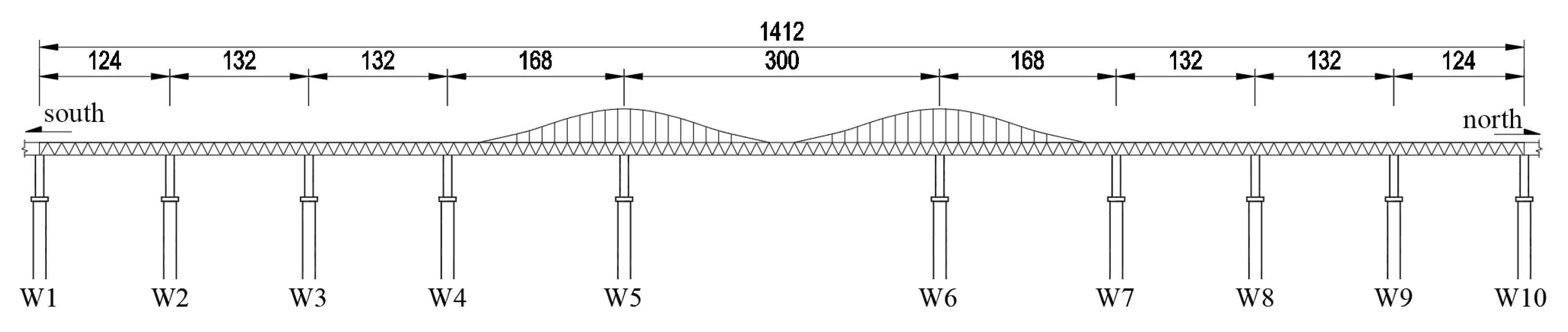
Figure 1.
General arrangement.
Figure 1.
General arrangement.
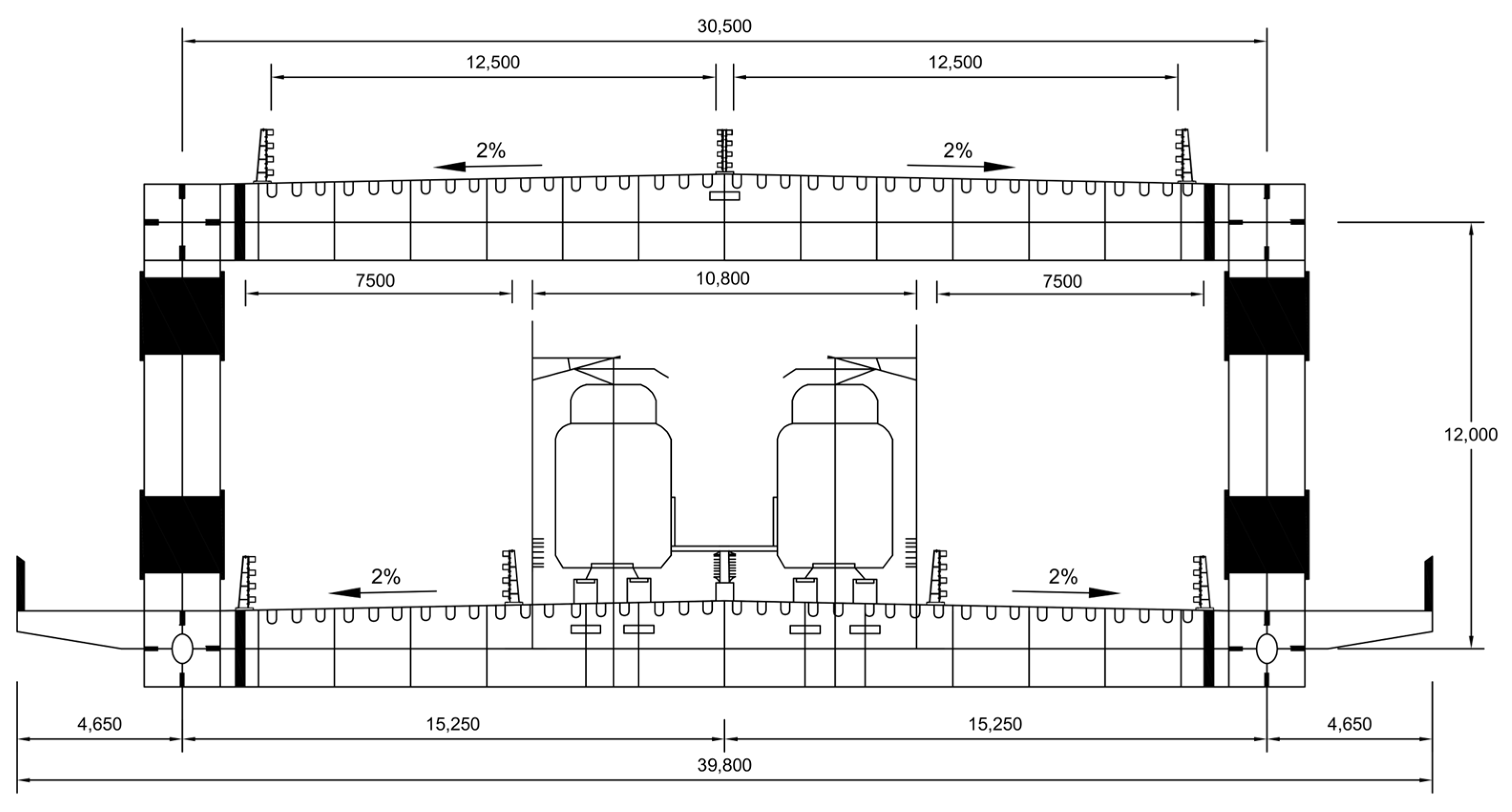
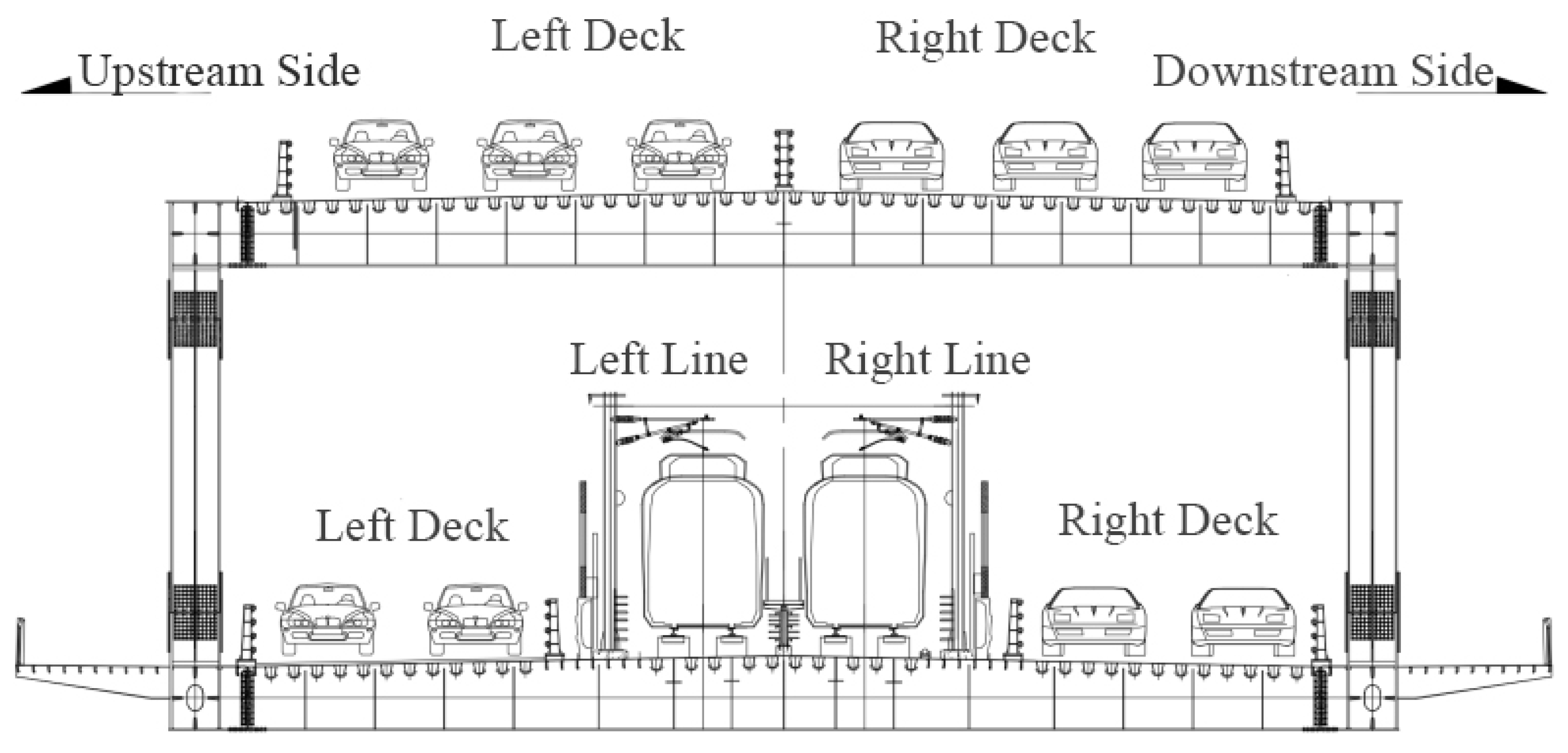
Figure 2.
Bridge cross-section.
Figure 2.
Bridge cross-section.
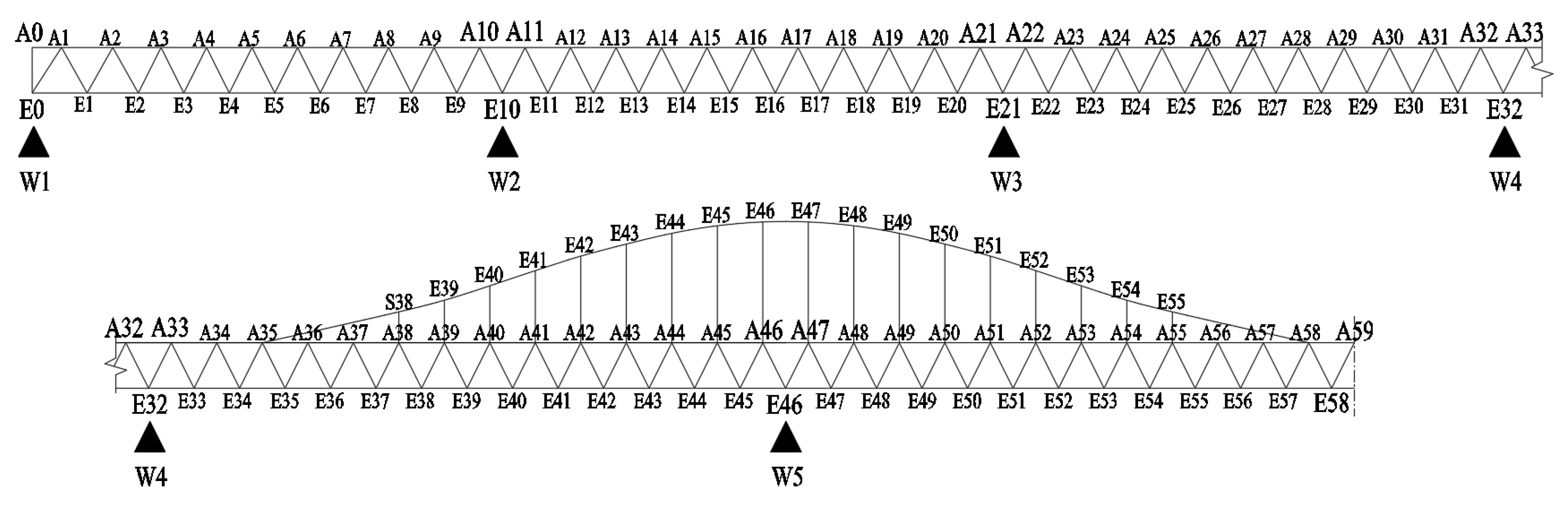
Figure 3.
Member designation diagram.
Figure 3.
Member designation diagram.
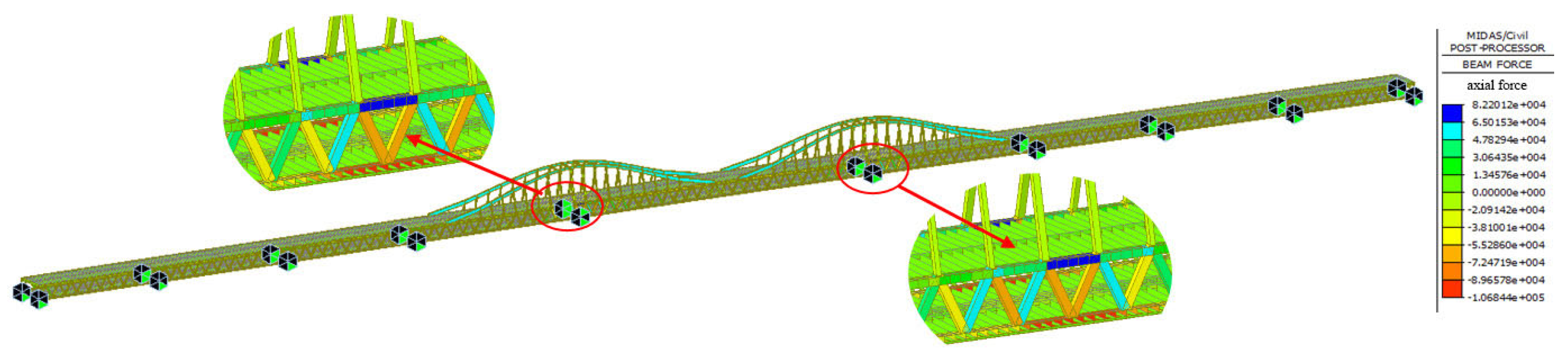
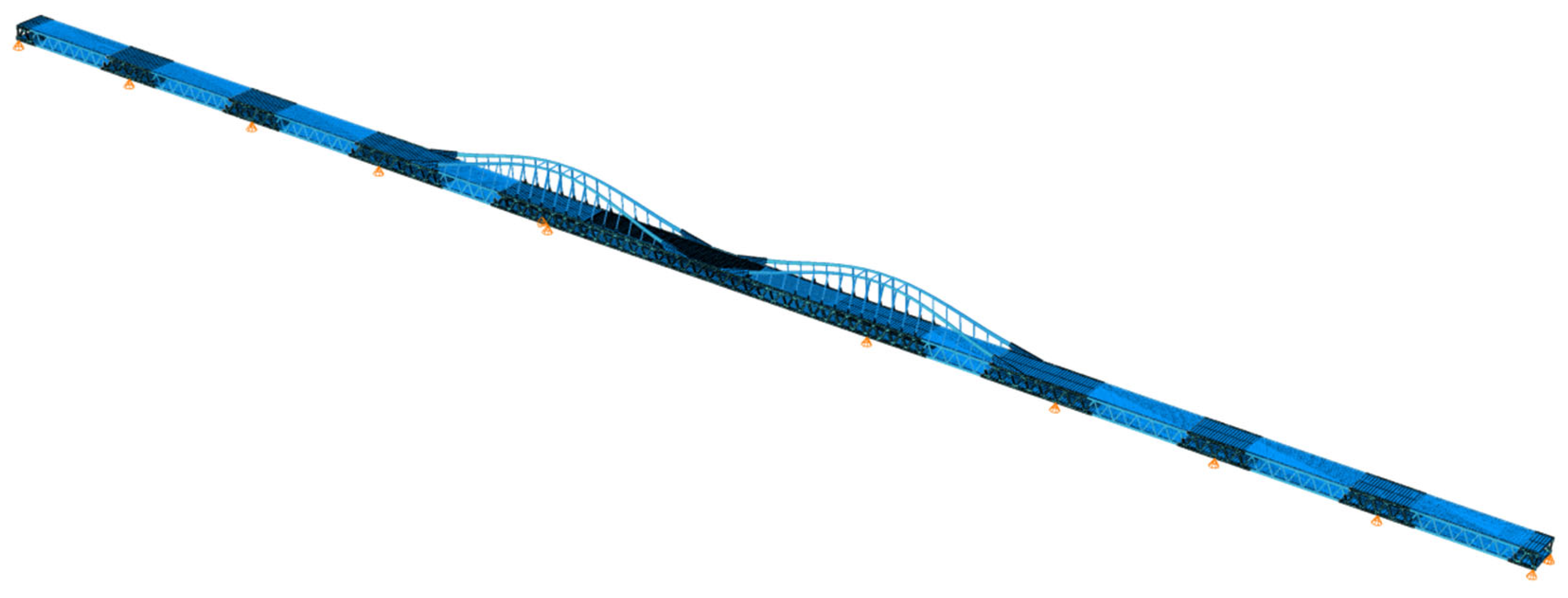
Figure 4.
Midas/Civil finite element model.
Figure 4.
Midas/Civil finite element model.
Figure 5.
Axial force distribution under dead load.
Figure 5.
Axial force distribution under dead load.
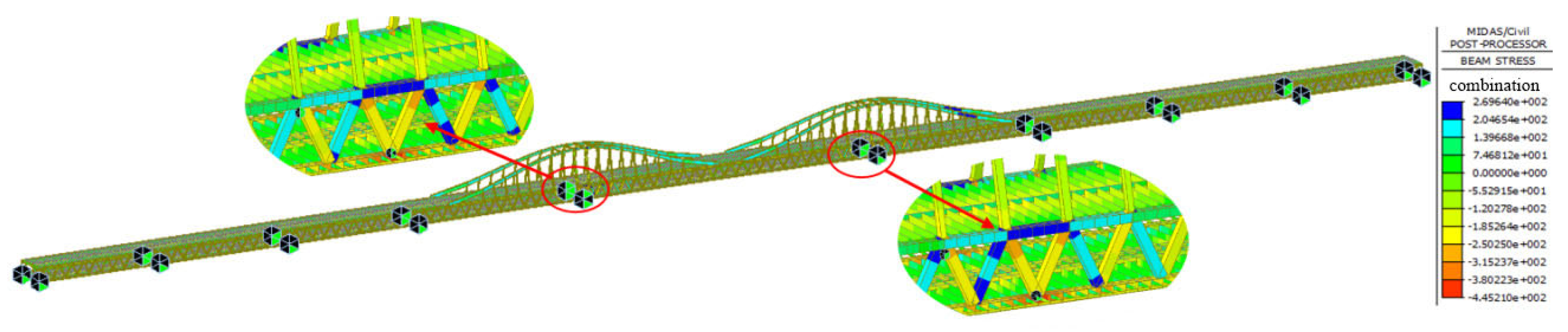
Figure 6.
Stress distribution under dead load.
Figure 6.
Stress distribution under dead load.
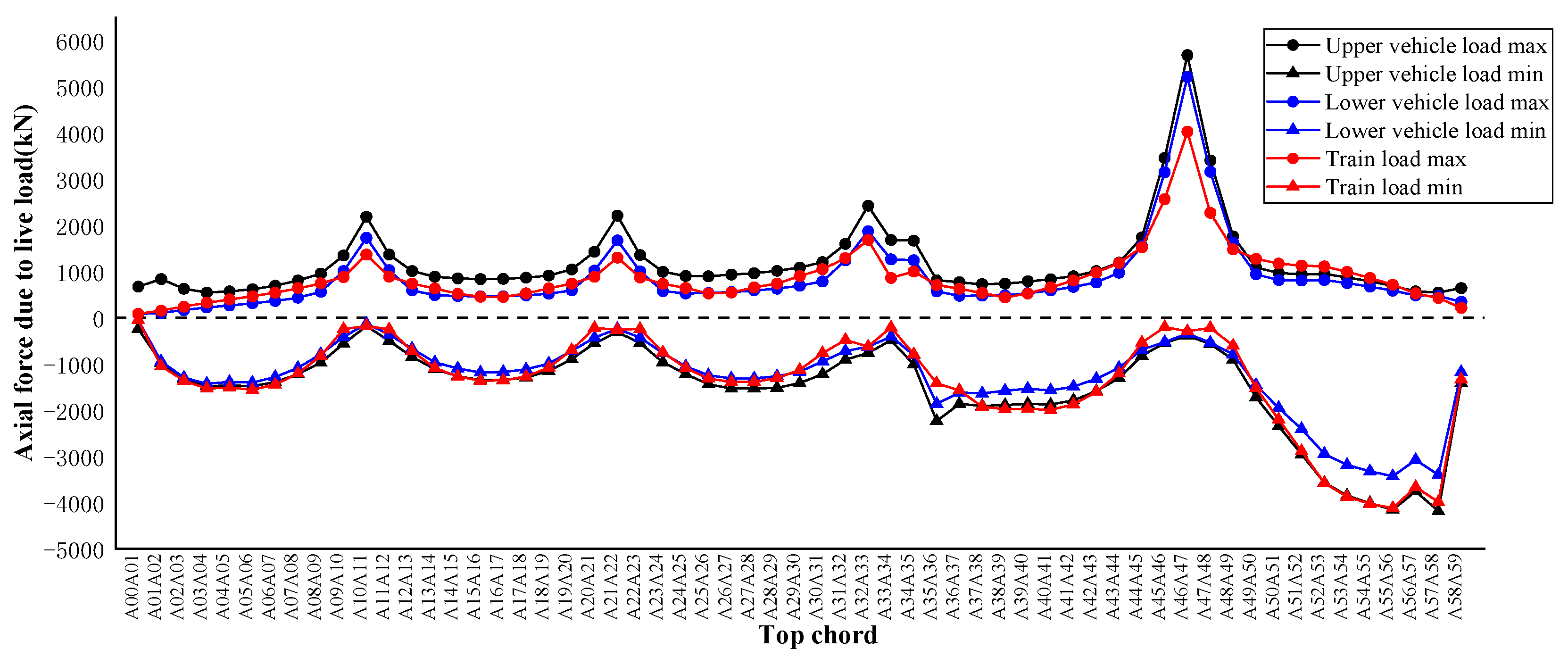
Figure 7.
Upper chord member axial forces under live loading.
Figure 7.
Upper chord member axial forces under live loading.
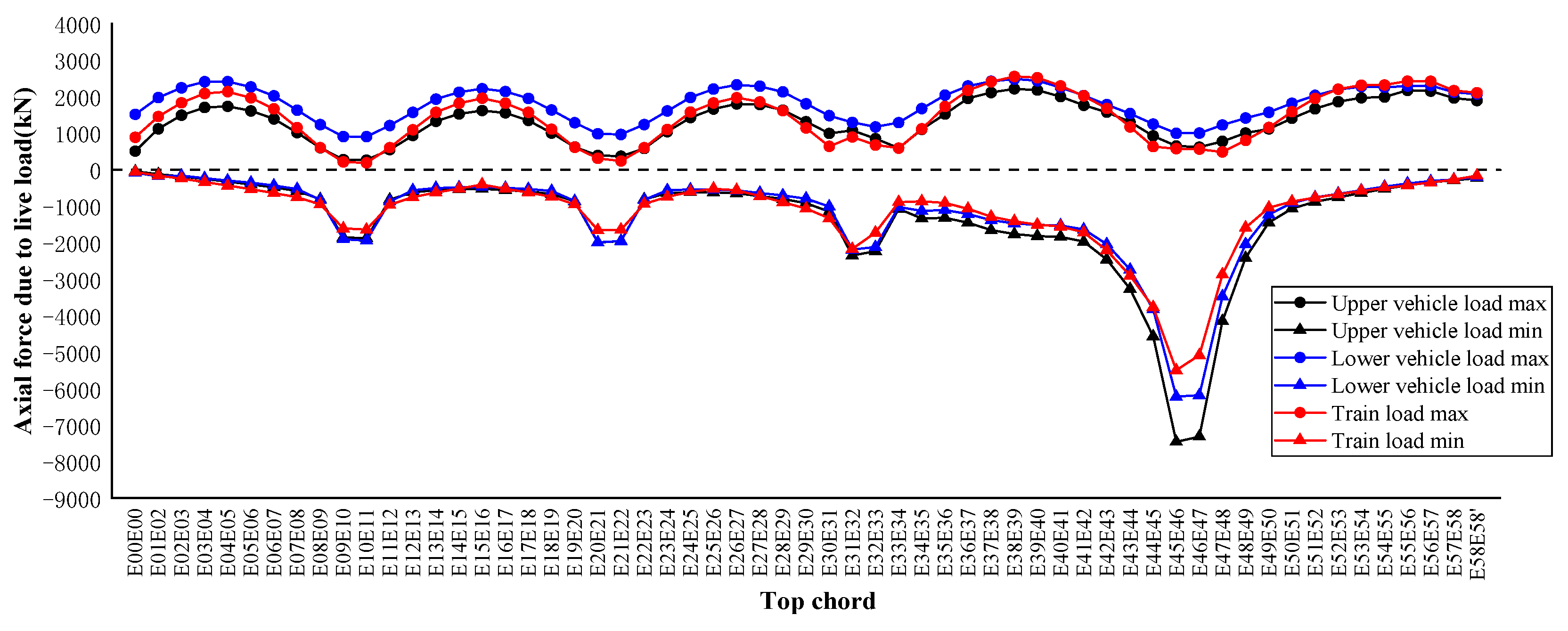
Figure 8.
Lower chord member axial forces under live loading.
Figure 8.
Lower chord member axial forces under live loading.
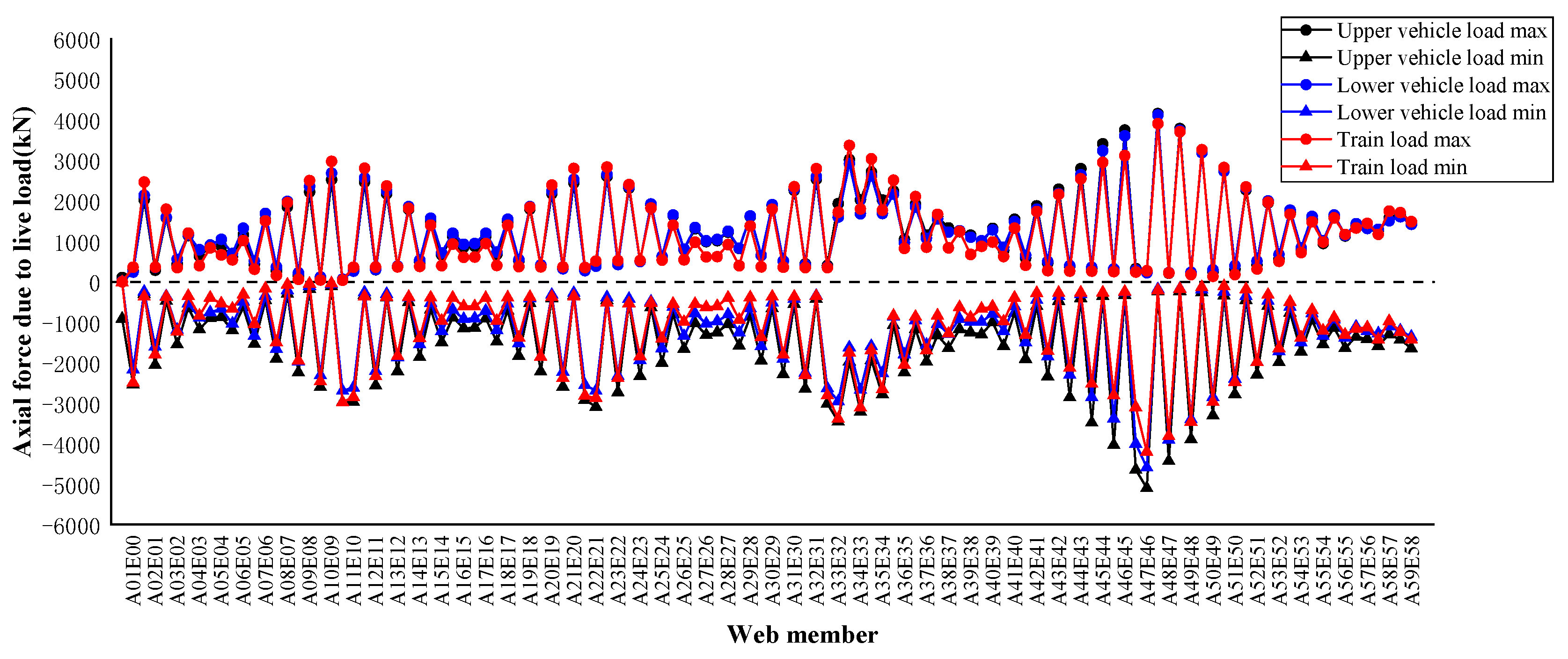
Figure 9.
Web member axial forces under live loading.
Figure 9.
Web member axial forces under live loading.
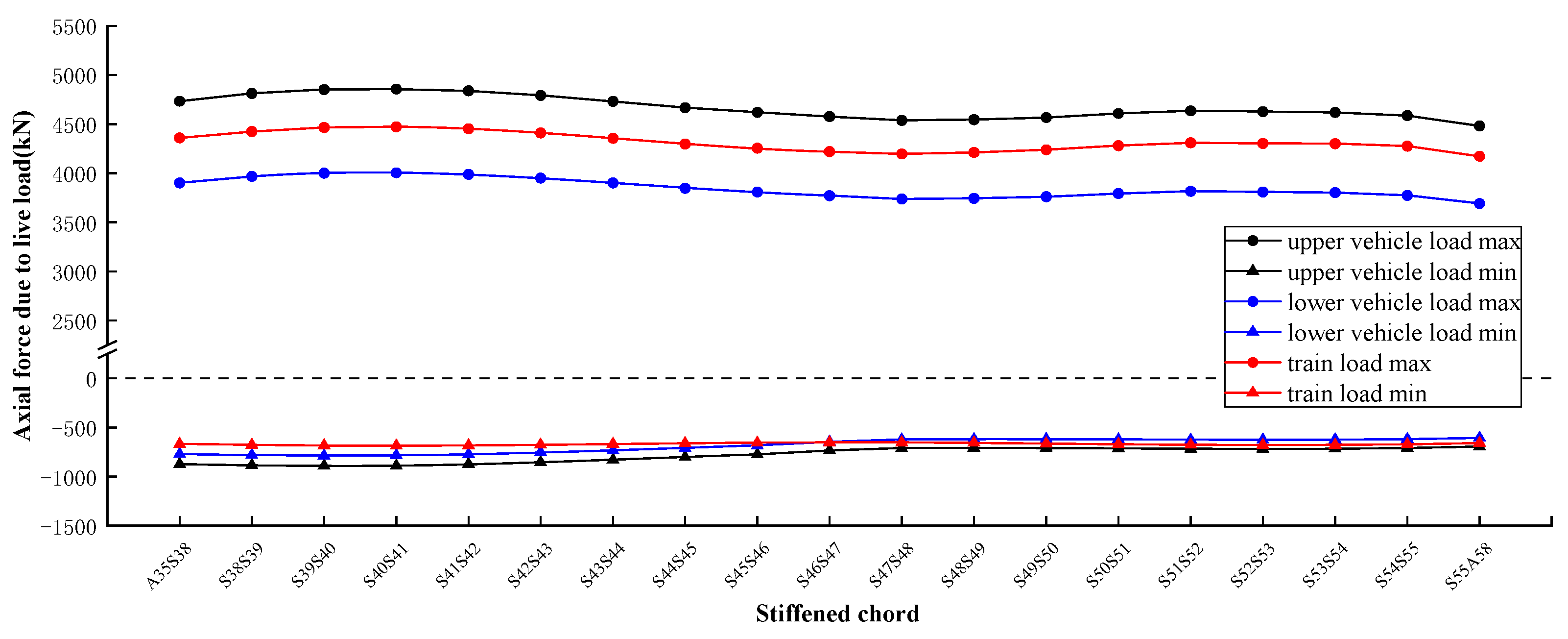
Figure 10.
Stiffening chord member axial forces under live loading.
Figure 10.
Stiffening chord member axial forces under live loading.
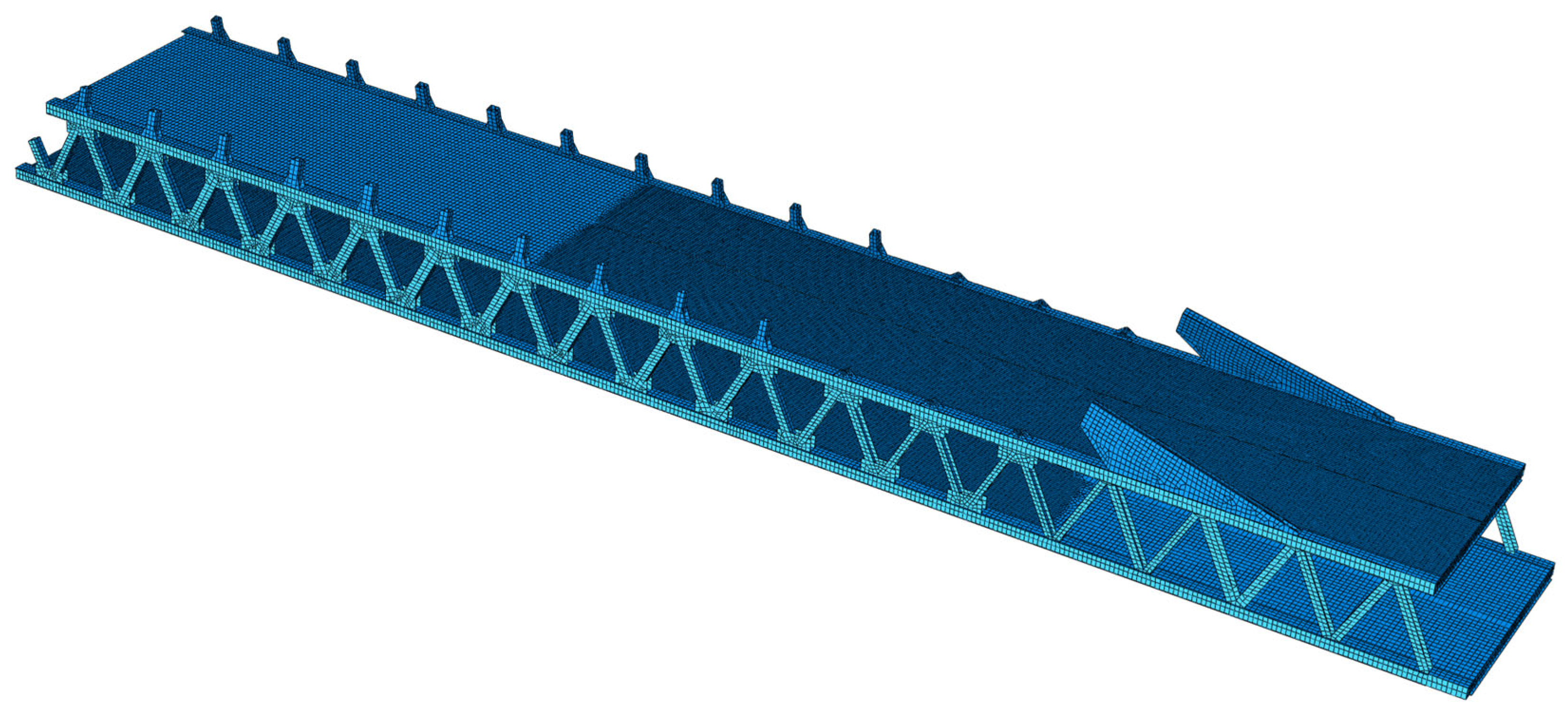
Figure 11.
Meshing result.
Figure 11.
Meshing result.
Figure 12.
ABAQUS full-bridge model.
Figure 12.
ABAQUS full-bridge model.
Figure 13.
Critical load positioning results for Load Case 7.
Figure 13.
Critical load positioning results for Load Case 7.
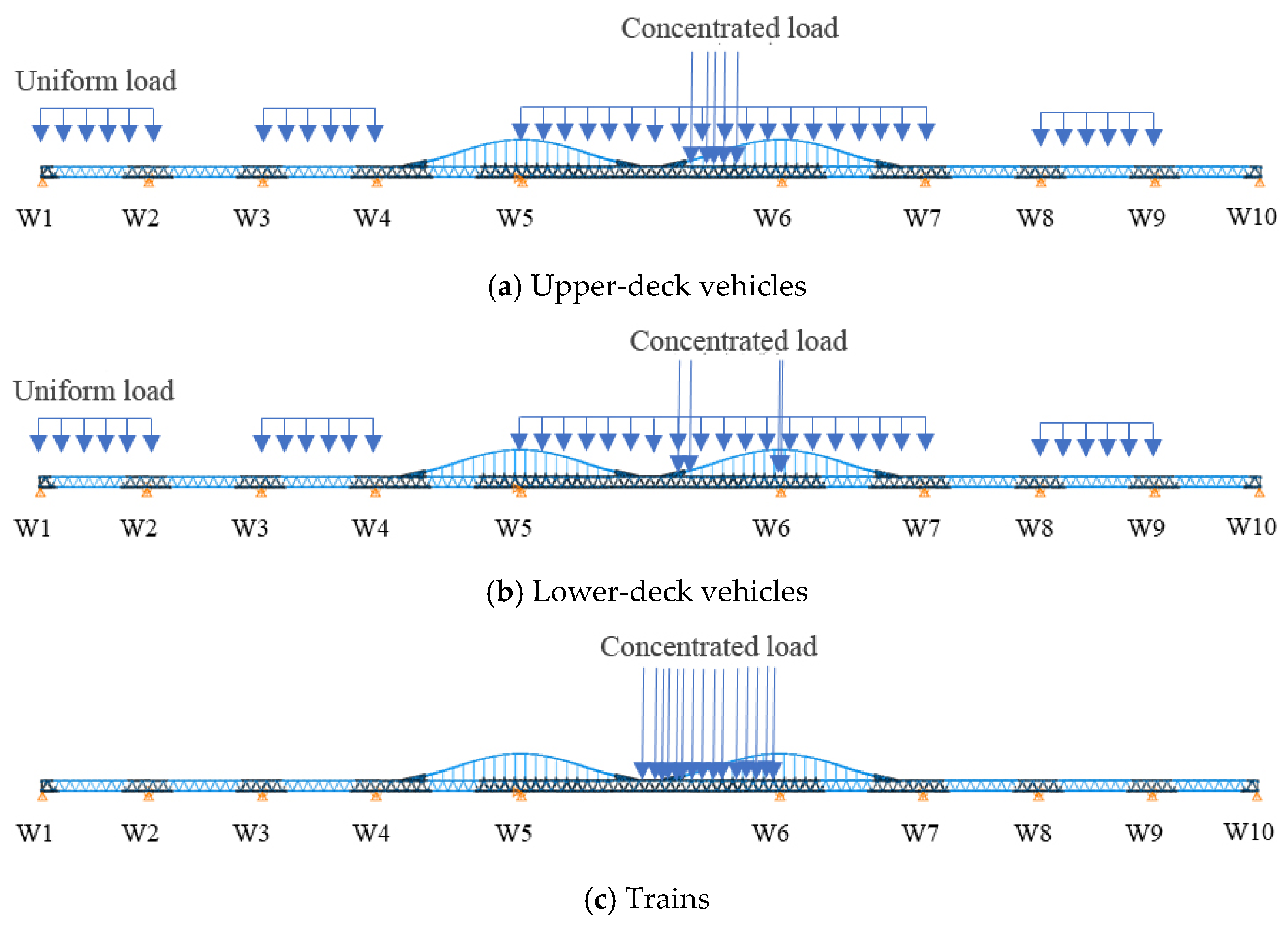
Figure 14.
Live-load application configuration for Load Case 7.
Figure 14.
Live-load application configuration for Load Case 7.
Figure 15.
Traffic flow classification schematic.
Figure 15.
Traffic flow classification schematic.
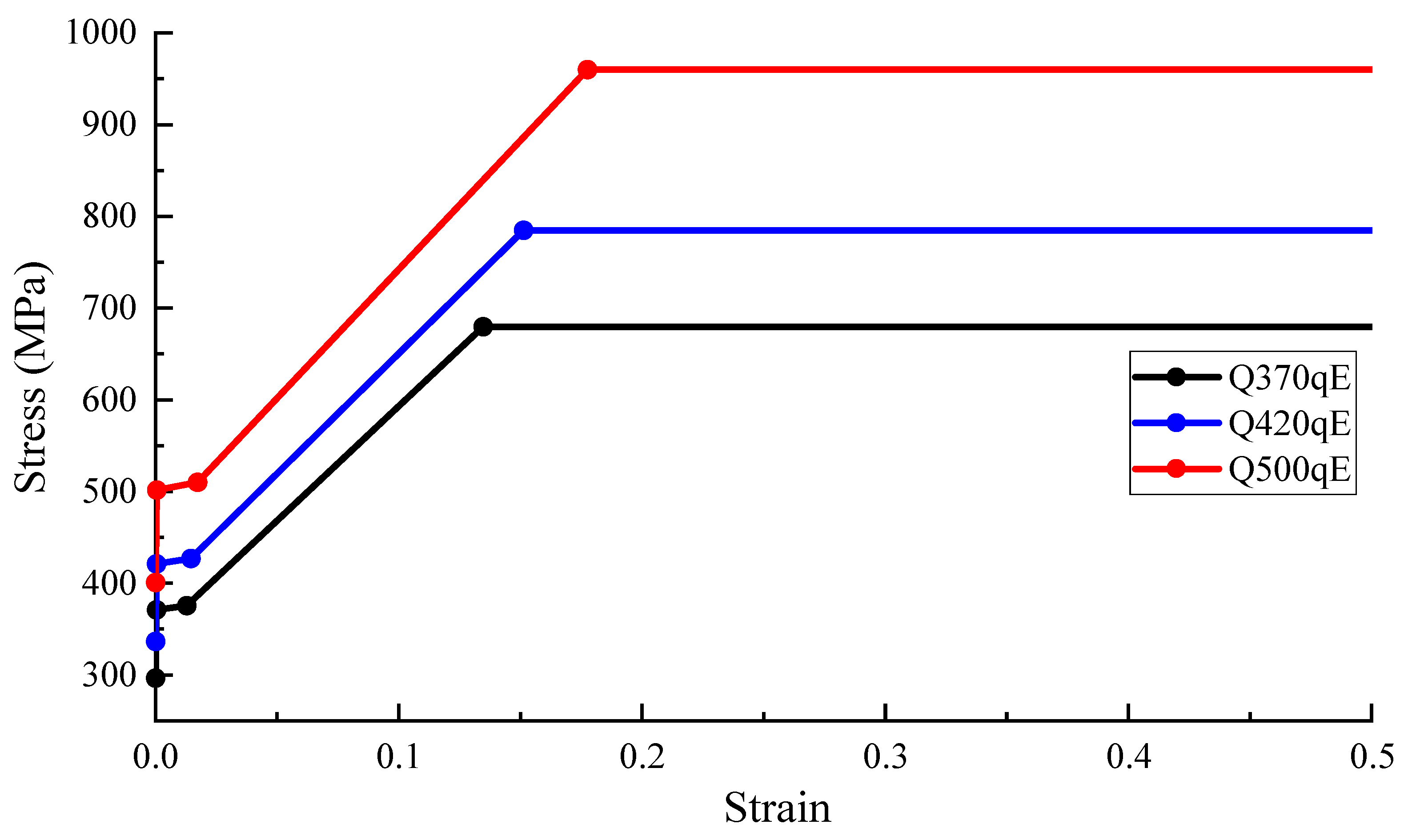
Figure 16.
True plastic stress-strain curve for steel.
Figure 16.
True plastic stress-strain curve for steel.
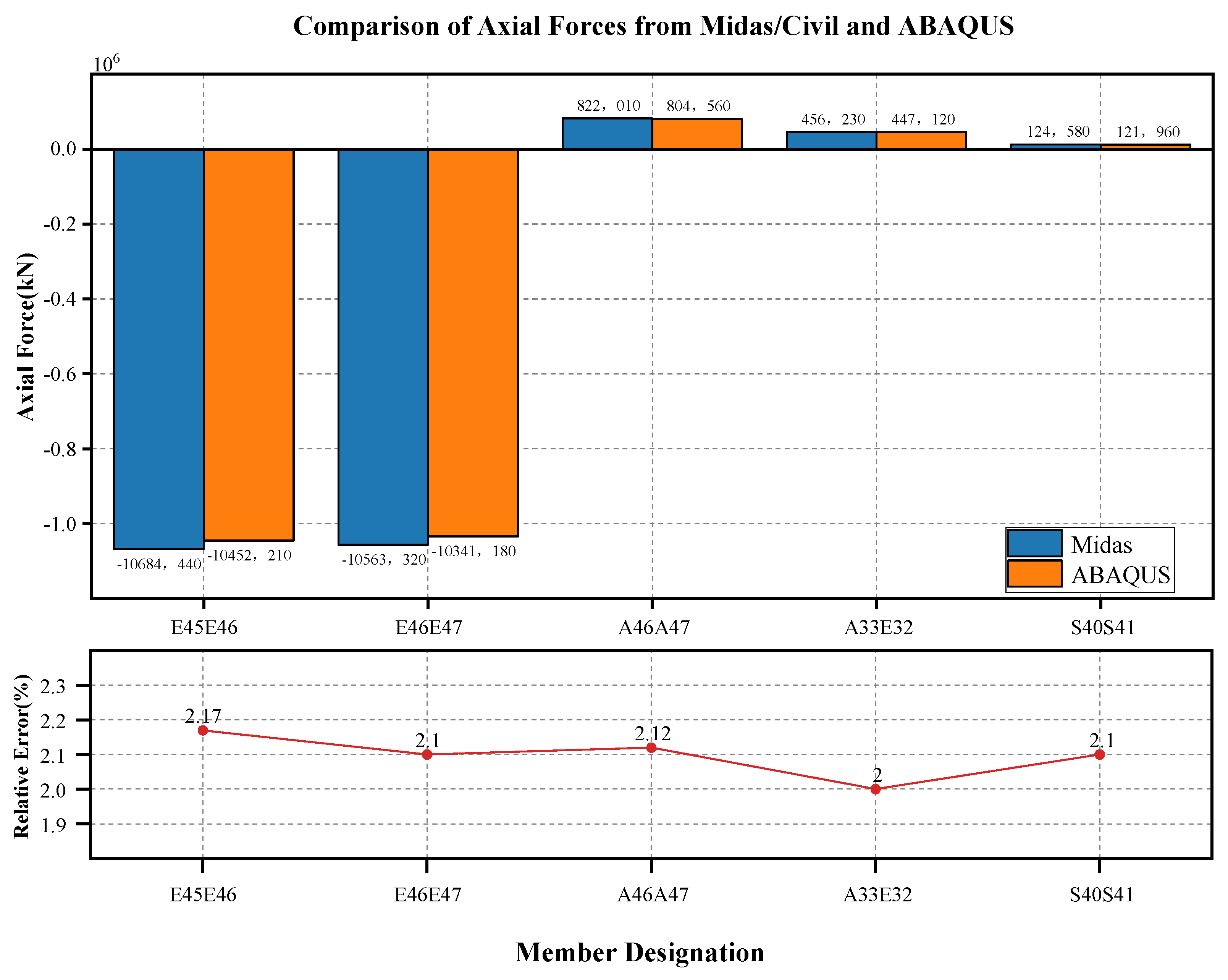
Figure 17.
Comparison of dead load axial forces between the Midas/Civil and ABAQUS models.
Figure 17.
Comparison of dead load axial forces between the Midas/Civil and ABAQUS models.
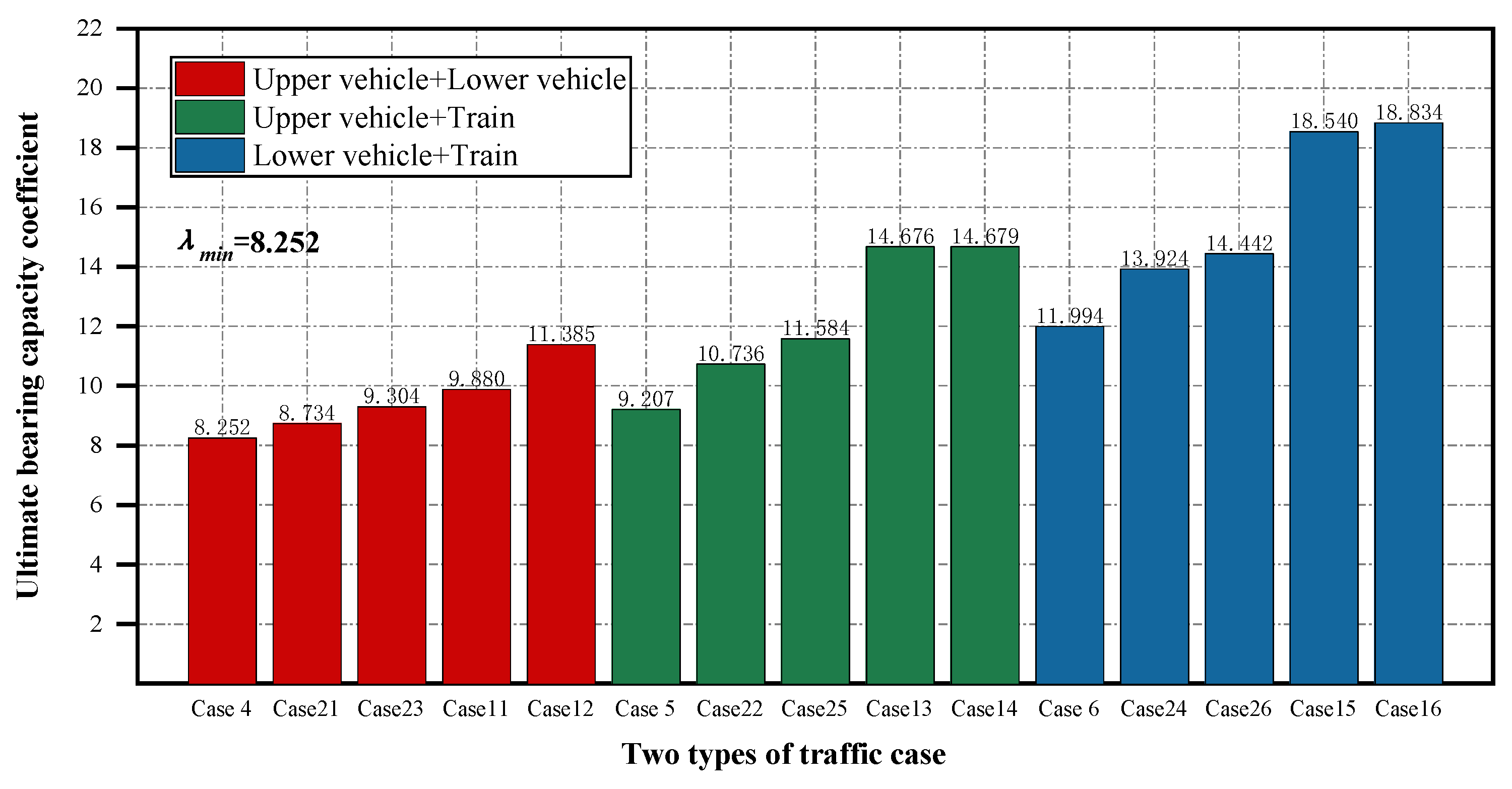
Figure 18.
Ultimate load-carrying capacity coefficients under dual-category traffic flow.
Figure 18.
Ultimate load-carrying capacity coefficients under dual-category traffic flow.
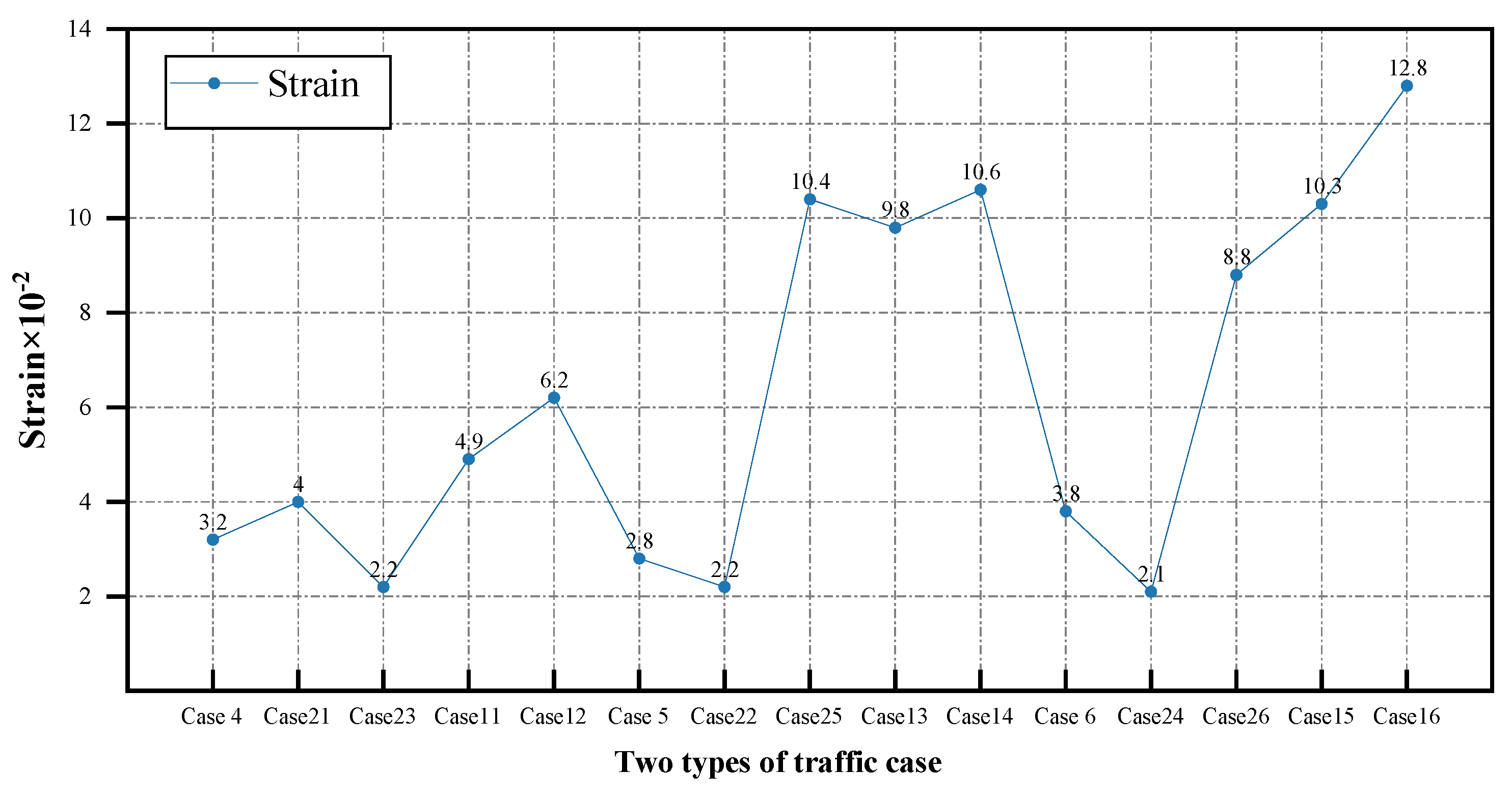
Figure 19.
The maximum true strain value of the full bridge under two types of traffic flows.
Figure 19.
The maximum true strain value of the full bridge under two types of traffic flows.
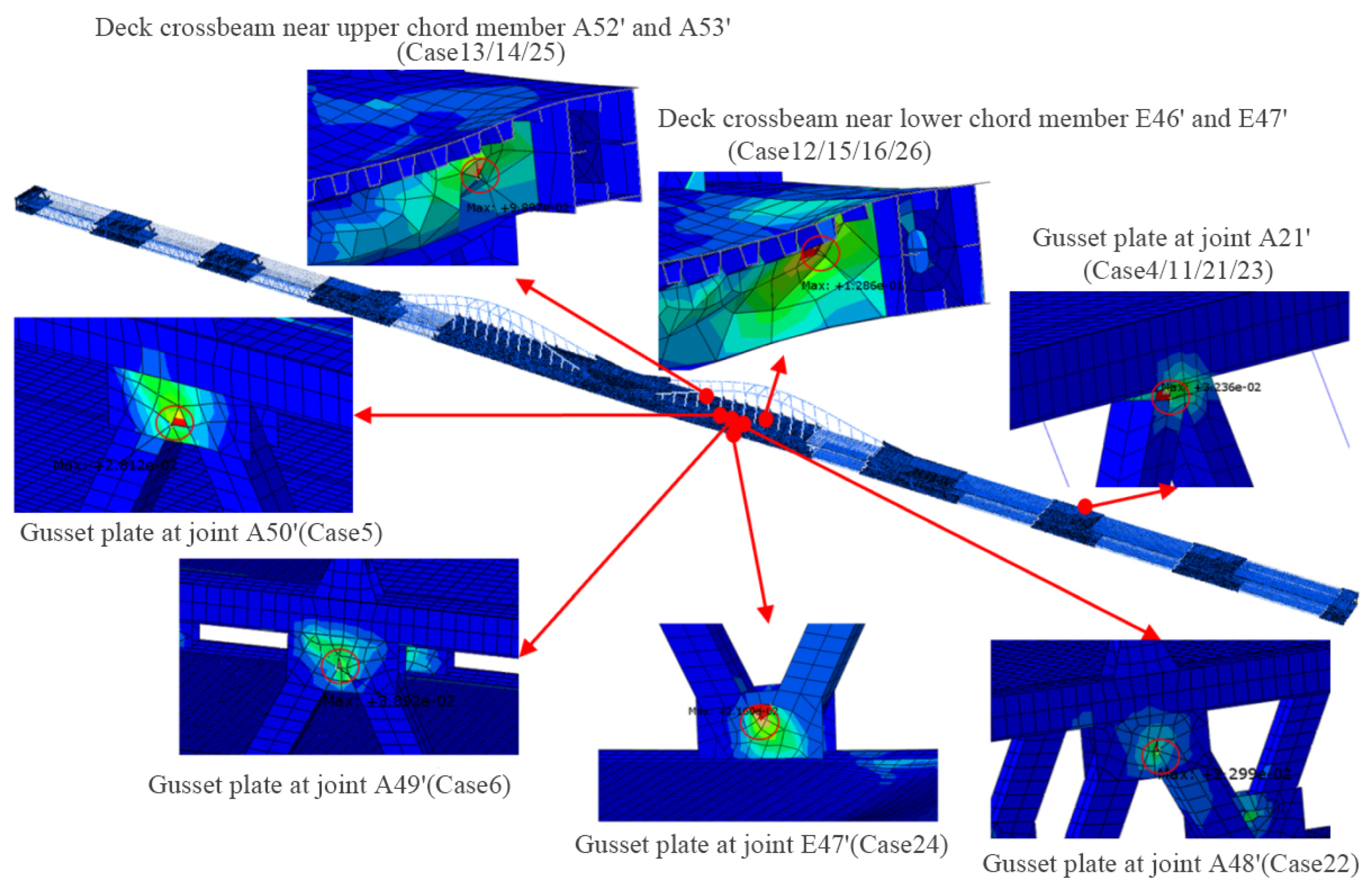
Figure 20.
True strain contour plots at failure locations under dual-category traffic flow.
Figure 20.
True strain contour plots at failure locations under dual-category traffic flow.
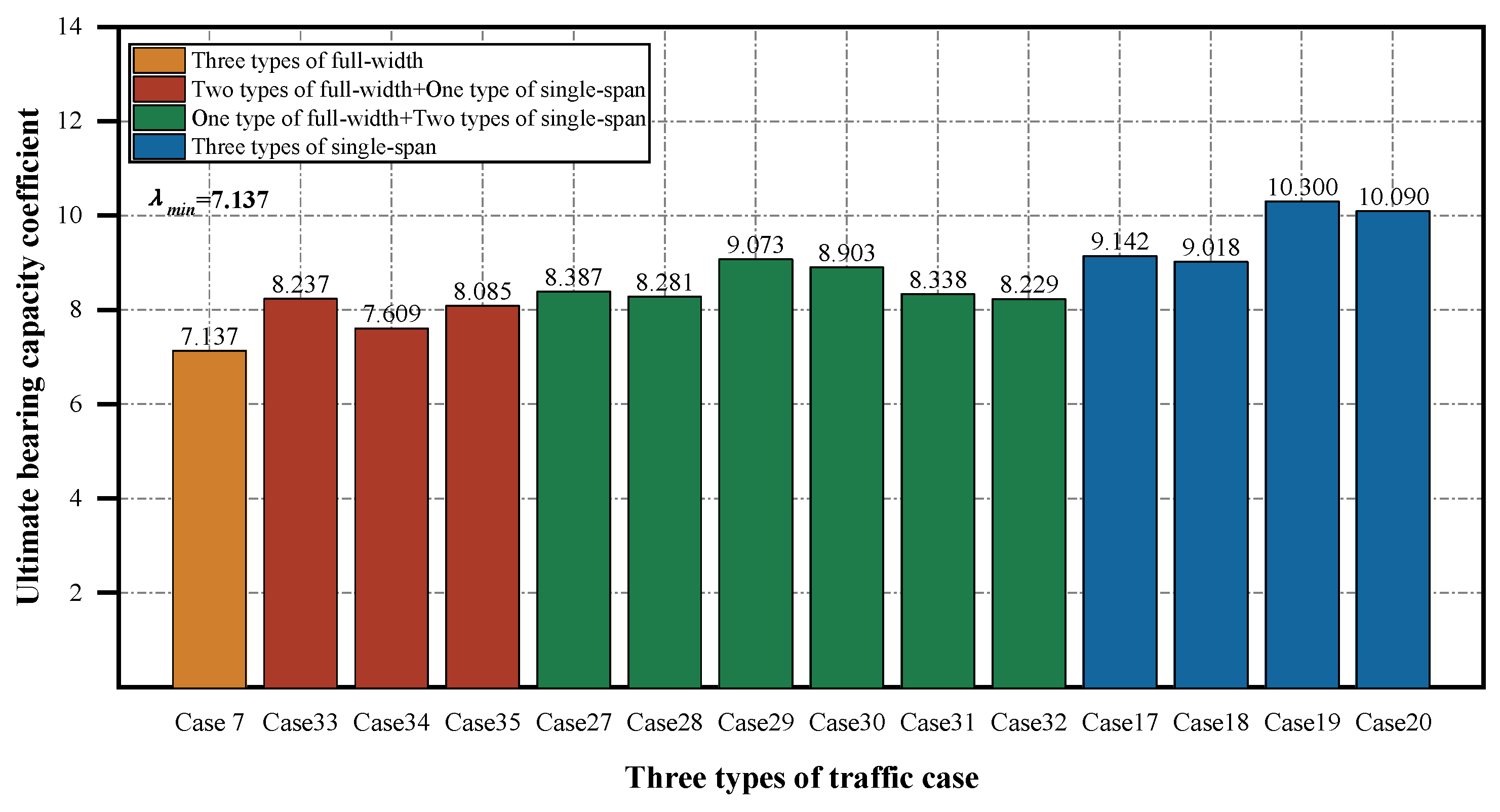
Figure 21.
Ultimate load-carrying capacity coefficients under triple-category traffic flow.
Figure 21.
Ultimate load-carrying capacity coefficients under triple-category traffic flow.
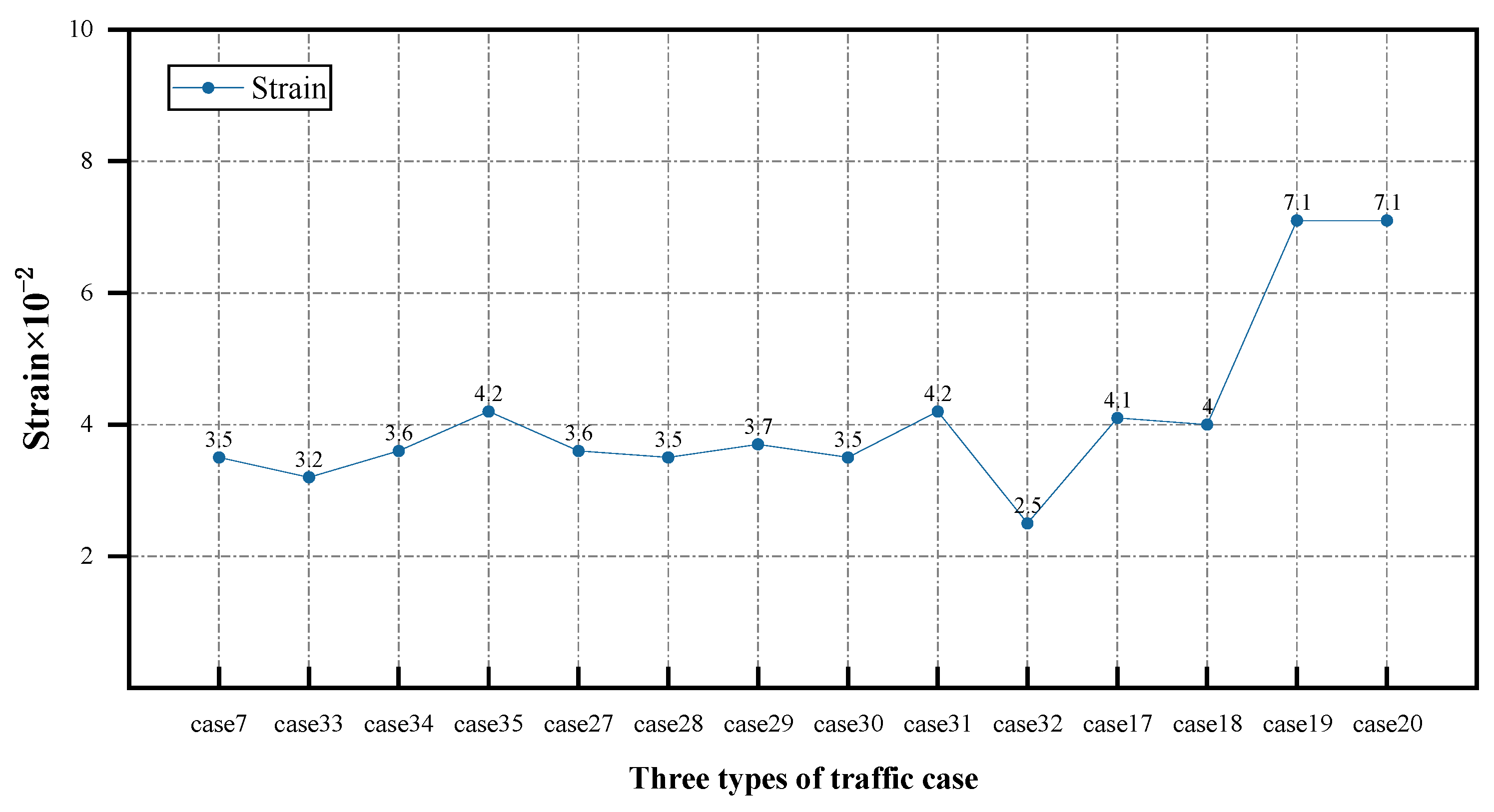
Figure 22.
The maximum true strain value of the full bridge under triple-category traffic flow.
Figure 22.
The maximum true strain value of the full bridge under triple-category traffic flow.
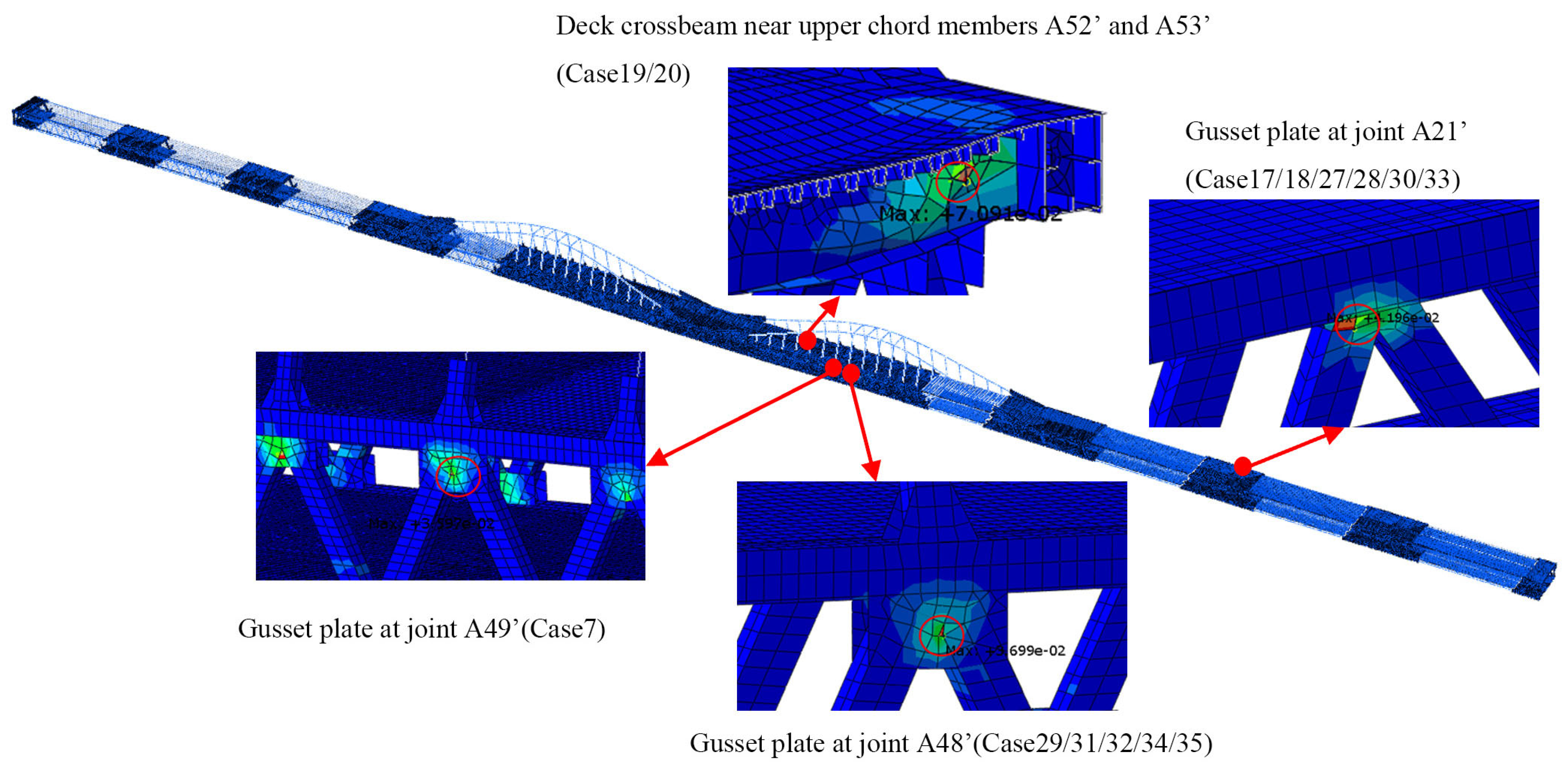
Figure 23.
True strain contour plots at failure locations under triple-category traffic flow.
Figure 23.
True strain contour plots at failure locations under triple-category traffic flow.
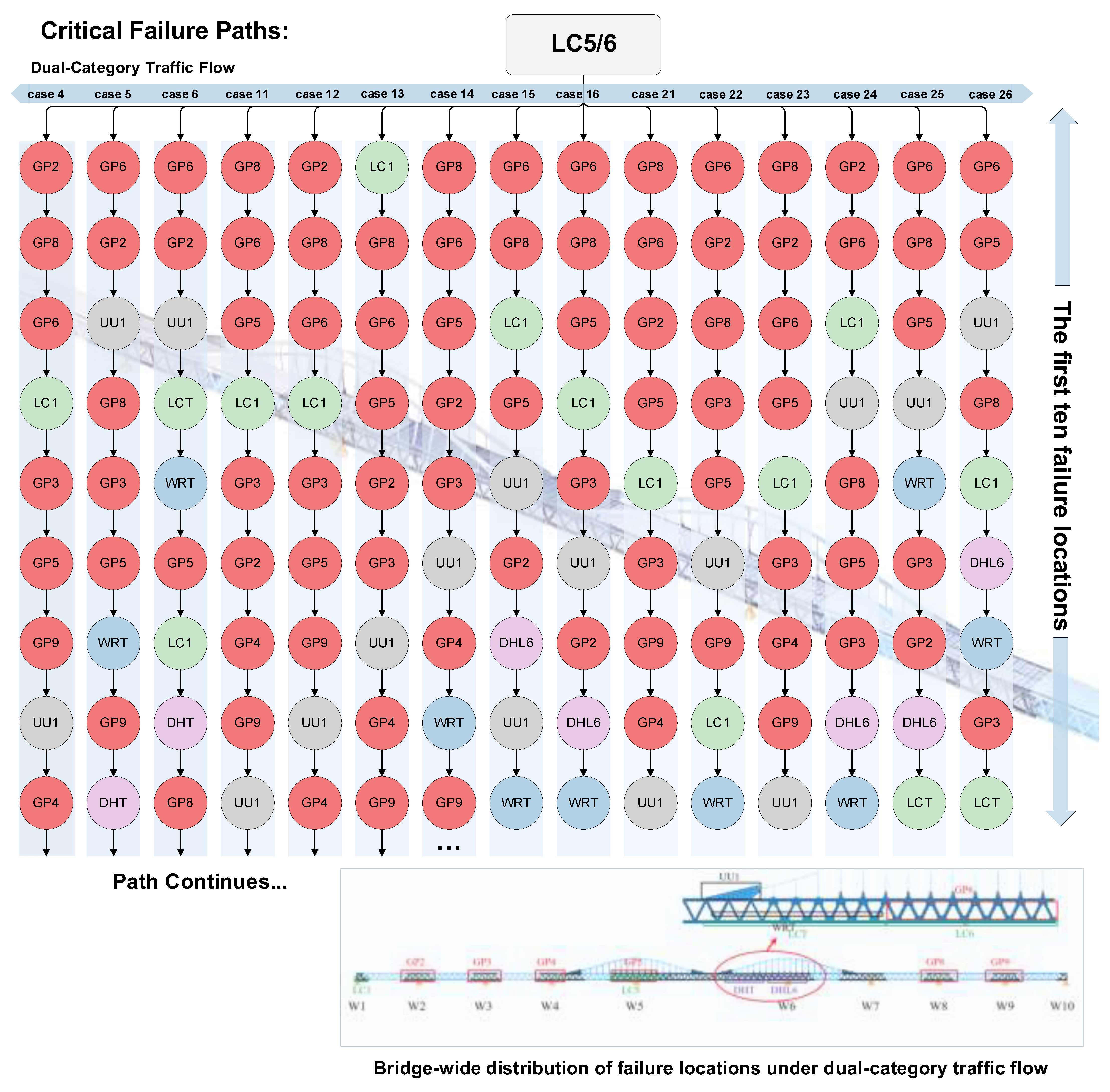
Figure 24.
Local plastic failure path of bridge under dual-category traffic flow.
Figure 24.
Local plastic failure path of bridge under dual-category traffic flow.
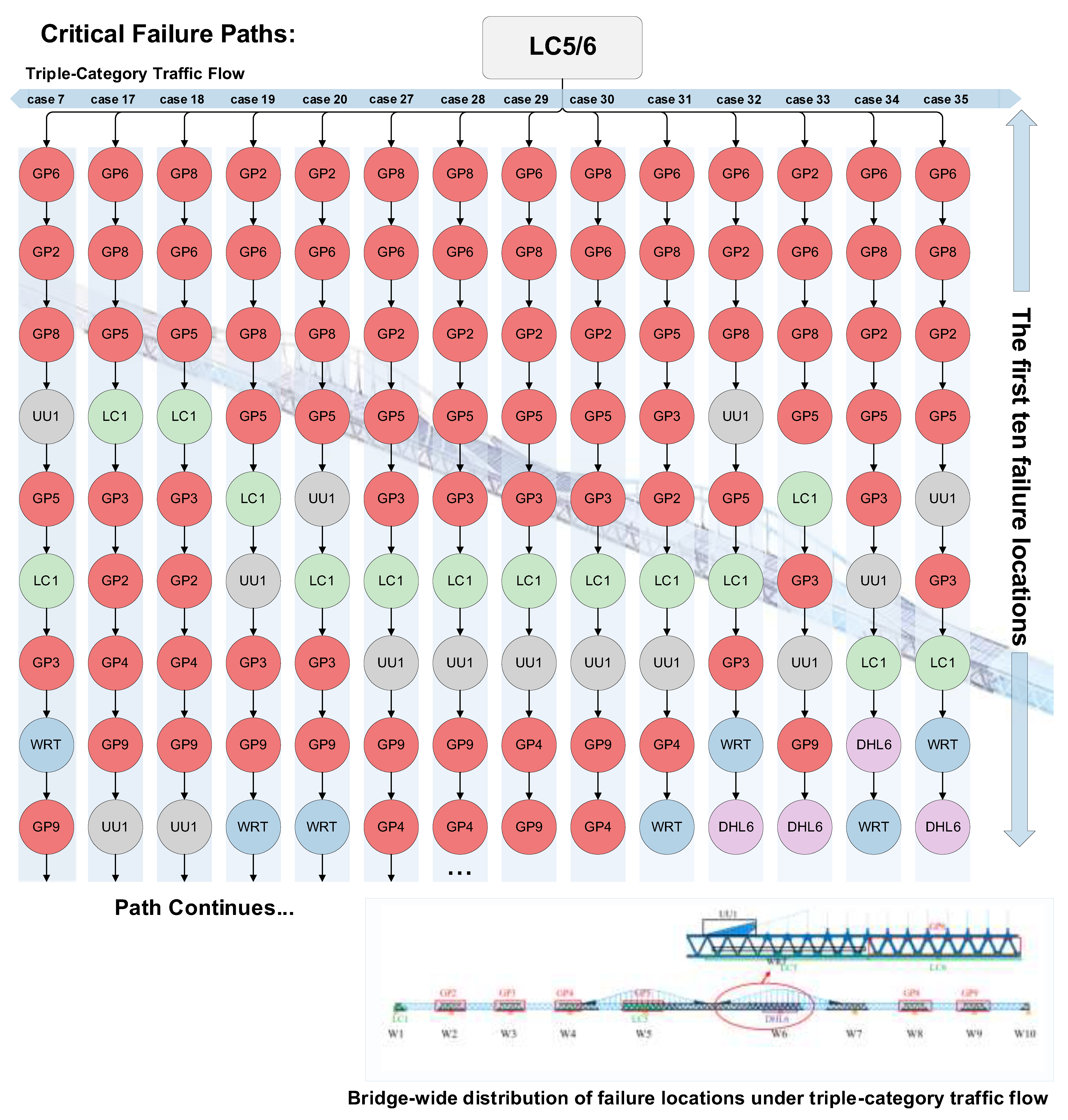
Figure 25.
Local plastic failure path of bridge under three types of traffic flow.
Figure 25.
Local plastic failure path of bridge under three types of traffic flow.
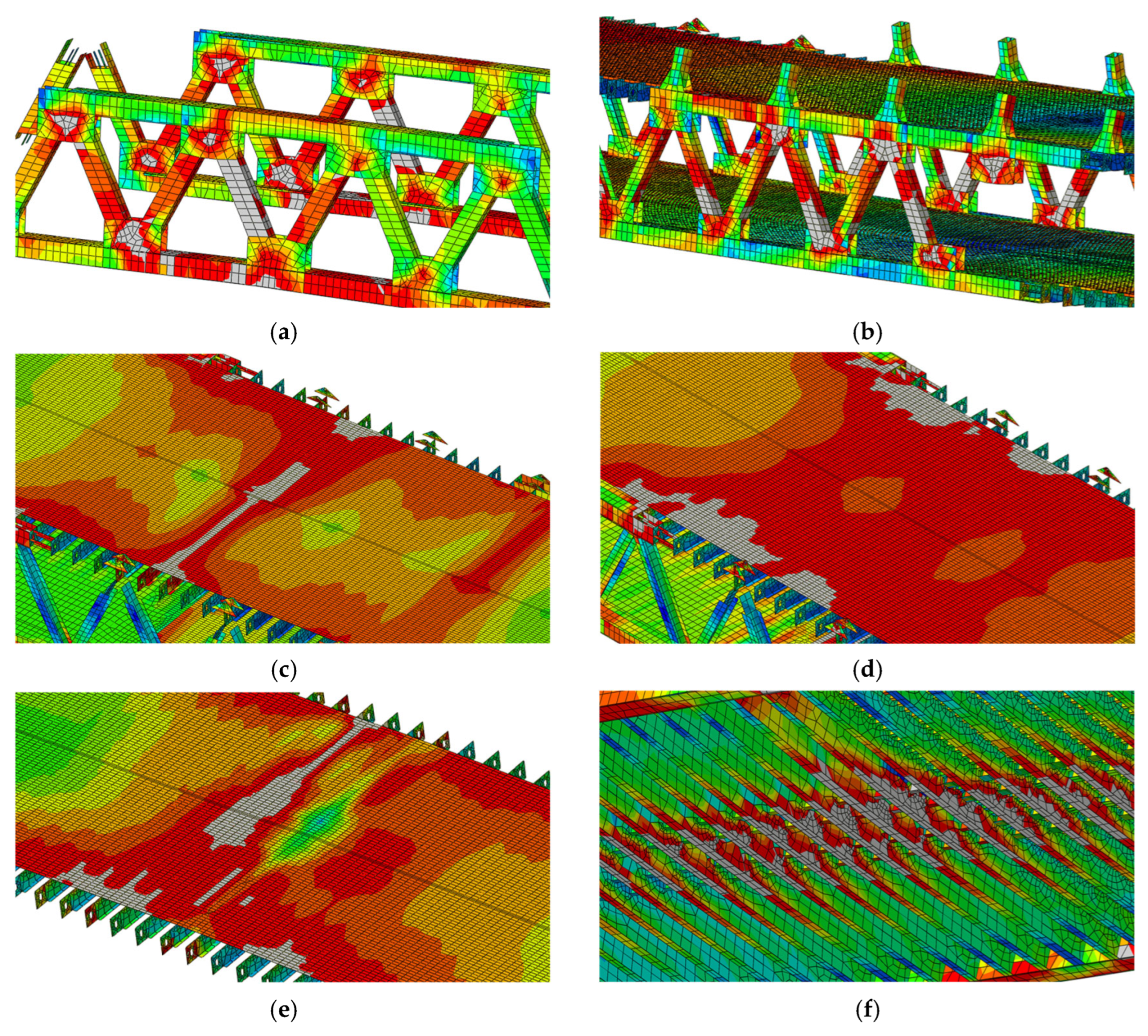
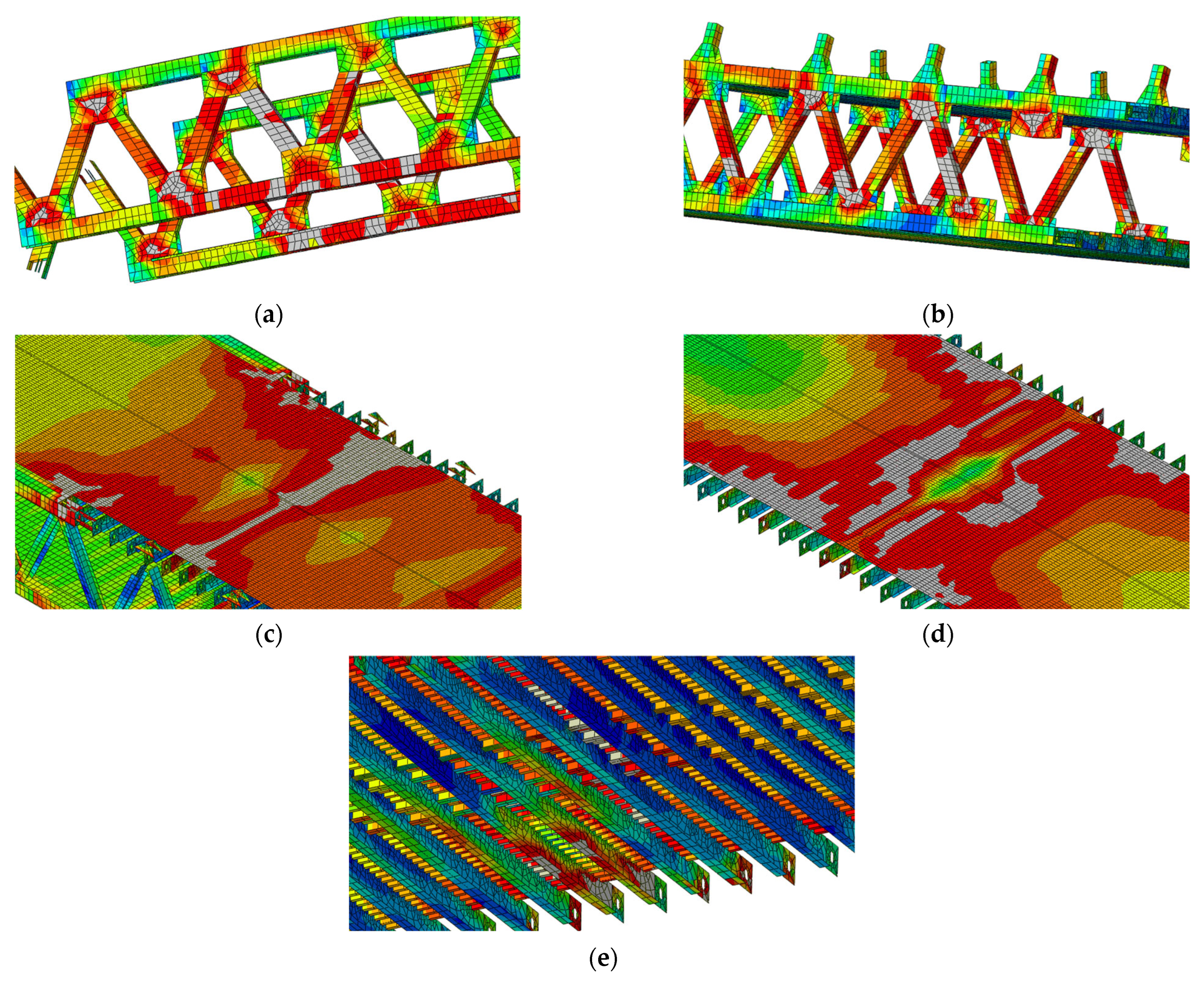
Figure 26.
Extensive failure regions under dual-category traffic flow. (a) Main truss members at mid-span pier top. (b) Main truss members in concentrated live-load segment. (c) Deck plate at upper-deck vehicle concentrated load location. (d) Deck plate at junction between stiffening chord and upper chord in mid-span region. (e) Deck plate at mid-span pier top. (f) Floor beams and stringers in train loading segment.
Figure 26.
Extensive failure regions under dual-category traffic flow. (a) Main truss members at mid-span pier top. (b) Main truss members in concentrated live-load segment. (c) Deck plate at upper-deck vehicle concentrated load location. (d) Deck plate at junction between stiffening chord and upper chord in mid-span region. (e) Deck plate at mid-span pier top. (f) Floor beams and stringers in train loading segment.
Figure 27.
Extensive failure regions under triple-category traffic flow. (a) Main truss members at mid-span pier top. (b) Main truss members in concentrated live-load segment. (c) Deck plate at upper-deck vehicle concentrated load location. (d) Deck plate at mid-span pier top. (e) Floor beams and stringers near pier W6 top.
Figure 27.
Extensive failure regions under triple-category traffic flow. (a) Main truss members at mid-span pier top. (b) Main truss members in concentrated live-load segment. (c) Deck plate at upper-deck vehicle concentrated load location. (d) Deck plate at mid-span pier top. (e) Floor beams and stringers near pier W6 top.
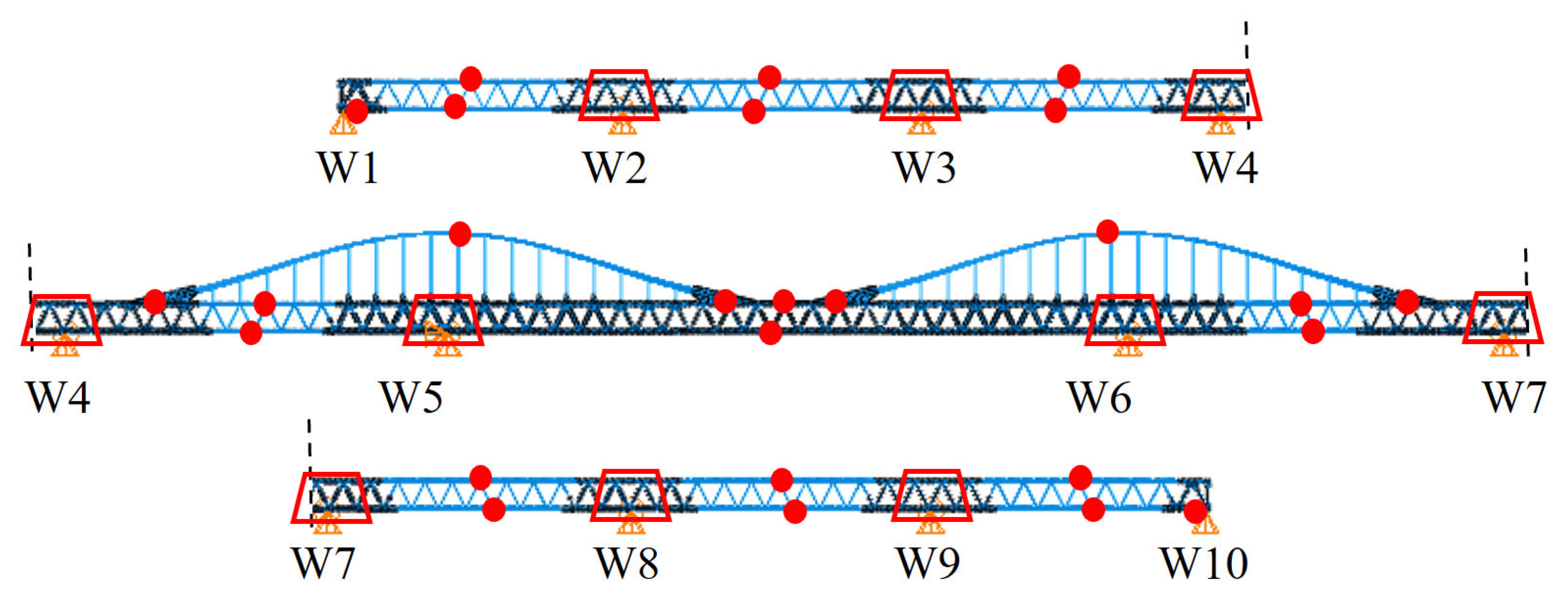
Figure 28.
Schematic diagram of stress-strain monitoring point layout scheme.
Figure 28.
Schematic diagram of stress-strain monitoring point layout scheme.
Table 1.
Loading cases for ultimate load-carrying capacity analysis under combined traffic flow.
Table 1.
Loading cases for ultimate load-carrying capacity analysis under combined traffic flow.
| Load Case | Upper Deck | Lower Deck | Trains |
|---|
| L | R | L | R | L | R |
|---|
| 1 |
●
|
●
|
○
|
○
|
○
|
○
|
| 2 |
○
|
○
|
●
|
●
|
○
|
○
|
| 3 |
○
|
○
|
○
|
○
|
●
|
●
|
| 4 |
●
|
●
|
●
|
●
|
○
|
○
|
| 5 |
●
|
●
|
○
|
○
|
●
|
●
|
| 6 |
○
|
○
|
●
|
●
|
●
|
●
|
| 7 |
●
|
●
|
●
|
●
|
●
|
●
|
| 8 |
●
|
○
|
○
|
○
|
○
|
○
|
| 9 |
○
|
○
|
●
|
○
|
○
|
○
|
| 10 |
○
|
○
|
○
|
○
|
●
|
○
|
| 11 |
●
|
○
|
●
|
○
|
○
|
○
|
| 12 |
●
|
○
|
○
|
●
|
○
|
○
|
| 13 |
●
|
○
|
○
|
○
|
●
|
○
|
| 14 |
●
|
○
|
○
|
○
|
○
|
●
|
| 15 |
○
|
○
|
●
|
○
|
●
|
○
|
| 16 |
○
|
○
|
●
|
○
|
○
|
●
|
| 17 |
●
|
○
|
●
|
○
|
●
|
○
|
| 18 |
●
|
○
|
●
|
○
|
○
|
●
|
| 19 |
●
|
○
|
○
|
●
|
●
|
○
|
| 20 |
●
|
○
|
○
|
●
|
○
|
●
|
| 21 |
●
|
●
|
●
|
○
|
○
|
○
|
| 22 |
●
|
●
|
○
|
○
|
●
|
○
|
| 23 |
●
|
○
|
●
|
●
|
○
|
○
|
| 24 |
○
|
○
|
●
|
●
|
●
|
○
|
| 25 |
●
|
○
|
○
|
○
|
●
|
●
|
| 26 |
○
|
○
|
●
|
○
|
●
|
●
|
| 27 |
●
|
●
|
●
|
○
|
●
|
○
|
| 28 |
●
|
●
|
●
|
○
|
○
|
●
|
| 29 |
●
|
○
|
●
|
●
|
●
|
○
|
| 30 |
●
|
○
|
●
|
●
|
○
|
●
|
| 31 |
●
|
○
|
●
|
○
|
●
|
●
|
| 32 |
●
|
○
|
○
|
●
|
●
|
●
|
| 33 |
●
|
●
|
●
|
●
|
●
|
○
|
| 34 |
●
|
●
|
●
|
○
|
●
|
●
|
| 35 |
●
|
○
|
●
|
●
|
●
|
●
|
Table 2.
Ultimate load factors and maximum structural deflections under different nonlinearities.
Table 2.
Ultimate load factors and maximum structural deflections under different nonlinearities.
| Analysis Type | Ultimate Load Factor | Maximum Structural Deflection (mm) |
|---|
| Dual nonlinearity | 7.134 | 1729 |
| Material nonlinearity | 9.14 | 5208 |
| Geometric nonlinearity | 8.46 | 1793 |
Table 3.
Failure locations under dual-category traffic flow.
Table 3.
Failure locations under dual-category traffic flow.
| Load Case No. | Ultimate State Failure Location |
|---|
| Case 4 | Gusset plate A21′, left truss, pier W8 top |
| Case 5 | Gusset plate A50′, right truss |
| Case 6 | Gusset plate A49′, right truss |
| Case 11 | Gusset plate A21′, left truss, pier W8 top |
| Case 12 | Floor beam near lower chord E46′E47′, at concentrated load location of lower-deck vehicles on left truss |
| Case 13 | Floor beam near upper chord A52′A53′, at concentrated load location of upper-deck vehicles on left truss |
| Case 14 | Floor beam near upper chord A52′A53′, at concentrated load location of upper-deck vehicles on left truss |
| Case 15 | Floor beam near lower chord E46′E47′, at concentrated load location of lower-deck vehicles on left truss |
| Case 16 | Floor beam near lower chord E46′E47′, at concentrated load location of lower-deck vehicles on left truss |
| Case 21 | Gusset plate A21′, left truss, pier W8 top |
| Case 22 | Gusset plate A48′, left truss |
| Case 23 | Gusset plate A21′, left truss, pier W8 top |
| Case 24 | Gusset plate E47′, left truss |
| Case 25 | Floor beam near upper chord A52′A53′, at concentrated load location of upper-deck vehicles on left truss |
| Case 26 | Floor beam near lower chord E46′E47′, at concentrated load location of lower-deck vehicles on left truss |
Table 4.
Failure locations under triple-category traffic flow.
Table 4.
Failure locations under triple-category traffic flow.
| Load Case No. | Ultimate State Failure Location |
|---|
| Case 7 | Gusset plate A49′, right truss |
| Case 17 | Gusset plate A21′, left truss, pier W8 top |
| Case 18 | Gusset plate A21′, left truss, pier W8 top |
| Case 19 | Floor beam near upper chord A52′A53′, at concentrated load location of upper-deck vehicles on left truss |
| Case 20 | Floor beam near upper chord A52′A53′, at concentrated load location of upper-deck vehicles on left truss |
| Case 27 | Gusset plate A21′, left truss, pier W8 top |
| Case 28 | Gusset plate A21′, left truss, pier W8 top |
| Case 29 | Gusset plate A48′, left truss |
| Case 30 | Gusset plate A21′, left truss, pier W8 top |
| Case 31 | Gusset plate A48′, left truss |
| Case 32 | Gusset plate A48′, left truss |
| Case 33 | Gusset plate A21′, left truss, pier W8 top |
| Case 34 | Gusset plate A48′, left truss |
| Case 35 | Gusset plate A48′, left truss |
Table 5.
Failure locations and corresponding abbreviations.
Table 5.
Failure locations and corresponding abbreviations.
| Abbreviation | Failure Location | Abbreviation | Failure Location |
|---|
| LC1 | Lower chord at pier W1 top | LC5/6 | Lower chord at pier W5/W6 top |
| LCT | Lower chord in train loading segment | GP2 | Gusset plate at pier W2 top |
| GP3 | Gusset plate at pier W3 top | GP4 | Gusset plate at pier W4 top |
| GP5 | Gusset plate at pier W5 top | GP6 | Gusset plate at pier W6 top |
| GP8 | Gusset plate at pier W8 top | GP9 | Gusset plate at pier W9 top |
| GPT | Gusset plate in train loading segment | WR6 | Web member at pier W6 top |
| WRUV | Upper flange of web member at upper-deck vehicle concentrated load location | WRT | Lower flange of web member in train loading segment |
| DHL6 | Lower-deck floor beam at pier W6 top | DHT | Floor beam in train loading segment |
| DZT | Deck stringer in train loading segment | UU1 | Junction of stiffening chord and upper chord |
| BDL6 | Lower-deck plate at pier W6 top | | |
Table 6.
Extensive failure regions under dual-category traffic flow.
Table 6.
Extensive failure regions under dual-category traffic flow.
| Load Case No. | Extensive Failure Regions at Ultimate State |
|---|
| Case 4 | Main truss members at mid-span pier top and concentrated live-load segment; deck plate at mid-span pier top |
| Case 5 | Main truss members at mid-span pier top and concentrated live-load segment; deck plate at upper-deck vehicle concentrated load location and at mid-span pier top |
| Case 6 | Main truss members at mid-span pier top and concentrated live-load segment; deck plate at junction between stiffening chord and upper chord in mid-span region and at mid-span pier top; floor beams and stringers in train loading segment |
Table 7.
Extensive failure regions under triple-category traffic flow.
Table 7.
Extensive failure regions under triple-category traffic flow.
| Load Case No. | Extensive Failure Regions at Ultimate State |
|---|
| Case 7 | Main truss members at mid-span pier top and in concentrated live-load segment; deck plate at upper-deck vehicle concentrated load location and at mid-span pier top |
| Case 18 | Main truss members at mid-span pier top and in concentrated live-load segment; deck plate, floor beams, and stringers at mid-span pier top |
| Case 32 | Main truss members at mid-span pier top and in concentrated live-load segment; deck plate at upper-deck vehicle concentrated load location and at mid-span pier top |
| Case 34 | Main truss members at mid-span pier top and in concentrated live-load segment; deck plate at upper-deck vehicle concentrated load location and at mid-span pier top |
Table 8.
Stress levels of various steel grades at ultimate state under dual-category traffic flow.
Table 8.
Stress levels of various steel grades at ultimate state under dual-category traffic flow.
| Load Case No. | Steel Grade | Maximum Stress (MPa) | Location of Maximum Stress |
|---|
| Case 4 | Q500qE | 529.9 | Lower chord at mid-span pier top bearing |
| Q420qE | 421.1 | South stiffening chord node S47 |
| Q370qE | 429.2 | Upper deck gusset plate at pier W8 top |
| Case 5 | Q500qE | 531.6 | Lower chord at mid-span pier top bearing |
| Q420qE | 416.8 | South stiffening chord node S47 |
| Q370qE | 392.0 | Upper deck gusset plate near pier W6 |
| Case 6 | Q500qE | 549.4 | Lower chord at mid-span pier top bearing |
| Q420qE | 421.3 | South stiffening chord node S47 |
| Q370qE | 428.1 | Lower chord in concentrated live-load segment |
Table 9.
Stress levels of various steel grades at ultimate state under triple-category traffic flow.
Table 9.
Stress levels of various steel grades at ultimate state under triple-category traffic flow.
| Load Case No. | Steel Grade | Maximum Stress (MPa) | Location of Maximum Stress |
|---|
| Case 7 | Q500qE | 549.8 | Lower chord at mid-span pier top bearing |
| Q420qE | 421.5 | South stiffening chord node S47 |
| Q370qE | 412.0 | Upper deck gusset plate in concentrated live-load segment |
| Case 18 | Q500qE | 539.0 | Lower chord at mid-span pier top bearing |
| Q420qE | 421.2 | South stiffening chord node S47 |
| Q370qE | 450.7 | Upper deck gusset plate at pier W8 top |
| Case 32 | Q500qE | 535.2 | Lower chord at mid-span pier top bearing |
| Q420qE | 421.1 | South stiffening chord node S47 |
| Q370qE | 388.1 | Upper deck gusset plate in concentrated live-load segment |
| Case 34 | Q500qE | 557.2 | Lower chord at mid-span pier top bearing |
| Q420qE | 421.4 | South stiffening chord node S47 |
| Q370qE | 420.8 | Lower chord in concentrated live-load segment |
Table 10.
Scoring criteria for bridge components.
Table 10.
Scoring criteria for bridge components.
| Failure Order | 1 | 2 | 3 | 4 | 5 | 6 | 7 | 8 | 9 | 10 | >10 |
| Score | 10 | 9 | 8 | 7 | 6 | 5 | 4 | 3 | 2 | 1 | 0 |
Table 11.
Vulnerability indices of bridge failure locations.
Table 11.
Vulnerability indices of bridge failure locations.
| Rank | Abbreviation | Failure Location | Vulnerability
Index |
|---|
| 1 | LC5/6 | Lower chord at pier W5/W6 top | 32.31 |
| 2 | GP6 | Gusset plate at pier W6 top | 26.68 |
| 3 | GP8 | Gusset plate at pier W8 top | 24.21 |
| 4 | GP2 | Gusset plate at pier W2 top | 21.39 |
| 5 | GP5 | Gusset plate at pier W5 top | 18.12 |
| 6 | GP3 | Gusset plate at pier W3 top | 13.77 |
| 7 | LC1 | Lower chord at pier W1 top | 13.68 |
| 8 | UU1 | Junction of stiffening chord and upper chord | 11.45 |
| 9 | GP9 | Gusset plate at pier W9 top | 4.87 |
| 10 | WRT | Lower flange of web member in train loading segment | 3.48 |
| 11 | GP4 | Gusset plate at pier W4 top | 3.25 |
| 12 | DHL6 | Lower-deck floor beam at pier W6 top | 1.92 |
| 13 | LCT | Lower chord in train loading segment | 1.32 |
| 14 | DHT | Floor beam in train loading segment | 0.52 |
| 15 | GPT | Gusset plate in train loading segment | 0.44 |
| 16 | DZT | Deck stringer in train loading segment | 0.11 |
| 17 | WR6 | Web member at pier W6 top | 0.08 |
| 18 | BDL6 | Lower-deck plate at pier W6 top | 0.06 |
| 19 | WRUV | Upper flange of web member at upper-deck vehicle concentrated load location | 0.05 |