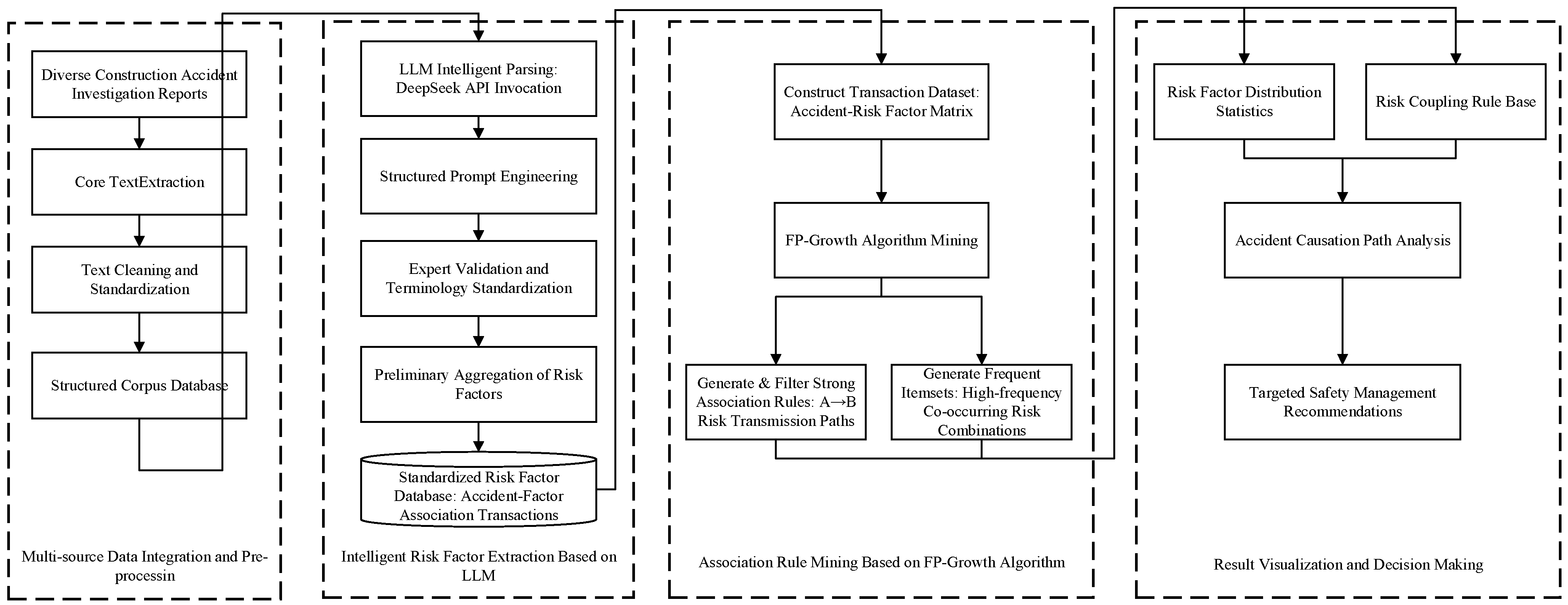
Construction Safety Risk Identification and Coupling Analysis Based on Data Mining

Abstract
1. Introduction
2. Literature Review
2.1. Risk Identification
2.2. Risk Coupling Analysis
3. Methods
3.1. Data Source and Preprocessing
3.2. LLM-Based Identification of Construction Safety Risk Factors
3.2.1. Theoretical Framework for Risk Factor Classification
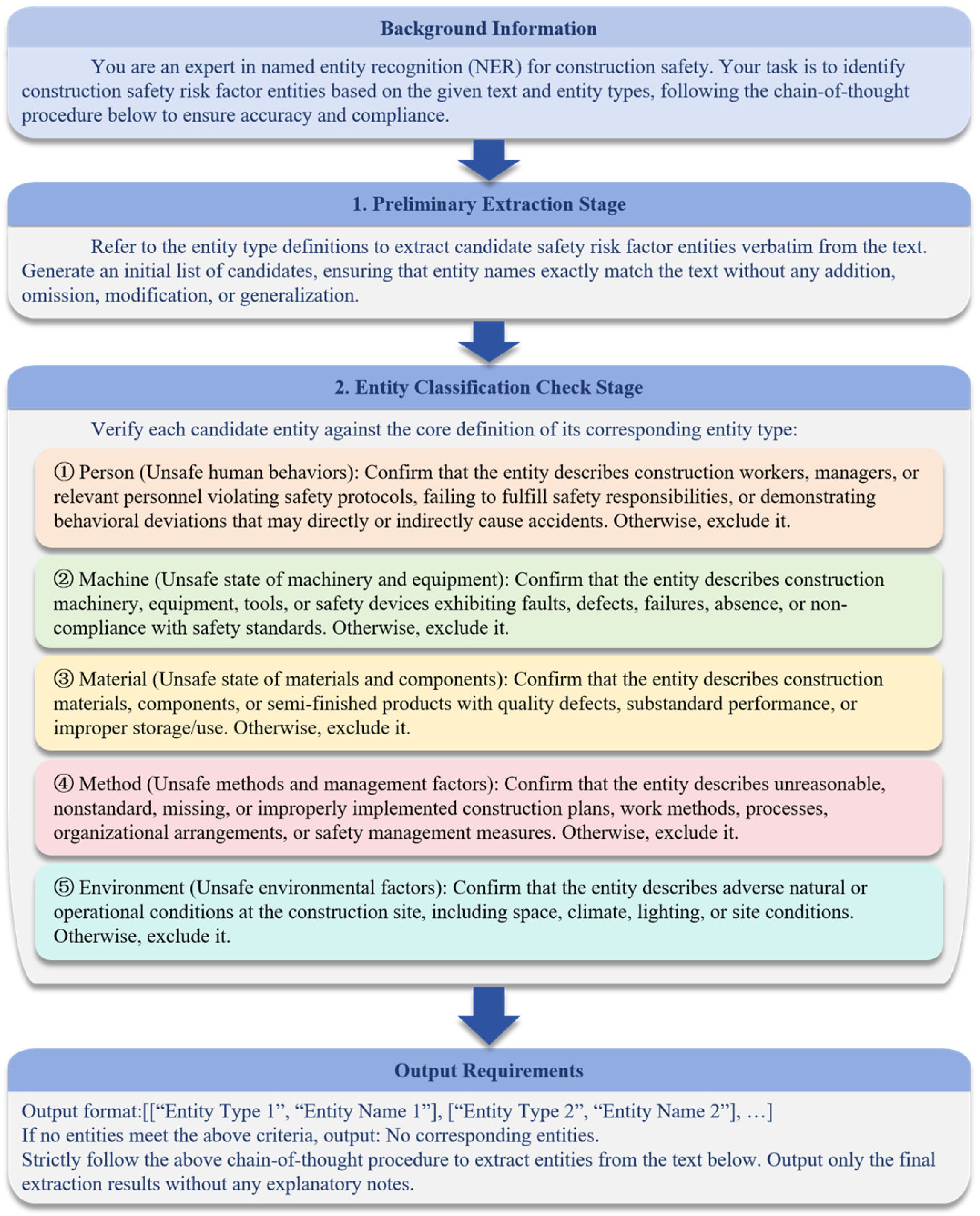
3.2.2. LLM Invocation and Prompt Engineering
3.3. Association Rule Mining of Risk Factors Based on the FP-Growth Algorithm
3.3.1. Construction of the Transaction Dataset
3.3.2. Principles of the FP-Growth Algorithm
3.4. Structural Characterization of Risk Factors Based on Complex Network Analysis
3.4.1. Construction of the Risk Factor Network
3.4.2. Centrality Measures
3.5. Experimental Environment
4. Results
4.1. Risk Factor Identification Results
4.1.1. Initial Identification of Risk Factors
4.1.2. Optimization of Risk Factors
4.1.3. Construction of the Risk Factor Indicator System
4.2. Association Rule Mining Results Based on FP-Growth
4.2.1. Threshold Setting
4.2.2. Strong Association Rules
4.3. Results of Complex Network Analysis
5. Discussion
5.1. Theoretical Implications
5.2. Practical Implications
- Strengthen source-oriented control along high-confidence pathways. High-confidence rules reveal pronounced chain-like failure mechanisms within the management system. Together with the identification of hub nodes in the network, safety training should be elevated from a basic measure to a source-control lever, with targeted programs for critical positions and high-risk operations, reinforced by process-based assessments to interrupt cascading managerial failures.
- Establish routine system-level governance for high-support combinations. Multiple rules exhibit support values exceeding 0.8, indicating that responsibility systems, training, and inspection form a high-frequency co-occurrence structure, reflecting systemic institutional deficiencies. Accordingly, safety management should shift from single-factor control to coordinated system governance, strengthening the linkage among responsibility implementation, training, and hazard inspection to reduce recurring risks.
- Implement coordinated interventions for high-lift coupling relationships. High-lift rules indicate strong amplification effects between human and environmental factors. Combined with nodes exhibiting high clustering coefficients, these risks tend to form dense local substructures. Management should therefore move from single-factor interventions to integrated strategies, optimizing site signage, working environments, and behavioral norms to weaken coupling conditions.
- Control critical coupling nodes in cross-operation scenarios. Rule mining and network analysis identify cross-operation contexts as key nodes where human and material risks intersect. Their high degree and clustering coefficients highlight their bridging role in risk transmission. Targeted control measures should be implemented at high-risk interfaces, including defined safety distances and dynamic monitoring mechanisms, to prevent physical risk convergence.
- Develop multi-indicator monitoring for concurrent management failures. When multiple managerial deficiencies co-occur, systemic risk increases significantly. A multi-indicator monitoring system based on medium- to high-confidence rules can trigger early warnings when key management factors simultaneously deviate, enabling timely identification of concurrent risk conditions and preventing local failures from escalating into systemic accidents.
- Adopt stratified and network-informed precision governance. Homogeneous governance approaches should be avoided. Based on network metrics, high-degree nodes should be prioritized for intervention to weaken their connectivity with other risks, while highly clustered substructures should be addressed through coordinated governance to disrupt tight interdependencies. This enables dynamic risk identification and precise control on construction sites.
5.3. Limitations and Future Research
6. Conclusions
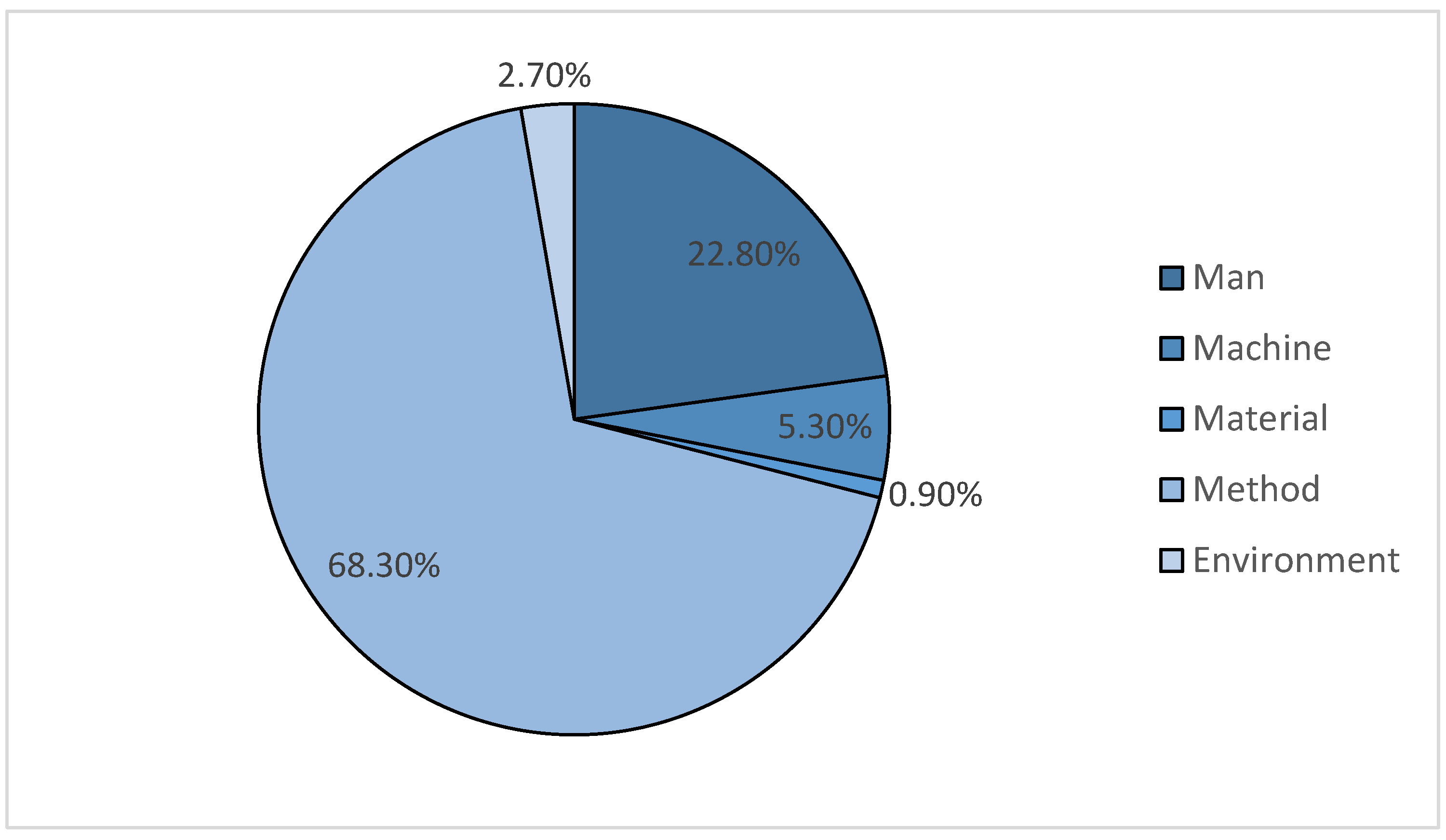
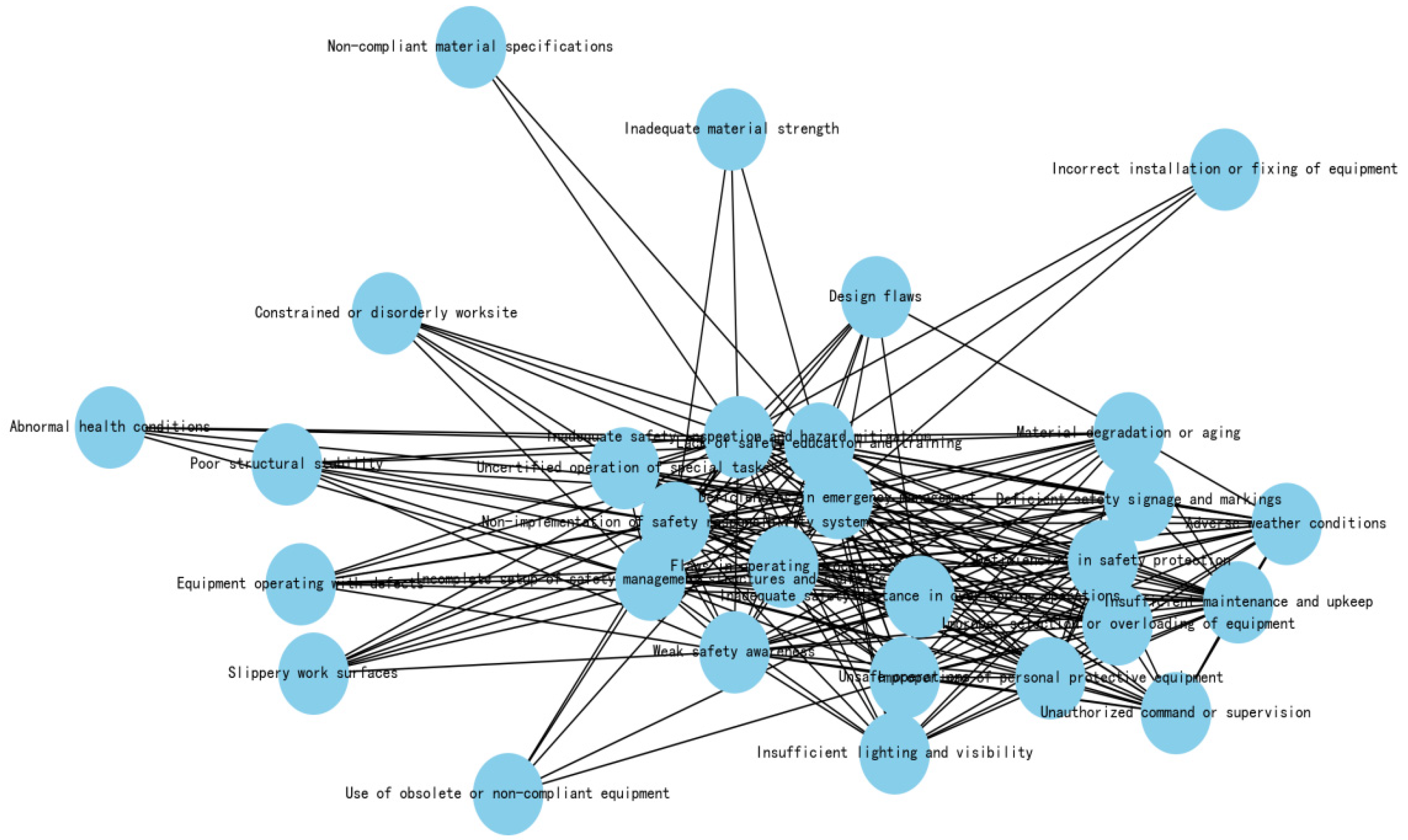
- The distribution of construction safety risks shows strong systemic and highly uneven characteristics, with the Method dimension playing a dominant role. At a deeper level, organizational and institutional factors consistently occupy core positions in the risk network. On average, each accident involves 11.81 risk factors, of which management-related factors account for 68.3%, highlighting the dominant role of managerial deficiencies in construction safety accidents. Association rule analysis further shows that the lack of safety education and training acts as a key hub in the risk system. It is strongly associated with inadequate safety inspection and hazard identification and rectification (support = 0.967, confidence = 0.987), weak implementation of safety responsibility systems (support = 0.920, confidence = 0.998), and deficiencies in emergency management (support = 0.846, confidence = 0.995). These results indicate that the underlying mechanisms of risk factors are largely universal. However, differences in safety culture, regulatory intensity, and organizational modes across countries may influence their specific manifestations.
- Risk evolution follows two characteristic transmission pathways. One is a cascading cognitive–behavioral pathway, whereby environmental deficiencies erode workers’ safety awareness and subsequently induce unsafe behaviors, providing empirical support for the safety psychology principle that “environment shapes cognition.” The other is a direct interaction pathway between human and material factors, in which reduced safety distances act as a critical interface, allowing unsafe behaviors and hazardous conditions to converge and trigger accidents.
- The co-occurrence of management deficiencies exhibits a pronounced “amplification effect.” When multiple managerial factors fail simultaneously, the resulting systemic risk is substantially greater than that caused by any single-factor failure. In extreme cases, such co-failures may escalate localized breakdowns of the safety management system into systemic collapse. This finding further substantiates that construction safety accidents are the outcome of multi-factor interaction and dynamic coupling. It also confirms that construction safety risks do not exist in isolation; instead, they form a structured network system through complex interdependencies. Complex network analysis further validates the structural robustness of the association rule mining results. At the network level, it reveals the key coupling mechanisms and critical coupling factors underlying construction safety risks.
Author Contributions
Funding
Data Availability Statement
Conflicts of Interest
References
- Giang, D.T.H.; Pheng, L.S. Role of construction in economic development: Review of key concepts in the past 40 years. Habitat Int. 2011, 35, 118–125. [Google Scholar] [CrossRef]
- Collie, A. Disparities in death at work: Reflections on occupational injury fatality data. Occup. Environ. Med. 2024, 81, 167–168. [Google Scholar] [CrossRef]
- Barua, U.; Wiersma, J.W.F.; Ansary, M.A. Can rana plaza happen again in Bangladesh? Saf. Sci. 2021, 135, 105103. [Google Scholar] [CrossRef]
- Hebei Department of Emergency Management. Investigation Report on the “4·25” Major Construction Hoist Car Fall Accident at Feicui Huating in Hengshui City [OL] Hebei Department of Emergency Management, 2019. Available online: https://yjgl.hebei.gov.cn/portal/index/getPortalNewsDetails?id=93a0c0cc-4ffd-4688-afeb-ced41ae43c86&categoryid=3a9d0375-6937-4730-bf52-febb997d8b48 (accessed on 12 March 2026).
- Wang, B.; Wang, Y.; Xu, F.; Shi, Z. Intelligence-led accident prevention and its application in petrochemical Enterprises. Process Saf. Environ. Prot. 2024, 184, 690–702. [Google Scholar] [CrossRef]
- Olimat, H.; Alwashah, Z.; Abudayyeh, O.; Liu, H. Data-Driven Analysis of Construction Safety Dynamics: Regulatory Frameworks, Evolutionary Patterns, and Technological Innovations. Buildings 2025, 15, 1680. [Google Scholar] [CrossRef]
- Wang, D.; Yin, K.; Wang, H. Risk identification in prefabricated building construction safety systems based on STPA-TM. Reliab. Eng. Syst. Saf. 2026, 268, 112004. [Google Scholar] [CrossRef]
- Liu, C.; Yang, S. Using text mining to establish knowledge graph from accident/incident reports in risk assessment. Expert Syst. Appl. 2022, 207, 117991. [Google Scholar] [CrossRef]
- Hai, N.; Gong, D.; Liu, S.; Dai, Z. Dynamic coupling risk assessment model of utility tunnels based on multimethod fusion. Reliab. Eng. Syst. Saf. 2022, 228, 108773. [Google Scholar] [CrossRef]
- Xu, X.; Zou, P.X.W. Discovery of new safety knowledge from mining large injury dataset in construction. Saf. Sci. 2021, 144, 105481. [Google Scholar] [CrossRef]
- Chowdhury, A.M.; Park, S.I.; Choi, J.-H. Safety Scheduling Through Integrated Accident Analysis Using Multiple Correspondence Analysis and Association Rule Mining: A Construction Engineering Perspective. Buildings 2025, 15, 4020. [Google Scholar] [CrossRef]
- Nwafor, M. Mitigating uncertainty: Analyzing the role of risk management in the construction industry. Harrisbg. Univ. Sci. Technol. 2024. Available online: https://digitalcommons.harrisburgu.edu/dandt/24/ (accessed on 12 March 2026).
- Liu, J.; Yan, X.; Gao, W. A Dualistic Perspective of Opportunity and Risk: The Impact of Head-Mounted Augmented Reality on Construction Onsite Hazard Identification of Workers. J. Constr. Eng. Manag. 2024, 150, 04024160. [Google Scholar] [CrossRef]
- Zhang, S.; Loosemore, M.; Sunindijo, R.Y.; Galvin, S.; Wu, J.; Zhang, S. Assessing Safety Risk Management Performance in Chinese Subway Construction Projects: A Multistakeholder Perspective. J. Manag. Eng. 2022, 38, 05022009. [Google Scholar] [CrossRef]
- Liang, Y.; Xu, N.; Chang, H.; Qian, S.; Liu, Y. Automatic construction of risk transmission network about subway construction based on deep learning Models. Sci. Rep. 2025, 15, 16383. [Google Scholar] [CrossRef]
- Goh, Y.M.; Ubeynarayana, C.U. Construction accident narrative classification: An evaluation of text mining Techniques. Accid. Anal. Prev. 2017, 108, 122–130. [Google Scholar] [CrossRef]
- Kim, T.; Chi, S. Accident Case Retrieval and Analyses: Using Natural Language Processing in the Construction Industry. J. Constr. Eng. Manag. 2019, 145, 04019004. [Google Scholar] [CrossRef]
- Wang, S. Development of an automated transformer-based text analysis framework for monitoring fire door defects in buildings. Sci. Rep. 2025, 15, 43910. [Google Scholar] [CrossRef]
- Wang, S. Graph neural network–driven text classification for fire-door defect inspection in pre-completion construction. Sci. Rep. 2025, 15, 44382. [Google Scholar] [CrossRef]
- Zhu, Y.; Yuan, H.; Wang, S.; Liu, J.; Liu, W.; Deng, C.; Chen, H.; Liu, Z.; Dou, Z.; Wen, J.-R. Large language models for information retrieval: A survey. ACM Trans. Inf. Syst. 2025, 44, 1–54. [Google Scholar] [CrossRef]
- Oral, M.; Alboga, Ö.; Aydinli, S.; Erdis, E. Usability of large language models for building construction safety risk assessment. Eng. Constr. Archit. Manag. 2025. [Google Scholar]
- Wu, W.; Wen, C.; Yuan, Q.; Chen, Q.; Cao, Y. Construction and application of knowledge graph for construction accidents based on deep learning. Eng. Constr. Archit. Manag. 2023, 32, 1097–1121. [Google Scholar] [CrossRef]
- Deng, Z.; Ma, W.; Han, Q.L.; Zhou, W.; Zhu, X.; Wen, S.; Xiang, Y. Exploring DeepSeek: A Survey on Advances, Applications, Challenges and Future Directions. IEEE/CAA J. Autom. Sin. 2025, 12, 872–893. [Google Scholar] [CrossRef]
- Ma, G.; Wu, Z.; Jia, J.; Shang, S. Safety risk factors comprehensive analysis for construction project: Combined cascading effect and machine learning Approach. Saf. Sci. 2021, 143, 105410. [Google Scholar] [CrossRef]
- Fu, L.; Li, X.; Wang, X.; Li, M. Safety risk propagation in complex construction projects: Insights from metro deep foundation pit projects. Reliab. Eng. Syst. Saf. 2025, 257, 110858. [Google Scholar] [CrossRef]
- Jiang, J.; Liu, G.; Ou, X. Risk Coupling Analysis of Deep Foundation Pits Adjacent to Existing Underpass Tunnels Based on Dynamic Bayesian Network and N–K Model. Appl. Sci. 2022, 12, 10467. [Google Scholar] [CrossRef]
- Guo, Q.; Amin, S.; Wang, H.; Yan, H. Coupling Simulation of Human-Environmental Safety Risk Factors in Metro Construction–a Case Study of Rongjiazhai Station at Xi’an Metro Line 5 in China. Int. J. Constr. Educ. Res. 2023, 20, 26–42. [Google Scholar] [CrossRef]
- Yan, K.; Jin, L.; Yu, X. Ordered weighted evaluation method of lifting operation safety risks considering coupling effect. Sci. Rep. 2024, 14, 5776. [Google Scholar] [CrossRef] [PubMed]
- He, Y.; Li, J. Analysis of coal mining accident risk factors based on text mining. Proc. Inst. Mech. Eng. Part O J. Risk Reliab. 2025, 239, 630–644. [Google Scholar] [CrossRef]
- Han, Y.; Shen, J.; Zhu, X.; An, B.; Bao, X. Interaction mechanisms of interface management risks in complex systems of high-speed rail construction projects: An association rule mining-based modeling framework. Eng. Constr. Archit. Manag. 2024, 31, 2101–2127. [Google Scholar] [CrossRef]
- Liu, Z.; Meng, X.; Xing, Z.; Jiang, A. Digital Twin-Based Safety Risk Coupling of Prefabricated Building Hoisting. Sensors 2021, 21, 3583. [Google Scholar] [CrossRef] [PubMed]
- Fu, L.; Wang, X.; Zhao, H.; Li, M. Interactions among safety risks in metro deep foundation pit projects: An association rule mining-based modeling framework. Reliab. Eng. Syst. Saf. 2022, 221, 108381. [Google Scholar] [CrossRef]
- Li, H.; Xiao, J.; Gan, L.; Liu, K. Prediction of navigation aid malfunction based on hash chain-optimized FP-growth and gradient boosting random forest. Reliab. Eng. Syst. Saf. 2026, 269, 112046. [Google Scholar] [CrossRef]
- Lawal, M.M.; Matthew, O.T. FP-Growth Algorithm: Mining Association Rules without Candidate Sets Generation. Kasu J. Comput. Sci. 2024, 1, 392–411. [Google Scholar] [CrossRef]
- Yang, Y.; Wang, Y.; Easa, S.M.; Yan, X. Risk factors influencing tunnel construction safety: Structural equation model Approach. Heliyon 2023, 9, e12924. [Google Scholar] [CrossRef]
- Hunyadi, I.D.; Constantinescun, N.; Țicleanu, O.A. Efficient Discovery of Association Rules in E-Commerce: Comparing Candidate Generation and Pattern Growth Techniques. Appl. Sci. 2025, 15, 5498. [Google Scholar] [CrossRef]
- Lin, K.C.; Liao, I.E.; Chen, Z.S. An improved frequent pattern growth method for mining association rules. Expert Syst. Appl. 2011, 38, 5154–5161. [Google Scholar] [CrossRef]
- Xiang, P.; Yang, Y.; Yan, K.; Jin, L. Identification of Key Safety Risk Factors and Coupling Paths in Mega Construction Projects. J. Manag. Eng. 2024, 40, 04024023. [Google Scholar] [CrossRef]
- Zhu, Y.; Li, C.; Li, L.; Yang, K.; Yang, Y.; Zhang, G. Dynamic assessment and system dynamics simulation of safety risk in whole life cycle of coal mine. Environ. Sci. Pollut. Res. 2023, 30, 64154–64167. [Google Scholar] [CrossRef] [PubMed]
- Tanabe, K. Pareto’s 80/20 Rule and the Gaussian Distribution. Phys. A 2018, 510, 635–640. [Google Scholar] [CrossRef]
- GB/T 13861-2022; Classification and Code for the Hazardous and Harmful Factors in Process. State Administration for Market Regulation of China, Standardization Administration of China: Beijing, China, 2022.
- Yoon, Y.G.; Ahn, C.R.; Yum, S.G.; Oh, T.K. Establishment of Safety Management Measures for Major Construction Workers through the Association Rule Mining Analysis of the Data on Construction Accidents in Korea. Buildings 2024, 14, 998. [Google Scholar] [CrossRef]
- Liu, J.; Wang, Y.; Deng, C.; Jin, Z.; Wang, G.; Yang, C.; Li, X. Research on safety supervision and management system of China railway based on association rule and DEMATEL. PLoS ONE 2023, 18, e0295755. [Google Scholar] [CrossRef] [PubMed]
- Liu, Q.; Ding, Y.; Luo, X. Automated knowledge graph-based risk assessment for fall-from-height accidents in construction. Autom. Constr. 2025, 179, 106482. [Google Scholar] [CrossRef]
- Liu, W.; Kang, X.; Ye, Q.; Xie, J. Unraveling hierarchical penetration mechanisms and coupling relationships of safety risks in major transportation infrastructure construction using text mining and complex networks. Sci. Rep. 2026, 16, 7313. [Google Scholar] [CrossRef] [PubMed]
- Edmondson, A.C.; Bransby, D.P. Psychological Safety Comes of Age: Observed Themes in an Established Literature. Annu. Rev. Organ. Psychol. Organ. Behav. 2023, 10, 55–78. [Google Scholar] [CrossRef]
- Li, X.; Liu, W.; Chen, B.; Zhou, N.; Huang, W.; Liang, Y.; Yuan, X.; Li, Z. Domino Effect Risk Modeling and Analysis of Tank Area Accidents Based on Accident Chain and Multifactor Coupling. ACS Chem. Health Saf. 2025, 32, 413–425. [Google Scholar] [CrossRef]
- Zhou, F.; Zhang, J.; Fu, C. Generation paths of major production safety accidents—A fuzzy-set qualitative comparative analysis based on Chinese data. Front. Public Health 2023, 11, 1136640. [Google Scholar] [CrossRef]
- Niu, H.; Yang, X.; Zhang, J.; Guo, S. Risk coupling analysis of causal factors in construction Fall-from-height Accidents. Eng. Constr. Archit. Manag. 2024, 32, 6045–6067. [Google Scholar] [CrossRef]



| Dimensions | Meanings | Examples |
|---|---|---|
| Man | Factors related to workers and management personnel | e.g., safety awareness, operational skills, violations, physical and psychological conditions |
| Machine | Factors related to equipment, tools, and facilities | e.g., equipment aging, safety device failure, tool defects, inadequate maintenance |
| Material | Factors related to construction materials and components | e.g., material defects, lack of protective equipment, insufficient structural strength, non-compliant specifications |
| Method | Factors related to construction processes, technical plans, and management procedures | e.g., flawed plans, unclear technical briefings, inadequate supervision, incomplete safety systems |
| Environment | Factors related to the working environment and external conditions | e.g., hazardous site conditions, insufficient lighting or ventilation, adverse weather, site disorder, complex geological conditions |
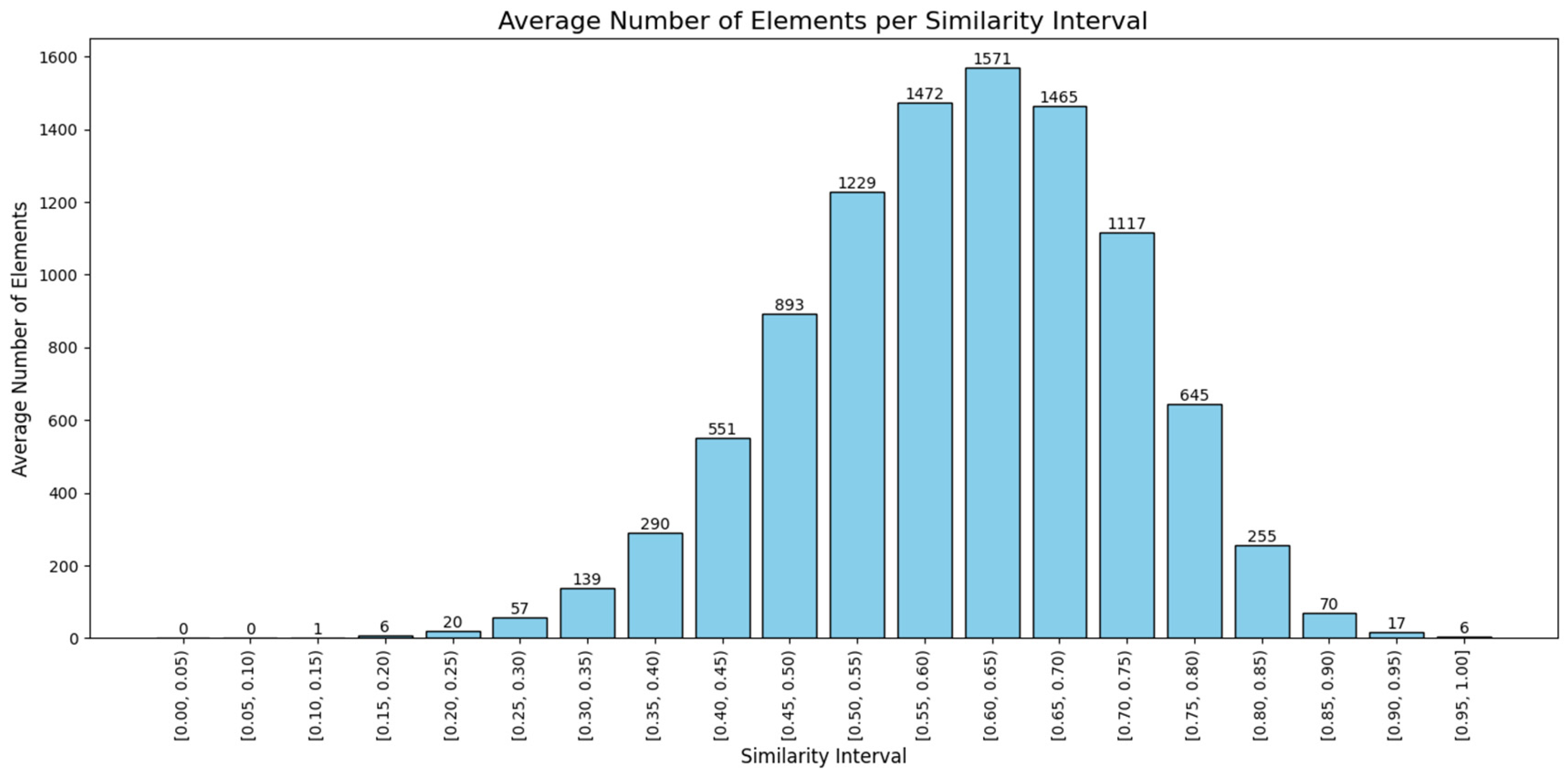
| Text | Similarity |
|---|---|
| Unauthorized bundling of loads by a construction hoisting signal and sling operator without the relevant special operations certificate. | 1.000000000 |
| Performing slinging operations without a construction hoisting signal and sling operator certificate | 0.858886719 |
| Illegally performing tower crane signaling without the required certificate. | 0.838867188 |
| Non-compliance with personnel-to-certificate alignment regulations for tower crane signal and sling operators. | 0.779296875 |
| Operator Sun used incorrect sling rigging, violating technical standards, directed unstable lifts, and failed to warn personnel below. | 0.772460938 |
| Failure to timely detect and stop unauthorized operations by signal and sling operators. | 0.771484375 |
| Unauthorized personnel without a construction hoisting signal and sling operator certificate directing Tower Crane 7C. | 0.76953125 |
| Tower crane operator Li followed instructions from non-certified personnel and lifted loads not properly rigged. | 0.763183594 |
| No working-at-height or hoisting signal and sling operation certificates. | 0.759765625 |
| Liu, lacking operator certification, directed the crane via hand signals. | 0.755859375 |
| Assigning unqualified personnel to direct lifts. | 0.749023438 |
| Liu had no certificate for special sling operations. | 0.74609375 |
| Absence of the required slinging qualification. | 0.744628906 |
| No certified personnel assigned for supervision during lifting operations. | 0.740234375 |
| Failure to recognize subcontractors who did not assign certified signal and sling supervisors. | 0.739257813 |
| Non-compliance with prescribed allocation of signal and sling operators. | 0.736816406 |
| Blindly following unqualified instructions of carpenter Wang without verifying crane signal qualification. | 0.731933594 |
| Crane operators and signalers lacked essential occupational safety knowledge for lifting operations | 0.73046875 |
| On-site supervisors and signalers not certified. | 0.728027344 |
| Failure to detect and correct lifting operations conducted with one signaler missing. | 0.7265625 |
| Expert | Domain | Affiliation | Title | Years of Experience |
|---|---|---|---|---|
| A | Construction Management | University | Professor | 20 |
| B | Construction Management | University | Associate Professor | 18 |
| C | Intelligent Construction | University | Professor | 21 |
| D | Intelligent Construction | Construction Firm | Senior Engineer | 15 |
| E | Construction Management | Construction Firm | Senior Engineer | 15 |
| Dimension | Risk Factor | |
|---|---|---|
| Construction Safety Risk Factor Indicator System | Man | Improper use of personal protective equipment |
| Unsafe operations | ||
| Unauthorized command or supervision | ||
| Weak safety awareness | ||
| Uncertified operation of special tasks | ||
| Abnormal health conditions | ||
| Machine | Deficiencies in safety protection | |
| Design flaws | ||
| Equipment operating with defects | ||
| Improper selection or overloading of equipment | ||
| Use of obsolete or non-compliant equipment | ||
| Incorrect installation or fixing of equipment | ||
| Insufficient maintenance and upkeep | ||
| Material | Inadequate material strength | |
| Material degradation or aging | ||
| Non-compliant material specifications | ||
| Poor structural stability | ||
| Method | Non-implementation of safety responsibility system | |
| Lack of safety education and training | ||
| Deficiencies in emergency management | ||
| Inadequate safety inspection and hazard mitigation | ||
| Flaws in operating procedures | ||
| Incomplete setup of safety management structures and staffing | ||
| Environment | Insufficient lighting and visibility | |
| Constrained or disorderly worksite | ||
| Adverse weather conditions | ||
| Slippery work surfaces | ||
| Inadequate safety distance in overlapping operations | ||
| Deficient safety signage and markings |
| No. | Association Rule (Antecedent → Consequent) | Support | Confidence | Lift |
|---|---|---|---|---|
| 1 | {Lack of safety education and training} → {Inadequate safety inspections and hazard mitigation} | 0.967 | 0.987 | 1.016 |
| 2 | {Failure to implement safety responsibility system} → {Lack of safety education and training} | 0.920 | 0.998 | 1.019 |
| 3 | {Deficiencies in emergency management} → {Lack of safety education and training} | 0.846 | 0.995 | 1.015 |
| 4 | {Flaws in operating procedures} → {Lack of safety education and training} | 0.838 | 0.995 | 1.015 |
| 5 | {Weak safety awareness} → {Improper use of personal protective equipment} | 0.313 | 0.806 | 2.571 |
| 6 | {Deficient safety signage and markings} → {Weak safety awareness} | 0.229 | 0.752 | 1.935 |
| 7 | {Unsafe operations} → {Insufficient safety distance in overlapping operations} | 0.349 | 0.878 | 1.511 |
| 8 | {Failure to implement safety responsibility system, inadequate safety inspections and hazard mitigation} → {Lack of safety education and training} | 0.911 | 0.989 | 1.009 |
| 9 | {Deficiencies in emergency management, lack of safety education and training} → {Failure to implement safety responsibility system} | 0.795 | 0.939 | 1.019 |
| 10 | {Improper selection or overloading of equipment} → {Insufficient safety distance in overlapping operations} | 0.249 | 0.911 | 1.568 |
| Node | Degree (k) | Clustering Coefficient (C) |
|---|---|---|
| Lack of safety education and training | 28 | 0.494708995 |
| Inadequate safety inspection and hazard mitigation | 28 | 0.494708995 |
| Non-implementation of safety responsibility system | 26 | 0.566153846 |
| Deficiencies in emergency management | 25 | 0.6 |
| Incomplete setup of safety management structures and staffing | 24 | 0.644927536 |
| Flaws in operating procedures | 23 | 0.687747036 |
| Inadequate safety distance in overlapping operations | 21 | 0.766666667 |
| Weak safety awareness | 21 | 0.771428571 |
| Unsafe operations | 19 | 0.859649123 |
| Material degradation or aging | 16 | 0.933333333 |
| Deficiencies in safety protection | 18 | 0.934640523 |
| Improper use of personal protective equipment | 18 | 0.934640523 |
| Insufficient maintenance and upkeep | 18 | 0.934640523 |
| Improper selection or overloading of equipment | 18 | 0.934640523 |
| Deficient safety signage and markings | 16 | 0.983333333 |
| Adverse weather conditions | 16 | 0.983333333 |
| Insufficient lighting and visibility | 14 | 1 |
| Unauthorized command or supervision | 14 | 1 |
| Uncertified operation of special tasks | 13 | 1 |
| Equipment operating with defects | 8 | 1 |
| Design flaws | 8 | 1 |
| Slippery work surfaces | 7 | 1 |
| Poor structural stability | 7 | 1 |
| Constrained or disorderly worksite | 6 | 1 |
| Use of obsolete or non-compliant equipment | 5 | 1 |
| Abnormal health conditions | 5 | 1 |
| Incorrect installation or fixing of equipment | 3 | 1 |
| Inadequate material strength | 3 | 1 |
| Non-compliant material specifications | 2 | 1 |
Disclaimer/Publisher’s Note: The statements, opinions and data contained in all publications are solely those of the individual author(s) and contributor(s) and not of MDPI and/or the editor(s). MDPI and/or the editor(s) disclaim responsibility for any injury to people or property resulting from any ideas, methods, instructions or products referred to in the content. |
© 2026 by the authors. Licensee MDPI, Basel, Switzerland. This article is an open access article distributed under the terms and conditions of the Creative Commons Attribution (CC BY) license.
Share and Cite
Zhang, G.; Yang, D.; Sun, Y. Construction Safety Risk Identification and Coupling Analysis Based on Data Mining. Buildings 2026, 16, 1917. https://doi.org/10.3390/buildings16101917
Zhang G, Yang D, Sun Y. Construction Safety Risk Identification and Coupling Analysis Based on Data Mining. Buildings. 2026; 16(10):1917. https://doi.org/10.3390/buildings16101917
Chicago/Turabian StyleZhang, Guozong, Dexin Yang, and Yuan Sun. 2026. "Construction Safety Risk Identification and Coupling Analysis Based on Data Mining" Buildings 16, no. 10: 1917. https://doi.org/10.3390/buildings16101917
APA StyleZhang, G., Yang, D., & Sun, Y. (2026). Construction Safety Risk Identification and Coupling Analysis Based on Data Mining. Buildings, 16(10), 1917. https://doi.org/10.3390/buildings16101917