

Relationship Between Social Support and Migrant Construction Workers’ Vocational Training Participation Intention: The Moderating Role of Work Pressure

 ,
,  and
and
Abstract
1. Introduction
2. Theoretical Framework and Hypothesis Development
2.1. Theory of Planned Behavior
2.2. Hypotheses and Research Model
2.2.1. SS, PBFs, and Migrant Construction Workers’ IAVET
2.2.2. PBFs and Migrant Construction Workers’ IAVET
2.2.3. The Moderating Role of WP
3. Research Methods
3.1. Data Collection
3.1.1. Questionnaire Development
3.1.2. Research Sampling
3.2. Data Analysis
3.2.1. Exploratory Factor Analysis (EFA)
3.2.2. Confirmatory Factor Analysis (CFA)
3.2.3. Structural Equation Modeling (SEM)
3.2.4. Multiple Mediation Models
3.2.5. The Moderation Model
4. Research Results
4.1. Descriptive Analysis
4.2. Results of EFA
4.3. Results of CFA
4.4. Hypothesis Testing
4.4.1. Overall SEM Results
4.4.2. SEM Results Under High and Low WP Levels
5. Discussion
5.1. Path Analysis of SS, PBFs, and the IAVET
- Among them, PBC demonstrates the strongest positive correlation with SS, suggesting the critical path of SS→PBC. This aligns with Costin et al. [86], who found that psychological support, including emotional encouragement from families and colleagues, can facilitate employees’ cognitive confidence in their abilities to access resources for behavior engagement.
- Besides, this research further uncovers the significant mediating roles of SN and ATT, which have been underexplored in the context of migrant construction workers. This addresses a critical gap in the literature by demonstrating how SS operates through multiple psychological pathways to shape training intentions. In the context of the Chinese construction industry, characterized by high work pressure and exacerbated by COVID-19 lockdown policies, migrant workers often experience significant work-family conflicts [87,88].
5.2. Mediating Role of PBFs
5.3. Moderating Effects of WP
5.4. Theoretical Implications
5.5. Practical Implications
6. Conclusions and Limitations
Author Contributions
Funding
Data Availability Statement
Acknowledgments
Conflicts of Interest
Abbreviations
| VET | Vocational education and training |
| IAVET | Intentions to attend VET |
| TPB | Theory of planned behavior |
| SS | Social support |
| WP | Work pressure |
| PBFs | Perceived behavioral factors |
| ROs | Research objectives |
| ATT | Attitudes |
| SN | Subjective norms |
| PBC | perceived behavioral control |
| EFA | Exploratory factor analysis |
| KMO | Kaiser–Meyer–Olkin |
| CFA | Confirmatory factor analysis |
| SEM | Structural equation modeling |
| Z | Critical ratios |
| CI | Confidence interval |
| CA | Composite reliability |
| CR | Cronbach’s alpha |
| AVE | Average variance extracted |
| RMSEA | Root mean square error of approximation |
| RMR | Root mean square residual |
| AGFI | Adjusted goodness-of-fit index |
| GFI | Goodness-of-fit index |
| IFI | Incremental fit index |
| TLI | Tucker–Lewis index |
| CFI | Comparative fit index |
| S.E. | Standard error |
| C.R. | Critical ratio |
References
- Juricic, B.B.; Galic, M.; Marenjak, S. Review of the construction and shortages in the EU. Buildings 2021, 11, 17. [Google Scholar] [CrossRef]
- Johari, S.; Jha, K.N. Challenges of attracting construction workers to skill development and training programmes. Eng. Constr. Archit. Manag. 2020, 27, 321–340. [Google Scholar] [CrossRef]
- Association of General Contractors of America. Eighty Percent of Contractors Report Difficulty Finding Qualified Craft Workers to Hire as Association Calls for Measures to Rebuild Workforce. 2018. Available online: https://www.agc.org/news/2018/08/29/eighty-percent-contractors-report-difficulty-finding-qualified-craft-workers-hire (accessed on 23 February 2025).
- Winterbotham, M.; Vivian, D.; Kik, G.; Hewitt, J.H.; Tweddle, M.; Downing, C.; Thomson, D.; Morrice, N.; Stroud, S. Employer Skills Survey 2017; IFF Research Ltd.: London, UK, 2017. [Google Scholar]
- Du, Q.; Zhou, J.; Pan, T.; Sun, Q.; Wu, M. Relationship of carbon emissions and economic growth in China’s construction industry. J. Clean. Prod. 2019, 220, 99–109. [Google Scholar] [CrossRef]
- Kim, S.; Chang, S.; Castro-Lacouture, D. Dynamic modeling for analyzing impacts of skilled labor shortage on construction project management. J. Manag. Eng. 2020, 36, 04019035. [Google Scholar] [CrossRef]
- Kalejaiye, P.O. Addressing shortage of skilled technical workers in the USA: A glimpse for training service providers. Future Bus. J. 2023, 9, 50. [Google Scholar] [CrossRef]
- Ke, Y.; Bian, J. Systematic training to improve the transformation of migrant workers into industrial workers within the construction sector in China. Buildings 2023, 13, 1948. [Google Scholar] [CrossRef]
- Zhang, N.; Ye, J.; Zhong, Y.; Chen, Z. Digital transformation in the Chinese construction industry: Status, barriers, and impact. Buildings 2023, 13, 1092. [Google Scholar] [CrossRef]
- Yap, J.B.H.; Chow, I.N.; Shavarebi, K. Criticality of construction industry problems in developing countries: Analyzing Malaysian projects. J. Manag. Eng. 2019, 35, 04019020. [Google Scholar] [CrossRef]
- Lyu, S.; Hon, C.K.; Chan, A.P.; Jiang, X.; Skitmore, M. Critical factors affecting the safety communication of ethnic minority construction workers. J. Constr. Eng. Manag. 2023, 149, 04022173. [Google Scholar] [CrossRef]
- López, F.; Contreras, M.; Nussbaum, M.; Paredes, R.; Gelerstein, D.; Alvares, D.; Chiuminatto, P. Developing critical thinking in technical and vocational education and training. Educ. Sci. 2023, 13, 590. [Google Scholar] [CrossRef]
- Chankseliani, M.; Keep, E.; Wilde, S. People and Policy: A Comparative Study of Apprenticeship Across Eight National Contexts; WISE Research: Doha, Qatar, 2017. [Google Scholar]
- Pilz, M. Typologies in comparative vocational education: Existing models and a new approach. Vocat. Learn. 2016, 9, 295–314. [Google Scholar] [CrossRef]
- Chen, P.; Schmidtke, C.; Jin, X. Chinese technical and vocational education and training, skill formation, and national development: A systematic review of educational policies. Vocat. Technol. Educ. 2024, 1, 19–28. [Google Scholar] [CrossRef]
- Wang, X.; Wang, X.; Huang, Y. Chinese construction worker reluctance toward vocational skill training. J. Eng. Des. Technol. 2019, 17, 155–171. [Google Scholar] [CrossRef]
- Yan, X.; Li, T.; Zhou, Y. Virtual reality’s influence on construction workers’ willingness to participate in safety education and training in China. J. Manag. Eng. 2022, 38, 04021095. [Google Scholar] [CrossRef]
- Zhang, S.; Sunindijo, R.Y.; Frimpong, S.; Su, Z. Work stressors, coping strategies, and poor mental health in the Chinese construction industry. Saf. Sci. 2023, 159, 106039. [Google Scholar] [CrossRef]
- Haiyan, G.; Peng, W.; Tam, T. Chinese social value change and its relevant factors: An age-period-cohort effect analysis. J. Chin. Sociol. 2024, 11, 7. [Google Scholar] [CrossRef]
- Yuan, H.; Wu, H.; Zuo, J. Understanding factors influencing project managers’ behavioral intentions to reduce waste in construction projects. J. Manag. Eng. 2018, 34, 04018031. [Google Scholar] [CrossRef]
- Zheng, X.; Lu, Y.; Le, Y.; Li, Y.; Fang, J. Formation of interorganizational relational behavior in megaprojects: Perspective of the extended theory of planned behavior. J. Manag. Eng. 2018, 34, 04017052. [Google Scholar] [CrossRef]
- Irfan, M.; Thaheem, M.J.; Gabriel, H.F.; Malik, M.S.A.; Nasir, A.R. Effect of stakeholder’s conflicts on project constraints: A tale of the construction industry. Int. J. Confl. Manag. 2019, 30, 538–565. [Google Scholar] [CrossRef]
- Zhang, M.; Murphy, L.A.; Fang, D.; Caban-Martinez, A.J. Influence of fatigue on construction workers’ physical and cognitive function. Occup. Med. 2015, 65, 245–250. [Google Scholar] [CrossRef] [PubMed]
- Tobia, L.; Muselli, M.; Mastrangeli, G.; Cofini, V.; Di Marcello, G.; Necozione, S.; Fabiani, L. Assessing the physical and psychological well-being of construction workers during the COVID-19 pandemic: A prospective study in Italy. J. Occup. Environ. Med. 2024, 66, 242–246. [Google Scholar] [CrossRef]
- Mastrantonio, R.; Cofini, V.; Tobia, L.; Mastrangeli, G.; Guerriero, P.; Cipollone, C.; Fabiani, L. Assessing Occupational Chemical Risk Perception in Construction Workers: A Cross-Sectional Study. Sustainability 2025, 17, 3332. [Google Scholar] [CrossRef]
- Kuhlman, S.T.W.; Walch, E.; Bauer, K.N.; Glenn, A.D. Intention to enact and enactment of gatekeeper behaviors for suicide prevention: An application of the theory of planned behavior. Prev. Sci. 2017, 18, 704–715. [Google Scholar] [CrossRef]
- Kyndt, E.; Baert, H. Antecedents of employees’ involvement in work-related learning: A systematic review. Rev. Educ. Res. 2013, 83, 273–313. [Google Scholar] [CrossRef]
- Ajzen, I. Perceived behavioural control, self-efficacy, locus of control, and the theory of planned behaviour. J. Appl. Psychol. 2002, 32, 665–683. [Google Scholar]
- Vamvaka, V.; Stoforos, C.; Palaskas, T.; Botsaris, C. Attitude toward entrepreneurship, perceived behavioral control, and entrepreneurial intention: Dimensionality, structural relationships, and gender differences. J. Innov. Entrep. 2020, 9, 1–26. [Google Scholar] [CrossRef]
- Tang, C.; Yi, T.; Naumann, S.E.; Dong, J. The influence of subjective norms and science identity on academic career intentions. High. Educ. 2023, 87, 1937–1956. [Google Scholar] [CrossRef]
- Galván-Mendoza, O. Environmental knowledge, perceived behavioral control, and employee green behavior in female employees of small and medium enterprises in Ensenada. Baja Calif. Environ. Psychol. 2022, 13, 1082306. [Google Scholar] [CrossRef] [PubMed]
- Zhao, W.; Peng, P.; Liu, H.; Wang, S.; Liu, W. How job satisfaction affects professionalization behavior of new-generation construction workers: A model based on theory of planned behavior. Eng. Constr. Archit. Manag. 2025, 32, 2672–2696. [Google Scholar] [CrossRef]
- Cohen, S.; Wills, T.A. Stress, social support, and the buffering hypothesis. Psychol. Bull. 1985, 98, 310–357. [Google Scholar] [CrossRef] [PubMed]
- Palaniappan, K.; Natarajan, R.; Dasgupta, C. Prevalence and risk factors for depression, anxiety and stress among foreign construction workers in Singapore–A cross-sectional study. Int. J. Constr. Manag. 2023, 23, 2479–2487. [Google Scholar] [CrossRef]
- Carley, L.A.; Haas, C.T.; Borcherding, J.G.; Goodrum, P.M. Experiences with multiskilling among non-union craft workers in US industrial construction projects. Eng. Constr. Archit. Manag. 2003, 10, 374–381. [Google Scholar] [CrossRef]
- Farooq, M.S. Modelling the significance of social support and entrepreneurial skills for determining entrepreneurial behaviour of individuals: A structural equation modelling approach. World J. Entrep. Manag. Sustain. Dev. 2018, 14, 242–266. [Google Scholar] [CrossRef]
- Pruett, M.; Shinnar, R.; Toney, B.; Llopis, F.; Fox, J. Explaining entrepreneurial intentions of university students: A cross-cultural study. Int. J. Entrep. Behav. Res. 2009, 15, 571–594. [Google Scholar] [CrossRef]
- Thoits, P.A. Mechanisms linking social ties and support to physical and mental health. J. Health Soc. Behav. 2011, 52, 145–161. [Google Scholar] [CrossRef]
- Armitage, C.J.; Conner, M. Efficacy of the theory of planned behaviour: A meta-analytic review. Br. J. Soc. Psychol. 2001, 40, 471–499. [Google Scholar] [CrossRef]
- Doll, J.; Ajzen, I. Accessibility and stability of predictors in the theory of planned behavior. J. Personal. Soc. Psychol. 1992, 63, 754. [Google Scholar] [CrossRef]
- Choi, W.; Jacobs, R.L. Influences of formal learning, personal learning orientation, and supportive learning environment on informal learning. Hum. Resour. Dev. Q. 2011, 22, 239–257. [Google Scholar] [CrossRef]
- Hurtz, G.M.; Williams, K.J. Attitudinal and motivational antecedents of participation in voluntary employee development activities. J. Appl. Psychol. 2009, 94, 635. [Google Scholar] [CrossRef] [PubMed]
- Chen, M.F.; Tung, P.J. Developing an extended theory of planned behavior model to predict consumers’ intention to visit green hotels. Int. J. Hosp. Manag. 2014, 36, 221–230. [Google Scholar] [CrossRef]
- Han, H.; Hsu, L.T.J.; Sheu, C. Application of the theory of planned behavior to green hotel choice: Testing the effect of environmental friendly activities. Tour. Manag. 2010, 31, 325–334. [Google Scholar] [CrossRef]
- Si, H.; Shi, J.; Tang, D.; Wu, G.; Lan, J. Understanding intention and behavior toward sustainable usage of bike sharing by extending the theory of planned behavior. Resour. Conserv. Recycl. 2020, 152, 104513. [Google Scholar] [CrossRef]
- Ajzen, I. The theory of planned behavior. Organ. Behav. Hum. Decis. Process. 1991, 50, 179–211. [Google Scholar] [CrossRef]
- Guo, Z.; Lamb, S. International Comparisons of China’s Technical and Vocational Education and Training System; Springer: Berlin/Heidelberg, Germany, 2010. [Google Scholar]
- Kurniawaty, K.; Ramly, M.; Ramlawati, R. The effect of work environment, stress, and job satisfaction on employee turnover intention. Manag. Sci. Lett. 2019, 9, 877–886. [Google Scholar] [CrossRef]
- Hobfoll, S.E. Conservation of resources: A new attempt at conceptualizing stress. Am. Psychol. 1989, 44, 513–524. [Google Scholar] [CrossRef] [PubMed]
- Saleem, M.S.; Isha, A.S.N.B.; Benson, C.; Awan, M.I.; Naji, G.M.A.; Yusop, Y.B. Analyzing the impact of psychological capital and work pressure on employee job engagement and safety behavior. Front. Public Health 2022, 10, 1086843. [Google Scholar] [CrossRef] [PubMed]
- Umer, W.; Yu, Y.; Afari, A.M.F. Quantifying the effect of mental stress on physical stress for construction tasks. J. Constr. Eng. Manag. 2022, 148, 04021204. [Google Scholar] [CrossRef]
- Techera, U.; Hallowell, M.; Littlejohn, R.; Rajendran, S. Measuring and predicting fatigue in construction: Empirical field study. J. Constr. Eng. Manag. 2018, 144, 04018062. [Google Scholar] [CrossRef]
- Pooladvand, S.; Hasanzadeh, S. Neurophysiological evaluation of workers’ decision dynamics under time pressure and increased mental demand. Autom. Constr. 2022, 141, 104437. [Google Scholar] [CrossRef]
- Dodanwala, T.C.; Santoso, D.S. The mediating role of job stress on the relationship between job satisfaction facets and turnover intention of the construction professionals. Eng. Constr. Archit. Manag. 2022, 29, 1777–1796. [Google Scholar] [CrossRef]
- Holden, S.; Sunindijo, R.Y. Technology, long work hours, and stress worsen work-life balance in the construction industry. Int. J. Integr. Eng. 2018, 10, 13–18. [Google Scholar] [CrossRef]
- Lazarus, R.S. Psychological stress in the workplace. In Occupational Stress; CRC Press: Boca Raton, FL, USA, 2020; pp. 3–14. [Google Scholar]
- Chandrasekaran, P.; Ganeshprabhu, P. A study on employee welfare measurement in construction industry in India. Int. J. Sci. Technol. Res. 2020, 9, 990–997. [Google Scholar]
- Gopalakrishnan, G.; Brindha, G. A study on employee welfare in construction industry. Int. J. Civ. Eng. Technol. 2017, 8, 7–12. [Google Scholar]
- Cammarata, M.; Scuderi, A.; Timpanaro, G.; Cascone, G. Factors influencing farmers’ intention to participate in the voluntary carbon market: An extended theory of planned behavior. J. Environ. Manag. 2024, 369, 122367. [Google Scholar] [CrossRef] [PubMed]
- Wang, B.; Tang, T.; Kaspar, E.; Li, Y. Explaining citizens’ plastic reduction behavior with an extended theory of planned behavior model: An empirical study in Switzerland. J. Environ. Manag. 2024, 358, 120869. [Google Scholar] [CrossRef]
- Zhang, S.; Sunindijo, R.Y.; Loosemore, M. The influence of personal and workplace characteristics on the job stressors of design professionals in the Chinese construction industry. J. Manag. Eng. 2023, 39, 05023006. [Google Scholar] [CrossRef]
- Kamardeen, I.; Sunindijo, R.Y. Personal characteristics moderate work stress in construction professionals. J. Constr. Eng. Manag. 2017, 143, 04017072. [Google Scholar] [CrossRef]
- Yeo, D.; Ha, Y. Job satisfaction among blood center nurses based on the job crafting model: A mixed methods study. Asian Nurs. Res. 2024, 19, 96–103. [Google Scholar] [CrossRef]
- Nantong Municipal Government. Nantong’s Construction Output Value Remained the Highest in the Province in 2023. 2024. Available online: https://www.nantong.gov.cn/ntsrmzf/tjsj3/content/c8ffaaf9-4af2-4b49-8d96-e4deda7b6dc5.html (accessed on 1 April 2025).
- Fan, Y.; Chen, J.; Shirkey, G.; John, R.; Wu, S.R.; Park, H.; Shao, C. Applications of structural equation modeling (SEM) in ecological studies: An updated review. Ecol. Process. 2016, 5, 19. [Google Scholar] [CrossRef]
- Chomeya, R.; Tayraukham, S.; Tongkhambanchong, S.; Saravitee, N. Sample size determination techniques for multivariate behavioral sciences research emphasizing SEM. J. Educ. Innov. 2024, 26, 438–447. [Google Scholar]
- Taherdoost, H.; Sahibuddin, S.; Jalaliyoon, N. Exploratory factor analysis; concepts and theory. Adv. Appl. Pure Math. 2022, 27, 375–382. [Google Scholar]
- Goni, M.D.; Naing, N.N.; Hasan, H.; Wan-Arfah, N.; Deris, Z.Z.; Arifin, W.N.; Hussin, T.M.A.R.; Abdulrahman, A.S.; Baaba, A.A.; Arshad, M.R. Development and validation of knowledge, attitude and practice questionnaire for prevention of respiratory tract infections among Malaysian Hajj pilgrims. BMC Public Health 2020, 20, 189. [Google Scholar] [CrossRef]
- Shrestha, N. Factor analysis as a tool for survey analysis. Am. J. Appl. Math. Stat. 2021, 9, 4–11. [Google Scholar] [CrossRef]
- Sigudla, J.; Maritz, J.E. Exploratory factor analysis of constructs used for investigating research uptake for public healthcare practice and policy in a resource-limited setting, South Africa. BMC Health Serv. Res. 2023, 23, 1423. [Google Scholar] [CrossRef]
- Hair, J.; Black, W.C.; Babin, B.J. Multivariate Data Analysis; Pearson Education, Inc.: New York, NY, USA, 2010. [Google Scholar]
- Marsh, H.W.; Guo, J.; Dicke, T.; Parker, P.D.; Craven, R.G. Confirmatory factor analysis (CFA), exploratory structural equation modeling (ESEM), and Set-ESEM: Optimal balance between goodness of fit and parsimony. Multivar. Behav. Res. 2020, 55, 102–119. [Google Scholar] [CrossRef] [PubMed]
- Durdyev, S.; Mbachu, J. Key constraints to labour productivity in residential building projects: Evidence from Cambodia. Int. J. Constr. Manag. 2017, 18, 385–393. [Google Scholar] [CrossRef]
- Kline, R.B. Principles and Practice of Structural Equation Modeling; Guilford Publications: New York, NY, USA, 2023. [Google Scholar]
- Bowen, N.K.; Guo, S. Structural Equation Modeling; Oxford University Press: Oxford, UK, 2011. [Google Scholar]
- Agler, R.; De Boeck, P. On the interpretation and use of mediation: Multiple perspectives on mediation analysis. Front. Psychol. 2017, 8, 293306. [Google Scholar] [CrossRef]
- Tibbe, T.D.; Montoya, A.K. Correcting the bias correction for the bootstrap confidence interval in mediation analysis. Front. Psychol. 2022, 13, 810258. [Google Scholar] [CrossRef] [PubMed]
- Dawson, J.F. Moderation in management research: What, why, when, and how. J. Bus. Psychol. 2014, 29, 1–19. [Google Scholar] [CrossRef]
- Aguirre-Urreta, M.I.; Hu, J. Detecting common method bias: Performance of the Harman’s single-factor test. Data Base Adv. Inf. Syst. 2019, 50, 45–70. [Google Scholar] [CrossRef]
- Cheung, G.W.; Cooper-Thomas, H.D.; Lau, R.S.; Wang, L.C. Reporting reliability, convergent and discriminant validity with structural equation modeling: A review and best-practice recommendations. Asia Pac. J. Manag. 2023, 41, 745–783. [Google Scholar] [CrossRef]
- Sharif, S.P.; Mostafiz, I.; Guptan, V. A systematic review of structural equation modelling in nursing research. Nurse Res. 2023, 26, 28–31. [Google Scholar] [CrossRef]
- Iacobucci, D. Structural equations modeling: Fit indices, sample size, and advanced topics. J. Consum. Psychol. 2010, 20, 90–98. [Google Scholar] [CrossRef]
- Cheung, G.W.; Wang, C. Current Approaches for Assessing Convergent and Discriminant Validity with SEM: Issues and Solutions; Academy of Management Proceedings: New York, NY, USA, 2017. [Google Scholar]
- Xiong, B.M.; Skitmore, B.; Xia, M.A.; Masrom, M.A.; Ye, K.; Bridge, A. Examining the influence of participant performance factors on contractor satisfaction: A structural equation model. Int. J. Proj. Manag. 2014, 32, 482–491. [Google Scholar] [CrossRef]
- Khayru, R.; Nichen, K.N.; Chairunnas, A.; Safaruddin, S.; Tahir, M. Study on the relationship between social support and entrepreneurship intention experienced by adolescents. J. Soc. Sci. Stud. JOS3 2021, 1, 47–51. [Google Scholar] [CrossRef]
- Costin, A.; Roman, A.F.; Balica, R.S. Remote work burnout, professional job stress, and employee emotional exhaustion during the COVID-19 pandemic. Front. Psychol. 2023, 14, 1193854. [Google Scholar] [CrossRef]
- Deep, S.; Sonkar, N.; Yadav, P.; Vishnoi, S.; Bhoola, V.; Kumar, A. Factors influencing the mental health of White-Collar construction workers in developing economies: Analytical study during the COVID-19 pandemic in India. J. Constr. Eng. Manag. 2024, 150, 04024058. [Google Scholar] [CrossRef]
- Liu, B.; Wang, Q.; Wu, G.; Zheng, J.; Li, L. How family-supportive supervisor affect Chinese construction workers’ work-family conflict and turnover intention: Investigating the moderating role of work and family identity salience. Constr. Manag. Econ. 2020, 38, 807–823. [Google Scholar] [CrossRef]
- Gómez-Salgado, C.; Camacho-Vega, J.C.; Gómez-Salgado, J.; García-Iglesias, J.J.; Fagundo-Rivera, J.; Allande-Cussó, R.; Pereira-Martin, J.; Ruiz-Frutos, C. Stress, fear, and anxiety among construction workers: A systematic review. Front. Public Health 2023, 11, 1226914. [Google Scholar] [CrossRef] [PubMed]
- Xu, Q.; Palmer, N.A. Migrant workers’ community in China: Relationships among social networks, life satisfaction and political participation. Psychosoc. Interv. 2011, 20, 281–294. [Google Scholar] [CrossRef]
- Ling, F.Y.Y.; Dulaimi, M.F.; Chua, M. Strategies for managing migrant construction workers from China, India, and the Philippines. J. Prof. Issues Eng. Educ. Pract. 2013, 139, 19–26. [Google Scholar] [CrossRef]
- Leung, M.Y.; Liang, Q.; Olomolaiye, P. Impact of job stressors and stress on the safety behavior and accidents of construction workers. J. Manag. Eng. 2016, 32, 04015019. [Google Scholar] [CrossRef]
- Wang, Q.; Ren, T.; Liu, T. Training, skill-upgrading and settlement intention of migrants: Evidence from China. Urban Stud. 2019, 56, 2779–2801. [Google Scholar] [CrossRef]
- Mo, P.K.H.; Mak, W.W.S. Help-seeking for mental health problems among Chinese: The application and extension of the theory of planned behavior. Soc. Psychiat. Epidemiol. 2009, 44, 675–684. [Google Scholar] [CrossRef]
- Park, J.; Yang, S.; Lehto, X. Adoption of mobile technologies for Chinese consumers. J. Electron. Commer. Res. 2007, 8, 196–206. [Google Scholar]
- Mao, E.; Palvia, P. Testing an extended model of IT acceptance in the Chinese cultural context. SIGMIS Database 2006, 37, 20–32. [Google Scholar] [CrossRef]
- Froehlich, D.E.; Raemdonck, I.; Beausaert, S. Resources to increase older workers’ motivation and intention to learn. Vocat. Learn. 2023, 16, 47–71. [Google Scholar] [CrossRef]
- Mushayi, T.; Deacon, C.; Smallwood, J. The effectiveness of health and safety training and its impact on construction workers’ attitudes, and perceptions. In Proceedings of the 8th International Conference on Engineering, Project, and Product Management (EPPM 2017), Amman, Jordan, 20–22 September 2017; Springer International Publishing: Cham, Switzerland, 2018; pp. 235–244. [Google Scholar]
- Aga, M.K. The mediating role of perceived behavioral control in the relationship between entrepreneurship education and entrepreneurial intentions of university students in Ethiopia. J. Innov. Entrep. 2023, 12, 32. [Google Scholar] [CrossRef]
- Wang, D.; Jiao, R.; Wang, H. Perceived overqualification and career indecisiveness: Examining the mediating role of career self-efficacy and moderating role of social support. Curr. Psychol. 2023, 43, 11983–11997. [Google Scholar] [CrossRef]
- Laranjeira, C.A. The effects of perceived stress and ways of coping in a sample of Portuguese health workers. J. Clin. Nurs. 2012, 21, 1755–1762. [Google Scholar] [CrossRef] [PubMed]


| Variables | Items | Literature Sources |
|---|---|---|
| SS | The construction firm provides necessary insurance, as well as necessary safety protection for me (SS1). | [57,58] |
| The construction firm pays for the expenses needed for skill training for me (SS2). | ||
| The construction firm provides a comprehensive skill training program for me (SS3). | ||
| The government provides corresponding policy subsidies for skill training for me (SS4). | ||
| ATT | After improving my skills, my salary will also increase (ATT1). | [59,60] |
| Improving skills is of significant help to my career development (ATT2). | ||
| Given the current industry situation, skill improvement is the general trend (ATT3). | ||
| SN | If my colleagues around me are attending skill training, I would also choose to join them (SN1). | |
| The encouraging and supportive attitude of the construction firm towards skill enhancement makes me want to improve my skills (SN2). | ||
| The encouraging and supportive attitude of the government departments towards skill enhancement makes me want to improve my skills (SN3). | ||
| PBC | I have enough physical strength to pursue skill enhancement (PBC1). | |
| I have enough energy to pursue skill enhancement (PBC2). | ||
| My learning ability can support me in skill enhancement (PBC3). | ||
| IAVET | I am willing to undergo further job-related skills training organized by the company (IAVET1). | |
| If conditions allow, I am willing to undergo skill training (IAVET2). | ||
| I have plans to further enhance my skills (IAVET3). | ||
| After understanding the benefits brought by skill enhancement, I am willing to undergo skill training (IAVET4). | ||
| WP | The amount of work I have to complete each day is appropriate (WP1). | [18,62] |
| The safety atmosphere at our construction site is satisfactory (WP2). | ||
| The working environment is pleasant (WP3). |
| Characteristics | Category | Frequency | Percentage (%) |
|---|---|---|---|
| Age | 20 or below | 4 | 0.7 |
| 21–30 | 52 | 9.5 | |
| 31–40 | 128 | 23.4 | |
| 41–50 | 141 | 25.8 | |
| 51–60 | 215 | 39.3 | |
| 61 or above | 7 | 1.3 | |
| Gender | Male | 501 | 91.6 |
| Female | 46 | 8.4 | |
| Residence status | Urban residency | 28 | 5.1 |
| Rural residency | 519 | 94.9 | |
| Educational level | Below primary | 149 | 27.2 |
| Primary | 309 | 56.5 | |
| Middle | 968 | 12.4 | |
| Secondary | 8 | 1.5 | |
| Diploma or above | 13 | 2.4 | |
| Daily salaries | 200 or below | 46 | 10.0 |
| 200–250 | 73 | 15.9 | |
| 250–300 | 100 | 21.8 | |
| 300–350 | 113 | 24.7 | |
| 350–400 | 73 | 15.9 | |
| 400–450 | 40 | 8.7 | |
| 450–500 | 5 | 1.1 | |
| 500 or above | 8 | 1.7 | |
| Skill certificate level | None | 397 | 72.6 |
| Primary | 69 | 12.6 | |
| Middle | 66 | 12.1 | |
| High | 15 | 2.7 |
| Latent Variables | Observed Variables | Factor Loadings | CA | CR | AVE | ||||
|---|---|---|---|---|---|---|---|---|---|
| 1 | 2 | 3 | 4 | 5 | |||||
| SS | SS1 | 0.732 | 0.719 | 0.760 | 0.518 | ||||
| SS2 | 0.843 | ||||||||
| SS4 | 0.714 | ||||||||
| ATT | ATT1 | 0.812 | 0.796 | 0.797 | 0.569 | ||||
| ATT2 | 0.752 | ||||||||
| ATT3 | 0.755 | ||||||||
| SN | SN1 | 0.690 | 0.783 | 0.783 | 0.546 | ||||
| SN2 | 0.844 | ||||||||
| SN3 | 0.711 | ||||||||
| PBC | PBC1 | 0.795 | 0.739 | 0.799 | 0.571 | ||||
| PBC2 | 0.852 | ||||||||
| PBC3 | 0.546 | ||||||||
| IAVET | IAVET1 | 0.682 | 0.814 | 0.826 | 0.543 | ||||
| IAVET2 | 0.611 | ||||||||
| IAVET3 | 0.725 | ||||||||
| IAVET4 | 0.720 | ||||||||
| Goodness-of-Fit Measures | Level of Acceptable Fit | CFA | Mediation Model | Moderation Model | |
|---|---|---|---|---|---|
| Absolute Fit | RMSEA | <0.08 | 0.054 | 0.060 | 0.051 |
| RMR | <0.08 | 0.030 | 0.034 | 0.045 | |
| AGFI | ≥0.85 | 0.924 | 0.912 | 0.861 | |
| GFI | ≥0.90 | 0.949 | 0.940 | 0.906 | |
| Incremental fit | IFI | ≥0.90 | 0.958 | 0.947 | 0.924 |
| TLI | ≥0.90 | 0.944 | 0.930 | 0.899 | |
| CFI | ≥0.90 | 0.957 | 0.946 | 0.923 | |
| Parsimonious fit | χ2/df | <3.00 | 2.600 | 2.992 | 2.417 |
| Variables | M | SD | ATT | SN | PBC | SS | IAVET | Standardized Factor Loadings |
|---|---|---|---|---|---|---|---|---|
| ATT | 3.976 | 0.821 | (0.754) | 0.657~0.803 | ||||
| SN | 4.115 | 0.731 | 0.693 *** | (0.739) | 0.732~0.747 | |||
| PBC | 3.840 | 0.765 | 0.451 *** | 0.400 *** | (0.756) | 0.683~0.822 | ||
| SS | 4.129 | 0.729 | 0.291 *** | 0.380 *** | 0.434 *** | (0.720) | 0.597~0.830 | |
| IAVET | 3.976 | 0.745 | 0.633 *** | 0.693 *** | 0.588 *** | 0.521 *** | (0.737) | 0.703~0.772 |
| Hypothesized Path | Estimate | S.E. | C.R. | p | Interpretation |
|---|---|---|---|---|---|
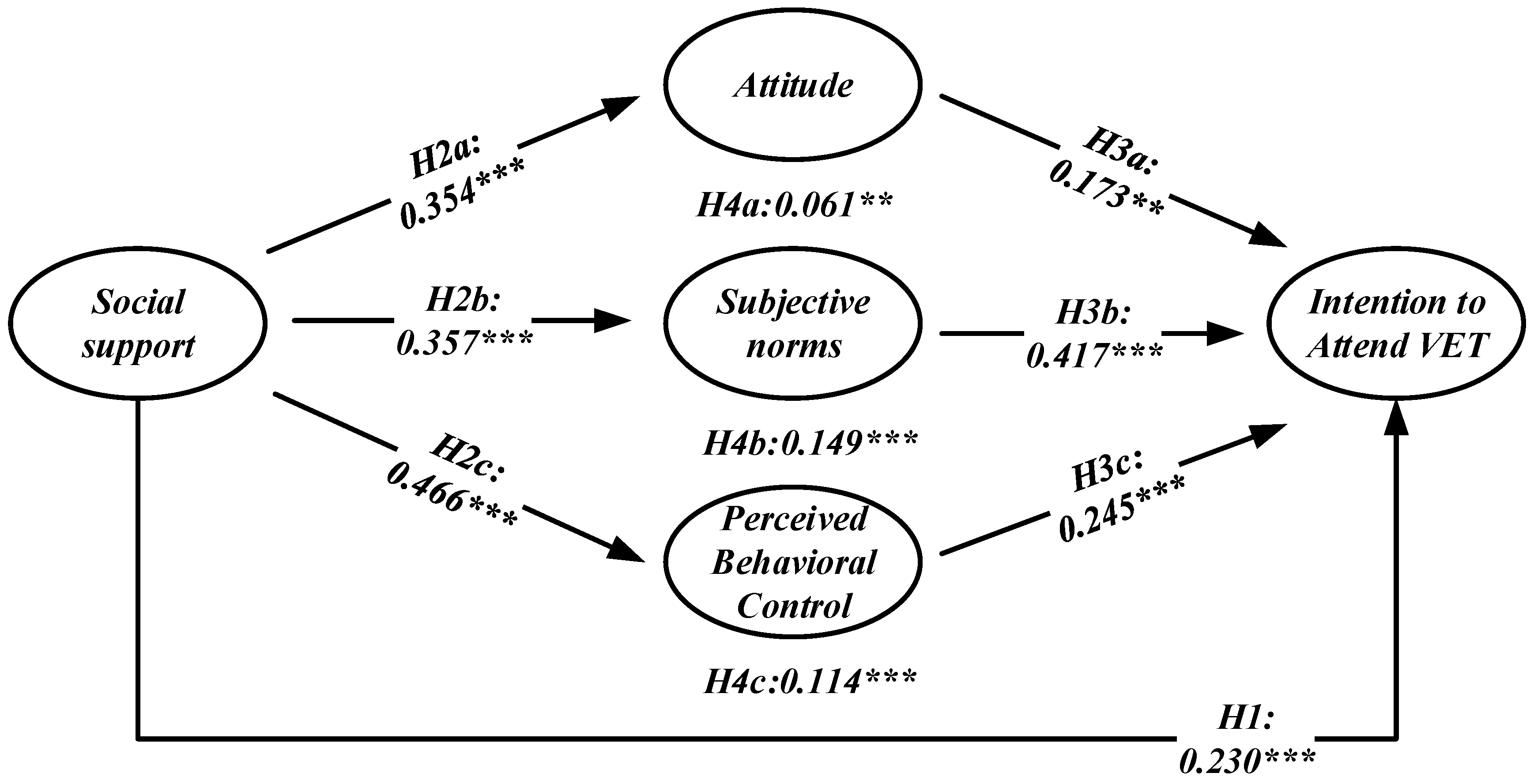
| H1: SS → IAVET | 0.230 | 0.050 | 4.577 | *** | Supported |
| H2a: SS → ATT | 0.354 | 0.066 | 5.391 | *** | Supported |
| H2b: SS → SN | 0.357 | 0.053 | 6.784 | *** | Supported |
| H2c: SS → PBC | 0.466 | 0.063 | 7.411 | *** | Supported |
| H3a: ATT → IAVET | 0.173 | 0.056 | 3.078 | 0.002 | Supported |
| H3b: SN → IAVET | 0.417 | 0.077 | 5.405 | *** | Supported |
| H3c: PBC → IAVET | 0.245 | 0.045 | 5.412 | *** | Supported |
| Specific Indirect Effect | Point Estimation | Product of Coefficients | Bootstrapping | ||||
|---|---|---|---|---|---|---|---|
| Bias-Corrected | Percentile | ||||||
| SE | Z | Lower | Upper | Lower | Upper | ||
| Indirect Effects (58.5%) | |||||||
| ATT | 0.061 | 0.031 | 1.968 | 0.009 | 0.134 | 0.005 | 0.129 |
| SN | 0.149 | 0.045 | 3.311 | 0.072 | 0.258 | 0.064 | 0.245 |
| PBC | 0.114 | 0.033 | 3.455 | 0.060 | 0.192 | 0.052 | 0.182 |
| TOTAL | 0.324 | 0.047 | 6.894 | 0.248 | 0.436 | 0.235 | 0.419 |
| Contrasts | |||||||
| ATT vs. SN | −0.088 | 0.058 | −1.517 | −0.209 | 0.023 | −0.201 | 0.031 |
| ATT vs. PBC | −0.053 | 0.052 | −1.019 | −0.159 | 0.045 | −0.153 | 0.049 |
| PBC vs. SN | −0.035 | 0.064 | −0.547 | −0.167 | 0.087 | −0.164 | 0.091 |
| Direct Effects (41.5%) | |||||||
| 0.230 | 0.074 | 3.108 | 0.092 | 0.378 | 0.103 | 0.390 | |
| Total Effects | |||||||
| 0.554 | 0.077 | 7.195 | 0.411 | 0.711 | 0.411 | 0.712 | |
| Specific Indirect Effect | Point Estimation | Product of Coefficients | Bootstrapping | |||||
|---|---|---|---|---|---|---|---|---|
| Bias-Corrected | Percentile | |||||||
| SE | Z | Lower | Upper | Lower | Upper | |||
| High | Indirect Effects (100%) | |||||||
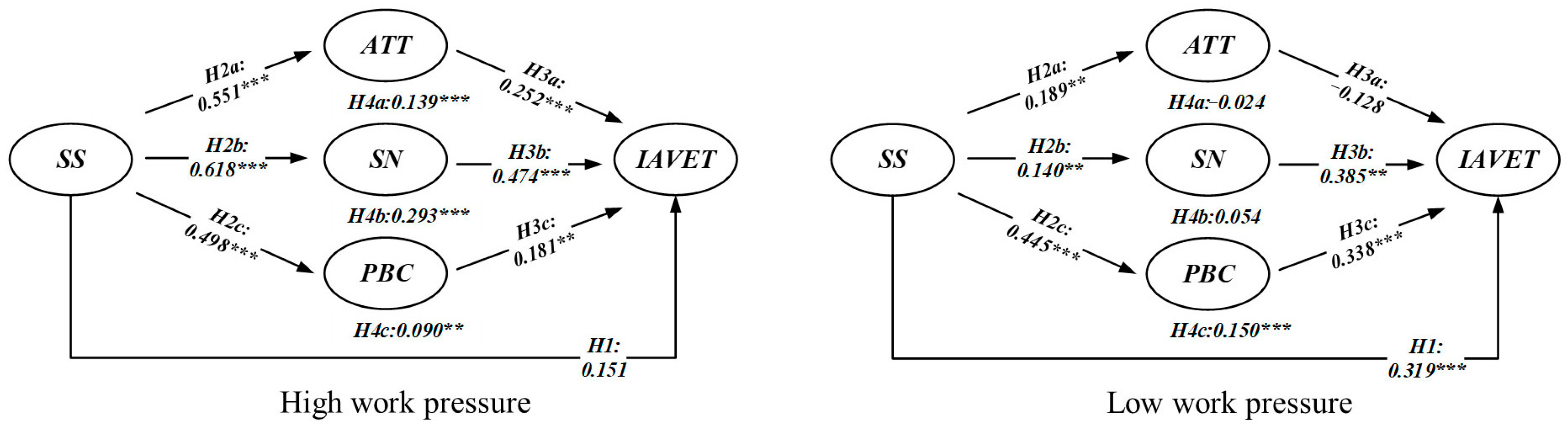
| ATT | 0.139 | 0.051 | 2.725 | 0.047 | 0.252 | 0.043 | 0.247 | |
| SN | 0.293 | 0.097 | 3.021 | 0.136 | 0.530 | 0.100 | 0.479 | |
| PBC | 0.090 | 0.045 | 2.000 | 0.015 | 0.205 | 0.001 | 0.184 | |
| TOTAL | 0.522 | 0.097 | 5.381 | 0.364 | 0.770 | 0.323 | 0.707 | |
| Direct Effects (0%) | ||||||||
| 0.151 | 0.130 | 1.162 | −0.107 | 0.408 | −0.072 | 0.442 | ||
| Total Effects | ||||||||
| 0.673 | 0.107 | 6.290 | 0.481 | 0.898 | 0.480 | 0.896 | ||
| Low | Indirect Effects (36%) | |||||||
| ATT | −0.024 | 0.060 | −0.400 | −0.205 | 0.017 | −0.128 | 0.039 | |
| SN | 0.054 | 0.054 | 1.000 | −0.001 | 0.228 | −0.014 | 0.171 | |
| PBC | 0.150 | 0.057 | 2.632 | 0.058 | 0.287 | 0.045 | 0.269 | |
| TOTAL | 0.180 | 0.062 | 2.903 | 0.081 | 0.303 | 0.068 | 0.290 | |
| Direct Effects (64%) | ||||||||
| 0.319 | 0.111 | 2.874 | 0.157 | 0.596 | 0.150 | 0.580 | ||
| Total Effects | ||||||||
| 0.498 | 0.121 | 4.116 | 0.297 | 0.776 | 0.287 | 0.759 | ||
| Contrasts | ||||||||
| Low vs. High | 0.342 | 0.114 | 3.000 | 0.144 | 0.587 | 0.115 | 0.556 | |
Disclaimer/Publisher’s Note: The statements, opinions and data contained in all publications are solely those of the individual author(s) and contributor(s) and not of MDPI and/or the editor(s). MDPI and/or the editor(s) disclaim responsibility for any injury to people or property resulting from any ideas, methods, instructions or products referred to in the content. |
© 2025 by the authors. Licensee MDPI, Basel, Switzerland. This article is an open access article distributed under the terms and conditions of the Creative Commons Attribution (CC BY) license (https://creativecommons.org/licenses/by/4.0/).
Share and Cite
Chen, M.; Dai, J.; Zhao, L.; Lyu, S.; Chen, J.; Skitmore, M.; Zhang, L. Relationship Between Social Support and Migrant Construction Workers’ Vocational Training Participation Intention: The Moderating Role of Work Pressure. Buildings 2025, 15, 4431. https://doi.org/10.3390/buildings15244431
Chen M, Dai J, Zhao L, Lyu S, Chen J, Skitmore M, Zhang L. Relationship Between Social Support and Migrant Construction Workers’ Vocational Training Participation Intention: The Moderating Role of Work Pressure. Buildings. 2025; 15(24):4431. https://doi.org/10.3390/buildings15244431
Chicago/Turabian StyleChen, Min, Jiaqi Dai, Lilin Zhao, Sainan Lyu, Jiaxu Chen, Martin Skitmore, and Lili Zhang. 2025. "Relationship Between Social Support and Migrant Construction Workers’ Vocational Training Participation Intention: The Moderating Role of Work Pressure" Buildings 15, no. 24: 4431. https://doi.org/10.3390/buildings15244431
APA StyleChen, M., Dai, J., Zhao, L., Lyu, S., Chen, J., Skitmore, M., & Zhang, L. (2025). Relationship Between Social Support and Migrant Construction Workers’ Vocational Training Participation Intention: The Moderating Role of Work Pressure. Buildings, 15(24), 4431. https://doi.org/10.3390/buildings15244431