1. Introduction
Following the fall of the communist regime, Albania gradually transitioned to an open-market economy and experienced a surge in mass immigration. The International Monetary Fund (IMF), the World Bank, and the EU supported the Albanian government in introducing structural reforms, which included the liberalisation of prices, balancing the budget deficit, establishing a new banking system and currency convertibility, privatisation, and trade liberalisation (
Skara 2022, pp. 236–37). Due to these reforms, Albania experienced rapid GDP growth rates in Europe: 9.4% in 1994, 8.9% in 1995, and 9.1% in 1996 (
Skara 2022, p. 237). On the other hand, as Albania lived isolated for around 45 years under the most brutal communist regime in the world, many Albanians fled the country once the regime fell (
Çaro and van Wissen 2007;
Vullnetari 2012). The massive immigration of Albanians to Europe provided the opportunity for criminal organisations to smuggle and traffic people, drugs, and arms (
Tabaku 2005;
Zhilla and Lamallari 2015;
Zhilla and Lamallari 2016). Within a short time, Albania’s criminal organisations became well-known for their efficiency and started conducting business with other criminal organisations worldwide (
Fink et al. 2005, pp. 415, 421).
While the EU reinforced the perspective of membership, declaring that “the future of the Balkans is within the EU” (
European Commission 2003), Albania was facing serious problems with high degree of informality and money laundering (
Fortuzi 2015). In 2000, the Albanian Parliament adopted the first anti-money laundering law (
Law 8610/2000 2000, hereinafter the 2000 Albanian AML Law). The 2000 Albanian AML Law was drafted in line with the 1st Anti-Money Laundering (AML) Directive, adopted in 1990 and with the 2nd AML Directive, which was under discussion at the time. Similarly to the 2nd AML Directive, the 2000 Albanian AML Law was limited to money laundering and defined money laundering in line with the United Nations Convention Against Illicit Traffic in Narcotic Drugs and Psychotropic Substances, adopted on 19 December 1988. Likewise to the 2nd AML Directive, the 2000 Albanian AML Law applied to credit and financial institutions, non-financial businesses, and the following professions: foreign exchange offices, money transmitters, investment firms, auditors, external accountants, tax advisors, real estate agents, notaries and other independent legal professionals (in specified circumstances), high-value dealers, and casinos. Additionally, the 2000 Albanian AML obliged these entities to register any transaction exceeding 2,000,000 Lek (approximately 2000 EUR) and report any suspicious money transactions within 48 h of registration.
Although Albania adopted legislation to prevent money laundering, it faced challenges in implementing it due to the high level of informality (
Fortuzi 2015). By 2001, more than 800 individuals were working informally in the money-changing sector in Tirana, and about 2000 across the country (
Hayton 2001). It was estimated that around
$2.5 billion passes through the hands of money changers each year (
Hayton 2001). Some of these money changers were linked as well to the terrorist organisations. The Bank of Albania took action to close these informal money changers by regulating money transactions through licencing. Nevertheless, the enforcement level was poor.
In 2008, Law 9917/2008, “On the Prevention of Money Laundering and Financing of Terrorism”, was adopted (
Law 9917/2008 2008), harmonised with the 3rd AML/FT Directive in force at that time. The Albanian AML/FT Law has been amended six times to ensure the level of approximation in combating money laundering and terrorist financing (
Law 9917/2008 2008 as amended, hereinafter, the Albanian AML/FT Law). In 2024,
Xhixho and Balliu (
2024) published an article on “Money Laundering: Harmonisation of Albanian Legislation in the field of EU Membership”. The article describes the legal obligations arising from Albania’s EU membership in the field of money laundering. Briefly, it analyses the main aspects of Albania’s anti-money laundering and countering financing of terrorism regime.
This paper analyses the compatibility of the Albanian Money Laundering and Financing of Terrorism Law with the EU AML/FT regime and assesses the enforcement level. This paper argues that the Albanian AML/FT largely aligns with the EU AML/FT regime but has not been effectively enforced. To assess enforcement levels, the paper uses empirical data from national and international reports. The recorded data reveal a discrepancy between reporting and punishment. The paper concludes that, despite positive progress in harmonisation, more focus should be placed on full and proper implementation of the Albanian AML/FT Law.
The core methodology is traditional legal doctrine. This methodology is important since it allows for the analysis and interpretation of the EU AML/FT regime and Albanian legislation on the prevention of money laundering and the financing of terrorism. Through this methodology, the paper examines how both the EU and the Albanian anti-money laundering regimes have been developed and maps the main novelties introduced by each legal act. Moreover, the paper compares how EU AML/FT provisions have been transposed into the Albanian legal system. In addition to the primary legislation, the paper will be enriched by secondary sources, such as books, articles, and reports, which enable more in-depth analysis and critical engagement in the area of money laundering.
The paper consists of this introduction and four sections.
Section 2 describes the development of Anti-Money Laundering and terrorist financing in the EU legal order. Historically, the section analyses the main novelties introduced by the AML/FT Directive.
Section 3 assesses the compatibility of the Albanian AML/FT Law with the EU AML/FT regime through a doctrinal and comparative legal research. Due to the limited scope of this paper, this section focuses only on the following themes to analyse the compatibility: (i) subject matter, scope and definitions; (ii) risk assessment; (iii) beneficial ownership information; and (iv) customer due diligence.
Section 4 focuses on the enforcement of the Albanian AML/FT Law. This section relies on empirical data obtained from the Albanian FIU annual reports and other international reports.
Section 5 concludes that, despite positive progress in harmonisation, more focus should be placed on enforcement. Albanian enforcement institutions need to ensure full and proper implementation of the Albanian AML/FT Law
2. The Development of Anti-Money Laundering and Counter—Terrorist Financing in the EU Legal Order
Since 1991, the EU’s anti-money laundering and countering the financing of terrorism regime has been developed gradually, driven by EU measures to complete the single market and international calls for rules in these areas (
Borlini and Anema 2018;
Borlini and Montanaro 2017). The Treaty of Rome, established in 1957, did not contain any provisions regarding the combating of money laundering or the fight against terrorist financing. With the consolidation of the free movement of capital and the freedom to supply financial services, it became necessary to establish an EU anti-money laundering regime. As noted in the 1st AML Directive, “lack of Community action against money laundering could lead Member States, for the purpose of protecting their financial systems, to adopt measures which could be inconsistent with completion of the single market” (
1st AML Directive 1991).
Moreover, the international community’s call for anti-money laundering measures pressured the EU to develop a legal regime (
United Nations 1988;
Council of Europe 1990). Particularly, the Financial Action Task Force (FATF) Recommendations, produced in 1990 by an intergovernmental body under the auspices of the OECD, have served as the main framework for establishing the EU anti-money laundering legal order: moving from the prohibition of money laundering from drug trafficking to the prohibition of money laundering from organised crime and terrorist organisations (
Bergström 2018;
Bello 2016, pp. 35–36;
Alexander 2001;
Mitsilegas and Vavoula 2016, p. 267;
Nance 2018). The FATF Recommendations’ influence is reflected in the EU Anti-Money Laundering and Combating the Financing of Terrorism Directives. For instance, in line with the 2012 FATF Recommendations, the 2nd AML Directive expanded the list of obliged entities beyond financial institutions, by including notaries and other independent legal professionals (
Gilmore 2011, chp. 4–6;
Mitsilegas and Gilmore 2007;
Borlini and Montanaro 2017). In the 4th AML/FT Directive explanatory document, the Commission argued that “a revision of the Directive at this time is complementary to the revised FATF Recommendations, which in themselves represent a substantial strengthening of the anti-money laundering and combating terrorist financing framework” (
European Commission 2013). Hence, the Commission considered it essential to align the EU anti-money laundering regime with FATF Recommendations to maintain coherence in the global anti-money laundering framework. The need to align the EU anti-money laundering law with the FATF Recommendation is clearly expressed in the Recital 4 of the Fourth AML Directive, stating that:
“Money laundering and terrorist financing are frequently carried out in an international context. Measures adopted solely at the national or even Union level, without taking into account international coordination and cooperation, would have a very limited effect. The measures adopted by the Union in that field should therefore be compatible with, and at least as stringent as, other actions undertaken in international fora. Union action should continue to take particular account of the FATF Recommendations and instruments of other international bodies active in the fight against money laundering and terrorist financing. With a view to reinforcing the efficacy of the fight against money laundering and terrorist financing, the relevant Union legal acts should, where appropriate, be aligned with the International Standards on Combating Money Laundering and the Financing of Terrorism and Proliferation adopted by the FATF in February 2012.”
(the ‘revised FATF Recommendations’)
The current EU AML/FT regime has been developed gradually through several anti-money laundering directives (
Borlini and Anema 2018;
Borlini and Montanaro 2017). The 1st AML Directive, adopted in 1991, criminalised money laundering and introduced preventive measures to combat money laundering (
1st AML Directive 1991). Before this, measures to address money laundering within the European Community were regulated solely at the national level by the Member States, as the European Community did not have competence in an area that could be seen falling under criminal law (
Seyad 2010, p. 210;
Halliday et al. 2019, p. 3). The 1st AML Directive obliged Member States to ensure that financial and credit institutions, including their directors and employees, identify their customers, maintain accurate records, and train their staff to prevent money laundering.
The 2nd AML Directive, which amended the first AML Directive, expanded the definition of credit and financial institutions to non-financial businesses and professions (
2nd AML Directive 2001). Additionally, compared with the 1st AML Directive, the 2nd AML Directive extended the offences of money laundering and criminal activity. Finally, the 2nd AML Directive required the competent authority of the Member States to identify, trace, freeze, seize, and confiscate any property and proceeds linked to criminal activities. The 2nd AML Directive defined the “competent authorities” as “the national authorities empowered by law or regulation to supervise the activity of any of the institutions or persons subject to this Directive” (
2nd AML Directive 2001, Art 1/f).
The 3rd AML/FT Directive entered into force in 2006 and was modelled on the FATF’s revised anti-money laundering and counter-terrorist financing standards of 2003 (
3rd AML/FT Directive 2005). Unlike the 1st and 2nd AML Directives, the 3rd AML/FT Directive expanded the scope, covering the issues related to financing terrorism as a result of the 9/11 terrorist attacks in the US and the Madrid Bombings (2004) (
Holland-McCowan and Basra 2019). In addition, the 3rd AML/FT Directive introduced broader and more detailed provisions, particularly regarding beneficial ownership (Art 3/6) and reporting obligations (Chapter III). Concerning the customer due diligence, the 3rd AML/FT Directive changed the procedure for customer identification and documentation (known as customer due diligence) (Chapter II) and introduced a “risk-based approach” (Chapter II, Section 3). Accordingly, the obliged institutions must analyse the risks themselves and report only those transactions with a high probability of money laundering or terrorism financing.
The 4th AML/FT Directive repealed the 3rd AML/FT Directive and implemented the 40 Recommendations issued by the FATF in 2012, known as the ‘revised FATF Recommendations’ (
4th AML/FT Directive 2015, Recital 4). The 4th AML Directive introduced the following key modifications to anti-money laundering and countering the financing of terrorism. Firstly, it broadens the scope of the AML/FT Directive by including all providers of gambling services. Nevertheless, Article 2 (3) (f) of the 4th AML/FT Directive exempts gambling service providers if their operations are proven to pose a low risk. In addition, natural and legal persons acting in the exercise of their professional activities were considered as “obliged companies” when “trading in goods to the extent that payments are made or received in cash in an amount of EUR 10,000 or more, whether the transaction is carried out in a single operation or in several operations which appear to be linked” (Art 2 para. 3, letter e)
Secondly, the 4th AML/FT Directive updated the list of predicate offences and clarified the meaning of “criminal activity” by also including tax crimes, in line with the revised FATF Recommendations. According to Article 3 (4) of the 4th AML/FT Directive, criminal activity means “all offences, including tax crimes relating to direct taxes and indirect taxes and as defined in the national law of the Member States, which are punishable by deprivation of liberty or a detention order for a maximum of more than one year or, as regards Member States that have a minimum threshold for offences in their legal system, all offences punishable by deprivation of liberty or a detention order for a minimum of more than six months” (Art 3 para. 4, letter f). As can be seen, the 4th AML/FT Directive stipulates what behaviour constitutes a criminal act and leaves it to the EU Member State to determine the level of sanctions applicable to these acts.
The third modification concerns adopting a holistic risk-based approach, which requires evidence-based decision-making to target the risks of money laundering and terrorist financing within the EU (
4th AML/FT Directive 2015, Recital 22). In addition, the 4th AML/FT Directive requires the obliged entities to take appropriate steps “to identify and assess the risks of money laundering and terrorist financing, taking into account risk factors including those relating to their customers, countries or geographic areas, products, services, transactions or delivery channels. Those steps shall be proportionate to the nature and size of the obliged entities” (Art 8 para. 1). The 4th AML/FT Directive emphasises the importance of identifying individuals who own or control legal entities (Recital 12) and maintaining accurate, up-to-date records of beneficial owners to help trace criminals hiding behind corporate structures (Recital 14)
The fourth modification relates to the establishment of operationally independent and autonomous FIUs at the national level, which have “the authority and capacity to carry out its functions freely, including the autonomous decision to analyse, request and disseminate specific information” (
4th AML/FT Directive 2015, Recital 12). The FIU’s main task is to collect and analyse the information received to link suspicious transactions with criminal activity, thereby preventing money laundering and terrorist financing.
The 5th AML/FT Directive amended the 4th AML/FT Directive. It introduced more transparency rules to help competent authorities effectively detect money laundering and terrorist financing (
5th AML/FT Directive 2018). The 5th AML/FT Directive expanded the scope by including virtual currency exchanges, estate agents and rental intermediaries, art dealers, and customers applying for Citizenship or Residency by Investment. Additionally, the amendment enhanced the detection of suspicious transactions in the digital age. As indicated in the second recital of the 5th AML/FT Directive, “certain modern technology services are becoming increasingly popular as alternative financial systems, whereas they remain outside the scope of union law or benefit from exemptions from legal requirements, which might no longer be justified”. Another innovation of the 5th AML/FT Directive concerns the transparency of beneficial ownership of corporate and legal arrangements. Accordingly, the beneficial ownership registers for legal entities should be publicly available and accessible by following the established procedure.
Additionally, the amendment granted the FIU unconditional access to data held by obliged entities and Member States. Moreover, the FIUs could collect and exchange information on money laundering and terrorist financing with law enforcement authorities. Finally, the 5th AML/FT Directive harmonised the enhanced due diligence measures for high-risk third countries, requiring obliged entities to apply explicit customer due diligence measures (Art 18a).
The 6th AML/FT Directive, adopted in 2018, codified 22 predicate offences, including cyber and environmental crimes (
6th AML/FT Directive 2018). Codification of predicate offences, harmonised AML/FT regulation and enforcement across the EU. Moreover, the 6th AML/FT Directive empowered financial institutions and authorities to combat money laundering and terrorist financing. Furthermore, it improved the cooperation between the member states.
In 2024, a “new” 6 AML/FT Directive was adopted under the co-legislative procedure by the European Parliament on 30 April 2024 and the Council on 30 May 2024. The “new” 6 AML/FT Directive was published on 19 June 2024 and entered into force twenty days after publication in the Official Journal of the European Union (
new 6th AML/FT Directive 2024, Art 79). According to Article 78 of the “new” 6 AML/FT, EU Member States have to transpose the directive by 10 July 2027. However, there is an exception to this general rule, where certain provisions must be transposed either before or after the stipulated deadline.
The “new” 6 AML/FT Directive amended the EU AML/FT regime by introducing the following novelties. Main novelties of the “new” 6AML/FT Directive are as follows. Firstly, the “new” 6 AML/FT Directive required EU Member States to conduct a national risk assessment to identify, assess, understand and mitigate the risks of money laundering and terrorist financing, as well as the dangers of non-implementation and evasion of targeted financial sanctions (Art 18 para. 1). EU Member States shall update their national risk assessments every 4 years and make the results available to obligated entities.
Secondly, the EU Member States must establish a joint analysis team for a specific purpose and limited period to conduct operational analyses of suspicious transactions or activities involving one or more of the FIUs that set up the team (
new 6th AML/FT Directive 2024, Art 32). This joint analysis framework aims to provide greater clarity on reporting suspicious transactions or activities.
Thirdly, the “new” 6 AML/FT Directive introduces specific provisions to self-regulatory bodies. Accordingly, the EU Member States must also establish a public authority to oversee self-regulatory bodies. The public authority shall ensure an adequate and effective supervisory system for the obliged entities (
new 6th AML/FT Directive 2024, Article 1d).
Fourthly, the “new” 6 AML/FT Directive laid down rules on setting up and accessing beneficial ownership (
new 6th AML/FT Directive 2024). It clarified which information should be held in EU beneficial ownership registers and introduced specific rules for beneficial ownership registers for persons with a legitimate interest (
new 6th AML/FT Directive 2024, Arts 10–12).
Fifthly, the “new” 6 AML/FT Directive introduced the creation of cross-border asset registers (central registers) that contain information on bank accounts, safes, and real estate. Such a measure was seen as crucial to increase transparency in combating the misuse of legal entities (
new 6th AML/FT Directive 2024, Recitals 23–24).
Finally, the “new” 6 AML/FT Directive clarified the legal basis for competent authorities to process personal data in the context of money laundering and terrorist financing (Art 70). Accordingly, the processing of personal data by competent authorities is subject to the general safeguard stipulated in
GDPR (
2016) Regulation and the following additional safeguards: (i) performed only on a case-by-case basis by the staff of each competent authority authorised to perform those tasks; (ii) maintain high professional standards of confidentiality and data protection and (iii) ensure the security of the data to high technological standards (
new 6th AML/FT Directive 2024, Art 70).
While the EU anti-money laundering regime has been developed gradually by strengthening the EU framework against money laundering and terrorist financing (
Borlini and Anema 2018;
Borlini and Montanaro 2017), several weaknesses and challenges remain unresolved. The EU anti-money laundering regime is built on a series of minimum harmonisation directives, which allow Member States to impose more stringent rules than those in the EU Anti-money laundering Directive or to transpose the AML/FT Directive provisions differently. For instance, in contrast to the AML/FT Directive on obliged entities, the
Belgian Anti-Money Laundering Act (
2017, as amended) has included high-level professional football clubs, sports agents in the football sector, and the Royal Belgian Football Association ASBL/VZW within the scope of obliged entities. As noted by Muradyan, the football sector in Belgium is financially lucrative and has been marred by recent scandals involving money laundering (
Muradyan 2022, p. 48). This minimum harmonisation approach leads to divergent substantial and procedural rules across the EU Member States.
Another weakness of the current EU Anti-Money Laundering regimes is weak enforcement and supervision. The EU Anti-Money Laundering regime has opted for a decentralised enforcement system rather than a central enforcement institution. In this context, national FIUs are responsible for enforcing AML/FT rules. Although the 4th AML/FT Directive established “operationally independent and autonomous FIUs”,
Kirschenbaum and Véron (
2018) found inconsistencies across Member States. In some countries, FIUs operate under the government; in others, it is under the law enforcement authority. In Italy, the FIU is under the central bank, whereas in Hungary, it is part of the tax authority. Also, some EU Member States have strong national FIUs, while others have weak institutions that often lack the human resources and expertise to effectively supervise obliged entities (
Van den Broek 2014, pp. 157–60). These divergences lead to inconsistent application and hinder the effectiveness of the EU AML/FT Regime (
Muradyan 2022;
Mintoff and Vella 2025), as highlighted by a series of anti-money laundering scandals in Cyprus, Latvia, Malta, Denmark and other Member states (
Demetriades and Vassileva 2020;
Mintoff and Vella 2025).
Another weakness concerns the transparency of the beneficial ownership registers. The 5th AML/FT Directive introduced greater transparency in accessing the beneficial ownership register. However, in practice, the situation is quite different. EU Member States have opted for different regulations on transparency of beneficial ownership registers, with varying degrees of quality, accessibility, and reliability across the EU (
Granjo and Martini 2021;
Matras 2025;
Martini 2023). For instance,
Transparency International (
2023) found that “despite being required to do so since 2017, over 1.53 million companies—nearly one-third of all active companies registered in France—have still not declared any beneficial owner”. Similarly, EU Member States had different rules regarding the accessibility of beneficial ownership registers. In her investigative article,
Martini (
2023) found that “in 13 of 27 member states, journalists and civil society representatives can either not access information or have to go through often complex requirements to prove their legitimate interest”.
These divergences were clarified in the Court of Justice’s ruling in joining Cases C-37/20 and C-601/20 (
Judgment 2022) and were later incorporated into the “new” 6 AML/FT Directive. In its ruling, the ECJ held that “Member States must ensure that information on the beneficial ownership of companies and of other legal entities incorporated within their territory is accessible in all cases to any member of the general public”. The Court of Justice ruling was incorporated into the “new” 6 AML/FT Directive, respectively, in Article 12, which introduces specific rules for beneficial ownership registers for persons with a legitimate interest. The EU Member States had to transpose the requirements on access to beneficial ownership information by the 10 July 2025 deadline. However, as of 25 September 2025, 11 Member States have failed to notify the Commission of their transposition of the “new” 6 AML/FT Directive provisions (
European Commission 2025).
For the sake of clarity and consistency, this paper will refer to the consolidated text of the AML/FT Directive, unless otherwise stated. The current legal base for the EU anti-money laundering and combating financing of terrorism is the 6th AML/FT Directive and the new 6th AML/FT Directive, which amended the former.
3. Assessing the Albanian Legislation of AML with the AML/FT Directive
In Albania, the first Law 8610/2000 “on the prevention of money laundering” was adopted in 2000 and took effect the same year (
Law 8610/2000 2000, hereinafter the 2000 Albanian AML Law). As the name shows, the material scope was limited only to preventing money laundering. Money laundering was defined in line with the 2nd draft AML Directive, which was under discussion at the time. Money laundering consisted of the circulation and recirculation of dirty money derived from the following criminal activities: (i) the conversion or transfer of property; (ii) depositing, alienating, transferring and/or exchanging money, including the intermediation of another person; (iii) the acquisition, possession or use of property, and (iv) participation in, association to commit, attempts to commit and aiding, abetting, facilitating and counselling the commission of any of the actions mentioned in the foregoing indents (2000 Albanian AML Law, Art 2 (1)).
With regard to applicability, the 2000 Albanian AML Law included credit and financial institutions and the following categories to report money laundering to the competent authority such as: (i) auditors, external accountants and tax advisors; (ii) real estate agents; (iii) notaries and other independent legal professionals; (iv) dealers in high-value goods, such as precious stones or metals, or works of art, auctioneers and (v) casinos (2000 Albanian AML Law, Art 3). Additionally, the provisions regarding customer identification and reporting to competent authorities were nearly identical to Article 3 of the 2nd AML Directives.
Another similarity relates to the establishment of the competent authority and international institutions and organisations. The 2000 Albanian AML Law established a competent authority to prevent money laundering. The Competent Authority, inter alia, had the authority to collect all reports submitted by obligated entities; maintain and evaluate the submitted data and carry out the control procedure. Furthermore, Article 15 provided to the competent authority the possibility to cooperate with respective institutions for: (i) investigating and taking legal measures aimed at confiscating the means and proceeds of criminal activity; and (ii) providing maximum assistance in identifying and tracing the source of the means, proceeds and other assets subject to confiscation. Such cooperation will be done in accordance with the relevant laws of each country or organisation.
In 2003, the 2000 Albanian AML Law was amended to bring it more in line with the EU standards (
Law 9084/2003 2003). The definition of money laundering was aligned almost literally with the second AML Directive. Additionally, the 2003 Amendment named the General Directorate for the Prevention of Money Laundering (GDPML) as a specialised unit situated near the Ministry of Finance, responsible for combating money laundering. Other amendments related to the obligation of tax and customs unions to report to the GDPML for any suspicion, signal, notification or data related to money laundering.
As Albania signed the Stabilisation and Association Agreement, to comply with the harmonisation obligation, in 2008, Law 9917/2008 “On the Prevention of Money Laundering and Financing of Terrorism” was adopted, repealing Law 8610/2000 (
Law 9917/2008 2008). Since 2008, Law 9917/2008 has been in force. It has been amended six times, bringing it more in line with the EU standards (hereinafter, Albanian AML/FT Law). The remaining part of this section assesses the Albanian AML/FT Law with the EU Anti-Money Laundering/Financial Terrorism regime, focusing on four themes: (i) subject matter, scope and definitions; (ii) risk assessment; (iii) beneficial ownership information; and (iv) customer due diligence.
3.1. Subject Matter Scope and Definitions
The Albanian AML/FT regime aligns almost literally with the AML/FT Directives’ provisions on the subject matter, scope, and definitions. Unlike the 2000 Albanian AML Law, the current Albanian AML/FT Law, as its name shows, encompasses both money laundering and the financing of terrorism within its scope. The Albanian AML/FT Law does not define what “money laundering” means (
Jani-Haxhiu and Leka 2021); instead, it refers to Article 287 of the Criminal Code, which describes money laundering as:
“(a) Exchange or transfer of property, for purposes of concealing or disguising its illicit origin, knowing that such property is a proceed of a criminal offence or activity;
(b) Concealing or disguising the real nature, source, location, disposition, relocation, ownership or rights in relation to the property, knowing that such property is a proceed of a criminal offence or activity;
(c) Obtaining ownership, possession or use of property, knowing at the time of its acquisition, that such property is a proceed of a criminal offence or activity;
(ç) Conducting financial operations or fragmented transactions to avoid reporting, according to the legislation on the prevention of money laundering;
(d) Investing money or items in economic or financial activities, knowing that they are proceeds of a criminal offence or activity;
(dh) Advising, assisting, inciting or making a public call for the commission of any of the offences defined above.”
By comparing the definitions of money laundering in Article 1 (3) of the AML/FT Directive and Article 287 of the Criminal Code, we observe that the alignment is almost literal. Moreover, like Article 1 (2) of the AML/FT Directive, the Albanian Criminal Code considers both money laundering and terrorist financing criminal offences (
Criminal Code of Albania 2024, Art 287; Arts 230a–230ç).
Furthermore, the Albanian AML/FT Law has transposed the scope of the AML/FT Directive almost literally (ad verbatim) with some minor differences. The Albanian AML/FT Law applies to the credit institutions, financial institutions, and natural or legal persons acting in the exercise of their professional activities, such as auditors, exchange offices, stock exchange offices, external accountants, notaries, independent legal professionals, gambling service providers, estate agents, intermediaries, or persons trading works. However, the Albanian legislator failed to include a catch-all provision requiring obliged entities to pay particular attention to “any financial activity which is considered to be particularly likely, by its nature, to be used or abused for the purposes of money laundering or terrorist financing” (cf. AML/FT Directive, Art 2 para. 7). Also, the Albanian AML/FT did not “establish risk-based monitoring activities or take other adequate measures to ensure that the exemption granted by decisions pursuant to this Article is not abused”, as Article 2 (9) of the AML/FT Directive requires. Lastly, the Albanian AML/FT Law does not contain any provisions that extend its scope, in whole or in part, to professions or groups of undertakings (cf. AML/FT Directive, Art. 4 para. 1).
Furthermore, the AML/FT Directive definitions have been almost transposed into the Albanian legal system. Given differences in national law structures, the definitions stipulated in the AML/FT Directive are reflected either in various pieces of legislation or in the Albanian AML/FT Law. Once a definition is established in one law, it is applied in other laws unless stated otherwise. For example, the Law “On the Bank of Albania” defines the “Bank” as “the legal person with the legal seat in the territory of the Republic of Albania, who carries out banking and other activities, as defined in this Law” (
Law 8269/1997 1997 as amended). This definition applies to the Albanian AML/FT Law and corresponds to the definition of a financial institution under the AML/FT Directive (cf. AML/FT Directive, Art. 3 para. 2).
In most cases, the Albanian legislator has opted for a literal (ad verbatim) transposition of definitions, mainly those which relate directly to the AML/FT Directives. In other cases, the definition uses different wording compared with the AML/FT Directive, but it covers all the required elements. For instance, the Albanian AML/FT Law defines “politically exposed persons” identically to the AML/FT Directive. Whereas the “exclusion of middle-ranking or more junior officials” is not literally transposed into the Albanian AML/FT Law (cf. AML/FT Directive, Art. 3 para. 9). Instead, the Albanian legislator has opted for a broader definition which covers all the required elements (cf. AML/FT Directive, Art. 10 letter a).
3.2. Risk Assessment
Similarly to the EU anti-money laundering and financing of terrorism regime, the Albanian AML/FT Law has adopted a risk-based approach, under which obliged institutions must analyse risks themselves and report only those transactions with a high probability of money laundering. The rules governing risk assessments of financial and other transactions are fully aligned with those outlined in the AML/FT Directive, with some exceptions.
Albania has taken significant steps to identify, assess, and understand the risks associated with money laundering and terrorist financing, as well as to mitigate these threats. In line with Article 7 AML/FT Directive, the Albanian AML/FT Law has established the Financial Intelligence Unit. Unlike Article 32 (2) of the AML/FT Directive, which requires Member States to establish an independent and autonomous FIU, the Albanian Financial Intelligence Agency is organised as a general directorate, subordinated to the Minister of Finance (
Pelinku 2021). This dependence seems not to be in line with the Directive’s requirements for independence and autonomy. Similarly to the EU Member States’ FIU, the Albanian FIU has the following duties to identify, assess, and understand the risks associated with money laundering and terrorist financing:
“(i) collect, manage, process, analyse and disseminate to the competent authorities, data, reports and information regarding cases of money laundering and terrorism financing;
(ii) access databases directly and any other information administered by public institutions, to private entities owned by the state or granted by the state in favor of private entities under a contract, and in any public register;
(iii) exchange information for the prevention and fighting of money laundering and financing of terrorism with other FIUs and law enforcement agencies in Albania;
(iv) keeps comprehensive statistics and publishes annual reports about registered criminal proceedings for money laundering and financing of terrorism;
(v) organise training activities with public and private institutions, aiming to increase awareness on preventing money laundering and terrorism financing;
(vi) reviews periodically the effectiveness and efficiency of national systems for combating money laundering and terrorism financing using statistics and available information.”
(Albanian AML/FT Law, Art 22)
Additionally, in December 2023, the fourth national risk assessment document was adopted (
FIU 2023). The risk assessment aims to assess the level of exposure to money laundering and terrorist financing at the national level, and to determine the risk levels according to criminal offences, subjects, sectors, products, internal and external factors that affect these risks. It remains unclear whether the obliged entities have had access to the necessary information to conduct their own risk assessments for money laundering and terrorist financing. Moreover, the Albanian AML/FT Law fails to comply with the AML Directive’s requirements, which require making available, to the extent possible, the institutional structure, resources, and anti-money laundering procedures to the FIU, tax authorities, and prosecutors (AML/FT Directive, Art 7 para. 4).
In line with Article 8 of the AML/FT Directive, the Albanian AML/FT Law has introduced provisions on “due diligence” and “enhanced due diligence” that align with the Directive’s overall objectives. According to Article 11 (1) a/1, obliged entities must “identify, assess and understand their money laundering and terrorist financing risks for customers, countries or geographical areas, products, services, transactions or distribution channels”. The risk assessment is recorded. However, in contrast to the AML/FT Directive requirement, which provides the FIU with the discretion to decide that “individual documented risk assessments are not required where the specific risks inherent in the sector are clear and understood”, the Albanian AML/FT Law remains unclear whether the FIU has this competence.
3.3. Beneficial Ownership Information
Beneficial Ownership is regulated by a specific law (
Law 112/2020 2020). Nevertheless, to comply with the AML/FT Directive, the Albanian legislator has incorporated provisions on “Beneficial Ownership” into the Albanian AML/FT Law. Both the Albanian AML/FT Law and Law on Beneficial Ownership largely align with the AML/FT Directive requirements. The Albanian AML/FT Law requires the trustee of a legal arrangement to retain “essential information about founders, beneficiaries, trustees or persons with de facto control over them, other regulated agents and service providers, including advisers, managers, accountants and tax/fiscal advisors” (Albanian AML/FT Law, Art 3/1 para. 2). Furthermore, the trustees of the legal arrangement are obliged to obtain and “retain accurate, appropriate, valid and current information” (Albanian AML/FT Law, Art 3/1 para. 3).
In line with Article 30 (3) of the AML/FT Directive, a state electronic database, named “Register of Beneficiary Owners”, is created, which identifies the beneficial owners of the reporting entities (
Law 112/2020 2020, Art 3). As of March 2022, the Beneficial Ownership Register comprised data from 96% of businesses and 86% of NGOs (
European Commission 2022, p. 39). The Register of Beneficiary Owners, administered by the National Business Center, contains: (i) name and surname of the beneficiary owner; (ii) citizenship of the beneficiary owners; (iii) year and month of birth; (iv) the date of determination of the individual as a beneficiary owner; (v) type and percentage of ownership (direct or indirect) (
Law 112/2020 2020, Art 7 paras. 1–6). Looking at Article 31 (4) of the AML/FT Directive, which leaves discretion to the member states whether to allow “wider access to the information held in the register”, we see that the Albanian legislator has opted for a broader approach to provide access to the information held in the Register of Beneficiary Owners.
Similarly to the AML/FT Directive, the information on the beneficial owner is accessible by: (i) competent authorities, including the Albanian FIU; (ii) obliged entities, within the framework of customer due diligence; and (iii) any person or organisation that can demonstrate a legitimate interest (
Law 112/2020 2020, Art 3). The competent authorities and FIU have free, direct, and unrestricted electronic access to the data registered in the register. In contrast, obliged entities or individuals may obtain public data that is not freely accessible, upon online registration and payment of a fee, if it is necessary for fulfilling their legal duties (cf. AML/FT Directive, Art 31 para. 4 and
Law 112/2020 2020, Art 7 paras. 1, 3, 4).
In line with Article 31 (1) of the AML/FT Directive, beneficial ownership information for express trusts and similar legal arrangements must be maintained in a central beneficial ownership register. However, neither the Albanian AML/FT Law nor the Law on Beneficiary of Ownership have transposed the provisions where the “establishment or residence of the trustee of the trust or person holding an equivalent position in a similar legal arrangement is outside the Union” or “reside in different Member States” (cf. AML/FT Directive Art 31, para. 3a).
3.4. Customer Due Diligence
The Albanian AML/FT Law provisions on the customer due diligence largely align with the AML/FT Directive provisions. Moreover, the Supervisory Board of the Bank of Albania has adopted a regulation, binding for all credit and financial institutions, to determine the procedures and documentation for client identification, registration, data storage and their reporting to the Albanian FIU (
Decision 41/2020 2020). Similarly to Article 10 of the AML/FT Directive, the Albanian AML/FT Law prohibits credit and financial institutions from opening or maintaining anonymous accounts (Albanian AML/FT Law, Art 4/1 para. 2 letter ç). In the context of customer due diligence, credit and financial institutions should identify the client and verify their identity through documents, data or information obtained from reliable and independent sources (Albanian AML/FT Law, Art 4/1 para. 1 letter a and para. 2 letter ç). Article 5 Albanian AML/FT Law clarifies further data recorded and kept for (i) natural persons; (ii) for natural persons, who carry out profitable activities; (iii) for private legal entities that carry out profitable activities; (iv) for legal representatives or with the power of attorney of the client and (v) for legal organisations.
Article 11 of the AML/FT Directive specifies six cases when obliged entities must apply due diligence. Instead of transposing all cases, the Albanian AML/FT Law opted to transpose only three cases with some differences compared to the wording of the AML/FT Directive. Firstly, although the definition of “direct electronic transfer” encompasses the main element of “transfer of funds”, there is no relevant provision in national law that requires obliged entities to apply due diligence. Secondly, there is no provision in Albanian legislation for the case when persons trading goods “when carrying out occasional transactions in cash amounting to EUR 10,000 or more” (AML/FT Directive, Art 11/c). Finally, while Albanian AML/FT requires due diligence for providers of gambling services, the threshold stipulated by the Albanian legislator is lower (approximately EUR 1000) compared to the EUR 2000 or more threshold specified in Article 11 (d) of the AML/FT Directive.
The Albanian AML/FT law has introduced “simplified customer due diligence” and “enhanced due diligence”. In the case of “simplified customer due diligence”, the Albanian AML/FT Law provisions are fully aligned with the AML/FT Directive provisions. The “simplified diligence on customers” may be carried out in cases where a low risk of money laundering and/or terrorist financing is identified (Albanian AML/FT Law, Art 4/2 para. 1). The “simplified diligence on customers” is based on risk assessments by competent authorities, as well as risk assessments by obligated entities. In addition, obliged entities carry out sufficient monitoring of transactions and business relations to detect any unusual or suspicious transactions (
Financial Supervisory Authority 2015).
On the other hand, the “enhanced due diligence” provisions largely align with the AML/FT Directive. The “enhanced due diligence” is carried out in certain cases specified by law concerning business relationships, high-risk customers or transactions. In these cases, the obliged entities should identify other categories of high-risk business relationships, customers, and transactions to which enhanced due diligence measures shall be applied (Albanian AML/FT Law, Art. 7 para. 1). Also, Article 18a of the AML/FT Directive is literally transposed into the Albanian AML/FT Law. It requires obliged entities to apply a set of measures for enhanced due diligence. These measures are literally transposed into the Albanian AML/FT Law.
Nevertheless, some AML/FT Directive rules on “enhanced due diligence” are either partly aligned or not fully transposed into the Albanian legal system. For instance, in line with Article 18 (1) of the AML/FT Directive, the Albanian AML/FT Law establishes customer due diligence rules for reporting entities that have subsidiaries in other jurisdictions. However, this Article is partly transposed as the Albanian AML/FT Law does not stipulate that such measures shall not be “invoked automatically”. Whereas Article 18 (3) AML/FT Directive, which obliges Member States and obliged entities to consider higher-risk factors for money laundering and terrorist financing as outlined in Annexe III of the AML/FT Directive, is not transposed. Additionally, Articles 28 and 29 of the AML/FT Directive have not been transposed into the Albanian legal system.
In conclusion, the Albanian AML/FT Law is largely aligned with the AML/FT Directive and, in some areas, goes further than the minimum EU requirements. The Albanian legislator has opted for a literal transposition of a large number of the provisions. As the AML/FT Directive introduces minimum harmonisation, Albania went further in terms of access to the beneficial ownership registry. Unlike the AML/FT Directive, which requires “legitimate interest”, in Albania, the beneficial ownership is accessible online by anyone for free.
4. Enforcement of the Albanian Anti-Money Laundering and Financing Terrorism: High Hopes and Low Results
Transposition of EU Law into the domestic legal system requires not only harmonisation of the legislation but also proper implementation. In the context of Europeanisation, implementation has been defined as “the degree to which the formal transposition and the practical application of supranational measures at the national level correspond to the objectives defined in European legislation” (
Knill 1998) or as “processes through which European norms are transposed, adhered to and enforced at the domestic level” (
Sverdrup 2008).
As discussed in the previous section, the Albanian AML/FT Law largely aligns with the AML/FT Directive. Additionally, the 4th Moneyval report on Albania concluded that “Albania has improved its measures to tackle money laundering and terrorist financing, strengthened the transparency of its legal arrangements and improved the regulation and supervision of non-financial institutions” (
European Commission 2023, p. 42). As shown in
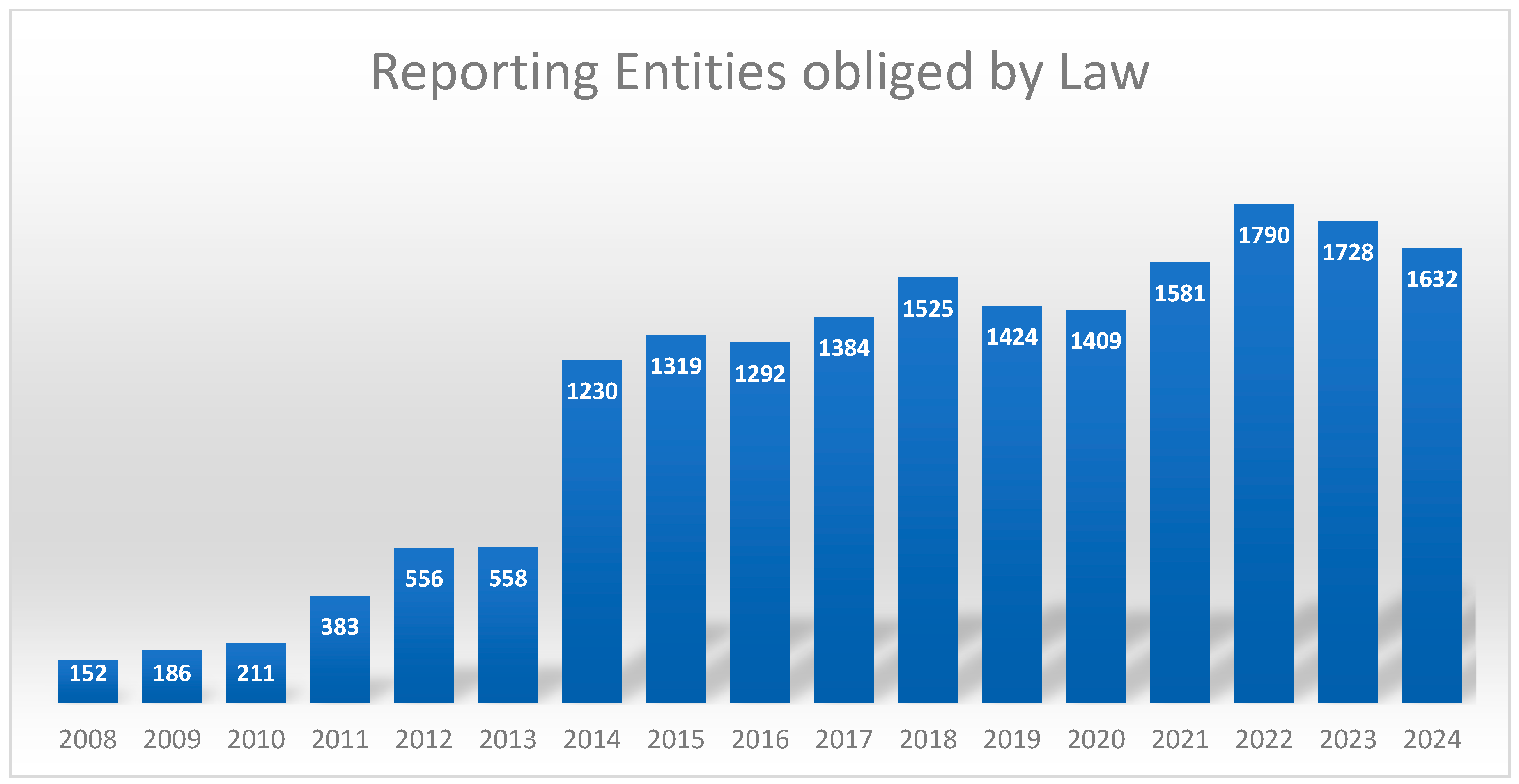
Figure 1, the number of suspicious transactions reported by obliged entities to the Albanian FIU increased from 152 in 2008 to 1632 in 2024. Such an increase may be explained by a better understanding of what constitutes a suspicious transaction, and with the obligation of entities to report suspicious transactions. Nevertheless, since 2022, the number of suspicious transactions has been decreasing.
As
Table 1 shows, the major reporting entities include financial institutions (banks and non-bank financial institutions), followed by notary offices, the State Cadastral Agency, and the General Directorate of Customs. Suspicious transactions involving other entities remain very low, which raises concerns about whether these entities are complying with the law. For instance, there is a public perception of money laundering through currency exchange offices and the construction sector in Albania. The 2020 report by the Global Initiative Against Transnational Organised Crime noted that currency exchange offices and the Albanian construction sector have become a favoured spot for international criminals to launder their money (
Reitano and Amerhauser 2020). The report estimated that from 2017 to 2020, “a total estimate of €1.6 billion worth of dirty money was laundered through the Albanian real estate sector in those three years” (
Reitano and Amerhauser 2020, p. 28). However, as shown in
Table 1, construction companies and exchange offices have reported a low number of suspicious transactions to the Albanian FIU. This low reporting raises questions about whether the Albanian AML/FT Law is merely on paper or is effectively enforced.
While the number of suspicious transactions is high, the number of reported cases to the law enforcement agencies is very low. According to Article 22 (a), the Albanian FIU, inter alia, has the responsibility to collect, manage, process, analyse, and disseminate information regarding cases of money laundering and terrorist financing to law enforcement agencies.
Table 2 shows the number of cases reported to law enforcement agencies for the period 2016–2024. As can be seen, the reported cases to the law enforcement agencies have decreased. The main offences reported to the law enforcement agencies are drug trafficking, tax evasion, smuggling and cybercrime (
European Commission 2022, pp. 42–43). Concerning terrorist financing, cases remain relatively low.
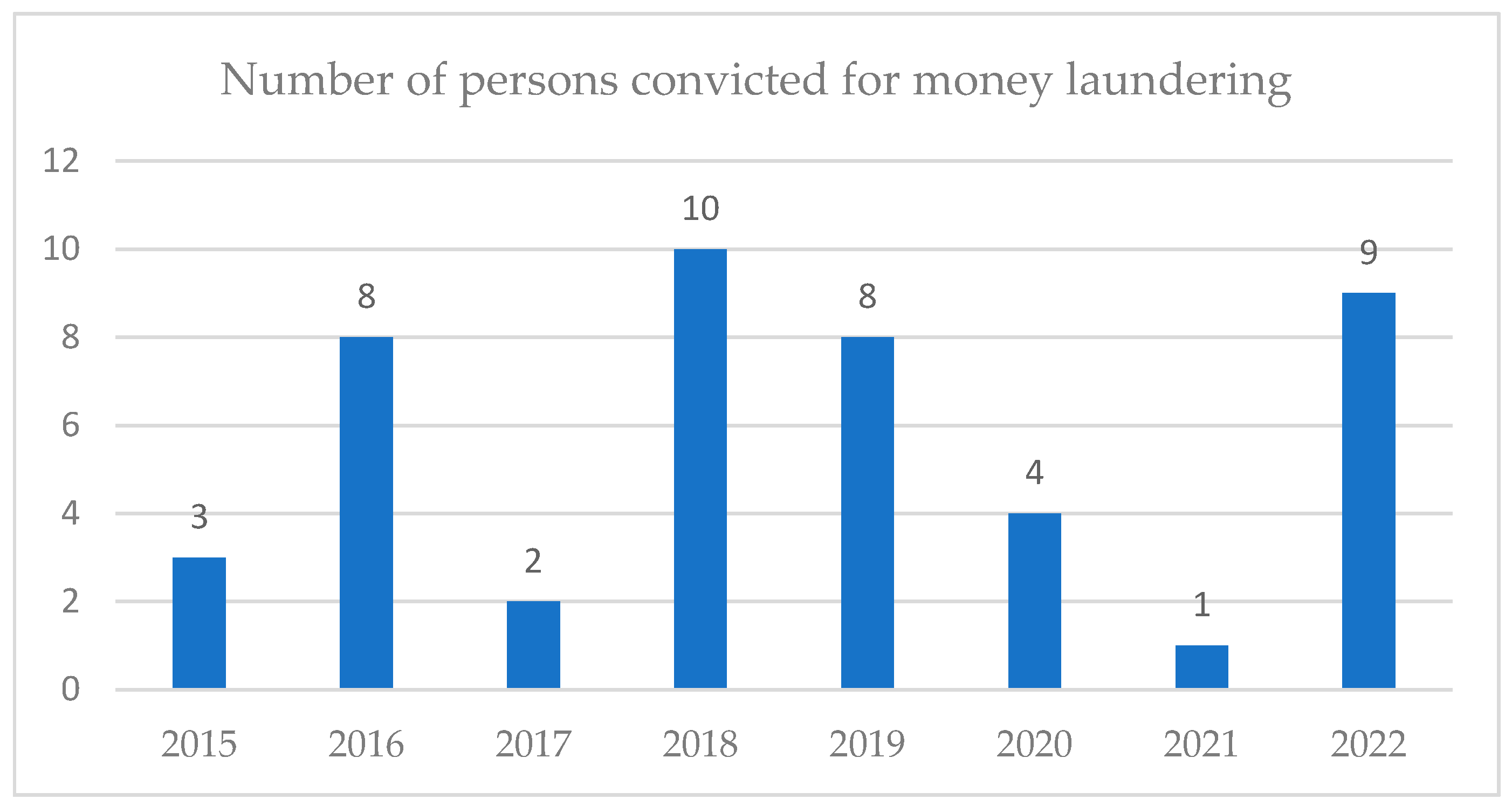
The number of convictions for money laundering remains very low. As shown in
Figure 2, based on data collected by various EU reports, between 2015 and 2022, a total of 45 persons were convicted for money laundering and terrorist financing. The highest number of convictions occurred in 2018, with 10 persons convicted, and the lowest number of convictions was in 2021, with one person. The main reason for the very low enforcement is the “limited law-enforcement resources, weak legal institutions, corruption, and a largely cash-based economy” (
European Commission 2018, p. 34;
2019, p. 36), all of which make Albania vulnerable to money laundering.
Table 3 shows the number of administrative fines imposed for each entity. Similarly, the administrative penalties imposed on entities are very low compared with the number of suspicious transactions reported.
5. Conclusions
The EU’s anti-money laundering and counter-terrorist financing measures have been developed gradually, influenced by international developments, such as the FATF Recommendations or terrorist attacks. It is built on a series of minimum harmonisation directives, which allow Member States either to opt out of transposing the EU minimum requirements or to adopt more stringent rules than those in the EU Anti-Money Laundering Directive. This minimum harmonisation approach has led to divergent substantial and procedural rules across the EU Member States. Moreover, inconsistencies across Member States concerning the establishment of an “operationally independent and autonomous FIU” have hindered the effectiveness of the EU AML/FT Regime, as some FIUs lack human resources and expertise or are established near a public institution. However, the recent adoption of
Regulation 2024/1624 (
2024), expected to enter into force in 2027, seems to address these weaknesses by introducing uniform rules across the EU Member States to address inconsistencies in national implementations and enhance cross-border effectiveness. Moreover,
Regulation 2024/1624 (
2024) establishes a central Anti-Money Laundering Authority with the competencies to supervise high-risk entities and to issue guidelines, recommendations, and technical details.
As Albania aspires to join the EU by 2030, harmonisation of domestic law with the EU Acquis and proper enforcement is the “Achilles Heel”. Currently, the Albanian government has opened 28 out of 33 chapters of negotiations for harmonising the Albanian legal system with the EU Acquis. Similarly, Albanian law enforcement agencies are committed to ensuring effective enforcement.
This paper argues that the Albanian AML Law is largely aligned with the AML/FT Directive, with only a few exceptions. The Albanian legislator has opted to transpose the AML/FT Directive provisions by literal transposition, either through a standard copying approach or by copying with reference to other laws. In some exceptional cases, the Albanian legislator opted to go beyond the AML/FT Directive rules. In this context, Albania needs to fully transpose the AML/FT Directive to increase the harmonisation level and establish an independent FIU.
While the Albanian AML Law is largely aligned with the AML/FT Directive, this paper pointed out a low level of enforcement. Despite a high level of suspicious transactions reported to the FIU, penalties remain low. As identified by EU Reports, between 2015 and 2022, 45 persons were convicted of money laundering and terrorist financing. In this context, law enforcement agencies need to prioritise the enforcement level. In conclusion, while Albania needs to fully transpose the AML/FT Directive, proper implementation remains a challenge due to limited enforcement capacities, weak legal structures, and an essentially cash-based economy with a substantial informal sector.