Article

Numerical Optimization of Die Geometry to Minimize Forming Defects in a 1 GPa-Grade Ultra-High-Strength Steel Cross-Member


Department of Future Mobility, Chonnam National University, Gwangju 61186, Republic of Korea
*
Author to whom correspondence should be addressed.
Metals 2026, 16(6), 561; https://doi.org/10.3390/met16060561
Submission received: 21 April 2026 / Revised: 17 May 2026 / Accepted: 18 May 2026 / Published: 22 May 2026
(This article belongs to the Special Issue Microstructure and Mechanical Behavior of High-Strength Steel)

Abstract

Ultra-high-strength steel (UHSS) cross-members with a high height-to-width ratio are prone to forming defects, such as splitting and wrinkling, due to localized stress concentration during the drawing process. In this study, the addendum geometry in first-stage of a two-stage drawing process was optimized to improve the formability of a cross-member made of 1 GPa-grade UHSS. The optimization was performed using the Sigma module of AutoForm, and Latin hypercube sampling was adopted for the design of experiments. The punch opening width, upper bar radius, wall angle, and lower die radius of the addendum were selected as design parameters, and multi-objective optimization was conducted to simultaneously minimize the maximum failure index and maximum wrinkle value, the two AutoForm forming-defect indicators used in this study. In the initial design, the maximum failure index was 1.044, exceeding the splitting criterion of 1.0; however, this value was reduced to 0.961 in the optimized design, thereby mitigating the risk of splitting. In addition, the maximum wrinkle value was reduced by 11.7% compared with that of the initial design. Pareto analysis was performed to quantitatively evaluate the effects of the design parameters on the forming defects, and the results confirmed that the punch opening width and lower die radius were the dominant parameters affecting both splitting and wrinkling. These results demonstrate that die addendum geometry optimization is effective for reducing splitting and wrinkling in 1 GPa-grade UHSS cross-members.

1. Introduction

In the automotive industry, the demand for vehicle lightweighting has increased to achieve carbon neutrality targets and improve fuel efficiency, leading to the expanded application of high-strength steel (HSS) sheets [1,2,3]. In particular, the use of thin ultra-high-strength steel (UHSS) sheets has increased not only in body structures but also in chassis components to ensure structural stiffness and stability [4,5]. Recent studies on advanced structural materials have also shown that the reliability of load-bearing components is closely related to deformation control and damage evolution under complex structural and material conditions [6]. However, as the strength level of UHSS increases, its elongation decreases, which narrows the formability window and increases its susceptibility to forming defects such as splitting and wrinkling during sheet metal forming processes [6]. In particular, when UHSS is formed into automotive components with complex geometries, such as automotive components, its high strength and limited formability increase the likelihood of localized stress and strain concentrations, which can lead to forming defects [7].
Accordingly, finite element analysis (FEA)-based optimization studies of process parameters and die geometry have been actively conducted to reduce forming defects in automotive components fabricated from UHSS [8]. For example, in the drawing process of a B-pillar component made of JSC980Y, process parameters such as blank holder force, die clearance, and blank width were optimized to reduce springback [9]. In addition, for a curved-axis hat channel made of QP1180, the flange wrinkling mechanism was analyzed, and the effects of key die design parameters on wrinkling were evaluated using a design of experiments (DOE) [10]. These studies indicate that, in the forming of UHSS automotive components, forming defects should be controlled by simultaneously considering the strength level of the material, component geometry, and process conditions.
The scope of optimization for reducing forming defects has been extended from process parameters to die design parameters, including forming tool geometry, drawbead geometry, and addendum geometry. A numerical procedure was proposed to simultaneously optimize the blank shape and forming tool geometry for complex automotive components, thereby compensating for thinning, edge deviation, and springback [11]. Studies have also been conducted to reduce splitting and wrinkling by controlling material flow through the adjustment of the shape, size, and position of drawbeads [12]. Furthermore, in the forming process of a front fender, a die shape optimization procedure was presented to simultaneously reduce splitting, wrinkling, and unstretched areas by using shape perturbation vectors of the addendum surface and drawbead height as design parameters [13]. In addition, response surface methodology (RSM), analysis of variance (ANOVA), and sensitivity-based optimization have been used to quantitatively evaluate the nonlinear relationships between design parameters and forming defects and to identify the dominant design parameters for defect reduction [14,15,16].
However, most previous studies have focused primarily on automotive exterior panels and have generally targeted a single forming defect, such as splitting, wrinkling, or springback, or the optimization of individual process or die-design parameters. In contrast, studies on 1 GPa-grade UHSS chassis components, such as cross-members, remain limited, particularly those involving multi-objective optimization of die addendum geometry to simultaneously reduce splitting and wrinkling.
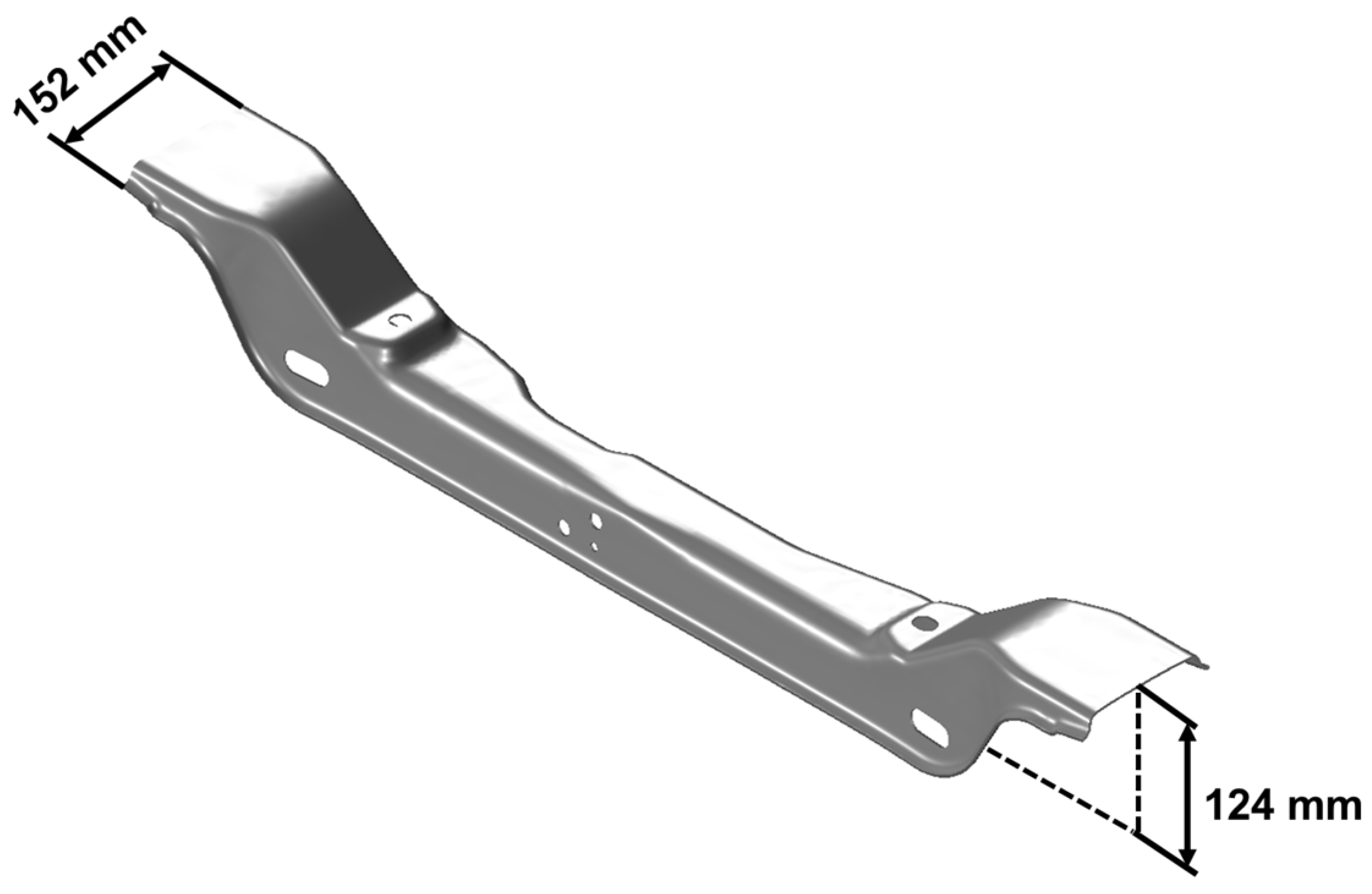
The cross-member investigated in this study is a critical component of the front chassis module of a light-duty commercial vehicle, interfacing with the suspension system to support vehicle loads and ensure structural stability. As shown in Figure 1, the cross-member has a cross-sectional geometry with a high height-to-width ratio to meet these structural requirements. However, this geometric characteristic makes the component prone to forming defects such as splitting and wrinkling during the drawing process, particularly when it is formed from UHSS. In this study, 1 GPa-grade UHSS was applied to a cross-member manufactured using a two-stage drawing process. Key design parameters for the addendum geometry of the first-stage drawing die were selected, and design optimization was performed to reduce forming defects. Furthermore, the effects of the major design parameters on the forming defects were evaluated through sensitivity analysis. Finally, the optimization results were compared with those of the currently used 500 MPa-grade HSS cross-member.
The remainder of this paper is organized as follows. Section 2 describes the die design configurations considered for the optimization study. Section 3 details the FEA-based design optimization methodology. Section 4 presents the optimization results for the die designs, and Section 5 discusses the evaluation of forming defects in the optimized designs and the sensitivity of these defects to the design parameters.

2. Die and Process Configuration

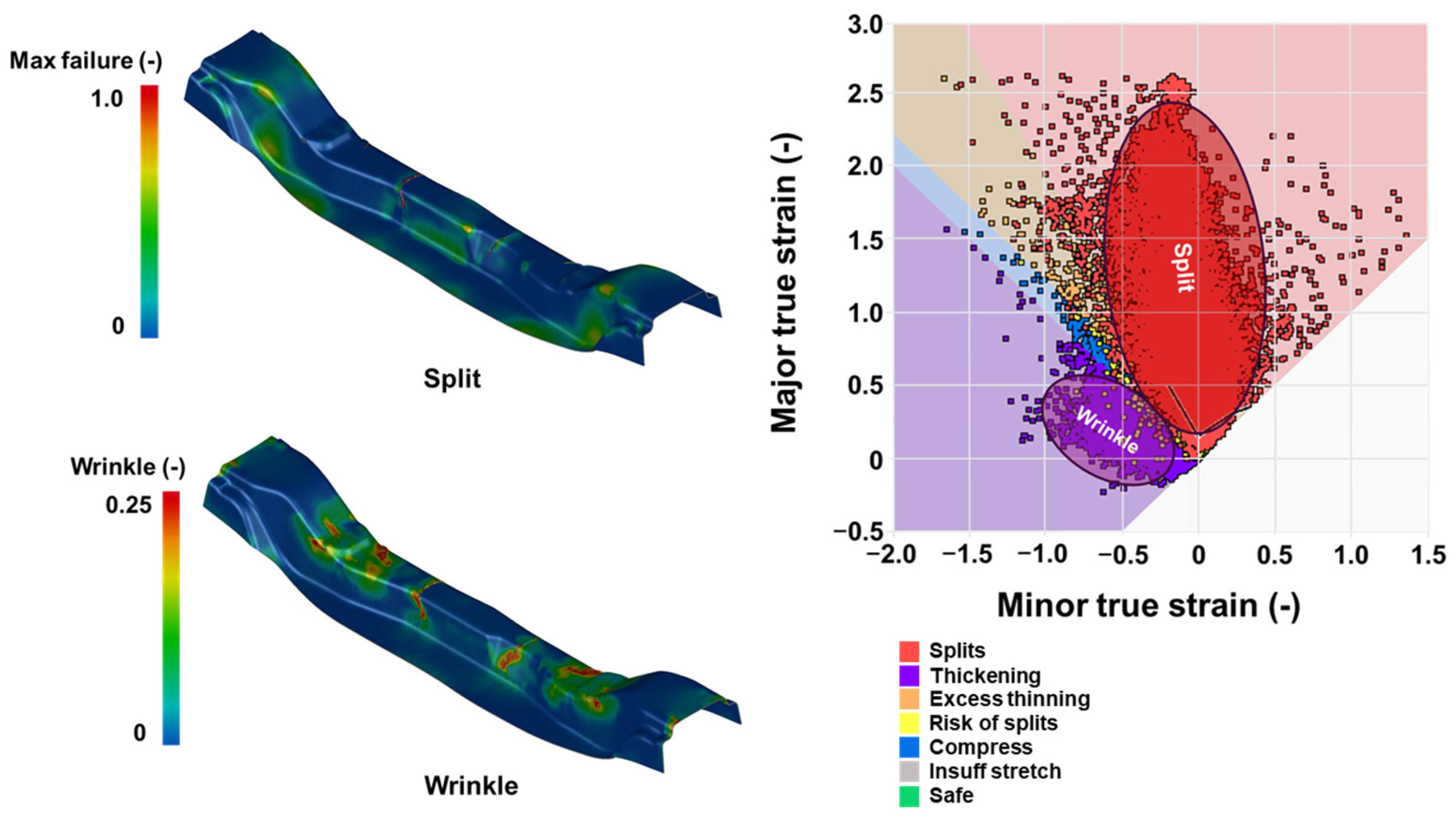
The cross-member has a cross-sectional shape with a high height-to-width ratio. Consequently, when a 1 GPa-grade UHSS sheet is formed using a conventional single-stage drawing process, material flow becomes unbalanced and localized stress concentrations intensify. These conditions give rise to typical forming defects such as splitting and wrinkling, as shown in Figure 2.
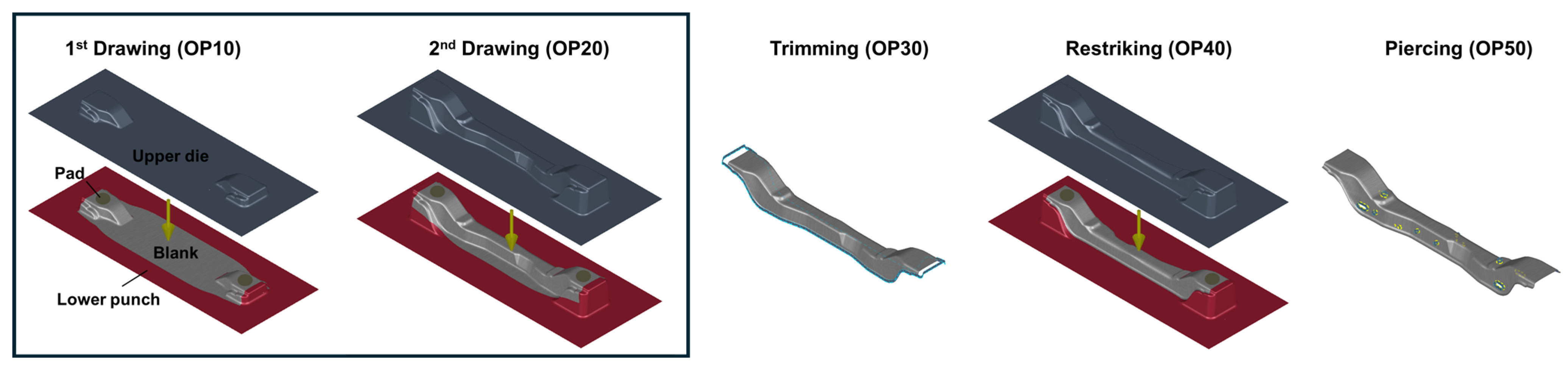
To reduce these defects, a previous study introduced a two-stage drawing process in which the conventional single-stage drawing process for the cross-member was divided into the first and second-stages drawing, and the effect of the first-stage drawing position—defined by the stroke in the first-stage drawing—on forming defects and process performance was investigated [17]. Forming defects were evaluated in terms of thinning, wrinkling, and springback, whereas process performance was assessed based on punch load and forming energy. As a result, the first-stage drawing position was set to 73 mm from the lower surface of the cross-member based on a comprehensive consideration of both forming defects and process performance. Accordingly, the forming process for the cross-member was designed as a five-stage process consisting of first-stage drawing (OP10), second-stage drawing (OP20), trimming (OP30), restriking (OP40), and piercing (OP50), as shown in Figure 3.
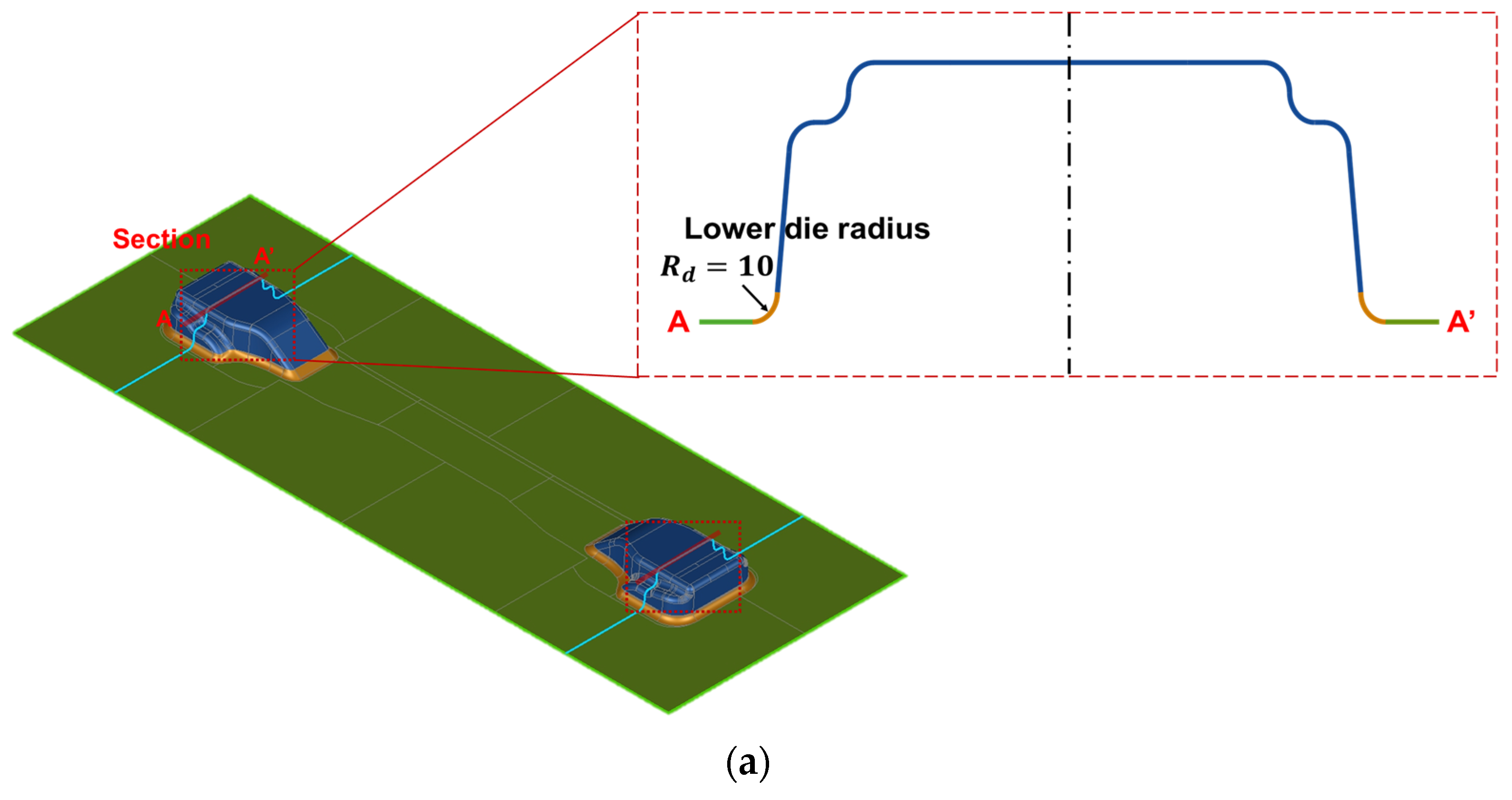
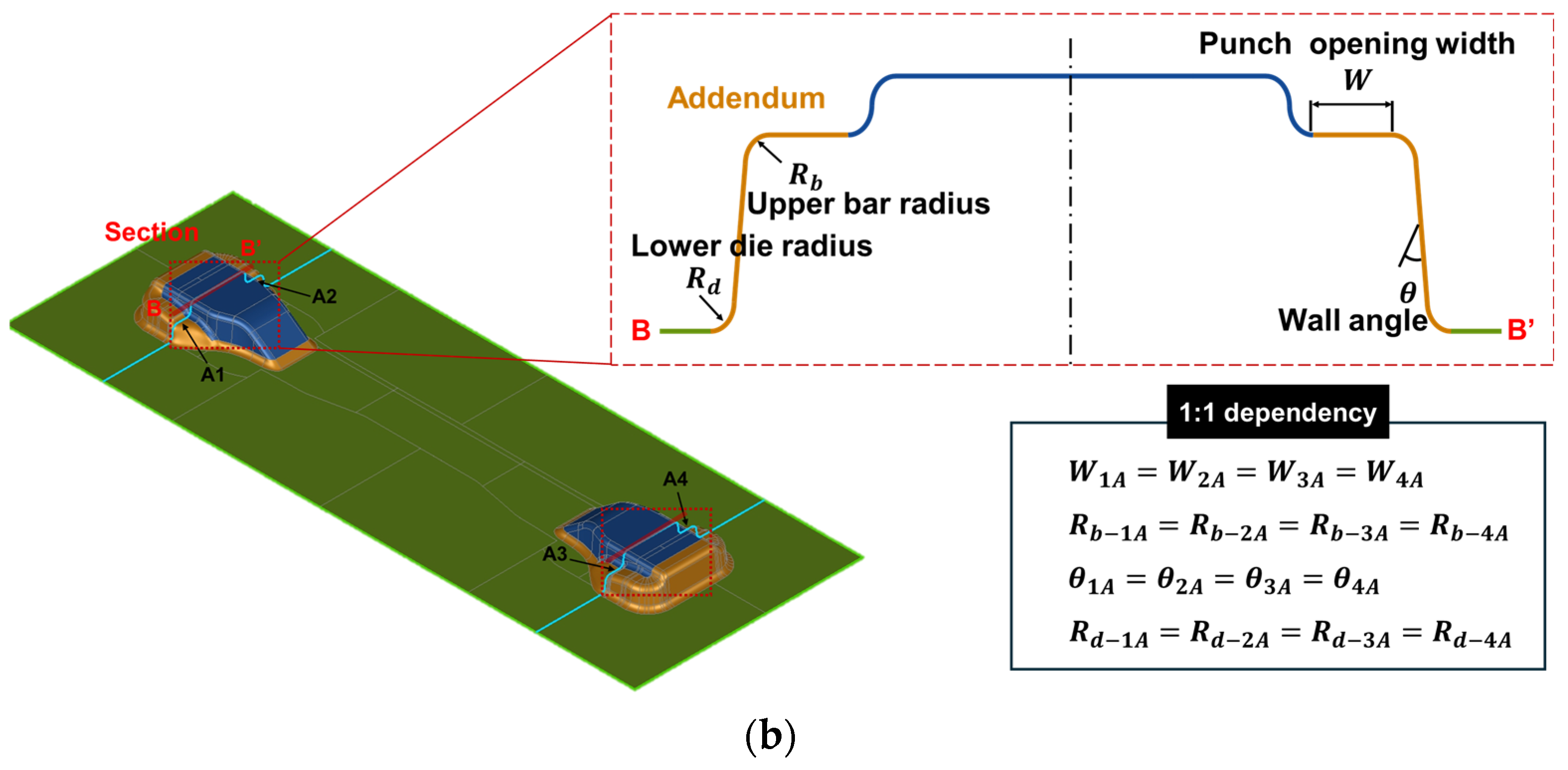
In the present study, to further reduce forming defects, addendum geometry was introduced at both ends of the die used in the first-stage drawing, and its shape was optimized to evaluate the defect-reduction effectiveness of the proposed addendum designs [18]. In this study, the addendum is defined as an auxiliary die feature added to the flange region to control the material inflow path into the die cavity. Although it is not included in the final product geometry, it helps reduce forming defects by alleviating localized stress concentrations in the sheet during forming. Figure 4a shows the first-stage drawing die geometry, in which only the lower die radius was applied without any additional addendum to isolate the effect of the first-stage drawing position. Figure 4b shows the die geometry with addendum features introduced at both ends to further reduce forming defects. The addendum region of the cross-member was divided into four zones, denoted as A1 to A4, and the same design parameters were applied to each zone. The main design parameters used to define the addendum geometry were defined as the punch opening width (PO width), upper bar radius, wall angle, and lower die radius. Design optimization was then performed to determine the combination of design parameters that minimizes forming defects. Based on the output response data obtained during the optimization process, the sensitivity of the forming defects to each design parameter was also analyzed.

3. Methodology for FEA-Based Optimization

To numerically optimize the design parameters presented in Section 2 for the dual objective of minimizing splitting and wrinkling, FEA was conducted using AutoForm version R13 [19], a dedicated sheet metal forming simulation package. The resulting FE data were then transferred to the Sigma module of AutoForm, where a constrained optimization routine was executed to adjust the design parameters according to the prescribed objective functions.

3.1. Material Modeling

The application of a 1 GPa-grade UHSS sheet with a thickness of 1.8 mm (hereafter referred to as T1000) to the cross-member was the primary focus of this study. In addition, a 500 MPa HSS sheet with a thickness of 2.3 mm (hereafter referred to as T500) was examined to investigate the influence of material strength on forming defects. Both T1000 and T500 exhibit planar anisotropy. To accurately characterize this behavior, constitutive plasticity models available in AutoForm, were selected based on their ability to represent sheet metal anisotropy using practically obtainable material properties. Specifically, the most sophisticated models that can be constructed solely from uniaxial tensile test data (hardening curves and R-values at the 0°, 45°, and 90° to the rolling directions) were implemented. Consequently, the combined Swift/Hockett–Sherby hardening law [20,21], the Barlat 1989 yield function [22], and the Abspoel/Scholting model [23] were employed to describe the hardening behavior, yield surface, and forming limit diagram, respectively.
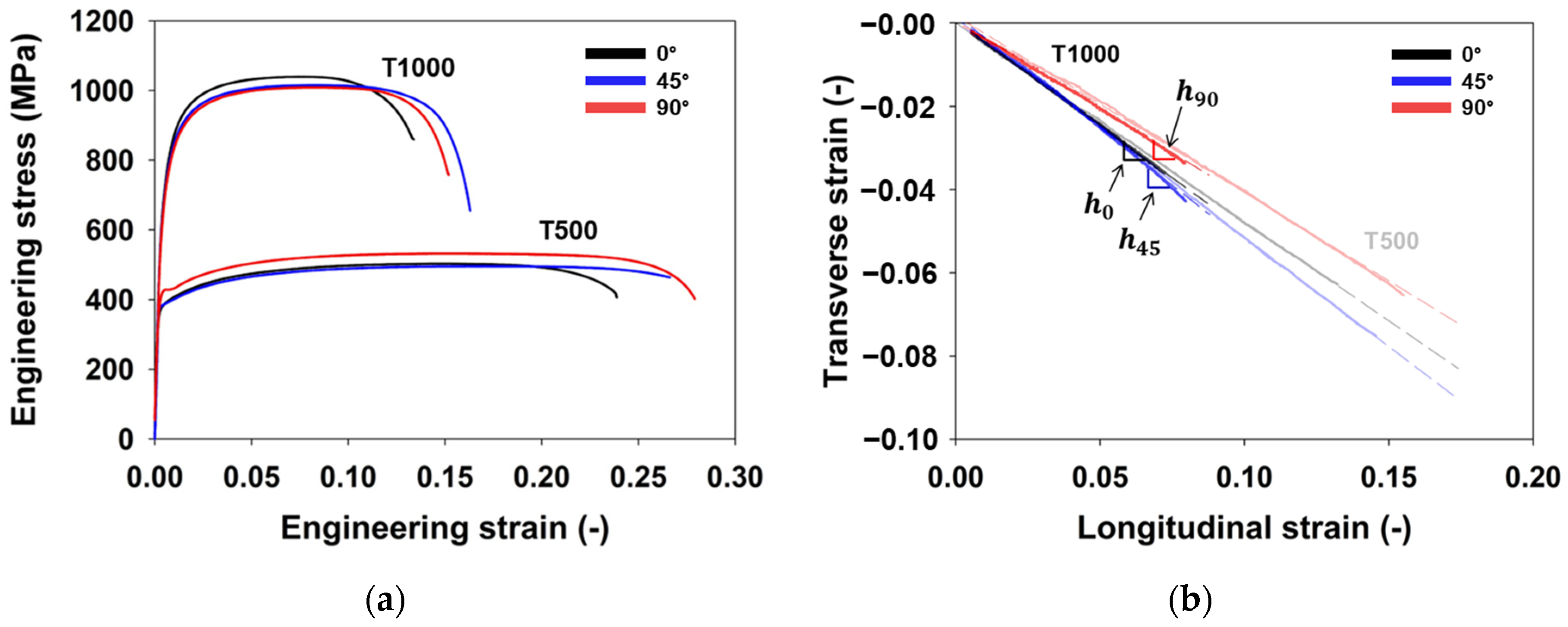
The mechanical properties required for the constitutive plasticity models were obtained from uniaxial tensile tests performed in the 0 ° , 45 ° , and 90 ° directions relative to the rolling direction. Five specimens were tested in each direction to account for sheet metal anisotropy. The uniaxial tensile tests were conducted in accordance with ASTM E8 [24] and were performed using the ARAMIS digital image correlation (DIC) system [25,26]. The engineering stress–strain curves measured in each direction and the longitudinal–transverse strain curves are shown in Figure 5a and b, respectively. The yield strength, tensile strength, and uniform and total elongations were extracted from the engineering stress–strain curves. The R-values were calculated using R θ = h θ / ( 1 + h θ ) , where h θ denotes the slope of the transverse strain versus longitudinal strain curve, and the results are summarized in Table 1.
The hardening curve was modeled using the combined Swift/Hockett–Sherby hardening law [20,21] (Equation (1)), which is expressed as follows:
σ ¯ = ( 1 α ) K ( ε 0 + ε ¯ ) n + α { σ s a t ( σ s a t σ y i e l d ) e ( N ε ¯ q ) }
where σ ¯ and ε ¯ denote the effective stress and effective strain, respectively. The material constant α represents the weighting factor ( 0 α 1 ) for combining the two laws, For the Swift law, ε 0 , n and K denote the initial plastic strain, the strain-hardening exponent, strength coefficient, respectively. For Hockett–Sherby law, σ y i e l d , σ s a t , N , and q represent the yield stress, the saturation stress, the hardening rate coefficient, and the hardening exponent, respectively.
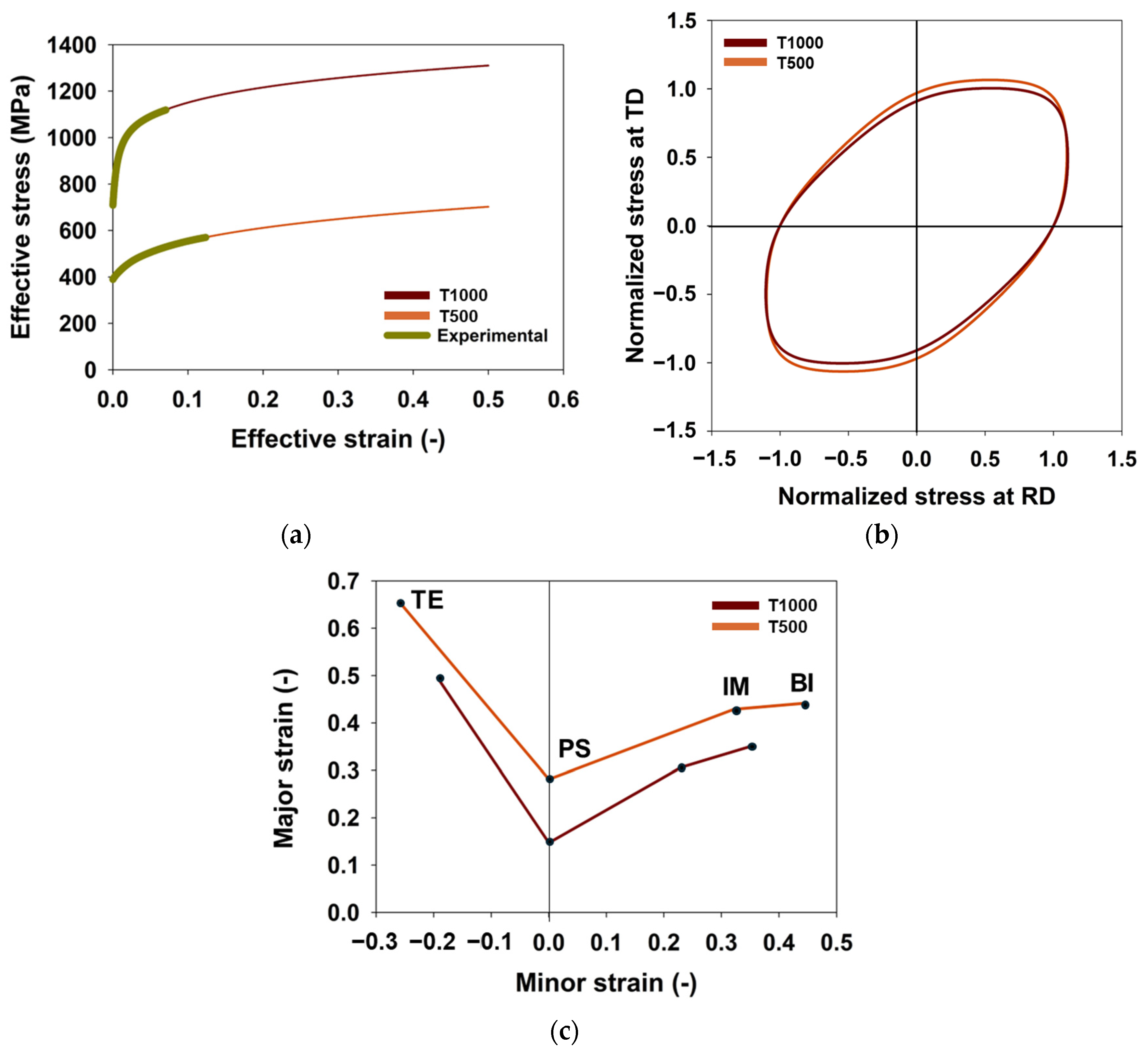
To determine the eight coefficients for the hardening curve, the true stress–strain curve at 0° to the rolling direction was utilized. Figure 6a presents the results of the curve fitting performed using the combined Swift/Hockett–Sherby hardening model, while the calculated hardening coefficients are summarized in Table 2.
Under plane stress conditions, the yield surface was described using the Barlat89 yield function [22], which is expressed as follows:
f = a | K 1 + K 2 | m + a | K 1 K 2 | m + c | 2 K 2 | m = 2 σ ¯ m K 1 = σ x x + z σ y y 2 K 2 = ( σ x x z σ y y 2 ) 2 + p 2 σ x y 2
where σ ¯ , σ x x , σ y y , and σ x y denote the effective stress and the stress components along the material x - and y -axes, respectively. The coefficients a , c , z , and p represent plastic anisotropy, whereas m is an exponent that reflects the crystallographic characteristics.
The coefficients a , c , z , and p were determined from the directional R-values and are summarized in Table 3. Parameters a , c , and z were obtained directly from R 0 and R 90 using Equation (3), while p was numerically calculated from R 45 using Equation (4). In this study, m was set to 6, considering the body-centered cubic crystal structure of the steel sheets. Figure 6b illustrates the yield surface modeled by the Barlat 1989 yield function.
a = 2 c , c = 2 R 0 1 + R 0 R 90 1 + R 90 , z = R 0 1 + R 0 1 + R 90 R 90
2 m σ ¯ m ( f σ x x + f σ y y ) σ 45 1 = R 45
The forming limit diagram (FLD) was constructed using the Abspoel/Scholting model [23]. This empirical model is applicable to steel sheets with a tensile strength of 280–1200 MPa, a sheet thickness of 0.2–3.1 mm, and an R-value of 0.6–2.7. The forming limits for the four primary strain states—uniaxial tension (TE), plane strain (PS), intermediate biaxial stretch (IM), and equi-biaxial stretch (BI) are defined by the major strain ( ε 1 ) and the minor strain ( ε 2 ) using Equations (5)–(8).
TE :   ε 1 T E = ( 1 + 0.797 · R 90 0.701 ) · ( 0.0626 · A 90 0.567 + ( t 1 ) ( 0.12 0.0024 · A 90 ) ) 1 + ( 0.797 · R 90 0.701 ) 2 ε 2 T E = 0.797 · R 90 0.701 · ( 0.0626 · A 90 0.567 + ( t 1 ) ( 0.12 0.0024 · A 90 ) ) 1 + ( 0.797 · R 90 0.701 ) 2
PS :   ε 1 P S = 0.0084 · A 90 + 0.0017 · A 90 · ( t 1 ) ε 2 P S = 0
IM :   ε 1 I M = 0.0062 · A 90 + 0.18 + 0.0027 · A 90 · ( t 1 )   ε 2 I M = 0.75 · ε 1 I M
BI :   ε 1 B I = 0.00215 · A M I N + 0.25 + 0.00285 · A M I N · t   ε 1 B I = ε 2 B I
where t is sheet thickness, A 90 , the total elongation at 90 ° to the rolling direction, and A M I N , the minimum total elongation among the measured directional values. The forming limits for the four primary strain states are summarized in Table 4. Values between these discrete strain states are determined through linear interpolation. Figure 6c illustrates the FLD predicted by the Abspoel/Scholting model [23].

3.2. Finite Element Modeling

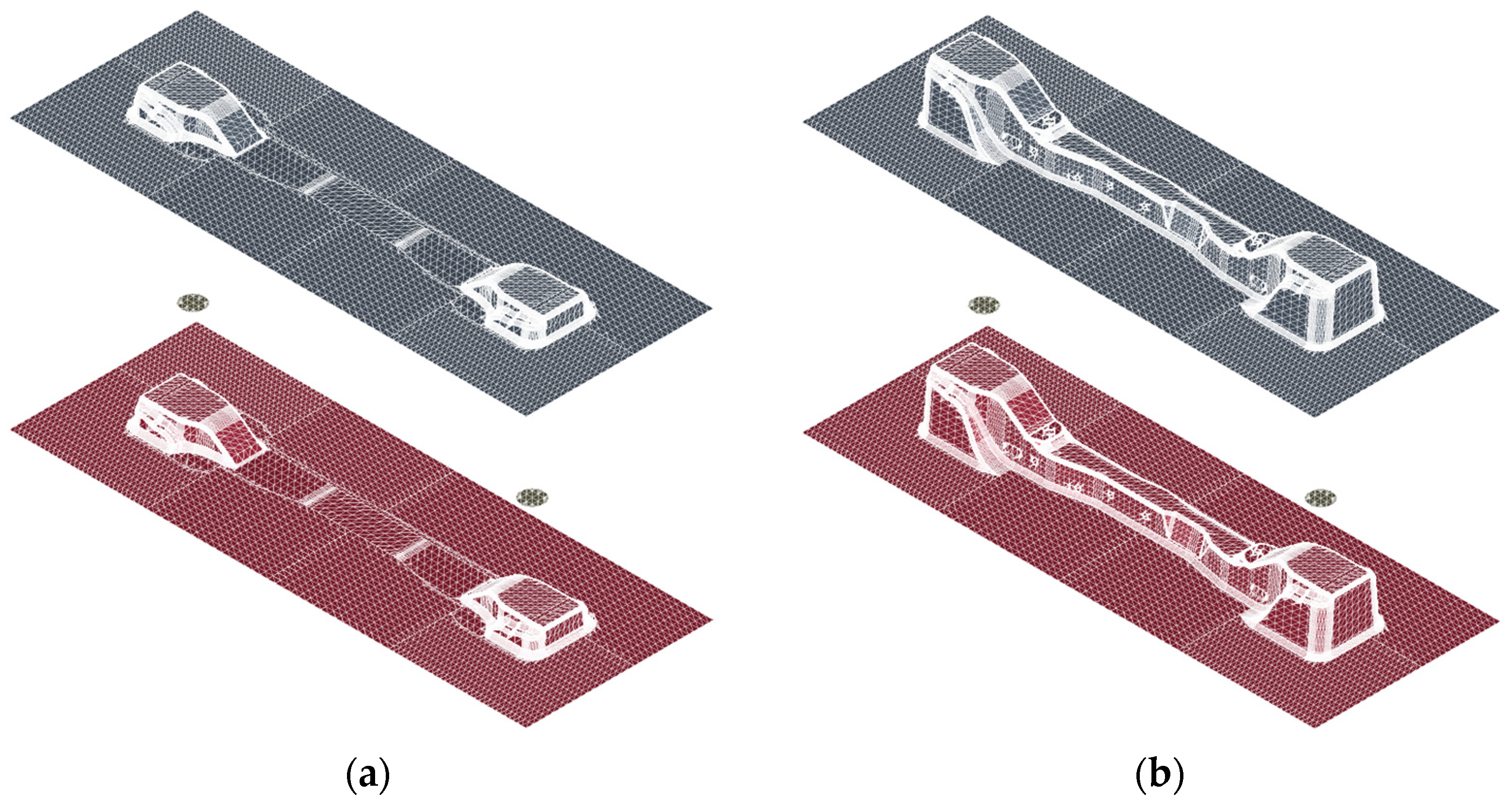
In the two-stage drawing process, the first and second-stages drawing were modeled separately using finite element analysis, and the analysis results from the first-stage drawing were sequentially transferred as initial conditions to the second-stage drawing. Figure 7 shows the finite element meshes for the first and second-stages drawing. The initial blank was defined as a rectangular sheet with dimensions of 260 mm × 980 mm. In both drawing stages, the tooling system consisted of an upper die, a pad, and a lower punch. During forming, the pad first pressed the blank against the fixed lower punch, and the upper die then moved downward to perform the drawing operation. The lower punch and upper die were assumed to be rigid bodies, and the pad stiffness was set to 100 MPa/mm. In addition, the pad force and coefficient of friction were kept constant in both stages at 30 kN and 0.1, respectively.
For the blank discretization, EPS-5 triangular shell elements were used to simulate the elastoplastic deformation occurring during sheet metal forming. The EPS-5 element is an elastoplastic shell element that can account for membrane deformation, bending deformation, and transverse shear deformation in sheet metals, making it suitable for forming simulations of components with complex geometries [27,28]. The initial mesh consisted of 1000 elements to ensure computational efficiency, and an adaptive mesh refinement scheme was applied to improve the accuracy in regions with large localized deformation and curvature changes during forming. This approach ensured computational efficiency by using relatively large elements at the initial stage, while automatically refining the elements in regions where curvature variation and strain localization became significant as forming progressed. The adaptive mesh refinement parameters were defined with a maximum refinement level of 7, a maximum element angle of 30°, and a minimum element size of 0.31 mm. The final mesh generated after the forming simulation consisted of approximately 65,000 triangular shell elements.

3.3. Die Design Optimization

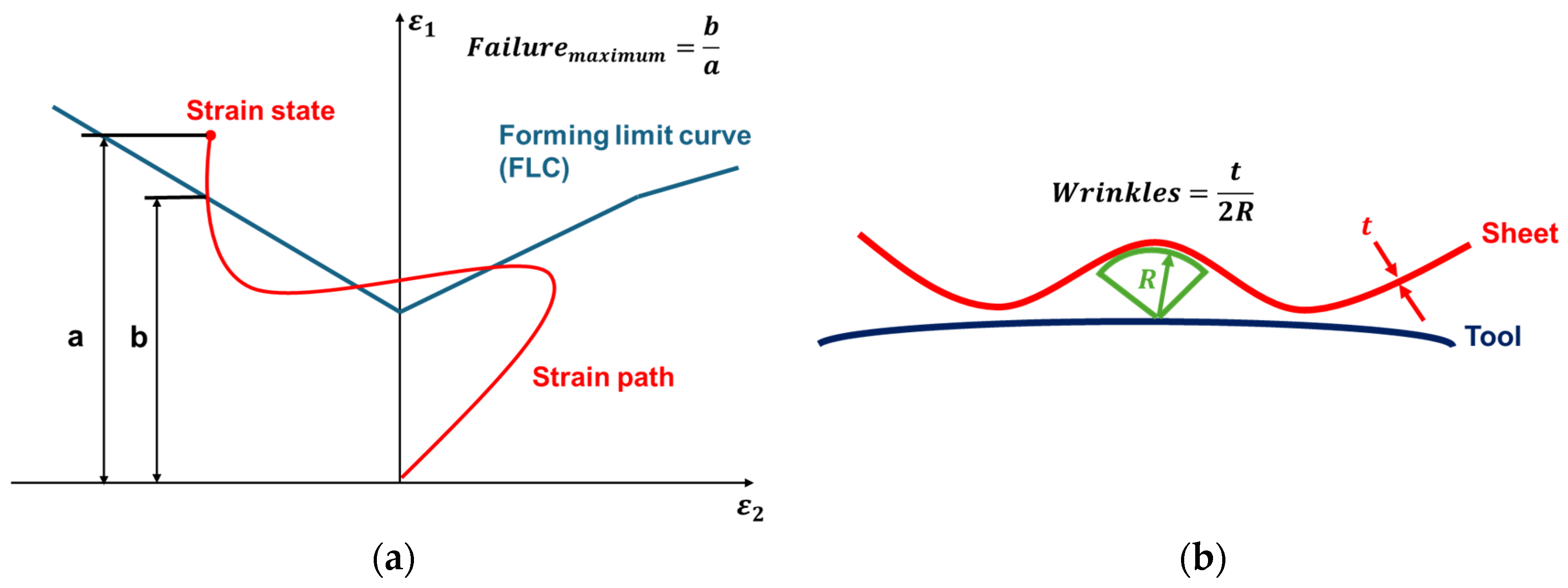
To quantitatively evaluate splitting and wrinkling occurring during the drawing process, the AutoForm formability indicators, namely the failure index and wrinkle value, were used, as shown in Figure 8. The failure index represents the relative strain state of the element under consideration with respect to the forming limit curve and is calculated as the ratio of a , the major strain of the element, to b , the major strain on the forming limit curve at the same minor strain. A value of 1.0 or higher indicates splitting. The wrinkle value is a dimensionless indicator used to evaluate the severity of wrinkling based on the geometric curvature of the formed sheet and is determined using the wrinkle curvature radius, R , and the sheet thickness, t .
In this study, the addendum geometry of the first-stage drawing die was selected as the optimization target to minimize the failure index and wrinkle value. For this purpose, four major design parameters were defined to describe the addendum geometry: PO width ( W ), upper bar radius ( R b ), wall angle ( θ ), and lower die radius ( R d ). PO width controls the material flow path as the sheet flows inward during drawing, while the upper bar radius and lower die radius govern the local deformation of the material in the curved die-entry regions. In addition, the wall angle controls the tensile and compressive states of the sheet during forming.
The baseline values and ranges of the design parameters are summarized in Table 5. The optimization was performed using the AutoForm Sigma module, and the design space comprising combinations of the design parameters was constructed based on a design of experiments (DOE). Latin hypercube sampling (LHS) was then adopted for sampling within the design space. LHS was used to provide stratified coverage of the entire design space and to avoid clustering of design points in a specific region. Because four design parameters were considered, at least 100 samples were required according to the recommended criterion that the sample size should be at least 25 times the number of design parameters [29]. In this study, a total of 150 design points were generated within the prescribed ranges of the four design parameters listed in Table 5, thereby satisfying this criterion. Using the sampled design points, the objective functions were then formulated for both single- and multi-objective optimization procedures. In the single-objective optimization, optimal designs were obtained by individually minimizing the maximum failure index and the maximum wrinkle value. In the multi-objective optimization, an optimal design capable of simultaneously reducing both forming-defect indicators was derived by considering the maximum failure index and the maximum wrinkle value together.

4. Results

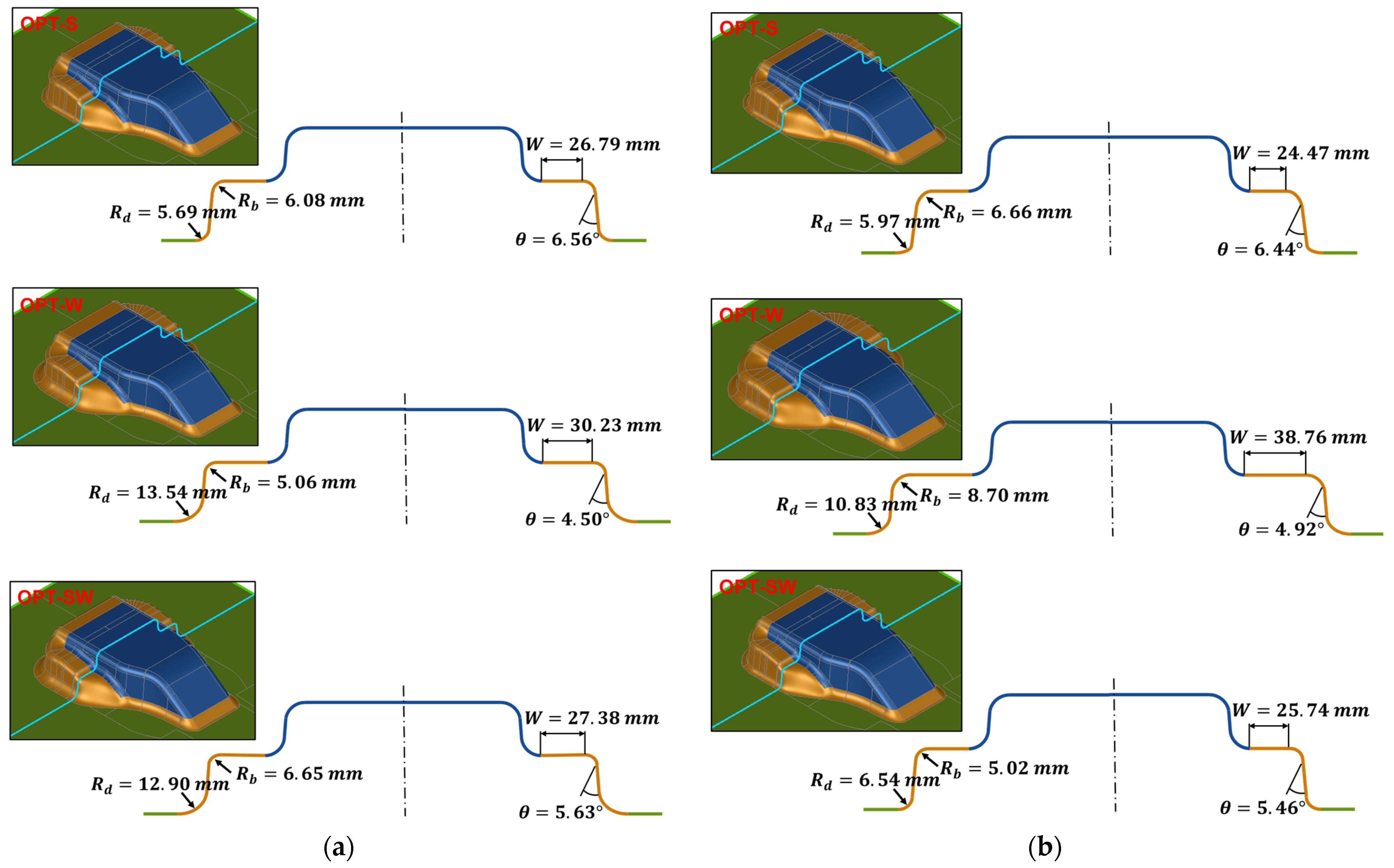
From the optimization results corresponding to the different objective functions, three optimal designs were obtained: OPT-S (optimal design for reducing splitting), in which the failure index was used as a single objective; OPT-W (optimal design for reducing wrinkling), in which the wrinkle value was used as a single objective; and OPT-SW (optimal design for simultaneously reducing splitting and wrinkling), in which both the failure index and wrinkle value were considered in a multi-objective framework. The addendum geometries of the three optimal designs are shown in Figure 9. The maximum failure index and maximum wrinkle value of the optimal designs were evaluated relative to INI (initial design), shown in Figure 4a, in which no addendum geometry was applied.
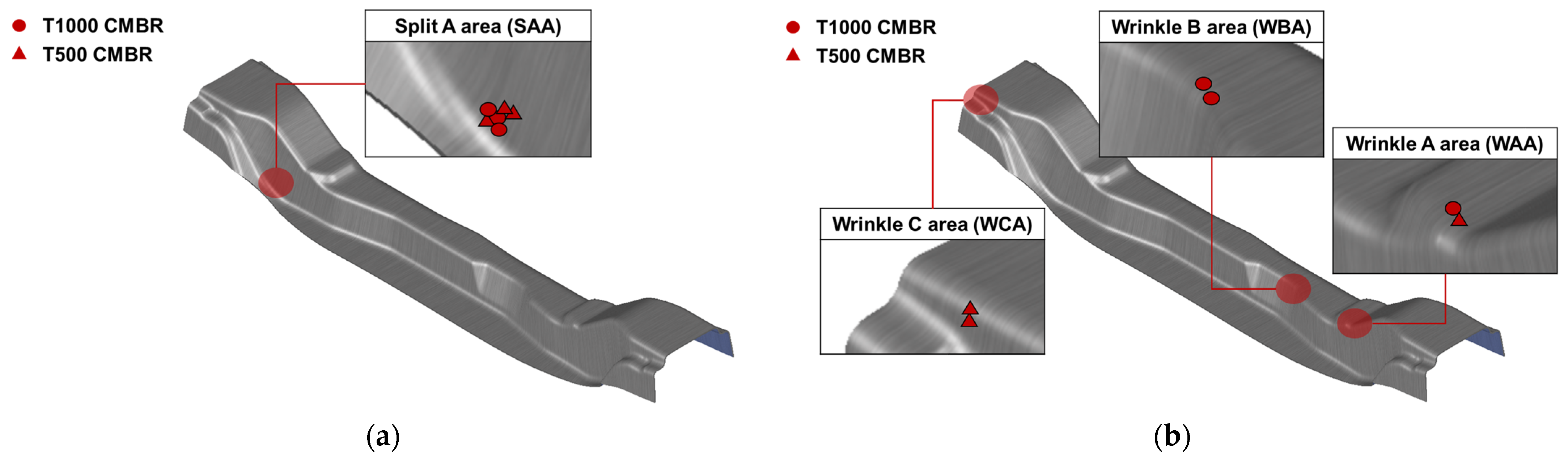
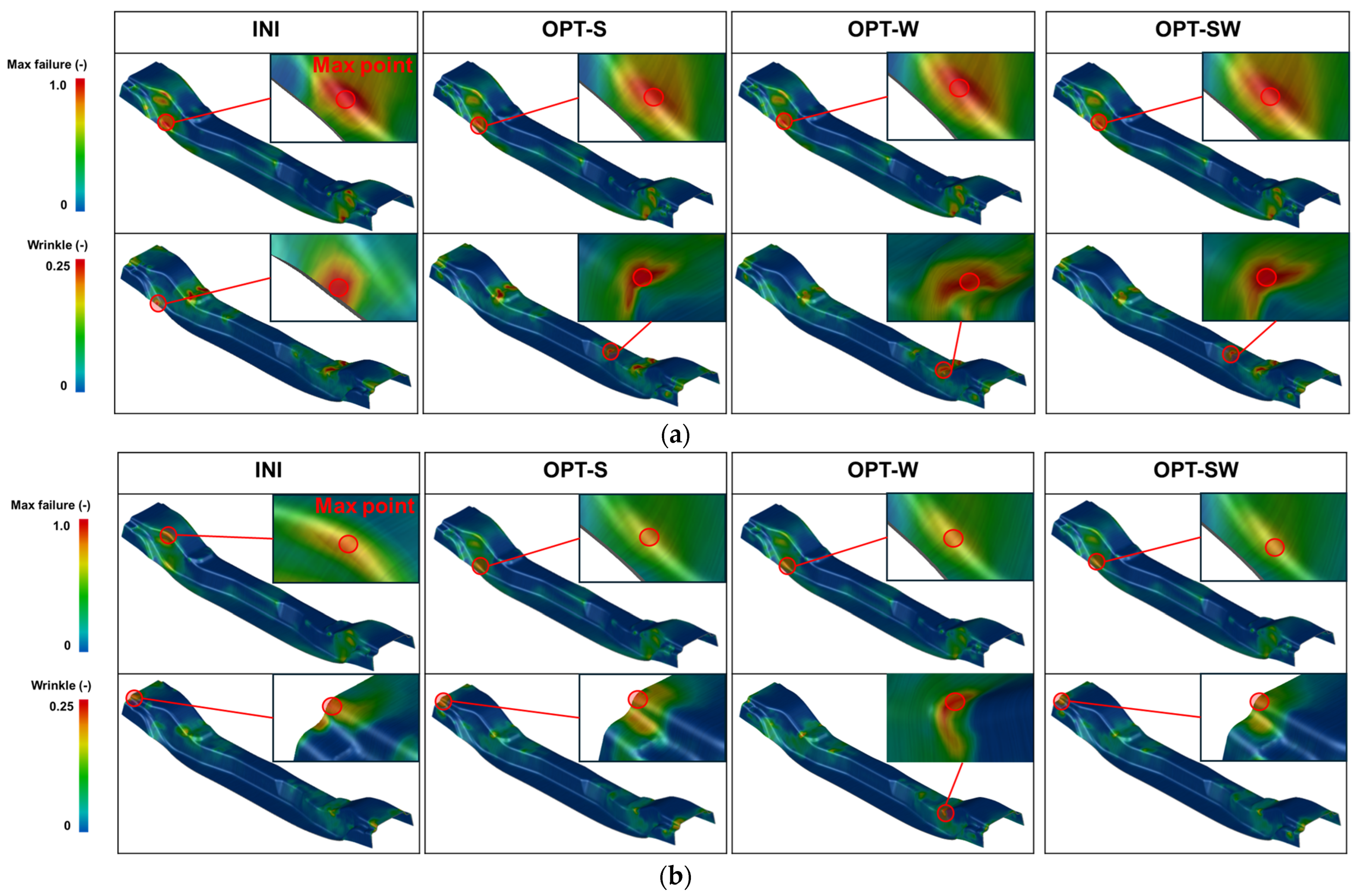
Figure 10 shows the failure index and wrinkle value distributions after the second-stage drawing for each design, together with the locations at which the maximum defect indicators occurred. Based on the results in Figure 10, Figure 11 schematically superimposes the locations of the most severe defects for each optimum design on the analysis result of the T500 reference design. The lower flange region of the cross-member, where the maximum failure index occurred, was defined as the SAA (splitting A area). The stepped region, central flange region, and end flange region, where the maximum wrinkle values occurred, were defined as the WAA (wrinkle A area), WBA (wrinkle B area), and WCA (wrinkle C area), respectively.

5. Discussion

5.1. Evaluation of Optimized Designs

Based on the analysis results shown in Figure 10, both the locations and maximum values of the failure index and wrinkle value were compared for each material condition and optimized design. For the cross-member fabricated from T1000, the maximum failure index occurred in SAA for all optimum designs, namely OPT-S, OPT-W, and OPT-SW. This indicates that SAA remained the region most vulnerable to splitting under the 1 GPa-grade UHSS condition, regardless of the optimization objective. However, the location of the maximum wrinkle value varied depending on the optimum design. In OPT-S and OPT-SW, the maximum wrinkle value occurred in WBA, whereas in OPT-W, it occurred in WAA. For the cross-member fabricated from T500, the maximum failure index also occurred in SAA for all optimum designs, indicating that the split-sensitive region remained unchanged even at the lower material strength level. However, the location of the maximum wrinkle value differed from that observed under the T1000 condition. In OPT-S and OPT-SW, the maximum wrinkle value occurred in WCA, whereas in OPT-W, it occurred in WAA. These results indicate that the region most vulnerable to splitting was consistently located in SAA regardless of material strength, whereas the wrinkle-sensitive region varied depending on both material strength and optimized addendum geometry.
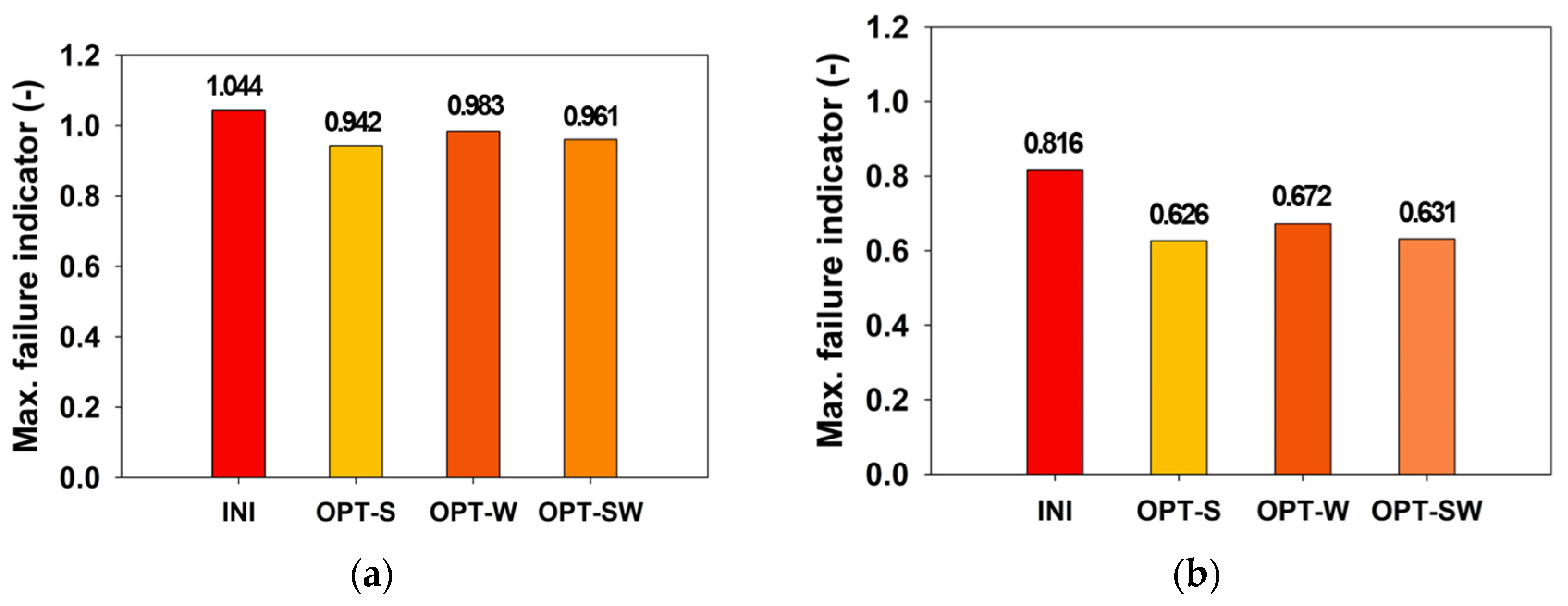
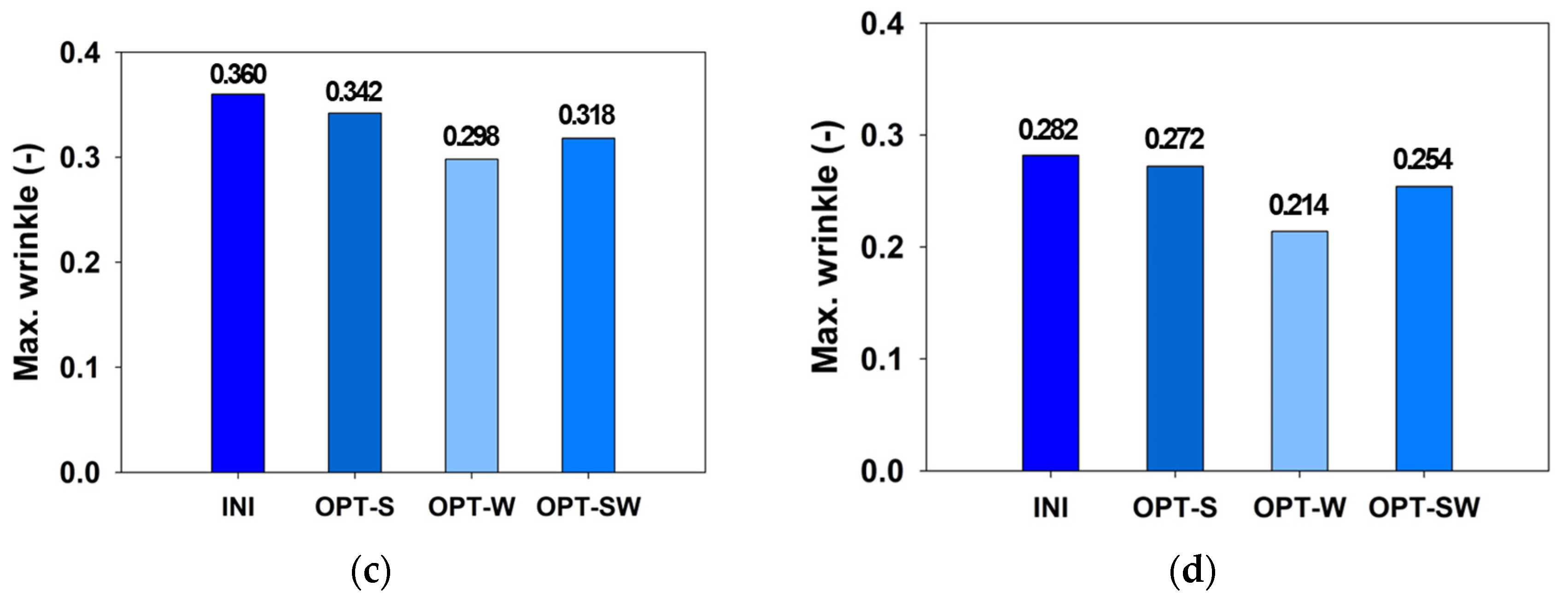
Figure 12 compares the maximum magnitudes of the major forming defects in the cross-member for each material condition. Figure 12a,b summarizes the maximum failure index for each design under the T1000 and T500 conditions. As shown in Figure 12a, under the T1000 condition, the maximum failure index for INI, OPT-S, OPT-W, and OPT-SW was 1.044, 0.942, 0.983, and 0.961, respectively, corresponding to reductions of 9.8%, 5.8%, and 8.0% relative to INI. In particular, the maximum failure index of INI exceeded 1.0, indicating the occurrence of splitting, whereas all optimal designs showed values below 1.0, indicating that the splitting risk was alleviated. As shown in Figure 12b, under the T500 condition, the maximum failure index was 0.816, 0.626, 0.672, and 0.631, respectively, corresponding to reductions of 23.3%, 17.6%, and 22.7% relative to INI.
Figure 12c,d compares the maximum wrinkle value for each design under the T1000 and T500 conditions. As shown in Figure 12c, under the T1000 condition, the maximum wrinkle value for INI, OPT-S, OPT-W, and OPT-SW was 0.360, 0.342, 0.298, and 0.318, respectively, corresponding to reductions of 5.0%, 17.2%, and 11.7% relative to INI. As shown in Figure 12d, under the T500 condition, the maximum wrinkle value was 0.282, 0.272, 0.214, and 0.254, respectively, corresponding to reductions of 3.5%, 24.1%, and 9.9% relative to INI. Overall, under both the T1000 and T500 conditions, OPT-S was the most effective in reducing splitting, OPT-W was the most effective in reducing wrinkling, and OPT-SW provided a balanced reduction of both forming defects. In particular, for the 1 GPa-grade UHSS cross-member, OPT-SW can be considered the preferred compromise design because it reduced the maximum failure index below the splitting criterion of 1.0 while also reducing the maximum wrinkle value.

5.2. Sensitivity Analysis of Design Parameters

To analyze the sensitivity of the forming defects to the design parameters, the sampling data obtained during the optimization process were used. Among the major defect locations defined in Figure 11, the SAA and WAA regions were selected because defects occurred commonly in these regions for both materials. For each combination of design parameters, the failure index at SAA and the wrinkle value at WAA were extracted. The relationships between the design parameters and the forming defects were analyzed using the quadratic regression model in Equation (9), which considers not only the linear effects of the design parameters but also their quadratic and interaction effects [30]:
Y =   β 0 + β 1 X 1 * + β 2 X 2 * + β 3 X 3 * + β 4 X 4 * + β 5 ( X 1 * ) 2 + β 6 ( X 2 * ) 2 + β 7 ( X 3 * ) 2 + β 8 ( X 4 * ) 2   + β 9 X 1 * X 2 * + β 10 X 1 * X 3 * + β 11 X 1 * X 4 * + β 12 X 2 * X 3 * + β 13 X 2 * X 4 * + β 14 X 3 * X 4 *
Here, Y denotes the forming defect indicator. For the sensitivity analysis of the failure index, the failure index at SAA was used, whereas for the sensitivity analysis of the wrinkle value, the wrinkle value at WAA was used. The design parameters were standardized using Equation (10) to eliminate the influence of differences in scale among the design parameters:
X i * = X i μ X i S X i
where X i * denotes the standardized design parameter, μ X i is the mean of X i , and S X i is the standard deviation of X i . In addition, X 1 * to X 4 * represent PO width ( W ), upper bar radius ( R b ), wall angle ( θ ), and lower die radius ( R d ), respectively. The coefficients β 0 to β 14 are the regression coefficients. The regression model consists of linear terms, quadratic terms, and interaction terms, which represent the linear, quadratic, and interaction effects of the design parameters on the forming defects, respectively.
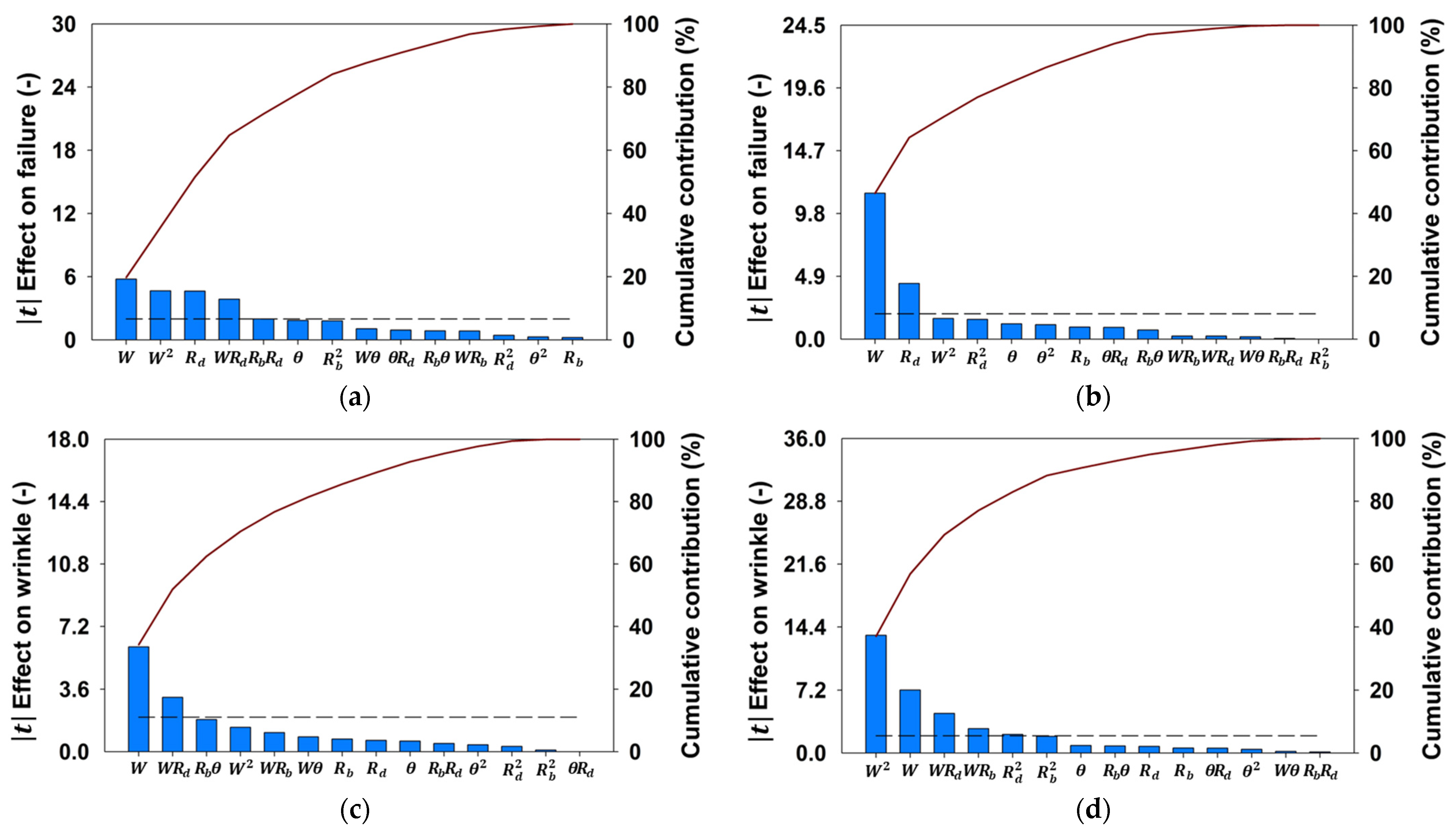
The influence of each term in the quadratic regression model on the forming defects was evaluated based on the t-values obtained from the regression analysis. In general, a larger absolute t-value indicates a greater influence of the corresponding term. Based on this criterion, the major design parameters and significant terms were identified. In addition, the relative influence and cumulative contribution of each term were presented using Pareto charts. For the influential combinations of design parameters, response surfaces were constructed using RSM to analyze the variations in the failure index and wrinkle value according to changes in the major design parameters. In other words, Pareto charts were used to identify the dominant terms, whereas RSM was used to visually analyze the behavior of the selected major design parameters.
Figure 13 presents the Pareto charts showing the influence of each term in the quadratic regression model for the failure index and wrinkle value of the T1000 and T500 cross-members. In each Pareto chart, the blue bars represent the absolute t-values of the regression terms, the red line indicates the cumulative contribution, and the black dashed line denotes the reference threshold for identifying influential terms. In Figure 13a, for T1000, W showed the greatest influence, followed by W 2 , R d , and W R d . This indicates that the failure index of T1000 was strongly affected not only by the linear effects of the design parameters but also by their quadratic and interaction effects. In Figure 13b, for T500, W showed the greatest influence, followed by R d . In contrast, the remaining terms showed relatively small contributions, indicating that the splitting behavior of T500 was governed mainly by the linear effects of the major design parameters. Therefore, W and R d were identified as the major design parameters affecting the failure index in both materials. In particular, T1000 exhibited more pronounced quadratic and interaction effects than T500, indicating more complex sensitivity behavior.
In Figure 13c, for T1000, W showed the greatest influence, followed by W R d . This indicates that the wrinkle value of T1000 was mainly affected by the linear effect of W and the interaction effect between W and R d . In Figure 13d, for T500, W 2 showed the greatest influence, followed by W , W R d , W R b , and R d 2 . This indicates that the wrinkling behavior of T500 was influenced not only by the linear effect of a specific design parameter but also significantly by the quadratic effects of the design parameters and their interaction effects. In particular, the fact that W 2 showed the greatest influence indicates that the wrinkle value changed nonlinearly with variation in W . Therefore, W and R d were identified as the major design parameters affecting the wrinkle value in both materials.
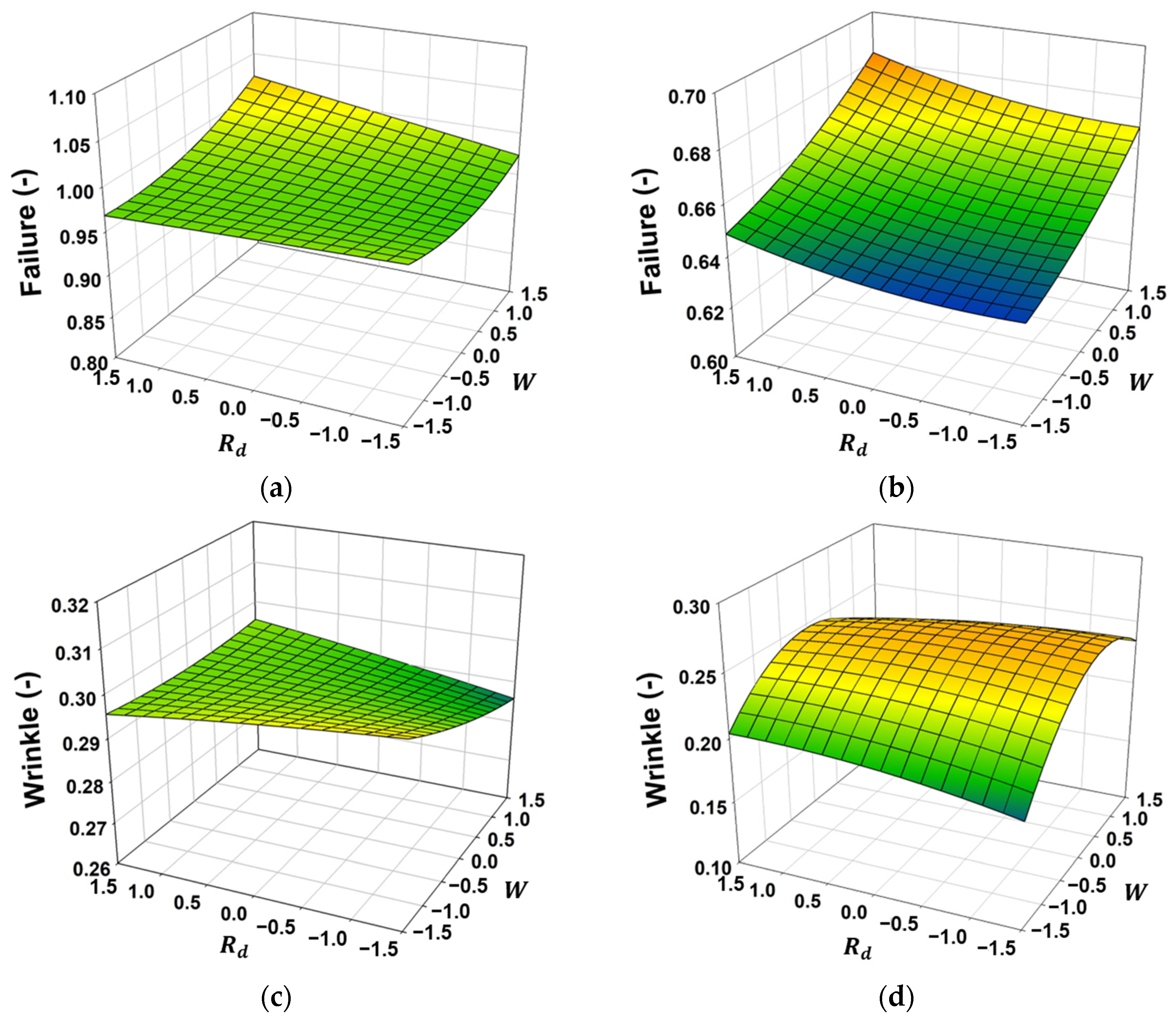
Figure 14 shows the response surface plots of the forming-defect indicators as functions of W and R d , which were identified as the major design parameters through the Pareto analysis. These response surfaces provide a visual representation of how the failure index and wrinkle value vary with changes in the two design parameters.
As shown in Figure 14a, the response surface for the failure index of T1000 exhibited a pronounced curvature as W varied, indicating a relatively strong quadratic effect associated with this parameter. The failure index also tended to increase as W and R d increased, suggesting that these parameters significantly affect the splitting risk under the T1000 condition. This trend is consistent with the Pareto chart results, in which W , W 2 , R d , and W R d were identified as highly influential terms. By comparison, the response surface for the failure index of T500 in Figure 14b also increased as W and R d increased, but the surface showed a more gently curved shape. This indicates that quadratic effects were also present under the T500 condition, although their influence was less pronounced than that observed for T1000.
For the wrinkle value of T1000 shown in Figure 14c, the response surface exhibited a relatively flat shape, with gradual variations as W and R d changed. This indicates that the wrinkle value under the T1000 condition showed less pronounced quadratic variation with respect to these parameters compared with the failure index. By comparison, the response surface for the wrinkle value of T500 in Figure 14d changed markedly as W varied, and the distinctly curved surface confirmed that quadratic effects were more pronounced. Therefore, the response surface analysis indicates that controlling W and R d is important for reducing forming defects in both materials, although their quadratic influence differs depending on the material condition.

6. Conclusions

In this study, the addendum geometry of the first-stage drawing die was optimized to reduce forming defects in a two-stage split drawing process for a commercial vehicle cross-member. The failure index and wrinkle value were used as the objective functions, and PO width, upper bar radius, wall angle, and lower die radius were defined as the design parameters. In addition, the effects of the design parameters on the forming defects were evaluated through sensitivity analysis. The main conclusions are as follows:
  • For both T1000 and T500, the optimal designs reduced both the failure index and the wrinkle value compared with the initial design. In particular, under the T1000 condition, splitting occurred in the initial design, whereas the optimal designs reduced the failure index to below 1.0, thereby alleviating the risk of splitting.
  • In the single-objective optimization, OPT-S was the most effective design for reducing the failure index, whereas OPT-W was the most effective design for reducing the wrinkle value. By contrast, the multi-objective optimal design, OPT-SW, provided a balanced reduction of both forming-defect indicators.
  • The sensitivity analysis showed that PO width ( W ) and lower die radius ( R d ) were the major design parameters significantly affecting both the failure index and the wrinkle value for both materials.
  • Regarding the failure index, the failure index of T1000 showed greater sensitivity than that of T500 to the quadratic effect of W and the interaction effect between W and R d , owing to its narrower formability window. In contrast, the failure index of T500 was mainly governed by the linear effects of the major design parameters, suggesting a relatively simpler trend for splitting reduction.
  • Regarding the wrinkle value, the wrinkle value of T1000 was dominated by the linear effect of W and the interaction effect between W and R d . In contrast, the wrinkle value of T500 showed a more pronounced quadratic effect of W , suggesting that its wrinkling behavior was more strongly affected by nonlinear changes in PO width.
  • The response surface analysis visually illustrated the variations in the failure index and the wrinkle value with changes in the major design parameters, and provided useful guidance for controlling these parameters to reduce forming defects.

Author Contributions

Conceptualization, methodology, validation, investigation, J.S., D.K.; writing—original draft preparation, visualization, J.S.; writing—review and editing, supervision, project administration, D.K. All authors have read and agreed to the published version of the manuscript.

Funding

This research was supported by Korea Industrial Complex Corporation (KICOX) grant (No. 2025-2110-01), by Korea Institute for Advancement of Technology (KIAT) grant (No. P0020536) and by Korea Planning & Evaluation Institute of Industrial Technology (KEIT) grant (No. RS-2024-00420231) funded by the Korea Government (MOTIR).

Data Availability Statement

The original contributions presented in this study are included in the article. Further inquiries can be directed to the corresponding author.

Conflicts of Interest

The authors declare no conflicts of interest.

References

  1. Czerwinski, F. Current Trends in Automotive Lightweighting Strategies and Materials. Materials 2021, 14, 6631. [Google Scholar] [CrossRef]
  2. Zhang, W.; Xu, J. Advanced Lightweight Materials for Automobiles: A Review. Mater. Des. 2022, 221, 110994. [Google Scholar] [CrossRef]
  3. Candela, A.; Sandrini, G.; Gadola, M.; Chindamo, D.; Magri, P. Lightweighting in the Automotive Industry as a Measure for Energy Efficiency: Review of the Main Materials and Methods. Heliyon 2024, 10, e29728. [Google Scholar] [CrossRef] [PubMed]
  4. Sutar, V.; Dharankar, C.S.; Raju, B.T. High Strength Steel for Automotive Applications. Int. Res. J. Eng. Technol. 2016, 3, 966–968. [Google Scholar]
  5. Larsson, F.; Hammarberg, S.; Jonsson, S.; Kajberg, J. Material Characterisation, Modelling, and Validation of a UHSS Warm-Forming Process for a Heavy-Duty Vehicle Chassis Component. Metals 2025, 15, 424. [Google Scholar] [CrossRef]
  6. Billur, E.; Altan, T. Challenges in forming advanced high strength steels. In Proceedings of the New Developments in Sheet Metal Forming 2010, Stuttgart, Germany, 2–4 May 2010; Engineering Research Center for Net Shape Manufacturing (ERC/NSM): Columbus, OH, USA, 2010; pp. 285–304. [Google Scholar]
  7. Pereira, R.; Peixinho, N.; Costa, S.L. A review of sheet metal forming evaluation of advanced high-strength steels (AHSS). Metals 2024, 14, 394. [Google Scholar] [CrossRef]
  8. Folle, L.F.; Lima, T.N.; Santos, M.P.S.; Callegari, B.; Silva, B.C.d.S.; Zamorano, L.G.S.; Coelho, R.S. A review on sheet metal forming behavior in high-strength steels and the use of numerical simulations. Metals 2024, 14, 1428. [Google Scholar] [CrossRef]
  9. Sunanta, A.; Suranuntchai, S. Optimization of process parameters for advanced high-strength steel JSC980Y automotive part using finite element simulation and deep neural network. J. Manuf. Mater. Process. 2025, 9, 197. [Google Scholar] [CrossRef]
  10. Liang, Z.; Liu, Y.; Zou, T.; Li, D.; Ding, S.; Xiao, H.; Shi, L.; Peng, Y. Analysis and suppression of flange wrinkling in AHSS chain-die forming channels with a curved axis. J. Manuf. Process. 2021, 71, 70–84. [Google Scholar] [CrossRef]
  11. Starman, B.; Cafuta, G.; Mole, N. A Method for Simultaneous Optimization of Blank Shape and Forming Tool Geometry in Sheet Metal Forming Simulations. Metals 2021, 11, 544. [Google Scholar] [CrossRef]
  12. Wang, Z.; Zhang, Q.; Liu, Y.; Zhang, Z. A Robust and Accurate Geometric Model for Automated Design of Drawbeads in Sheet Metal Forming. Comput.-Aided Des. 2017, 92, 42–57. [Google Scholar] [CrossRef]
  13. Shi, X.; Chen, J.; Peng, Y.; Ruan, X. A New Approach of Die Shape Optimization for Sheet Metal Forming Processes. J. Mater. Process. Technol. 2004, 152, 35–42. [Google Scholar] [CrossRef]
  14. Jansson, T.; Nilsson, L. Optimizing Sheet Metal Forming Processes—Using a Design Hierarchy and Response Surface Methodology. J. Mater. Process. Technol. 2006, 178, 218–233. [Google Scholar] [CrossRef]
  15. Xiao, X.; Kim, J.-J.; Hong, M.-P.; Yang, S.; Kim, Y.-S. RSM and BPNN Modeling in Incremental Sheet Forming Process for AA5052 Sheet: Multi-Objective Optimization Using Genetic Algorithm. Metals 2020, 10, 1003. [Google Scholar] [CrossRef]
  16. Sosnowski, W.; Marczewska, I.; Marczewski, A. Sensitivity Based Optimization of Sheet Metal Forming Tools. J. Mater. Process. Technol. 2002, 124, 319–328. [Google Scholar] [CrossRef]
  17. Son, J.H.; Park, S.; Na, Y.-G.; Kim, D. Effect of a Two-Stage Split Process on the Sheet Metal Forming Behavior of Automotive Crossmembers. Trans. Mater. Process. 2025, 34, 202–212. [Google Scholar] [CrossRef]
  18. Son, J.H.; Park, S.; Na, Y.-G.; Kim, D. Optimization of Die Addendum Shape and Impact Analysis of Design Parameters in Split Drawing Operations for Automotive Crossmembers. Trans. Mater. Process. 2025, 34, 350–358. [Google Scholar] [CrossRef]
  19. AutoForm Engineering GmbH. AutoForm R13 Software Manual. Available online: https://servicecenter.autoform.com/smf13/en (accessed on 21 April 2026).
  20. Swift, H.W. Plastic Instability under Plane Stress. J. Mech. Phys. Solids 1952, 1, 1–18. [Google Scholar] [CrossRef]
  21. Hockett, J.E.; Sherby, O.D. Large Strain Deformation of Polycrystalline Metals at Low Homologous Temperatures. J. Mech. Phys. Solids 1975, 23, 87–98. [Google Scholar] [CrossRef]
  22. Barlat, F.; Lian, J. Plastic Behavior and Stretchability of Sheet Metals. Part I: A Yield Function for Orthotropic Sheets under Plane Stress Conditions. Int. J. Plast. 1989, 5, 51–66. [Google Scholar] [CrossRef]
  23. Abspoel, M.; Scholting, M.E.; Droog, J.M.M. A New Method for Predicting Forming Limit Curves from Mechanical Properties. J. Mater. Process. Technol. 2013, 213, 759–769. [Google Scholar] [CrossRef]
  24. ASTM E8/E8M-22; Standard Test Methods for Tension Testing of Metallic Materials. ASTM International: West Conshohocken, PA, USA, 2022. [CrossRef]
  25. Tekieli, M.; De Santis, S.; de Felice, G.; Kwiecień, A.; Roscini, F. Application of Digital Image Correlation to Composite Reinforcements Testing. Compos. Struct. 2017, 160, 670–688. [Google Scholar] [CrossRef]
  26. Tung, S.-H.; Shih, M.-H.; Kuo, J.-C. Application of Digital Image Correlation for Anisotropic Plastic Deformation During Tension Testing. Opt. Lasers Eng. 2010, 48, 636–641. [Google Scholar] [CrossRef]
  27. Reissner, E. The effect of transverse shear deformation on the bending of elastic plates. J. Appl. Mech. 1945, 12, A69–A77. [Google Scholar] [CrossRef]
  28. Mindlin, R.D. Influence of rotatory inertia and shear on flexural motions of isotropic, elastic plates. J. Appl. Mech. 1951, 18, 31–38. [Google Scholar] [CrossRef]
  29. Helton, J.C.; Davis, F.J.; Johnson, J.D. A Comparison of Uncertainty and Sensitivity Analysis Results Obtained with Random and Latin Hypercube Sampling. Reliab. Eng. Syst. Saf. 2005, 89, 305–330. [Google Scholar] [CrossRef]
  30. Box, G.E.P.; Wilson, K.B. On the Experimental Attainment of Optimum Conditions. J. R. Stat. Soc. Ser. B Methodol. 1951, 13, 1–45. [Google Scholar] [CrossRef]
Figure 1. Cross-member geometry with a large height-to-width ratio (unit: mm).
Metals 16 00561 g001
Figure 2. Representative forming defects (splitting and wrinkling) observed in 1 GPa-grade UHSS cross-member during a single drawing process.
Metals 16 00561 g002
Figure 3. Process layout of sheet metal forming for the cross-member.
Metals 16 00561 g003
Figure 4. Die geometry configurations for the OP10: (a) initial design (INI) and (b) addendum-integrated design (OPT) highlighting the four design parameters employed for optimization.
Metals 16 00561 g004aMetals 16 00561 g004b
Figure 5. Measured mechanical properties from uniaxial tensile testing at 0 ° , 45 ° , and 90 ° to the rolling direction: (a) engineering stress–strain and (b) transverse-longitudinal strain curves. In (b), The solid and dashed lines represent the results for T1000 and T500, respectively.
Metals 16 00561 g005
Figure 6. Constitutive models for T1000 and T500: (a) hardening curve, (b) yield surface and (c) forming limit diagram.
Metals 16 00561 g006
Figure 7. Finite element modeling: (a) OP10 and (b) OP20.
Metals 16 00561 g007
Figure 8. Schematic illustrations of the formability indicators employed in Autoform to assess forming defects: (a) failure index, which quantifies the tendency toward splitting and (b) wrinkle value, which measures the propensity for wrinkling.
Metals 16 00561 g008
Figure 9. Comparison of the addendum geometries of the optimum designs for splitting reduction (OPT-S), wrinkling reduction (OPT-W), and simultaneous splitting and wrinkling reduction (OPT-SW): (a) T1000; (b) T500.
Metals 16 00561 g009
Figure 10. Failure index and wrinkle value distributions, together with the locations of the most severe forming defects after OP20: (a) T1000 and (b) T500.
Metals 16 00561 g010
Figure 11. Definition of the major forming defect locations: (a) Split A area (SAA); (b) Wrinkle A, B, and C areas (WAA, WBA, and WCA).
Metals 16 00561 g011
Figure 12. Comparison of forming defects with respect to each design: (a,b) maximum failure index and (c,d) maximum wrinkle value; (a,c) T1000 and (b,d) T500.
Metals 16 00561 g012aMetals 16 00561 g012b
Figure 13. Pareto charts of the effects of the quadratic regression terms on: (a,b) failure index and (c,d) wrinkle value; (a,c) T1000; (b,d) T500.
Metals 16 00561 g013
Figure 14. Response surfaces of forming defects with respect to W and R d : (a,b) failure index and (c,d) wrinkle value; (a,c) T1000 and (b,d) T500.
Metals 16 00561 g014
Table 1. Mechanical properties of T1000 and T500 steel sheets.
MaterialsDirections
(°)
Yield Strength
(MPa)
Tensile Strength
(MPa)
% ElongationR-Value
(-)
UniformTotal
T500384.3 (±4.6)502.5 (±0.6)14.1 (±0.6)22.9 (±1.3)0.85 (±0.06)
45°389.4 (±3.9)498.5 (±4.1)16.4 (±0.2)29.0 (±0.4)1.00 (±0.11)
90°417.3 (±7.1)527.9 (±6.9)14.8 (±0.5)26.5 (±2.0)0.76 (±0.02)
T1000708.2 (±6.5)1039.1 (±1.0)7.7 (±0.3)13.8 (±1.1)1.04 (±0.03)
45°699.4 (±5.3)1014.9 (±0.4)8.5 (±0.2)16.6 (±0.6)1.14 (±0.09)
90°698.5 (±7.6)1012.7 (±3.4)8.3 (±0.1)15.1 (±0.1)0.73 (±0.01)
Table 2. Hardening coefficients of the combined Swift/Hockett–Sherby law.
Materials α ε 0 n K
(MPa)
σ y i e l d
(MPa)
σ s a t
(MPa)
N q
T10000.190.00210.111362.6708.21509.01160.91
T5000.250.01300.19892.8384.3445.7511.04
Table 3. Anisotropic coefficients of Barlat 1989 yield function.
Materials a c z p
T10001.0720.9281.0990.8574
T5001.1090.8911.0320.8097
Table 4. Forming limits ( ε 1 ,   ε 2 )   for four primary strain states with Abspoel/Scholting model.
Materials T E P S IM B I
T1000(0.495, −0.193)(0.147, 0)(0.306, 0.230)(0.350, 0.350)
T500(0.658, −0.261)(0.281, 0)(0.429, 0.322)(0.442, 0.442)
Table 5. Design parameters, baseline values, and allowable ranges used in the optimization study.
Design ParametersUnitBaselineRange
Punch opening width, W mm3020–40
Upper bar radius, R b mm105–15
Wall angle, θ (°)63–9
Lower die radius, R d mm105–15
Disclaimer/Publisher’s Note: The statements, opinions and data contained in all publications are solely those of the individual author(s) and contributor(s) and not of MDPI and/or the editor(s). MDPI and/or the editor(s) disclaim responsibility for any injury to people or property resulting from any ideas, methods, instructions or products referred to in the content.