Article

Effect of Heat Treatment on Mechanical Properties and Fatigue Behaviors of a Selective Laser Melting Nickel-Based Superalloy


1
School of Aeronautics and Astronautics, Tianjin Sino-German University of Applied Sciences, Tianjin 300350, China
2
Tianjin Key Laboratory of High Performance Precision Forming Manufacturing Technology and Equipment, School of Mechanical Engineering, Tianjin University of Technology and Education, Tianjin 300222, China
3
Wheel Rail Center, Tianjin Research Institute for Advanced Equipment, Tsinghua University, Tianjin 300300, China
4
School of Control and Mechanical Engineering, Tianjin Chengjian University, Tianjin 300384, China
5
School of Materials Science and Engineering, Tianjin University, Tianjin 300350, China
*
Author to whom correspondence should be addressed.
Metals 2026, 16(5), 525; https://doi.org/10.3390/met16050525
Submission received: 8 April 2026 / Revised: 7 May 2026 / Accepted: 8 May 2026 / Published: 12 May 2026
(This article belongs to the Special Issue Laser-Assisted Processing of Metals)

Abstract

This investigation elucidates the elevated-temperature (650 °C) monotonic mechanical response and very-high-cycle fatigue (VHCF) characteristics of Inconel 718 superalloys additively manufactured via selective laser melting (SLM), with a comparative assessment between the as-built and post-process heat-treated states. The results indicate that mechanical performance improves after heat treatment, primarily due to the formation of γ′ and γ″ precipitates, which interact with dislocations to strengthen the alloy. Relative to the as-built specimens, the fatigue strength of the specimen after heat treatment has increased by more than twice. For the as-built specimen, fatigue cracks nucleate at the specimen surface. However, in the high stress range, crack initiation in the heat-treated specimens consistently occurs at the free surface, whereas under low stress conditions, the crack initiation site transitions to the subsurface region encompassing internal defects. Post heat treatment, the fatigue crack trajectory adopts a markedly ductile and tortuous morphology, engendered by the concerted influence of grain-boundary (Laves/δ) precipitates that enforce repeated crack deflection, matrix-strengthening phases that homogenize plastic strain and the attendant reduction in local strain accumulation under the effect of cyclic load.

1. Introduction

Inconel 718 is widely used in aerospace due to its excellent corrosion, oxidation, creep and fatigue resistance [1,2,3,4,5]. Conventional casting/forging struggle to produce complex geometries efficiently, while selective laser melting (SLM) enables greater design freedom but introduces residual stresses [6,7], micro-segregation [8], and non-equilibrium phases [9,10]. Therefore, this study aims to develop an optimized post-heat-treatment cycle that simultaneously relieves these defects and tailors the microstructure. The main contributions are (1) identifying a heat-treatment route that eliminates residual stresses and homogenizes elemental segregation and (2) achieving superior mechanical properties comparable to or exceeding those of conventionally processed IN718, providing a practical solution for additive manufacturing of critical aerospace components [9,11].
Solution treatment at around 1000 °C followed by a two-step aging sequence constitutes the standard precipitation-hardening regime for Inconel 718. Liu et al. pointed out that, after solution treatment at 950 °C, Inconel 718 undergoes a two-step aging process that precipitates nanometer-sized γ″/γ′ strengthening phases within the grains while forming discretely distributed δ-phase at the grain boundaries [6,12]. The modest precipitation of this δ-phase does not compromise toughness; instead, it refines the microstructure by pinning the grain boundaries and indirectly promotes a uniform, fine dispersion of γ″ during subsequent aging, thereby jointly increasing the alloy hardness [13]. Wang et al. reported that solution-treating IN718 at 980 °C followed by a double-aging sequence enhances its mechanical properties through combined precipitation hardening and grain-boundary strengthening [14]. Wang et al. [1] showed that post-SLM heat treatment markedly raises the tensile strength and strain-hardening rate of IN718 because the brittle Laves phase dissolves and fine γ′/γ″ precipitates form. They also found that fatigue life improves when the same treatment eliminates Laves, needle-like δ and primary MC carbides. Yu et al. [2] further pointed out that the shape and location of the δ phase control high-temperature behavior: excessive δ either inside grains or along boundaries acts as a dislocation source, generating local stress concentrations that initiate micro-cracks. How the δ phase that remains (or re-precipitates) after standard SLM heat treatments influences high-temperature strength and fatigue of additively manufactured IN718 therefore still needs systematic investigation.
Blades typically fail in the very-high-cycle-fatigue (VHCF, Nf > 107 cycles) regime [15,16]. Yang et al. [17] tracked IN718 in that range and showed that VHCF life and the site of crack initiation are governed by the type, dimension and position of the dominant micro-flaw. Li et al. [18] observed that localized oxidation can markedly shorten fatigue life. At high stress levels, the produced oxide coating at elevated temperature would increase the crack growth rate because oxidation at the crack tip becomes progressively more severe. While Qin et al. [19] and Shen et al. [20] have advanced the understanding of crack initiation mechanisms under HCF and VHCF conditions, the significant regime-dependent differences remain insufficiently addressed. Therefore, a systematic investigation into the distinct mechanisms of VHCF crack initiation and propagation in IN718 superalloy is warranted. Nevertheless, in the VHCF regime, where the applied stress is low, the surface oxide is comparatively thick yet remains intact because the surrounding plastic strain is too small to rupture it. This intact film suppresses surface crack nucleation and thereby shifts the initiation site to the interior. Miao et al. [14] showed that, at 593 °C, the VHCF crack initiation in Ni-based superalloy is governed by microstructural heterogeneity together with the concentration of cyclic plastic strain. Nevertheless, how additively manufactured IN718 behaves in the VHCF regime after standard heat treatment is still an open question. Heat treatment is routinely applied to relieve as-built residual stresses and to precipitate the γ″/γ′ strengthening phases, both of which can strongly influence fatigue damage evolution. Consequently, a systematic characterization of the VHCF response of post-heat-treated IN718 is essential.
Here, we characterize the tensile properties and VHCF response of selective-laser-melted IN718 at 650 °C. Combining detailed microstructural analyses with elevated-temperature tensile and ultrasonic fatigue experiments, we correlate fatigue performance with microstructural evolution during high-temperature cycling. The findings deliver critical insight for deploying SLM IN718 in high-temperature VHCF-critical applications.

2. Materials and Methods

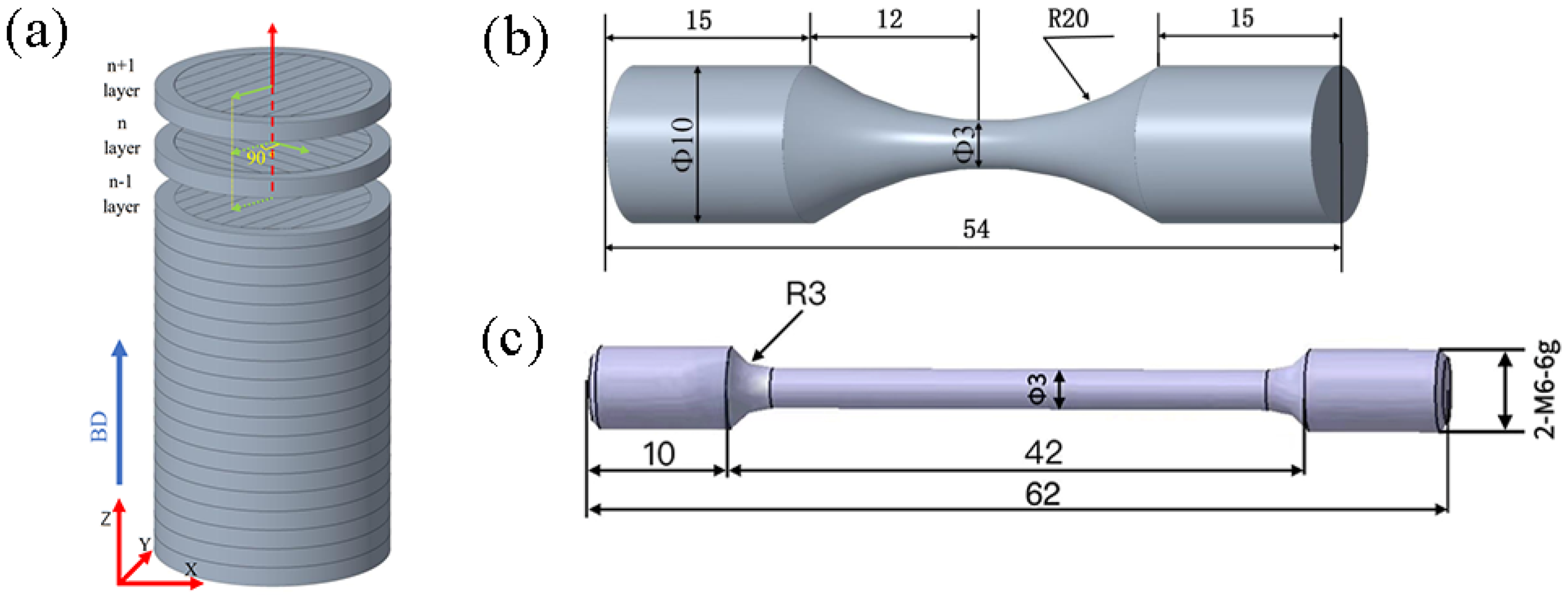
All test specimens were additively manufactured on an EOS M290 selective laser melting platform (Krailling, Germany) incorporating a 400 W ytterbium-doped fiber laser source. The feedstock material consisted of gas-atomized IN718 powder with a particle size distribution ranging from 15 to 45 µm. The nominal chemical composition of the as-received powder is summarized in Table 1. Cylindrical rods with a diameter of 10 mm and a height of 80 mm were fabricated using a cross-direction raster scanning (CDRS) strategy [21]. The SLM builds were conducted with a laser power of 260 W, a scan speed of 1000 mm s−1, a hatch spacing of 0.11 mm and a layer thickness of 40 µm, accompanied by an inter-layer scan-vector rotation of 90°. The specimens were fabricated under a high-purity argon atmosphere to ensure effective shielding of the melt pool from oxidation. Specimens were machined to prepare the standard tensile and fatigue tests; the shape and size are shown in Figure 1. To conform to AMS 5663, the as-built IN718 was subjected to a controlled post-heat-treatment protocol consisting of primary solution annealing at 980 °C for 1 h (ambient-air quench) followed by a duplex precipitation-hardening cycle: primary aging at 720 °C for 8 h (furnace-cooled at 50 °C h−1) and secondary aging at 620 °C for 8 h (air-cooled) [22].
For microstructural characterization, metallographic coupons were sequentially ground with SiC abrasive papers (400–2000 grit) and polished to a 1 µm diamond finish. Chemical contrast was developed by immersion etching for 10 s in a modified Fry’s reagent (1.5 g CuSO4 + 20 mL HCl + 10 mL EtOH, aqueous). Microstructural characterization was conducted with a JSM-7800F field-emission scanning electron microscope (JEOL Ltd., Tokyo, Japan), coupled with an energy-dispersive X-ray detector for elemental analysis. Crystallographic orientation data were acquired via electron back-scatter diffraction (EBSD) on surfaces normal to the build direction, employing a step size of 0.38 µm. EBSD specimens were prepared by electro-polishing at −30 °C in a perchloric-acid-based electrolyte (10% HClO4, 90% EtOH, vol. %) at 30 V for 20 s to remove surface deformation layers.
Cylindrical blanks were finish-polished to eradicate superficial flaws. Uniaxial tensile experiments were then performed at 650 °C (3.3 × 10⁻⁵ s−1) on an INSTRON 5982 frame (Norwood, MA, USA), strictly following GB/T 228.2-2015 [23], and geometry is given in Figure 1c. Each variant was validated through triplicate tests. Ultrasonic fatigue characterization was conducted at 20 kHz and R = −1 on a USF-300 system (Tianjin Yipu Technology Co., Ltd., Tianjin, China) equipped with an induction heater maintaining 650 °C. In order to shorten the specimen length and speed up the fatigue test, the specimen is usually designed in the shape of a dog bone, which allows the specimen to obtain a high stress amplification coefficient and maximize stress in its intermediate cross-section (geometry in Figure 1b). Surfaces were sequentially ground to a mirror finish using SiC papers to eliminate machining marks. The load axis was aligned parallel to the SLM build direction. Tests were terminated when either the resonance frequency shifted by ≥5% owing to crack initiation or 1 × 10⁹ cycles were attained. Following the fatigue-life tests, fracture surfaces were systematically characterized via high-resolution field-emission scanning electron microscopy to delineate the crack initiation sites, propagation topography, and ultimate failure morphology. Moreover, the compositions of crack initiation sites were determined by EDS.

3. Results and Discussion

3.1. Microstructure Characterization

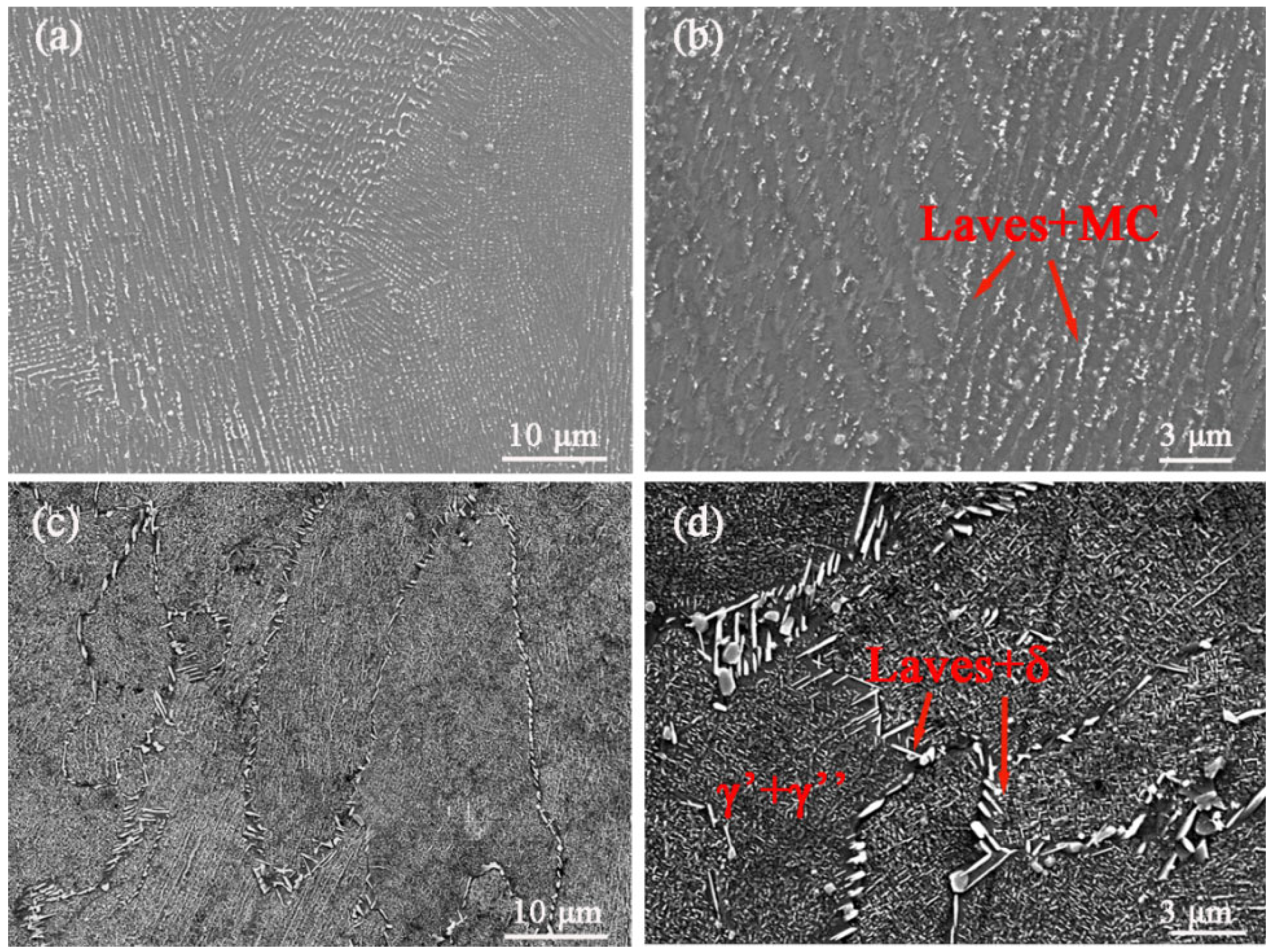
To elucidate the microstructural response to post-SLM heat treatment, representative SEM micrographs acquired along the longitudinal plane of both the as-built and heat-treated conditions are collated in Figure 2. The as-built microstructure of Inconel 718 is characterized by an interpenetrating array of nanometric–sub-micrometric dendrites that exhibit gray-level contrast under back-scattered electron imaging. Figure 2a reveals a primary dendrite arm spacing (PDAS) of 500 nm–1 µm, in quantitative agreement with the values reported by Li et al. [24]. The PDAS observed herein is one to two orders of magnitude finer than that characteristic of conventionally cast material (10–40 μm); this refinement is a direct manifestation of the extreme cooling rates inherent to the SLM process [25].
The as-built microstructure comprised a γ-matrix decorated by abundant interdendritic laths of the Laves phase together with faceted MC-type carbides (predominantly NbC), and these constituents appear as bright, irregular granular precipitates under back-scattered electron imaging (Figure 2b). Corroborating prior investigations, the interdendritic space is enriched in brittle, topologically close-packed Laves phases [25]. Consequently, the columnar grains comprise an aggregate of elongated dendritic trunks and interspersed granular Laves particles. Figure 2b further evidences pronounced grain-size heterogeneity in the as-built IN718 alloy; such inhomogeneity is a recurrent feature of SLM-processed alloys and originates from the highly localized thermal cycles inherent to laser scanning [25,26]. In addition, in the as-built condition, the δ, γ′, and γ″ phases were entirely absent because the ultra-rapid cooling and concomitantly brief solid-state residence time inherent to SLM suppress their nucleation and growth. Figure 2c,d show the microstructure of specimens with heat treatment, and SEM analysis reveals that rod-like and globular δ precipitates formed along grain boundaries after heat treatment, which were absent in the as-built specimen. Following the post-processing thermal cycle, the microstructure is dominated by grain-boundary decorations of Laves and δ precipitates, while coherent γ′ and γ″ precipitates are heterogeneously nucleated within the γ matrix. The marked decrease in Laves volume fraction liberates niobium, enriching the interdendritic areas and establishing the compositional supersaturation required for subsequent δ-phase nucleation and growth [27].

3.2. Tensile Behavior

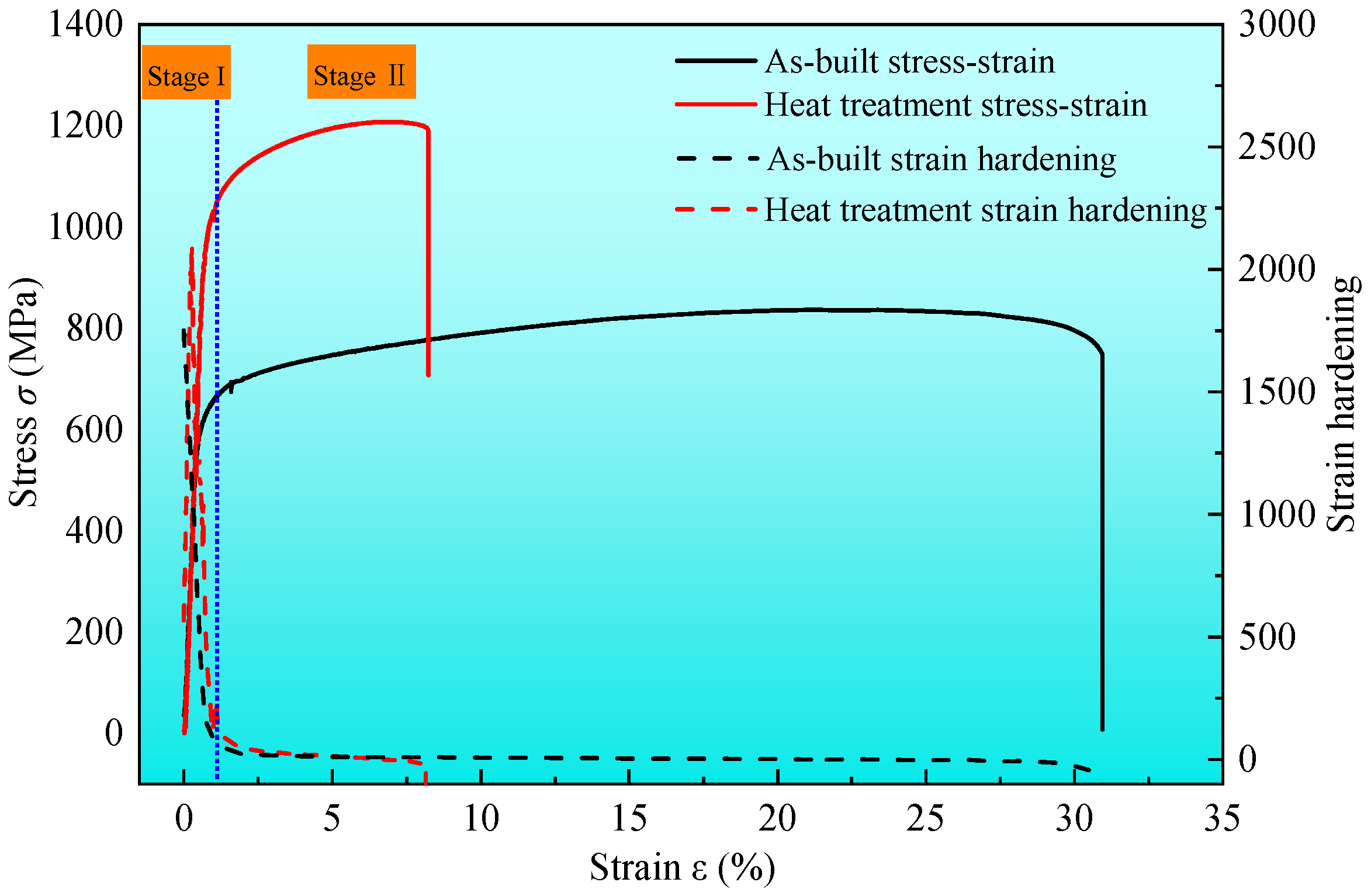
The engineering stress–strain and strain-hardening responses of additively manufactured Inconel 718 in both as-built and post-process heat-treated conditions are depicted in Figure 3. The as-built specimens exhibit pronounced plastic deformability, evidenced by appreciable uniform elongation, albeit at the expense of comparatively low yield and ultimate tensile strengths. Upon subjecting the alloy to a standard precipitation-hardening thermal cycle, a marked increment in both yield strength and ultimate tensile strength is realized. Concomitantly, a pronounced reduction in total elongation to failure is observed, manifesting as a steepened elastic slope and a curtailed plastic regime in the post-treated stress–strain curve.
The strain–hardening rate curves (dashed lines, Figure 3) exhibit a distinct two-stage response: an initial rapid decay (stage I) followed by a quasi-plateau (stage II). Stage I reflects the abrupt loss of work-hardening capacity immediately after yielding, governed by the unrestricted glide of newly generated dislocations [21]. In stage II, the rate of decrease diminishes as strain accumulates, indicating a dynamic balance between dislocation multiplication and dynamic recovery. The sub-solvus solution treatment employed here (980 °C) did not fully dissolve the metastable γ′/γ″ population. Partial transformation to δ-Ni3Nb and Laves phases is therefore anticipated [21]. The residual and reprecipitated particles act as discrete obstacles to dislocation motion, providing the extended, albeit modest, hardening component observed in stage II, as shown in Figure 3. The quasi-plateau observed in stage II of the strain–hardening rate curve for the heat-treated condition is primarily attributed to the γ″ precipitates, which serve as the dominant strengthening phase in Inconel 718. Crystal plasticity modeling and experimental observations demonstrate that the strain gradient governed by geometrically necessary dislocation (GND) density accumulation around coherent γ″ precipitates plays a decisive role in sustaining a near-constant work-hardening rate. The three γ″ variants exhibit distinct deformation behaviors under uniaxial loading, with the shearable variants ([100] and [001]) accommodating dislocation shearing and thereby reducing strain localization in the adjacent γ matrix while maintaining continuous GND evolution [28]. Given that γ″ precipitates occupy the vast majority of the total precipitates after standard double aging, their contribution to stage II hardening is quantitatively dominant [28,29]. The δ phase, in contrast, does not directly contribute to the quasi-plateau as a strengthening constituent; rather, it exerts a secondary modulating effect through dislocation pinning at grain boundaries or intragranular sites, which may locally enhance the work-hardening rate via pile-up mechanisms. However, excessive δ precipitation is detrimental because it depletes Nb from the matrix and promotes γ″ dissolution, ultimately reducing the overall strain-hardening capacity. The γ′ phase contributes marginally to stage II due to its lower volume fraction and smaller lattice misfit. Therefore, it can be inferred that that the maintenance of the stage II quasi-plateau is governed predominantly by the dynamic equilibrium between dislocation shearing of γ″ precipitates and the associated GND density evolution, with δ and γ′ phases playing subordinate or indirect roles [4,30]. In addition, Table 2 summarizes the monotonic tensile data. In the as-built state, the yield strength and ultimate tensile strength of Inconel 718 are 611 MPa and 831 MPa, respectively, accompanied by a total elongation of 38%. Following a post-fabrication precipitation-hardening heat treatment, the yield strength and ultimate tensile strength increase markedly to 983 MPa and 1196 MPa, respectively. This substantial strength enhancement is, however, accompanied by a pronounced reduction in ductility, with elongation decreasing from 38% to 6.9%, reflecting a significant compromise in plastic deformability.

3.3. Fatigue Behavior

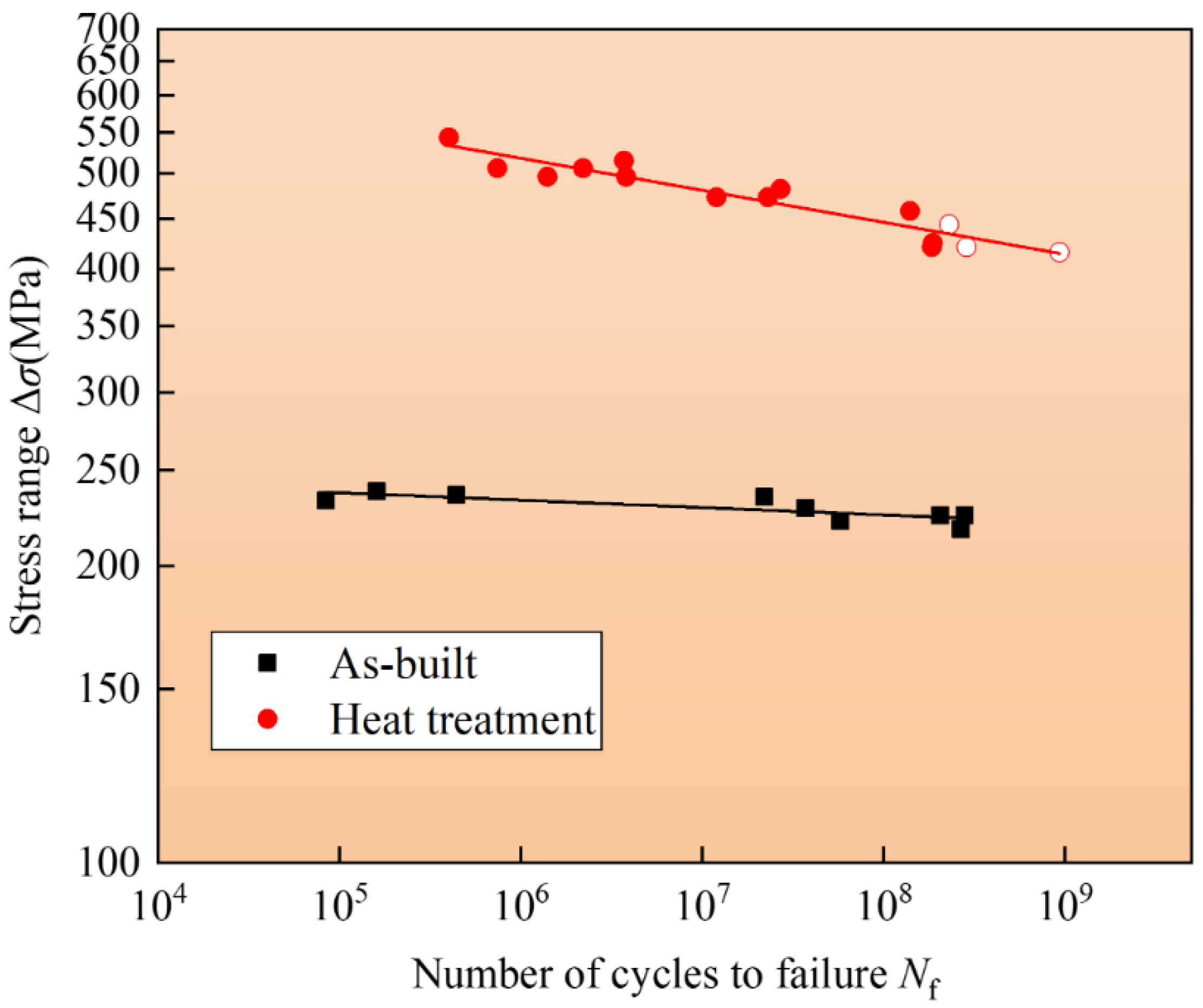
Figure 4 compiles the S–N response of both the as-built and heat-treated IN718. Solid symbols denote fatigue cracks nucleated at the specimen surface and open symbols indicate subsurface initiation. As illustrated in Figure 4, every as-built specimen exhibited surface-initiated fatigue cracking. In contrast, for the heat-treated condition, subsurface nucleation was encountered in only a handful of tests within the VHCF regime. Across both microstructural states the S–N data display a monotonic decline with decreasing stress amplitude; no conventional engineering endurance limit was attained even at lives exceeding 107 cycles. The specimens still fractured after 107 or even around 109 cycles. For additively manufactured specimens in the as-built condition, the S–N relationship was delineated from 105 to 109 cycles under stress amplitudes regressing from 240 MPa to 210 MPa. Upon the imposition of a post-process thermal treatment, the fatigue–limit curve underwent a marked upward translation, permitting the same life regime to be spanned under stress amplitudes regressing from 550 MPa to 410 MPa. Therefore, compared to the as-built specimens, the fatigue strength of the specimen after heat treatment has increased by more than twice.
The mathematical formulations governing the S–N behavior are herein delineated.
For as-built specimens:
l g N f = 322.1 133.5 l g Δ σ
For heat-treated specimens:
l g N f = 89.6 30.8 l g Δ σ
where Δσ designates the imposed stress amplitude and Nf is the corresponding fatigue life. The heat-treated specimens exhibit a markedly superior fatigue strength relative to their as-built counterparts. For example, according to Equations (1) and (2), at 1 × 10⁵ cycles, the fatigue strength increases from 237 MPa (as-built state) to 558 MPa (heat-treated state). At the 1 × 10⁸ cycles endurance limit, the corresponding values are 225 MPa (as-built state) and 446 MPa (heat-treated state), respectively. Namely, the fatigue strength of the IN718 alloy exhibits a pronounced enhancement following heat treatment.

3.4. Fractography

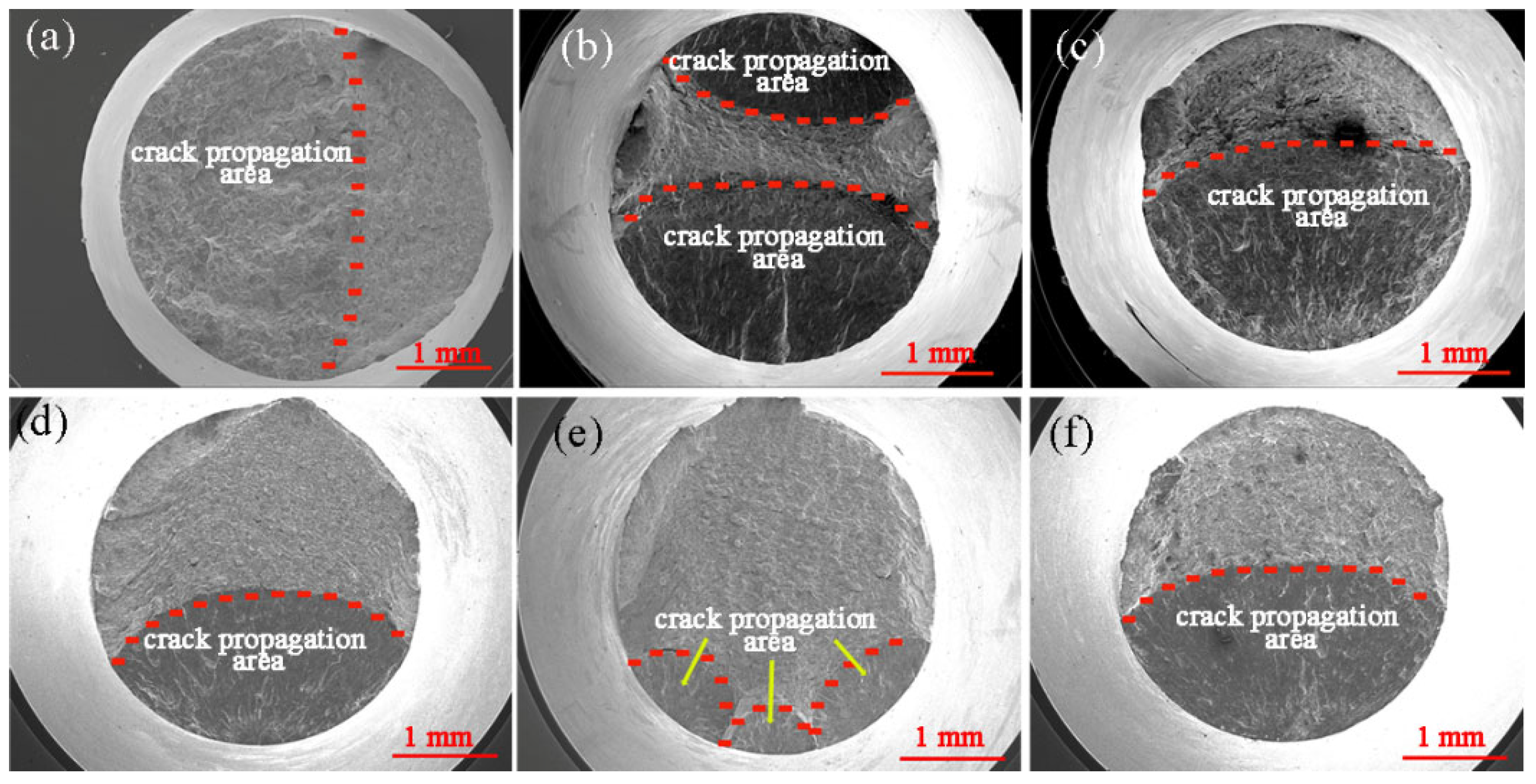
Following ultrasonic fatigue test, the fracture surfaces of all fractured specimens were subjected to systematic SEM examination. The resultant macroscopic morphologies consistently reveal that fatigue cracks nucleate at the specimen surface and subsurface. Additionally, it should be noted that some specimens have multiple initiation sites. For example, the as-built specimen with fatigue life 3.7 × 10⁷ cycles has two crack initiation sites which are located on opposite sides and then propagate into the interior of the specimen. However, for the heat-treatment specimen with fatigue life 2.7 × 10⁷ cycles, the crack initiation sites are all on the same side and close to each other, eventually converging into a large crack. Regardless of whether heat treatment is applied, the fatigue crack propagation path mainly extends from the outer surface to the interior, indicating that the strengthening effect of heat treatment has a relatively small impact on the crack initiation stage (Figure 5).
Figure 5. Micrographs of fatigue surfaces for the as-built (ac) and heat-treated (df) specimens with various stress range: (a) Δσ = 238 MPa, Nf = 4.4 × 10⁵ cycles; (b) Δσ = 229 MPa, Nf = 3.7 × 10⁷ cycles; (c) Δσ = 218 MPa, Nf = 2.67 × 10⁸ cycles; (d) Δσ = 506 MPa, Nf = 7.4 × 10⁵ cycles; (e) Δσ = 482 MPa, Nf = 2.7 × 10⁷ cycles; (f) Δσ = 421 MPa, Nf = 2.87 × 10⁸ cycles.
Metals 16 00525 g005
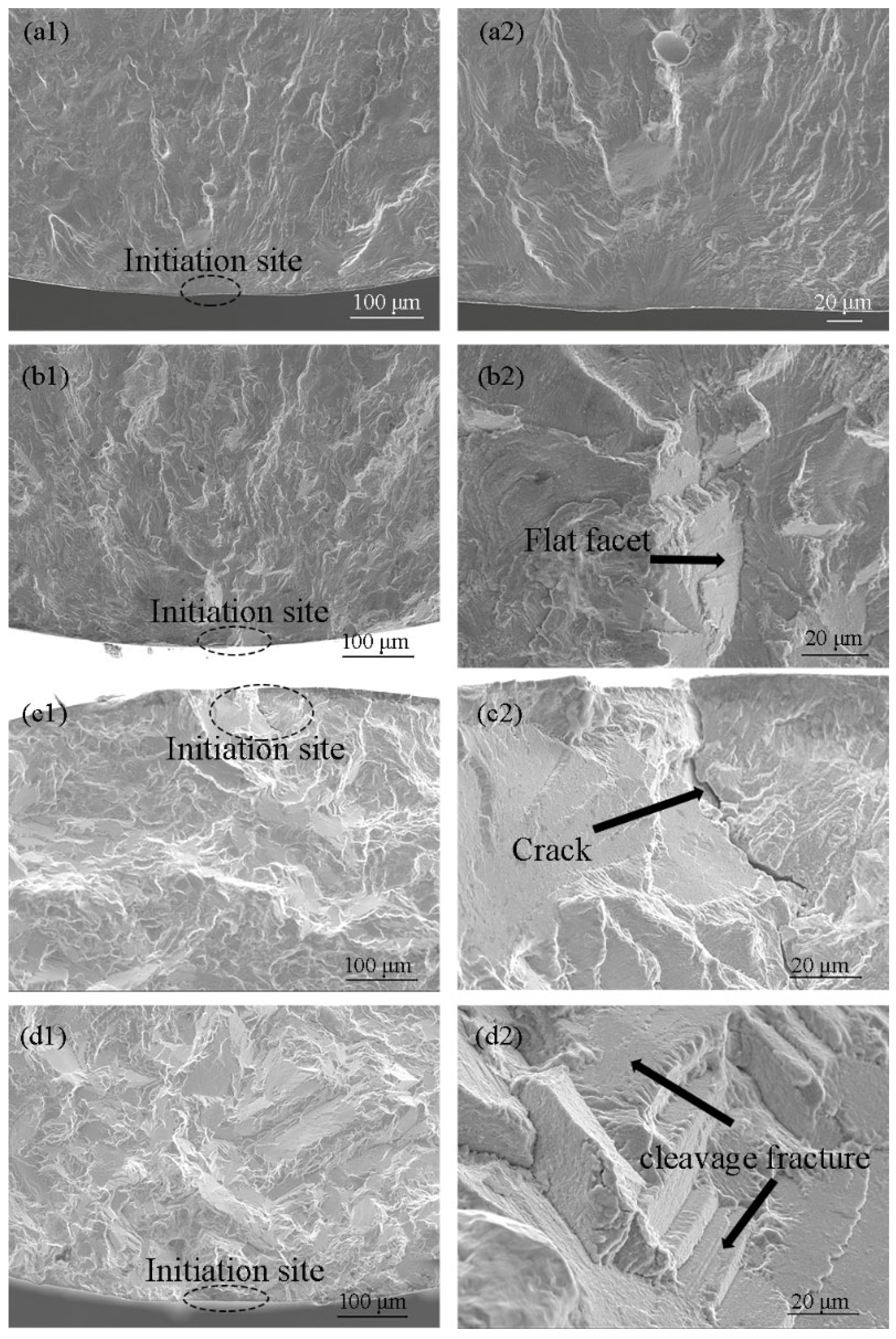
Representative SEM fractographs of as-built (Figure 6) and heat-treated (Figure 7) SLM IN718 reveal universal surface-located fatigue crack initiation in the as-built condition. Fatigue cracks preferentially nucleate at the free surface due to (i) image-force-enhanced dislocation mobility, (ii) localized slip-band formation, and (iii) subsequent micro-crack evolution, collectively establishing the surface as the dominant initiation site [31]. Alexandre et al. found that the mechanism of fatigue crack initiation from surface is related to the fine-grained material with grain size ranged from 5 µm to 10 µm. The average grain size in the present study was 9.8 µm for SLM IN718 alloy, which has been reported in our previous study [27]. Therefore, the mechanism of fatigue crack initiation from surface would be consistent with Alexandre et al. Under conventional solution temperatures (980–1080 °C), the grain size changes only slightly, and the columnar grain morphology is largely retained. Only when the temperature is sufficiently high (≥1090 °C) to trigger static recrystallization do the grains become significantly equiaxed and may even be refined due to the formation of annealing twins. Since the present study focuses on conventional heat treatment, the grain size does not undergo significant changes; instead, the variation in precipitates is the primary concern. Therefore, the influence of grain size on mechanical properties is not discussed in detail in this paper. In addition, some typical microscopic fracture characteristics were detected for the as-built specimens, namely, higher tendency for shear mode (ductile) fracture (Figure 6a) and cleavage-like morphology (Figure 6b–d). At higher stress levels, the shear mode (ductile) fracture is the dominant type. However, at low stress levels, the cleavage-like morphology would be the main fracture mode. Moreover, some cracks at the initiation site were found, as shown in Figure 6c. Numerous investigators have reported cleavage-like facets on Inconel 718 fractures tested at ambient and elevated temperatures [2,32,33,34,35]. In contrast to wrought counterparts, where such features are restricted to the crack initiation vicinity, the SLM material exhibits this morphology across the entire rupture surface. This pervasive “cyclic cleavage” is ascribed to the microstructural heterogeneity inherent to additive manufacturing: a bimodal grain-size distribution (Figure 2a) generates local clusters of ultrafine grains whose boundaries enforce planar-slip confinement in adjacent coarse grains [36]. The crack-tip plastic zone, constrained to lie within a single large grain, propagates along crystallographic slip bands, thereby producing the faceted, cleavage-like appearance evident in Figure 6d. It is widely recognized that fatigue-crack propagation in polycrystalline metals proceeds in two sequential stages: Stage I, characterized by a crystallographically faceted fracture surface, and Stage II, which yields a macroscopically flatter topography decorated by fatigue striations. When the radius of the crack-tip plastic zone is smaller than the average grain size, the crack advances by single-slip shear along the primary slip system, giving rise to Stage I growth. Conversely, once the plastic zone spans several grains, the crack re-orients and propagates on a plane normal to the maximum remote tensile stress, marking the onset of Stage II growth. Stage I cracking corresponds to the near-threshold regime, where shear-localized advance dominates, whereas Stage II is operative in the Paris region, characterized by tensile-driven, striation-forming growth [36]. The present fracture morphology is consistent with Stage I propagation, evidencing shear-controlled crack extension. Moreover, Ono et al. found that the facets are relevant with the stress amplitude and Nb-enriched carbides [37]. At reduced stress amplitudes, no Nb-rich zone acted as the crack initiation site, and the average facet dimension exceeded that observed under higher stress amplitudes [37]. In the crack propagation stage, once the crack propagated along the cleavage facet, which has relatively low resistance to crack propagation, it would thus result in a decrease in fatigue life (Figure 4).
Figure 6. Representative SEM fractographs of as-built IN718 specimens tested at 650 °C: (a1,a2) Δσ = 238 MPa, Nf = 4.4 × 10⁵ cycles; (b1,b2) Δσ = 229 MPa, Nf = 3.7 × 10⁷ cycles; (c1,c2) Δσ = 218 MPa, Nf = 2.67 × 10⁸ cycles; (d1,d2) Δσ = 225 MPa, Nf = 2.8 × 10⁸ cycles.
Metals 16 00525 g006
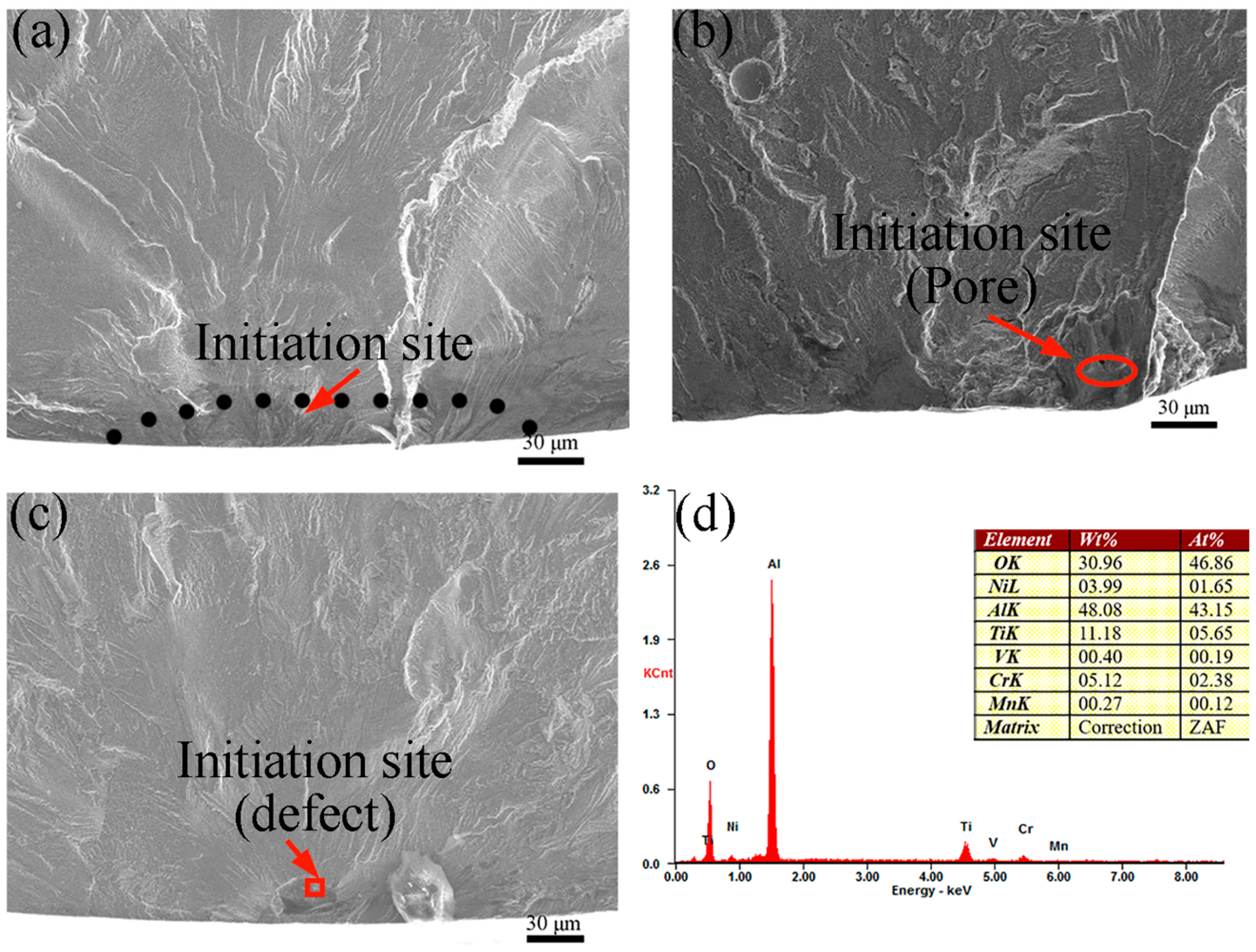
For the heat-treated specimens, the crack initiation sites were dependent on the stress level and defects. When the applied stress range is higher, the crack initiation site is located at the surface with shear mode (ductile) fracture, as shown in Figure 7a. With the decrease in stress range, when there are defects (pores or inclusions) inside the specimen, the fatigue crack origin is located subsurface, as shown in Figure 7b,c. The pore is due to the protective gas (e.g., argon) or gas in the powder not escaping during the SLM process. In the heat-treated specimens, fatigue crack initiation was overwhelmingly pore-driven, particularly within the VHCF regime. In addition, another type of crack initiation site is the oxide inclusion, and EDS exhibits subsurface inclusion is rich in Al, Ti, Cr and Ni. Attributed to the intensified stress concentration conferred by the defect, crack initiation becomes defect-controlled at reduced stress amplitudes, driving the locus of nucleation from the surface into the subsurface.
Figure 7. Representative SEM fractographs (ac) and EDS spectrum (d) of heat-treated IN718 specimens fatigued at 650 °C: (a) Δσ = 506 MPa, Nf = 7.4 × 10⁵ cycles; (b) Δσ = 482 MPa, Nf = 2.7 × 10⁷ cycles; (c) Δσ = 421 MPa, Nf = 2.87 × 10⁸ cycles; (d) EDS analysis of the subsurface inclusion served as the crack initiation site.
Metals 16 00525 g007

3.5. Effect of Heat Treatment on the Fatigue Behavior of IN718

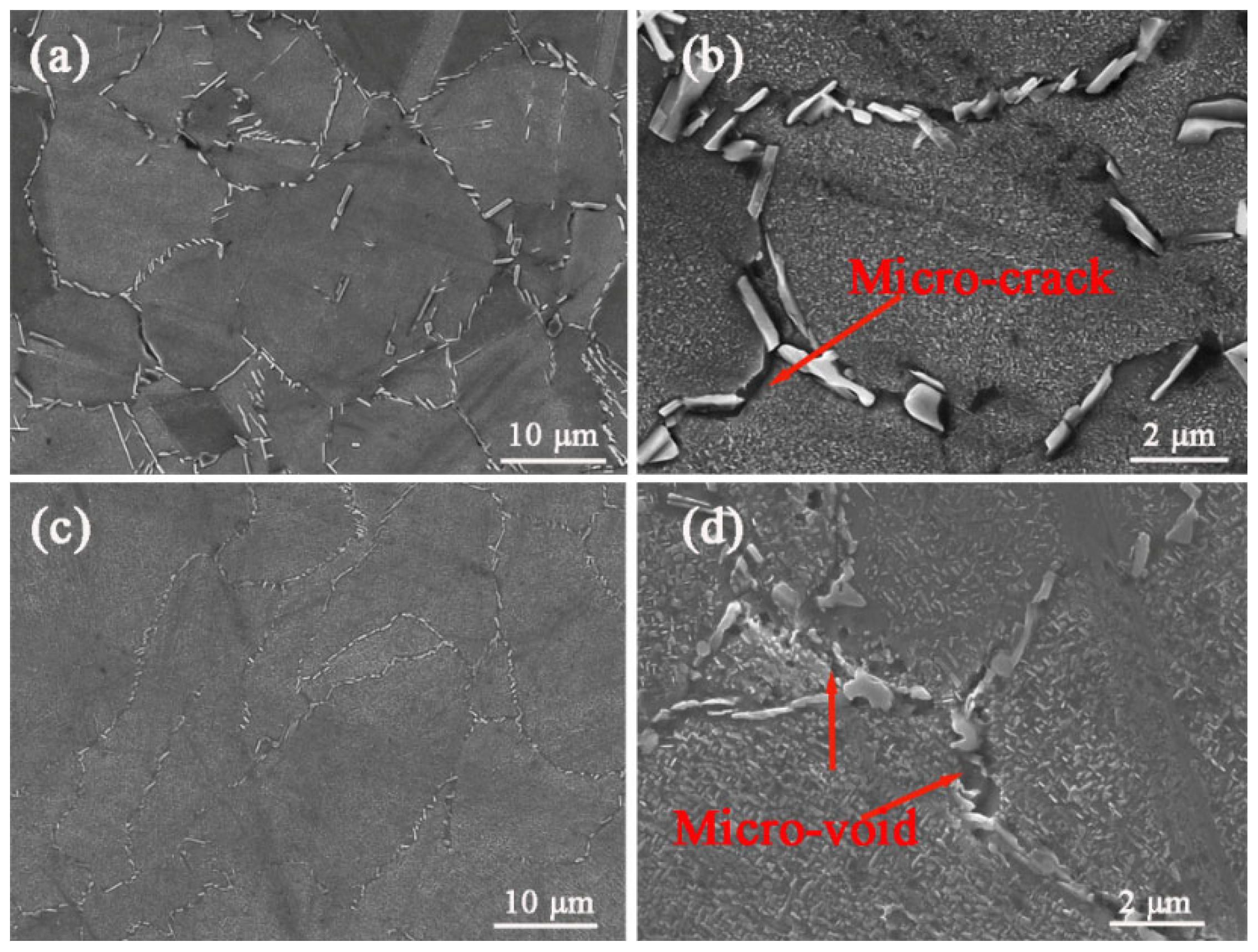
To elucidate the fatigue-life enhancement conferred by heat treatment, metallographic planes were sectioned mid-length and perpendicular to the loading axis from run-out specimens and subjected to SEM analysis. These examinations capture the microstructural evolution and incipient crack initiation mechanisms operative under high-temperature cyclic loading. Consistent with prior investigations [27,34], prolonged exposure at 650 °C promotes the precipitation and coarsening of both Laves and δ phases. Following fatigue cycling of the as-built specimen to 109 cycles (Figure 8a,b), SEM reveals extensive intergranular decoration by rod- and needle-shaped Laves and δ precipitates, with the δ phase constituting the dominant fraction. However, the profuse formation of elongated, needle-like δ-phase precipitates along grain boundaries introduces a marked embrittlement effect, severely compromising both the mechanical integrity and the fatigue-crack-growth resistance (FCGR) of the alloy [38,39]. Dislocations accumulate at δ-phase interfaces, generating intense stress concentrations. Owing to the phase’s intrinsic hardness and high strength, shear cutting is suppressed. When the δ phase presents as high-aspect-ratio acicular plates oriented nearly normal to the tensile axis, the accumulated stress can induce bending and eventual fracture of the needles, as shown in Figure 8b. Moreover, Figure 8b evidences intergranular micro-cracks. Preferentially nucleated at grain boundaries because of their lower activation energy, the Nb-rich Laves and δ phases rapidly lose coherency with the γ matrix under elevated-temperature cyclic loading. Finally, the decohesion embrittles the boundary and furnishes a low-energy path for crack advance [15].
Figure 8. SEM images showing microstructure and micro-cracks of (a,b) as-built and heat-treated (c,d) of SLM IN718 run-out specimens after fatigue tests at 650 °C.
Metals 16 00525 g008
In the heat-treated condition, δ phase likewise decorated the grain boundaries. An et al. [38] demonstrated that the volume fraction and morphology of the δ phase govern fatigue-cracking behavior. The equiaxed and low-aspect-ratio δ particles would impede dislocation glide and rigidly pin boundaries, thereby suppressing intergranular micro-crack initiation. Generally, granular δ-phase particles retard crack growth rate by dissipating deformation energy through their own plastic distortion and subsequent micro-cracking. An optimal volume fraction of equiaxed δ phase has accordingly been shown to enhance fatigue-crack-propagation resistance [40,41]. As shown in Figure 8d, the morphology of the δ phase was mainly granular; thus, the fatigue crack is hard to initiate from the grain boundaries, and only some micro-voids were observed in grain boundaries.
After heat treatment, following the post-processing thermal cycle, the microstructure is dominated by grain-boundary decorations of Laves and δ precipitates, while coherent γ′ and γ″ precipitates are heterogeneously nucleated within the γ matrix. Singh et al. found that the total volume fraction of γ″ and γ′ precipitates in Inconel 718 reaches 70–80% of the total precipitation strengthening increment [30]. γ″ to γ′ precipitates would increase the yield strength of the material through coherency strain strengthening, order strengthening, and Orowan mechanisms [28,29,30]. In terms of fatigue performance, high-density nano-precipitates significantly elevate the crack initiation threshold by suppressing cyclic slip band formation; however, the transformation of γ″ into the δ phase (>650 °C) quantitatively degrades this strengthening effect [30]. Since γ′ and γ″ are synergistically sheared by dislocations during deformation, consequently, the overall precipitation strengthening increment is generally adopted as the microstructural origin of fatigue strength enhancement.
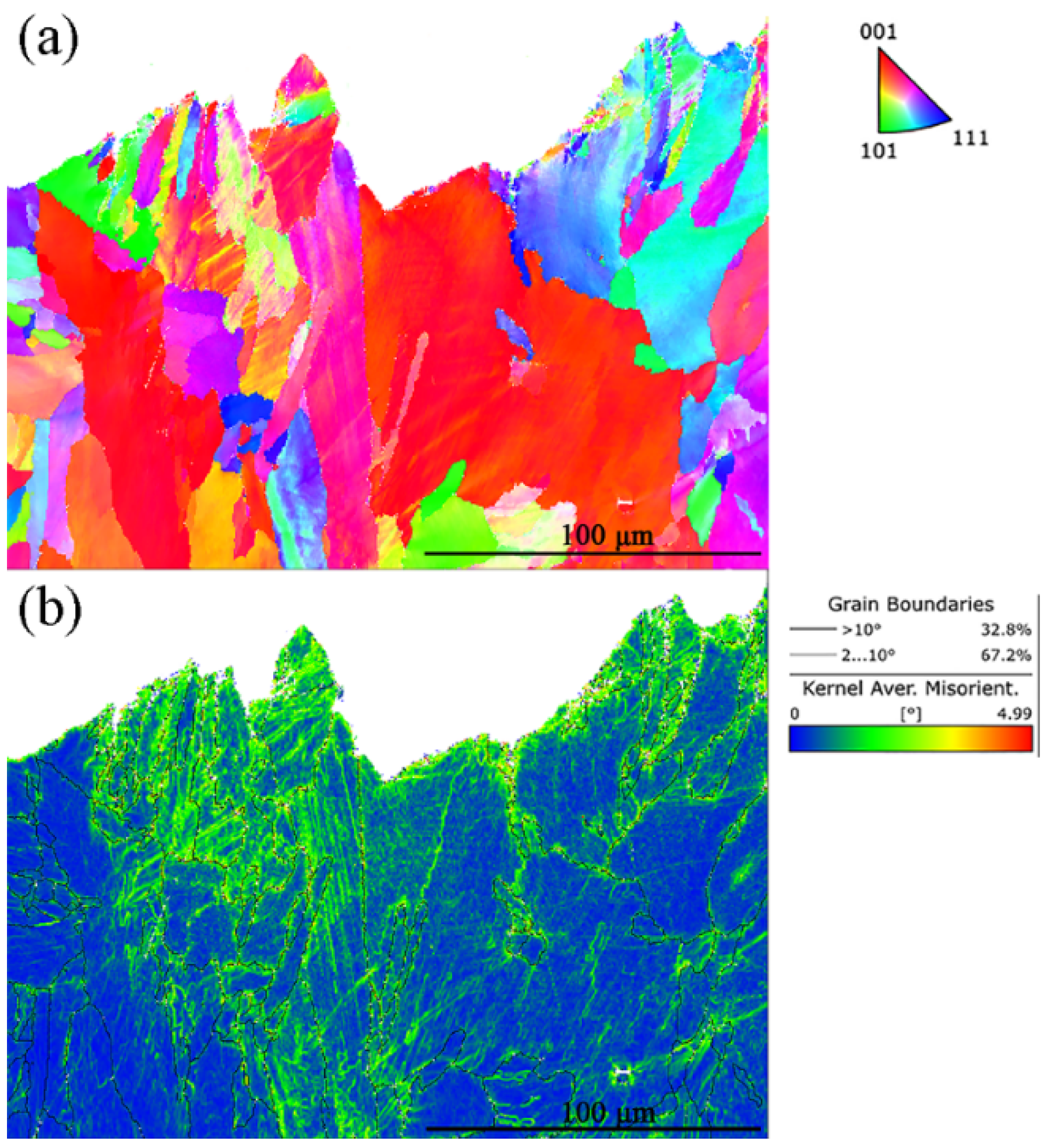
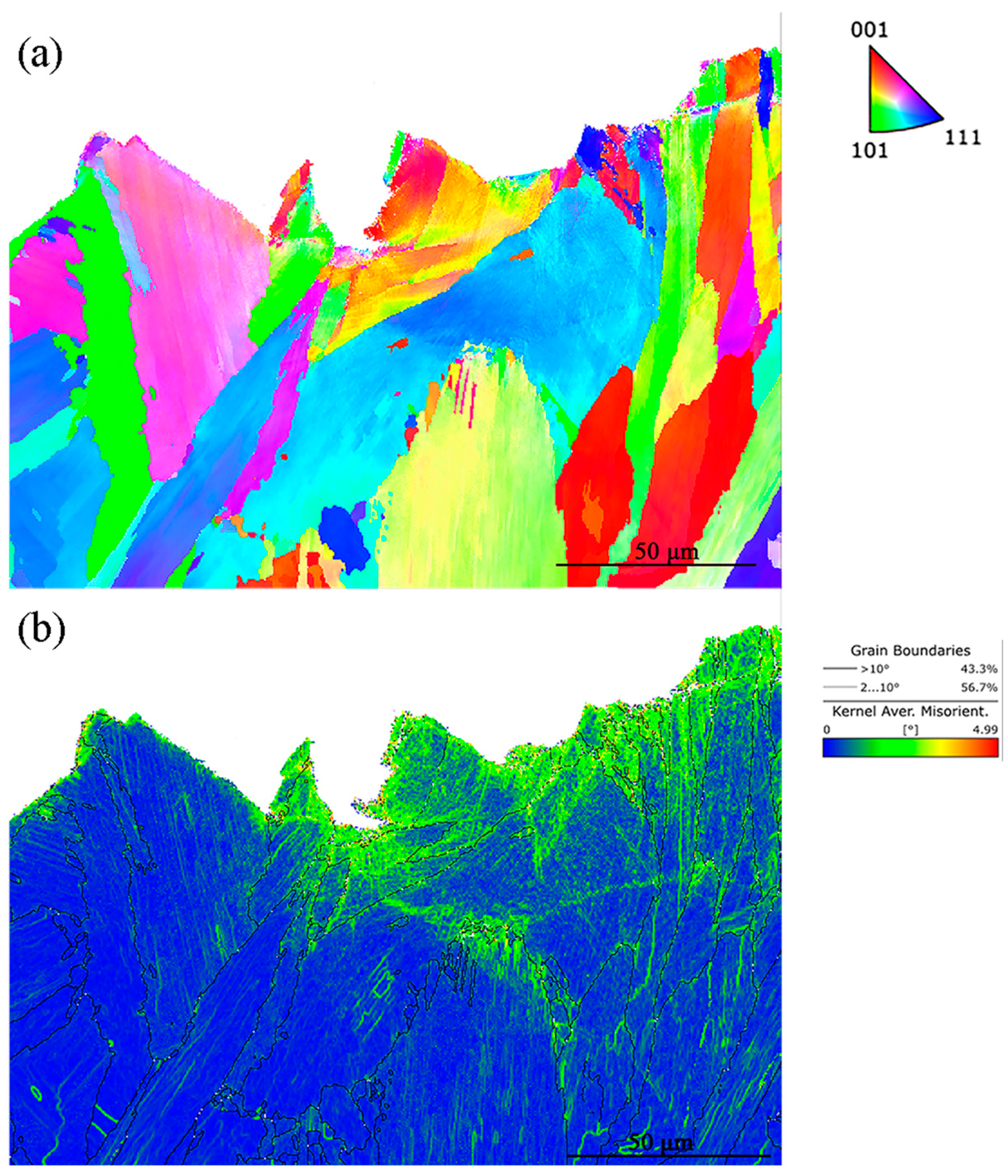
Grain boundaries intrinsically impede crack advance by forcing transgranular cleavage, thereby promoting crystallographic facet formation within individual grains. To quantify how heat treatment modifies this barrier effect, EBSD mapping was performed along the crack propagation path on tested IN718 specimens, encompassing the entire cracked domain. Figure 9 and Figure 10 are representative EBSD images of the as-built and heat-treated Inconel 718 specimens, respectively. For the as-built specimen, the IPF map (see Figure 9a) showed that the crack propagation path is flat.
It is well documented that transgranular-cleavage fatigue cracks deflect at boundaries separating grains of differing orientation. The kernel average misorientation (KAM) scales with local dislocation density and hence with plastic strain. Figure 9b reveals that the overwhelming majority of pixels exhibit KAM values between 1° and 5° (green–red scale), with the largest misorientations concentrated at grain boundaries. KAM mapping of the as-built specimen reveals pronounced local strain localization along the crack path, with maxima sited at grain boundaries. This accumulation is attributed to intergranular δ-phase particles that impede dislocation motion, generating pile-ups and attendant stress concentrations, thereby intensifying plastic strain at the boundaries. Meanwhile, the Laves phase, distributed interdendritically with high hardness and modulus mismatch against the γ matrix, acts as the primary site for fatigue crack initiation. Under low stress amplitudes characteristic of the VHCF regime, stress concentration at the Laves/γ interface promotes early micro-crack formation [31,42,43]. Therefore, the micro-crack is prone to initiate at the grain boundaries. Due to the minimum binding energy of the interface, once the crack initiates at the grain boundary, the crack would preferentially propagate along grain boundaries and lead to the decrease in fatigue performance. However, for the heat-treated specimen, the EBSD micrographs of the cracked area is different from that of as-built specimen. Firstly, the IPF map of the heat-treated specimen has shown that the crack propagation path was more tortuous, as shown in Figure 10. The tortuous path would consume more energy and result in an increase in fatigue performance. It is related to the δ phase which is precipitated as acicular/needle-like grains at grain boundaries, playing a dominant role in crack deflection during the propagation stage. When the crack front interacts with δ precipitates, the mismatch in crystallographic orientation and interface energy causes the crack to deviate from its original plane [31,42]. Moreover, the KAM map reveals that domains of intense plastic deformation are spatially dispersed around the fracture surface and preferentially coincide with sites of slight crack path deflection. Based on the EBSD results, it demonstrates that heat treatment markedly alters the crack propagation trajectory, engendering a concomitant divergence in fatigue performance relative to the as-built condition.

4. Conclusions

This study systematically quantified the effect of heat treatment on the mechanical properties and VHCF response of selective-laser-melted IN718 at 650 °C. The key findings are summarized below.
(1)
Relative to the as-built baseline, the heat-treated specimens showed pronounced strengthening: yield strength rose from 611 MPa to 983 MPa (~60.9% improvement), and ultimate tensile strength increased from 831 MPa to 1196 MPa (~43.9% improvement). The improvement in mechanical properties was attributed to the presence of the γ′ and γ″ precipitates, δ and Laves phases in the microstructure and their interaction with dislocations.
(2)
For the as-built condition, the S–N curve between 105 and 109 cycles spans a stress range 240–210 MPa, whereas heat treatment shifts the same interval to 550–410 MPa. The fatigue strength of the specimen after heat treatment has increased by more than twice relative to the as-built condition.
(3)
For the as-built specimen, the crack initiation sites are located at the surface. At higher stress levels, the shear mode (ductile) fracture is the dominant type. However, at low stress levels, the cleavage-like morphology would be the main fracture mode. Following heat treatment, fatigue-crack nucleation locus becomes stress- and defect-controlled: at high stress ranges, cracks initiate on the specimen surface via shear-localized (ductile) fracture; as the stress range decreases, internal defects (pores or inclusions) act as preferential nucleation sites, shifting initiation to the sub-surface.
(4)
The crack extension micromechanism switches from transgranular cleavage in the as-built state to ductile after heat treatment. This mechanistic transition stems from (i) a denser population of grain-boundary Laves/δ precipitates that multiply crack initiation events and (ii) a precipitation-hardened matrix that homogenizes plastic strain, minimizing local strain build-up a during the fatigue cyclic load.

Author Contributions

Conceptualization, L.Z.; methodology, Z.G. and J.Z.; software, Z.G.; validation, Z.S., J.Z. and C.D.; formal analysis, Z.G. and H.J.; investigation, Z.S., Z.G., L.Z., H.J., J.Z. and C.D.; resources, Z.S., L.Z., J.Z. and C.D.; data curation, Z.G. and H.J.; writing—original draft preparation, Z.G.; writing—review and editing, Z.S.; visualization, C.D.; supervision, Z.S., Z.G., L.Z., J.Z. and C.D.; project administration, L.Z. and C.D.; funding acquisition, Z.S. All authors have read and agreed to the published version of the manuscript.

Funding

The authors gratefully acknowledge financial support from the Tianjin Natural Science Foundation (No. 23JCZDJC00680).

Data Availability Statement

The raw data supporting the conclusions of this article will be made available by the authors on request.

Conflicts of Interest

The authors declare no conflict of interest.

References

  1. Wang, W.; Chen, Z.; Lu, W.; Meng, F.; Zhao, T. Heat treatment for selective laser melting of Inconel 718 alloy with simultaneously enhanced tensile strength and fatigue properties. J. Alloys Compd. 2022, 913, 165171. [Google Scholar] [CrossRef]
  2. Yu, X.; Lin, X.; Tan, H.; Hu, Y.; Zhang, S.; Liu, F.; Yang, H.; Huang, W. Microstructure and fatigue crack growth behavior of Inconel 718 superalloy manufactured by laser directed energy deposition. Int. J. Fatigue 2021, 143, 106005. [Google Scholar] [CrossRef]
  3. Zhang, D.; Niu, W.; Cao, X.; Liu, Z. Effect of standard heat treatment on the microstructure and mechanical properties of selective laser melting manufactured Inconel 718 superalloy. Mater. Sci. Eng. A 2015, 644, 32–40. [Google Scholar] [CrossRef]
  4. Sun, C.; Li, W.; Li, C.; Cao, X.; Sun, R.; Jin, Y.; Hu, Z. Microstructural evolution and fatigue cracking mechanisms of as-built and solution-aged Inconel 718 superalloy fabricated by selective laser melting at service temperature. Eng. Fail. Anal. 2025, 181, 109996. [Google Scholar] [CrossRef]
  5. Hu, B.; Yang, S.; Shao, C. Investigation of post-heat treatment on precipitation kinetics and mechanical properties Inconel 718 superalloy additively manufactured by selective laser melting. Mater. Today Commun. 2025, 44, 111956. [Google Scholar] [CrossRef]
  6. Chaudhari, S.B.; Wakchaure, V.D.; Nagare, P.N.; Kadhane, S.B. Effect of solution annealing on the microstructure, mechanical properties & residual stresses of selective laser melted Inconel 718. J. Alloys Compd. 2025, 1045, 184656. [Google Scholar]
  7. Ning, Y.; Zhao, Y.; Zhang, X.; Zhang, H.; Mu, Y.; Liang, J.; Li, J.; Guan, J.; Yang, Y. Effect of annealing treatment on microstructure and residual stress evolution in a selective laser melted Ni-based superalloy. J. Mater. Res. Technol. 2026, 40, 280–294. [Google Scholar] [CrossRef]
  8. Qin, H.; Hou, H.; Xu, C.; Song, J.; Dong, B.; Huang, J. Effects of manufacturing defects and microstructure on the tensile and low cycle fatigue behavior of selective laser melting IN718 TPMS structures. Thin-Walled Struct. 2026, 222, 114528. [Google Scholar] [CrossRef]
  9. Amato, K.N.; Gaytan, S.M.; Murr, L.E.; Martinez, E.; Shindo, P.W.; Hernandez, J.; Collins, S.; Medina, F. Microstructures and mechanical behavior of Inconel 718 fabricated by selective laser melting. Acta Mater. 2012, 60, 2229–2239. [Google Scholar] [CrossRef]
  10. Jeong, W.; Yang, J.; Choi, J.P.; Hwang, J.Y.; Kim, Y.W.; Park, S.J.; Choi, J.W.; Heogh, W.; Lee, H.; Park, J.; et al. Al-based functionally graded super-intermetallic compounds for the turbine blade of a high-performance jet engine. Adv. Compos. Hybrid Mater. 2025, 8, 420. [Google Scholar] [CrossRef]
  11. Chlebus, E.; Gruber, K.; Kuźnicka, B.; Kurzac, J.; Kurzynowski, T. Effect of heat treatment on the microstructure and mechanical properties of Inconel 718 processed by selective laser melting. Mater. Sci. Eng. A 2015, 639, 647–655. [Google Scholar] [CrossRef]
  12. Zhang, S.; Wang, Y.; Lv, L.; Deng, H.; Lin, J.; Lv, B.; Wang, W.; Tan, L.; Liu, F. Effect of heat treatment on the microstructure and mechanical anisotropy of selective laser-melted Inconel 718 alloy. Mater. Today Commun. 2025, 48, 113453. [Google Scholar] [CrossRef]
  13. Liu, P.; Hu, J.; Sun, S.; Feng, K.; Zhang, Y.; Cao, M. Microstructural evolution and phase transformation of Inconel 718 alloys fabricated by selective laser melting under different heat treatment. J. Manuf. Process. 2019, 39, 226–232. [Google Scholar] [CrossRef]
  14. Wang, Z.; Guan, K.; Gao, M.; Li, X.; Chen, X.; Zeng, X. The microstructure and mechanical properties of deposited-IN718 by selective laser melting. J. Alloys Compd. 2012, 513, 518–523. [Google Scholar] [CrossRef]
  15. Cervellon, A.; Hémery, S.; Kürnsteiner, P.; Gault, B.; Kontis, P.; Cormier, J. Crack initiation mechanisms during very high cycle fatigue of Ni-based single crystal superalloys at high temperature. Acta Mater. 2020, 188, 131–144. [Google Scholar] [CrossRef]
  16. Shen, Z.; Huang, Z.; Wang, J.; Qian, H.; Zheng, L.; Zhou, Q.; Zhu, Q.; Shen, J. Fracture mechanism and life prediction of IN718 under very high cycle variable amplitude loading at high temperature. Eng. Fail. Anal. 2025, 178, 109745. [Google Scholar] [CrossRef]
  17. Yang, K.; Huang, Q.; Wang, Q.; Chen, Q. Competing crack initiation behaviors of a laser additively manufactured nickel-based superalloy in high and very high cycle fatigue regimes. Int. J. Fatigue 2020, 136, 105580. [Google Scholar] [CrossRef]
  18. Li, W.; Sun, R.; Hu, T.; Li, X.; Li, C.; Zhang, Y.; Ding, X.; Wang, P. Effect of elevated temperature on high-cycle and very-high-cycle fatigue properties of Ni-based superalloy manufactured by selective laser melting. Int. J. Fatigue 2021, 148, 106250. [Google Scholar] [CrossRef]
  19. Qin, Z.; Li, B.; Chen, C.; Chen, T.; Chen, R.; Zhang, H.; Xue, H.; Yao, C.; Tan, L. Crack initiation mechanisms and life prediction of GH4169 superalloy in the high cycle and very high cycle fatigue regime. J. Mater. Res. Technol. 2023, 26, 720–736. [Google Scholar] [CrossRef]
  20. Shen, J.; Fan, H.; Wang, J.; Zhang, G.; Pan, R.; Huang, Z. Stored energy density research on the fatigue crack initiation at twin boundary and life prediction of Inconel718 superalloy. Int. J. Fatigue 2023, 171, 107590. [Google Scholar] [CrossRef]
  21. Nezhadfar, P.D.; Johnson, A.S.; Shamsaei, N. Fatigue behavior and microstructural evolution of additively manufactured Inconel 718 under cyclic loading at elevated temperature. Int. J. Fatigue 2020, 136, 105598. [Google Scholar] [CrossRef]
  22. SAE International Group; Alloy, N. Corrosion and Heat-Resistant, Bars, Forgings, and Rings 52.5Ni-19Cr-3.0Mo-5.1Cb (Nb)-0.90Ti-0.50Al-18Fe Consumable Electrode or Vacuum Induction Melted 1775 °F (968 °C) Solution and Precipitation Heat Treated; SAE International Group: Warrendale, PA, USA, 2009. [Google Scholar]
  23. GB/T 228.2 2015; Metallic Materials-Tensile Testing-Part 2: Method of Test at Elevated Temperature. National Standardization Administration: Beijing, China, 2015.
  24. Li, X.; Shi, J.J.; Wang, C.H.; Cao, G.H.; Russell, A.M.; Zhou, Z.J.; Li, C.P.; Chen, G.F. Effect of heat treatment on microstructure evolution of Inconel 718 alloy fabricated by selective laser melting. J. Alloys Compd. 2018, 764, 639–649. [Google Scholar] [CrossRef]
  25. Parimi, L.L.; Ravi, G.A.; Clark, D.; Attallah, M.M. Microstructural and texture development in direct laser fabricated IN718. Mater. Charact. 2014, 89, 102–111. [Google Scholar] [CrossRef]
  26. Tillmann, W.; Schaak, C.; Nellesen, J.; Schaper, M.; Aydinöz, M.E.; Hoyer, K.P. Hot isostatic pressing of IN718 components manufactured by selective laser melting. Addit. Manuf. 2017, 13, 93–102. [Google Scholar] [CrossRef]
  27. Song, Z.; Gao, W.; Wang, D.; Wu, Z.; Yan, M.; Huang, L.; Zhang, X. Very-High-Cycle Fatigue Behavior of Inconel 718 Alloy Fabricated by Selective Laser Melting at Elevated Temperature. Materials 2021, 14, 1001. [Google Scholar] [CrossRef]
  28. Lv, D.C.; McAllister, D.; Mills, M.J.; Wang, Y. Deformation mechanisms of D022 ordered intermetallic phase in superalloys. Acta Mater. 2016, 118, 350–361. [Google Scholar] [CrossRef]
  29. Li, R.; Jia, Z.; Wang, Z.; Zhang, P.; Sun, G.; Han, E.-H. Synergistic effects of γ′/γ″ precipitates and grain boundary engineering on high-temperature fatigue behavior in GH4169-CoZr superalloys: Multiscale mechanisms. Int. J. Fatigue 2026, 206, 109441. [Google Scholar] [CrossRef]
  30. Singh, S.R.; Mote, R.G.; Mishra, S.K. The effect of microstructures and precipitates (γ′, γ″, δ) on machinability of Inconel-718 nickel-based superalloy in turning process. J. Manuf. Process. 2022, 82, 374–389. [Google Scholar] [CrossRef]
  31. Belan, J.; Vaško, A.; Uhríčik, M.; Matvija, M. Fatigue crack initiation and failure analysis of IN718 alloy after push–pull loading at room temperature and at 700 °C. Eng. Fail. Anal. 2025, 167, 108977. [Google Scholar] [CrossRef]
  32. Balachandramurthi, A.R.; Moverare, J.; Dixit, N.; Pederson, R. Influence of defects and as-built surface roughness on fatigue properties of additively manufactured Alloy 718. Mater. Sci. Eng. A 2018, 735, 463–474. [Google Scholar] [CrossRef]
  33. Gribbin, S.; Ghorbanpour, S.; Ferreri, N.C.; Bicknell, J.; Tsukrov, I.; Knezevic, M. Role of grain structure, grain boundaries, crystallographic texture, precipitates, and porosity on fatigue behavior of Inconel 718 at room and elevated temperatures. Mater. Charact. 2019, 149, 184–197. [Google Scholar] [CrossRef]
  34. Kim, S.; Choi, H.; Lee, J.; Kim, S. Room and elevated temperature fatigue crack propagation behavior of Inconel 718 alloy fabricated by laser powder bed fusion. Int. J. Fatigue 2020, 140, 105802. [Google Scholar] [CrossRef]
  35. Pei, C.; Shi, D.; Yuan, H.; Li, H. Assessment of mechanical properties and fatigue performance of a selective laser melted nickel-base superalloy Inconel 718. Mater. Sci. Eng. A 2019, 759, 278–287. [Google Scholar] [CrossRef]
  36. Balachandramurthi, A.R.; Moverare, J.; Dixit, N.; Deng, D.; Pederson, R. Microstructural influence on fatigue crack propagation during high cycle fatigue testing of additively manufactured Alloy 718. Mater. Charact. 2019, 149, 82–94. [Google Scholar] [CrossRef]
  37. Ono, Y.; Yuri, T.; Sumiyoshi, H.; Takeuchi, E.; Matsuoka, S.; Ogata, T. High-Cycle Fatigue Properties at Cryogenic Temperatures in INCONEL 718 Nickel-based Superalloy. Mater. Trans. 2004, 45, 342–345. [Google Scholar] [CrossRef]
  38. An, J.; Wang, L.; Liu, Y.; Cai, W.; Song, X. The role of δ phase for fatigue crack propagation behavior in a Ni base superalloy at room temperature. Mater. Sci. Eng. A 2017, 684, 312–317. [Google Scholar] [CrossRef]
  39. Wang, K.; Li, M.Q.; Luo, J.; Li, C. Effect of the δ phase on the deformation behavior in isothermal compression of superalloy GH4169. Mater. Sci. Eng. A 2011, 528, 4723–4731. [Google Scholar] [CrossRef]
  40. Liu, X.; Xu, J.; Barbero, E.; Cao, W.-D.; Kennedy, R.L. Effect of thermal treatment on the fatigue crack propagation behavior of a new Ni-base superalloy. Mater. Sci. Eng. A 2008, 474, 30–38. [Google Scholar] [CrossRef]
  41. Siddiqui, S.F.; Wickett, S.T.; Kozak, E. Failure mechanisms governing the high temperature torsional fatigue behavior of additively manufactured Inconel 718. Eng. Fail. Anal. 2026, 183, 110255. [Google Scholar] [CrossRef]
  42. Cubi, R.E.; Gonçalves, R.L.; Massi, M.; Ribeiro, G.D.; Reis, L.; Couto, A.A. Comparison of Microstructure and Fatigue Life of Laser Powder Bed Fusion and Forging/Rolling Inconel 718 Alloy After Solution Heat Treatment and Double Aging. Metals 2026, 16, 57. [Google Scholar] [CrossRef]
  43. Sarkar, R.; Chen, B.; Fitzpatrick, M.E.; Fabijanic, D.; Hilditch, T. Additive manufacturing-based repair of IN718 superalloy and high-cycle fatigue assessment of the joint. Addit. Manuf. 2022, 60, 103276. [Google Scholar]
Figure 1. Schematic of SLM process (a) and geometric characteristics of (b) fatigue and (c) tensile specimens (all dimensions in mm).
Metals 16 00525 g001
Figure 2. Various magnification SEM micrographs: (a,b) as-built specimen; (c,d) heat-treated specimen.
Metals 16 00525 g002
Figure 3. The stress–strain curves and strain–hardening rate curves for Inconel 718 specimens tested at 650 °C.
Metals 16 00525 g003
Figure 4. S–N data and fitted curves for the as-built and heat-treatment IN718 alloy at R = −1.
Metals 16 00525 g004
Figure 9. Fracture profile of as-built SLM IN718 specimen following the fatigue test (Δσ = 225 MPa, Nf = 2.8 × 10⁸ cycles): (a) EBSD IPF maps; (b) EBSD KAM maps.
Metals 16 00525 g009
Figure 10. Fracture profile of heat-treated SLM IN718 specimen following the fatigue test (Δσ = 421 MPa, Nf = 2.87 × 10⁸ cycles): (a) EBSD IPF maps; (b) EBSD KAM maps.
Metals 16 00525 g010
Table 1. Chemical composition in Inconel 718 powder (wt.%).
CCrCoMoAlTiNiNbBSiMnP/SCuOFe
0.03918.52<0.13.030.520.9852.445.250.0045<0.1<0.02<0.01<0.10.0092Bal
Table 2. The tensile properties of as-built and heat-treated Inconel 718 specimen.
StatusYield Strength (MPa) Tensile Strength (MPa)Elongation (%)
As-built611 ± 6831 ± 638 ± 2.3
HT983 ± 281196 ± 126.9 ± 0.7
Disclaimer/Publisher’s Note: The statements, opinions and data contained in all publications are solely those of the individual author(s) and contributor(s) and not of MDPI and/or the editor(s). MDPI and/or the editor(s) disclaim responsibility for any injury to people or property resulting from any ideas, methods, instructions or products referred to in the content.