Article

Efficient Recovery of Vanadium from Vanadium–Titanium Slag (VTS) via Calcification Roasting and Acid Leaching: Process and Mechanism


1
Institute of Resources and Environmental Engineering, Shanxi University, Taiyuan 030031, China
2
Key Laboratory of Coal Science and Technology, Ministry of Education, College of Chemistry and Chemical Engineering, Taiyuan University of Technology, Taiyuan 030024, China
3
State Key Laboratory of Coal Conversion, Institute of Coal Chemistry, Chinese Academy of Sciences, Taiyuan 030001, China
4
College of Materials Science and Engineering, Chongqing University, Chongqing 400044, China
5
Institute of Nuclear and New Energy Technology, Tsinghua University, Beijing 100084, China
*
Authors to whom correspondence should be addressed.
Metals 2026, 16(5), 472; https://doi.org/10.3390/met16050472
Submission received: 24 March 2026 / Revised: 22 April 2026 / Accepted: 24 April 2026 / Published: 27 April 2026

Abstract

As a strategically important metal, vanadium (V) plays a crucial role in resource security, and its efficient extraction is therefore of great significance. Traditional sodium roasting processes suffer from gaseous pollutant emissions and high costs, while calcification roasting–acid leaching has emerged as an alternative due to its environmental friendliness and economic viability. This study focuses on VTS (mainly composed of FeV2O4 and Fe2SiO4), systematically optimizing the calcification roasting–hydrochloric acid leaching process and investigating its reaction mechanism. By comparing the Gibbs free energy changes of reaction products and the acid leaching process with different additives using DFT calculations, calcium oxide was selected as the optimal calcifying agent. Experimental results show that CaO significantly promotes the transformation of FeV2O4 into soluble calcium vanadate and preferentially reacts with SiO2 to inhibit vanadate encapsulation, creating a structural basis for the selective dissolution of V. Under optimal process conditions, the leaching efficiency of V can reach 94.23%. Furthermore, density functional theory (DFT) calculations substantiate that the inherently weak bonding in Ca2V2O7 facilitates its effortless dissociation during the acid leaching phase. The Douglas hierarchical decision-making method is further adopted for secondary economic potential, and this proposed method has the lowest investment risk. This study provides an experimental and theoretical basis for the efficient and clean extraction of vanadium.

1. Introduction

Vanadium ( V 23 51 ) was discovered in 1830 [1], and its average content in the Earth’s crust is approximately 0.02–0.03%. Globally, V resources are mainly found in vanadium–titanium magnetite, with proven reserves exceeding 40 billion tons, primarily distributed in countries such as Uganda, China, Russia, the United States, Canada, and Peru [2,3]. In addition, V also exists in various forms in ilmenite, vanadium–iron shale, and vanadate minerals, with some ores containing up to 32% vanadium pentoxide (V2O5) by mass. China’s vanadium resources exhibit a clear regional concentration, with Panzhihua in Sichuan and Chengde in Hebei being the two core producing areas, accounting for approximately one-quarter of the global reserves. Other important resource areas include western of Panzhihua, Ma’anshan in Anhui, and Xinjiang, with total national reserves of vanadium–titanium magnetite estimated at approximately 23.188 billion tons [4]. As an important strategic metal, V has wide applications in various fields such as national defense [5,6], chemical industry [7,8], metallurgy [9,10], and new energy.
In the V extraction industry, vanadium slag produced from the smelting of vanadium–titanium magnetite is the primary source of raw materials, currently accounting for over 88% of vanadium resources [11]. Among various smelting processes, the direct reduction-grinding method, while shorter in process, typically yields lower-grade vanadium slag, requiring more stringent conditions for subsequent V extraction processes [12,13]. The pre-reduction-electric furnace smelting method, primarily designed for special resources such as high-chromium vanadium–titanium magnetite [14], is currently only a specialized technology for specific minerals due to its high-energy consumption and cost and has not yet achieved large-scale adoption. In contrast, the blast furnace-converter method [15], with its high technological maturity, large processing capacity, and stable and reliable operation, has become the most widely used industrial method globally, with converter vanadium slag accounting for approximately 69% of the total vanadium raw material output [16].
Currently, the main industrial method for extracting V from converter vanadium slag is the sodium roasting–water leaching process. Using different sodium salts (such as Na2CO3, Na2S2O8, etc.) under certain roasting and leaching conditions, the V leaching efficiency can reach 88.6–93.0% [17,18,19]. However, to improve the reaction efficiency between sodium and vanadium oxide, the amount of sodium salt added during sodium roasting needs to be controlled between 10% and 70% relative to the mass of the slag. This range not only increases processing costs but also generates toxic gases such as SO2 and Cl2 during roasting.
To address these issues, researchers have developed novel V extraction processes in recent years, including calcification roasting–acid leaching [20], magnesia roasting–acid leaching [21], and calcium–magnesium composite roasting [22]. Cheng et al. [23] used a two-stage magnesia roasting–acid leaching method and, after optimizing the conditions, increased the V leaching efficiency to 96.65%. Further kinetic studies showed that enhanced mass transfer and precise temperature control help to further improve leaching efficiency [24]. However, magnesium salts are expensive, and the energy consumption for magnesium oxide recovery is high, resulting in poor economic efficiency and limiting their industrial application. Similarly, the overall cost of calcium–magnesium composite roasting is also higher than that of sodium roasting, so replacing sodium roasting still faces significant challenges. Other methods, such as sub-molten salt methods, electrochemical alkaline decomposition, and photo-promoted V release [4,25,26] technologies, currently also have difficulty achieving cost-effective V recovery in a short period of time.
The calcification roasting process is considered an environmentally friendly V extraction route due to its advantages, such as not producing polluting gases, fixing sulfur oxides, and having a relatively low overall cost. This process uses lime (CaO) or limestone (CaCO3) as additives, is compatible with existing sodium calcification processes, and has good industrialization potential. During roasting, vanadium-containing phases such as iron vanadium spinel (FeV2O4) and fayalite (Fe2SiO4) are oxidized and react with calcium to produce products such as calcium vanadate. Sulfuric acid, oxalic acid, and ammonium carbonate are commonly used as aqueous leaching agents in vanadium extraction processes, with their specific concentrations and pH conditions varying depending on the literature and operational requirements. Zheng et al. [11] successfully eliminated the core-shell structure under preheating conditions of 900 °C (25 min) and roasting at 1150 °C (15 min), achieving a V leaching efficiency of 72.78% after sulfuric acid leaching. However, the calcium sulfate (CaSO4) coating layer generated during the process hinders further reactions. Hui et al.’s [27] research shows that ammonium carbonate leaching has higher selectivity for V, but it requires high temperature and high stirring intensity, resulting in high energy consumption. Among various leaching processes, hydrochloric acid (HCl) leaching is considered the most promising alternative. Although studies have confirmed that HCl leaching can significantly improve the leaching efficiency of V in vanadium–titanium slag (VTS), existing technologies still face two key challenges. First, to achieve a metal leaching efficiency of over 80%, current methods typically require stringent process conditions, including a roasting additive to VTS mass ratio ≥1 and a leaching temperature of 50 °C–80 °C. Second, current research mainly focuses on the recovery of multiple metals (such as V, Ti, and Fe), lacking systematic research on the highly selective recovery of single valuable metals (especially V) from VTS [28,29].
Based on this, this work investigates the process parameters and reaction mechanism of vanadium recovery from steel plant VTS via calcification roasting–acid leaching, with the goal of highly selective and efficient V extraction. The process parameters were systematically optimized, encompassing the roasting and leaching stages, in terms of time, temperature, calcium salt dosage, acid concentration, and solid–liquid ratio. Under conditions of significantly reduced total additive amount (CaO/VTS mass ratio < 1) and a leaching temperature of 25 °C, highly efficient and selective extraction of vanadium metal was achieved. It has broken through the reliance of the existing process on large quantities of additives and high acid concentrations. This study not only provides a theoretical basis and operational guidance for industrial V production but also offers an important reference for determining an efficient, environmentally friendly, and economical acid leaching extraction process for V from calcified roasted ore.

2. Materials and Methods

2.1. Materials

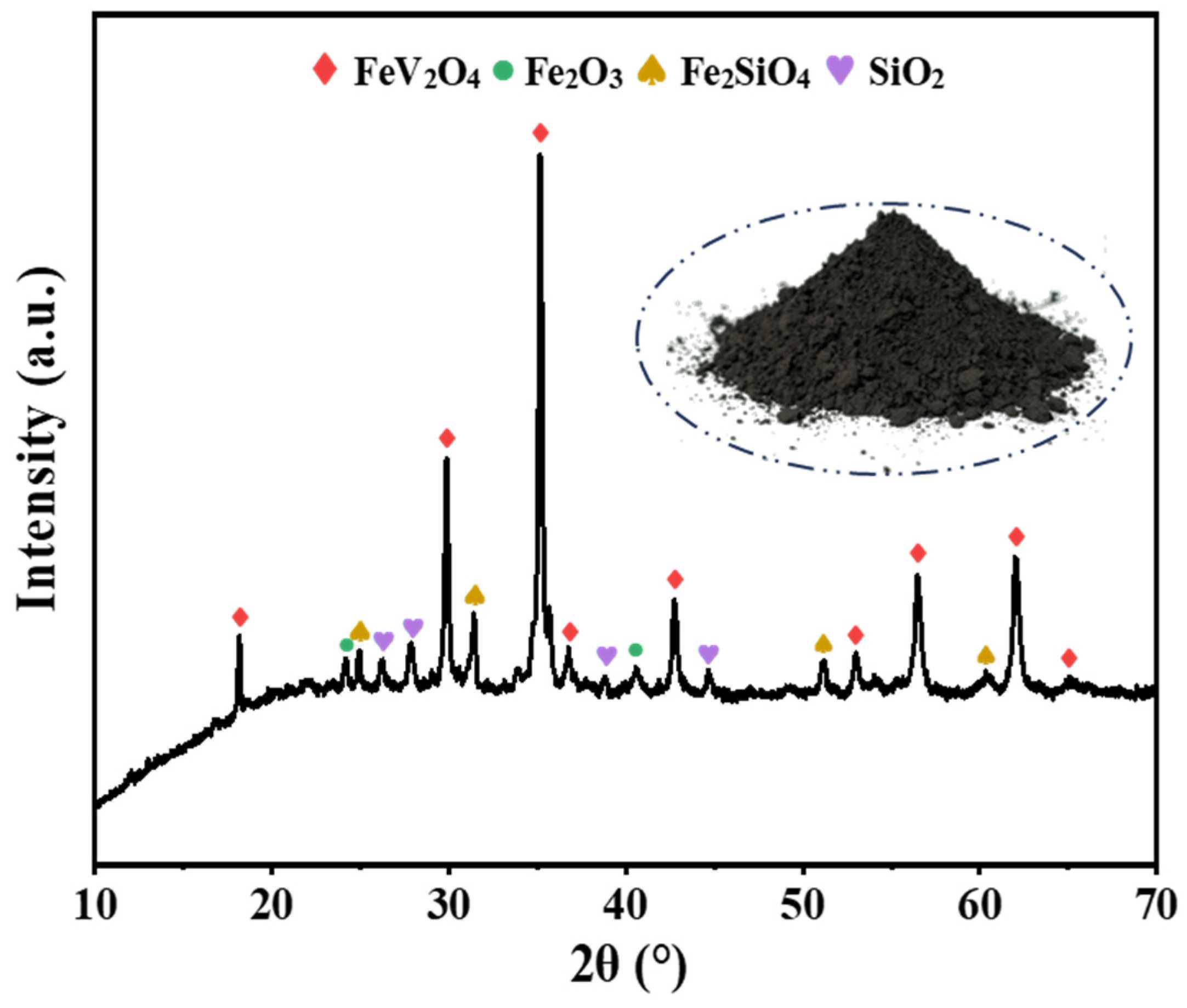
The experimental raw material was VTS from CITIC Jinzhou Metal Co., Ltd. (Jinzhou, China). All reagents in the experiment were produced by Sinopharm Chemical Reagent Co., Ltd. (Shanghai, China). Among them, HCl was of analytical grade, and CaO was of analytical purity. The semiquantitative chemical composition of the as-received VTS was determined by X-ray fluorescence (XRF, ZSX Primus II, Rigaku, Tokyo, Japan) and is expressed as oxides in Table 1 for reference only, without implying that each element existed exclusively in oxide form. X-ray diffraction (XRD) (MiniFlex 600, Rigaku, Tokyo, Japan) determined the main minerals in the samples to be vanadium–iron spinel (FeV2O4), fayalite (Fe2SiO4), and small amounts of hematite (Fe2O3) and quartz (SiO2) (Figure 1).
The total oxide content does not reach 100 wt% due to the presence of minor components and loss on ignition (LOI), including adsorbed moisture and trace volatile substances.

2.2. Methods

2.2.1. Experimental Procedure

The specific procedures for the calcination leaching experiment are as follows: 5.0 g of dried VTS and calcification reagent CaO are mixed evenly in a certain proportion and placed in a corundum crucible, then placed in a muffle furnace for high-temperature calcination. After the reaction is complete, the calcined product is cooled to room temperature inside the furnace. The calcined product was collected and loaded into a 100 mL conical flask, and in a temperature-controlled magnetic stirring device, 8 × 25 mm was used for HCl leaching at a rotational speed of 450 rpm. The filtered solution was diluted, and metal element concentrations were analyzed using an ICP-OES (Optima 8000, PerkinElmer, Waltham, MA, USA), based on which the V leaching efficiency was determined.

2.2.2. Characterization Methods

The calcification roasting of CaO to VTS at a mass ratio of 0.4 was studied using a thermogravimetric analyzer (STA 449 F5, NETZSCH, Selb, Germany). CaO and VTS were mixed in a mass ratio of 2:5; 8.4 mg, 10.9 mg, and 18.5 mg were weighed, put into the corundum crucibles, and heated from 24 °C to 1100 °C at heating rates of 10 °C·min−1, 15 °C·min−1, and 20 °C·min−1, respectively, under air atmosphere with no additional gas flow. Thermogravimetric (TG) and differential scanning calorimetric (DSC) curves of the samples were acquired simultaneously. The microstructure, elemental distribution, and composition of the calcined products were characterized using scanning electron microscopy (SEM, JSM7610F-plus, JEOL, Tokyo, Japan) and energy-dispersive spectroscopy (EDS). The changes in chemical bonds and functional groups in the calcination residue were determined using Fourier transform infrared spectroscopy (FTIR) (Thermo Nicolet Corporation, Nicolet IS10, Waltham, MA, USA). The valence state changes of valuable metals in VTS were analyzed by X-ray photoelectron spectroscopy (XPS, Al Kα, 100 W). The concentration of metal ions in the solution was quantitatively analyzed using inductively coupled plasma optical emission spectrometry (ICP-OES) (Optima 8000, PerkinElmer, Waltham, MA, USA).

2.2.3. Computational Methods

All spin-polarized density functional theory (DFT) calculations were performed utilizing the Vienna Ab initio Simulation Package (VASP, version 6.5.1) [30,31]. The Perdew–Burk–Ernzerhof (PBE) generalized gradient approximation (GGA) was used to handle the exchange-correlation function [32,33]. Due to the use of GGA-PBE, the scaling factor S6 was set to 0.75. The plane-wave basis set cutoff energy was set to 450 eV, and the K-point of the reciprocal lattice was chosen to be 3 × 3 × 3. The convergence of total energy was constrained to 10−4 eV, and atomic relaxation was converged to 0.02 eV/Å within the electron self-consistent iteration loop. To eliminate spurious interactions in periodic systems, long-range dispersion and van der Waals effects were corrected via the semi-empirical DFT-D3 method [34,35].

3. Results

3.1. Effect of Roasting Additive Type on the Leaching Efficiency of Valuable Metals

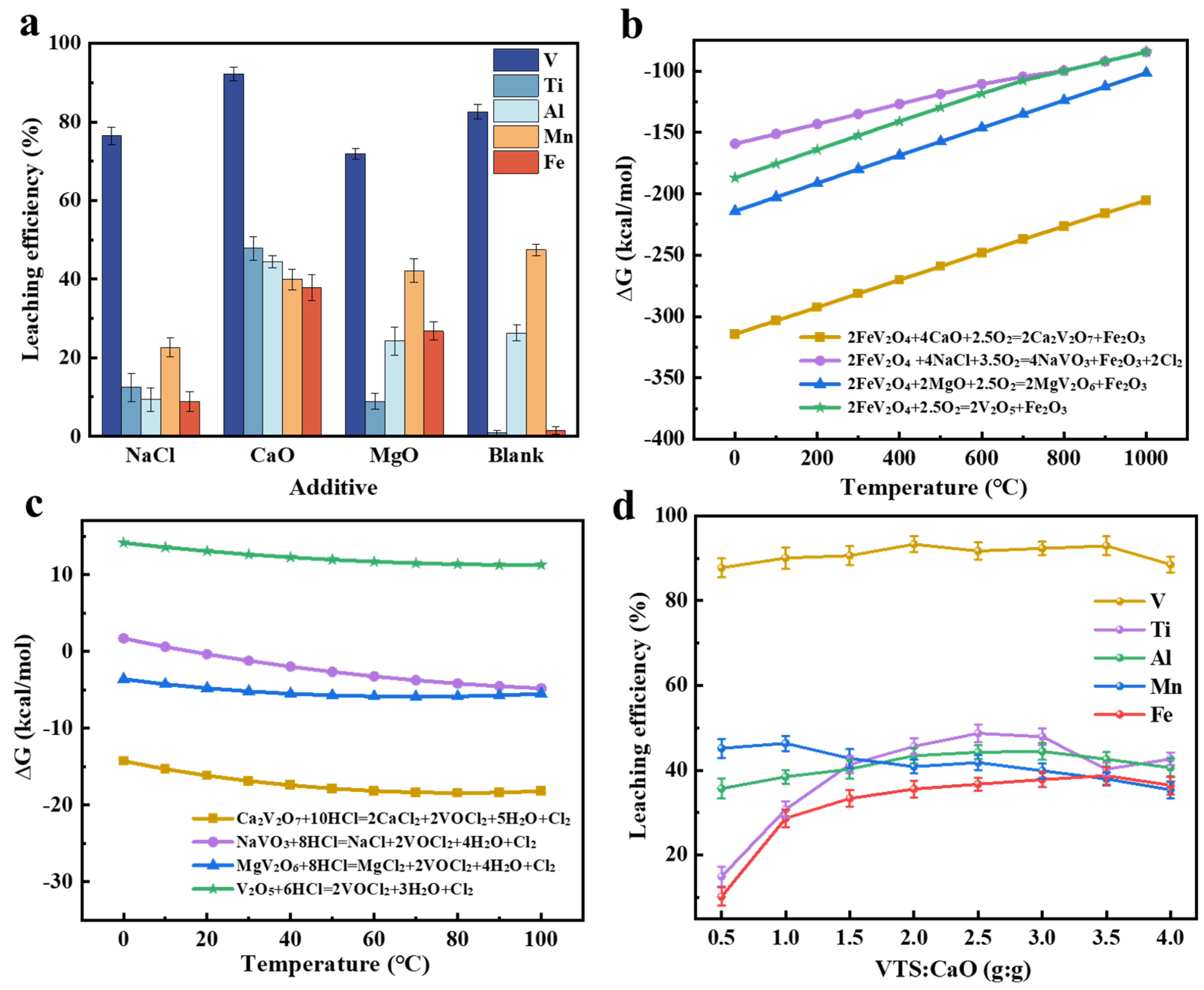
The core of the roasting–leaching process is to control the occurrence form of V through roasting additives to achieve selective and efficient leaching. To evaluate the effects of different types of roasting additives and the amount of CaO on the leaching behavior of various metals, Figure 2a compares the effects of the blank and three common and easily accessible additive families, NaCl, CaO, and MgO, on the leaching efficiency of V, Ti, Al, Mn, and Fe. In the experiment, 2.0 g of additive was mixed with 5.0 g of VTS (the blank control refers to the original VTS sample without any roasting additives) and roasted at 10 °C·min−1 to 900 °C for 2 h. The roasted product was then used as a 10 mol/L HCl, solid–liquid ratio 1:6 (g/mL), and leaching was performed at 70 °C with stirring for 2 h. Error bars represent the standard deviation of three parallel experiments.
The results showed that the leaching efficiency of V was in the order of CaO additive > blank additive > NaCl additive > MgO additive. Among them, the leaching efficiency of V under the action of CaO reached 92.20%, which was significantly higher than that of impurity metals such as Ti (47.91%) and Al (44.44%). The leaching efficiency of V for NaCl and MgO were only 76.47% and 71.98%, respectively, and the differences in the leaching efficiency of each metal were small, indicating no obvious selectivity. The above differences are due to the regulatory effect of different additives on the phase transformation of V. Vanadium in VTS is mainly hosted in chemically inert FeV2O4. CaO, as a calcining agent, can undergo an oxidation reaction with FeV2O4 during high-temperature roasting to generate calcium vanadate (such as CaV2O6, Ca2V2O7) that is easily soluble in HCl. Simultaneously, CaO reacts with the Fe2SiO4 present in the slag to form calcium silicate, disrupting the dense crystal structure of Fe2SiO4 and preventing it from encapsulating the V phase and hindering the contact between V and the calcining agent, thus achieving efficient and selective V leaching. NaCl mainly converts vanadium into volatile vanadium chloride compounds through chlorination roasting, resulting in vanadium loss; MgO has low reactivity with the vanadium phase and is difficult to form soluble vanadate; therefore, both have limited effects on promoting V leaching. Under blank leaching conditions, the vanadium extraction efficiency is relatively high. This is due to the use of relatively strong leaching parameters, which partially dissolves vanadium from the oxidized phase formed during the calcination process. However, this process is non-selective and does not involve effective regulation of vanadium phase transition. Based on the analysis of the leaching efficiency of V in the experimental results and considering the economic and environmental benefits of the additives, CaO was initially determined as the roasting additive.
To verify the theoretical feasibility of the additive roasting–acid leaching best V extraction process, this study used HSC Chemistry software (version 6.0) to perform thermodynamic calculations on key steps. As shown in Figure 2b, the relationship between ΔG and temperature (0–1000 °C) was calculated and compared for the conversion of the main phase FeV2O4 in VTS into the corresponding vanadate under conditions of no addition and with the addition of NaCl, CaO, and MgO, respectively. The results show that ΔG is negative for all paths within the roasting temperature range, proving that each reaction can proceed spontaneously thermodynamically. Notably, as the temperature increases, the value of ΔG for each reaction gradually decreases, indicating that the spontaneous driving force of the reaction weakens with increasing temperature. According to the Gibbs equation ΔG = ΔH − TΔS, this phenomenon stems from the negative entropy change ΔS of the reaction (i.e., entropy reduction process), which leads to a positive contribution of increasing temperature T to ΔG [36]. Among different additives, the reaction ΔG corresponding to CaO is at the lowest level throughout the entire temperature range, and its thermodynamic spontaneous tendency is significantly stronger than that of MgO, the no-additive system, and the NaCl system. This indicates that the addition of CaO can effectively reduce the reaction energy barrier and provides the optimal pathway for the efficient conversion and activation of V in FeV2O4 from a thermodynamic perspective.
Figure 2c further calculates the Gibbs free energy of the above-mentioned roasted products (including Ca2V2O7, NaVO3, MgV2O6, and the direct oxidation product V2O5) in the HCl leaching reaction. It can be found that in the temperature range of 0~100 °C, the Gibbs free energy of the acid leaching reaction of Ca2V2O7 and MgV2O6 is always negative, indicating that these two calcified and magnesian roasted products can be spontaneously leached by HCl thermodynamically [37]; the ΔG of the acid leaching reaction of NaVO3 is positive at low temperature (<20 °C) and gradually becomes negative after 20 °C, indicating that the reaction can only proceed spontaneously by increasing the leaching temperature, while the ΔG of the acid leaching reaction of the direct oxidation product V2O5 is always positive, indicating that this reaction cannot proceed spontaneously throughout the entire temperature range. By comparing the driving forces of the acid leaching reaction of each product, the order is Ca2V2O7 > MgV2O6 > NaVO3 > V2O5. Among these, the ΔG value of Ca2V2O7 is consistently below −10 kcal/mol, indicating that its acid leaching reaction has the strongest spontaneous tendency and the highest thermodynamic feasibility. In summary, this study verified the feasibility of the proposed process route from a theoretical perspective through thermodynamic calculations: First, additives (especially CaO) can effectively reduce the Gibbs free energy of the roasting reaction, promoting the efficient conversion of V in FeV2O4 into more soluble vanadate; second, the acid leaching reactions of both calcification and magnesium roasting products have a spontaneous tendency, with Ca2V2O7 exhibiting the highest degree of spontaneity. Finally, CaO was determined to be the roasting additive, and these thermodynamic analysis results provide a crucial theoretical basis for subsequent experimental research.
As illustrated in Figure 2d, the optimization of the CaO dosage was further investigated by varying the mass ratio (referred to as mVTS:mCaO = 0.5–4.0). It was found that as the CaO dosage increased, the V leaching efficiency remained above 90%, while the leaching of impurities such as Ti, Al, and Fe initially increased and then decreased, fluctuating within a small range. Specifically, with the mass ratio rising from 0.5 to 2.5, the conversion of V to soluble calcium vanadate gradually became complete, with a leaching efficiency reaching 91.72%, while the leaching efficiencies of Ti, Al, and Fe were 48.71%, 44.25%, and 36.71%, respectively. Although the impurity leaching efficiency was at a relatively high level within the fluctuation range at this point, no significant increase in co-solubility was observed. When further increasing the ratio to 3.5, the Ti and Al leaching efficiency decreased to approximately 40%, while the Fe leaching efficiency increased slightly to 38.71%. When the mass ratio reached 4.0, the relative content of CaO as a reactant was insufficient, making it impossible to completely convert the iron vanadium spinel in the slag into acid-soluble calcium vanadate. As a result, some V remained in refractory phases such as unreacted FeV2O4 and stable calcium vanadates (e.g., Ca3V2O8) with low solubility in HCl. Therefore, considering leaching efficiency, selectivity, and economy, a VTS–CaO mass ratio of 2.5 is determined to be the optimal condition.

3.2. Effect of Roasting Temperature on Characterization of VTS and Leaching Efficiency of Valuable Metals

3.2.1. Phase Composition Analysis via XRD

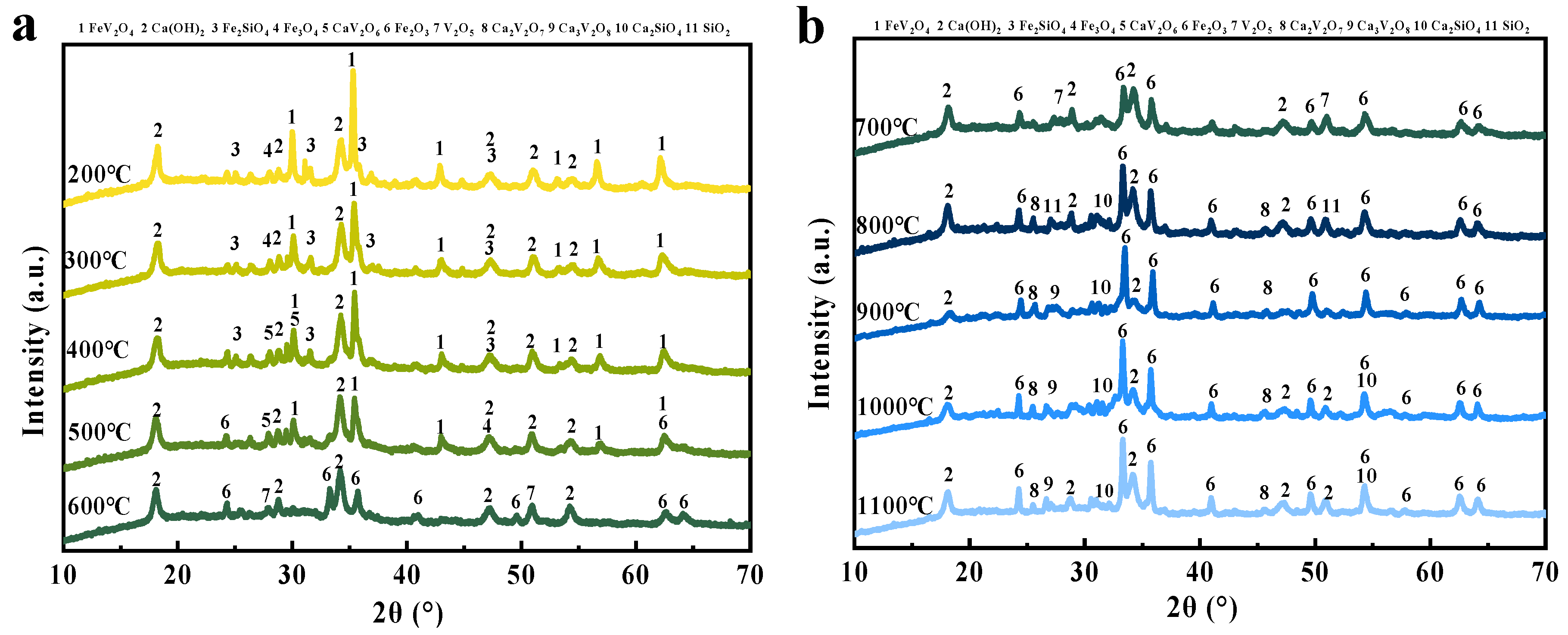
Figure 3 systematically reveals the regulatory mechanism of roasting temperature on the phase structure, microstructure, and leaching behavior of VTS. The XRD analysis of the residues after roasting at different temperatures elucidates the evolution of phases during calcification roasting. In the temperature range of 200–300 °C (Figure 3a), the XRD patterns were dominated by the diffraction peaks of FeV2O4, Fe2SiO4, and Fe3O4. Concurrently, characteristic peaks of Ca(OH)2, generated from the hydration of CaO, were observed. This stage is only accompanied by a slight decrease in peak intensity, indicating that the main process is the physical desorption of adsorbed water and organic matter, without significant solid–phase chemical reactions. When the temperature rises to 400 °C, a new CaV2O6 diffraction peak appears, originating from the initial solid-state reaction between FeV2O4 and CaO, indicating that V begins to transform from a spinel structure to a soluble calcium vanadate. In the 500–700 °C range, the characteristic peak of FeV2O4 significantly weakens and disappears, while diffraction peaks of Fe2O3 and V2O5 appear, with the Fe2O3 peak intensity gradually increasing, confirming that FeV2O4 undergoes decomposition and oxidation under an oxidizing atmosphere. At this point, the Fe2SiO4 diffraction peak completely disappears, indicating that the fir olivine structure has been destroyed, which is conducive to the release of the encapsulated V species (Figure 3b).
When the temperature continued to rise to 800 °C, diffraction peaks of Ca2V2O7 and Ca2SiO4 appeared in the diffraction. The formation of Ca2V2O7 indicates that the calcification reaction was not yet complete at this temperature, and some intermediate valence vanadate still existed stably. The formation of Ca2SiO4 reflects the combination of CaO with SiO2 in the slag, which helps to suppress the silicon—containing phase from encapsulating the V phase and improve the leaching ability of V. When the temperature was raised to 900 °C, Ca3V2O8 with a higher calcium–vanadium ratio appeared in the product, indicating that the vanadate further transformed into a more thermodynamically stable calcium-rich form. In the high-temperature range of 1000–1100 °C, no new calcium vanadate phases appeared, and the diffraction peak of Ca2SiO4 was significantly enhanced. This indicates that the system gradually tends towards a stable phase composition dominated by Ca2V2O7, Ca3V2O8, and Ca2SiO4. Notably, the sample calcined at 900 °C exhibits the highest diffraction peak intensity, sharpest peak shape, and fewest impurity peaks, reflecting the highest crystallinity and relatively pure phase composition of the product under these conditions. These phase change results demonstrate that the calcification roasting process effectively converts the inert FeV2O4 and Fe2SiO4 in the VTS into acid-soluble calcium vanadate (such as CaV2O6, Ca2V2O7, and Ca3V2O8), while simultaneously preventing V from being encapsulated by silicates through the formation of stable calcium silicates (Ca2SiO4), thus laying the phase foundation for subsequent efficient leaching and recovery of V.

3.2.2. Functional Group Characterization via FT-IR

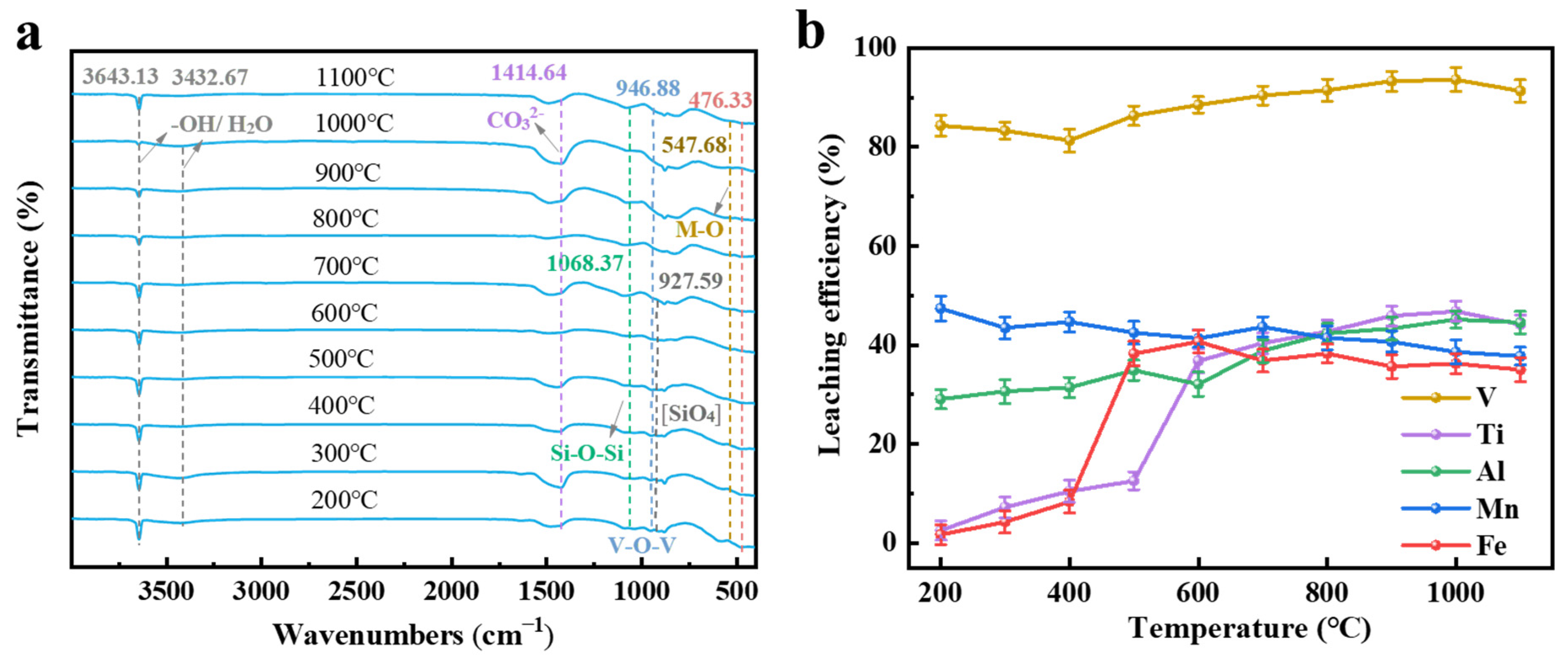
Figure 4a reveals the evolution of functional groups and crystal structure in VTS during calcification roasting. At 200–400 °C, the broad absorption peaks at 3643.13 cm−1 and 3432.67 cm−1 are attributed to the stretching vibrations of free water or hydroxyl groups (-OH), indicating that the VTS still contains a certain amount of adsorbed water and structural hydroxyl groups. Meanwhile, the weak peak near 1414.64 cm−1 may correspond to the vibrations of residual carbonates or some organic matter [38], which is consistent with the XRD results showing no significant chemical reactions in the phases at this temperature, indicating that the low-temperature stage is mainly characterized by physical dehydration and initial activation of surface groups. The absorption bands at 476.33 cm−1 and 547.68 cm−1 belong to the metal–oxygen (M–O) stretching vibrations at tetrahedral and octahedral sites in FeV2O4 [39,40], respectively, indicating that the spinel phase structure is exposed and stabilized during heating. As the temperature increases to 500–700 °C, the –OH characteristic peak (~3432.67 cm−1) gradually weakens and disappears, indicating that water and hydroxyl groups have been largely removed. The Si-O-Si vibrational peak at 10 68.37 cm−1 gradually strengthens, originating from the vibrational response of residual SiO2 or silicate networks in the slag, indicating that the calcium reagent gradually destroys its silicon–oxygen network. Simultaneously, the disappearance of the band at 879.38 cm−1 marked the complete deconstruction of the characteristic [SiO4] tetrahedral absorption band of the Fe2SiO4 [41,42,43]. When the temperature is further increased to 800–1100 °C, the sharp absorption peak that gradually intensifies in the range of 946.88 cm−1 can be considered the stretching vibration of the V–O–V bond with high symmetry. This is because the high temperature promotes the rearrangement and ordering of the vanadium–oxygen structure, forming a new phase of calcium vanadate with good crystallinity. This is consistent with the enhanced diffraction peaks of the corresponding phase in XRD.

3.2.3. Microscopic Morphology Analysis via SEM

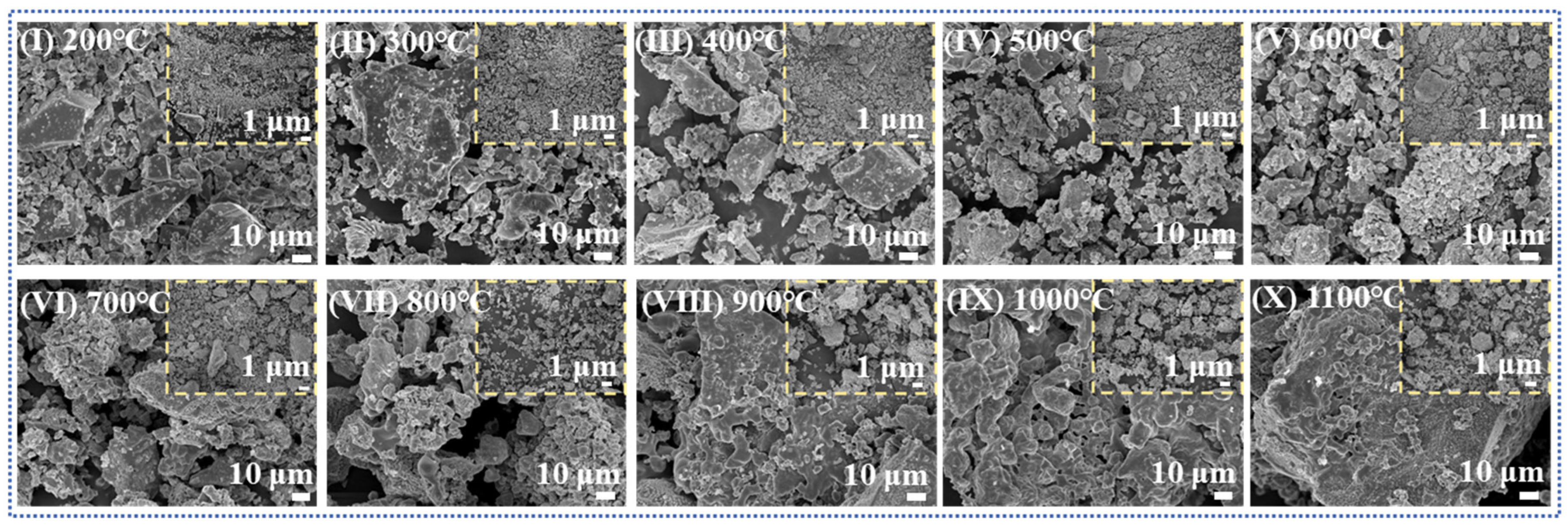
Combining XRD phase analysis and SEM morphology characterization, the microstructure evolution of VTS during calcification roasting exhibits a significant temperature dependence. Within the 200–400 °C range (Figure 5I–III), the particles maintain their original irregular blocky morphology, with a dense surface and clear boundaries, consistent with the XRD results showing no significant phase changes. This indicates that this stage mainly involves the removal of adsorbed water and volatiles, without causing particle structure reconstruction. When the temperature rises to 500–800 °C (Figure 5IV–VII), the particle surface gradually roughens and forms micron-sized pores, while fine particles adhere to the surface of larger particles. This morphological change corresponds to the weakening of the FeV2O4 diffraction peak, the disappearance of the Fe2SiO4 peak, and the formation of new phases such as calcium vanadate, silicate, and Fe2O3 in XRD, indicating that the calcination reaction extends from the surface inwards, promoting pore growth and increasing the reaction interface. At 900 °C (Figure 5VIII), the particles exhibited significant agglomeration and sintering, forming aggregates with blurred boundaries and visible plate-like or prismatic crystal precipitation on the surface. This coincides with the XRD diffraction peaks of crystalline phases such as Ca3V2O8, indicating that high temperature promoted the crystallization and growth of calcium vanadate and silicate, and the particles underwent structural rearrangement through solid-phase diffusion and surface melting. When the temperature was further increased to 1000–1100 °C (Figure 5IX,X), the aggregates tended to become denser, with some areas exhibiting a smooth, molten glassy surface, and the particle boundaries essentially disappeared. XRD showed a significant enhancement of the Ca2SiO4 diffraction peak and a tendency for the calcium vanadate phase to stabilize, indicating that excessively high temperatures caused partial liquid-phase sintering, and the dense glassy phase may have encapsulated the active components, thereby inhibiting subsequent leaching mass transfer. In conclusion, calcination temperature exerts a pivotal influence on the structural alterations of VTS: at low temperatures, it is mainly manifested as surface etching and pore formation; at moderate temperatures, it promotes the generation of soluble calcium salts, whereas at ultra-high temperatures, it induces the decomposition of calcium salts, reducing the activation efficiency.

3.2.4. Leaching Analysis of Valuable Metals

To investigate the effect of calcination temperature on the leaching behavior of V, Ti, Al, Mn, and Fe, an optimized calcination–acid leaching process was used: calcination time of 2 h, mVTS:mCaO = 0.4:1, leaching of the calcined product with 10 mol/L HCl, a solid–liquid ratio of 1:6 (g/mL), and leaching at 70 °C for 2 h. Figure 4b shows the change in leaching efficiency with temperature. The findings indicate that over the temperature of 200 to 900 °C, the efficiency of leaching V keeps on rising with the increment in the calcination temperature, and at 900 °C, it is 93.32% in terms of leaching. This behavior is in line with the phase and morphology development trends disclosed by XRD and SEM trends: increasing the temperature, the inert FeV2O4 present in the VTS slowly combines with CaO to become the acid-soluble calcium vanadate. At the same time, CaO selectively reacts with SiO2 to give stable calcium silicate (Ca2SiO4), which, in effect, inhibits the encapsulation of the V phase by silicate (Fe2SiO4) and therefore greatly enhances the leaching selectivity of V. In the process, the efficiency of leaching of the elements of impurity (Ti, Al, Mn, and Fe) is at a low level, which again proves the strongly selective activity of calcification roasting on V. In situations where the roasting temperature is above 900 °C, the V leaching efficiency will not be increasing rapidly, and the impurity leaching efficiency is also not high. The primary reason is that the high temperature may cause the crystallinity of inert phases, including Ca2SiO4, to increase, and hence, the reactivity of the system reduces. This may also be due to sintering, which to some extent inhibits further V dissolution. Based on the comprehensive leaching efficiency and phase transformation characteristics, 900 °C not only achieves efficient vanadium leaching but also avoids the problems of crystal phase passivation and structural densification caused by excessively high temperatures. Among them, selectivity does not refer to the absolute absence of impurity leaching, but rather a comprehensive balance based on the co-leaching behavior of vanadium recovery and impurities. That is, under the same conditions, the leaching capacity of vanadium is significantly stronger than that of impurity elements, thereby ensuring the preferential enrichment and efficient extraction of vanadium in the leaching solution. Thus, this condition was identified as the optimal calcination parameter for experimental studies.

3.3. Effect of Roasting Time on Characterization of VTS and Leaching Efficiency of Valuable Metals

3.3.1. Phase Composition Analysis via XRD

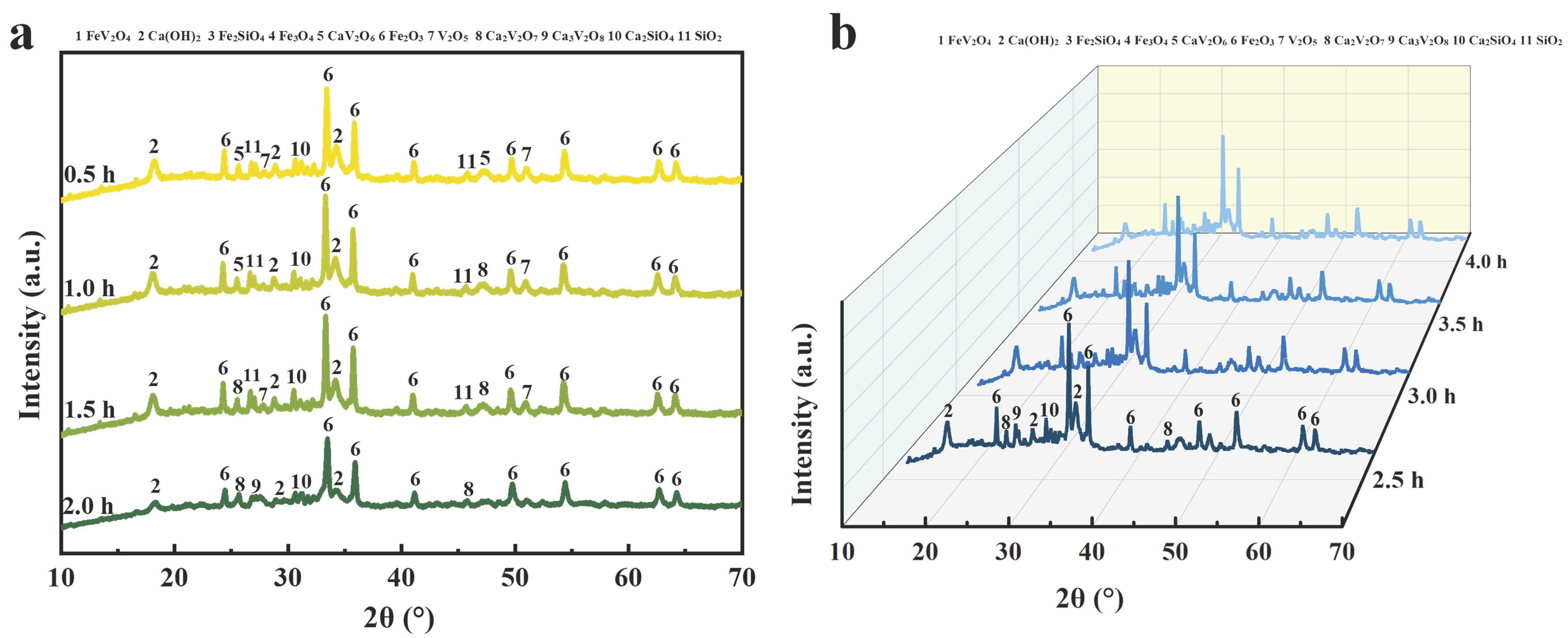
Figure 6 shows that the phase transformation process exhibits distinct stages with increasing calcination time. Under calcination conditions of 0.5 h, diffraction peaks of Fe2O3, Ca(OH)2, and SiO2 are still clearly visible in the spectra, while a small amount of diffraction signals of CaV2O6 and Ca2SiO4 begins to appear, indicating that the FeV2O4 and fir olivine have initially reacted with the calcining reagent at this time. When the calcination time is increased to 1.0 h, a weak diffraction peak of Ca2V2O7 is observed. When further extending the calcination time to 1.5 h, the peak intensity of CaV2O6 decreases significantly, while the diffraction signal of Ca2V2O7 increases significantly, indicating the appearance of a vanadate phase that is easily soluble in acid. When the calcination time reached 2.0 h, the characteristic peaks of SiO2 completely disappeared, and diffraction peaks of Ca3V2O8 appeared, which is less soluble in HCl than Ca2V2O7 (Figure 6a). As shown in Figure 6b, after calcination time exceeds 2.0 h, the diffraction peak intensities of the calcium vanadate and calcium silicate phases tended to stabilize, and no new phases were formed, indicating that the system had reached reaction equilibrium. This further confirms that 1.5 h is the optimal calcination time. This trend indicates the existence of an optimal calcination time range. Beyond this range, the phase composition no longer changes, and the reaction reaches a dynamic equilibrium. The peak positions and phase identification results observed in XRD under different roasting temperatures and times are shown in Table 2.

3.3.2. Functional Group Characterization via FT-IR

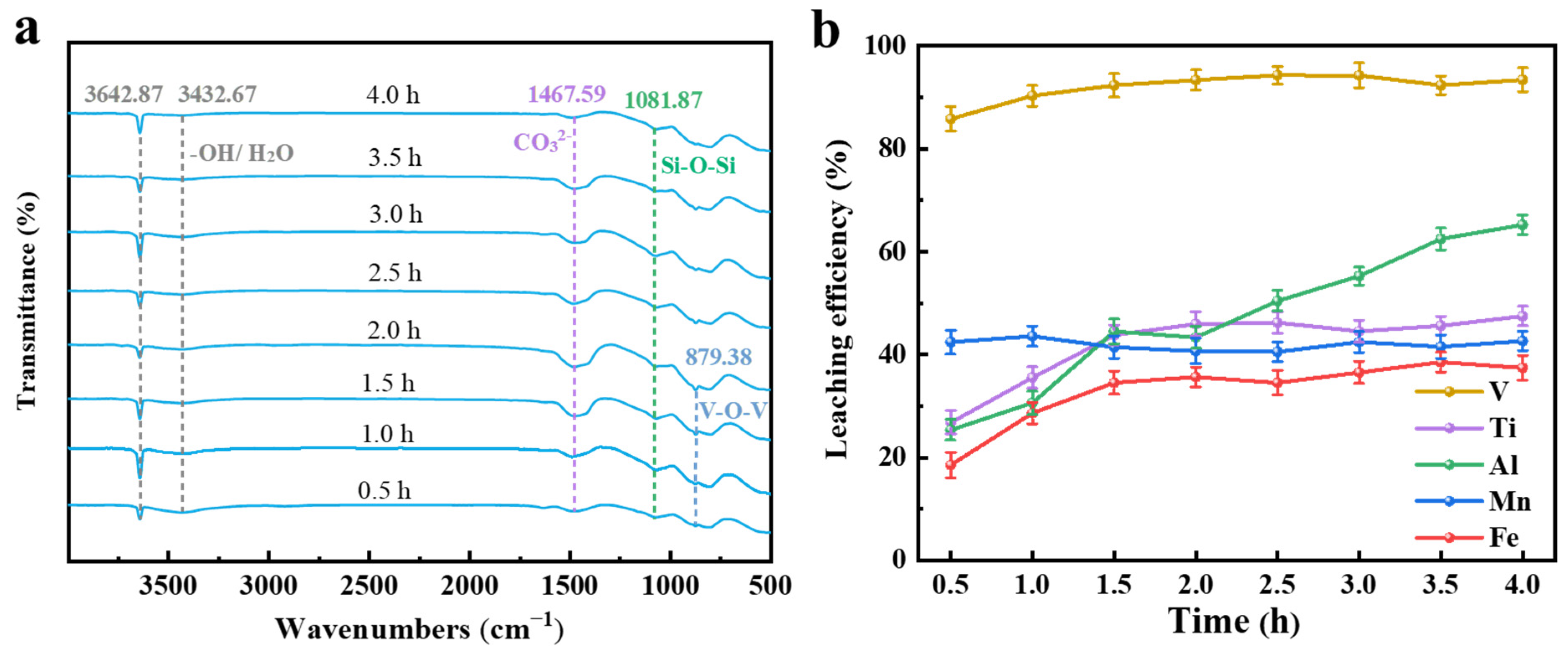
The FT-IR spectral results further clarified the structural change path of vanadium–titanium slag over time during the calcination process (Figure 7a). At 1467.59 cm−1, the antisymmetric stretching vibration peak corresponding to CO32− remained detectable through all stages of the calcination process [44], which indicated the persistent existence of carbonate components within the reaction system. At 0.5 h, a broadened absorption peak appearing near approximately 3400 cm−1 can be attributed to the stretching vibration of free water or structural hydroxyl groups (–OH) [45], confirming that the material initially contained some adsorbed water and bound hydroxyl groups. As the roasting time increased from 1 h to 1.5 h, this –OH characteristic peak gradually weakened and eventually disappeared, reflecting the gradual removal of water and hydroxyl groups during roasting. Simultaneously, the stretching vibration peak at approximately 1081.87 cm−1, attributed to Si–O–Si bonds, became sharper, indicating that the destructive effect of Ca2+ on the silicon–oxygen network had become complete, and the local silicate structural order had increased. The absorption peak at 879.38 cm−1 significantly increased with time, reaching its maximum intensity at 1.5 h–2 h. This peak originates from the well-symmetric V–O–V stretching vibration, directly confirming the formation of a new calcium vanadate phase with high crystallinity. When the calcination time exceeded 2.0 h, the positions of all characteristic peaks remained unchanged, and the overall FT-IR spectrum showed no significant changes, nor did any new characteristic peaks appear, indicating that the formation and transformation of vanadate in the system had reached dynamic equilibrium.

3.3.3. Microscopic Morphology Analysis via SEM

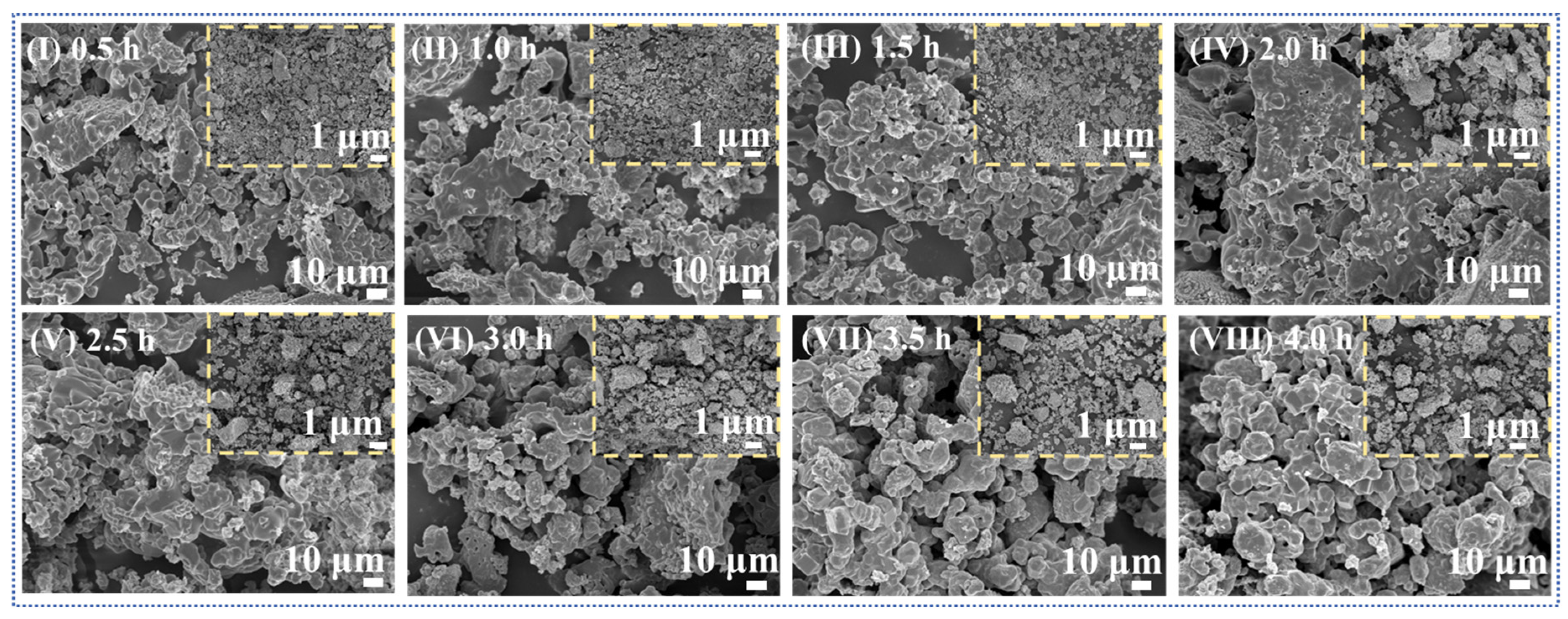
It can be seen from Figure 8 that the morphological changes of VTS particles show a strong reliance on the calcination schedule. During the early calcination phase (0.5 h), the sample particles are loose and lack obvious crystals, indicating that the erosion effect of CaO on the VTS is still in its initial stage. With the extension of time to 1.0–1.5 h, plate-like crystals appear on the particle surface, and the porous structure is well-developed, reflecting the gradual formation of calcium vanadate phases (such as Ca2V2O7). When the calcination time is further extended to 2.0 h, the system tends to stabilize, and the particles as a whole transform into uniformly sized, dense, blocky aggregates, with the surface evolving into a porous structure (Figure 8I–IV). Between 2.5 h and 4.0 h, particle sintering intensifies, reaching a molten state. It is worth noting that at this stage, the number of aggregates no longer increases, and the morphological characteristics indicate that the system has reached a thermodynamically stable state close to equilibrium under the given calcination conditions (Figure 8V–VIII).

3.3.4. Leaching Analysis of Valuable Metals

To systematically investigate the effect of roasting time on metal leaching, roasting treatments were conducted at 900 °C with an alkali-to-slag mass ratio of 0.4. The leaching experiment was conducted with the process parameters of 10 mol/L HCl, liquid–solid ratio = 6 (g/mL), and continuous stirring at 70 °C for 2 h. Figure 7b shows the change in leaching efficiency over time. The leaching efficiency of V showed a trend of first increasing and then stabilizing with the extension of roasting time. Within 0.5 h to 1.5 h, the V leaching efficiency increased from 85.82% to 92.35%. This was mainly because with prolonged calcination time, the solid-phase reaction tended to be complete, the crystallinity of calcium vanadate increased, and the quantity increased, thus significantly improving its solubility in acid. After 1.5 h, the V leaching efficiency basically stabilized (93%~94%), indicating that the system had basically reached the dynamic equilibrium of phase transformation. The efficiency of impurity leaching was a little bit greater, perhaps because some impurities were being over-calcined, resulting in a loose phase structure, or by secondary reactions, giving them a slight increase in acid solubility. Together with phase and morphology analysis, it can be observed that V was fully transformed to soluble calcium vanadate after 1.5 h, and the microstructure was not highly sintered, which means that the reaction time was not so long as to enhance more mass transfer resistance by excessive growth of grains or densification. Thus, it was decided to determine 1.5 h as the optimal time of calcification, which will be effective in removing V and at the same time prevent the aggravation of impurities co-leaching. In short, with the presence of the conditions of 900 °C and 1.5 h of calcification, VTS can convert the inert spinel to fully become calcium vanadate, which is the most favorable combination of the process factors to strike the balance between the efficiency of the reaction, its selectivity, and energy use.

3.4. Comparative XPS Analysis of Raw VTS and Optimally Roasted Products

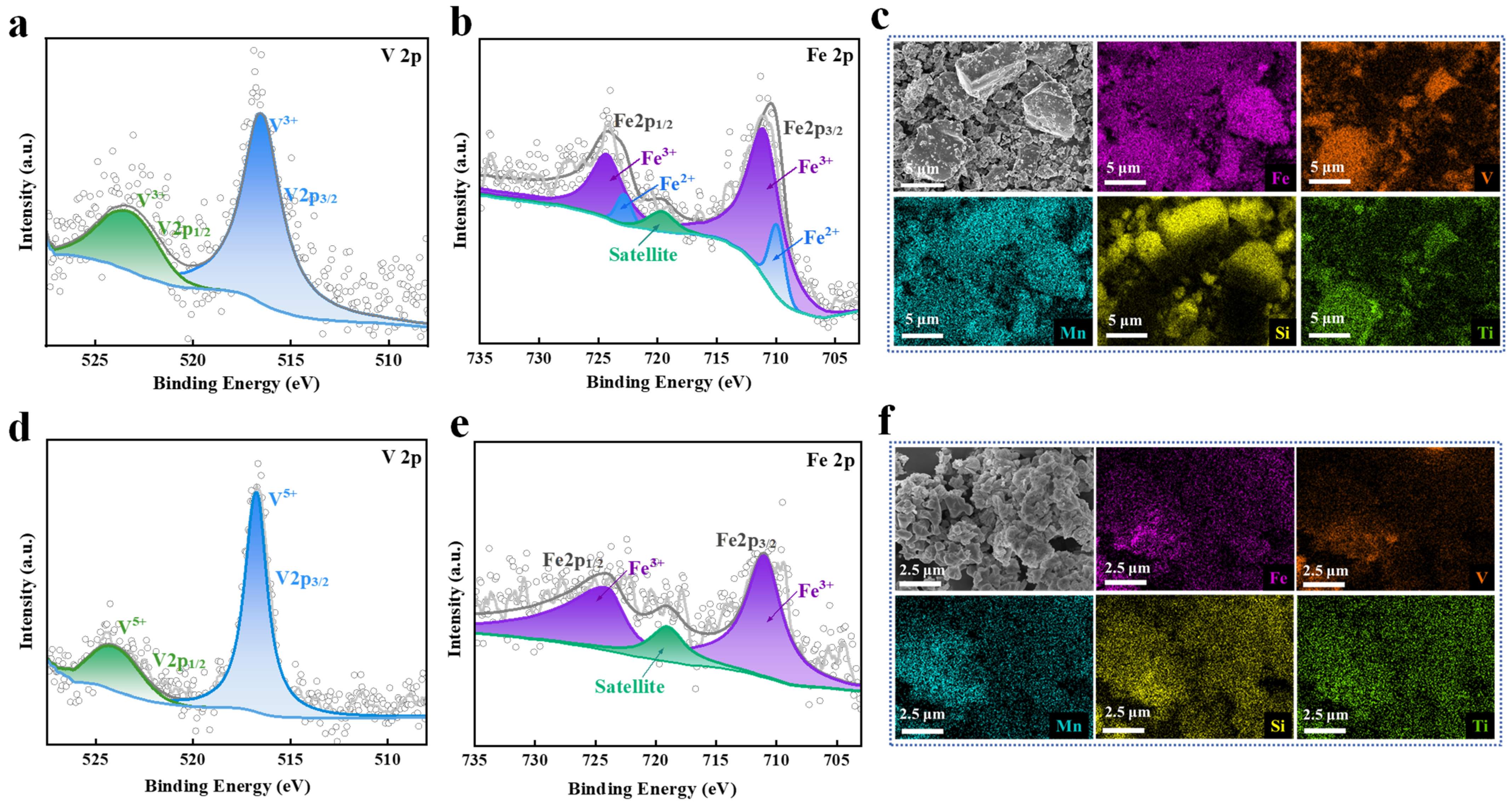
To elucidate the chemical state changes of key elements such as V and Fe during calcification roasting, XPS comparative analysis was performed on the original VTS and the product obtained under optimal conditions (alkali-to-slag ratio 0.4, roasting at 900 °C for 1.5 h), and the results are shown in Figure 9. In the V 2p spectrum of the original slag (Figure 9a), the characteristic peaks with binding energies at 516.6 eV (V 2p3/2) and 523.5 eV (V 2p1/2) are consistent with V3+, corresponding to the typical valence state of V in FeV2O4. After calcination, the V 2p spectrum of the product exhibited a red shift (Figure 9d): the V 2p3/2 and V 2p1/2 peaks shifted towards higher binding energies by approximately 0.20 eV and 0.70 eV, respectively, ultimately located at 516.8 eV and 524.2 eV, a range highly consistent with the characteristics of V5+. This shift directly confirms that during calcination, V underwent a valence state increase from V3+ to V5+, with V3+ ([Ar]3d2 4s0) losing two electrons and transforming into V5+ ([Ar]3d0 4s0). This is because under an oxidizing atmosphere coexisting with CaO, V3+ in the spinel structure is oxidized by oxygen and simultaneously combines with calcium, transforming into various calcium vanadate (such as CaV2O6, Ca2V2O7, etc.). This transformation forms the electronic structure basis for the subsequent efficient acid leaching of V.
For iron, the Fe 2p spectrum of the original sample, after fitting, reveals multiple peaks for Fe2+ and Fe3+, originating from Fe2+ in FeV2O4 and Fe3+ in the associated Fe2O3, respectively, as well as a weak satellite feature. The characteristic signal near 711.1 eV is attributed to the Fe–O bond (Figure 9b) [46]. The Fe 2p spectrum of the roasted product undergoes significant changes (Figure 9e) [47]: the binding energy of the Fe 2p3/2 main peak shifts to 710.7 eV, the binding energy of Fe 2p1/2 is 724.1 eV, and the fitted spectrum only shows the single-component characteristic of Fe3+, indicating that iron has completely transformed into the trivalent state. This is attributed to the complete oxidation of all Fe2+ during high-temperature oxidative roasting, ultimately resulting in Fe2O3. This result is corroborated by the appearance of hematite diffraction peaks in XRD. Furthermore, a significant evolution in morphology and elemental distribution was observed by comparing the EDS density of the samples before and after roasting. The initial slag particles were coarse and were not uniformly distributed with each other (Figure 9c); the roasted product was a uniformly distributed powder. Particularly, the distribution of Si elements was not local aggregation but high dispersion (Figure 9f). This shows that the silicon originally in the silicate net or isolated SiO2 was changed to a new phase that is much more uniformly distributed under the disrupting and reorganizing influence of calcium, which finally changed to calcium silicate salts. This alteration significantly suppressed the process of vanadate encapsulation, therefore leading to the eventual leaching.

3.5. TG Analysis and Chemical Reaction Kinetics of VTS

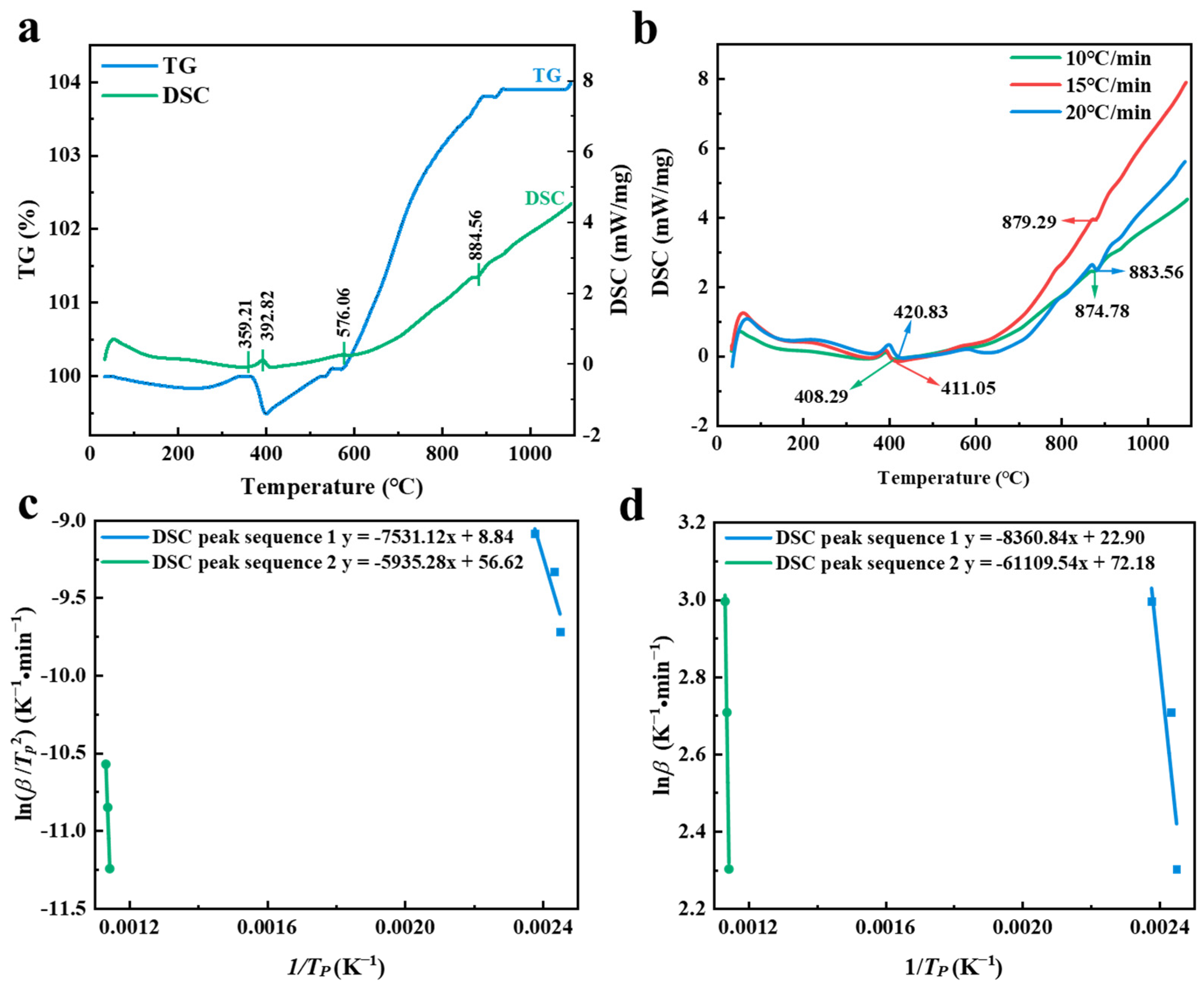
TG-DSC characterization of the VTS-CaO mixed system was carried out to interpret the phase transformation mechanism associated with calcification roasting, the findings of which are presented in Figure 10. By carrying out a systematic study of the thermogravimetric and heat flow curves, the nature of the mass change and thermal effect in the system as the heating progressed was apparent. Moreover, together with non-isothermal kinetic analysis, this study will give the thermodynamic and kinetic justification for determining the reaction pathways and the process parameter optimization of calcification roasting.

3.5.1. Thermogravimetric Analysis

TG-DSC was used to study the thermal behavior of the VTS and calcium oxide mixture, and the results are presented in Figure 10a. At temperatures of 35–370 °C, the TG curve had a slow curve (weight gain of about 0.2 percent), and the DSC had an exothermic peak at 359.21 °C. Oxidation of Fe2SiO4 of VTS is the primary cause of this phenomenon, whereby Fe2+ is oxidized to Fe3+ and reacts with gaseous oxygen, resulting in the addition of mass to the system. There was a short-lived weight loss in the TG curve at 370–400 °C concomitant with a strong endothermic peak at 392.82 °C, which may be due to the loss of little adsorbed water or water of crystallization in the sample. The system keeps on gaining weight by about 0.8 percent as the temperature reaches 600 °C. Meanwhile, the maximum temperature of the DSC curve was 576.06 °C and endothermic. This phenomenon is because as the FeSiO3 phase was oxidized, it began breaking down, thus exposing FeV2O4 [21]. This exposure stimulated the spinel reaction with oxygen, in which the process of conversion of V3+ to V5+ and the resulting oxygen uptake by it led to a further increase in the mass. At temperatures of 600–900 °C, the rate of mass gain increases much more sharply (about 3.6%), and the DSC displays a very strong exothermic maximum with the temperature of 884.56 °C; this result suggests that a calcification transformation reaction took place at this temperature. In particular, the reagent, FeV2O4, is presented with CaO and O2 to give calcium vanadate (primarily Ca2V2O7). This reaction is intensely exothermic, and a large increase in weight is observed owing to the weight of a large quantity of CaO combined with oxygen. Above 900 °C, the TG curve hovers, and the DSC indicates no greater thermal impact, meaning that the reaction is all but finished. Therefore, based on the comprehensive thermal analysis results, the suitable temperature for calcification roasting was determined to be 900 °C.

3.5.2. Chemical Reaction Kinetic Analysis

The kinetics of chemical reactions can reveal the influences of reaction time, reaction temperature, and reactant concentration on the chemical reaction rate. Within the present research, the activation energy, pre-exponential factor, and other kinetic parameters of the VTS thermal decomposition reaction were evaluated via the Kissinger and Kissinger–Crane methodologies, and the pertinent rate equation for this reaction was then formulated [48,49]. The DSC curves of vanadium–titanium slag were obtained at different heating rates using a thermogravimetric analyzer, and the results are shown in Figure 10b. It can be observed that at different heating rates, two major peaks appear on each of the three DSC curves, indicating that there are two DSC peak sequences. As the heating rate increases, the peak temperature of each peak sequence shifts towards higher temperatures. On the basis of the derived rate equation, the mechanism underlying the thermal decomposition of VTS can be investigated in greater depth. In accordance with the Arrhenius equation and the law of mass action, the functional correlation between the thermal decomposition duration and conversion rate of VTS can be deduced. Subsequently, the kinetic parameters of the chemical reactions in each step of the thermal decomposition of VTS can be calculated, respectively, using the Kissinger method and the Kissinger–Crane method. By fitting ln(β/Tp2) with 1/Tp, the linear equations under different DSC peak sequences can be obtained, and the results are shown in Figure 10c. By fitting lnβ with 1/Tp, linear equations under different DSC peak sequences can be obtained, as shown in Figure 10d. Derive and fit the equation, Equation (1):
d ( ln β ) d ( 1 / T p ) = E n R
The reaction order associated with VTS thermal decomposition was determined from the slope, as presented in Table 3. For the co-thermal decomposition system of VTS and CaO, the activation energy of the stage corresponding to the first sequence of DSC peaks reaches the maximum; hence, this stage is regarded as the primary rate-determining step for the overall thermal decomposition course. The thermal decomposition rate equation of VTS blended with CaO can be characterized by the reaction rate of this specific stage, as illustrated in Equation (2).
d α d t = 5.20 × 1 0 7 × e 62610 / R T × 1 α 0.90

3.6. Effects of Different Leaching Conditions on Leaching Efficiency of Valuable Metals

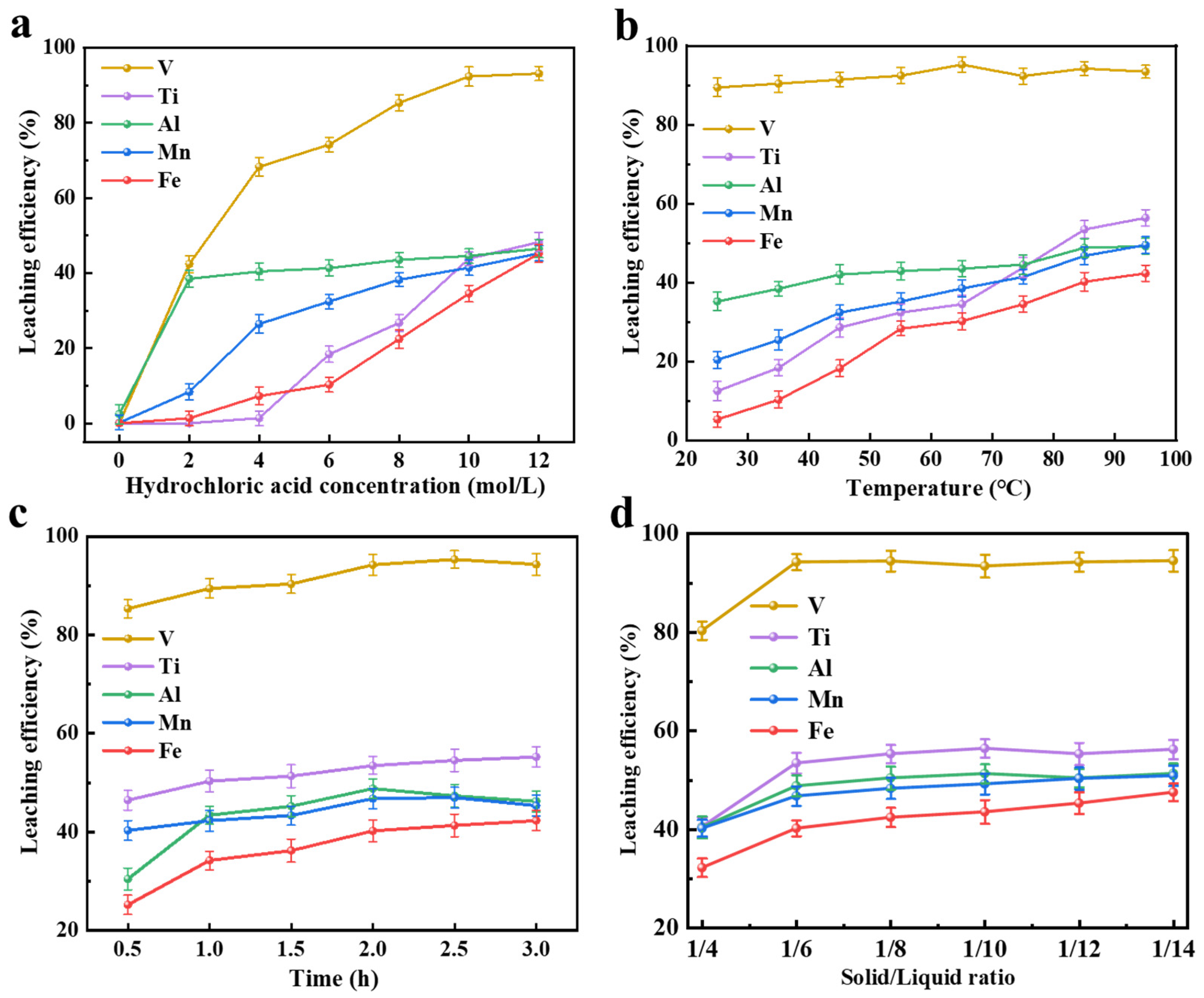
To investigate how leaching conditions affect metal recovery, samples pre-calcined at 900 °C for 1.5 h (CaO/VTS mass ratio of 0.4:1) were subjected to stirred leaching at an initial liquid–solid ratio of 6 mL·g−1. The corresponding results are presented in Figure 11.
(1)
Effect of HCl Concentration
As the HCl concentration increased from 0 to 10 mol/L, the leaching efficiency of V rapidly increased from nearly 0 to 92.35%, while the leaching efficiency of Ti, Al, Mn, and Fe only increased from about 5% to about 50%. When the concentration exceeded 10 mol/L, the leaching efficiency of V tended to stabilize, while the leaching efficiency of impurities increased slightly (Figure 11a). The reason for this is that the reaction between calcium vanadate and HCl requires sufficient driving force, and an acid concentration of 10 mol/L is sufficient to ensure the complete dissolution of calcium vanadate. However, excessively high acid concentrations will promote the slight dissolution of inert impurity phases such as Ti and Al. Therefore, 10 mol/L is chosen as the optimal acidity condition.
(2)
Effect of Leaching Temperature
When the leaching temperature increased from 25 °C to 95 °C, the V leaching efficiency slowly increased from 89.43% to 93.43%, but the Ti and Al leaching efficiency increased significantly (Figure 11b). This is because the acid dissolution reaction of calcium vanadate already has a high efficiency at room temperature, and increasing the temperature has a limited promoting effect on its dissolution while also increasing energy consumption. Conversely, for impurity phases, increasing the temperature enhances the erosion of impurity phases such as ilmenite and aluminosilicates by HCl, leading to intensified co-leaching of impurities such as Ti and Al. Therefore, 25 °C is the optimal temperature for balancing V leaching efficiency and selectivity.
(3)
Effect of Leaching Time
When the leaching time was extended from 0.5 h to 2 h, the V leaching efficiency increased from 85.32% to 94.23%. After 2 h, the V leaching efficiency basically stabilized, while the impurity leaching efficiency increased slightly (Figure 11c). This is because the calcium vanadate has completed the acid dissolution reaction within 2 h, and further extending the time will only promote the slow dissolution of the impurity phase. Therefore, 2 h was selected as the optimal leaching time.
(4)
Effect of Solid–Liquid Ratio
The effect of solid–liquid ratio on the leaching of valuable metals was investigated within the range of 1:4–1:14 g/mL. As the solid–liquid ratio was reduced from 1:4 to 1:6, the leaching efficiency of V increased from 80.31% to 94.23%. When this ratio was further lowered to 1:14, the vanadium leaching efficiency exhibited no significant change, whereas the leaching efficiency of impurity elements showed a slight increase (Figure 11d). This phenomenon can be attributed to the fact that at a solid–liquid ratio of 1:4, the H+ concentration in the system is comparatively inadequate, leading to the incomplete dissolution of calcium vanadate. A solid–liquid ratio of 1:6 can provide sufficient acid and mass transfer space to ensure efficient leaching of V. Further reducing the solid–liquid ratio will increase the dissolution opportunity of impurity ions in the solution while increasing the liquid consumption. Therefore, 1:6 is the optimal solid–liquid ratio.
Therefore, the optimized leaching conditions obtained in this study are HCl concentration of 10 mol/L, leaching temperature of 25 °C, solid–liquid ratio of 1:6 (g/mL), and leaching time of 2 h. Under these conditions, the leaching efficiency of V can reach 94.23%, while the leaching efficiency of impurities such as Ti and Al are relatively low, achieving efficient and selective leaching of V.

3.7. Theoretical Calculations

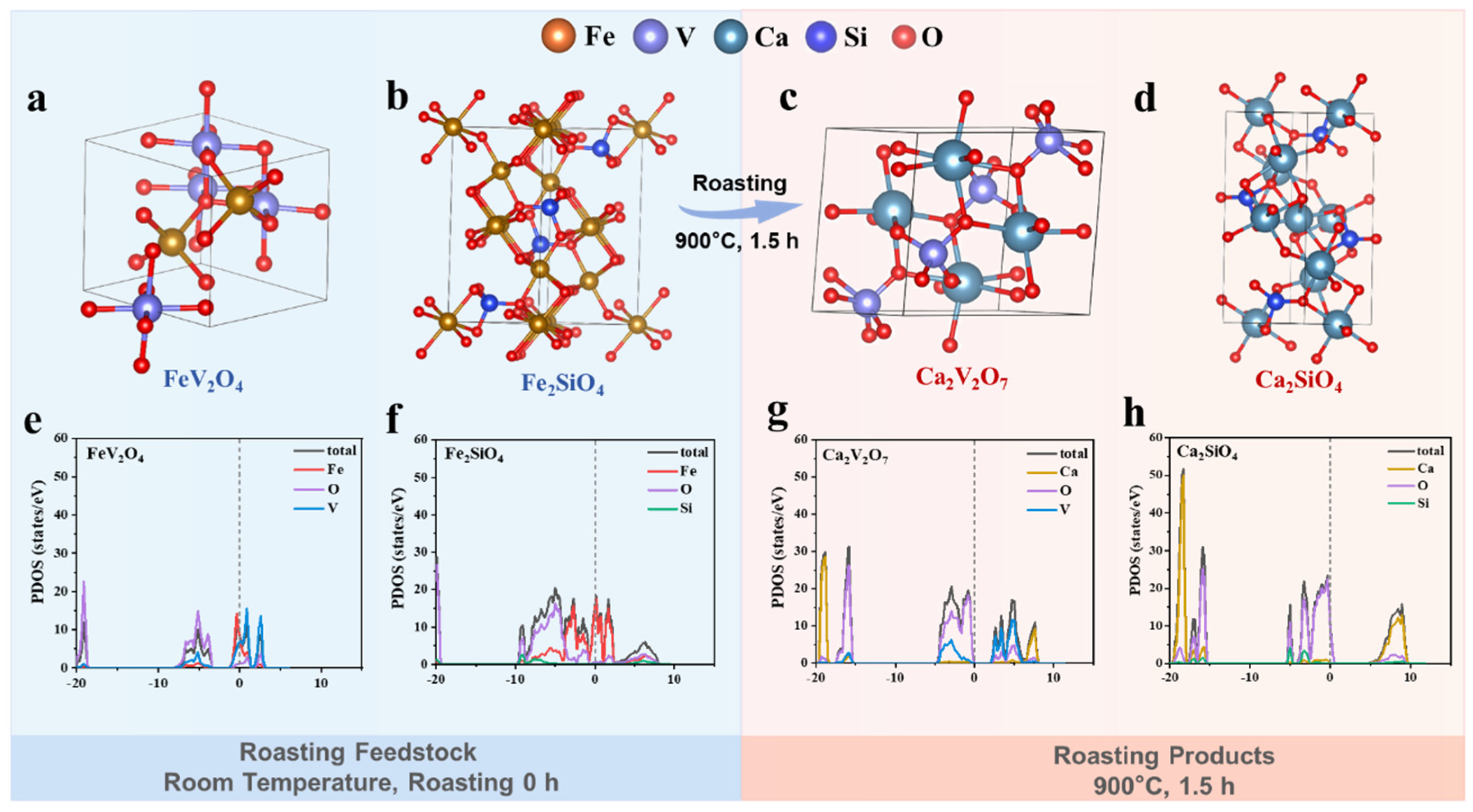
To further analyze the phase transformation rules throughout the VTS calcification roasting–acid leaching process, DFT with the GGA was used to systematically calculate the geometric structures and projected density of states (PDOS) of primary VTS initial phases (FeV2O4, Fe2SiO4) and calcification roasting products (Ca2V2O7, Ca2SiO4). The crystal structures of the initial phases FeV2O4 and Fe2SiO4 are centered on stable V–O, Fe–O, and Si–O bonds (Figure 12a,b), exhibiting a large overlap peak area below the Fermi level (Figure 12e,f), indicating high bonding energy and strong chemical stability. This is the main reason why key elements such as V and Si in VTS are difficult to leach directly. Under calcination conditions, the introduction of CaO disrupts the stable structure of the initial phase, gradually generating Ca2V2O7 and Ca2SiO4 (Figure 12c,d). PDOS analysis shows that the overlap area of the electronic states of Ca–O and V–O bonds in Ca2V2O7 is smaller than that of the Ca–O and Si–O bonds in Ca2SiO4 (Figure 12g,h), indicating that the Ca2V2O7 bond energy is weaker and less stable, making it more prone to dissociation during subsequent acid leaching.
Bader charge analysis further revealed (Table 4) that the average charge transfer amounts of metal atoms (Ca, Si) to oxygen atoms in Ca2SiO4 were +1.58 e and +4.00 e, respectively. While the average charge transfer from Ca to V in Ca2V2O7 is only +1.62 e and +2.13 e, respectively. Furthermore, the average negative charge of O atoms increased from −1.07 e in Ca2V2O7 to −1.69 e in Ca2SiO4. This stronger charge transfer implies that Ca2SiO4 has a higher ionic bond composition and structural stability, while the weaker charge transfer and bonding in Ca2V2O7 makes it more prone to releasing vanadium ions in acid leaching systems. This theoretically explains the dominant position of Ca2V2O7 in the calcification products. To sum up, the DFT calculation results reveal the process in which FeV2O4 and Fe2SiO4 gradually decompose and transform into Ca2V2O7 and Ca2SiO4 during the roasting process, and the low stability of Ca2V2O7 is key to its efficient V release during acid leaching. The main chemical reaction equations involved in the sample heating process are as follows:
2FeV2O4(s) + 2.5O2(g) = 2V2O5(s) + Fe2O3(s)
Fe2SiO4(s) + 0.5O2(g) = SiO2(s) + Fe2O3(s)
2FeV2O4(s) + 2CaO(s) + 2.5O2(g) = 2CaV2O6(s) + Fe2O3(s)
2FeV2O4(s) + 4CaO(s) + 2.5O2(g) = 2Ca2V2O7(s) + Fe2O3(s)
2FeV2O4(s) + 6CaO(s) + 2.5O2(g) = 2Ca3V2O8(s) + Fe2O3(s)
Fe2SiO4(s) + 2CaO(s) + 0.5O2(g) = Ca2SiO4(s) + Fe2O3(s)
The major chemical reactions occurring during the leaching of the roasted products are expressed as follows:
Fe2O3(s) + 6HCl(aq) = 2FeCl3(aq) + 3H2O(l)
CaV2O6(s) + 8HCl(aq) = CaCl2(aq) + 2VOCl2(aq) + 4H2O(l) + Cl2(g)↑
Ca2V2O7(s) + 10HCl(aq) = 2CaCl2(aq) + 2VOCl2(aq) + 5H2O(l) + Cl2(g)↑
Ca3V2O8(s) + 12HCl(aq) = 3CaCl2(aq) + 2VOCl2(aq) + 6H2O(l) + Cl2(g)↑
Ca2SiO4(s) + 4HCl(aq) = 2CaCl2(aq) + H4SiO4(s)↓

3.8. Techno-Economic Potential and Risk Assessment

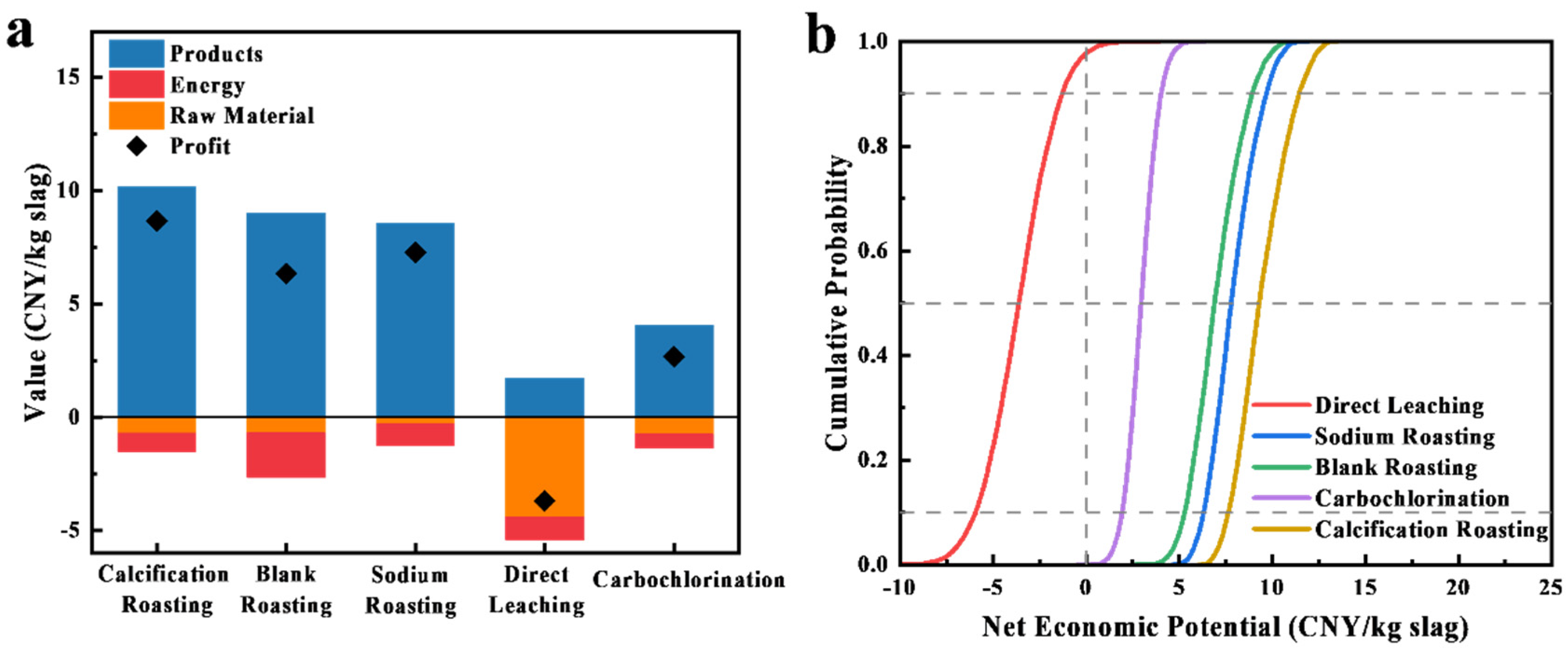
The Douglas hierarchical decision [50,51] method was used to conduct a secondary economic potential (EP2) assessment of the proposed calcification roasting–low-temperature acid leaching process, aiming to quantify its industrial application prospects [52]. Based on market price data from 2024–2025, this study compared the economic benefits of this new process with existing sodium calcination water leaching, blank calcination acid leaching, direct acid leaching, and carbon-chlorination processes (Table 5). The EP2 model is defined as follows:
E P 2 = i ( P i × C P , i ) + j ( B j × C B , j ) k ( R k × C R , k )
where
  • E P 2 : Economic Potential Level 2 (CNY/kg-slag).
  • P i : Mass flow rate of the main product.
  • C P , i : Market price of the main product (CNY/kg).
  • B j : Mass flow rate of the by-product.
  • C B , j : Market price of the by-product (CNY/kg).
  • R k : Mass flow rate of the raw material.
  • C R , k : Market price of the raw material (CNY/kg).

Considering the volatility of the bulk chemical raw material and energy markets, this study introduces Monte Carlo simulation to analyze the uncertainty of net economic potential, and performs 10,000 iterations on the EP2 model to evaluate its robustness. Given the recent sharp fluctuations in vanadium prices, V product prices are set to a triangular distribution, while raw material prices follow a uniform distribution; energy prices (water, electricity) are modeled as a normal distribution ( σ μ = 0.12 ) to cover extreme market conditions.
Table 5. Key technical parameters of various V extraction processes.
MethodsConditionsKey Reagents InputEnergy
Consumption
V Recovery
Calcification Roasting-Acid LeachingRoasting: 900 °C, 90 min
Leaching: 25 °C, 120 min
CaO, HCl0.82 kWh94.23%
Sodium Roasting-Water LeachingRoasting: 800 °C, 120 min
Leaching: 25 °C, 120 min
Na2CO31.02 kWh87.9% [17]
Blank Roasting-LeachingRoasting: 900 °C, 120 min
Leaching: 80 °C, 240 min
H2SO42.05 kWh94.55% [53]
Direct LeachingLeaching: 70 °C, 120 minH2SO41.05 kWh98% [54]
CarbochlorinationRoasting: 900 °C, 90 minToner, Cl20.8 kWh95% [55]
In Figure 13a, the calcification–roasting–low-temperature acid leaching process exhibits the best economic competitiveness, with a net economic potential of approximately 8.67 CNY/kg-slag, significantly outperforming the current mainstream sodium calcination process (~6.2 CNY/kg-slag). As seen by the cost structure analysis, this reduction is mostly due to the structural optimization of reagent costs: high-priced sodium carbonate (Na2CO3) would be substituted by the low-priced calcium oxide (CaO), thus leading to a substantial drop in the reagent costs of over 60. It is noteworthy that despite the high-temperature step in the process, which involves calcination at 900 °C, the resulting step of room temperature (25 °C) acid leaching seems to counteract energy use in calcination. Conversely, although the sodium calcification reaction occurs at a lower calcification temperature, it requires a lengthy period of high-temperature leaching (>80 °C), resulting in a similar amount of energy consumed between the two processes. Moreover, the direct acid leaching process has its drawback in that its cost of consuming acid is very high, such that it results in a negative EP2 value, which denotes that it is not economically viable given the prevailing market conditions. Benefiting from a V leaching efficiency as high as 94.23%, the process proposed in this study also achieves slightly higher product profitability than the traditional sodium leaching route.
Figure 13b illustrates the cumulative probability distribution (CDF) of the net economic potential for each process. The results show that the CDF curve of the calcification roasting process exhibits “first-order stochastic dominance” over all other technologies, meaning that at any cumulative probability level, this process provides a higher expected return. The collocation and crossover point between the curve and the break-even line (x = 0) also reveals the risk profile: the direct leaching process is loss-prone (nearing 100%), which is a structural investment risk, whereas the calcification roasting–low-temperature acid leaching process is highly robust and has a positive NEP even in the worst-case scenario of either an energy decline in vanadium prices or an increase in acid prices. Moreover, the slope of the curve is steeper, which means that it has less uncertainty about its economic returns. This process is less price-sensitive to the price of raw materials as compared to the carbon chlorination process, which remains considerably sensitive to chlorine price variability as well as having a greater likelihood of consistent investment returns. A discussion on economic potential indicates that the calcification–roasting–low-temperature acid leaching process described in this paper reduces structural costs by eliminating the need for roasting additives and allowing for room temperature leaching, while also presenting the least investment risk in uncertain market conditions. In this preliminary assessment model, the calcification calcination process demonstrates a competitive economic trend compared to the selected comparison techniques. Although further pilot-scale verification and detailed energy balance calculation are still needed for actual industrial applications, the preliminary results of this study suggest that this process has certain exploration value for industrial applications.

4. Conclusions

This study focuses on the efficient and clean recovery of vanadium resources from VTS. It has been established that the addition of calcium oxide as a roasting additive can successfully lower the Gibbs free energy of the roasting reaction and therefore increase the yield of V in FeV2O4 to more soluble vanadate (primarily Ca2V2O7) and deter impurity entrapment. The optimal conditions are as follows: alkali-to-slag ratio 0.4 (CaO: VTS = 2: 5), calcined at 900 °C for 1.5 h, leached at 10 mol/L HCl, solid–liquid ratio 1:6, and 25 °C for 2 h. The V leaching efficiency reaches 94.23%, achieving efficient recovery of V. Combining various characterization methods and theoretical calculations, the phase evolution path of the roasting process was clarified, and the mechanism by which Ca2V2O7 easily dissociates during acid leaching due to its weaker bond energy was revealed at the electronic structure level. Through economic evaluation and analysis, this process achieves structural cost reduction, providing a feasible technical solution and theoretical basis for the resource utilization of VTS and the green extraction of key metals.

Author Contributions

Conceptualization, Z.M. and J.D.; methodology, Z.Z., Z.M., J.D., S.L. and J.C.; validation, T.L. and G.W.; formal analysis, Z.Z., T.L. and S.X.; investigation, Z.Z.; writing—original draft preparation, Z.Z.; writing—review and editing, Z.Y., G.W. and S.X.; visualization, S.L. and J.C.; funding acquisition, Z.Y. All authors have read and agreed to the published version of the manuscript.

Funding

This work was funded by the National Key R&D Program of China, Grant Number 2024YFC2910900, China Postdoctoral Science Foundation, Grant Number 2024M751661 and National Natural Science Foundation of China, Grant Number 52404421.

Data Availability Statement

The original contributions presented in this study are included in the article. Further inquiries can be directed to the corresponding authors.

Conflicts of Interest

The authors declare no conflicts of interest.

References

  1. Weeks, M.E. The Discovery of the Elements. VII. Columbium, Tantalum, and Vanadium. J. Chem. Educ. 1932, 9, 863. [Google Scholar] [CrossRef]
  2. Wu, D.; Geng, Y.; Gao, Z.; Wu, Y. Uncovering the Evolution of Vanadium Cycle in China during 2000–2022. Resour. Environ. Sustain. 2025, 19, 100188. [Google Scholar] [CrossRef]
  3. Li, Y.; Zhang, L.; Jiang, S.; Han, F.; Yang, D.; Liu, L.; Wang, Y.; Yuan, Z. Unraveling the Global Vanadium Cycle for a Resilient and Sustainable Supply. Environ. Sci. Technol. 2025, 59, 20377–20388. [Google Scholar] [CrossRef]
  4. Wang, Y.-H.; Wang, Y.-F.; Li, Y.-T.; Wu, C.; Han, X.-L.; Zhao, N.-N.; Zhang, Z.-K.; Dai, L.; Wang, L.; He, Z.-X. A Review on Vanadium Extraction Techniques from Major Vanadium-Containing Resources. Rare Met. 2024, 43, 4115–4131. [Google Scholar] [CrossRef]
  5. Moskalyk, R.; Alfantazi, A. Processing of Vanadium: A Review. Miner. Eng. 2003, 16, 793–805. [Google Scholar] [CrossRef]
  6. Van Thyne, R.J. Vanadium Alloys in Aerospace. JOM 1963, 15, 642–644. [Google Scholar] [CrossRef]
  7. Ning, P.; Lin, X.; Wang, X.; Cao, H. High-Efficient Extraction of Vanadium and Its Application in the Utilization of the Chromium-Bearing Vanadium Slag. Chem. Eng. J. 2016, 301, 132–138. [Google Scholar] [CrossRef]
  8. Crans, D.C.; Smee, J.J.; Gaidamauskas, E.; Yang, L. The Chemistry and Biochemistry of Vanadium and the Biological Activities Exerted by Vanadium Compounds. Chem. Rev. 2004, 104, 849–902. [Google Scholar] [CrossRef]
  9. Burwell, B. Extractive Metallurgy of Vanadium. JOM 1961, 13, 562–566. [Google Scholar] [CrossRef]
  10. Hu, B.; Zhang, C.; Yang, M.; Liu, Q.; Wang, M.; Wang, X. A Clean Metallurgical Process for Vanadium Precipitation from Chromium-Containing Vanadate Solution. Hydrometallurgy 2021, 205, 105742. [Google Scholar] [CrossRef]
  11. Zheng, Y.; Chen, J.; Chen, S.; Chen, F.; Wang, S.; Guo, Y.; Li, H.; Xu, F.; Zhang, J.; Yang, L. Effect of Calcification Roasting Process on Vanadium Oxidation and Extraction from Vanadium Titanomagnetite Pellets via Sulfuric Acid Leaching: Mechanism and Enhancement. Sep. Purif. Technol. 2025, 354, 128859. [Google Scholar] [CrossRef]
  12. Liu, L.; Li, G.; Zhao, L.; Li, J.; Li, Y. Recovery of Fe and V via Selective Reduction–Magnetic Separation of Vanadium-Titanium Magnetite Concentrate. Physicochem. Probl. Miner. Process. 2021, 58, 50–62. [Google Scholar] [CrossRef]
  13. Liu, X.-J.; Chen, D.-S.; Chu, J.-L.; Wang, W.-J.; Li, Y.-L.; Qi, T. Recovery of Titanium and Vanadium from Titanium–Vanadium Slag Obtained by Direct Reduction of Titanomagnetite Concentrates. Rare Met. 2022, 41, 1688–1696. [Google Scholar] [CrossRef]
  14. Liu, Z.; Wang, B.; Ding, X. Optimizing Pre-Reduction of Vanadium–Titanium Magnetite through Recycling and Integrating of Top Gas from Melting Furnace and Tail Gas from Rotary Kiln. Process Saf. Environ. Prot. 2024, 185, 86–95. [Google Scholar] [CrossRef]
  15. Yao, Z.; Yu, J.; Ma, B.; Wang, L.; Wang, C.; Wang, B.; Gao, M.; Feng, G. Clean Process for Vanadium Extraction from Vanadium-Bearing Converter Slag. J. Environ. Chem. Eng. 2023, 11, 109202. [Google Scholar] [CrossRef]
  16. Lee, J.-C.; Kurniawan; Kim, E.-Y.; Chung, K.W.; Kim, R.; Jeon, H.-S. A Review on the Metallurgical Recycling of Vanadium from Slags: Towards a Sustainable Vanadium Production. J. Mater. Res. Technol. 2021, 12, 343–364. [Google Scholar] [CrossRef]
  17. Li, H.-Y.; Fang, H.-X.; Wang, K.; Zhou, W.; Yang, Z.; Yan, X.-M.; Ge, W.-S.; Li, Q.-W.; Xie, B. Asynchronous Extraction of Vanadium and Chromium from Vanadium Slag by Stepwise Sodium Roasting–Water Leaching. Hydrometallurgy 2015, 156, 124–135. [Google Scholar] [CrossRef]
  18. Deng, R.; Xiao, H.; Xie, Z.; Liu, Z.; Yu, Q.; Chen, G.; Tao, C. A Novel Method for Extracting Vanadium by Low Temperature Sodium Roasting from Converter Vanadium Slag. Chin. J. Chem. Eng. 2020, 28, 2208–2213. [Google Scholar] [CrossRef]
  19. Ma, J.; Ma, B.; An, Y.; Wang, C.; Wang, B.; Gao, M.; Feng, G. Recovery of Vanadium from Rapid-Cooling Converter Vanadium Slag by Sodium Roasting and Water Leaching. JOM 2024, 76, 7047–7059. [Google Scholar] [CrossRef]
  20. Peng, H.; Guo, J.; Zheng, X.; Liu, Z.; Tao, C. Leaching Kinetics of Vanadium from Calcification Roasting Converter Vanadium Slag in Acidic Medium. J. Environ. Chem. Eng. 2018, 6, 5119–5124. [Google Scholar] [CrossRef]
  21. Li, H.-Y.; Wang, C.-J.; Yuan, Y.-H.; Guo, Y.; Diao, J.; Xie, B. Magnesiation Roasting-Acid Leaching: A Zero-Discharge Method for Vanadium Extraction from Vanadium Slag. J. Clean. Prod. 2020, 260, 121091. [Google Scholar] [CrossRef]
  22. Xiang, J.-Y.; Wang, X.; Pei, G.-S.; Huang, Q.-Y.; Lü, X.-W. Recovery of Vanadium from Vanadium Slag by Composite Roasting with CaO/MgO and Leaching. Trans. Nonferrous Met. Soc. China 2020, 30, 3114–3123. [Google Scholar] [CrossRef]
  23. Cheng, J.; Li, H.-Y.; Hai, D.; Chen, X.-M.; Diao, J.; Xie, B. Magnesiation Roasting Kinetics Exploration of Vanadium Slag toward Minimization of Tailing Toxicity. J. Hazard. Mater. 2023, 452, 131378. [Google Scholar] [CrossRef]
  24. Cheng, J.; Li, H.; Hai, D.; Chen, X.; Diao, J.; Xie, B. Acidic Leaching Kinetics Study on Vanadium from Magnesiation-Roasted Vanadium Slag. Trans. Nonferrous Met. Soc. China 2024, 34, 669–680. [Google Scholar] [CrossRef]
  25. Hu, X.; Peng, X.; Kong, L. Mechanism for Photopromoted Release of Vanadium from Vanadium Titano-Magnetite. Environ. Sci. Technol. 2018, 52, 1954–1962. [Google Scholar] [CrossRef]
  26. Wang, Z.; Zheng, S.; Wang, S.; Qin, Y.; Du, H.; Zhang, Y. Electrochemical Decomposition of Vanadium Slag in Concentrated NaOH Solution. Hydrometallurgy 2015, 151, 51–55. [Google Scholar] [CrossRef]
  27. Hui, X.; Zhang, J.; Liang, Y.; Chang, Y.; Zhang, W.; Zhang, G. Comparison and Evaluation of Vanadium Extraction from the Calcification Roasted Vanadium Slag with Carbonation Leaching and Sulfuric Acid Leaching. Sep. Purif. Technol. 2022, 297, 121466. [Google Scholar] [CrossRef]
  28. Yang, Z.; Li, H.-Y.; Yin, X.-C.; Yan, Z.-M.; Yan, X.-M.; Xie, B. Leaching Kinetics of Calcification Roasted Vanadium Slag with High CaO Content by Sulfuric Acid. Int. J. Miner. Process. 2014, 133, 105–111. [Google Scholar] [CrossRef]
  29. Jiang, T.; Wen, J.; Zhou, M.; Xue, X. Phase Evolutions, Microstructure and Reaction Mechanism during Calcification Roasting of High Chromium Vanadium Slag. J. Alloys Compd. 2018, 742, 402–412. [Google Scholar] [CrossRef]
  30. Kuehnel, M.F.; Sahm, C.D.; Neri, G.; Lee, J.R.; Orchard, K.L.; Cowan, A.J.; Reisner, E. ZnSe Quantum Dots Modified with a Ni(Cyclam) Catalyst for Efficient Visible-Light Driven CO2 Reduction in Water. Chem. Sci. 2018, 9, 2501–2509. [Google Scholar] [CrossRef]
  31. Shindell, D.; Smith, C.J. Climate and Air-Quality Benefits of a Realistic Phase-out of Fossil Fuels. Nature 2019, 573, 408–411. [Google Scholar] [CrossRef]
  32. Perdew, J.P.; Burke, K.; Ernzerhof, M. Generalized Gradient Approximation Made Simple. Phys. Rev. Lett. 1996, 77, 3865–3868. [Google Scholar] [CrossRef]
  33. Li, X.; Sun, Y.; Xu, J.; Shao, Y.; Wu, J.; Xu, X.; Pan, Y.; Ju, H.; Zhu, J.; Xie, Y. Selective Visible-Light-Driven Photocatalytic CO2 Reduction to CH4 Mediated by Atomically Thin CuIn5S8 Layers. Nat. Energy 2019, 4, 690–699. [Google Scholar] [CrossRef]
  34. Zhu, Y.; Deng, W.; Tan, Y.; Shi, J.; Wu, J.; Lu, W.; Jia, J.; Wang, S.; Zou, Y. In Situ Topochemical Transformation of ZnIn2S4 for Efficient Photocatalytic Oxidation of 5-Hydroxymethylfurfural to 2,5-Diformylfuran. Adv. Funct. Mater. 2023, 33, 2304985. [Google Scholar] [CrossRef]
  35. Guo, Y.; Sun, J.; Tang, Y.; Jia, X.; Nie, Y.; Geng, Z.; Wang, C.; Zhang, J.; Tan, X.; Zhong, D.; et al. Efficient Interfacial Electron Transfer Induced by Hollow-Structured ZnIn2S4 for Extending Hot Electron Lifetimes. Energy Environ. Sci. 2023, 16, 3462–3473. [Google Scholar] [CrossRef]
  36. Nain, P.; Kumar, A. Understanding Metal Dissolution from Solar Photovoltaics in MSW Leachate under Standard Waste Characterization Conditions for Informing End-of-Life Photovoltaic Waste Management. Waste Manag. 2021, 123, 97–110. [Google Scholar] [CrossRef]
  37. Gireesh, V.S.; Vinod, V.P.; Krishnan Nair, S.; Ninan, G. Catalytic Leaching of Ilmenite Using Hydrochloric Acid: A Kinetic Approach. Int. J. Miner. Process. 2015, 134, 36–40. [Google Scholar] [CrossRef]
  38. Duan, S.; Liao, H.; Cheng, F.; Tao, M. Effect of Curing Condition and Carbonization Enhancement on Mechanical Properties of Fly Ash -Desulfurization Gypsum—Steel Slag Blocks. J. CO2 Util. 2020, 38, 282–290. [Google Scholar] [CrossRef]
  39. Dong, Z.; Zhang, J.; Yan, B. Co-Extraction of Vanadium Titanium and Chromium from Vanadium Slag by Oxalic Acid Hydrothermal Leaching with Synergy of Fe Powder. Metall. Mater. Trans. B 2021, 52, 3961–3969. [Google Scholar] [CrossRef]
  40. Chen, X.-M.; Li, H.-Y.; Wei, C.-C.; Cheng, J.; Diao, J.; Xie, B.; Pan, F. Selective Chemical Etching of Vanadium Slag Enables Highly Efficient and Clean Extraction of Vanadium. ACS Sustain. Chem. Eng. 2025, 13, 1327–1335. [Google Scholar] [CrossRef]
  41. Zhang, X.; Liu, F.; Xue, X.; Jiang, T. Effects of Microwave and Conventional Blank Roasting on Oxidation Behavior, Microstructure and Surface Morphology of Vanadium Slag with High Chromium Content. J. Alloys Compd. 2016, 686, 356–365. [Google Scholar] [CrossRef]
  42. Yue, H.; Cheng, G.; Liu, J.; Xue, X.; Zhang, W. A Novel Method of Recovery Vanadium from Vanadium Slag through CaO2-Briquetting Roasting Process. Steel Res. Int. 2022, 93, 2100788. [Google Scholar] [CrossRef]
  43. Jeanloz, R. Infrared Spectra of Olivine Polymorphs: α, β Phase and Spinel. Phys. Chem. Miner. 1980, 5, 327–341. [Google Scholar] [CrossRef]
  44. Sun, Y.; Yao, M.-S.; Zhang, J.-P.; Yang, G. Indirect CO2 Mineral Sequestration by Steelmaking Slag with NH4Cl as Leaching Solution. Chem. Eng. J. 2011, 173, 437–445. [Google Scholar] [CrossRef]
  45. Kratochvíla, J.; Salajka, Z.; Kazda, A.; Kadlc, Z.; Souček, J.; Gheorghiu, M. Determination of Hydroxyl Groups and Free Water on Silica Gel in the near Infrared Region. J. Non-Cryst. Solids 1990, 116, 93–99. [Google Scholar] [CrossRef]
  46. Lopinski, G.P.; Kodra, O.; Kunc, F.; Kennedy, D.C.; Couillard, M.; Johnston, L.J. X-Ray Photoelectron Spectroscopy of Metal Oxide Nanoparticles: Chemical Composition, Oxidation State and Functional Group Content. Nanoscale Adv. 2025, 7, 1671–1685. [Google Scholar] [CrossRef]
  47. You, Y.; Hu, Q.; He, F.; Liu, Y.; Huang, Q.; Liu, X.; You, Z.; Lv, X. Synthesis of Vanadium Nitride from Vanadium Spinel by Synchronous Reduction and Nitridation with Ammonia Energy. Int. J. Energy Res. 2022, 46, 18465–18476. [Google Scholar] [CrossRef]
  48. Elder, J.P. The General Applicability of the Kissinger Equation in Thermal Analysis. J. Therm. Anal. 1985, 30, 657–669. [Google Scholar] [CrossRef]
  49. Sánchez-Jiménez, P.; Criado, J.; Pérez-Maqueda, L. Kissinger Kinetic Analysis of Data Obtained under Different Heating Schedules. J. Therm. Anal. Calorim. 2008, 94, 427–432. [Google Scholar] [CrossRef]
  50. Ahmat, F.; Yunus, M.Y.M. Revised Douglas Method for Rare Earth Element Extraction Processes: A Case Study of Extraction from Malaysian Monazite Sand. AIP Conf. Proc. 2023, 2792, 040004. [Google Scholar] [CrossRef]
  51. Douglas, J.M. A Hierarchical Decision Procedure for Process Synthesis. AIChE J. 1985, 31, 353–362. [Google Scholar] [CrossRef]
  52. Perez Zuniga, D.L.; Luna Barrios, E.J.; Peralta-Ruiz, Y.Y.; Gonzalez-Delgado, A.D. Techno-Economic Sensitivity of Bio-Hydrogen Production from Empty Palm Fruit Bunches under Colombian Conditions. Chem. Eng. Trans. 2016, 52, 1117–1122. [Google Scholar] [CrossRef]
  53. Yao, Z.; Zhang, Q.; Wang, L.; Zhang, W.; Ma, B.; Wang, C. Non-Salt Roasting Mechanism of V–Cr Slag toward Efficient Selective Extraction of Vanadium. J. Ind. Eng. Chem. 2023, 126, 588–600. [Google Scholar] [CrossRef]
  54. Mirazimi, S.M.J.; Rashchi, F.; Saba, M. A New Approach for Direct Leaching of Vanadium from LD Converter Slag. Chem. Eng. Res. Des. 2015, 94, 131–140. [Google Scholar] [CrossRef]
  55. Seron, A.; Menad, N.; Galle-Cavalloni, P.; Bru, K. Selective Recovery of Vanadium by Oxy-Carbochlorination of Basic Oxygen Furnace Slag: Experimental Study. J. Sustain. Metall. 2020, 6, 478–490. [Google Scholar] [CrossRef]
Figure 1. XRD pattern of VTS.
Metals 16 00472 g001
Figure 2. (a) The effects of different additives (NaCl, CaO, MgO) and blank control on the leaching efficiencies of value metals; (b) the Gibbs free energy of FeV2O4 roasting reaction with temperature under different additives and blank conditions; (c) the Gibbs free energy of acid leaching reaction of different products with temperature; and (d) the effects of the mass ratio of VTS to CaO (mVTS:mCaO) on the leaching efficiencies of V, Ti, Al, Mn, and Fe.
Metals 16 00472 g002
Figure 3. XRD patterns of VTS roasted at various temperatures ranges of (a) 200–600 °C and (b) 700–1100 °C.
Metals 16 00472 g003
Figure 4. (a) FT-IR spectra of VTS roasted at temperatures from 200 °C to 1100 °C; (b) variations in the leaching efficiencies of V, Ti, Al, Mn, and Fe as a function of roasting temperature.
Metals 16 00472 g004
Figure 5. SEM micrographs of VTS showing the microscopic morphology at corresponding roasting temperatures.
Metals 16 00472 g005
Figure 6. XRD patterns of VTS roasted at roasting times of (a) 0.5–2.0 h and (b) 2.5–4.0 h.
Metals 16 00472 g006
Figure 7. (a) FT-IR spectra of VTS roasted at times from 0.5 h to 4.0 h. (b) Variations in the leaching efficiencies of V, Ti, Al, Mn, and Fe as a function of roasting time.
Metals 16 00472 g007
Figure 8. SEM micrographs of VTS showing the microscopic morphology at corresponding roasting times.
Metals 16 00472 g008
Figure 9. XPS spectra of (a) V, (b) Fe; (c) EDS spectra of the raw VTS sample; XPS spectra of (d) V, (e) Fe; (f) EDS spectra of the sample roasted under optimal conditions.
Metals 16 00472 g009
Figure 10. (a) Thermogravimetric analysis curves of the VTS and CaO mixed sample; (b) DSC curves of the VTS-CaO system obtained at different heating rates; (c) linear relationship between ln(β/Tp2) and 1/Tp (Kissinger plot); (d) functional relationship between lnβ and 1/Tp (Ozawa plot).
Metals 16 00472 g010
Figure 11. The influence of different (a) HCl concentrations, (b) leaching temperatures, (c) leaching times, (d) solid–liquid ratios on the leaching efficiencies of valuable metals in VTS.
Metals 16 00472 g011
Figure 12. The evolution of the crystal structures of major components in VTS during roasting and their corresponding PDOS plots: structures and PDOS of (a,e) FeV2O4, (b,f) Fe2SiO4, (c,g) Ca2V2O7, (d,h) Ca2SiO4.
Metals 16 00472 g012
Figure 13. (a) Stacked cost–benefit chart of different V extraction processes; (b) Cumulative Distribution Function (CDF) plot of the net economic potential for various V extraction processes (The vertical grey dashed line indicates the breakeven point (Net EP = 0). The horizontal grey dashed lines denote the 80% confidence interval (10% and 90%)).
Metals 16 00472 g013
Table 1. Quantitative analysis of oxide components in VTS.
CompoundFe2O3SiO2V2O5MnOCr2O3TiO2CaOAl2O3
wt%39.016.812.19.198.315.284.861.96
Table 2. Peak positions and phase identification results in XRD at different roasting temperatures and times.
PhaseFormula2θ (°)Occurrence ConditionsEvolution Trend
VivianiteFeV2O430.2, 35.5, 43.1, 57.3Temperature: 200–300 °C
Time: Any initial stage
Reacts with CaO starting at 400 °C;
completely disappears at 700 °C
FayaliteFe2SiO431.7, 36.1, 52.0Temperature: 200–300 °C
Time: ≤0.5 h
Decomposes starting at 500 °C;
completely disappears at 700 °C, releasing encapsulated V
MagnetiteFe3O430.1, 35.4, 43.0, 62.5Temperature: 200–300 °C
Time: ≤0.5 h
Coexists with FeV2O4;
gradually oxidizes to Fe2O3 with increasing temperature
Calcium HydroxideCa(OH)218.0, 34.1, 47.1, 50.8Temperature: 200–300 °C
Time: 0.5 h
Derived from CaO hydration;
disappears after roasting time ≥ 1.0 h
Quartz (Residual)SiO226.6, 20.9, 50.2Temperature: ≤800 °C
Time: 0.5–1.5 h
Transient phase;
participates in reaction to form Ca2SiO4 with prolonged temperature/time;
completely disappears at 2.0 h
Calcium MetavanadateCaV2O612.6, 25.4, 31.8, 36.7Temperature: 400 °C
Time: Appears at 0.5 h, persists at 1.0 h, weakens at 1.5 h
Initial calcium vanadate product;
converts to Ca2V2O7 etc. with increasing temperature or prolonged time
HematiteFe2O333.2, 35.6, 54.1, 62.4Temperature: 500–700 °C
Time: Strong peak at 0.5 h, stable afterward
Oxidation product of FeV2O4;
peak intensity increases with rising temperature
Vanadium PentoxideV2O520.3, 26.1, 31.0, 34.3Temperature: 500–700 °C
Time: Transient intermediate
Intermediate oxidation product, rapidly converts to calcium vanadates
Calcium PyrovanadateCa2V2O728.3, 30.9, 35.9, 47.5Temperature: 800–1100 °C
Time: Peak at 1.0 h, significantly enhanced at 1.5 h, stable ≥2.0 h
High-temperature stable phase with good acid solubility;
1.5 h is the optimal roasting time
Dicalcium SilicateCa2SiO432.1, 41.4, 49.5Temperature: 800–1100 °C
Time: Initial at 0.5 h, significantly enhanced at 2.0 h
Fixes SiO2 to suppress silicate encapsulation of V;
stable at high temperatures
Calcium OrthovanadateCa3V2O827.5, 33.8, 47.8, 56.5Temperature: 900–1100 °C
Time: Appears at 2.0 h
Compared with calcium pyrovanadate, exhibits poorer acid solubility than Ca3V2O8
Table 3. Kinetic parameters of the VTS and CaO system for different reaction stages under various heating rates.
DSC Peak SequenceThe Fitting Straight LineEa (kJ·mol−1)A (min−1)n
ln(β/Tp2)—1/Tplnβ—1/Tp
1y = −7531.12x + 8.84y = −8360.84x + 22.9062.615.20 × 1070.90
2y = −5935.28x + 56.62y = −61109.54x + 72.1849.352.31 × 10280.097
Table 4. The Bader charge distribution of the roasted products.
Metal OxidesAtomBader ChargeAverage Bader Charge
Ca2V2O7O−14.95 e−1.07 e
Ca+6.46 e+1.62 e
V+8.49 e+2.13 e
Ca2SiO4O−27.07 e−1.69 e
Ca+11.07 e+1.58 e
Si+16.00 e+4.00 e
Disclaimer/Publisher’s Note: The statements, opinions and data contained in all publications are solely those of the individual author(s) and contributor(s) and not of MDPI and/or the editor(s). MDPI and/or the editor(s) disclaim responsibility for any injury to people or property resulting from any ideas, methods, instructions or products referred to in the content.