Article

Mechanical Origin of Twinning Variant Selection in Commercially Pure Titanium Under Plane Strain Compression

LEM3, Arts et Métiers, CNRS, Université de Lorraine, F-57000 Metz, France
*
Author to whom correspondence should be addressed.
Metals 2026, 16(4), 394; https://doi.org/10.3390/met16040394
Submission received: 24 February 2026 / Revised: 25 March 2026 / Accepted: 30 March 2026 / Published: 2 April 2026

Abstract

The selection of deformation mechanisms in hexagonal close-packed (HCP) metals is strongly influenced by both crystallographic orientation and macroscopic deformation constraints. In commercially pure titanium, plastic deformation under constrained loading conditions involves a complex interplay between dislocation slip and deformation twinning, whose respective activation cannot be fully described by classical stress-based criteria. In this study, the mechanical origin of slip and twinning variant selection in commercially pure titanium subjected to plane strain compression is investigated experimentally. Plane strain compression is used as a canonical loading condition representative of constrained deformation paths encountered in sheet metal forming. Interrupted in-situ electron backscatter diffraction is combined with slip trace and twin variant analyses to identify the active deformation mechanisms at the grain scale. Resolved shear stress calculations show that stress-based criteria provide a necessary first-order condition for the activation of both slip and twinning systems. While the Schmid factor reasonably predicts part of the observed slip activity, it fails to uniquely determine the selection of active twinning variants. A kinematic analysis reveals that twinning variant selection is governed by the compatibility between the deformation induced by twinning and the macroscopic strain constraints imposed by plane strain compression. Only variants whose deformation accommodates compression along the loading axis, extension along the free in-plane direction, and minimal strain along the constrained in-plane direction are preferentially activated. These results demonstrate that deformation mechanism selection in HCP titanium under constrained loading conditions results from a combined effect of resolved shear stress and kinematic compatibility. The proposed framework provides a physically grounded basis for interpreting deformation-induced texture evolution and offers clear perspectives for the development of crystal plasticity models incorporating twinning under complex strain paths.

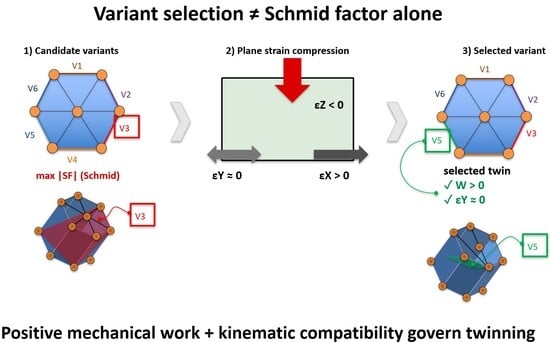
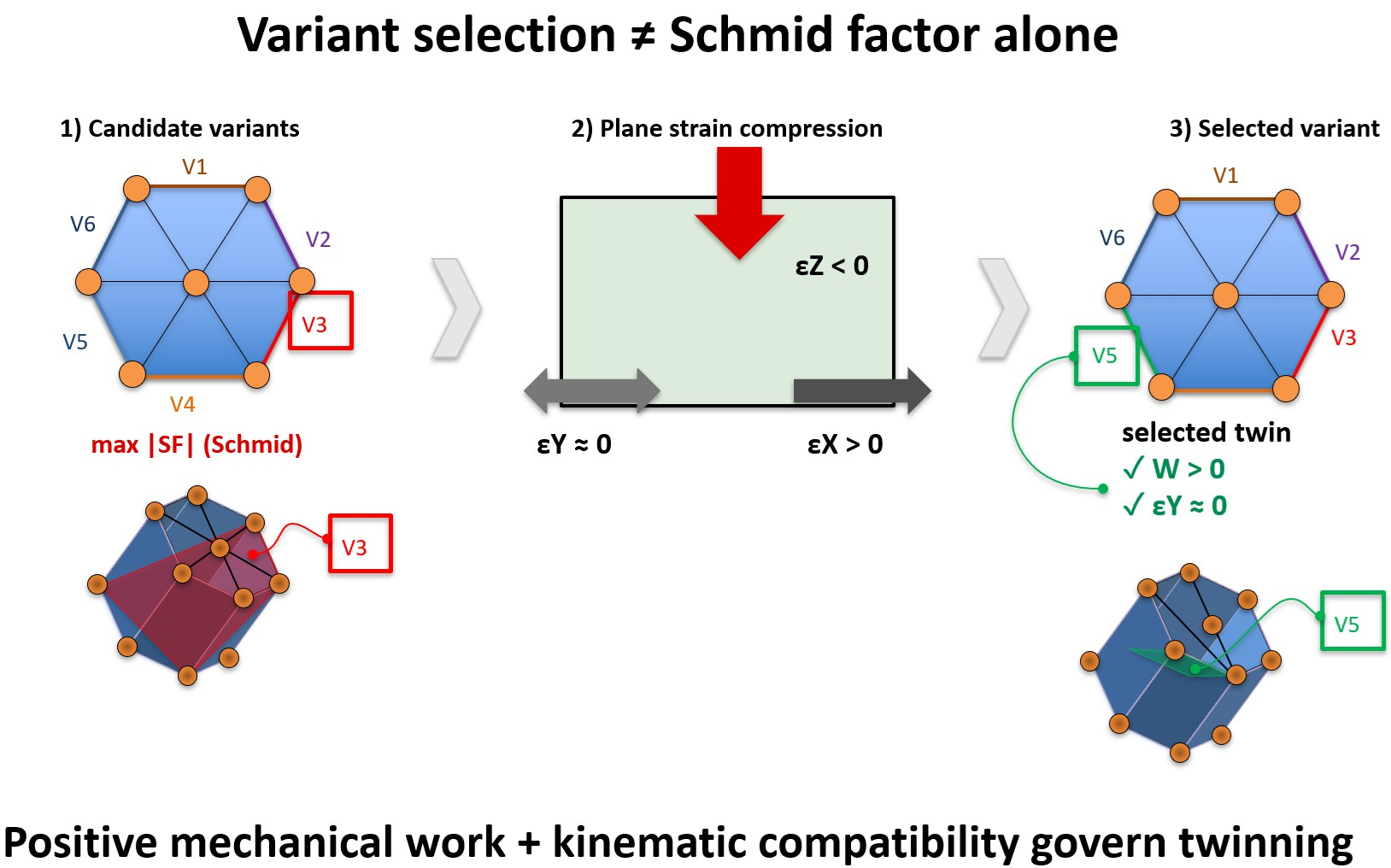
Graphical Abstract

1. Introduction

Hexagonal close-packed (HCP) metals such as titanium exhibit complex plastic behavior due to the limited number of independent slip systems available at room temperature. In commercially pure titanium, plastic deformation is accommodated by a combination of dislocation slip and deformation twinning, whose relative activity strongly depends on crystallographic orientation, loading mode, and deformation constraints [1,2,3,4,5]. Consequently, both the mechanical response and the deformation-induced texture evolution are highly anisotropic and sensitive to the imposed strain path [6,7,8].
Among the various deformation mechanisms, deformation twinning plays a key role by providing additional deformation modes and inducing abrupt crystallographic reorientations. In titanium, extension twinning of the { 10 1 ¯ 2 } 10 1 ¯ 1 type (T1) and compression twinning of the { 11 2 ¯ 2 } 11 2 ¯ 3 type (C1) are commonly observed under monotonic loading [9,10,11,12]. These twinning modes strongly influence strain accommodation and texture evolution, particularly under constrained loading conditions such as plane strain compression [13,14,15,16].
The activation of crystallographic systems is classically rationalized using the Schmid law, which evaluates the resolved shear stress acting on a given plane and direction. While this criterion is generally effective for slip, its applicability to deformation twinning is more subtle. Twinning exhibits an intrinsic polarity: the shear associated with a given twinning system can only operate in one crystallographically defined sense, while the opposite shear (anti-twinning) is energetically unfavorable [17]. As a consequence, twinning activation depends not only on the magnitude of the resolved shear stress, but also on its sign and on the compatibility of the associated deformation with the imposed loading conditions.
Experimental studies have further demonstrated that the variants exhibiting the highest Schmid factor are not systematically activated, and that variant selection frequently deviates from a purely stress-based criterion [9,18,19,20,21]. These observations indicate that favorable stress resolution is a necessary but not sufficient condition for twinning activation.
From a mechanical standpoint, the formation of a twin requires that the mechanical work supplied by the external stress be positive, i.e., W = σ : ε twin > 0 [22,23,24]. This condition has been incorporated in energetic approaches to twin variant selection, where the deformation energy required to form a twin is explicitly evaluated [18,25,26,27,28]. These approaches highlight that twinning must be treated as a kinematically defined transformation, characterized by a specific deformation tensor, rather than solely as a stress-driven shear mechanism.
More generally, recent finite element and crystal plasticity simulations have shown that microstructure evolution and strain localization in titanium alloys are highly sensitive to crystallographic texture and slip–twin competition. In parallel, phase-field-type approaches provide a framework to describe interface-mediated microstructural evolution. However, these predictive models still rely on physically sound criteria to determine which deformation systems are activated at the grain scale.
In this context, a key unresolved issue is the selection of individual deformation variants under constrained loading conditions. While the role of texture on slip activity is relatively well established, the selection of twinning variants at the grain scale, especially under plane strain conditions, remains insufficiently understood. In particular, the respective roles of resolved shear stress, twin polarity, and kinematic compatibility with the imposed macroscopic strain state are not yet clearly disentangled.
Plane strain compression (PSC) provides a particularly relevant framework to address this question. Under PSC, deformation is characterized by compression along the loading axis, elongation along one in-plane direction, and negligible strain along the orthogonal in-plane direction [29,30]. This constrained strain path imposes strong kinematic restrictions on the deformation mechanisms that can accommodate the imposed deformation, making PSC an ideal configuration to investigate variant selection.
Beyond its fundamental interest, understanding deformation mechanism selection under constrained loading paths is directly relevant for the prediction of texture evolution and deformation heterogeneities in titanium sheet forming. It also provides key input for crystal plasticity models, which require robust criteria to describe the activation of slip and twinning systems under complex strain paths.
The objective of the present work is therefore to experimentally investigate the mechanical origin of slip and twinning variant selection in commercially pure titanium subjected to plane strain compression in a channel–die configuration. By combining interrupted EBSD observations with resolved shear stress analysis and explicit evaluation of the deformation kinematics, this study aims to clarify the respective roles of stress-based, polarity-related, and kinematic criteria in controlling deformation mechanism activation. The results provide a physically grounded framework for understanding deformation-induced texture evolution and for improving predictive models of HCP deformation under constrained loading conditions.

2. Experimental Strategy and Mechanical Framework

2.1. Material and Initial Microstructure

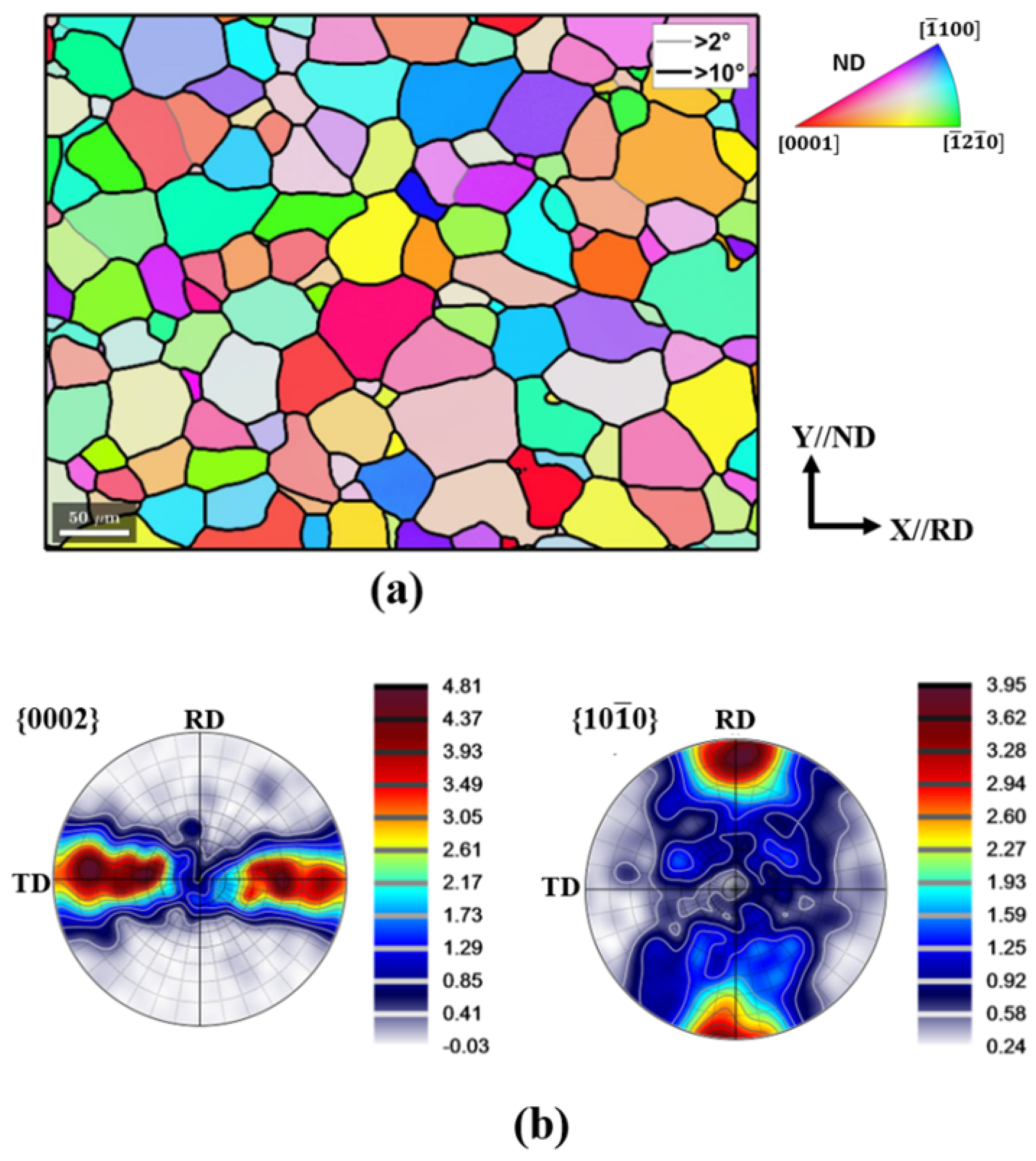
The material investigated in this study is commercially pure titanium (cp-Ti, ASTM Grade 2), supplied in the form of a recrystallized sheet with a thickness of 5 mm. The material was provided by Baoji Titans Metal Co. (Baoji, China). The initial microstructure consists of equiaxed grains with a homogeneous grain size distribution (average grain size of approximately 45 µm) and a weak rolling-type texture, as shown in Figure 1. The rolling direction (RD), transverse direction (TD), and normal direction (ND) define the principal axes of the sheet reference frame.
This initial condition was selected to minimize inherited texture effects and to ensure that the deformation mechanisms observed during loading primarily result from the imposed deformation path rather than from strong pre-existing crystallographic anisotropy.

2.2. Microstructural Characterization by SEM/EBSD

The microstructure and texture of the deformed samples were characterized using JSM-F100 Schottky Field Emission Scanning Electron Microscope from JEOL (Tokyo, Japan) (FEG-SEM) and electron backscatter diffraction (EBSD) equipped with the Symmetry CMOS (Complementary Metal-Oxide-Semiconductor) detector with a full camera resolution of 1244 × 1024 pixels (Oxford Instruments, Oxford, UK) and “Oxford Instruments Aztec” software, https://nano.oxinst.com/products/aztec/aztechkl, accessed on 21 June 2024 (Oxford Instruments).
Prior to EBSD, samples were mechanically polished using SiC papers (grit sizes from 1200# to 4000#), followed by electrolytic polishing for 30 s in a solution of 20% perchloric acid and 80% methanol, at 30 V and 5 °C. For the RD-PSC configuration, EBSD maps were acquired in the RDTD plane, whereas for the TD-PSC configuration, EBSD maps were acquired in the TDRD plane. In both cases, the electron beam was aligned with ND. The EBSD step size was 50 nm, and the orientation accuracy was on the order of 0.5–1°. Two EBSD regions of interest (ROI), each approximately 0.5 × 0.5 mm2, were investigated per sample and were located near the center of the specimen. Grain size distributions, grain boundary characteristics, and twinning activity were analyzed using the MTEX v5.10 toolbox for MATLAB R2020b® [31]. Crystallographic orientations were visualized as pole figures on the RDTD plane of the initial reference system using the ATEX software V5.08 [32].

2.3. Plane Strain Compression as a Canonical Loading Condition

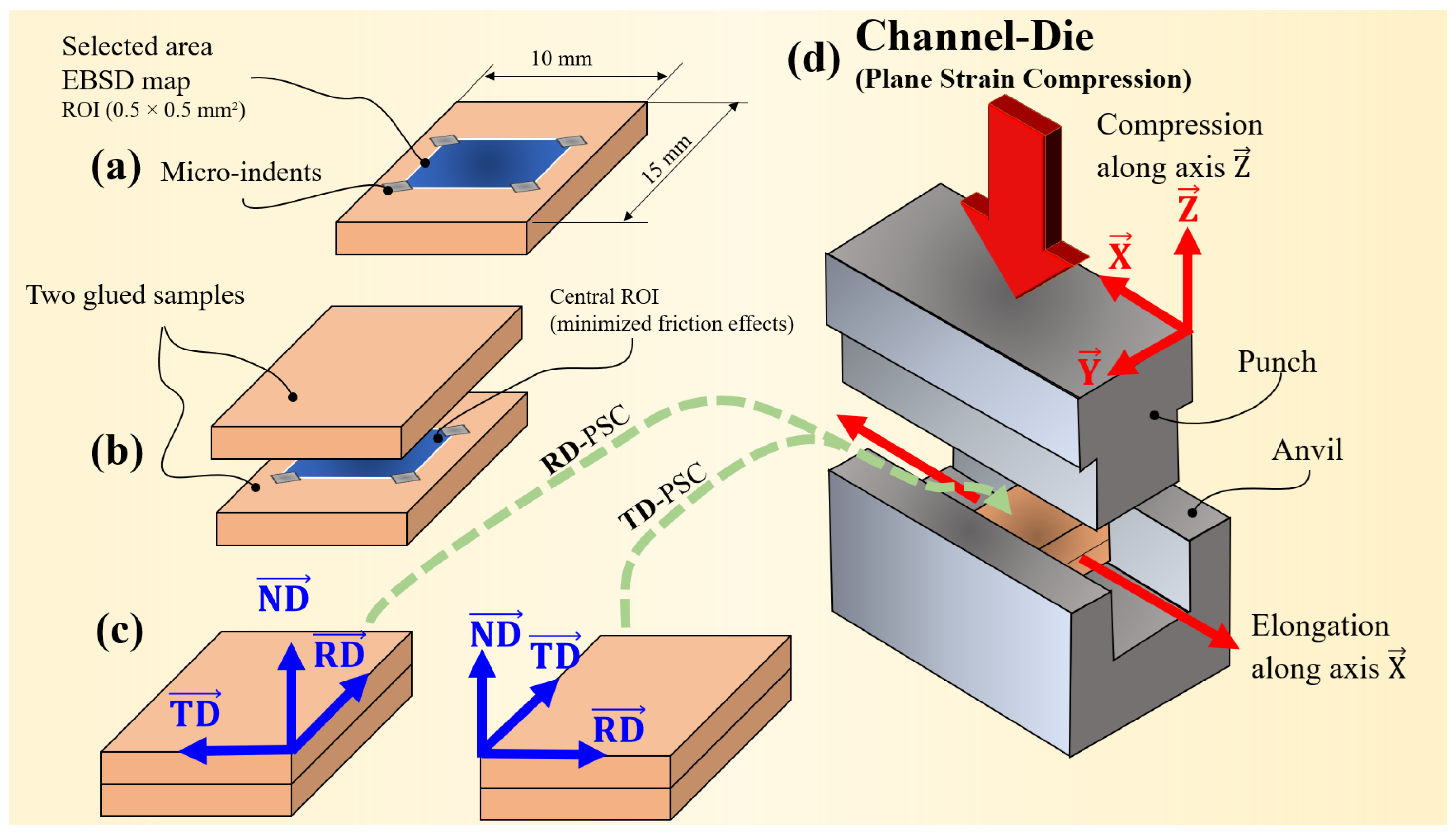
Plane strain compression (PSC) tests were performed at room temperature using a channel–die setup (Figure 2) on a Zwick 120T testing machine (ZwickRoell, Ulm, Germany), at a nominal strain rate of 10 3 s−1. Compression was applied along the normal direction (ND). The channel–die geometry enforces negligible strain along one in-plane direction and allows free elongation along the orthogonal in-plane direction (Figure 2d). Because of the compliance of the channel–die assembly and the absence of a local displacement measurement directly on the specimen, reliable macroscopic stress–strain curves could not be obtained for the present interrupted PSC tests. The global displacement included a non-negligible contribution from the loading frame, so the present study focuses on microstructural observations and crystallographic analysis rather than on quantitative macroscopic constitutive response. To reduce friction between the sample and the anvils, the contact surfaces were coated with PTFE (Teflon) prior to deformation. Although friction cannot be completely eliminated, the EBSD observations were performed at mid-thickness in order to minimize surface-related heterogeneities. The present analysis therefore does not assume a perfectly homogeneous macroscopic strain field, but rather uses the central ROI as a region where boundary effects are reduced and where grain-scale deformation mechanisms can be compared more consistently between the two loading configurations.
Two loading configurations were investigated by rotating the sheet within the channel–die:
  • RD-PSC: the rolling direction (RD) is aligned with the free elongation direction (X) of the channel–die,
  • TD-PSC: the transverse direction (TD) is aligned with the free elongation direction (X) of the channel–die.
In the remainder of the manuscript, any mention of “RD–PSC” or “TD–PSC” deformation configuration refers to these two PSC configurations.
In the channel–die reference frame ( X , Y , Z ) , the macroscopic strain state under PSC can be summarized as:
ε Z < 0 , ε X > 0 , ε Y 0 ,
where Z is the compression axis, X is the free elongation direction, and Y is the constrained in-plane direction. The relationship between ( X , Y , Z ) and the sheet frame ( RD , TD , ND ) depends on the PSC configuration: for RD-PSC, XRD and YTD; for TD-PSC, XTD and YRD (see Figure 2c).

2.4. Interrupted In-Situ EBSD and Identification of Deformation Mechanisms

Crystallographic orientations were characterized by EBSD on a surface normal to the normal direction (ND). Two sheets of identical thickness were first polished on their RDTD surfaces to EBSD quality. One of the sheets was marked with macroscopic Vickers indentation imprints to enable spatial relocation. The two polished RDTD surfaces were then glued face to face, so that the investigated interface was located at mid-thickness during deformation. Interrupted deformation was performed during PSC tests, allowing EBSD analyses to be conducted on the same surface areas before and after loading. The equivalent thickness reduction levels used for interrupted observations are reported in the corresponding figure captions and case studies. The identification of active slip systems was carried out using trace analysis, based on the comparison between experimentally observed slip traces and theoretical trace directions calculated from the crystallographic orientation of each grain.
Twinning activity was first detected from the characteristic misorientation relationships between parent grains and twins, which allowed the twinning mode (T1, T2 or C1) to be identified. The determination of the active twinning variant was then refined by combining this misorientation analysis with trace analysis, i.e., by comparing the experimentally observed twin traces with the calculated trace directions of all possible variants in the investigated grain. Twin identification was based on the characteristic misorientation relationships of the twinning modes, combined with trace analysis and morphological consistency. In particular, T1 twins were identified from misorientations close to 85 ° , C1 twins from misorientations close to 64 ° , and the active variant was determined by comparing the measured twin trace with the theoretical traces of all possible variants in the parent grain.

2.5. Slip and Twinning Systems Considered

The slip systems considered in the present work are summarized in Table 1. The twinning systems and twinning variants observed during deformation are summarized in Table 2, including the misorientation axis, misorientation angle, and twinning shear magnitude s used for displacement gradient tensor calculations (Appendix A).

3. Identification of Active Deformation Mechanisms Under Plane Strain Compression

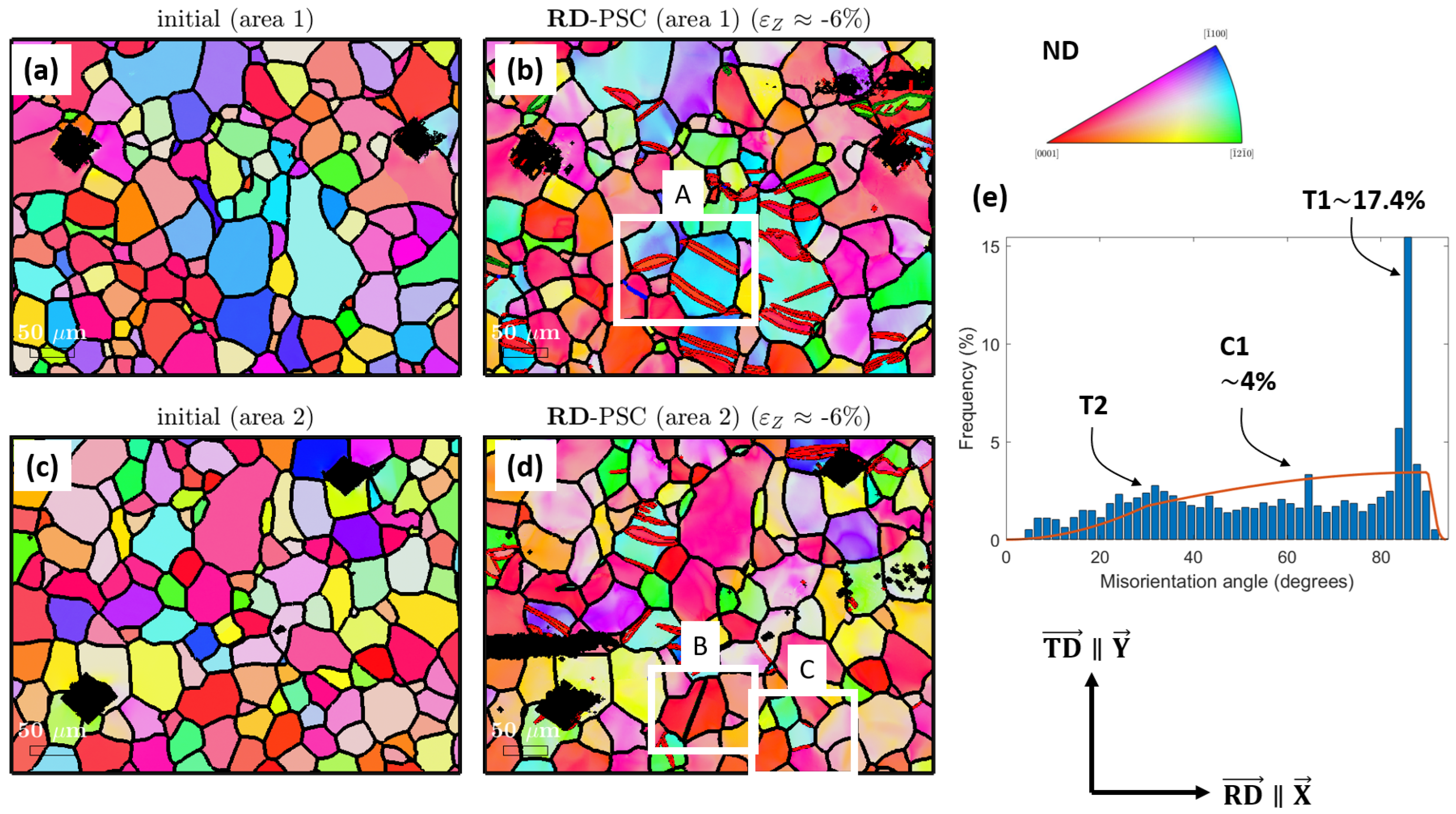
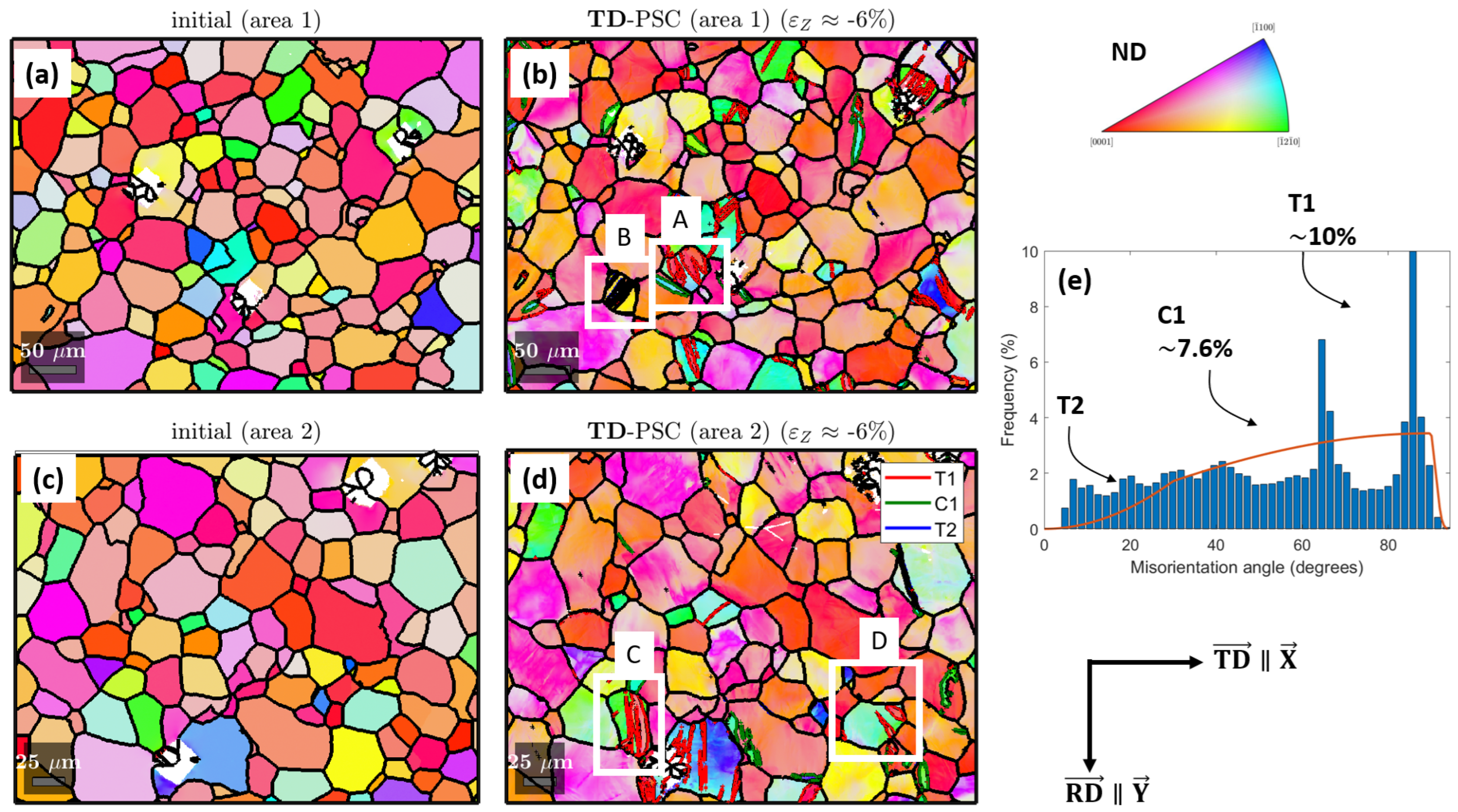
Figure 3 and Figure 4 present EBSD orientation maps obtained in two representative areas for each PSC configuration, both in the initial undeformed state and after a thickness reduction of approximately 6 % . Crystallographic orientations are displayed using inverse pole figure (IPF) coloring with respect to the normal direction (ND), while deformation twins are superimposed using a color code distinguishing the different twinning modes: T1 twins in red, C1 twins in green, and T2 twins in blue. The corresponding misorientation angle distributions are shown in panel (g) of each figure.
For the RD-PSC configuration (Figure 3), deformation is characterized by a limited amount of twinning, with slip being the dominant deformation mode in most grains. The misorientation distribution exhibits pronounced peaks corresponding to the characteristic misorientation angles of T2, C1 and T1 twins, although the overall twin volume fraction remains relatively low. Several grains exhibiting well-defined T1 twin lamellae are highlighted by white rectangles (labels A, B and C) and are selected for detailed case studies in Section 5.
In contrast, the TD–PSC configuration (Figure 4) displays a markedly higher twinning activity. In this case, numerous grains contain dense twin lamellae, and both T1 and C1 twins are frequently observed. This difference is reflected in the misorientation angle distribution, which shows a stronger contribution of C1 and T1 twins compared to RD-PSC. No specific grains are highlighted in this configuration, as the enhanced twinning activity is more homogeneously distributed across the observed areas.
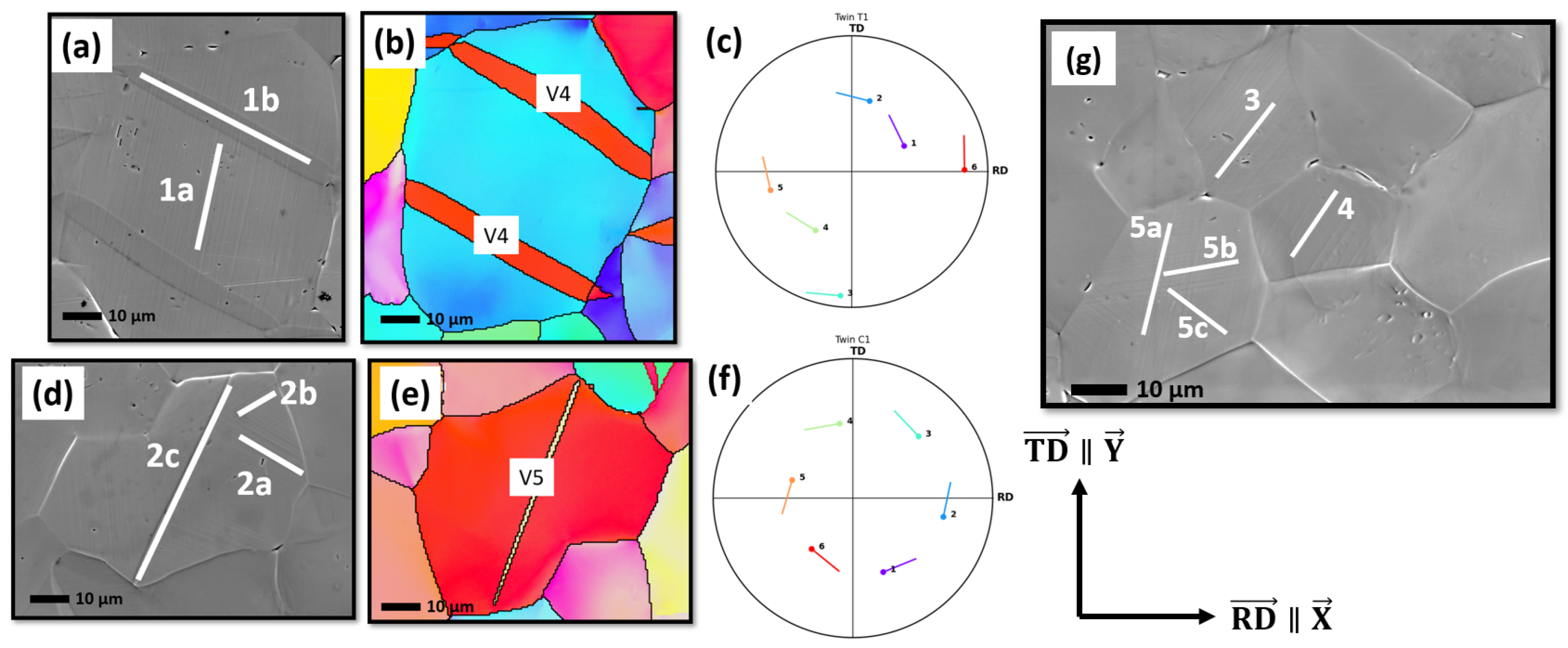
Complementary information on the activation of dislocation slip systems was obtained from slip trace analysis performed on SEM images and corresponding EBSD maps (Figure 5). Depending on grain orientation, deformation is accommodated either by single or multiple slip systems, or by a combination of slip and twinning. The experimentally measured trace angles were compared with theoretical trace directions to identify the most probable active systems. The associated Euler angles, experimental trace angles, identified deformation systems, and corresponding Schmid factors are summarized in Table 3.
Table 3 further shows that all experimentally activated twinning systems exhibit negative Schmid factors, highlighting the systematic role of the stress sign under compression for twin activation in the present PSC configuration.

3.1. Overview of Active Slip and Twinning Systems

Under plane strain compression, plastic deformation in cp-Ti is accommodated by a combination of dislocation slip and deformation twinning. For both PSC configurations, prismatic a slip and first-order pyramidal c + a slip are the dominant slip modes. Basal a slip was not observed within the investigated strain range, indicating that deformation proceeds primarily through non-basal mechanisms under the imposed loading conditions.
Deformation twinning contributes significantly to plastic accommodation, particularly in the TD-PSC configuration. Two main twinning modes are identified: { 10 1 ¯ 2 } 10 1 ¯ 1 extension twinning (T1) and { 11 2 ¯ 2 } 11 2 ¯ 3 compression twinning (C1). T2 twins are also detected, but their contribution remains secondary. The relative activity of these twinning modes strongly depends on the loading configuration, with enhanced twinning observed when the free elongation direction is aligned with TD. The relative activity of slip and twinning mechanisms identified from SE observations and EBSD analysis is summarized in Table 4 and Table 5.

3.2. Scope of the Observations

The experimental observations presented in this section lead to two important conclusions. First, plane strain compression activates only a restricted subset of the crystallographically available slip and twinning systems in cp-Ti, and their relative activity is strongly dependent on the loading configuration. Second, the observed differences between RD-PSC and TD-PSC cannot be fully rationalized on the basis of resolved shear stress alone. These findings motivate the mechanical analyses developed in Section 4 and Section 5, which aim to clarify the respective roles of stress-based criteria and kinematic compatibility in deformation mechanism selection.

4. Resolved Shear Stress Analysis and Macroscopic Strain Constraints

4.1. Macroscopic Stress State Under Plane Strain Compression

Under plane strain compression, the macroscopic deformation is constrained such that elongation occurs along one in-plane direction while deformation along the orthogonal in-plane direction is suppressed. The stress and strain states considered here should therefore be understood as idealized reference states for interpreting deformation mechanism selection. They provide the macroscopic constraints imposed by the channel–die geometry, while local deviations associated with friction and grain interactions may still occur. Assuming plastic incompressibility and considering friction-reduced contact conditions, the macroscopic stress state can be described by a diagonal stress tensor expressed in the channel–die reference frame ( X , Y , Z ) as:
σ = σ X 0 0 0 σ Y 0 0 0 σ Z ,
with σ Z < 0 and σ X > σ Y .

4.2. Resolved Shear Stress Formulation

For a given deformation system s, characterized by a unit shear direction b s and a unit normal to the shear plane n s , the resolved shear stress τ s is:
τ s = b s · σ · n s ,
which can be expressed using the Schmid tensor m s = b s n s as:
τ s = m s : σ .
For deformation twinning or slip, the Schmid factor is written in the geometrical form:
S F = cos φ · cos λ ,
where φ is the angle between the normal to the twinning or slip plane and the loading direction, and λ is the angle between the twinning shear or slip direction and the loading direction (Appendix A).

4.3. Resolved Shear Stress Statistics: Definition of Δ τ

To assess the relevance of stress-based activation, the resolved shear stress of the activated systems, denoted τ a s , was compared with the maximum resolved shear stress τ h s among all possible systems (for slip) or among all possible variants within the same family (for twinning). In the present work, resolved shear stresses are reported in normalized form, i.e., as dimensionless quantities relative to the applied macroscopic stress state. They should therefore be interpreted as relative indicators for comparing activated and competing systems, rather than as absolute stresses expressed in MPa. The difference
Δ τ = τ h s τ a s
was used as a quantitative indicator. When Δ τ 0 , the activated system corresponds to the one experiencing the highest resolved shear stress. Conversely, when Δ τ 0 , the activated system does not maximize the resolved shear stress, highlighting the limitations of a purely stress-based criterion.
The results for slip systems are summarized in Table 6, while those for deformation twinning are presented in Table 7.

4.4. Macroscopic Strain Constraints and Strain Compatibility

The statistics in Table 6 and Table 7 show that, in many cases, the system exhibiting the highest resolved shear stress τ h s does not correspond to the experimentally activated system τ a s . This discrepancy indicates that additional constraints beyond stress resolution must be considered [33,34] to explain deformation mechanism selection under plane strain compression.
To investigate these additional constraints, the strain compatibility between the imposed macroscopic deformation and the microscopic deformation induced by dislocation slip was analyzed for cases where τ h s τ a s . The displacement gradient tensor D S associated with each slip system was computed and expressed in the macroscopic channel–die frame, following Appendix A [35]. The corresponding strain tensor ε was obtained by symmetrization:
ε i j = 1 2 D i j S + D j i S .
In the channel–die reference frame ( X , Y , Z ) , the macroscopic plane strain compression (PSC) state is defined by:
ε P S C = ε X 0 0 0 ε Y 0 0 0 ε Z with ε X > 0 , ε Y 0 , ε Z < 0
where Z is the compression axis, X is the free in-plane elongation direction, and Y is the constrained in-plane direction.
Under plane strain compression, the macroscopic deformation is characterized by two constraints consistent with Equation (1):
  • Condition 1:  ε Y 0 (negligible strain along the constrained in-plane direction),
  • Condition 2:  ε X ε Z with ε Z < 0 (elongation along X balanced by compression along Z).
Thus, for both PSC configurations, the target strain tensor has the same diagonal form, and only the correspondence between the channel–die frame ( X , Y , Z ) and the sheet frame ( RD , TD , ND ) changes.
For RD-PSC:
X RD , Y TD , Z ND
so that, in the sheet reference frame ( RD , TD , ND ) ,
ε R D P S C = ε R D 0 0 0 ε T D 0 0 0 ε N D = + 0 0 0 0 0 0 0
For TD-PSC:
X TD , Y RD , Z ND
so that, in the sheet reference frame ( RD , TD , ND ) ,
ε T D P S C = ε R D 0 0 0 ε T D 0 0 0 ε N D = 0 0 0 0 + 0 0 0
For each activated system (A) and each system exhibiting the highest resolved shear stress (H), these two conditions were checked. The percentages of systems satisfying the conditions are summarized in Table 8.
For the RD-PSC configuration, activated P a systems exhibit a high degree of compatibility with PSC constraints: more than 80% satisfy Condition 1 and 100% satisfy Condition 2. In contrast, systems exhibiting the highest resolved shear stress show poorer compatibility, indicating that macroscopic strain constraints strongly favor the activation of P a slip under RD-PSC. In cases where both P a and the highest- τ s systems satisfy the macroscopic constraints, the preferential activation of P a is consistent with its lower critical resolved shear stress.
In TD-PSC, activated P a systems also largely satisfy the two conditions, whereas none of the highest- τ s systems ( π 1 c + a or π 2 c + a ) do, confirming that macroscopic strain constraints dominate system selection in this configuration. For π 1 c + a activation, only a fraction of the activated systems satisfies the macroscopic constraints, suggesting a competing role of local stress heterogeneities induced by grain-to-grain strain incompatibilities.

4.5. Sign of the Schmid Factor, Twin Polarity and Positivity of Mechanical Work

The activation of a deformation twin is governed by the thermodynamic requirement that the mechanical work associated with the twinning transformation remains positive [36],
W = σ : ε twin > 0 ,
where σ is the applied stress tensor and ε twin is the transformation strain associated with the twinning shear.
  • General case: plane strain compression.
Under plane strain compression in a channel–die, the macroscopic stress tensor, previously defined in Equation (2), is diagonal. Using the Schmid tensor formulation introduced in Equation (4), the resolved shear stress on system s writes
τ s = m 11 s σ X + m 22 s σ Y + m 33 s σ Z .
Since σ Y 0 , this simplifies to
τ s = m 11 s σ X + m 33 s σ Z .
  • Approximation: quasi-uniaxial compression.
In the present channel–die configuration, the compressive stress along Z is significantly larger in magnitude than the in-plane stress along X, i.e.,
| σ Z |     | σ X | .
Under this condition, the contribution m 11 s σ X in Equation (10) becomes second-order compared to m 33 s σ Z , so that the resolved shear stress is dominated by the Z-component:
τ s m 33 s σ Z .
For a twinning system, the Schmid tensor component along the loading direction is
τ SF · σ Z with SF = m 33 s
  • Sign of the Schmid factor and twin polarity.
Twin growth requires the resolved shear stress to act in the twinning sense, which we define as τ > 0 . Under compression, σ Z < 0 . Therefore, the condition τ > 0 implies
SF < 0 .
The systematic observation of negative Schmid factors for activated twins in the present compression experiments is thus a direct consequence of the positivity of mechanical work,
W = σ : ε twin > 0 .
Only one shear sense satisfies τ > 0 (and hence W > 0 ) under compressive loading. The opposite shear sense would produce τ < 0 and W < 0 , corresponding to anti-twinning.
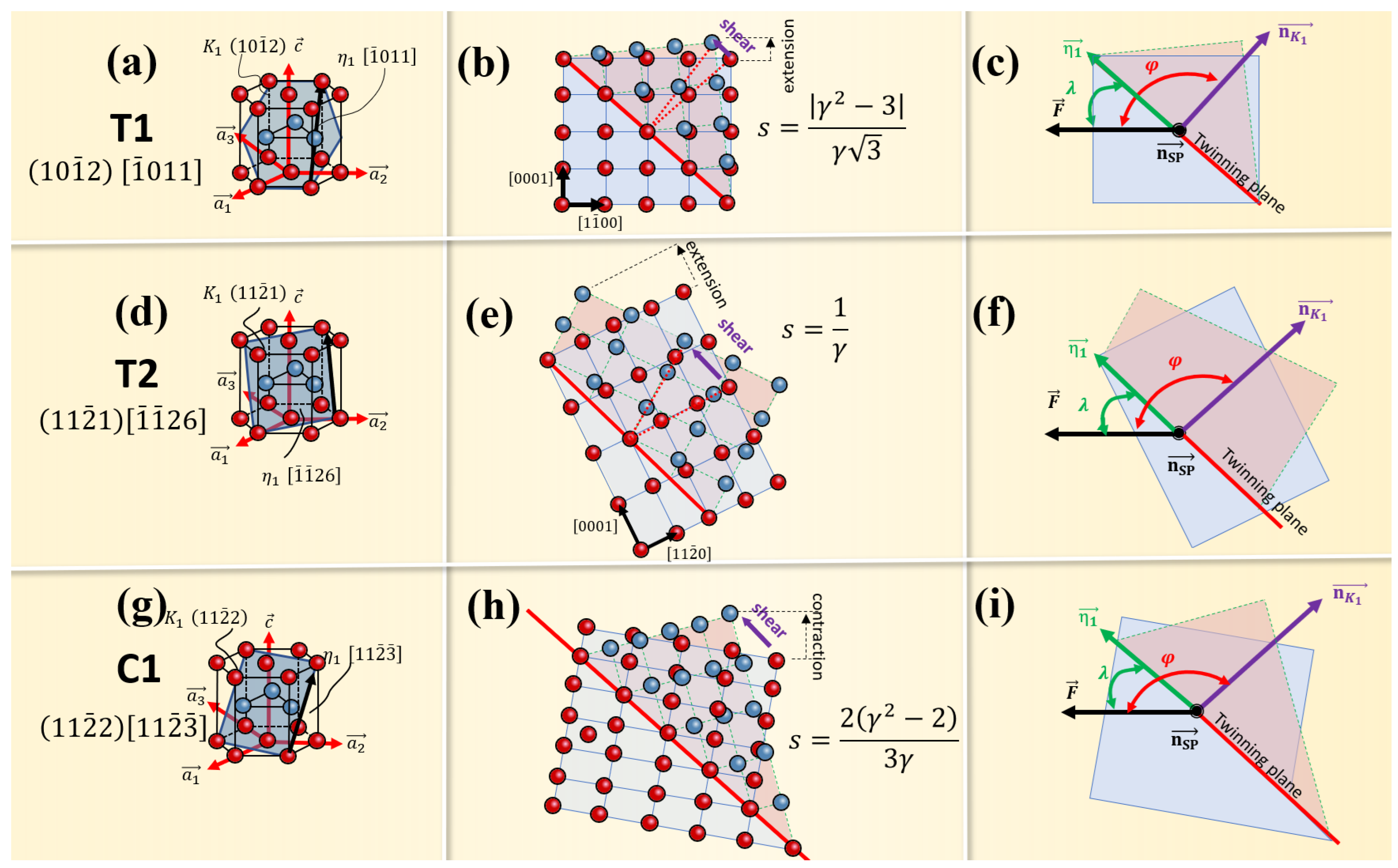
The negative Schmid factor observed under compression and the existence of a unique active twin polarity therefore originate from the same energetic requirement W > 0 . The Schmid factor merely reflects its geometrical projection under a stress state dominated by σ Z (see Figure 6).

5. Kinematic Compatibility as a Selection Criterion for Twinning Variants

The previous analysis shows that the Schmid factor provides a necessary first-order condition for twinning activation, but it does not uniquely determine the selected twin variant. Under plane strain compression, the deformation imposed at the macroscopic scale constrains the admissible strain components at the grain scale. Compatibility was evaluated by comparing the sign and relative magnitude of the transformation strain tensor components ε i j t of each twinning variant with the imposed PSC strain state ( ε X > 0 , ε Y 0 , ε Z < 0 ). Variants whose transformation strain tensor best satisfies these conditions are expected to be preferentially activated.

5.1. Case Studies A and B Under RD-PSC (Figure 3 and Figure 5)

In region A (RD-PSC), a T1 twin is experimentally observed and identified as variant V4 (see Table 9). If the selection were governed solely by the Schmid factor, variant V1 would be expected to activate, since it exhibits the highest magnitude ( SF = 0.450 ), slightly larger than that of V4 ( SF = 0.438 ). The difference in resolved shear stress between V1 and V4 is therefore marginal. The strain tensors associated with the two variants, however, reveal a subtle but relevant difference. Both V1 and V4 satisfy the channel–die conditions: they produce ε X > 0 and ε Z < 0 , with comparable magnitudes. However, V4 generates a slightly smaller ε Y component than V1. Although the difference appears modest, the Y direction is strictly constrained in channel–die compression, and any non-zero ε Y induces incompatibility stresses.
The experimental activation of V4 instead of V1 therefore indicates that, once several variants satisfy the stress criterion, the selection becomes controlled by the degree of kinematic compatibility, with minimization of the forbidden ε Y component acting as a secondary but decisive criterion.
In region B (RD-PSC), a C1 twin is observed and identified as variant V5. In this case, the Schmid factor analysis already singles out V5 as the most favorably oriented variant ( SF = 0.494 ), followed closely by V6 ( SF = 0.487 ). The corresponding strain tensors show that V5 not only exhibits the largest resolved shear stress, but also provides the best kinematic compatibility with the channel–die constraints (see Table 10).
In particular, V5 produces a very small ε Y component compared to the other variants, while maintaining the required ε X > 0 and ε Z < 0 . In contrast, variants such as V1, V3 or V6 generate significantly larger ε Y components, which are incompatible with the imposed plane strain condition. Thus, in Case B, the stress criterion and the kinematic compatibility criterion are consistent and jointly favor V5.
  • General remarks for RD-PSC.
The comparison between Cases A and B highlights two important points. First, the Schmid factor alone is insufficient to predict variant selection when several variants exhibit comparable resolved shear stresses. Second, the plane strain constraint, and in particular the requirement ε Y 0 , acts as a strong kinematic filter among stress-eligible variants.
Twinning variant selection under channel–die compression therefore results from a hierarchical mechanism: (i) satisfaction of the positive mechanical work condition (hence SF < 0 under compression), (ii) maximization of resolved shear stress, and (iii) minimization of incompatibility with the imposed macroscopic strain state.

5.2. Case Studies A, B, C and D Under TD-PSC (Figure 4Figure 7 and Figure 8)

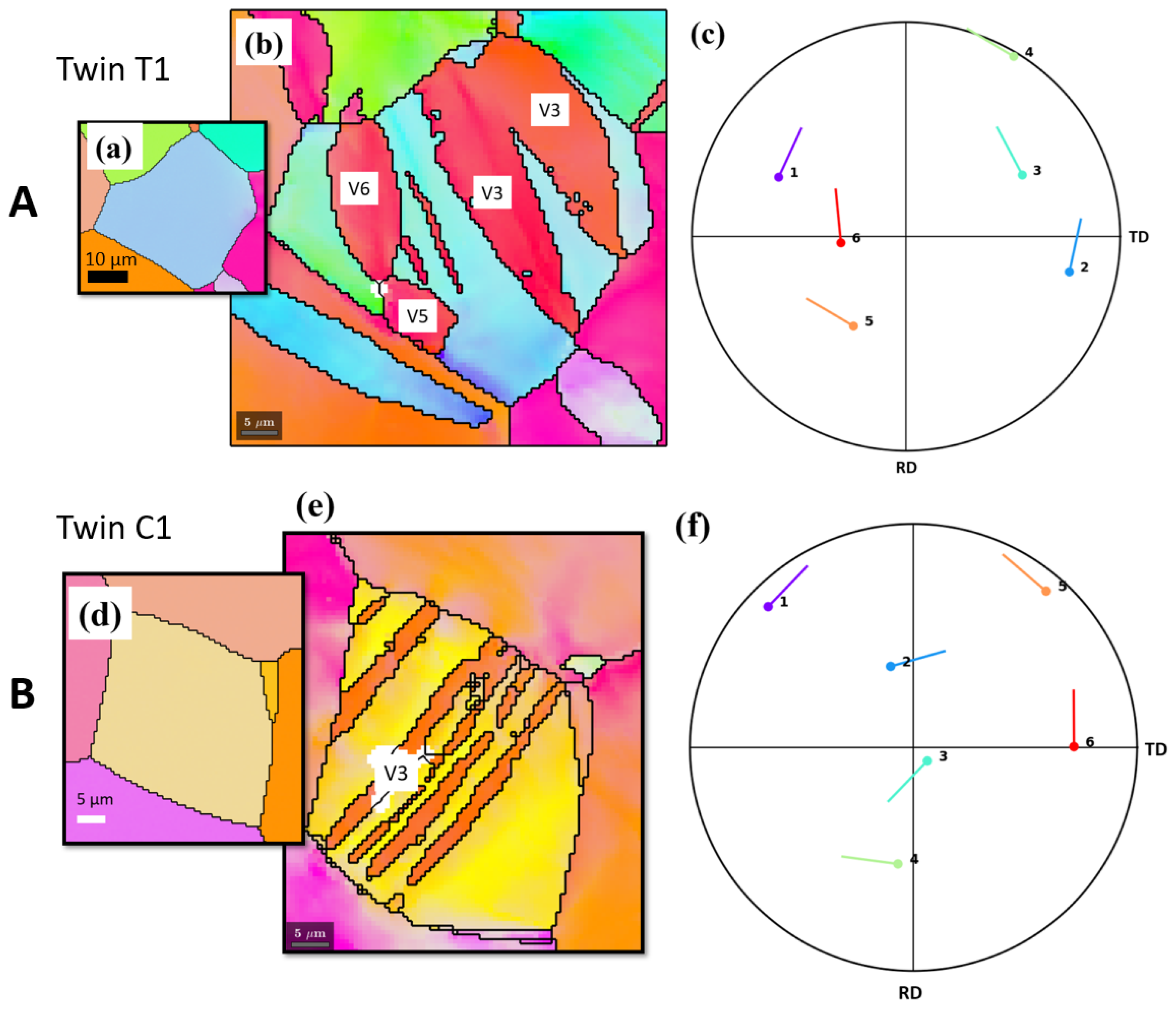
In region A under TD-PSC, three T1 variants (V3, V5 and V6) are experimentally observed. A pure Schmid factor analysis would predict activation of variant V6, which exhibits the highest magnitude ( SF = 0.436 ), followed by V3 ( SF = 0.394 ). However, the experimental observations reveal a predominance of variant V3 rather than V6 (see Table 11) The analysis of the corresponding transformation strain tensors provides a clear explanation. Both V3 and V6 satisfy the channel–die requirements ( ε X > 0 , ε Z < 0 ).
Figure 7. EBSD orientation maps and stereographic projections of slip traces for the regions (A,B) within area 1 after TD-PSC. (ac) show the evolution of a grain from its initial undeformed state (a), to the deformed state (b) where T1 twins (V3, V5, V6) are observed, and (c) shows the corresponding stereographic projection of the T1 twin traces for variants V3, V5, and V6. (df) present the same analysis for the grain in region B, where C1 twinning is observed. (d) shows the initial grain, (e) the deformed grain with the C1 twin (variant V3), and (f) is the stereographic projection of the C1 twin traces. The projections are based on the traces of the deformation twins for each system, with the corresponding variant numbers marked. The color code in the EBSD maps represents crystallographic orientations in the inverse pole figure (IPF) with respect to the normal direction (ND).
Metals 16 00394 g007
Nevertheless, V3 generates a smaller ε Y component than V6. Since the Y direction is constrained in plane strain compression, even moderate differences in ε Y translate into significant incompatibility stresses. The preferential activation of V3 therefore indicates that, when several variants exhibit comparable resolved shear stresses, the minimization of the constrained strain component becomes decisive.
In addition, a small T1 twin of variant V5 is observed, although its Schmid factor is relatively low ( SF = 0.185 ). While T1V5 satisfies the sign condition ( SF < 0 ) and produces ε X > 0 and ε Z < 0 , it generates a comparatively large ε Y component. Its limited thickness and local character suggest that this variant does not contribute to the global accommodation of the imposed strain, but rather to the relaxation of local incompatibility stresses within the grain or at grain boundaries. This observation highlights the coexistence of global kinematic selection and local stress accommodation mechanisms.
In region B under TD-PSC, a single C1 variant (C1V3) is activated. The Schmid factor of C1V3 ( SF = 0.115 ) is not the largest among the negative values (C1V2 and C1V4 exhibit larger magnitudes), and variants C1V5 and C1V6 even display positive Schmid factors and are therefore mechanically forbidden under compression (see Table 12).
The decisive factor in this case is the kinematic compatibility. Among all variants, only C1V3 simultaneously satisfies the channel–die conditions with ε X > 0 , ε Z < 0 and a near-zero ε Y . All other variants either produce a non-negligible ε Y or violate one of the required strain signs.
Thus, in this configuration, the selection is entirely governed by kinematic compatibility rather than by maximization of the resolved shear stress.
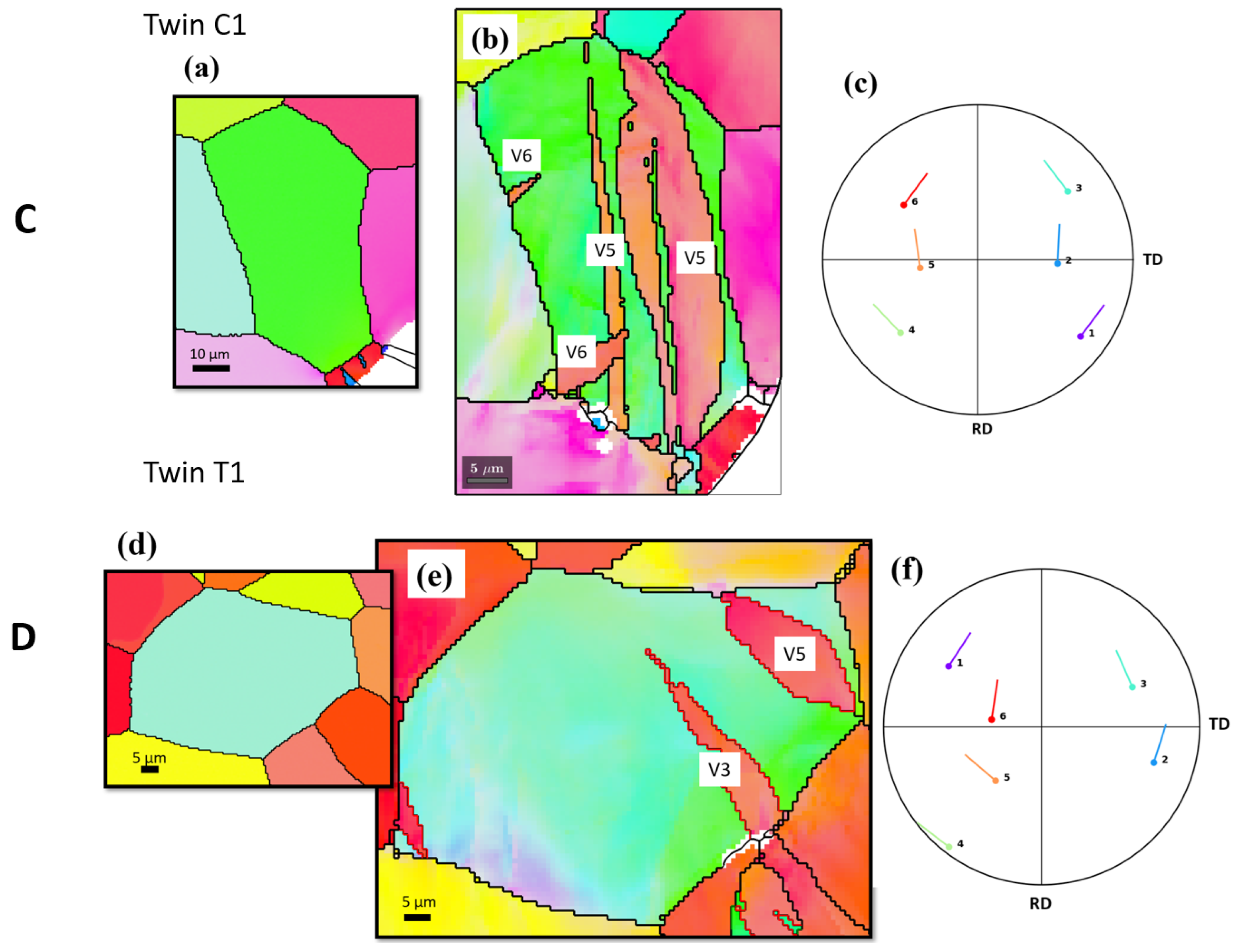
In region C (TD-PSC) (see Figure 8), two C1 variants (C1V5 and C1V6) are observed. The dominant twin corresponds to variant C1V5, which simultaneously exhibits the largest Schmid factor ( SF = 0.489 ) and full compliance with the channel–die kinematic constraints ( ε X > 0 , ε Z < 0 , ε Y 0 ).
Figure 8. EBSD orientation maps and stereographic trace analysis for regions (C,D) within area 2 after TD-PSC ( ε z 6 % ). (ac) correspond to region C: (a) shows the initial undeformed grain, (b) the deformed state where C1 compression twins are activated, with two variants identified (C1V5 and C1V6), and (c) the associated stereographic projection of the C1 twin trace directions. (df) correspond to region D: (d) shows the initial undeformed grain, (e) the deformed state exhibiting T1 extension twins with two activated variants (T1V3 and T1V5), and (f) the corresponding stereographic projection of the T1 twin trace directions. Variant numbers are indicated directly on the EBSD maps and on the stereographic projections. Crystallographic orientations are displayed using the inverse pole figure (IPF) coloring with respect to the normal direction (ND).
Metals 16 00394 g008
In this configuration, the stress-based and kinematic criteria are fully consistent (see Table 13): C1V5 maximizes the resolved shear stress while minimizing incompatibility with the imposed plane strain state. The selection is therefore unambiguous. Two small C1 twins of variant C1V6 are also detected, nucleating at grain boundaries.
However, C1V6 does not satisfy the dominant selection criteria: its Schmid factor is significantly smaller ( SF = 0.168 ), and although ε X > 0 and ε Z < 0 , the associated ε Y component remains non-negligible. The limited size and boundary location of these C1V6 twins indicate that they do not contribute to global strain accommodation. Instead, they are most likely triggered by local stress concentrations at grain boundaries, where compatibility with neighboring grains governs the activation. This behavior is consistent with the interpretation already proposed for Case B.
In region D (TD-PSC), two T1 variants (T1V3 and T1V5) are activated. Both variants satisfy the channel–die strain conditions and exhibit negative Schmid factors ( SF V 3 = 0.373 , SF V 5 = 0.230 ). Interestingly, variant T1V6 displays a larger magnitude Schmid factor ( SF = 0.414 ) but is not activated. The analysis of the transformation strain tensors shows that T1V6 generates a larger incompatible ε Y component than T1V3, making it less favorable under plane strain conditions despite its higher stress resolution. Variant T1V3 therefore emerges as the best compromise between stress resolution and kinematic compatibility (see Table 14).
Variant T1V5, although characterized by a smaller Schmid factor and a non-negligible ε Y component, is observed near a triple junction. Its activation is thus likely driven by local stress accommodation rather than by global plane strain compatibility.
  • General remarks for TD-PSC.
The four TD-PSC cases consistently demonstrate that the positivity of mechanical work (hence SF < 0 under compression) acts as a necessary condition, but not as a sufficient one. When multiple variants satisfy the work condition, the imposed plane strain constraint strongly discriminates between them, primarily through the magnitude of the constrained strain component ε Y .
Variants that optimize global kinematic compatibility dominate the microstructure, whereas variants that violate the plane strain constraint may still appear locally to relax stress concentrations at grain boundaries or triple junctions.
Twinning variant selection under channel–die compression therefore results from the combined action of: (i) the thermodynamic requirement W = σ : ε twin > 0 , (ii) the magnitude of the resolved shear stress, and (iii) the minimization of incompatibility with the imposed macroscopic strain state, with additional local effects superimposed at microstructural heterogeneities.
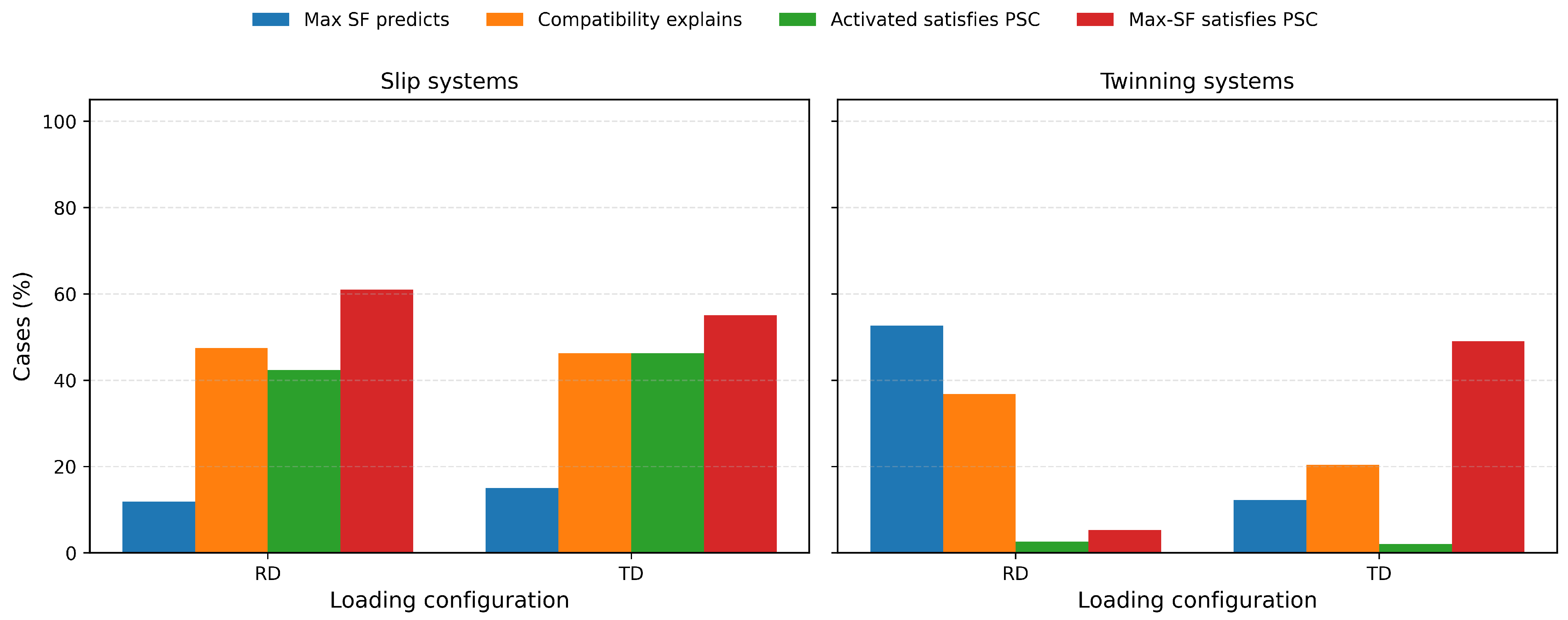
To quantitatively evaluate the ability of different criteria to rationalize deformation system selection, four complementary metrics are defined: prediction by the maximum Schmid factor, explanation by kinematic compatibility, and satisfaction of the channel–die constraints for both the activated system and the maximum Schmid factor system.
This analysis is based on a total of 139 identified slip systems and 87 deformation twins extracted from EBSD and trace analyses, distributed between the RD and TD loading configurations. These metrics are summarized in Table 15 and illustrated in Figure 9.
These results clearly demonstrate that the Schmid factor alone is insufficient to predict deformation system activity under plane strain compression for both slip and twinning. However, the role of kinematic compatibility differs between the two mechanisms.
For slip, compatibility acts as a filtering criterion among several potentially admissible systems, since multiple slip modes may accommodate the imposed strain state. For twinning, compatibility is more selective: once the positivity of mechanical work is satisfied, only a restricted subset of variants remains consistent with the channel–die constraints. In this sense, kinematic compatibility does not simply compete with the Schmid factor, but provides an additional mechanical criterion that helps rationalize why some stress-favored variants are not activated.
This distinction highlights the intrinsic difference between dislocation-mediated plasticity and twinning, and underscores the need to incorporate kinematic constraints, in addition to resolved shear stress, into predictive models of HCP deformation. These findings provide a strong rationale for implementing such combined criteria in crystal plasticity frameworks aimed at predicting deformation mechanisms in HCP metals under constrained loading conditions.


6. Conclusions

This study investigated the mechanical origin of deformation mechanism selection in commercially pure titanium subjected to plane strain compression. By combining interrupted EBSD observations with a detailed mechanical analysis, the respective roles of stress-based and kinematic criteria in controlling slip and twinning activation were clarified. From an application standpoint, the proposed framework can support the design of microstructures and forming paths that favor crystallographically compatible deformation modes, thereby helping to control texture evolution and reduce unwanted localization in titanium products.
The main conclusions can be summarized as follows:
  • Under plane strain compression, plastic deformation in cp-Ti is accommodated by a limited subset of slip and twinning systems, whose relative activity strongly depends on loading configuration (RD-PSC vs. TD-PSC).
  • Resolved shear stress provides a necessary first-order criterion for the activation of both slip and twinning systems. For deformation twinning, however, favorable stress resolution alone is not sufficient to predict the selected variant.
  • Macroscopic plane strain constraints promote the activation of specific slip systems (notably P a ), even when other systems exhibit higher resolved shear stress.
  • Twinning variant selection is governed by kinematic compatibility between the deformation induced by twinning and the macroscopic strain constraints imposed by plane strain compression. Only variants whose deformation tensors accommodate compression along Z, extension along X, and minimal strain along Y are preferentially activated.
  • The combined consideration of stress resolution and kinematic compatibility provides a physically grounded framework for interpreting the dependence of twinning activity on loading configuration in HCP titanium.
More generally, these results demonstrate that deformation mechanism selection in HCP metals subjected to constrained deformation paths cannot be predicted solely on the basis of Schmid factor distributions. Incorporating kinematic compatibility as a selection criterion is essential for developing predictive descriptions of plastic deformation and deformation-induced texture evolution.

Author Contributions

M.T.: Formal analysis, Data curation, Investigation, Methodology, Software, Visualization, Writing—original draft. C.S.: Funding acquisition, Investigation, Methodology, Project administration, Supervision, Validation, Writing—review & editing. Y.Z.: Data curation, Investigation, Methodology, Resources, Visualization, Writing—review & editing. É.F.: Methodology, Software, Validation, Writing—review & editing. J.-S.L.: Conceptualization, Formal analysis, Funding acquisition, Investigation, Methodology, Project administration, Resources, Supervision, Software, Visualization, Writing—original draft. É.R.: Formal analysis, Investigation, Data curation. All authors have read and agreed to the published version of the manuscript.

Funding

This work was supported by the ANR AFoTi project, grant ANR-20-CE08-0020-02 of the French Agence Nationale de la Recherche. We acknowledge the experimental facilities MicroMat from LEM3 (Université de Lorraine—CNRS UMR 7239).

Data Availability Statement

The raw data supporting the conclusions of this article will be made available by the authors on request.

Conflicts of Interest

The authors declare that the research was conducted in the absence of any commercial or financial relationships that could be construed as a potential conflict of interest.

Appendix A. Expression of the Displacement Gradient Tensor for Slip and Twinning in the Macroscopic Reference Frame

This appendix details the formulation used to compute the displacement gradient tensor associated with crystallographic deformation mechanisms in cp-Ti. The same formalism is applied to both dislocation slip and deformation twinning, allowing a direct comparison of their kinematic contributions in the macroscopic channel–die reference frame.

Appendix A.1. Shear Associated with Crystallographic Deformation

  • Dislocation slip
For a given slip system (Figure A1), the maximum shear strain γ associated with dislocation glide can be expressed as:
γ = b d h k l ,
where b is the magnitude of the Burgers vector and d h k l is the interplanar spacing of the slip plane. This expression corresponds to an idealized shear produced by the passage of one dislocation on each active slip plane.
  • Deformation twinning
For deformation twinning (Figure A1), the shear strain is a crystallographically defined constant associated with the twinning mode. In this case, the shear strain is denoted s and its value depends on the considered twinning system (Table 2). Thus:
γ = s .
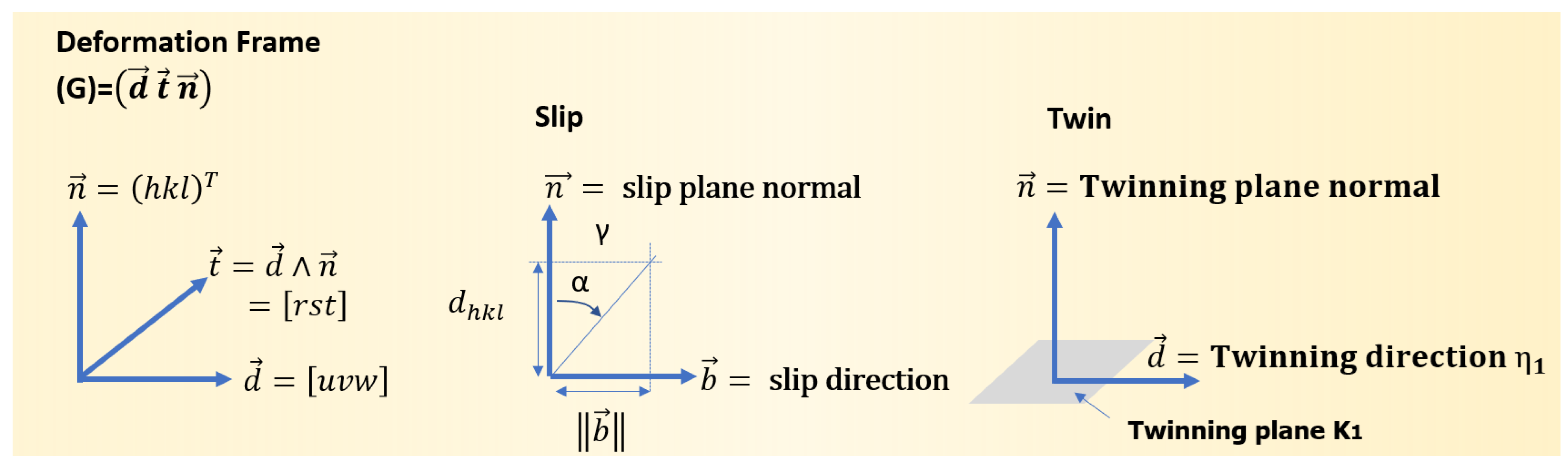
Figure A1. Schematic representation of the deformation reference frame G = ( d , t , n ) used to describe crystallographic deformation mechanisms. The unit vector d denotes the shear direction, n the normal to the shear plane, and t = n × d completes the right-handed basis. The same definition applies to dislocation slip (middle) and deformation twinning (right), enabling a unified displacement gradient tensor description.
Metals 16 00394 g0a1

Appendix A.2. Displacement Gradient Tensor in the Deformation System Reference Frame

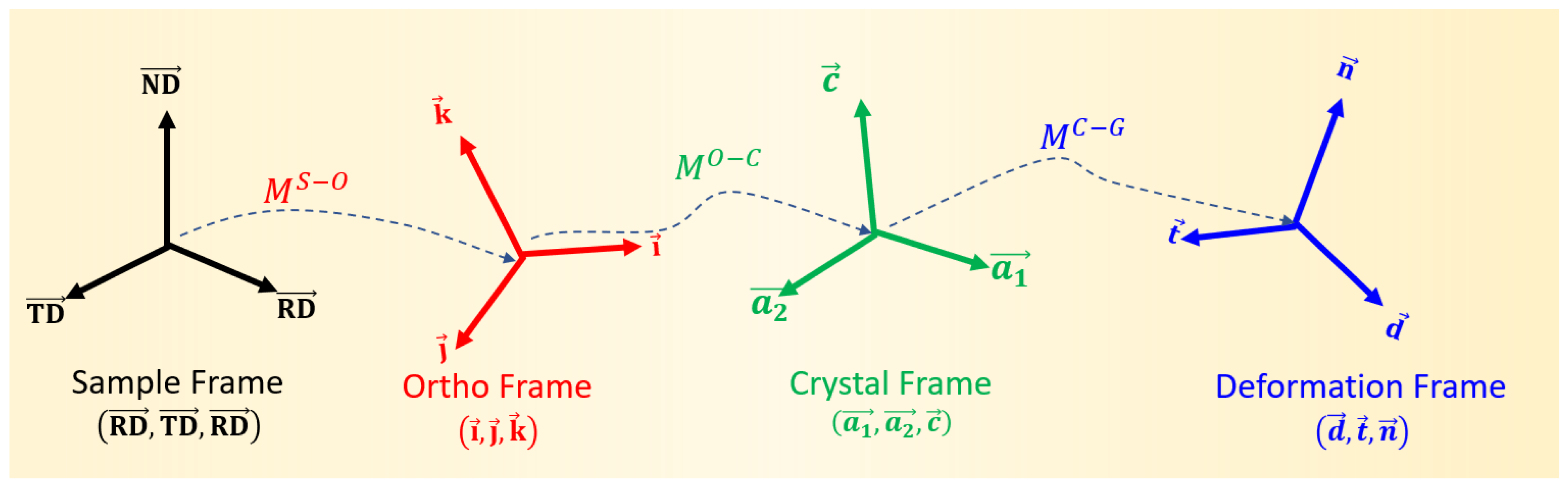
The deformation system reference frame G = ( d , t , n ) is defined by: d (shear direction), n (plane normal), and t = n × d . In this frame, the displacement gradient tensor associated with a simple shear is:
D def = 0 0 γ 0 0 0 0 0 0 G .

Appendix A.3. Coordinate Transformations

  • Transformation from the Bravais lattice frame to the deformation frame
M C G = u r h v s k w t l ,
where u v w denotes the shear direction (slip direction or twinning shear direction), { h k l } denotes the shear plane (slip plane or habit plane), and r s t = h k l × u v w .
  • Transformation from the orthonormal crystal frame to the Bravais lattice frame
M O C = 3 2 0 0 1 2 1 0 0 0 c a ,
with j a 2 and k c .
  • Transformation from the macroscopic frame to the crystal frame
The transformation M S O is defined by the Euler angles describing the crystallographic orientation of the grain.

Appendix A.4. Displacement Gradient Tensor in the Macroscopic Reference Frame

The total transformation matrix is:
X = M S O M O C M C G .
The displacement gradient tensor expressed in the macroscopic frame is then:
D S = X D def X 1 .
Figure A2. Reference frames and coordinate transformations used to express crystallographic deformation in the macroscopic frame. From left to right: sample frame S = ( RD , TD , ND ) , orthonormal crystal frame O = ( i , j , k ) , Bravais lattice frame C = ( a 1 , a 2 , c ) , and deformation frame G = ( d , t , n ) . The transformation matrices M S O , M O C , and M C G are applied sequentially to express D def in the macroscopic reference frame.
Metals 16 00394 g0a2

References

  1. Christian, J.; Mahajan, S. Deformation twinning. Prog. Mater. Sci. 1995, 39, 1–157. [Google Scholar] [CrossRef]
  2. Roth, A.; Lebyodkin, M.; Lebedkina, T.; Lecomte, J.S.; Richeton, T.; Amouzou, K. Mechanisms of anisotropy of mechanical properties of α-titanium in tension conditions. Mater. Sci. Eng. A 2014, 596, 236–243. [Google Scholar] [CrossRef]
  3. Partridge, P.G. The crystallography and deformation modes of hexagonal close-packed metals. Metall. Rev. 1967, 12, 169–194. [Google Scholar] [CrossRef]
  4. Capolungo, L.; Beyerlein, I.; Tomé, C. Slip-assisted twin growth in hexagonal close-packed metals. Scr. Mater. 2009, 60, 32–35. [Google Scholar] [CrossRef]
  5. Amouzou, K.; Richeton, T.; Roth, A.; Lebyodkin, M.; Lebedkina, T. Micromechanical modeling of hardening mechanisms in commercially pure α-titanium in tensile condition. Int. J. Plast. 2016, 80, 222–240. [Google Scholar] [CrossRef]
  6. Singh, A.; Schwarzer, R. Evolution of texture during thermomechanical processing of titanium and its alloys. Trans. Indian Inst. Met. 2008, 61, 371–387. [Google Scholar] [CrossRef]
  7. Pushp, P.; Dasharath, S.; Arati, C. Classification and applications of titanium and its alloys. Mater. Today Proc. 2022, 54, 537–542. [Google Scholar] [CrossRef]
  8. Kalidindi, S.R. Incorporation of deformation twinning in crystal plasticity models. J. Mech. Phys. Solids 1998, 46, 267–290. [Google Scholar] [CrossRef]
  9. Bao, L.; Zhang, Y.; Schuman, C.; Lecomte, J.S.; Philippe, M.J.; Zhao, X.; Esling, C. Multiple twinning in pure hexagonal close-packed titanium. J. Appl. Crystallogr. 2013, 46, 1397–1406. [Google Scholar] [CrossRef]
  10. Wang, S.; Zhang, Y.; Schuman, C.; Lecomte, J.S.; Zhao, X.; Zuo, L.; Philippe, M.J.; Esling, C. Study of twinning/detwinning behaviors of Ti by interrupted in situ tensile tests. Acta Mater. 2015, 82, 424–436. [Google Scholar] [CrossRef]
  11. Ma, C.; Wang, H.; Hama, T.; Guo, X.; Mao, X.; Wang, J.; Wu, P. Twinning and detwinning behaviors of commercially pure titanium sheets. Int. J. Plast. 2019, 121, 261–279. [Google Scholar] [CrossRef]
  12. Chen, J.; An, Q.; Deng, L.; Ye, P.; Wang, C.; Chen, J.; Xiao, L.; Wang, B. Activation mechanism of multiple twin variants during uniaxial compression in pure titanium. J. Alloys Compd. 2025, 1024, 180280. [Google Scholar] [CrossRef]
  13. Chun, Y.; Yu, S.; Semiatin, S.; Hwang, S. Effect of deformation twinning on microstructure and texture evolution during cold rolling of CP-titanium. Mater. Sci. Eng. A 2005, 398, 209–219. [Google Scholar] [CrossRef]
  14. Bozzolo, N.; Dewobroto, N.; Wenk, H.; Wagner, F. Microstructure and microtexture of highly cold-rolled commercially pure titanium. J. Mater. Sci. 2007, 42, 2405–2416. [Google Scholar] [CrossRef]
  15. Gurao, N.; Sethuraman, S.; Suwas, S. Evolution of texture and microstructure in commercially pure titanium with change in strain path during rolling. Metall. Mater. Trans. A 2013, 44, 1497–1507. [Google Scholar] [CrossRef]
  16. Chapuis, A.; Liu, Q. Simulations of texture evolution for HCP metals: Influence of the main slip systems. Comput. Mater. Sci. 2015, 97, 121–126. [Google Scholar] [CrossRef]
  17. Bertrand, E.; Castany, P.; Péron, I.; Gloriant, T. Twinning system selection in a metastable α-titanium alloy by Schmid factor analysis. Scr. Mater. 2011, 64, 1110–1113. [Google Scholar] [CrossRef]
  18. Wang, S.; Schuman, C.; Bao, L.; Lecomte, J.; Zhang, Y.; Raulot, J.; Philippe, M.; Zhao, X.; Esling, C. Variant selection criterion for twin variants in titanium alloys deformed by rolling. Acta Mater. 2012, 60, 3912–3919. [Google Scholar] [CrossRef]
  19. Qin, H.; Jonas, J.J. Variant selection during secondary and tertiary twinning in pure titanium. Acta Mater. 2014, 75, 198–211. [Google Scholar] [CrossRef]
  20. Arul Kumar, M.; Beyerlein, I.; Tomé, C. Effect of local stress fields on twin characteristics in HCP metals. Acta Mater. 2016, 116, 143–154. [Google Scholar] [CrossRef]
  21. Beyerlein, I.; Tomé, C. A dislocation-based constitutive law for pure Zr including temperature effects. Int. J. Plast. 2008, 24, 867–895. [Google Scholar] [CrossRef]
  22. Tomé, C.N.; Lebensohn, R.A. (Eds.) Material Modeling with the Visco-Plastic Self-Consistent (VPSC) Approach; Elsevier Series on Plasticity of Materials; Elsevier: Amsterdam, The Netherlands, 2023; pp. i–iii. [Google Scholar] [CrossRef]
  23. Tomé, C.; Lebensohn, R.; Kocks, U. A model for texture development dominated by deformation twinning: Application to zirconium alloys. Acta Metall. Mater. 1991, 39, 2667–2680. [Google Scholar] [CrossRef]
  24. Tomé, C.N.; Lebensohn, R.A. Self Consistent Homogenization Methods for Texture and Anisotropy. In Continuum Scale Simulation of Engineering Materials; John Wiley & Sons, Ltd.: Hoboken, NJ, USA, 2004; Chapter 23; pp. 473–499. [Google Scholar] [CrossRef]
  25. Schuman, C.; Bao, L.; Sébastien Lecomte, J.; Zhang, Y.; Marc Raulot, J.; Jeanne Philippe, M.; Esling, C. A New Variant Selection Criterion for Twin Variants in Titanium Alloys (Part 1). Adv. Eng. Mater. 2011, 13, 1114–1121. [Google Scholar] [CrossRef]
  26. Schuman, C.; Bao, L.; Lecomte, J.S.; Zhang, Y.; Raulot, J.M.; Philippe, M.J.; Esling, C. A New Variant Selection Criterion for Twin Variants in Titanium Alloys (Part 2). Adv. Eng. Mater. 2012, 14, 304–311. [Google Scholar] [CrossRef]
  27. Zecevic, M.; Knezevic, M.; Beyerlein, I.J.; Tomé, C.N. An elasto-plastic self-consistent model with hardening based on dislocation density, twinning and de-twinning: Application to strain path changes in HCP metals. Mater. Sci. Eng. A 2015, 638, 262–274. [Google Scholar] [CrossRef]
  28. Britton, T.B.; Dunne, F.P.E.; Wilkinson, A.J. On the mechanistic basis of deformation at the microscale in hexagonal close-packed metals. Proc. R. Soc. A Math. Phys. Eng. Sci. 2015, 471, 20140881. [Google Scholar] [CrossRef]
  29. Engler, O.; Hirsch, J. Texture control by thermomechanical processing of AA6xxx Al–Mg–Si sheet alloys for automotive applications—A review. Mater. Sci. Eng. A 2002, 336, 249–262. [Google Scholar] [CrossRef]
  30. Molinari, A.; Canova, G.; Ahzi, S. A self consistent approach of the large deformation polycrystal viscoplasticity. Acta Metall. 1987, 35, 2983–2994. [Google Scholar] [CrossRef]
  31. Bachmann, F.; Hielscher, R.; Schaeben, H. Grain detection from 2D and 3D EBSD data—Specification of the MTEX algorithm. Ultramicroscopy 2011, 111, 1720–1733. [Google Scholar] [CrossRef]
  32. Beausir, B.; Fundenberger, J. Analysis Tools for Electron and X-Ray Diffraction; ATEX-Software; Université Lorraine-Metz: Metz, France, 2017. [Google Scholar]
  33. Roters, F.; Eisenlohr, P.; Hantcherli, L.; Tjahjanto, D.; Bieler, T.; Raabe, D. Overview of constitutive laws, kinematics, homogenization and multiscale methods in crystal plasticity finite-element modeling: Theory, experiments, applications. Acta Mater. 2010, 58, 1152–1211. [Google Scholar] [CrossRef]
  34. Greeley, D.; Vo, H.; McCabe, R.; Tomé, C.; Capolungo, L. Twin networks in hexagonal close-packed metals: Morphology, connectivity, and incompatibilities. Acta Mater. 2025, 286, 120595. [Google Scholar] [CrossRef]
  35. Bilby, B.A.; Crocker, A.G. The theory of the crystallography of deformation twinning. Proc. R. Soc. Lond. Ser. A Math. Phys. Sci. 1965, 288, 240–255. [Google Scholar] [CrossRef]
  36. Ostapovets, A.; Serra, A. Slip dislocation and twin nucleation mechanisms in hcp metals. J. Mater. Sci. 2017, 52, 533–540. [Google Scholar] [CrossRef]
Figure 1. (a) Equiaxed grain microstructure of the as-received cp-Ti sheet. (b) Associated pole figure (weak B/T–type texture).
Metals 16 00394 g001
Figure 2. Schematic illustration of the plane strain compression (PSC) configuration for interrupted in-situ EBSD measurements: (a) imposed strain state in the channel–die, (b,c) sandwich sample configuration enabling repeated EBSD mapping of the same area, and (d) channel–die device. The blue region indicates the location of the EBSD regions of interest (ROI), each approximately 0.5 × 0.5 mm2, located near the center of the sample to minimize boundary and friction effects.
Metals 16 00394 g002
Figure 3. EBSD orientation maps illustrating the microstructural evolution of commercially pure titanium deformed by channel–die compression to a thickness reduction of approximately ε z 6 % . Two regions of interest (area 1 and area 2), previously marked by micro-indentations for relocation, are shown in the initial undeformed state (a,c) and after deformation (b,d). Crystallographic orientations are displayed using the inverse pole figure (IPF) coloring with respect to the normal direction (ND), as indicated by the color key. White rectangles labeled A, B and C in the deformed maps highlight specific grains selected for detailed analysis in the following sections. (e) Misorientation angle distribution compiled from several mapped areas after deformation. A pronounced peak near 85 ° indicates strong activity of { 10 1 ¯ 2 } 10 1 ¯ 1 (T1) extension twins, whereas a smaller contribution around 64 ° corresponds to { 11 2 ¯ 2 } 11 2 ¯ 3 (C1) twins. The peak associated with T2 twinning remains negligible. The sample reference frame is indicated, with RD X and TD Y .
Metals 16 00394 g003
Figure 4. EBSD orientation maps illustrating the microstructural evolution of commercially pure titanium deformed by channel–die compression along the transverse direction (TD-PSC) to a thickness reduction of approximately ε z 6 % . Two regions of interest (area 1 and area 2), previously marked by micro-indentations for relocation, are shown in the initial undeformed state (a,c) and after deformation (b,d). Crystallographic orientations are displayed using the inverse pole figure (IPF) coloring with respect to the normal direction (ND), as indicated by the color key. Twin boundaries are identified according to their type: T1 twins in red, C1 twins in green and T2 twins in blue; non-indexed regions are shown in black. White rectangles labeled A, B, C and D in the deformed maps highlight specific grains selected for detailed analysis in the following sections. (e) Misorientation angle distribution compiled from several mapped areas after TD-PSC. Distinct peaks near 85 ° , 64 ° and 35 ° correspond respectively to T1, C1 and T2 twinning systems, indicating significant T1 activity together with a measurable contribution from C1 twins and limited T2 activation. The sample reference frame is indicated, with TD X and RD Y .
Metals 16 00394 g004
Figure 5. Representative SEM/EBSD observations and trace-based identification of deformation mechanisms after plane strain compression along the rolling direction (RD-PSC, ε z 6 % ). (a) SEM image of a grain exhibiting a T1 twin trace (trace 1b) together with a slip trace (trace 1a). (b) Corresponding EBSD IPF map (ND coloring) of the same region, confirming activation of a { 10 1 ¯ 2 } 10 1 ¯ 1 twin of variant T1V4 (Case A). (c) Stereographic projection of the theoretical trace directions of the six T1 variants in the parent grain, used to discriminate the active variant. (d) SEM image of a grain containing multiple slip traces (2a–2c). (e) Corresponding EBSD IPF map identifying a { 11 2 ¯ 2 } 11 2 ¯ 3 twin of variant C1V5 (Case B). (f) Stereographic projection of the theoretical trace directions of the six C1 variants in the parent grain, supporting the identification of variant C1V5. (g) SEM image illustrating a third representative case (Case C) with multiple slip traces (3–5c). The orientations and loading reference frame are indicated with RD X and TD Y . Experimentally measured trace angles θ exp were compared with the calculated trace directions to identify the active systems; the corresponding Euler angles, θ exp , selected system/variant, and Schmid factor are reported in Table 3.
Metals 16 00394 g005
Figure 6. Crystallographic description and geometric interpretation of the three twinning modes observed in cp-Ti: T1 ( { 10 1 ¯ 2 } 1 ¯ 011 ), T2 ( { 11 2 ¯ 1 } 1 ¯ 1 ¯ 26 ) and C1 ( { 11 2 ¯ 2 } 11 2 ¯ 3 ¯ ). (a,d,g) show three-dimensional representations of the T1, T2 and C1 twinning systems, respectively, highlighting the habit plane K 1 and the twinning direction η 1 within the hexagonal lattice. (b,e,h) present atomic-scale schematics of the corresponding twinning shear, together with the analytical expressions used to compute the twinning shear magnitude s as a function of γ = c / a (with γ = 1.587 for cp-Ti). (c,f,i) illustrate the geometric construction used for Schmid factor evaluation under uniaxial compression (force vector F). The normal to the twinning plane n K 1 and the twinning direction η 1 are represented, together with the angles λ (between η 1 and F) and φ (between n K 1 and F). In the three configurations shown, the combination of λ and φ leads to a negative Schmid factor, illustrating the sign convention associated with twinning under compressive loading. In (b,e,h), the initial lattice is drawn (red atoms) with a solid line, and the twinned lattice is drawn with blue atoms and a dashed line.
Metals 16 00394 g006
Figure 9. Quantitative comparison of slip and twinning system selection under plane strain compression (PSC) for rolling direction (RD) and transverse direction (TD) loading configurations. For each mechanism, four metrics are reported: (i) fraction of cases where the system with the maximum Schmid factor corresponds to the experimentally activated system, (ii) fraction of cases explained by kinematic compatibility with the imposed PSC strain state, (iii) fraction of activated systems satisfying the channel–die constraints ( ε X > 0 , ε Y 0 , ε Z < 0 ), and (iv) fraction of maximum Schmid factor systems satisfying the same constraints. Slip systems exhibit a distributed behavior where multiple systems can accommodate the imposed deformation, whereas twinning shows a stronger selection governed by kinematic compatibility.
Metals 16 00394 g009
Table 1. List of slip systems in HCP titanium.
Slip PlaneSlip DirectionNumberAbbreviation
{ 0002 } 11 2 ¯ 0 3B a
{ 10 1 ¯ 0 } 1 2 ¯ 10 3P a
{ 10 1 ¯ 1 } 1 2 ¯ 10 6 π 1 a
{ 10 1 ¯ 1 } 11 2 ¯ 3 12 π 1 c + a
{ 11 2 ¯ 2 } 11 2 ¯ 3 6 π 2 c + a
Table 2. Deformation twinning systems and their variants in cp-Ti.
NameTwinning SystemVariantVariant { h k i l } u v t w Mis. AxisMis. Angle (°)
T1 { 10 1 ¯ 2 } 1 ¯ 011 T1V1 ( 2 , 1 ¯ , 1 ¯ , 2 ) [ 2 , 1 ¯ , 1 ¯ , 3 ¯ ] 1 ¯ 2 1 ¯ 0 85.05
T1V2 ( 1 , 2 ¯ , 1 , 2 ) [ 1 , 2 ¯ , 1 , 3 ¯ ]
T1V3 ( 1 ¯ , 1 ¯ , 2 , 2 ) [ 1 ¯ , 1 ¯ , 2 , 3 ¯ ]
T1V4 ( 2 ¯ , 1 , 1 , 2 ) [ 2 ¯ , 1 , 1 , 3 ¯ ]
T1V5 ( 1 ¯ , 2 , 1 ¯ , 2 ) [ 1 ¯ , 2 , 1 ¯ , 3 ¯ ]
T1V6 ( 1 , 1 , 2 ¯ , 2 ) [ 1 , 1 , 2 ¯ , 3 ¯ ]
Twinning shear s = 0.173
T2 { 11 2 ¯ 1 } 1 ¯ 1 ¯ 26 T2V1 ( 1 , 0 , 1 ¯ , 2 ) [ 1 ¯ , 0 , 1 , 1 ] 1 ¯ 100 34.94
T2V2 ( 0 , 1 , 1 ¯ , 2 ) [ 0 , 1 ¯ , 1 , 1 ]
T2V3 ( 1 ¯ , 1 , 0 , 2 ) [ 1 , 1 ¯ , 0 , 1 ]
T2V4 ( 1 ¯ , 0 , 1 , 2 ) [ 1 , 0 , 1 ¯ , 1 ]
T2V5 ( 0 , 1 ¯ , 1 , 2 ) [ 0 , 1 , 1 ¯ , 1 ]
T2V6 ( 1 , 1 ¯ , 0 , 2 ) [ 1 ¯ , 1 , 0 , 1 ]
Twinning shear s = 0.219
C1 { 11 2 ¯ 2 } 11 2 ¯ 3 ¯ C1V1 ( 1 , 1 , 2 ¯ , 1 ) [ 1 ¯ , 1 ¯ , 2 , 6 ] 01 1 ¯ 0 64.38
C1V2 ( 2 , 1 ¯ , 1 ¯ , 1 ) [ 2 ¯ , 1 , 1 , 6 ]
C1V3 ( 1 , 2 ¯ , 1 , 1 ) [ 1 ¯ , 2 , 1 ¯ , 6 ]
C1V4 ( 1 ¯ , 1 ¯ , 2 , 1 ) [ 1 , 1 , 2 ¯ , 6 ]
C1V5 ( 2 ¯ , 1 , 1 , 1 ) [ 2 , 1 ¯ , 1 ¯ , 6 ]
C1V6 ( 1 ¯ , 2 , 1 ¯ , 1 ) [ 1 , 2 ¯ , 1 , 6 ]
Twinning shear s = 0.630
Table 3. Summary of experimentally identified traces, associated Euler angles ( φ 1 , Φ , φ 2 ) , experimental angle θ exp , most probable deformation system (BEST), and Schmid factor (SF).
Trace ( φ 1 , Φ , φ 2 ) (deg) θ exp (deg)SystemSF
1a(161.8, 86.1, 43.0)78.0P a 0.483
1b−25.0T1V4−0.438
2a(112.1, 9.8, 8.5)149.0 π 1 c + a 0.328
2b35.0 π 1 c + a 0.401
2c66.0C1V5−0.387
3(132.7, 80.6, 52.3)53.0P a 0.471
4(164.9, 71.8, 19.2)59.0P a 0.446
5a(50.7, 168.9, 4.2)78.0 π 1 c + a 0.481
5b12.0 π 1 c + a 0.479
5c142.0 π 1 c + a 0.422
Table 4. Summary of identified slip systems under RD-PSC and TD-PSC. Percentages are given relative to the total number of identified slip systems for each loading configuration.
LoadingTotal SlipP a π 1 a π 1 c + a π 2 c + a
RD-PSC5934 (57.6%)1 (1.7%)24 (40.7%)0 (0.0%)
TD-PSC8031 (38.8%)4 (5.0%)20 (25.0%)16 (20.0%)
Table 5. Summary of identified twinning systems under RD-PSC and TD-PSC. Percentages are given relative to the total number of identified twins for each loading configuration.
LoadingTotal TwinsT1C1T2
RD-PSC3831 (81.6%)7 (18.4%)0 (0.0%)
TD-PSC4925 (51.0%)24 (49.0%)0 (0.0%)
Table 6. Resolved shear stress of activated slip systems ( τ a s ) under RD-PSC and TD-PSC, and comparison with the highest resolved shear stress ( τ h s ) among all possible slip systems.
Act. SystemSample τ a s System with Highest τ s τ h s Δ τ
P a RD-PSC0.45P a (64%)0.460.00
π 1 a (30%)0.470.03
TD-PSC0.23 π 1 c + a (65%)0.460.22
π 2 c + a (26%)0.460.26
π 1 c + a RD-PSC0.40 π 1 c + a (57%)0.470.14
π 2 c + a (37%)0.460.03
TD-PSC0.31 π 1 c + a (54%)0.470.15
π 2 c + a (42%)0.470.17
Table 7. Resolved shear stress of activated twinning systems ( τ a s ) under RD-PSC and TD-PSC, compared with the highest resolved shear stress ( τ h s ) among all possible variants of the same twinning family.
Act. TwinSample τ a s Fraction with Δ τ 0 τ h s Δ τ
T1RD-PSC0.2156%0.240.05
TD-PSC0.4055%0.420.04
C1RD-PSC0.27100%0.440.18
TD-PSC0.3859%0.440.12
Table 8. Strain compatibility between macroscopic PSC constraints and the deformation induced by activated slip systems in RD-PSC and TD-PSC configurations.
Act. System (A)SampleHighest System (H)Condition 1: ε Y 0 Condition 2: ε X ε Z
AHAH
P a RD-PSC π 1 a 80%60%100%100%
TD-PSC π 1 c + a 80%0%93%0%
π 2 c + a 83%0%83%0%
π 1 c + a RD-PSC π 1 c + a 0%63%18%90%
π 2 c + a 0%86%100%100%
TD-PSC π 1 c + a 30%8%30%8%
π 2 c + a 50%0%50%0%
Table 9. Schmid factor (SF) and associated strain tensor ε twin for the six T1-twinning variants (case A).
VariantSF ε twin
T1V1 0.450 0.041 0.047 0.015 0.047 0.037 0.022 0.015 0.022 0.078  
T1V2 0.279 0.030 0.062 0.032 0.062 0.018 0.029 0.032 0.029 0.048  
T1V3 0.017 0.015 0.083 0.006 0.083 0.012 0.017 0.006 0.017 0.003  
T1V4 0.438 0.045 0.046 0.004 0.046 0.031 0.031 0.004 0.031 0.076  
T1V5 0.271 0.019 0.062 0.040 0.062 0.027 0.021 0.040 0.021 0.047  
T1V6 0.019 0.001 0.085 0.009 0.085 0.003 0.016 0.009 0.016 0.003
Table 10. Schmid factor (SF) and associated strain tensor ε twin for the six C1-twinning variants (Case B).
VariantSF ε twin
C1V1 0.428 0.001 0.057 0.086 0.057 0.268 0.128 0.086 0.128 0.269  
C1V2 0.360 0.209 0.064 0.215 0.064 0.017 0.036 0.215 0.036 0.227  
C1V3 0.373 0.092 0.119 0.161 0.119 0.143 0.131 0.161 0.131 0.235  
C1V4 0.448 0.027 0.099 0.012 0.099 0.255 0.129 0.012 0.129 0.282  
C1V5 0.494 0.297 0.068 0.035 0.068 0.014 0.029 0.035 0.029 0.311  
C1V6 0.487 0.154 0.157 0.015 0.157 0.153 0.062 0.015 0.062 0.307
Table 11. Schmid factor (SF) and associated strain tensor ε twin for the six T1-twinning variants (Case A, TD-PSC).
VariantSF ε twin
T1V1 0.022 0.064 0.050 0.011 0.050 0.060 0.033 0.011 0.033 0.004  
T1V2 0.156 0.052 0.052 0.046 0.052 0.025 0.026 0.046 0.026 0.027  
T1V3 0.394 0.067 0.019 0.040 0.019 0.001 0.031 0.040 0.031 0.068  
T1V4 0.008 0.070 0.038 0.016 0.038 0.069 0.031 0.016 0.031 0.001  
T1V5 0.185 0.063 0.045 0.039 0.045 0.031 0.032 0.039 0.032 0.032  
T1V6 0.436 0.072 0.023 0.028 0.023 0.004 0.027 0.028 0.027 0.075
Table 12. Schmid factor (SF) and associated strain tensor ε twin for the six C1 twinning variants (Case B, TD-PSC).
VariantSF ε twin
C1V1 0.067 0.208 0.028 0.166 0.028 0.251 0.129 0.166 0.129 0.042  
C1V2 0.198 0.090 0.130 0.204 0.130 0.215 0.075 0.204 0.075 0.125  
C1V3 0.115 0.077 0.035 0.303 0.035 0.005 0.024 0.303 0.024 0.072  
C1V4 0.216 0.058 0.204 0.164 0.204 0.194 0.031 0.164 0.031 0.136  
C1V5 0.068 0.206 0.052 0.147 0.052 0.163 0.199 0.147 0.199 0.043  
C1V6 0.300 0.189 0.041 0.248 0.041 0.000 0.012 0.248 0.012 0.189
Table 13. Schmid factor (SF) and associated strain tensor ε twin for the six C1-twinning variants (Case C, TD-PSC).
VariantSF ε twin
C1V1 0.071 0.083 0.016 0.016 0.016 0.071 0.031 0.016 0.031 0.012  
C1V2 0.469 0.082 0.005 0.027 0.005 0.001 0.008 0.027 0.008 0.081  
C1V3 0.156 0.084 0.006 0.016 0.006 0.057 0.041 0.016 0.041 0.027  
C1V4 0.079 0.086 0.003 0.010 0.003 0.072 0.032 0.010 0.032 0.014  
C1V5 0.489 0.085 0.003 0.013 0.003 0.001 0.008 0.013 0.008 0.085  
C1V6 0.168 0.085 0.006 0.008 0.006 0.056 0.042 0.008 0.042 0.029
Table 14. Schmid factor (SF) and associated strain tensor ε twin for the six twinning variants (Case D, TD-PSC).
VariantSF ε twin
T1V1 0.004 0.074 0.033 0.017 0.033 0.075 0.024 0.017 0.024 0.001  
T1V2 0.198 0.064 0.037 0.045 0.037 0.030 0.032 0.045 0.032 0.034  
T1V3 0.373 0.072 0.007 0.042 0.007 0.007 0.031 0.042 0.031 0.064  
T1V4 0.014 0.078 0.020 0.020 0.020 0.080 0.021 0.020 0.021 0.002  
T1V5 0.230 0.073 0.029 0.036 0.029 0.034 0.037 0.036 0.037 0.040  
T1V6 0.414 0.077 0.013 0.030 0.013 0.005 0.030 0.030 0.030 0.072
Table 15. Quantitative comparison of Schmid-factor-based prediction and kinematic compatibility analysis for slip and twinning under plane strain compression. SF match: fraction of cases where the maximum Schmid factor system corresponds to the experimentally activated system; Compat.: fraction of cases better explained by kinematic compatibility; Act. PSC: fraction of activated systems satisfying the channel–die constraints; SF PSC: fraction of maximum Schmid factor systems satisfying the same constraints.
MechanismLoadingSF Match (%)Compat. (%)Act. PSC (%)SF PSC (%)
SlipRD11.947.542.461.0
SlipTD15.046.346.355.0
TwinRD52.636.82.65.3
TwinTD12.220.42.049.0
Disclaimer/Publisher’s Note: The statements, opinions and data contained in all publications are solely those of the individual author(s) and contributor(s) and not of MDPI and/or the editor(s). MDPI and/or the editor(s) disclaim responsibility for any injury to people or property resulting from any ideas, methods, instructions or products referred to in the content.