Article

Effect of PTA Current on Microstructure, Phase Constitution, Hardness and Dry-Sliding Wear of Fe–Cr–C Layers Deposited on 35L Cast Steel


by
Aibek Shynarbek
1,2,*,
Zarina Satbayeva
1,
Bauyrzhan Rakhadilov
3,
Duman Orynbekov
2,
Ainur Zhassulan
1,
Kuanysh Ormanbekov
1,2,
Nurlat Kadyrbolat
1 and
Duman Askerzhanov
1
1
Engineering Center, Shakarim University NPJSC, Glinka Street, 20A, Semey 071412, Kazakhstan
2
Department of Bioengineering Systems, Shakarim University NPJSC, Glinka Street, 20A, Semey 071412, Kazakhstan
3
PlasmaScience LLP, Ust-Kamenogorsk 070000, Kazakhstan
*
Author to whom correspondence should be addressed.
Metals 2026, 16(3), 308; https://doi.org/10.3390/met16030308
Submission received: 13 February 2026 / Revised: 5 March 2026 / Accepted: 9 March 2026 / Published: 11 March 2026

Abstract

Wear of crushing and grinding equipment components causes frequent maintenance and downtime; therefore, effective repair hardfacing routes are required to extend service life. This study investigates plasma transferred arc (PTA) surfacing of 35L cast steel using a high-chromium Fe–Cr–C powder (PG-S27) and clarifies how the welding current (40–120 A) governs layer geometry, microstructure, phase constitution, hardness, and dry-sliding tribological behavior. All deposits exhibited a dendritic–eutectic structure; increasing current led to dendrite coarsening, wider interdendritic regions, and deeper penetration/dilution. X-ray diffraction indicated an α-Fe matrix with chromium carbide phases (Cr7C3/Cr23C6), while the carbide-related signal decreased with higher current, consistent with enhanced dilution. The coatings showed a strong hardening effect compared with the substrate (~190 HV), reaching ~625–650 HV at 40–80 A and decreasing to ~556–589 HV at 100–120 A. In dry ball-on-flat sliding, the steady-state friction coefficient was nearly unchanged (μ ≈ 0.50–0.55) across all regimes; however, wear resistance depended strongly on current: the lowest wear was achieved at low-to-moderate currents (40–80 A), whereas higher currents (100–120 A) resulted in substantially increased material loss, approaching the substrate level. These results identify 40–80 A as the most favorable current window for obtaining wear-resistant PTA layers from PG-S27 on 35L steel.

1. Introduction

Crushing, grinding, and comminution equipment operates under long duty cycles, high contact loads, and continuous exposure to abrasive particles. Operating costs are largely driven by component wear and repair-related downtime; therefore, developing effective methods to restore worn parts and extend their service life remains an important scientific and engineering challenge. In practice, many fast-wearing components are replaced or restored using conventional overlaying approaches without systematic process optimization, even when the base part retains significant residual life and a parameter-controlled restoration strategy would be more rational [1,2]. Since abrasive/impact–abrasive wear and fatigue processes are dominant damage mechanisms, surface-engineering technologies capable of substantially improving wear resistance are required [3,4]. The relevance of refurbishment is also reinforced by the industrial context of Kazakhstan: domestic heavy machinery production is limited and a considerable share of industrial assets operates with aged equipment, which increases the demand for repair solutions [5,6]. In this context, surfacing/cladding is attractive as a tool for reducing maintenance costs and partially mitigating import dependence; additionally, refurbishment is resource- and emission-efficient compared with manufacturing new components.
A practical approach to increasing durability is the formation of wear-resistant surface layers using surfacing/cladding or surface modification methods, which simultaneously restore geometry and improve surface properties; plasma surfacing is therefore considered a promising method for enhancing wear resistance and extending service life [2,7,8,9,10,11]. For crushing and grinding machines, the wear resistance of shaft journals (support trunnions and seating zones for bearings and seals) is especially critical. These zones experience variable loads and friction, leading to scuffing, fatigue wear, and loss of dimensional accuracy, which in turn degrades bearing operation, increases runout and vibration, and reduces overall equipment efficiency. Accordingly, restorative cladding of shaft journals with hard alloys is an effective solution to recover geometry and create a hardened working layer with improved hardness and wear resistance [9,12,13,14].
Among repair cladding technologies, plasma powder surfacing based on the plasma transferred arc (PTA) process is widely used due to its productivity, practical implementation, and cost-effectiveness, particularly for depositing relatively thick layers over large areas. PTA deposits form a strong metallurgical bond with the substrate through controlled melting of a thin subsurface layer, providing high adhesion and load-bearing capacity. Material flexibility is another advantage: a wide range of alloys can be supplied in powder form, enabling tailored compositions for specific wear conditions. PTA hardfacing is applied for restoring and strengthening mining and crushing equipment components using both conventional self-fluxing powders (Ni-, Co-, and Fe-based) and composite mixtures containing hard phases (e.g., carbides and oxides) [9,15,16]. For abrasive-wear conditions, iron-based surfacing materials are particularly relevant due to availability and lower cost compared with Co- and Ni-based alloys. Alloying of an Fe matrix with elements such as Cr, V, Mo, Si, and B promotes the formation of hard phases (e.g., M7C3 carbides, VC), enabling high hardness and wear resistance when the powder and process parameters are properly selected [17,18]. In particular, Fe–Cr–C hardfacing alloys are widely used for severe abrasive wear because they can form a high volume fraction of hard carbide phases while maintaining adequate matrix toughness [19]. Alloys with ~15–30% Cr and ~3–5% C typically precipitate M7C3-type carbides (M = Cr, Fe) within an austenitic matrix, producing a hypereutectic microstructure characteristic of wear-resistant white cast irons. These carbides exhibit very high hardness (reported up to ~1600 HV) and resist abrasion by bearing load and limiting plastic deformation of the matrix during sliding contact; therefore, the combination of hard carbides and a comparatively ductile eutectic matrix provides Fe–Cr–C alloys with high wear resistance and sufficient strength for industrial applications [20]. PG-S27 (“Sormait PG-S27”, GOST 21448-75) is a representative Fe–Cr–C powder used for hardfacing mining and crushing equipment parts exposed to severe abrasive wear and moderate impact loads, typically forming primary (Cr,Fe)7C3 carbides embedded in a eutectic matrix (austenite + carbides), consistent with reports for similar compositions [20].
Despite the broad use of PTA hardfacing, the influence of process parameters—particularly surfacing current and associated heat input—on the formation and performance of Fe–Cr–C iron-based layers remains insufficiently quantified in a systematic manner [17,21]. Many studies emphasize alloy design and hard-particle additions, whereas fewer works provide consistent datasets linking current-controlled thermal cycles to key outputs such as dilution/penetration, carbide signature and phase response, hardness gradients through the thickness, and tribological behavior for Fe–Cr–C powders. Moreover, published results are dominated by Ni- and Co-based deposits, and observations on current effects often concern other material systems, limiting direct transferability to PG-S27-type Fe–Cr–C layers [17,21]. Consequently, establishing parameter-oriented relationships for the PG-S27/35L system is necessary to support reliable process selection for restorative cladding of wear-critical components. Therefore, the objective of this study is to determine the effect of PTA surfacing current on deposited layer geometry, microstructure, phase composition, hardness, and dry-sliding tribological performance of Fe–Cr–C layers produced using PG-S27 powder on a 35L steel substrate. Coatings are produced at different current levels, followed by SEM/metallographic characterization, XRD phase analysis, microhardness measurements, and wear testing; the results are compared to establish correlations between current, carbide formation/morphology, hardness distribution, and wear performance [22,23,24,25].

2. Materials and Methods

2.1. Materials

Before surfacing, the surfaces of the 35L steel substrates (Velund Steel, Astana, Kazakhstan) were mechanically prepared by grinding to remove oxide films and surface contaminants, and to ensure stable wetting and reliable metallurgical bonding of the deposited layer to the base metal. After grinding, the specimens were cleaned of abrasive particles and degreased with alcohol, and then dried prior to surfacing. The chemical composition of the powder and 35L steel is presented in Table 1. The substrates for surfacing had dimensions of 10 cm × 2 cm × 0.5 cm. Surfacing was carried out on the prepared surface under identical preparation conditions for all specimens, which allowed a reliable comparison of results when varying the surfacing parameters.

2.2. Plasma Cladding Process

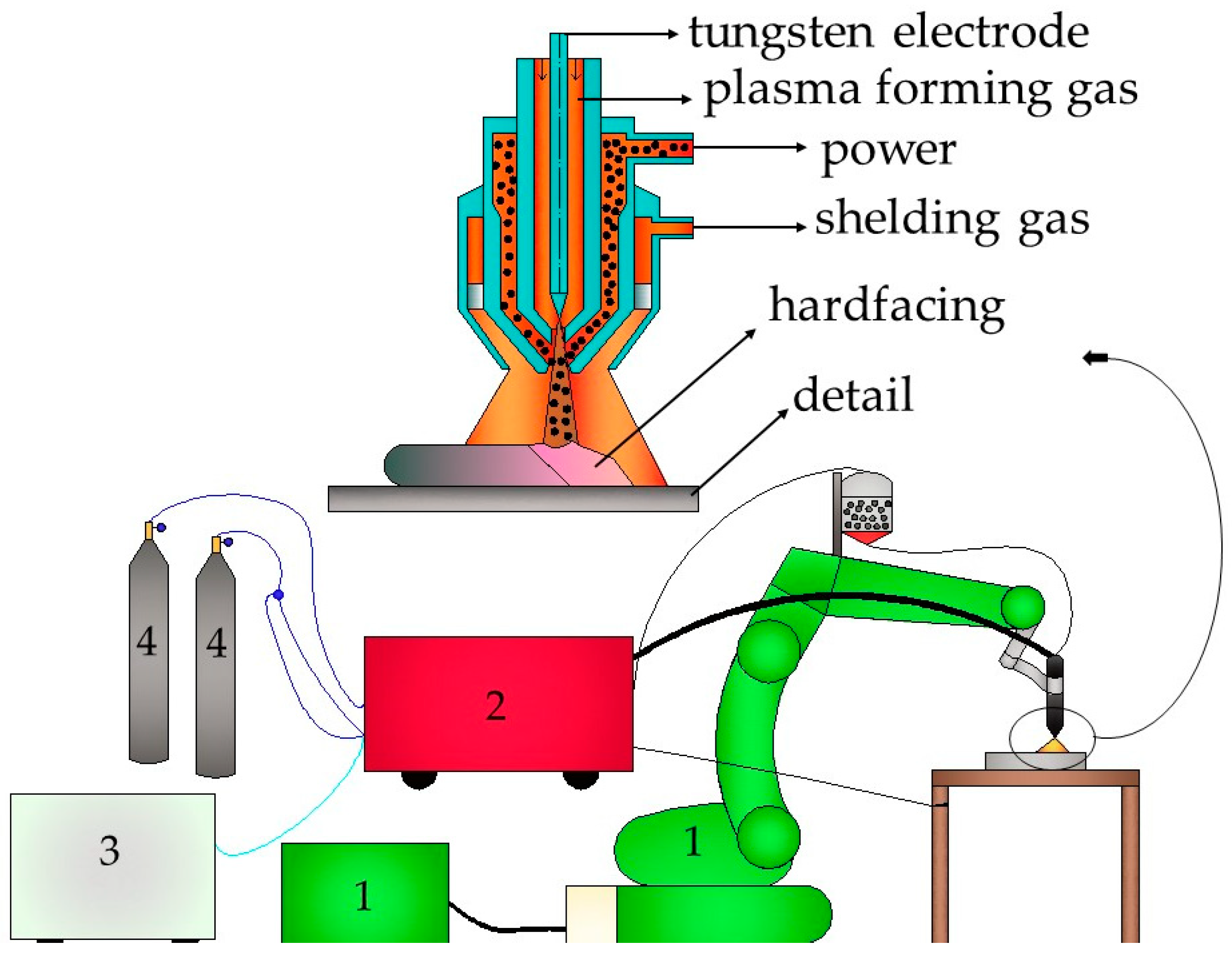
Surfacing was performed using a ZTW3501DC plasma surfacing system (Zhongtianweier (Shanghai) Intelligent Technology Co., Ltd., Shanghai, China) equipped with powder and inert gas feeding units. Process automation was achieved with an SZHN industrial six-axis robot, which ensured high repeatability of the surfacing trajectory and stable processing conditions. Argon was used as both the plasma-forming and shielding gas. Figure 1 shows the general view of the plasma surfacing setup and a schematic diagram of the plasma torch, while the experimental process parameters are presented in Table 2.

2.3. Microstructural and Phase Analysis

The surface morphology and microstructure of the coating cross-sections were examined using an SEM3200 scanning electron microscope (CIQTEK, Hefei, China). This approach made it possible to obtain high-resolution images of the deposited layer, analyze the solidification behavior and the distribution of carbide phases, and identify possible structural defects.
The phase composition was studied by X-ray diffraction (XRD) using an X’Pert PRO diffractometer (X’Pert PRO, PANalytical, Almelo, The Netherlands) (Cu Kα radiation, λ = 1.5406 Å). Measurements were carried out in the 2θ range of 20–90° with a step size of 0.02° and a counting time of 0.5 s per step. HighScore software 3.0.0 was used for diffraction pattern analysis, enabling the identification of carbide and intermetallic compounds formed in the coating structure.

2.4. Mechanical and Tribological Testing

The hardness of the deposited coatings was measured on cross-sectional metallographic mounts using a Vickers HLV-1DT microhardness tester (Shanghai HLV manufacturer, Shanghai, China) with an indenter load of 2 N and a dwell time of 10 s. Measurements were performed both within the deposited layer and through the thickness down to the substrate in order to assess property uniformity and the possible presence of hardness gradients.
Data processing was carried out in accordance with the guidelines of the manual “Processing of Experimental Data.” For each region, the average microhardness value, standard deviation (SD), and random error at a confidence level of α = 0.95 were calculated. The instrumental error component was conventionally taken as ±2% of the mean value and converted to α = 0.95 using a factor of 2/3. Based on these values, the final combined and relative measurement errors were determined.
The wear resistance and coefficient of friction of the coatings were studied using an Anton Paar TRB3 tribometer in a “ball-on-flat” configuration. A 6 mm diameter steel ball made of bearing steel 100Cr6 (ShKh15) was used as the counterbody. Tests were conducted under dry sliding in air at a normal load of 10 N, a sliding speed of 5 cm/s (0.05 m/s), a total sliding distance of 100 m, and a wear track radius of 2.0 mm. The coefficient of friction as a function of time was recorded using a friction compensation sensor, and the wear depth was monitored with a displacement sensor. Prior to testing, the specimen surfaces were ground with P400 abrasive paper. Based on the test results, the coefficient of friction and wear rate were evaluated depending on the tribological loading conditions.

3. Results and Discussion

3.1. Microstructure

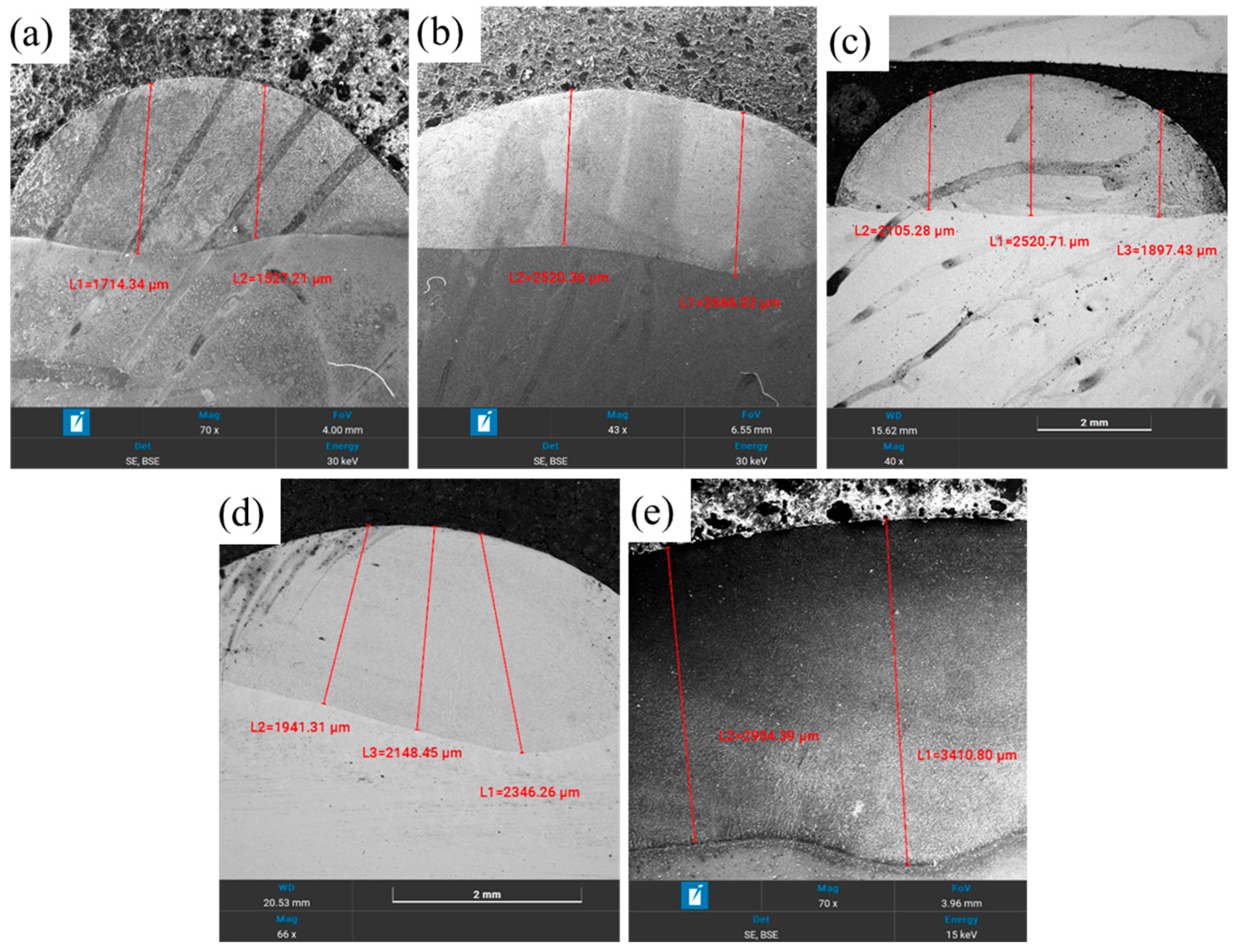
Figure 2 provides cross-sectional macrographs of coatings produced by plasma surfacing at currents of 40–120 A, allowing a direct assessment of how the processing regime affects deposited layer thickness, penetration into the substrate, and the extent of the heat-affected zone (HAZ).
At 40 A (Figure 2a), the deposited layer is comparatively thin and the penetration into the substrate is limited; correspondingly, the HAZ is narrow and only weakly developed. Increasing the current to 60 A (Figure 2b) results in a clear increase in layer thickness together with more pronounced substrate melting, which is indicative of higher heat input and an enlarged molten pool. At 80 A (Figure 2c), the same tendency persists—thickness and penetration continue to increase—while thickness variations along the cross-section become more evident, reflecting a greater sensitivity of bead geometry to local thermal conditions at elevated thermal power.
At 100 A (Figure 2d), both penetration depth and HAZ width increase further compared with low-current regimes, confirming the strengthened thermal impact on the substrate. The 120 A condition (Figure 2e) yields the maximum layer thickness and penetration depth across the series, and the HAZ is the most extensive, consistent with the highest heat input and the deepest substrate melting.
The observed evolution in Figure 2 is readily rationalized in terms of the thermal cycle of PTA surfacing: increasing current increases arc power, thereby raising the temperature and effective volume of the molten pool. This simultaneously enhances powder melting and intensifies substrate melting, which manifests macroscopically as thicker deposits and deeper penetration. The progressive widening of the HAZ at higher currents is an expected outcome of greater thermal exposure and a longer residence time of the material at elevated temperatures.
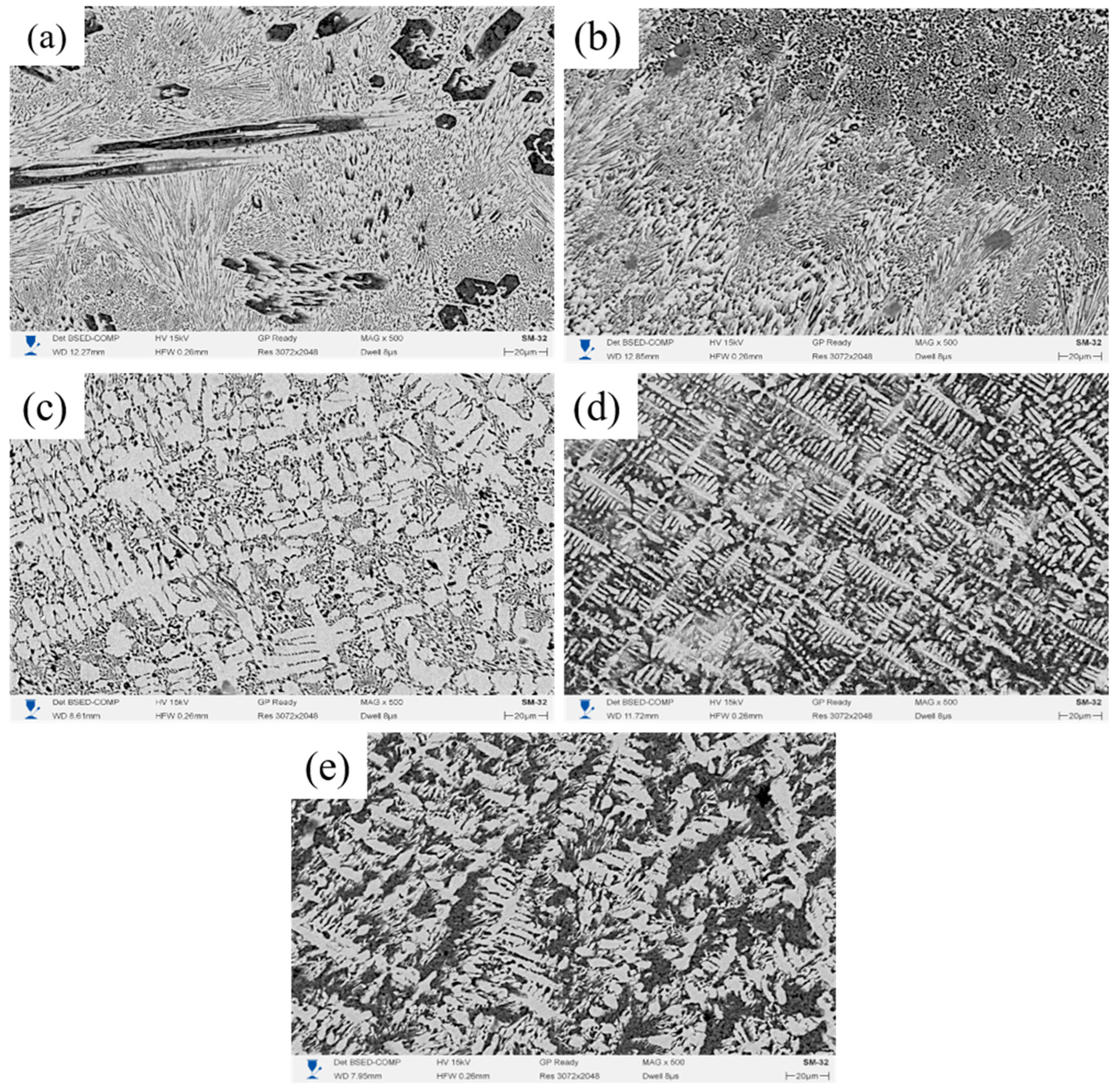
Figure 3 presents representative SEM micrographs of the Fe–Cr–C layers produced at currents of 40–120 A. All samples exhibit a dendritic–eutectic morphology typical of high-chromium Fe–Cr–C hardfacing alloys; with increasing current, the microstructure tends to coarsen and the carbide-rich interdendritic regions become less uniformly distributed. It should be noted, however, that the apparent “coarseness” in an individual image (e.g., Figure 3c) is influenced by the selected field of view and the local position within the deposited layer (near-surface vs. mid-thickness), as well as by the orientation of columnar growth; therefore, Figure 3 provides qualitative, local evidence of the solidification morphology rather than a quantitative measure of the average dendrite spacing across the entire coating.
Across the series, increasing current is associated with larger dendrite features and wider interdendritic channels, while carbide-rich regions show increasing heterogeneity and signs of coalescence at higher heat input. For intermediate regimes (60–100 A; Figure 3b–d), the microstructure remains within the same dendritic–eutectic class, and local variations between images mainly reflect spatial heterogeneity inherent to PTA deposits. These observations are consistent with a current-controlled thermal cycle: higher current increases the molten pool lifetime and reduces the effective cooling rate, which promotes microstructural coarsening and less uniform carbide distribution at the scale of the interdendritic network.
The formation of a dendritic structure during plasma surfacing can be explained by the principles of directional solidification and the instability of the solidification front. The motion of the “liquid–solid” interface follows the Stefan heat-balance condition,
k s T s n k l T l     n ,
where ks and kl are the thermal conductivities of the solid and liquid phases, respectively; Ts and Tl are the temperature fields in the solid and liquid near the solid–liquid interface; and T s n and T l   n are the vn is the normal velocity of the solid–liquid interface; and L is the latent heat of solidification [26]. In the presence of thermal and solutal gradients, a planar solidification front becomes unstable according to the Mullins–Sekerka criterion [27], leading to the formation of protrusions and their subsequent branching into dendrites. A key factor is local undercooling of the melt,
T = T L T r e a l ,
where T is the local undercooling (supercooling) of the melt; T L is the equilibrium liquidus temperature of the alloy; and T r e a l is the actual local temperature of the melt at the solidification front. Under this condition, the growth front loses stability and crystals develop into elongated columnar “tree-like” dendrites.
The trend observed in Figure 3 is consistent with the effect of PTA parameters on the thermal cycle. Increasing welding current raises heat input and extends the time the melt remains liquid, thereby reducing the effective cooling rate and promoting a larger dendrite arm spacing, thicker dendrite trunks, and more pronounced branching. These conditions also favor the growth and coalescence of carbide particles in inter-dendritic regions, which explains the reduced uniformity of carbide distribution at high current (Figure 3e). Conversely, parameters that shorten the solidification time (e.g., higher torch travel speed) typically accelerate cooling and lead to finer, denser dendrites, whereas increasing powder feed may increase the deposited layer thickness and modify temperature gradients, contributing to a coarser microstructure. In the present series, current is the primary controlling parameter, and its increase governs the overall coarsening behavior. These microstructural changes imply that the apparent carbide strengthening contribution and the overall phase response may also vary with current, particularly under conditions of enhanced dilution at high heat input. Therefore, XRD analysis was performed to evaluate how the phase constitution of the deposited layers evolves with current (Figure 4).

3.2. Phase Analysis

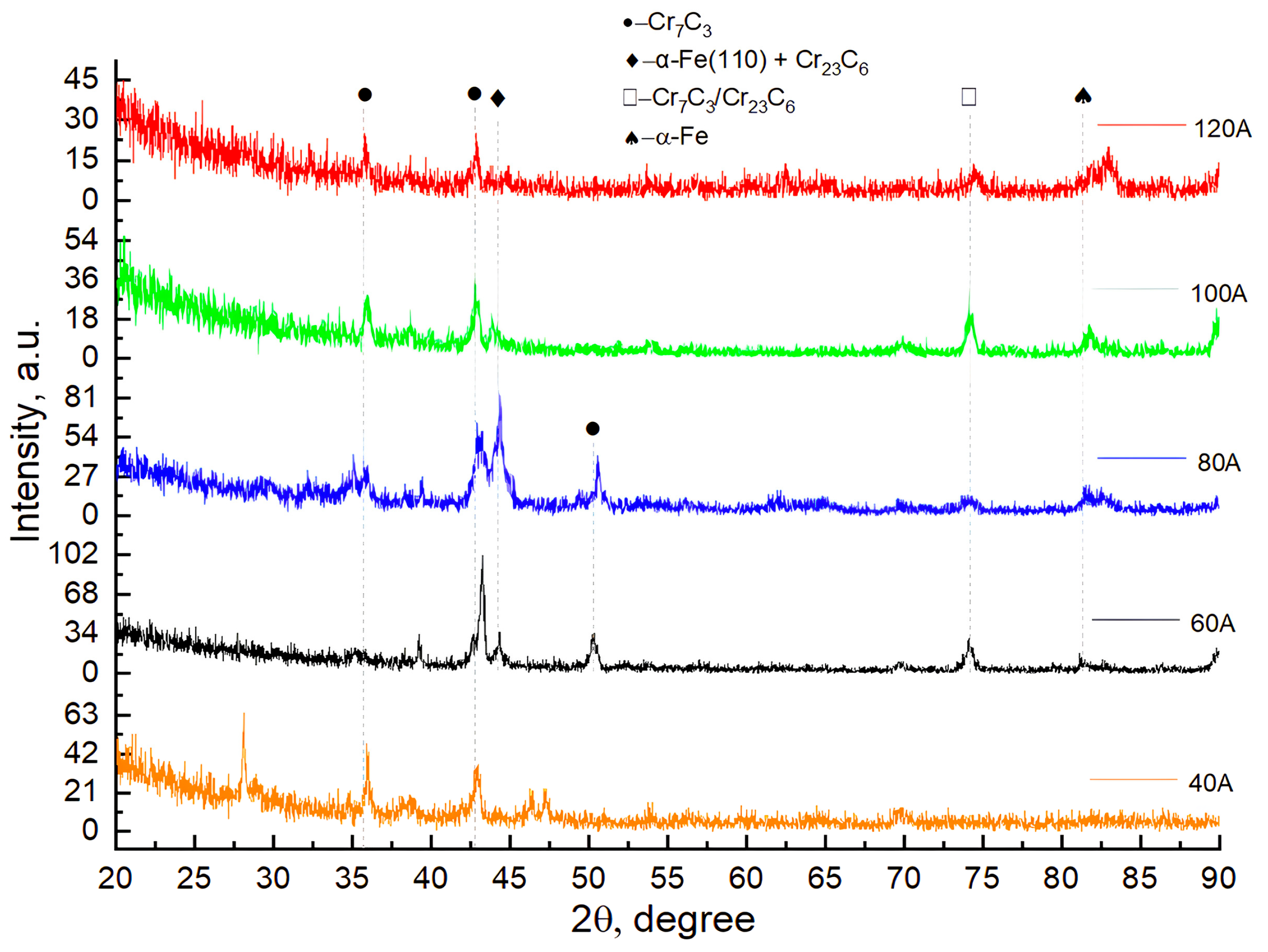
Figure 4 shows the XRD patterns of coatings produced by plasma surfacing using PG-S27 powder at currents of 40–120 A. For all conditions, the diffractograms contain reflections attributable to chromium carbides (Cr7C3/Cr23C6) together with the α-Fe matrix, represented by the characteristic (110)/(200)/(211) peaks. This phase assemblage is consistent with the carbide–metal microstructure expected for Fe–Cr–C-based hardfacing materials.
A systematic shift in the “carbide–matrix” contribution is observed as the current increases from 40 to 120 A. The carbide reflections (Cr7C3/Cr23C6) progressively decrease in intensity and exhibit noticeable peak broadening. Importantly, attenuation of carbide peaks at higher current does not contradict SEM-observed carbide coarsening, since XRD reflects the relative phase contribution within the irradiated volume and is strongly affected by Fe dilution and matrix dominance. In XRD terms, the reduced peak intensity primarily indicates a lower relative contribution of carbide phases in the diffracting volume, while the observed broadening can be associated with crystallite-size and microstrain effects and/or increased structural heterogeneity induced by the more severe thermal cycle. Concurrently, the α-Fe peaks become more prominent, implying an increasing relative contribution of the iron-rich matrix.
An additional feature is the broadening of the α-Fe (110) reflection when moving from 40 to 120 A. Peak broadening of this type is commonly associated with increased microstrain/defect density and/or a reduction in the coherent scattering domain size, i.e., a more heterogeneous lattice state induced by a more severe thermal cycle. Considered together with the strengthened α-Fe signal, these observations are consistent with enhanced substrate influence and increased Fe dilution under high-current conditions, leading to a matrix-dominated phase response.
Comparison across regimes suggests that the most distinct carbide signature occurs at 40–60 A, where the carbide peaks are both more intense and relatively sharper. At currents ≥100 A, the patterns become markedly matrix-dominated: α-Fe reflections intensify, whereas carbide peaks weaken and broaden, indicating that carbide strengthening is less prominently expressed in the phase response under high heat input.

3.3. Mechanical and Tribological Properties

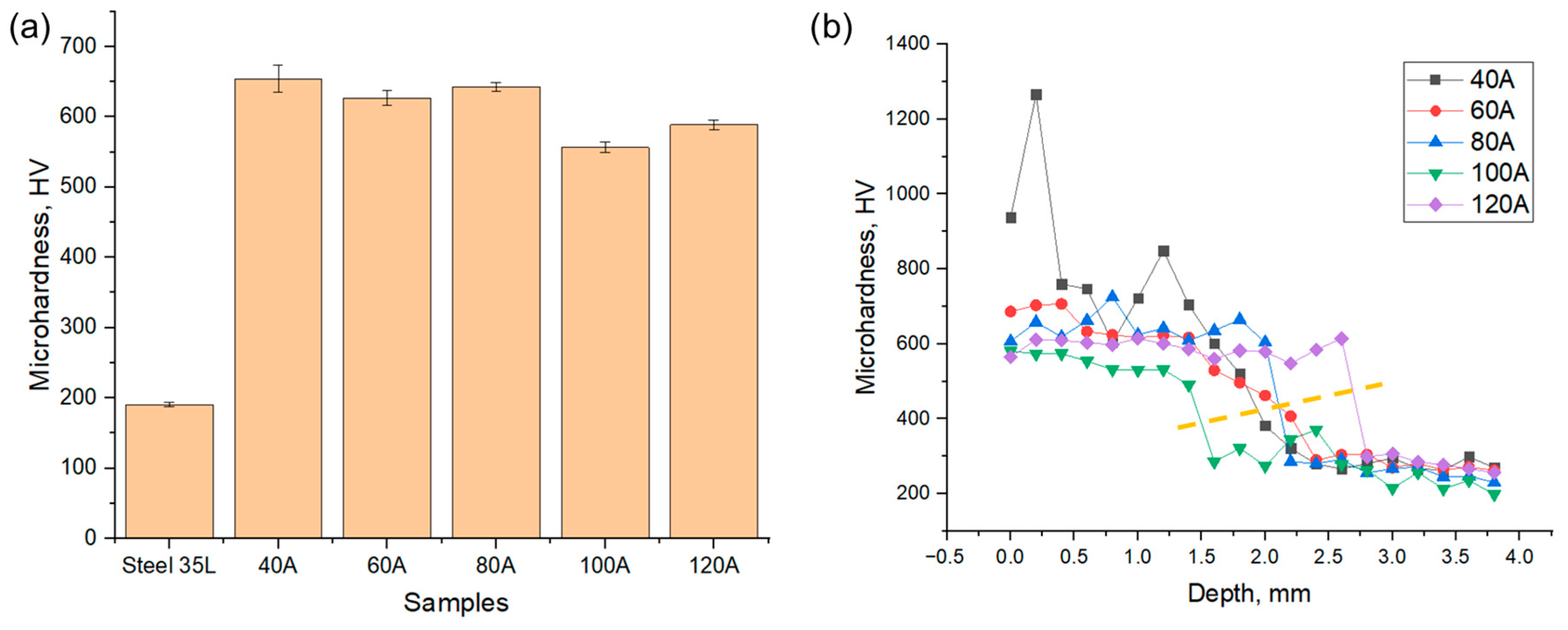
Figure 5a summarizes the mean microhardness of coatings produced by plasma surfacing using PG-S27 powder at different currents, with cast steel 35L shown as a reference. In every regime, the deposited coatings exhibit a substantial hardening response relative to the substrate: whereas 35L is ~190 HV, the coated layers fall within ~556–654 HV, i.e., close to a threefold increase.
The highest hardness is obtained at moderate heat input (40–80 A). The average values are (654 ± 40) HV at 40 A, (627 ± 23) HV at 60 A, and (640 ± 16) HV at 80 A (α = 0.95), indicating a consistently high hardness level of approximately 625–650 HV across this current window. When the current is increased further, hardness decreases to (556 ± 15) HV at 100 A and (589 ± 16) HV at 120 A. Considering the 95% confidence level (α = 0.95) and the reported uncertainty ranges in Figure 5a, the coatings produced at 40–80 A exhibit a consistently higher mean microhardness than those produced at 100–120 A, indicating that the observed difference between these current ranges is statistically meaningful and not attributable to random scatter. Although the 120 A condition shows a partial recovery relative to 100 A, the overall tendency at higher heat input is a measurable reduction in hardness compared with the 40–80 A range. Although SEM images indicate local variations in dendrite morphology within the 40–80 A window (e.g., the field of view in Figure 3c), the mean microhardness values in Figure 5a remain comparable because indentation response is governed by the integrated matrix–carbide framework and dilution level averaged over multiple measurements. Importantly, the confidence intervals for 40 A (654 ± 40 HV), 60 A (627 ± 23 HV), and 80 A (640 ± 16 HV) overlap, indicating that the differences within this group are not statistically pronounced at α = 0.95. In contrast, the decrease in hardness at 100–120 A is clear and consistent with the combined effects of microstructural coarsening and increased Fe dilution at higher current.
This trend is readily interpreted in the context of the microstructural evolution observed by SEM. At 40–80 A, the deposited layers retain a relatively refined dendritic–eutectic framework with a carbide-bearing interdendritic network that provides a high hardening response, whereas at 100–120 A the structure becomes coarser and more heterogeneous and dilution effects become more pronounced. At 100–120 A, dendrite coarsening becomes pronounced and carbides show coalescence and reduced spatial uniformity; simultaneously, the deeper penetration characteristic of high-current PTA increases dilution by Fe from the substrate. The combined effect is a lower effective contribution of carbide strengthening within the deposited layer, which is reflected by the reduced mean hardness in Figure 5a.
The through-thickness profiles in Figure 5b further clarify how hardness is distributed from the surface into the substrate. All conditions display a three-zone profile: (i) near-surface scatter with occasional local maxima reaching ~1100–1200 HV, attributable to indents placed on carbide-rich regions; (ii) a relatively stable plateau within the coating, typically ~550–700 HV; and (iii) a sharp decline to ~200–250 HV upon approaching the fusion zone and base metal. Notably, the transition from the coating plateau to the substrate level is more abrupt at 100–120 A, consistent with increased penetration and dilution, which attenuate the strengthening effect near the coating–substrate interface. Because wear resistance in Fe–Cr–C hardfacing depends not only on hardness but also on the integrity of the matrix–carbide framework and the degree of dilution, the current-dependent changes in hardness profiles are expected to translate into different wear rates. Accordingly, tribological tests were performed under dry ball-on-flat conditions (Figure 6, Table 3).
The hardness response of hypereutectic Fe–Cr–C hardfacing layers is governed by the load-bearing matrix–carbide framework, including the effective fraction/continuity of Cr-rich carbides within the interdendritic network, the phase state/strength of the metallic matrix, and the extent of dilution by Fe from the substrate. In the present case, the high-current conditions (100–120 A) promote deeper penetration and stronger dilution, which reduces the effective carbide contribution and shifts the phase balance toward a more Fe-rich matrix, consistent with the matrix-dominated XRD response. Moreover, the more severe thermal cycle at high current promotes microstructural coarsening and may also modify the matrix phase state (e.g., increased austenite stabilization), further reducing the hardening efficiency. Therefore, the lower mean hardness at 100–120 A is metallurgically consistent with the combined effects of dilution and reduced effective carbide strengthening under higher heat input.
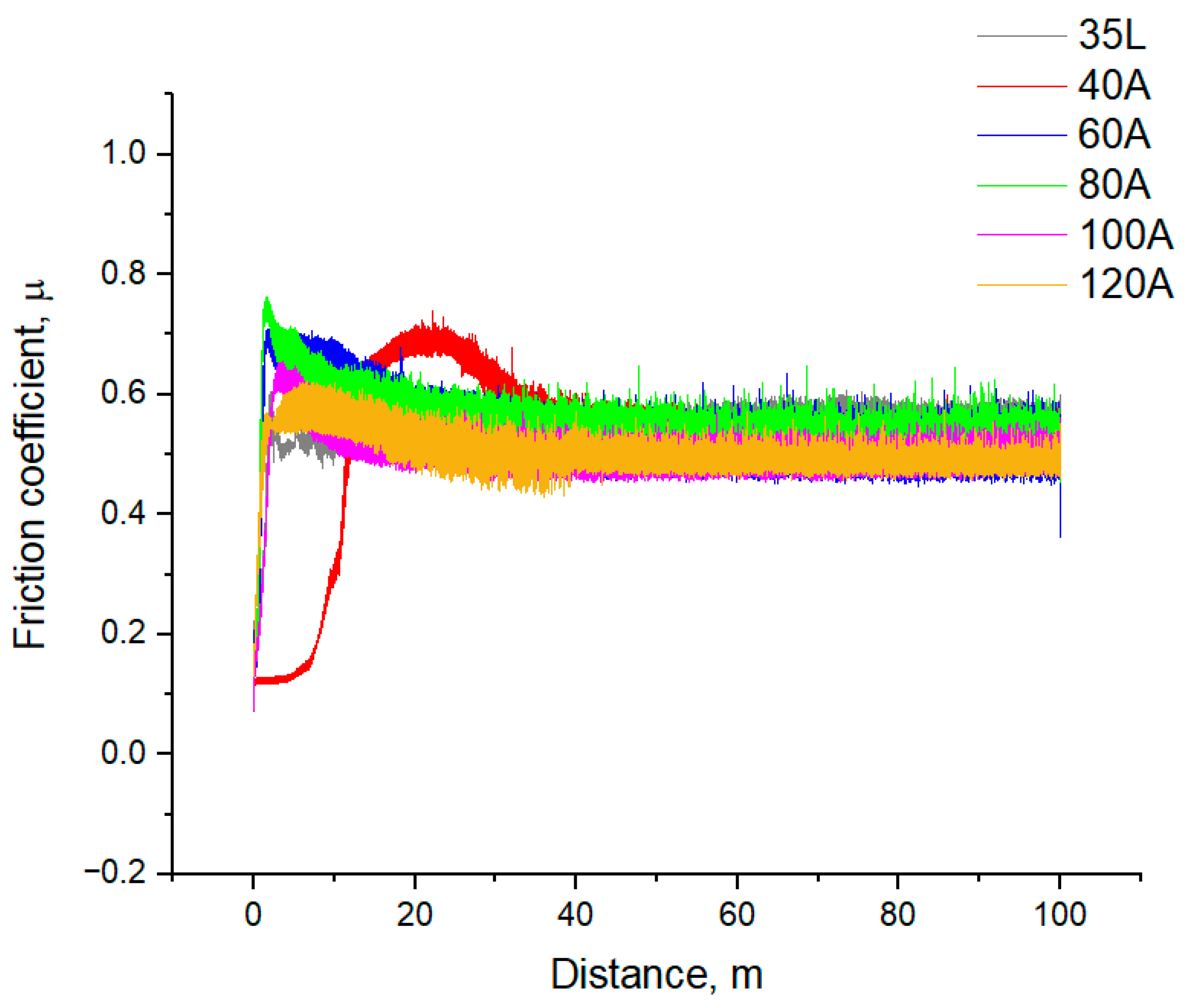
As indicated by the curves in Figure 6, all deposited coatings exhibit similar steady-state friction coefficients, μ ≈ 0.50–0.55, comparable to the 35L substrate (μ ≈ 0.531 in Table 3). The initial stage is characterized by run-in behavior with transient spikes in μ, followed by stabilization and convergence of the curves within a narrow range. Hence, in the present coating–100Cr6 ball system, μ is governed mainly by the contact conditions (counterbody material, load, speed, surface state) and the formation of a third-body layer, rather than by the surfacing regime. Consequently, the primary differences between the samples are expressed not in μ, but in the wear intensity and—importantly—in the dominant wear mechanisms.
The wear data summarized in Table 3 reveal markedly different wear resistance at nearly the same friction level. The best performance is obtained at 40 A, with a wear rate of 5.63 × 10⁻⁶ mm3/(N·m) and the smallest worn track cross-sectional area of 447.7 μm2, which is approximately 6–7 times lower than that of the 35L steel (3.85 × 10⁻⁵ mm3/(N·m), worn track cross-sectional area 3350.1 μm2). In the 60–80 A range, the wear rate increases to (9.79–9.94) × 10−6 mm3/(N·m); nevertheless, these coatings remain 3–4 times more wear resistant than the substrate. At higher currents (100–120 A), a sharp deterioration is observed: 2.74 × 10⁻⁵ and 3.53 × 10⁻⁵ mm3/(N·m), respectively, while the worn track cross-sectional area rises to 2180–2810 μm2, i.e., the wear level approaches that of 35L steel. Overall, wear increases with current, following 40 A (minimum) → 60–80 A (moderate increase) → 100–120 A (pronounced deterioration).
Beyond the quantitative trend, the microstructure suggests a clear shift in wear mechanism with increasing current (heat input). For the low-current regime (40 A), the coating retains a relatively refined dendritic–eutectic framework with a more uniform carbide-bearing network, which provides strong matrix support and limits localized shear deformation at the surface. Under these conditions, wear is likely dominated by mild abrasive grooving accompanied by oxidative/tribolayer effects, where a relatively stable third-body layer forms and partially protects the surface. In contrast, at high currents (120 A), dendrite coarsening, carbide coalescence, reduced carbide uniformity, and increased dilution weaken the load-bearing skeleton of the coating. This promotes stress concentration at carbide/matrix boundaries and facilitates carbide pull-out/micro-chipping, followed by fatigue-assisted delamination (spallation) of the near-surface layer. In other words, the dominant mechanism shifts from “mild abrasion + oxidative wear” at 40 A to a more severe mode at 120 A characterized by deeper grooving, carbide pull-out, and local delamination, explaining the strong increase in material loss despite similar steady-state μ values. To illustrate this mechanistic transition, SEM micrographs of the wear tracks for representative low- and high-current coatings (40 A and 120 A) are provided in the revised manuscript (new figure). Wear debris chemistry was not analyzed in this work; therefore, the oxidative contribution is inferred from wear-track morphology and the stable friction behavior.
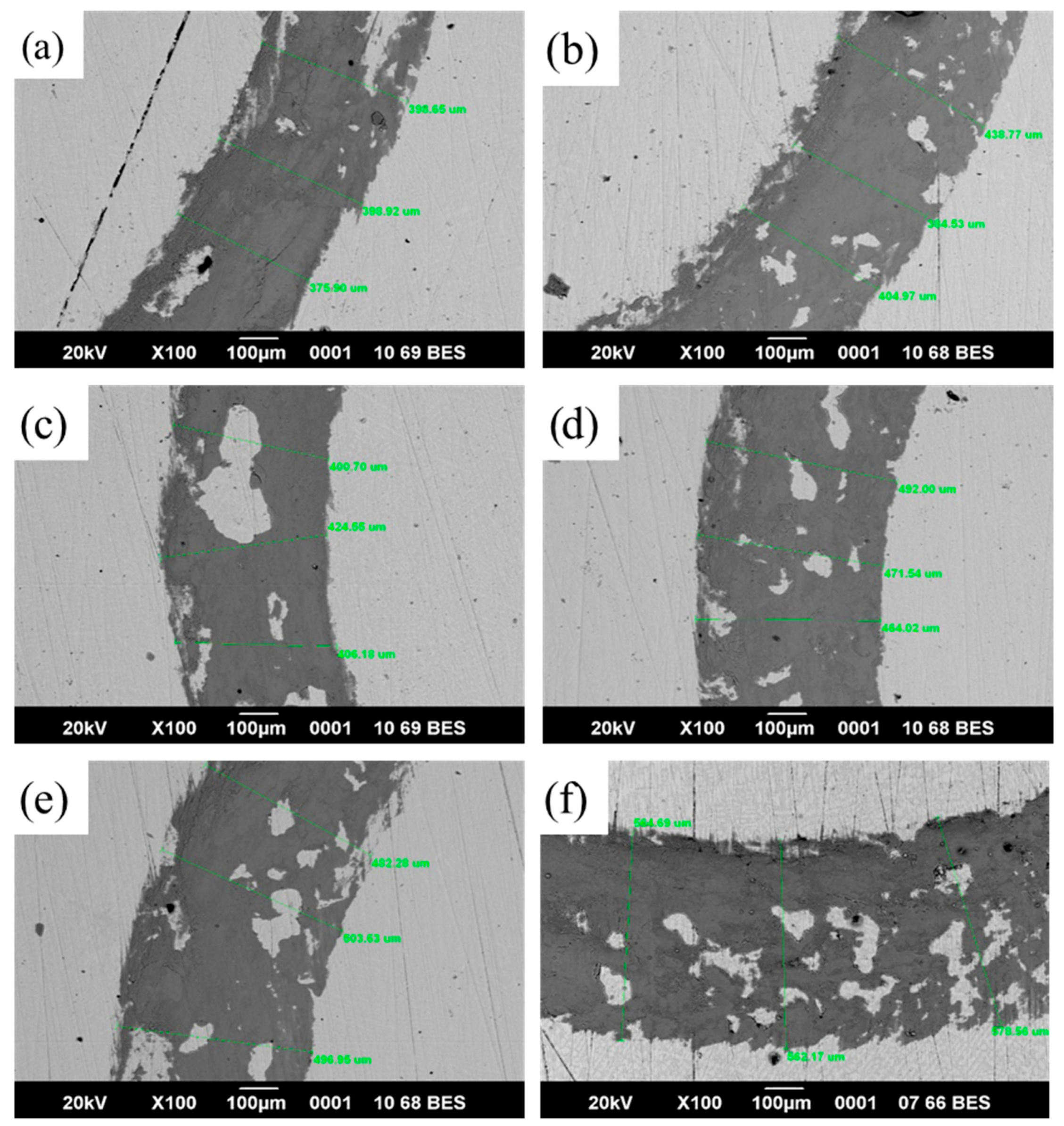
Figure 7 shows SEM micrographs of wear tracks used to quantify the track width after dry ball-on-flat tests for layers produced at currents of 40–120 A, as well as for 35L steel. For all specimens, a clearly defined contact track is formed, and the wear-track width increases systematically with increasing surfacing current: 40 A—~387 μm, 60 A—~415 μm, 80 A—~410 μm, 100 A—~475 μm, 120 A—~496 μm, whereas for 35L steel—~568 μm. The systematic increase in track width provides an additional morphological indicator of material removal severity, consistent with the specific wear rates reported in Table 3. Thus, the narrowest track is observed for 40 A and the widest for the 35L substrate, which qualitatively agrees with the wear-rate data (Table 3): minimum wear at 40 A and a pronounced deterioration at 100–120 A approaching the 35L level.
The wear-track morphology also evolves with increasing current. For coatings produced at 40–80 A, the track appears more “compact” and relatively uniform in width, and the track boundaries are less damaged, indicating a more stable resistance to near-surface deformation during sliding. Within the tracks, regions with contrast typical of the carbide–matrix framework are still observed, indirectly suggesting that the reinforcing skeleton (matrix + carbides) largely retains its load-bearing capability and limits severe surface degradation. Considering the high microhardness in the 40–80 A range and the pronounced carbide contribution, the dominant mechanism in this window can be interpreted as mild-to-moderate abrasive wear (plastic grooving/ploughing), for which material removal remains limited and the track stays relatively narrow.
For the high-current regimes 100–120 A, the track becomes noticeably wider and its boundaries appear more irregular and locally damaged, which is typical of intensified surface degradation under repeated contact cycles. Taking into account the previously established microstructural trends (dendrite coarsening, carbide coalescence/heterogeneity) and the decrease in microhardness at 100–120 A, the increased track width can be attributed to reduced effectiveness of carbide reinforcement in the near-surface layer and a stronger role of Fe dilution from the substrate. Under these conditions, in addition to abrasive grooving, the contribution of local micro-chipping/carbide pull-out and fatigue-assisted delamination (spallation) is suggested by the more irregular track margins and local damage features, accelerating material loss at an almost unchanged friction coefficient (Figure 6).
For 35L steel, the wear track is the widest (~568 μm), consistent with its lower hardness and the absence of carbide reinforcement. This confirms that the reduced wear of the surfaced layers compared with the substrate is primarily achieved by forming a hard carbide–matrix layer. Overall, Figure 7 demonstrates that increasing PTA current leads to widening of the wear track and reduced resistance to surface damage, while the most favorable track width and damage morphology are obtained at 40–80 A, particularly at 40 A, in agreement with the minimum wear rate reported in Table 3.

4. Conclusions

In summary, this study shows that PTA surfacing current is a key control parameter for tailoring the structure and service performance of Fe–Cr–C layers deposited using PG-S27 powder on 35L cast steel. The main conclusions are as follows:
  • Current-dependent evolution: The PTA current decisively governs deposited-layer geometry and thermal effects, which in turn control microstructure/phase response, microhardness, and dry-sliding wear behavior of the PG-S27-derived layers on 35L steel.
  • Hardening efficiency (percent vs. 35L): All deposited layers provide a pronounced hardening effect relative to 35L (~190 HV). The mean microhardness increases by approximately +230–244% in the 40–80 A window (654 HV at 40 A; 627 HV at 60 A; 640 HV at 80 A), and remains elevated at high current (+193–210% at 100–120 A), although with reduced hardening efficiency compared with the optimum range.
  • Optimal regime and wear benefit (percent vs. 35L): The most favorable performance is obtained at 40 A (within the optimal window 40–80 A). At 40 A, the specific wear rate is 5.63 × 10⁻⁶ mm3/(N·m), corresponding to an ~85% reduction in wear relative to 35L steel (3.85 × 10⁻⁵ mm3/(N·m)) and an improvement factor of ~6–7. Currents of 60–80 A provide a robust compromise, maintaining wear rates ~74–75% lower than 35L, whereas at 100–120 A wear increases sharply and approaches the substrate level (only ~29% and ~8% lower than 35L at 100 A and 120 A, respectively).
  • Friction behavior: Despite large differences in wear, the steady-state friction coefficient remains within a narrow range (μ ≈ 0.50–0.55; 35L ≈ 0.531), indicating that, under the present test conditions, performance differences are governed primarily by current-induced microstructure/dilution effects rather than changes in interfacial friction.
  • Process–structure–property linkage and application: Increasing current is associated with microstructural coarsening and stronger Fe dilution, which reduces the effective carbide strengthening contribution and degrades wear resistance; moderate currents preserve a more effective matrix–carbide framework and maximize service performance. The post-wear SEM observations (Figure 7) further support this trend by showing a systematic increase in wear-track width with current. These results confirm the feasibility of PG-S27 powder PTA surfacing for restoration and strengthening of wear-critical components (e.g., shaft journals) in crushing and grinding equipment, offering a practical pathway to extend service life and reduce wear-related downtime.
Overall, the established current window (40–80 A), with 40 A as the recommended optimum under the present conditions, provides actionable guidance for repair hardfacing where maximizing wear resistance while maintaining stable friction behavior is required.

Author Contributions

Conceptualization, A.S. and Z.S.; methodology, A.S., D.O. and N.K.; software, A.S.; validation, A.S., Z.S., B.R. and D.A.; formal analysis, A.S., K.O. and A.Z.; investigation, A.S., D.O., N.K., A.Z. and K.O.; resources, Z.S., B.R. and D.A.; data curation, A.S., A.Z. and K.O.; writing—original draft preparation, A.S.; writing—review and editing, A.S., Z.S., B.R. and D.A.; visualization, A.S. and K.O.; supervision, Z.S., B.R. and D.A.; project administration, Z.S. and B.R.; funding acquisition, Z.S., B.R. and D.A. All authors have read and agreed to the published version of the manuscript.

Funding

This research has been funded by the Committee of Science of the Ministry of Science and Higher Education of the Republic of Kazakhstan (Grant No. BR24992870).

Data Availability Statement

The original contributions presented in this study are included in the article. Further inquiries can be directed to the corresponding author.

Conflicts of Interest

Author Bauyrzhan Rakhadilov was employed by the company PlasmaScience LLP. The remaining authors declare that the research was conducted in the absence of any commercial or financial relationships that could be construed as a potential conflict of interest.

References

  1. Asadullin, N.; Mukhametgaliev, F.; Avkhadiev, F.; Khismatullin, M.; Gaynutdinov, I. Modern Trends in Technical Support for Agricultural Producers. BIO Web Conf. 2021, 37, 00016. [Google Scholar] [CrossRef]
  2. Belik, A.G.; Efremenko, B.V.; Makurov, S.L. Microstructure Features of Chrome-Nickel Coating Welded with Filler Wire PL AN-111 with a 50% Overlap. Sci. Transp. Prog. 2017, 2, 120–130. [Google Scholar] [CrossRef] [PubMed]
  3. Chang, C.-M.; Chen, L.-H.; Lin, C.-M.; Chen, J.-H.; Fan, C.-M.; Wu, W. Microstructure and Wear Resistance of Hypereutectic Fe–Cr–C Cladding with Different Carbon Contents. Surf. Coat. Technol. 2010, 205, 245–250. [Google Scholar] [CrossRef]
  4. Deshmukh, D.D.; Kalyankar, V.D. State of the Art of Plasma Arc Hardfacing Technology. Int. J. Mater. Prod. Technol. 2018, 56, 23. [Google Scholar] [CrossRef]
  5. Kazakhstan Mining Equipment and Services—Country Commercial Guide. Available online: https://www.trade.gov/country-commercial-guides/kazakhstan-mining-equipment-and-services (accessed on 11 February 2026).
  6. Bureau of National Statistics of the Republic of Kazakhstan. Foreign Market Publications (Import Partners/Statistics). Available online: https://stat.gov.kz/en/industries/economy/foreign-market/publications/376248/ (accessed on 11 February 2026).
  7. Gokhfeld, N.V.; Filippov, M.A.; Korobov, Y.S.; Estemirova, S.K.; Morozov, S.O. Features of Metastable Austenite Transformation into Deformation Martensite during Laser Surfacing with Flux-Cored Wire 60Cr7TiAl. Phys. Solid State 2021, 63, 1967–1973. [Google Scholar] [CrossRef]
  8. Gürgenc, T.; Özel, K. Investigation of Microstructure and Mechanical Properties of AISI 1020 Steel Coated with FeCrC, FeB and FeW Alloys Using PTA Method. 2016. Available online: https://www.researchgate.net/publication/322414594_Effect_of_heat_input_on_microstructure_wear_and_friction_behavior_of_wt-_50FeCrC-20FeW-30FeB_coating_on_AISI_1020_produced_by_using_PTA_welding (accessed on 11 February 2026).
  9. Lavrinenko, V.Y. Innovative Technologies of Forging and Stamping Production. In MashTech 2022. Innovative Technologies, Equipment and Material Blanks in Mechanical Engineering: Proceedings of the International Scientific and Technical Conference, Moscow, Russia, 24–26 May 2022; Bauman Moscow State Technical University (National Research University): Moscow, Russia, 2022; pp. 137–140. (In Russian) [Google Scholar]
  10. Lobachevsky, Y.P.; Mironov, D.A.; Mironova, A.V. Increasing the Service Life of Wear-Prone Working Bodies of Agricultural Machines. Agric. Mach. Technol. 2023, 17, 41–50. [Google Scholar] [CrossRef]
  11. Marginson, S.; Maksimova, A.; Lanshina, T. Higher Education as a Global Public Good. J. Int. Organ. Res. 2015, 10, 31–59. [Google Scholar] [CrossRef]
  12. Popov, D.V.; Mironov, D.A.; Tsents, Y.S. Evolution in the Design of Working Tools for Tillage Machines. Agric. Mach. Technol. 2025, 19, 66–73. [Google Scholar] [CrossRef]
  13. Zhang, S.; Liu, Y.; Cheng, H.; Li, K.; Qian, C.; Li, W. Fe–Cr–VC Composite Coatings Produced by Plasma Transferred Arc Powder Surfacing. Materials 2023, 16, 5059. [Google Scholar] [CrossRef]
  14. Vorobyev, E.A. Use of Metallic Powders in the Restoration of Machine Parts by Plasma Powder Surfacing. In Prospective Development of Science, Engineering and Technologies; Universitetskaya Kniga: Kursk, Russia, 2013; pp. 253–256. Available online: https://www.elibrary.ru/item.asp?id=22901183 (accessed on 8 March 2026).
  15. Gromov, V.E.; Kapralov, E.B.; Raikov, S.V.; Ivanov, Y.V.; Budovskikh, E.A. Structure and Properties of Wear-Resistant Coatings Deposited on Steel by Flux-Cored Wire Using Arc Method. Prog. Phys. Met. 2014, 15, 213–232. [Google Scholar] [CrossRef]
  16. Gusev, A.I.; Usoltsev, A.A.; Kozyrev, N.A.; Kibko, N.V.; Bashchenko, L.P. Development of Flux-Cored Wire for Surfacing Parts Operating under Wear Conditions. Izv. Ferr. Metall. 2018, 61, 898–906. [Google Scholar] [CrossRef]
  17. Gao, P.-H.; Li, K.-B.; Chen, B.-Y.; Zhang, B.; Naumov, A.; Wang, Z.-T.; Yang, Z.; Guo, Y.C. Effect of Plasma Arc Current on the Microstructure and Properties of Stellite-20 Alloy Coatings Obtained by Plasma Arc Surfacing. J. Mater. Res. Technol. 2025. [Google Scholar] [CrossRef]
  18. Konchin, V.A. Analysis of Materials Used in Plasma Powder Surfacing. Mod. Mater. Equip. Technol. 2023, 5, 79–84. [Google Scholar]
  19. Makarenko, N.A.; Bogutsky, A.A.; Granovskaya, N.A. Improving the Performance Efficiency of Machine Parts in Metallurgical and Press Production by Applying Plasma Powder Surfacing with Alternating Polarity Current; Issue 1; DSEA: Kramatorsk, Ukraine, 2011; p. 22. Available online: http://www.dgma.donetsk.ua/science_public/ddma/2011-1-22/article/11MNAMEP.pdf (accessed on 8 March 2026).
  20. Malinov, V.L. Increasing Wear Resistance of Metal with Metastable Cr–Mn Structure after Melting. Sci. Transp. Prog. 2012, 40, 239–242. [Google Scholar] [CrossRef] [PubMed]
  21. Mironov, D.A.; Sidorov, S.A.; Liskin, I.V. Strength and Durability Characteristics of Soil-Cutting Working Bodies. Agric. Mach. Technol. 2019, 13, 39–43. [Google Scholar] [CrossRef]
  22. Nefedyev, S.P. Regularities of Structure and Properties Formation of Nitrogen-Alloyed Wear-Resistant Coatings during Plasma Surfacing and Additional Technological Treatments. Doctoral Dissertation, Moscow Institute of Steel and Alloys, Moscow, Russia, 2024. Available online: https://earchive.tpu.ru/bitstream/11683/84066/1/thesis_tpu-2025-07.pdf (accessed on 8 March 2026).
  23. Nefedyev, S.P.; Morozov, A.N. Plasma-powder surfacing of hydraulic cylinder rods with white wear-resistant cast iron. Mech. Eng. Comput. Technol. 2014, 5, 41–49. [Google Scholar] [CrossRef][Green Version]
  24. Petridis, A.V.; Tolkushev, A.A.; Ageev, E.V.; Ageeva, E.V. Composition for Plasma Powder Surfacing of Wear-Resistant Coatings on Machine Parts Including Tungsten Carbide and Titanium Carbide Powder. Patent RU 2364482 C2, 20 August 2009. Available online: https://www.elibrary.ru/item.asp?id=37688904 (accessed on 8 March 2026). (In Russian)
  25. Sokolov, G.N.; Artemyev, A.A.; Dubtsov, Y.N.; Eremin, E.N.; Litvinenko-Arkov, V.B.; Losev, A.S. Effect of Titanium Carbonitride Particles on the Structure and Properties of Fe–C–Cr–Ni–Mo Metallic System Deposited by Flux-Cored Wire. Omsk. Sci. Bull. 2018, 158, 15–19. [Google Scholar] [CrossRef]
  26. Stefan, J. Über die Theorie der Eisbildung, insbesondere über die Eisbildung im Polarmeere. Ann. Phys. 1891, 278, 269–286. [Google Scholar] [CrossRef]
  27. Mullins, W.W.; Sekerka, R.F. Stability of a Planar Interface during Solidification of a Dilute Binary Alloy. J. Appl. Phys. 1964, 35, 444–451. [Google Scholar] [CrossRef]
Figure 1. General layout of the plasma surfacing system and a schematic diagram of the plasma torch: (1) 6-axis robot; (2) power supply; (3) chiller (cooling unit); (4) Ar cylinders.
Metals 16 00308 g001
Figure 2. Fe–Cr–C coating thickness for different PTA currents: (a) 40 A; (b) 60 A; (c) 80 A; (d) 100 A; (e) 120 A. L1–L3 denote three independent thickness measurements taken at different positions across the coating cross-section (L1—first measurement, L2—second measurement, L3—third measurement).
Metals 16 00308 g002
Figure 3. SEM images of dendritic structure for Fe-Cr-C coatings created at different currents (a) 40 A; (b) 60 A; (c) 80 A; (d) 100 A; (e) 120 A.
Metals 16 00308 g003
Figure 4. XRD patterns of the coatings deposited at different currents: 40 A; 60 A; 80 A; 100 A; 120 A.
Metals 16 00308 g004
Figure 5. Hardness results of the obtained coatings: (a) shows the average hardness of the deposited layer; (b) shows the hardness profile from the coating surface to the substrate, where the yellow line marks the coating–substrate interface and the heat-affected zone (HAZ).
Metals 16 00308 g005
Figure 6. Coefficient of friction of Fe–Cr–C coatings produced by PTA at different currents.
Metals 16 00308 g006
Figure 7. SEM images of wear tracks after dry ball-on-flat tests for Fe–Cr–C layers produced at different PTA currents and for the 35L substrate: (a) 40 A; (b) 60 A; (c) 80 A; (d) 100A; (e) 120 A; (f) 35L cast steel.
Metals 16 00308 g007
Table 1. Chemical Composition of the Materials Used.
MaterialFeCCrSiMnNiWMoCuSP
Steel 35L based 0.32–0.40≤0.30.17–0.370.4–0.9≤0.3≤0.3≤0.045≤0.045
Sormait PG-S27based~3.3~26~1.5~0.9~1.5~0.3~0.09~0.07~0.06
Table 2. Experimental modes for plasma surfacing.
SampleVoltage, VCurrent, AQlin, kJ/mmShielding Gas, L/minIon Gas, L/minGas for Powder Supply, L/minPowder Feed, g/minTravel Speed, mm/minNozzle-to-Workpiece Distance, mm
40 A25400.42151.533010015
60 A600.63
80 A800.84
100 A1001.05
120 A1201.26
Table 3. Average friction coefficient and wear characteristics of Fe–Cr–C coatings deposited at different welding currents, measured using an Anton Paar TRB3 tribometer (μ_avg, wear volume/area, specific wear rate).
SampleLoad (H)Coefficient of Friction (avg.)Worn Track Section
(µm2)
Wear Rate (mm3/N/m)
40A100.522447.75.63 × 10−6
60A100.537791.39.94 × 10−6
80A100.547779.09.79 × 10−6
100A100.5032180.22.74 × 10−5
120A100.5072810.63.53 × 10−5
Steel 35L100.5313350.13.85 × 10−5
Disclaimer/Publisher’s Note: The statements, opinions and data contained in all publications are solely those of the individual author(s) and contributor(s) and not of MDPI and/or the editor(s). MDPI and/or the editor(s) disclaim responsibility for any injury to people or property resulting from any ideas, methods, instructions or products referred to in the content.