Article

Hot Deformation Behavior of High-Nitrogen Steels and Numerical Simulation of Continuous Rolling

1
China Institute of Marine Technology and Economy, Beijing 100081, China
2
Key Laboratory of Automobile Materials, Ministry of Education and School of Material Science and Engineering, Jilin University, Changchun 130022, China
*
Authors to whom correspondence should be addressed.
Metals 2026, 16(3), 285; https://doi.org/10.3390/met16030285
Submission received: 23 January 2026 / Revised: 15 February 2026 / Accepted: 19 February 2026 / Published: 3 March 2026
(This article belongs to the Special Issue Recent Advances in Analysis of Metal Rolling Processes)

Abstract

In this paper, high-strength high-nitrogen steel Cr18Mn15 was fabricated using centrifugal casting. High-temperature tensile tests were subsequently performed on the centrifugally cast material. Based on the dynamic material model (DMM), power dissipation and instability maps were constructed for the steel. The results revealed that the optimal processing conditions for Cr18Mn15 are within a temperature range of 940 °C to 980 °C and a strain rate range of 0.001 s−1 to 0.01 s−1. Flow instability was observed primarily under high strain rate conditions (1 s−1) at a lower temperature of 900 °C. Four constitutive equation models were established based on the experimental results, and the prediction accuracy was assessed by calculating their average absolute relative errors (AAREs) and correlation coefficients (r). It was found that the Modified-JC constitutive model could simultaneously take care of both accuracy and simulation convergence with an AARE of 17.823 and Pearson’s correlation coefficient (PCC) of 0.968. For the practical application of Cr18Mn15 high-nitrogen steel, a three-layer composite tube forming and a continuous rolling equipment were developed. The rolling and spreading process was simulated using finite elements, and the stress field, strain field, and temperature field in the spreading process were analyzed to determine the following optimum process parameters of the alloy: a temperature of 950 °C, a processing line speed of 1 m/s, and a preheating temperature of 200 °C.

1. Introduction

With the increasingly severe need to conserve resources and protect the environment, the demand for high-strength, fatigue-resistant high-nitrogen steels in fields such as marine and aerospace is becoming more and more important [1,2,3,4,5,6]. According to the main chemical composition, high-nitrogen austenitic steel can be divided into the Cr-Ni system and the Cr-Mn system [7]. Nitrogen in high-nitrogen steels not only improves corrosion resistance and yield strength but also hinders grain growth, resulting in fine carbon–nitrogen compounds [8,9,10,11,12]. The Cr-Ni system of high-nitrogen steel has a very high content of nickel, which results in higher costs. The Cr-Mn system of high-nitrogen austenitic steel mainly occurs through the addition of manganese instead of expensive nickel. Manganese not only plays a role in the stabilization of the austenite but also improves the solid solubility of nitrogen [13,14,15,16,17,18]. However, the heat treatment of Cr-Mn high-nitrogen steels is complex, requiring precise temperature control and time management, and it is difficult to process due to its high strength. Therefore, there is an urgent need to identify the heat distortion parameters and to form methods for high-nitrogen steels.
The thermal processing map is a diagram that is used to describe the relationship between temperature and strain during the thermal processing of a metallic material to ensure that the material achieves optimum mechanical properties during processing [19,20,21,22,23,24]. Lin Wang et al. [25] obtained the optimum range of thermal processing parameters for 7Mo-0.46N-0.02Ce by performing thermal compression experiments on super austenitic stainless steel. Xuewen Chen et al. [26] determined the optimum heat distortion conditions for Cr5 by creating a thermal processing map. Zhaohui Zhou et al. [27] investigated the thermal processing behavior of Mg-Gd-Y-Nb-Zr alloys by means of thermal processing maps, linking the processing maps to the corresponding tissue evolution.
The constitutive equation is a mathematical equation that describes the mechanical behavior of a material and relates the strain of a material to parameters such as applied stress, temperature, strain rate, etc. It is used to make predictions for the behavior of the material under different deformation conditions [28,29,30,31]. Compared with the traditional constitutive model, the optimized model of NSGA2-BP saves time during parameter tuning, obtains a better and more reproducible model, predicts new material or new process parameters more reliably, and better characterizes the highly nonlinear and coupling relationship in mechanical behavior. Jie Xiong et al. [32] investigated the Arrhenius constitutive equation model for nickel-based high-temperature alloys and compared the predicted behavior. Yingxiang Xia et al. [33] investigated the Arrhenius constitutive equation model for T4 aluminum alloy based on the strain compensation, genetic algorithm, and k-function correction, and they compared the prediction accuracy by correlation coefficients and mean absolute relative errors.
Material-forming simulation is the application of computer simulation to predict and optimize the behavior of materials during the forming process. Simulation can be used to anticipate potential problems prior to the actual production, which reduces risks in practical applications [34,35,36,37,38,39]. Li Hu et al. [40,41] verified the validity of the Arrhenius intrinsic model for the finite element simulation of the thermal compression of magnesium alloys by ABAQUS software. Mengyue Wang et al. [42] analyzed the plastic rheological behavior of blade surface materials by importing the Johnson–Cook model through the ABAQUS software and carried out precision control of plastic deformation.
In this paper, we prepared Cr18Mn15 high-nitrogen steel by melting and centrifugal casting, conducted hot tensile experiments at different temperature ranges and different strain rates, and established corresponding hot working diagrams to determine the optimum range of hot working parameters for Cr18Mn15 high-nitrogen steel. In addition, four kinds of constitutive equations were also established for the high-temperature rheological curves of Cr18Mn15 high-nitrogen steel, and their accuracies were verified in comparison. Finally, the changes of stress field, strain field, and temperature field during the flattening process of the Cr18Mn15 high-nitrogen steel composite plate were simulated by ABAQUS finite element software according to the parameters of the constitutive equation. The optimal process parameters were determined by the analysis of the stress field and temperature field.

2. Experimental Materials and Methods

2.1. Preparation of Materials and Specimens

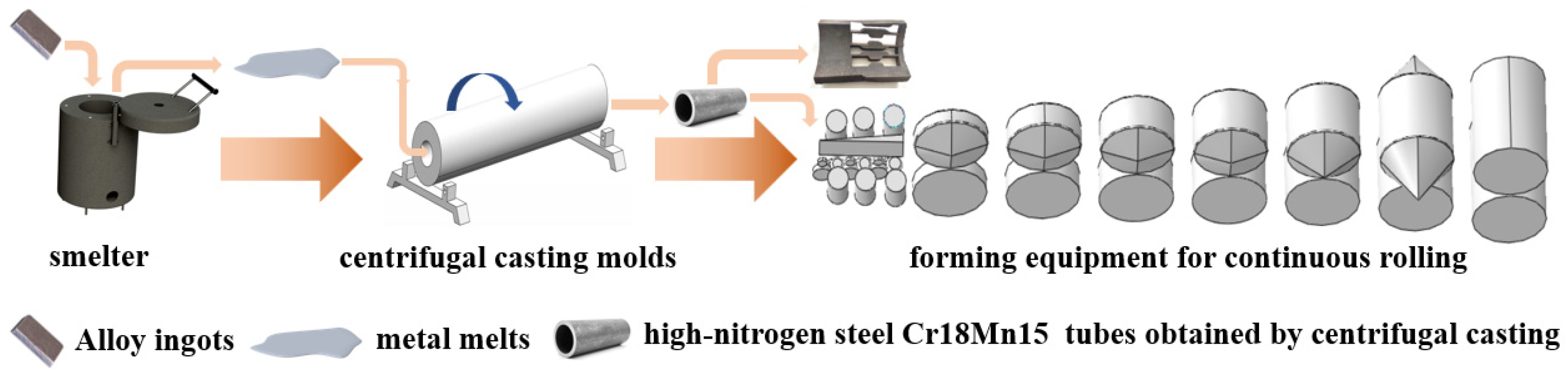
The alloy material is heated above the melting point in the melting furnace to make it completely melted, and then the molten metal is injected into the rotating mold through the sprue. It is worth noting that the mold needs to be preheated before re-pouring in order to reduce thermal stresses when the casting cools. At this time, since the mold has been in a rotating state, the molten alloy will solidify on the inner wall of the mold under the action of centrifugal force to form a ring casting, as shown in Figure 1. The composition was examined by ICP-AES, and the composition is shown in Table 1. After waiting for the casting to fully solidify, we slowly reduced the speed to a stop, removed the casting, and perform post-processing.
The composite steel mentioned in this paper refers to a composite steel prepared by centrifugal casting, consisting of 304 stainless steel and high-nitrogen steel. The objective of this paper is to investigate the optimal rolling process parameters for this steel. The thickness ratio of 304 stainless steel to high-nitrogen steel is approximately 3:4:3, and the thickness decreases as the number of rolling passes increases.
Standardized test pieces for hot tensile tests are cut from a homogeneous part of the casting by wire cutting. For centrifugally cast high-nitrogen steel pipes with a thickness of 20 mm and an inner diameter of 100 mm, the mold rotation speed is set at 105 rpm, and the melting atmosphere is maintained in an argon protection state with oxygen content controlled at an extremely low level (<20 ppm). The optimal nitrogen injection method involves introducing 0.65 MPa nitrogen into the molten steel for alloying in a sealed pressurized furnace.
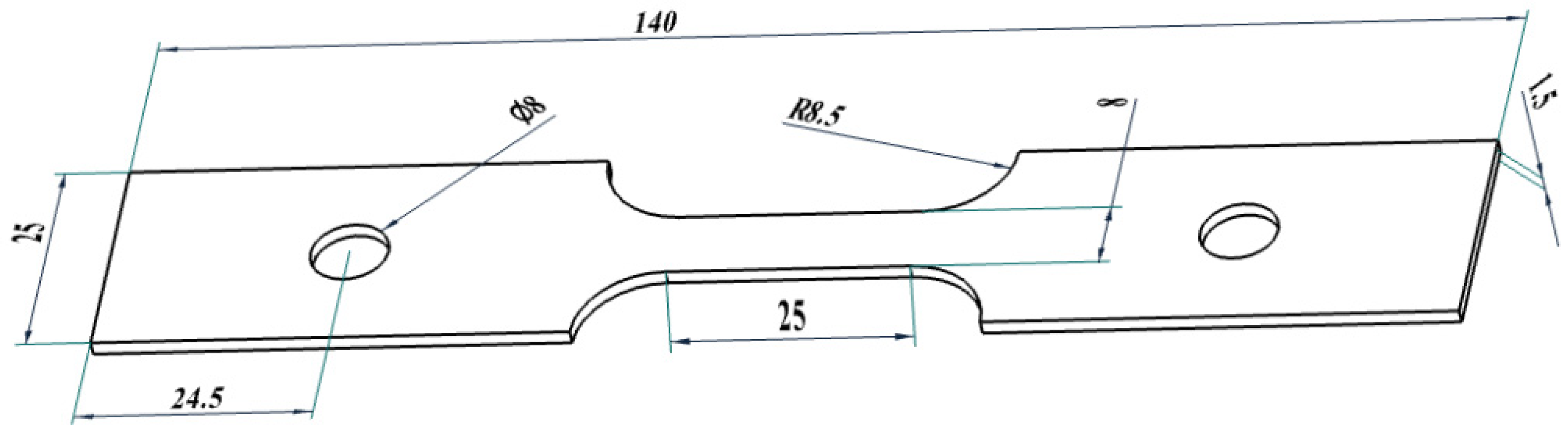
Three samples were made for each tensile test, and three experiments were carried out. The average value of the final results was used to draw the tensile test curve. The dimensions of the tensile specimens are shown in Figure 2. Thermal tensile tests were performed using the WDW-300 high-temperature universal testing machine(Changchun Kexin Test Instrument Co., Ltd., Changchun, China), which operates stably within a temperature range of several hundred to over a thousand degrees. Given the minimal variation in the measured thermal tensile data, the results fall within the allowable error margin. Consequently, the median value of three consecutive tests was adopted as the stress–strain curve parameter.

2.2. Thermal Processing Map

Thermal processing maps are used to reveal the properties and behavior during high-temperature processing, providing a visual representation of the processing quality and performance status of the material. In this work, the power dissipation and instability maps of Cr18Mn15 have been constructed by dynamic material modeling, and the parameter ranges for the optimal hot working deformation of Cr18Mn15 have been determined by hot working maps. Because the wall thickness of a steel pipe after centrifugal casting is thin, it is easy to lose stability under the compression test. Meanwhile, the rolling process belongs to a high-temperature test, and the experimental curves obtained by the tensile test and compression test are close. Therefore, the tensile test is adopted instead of the compression test.

2.3. Constitutive Equation

The intrinsic equation describes the relationship between the stresses and strains obtained by the material, reflecting the intrinsic relationship of the material. In this paper, three constitutive equations have been developed based on experimental results: the strain-compensated Arrhenius model, the modified Johnson–Cook model, and the NSGA2-BP neural network model. The model accuracy was evaluated by calculating the model’s average absolute relative errors (AARE) and correlation coefficients (r).
The strain-compensated Arrhenius model takes into account the role of temperature softening and the effect of different strain rates on the thermal processing of materials, but convergence during simulation is poor due to its high number of higher-order terms. The modified Johnson–Cook model takes into account the processing effect, the strain rate effect, the softening effect of temperature on the material, and the inherent coupling of the three factors. The NSGA2-BP neural network model is the most accurate in predicting the flow stress of Cr18Mn15; however, the artificial neural network model makes it difficult to visualize the effects of deformation temperature and strain rate on the flow stress, which limits its application in simulation.

2.4. Design of Forming Equipment for Continuous Rolling After Centrifugal Casting

In the design and manufacture of high-hardness stainless steel materials, due to low toughness, proneness to chipping and fracture, and other phenomena, the general industry uses high-strength stainless steel materials in the inner layer of each side of the composite layer with a toughness better than the 304 stainless steel inner layer of reinforcing bars to ensure that the material at the same time takes into account the toughness. This work is carried out through the simulation of centrifugal casting of a Cr18Mn15 bar on both sides of a layer of the 304 stainless steel composite continuous rolling process. In this paper, the evolution of stress, strain, and temperature fields during continuous rolling and flattening of the composite steel pipe is investigated by thermodynamically coupled finite element simulation modeling.

3. Results and Discussion

3.1. Thermal Stretching and Thermal Processing Map

3.1.1. Thermal Tensile Stress–Strain Curve

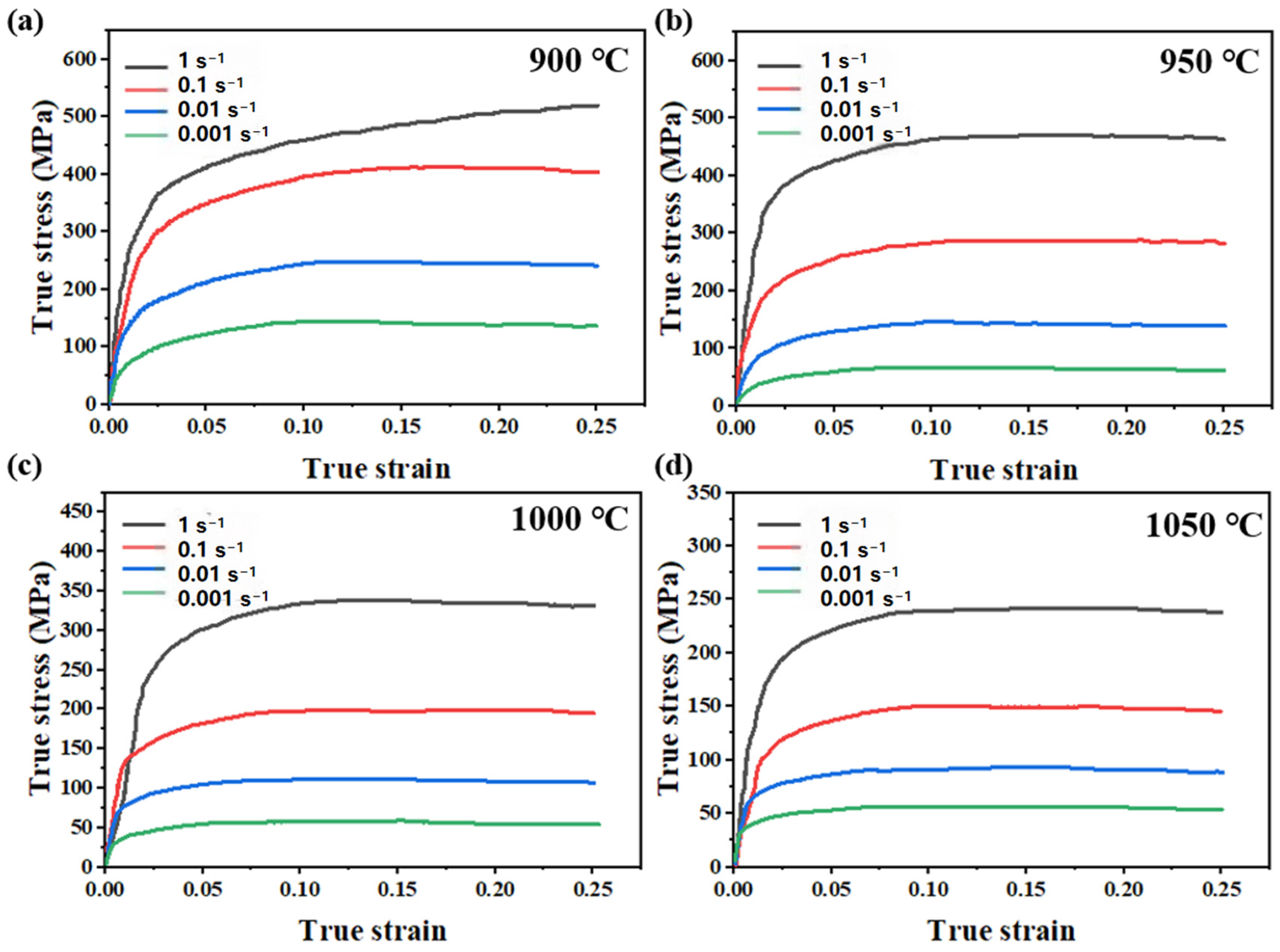
Figure 3 shows the true stress–strain curves for Cr18Mn15 in the temperature range of 900 °C to 1050 °C with strain rates from 0.001 s−1 to 1 s−1. The curves in Figure 3, with different colors, represent the stress–strain curves corresponding to different strain rates at various temperatures. The three different stages of the flow stress profile can be clearly observed in Figure 3. Black curves represent true stress–strain curves at strain rates of 1 s−1 across different temperatures. Red curves show true stress–strain curves at 0.1 s−1 for the same temperature range. Blue curves indicate true stress–strain curves at 0.01 s−1, while green curves represent curves at 0.001 s−1.
In the initial stage of tensile deformation, work hardening plays a major role, and the flow stress increases rapidly in relation to the critical stress as the strain increases. In the second stage, the transition from critical stress to peak stress, the formation of new grains hinders the work hardening. The peak stress is reached when the rate of work hardening equals the rate of dynamic softening. In the third stage, flow softening exceeds work hardening, and the stress decreases. The increases in peak stress and the deformation strain rate are due to the increase in dislocation motion velocity alongside the increasing strain rate and the shortening of the time for dynamic recovery (DRV) and dynamic recrystallization (DRX). At the same strain rate, Cr18Mn15 shows an increase in plastic deformability and a gradual decrease in yield strength with increasing temperature, which is due to the fact that dislocations are more likely to move due to grain growth at elevated temperatures, and the DRV effect is enhanced with increasing temperature.

3.1.2. Thermal Processing Map

Based on the rheological stress values of high-nitrogen steel under different deformation conditions obtained from hot stretching experiments, the stress data were obtained at different temperatures and strain rates when the true strains were 0.05, 0.15, and 0.25, as shown in Table 2, to establish the power dissipation diagrams and destabilization diagrams of high-nitrogen steel.
The total energy P consumed by the workpiece is divided into two parts to be dissipated: one part is the dissipated energy (G) and the other part is the dissipated coefficient (J).
P = ε ˙ · σ = G + J = 0 ε ˙ σ d ε ˙ + 0 σ ε ˙ d σ
Introducing a strain rate sensitivity factor m describes the distribution of the total energy P among the dissipated energy (G) and the dissipation coefficient (J).
m = J G = ε ˙ · σ σ · ε ˙ = | ( ln σ ) ( ln ε ˙ ) | ε , T
At the same temperature (T) and strain (ε), the energy dissipation coefficient (J) can be expressed as
J = 0 σ ε ˙ d σ = m m + 1 σ ε ˙
When m takes the value of 1, the material is in the ideal state, at which time J reaches its maximum value.
J m a x = σ ε ˙ 2 = P 2
The power dissipation factor ( η ) refers to the proportion of the total energy that is dissipated by microstructural change.
η = J J m a x = 2 m m + 1
This paper uses the destabilization criterion established by Prasad et al. [43] based on the Ziegler principle of maximum entropy production rate.
D ε ˙ < D ε ˙
where D is the dissipation factor, and according to the dynamic material model, D is equal to the dissipation coefficient (J).
Taking the logarithm on both sides of Equation (3) simultaneously yields Equation (7).
ln J = ln ( m m + 1 ) + ln σ + ln ε ˙
There are simultaneous derivatives of ln ε ˙ for both sides of Equation (7):
ln J ln ε ˙ = ln ( m m + 1 ) ln ε ˙ + ln σ ln ε ˙ + 1
Next, we organize the available rheological instability criteria.
ξ ( ε ˙ ) = ln ( m m + 1 ) ln ε ˙ + m < 0
The relationship between strain rate and true stress is fitted by a cubic polynomial and can be expressed as Equation (10).
ln σ = a + b ln ε ˙ + c ( ln ε ˙ ) 2 + d ( ln ε ˙ ) 3
where a, b, c and d are the constants.
Taking partial derivatives of ln ε ˙ on both sides of Equation (1) yields Equation (2).
m = ln σ ln ε ˙ = b + 2 c ( ln ε ˙ ) + 3 d ( ln ε ˙ ) 2
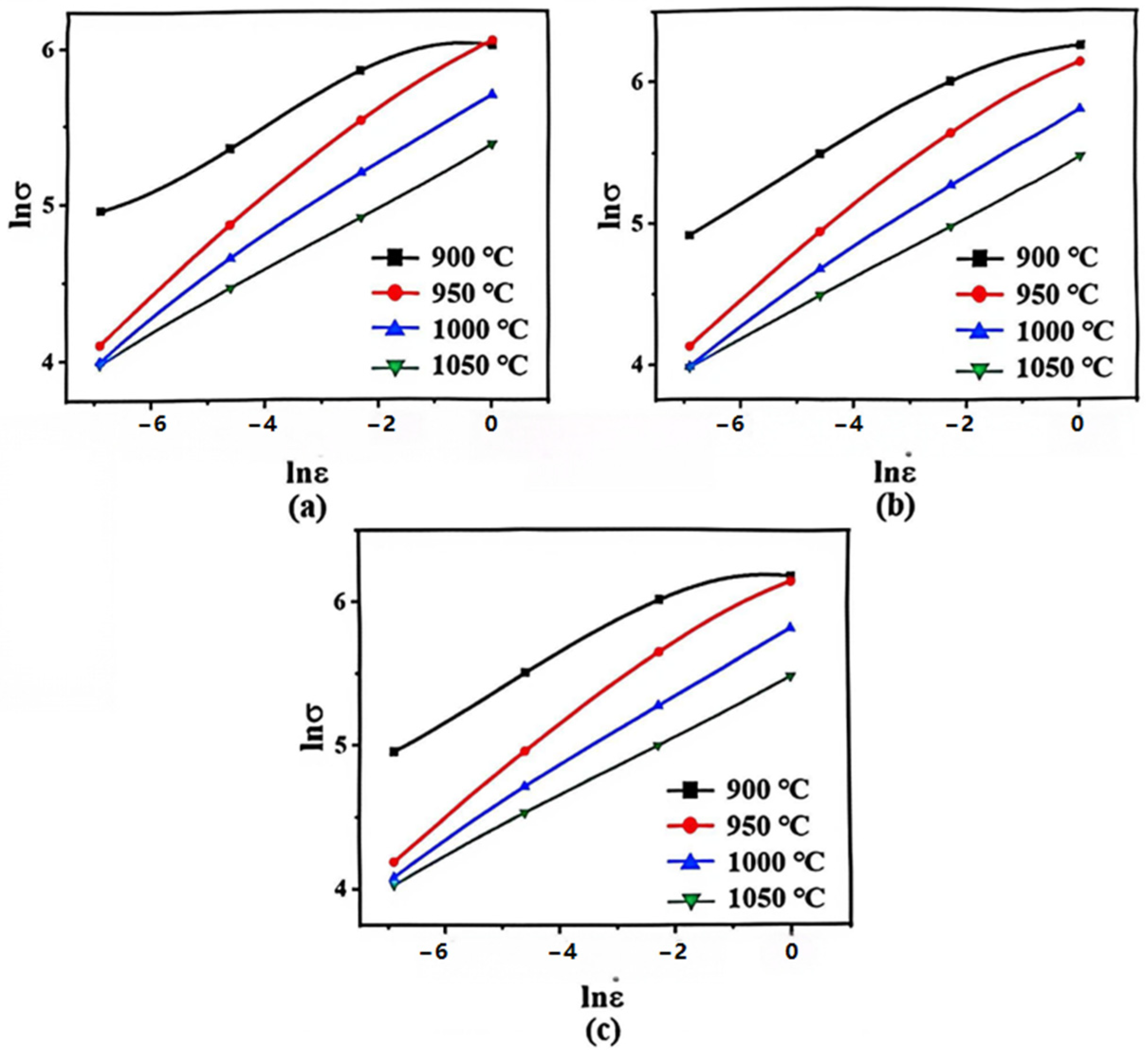
The three-degree polynomial has been fitted to ln σ and ln ε ˙ , and the results of the fit are shown in Figure 4.
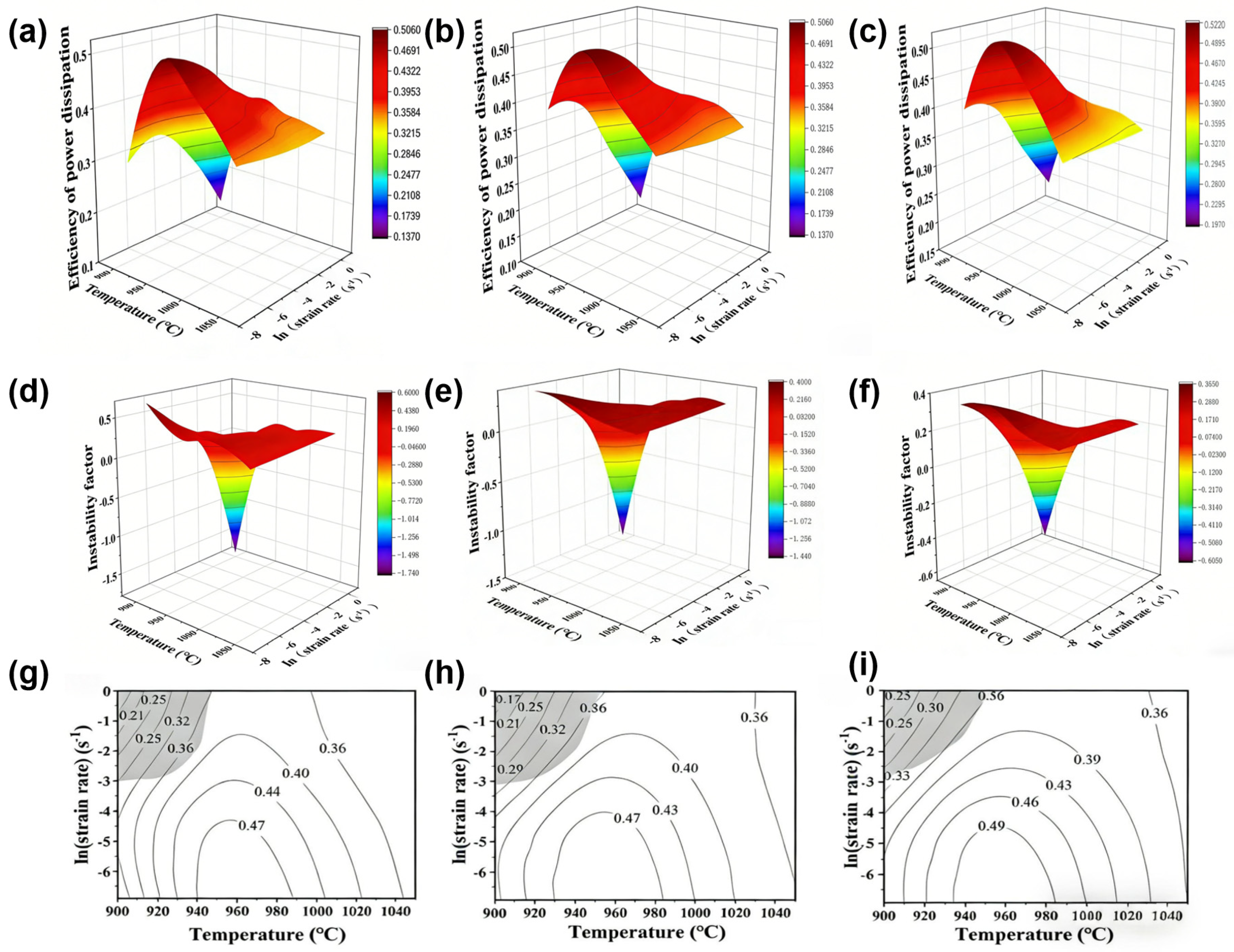
From Figure 4, it can be seen that the cubic polynomial can provide a better fit to the relationship between ln σ and ln ε ˙ . A 3D power dissipation diagram for high-nitrogen steels has been created using Origin software, as shown in Figure 5a–c. It can be seen that the distribution of the power dissipation factor is concentrated within 0.17 to 0.49, and the change in strain has a small effect on the power dissipation factor. When the processing temperature is 900 °C and the strain rate is high, the power dissipation factor is the smallest, which indicates that the processing performance of Cr18Mn15 is the worst under this processing condition. An observation of the power dissipation diagrams reveals that a stable single-peak region exists at a low strain rate of 960 °C for all three strains, indicating that the power dissipation factor of the material is the largest at that location and that the more energy there is acting on the changes in the internal structure of the material, the better the performance of the processed product may be. However, considering that the damage that occurs during thermal deformation also consumes energy, the corresponding power dissipation factor becomes larger. Therefore, a larger power dissipation factor does not fully indicate a better processing performance but needs to be judged in combination with the instability diagram.
The 3D destabilization map of high-nitrogen steel was plotted by Origin, as shown in Figure 5d–f. From the figure, it can be seen that the rheological instability region is mainly distributed in the high strain rate region of T ≤ 950 °C. At this temperature and strain rate, the deformation of the material is not conducive to the occurrence of dynamic recrystallization, and a faster strain rate will lead to deformation inhomogeneity, which is more likely to occur as a rheological instability phenomenon. Comparison of the instability maps at three strains in Figure 5d–f shows that with the increase in strain, the instability region becomes larger at the same time, which indicates that along with the increase in deformation, more defects may appear inside the material organization, causing the instability region to expand. At higher processing temperatures, the material instability coefficient is always greater than 0, indicating that the material plasticity is sensitive to temperature changes.
The power dissipation maps at the same strain in Origin software were superimposed with the instability maps and processed to obtain Figure 5g–i, in which the shaded portion of the internal instability factor is less than zero, which represents the unstable region during the material processing. When the effect of deformation on the thermal processing map is small, the low strain rate at ε ˙ = 1 × 10 3 ~ 1 × 10 2   s 1 at temperatures of 900~940 °C is suitable for the material processing, and there is a destabilization zone in the high strain rate region corresponding to it. At the temperature of 940~970 °C, the peak value of the memory localized power dissipation coefficient in the low strain rate interval of ε ˙ = 1 × 10 3 ~ 1 × 10 2   s 1 is about 0.49, and there is no destabilization zone in this range, which indicates that the material performance is better under this processing condition. At a temperature of 970~1050 °C, there is no destabilization zone in the whole temperature interval, indicating that high temperature has a large impact on the processing performance of the material, but the power dissipation coefficient gradually decreases as the temperature rises. Therefore, the most suitable processing conditions for Cr18Mn15 is the low strain rate region at temperatures of 940~970 °C and ε ˙ = 1 × 10 3 ~ 1 × 10 2   s 1 .

3.2. Constitutive Equation

3.2.1. The Arrhenius Constitutive Equation for Strain Compensation

The Arrhenius constitutive equation describes the plastic deformation behavior of materials at high temperatures and is widely used to predict the plastic deformation properties of materials at high temperatures. The rheological stress model for the Arrhenius constitutive equation has the following three expressions.
At an arbitrary stress level, the rheological stress is modeled as
ε ˙ = A [ sinh ( α σ ) ] n e x p ( Q R T )
where A, α , and n are temperature-independent material parameters, Q is the deformation activation energy (J mol−1), T is the absolute temperature (K), and R is the gas constant.
At low stresses (ασ < 0.8 ), the flow stresses are modeled as
ε ˙ = A 1 σ n 1 e x p ( Q R T )
At high stresses (ασ > 1.2 ), the flow stresses are modeled as
ε ˙ = A 2 e x p ( β σ ) e x p ( Q R T )
where A 1 , A 2 , β and, n 1 are temperature-independent material parameters.
The coupling between flow stress, strain rate and temperature at elevated temperatures can be represented by the Zener–Holloman parameter:
Z = ε ˙ exp ( Q R T ) = F ( σ )
Since the effect of strain on the rheological stress is not considered in the Arrhenius constitutive equation, this paper uses a strain of 0.2, and Table 3 shows the values of the rheological stress at ε = 0.2 .
Taking logarithms of both sides of Equations (13) and (14) yields Equations (16) and (17).
ln ε ˙ = ln A 1 + n 1 ln σ Q R T
ln ε ˙ = ln A 2 + β σ Q R T
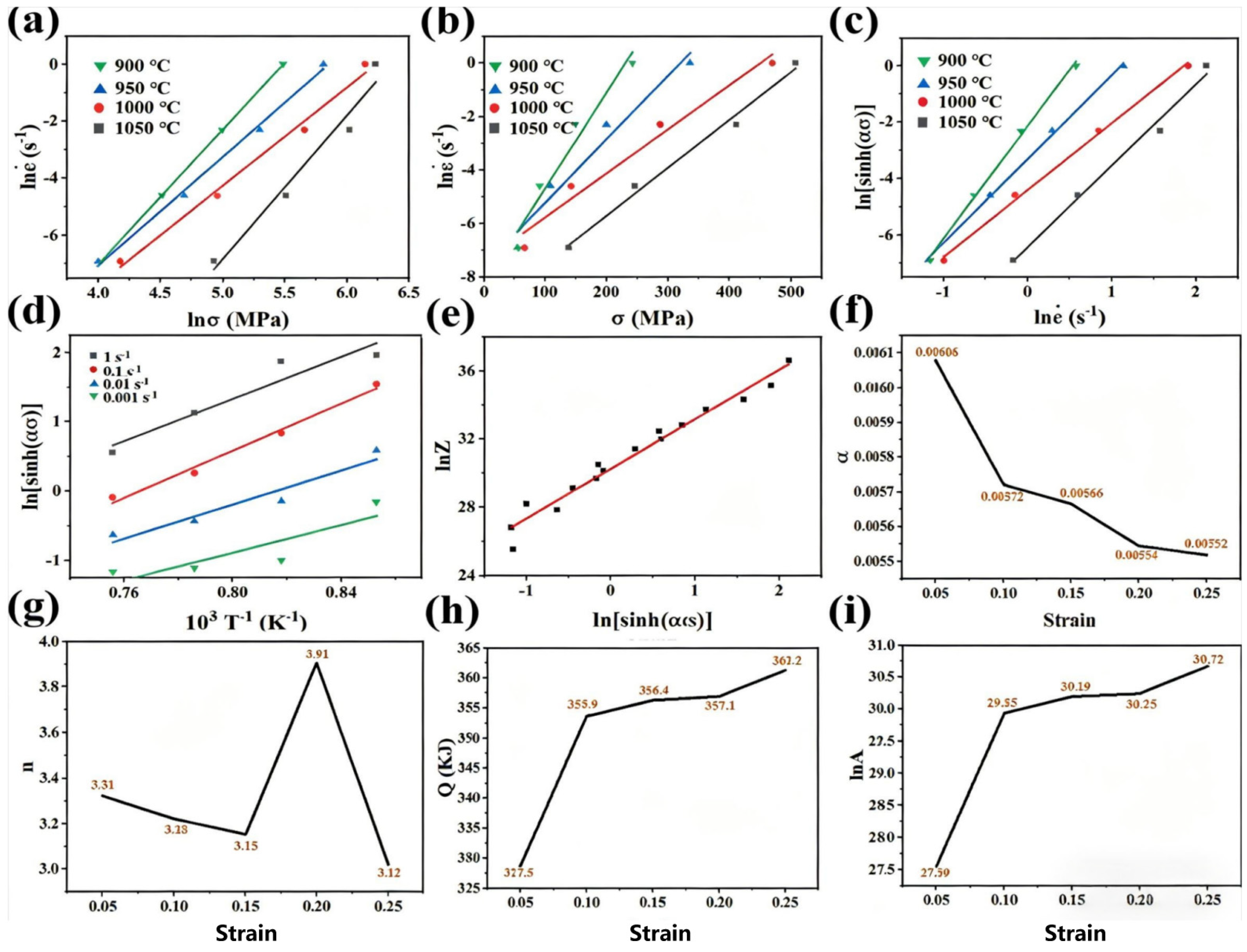
From Equation (16), n1 is the slope of the line ln ε ˙ - ln σ , and from Equation (17), β is the slope of the line ln ε ˙ - σ . The results of linear fitting of ln ε ˙ , ln σ , respectively, are shown in Figure 6a,b. Taking the average of the slopes of the fitted straight lines in the figure, respectively, we can obtain n1 = 4.242 and β   = 0.0235, resulting in α = β / n 1 = 0.00554.
Simultaneously taking the logarithm of both sides of Equation (12) yields Equation (18)
ln ε ˙ = lnA + nln [ sin h ( α σ ) ] Q R T
The ln ε ˙ is linearly related to ln [ sin h ( α σ ) ] , and the slope is n. Substituting α = 0.00554 and using origin to linearly fit ln ε ˙ with ln [ sin h ( α σ ) ] to a linear fit, as shown in Figure 6c, and averaging the slopes of the fitted lines yields n = 3.906.
The transformation of Equation (18) yields Equation (19).
ln [ sin h ( α σ ) ] = Q R n × 1 T + ln ε ˙ n lnA n
From Equation (19), it can be seen that a and b are linearly related, and due to the small value of 1 / T , a large error occurs in the fitting, which is expanded by a factor of 1000 to fit linearly with ln[sinh(ασ)], as shown in Figure 6d. Substituting n = 3.906 for k = Q / ( 1000 × R n ) gives the deformation activation energy Q = 356.915 kJ/mol. Such a high deformation activation energy Q has a direct and significant impact on the production and application of materials. Therefore, during hot working processes (e.g., hot rolling, forging), higher heating temperatures and greater rolling forces are required, leading to a substantial increase in energy consumption and equipment load. The processable temperature window may consequently narrow.
Substituting Z in Equation (15) into the Arrhenius equation yields Equation (20).
Z   = A [ sin h ( α σ ) ] n
Taking the logarithm of both ends of Equation (20) yields Equation (21).
ln Z   = lnA + nln [ sin h ( α σ ) ]
The linear fit of ln Z to ln [ sin h ( α σ ) ] by origin is shown in Figure 6e, and the intercept of the fitted straight line is lnA, lnA = 30.247, which is found to be A = 1.368 × 10¹³.
At this point, the Arrhenius constitutive equation has been solved for all four parameters, and Equation (12) can be written as Equation (22).
ε ˙ = 1.368 10 13 [ sinh ( 0.554 σ ) ] 3.906 e x p ( 356.915 R T )
Since the effect of strain on the rheological stress is not considered in the Arrhenius constitutive equation, the Arrhenius constitutive equation derived above has some limitations in its use, and therefore the Arrhenius equation with strain compensation should be used for data fitting. The material constants were fitted and calculated separately for the strain range of interval 0.05–0.25 with a strain spacing of 0.05 as the unit length for that strain. The material parameters obtained after calculation were imported into MATLAB R2021b in the form of discrete coordinate points with strain as the horizontal coordinate and material parameters as the vertical coordinate for polynomial fitting, and the fitting coefficients are shown in Table 4. The fitting results are shown in Figure 6f–i, and the correlation coefficient of the fitted curves is above 0.99, which can well reflect the trend of each material parameter.
The strain-compensated Arrhenius constitutive equation is
σ = 1 α ln { ( Z A ) 1 n + [ ( Z A ) 2 n + 1 ] 1 2 }

3.2.2. The Modified Johnson–Cook Constitutive Equation

The Johnson–Cook model is a widely used material constitutive equation model for describing the thermal deformation of metals, proposed by Johnson and Cook, and the expression is Equation (24).
σ = ( A + B ε n ) ( 1 + C ln ε ˙ ε ˙ 0 ) ( 1 T m )
where A is the yield strength, B and n are the parameters of material strain intensification effect, C is the parameter of strain rate effect, m is the parameter of temperature effect, T = T T r T m T r and T r is the reference temperature (1173 K), the melting point T m = 1693 K, and ε ˙ 0 is the reference strain rate (0.1 s−1).
At a reference temperature with a reference strain rate, Equation (24) can be simplified to Equation (25).
σ A = B ε n
Taking logarithms on both sides of Equation (25) yields Equation (26).
ln ( σ A ) = ln B + n ln ε
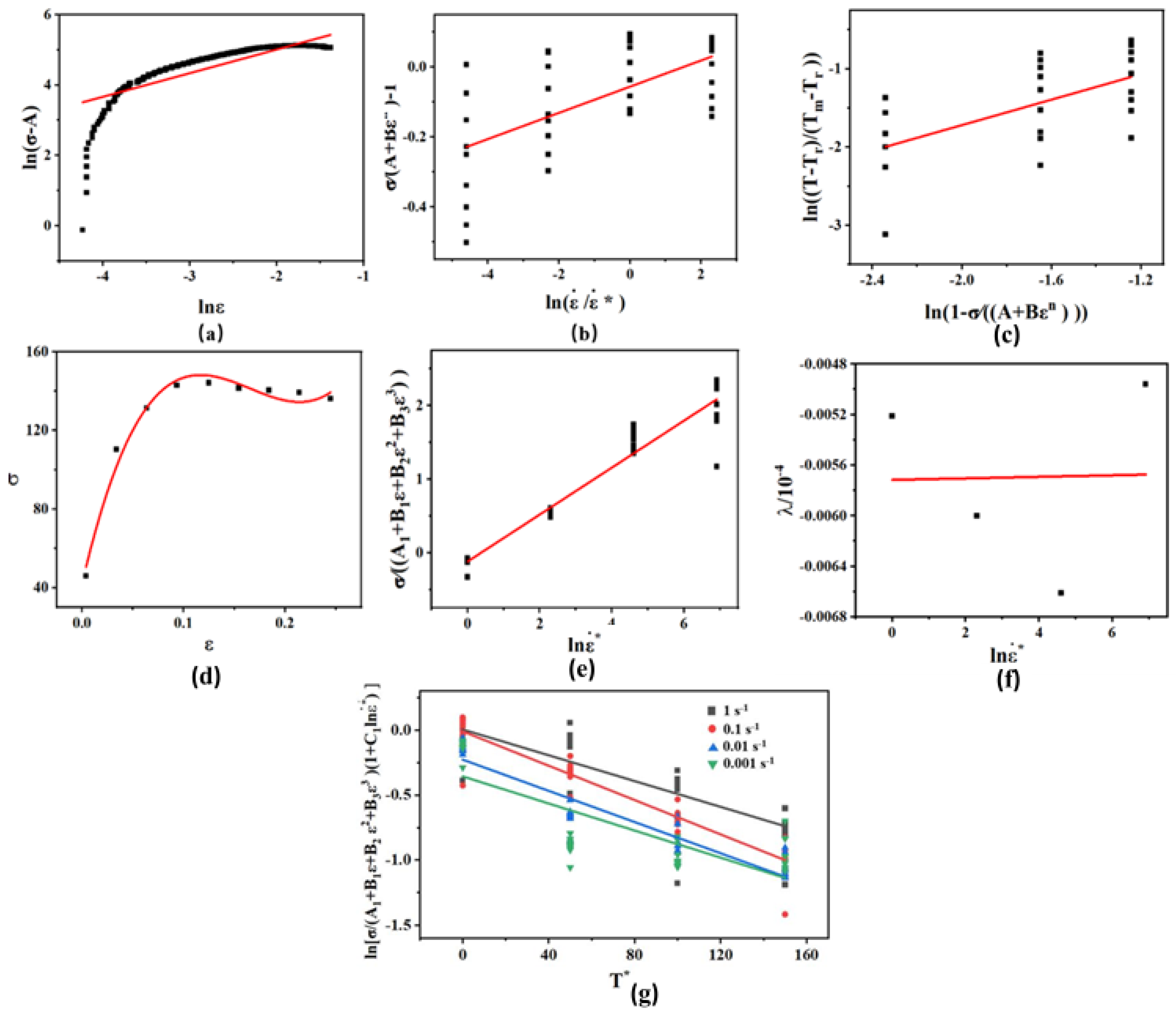
ln ( σ A )   is linearly related to ln ε , and a linear fit is performed with the slope of the fitted line being n and the intercept being ln B , and n = 0.6715, B = 573.467 Mpa, as shown in Figure 7a.
At the reference temperature, Equation (24) can be simplified to Equation (27).
σ / ( A + B ε n ) 1 = C ln ( ε ˙ ε ˙ )
By fitting σ / ( A + B ε n ) 1 linearly to ln ( ε ˙ ε ˙ ) , the slope of the fitted straight line is C, which is obtained as C = 0.03746 as in Figure 7b.
At the reference strain rate, Equation (24) can be simplified to Equation (28).
ln ( 1 σ / ( A + B ε n ) ) = m ln ( T T r T m T r )
By fitting ln ( T T r T m T r ) linearly to ln ( 1 σ / ( A + B ε n ) ) , the slope of the fitted straight line is m, which is obtained as m = 0.8131 as in Figure 7c.
The calculated specific parameters of the JC model are listed in Table 5.
The original JC model considered the strain intensification effect, the strain rate effect, and the temperature effect, respectively, but it did not consider the mutual influence between these three factors, so the predicted values deviated from the experimental values and the prediction accuracy was low. Therefore, the modified JC model proposed by LIN et al. [44] was used to establish the Cr18Mn15 constitutive equation, and the modified JC constitutive equation expression is given in Equation (29).
σ = ( A 1 + B 1 ε + B 2 ε 2 ) ( 1 + C 1 ln ε ˙ ) e x p [ ( λ 1 + λ 2 ln ε ˙ ) ( T T r ) ]
where ε ˙ = ε ˙ ε ˙ 0 , A 1 , B 1 , B 2 , C 1 ,   λ 1 , and λ 2 are the parameters to be fitted. It is obvious that the first term A 1 + B 1 ε + B 2 ε 2 plays a key role in the fitting result; in order to improve the prediction accuracy, the number of instances of the first term is increased by one, i.e., the term is used three times term for the fitting, and the modified expression is shown in Equation (30).
σ = ( A 1 + B 1 ε + B 2 ε 2 + B 3 ε 3 ) ( 1 + C 1 ln ε ˙ ) e x p [ ( λ 1 + λ 2 ln ε ˙ ) ( T T r ) ]
By choosing the reference temperature and the reference strain rate as 1173 K and 0.001 s 1 , respectively, Equation (30) can be expressed as Equation (31) at the reference temperature reference strain rate.
σ = A 1 + B 1 ε + B 2 ε 2 + B 3 ε 3
The strain and stress data at the reference strain rate were fitted to a cubic polynomial in the form of discrete data points, and the results of the fit are shown in Figure 7d. It can be obtained that A 1 = 59.713 , B 1 = 2223.878 , B 2 = 14,719.546 , and B 3 = 29,659.396 .
At the reference temperature, Equation (30) can be expressed as Equation (32).
σ / ( A 1 + B 1 ε + B 2 ε 2 + B 3 ε 3 ) = 1 + C 1 ln ε ˙
Substituting the obtained A 1 , B 1 , B 2 , B 3 and stress–strain data into Equation (32), it can be seen that σ / ( A 1 + B 1 ε + B 2 ε 2 + B 3 ε 3 ) is linearly related to ln ε ˙ , and the slope of the line derived from the linear fitting is C 1 , C 1   = 0.31892, as shown in Figure 7e.
Let λ = λ 1 + λ 2 ln ε ˙ , substituting it into Equation (30), and transforming it equationally into Equation (33).
σ ( A 1 + B 1 ε + B 2 ε 2 + B 3 ε 3 ) ( 1 + C 1 ln ε ˙ ) = e x p ( λ T )
The logarithm of both sides of Equation (33) yields Equation (34).
ln [ σ ( A 1 + B 1 ε + B 2 ε 2 + B 3 ε 3 ) ( 1 + C 1 ln ε ˙ ) ] = λ T
The scatter plots of ln [ σ ( A 1 + B 1 ε + B 2 ε 2 + B 3 ε 3 ) ( 1 + C 1 ln ε ˙ ) ] and T at different strain rates are plotted and linearly fitted. The results of the fitting are shown in Figure 7g, and the slope of the fitted straight line is the value of λ at the strain rate.
The scatter plot of λ and ln ε ˙ is linearly fitted, the intercept of the fitted straight line is λ 1 , the slope is λ 2 , and the fitting result is shown in Figure 7f. It can be obtained that λ 1 = −0.00572 and λ 2 = 0.000006.

3.2.3. Constitutive Equation for Modified BP Neural Network

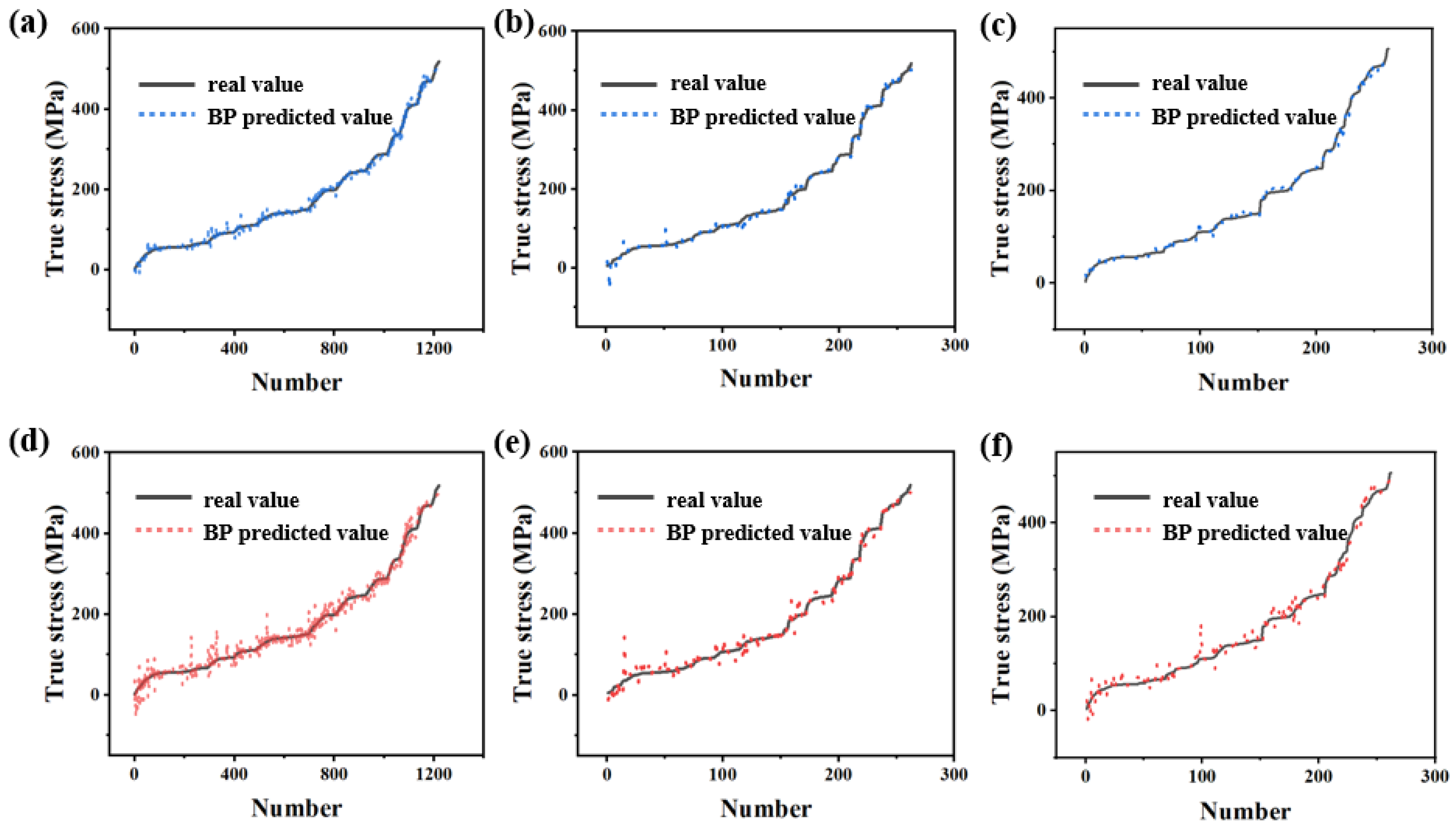
In order to solve the problem whereby it is easy for the BP neural network to fall into the local optimal solution, the BP neural network optimized based on the multi-objective genetic algorithm (NSGA2) is used in this paper to establish the Cr18Mn15 high-nitrogen steel principal structure. In this paper, the three dimensions of temperature, strain rate, and strain are used as the input layer of the network, stress is used as the output layer, and the thermal tensile data are sampled at intervals. Here, 100 data points are taken at intervals at the same temperature and strain rate, and a total of 1600 data points are imported into MATLAB R2021b. The dataset slicing function is used as the divider and function, the dataset is randomly sliced, and 70% of the data is selected as the training set and 15% is selected as the test set for computation. The maximum number of iterations was set to 100, the number of populations was set to 30, and the Pareto set ratio was set to 0.45. In order to verify the prediction index of the NSGA2-BP neural network model, the output prediction results of the training set, validation set, and test set are compared with the real value and the traditional BP neural network prediction value, and the output prediction results are shown in Figure 8. From the training set, validation set, and test set prediction graphs, it can be seen that the NSGA2-BP prediction value is close to the true value, and it can be better for Cr18Mn15 high-nitrogen steel flow stress prediction. Overall, the prediction results of the three sets are better than that of the traditional BP neural network, which indicates that in the prediction of Cr18Mn15 high-nitrogen steel flow stress, the NSGA2-BP neural network is better than the traditional BP neural network.
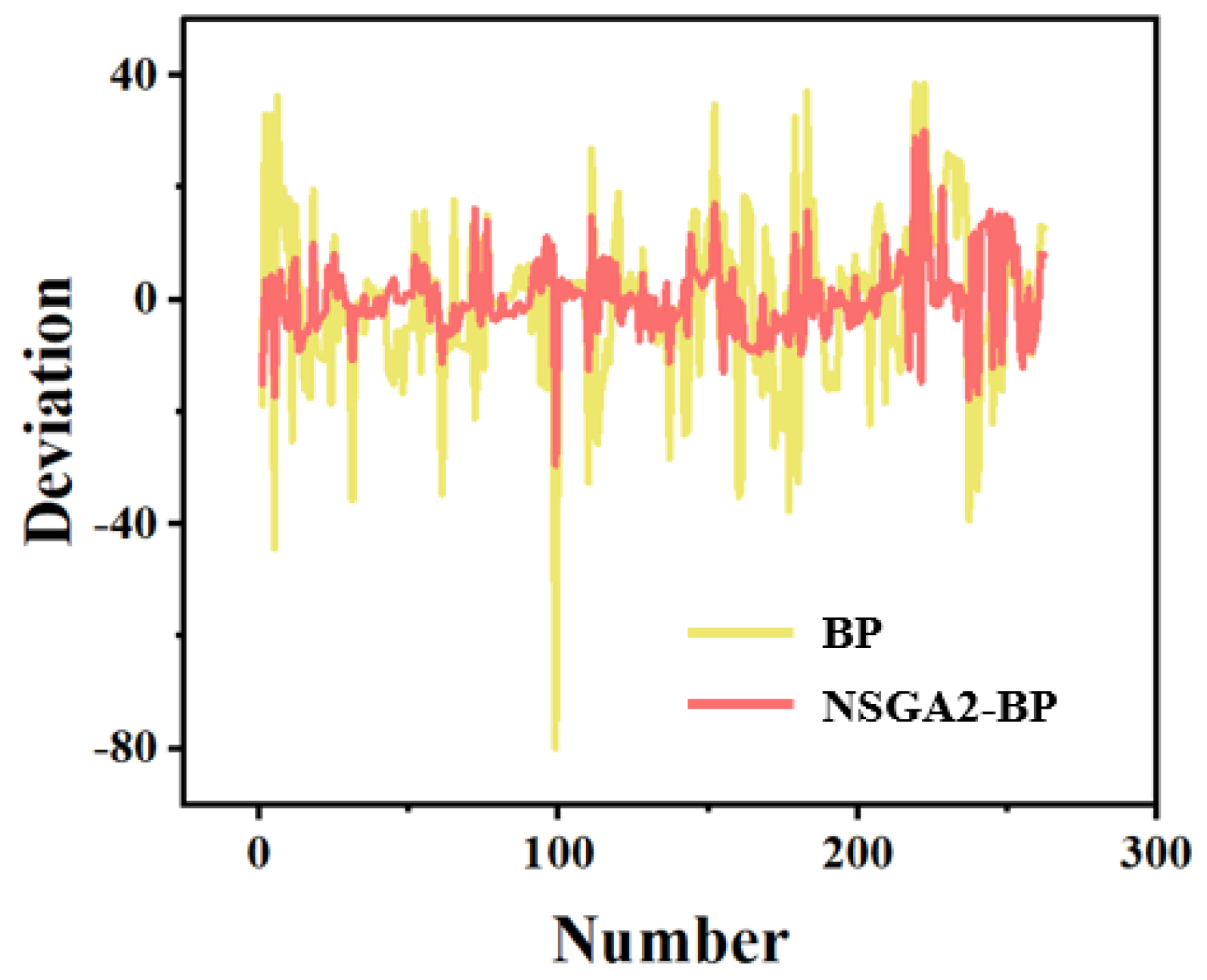
To further verify the stability of the NSGA2-BP neural network, the test set prediction error of the NSGA2-BP neural network and the test set prediction error of the traditional BP neural network are output, respectively, and the prediction error graph is shown in Figure 9. In Figure 9, under identical experimental conditions, the prediction error (difference between predicted and actual values) of the NSGAII-BP neural network is closer to the straight line y = 0 compared to the traditional BP neural network with significantly smaller fluctuation amplitude. This demonstrates that the NSGAII-BP neural network exhibits superior prediction accuracy and better performance in approximating actual values.
The coefficient of determination and root mean square difference of the NSGA2-BP neural network and BP neural network are calculated, respectively, and the results are shown in Table 6. From the table, it can be seen that the NSGA2-BP neural network is significantly better than the BP neural network in both the coefficient of determination and the root mean square deviation in the evaluation of the performance, and the overall model performance is better, which further verifies the performance advantage of the NSGA2-BP neural network.
The NSGA2-BP neural network embodies a groundbreaking integration of multi-objective optimization and deep learning. It has demonstrated academic feasibility in automatically balancing multiple performance metrics through search algorithms, holding significant theoretical value. However, its precision-driven approach may also increase the risk of overfitting, raise computational complexity, and prolong processing time. Moreover, deep learning models are difficult to interpret, posing significant challenges for industrial applications that demand high efficiency, explainability, stability, and cost-effectiveness.

3.2.4. Comparison of the Error Analysis of the Constitutive Equation

In order to judge the accuracy of the constitutive equations for the four constitutive equations obtained in this paper for Cr18Mn15 high-nitrogen steel, Pearson’s correlation coefficient (r) and the average absolute relative error (ARRE) were used, and ARRE was calculated using the following formula:
A R R E ( % ) = 1 N i = 1 N | E i P i E i | × 100 %
where E i is the experimental value, P i is the predicted value of the intrinsic model, and N is the number of the data.
The calculated AARE values of the four models are shown in Table 7. From the figure, it can be seen that the BP neural network has the smallest AARE value and the highest prediction accuracy; the AARE value of the JC model is significantly larger than that of the other three constitutive equations, which indicates that the JC model has the worst prediction of the rheological stress of high-nitrogen steel.
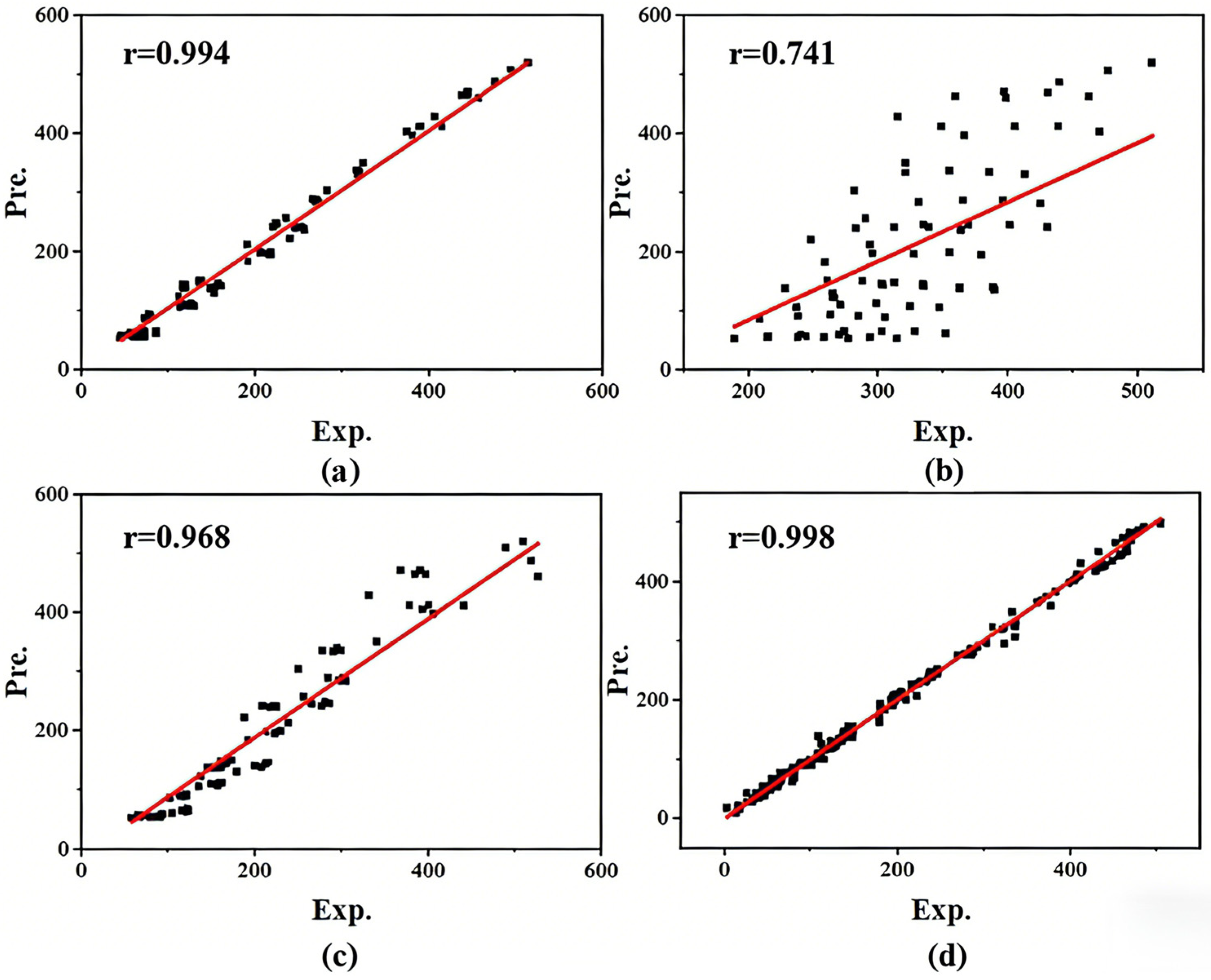
In Figure 10, the experimental and predicted values of the different models are fitted, and the Pearson’s relative coefficients of the corresponding models are calculated and labeled in the plots, respectively. As can be seen from the figure, the scatters in the images of the Arrhenius constitutive equation, the modified-JC model, and the improved BP neural network model are uniformly distributed around the line y = x, which indicates that they can predict the rheological stress better. It is noteworthy that the improved BP neural network model is very close to y = x, which indicates that it is excellent for predicting rheological stress.

3.3. Simulation of Continuous Rolling Molding

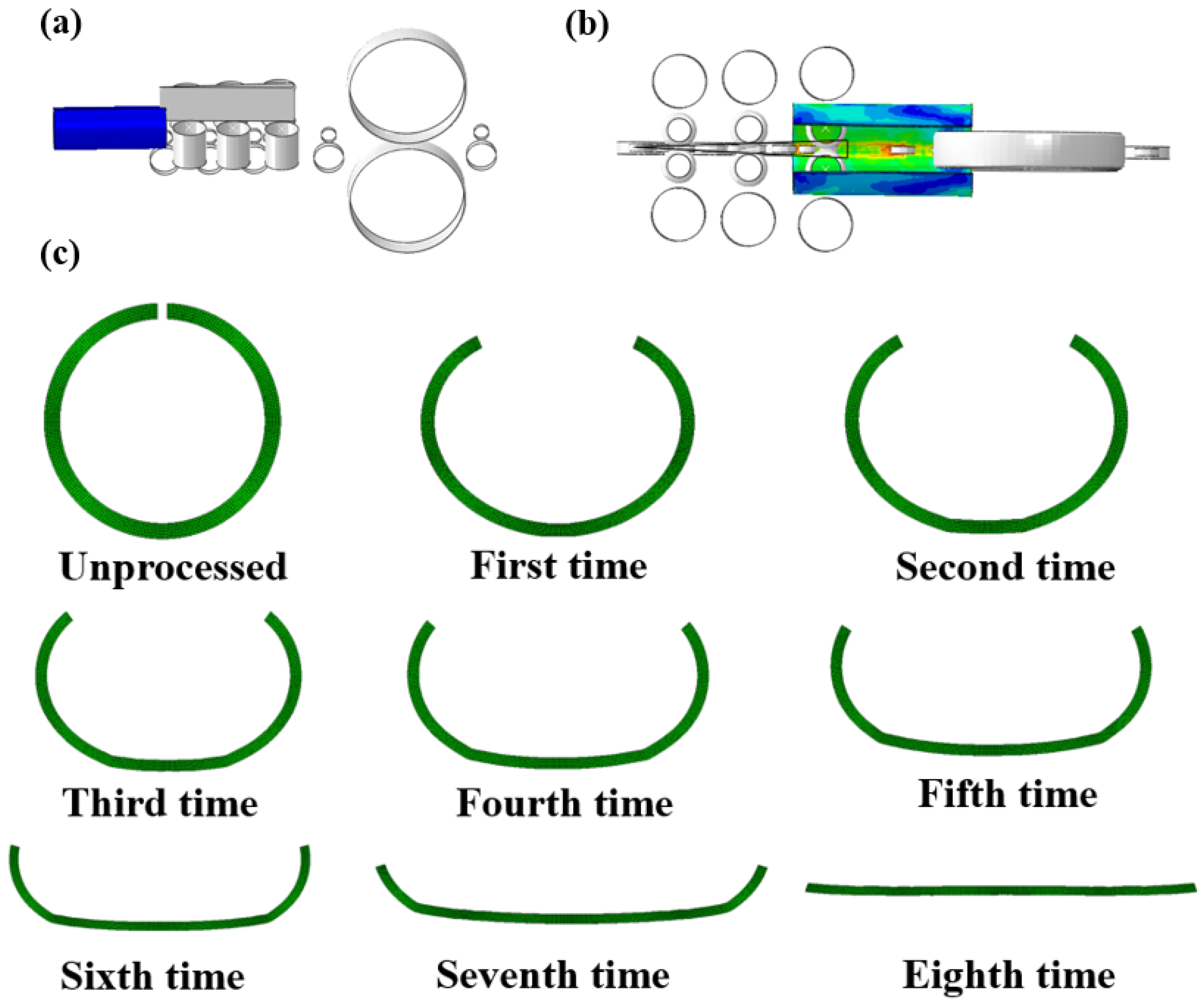
The rolling and flattening process of three-layer composite Cr18Mn15 pipe is relatively complex, and the heated Cr18Mn15 pipe undergoes multiple passes of rolling deformation. Compared with direct experimental investigation, finite element numerical simulation can study the changing law of the stress field, strain field, and temperature field in the rolling and flattening process in a more in-depth manner and also reduce the cost of trial and error and provide reference for the development of subsequent rolling equipment. The complex stress in the rolling process is similar to the uniaxial tensile test in all directions under high temperature, so the uniaxial tensile test data are used to simulate the rolling process. In this work, the modified-JC intrinsic structure established in the third part is embedded into ABAQUS software in the form of a VUHARD subroutine to establish the thermal coupling field model of three-layer composite steel pipe rolling and flattening, which reveals the metal flow law in the process of hot rolling and analyzes the influence of processing parameters on the forming results. Figure 11a,b shows a side view and a top view of the continuous rolling equipment. In this work, the rolling speed is set to 5 m/s, the rolling temperature is set to 1100 °C, and the preheating temperature of the rolls is 500 °C.
In this model simulation, due to the faster rolling speed, the front end of the Cr18Mn15 tube and the widening roll contact with the collision will produce part of the damage in the front end of the Cr18Mn15 tube. However, due to the length of the Cr18Mn15 tube being longer, in the actual production of only the front end of the rolled Cr18Mn15 plate, a 5 cm excision can be excluded from the deformation generated by the collision. Therefore, in this work, the cross-section and the point of taking are taken from the middle section of the Cr18Mn15 tube in the simulation. Comparing different passes with the unprocessed Cr18Mn15 tube model, the deformation law of the Cr18Mn15 tube after rolling can be clearly seen. Among them, pass 1 is the slit widening pass. It can be seen that after pass 1, the Cr18Mn15 tube ground did not produce an obvious flattening phenomenon, but the slit is obviously widened. The slit is widened from 5 mm to 87.5 mm, which is convenient for the subsequent processing. Road 2 to road 8 is a leveling rolling process; it can be seen that with the increase in road, the Cr18Mn15 tube bottom leveling distance continues to increase, and the Cr18Mn15 tube cut seam from 87.5 mm gradually increased to completely flat. After eight processing passes, the tube was rolled completely flat.
In this paper, the adaptive Lagrange–Euler method (ALE) was employed for adaptive mesh control. Abaqus explicitly meshed the steel pipes with a spacing of 1.5 mm while performing cross-sectioning on the pipes. A bidirectional offset was applied to each quarter section of the pipe with a minimum offset width of 0.75 mm. The simulation model utilized the universal contact method. Constraint points were established at the center of each roll, binding them to the corresponding rolls as rigid bodies. When the forming surface of the roll contacts the outer surface of the steel pipe, the pipe continues to move forward under frictional forces. The friction problem, influenced by multiple factors, becomes highly complex. Common friction models in finite element analysis include shear friction and Coulomb friction. In finite element models involving thermoplastic volume forming, the shear friction model is more frequently used. A thermomechanical coupling model was established for the rolling and flattening process of three-layer composite steel pipes, revealing the metal flow patterns during hot rolling and analyzing the impact of processing parameters on the forming results.

3.3.1. Stress Field Analysis

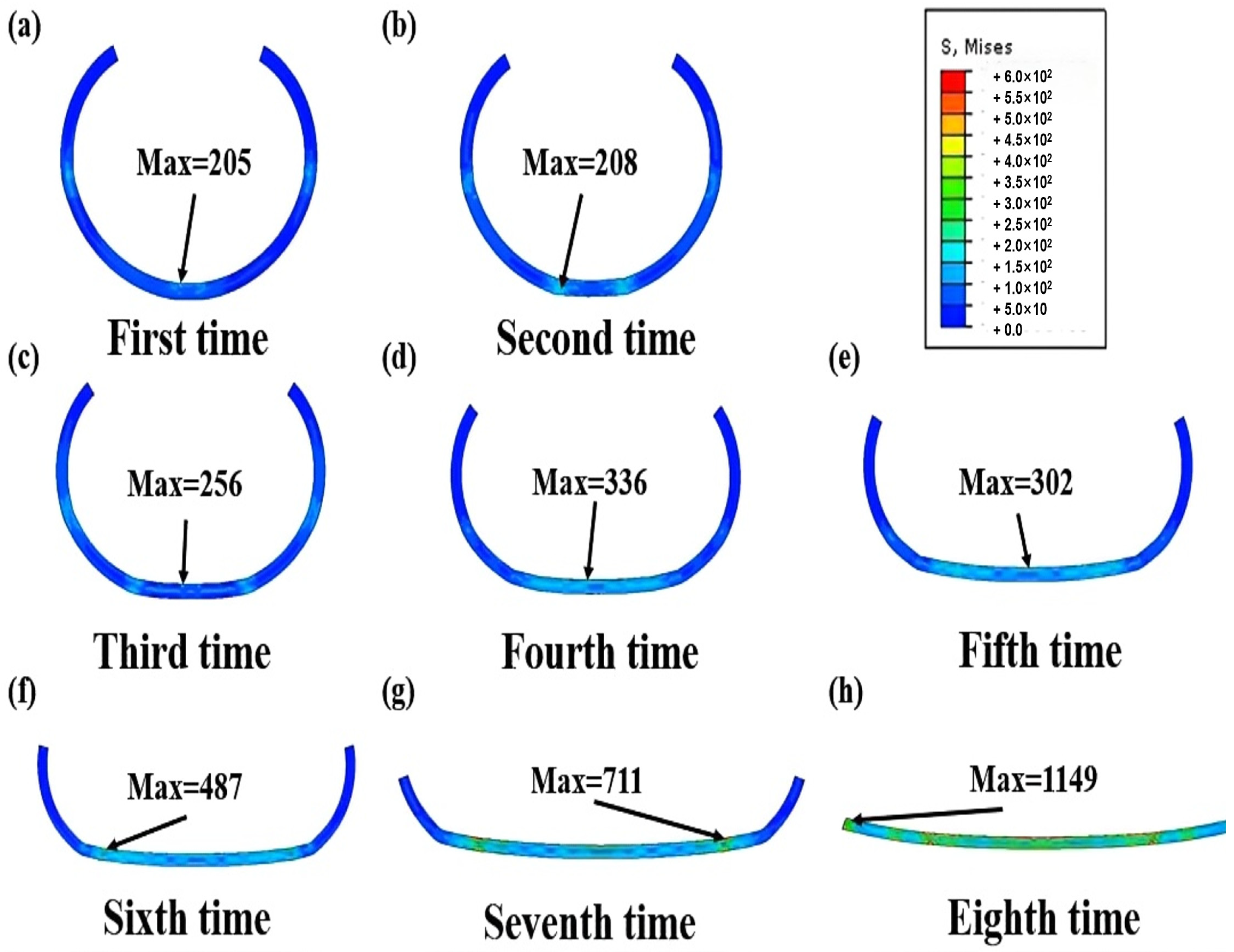
Figure 12 shows the stress field distribution after different numbers of rolls. In processing pass 2, as in Figure 12b, the stress concentration is mainly located in the middle of the tube, which is squeezed by the lower roll wheel in processing, limiting the upward movement of the tube in the processing process and generating a larger stress in the position of the contact between the lower roll wheel and the tube. In addition to processing pass 2, the middle stress is less than the inner layer of stress; by the location of the maximum stress in the figure, it can be seen that the stress concentration phenomenon usually occurs in direct contact with the edge of the rolls at the inner wall of the tube. In particular, in pass 8, as in Figure 12h, the stress concentration occurs in the edge after flattening In the tube movement here, the inner edge of the tube and roll surface are in direct contact, while the friction and pressure are generated by the roll on the tube, resulting in greater stress concentration.
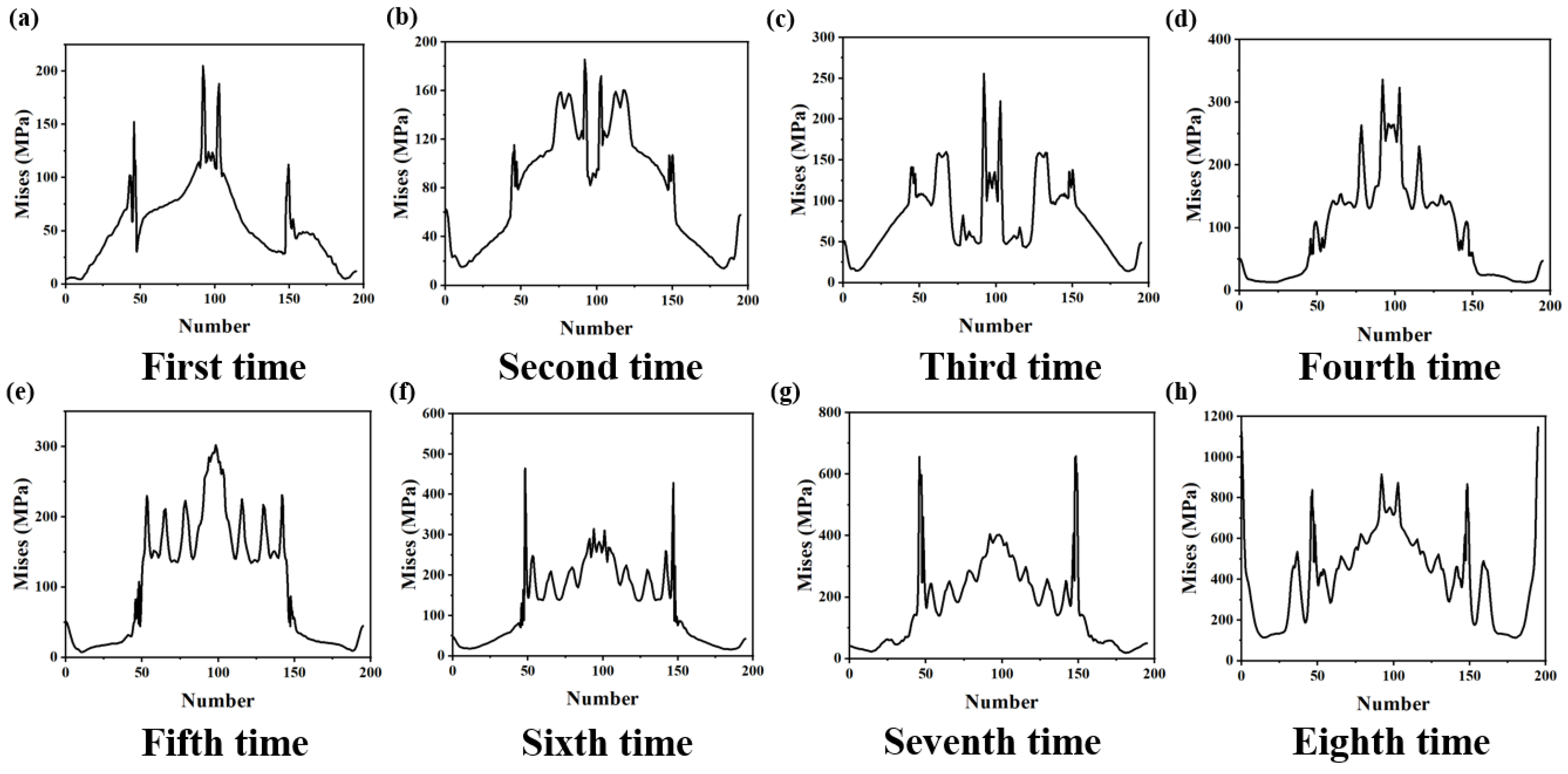
Figure 13 shows the equivalent stresses on the inner surface of Cr18Mn15 tubes after different numbers of rolling. From the equivalent stress diagram of pass 1, as in Figure 13a, it can be seen that after processing pass 1, the inner surface of the Cr18Mn15 pipe mainly exists in four stress concentration places. The maximum stress concentration is located in the middle of the Cr18Mn15 pipe; here is the widening mechanism of the lower wheel. The Cr18Mn15 pipe in the widening of the side wheels has a larger transverse width and a smaller vertical width, but due to the extrusion of the lower wheel, the pipe relative to the widening of the side wheel is in the lower part of the overall sliding, so the central and lateral parts of the pipe have a stress concentration phenomenon, and the middle to the side of the middle part also shows a stress rise phenomenon. However, due to the extrusion of the lower wheel, the tube slides downward relative to the widening side wheel, so the stress concentration occurs in the middle and side of the tube, and the stress rise occurs in the middle part from the middle to the side. With the processing passes, it can be seen that the equivalent force of the overall trend of rising in the tube and the roll edge contact position of the stress value rose. After analysis, we can see that this is after the widening mechanism produced by the depression and not in direct contact with the subsequent rolls, so the value of the stress here is low. After pass 8 processing, as in Figure 13h, the Cr18Mn15 tube is completely unfolded, the inner surface of the tube is in contact with the upper roll, the overall stress value rises significantly, and due to the edge of the Cr18Mn15 tube and the upper roll, there is a large amount of friction, so there is an edge to the Cr18Mn15 tube stress concentration phenomenon.

3.3.2. Strain Field Analysis

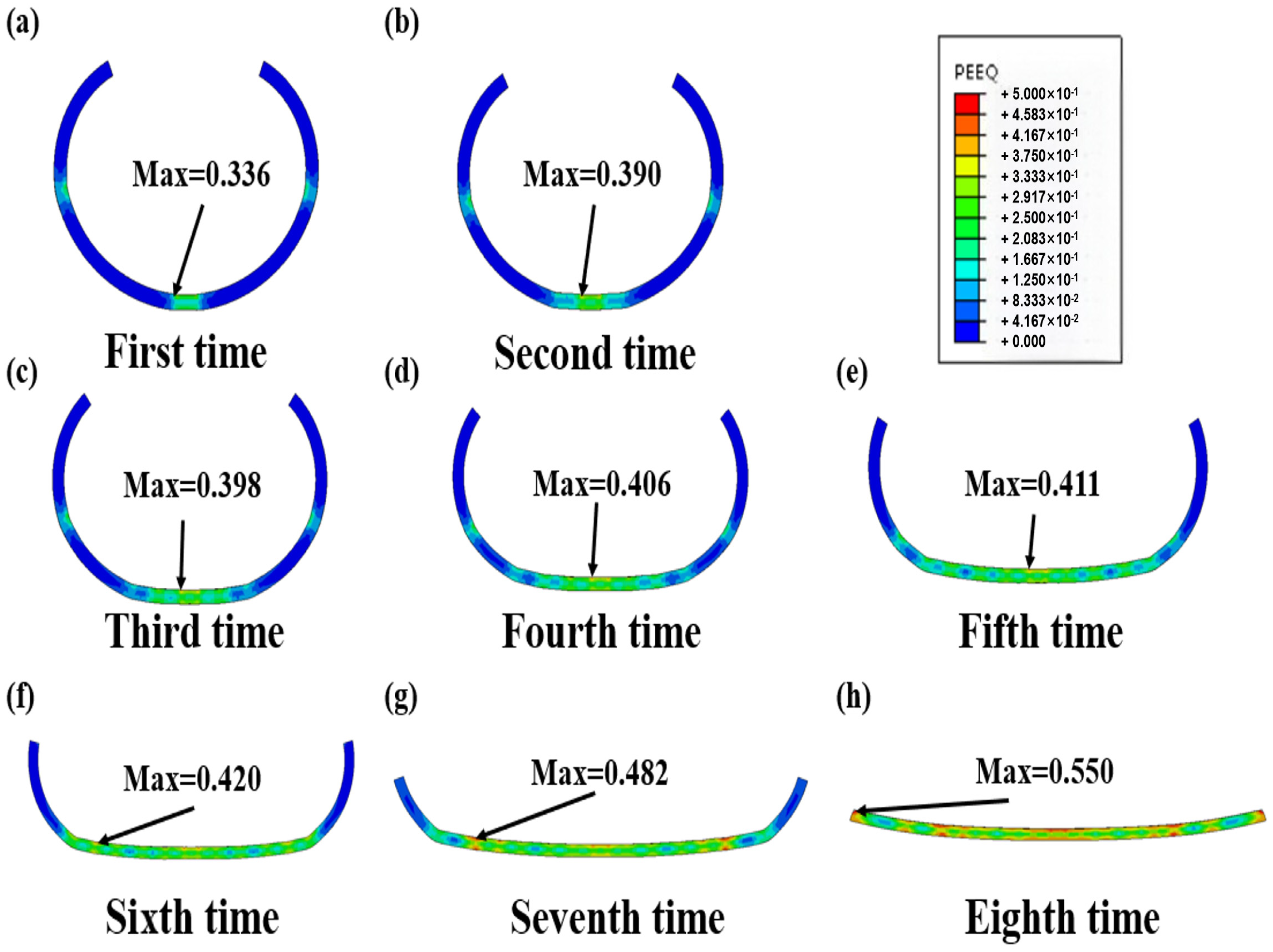
The strain field distribution of the Cr18Mn15 tube under different processing passes is shown in Figure 14. In the first processing pass, as in Figure 14a, the plastic strain maximum position for the bottom of the tube is plastic strain, which mainly occurs in the bottom and side of the tube. As part of the rolling process, the rolls produce direct contact, and the tube side and the rolls have mutual sliding, resulting in a larger rolling force and friction and thus a larger strain in addition to the location of the strain being close to 0. With the increase in processing passes, the bottom of the Cr18Mn15 pipe has wider and wider rolls, and the width of the plastic strain site with the increase in passes gradually becomes wider, but the maximum plastic strain is still located in the middle of the bottom of the Cr18Mn15 pipe. Until the processing of pass 6, as in Figure 14f, the width of the pass roll changes; the maximum plastic strain is located in contact with the Cr18Mn15 tube roll edge position. Processing to channel 8, as in Figure 14h, the Cr18Mn15 tube is completely flattened; at this time, the plastic strain reaches its maximum value. The maximum value is located at the edge of the Cr18Mn15 tube with the greatest force.
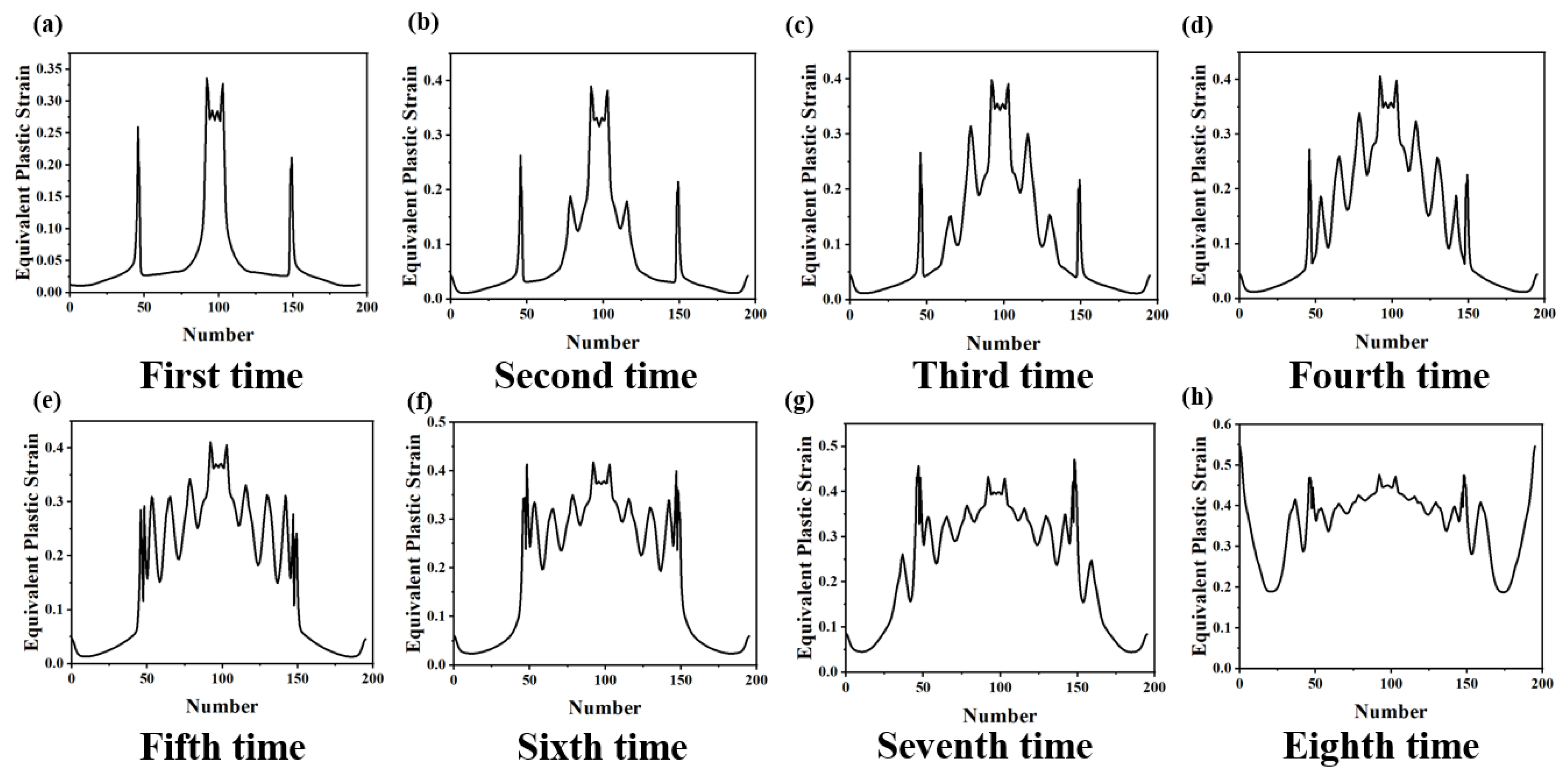
The equivalent strain curve of the inner surface of the Cr18Mn15 pipe is shown in Figure 15. From the comparison between Figure 13 and Figure 15, it can be seen that the equivalent stress map corresponds to the equivalent plastic strain map, and the equivalent plastic strain is also larger at the position of larger equivalent stress. As the number of machining passes increases, the number of equivalent plastic strain peaks increases, and the equivalent plastic strain shows an overall upward trend with the increase in the number of machining passes.

3.3.3. Temperature Field Analysis

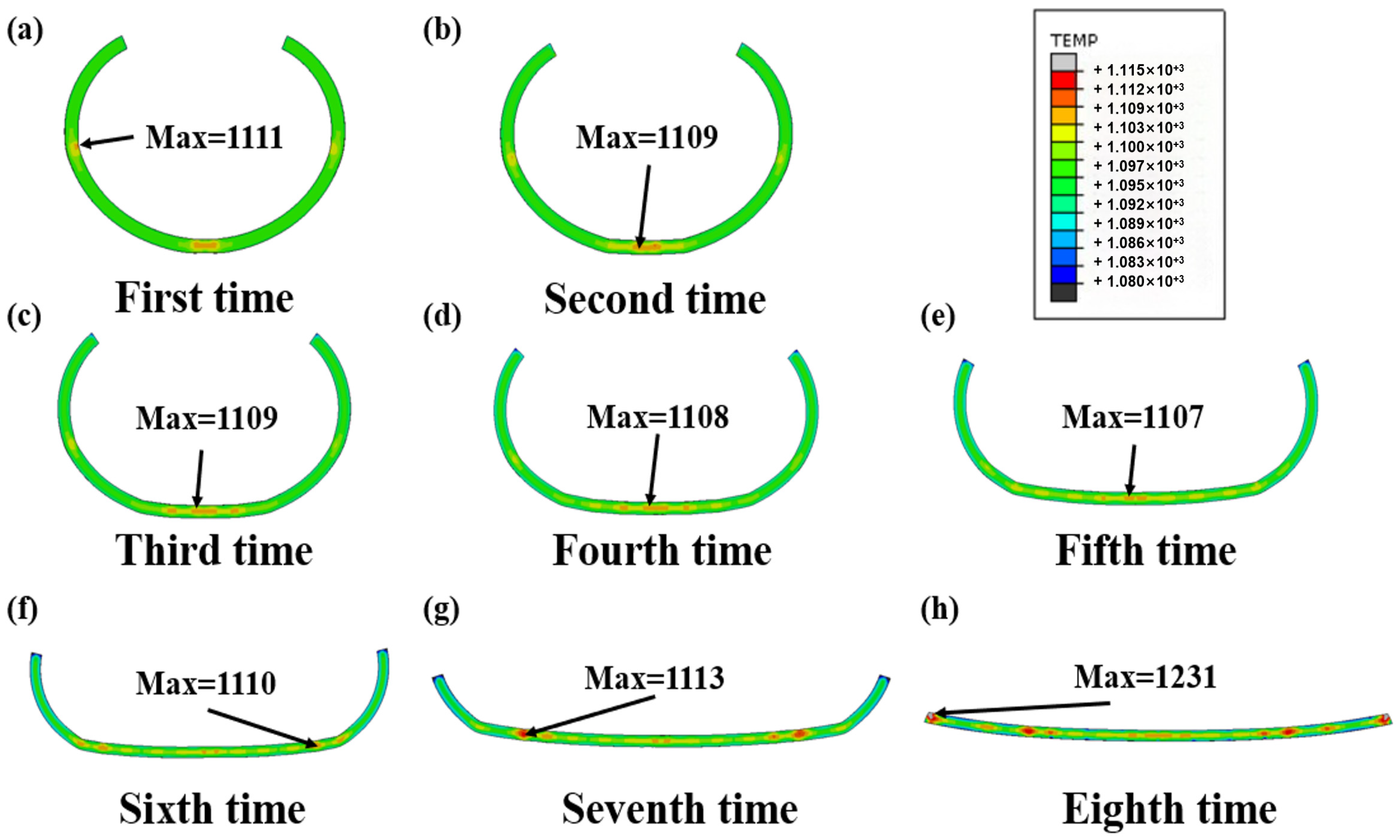
The temperature field distribution of the Cr18Mn15 pipe model under different processing passes is shown in Figure 16. The predefined temperature field of the Cr18Mn15 tube model was 1100 °C. As the processing passes progressed, the overall temperature of the Cr18Mn15 tube decreased due to the thermal radiation heat transfer between the tube and the air. After processing in processing pass 1, as in Figure 16a, a significant warming occurred at the stress concentration, and the highest temperature location was at 1111 °C at the location where the inner surface of the Cr18Mn15 tube was in contact with the widening wheel on the lateral side of the tube. With the processing passes, in the Cr18Mn15 tube, heat radiation and processing heat under the joint action of the highest temperature value are transferred to the Cr18Mn15 tube inside. From processing pass 2 to processing pass 5, the highest temperature is located in the central position of the Cr18Mn15 tube inside. During processing pass 6 and processing pass 7, due to the contact position with the rollers of the larger deformation, the temperature of the Cr18Mn15 tube in contact with the edge of the rollers in the position of the temperature rises significantly with the highest temperature of 1113 °C. During processing passes 6 and 7, due to the contact position with the roller, the deformation is large; in the position of the Cr18Mn15 tube in contact with the edge of the rollers, the highest temperature reaches 1113 °C. During processing pass 8, as in Figure 16h, due to the edge of the Cr18Mn15 tube and the close roll contact resulting in greater friction, the temperature rises significantly with the highest temperature of 1231 °C.
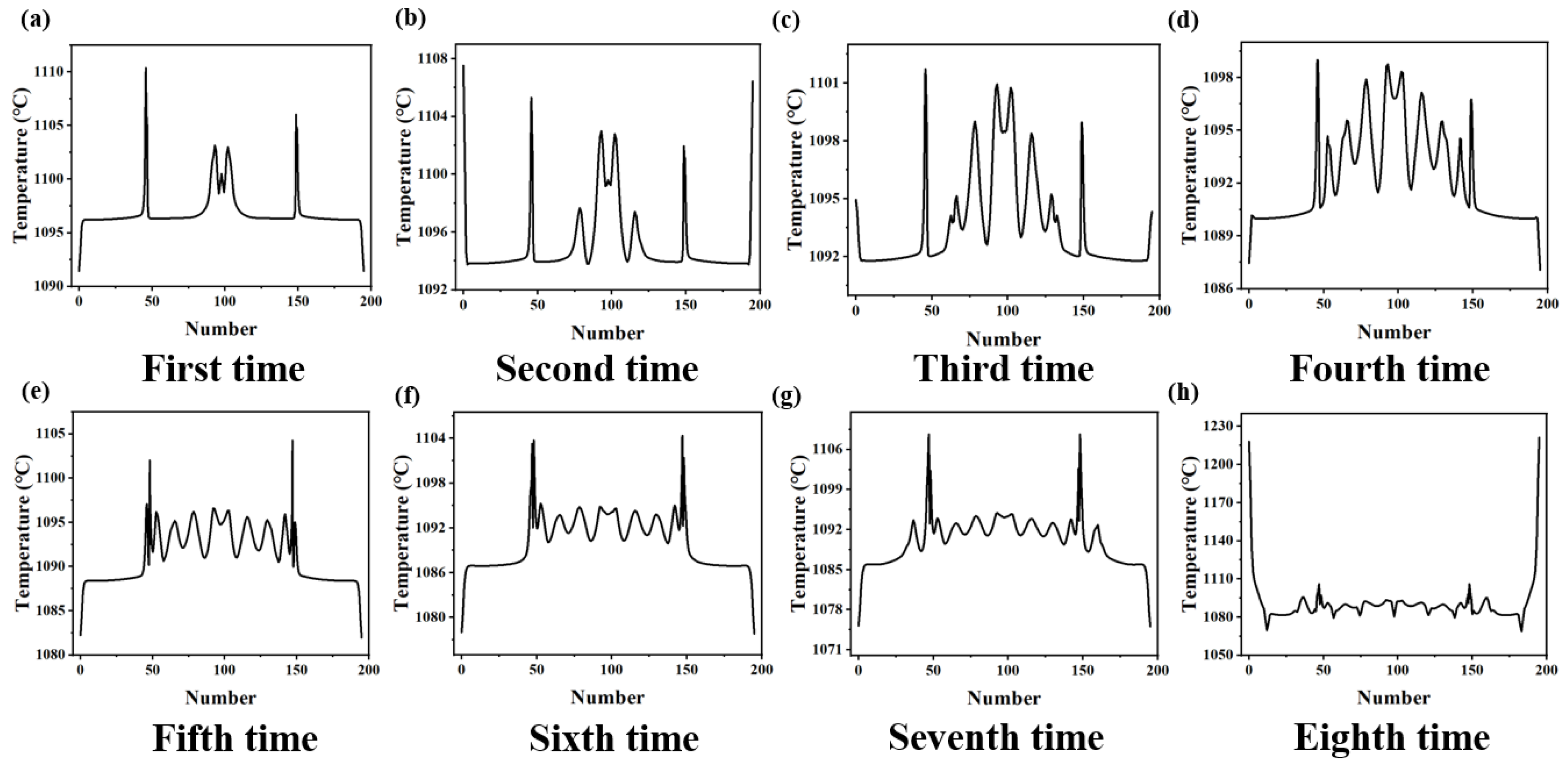
The circumferential temperature variation curve of the inner surface of the Cr18Mn15 tube is shown in Figure 17. As can be seen in Figure 17a, the overall temperature of the Cr18Mn15 pipe decreases compared to the predefined temperature field with a more pronounced decrease at the edge of the Cr18Mn15 pipe and a pronounced temperature increase at the location in contact with the widening wheel and the transfer wheel. In Figure 17b, there is a significant temperature rise at the tube edge, which is due to the friction between the tube edge and the widening rollers. The number of temperature peaks gradually increases as the processing pass proceeds. In processing pass 8, greater friction is generated between the edge of the Cr18Mn15 tube and the rolls, and the temperature rises to more than 1200 °C. When the local temperature of high-strength steel exceeds 1200 °C, it will lead to local overheating and an abnormal growth of austenite grain, which should be avoided.

3.3.4. Analysis of the Impact of Machining Process Parameters

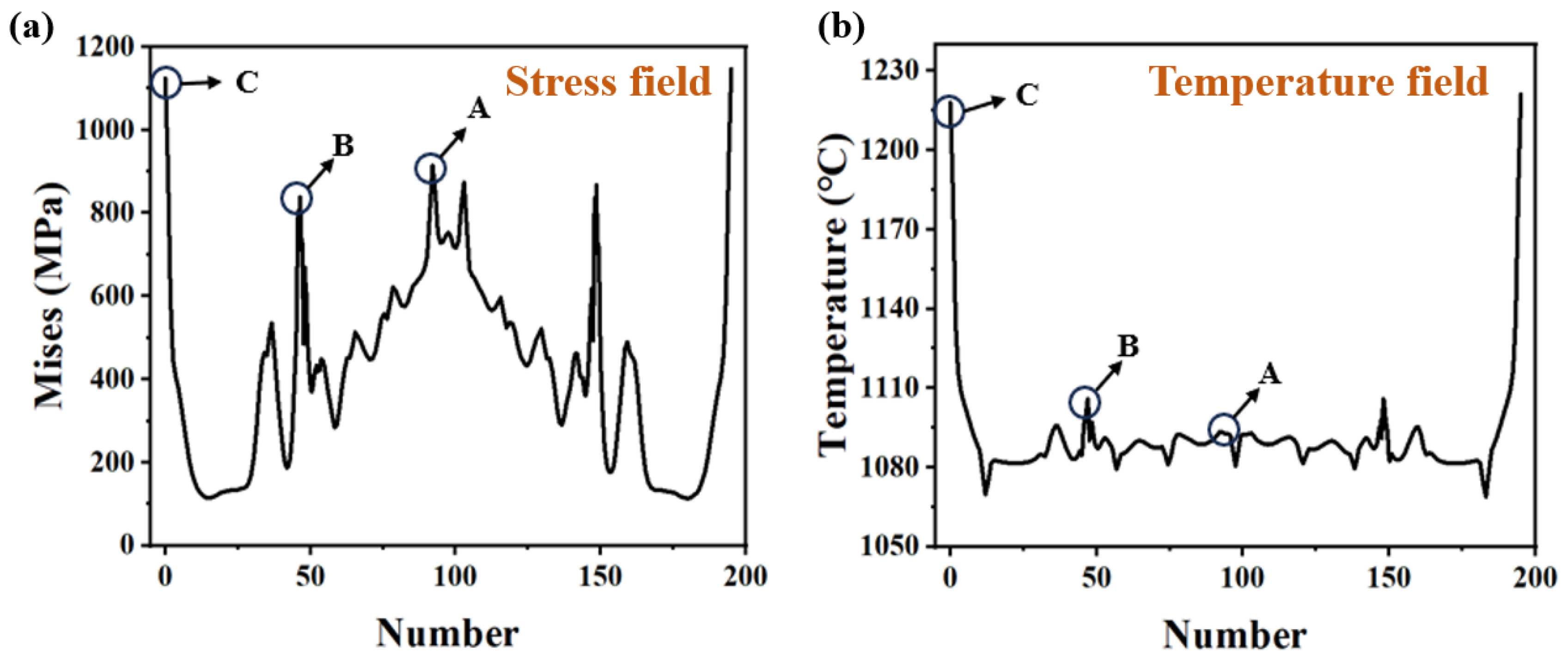
Hot rolling forming simulation was used to analyze the main parameters for the processing line speed, tube preheating temperature, and roll preheating temperature. In this process, the ideal forming effect for the processing of heating and equivalent stresses is as small as possible. After the completion of the processing of the inner surface of the Cr18Mn15 pipe stress field and temperature field, the results are shown in Figure 18. The most obvious localized warming and stress concentration occurs at the places marked A, B, and C in the figure. In this part, the temperature and stress changes at A, B, and C under different processing parameters are investigated to find the optimal processing parameters.
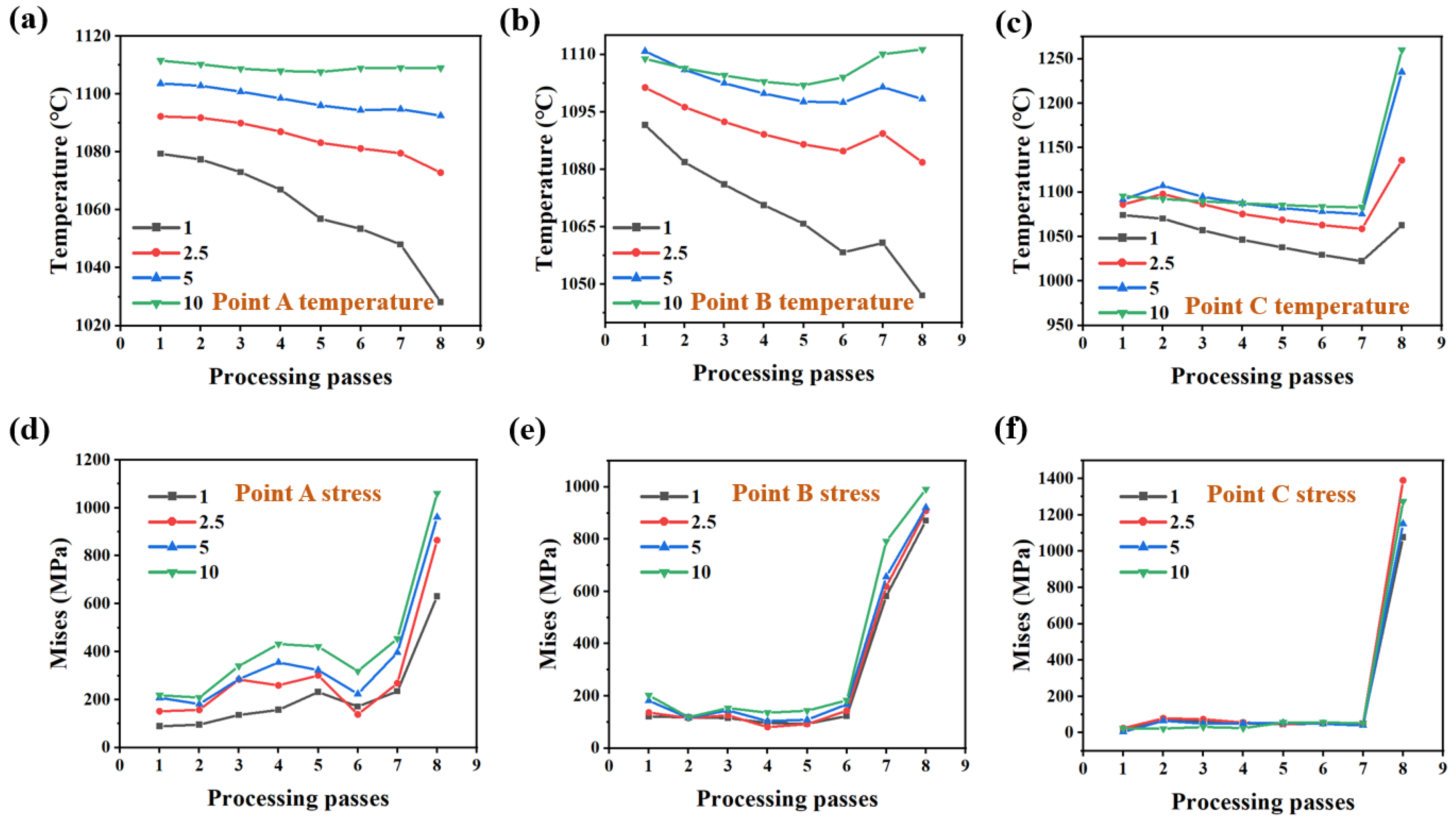
In Figure 19a–c, except for individual machining passes, the overall temperature shows a decreasing trend. In particular, at a machining line speed of 10 m/s, the Cr18Mn15 pipe has less heat dissipation to the air and higher heat generation, and the two points A and B show the phenomenon of temperature increase. The smaller the processing line speed, the longer the time required for the same number of processing passes, and the more heat dissipation to the air, so the temperature reduction under low line speed is more obvious than that under high line speed. After analysis, it can be seen that in Figure 19, the C point has the most heat generation and is far more than the general temperature level; this should be the focus of analysis. From Figure 20c, it can be seen that at a linear velocity of 1 m/s, the temperature increase at point C is the smallest.
In Figure 19d, it is analyzed that the greater the linear speed, the greater the processing stress generated; at 1 m/s linear speed, stress is always maintained at a relatively low level. In Figure 20e, before machining pass 7, the point is not in direct contact with the rolls, and the overall stress is kept at a low level. In machining passes 7 and 8, the phenomenon of stress increasing with the machining speed is still present. In Figure 20f, before processing pass 8, the point is not in direct contact with the rolls, and the stress fluctuates at the value of 0. In processing pass 8, the stress rises sharply, and the minimum value of the stress is located at the curve where the linear velocity is 1 m/s. After analysis, it can be seen that the lower processing line speed reduces the phenomenon of local heating and stress concentration during processing, so in the design of this processing program, the optimal processing line speed is 1 m/s.
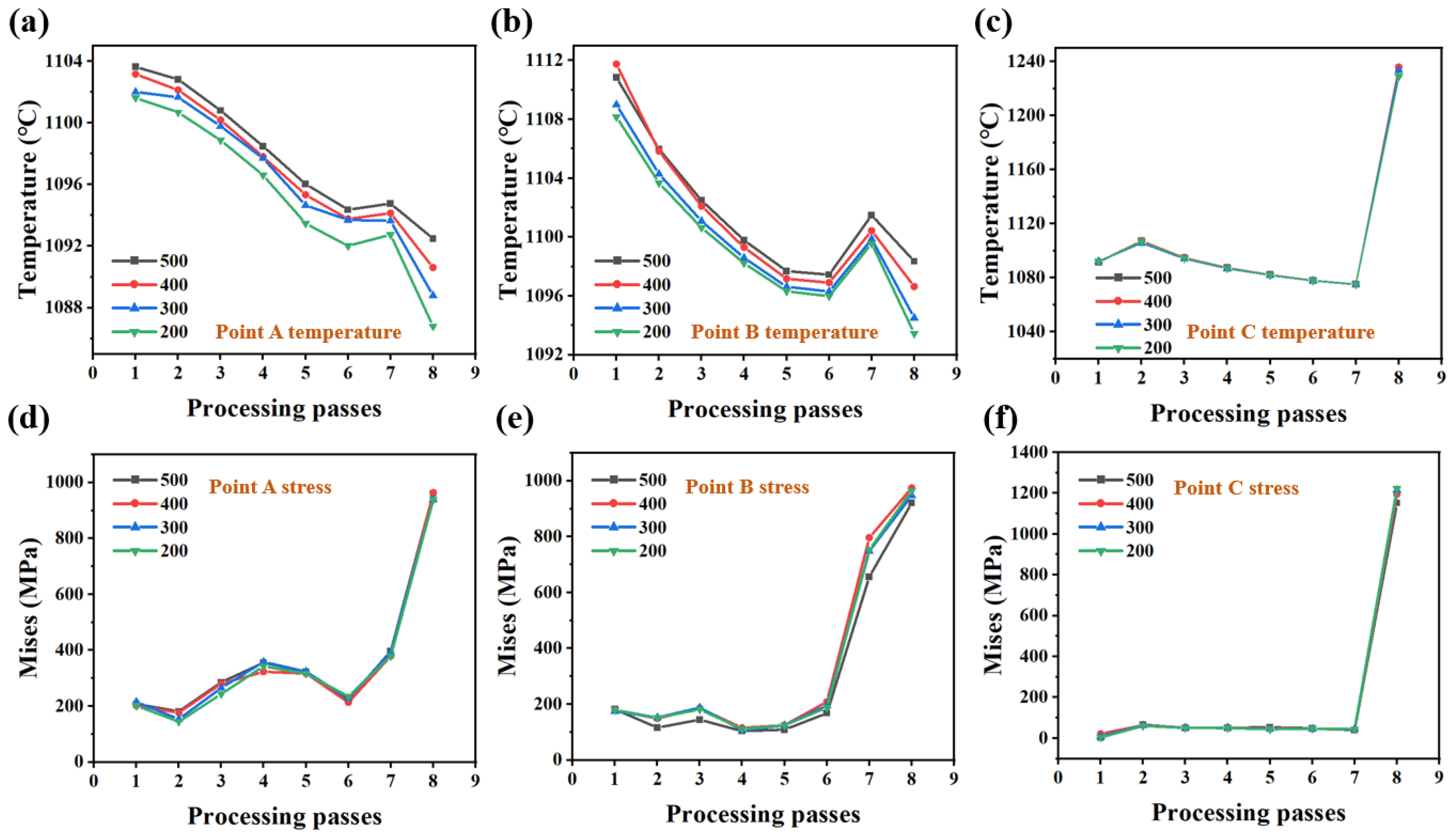
The Cr18Mn15 tube temperature and stress changes under different roll preheating temperatures are shown in Figure 20. The lower the roll preheating temperature in Figure 20a,b, the greater the temperature difference with the Cr18Mn15 tube, the more heat transfer between the Cr18Mn15 tube and the roll, and the lower the Cr18Mn15 tube temperature. As can be seen from Figure 20c, since point C is not in direct contact with the roll, the roll preheating temperature has almost no effect on the temperature at point C. An analysis of the temperature change between two adjacent passes shows that the roll preheating temperature has little effect on the heat generation in processing. As can be seen from Figure 20d–f, the stress change curves under different preheating temperatures almost overlap, indicating that the roll preheating temperature on the rolling of the stress generated by the smaller roll is different from the traditional hot rolling. The rolled parts and rolls have a smaller contact area, less heat transfer, and less heat. Therefore, for energy-saving considerations, the optimal roll preheating temperature of this process is set to 200 °C.

4. Conclusions

In this paper, the hot working properties of centrifugally cast Cr18Mn15 high-nitrogen steel are investigated in the range of deformation temperatures from 900 °C to 1050 °C and strain rates of 0.001 s−1 to 1 s−1, and their rheological behavior is predicted by three constitutive equation models.
Unlike conventional methods that rely on extensive experimentation to determine optimal parameters, this paper employs a modified JC constitutive equation model for visual modeling. By adopting the NSGA2-BP neural network instead of the standard BP neural network to simulate the actual working conditions of the casting–rolling integrated forming process, the simulation accuracy is significantly enhanced while substantially reducing costs.
In this paper, the spreading process of Cr18Mn15 composite steel tubes was also simulated, and the optimum process parameters were obtained. The conclusions obtained are as follows:
1. The hot-working diagrams of Cr18Mn15 high-nitrogen steel under different strains were analyzed, and the suitable thermal processing parameters for high-nitrogen steels were determined as follows: the deformation temperature of 940 °C to 980 °C and the strain rate of 0.001 s−1 to 0.01 s−1. The instability zone was mainly concentrated in the region of high strain rate (1 s−1) at low temperature (900 °C).
2. Four high-temperature constitutive equations for Cr18Mn15 high-nitrogen steel at temperatures ranging from 900 °C to 1050 °C have been established. From a practical point of view, the modified Modified-JC constitutive equation model can simultaneously take care of both accuracy and simulation convergence with an average absolute relative error of 17.823 and a Pearson’s correlation coefficient of 0.968.
3. The prediction model based on the multi-objective genetic algorithm (NSGA2) neural network for Cr18Mn15 high-nitrogen steel has been written. The NSGA2-BP neural network outperformed the traditional BP neural network in all three regions of the training set, validation set, and test set, the value of the coefficient of determination (R2) was improved from 0.987 to 0.997, and the value of the root mean squared error (RMSE) was reduced from 15.168 to 7.288.
4. Thermal coupling modeling of rolling of Cr18Mn15 composite steel pipe using ABAQUS. The optimum process parameters for the rolling of Cr18Mn15 composite steel pipe follow: the temperature is 950 °C, the processing line speed is 1 m/s, and the preheating temperature of the roll is 200 °C.
However, this paper does not include the correspondence between actual conditions and simulated conditions. We will further explore this in subsequent research.

Author Contributions

Conceptualization: Y.W. and Z.L.; Methodology, Y.Z.; Software: Z.Z. and M.Z.; Validation: Y.Z., X.L. and Z.Z.; formal analysis, Z.Z.; investigation, Y.W. and M.Z.; resources, X.L.; data curation, Z.Z. and M.Z.; writing—original draft preparation, Y.Z. and Z.Z.; writing—review and editing, Y.Z. and X.L.; Visualization, Z.Z.; Supervision, X.L.; project administration, X.L.; funding acquisition, Y.Z. and X.L.; Literature search, Y.W. and Z.L.; Chart production: Y.Z. and X.L. All authors have read and agreed to the published version of the manuscript.

Funding

This work is supported by the Science and Technology Development Program of Jilin Province (Technology R&D Project-20220201137GX).

Data Availability Statement

The original contributions presented in this study are included in the article. Further inquiries can be directed to the corresponding authors.

Conflicts of Interest

The authors declare no conflicts of interest.

References

  1. Zhang, Y.; Wang, C.; Reddy, K.M.; Li, W.; Wang, X. Study on the deformation mechanism of a high-nitrogen duplex stainless steel with excellent mechanical properties originated from bimodal grain design. Acta Mater. 2022, 226, 117670. [Google Scholar] [CrossRef]
  2. Wang, Y.; Feng, H.; Li, H.; Zhang, Y.; Jiang, Z.; Wang, X. Study on the mechanism of excellent strength and toughness combination of a high nitrogen martensitic stainless steel treated by Q-C-P-T process. J. Mater. Res. Technol. 2023, 27, 804–812. [Google Scholar] [CrossRef]
  3. Liu, X.; Lu, W.; Zhang, X. Reconstructing the decomposed ferrite phase to achieve toughness regeneration in a duplex stainless steel. Acta Mater. 2020, 183, 51–63. [Google Scholar] [CrossRef]
  4. Feng, H.; Jiang, Z.; Li, H.; Lu, P.; Zhang, S.; Zhu, H.; Zhang, B.; Zhang, T.; Xu, D.; Chen, Z. Influence of nitrogen on corrosion behaviour of high nitrogen martensitic stainless steels manufactured by pressurized metallurgy. Corros. Sci. 2018, 144, 288–300. [Google Scholar] [CrossRef]
  5. Feng, H.; Li, H.-B.; Dai, J.; Han, Y.; Qu, J.-D.; Jiang, Z.-H.; Zhao, Y.; Zhang, T. Why CoCrFeMnNi HEA could not passivate in chloride solution?–A novel strategy to significantly improve corrosion resistance of CoCrFeMnNi HEA by N-alloying. Corros. Sci. 2022, 204, 110396. [Google Scholar] [CrossRef]
  6. Jiao, W.-C.; Li, H.-B.; Dai, J.; Feng, H.; Jiang, Z.-H.; Zhang, T.; Xu, D.-K.; Zhu, H.-C.; Zhang, S.-C. Effect of partial replacement of carbon by nitrogen on intergranular corrosion behavior of high nitrogen martensitic stainless steels. J. Mater. Sci. Technol. 2019, 35, 2357–2364. [Google Scholar] [CrossRef]
  7. Peng, M.D.; Shi, J.; Cui, B.; Sun, T.; Li, X.Y.; Wang, M.Q. Effect of Cold Deformation on Microstructure and Mechanical Properties of a Fe-20Mn-19Cr-0.5C-0.6N High Nitrogen Austenitic Steel. Steel Res. Int. 2017, 88, 1700069. [Google Scholar] [CrossRef]
  8. Yang, K.; Chen, M.; Wang, Z.; Qi, H.; Bao, J.; Sun, G. Influence mechanisms of underwater hyperbaric environment on nitrogen behavior. phase evolution, and mechanical properties of high nitrogen steel repaired by underwater laser direct metal deposition. Mater. Sci. Eng. A 2023, 872, 144967. [Google Scholar] [CrossRef]
  9. Feng, H.; Wu, M.; Li, H.; Xia, L.; Lu, P.; Zhang, S.; Zhu, H.; Jiang, Z. Elucidating the dual effect of vanadium microalloying on hot deformation behavior of high nitrogen martensitic stainless steel. J. Mater. Res. Technol. 2024, 29, 4902–4916. [Google Scholar] [CrossRef]
  10. Zhang, X.; Zhou, Q.; Wang, K.; Peng, Y.; Ding, J.; Kong, J.; Williams, S. Study on microstructure and tensile properties of high nitrogen Cr-Mn steel processed by CMT wire and arc additive manufacturing. Mater. Des. 2019, 166, 107611. [Google Scholar] [CrossRef]
  11. Sun, M.; Wang, F.; Qian, D.; Liu, X.; Wu, M. Microstructure evolution and crack formation mechanism of high-nitrogen bearing steel subjected to warm deformation. Mater. Des. 2023, 228, 111841. [Google Scholar] [CrossRef]
  12. Ning, J.; Na, S.-J.; Wang, C.-H.; Zhang, L.-J. A comparison of laser-metal inert gas hybrid welding and metal inert gas welding of high-nitrogen austenitic stainless steel. J. Mater. Res. Technol. 2021, 13, 1841–1854. [Google Scholar] [CrossRef]
  13. Niu, G.; Li, L.; Chen, H.; Gu, C.; Liu, J.; Gong, N.; Wu, H. Study on thermal stability and biocompatibility of bimodal microstructure in Cr–Mn–N austenitic stainless steel. J. Mater. Res. Technol. 2023, 25, 4528–4542. [Google Scholar] [CrossRef]
  14. Knutsen, R.D.; Lang, C.I.; Basson, J.A. Discontinuous cellular precipitation in a Cr–Mn–N steel with niobium and vanadium additions. Acta Mater. 2004, 52, 2407–2417. [Google Scholar] [CrossRef]
  15. Liu, L.; Zhang, H.; Bi, H.; Chang, E.; Li, M. Corrosion behavior of cold-rolled metastable Cr–Mn–Ni–N austenitic stainless steel in acidic NaCl solution. J. Mater. Res. Technol. 2022, 19, 278–288. [Google Scholar] [CrossRef]
  16. Zhang, J.-Y.; Jiang, P.; Zhu, Z.-L.; Chen, Q.; Zhou, J.; Meng, Y. Tensile properties and strain hardening mechanism of Cr-Mn-Si-Ni alloyed ultra-strength steel at different temperatures and strain rates. J. Alloys Compd. 2020, 842, 155856. [Google Scholar] [CrossRef]
  17. Liu, Z.; Fan, C.; Chen, C.; Ming, Z.; Yang, C.; Lin, S.; Wang, L. Design and evaluation of nitrogen-rich welding wires for high nitrogen stainless steel. J. Mater. Process. Technol. 2021, 288, 116885. [Google Scholar] [CrossRef]
  18. Cheng, B.; Wei, F.; Teh, W.H.; Lee, J.J.; Meng, T.L.; Lau, K.B.; Chew, L.T.; Zhang, Z.; Cheong, K.H.; Ng, C.K.; et al. Ambient pressure fabrication of Ni-free high nitrogen austenitic stainless steel using laser powder bed fusion method. Addit. Manuf. 2022, 55, 102810. [Google Scholar] [CrossRef]
  19. Hu, D.-C.; Wang, L.; Wang, N.; Chen, M.-H.; Wang, H.-J. Hot tensile deformation behaviors of TA32 titanium alloy based on back-propagation neural networks and three-dimensional thermal processing maps. J. Mater. Res. Technol. 2022, 18, 4786–4795. [Google Scholar] [CrossRef]
  20. Liao, Q.; Jiang, Y.; Le, Q.; Chen, X.; Cheng, C.; Hu, K.; Li, D. Hot deformation behavior and processing map development of AZ110 alloy with and without addition of La-rich Mish Metal. J. Mater. Sci. Technol. 2021, 61, 1–15. [Google Scholar] [CrossRef]
  21. Ji, H.; Duan, H.; Li, Y.; Li, W.; Huang, X.; Pei, W.; Lu, Y. Optimization the working parameters of as-forged 42CrMo steel by constitutive equation-dynamic recrystallization equation and processing maps. J. Mater. Res. Technol. 2020, 9, 7210–7224. [Google Scholar] [CrossRef]
  22. Xiao, Y.-W.; Lin, Y.C.; Jiang, Y.-Q.; Zhang, X.-Y.; Pang, G.-D.; Wang, D.; Zhou, K.-C. A dislocation density-based model and processing maps of Ti-55511 alloy with bimodal microstructures during hot compression in α+β region. Mater. Sci. Eng. A 2020, 790, 139692. [Google Scholar] [CrossRef]
  23. Chen, L.; Zhang, B.; Yang, Y.; Zhao, T.; Xu, Y.; Wang, Q.; Zan, B.; Cai, J.; Wang, K.; Chen, X. Evolution of hot processing map and microstructure of as-forged nickel-based superalloy during hot deformation. J. Mater. Res. Technol. 2023, 24, 7638–7653. [Google Scholar] [CrossRef]
  24. Zhang, E.; Ge, Y.; Qin, G. Hot deformation behavior of an antibacterial Co–29Cr–6Mo–1.8Cu alloy and its effect on mechanical property and corrosion resistance. J. Mater. Sci. Technol. 2018, 34, 523–533. [Google Scholar] [CrossRef]
  25. Wang, L.; Li, Z.; Hu, X.; Lv, B.; Chen, C.; Zhang, F. Hot deformation behavior and 3D processing map of super austenitic stainless steel containing 7Mo–0.46N–0.02Ce: Effect of the solidification direction orientation of columnar crystal to loading direction. J. Mater. Res. Technol. 2021, 13, 618–634. [Google Scholar] [CrossRef]
  26. Chen, X.; Si, Y.; Bai, R.; Zhang, X.; Li, Z. Hot Formability Study of Cr5 Alloy Steel by Integration of FEM and 3D Processing Maps. Materials 2022, 15, 4801. [Google Scholar] [CrossRef] [PubMed]
  27. Zhou, Z.; Fan, Q.; Xia, Z.; Hao, A.; Yang, W.; Ji, W.; Cao, H. Constitutive Relationship and Hot Processing Maps of Mg-Gd-Y-Nb-Zr Alloy. J. Mater. Sci. Technol. 2017, 33, 637–644. [Google Scholar] [CrossRef]
  28. Páez, J.R.; Dorronsoro, A.; Martínez-Esnaola, J.M.; Gil Sevillano, J.; Alkorta, J. A microstructure-based constitutive model for eutectoid steels. Acta Mater. 2024, 263, 119533. [Google Scholar] [CrossRef]
  29. Yang, K.; Li, X.; Wang, J.; Zheng, Q.; Shi, M.; Jiao, Y.; Ji, M.; Zhang, M. Hot tensile deformation behavior and microstructure evolution of Mg–Mn–Ce alloy. J. Mater. Res. Technol. 2024, 29, 5074–5089. [Google Scholar] [CrossRef]
  30. Yao, K.; Min, X. Abnormal strain rate strengthening and strain hardening with constitutive modeling in body-centered cubic {332}<113> TWIP titanium alloy. Acta Mater. 2022, 226, 117641. [Google Scholar] [CrossRef]
  31. Ali, S.F.; Fan, J. Elastic-viscoplastic constitutive model for capturing the mechanical response of polymer composite at various strain rates. J. Mater. Sci. Technol. 2020, 57, 12–17. [Google Scholar] [CrossRef]
  32. Xiong, J.; He, J.-C.; Leng, X.-S.; Zhang, T.-Y. Gaussian process regressions on hot deformation behaviors of FGH98 nickel-based powder superalloy. J. Mater. Sci. Technol. 2023, 146, 177–185. [Google Scholar] [CrossRef]
  33. Xia, Y.; Shu, X.; Zhang, Q.; Pater, Z.; Li, Z.; Xu, H.; Ma, Z.; Xu, C. Modified Arrhenius constitutive model and simulation verification of 2A12-T4 aluminum alloy during hot compression. J. Mater. Res. Technol. 2023, 26, 1325–1340. [Google Scholar] [CrossRef]
  34. Zhang, Y.B.; Song, S.J.; Liu, F. Thermo-kinetic characteristics on stabilizing hetero-phase interface of metal matrix composites by crystal plasticity finite element method. J. Mater. Sci. Technol. 2024, 169, 53–67. [Google Scholar] [CrossRef]
  35. Pan, C.; Cheng, C.; El-Aty, A.A.; Wang, J.; Tao, J.; Liu, C.; Guo, X.; Hu, S. Predicting the wrinkling in AA5052 seamless tubes manufactured by free bending forming technology. J. Manuf. Process. 2023, 101, 1065–1079. [Google Scholar] [CrossRef]
  36. Mehta, A.; Woo, J.; Giglio, J.J.; Jue, J.-F.; Keiser, D.D.; Cole, J.I.; Sohn, Y. Tensile behavior of diffusion bonded AA6061–AA6061 with variation in cooling method. Mater. Sci. Eng. A 2023, 882, 145459. [Google Scholar] [CrossRef]
  37. Hu, L.; Luo, W.; Lu, F.; Deng, D. FE analysis of residual stress and welding deformation of a low-alloy UHS quenched steel fillet joint. J. Mater. Res. Technol. 2024, 29, 5693–5712. [Google Scholar] [CrossRef]
  38. Zou, Z.; He, L.; Zhou, T.; Wang, M.; Tian, P.; Zhou, X. Research on microhardness prediction of 304 stainless steel turning based on dislocation density. J. Manuf. Process. 2022, 83, 522–535. [Google Scholar] [CrossRef]
  39. Tekkaya, B.; Meurer, M.; Dölz, M.; Könemann, M.; Münstermann, S.; Bergs, T. Modeling of microstructural workpiece rim zone modifications during hard machining. J. Mater. Process. Technol. 2023, 311, 117815. [Google Scholar] [CrossRef]
  40. Hu, L.; Lang, M.; Shi, L.; Li, M.; Zhou, T.; Bao, C.; Yang, M. Study on hot deformation behavior of homogenized Mg-8.5Gd-4.5Y-0.8Zn-0.4Zr alloy using a combination of strain-compensated Arrhenius constitutive model and finite element simulation method. J. Magnes. Alloys 2023, 11, 1016–1028. [Google Scholar] [CrossRef]
  41. Johnson, G.; Cook, W. A constitutive model and data for metals subjected to large strains. high strain rates, and high temperatures. In Proceedings of the 7th International Symposium on Ballistics, Seventh International Symposium on Ballistics, The Hague, The Netherlands, 19–21 April 1983; p. 541. [Google Scholar]
  42. Wang, M.; Chen, X.; Dai, F.; Peng, K.; Singh, R.A.; Konovalov, S. Simulation of residual stress and micro-plastic deformation induced by laser shock imprinting on TC4 titanium alloy aero-engine blade. J. Mater. Res. Technol. 2023, 26, 9419–9436. [Google Scholar] [CrossRef]
  43. Prasad, Y.V.R.K. Recent advances in the science of mechanical processing. Indian J. Technol. 1990, 28, 435–451. [Google Scholar]
  44. Lin, Y.C.; Chen, X.-M.; Liu, G. A modified Johnson–Cook model for tensile behaviors of typical high-strength alloy steel. Mater. Sci. Eng. A 2010, 527, 6980–6986. [Google Scholar] [CrossRef]
Figure 1. Schematic diagram of the experimental sample preparation process.
Metals 16 00285 g001
Figure 2. Schematic diagram of tensile specimen size. (The units of measurement in the image are mm).
Metals 16 00285 g002
Figure 3. The true stress–strain curves for different strain rates at the same temperature. (a) 900 °C, (b) 950 °C, (c) 1000 °C, (d) 1050 °C.
Metals 16 00285 g003
Figure 4. Three-degree polynomial fitting of ln σ - ln ε ˙ : (a) ε = 0.05; (b) ε = 0.15; (c) ε = 0.25.
Metals 16 00285 g004
Figure 5. (a) A 3D power dissipation diagram for ε = 0.05, (b) 3D power dissipation diagram for ε = 0.15, (c) 3D power dissipation diagram for ε = 0.25, (d) 3D destabilization map for ε = 0.05, (e) 3D destabilization map for ε = 0.15, (f) 3D destabilization map for ε = 0.25, (g) thermal processing map for ε = 0.05, (h) thermal processing map for ε = 0.15, and (i) thermal processing map for ε = 0.25.
Metals 16 00285 g005
Figure 6. (a) The relationship between ln ε ˙ and ln σ . (b) The relationship between ln ε ˙ and σ . (c) The relationship between ln ε ˙ and ln [ sin h ( α σ ) ] . (d) The relationship between ln [ sin h ( α σ ) ] and 1000 / T . (e) The relationship between ln Z and ln [ sin h ( α σ ) ] . (f) Variation of material parameter α with strain. (g) Variation of material parameter n with strain. (h) Variation of material parameter Q with strain. (i) Variation of material parameter ln A with strain.
Metals 16 00285 g006
Figure 7. (a) The relationship between ln ( σ A ) and ln ε . (b) The relationship between σ / ( A + B ε n ) 1 and ln ( ε ˙ ε ˙ ) . (c) The relationship between ln ( T T r T m T r ) and ln ( 1 σ / ( A + B ε n ) ) . (d) The relationship between σ and ε . (e) The linear relationship between σ / ( A 1 + B 1 ε + B 2 ε 2 + B 3 ε 3 ) and ln ε ˙ . (f) The linear relationship between λ and ln ε ˙ . (g) Fitting results of ln [ σ ( A 1 + B 1 ε + B 2 ε 2 + B 3 ε 3 ) ( 1 + C 1 ln ε ˙ ) ] and T for different strain rates.
Metals 16 00285 g007
Figure 8. Neural network prediction results: (a) NSGA2-BP training set. (b) NSGA2-BP validation set. (c) NSGA2-BP test set. (d) BP training set. (e) BP validation set. (f) BP test set.
Metals 16 00285 g008
Figure 9. Comparison of error prediction.
Metals 16 00285 g009
Figure 10. Comparison of rheological stresses obtained from constitutive equations with experimental values. (a) Arrhenius constitutive equation. (b) JC constitutive equation. (c) Modified-JC constitutive equation. (d) NSGA2-BP constitutive equation.
Metals 16 00285 g010
Figure 11. (a) Side view of a continuous rolling mill. (b) Top view of a continuous rolling mill. (c) Cr18Mn15 tube hot roll forming section.
Metals 16 00285 g011
Figure 12. After different times of rolling stress field distribution.
Metals 16 00285 g012
Figure 13. Equivalent stress on the inner surface of the Cr18Mn15 tube after different numbers of rolls.
Metals 16 00285 g013
Figure 14. After different times of rolling strain field distribution.
Metals 16 00285 g014
Figure 15. Equivalent strain on the inner surface of the Cr18Mn15 tube after different numbers of rolls.
Metals 16 00285 g015
Figure 16. After different times of rolling temperature field distribution.
Metals 16 00285 g016
Figure 17. Internal surface temperature of the Cr18Mn15 tube after different number of rolls.
Metals 16 00285 g017
Figure 18. Stress and temperature field distribution at machining pass 8. (a) Stress field. (b) Temperature field.
Metals 16 00285 g018
Figure 19. Temperature and von Mises Stress variation curves at different linear velocities. (a) Point A temperature; (b) Point B temperature; (c) Point C temperature; (d) Point A stress (e) Point B stress; (f) Point C stress.
Metals 16 00285 g019
Figure 20. Temperature and von Mises Stress variation curves at different roll preheating temperatures. (a) Point A temperature; (b) Point B temperature; (c) Point C temperature; (d) Point A stress (e) Point B stress; (f) Point C stress.
Metals 16 00285 g020
Table 1. Chemical composition table of Cr18Mn15 high-nitrogen steel.
ElementCSiMnPSCrNiNMoFe
Wt.%0.0240.3915.830.0140.00818.993.200.652.24Bal.
Table 2. The stress values at strain of 0.05, 0.15 and 0.25 (MPa).
ε ε ˙   ( s 1 ) 900 °C950 °C1000 °C1050 °C
0.051414.114428.007303.217221.499
0.1349.146255.823183.266137.776
0.01211.597130.265105.32487.226
0.001142.21860.67454.48753.548
0.151486.532469.974337.891241.732
0.1410.643287.482197.645149.784
0.01247.023143.357111.70493.213
0.001142.21865.97459.28856.167
0.251519.057463.229331.061237.985
0.1403.047282.611194.982145.656
0.01241.597139.507106.91988.723
0.001136.69162.18853.95353.548
Table 3. Flow stress values for Cr18Mn15 high-nitrogen steels at strain 0.2.
ε ˙ /s−1 ln ε ˙ 900 °C950 °C1000 °C1050 °C
10507.965469.224335.264241.732
0.1−2.303411.005286.670199.242148.283
0.01−4.605245.974141.047108.51491.342
0.001−6.908138.13665.21754.48755.793
Table 4. Fitting polynomial parameters after considering rheological stresses.
Parameter1 ε ε 2 ε 3 ε 4
α 0.0077−0.0550.5563−2.45333.8667
n−0.5775161.082−220111864−21627
Q246.582517.3−2105775553−97047
ln A 19.764237.585−1966.86966−8806.7
Table 5. Fitting results of JC model’s parameters.
ABnCm
244.97573.4670.67150.037460.8131
Table 6. Evaluation performance indicators.
Forecast Methodology R 2 RMSE
BP0.98715.168
NSGA2-BP0.9977.288
Table 7. AARE comparison of models.
AARE (%)ArrheniusJohnson-CookModified-JCNSGA2-BP
-10.02442.95317.8235.992
Disclaimer/Publisher’s Note: The statements, opinions and data contained in all publications are solely those of the individual author(s) and contributor(s) and not of MDPI and/or the editor(s). MDPI and/or the editor(s) disclaim responsibility for any injury to people or property resulting from any ideas, methods, instructions or products referred to in the content.