Formation Mechanisms of Chilled Layer on the Perimeter of Superalloy Seed

Abstract
1. Introduction
2. Materials and Methods
3. Results and Discussion
3.1. The Surface Morphology of the Chilled Layer
3.2. The Longitudinal and Cross-Sectional Microstructure of the Chilled Layer
3.2.1. Specimen A (Smaller-Gap Seed)
3.2.2. Specimen B (Larger-Gap Seed)
4. Discussion
- (1)
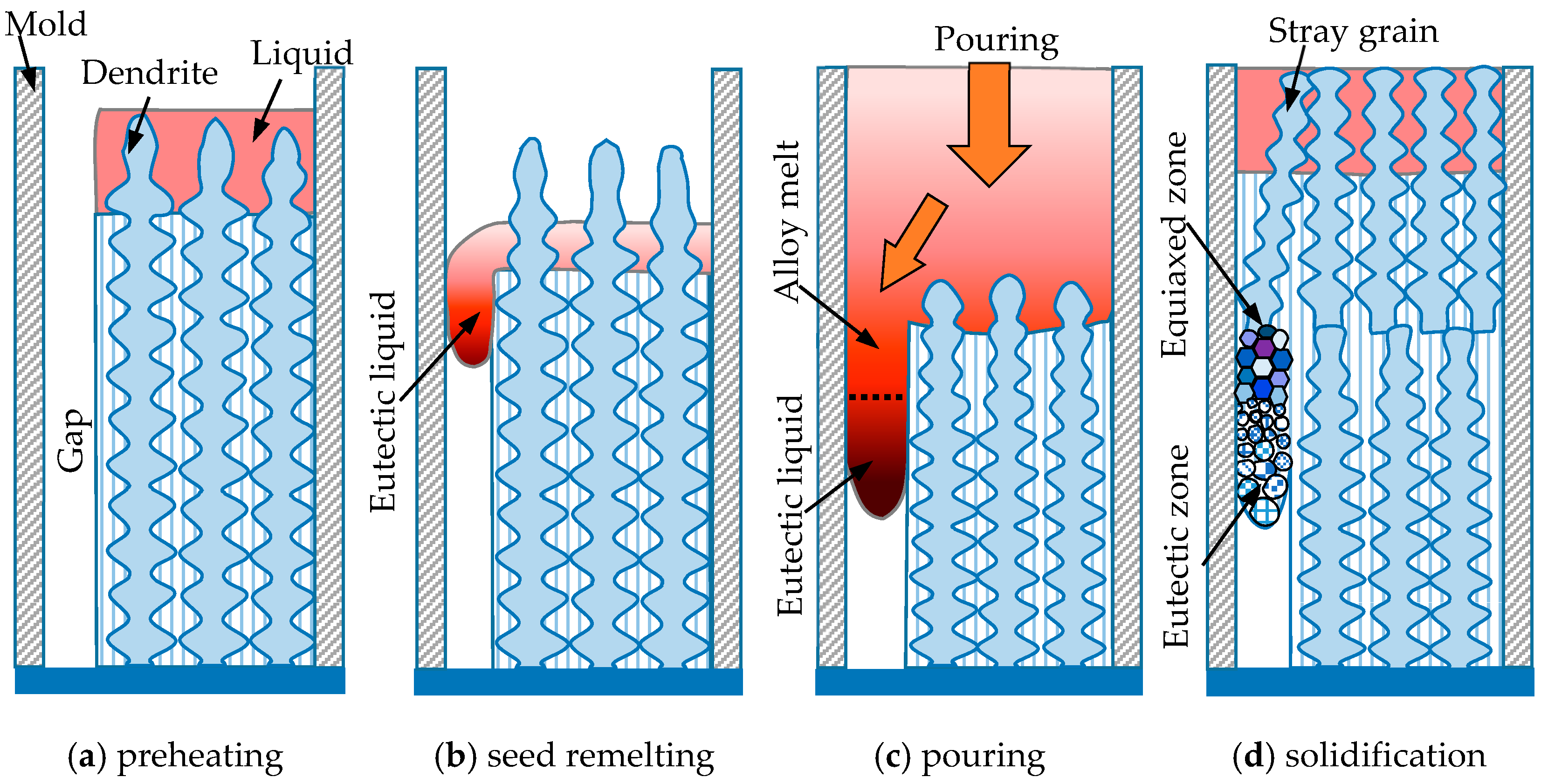
- During the preheating stage of the casting experiment, the top of the seed melts initially, preferentially beginning with the interdendritic regions (Figure 8a). This behavior is attributed to the solute redistribution during solidification, where the dendrite trunks were enriched with refractory elements W and Re. This gives the dendrite trunks a higher melting point. Conversely, the γ′-forming elements Al + Ti + Ta were expelled into the residual liquid between the dendrites, forming γ/γ′ eutectics with a lower melting point [40,41]. Consequently, the interdendritic regions of the seed crystal, which contained a significant amount of γ/γ′ eutectics, melt preferentially. This also leads to an enrichment of Al + Ti + Ta in the melt liquid.
- (2)
- As the temperature gradually increased during preheating, the melt–back interface of the seed crystal progressively moved downward. Then, the molten alloy in the interdendritic regions accumulated gradually and flowed down slowly into the gap between the shell mold and the seed, driven by gravity (Figure 8b). This part of the fluid, which originated from the interdendritic regions of the seed, could be referred to as the eutectic liquid due to its enrichment with eutectic-forming elements Al + Ti + Ta.
- (3)
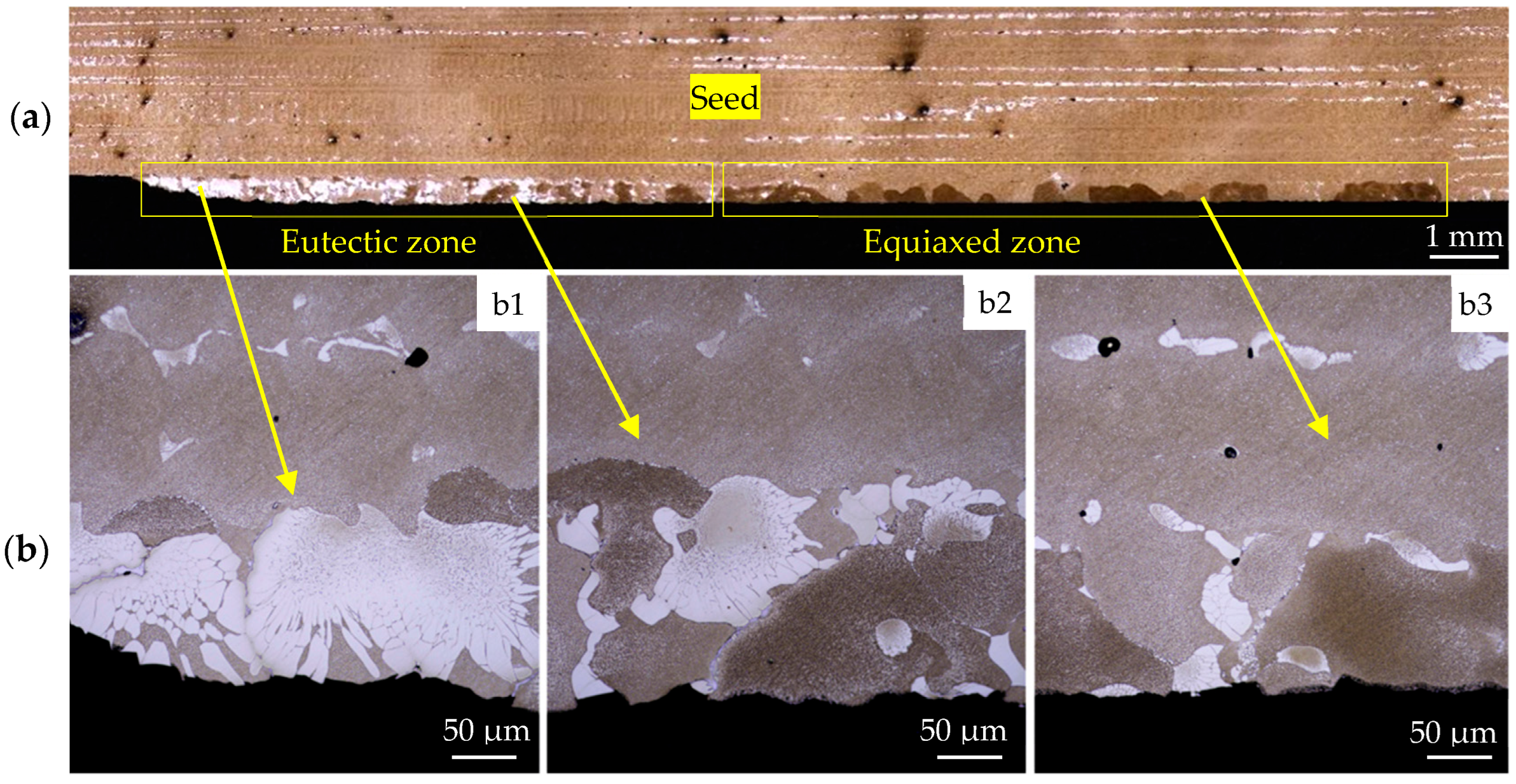
- After preheating the shell mold, the overheated charge alloy melt in the crucible was poured into the mold, first filling the seed cavity at the bottom. It forced the eutectic liquid in the gap to flow down rapidly (Figure 8c). Upon cooling and solidification, this eutectic liquid ultimately developed into the eutectic zone of the lower chilled layer (Figure 8d). In more detail, the leading part of the eutectic liquid was in a semi-solid state initially and formed a suspended shape due to surface tension, without full contact with the seed crystal and the mold wall. As a consequence of the low cooling rate, the coarse eutectic structures at the bottom of the eutectic zone appeared. However, the latter part of the eutectic liquid adhered closely to the cold seed and formed finer eutectic structures because of effective heat dissipation. Above the eutectic liquid was the poured alloy melt, whose composition is the same as that of the charge alloy, without enrichment of Al + Ti + Ta. It solidified upon contact with the seed crystal under rapid cooling, forming normal equiaxed γ-phase grains with normal eutectic fractions, constituting the equiaxed zone in the upper region of the chilled layer (Figure 8d).
- (4)
- When the mold was pulled downward after pouring the alloy melt, the liquid above the remelting interface of the seed solidified upward in the form of columnar dendrites. However, equiaxed grains at the top of the chilled layer grew epitaxially, developing into stray grains with random orientations (Figure 8d). These grains subsequently evolved into stray grain defects during the withdrawal process, as observed in Figure 3, which destroyed the monocrystallinity of the SC casting. This formation mechanism of stray grains differs completely from the mechanism referenced in prior work by the authors [31], where stray grains originated from unmelted and recrystallized grains on the surface of the seed crystal.
5. Conclusions
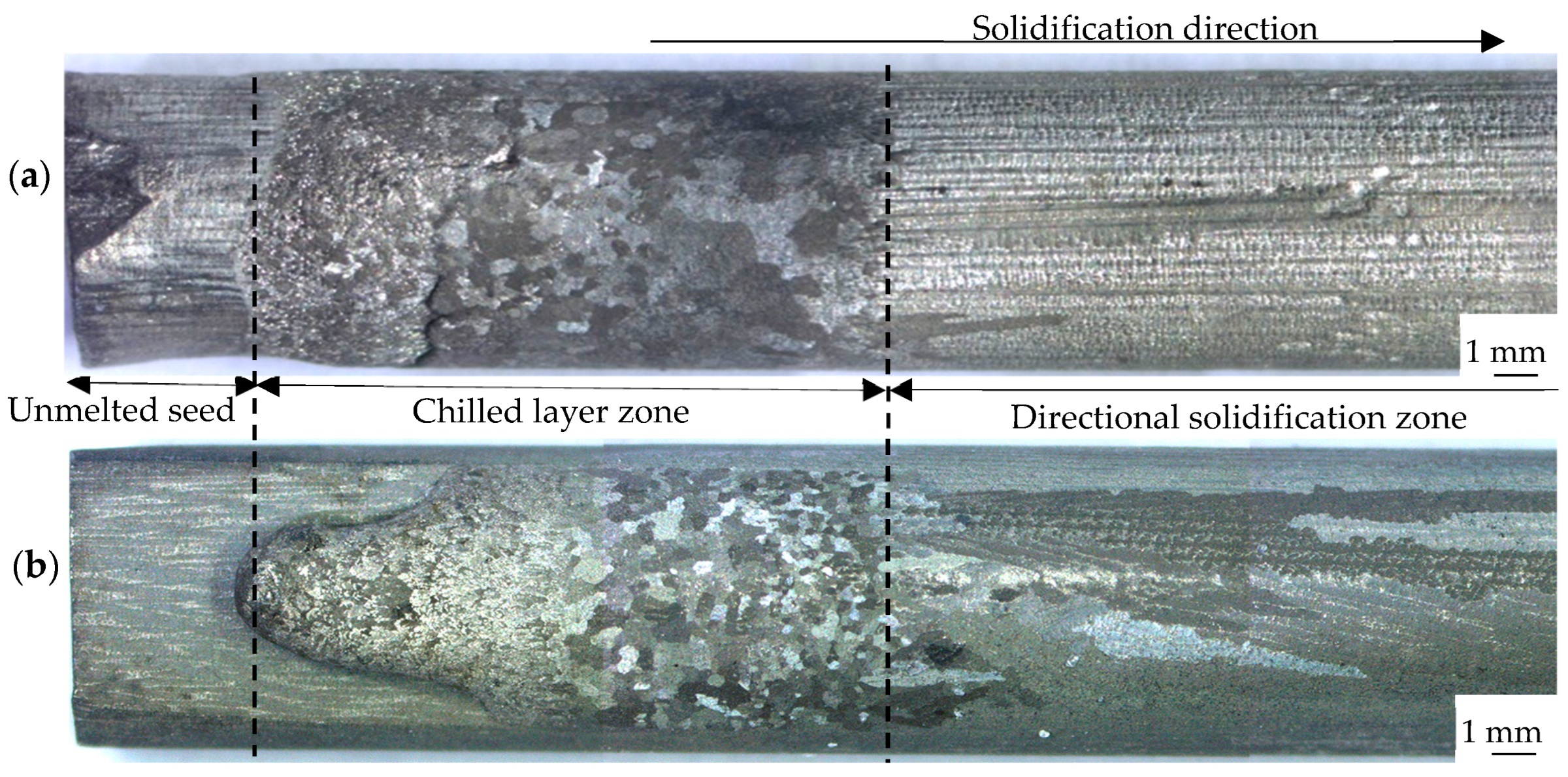
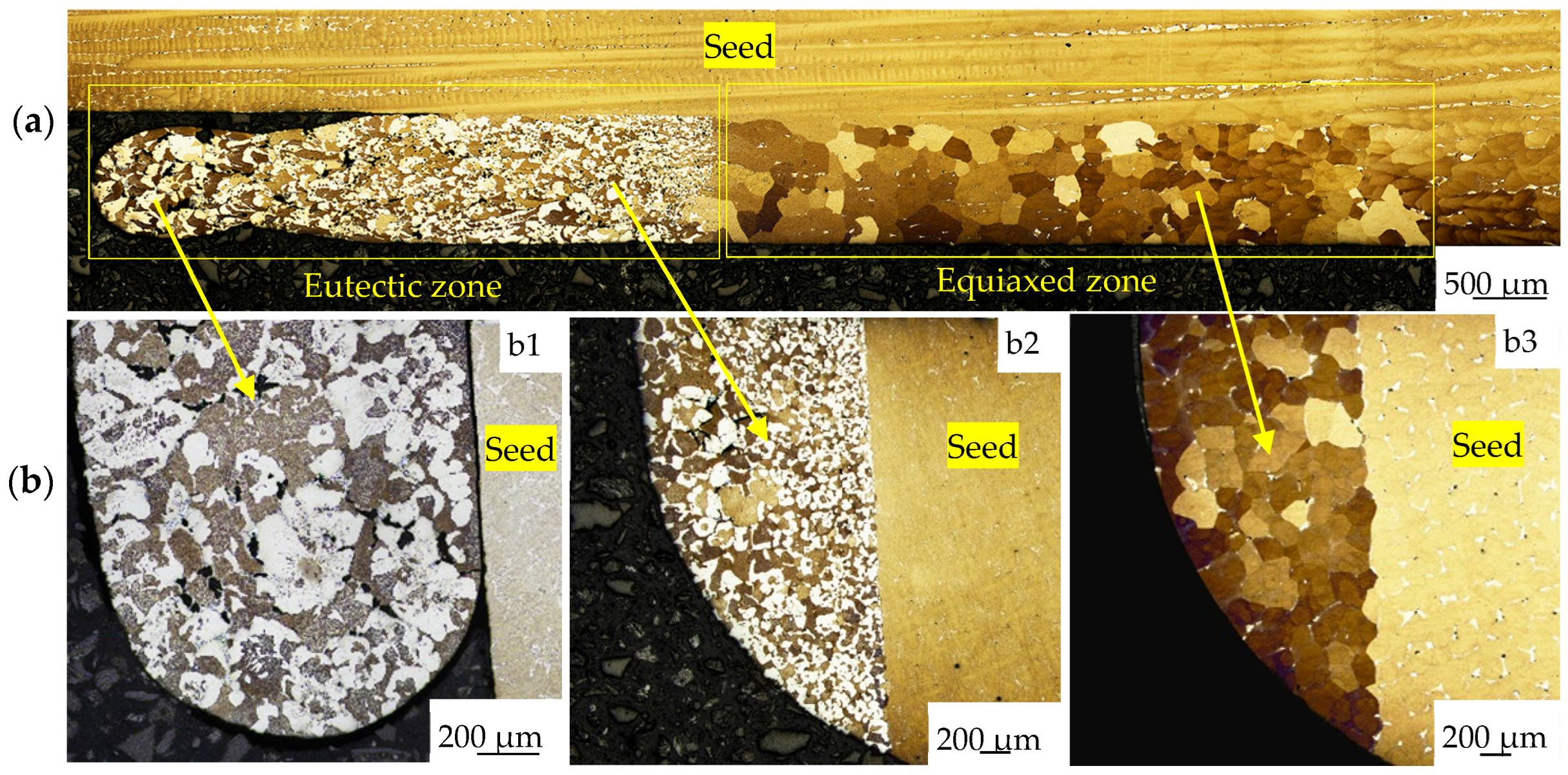
- The gap between the seed and the mold wall can cause a chilled layer on the seed perimeter. A larger gap results in a thicker chilled layer and more severe stray grain defects. By using the seeds with an approximate 0.3 mm gap from the mold shell, the epitaxial growth of SC was essentially unaffected by the chilled layer, whereas the castings prepared with an approximate 1.0 mm gap between the seed and mold exhibited multiple large-angle deviated grains from the chilled layer.
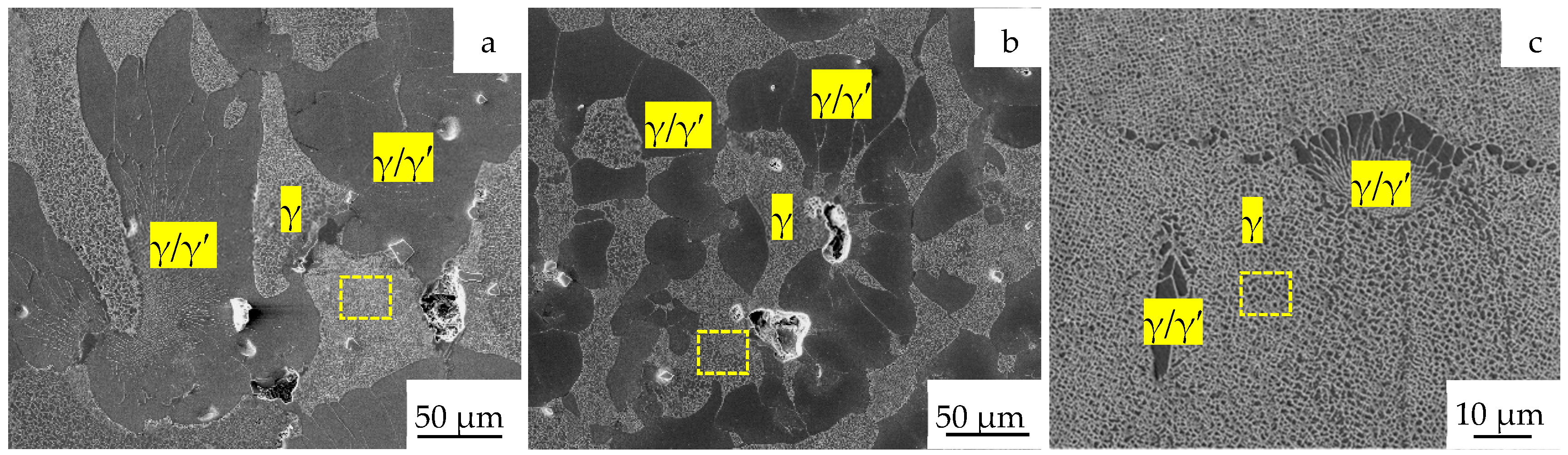
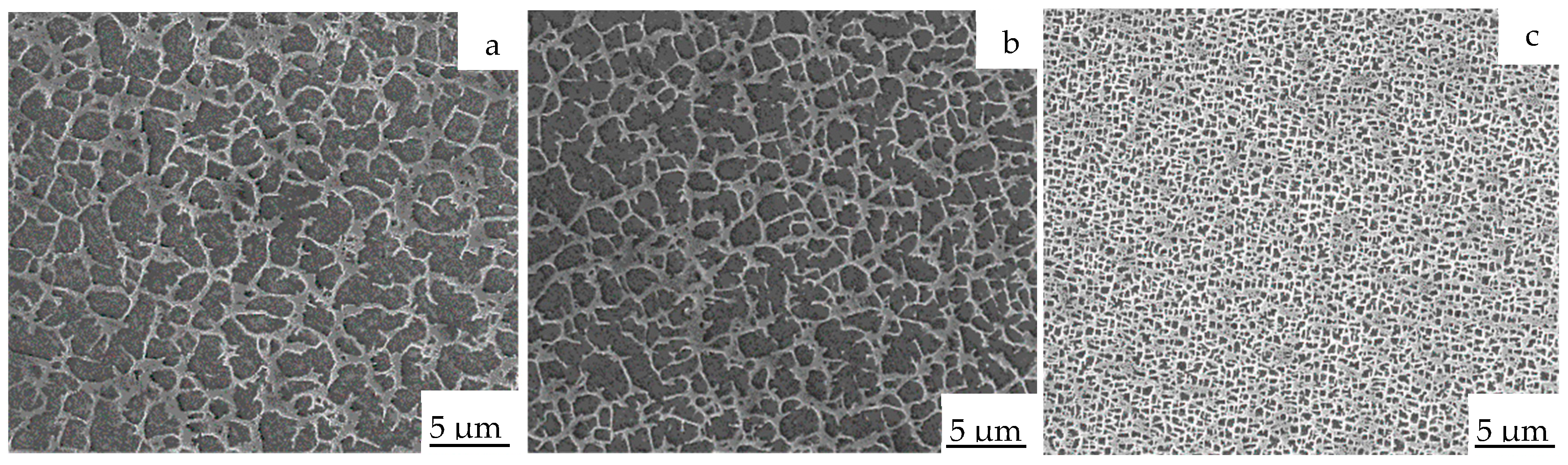
- The chilled layer can be divided into two zones. The lower part is the γ/γ′ eutectic zone, where the γ/γ′ eutectic fraction exceeds 50%. The upper zone is characterized by equiaxed γ-phase grains containing only 5% γ/γ′ eutectic structures, similar to normal as-cast structures.
- The lower part of the eutectic zone, exhibiting a suspended shape and coarse γ/γ′ eutectics, was formed due to slower heat dissipation. In contrast, the upper part of the eutectic zone was tightly bonded to the unmelted seed experienced rapid cooling, leading to fine eutectic structures.
- The lower part of the chilled layer was enriched in γ′-forming elements Al + Ti + Ta, derived from the preferentially melted interdendritic regions of the seed during preheating, resulting in an abnormal eutectic zone. The upper chilled layer mainly originated from the subsequently poured charge alloy melt without enrichment in γ′-forming elements; consequently, no excessive γ/γ′ eutectic development was observed.
- During subsequent directional solidification, the equiaxed γ-grains in the chilled layer grew epitaxially into misoriented stray grains; so, the monocrystallinity of the SC casting was destroyed.
Author Contributions
Funding
Data Availability Statement
Conflicts of Interest
References
- Donachie, M.J.; Donachie, S.J. Superalloys: A Technical Guide; ASM International: Troit, MI, USA, 2002; pp. 11–25. [Google Scholar]
- Harris, K.; Erickson, G.L.; Schwer, R.E. Metals Handbook, 10th ed.; ASM International: Russell Township, OH, USA, 1990. [Google Scholar]
- Meetham, G.W. The Development of Gas Turbine Materials; Applied Science Publishers: London, UK, 1981; pp. 89–119. [Google Scholar]
- Reed, R.C. The Superalloys Fundamentals and Applications; Cambridge University Press: Cambridge, UK, 2006. [Google Scholar]
- Yang, W.; Li, J.; Liu, S.; Wang, X.; Zhao, J.; Shi, Z. Effect of Low-Angle Boundaries on the Microstructures and Tensile Properties of the Third-Generation Single-Crystal Superalloy DD9. Crystals 2022, 12, 595. [Google Scholar] [CrossRef]
- Epishin, A.; Fedelich, B.; Finn, M.; Künecke, G.; Rehmer, B.; Nolze, G.; Leistner, C.; Petrushin, N.; Svetlov, I. Investigation of Elastic Properties of the Single-Crystal Nickel-Base Superalloy CMSX-4 in the Temperature Interval between Room Temperature and 1300 °C. Crystals 2021, 11, 152. [Google Scholar] [CrossRef]
- Gudivada, G.; Pandey, A.K. Recent developments in nickel-based superalloys for gas turbine applications: Review. J. Alloys Compd. 2023, 963, 171128. [Google Scholar] [CrossRef]
- Jian, Z.; Wang, L.; Guang, X.; Dong, W.; Jian, S.; Lu, Y.; Huang, Y.; Li, Y. Recent Progress in Research and Development of Nickel-Based Single Crystal Superalloys. Acta Metall. Sin. 2023, 59, 1109–1124. [Google Scholar]
- Bae, J.S.; Lee, J.H.; Kim, S.S.; Jo, C.Y. Formation of MC-γ/γ′ eutectic fibers and their effect on stress rupture behavior in D/S Mar-M247LC superalloy. Scripta Materis. 2001, 45, 503–508. [Google Scholar] [CrossRef]
- Wang, F.; Ma, D.; Bührig-Polaczek, A. Eutectic Formation During Solidification of Ni-Based Single-Crystal Superalloys with Additional Carbon. Met. Mater. Trans. A 2017, 48, 5442–5448. [Google Scholar] [CrossRef]
- Moreira, M.F.; Fantin, L.B.; Azevedo, C.R.F. Microstructural Characterization of Ni-Base Superalloy As-Cast Single Crystal (CMSX-4). Inter Metalcast. 2021, 15, 676–691. [Google Scholar] [CrossRef]
- D’Souza, N.; Dong, H. Solidification path in third-generation Ni-based superalloys, with an emphasis on last stage solidification. Scr. Mater. 2007, 56, 41–44. [Google Scholar] [CrossRef]
- Seo, S.M.; Kim, I.S.; Lee, J.H.; Jo, C.Y.; Miyahara, H.; Ogi, K. Microstructural evolution in directionally solidified Ni-base superalloy IN792+Hf. J. Mater. Sci. Technol. 2008, 24, 110–114. [Google Scholar]
- Park, K.; Withey, P. Compositions of Gamma and Gamma Prime Phases in an As-Cast Nickel-Based Single Crystal Superalloy Turbine Blade. Crystals 2022, 12, 299. [Google Scholar] [CrossRef]
- Seo, S.M.; Lee, J.H.; Yoo, Y.S.; Jo, C.Y.; Miyahara, H.; Ogi, K. Comparative Study of the γ/γ′ Eutectic Evolution During the Solidification of Ni-Base Superalloys. Metall. Mater. Sci. 2011, 42, 3150–3159. [Google Scholar] [CrossRef]
- Homam, N. Microstructural investigation and castability anticipation in modern Ti/Al/Nb-containing nickel-based superalloys. Trans. Nonferrous Met. Soc. China 2016, 26, 1607−1619. [Google Scholar]
- Pandey, P.; Sawant, A.K.; Nithin, B.; Peng, Z.; Makineni, S.K.; Gault, B.; Chattopadhyay, K. On the effect of Re addition on microstructural evolution of a CoNi-based superalloy. Acta Mater. 2019, 168, 37–51. [Google Scholar] [CrossRef]
- Cao, L.; Zhou, Y.; Jin, T.; Sun, X. Effects of Re on surface eutectic formation for Ni-base single crystal superalloys during directional solidification. J. Mater. Sci. Techno. 2017, 33, 1308–1313. [Google Scholar] [CrossRef]
- Zhao, Y.; Zhang, J.; Luo, Y.; Tang, D.; Feng, Q. Effects of Hf on High Temperature Low Stress Rupture Properties of a Second Generation Ni-based Single Crystal Superalloy DD11. Acta Metall. Sin. 2015, 51, 1261–1272. [Google Scholar]
- Shi, Z.; Liu, S.; Yue, X.; Wang, Z.; Li, J. Effect of Re Content on Mircrostructure and Stress Rupture Properties of DD15 Single Crystal Superalloy. Rare Met. Mater. Eng. 2023, 52, 1977–1984. [Google Scholar]
- Ma, D.; Zhao, Y.; Xu, W.; Pi, L.; Li, Z. Surface Effect on Eutectic Structure Distribution in Single Crystal Superalloy Castings. Acta Metall. Sin. 2021, 57, 1539–1548. [Google Scholar]
- Ma, D.; Zhao, Y.; Xu, W.; Wang, F. Effect of Gravity on Directionally Solidified Structure of Superalloys. Acta Metall. Sin. 2023, 59, 1279–1290. [Google Scholar]
- Wang, Q.; Yang, W.; Lin, S.; Liu, C.; Qin, J.; Qu, P.; Qu, P.; Zhang, J. A novel l12-strengthened single crystal high entropy alloy with excellent high-temperature mechanical properties. Mater. Charact. 2024, 212, 113958. [Google Scholar] [CrossRef]
- Yang, S.; Bao, J.; Yang, X.; Zhen, Q.; Liu, Q.; Zhang, J.; Hu, S. Controlling crystal orientation of Ni-based single crystal superalloy by inclined seeding metho. J. Mater. Eng. 2025, 53, 63–69. [Google Scholar]
- Yang, Z.; Hu, S.; Chen, Y.; He, M.; Li, W.; Bai, W.; Wang, X. Effect of Growth Orientation on Solidification Process of Nickel-Based Single Crystal Superalloy DD6. Metall. Mater. Trans. A 2025, 56, 2653–2664. [Google Scholar] [CrossRef]
- Qin, J.; Hu, S.; Yang, W.; Qu, P.; Liu, C.; Wang, Q.; Zhang, J.; Liu, L. Oxidation behavior of Ni-20W and Ni-20W-20Cr heterogeneous seeds under different vacuum conditions. Vacuum 2024, 229, 113578. [Google Scholar] [CrossRef]
- Toloraiya, V.N.; Orekhov, N.G.; Kablov, E.N. Advanced Method for Single Crystal Casting of Turbine Blades for Gas Turbine Engines and Plants. Metal. Sci. Heat. Treat. 2002, 44, 279–283. [Google Scholar] [CrossRef]
- Zhao, X.; Liu, L.; Yang, C.; Li, Y.; Fu, H. Influence of crystal orientation on cellular growth of a nickel-base single crystal superalloy. J. Alloys Compd. 2011, 509, 9645–9649. [Google Scholar] [CrossRef]
- Yang, W.; Hu, S.; Huo, M.; Sun, D.; Zhang, J.; Liu, L. Orientation controlling of Ni-based single-crystal superalloy by a novel method: Grain selection assisted by un-melted reused seed. J. Mater. Res. Technol. 2019, 8, 1347–1352. [Google Scholar] [CrossRef]
- Hu, S.; Liu, L.; Yang, W.; Sun, D.; Huo, M.; Li, Y.; Huang, T.; Zhang, J.; Sun, H.; Fu, H. Inhibition of stray grains at melt-back region for re-using seed to prepare Ni-based single crystal superalloys. Prog. Nat. Sci. 2019, 29, 582–586. [Google Scholar] [CrossRef]
- Deng, Y.; Ma, D.; Zhao, Y.; Xu, W.; Xu, F.; Li, L. Stray Grain Formation Mechanism During Seeding Process of Single Crystal Superalloy DD419. Rare Met. Mater. Eng. 2024, 53, 2042–2048. [Google Scholar]
- Hu, S.; Zhao, Y.; Bai, W.; Wang, X.; Yin, F.; Yang, W.; Liu, L. Temperature Field Evolution of Seeding during Directional Solidification of Single-Crystal Ni-Based Superalloy Castings. Metals 2022, 12, 817. [Google Scholar] [CrossRef]
- Ma, D.; Wang, F.; Sun, H.; Xu, W. Experimental Investigations on Stray Grain Defects in Single Crystal Castings of Superalloys. Foundry 2019, 68, 558–566. [Google Scholar]
- Fan, Y.; Zhao, X.; Qiao, L.; Song, Y.; Zhou, Y.; Cheng, Y.; Zeng, S.; Yue, Q.; Xia, W.; Gu, Y.; et al. Microstructure evolution and stability of directionally solidified superalloys with varying γ′ phase forming elements. Mater. Today Nano 2025, 30, 100637. [Google Scholar] [CrossRef]
- Liu, G.; Liu, L.; Cheng, A.; Ge, B.; Zhang, J.; Fu, H. Influence of withdrawal rate on the microstructure of Ni-base single-crystal superalloys containing Re and Ru. J. Alloys Compd. 2011, 509, 5866–5872. [Google Scholar] [CrossRef]
- Cheng, T.; Wang, Y.; Zhao, Y.; Lv, B.; Ma, D. Effect of solidification direction on microstructure and mechanical property of single crystal superalloy CMSX-4. Mater. Charact. 2022, 202, 112992. [Google Scholar] [CrossRef]
- He, J.; Liu, C.; Dong, J.; Zhang, M. The effect of Mo and Ti elements on long-term microstructure stability of 617B nickel-base superalloy. J. Alloys Compd. 2020, 821, 153217. [Google Scholar]
- Kearsey, R.M.; Beddoes, J.C.; Jones, P.; Au, P. Compositional design considerations for microsegregation in single crystal superalloy systems. Intermetallics 2004, 12, 903–910. [Google Scholar] [CrossRef]
- Sudbrack, C.K.; Ziebell, T.D.; Noebe, R.D.; Seidmanet, D.N. Effects of a tungsten addition on the morphological evolution, spatial correlations and temporal evolution of a model Ni-Al-Cr superalloy. Acta Mater. 2008, 56, 448–463. [Google Scholar] [CrossRef]
- Heckl, A.; Rettig, R.; Cenanovic, S.; Goken, M.; Singer, R.F. Investigation of the final stages of solidification and eutectic phase formation in Re and Ru containing nickel-base superalloys. J. Cryst. Growth 2010, 312, 2137–2144. [Google Scholar] [CrossRef]
- Gong, L.; Chen, B.; Du, Z.; Zhang, M.; Liu, R.; Liu, K. Investigation of Solidification and Segregation Characteristics of Cast Ni-Base Superalloy K417G. Mater. Sci. Technol. 2016, 34, 127–136. [Google Scholar] [CrossRef]



| Cr | Co | Mo | W | Re | Al | Ti | Ta | Hf | W + Re | Al + Ti + Ta | Ni |
|---|---|---|---|---|---|---|---|---|---|---|---|
| 6.56 | 9.38 | 0.65 | 6.27 | 2.94 | 5.56 | 1.08 | 6.47 | 0.13 | 9.21 | 13.11 | Bal. |
| Region | γ/γ′ Fraction | γ′-Size (μm) | Chemical Composition (wt. %) | |||||||||||
|---|---|---|---|---|---|---|---|---|---|---|---|---|---|---|
| Cr | Co | Mo | W | Re | Al | Ti | Ta | Hf | Ni | W + Re | Al + Ti + Ta | |||
| Eutectic zone (lower part) | 52.7% | 1.5 | 6.26 | 8.39 | 0.39 | 3.53 | 1.69 | 4.23 | 2.33 | 10.66 | 1.36 | 61.16 | 5.22 | 17.22 |
| Eutectic zone (upper part) | 61.4% | 1.2 | ||||||||||||
| Equiaxed zone | 5.0% | 0.28 | 6.80 | 9.59 | 0.36 | 5.65 | 2.81 | 3.39 | 1.54 | 7.52 | 1.12 | 61.22 | 8.46 | 12.45 |
Disclaimer/Publisher’s Note: The statements, opinions and data contained in all publications are solely those of the individual author(s) and contributor(s) and not of MDPI and/or the editor(s). MDPI and/or the editor(s) disclaim responsibility for any injury to people or property resulting from any ideas, methods, instructions or products referred to in the content. |
© 2026 by the authors. Licensee MDPI, Basel, Switzerland. This article is an open access article distributed under the terms and conditions of the Creative Commons Attribution (CC BY) license.
Share and Cite
Deng, Y.; Ma, D.; Wei, J.; Zhao, Y.; Li, L.; Cheng, B.; Xu, F. Formation Mechanisms of Chilled Layer on the Perimeter of Superalloy Seed. Metals 2026, 16, 79. https://doi.org/10.3390/met16010079
Deng Y, Ma D, Wei J, Zhao Y, Li L, Cheng B, Xu F. Formation Mechanisms of Chilled Layer on the Perimeter of Superalloy Seed. Metals. 2026; 16(1):79. https://doi.org/10.3390/met16010079
Chicago/Turabian StyleDeng, Yangpi, Dexin Ma, Jianhui Wei, Yunxing Zhao, Lv Li, Bowen Cheng, and Fuze Xu. 2026. "Formation Mechanisms of Chilled Layer on the Perimeter of Superalloy Seed" Metals 16, no. 1: 79. https://doi.org/10.3390/met16010079
APA StyleDeng, Y., Ma, D., Wei, J., Zhao, Y., Li, L., Cheng, B., & Xu, F. (2026). Formation Mechanisms of Chilled Layer on the Perimeter of Superalloy Seed. Metals, 16(1), 79. https://doi.org/10.3390/met16010079