
Article

Modeling and Experimental Analysis of the Dislocation Structure Evolution During Deformation of High-Purity Aluminum

1
Institute of Materials Science and Technology, TU Wien, Getreidemarkt 9, 1060 Vienna, Austria
2
Materials Center Leoben Forschung GmbH, Roseggerstraße 12, 8700 Leoben, Austria
3
Christian Doppler Laboratory for Interfaces and Precipitation Engineering CDL-IPE, Institute of Materials Science and Technology, TU Wien, Getreidemarkt 9, 1060 Vienna, Austria
4
Department of Lithospheric Research, University of Vienna, Josef-Holaubek-Platz 2, 1090 Vienna, Austria
*
Author to whom correspondence should be addressed.
Metals 2025, 15(12), 1348; https://doi.org/10.3390/met15121348
Submission received: 29 October 2025 / Revised: 1 December 2025 / Accepted: 2 December 2025 / Published: 8 December 2025
(This article belongs to the Special Issue Heat Treatment and Mechanical Behavior of Steels and Alloys)

Abstract

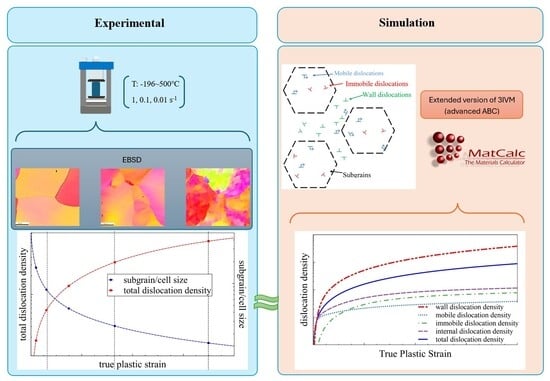
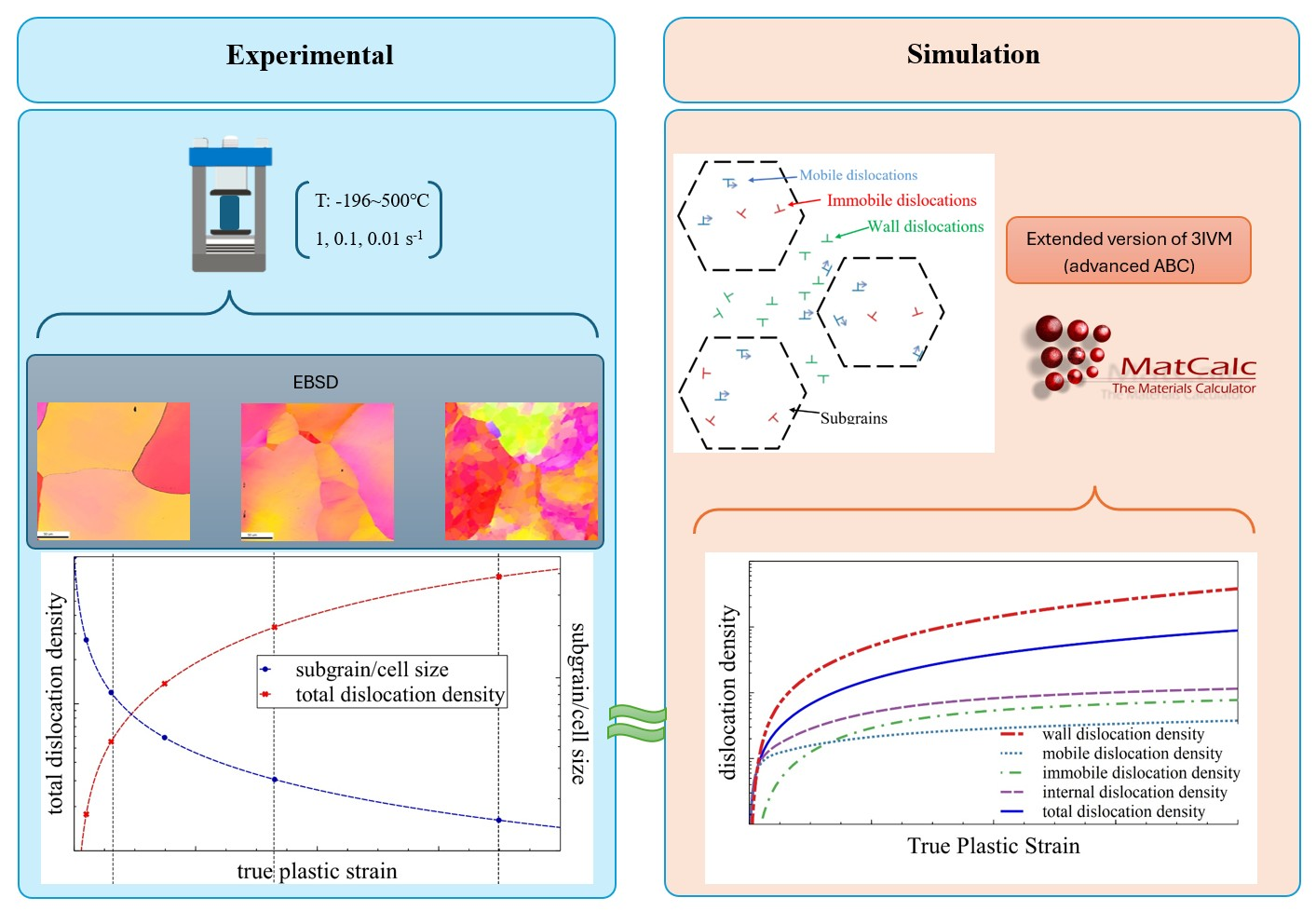
In this study, the three internal variables model (3IVM) for dislocation density evolution is further developed into the advanced ABC (advABC) model to simulate the thermo-mechanical behavior of high-purity aluminum (5N). In contrast to conventional FEM packages (e.g., ABAQUS, ANSYS), the present physically based ABC framework directly captures the evolution of the underlying dislocation structure, providing a more coherent prediction of flow behavior. The enhanced model extends the classical formulation by incorporating dislocation annihilation mechanisms and introducing the wall volume fraction as an evolving variable. Simulations are performed over a wide temperature range from −196 °C to 500 °C and at three strain rates of 1, 0.1, and 0.01 s−1. To validate the model, both stress–strain flow curves and microstructural observations obtained via Electron Backscatter Diffraction (EBSD) are used. The simulation results show excellent agreement with experimental data, successfully capturing the temperature- and strain-rate-dependence of the flow behavior, as well as the evolution of dislocation substructures. This work demonstrates the capability of the advABC model to describe both macroscopic and microscopic aspects of deformation. It provides a robust framework for predicting material behavior under complex thermo-mechanical conditions.

Graphical Abstract

1. Introduction

Simulating material behavior under extreme thermo-mechanical conditions, such as large strains, high strain rates, severe plastic deformation, and rapid temperature changes, is essential because many industrial forming and impact processes operate in regimes that are difficult, costly, or sometimes impossible to fully explore experimentally. Conventional approaches for predicting deformation include empirical constitutive laws, physics-based high-rate models, crystal-plasticity finite-element methods for microstructure-sensitive simulations, and dislocation-based internal-variable models. These methods have complementary strengths but also important limitations such as a lack of direct microstructural fidelity in empirical laws, high cost of computations for large-scale or long-time simulations in crystal-plasticity models, and weakness of dislocation substructure tracking in many continuum codes, which are crucial for controlling work-hardening and recovery [1,2,3,4,5,6,7]. The extended internal-variable framework employed in this work provides a middle ground by explicitly tracking dislocation populations and wall-volume evolution, enabling a physically meaningful yet computationally efficient prediction of flow behavior across a broad range of extreme thermo-mechanical scenarios.
Various methods are documented in the literature to characterize the flow curves of metals [8,9,10,11,12,13,14,15,16,17,18,19]. In all instances, the dislocation density is the critical state parameter used to define the microstructure during plastic deformation [20]. Hence, several models were established to predict the dislocation density evolution of, e.g., aluminum, during different thermo-mechanical treatments [8,12,16,21]. A recently published model by Sadeghi and Kozeschnik [22] describes the dislocation density with three internal variables, similar to ref. [11]. In the aforementioned papers, the volume fraction containing the wall dislocations is considered as constant. As shown in references [23,24,25], the wall volume fraction decreases with increasing plastic strain. The present work considers two distinct functions for the wall volume fraction. Although the model is calibrated for high-purity aluminum, the underlying structure of the internal-variable framework is general and can be extended to alloys containing second-phase particles by incorporating additional strengthening mechanisms, such as particle–dislocation interactions or solute effects. Likewise, reliable application to BCC or HCP metals would require introducing material-specific deformation characteristics (e.g., thermally activated screw-dislocation motion in BCC or limited slip systems in HCP), meaning that the present formulation provides a transferable basis but is not directly applicable without such modifications.
The simulated dislocation densities are compared with the literature and the experimental data obtained with EBSD. The model employed in this study is a mean-field model, which utilizes an average for different categories of dislocation densities. Although EBSD provides a comparably reliable estimate of the dislocation density [26,27,28,29], it is only possible to detect geometrically necessary dislocations (GNDs), i.e., those dislocations that contribute to a lattice rotation. Lattice rotations are usually unevenly distributed across different grains and tend to localize, e.g., as shear bands on the scale of entire grains or as subgrain/cell walls within individual grains. All of these lattice rotations have to be accommodated by GNDs [29,30,31,32,33]. Dislocations that do not contribute to lattice curvatures, so-called statistically stored dislocations (SSDs), are not detectable with EBSD [34].
There are publications that use EBSD to measure the dislocation density of single-crystalline [35], bi-crystalline [36,37], and poly-crystalline [28,33,38,39,40,41] aluminum. Most of these works deal with deformation to high strains at room temperature. The present work uses EBSD to study the evolution of the microstructure during deformation to different strains at 30 °C, 100 °C, and 300 °C. The assessment of the subgrain/cell size and the evaluation of the dislocation density after Kamaya et al. [42] from the present work are compared to the data from the literature. The present work investigates a 5N-purity aluminum using EBSD for the first time. Also, to receive a more reliable result for the average dislocation density, a relatively large area is scanned, which represents another key feature of the current work.

2. Method

2.1. Experiment

2.1.1. Deformation

The experiment utilizes an aluminum cylinder with a diameter of 76 mm and a purity of 99.999 percent, supplied by the HMW Hauner company (Röttenbach, Germany). Figure 1 presents the microstructure of the as-received cylinder in both transverse and longitudinal sections, examined at the center and near the surface, using light microscopy combined with color etching. Cylindrical samples, oriented parallel to the original cylinder, are machined with a length of 10 mm and a diameter of 5 mm. Subsequently, the samples undergo deformation at three distinct initial strain rates: 1, 0.1, and 0.01 s−1. The compression tests are performed at temperatures of −196 °C, −50 °C, 30 °C, 100 °C. 300 °C and 500 °C. Liquid nitrogen and a mixture of acetone and dry ice are used to achieve temperatures of −196 °C and −50 °C, respectively. Due to practical limitations, the compression test at −196 °C and 0.01 s−1 has not been carried out. The cooling liquids are applied directly to the samples during the course of the tests. The dilatometer DIL 805 A/D, manufactured by Baehr (Hüllhorst, Germany), is utilized, with graphite employed as a lubricant to avert barreling.

2.1.2. Data Acquisition and Post-Processing

Samples deformed at an initial strain rate of 0.1 s−1 at temperatures of 30 °C, 100 °C, and 300 °C are selected for EBSD analysis to investigate the evolution of the dislocation density at varying levels of true plastic strain (Table 1). However, EBSD measurements were not conducted at −50 °C and −196 °C temperatures because both specimen preparation and EBSD acquisition at such temperatures are technically impractical and would significantly compromise the measurement accuracy.
EBSD scans are performed in transverse cross-section. Since the deformation is not homogeneous for low-deformed samples, EBSD scans for 5% and 10% deformed samples at 30 °C are performed in both transverse and longitudinal cross-sections. Orientation Imaging Microscopy (OIM) measurements are carried out on a ZEISS Sigma 500 VP scanning electron microscope (ZEISS, Oberkochen, Germany), equipped with an EDAX Velocity EBSD system. Samples are mounted at a tilt angle of 70°, with a working distance of ≈15 mm. Scans with a step size of 0.1 µm are obtained at an acceleration voltage of 15 kV on areas of 200 × 200 µm2. For each deformation condition, EBSD mapping is performed on a single representative region.
The sample preparation involves fine mechanical polishing followed by a final electropolishing step with a Struers A2 electrolyte at a voltage of 50 V for a duration of 20 s.
Post-processing and microstructural analysis of the collected datasets are performed using the EDAX OIM software 9.0. The data cleanup procedure includes the removal of pixels with a confidence index (CI) lower than 0.1, followed by grain confidence index standardization and a single iteration of grain dilation. This systematic approach ensures high-quality data for subsequent microstructural characterization.

2.1.3. Evaluation of GNDs

The misorientation gradient obtained from EBSD is directly related to the density of GNDs [30,43]. The common way to measure dislocation density from EBSD is [26,42]:
ρ = H b × G a v e .
Here, H is a constant, b is the length of the Burgers vector, and Gave is the average misorientation gradient. The latter is obtained via evaluation of the Kernel Average Misorientation (KAM) as a function of the kernel radius. The true misorientation gradient is then equal to the slope of the function. In the present study, the slope is determined from the fit of a linear equation through five KAM values—related to the first five nearest neighbors (perimeter only), respectively. For each sample in Table 1, over 4 million points are scanned with a resolution of 0.1 µm to obtain the KAM values.
It should be noted that the EBSD technique provides robust information on lattice curvature and GND distributions, and alone, it is not adequate to delineate cell wall dislocations from internal dislocations [44,45,46].

2.1.4. Subgrain/Cell Size Evaluation

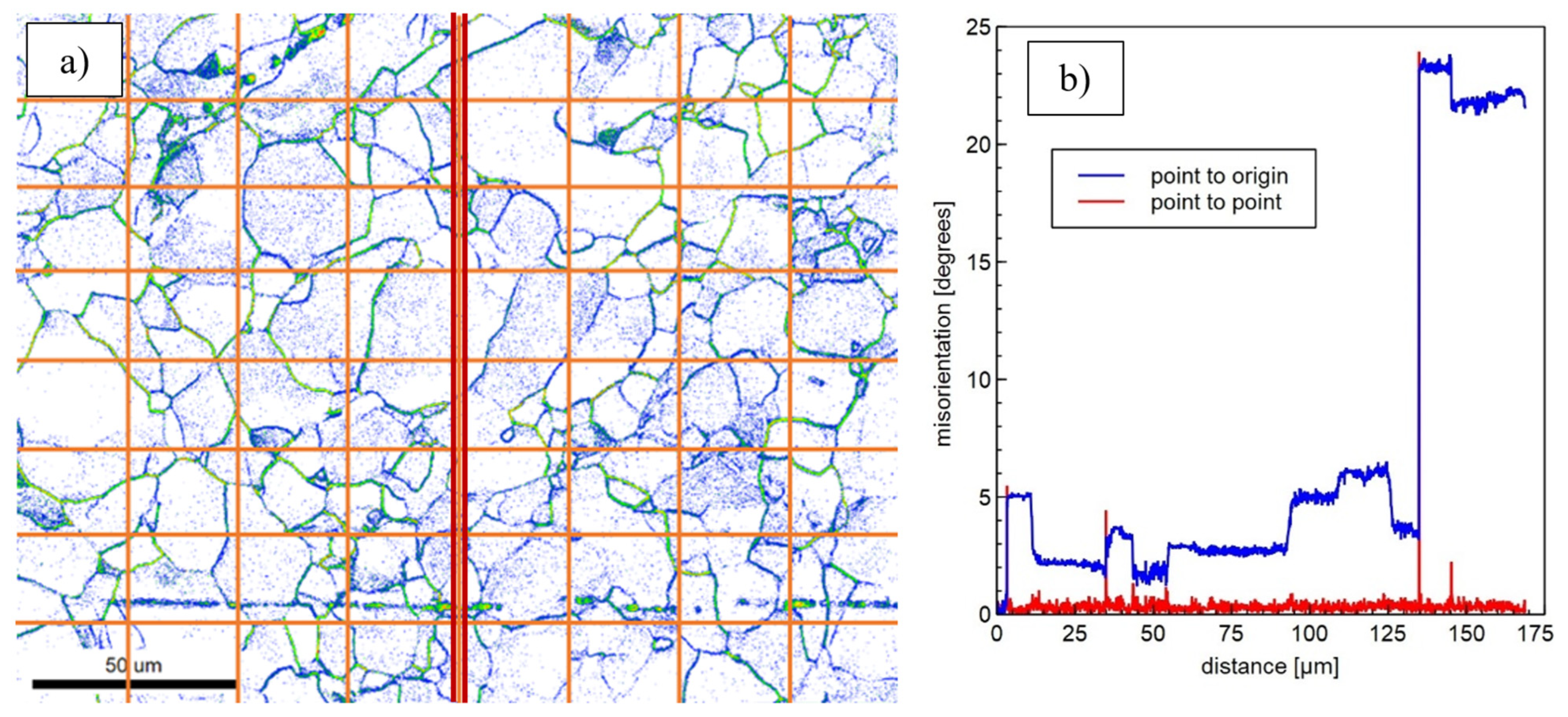
The subgrain/cell size is determined using a variant of the line intercept method, adapted to misorientation data obtained from EBSD measurements. In this approach, peaks in both point-to-point and point-to-origin misorientation angles along predefined scan lines are analyzed to identify subgrain/cell boundaries. The use of both misorientation types is crucial: while point-to-point misorientation is effective in detecting abrupt orientation changes indicative of subgrain/cell walls, point-to-origin misorientation helps reveal gradual orientation changes that may not be captured by point-to-point analysis alone. This combined analysis improves the reliability of boundary detection. For each scanned area, seven horizontal and seven vertical lines are evaluated. The presence of misorientation jumps or inflection points in the profile indicates the position of subgrain/cell walls, and the subgrain/cell size is determined by averaging the distances between these features. As illustrated in Figure 2a, the grid of the specimen deformed at 300 °C to 0.47 strain is presented. Figure 2b details the misorientation angles for the central vertical line.

2.2. Simulation

The yield stress of polycrystalline metals is expressed as sum of the initial (thermal) yield stress σ 0 and the plastic (athermal) stress σ P :
σ = σ 0 + σ P .
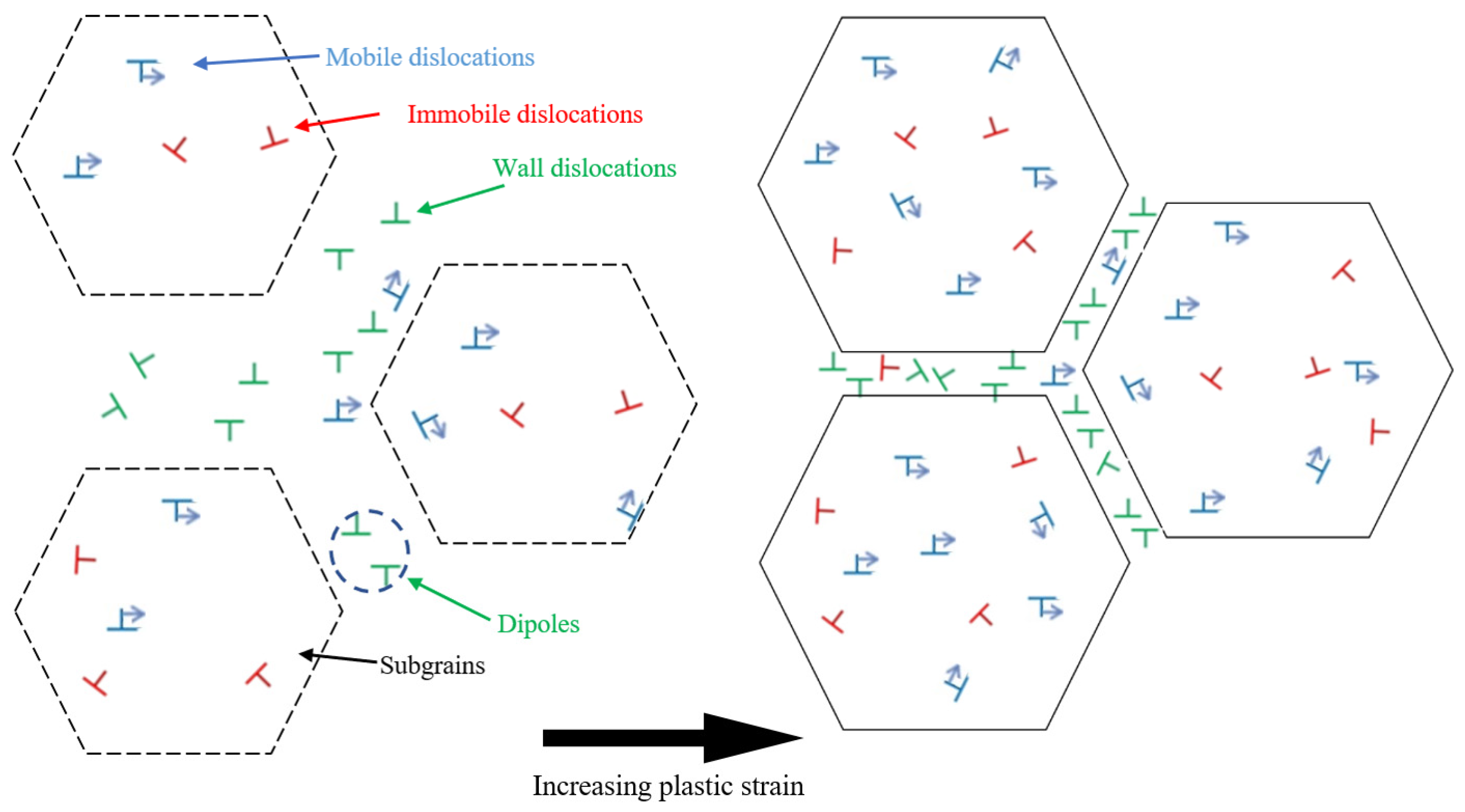
A discussion of the thermal yield stress contribution, as used in the present work, is given by Kreyca and Kozeschnik [47]. The plastic stress of the material depends on its dislocation density [48,49]. During deformation, grains subdivide into subgrains/cells with increasing misorientation to accommodate the applied deformation. These subgrains/cells are separated by boundaries characterized by a higher density of dislocations, referred to as subgrain/cell walls. Dislocations can thus be classified into two types: internal dislocations, which are located within the subgrains/cells, and wall dislocations, which are concentrated along the subgrain/cell walls. The categorization of internal dislocations is further refined based on their mobility: mobile dislocations, which remain active and contribute to plastic deformation, and immobile dislocations, which remain stationary during deformation [50]. Figure 3 illustrates the assumed constitution of the microstructure.
Mobile dislocations play a pivotal role in accommodating plastic deformation. These dislocations are generated at appropriate dislocation sources and interact with other dislocations, which can result in a variety of outcomes depending on the nature of the interaction. These outcomes may include the annihilation of mobile, immobile, or wall dislocations, immobilization, or the formation of dipoles, which constitute the majority of wall dislocations [20,51].
The macroscopic stress is calculated from the evaluated dislocation densities using the extended version of the Taylor and Orowan equation, which is a common method for calculating plastic stress [48,49]:
σ P = α i 1 f M G b ρ i + α w f M G b ρ w .
where α i and α w are the strengthening coefficients for internal and wall dislocations, respectively. The coefficient f represents the subgrain/cell wall volume fraction, M is the Taylor factor, G is the shear modulus, and b is the Burgers vector. ρ i is the internal and ρ w the wall dislocation density. The internal dislocations comprise the immobile and mobile dislocations within the subgrains/cells. Their rates during deformation can be calculated [22]:
ρ ˙ m =   M ε ˙ b   ρ i A m + ρ w β w + β d B · V · ρ m + 2 A i m m · V · ρ m + A w · V · ρ m 2 C m D G b 3 k T ρ m 2 ρ e q u , m 2 ,
for mobile dislocations,
ρ ˙ i m m = 2 A i m m · V · ρ m B i m m · V · ρ i m m 2 C i m m D G b 3 k T ρ i m m 2 ρ e q u , i m m 2 ,
for immobile dislocations and
ρ ˙ w = 1 f A w · V · ρ m B w · V · ρ w 2 C w D G b 3 k T ρ w 2 ρ e q u , w 2 ,
for wall dislocations, where ε is the true plastic strain, d is the grain diameter and V is the critical interaction volume of dislocations. In ref. [22], further details on this treatment are reported. D is the effective bulk diffusion coefficient and it is discussed in ref. [52]. k is the Boltzmann constant and T is the temperature. ρ e q u , m , ρ e q u , i m m and ρ e q u , w are the equilibrium densities of mobile, immobile and wall dislocations, respectively. A m , β w and β are calibration parameters, which refer to the generation of mobile dislocations. B , B i m m and B w are calibration parameters related to the dynamic annihilation of mobile, immobile and wall dislocations, respectively. A i m m and A w are calibration parameters related to the rate of interactions that turn mobile dislocations into immobile and wall dislocations, respectively. C m , C i m m and C w are calibration parameters for static annihilation of mobile, immobile and wall dislocations, respectively. Each rate equation is composed of three distinct components on the right-hand side:
(1)
The first term accounts for the generation of dislocations. Comprehensive discourses on the subject of dislocation generation can be found in refs. [11,50,53].
(2)
Dynamic annihilation of dislocations is described by the second term. The mechanisms underlying dynamic annihilation are covered in detail in refs. [22,50].
(3)
Static annihilation is represented by the third term. Details on the static annihilation term are provided in refs. [52,54,55].
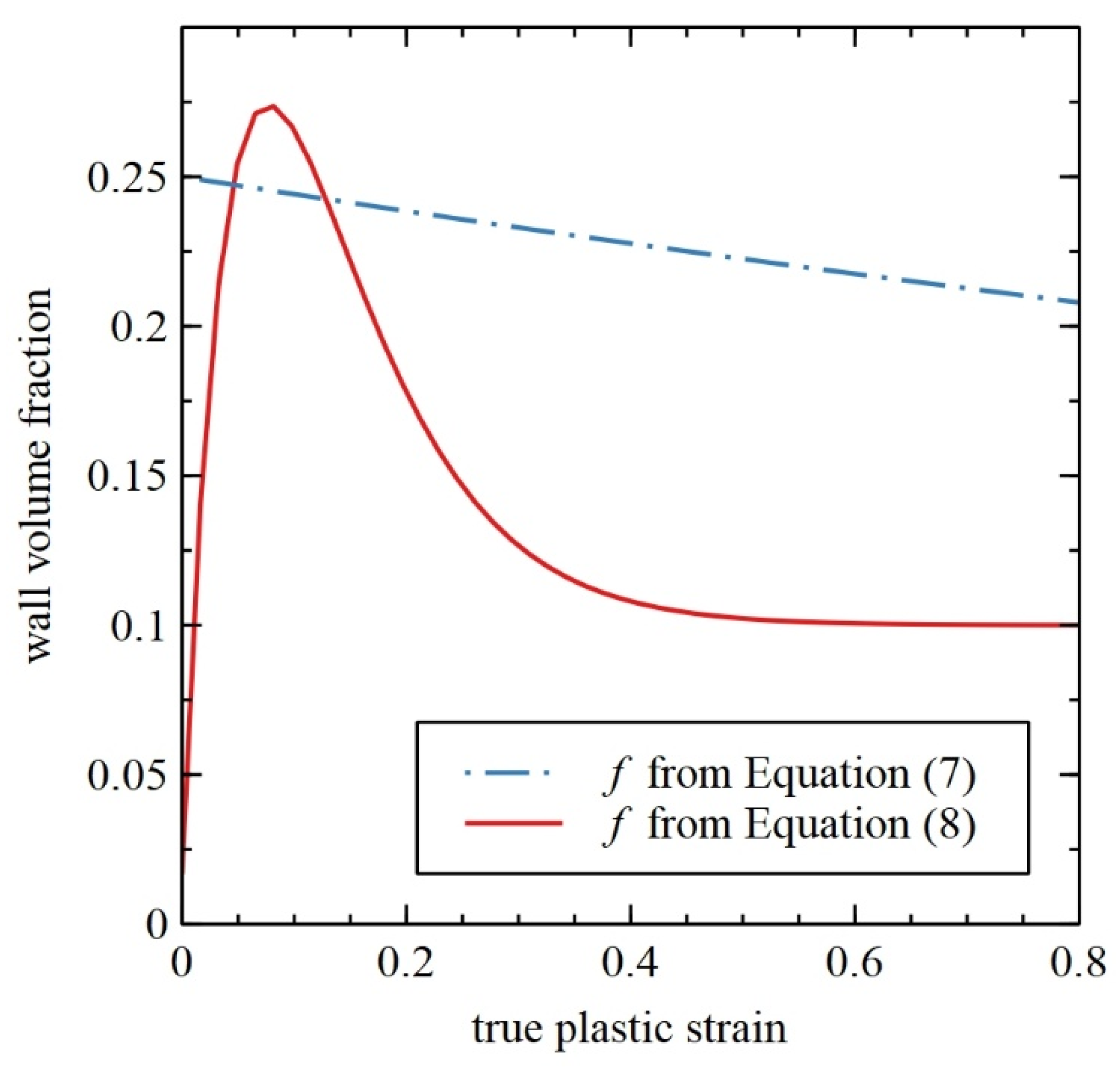
In contrast to our previous work [22], where f is considered to be constant, its value can change during the deformation process in the present. According to Müller et al. [56] and Mughrabi et al. [57], at the onset of stage III deformation, f experiences a rapid increase until reaching a peak value. With progressing deformation, the value of f declines again, leading to the formation of narrow subgrain/cell walls characterized by elevated dislocation density and augmented misorientation angles [23,24,25,28,58,59,60,61]. The value of f can be estimated based on the subgrain/cell size and the width of subgrain/cell walls. While it appears to exhibit a temperature dependence, this relationship is complex and not fully understood [62]. According to the authors’ current understanding, the most widely employed phenomenological parameterization [23,24] of f is
f = f i n f + f 0 f i n f e x p ε k f ,
where f 0 is the peak value of f , f i n f the saturation value of f and k f is a parameter, which determines the decrease rate of f . Equation (7) is particularly useful at large strains. To verify the presented model, in addition to the aforementioned equation, another equation is presented below to estimate the wall volume fraction. As demonstrated in refs. [56,57], the value of f escalates rapidly at the onset of plastic deformation, subsequently decreasing to a saturated state. We approximate these values with the following empirical relation
f = 5 ε 0.01 exp 0.5 15 ε + 0.1 ,
The two equations of wall volume fraction, (7) and (8), are plotted in Figure 4, showing that the model used in refs. [23,24] is characterized by a continuous decrease in the cell volume fraction until a saturation value is reached, whereas the approach used in refs. [56,57] reproduces both, the proposed steep increase at the beginning of stage III and the following decrease.
The thermokinetic software MatCalc 6.05 [63] is employed to perform all simulations, incorporating the model presented in this study. Table 2 presents the values of the coefficients used in the current model, along with the corresponding references that provide the basis for these values.
Table 2. Parameters used for simulation.
SymbolNameValueUnit Reference
α i strengthening coefficients for internal dislocations 0.34 _[64]
α w strengthening coefficients for wall dislocations 0.34 _[64]
M Taylor factor 3.06 _[65,66]
G shear modulus 29,438.4 15.052 T MPa[67,68]
b Burgers vector 2.86 × 10 10 m[69,70]
f i n f the saturation value of wall volume fraction 0.06 _[23]
f 0 the peak value of wall volume fraction 0.25 _[23]
k f A constant to determine the decrease rate of wall volume fraction 3.2 _[23]

3. Results

The results section is structured to validate the advanced ABC using both macroscopic flow curve measurements and microstructural characterization. First, all experimental true stress–true strain curves obtained at different temperatures and strain rates are reconstructed using the proposed simulation procedure, which allows for extracting the model parameters for each deformation condition. Subsequently, temperature- and strain-rate-dependent interpolation functions are established for the parameters, enabling direct comparison between experimental and simulated flow curves. These comparisons are presented to evaluate the predictive capability and consistency of the model across the full deformation range. Finally, EBSD measurements are used to quantify the evolution of dislocation density and subgrain size as a function of plastic strain. These microstructural metrics are compared with the corresponding simulated internal variables and with established trends reported in the literature, providing a microstructural validation of the modeling approach.
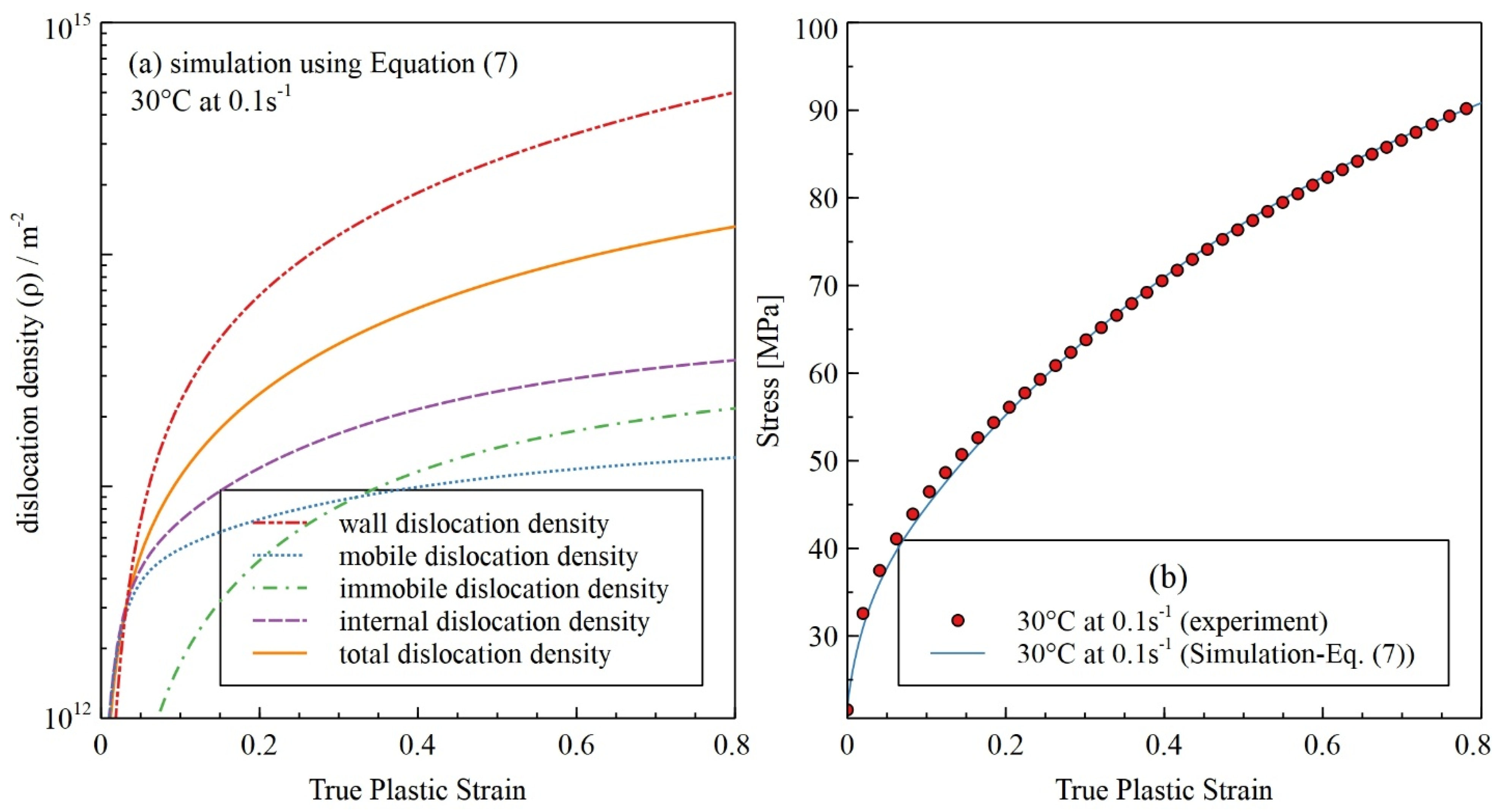
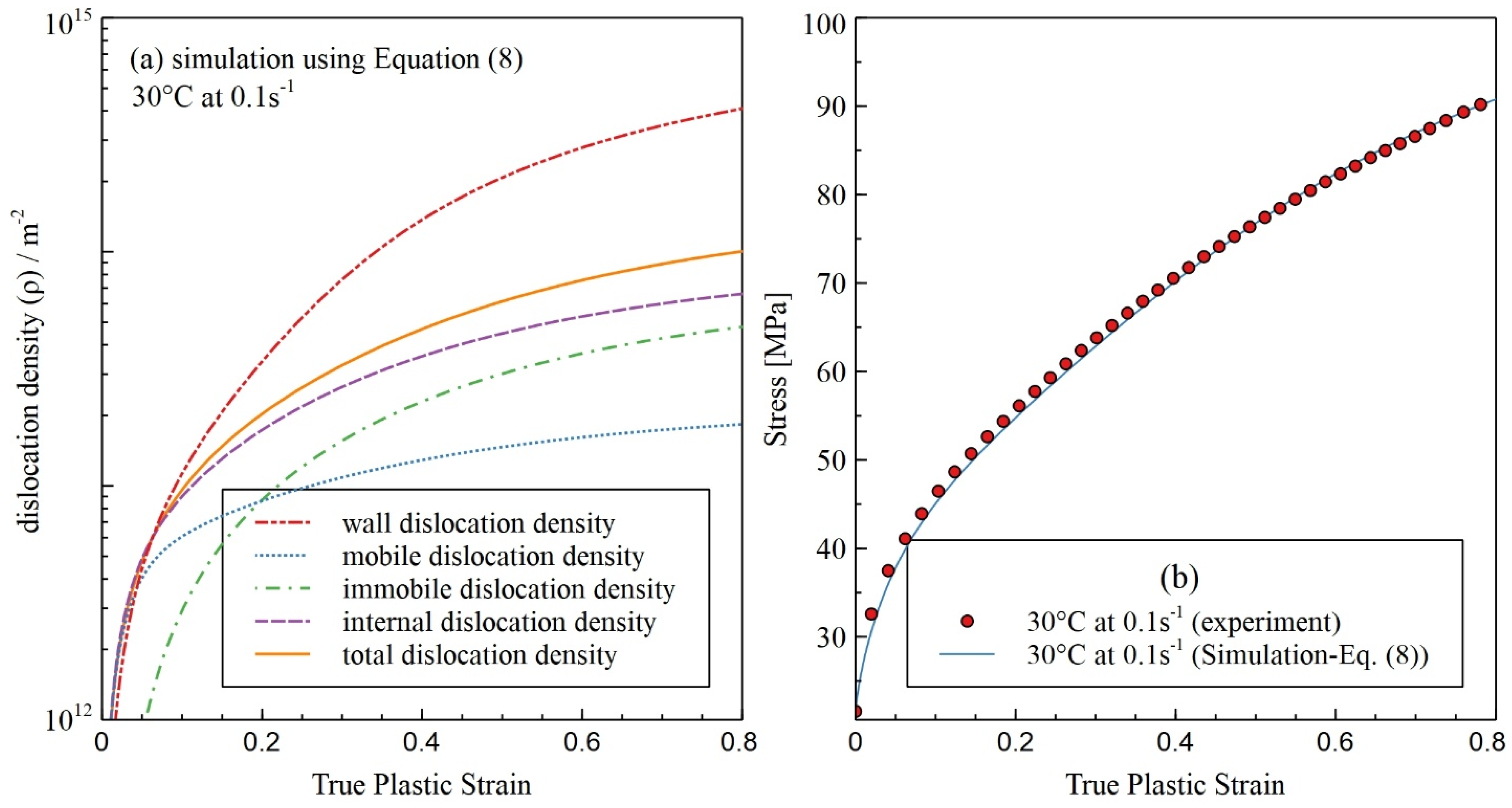
The simulations are performed for all specimens employing both Equations (7) and (8). The outcomes of these simulations, illustrated in Figure 5a and Figure 6a, provide the evolution of dislocation densities. With Equation (3), the corresponding flow curves are extracted and then compared with the experimental results from compression tests. Figure 5 presents the outcomes obtained with Equation (7), while Figure 6 displays those based on Equation (8), both of them providing a good description of the material stress–strain response.
As shown in Table 2, the present study assumes equal values for the wall dislocation strengthening coefficient and the internal dislocation strengthening coefficient, both set to 0.34. Consequently, as indicated by Equation (3), the individual contributions of wall and internal dislocation densities have an equivalent effect on the flow stress. To match a specific flow curve in the simulation, it is the total dislocation density that plays a decisive role, regardless of its partitioning between wall and internal components. As demonstrated in Figure 5 and Figure 6, the evolution of total dislocation density is similar across both simulation approaches.
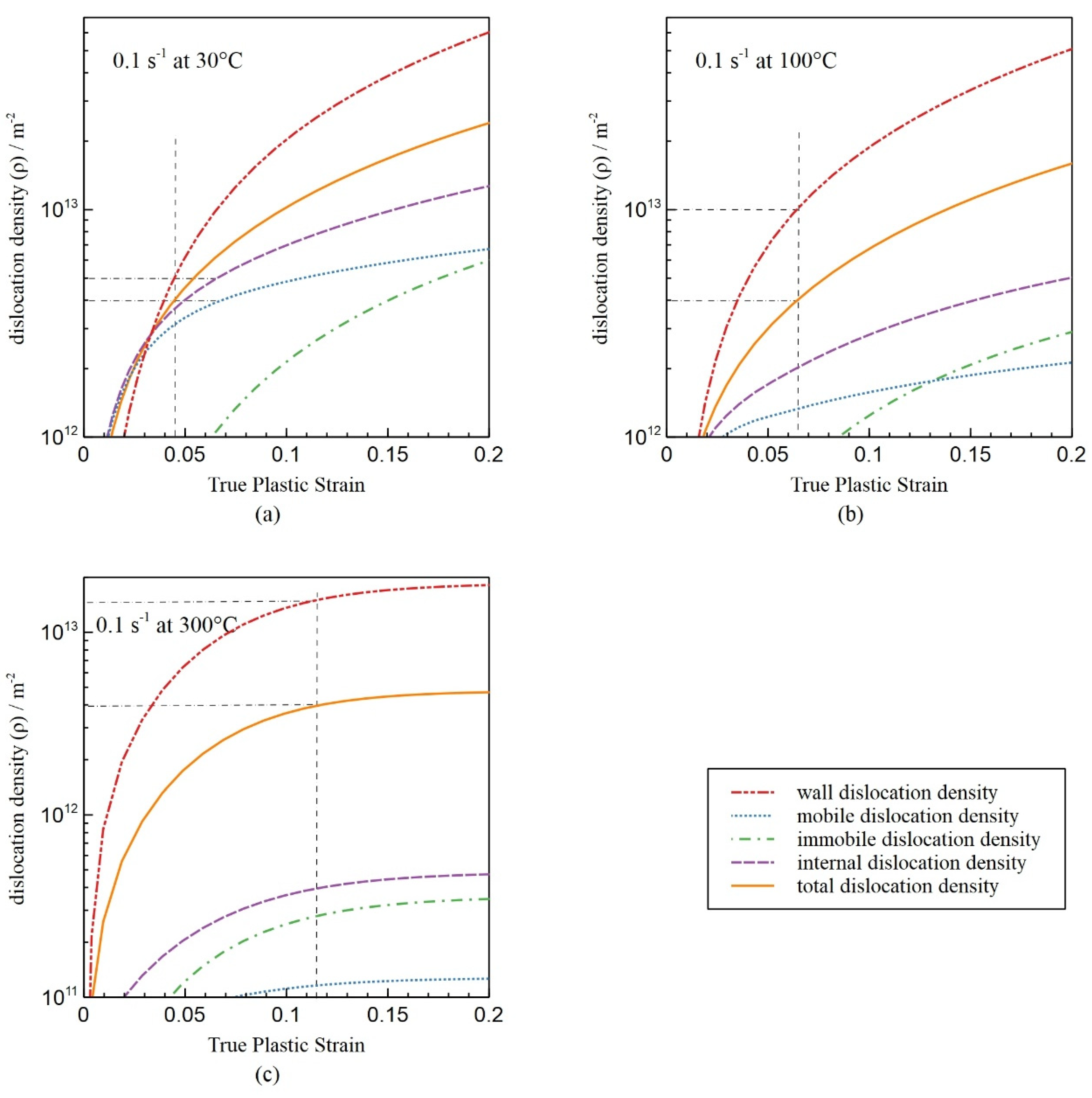
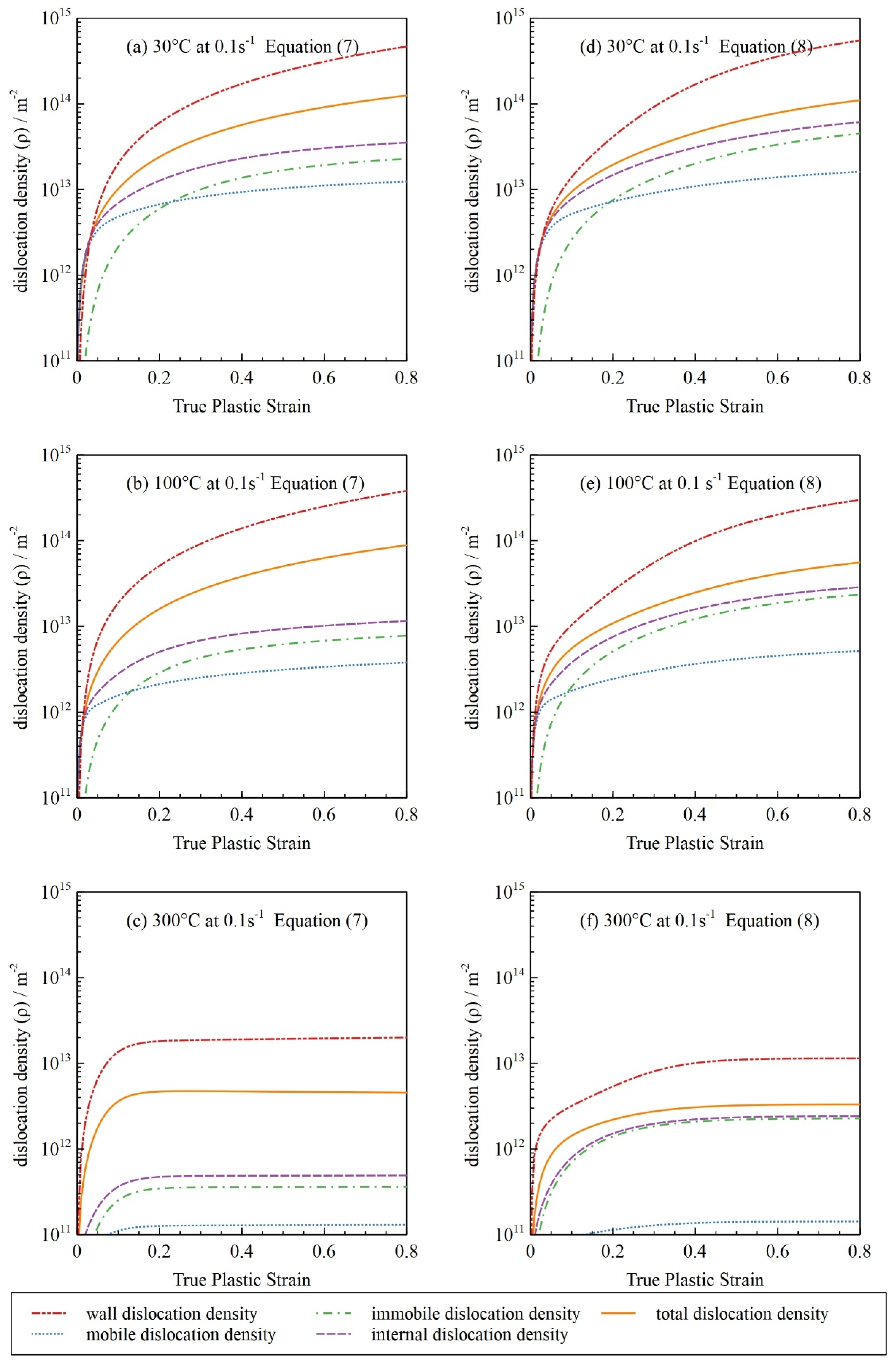
The evolution of dislocation densities for the samples which are deformed with strain rate of 0.1 s−1 at temperatures of 30, 100 and 300 °C is illustrated in Figure 7. For comparison between the simulation results for different equations of wall volume fraction, their evolutions are shown next to each other in the figure.
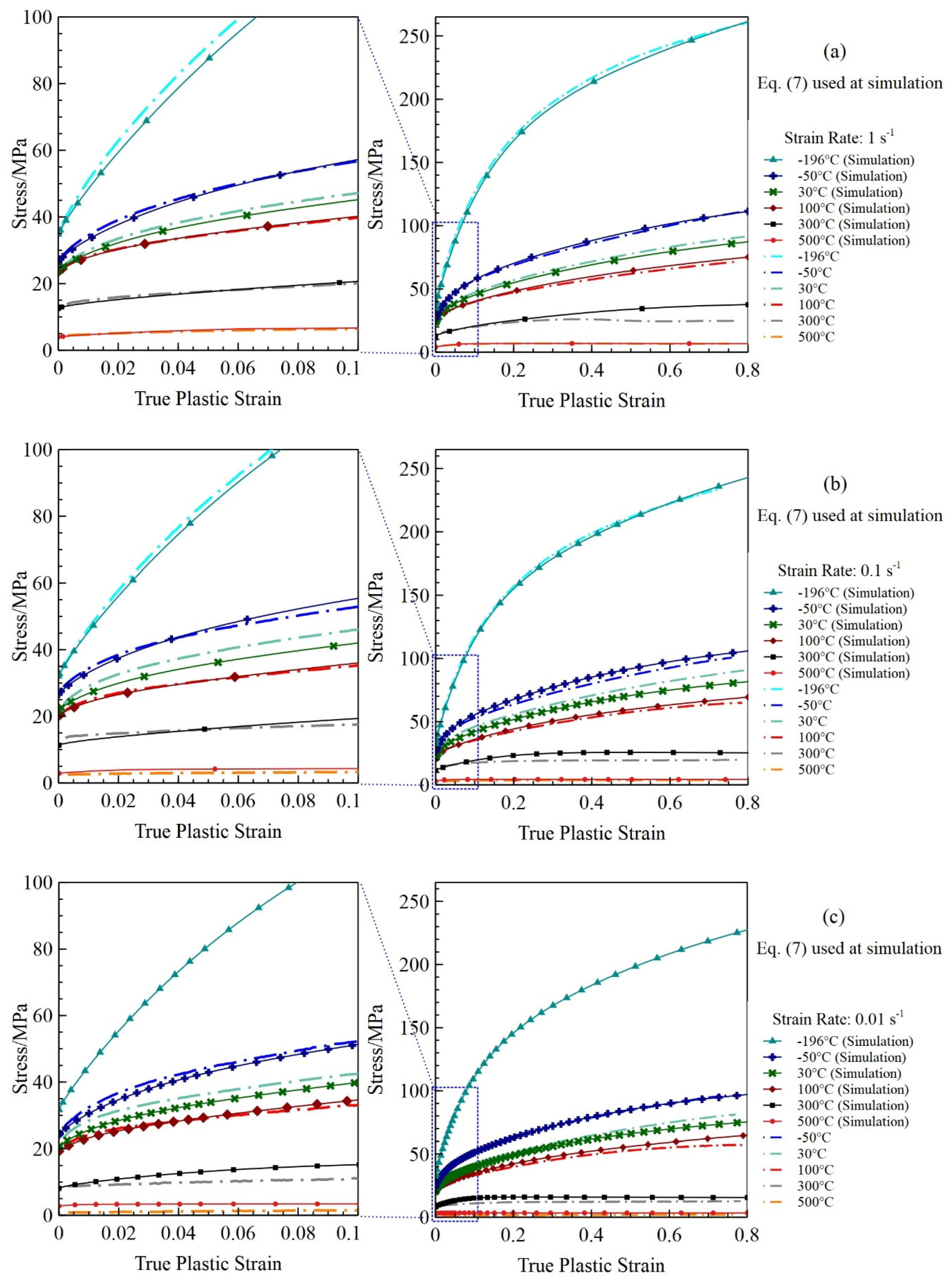
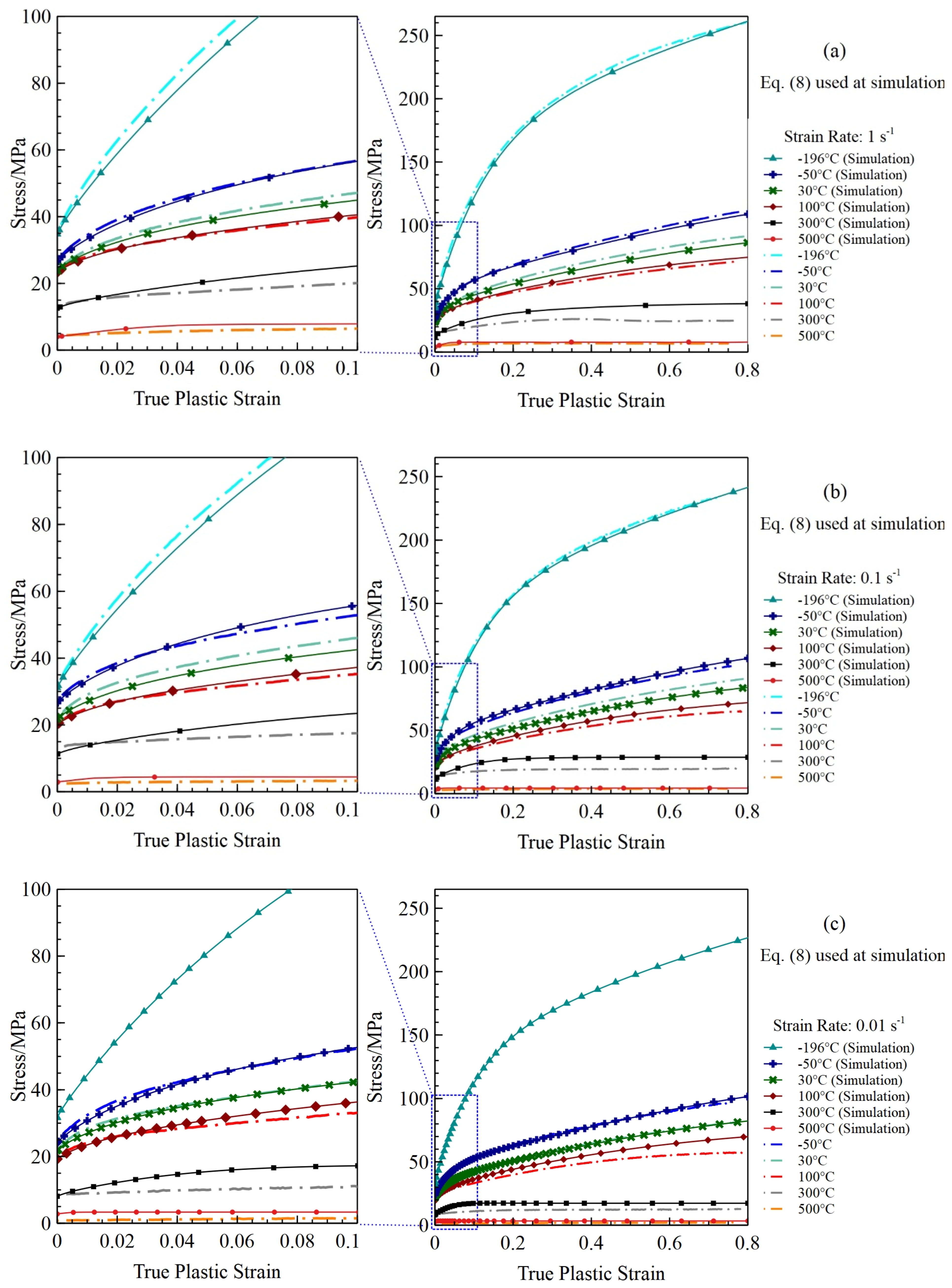
The model parameters are determined based on simulations, and a unique set is identified for each condition. These values are then used to develop empirical interpolation functions for each parameter, capturing their dependence on temperature and strain rate. The derived functional relationships are summarized in Table 3. To identify the optimal parameter sets, a constrained nonlinear optimization was carried out using the Generalized Reduced Gradient (GRG) Nonlinear method, minimizing the deviation between simulated and experimental flow curves. With these, final simulations are performed with both equations, with the results being presented in Figure 8 and Figure 9 for Equations (7) and (8), respectively. These figures represent a direct comparison between the simulation outcomes and the experimental flow curves derived from the compression tests.
A direct comparison between the experimental and simulated true stress–true strain curves confirms a high level of consistency across all deformation conditions. The reconstructed flow curves closely reproduce the measured stress evolution, demonstrating that the identified parameter set and the extended 3IVM formulation effectively capture the dominant hardening and recovery mechanisms in high-purity aluminum. At elevated temperatures, the simulations slightly overpredict the flow stress in the later stages of deformation, which is expected because dynamic recrystallization and subgrain coarsening are not yet incorporated into the current model [71]. Aside from this systematic deviation at high temperatures, the overall agreement indicates that the present approach provides a coherent and physically grounded description of the material response over a wide range of strains and temperatures.
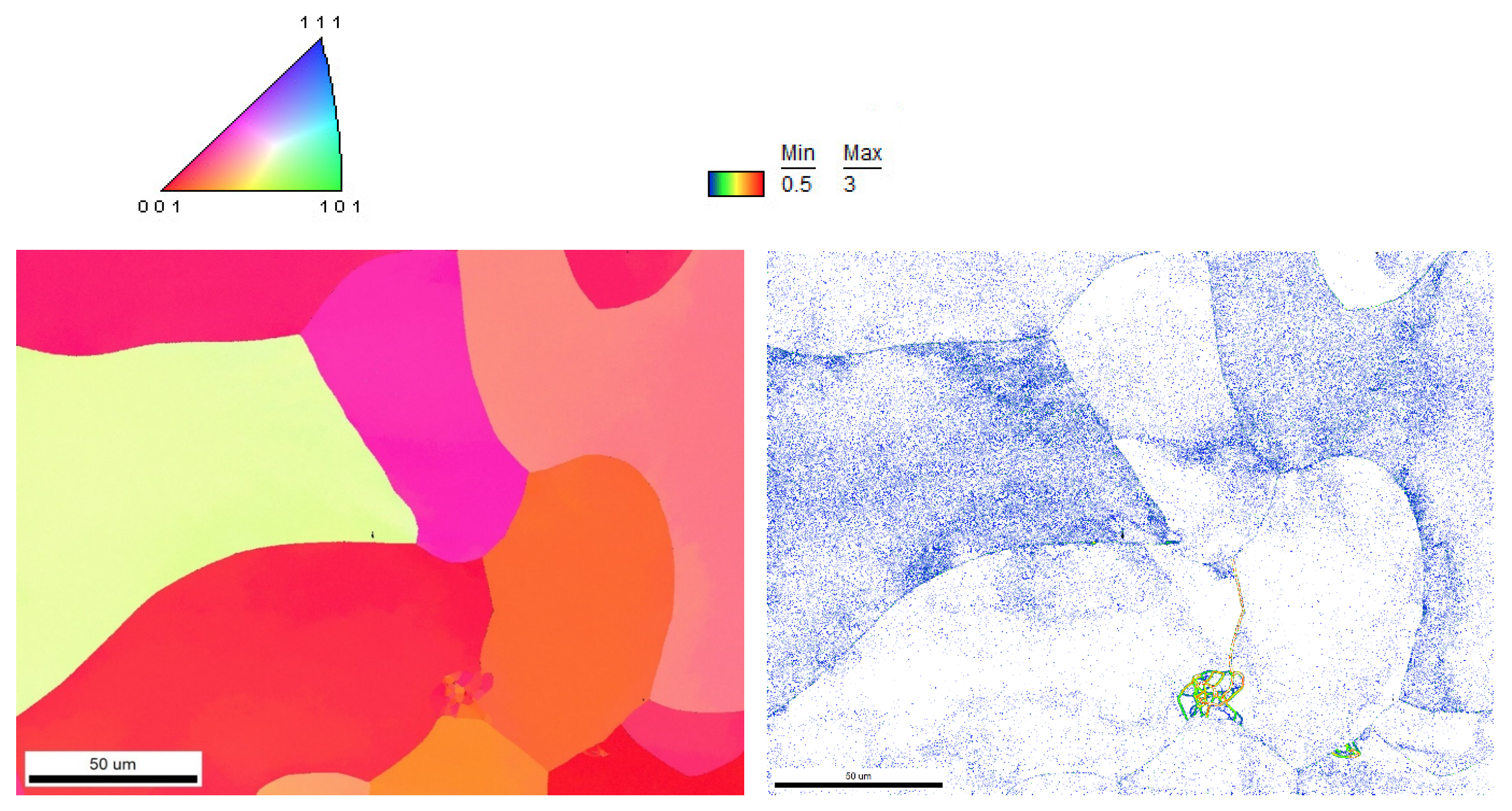
The inverse pole figure (IPF) map of the transverse cross-section (perpendicular to the cylinder axis) for the as-received (undeformed) state sample is presented in Figure 10. Each color corresponds to a specific crystallographic orientation relative to the sample reference frame. In this work, the compression direction (parallel to the cylinder axis) is the sample reference frame. The IPF triangle color key corresponds to the crystallographic directions. The KAM of as-received sample is provided to ensure that the samples are in the state of low dislocation density before deformation.
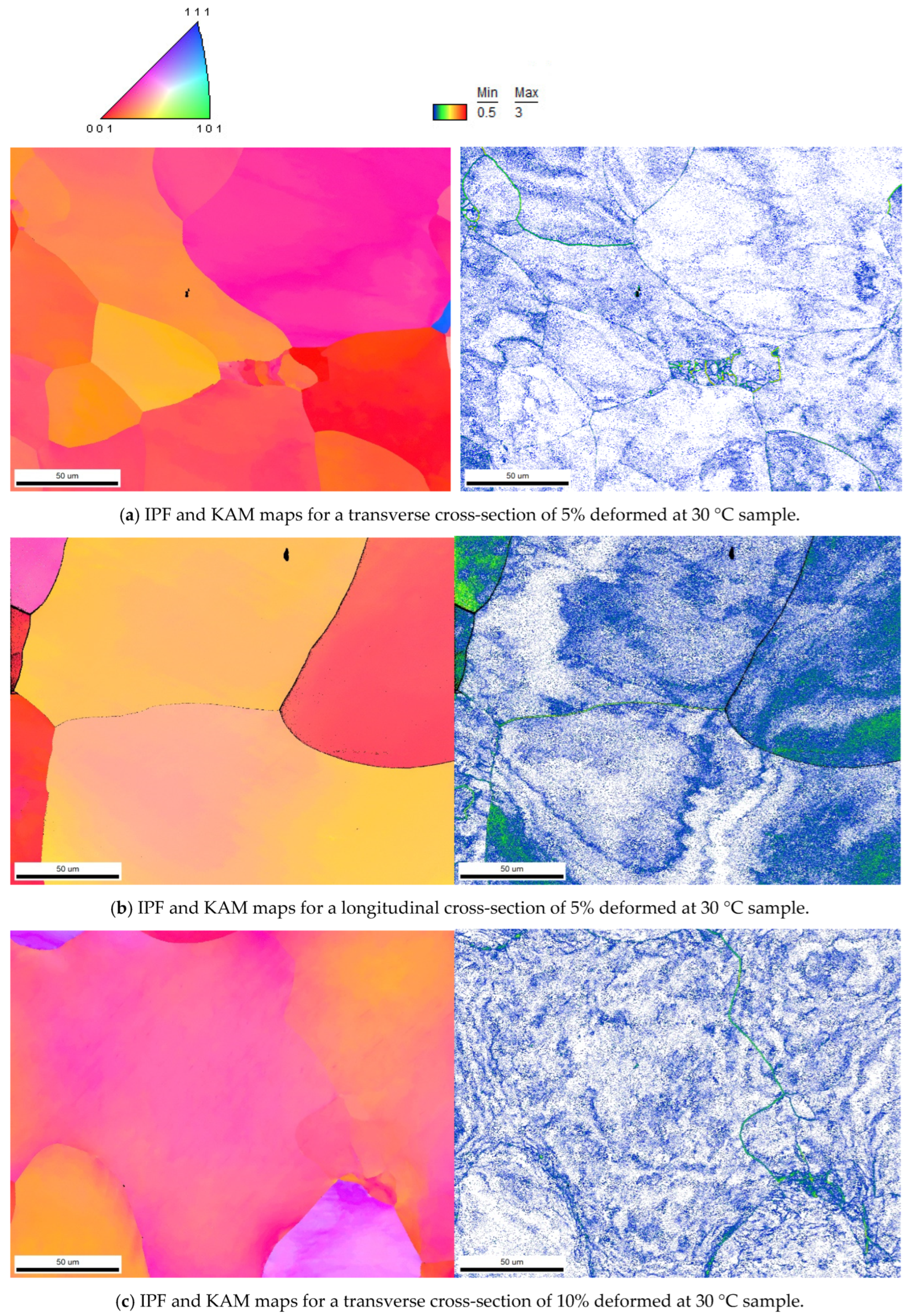
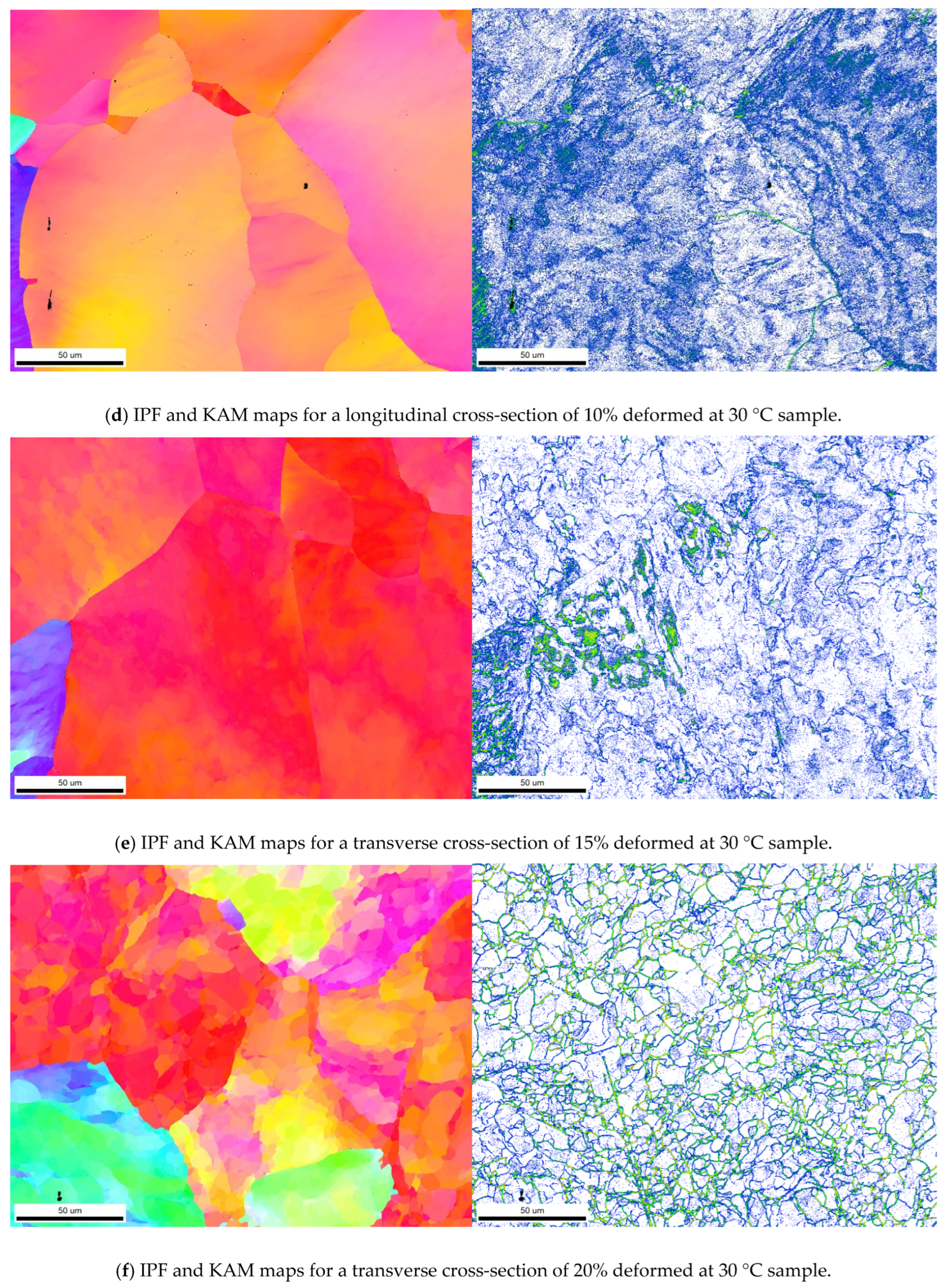
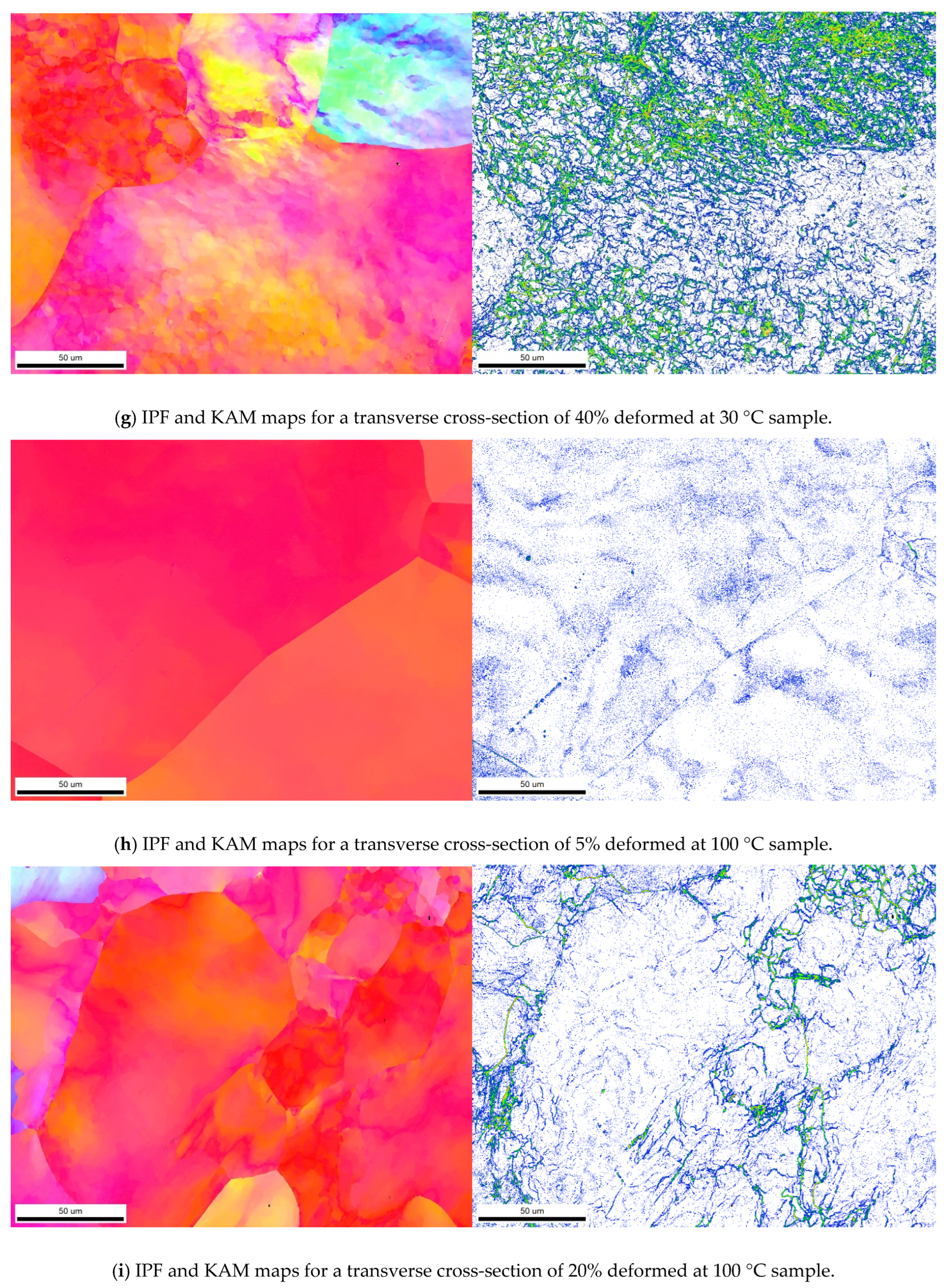
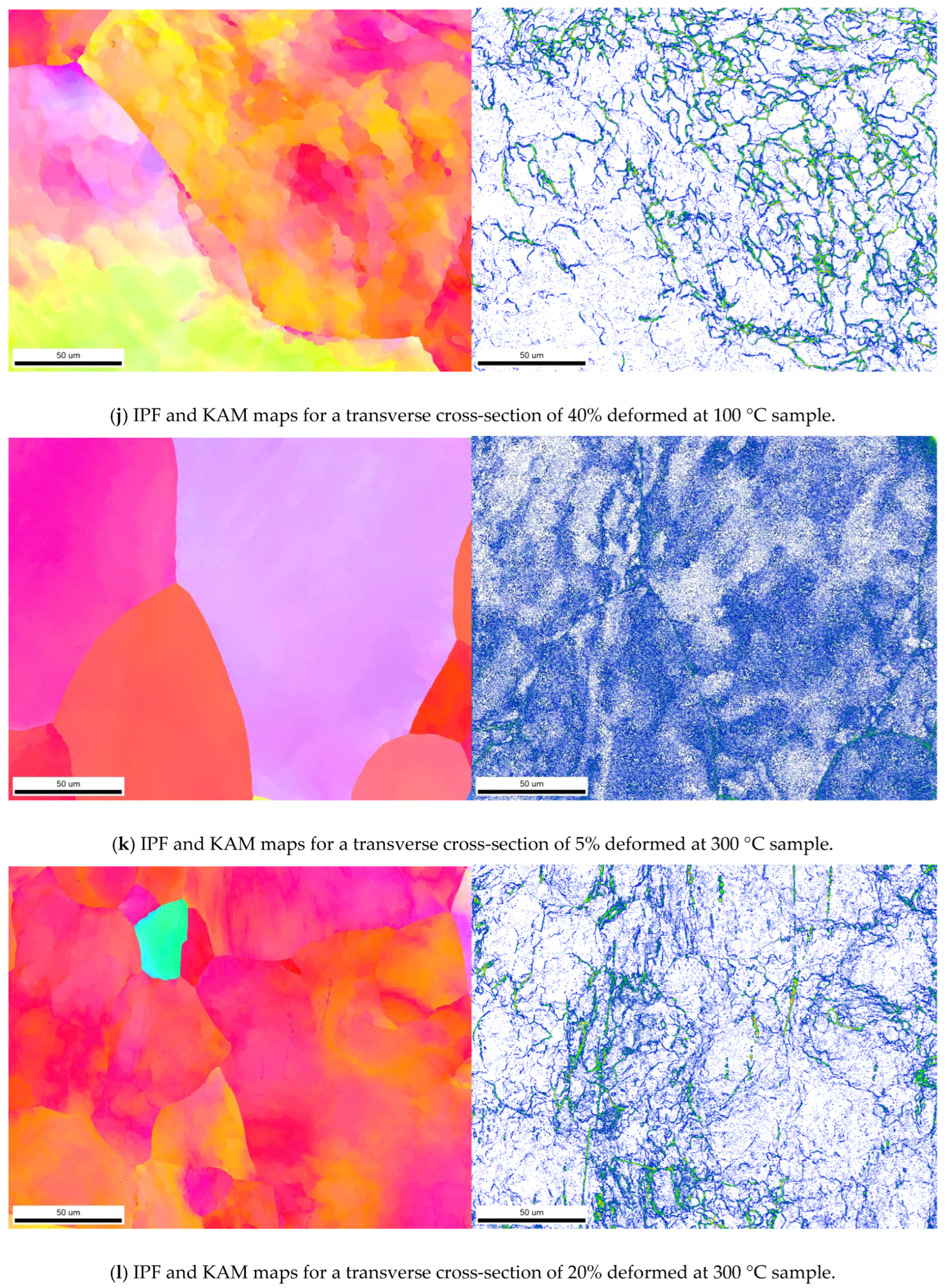
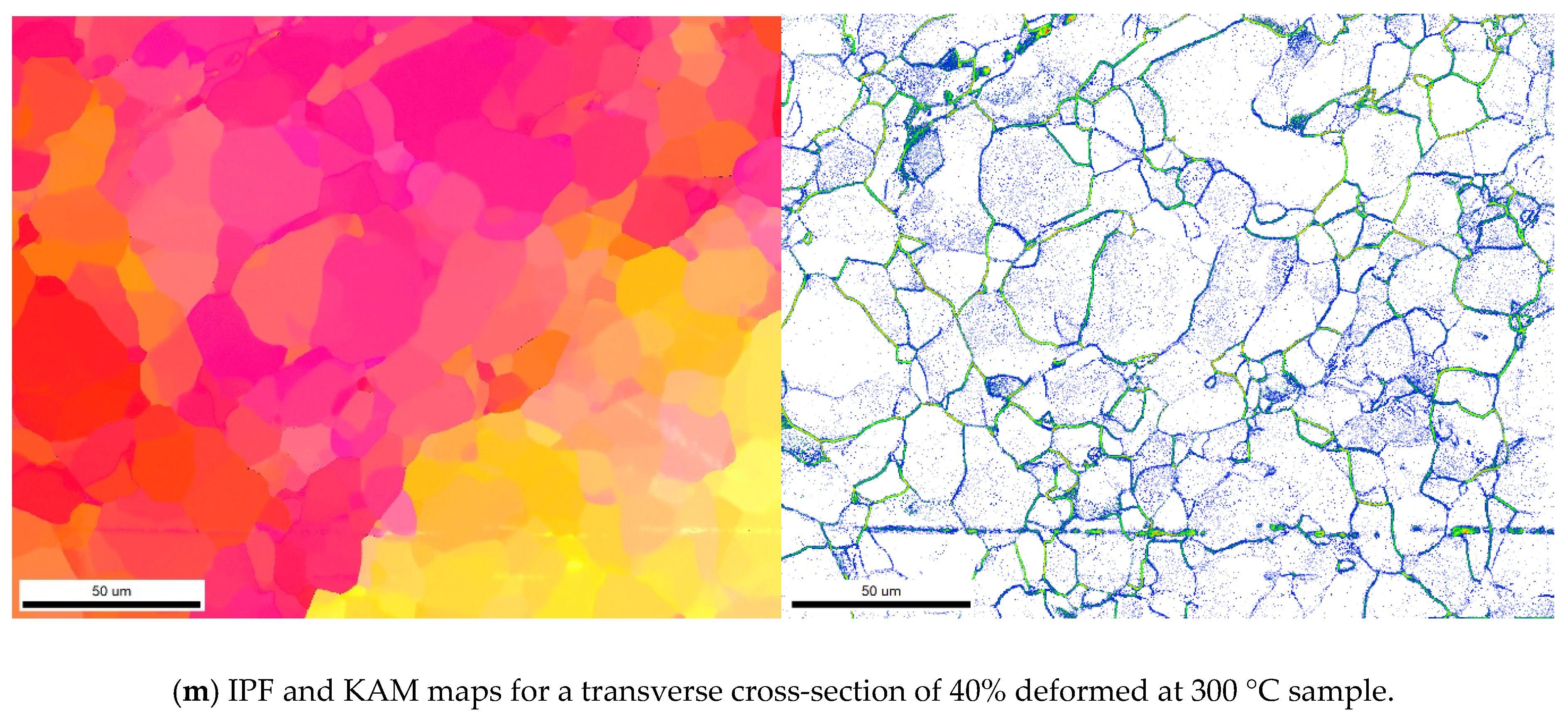
The IPF maps of the transverse cross-sections for each sample are shown in Figure 11. For the specimens deformed to 5% and 10% strain at 30 °C, the longitudinal cross-sections are also included. The corresponding KAM maps, calculated based on the third nearest neighbors, are provided alongside the IPF maps. While the average misorientation angle can increase up to 3 degrees during deformation [69], the KAM values are constrained to the range of 0.5–3° in order to better highlight intragranular misorientation and the formation of subgrains/cells.
Table 4 summarizes the Kernel Average Misorientation (KAM) values calculated using the first five nearest neighbors for the as-received material and for all deformed samples at 30 °C. As discussed, the KAM values were not used directly to represent dislocation density, but rather to compute the average misorientation gradient (Gave), which is a more robust parameter for estimating geometrically necessary dislocation (GND) density.
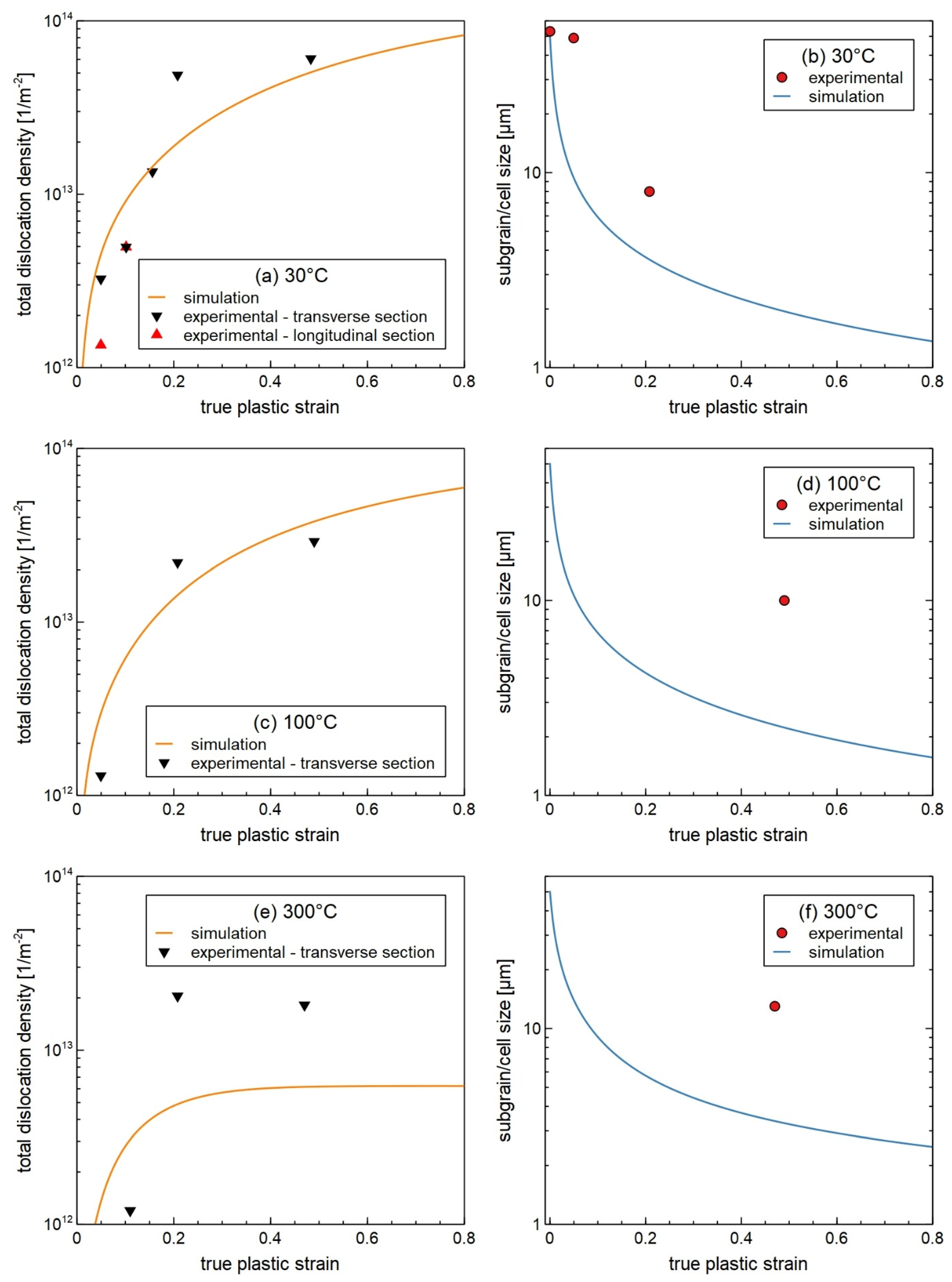
The measured (GND) dislocation densities are shown in Table 5 with H = 1 , which is consistent with Ref. [29]. The measured and simulated values of the total dislocation density for each temperature are shown in Figure 12 together with the calculated and measured subgrain/cell sizes. The subgrain/cell size was measured only for those samples where a reliable evaluation was possible. In other samples, the gradual orientation variations within grains made a clear and confident identification of cell boundaries impossible.
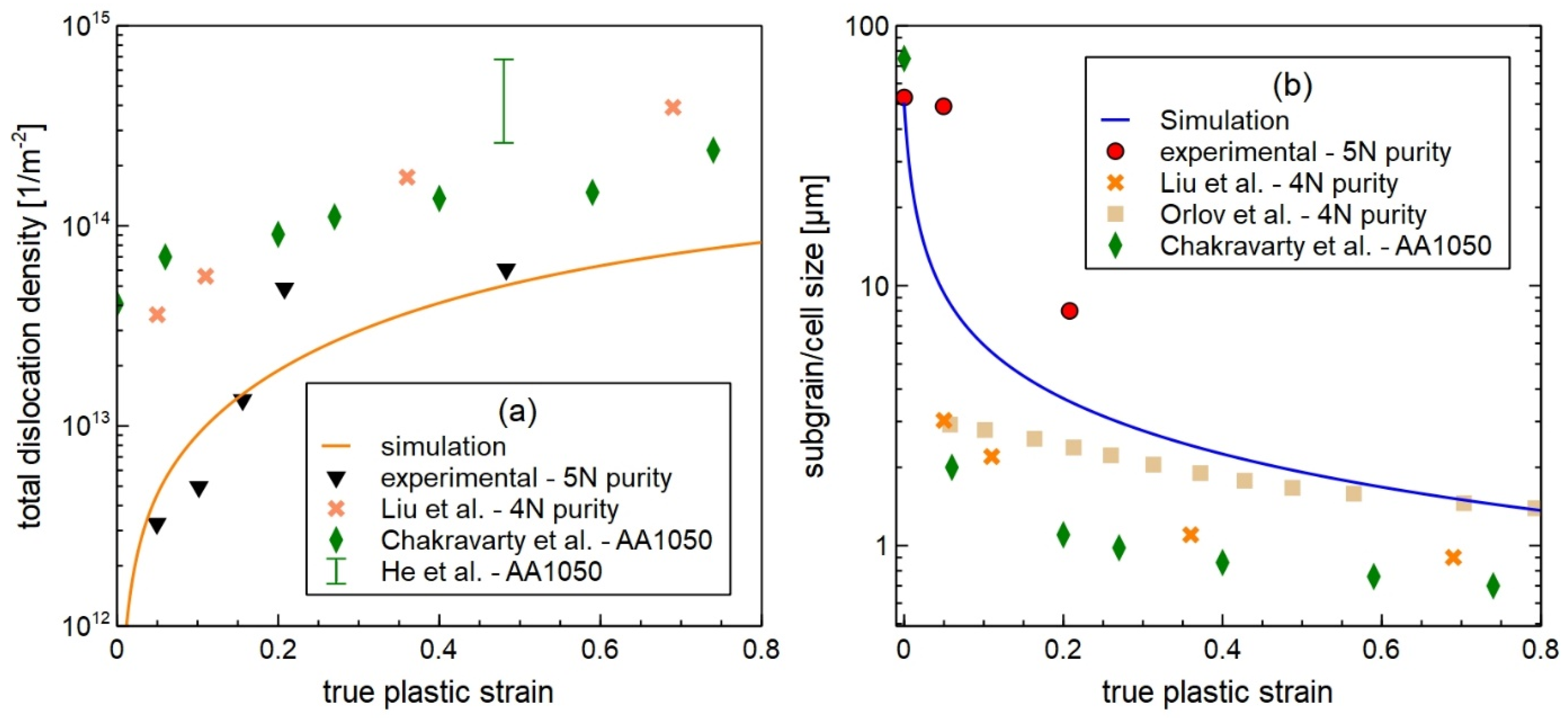
The findings of this study are broadly consistent with previously reported values in the literature, as shown in Figure 13. Studies by Orlov et al. [28], Liu et al. [72], Chakravarty et al. [73], and He et al. [39] investigated aluminum with lower purity (4N or AA1050) and reported higher dislocation densities. The comparatively lower values observed here are discussed in more detail in Section 4.

4. Discussion

The advABC model developed in this study successfully captures the flow behavior of commercially pure aluminum across a wide range of temperatures and strain rates. A key advantage of this approach is its ability to separately model mobile, immobile, and wall dislocation populations, providing a more physically meaningful description of dislocation evolution. As illustrated in Figure 5a and Figure 6a, mobile dislocations are generated rapidly at the onset of plastic deformation and quickly reach a plateau. This behavior reflects the balance between generation, annihilation, and transformation into immobile or wall dislocations. Initially, the density of mobile dislocations is low, and interactions are limited, making dislocation generation the dominant mechanism. With increasing strain, interactions become more frequent, and reduction mechanisms, such as annihilation and transformation, intensify, eventually balancing generation and leading to a plateau in mobile dislocation density.
A similar trend is observed for immobile and wall dislocations. Generation dominates early in the deformation process, while reduction mechanisms gain prominence as their densities increase. Notably, the slope of the mobile dislocation density curve is steeper than that of the immobile and wall dislocations. This is because the mobile dislocation density is reduced through both annihilation and transformation, whereas immobile and wall dislocations are primarily reduced by the assumed annihilation processes.
To assess the influence of the wall volume fraction, two different model formulations are employed. Despite the differences, the total dislocation density evolution remains comparable in both cases. This similarity arises from Equation (3), where wall and internal dislocation densities contribute equally to the flow stress, emphasizing the role of total dislocation density in shaping the simulated curves. However, as demonstrated in Figure 5a and Figure 6a, the evolution of wall and internal dislocation densities exhibits noticeable differences, highlighting the influence of wall volume fraction modeling on the internal dislocation structure.
The evolution of subgrain/cell structures during deformation is strongly influenced by both strain and temperature, as confirmed by EBSD measurements and model predictions. At low strain levels, the EBSD maps reveal gradual orientation gradients within individual grains, visible as smooth color transitions, without clearly defined subgrain/cell boundaries. As the samples are progressively deformed, these orientation gradients become sharper, and GNDs begin to organize into dense walls that subdivide grains into smaller substructures. For the selected samples, the onset of this subgrain formation is observed at strains higher than 0.16 at 30 °C and 0.21 at 100 °C and 300 °C. This strain-induced refinement of the microstructure leads to a noticeable reduction in subgrain/cell size, in agreement with established findings in the literature [58,69,73]. The EBSD measurements at 30 °C (Table 5) confirm this trend, and the model successfully reproduces the observed behavior, as shown in Figure 12b. Additionally, both simulations and EBSD images demonstrate that the dislocation density increases with strain, which correlates with the progressive reduction in subgrain/cell size. This consistency highlights the model’s ability to capture the strain-dependent evolution of dislocation structure and microstructural refinement.
Temperature also plays a critical role in the development of subgrain/cell structures. At a given strain, increasing the deformation temperature leads to the formation of larger subgrains/cells, as clearly illustrated in Table 5 and supported by the EBSD images. This temperature-dependent behavior is primarily attributed to the thermally activated mobility of dislocations. At higher temperatures, enhanced dislocation movement increases the probability of annihilation and promotes dynamic recovery, thereby reducing the total dislocation density. As a result, the driving force for subgrain refinement is diminished, leading to coarser microstructures. In addition, thermal coarsening of subgrains becomes more prominent with increasing temperature [74,75,76].This overall trend is evident in Figure 12, where the spacing between subgrain/cell walls becomes larger with increasing temperature. The model captures these effects accurately, as illustrated in Figure 7 and consistent with previously reported observations in the literature [77,78].
An additional insight from this study concerns the comparison of microstructures formed at different temperatures exhibiting similar total dislocation densities. The results reveal that the relative share of wall dislocations increases with temperature, whereas the internal dislocation content decreases. This indicates that subgrain/cell walls tend to form earlier at higher temperatures, specifically at lower strains and lower internal dislocation densities. Such behavior aligns well with findings reported in the literature [22,77,78]. For example, the EBSD image in Figure 11m, corresponding to 300 °C and a total dislocation density of approximately 1.82 × 10¹³ m−2, displays clearly developed subgrain/cell walls. In contrast, the image in Figure 11e, taken at 30 °C with a total dislocation density of about 1.35 × 10¹³ m−2, shows no visible wall formation. A similar observation can be made by comparing Figure 11i,l. The model successfully reproduces this trend. At a fixed total dislocation density of roughly 4 × 10¹² m−2, the predicted wall dislocation density is approximately 5 × 10¹² m−2 at 30 °C, increases to 1.0 × 10¹³ m−2 at 100 °C, and reaches 1.65 × 10¹³ m−2 at 300 °C, as shown in Figure 14. This progressive increase in wall dislocation content with temperature supports the proposed mechanism of enhanced subgrain boundary development at elevated temperatures. Consequently, the model not only reproduces the magnitude of dislocation densities, but also reflects the structural evolution of dislocations and the redistribution between wall and internal components.
Misorientation angles obtained from EBSD scans provide a reasonable estimate of the geometrically necessary dislocation density [29]. As shown in Figure 13, the calculated values in this study align well with the simulation results. However, both dislocation density and subgrain/cell size differ notably from values reported in the literature. Specifically, the dislocation densities in the present work are lower, while the subgrain/cell sizes are comparatively larger at high strains. These discrepancies are attributed to the higher purity of the material used here (5N aluminum). In contrast, Liu et al. [72] and Orlov et al. [28] studied 4N aluminum, and Chakravarty et al. [73] examined AA1050, which contains additional alloying elements. Given that no prior study has reported dislocation densities in 5N aluminum, the present results help fill this gap and highlight the influence of purity on microstructural evolution under plastic deformation.

5. Conclusions

In the present study, the three internal variables model (3IVM) is extended to simulate the mechanical and microstructural behavior of high-purity aluminum (5N). Overall, this work not only demonstrates the enhanced accuracy of the advABC model but also provides valuable insights into the microstructural mechanisms that govern the plastic deformation of high-purity aluminum under various thermo-mechanical conditions. The main findings are:
(1)
Accurate stress–strain prediction: By incorporating temperature- and strain-rate-dependent dynamic annihilation terms, the model successfully reproduced the experimental flow curves across a wide range of strain rates and temperatures, capturing both work hardening and dynamic recovery behavior.
(2)
Flexible description of wall volume fraction: The new formulation can represent both increasing and decreasing trends in wall volume fraction reported in the literature, demonstrating the adaptability of the model to different microstructural evolution scenarios.
(3)
Dislocation density evolution: The model accurately predicts the evolution of wall and cell dislocation densities, reflecting temperature effects on recovery and the transition toward steady-state deformation.
(4)
Validation by EBSD measurements: EBSD analysis (GND, and subgrain/cell size) confirms the simulated microstructural trends, including reduced dislocation densities and larger subgrain sizes at higher temperatures, which are consistent with recovery-dominated deformation in ultra-pure aluminum.
(5)
Strong coherence between experiment and simulation: Overall, the extended model reproduces both the macroscopic mechanical response and the microscale dislocation-based mechanisms observed experimentally, demonstrating its capability to reliably describe the thermo-mechanical behavior of high-purity aluminum.

Author Contributions

Conceptualization, A.S. and E.K.; Methodology, A.S., R.K., R.S., P.R., Y.V.S. and E.K.; Software, Y.V.S. and P.R.; Investigation, A.S. and R.K.; Data curation, A.S. and R.K.; Writing—original draft, A.S.; Writing—review & editing, E.K.; Visualization, A.S., R.K., R.S. and T.W.; Supervision, E.K.; Funding acquisition, E.K. All authors have read and agreed to the published version of the manuscript.

Funding

This research received no external funding.

Data Availability Statement

The original contributions presented in this study are included in the article. Further inquiries can be directed to the corresponding author.

Conflicts of Interest

Author Robert Kahlenberg was employed by Materials Center Leoben Forschung GmbH. The remaining authors declare that the research was conducted in the absence of any commercial or financial relationships that could be construed as a potential conflict of interest.

References

  1. Zerilli, F.J.; Armstrong, R.W. Dislocation-Mechanics-Based Constitutive Relations for Material Dynamics Calculations. J. Appl. Phys. 1987, 61, 1816–1825. [Google Scholar] [CrossRef]
  2. Roters, F.; Eisenlohr, P.; Hantcherli, L.; Tjahjanto, D.D.; Bieler, T.R.; Raabe, D. Overview of Constitutive Laws, Kinematics, Homogenization and Multiscale Methods in Crystal Plasticity Finite-Element Modeling: Theory, Experiments, Applications. Acta Mater. 2010, 58, 1152–1211. [Google Scholar] [CrossRef]
  3. Asaro, R.J.; Needleman, A. Texture Development and Strain Hardening in Rate Dependent Polycrystals. Acta Metall. 1985, 33, 923–953. [Google Scholar] [CrossRef]
  4. Gupta, A.; Ben Bettaieb, M.; Abed-Meraim, F.; Kalidindi, S.R. Computationally Efficient Predictions of Crystal Plasticity Based Forming Limit Diagrams Using a Spectral Database. Int. J. Plast. 2018, 103, 168–187. [Google Scholar] [CrossRef]
  5. Nieto-Fuentes, J.C.; Rittel, D.; Osovski, S. On a Dislocation-Based Constitutive Model and Dynamic Thermomechanical Considerations. Int. J. Plast. 2018, 108, 55–69. [Google Scholar] [CrossRef]
  6. Starkey, K.; Winther, G.; El-Azab, A. Theoretical Development of Continuum Dislocation Dynamics for Finite-Deformation Crystal Plasticity at the Mesoscale. J. Mech. Phys. Solids 2020, 139, 103926. [Google Scholar] [CrossRef]
  7. Akhondzadeh, S.; Sills, R.B.; Bertin, N.; Cai, W. Dislocation Density-Based Plasticity Model from Massive Discrete Dislocation Dynamics Database. J. Mech. Phys. Solids 2020, 145, 104152. [Google Scholar] [CrossRef]
  8. Tabourot, L.; Fivel, M.; Rauch, E. Generalised Constitutive Laws for f.c.c. Single Crystals. Mater. Sci. Eng. A 1997, 234–236, 639–642. [Google Scholar] [CrossRef]
  9. Kocks, U.F. Laws for Work-Hardening and Low-Temperature Creep. J. Eng. Mater. Technol. 1976, 98, 76–85. [Google Scholar] [CrossRef]
  10. Hansen, B.L.; Beyerlein, I.J.; Bronkhorst, C.A.; Cerreta, E.K.; Dennis-Koller, D. A Dislocation-Based Multi-Rate Single Crystal Plasticity Model. Int. J. Plast. 2013, 44, 129–146. [Google Scholar] [CrossRef]
  11. Li, Y.Z.; Huang, M.X. A Dislocation-Based Flow Rule with Succinct Power-Law Form Suitable for Crystal Plasticity Finite Element Simulations. Int. J. Plast. 2021, 138, 102921. [Google Scholar] [CrossRef]
  12. Arsenlis, A.; Parks, D.M. Modeling the Evolution of Crystallographic Dislocation Density in Crystal Plasticity. J. Mech. Phys. Solids 2002, 50, 1979–2009. [Google Scholar] [CrossRef]
  13. Goerdeler, M.; Gottstein, G. A Microstructural Work Hardening Model Based on Three Internal State Variables. Mater. Sci. Eng. A 2001, 309–310, 377–381. [Google Scholar] [CrossRef]
  14. Kocks, U.F.; Mecking, H. Physics and Phenomenology of Strain Hardening: The FCC Case. Prog. Mater. Sci. 2003, 48, 171–273. [Google Scholar] [CrossRef]
  15. Puchi, E.S. Constitutive Equations for Commercial-Purity Aluminum Deformed under Hot-Working Conditions. J. Eng. Mater. Technol. Trans. ASME 1995, 117, 20–27. [Google Scholar] [CrossRef]
  16. Abo-Elkhier, M. Modeling of High-Temperature Deformation of Commercial Pure Aluminum (1050). J. Mater. Eng. Perform. 2004, 13, 241–247. [Google Scholar] [CrossRef]
  17. Estrin, Y.; Kubin, L.P. Local Strain Hardening and Nonuniformity of Plastic Deformation. Acta Metall. 1986, 34, 2455–2464. [Google Scholar] [CrossRef]
  18. Kubin, L.P.; Estrin, Y. Evolution of Dislocation Densities and the Critical Conditions for the Portevin-Le Châtelier Effect. Acta Metall. Mater. 1990, 38, 697–708. [Google Scholar] [CrossRef]
  19. Barlat, F.; Glazov, M.V.; Brem, J.C.; Lege, D.J. A Simple Model for Dislocation Behavior, Strain and Strain Rate Hardening Evolution in Deforming Aluminum Alloys. Int. J. Plast. 2002, 18, 919–939. [Google Scholar] [CrossRef]
  20. Hull, D.; Bacon, D.J. Introduction to Dislocations, 5th ed.; Butterworth-Heinemann: Oxford, UK, 2011; ISBN 9780080966724. [Google Scholar]
  21. Bammann, D.J. An Internal Variable Model of Viscoplasticity. Int. J. Eng. Sci. 1984, 22, 1041–1053. [Google Scholar] [CrossRef]
  22. Sadeghi, A.; Kozeschnik, E. Modeling the Evolution of the Dislocation Density and Yield Stress of Al over a Wide Range of Temperatures and Strain Rates. Metall. Mater. Trans. A 2024, 55, 1643–1653. [Google Scholar] [CrossRef]
  23. Estrin, Y.; Tóth, L.S.; Molinari, A.; Bréchet, Y. A Dislocation-Based Model for All Hardening Stages in Large Strain Deformation. Acta Mater. 1998, 46, 5509–5522. [Google Scholar] [CrossRef]
  24. Castelluccio, G.M.; McDowell, D.L. Mesoscale Cyclic Crystal Plasticity with Dislocation Substructures. Int. J. Plast. 2017, 98, 1–26. [Google Scholar] [CrossRef]
  25. Pham, M.S.; Holdsworth, S.R. Evolution of Relationships between Dislocation Microstructures and Internal Stresses of AISI 316L during Cyclic Loading at 293 K and 573 K (20 °C and 300 °C). Metall. Mater. Trans. A Phys. Metall. Mater. Sci. 2014, 45, 738–751. [Google Scholar] [CrossRef]
  26. Moussa, C.; Bernacki, M.; Besnard, R.; Bozzolo, N. About Quantitative EBSD Analysis of Deformation and Recovery Substructures in Pure Tantalum. IOP Conf. Ser. Mater. Sci. Eng. 2015, 89, 012038. [Google Scholar] [CrossRef]
  27. Humphreys, F.J. Grain and Subgrain Characterisation by Electron Backscatter Diffraction. J. Mater. Sci. 2001, 36, 3833–3854. [Google Scholar] [CrossRef]
  28. Orlov, D.; Kamikawa, N.; Tsuji, N. High Pressure Torsion to Refine Grains in Pure Aluminum up to Saturation: Mechanisms of Structure Evolution and Their Dependence on Strain. Philos. Mag. 2012, 92, 2329–2350. [Google Scholar] [CrossRef]
  29. Breitbarth, E.; Zaefferer, S.; Archie, F.; Besel, M.; Raabe, D.; Requena, G. Evolution of Dislocation Patterns inside the Plastic Zone Introduced by Fatigue in an Aged Aluminium Alloy AA2024-T3. Mater. Sci. Eng. A 2018, 718, 345–349. [Google Scholar] [CrossRef]
  30. Nye, J. Some Geometrical Relations in Dislocated Crystals. Acta Metall. 1953, 1, 153–162. [Google Scholar] [CrossRef]
  31. Bilby, B.A.; Bullough, R.; Smith, E. Continuous Distributions of Dislocations: A New Application of the Methods of Non-Riemannian Geometry. Proc. R. Soc. London. Ser. A Math. Phys. Sci. 1955, 231, 263–273. [Google Scholar] [CrossRef]
  32. Kröner, E. Allgemeine Kontinuumstheorie Der Versetzungen Und Eigenspannungen. Arch. Ration. Mech. Anal. 1959, 4, 273–334. [Google Scholar] [CrossRef]
  33. Zhang, S.; Liu, W.; Wan, J.; Misra, R.D.K.; Wang, Q.; Wang, C. The Grain Size and Orientation Dependence of Geometrically Necessary Dislocations in Polycrystalline Aluminum during Monotonic Deformation: Relationship to Mechanical Behavior. Mater. Sci. Eng. A 2020, 775, 138939. [Google Scholar] [CrossRef]
  34. Ashby, M.F. The Deformation of Plastically Non-Homogeneous Materials. Philos. Mag. 1970, 21, 399–424. [Google Scholar] [CrossRef]
  35. Field, D.P.; Trivedi, P.B.; Wright, S.I.; Kumar, M. Analysis of Local Orientation Gradients in Deformed Single Crystals. Ultramicroscopy 2005, 103, 33–39. [Google Scholar] [CrossRef] [PubMed]
  36. Sun, S.; Adams, B.L.; King, W.E. Observations of Lattice Curvature near the Interface of a Deformed Aluminium Bicrystal. Philos. Mag. A Phys. Condens. Matter Struct. Defects Mech. Prop. 2000, 80, 9–25. [Google Scholar] [CrossRef]
  37. Dahlberg, C.F.O.; Saito, Y.; Öztop, M.S.; Kysar, J.W. Geometrically Necessary Dislocation Density Measurements at a Grain Boundary Due to Wedge Indentation into an Aluminum Bicrystal. J. Mech. Phys. Solids 2017, 105, 131–149. [Google Scholar] [CrossRef]
  38. Huang, F.; Tao, N.R.; Lu, K. Effects of Impurity on Microstructure and Hardness in Pure Al Subjected to Dynamic Plastic Deformation at Cryogenic Temperature. J. Mater. Sci. Technol. 2011, 27, 628–632. [Google Scholar] [CrossRef]
  39. He, W.; Ma, W.; Pantleon, W. Microstructure of Individual Grains in Cold-Rolled Aluminium from Orientation Inhomogeneities Resolved by Electron Backscattering Diffraction. Mater. Sci. Eng. A 2008, 494, 21–27. [Google Scholar] [CrossRef]
  40. Chrominski, W.; Lewandowska, M. Mechanisms of Plastic Deformation in Ultrafine-Grained Aluminium—In-Situ and Ex-Post Studies. Mater. Sci. Eng. A 2018, 715, 320–331. [Google Scholar] [CrossRef]
  41. Lanjewar, H.; Naghdy, S.; Verleysen, P.; Kestens, L.A.I. Statistical Analysis of Dislocation Substructure in Commercially Pure Aluminum Subjected to Static and Dynamic High Pressure Torsion. Mater. Charact. 2020, 160, 110088. [Google Scholar] [CrossRef]
  42. Kamaya, M. Assessment of Local Deformation Using EBSD: Quantification of Accuracy of Measurement and Definition of Local Gradient. Ultramicroscopy 2011, 111, 1189–1199. [Google Scholar] [CrossRef]
  43. Konijnenberg, P.J.; Zaefferer, S.; Raabe, D. Assessment of Geometrically Necessary Dislocation Levels Derived by 3D EBSD. Acta Mater. 2015, 99, 402–414. [Google Scholar] [CrossRef]
  44. Seyed Salehi, M.; Anjabin, N.; Kim, H.S. Study of Geometrically Necessary Dislocations of a Partially Recrystallized Aluminum Alloy Using 2D EBSD. Microsc. Microanal. 2019, 25, 656–663. [Google Scholar] [CrossRef]
  45. Hansen, L.T.; Jackson, B.E.; Fullwood, D.T.; Wright, S.I.; De Graef, M.; Homer, E.R.; Wagoner, R.H. Influence of Noise-Generating Factors on Cross-Correlation Electron Backscatter Diffraction (EBSD) Measurement of Geometrically Necessary Dislocations (GNDs). Microsc. Microanal. 2017, 23, 460–471. [Google Scholar] [CrossRef]
  46. Naghdy, S.; Verleysen, P.; Petrov, R.; Kestens, L. Resolving the Geometrically Necessary Dislocation Content in Severely Deformed Aluminum by Transmission Kikuchi Diffraction. Mater. Charact. 2018, 140, 225–232. [Google Scholar] [CrossRef]
  47. Kreyca, J.; Kozeschnik, E. State Parameter-Based Constitutive Modelling of Stress Strain Curves in Al-Mg Solid Solutions. Int. J. Plast. 2018, 103, 67–80. [Google Scholar] [CrossRef]
  48. Taylor, G.I. The Mechanism of Plastic Deformation of Crystals. Part I.—Theoretical. Proc. R. Soc. London. Ser. A Math. Phys. Character 1934, 145, 362–387. [Google Scholar] [CrossRef]
  49. Orowan, E. Zur Kristallplastizität. I—Tieftemperaturplastizität und Beckersche Formel. Zeitschrift für Phys. 1934, 89, 605–613. [Google Scholar] [CrossRef]
  50. Roters, F.; Raabe, D.; Gottstein, G. Work Hardening in Heterogeneous Alloys—A Microstructural Approach Based on Three Internal State Variables. Acta Mater. 2000, 48, 4181–4189. [Google Scholar] [CrossRef]
  51. Friedel, J. Discolations, 1st ed.; Pergamon Press Ltd.: Oxford, UK, 1964. [Google Scholar]
  52. Fischer, F.D.; Svoboda, J.; Appel, F.; Kozeschnik, E. Modeling of Excess Vacancy Annihilation at Different Types of Sinks. Acta Mater. 2011, 59, 3463–3472. [Google Scholar] [CrossRef]
  53. Prasad, G.V.S.S.; Goerdeler, M.; Gottstein, G. Work Hardening Model Based on Multiple Dislocation Densities. Mater. Sci. Eng. A 2005, 400–401, 231–233. [Google Scholar] [CrossRef]
  54. Lagneborg, R.; Zajac, S.; Hutchinson, B. A Model for the Flow Stress Behaviour during Hot Working of Aluminium Alloys Containing Non-Deformable Precipitates. Scr. Metall. Mater. 1993, 29, 159–164. [Google Scholar] [CrossRef]
  55. Lindgren, L.E.; Domkin, K.; Hansson, S. Dislocations, Vacancies and Solute Diffusion in Physical Based Plasticity Model for AISI 316L. Mech. Mater. 2008, 40, 907–919. [Google Scholar] [CrossRef]
  56. Müller, M.; Zehetbauer, M.; Borbely, A.; Ungar, T. Dislocation Density and Long Range Internal Stresses in Heavily Cold Worked Cu Measured by X-Ray Line Broadening. Int. J. Mater. Res. 1995, 86, 827–831. [Google Scholar] [CrossRef]
  57. Mughrabi, H.; Ungár, T.; Kienle, W.; Wilkens, M. Long-Range Internal Stresses and Asymmetric X-Ray Line-Broadening in Tensile-Deformed [001]-Orientated Copper Single Crystals. Philos. Mag. A 1986, 53, 793–813. [Google Scholar] [CrossRef]
  58. Ito, Y.; Horita, Z. Microstructural Evolution in Pure Aluminum Processed by High-Pressure Torsion. Mater. Sci. Eng. A 2009, 503, 32–36. [Google Scholar] [CrossRef]
  59. Dindarlou, S.; Castelluccio, G.M. Substructure-Sensitive Crystal Plasticity with Material-Invariant Parameters. Int. J. Plast. 2022, 155, 103306. [Google Scholar] [CrossRef]
  60. Mckenzie, P.W.J.; Lapovok, R.; Estrin, Y. The Influence of Back Pressure on ECAP Processed AA 6016: Modeling and Experiment. Acta Mater. 2007, 55, 2985–2993. [Google Scholar] [CrossRef]
  61. Baik, S.C.; Estrin, Y.; Kim, H.S.; Hellmig, R.J. Dislocation Density-Based Modeling of Deformation Behavior of Aluminium under Equal Channel Angular Pressing. Mater. Sci. Eng. A 2003, 351, 86–97. [Google Scholar] [CrossRef]
  62. Ashraf, F.; Castelluccio, G.M. On the Similitude Relation for Dislocation Wall Thickness under Cyclic Deformation. Mater. Sci. Eng. A 2022, 840, 142972. [Google Scholar] [CrossRef]
  63. Kozeschnik, E. Mean-Field Microstructure Kinetics Modeling. Encycl. Mater. Met. Alloys 2022, 4, 521–526. [Google Scholar] [CrossRef]
  64. Sauzay, M.; Kubin, L.P. Scaling Laws for Dislocation Microstructures in Monotonic and Cyclic Deformation of Fcc Metals. Prog. Mater. Sci. 2011, 56, 725–784. [Google Scholar] [CrossRef]
  65. Kato, M. Introduction to the Theory of Dislocations; Shokabo: Tokyo, Japan, 1999. [Google Scholar]
  66. Bergström, Y. The Plastic Deformation of Metals—A Dislocation Model and Its Applicability. Rev. Powder Metall. Phys. Ceram. 1983, 2, 79–265. [Google Scholar]
  67. Galindo-Nava, E.I.; Sietsma, J.; Rivera-Díaz-Del-Castillo, P.E.J. Dislocation Annihilation in Plastic Deformation: II. Kocks-Mecking Analysis. Acta Mater. 2012, 60, 2615–2624. [Google Scholar] [CrossRef]
  68. Mecking, H.; Nicklas, B.; Zarubova, N.; Kocks, U.F. A “Universal” Temperature Scale for Plastic Flow. Acta Metall. 1986, 34, 527–535. [Google Scholar] [CrossRef]
  69. Nes, E. Modelling of Work Hardening and Stress Saturation in FCC Metals. Prog. Mater. Sci. 1997, 41, 129–193. [Google Scholar] [CrossRef]
  70. Frost, H.J.; Ashby, M.F. Deformation-Mechanism Maps: The Plasticity and Creep of Metals and Ceramics, 1st ed.; Pergamon Press: Oxford, UK, 1981; ISBN 0080293387. [Google Scholar]
  71. Li, P.; Li, F.-G.; Cao, J.; Ma, X.-K.; Li, J.-H. Constitutive Equations of 1060 Pure Aluminum Based on Modified Double Multiple Nonlinear Regression Model. Trans. Nonferrous Met. Soc. China 2016, 26, 1079–1095. [Google Scholar] [CrossRef]
  72. Liu, Q.; Juul Jensen, D.; Hansen, N. Effect of Grain Orientation on Deformation Structure in Cold-Rolled Polycrystalline Aluminium. Acta Mater. 1998, 46, 5819–5838. [Google Scholar] [CrossRef]
  73. Chakravarty, P.; Pál, G.; Sidor, J.J. The Dependency of Work Hardening on Dislocation Statistics in Cold Rolled 1050 Aluminum Alloy. Mater. Charact. 2022, 191, 112166. [Google Scholar] [CrossRef]
  74. Yang, Q.; Wojcik, T.; Kozeschnik, E. Subgrain Size Modeling and Substructure Evolution in an AA1050 Aluminum Alloy during High-Temperature Compression. Materials 2024, 17, 4385. [Google Scholar] [CrossRef]
  75. Bunkholt, S.; Nes, E.; Marthinsen, K. Orientation Independent and Dependent Subgrain Growth during Iso-Thermal Annealing of High- Purity and Commercial Purity Aluminium. Metals 2019, 9, 1032. [Google Scholar] [CrossRef]
  76. Huang, Y.; Humphreys, F.J. Subgrain Growth and Low Angle Boundary Mobility in Aluminium Crystals of Orientation {110} <001>. Acta Mater. 2000, 48, 2017–2030. [Google Scholar] [CrossRef]
  77. Ding, S.X.; Lin, J.L.; Chang, C.P.; Kao, P.W. Microstructural Characterization of Warm-Worked Commercially Pure Aluminum. Metall. Mater. Trans. A 2006, 37, 1065–1073. [Google Scholar] [CrossRef]
  78. Chen, C.M.; Ding, S.X.; Chang, C.P.; Kao, P.W. Plane Strain Deformation Microstructure of Warm-Worked Aluminum. Mater. Sci. Eng. A 2009, 512, 126–131. [Google Scholar] [CrossRef]
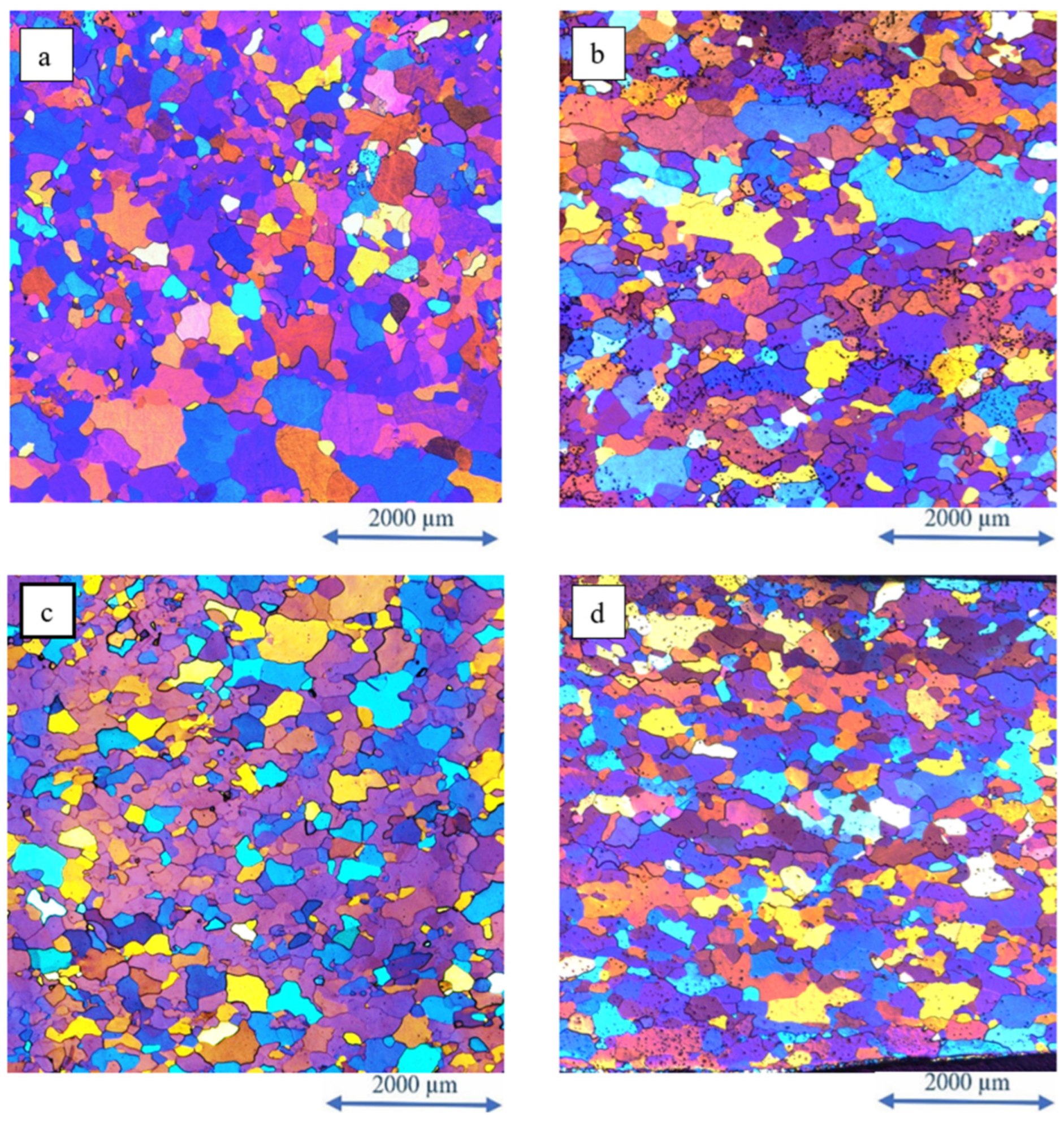
Figure 1. The microstructure of the as-received pure Al provided by color etching in (a) transverse cross-section and (b) longitudinal cross-section at the center and (c) transverse cross-section and (d) longitudinal cross-section near the surface.
Metals 15 01348 g001
Figure 2. Measurement of subgrain/cell size using the line intercept method. (a) The scanned area and the vertical and horizontal lines for the subgrain/cell size investigation. (b) The point-to-origin and point-to-point misorientation angles related to the middle vertical line.
Metals 15 01348 g002
Figure 3. Schematic arrangement of dislocations during plastic deformation.
Metals 15 01348 g003
Figure 4. Illustration of wall volume fraction as a function of strain for two used functions.
Metals 15 01348 g004
Figure 5. (a) Evolution of dislocation densities using Equation (7) and (b) comparison of flow curves achieved from simulation and experimental compression test for specimen deformation by 0.1 s−1 at 30 °C.
Metals 15 01348 g005
Figure 6. (a) Evolution of dislocation densities using Equation (8) and (b) comparison of flow curves achieved from simulation and experimental compression test for specimen deformation by 0.1 s−1 at 30 °C.
Metals 15 01348 g006
Figure 7. Evolution of dislocation densities during deformation at a strain rate of 0.1 s−1, simulated using Equation (7) for (a) 30 °C, (b) 100 °C, and (c) 300 °C, and using Equation (8) for (d) 30 °C, (e) 100 °C, and (f) 300 °C.
Metals 15 01348 g007
Figure 8. Comparison of flow curves from simulation (Equation (7)) and experimental data for strain rates of (a) 1 s−1 (b) 0.1 s−1 and (c) 0.01 s−1.
Metals 15 01348 g008
Figure 9. Comparison of flow curves from simulation (Equation (8)) and experimental data for strain rates of (a) 1 s−1 (b) 0.1 s−1 and (c) 0.01 s−1.
Metals 15 01348 g009
Figure 10. The IPF and KAM maps of the transverse cross-section of an as-received sample with respect to the compression direction.
Metals 15 01348 g010
Figure 11. IPF and KAM maps for aluminum at different amounts of deformations.
Metals 15 01348 g011aMetals 15 01348 g011bMetals 15 01348 g011cMetals 15 01348 g011dMetals 15 01348 g011e
Figure 12. Simulated total dislocation density compared with experimental values from EBSD for deformed samples with strain rate of 0.1 s−1 at (a) 30 °C, (c) 100 °C and (e) 300 °C and subgrain/cell size changes during deformation at (b) 30 °C, (d) 100 °C and (f) 300 °C.
Metals 15 01348 g012
Figure 13. Comparison between the results in the present study and the literature for (a) the dislocation density and (b) subgrain/cell size during deformation. Adapted from Liu et al. [72], Orlov et al. [28], He et al. [39] and Chakravarty et al. [73].
Metals 15 01348 g013
Figure 14. Calculated wall dislocation fraction relative to the total dislocation density as predicted by simulations at a strain rate of 0.1 s−1 and temperatures of (a) 30 °C, (b) 100 °C, and (c) 300 °C.
Metals 15 01348 g014
Table 1. Temperature and plastic true strain of samples in the present work.
Temp.True StrainInvestigated Plane
30 °C0.05transverse and longitudinal
30 °C0.1transverse and longitudinal
30 °C0.16transverse
30 °C0.21transverse
30 °C0.48transverse
100 °C0.05transverse
100 °C0.21transverse
100 °C0.49transverse
300 °C0.11transverse
300 °C0.21transverse
300 °C0.47transverse
Table 3. Simulation parameters as a function of temperature and strain rate.
Functions Based on Equation (7)Functions Based on Equation (8)
f = f i n f + f 0 f i n f e x p ε k f f = 5 ε 0.01 exp 0.5 15 ε + 0.1
A m = 1096.93 2,820,887 / ( T 0.628 ln ε ˙ + 2586.7 ) A m = 1478.27 5,504,670 / ( T 1.09 ln ε ˙ + 3748.9 )
β w = 1100 β w = 1100
β = 0.0007 T + 0.0034 ln ε ˙ + 0.65 β = 0.0007 T + 0.0034 ln ε ˙ + 0.65
B m = 0.817 e x p ( 0.0057 T 0.0682 ln ε ˙ ) + 0.292 B m = 1.683 e x p ( 0.00412 T 0.0214 ln ε ˙ ) + 0.9114
A i m m = 0.0483 e x p ( 0.007 T 0.072 ln ε ˙ ) 0.019 A i m m = 0.0252 e x p ( 0.0102 T + 0.0054 ln ε ˙ ) 0.0285
A w = 0.0294 e x p ( 0.0137 T 0.04 ln ε ˙ ) 0.081 A w = 0.05 e x p ( 0.0062 T 0.2248 ln ε ˙ ) 0.00017
B i m m = 0.00314 e x p ( 0.0087 T 0.15 ln ε ˙ ) 0.05144 B i m m = 0.000001 T 0.0021 ln ε ˙ + 0.0476
B w = 3.557 e x p ( 0.0112 T ) B w = 0.00025 T 0.029 ln ε ˙ 0.0468
C m = 20 C m = 20
C i m m = 20 C i m m = 20
C w = 20 C w = 20
Table 4. The value of average KAM of the first five nearest neighbors and average misorientation angel for samples at 30 °C.
Average of the KAM RelatedAs-Received SampleTrue Strain 0.05True Strain 0.1True Strain 0.16True Strain 0.21True Strain 0.48
1st nearest neighbors0.43900.54500.40500.44400.50200.4140
2nd nearest neighbors0.44200.54800.41000.45000.50800.4310
3rd nearest neighbors0.44500.55000.41500.45800.51600.4540
4th nearest neighbors0.44800.55200.42100.46700.52500.4780
5th nearest neighbors0.45000.55400.42600.47600.53400.5010
Gave0.00280.00220.00530.00810.00810.0221
Table 5. The amount of calculated and simulated values of dislocation density and measured subgrain/cell sizes.
Temp.True StrainMeasured Dislocation Densities
[1013/m2]
Simulated Total Dislocation Densities by MatCalc [1013/m2]Measured Subgrain/Cell Size [µm]
As-received0.000.170.0153
30 °C0.050.130.4749
30 °C-longitudinal0.050.320.47-
30 °C 0.10.501.02-
30 °C-longitudinal0.10.501.02-
30 °C0.161.351.70-
30 °C0.214.872.128
30 °C0.486.065.35-
100 °C0.050.130.31-
100 °C0.212.201.58-
100 °C0.492.914.3110
300 °C0.110.120.4-
300 °C0.212.050.63-
300 °C0.471.820.8013
Disclaimer/Publisher’s Note: The statements, opinions and data contained in all publications are solely those of the individual author(s) and contributor(s) and not of MDPI and/or the editor(s). MDPI and/or the editor(s) disclaim responsibility for any injury to people or property resulting from any ideas, methods, instructions or products referred to in the content.