1. Introduction
Gender-based violence (GBV) in higher education is increasingly recognized as an institutional problem rather than only a set of isolated interpersonal incidents [
1,
2,
3]. For women students, violence and harassment may occur across physical, relational, and digital settings, including sexual harassment, sexual assault, surveillance, monitoring, intimidation, and other forms of Coercive Control. The present study focuses specifically on two forms of victimization among women students in Greek higher education institutions: Sexual Harassment/Assault and Coercive Control [
2,
4]. This distinction is central because Sexual Harassment and Assault are often treated as discrete events, whereas Coercive Control refers to a patterned and cumulative process through which autonomy, movement, relationships, and access to resources may be restricted over time [
1,
2,
3].
Recent Greek and European research confirms that GBV is a salient concern in university contexts. Studies of Greek university students have documented technology-facilitated sexual violence and non-consensual intimate image distribution, showing that harassment and abuse can be normalized within digital cultures as well as offline relationships [
2,
4]. Broader European scholarship similarly frames sexual harassment in higher education as a form of discrimination and stresses institutional responsibility, while also noting that national and institutional responses remain uneven [
4,
5,
6,
7,
8]. Greek evidence further suggests that women students are especially exposed to harmful and harassing environments, while protective resources such as resilience are unequally distributed [
9]. These findings establish the importance of GBV in higher education but leave open an important question: how do different forms of victimization shape students’ readiness to seek formal help?
This question is especially important because formal help-seeking is not determined only by the experience of harm. Research on help-seeking and service use shows that attitudes, stigma, service awareness, and Perceived Behavioral Control influence whether young people believe that support is accessible and usable [
7,
8]. In GBV contexts, this means that recognizing harm may not automatically translate into contacting university services, health professionals, police, or specialized NGOs. Students may be uncertain whether their experience “counts,” may lack confidence in institutional procedures, or may perceive formal services as difficult to access. Therefore, help-seeking intentions need to be examined not only in relation to victimization, but also in relation to the attitudinal and perceived-control factors that shape whether formal support appears possible.
Despite this emerging literature, three gaps remain. First, much research in higher education continues to foreground incident-based forms of sexual harassment or assault, while Coercive Control remains less visible as a patterned form of victimization. This is problematic because monitoring, isolation, threats, and restriction may produce harm even when no single incident appears sufficiently severe to trigger formal intervention. Second, existing work has not sufficiently integrated gender-attitudinal constructs, such as Hostile Sexism, Benevolent Sexism, and Acceptance of Dating Violence, with help-seeking models. These attitudes may shape the recognition, normalization, or interpretation of abusive dynamics, but their role in pathways to formal support remains underdeveloped. Third, the intention–behavior gap in help-seeking remains insufficiently explained in Greek higher education. Perceived Behavioral Control, including students’ confidence that they can identify and access support services, may be a key factor linking victimization experiences to Formal Help-Seeking Intentions.
The central aim of the present study is therefore to explain women students’ Formal Help-Seeking Intentions by distinguishing between incident-based victimization and patterned Coercive Control. To address this aim, the study tests an integrated structural equation model among women students enrolled in Greek higher education institutions. The model examines whether Hostile Sexism, Benevolent Sexism, Acceptance of Dating Violence, and Perceived Behavioral Control are associated with Formal Help-Seeking Intentions, and whether these associations are mediated by two distinct forms of victimization: Sexual Harassment/Assault and Coercive Control. In addition, the study explores whether these pathways differ across age, education level, and perceived financial situation.
This focused model makes three contributions. First, it clarifies whether Coercive Control operates differently from Sexual Harassment/Assault in shaping Formal Help-Seeking Intentions. Second, it connects attitudinal climate factors and Perceived Behavioral Control to victimization-sensitive pathways toward support-seeking. Third, it provides evidence from Greek higher education, a context in which GBV, institutional response, and formal help-seeking remain comparatively underexamined.
The results show that Formal Help-Seeking Intentions are most strongly associated with Coercive Control, followed by Acceptance of Dating Violence and Perceived Behavioral Control. Hostile and Benevolent Sexism do not have significant direct effects once other variables are included. Mediation analyses indicate that Coercive Control, rather than Sexual Harassment/Assault, is the main pathway through which attitudinal and perceived-control variables are linked to help-seeking intentions. Multi-group analyses suggest that most structural paths are relatively stable, although selected associations vary by age, education level, and perceived financial situation. Collectively, the findings position Coercive Control and perceived access to support as central to understanding help-seeking readiness in Greek higher education.
The remainder of this article is organized as follows:
Section 2 introduces the literature review and proposes the conceptual framework and hypotheses;
Section 3 explains the methodology and analytical procedures;
Section 4 reports the structural equation modeling, mediation analyses, and multi-group analyses;
Section 5 discusses the theoretical and practical implications; and
Section 6 concludes with key contributions, limitations, and suggestions for future research.
2. Literature Review
2.1. Attitude Frameworks and Ambivalent Sexism
The ambivalent sexism theory provides a useful lens for understanding with regard to attitudinal climate and rape interpretation and reaction [
10]. Throughout each study, hostile and benevolent components of sexism are again shown to correlate with more permissive attitudes about aggression by men and blame by women. Angelone et al. [
11] find that Hostile Sexism, with gender differentiation and intimacy with women, correlates with the gender difference in rape myth acceptance among students, one mechanism by which men are more likely on average to excuse perpetrators and blame victims. Nisar et al. [
12] come to similar conclusions by reporting that hostile components (and benevolent subcomponents of paternalism and hetero-intimacy and gender differentiation) are predictors and that men are higher on each construct than women. Prina and Schatz-Stevens [
13] go one step beyond these conclusions to argue with data from Italian and U.S. samples that religiosity (but not educationally attained difference) predicts sexism and rape myth acceptance—but that national difference moderated sexism but not rape acceptance tends to imply that cultural scripts about rape acceptance might travel more differently cultural (and perhaps less so tied to national difference) than sexism.
Furthermore, the link between abstract attitude and judgment in concrete situations is itself non-uniform. In terms of the latter result, Yurrebaso Macho et al. [
14] find that while men score higher in ambivalent sexism with higher variability (supporting the “variability hypothesis”), men and women actually converge in judging concrete instructor behavior, suggesting that abstract attitude measures might overlook subtle normative expectations within contexts. In a similar vein, Sakalli-Uǧurlu [
15] demonstrates that Hostile Sexism is predictive of less positive attitudes about women in gender-nonconforming professions (and benevolence towards men predictive about views of men in the social sciences), placing emphasis upon sexism’s intersection with beliefs about status and role—a process potentially teasing out peer group norms about credibility, blame, and seeking help in academic environments. To further indicate boundary conditions on these dynamics, Carrera-Fernández et al. [
16] highlight that boy adolescents display more negative trans-attitudinal and affective reactions (and corresponding action), suggesting that gender-policing attitude extends past cis-attitudinal scripts; this has direct implications about GBV climates in higher education settings with trans and gender-nonconforming students already ‘at risk’ there. Lastly, Kouta et al. [
17] substantiate the non-trivial incidence rates of date rape among Cypriot female university students and qualitative data pointing to ‘pressure, guilt, and fear’ within dating situations—regional confirmation that Southeastern European campuses are not an exception to coercive dynamics and that psychological pressure rather than mere force is at work.
In terms of methodology, there is a significant emphasis on cross-sectional research with self-report data that is either convenience- or small (e.g., n ≈ 80) sample-based; however, these studies use standardized measures and assess attitudes in relation to behaviorally defined outcomes (e.g., self-reported dating violence among the boy population in Lisa Price et al.’s work [
18]; various dimensions of rape mythology in Nisar et al. [
19]. The most salient theoretical continuity concerns Hostile Sexism as the robust and immediate correlate of rape-myth endorsement while Benevolent Sexism operates through paternalistic and complementary gender ideologies that entail male dominance and female subordinacy. The question concerns how these are mediated to the pursuit of aid following infliction and how various types of non-incident violence (e.g., Coercive Control) shape this process.
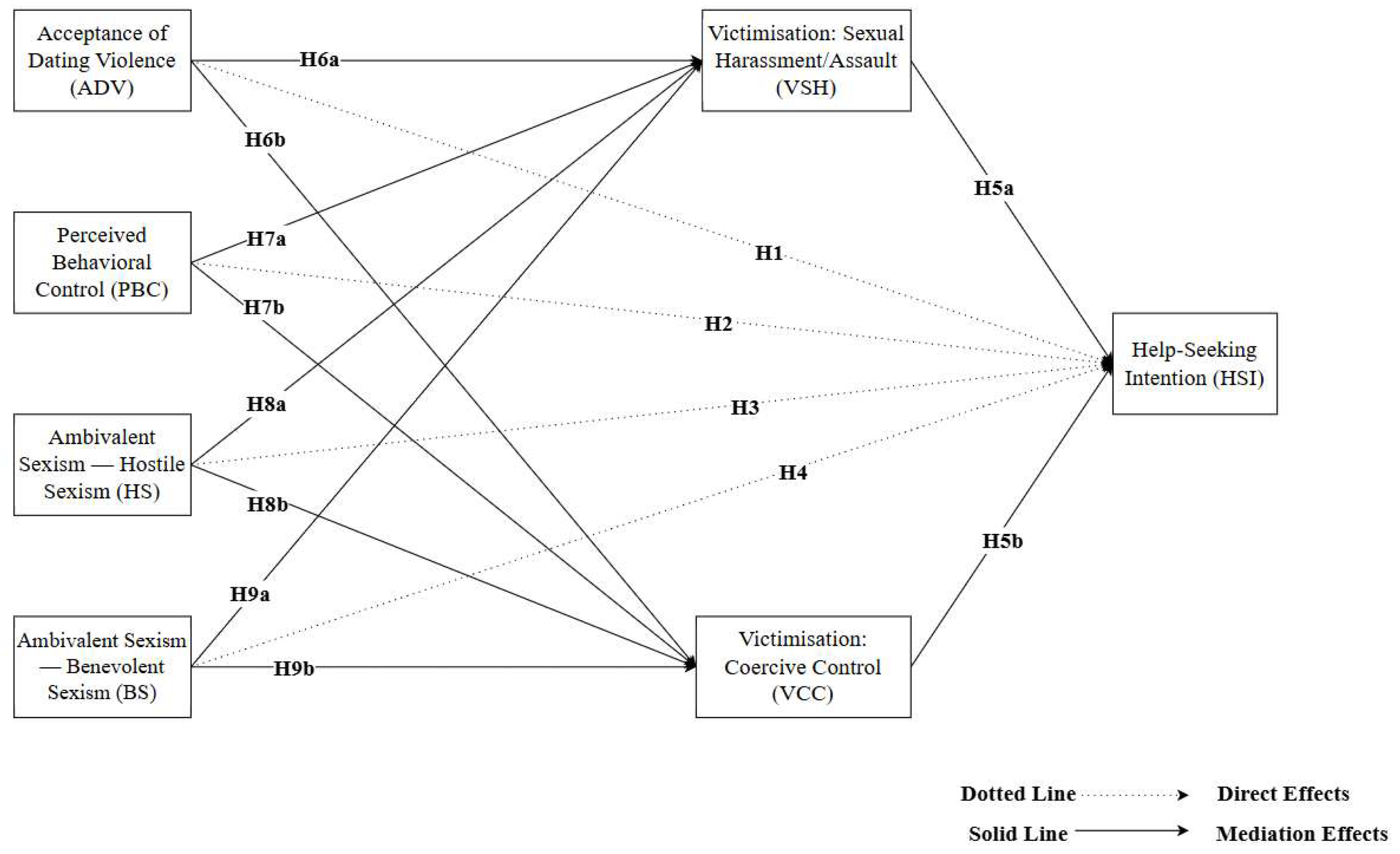
Our research contributes to this field in three capacities. Firstly, it examines an integrated pathway from ambivalent sexism (Hostile/Benevolent), Acceptance of Dating Violence to subsequent victimization (dual mediators—Sexual Harassment/Assault and Coercive Control), through to intentions to seek formal help; this shifts beyond mere correlation to model explanation. Secondly, it provides data from Greek HE institutions; while these are comparatively under researched to Anglo-American settings with similar cultural tenets, there is enough cultural proximity to be informative about Cypriot data on dating coercion. Thirdly, the inclusion of Perceived Behavioral Control as an explanatory ‘lever’ and testing these measures and structures to be free from measurement error among sub-groups offers theoretical refinement and practical take-aways for prevention initiatives. To this end, the following hypotheses were tested:
H1.
Acceptance of Dating Violence (ADV) is associated with Help-Seeking Intention (HSI).
H2.
Perceived Behavioral Control (PBC) is associated with Help-Seeking Intention (HSI).
H3.
Ambivalent Sexism—Hostile Sexism (HS) is associated with Help-Seeking Intention (HSI).
H4.
Ambivalent Sexism—Benevolent Sexism (BS) is associated with Help-Seeking Intention (HSI).
2.2. Help-Seeking Theory and Intentions
Help-seeking among university students is best understood within the Theory of Planned Behavior (TPB), which assumes that the joint effect of attitude, subjective norm, and Perceived Behavioral Control (PBC) influences intention and ultimately behavior [
19,
20]. In various research settings, TPB reliably predicts intentions; however, the prediction of behavior is variable. In an Australian study [
21], Bornschlegl et al. illustrate that intentions are accounted for by TPB constructs and person variables (public/self-stigma and Big Five factors), though the proportion of variance accounted for in actual behavior is trivial and confirms the intention–behavior gap. A similar trend is found in Chinese longitudinal research. Wang et al. [
22] indicate that attitude and PBC predict intentions, while PBC also influences behavior; however, intention fails to; subjective norm is nonsignificant. Contrasting results are found by Shi and Hall [
23] with Chinese students who went through a natural disaster—subjective norm was found to be the strongest predictor of intentions followed by TPB constructs (attitude and PBC), though self-stigma had only a trivial negative impact and public stigma had no impact; suggesting that the relative importance of TPB constructs varies according to the research context.
Across countries, the most dependable antecedent to intention is attitudes. For Korean students, Lee and Shin [
24] study validation on the TPB questionnaire confirms that either mental health factors and service awareness correlate to TPB belief measures that direct intention fully, with each TPB variable predicting intention. International student research encompasses other motivations. In various international settings, research shows that other factors come into play apart from attitude within the TPB to enable intention to be gained. These include the observation by Lee and Shin [
24] that service knowledge correlates with higher PBC; further, the study by Wang et al. [
22] finds that PBC was more than a mere intention-builder; instead, it was a direct action-advancer such that eliminating these factors might be more salient to behavior-change outcomes than attitude change [
22,
23,
25].
The stigma studies corroborate TPB but distinguish between self-stigma and public stigma. In one study, the impact of self-stigma and public stigma is seen during the intention stage by Bornschlegl et al. [
21], but another study by Shi and Hall [
23] finds that self-stigma and not public stigma is predictive of lower intention, indicating differences in salience of audience costs across settings (post-disaster vs. normal collegiate environment) and that internal barriers need to be addressed in intervention policies. Other emergent psychosocial considerations further clarify the process from belief to action. Alqhtani [
26] reveal that the process from help-seeking attitude to intention is mediated by emotional intelligence in nursing students; that is, the ability to identify and manage one’s own emotions might magnify the action potential of help-seeking attitudes—especially in more pressurized medical courses.
Overall, these studies confirm three findings with clear bearing on help-seeking in GBV. First, attitudes and PBC are strong predictors of intention, with PBC the stronger behavior-change ‘lever,’ often bearing direct intention-to-action effects; while service knowledge and understanding improve this ‘lever.’ Second, subjective norms are variable and ‘context-dependent,’ strong in collectivist (‘high-profile’ settings such as post-disaster cohorts and certain international students) but weaker in other circumstances. Third, there exists an intention–action gap, such that purely attitudinal change may lack direct service-uptake implications without offset decreases in self-stigma and changed ‘access’ conditions (navigation assistance).
In pertinent respects, however, this research contributes to this body of research in three ways. Firstly, it contextualizes TPB within a GBV-specific process that connects attitudes about gender and dating violence to current victimization and then to formal help-seeking to assess the role of need recognition and threat appraisal in crossing the intention–behavior gap. Secondly, it operationalizes PBC as a design variable—one that considers efficacy as well as service awareness—that accords with evidence about the direct effect of PBC on subsequent behavior. Thirdly, with its analysis spanning student year groups and residential groupings (and therefore normative influences and accessibility constraints found to be variable), this research provides subgroup results that correspond to views about the variable influences of subjective norms and the persistent intention–action gap.
H5a.
Victimization: Sexual Harassment/Assault (VSH) is associated with Help-Seeking Intention (HSI).
H5b.
Victimization: Coercive Control (VCC) is associated with Help-Seeking Intention (HSI).
2.3. Victimization Mechanisms
Student victimization in higher education should not be understood only as a series of isolated incidents. It also includes relational and cumulative processes that can restrict autonomy, produce fear, and shape whether students view formal support as necessary or accessible. For this reason, the present study distinguishes between two forms of GBV victimization: Sexual Harassment/Assault and Coercive Control.
Sexual Harassment and Assault are often conceptualized as incident-based forms of victimization. European evidence shows that sexual harassment is widespread in higher education, although prevalence estimates vary considerably depending on definitions, measurement strategies, and reporting thresholds [
25]. Bondestam and Lundqvist’s review [
27] similarly describes sexual harassment in higher education as pervasive but notes that the field remains limited by thin theoretical foundations and a lack of longitudinal evidence. Large-scale student research, such as the SHoT survey in Norway, also indicates that women and younger students report higher exposure to Sexual Harassment and Assault, while underreporting remains a persistent concern [
28,
29].
Coercive Control, by contrast, refers to a patterned process of domination rather than a single event [
30]. It may involve monitoring, isolation, intimidation, threats, economic restriction, and control over social relationships or movement. This distinction matters because Coercive Control may not always be recognized through conventional incident-based frameworks, even though its cumulative effects can be severe. Hamberger et al. [
31] define Coercive Control in terms of domination, perceived constraint, and credible threats, while [
19] Nevala’s analysis of EU-wide data shows that coercive-control-related violence is especially harmful and socially patterned [
32]. Similarly, Walker et al. [
33] show that controlling behaviors vary in form and intensity, and that their harmfulness increases when multiple forms of control accumulate.
This distinction between incident-based and patterned victimization is central to help-seeking [
34]. Sexual harassment or assault may trigger formal help-seeking when students interpret a specific event as serious or reportable. Coercive Control, however, may influence help-seeking through a different route: students may gradually recognize a pattern of restriction, surveillance, or intimidation that makes informal coping insufficient. At the same time, Coercive Control may also reduce perceived autonomy and make formal support feel difficult to access [
22,
33,
34]. For this reason, examining Sexual Harassment/Assault and Coercive Control as separate mediating mechanisms can clarify whether different forms of victimization connect attitudes and perceived control to Formal Help-Seeking Intentions in different ways.
Measurement considerations follow from this theoretical distinction. Behaviorally specific measures are needed for Sexual Harassment/Assault because broad labels may undercount experiences that students do not name as violence. Similarly, Coercive Control measures need to capture monitoring, threats, isolation, and other cumulative restrictions, including digitally mediated forms of control. Updated instruments, including work on psychological maltreatment and controlling behaviors, have increasingly incorporated items such as electronic monitoring and resource control to reflect these changing forms of abuse [
32,
33].
The present study therefore tests whether Sexual Harassment/Assault and Coercive Control operate as distinct victimization pathways between attitudinal or perceived-control factors and Formal Help-Seeking Intentions. This approach allows the analysis to examine whether help-seeking is shaped mainly by incident-based harm, by patterned Coercive Control, or by both.
H6a–H6b.
Victimization mediates the association between Acceptance of Dating Violence (ADV) and Help-Seeking Intention (HSI), through (a) Sexual Harassment/Assault (VSH) and (b) Coercive Control (VCC).
H7a–H7b.
Victimization mediates the association between Perceived Behavioral Control (PBC) and Help-Seeking Intention (HSI), through (a) Sexual Harassment/Assault (VSH) and (b) Coercive Control (VCC).
H8a–H8b.
Victimization mediates the association between Hostile Sexism (HS) and Help-Seeking Intention (HSI), through (a) Sexual Harassment/Assault (VSH) and (b) Coercive Control (VCC).
H9a–H9b.
Victimization mediates the association between Benevolent Sexism (BS) and Help-Seeking Intention (HSI), through (a) Sexual Harassment/Assault (VSH) and (b) Coercive Control (VCC).
3. Research Methodology
3.1. Conceptual Model and Rationale
Contributing to this problem is the fact that modeling women students’ intentions to seek formal help in Greek higher education settings would need to include attitudinal predictors, differential mechanisms of victimization, and an action-proximal determinant [
34,
35]. The problem persists and has direct implications for policymaking since gender-based violence on campuses has been widely documented and grossly underestimated; most empirical research has addressed Sexual Harassment and Assault in terms that are strictly isolated incidents to the point that Coercive Control has been outlined in terms that are strictly patterned rather than strictly defined mechanisms to include attitudinal climates on action to seek formal help [
36,
37,
38,
39,
40,
41]. The study draws theoretical inspirations from ambivalent sexism and TPB Theory since it seeks to account for distinctions made between singular incidents and patterned processes of Coercive Controls by specifying action distal/proximal determinants with the estimation of two mediation processes (
Figure 1).
The conceptual model includes three attitudinal predictors—Hostile Sexism, Benevolent Sexism, and Acceptance of Dating Violence; two mediators—Sexual Harassment and Assault and Coercive Control; one behavior-proximal determinant—Perceived Behavioral Control; and the outcome—Formal Help-Seeking Intentions towards university services, health professionals, NGOs, and the police [
42,
43]. We propose that Hostile and Benevolent Sexisms, and Acceptance of Dating Violence are positive predictors of both types of victimization; Perceived Behavioral Control has a positive direct effect on help-seeking; Sexual Harassment and Assault are positive predictors of help-seeking intentions through need recognition; and Coercive Control negatively affects Perceived Behavioral Control and reverses its effect on help-seeking intentions [
44]. The indirect effects are proposed to flow from the attitudinal predictors to help-seeking intentions through the two types of victimizations and Perceived Behavioral Control.
Each linkage has theoretical foundations. Hostile vs. Benevolent Sexism is linked to rape-myth acceptance and perpetrator exoneration, with benevolent paternalism and gender complementarity to normalized male dominance and female subordinacy; these with acceptance of violence are linked to greater vulnerability to harassment and to tolerance of control. Distinguishing Coercive Control from rape and harassment acknowledges that one aspect of maintaining control is to be action-guided and cumulative, with or without technology. Perceived Behavioral Control is the most direct means to change behavior within the Theory of Planned Behavior; capability beliefs and service knowledge increase intentions and can produce direct effect to action if made accessible with low barriers to action by higher education institutions. The current model places Perceived Behavioral Control after victimization, specifically after Coercive Control, to confirm the intention–behavior gap as an object process.
3.2. Data Collection and Sampling
In this research, a quantitative cross-sectional study with an anonymous web-based self-completion survey was used to investigate the relationships between attitudinal factors—Ambivalent Sexism (Hostile and Benevolent), Acceptance of Dating Violence—and Perceived Behavioral Control (help-seeking self-efficacy) with experiences of recent victimization (Sexual Harassment/Assault; Coercive Control), and then with intentions to seek formal help among women students in Greek higher education institutions [
44,
45]. As with other sensitive topics such as gender-based violence, probability sampling was not feasible because of practical and ethical considerations, including the need to protect vulnerable students and the difficulty of accessing dispersed institutional populations. The study therefore used stratified nonprobability sampling with soft quotas by institution/geographic location, study stage, and living status [
46,
47].
Data collection took place over a window of four to six weeks using Google Forms, which was accessible on mobile and desktop platforms. Recruitment was conducted through official university departments via announcements from Dean’s Offices, Student Affairs, and Equality/GBV offices, as well as recognized university networks. Recruitment messages used neutral wording focused on student well-being and support needs. Reminder notices were sent twice during the data collection period. Where participation incentives were offered, contact information was collected through a separate anonymous form that could not be linked to survey responses.
Inclusion criteria included self-identification as a woman, age ≥ 18 years, current enrollment in a Greek university at undergraduate or postgraduate level, and e-consent. Exclusion criteria removed respondents aged <18 years, respondents not currently enrolled, respondents outside the target gender group for this study, and cases that did not meet pre-specified data quality criteria, such as unreasonably short completion time, straight-lining, or failed attention checks. A routing item determined whether respondents had an intimate partner within the last 12 months; those who answered “No” were not shown the Coercive Control module.
The measures for all variables used standardized short-form scales translated into Greek and English. The process began with forward translation and subsequent back-translation. The measures included Hostile and Benevolent Sexism items, Perceived Behavioral Control items framed around help-seeking self-efficacy and service accessibility, 12-month behaviorally specific victimization items, Coercive Control frequency items, and Formal Help-Seeking Intentions items referring to university services, police, health services, and specialist NGOs. To reduce priming and participant distress, sensitive blocks were placed later in the survey and grouped with priming minimization in mind. The survey also included soft-skip options, prefer-not-to-answer options, a quick-exit button, and a persistent resource area with national crisis numbers and help services.
Pilot testing was completed before the main data collection. First, a small clarity and usability pilot was conducted with 10 participants to assess item comprehension, emotional burden, routing logic, and the accessibility of the survey on mobile and desktop devices. This stage indicated that the questionnaire was understandable and that the safety features, including skip options and the resource area, were visible and functional. Second, a larger technical and item-functioning pilot was conducted with 48 participants. This pilot confirmed that the expected completion time was acceptable, approximately 11–13 min, and did not reveal major technical problems or systematic misunderstanding of the items. Only minor wording adjustments were made to improve clarity and reduce ambiguity; no construct or scale was removed at this stage.
We aimed to collect N ≈ 600 completes. This target ensured an acceptable N-to-parameter ratio for SEM analysis, sufficient power to detect indirect effects, and adequate precision for robustness testing across demographic subgroups [
48,
49,
50]. The final analysis sample consisted of 550 valid responses after applying the inclusion, exclusion, and data-quality criteria.
3.3. Measures Scales
All multi-item constructs were assessed with short Likert-type scales adapted to the Greek university context and translated/back-translated on a 1 = Strongly disagree to 5 = Strongly agree scale, unless otherwise indicated (
Appendix A,
Table A1). Internal consistency was assessed in the present sample using Cronbach’s alpha, with all retained constructs exceeding the commonly used 0.70 threshold. The observed alpha coefficients were: Acceptance of Dating Violence (α = 0.842), Benevolent Sexism (α = 0.731), Hostile Sexism (α = 0.868), Formal Help-Seeking Intentions (α = 0.790), Perceived Behavioral Control (α = 0.878), Coercive Control (α = 0.831), and Sexual Harassment/Assault (α = 0.839).
Acceptance of Dating Violence (ADV) was measured with 5 items (e.g., “Sometimes hitting a dating partner is understandable”; ADV1–ADV5) (adapted from [
18,
20]). Perceived Behavioral Control (PBC) used 5 items (e.g., “Seeking help from a university support service would be easy for me”; PBC1–PBC5) (adapted from [
36,
37]).
Ambivalent Sexism was captured with two 5-item subscales: Hostile Sexism (HS) (e.g., “These days, many women are too easily offended”; HS1–HS5) and Benevolent Sexism (BS) (e.g., “Women should be cherished and protected by men”; BS1–BS5), adapted from [
41,
42].
Victimization Sexual Harassment/Assault (VSH) comprised 5 behaviorally specific items referencing the past 12 months (e.g., “Someone used physical force or threats to make you have sexual contact”; VSH1–VSH5) adapted from [
34,
35].
Victimization: Coercive Control (VCC) included 5 items (e.g., “A partner tried to isolate you from friends or family”; VCC1–VCC5) referencing the past 12 months, adapted from [
34,
35].
Formal Help-Seeking Intentions (HSI) asked how likely participants would be to seek help from four formal sources if they experienced partner violence (university support office, police, health service, specialist NGO; HSI1–HSI4) adapted from Wilson et al. [
51].
3.4. Sample Profile
The full analysis sample was N = 550 participants (
Table 1). Broken down by participants’ age, 48.2% were 18–24 years old (n = 265), 20.5% were 25–34 years old (n = 113), and 31.3% were 35+ years old (n = 172). Education level was as follows: Undergraduate 42.5% (n = 234), Bachelor’s degree 35.3% (n = 194), and Master’s degree or higher 22.2% (n = 122). Now to perceived financial situation: Comfortable 30.7% (n = 169), Coping 42.9% (n = 236), Struggling 26.4% (n = 145). Knowledge of local resources for support by hotlines or NGOs was not aware 34.9% (n = 192), slightly informed was 22.4% (n = 123), or aware of services 42.7% (n = 235). Within last 12 months, participants’ contacts or use was with police services 21.3% (n = 117), and with medical/counseling services 19.1% (n = 105) or with either hotlines/NGOs 24.7% (n = 136), with 28.9% non-contact usage plus 6.0% preferred not to answer (n = 159 and n = 33). Percentages are on full data and are slightly rounded to nearest whole number.
4. Data Analysis and Results
For data analysis, structural equation modeling analysis was applied using SmartPLS 4 version 4.1.1.6. As suggested by Nitzl et al. [
52], variance-based structural equation modeling is very helpful for analyzing business studies and other studies in the field of social sciences. PLS-SEM analysis was adopted as it concentrates on the principle of maximization for variance explained in case of endogenous constructs and also evaluates predictive fit [
53,
54]. Heterogeneities in subgroups are evaluated using multi-group analysis (MGA), where variances in structural paths are identified for various types of respondents, showing contextually distinct features that are not visible using other regression methods [
55,
56]. For estimation, Wong [
56] suggestions on calculation for structural equation models for path coefficients, standard errors, and reliability on measurements are followed. For reflective indicators, reliability and validity are appraised using 0.70 as threshold for loadings.
4.1. Common Method Bias
To ensure the validity and reliability of data and to test for common method bias (CMB), it was evaluated using procedures described by Podsakoff et al. [
57]. To test for CMB, Harman’s single-factor test was employed to investigate whether data can easily relate to one underlying construct. The principal factor analysis, which does not involve rotation, revealed that only 22.784% of the variance can be explained by the first factor, which is far from the 50% cut-off point for CMB to meaningfully exist. Given this low indication of CMB, direct assessment and reporting enhance construct validity and inter-construct relations against suspicion of biased measurements on common method variables [
57,
58].
4.2. Measurement Model
The assessment of reflective measurement models was followed by the assessment of structural paths within the PLS-SEM approach. As per Hair et al.’s work [
49,
53,
55], this phase comprised evaluation of Composite Reliability, indicator reliability, convergent validity, and discriminant validity to ensure sufficient construct validity prior to inferring structural links. Moreover, following Vinzi et al. [
59], for this phase, reliability for each indicator has been measured using the ratio of variance explained by respective indicators to their construct and was operationalized via outer loadings. As stated in Wong’s [
56], for satisfactory item assessment, indicators above 0.70 can provide pointers on satisfactory item quality. However, as stated in Vinzi et al.’s [
59], common to data observed in social sciences, adherence to this standard for various indicators sometimes proves challenging [
60,
61]. This means that item deletion did not always happen automatically but rather on the basis of progressive improvement for model quality, where items stayed on provided they added to Composite Reliability and Average Variance Extracted, but only to delete when exclusion demonstrated noticeable added benefits to either [
62].
As per suggestions by Hair Jr et al [
60], indicators with factor loadings between 0.40 and 0.70 are discarded only when they result in substantially higher CR or AVE for that particular construct. On the basis of these guidelines and rules provided by Gefen and Straub [
61], the measurement model was reduced by eliminating two indicators, namely PBC5 and VCC4, which had factor loadings below 0.50. This model purification is provided in
Table 2 above.
Reliability estimation was conducted using Cronbach’s alpha, rho_A, and Composite Reliability (CR). In line with the recommendation provided in Wasko and Faraj [
62], to aim for 0.70 or above, this criterion was exceeded for ADV, PBC, HS, BS, VSH, VCC, and HSI, while for other variables, reliability was also moderate to higher, in accordance with previous research work conducted by other researchers [
62,
63,
64]. As rho_A falls between alpha and CR, above 0.70 for most variables further validated the reliability estimates, according to Henseler et al. [
65] and Sarstedt et al. [
64] guidelines on internal consistency estimates for structural models.
For convergent validity, it was considered acceptable if Average Variance Extracted (AVE) values exceeded 0.50 for most constructs. As stated by Fornell and Larcker [
66], slightly lower than 0.50 for AVE can also pass for adequacy provided the Composite Reliability (CR) is above 0.60, which was met where applicable in this research work. For discriminant validity, assessment was conducted using the criterion described in Fornell and Larcker’s work [
66]. Here, it was observed that for every construct, the square root of its Average Variance Extracted was larger than correlation coefficients between pairs of constructs, thus confirming discriminant validity between the latent variables. This assessment was also validated by Heterotrait-Monotrait ratio indices, where every parameter was well below the conservative cut-off threshold of 0.85 [
66]. Specifically, construct validity and internal consistency for this structural model are well-validated by these various tests [
67,
68]. The alpha indices for every construct, rho_A, CR, Average Variance Extracted, inter-construct correlation coefficients, and HTMT are provided in
Table 3 and
Table 4.
4.3. Structural Model
The structural results are presented around the central empirical question of the study: whether patterned Coercive Control provides a stronger and more consistent explanation of Formal Help-Seeking Intentions than incident-based Sexual Harassment/Assault. Before interpreting the structural paths, model explanatory and predictive quality were assessed.
The structural model was evaluated using coefficients of determination (R2), predictive fit indices (Q2), and significance tests for structural parameters. The model accounted for 46.2% of the variance in HSI (R2 = 0.462), 22.6% of the variance in VCC (R2 = 0.226), and 15.6% of the variance in VSH (R2 = 0.156), indicating moderate explanatory power. Predictive fit was supported by cross-validated redundancy indices of Q2 = 0.212 for VCC, Q2 = 0.140 for VSH, and Q2 = 0.290 for HSI, indicating acceptable predictive relevance.
The hypotheses are evaluated by examining the statistical significance of structural relations. The path coefficients and standard errors are derived on the basis of non-parametric bootstrapping procedures as espoused by Hair and Alamer [
53]. The indirect effects are analyzed using bias-corrected one-tailed bootstrapping procedures with 10,000 resamples, as advised by multiple works [
69,
70]. Collectively, these provide an assurance for the structural validity and prediction capabilities for the proposed model. Detailed output tables are tabulated in
Table 5.
The main structural finding was clear: Coercive Control was the strongest predictor of Formal Help-Seeking Intentions. Higher levels of Coercive Control victimization were strongly associated with higher Formal Help-Seeking Intentions (β = 0.439, SD = 0.040, t = 10.907, p < 0.001). By contrast, Sexual Harassment/Assault showed a much weaker and only marginal association with help-seeking intentions (β = 0.073, SD = 0.045, t = 1.632, p = 0.051). This contrast supports the central argument of the paper that patterned Coercive Control has greater explanatory value for Formal Help-Seeking Intentions than incident-based victimization alone.
Among the attitudinal and control-related predictors, Acceptance of Dating Violence (ADV) was positively associated with HSI (β = 0.268, SD = 0.040, t = 6.784, p < 0.001), and Perceived Behavioral Control (PBC) also showed a smaller but significant positive association with HSI (β = 0.093, SD = 0.044, t = 2.132, p = 0.017). These results suggest that both normative Acceptance of Dating Violence and perceived capacity to access support are relevant to Formal Help-Seeking Intentions.
By contrast, Hostile Sexism (HS) was not significantly associated with HSI (β = −0.034, SD = 0.035, t = 0.950, p = 0.171). Benevolent Sexism (BS) showed a small positive but non-significant association with HSI (β = 0.047, SD = 0.030, t = 1.546, p = 0.061). Thus, once victimization experiences, ADV, and PBC were included in the model, ambivalent sexism did not directly explain Formal Help-Seeking Intentions.
Overall, the structural model indicates that the results are not evenly distributed across all predictors. Rather, the strongest and most theoretically important finding is the role of Coercive Control. ADV and PBC also contribute to HSI, whereas Sexual Harassment/Assault and ambivalent sexism show weaker or non-significant direct associations.
4.4. Mediation Analysis
The mediation analyses were used to test whether the central role of Coercive Control was also evident in indirect pathways. Specifically, the analyses compared whether Sexual Harassment/Assault (VSH) or Coercive Control (VCC) mediated the associations between attitudinal/perceived-control variables and Formal Help-Seeking Intentions. Bootstrapped estimates for standardized coefficients, standard errors, t-values, and
p-values are presented in
Table 6.
For Acceptance of Dating Violence (ADV), the indirect relationship via VSH was not significant (ADV → VSH → HSI: β = −0.000, SD = 0.004, t = 0.096, p = 0.462), indicating no mediation by Sexual Harassment/Assault. In contrast, the indirect relationship via VCC was positive and significant (ADV → VCC → HSI: β = 0.105, SD = 0.021, t = 5.045, p < 0.001). Because the direct relationship between ADV and HSI remained significant, this indicates partial mediation by Coercive Control.
Regarding Perceived Behavioral Control (PBC), no significant indirect effect via VSH was observed (PBC → VSH → HSI: β = −0.005, SD = 0.005, t = 0.937, p = 0.174). Conversely, a significant indirect effect existed through VCC (PBC → VCC → HSI: β = 0.105, SD = 0.024, t = 4.364, p < 0.001). As PBC remained directly associated with HSI, this also suggests partial mediation through Coercive Control.
For Hostile Sexism (HS), the direct effect on HSI was not significant (β = −0.034, p = 0.171). The indirect effect via VSH was small and marginal (HS → VSH → HSI: β = 0.029, SD = 0.018, t = 1.622, p = 0.052), and the indirect effect via VCC was also small and marginal (HS → VCC → HSI: β = 0.026, SD = 0.016, t = 1.582, p = 0.057). These results do not provide strong evidence that Hostile Sexism is transmitted to help-seeking intentions through either victimization pathway, although the direction of the estimates suggests that indirect associations may warrant further examination.
For Benevolent Sexism (BS), the indirect effect via VSH was not significant (BS → VSH → HSI: β = −0.001, SD = 0.004, t = 0.336, p = 0.369). However, the indirect effect via VCC was significant and negative (BS → VCC → HSI: β = −0.049, SD = 0.018, t = 2.737, p = 0.003). As the direct link from BS to HSI was not significant, this suggests an indirect-only association through Coercive Control. The negative sign indicates that the pathway involving Benevolent Sexism and Coercive Control may operate differently from the ADV and PBC pathways and should be interpreted cautiously.
Taken together, the mediation results reinforce the central story of the model: Coercive Control, rather than Sexual Harassment/Assault, provides the more consistent mediating pathway between attitudinal/perceived-control factors and Formal Help-Seeking Intentions. Sexual Harassment/Assault showed little mediating evidence in the present model.
4.5. Multi-Group Analysis
Multi-group analyses were treated as exploratory contextual refinements of the main model. Their purpose was to examine whether key pathways, especially those involving Coercive Control and help-seeking intentions, differed across age, education level, and perceived financial situation (
Table 7).
Across age groups, most paths did not differ significantly. Two differences emerged: the ADV → VCC path was stronger among participants aged 25–34 than among those aged 18–24 or 35+, while the VCC → HSI path was stronger among participants aged 35+ than among those aged 18–24. These findings suggest that the coercive-control pathway remains central, but its links with dating-violence attitudes and help-seeking may vary by age.
Education-level comparisons also showed selected differences. The VCC → HSI link was strongest among Bachelor’s degree holders and weakest among participants with a Master’s degree or higher. The ADV → HSI path was stronger among participants with a Master’s degree or higher than among Bachelor’s degree holders and undergraduates. The VSH → HSI path was also stronger among Bachelor’s degree holders and undergraduates than among those with a Master’s degree or higher.
For perceived financial situation, only the VSH → HSI path differed significantly: Sexual Harassment/Assault was more strongly associated with help-seeking intentions among financially struggling students than among comfortable students. The PBC → HSI contrast between comfortable and struggling students was marginal, suggesting a possible but not definitive difference.
Overall, the multi-group findings do not change the main interpretation of the model. They indicate that Coercive Control is broadly important while also being shaped by life stage, education level, and financial position. Because these subgroup effects were selective and exploratory, they should be interpreted cautiously and as a basis for future intersectional research rather than as definitive evidence of group-specific mechanisms.
5. Discussion
5.1. Direct Relationships Between Attitudes, Victimization, and Help-Seeking Intentions
The structural model showed that Formal Help-Seeking Intentions among women students were most strongly associated with Coercive Control, followed by Acceptance of Dating Violence and Perceived Behavioral Control. By contrast, Hostile and Benevolent Sexism had no significant direct effects once other variables were included. This pattern situates the Greek findings within a broader international literature showing that GBV in higher education cannot be understood only through isolated incidents or general gender attitudes, but also through relational patterns of control and students’ perceived ability to access support.
Acceptance of Dating Violence (ADV) was positively associated with help-seeking intentions. This finding differs from studies suggesting that pro-violence attitudes and rape-myth beliefs usually inhibit disclosure or help-seeking [
11,
43]. One possible explanation is that ADV may also reflect proximity to, or familiarity with, conflictual relationship contexts. Students who have encountered problematic relationship dynamics may be more likely to anticipate the need for formal assistance, even if some controlling or aggressive behaviors are partly normalized. In the Greek and wider Eastern Mediterranean context, previous work has similarly highlighted the role of psychological pressure, fear, and relational strain in dating contexts [
17], suggesting that help-seeking may emerge from complex combinations of normalization, recognition, and perceived escalation [
71,
72,
73].
Perceived Behavioral Control (PBC) also predicted help-seeking intentions, supporting international Theory of Planned Behavior research showing that perceived access, confidence, and service knowledge shape help-seeking among students and young adults [
21,
22,
24,
25]. In the present study, PBC is best understood as an action-proximal resource: students who believe that they can identify and navigate formal services appear more willing to seek support. In the Greek university context, where formal GBV infrastructures are still developing unevenly, perceived navigability may be especially relevant.
Victimization experiences were central to the model. Coercive Control was the strongest predictor of help-seeking intentions, consistent with international and European research identifying Coercive Control as a particularly harmful form of intimate-partner victimization [
19,
25]. Monitoring, isolation, threats, and control over resources may create a cumulative sense of entrapment that makes formal support appear necessary. Sexual Harassment/Assault, by contrast, showed only a weak and marginal association with help-seeking intentions. This is consistent with evidence that many forms of sexual harassment, including technology-facilitated or “lower-level” incidents, are normalized, trivialized, or underreported within higher education [
25,
27]. The Greek findings therefore align with wider international evidence while also showing that, in this setting, patterned Coercive Control may be more strongly connected to support-seeking readiness than incident-based victimization alone.
Finally, neither Hostile Sexism nor Benevolent Sexism directly predicted help-seeking intentions once ADV, PBC, and victimization were included. This finding is consistent with work showing that ambivalent sexism is associated with rape myths and gendered interpretations of harm, but does not necessarily translate directly into help-seeking decisions [
14]. In this model, sexism appears to matter less as a direct predictor and more as part of the broader normative environment in which coercive or abusive dynamics may be interpreted.
5.2. Mediation Analysis: Pathways from Attitudes to Help-Seeking
The mediation results further clarified the central role of Coercive Control. For both ADV and PBC, Coercive Control, rather than Sexual Harassment/Assault, mediated associations with Formal Help-Seeking Intentions. This pattern supports the distinction between acute or incident-based victimization and chronic, patterned control. It also aligns with international coercive-control scholarship, which emphasizes cumulative domination, constraint, and threat rather than isolated events alone [
14,
15].
For Hostile Sexism, indirect effects through both victimization pathways were small and marginal. These findings should therefore be interpreted cautiously. They suggest that Hostile Sexism may shape the wider relational or normative conditions in which victimization occurs, but the present data do not support a strong indirect pathway to help-seeking intentions. For Benevolent Sexism, the significant indirect effect through Coercive Control suggests a more complex pattern. Paternalistic or protective beliefs may make controlling behaviors easier to normalize as care, concern, or relationship commitment [
74], potentially complicating recognition of harm and support-seeking.
Sexual Harassment/Assault had limited mediating influence in the model. This does not imply that sexual harassment or assault is unimportant; rather, it suggests that, in this dataset, these experiences were less consistently connected to the attitudinal and perceived-control pathways leading to Formal Help-Seeking Intentions. This finding is consistent with international evidence on underreporting and normalization of sexual harassment in higher education, and it highlights the need to distinguish between forms of GBV that are incident-based and forms that are cumulative, relational, and controlling.
5.3. Demographic Structural Differences
Multi-group analysis showed that most structural paths were stable across age, education, and perceived financial situation, although selected differences emerged. These differences suggest that the links between attitudes, victimization, and help-seeking may vary by life stage and structural position, but they should be interpreted cautiously.
Regarding age, the ADV → VCC path was strongest among participants aged 25–34 years, while the VCC → HSI path was strongest among participants aged 35+. This may indicate that, for students in their mid-20s, dating-violence norms are more closely connected to experiences of controlling partner behavior, whereas older students may be more likely to interpret Coercive Control as requiring formal support. Differences by education level also suggested that postgraduate women may rely on different coping strategies or may face distinct reputational and professional concerns within academic environments. Financial situation was mainly relevant for sexual harassment: financially struggling students showed a stronger VSH → HSI association than comfortable students, possibly because material precarity makes institutional protection and support more consequential.
These subgroup findings connect the Greek data to wider international debates on intersectionality and institutional trust. Age, education, and perceived financial situation are useful but limited indicators of structural position. Students’ experiences of Coercive Control, credibility, and access to support are also likely to be shaped by intersecting dimensions such as gender, class, ethnicity, sexuality, disability, and migration status [
25,
26,
31,
39]. The present results should therefore be read not as fixed group differences, but as evidence that help-seeking pathways are socially situated.
Overall, the subgroup analyses suggest that support responses in higher education may benefit from differentiation rather than a single universal model. For example, prevention work may need to address dating-violence norms among students in established relationships, confidentiality and reputational concerns among postgraduate students, and access barriers among financially struggling students. Given the limited number of significant differences, small effect sizes, and group-size inequalities, replication with larger and more diverse samples is needed, particularly through designs that can examine how multiple social positions jointly shape GBV experiences and help-seeking.
6. Practical Implications
One implication for practitioners working to prevent gender-based violence in institutions of higher education, and to support those students affected by it, is derived from the key part played by Coercive Control in predicting Formal Help-Seeking Intentions. Practitioners must develop policies informed by Coercive Control as a patterned and relational form of abuse, rather than policies centered mainly on isolated incidents or clearly punishable acts. This can involve revising codes of conduct, reporting procedures, and risk assessment methods to address monitoring, isolation, economic control, and threats, even where no single event is ‘extreme’ [
30]. Drawing on Ahmed’s critique [
28] of institutional “non-performativity,” universities should not assume that having formal GBV policies means that those policies transform the conditions that make harm difficult to name, report, or address. The present findings therefore support a shift from incident-based compliance toward responses that recognize ongoing patterns of control and make support practically accessible.
Second, it is clear that perceived control over accessing services has both direct and indirect associations with seeking help, so universities need to treat navigability of support systems as a core design challenge. This would involve making services visible, minimizing barriers, and providing “one-stop” support centers, confidential online routes for seeking help, clear procedural information, and agreements between universities, healthcare providers, law enforcement agencies, and specialized NGOs. Such systems should allow students to seek advice even when they are unsure whether their experience “counts” as violence, especially in cases of cumulative monitoring, intimidation, or dependency.
Thirdly, attitudes pertaining to dating violence and Benevolent Sexism appear to be indirectly related to seeking assistance through Coercive Control. Interventions should therefore target these attitudes not only as abstract beliefs but also as scripts that normalize control and delay recognition of harm. Teaching interventions can include recognizing patterns of control, reframing narratives in which control is conflated with care or protection, and encouraging peers to support victims in trusting their own perceptions.
The multi-group findings also point to the need for customized intervention and support. For students in their mid-twenties and postgraduate students, interventions could address established relationships, power dynamics, and worries about reputation or career implications. For financially struggling students, low-cost support, flexible appointments, and coordination between financial and psychosocial services may be especially important. At the same time, these findings should be read through an intersectional lens. Age, education, and financial situation capture only part of students’ structural position; institutional trust and help-seeking may also vary across intersections of class, ethnicity, migration status, sexuality, disability, and gender identity [
29,
30].
Lastly, the findings stress the need for institutional strategies that move beyond reactive responses. Institutional leadership, equality and diversity units, and support services should track Coercive Control and harassment incidents, assess whether support services are known, accessible, and trusted, and collaborate with external organizations to reach students on and off campus. These steps would help shift institutional responses from formal policy display toward practice that addresses ongoing patterns of harm, builds community capacity, and reduces the burden placed on individual victims to make institutions act.
7. Conclusions, Limitations, and Future Directions
This research investigated how ambivalent sexism, Acceptance of Dating Violence, perceived control, and victimization experiences contribute to women university students’ intentions to seek formal support within Greek higher education institutions. Coercive Control had the strongest association with help-seeking intentions, while Acceptance of Dating Violence and perceived control also operated as important factors. Hostile and Benevolent Sexism mainly operated indirectly. By separating Coercive Control from Sexual Harassment/Assault and conceptualizing help-seeking through a Theory of Planned Behavior framework, the study shows how attitudinal environments and control dynamics may be linked to support-seeking readiness.
At the same time, several limitations should be acknowledged. First, the study used a cross-sectional, self-administered questionnaire design. Therefore, the reported mediation paths should be interpreted as statistical indirect associations, not as evidence of causal or temporal mechanisms. Future longitudinal or panel designs could examine how attitudes, victimization, perceived control, and help-seeking develop over time, including whether changes in perceived control precede actual service use.
Second, the reliance on self-report data suggests the need for methodological diversification. Future research could combine survey data with interviews, diaries, administrative service-use data, or perspectives from institutional staff, counseling personnel, and non-governmental organizations. Such approaches would help clarify how fear, stigma, institutional distrust, and repeated disclosure demands operate between intention and action.
Third, the focus on women students in Greek universities limits the generalizability of the findings. Future research should include men, non-binary and trans students, international students, and young people outside higher education to examine how gender identity, migration status, and institutional context shape GBV experiences and help-seeking. Cross-national studies in Southern and Eastern Europe would also help assess whether the observed patterns apply in contexts where GBV in academia intersects with precarious work, limited welfare support, or incomplete institutional reform.
Fourth, although the multi-group analysis considered age, education, and perceived financial situation, the study did not provide a full intersectional account of Coercive Control and institutional trust. Future research should examine how help-seeking varies across intersections of gender, class, ethnicity, sexuality, disability, migration status, and other marginalized positions [
25,
27]. This is particularly important because institutional support may be experienced differently by students whose social locations shape their exposure to harm, perceived credibility, and confidence in formal procedures.
Finally, the study did not directly examine whether university GBV policies are trusted, accessible, or effective in practice. Future work should therefore investigate the possible gap between policy existence and policy effectiveness. In line with Ahmed’s critique [
28] of institutional “non-performativity,” research should assess whether formal procedures merely signal institutional commitment or actually transform the conditions that make Coercive Control difficult to recognize, report, and address.
In this regard, the present study should be seen not as a final verdict, but as a map of one part of the terrain. It shows how control, beliefs, and perceived possibilities are entangled in women students’ help-seeking intentions. Future work using longitudinal, qualitative, comparative, and intersectional designs can refine this model and help institutions move toward responses in which acknowledging harm and seeking help become supported, accessible, and trusted processes.