
Physical Activity and Sedentary Behaviour in the MEDIET4ALL Study: Associations with Mediterranean Lifestyle, Sleep, and Psychosocial Well-Being, with Mediation Analyses

 ,
, 
 , , ,
, , , 
 , , ,
, , ,  , ,
, ,  ,
,  , and
, and  add
Show full author list
add
Show full author list
Abstract
1. Introduction
2. Materials and Methods
2.1. Study Design and Participants
2.2. Survey Instruments and Measured Variables
2.2.1. Sociodemographic and Lifestyle Characteristics
2.2.2. Physical Activity and Sedentary Behaviour
2.2.3. Mediterranean Lifestyle Adherence
2.2.4. Sleep Characteristics and Insomnia
2.2.5. Social Participation and Technology Use
2.3. Statistical Analysis
3. Results
3.1. Descriptive Characteristics of the Study Population
3.2. Hierarchical Regression Analyses Examining Correlates of Physical Activity
3.3. Hierarchical Regression Analyses Examining Correlates of Sedentary Behaviour
3.4. Exploratory Mediation Analyses Examining Indirect Associations Between Lifestyle Factors and Movement Behaviours
4. Discussion
4.1. Distinct but Interconnected Determinants of Physical Activity and Sedentary Behaviour
4.2. Mediterranean Lifestyle, Social Participation, and Indirect Pathways to Sedentary Behaviour
4.3. Strengths and Limitations
4.4. Implications and Future Directions
5. Conclusions
Supplementary Materials
Author Contributions
Funding
Institutional Review Board Statement
Informed Consent Statement
Data Availability Statement
Acknowledgments
Conflicts of Interest
References
- Lee, I.-M.; Shiroma, E.J.; Lobelo, F.; Puska, P.; Blair, S.N.; Katzmarzyk, P.T. Effect of physical inactivity on major non-communicable diseases worldwide: An analysis of burden of disease and life expectancy. Lancet 2012, 380, 219–229. [Google Scholar] [CrossRef]
- Ammar, A.; Trabelsi, K.; Hermassi, S.; Kolahi, A.-A.; Mansournia, M.; Jahrami, H.; Boukhris, O.; Boujelbane, M.; Glenn, J.; Clark, C.; et al. Global disease burden attributed to low physical activity in 204 countries and territories from 1990 to 2019: Insights from the Global Burden of Disease 2019 Study. Biol. Sport 2023, 40, 835–855. [Google Scholar] [CrossRef]
- World Health Organization. WHO Guidelines on Physical Activity and Sedentary Behavior. Available online: https://www.who.int/publications/i/item/9789240015128 (accessed on 9 March 2026).
- Booth, F.W.; Roberts, C.K.; Laye, M.J. Lack of Exercise Is a Major Cause of Chronic Diseases. In Comprehensive Physiology, 1st ed.; Prakash, Y.S., Ed.; Wiley: Hoboken, NJ, USA, 2012; pp. 1143–1211. Available online: https://onlinelibrary.wiley.com/doi/10.1002/cphy.c110025 (accessed on 25 March 2026).
- Tremblay, M.S.; Aubert, S.; Barnes, J.D.; Saunders, T.J.; Carson, V.; Latimer-Cheung, A.E.; Chastin, S.F.M.; Altenburg, T.M.; Chinapaw, M.J.M. on behalf of SBRN Terminology Consensus Project Participants. Sedentary Behavior Research Network (SBRN)—Terminology Consensus Project process and outcome. Int. J. Behav. Nutr. Phys. Act. 2017, 14, 75. [Google Scholar] [CrossRef] [PubMed]
- Owen, N.; Healy, G.N.; Matthews, C.E.; Dunstan, D.W. Too Much Sitting: The Population Health Science of Sedentary Behavior. Exerc. Sport Sci. Rev. 2010, 38, 105–113. [Google Scholar] [CrossRef]
- Biswas, A.; Oh, P.I.; Faulkner, G.E.; Bajaj, R.R.; Silver, M.A.; Mitchell, M.S.; Alter, D.A. Sedentary Time and Its Association with Risk for Disease Incidence, Mortality, and Hospitalization in Adults: A Systematic Review and Meta-analysis. Ann. Intern. Med. 2015, 162, 123–132. [Google Scholar] [CrossRef] [PubMed]
- Ekelund, U.; Steene-Johannessen, J.; Brown, W.J.; Fagerland, M.W.; Owen, N.; Powell, K.E.; Bauman, A.; Lee, I.-M. Does physical activity attenuate, or even eliminate, the detrimental association of sitting time with mortality? A harmonised meta-analysis of data from more than 1 million men and women. Lancet 2016, 388, 1302–1310. [Google Scholar] [CrossRef]
- Kracht, C.L.; Burkart, S.; Groves, C.I.; Balbim, G.M.; Pfledderer, C.D.; Porter, C.D.; St. Laurent, C.W.; Johnson, E.K.; Brown, D.M.Y. 24-hour movement behavior adherence and associations with health outcomes: An umbrella review. J. Act. Sedentary Sleep Behav. 2024, 3, 25. [Google Scholar] [CrossRef] [PubMed]
- Ammar, A.; Salem, A.; Boujelbane, M.A.; Trabelsi, K.; Bouaziz, B.; Kerkeni, M. Multifactorial Determinants of Health Status: Insights from the MEDIET4ALL Large-Scale Survey on Eco-Sociodemographic, Psychological, and Lifestyle (Diet, Physical Activity, and Sleep) Factors. Front. Public Health 2026, 14, 1704240. [Google Scholar] [CrossRef]
- Monteiro, C.A.; Moubarac, J.-C.; Cannon, G.; Ng, S.W.; Popkin, B. Ultra-processed products are becoming dominant in the global food system. Obes. Rev. 2013, 14, 21–28. [Google Scholar] [CrossRef]
- Trichopoulou, A.; Martínez-González, M.A.; Tong, T.Y.; Forouhi, N.G.; Khandelwal, S.; Prabhakaran, D.; Mozaffarian, D.; De Lorgeril, M. Definitions and potential health benefits of the Mediterranean diet: Views from experts around the world. BMC Med. 2014, 12, 112. [Google Scholar] [CrossRef]
- Holt-Lunstad, J.; Smith, T.B.; Baker, M.; Harris, T.; Stephenson, D. Loneliness and Social Isolation as Risk Factors for Mortality: A Meta-Analytic Review. Perspect. Psychol. Sci. 2015, 10, 227–237. [Google Scholar] [CrossRef]
- Gualdi-Russo, E.; Zaccagni, L. Physical Activity for Health and Wellness. Int. J. Environ. Res. Public Health 2021, 18, 7823. [Google Scholar] [CrossRef] [PubMed]
- Warburton, D.E.R.; Bredin, S.S.D. Health benefits of physical activity: A systematic review of current systematic reviews. Curr. Opin. Cardiol. 2017, 32, 541–556. [Google Scholar] [CrossRef]
- Keating, S.E.; Chawla, Y.; De, A.; George, E.S. Lifestyle intervention for metabolic dysfunction-associated fatty liver disease: A 24-h integrated behavior perspective. Hepatol. Int. 2024, 18, 959–976. [Google Scholar] [CrossRef]
- Guthold, R.; Stevens, G.A.; Riley, L.M.; Bull, F.C. Worldwide trends in insufficient physical activity from 2001 to 2016: A pooled analysis of 358 population-based surveys with 1·9 million participants. Lancet Glob. Health 2018, 6, e1077–e1086. [Google Scholar] [CrossRef] [PubMed]
- Rebar, A.L.; Stanton, R.; Geard, D.; Short, C.; Duncan, M.J.; Vandelanotte, C. A meta-meta-analysis of the effect of physical activity on depression and anxiety in non-clinical adult populations. Health Psychol. Rev. 2015, 9, 366–378. [Google Scholar] [CrossRef]
- Ammar, A.; Boujelbane, M.A.; Salem, A.; Trabelsi, K.; Bouaziz, B.; Kerkeni, M.; Masmoudi, L.; Heydenreich, J.; Schallhorn, C.; Müller, G.; et al. Exploring Determinants of Mediterranean Lifestyle Adherence: Findings from the Multinational MEDIET4ALL e-Survey Across Ten Mediterranean and Neighboring Countries. Nutrients 2025, 17, 2280. [Google Scholar] [CrossRef]
- Diolintzi, A.; Panagiotakos, D.B.; Sidossis, L.S. From Mediterranean diet to Mediterranean lifestyle: A narrative review. Public Health Nutr. 2019, 22, 2703–2713. [Google Scholar] [CrossRef] [PubMed]
- Tremblay, M.S.; Chaput, J.-P.; Adamo, K.B.; Aubert, S.; Barnes, J.D.; Choquette, L.; Duggan, M.; Faulkner, G.; Goldfield, G.S.; Gray, C.E.; et al. Canadian 24-Hour Movement Guidelines for the Early Years (0–4 years): An Integration of Physical Activity, Sedentary Behaviour, and Sleep. BMC Public Health 2017, 17, 874. [Google Scholar] [CrossRef]
- Sofi, F.; Cesari, F.; Abbate, R.; Gensini, G.F.; Casini, A. Adherence to Mediterranean diet and health status: Meta-analysis. BMJ 2008, 337, a1344. [Google Scholar] [CrossRef]
- Scazzina, F.; Rosi, A.; Giampieri, F.; Poveda-Loor, C.; Abdelkarim, O.; Aly, M.; Frias-Toral, E.; Pons, J.; Vázquez-Araújo, L.; Sumalla Cano, S.; et al. Socio-economic status, food security and adherence to the Mediterranean diet in five Mediterranean countries: The DELICIOUS project. Int. J. Food Sci. Nutr. 2025, 76, 869–877. [Google Scholar] [CrossRef]
- Rhodes, R.E. Multi-Process Action Control in Physical Activity: A Primer. Front. Psychol. 2021, 12, 797484. [Google Scholar] [CrossRef] [PubMed]
- Rhodes, R.E.; Cox, A.; Sayar, R. What Predicts the Physical Activity Intention–Behavior Gap? A Systematic Review. Ann. Behav. Med. 2022, 56, 1–20. [Google Scholar] [CrossRef]
- Bauman, A.E.; Reis, R.S.; Sallis, J.F.; Wells, J.C.; Loos, R.J.; Martin, B.W. Correlates of physical activity: Why are some people physically active and others not? Lancet 2012, 380, 258–271. [Google Scholar] [CrossRef]
- Bull, F.C.; Al-Ansari, S.S.; Biddle, S.; Borodulin, K.; Buman, M.P.; Cardon, G.; Carty, C.; Chaput, J.-P.; Chastin, S.; Chou, R.; et al. World Health Organization 2020 guidelines on physical activity and sedentary behaviour. Br. J. Sports Med. 2020, 54, 1451–1462. [Google Scholar] [CrossRef]
- Aryannezhad, S.; Mok, A.; Imamura, F.; Wareham, N.J.; Brage, S.; Forouhi, N.G. Combined associations of physical activity, diet quality and their changes over time with mortality: Findings from the EPIC-Norfolk study, United Kingdom. BMC Med. 2024, 22, 464. [Google Scholar] [CrossRef] [PubMed]
- Dickinson, D.L.; Kakoschke, N.; Drummond, S.P.A. The impact of insufficient sleep on dietary choices and physical activity behaviors: Evidence from a randomized cross-over trial. Sci. Rep. 2025, 15, 24513. [Google Scholar] [CrossRef]
- López Velasco, L.; Tárraga López, P.J.; López-González, Á.A.; Busquets-Cortés, C.; Vicente Herrero, M.T.; Obrador de Hevia, J.; Ramírez-Manent, J.I. Joint Associations of Sleep Quality, Mediterranean Diet, and Physical Activity with Central and Visceral Adiposity in 88,343 Spanish Workers. Obesities 2026, 6, 21. [Google Scholar] [CrossRef]
- Bazzani, A.; Faraguna, U. Eat Well, Sleep Well: Exploring the Association Between Eating Behavior and Sleep Quality. Nutrients 2025, 17, 2908. [Google Scholar] [CrossRef] [PubMed]
- Ma, X.; Zhao, H.; Wang, Y.; Zhao, Y.; Zhou, D.; Sun, M. Dietary diversity modifies the association between household solid fuel use and sleep health in older adults. Front. Nutr. 2026, 13, 1734689. [Google Scholar] [CrossRef]
- Park, J.-H.; Prochnow, T.; Vigil, J.A.; Smith, M.L. A Systematic Literature Review of the Relationships Between Social and Interpersonal Factors and Physical Activity Among Older Adults. Am. J. Health Promot. 2025, 39, 664–678. [Google Scholar] [CrossRef] [PubMed]
- Gao, Z.; Chee, C.S.; Omar Dev, R.D.; Liu, Y.; Gao, J.; Li, R.; Li, F.; Liu, X.; Wang, T. Social capital and physical activity: A literature review up to March 2024. Front. Public Health 2025, 13, 1467571. [Google Scholar] [CrossRef]
- Teychenne, M.; Sousa, G.M.; Baker, T.; Liddelow, C.; Babic, M.; Chauntry, A.J.; France-Ratcliffe, M.; Guagliano, J.; Christie, H.E.; Tremaine, E.M.; et al. Domain-specific physical activity and mental health: An updated systematic review and multilevel meta-analysis in a combined sample of 3.3 million people. Br. J. Sports Med. 2026, 60, 267–285. [Google Scholar] [CrossRef]
- Rosi, A.; Scazzina, F.; Touriz Bonifaz, M.A.; Giampieri, F.; Ammar, A.; Trabelsi, K.; Abdelkarim, O.; Aly, M.; Frias-Toral, E.; Pons, J.; et al. Children’s and adolescents’ lifestyle factors associated with physical activity in five Mediterranean countries: The DELICIOUS project. Front. Public Health 2025, 13, 1654645. [Google Scholar] [CrossRef]
- Ammar, A. A transnational movement to support the sustainable transition towards a healthy and Eco-friendly Agri-Food System through the promotion of MEDIET and its lifestyle in modern society: MEDIET4ALL. Eur. J. Public Health 2024, 34, 144–643. [Google Scholar] [CrossRef]
- Boujelbane, M.A.; Ammar, A.; Salem, A.; Kerkeni, M.; Trabelsi, K.; Bouaziz, B.; Masmoudi, L.; Heydenreich, J.; Schallhorn, C.; Müller, G.; et al. Gender-specific insights into adherence to Mediterranean diet and lifestyle: Analysis of 4,000 responses from the MEDIET4ALL project. Front. Nutr. 2025, 12, 1570904. [Google Scholar] [CrossRef]
- Boujelbane, M.A.; Ammar, A.; Salem, A.; Kerkeni, M.; Trabelsi, K.; Bouaziz, B.; Masmoudi, L.; Heydenreich, J.; Schallhorn, C.; Müller, G.; et al. Regional variations in Mediterranean diet adherence: A sociodemographic and lifestyle analysis across Mediterranean and non-Mediterranean regions within the MEDIET4ALL project. Front. Public Health 2025, 13, 1596681. [Google Scholar] [CrossRef]
- Ammar, A.; Uyar, A.M.; Salem, A.; Álvarez-Córdova, L.; Boujelbane, M.A.; Trabelsi, K.; Orhan, B.E.; Heydenreich, J.; Schallhorn, C.; Grosso, G.; et al. Adherence to Mediterranean Healthy Lifestyle Patterns and Potential Barriers: A Comparative Study of Dietary Habits, Physical Activity, and Social Participation Between German and Turkish Populations. Nutrients 2025, 17, 3338. [Google Scholar] [CrossRef]
- Ammar, A.; Salem, A.; Zarzissi, S.; Abril Mera, T.M.; Trabelsi, K.; Bouaziz, B. Cross-country variability in Mediterranean lifestyle adherence and its psychosocial and behavioral correlates: Insights from the MEDIET4ALL project across ten Mediterranean and neighboring countries. Front. Nutr. 2026, 13, 1807414. [Google Scholar] [CrossRef] [PubMed]
- Brislin, R.W. Back-Translation for Cross-Cultural Research. J. Cross-Cult. Psychol. 1970, 1, 185–216. [Google Scholar] [CrossRef]
- Craig, C.L.; Marshall, A.L.; Sjöström, M.; Bauman, A.E.; Booth, M.L.; Ainsworth, B.E.; Pratt, M.; Ekelund, U.; Yngve, A.; Sallis, J.F.; et al. International Physical Activity Questionnaire: 12-Country Reliability and Validity. Med. Sci. Sports Exerc. 2003, 35, 1381–1395. [Google Scholar] [CrossRef] [PubMed]
- Lee, P.H.; Macfarlane, D.J.; Lam, T.H.; Stewart, S.M. Validity of the International Physical Activity Questionnaire Short Form (IPAQ-SF): A systematic review. Int. J. Behav. Nutr. Phys. Act. 2011, 8, 115. [Google Scholar] [CrossRef] [PubMed] [PubMed Central]
- Sotos-Prieto, M.; Moreno-Franco, B.; Ordovás, J.M.; León, M.; Casasnovas, J.A.; Peñalvo, J.L. Design and development of an instrument to measure overall lifestyle habits for epidemiological research: The Mediterranean Lifestyle (MEDLIFE) index. Public Health Nutr. 2015, 18, 959–967. [Google Scholar] [CrossRef]
- Bastien, C. Validation of the Insomnia Severity Index as an outcome measure for insomnia research. Sleep Med. 2001, 2, 297–307. [Google Scholar] [CrossRef] [PubMed]
- Preacher, K.J.; Hayes, A.F. Asymptotic and resampling strategies for assessing and comparing indirect effects in multiple mediator models. Behav. Res. Methods 2008, 40, 879–891. [Google Scholar] [CrossRef]
- Hayes, A.F. Introduction to Mediation, Moderation, and Conditional Process Analysis: A Regression-Based Approach, 2nd ed.; Guilford Press: New York, NY, USA, 2018. [Google Scholar]
- Adhikari, B.; Hong, A.; Johnson, E.; Fisher, P.; Frank, L.D. Occupation type, home and work environments, and physical activity and sedentary behaviour. J. Transp. Health 2026, 48, 102269. [Google Scholar] [CrossRef]
- Prince, S.A.; Enns, A.; Lang, J.J.; Lancione, S.; de Groh, M.; Geneau, R. Built Environment and Physical Activity Evidence Gaps: A Content Analysis of Published Systematic Reviews. Int. J. Community Well-Being 2025, 8, 797–831. [Google Scholar] [CrossRef]
- Rouyard, T.; Yoda, E.; Akksilp, K.; Dieterich, A.V.; Kc, S.; Dabak, S.V.; Müller, A.M. Effects of workplace interventions on sedentary behaviour and physical activity: An umbrella review with meta-analyses and narrative synthesis. Lancet Public Health 2025, 10, e295–e308. [Google Scholar] [CrossRef] [PubMed]
- Suárez-Reyes, M.; Button, A.M.; Beyl, R.A.; Katzmarzyk, P.T.; Staiano, A.E. Family, social, and built environment: Examining associations with physical activity and sedentary time in adolescents. Front. Sports Act. Living 2026, 8, 1709140. [Google Scholar] [CrossRef]
- Singh, B.; Olds, T.; Curtis, R.; Dumuid, D.; Virgara, R.; Watson, A.; Szeto, K.; O’Connor, E.; Ferguson, T.; Eglitis, E.; et al. Effectiveness of physical activity interventions for improving depression, anxiety and distress: An overview of systematic reviews. Br. J. Sports Med. 2023, 57, 1203–1209. [Google Scholar] [CrossRef]
- Stults-Kolehmainen, M.A.; Sinha, R. The effects of stress on physical activity and exercise. Sports Med. 2014, 44, 81–121. [Google Scholar] [CrossRef] [PubMed] [PubMed Central]
- Stubbs, B.; Vancampfort, D.; Rosenbaum, S.; Firth, J.; Cosco, T.; Veronese, N.; Salum, G.A.; Schuch, F.B. An examination of the anxiolytic effects of exercise for people with anxiety and stress-related disorders: A meta-analysis. Psychiatry Res. 2017, 249, 102–108. [Google Scholar] [CrossRef] [PubMed]
- Herring, M.P.; O’Connor, P.J.; Dishman, R.K. The Effect of Exercise Training on Anxiety Symptoms Among Patients: A Systematic Review. Arch. Intern. Med. 2010, 170, 321–331. [Google Scholar] [CrossRef]
- French, M.T.; Popovici, I.; Maclean, J.C. Do Alcohol Consumers Exercise More? Findings from a National Survey. Am. J. Health Promot. 2009, 24, 2–10. [Google Scholar] [CrossRef] [PubMed] [PubMed Central]
- Lisha, N.E.; Sussman, S. Relationship of high school and college sports participation with alcohol, tobacco, and illicit drug use: A review. Addict. Behav. 2010, 35, 399–407. [Google Scholar] [CrossRef] [PubMed] [PubMed Central]
- Dodge, T.; Clarke, P.; Dwan, R. The Relationship Between Physical Activity and Alcohol Use Among Adults in the United States. Am. J. Health Promot. 2017, 31, 97–108. [Google Scholar] [CrossRef] [PubMed]
- De Cocker, K.; Duncan, M.J.; Short, C.; Van Uffelen, J.G.Z.; Vandelanotte, C. Understanding occupational sitting: Prevalence, correlates and moderating effects in Australian employees. Prev. Med. 2014, 67, 288–294. [Google Scholar] [CrossRef] [PubMed]
- Hadgraft, N.T.; Lynch, B.M.; Clark, B.K.; Healy, G.N.; Owen, N.; Dunstan, D.W. Excessive sitting at work and at home: Correlates of occupational sitting and TV viewing time in working adults. BMC Public Health 2015, 15, 899. [Google Scholar] [CrossRef] [PubMed]
- Hiscock, R.; Bauld, L.; Amos, A.; Fidler, J.A.; Munafò, M. Socioeconomic status and smoking: A review. Ann. N. Y. Acad. Sci. 2012, 1248, 107–123. [Google Scholar] [CrossRef] [PubMed]
- Beenackers, M.A.; Kamphuis, C.B.M.; Giskes, K.; Brug, J.; Kunst, A.E.; Burdorf, A.; van Lenthe, F.J. Socioeconomic inequalities in occupational, leisure-time, and transport related physical activity among European adults: A systematic review. Int. J. Behav. Nutr. Phys. Act. 2012, 9, 116. [Google Scholar] [CrossRef] [PubMed] [PubMed Central]
- Godos, J.; Guglielmetti, M.; Ferraris, C.; Frias-Toral, E.; Domínguez Azpíroz, I.; Lipari, V.; Di Mauro, A.; Furnari, F.; Castellano, S.; Galvano, F.; et al. Mediterranean Diet and Quality of Life in Adults: A Systematic Review. Nutrients 2025, 17, 577. [Google Scholar] [CrossRef] [PubMed]
- Ammar, A.; Salem, A.; Zarzissi, S.; Trabelsi, K. Psychological well-being and distress in relation to Mediterranean lifestyle adherence and other behavioural correlates: Findings from the MEDIET4ALL international survey. Front. Nutr. 2026, 13, 1835496. [Google Scholar]
- Alosaimi, N.; Sherar, L.B.; Griffiths, P.; Pearson, N. Clustering of diet, physical activity and sedentary behaviour and related physical and mental health outcomes: A systematic review. BMC Public Health 2023, 23, 1572. [Google Scholar] [CrossRef] [PubMed]


| Predictor | M1 β | M2 β | M3 β | M4 β | M5 β | M6 β | M7 B (95% CI) | M7 β | M7 p |
|---|---|---|---|---|---|---|---|---|---|
| Age | 0.031 | 0.052 | 0.032 | 0.019 | 0.006 | 0.032 | |||
| Sex | −0.101 | −0.099 | −0.103 | −0.104 | −0.104 | −0.098 | −0.296 (−0.394; −0.197) | −0.097 | 0.000 |
| Region | 0.008 | 0.002 | −0.004 | −0.015 | −0.010 | −0.008 | |||
| Education | 0.047 | 0.041 | 0.035 | 0.034 | 0.025 | 0.015 | |||
| Employment | 0.040 | 0.027 | 0.031 | 0.033 | 0.038 | 0.031 | |||
| Marital status | −0.027 | −0.025 | −0.025 | −0.024 | −0.025 | −0.025 | |||
| Living environment | 0.059 | 0.052 | 0.055 | 0.053 | 0.055 | 0.061 | 0.127 (0.064; 0.19) | 0.064 | 0.000 |
| BMI | −0.066 | −0.062 | −0.061 | −0.060 | −0.057 | −0.016 (−0.026; −0.006) | −0.051 | 0.000 | |
| Smoking (higher = less smoking) | 0.074 | 0.071 | 0.068 | 0.068 | 0.067 | 0.138 (0.078; 0.197) | 0.074 | 0.002 | |
| Alcohol | 0.094 | 0.093 | 0.094 | 0.112 | 0.099 | 0.243 (0.161; 0.325) | 0.098 | 0.000 | |
| Health status | −0.008 | −0.013 | −0.010 | −0.024 | −0.026 | ||||
| MEDLIFE dietary consumption patterns | 0.032 | 0.035 | 0.036 | 0.028 | |||||
| MEDLIFE dietary habits | 0.076 | 0.080 | 0.077 | 0.069 | 0.074 (0.043; 0.105) | 0.076 | 0.000 | ||
| Sleep duration | −0.076 | −0.063 | −0.069 | −0.033 (−0.061; −0.005) | −0.038 | 0.000 | |||
| Sleep latency | 0.187 | 0.205 | 0.211 | 0.004 (0.003; 0.006) | 0.096 | 0.020 | |||
| Sleep efficiency | 0.121 | 0.120 | 0.127 | ||||||
| Subjective sleep quality | −0.038 | −0.018 | −0.029 | ||||||
| ISI total score | −0.062 | −0.013 | −0.023 | ||||||
| SLSQ total score | 0.012 | −0.008 | |||||||
| DASS depression | −0.036 | −0.018 | |||||||
| DASS anxiety | −0.195 | −0.216 | −0.072 (−0.087; −0.056) | −0.226 | 0.000 | ||||
| DASS stress | 0.127 | 0.123 | 0.036 (0.02; 0.051) | 0.112 | 0.000 | ||||
| SSPQ total score | 0.113 | 0.016 (0.011; 0.021) | 0.106 | 0.000 | |||||
| STuQL total score | 0.003 | ||||||||
| No. of predictors | 7 | 11 | 13 | 18 | 22 | 24 | 11 | ||
| R2 | 0.017 | 0.034 | 0.041 | 0.049 | 0.067 | 0.077 | 0.072 | ||
| Adjusted R2 | 0.015 | 0.031 | 0.037 | 0.045 | 0.062 | 0.071 | 0.069 | ||
| ΔR2 | 0.017 | 0.016 | 0.007 | 0.009 | 0.018 | 0.01 | 0.072 | ||
| F change | 9.28 | 15.38 | 13.82 | 6.69 | 17.42 | 20.01 | 25.99 | ||
| Predictor | M1 β | M2 β | M3 β | M4 β | M5 β | M6 β | M7 B (95% CI) | M7 β | M7 p |
|---|---|---|---|---|---|---|---|---|---|
| Age | 0.019 | −0.006 | 0.008 | 0.014 | 0.012 | 0 | |||
| Sex | −0.02 | −0.017 | −0.011 | −0.017 | −0.02 | −0.023 | |||
| Region | −0.023 | −0.011 | −0.005 | −0.008 | −0.013 | −0.014 | |||
| Education | 0.071 | 0.075 | 0.079 | 0.081 | 0.084 | 0.088 | 0.215 (0.142; 0.289) | 0.093 | 0.000 |
| Employment | 0.004 | −0.002 | −0.005 | −0.009 | −0.005 | −0.002 | |||
| Marital status | −0.007 | −0.015 | −0.016 | −0.017 | −0.01 | −0.01 | |||
| Living environment | −0.013 | −0.017 | −0.021 | −0.023 | −0.023 | −0.026 | |||
| BMI | 0.053 | 0.05 | 0.049 | 0.045 | 0.044 | 0.026 (0.006; 0.046) | 0.042 | 0.010 | |
| Smoking (higher = less smoking) | 0.035 | 0.038 | 0.036 | 0.038 | 0.039 | 0.139 (0.022; 0.256) | 0.037 | 0.020 | |
| Alcohol | 0.012 | 0.013 | 0.008 | 0.009 | 0.015 | ||||
| Health status | −0.059 | −0.055 | −0.047 | −0.042 | −0.041 | −0.199 (−0.363; −0.036) | −0.039 | 0.017 | |
| MEDLIFE dietary consumption patterns | −0.051 | −0.048 | −0.045 | −0.042 | −0.081 (−0.129; −0.033) | −0.052 | 0.001 | ||
| MEDLIFE dietary habits | −0.039 | −0.035 | −0.029 | −0.025 | |||||
| Sleep duration | 0.027 | 0.03 | 0.033 | ||||||
| Sleep latency | −0.005 | −0.008 | −0.011 | ||||||
| Sleep efficiency | −0.042 | −0.045 | −0.048 | ||||||
| Subjective sleep quality | −0.034 | −0.024 | −0.019 | ||||||
| ISI total score | 0.005 | −0.013 | −0.009 | ||||||
| SLSQ total score | −0.052 | −0.044 | −0.047 (−0.069; −0.025) | −0.07 | 0.000 | ||||
| DASS depression | 0.059 | 0.052 | |||||||
| DASS anxiety | −0.088 | −0.08 | 0.004 (−0.017; 0.025) | 0.007 | 0.690 | ||||
| DASS stress | 0.051 | 0.052 | |||||||
| SSPQ total score | −0.048 | −0.013 (−0.023; −0.004) | −0.044 | 0.007 | |||||
| STuQL total score | −0.015 | ||||||||
| N | 7 | 11 | 13 | 18 | 22 | 24 | 8 | ||
| R2 | 0.006 | 0.014 | 0.018 | 0.022 | 0.029 | 0.031 | 0.024 | ||
| Adjusted R2 | 0.004 | 0.011 | 0.015 | 0.017 | 0.024 | 0.026 | 0.022 | ||
| ΔR2 | 0.006 | 0.008 | 0.005 | 0.003 | 0.008 | 0.002 | 0.024 | ||
| F change | 3.437 | 7.766 | 9.547 | 2.715 | 7.864 | 4.242 | 12.14 | ||
| Pathway | Direct β | Indirect β | 95% CI |
|---|---|---|---|
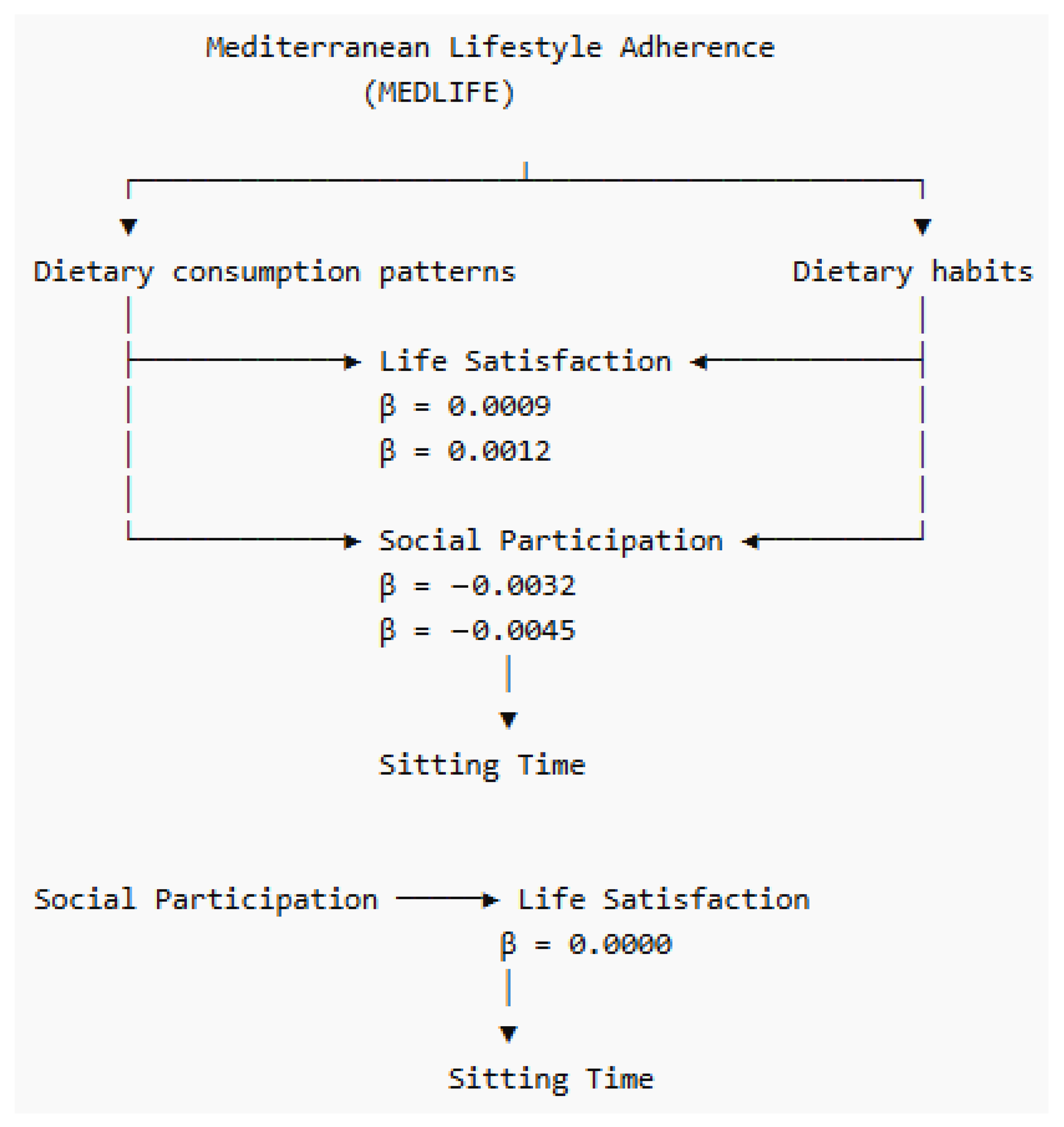
| A1: MEDLIFE dietary consumption patterns → SLSQ → sitting time | 0.0316 | 0.0009 | −0.0009 to 0.0030 |
| A2: MEDLIFE dietary habits → SLSQ → sitting time | 0.0778 | 0.0012 | −0.0032 to 0.0056 |
| B1: MEDLIFE dietary consumption patterns → SSPQ → Sitting time | −0.0860 | −0.0032 | −0.0070 to −0.0002 |
| B2: MEDLIFE dietary habits → SSPQ → Sitting time | −0.0898 | −0.0045 | −0.0098 to −0.0004 |
| C: Social participation → SLSQ → sitting time | 0.0143 | 0.0000 | −0.0011 to 0.0012 |
Disclaimer/Publisher’s Note: The statements, opinions and data contained in all publications are solely those of the individual author(s) and contributor(s) and not of MDPI and/or the editor(s). MDPI and/or the editor(s) disclaim responsibility for any injury to people or property resulting from any ideas, methods, instructions or products referred to in the content. |
© 2026 by the authors. Licensee MDPI, Basel, Switzerland. This article is an open access article distributed under the terms and conditions of the Creative Commons Attribution (CC BY) license.
Share and Cite
Ammar, A.; Salem, A.; Trabelsi, K.; Montalvan, M.; Bouaziz, B.; Boujelbane, M.A.; Kerkeni, M.; Masmoudi, L.; Ghazzawi, H.A.; Amawi, A.T.; et al. Physical Activity and Sedentary Behaviour in the MEDIET4ALL Study: Associations with Mediterranean Lifestyle, Sleep, and Psychosocial Well-Being, with Mediation Analyses. Sports 2026, 14, 186. https://doi.org/10.3390/sports14050186
Ammar A, Salem A, Trabelsi K, Montalvan M, Bouaziz B, Boujelbane MA, Kerkeni M, Masmoudi L, Ghazzawi HA, Amawi AT, et al. Physical Activity and Sedentary Behaviour in the MEDIET4ALL Study: Associations with Mediterranean Lifestyle, Sleep, and Psychosocial Well-Being, with Mediation Analyses. Sports. 2026; 14(5):186. https://doi.org/10.3390/sports14050186
Chicago/Turabian StyleAmmar, Achraf, Atef Salem, Khaled Trabelsi, Martha Montalvan, Bassem Bouaziz, Mohamed Ali Boujelbane, Mohamed Kerkeni, Liwa Masmoudi, Hadeel Ali Ghazzawi, Adam Tawfiq Amawi, and et al. 2026. "Physical Activity and Sedentary Behaviour in the MEDIET4ALL Study: Associations with Mediterranean Lifestyle, Sleep, and Psychosocial Well-Being, with Mediation Analyses" Sports 14, no. 5: 186. https://doi.org/10.3390/sports14050186
APA StyleAmmar, A., Salem, A., Trabelsi, K., Montalvan, M., Bouaziz, B., Boujelbane, M. A., Kerkeni, M., Masmoudi, L., Ghazzawi, H. A., Amawi, A. T., Orhan, B. E., Zambrano-Villacres, R., Heydenreich, J., Schallhorn, C., Driss, T., Frias-Toral, E., Zmijewski, P., Jahrami, H., Husain, W., ... Schöllhorn, W. I. (2026). Physical Activity and Sedentary Behaviour in the MEDIET4ALL Study: Associations with Mediterranean Lifestyle, Sleep, and Psychosocial Well-Being, with Mediation Analyses. Sports, 14(5), 186. https://doi.org/10.3390/sports14050186