
Biological Maturation Is Associated with Single-Leg Jump Performance, but Not with the Magnitude of Inter-Limb Asymmetry

 , , , ,
  and
and 
Abstract
1. Introduction
2. Materials and Methods
2.1. Subjects
length) + (0.007216 × age × sitting height) + (0.02292 × mass by stature ratio × 100)
2.2. Procedures
- Single-Leg Countermovement Jump (SL-CMJ)
- 2.
- Single-Leg Drop Jump from a 30 cm Box (SL-Drop jump)
- 3.
- Single-Leg Hop for Distance (Single-leg hop)
- 4.
- Triple Hop for Distance (Triple hop)
- 5.
- 6-Metre Timed Hop (6 m timed hop)
2.3. Statistical Analysis
3. Results
3.1. Anthropometry
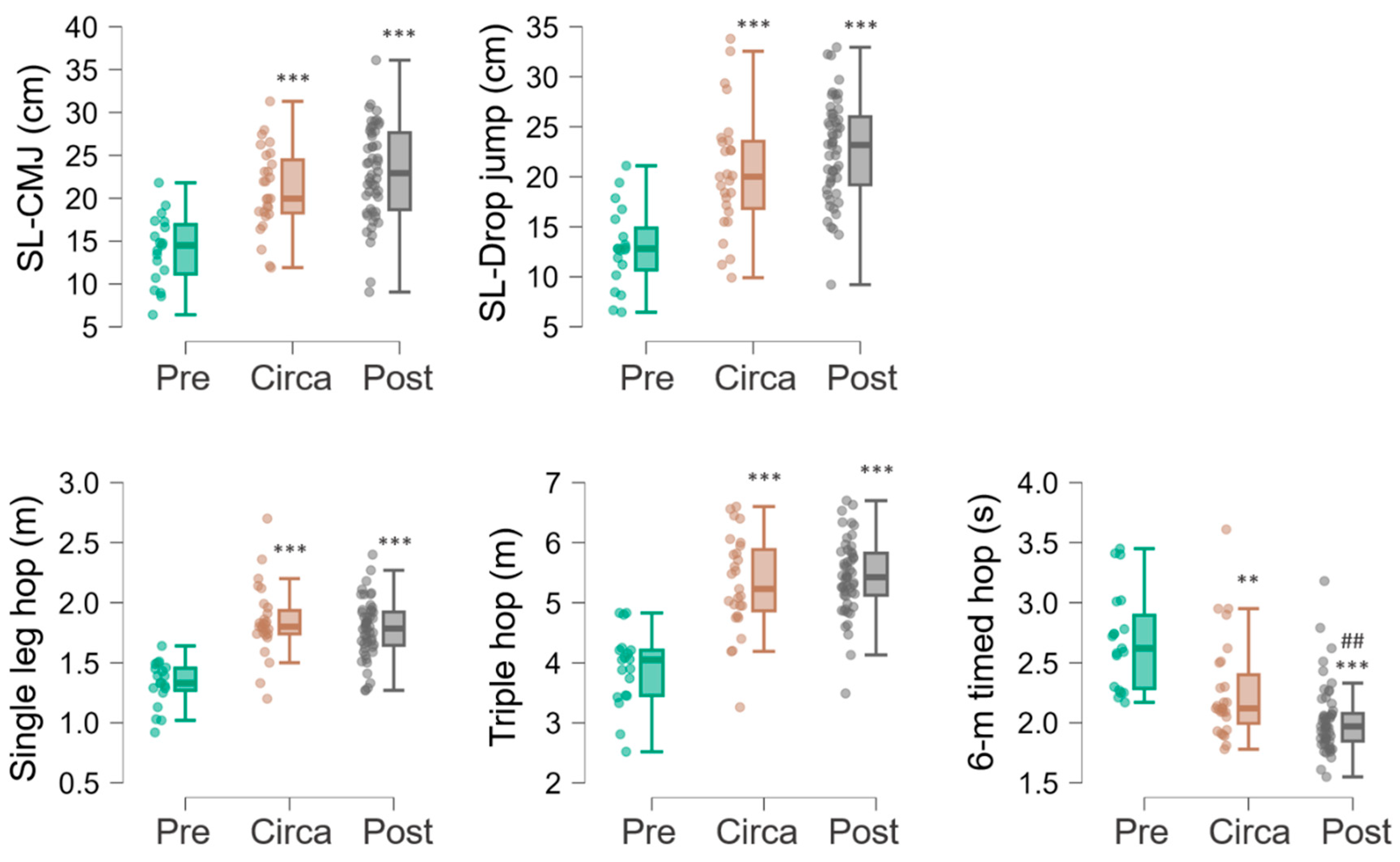
3.2. Effects of Maturation on Performance
3.3. Effects of Dominance on Performance
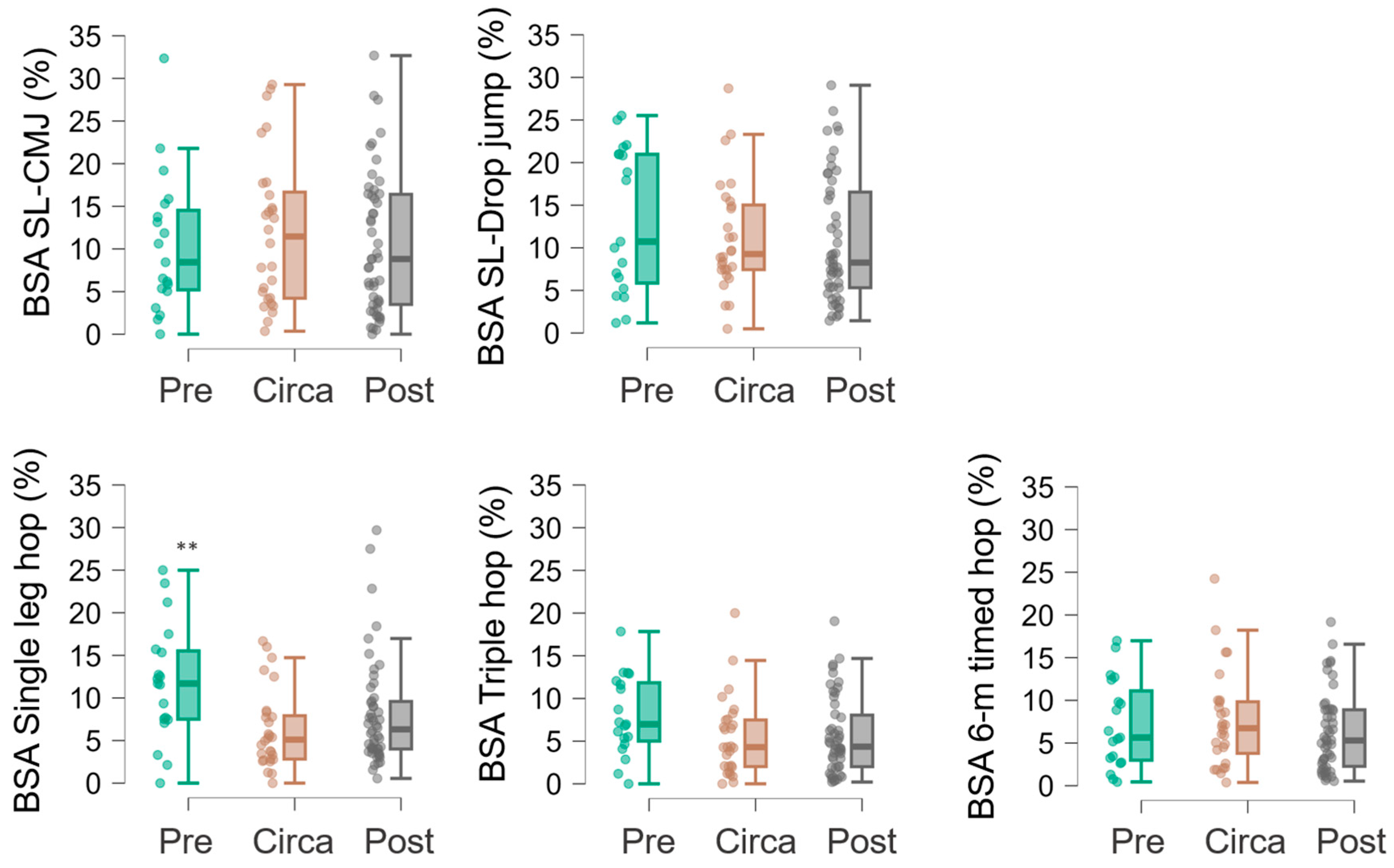
3.4. Effects of Maturation on BSA
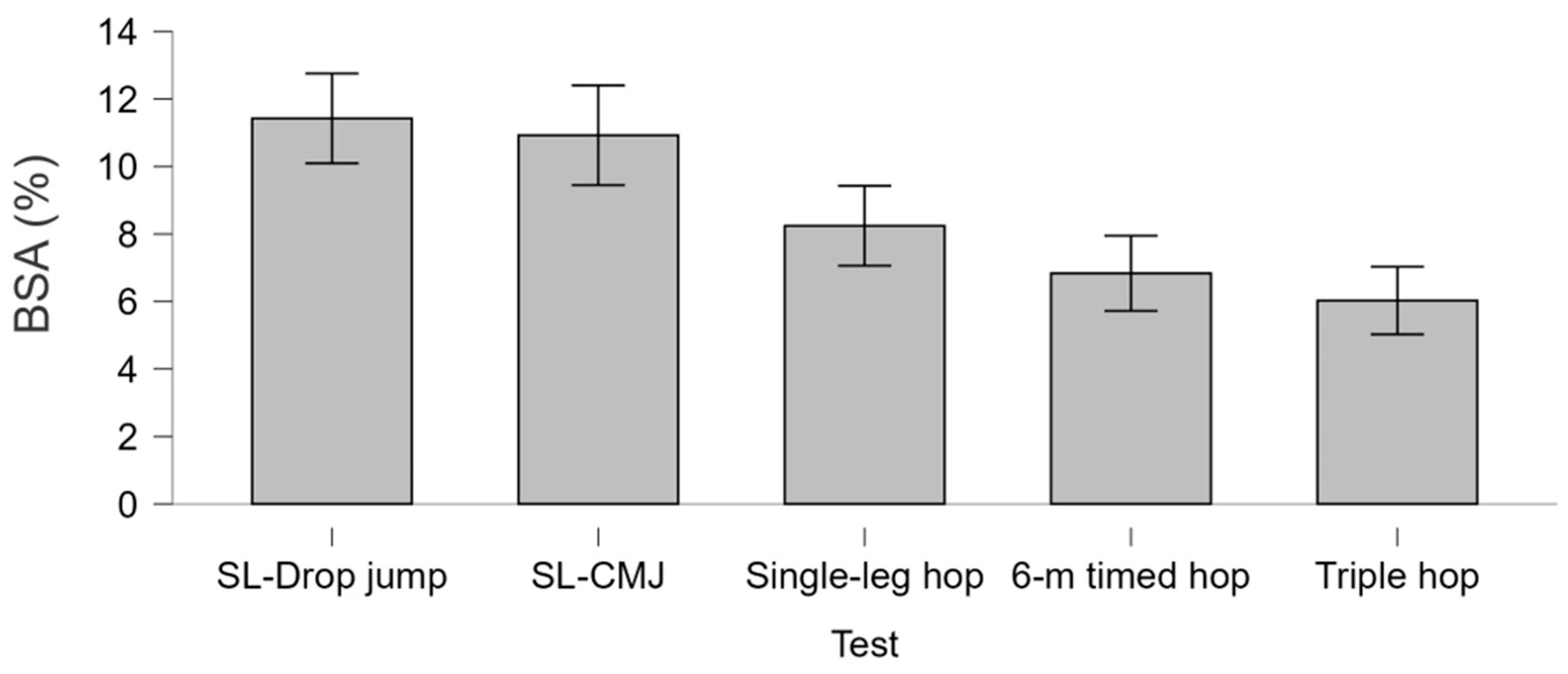
3.5. Agreement
3.6. Explorative Analysis
4. Discussion
5. Conclusions
Author Contributions
Funding
Institutional Review Board Statement
Informed Consent Statement
Data Availability Statement
Acknowledgments
Conflicts of Interest
References
- Afonso, J.; Peña, J.; Sá, M.; Virgile, A.; García-de-Alcaraz, A.; Bishop, C. Why Sports Should Embrace Bilateral Asymmetry: A Narrative Review. Symmetry 2022, 14, 1993. [Google Scholar] [CrossRef]
- Bishop, C.; Read, P.; McCubbine, J.; Turner, A. Vertical and Horizontal Asymmetries Are Related to Slower Sprinting and Jump Performance in Elite Youth Female Soccer Players. J. Strength Cond. Res. 2021, 35, 56–63. [Google Scholar] [CrossRef] [PubMed]
- Bishop, C.; Turner, A.; Read, P. Effects of Inter-Limb Asymmetries on Physical and Sports Performance: A Systematic Review. J. Sports Sci. 2018, 36, 1135–1144. [Google Scholar] [CrossRef] [PubMed]
- Maloney, S.J. The Relationship between Asymmetry and Athletic Performance: A Critical Review. J. Strength Cond. Res. 2019, 33, 2579–2593. [Google Scholar] [CrossRef] [PubMed]
- Guan, Y.; Bredin, S.S.D.; Taunton, J.; Jiang, Q.; Wu, N.; Warburton, D.E.R. Association between Inter-Limb Asymmetries in Lower-Limb Functional Performance and Sport Injury: A Systematic Review of Prospective Cohort Studies. J. Clin. Med. 2022, 11, 360. [Google Scholar] [CrossRef]
- Möck, S.; Happ, K.; Wirth, K. The Evaluation of Strength Imbalances as Risk Factor for Contactless Injuries of the Knee and Thigh: A Critical Review. J. Sports Med. Phys. Fit. 2023, 63, 685–695. [Google Scholar] [CrossRef]
- MacNeilage, P.F.; Rogers, L.J.; Vallortigara, G. Origins of the Left & Right Brain. Sci. Am. 2009, 301, 60–67. [Google Scholar] [CrossRef]
- Sainburg, R.L. Convergent Models of Handedness and Brain Lateralization. Front. Psychol. 2014, 5, 1092. [Google Scholar] [CrossRef]
- DeLang, M.D.; Rouissi, M.; Bragazzi, N.L.; Chamari, K.; Salamh, P.A. Soccer Footedness and Between-Limbs Muscle Strength: Systematic Review and Meta-Analysis. Int. J. Sports Physiol. Perform. 2019, 14, 551–562. [Google Scholar] [CrossRef]
- McGrath, T.M.; Waddington, G.; Scarvell, J.M.; Ball, N.B.; Creer, R.; Woods, K.; Smith, D. The Effect of Limb Dominance on Lower Limb Functional Performance: A Systematic Review. J. Sports Sci. 2016, 34, 289–302. [Google Scholar]
- Virgile, A.; Bishop, C. A Narrative Review of Limb Dominance: Task Specificity and the Importance of Fitness Testing. J. Strength Cond. Res. 2021, 35, 846–858. [Google Scholar] [CrossRef] [PubMed]
- Bishop, C.; Lake, J.; Loturco, I.; Papadopoulos, K.; Turner, A.N.; Read, P. Interlimb Asymmetries: The Need for an Individual Approach to Data Analysis. J. Strength Cond. Res. 2021, 35, 695–701. [Google Scholar] [CrossRef] [PubMed]
- Exell, T.A.; Irwin, G.; Gittoes, M.J.R.; Kerwin, D.G. Implications of Intra-Limb Variability on Asymmetry Analyses. J. Sports Sci. 2012, 30, 403–409. [Google Scholar] [CrossRef]
- Kozinc, Ž.; Šarabon, N. Inter-Limb Asymmetries in Volleyball Players: Differences between Testing Approaches and Association with Performance. J. Sports Sci. Med. 2020, 19, 745–752. [Google Scholar] [PubMed]
- Kuki, S.; Konishi, Y.; Okudaira, M.; Yoshida, T.; Exell, T.; Tanigawa, S. Asymmetry of Force Generation and Neuromuscular Activity during Multi-Joint Isometric Exercise. J. Phys. Fit. Sports Med. 2019, 8, 37–44. [Google Scholar] [CrossRef]
- Gonzalo-Skok, O.; Dos’Santos, T.; Bishop, C. Assessing Limb Dominance and Interlimb Asymmetries over Multiple Angles during Change of Direction Speed Tests in Basketball Players. J. Strength Cond. Res. 2023, 37, 2423–2430. [Google Scholar] [CrossRef]
- Bishop, C.; Pereira, L.A.; Reis, V.P.; Read, P.; Turner, A.N.; Loturco, I. Comparing the Magnitude and Direction of Asymmetry during the Squat, Countermovement and Drop Jump Tests in Elite Youth Female Soccer Players. J. Sports Sci. 2020, 38, 1296–1303. [Google Scholar] [CrossRef]
- Lepley, L.K. Deficits in Quadriceps Strength and Patient-Oriented Outcomes at Return to Activity after ACL Reconstruction: A Review of the Current Literature. Sports Health 2015, 7, 231–238. [Google Scholar] [CrossRef]
- Möck, S.; Wirth, K. Bilateral Differences of Isokinetic Knee Extensor Strength Are Velocity- and Task-Dependent. Sports Biomech. 2024, 23, 3641–3653. [Google Scholar] [CrossRef]
- Eisenmann, J.C.; Till, K.; Baker, J. Growth, Maturation and Youth Sports: Issues and Practical Solutions. Ann. Hum. Biol. 2020, 47, 324–327. [Google Scholar] [CrossRef]
- Lyu, M.; Chen, Z.; Deng, S.; Ding, L.; Han, J.; Bishop, C.; Li, Y. Asymmetry of the Single Leg Jump and Lateral Shuffle Performance in Pre-Juvenile Basketball Players. J. Hum. Kinet. 2025, 96, 109–119. [Google Scholar] [CrossRef] [PubMed]
- Read, P.J.; Oliver, J.L.; Myer, G.D.; De Ste Croix, M.B.A.; Lloyd, R.S. The Effects of Maturation on Measures of Asymmetry during Neuromuscular Control Tests in Elite Male Youth Soccer Players. Pediatr. Exerc. Sci. 2018, 30, 168–175. [Google Scholar] [CrossRef] [PubMed]
- Baker, J.; Read, P.; Graham-Smith, P.; Cardinale, M.; Jones, T.W. Differences in Sprinting and Jumping Performance between Maturity Status Groups in Youth: A Systematic Review and Meta-Analysis. Sports Med. 2025, 55, 1405–1427. [Google Scholar] [CrossRef] [PubMed]
- Perroni, F.; Amatori, S.; Corsi, L.; Bensi, R.; Guidetti, L.; Baldari, C.; Rocchi, M.B.L.; Castagna, C.; Gobbi, E.; Sisti, D.; et al. Assessment of Performance in Youth Soccer Players: Should We Consider the Maturation Status? J. Hum. Kinet. 2024, 93, 119–131. [Google Scholar] [CrossRef]
- Bouafif, N.; Hammami, R.; Mahmoudi, A.; Jiménez-Martínez, P.; Alix-Fages, C.; Garcia-Ramos, A.; Juesas, A.; Gene-Morales, J.; Gaied-Chortane, S.; Colado, J.C. Reliability of Single-Leg Maximal Dynamic Strength Performance and Inter-Limb Asymmetries in Pre-Pubertal Soccer Players: The Influence of Maturity in Asymmetries. Heliyon 2024, 10, e38716. [Google Scholar] [CrossRef]
- Robles-Palazón, F.J.; McMahon, J.J.; Ayala, F.; Comfort, P. Things to Keep in Mind When Selecting Physical Assessments in Youth Soccer: Correlations between Test Performances, Interlimb Asymmetries, and Effects of Maturation. PLoS ONE 2024, 19, e0305570. [Google Scholar] [CrossRef]
- Asimakidis, N.D.; Dalamitros, A.A.; Ribeiro, J.; Lola, A.C.; Manou, V. Maturation Stage Does Not Affect Change of Direction Asymmetries in Young Soccer Players. J. Strength Cond. Res. 2022, 36, 3440–3445. [Google Scholar] [CrossRef]
- Mainer-Pardos, E.; Bishop, C.; Gonzalo-Skok, O. Seasonal Variations in Performance and Asymmetry Data for Jump and Change of Direction Abilities in Female Soccer Players. J. Strength Cond. Res. 2024, 38, 1768–1777. [Google Scholar] [CrossRef]
- Cadens, M.; Planas-Anzano, A.; Peirau-Terés, X.; Bishop, C.; Romero-Rodríguez, D.; Madruga-Parera, M. Relationship between Asymmetry Profiles and Jump Performance in Youth Female Handball Players. J. Hum. Kinet. 2023, 88, 5–16. [Google Scholar] [CrossRef]
- Lopez-Valenciano, A.; Ayala, F.; De Ste Croix, M.B.; Barbado, D.; Moreno-Perez, V.; Sanz-Rivas, D.; Fernandez-Fernandez, J. The Association between Chronological Age and Maturity Status on Lower Body Clinical Measurements and Asymmetries in Elite Youth Tennis Players. Sports Health 2023, 15, 250–259. [Google Scholar] [CrossRef]
- Madruga-Parera, M.; Romero-Rodríguez, D.; Bishop, C.; Beltran-Valls, M.R.; Latinjak, A.T.; Beato, M.; Fort-Vanmeerhaeghe, A. Effects of Maturation on Lower Limb Neuromuscular Asymmetries in Elite Youth Tennis Players. Sports 2019, 7, 106. [Google Scholar] [CrossRef] [PubMed]
- D’Hondt, J.; Chapelle, L. Change of Direction Asymmetry in Youth Elite Tennis Players: A Longitudinal Study. Int. J. Sports Med. 2024, 45, 436–442. [Google Scholar] [CrossRef] [PubMed]
- Monasterio, X.; Gil, S.; Bidaurrazaga-Letona, I.; Lekue, J.A.; Diaz-Beitia, G.; Santisteban, J.M.; Lee, D.-J.; Zumeta-Olaskoaga, L.; Martin-Garetxana, I.; Larruskain, J. Peak Height Velocity Affects Injury Burden in Circa-PHV Soccer Players. Int. J. Sports Med. 2023, 44, 292–297. [Google Scholar] [CrossRef] [PubMed]
- Mala, L.; Hank, M.; Stastny, P.; Zahalka, F.; Ford, K.; Zmijewski, P.; Bujnovsky, D.; Petr, M.; Maly, T. Elite Young Soccer Players Have Smaller Inter-Limb Asymmetry and Better Body Composition than Non-Elite Players. Biol. Sport 2023, 40, 265–272. [Google Scholar] [CrossRef]
- Gonzalo-Skok, O.; Bishop, C. Effects of Maturation on the Magnitude and Direction of Asymmetry in Jumping and Change of Direction Speed in Young Elite Football Players. J. Strength Cond. Res. 2025, 39, 70–78. [Google Scholar] [CrossRef]
- Mirwald, R.L.; Baxter-Jones, A.D.G.; Bailey, D.A.; Beunen, G.P. An Assessment of Maturity from Anthropometric Measurements. Med. Sci. Sports Exerc. 2002, 34, 689–694. [Google Scholar]
- Khamis, H.J.; Roche, A.F. Predicting Adult Stature without Using Skeletal Age: The Khamis-Roche Method. Pediatrics 1994, 94, 504–507. [Google Scholar] [CrossRef]
- Towlson, C.; Salter, J.; Ade, J.D.; Enright, K.; Harper, L.D.; Page, R.M.; Malone, J.J. Maturity-Associated Considerations for Training Load, Injury Risk, and Physical Performance in Youth Soccer: One Size Does Not Fit All. J. Sport Health Sci. 2021, 10, 403–412. [Google Scholar] [CrossRef]
- van Melick, N.; Meddeler, B.M.; Hoogeboom, T.J.; Nijhuis-van der Sanden, M.W.G.; van Cingel, R.E.H. How to Determine Leg Dominance: The Agreement between Self-Reported and Observed Performance in Healthy Adults. PLoS ONE 2017, 12, e0189876. [Google Scholar] [CrossRef]
- González-García, J.; Conejero, M.; Gutiérrez-Hellín, J. Assessing Jump Performance: Intra- and Interday Reliability and Minimum Difference of Countermovement Jump and Drop Jump Outcomes, Kinetics, Kinematics, and Jump Strategy. Appl. Sci. 2024, 14, 2662. [Google Scholar] [CrossRef]
- Dingenen, B.; Truijen, J.; Bellemans, J.; Gokeler, A. Test-Retest Reliability and Discriminative Ability of Forward, Medial and Rotational Single-Leg Hop Tests. Knee 2019, 26, 978–987. [Google Scholar] [CrossRef]
- Ripic, Z.; Letter, M.; Schoenwether, B.; Kaplan, L.D.; Baraga, M.G.; Costello, J.P., II; Eskenazi, J.; Dennison, M.; Best, T.M.; Signorile, J.F. A Hop Testing Alternative for Functional Performance Following Anterior Cruciate Ligament Reconstruction. PLoS ONE 2024, 19, e0309003. [Google Scholar] [CrossRef] [PubMed]
- Impellizzeri, F.M.; Rampinini, E.; Maffiuletti, N.; Marcora, S.M. A Vertical Jump Force Test for Assessing Bilateral Strength Asymmetry in Athletes. Med. Sci. Sports Exerc. 2007, 39, 2044–2050. [Google Scholar] [CrossRef] [PubMed]
- Bishop, C.; Read, P.; Lake, J.; Chavda, S.; Turner, A. Interlimb Asymmetries: Understanding How to Calculate Differences from Bilateral and Unilateral Tests. Strength Cond. J. 2018, 40, 1–6. [Google Scholar] [CrossRef]
- Helme, M.; Bishop, C.; Emmonds, S.; Low, C. Validity and Reliability of the Rear Foot Elevated Split Squat 5 Repetition Maximum to Determine Unilateral Leg Strength Symmetry. J. Strength Cond. Res. 2019, 33, 3269–3275. [Google Scholar] [CrossRef]
- Hopkins, W.G.; Marshall, S.W.; Batterham, A.M.; Hanin, J. Progressive Statistics for Studies in Sports Medicine and Exercise Science. Med. Sci. Sports Exerc. 2009, 41, 3–12. [Google Scholar] [CrossRef]
- Cohen, J. A Coefficient of Agreement for Nominal Scales. Educ. Psychol. Meas. 1960, 20, 37–46. [Google Scholar] [CrossRef]
- Landis, J.R.; Koch, G.G. The Measurement of Observer Agreement for Categorical Data. Biometrics 1977, 33, 159–174. [Google Scholar] [CrossRef]
- Viera, A.J.; Garrett, J.M. Understanding Interobserver Agreement: The Kappa Statistic. Fam. Med. 2005, 37, 360–363. [Google Scholar]
- Jones, M.A.; Hitchen, P.J.; Stratton, G. The Importance of Considering Biological Maturity When Assessing Physical Fitness Measures in Girls and Boys Aged 10 to 16 Years. Ann. Hum. Biol. 2000, 27, 57–65. [Google Scholar] [CrossRef]
- Radnor, J.M.; Staines, J.; Bevan, J.; Cumming, S.P.; Kelly, A.L.; Lloyd, R.S.; Oliver, J.L. Maturity Has a Greater Association than Relative Age with Physical Performance in English Male Academy Soccer Players. Sports 2021, 9, 171. [Google Scholar] [CrossRef]
- de la Rubia, A.; Molina-Martin, J.J.; Muriarte-Solana, D.; Veiga, S.; Nieto-Acevedo, R.; Lopez-Serrano, C. Examining the Role of Maturity Status on Physical Performance: A Case Study in the Spanish Volleyball Talent Development Programme. Int. J. Sports Sci. Coach. 2025, 20, 1707–1716. [Google Scholar] [CrossRef]
- Çakır, H.İ.; Kayhan, R.F.; Terzi, E. Age-Related Bilateral and Unilateral Lower Extremity Strength Imbalances in Elite Soccer. Int. J. Sports Med. 2025, 46, 918–926. [Google Scholar] [CrossRef] [PubMed]
- Lloyd, R.S.; Oliver, J.L.; Faigenbaum, A.D.; Myer, G.D.; De Ste Croix, M.B.A. Chronological Age vs. Biological Maturation: Implications for Exercise Programming in Youth. J. Strength Cond. Res. 2014, 28, 1454–1464. [Google Scholar] [CrossRef] [PubMed]
- Sheehan, D.P.; Lienhard, K. Gross Motor Competence and Peak Height Velocity in 10- to 14-Year-Old Canadian Youth: A Longitudinal Study. Meas. Phys. Educ. Exerc. Sci. 2019, 23, 89–98. [Google Scholar] [CrossRef]
- Bishop, C.; Weldon, A.; Hughes, J.; Brazier, J.; Loturco, I.; Turner, A.; Read, P. Seasonal Variation of Physical Performance and Inter-Limb Asymmetry in Professional Cricket Athletes. J. Strength Cond. Res. 2021, 35, 941–948. [Google Scholar] [CrossRef]
- D’Hondt, J.; Vanhoudt, M.; Dani, M.; Chapelle, L.; Aerenhouts, D. Does a Muscle Fatigue-Inducing Protocol Alter the Magnitude of Jump Inter-Limb Asymmetry in Healthy Adolescents? J. Hum. Kinet. 2025. advance online publication. [Google Scholar] [CrossRef]
- Gustavsson, A.; Neeter, C.; Thomeé, P.; Grävare Silbernagel, K.; Augustsson, J.; Thomeé, R.; Karlsson, J. A Test Battery for Evaluating Hop Performance in Patients with an ACL Injury and Patients Who Have Undergone ACL Reconstruction. Knee Surg. Sports Traumatol. Arthrosc. 2006, 14, 778–788. [Google Scholar] [CrossRef]
- Ohji, S.; Aizawa, J.; Hirohata, K.; Ohmi, T.; Kawasaki, T.; Koga, H.; Yagishita, K. Relationship between Single-Leg Vertical Jump and Drop Jump Performance, and Return to Sports after Primary Anterior Cruciate Ligament Reconstruction Using Hamstring Graft. Int. J. Sports Phys. Ther. 2024, 19, 1204. [Google Scholar] [CrossRef]
- Kotsifaki, A.; Van Rossom, S.; Whiteley, R.; Korakakis, V.; Bahr, R.; Sideris, V.; Jonkers, I. Single Leg Vertical Jump Performance Identifies Knee Function Deficits at Return to Sport after ACL Reconstruction in Male Athletes. Br. J. Sports Med. 2022, 56, 490–498. [Google Scholar] [CrossRef]
- Giacomazzo, Q.; Picot, B.; Chamu, T.; Samozino, P.; Pairot de Fontenay, B. Impaired Symmetry in Single-Leg Vertical Jump and Drop Jump Performance 7 Months after ACL Reconstruction. Orthop. J. Sports Med. 2024, 12, 23259671241263794. [Google Scholar] [CrossRef]
- Wang, I.-L.; Lai, C.-T.; Su, Y.; Gu, C.-Y. Analysis of Lower Limb Asymmetry in Drop Jumps from Different Heights. J. Hum. Kinet. 2025, 98, 57–66. [Google Scholar] [CrossRef]
- Panoutsakopoulos, V.; Schwarz, A.V.; Merkou, E.; Savvoulidis, S.; Kotzamanidou, M.C.; Papadakis, Z. Handgrip Strength Asymmetry in Female Basketball Players: The Critical Role of Arm Position and the Challenge of Statistical Power. Sports 2025, 13, 279. [Google Scholar] [CrossRef]
- Malina, R.M. Physical Growth and Biological Maturation of Young Athletes. Exerc. Sport Sci. Rev. 1994, 22, 280–284. [Google Scholar] [CrossRef]
- Moore, S.A.; McKay, H.A.; Macdonald, H.; Nettlefold, L.; Baxter-Jones, A.D.G.; Cameron, N.; Brasher, P.M.A. Enhancing a Somatic Maturity Prediction Model. Med. Sci. Sports Exerc. 2015, 47, 1755–1764. [Google Scholar] [CrossRef]



| Pre-PHV n = 19 | Circa-PHV n = 29 | Post-PHV n = 52 | |
|---|---|---|---|
| Weight (kg) | 47.6 ± 9.0 | 61.7 ± 10.2 *** | 75.5 ± 9.2 ***### |
| Stature (cm) | 150.7 ± 10.3 | 169.1 ± 7.2 *** | 183.4 ± 6.3 ***### |
| Sitting Height (cm) | 75.6 ± 6.9 | 83.1 ± 3.3 *** | 91.2 ± 3.4 ***### |
| Chronological age (yrs) | 11.6 ± 1.0 | 13.9 ± 0.9 *** | 16.7 ± 1.2 ***### |
| Predicted adult height (PAH) (%) | 83.8 ± 5.1 | 93.3 ± 3.1 *** | 100.3 ± 3.6 ***### |
| Dominant | Non-Dominant | BSA (%) | Participant Favouring Non-Dominant/Symmetric/Dominant Limb (%) | p Value for Maturation | p Value for Dominance | p Value for Interaction | ||
|---|---|---|---|---|---|---|---|---|
| SL-CMJ (cm) | Pre-PHV | 14.2 ± 4.4 | 13.6 ± 3.7 | 10.4 ± 8.1 | 33/38/29 | 0.635 | ||
| Circa-PHV | 20.8 ± 5.5 *** | 20.4 ± 5.2 *** | 12.1 ± 8.7 | <0.001 | 0.350 | |||
| Post-PHV | 22.9 ± 5.8 *** | 23.0 ± 5.5 *** | 10.5 ± 8.1 | |||||
| SL-Drop jump (cm) | Pre-PHV | 12.9 ± 4.2 | 12.8 ± 4.1 | 13.3 ± 8.5 | 41/30/29 | 0.514 | ||
| Circa-PHV | 20.5 ± 6.4 *** | 19.4 ± 6.0 *** | 12.3 ± 8.0 | <0.001 | 0.065 | |||
| Post-PHV | 22.9 ± 5.2 *** | 22.2 ± 5.5 *** | 11.5 ± 8.2 | |||||
| Single-leg hop (m) | Pre-PHV | 1.38 ± 0.20 | 1.26 ± 0.20 $ | 11.8 ± 6.9 | 46/24/30 | 0.172 | ||
| Circa-PHV | 1.82 ± 0.30 *** | 1.80 ± 0.34 *** | 6.4 ± 4.7 | <0.001 | 0.011 | |||
| Post-PHV | 1.79 ± 0.29 *** | 1.76 ± 0.23 *** | 8.2 ± 6.2 | |||||
| Triple hop (m) | Pre-PHV | 3.91 ± 0.65 | 3.87 ± 0.66 | 7.9 ± 4.7 | 35/34/31 | 0.885 | ||
| Circa-PHV | 5.22 ± 0.93 *** | 5.22 ± 0.96 *** | 5.8 ± 4.8 | <0.001 | 0.431 | |||
| Post-PHV | 5.45 ± 0.67 *** | 5.40 ± 0.63 *** | 6.0 ± 4.8 | |||||
| 6 m timed hop (s) | Pre-PHV | 2.66 ± 0.36 | 2.70 ± 0.49 | 7.2 ± 5.2 | 24/44/32 | 0.758 | ||
| Circa-PHV | 2.33 ± 0.62 ** | 2.35 ± 0.64 ** | 7.9 ± 5.5 | <0.001 | 0.465 | |||
| Post-PHV | 2.02 ± 0.31 *** | 2.01 ± 0.30 *** | 6.7 ± 6.2 | |||||
| Test 1 | Test 2 | Exact Agreement | Kappa |
|---|---|---|---|
| Single-leg hop | SL-CMJ | 49% | 0.291 |
| Single-leg hop | Triple hop | 48% | 0.276 |
| SL-Drop jump | Triple hop | 48% | 0.239 |
| SL-Drop jump | Single-leg hop | 48% | 0.230 |
| SL-Drop jump | SL-CMJ | 47% | 0.251 |
| Triple hop | SL-CMJ | 36% | 0.080 |
| 6 m timed hop | SL-Drop jump | 31% | −0.026 |
| 6 m timed hop | SL-CMJ | 30% | −0.100 |
| 6 m timed hop | Single-leg hop | 28% | −0.102 |
| 6 m timed hop | Triple hop | 28% | −0.125 |
Disclaimer/Publisher’s Note: The statements, opinions and data contained in all publications are solely those of the individual author(s) and contributor(s) and not of MDPI and/or the editor(s). MDPI and/or the editor(s) disclaim responsibility for any injury to people or property resulting from any ideas, methods, instructions or products referred to in the content. |
© 2026 by the authors. Licensee MDPI, Basel, Switzerland. This article is an open access article distributed under the terms and conditions of the Creative Commons Attribution (CC BY) license.
Share and Cite
Boccia, G.; Paurini, G.; Villano, D.; Marocco, R.; Ungureanu, A.N.; Beratto, L.; Brustio, P.R.; Rainoldi, A.; Lupo, C. Biological Maturation Is Associated with Single-Leg Jump Performance, but Not with the Magnitude of Inter-Limb Asymmetry. Sports 2026, 14, 163. https://doi.org/10.3390/sports14040163
Boccia G, Paurini G, Villano D, Marocco R, Ungureanu AN, Beratto L, Brustio PR, Rainoldi A, Lupo C. Biological Maturation Is Associated with Single-Leg Jump Performance, but Not with the Magnitude of Inter-Limb Asymmetry. Sports. 2026; 14(4):163. https://doi.org/10.3390/sports14040163
Chicago/Turabian StyleBoccia, Gennaro, Giulia Paurini, Daniele Villano, Roberto Marocco, Alexandru Nicolae Ungureanu, Luca Beratto, Paolo Riccardo Brustio, Alberto Rainoldi, and Corrado Lupo. 2026. "Biological Maturation Is Associated with Single-Leg Jump Performance, but Not with the Magnitude of Inter-Limb Asymmetry" Sports 14, no. 4: 163. https://doi.org/10.3390/sports14040163
APA StyleBoccia, G., Paurini, G., Villano, D., Marocco, R., Ungureanu, A. N., Beratto, L., Brustio, P. R., Rainoldi, A., & Lupo, C. (2026). Biological Maturation Is Associated with Single-Leg Jump Performance, but Not with the Magnitude of Inter-Limb Asymmetry. Sports, 14(4), 163. https://doi.org/10.3390/sports14040163