


Abstract
Elastic resistance exercise is a popular mode of strength training that has demonstrated positive effects on whole-body strength and performance. The purpose of this work was to identify the efficacy of elastic resistance training on improving upper limb strength and performance measures for the shoulder. Seven online databases were searched with a focus on longitudinal studies assessing shoulder elastic training strength interventions. In total, 1367 studies were initially screened for relevancy; 24 full-text articles were included for review. Exercise interventions ranged from 4–12 weeks, assessing pre-/post-strength and performance measures inclusive of isometric and isokinetic strength, 1RM strength, force-velocity tests, and throwing-velocity tests. Significant increases in various isometric strength measures (IR:11–13%, ER:11–42%, FL: 14–36%, EXT: 4–17%, ABD: 8–16%), 1RM strength (~24% in bench press), force-velocities, throwing- and serve-velocities (12%) were all observed. Elastic resistance training elicited positive effects for both strength and performance parameters regardless of intervention duration. Similar significant increases were observed in isometric strength and 1RM strength across durations. Isokinetic strength increases were variable and dependent on the joint velocity conditions. Quantifying the dosage of appropriate exercise prescription for optimal strength and performance gains is inconclusive with this study due to the heterogeneity of the intervention protocols.
1. Introduction
Strength training provides a multitude of health and performance benefits. This training involves a diverse range of movements that require the muscles to counteract some form of resistance or force. The use of this training method enables improvements in static and dynamic muscle function, bone strength and formation, joint range of motion, joint stability [1], and athletic performance while decreasing injury risk [2,3,4]. These same benefits hold true across the lifespan, with demonstrated improvements in both young and old participant populations [1,3,4,5,6]. While many strength training modalities are available, differences exist in the volume of research across modalities and the efficacy of their long-term use as a training methodology.
Elastic resistance training (ERT) is a popular method of resistance training. This type of training enables users to perform functional movements in any direction, alternative to traditional free weights, which provide an external force for the muscles against gravity. Upper extremity ERT typically involves attaching the band to a wall or post, standing at a distance to create tension in the band while performing rectilinear, curvilinear, or circular motions with each arm. This can facilitate increases in maximum torque production and stabilization at the shoulder [5,7]. ERT has sport-specific utility; overhead athletes have used elastic resistance to mimic throwing motions including external rotation and abduction movements during warmup [8]. Continued research on elastic resistance has elaborated on muscle activation differences, particularly in posture examinations and the use of single- and dual-vector elastic setups [9,10].
ERT is a viable mode of resistance training to employ in strengthening and rehabilitation programs due to its low cost, versatility, and applicability to all populations. This method of resistance training has received support for its simplicity and feasibility among elderly populations [11,12], effective home-based programs [13,14], and for its usefulness in advanced lifters and athletic populations by providing a varied form of resistance [15,16]. Elastic bands have diverse training applications, including speed and agility training, stretching, plyometric training, and reactive neuromuscular training [17]. The simplicity, versatility, and inexpensiveness of elastic bands for training could combat the commonly perceived barriers to strength training such as the fear of injury, high costs of training equipment, and the intimidation of using fitness facilities [18].
The effects of this type of training on whole-body muscle strength have previously been explored [19,20], but the efficacy of this specific type of training on isokinetic and isometric strength measures of the shoulder remains unknown. Strength gains observed with single-joint and multi-joint elastic resistance exercises have shown to be comparable to that of conventional resistance training [19,21,22,23,24]. The effects of resistance training have been documented to be affected by the sex, health status, and initial strength capability of the user, and should be considered in the context of this treatment method. A comprehensive analysis of elastic training and its effects on shoulder strength would provide clinicians, rehabilitation specialists, and strength and conditioning coaches with information to determine its utility for their clients. The purpose of this review was to assess the current literature on elastic resistance training and collate its findings to determine its efficacy on shoulder strength and performance parameters.
2. Materials and Methods
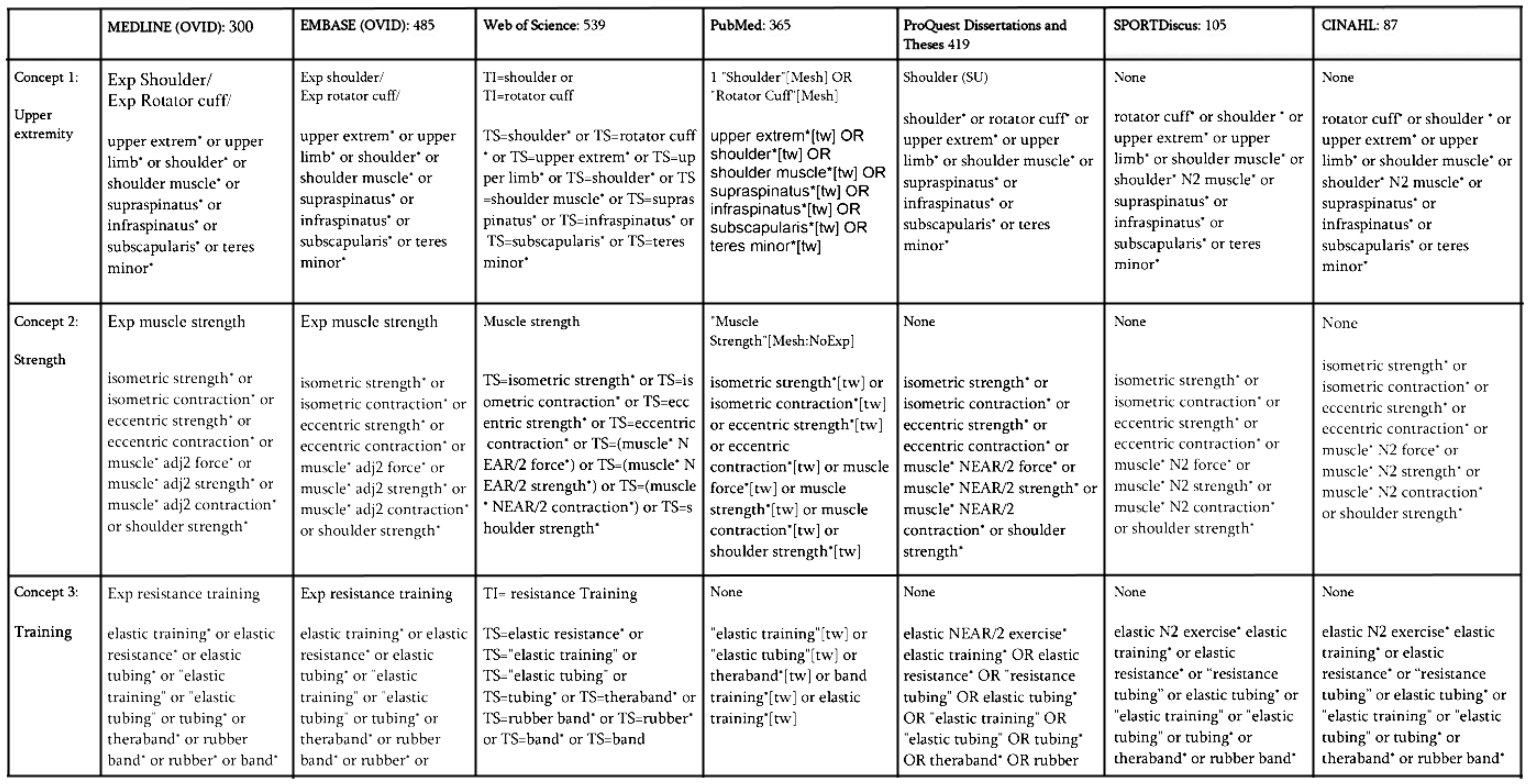
A search was devised by considering the main topics of interest and carefully selecting keywords to efficiently extract articles from each database. Seven databases in total were searched on 11 December 2020, including MEDLINE, Embase, Web of Science, PubMed, ProQuest Dissertations and Theses, SPORTDiscus and CINAHL. The search strategy was critiqued and revised by the institutional Library staff to formulate a finalized search string (Figure 1). The search was comprised of a combination of three classifications with their affiliated keywords; these sections were focused on the upper extremity, strength, and performance measures, and the elastic resistance training modality. The study was registered to PROSPERO (ID: CRD42021236849).
Figure 1.
Search string entries for all databases. * represents a wildcard operator to increase the possible number of search terms that contain the preceding letters (e.g. ‘shoulder’ and ‘shoulders’ are both returned by shoulder *). N2 means that the words appear within two words of each other.
All articles were screened for eligibility to be included within this review. Included were randomized control trials, systematic reviews/meta-analyses, cohort studies, and theses. No restrictions on publication dates were applied. A minimum training regimen of twice weekly for 4 weeks with pre- and post- regimen strength or performance metrics was required for randomized control trial inclusion. The strength and performance parameters could include isokinetic or isometric strength assessments, one-repetition maximum (1RM) testing, force-velocity tests, or throwing-velocity tests. The participant population was limited to healthy subjects of all ages. Exclusion criteria involved incorrect study design, patient populations with shoulder pathologies or known adverse health conditions, or outcome measures that did not assess pre- and post-muscular strength.
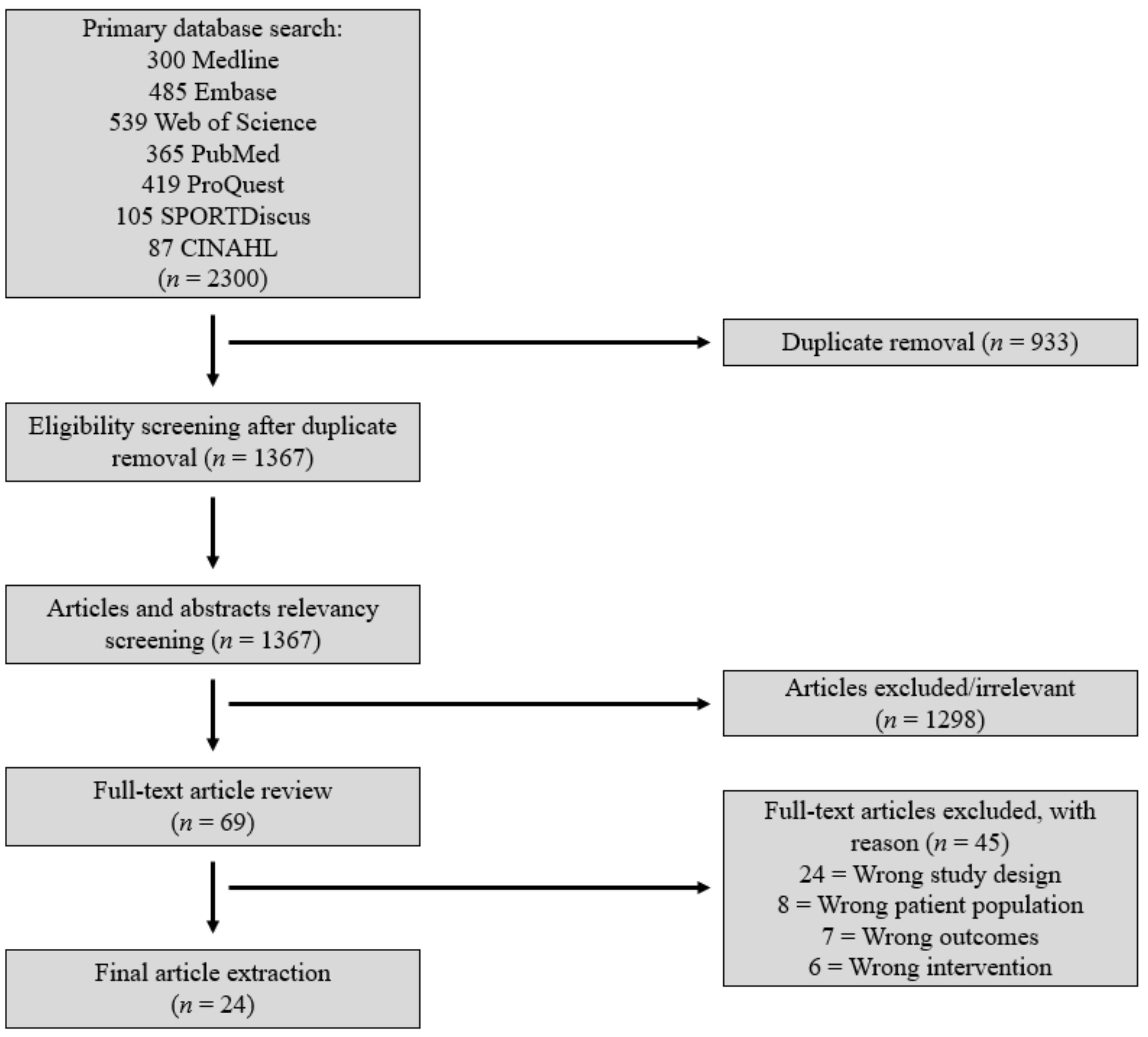
A multi-step screening process was applied to arrive at the final selection of studies for full-text analysis and data extraction. Initial database searches were conducted by the primary author and were subsequently extracted and screened according to the inclusion/exclusion criteria. The articles were then uploaded to Covidence (Veritas Health Innovation Ltd., Melbourne, Australia) to manage screening processes. Abstract and title screening was conducted first by two independent reviewers, with a third independent reviewer to resolve reviewer decision conflicts. Following the initial screening, eligible articles were assessed using a full-text screen with identical criteria and conflict resolution methods as the first round (Figure 2). All articles that passed the second round of screening were the final studies included for data extraction.
Figure 2.
All titles collected through database searches were screened for eligibility; article dispersion is described through this process flowchart.
A modified Downs and Black quality checklist [25] was used to assess the methodological quality of each study that was extracted; fourteen criteria from this checklist were utilized. Each study was given a score for each criterion with “yes” = 1, “no/unable to determine” = 0, and a total score out of 14 was yielded. The threshold for adequate quality was a score of 7; any article with a score lower than this was excluded from the review. The ratings of each article are provided in Table 1.
Table 1.
Modified Downs and Black methodological quality assessment 1.
All studies were assessed for potential risks of bias by using the Risk Of Bias In Non-randomised Studies [47] (Table 2). The level of bias assigned to each study was formulated from seven domains: The randomization process, intervention deviations, absence of outcome data, measurements of outcomes, and the reported selection of results. Escalating ratings were described as low (L), moderate (M), serious (S), and critical (C). Bias ratings were totaled based on the highest rating within the seven categories.
Table 2.
Risk of bias assessments following criteria from ROBINS-I tool 2.
The principal summary measure extracted from all included articles was the differences in pre- and post-test mean strength and performance measures. These measures were divided into five main categories, with strength-based measures including isokinetic strength, isometric strength, and 1RM strength, as well as two performance measures of throwing-velocity and force-velocity tests. A percent-change was calculated from the pre-/post-strength and performance measures to normalize increases or decreases of the parameters being measured that occurred over the strength training protocol. This allowed for quantification in strength and performance gains and uniformity of the different variables of performance and strength measurements.
3. Results
3.1. Study Selection
Collectively, 1367 studies were extracted through initial database retrieval; 24 articles were extracted for assessment following the screening. A detailed flowchart of article screening is detailed in Figure 2. Each article included in the review had data extraction through six key components deemed essential for appropriate analysis of this strength intervention, which included the participant pool, study duration, elastic training intervention exercises, session details, mode of strength measurement, and strength quantification pre- and post-intervention. A full table and the characteristics for each respective study can be found in Appendix A.
3.2. Participant Pool
The ages of the participants within the studies were variable, ranging between adolescents >18years of age [26,28,31,32,39,40,46] to elderly patients <65 years of age [33,42]. Some studies assessed strictly males or females [26,27,28,31,32,36,39,40,43,45,46,48,49], one study assessed both and performed a between-subject factor [41], while the rest of the studies assessed both sexes in the same category [7,29,30,33,34,37,38,41,42,44]. The study conducted by Kim et al. [35] did not specify its participants.
3.3. Bias and Quality Assessments
The methodological quality of each study was represented by a score out of 14, and an overall bias rating was given for each article. The methodological quality scores and the rating of bias for each article are located in Table 1 and Table 2, respectively. Qualitative scores for all studies were no less than 7, with a range of 7 to 12 (50–86%) and a mean score of 10 [13]. Risk of bias assessments of each article conducted using the ROBINS-I identified one study with serious risk of bias due to deviation from the intended interventions [27]; five studies had a moderate risk of bias in multiple domains, including concerns due to confounding [44], participant selection [7], intervention classification [44,45,46], deviations from intended interventions [41], and missing data [7,45].
3.4. Exercise Protocol
The duration of the elastic-training interventions ranged from 4 to 12 weeks. Five studies were 4 weeks in duration [7,30,31,36,38,44], nine studies were 6 weeks in duration [27,34,39,40,42,43,48], four studies were 8 weeks in duration [26,41,44,45], and four studies were comprised of 10–12-week interventions [28,33,37,46,49]. The majority of intervention protocols were three days per week (78%), as one study consisted of two exercise sessions each week [26], and one study with a protocol of five days per week [30]. The most commonly employed elastic resistance bands in the studies assessed in this review were Theraband® at varying resistance levels. Many studies made use of multiple colour-resistance levels as a source of progressive overload over the course of the intervention. Overload was also introduced by increasing band stretch to facilitate increased tension. Three studies did not specify the type of banded resistance used [37,38,39] and one study used an “MVP band”, a circular band that attaches around the wrist rather than being held in the hand [31].
The exercises completed and the angles of resistance of the band were variable. The bands used in nearly all exercise protocols were fixed to a wall or doorknob at hip height or elbow height. Many studies did not specify band tension at the onset of exercise; those that did, started either in a slack or high-tension setting. Specific exercises were generally described as classifications of movements, including abduction exercises, shoulder-retraction exercises, flexion and extension exercises, and internal and external rotation exercises. Appendix A provides specific exercise-session details including repetitions, sets, and the number of sessions per week.
3.5. Strength Performance Assessment Results
Various strength and performance measures were assessed within the included studies. Handheld dynamometers and isokinetic dynamometers were the most popular method of measuring upper-extremity strength in the studies included (70%), which measure muscle strength through isometric contraction or specific joint-velocity conditions [50,51]. The most common isokinetic dynamometers used were the Kin-Com® or CYBEX® and were typically employed at joint velocities from 60–240° per second [7,28,39,48,49]. Performance and strength measures collected using 1RM tests included variations of lying bench press, dumbbell pullover, seated row, shoulder press, and shoulder abduction [26,33,43,45]. Force-velocity tests were performed on a Monark cycle ergometer [26] and throwing- and serving-velocity evaluations were conducted with the use of a radar gun [26,31].
Time-dependent measures are illustrated in Appendix A. Increases in various strength and performance measures were observed regardless of the length of the exercise intervention. Significant increases of 7–42% improvement were observed in multiple isometric strength measures across all studies. Studies measuring internal and external rotation isometric strength observed significant increases in both parameters, with increases in internal and external rotation isometric strength increasing by 11.2–13.5 and 11.0–42.3% across studies, respectively [29,30,38,44]. Increases in isometric flexion and extension were observed across all studies, with significant (p < 0.05) increases of 14.7–36.0% and 4.7–17.1%, respectively. [30,34,35,37,52]. The few studies that assessed isometric abduction observed both significant (p < 0.05) [30,37] and insignificant increases [41,52] ranging from 8–16%. All studies that evaluated 1RM strength found increases that were significant, regardless of the duration of the strength training program [26,43,45]. An average increase of 24% was observed for lying and seated variations of the bench press. Richards and Dawson [43] found significant increases of 11.4–25.2% in 1RM shoulder flexion and abduction strength after six weeks of training, as other studies observed increases in various concentric lifts [26,33,45]. Throwing and serving velocity increases were observed over variable intervention durations. Escamilla et al. [31] found significant increases in baseball-throwing velocities (3.9%) after a four-week protocol, as significant increases in both force-velocities and throwing-velocities (Wpeak increases of 36%) were observed by Aloui et al. [26].
The changes that occurred for isokinetic strength were much more variable over time. Significant increases were observed by Baker [27] and Batalha [28] in external rotation at 180 degrees/s (4.2–4.4%), while Page et al. [48] observed decreases of 14.8% during isokinetic diagonal movement patterns at 180°/s.
Decreases in strength were observed at lower internal rotation joint velocities (60°/s) by Baker and Batalha, with decreases of 2.1–2.6%. Similar decreases (2.7–4.6%) were found in eccentric internal and external rotation strengths after eight weeks by Sugimoto et al. [44]. Opposingly, Treiber [7] and Knerr [36] observed increases in all joint velocity conditions for both external and internal rotation (2.3–21.2%).
Collectively, four studies reported significant increases in isometric internal rotation (IR) strength [30,34,38,44], three of which also reported similar significant increases in external rotation (ER) isometric strength [29,30,38]. Four studies also found significant (p < 0.05) increases of 8.1–42.3% in isometric flexion, extension, and abduction [30,34,35,37]. Increases in isokinetic strength were observed variably across all studies. Two studies observed increases in isokinetic internal rotation strength at higher joint velocities (+12.13% at 180 degrees/s [36], +21.24% at 300 degrees/second [7]), although Batalha et al. [28] did not observe this same effect and only observed significant increases of ER isokinetic strength at 180 degrees/s.
4. Discussion
The primary aim of this review was to examine the effects of longitudinal ERT programs on shoulder strength and performance measures. Although the effects of elastic resistance training on whole-body strength gains have previously been explored, the specific effects of this mode of training on the upper extremity remained unclear. A consensus from the included studies identified statistically significant increases in external rotation, internal rotation, flexion and extension, and abduction strength of the shoulder following varied ERT programs. Secondly, this mode of strength training yielded significant increases in 1RM strength—particularly in the lying and seated bench press—and performance measures including throw and serve velocities that increased by ~11% over a six- to eight-week regimen [26,31,32]. Lastly, there are some positive effects of ERT on isokinetic strength, though, these results are less conclusive due to varying observations at different joint velocities. Some studies observed increases at all joint velocities [27,36] and increases in both eccentric and concentric ER and IR strengths [36,40,44] while some studies observed decreases in certain variables of isokinetic strength, such as Page [48] and Mascarin [40] who observed decreases at higher joint velocities at 180°/s and 240°/s, respectively. Collectively, the increases observed in performance measures and strength variables, particularly in peak torque, 1RM strength, force velocities, and throwing velocities identify ERT as a viable mode of resistance training for eliciting observable strength and performance gains in individuals participating in longitudinal strength training programs. These 1RM increases were observed across a diverse participant pool; the five studies that had 1RM as an outcome metric included university-aged participants of both sexes [33], national-level handball players [26], and post-menopausal women [45]; these groups collectively saw reported 1RM increases of 13–24%. These 1RM tests were completed using non-elastic equipment such as CYBEX machines, but strong relationships between submaximal elastic resistance and estimated maximal strength have been quantified and could be used in future research designs [53]. Due to the lack of homogeneity in the exercise interventions of the studies included and the range of initial strength and normalized strength increases, an optimal prescription of upper extremity training with elastic resistance cannot be concluded, and further research is needed.
Previous studies have concluded that elastic devices utilized in training can produce strength gains that are equivalent to those observed with free weights and conventional-device training [19,54]. ERT has also previously been proven to be effective in improving whole-body strength and function in the elderly [3,55]. This is similar to the findings within this review, as a minimum of a four-week elastic resistance training program has demonstrated improvements in isometric strength and 1RM strength, in addition to other performance measures and isokinetic strength variables. The ease of access and versatility of this type of training paired with the positive effects observed among studies included in this review indicated this training may be useful for clinicians and trainers to implement as a longitudinal program to aid in the strength and performance of their clients.
There are limitations to be considered for the intervention methods employed. The strength training protocols for studies included in this review were not uniform. The intervention protocols varied considerably in length, where strength and performance gains could be attributed to different factors. The increases observed for shorter intervention durations were likely due to neurological adaptations such as increased motor unit recruitment and neural drive to the working muscles, whereas longer intervention durations likely elicited strength gains from both central and peripheral adaptations [56,57]. As muscle volume was not measured in the examined studies, the noted strength gains could have resulted from a combination of factors. There is a paucity of documented strength changes with elastic resistance training in populations beyond healthy, university-aged participants, despite the simplicity and feasibility of its use [1,3,11]. The papers included in this review focused on strength. Thus, studies with a rehabilitation focus that may not have documented a strength outcome were not included. This work highlights the need to continue to examine the effects of this training method on expanded populations, including those with differences in initial strength or health, as well as understanding differences across sex and age groups. Variability existed in the exercises completed and their accompanying sets and repetitions, making inferences regarding appropriate dosing of an ERT regimen to elicit optimal strength and performance gains difficult. The starting tension of the elastic band was inconsistent across studies, as some programs instructed participants to begin with minimal resistance or tension, while others had participants initiate movements at a distance from the wall that removed slack in the band. Discrepancies between the slack length or length of stretch could be a cause for patient variability and a lack of codified information on resistance levels within these studies obscure recommendations. The initial resting length of the bands is a crucial component to consider, as the resistance that is generated throughout any movement completed with the band is dependent upon the relative stretch of the material. Many of the intervention protocols implemented in each study did not provide details on the monitoring of exercises being completed, the set-up of the bands, or the progression of the coloured resistance levels over time. While progression over the training period occurred in most included studies, it was unclear what percentage of the maximum the elastic training represented. Lastly, variability existed in the methodology of measuring strength variables, particularly in isometric and isokinetic strength [58]. These strength measures were assessed at different internal and external rotation angles, and different joint velocities ranging from 60–240°/s, which may have confounded results.
5. Conclusions
Longitudinal elastic resistance training protocols involving upper extremity movements such as external rotation, internal rotation, abduction, and elevation elicit increases in strength and performance for the general healthy population. The considerable heterogeneity of the exercise regimens and methods of assessing strength make it difficult to firmly conclude the types of exercises and protocols that should be employed in training and clinical settings to elicit the most observable strength and performance enhancements. The documented changes in strength may represent a portion of the progressive changes seen in these groups, and additional reviews focusing on the potential existence of technique, range of motion, or fatigue resistance changes when using this exercise methodology would be beneficial. This enforces the need for more rigorous studies that follow a more standardized exercise regimen and protocol of measuring strength and performance parameters.
Author Contributions
Conceptualization, R.C.S., A.C.C. and M.W.R.H.; methodology, R.C.S. and A.C.C.; software A.C.C. and M.W.R.H.; validation, R.C.S., A.C.C. and M.W.R.H.; formal analysis, R.C.S. and A.C.C.; investigation, R.C.S.; data curation, R.C.S., A.C.C. and M.W.R.H.; writing—original draft preparation, R.C.S. and A.C.C.; writing—review and editing, R.C.S., A.C.C. and M.W.R.H.; visualization, A.C.C.; supervision, A.C.C. and M.W.R.H.; project administration, A.C.C. and M.W.R.H.; funding acquisition, M.W.R.H. All authors have read and agreed to the published version of the manuscript.
Funding
This research was funded by an NSERC Discovery Grant held by the corresponding author (Discovery Grant RGPIN 2015-05765).
Institutional Review Board Statement
Not applicable.
Informed Consent Statement
Not applicable.
Data Availability Statement
Not applicable.
Acknowledgments
The authors would like to thank Chelsea Humphries for her contributions to search strategies for this work.
Conflicts of Interest
The authors declare no conflict of interest.
Appendix A
Table A1.
Summary of studies extracted, including performance measures, the sample population, type and length of training, exercise-session details, measurements of strength, and the quantification in pre-/post-strength and performance.
References
- Maestroni, L.; Read, P.; Bishop, C.; Papadopoulos, K.; Suchomel, T.J.; Comfort, P.; Turner, A. The Benefits of Strength Training on Musculoskeletal System Health: Practical Applications for Interdisciplinary Care. Sports Med. 2020, 50, 1431–1450. [Google Scholar] [CrossRef] [Scilit] [PubMed]
- Lauersen, J.B.; Andersen, T.E.; Andersen, L.B. Strength training as superior, dose-dependent and safe prevention of acute and overuse sports injuries: A systematic review, qualitative analysis and meta-analysis. Br. J. Sports Med. 2018, 52, 1557–1563. [Google Scholar] [CrossRef] [Scilit] [PubMed]
- Motalebi, S.A.; Iranagh, J.A.; Mohammadi, F.; Cheong, L.S. Efficacy of Elastic Resistance Training Program for the Institutionalized Elderly. Top. Geriatr. Rehabil. 2018, 34, 105–111. [Google Scholar] [CrossRef] [Scilit]
- Dahab, K.S.; McCambridge, T.M. Strength Training in Children and Adolescents: Raising the Bar for Young Athletes? Sports Health 2009, 1, 223–226. [Google Scholar] [CrossRef] [Scilit] [PubMed]
- Mayer, F.; Scharhag-Rosenberger, F.; Carlsohn, A.; Cassel, M.; Müller, S.; Scharhag, J. The Intensity and Effects of Strength Training in the Elderly. Dtsch. Ärzteblatt Int. 2011, 108, 359–364. [Google Scholar] [CrossRef] [Scilit]
- Behm, D.G.; Faigenbaum, A.D.; Falk, B.; Klentrou, P. Canadian Society for Exercise Physiology position paper: Resistance training in children and adolescents. Appl. Physiol. Nutr. Metab. 2008, 33, 547–561. [Google Scholar] [CrossRef] [Scilit]
- Treiber, F.A.; Lott, J.; Duncan, J.; Slavens, G.; Davis, H. Effects of Theraband and Lightweight Dumbbell Training on Shoulder Rotation Torque and Serve Performance in College Tennis Players. Am. J. Sports Med. 1998, 26, 510–515. [Google Scholar] [CrossRef] [Scilit]
- Myers, J.B.; Pasquale, M.R.; Laudner, K.G.; Sell, T.C.; Bradley, J.P.; Lephart, S.M. On-the-Field Resistance-Tubing Exercises for Throwers: An Electromyographic Analysis. J. Athl. Train. 2005, 40, 15–22. [Google Scholar]
- Bench, R.; Thompson, S.; Cudlip, A.; Holmes, M. Examining muscle activity differences in single and dual vector theraband shoulder resistance exercises. Int. J. Sports Phys. Ther. 2021, 16, 322–334. [Google Scholar]
- Reece, A.A.; Parkinson, J.E.; Cudlip, A.C.; Page, P.; Holmes, M.W. The effects of upper body posture and instructional cues on upper extremity muscle activity and kinematics during elastic resistance exercise. Am. J. Phys. Med. Rehabil. 2021, 100, 1176–1183. [Google Scholar] [CrossRef] [Scilit]
- Chen, K.-M.; Tseng, W.-S.; Huang, H.-T.; Li, C.-H. Development and Feasibility of a Senior Elastic Band Exercise Program for Aged Adults: A Descriptive Evaluation Survey. J. Manip. Physiol. Ther. 2013, 36, 505–512. [Google Scholar] [CrossRef] [Scilit] [PubMed]
- Rathleff, C.R.; Bandholm, T.; Spaich, E.G.; Jorgensen, M.; Andreasen, J. Unsupervised progressive elastic band exercises for frail geriatric inpatients objectively monitored by new exercise-integrated technology—A feasibility trial with an embedded qualitative study. Pilot Feasibility Stud. 2017, 3, 56. [Google Scholar] [CrossRef] [Scilit] [PubMed]
- Mikesky, A.E.; Topp, R.; Wigglesworth, J.K.; Harsha, D.M.; Edwards, J.E. Efficacy of a home-based training program for older adults using elastic tubing. Eur. J. Appl. Physiol. 1994, 69, 316–320. [Google Scholar] [CrossRef] [Scilit] [PubMed]
- Zion, A.S.; De Meersman, R.; Diamond, B.E.; Bloomfield, D.M. A home-based resistance-training program using elastic bands for elderly patients with orthostatic hypotension. Clin. Auton. Res. 2003, 13, 286–292. [Google Scholar] [CrossRef] [Scilit] [PubMed]
- Anderson, C.E.; Sforzo, G.A.; Sigg, J.A. The Effects of Combining Elastic and Free Weight Resistance on Strength and Power in Athletes. J. Strength Cond. Res. 2008, 22, 567–574. [Google Scholar] [CrossRef] [Scilit]
- Lorenz, D.S. Variable resistance training using elastic bands to enhance lower extremity strengthening. Int. J. Sports Phys. Ther. 2014, 9, 410–414. [Google Scholar]
- Page, P.; Ellenbecker, T.S. The Scientific and Clinical Application of Elastic Resistance; Human Kinetics: Champaign, IL, USA, 2003. [Google Scholar]
- Pate, R.R.; Saunders, R.P.; O’Neill, J.R.; Dowda, M. Overcoming barriers to physical activity: Helping Youth Be More Active. ACSM’S Health Fit. J. 2011, 15, 7–12. [Google Scholar] [CrossRef] [Scilit]
- Lopes, J.S.S.; Machado, A.F.; Micheletti, J.K.; de Almeida, A.C.; Cavina, A.P.; Pastre, C.M. Effects of training with elastic resistance versus conventional resistance on muscular strength: A systematic review and meta-analysis. SAGE Open Med. 2019, 7, 2050312119831116. [Google Scholar] [CrossRef] [Scilit]
- De Oliveira, P.A.; Blasczyk, J.C.; Junior, G.S.; Lagoa, K.F.; Soares, M.; Oliveira, R.; Filho, P.G.; Carregaro, R.L.; Martins, W. Effects of Elastic Resistance Exercise on Muscle Strength and Functional Performance in Healthy Adults: A Systematic Review and Meta-Analysis. J. Phys. Act. Health 2016, 14, 317–327. [Google Scholar] [CrossRef] [Scilit]
- de Lima, F.; Cavalheri, V.; Silva, I.G.; Grigoletto, I.; Uzeloto, J.S.; Ramos, D.; Camillo, C.A.; Ramos, E.M.C. Elastic Resistance Training Produces Benefits Similar to Conventional Resistance Training in People with Chronic Obstructive Pulmonary Disease: Systematic Review and Meta-Analysis. Phys. Ther. 2020, 100, 1891–1905. [Google Scholar] [CrossRef] [Scilit]
- Iversen, V.M.; Mork, P.J.; Vasseljen, O.; Bergquist, R.; Fimland, M.S. Multiple-joint exercises using elastic resistance bands vs. conventional resistance-training equipment: A cross-over study. Eur. J. Sport Sci. 2017, 17, 973–982. [Google Scholar] [CrossRef] [Scilit] [PubMed]
- Bergquist, R.; Iversen, V.M.; Mork, P.J.; Fimland, M.S. Muscle Activity in Upper-Body Single-Joint Resistance Exercises with Elastic Resistance Bands vs. Free Weights. J. Hum. Kinet. 2018, 61, 5–13. [Google Scholar] [CrossRef] [Scilit] [PubMed]
- Fritz, N.B.; Juesas, A.; Gargallo, P.; Calatayud, J.; Fernandez-Garrido, J.; Rogers, M.E.; Colado, J.C. Positive Effects of a Short-Term Intense Elastic Resistance Training Program on Body Composition and Physical Functioning in Overweight Older Women. Biol. Res. Nurs. 2018, 20, 321–334. [Google Scholar] [CrossRef] [Scilit] [PubMed]
- Downs, S.H.; Black, N. The feasibility of creating a checklist for the assessment of the methodological quality both of randomised and non-randomised studies of health care interventions. J. Epidemiol. Community Health 1998, 52, 377–384. [Google Scholar] [CrossRef] [Scilit] [PubMed]
- Aloui, G.; Hermassi, S.; Hammami, M.; Gaamouri, N.; Bouhafs, E.G.; Comfort, P.; Shephard, R.J.; Schwesig, R.; Chelly, M.S. Effects of an 8-Week In-Season Upper Limb Elastic Band Training Programme on the Peak Power, Strength, and Throwing Velocity of Junior Handball Players. Sportverletz Sportschaden 2019, 33, 133–141. [Google Scholar] [CrossRef] [Scilit]
- Jacqueline, A. Baker. The Effects of a Thera-Band Exercise Program on Strength of the External Rotators of the Shoulder. Master’s Thesis, Touro College, New York, NY, USA, 1992. [Google Scholar]
- Batalha, N.; Dias, S.; Marinho, D.; Parraca, J.A. The Effectiveness of Land and Water Based Resistance Training on Shoulder Rotator Cuff Strength and Balance of Youth Swimmers. J. Hum. Kinet. 2018, 62, 91–102. [Google Scholar] [CrossRef] [Scilit]
- Bussey, H.I., III. Effect of Pulley System versus Thera-Band® Training of the Rotator Cuff Musculature as Measured by Shoulder External Rotation Strength in Healthy Subjects. Master’s Thesis, Texas Woman’s University, Denton, TX, USA, 2000; p. 1404700. [Google Scholar]
- Cho, J.; Lee, K.; Kim, M.; Hahn, J.; Lee, W. The Effects of Double Oscillation Exercise Combined with Elastic Band Exercise on Scapular Stabilizing Muscle Strength and Thickness in Healthy Young Individuals: A Randomized Controlled Pilot Trial. J. Sports Sci. Med. 2018, 17, 7–16. [Google Scholar]
- Escamilla, R.F.; Fleisig, G.S.; Yamashiro, K.; Mikla, T.; Dunning, R.; Paulos, L.; Andrews, J.R. Effects of a 4-Week Youth Baseball Conditioning Program on Throwing Velocity. J. Strength Cond. Res. 2010, 24, 3247–3254. [Google Scholar] [CrossRef] [Scilit]
- Fernandez-Fernandez, J.; Ellenbecker, T.; Sanz-Rivas, D.; Ulbricht, A.; Ferrautia, A. Effects of a 6-week junior tennis conditioning program on service velocity. J. Sports Sci. Med. 2013, 12, 232–239. [Google Scholar]
- Gibson, T.S. Effects of a Home-Based Resistance Training Program on Physical Function and Strength in a Group of Older Adults. Master’s Thesis, University of Idaho, Moscow, ID, USA, 2002. [Google Scholar]
- Hibberd, E.E.; Oyama, S.; Spang, J.T.; Prentice, W.; Myers, J.B. Effect of a 6-Week Strengthening Program on Shoulder and Scapular-Stabilizer Strength and Scapular Kinematics in Division I Collegiate Swimmers. J. Sport Rehabil. 2012, 21, 253–265. [Google Scholar] [CrossRef] [Scilit]
- Kim, M.-K.; Lee, J.C.; Yoo, K.-T. The effects of shoulder stabilization exercises and pectoralis minor stretching on balance and maximal shoulder muscle strength of healthy young adults with round shoulder posture. J. Phys. Ther. Sci. 2018, 30, 373–380. [Google Scholar] [CrossRef] [Scilit] [PubMed]
- Knerr, S.A. Theraband versus Cuff Weights in the Strengthening of the Internal and External Rotator Muscles of the Shoulder: An Honors Thesis (HONRS 499). Bachelor’s Thesis, Ball State University, Muncie, IN, USA, 1995. [Google Scholar]
- Lima, F.F.; Camillo, C.A.; Gobbo, L.A.; Trevisan, I.B.; Nascimento, W.B.B.M.; Silva, B.S.A.; Lima, M.C.S.; Ramos, D.; Ramos, E.M.C. Resistance Training using Low Cost Elastic Tubing is Equally Effective to Conventional Weight Machines in Middle-Aged to Older Healthy Adults: A Quasi-Randomized Controlled Clinical Trial. J. Sports Sci. Med. 2018, 17, 153–160. [Google Scholar] [PubMed]
- Magnus, C.R.A.; Boychuk, K.; Kim, S.Y.; Farthing, J.P. At-home resistance tubing strength training increases shoulder strength in the trained and untrained limb. Scand. J. Med. Sci. Sports 2013, 24, 586–593. [Google Scholar] [CrossRef] [Scilit] [PubMed]
- Markovic, P.; Suzovic, D.; Kasum, G.; Jaric, S. Effects of training against elastic resistance on jab punch performance in elite junior athletes. Kinesiology 2016, 48, 79–86. [Google Scholar] [CrossRef] [Scilit]
- Mascarin, N.C.; De Lira, C.A.B.; Vancini, R.L.; Pochini, A.D.C.; Da Silva, A.C.; Andrade, M.D.S.; De Lira, C.A. Strength Training Using Elastic Bands: Improvement of Muscle Power and Throwing Performance in Young Female Handball Players. J. Sport Rehabil. 2017, 26, 245–252. [Google Scholar] [CrossRef] [Scilit]
- Picha, K.J.; Almaddah, M.R.; Barker, J.; Ciochetty, T.; Black, W.S.; Uhl, T.L. Elastic Resistance Effectiveness on Increasing Strength of Shoulders and Hips. J. Strength Cond. Res. 2019, 33, 931–943. [Google Scholar] [CrossRef] [Scilit]
- Pourtaghi, F.; Moghadam, Z.E.; Ramezani, M.; Vashani, H.B.; Mohajer, S. The Effect of Resistance Training using Thera-Band on Muscular Strength and Quality of Life among the Elderly in the City of Mashhad. Evid. Based Care 2017, 7, 7–16. [Google Scholar]
- Richards, J.A.; Dawson, T. Optimizing Exercise Outcomes: The Efficacy of Resistance Training Using Conventional vs. Novel Movement Arcs. J. Strength Cond. Res. 2009, 23, 2015–2024. [Google Scholar] [CrossRef] [Scilit]
- Sugimoto, D.; Blanpied, P. Flexible foil exercise and shoulder internal and external rotation strength. J. Athl. Train. 2006, 41, 280–285. [Google Scholar]
- Thiebaud, R.S.; Loenneke, J.P.; Fahs, C.A.; Rossow, L.M.; Kim, D.; Abe, T.; Anderson, M.A.; Young, K.C.; Bemben, D.A.; Bemben, M.G. The effects of elastic band resistance training combined with blood flow restriction on strength, total bone-free lean body mass and muscle thickness in postmenopausal women. Clin. Physiol. Funct. Imaging 2013, 33, 344–352. [Google Scholar] [CrossRef] [Scilit]
- Vaezi, S.S.; Marandi, S.M.; Kishi, S. The comparison between three methods of resistance exercises (elastic, weight machine & combination) on power, strength, the amount of jumping & flexibility among teenage volleyball players. J. Chem. Pharm. Res. 2015, 7, 226–233. [Google Scholar]
- Sterne, J.A.C.; Hernán, M.A.; Reeves, B.C.; Savović, J.; Berkman, N.D.; Viswanathan, M.; Henry, D.; Altman, D.G.; Ansari, M.T.; Boutron, I.; et al. ROBINS-I: A tool for assessing risk of bias in non-randomised studies of interventions. BMJ 2016, 355, i4919. [Google Scholar] [CrossRef] [Scilit] [PubMed]
- Page, P.A.; Lamberth, J.; Abadie, B.; Boling, R.; Collins, R.; Linton, R. Posterior rotator cuff strengthening using theraband(r) in a functional diagonal pattern in collegiate baseball pitchers. J. Athl. Train. 1993, 28, 346–354. [Google Scholar] [PubMed]
- Behm, D.G. An analysis of intermediate speed resistance exercises for velocity-specific strength gains. J. Appl. Sport Sci. Res. 1991, 5, 1–5. [Google Scholar]
- Mendoza, M.; Miller, R.G. Assessment of Muscle Strength. In Encyclopedia of the Neurological Sciences; Aminoff, M.J., Daroff, R.B., Eds.; Academic Press: Cambridge, MA, USA, 2003; pp. 279–285. [Google Scholar] [CrossRef] [Scilit]
- Osternig, L.R. Isokinetic dynamometry: Implications for muscle testing and rehabilitation. Exerc. Sport Sci. Rev. 1986, 14, 45–80. [Google Scholar] [CrossRef] [Scilit]
- Kim, Y. Relationship between Range of Motion, Strength, Upper Quarter Y-Balance Test and Shoulder Injury among NCAA Division I Overhead Athletes. Master’s Thesis, University of Nebraska at Omaha, Omaha, NE, USA, 2017. [Google Scholar]
- Haraldsson, B.; Andersen, C.; Erhardsen, K.; Zebis, M.; Micheletti, J.; Pastre, C.; Andersen, L. Submaximal Elastic Resistance Band Tests to Estimate Upper and Lower Extremity Maximal Muscle Strength. Int. J. Environ. Res. Public Health 2021, 18, 2749. [Google Scholar] [CrossRef] [Scilit]
- Colado, J.C.; Garcia-Masso, X.; Pellicer, M.; Alakhdar, Y.; Benavent, J.; Ruiz, R.C. A Comparison of Elastic Tubing and Isotonic Resistance Exercises. Int. J. Sports Med. 2010, 31, 810–817. [Google Scholar] [CrossRef] [Scilit]
- Martins, W.R.; Safons, M.P.; Bottaro, M.; Blasczyk, J.C.; Diniz, L.R.; Fonseca, R.M.C.; Bonini-Rocha, A.C.; De Oliveira, R.J. Effects of short term elastic resistance training on muscle mass and strength in untrained older adults: A randomized clinical trial. BMC Geriatr. 2015, 15, 99. [Google Scholar] [CrossRef] [Scilit]
- Ozaki, H.; Loenneke, J.P.; Buckner, S.L.; Abe, T. Muscle growth across a variety of exercise modalities and intensities: Contributions of mechanical and metabolic stimuli. Med. Hypotheses 2016, 88, 22–26. [Google Scholar] [CrossRef] [Scilit]
- Pearcey, G.E.P.; Alizedah, S.; Power, K.E.; Button, D.C. Chronic resistance training: Is it time to rethink the time course of neural contributions to strength gain? Eur. J. Appl. Physiol. 2021, 121, 2413–2422. [Google Scholar] [CrossRef] [Scilit]
- Schoenfeld, B.J.; Grgic, J.; Ogborn, D.; Krieger, J.W. Strength and Hypertrophy Adaptations between Low- vs. High-Load Resistance Training: A Systematic Review and Meta-analysis. J. Strength Cond. Res. 2017, 31, 3508–3523. [Google Scholar] [CrossRef] [Scilit] [PubMed]



Publisher’s Note: MDPI stays neutral with regard to jurisdictional claims in published maps and institutional affiliations. |
© 2022 by the authors. Licensee MDPI, Basel, Switzerland. This article is an open access article distributed under the terms and conditions of the Creative Commons Attribution (CC BY) license (https://creativecommons.org/licenses/by/4.0/).