Evaluation of Different Strategies to Incorporate Absolute Abundance into Habitat Selection Modeling for the Endangered Cheirotonus jansoni

 , , ,
, , ,
Simple Summary
Abstract
1. Introduction
2. Materials and Methods
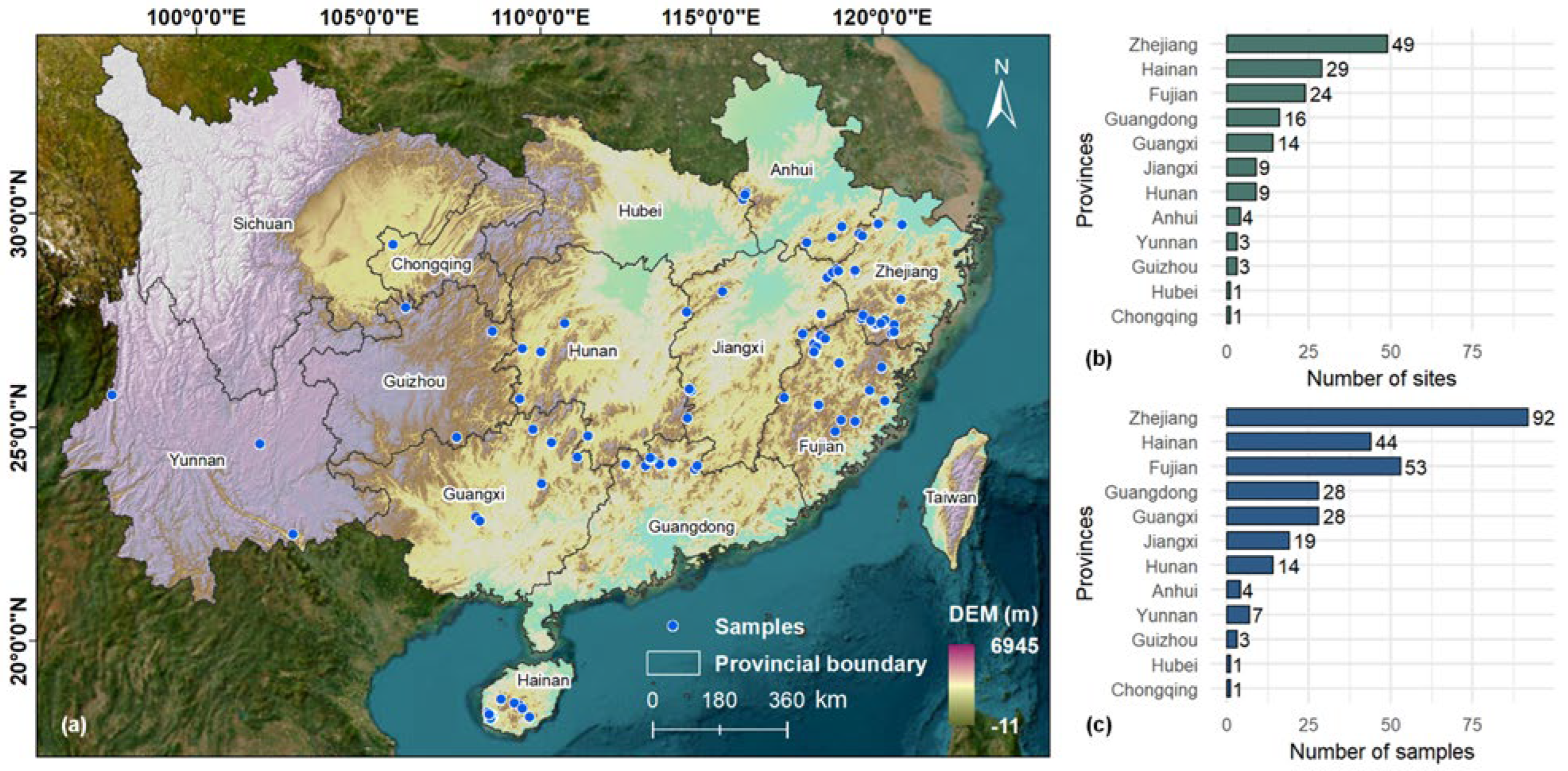
2.1. Study Area and Data
2.1.1. Study Area
2.1.2. Sample Collection
2.1.3. Environmental Covariates
2.2. Construction of Habitat Selection Models
2.2.1. Basic Idea
2.2.2. Quantification of Sample Weights
2.2.3. Integration of Absolute Abundance-Weighted Samples into Random Forests
2.3. Experimental Design
3. Results
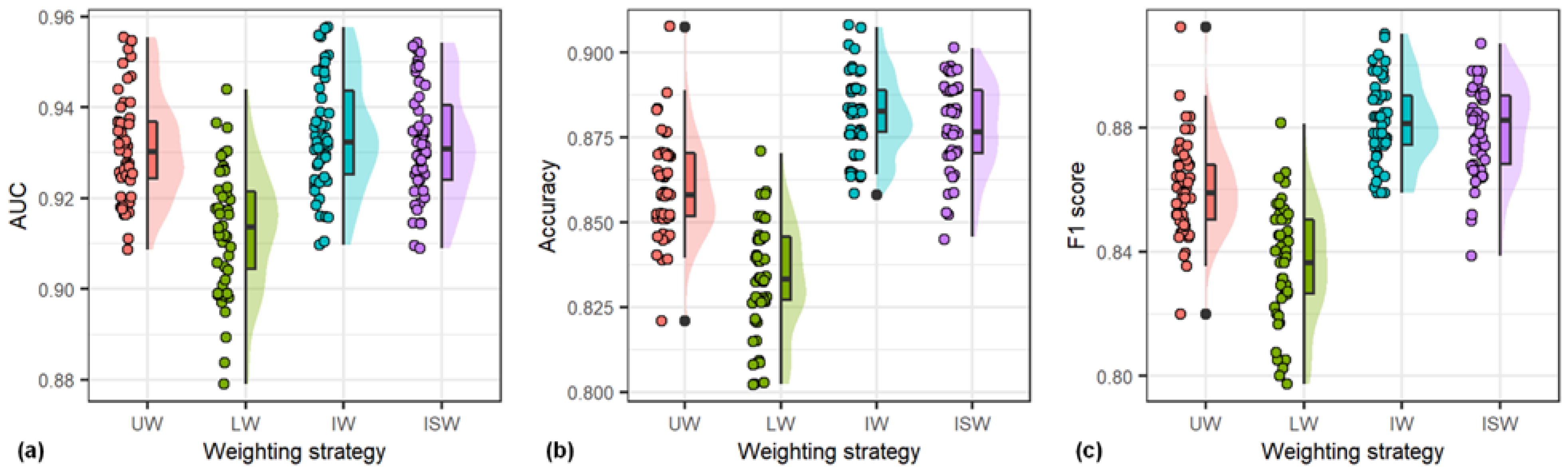
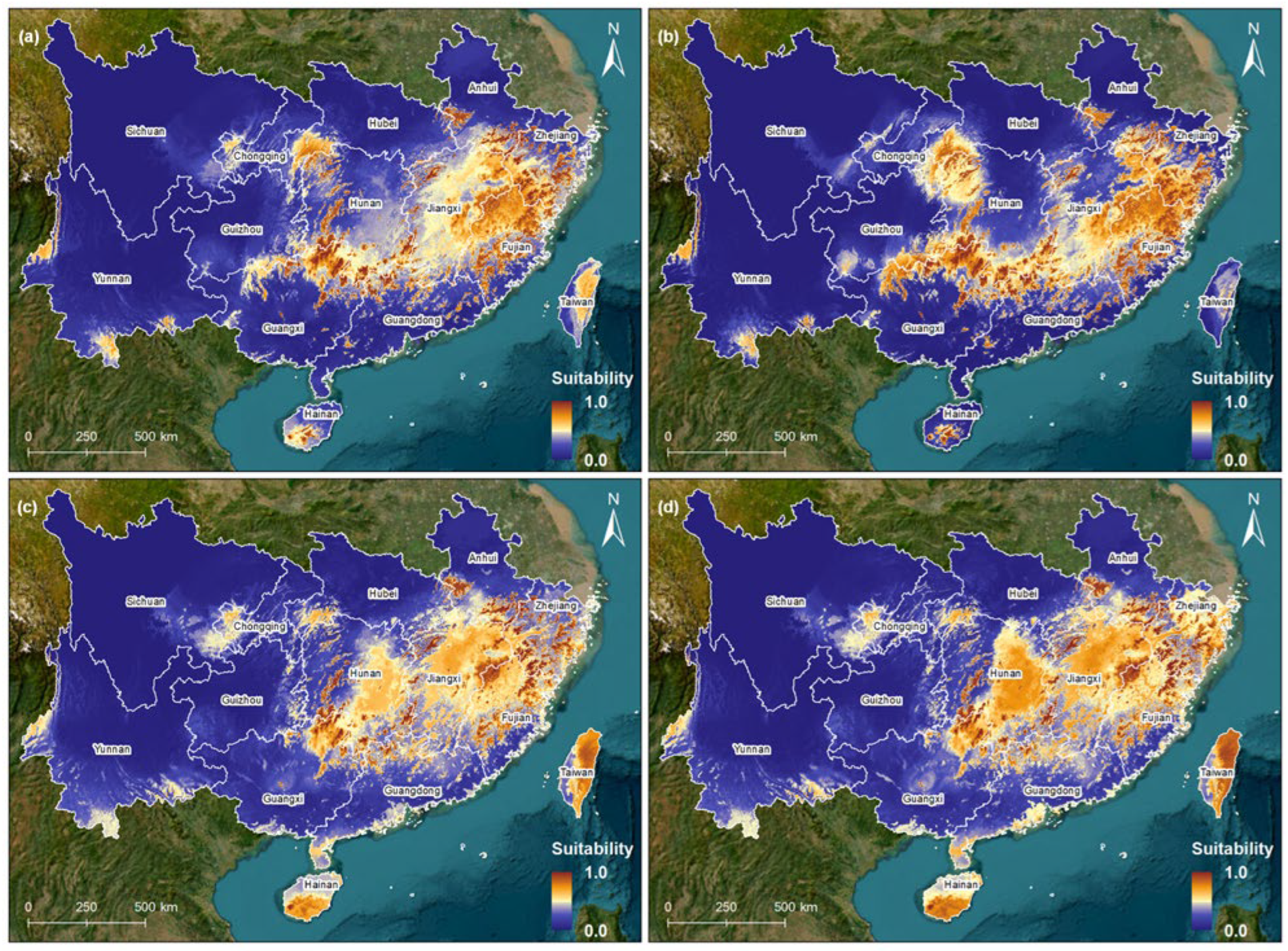
3.1. Habitat Selection Modeling Using Different Weighting Strategies
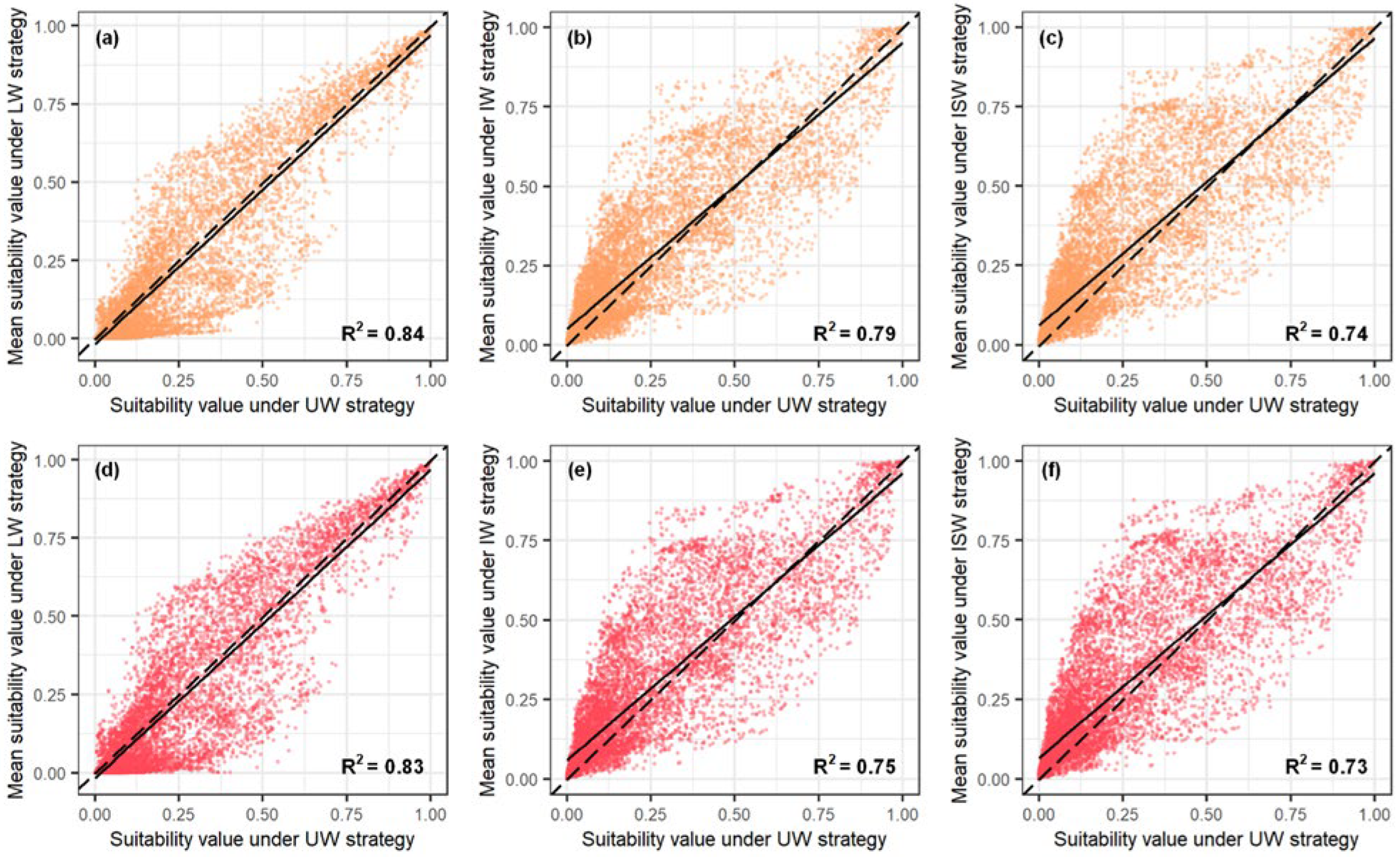
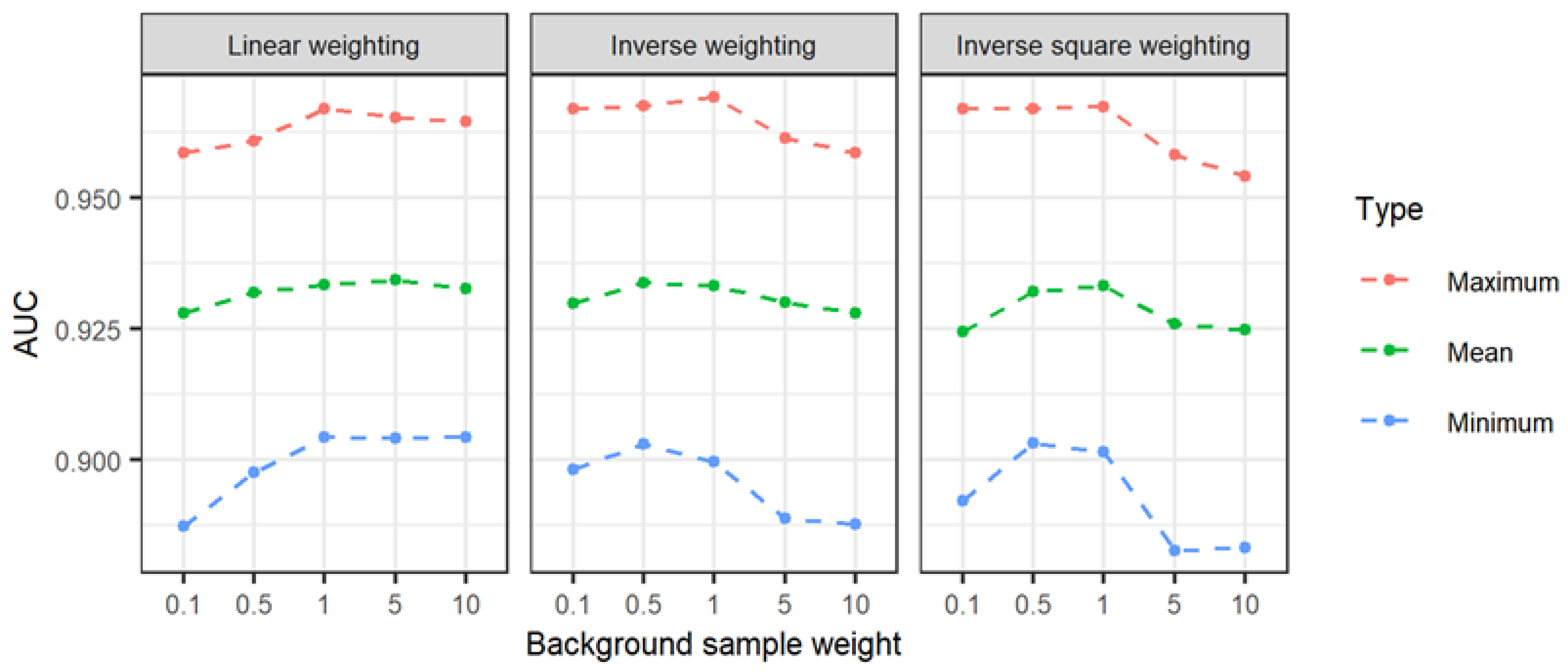
3.2. Uncertainty from Sample Weights
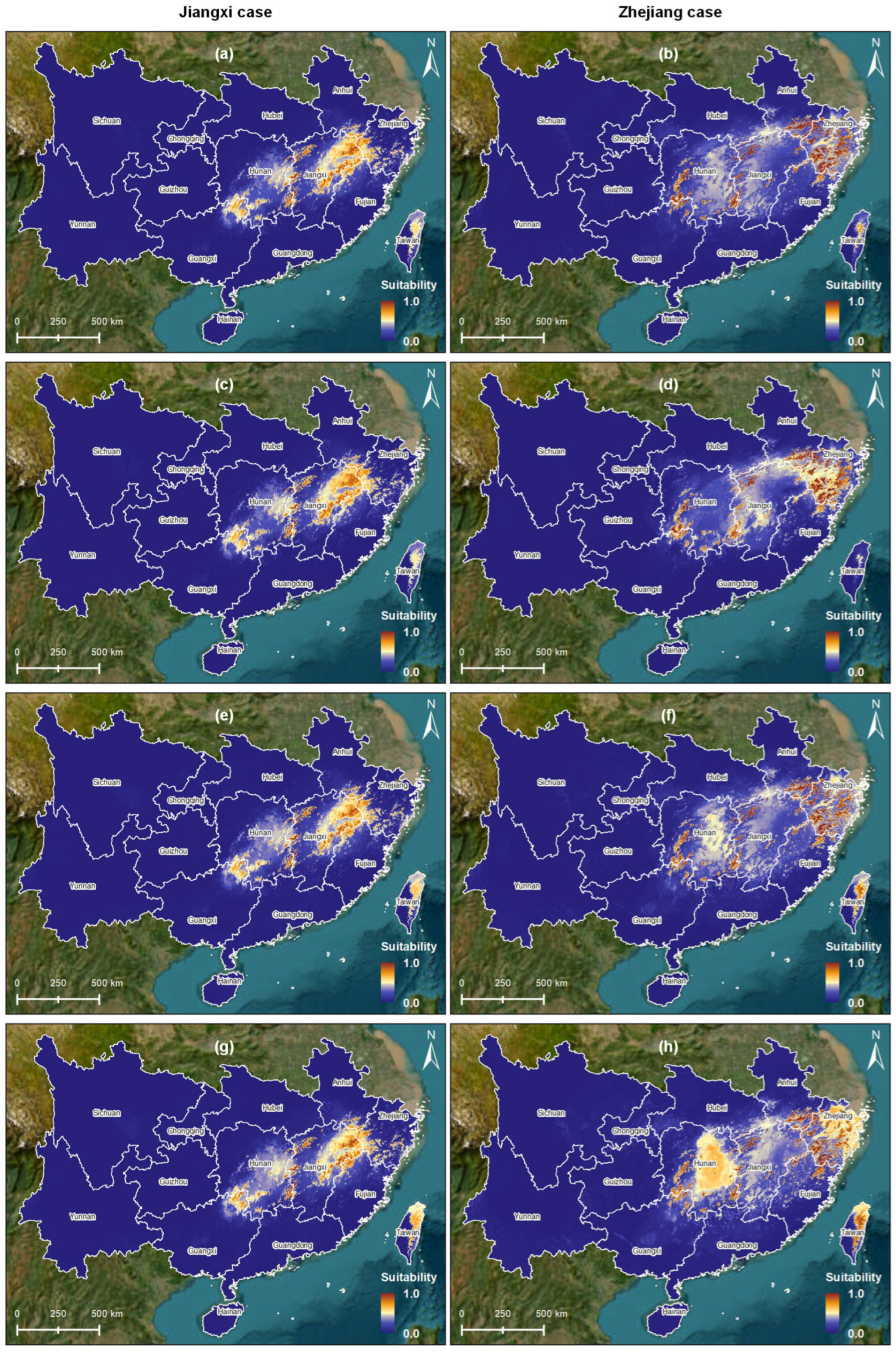
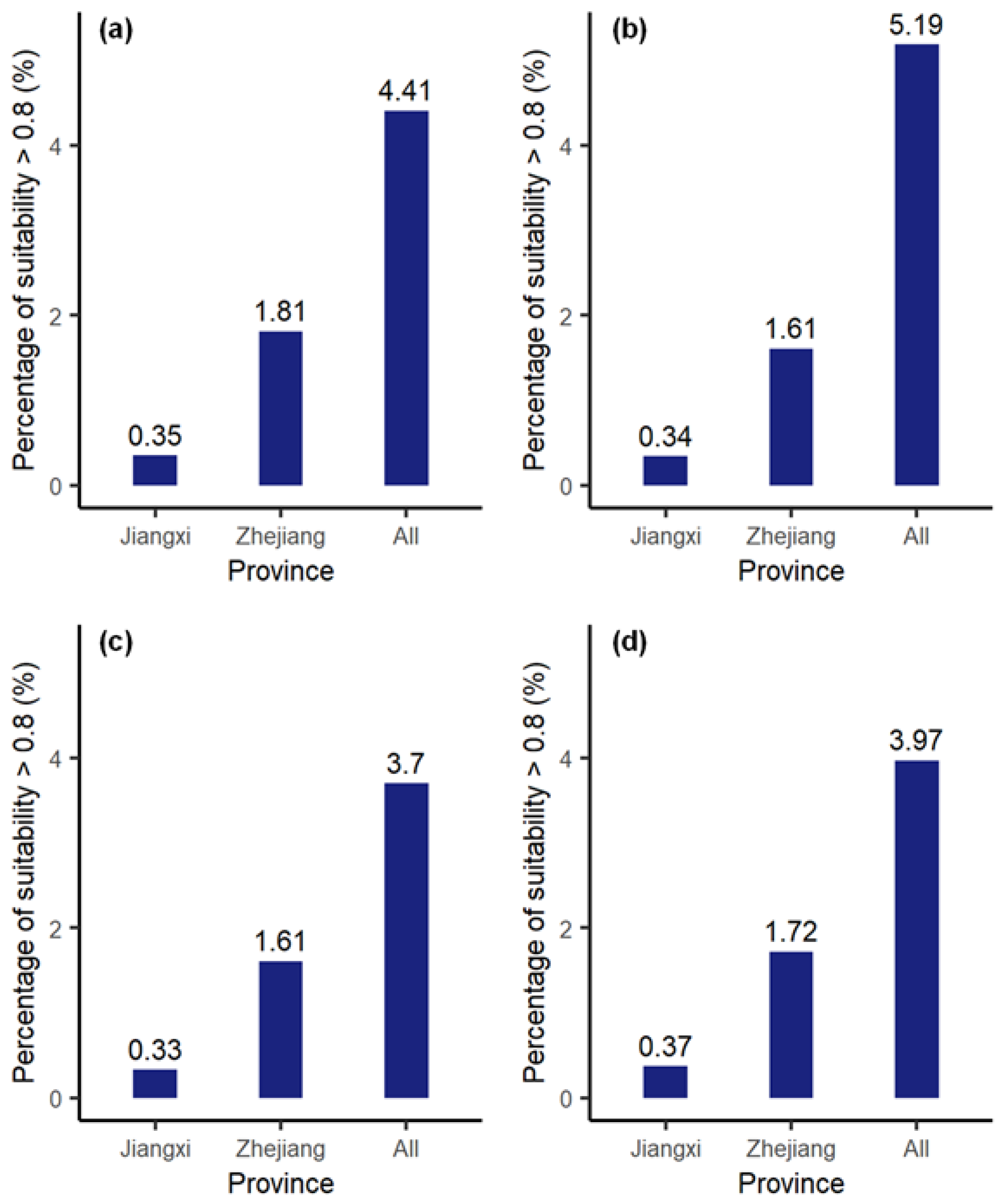
3.3. Spatial Extrapolation
4. Discussion
4.1. Impact of Absent Sample Weights
4.2. Applications and Limitations
4.3. Habitat Conservation
5. Conclusions
Author Contributions
Funding
Data Availability Statement
Conflicts of Interest
Abbreviations
| RFs | Random forests |
| HSI | Habitat suitability index |
| UW | Unweighted strategy |
| LW | Linear weighting strategy |
| IW | Inverse weighting strategy |
| ISW | Inverse square weighting strategy |
References
- Losey, J.E.; Vaughan, M. The Economic Value of Ecological Services Provided by Insects. BioScience 2006, 56, 311. [Google Scholar] [CrossRef]
- Noriega, J.A.; Hortal, J.; Azcárate, F.M.; Berg, M.P.; Bonada, N.; Briones, M.J.I.; Del Toro, I.; Goulson, D.; Ibanez, S.; Landis, D.A.; et al. Research Trends in Ecosystem Services Provided by Insects. Basic Appl. Ecol. 2018, 26, 8–23. [Google Scholar] [CrossRef]
- Stork, N.E. How Many Species of Insects and Other Terrestrial Arthropods Are There on Earth? Annu. Rev. Entomol. 2018, 63, 31–45. [Google Scholar] [CrossRef] [PubMed]
- McCain, C.M.; Garfinkel, C.F. Climate Change and Elevational Range Shifts in Insects. Curr. Opin. Insect Sci. 2021, 47, 111–118. [Google Scholar] [CrossRef]
- Parmesan, C. Ecological and Evolutionary Responses to Recent Climate Change. Annu. Rev. Ecol. Evol. Syst. 2006, 37, 637–669. [Google Scholar] [CrossRef]
- Rumpf, S.B.; Hülber, K.; Klonner, G.; Moser, D.; Schütz, M.; Wessely, J.; Willner, W.; Zimmermann, N.E.; Dullinger, S. Range Dynamics of Mountain Plants Decrease with Elevation. Proc. Natl. Acad. Sci. USA 2018, 115, 1848–1853. [Google Scholar] [CrossRef]
- Warren, M.S.; Hill, J.K.; Thomas, J.A.; Asher, J.; Fox, R.; Huntley, B.; Roy, D.B.; Telfer, M.G.; Jeffcoate, S.; Harding, P.; et al. Rapid Responses of British Butterflies to Opposing Forces of Climate and Habitat Change. Nature 2001, 414, 65–69. [Google Scholar] [CrossRef]
- Elith, J.; Leathwick, J.R. Species Distribution Models: Ecological Explanation and Prediction Across Space and Time. Annu. Rev. Ecol. Evol. Syst. 2009, 40, 677–697. [Google Scholar] [CrossRef]
- Guisan, A.; Tingley, R.; Baumgartner, J.B.; Naujokaitis-Lewis, I.; Sutcliffe, P.R.; Tulloch, A.I.T.; Regan, T.J.; Brotons, L.; McDonald-Madden, E.; Mantyka-Pringle, C.; et al. Predicting Species Distributions for Conservation Decisions. Ecol. Lett. 2013, 16, 1424–1435. [Google Scholar] [CrossRef] [PubMed]
- Ma, T.; Wang, G.; Guo, R.; Chen, H.; Jia, N.; Ma, J.; Cheng, H.; Zhang, Y. Multi-Scale Habitat Selection Modeling Using Combinatorial Optimization of Environmental Covariates: A Case Study on Nature Reserve of Red-Crowned Cranes. Ecol. Indic. 2023, 154, 110488. [Google Scholar] [CrossRef]
- Franklin, J. Mapping Species Distributions: Spatial Inference and Prediction, 1st ed.; Cambridge University Press: Cambridge, UK, 2010; ISBN 978-0-521-87635-3. [Google Scholar]
- Svenningsen, C.S.; Schigel, D. Sharing Insect Data through GBIF: Novel Monitoring Methods, Opportunities and Standards. Phil. Trans. R. Soc. B 2024, 379, 20230104. [Google Scholar] [CrossRef] [PubMed]
- Wieczorek, J.; Bloom, D.; Guralnick, R.; Blum, S.; Döring, M.; Giovanni, R.; Robertson, T.; Vieglais, D. Darwin Core: An Evolving Community-Developed Biodiversity Data Standard. PLoS ONE 2012, 7, e29715. [Google Scholar] [CrossRef]
- Yu, H.; Cooper, A.R.; Infante, D.M. Improving Species Distribution Model Predictive Accuracy Using Species Abundance: Application with Boosted Regression Trees. Ecol. Model. 2020, 432, 109202. [Google Scholar] [CrossRef]
- Li, X.; Wu, K.; Hao, S.; Kang, L.; Ma, J.; Zhao, R.; Zhang, Y. Mapping of Suitable Habitats for Earthworms in China. Soil Biol. Biochem. 2023, 184, 109081. [Google Scholar] [CrossRef]
- Conlisk, E.E.; Golet, G.H.; Reynolds, M.D.; Barbaree, B.A.; Sesser, K.A.; Byrd, K.B.; Veloz, S.; Reiter, M.E. Both Real-time and Long-term Environmental Data Perform Well in Predicting Shorebird Distributions in Managed Habitat. Ecol. Appl. 2022, 32, e2510. [Google Scholar] [CrossRef]
- Sheehy, J.; Kerr, S.; Bell, M.; Porter, J. Adaptive Stacked Species Distribution Modelling: Novel Approaches to Large Scale Quantification of Blue Carbon to Support Marine Management. Sci. Total Environ. 2024, 949, 174993. [Google Scholar] [CrossRef]
- Weber, M.M.; Stevens, R.D.; Diniz-Filho, J.A.F.; Grelle, C.E.V. Is There a Correlation between Abundance and Environmental Suitability Derived from Ecological Niche Modelling? A Meta-analysis. Ecography 2017, 40, 817–828. [Google Scholar] [CrossRef]
- Bowler, D.E.; Boyd, R.J.; Callaghan, C.T.; Robinson, R.A.; Isaac, N.J.B.; Pocock, M.J.O. Treating Gaps and Biases in Biodiversity Data as a Missing Data Problem. Biol. Rev. 2025, 100, 50–67. [Google Scholar] [CrossRef] [PubMed]
- Fithian, W.; Elith, J.; Hastie, T.; Keith, D.A. Bias Correction in Species Distribution Models: Pooling Survey and Collection Data for Multiple Species. Methods Ecol. Evol. 2015, 6, 424–438. [Google Scholar] [CrossRef] [PubMed]
- Fithian, W.; Hastie, T. Finite-Sample Equivalence in Statistical Models for Presence-Only Data. Ann. Appl. Stat. 2013, 7, 1917–1939. [Google Scholar] [CrossRef]
- Noble, C.D.; Peres, C.A.; Gilroy, J.J. Accounting for Imperfect Detection When Estimating Species-area Relationships and Beta-diversity. Ecol. Evol. 2024, 14, e70017. [Google Scholar] [CrossRef]
- Stolar, J.; Nielsen, S.E. Accounting for Spatially Biased Sampling Effort in Presence-only Species Distribution Modelling. Divers. Distrib. 2015, 21, 595–608. [Google Scholar] [CrossRef]
- Beever, E.A.; Smith, A.B.; Wright, D.; Rickman, T.; Gerraty, F.D.; Stewart, J.A.E.; Gill, A.; Klingler, K.; Robinson, M. Expanding Barriers: Impassable Gaps Interior to Distribution of an Isolated Mountain-dwelling Species. Ecosphere 2025, 16, e70223. [Google Scholar] [CrossRef]
- Liu, L.; Guo, R.; Lei, Q.; Li, Q.; Zhu, Y.; Wu, H.; Huang, J.; Wang, Y.; Xu, H.; Yin, C.; et al. Genome Assembly and Characterization of the Endangered Long-Armed Scarab Beetle, Cheirotonus jansoni. Sci. Data 2026, 13, 409. [Google Scholar] [CrossRef]
- Yu, Y.; Li, Z. Predicting the Potential Distribution of Cheirotonus jansoni (Coleoptera: Scarabaeidae) Under Climate Change. Insects 2024, 15, 1012. [Google Scholar] [CrossRef]
- Zothansanga, C.; Malsawmdawngzuali, T.; Zodinpuii, B.; Lalramliana, L.L. On the Occurrence of Cheirotonus gestroi (Scarabaeidae: Coleoptera) in Mizoram, Northeastern India: Molecular and Morphological Characterization. Asian J. Biol. Life Sci. 2025, 14, 42–47. [Google Scholar] [CrossRef]
- Liu, Y.; Axmacher, J.C.; Li, L.; Wang, C.; Yu, Z. Ground Beetle (Coleoptera: Carabidae) Inventories: A Comparison of Light and Pitfall Trapping. Bull. Entomol. Res. 2007, 97, 577–583. [Google Scholar] [CrossRef]
- Stočes, D.; Wijacki, T.; Knoll, A.; Kopecký, T.; Šipoš, J. Evaluating DNA Quality in Coleoptera and Lepidoptera: Impact of Fixation and Preservation in Various Trapping Methods. Entomol. Exp. Appl. 2025, 173, 903–917. [Google Scholar] [CrossRef]
- Holyoak, M.; Jarosik, V.; Novák, I. Weather-induced Changes in Moth Activity Bias Measurement of Long-term Population Dynamics from Light Trap Samples. Entomol. Exp. Appl. 1997, 83, 329–335. [Google Scholar] [CrossRef]
- Jonason, D.; Franzén, M.; Ranius, T. Surveying Moths Using Light Traps: Effects of Weather and Time of Year. PLoS ONE 2014, 9, e92453. [Google Scholar] [CrossRef] [PubMed]
- Fick, S.E.; Hijmans, R.J. WorldClim 2: New 1-km Spatial Resolution Climate Surfaces for Global Land Areas. Int. J. Climatol. 2017, 37, 4302–4315. [Google Scholar] [CrossRef]
- Ma, L.; Li, Y. Evaluation of SRTM DEM over China. In Proceedings of the 2006 IEEE International Symposium on Geoscience and Remote Sensing; IEEE: Denver, CO, USA, 2006; pp. 2977–2980. [Google Scholar]
- Yang, L.; Meng, X.; Zhang, X. SRTM DEM and Its Application Advances. Int. J. Remote Sens. 2011, 32, 3875–3896. [Google Scholar] [CrossRef]
- Thai-Nghe, N.; Gantner, Z.; Schmidt-Thieme, L. Cost-Sensitive Learning Methods for Imbalanced Data. In Proceedings of the 2010 International Joint Conference on Neural Networks (IJCNN); IEEE: Barcelona, Spain, 2010; pp. 1–8. [Google Scholar]
- Peters, J.; Baets, B.D.; Verhoest, N.E.C.; Samson, R.; Degroeve, S.; Becker, P.D.; Huybrechts, W. Random Forests as a Tool for Ecohydrological Distribution Modelling. Ecol. Model. 2007, 207, 304–318. [Google Scholar] [CrossRef]
- Siders, Z.; Ducharme-Barth, N.; Carvalho, F.; Kobayashi, D.; Martin, S.; Raynor, J.; Jones, T.; Ahrens, R. Ensemble Random Forests as a Tool for Modeling Rare Occurrences. Endang. Species. Res. 2020, 43, 183–197. [Google Scholar] [CrossRef]
- Breiman, L. Random Forests. Mach. Learn. 2001, 45, 5–32. [Google Scholar] [CrossRef]
- Wright, M.N.; Ziegler, A. Ranger: A Fast Implementation of Random Forests for High Dimensional Data in C++ and R. J. Stat. Soft. 2017, 77, 1–17. [Google Scholar] [CrossRef]
- Barbet-Massin, M.; Jiguet, F.; Albert, C.H.; Thuiller, W. Selecting Pseudo-absences for Species Distribution Models: How, Where and How Many? Methods Ecol. Evol. 2012, 3, 327–338. [Google Scholar] [CrossRef]
- Merow, C.; Smith, M.J.; Silander, J.A. A Practical Guide to MaxEnt for Modeling Species’ Distributions: What It Does, and Why Inputs and Settings Matter. Ecography 2013, 36, 1058–1069. [Google Scholar] [CrossRef]
- Zhou, Z.H. Model Selection and Evaluation. In Machine Learning; Springer: Singapore, 2021; pp. 25–55. ISBN 978-981-15-1966-6. [Google Scholar]
- Bhardwaj, M.; Soanes, K.; Lahoz-Monfort, J.J.; Lumsden, L.F.; Van Der Ree, R. Little Evidence of a Road-effect Zone for Nocturnal, Flying Insects. Ecol. Evol. 2019, 9, 65–72. [Google Scholar] [CrossRef]
- Longbottom, J.; Krause, A.; Torr, S.J.; Stanton, M.C. Quantifying Geographic Accessibility to Improve Efficiency of Entomological Monitoring. PLoS Negl. Trop. Dis. 2020, 14, e0008096. [Google Scholar] [CrossRef]
- McDermott, E.G.; Mullens, B.A. The Dark Side of Light Traps. J. Med. Entomol. 2018, 55, 251–261. [Google Scholar] [CrossRef]
- Chen, T.; Guestrin, C. XGBoost: A Scalable Tree Boosting System. In Proceedings of the 22nd ACM SIGKDD International Conference on Knowledge Discovery and Data Mining; ACM: San Francisco, CA, USA, 2016; pp. 785–794. [Google Scholar]
- Pawłuszek-Filipiak, K.; Lewandowski, T. The Impact of Feature Selection on XGBoost Performance in Landslide Susceptibility Mapping Using an Extended Set of Features: A Case Study from Southern Poland. Appl. Sci. 2025, 15, 8955. [Google Scholar] [CrossRef]
- Vaswani, A.; Shazeer, N.; Parmar, N.; Uszkoreit, J.; Jones, L.; Gomez, A.N.; Kaiser, L.; Polosukhin, I. Attention Is All You Need. In Proceedings of the Advances in Neural Information Processing Systems 30 (NIPS 2017); Guyon, I., Luxburg, U., Bengio, S., Wallach, H., Fergus, R., Vishwanathan, S., Garnett, R., Eds.; Curran Associates, Inc.: Red Hook, NY, USA, 2017; Volume 30, Available online: https://arxiv.org/pdf/1706.03762 (accessed on 2 August 2023).



| Weighting Strategy | Evaluation Metric (%) | |||||
|---|---|---|---|---|---|---|
| AUC | Kappa | Accuracy | Precision | Recall | F1 Score | |
| Unweighted strategy (UW) | 93.11 | 71.92 | 85.96 | 85.61 | 86.51 | 86.02 |
| Linear weighting strategy (LW) | 91.32 | 66.56 | 83.28 | 82.04 | 85.23 | 83.57 |
| Inverse weighting strategy (IW) | 93.41 | 76.22 | 88.11 | 87.61 | 88.83 | 88.18 |
| Inverse square weighting strategy (ISW) | 93.21 | 75.58 | 87.79 | 86.60 | 89.48 | 87.79 |
| Weighting Strategy | AUC (%) | |
|---|---|---|
| Zhejiang | Jiangxi | |
| Unweighted strategy (UW) | 66.91 | 65.89 |
| Linear weighting strategy (LW) | 63.82 | 62.27 |
| Inverse weighting strategy (IW) | 71.03 | 70.06 |
| Inverse square weighting strategy (ISW) | 70.10 | 69.69 |
Disclaimer/Publisher’s Note: The statements, opinions and data contained in all publications are solely those of the individual author(s) and contributor(s) and not of MDPI and/or the editor(s). MDPI and/or the editor(s) disclaim responsibility for any injury to people or property resulting from any ideas, methods, instructions or products referred to in the content. |
© 2026 by the authors. Licensee MDPI, Basel, Switzerland. This article is an open access article distributed under the terms and conditions of the Creative Commons Attribution (CC BY) license.
Share and Cite
Ma, T.; Guo, R.; Lei, Q.; Cheng, Z.; Wang, Q.; Li, Q.; Wu, H.; Huang, J.; Liu, L. Evaluation of Different Strategies to Incorporate Absolute Abundance into Habitat Selection Modeling for the Endangered Cheirotonus jansoni. Insects 2026, 17, 537. https://doi.org/10.3390/insects17060537
Ma T, Guo R, Lei Q, Cheng Z, Wang Q, Li Q, Wu H, Huang J, Liu L. Evaluation of Different Strategies to Incorporate Absolute Abundance into Habitat Selection Modeling for the Endangered Cheirotonus jansoni. Insects. 2026; 17(6):537. https://doi.org/10.3390/insects17060537
Chicago/Turabian StyleMa, Tianwu, Rui Guo, Qian Lei, Zhangfeng Cheng, Qingyun Wang, Qiao Li, Hong Wu, Junhao Huang, and Liwei Liu. 2026. "Evaluation of Different Strategies to Incorporate Absolute Abundance into Habitat Selection Modeling for the Endangered Cheirotonus jansoni" Insects 17, no. 6: 537. https://doi.org/10.3390/insects17060537
APA StyleMa, T., Guo, R., Lei, Q., Cheng, Z., Wang, Q., Li, Q., Wu, H., Huang, J., & Liu, L. (2026). Evaluation of Different Strategies to Incorporate Absolute Abundance into Habitat Selection Modeling for the Endangered Cheirotonus jansoni. Insects, 17(6), 537. https://doi.org/10.3390/insects17060537