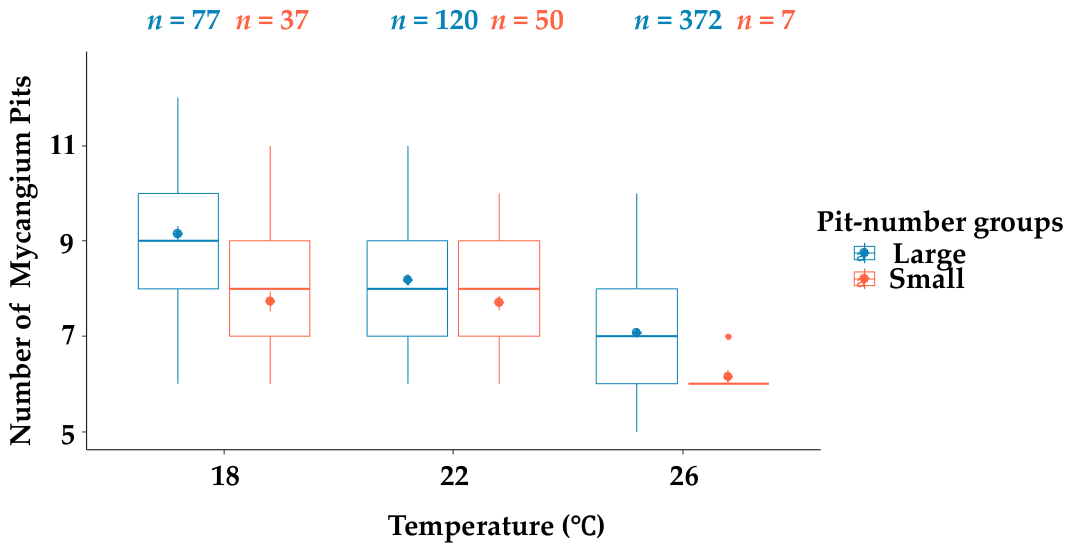
Effect of Temperature and Genetic Inheritance on the Number of Mycangium Pits in Female Platypus quercivorus (Coleoptera: Curculionidae: Platypodinae)



Simple Summary
Abstract
1. Introduction
2. Materials and Methods
2.1. Study Sites and Insect Collection
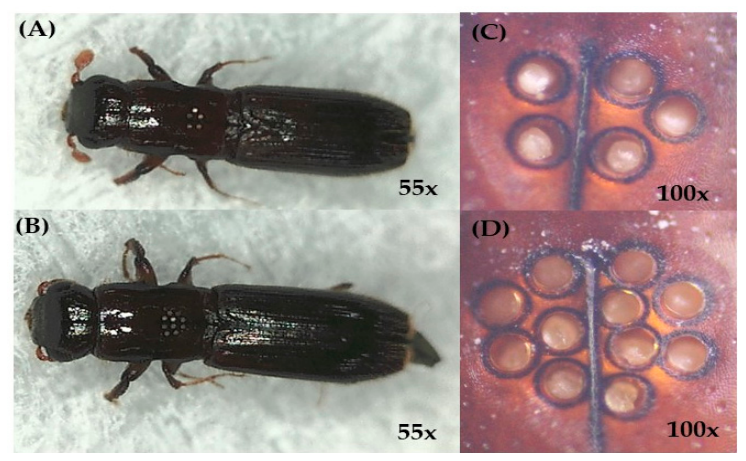
2.2. Classification of Size Groups
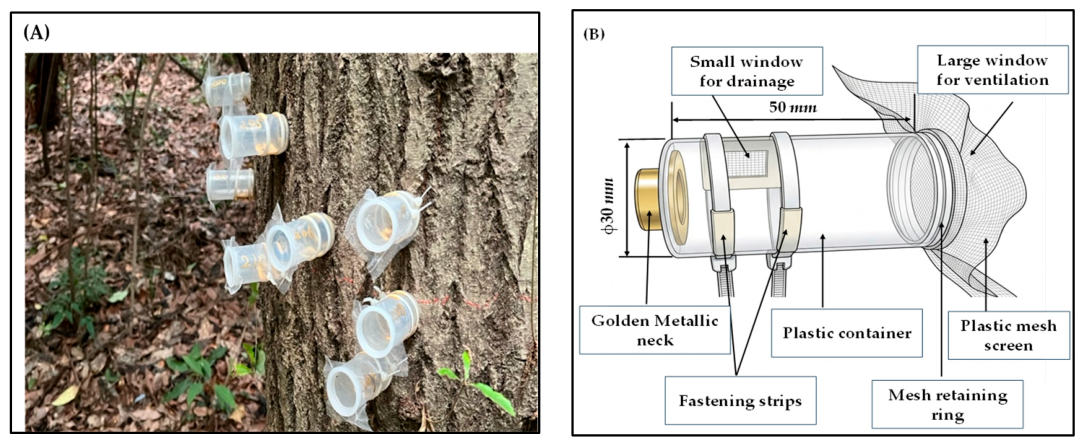
2.3. Log Preparation and Inoculation
2.4. Incubation and Data Collection
2.5. Statistical Analysis
3. Results
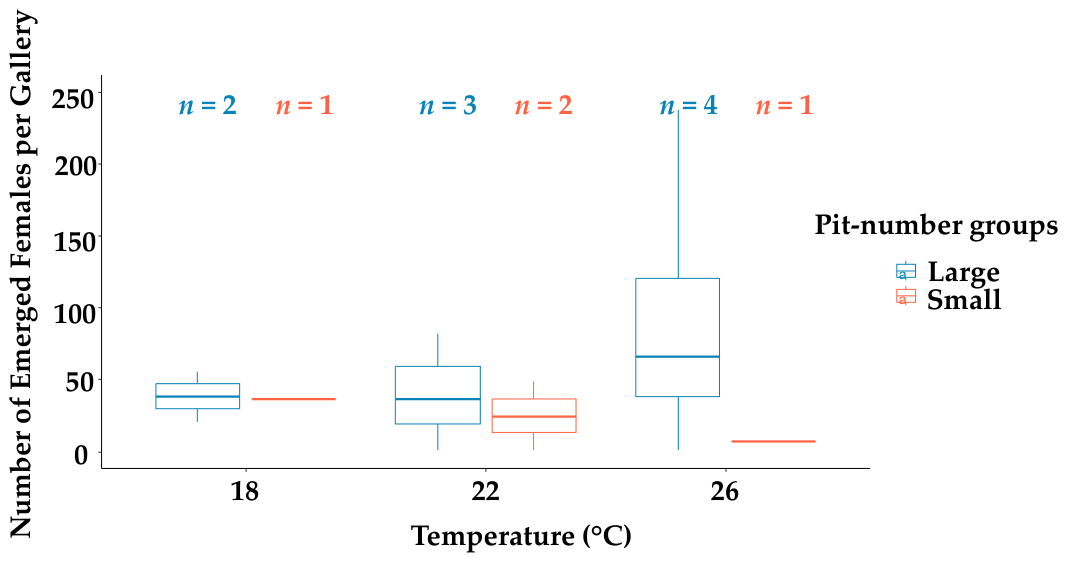
3.1. Reproductive Output
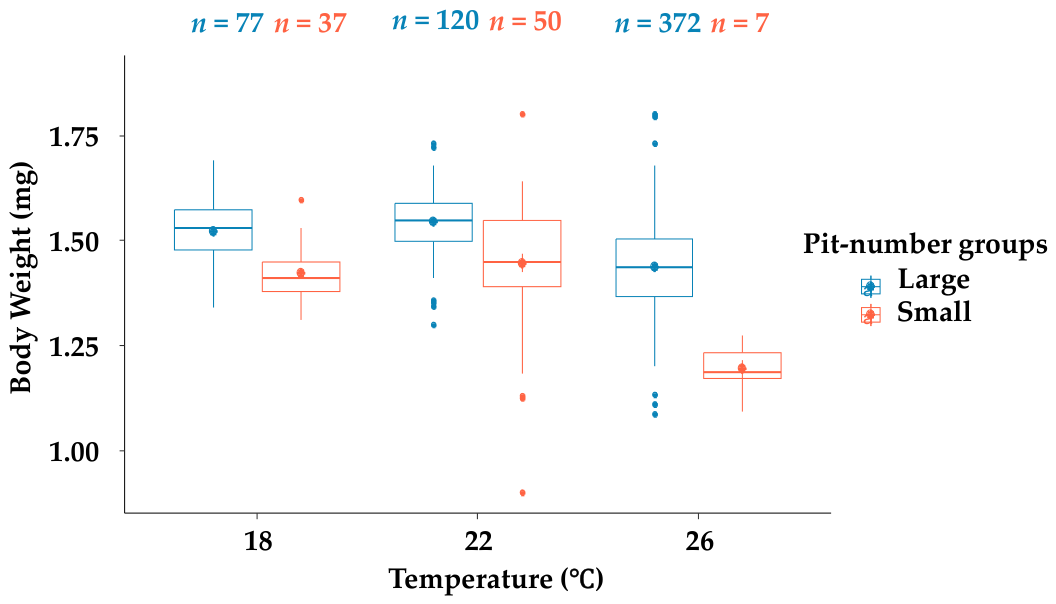
3.2. Offspring Body Weight
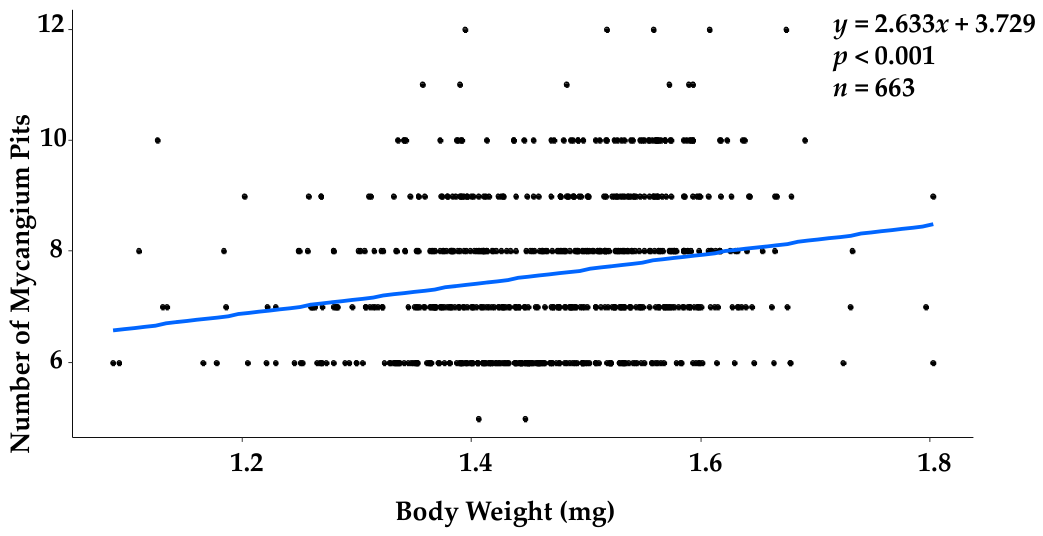
3.3. Effect of Temperature and Parental Traits on Mycangial Pits
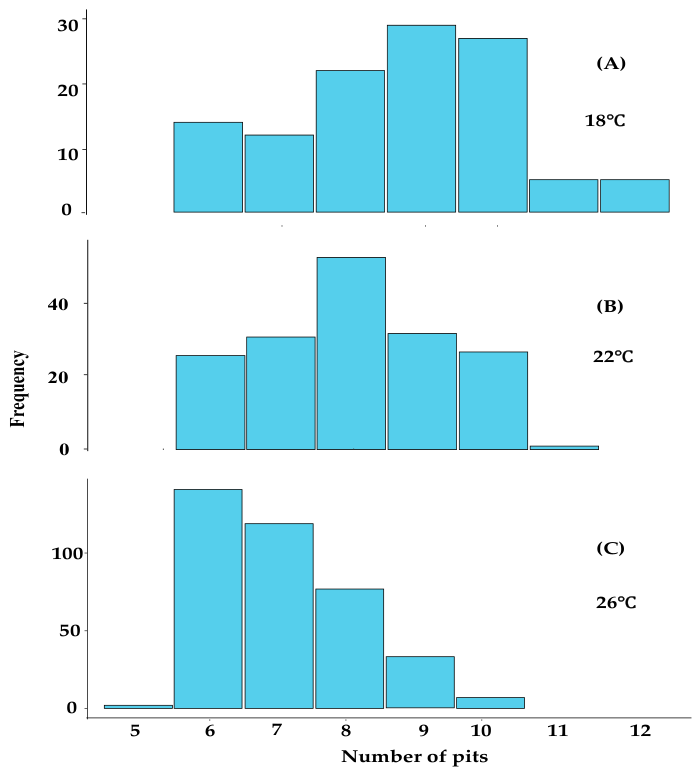
3.4. Distribution of Mycangial Pits Across Temperatures
4. Discussion
5. Conclusions
Supplementary Materials
Author Contributions
Funding
Data Availability Statement
Acknowledgments
Conflicts of Interest
References
- Bar-On, Y.M.; Phillips, R.; Milo, R. The biomass distribution on Earth. Proc. Natl. Acad. Sci. USA 2018, 115, 6506–6511. [Google Scholar] [CrossRef]
- Sanderson, K. Lignocellulose: A chewy problem. Nature 2011, 474, S12–S14. [Google Scholar] [CrossRef]
- Cleveland, L.R. Symbiosis between termites and their intestinal protozoa. Proc. Natl. Acad. Sci. USA 1923, 9, 424–428. [Google Scholar] [CrossRef] [PubMed]
- Ohkuma, M. Termite symbiotic systems: Efficient bio-recycling of lignocellulose. Appl. Microbiol. Biotechnol. 2003, 61, 1–9. [Google Scholar] [CrossRef] [PubMed]
- Brune, A. Symbiotic digestion of lignocellulose in termite guts. Nat. Rev. Microbiol. 2014, 12, 168–180. [Google Scholar] [CrossRef]
- Brune, A.; Dietrich, C. The gut microbiota of termites: Digesting the diversity in the light of ecology and evolution. Annu. Rev. Microbiol. 2015, 69, 145–166. [Google Scholar] [CrossRef]
- Vega, F.E.; Biedermann, P.H. On interactions, associations, mycetangia, mutualists and symbiotes in insect-fungus symbioses. Fungal Ecol. 2020, 44, 100909. [Google Scholar] [CrossRef]
- Six, D.L.; Klepzig, K.D. Evolution of localized specialized ectosymbiotic organs (mycangia). In Insect-Fungal Associations: Ecology and Evolution; Vega, F.E., Blackwell, M., Eds.; Oxford University Press: Oxford, UK, 2005; pp. 171–193. [Google Scholar]
- Ulyshen, M.D. Ecology and conservation of Passalidae. In Saproxylic Insects: Diversity, Ecology and Conservation; Springer: Berlin/Heidelberg, Germany, 2018; pp. 129–147. [Google Scholar]
- Batra, L.R. Ecology of ambrosia fungi and their dissemination by beetles. Trans. Kans. Acad. Sci. 1963, 66, 213–236. [Google Scholar] [CrossRef]
- Francke-Grosmann, H. Ectosymbiosis in wood-inhabiting insects. Symbiosis 1967, 2, 141–205. [Google Scholar]
- Cassier, P.; Lévieux, J.; Morelet, M.; Rougon, D. The mycangia of Platypus cylindrus Fab. and P. oxyurus Dufour (Coleoptera: Platypodidae). Structure and associated fungi. J. Insect Physiol. 1996, 42, 171–179. [Google Scholar] [CrossRef]
- Mayers, C.G.; Harrington, T.C.; Biedermann, P.H. Mycangia define the diverse ambrosia beetle–fungus symbioses. In The Convergent Evolution of Agriculture in Humans and Insects; Schultz, T.R., Gwane, R., Pergrine, P.N., Eds.; MIT Press: Main Street, NE, USA, 2022; pp. 105–142. [Google Scholar]
- Ryan, K.; Hurley, B.P. Life history and biology of Sirex noctilio. In The Sirex Woodwasp and Its Fungal Symbiont: Research and Management of a Worldwide Invasive Pest; Slippers, B., De Groot, P., Wingfield, M.J., Eds.; Springer Science & Business Media: Berlin/Heidelberg, Germany, 2012; pp. 15–30. [Google Scholar]
- Tanahashi, M.; Kubota, K.; Matsushita, N.; Togashi, K. Discovery of mycangia and the associated xylose-fermenting yeasts in stag beetles (Coleoptera: Lucanidae). Naturwissenschaften 2010, 97, 311–317. [Google Scholar] [CrossRef] [PubMed]
- Toki, W. A single case study of mycetangia-associated fungi and their abilities to assimilate wood-associated carbon sources in the ship timber beetle Elateroides flabellicornis (Coleoptera: Lymexylidae) in Japan. Symbiosis 2021, 83, 173–181. [Google Scholar] [CrossRef]
- Six, D.L. Ecological and evolutionary determinants of bark beetle—Fungus symbioses. Insects 2012, 3, 339–366. [Google Scholar] [CrossRef]
- Beaver, R.A. Insect-Fungus Relationships in the Bark and Ambrosia Beetles; Academic Press: London, UK, 1987; pp. 121–143. [Google Scholar]
- Hulcr, J.; Dunn, R.R. The sudden emergence of pathogenicity in insect–fungus symbioses threatens naive forest ecosystems. Proc. R. Soc. B Biol. Sci. 2011, 278, 2866–2873. [Google Scholar] [CrossRef]
- Peng, Y.; Buranapanichpan, A.; Kamata, N. Succession of Ambrosia beetles colonizing the logs of fallen alder and birch trees. Insects 2022, 13, 223. [Google Scholar] [CrossRef]
- Kirkendall, L.R.; Biedermann, P.H.; Jordal, B.H. Evolution and diversity of bark and ambrosia beetles. In Bark Beetles: Biology and Ecology of Native and Invasive Species; Vega, F.E., Hofstetter, R.W., Eds.; Elsevier: Amsterdam, The Netherlands, 2015; pp. 85–156. [Google Scholar]
- Ploetz, R.C.; Konkol, J.L.; Narvaez, T.; Duncan, R.E.; Saucedo, R.J.; Campbell, A.; Mantilla, J.; Carrillo, D.; Kendra, P.E. Presence and prevalence of Raffaelea lauricola, cause of laurel wilt, in different species of ambrosia beetle in Florida, USA. J. Econ. Entomol. 2017, 110, 347–354. [Google Scholar]
- Eskalen, A.; Gonzalez, A.; Wang, D.; Twizeyimana, M.; Mayorquin, J.; Lynch, S. First report of a Fusarium sp. and its vector tea shot hole borer (Euwallacea fornicatus) causing Fusarium dieback on avocado in California. Plant Dis. 2012, 96, 1070. [Google Scholar] [CrossRef] [PubMed]
- Kim, K.-H.; Choi, Y.-J.; Seo, S.-T.; Shin, H.-D. Raffaelea quercus-mongolicae sp. nov. associated with Platypus koryoensis on oak in Korea. Mycotaxon 2009, 110, 189–197. [Google Scholar] [CrossRef]
- Ito, S.; Yamada, T. Distribution and spread of the mass mortality of oak trees. J. Jpn. For. Soc. 1998, 80, 229–232. [Google Scholar]
- Kubono, T.; Ito, S.-I. Raffaelea quercivora sp. nov. associated with mass mortality of Japanese oak, and the ambrosia beetle (Platypus quercivorus). Mycoscience 2002, 43, 0255–0260. [Google Scholar] [CrossRef]
- Hijii, N.; Kajimura, H.; Urano, T.; Kinuura, H.; Itami, H. The mass mortality of oak trees induced by Platypus quercivorus (Murayama) and Platypus calamus Blandford (Coleoptera: Platypodidae) The density and spatial distribution of attack by the beetles. J. Jpn. For. Soc. 1991, 73, 471–476. [Google Scholar]
- Fukuzawa, T.; Arai, R.; Kitajima, H.; Tokoro, M.; Aizawa, M.; Ohkubo, T. Seasonal emergence and flight behavior of the oak ambrosia beetle Platypus quercivorus along an altitudinal gradient in the high elevation area. J. Jpn. For. Soc. 2019, 101, 1–6. [Google Scholar] [CrossRef]
- Soné, K.; Mori, T.; Ide, M. Life history of the oak borer, Platypus quercivorus (Murayama) (Coleoptera: Platypodidae). Appl. Entomol. Zool. 1998, 33, 67–75. [Google Scholar] [CrossRef]
- Li, Y.; Ruan, Y.; Kasson, M.T.; Stanley, E.L.; Gillett, C.P.; Johnson, A.J.; Zhang, M.; Hulcr, J. Structure of the ambrosia beetle (Coleoptera: Curculionidae) mycangia revealed through micro-computed tomography. J. Insect Sci. 2018, 18, 13. [Google Scholar] [CrossRef]
- Kinuura, H. Relative dominance of the mold fungus, Raffaelea sp., in the mycangium and proventriculus in relation to adult stages of the oak platypodid beetle, Platypus quercivorus (Coleoptera; Platypodidae). J. For. Res. 2002, 7, 7–12. [Google Scholar] [CrossRef]
- Takahashi, Y.; Matsushita, N.; Hogetsu, T. Spatial distribution of Raffaelea quercivora in xylem of naturally infested and inoculated oak trees. Phytopathology 2010, 100, 747–755. [Google Scholar] [CrossRef]
- Kato, K.; Esaki, K.; Igeta, Y.; Kamata, N. Preliminary report on comparison of reproductive success of Platypus quercivorus among four species of the family Fagaceae. Chubu For. Res. 2001, 49, 81–84. [Google Scholar]
- Kirkendall, L. The evolution of mating systems in bark and ambrosia beetles (Coleoptera: Scolytidae and Platypodidae). Zool. J. Linn. Soc. 1983, 77, 293–352. [Google Scholar] [CrossRef]
- Soné, K.; Uto, K.; Fukuyama, S.; Nagano, T. Effects of attack time on the development and reproduction of the oak borer, Platypus quercivorus (Murayama). Jpn. J. Appl. Entomol. Zool. 2000, 44, 189–196. [Google Scholar] [CrossRef][Green Version]
- Tarno, H.; Qi, H.; Endoh, R.; Kobayashi, M.; Goto, H.; Futai, K. Types of frass produced by the ambrosia beetle Platypus quercivorus during gallery construction, and host suitability of five tree species for the beetle. J. For. Res. 2011, 16, 68–75. [Google Scholar] [CrossRef]
- Japan Forest Technology Association. Manual for Countermeasures Against Oak Wilt Damage, 3rd ed.; Japan Forest Technology Association: Tokyo, Japan, 2026. [Google Scholar]
- Kitajima, H.; Kinuura, H.; Taki, H.; Matsumoto, T. Efficacy of commercially available nozzle-type insecticide against an ambrosia beetle, Platypus quercivorus, boring into living tree trunks. Bull. FFPRI 2025, 24, 15–21. [Google Scholar]
- R Core Team. R: A Language and Environment for Statistical Computing; R Foundation for Statistical Computing: Vienna, Austria, 2025; Available online: https://www.r-project.org/ (accessed on 14 April 2026).
- Kamata, N.; Esaki, K.; Kato, K.; Igeta, Y.; Wada, K. Potential impact of global warming on deciduous oak dieback caused by ambrosia fungus Raffaelea sp. carried by ambrosia beetle Platypus quercivorus (Coleoptera: Platypodidae) in Japan. Bull. Entomol. Res. 2002, 92, 119–126. [Google Scholar] [CrossRef] [PubMed]
- Ueda, A.; Kobayashi, M. Relationship between flight of Platypus quercivorus (Coleoptera: Platypodidae), temperature and sunshine. Appl. For. Sci. 2000, 9, 93–97. [Google Scholar]
- Sueyoshi, M. Infestation of broad-leaved trees by Platypus quercivorus (Murayama) (Coleoptera: Platypodidae) in Kagoshima Prefecture. For. Pests 1990, 27, 242–245. [Google Scholar]
- Chapman, R.F. The egg and embryology. In The Insects: Structure and Function, 4th ed.; Cambridge University Press: Cambridge, UK, 1998; pp. 325–361. [Google Scholar]
- Kajimura, H.; Hijii, N. Reproduction and resource utilization of the ambrosia beetle, Xylosandrus mutilatus, in field and experimental populations. Entomol. Exp. Appl. 1994, 71, 121–132. [Google Scholar] [CrossRef]
- Endoh, R.; Suzuki, M.; Okada, G.; Takeuchi, Y.; Futai, K. Fungus symbionts colonizing the galleries of the ambrosia beetle Platypus quercivorus. Microb. Ecol. 2011, 62, 106–120. [Google Scholar] [CrossRef]
- Endoh, R.; Suzuki, M.; Benno, Y.; Futai, K. Candida kashinagacola sp. nov., C. pseudovanderkliftii sp. nov. and C. vanderkliftii sp. nov., three new yeasts from ambrosia beetle-associated sources. Antonie Van Leeuwenhoek 2008, 94, 389–402. [Google Scholar] [CrossRef]
- Kurtzman, C.P.; Robnett, C.J. Description of Ambrosiozyma oregonensis sp. nov., and reassignment of Candida species of the Ambrosiozyma clade to Ambrosiozyma kashinagacola fa, comb. nov., Ambrosiozyma llanquihuensis fa, comb. nov., Ambrosiozyma maleeae fa, comb. nov., Ambrosiozyma pseudovanderkliftii fa, comb. nov., and Ambrosiozyma vanderkliftii fa, comb. nov. Int. J. Syst. Evol. Microbiol. 2013, 63, 3877–3883. [Google Scholar] [PubMed]
- Yun, Y.H.; Suh, D.Y.; Yoo, H.D.; Oh, M.H.; Kim, S.H. Yeast associated with the ambrosia beetle, Platypus koryoensis, the pest of oak trees in Korea. Mycobiology 2015, 43, 458–466. [Google Scholar] [CrossRef]
- Arthur, H.; Watson, K. Thermal adaptation in yeast: Growth temperatures, membrane lipid, and cytochrome composition of psychrophilic, mesophilic, and thermophilic yeasts. J. Bacteriol. 1976, 128, 56–68. [Google Scholar] [CrossRef]
- Conlon, I.; Raff, M. Size control in animal development. Cell 1999, 96, 235–244. [Google Scholar] [CrossRef]
- Shingleton, A.W.; Frankino, W.A.; Flatt, T.; Nijhout, H.F.; Emlen, D.J. Size and shape: The developmental regulation of static allometry in insects. Bioessays 2007, 29, 536–548. [Google Scholar] [CrossRef] [PubMed]
- Cowley, D.E.; Atchley, W.R. Development and quantitative genetics of correlation structure among body parts of Drosophila melanogaster. Am. Nat. 1990, 135, 242–268. [Google Scholar] [CrossRef]
- Nijhout, H.F.; Emlen, D.J. Competition among body parts in the development and evolution of insect morphology. Proc. Natl. Acad. Sci. USA 1998, 95, 3685–3689. [Google Scholar] [CrossRef] [PubMed]
- Stern, D.L.; Emlen, D.J. The developmental basis for allometry in insects. Development 1999, 126, 1091–1101. [Google Scholar] [CrossRef]
- Bernardo, J. Maternal effects in animal ecology. Am. Zool. 1996, 36, 83–105. [Google Scholar] [CrossRef]
- Mousseau, T.A.; Fox, C.W. The adaptive significance of maternal effects. Trends Ecol. Evol. 1998, 13, 403–407. [Google Scholar] [CrossRef]
- Six, D.L. A comparison of mycangial and phoretic fungi of individual mountain pine beetles. Can. J. For. Res. 2003, 33, 1331–1334. [Google Scholar] [CrossRef]
- Wolf, J.; Vaughn, T.; Pletscher, L.; Cheverud, J. Contribution of maternal effect QTL to genetic architecture of early growth in mice. Heredity 2002, 89, 300–310. [Google Scholar] [CrossRef]





| Predictor | Coefficient | Std. Error | z Value | p-Value |
|---|---|---|---|---|
| Intercept | 3.9413 | 0.0528 | 74.684 | <0.001 |
| Temperature | 0.4865 | 0.0553 | 8.797 | <0.001 |
| No. of pits grp (Small) | –0.8917 | 0.1258 | –7.086 | <0.001 |
| Temperature × No. of pits grp (Small) | –1.0780 | 0.1484 | –7.267 | <0.001 |
| Predictor | Coefficient | Std. Error | t Value | p Value |
|---|---|---|---|---|
| Intercept | 1.477 | 0.004 | 339.49 | <0.001 |
| Temperature | −0.043 | 0.005 | −9.47 | <0.001 |
| No. of pits group (Small) | −0.087 | 0.017 | −5.11 | <0.001 |
| Temperature × No. of pits grp (Small) | 0.009 | 0.014 | 0.61 | 0.543 |
| ID | Model | Predictor | Coefficient | SE | z Value | p Value |
|---|---|---|---|---|---|---|
| 1 | Temperature | Intercept | 2.023 | 0.014 | 142.93 | <0.001 |
| AIC = 2696.9 | Temperature | −0.083 | 0.014 | −6.04 | <0.001 | |
| 2 | No. of maternal pits | Intercept | 2.026 | 0.014 | 143.62 | <0.001 |
| AIC = 2730.9 | No. of maternal pits. | 0.019 | 0.014 | 1.32 | 0.187 | |
| 3 | Maternal weight | Intercept | 2.026 | 0.014 | 143.58 | <0.001 |
| AIC = 2729.0 | Maternal weight | 0.027 | 0.014 | 1.94 | 0.052 | |
| 4 | Paternal weight | Intercept | 2.025 | 0.014 | 143.48 | <0.001 |
| AIC = 2723.8 | Paternal weight | 0.041 | 0.014 | 2.99 | 0.003 | |
| 5 | Temperature + No. of maternal pits | Intercept | 2.022 | 0.014 | 142.81 | <0.001 |
| AIC = 2693.3 | Temperature | −0.088 | 0.014 | −6.36 | <0.001 | |
| No. of maternal pits | 0.034 | 0.014 | 2.36 | 0.018 | ||
| 6 | Temperature + Maternal weight | Intercept | 2.022 | 0.014 | 142.87 | <0.001 |
| AIC = 2696.8 | Temperature | −0.081 | 0.014 | −5.91 | <0.001 | |
| Maternal weight | 0.020 | 0.014 | 1.44 | 0.149 | ||
| 7 | Temperature + Paternal weight | Intercept | 2.022 | 0.014 | 142.91 | <0.001 |
| AIC = 2697.9 | Temperature | −0.077 | 0.015 | −5.30 | <0.001 | |
| Paternal weight | 0.015 | 0.015 | 1.00 | 0.316 |
Disclaimer/Publisher’s Note: The statements, opinions and data contained in all publications are solely those of the individual author(s) and contributor(s) and not of MDPI and/or the editor(s). MDPI and/or the editor(s) disclaim responsibility for any injury to people or property resulting from any ideas, methods, instructions or products referred to in the content. |
© 2026 by the authors. Licensee MDPI, Basel, Switzerland. This article is an open access article distributed under the terms and conditions of the Creative Commons Attribution (CC BY) license.
Share and Cite
Fiakpornu, G.; Kamata, N. Effect of Temperature and Genetic Inheritance on the Number of Mycangium Pits in Female Platypus quercivorus (Coleoptera: Curculionidae: Platypodinae). Insects 2026, 17, 536. https://doi.org/10.3390/insects17060536
Fiakpornu G, Kamata N. Effect of Temperature and Genetic Inheritance on the Number of Mycangium Pits in Female Platypus quercivorus (Coleoptera: Curculionidae: Platypodinae). Insects. 2026; 17(6):536. https://doi.org/10.3390/insects17060536
Chicago/Turabian StyleFiakpornu, Gabriel, and Naoto Kamata. 2026. "Effect of Temperature and Genetic Inheritance on the Number of Mycangium Pits in Female Platypus quercivorus (Coleoptera: Curculionidae: Platypodinae)" Insects 17, no. 6: 536. https://doi.org/10.3390/insects17060536
APA StyleFiakpornu, G., & Kamata, N. (2026). Effect of Temperature and Genetic Inheritance on the Number of Mycangium Pits in Female Platypus quercivorus (Coleoptera: Curculionidae: Platypodinae). Insects, 17(6), 536. https://doi.org/10.3390/insects17060536