Review

When Small Meets Smaller: Immune Modulation and Virulence Strategies in Insect–Bacteria Interactions


1
Laboratory of Applied Entomology and Parasitology, Department of Theoretical and Applied Sciences (DiSTA), University of Insubria, 21100 Varese, Italy
2
Laboratory of Bio-Aggressors and Integrated Protection in Agriculture, Department of Plant Health and Environment, National Agronomic Institute of Tunisia, University of Carthage, Tunis 1082, Tunisia
3
Laboratory of Ecology, Department of Theoretical and Applied Sciences, University of Insubria, 21100 Varese, Italy
*
Author to whom correspondence should be addressed.
Insects 2026, 17(5), 515; https://doi.org/10.3390/insects17050515
Submission received: 2 April 2026 / Revised: 13 May 2026 / Accepted: 16 May 2026 / Published: 19 May 2026

Simple Summary

Insects are widely used as models to study interactions between bacteria and their hosts, including how bacteria cause disease and host immune responses. This review focuses on insect–bacteria relationships. It describes how factors such as infection routes, bacterial virulence, and insect immunity influence infection outcomes, highlighting key immune pathways. The review also discusses interactions between pathogenic and non-pathogenic bacteria, including effects on immune balance and dysbiosis. Finally, it presents key insect-pathogenic bacteria, describing how different bacterial strains are used with insect models to study immunity, biological control, and the efficacy of antimicrobial compounds, including recent advances in integrated multi-omic analyses.

Abstract

Insects represent powerful experimental systems for investigating host–microorganism interactions, providing valuable insights into bacterial pathogenicity, immune regulation, symbiosis, and antimicrobial discovery. This review examines the complex relationships between insects and bacteria, focusing on the mechanisms that control infection, immune activation, and microbial adaptation. Particular attention is given to the routes of pathogen entry and to the conserved innate immune pathways that coordinate host defenses, including the Toll, Imd, Duox, and Jak/Stat signaling cascades. The review illustrates how bacterial pathogens exploit toxins, immune evasion strategies, and metabolic adaptation to overcome host defenses, while insects rely on tightly regulated cellular and humoral responses, antimicrobial peptides, melanization, and microbiota-mediated homeostasis. Interactions between pathogenic and commensal bacteria in the insect gut are discussed in the context of immune tolerance, dysbiosis, and ecological adaptation. The dual role of bacterial virulence factors in both pathogenesis and symbiosis is highlighted through examples involving entomopathogenic bacteria such as Photorhabdus spp., Xenorhabdus spp., and Bacillus thuringiensis. In addition, the review summarizes the use of insect models, including Drosophila melanogaster, Galleria mellonella, Bombyx mori, and Apis mellifera, in experimental infections aimed at studying virulence mechanisms, host immune responses, and antimicrobial efficacy. Finally, multi-omic approaches, including transcriptomics, metabolomics, epigenomics, and single-cell technologies are discussed as transformative tools for dissecting host–microbe interactions at molecular and systems levels. Overall, insect–bacteria interactions emerge as dynamic and evolutionarily shaped systems in which immunity, metabolism, microbiota composition, and environmental factors are closely interconnected, offering important perspectives for both basic research and the development of sustainable biocontrol and antimicrobial strategies.

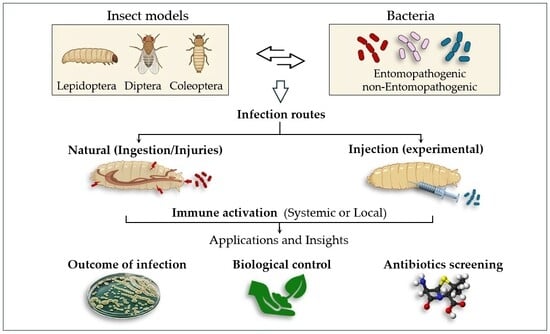
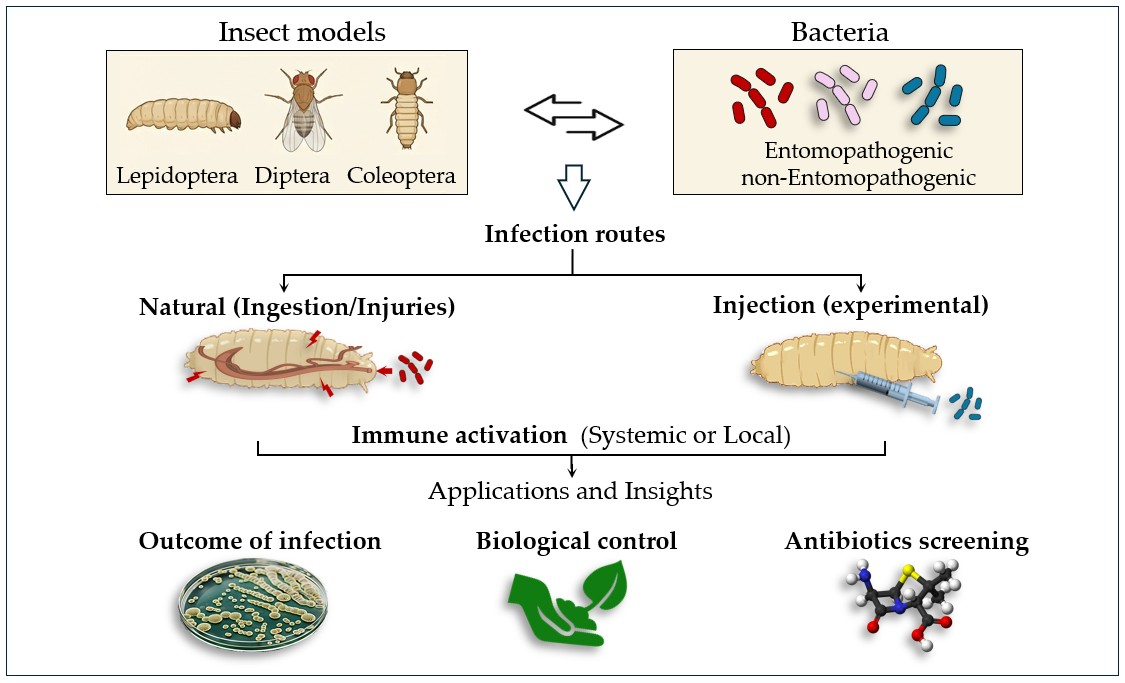
Graphical Abstract

1. Introduction

This review aims to provide an overview of the processes that regulate interactions between bacteria and their insect hosts. In particular, it aims to present an integrated perspective on the main mechanisms underlying host–microorganism interactions, examining their environmental implications, also in relation to biocontrol strategies. Furthermore, the physiological aspects that characterize the progression of infectious processes in the biomedical field are considered, as well as the potential applications of invertebrate models in the research and development of new antimicrobial drugs.
Insects, with an estimated 5.5 million extant species [1], dominate terrestrial biodiversity and interact continuously with a diverse microbial spectrum. In addition to their ecological importance, insects are increasingly studied for eco-sustainable pest control strategies [2,3] and for physiological traits that make them valuable models in immunological and pharmacological research [4,5,6]. Some species considered harmful to agroecosystems and urban green areas, or identified as pathogen vectors, have been investigated as targets for biological control using entomopathogenic microorganisms [7]. Others are also ideal models for genetic research due to features such as small genomes, short life cycles, and fewer ethical constraints compared to vertebrate systems. These characteristics support the investigation of microbial virulence mechanisms and the evaluation of novel antibiotic formulations.
The coevolution between insects and bacteria stems from long-term coexistence, immune plasticity, and strong environmental influences, forming a dynamic system that shapes insect physiology, adaptation, and ecological success [8,9,10]. Over hundreds of millions of years, insects and their bacterial partners have developed highly specialized relationships that influence feeding, development, immunity, and behavior. Many insects rely on obligate endosymbionts for essential nutrients, while others maintain diverse gut microbial communities that vary with diet, life stage, and habitat [11]. These associations are deeply rooted in evolutionary history and have contributed to the extraordinary ecological dominance of insects [12].
Although insects lack the antibody-based adaptive immunity of vertebrates, they mount rapid and efficient cellular and humoral immune responses. Infection outcomes in both insects and mammals often involve enzymatic cascades and conserved signal transduction pathways. These shared features are considered evolutionarily conserved defensive strategies rather than fully equivalent immune systems [13,14,15]. In particular, studies in Drosophila melanogaster have identified key signaling pathways underlying humoral and cellular defenses that share core elements with vertebrate innate immunity, providing a useful framework for understanding general principles of host–pathogen interactions [16,17]. In addition, insects such as Galleria mellonella and Bombyx mori are widely used as model organisms to study host–microbe dynamics, virulence, antimicrobial activity, and infection clearance [18,19]. Findings from these insect models can inform antibiotic efficacy studies and support translation into preclinical research using conventional animal models. A central feature of insect–microbe interactions is immune plasticity, meaning the ability of insects to finely regulate immune responses in order to tolerate beneficial microbes while defending against pathogens. The insect immune system actively shapes gut microbiota composition and stability through antimicrobial peptides (AMPs), reactive oxygen species (ROS), and immune signaling pathways, maintaining a balance between microbial symbionts and immune defense. At the same time, microbial variation can itself generate phenotypic plasticity in insects. Differences in gut microbiomes influence host physiology, behavior, and ecological interactions, showing that microbes actively contribute to insect traits rather than acting as passive passengers. These host–microbe relationships are strongly influenced by environmental factors such as diet, temperature, habitat, and chemical exposure. Environmental conditions determine which microbes insects acquire and maintain, while microbial communities in turn shape how insects respond to ecological pressures. Recent research highlights the complexity of the host–microbe–environment triad [20], demonstrating that microbial communities shift with environmental change and can mediate insect responses across trophic levels. Together, insect–bacteria coevolution, immune plasticity, conserved immune mechanisms, and environmental influences form an integrated framework for understanding how insects adapt, thrive, and interact within ecosystems.

2. Insect Immunity: A Brief Overview

2.1. Routes of Pathogen Entry and Immune Defenses in Insects

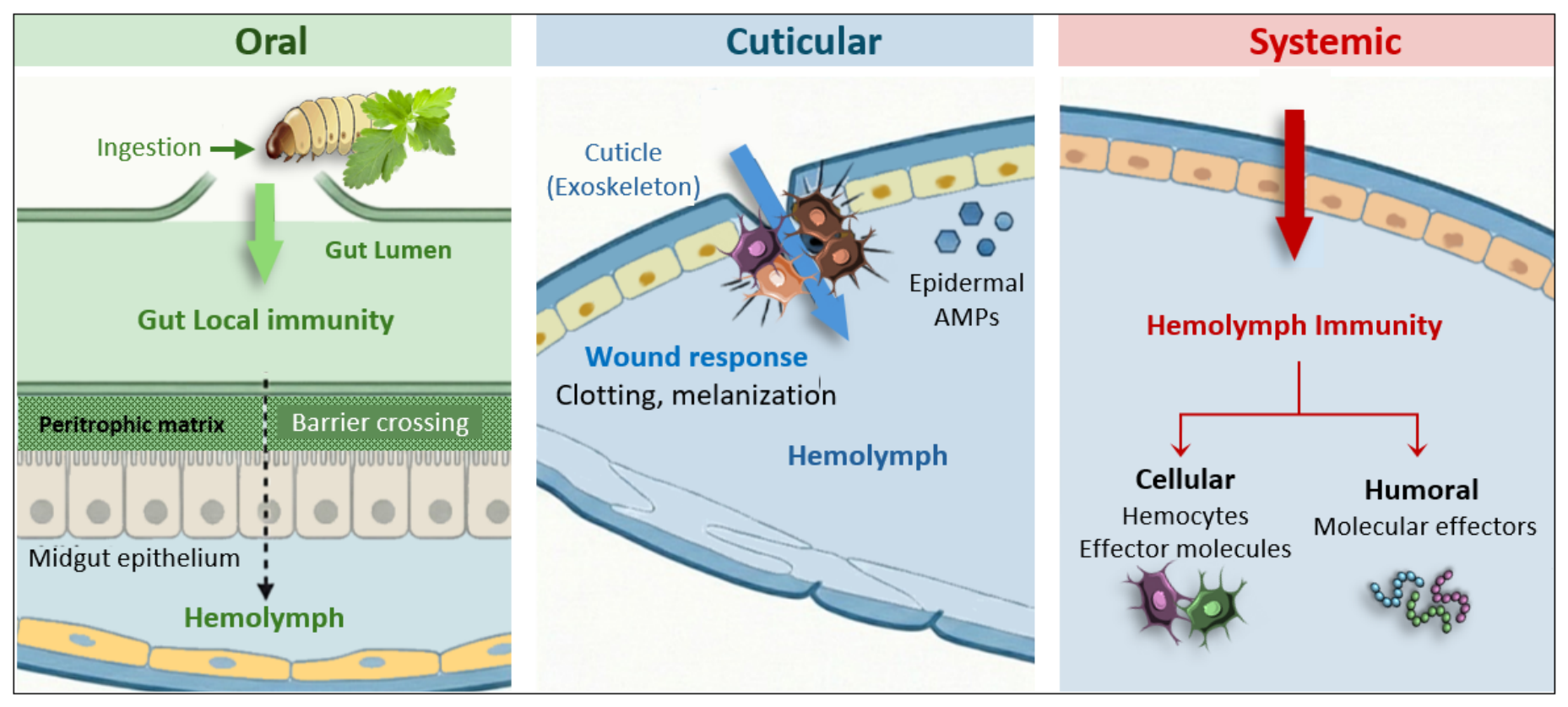
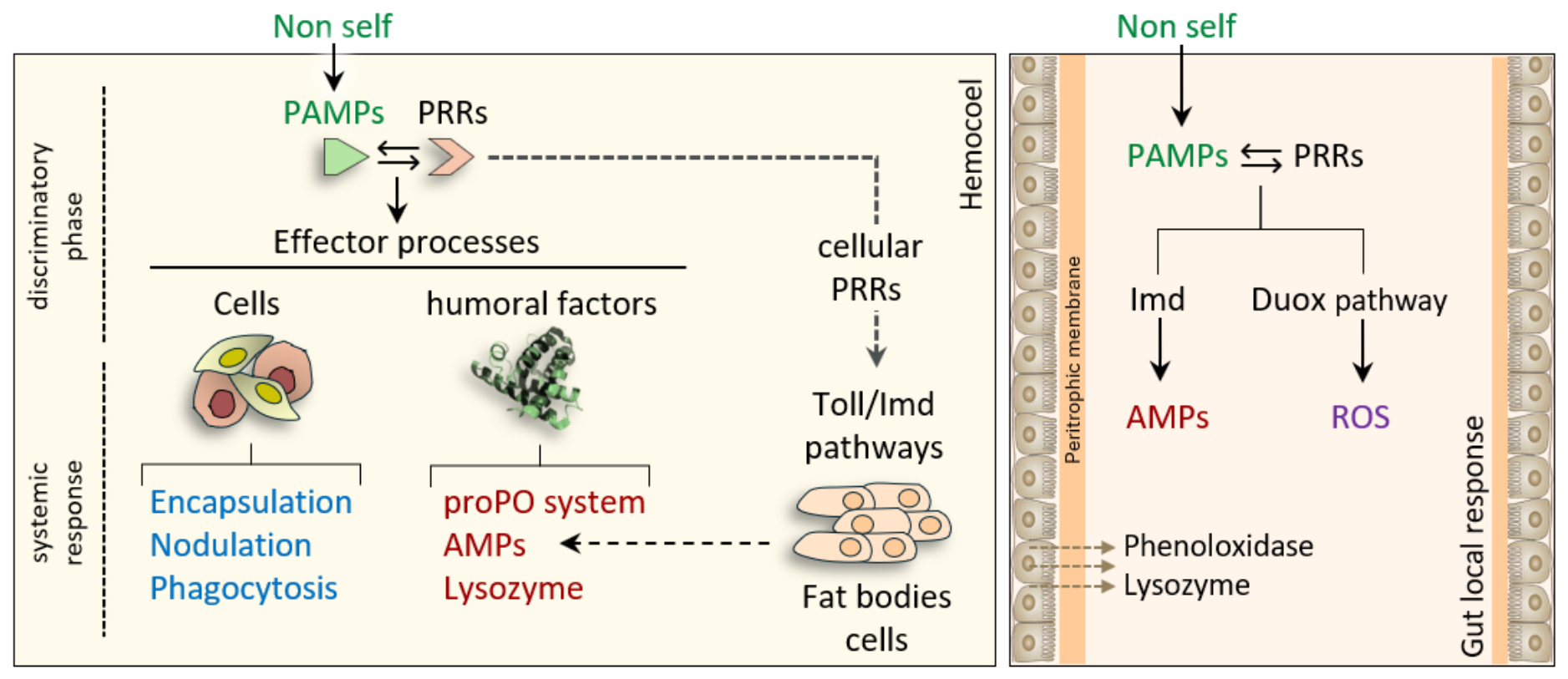
In insects, each potential route of infection can trigger distinct local or systemic immune responses (Figure 1). Oral infection occurs through ingestion, where pathogens encounter gut immunity in the lumen, including ROS and reactive nitrogen species (RNS), AMPs, and digestive enzymes. The peritrophic matrix and midgut epithelium act as main physical barriers, and only pathogens that successfully cross them reach the hemolymph. Cuticular infection results from breaches in the exoskeleton, triggering local wound responses such as clotting and melanization, along with the production of epidermal AMPs, before pathogens can access the hemolymph.
However, the immune response in fat body tissues and hemocytes can be triggered before pathogens enter the hemolymph, starting as early as their entry into the gut or adhesion to the cuticle. Systemic infection directly exposes the hemolymph to pathogens, activating both cellular and humoral immunity [21,22,23]. Although direct systemic exposure is uncommon in natural conditions, where penetration can occur through the body natural opening, it is a standard method in experimental assays, occurring after pathogens have been ingested or administered via microinjection into the hemocoel [21,24].

2.2. Key Signaling Pathways

Insect immunity is mediated exclusively by innate mechanisms that detect and respond to invading microorganisms through conserved molecular signals [25]. Central to this process is pathogen recognition via interactions between pathogen-associated molecular patterns (PAMPs) and host pattern recognition receptors (PRRs). PRRs include soluble hemolymph proteins and membrane-associated receptors such as peptidoglycan recognition proteins (PGRPs), lipopolysaccharide-binding proteins (LBPs), and other microorganism-recognition factors (Table 1) [26].
While it is often presented as a highly specific detection system, the degree of immune specificity in insects is still debated, particularly with respect to how host receptors discriminate between pathogens versus triggering broadly reactive responses that prioritize tolerance and energetic efficiency over precision. Although immune pathways are well characterized (Figure 2), their relative importance, regulatory architecture, and activation thresholds vary across insect orders. For example, the number and diversity of PGRP genes, AMPs repertoires, and pathway cross-regulation differ markedly between Diptera, Lepidoptera, Coleoptera, and Hymenoptera.
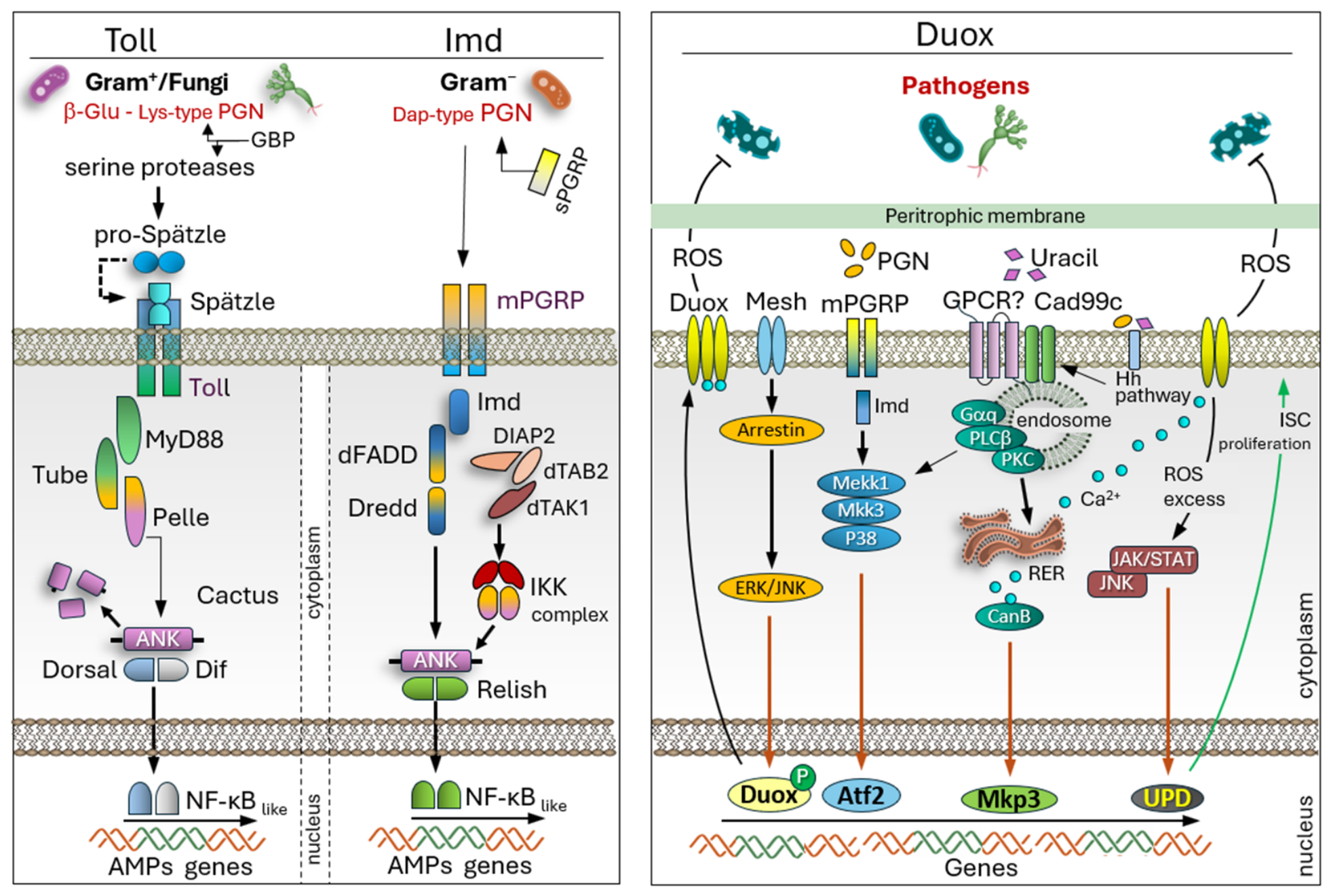
These receptors trigger downstream signaling primarily through the Toll and Imd pathways, which regulate transcriptional immune responses via NF-κB-like transcription factors (Figure 3) [27]. The Toll pathway is activated by fungal β-glucans and Gram-positive bacteria through PRRs such as glucan binding proteins (GBPs) and PGRPs, leading to Toll receptor engagement at the plasma membrane. In the cell cytoplasm, the adaptor complex MyD88, Tube, and Pelle transduces the signal, resulting in phosphorylation dependent degradation of the IκB-like inhibitor Cactus. This releases the NF-κB-like transcription factors Dorsal and Dif, which translocate into the nucleus and induce transcription of AMPs genes, whose transcripts are key elements in bacterial clearance [28].
The Imd pathway is triggered primarily by Gram-negative bacterial peptidoglycan (PGN), recognized by membrane-bound PGRP-LC and cytosolic PGRP-LE. Signal transduction involves Imd, dFADD, and caspase Dredd, along with the TAK1, TAB2 complex and DIAP2, culminating in the activation of the IKK complex. Relish, a NF-κB-like factor, is phosphorylated and cleaved, allowing its N-terminal Rel domain to enter the nucleus and drive AMP genes expression [29].
The gut immune system functions as an integrated network in which multiple signaling pathways work together to maintain a balance between the effective elimination of pathogens and tolerance towards commensal microorganisms. The interaction between the Imd, ROS, Jak/Stat pathways and the prophenoloxidase–phenoloxidase (proPO) system ensures a rapid yet controlled response, preventing excessive immune activation that could injure host tissues. The gut microbiota itself plays a crucial role in modulating these immune responses, influencing signaling pathways and contributing to resistance to colonization by invading pathogens. A disruption of this delicate balance, whether due to environmental stress, pathogen invasion or dysbiosis, can lead to impaired immune function and increased susceptibility to infection. Consequently, understanding the coordination between immune signaling, epithelial renewal and microbial interactions in the insect gut provides valuable insights into host–microbe relationships. Insect tissues respond to bacterial invasion by triggering acute inflammatory reactions, highlighting the constant challenge faced by mucosal epithelia exposed to diverse microbial communities.
Recent studies across multiple animal models have demonstrated a dynamic, bidirectional interaction between the gut microbiota and the host immune system: the immune system shapes microbial composition, while resident microbes influence immune function and responsiveness [30]. In this context, the dual oxidase (Duox)–Mitogen-Activated Protein Kinase (MAPK)-Jak/Stat signaling axis (Figure 3) plays a central role in gut immunity, as it is activated by tissue damage and promotes epithelial regeneration during infection [31]. Microbiota-derived metabolites can influence host signaling pathways involved in epithelial renewal, stem cell proliferation, and immune tolerance, highlighting the intimate molecular dialog between symbiotic microbes and the insect immune system [32,33].
Genetic studies in Drosophila, along with analyses of gut-associated bacteria with varying capacities to stimulate the Duox pathway, have provided insight into mechanisms underlying homeostatic inflammation and chronic inflammatory conditions [34]. Furthermore, impairment of Duox function or its regulator Socs36E reduces infection tolerance, particularly in male dipterans, emphasizing the importance of ROS in host defense [35]. Figure 3 shows the Duox pathway activated in gut epithelial cells in the presence of pathogens [36]. When pathogens enter the gut environment, they release molecular signals like PGN and uracil. These molecules are detected at the cell surface by specialized receptors, including membrane-bound mPGRPs and possibly G protein-coupled receptors (GPCRs), while proteins such as Cad99c contribute to signal organization and internalization processes. After recognition, multiple intracellular signaling cascades are triggered. Detection of PGN activates the Imd pathway, which in turn initiates a kinase cascade involving Mekk1, Mkk3, and p38. This signaling influences transcription factors such as Atf2, promoting the expression of immune-related genes. In parallel, GPCR activation stimulates a Gαq-PLCβ-PKC pathway that increases intracellular calcium levels. The rise in Ca2+ is a key step, as it directly activates the Duox enzyme, enabling it to produce ROS. Additional regulatory layers refine this response. Arrestin-mediated processes modulate receptor activity and connect to ERK and JNK signaling pathways, ensuring proper signal strength and duration. At the same time, ROS generated by Duox serve not only as antimicrobial agents but also as signaling molecules. When ROS levels become high, they activate stress-responsive pathways such as JNK and Jak/Stat. These pathways coordinate protective responses and help maintain tissue integrity. At the transcriptional level, these combined signals converge to regulate genes including Duox itself, as well as Atf2, Mkp3, and UPD. The UPD cytokine activates Jak/Stat signaling, which promotes intestinal stem cell proliferation and supports tissue repair. Overall, the Duox pathway represents a tightly controlled defense mechanism in which pathogen detection leads to ROS production, immune gene activation, and regenerative signaling, ensuring both protection against infection and restoration of epithelial homeostasis [34]. The integration of studies on insect immunity have revealed that the innate response is regulated through interactions with metabolism, microbial symbiosis, epigenetic mechanisms, and systemic communication between organs. These studies suggest that immune activation is closely linked to metabolic reprogramming at the molecular level [37,38]. Conserved pathways such as Toll, Imd, and JNK not only regulate the expression of AMPs but also modulate lipid and carbohydrate metabolism to support the energy demands of immune responses [39,40]. During infection, metabolic intermediates and mitochondrial ROS also act as signaling molecules, influencing the transcription of immune genes and cellular stress responses [41]. Epigenetic regulation represents another important level of immune control. Histone acetylation and methylation, along with chromatin remodeling, regulate the accessibility of immune-related genes during exposure to pathogens. Recent works suggest that infection-induced metabolic changes may alter the activity of epigenetic enzymes, thereby linking cellular metabolism to the transcriptional regulation of immunity [42,43]. Furthermore, non-coding RNAs, particularly microRNAs (miRNAs) and long non-coding RNAs (lncRNAs), contribute to post-transcriptional regulation by targeting components of the Toll, Imd, and Jak/Stat pathways, precisely regulating AMP production, apoptosis, and antiviral responses [44,45].
Also, systemic immune regulation is based on inter-tissue signaling between gut, fat bodies, hemocytes, endocrine organs, and nervous system. Cytokine-like molecules, insulin-like peptides, and hormonal mediators coordinate immune activation with developmental and metabolic processes, ensuring body homeostasis during infection [46]. Taken together, these findings have expanded our understanding of innate immunity in insects, revealing a highly integrated network in which molecular immune signaling is closely linked to metabolism, microbiota composition, epigenetic plasticity, and the physiological regulation of the whole organism.

2.3. Molecular and Cellular Effectors

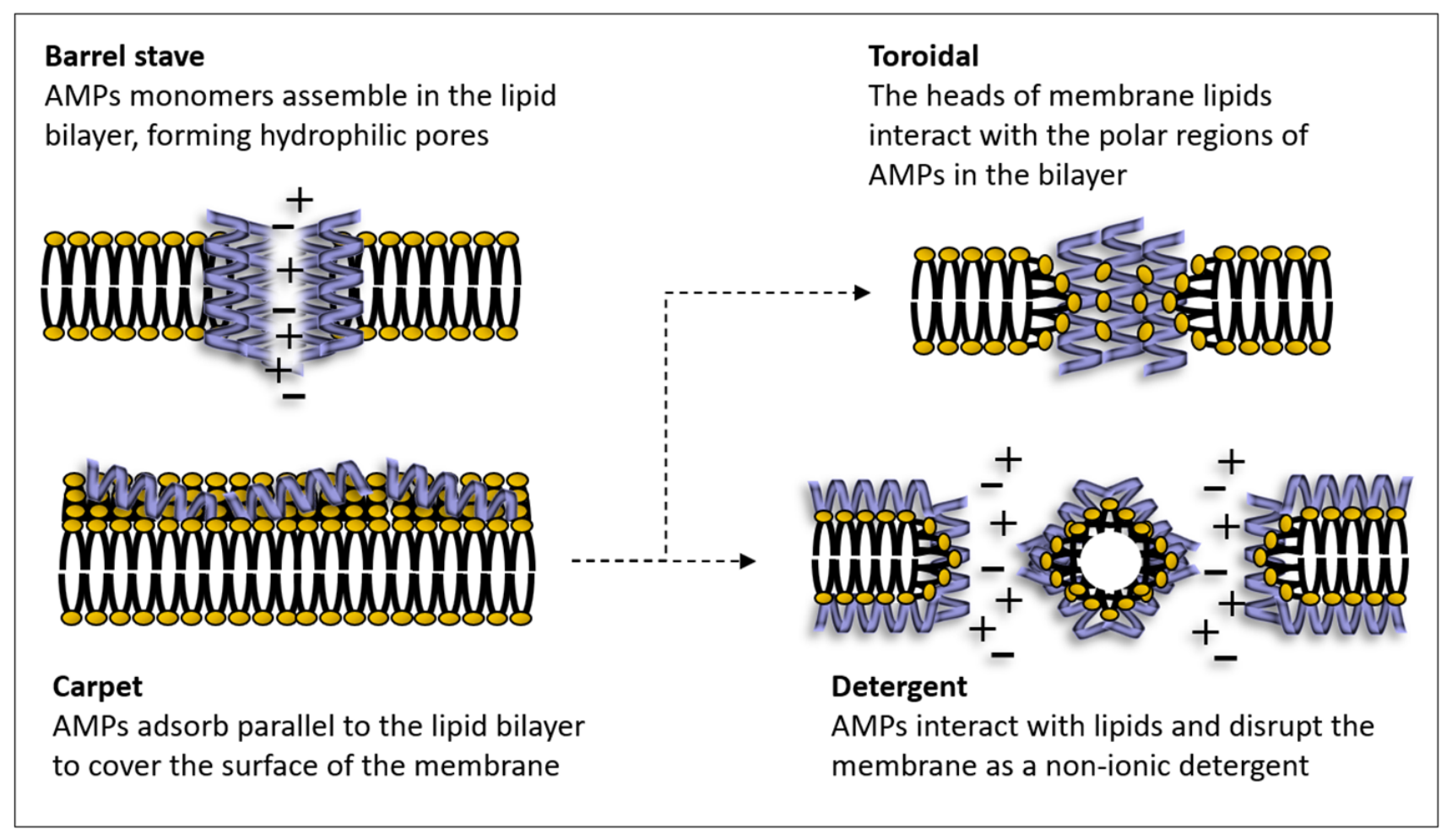
The main key components of bacterial clearance, the AMPs, include anionic and cationic molecules such as defensins, cecropins, drosomycin, drosocins, attacins, diptericins, melittin, etc., described in various insect species [47,48]. The short cationic AMPs exert an antimicrobial effect by destabilizing the microbial membrane. The positive charge, hydrophobic property, and secondary structure of peptides are essential for their antibacterial activity. The main mechanisms directed to the bacterial membrane are the Barrel stave, Toroidal and Carpet models. The last is an intermediate model that generates Toroidal pores or detergent action (Figure 4).
The formation of pores induces a drastic modification of the membrane permeability that progressively destabilizes the membrane structure. In the Barrel-stave model, AMPs insert into the membrane and form stable channels.
In the Toroidal pore model, both peptides and lipid groups form transient pores across the membrane. In the Carpet model, peptides accumulate on the membrane and compromise its integrity, leading to the formation of Toroidal pores or detergent-like membrane disintegration. AMPs damage the bacterial membrane causing a loss of membrane potential through disrupted ionic flux regulation [49].
An additional mechanism of action of AMPs involves their internalization into cells, where they act at multiple levels by disrupting membrane septum formation and inhibiting cell wall synthesis, nucleic acid synthesis, protein synthesis, and enzymatic activity. AMPs induction shows substantial interspecific variation in expression levels, inducibility, and spectrum of activity, suggesting that immune effectiveness is shaped not only by qualitative differences but also by dose and timing of AMPs formation [48,49].
Besides AMPs, humoral defenses include lysozymes and the proPO system [50,51]. This enzymatic system mediates melanization responses that contribute to pathogen immobilization and elimination, but it may also pose risks of self-damage due to cytotoxic intermediates [52]. This has fueled debate on how tightly melanization is regulated across taxa and ecological contexts, and whether its functional parallels with the vertebrate complement system reflect deep homology or convergent solutions to similar immune challenges [53]. Cellular immunity, mediated by hemocytes, includes phagocytosis, encapsulation, and nodulation [54,55,56]. The prevalence and efficiency of these responses vary with hemocyte abundance and composition, which differ widely between insect species and developmental stages. Such variability can limit the use of insect models as direct proxies for vertebrate immunity, particularly for studying immune memory, clonal expansion, or fine-scale pathogen discrimination [57]. At mucosal interfaces, such as in the intestine, immune responses must maintain a delicate balance between the effective elimination of pathogens and tolerance toward the commensal microbiota [58]. Local activation of the Imd pathway, together with the production of ROS mediated by Duox, modulates local responses [59]. However, the regulatory thresholds distinguishing immune activation from tolerance remain poorly characterized.

2.4. Immune Priming in Insects

An issue of interest, still under debate in insect immunology, is the potential presence of a form of immune memory. This aspect is relevant for understanding the interactions between insects and bacterial pathogens. In this context, several studies have described a phenomenon referred to as immune priming, whereby prior exposure to a sublethal dose of a pathogen enhances the host subsequent immune response. As a consequence, primed individuals often exhibit increased resistance to later infections with lethal doses of the same pathogen [60,61]. This process is often associated with expanded hemocyte populations and increased production of AMPs. Across studied systems, a common theme is that immune memory varies between insects but is consistently shaped by similar immune mechanisms. Priming does not rely on a single effector but rather results from a coordinated modulation of cellular and humoral processes and is adapted to the pathogen encountered. Unlike other insects, Manduca sexta does not possess a stable gut microbiome; however, it has been observed that protection against Photorhabdus luminescens is primarily mediated by PRRs, which trigger a broad humoral response [62]. The lack of a stable microbiome in some insects [63,64,65,66] could make them a useful experimental model for analyzing immune responses in the absence of potential interference from gut-resident bacteria. In contrast, Tribolium castaneum displays exceptional fine-scale discrimination, developing protection only against the specific Bacillus thuringiensis genotype previously encountered [67,68], while remaining unprotected against other bacterial strains. Social insects such as Bombus terrestris display an intermediate strategy, maintaining long-lasting, species-specific protection against Paenibacillus spp. and Pseudomonas fluorescens [61]. Transgenerational priming in Tenebrio molitor is conferred not through persistent infection or inherited immune transcripts, but via the targeted deposition of a restricted set of AMPs into the egg, enhancing resistance to Staphylococcus aureus, B. thuringiensis, and Serratia entomophila in offspring [69,70]. Insect priming immunity is thus a spectrum of memory-like states varying in specificity, duration, and cost, shaped by the pathogen type, prior exposures, and ecological context, rather than a simple on-off mechanism or vertebrate-like adaptive response.

3. Bacterial Strategies to Overcome the Host Immune Responses

3.1. Bacterial Evasion/Depression Strategies

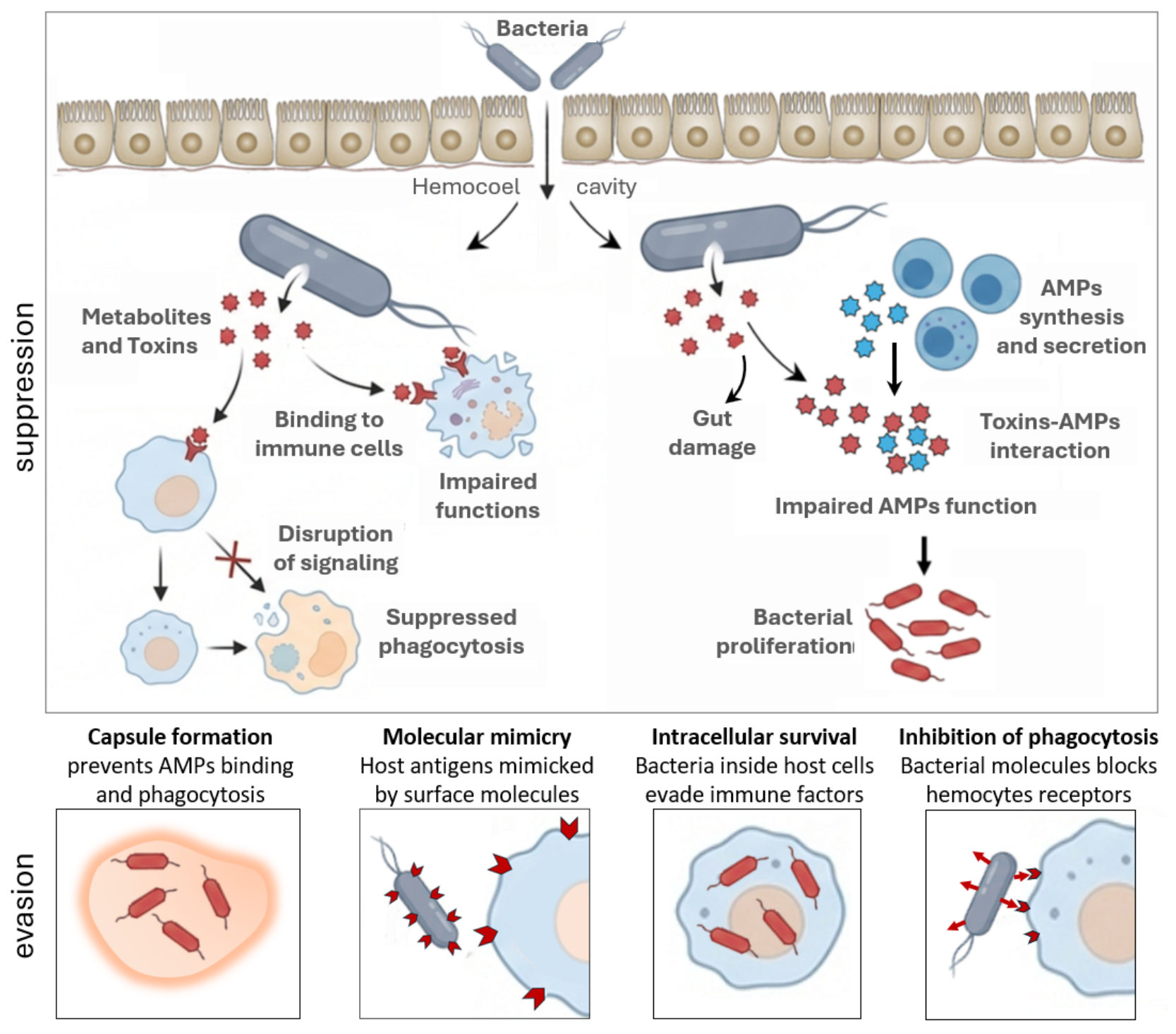
Across insect–bacteria associations, a striking convergence emerges between entomopathogenic bacteria and free-living pathogens in the deployment of immunosuppressive strategies that target conserved components of insect innate immunity. Regardless of whether bacteria are delivered directly into the hemocoel by entomopathogenic nematodes or enter via oral ingestion, successful colonization depends on the ability to evade or suppress host immune recognition and modulate downstream effector responses (Table S1) [3,18,62,64,68,71,72,73,74,75,76,77,78,79,80,81,82,83,84,85,86,87,88,89,90,91,92,93,94,95,96,97,98,99,100,101,102,103,104,105,106,107,108,109,110,111,112,113,114,115,116,117,118,119,120,121]. The effectiveness of bacterial pathogenesis is often attributable to the action of bacterial metabolites and toxins (Figure 5 and Table 2). Although toxins are key elements in immune modulation, they are not exclusive. Other factors, such as metabolic competition, nutrient sequestration, growth rate, and spatial niche occupancy, can contribute significantly to pathogenesis [122,123].
Central to this process is the interference with PRR-mediated pathways, which represent major hubs of AMPs induction in insects. Pathogenic bacteria can enter the insect through injuries in the cuticle or through oral ingestion, releasing toxins that interfere with multiple components of the insect immune response. The toxins bind to immune cells, interfering with signaling pathways and compromising cellular functions such as phagocytosis. At the same time, AMPs activity [47] can be reduced by their interactions with toxins, resulting in decreased AMPs and bacterial proliferation [124,125]. The toxins also damage the intestinal epithelium, facilitating further translocation of bacteria into the hemocoel and compromising the immune function of the insect host.
Both obligate entomopathogens (e.g., Photorhabdus spp. and Xenorhabdus spp.) and free-living entomopathogens such as Serratia spp., Pseudomonas spp., and B. thuringiensis converge on similar outcomes: inhibition of NF-κB-like transcription factors, suppression of AMPs expression, impairment of hemocyte-mediated defenses, and disruption of epithelial barrier integrity (Figure 4 and Figure 5) [72,100,126,127,128]. These strategies add to the evasion/suppression mechanisms observed in different species, underscoring their evolutionary conservation. Moreover, the possible formation of biofilms, intracellular persistence, modification of surface antigens, and expression of virulence traits regulated by sensing threshold further increase resistance to immune clearance (Figure 5).
An additional important aspect of bacterial biology involves the mechanisms governing the transition from pathogenicity to mutualism. During the evolutionary shift from parasitism to mutualistic association, bacteria typically exhibit reduced virulence alongside increased host benefits, particularly when vertical transmission aligns bacterial fitness with that of the host [129]. This transition is frequently associated with genomic reduction, whereby symbionts lose genes required for autonomous survival while retaining functions essential for host support. Some examples of this process have been documented: in taxa such as Sodalis spp. and Hamiltonella defensa, an evolutionary transition from parasitic ancestors to endosymbiotic states has been proposed, indicating that host–microbe relationships exist along a continuum rather than as discrete categories of pathogen or symbiont [130,131]. The interaction between Aphis fabae and H. defensa illustrates this functional plasticity: the bacterium confers protection against parasitoid wasps (e.g., Aphidius spp.) yet imposes fitness costs in environments lacking such natural enemies [132]. Similarly, the system involving Sodalis praecaptivus and Oryzaephilus surinamensis demonstrates how novel symbionts can invade hosts, establish vertical transmission, and rapidly displace ancestral symbionts such as Shikimatogenerans silvanidophilus [133]. Together, these examples underscore the context dependency of microbial effects on host biology.
Table 2. Bacterial toxins and secondary metabolites.
BacteriaCompoundsTx, SM,
AMP
Target
Structure
Mechanism
of Action
Insect OrdersRef.
Bacillus
thuringiensis
Cry toxins
Cyt toxins
Vip toxins
Sip toxins
Aerolysin β
TxMidgut
epithelial
receptors
Pores formation
Pores formation
Apoptosis
Cytotoxic
Lepidoptera,
Diptera,
Coleoptera
[134,135]
Lysinibacillus
sphaericus
Binary toxin (BinA/BinB)TxMidgut
epithelial
receptors
Pores formation Diptera[136]
Paenibacillus
larvae
PaenilamicinSMMidgut
epithelia
Cytotoxic Hymenoptera[137]
Photorhabdus
luminescens
Tc toxins
Mcf toxin
Pir toxins
Pit toxins
TxCytoskeleton
Hemocytes
Midgut cells
Gut cells
Cytoskeleton damage
Apoptosis
Pore formation
Cytotoxic
Lepidoptera,
Diptera,
Coleoptera
[138]
Xenorhabdus spp.Xenocoumacin
Xenematides
Xenortides
Benzalacetone
Rhapidosin
SMImmune cells
Signaling
Antibiotic
Immunosuppressive
Immunosuppressive
PLA2 inhibition
Cytotoxic
Many
orders
[139]
Serratia spp.Sep complex
ShlA hemolysin
Serratamolide
Tx
Tx
SM
Midgut cells
Cells membrane
Cells membrane
Gut damage
Membrane lysis
Membrane surfactant
Coleoptera
Many
orders
[140,141]
Pseudomonas spp.Monalysin
FitD
Fit-like
TxGut epithelia
Hemocytes
Hemocytes
Pore formation
Immune suppression
Cytotoxicity
Diptera
Lepidoptera
[142,143,144]
Clostridium
bifermentans
Mosquito TxTxMidgut epitheliaGut cell lysisDiptera[145]
Yersinia spp.Yen Tx complex
Tc-like Tx
TxCytoskeleton
Cytoskeleton
Cell disruptionLepidoptera[146,147]
Chromobacterium
subtsugae
ViolaceinSMCellular
respiration
Oxidative stressLepidoptera,
Diptera
[148]
Burkholderia spp.Thailandamide Bongkrekic acid SMFA synthesis
Mitochondria
Metabolic inhibition
ADP/ATP transport
Many
orders
[149,150]
Streptomyces spp.Avermectins
Spinosyns
Milbemycins
SMNervous systemCl channel activation
Nervous stimulated
Paralysis
Many orders[151,152,153]
Brevibacillus
laterosporus
BL
Laterosporulin
Tx
AMP
Midgut epithelia
Cell membranes
Gut damage
Membrane damage
Many
orders
[154,155]
Tx: toxin, SM: secondary metabolites, AMP: antimicrobial peptide, FA: fatty acids.

3.2. Balancing Virulence and Symbiosis in Insect–Microbe Systems

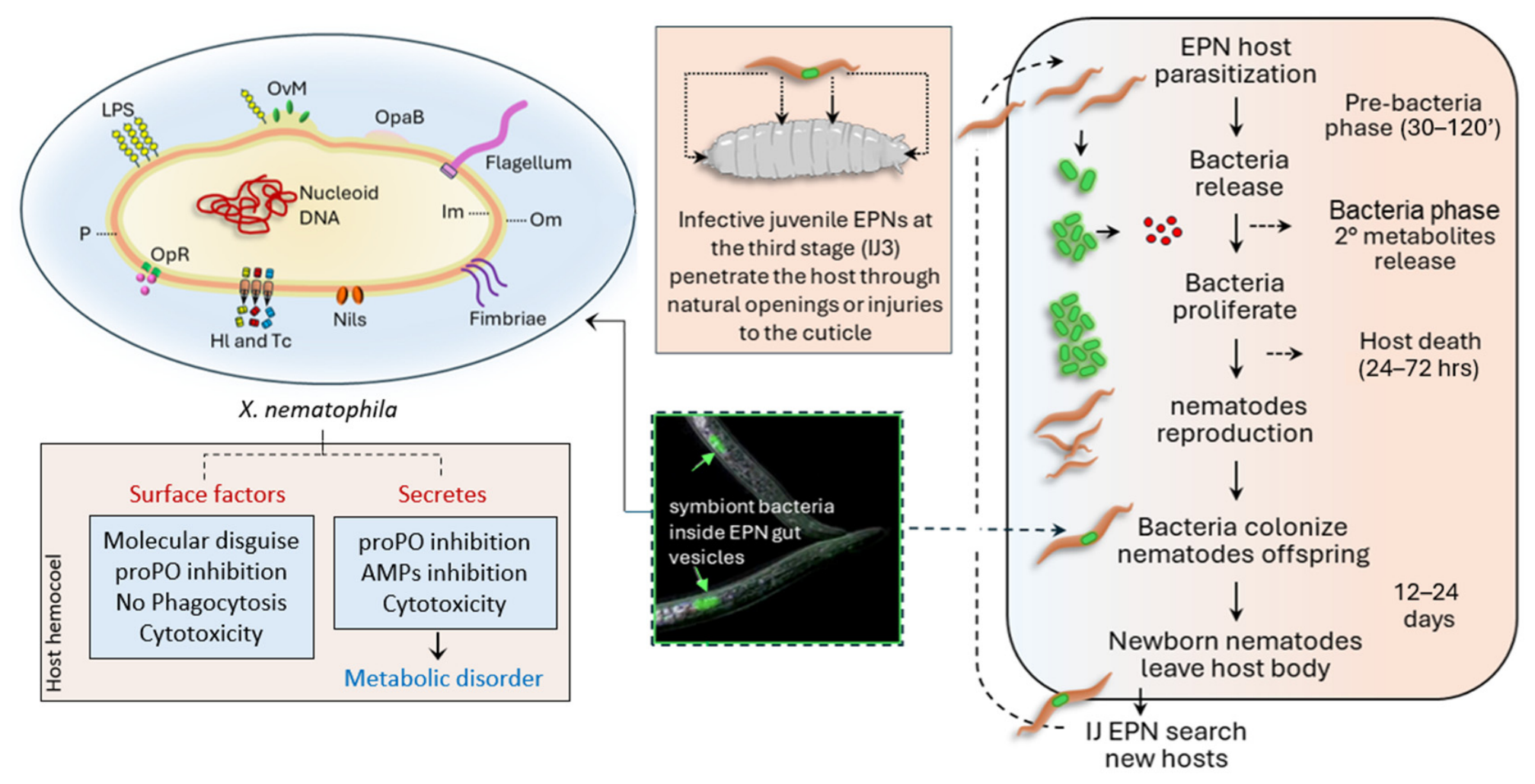
The trade-off between virulence and symbiosis is evident in various bacteria, such as the genera Photorhabdus and Xenorhabdus [126,127], whose success depends on their ability to effectively kill the host insect while maintaining long-term compatibility with their nematode partners (Figure 6). Nematodes and their bacterial partners have a peculiar life cycle: the infective entomopathogenic nematodes (EPNs) at the third larval stage (IJ3) penetrate the insect host through natural openings or cuticular lesions and release their symbionts into the hemocoel from nematode intestine vesicles. The bacteria proliferate rapidly in the hemolymph, producing secondary metabolites responsible for evading/suppressing the host immunity, causing the death of the target insect within 24–72 h. Symbiotic bacteria also release antibiotic compounds to prevent colonization by other microorganisms [156,157]. Excessive virulence destabilizes the ecological niche required for nematode development and bacterial transmission, whereas insufficient immune suppression limits bacterial proliferation in the host hemocoel [158]. Bacterial transcription factors, such as Lrp, enable symbionts to modulate gene transcription in response to environmental signals, thereby finely regulating the shift between virulent behavior and cooperative interactions with the nematode [127]. In this context, immunosuppression is not purely destructive but rather modulatory, finely tuned to enable rapid exploitation of the host while preserving resources within the insect corpse.
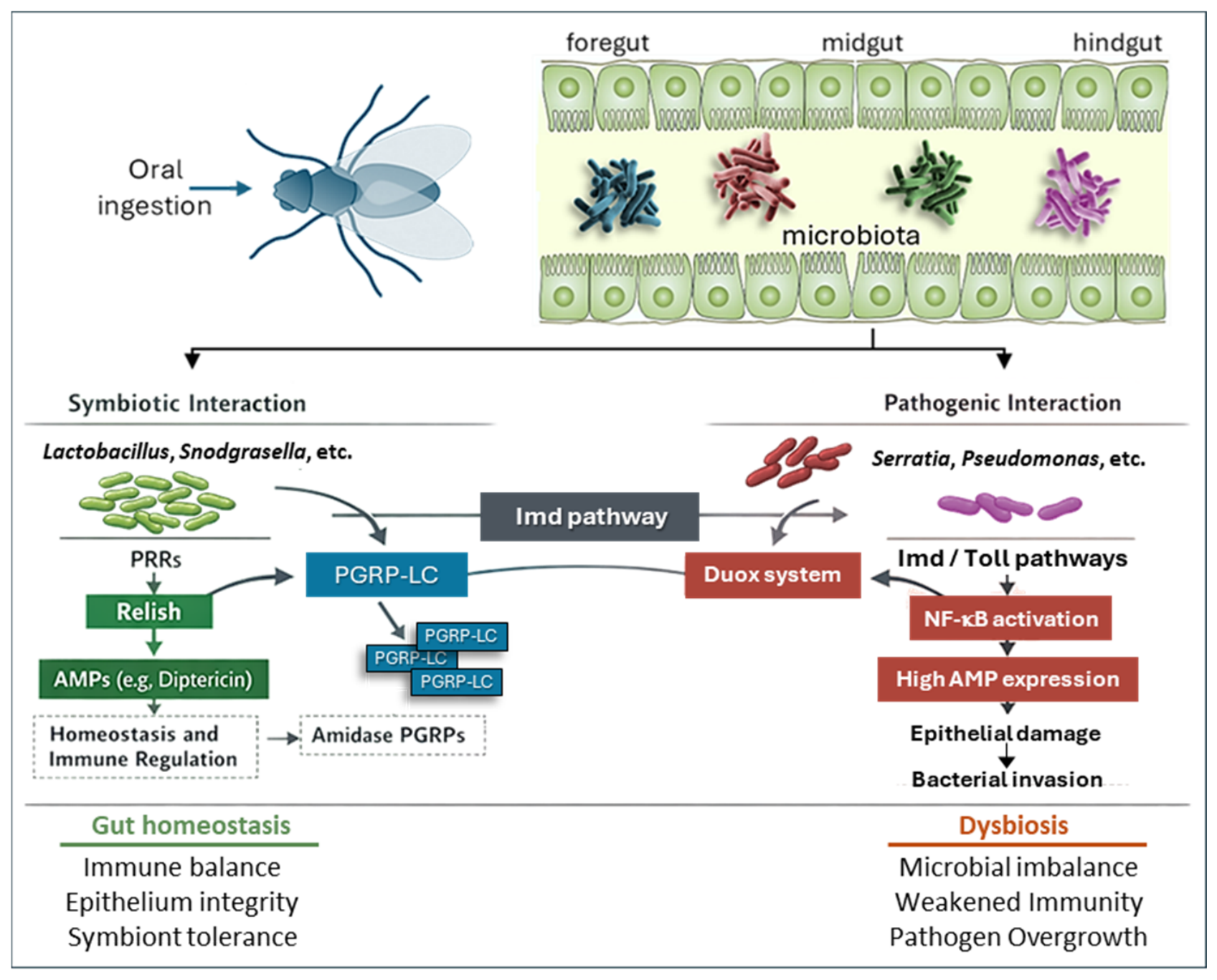
Similar interactions are also observed in gut-associated bacteria, where controlled activation of immune pathways by symbionts sustains tolerance and homeostasis (Figure 7), while dysregulation or loss of microbial diversity shifts interactions toward pathogenicity. Microorganisms enter the insect gut through oral ingestion and encounter resident microbiota along the intestinal epithelium. Symbiotic bacteria (e.g., Lactobacillus spp., Snodgrassella spp.) recognized by PRRs, including PGRP-LC, lead to controlled activation of the Imd pathway, Relish signaling, and basal AMPs production, as well as the action of amidase PGRPs to maintain immune tolerance and gut homeostasis. In contrast, pathogenic bacteria (e.g., Pseudomonas spp., Serratia spp.) trigger strong activation of the Imd and Toll pathways, Duox activation, and high AMPs expression, which can cause epithelial damage, bacterial invasion, and dysbiosis [72,128]. The balance between these responses is essential for maintaining intestinal integrity and immune homeostasis (Figure 7).
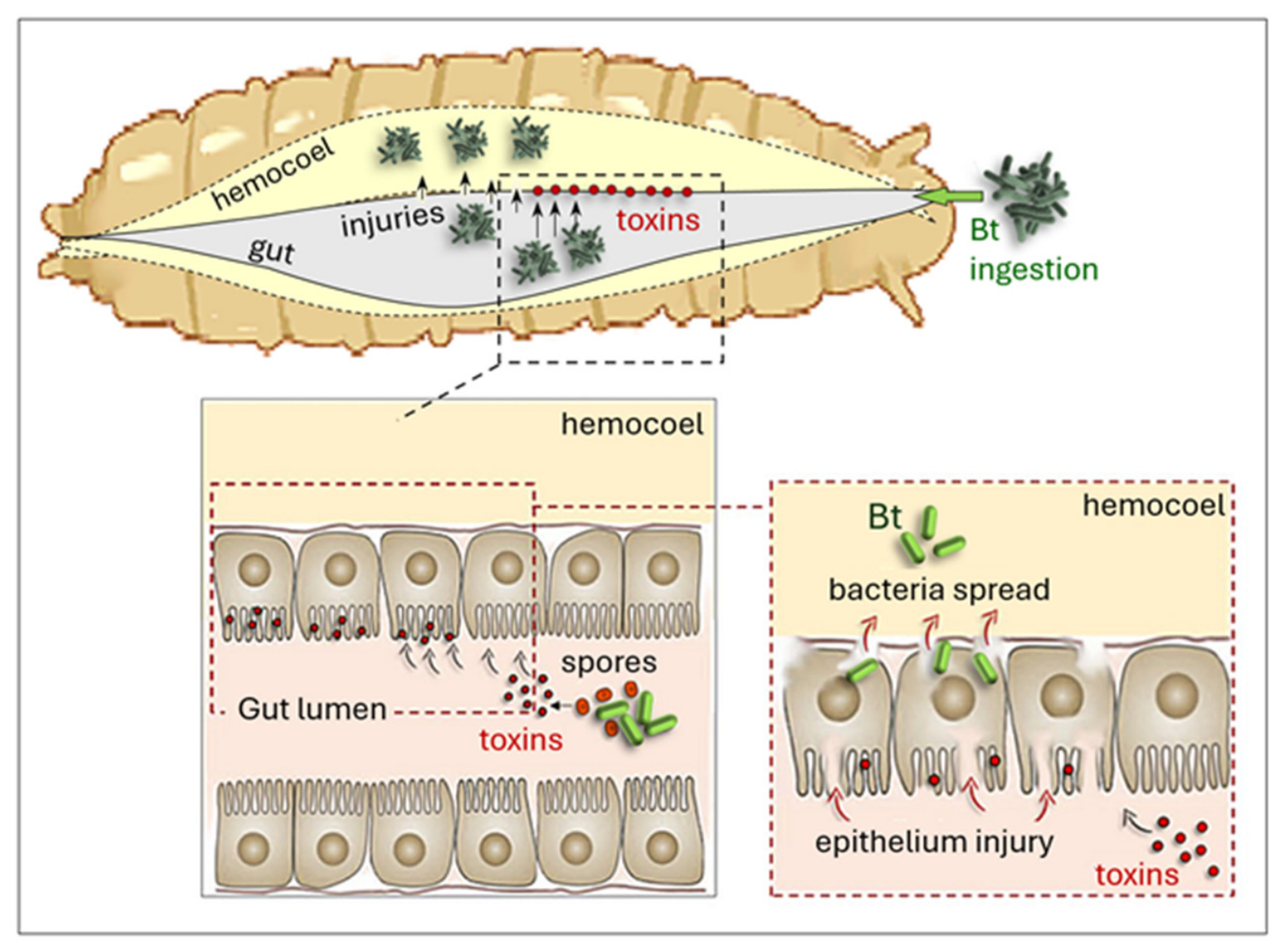
Thus, immune modulation emerges as a continuum rather than a binary state, with bacterial fitness determined by the ability to optimize host survival (i.e., to be long enough to ensure transmission). Bacterial toxins emerge as a unifying mechanism driving immune evasion across diverse insect–bacteria interactions. Although toxins differ in structure, targets, and delivery routes, their functional convergence is evident in their capacity to simultaneously damage tissues and suppress immune defenses (Figure 5). Pore-forming toxins (e.g., Cry, Tc, Pir), apoptosis-inducing factors (e.g., Mcf), and enzymatic toxins targeting cytoskeletal or signaling components collectively dismantle both cellular and humoral immunity by inducing hemocyte apoptosis, blocking phagocytosis, inhibiting melanization, and compromising AMPs activity (Table 2) [124]. For instance, following ingestion of B. thuringiensis, bacterial spores and toxins are released into the gut lumen, where toxins disrupt the intestinal epithelium, causing cellular damage and barrier dysfunction. Gut injuries facilitate the translocation of bacteria and toxins across the epithelium into the hemocoel, leading to systemic infection and widespread tissue damage (Figure 8) [45].
Lethal infection in a variety of lepidopterans often requires a tripartite interaction in which Cry toxins perforate the midgut, allowing resident gut commensals to spread and cause mortality [125,159]. Notably, toxin-mediated immune evasion is not restricted to highly specialized symbionts but is equally prominent in free-living entomopathogens such as B. thuringiensis and Lysinibacillus spp., indicating strong selective pressure that favors this strategy [100,101]. Even in gut-associated infections, where immune activation is robust, toxins can overwhelm local defenses by disrupting epithelial integrity and enabling bacterial translocation into the hemocoel. This convergence highlights toxins as multifunctional effectors that integrate virulence with immune modulation rather than acting solely as cytolytic agents [100].
Taken together, insect–bacteria interactions reveal a conserved toolkit of immunosuppressive strategies shaped by evolutionary trade-offs between exploitation and coexistence. Toxin-mediated immune evasion processes, the presence of common mechanisms that modulate changes in virulence, and the finely tuned regulation within the gut highlight how insect immunity has played a powerful selective role [24,160]. Viewing entomopathogenic and symbiotic bacteria through this comparative lens not only clarifies common principles of host–microbe interactions but also promotes insects as valuable models for understanding the evolution of immune evasion strategies across biological systems.

4. Use of Insect–Bacteria Models to Deepen Their Interactions

In addition to offering insights into host–pathogen interactions during natural infections, insects serve as valuable alternative in vivo models for investigating experimental infections. Direct systemic infection is widely employed in laboratory settings and often yields significant data, even if this method may not faithfully replicate the outcomes observed in natural infections. These trials represent a valuable approach for analyzing pathogen–host interactions or testing new antimicrobial compounds [161,162]. Among the insect models commonly used in these laboratory tests are D. melanogaster [163], B. mori [164], and G. mellonella [6,102], which are genetically versatile and easily manipulable systems, as well as Apis mellifera, which is of particular importance in studies of social immunity and transmission of inherited microbiomes [164,165,166].
Integrated multi-omic approaches have improved our understanding of insect–microbe interactions and immune regulation at the molecular level. Previous research, based on single-omic datasets, often failed to capture the complexity of interactions between insect hosts, microbial symbionts, pathogens, and environmental stressors. The integration of transcriptomics, metagenomics, metabolomics, proteomics, epigenomics, and single-cell technologies now enables analysis at the level of immune signaling, microbial homeostasis, and host physiological adaptation [167,168].
A number of insect models have been extensively investigated using integrated omics approaches to elucidate the molecular basis of host–microbe interactions and immune regulation. In D. melanogaster, commensal bacteria such as Lactobacillus plantarum and Acetobacter pomorum regulate intestinal stem cell proliferation, ROS homeostasis, and epithelial renewal through Imd and JNK signaling pathways [169]. Similarly, in Aedes aegypti and Anopheles gambiae, microbiota members as Wolbachia pipientis, Asaia bogorensis, and Enterobacter spp. strongly modulate antiviral and antiparasitic immunity. In particular, Wolbachia limits Dengue, Zika virus, and Plasmodium replication through ROS-mediated immune priming and competition for host lipids required for pathogen replication [170,171]. In B. mori, infection with B. thuringiensis and Serratia spp. triggers broad transcriptional activation of melanization cascades, stress response genes, and AMPs production [170,171]. The honeybee A. mellifera represents another well-characterized model, hosting a relatively stable gut microbiota dominated by Gilliamella apicola, Snodgrassella alvi, Bifidobacterium asteroides, and Lactobacillus spp., which contribute to nutrient metabolism, pathogen resistance, and immune homeostasis [164,172].
Metagenomic and metatranscriptomic analyses have further expanded the understanding of insect-associated microbial functional potential. Shotgun sequencing has revealed microbial gene repertoires involved in vitamin biosynthesis, amino acid metabolism, quorum sensing, biofilm formation, and detoxification processes [173,174]. In termites such as Macrotermes natalensis and Reticulitermes flavipes, gut symbionts including Treponema, Fibrobacter, and methanogenic archaea encode cellulases, hemicellulases, lignin-degrading enzymes, and nitrogen-fixation pathways that enable lignocellulose digestion and nutrient acquisition. These consortia also produce acetate, the primary energetic substrate for the host [175,176]. Overall, integrated omics approaches consistently highlight microbial contributions to host metabolism, immune modulation, and pathogen susceptibility. In mosquitoes, as mentioned before, Wolbachia and Asaia alter lipid metabolism and immune gene expression, thereby influencing vector competence, while bacteria such as Serratia odorifera can increase susceptibility to arboviral infection by affecting intestinal barrier integrity and immune suppression [177,178]. Multi-omics integration further supports bidirectional host–microbe communication mediated by coordinated regulation of bacterial virulence factors and insect immune pathways [179].
Metabolomics has become essential for understanding the biochemistry of these interactions. Immune-related metabolites, including short-chain fatty acids, sphingolipids, polyamines, eicosanoids, and indole derivatives, have been shown to regulate oxidative stress responses and antimicrobial defenses [180,181]. In honeybees, microbial metabolites produced by Gilliamella and Lactobacillus participate in carbohydrate fermentation, amino acid biosynthesis, and detoxification of plant-derived phytochemicals [182]. In arbovirus-infected mosquitoes, metabolic remodeling of phosphatidylcholine, triglycerides, and cholesterol pathways is tightly associated with viral replication efficiency and vector competence [183].
Beyond metabolic shifts, the molecular landscape of these interactions is further fine-tuned at the protein level. Post-translational modifications (PTMs) are essential for regulating the strength and duration of innate immune responses by modulating the activity and stability of signaling components. Phosphorylation and dephosphorylation serve as primary mechanisms for activating immune signaling pathways, while ubiquitination controls the turnover of key regulators to prevent uncontrolled inflammation. Additionally, modifications such as glycosylation play a vital role in the maturation and intracellular trafficking of pattern recognition receptors (PRRs), which is necessary for the effective detection of invading pathogens [184]. Moreover, significant variations in phenoloxidase activity, lysozyme-like enzyme levels, and circulating hemocyte counts are consistently observed, with the timing and magnitude of these responses depending on the specific immune challenge [185]. Secretome analyses have identified extracellular vesicles (EVs) and exosome-like particles as ubiquitous mediators of communication. These vesicles serve as carriers for proteins, lipids, and regulatory RNAs involved in infection, defense, and intercellular immune signaling [186].
Epigenomic regulation adds a layer of complexity to host–microbe interactions. DNA methylation, histone modifications, and chromatin remodeling, collectively shape the transcriptional landscape of immune-related genes and microbial tolerance mechanisms [187,188]. In eusocial insects such as honeybees, epigenetic regulation, including DNA methylation and histone modifications, is closely linked to caste differentiation, behavioral plasticity, and environmental adaptation. These mechanisms respond to external cues, such as social context or seasonality, to establish diverse phenotypes and longevity without altering the underlying genotype. Comparative studies of chromatin accessibility and transcriptome landscapes, particularly in the brain, have identified tissue-specific gene expression patterns that underpin social communication and task specialization [189,190]. Moreover, microbial metabolites can directly influence histone acetylation and methylation states, thereby connecting microbial metabolism to host epigenetic regulation.
Single-cell omics technologies have provided unprecedented resolution in dissecting immune cell heterogeneity. Single-cell RNA sequencing (scRNA-seq) in D. melanogaster and A. aegypti has identified distinct hemocyte subpopulations specialized for phagocytosis, melanization, clotting, and antiviral defense [191,192]. Canonical markers such as hemolectin, nimrod, lozenge, and prophenoloxidase are widely used to define differentiation states within the insect immune system [191,193]. The integration of scRNA-seq with spatial transcriptomics and single-cell ATAC-seq enables a comprehensive analysis of molecular dynamics, linking chromatin accessibility to gene expression and revealing tissue organization at subcellular resolution. These multi-omic approaches are transformative for mapping immune responses and understanding the mechanistic basis of host–microbe interactions [192,194], revealing strong spatial coupling between microbiota distribution, epithelial renewal, and barrier immunity.
Improvements in computational biology and artificial intelligence have significantly accelerated the integration of heterogeneous omics datasets. Graph neural networks, systems biology models, and machine learning approaches are increasingly being used to reconstruct host–microbe regulatory networks and identify molecular nodal points associated with immune resilience or susceptibility to pathogens [195]. These integrated analyses highlight central signaling axes, including Relish, FOXO, JNK, and TOR, which coordinate immunity, metabolism, and stress responses across multiple levels of biological organization [196].
Integrated multi-omics approaches are revolutionizing the molecular understanding of insect–microbe interactions by linking microbial community with host immune signaling, metabolism, and epigenetic regulation. The combination of transcriptomic, metabolomic, proteomic, and single-cell technologies now allows investigation of biological systems across multiple levels of organization, from molecular pathways to ecological interactions [197]. Future developments in spatial multi-omics, long-read sequencing, synthetic microbiome engineering, and causal network modeling are expected to further elucidate mechanisms underlying symbiosis, pathogen resistance, and immune adaptation in insects [198]. These advances may support the development of microbiome-based pest management strategies, improved vector control programs, and more sustainable agricultural practices [199].

4.1. Insect Infection with Gram-Negative Bacteria

Gram-negative bacteria represent a large and evolutionary diverse group of pathogens. As infection models, they provide a versatile platform for studying a variety of processes, from preliminary assessments of antibiotic efficacy to the investigation of virulence determinants and of the complex mechanisms underlying the transmission dynamics of enteric pathogens. A major strength of insect systems lies in their ability to reveal how infection route, host physiology, and ecological context influence disease outcomes [22].
Among these, larval hosts such as G. mellonella are widely used to identify virulence determinants, assess antimicrobial efficacy, and evaluate therapeutic strategies in vivo. Several studies on Acinetobacter baumannii indicate that this lepidopteran model can be used to assess the efficacy of antibiotics such as meropenem, cefotaxime, gentamicin, and tetracycline, which either target the cell wall or inhibit protein synthesis. Meropenem and gentamicin were shown to significantly increase the survival of G. mellonella, whereas cefotaxime and tetracycline, against which the bacterium is resistant, did not affect larval survival [74,75]. This insect also provides a valid and effective model for studying Klebsiella pneumoniae infections. Insua et al. [76,77] demonstrated that the larva can be used to study bacterial pathogenesis, as it is capable of distinguishing between pathogenic and non-pathogenic strains and of reproducing key features of infection, including cell death associated with bacterial replication, evasion of phagocytosis, and suppression of host immune responses. Mutants lacking the capsular polysaccharide or exhibiting alterations in lipid A or in the outer membrane proteins OmpA and OmpK36 displayed attenuated virulence, still eliciting host immune responses. Furthermore, the gene expression has been investigated revealing an upregulation of genes involved in capsule biosynthesis and Lipid A remodeling, under the control of the PhoPQ and PmrAB regulatory systems. In addition to these results, other studies have shown that G. mellonella infected with K. pneumoniae exhibits virulence traits comparable to those observed in mammalian models, supporting its use as a model for evaluating antimicrobial strategies [76,77].
Studies on motile pseudomonads in D. melanogaster reveal that systemic injection causes acute virulence by interfering with chemosensory signaling of the Pil/Chp system, whereas oral exposure triggers a melanization response that traps Pseudomonas aeruginosa in a persistent, antibiotic-tolerant state [78,79]. D. melanogaster can also be used to monitor intestinal colonization during polymicrobial infections caused by Aeromonas spp. [81]; the authors designed an infection method using multiple Aeromonas species to distinguish the effects of polymicrobial mixtures. Individual strains killed more than 80% of the flies in 20 h and the course of infection was altered with microbial mix.
The versatility of these insect models also extends to studying complex intracellular pathogenesis and high-impact diseases, as demonstrated by the effectiveness of wax moth larvae as a new model for Helicobacter pylori infection [82]. G. mellonella larvae were inoculated with different wild-type H. pylori strains or mutants lacking virulence determinants, such as the VacA toxin, and the associated factors CagA and CagE, the entire cag pathogenicity island (PAI), urease, and gamma-glutamyl transpeptidase (GGT). The authors found that both wild-type and mutant H. pylori strains were able to survive and replicate in G. mellonella larvae. Mutant strains were less virulent than their respective wild type. In addition, larval death was consistently associated with the induction of apoptosis in hemocytes. This lepidopteran also exhibits similar hallmarks of infection as observed in mammals, such as the intracellular replication of Brucella spp. and Legionella pneumophila [83,200]. Brucella caused long-lasting infections when the lipopolysaccharide (LPS) and envelope lipids were modified, reducing PAMP recognition and thereby hindering the activation of innate immunity. Compared to K. pneumoniae, the tested Brucella spp. induced a delayed and less severe mortality profile, consistent with evasion of detection by immunity. Strains of L. pneumophila, isolated from various environments, which exhibit variability in virulence-related genes, display different levels of pathogenicity in G. mellonella [83,200]. M. sexta larvae are used as a model organism to investigate the pathogenesis and virulence of Pseudomonas aeruginosa, an opportunistic pathogen in both humans and insects. M. sexta is especially useful for studying highly virulent bacteria and analyzing microbial virulence factors rigorously: strains of P. aeruginosa injected directly into the hemocoel resist phagocytic encapsulation and proliferate extensively in the hemolymph [80].
Furthermore, non-conventional models such as the German cockroach (Blattella germanica) highlight how host behaviors, including coprophagy, and gut microbiota composition, influence the horizontal transmission of enteric pathogens and the hosts immune resistance to infections like Salmonella enterica [84,85,86]. In this species, the gut microbiota exerts a protective role against S. enterica: rather than competing with bacterial growth in feces, commensal bacteria promote the expression of AMPs that suppress infection. Finally, neither the total abundance of the microbiota nor its overall diversity appears to correlate with susceptibility to infection.

4.2. Insect Infection with Gram-Positive Bacteria

Parallel to Gram-negative systems, insect-based models have become increasingly important for elucidating the molecular mechanisms underlying Gram-positive bacterial pathogenicity. Gram-positive bacteria such as Enterococcus spp., Staphylococcus spp., Bacillus spp., Listeria monocytogenes, Micrococcus luteus, and Streptococcus spp. have been extensively investigated using invertebrate hosts, enabling detailed characterization of virulence determinants and host immune responses.
To investigate the contribution of specific virulence determinants, including the fsr quorum-sensing system and gelatinase activity, Enterococcus spp. have been evaluated using G. mellonella as an in vivo infection model [103]. Enterococcus faecalis strains, including those of dairy origin, exhibit strong larvicidal activity comparable to the reference strain OG1RF, whereas E. durans and E. faecium display attenuated or avirulent phenotypes. Targeted deletion of fsrB and gelE genes results in gelatinase-negative phenotype, confirming disruption of enzyme production. Functional analyses demonstrate that both ΔfsrB and ΔgelE mutants exhibit reduced virulence in G. mellonella, with a more pronounced attenuation observed in ΔfsrB strains, indicating that fsrB regulates additional virulence-associated pathways beyond gelatinase production.
With regard to S. aureus, insect models have elucidated immune evasion mechanisms at the molecular level. D-alanylation of wall teichoic acids (TA) reduces activation of the Toll-mediated humoral response in D. melanogaster by impairing PGN recognition by the host receptor PGRP-SA, thereby promoting bacterial persistence [104]. Complementary studies in T. molitor using cell-free systems demonstrate that purified D-alanylated WTA loses its inhibitory effect when dissociated from PGN, indicating that immune evasion depends on the covalent linkage between WTA and PGN rather than on higher-order cell wall structure [105]. The increasing number of microorganisms that are resistant to antibiotics is prompting the development of new antimicrobial compounds and strategies to fight bacterial infections. The use of insects to screen and test new drugs is increasingly considered a promising tool to accelerate the discovery phase and limit the use of mammalians. The silkworm B. mori has been used as an in vivo system to test glycopeptide antibiotics against Staphylococcus epidermidis, where treatments with vancomycin, teicoplanin, and dalbavancin significantly improve larval survival, reduce mortality, and limit excessive immune activation [106].
D. melanogaster and Culex spp. have been employed to investigate the activity of anthrax toxins produced by Bacillus anthracis. In these systems, the protective antigen PA83 is cleaved into PA20 and PA63. Notably, PA20 enhances host resistance to infection independently of bacterial growth inhibition by interacting with PGRP-SA and activating the Toll/NF-κB signaling pathway. This suggests a role for host immunity in modulating anthrax pathogenesis [107].
Further insights into Gram-positive intracellular and systemic infections have been obtained using L. monocytogenes. G. mellonella enables comparative virulence analyses across multiple Listeria species, including non-pathogenic (L. innocua, L. seeligeri, L. welshimeri) and pathogenic (L. ivanovii) strains, revealing dose- and strain-dependent virulence differences without significant variation between serotypes [108]. Moreover, studies in M. sexta with Streptococcus pneumoniae demonstrate that unencapsulated strains such as R6 retain virulence and can induce mortality, suggesting that capsule-independent mechanisms contribute to pathogenicity in insect hosts [109]. Infections with M. luteus in G. mellonella have established a standardized low-virulence model, with defined growth dynamics and an LD50 of about 104 CFU per larva, providing a reproducible framework for assessing host immune efficiency and enabling comparative analyses of infection dynamics [110].
Overall, insect models offer a unified and complementary platform for studying both Gram-negative and Gram-positive bacteria, bridging molecular mechanisms of virulence with host immune responses and supporting the development of innovative antimicrobial strategies.

5. Conclusions

Insect–bacteria interactions are dynamic evolutionary systems shaped by continuous interplay between host immunity, microbial adaptation, and ecological factors. Studies in insect models have revealed conserved innate immune pathways, mechanisms of immune modulation, and the importance of microbiota in maintaining host homeostasis. These interactions show that bacterial virulence depends not only on toxins, but also on metabolic flexibility, immune evasion, and niche adaptation, while insect defenses rely on coordinated cellular, humoral, and microbiota-mediated responses. Despite major advances, important questions remain regarding immune specificity across insect taxa, the regulation of immune tolerance, and the ecological consequences of microbiota disruption. Current knowledge is still focused on D. melanogaster and G. mellonella, highlighting the need for broader comparative studies across insect lineages.
Recent developments in multi-omic approaches, single-cell transcriptomics, spatial imaging, and microbiome analyses are providing increasingly detailed insights into host–microbe interactions. Together with standardized polymicrobial infection models and experimental evolution studies, these approaches will improve understanding of how immunity, metabolism, and microbial communities interact under natural conditions.
Beyond their ecological relevance, insects are valuable experimental systems for studying bacterial pathogenicity, antimicrobial resistance, host tolerance, and novel antimicrobial compounds, while also supporting the development of sustainable biocontrol strategies. Overall, future progress will depend on integrating ecology, immunology, microbiology, and systems biology to better understand the complexity and broader significance of insect–bacteria interactions.

Supplementary Materials

The following supporting information can be downloaded at: https://www.mdpi.com/article/10.3390/insects17050515/s1, Table S1: Bacteria and Insect host: infection routes and effects.

Author Contributions

Conceptualization, T.B., M.F.B., M.M. and D.B.; resources, M.F.B.; writing—original draft preparation, T.B., D.B. and A.L.; writing—review and editing, M.F.B., M.M. and S.Q.; supervision, M.F.B.; funding acquisition, M.F.B. All authors have read and agreed to the published version of the manuscript.

Funding

This research was funded by FAR 2025 from the University of Insubria.

Data Availability Statement

No new data were created or analyzed in this study. Data sharing is not applicable to this article.

Acknowledgments

The authors have reviewed and edited the output and take full responsibility for the content of this publication.

Conflicts of Interest

The authors declare no conflicts of interest.

Abbreviations

The following abbreviations are used in this manuscript:
PAMPsPathogen-associated molecular patterns
PRRsPattern recognition receptors
PGRPsPeptidoglycan recognition proteins
PGNPeptidoglycan
GNBPsGlucan-binding proteins
LBPsLipopolysaccharide-binding proteins
SBPsSugar-binding proteins
NF-κBNuclear factor kappa-light-chain-enhancer of activated B cells
AMPsAntimicrobial peptides
proPO Prophenoloxidase–Phenoloxidase
ROSReactive oxygen species
RNSReactive nitrogen species
EPNsEntomopathogenic nematodes
TATeichoic Acid
CFUColony-Forming Unit

References

  1. Stork, N.E. How Many Species of Insects and Other Terrestrial Arthropods Are There on Earth? Annu. Rev. Entomol. 2018, 63, 31–45. [Google Scholar] [CrossRef] [PubMed]
  2. Mastore, M.; Quadroni, S.; Toscano, A.; Mottadelli, N.; Brivio, M.F. Susceptibility to Entomopathogens and Modulation of Basal Immunity in Two Insect Models at Different Temperatures. J. Therm. Biol. 2019, 79, 15–23. [Google Scholar] [CrossRef]
  3. Garriga, A.; Mastore, M.; Morton, A.; Garcia-del-Pino, F.; Brivio, M.F. Immune Response of Drosophila suzukii Larvae to Infection with the Nematobacterial Complex Steinernema carpocapsaeXenorhabdus nematophila. Insects 2020, 11, 210. [Google Scholar] [CrossRef]
  4. Obafemi, O.T.; Ayeleso, A.O.; Adewale, O.B.; Unuofin, J.; Ekundayo, B.E.; Ntwasa, M.; Lebelo, S.L. Animal Models in Biomedical Research: Relevance of Drosophila melanogaster. Heliyon 2024, 11, e41605. [Google Scholar] [CrossRef]
  5. Ménard, G.; Rouillon, A.; Cattoir, V.; Donnio, P.Y. Galleria mellonella as a Suitable Model of Bacterial Infection: Past, Present and Future. Front. Cell. Infect. Microbiol. 2021, 11, 782733. [Google Scholar] [CrossRef] [PubMed]
  6. Tsai, C.J.; Loh, J.M.; Proft, T. Galleria mellonella Infection Models for the Study of Bacterial Diseases and for Antimicrobial Drug Testing. Virulence 2016, 7, 214–229. [Google Scholar] [CrossRef]
  7. Lacey, L.A.; Grzywacz, D.; Shapiro-Ilan, D.I.; Frutos, R.; Brownbridge, M.; Goettel, M.S. Insect Pathogens as Biological Control Agents: Back to the Future. J. Invertebr. Pathol. 2015, 132, 1–41. [Google Scholar] [CrossRef] [PubMed]
  8. Vilcinskas, A. Evolutionary Plasticity of Insect Immunity. J. Insect Physiol. 2013, 59, 123–129. [Google Scholar] [CrossRef] [PubMed]
  9. Graber, L.C.; Moreau, C.S. Insect-Microbiome Interactions in a Changing World. Curr. Opin. Insect Sci. 2026, 75, 101495. [Google Scholar] [CrossRef]
  10. Henry, L.M.; Maiden, M.C.J.; Ferrari, J.; Godfray, H.C.J. Insect Life History and the Evolution of Bacterial Mutualism. Ecol. Lett. 2015, 18, 516–525. [Google Scholar] [CrossRef]
  11. Li, X.; Ye, Z.; Wu, S.; Lv, Y.; Ren, Y.; Luo, Q.; Yang, H. Insect Gut Microbiota-Research Strategies and Perspectives. Insects 2026, 17, 367. [Google Scholar] [CrossRef]
  12. Lou, Y.; Wang, G.; Zhang, W.; Xu, L. Adaptation Strategies of Insects to Their Environment by Collecting and Utilizing External Microorganisms. Integr. Zool. 2025, 20, 208–212. [Google Scholar] [CrossRef]
  13. Boehm, T. Evolution of Vertebrate Immunity. Curr. Biol. 2012, 22, R722–R732. [Google Scholar] [CrossRef]
  14. Buchmann, K. Evolution of Innate Immunity: Clues from Invertebrates via Fish to Mammals. Front. Immunol. 2014, 5, 459. [Google Scholar] [CrossRef] [PubMed]
  15. Silva, R.; Ramos, I.B.; Travassos, L.H.; Mendez, A.P.G.; Gomes, F.M. Evolution of Innate Immunity: Lessons from Mammalian Models Shaping Our Current View of Insect Immunity. J. Comp. Physiol. B 2024, 194, 105–119. [Google Scholar] [CrossRef]
  16. Hultmark, D. Drosophila Immunity: Paths and Patterns. Curr. Opin. Immunol. 2003, 15, 12–19. [Google Scholar] [CrossRef] [PubMed]
  17. Lemaitre, B.; Hoffmann, J. The Host Defense of Drosophila melanogaster. Annu. Rev. Immunol. 2007, 25, 697–743. [Google Scholar] [CrossRef] [PubMed]
  18. Chen, R.Y.; Keddie, B.A. The Galleria mellonella-Enteropathogenic Escherichia coli Model System: Characterization of Pathogen Virulence and Insect Immune Responses. J. Insect Sci. 2021, 21, 7. [Google Scholar] [CrossRef]
  19. Montali, A.; Berini, F.; Brivio, M.F.; Mastore, M.; Saviane, A.; Cappellozza, S.; Marinelli, F.; Tettamanti, G. A Silkworm Infection Model for In Vivo Study of Glycopeptide Antibiotics. Antibiotics 2020, 9, 300. [Google Scholar] [CrossRef]
  20. Wang, Y.; Tang, J.; Chen, Y.; Chen, S.; Chen, S.; Yu, X.; Wan, C.; Xiang, G.; Chen, Y.; Li, Q. The Ecological-Evolutionary Game of the Insect Gut Microbiome: Environmental Drivers, Host Regulation, and Prospects for Cross-Cutting Applications. Vet. Sci. 2025, 12, 866. [Google Scholar] [CrossRef]
  21. Eleftherianos, I.; Tafesh-Edwards, G.; Mohamed, A. Pathogen Infection Routes and Host Innate Immunity: Lessons from Insects. Immunol. Lett. 2022, 247, 46–51. [Google Scholar] [CrossRef] [PubMed]
  22. Scully, L.R.; Bidochka, M.J. Developing Insect Models for the Study of Current and Emerging Human Pathogens. FEMS Microbiol. Lett. 2006, 263, 1–9. [Google Scholar] [CrossRef]
  23. Martins, N.E.; Faria, V.G.; Teixeira, L.; Magalhães, S.; Sucena, É. Host Adaptation Is Contingent upon the Infection Route Taken by Pathogens. PLoS Pathog. 2013, 9, e1003601. [Google Scholar] [CrossRef]
  24. Vallet-Gely, I.; Lemaitre, B.; Boccard, F. Bacterial Strategies to Overcome Insect Defences. Nat. Rev. Microbiol. 2008, 6, 302–313. [Google Scholar] [CrossRef]
  25. Hoffmann, J.A.; Reichhart, J.M.; Hetru, C. Innate Immunity in Higher Insects. Curr. Opin. Immunol. 1996, 8, 8–13. [Google Scholar] [CrossRef] [PubMed]
  26. Wang, X.; Zhang, Y.; Zhang, R.; Zhang, J. The Diversity of Pattern Recognition Receptors (PRRs) Involved with Insect Defense against Pathogens. Curr. Opin. Insect Sci. 2019, 33, 105–110. [Google Scholar] [CrossRef]
  27. Yu, S.; Luo, F.; Xu, Y.; Zhang, Y.; Jin, L.H. Drosophila Innate Immunity Involves Multiple Signaling Pathways and Coordinated Communication Between Different Tissues. Front. Immunol. 2022, 13, 905370. [Google Scholar] [CrossRef]
  28. Belvin, M.P.; Anderson, K.V. A conserved signaling pathway: The Drosophila Toll-Dorsal Pathway. Annu. Rev. Cell Dev. Biol. 1996, 12, 393–416. [Google Scholar] [CrossRef]
  29. Myllymäki, H.; Valanne, S.; Rämet, M. The Drosophila Imd Signaling Pathway. J. Immunol. 2014, 192, 3455–3462. [Google Scholar] [CrossRef]
  30. Artis, D. Epithelial-Cell Recognition of Commensal Bacteria and Maintenance of Immune Homeostasis in the Gut. Nat. Rev. Immunol. 2008, 8, 411–420. [Google Scholar] [CrossRef] [PubMed]
  31. Bae, Y.S.; Choi, M.K.; Lee, W.-J. Dual Oxidase in Mucosal Immunity and Host-Microbe Homeostasis. Trends Immunol. 2010, 31, 278–287. [Google Scholar] [CrossRef]
  32. Douglas, A.E. Multiorganismal Insects: Diversity and Function of Resident Microorganisms. Annu. Rev. Entomol. 2015, 60, 17–34. [Google Scholar] [CrossRef]
  33. Bonfini, A.; Liu, X.; Buchon, N. From Pathogens to Microbiota: How Drosophila Intestinal Stem Cells React to Gut Microbes. Dev. Comp. Immunol. 2016, 64, 22–38. [Google Scholar] [CrossRef]
  34. Kim, S.-H.; Lee, W.-J. Role of DUOX in Gut Inflammation: Lessons from Drosophila Model of Gut-Microbiota Interactions. Front. Cell. Infect. Microbiol. 2014, 3, 116. [Google Scholar] [CrossRef]
  35. Prakash, A.; Monteith, K.M.; Bonnet, M.; Vale, P.F. Duox and Jak/Stat Signalling Influence Disease Tolerance in Drosophila during Pseudomonas entomophila Infection. Dev. Comp. Immunol. 2023, 147, 104756. [Google Scholar] [CrossRef] [PubMed]
  36. Zeng, T.; Jaffar, S.; Xu, Y.; Qi, Y. The Intestinal Immune Defense System in Insects. Int. J. Mol. Sci. 2022, 23, 15132. [Google Scholar] [CrossRef]
  37. Arrese, E.L.; Soulages, J.L. Insect Fat Body: Energy, Metabolism, and Regulation. Annu. Rev. Entomol. 2010, 55, 207–225. [Google Scholar] [CrossRef]
  38. Li, S.; Wang, J.; Tian, X.; Toufeeq, S.; Huang, W. Immunometabolic Regulation during the Presence of Microorganisms and Parasitoids in Insects. Front. Immunol. 2023, 14, 905467. [Google Scholar] [CrossRef]
  39. Valanne, S.; Wang, J.-H.; Rämet, M. The Drosophila Toll Signaling Pathway. J. Immunol. 2011, 186, 649–656. [Google Scholar] [CrossRef] [PubMed]
  40. Dolezal, T.; Krejcova, G.; Bajgar, A.; Nedbalova, P.; Strasser, P. Molecular Regulations of Metabolism during Immune Response in Insects. Insect Biochem. Mol. Biol. 2019, 109, 31–42. [Google Scholar] [CrossRef] [PubMed]
  41. Salminen, T.S.; Vale, P.F. Drosophila as a Model System to Investigate the Effects of Mitochondrial Variation on Innate Immunity. Front. Immunol. 2020, 11, 521. [Google Scholar] [CrossRef]
  42. Lai, Y.; Wang, S. Epigenetic Regulation in Insect-Microbe Interactions. Annu. Rev. Entomol. 2025, 70, 293–311. [Google Scholar] [CrossRef] [PubMed]
  43. Mukherjee, K.; Grizanova, E.; Chertkova, E.; Lehmann, R.; Dubovskiy, I.; Vilcinskas, A. Experimental Evolution of Resistance against Bacillus thuringiensis in the Insect Model Host Galleria mellonella Results in Epigenetic Modifications. Virulence 2017, 8, 1618–1630. [Google Scholar] [CrossRef]
  44. Asgari, S. MicroRNA Functions in Insects. Insect Biochem. Mol. Biol. 2013, 43, 388–397. [Google Scholar] [CrossRef]
  45. Satyavathi, V.; Ghosh, R.; Subramanian, S. Long Non-Coding RNAs Regulating Immunity in Insects. Noncoding RNA 2017, 3, 14. [Google Scholar] [CrossRef] [PubMed]
  46. Droujinine, I.A.; Perrimon, N. Interorgan Communication Pathways in Physiology: Focus on Drosophila. Annu. Rev. Genet. 2016, 50, 539–570. [Google Scholar] [CrossRef] [PubMed]
  47. Zhou, L.; Meng, G.; Zhu, L.; Ma, L.; Chen, K. Insect Antimicrobial Peptides as Guardians of Immunity and Beyond: A Review. Int. J. Mol. Sci. 2024, 25, 3835. [Google Scholar] [CrossRef]
  48. Stączek, S.; Cytryńska, M.; Zdybicka-Barabas, A. Unraveling the Role of Antimicrobial Peptides in Insects. Int. J. Mol. Sci. 2023, 24, 5753. [Google Scholar] [CrossRef]
  49. Brogden, K.A. Antimicrobial Peptides: Pore Formers or Metabolic Inhibitors in Bacteria? Nat. Rev. Microbiol. 2005, 3, 238–250. [Google Scholar] [CrossRef]
  50. Hultmark, D. Insect Lysozymes. EXS 1996, 75, 87–102. [Google Scholar] [CrossRef]
  51. Zdybicka-Barabas, A.; Stączek, S.; Kunat-Budzyńska, M.; Cytryńska, M. Innate Immunity in Insects: The Lights and Shadows of Phenoloxidase System Activation. Int. J. Mol. Sci. 2025, 26, 1320. [Google Scholar] [CrossRef]
  52. Cerenius, L.; Söderhäll, K. The Prophenoloxidase-Activating System in Invertebrates. Immunol. Rev. 2004, 198, 116–126. [Google Scholar] [CrossRef]
  53. Cerenius, L.; Lee, B.L.; Söderhäll, K. The ProPO-System: Pros and Cons for Its Role in Invertebrate Immunity. Trends Immunol. 2008, 29, 263–271. [Google Scholar] [CrossRef]
  54. Lavine, M.D.; Strand, M.R. Insect Hemocytes and Their Role in Immunity. Insect Biochem. Mol. Biol. 2002, 32, 1295–1309. [Google Scholar] [CrossRef]
  55. Strand, M.R. Recent Insights in the Development and Functions of Insect Hemocytes. Curr. Opin. Insect Sci. 2026, 73, 101434. [Google Scholar] [CrossRef] [PubMed]
  56. Dubovskiy, I.M.; Kryukova, N.A.; Glupov, V.V.; Ratcliffe, N.A. Encapsulation and Nodulation in Insects. ISJ—Invertebr. Surviv. J. 2016, 13, 229–246. [Google Scholar]
  57. Little, T.J.; Hultmark, D.; Read, A.F. Invertebrate Immunity and the Limits of Mechanistic Immunology. Nat. Immunol. 2005, 6, 651–654. [Google Scholar] [CrossRef] [PubMed]
  58. Khan, S.A.; Kojour, M.A.M.; Han, Y.S. Recent Trends in Insect Gut Immunity. Front. Immunol. 2023, 14, 1272143. [Google Scholar] [CrossRef] [PubMed]
  59. Bai, S.; Yao, Z.; Raza, M.F.; Cai, Z.; Zhang, H. Regulatory Mechanisms of Microbial Homeostasis in Insect Gut. Insect Sci. 2021, 28, 286–301. [Google Scholar] [CrossRef]
  60. Sheehan, G.; Farrell, G.; Kavanagh, K. Immune Priming: The Secret Weapon of the Insect World. Virulence 2020, 11, 238–246. [Google Scholar] [CrossRef]
  61. Sadd, B.M.; Schmid-Hempel, P. Insect Immunity Shows Specificity in Protection upon Secondary Pathogen Exposure. Curr. Biol. 2006, 16, 1206–1210. [Google Scholar] [CrossRef]
  62. Eleftherianos, I.; Marokhazi, J.; Millichap, P.J.; Hodgkinson, A.J.; Sriboonlert, A.; ffrench-Constant, R.H.; Reynolds, S.E. Prior Infection of Manduca sexta with Non-Pathogenic Escherichia coli Elicits Immunity to Pathogenic Photorhabdus luminescens: Roles of Immune-Related Proteins Shown by RNA Interference. Insect Biochem. Mol. Biol. 2006, 36, 517–525. [Google Scholar] [CrossRef] [PubMed]
  63. Hammer, T.J.; Janzen, D.H.; Hallwachs, W.; Jaffe, S.P.; Fierer, N. Caterpillars Lack a Resident Gut Microbiome. Proc. Natl. Acad. Sci. USA 2017, 114, 9641–9646. [Google Scholar] [CrossRef]
  64. Nobles, S.; Jackson, C.R. Effects of Life Stage, Site, and Species on the Dragonfly Gut Microbiome. Microorganisms 2020, 8, 183. [Google Scholar] [CrossRef] [PubMed]
  65. Shelomi, M.; Lo, W.-S.; Kimsey, L.S.; Kuo, C.-H. Analysis of the Gut Microbiota of Walking Sticks (Phasmatodea). BMC Res. Notes 2013, 6, 368. [Google Scholar] [CrossRef]
  66. Hettiarachchi, A.; Tuerlings, T.; Weekers, T.; Marshall, L.; Leclercq, N.; Wood, T.J.; Cejas, D.; Gerard, M.; Vereecken, N.J.; Michez, D.; et al. The Gut Microbial Community of Solitary Bees Is Acquired through Host and Location Filtering. Microb. Ecol. 2025, 88, 114. [Google Scholar] [CrossRef] [PubMed]
  67. Roth, O.; Sadd, B.M.; Schmid-Hempel, P.; Kurtz, J. Strain-Specific Priming of Resistance in the Red Flour Beetle, Tribolium Castaneum. Proc. Biol. Sci. 2009, 276, 145–151. [Google Scholar] [CrossRef]
  68. Greenwood, J.M.; Milutinović, B.; Peuß, R.; Behrens, S.; Esser, D.; Rosenstiel, P.; Schulenburg, H.; Kurtz, J. Oral Immune Priming with Bacillus thuringiensis Induces a Shift in the Gene Expression of Tribolium castaneum Larvae. BMC Genom. 2017, 18, 329. [Google Scholar] [CrossRef]
  69. González-Acosta, S.; Baca-González, V.; Asensio-Calavia, P.; Otazo-Pérez, A.; López, M.R.; Morales-delaNuez, A.; de la Lastra, J.M. Efficient Oral Priming of Tenebrio Molitor Larvae Using Heat-Inactivated Microorganisms. Vaccines 2022, 10, 1296. [Google Scholar] [CrossRef]
  70. Moret, Y. “Trans-Generational Immune Priming”: Specific Enhancement of the Antimicrobial Immune Response in the Mealworm Beetle, Tenebrio Molitor. Proc. Biol. Sci. 2006, 273, 1399–1405. [Google Scholar] [CrossRef] [PubMed]
  71. Silva, C.P.; Waterfield, N.R.; Daborn, P.J.; Dean, P.; Chilver, T.; Au, C.P.Y.; Sharma, S.; Potter, U.; Reynolds, S.E.; ffrench-Constant, R.H. Bacterial Infection of a Model Insect: Photorhabdus Luminescens and Manduca Sexta. Cell. Microbiol. 2002, 4, 329–339. [Google Scholar] [CrossRef]
  72. Akhtar, M.R.; Younas, M.; Xia, X. Pathogenicity of Serratia Marcescens Strains as Biological Control Agent: Implications for Sustainable Pest Management. Insect Sci. 2026, 33, 13–32. [Google Scholar] [CrossRef] [PubMed]
  73. Ahad, I.I.; Hossain, M.M.; Uddin, M.A.; Bari, M.L.; Hossain, M.S. Therapeutic Effect of Antibiotics Against Escherichia coli O157:H7 in Silk Moth Larvae Animal Model. Curr. Microbiol. 2020, 77, 2172–2180. [Google Scholar] [CrossRef] [PubMed]
  74. Peleg, A.Y.; Jara, S.; Monga, D.; Eliopoulos, G.M.; Moellering, R.C.; Mylonakis, E. Galleria mellonella as a Model System To Study Acinetobacter baumannii Pathogenesis and Therapeutics. Antimicrob. Agents Chemother. 2009, 53, 2605–2609. [Google Scholar] [CrossRef]
  75. Tao, Y.; Duma, L.; Rossez, Y. Galleria mellonella as a Good Model to Study Acinetobacter Baumannii Pathogenesis. Pathogens 2021, 10, 1483. [Google Scholar] [CrossRef] [PubMed]
  76. Insua, J.L.; Llobet, E.; Moranta, D.; Pérez-Gutiérrez, C.; Tomás, A.; Garmendia, J.; Bengoechea, J.A. Modeling Klebsiella Pneumoniae Pathogenesis by Infection of the Wax Moth Galleria mellonella. Infect. Immun. 2013, 81, 3552–3565. [Google Scholar] [CrossRef]
  77. Quispe-Villegas, G.; Alcántara-Lozano, G.I.; Cuicapuza, D.; Laureano, R.; Ayzanoa, B.; Tsukayama, P.; Tamariz, J. In Vivo Evaluation of Phage Therapy against Klebsiella pneumoniae Using the Galleria mellonella Model and Molecular Characterization of a Novel Drulisvirus Phage Species. Microbiol. Spectr. 2025, 13, e0114524. [Google Scholar] [CrossRef]
  78. D’Argenio, D.A.; Gallagher, L.A.; Berg, C.A.; Manoil, C. Drosophila as a Model Host for Pseudomonas Aeruginosa Infection. J. Bacteriol. 2001, 183, 1466–1471. [Google Scholar] [CrossRef]
  79. Chen, J.; Lin, G.; Ma, K.; Li, Z.; Liégeois, S.; Ferrandon, D. A Specific Innate Immune Response Silences the Virulence of Pseudomonas Aeruginosa in a Latent Infection Model in the Drosophila melanogaster Host. PLoS Pathog. 2024, 20, e1012252. [Google Scholar] [CrossRef] [PubMed]
  80. Horohov, D.W.; Dunn, P.E. Phagocytosis and Nodule Formation by Hemocytes of Manduca sexta Larvae Following Injection of Pseudomonas Aeruginosa. J. Invertebr. Pathol. 1983, 41, 203–213. [Google Scholar] [CrossRef]
  81. Robert, A.; Talagrand-Reboul, E.; Figueras, M.-J.; Ruimy, R.; Boyer, L.; Lamy, B. Drosophila melanogaster Systemic Infection Model to Study Altered Virulence during Polymicrobial Infection by Aeromonas. Pathogens 2023, 12, 405. [Google Scholar] [CrossRef]
  82. Giannouli, M.; Palatucci, A.T.; Rubino, V.; Ruggiero, G.; Romano, M.; Triassi, M.; Ricci, V.; Zarrilli, R. Use of Larvae of the Wax Moth Galleria mellonella as an in Vivo Model to Study the Virulence of Helicobacter Pylori. BMC Microbiol. 2014, 14, 228. [Google Scholar] [CrossRef]
  83. Wang, S.; Yin, Y.; Zai, X.; Gu, Y.; Guo, F.; Shao, F.; Zhang, Y.; Li, Y.; Li, R.; Zhang, J.; et al. A Novel Galleria mellonella Experimental Model for Zoonotic Pathogen Brucella. Virulence 2023, 14, 2268496. [Google Scholar] [CrossRef] [PubMed]
  84. Mond, M.; Pietri, J.E. Horizontal Transmission of Salmonella Typhimurium among German Cockroaches and Its Possible Mechanisms. Ecol. Evol. 2023, 13, e10070. [Google Scholar] [CrossRef]
  85. Ismael, B.; Wilson, M.; Miller, D.; Pietri, J.E. Differences in Salmonella Typhimurium Infection and Excretion among Laboratory and Field Strains of the German Cockroach Suggest a Genomic Basis for Vector Competence. Infect. Genet. Evol. 2024, 123, 105624. [Google Scholar] [CrossRef]
  86. Turner, M.; Van Hulzen, L.; Guse, K.; Agany, D.; Pietri, J.E. The Gut Microbiota Confers Resistance against Salmonella Typhimurium in Cockroaches by Modulating Innate Immunity. iScience 2024, 27, 111293. [Google Scholar] [CrossRef]
  87. Chua, J.; Nguyenkhoa, E.; Mou, S.; Tobery, S.A.; Friedlander, A.M.; DeShazer, D. Burkholderia Pseudomallei JW270 Is Lethal in the Madagascar Hissing Cockroach Infection Model and Can Be Utilized at Biosafety Level 2 to Identify Putative Virulence Factors. Infect. Immun. 2022, 90, e0015922. [Google Scholar] [CrossRef]
  88. Basset, A.; Khush, R.S.; Braun, A.; Gardan, L.; Boccard, F.; Hoffmann, J.A.; Lemaitre, B. The Phytopathogenic Bacteria Erwinia carotovora Infects Drosophila and Activates an Immune Response. Proc. Natl. Acad. Sci. USA 2000, 97, 3376–3381. [Google Scholar] [CrossRef]
  89. Basset, A.; Tzou, P.; Lemaitre, B.; Boccard, F. A Single Gene That Promotes Interaction of a Phytopathogenic Bacterium with Its Insect Vector, Drosophila melanogaster. EMBO Rep. 2003, 4, 205–209. [Google Scholar] [CrossRef] [PubMed]
  90. Quevillon-Cheruel, S.; Leulliot, N.; Muniz, C.A.; Vincent, M.; Gallay, J.; Argentini, M.; Cornu, D.; Boccard, F.; Lemaître, B.; van Tilbeurgh, H. Evf, a Virulence Factor Produced by the Drosophila Pathogen Erwinia Carotovora, Is an S-Palmitoylated Protein with a New Fold That Binds to Lipid Vesicles. J. Biol. Chem. 2009, 284, 3552–3562. [Google Scholar] [CrossRef] [PubMed][Green Version]
  91. Grenier, A.-M.; Duport, G.; Pagès, S.; Condemine, G.; Rahbé, Y. The Phytopathogen Dickeya dadantii (Erwinia chrysanthemi 3937) Is a Pathogen of the Pea Aphid. Appl. Environ. Microbiol. 2006, 72, 1956–1965. [Google Scholar] [CrossRef]
  92. Costechareyre, D.; Balmand, S.; Condemine, G.; Rahbé, Y. Dickeya dadantii, a Plant Pathogenic Bacterium Producing Cyt-Like Entomotoxins, Causes Septicemia in the Pea Aphid Acyrthosiphon pisum. PLoS ONE 2012, 7, e30702. [Google Scholar] [CrossRef] [PubMed]
  93. Costechareyre, D.; Chich, J.-F.; Strub, J.-M.; Rahbé, Y.; Condemine, G. Transcriptome of Dickeya dadantii Infecting Acyrthosiphon pisum Reveals a Strong Defense against Antimicrobial Peptides. PLoS ONE 2013, 8, e54118. [Google Scholar] [CrossRef]
  94. Vodovar, N.; Vinals, M.; Liehl, P.; Basset, A.; Degrouard, J.; Spellman, P.; Boccard, F.; Lemaitre, B. Drosophila Host Defense after Oral Infection by an Entomopathogenic Pseudomonas Species. Proc. Natl. Acad. Sci. USA 2005, 102, 11414–11419. [Google Scholar] [CrossRef]
  95. Liehl, P.; Blight, M.; Vodovar, N.; Boccard, F.; Lemaitre, B. Prevalence of Local Immune Response against Oral Infection in a Drosophila/Pseudomonas Infection Model. PLoS Pathog. 2006, 2, e56. [Google Scholar] [CrossRef] [PubMed]
  96. Sułek, M.; Kordaczuk, J.; Mak, P.; Śmiałek-Bartyzel, J.; Hułas-Stasiak, M.; Wojda, I. Immune Priming Modulates Galleria mellonella and Pseudomonas entomophila Interaction. Antimicrobial Properties of Kazal Peptide Pr13a. Front. Immunol. 2024, 15, 1358247. [Google Scholar] [CrossRef] [PubMed]
  97. Park, Y.; Herbert, E.E.; Cowles, C.E.; Cowles, K.N.; Menard, M.L.; Orchard, S.S.; Goodrich-Blair, H. Clonal Variation in Xenorhabdus nematophila Virulence and Suppression of Manduca sexta Immunity. Cell. Microbiol. 2007, 9, 645–656. [Google Scholar] [CrossRef]
  98. Vlisidou, I.; Eleftherianos, I.; Dorus, S.; Yang, G.; ffrench-Constant, R.H.; Reynolds, S.E.; Waterfield, N.R. The KdpD/KdpE Two-Component System of Photorhabdus asymbiotica Promotes Bacterial Survival within M. sexta Hemocytes. J. Invertebr. Pathol. 2010, 105, 352–362. [Google Scholar] [CrossRef]
  99. Nehme, N.T.; Liégeois, S.; Kele, B.; Giammarinaro, P.; Pradel, E.; Hoffmann, J.A.; Ewbank, J.J.; Ferrandon, D. A Model of Bacterial Intestinal Infections in Drosophila melanogaster. PLoS Pathog. 2007, 3, e173. [Google Scholar] [CrossRef]
  100. Li, S.; De Mandal, S.; Xu, X.; Jin, F. The Tripartite Interaction of Host Immunity–Bacillus thuringiensis Infection–Gut Microbiota. Toxins 2020, 12, 514. [Google Scholar] [CrossRef]
  101. Mastore, M.; Broggio, E.; Banfi, D.; Machado, R.A.R.; Bhat, A.H.; Kallel, S.; Reguzzoni, M.; Quadroni, S.; Brivio, M.F. Evaluation of the Insecticidal Potential of Lysinibacillus fusiformis Against Drosophila suzukii Larvae. Insects 2025, 16, 1090. [Google Scholar] [CrossRef]
  102. Mukherjee, K.; Altincicek, B.; Hain, T.; Domann, E.; Vilcinskas, A.; Chakraborty, T. Galleria mellonella as a Model System for Studying Listeria Pathogenesis. Appl. Environ. Microbiol. 2010, 76, 310–317. [Google Scholar] [CrossRef]
  103. Gaspar, F.; Teixeira, N.; Rigottier-Gois, L.; Marujo, P.; Nielsen-LeRoux, C.; Crespo, M.T.B.; Lopes, M.d.F.S.; Serror, P. Virulence of Enterococcus Faecalis Dairy Strains in an Insect Model: The Role of FsrB and GelE. Microbiology 2009, 155, 3564–3571. [Google Scholar] [CrossRef] [PubMed]
  104. Tabuchi, Y.; Shiratsuchi, A.; Kurokawa, K.; Gong, J.H.; Sekimizu, K.; Lee, B.L.; Nakanishi, Y. Inhibitory Role for d-Alanylation of Wall Teichoic Acid in Activation of Insect Toll Pathway by Peptidoglycan of Staphylococcus aureus. J. Immunol. 2010, 185, 2424–2431. [Google Scholar] [CrossRef] [PubMed]
  105. Kurokawa, K.; Gong, J.-H.; Ryu, K.-H.; Zheng, L.; Chae, J.-H.; Kim, M.-S.; Lee, B.L. Biochemical Characterization of Evasion from Peptidoglycan Recognition by Staphylococcus aureus D-Alanylated Wall Teichoic Acid in Insect Innate Immunity. Dev. Comp. Immunol. 2011, 35, 835–839. [Google Scholar] [CrossRef]
  106. Montali, A.; Berini, F.; Saviane, A.; Cappellozza, S.; Marinelli, F.; Tettamanti, G. A Bombyx Mori Infection Model for Screening Antibiotics against Staphylococcus Epidermidis. Insects 2022, 13, 748. [Google Scholar] [CrossRef]
  107. Alameh, S.; Bartolo, G.; O’Brien, S.; Henderson, E.A.; Gonzalez, L.O.; Hartmann, S.; Klimko, C.P.; Shoe, J.L.; Cote, C.K.; Grill, L.K.; et al. Anthrax Toxin Component, Protective Antigen, Protects Insects from Bacterial Infections. PLoS Pathog. 2020, 16, e1008836. [Google Scholar] [CrossRef] [PubMed]
  108. Rakic Martinez, M.; Wiedmann, M.; Ferguson, M.; Datta, A.R. Assessment of Listeria Monocytogenes Virulence in the Galleria mellonella Insect Larvae Model. PLoS ONE 2017, 12, e0184557. [Google Scholar] [CrossRef]
  109. Roth, A.; Reichmann, P.; Hakenbeck, R. The Capsule of Streptococcus pneumoniae contributes to Virulence in the Insect Model Manduca sexta. Microb. Physiol. 2012, 22, 326–334. [Google Scholar] [CrossRef]
  110. Banfi, D.; Bianchi, T.; Mastore, M.; Brivio, M.F. Optimization of Experimental Infection of the Animal Model Galleria mellonella Linnaeus 1758 (Lepidoptera: Pyralidae) with the Gram-Positive Bacterium Micrococcus luteus. Insects 2024, 15, 618. [Google Scholar] [CrossRef]
  111. Johnston, P.R.; Crickmore, N. Gut Bacteria Are Not Required for the Insecticidal Activity of Bacillus thuringiensis toward the Tobacco Hornworm, Manduca Sexta. Appl. Environ. Microbiol. 2009, 75, 5094–5099. [Google Scholar] [CrossRef] [PubMed]
  112. Milutinović, B.; Stolpe, C.; Peuβ, R.; Armitage, S.A.O.; Kurtz, J. The Red Flour Beetle as a Model for Bacterial Oral Infections. PLoS ONE 2013, 8, e64638. [Google Scholar] [CrossRef]
  113. Malmquist, J.A.; Rogan, M.R.; McGillivray, S.M. Galleria mellonella as an Infection Model for Bacillus anthracis Sterne. Front. Cell. Infect. Microbiol. 2019, 9, 360. [Google Scholar] [CrossRef]
  114. Vargas, V.; Moreno-García, M.; Duarte-Elguea, E.; Lanz-Mendoza, H. Limited Specificity in the Injury and Infection Priming against Bacteria in Aedes aegypti Mosquitoes. Front. Microbiol. 2016, 7, 975. [Google Scholar] [CrossRef] [PubMed]
  115. Dorling, J.; Moraes, C.; Rolff, J. Recognition, Survival and Persistence of Staphylococcus Aureus in the Model Host Tenebrio Molitor. Dev. Comp. Immunol. 2015, 48, 284–290. [Google Scholar] [CrossRef]
  116. Desbois, A.P.; Coote, P.J. Wax Moth Larva (Galleria mellonella): An In Vivo Model for Assessing the Efficacy of Antistaphylococcal Agents. J. Antimicrob. Chemother. 2011, 66, 1785–1790. [Google Scholar] [CrossRef]
  117. Dionne, M.S.; Ghori, N.; Schneider, D.S. Drosophila melanogaster Is a Genetically Tractable Model Host for Mycobacterium marinum. Infect. Immun. 2003, 71, 3540–3550. [Google Scholar] [CrossRef] [PubMed]
  118. Oh, C.-T.; Moon, C.; Jeong, M.S.; Kwon, S.-H.; Jang, J. Drosophila melanogaster Model for Mycobacterium abscessus Infection. Microbes Infect. 2013, 15, 788–795. [Google Scholar] [CrossRef]
  119. Yost, D.G.; Tsourkas, P.; Amy, P.S. Experimental Bacteriophage Treatment of Honeybees (Apis mellifera) Infected with Paenibacillus larvae, the Causative Agent of American Foulbrood Disease. Bacteriophage 2016, 6, e1122698. [Google Scholar] [CrossRef] [PubMed]
  120. Takamatsu, D.; Sato, M.; Yoshiyama, M. Infection of Melissococcus plutonius; Clonal Complex 12 Strain in European Honeybee Larvae Is Essentially Confined to the Digestive Tract. J. Vet. Med. Sci. 2016, 78, 29–34. [Google Scholar] [CrossRef] [PubMed]
  121. Broderick, N.A.; Robinson, C.J.; McMahon, M.D.; Holt, J.; Handelsman, J.; Raffa, K.F. Contributions of Gut Bacteria to Bacillus thuringiensis-Induced Mortality Vary across a Range of Lepidoptera. BMC Biol. 2009, 7, 11. [Google Scholar] [CrossRef]
  122. Valiei, A.; Dickson, A.M.; Aminian-Dehkordi, J.; Mofrad, M.R.K. Bacterial Community Dynamics as a Result of Growth-Yield Trade-off and Multispecies Metabolic Interactions toward Understanding the Gut Biofilm Niche. BMC Microbiol. 2024, 24, 441. [Google Scholar] [CrossRef]
  123. Bakkeren, E.; Piskovsky, V.; Foster, K.R. Metabolic Ecology of Microbiomes: Nutrient Competition, Host Benefits, and Community Engineering. Cell Host Microbe 2025, 33, 790–807. [Google Scholar] [CrossRef]
  124. Chattopadhyay, A.; Bhatnagar, N.B.; Bhatnagar, R. Bacterial Insecticidal Toxins. Crit. Rev. Microbiol. 2004, 30, 33–54. [Google Scholar] [CrossRef] [PubMed]
  125. Tetreau, G. Interaction between Insects, Toxins, and Bacteria: Have We Been Wrong So Far? Toxins 2018, 10, 281. [Google Scholar] [CrossRef]
  126. Sajnaga, E.; Kazimierczak, W. Evolution and Taxonomy of Nematode-Associated Entomopathogenic Bacteria of the Genera Xenorhabdus and Photorhabdus: An Overview. Symbiosis 2020, 80, 1–13. [Google Scholar] [CrossRef]
  127. Goodrich-Blair, H.; Clarke, D.J. Mutualism and Pathogenesis in Xenorhabdus and Photorhabdus: Two Roads to the Same Destination. Mol. Microbiol. 2007, 64, 260–268. [Google Scholar] [CrossRef] [PubMed]
  128. Teoh, M.C.; Furusawa, G.; Veera Singham, G. Multifaceted Interactions between the Pseudomonads and Insects: Mechanisms and Prospects. Arch. Microbiol. 2021, 203, 1891–1915. [Google Scholar] [CrossRef] [PubMed]
  129. Drew, G.C.; Stevens, E.J.; King, K.C. Microbial Evolution and Transitions along the Parasite-Mutualist Continuum. Nat. Rev. Microbiol. 2021, 19, 623–638. [Google Scholar] [CrossRef]
  130. Renoz, F.; Arai, H.; Pons, I. The Genus Sodalis as a Resource for Understanding the Multifaceted Evolution of Bacterial Symbiosis in Insects. Symbiosis 2024, 92, 187–208. [Google Scholar] [CrossRef]
  131. Kaech, H.; Vorburger, C. Horizontal Transmission of the Heritable Protective Endosymbiont Hamiltonella Defensa Depends on Titre and Haplotype. Front. Microbiol. 2021, 11, 628755. [Google Scholar] [CrossRef] [PubMed]
  132. Degnan, P.H.; Yu, Y.; Sisneros, N.; Wing, R.A.; Moran, N.A. Hamiltonella defensa, Genome Evolution of Protective Bacterial Endosymbiont from Pathogenic Ancestors. Proc. Natl. Acad. Sci. USA 2009, 106, 9063–9068. [Google Scholar] [CrossRef]
  133. Krüsemer, R.; Carvalho, A.S.P.; Keller, J.; Vogel, H.; Dale, C.; Engl, T.; Kaltenpoth, M. Experimental Sodalis Infection Eliminates Ancient Insect Symbiont. Nat. Commun. 2026, 17, 3153. [Google Scholar] [CrossRef]
  134. Palma, L.; Muñoz, D.; Berry, C.; Murillo, J.; Caballero, P. Bacillus thuringiensis Toxins: An Overview of Their Biocidal Activity. Toxins 2014, 6, 3296–3325. [Google Scholar] [CrossRef] [PubMed]
  135. Xu, C.; Chinte, U.; Chen, L.; Yao, Q.; Meng, Y.; Zhou, D.; Bi, L.-J.; Rose, J.; Adang, M.J.; Wang, B.-C.; et al. Crystal Structure of Cry51Aa1: A Potential Novel Insecticidal Aerolysin-Type β-Pore-Forming Toxin from Bacillus thuringiensis. Biochem. Biophys. Res. Commun. 2015, 462, 184–189. [Google Scholar] [CrossRef]
  136. Berry, C. The Bacterium, Lysinibacillus sphaericus, as an Insect Pathogen. J. Invertebr. Pathol. 2012, 109, 1–10. [Google Scholar] [CrossRef]
  137. Koller, T.O.; Berger, M.J.; Morici, M.; Paternoga, H.; Bulatov, T.; Di Stasi, A.; Dang, T.; Mainz, A.; Raulf, K.; Crowe-McAuliffe, C.; et al. Paenilamicins Are Context-Specific Translocation Inhibitors of Protein Synthesis. Nat. Chem. Biol. 2024, 20, 1691–1700. [Google Scholar] [CrossRef]
  138. da Silva, W.J.; Pilz-Júnior, H.L.; Heermann, R.; da Silva, O.S. The Great Potential of Entomopathogenic Bacteria Xenorhabdus and Photorhabdus for Mosquito Control: A Review. Parasites Vectors 2020, 13, 376. [Google Scholar] [CrossRef] [PubMed]
  139. Abd-Elgawad, M.M.M. Xenorhabdus spp.: An Overview of the Useful Facets of Mutualistic Bacteria of Entomopathogenic Nematodes. Life 2022, 12, 1360. [Google Scholar] [CrossRef]
  140. Hertle, R.; Schwarz, H. Serratia Marcescens Internalization and Replication in Human Bladder Epithelial Cells. BMC Infect. Dis. 2004, 4, 16. [Google Scholar] [CrossRef]
  141. Matsuyama, T.; Nakagawa, Y. Bacterial Wetting Agents Working in Colonization of Bacteria on Surface Environments. Colloids Surf. B Biointerfaces 1996, 7, 207–214. [Google Scholar] [CrossRef]
  142. Opota, O.; Vallet-Gély, I.; Vincentelli, R.; Kellenberger, C.; Iacovache, I.; Gonzalez, M.R.; Roussel, A.; van der Goot, F.-G.; Lemaitre, B. Monalysin, a Novel ß-Pore-Forming Toxin from the Drosophila Pathogen Pseudomonas entomophila, Contributes to Host Intestinal Damage and Lethality. PLoS Pathog. 2011, 7, e1002259. [Google Scholar] [CrossRef]
  143. Péchy-Tarr, M.; Bruck, D.J.; Maurhofer, M.; Fischer, E.; Vogne, C.; Henkels, M.D.; Donahue, K.M.; Grunder, J.; Loper, J.E.; Keel, C. Molecular Analysis of a Novel Gene Cluster Encoding an Insect Toxin in Plant-associated Strains of Pseudomonas fluorescens. Environ. Microbiol. 2008, 10, 2368–2386. [Google Scholar] [CrossRef]
  144. Ruffner, B.; Péchy-Tarr, M.; Ryffel, F.; Hoegger, P.; Obrist, C.; Rindlisbacher, A.; Keel, C.; Maurhofer, M. Oral Insecticidal Activity of Plant-associated Pseudomonads. Environ. Microbiol. 2013, 15, 751–763. [Google Scholar] [CrossRef] [PubMed]
  145. Qureshi, N.; Chawla, S.; Likitvivatanavong, S.; Lee, H.L.; Gill, S.S. The Cry Toxin Operon of Clostridium bifermentans Subsp. malaysia Is Highly Toxic to Aedes Larval Mosquitoes. Appl. Environ. Microbiol. 2014, 80, 5689–5697. [Google Scholar] [CrossRef]
  146. Hurst, M.R.H.; Jones, S.A.; Binglin, T.; Harper, L.A.; Jackson, T.A.; Glare, T.R. The Main Virulence Determinant of Yersinia Entomophaga MH96 Is a Broad-Host-Range Toxin Complex Active against Insects. J. Bacteriol. 2011, 193, 1966–1980. [Google Scholar] [CrossRef] [PubMed]
  147. Waterfield, N.; Hares, M.; ffrench-Constant, R.; Wren, B.W.; Hinchliffe, S. The Insect Toxin Complex of Yersinia. Adv. Exp. Med. Biol. 2007, 603, 247–257. [Google Scholar]
  148. Gnambani, E.J.; Bilgo, E.; Sanou, A.; Dabiré, R.K.; Diabaté, A. Infection of Highly Insecticide-Resistant Malaria Vector Anopheles coluzzii with Entomopathogenic Bacteria Chromobacterium violaceum Reduces Its Survival, Blood Feeding Propensity and Fecundity. Malar. J. 2020, 19, 352. [Google Scholar] [CrossRef] [PubMed]
  149. Pagani, M.K.; Johnson, T.B.; Doughty, H.B.; McIntyre, K.C.; Kuhar, T.P. Burkholderia Spp.-Based Biopesticide Controls Wireworms (Coleoptera: Elateridae) in Potatoes. J. Econ. Entomol. 2023, 116, 1934–1938. [Google Scholar] [CrossRef]
  150. Wozniak, C.E.; Lin, Z.; Schmidt, E.W.; Hughes, K.T.; Liou, T.G. Thailandamide, a Fatty Acid Synthesis Antibiotic That Is Coexpressed with a Resistant Target Gene. Antimicrob. Agents Chemother. 2018, 62, e00463-18. [Google Scholar] [CrossRef]
  151. El-Saber Batiha, G.; Alqahtani, A.; Ilesanmi, O.B.; Saati, A.A.; El-Mleeh, A.; Hetta, H.F.; Magdy Beshbishy, A. Avermectin Derivatives, Pharmacokinetics, Therapeutic and Toxic Dosages, Mechanism of Action, and Their Biological Effects. Pharmaceuticals 2020, 13, 196. [Google Scholar] [CrossRef] [PubMed]
  152. Sparks, T.C.; Crouse, G.D.; Benko, Z.; Demeter, D.; Giampietro, N.C.; Lambert, W.; Brown, A. V The Spinosyns, Spinosad, Spinetoram, and Synthetic Spinosyn Mimics—Discovery, Exploration, and Evolution of a Natural Product Chemistry and the Impact of Computational Tools. Pest Manag. Sci. 2021, 77, 3637–3649. [Google Scholar] [CrossRef]
  153. Yang, X.; Du, G.; Li, X.; Xiang, W.; Li, S.; Zhang, Y. Recent Advances of Natural Product Pesticide Milbemycins from Streptomyces. New Plant Prot. 2024, 1, e18. [Google Scholar] [CrossRef]
  154. Ruiu, L. Brevibacillus laterosporus, a Pathogen of Invertebrates and a Broad-Spectrum Antimicrobial Species. Insects 2013, 4, 476–492. [Google Scholar] [CrossRef]
  155. Barbieri, G.; Ferrari, C.; Mamberti, S.; Gabrieli, P.; Castelli, M.; Sassera, D.; Ursino, E.; Scoffone, V.C.; Radaelli, G.; Clementi, E.; et al. Identification of a Novel Brevibacillus laterosporus Strain with Insecticidal Activity Against Aedes Albopictus Larvae. Front. Microbiol. 2021, 12, 624014. [Google Scholar] [CrossRef]
  156. Brivio, M.; Mastore, M. Nematobacterial Complexes and Insect Hosts: Different Weapons for the Same War. Insects 2018, 9, 117. [Google Scholar] [CrossRef]
  157. Herbert, E.E.; Goodrich-Blair, H. Friend and Foe: The Two Faces of Xenorhabdus nematophila. Nat. Rev. Microbiol. 2007, 5, 634–646. [Google Scholar] [CrossRef]
  158. Brivio, M.F.; Mastore, M. When Appearance Misleads: The Role of the Entomopathogen Surface in the Relationship with Its Host. Insects 2020, 11, 387. [Google Scholar] [CrossRef]
  159. Caccia, S.; Di Lelio, I.; La Storia, A.; Marinelli, A.; Varricchio, P.; Franzetti, E.; Banyuls, N.; Tettamanti, G.; Casartelli, M.; Giordana, B.; et al. Midgut Microbiota and Host Immunocompetence Underlie Bacillus thuringiensis Killing Mechanism. Proc. Natl. Acad. Sci. USA 2016, 113, 9486–9491. [Google Scholar] [CrossRef]
  160. Brivio, M.F.; Toscano, A.; De Pasquale, S.M.; De Lerma Barbaro, A.; Giovannardi, S.; Finzi, G.; Mastore, M. Surface Protein Components from Entomopathogenic Nematodes and Their Symbiotic Bacteria: Effects on Immune Responses of the Greater Wax Moth, Galleria mellonella (Lepidoptera, Pyralidae). Pest. Manag. Sci. 2018, 74, 2089–2099. [Google Scholar] [CrossRef] [PubMed]
  161. Ahlawat, S.; Sharma, K.K. Lepidopteran Insects: Emerging Model Organisms to Study Infection by Enteropathogens. Folia Microbiol. 2023, 68, 181–196. [Google Scholar] [CrossRef] [PubMed]
  162. Matsumoto, Y. Facilitating Drug Discovery in Human Disease Models Using Insects. Biol. Pharm. Bull. 2020, 43, 216–220. [Google Scholar] [CrossRef] [PubMed]
  163. Harnish, J.M.; Link, N.; Yamamoto, S. Drosophila as a Model for Infectious Diseases. Int. J. Mol. Sci. 2021, 22, 2724. [Google Scholar] [CrossRef]
  164. Kwong, W.K.; Moran, N.A. Gut Microbial Communities of Social Bees. Nat. Rev. Microbiol. 2016, 14, 374–384. [Google Scholar] [CrossRef]
  165. Khan, K.A.; Al-Ghamdi, A.A.; Ghramh, H.A.; Ansari, M.J.; Ali, H.; Alamri, S.A.; Al- Kahtani, S.N.; Adgaba, N.; Qasim, M.; Hafeez, M. Structural Diversity and Functional Variability of Gut Microbial Communities Associated with Honey Bees. Microb. Pathog. 2020, 138, 103793. [Google Scholar] [CrossRef]
  166. Kwong, W.K.; Medina, L.A.; Koch, H.; Sing, K.-W.; Soh, E.J.Y.; Ascher, J.S.; Jaffé, R.; Moran, N.A. Dynamic Microbiome Evolution in Social Bees. Sci. Adv. 2017, 3, e1600513. [Google Scholar] [CrossRef]
  167. Raddi, G.; Barletta, A.B.F.; Efremova, M.; Ramirez, J.L.; Cantera, R.; Teichmann, S.A.; Barillas-Mury, C.; Billker, O. Mosquito Cellular Immunity at Single-Cell Resolution. Science 2020, 369, 1128–1132. [Google Scholar] [CrossRef]
  168. Buchon, N.; Broderick, N.A.; Lemaitre, B. Gut Homeostasis in a Microbial World: Insights from Drosophila melanogaster. Nat. Rev. Microbiol. 2013, 11, 615–626. [Google Scholar] [CrossRef]
  169. Broderick, N.A.; Lemaitre, B. Gut-Associated Microbes of Drosophila melanogaster. Gut Microbes 2012, 3, 307–321. [Google Scholar] [CrossRef] [PubMed]
  170. Pan, X.; Zhou, G.; Wu, J.; Bian, G.; Lu, P.; Raikhel, A.S.; Xi, Z. Wolbachia Induces Reactive Oxygen Species (ROS)-Dependent Activation of the Toll Pathway to Control Dengue Virus in the Mosquito Aedes aegypti. Proc. Natl. Acad. Sci. USA 2012, 109, E23–E31. [Google Scholar] [CrossRef]
  171. Geoghegan, V.; Stainton, K.; Rainey, S.M.; Ant, T.H.; Dowle, A.A.; Larson, T.; Hester, S.; Charles, P.D.; Thomas, B.; Sinkins, S.P. Perturbed Cholesterol and Vesicular Trafficking Associated with Dengue Blocking in Wolbachia-Infected Aedes aegypti Cells. Nat. Commun. 2017, 8, 526. [Google Scholar] [CrossRef]
  172. Raymann, K.; Moran, N.A. The Role of the Gut Microbiome in Health and Disease of Adult Honey Bee Workers. Curr. Opin. Insect Sci. 2018, 26, 97–104. [Google Scholar] [CrossRef]
  173. Engel, P.; Moran, N.A. The Gut Microbiota of Insects–Diversity in Structure and Function. FEMS Microbiol. Rev. 2013, 37, 699–735. [Google Scholar] [CrossRef] [PubMed]
  174. Kešnerová, L.; Mars, R.A.T.; Ellegaard, K.M.; Troilo, M.; Sauer, U.; Engel, P. Disentangling Metabolic Functions of Bacteria in the Honey Bee Gut. PLoS Biol. 2017, 15, e2003467. [Google Scholar] [CrossRef] [PubMed]
  175. Brune, A. Symbiotic Digestion of Lignocellulose in Termite Guts. Nat. Rev. Microbiol. 2014, 12, 168–180. [Google Scholar] [CrossRef] [PubMed]
  176. Poulsen, M.; Hu, H.; Li, C.; Chen, Z.; Xu, L.; Otani, S.; Nygaard, S.; Nobre, T.; Klaubauf, S.; Schindler, P.M.; et al. Complementary Symbiont Contributions to Plant Decomposition in a Fungus-Farming Termite. Proc. Natl. Acad. Sci. USA 2014, 111, 14500–14505. [Google Scholar] [CrossRef]
  177. Apte-Deshpande, A.; Paingankar, M.; Gokhale, M.D.; Deobagkar, D.N. Serratia Odorifera a Midgut Inhabitant of Aedes aegypti Mosquito Enhances Its Susceptibility to Dengue-2 Virus. PLoS ONE 2012, 7, e40401. [Google Scholar] [CrossRef]
  178. Guégan, M.; Zouache, K.; Démichel, C.; Minard, G.; Tran Van, V.; Potier, P.; Mavingui, P.; Valiente Moro, C. The Mosquito Holobiont: Fresh Insight into Mosquito-Microbiota Interactions. Microbiome 2018, 6, 49. [Google Scholar] [CrossRef]
  179. Wang, Z.; Li, S.; Zhang, S.; Zhang, T.; Wu, Y.; Liu, A.; Wang, K.; Ji, X.; Cao, H.; Zhang, Y.; et al. Hosts Manipulate Lifestyle Switch and Pathogenicity Heterogeneity of Opportunistic Pathogens in the Single-Cell Resolution. Elife 2024, 13. [Google Scholar] [CrossRef]
  180. Stanley, D. Prostaglandins and other eicosanoids in insects: Biological Significance. Annu. Rev. Entomol. 2006, 51, 25–44. [Google Scholar] [CrossRef]
  181. Lee, W.-J.; Hase, K. Gut Microbiota-Generated Metabolites in Animal Health and Disease. Nat. Chem. Biol. 2014, 10, 416–424. [Google Scholar] [CrossRef]
  182. Zheng, H.; Perreau, J.; Powell, J.E.; Han, B.; Zhang, Z.; Kwong, W.K.; Tringe, S.G.; Moran, N.A. Division of Labor in Honey Bee Gut Microbiota for Plant Polysaccharide Digestion. Proc. Natl. Acad. Sci. USA 2019, 116, 25909–25916. [Google Scholar] [CrossRef]
  183. Chotiwan, N.; Andre, B.G.; Sanchez-Vargas, I.; Islam, M.N.; Grabowski, J.M.; Hopf-Jannasch, A.; Gough, E.; Nakayasu, E.; Blair, C.D.; Belisle, J.T.; et al. Dynamic Remodeling of Lipids Coincides with Dengue Virus Replication in the Midgut of Aedes aegypti Mosquitoes. PLoS Pathog. 2018, 14, e1006853. [Google Scholar] [CrossRef]
  184. Liu, J.; Qian, C.; Cao, X. Post-Translational Modification Control of Innate Immunity. Immunity 2016, 45, 15–30. [Google Scholar] [CrossRef] [PubMed]
  185. Charles, H.M.; Killian, K.A. Response of the Insect Immune System to Three Different Immune Challenges. J. Insect Physiol. 2015, 81, 97–108. [Google Scholar] [CrossRef]
  186. Stotz, H.U.; Brotherton, D.; Inal, J. Communication Is Key: Extracellular Vesicles as Mediators of Infection and Defence during Host-Microbe Interactions in Animals and Plants. FEMS Microbiol. Rev. 2022, 46, fuab044. [Google Scholar] [CrossRef]
  187. Heitmueller, M.; Billion, A.; Dobrindt, U.; Vilcinskas, A.; Mukherjee, K. Epigenetic Mechanisms Regulate Innate Immunity against Uropathogenic and Commensal-Like Escherichia coli in the Surrogate Insect Model Galleria mellonella. Infect. Immun. 2017, 85, e00336-17. [Google Scholar] [CrossRef]
  188. Mukherjee, K.; Dobrindt, U. Epigenetic Remodeling in Insect Immune Memory. Front. Immunol. 2024, 15, 1397521. [Google Scholar] [CrossRef]
  189. Sieber, K.R.; Dorman, T.; Newell, N.; Yan, H. (Epi)Genetic Mechanisms Underlying the Evolutionary Success of Eusocial Insects. Insects 2021, 12, 498. [Google Scholar] [CrossRef] [PubMed]
  190. Schäfer, P.S.L.; Dimitrov, D.; Villablanca, E.J.; Saez-Rodriguez, J. Integrating Single-Cell Multi-Omics and Prior Biological Knowledge for a Functional Characterization of the Immune System. Nat. Immunol. 2024, 25, 405–417. [Google Scholar] [CrossRef] [PubMed]
  191. Kwon, H.; Mohammed, M.; Franzén, O.; Ankarklev, J.; Smith, R.C. Single-Cell Analysis of Mosquito Hemocytes Identifies Signatures of Immune Cell Subtypes and Cell Differentiation. Elife 2021, 10, e66192. [Google Scholar] [CrossRef] [PubMed]
  192. Nayyar, N.; Arya, S.K.; Harrison, D.A.; Palli, S.R. Recent Advances and Applications of Single-Cell Sequencing in Insects. Curr. Opin. Insect Sci. 2026, 73, 101455. [Google Scholar] [CrossRef]
  193. Eleftherianos, I.; Heryanto, C.; Bassal, T.; Zhang, W.; Tettamanti, G.; Mohamed, A. Haemocyte-mediated Immunity in Insects: Cells, Processes and Associated Components in the Fight against Pathogens and Parasites. Immunology 2021, 164, 401–432. [Google Scholar] [CrossRef]
  194. Merkling, S.H.; Lambrechts, L. Taking Insect Immunity to the Single-Cell Level. Trends Immunol. 2020, 41, 190–199. [Google Scholar] [CrossRef]
  195. Ivanov, V.A.; Hartman, W.H.; Soheilypour, M. Decoding the Microbiome-Disease Axis with Interpretable Graph Neural Networks. J. Appl. Microbiol. 2026, 137, lxag063. [Google Scholar] [CrossRef]
  196. Tsalikis, J.; Croitoru, D.O.; Philpott, D.J.; Girardin, S.E. Nutrient Sensing and Metabolic Stress Pathways in Innate Immunity. Cell Microbiol. 2013, 15, 1632–1641. [Google Scholar] [CrossRef]
  197. Li, Y.; Ma, L.; Wu, D.; Chen, G. Advances in Bulk and Single-Cell Multi-Omics Approaches for Systems Biology and Precision Medicine. Brief Bioinform. 2021, 22, bbab024. [Google Scholar] [CrossRef] [PubMed]
  198. Li, J.; Wang, Q.-Y. Multi-Omics Insights into Mosquito Insecticide Resistance for Integrated Vector Management. PeerJ 2026, 14, e21083. [Google Scholar] [CrossRef]
  199. Haider, K.; Abbas, D.; Galian, J.; Ghafar, M.A.; Kabir, K.; Ijaz, M.; Hussain, M.; Khan, K.A.; Ghramh, H.A.; Raza, A. The Multifaceted Roles of Gut Microbiota in Insect Physiology, Metabolism, and Environmental Adaptation: Implications for Pest Management Strategies. World J. Microbiol. Biotechnol. 2025, 41, 75. [Google Scholar] [CrossRef]
  200. Sousa, P.S.; Silva, I.N.; Moreira, L.M.; Veríssimo, A.; Costa, J. Differences in Virulence Between Legionella pneumophila Isolates From Human and Non-Human Sources Determined in Galleria mellonella Infection Model. Front. Cell. Infect. Microbiol. 2018, 8, 97. [Google Scholar] [CrossRef] [PubMed]
Figure 1. Infection routes and immune barriers. Oral: ingested pathogens face gut local immunity but can sometimes cross the peritrophic matrix and midgut epithelium, reaching the hemocoel cavity. Cuticular: breaching the exoskeleton triggers wound responses (clotting, melanization) and epidermal AMPs. Systemic: direct entry into the hemolymph activates cellular defenses and humoral effectors.
Insects 17 00515 g001
Figure 2. Systemic and local immune responses in insects. The interaction between PAMPs and PRRs triggers systemic immune responses in the hemocoel and local responses in the gut. Immune processes include cellular defenses, such as phagocytosis, encapsulation, and nodulation, and humoral ones, such as AMPs production, melanization by the prophenoloxidase–phenoloxidase (proPO) system, lysozyme activity, and activation of dual oxidase (Duox) pathway with ROS production.
Insects 17 00515 g002
Figure 3. Schematic representation of the Toll, Imd and Duox signaling pathways in D. melanogaster. The pathways are activated by the presence of bacterial PAMPs. Intracellular signal transduction leads to the activation of transcription factors that enter the nucleus and turn on the genes encoding AMPs or ROS production.
Insects 17 00515 g003
Figure 4. Models of the mechanisms of action of α-helical AMPs.
Insects 17 00515 g004
Figure 5. Bacterial immunosuppressive/evasive strategies. After penetration, bacteria can reach the insect hemocoel, where they encounter systemic immune defenses. Bacteria can act by releasing toxins, which neutralize the immune system. Toxins interact with immune cells, interfering with signaling pathways and impairing cellular functions. The action of AMPs can be impaired by toxins, resulting in bacterial proliferation. Toxins that damage the intestinal epithelium facilitate bacterial translocation into the hemocoel. Mechanisms implemented by bacteria to evade the insect immune response include strategies such as the formation of protective capsules (biofilms), penetration into host cells (intracellular bacteria), the action of enzymes that degrade humoral factors, or recognition evasion mechanisms.
Insects 17 00515 g005
Figure 6. Infective entomopathogenic nematode (EPN) life cycle and its symbiont Xenorhabdus nematophila. The bottom panel illustrates the cellular structure of X. nematophila, highlighting key components involved in virulence, motility, host interaction, and survival, including lipopolysaccharides (LPS), outer membrane proteins (e.g., Omp/Opa), fimbriae, flagella, secretion systems, and other surface-associated factors. OvM: outer membrane vesicles; OpaB: cell surface adhesin; Om: outer membrane; Im: inner membrane; Nils: nematode colonization membrane proteins; Hl: hemolysin; Tc: toxin complex; OpR: oligopeptides receptors; P: periplasm.
Insects 17 00515 g006
Figure 7. Gut immune responses regulate symbiosis and pathogenesis in insects. Bacteria entering the gut through oral ingestion encounter the resident microbiota. Symbiotic bacteria (e.g., Lactobacillus spp., Snodgrassella spp.) are recognized by PRRs, such as PGRP-LC, which triggers the Imd pathway, leading to the synthesis of AMPs, as well as the action of the PGRP amidase, which maintains immune tolerance and intestinal homeostasis. In contrast, pathogenic bacteria (e.g., Serratia spp., Pseudomonas spp.) trigger marked activation of the Imd and Toll pathways, Duox system, and the expression of AMP genes, causing epithelial damage and dysbiosis.
Insects 17 00515 g007
Figure 8. Schematic representation of B. thuringiensis (Bt) toxin activity in the host gut. After ingestion, Bt spores and toxins are released into the gut lumen, where the toxins damage the intestinal epithelium and compromise barrier integrity. This disruption allows bacteria to cross into the hemocoel, leading to systemic infection and extensive tissue damage.
Insects 17 00515 g008
Table 1. Main bacterial PAMPs and insect PRRs.
Bacterial PAMPsDescriptionInsect PRRsImmune Pathway
Peptidoglycan
(Lys-type)
Wall component mainly
Gram-positive
PGRP-SA,
PGRP-SD
Toll pathway
Peptidoglycan
(DAP-type)
Wall component
Gram-negative,
some Gram-positive
PGRP-LC,
PGRP-LE
Imd pathway
Lipopolysaccharide (LPS)Outer membrane
component
Gram-negative
PGRP-LC
GNBP3
proteins
Indirect recognition
via PG fragments
Lipoteichoic acid
(LTA)
Gram-positive wall GNBP1 with
PGRP-SA
Toll pathway
FlagellinStructural protein
of flagella
Some lectins and
unidentified PRRs
Not well
characterized
Bacterial DNA
(CpG motifs)
Unmethylated
CpG-rich DNA
Intracellular
sensors
(not well defined)
Not well
characterized
β-1,3-glucan
(fungi, bacteria)
Cell wall
polysaccharide
βGRPs proteins Toll pathways
Disclaimer/Publisher’s Note: The statements, opinions and data contained in all publications are solely those of the individual author(s) and contributor(s) and not of MDPI and/or the editor(s). MDPI and/or the editor(s) disclaim responsibility for any injury to people or property resulting from any ideas, methods, instructions or products referred to in the content.