Article

Age–Stage, Two-Sex Life Table Analyses of Zeugodacus tau Preferences Comparing Trichosanthes kirilowii and Cucurbita moschata

1
Key Laboratory of Green Prevention and Control of Agricultural Pests in Shandong Province, Plant Protection Research Institute of Shandong Academy of Agricultural Sciences, Jinan 250100, China
2
State Key Laboratory of Green Pesticide, China–Sri Lanka Belt and Road Joint Laboratory on Tea Ecological Control, Center for R&D of Fine Chemicals of Guizhou University, Guiyang 550025, China
3
College of Agricultural Science and Technology, Shandong Agriculture and Engineering University, Jinan 250100, China
4
College of Agronomy and Horticulture Technology, Yunnan Vocational College of Agriculture, Kunming 650212, China
*
Authors to whom correspondence should be addressed.
Insects 2026, 17(5), 462; https://doi.org/10.3390/insects17050462
Submission received: 2 March 2026 / Revised: 27 April 2026 / Accepted: 28 April 2026 / Published: 30 April 2026
(This article belongs to the Special Issue Biology and Management of Tephritid Fruit Flies)

Simple Summary

Zeugodacus tau is a quarantine pest of cucurbit crops in China; in recent years, it has increasingly affected Trichosanthes kirilowii, but evidence on how this plant species can act as a suitable host is limited. In this study, we investigated the host suitability of T. kirilowii, compared with the known suitable host Cucurbita moschata, by testing the host preference and survival, development, and egg production of Z. tau throughout its life stages. Adults were more strongly attracted to and laid more eggs on T. kirilowii. Zeugodacus tau reared on T. kirilowii produced heavier pupae and completed development a generation sooner than those on C. moschata, indicating faster population build-up. Population projections further showed that Z. tau numbers could increase much more rapidly on T. kirilowii within the same time period. These findings suggest that T. kirilowii is a highly suitable host for Z. tau.

Abstract

Zeugodacus tau Walker (Diptera: Tephritidae) is a quarantine pest of cucurbit crops in China. In recent years, the damage it has caused to Trichosanthes kirilowii (Cucurbitales: Cucurbitaceae) has increased, but evidence for host adaptation and population growth on this plant remains limited. We investigated the suitability of T. kirilowii as a host plant for Z. tau, compared with the known suitable host Cucurbita moschata, by examining adult olfactory preference, oviposition choice, and demographic performance using an age–stage, two-sex life table. Females preferred T. kirilowii significantly more than C. moschata in cases of both peeled and unpeeled fruits, whereas males showed no significant difference. Oviposition was also higher on T. kirilowii and further increased on peeled fruit. Developmental duration, total longevity, ovipositing days, oviposition period, and hatching rate did not differ between the two host species. However, Z. tau reared on T. kirilowii exhibited significantly shorter APOP and TPOP, along with higher fecundity and increased pupal weight. Life table parameters indicated higher intrinsic (r = 0.1028 ± 0.0040 d−1) and finite rates of increase (λ = 1.1083 ± 0.0044 d−1) on T. kirilowii, whereas R0 was similar and mean generation time was shortened by 11.61 d. A 100-day projection predicted 11,980 adults from T. kirilowii compared to 1231 from C. moschata. Overall, T. kirilowii is a highly suitable host that supports the rapid population growth of Z. tau.

1. Introduction

Zeugodacus tau Walker (Diptera: Tephritidae) is a serious insect pest of cucurbit crops across Asia. The number of generations of Z. tau varies significantly across different regions (typically from one to multiple generations per year), with substantial generational overlap commonly observed [1,2]. Z. tau shows broad preferences and adaptability to multiple cucurbit host plant species [3]. Females typically lay eggs inside fruits, where the larvae feed on the pulp and pupate within the fruit, resulting in fruit deformation, premature abscission, or rot, severely reducing both fruit quality and yield. Several studies indicate that cucurbit plant species are favorable for both Z. tau adult oviposition and larval development [4,5].
Notably, insects often exhibit distinct survival and reproductive strategies across different host plants, and in tephritid fruit flies, these differences are mainly reflected in the combined effects of host fruits on oviposition choice and offspring development. This pattern has been widely demonstrated across multiple fruit fly species. For example, Z. cucurbitae (Coquillett) showed the highest numbers of flower visits and oviposition punctures on Cucumis sativus L. and Cucurbita pepo L. [6]. These differences in preference are also closely associated with host fruit characteristics [7] such as skin, maturity, and nutritional status, which can influence adult feeding and oviposition behavior and further determine egg–larval survival and development. Theron et al. reported that Z. dorsalis shows significantly higher oviposition preference for damaged citrus fruits [8], while Papadopoulos et al. reported that B. correcta had a strong oviposition preference for cucurbit fruits, especially when ripe, leading to enhanced larval survival [9]. Overall, host nutritional composition, secondary metabolites, and volatile organic compounds jointly influence adult host location and oviposition behavior, while the physical traits of fruits further constrain oviposition feasibility and larval developmental suitability. Females therefore regulate offspring survival, development, and reproductive performance through host selection, optimizing fitness and influencing population establishment and expansion. Previous studies have shown that Cucurbita moschata is a highly suitable host for Z. tau [2]. Trichosanthes kirilowii (Cucurbitales: Cucurbitaceae) is native to China and East Asia and holds importance in this area due to both its medicinal and culinary uses [10,11]. It is rich in moisture and nutrients [12], which may be favorable for Z. tau feeding, oviposition, and larval development. Due to the rapid expansion of T. kirilowii production acreage in China, the population density of Z. tau and the severity of damage it causes in T. kirilowii fields have shown a simultaneous increasing trend, causing significant economic losses [13]. However, evidence regarding the host adaptation of Z. tau to T. kirilowii remains limited.
Biological characteristics are fundamental attributes of pest species and can serve as an essential basis for establishing IPM systems [14,15]; therefore, a thorough understanding of Z. tau’s basic attributes is necessary. Life tables are fundamental tools in the study of population ecology [16], used to determine the survival and reproductive potential of insect populations in certain host plant species and environmental conditions. As outlined by Chi [17], the age–stage, two-sex life table improves upon traditional life tables by incorporating both sexes and life stages [18]. This approach can accurately reflect the life history of insect species and has been widely applied to ecological studies of insect pests and their natural enemies, and pest population dynamics are influenced by life-history traits, habitat conditions, and environmental changes. [19]. Understanding the population parameters derived from age–stage, two-sex life tables is essential in order to conduct accurate risk assessments and establish management strategies in T. kirilowii production systems.
In this study, we evaluated the population performance of Z. tau on T. kirilowii in comparison with a known suitable host C. moschata. Population parameters, including developmental duration, survival, and fecundity, were quantified using age–stage, two-sex life tables. In addition, we also compared adult olfactory and oviposition preferences between the two host species. By doing so, we aimed to investigate the adaptation of Z. tau to T. kirilowii and clarify host-dependent differences in population performance and behavior, thereby providing a basis for pest management in T. kirilowii production systems.

2. Materials and Methods

2.1. Insect Rearing

An experimental colony of Z. tau was obtained from the insectary of the Institute of Plant Protection, Shandong Academy of Agricultural Sciences, Jinan, China, where the population has been continuously maintained under laboratory conditions for eight generations. Adult Z. tau were reared in insect cages (30 × 30 × 30 cm) and provided with fresh C. moschata as food and an oviposition substrate. After oviposition, fruits containing eggs were transferred into slanted glass rearing bottles (2200 mL) and maintained in an illuminated incubator at 25 ± 1 °C, 55–65% relative humidity, and a photoperiod of 16L:8D until larvae developed into mature stages and exited the fruit. Prior to the experiment, late third-instar larvae were selected and placed into sterilized disposable 300 mL plastic containers. Each container was filled with a layer of fine sand approximately 3 cm thick with a gravimetric moisture content of 10~12% to serve as a pupation substrate. There were 20 0.1 mm diameter holes in the container lid.
After pupation, pupae were monitored and recorded until adult emergence. During adult rearing, fresh pieces of T. kirilowii and C. moschata fruit (approximately 5 cm × 5 cm × 5 cm per piece) were provided daily. After adults mated, the eggs laid were collected and used for subsequent experiments. All eggs, larvae, pupae, and adults were reared in a GXZ380B insect growth chamber (Ningbo Jiangnan Instrument Factory, Ningbo, China) under controlled conditions of 25 ± 1 °C, 55–65% relative humidity, and a photoperiod of 16:8 h (L:D).

2.2. Host Plants

T. kirilowii and C. moschata host fruits used in the experiments were purchased from a local supermarket in Jinan, Shandong Province, China. The selected fruits were fresh with a uniform maturity and free from visible disease symptoms, insect damage, or mechanical injury. All fruits in the market complied with local regulations on pesticide residue monitoring and management. To further reduce potential effects of pesticide residues on the experiment, all host fruits were thoroughly rinsed with tap water, subsequently soaked in sterile water for 2 h, and air-dried at room temperature before use.

2.3. Z. tau Olfactory Preference Assay

The experiment was conducted based on the method described by Cornelius, Duan, and Messing [20], with slight modifications. In each insect rearing cage (40 cm × 40 cm × 40 cm), 10-day-old Z. tau adults (20 females and 20 males) were released. Fresh, fully mature fruits of T. kirilowii and C. moschata were used as host materials. For each host, two treatments were set up (peeled vs. unpeeled) and randomly arranged within the cage. For the unpeeled treatment, only the peel side was exposed upward, while all other sides were tightly wrapped with plastic film to minimize interference from non-target surfaces; for the peeled treatment, the peel was removed and the material was prepared in the same manner. Each host was cut into cubes (3 cm × 3 cm × 3 cm), and one cube per host was placed in each cage and randomly arranged at equal distances. Subsequently, the rearing cage was gently tapped for 1 min to induce flight activity in all adults. They were then allowed to settle, and the number of landings shown by male and female adults on each host cube was recorded within 2 min after settling. The experiment was repeated 10 times.

2.4. Z. tau Oviposition Preference Assay

This study included three independent choice-preference assays, each conducted in a separate insect rearing cage (30 cm × 30 cm × 30 cm). (1) Unpeeled group: two host fruits (T. kirilowii and C. moschata) were tested under unpeeled conditions. (2) Peeled group: the same hosts were tested after peeling. (3) Effect-comparison group: To distinguish this group from the aforementioned experiments, an additional independent experiment was conducted. Using T. kirilowii as a model host, only two treatments (peeled vs. unpeeled) were set up to specifically evaluate the effect of peeling on the oviposition preference of Z. tau. This experiment was designed as a single-factor comparison, and the resulting data were not combined with those from the previous experiments.
Host preparation followed the methods of Zhang et al. [21]. Healthy, intact fruits were selected and completely wrapped in plastic film, and a square window (2 cm × 2 cm) was cut on the film surface (without damaging the peel). The cutting knife was deodorized after each use to avoid interference from residual odors. In each cage, 20-day-old adult Z. tau were released (10 females and 10 males). After 24 h exposure, the fruits were examined, and the number of eggs deposited within the window area on each host was counted under a stereomicroscope. Each treatment was replicated five times.

2.5. Effects of Host Plants on the Development and Population Parameters of Z. tau

Under the experimental condition, an age–stage, two-sex life table of Z. tau was constructed using T. kirilowii and C. moschata as tested hosts. Fresh host materials were placed in separate rearing containers to maintain adults. After mating and oviposition, the most recent 150 eggs laid on each host were collected within 12 h. During the egg stage, observations were conducted twice daily (09:00 and 21:00) to record egg developmental duration and hatching rate.
After hatching, neonate larvae from each host treatment were reared individually [22] in disposable 25 mL transparent plastic cups lined with filter paper, with one larva per cup. Throughout the experiment, fresh pieces of the corresponding host (2 cm × 2 cm × 2 cm) were provided daily to ensure sufficient and fresh food. Larval development and survival were checked and recorded daily. Molting or changes in morphological characteristics were used as indicators of instar transitions, and exuviae were removed promptly after molting.
When mature larvae appeared, they were transferred to 30 mL cups containing sterilized moist sand (20% moisture content) and covered with a 1 cm layer of sterile soil for pupation. After 3 days of pupation, pupae were collected and any adhering sand or surface moisture was removed. They were weighed using an electronic balance (Intelligent LF-225 DR Semi-Micro Balance (Shinko Denshi Co., Ltd., Tokyo, Japan)). After weighing, pupae were returned to the plastic cups and covered with approximately 1 cm of sand until adult emergence. Newly emerged adults were collected every 24 h; then, the emergence time was recorded, sex was determined, and the female-to-male ratio was calculated [22].
Newly emerged males and females were paired at a ratio of 1:1. Adults from the same host treatment were allowed to mate and oviposit in semi-transparent plastic containers (height 4.3 cm; top diameter 11.6 cm; bottom diameter 9.4 cm). The corresponding host material and a diet solution were provided continuously in each container. The diet solution was prepared by mixing sucrose, enzymatic hydrolyzed casein, and water at a ratio of 9:3:100, and it was supplied on absorbent cotton. Host materials and diet solution were replaced daily. From adult emergence onward, the actual ovipositing days and cumulative fecundity (F) of each female were recorded daily, and the durations of the adult pre-oviposition period (APOP), total pre-oviposition period (TPOP), and oviposition period (OP) were calculated [23]. Eggs laid by females were collected and incubated concurrently to determine the hatching rate. Observations continued until all adults died naturally. Female longevity, male longevity, and full life-cycle data were obtained for subsequent life table construction and population parameter estimation.

2.6. Life Table Data Analysis

Life table data were analyzed using TWOSEX-MSChart (Ver. 2/5/2025) [24] based on the age–stage, two-sex life table theory to evaluate the life table of Z. tau. The key parameters calculated were the age–stage-specific survival rate (Sxj), age-specific survival rate (lx), female age-specific fecundity (mx), age-specific net maternity (lxmx), intrinsic rate of increase (r), finite rate of increase (λ), net reproductive rate (R0), and mean generation time (T), following the procedures described by Chi and Liu [25]. The values of r and λ were reported to four decimal places to ensure numerical precision and comparability of the results [26]. The calculation methods for each parameter were as follows:
m denotes the number of life stages, x denotes age, and j denotes the stage (instar). Sxj represents the probability that a newly laid egg survives to age x and stage j [27]. The age-specific survival rate is calculated as follows [28]:
l x = j = 1 m S x j
Ei denotes the total number of eggs laid by the xth female adult, and Nf represents the total number of females. The mean female fecundity (F) is calculated as follows [29]:
F = x = 1 N f E i N f
The female age-specific fecundity (mx) was calculated as follows [30]:
m x = j = 1 K S x j f x j ÷ j k S x j
Using the Euler–Lotka equation and the iterative bisection method, the intrinsic rate of increase (r) was determined as follows [28]:
x = 0 e r x + 1 l x m x = 1
The finite rate of increase (λ) was calculated as follows [31]:
λ = e r
The net reproductive rate (R0) was calculated as follows [32]:
R 0 = x = 0 l x m x
The mean generation time (T) was calculated as follows [27,33]:
T = ln R 0 r
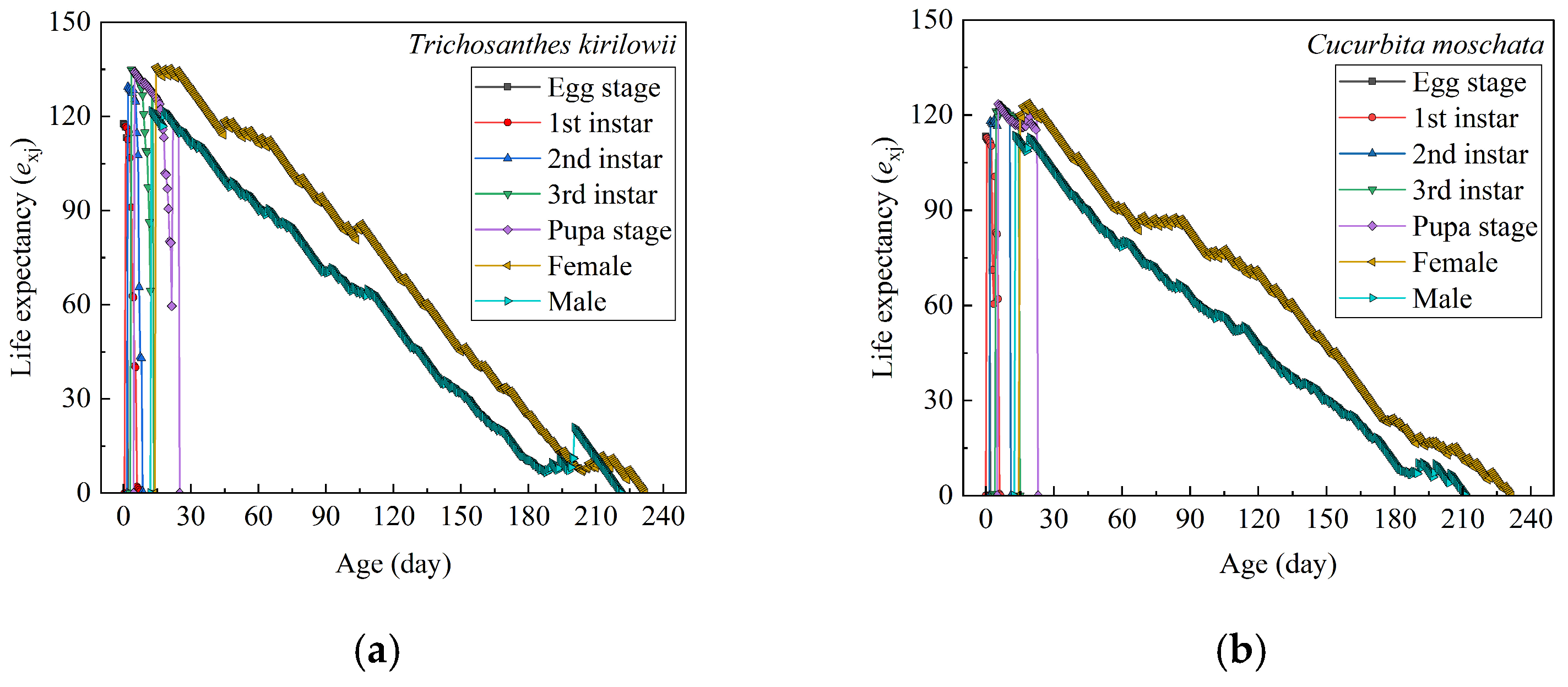
The age–stage life expectancy (exj) represents the expected remaining lifespan of an individual at age x and stage j [17]. Here, exj is calculated based on the probability that an individual at age x and stage j survives to age i and stage y, under the assumption that S′iy = 1. The life expectancy is calculated as follows [27]:
e x j = i = x y = j m S i y
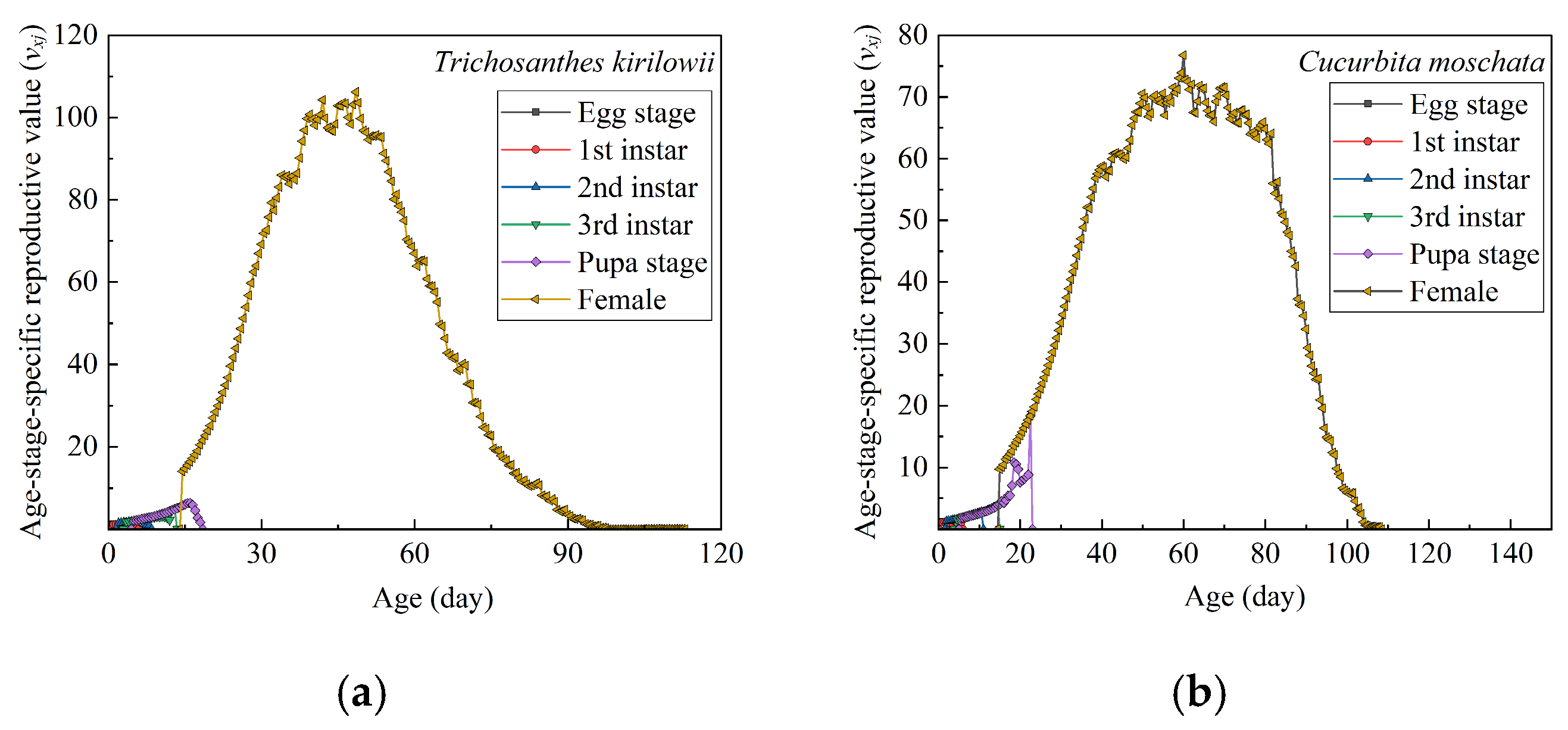
The age–stage reproductive value (vxj) represents the expected contribution of an individual at age x and stage j to future population growth, as defined by Fisher [34,35]. The reproductive value is calculated as follows:
V x j = e r x + 1 S x j y = j m S i y f i y

2.7. Data Analysis

For the odor and oviposition choice assays, the selections made by Z. tau between different host types were analyzed using a t-test in IBM SPSS Statistics 25 software, with the significance level set at p < 0.05 [36], as were the pupal weight and hatching rate. All Z. tau life table data were analyzed using the TWOSEX-MSChart program (Ver. 2/5/2025) [34]. Because the bootstrap procedure involves random resampling, minimizing estimation error is critical. To estimate variances and standard errors, paired bootstrap tests were performed with 100,000 resamplings [27]. Population dynamics were projected using the TIMING-MSChart program (Ver. 18/2/2025) [37,38]. OriginPro 2021 software was used to plot survival rate, fecundity, life expectancy, reproductive value, and population projection curves [39].

3. Results

3.1. Olfactory Preferences of Z. tau

Table 1 shows that, under both the unpeeled and peeled conditions, female Z. tau landed significantly more frequently on T. kirilowii than on C. moschata (p = 0.001; p = 0.025). In contrast, no significant differences were observed in the landing frequencies of male Z. tau between T. kirilowii and C. moschata under either condition (p = 0.433; p = 0.342).

3.2. Oviposition Preferences of Z. tau

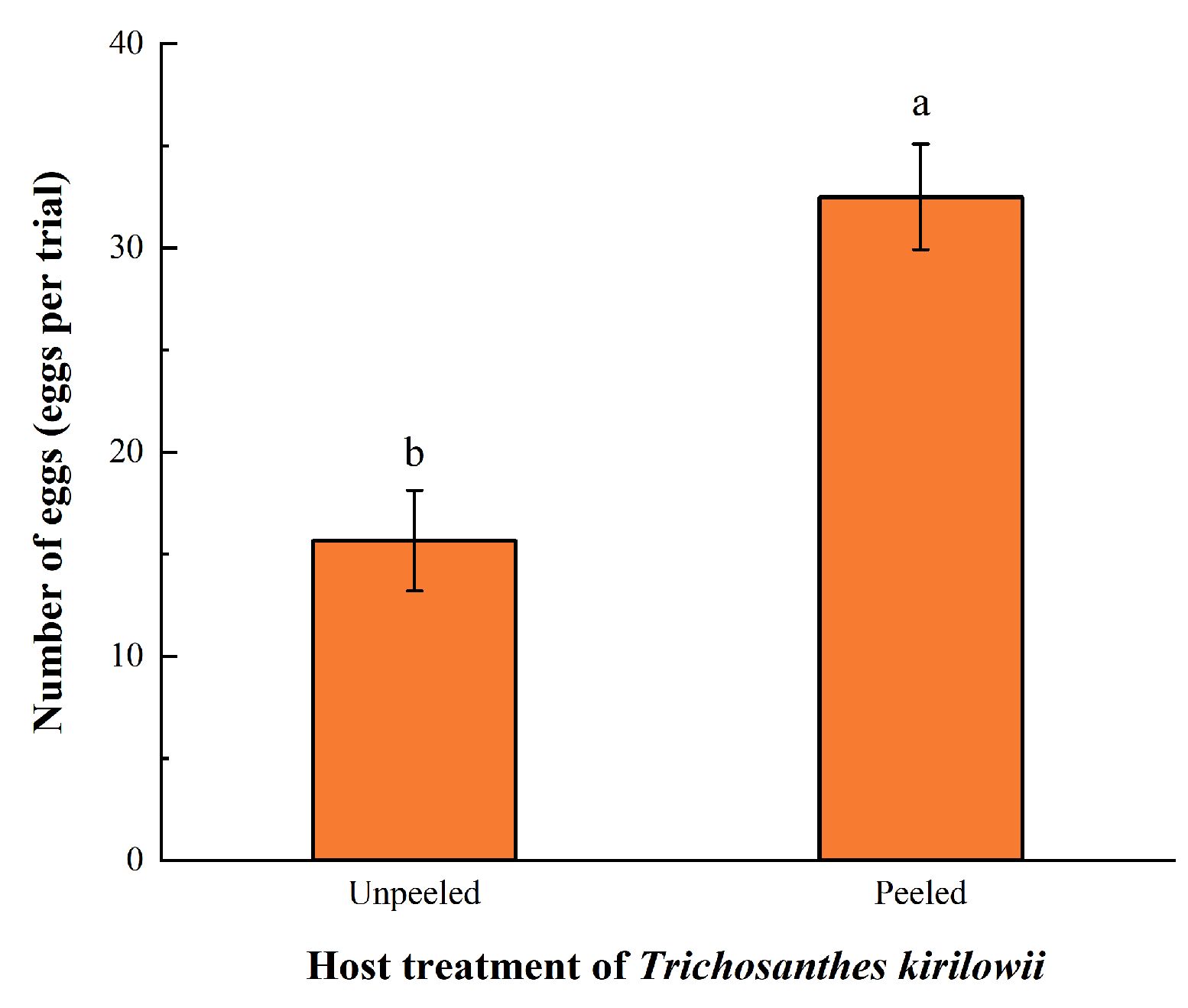
Based on the oviposition data of Z. tau on the two host plants under both unpeeled and peeled conditions (Table 2), the number of eggs laid on T. kirilowii was significantly higher than that on C. moschata (both p < 0.001). Moreover, in the effect-comparison group (Figure 1), the mean number of eggs laid per trial on peeled T. kirilowii reached 32.50 ± 2.59 eggs per trial, which was significantly higher than that on unpeeled T. kirilowii.

3.3. Biological Parameters of Z. tau on T. kirilowii and C. moschata

3.3.1. Developmental Duration

The developmental durations of Z. tau on T. kirilowii and C. moschata are shown in Table 3. No significant differences were detected in the duration of each developmental stage or total longevity between individuals reared on the two hosts (p > 0.05).

3.3.2. Survival Rate at the Pre-Adult Stage

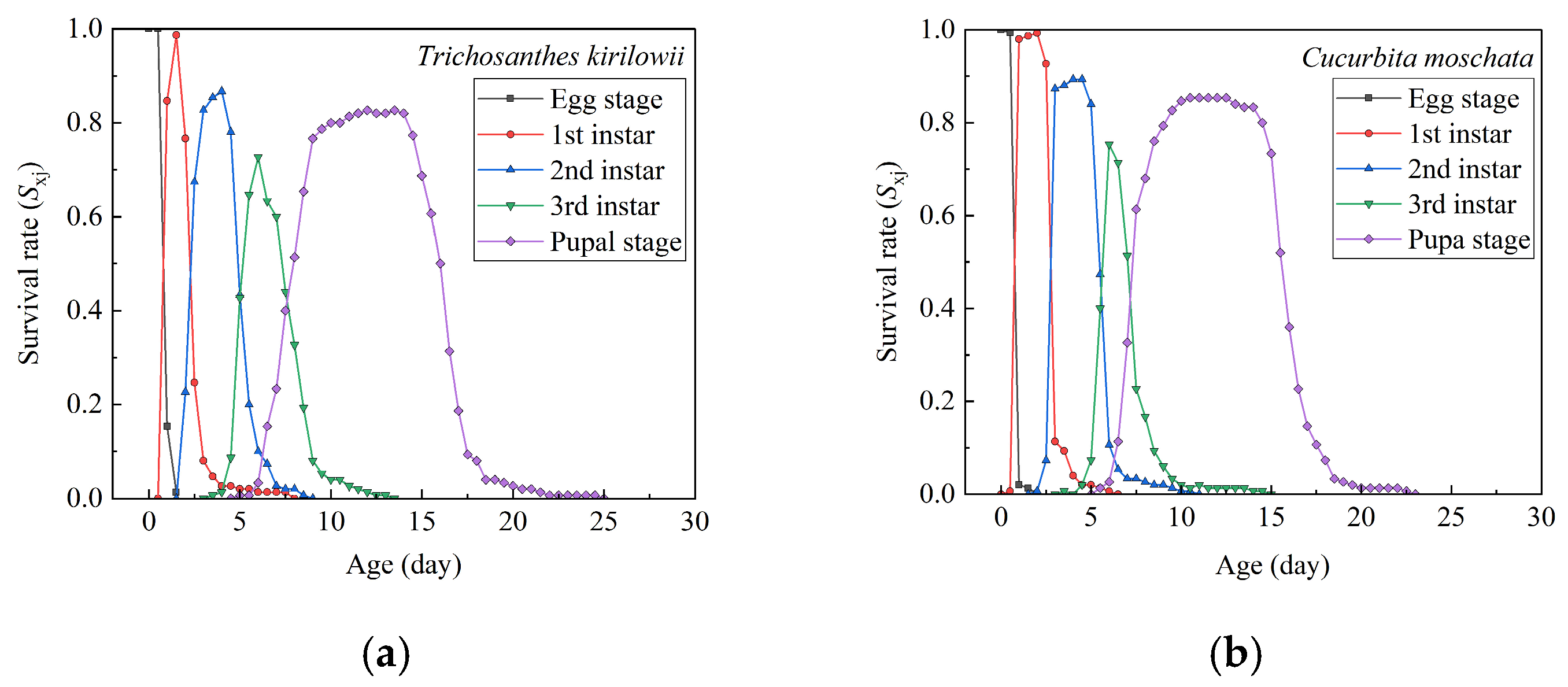
As shown in Figure 2, the Sxj values of Z. tau on T. kirilowii and C. moschata varied between developmental stages, reflecting individual differences in developmental rates. On C. moschata, larval development was complete at approximately 14.5 d, with adult emergence occurring around 22.5 d, whereas larval development was complete at approximately 13.0 d on T. kirilowii, with adult emergence occurring around 24.5 d. The overlap of the Sxj curves indicates variability in developmental timing among individuals within the population across different stages.

3.3.3. Survival Rate at the Adult Stage

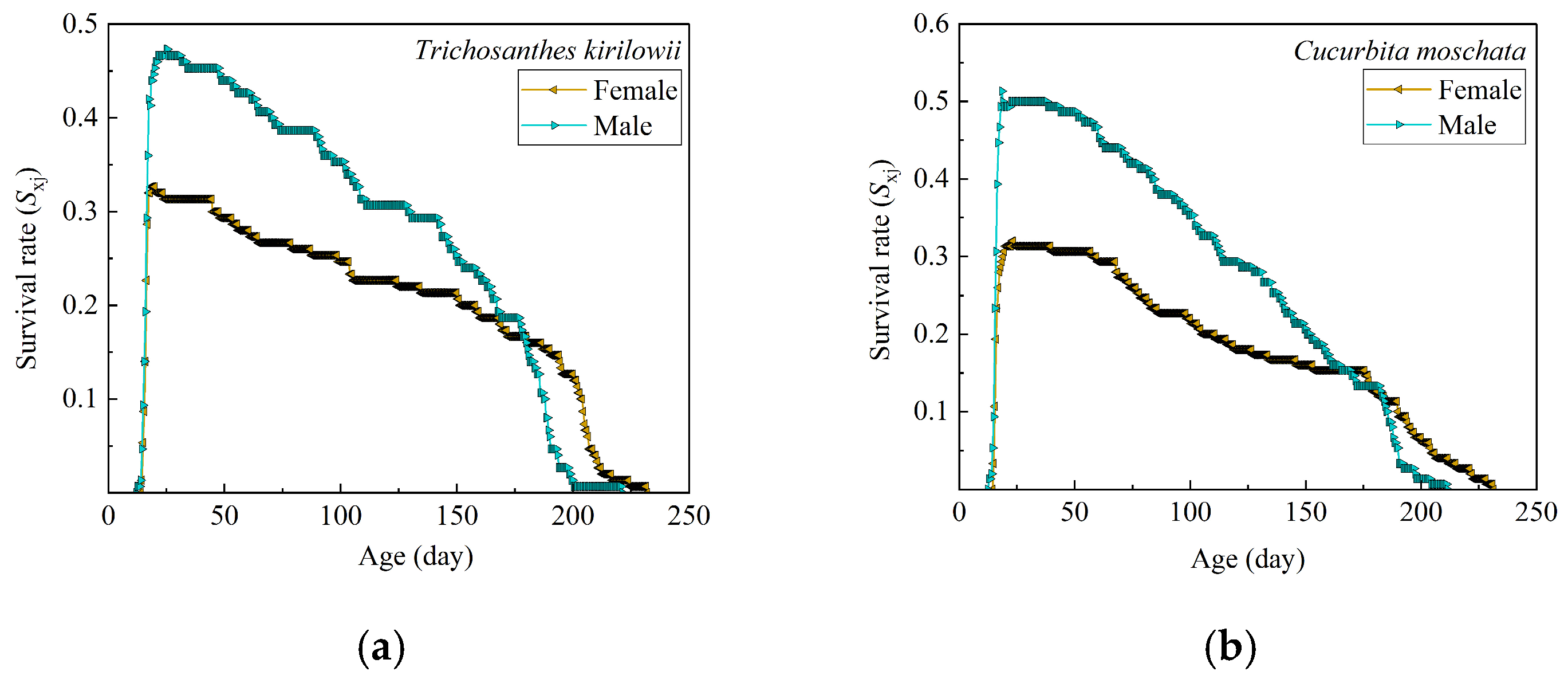
In both hosts, the Sxj values of female and male Z. tau adults peaked soon after emergence and then showed a declining trend. Within the same host, clear differences in Sxj values were observed between females and males, as shown in Figure 3. On T. kirilowii, female survival declined to zero at 232 days, while males survived up to 221 days. Similarly, on C. moschata, female survival reached zero at 231.5 days, while males survived up to 211.5 days.

3.3.4. Reproductive Parameters and Pupal Weight

As shown in Table 4, no significant differences were observed in the actual oviposition periods of Z. tau adults reared on T. kirilowii and C. moschata. In contrast, the APOP and TPOP were significantly shorter in the T. kirilowii group than in the C. moschata group (both p = 0.001). No significant differences were detected between the two host plants in terms of OP and hatching rate. By contrast, fecundity was significantly higher in the T. kirilowii group compared to the C. moschata group (p = 0.001), and pupal weight was also significantly greater in individuals reared on T. kirilowii (p = 0.001).

3.3.5. Age-Specific Survival Rate and Fecundity

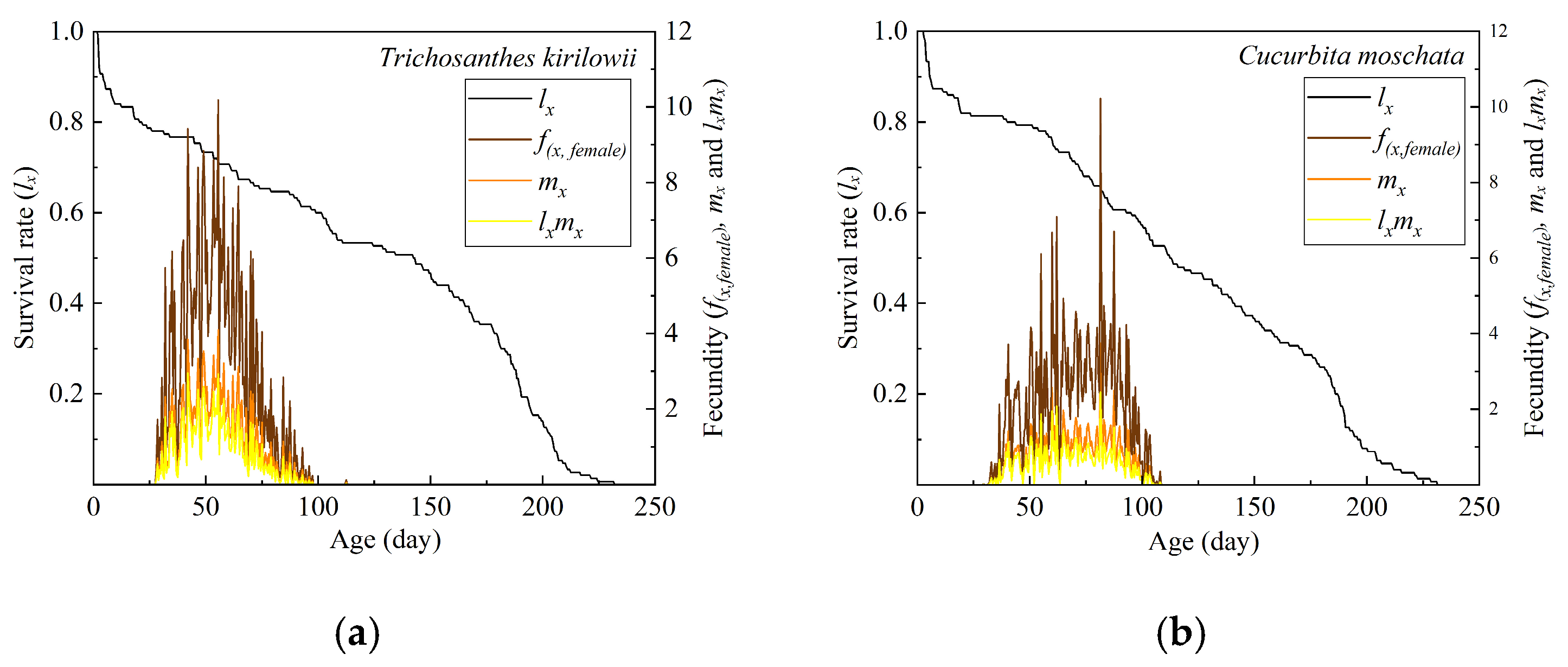
The effects of the two hosts on the survival and fecundity parameters (lx, fx,female, mx, and lxmx) of Z. tau are presented in Figure 4. On both T. kirilowii and C. moschata, lx declined with age, and the last adult died at 231.5 d; however, the decline was slower on T. kirilowii than on C. moschata. On T. kirilowii, fx,female, mx, and lxmx all peaked at 55.5 d, with corresponding values of 10.1860, 4.0935, and 2.92; on C. moschata, these parameters all peaked at 81.5 d, with corresponding values of 10.2222, 3.7551, and 2.4533. Fluctuations in mx suggested that oviposition ceased at certain ages.

3.3.6. Age–Stage-Specific Life Expectancy

The exj values of Z. tau on both T. kirilowii and C. moschata show a declining trend with age (Figure 5). At the ages of 0, 1 days, the mean maximum life expectancy of Z. tau is 117.72 d on T. kirilowii and 113.27 d on C. moschata, which is consistent with the total longevity reported in Table 3.

3.3.7. Age–Stage-Specific Reproductive Value

The vxj values of Z. tau on both T. kirilowii and C. moschata are shown in Figure 6. At age 0, v0,1 was 1.05274 on T. kirilowii and 1.03926 on C. moschata. The vxj values showed that the peak reproductive value on T. kirilowii occurred at 48.5 d, whereas on C. moschata it occurred at 69.5 d.

3.3.8. Key Population Parameters

Life table population parameters reflect the population growth and reproductive performance of Z. tau on T. kirilowii and C. moschata, as shown in Table 5. The r values of Z. tau were greater than zero and both the finite rate of increase λ and the net reproductive rate R0 were greater than one, indicating that the species was able to complete development and reproduction on both hosts. On T. kirilowii, the values of r and λ were significantly higher than those on C. moschata (p < 0.001). In contrast, no significant difference in R0 was observed between the two hosts (p > 0.05). In addition, the mean generation time of Z. tau on C. moschata was significantly longer than that on T. kirilowii (p < 0.001).

3.4. Population Size Prediction

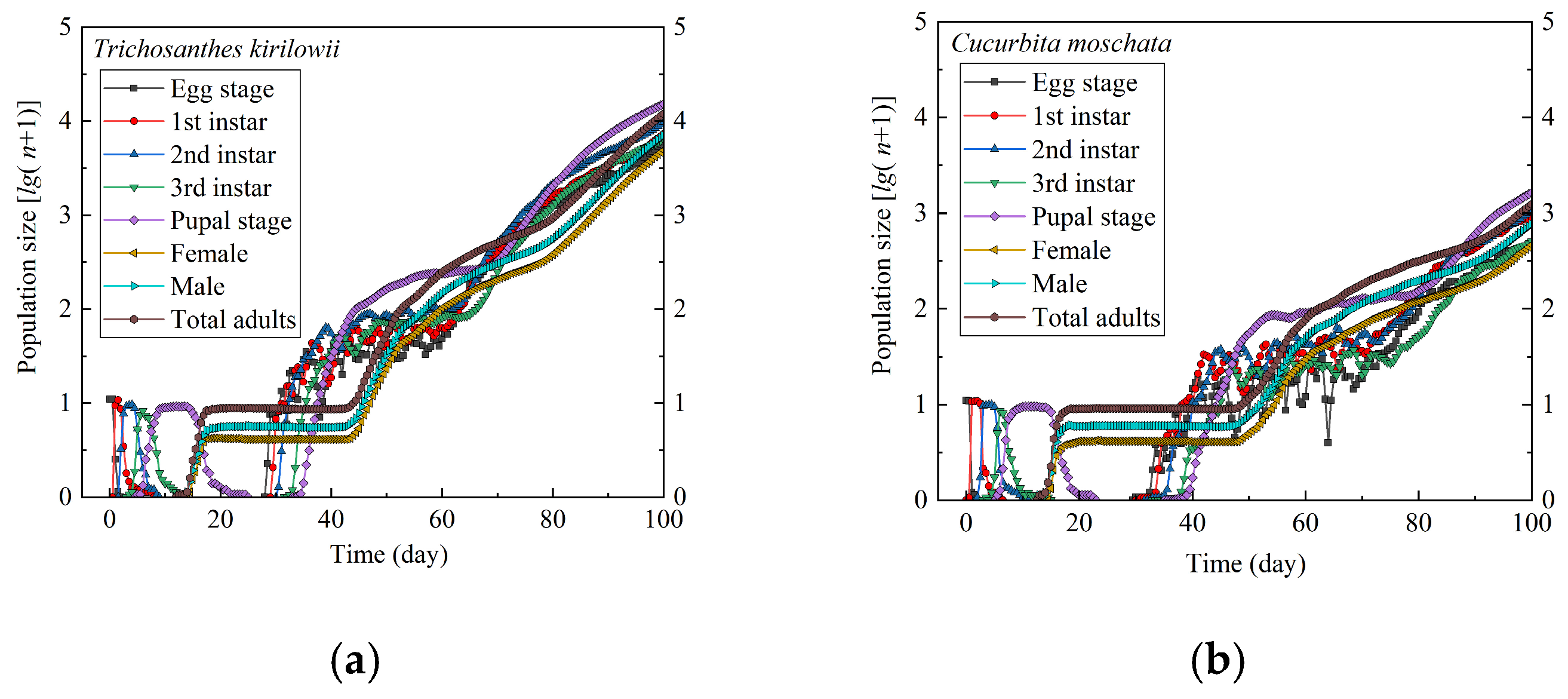
The population dynamics of Z. tau on different host plants over the next 100 d were predicted using the TIMING-MSChart (Ver. 2/5/2025) software, as shown in Figure 7. In the projections, adults first appeared at approximately 12.5 d on T. kirilowii and at 13 d on C. moschata. Overall, the predicted population size increased over time on both host plants, with different growth patterns observed between hosts. After 100 d of oviposition, the projected number of adults on T. kirilowii reached 11,980, whereas only 1231 adults were projected on C. moschata.

4. Discussion

The relationship between insects and plants has long been a key topic in insect ecology, with host selection widely regarded as an outcome of their long-term interaction and coevolution. Feeding and host finding are key behavioral processes that strongly influence an insect’s colonization success and reproductive performance throughout its life history [40]. Previous studies have shown that different tephritid fruit flies often exhibit pronounced host preferences under multi-host conditions. For instance, Amin et al. reported that B. dorsalis showed the highest preference for Prunus persica, followed by Mangifera indica, and the lowest preference for Momordica charantia [41]. On the other hand, Shahzadi et al. demonstrated significant differences in host selection by Bactrocera cucurbitae among cucurbit host species [42].
Our results indicate that Z. tau exhibited the strongest preference for and highest oviposition output on T. kirilowii, which also significantly increased its population growth potential. Differences in host suitability are commonly linked to host nutritional quality, profiles of volatile compounds, and long-term insect–host adaptation [43,44]. For example, Roy reported that feeding on a high-quality host can markedly accelerate population growth; Bactrocera dorsalis (Hendel) individuals developed most rapidly and exhibited the highest survival rate, fecundity, and population growth rate on guava among four tested hosts [45]. Accordingly, nutritional factors such as sugars and available carbon sources often play a critical role in accelerating development and enhancing fecundity. As a medicinal and edible plant, T. kirilowii possesses a relatively rich nutritional profile: Zhang et al. quantified major carbohydrates in its various tissues using UHPLC–MS/MS and reported high proportions of glucose (22.91%), fructose (20.63%), and polysaccharides (27.29%) in the fruit pulp [46]. This carbohydrate-rich composition likely provides a stronger energy base for larval growth, thereby improving developmental performance and reproductive output on T. kirilowii. In contrast, nutritional studies indicate that total and soluble sugar contents in C. moschata pulp are relatively low, approximately 1–5% on a fresh-weight basis or 10–70 mg/g on a dry-weight basis [47].
These comparisons suggest that polysaccharides and related compounds in T. kirilowii may offer a more sufficient energy supply for larval development. Correspondingly, differences in pupal weight, female fecundity, and oviposition timing were observed between hosts, with pupae being heavier, fecundity higher, and the oviposition peak occurring earlier on T. kirilowii. These patterns may indicate a potential association between nutritional compatibility and both individual performance and population-level reproduction. Beyond nutrients, chemical signals may further amplify host advantages by influencing adult orientation and oviposition site selection. In our odor-choice assays, adults showed the strongest attraction to peeled T. kirilowii. Xu et al. demonstrated that 1-octen-3-ol from mango volatiles can elicit female oviposition behavior in B. dorsalis and identified an olfactory receptor regulating this response [48]. Notably, previous studies on volatiles from T. kirilowii seeds have also reported that 1-octen-3-ol is a key component [49]. Thus, peeling T. kirilowii may enhance volatile emissions or alter its profile, increasing attractiveness to B. tau and improving the efficiency of oviposition site location, thereby promoting rapid colonization and reproductive potential on a suitable host.
Additionally, a co-adaptive background may exist between Z. tau and T. kirilowii. Trichosanthes plants have long been distributed across East and South Asia, providing a stable ecological context for sustained insect utilization [50]. From the perspective of crown-group age, Trichosanthes predates Cucurbita, suggesting that it represents an older Asian cucurbit lineage [51]. In comparison, Cucurbita crops originated in the Americas and were introduced relatively late into Asia [52]. Evidence also suggests that Z. tau (synonym: Bactrocera tau) has undergone a relatively long process of colonization and dispersal in Southern China, which has also been considered a possible part of its native distribution range [53]. Therefore, against the dual background of geographic co-occurrence and long-term utilization, Z. tau may have developed a higher level of physiological adaptation to T. kirilowii, as reflected in the shortened generation time observed in this study. Similarly, Wang et al. reported that fruit flies tend to colonize plant species that are closely related to their ancestral hosts [54]. Differences in larval survival and population growth were also observed, which may further indicate a potential association with host adaptation. These findings suggest that the Z. tau preference for T. kirilowii is not accidental but reflects its long-term adaptation to cucurbit hosts in Southern China and also provides strong support for the hypothesis that Z. tau is not an introduced invasive pest in China.
However, host-feeding preference and oviposition choice alone are insufficient to assess long-term outbreak risk [55]. Therefore, we applied the age–stage, two-sex life table theory and the TWOSEX-MSChart program to comprehensively quantify survival, development, and reproduction under different host conditions. Life table comparisons revealed that, although no significant difference in oviposition duration was observed between hosts, Z. tau reared on T. kirilowii exhibited significantly shorter APOP and TPOP, indicating that individuals entered the reproductive phase earlier. Similar patterns have been reported in other insect–host systems. Anamika Koner et al. found that Galerucella placida reared on Rumex dentatus exhibited shorter APOP and TPOP along with higher fecundity [56], suggesting that host plant nutritional quality can influence population performance by regulating reproductive timing. Furthermore, on T. kirilowii, the peak of the age–stage-specific reproductive value (vxj) of Z. tau occurred earlier, indicating that individuals reached their maximum contribution to population growth at an earlier age on this host. This result provides temporal evidence that earlier reproductive onset shifts the contribution to population growth forward. Differences in individual reproductive traits among hosts can accumulate at the population level, thereby influencing overall population growth. Consistent with this, Z. tau reared on T. kirilowii exhibited significantly higher intrinsic (r) and finite rates of increase (λ), along with a shorter mean generation time (T), indicating faster generational turnover and greater population expansion potential on T. kirilowii [2].
This pattern aligns with the strong preference for T. kirilowii observed in oviposition choice assays, suggesting that host preference may extend beyond short-term behavioral responses and contribute to population growth through enhanced reproductive output and faster generational turnover. The odor-choice assays further showed that the pronounced attraction to T. kirilowii could facilitate host location and potentially shorten the pre-oviposition period, thereby further supporting population establishment. Population projections based on the age–stage, two-sex life table provide insight into stage-structured dynamics and offer time-window information relevant to pest risk assessment and integrated management [25,37,57]. These projections indicated a faster population increase on T. kirilowii, accompanied by a rapid accumulation of individuals over time, suggesting a potential outbreak risk. In addition, temporal patterns of larval peaks and adult emergence were identified, which were consistent with developmental trajectories and the Sxj curves. This, in turn, offers a critical indication for controlling timing within integrated pest management (IPM) programs [16].

5. Conclusions

Z. tau females showed a significant preference for T. kirilowii, whereas males showed no significant preferences. Oviposition was also higher on T. kirilowii. The developmental duration, total longevity, ovipositing days, oviposition period, and hatching rate did not differ between the two host species. However, on T. kirilowii, the APOP and TPOP were significantly shorter, and the average pupal weight was greater. In addition, we observed higher intrinsic and finite rates of increase and a shortened mean generation time but a similar net reproductive rate (R0). Taken together, these results indicate that T. kirilowii is a favorable host for Z. tau, with its advantages primarily manifesting through population performance parameters.

Author Contributions

Conceptualization, Y.Y. and Y.-Q.P.; methodology, Y.-Y.X.; formal analysis, Y.-Q.P. and H.-G.L.; investigation, Y.-Q.P., Y.-Y.X. and J.-Q.L.; resources, Y.Y. and W.-X.G.; data curation, Y.-Q.P.; Y.-Y.X. and J.-Q.L.; writing—original draft preparation, Y.-Q.P.; writing—review and editing, Y.Y., S.L., J.-Y.L. and H.-G.L.; supervision, Y.Y., W.-X.G., and S.L.; funding acquisition, Y.Y. All authors have read and agreed to the published version of the manuscript.

Funding

This research was supported by the earmarked fund for China Agriculture Research System-21 (CARS-21).

Data Availability Statement

The original contributions presented in this study are included in the article. Further inquiries can be directed to the corresponding author.

Acknowledgments

The authors would like to thank Qingcai Lin from Hebei University for her valuable suggestions on the figure preparation in this manuscript.

Conflicts of Interest

The authors declare no conflicts of interest.

References

  1. Liu, X.; Ji, Q. Review of Zeugodacus tau (Walker) (Diptera: Tephritidae): Biological characteristics and control strategy. CABI Agric. Biosci. 2024, 5, 90. [Google Scholar] [CrossRef]
  2. Zhao, C.W.; Li, C.R.; Yang, Y.T.; An, W.B.; Wang, Z.L. Effect of different host plants on the growth, development and fecundity of Zeugodacus tau (Walker). J. Biosaf. 2024, 33, 229–235. (In Chinese) [Google Scholar] [CrossRef]
  3. Pramanik, S.; Debnath, P.; Pandit, M.K.; Gupta, A.K.; Naskar, M.K. Fruit fly species diversity, population dynamics and infestation rate during fruiting season of snake gourd. S. Afr. J. Bot. 2022, 145, 303–312. [Google Scholar] [CrossRef]
  4. He, Y.X.; Xu, Y.J.; Chen, X. Biology, ecology and management of Tephritid fruit flies in China: A review. Insects 2023, 14, 196. [Google Scholar] [CrossRef]
  5. Mitra, A.; Mitra, P.; Mahadani, P.; Trivedi, S.; Banerjee, D.; Das, M. Application of character based DNA barcode: A novel approach towards identification of fruit fly (Diptera: Tephritidae) species from cucurbit crops. BMC Genom. 2025, 26, 70. [Google Scholar] [CrossRef]
  6. Farooq, M.; Baig, S.; Honey, S.F.; Bajwa, B.E.; Fazlullah; Shah, I.H. Evaluation of host susceptibility, preference and offspring performance of Zeugodacus cucurbitae (Coquillett) (Diptera: Tephritidae) on different hosts. Int. J. Trop. Insect Sci. 2020, 40, 93–99. [Google Scholar] [CrossRef]
  7. Baraki, Y.W.; Woldehawariat, Y.; Dekker, T.; Biasazin, T.; Dejene, A. Comparison of electrophysiological and behavioral responses of tephritid (Diptera: Tephritidae) pests to cucurbit host odors. J. Insect Physiol. 2025, 165, 104865. [Google Scholar] [CrossRef]
  8. Theron, C.D.; Kotzé, Z.; Manrakhan, A.; Weldon, C.W. Oviposition by the oriental fruit fly, Bactrocera dorsalis (Hendel) (Diptera: Tephritidae), on five citrus types in a laboratory. Austral Entomol. 2023, 62, 389–526. [Google Scholar] [CrossRef]
  9. Papadopoulos, N.T.; De Meyer, M.; Terblanche, J.S.; Kriticos, D.J. Fruit flies: Challenges and opportunities to stem the tide of global Invasions. Annu. Rev. Entomol. 2024, 69, 355–373. [Google Scholar] [CrossRef] [PubMed]
  10. Xue, Z.J.; Chen, G.; Zhang, D.; Guo, L.; Zheng, Y.G.; Zhan, Z.L. Herbal textual research on Trichosanthis fructus and Trichosanthis radix in famous classical formulas. Chin. J. Exp. Tradit. 2023, 29, 62–74. [Google Scholar] [CrossRef]
  11. Yu, L.F. Analysis of the components in the pulp liquid of Trichosanthes kirilowii Maxim amd the preparation of main active components. J. Anhui Agric. Sci. 2012, 40, 8151–8152. (In Chinese) [Google Scholar] [CrossRef]
  12. Xu, Y.; Chen, G.; Lu, X.; Li, Z.Q.; Su, S.S.; Zhou, C.; Pei, Y.H. Chemical constituents from Trichosanthes kirilowii Maxim. Biochem. Syst. Ecol. 2012, 43, 114–116. [Google Scholar] [CrossRef]
  13. Liu, J.Q.; Li, W.W.; Wang, C.L.; Liang, H.; Chu, Z.N.; Wang, G.P.; Jin, L.H.; Guo, W.X.; Yu, Y. Mixtures of entomopathogenic nematodes provided successful suppression of Bactrocera tau by stimulated dispersal, aggregation, and invasion. Biol. Control 2025, 208, 105858. [Google Scholar] [CrossRef]
  14. Kogan, M. Integrated pest management: Historical perspectives and contemporary developments. Annu. Rev. Entomol. 1998, 43, 243–270. [Google Scholar] [CrossRef]
  15. Liang, P.; Gu, S.H.; Zhang, L.; Gao, X.W. Research status and prospects of Spodoptera frugiperda (Lepidoptera:Noctuidae) in China. Acta Entomol. Sin. 2020, 63, 624–638. [Google Scholar] [CrossRef]
  16. Chen, Z.F.; Luo, Y.; Wang, L.; Sun, D.; Wang, Y.K.; Zhou, J.; Luo, B.; Liu, H.; Yan, R.; Wang, L.J. Advancements in life tables applied to integrated pest management with an emphasis on two-sex life tables. Insects 2025, 16, 261. [Google Scholar] [CrossRef]
  17. Chi, H. Life-table analysis incorporating both sexes and variable development rates among individuals. Environ. Entomol. 1988, 17, 26–34. [Google Scholar] [CrossRef]
  18. Ning, S.Y.; Zhang, W.C.; Sun, Y.; Feng, J.N. Development of insect life tables: Comparison of two demographic methods of Delia antiqua (Diptera: Anthomyiidae) on different hosts. Sci. Rep. 2017, 7, 4821. [Google Scholar] [CrossRef]
  19. Walter, J.A.; Ives, A.R.; Tooker, J.F.; Johnson, D.M. Life history and habitat explain variation among insect pest populations subject to global change. Ecosphere 2018, 9, e02274. [Google Scholar] [CrossRef]
  20. Cornelius, M.L.; Duan, J.J.; Messing, R.H. Volatile host fruit odors as attractants for the oriental fruit fly (Diptera: Tephritidae). J. Econ. Entomol. 2000, 93, 93–100. [Google Scholar] [CrossRef]
  21. Zhang, J.L.; Yan, Z.H.; Fang, X.J.; Wu, H.; Liu, H.P.; Zhu, W.L.; Li, A.Q.; Du, N.; Chen, G.H.; Tao, H. Oviposition selectivity and competitive research on Bactrocera cucurbitae (Coquillett) and Bactrocera tau (Walker). J. Yunnan Agric. Univ. (Nat. Sci. Ed.) 2017, 32, 427–431. [Google Scholar] [CrossRef]
  22. Huang, Y.B.; Chi, H. Age-stage, two-sex life tables of Bactrocera cucurbitae (Coquillett) (Diptera: Tephritidae) with a discussion on the problem of applying female age-specific life tables to insect populations. Insect Sci. 2012, 19, 263–273. [Google Scholar] [CrossRef]
  23. Tuan, S.J.; Lee, C.C.; Chi, H. Population and damage projection of Spodoptera litura (F.) on peanuts (Arachis hypogaea L.) under different conditions using the age-stage, two-sex life table. Pest Manag. Sci. 2014, 70, 805–813. [Google Scholar] [CrossRef]
  24. Chi, H.; Güncan, A.; Kavousi, A.; Gharakhani, G.; Atlıhan, R.; Özgökçe, M.S.; Shirazi, J.; Amir-Maafi, M.; Maroufpoor, M.; Taghizadeh, R. TWOSEX-MSChart: The key tool for life table research and education. Entomol. Gen. 2022, 42, 845–849. [Google Scholar] [CrossRef]
  25. Chi, H.; Liu, H. Two new methods for the study of insect population ecology. Bull. Inst. Zool. Acad. Sin. 1985, 24, 225–240. [Google Scholar]
  26. Chi, H.; Kavousi, A.; Gharekhani, G.; Atlihan, R.; Salih Özgökçe, M.; Güncan, A.; Gökçe, A.; Smith, C.L.; Benelli, G.; Guedes, R.N.C. Advances in theory, data analysis, and application of the age-stage, two-sex life table for demographic research, biological control, and pest management. Entomol. Gen. 2023, 43, 705–732. [Google Scholar] [CrossRef]
  27. Cui, J.; Yin, J.X.; Tian, X.Y.; Gao, Y.; Shi, S.S.; Li, W.B. Age–stage, two-sex life table analysis of Riptortus pedestris (Hemiptera: Alydidae) across different soybean varieties. Insects 2024, 15, 952. [Google Scholar] [CrossRef] [PubMed]
  28. Chen, Q.; Li, N.; Wang, X.; Ma, L.; Huang, J.B.; Huang, G.H. Age-stage, two-sex life table of Parapoynx crisonalis (Lepidoptera: Pyralidae) at different temperatures. PLoS ONE 2017, 12, e0173380. [Google Scholar] [CrossRef] [PubMed]
  29. Chi, H.; Su, H.Y. Age-stage, two-sex life tables of Aphidius gifuensis (Ashmead) (Hymenoptera: Braconidae) and its host Myzus persicae (Sulzer) (Homoptera: Aphididae) with mathematical proof of the relationship between female fecundity and the net reproductive rate. Environ. Entomol. 2006, 35, 10–21. [Google Scholar] [CrossRef]
  30. Zhu, Y.F.; Qi, F.J.; Tan, X.M.; Zhang, T.; Teng, Z.W.; Fan, Y.J.; Wan, F.H.; Zhou, H.X. Use of age-stage, two-sex life table to compare the fitness of Bactrocera dorsalis (Diptera: Tephritidae) on northern and southern host fruits in China. Insects 2022, 13, 258. [Google Scholar] [CrossRef]
  31. Mostafiz, M.M.; Güncan, A.; Schughart, M.; Byrne, S.; McNamara, L. Life history and fitness costs in the lambda-cyhalothrin resistant clone of English grain aphid, Sitobion avenae (Fabricius). Pest Manag. Sci. 2025, 81, 5717–5726. [Google Scholar] [CrossRef]
  32. Rossini, L.; Contarini, M.; Speranza, S.; Mermer, S.; Walton, V.; Francis, F.; Garone, E. Life tables in entomology: A discussion on tables’ parameters and the importance of raw data. PLoS ONE 2024, 19, e0299598. [Google Scholar] [CrossRef]
  33. Pereira, F.P.; Diniz, A.J.F.; Parra, J.R.P. Fertility life table, thermal requirements, and ecological zoning of Anthonomus grandis grandis Boheman (Coleoptera: Curculionidae) in Brazil. Insects 2023, 14, 582. [Google Scholar] [CrossRef]
  34. Abbes, K.; Harbi, A.; Guerrieri, E.; Chermiti, B. Using age-stage two-sex life tables to assess the suitability of three solanaceous host plants for the invasive cotton mealybug Phenacoccus solenopsis Tinsley. Plants 2024, 13, 1381. [Google Scholar] [CrossRef]
  35. Fisher, R. The Genetical Theory of Natural Selection, 2nd ed.; Clarendon Press: Oxford, UK, 1958. [Google Scholar]
  36. Marchioro, M.; Foerster, L.A. Preference‒performance linkage in the diamondback moth, Plutella xylostella, and implications for its management. J. Insect Sci. 2014, 14, 85. [Google Scholar] [CrossRef][Green Version]
  37. Chi, H. Timing of control based on the stage structure of pest populations: A simulation approach. J. Econ. Entomol. 1990, 83, 1143–1150. [Google Scholar] [CrossRef]
  38. Chi, H. TIMING-MSChart: A Computer Program for the Population Projection Based on the Age-Stage, Two-Sex Life Table; Zenodo: Geneva, Switzerland, 2022. [Google Scholar] [CrossRef]
  39. Zhai, Y.T.; Zeng, X.R.; Wei, D.W.; Jiang, X.D.; Long, X.Z.; Zhan, H.; Yu, Y.H.; Gao, X.Y. Exploring the life cycle of Bactrocera latifrons: A detailed age-stage, two-sex life table. Insects 2025, 16, 132. [Google Scholar] [CrossRef]
  40. Blaauw, B.R.; Hamilton, G.; Rodriguez-Saona, C.; Nielsen, A.L. Plant stimuli and their impact on brown marmorated stink bug dispersal and host selection. Front. Ecol. Evol. 2019, 7, 414. [Google Scholar] [CrossRef]
  41. Amin, M.; Khan, A.M.; Salim, M.; Haq, I.U.; Akhtar, H.; Amjad, S.; Ullah, F. Host preference study of fruit fly, Bactrocera dorsalis (Hendel) (Diptera: Tephritidae) and parasitism potential of Diachasmimorpha longicaudata on different hosts under laboratory condition. Pure Appl. Biol. 2025, 14, 148–158. [Google Scholar] [CrossRef]
  42. Shahzadi, K.; Khan, M.A.; Gul, T.; Ahmad, T.; Aslam, F.; Ishfaq, M.; Aslam, I. Host preference of Bactrocera cucurbitae (Diptera: Tephritidae). Acta Sci. Agric. 2019, 3, 80–83. [Google Scholar] [CrossRef]
  43. Behmer, S.T. Insect herbivore nutrient regulation. Annu. Rev. Entomol. 2009, 54, 165–187. [Google Scholar] [CrossRef]
  44. Bruce, T.J.A. Interplay between insects and plants: Dynamic and complex interactions that have coevolved over millions of years but act in milliseconds. J. Exp. Bot. 2014, 66, 455–465. [Google Scholar] [CrossRef] [PubMed]
  45. Roy, N. Two-sex life table and host preference studies of Bactrocera dorsalis Hendel (Diptera: Tephritidae). Entomon 2021, 46, 11–24. [Google Scholar] [CrossRef]
  46. Zhang, H.Q.; Liu, P.; Duan, J.A.; Dong, L.; Shang, E.X.; Qian, D.W.; Zhu, Z.H.; Li, H.W.; Li, W.W. Comparative analysis of carbohydrates, nucleosides and amino acids in different parts of Trichosanthes kirilowii Maxim. by (Ultra) high-performance liquid chromatography coupled with tandem mass spectrometry and evaporative light scattering detector methods. Molecules 2019, 24, 1440. [Google Scholar] [CrossRef]
  47. Men, X.; Choi, S.I.; Han, X.; Kwon, H.Y.; Jang, G.W.; Choi, Y.E.; Park, S.M.; Lee, O.H. Physicochemical, nutritional and functional properties of Cucurbita moschata. Food Sci. Biotechnol. 2021, 30, 171–183. [Google Scholar] [CrossRef] [PubMed]
  48. Xu, L.; Jiang, H.B.; Yu, J.L.; Pan, D.; Tao, Y.; Lei, Q.; Chen, Y.; Liu, Z.; Wang, J.J. Two odorant receptors regulate 1-octen-3-ol induced oviposition behavior in the oriental fruit fly. Commun. Biol. 2023, 6, 176. [Google Scholar] [CrossRef] [PubMed]
  49. Wu, S.; Xu, T.; Akoh, C.C. Effect of roasting on the volatile constituents of Trichosanthes kirilowii seeds. J. Food Drug Anal. 2014, 22, 310–317. [Google Scholar] [CrossRef]
  50. de Boer, H.J.; Schaefer, H.; Thulin, M.; Renner, S.S. Evolution and loss of long-fringed petals: A case study using a dated phylogeny of the snake gourds, Trichosanthes (Cucurbitaceae). BMC Evol. Biol. 2012, 12, 108. [Google Scholar] [CrossRef]
  51. Renner, S.S.; Schaefer, H. Phylogeny and evolution of the Cucurbitaceae. In Genetics and Genomics of Cucurbitaceae; Springer: Berlin/Heidelberg, Germany, 2016; pp. 13–23. [Google Scholar]
  52. Smith, B.D. The initial domestication of Cucurbita pepo in the Americas 10,000 years ago. Science 1997, 276, 932–934. [Google Scholar] [CrossRef]
  53. Shi, W.; Kerdelhué, C.; Ye, H. Genetic structure and colonization history of the fruit fly Bactrocera tau in China and Southeast Asia. J. Econ. Entomol. 2014, 107, 1256–1265. [Google Scholar] [CrossRef]
  54. Wang, Y.; Wu, K.; Li, R.; Wang, G.; Tan, H.; Zhou, Z. Rapid adaptive response of population fitness of Zeugodacus tau during host shifts and implications for integrated pest management strategies. Pest Manag. Sci. 2025, 81, 6525–6537. [Google Scholar] [CrossRef] [PubMed]
  55. Sotelo-Cardona, P.; Chuang, W.P.; Lin, M.Y.; Chiang, M.Y.; Ramasamy, S. Oviposition preference not necessarily predicts offspring performance in the fall armyworm, Spodoptera frugiperda (Lepidoptera: Noctuidae) on vegetable crops. Sci. Rep. 2021, 11, 15885. [Google Scholar] [CrossRef] [PubMed]
  56. Koner, A.; Debnath, R.; Barik, A. Age-stage, two-sex life table and food utilization efficiencies of Galerucella placida Baly (Coleoptera: Chrysomelidae) on two Polygonaceae weeds. J. Asia-Pac. Entomol. 2019, 22, 1136–1144. [Google Scholar] [CrossRef]
  57. Chi, H.; Fu, J.W.; You, M.S. Age-stage, two-sex life table and its application in population ecology and integrated pest management. Acta Entomol. Sin. 2019, 62, 255–262. (In Chinese) [Google Scholar] [CrossRef]
Figure 1. Fecundity of Z. tau on peeled and unpeeled T. kirilowii. Note: Different lowercase letters in the figure indicate significant differences between different treatments (t-test, p < 0.05). Values in the figure are expressed as mean ± standard error (mean ± SE).
Insects 17 00462 g001
Figure 2. Age–stage-specific survival rates (Sxj) of Z. tau on T. kirilowii (a) and C. moschata (b).
Insects 17 00462 g002
Figure 3. Age–stage-specific survival rates (Sxj) of female and male Z. tau adults on T. kirilowii (a) and C. moschata (b).
Insects 17 00462 g003
Figure 4. Reproductive and survival rates of Z. tau on T. kirilowii (a) and C. moschata (b).
Insects 17 00462 g004
Figure 5. Age–stage-specific life expectancies (exj) of Z. tau on T. kirilowii (a) and C. moschata (b).
Insects 17 00462 g005
Figure 6. Age–stage-specific reproductive values (vxj) of Z. tau on T. kirilowii (a) and C. moschata (b).
Insects 17 00462 g006
Figure 7. Predictions of population growth and structure of Z. tau on T. kirilowii (a) and C. moschata (b).
Insects 17 00462 g007
Table 1. Number of female and male Z. tau adults on different cucurbit hosts under unpeeled and peeled treatments.
TreatmentUnpeeledPeeled
FemaleMaleFemaleMale
T. kirilowii.1.20 ± 0.47 a1.10 ± 0.23 a3.60 ± 0.65 a1.70 ± 0.34 a
C. moschata0.20 ± 0.13 b1.50 ± 0.27 a1.90 ± 0.31 b1.00 ± 0.26 a
Note: Different lowercase letters in the same column indicate significant differences between different hosts (t-test, p < 0.05). Values in the table are expressed as mean ± standard error (mean ± SE).
Table 2. Oviposition preferences of Z. tau adults on T. kirilowii and C. moschata.
TreatmentUnpeeledPeeled
T. kirilowii22.17 ± 3.07 a39.83 ± 4.59 a
C. moschata0.33 ± 0.21 b3.33 ± 0.49 b
Note: Different lowercase letters in the same column indicate significant differences (t-test, p < 0.05). Values in the table are expressed as mean ± standard error (mean ± SE).
Table 3. Developmental duration of Z. tau on T. kirilowii and C. moschata.
Developmental StagenT. kirilowii (Days)nC. moschata (Days)
Egg1501.08 ± 0.02 a1501.01 ± 0.01 a
1st instar 1341.48 ± 0.05 a1412.04 ± 0.03 a
2nd instar1272.87 ± 0.05 a1352.83 ± 0.05 a
3rd instar1262.57 ± 0.10 a1311.81 ± 0.07 a
Pupa stage1248.59 ± 0.06 a1298.60 ± 0.05 a
Pre-adult stage12416.52 ± 0.13 a12916.29 ± 0.12 a
Total longevity124117.72 ± 6.18 a129113.27 ± 5.63 a
Note: Same lowercase letters in the same row indicate no significant differences at the 0.05 level, as determined by the bootstrap procedure (B = 100,000). Values in the table are expressed as mean ± standard error (mean ± SE).
Table 4. Reproductive parameters and pupal weight of Z. tau on T. kirilowii and C. moschata.
HostOvipositing DaysAPOP (Days)TPOP (Days)OP (Days)Hatching Rate (%)F (n/Individual)P Weight
(mg/Individual)
T. kirilowii8.28 ± 0.41 a19.46 ± 0.97 b35.81 ± 0.99 b43.31 ± 3.58 a68.21 ± 0.23 a381.24 ± 25.78 a18.19 ± 0.53 a
C. moschata8.41 ± 0.59 a24.23 ± 0.91 a40.72 ± 0.94 a47.24 ± 3.54 a70.46 ± 0.33 a276.58 ± 23.31 b12.91 ± 0.53 b
Note: Different lowercase letters in the same column indicate significant differences at the 0.05 level. Pupal weight and hatching rate were determined using a t-test, while the remaining parameters were analyzed using the bootstrap procedure (B = 100,000). Values in the table are expressed as mean ± standard error (mean ± SE).
Table 5. Population parameters of Z. tau on T. kirilowii and C. moschata.
HostIntrinsic Rate of Increase
r (d−1)
Finite Rate of Increase
λ (d−1)
Net Reproductive Rate R0Mean Generation Time
T (d)
T. kirilowii0.1028 ± 0.0040 a1.1083 ± 0.0044 a127.08 ± 16.97 a47.13 ± 0.97 b
C. moschata0.0770 ± 0.0032 b1.0801 ± 0.0035 b92.19 ± 13.18 a58.74 ± 1.26 a
Note: Different lowercase letters in the same column indicate significant differences at the 0.05 level according to the bootstrap test (B = 100,000). Values in the table are expressed as mean ± standard error (mean ± SE).
Disclaimer/Publisher’s Note: The statements, opinions and data contained in all publications are solely those of the individual author(s) and contributor(s) and not of MDPI and/or the editor(s). MDPI and/or the editor(s) disclaim responsibility for any injury to people or property resulting from any ideas, methods, instructions or products referred to in the content.