1. Introduction
Systemic sclerosis (SSc) is a complex, chronic, multisystem disease characterized by immune dysregulation, vasculopathy, and progressive fibrosis with excessive collagen deposition involving the skin and internal organs [
1]. The disease is primarily categorized as limited cutaneous systemic sclerosis (lcSSc) or diffuse cutaneous systemic sclerosis (dcSSc) based on the extent of skin involvement. There is acral distribution in limited form, and involvement of the trunk and proximal limbs in diffuse form [
2]. Systemic sclerosis sine scleroderma (ssSSc) is a variant that applies to individuals with typical SSc features (positive autoantibodies, Raynaud’s phenomenon, lung involvement) without skin manifestations [
2].
Interstitial lung disease (ILD) occurs frequently in SSc (SSc-ILD) and is seen in about 35% to 52% of patients [
3]. It is the leading cause of SSc-related mortality, accounting for 20% to 40% of deaths [
4]. SSc-ILD carries a mortality risk almost three times higher than for those without ILD [
5]. Risk factors for SSc-ILD include African American ethnicity, male sex, older age at disease onset, presence of anti-Scl-70/anti-topoisomerase I antibody, absence of anticentromere antibody, and dcSSc [
1,
6]. Early detection of ILD in SSc patients can be difficult, considering most patients have no respiratory symptoms in the earlier stages. Current expert consensus recommends screening all SSc patients for ILD through clinical assessment, pulmonary function testing (PFT), and chest high-resolution computed tomography (HRCT) [
4,
7]. Although lung function measures eventually become abnormal as ILD progresses, PFT lacks the sensitivity and specificity for diagnosing early ILD in patients with SSc [
8]. The role of lung auscultation as a screening tool for ILD during clinical evaluation of patients with SSc is unclear.
Fine inspiratory crackles are commonly heard on physical examination of patients with fibrotic ILDs [
9]. Lung auscultation is a readily available screening tool for ILD, particularly in low-resource settings, and would avoid costs and exposure to ionizing radiation associated with CT scanning. In the absence of available data on the accuracy of lung auscultation in screening for ILD in patients with SSc, we sought to address this issue by retrospectively evaluating patients with newly diagnosed SSc encountered in clinical practice. Thus, the aim of this study was to assess the utility of lung auscultation for detecting ILD patients newly diagnosed with SSc in a real-world setting.
2. Patients and Methods
This research study was approved by the Mayo Clinic Institutional Review Board (IRB) and deemed exempt from the requirement for IRB approval, with the need for written informed consent waived (IRB number 23-009787, 24 October 2023) since only existing data from medical records were used without patient contact.
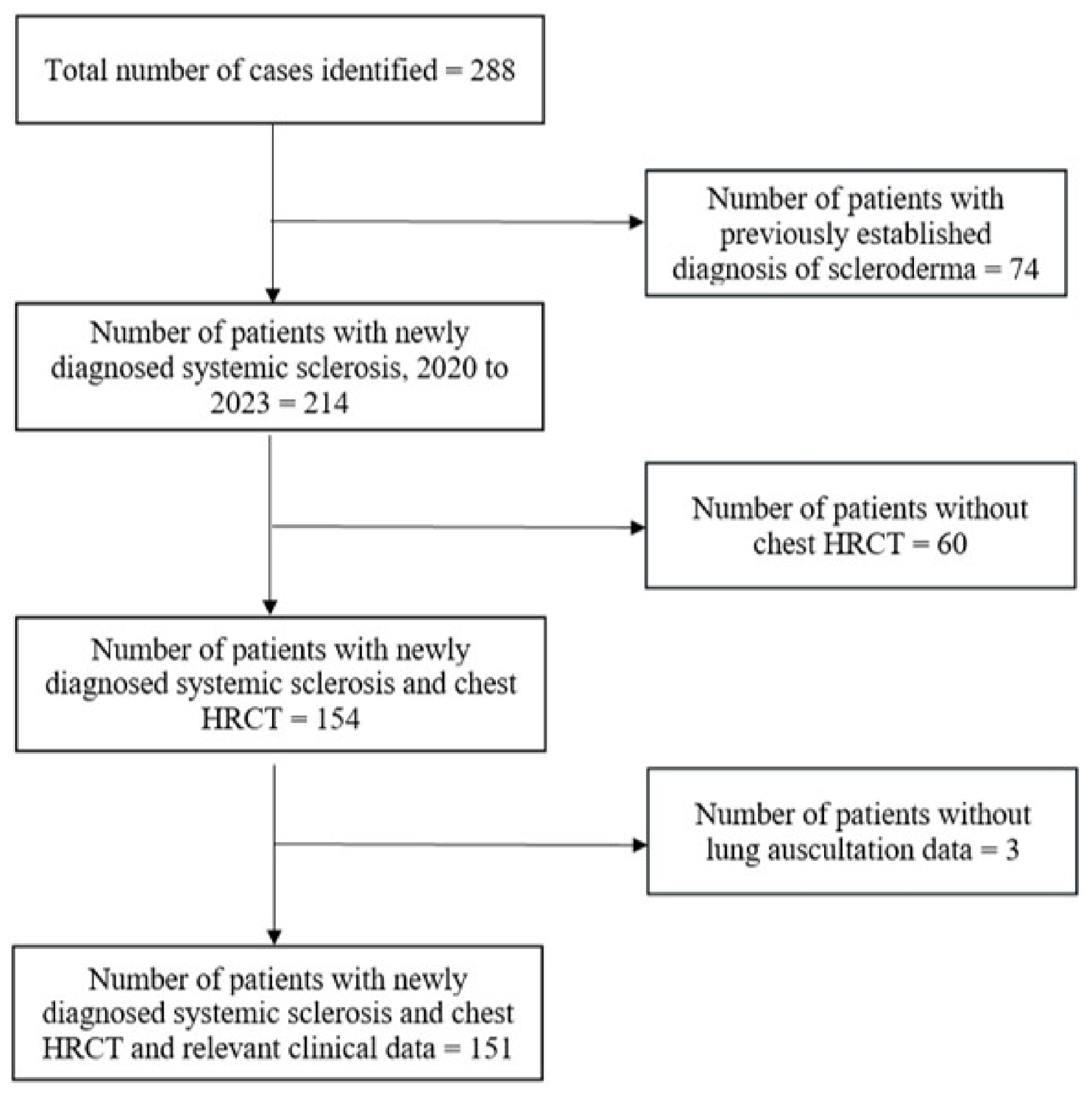
This retrospective cohort study incorporated all patients newly diagnosed with SSc by rheumatologists at Mayo Clinic in Rochester, Minnesota, during a 4-year period between January 2020 and December 2023, with chest HRCT study from initial diagnosis available for current review. We identified 288 subjects; 74 had been diagnosed with scleroderma previously and were excluded (
Figure 1).
Sixty-three additional subjects were excluded for reasons shown in
Figure 1. Thus, the final cohort comprised 151 subjects with newly diagnosed SSc with chest HRCT available for current review and lung auscultatory findings documented in the medical records.
Demographic data (age, sex, race, smoking status), clinical features (SSc phenotype, comorbidities, respiratory symptoms, presence of inspiratory crackles (auscultated by rheumatologist and/or pulmonologist and other physical findings, body mass index), laboratory data (autoimmune serologies including antinuclear antibody [ANA], anti-topoisomerase 1, anti-centromere, anti-RNP and anti-RNA polymerase III), and PFT results were retrieved from electronic medical records. Clinical evaluation including lung auscultation occurred in a quiet examination room during their consultation visit in the outpatient clinic. Clinicians used stethoscopes of their personal preference. Referral to pulmonology was made at the discretion of the evaluating rheumatologist and patient preference most commonly.
Chest CT scans were performed on available clinical systems including Siemens SOMATOM Force 192-slice dual-source scanner, Siemens Definition Flash 128-slice dual-source scanner, and Siemens NAEOTOM Alpha 288-slice photon-counting dual-source scanner (Siemens Healthineers, Forchheim, Germany) using thin-section (≤1.5 mm) reconstructions and high-spatial frequency reconstruction algorithm. HRCT scans of the chest were reviewed independently by two of the authors (VT, JHR) to confirm the presence or absence of ILD as indicated in the original chest radiologist’s interpretation, and to categorize the pattern of ILD as usual interstitial pneumonia (UIP), probable UIP, fibrotic nonspecific interstitial pneumonia (NSIP), cellular NSIP, organizing pneumonia, pleuroparenchymal fibroelastosis, and mild nonspecific ILD (
Table 1).
Discrepancies in interpretations of HRCT findings (N = 11, 7.3%) were reconciled by consensus on second review conducted by two of the authors (VT, JHR).
Pulmonary function measurements (lung volumes, spirometry, and single-breath diffusing capacity) were obtained using the Jaeger SentrySuite™ Body Plethysmograph system (Jaeger Medical, Basingstoke, UK). Analysis of PFT data included forced vital capacity (FVC), diffusing capacity of the lungs for carbon monoxide (DLCO), and total lung capacity (TLC). TLC percent (%) predicted was categorized as normal (≥80), mild (70–79), moderate (50–69), and severe (<50). Similarly, percent predicted DLCO was classified as normal (>75), mild (60–75), moderate (40–59), and severe (<40). FVC percent predicted was categorized as normal (≥80) or abnormal (<80), with reference values from the National Health and Nutrition Examination Survey III.
Statistical Analysis
The baseline characteristics of the study participants were summarized based on the presence or absence of ILD on chest HRCT. Continuous variables are presented as mean (±standard deviation [SD]) or median (range), while categorical variables are expressed as proportions. Student’s t-test and Wilcoxon signed-rank test were employed for normally and non-normally distributed continuous variables, respectively. Chi-square tests were utilized for categorical variables. The lung auscultation findings were analyzed, and the association between inspiratory crackles and SSc-ILD was examined using a multivariable analysis (Poisson models). Statistical analyses were conducted using STATA 17 (Stata Corp, Grand Forks, ND, USA), with a two-sided p-value of 0.05, to determine the significance of the results.
3. Results
The study cohort of 151 patients comprised 109 (72.2%) females, 132 (88.1%) whites, and 83 (55.0%) never smokers, with a median (range) age at diagnosis of 62 (22–88) years (
Table 2). Limited SSc was the most common SSc subtype, 101 (67.3%). Forty-five patients (29.8%) had respiratory symptoms (cough and/or dyspnea).
HRCT of the chest demonstrated evidence of ILD in 69 (45.7%) patients, among whom the most prevalent ILD pattern was nonspecific interstitial pneumonia (NSIP), seen in 49 (71.0%) of these patients and predominantly the fibrotic-NSIP (f-NSIP) subtype, seen in 41 (59.4%).
ANA positivity was documented in nearly all patients, with and without evidence of ILD on HRCT. High anti-topoisomerase 1 (Scl-70) antibody level (>8 U) was significantly more common in those with ILD compared to those without ILD, 20.9% versus 1.2%, respectively (p-value < 0.001). High level of anticentromere antibodies (>8 U) was less frequent in those with ILD compared to those without ILD, 17.6% versus 37.7%, respectively (p value = 0.014).
Inspiratory crackles on lung auscultation were documented by rheumatologists in 37 of 151 (24.5%) patients, and 35 (94.6%) of this cohort had HRCT evidence of ILD (
Table 3). Among 114 patients in whom the rheumatologists heard no inspiratory crackles, 34 (29.8%) patients had CT evidence of ILD. Sensitivity and specificity of inspiratory crackles heard by rheumatologists in detecting ILD were 50.7% and 97.6%, respectively.
Seventy (46.4%) of 151 patients had been evaluated by pulmonologists; inspiratory crackles were documented in 38 (54.3%) patients and 35 (92.1%) of the 38 had CT evidence of ILD (
Table 4). Among 32 subjects in whom no inspiratory crackles were heard by the pulmonologists, 14 (43.8%) patients had CT evidence of ILD. Sensitivity and specificity of inspiratory crackles heard by pulmonologists in detecting ILD were 71.4% and 85.7%, respectively.
The positive predictive values (PPV) for crackles heard by rheumatologists and pulmonologists were high (94.6% vs. 92.1%, respectively). Conversely, the negative predictive values for absence of crackles were moderate (70.2% vs. 56.3%, respectively).
Respiratory symptoms (cough and/or dyspnea) were present in 46.4% of those with ILD compared to 15.9% among those without ILD. However, 53.6% of patients with ILD had neither dyspnea nor cough. Among the patients with ILD, dyspnea was documented in 30 (43.5%) and 16 (23.2%) with cough. Among those without ILD, dyspnea was documented in 11 (13.4%) and cough in 6 (7.3%). Both dyspnea (p < 0.001) and cough (p < 0.012) showed a significant correlation with the presence of ILD, with dyspnea showing a stronger association.
As expected, the mean % predicted of TLC, DLCO, and FVC were significantly lower in patients with ILD compared to those without ILD, 77.0 vs. 95.0 (95% CI: 13.20 to 22.80,
p < 0.001), 63.0 vs. 82.0, (95% CI: 14.20 to 23.80,
p <0.001), and 79.4 vs. 94.0 (95% CI: 10.60 to 20.20,
p < 0.001), respectively (
Table 3 and
Table 4).
Among 69 patients with ILD, those who had crackles heard by rheumatologists manifested a lower mean % predicted TLC (p = 0.004) and DLCO (p = 0.025) compared to those with no crackles heard on lung auscultation. In the subset of 49 patients with ILD evaluated by pulmonologists, those who manifested crackles showed a trend toward lower mean % predicted TLC (p < 0.056) and DLCO (p < 0.08) compared to those without crackles, but no difference in % predicted FVC (p < 0.589).
Among patients with ILD, there was no correlation between the ILD patterns seen on HRCT and crackles heard by rheumatologists (p = 0.168) or pulmonologists (p = 0.138). The Spearman correlation between ILD pattern and DLCO severity was approximately −0.317 (p = 0.015), and between ILD pattern and TLC was −0.391 (p = 0.005). The negative correlations suggest that as the ILD pattern progresses from cellular NSIP (c-NSIP) to fibrotic NSIP (f-NSIP) to probable UIP, both DLCO and TLC tend to decrease. This reflects worsening lung function, with more advanced fibrotic patterns associated with greater impairment in gas exchange and lung volume.
Multivariable regression analysis assessed the relationship between ILD present on HRCT scans and crackles heard by rheumatologists and pulmonologists on lung auscultation (
Table 5 and
Table 6). In this multivariable analysis adjusted for age, sex, body mass index, spirometry, and anti-topoisomerase 1 antibody levels, a significant correlation was observed between ILD on HRCT and crackles identified by rheumatologists (IRR 1.643, 95% CI 1.069–2.526,
p = 0.024), while crackles detected by pulmonologists showed a trend toward significance (IRR 1.624, 95% CI 0.969–2.721,
p = 0.066). Other clinical variables, pulmonary function measures and anti-topoisomerase levels did not appear to correlate with the presence of ILD on HRCT.
4. Discussion
In this retrospective study, we examined the accuracy of lung auscultation in detecting the presence of ILD in 151 patients with newly diagnosed SSc in real-world clinical practice, nearly one-half of whom had HRCT evidence of ILD, often in the absence of respiratory symptoms. Our study demonstrated presence of inspiratory crackles to have a moderate sensitivity and a high specificity in detecting ILD in these patients. The presence of crackles tended to correlate with lower pulmonary function measures.
In a prospective study of 290 patients referred to an ILD clinic in Canada, crackles (“fine” and/or “coarse”) were documented by clinicians in 98% patients with idiopathic pulmonary fibrosis (IPF) and 84% of those with non-IPF ILD [
10]. In a study of patients with fibrotic ILDs, “Velcro-type” crackles correlated with the presence of fibrotic ILD, particularly the UIP pattern of ILD [
9]. In addition, lung auscultation has been identified as a useful noninvasive method for screening industrial populations exposed to asbestos [
11]. Among patients with SSc and evidence of ILD by HRCT, less than half were reported to have a positive clinical examination (“presence of basilar Velcro-like crackles”) [
12]. Thus, the prevalence of crackles appears to vary depending on the underlying ILD and clinical setting. In our retrospective study cohort of patients with newly diagnosed SSc encountered in real-world practice, quality of crackles was often not characterized as “fine” or “Velcro-like” versus “coarse.” Thus, we were not able to specifically address the value of Velcro-like” crackles.
Among 69 patients who had SSc-ILD in our study, no crackles were heard by rheumatologists in nearly one-half of patients. Among 49 patients with SSc-ILD evaluated by pulmonologists, no crackles were heard in over one-quarter of patients. With the advent of advanced chest imaging, particularly HRCT, there has been lessening emphasis on lung auscultation and perhaps a decline in auscultatory skills. For example, fine inspiratory (‘Velcro”) crackles may be difficult to appreciate by the busy clinician unless the patient is deliberately instructed to take slow and deep breaths. Accordingly, the absence of crackles on lung auscultation does not exclude the presence of ILD.
Inspiratory crackles are commonly encountered in patients with fibrotic ILDs and have been reported to be more common than respiratory symptoms (dyspnea or cough) or abnormal PFT results (restrictive pattern or low diffusing capacity) [
10]. However, inspiratory crackles are not specific for fibrotic processes in the lung and can be associated with other lung diseases including infections, noninfectious inflammation, edema, and others [
13]. Nonetheless, in our cohort of newly diagnosed SSc patients, detection of inspiratory crackles appeared to be relatively specific for ILD. While the most common pattern of ILD seen on HRCT was fibrotic NSIP, specific patterns of ILD did not correlate with the presence of crackles.
In recent years, the digital stethoscope has been developed which may facilitate respiratory sound analysis with the aid of artificial intelligence techniques [
14]. This type of auscultatory analysis would reduce subjectivity and interobserver variability and is a promising avenue for more accurate clinical assessment. In a recent systematic review of screening methods used in detecting ILD in patients with rheumatoid arthritis-associated ILD, digital auscultation achieved diagnostic accuracy of 84% to 90% compared to HRCT, with a sensitivity of 93% and specificity of 77% to 88% [
15]. The sensitivity and specificity of PFT variables (DLCO, TLC, and FVC) were 0.77 and 0.70, respectively, in our study and were comparable to values previously reported in the literature, where a PFT-based ILD prediction tool showed a sensitivity of 0.79 and specificity of 0.83 [
16]. A recent review on lung sound analysis describes the potential role of AI-based auscultation for early and accurate diagnosis of ILD [
17].
The limitations of our study relate to the research setting and retrospective design. This study was conducted in a tertiary referral medical center and might not reflect the general scleroderma population. Lung auscultation data were retrieved from medical records as physicians documented them. The crackles were often not categorized as fine or coarse. Our patient population was predominantly white (88.1%), which may limit applicability to other racial groups.
5. Conclusions
Detection of inspiratory crackles on lung auscultation in patients with newly diagnosed SSc strongly indicates the presence of ILD even in the absence of respiratory symptoms. The presence of crackles correlated with worse pulmonary function measures, including lower TLC and DLCO. However, crackles were not associated with specific ILD patterns and may be absent in early disease.
Author Contributions
F.W.W., A.M. and J.H.R. made substantial contributions to the conception of the work and data collection. F.W.W., C.A.-K., V.T., A.S.S.A., Y.A.Y.-K., A.M. and J.H.R. made significant contributions to the study design, data analysis and interpretation, and the writing of the manuscript. All authors substantially contributed to the revision of the manuscript drafts. All authors have read and agreed to the published version of the manuscript.
Funding
The authors declare that no funds, grants, or other support were received during the preparation of this manuscript.
Institutional Review Board Statement
The research study was conducted in accordance with the Declaration of Helsinki, and approved by the Mayo Clinic Institutional Review Board (IRB) (IRB number 23-009787, 24 October 2023).
Informed Consent Statement
The research study was deemed exempt from the requirement for IRB approval with the need for written informed consent waived since only existing data from medical records were used without patient contact.
Data Availability Statement
All data generated or analyzed during this study are included in this article. Additional deidentified data are available from the corresponding author upon reasonable request.
Conflicts of Interest
The authors have no conflicts of interest.
Abbreviations
The following abbreviations are used in this manuscript.
| ANA | antinuclear antibody |
| DLCO | diffusing capacity of the lungs for carbon monoxide |
| dcSSc. | diffuse cutaneous systemic sclerosis |
| FVC | forced vital capacity |
| HRCT | high-resolution computed tomography |
| ILD | interstitial lung disease |
| lcSSc | limited cutaneous systemic sclerosis |
| PFT | pulmonary function testing |
| SD | standard deviation |
| ssSSc | systemic sclerosis sine scleroderma |
| SSc | systemic sclerosis |
| SSc-ILD | systemic sclerosis-associated interstitial lung disease |
| TLC | total lung capacity |
References
- Roofeh, D.; Jaafar, S.; Vummidi, D.; Khanna, D. Management of systemic sclerosis-associated interstitial lung disease. Curr. Opin. Rheumatol. 2019, 31, 241–249. [Google Scholar] [CrossRef] [PubMed]
- Sobolewski, P.; Maslinska, M.; Wieczorek, M.; Lagun, Z.; Malewska, A.; Roszkiewicz, M.; Nitskovich, R.; Szymanska, E.; Walecka, I. Systemic sclerosis—Multidisciplinary disease: Clinical features and treatment. Reumatologia 2019, 57, 221–233. [Google Scholar] [CrossRef] [PubMed]
- Moinzadeh, P.; Bonella, F.; Oberste, M.; Weliwitage, J.; Blank, N.; Riemekasten, G.; Müller-Ladner, U.; Henes, J.; Siegert, E.; Günther, C.; et al. Impact of Systemic Sclerosis-Associated Interstitial Lung Disease With and Without Pulmonary Hypertension on Survival: A Large Cohort Study of the German Network for Systemic Sclerosis. Chest 2024, 165, 132–145. [Google Scholar] [CrossRef] [PubMed]
- Rahaghi, F.F.; Hsu, V.M.; Kaner, R.J.; Mayes, M.D.; Rosas, I.O.; Saggar, R.; Steen, V.D.; Strek, M.E.; Bernstein, E.J.; Bhatt, N.; et al. Expert consensus on the management of systemic sclerosis-associated interstitial lung disease. Respir. Res. 2023, 24, 6. [Google Scholar] [CrossRef] [PubMed]
- Rubio-Rivas, M.; Royo, C.; Simeon, C.P.; Corbella, X.; Fonollosa, V. Mortality and survival in systemic sclerosis: Systematic review and meta-analysis. Semin. Arthritis Rheum. 2014, 44, 208–219. [Google Scholar] [CrossRef] [PubMed]
- Cottin, V.; Brown, K.K. Interstitial lung disease associated with systemic sclerosis (SSc-ILD). Respir. Res. 2019, 20, 13. [Google Scholar] [CrossRef] [PubMed]
- Johnson, S.R.; Bernstein, E.J.; Bolster, M.B.; Chung, J.H.; Danoff, S.K.; George, M.D.; Khanna, D.; Guyatt, G.; Mirza, R.D.; Aggarwal, R.; et al. 2023 American College of Rheumatology (ACR)/American College of Chest Physicians (CHEST) Guideline for the Screening and Monitoring of Interstitial Lung Disease in People with Systemic Autoimmune Rheumatic Diseases. Arthritis Rheumatol. 2024, 76, 1201–1213. [Google Scholar] [CrossRef] [PubMed]
- Codes, H.; Guler, A.A.; Campochiaro, C.; Cerinic, M.M.; Castellvi, I. Systemic sclerosis and interstitial lung disease: From pathogenesis, to screening, diagnosis, and classification. Colomb. J. Rheumatol. (Engl. Version) 2024, 31, S54–S66. [Google Scholar]
- Sgalla, G.; Walsh, S.L.F.; Sverzellati, N.; Fletcher, S.; Cerri, S.; Dimitrov, B.; Nikolic, D.; Barney, A.; Pancaldi, F.; Larcher, L.; et al. “Velcro-type” crackles predict specific radiologic features of fibrotic interstitial lung disease. BMC Pulm. Med. 2018, 18, 103. [Google Scholar] [CrossRef] [PubMed]
- Moran-Mendoza, O.; Ritchie, T.; Aldhaheri, S. Fine crackles on chest auscultation in the early diagnosis of idiopathic pulmonary fibrosis: A prospective cohort study. BMJ Open Respir. Res. 2021, 8, e000815. [Google Scholar] [CrossRef] [PubMed]
- Murphy, R.L., Jr.; Gaensler, E.A.; Holford, S.K.; Del Bono, E.A.; Epler, G. Crackles in the early detection of asbestosis. Am. Rev. Respir. Dis. 1984, 129, 375–379. [Google Scholar] [CrossRef] [PubMed]
- Steele, R.; Hudson, M.; Lo, E.; Baron, M.; Canadian Scleroderma Research Group. Clinical decision rule to predict the presence of interstitial lung disease in systemic sclerosis. Arthritis Care Res. 2012, 64, 519–524. [Google Scholar] [CrossRef] [PubMed]
- Arts, L.; Lim, E.H.T.; van de Ven, P.M.; Heunks, L.; Tuinman, P.R. The diagnostic accuracy of lung auscultation in adult patients with acute pulmonary pathologies: A meta-analysis. Sci. Rep. 2020, 10, 7347. [Google Scholar] [CrossRef] [PubMed]
- Kim, Y.; Hyon, Y.; Lee, S.; Woo, S.D.; Ha, T.; Chung, C. The coming era of a new auscultation system for analyzing respiratory sounds. BMC Pulm. Med. 2022, 22, 119. [Google Scholar] [CrossRef] [PubMed]
- Garrote-Corral, S.; Silva-Fernández, L.; Seoane-Mato, D.; Guerra-Rodríguez, M.; Aburto, M.; Castañeda, S.; Valenzuela, C.; Narváez, J. Screening of interstitial lung disease in patients with rheumatoid arthritis: A systematic review. Reumatol. Clin. (Engl. Ed.) 2022, 18, 587–596. [Google Scholar] [CrossRef] [PubMed]
- Pugashetti, J.V.; Kitich, A.; Alqalyoobi, S.; Maynard-Paquette, A.C.; Pritchard, D.; Graham, J.; Boctor, N.; Kulinich, A.; Lafond, E.; Foster, E.; et al. Derivation and Validation of a Diagnostic Prediction Tool for Interstitial Lung Disease. Chest 2020, 158, 620–629. [Google Scholar] [CrossRef] [PubMed]
- Kaur, A.; Cherukuri, S.P.; Handral, M.S.; Kukunoor, H.R.; Kc, R.; Godugu, S.; Lee, J.; Yerrapragada, G.; Elangovan, P.; Shariff, M.N.; et al. Artificial Intelligence Enabled Lung Sound Auscultation in the Early Diagnosis and Subtyping of Interstitial Lung Disease. J. Clin. Med. 2025, 14, 8500. [Google Scholar] [CrossRef] [PubMed]
| Disclaimer/Publisher’s Note: The statements, opinions and data contained in all publications are solely those of the individual author(s) and contributor(s) and not of MDPI and/or the editor(s). MDPI and/or the editor(s) disclaim responsibility for any injury to people or property resulting from any ideas, methods, instructions or products referred to in the content. |




 ,
,