3.1. The Origin of the APA
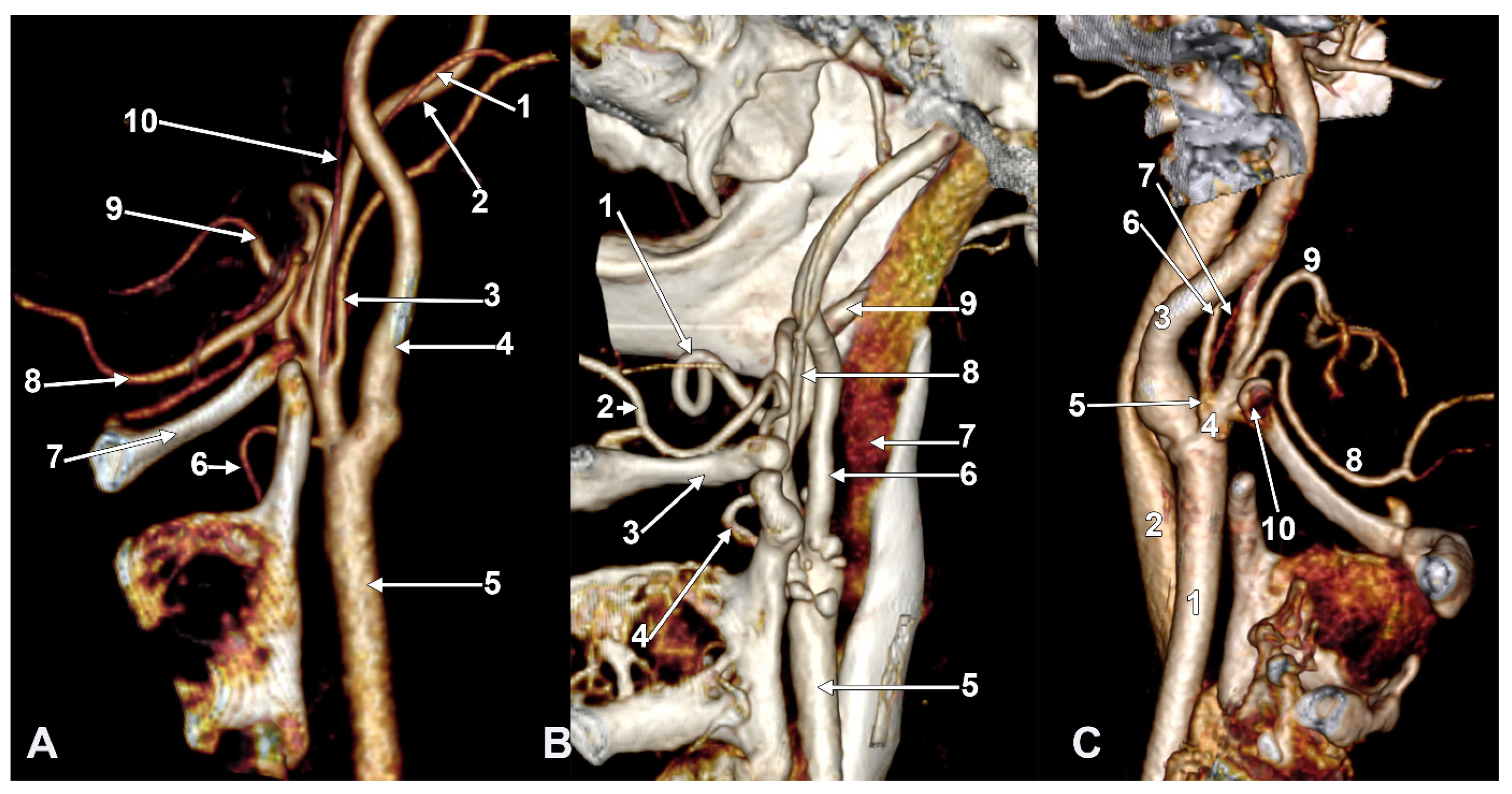
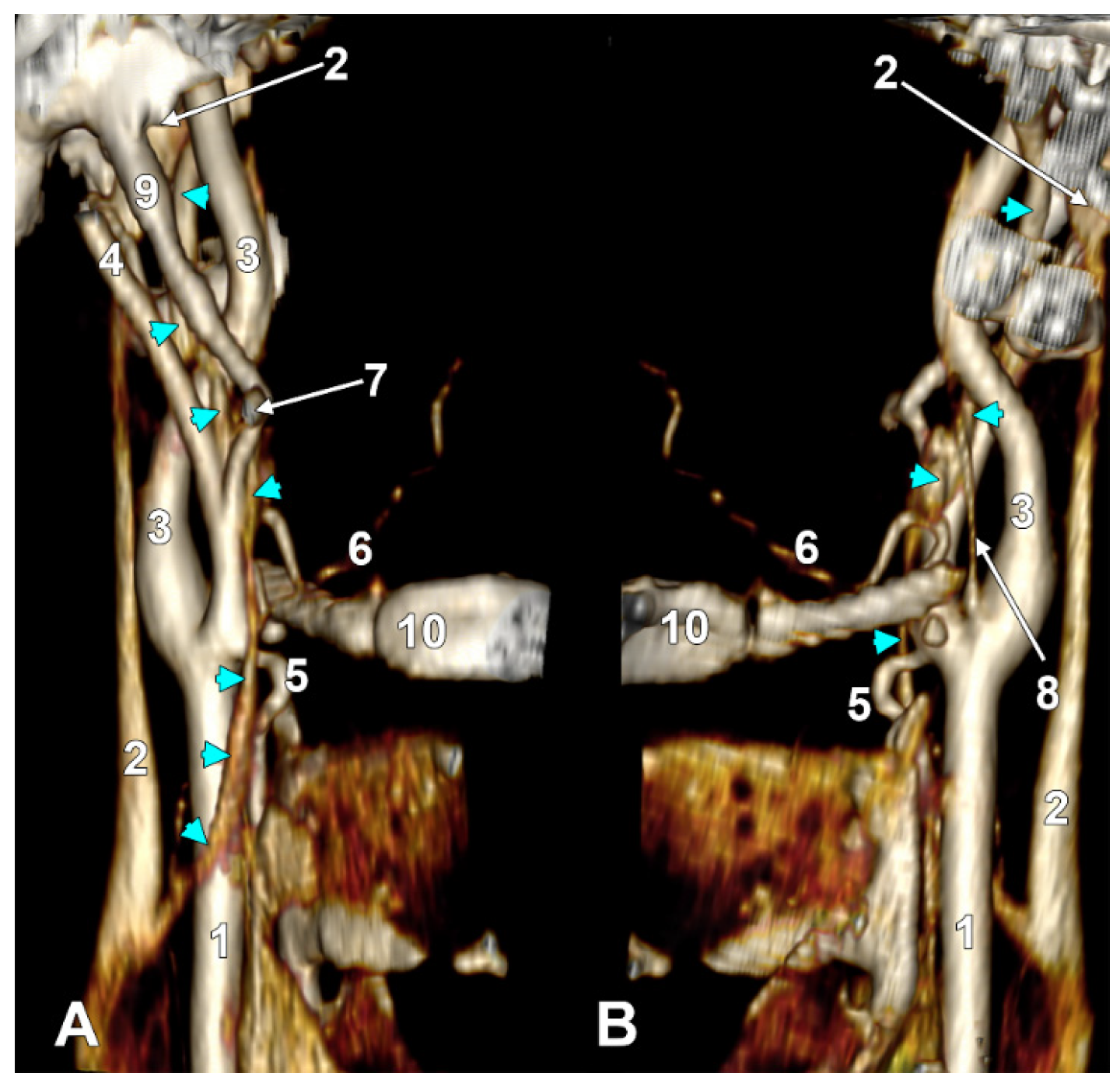
We investigated 170 carotid axes bilaterally. The APA exhibited six origin patterns: Type 0 (absent) in 25 sides (14.71%), Type I (ECA medial wall,
Figure 1A) in 45 sides (26.47%), Type II (ECA posterior wall,
Figure 1B) in 61 sides (35.88%), Type III (occipitopharyngeal trunk,
Figure 1C and
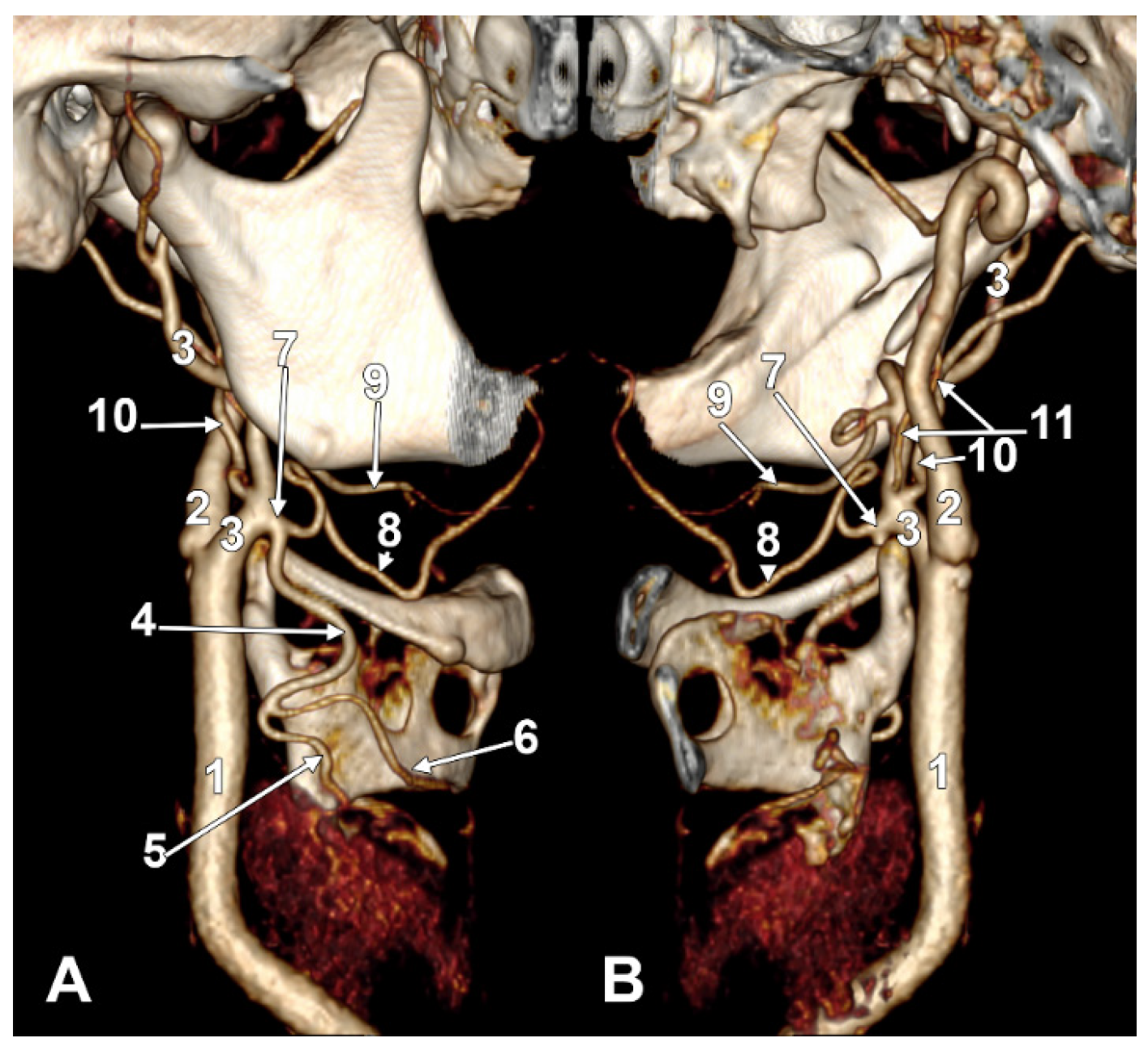
Figure 2A) in 29 sides (17.06%), Type IV (ICA origin,
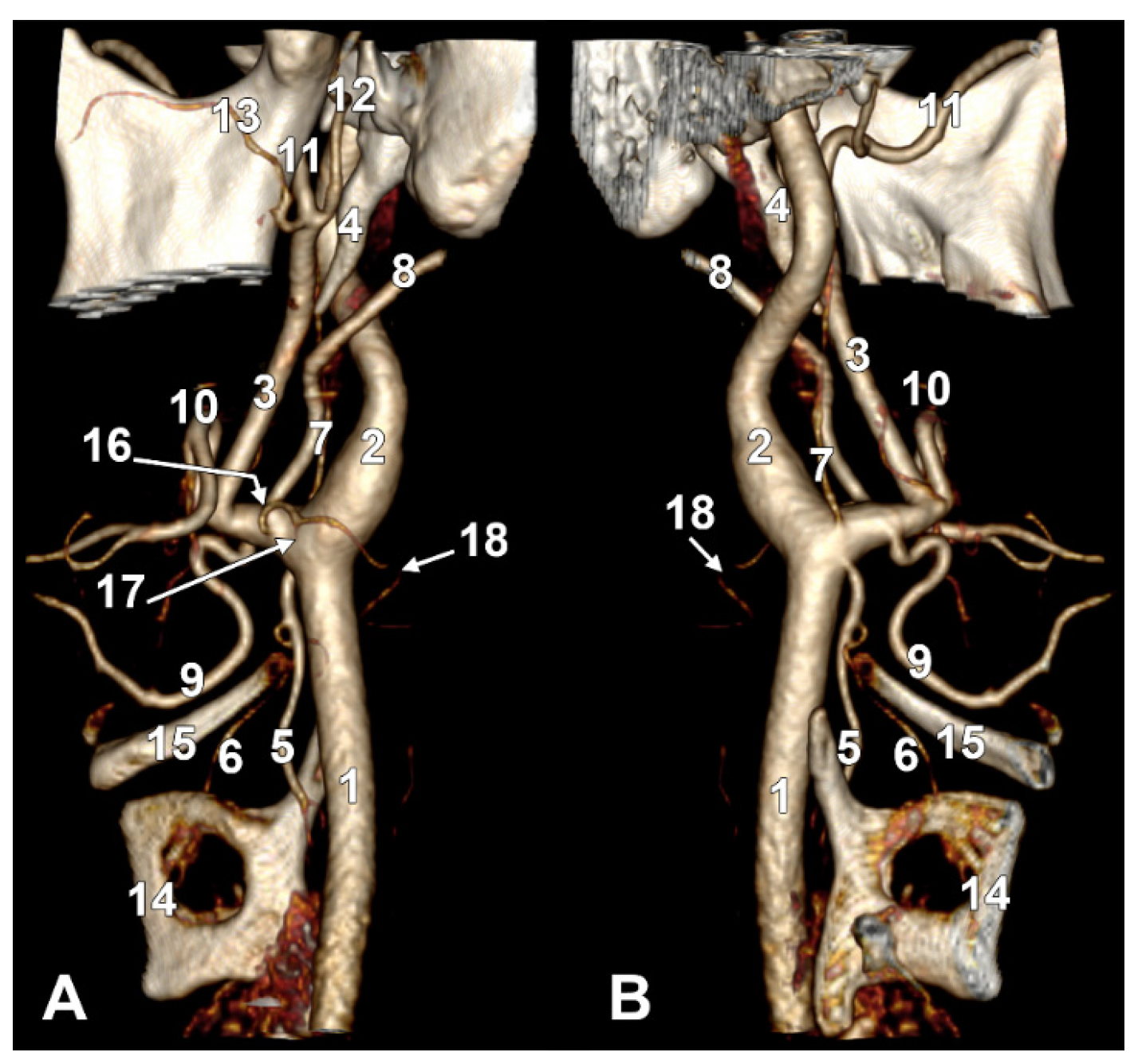
Figure 2B) in 8 sides (4.71%), and Type V (other origins including LA—
Figure 2C—and CB) in 2 sides (1.18%). For sequential classification purposes, Types 0 and IV were designated as S0 (33 sides, 19.41%) because both represent the absence of APA from the ECA branching sequence.
We detailed the origin types of APA on the right and left sides (
Figure 1 and
Figure 2,
Table 1), respectively, in the investigated cohort (
N = 85). On the right side, we found types 0, I, II, III, IV, and V, with prevalences of 12.9%, 37.6%, 24.7%, 14.1%, 9.4%, and 1.2%, respectively. On the left, the prevalence of types 0–V was in the following order: 16.5%, 15.3%, 47.1%, 20.0%, 0.0%, and 1.2%.
Table 1.
Summary of anatomical variants illustrated by figure panels. Abbreviations: APA = ascending pharyngeal artery; ECA = external carotid artery; ICA = internal carotid artery; OPT = occipitopharyngeal trunk; LFT = linguofacial trunk; TLT = thyrolingual trunk; CB = carotid bifurcation; IPS = inferior petrosal sinus; STA = superior thyroid artery; IH = infrahyoid; H = hyoid level; SH = suprahyoid.
Table 1.
Summary of anatomical variants illustrated by figure panels. Abbreviations: APA = ascending pharyngeal artery; ECA = external carotid artery; ICA = internal carotid artery; OPT = occipitopharyngeal trunk; LFT = linguofacial trunk; TLT = thyrolingual trunk; CB = carotid bifurcation; IPS = inferior petrosal sinus; STA = superior thyroid artery; IH = infrahyoid; H = hyoid level; SH = suprahyoid.
| Figure | Panel(s) | Variant(s) Illustrated | Prevalence | Rarity |
|---|
| Figure 1A | A | Type I APA (ECA medial wall) | 26.47% | Common |
| Figure 1B | B | Type II APA (ECA posterior wall) | 35.88% | Most common |
| Figure 1C | C | Type III APA (from OPT) | 17.06% | Common |
| Figure 2A | A | Type III APA + LFT | 17.06% | Common |
| Figure 2B | B | Type IV APA (from ICA) | 4.71% | Rare |
| Figure 2C | C | Type V APA (from LA) | 1.18% | Very rare |
| Figure 3A | A | Infrahyoid (IH) APA + LFT | 8.24% | Uncommon |
| Figure 3B | B | Hyoid-level (H) APA | 5.29% | Uncommon |
| Figure 3C | C | S37 type + OPT + absent STA | 1.18% | Very rare |
| Figure 4 | - | Reference diagram (no variants) | N/A | N/A |
| Figure 5 | - | S-types 1–20 (schematic) | Mixed | S7: 7.1% |
| Figure 6 | - | S-types 21–40 (schematic) | Mixed | Multiple rare |
| Figure 7 | - | Long IPS + Type IV APA + long styloid | Case report | Very rare |
| Figure 8 | A, B | Same case as Figure 7 (3D views) | Case report | Very rare |
| Figure 9 | A, B | TLT from CCA (S33 pattern) | 1.18% | Very rare |
| Figure 10 | A, B | TLT from ECA (S35) + collapsed hyoid | 1.18% | Very rare |
| Figure 11 | A, B | Type V from CB + S40 + multiple variants | 1.18% | Very rare |
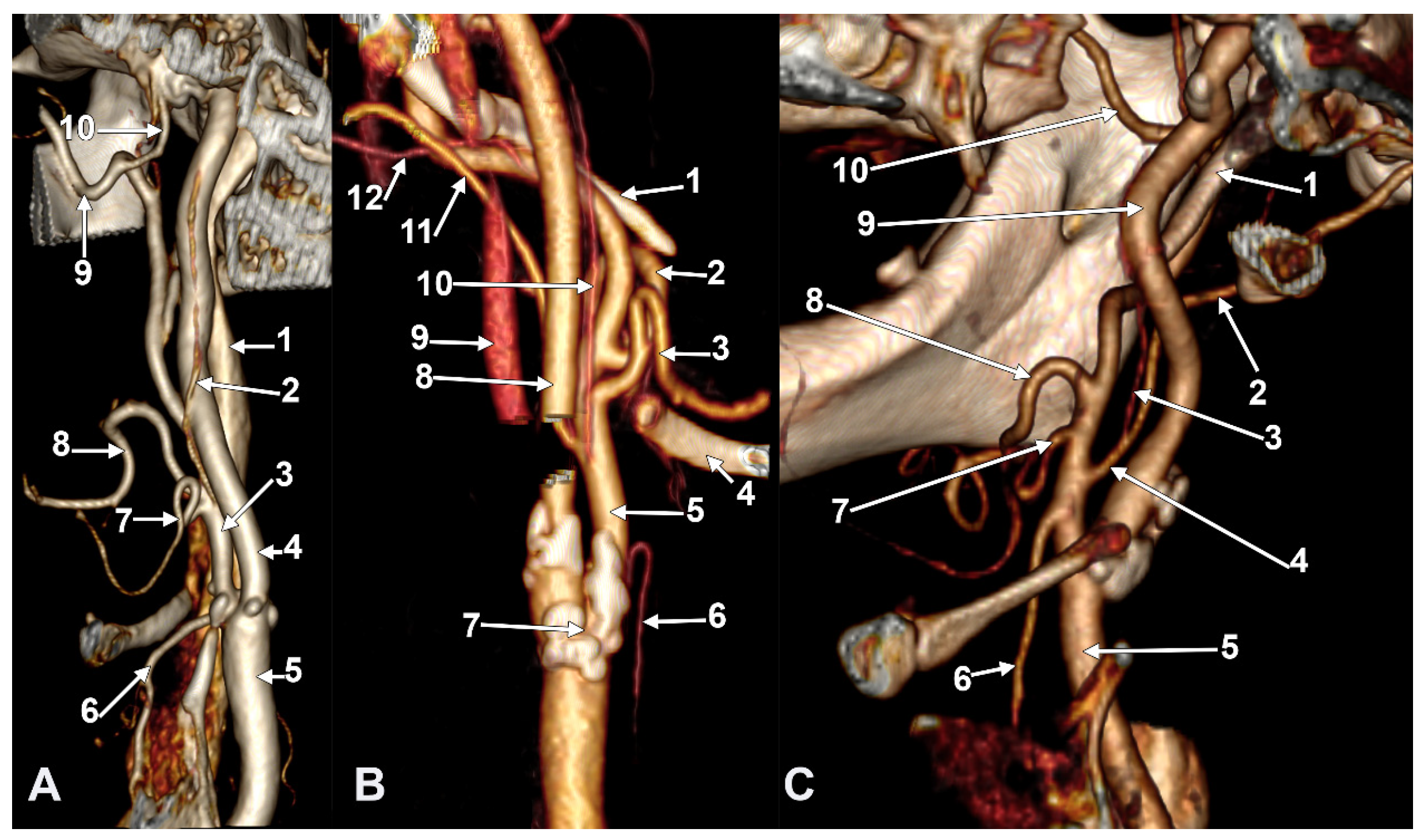
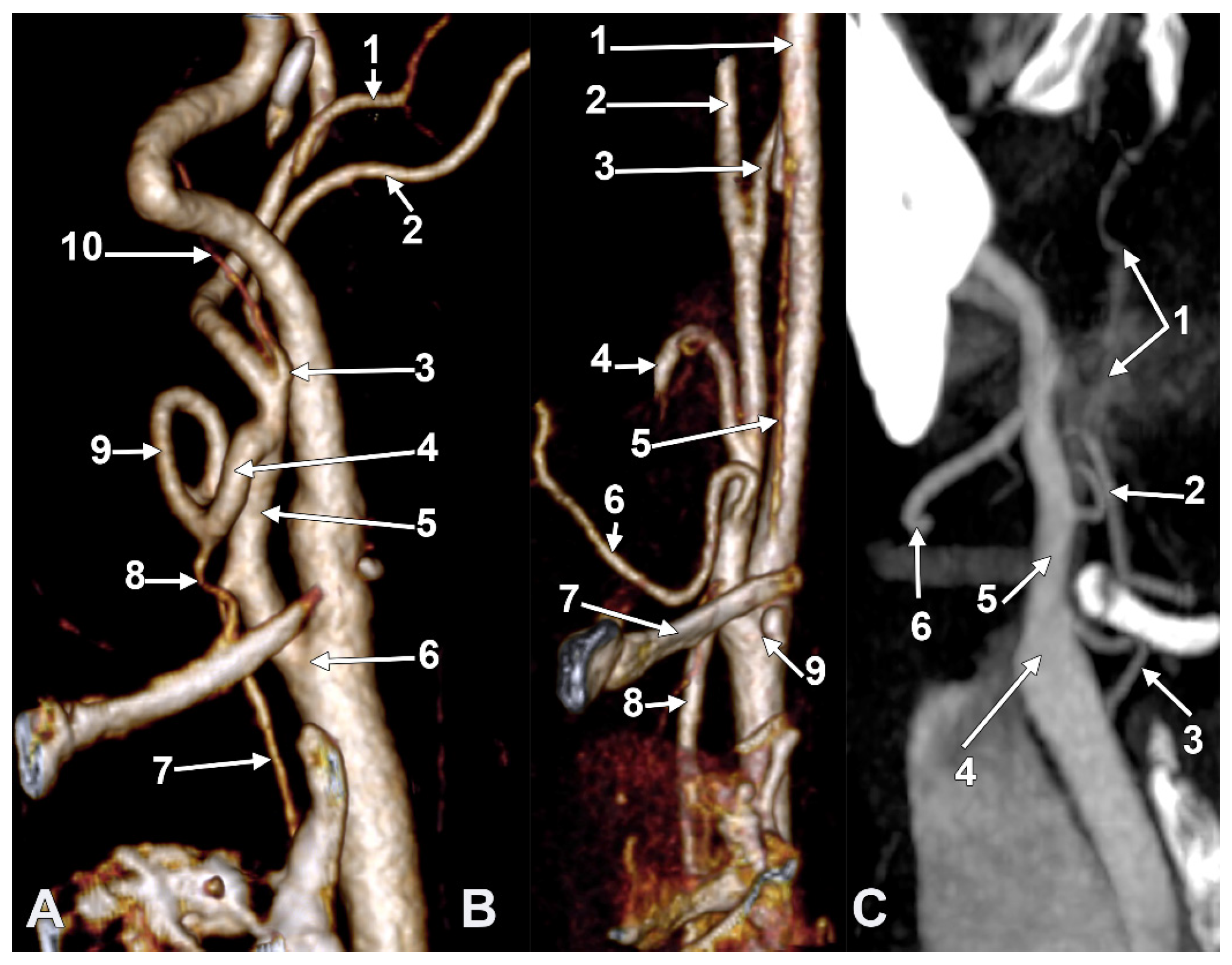
Figure 3.
(A) Infrahyoid origin of the ascending pharyngeal artery. Linguofacial trunk. Three-dimensional rendering. Antero-infero-medial view. 1. Posterior auricular artery; 2. external carotid artery; 3. occipital artery; 4. internal carotid artery; 5. common carotid artery; 6. superior thyroid artery; 7. greater hyoid horn; 8. lingual artery; 9. facial artery; 10. ascending pharyngeal artery. (B) The hyoid origin of the ascending pharyngeal artery, lateral to the greater hyoid horn. Three-dimensional volume rendering. Right side. Posteromedial view. 1. Facial artery; 2. lingual artery; 3. greater hyoid horn; 4. superior thyroid artery; 5. common carotid artery; 6. internal carotid artery; 7. internal jugular vein; 8. ascending pharyngeal artery; 9. external carotid artery. (C) Occipitopharyngeal trunk and absent superior thyroid artery. Type S 37 of sequence of the origin of the external carotid branches. Three-dimensional rendering. Left side. Medial view. 1. Common carotid artery; 2. internal jugular vein; 3. internal carotid artery; 4. external carotid artery; 5. occipitopharyngeal trunk; 6. occipital artery; 7. ascending pharyngeal artery; 8. lingual artery; 9. facial artery; 10. hyoid tubercle.
Figure 3.
(A) Infrahyoid origin of the ascending pharyngeal artery. Linguofacial trunk. Three-dimensional rendering. Antero-infero-medial view. 1. Posterior auricular artery; 2. external carotid artery; 3. occipital artery; 4. internal carotid artery; 5. common carotid artery; 6. superior thyroid artery; 7. greater hyoid horn; 8. lingual artery; 9. facial artery; 10. ascending pharyngeal artery. (B) The hyoid origin of the ascending pharyngeal artery, lateral to the greater hyoid horn. Three-dimensional volume rendering. Right side. Posteromedial view. 1. Facial artery; 2. lingual artery; 3. greater hyoid horn; 4. superior thyroid artery; 5. common carotid artery; 6. internal carotid artery; 7. internal jugular vein; 8. ascending pharyngeal artery; 9. external carotid artery. (C) Occipitopharyngeal trunk and absent superior thyroid artery. Type S 37 of sequence of the origin of the external carotid branches. Three-dimensional rendering. Left side. Medial view. 1. Common carotid artery; 2. internal jugular vein; 3. internal carotid artery; 4. external carotid artery; 5. occipitopharyngeal trunk; 6. occipital artery; 7. ascending pharyngeal artery; 8. lingual artery; 9. facial artery; 10. hyoid tubercle.

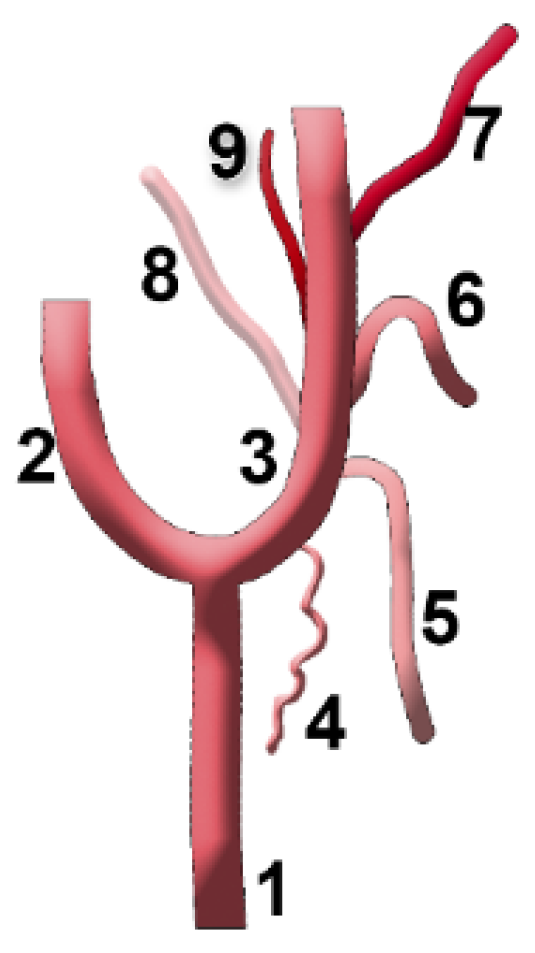
Figure 4.
Anatomical diagram used to represent the types of sequence of the origin of the ascending pharyngeal artery from the external carotid artery. 1. Common carotid artery (CCA); 2. internal carotid artery (ICA); 3. external carotid artery (ECA); 4. sternocleidomastoid (SCM) br.; 5. superior thyroid artery (STA); 6. lingual artery (LA); 7. facial artery (FA); 8. occipital artery (OA); 9. ascending pharyngeal artery (APA).
Figure 4.
Anatomical diagram used to represent the types of sequence of the origin of the ascending pharyngeal artery from the external carotid artery. 1. Common carotid artery (CCA); 2. internal carotid artery (ICA); 3. external carotid artery (ECA); 4. sternocleidomastoid (SCM) br.; 5. superior thyroid artery (STA); 6. lingual artery (LA); 7. facial artery (FA); 8. occipital artery (OA); 9. ascending pharyngeal artery (APA).
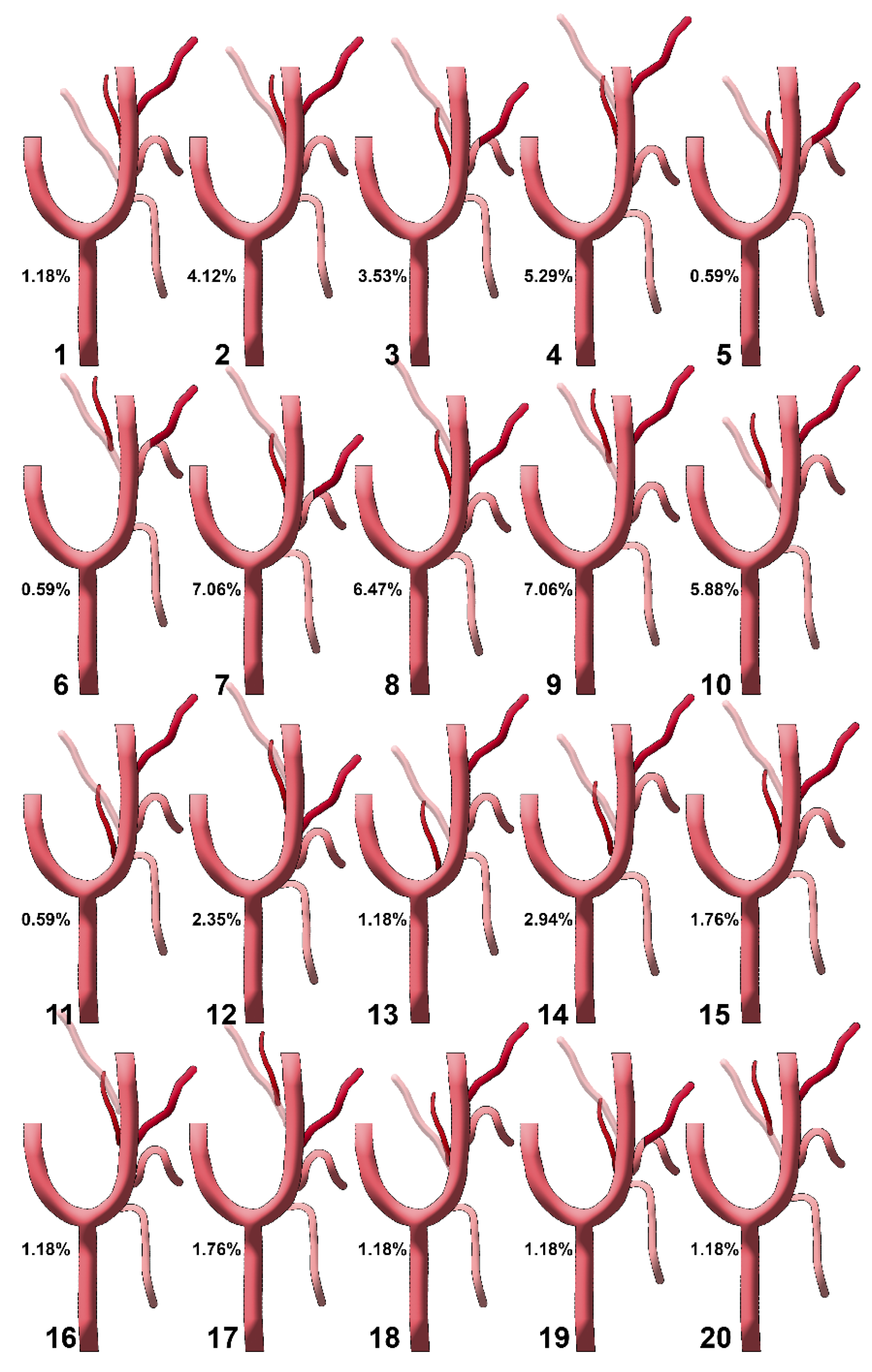
Figure 5.
Diagrams of sequence types 1–20 of the origin of the ascending pharyngeal artery from the external carotid artery. Their prevalences are shown. Type 1: STA-OA-LA-APA-FA; type 2: STA-LA-APA/OA-FA; type 3: STA-APA/LFT-OA; type 4: STA-LA-APA-OA-FA; type 5: STA-APA/LFT/OA-FA; type 6: STA-LFT/OPT; type 7: STA-LFT-APA-OA; type 8: STA-LA-APA-FA-OA; type 9: STA-LA-OPT-FA; type 10: STA-OPT-LA-FA; type 11: STA/APA-LA/OA-FA; type 12: STA-LA-FA-APA-OA; type 13: APA-STA-OA-LA-FA; type 14: STA-APA-OA-LA-FA; type 15: STA-LA/APA-OA/FA; type 16: STA-LA-APA/FA-OA; type 17: STA-LA-FA-OPT; type 18: STA-APA/OA-LA-FA; type 19: STA-LFT/APA-OA; type 20: STA-OPT/LA-FA. STA: superior thyroid artery; LA: lingual artery; FA: facial artery; OA: occipital artery; APA: ascending pharyngeal artery; OPT: occipitopharyngeal trunk; LFT: linguofacial trunk.
Figure 5.
Diagrams of sequence types 1–20 of the origin of the ascending pharyngeal artery from the external carotid artery. Their prevalences are shown. Type 1: STA-OA-LA-APA-FA; type 2: STA-LA-APA/OA-FA; type 3: STA-APA/LFT-OA; type 4: STA-LA-APA-OA-FA; type 5: STA-APA/LFT/OA-FA; type 6: STA-LFT/OPT; type 7: STA-LFT-APA-OA; type 8: STA-LA-APA-FA-OA; type 9: STA-LA-OPT-FA; type 10: STA-OPT-LA-FA; type 11: STA/APA-LA/OA-FA; type 12: STA-LA-FA-APA-OA; type 13: APA-STA-OA-LA-FA; type 14: STA-APA-OA-LA-FA; type 15: STA-LA/APA-OA/FA; type 16: STA-LA-APA/FA-OA; type 17: STA-LA-FA-OPT; type 18: STA-APA/OA-LA-FA; type 19: STA-LFT/APA-OA; type 20: STA-OPT/LA-FA. STA: superior thyroid artery; LA: lingual artery; FA: facial artery; OA: occipital artery; APA: ascending pharyngeal artery; OPT: occipitopharyngeal trunk; LFT: linguofacial trunk.
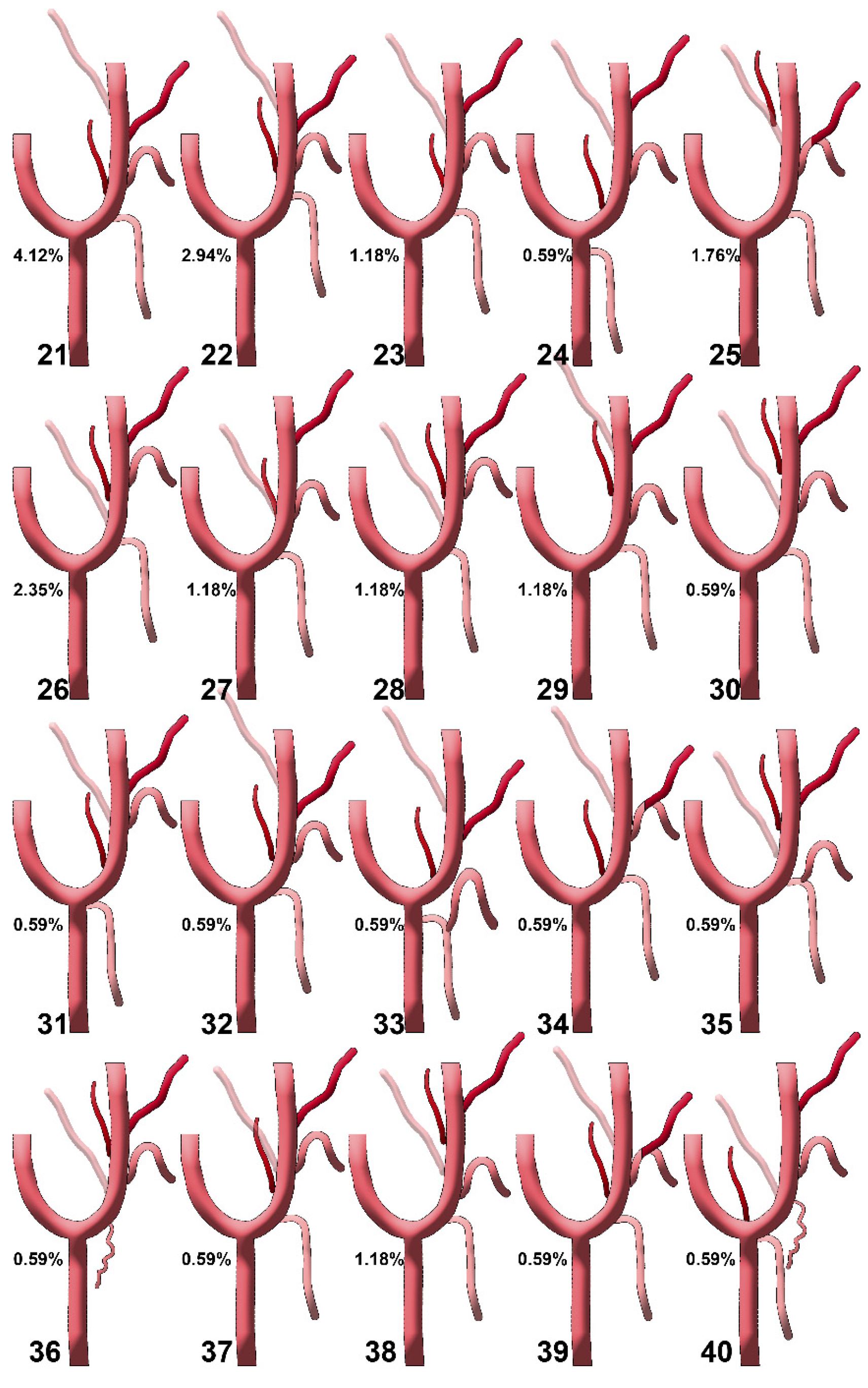
Figure 6.
Diagrams of sequence types 21–40 of the origin of the ascending pharyngeal artery from the external carotid artery. Their prevalences are shown. Type 21: STA-APA-LA-FA-OA; type 22: STA-LA/APA-FA-OA; type 23: STA-APA-LA-OA-FA; type 24: APA-LA-OA-FA (STA from CCA); type 25: STA-LFT-OPT; type 26: STA-OA-APA-LA-FA; type 27: STA-LA/APA/OA-FA; type 28: STA-OA-LA/APA-FA; type 29: STA-LA-APA-FA/OA; type 30: STA-LA/OA-APA-FA; type 31: STA (from CB)-APA-LA/OA-FA; type 32: STA-APA/LA-FA-OA; type 33: TLT (from CCA)-APA-FA-OA; type 34: STA/APA-LFT-OA; type 35: TLT (from ECA)-OA-APA-FA; type 36: (S0, STA absent or with internal carotid origin)-SCM br.-OA-LA-APA-FA; type 37: STA-APA-LA/OA-FA; type 38: STA-LA-OA-APA-FA; type 39: STA-APA-LFT-OA; type 40: STA/APA from CB-OA/SCM br.-LA-FA. STA: superior thyroid artery; LA: lingual artery; FA: facial artery; OA: occipital artery; APA: ascending pharyngeal artery; CCA: common carotid artery; CB: carotid bifurcation; CCA: common carotid artery; ECA: external carotid artery; OPT: occipitopharyngeal trunk; LFT: linguofacial trunk; TLT: thyrolingual trunk; SCM br.: sternocleidomastoid branch.
Figure 6.
Diagrams of sequence types 21–40 of the origin of the ascending pharyngeal artery from the external carotid artery. Their prevalences are shown. Type 21: STA-APA-LA-FA-OA; type 22: STA-LA/APA-FA-OA; type 23: STA-APA-LA-OA-FA; type 24: APA-LA-OA-FA (STA from CCA); type 25: STA-LFT-OPT; type 26: STA-OA-APA-LA-FA; type 27: STA-LA/APA/OA-FA; type 28: STA-OA-LA/APA-FA; type 29: STA-LA-APA-FA/OA; type 30: STA-LA/OA-APA-FA; type 31: STA (from CB)-APA-LA/OA-FA; type 32: STA-APA/LA-FA-OA; type 33: TLT (from CCA)-APA-FA-OA; type 34: STA/APA-LFT-OA; type 35: TLT (from ECA)-OA-APA-FA; type 36: (S0, STA absent or with internal carotid origin)-SCM br.-OA-LA-APA-FA; type 37: STA-APA-LA/OA-FA; type 38: STA-LA-OA-APA-FA; type 39: STA-APA-LFT-OA; type 40: STA/APA from CB-OA/SCM br.-LA-FA. STA: superior thyroid artery; LA: lingual artery; FA: facial artery; OA: occipital artery; APA: ascending pharyngeal artery; CCA: common carotid artery; CB: carotid bifurcation; CCA: common carotid artery; ECA: external carotid artery; OPT: occipitopharyngeal trunk; LFT: linguofacial trunk; TLT: thyrolingual trunk; SCM br.: sternocleidomastoid branch.

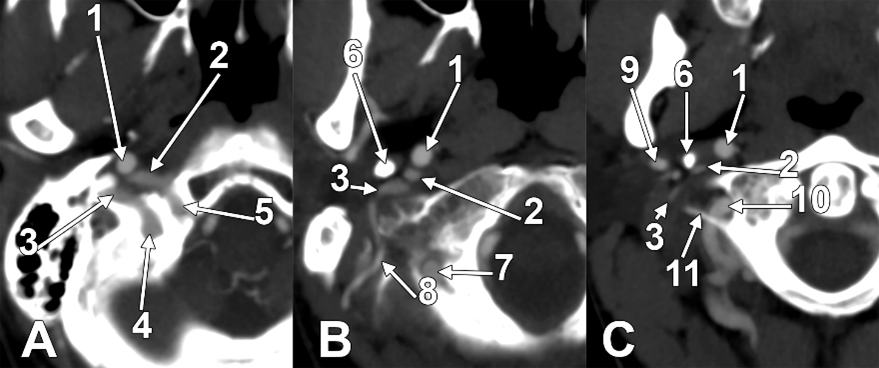
Figure 7.
Successive axial sections from superior to inferior (A–C) through the long inferior petrosal sinus. Right side. Inferior views. 1. Internal carotid artery; 2. inferior petrosal sinus; 3. internal jugular vein; 4. sigmoid sinus; 5. anterior condylar vein; 6. styloid process; 7. vertebral artery; 8. occipital artery; 9. external carotid artery; 10. vertebral artery; 11. transverse process of the atlas.
Figure 7.
Successive axial sections from superior to inferior (A–C) through the long inferior petrosal sinus. Right side. Inferior views. 1. Internal carotid artery; 2. inferior petrosal sinus; 3. internal jugular vein; 4. sigmoid sinus; 5. anterior condylar vein; 6. styloid process; 7. vertebral artery; 8. occipital artery; 9. external carotid artery; 10. vertebral artery; 11. transverse process of the atlas.
Figure 8.
Long inferior petrosal sinus (arrowheads). Internal carotid origin of the ascending pharyngeal artery. Right side. (A) Anterolateral view. (B) Anteromedial view. 1. Common carotid artery; 2. internal jugular vein; 3. internal carotid artery; 4. external carotid artery; 5. superior thyroid artery; 6. lingual artery; 7. facial artery; 8. ascending pharyngeal artery; 9. styloid process; 10. body of the hyoid.
Figure 8.
Long inferior petrosal sinus (arrowheads). Internal carotid origin of the ascending pharyngeal artery. Right side. (A) Anterolateral view. (B) Anteromedial view. 1. Common carotid artery; 2. internal jugular vein; 3. internal carotid artery; 4. external carotid artery; 5. superior thyroid artery; 6. lingual artery; 7. facial artery; 8. ascending pharyngeal artery; 9. styloid process; 10. body of the hyoid.
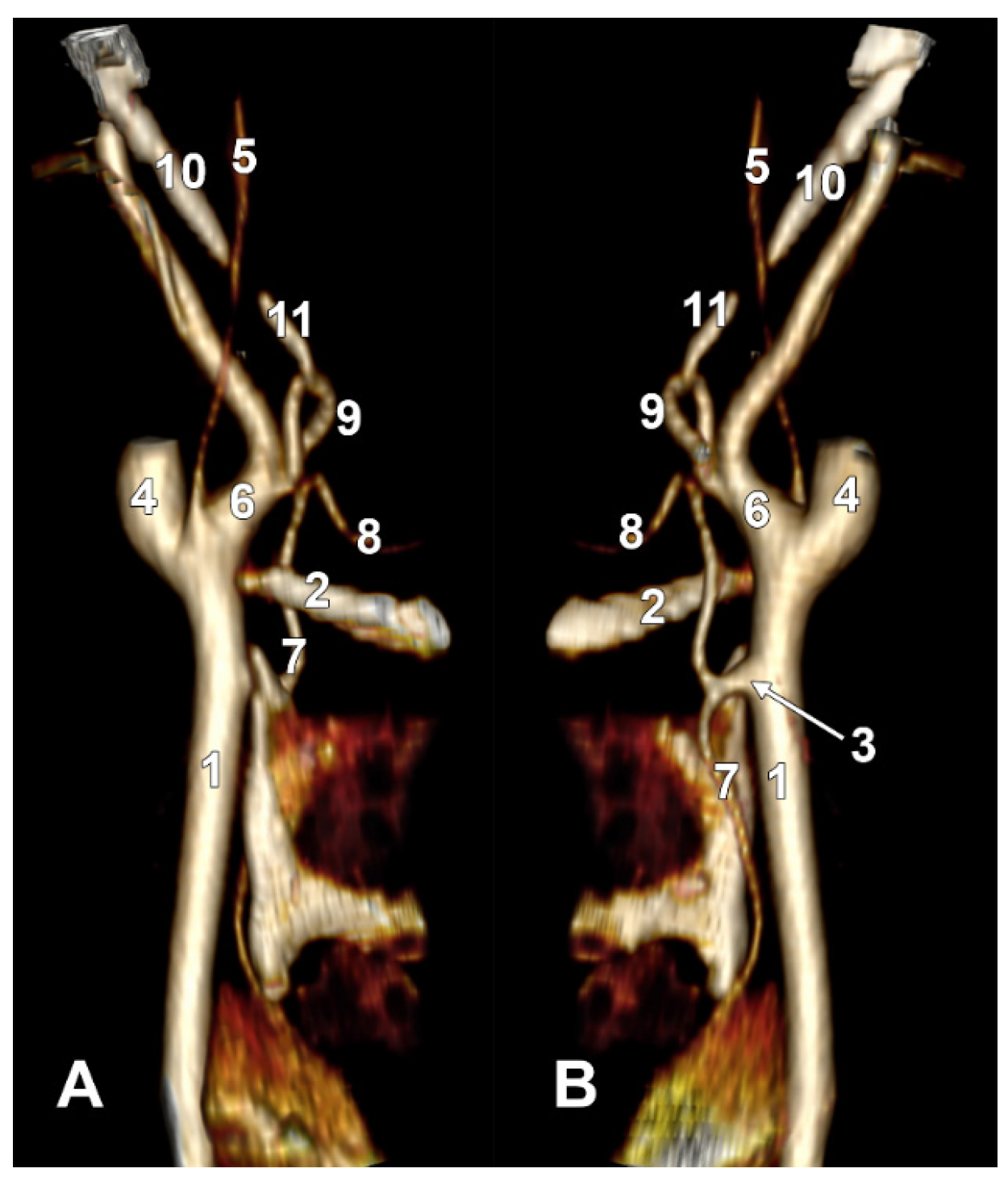
Figure 9.
Thyrolingual trunk originating from the common carotid artery. The ascending pharyngeal artery is the first branch of the external carotid artery. Type 33 of the sequence of branches of the external carotid artery. Three-dimensional rendering. Left side. (A) Posteromedial view. (B) Antero-lateral view. 1. Common carotid artery; 2. greater hyoid horn; 3. thyrolingual trunk; 4. internal carotid artery; 5. ascending pharyngeal artery; 6. external carotid artery; 7. superior thyroid artery; 8. lingual artery; 9. facial artery; 10. styloid process; 11. ossified stylohyoid ligament.
Figure 9.
Thyrolingual trunk originating from the common carotid artery. The ascending pharyngeal artery is the first branch of the external carotid artery. Type 33 of the sequence of branches of the external carotid artery. Three-dimensional rendering. Left side. (A) Posteromedial view. (B) Antero-lateral view. 1. Common carotid artery; 2. greater hyoid horn; 3. thyrolingual trunk; 4. internal carotid artery; 5. ascending pharyngeal artery; 6. external carotid artery; 7. superior thyroid artery; 8. lingual artery; 9. facial artery; 10. styloid process; 11. ossified stylohyoid ligament.
Figure 10.
S-type 35 of the sequence of the external carotid artery branches. The hyoid collapsed over the thyroid cartilage of the larynx, as reported in [
21]. Right side. (
A) Lateral view. (
B) Medial view. 1. Common carotid artery; 2. internal carotid artery; 3. external carotid artery; 4. superior thyroid artery; 5. right thyroid branch; 6. left thyroid branch; 7. thyrolingual trunk; 8. lingual artery; 9. facial artery; 10. occipital artery; 11. ascending pharyngeal artery.
Figure 10.
S-type 35 of the sequence of the external carotid artery branches. The hyoid collapsed over the thyroid cartilage of the larynx, as reported in [
21]. Right side. (
A) Lateral view. (
B) Medial view. 1. Common carotid artery; 2. internal carotid artery; 3. external carotid artery; 4. superior thyroid artery; 5. right thyroid branch; 6. left thyroid branch; 7. thyrolingual trunk; 8. lingual artery; 9. facial artery; 10. occipital artery; 11. ascending pharyngeal artery.
Figure 11.
Type V ascending pharyngeal artery originating from the carotid bifurcation. Superior laryngeal artery with suprahyoid origin. Three-dimensional rendering. Left side. (A) Lateral view. (B) Medial view. 1. Common carotid artery; 2. internal carotid artery; 3. external carotid artery; 4. styloid process; 5. superior thyroid artery; 6. superior laryngeal artery; 7. ascending pharyngeal artery; 8. occipital artery; 9. lingual artery; 10. facial artery; 11. maxillary artery; 12. superficial temporal artery; 13. transverse facial artery; 14. thyroid cartilage; 15. greater hyoid horn; 16. sternocleidomastoid branch; 17. descending branch; 18. posterior branch.
Figure 11.
Type V ascending pharyngeal artery originating from the carotid bifurcation. Superior laryngeal artery with suprahyoid origin. Three-dimensional rendering. Left side. (A) Lateral view. (B) Medial view. 1. Common carotid artery; 2. internal carotid artery; 3. external carotid artery; 4. styloid process; 5. superior thyroid artery; 6. superior laryngeal artery; 7. ascending pharyngeal artery; 8. occipital artery; 9. lingual artery; 10. facial artery; 11. maxillary artery; 12. superficial temporal artery; 13. transverse facial artery; 14. thyroid cartilage; 15. greater hyoid horn; 16. sternocleidomastoid branch; 17. descending branch; 18. posterior branch.
The distribution of APA origin types was analyzed by gender. Bilaterally in men (
N = 108), there were 16 (14.8%) absent APAs, 26 (24.1%) type I APAs, 43 (39.8%) type II APAs, 17 (15.7%) type III APAs, 5 (4.6%) type IV APAs, and 1 (0.9%) type V APA. Bilaterally in women (
N = 62), there were 9 (14.5%) absent APAs, 19 (30.6%) APA type I, 18 (29%) APA type II, 12 (19.4%) APA type III, 3 (4.8%) APA type IV and 1 (1.6%) APA type V. The distribution of types 0–V on each side of the median plane by gender is shown in
Table 2.
3.5. Framing of the Ascending Pharyngeal Artery in the Sequence of Origin of the First Branches of the External Carotid Artery—The S-Types
We recorded the sequence of origin from the ECA of the initial consecutive branches (as diagrammed in
Figure 4), and found 40 different anatomical sequences (‘S’-types,
Figure 5 and
Figure 6): type 1—STA-OA-LA-APA-APA-FA, type 2—STA-LA-APA-APA/OA-FA (*/* refers to the same-level origin of the respective arteries), type 3—STA-APA/LFT-OA, type 4—STA-LA-APA-APA-OA-FA, type 5—STA-APA/LFT/OA-FA, type 6—STA-LFT/OPT, type 7—STA-LFT-APA-OA, type 8—STA-LA-APA-APA-FA-OA, type 9—STA-LA-OPT-FA, type 10—STA-OPT-LA-FA, type 11—STA/APA-LA/OA-FA, type 12—STA-LA-FA-APA-OA, type 13—APA-STA-OA-LA-FA type 14—STA-APA-APA-OA-LA-FA, type 15—STA-LA/APA-OA/FA, type 16—STA-LA-APA/FA-OA, type 17—STA-LA-FA-OPT, type 18—STA-APA-APA/OA-LA-FA, type 19—STA-LFT/APA-OA-OA, type 20—STA-OPT/LA-FA, type 21—STA-APA-LA-FA-OA, type 22—STA-LA/APA-FA-OA, type 23—STA-APA-LA-OA-FA, type 24—APA-LA-OA-FA (STA from ACC), type 25—STA-LFT-OPT, type 26—STA-OA-APA-LA-FA, type 27—STA-LA/APA/OA-FA, type 28—STA-OA-LA/APA-APA-FA, type 29—STA-LA-APA-APA-FA/OA, type 30—STA-LA/OA-APA-FA, type 31—STA (from BC)-APA-LA/OA-FA, type 32—STA-APA/LA-FA-OA, type 33—TLT (from CCA), APA-FA-OA, type 34—STA/APA-LFT-OA, type 35—TLT (from ECA)-OA-APA-APA-FA, type 36—(absent STA) sternocleidomastoid (SCM) br.-OA-LA-APA-FA, type 37—STA-APA-LA/OA-FA, type 38—STA-LA-OA-APA-FA, type 39—STA-APA-APA-LFT-OA, type 40—STA/APA from BC, OA/r.SCM-LA-FA.
On the right side, we did not identify S-types 5, 13, 16, 18, 23, 26, 30, 34, and 35. Types 6, 11, 15, 17, 20, 24, 29, 31, 32, 33, 36, 37, 39, and 40 were missing on the left side. In the overall batch of 170 sides, we found ‘S’ types 1 to 40 with different prevalences (
Table 4). We determined the ‘S’ types of the sequence of the origin of the external carotid branches on either side of the median plane, right and left (
Table 5).
The most common S-types (N = 170) were type 7: 12 cases (7.1%)—STA-LFT-APA-OA; type 9: 12 cases (7.1%)—STA-LA-OPT-FA; type 8: 11 cases (6.5%)—STA-LA-APA-FA-OA; type 10: 10 cases (5.9%)—STA-OPT-LA-FA; and type 4: 9 cases (5.3%)—STA-LA-APA-OA-FA.
Some S-types were side-specific: (A) right-only: types 5, 13, 16, 18, 23, 26, 30, 34, 35, and (B) left-only: types 6, 11, 15, 17, 20, 24, 29, 31, 32, 33, 36, 37, 39, 40. Rare variants documented include TLT from CCA (type 33) and TLT from ECA (type 35).
The gender distribution of ‘S’ types on the right side is shown in
Table 5. In males, types 5, 6, 11, 12, 15, 17, 19, 20, 24, 25, 28, 29, 31, 32, 33, 36, 37, 38, 39, and 40 were missing. In females, types 1, 2, 6, 11, 14, 15, 17, 20, 21, 22, 24, 27, 29, 30, 31, 32, 33, 34, 35, 36, 37, 39, and 40 were missing.
The gender distribution of the ‘S’ types on the left side is also shown in
Table 6. In males, types 1, 5, 6, 13, 16, 18, 19, 20, 23, 24, 25, 26, 27, 30, 34, 35, 37, and 38 were missing. In females, we did not identify types 4, 5, 11, 13, 15, 16, 17, 18, 21, 23, 26, 28, 30, 31, 32, 33, 34, 35, 36, 39, and 40.
The present study identified 40 different S-types of ECA branching sequences, demonstrating extraordinary anatomical variability in the origin and sequencing of the APA relative to other ECA branches. Despite observing 14 right-only and 9 left-only S-types, as well as 13 male-only and 8 female-only types, comprehensive statistical analysis revealed no significant side-related (χ2 = 42.12, df = 39, p = 0.379, Cramer’s V = 0.50) or gender-related (χ2 = 49.81, df = 39, p = 0.138, Cramer’s V = 0.54) differences in the overall distribution of S-types. Both comparisons showed medium effect sizes but failed to reach statistical significance, indicating substantial variability without systematic lateralization or sexual dimorphism.
Furthermore, S0 (absent or ICA-origin of APA) showed identical prevalence between sexes (19.4% in males vs. 19.4% in females, χ2 = 0.00, df = 1, p = 1.000, Cramer’s V = 0.00) and no significant side preference (16.5% right vs. 22.4% left, χ2 = 0.61, df = 1, p = 0.438, Cramer’s V = 0.14). The absence of effect for sex (V = 0.00) and minimal effect for side (V = 0.14) indicate that APA absence or ectopic ICA origin occurs randomly without demographic or laterality patterns.
Even when analyzing the most common S-types (types 7, 9, 8, 10, and 4) or grouping by anatomical features (presence of OPT, LFT, or TLT), no statistically significant patterns emerged (all p > 0.05). The observed side-specific and gender-specific types were predominantly rare variants (n = 1–2 cases), representing sampling variation rather than true biological lateralization or sexual dimorphism.
Multiple regression analysis revealed that the hyoid level of APA origin significantly predicted S-type classification on the right side (β = 5.71, SE = 1.48, t = 3.85, p < 0.001), while APA origin type (β = −0.52, SE = 0.57, t = −0.91, p = 0.365) and gender (β = −2.03, SE = 2.08, t = −0.97, p = 0.333) did not contribute significantly. The overall right-side model was statistically significant (R2 = 0.165, adjusted R2 = 0.134, F(3, 81) = 5.33, p = 0.002), explaining 16.5% of variance in S-type classification. The Durbin–Watson statistic (1.96) indicated no autocorrelation concerns.
Similarly, for the left side, hyoid type significantly influenced S-type classification (β = 6.17, SE = 1.90, t = 3.25, p = 0.002), while APA origin (β = 1.01, SE = 0.59, t = 1.71, p = 0.092) and gender (β = 0.35, SE = 2.29, t = 0.15, p = 0.880) showed no significant effects. The left-side model was also significant (R2 = 0.200, adjusted R2 = 0.170, F(3, 81) = 6.74, p < 0.001), explaining 20.0% of variance. The Durbin–Watson statistic (1.74) indicated no autocorrelation concerns.



 ,
,