The ICN-UN Battery: A Machine Learning-Optimized Tool for Expeditious Alzheimer’s Disease Diagnosis
 , , ,
, , , 
Abstract
1. Introduction
2. Subjects and Methods
2.1. Subjects
2.2. Neuropsychological Assessment
2.3. ML-Based Screening Tool for AD Diagnosis
2.3.1. Preprocessing
2.3.2. ML Algorithms
2.4. Construction of Neuropsychological Protocols
2.4.1. Compactness, Cohesion and Separation of Neuropsychological Protocols
2.4.2. Explainability of ML-Based Predictions
3. Results
3.1. Participants
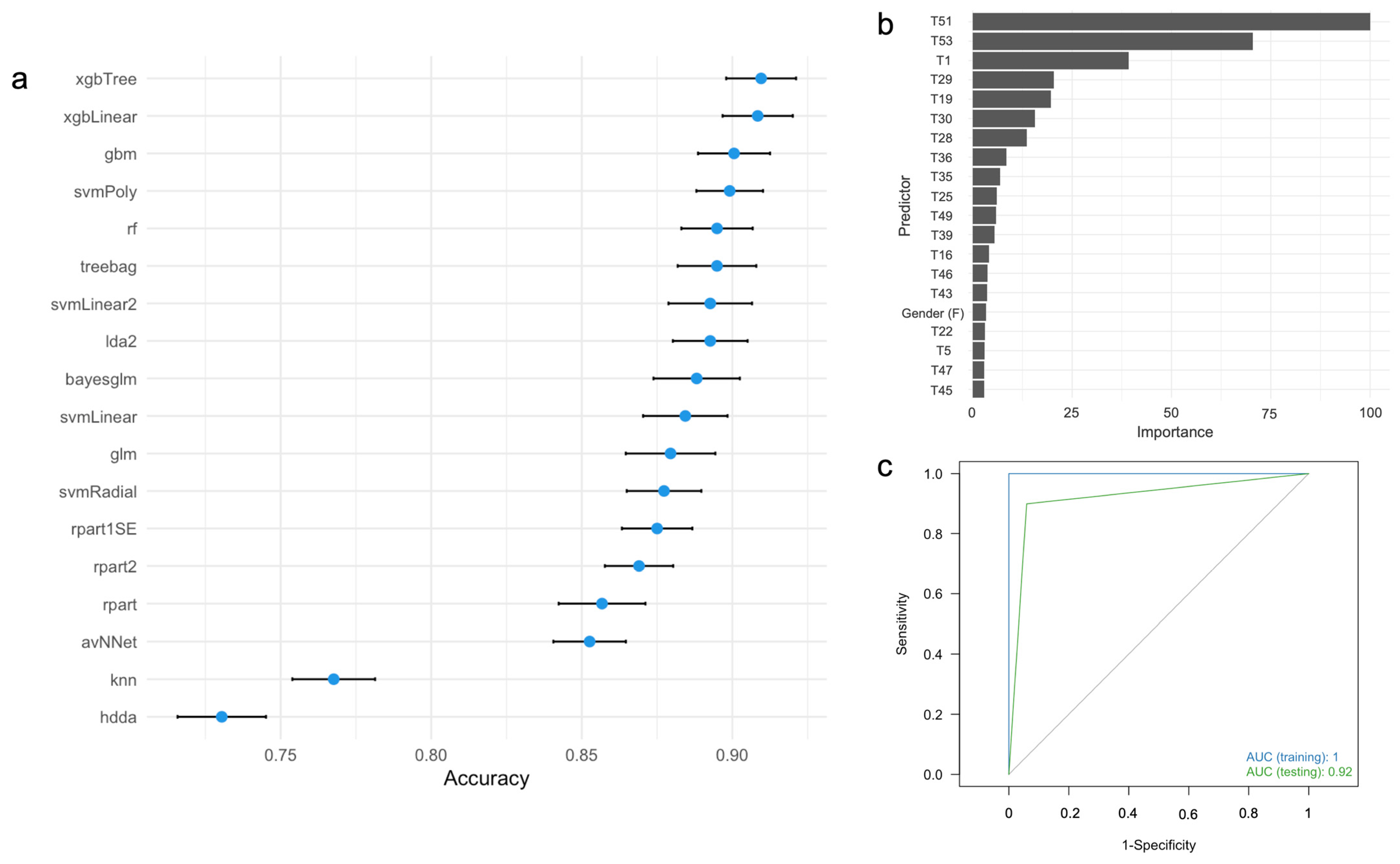
3.2. ML-Optimized Protocols for AD Diagnosis
3.3. Compactness, Cohesion and Separation of Individuals of by Neuropsychological Protocol
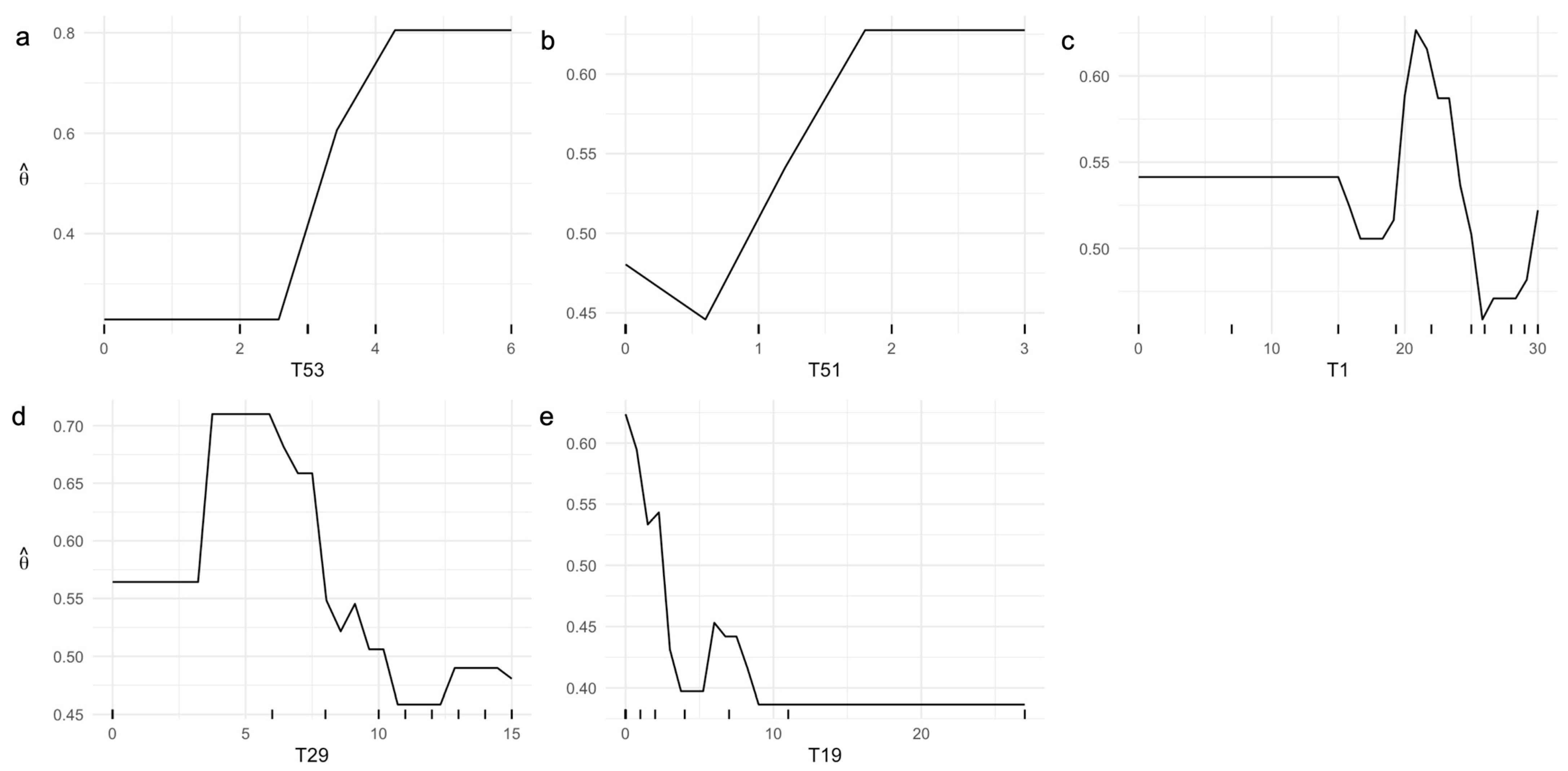
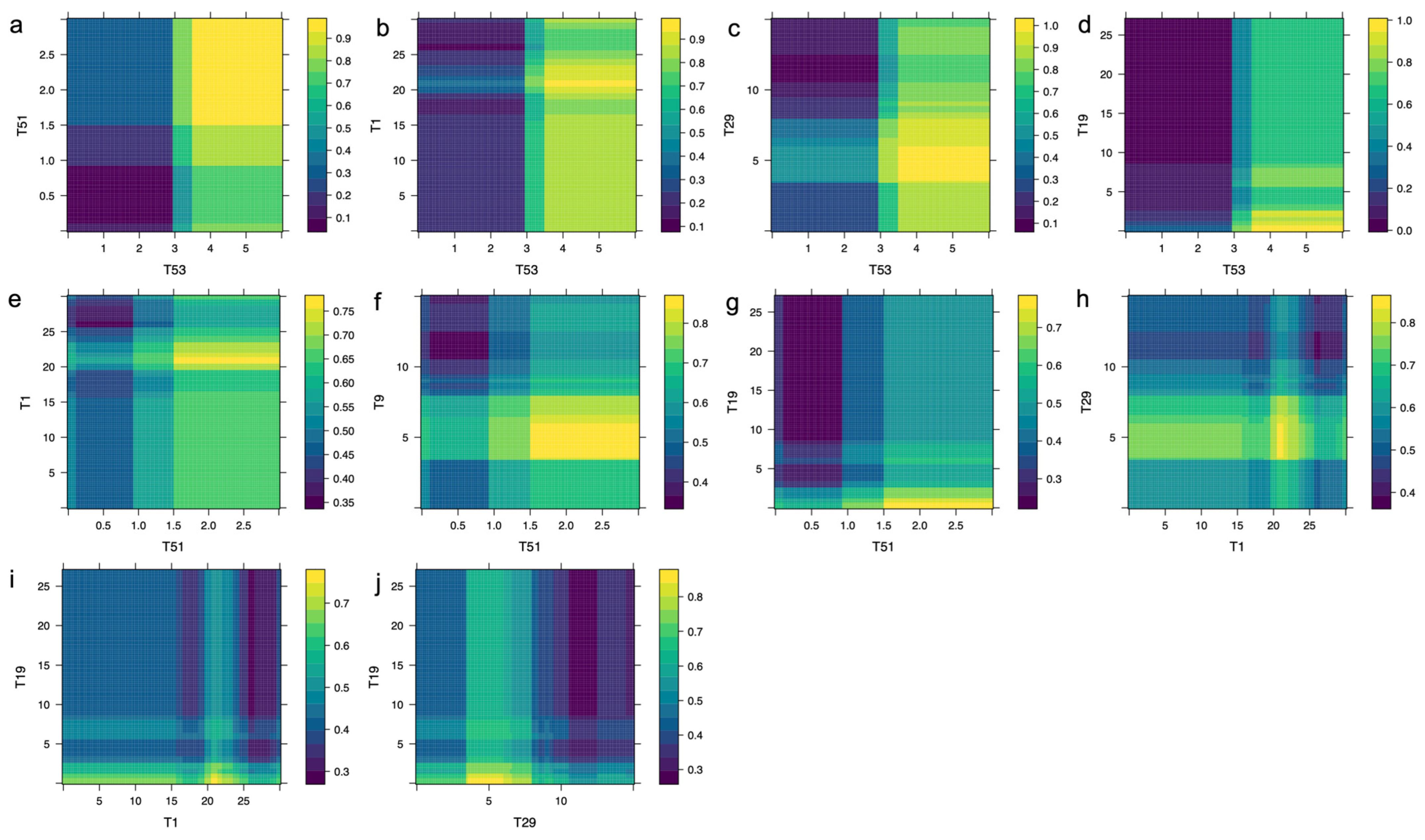
3.4. ML Explainability of the ICN-UN Battery
4. Discussion
5. Conclusions
Supplementary Materials
Author Contributions
Funding
Institutional Review Board Statement
Informed Consent Statement
Data Availability Statement
Acknowledgments
Conflicts of Interest
Abbreviations
| AD | Alzheimer’s Disease |
| AUC | Area Under the Receiver Operating Characteristic Curve |
| BNT | Boston Naming Test |
| CART | Classification and Regression Trees |
| FAST | Functional Assessment Staging Test |
| LMICs | Low- and Middle-Income Countries |
| ML | Machine Learning |
| MMSE | Mini-Mental State Examination |
| MoCA | Montreal Cognitive Assessment |
| NPV | Negative Predictive Value |
| PPS | Predictive Power Score |
| PPV | Positive Predictive Value |
| RAVLT | Rey Auditory Verbal Learning Test |
| RF | Random Forest |
| ROC | Receiver Operating Characteristic |
| ROCFT | Rey–Osterrieth Complex Figure Test |
| Se | Sensitivity |
| Sp | Specificity |
| SVM | Support Vector Machines |
| TMT | Trail Making Test |
| WCST | Wisconsin Card Sorting Test |
References
- World Health Organization. World Failing to Address Dementia Challenge. Available online: https://www.who.int/news/item/02-09-2021-world-failing-to-address-dementia-challenge (accessed on 17 November 2025).
- World Health Organization. Dementia. Available online: https://www.who.int/news-room/fact-sheets/detail/dementia (accessed on 17 November 2025).
- Kerwin, D.; Abdelnour, C.; Caramelli, P.; Ogunniyi, A.; Shi, J.; Zetterberg, H.; Traber, M. Alzheimer’s Disease Diagnosis and Management: Perspectives from around the World. Alzheimer’s Dement. Diagn. Assess. Dis. Monit. 2022, 14, e12334. [Google Scholar] [CrossRef]
- Allegri, R.F. Dementia Research in Low-Income and Middle-Income Countries—A View from Latin America. Nat. Rev. Neurol. 2025, 21, 499–505. [Google Scholar] [CrossRef]
- Costanzo, M.; Cutrona, C.; Leodori, G.; Malimpensa, L.; D’antonio, F.; Conte, A.; Belvisi, D. Exploring Easily Accessible Neurophysiological Biomarkers for Predicting Alzheimer’s Disease Progression: A Systematic Review. Alzheimers Res. Ther. 2024, 16, 244. [Google Scholar] [CrossRef]
- Battista, P.; Salvatore, C.; Castiglioni, I. Optimizing Neuropsychological Assessments for Cognitive, Behavioral, and Functional Impairment Classification: A Machine Learning Study. Behav. Neurol. 2017, 2017, 1850909. [Google Scholar] [CrossRef]
- Garcia-Gutierrez, F.; Delgado-Alvarez, A.; Delgado-Alonso, C.; Díaz-Álvarez, J.; Pytel, V.; Valles-Salgado, M.; Gil, M.J.; Hernández-Lorenzo, L.; Matías-Guiu, J.; Ayala, J.L.; et al. Diagnosis of Alzheimer’s Disease and Behavioural Variant Frontotemporal Dementia with Machine Learning-Aided Neuropsychological Assessment Using Feature Engineering and Genetic Algorithms. Int. J. Geriatr. Psychiatry 2022, 37, 1–13. [Google Scholar] [CrossRef]
- Gurevich, P.; Stuke, H.; Kastrup, A.; Stuke, H.; Hildebrandt, H. Neuropsychological Testing and Machine Learning Distinguish Alzheimer’s Disease from Other Causes for Cognitive Impairment. Front. Aging Neurosci. 2017, 9, 114. [Google Scholar] [CrossRef] [PubMed]
- Martínez-Banfi, M.; Vélez, J.I.; Perea, M.V.; García, R.; Puentes-Rozo, P.J.; Mebarak Chams, M.; Ladera, V. Neuropsychological Performance in Patients with Asymptomatic HIV-1 Infection. AIDS Care-Psychol. Socio-Med. Asp. AIDS/HIV 2018, 30, 623–633. [Google Scholar] [CrossRef] [PubMed]
- Belleville, S.; Fouquet, C.; Hudon, C.; Zomahoun, H.T.V.; Croteau, J. Neuropsychological Measures That Predict Progression from Mild Cognitive Impairment to Alzheimer’s Type Dementia in Older Adults: A Systematic Review and Meta-Analysis. Neuropsychol. Rev. 2017, 27, 328–353. [Google Scholar] [CrossRef] [PubMed]
- Eckerström, C.; Olsson, E.; Bjerke, M.; Malmgren, H.; Edman, Å.; Wallin, A.; Nordlund, A. A Combination of Neuropsychological, Neuroimaging, and Cerebrospinal Fluid Markers Predicts Conversion from Mild Cognitive Impairment to Dementia. J. Alzheimer’s Dis. 2013, 36, 421–431. [Google Scholar] [CrossRef]
- Salimi, S.; Irish, M.; Foxe, D.; Hodges, J.R.; Piguet, O.; Burrell, J.R. Can Visuospatial Measures Improve the Diagnosis of Alzheimer’s Disease? Alzheimer’s Dement. Diagn. Assess. Dis. Monit. 2018, 10, 66–74. [Google Scholar] [CrossRef]
- Davis, J.J. Time Is Money: Examining the Time Cost and Associated Charges of Common Performance Validity Tests. Clin. Neuropsychol. 2023, 37, 475–490. [Google Scholar] [CrossRef]
- Kamini; Rani, S. Machine Learning Models for Diagnosing Alzheimer’s Disorders. In Data Analysis for Neurodegenerative Disorders; Cognitive Technologies Series; Springer: Singapore, 2023. [Google Scholar]
- Aghdam, M.A.; Bozdag, S.; Saeed, F. Alzheimer’s Disease Diagnosis Using Gray Matter of T1-weighted SMRI Data and Vision Transformer. Alzheimer’s Dement. 2024, 20, e089944. [Google Scholar] [CrossRef]
- Nasreddine, Z.S.; Phillips, N.A.; Bédirian, V.; Charbonneau, S.; Whitehead, V.; Collin, I.; Cummings, J.L.; Chertkow, H. The Montreal Cognitive Assessment, MoCA: A Brief Screening Tool For Mild Cognitive Impairment. J. Am. Geriatr. Soc. 2005, 53, 695–699. [Google Scholar] [CrossRef]
- Sonkurt, H.O.; Altınöz, A.E.; Çimen, E.; Köşger, F.; Öztürk, G. The Role of Cognitive Functions in the Diagnosis of Bipolar Disorder: A Machine Learning Model. Int. J. Med. Inform. 2021, 145, 104311. [Google Scholar] [CrossRef]
- Vaccaro, M.G.; Sarica, A.; Quattrone, A.; Chiriaco, C.; Salsone, M.; Morelli, M.; Quattrone, A. Neuropsychological Assessment Could Distinguish among Different Clinical Phenotypes of Progressive Supranuclear Palsy: A Machine Learning Approach. J. Neuropsychol. 2021, 15, 301–318. [Google Scholar] [CrossRef] [PubMed]
- Bledsoe, J.C.; Xiao, C.; Chaovalitwongse, A.; Mehta, S.; Grabowski, T.J.; Semrud-Clikeman, M.; Pliszka, S.; Breiger, D. Diagnostic Classification of ADHD Versus Control: Support Vector Machine Classification Using Brief Neuropsychological Assessment. J. Atten. Disord. 2020, 24, 1547–1556. [Google Scholar] [CrossRef] [PubMed]
- Javeed, A.; Dallora, A.L.; Berglund, J.S.; Ali, A.; Ali, L.; Anderberg, P. Machine Learning for Dementia Prediction: A Systematic Review and Future Research Directions. J. Med. Syst. 2023, 47, 17. [Google Scholar] [CrossRef]
- Derbentsev, V.; Matviychuk, A.; Datsenko, N.; Bezkorovainyi, V.; Azaryan, A. Machine Learning Approaches for Financial Time Series Forecasting. In Proceedings of the CEUR Workshop Proceedings, 2020; Volume 2713. Available online: https://www.semanticscholar.org/paper/Machine-learning-approaches-for-financial-time-Derbentsev-Matviychuk/d5e437f2cdfe3d845ae5624215cf2444fe8d572b (accessed on 21 November 2025).
- Jasti, V.D.P.; Zamani, A.S.; Arumugam, K.; Naved, M.; Pallathadka, H.; Sammy, F.; Raghuvanshi, A.; Kaliyaperumal, K. Computational Technique Based on Machine Learning and Image Processing for Medical Image Analysis of Breast Cancer Diagnosis. Secur. Commun. Netw. 2022, 2022, 1918379. [Google Scholar] [CrossRef]
- Almubark, I.; Chang, L.C.; Nguyen, T.; Turner, R.S.; Jiang, X. Early Detection of Alzheimer’s Disease Using Patient Neuropsychological and Cognitive Data and Machine Learning Techniques. In Proceedings of the 2019 IEEE International Conference on Big Data, Big Data 2019, Los Angeles, CA, USA, 9–12 December 2019. [Google Scholar]
- Buyrukoglu, S. Improvement of Machine Learning Models Performances Based on Ensemble Learning for the Detection of Alzheimer Disease. In Proceedings of the 6th International Conference on Computer Science and Engineering, UBMK 2021, Ankara, Turkey, 15–17 September 2021. [Google Scholar]
- Sadeghi, Z.; Alizadehsani, R.; CIFCI, M.A.; Kausar, S.; Rehman, R.; Mahanta, P.; Bora, P.K.; Almasri, A.; Alkhawaldeh, R.S.; Hussain, S.; et al. A Review of Explainable Artificial Intelligence in Healthcare. Comput. Electr. Eng. 2024, 118, 109370. [Google Scholar] [CrossRef]
- Lundberg, S.M.; Lee, S.I. A Unified Approach to Interpreting Model Predictions. In Proceedings of the Advances in Neural Information Processing Systems, Long Beach, CA, USA, 4–9 December 2017; Volume 2017. [Google Scholar]
- Friedman, J.H. Greedy Function Approximation: A Gradient Boosting Machine. Ann. Stat. 2001, 29, 1189–1232. [Google Scholar] [CrossRef]
- Vlontzou, M.E.; Athanasiou, M.; Dalakleidi, K.V.; Skampardoni, I.; Davatzikos, C.; Nikita, K. A Comprehensive Interpretable Machine Learning Framework for Mild Cognitive Impairment and Alzheimer’s Disease Diagnosis. Sci. Rep. 2025, 15, 8410. [Google Scholar] [CrossRef]
- Das, D.; Ito, J.; Kadowaki, T.; Tsuda, K. An Interpretable Machine Learning Model for Diagnosis of Alzheimer’s Disease. PeerJ 2019, 2019, e6543. [Google Scholar] [CrossRef]
- Vimbi, V.; Shaffi, N.; Mahmud, M. Interpreting Artificial Intelligence Models: A Systematic Review on the Application of LIME and SHAP in Alzheimer’s Disease Detection. Brain Inform. 2024, 11, 10. [Google Scholar] [CrossRef]
- Universidad del Norte. Proyecto de Investigación En Alzheimer. Available online: https://www.uninorte.edu.co/web/hospital/proyecto-de-investigacion-en-alzheimer (accessed on 7 September 2025).
- BoIivar, D.; Mosquera Heredia, M.; Vidal, O.; Barceló, E.; Allegri, R.; Morales, L.; Silvera-Redondo, C.; Arcos-Burgos, M. Exosomal MRNA Signatures as Predictive Biomarkers for Risk and Age of Onset in Alzheimer’s Disease. Int. J. Mol. Sci. 2024, 25, 12293. [Google Scholar] [CrossRef] [PubMed]
- Mosquera-Heredia, M.I.; Vidal, O.M.; Morales, L.C.; Silvera-Redondo, C.; Barceló, E.; Allegri, R.; Arcos-Burgos, M.; Vélez, J.I.; Garavito-Galofre, P. Long Non-Coding RNAs and Alzheimer’s Disease: Towards Personalized Diagnosis. Int. J. Mol. Sci. 2024, 25, 7641. [Google Scholar] [CrossRef]
- Stekhoven, D.J.; Buehlmann, P. MissForest: Nonparametric Missing Value Imputation Using Random Forest. R Package Version 1.5. Bioinformatics 2012, 28, 112–118. [Google Scholar] [CrossRef] [PubMed]
- R Core Team. R: A Language and Environment for Statistical Computing [Computer Software]; R Core Team: Vienna, Austria, 2012. [Google Scholar]
- Kuhn, M. Package ‘caret’—Classification and Regression Training; CRAN Repository; R Core Team: Vienna, Austria, 2019. [Google Scholar]
- Kuhn, M. Building Predictive Models in R Using the Caret Package. J. Stat. Softw. 2008, 28, 1–26. [Google Scholar] [CrossRef]
- Ramezan, C.A.; Warner, T.A.; Maxwell, A.E. Evaluation of Sampling and Cross-Validation Tuning Strategies for Regional-Scale Machine Learning Classification. Remote Sens. 2019, 11, 185. [Google Scholar] [CrossRef]
- Naidu, G.; Zuva, T.; Sibanda, E.M. A Review of Evaluation Metrics in Machine Learning Algorithms. In Artificial Intelligence Application in Networks and Systems; Lecture Notes in Networks and Systems; Springer: Cham, Switzerland, 2023; Volume 724. [Google Scholar]
- von Jouanne-Diedrich, J. OneR: One Rule Machine Learning Classification Algorithm with Enhancements; R Core Team: Vienna, Austria, 2017. [Google Scholar]
- Holte, R.C. Very Simple Classification Rules Perform Well on Most Commonly Used Datasets. Mach. Learn. 1993, 11, 63–90. [Google Scholar] [CrossRef]
- van der Laken, P.; ppsr: Predictive Power Score. R Package Version 0.0.5. 2024. Available online: https://CRAN.R-project.org/package=ppsr (accessed on 1 July 2025). [CrossRef]
- Chiu, D.S.; Talhouk, A. DiceR: An R Package for Class Discovery Using an Ensemble Driven Approach. BMC Bioinform. 2018, 19, 11. [Google Scholar] [CrossRef] [PubMed]
- Chiu, D.; Talhouk, A. DiceR: Diverse Cluster Ensemble in R; CRAN: Contributed Packages; R Core Team: Vienna, Austria, 2017. [Google Scholar] [CrossRef]
- Maechler, M.; Rousseeuw, P.; Struyf, A.; Hubert, M.; Cluster: Cluster Analysis Basics and Extensions. R Package Version 2.1.8.1. Available online: https://CRAN.R-project.org/package=cluster (accessed on 9 September 2025).
- Rousseeuw, P.J. Silhouettes: A Graphical Aid to the Interpretation and Validation of Cluster Analysis. J. Comput. Appl. Math. 1987, 20, 53–65. [Google Scholar] [CrossRef]
- Greenwell, B.M. Pdp: An R Package for Constructing Partial Dependence Plots. R J. 2017, 9, 421–436. [Google Scholar] [CrossRef]
- Greenwell, B.M. Pdp: Partial Dependence Plots. Available online: https://CRAN.R-project.org/package=pdp (accessed on 10 September 2025).
- Nabosne, I.; da Cruz, R.C.; Borges, B.E.; The Importance of Early Detection of Alzheimer’s to Improve the Patient’s Quality of Life. In Eyes on Health Sciences V.02; Seven Editora: 2024. Available online: https://sevenpubl.com.br/editora/article/view/3534 (accessed on 21 November 2025).
- Parul; Singh, A.; Shukla, S. Novel Techniques for Early Diagnosis and Monitoring of Alzheimer’s Disease. Expert Rev. Neurother. 2025, 25, 29–42. [Google Scholar] [CrossRef]
- Castellazzi, G.; Cuzzoni, M.G.; Cotta Ramusino, M.; Martinelli, D.; Denaro, F.; Ricciardi, A.; Vitali, P.; Anzalone, N.; Bernini, S.; Palesi, F.; et al. A Machine Learning Approach for the Differential Diagnosis of Alzheimer and Vascular Dementia Fed by MRI Selected Features. Front. Neuroinform. 2020, 14, 25. [Google Scholar] [CrossRef]
- Sexton, C.; Snyder, H.M.; Chandrasekaran, L.; Worley, S.; Carrillo, M.C. Expanding Representation of Low and Middle Income Countries in Global Dementia Research: Commentary From the Alzheimer’s Association. Front. Neurol. 2021, 12, 633777. [Google Scholar] [CrossRef]
- Cazzolli, C.; Chierici, M.; Dallabona, M.; Guella, C.; Jurman, G. Neuropsychological Tests and Machine Learning: Identifying Predictors of MCI and Dementia Progression. Aging Clin. Exp. Res. 2025, 37, 79. [Google Scholar] [CrossRef]
- Goodwin, G.J.; Fonseca, J.; Mehrzad, S.; Cummings, J.L.; John, S.E. Classification of AD and BvFTD Using Neuropsychological and Neuropsychiatric Variables: A Machine Learning Study. Alzheimer’s Dement. 2025, 21, e70782. [Google Scholar] [CrossRef] [PubMed]
- Merkley, T.L.; Esopenko, C.; Zizak, V.S.; Bilder, R.M.; Strutt, A.M.; Tate, D.F.; Irimia, A. Challenges and Opportunities for Harmonization of Cross-Cultural Neuropsychological Data. Neuropsychology 2023, 37, 237–246. [Google Scholar] [CrossRef] [PubMed]



| Variable | All | AD Diagnosis | Controls | Statistic | p |
|---|---|---|---|---|---|
| (n = 760) | (n = 394) | (n = 366) | |||
| M (SD) | t (df) | ||||
| Age (years) | 76.7 (7.37) | 78.9 (7.51) | 74.29 (6.41) | −9.00 (751) | <0.001 |
| Years of education | 9.02 (14.1) | 8.85 (14.67) | 9.21 (13.48) | 0.354 (749) | 0.723 |
| Gender | n (%) | χ2 (df) | |||
| Female | 477 (63.18) | 264 (67.01) | 213 (59) | 4.84 (1) | 0.027 |
| Male | 278 (36.82) | 130 (32.99) | 148 (41) | ||
| Label | Neuropsychological Test | Cases (n = 394) | Controls (n = 366) | () | p |
|---|---|---|---|---|---|
| T1 | Mini-Mental State Examination (MMSE) | 16.3 (9.5) | 26.9 (3.9) | 9.331 (0.558) | <0.0001 |
| T2 | Mental Control-Wechsler Memory Scale | 1.8 (2.9) | 4.7 (3.2) | 2.687 (0.219) | <0.0001 |
| Semantic Verbal Fluency | |||||
| T3 | Letter “a” | 6.1 (4.7) | 12.8 (4.4) | 5.78 (0.348) | <0.0001 |
| T4 | Category loss, letter “a” | 0.1 (0.3) | 0.1 (0.3) | 0.018 (0.021) | 0.385 |
| T5 | Perseverations, letter “a” | 0.4 (1) | 0.3 (0.7) | −0.16 (0.068) | 0.018 |
| Semantic Verbal Fluency | |||||
| T6 | Letter “c” | 6.2 (4.2) | 11.4 (3.8) | 4.635 (0.306) | <0.0001 |
| T7 | Category loss, letter “c” | 0.1 (0.3) | 0 (0.2) | −0.022 (0.021) | 0.310 |
| T8 | Perseverations, letter “c” | 0.6 (1.2) | 0.6 (1.2) | −0.064 (0.095) | 0.498 |
| Phonological Verbal Fluency | |||||
| T9 | Letter “f” | 3.7 (3.9) | 7.7 (4.8) | 3.646 (0.34) | <0.0001 |
| T10 | Category loss, letter “f” | 0.3 (0.7) | 0.1 (0.4) | −0.197 (0.048) | <0.0001 |
| T11 | Perseverations, letter “f” | 0.3 (0.7) | 0.4 (0.7) | 0.085 (0.059) | 0.14600 |
| Phonological Verbal Fluency | |||||
| T12 | Letter “a” | 3.2 (3.6) | 7.2 (4.5) | 3.552 (0.318) | <0.0001 |
| T13 | Category loss, letter “a” | 0.4 (0.8) | 0.3 (0.7) | −0.113 (0.06) | 0.060 |
| T14 | Perseverations, letter “a” | 0.2 (0.6) | 0.2 (0.5) | −0.003 (0.042) | 0.946 |
| T15 | Letter “s” | 3.4 (3.9) | 7.3 (4.7) | 3.51 (0.333) | <0.0001 |
| T16 | Category loss, letter “s” | 0.4 (0.9) | 0.3 (0.6) | −0.133 (0.061) | 0.028 |
| T17 | Perseverations, letter “s” | 0.2 (0.5) | 0.3 (0.7) | 0.109 (0.046) | 0.018 |
| Rey–Osterrieth Complex Figure Test | |||||
| T18 | Copy | 8.1 (10.9) | 22.4 (12.1) | 12.22 (0.862) | <0.0001 |
| T19 | Recall | 1 (2.5) | 6.4 (5.5) | 4.751 (0.319) | <0.0001 |
| T20 | Token Test | 16 (10.6) | 27.1 (17.6) | 9.5 (1.133) | <0.0001 |
| Rey Auditory Verbal Learning Test | |||||
| T21 | Attempt #1 | 1.7 (1.5) | 3.3 (1.5) | 1.445 (0.114) | <0.0001 |
| T22 | Attempt #2 | 2.4 (1.8) | 4.8 (1.8) | 2.14 (0.135) | <0.0001 |
| T23 | Attempt #3 | 2.9 (2) | 5.7 (2.1) | 2.521 (0.154) | <0.0001 |
| T24 | Attempt #4 | 3 (2.2) | 6.3 (2.3) | 2.964 (0.169) | <0.0001 |
| T25 | Attempt #5 | 3.2 (2.3) | 7 (2.5) | 3.494 (0.183) | <0.0001 |
| T26 | Block of Words | 1.3 (1.3) | 2.7 (1.4) | 1.221 (0.104) | <0.0001 |
| T27 | Immediate recall | 1.5 (1.8) | 4.9 (2.5) | 3.126 (0.164) | <0.0001 |
| T28 | Delayed recall | 0.9 (1.7) | 4.4 (2.8) | 3.238 (0.179) | <0.0001 |
| Rey Auditory Verbal Memory Recognition | |||||
| T29 | Yes | 7.3 (5.7) | 12.1 (2.8) | 4.337 (0.348) | <0.0001 |
| T30 | No | 7.7 (5.9) | 12.8 (3.1) | 4.601 (0.373) | <0.0001 |
| Boston Naming Test (BNT) | |||||
| T31 | Spontaneous words | 19.3 (14.4) | 35.1 (12.4) | 13.293 (1.021) | <0.0001 |
| T32 | Semantic words | 1.5 (2.4) | 2.5 (3.1) | 1.076 (0.219) | <0.0001 |
| T33 | Total | 20.6 (15.1) | 37.6 (12.4) | 14.552 (1.053) | <0.0001 |
| Stroop test | |||||
| T34 | Words | 30.1 (29.2) | 61.8 (27) | 26.669 (2.195) | <0.0001 |
| T35 | Colors | 21.1 (20.1) | 46.6 (18) | 21.428 (1.468) | <0.0001 |
| T36 | Words + Colors | 9.5 (11.5) | 24.3 (13) | 12.539 (0.961) | <0.0001 |
| Trail Making Test (TMT) | |||||
| T37 | Part A | 27.3 (64.2) | 98 (80.3) | 69.966 (8.182) | <0.0001 |
| T38 | Part B | 18.9 (73.4) | 108.9 (144.4) | 93.605 (10.274) | <0.0001 |
| Symbol Digit Test | |||||
| T39 | Oral part | 3.7 (7.4) | 17 (13.6) | 11.355 (0.85) | <0.0001 |
| T40 | Written part | 2.9 (5.7) | 13.1 (10.6) | 8.635 (0.656) | <0.0001 |
| T41 | Continuous Auditory Performance Test | 8.8 (6.9) | 14 (3.7) | 4.355 (0.438) | <0.0001 |
| T42 | Benton Visual Retention Test | 0.9 (1.3) | 3.1 (3) | 1.869 (0.179) | <0.0001 |
| T43 | Clock Drawing Test | 2.9 (3.2) | 7.4 (3.4) | 4.008 (0.256) | <0.0001 |
| Wisconsin Card Sorting Test (WCST) | |||||
| T44 | Categories | 0.8 (1.2) | 1.8 (1.4) | 0.883 (0.099) | <0.0001 |
| T45 | Non-perseverative errors | 7.4 (10) | 10.7 (9.2) | 2.564 (0.764) | <0.001 |
| T46 | Perseverative errors | 18.4 (16.3) | 19.3 (11.2) | −0.109 (1.122) | 0.923 |
| T47 | Correct answers | 12.2 (12.9) | 19.6 (13.4) | 6.073 (1.041) | <0.0001 |
| T48 | Memory Disorder Scale | 2.1 (2.1) | 0.7 (0.9) | −1.323 (0.13) | <0.0001 |
| T49 | Yesavage Depression Scale | 6.3 (5.9) | 2.3 (2.3) | −3.827 (0.354) | <0.0001 |
| T50 | Barthel Index | 37.6 (18) | 49.4 (4.6) | 9.648 (1.026) | <0.0001 |
| T51 | Lawton & Brody Scale | 1.7 (1.2) | 0.2 (0.5) | −1.382 (0.067) | <0.0001 |
| T52 | Katz Index | 1.6 (2.2) | 0 (0.3) | −1.311 (0.12) | <0.0001 |
| T53 | Functional Assessment Staging (FAST) | 3.5 (0.9) | 2.3 (0.6) | −1.103 (0.057) | <0.0001 |
| Protocol (Evaluation Time) | Dataset | Performance Measure | ||||||||
|---|---|---|---|---|---|---|---|---|---|---|
| Se | Sp | PPV | NPV | FDR | FPR | Accuracy | Lift | AUC | ||
| #1 | Training | 1 | 1 | 1 | 1 | 0 | 0 | 1 | 1.931 | 1 |
| (240 min) | Testing | 0.941 | 0.899 | 0.91 | 0.933 | 0.09 | 0.101 | 0.921 | 1.75 | 0.92 |
| #2 | Training | 0.906 | 0.926 | 0.929 | 0.902 | 0.071 | 0.074 | 0.916 | 1.795 | 0.916 |
| (25 min) | Testing | 0.941 | 0.899 | 0.91 | 0.933 | 0.09 | 0.101 | 0.921 | 1.75 | 0.920 |
| #3 | Training | 0.895 | 0.911 | 0.915 | 0.89 | 0.085 | 0.089 | 0.902 | 1.767 | 0.903 |
| (35 min) | Testing | 0.941 | 0.872 | 0.888 | 0.931 | 0.112 | 0.128 | 0.907 | 1.708 | 0.906 |
| #4 | Training | 0.649 | 0.7 | 0.699 | 0.65 | 0.301 | 0.3 | 0.674 | 1.35 | 0.674 |
| (25 min) | Testing | 0.72 | 0.679 | 0.708 | 0.692 | 0.292 | 0.321 | 0.7 | 1.363 | 0.700 |
| BNT | Training | 0.714 | 0.794 | 0.788 | 0.721 | 0.212 | 0.206 | 0.752 | 1.522 | 0.754 |
| (25 min) | Testing | 0.678 | 0.826 | 0.808 | 0.703 | 0.192 | 0.174 | 0.749 | 1.555 | 0.752 |
| RAVLT | Training | 0.873 | 0.86 | 0.87 | 0.863 | 0.13 | 0.14 | 0.867 | 1.68 | 0.867 |
| (25 min) | Testing | 0.89 | 0.862 | 0.875 | 0.879 | 0.125 | 0.138 | 0.877 | 1.683 | 0.876 |
| (a) | ||||||||||
| Rank | 1 | 2 | 3 | 4 | 5 | 6 | 7 | 8 | 9 | 10 |
| Feature | T51 | T53 | T1 | T19 | T28 | T27 | T25 | T43 | T23 | T3 |
| Accuracy | 0.818 | 0.803 | 0.788 | 0.7805 | 0.7786 | 0.7767 | 0.7674 | 0.7655 | 0.7617 | 0.7542 |
| (b) | ||||||||||
| Rank | 1 | 2 | 3 | 4 | 5 | 6 | 7 | 8 | 9 | 10 |
| Feature | Gender | T4 | T10 | T13 | T16 | T45 | T8 | T7 | T32 | Schooling |
| PPS | 0.058 | 0.037 | 0.026 | 0.026 | 0.026 | 0.026 | 0.018 | 0.014 | 0.014 | 0.009 |
| Protocol | 1 | 2 | 3 | 4 | BNT | RAVLT |
| Compactness | 158.869 (6) | 10.487 (2) | 11.593 (3) | 8.83 (1) | 22.23 (5) | 20.28 (4) |
| Average silhouette | 0.226 (4) | 0.371 (1) | 0.332 (2) | 0.025 (6) | 0.197 (5) | 0.249 (3) |
| Accuracy | 0.921 (1) | 0.921 (1) | 0.907 (3) | 0.7 (6) | 0.749 (5) | 0.877 (4) |
Disclaimer/Publisher’s Note: The statements, opinions and data contained in all publications are solely those of the individual author(s) and contributor(s) and not of MDPI and/or the editor(s). MDPI and/or the editor(s) disclaim responsibility for any injury to people or property resulting from any ideas, methods, instructions or products referred to in the content. |
© 2025 by the authors. Licensee MDPI, Basel, Switzerland. This article is an open access article distributed under the terms and conditions of the Creative Commons Attribution (CC BY) license (https://creativecommons.org/licenses/by/4.0/).
Share and Cite
Barceló, E.; Romero, D.; Allegri, R.; Meza, E.; Mosquera-Heredia, M.I.; Vidal, O.M.; Silvera-Redondo, C.; Arcos-Burgos, M.; Garavito-Galofre, P.; Vélez, J.I. The ICN-UN Battery: A Machine Learning-Optimized Tool for Expeditious Alzheimer’s Disease Diagnosis. Diagnostics 2025, 15, 3045. https://doi.org/10.3390/diagnostics15233045
Barceló E, Romero D, Allegri R, Meza E, Mosquera-Heredia MI, Vidal OM, Silvera-Redondo C, Arcos-Burgos M, Garavito-Galofre P, Vélez JI. The ICN-UN Battery: A Machine Learning-Optimized Tool for Expeditious Alzheimer’s Disease Diagnosis. Diagnostics. 2025; 15(23):3045. https://doi.org/10.3390/diagnostics15233045
Chicago/Turabian StyleBarceló, Ernesto, Duban Romero, Ricardo Allegri, Eliana Meza, María I. Mosquera-Heredia, Oscar M. Vidal, Carlos Silvera-Redondo, Mauricio Arcos-Burgos, Pilar Garavito-Galofre, and Jorge I. Vélez. 2025. "The ICN-UN Battery: A Machine Learning-Optimized Tool for Expeditious Alzheimer’s Disease Diagnosis" Diagnostics 15, no. 23: 3045. https://doi.org/10.3390/diagnostics15233045
APA StyleBarceló, E., Romero, D., Allegri, R., Meza, E., Mosquera-Heredia, M. I., Vidal, O. M., Silvera-Redondo, C., Arcos-Burgos, M., Garavito-Galofre, P., & Vélez, J. I. (2025). The ICN-UN Battery: A Machine Learning-Optimized Tool for Expeditious Alzheimer’s Disease Diagnosis. Diagnostics, 15(23), 3045. https://doi.org/10.3390/diagnostics15233045