Genus Myricaria, the Smaller Sister of Tamarisks—Ornamental Value, Phytochemistry, Biological Activities and Traditional Uses

 , , and
Abstract
1. Introduction
2. Methods
3. General Characteristics of Myricaria spp.
3.1. Taxonomy

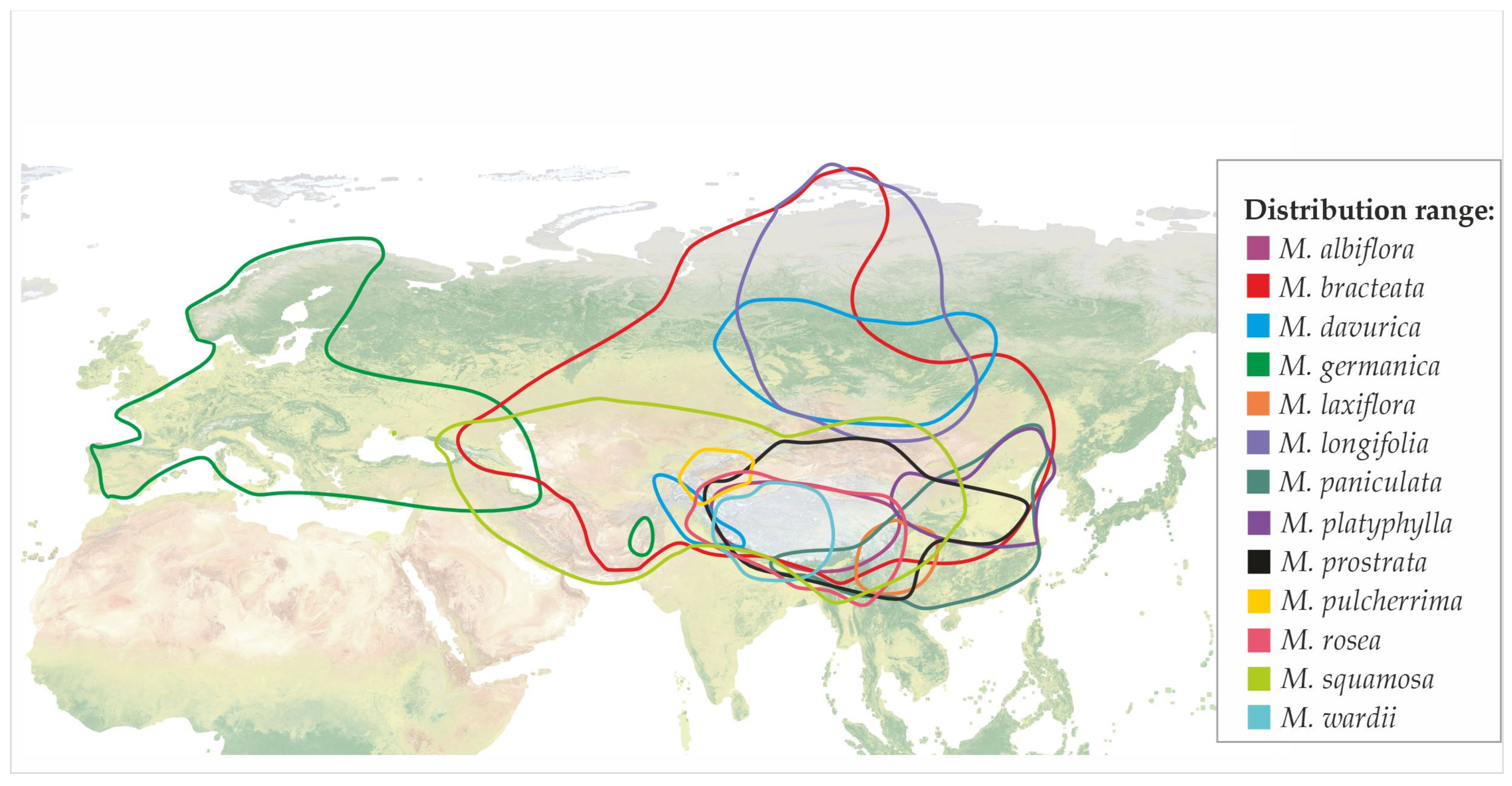
| Species 1 | Synonyms 1 | Plant Overall Shape | Distribution | Habitat | References |
|---|---|---|---|---|---|
| Myricaria albiflora Grierson & D.G.Long | not mentioned | erect shrubs; 1–2 m tall | primarily in temperate biome; eastern Himalayas, Tibet; 2130–3050 m amsl | gravel beds by streams and rivers; stony streamsides in the drier inner valleys | [1,16,17] |
| Myricaria bracteata Royle | homotypic: Myricaria germanica var. bracteata (Royle) Franch. heterotypic: M. alopecuroides Schrenk ex Fisch. & C.A.Mey. M. germanica var. alopecuroides (Schrenk) Maxim. M. germanica subsp. alopecuroides (Schrenk) Kitam. M. macrostachya Kar. & Kir. M. schartii Vassilcz. | geoxyl shrubs; 2–2.5 m tall | primarily in the temperate biome; northern-central China, western Himalayas, the Pamirs, the Tien Shan, Sayan Mountains, Altai, North Caucasus, the Crimea; 1500–4200 m amsl; domesticated and used in landscaping | rocky/sandy banks of highland rivers, stream dry canals, pebbles, riparian sand; high winter hardiness and drought resistance | [1,18,19,20,21] |
| Myricaria davurica (Willd.) Ehrenb | homotypic: Myricaria longifolia var. davurica (Willd.) Maxim (POWO) Tamarix davurica Willd. heterotypic: Myricaria brevifolia Turcz. Myricaria dahurica DC. Myricaria davurica var. macrophylla Bunge | shrubs with branches erect to more or less appressed; 2.5–3 m tall | primarily in the temperate biome; South Siberia, Mongolia, western and central Himalayas; 3200–4300 m amsl | gravelly river beds | [1,22,23] |
| Myricaria germanica (L.) Desv. Subspecies: Myricaria germanica subsp. germanica Myricaria germanica subsp. pakistanica Qaiser | homotypic: Tamarix germanica L., Tamariscus germanicus (L.) Scop. heterotypic: Myrica pannonica Bubani Myricaria herbacea Desv. Tamariscus decander Lam. Tamarix decandra Salisb. T. herbacea Willd. T. monogyna Stokes T. squamosa Steud. | shrubs with erect and densely leafy twigs, 0.6–3 m tall | subsp. germanica: primarily in the temperate biome; North Caucasus, the Carpathian Mountains, the Alps, the Pyrenees, the Scandinavian Mountains introduced to Denmark, Belgium; weed in New Zealand from high-altitude running water habitats (glacier forelands) down to sea level subsp. pakistanica: North Pakistan | montane to subalpine riverine floodplains; non-saline limestone and dolomite soils; probably a facultative rheophyte; light-demanding pioneer species | [1,2,3,4] |
| Myricaria laxiflora (Franch.) P.Y.Zhang & Y.J.Zhang | homotypic: Myricaria germanica var. laxiflora Franch. | erect shrubs; ca. 1.5 m tall | primarily in the temperate biome; north temperate and pantropic vegetation distribution areas between the middle subtropical zone and northern subtropical zone; water-level-fluctuation zone; Three Gorges Reservoir area, along the riverbank of the Yangtze River valley; 70–155 m amsl | low-altitude riversides and shores; roadsides; habitats within the water-level fluctuation zone; clusters in the flooded areas in summer and exposed areas in winter; highly tolerant to river flooding and water submergence | [1,14,24,25] |
| Myricaria longifolia (Willd.) Ehrenb. | homotypic: Tamarix longifolia Willd. heterotypic: Myricaria linearifolia Desv. Tamarix decandra Pall. | shrubs up to 2 m tall | primarily in the temperate biome; Siberia, Mongolia | pebble and stony riverbanks of the mountain rivers; to the tree line | [1,26] |
| Myricaria paniculata P.Y.Zhang et Y.J.Zhang | not mentioned | shrubs, 1–3 m tall | primarily in the temperate biome; northern-central, south-central, and southeast China, Inner Mongolia, Tibet; 1000–2800 m amsl | mountain slopes of river valleys; riparian sand | [1,14,27,28] |
| Myricaria platyphylla Maxim. | not mentioned | erect shrubs; ca. 2 m tall; much branched | primarily in the temperate biome; northern-central China, Inner Mongolia; ca. 1300 m amsl | sandy riverbanks and slopes, lowlands between mobile sand dunes in the desert | [1,14,19,28] |
| Myricaria prostrata Hook.f. & Thomson | homotypic: Myricaria germanica var. prostrata (Hook.f. & Thomson) Dyer heterotypic: Myricaria hedinii Paulsen | dwarf prostrate shrubs or subshrubs; much branched 5–14 cm tall | primarily in the subalpine or subarctic biome low- and high-shrub tundra; northern-central China, Qinghai, Tibet, western Himalayas, Xinjiang; 4000–5200 m amsl | sandy places at lakesides and in river valleys in high mountains, rocky mountain slopes, streamsides, billabongs of hillside; probably a facultative rheophyte | [1,4,14,28,29] |
| Myricaria pulcherrima Batalin | not mentioned | shrubs or subshrubs; rarely much branched; 1–1.5 m tall | primarily in the temperate biome; Xinjiang | sandy riverbanks, lowlands among mountains | [1,14,28] |
| Myricaria rosea W.W.Sm. | not mentioned | prostrate shrubs or subshrubs with densely leafy, numerous ascending branches; ca. 1 m tall | primarily in the subalpine or subarctic biome; native to south-central China, eastern Himalayas, Nepal, Tibet; 2600–4600 m amsl | stream sides in high mountains, rocky mountain slopes; probably a facultative rheophyte | [1,4,14,16,23,28] |
| Myricaria squamosa Desv. | homotypic: Myricaria dahurica subsp. squamosa (Desv.) P.Fourn. M. germanica var. squamosa (Desv.) Maxim. heterotypic: Myricaria armena Boiss. M. davurica var. microphylla Bunge M. hoffmeisteri Klotzsch | shrubs; ca 2 m high | primarily in the temperate biome; in lower subalpine to upper alpine zones; Central and East Asia from the Altai mountains to the Himalayas; 2400–4600 m amsl | riparian sand, river valleys, sandy and pebbly banks of mountain streams and rivers | [1,19,23,28,29,30] |
| Myricaria wardii C.Marquand | not mentioned | erect shrubs 1–2 m tall | primarily in the subalpine or subarctic biome; Nepal, Tibet; 3000–4000 m amsl | sandy places at riversides | [1,14] |
3.2. Distribution and Habitats

3.3. Morphology
Features Determining Ornamental Uses of Myricaria spp.
4. Phytochemistry
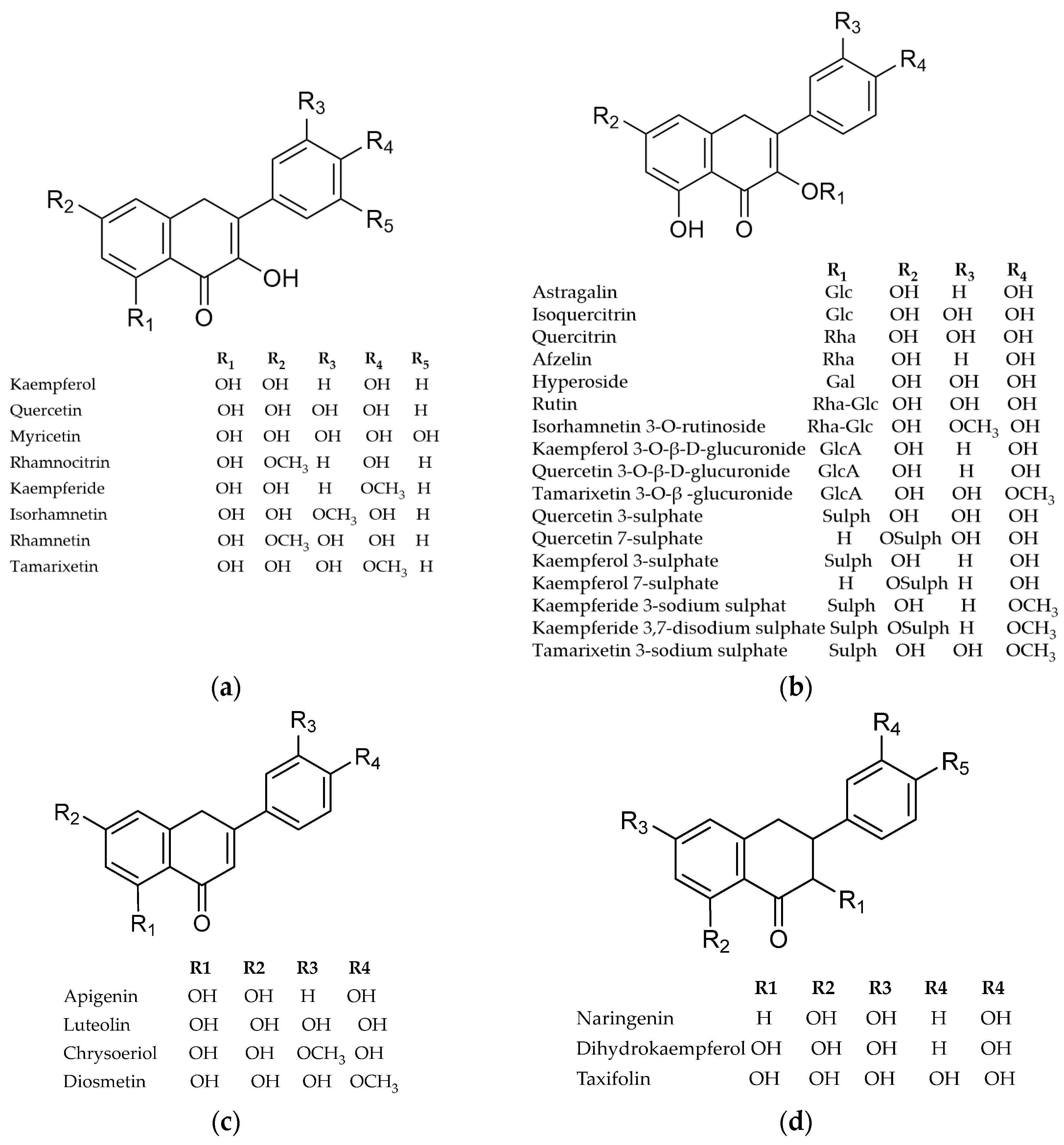
4.1. Flavonoids
4.2. Tannins
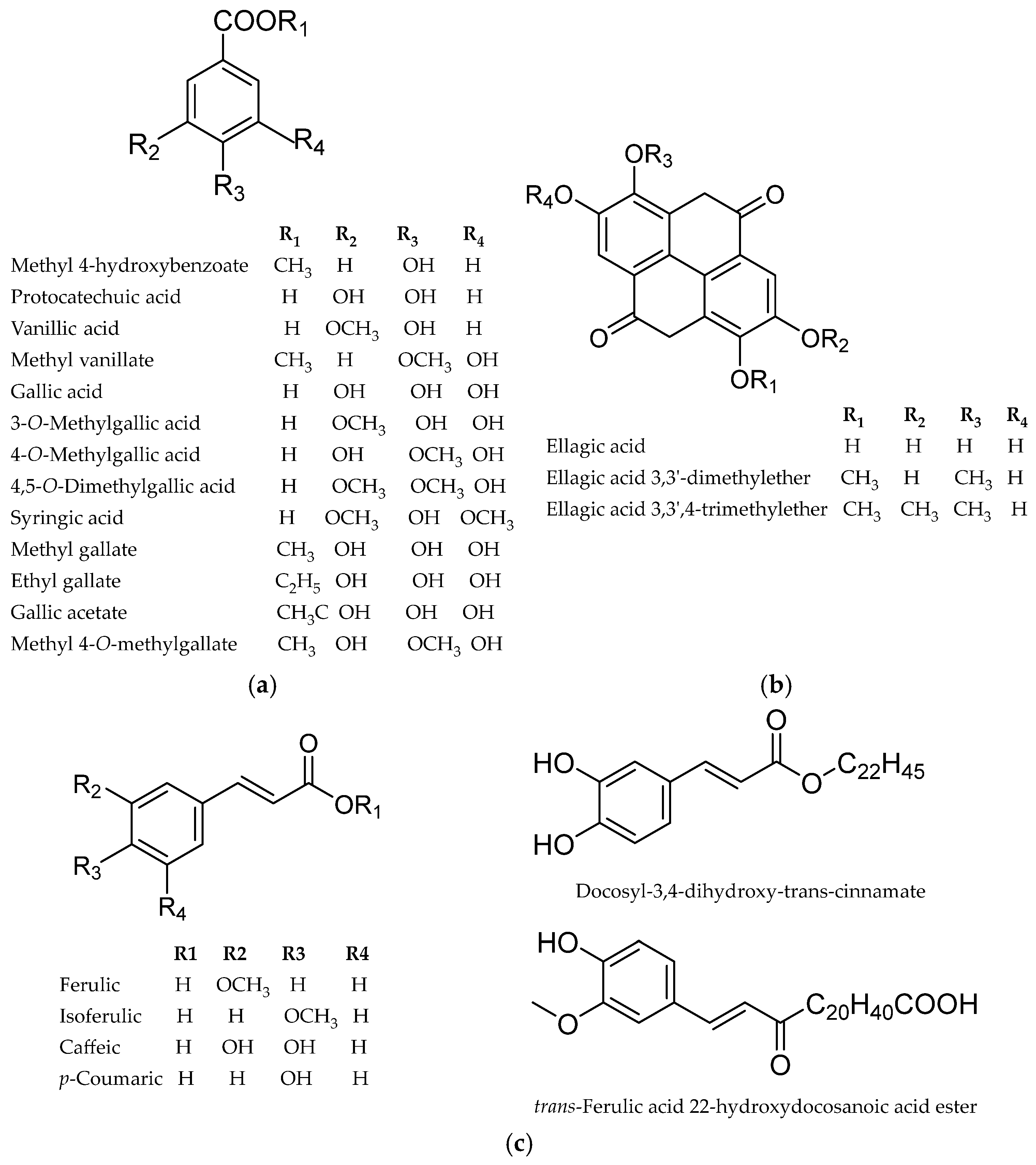
4.3. Phenolic Acids and Their Derivatives
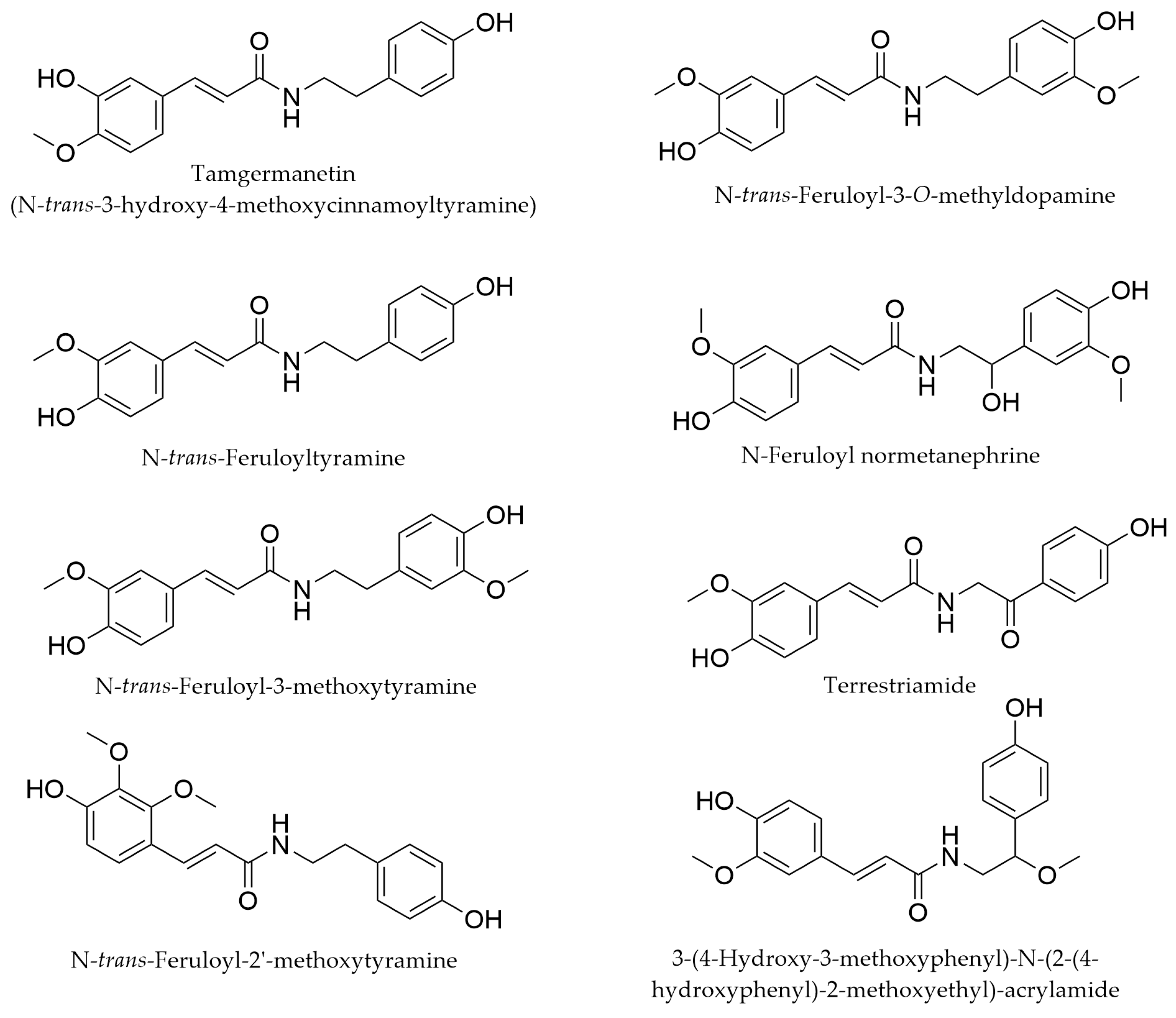
4.4. Feruloyl-Amides
4.5. Other Phenolics
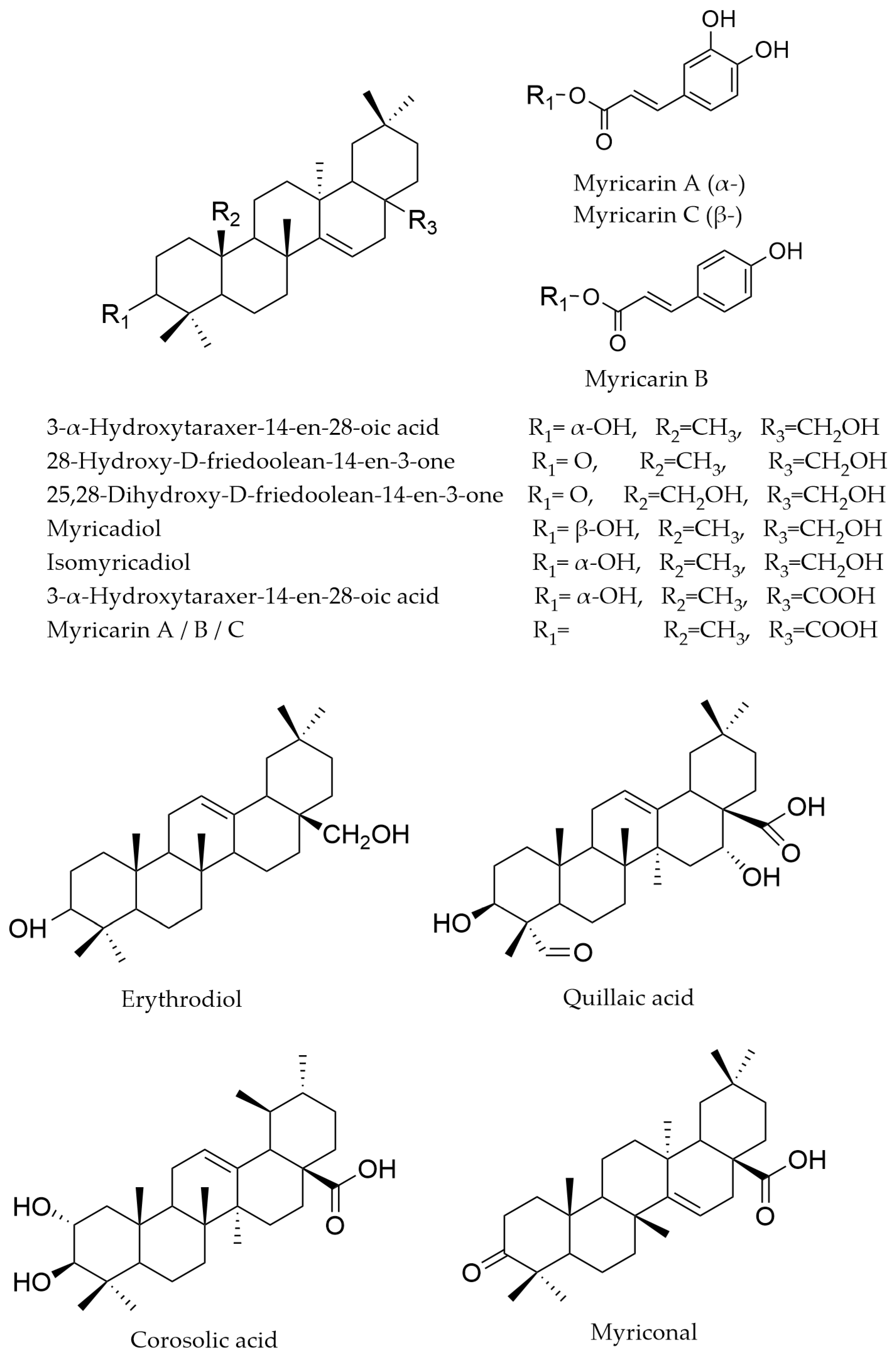
4.6. Triterpenoids
4.7. Sterols
4.8. Long-Chain Fatty Alcohols (Alkanols and Alkanediols)
4.9. Other Compounds
5. Traditional Uses and Current Pharmacological Investigations
5.1. Traditional Uses
5.1.1. Siberia, Central Asia, and Mongolia
5.1.2. Himalayas and Tibetan Plateau
5.1.3. Western Himalayas
5.1.4. Europe
5.2. Pharmacological Studies
5.2.1. Antioxidant Activity
Extract-Level Evidence
Compound-Level Evidence
5.2.2. Anti-Inflammatory Activity
Extract-Level Evidence
Compound-Level Evidence
In Silico Evidence
5.2.3. Antimicrobial and Antifungal Activity
Extract-Level Evidence
Compound-Level Evidence
5.2.4. Cytotoxic Activity
Extract-Level Evidence
Compound-Level Evidence
5.2.5. AChE Inhibition
5.2.6. Immunomodulatory Effects
5.2.7. Choleretic Activity
5.2.8. Pancreatic Lipase Inhibitory Activity
5.2.9. Prolyl Endopeptidase Inhibitory Activity
5.2.10. Glucose Absorption Inhibition
5.2.11. UVB-Protective Effect
5.2.12. Anti-Complementary Activity
5.2.13. Toxicity
5.3. Non-Therapeutic Use

6. Conclusions and Future Perspectives
Supplementary Materials
Author Contributions
Funding
Institutional Review Board Statement
Informed Consent Statement
Data Availability Statement
Conflicts of Interest
Abbreviations
| 5-LOX | lipoxygenase-5 |
| A549 | human lung cancer cell line |
| AA | adjuvant arthritis |
| AAS | Atomic Absorption Spectrometry |
| ABTS | 2,2′-azinobis-(3-ethylbenzothiazoline-6-sulphonate) |
| AChE | acetylcholinesterase |
| AIA | adjuvant-induced arthritis |
| ALT | alanine aminotransferase |
| APG | The Angiosperm Phylogeny Group |
| AST | aspartate aminotransferase |
| Bel-7402 | human liver cancer cell line |
| BGC823 | human gastric cancer cell line |
| BHT | butylhydroxytoluene |
| BuOH | n-butanol |
| CCK-8 | Cell Counting Kit-8 |
| CH50 | haemolytic complement |
| CIA | collagen-induced arthritis |
| CS-Au-MGP | Myricaria germanica polysaccharide chitosan–gold complex |
| CS–Au–MGP NPs | Myricaria germanica polysaccharide chitosan–gold nanoparticle complex |
| COX-2 | cyclooxygenase-2 enzyme |
| CZE | Capillary Zone Electrophoresis |
| DCM | dichloromethane |
| DNA | deoxyribonucleic acid |
| DPPH | 2,2-diphenyl-1-picrylhydrazyl |
| DTNB | 5,5-dithio-bis-(2-nitrobenzoic acid), Ellman’s Reagent |
| EA | ethyl acetate |
| EC50 | half maximal effective concentration |
| EGF | epidermal growth factor |
| EGFR | epidermal growth factor receptor |
| elemen. anal. | elementary analysis |
| ELISA | enzyme-linked immunosorbent assay |
| ERK | extracellular signal-regulated kinase |
| ESI-MS | Electrospray Ionization Mass Spectrometry |
| EtOH | ethanol |
| FAAS | Flame Atomic Absorption Spectroscopy |
| FRAP | ferric ion reducing antioxidant power assay |
| FTMS | Fourier Transform Mass Spectrometry |
| GC | Gas Chromatography |
| GC-FID | Gas Chromatography with Flame Ionization Detector |
| GC-MS | Gas chromatography–mass spectrometry |
| GLC | Gas–Liquid Chromatography |
| HaCaT | normal keratinocyte cell line |
| HCT-8 | human large intestine adenocarcinoma |
| HCT-15 | colon cancer cell line |
| HDL | high-density lipoprotein cholesterol |
| HeLa | cervix cancer cell line |
| HepG2 | liver carcinoma cell line |
| Huh-7 | liver cancer cell line (hepatocyte-derived carcinoma cell line) |
| HPLC | High Performance Liquid Chromatography |
| HPLC-UV-DAD | High-Performance Liquid Chromatography with UV-Diode Array Detector |
| HREIMS | High-Resolution Electron Ionization Mass Spectrometry |
| HR-ESI-MS | High-Resolution Electrospray Ionization Mass Spectrometry |
| IC50 | half maximal inhibitory concentration |
| IFN-γ | interferon gamma |
| H2O | water |
| IgG1 | immunoglobulin G1 |
| IgG2 | immunoglobulin G2 |
| IgG2a | immunoglobulin G2a |
| IL-1β | interleukin 1β |
| IL-2 | interleukin |
| IL-4 | interleukin 4 |
| IL-6 | interleukin 6 |
| IL-17 | interleukin 17 |
| IR | Infrared spectroscopy |
| iNOS | inducible nitric oxide synthase; |
| JNK | c-Jun N-terminal kinase (MAPK family) |
| LC-MS | Liquid Chromatography-Mass Spectrometry |
| LC-MS/MS | Liquid Chromatography-Mass Spectrometry tandem Mass Spectrometry |
| LD50 | median lethal dose |
| LDL | low-density lipoprotein cholesterol |
| LPS | lipopolysaccharide |
| LTB4 | leukotriene B4 |
| MAPK | mitogen-activated protein kinases |
| MDA | malondialdehyde |
| MeOH | methanol |
| MCF-7 | human breast cancer cell line |
| MGP | Myricaria germanica polysaccharide |
| MIC | minimal inhibitory concentration |
| MIN6 | mouse insulinoma cell line |
| MMP-9 | matrix metalloproteinase-9 |
| MPO | myeloperoxidase |
| MTT | 3-(4,5-dimethylthiazol-2-yl)-2,5-diphenyltetrazolium bromide assay |
| NF-κB | nuclear factor kappa B |
| NMR | Nuclear Magnetic Resonance |
| NO | nitric oxide |
| O2•− | superoxide anion |
| p38 | 38 kDa polypeptide |
| p65 | 65 kDa polypeptide |
| PARP | poly (ADP-ribose) polymerase |
| PC-3 | prostate cancer cell line |
| PCR | polymerase chain reaction |
| PE | petroleum ether |
| PLGA | poly(lactic-co-glycolic acid) |
| POWO | The Plants of the World Online database |
| PREP | prolyl endopeptidase |
| PREPi | prolyl endopeptidase inhibitor |
| PTGS2 | prostaglandin-endoperoxidase synthase 2 |
| RA | rheumatoid arthritis |
| RAW 264.7 | a macrophage-like, Abelson leukemia virus-transformed cell line derived from BALB/c mice |
| ROS | reactive oxygen species |
| SOD | superoxide dismutase |
| SRB | sulphorhodamine B |
| TBARS | thiobarbituric acid reactive species assay |
| TC | total cholesterol |
| TG | triglyceride |
| THP-1 | leukemia cell line |
| TLC | Thin-Layer Chromatography |
| TNF-α | tumor necrosis factor α |
| UPLC-Q-TOF MS/MS | Ultra-Performance Liquid Chromatography combined with Quadrupole Time-of-Flight Tandem Mass Spectrometry |
| UV | Ultraviolet Spectroscopy |
| UVB | ultraviolet B |
References
- POWO, The Plants of the World Online Database. Facilitated by the Royal Botanic Gardens, Kew. Available online: https://powo.science.kew.org/ (accessed on 12 November 2025).
- Sitzia, T.; Kudrnovsky, H.; Müller, N.; Michielon, B. Biological Flora of Central Europe: Myricaria germanica (L.) Desv. Perspect. Plant Ecol. Evol. Syst. 2021, 52, 125629. [Google Scholar] [CrossRef]
- Dörken, V.M.; Parsons, R.F.; Marshall, A.T. Studies on the Foliage of Myricaria germanica (Tamaricaceae) and Their Evolutionary and Ecological Implications. Trees 2017, 31, 997–1013. [Google Scholar] [CrossRef][Green Version]
- Costa, L.M.S.; Goetze, M.; Rodrigues, A.V.; dos Santos Seger, G.D.; Bered, F. Global Rheophytes Data Set: Angiosperms and Gymnosperms. Ecology 2020, 101, e03056. [Google Scholar] [CrossRef]
- The Angiosperm Phylogeny Group; Chase, M.W.; Christenhusz, M.J.M.; Fay, M.F.; Byng, J.W.; Judd, W.S.; Soltis, D.E.; Mabberley, D.J.; Sennikov, A.N.; Soltis, P.S.; et al. An Update of the Angiosperm Phylogeny Group Classification for the Orders and Families of Flowering Plants: APG IV. Bot. J. Linn. Soc. 2016, 181, 1–20. [Google Scholar] [CrossRef]
- The World Flora Online. Available online: www.worldfloraonline.org (accessed on 13 September 2025).
- Gaskin, J.F. Tamaricaceae. In The Families and Genera of Vascular Plants; Flowering Plants, Dicotyledons; Springer: Berlin/Heidelberg, Germany, 2003; Volume V, pp. 363–368. [Google Scholar]
- Zhang, D.; Zhang, Y.; Gaskin, J.F.; Chen, Z. Systematic Position of Myrtama Ovcz. & Kinz. Based on Morphological and nrDNA ITS Sequence Evidence. Chin. Sci. Bull. 2006, 51, 117–123. [Google Scholar] [CrossRef]
- Wang, Y.; Liu, Y.; Liu, S.; Huang, H. Molecular Phylogeny of Myricaria (Tamaricaceae): Implications for Taxonomy and Conservation in China. Bot. Stud. 2009, 50, 343–352. [Google Scholar]
- Qaiser, M.; Ali, S.I. Tamaricaria, a New Genus of Tamaricaceae. Blumea 1978, 24, 151–155. [Google Scholar]
- Zhang, D.Y.; Chen, Z.D.; Sun, H.Y.; Yin, L.K.; Pan, B.R. Systematic studies on some questions of Tamaricaceae based on ITS sequence. Acta Bot. Boreali-Occident. Sin. 2000, 20, 421–431. [Google Scholar]
- Zeng, Y.; Bao, M.; Ma, J.; Chen, H.; Zhang, G.; Zhang, H. Immunoregulatory Mechanisms of the Total Flavonoids of Tibetan Herb Myricaria germanica auct. non Linn. Desv. in Adjuvant Arthritic Rat. Chin. Pharmacol. Bull. 2011, 27, 504–507. (In Chinese) [Google Scholar]
- Liu, L.; Yuan, W.; Liu, Z.; Zuo, W.; Zhang, R.; Wang, Z.; Li, J. Elucidating the Material Basis and Potential Mechanisms of Myricaria germanica Acting on Rheumatoid Arthritis by UPLC-Q-TOF-MS /MS and Network Pharmacology. Phytomed. Plus 2023, 3, 100457. [Google Scholar] [CrossRef]
- Yang, Q.; Gaskin, J. Tamaricaceae. In Flora of China; Wu, Z.Y., Raven, P.H., Hong, D.Y., Eds.; Science Press: Beijing, China; Missouri Botanical Garden Press: St. Louis, MO, USA, 2007; Volume 13, pp. 58–69. Available online: http://www.efloras.org/florataxon.aspx?flora_id=2&taxon_id=10868 (accessed on 11 November 2025).
- Don, G.; Miller, P. A General System of Gardening and Botany. Founded upon Miller’s Gardener’s Dictionary, and Arranged According to the Natural System; C. J. G. and F. Rivington: London, UK, 1832; Volume II, p. 727. [Google Scholar]
- Grierson, A.J.C.; Long, D.G. Flora of Bhutan; Illustrations by Mary Bates and Glenn Rodrigues; Royal Botanic Garden: Edinburgh, Scotland, 1991; Volume 2, pp. 232–234. [Google Scholar]
- Grierson, A.J.C.; Long, D.G. Notes Relating to the Flora of Bhutan: V. New and Noteworthy Plants Collected in Bhutan in 1979. Notes R. Bot. Gard. Edinb. 1982, 40, 115–138. [Google Scholar] [CrossRef]
- Astashenkov, A.; Lyakh, E. Ontogenesis and Architectural Analysis of Myricaria bracteata Royal in East Kazakhstan. BIO Web Conf. 2020, 24, 00004. [Google Scholar] [CrossRef]
- Wang, Y.; Liu, Y.F.; Liu, S.B.; Huang, H.W. Geographic Distribution and Current Status and Conservation Strategy of the Genus Myricaria in China. J. Wuhan Bot. Res. 2006, 24, 455–463. [Google Scholar]
- Karpova, E.A.; Krasnikov, A.A.; Lyakh, E.M.; Chernonosov, A.A. Leaf Surface Secretion of Flavonoids in Myricaria bracteata and M. longifolia (Tamaricaceae). Taiwania 2022, 67, 413–421. [Google Scholar] [CrossRef]
- Lyakh, E.M.; Tsybuloya, N.V. To the study of antibacterial and antifungal activity of volatile emissions of Myricaria bracteata (Tamaricaceae). Rastitielnye Resur. 2009, 45, 154–156. (In Russian) [Google Scholar]
- Qaiser, M. Flora of Pakistan; Department of Botany, University of Karachi: Karachi, Pakistan, 1982; Volume 141, pp. 46–52. Available online: www.eFloras.org (accessed on 11 November 2025).
- Efloraofindia (2007 Onwards). Database of Plants of the Indian Subcontinent. Available online: https://efloraofindia.com/ (accessed on 11 November 2025).
- Liu, Y.; Wang, Y.; Huang, H. High Interpopulation Genetic Differentiation and Unidirectional Linear Migration Patterns in Myricaria laxiflora (Tamaricaceae), an Endemic Riparian Plant in the Three Gorges Valley of the Yangtze River. Am. J. Bot. 2006, 93, 206–215. [Google Scholar] [CrossRef] [PubMed]
- Huang, G.Y.; Zhang, H.L.; Qiu, L.W.; Li, W.; Li, H.; Lei, H.; Guo, Y.; Hu, H.; Zhang, D.Y.; Song, Z.J. Population and Community Characteristics of Remnant Populations of Endangered Myricaria laxiflora. Plant Sci. J. 2023, 41, 26–36. [Google Scholar] [CrossRef]
- University of Greifswald, Institute of Botany and Landscape Ecology, Institute of Geography and Geology, Computer Centre. FloraGREIF—Virtual Flora of Mongolia; Computer Centre of University of Greifswald: Greifswald, Germany, 2010; Available online: http://floragreif.uni-greifswald.de/floragreif/ (accessed on 11 November 2025).
- Hu, H.; Wang, Q.; Hao, G.; Zhou, R.; Luo, D.; Cao, K.; Yan, Z.; Wang, X. Insights into the Phylogenetic Relationships and Species Boundaries of the Myricaria squamosa Complex (Tamaricaceae) Based on the Complete Chloroplast Genome. PeerJ 2023, 11, e16642. [Google Scholar] [CrossRef] [PubMed]
- Fang, J.; Wang, Z.; Tang, Z. Atlas of Woody Plants in China; Higher Education Press: Beijing, China; Springer: Berlin/Heidelberg, Germany, 2011; Volume I, pp. 1148–1149. [Google Scholar]
- Ni, J.; Herzschuh, U. Simulating Biome Distribution on the Tibetan Plateau Using a Modified Global Vegetation Model. Arct. Antarct. Alp. Res. 2011, 43, 429–441. [Google Scholar] [CrossRef]
- Shrestha, M.R.; Rokaya, M.B.; Ghimire, S.K. Vegetation Pattern of Trans-Himalayan Zone in the North-West Nepal. Nepal J. Plant Sci. 2005, 1, 129–135. [Google Scholar]
- Sun, K.; Werth, S. Journey to the West: Migration Patterns of the Riparian Montane Genus Myricaria. Flora 2024, 321, 152639. [Google Scholar] [CrossRef]
- Liu, Y.; Wang, Y.; Huang, H. Species-level Phylogeographical History of Myricaria Plants in the Mountain Ranges of Western China and the Origin of M. laxiflora in the Three Gorges Mountain Region. Mol. Ecol. 2009, 18, 2700–2712. [Google Scholar] [CrossRef]
- Lyakh, E.M. Overview of the Study of the Genus Myricaria Desv. in Siberia. Eurasian J. For. Res. 2013, 16, 67–72. [Google Scholar]
- Lyakh, E.M.; Astashenkov, A.Y. Coenopopulations of Myricaria bracteata Royal at the Territory of the Republic of Kazakhstan and Their Ontogenetic Structure. BIO Web Conf. 2019, 16, 00017. [Google Scholar] [CrossRef]
- Lyakh, E.M.; Astashenkov, A.Y. Features of the Population Organization of Myricaria bracteata in the Riverbed of the Ursul River (Gorny Altai). BIO Web Conf. 2021, 38, 00076. [Google Scholar] [CrossRef]
- Sitzia, T.; Michielon, B.; Iacopino, S.; Kotze, J. Population dynamics of the endangered shrub Myricaria germanica in a regulated Alpine river is influenced by active channel width and distance to check dams. Ecol. Eng. 2016, 95, 828–838. [Google Scholar] [CrossRef]
- Danube Pollution Reduction Programme Evaluation of Wetlands and Floodplain Areas in the Danube River Basin Final Report 1999. Programme Coordination Unit UNDP/GEF Assistance prepared by WWF Dan-ube-Carpathian-Programme and WWF-Auen-Institut (Germany). Available online: https://www.icpdr.org/sites/default/files/EVALUATIONWETLANDSFLOODPLAINAREAS.pdf (accessed on 30 September 2025).
- The Council of the European Communities. Council Directive 92/43/EEC of 21 May 1992 on the Conservation of Natural Habitats and of Wild Fauna and Flora 1992. Off. J. Eur. Union 1992, 206, 50. [Google Scholar]
- Lyakh, E. Biological Aspects of the Genus Myricaria Desv. (Tamaricaceae), Especially of the Siberian Species. BIO Web Conf. 2019, 16, 00018. [Google Scholar] [CrossRef]
- Michielon, B. Conservation of the Endangered Myricaria germanica (L.) Desv.: A Keystone Species of Riverine Habitats; University of Padova: Padova, Italy, 2019. [Google Scholar]
- Hegnauer, R. Tamaricaceae. In Chemotaxonomie der Pflanzen; Lehrbücher und Monographien aus dem Gebiete der Exakten Wissenschaften; Birkhäuser: Basel, Switzerland, 1973; Volume 21, pp. 482–486. [Google Scholar]
- Ntie-Kang, F.; Njume, L.E.; Malange, Y.I.; Günther, S.; Sippl, W.; Yong, J.N. The Chemistry and Biological Activities of Natural Products from Northern African Plant Families: From Taccaceae to Zygophyllaceae. Nat. Prod. Bioprospect. 2016, 6, 63–96. [Google Scholar] [CrossRef]
- Swilam, N. Chemistry and Biology of Phenolics Isolated from Myricaria germanica (L.) Desv. (Tamaricaceae); Ernst-Moritz-Arndt-Universität Greifswald: Greifswald, Germany, 2014. [Google Scholar]
- Mubashir, S. Phytochemical Screening of Major Constituents of Various Folklore Medicinal Plants of Kashmir Valley; The University of Kashmir: Srinagar, India, 2011. [Google Scholar]
- Zhang, M.; Deji; Chen, D.; Lu, Y. Chemical Recognition and Spectrum-Effect Relationship of UPLC-MS Chromatograms with Anti-Complementary and Antioxidant Activities of Myricariae Ramulus. Phytochem. Anal. 2025, 36, 1502–1516. [Google Scholar] [CrossRef] [PubMed]
- Troshchenko, A.T.; Povolotskaya, N.N. 12-Hentriacontanol from Myricaria alopecuroides. Chem. Nat. Compd. 1967, 3, 61–64. [Google Scholar] [CrossRef]
- Bandyukova, V.A.; Dzhumyrko, S.F. Flavonol Glycosides of Some Plants of the Teberda Reserve. I. Chem. Nat. Compd. 1970, 6, 266. [Google Scholar] [CrossRef]
- Chumbalov, T.K.; Bikbulatova, T.N.; Il’yasova, M.I. Polyphenols of Myricaria alopecuroides. I. Chem. Nat. Compd. 1974, 10, 435. [Google Scholar] [CrossRef]
- Chumbalov, T.K.; Bikbulatova, T.N.; Il’yasova, M.I.; Mukhamedieva, R.M. Polyphenols of Myricaria alopecuroides II. Flavonoid Aglycones. Chem. Nat. Compd. 1975, 11, 308. [Google Scholar] [CrossRef]
- Chumbalov, T.K.; Bukbulatova, T.N.; Il’yasova, M.I. Polyphenols of Myricaria alopecuroides. III. Hydrolyzable Tanning Substances. Chem. Nat. Compd. 1976, 12, 127–128. [Google Scholar] [CrossRef]
- Chumbalov, T.K.; Bikbulatova, T.N.; Il’yasova, M.I. Polyphenols of Myricaria alopecuroides. IV. Hydrolysable Tanning Substances. Chem. Nat. Compd. 1979, 15, 94. [Google Scholar] [CrossRef]
- Semenova, L.S. Flavonoid composition of shoots of Myricaria longifolia (Willd.) Ehrenb. Rastit. Resur. Plant Resour. 1993, 29, 40–42. (In Russian) [Google Scholar]
- Zhao, D.B.; Liu, X.H.; Cui, S.Y.; Wang, T.; Wang, H.Q. Separation and Determination of Six Active Components in Two Myricaria Plants by Capillary Chromatography. Chromatographia 2005, 61, 643–646. [Google Scholar] [CrossRef]
- Nawwar, M.A.; Swilam, N.F.; Hashim, A.N.; Al-Abd, A.; Abdel-Naim, A.B.; Lindequist, U. Cytotoxic Isoferulic Acidamide from Myricaria germanica (Tamaricaceae). Plant Signal. Behav. 2013, 8, e22642. [Google Scholar] [CrossRef]
- Chernonosov, A.A.; Karpova, E.A.; Lyakh, E.M. Identification of Phenolic Compounds in Myricaria bracteata Leaves by High-Performance Liquid Chromatography with a Diode Array Detector and Liquid Chromatography with Tandem Mass Spectrometry. Rev. Bras. Farmacogn. 2017, 27, 576–579. [Google Scholar] [CrossRef]
- Karpova, E.; Davlatov, S.K.; Chernonosov, A. Phenolic Compounds in Taxonomy of Myricaria longifolia and Myricaria bracteata (Tamaricaceae). BIO Web Conf. 2021, 38, 00051. [Google Scholar] [CrossRef]
- Zhou, R.; Wang, T.; Du, X.Z. Studies on chemical constituents in herb of Myricaria bracteata. China J. Chin. Mater. Med. 2006, 31, 474–476. [Google Scholar]
- Li, S.; Chen, R.Y.; Yu, D.Q. Study on Chemical Constituents of Myricaria paniculata I. China J. Chin. Mater. Med. 2007, 32, 403–406. [Google Scholar]
- Li, Z.; Xue, P.; Xie, P.; Li, X.; Xie, M. Chemical constituents from Myricaria alopecuroides. China J. Chin. Mater. Med. 2010, 35, 865–866. [Google Scholar] [CrossRef]
- La, X.Q.; Zeng, Y.; Xu, M.; Zhang, Y.J. Flavonoids from the Twigs of the Tibetian Medicine Myricaria germanica. Nat. Prod. Res. Dev. 2011, 23, 596–599. (in Chinese). [Google Scholar]
- Liu, J.-B.; Ding, Y.-S.; Zhang, Y.; Chen, J.-B.; Cui, B.-S.; Bai, J.-Y.; Lin, M.-B.; Hou, Q.; Zhang, P.-C.; Li, S. Anti-Inflammatory Hydrolyzable Tannins from Myricaria bracteata. J. Nat. Prod. 2015, 78, 1015–1025. [Google Scholar] [CrossRef]
- Liu, J.-B.; Zhang, Y.; Cui, B.S.; Shuai, L. Chemical constituents from twigs of Myricaria bracteata. Chin. Tradit. Herb. Drugs 2013, 24, 2661–2665. [Google Scholar]
- Tian, W.; Zheng, Y.; Xue, Y.; Zou, K.; Liu, S. Identification of Gallicin from Myricaria laxiflora and Its Antibiotic & Antioxidant Activity. In Proceedings of the 2012 International Symposium on Information Technologies in Medicine and Education, Hokodate, Japan; IEEE: New York, NY, USA, 2012; pp. 100–1003. [Google Scholar]
- Li, S.; Dai, S.-J.; Chen, R.-Y.; Yu, D.-Q. Triterpenoids from the Stems of Myricaria paniculata. J. Asian Nat. Prod. Res. 2005, 7, 253–257. [Google Scholar] [CrossRef]
- Zhang, K.; Han, M.-J.; Wang, L.; Liu, S.; Zhao, X.-F.; Shen, W.-Y.; Mao, H.-Q.; Qin, D.; Dong, J.-Y. A New Oleanane Type Triterpenoid and Other Constituents from the Waterlogging Tolerant Plant Myricaria laxiflora. Biochem. Syst. Ecol. 2016, 68, 186–191. [Google Scholar] [CrossRef]
- Zhang, Y.; Yuan, Y.; Cu, B.; Li, S. Study on chemical constituents from ethyl acetate extract of Myricaria bracteata. China J. Chin. Mater. Med. 2011, 6, 1019–1023. [Google Scholar] [CrossRef]
- Xu, H.; Yuan, Z.-Z.; Ma, X.; Wang, C.; Suo, Y.-R.; Wang, H.-L.; Wang, X.-Y.; Bai, B. Triterpenoids with Antioxidant Activities from Myricaria squamosa. J. Asian Nat. Prod. Res. 2018, 20, 292–298. [Google Scholar] [CrossRef]
- Jetter, R. Long-Chain Alkanediols from Myricaria germanica Leaf Cuticular Waxes. Phytochemistry 2000, 55, 169–176. [Google Scholar] [CrossRef]
- Gendaram, O. Anti-Oxidative, Acetylcholinesterase and Pancreatic Lipase Inhibitory Activities of Compounds from Dasiphora fruticosa, Myricaria alopecuroides and Sedum hybridum. Mong. J. Chem. 2016, 17, 42–49. [Google Scholar] [CrossRef]
- Huan, M.; Umbetova, A.K.; Jenis, J.; Sagdullaev, S.S.; Gemedzhieva, N.G. Chemical Research of the Genus Myricaria (I), Book of Abstract. In Proceedings of the International Scientific Conference on Actual Problems of the Chemistry of Natural Compounds, Tashkent, Uzbekistan, 15–16 March 2023; p. 68. [Google Scholar]
- Shults, E.E.; Raldugin, V.A.; Volcho, K.P.; Salakhutdinov, N.F.; Tolstikov, G.A. Plant Metabolites of the Siberian Flora. Chemical Transformations and the Scope of Practical Application. Russ. Chem. Rev. 2007, 76, 655–671. [Google Scholar] [CrossRef]
- Harborne, J.B. Flavonoid Bisulphates and Their Co-Occurences with Ellegic Acid in the Bixaceae, Frankeniaceae and Related Families. Phytochemistry 1975, 14, 1331–1337. [Google Scholar] [CrossRef]
- Ullah, K.; Azam, T.; Sammad, A.; Ahmed, T.; Wadood, A.; Ali, M.F.; Mushraf, G.M.; Shaheen Siddiqui, B.; Li, Y. Novel Prolyl Endopeptidase Inhibitor from Myricaria germanica Alleviates Steatohepatitis. RSC Adv. 2025, 15, 37245–37262. [Google Scholar] [CrossRef]
- Zeng, Y.; La, X.Q.; Xu, M.; Zhang, Y.J. Phenolic Constituents from Twigs of Tibetan Medicine Myricaria germanica. Nat. Prod. Res. Dev. 2012, 23, 1169–1171. [Google Scholar]
- Wang, Y.; Qiu, F.; Zheng, Q.; Hong, A.; Wang, T.; Zhang, J.; Lin, L.; Ren, Z.; Qin, T. Preparation, Characterization and Immune Response of Chitosan-gold Loaded Myricaria germanica Polysaccharide. Int. J. Biol. Macromol. 2024, 257, 128670. [Google Scholar] [CrossRef] [PubMed]
- Mraz, B.A. Beiträge zur Phytochemischen Analyse der Mongolischen Heilpflanze Myricaria longifolia Ehrenb.; Univeritat Wien: Wien, Austria, 2010. [Google Scholar]
- Karpova, E.A.; Buglova, L.V.; Lyakh, E.M.; Shaldaeva, T.M. Ecological Aspects of the Composition and Tissue Distribution of Phenolic Compounds in Myricaria bracteata and Myricaria longifolia Twigs. Contemp. Probl. Ecol. 2025, 18, 546–562. [Google Scholar] [CrossRef]
- Kubasa, B. Analyse und Isolierung Sulfatierter und Glykosylierter Flavonoide aus der Mongolischen Arzneipflanze Myricaria longifolia Ehrenb.; University of Vienna: Vienna, Austria, 2011. [Google Scholar]
- Donath, O.; Glasl, S.; Kletter, C.; Narantuya, S. Phytochemical Investigation of Myricaria longifolia Ehrenb.—A Plant Used in Traditional Mongolian Medicine. Sci. Pharm. 2006, 74, S93. [Google Scholar] [CrossRef]
- Obmann, A.; Mraz, B.; Kubasa, B.; Zehl, M.; Kletter, C.; Glasl, S. Phytochemical Profiling of the Mongolian Medicinal Plant Myricaria longifolia Ehrenb. Planta Med. 2010, 76, 1127. [Google Scholar] [CrossRef]
- Pan, J.J.; Zhang, X.L.; Yang, N.; Fan, Y. Study on the chemical constituents of Myricaria squamosa. J. Pharm. Res. 2018, 37, 203–205. [Google Scholar]
- Iwashina, T. Flavonoid Properties of Five Families Newly Ncorporated into the Order Caryophyllales (Review). Bull. Natl. Mus. Nat. Sci. Ser. B 2013, 9, 25–51. [Google Scholar]
- Harborne, J.B. Flavonoid Sulphates: A New Class of Sulphur Compounds in Higher Plants. Phytochemistry 1975, 14, 1147–1155. [Google Scholar] [CrossRef]
- Mohammed, H.A.; Ragab, E.A.; Dutta, A.; Othman, A.; Shaheen, U.; Jaremko, M.; Badshah, S.L.; Dhahri, M.; Al-Younis, I.; Al-Rimawi, F.; et al. Sulfated Flavonoids: An Updated and Comprehensive Review of Their Chemistry and Bioactivities. Phytochem. Rev. 2025, 24, 6255–6310. [Google Scholar] [CrossRef]
- Teles, Y.; Souza, M.; Souza, M. Sulphated Flavonoids: Biosynthesis, Structures, and Biological Activities. Molecules 2018, 23, 480. [Google Scholar] [CrossRef]
- Chung, K.-T.; Wong, T.Y.; Wei, C.-I.; Huang, Y.-W.; Lin, Y. Tannins and Human Health: A Review. Crit. Rev. Food Sci. Nutr. 1998, 38, 421–464. [Google Scholar] [CrossRef]
- Mavlyanov, S.M.; Islambekov, S.Y.; Ismailov, A.I.; Dalimov, D.N.; Abdulladzhanova, N.G. Vegetable Tanning Agents. Chem. Nat. Compd. 2001, 37, 1–24. [Google Scholar] [CrossRef]
- Ahmad, M.; Ahmad, W.; Khan, S.; Zeeshan, M.; Obaidullah; Nisar, M.; Shaheen, F.; Ahmad, M. New Antibacterial Pentacyclic Triterpenes from Myricaria elegans Royle. (Tamariscineae). J. Enzyme Inhib. Med. Chem. 2008, 23, 1023–1027. [Google Scholar] [CrossRef]
- Khan, S.; Nisar, M.; Khan, R.; Ahmad, W.; Nasir, F. Evaluation of Chemical Constituents and Antinociceptive Properties of Myricaria elegans Royle. Chem. Biodivers. 2010, 7, 2897–2900. [Google Scholar] [CrossRef]
- Umbetova, A.K.; Choudhary, M.I.; Sultanova, N.A.; Burasheva, G.S.; Abilov, Z.A. Triterpenoids from the Genus Tamarix. Chem. Nat. Compd. 2006, 42, 332–335. [Google Scholar] [CrossRef]
- Zeng, Y.; Chen, R.; Ma, X.; Lei, Y. Analysis of Chemical Components of Volatile Oil from Myricaria germanica by GC-MS. Nat. Prod. Res. Dev. 2014, 26, 691–694, 698. (In Chinese) [Google Scholar]
- Liu, L.; Ma, J.; Chen, W.; Zhang, J.; Zuo, W.; Wang, M.; Li, J. UVB-Induced HaCat Cell Damage and Myricaria paniculata’s Molecular Effects. Sci. Rep. 2025, 15, 10909. [Google Scholar] [CrossRef]
- Sun, Y.-L.; Hong, S.-K. Effects of Citric Acid as an Important Component of the Responses to Saline and Alkaline Stress in the Halophyte Leymus chinensis (Trin.). Plant Growth Regul. 2011, 64, 129–139. [Google Scholar] [CrossRef]
- Chen, C.; Fan, G.; Lin, Y.; Zheng, Z.; Zhang, X.; Zhang, Y.; Qin, T.; Ren, Z. Selenium Myricaria germanica Polysaccharides-based Nanoparticles to Improve Immune Activity. Chem. Biodivers. 2026, 23, e01322. [Google Scholar] [CrossRef]
- Jiao, Y.; Yang, Y.; Zhou, L.; Chen, D.; Lu, Y. Two Natural Flavonoid Substituted Polysaccharides from Tamarix chinensis: Structural Characterization and Anticomplement Activities. Molecules 2022, 27, 4532. [Google Scholar] [CrossRef]
- Jiao, Y.; Zhou, L.; Huo, J.; Li, H.; Zhu, H.; Chen, D.; Lu, Y. Flavonoid Substituted Polysaccharides from Tamarix chinensis Lour. Alleviate H1N1-Induced Acute Lung Injury via Inhibiting Complement System. J. Ethnopharmacol. 2024, 322, 117651. [Google Scholar] [CrossRef] [PubMed]
- Jiao, Y.; Zhou, L.; Li, H.; Zhu, H.; Chen, D.; Lu, Y. A Novel Flavonol-Polysaccharide from Tamarix chinensis Alleviates Influenza A Virus-Induced Acute Lung Injury. Evidences for Its Mechanism of Action. Phytomedicine 2024, 125, 155364. [Google Scholar] [CrossRef]
- Shyshkin, B.K.; Bobrov, E.G. Flora CCCP; Academie Scientarum URSS: Moscow, Russia, 1949; Volume XV, pp. 321–327. [Google Scholar]
- World Health Organisation (WHO). Report of Marked Research on Mongolian Traditional Medicinal Drugs; WHO: Geneva, Switzerland, 2007. [Google Scholar]
- Khookhor, O.; Sato, Y. Mongolian Plant Extracts with Potential Glucose Absorption Inhibiting Effects in Rats. J. Trad. Med. 2009, 26, 74–79. [Google Scholar]
- Popov, P.L. Plant species, using against virous infections of man and animals: Regularities of the distribution in the phylogenetic classification system. J. Stress Physiol. Biochem. 2008, 4, 17–64. [Google Scholar]
- Rinpoche, R. Tibetan Medicine; University of California Press: Berkeley, CA, USA; Los Angeles, CA, USA, 1976. [Google Scholar]
- World Health Organization. Medicinal Plants in Mongolia; World Health Organization: Geneva, Switzerland, 2013; pp. 122–123. [Google Scholar]
- Kletter, C.; Glasl, S.; Thalhammer, T.; Narantuya, S. Traditional Mongolian Medicine—A Potential for Drug Discovery. Sci. Pharm. 2008, 76, 49–63. [Google Scholar] [CrossRef]
- Sharma, L.; Samant, S.S.; Kumar, A.; Negi, D.; Devi, K.; Lal, M.; Tewari, L.M. Diversity, Distribution Pattern and Indigenous Uses of Medicinal Plants of Cold Desert Biosphere Reserve in Trans Himalaya. J. Ethnobiol. Tradit. Med. 2017, 128, 1320–1345. [Google Scholar]
- Adhikari, B.S.; Babu, M.M.; Saklani, P.L.; Rawat, G.S. Distribution, Use Pattern and Prospects for Conservation of Medicinal Shrubs in Uttaranchal State, India. J. Mt. Sci. 2007, 4, 155–180. [Google Scholar] [CrossRef]
- Quattrocchi, U. CRC World Dictionary of Medicinal and Poisonous Plants; CRC Press: Boca Raton, FL, USA; Taylor & Francis Group: Abingdon, UK, 2012. [Google Scholar]
- Bao, Y.-F.; Li, J.-Y.; Zheng, L.-F.; Li, H.-Y. Antioxidant Activities of Cold-Nature Tibetan Herbs Are Signifcantly Greater than Hot-Nature Ones and Are Associated with Their Levels of Total Phenolic Components. Chin. J. Nat. Med. 2015, 13, 609–617. [Google Scholar] [CrossRef]
- Wangchuk, P.; Keller, P.A.; Pyne, S.G.; Taweechotipatr, M.; Tonsomboon, A.; Rattanajak, R.; Kamchonwongpaisan, S. Evaluation of an Ethnopharmacologically Selected Bhutanese Medicinal Plants for Their Major Classes of Phytochemicals and Biological Activities. J. Ethnopharmacol. 2011, 137, 730–742. [Google Scholar] [CrossRef]
- Lama, D. The Quintessence Tantras of Tibetan Medicine; Shambhala: Boulder, CO, USA, 1995; p. 168. [Google Scholar]
- Ding, X.; Guo, C.; Zhang, X.; Li, J.; Jiao, Y.; Feng, H.; Wang, Y. Wild Plants Used by Tibetans in Burang Town, Characterized by Alpine Desert Meadow, in Southwestern Tibet, China. Agronomy 2022, 12, 704. [Google Scholar] [CrossRef]
- Lama, Y.C.; Ghimire, S.K.; Aumeeruddy-Thomas, Y. Medicinal Plants of Dolpo: Amchis’ Knowledge and Conservation, 1st ed.; People and Plants Initiative, WWF Nepal Program: Kathmandu, Nepal, 2001. [Google Scholar]
- Ministry of Health of Bhutan. Monograph on Medicinal Plants of Bhutan; Institut of Traditional Medicine Services, Ministry of Health: Timphu, Bhutan, 2009; Volume II. [Google Scholar]
- Bhattarai, S.; Chaudhary, R.P.; Quave, C.L.; Taylor, R.S. The Use of Medicinal Plants in the Trans-Himalayan Arid Zone of Mustang District, Nepal. J. Ethnobiol. Ethnomed. 2010, 6, 14. [Google Scholar] [CrossRef]
- Gewali, M.B. Aspects of Traditional Medicine in Nepal; Institute of Natural Medicine, University of Toyama: Toyama, Japan, 2008. [Google Scholar]
- Dorji, K.; Tobgay, S.; Yangdon, N. The Ethno-Botanical Studies of Medicinal and Aromatic Plants in Sakteng Wildlife Sanctuary, Trashigang, Bhutan. Int. J. Curr. Res. Biosci. Plant Biol. 2017, 4, 75–82. [Google Scholar] [CrossRef]
- Bhattarai, S.; Chaudhary, R.P.; Taylor, R.S. Ethnomedicinal Plants Used by the People of Manang District, Central Nepal. J. Ethnobiol. Ethnomed. 2006, 2, 41. [Google Scholar] [CrossRef] [PubMed]
- Bano, A.; Ahmad, M.; Zafar, M.; Sultana, S.; Rashid, S.; Khan, M.A. Ethnomedicinal Knowledge of the Most Commonly Used Plants from Deosai Plateau, Western Himalayas, Gilgit Baltistan, Pakistan. J. Ethnopharmacol. 2014, 155, 1046–1052. [Google Scholar] [CrossRef]
- Witt, C.M.; Berling, N.E.J.; Rinpoche, N.T.; Cuomo, M.; Willich, S.N. Evaluation of Medicinal Plants as Part of Tibetan Medicine Prospective Observational Study in Sikkim and Nepal. J. Altern. Complement. Med. 2009, 15, 59–65. [Google Scholar] [CrossRef]
- Khan, B.; Abdukadir, A.; Qureshi, R.; Mustafa, G. Medicinal Uses of Plants by the Inhabitants of Khunjerab National Park, Gilgit, Pakistan. Pak. J. Bot. 2011, 43, 2301–2310. [Google Scholar]
- Chaurasia, O.P.; Khatoon, N.; Singh, S.B. Fields Guide Floral Diversity of Ladakh; WWF India: New Delhi, India, 2008. [Google Scholar]
- Tsarong, T.J. Tibetan Medicinal Plants; Tibetan Medical Publications: Kalimpong, India, 1994. [Google Scholar]
- Soelberg, J.; Jäger, A.K. Comparative Ethnobotany of the Wakhi Agropastoralist and the Kyrgyz Nomads of Afghanistan. J. Ethnobiol. Ethnomed. 2016, 12, 2. [Google Scholar] [CrossRef]
- Liu, H.; Wagutu, G.K.; Chen, Y.; Li, X.; Fan, X. The Complete Chloroplast Genome Sequence of Myricaria wardii Marquand 1929 (Tamaricaceae): A Shrub Species Endemic to the Tibet Plateau. Mitochondrial DNA Part B 2024, 9, 367–370. [Google Scholar] [CrossRef]
- Batool, Z.; Singh, K.; Gairola, S. Medicinal Plants Traditionally Used in the Health Care Practices by the Indigenous Communities of the Trans-Himalayan Region of Ladakh, India. J. Ethnopharmacol. 2023, 317, 116837. [Google Scholar] [CrossRef]
- Rinchen, T.; Pant, S. Ethnopharmacological Uses of Plants among Inhabitants Surrounding Suru and Zanskar Valleys of Cold Desert, Ladakh. Int. J. Pharma Bio Sci. 2014, 5, 486–494. [Google Scholar]
- Buth, G.M.; Navchoo, I.A. Ethnobotany of Ladakh (India) Plants Used in Health Care. J. Ethnobiol. 1988, 8, 185–194. [Google Scholar]
- Kumar, G.P.; Gupta, S.; Murugan, M.P.; Bala Singh, S. Ethnobotanical Studies of Nubra Valley—A Cold Arid Zone of Himalaya. Ethnobot. Leafl. 2009, 6, 9. [Google Scholar]
- Singh, K.N. Traditional Knowledge on Ethnobotanical Uses of Plant Biodiversity: A Detailed Study from the Indian Western Himalaya. Biodivers. Res. Conserv. 2012, 28, 63–77. [Google Scholar] [CrossRef]
- Singh, K.N.; Lal, B. Ethnomedicines Used against Four Common Ailments by the Tribal Communities of Lahaul-Spiti in Western Himalaya. J. Ethnopharmacol. 2008, 115, 147–159. [Google Scholar] [CrossRef]
- Kiem, J. Ein Tamariskenvorkommen Im Sarntal. Berichte Bayer. Bot. Ges. 1992, 63, 139–143. [Google Scholar]
- Kirbağ, S.; Zengin, F.; Kursat, M. Antimicrobial Activities of Extracts of Some Plants. Pak. J. Bot. 2009, 41, 2067–2070. [Google Scholar]
- Dogan, Y.; Nedelcheva, A.M.; Obratov-Petković, D.; Padure, I.M. Plants Used in Traditional Handicrafts in Several Balkan Countries. IJTK 2008, 7, 157–161. [Google Scholar]
- Zhang, L.; Cui, Z.; Mu, Y.; Wei, K.; Li, Z.; Zhu, H.; Yang, D.; Wang, Y.; Long, P.; Zhang, C.; et al. Ethnopharmacological Investigation and Rapid Authentication of Mongolian Patent Medicines Digeda. Chin. Herb. Med. 2015, 7, 223–237. [Google Scholar] [CrossRef]
- Lei, X.-J.; Sun, H.-M.; Qu, Y.-X.; Xu, Q.-Z.; Zhou, Y.; Xiao, H.; Li, L.-J.; Yang, Z.-B. Research Overview of Ethnic Medicines for the Treatment of Rheumatoid Arthritis. Front. Pharmacol. 2025, 16, 1662130. [Google Scholar] [CrossRef]
- Chen, H.; Shoumura, S.; Emura, S.; Isono, H. Tibetan Medicated-Bath Therapy May Improve Adjuvant Arthritis in Rat. Evid. Based Complement. Altern. Med. 2009, 6, 211–217. [Google Scholar] [CrossRef]
- Peng, S.-Y.; Liu, Y.; Bao, X.; Wang, L.; Zhang, F.; Wang, F.; Wang, W. Inhibition of 5-Lipoxygenase and Cyclooxygenase-2 Pathways by Pain-Relieving Plaster in Macrophages. Pharm. Biol. 2011, 49, 716–726. [Google Scholar] [CrossRef] [PubMed]
- Wang, Y.-Z.; Guo, C.-Y.; Zhong, H.-G.; Zhang, W.-N.; Wang, D.-L.; Wang, X.; Dong, F.-H. In Vivo Effects of Pain Relieving Plaster on Closed Soft Tissue Injury in Rabbit Ears. BMC Complement. Altern. Med. 2008, 8, 51. [Google Scholar] [CrossRef]
- Chen, C.; Li, S.Q.; Bao, T.; Zhang, L.; Seluzicki, C.; Mao, J.J. A Systematic Review of CheeZheng Pain Relieving Plaster for Musculoskeletal Pain: Implications for Oncology Research and Practice. Integr. Cancer Ther. 2020, 19, 1534735420918933. [Google Scholar] [CrossRef]
- Geiger, P.L. Pharmacopoea Universalis; Sumptibus Chr. Fr. Winter: Berlin/Heidelberg, Germany, 1845; Volume I. [Google Scholar]
- Kraemer, H. A Text-Book of Botany and Pharmacognosy; J.B. Lippincott Company: Philadelphia, PA, USA; London, UK, 1902. [Google Scholar]
- Zhuang, Y.; Liu, J.; Ma, P.; Bai, J.; Ding, Y.; Yang, H.; Fan, Y.; Lin, M.; Li, S.; Hou, Q. Tamarixinin A Alleviates Joint Destruction of Rheumatoid Arthritis by Blockade of MAPK and NF-κB Activation. Front. Pharmacol. 2017, 8, 538. [Google Scholar] [CrossRef]
- Gonching, E.; Erdenebat, S.; Togtoo, O.; Bataa, S.; Gendaram, O.; Kim, Y.S.; Ryu, S.Y. Antimicrobial Activity of Mongolian Medicinal Plants. Nat. Prod. Sci. 2008, 14, 32–36. [Google Scholar]
- Zandanov, A.O.; Sambueva, Z.G.; Ubeeva, I.P.; Nikolaev, S.M. The perspective choleretic species of the plant raw materials of Siberia. Vestn. Buryatskogo Gos. Univ. Filos. Bull. Buryat State Univ. Philos. 2009, 12, 3–8. (In Russian) [Google Scholar]
- Azam, T.; Noreen, F.; Siddiqui, B.S.; Hafizur, R.M.; Begum, S. Suppression of β-Cell Apoptosis from H2O2-Induced Oxidative Stress in MIN6 Cells Using Methyl Gallate. J. Chem. Soc. Pak. 2022, 44, 84. [Google Scholar] [CrossRef]
- Liu, L.; Wang, M.; Zhang, J.; Chen, W.; Zuo, W.; Zeng, Y.; Li, J. The Inhibitory Effect and Mechanism of Action of Myricaria germanica Essential Oils on Skin Inflammation Based on Network Pharmacology and Molecular Docking. Lett. Drug Des. Discov. 2024, 21, 4484–4499. [Google Scholar] [CrossRef]
- Zeng, Y.; Chen, Z.; Zhong, L.; Li, H. Study on the Effects That Caused by the Tradition Tibetan Herb Myricaria germanica (L.) Desv. on the Immune Function of Cells and the Toxicity Tests. J. Qinghai Norm. Univ. 2005, 1. [Google Scholar]
- Vogl, C.; Bresgen, N.; Eckl, P.M.; Glasl, S.; Kletter, C. In Vitro Evaluation of the Hepatotoxic Potential of Aqueous and Methanolic Extracts of Myricaria longifolia. Sci. Pharm. 2009, 77, 268. [Google Scholar] [CrossRef]
- Bao, M.; Zeng, Y.; Mi, Q.; Chen, Z. Bacteriostasis study of the different extracts from the Traditional Tibetan Herb Myricaria germanica (L.) Desv in vitro. LiShiZhen Med. Mater. Med. Res. 2006, 17, 1410–1411. [Google Scholar]
- Draczkowski, P.; Tomaszuk, A.; Halczuk, T.; Strzemski, M.; Matosiuk, D.; Jozwiak, K. Determination of Affinity and Efficacy of Acetylcholinesterase Inhibitors Using Isothermal Titration Calorimetry. Biochim. Biophys. Acta (BBA)—Gen. Subj. 2016, 1860, 967–974. [Google Scholar] [CrossRef]
- Bhattacharyya, A. Ethnobotanical Observations in the Ladakh Region of Northern Jammu and Kashmir State, India. Econ. Bot. 1991, 45, 305–308. [Google Scholar] [CrossRef]
- Himalayan Forest Research Institute (HFRI). HFRI Initiatives and Achievements in the Cold Deserts of Himachal Pradesh & Jammu & Kashmir 2010; Report (Indian Council of Forestry Research & Education) Conifer Campus, Panthaghati, Shimla; Himalayan Forest Research Institute (HFRI): Shimla, India, 2010. [Google Scholar]
- Abbas, Z.; Bussmann, R.W.; Khan, S.M.; Umair, M.; Alam, J.; Salma; Hussain, M.; Ullah, Z. Ethnobotany of Karakorum, Pakistan. In Ethnobiology of Mountain Communities in Asia; Springer: Cham, Switzerland, 2021; pp. 229–244. [Google Scholar]
- Huang, N.; Tang, L.; Zhu, F.; Wu, C.; Hartley, W.; Zhou, J.J.; Xue, S.G. Salt Ions Accumulation and Distribution Characteristics of Pioneer Plant Species at a Bauxite Residue Disposal Area. China J. Cent. S. Univ. 2019, 26, 323–330. [Google Scholar] [CrossRef]







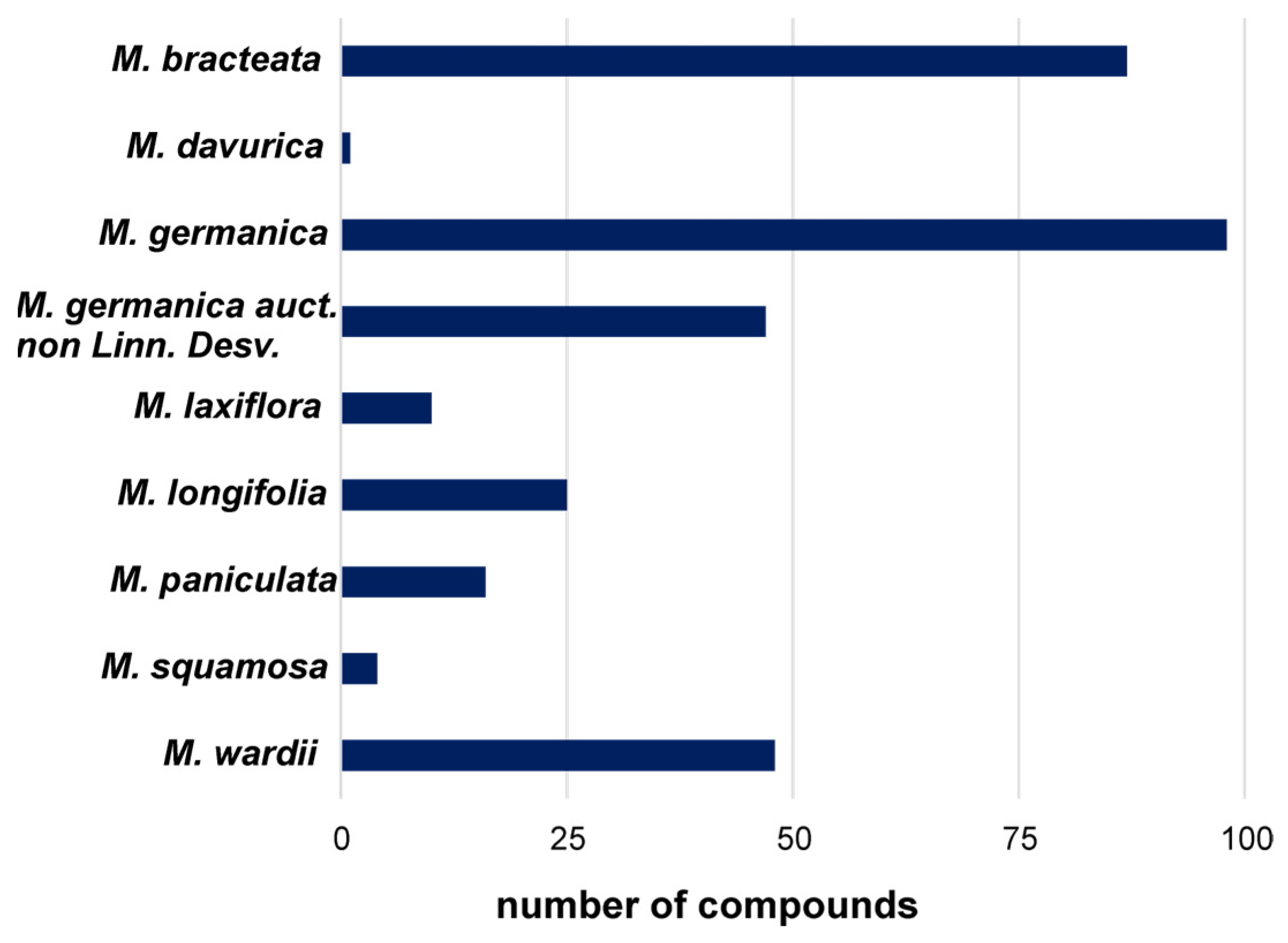
| Species | Plant Parts | Compounds | Method of Identification | References |
|---|---|---|---|---|
| M. bracteata | aerial parts 1 | Flavonoids | [47,49,57,59,62,69] | |
| Kaempferol | UV, NMR; n.g. 2 | |||
| Kaempferide | UV | |||
| Rhamnocitrin | n.g. 2 | |||
| Afzelin | UV, NMR | |||
| Kaempferol-3-O-β-D-glucuronide | “ | |||
| Kaempferol-3-O-β-D-glucuronic acid methylester | n.g. 2 | |||
| Quercetin | UV, IR; NMR | |||
| Isorhamnetin | “ | |||
| Rhamnetin | UV, IR | |||
| Rhamnazin | “ | |||
| Isoquercetin | UV, NMR | |||
| Quercitrin | “ | |||
| Tamarixetin | UV | |||
| Quercetin-3-O-β-D-glucuronide | UV, NMR | |||
| Quercetin-3-O-β-D-glucuronic acid methylester | “ | |||
| Tamarixetin-6-desoxyhexose | UV | |||
| Chrysoeriol | n.g. 2 | |||
| Tannins | [50,51,61,69] | |||
| combined ellagotannins: dehydrodigallic acid, dehydrotrigallic acid | IR, NMR | |||
| Myrinin (1,2,3-dehydrotrigalloyl-α-D-glucose) | “ | |||
| Nilotinin M4 | NMR | |||
| 1,3-di-O-Galloyl-4,6-O-(aS)-hexahydroxydiphenoyl-β-D-glucose | “ | |||
| Tellimagrandin II | “ | |||
| Bracteatinin D1 (dimer) | “ | |||
| Bracteatinin D2 (dimer) | “ | |||
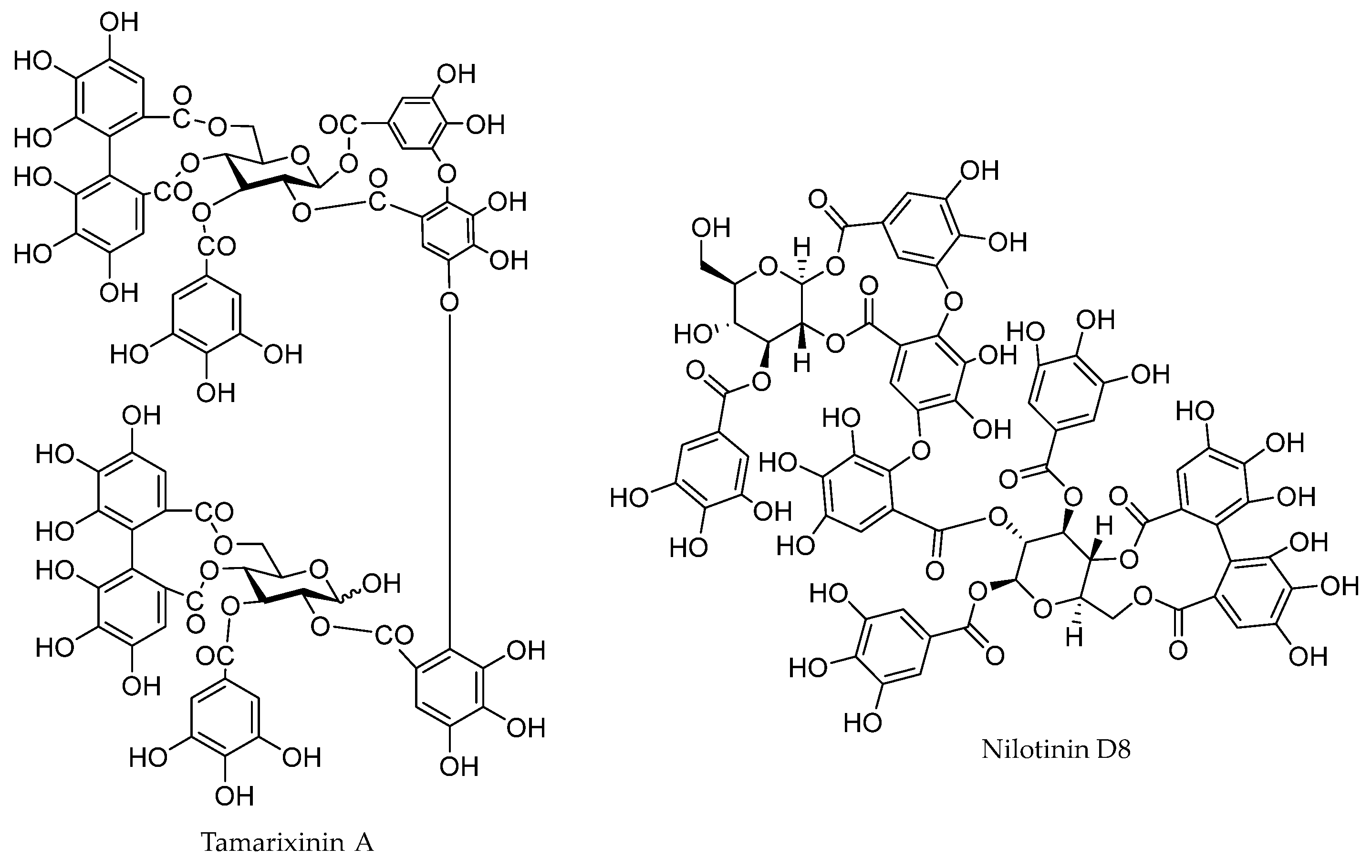
| Tamarixinin A (dimer) | “ | |||
| Nilotinin D8 (dimer) | “ | |||
| Hirtellin A (dimer) | “ | |||
| Hirtellin B (dimer) | “ | |||
| Hirtellin E (dimer) | “ | |||
| Isohirtellin C (dimer) | “ | |||
| Bracteatinin T1 (trimer) | “ | |||
| Hirtellin T3 (trimer) | “ | |||
| Phenolic acids and their derivatives | [48,57,59,62,69] | |||
| Gallic acid | UV, NMR | |||
| Ethyl gallate | UV, NMR | |||
| Methyl 3,4-O-dimethylgallate (gallicin) | n.g. 2 | |||
| Methyl 3,4-dihydroxy-5-methoxybenzoate | IR, elemen. anal. | |||
| 3, 5-Dihydroxy-4-methoxybenzoic acid | n.g. 2 | |||
| Ellagic acid 3,3′,4-trimethylether | n.g. 2 | |||
| Ellagic acid 3,3′-dimethylether | n.g. 2 | |||
| Ferulic acid | UV, NMR, n.g. 2 | |||
| Caffeic acid | n.g. 2 | |||
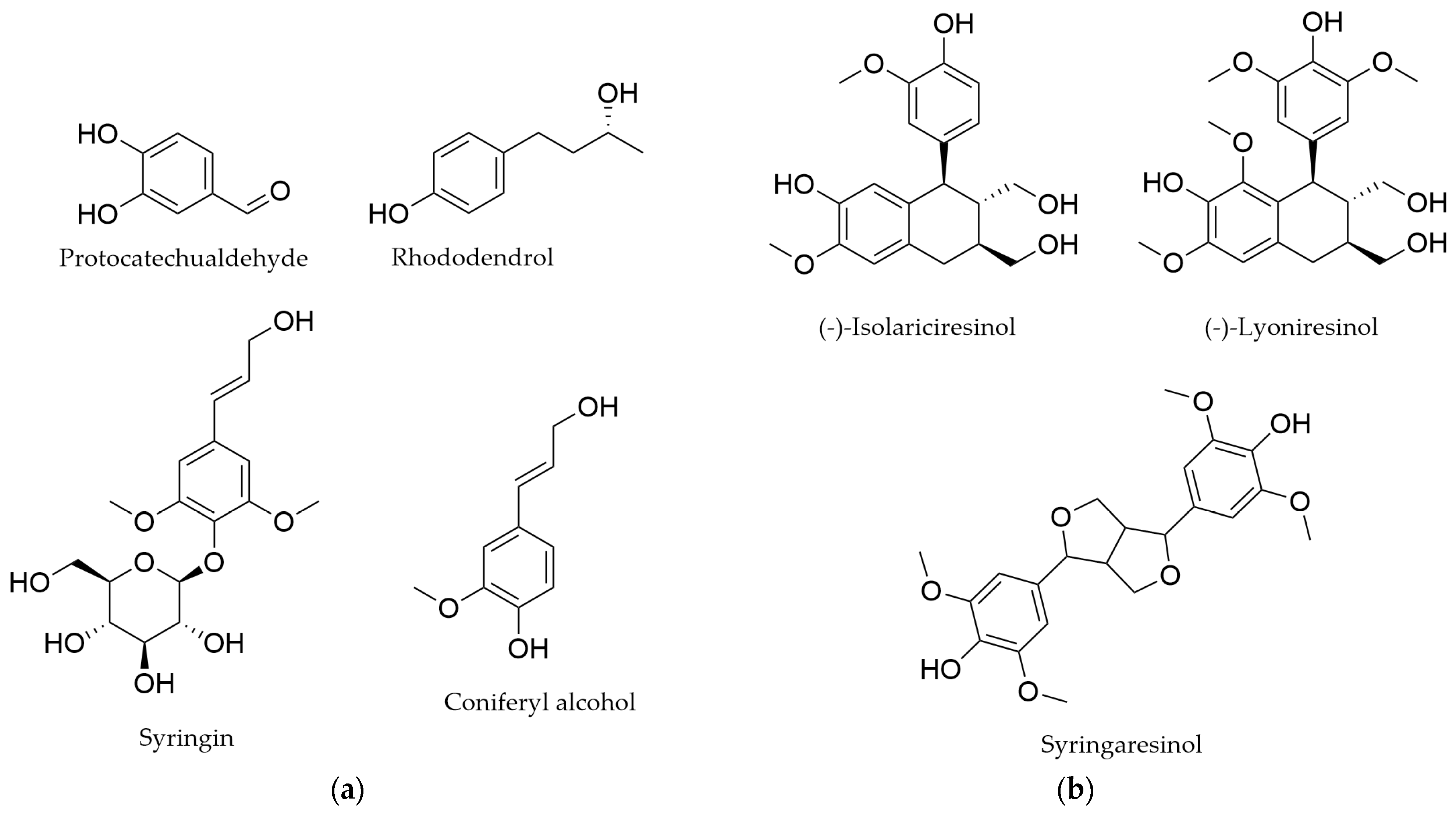
| Syringaresinol | n.g. 2 | |||
| (-)-Lyoniresinol | n.g. 2 | |||
| (-)-Isolariciresinol | n.g. 2 | |||
| Feruloyl-amides | [62] | |||
| N-trans-Feruloyltyramine | n.g. 2 | |||
| N-trans-Feruloyl-3-methoxytyramine | n.g. 2 | |||
| N-trans-Feruloyl-2′-methoxytyramine | n.g. 2 | |||
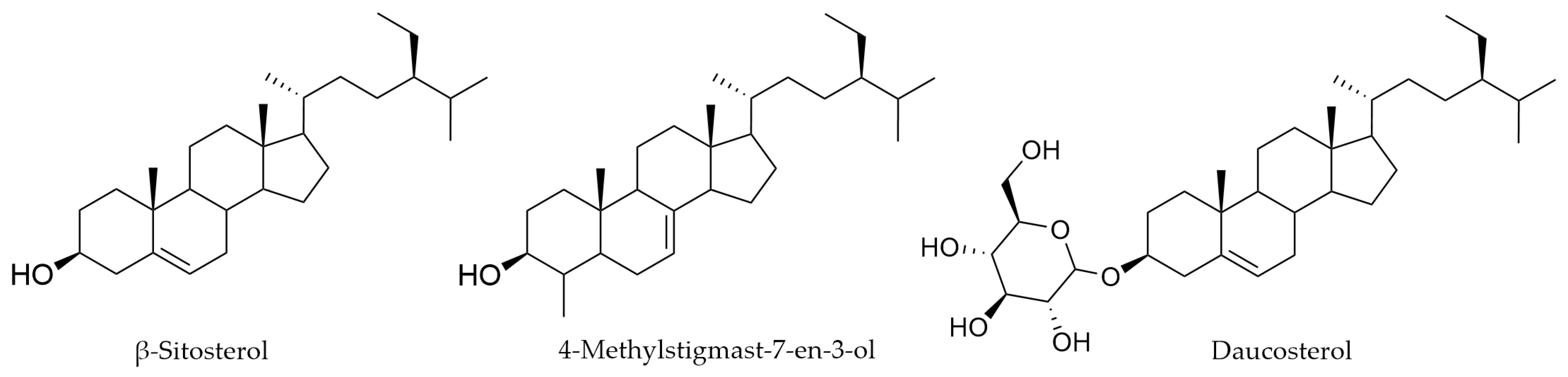
| Sterols | [57,59,69] | |||
| β-Sitosterol | UV, NMR; n.g. 2 | |||
| β-Sitosterylglucopyranose | “ | |||
| Daucosterol | n.g. 2 | |||
| Long-chain fatty alcohols | [46] | |||
| 12-Hentriacontanol | TLC, IR | |||
| Other compounds | [59,69,70] | |||
| Palmitic acid | GLC | |||
| Stearic acid | UV, NMR | |||
| Stearic acid ethylate | “ | |||
| Oleic acid | GLC | |||
| Linoleic acid | “ | |||
| 6,7,10-Trihydroxy-8-octadecenoic acid | n.g. 2 | |||
| Palmitic acid | n.g. 2 | |||
| Hexadecanoic acid 2,3-dihydroxypropyl ester | n.g. 2 | |||
| Vitamin C | titrimetic method | |||
| Vitamin A, E | fluorimetric method | |||
| Fe, K | AAS | |||
| leaves | Flavonoids | [55,56] | ||
| Kaempferol | LC-MS/MS | |||
| Kaempferide | “ | |||
| Rhamnocitrin | “ | |||
| Astragalin | “ | |||
| Quercetin | “ | |||
| Isorhamnetin | “ | |||
| Rhamnazin | “ | |||
| Isoquercetin | “ | |||
| Hyperoside | “ | |||
| Narcissin | “ | |||
| Myricetin | “ | |||
| Apigenin | “ | |||
| Luteolin | “ | |||
| Naringenin | “ | |||
| Chrysoeriol | “ | |||
| Phenolic acids and their derivatives | ||||
| Gallic acid | LC-MS/MS | |||
| Methyl gallate | “ | |||
| Ethyl gallate | “ | |||
| Ellagic acid | “ | |||
| Ferulic acid | “ | |||
| Other compounds | ||||
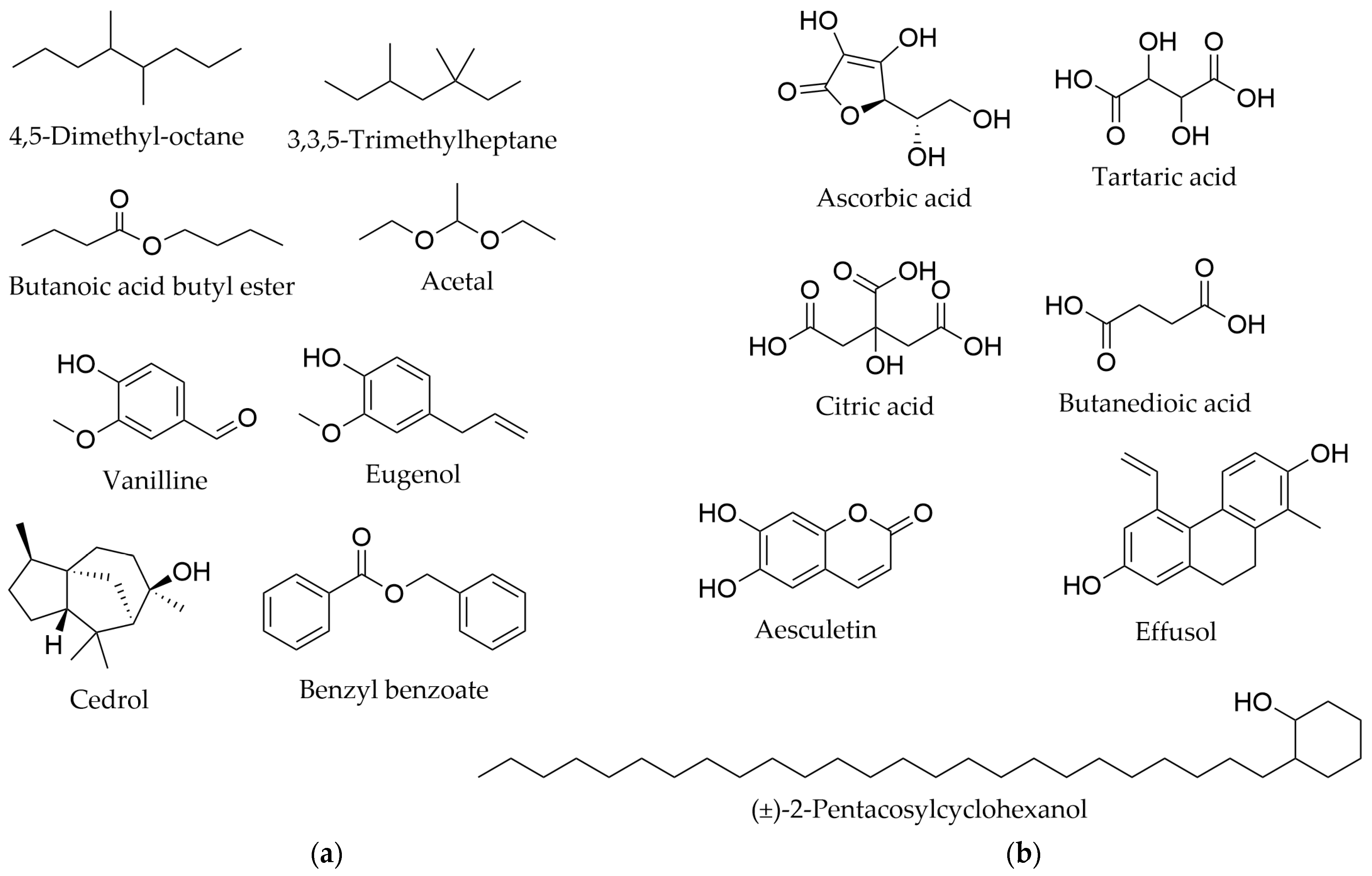
| Citric acid | LC-MS/MS | |||
| root bark | Flavonoids | [53] | ||
| Afzelin | UV (CZE) | |||
| Phenolic acids and their derivatives | [53] | |||
| Gallic acid | UV (CZE) | |||
| 3,4-Dimethoxygallic acid | “ | |||
| Gallic acetate | “ | |||
| n.i. | Flavonoids | [66] | ||
| Rhamnazin | n.g. 2 | |||
| Dillenetin | n.g. 2 | |||
| Rhamnocitrin | n.g. 2 | |||
| Phenolic acids and their derivatives | [66] | |||
| Methyl 3,5-dihydroxy-4-methoxybenzoate | n.g. 2 | |||
| Methyl p-hydroxybenzoate | n.g. 2 | |||
| 3,3′,4′-Trimethoxyellagic acid | n.g. 2 | |||
| Isoferulic acid | n.g. 2 | |||
| trans-Ferulic acid 22-hydroxydocosanoic acid ester | n.g. 2 | |||
| Docosyl-3,4-dihydroxy-trans-cinnamate | n.g. 2 | |||
| Other phenolics | [66] | |||
| Sinapaldehyde | n.g. 2 | |||
| Vanillin | n.g. 2 | |||
| Syringaldehyde | n.g. 2 | |||
| Triterpenoids | [66] | |||
| Myricarin | n.g. 2 | |||
| Myricarin B | n.g. 2 | |||
| 3-α-Hydroxytaraxer-14-en-28-oic acid | n.g. 2 | |||
| Myricadiol | n.g. 2 | |||
| M. davurica | n.i. | Phenolic acids and their derivatives | [71] | |
| Ellagic acid | n.g. | |||
| M. germanica | leaves | Flavonoids | [43,54,72] | |
| Kaempferol | UV, FTMS, NMR, FAAS | |||
| Afzelin | “ | |||
| Kaempferide | “ | |||
| Kaempferol 3-O-β-D-glucuronide | “ | |||
| Kaempferol 3-sulfate | n.g. 2 | |||
| Kaempferol 7-sulfate | n.g. 2 | |||
| Kaempferide 3,7-disodium sulfate | n.g. 2 | |||
| Quercetin | UV, FTMS, NMR, FAAS | |||
| Quercitrin | “ | |||
| Quercetin 3-O-β-D-glucuronide | “ | |||
| Quercetin 3-sulfate | “ | |||
| Quercetin 7-sulfate | n.g. 2 | |||
| Tamarixetin | n.g. 2 | |||
| Tamarixetin 3-O-β-glucuronide | UV, FTMS, NMR, FAAS | |||
| Tamarixetin 3-sodium sulfate | “ | |||
| Tannins | [43,54] | |||
| 1,3-Di-O-galloyl-β-glucose | UV, FTMS, NMR, FAAS | |||
| 2,3-Di-O-galloyl-(α/β)-glucose | “ | |||
| 2,4-Di-O-galloyl-(α/β)-glucose | “ | |||
| 2,6-Di-O-galloyl-(α/β)-glucose | “ | |||
| Tamarixellagic acid | “ | |||
| Phenolic acids and their derivatives | [43,54] | |||
| Gallic acid | UV, FTMS, NMR, FAAS | |||
| 3-O-Methylgallic acid | “ | |||
| 3-O-Methylgallic 5-sodium sulfate | “ | |||
| Methyl gallate | GC-MS, NMR, IR | |||
| Syringic acid | “ | |||
| Feruloyl-amides | [43,54] | |||
| Tamgermanetin (N-trans-3-hydroxy-4-methoxycinnamoyltyramine) | UV, FTMS, NMR, FAAS | |||
| Other compounds | [73] | |||
| Butanedioic acid | GC-MS, NMR | |||
| (±)-2-Pentacosylcyclohexanol | “ | |||
| twigs | Flavonoids | [60] | ||
| Kaempferol | n.g. 2 | |||
| Rhamnocitrin | n.g. 2 | |||
| Kaempferide | n.g. 2 | |||
| Afzelin | n.g. 2 | |||
| Kaempferol 3-O-β-D-glucuronide | n.g. 2 | |||
| Rhamnazin | n.g. 2 | |||
| Tamarixetin | n.g. 2 | |||
| Quercitrin | n.g. 2 | |||
| Quercetin 3-O-β-D-glucuronide | n.g. 2 | |||
| Isoquercetin | n.g. 2 | |||
| Phenolic acids and their derivatives | [74] | |||
| Gallic acid | n.g. 2 | |||
| 4-O-Methylgallic acid | n.g. 2 | |||
| Ferulic acid | n.g. 2 | |||
| Caffeic acid | n.g. 2 | |||
| p-Coumaric acid | n.g. 2 | |||
| 3,4,5-Trihydroxycinnamic acid | n.g. 2 | |||
| Vanillic acid | n.g. 2 | |||
| Feruloyl glucose | n.g. 2 | |||
| Other phenolics | [74] | |||
| Rhododendrol | n.g. 2 | |||
| Coniferyl alcohol | n.g 2 | |||
| (-)-Isolariciresinol | n.g. 2 | |||
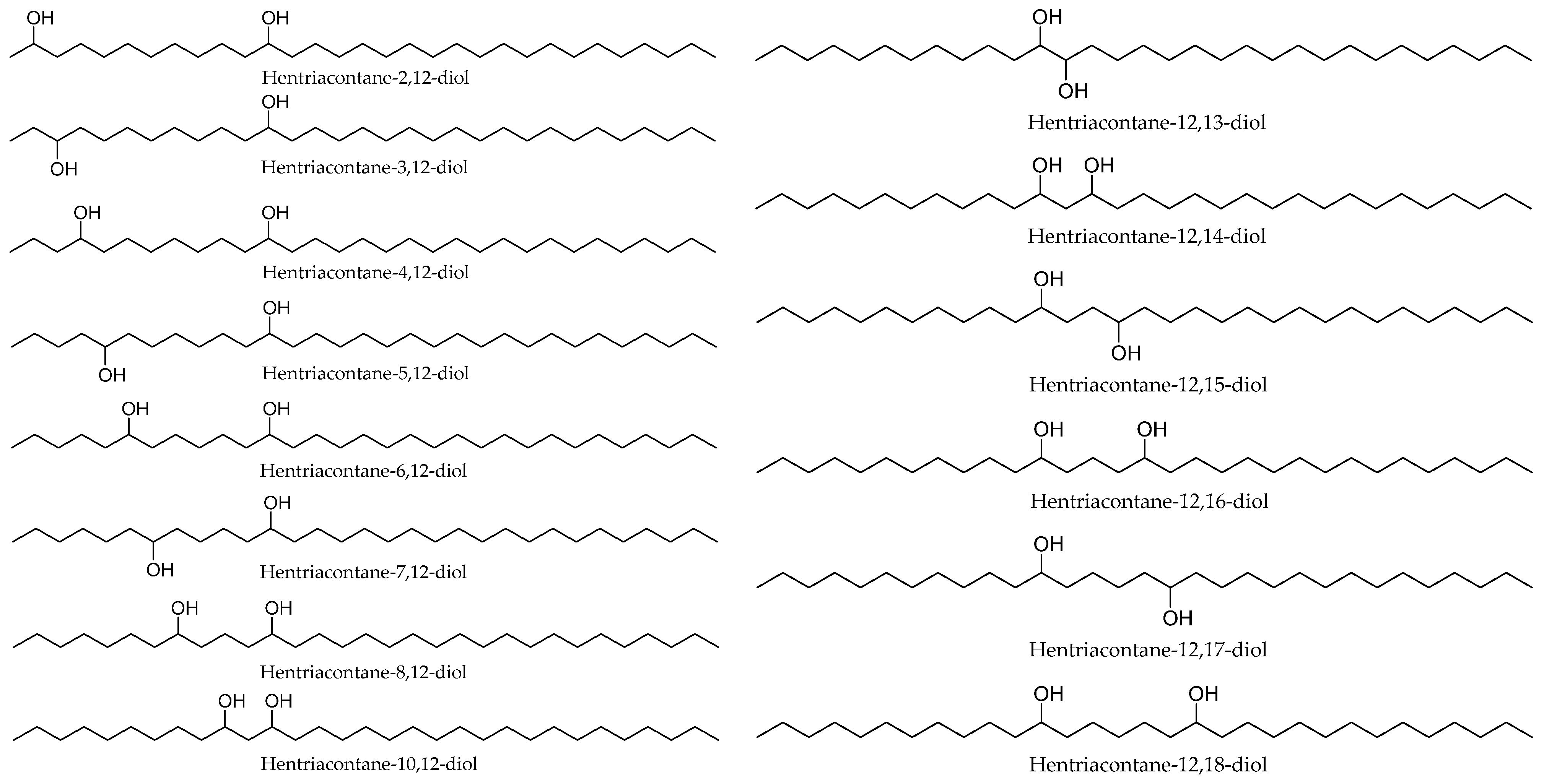
| leaf wax | Long-chain fatty alcohols | [68] | ||
| Pentacosane-8,10-diol | GC-FID, GC-MS | |||
| Heptacosane-6,8-diol | “ | |||
| Heptacosane-8,10-diol | “ | |||
| Heptacosane-10,12-diol | “ | |||
| Nonacosane-3,10-diol | “ | |||
| Nonacosane-8,10-diol | “ | |||
| Nonacosane-10,12-diol | “ | |||
| Hentriacontane-2,12-diol | “ | |||
| Hentriacontane-3,12-diol | “ | |||
| Hentriacontane-4,12-diol | “ | |||
| Hentriacontane-5,12-diol | “ | |||
| Hentriacontane-6,12-diol | “ | |||
| Hentriacontane-7,12-diol | “ | |||
| Hentriacontane-8,12-diol | “ | |||
| Hentriacontane-10,12-diol | “ | |||
| Hentriacontane-12,13-diols | “ | |||
| Hentriacontane-12,14-diol | “ | |||
| Hentriacontane-12,15-diol | “ | |||
| Hentriacontane-12,16-diol | “ | |||
| Hentriacontane-12,17-diol | “ | |||
| Hentriacontane-12,18-diol | “ | |||
| Dotriacontane-1,9-diol | “ | |||
| Dotriacontane-1,11-diol | “ | |||
| Dotriacontane-1,13-diol | “ | |||
| Tritriacontane-6,12-diol | “ | |||
| Tritriacontane-8,10-diol | “ | |||
| Tritriacontane-8,14-diol | “ | |||
| Tritriacontane-10,12-diol | “ | |||
| Tritriacontane-10,14-diol | “ | |||
| Tritriacontane-12,16-diol | “ | |||
| Tritriacontane-14,18-diol | “ | |||
| Tetratriacontane-1,11-diol | “ | |||
| Pentatriacontane-8,10-diol | “ | |||
| Pentatriacontane-10,12-diol | “ | |||
| Hexatriacontane-8,10-diol | “ | |||
| Hexatriacontane-9,11-diol | “ | |||
| Heptatriacontane-8,10-diol | “ | |||
| Heptatriacontane-10,12-diol | “ | |||
| Octatriacontane-8,10-diol | “ | |||
| Octatriacontane-9,11-diol | “ | |||
| Octatriacontane-10,12-diol | “ | |||
| Nonatriacontane-8,10-diol | “ | |||
| Nonatriacontane-8,11-diol | “ | |||
| Nonatriacontane-10,12-diol | “ | |||
| Tetracontane-8,10-diol | “ | |||
| Tetracontane-9,11-diol | “ | |||
| Tetracontane-10,12-diol | “ | |||
| Hentetracontane-8,10-diol | “ | |||
| Hentetracontane-8,11-diol | “ | |||
| Hentetracontane-10,12-diol | “ | |||
| Hentetracontane-10,13-diol | “ | |||
| Tritetracontane-8,11-diol | “ | |||
| Tritetracontane-10,13-diol | “ | |||
| n.i. | Other compounds | [75] | ||
| Polysaccharide | n.g. | |||
| M. germanica auct. non Linn. Desv. | leaves/branches | Flavonoids | [13] | |
| Kaempferol | UPLC-Q-TOF MS/MS | |||
| Kaempferol-3-O-rutinoside | “ | |||
| Isorhamnetin | “ | |||
| Isoquercetin | “ | |||
| Quercitrin | “ | |||
| Rutoside | “ | |||
| Quercetin 3-O-β-D-glucuronide | “ | |||
| Apigenin | “ | |||
| Acacetin | “ | |||
| Genkwanin | “ | |||
| Isovitexin | “ | |||
| Eupafolin | “ | |||
| Diosmetin | “ | |||
| Homoorientin | “ | |||
| Luteolin 7-O-glucuronide | “ | |||
| Calycosin-7-O-β-D-glucoside | “ | |||
| Jaceosidin | “ | |||
| Eriodictyol | “ | |||
| (+)-Catechin | “ | |||
| Tannins | [13] | |||
| Corilagin | UPLC-Q-TOF MS/MS | |||
| Phenolic acids and their derivatives | [13] | |||
| 4-Hydroxybenzoic acid | UPLC-Q-TOF MS/MS | |||
| 5-Acetylsalicylic acid | " | |||
| 4-Methoxysalicylic acid | “ | |||
| Isovanillic acid | “ | |||
| Gallic acid | “ | |||
| Methyl gallate | “ | |||
| Propyl gallate | “ | |||
| Brevifolincarboxylic acid | “ | |||
| Caffeic acid | “ | |||
| Isoferulic acid | “ | |||
| Ferulic acid | “ | |||
| Phenethyl caffeate | “ | |||
| Ethyl ferulate | “ | |||
| 1,3-Dicaffeoylquinic acid | “ | |||
| Other phenolics | [13] | |||
| Pyrogallol | UPLC-Q-TOF MS/MS | |||
| Vanillin | “ | |||
| 3,5-Dimethoxy-4-hydroxybenzaldehyde | “ | |||
| (+)-Pinoresinol | “ | |||
| Isoeugenol acetate | “ | |||
| Triterpenoids | [13] | |||
| Quillaic acid | UPLC-Q-TOF MS/MS | |||
| Corosolic acid | “ | |||
| Other compounds | [13] | |||
| Azelaic acid | UPLC-Q-TOF MS/MS | |||
| Aristolone | “ | |||
| Abscisic acid | “ | |||
| Germacrone | “ | |||
| Isoalantolactone | “ | |||
| Citric acid | “ | |||
| M. laxiflora | whole plant | Phenolic acids and their derivatives | [65] | |
| Methyl 3-O-methylgallate | ESI-MS, NMR | |||
| Triterpenoids | [65] | |||
| Erythrodiol | ESI-MS, NMR | |||
| Myricadiol | “ | |||
| Isomyricadiol | “ | |||
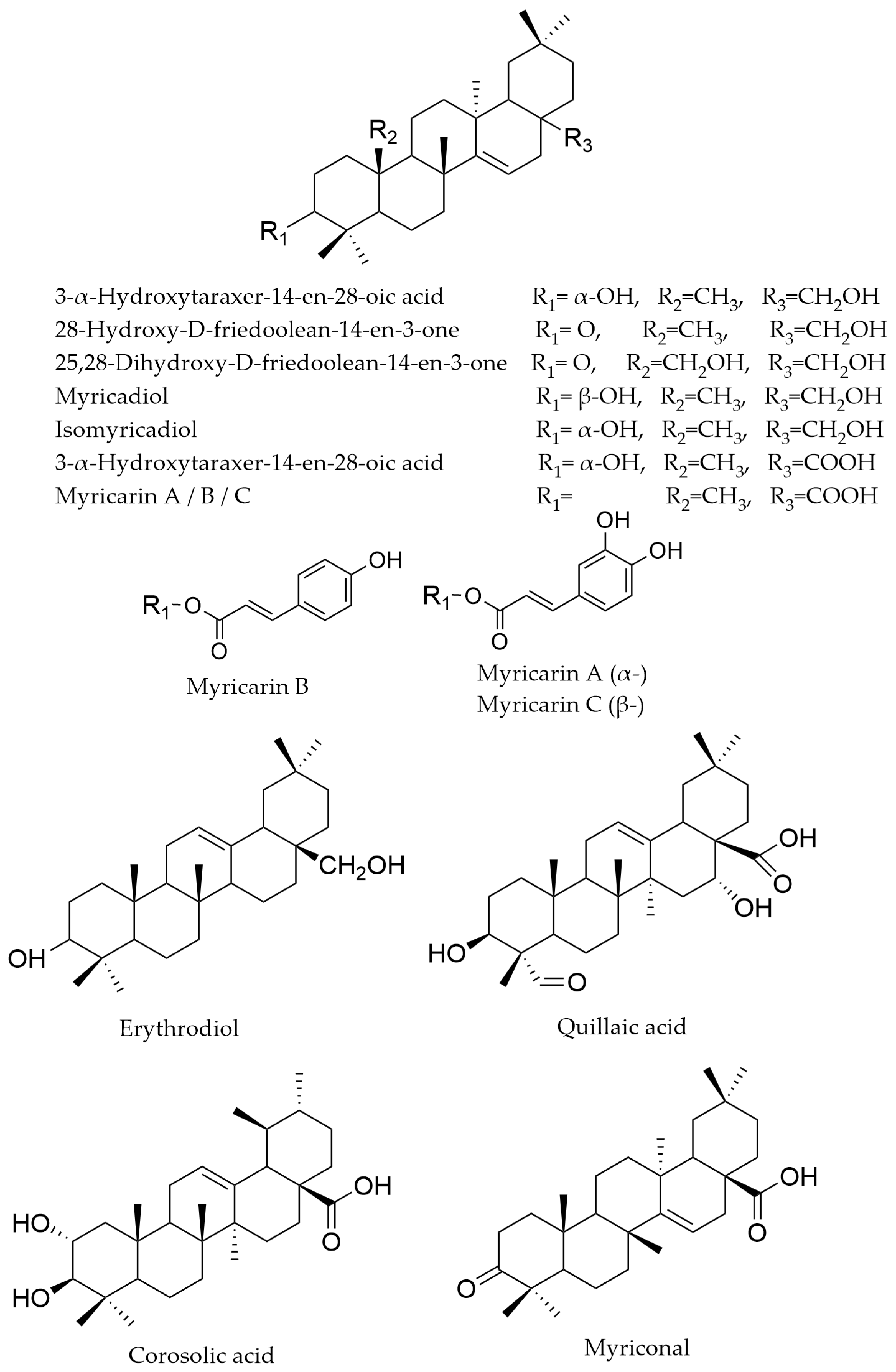
| (5R, 8R, 9R, 10R, 13S, 17S, 18S) 25, 28-Dihydroxy-D-friedoolean-14-en-3-one | “ | |||
| 28-Hydroxy-D-friedoolean-14-en-3-one | “ | |||
| 3-α-Hydroxy-D-friedoolean-14-en-28-oic acid | “ | |||
| 3-α-[4″-Hydroxy-trans-cinnamoyloxy]-D-friedoolean-14-en-28-oic acid | “ | |||
| Sterols | [65] | |||
| β-Sitosterol | ESI-MS, NMR | |||
| n.i. | Phenolic acids and their derivatives | [63] | ||
| Methyl 3,4-O-dimethylgallate (gallicin) | n.g. | |||
| M. longifolia | leaves | Flavonoids | [20,56,76,77,78] | |
| Kaempferol | HPLC-DAD | |||
| Astragalin | HPLC-DAD, LC-MS | |||
| Quercetin | “ | |||
| Rhamnetin | HPLC-UV-DAD, LC-MS | |||
| Isoquercetin | HPLC-DAD, LC-MS | |||
| Hyperoside | “ | |||
| Avicularin | “ | |||
| Quercetin 3-O-β-D-glucuronide | HPLC-DAD, UV, GC, NMR | |||
| Quercetin 3-sulfate | “ | |||
| Narcissin | HPLC-DAD | |||
| Isorhamnetin 3-sulfate | HPLC-UV-DAD, LC-MS | |||
| Apigenin | HPLC-DAD, LC-MS | |||
| Luteolin | “ | |||
| Naringenin | “ | |||
| Phenolic acids and their derivatives | [20,56,76,77] | |||
| Gallic acid | HPLC-DAD, LC-MS | |||
| Ellagic acid | “ | |||
| Ferulic acid | “ | |||
| Citric acid | “ | |||
| twigs/overground parts | Flavonoids | [52,77] | ||
| Kaempferol | HPLC-DAD | |||
| Quercetin | UV, HPLC-DAD | |||
| Isoquercetin | UV | |||
| Rhamnetin | “ | |||
| Tamarixetin | “ | |||
| Astragalin | HPLC-DAD | |||
| Hyperoside | “ | |||
| Narcissin | “ | |||
| Naringenin | “ | |||
| Phenolic acids and their derivatives | [77] | |||
| Gallic acid | HPLC-DAD | |||
| Ellagic acid | “ | |||
| Ferulic acid | “ | |||
| n.i. | Flavonoids | [79,80] | ||
| Quercetin | HPLC-UV-DAD, LC-MS | |||
| Rhamnetin | “ | |||
| Rutin | “ | |||
| Phenolic acids and their derivatives | [79,80] | |||
| Gallic acid | HPLC-UV-DAD, LC-MS | |||
| Ellagic acid | “ | |||
| Isoferulic acid | “ | |||
| Caffeic acid | “ | |||
| Syringic acid | " | |||
| Sterols | [79] | |||
| β-Sitosterol | HPLC-UV-DAD, LC-MS | |||
| M. paniculata | stem | Triterpenoids | [64] | |
| epi-Friedelanol | HREIMS, IR | |||
| 28-Hydroxy-D-friedoolean-14-en-3-one | “ | |||
| Myriconal | “ | |||
| Myricarin A | “ | |||
| Myricarin B | “ | |||
| Sterols | [64] | |||
| β-Sitosterol | HREIMS, IR | |||
| 4-Methylstigmast-7-en-3-ol | “ | |||
| Long-chain fatty alcohols | [64] | |||
| Triacontanol | HREIMS, IR | |||
| Hentriacontan-12-ol | “ | |||
| n.i. | Flavonoids | [58] | ||
| Morelloflavone | n.g. 2 | |||
| Phenolic acids and their derivatives | [58] | |||
| Methyl 4-O-methylgallate | n.g. 2 | |||
| Isoferulic acid | n.g. 2 | |||
| Triterpenoids | [58] | |||
| epi-Friedelanol | n.g. 2 | |||
| 28-Hydroxy-D-friedoolean-14-en-3-one | n.g. 2 | |||
| 28-Aldehyde-taraxerenone | n.g. 2 | |||
| Sterols | [58] | |||
| 4-Methylstigmast-7-en-3-ol | n.g. 2 | |||
| M. squamosa | overground parts | Triterpenoids | [67] | |
| 3-α-Hydroxy-D-friedoolean-14-en-28-oic acid | IR, NMR, HR-ESI-MS | |||
| Myricarin A | “ | |||
| Myricarin B | “ | |||
| Myricarin C | “ | |||
| n.i. | Flavonoids | [81] | ||
| Rhamnazin | n.g. 2 | |||
| Isoquercetin | n.g. 2 | |||
| Afzelin | n.g. 2 | |||
| Phenolic acids and their derivatives | [81] | |||
| 2,3,8-Tri-O-methylellagic acid | n.g. 2“ | |||
| Other phenolics | [81] | |||
| Syringenin | n.g. 2 | |||
| Triterpenoids | [81] | |||
| Isomyricadiol | n.g. 2 | |||
| Other compounds | [81] | |||
| Methyl linolenate | n.g. 2 | |||
| M. wardii | leafy twigs/branches 3 | Flavonoids | [45] | |
| Quercetin | UPLC-Q-TOF-MS/MS | |||
| Afzelin | “ | |||
| Isoquercetin | “ | |||
| Quercitrin | “ | |||
| Hyperoside | “ | |||
| Apigenin | “ | |||
| Luteolin | “ | |||
| Tricin | “ | |||
| Taxifolin | “ | |||
| Phlorizin | “ | |||
| Phenolic acids and their derivatives | [45] | |||
| Protocatechuic acid | UPLC-Q-TOF-MS/MS | |||
| Vanillic acid | “ | |||
| Methyl vanillate | “ | |||
| Gallic acid | “ | |||
| 3-O-Methylgallic acid | “ | |||
| 3,4-O-Dimethylgallic acid | “ | |||
| Syringic acid | “ | |||
| Methyl 3-O-methylgallate | “ | |||
| Ellagic acid | “ | |||
| Isoferulic acid | “ | |||
| Caffeic acid | “ | |||
| 3,4-Dimethoxycinnamic acid | “ | |||
| Feruloyl-amides | [45] | |||
| N-Feruloyl tyramine | UPLC-Q-TOF-MS/MS | |||
| Isomer-N-feruloyl tyramine | “ | |||
| 3-(4-Hydroxy-3-methoxyphenyl)-N-(2-(4-hydroxyphenyl)-2-methoxyethyl)-acrylamide | “ | |||
| Other phenolics | [45] | |||
| Protocatechualdehyde | UPLC-Q-TOF-MS/MS | |||
| Coniferylaldehyde | “ | |||
| Triterpenoids | [45] | |||
| Myricarin A | UPLC-Q-TOF-MS/MS | |||
| Other compounds | [45] | |||
| 8,11,12-Trihydroxy-9-octadecenoic acid | UPLC-Q-TOF-MS/MS | |||
| Linoleic acid | “ | |||
| Aesculetin | “ | |||
| Effusol | “ | |||
| leafy twigs 3 | Flavonoids | [45] | ||
| Kaempferol | UPLC-Q-TOF-MS/MS | |||
| Phenolic acids and their derivatives | [45] | |||
| Methyl 4-O-methylgallate | UPLC-Q-TOF-MS/MS | |||
| p-Coumaric acid | “ | |||
| Feruloyl-amides | [45] | |||
| N-Feruloyl-3-methyldopamine | UPLC-Q-TOF-MS/MS | |||
| Other compounds | [45] | |||
| Hexadecenoic acid | UPLC-Q-TOF-MS/MS | |||
| 9,12,13-Trihydroxy-10,15-octadecadienoic acid | “ | |||
| branches 3 | Flavonoids | [45] | ||
| Diosmetin | UPLC-Q-TOF-MS/MS | |||
| Dihydrokaempferol | “ | |||
| Phenolic acids and their derivatives | [45] | |||
| Methyl 3,4-O-dimethylgallate (gallicin) | UPLC-Q-TOF-MS/MS | |||
| Vanillin | “ | |||
| Terrestriamide | “ | |||
| Triterpenoids | [45] | |||
| Ursolic acid | UPLC-Q-TOF-MS/MS | |||
| Corosolic acid | “ | |||
| Myristic acid | “ | |||
| root bark | Flavonoids | [53] | ||
| Rhamnetin | UV (CZE) | |||
| Afzelin | “ | |||
| Phenolic acids and their derivatives | [53] | |||
| Gallic acid | UV (CZE) | |||
| 3,4-Dimethylgallic acid | “ |
| Species | Traditional Names | Traditional Uses | References |
|---|---|---|---|
| SIBERIA, CENTRAL ASIA, AND MONGOLIA | |||
| Myricaria bracteata | Mirikariya lisokhvostnaya (Russian) Tsetsgiin dagavart balgana (Mongolian) | -Shoots: rheumatism, fever, phthisis, measles, chronic ulcers, rashes, boils, spasm, and atrophy; -Cortex: fever, diabetes, cytotoxic; -Aerial parts as ingredients of the traditional Mongolian formulas: Braivu-3, Gagol-18, Gontog-7, Hachgurum-25, Degd-13, and Debao-9 cure fever, counteract toxicity; -Myricariae Ramulus ingredient of the traditional Mongolian formula Ga Gu La-19 Powder: strengthens the spleen, curing spleen cold and spleen heat. | [69,99,100] |
| M. davurica | Mirikariya daurskaya (Russian) Om-bu (Tibetan) | -Respiratory infections; -Leaves: astringent-flavored; air, phlegm, and bile disease. | [101,102] |
| M. longifolia | Mirikariya dlinnolistnaya (Russian) Urt navchit balgana (Mongolian) Ombu (Tibetan) | -Shoots: the taste is sour and sweet, astringent, the potency is blunt and cool; treats fever and poisoning, counteracts toxicity; -Ingredient of the traditional Mongolian formulas: Braivu-3, Gagol-18, Gontog-7, Khach gurgum-25, Degd-13, and Dedbo-10, Debao-9, Hachgurum-25; -Ornamental, useful plant. | [99,103,104] |
| HIMALAYAS, TIBETAN PLATEAU | |||
| M. albiflora | Blood purifier | [105] | |
| M. bracteata | Wenbu, Om-bu (Tibetan) Hambu, Hombuk (India) Kuan bao shui bai zhi (Chinese) | -Aerial parts decoction: blood purifier, neutralizes poison (meat poisoning), rheumatism, arthritis; -Whole plant in rheumatism (Uttaranchal, India); -Fodder, fuel, and small timber. | [61,66,106,107] |
| M. laxiflora | Shu hua shui bai zhi (Chinese) | -Aerial parts/dry young branch: the taste is spicy and sweet; scald, fistula, scabies, alopecia areata, typhoid, arthritis, sprains, women’s leucorrhea, thromboangiitis obliterans. | [14,63] |
| M. paniculata | Shui bai zhi (Chinese) | -Twigs: traditional Tibetan herb, the taste is sour and sweet, cold in nature, clears heat and toxic material, dispels mild wind and relieves exterior syndrome, promotes eruption and relieves coughs; -Also to cure rheumatism and arthritis. | [64,108] |
| M. platyphylla | -Aerial parts as ingredients of traditional medicinal bath therapies (WuWei GanLu). | [109] | |
| M. prostrata | Hom.bu, Chhu.shing.hom.bu, Ong bu (Tibetan) | -Aerial parts: neutralize poison (compounded or meat poison), bile fevers, pneumonia, also in veterinary; -External application for sores; -Whole plant as firewood/fuel. | [110,111] |
| M. pulcherrima | No data | ||
| M. rosea | Umbu (India) Chu-sching-om-bu (chushing-om-bu), Wombur (Bhutan) Angmeo, Wonbu, Hanmbu, Humpu, Yumbu (Nepal) Wo sheng shui bai zhi (Chinese) | -Potency: sweet (ngar) and astringent (ka)/cool (sil); -Aerial parts: fever associated with poisoning (dug-tshad), meat poisoning (sha-dug), blood infection (khrag-tshad), diarrhea, stomachache, uterine bleeding, fever, dropsy, wounds, chicken pox; -Leaves, stems, and flowers in wated decoction or plant paste: orally in respiratory/lung diseases, asthma, cough, cold, headache, diarrhea; | [107,109,112,113,114,115,116,117] |
| -Externally: relieves backache (plant paste), medicinal herbal bath; -Leaves, stems, and flowers in a water decoction for respiratory disease, asthma, bronchitis, breathing difficulty, 2–3 times a day (Manang and Mustang districts, Nepal); -Decoction for livestock in respiratory diseases (Manang district, Nepal); -Fuelwood and incense. | |||
| M. squamosa | Onbu (Pakistan) Wombu (Nepal) ‘Om-bu, umbo (Tibetan) Tark, bölghön (Wakhi, Kyrgyz; Afghanistan) | -Whole plant: traditional Tibetan herb, has astringent taste and a cooling potency; blood fever, exterior syndrome, and aconitum poisoning; -Febrifuge, poison plant (Ladakh, India); -Flower and leaves: fever, headache, antidote to food and meat poisoning (Dolpo, Nepal); -Flower infusion: antitussive, febrifuge (Gilgit-Baltistan, Pakistan); -Neutralize the poison (meat poisoning); -Powder of flowers and leaves dusted on wounds, injuries (also for livestock) (Gilgit-Baltistan, Pakistan); -Branches: passed quickly through fire, the oil exuded is applied to ‘white skin’ (Wakhi people, Afghanistan); -Useful plant: for screen-door of yurts (Wakhi people, Afghanistan); fuelwood (Kirgiz nomads, Afghanistan). | [67,112,118,119,120,121,122,123] |
| M. wardii | -Shoots: Tibetan heat-clearing and detoxifying agent. | [45,124] | |
| Myricariae ramulus (leafy twigs and branches of Myricaria wardii, M. squamosa, M. paniculata, M. bracteata, and Myrtama elegans) | -Twigs and branches: Tibetan heat-clearing and detoxifying agent; infections, sore throat, scalds, joint pain, rheumatic arthritis. | [45] | |
| WESTERN HIMALAYA | |||
| M. germanica (M. germanica subsp. pakistanica) | Hombug, humbu umbu, umbo, um-boo (India) Wengbu | Leaves: jaundice, chronic bronchitis, analgesic; Juice from fresh tender shoots with leaves: ingre-dient in the medicines to cure joint pains, swell-ings (Lahaul-Spiti region, India); Branches and leaves: cold, asthma, measles, scor-pion poison, limiting the effects of poison, rheu-matism; Bark decoction: jaundice, inflammation, sore throat; Leaves, stems, shoots or whole plant paste/decoction: applied to bruises and swollen joints, topical/oral toothache; Leaves: to treat jaundice, swollen joints, as aperi-ent, emollient (Uttaranchal); controls bronchitis, decoction once a day as a blood purifier (Ladakh, India); Fuel/fodder. | [106,107,115,125,126,127,128,129,130] |
| EUROPE | |||
| M. germanica | Židoviník německý (Czech), Piskeris (Danish), German false tamarisk (English), Pensaskanevra (Finnish), Myricaire, tamarin, Tamarin d’Allemagne (French), Deutsche Tamariske, Rispelstrauch (Deutsch), Tamerici alpino (Italian), Klåved (Norvegian), Września (Polish), Klådris (Swedish), Myrikovka nemecká (Slovak); Herbakotu (Turkish) | -Infusion of leaves as analgesic; -Rubbing oil; -Useful plant: basketry; -Fuel/fodder. | [131,132,133] |
| Myricaria Species (Plant Part, Origin) | Tested Activity | Type of Extract or Tested Compounds | Results | Assay/Experimental Model | References |
|---|---|---|---|---|---|
| M. bracteata | |||||
| (twigs; collected in Qinghai, China) | antioxidant | isolated tannins: nilotinin M4, 1,3-di-O-galloyl-4,6-O-(aS)-hexahydroxydiphenoyl-β-D-glucose, bracteatinin D1, D2, hirtellin A, B, E, isohirtellin C, tamarixinin A, nilotinin D8, bracteatynin T4, hirtellin T3 | lipid peroxidation inhibition (↓MDA) IC50 [μg/mL]): - hirtellin A (15.6), hirtellin B (48.8), tamarixinin A (18.4) | in vitro: lipid peroxidation test; rat liver microsomes | [61] |
| hydroxyl radical-scavenging activity (IC50 [μM]): - nilotinin M4 (37.96), 1,3-di-O-galloyl-4,6-O-(aS)-hexahydroxydiphenoyl-β-D-glucose (34.62), bracteatinin D1 (15.8), bracteatinin D2 (36.81), hirtellin A (38.49), hirtellin B (39.72), hirtellin E (16.27), isohirtellin C (42.91), tamarixinin A (41.52), nilotinin D8 (32.55), hirtellin T3 (55.1), bracteatinin D1 (15.8) - positive controls: BHT (22.63), Trolox (76.73), gallic acid (15.66) | hydroxyl radical-scavenging rate (modified deoxyribose degradation method) | ||||
| DPPH radical-scavenging activity (IC50 [μM]): - all tested compounds (2.4 to 5.89) - positive controls: BHT (7.08), Trolox (8.0), gallic acid (7.23) | DPPH assay | ||||
| (branches; collected in Gobi-Altay, Mongolia) | EtOH, EA, BuOH fractions; isolated compounds: quercetin, quercetin 3-O-β-D-glucuronide, quercetin-3-O-β-D-glucopyranoside, kaempferol, isorhamnetin, gallic acid, ethyl gallate, tellimagrandin II | free-radical scavenging activity - extract/fractions IC50 [mg/mL]): EtOH (31.93 ± 0.48), EA (27.11 ± 0.58), BuOH (26.14 ± 0.31) - positive control: rutin (22.66 ± 0.29 mg/mL) - compounds (IC50 [μM]): quercetin (41.36 ± 0.89), quercetin 3-O-β-D-glucuronide (24.3 ± 0.27), quercetin-3-O-β-D-glucopyranoside (13.4 ± 1.04), kaempferol 86.7 ± 1.13), isorhamnetin (68.42 ± 0.02), tellimagrandin II (5.97 ± 0.52), gallic acid (30.9 ± 1.21), ethyl gallate (53.94 ± 1.2) - positive control: rutin (38.7 μM) | in vitro: DPPH assay | [69] | |
| (twigs; collected in Qinghai, China) | anti-inflammatory | tamarixinin A | ↑ viability rates; positive control: methotrexate | in vitro: viability rates (MTT assay); LPS-induced murine macrophages from C57BL/6J male mice | [61] |
| % of inhibition rates [in sc mg/kg doses]: - ear edema (34.4 at dose 50.0 to 69.8 at dose 200) | in vivo: Croton oil-induced ear edema; ICR male mice | ||||
| - paw edema 25.0 at dose 50 | carrageenan-induced paw edema, ICR male mice | ||||
| CIA in 56 days: 46.0 at dose 20.0 | collagen-induced arthritis (CIA); DBA/1 mice | ||||
| dose-dependent ↓ TNF-α, ↓ IL-6, ↓ NO; ↓ iNOS expression, ↓ MAPK and ↓NF-κB signal activation | in vitro: ELISA, Gres reagent, Western blot; peritoneal macrophages isolated from C57BL/6 mice | [142] | |||
| effective dose: 12.5 mg/kg; ↓ paw swelling, ↓ body weight loss; ↓ IL-6, ↓ IL-1β | in vivo: CIA model; DBA/1 mice | ||||
| effective dose: 6.25 mg/kg; ↓ paw swelling, ↓ erythrema; ↓ TNF-α, ↓ IL-1β; ↓ expression p38, p65, ↓phosphorylation p38; positive control: methotrexate | AIA model; Wistar rats | ||||
| (herb; collected in Gobi-Altay, Mongolia) | antimicrobial | crude 80% EtOH extract; DCM, EA, BuOH fractions | inhibition zone [mm] for dose 100 mg/mL: - EtOH: S. aureus (11.7), E. faecalis (12.2), M. luteus (13.7) - DCM: S. aureus (10.0), M. luteus (11.6) - EA: P. aeruginosa (10.5), S. aureus (14.6), M. luteus (14.6) - BuOH: S. aureus (12.7), M. luteus (11.8) | in vitro: disc diffusion method; bacteria: P. aeruginosa, S. aureus, M. luteus, E. faecalis, E. coli | [143] |
| (herb; collected in Novosibirsk, Russia) | volatile emission | relative decrease of the number of microorganism colonies [%]: S. epidermis (60–70), C. albicans (30–40), E. coli (0) | in vitro: bacteria: S. epidermis, E. coli, yeast: C. albicans | [21] | |
| (branches; collected in Gobi-Altay, Mongolia) | AChE inhibition | crude 80% MeOH extract; DCM, EA, BuOH fractions, isolated compounds: quercetin-3-O-β-D-glucuronide, quercetin-3-O-β-D-glucopyranoside, quercetin-3-O-α-L-rhamnopyranoside | enzyme inhibition [IC50 [mM]): - in conc. 1 mg/mL: EA fraction (over 60%), other (40–59%) - positive control in conc. 0.1 mg/mL: physostigmine (0.000083) - quercetin-3-O-β-D-glucuronide (0.077 ± 0.002), quercetin-3-O-β-D-glucopyranoside (0.041 ± 0.001), quercetin-3-O-α-L-rhamnopyranoside (0.073 ± 0.005) | in vitro: Ellmann method (DTNB) | [69] |
| (branches; collected in Gobi-Altay, Mongolia) | pancreatic lipase inhibition | isolated compound: tallimagrandin II | enzyme inhibition (IC50 [mM]): - tellimagrandin II (0.051 ± 0.0001) - positive control: orlistat (0.109) | in vitro: DTNB assay | [69] |
| (cortex; n.i.) | glucose absorption inhibition | H2O extract | dose 500 mg/kg: ↓ intestinal glucose (2 g/kg b.w.) absorption | in vivo: intestinal glucose absorption; male Wistar rats | [100] |
| M. davurica | |||||
| (aerial parts; n.i.) | choleretic | decoction | at dose 0.05 g/kg: bile secretion rate in 5 h ↑18% | in vivo: Wistar rats | [144] |
| M. germanica | |||||
| (leaves; collected in Gilgit, Pakistan) | antioxidant | isolated compound: methyl gallate | viability [%]: - at dose 50 μM 95.5% ± 16.0 vs. 57.6% ± 1.1 (blank) - at dose 100 μM 85.5% ± 7.0 vs. 57.6% ± 1.1 (blank) | in vitro: protection of H2O2-induced oxidative stress apoptosis in β-cells; MTT assay; MIN6 cells | [145] |
| (aerial parts; collected in Quinghai, China) | anti-inflammatory | essential oil | skin inflammation ↓ TNF-α, ↓ IL-6, ↓ Caspase-3, ↓ ROS, ↓ MDA | in vitro: CCK-8 assay; HaCaT cells | [146] |
| identified corresponding targets and signaling pathways | in silico: molecular docking and network pharmacology | ||||
| (leaves; collected in Turkey) | antimicrobial | infusion | inhibition zone [mm]: - B. megaterium (8), K. pneumoniae (8), C. glabrata (8), C. tropicalis (18) - other tested strains—no activity - positive controls: streptomycin sulfate (9–13), nystatin (11–18) | in vitro: disc-diffusion method; bacteria: B. megaterium, P. aeruginosa, E. coli, K. pneumoniae, P. vulgaris, S. aureus, yeasts: C. albicans, C. glabrata, C. tropicalis | [132] |
| (roots, aerial parts; collected in Jammu & Kashmir, India) | MeOH extract | inhibition zone [mm] in conc. 100 μg: - P. aeruginosa (17), S. aureus (25), B. subtilis (27), S. epidermis (20), C. albicans (18) - P. vulgaris and E. coli no activity - positive control: kanamycin (30) | in vitro: agar well diffusion method; bacteria: P. aeruginosa, P. vulgaris, S. aureus, E. coli, B. subtilis, S. epidermis, yeasts: C. albicans | [44] | |
| (aerial parts, roots; collected in Jammu & Kashmir, India) | cytotoxic | MeOH extract | ↓ viability [%] in dose 100 μg: aerial parts: THP-1 (83), A549 (40), HCT-15 (30), HeLa (22), PC-3 (24) - roots: HCT-15 (68), (other 3–16) THP-1 (16), PC-3 (15), A549 (13), HeLa (-3 - positive controls (in dose 1 × 10⁻⁶ μg) paclitaxel: THP-1 (13), A549 (61), HCT-15 (17), Hela (6) PC-3 (7); mitomycin-C: THP-1 (23), A549 (43); HCT-15 (21), Hela (4) PC-3 (67) | in vitro: SRB assay; human cancer cell lines: THP-1, A-549, HCT-15, HeLa, PC-3 | [44] |
| (leaves; collected in Germany) | EtOH-H2O extract, isolated fractions with identified compounds | IC50 [μg/mL]: - crude extract: PC-3 (6.5), Huh-7 (2.85), MCF-7 (0.2) - active (better than control) fractions against PC-3: tamarixellagic acid (0.13), fraction contain quercetin 3-O-β-glucuronide, kaempferol 3-O-β-glucuronide, tamarixetin 3-O-β-glucuronide (0.22), 2,3-di-O-galloyl-(α/β)-glucose (0.3), 2,6-di-O-galloyl-(α/β)-glucose (0.4), fraction contain 1,3-di-O-galloyl-β-glucose, 2,4-di-O-galloyl-(α/β)-glucose (0.61) Huh-7: all fractions except fraction contain kaempferide 3-OSO3Na and tamarixetin 3-OSO3Na MCF-7: fraction contains gallic acid and 3-O-methylgallic acid (0.13), tamarixellagic acid (0.16) positive control: doxorubicin PC-3 (0.63), Huh-7 (1.5), MCF-7 (0.13) 2,6-di-O-galloyl-(α/β)-glucose (015) - fractions (tamarixellagic acid, tamgermanitin) act in cell cycle distribution at G0/G1, S, G2/M and pre-G-phase; ↑ caspase-3, ↓ cell-free PARP enzyme | in vitro: SRB assay, caspase-3 activity (Huh-7; Quantikine immunoassay kit), PARP enzyme activity assay | [54] | |
| (n.i.; collected in Tibet, China) | nano-drug delivery system based on M. germanica polysaccharide nanoparticles complex | CS-Au-MGP nanoparticles: ↑ IgG1, ↑ IgG2, ↑ IFN-γ, ↑ IL-6 (+)thymus, spleen, and liver indices | in vivo: ELISA; ICR mice | [75] | |
| (n.i.; collected in Tibet, China) | selenated polysaccharide isolated from leaves, PLGA encapsulated | ↑ phagocytic ability ↑ IFN-γ, ↑ IL-4 ↑ organ index, (+)immune functions of spleen, thymus, and bursa of Fabricius | in vitro: RAW264.7 macrophages in vivo: MTT, ELISA; chicken | [94] | |
| (leaves; collected in Gilgit-Baltistan, Pakistan) | prolyl endopeptidase (PREP) inhibition in model steatohepatitis | MeOH extract; EA, PE fractions; isolated compounds: (±)-2-pentacosylcyclohexanol, methyl gallate, syringic acid, butanedioic acid | PREP inhibition [%], (IC50 [μM]): - in conc. 1 mg/mL: EA (97.8%), - in conc. 500 mg/mL: (±)-2-pentacosylcyclohexanol (88%, 20.05 ± 1.6), methyl gallate (59.0%); syringic acid (75.4%, 155.13 ± 1.8), butanedioic acid (64.7%); ↑ cell viability | in vitro: ROS assay (fluorescence microscopy), TG assay kit, PCR; HepG2 cells | [73] |
| protective effect (measured: TC, TG, LDL, HDL, ALT, AST); standard: inhibitor Kyp-2047 | in vivo: cell viability assay, steatohepatitis model; male C57BL/6 mice | ||||
| enzyme binding mechanism for (±)-2-pentacosylcyclohexanol | in silico: molecular docking | ||||
| (n.i.; n.i.) | toxicity | H2O extract | tolerance for dose 120 g/kg: LD50 4.4482 ± 0.0329 g/kg (i.p.) | in vivo: mice | [147] |
| Myricaria germanica auct. non Linn. Desv. | |||||
| (branches and leaves; collected in Qinghai, China) | anti-inflammatory | MeOH extract, identified compounds | identified probably important targets and anti-RA activity pathways, proposed important active compounds: apigenin, isorhamnetin, quillaic acid | in silico: molecular docking and network pharmacology for determined compounds | [13] |
| (young branches; collected in Qinghai, China) | anti-inflammatory | flavonoid fraction | intragastric dose 1–1.5 g/kg: ↓ secondary inflammation from 24th day (paw swelling), ↓ thymus and spleen index, ↑ lymphocyte proliferation, ↑ phagocytosis of peritoneal macrophages, ↑ IL-2, ↑ TNF-α; positive control: indomethacin | in vivo: AA rats | [12] |
| M. laxiflora | |||||
| (n.i.; collected in China) | antimicrobial | isolated compound: gallicin | MIC [mg/mL]: - S. aureus (5), E. coli (10), Rhizopus sp. (5) | in vitro: bacteria: S. aureus, E. coli; fungus: Rhysopus sp. | [63] |
| M. longifolia | |||||
| (overground; collected in Mongolia) | hepatototoxic | H2O extract | dose-dependent effect: in concentration 100 μg/mL (more than 30% necrotic cells), no genotoxic effect | in vitro: primary rat hepatocyte assay with stimulation by EGF | [76,148] |
| (overground; collected in Mongolia) | anti-choleretic | H2O extract | bile flow [% of the basal value]: - in conc. 200 mg/L (−13) - in conc. 1000 mg/L (−51) | ex vivo: liver perfusion test; isolated rat liver | [76] |
| M. paniculata | |||||
| (twigs; n.i.) | antioxidant | H2O extract | scavenging activities [mg trolox/g dw]: - ABTS•+ (145.93 ± 6.08) - O2•− (316.18 ± 12.16) - FRAP (112.3 ± 7.25) | in vitro: ABTS•+-, O2•−-scavenging power, FRAP test | [108] |
| (stems; collected in Qinghai, China) | cytotoxicity | isolated compounds: myricarin A and B | myricarin A and B: no cytotoxicity (IC50 > 10 μg/mL for all cell lines) | in vitro: MTT method; human cancer cell lines: Bel-7402; HCT-8, BGC823, A549 and MCF-7 | [64] |
| (n.i., collected in Qinghai, China) | UVB-protective | pure compounds: kaempferol, rhamnazin, rhamnocitrin, quercetin-3-O-β-D-glucuronic acid, ferulic acid, caffeic acid, gallic acid | ↑cell viability after 6 h in dose 3 μmol/L; identified most active compounds’ impact on cell viability, inhibit early cell apoptosis or delay cell apoptosis - ↑ SOD activity: kaempferol, gallic acid - ↓ MDA: kaempferol, gallic acid - ↓ IL-6: kaempferol, rhamnocitrin, quercetin-3-O-β-D-glucuronic acid, ferulic acid - ↓ TNF-α: ferulic acid, caffeic acid, gallic acid - ↓ Caspase-3: kaempferol, quercetin-3-O-β-D-glucuronic acid | in vitro: CCK-8 assay, flow cytometry HaCaT cells after UVB irradiation | [92] |
| proposed core targets related to skin inflammation and mechanisms of action | in silico: molecular docking and network pharmacology for selected compounds | ||||
| M. squamosa | |||||
| (overground parts; collected in Qinghai, China) | antioxidant | isolated compounds: myricarin A, C | EC50 [μg/mL]: - myricarin A (40.9), myricarin C (42.22) - positive control: rutin (5.17) | in vitro: DPPH test | [67] |
| M. wardii | |||||
| (leafy twigs, branches; collected in China) | antioxidant | isolated compounds: methyl 3,4-dihydroxy-5-methoxybenzoate, protocatechualdehyde, protocatechuic acid, myricarin A | IC50 [mM]: - methyl 3,4-dihydroxy-5-methoxybenzoate (0.26 ± 0.02), myricarin A (0.31 ± 0.1), protocatechualdehyde (2.43 ± 0.26), protocatechuic acid (0.42 ± 0.01) - positive control: Trolox (0.28 ± 0.01) | in vitro: ABTS test | [45] |
| anti-inflammatory | 95% EtOH extract; PE, EA, BuOH, H2O fractions | dose 100 mg/kg: - ↓IL-6, ↓ MPO activity in serum or lung tissue; alleviated the damages of lung tissue - EtOH, EA, H2O: ↓ MPO, ↓ IL-6 (serum, lung) - PE: ↓ MPO, ↓ IL-6 (serum) but no significant effect in lung - BuOH: ↓ MPO, ↓ IL-6 (lung), no effect on IL-6 in serum | in vivo: MPO activity in lung tissue IL-6 level in serum and lung tissue; LPS-infected male BALB/c mice | [45] | |
| anti-complementary | 95% EtOH extract; PE, EA, BuOH, H2O fractions; isolated compounds: methyl 3.4-dihydroxy-5-methoxybenzoate, protocatechualdehyde, protocatechuic acid, myricarin A | half-inhibit hemolysis concentration (CH50 [mM]): - extract and fractions: (5.86 ± 0.12 to 21.57 ± 0.29 μg/mL) - methyl 3.4-dihydroxy-5-methoxybenzoate (0.92 ± 0.38); protocatechualdehyde (0.2 ± 0.03), protocatechuic acid (1.02 ± 0.16), myricarin A (0.34 ± 0.08) - positive control: heparin (20.21 ± 2.0 μg/mL) | in vitro: hemolysis test | [45] |
Disclaimer/Publisher’s Note: The statements, opinions and data contained in all publications are solely those of the individual author(s) and contributor(s) and not of MDPI and/or the editor(s). MDPI and/or the editor(s) disclaim responsibility for any injury to people or property resulting from any ideas, methods, instructions or products referred to in the content. |
© 2026 by the authors. Licensee MDPI, Basel, Switzerland. This article is an open access article distributed under the terms and conditions of the Creative Commons Attribution (CC BY) license.
Share and Cite
Makowska-Wąs, J.; Sobolewska, D.; Grabowska, K.; Wróbel-Biedrawa, D.; Podolak, I. Genus Myricaria, the Smaller Sister of Tamarisks—Ornamental Value, Phytochemistry, Biological Activities and Traditional Uses. Life 2026, 16, 832. https://doi.org/10.3390/life16050832
Makowska-Wąs J, Sobolewska D, Grabowska K, Wróbel-Biedrawa D, Podolak I. Genus Myricaria, the Smaller Sister of Tamarisks—Ornamental Value, Phytochemistry, Biological Activities and Traditional Uses. Life. 2026; 16(5):832. https://doi.org/10.3390/life16050832
Chicago/Turabian StyleMakowska-Wąs, Justyna, Danuta Sobolewska, Karolina Grabowska, Dagmara Wróbel-Biedrawa, and Irma Podolak. 2026. "Genus Myricaria, the Smaller Sister of Tamarisks—Ornamental Value, Phytochemistry, Biological Activities and Traditional Uses" Life 16, no. 5: 832. https://doi.org/10.3390/life16050832
APA StyleMakowska-Wąs, J., Sobolewska, D., Grabowska, K., Wróbel-Biedrawa, D., & Podolak, I. (2026). Genus Myricaria, the Smaller Sister of Tamarisks—Ornamental Value, Phytochemistry, Biological Activities and Traditional Uses. Life, 16(5), 832. https://doi.org/10.3390/life16050832