1. Introduction
Driven by the profound integration of sensing, computing, and control algorithms, autonomous vehicles (AVs) command widespread attention across academia and industry for their extraordinary potential to elevate traffic safety and efficiency. As vehicle safety paradigms transition from structure-dependent passive safety to active safety governed by real-time state regulation, lateral stability serves as a fundamental metric of dynamic performance. It plays a decisive role in guaranteeing the active collision-avoidance capabilities of AVs and refining the overall driving experience. In the realm of lateral stability analysis, the phase plane method—specifically the phase portrait utilizing lateral velocity (
) and the yaw rate (
) as coordinate axes—is universally acknowledged as a robust and intuitive instrument. By examining phase trajectories, equilibrium points, and their regions of attraction, researchers delineate the stable operating boundaries, termed the “stability envelope” or “safe operating envelope.” Over the past decades, the classification of lateral stability regions has been extensively investigated; the primary methodologies are summarized in
Table 1.
The effectiveness of these classic methods largely depends on the precision of the stability boundaries and the feasibility of real-time computation. To address this issue, researchers have considered various influencing factors to analyze the actual stability region of vehicles. Ref. [
7] proposed an integrated analytical framework that combines phase-plane analysis, which focuses on transient (
) stability boundaries, with handling stability diagrams, which focus on steady-state steering characteristics. This provides a comprehensive perspective for evaluating how key parameters, such as tire characteristics and the center of gravity, affect the limit stability of a vehicle. Focusing on the issue of conservativeness, ref. [
8] utilized nonlinear bifurcation theory and handling stability criteria to define a dynamic envelope aimed at minimizing driver discomfort. Furthermore, ref. [
9] proposed a control-oriented method for delineating the lateral stability region. By constructing dynamic boundaries based on the (
) phase plane, this method achieves precise definition and condition-adaptive identification of the vehicle’s linear, nonlinear, and unstable states. Meanwhile, computational efficiency remains another major challenge limiting the real-time application of phase-plane analysis. The study in [
10] provided a major breakthrough in this regard by proposing a novel
(
) tire model. This model analytically transforms the numerical calculation of nonlinear equilibrium points into solving the roots of a cubic polynomial, thereby significantly accelerating the computational speed. In line with the demand for real-time and control-oriented stability assessments, phase-plane-based methods have been further combined with uncertainty analysis and coordinated chassis control. Ref. [
11] developed a stochastic phase-plane analysis method under road-friction uncertainty for vehicle stability control under extreme conditions. By considering the influence of adhesion uncertainty on the stability boundary, their study revealed that the phase-plane region may shift or contract when the vehicle operates near the handling limit. Ref. [
12] proposed an AFS/DYC cooperative control strategy based on model prediction and a phase-plane stability analysis, where the phase-plane boundary was used to classify the vehicle state and coordinate steering and yaw-moment interventions. Ref. [
13] further verified the effectiveness of phase-plane-boundary-based electric-vehicle stability control through simulation and experimental analysis. These works demonstrate that phase-plane analysis has gradually moved beyond qualitative trajectory interpretation and has become a practical stability criterion for online state evaluations and controller intervention. This development is consistent with the objective of this paper, in which the lateral stability region is dynamically evaluated and further incorporated into the hierarchical control strategy.
As research deepens, two-dimensional planar models are no longer sufficient to describe the global dynamic behavior of nonlinear systems, prompting the expansion of research into high-dimensional phase spaces. For example, ref. [
14] explored the region of attraction in a three-degree-of-freedom (3-DOF) phase space under coupled longitudinal motion, identifying the yaw moment as an effective control intervention. In the work of [
15], researchers designed simplified steering and longitudinal controllers, successfully maintaining the vehicle in a stable drifting state. To address more complex scenarios, such as the combined steering and braking conditions investigated in [
16], a 5-DOF nonlinear vehicle dynamic model was established. By analyzing the bifurcation characteristics of the equilibrium points, the boundaries of the stability region at a given initial longitudinal velocity were determined, and a three-dimensional stability region was successfully fitted.
While previous studies have revealed various characteristics of vehicle lateral stability, they often fail to adequately account for the strong nonlinear coupling among the lateral, vertical, and roll motions of the vehicle. During extreme steering or braking maneuvers, dynamic load transfer induced by lateral and longitudinal accelerations is inevitable. This dynamic load transfer significantly alters the vertical load distribution among the wheels, which directly impacts the available tire adhesion. Consequently, two-dimensional stability regions based on the assumption of constant vertical loads become unreliable in the presence of actual load transfer, as their defined boundaries may have already shrunk or shifted.
To more accurately reflect the vehicle’s controllable range, current research frontiers have shifted toward constructing multi-dimensional stability regions that incorporate the roll degree of freedom. For example, ref. [
6] proposed a three-dimensional “(
)” stability region. This study found that under high-speed, low-adhesion conditions, the vehicle should actively generate an “ideal roll angle” opposite to the steering direction to maximize stability. Similarly, the work in [
17] constructed a 3D “lateral velocity–yaw rate–lateral load transfer ratio” “(
)” phase space. Furthermore, ref. [
18] constructed a state space (
) using acceleration and the yaw rate measured based on an inertial measurement unit IMU to achieve global chassis control. Ultimately, these multi-dimensional models provide a broader range of constraint options for controller design.
Research on lateral stability regions aims to better delineate the controllable and uncontrollable regions of a vehicle, thereby facilitating stability control under extreme conditions. Currently, alongside traditional methods like active steering control [
19] and yaw moment control [
20,
21,
22], active suspension control [
23] has been extensively investigated. Active suspension systems directly intervene in the vehicle’s roll and lateral states by actively balancing the vertical loads between the left and right sides. For traditional vehicles, applying nonlinear model predictive control to adjust suspension characteristics [
24,
25,
26] enables effective trajectory tracking and stability control. In [
27], active inward tilt (AST) and all-wheel steering were integrated; the active roll moment generated by AST was utilized to optimize the load distribution, thereby mitigating the passenger discomfort caused by excessive lateral acceleration. For narrow tilt vehicles (NTVs), ref. [
28] experimentally demonstrated that steering and direct tilt control (SDTC) can significantly reduce load transfer by 36%. Meanwhile, ref. [
29] utilized MPC to address the non-minimum phase problem induced by active inward tilt. Based on the above studies on direct tilt control and MPC-based tilt stabilization, active inward tilting control has been further extended to constrained actuator control, torque-assisted tilt dynamics, and safety-oriented obstacle avoidance. Ref. [
30] proposed a semi-active actuator-based hybrid model predictive control strategy for vehicle tilting, in which the discrete adjustment of actuator states and the continuous tilting dynamics were integrated into a predictive control framework. Ref. [
31] investigated the tilt dynamics and control of narrow tilting electric vehicles considering the driving torque difference, showing that differential driving torque can assist the tilting response and improve vehicle stability when actuator dynamics are limited. Ref. [
32] studied personal mobility vehicles equipped with an active inward tilting mechanism and demonstrated that active inward tilting can improve obstacle-avoidance capability by enhancing lateral-force utilization and the steering response.
In terms of vehicle trajectory-tracking control, MPC-based methods have gradually developed from conventional tracking-error optimization toward robust constraint handling, disturbance compensation, low-adhesion adaptability, and data-driven prediction. Ref. [
33] proposed an adaptive tube-based robust MPC method for the path tracking of high-speed intelligent vehicles, in which the prediction horizon, control horizon, and look-ahead distance were jointly optimized to improve tracking accuracy and vehicle stability under uncertain conditions. Ref. [
34] combined ADRC with Tube MPC for the trajectory tracking of a four-mecanum-wheel mobile vehicle, where Tube MPC was used to handle system constraints and active disturbance rejection control was employed to compensate for external disturbances and model uncertainties. For low-adhesion and complex road conditions, ref. [
35] proposed a robust Tube-MPC trajectory-tracking controller for four-wheel independent steering vehicles on intermittent snowy and icy roads, explicitly incorporating road-condition uncertainty and a tire cornering-stiffness estimation into the control framework. Ref. [
36] further developed a Tube-based MPC method for the path tracking of autonomous vehicles subjected to disturbances near the handling limits, emphasizing that trajectory tracking under extreme conditions should simultaneously consider lateral stability and disturbance rejection. In addition to robust predictive control based on analytical vehicle models, ref. [
37] constructed a predictive model of coupled longitudinal and lateral vehicle dynamics using real driving data and designed a neural predictive controller, indicating that data-driven models can provide an alternative modeling approach for the predictive control of complex vehicle systems. From the perspective of active collision avoidance, ref. [
38] proposed a personalized collision-avoidance trajectory planning and variable-time-domain MPC method incorporating driver characteristics, so that the control horizon could be adjusted according to driver-specific avoidance behavior.
While the aforementioned studies provide valuable insights for designing vehicle lateral stability regions, a comprehensive analysis of stability region delineation considering vertical load transfer during high-speed cornering remains lacking. This deficiency is primarily manifested in two aspects: first, although active inward tilt control can effectively adjust the vertical loads on the left and right wheels, its specific impact on the lateral stability region has not been intuitively demonstrated. Second, the integration of a phase-plane stability region evaluation into vehicle stability control systems lacks direct and explicit implementation. To address the above issues, the main contributions of this paper are summarized as follows:
An improved method is proposed for calculating the two-dimensional phase-plane lateral stability region of active inward tilt vehicles. In constructing the stability boundary, the proposed method considers the vertical load transfer caused by vehicle roll motion and its influence on tire lateral forces. Therefore, the differences in the lateral stability boundaries between active inward tilt and passive roll conditions can be described more intuitively.
The effects of the longitudinal speed, front wheel steering angle, road adhesion coefficient, and vertical load transfer on the phase-plane stability region and state-trajectory convergence characteristics of active inward tilt vehicles are systematically analyzed under different operating conditions. By comparing the streamline-based stability boundary with the calculated lateral stability boundary, the influence of active inward tilt on stability-region expansion and vehicle-state convergence is further revealed.
The phase-plane stability region is further transformed into an online stability-determination criterion and incorporated into a hierarchical NMPC control framework for active inward tilt vehicles. The upper-level controller dynamically adjusts the reference values and objective weights according to whether the vehicle state is located in the stable, critical, or dangerous region. Meanwhile, the lower-level NMPC controller outputs the optimal active suspension force and front wheel steering angle, thereby improving vehicle handling stability during trajectory tracking.
The rest of this paper is organized as follows.
Section 2 establishes the nonlinear vehicle dynamics model, including lateral, yaw, and roll motions, and introduces the tire model used for the stability-region calculation.
Section 3 presents the improved calculation method for the phase-plane lateral stability region considering vertical load transfer.
Section 4 analyzes the stability-region boundaries and state trajectories under different operating conditions and develops the stability-region determination method.
Section 5 designs the hierarchical active inward tilt NMPC controller.
Section 6 verifies the proposed method through double lane-change simulations and compares the control performance of different cases.
Section 7 summarizes the main conclusions and discusses the limitations and future work.
2. Nonlinear Vehicle Dynamics Model
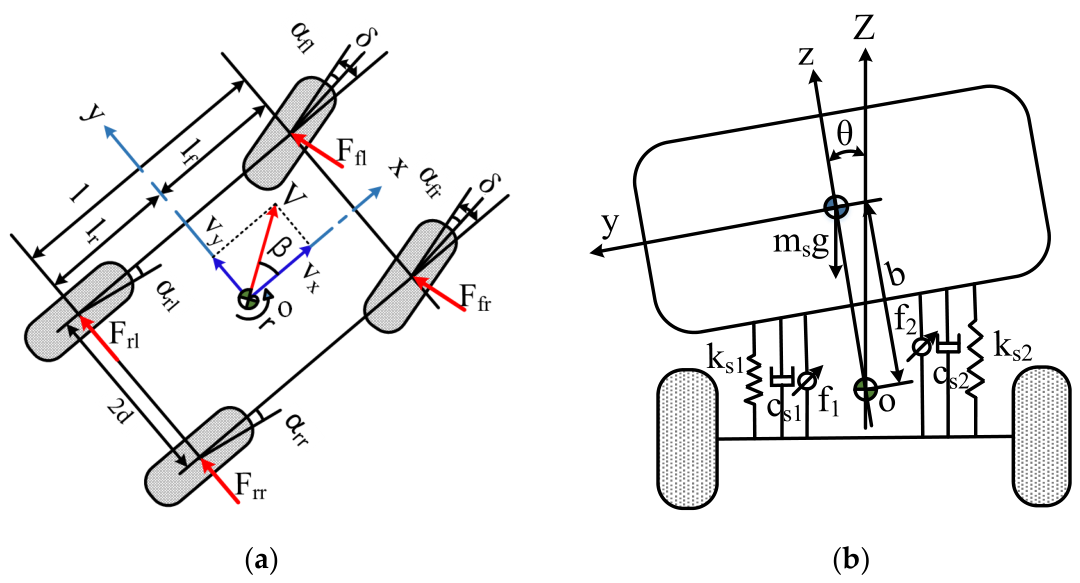
In this paper, a 3-DOF dynamics model was built, including the lateral, yaw, and roll motions of the vehicle. To study the phase plane stability region under active inward tilt control, a steering dynamics model and a roll dynamics model were established. These models are shown in
Figure 1a and
Figure 1b, respectively.
In this model, the effect of the sprung mass roll motion on the lateral and yaw motions of the vehicle was considered. Due to the unpredictable and uncontrollable nature of real-world roads, the vehicle was assumed to travel on a flat surface. Meanwhile, to reduce computational complexity, the effects of lateral and longitudinal aerodynamics on the yaw characteristics of the vehicle were ignored.
According to the D’Alembert principle, Equations (1)–(10) can express the dynamic Equation of the vehicle.
Equation (1) provides the dynamic Equation for the lateral motion:
The dynamic Equation for the yaw motion is given in Equation (2):
The dynamic Equation for the roll motion is given in Equation (3):
where
The vertical loads of the front, rear, left, and right tires are expressed by Equation (5):
In Equations (1)–(8),
represents the total mass of the vehicle;
is the sprung mass of the vehicle;
represents the roll angle of the sprung mass;
is the vehicle yaw moment of inertia about the
z-axis;
and
are the spring stiffness coefficients of the left and right suspensions, respectively;
is the rolling moment of inertia of the sprung mass;
and
are the damping coefficients of the left and right suspensions, respectively;
and
represent the distances from the center of mass to the front and rear axles, respectively;
is half the track width; and
is the distance from the vehicle center of mass to the ground.
The accuracy of the tire model directly affects the dynamic simulation results, and the Fiala tire model, which has strong versatility and is easily solvable, was selected for this study. The simplified Fiala lateral tire force model can be expressed by Equation (6):
where
represents the lateral force of the tire,
is the stiffness of the tire,
is the coefficient of friction between the tire and the ground,
is the declination angle of the tire, and
represents the vertical load of the tire. Additionally,
(where
) is a derating coefficient, which means that the lateral force weakens when the longitudinal force is applied, and since no longitudinal force is applied to the tire, the value of
is 1.
When studying vehicle lateral stability under extreme conditions, particularly when lateral tire forces saturate at large slip angles, linear approximations can be inaccurate. Therefore, the small-angle approximation was not used to calculate the tire slip angles in this study, as shown in Equations (7)–(10).
3. Improved Lateral Stability Region Calculation Method
The stability-region derivation in this paper is based on a control-oriented vehicle model. Since lateral instability and active inward tilt are mainly related to lateral, yaw, and roll motions, these three degrees of freedom are retained in the modeling process. In particular, the influence of roll motion on the left–right vertical load transfer is considered, and the Fiala tire model is adopted to describe the nonlinear lateral tire force under large slip angles. These modeling choices enable the proposed stability boundary to reflect the effect of active inward tilt on tire load redistribution and available lateral force. To make the boundary calculation suitable for subsequent controller design, the vehicle is assumed to travel on a flat road surface, aerodynamic effects on yaw motion are neglected, and steady-state cornering relationships are used in the boundary derivation.
During cornering, the passive roll vehicle rolls outward, generating a large lateral acceleration that degrades passenger comfort and increases the rollover risk. To address this issue, the active suspension allows the vehicle body to tilt inward. When the gravitational moment balances the centrifugal moment, the vertical loads on the left and right wheels can be redistributed, thereby reducing lateral acceleration. This angle is defined as the ideal tilt angle
, which can be expressed by
. In this paper, under active inward tilt control, the inward tilt angle of the vehicle
was expressed as follows:
The maximum inward tilt angle was calculated as 10° based on the suspension dynamic travel and track width data [
39]. For the passive roll vehicle, assuming steady-state cornering,
,
=
, and combining Equations (3) and (4), the maximum outward roll angle
was obtained as follows:
Then, by substituting the obtained limit roll angle into Equation (5) and combining it with
,
under the small steering angle approximation, the vertical load Equation (5) was further expressed as follows:
Based on Equations (1)–(13), the values of the state variables
were calculated and substituted as the limits for the yaw rate and lateral velocity. The boundary of the lateral stability region was expressed by Equation (14):
During steady-state cornering, vertical load transfer causes a difference in the available lateral forces between the left and right rear tires, leading to a reduction in the total rear lateral force. Meanwhile, as the steering angle and speed increase, the insufficient lateral force accelerates the lateral instability of the rear axle. Because the tires saturate before reaching the lateral force limit
, the traditional formula
was not used as the boundary condition. Instead, the stability region boundary in this study was designed to account for the variations in tire lateral forces under both active inward tilt and passive roll, making it more consistent with actual vehicle cornering conditions. Furthermore, the vehicle model and tire parameters were adopted from [
40], as shown in
Table 2.
4. Phase-Plane Analysis
In this section, the stability regions calculated using the equations and estimated via streamline convergence under 2-DOF, passive roll, and active inward tilt control were first plotted on the phase plane. Meanwhile, the effects of the longitudinal speed, front wheel steering angle, and road adhesion coefficient on the phase plane stability region were discussed. Furthermore, the state trajectories for both the active inward tilt and passive roll models were tracked along the streamlines to study the different convergence characteristics of various initial vehicle state points. The analysis results show that, compared to passive roll, active inward tilt expands the stability region in the two-dimensional phase plane, allowing it to contain more vehicle state points.
4.1. Stability Region Analysis
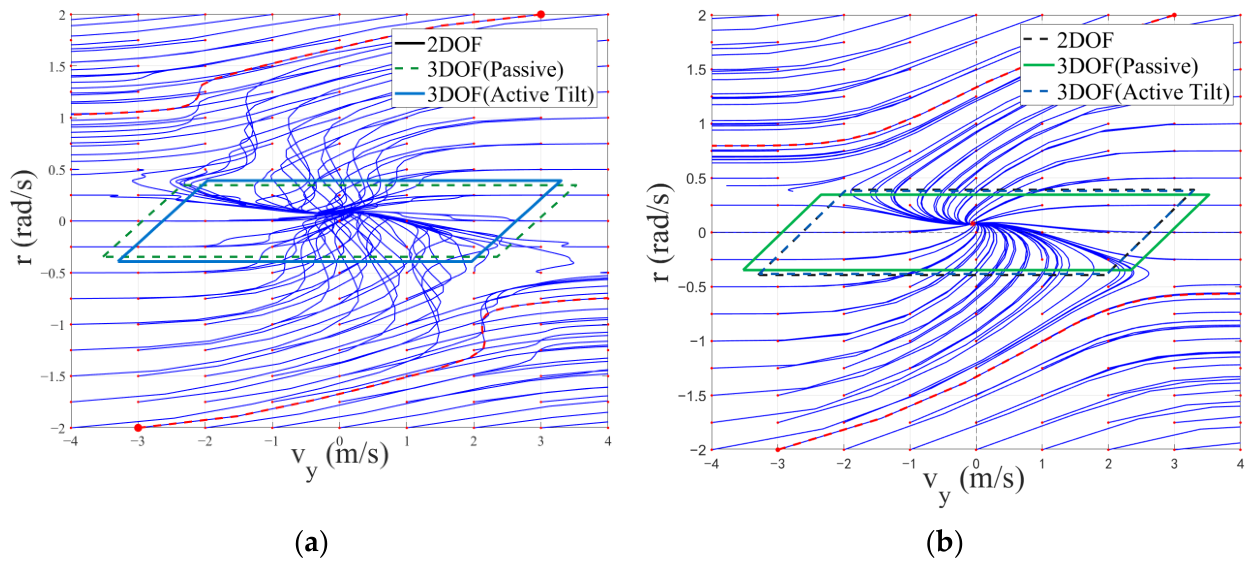
For closed-loop or open-loop phase-plane portraits, the stability regions and streamlines vary depending on the selected vehicle model. In this subsection, the phase-plane streamline boundaries and lateral stability boundaries among the 2-DOF, 3-DOF, and active inward tilt models were compared. As shown in
Figure 2, the red dashed line represents the stability boundary of the phase-plane streamlines, while the blue, green, and black lines represent the lateral stability boundaries for the respective vehicle models. These two boundaries were distinctly defined. In the phase-plane analysis, the equilibrium point represents the steady-state cornering condition of the vehicle. The
in the figure represents the equilibrium point in the phase-plane portrait of the active tilting vehicle. At this point, the lateral velocity and yaw rate remain constant, and the vehicle states satisfy the force and moment balance under the given steering input and vehicle speed. Therefore, the equilibrium point can be regarded as the reference state for judging vehicle stability. If the streamlines starting from different initial points gradually approach this equilibrium point, the corresponding vehicle states are considered to be convergent and stable; otherwise, the vehicle may lose lateral stability. The phase-plane streamline boundary is the dividing line that determines whether initial points can return to the steady-state cornering equilibrium. To plot this boundary, the
convergence criterion based on the velocity field [
1] was used. A global evaluation was performed for initial points within the ranges of
in
, and the state trajectory containing the limit initial points was set as the dividing line. Furthermore, the area of the stability region calculated for each model intuitively shows the vehicle’s stability-control capability.
By comparing
Figure 2a,b, compared to passive roll, the stability boundary value
in the active inward tilt vehicle increases from 0.34 rad/s to 0.39 rad/s, and the area of the streamline stability region expands by 12%. This means that initial state points diverging under passive roll can eventually converge to the equilibrium point through energy dissipation during roll oscillation, thereby expanding the stability region. Furthermore, for vehicle state points located between the lateral stability boundary and the streamline stability boundary in the second and fourth quadrants, some yaw rate or sideslip angle values are excessively large. However, the vehicle is not uncontrollable, as it has not exceeded the lateral stability region. If the tires can still provide sufficient lateral force, the vehicle state points converge along the state trajectories.
The streamline-based boundary and the calculated lateral stability boundary have different purposes in this study. The streamline-based boundary describes whether the vehicle states starting from different initial points can eventually converge to the steady-state equilibrium, and is therefore useful for offline stability-region analysis. However, obtaining this boundary requires numerical integration from a large number of initial points, which makes it difficult to apply directly in real-time controller design. By contrast, the calculated lateral stability boundary is more conservative, but it retains the main effects of vertical load transfer, nonlinear tire lateral force, and the difference between active inward tilt and passive roll based on the stability limit. Therefore, the streamline-based boundary is used as an analytical reference, while the calculated lateral stability region is adopted as the control-oriented safety boundary for subsequent stability determination and controller intervention.
4.2. The Influence of Longitudinal Speed, Front Wheel Steering Angle, and Road Adhesion Coefficient
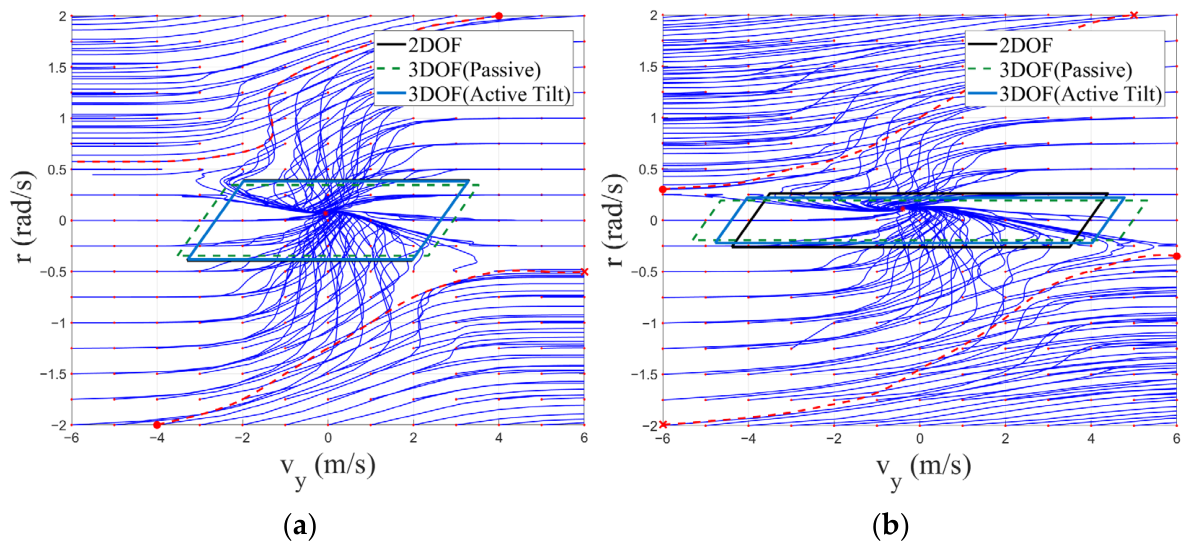
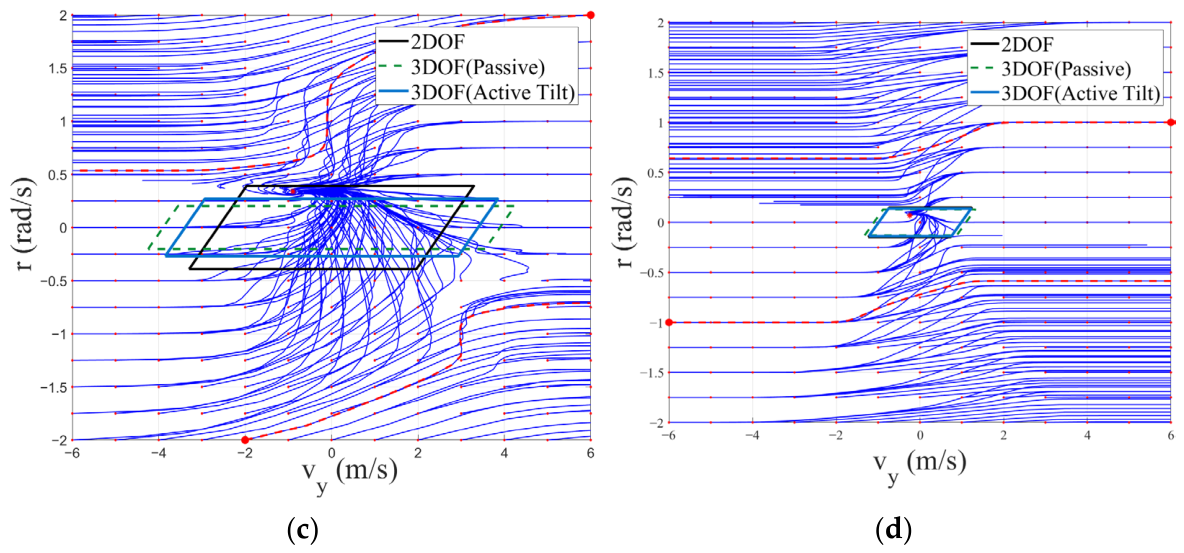
To systematically study the effects of the front wheel steering angle, vehicle speed, and road adhesion coefficient on the phase-plane streamlines and stability boundaries under active inward tilt, four comparative conditions were set, as shown in
Table 3. These conditions represent driving scenarios with low and high speeds, small and large steering angles, and normal and slippery road surfaces. The stability boundaries are shown in
Figure 3.
Vehicle longitudinal speed most directly impacts the estimated lateral stability region. As shown by comparing
Figure 3a,b, as the longitudinal speed increases, the lateral stability boundary
value for the active inward tilt vehicle decreases from 0.38 rad/s to 0.2 rad/s, and the overall stability region shrinks to 81% of its original area. This phenomenon is explained as follows: under identical
and
states, increased longitudinal speed reduces the tire sideslip angle and the available lateral force, decreasing the
value. Meanwhile, as tire stability decreases, the active force provided by the suspension is insufficient to balance the vertical loads on the left and right sides, shrinking the overall control range. Furthermore, based on Equation (13), the vertical loads on the left and right wheels under active inward tilt were calculated as 3409.42 N and 4299.34 N, respectively, whereas under passive roll, they were calculated as 2846.95 N and 4861.81 N. This variation in vertical loads also verifies the effectiveness of the proposed lateral stability region method.
During steady-state cornering, variations in the front wheel steering angle directly affect the performance of the left and right wheels, thereby altering the stability boundaries. As shown by comparing
Figure 3a,c, as the front wheel steering angle increases, the
boundary value of the active inward tilt lateral stability region decreases from 0.38 rad/s to 0.26 rad/s. Although the
boundary expands relatively, the overall stability control range shrinks to 75% of its original area. Furthermore, under large front wheel steering angle steady-state cornering conditions, the large tire lateral force required to balance the centrifugal force causes a significant increase in the yaw rate at the equilibrium point, which eventually converges outside the lateral stability region. Although this does not indicate an immediate danger of vehicle instability, considering the application of this study in subsequent controller design, the front wheel steering angle should be maintained within a certain range. The goal is to keep the steady-state equilibrium point within the lateral stability region, providing a physically realizable reference state constraint for the stable intervention of the controller.
The road adhesion coefficient directly affects the tire lateral friction force, thereby influencing the estimated stability region. As shown by comparing
Figure 3a,d, given a constant longitudinal speed and front wheel steering angle, a decrease in the road adhesion coefficient reduces the overall lateral stability region to 42% of its original area. This change is reasonable because, on slippery, low-adhesion road surfaces, the lack of tire friction makes the vehicle’s lateral motion difficult to control. In this case, the lateral stability regions under the active inward tilt and passive roll models are similar, with an
value of approximately 0.13 rad/s. Besides the road adhesion coefficient, other tire parameters also vary, leading to differences in tire characteristics among the four tires, which affects the vehicle’s handling characteristics [
41].
4.3. The Analyses of Vehicle State Trajectories
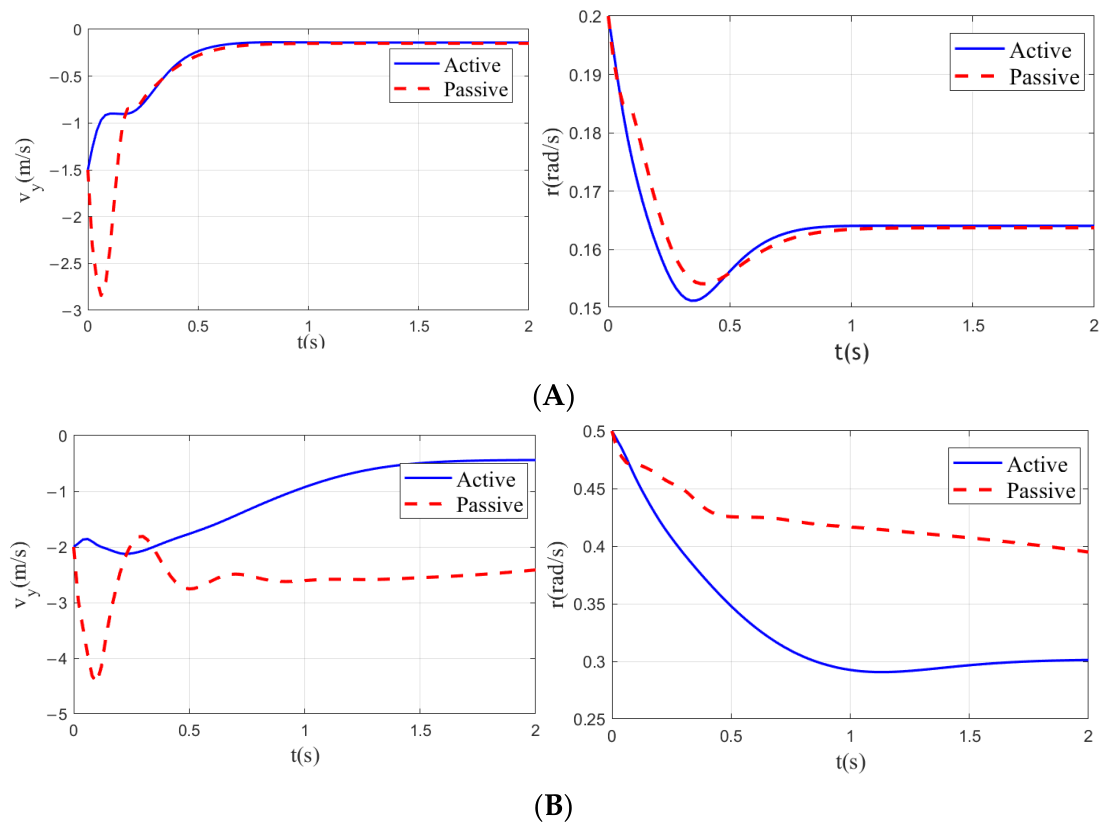
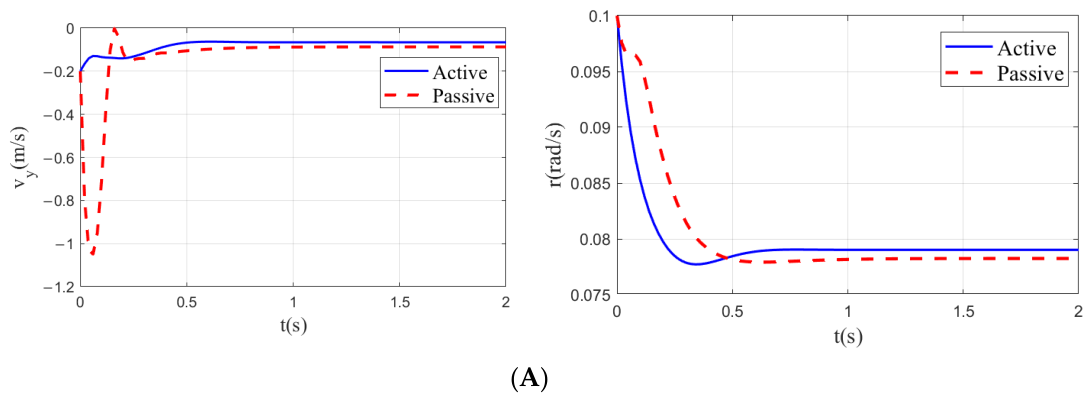
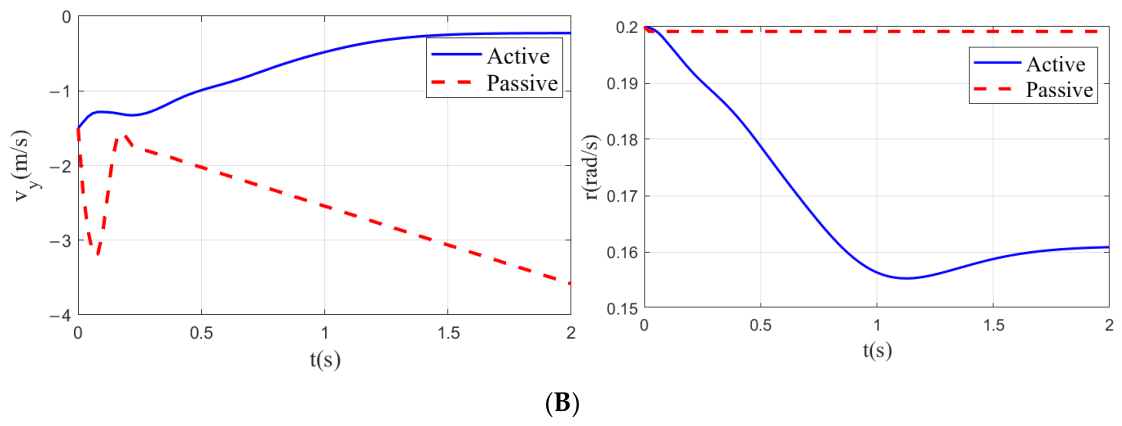
The phase-plane streamline visualization was obtained by applying numerical integration to the dynamic equations, where each streamline represents the state evolution trajectory starting from a specific initial state. To investigate the process of the vehicle returning to the steady-state equilibrium point under disturbances, the initial points of the streamlines for the two models shown in
Figure 3 were sampled and analyzed. Considering the variation in the lateral stability region, the initial points for the vehicle state trajectory analysis under the four selected operating conditions were set as follows (
Table 4):
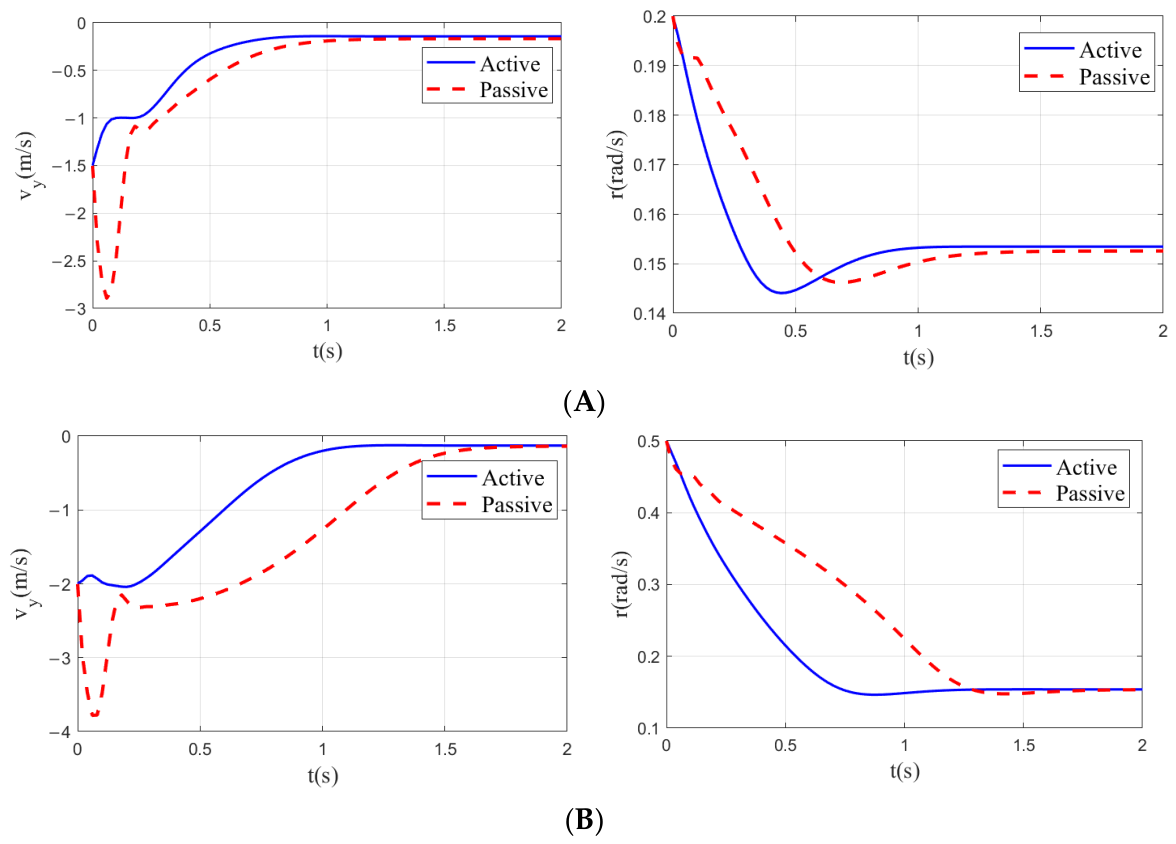
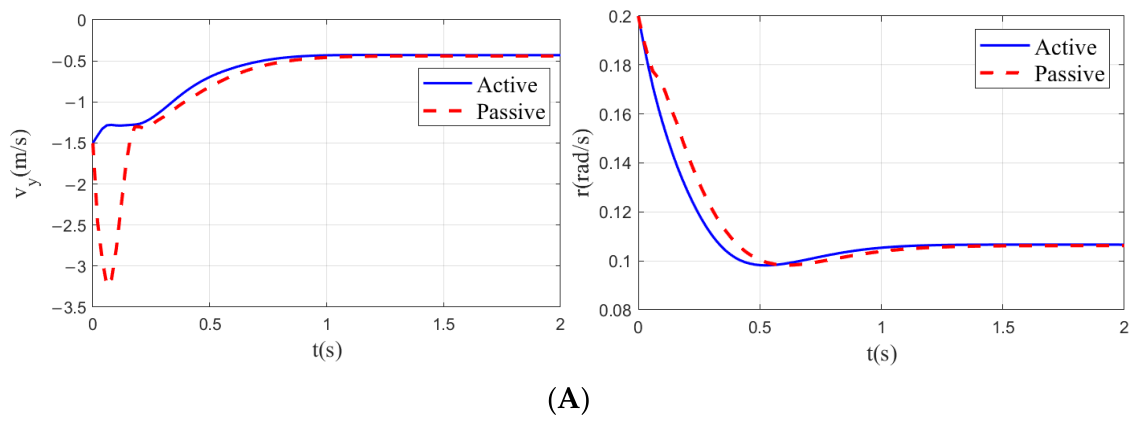
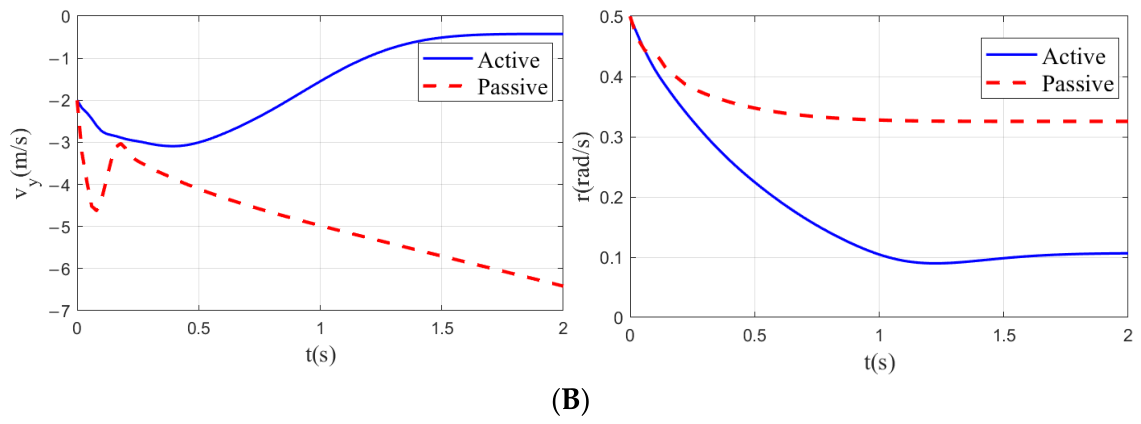
For all four conditions, Point A is located inside the lateral stability region, while Point B is located outside the lateral stability region but inside the streamline stability region.
The state variations of the lateral speed
and yaw rate
starting from the two different initial state points are shown in
Figure 4,
Figure 5,
Figure 6 and
Figure 7. The trajectory variation from the initial state point inside the lateral stability region under Condition 1 is shown in
Figure 4A. Due to insufficient lateral force, the state variables of the initial point under passive roll momentarily increase during the initial convergence process. This means that the system trajectory briefly breaches the boundary line and stays outside the lateral stability region, facing the risk of nonlinear loss of control. Conversely, the initial point under active inward tilt forcibly constrains the vehicle state within the stability region by adjusting the vertical loads, allowing it to converge to the equilibrium point along an asymptotically stable streamline within approximately 0.5 s. The trajectory variation from the initial state point outside the lateral stability region is shown in
Figure 4B. Although the state variables of both vehicle models eventually converge to the equilibrium point, the active inward tilt converges faster than the passive roll, reaching the final steady-state cornering condition 0.6 s earlier.
When the longitudinal speed increases from 20 m/s to 30 m/s, the simulation results are shown in
Figure 5. The variation trend of the initial state point A inside the stability region is almost identical to that in Condition 1. However, between 0.25
and 1
, the difference in convergence speed between the two vehicle models decreases, and both basically reach the convergent state at 1 s. On the other hand, for the initial state point B outside the stability region, the vehicle under active inward tilt can converge to the equilibrium point, whereas it diverges under passive roll. This demonstrates that under high-speed scenarios, the active inward tilt control can expand the range of convergent initial points
through load balancing.
When the front wheel steering angle increases from 0.77° to 5°, the variation trends of the sampled vehicle state points A and B become more obvious. For the initial point inside the stability region, as shown in
Figure 6A, the state variable variation trends of both models within 0–0.25 s are the same as in Condition 1, and their convergence speeds are almost identical between 0.25 s and 2 s. For the initial point outside the stability region, as shown in
Figure 6B, the tires at the initial point are saturated. The active inward tilt still maintains a better control effect than the passive roll, enabling
at larger states to converge to the equilibrium point within a short time. Furthermore, according to the discussion on the influencing factors of the lateral stability region in
Section 4.2, changes in the road adhesion coefficient have the greatest impact on the stability region area. When the road adhesion coefficient decreases from 0.8 to 0.3, as shown in
Figure 7A, the initial point inside the stability region under active inward tilt control can converge, but the equilibrium point only reaches (−0.06 m/s, 0.07 rad/s), which is not close to the origin. This indicates that vehicle stability control is extremely difficult under severely poor road conditions. Conversely, as shown in
Figure 7B, for the initial point outside the stability region under passive roll, the vehicle experiences sideslip from the very beginning. In contrast, under active inward tilt control, (
) eventually reaches (0.14 m/s, 0.15 rad/s), achieving state trajectory convergence.
In summary, the comparisons indicate that active inward tilt provides sufficient lateral force to maintain steering stability, avoiding the risks of vehicle drifting or sideslip. The proposed improved lateral stability region calculation method provides a more conservative estimate, allowing vehicle stability control to intervene earlier. This stability region design can be incorporated into the controller design for autonomous vehicles in driving scenarios with large front wheel steering angles, high longitudinal speeds, and slippery road surfaces.
4.4. Stability Region Determination Design
In this paper, the state variables
of the vehicle during driving are extracted in real time. Since the left and right boundaries calculated according to Equation (14) are time-varying,
is adopted for processing to unify the standard. The results are then substituted into Equation (15) to derive the evaluation indices
and
. These indices intuitively represent the distances from the coordinates
on the phase-plane trajectory to their respective boundaries. Based on these evaluation indices, the phase plane is divided into a stable region, a critical region, and a dangerous region. Finally, according to Equation (16), the maximum value
of the two indices is extracted as the global state determination threshold, thereby triggering the intervention of the corresponding control mode.
where
. The indices
and
are used to evaluate the relative relationship between the current vehicle state and the calculated phase-plane stability boundary. Based on
, the vehicle state is classified into stable, critical, and dangerous modes. The dynamic reference adjustment under different stability modes is defined as follows:
where,
In Equations (17)–(19), λ is defined as the attenuation factor, which is introduced to adjust the reference values under different stability modes. When the vehicle enters the critical or dangerous region, λ reduces the desired yaw rate, lateral velocity, and active inward tilt references, so that the controller gives higher priority to suppressing excessive yaw and lateral motion rather than only pursuing trajectory-tracking accuracy. Since the switching process may be affected by measurement noise, vehicle-parameter variations, and boundary approximation errors, hysteresis switching or a continuous smoothing function will be considered in future work to reduce possible high-frequency mode changes.
5. Design of the Vehicle Active Inward Tilt and Trajectory Tracking Layer
The nonlinear model predictive control principle is adopted to design the vehicle active inward tilt controller. The 3-degree-of-freedom (3-DOF) vehicle steering and roll dynamics model from Equations (1)–(13) are used as the prediction model, and the state equation is established. The state variables are taken as , input variables as , and output variables as . Among them, the expected value is obtained using Equation (17).
In order to ensure the phase-plane stability of the vehicle under extreme conditions while realizing active inward leaning and trajectory tracking, this paper introduces an adaptive coordination control and soft constraints based on the phase-plane state into the NMPC solving framework. The phase-plane stability judgment coefficient
is introduced to construct a dynamic reference sequence and an adaptive weight matrix. The optimization objective function is set as follows:
where
is the control objective,
is the prediction horizon,
is the control horizon,
is the input vector at time
k,
and
are weighting matrices,
is the slack variable, and
is the weight of the slack variable.
is the dynamic reference output, which attenuates the yaw and roll reference values in real-time according to the hazard coefficient
to reduce the risk of instability.
(
) is the adaptive penalty weight, and the formula is as follows:
where
is the attenuation matrix.
are the weighting matrices used for conventional trajectory tracking, and
are the recovery weighting matrices used to enhance yaw and roll stability.
Furthermore, the constraints are defined as follows:
It is difficult to analytically obtain the optimal solution for the NMPC-constrained optimal control problem described by Equation (20). Therefore, the problem was reduced to the nonlinear programming (NLP) problem presented in Equation (25), where f, g, and h represent the objective function, the equality constraint, and the inequality constraint, respectively:
Sequential quadratic programming (SQP) is used to solve constrained nonlinear programming. It is necessary to solve several QP subproblems to obtain the optimal solution to the original problem. If
is the iteration point of the current NLP problem, SQP can be used to solve the QP subproblems in Equation (20):
Suppose that
is the solution of Equation (26), where
is the line search direction. Step
is obtained using this search method, then the iteration point at moment
can be expressed based on
.
,
, and
represents the gradients of
, and
, respectively, at point
, and matrix
represents the quasi-Newtonian approximation matrix of the Hessian array at (
) of the Lagrangian function, as expressed by Equation (27), for the problem shown in Equation (26):
Powell’s improved BFGS formula of the quasi-Newton methods was used to obtain the
matrix according to Equation (28):
where
Experience has shown that
is appropriate. Because
and
, then
is always positive as long as Bk is positive. To ensure that the algorithm converges globally, after solving a QP subproblem to obtain the search direction,
, it is necessary to take the search step, t, to obtain the next iteration point
. The selected
step should be able to improve the constraints and the objective function values for the next iteration point, so the function must be evaluated. This study comprehensively used the penalty function method and the one-dimensional search method, which employs the penalty function shown in Equation (30):
where the penalty factor,
, is a positive and sufficiently-large fixed value. The one-dimensional search for
in the
direction yields the step
> 0, which satisfies Equation (31):
The next iteration point can then be determined from Equation (32):
If there is no feasible solution to an iteration subproblem as shown in Equation (25), the relaxation variable,
, can be introduced, and the QP problem can be rewritten as Equation (33):
Equation (34) is equivalent to the unconstrained minimization problem in Equation (34):
Therefore, there is always an optimal solution,
, for Equation (34). A one-dimensional search uses
as
, so the problem becomes more relaxed than that in Equation (33):
In Equation (35), is a constant and . The SQP algorithm has global convergence when the method described above is employed.
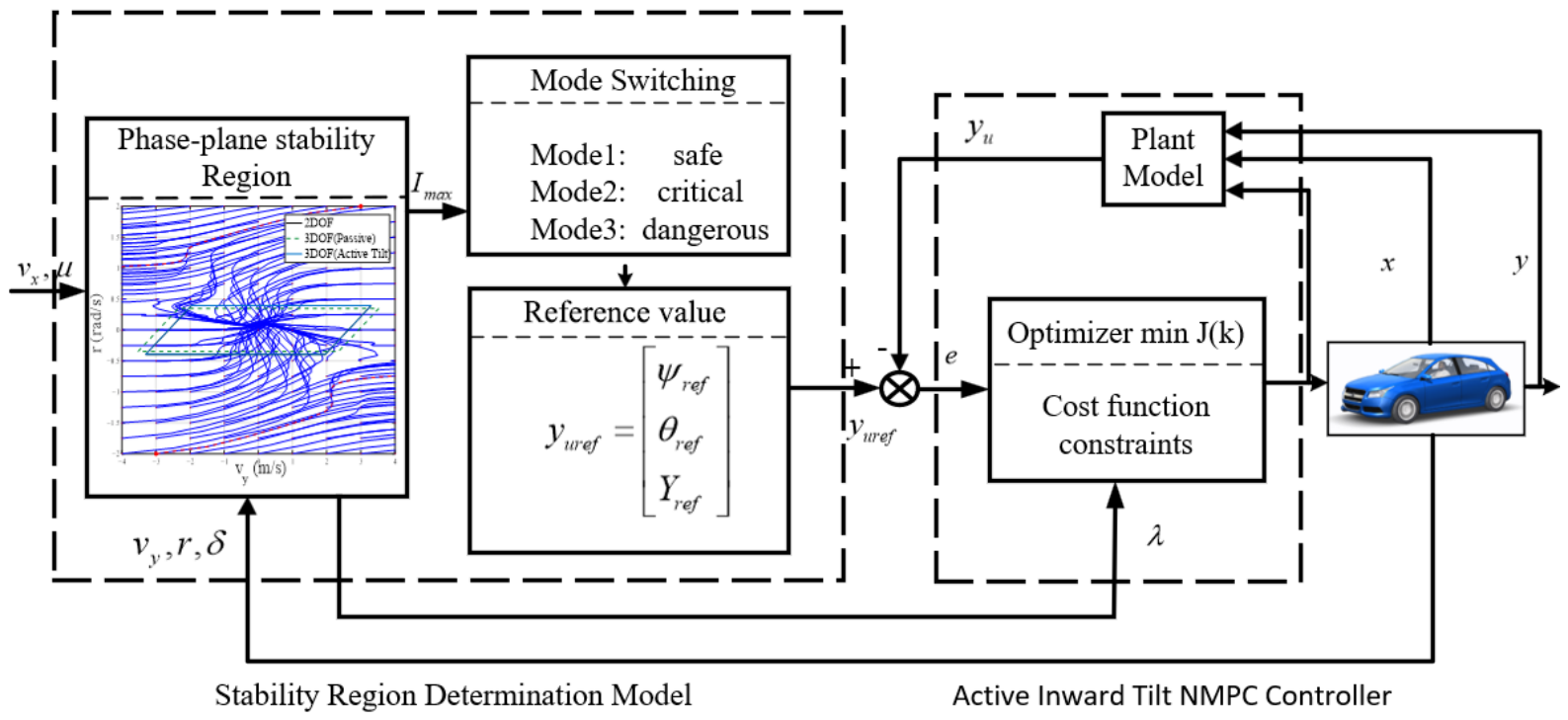
The overall logical framework of the proposed hierarchical active inward-tilt-control system for vehicles is illustrated in
Figure 8. Logically configured as a closed-loop structure, the system primarily comprises two components: an upper-level “stability region determination model” and a lower-level “active inward tilt NMPC controller.” The upper-level model is tasked with real-time state evaluation and reference trajectory generation. Taking
and
as environmental inputs and incorporating the lateral velocity
, yaw rate
, and front wheel steering angle
fed back from the vehicle, this module dynamically constructs the phase-plane stability region and computes the stability evaluation index
. Subsequently, according to the magnitude of
, the mode-switching module classifies the current driving state of the vehicle into three modes: safe, critical, and dangerous. Simultaneously, the reference generation module outputs the corresponding desired references. The lower-level active inward tilt NMPC controller is responsible for receding horizon optimization and execution. The optimizer receives the prediction error
and the current vehicle states, performing online solving to minimize the objective cost function
while satisfying various physical constraints. The derived optimal control commands are applied directly to the vehicle model, generating the actual output
and state variables
. These are then fed back to both the prediction model and the upper-level determination model, ultimately forming a comprehensive closed-loop control system that balances stability determination with high-precision trajectory tracking.
6. Simulation and Results
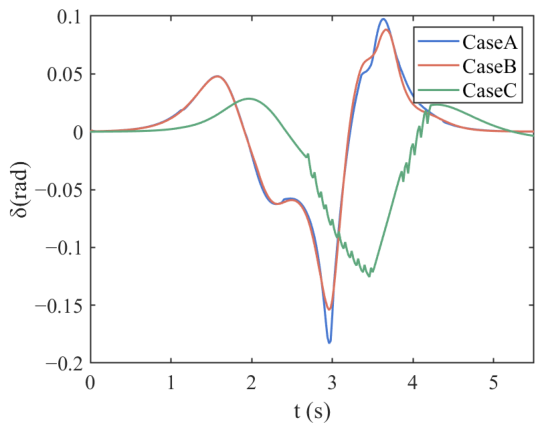
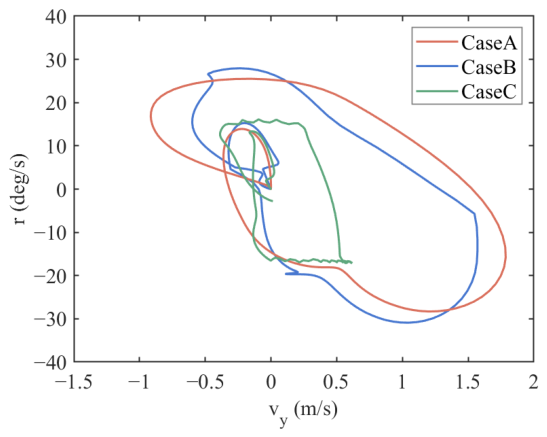
In order to verify the effectiveness of the lateral-stability-region-calculation method based on vehicle active inward tilt proposed in this paper, three test groups were designed using MATLAB and Simulink (version 2023b) to perform trajectory tracking control on the vehicle: CaseA, CaseB, and CaseC. Specifically, CaseA represents trajectory tracking control for a passively rolling vehicle, CaseB represents trajectory tracking control for an active inward tilt vehicle, and CaseC represents trajectory tracking control for an active inward tilt vehicle using stability region determination control.
The evaluation of the controller is carried out through closed-loop control using the double lane change test. The vehicle parameters
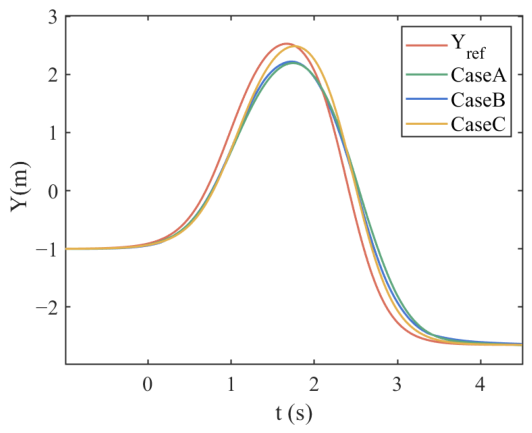
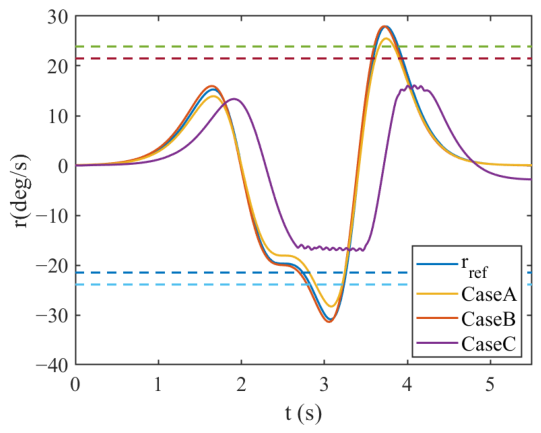
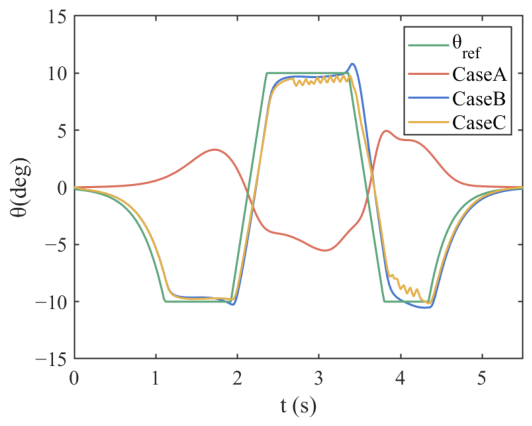
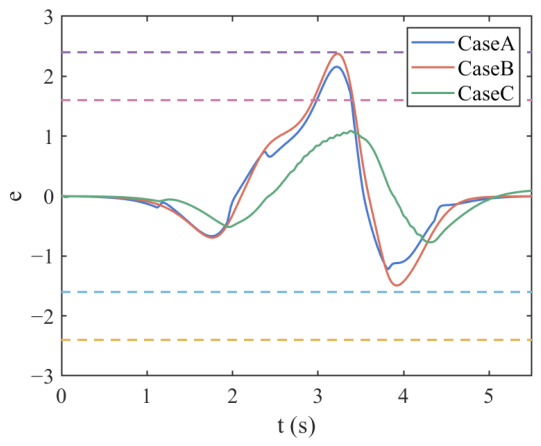
are selected, and a simulation time of 5.5 s and a time step of 0.02 s are set as fixed input values during vehicle trajectory tracking. The simulation results are shown in
Figure 9,
Figure 10,
Figure 11,
Figure 12,
Figure 13,
Figure 14,
Figure 15,
Figure 16,
Figure 17 and
Figure 18. These results provide concise validation for the stability region control of the active inward tilt vehicle and demonstrate its superiority over the passive suspension. In addition, the relevant setting parameters of the NMPC controller are shown in
Table 5.
As illustrated in
Figure 9, all three test configurations exhibit satisfactory tracking of the ideal trajectory. Compared to the passive roll condition, the active inward tilt control demonstrates marginal differences in lateral tracking accuracy. However, with the incorporation of the stability region determination, the vehicle tracks the ideal trajectory more rationally with reduced errors at approximately 2.6 s.
Figure 10 depicts the time-domain response of the vehicle’s yaw rate. The horizontal dashed lines represent the lateral stability boundaries of the passive roll and active tilt vehicle models. The dark-blue and red dashed lines denote the lower and upper lateral stability boundaries of the passive roll model, respectively, while the light-blue and green dashed lines denote the lower and upper lateral stability boundaries of the active tilt model, respectively. It can be seen that, under severe steering maneuvers, the yaw rate responses generated by CaseA and CaseB are relatively comparable, with the peak difference maintained within 3 deg/s. Conversely, CaseC, being strictly constrained by the stability region boundaries, significantly suppresses drastic fluctuations in the yaw rate, yielding the lowest peak value and demonstrating exceptional anti-spin capability.
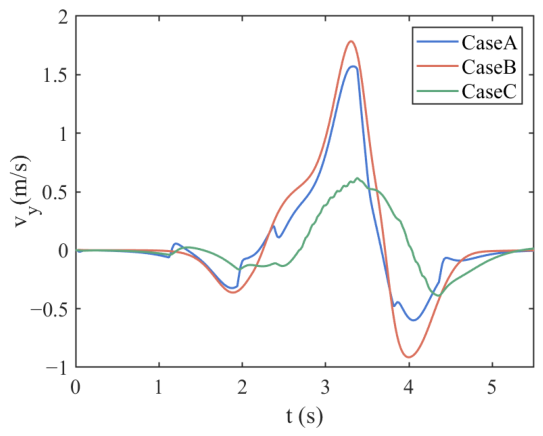
Figure 11 presents the time-domain evolution of the vehicle’s lateral velocity. As observed, premature saturation of the tire lateral forces in the passively rolling vehicle causes the phase-plane stability boundary to contract, making the lateral velocity highly susceptible to exceeding the safety limits. Although the active inward tilt control introduces larger lateral velocity fluctuations, it generally operates within its expanded stability region. Notably, the stability boundary control in CaseC acutely identifies any tendency of the lateral velocity to cross the limit, forcing it to rapidly converge back to a safe state.
Figure 12 displays the time-domain response curves of the vehicle’s roll angle. The results indicate that all three control configurations effectively track the desired roll angle targets. During sharp turns, the active inward tilt angle is consistently maintained at approximately 10 deg, whereas the passively rolling vehicle experiences an outward roll of approximately 5.21 deg in the opposite direction. Furthermore, the roll angle in CaseC, equipped with stability region determination, remains strictly within 10 deg, thereby ensuring both control precision and vehicle safety.
Figure 13 illustrates the variation trend of the comprehensive stability evaluation variable
. The horizontal dashed lines represent the lateral stability boundaries of the passive roll and active tilt vehicle models. The blue and pink dashed lines denote the lower and upper lateral stability boundaries of the passive roll model, respectively, while the yellow and purple dashed lines denote the lower and upper lateral stability boundaries of the active tilt model, respectively. Compared to the passive roll configuration, the active inward tilt control effectively mitigates the risk of instability. Under the intervention of the stability region determination module, CaseC dynamically attenuates the reference commands, consistently restricting the value of
strictly within the absolute safety threshold.
Figure 14 delineates the front-wheel-steering-angle-response curves for the three test groups. Under conventional control, the peak steering angles for passive roll and active inward tilt control are 0.15 rad and 0.181 rad, respectively, while the maximum steering angle for CaseC is restricted to approximately 0.123 rad. This comparison reveals that CaseC can satisfy higher precision requirements with reduced control effort during reference tracking.
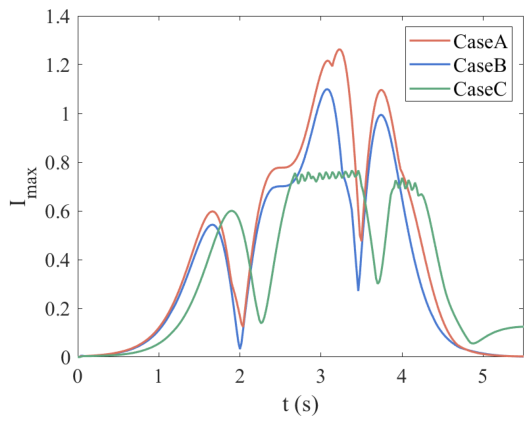
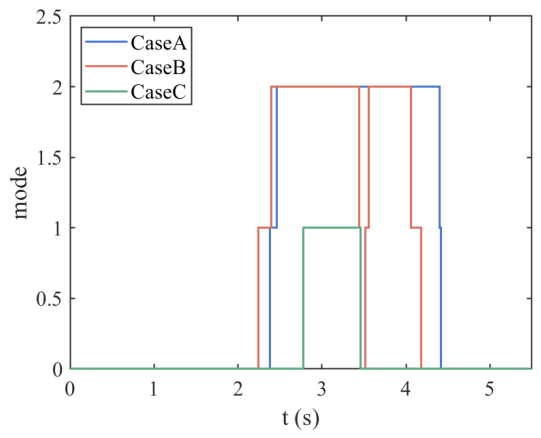
The responses of two crucial indicators during trajectory tracking, and the mode, are presented in
Figure 15 and
Figure 16. Lacking boundary constraints, the peak state evaluation indices for both CaseA and CaseB exceed 1, although CaseB exhibits slight improvement over CaseA. By contrast, the stability region determination in CaseC strictly confines this index below 0.8, effectively preventing the vehicle’s state from deteriorating into the dangerous transition zone. This is corroborated by the mode-time response graph, where the duration is 1.75 s for CaseA, 1.5 s for CaseB, and is significantly reduced to 0.76 s for CaseC.
Figure 17 presents the time-domain response curves of the left and right suspension active forces for the different test groups. As illustrated, both active test groups exhibit symmetric active forces to generate the required roll moment for active inward tilt. A comparative analysis reveals that during the continuous lane change, the control force in CaseB approaches its saturation limit at 3.5 s. Notably, CaseC, which incorporates phase-plane constraints, exhibits a high-frequency chattering phenomenon. This occurs because the controller aggressively switches modes to suppress the lateral velocity and yaw rate from exceeding the boundaries as the vehicle state approaches the predefined phase-plane stability limits. While this high-frequency intervention guarantees anti-rollover and anti-spin capabilities under extreme conditions, its impact on vehicle ride comfort can be mitigated in future engineering applications by optimizing the NMPC-prediction horizon or introducing smoother constraint relaxation functions.
From the phase-plane state distribution in
Figure 18 and the extreme value data in
Table 6, it is evident that the proposed stability region determination control exerts the most significant convergence effect on the vehicle’s yaw and lateral motion states. Compared to passive roll and conventional active inward tilt control, the proposed strategy significantly mitigates the yaw rate and lateral velocity; specifically, compared to CaseB, CaseC reduces these two parameters by approximately 62% and 55%, respectively. Although active inward tilt intrinsically broadens the stability boundary, in practical trajectory tracking control, a phase-plane state trajectory that converges closer to the origin indicates a more ample handling margin for the vehicle. Under extreme operating conditions, CaseC successfully maintains the dynamic stability of the vehicle while requiring smaller suspension active control forces and steering angle inputs. Furthermore, addressing the potential state response hysteresis associated with the switching intervention of the stability-region control, future research could consider coupling Direct Yaw-moment Control (DYC) to further accelerate the convergence of the phase trajectory by enhancing the recovery speed of lateral forces.
7. Conclusions
To address the handling stability challenges during the active inward tilt process of vehicles, this paper proposes an improved phase-plane lateral stability-region calculation method considering dynamic vertical load transfer and nonlinear tire forces. Based on this method, the lateral stability boundaries of passive roll and active inward tilt vehicles are compared under different operating conditions. The results show that active inward tilt can improve the vertical load distribution between the left and right wheels and expand the lateral stability region in the phase plane, thereby providing a larger controllable range for vehicle state convergence.
A hierarchical NMPC-control strategy incorporating phase-plane stability-region determination is further developed. In the upper layer, the stability-evaluation index is used to identify the vehicle state in real time and adjust the reference values and objective weights according to the stable, critical, and dangerous regions. In the lower layer, the NMPC controller performs trajectory tracking and active suspension force allocation under physical constraints. The double-lane-change simulation results show that the proposed strategy can suppress yaw rate and lateral velocity more effectively than passive roll and conventional active inward tilt control. Compared with these two cases, the convergence area of the phase-plane state is reduced by 68% and 75%, respectively, indicating improved handling stability and active safety under severe driving conditions.
Although the proposed method verifies the feasibility of combining active inward tilt, phase-plane stability-region determination, and NMPC trajectory tracking, several issues still require further investigation. NMPC is suitable for the nonlinear, multi-objective, and multi-constraint control problem considered in this paper, but its online optimization may introduce a relatively high computational burden. The present work mainly focuses on control effectiveness, while the computational complexity and real-time execution time have not been systematically analyzed. Moreover, the current validation is based on MATLAB/Simulink simulations. In practical applications, vehicle-parameter variations, road-adhesion estimation errors, the actuator response delay, tire-model inaccuracies, and sensor noise may affect the calculated stability boundary and controller response. Future work will focus on fast optimization algorithms, hardware-in-the-loop validation, and real-vehicle experiments to further evaluate the robustness, real-time feasibility, and engineering applicability of the proposed method.