Review

The Application of Four-Quadrant Pump-Controlled Technology in the Recovery of Boom Potential Energy Current Status, Challenges and Future Directions


College of Mechanical Engineering, Taiyuan University of Science and Technology, Taiyuan 030024, China
*
Author to whom correspondence should be addressed.
Machines 2026, 14(5), 548; https://doi.org/10.3390/machines14050548
Submission received: 30 March 2026 / Revised: 6 May 2026 / Accepted: 12 May 2026 / Published: 14 May 2026
(This article belongs to the Section Electromechanical Energy Conversion Systems)

Abstract

Against the backdrop of the global energy crisis and the urgent pursuit of dual-carbon goals, improving energy efficiency and reducing energy consumption in construction machinery have become central to the industry’s green and low-carbon transition. As key equipment in infrastructure construction, hydraulic excavators generate considerable gravitational potential energy in the boom during cyclic operations. However, the throttling losses inherent in conventional valve-controlled systems not only waste energy but also cause system overheating and reduced efficiency. Owing to its four-quadrant operating capability and high efficiency, the four-quadrant pump-controlled system provides an effective technical platform for recovering boom potential energy. Therefore, this paper presents a comprehensive review of four-quadrant pump-controlled boom energy recovery (FQ-PCBER) systems. First, three representative system architectures—electric, hydraulic, and hybrid—are examined, and their technical characteristics, performance limitations, and applicable scenarios are compared. Subsequently, the review focuses on the control challenges associated with these systems and summarizes advanced control strategies. Finally, practical engineering issues, technical challenges, and future research directions are discussed. This review aims to provide researchers with a clear technical roadmap, accelerate the practical implementation of four-quadrant pump-controlled boom energy recovery technology, and support the green and low-carbon transformation of the construction machinery sector.

1. Introduction

1.1. Literature Review

Hydraulic excavators, as essential equipment for global infrastructure construction, face increasingly severe challenges related to energy consumption and carbon emissions [1,2,3]. Studies have shown that, in a typical 18-ton hydraulic excavator equipped with a conventional load-sensing system, the working attachments are the main contributors to overall energy consumption during frequent operating cycles. Among these cycles, boom lifting and lowering are key processes in which energy losses and recovery potential are concentrated [4]. More importantly, during the descent of the boom and loaded bucket, substantial gravitational potential energy is not effectively recovered in conventional hydraulic systems. Instead, this energy is dissipated as heat as it passes through the throttling orifices of control valves [5,6]. Such persistent energy waste not only substantially increases operating costs but also intensifies thermal management challenges in hydraulic systems [7], resulting in avoidable carbon emissions. Consequently, the efficient recovery and reuse of boom potential energy have become a promising research direction in excavator energy-saving technologies [8]. This approach has considerable economic and environmental significance for promoting the green and low-carbon transformation of the construction machinery industry [9,10].
Energy-saving technologies for hydraulic excavators have advanced substantially. Early strategies primarily focused on optimizing engine universal characteristic curves and improving hydraulic systems, such as through negative flow control [11], load-sensing systems [12], and positive flow control [13], to passively reduce energy losses. However, because of their inherent throttling mechanisms, these valve-controlled systems have nearly reached their efficiency limits [14]. Hybrid power technologies were subsequently introduced, incorporating energy storage components at the machine level to enable preliminary energy management and recovery. Nevertheless, because of multiple energy conversion stages and increased system complexity, these technologies have not fundamentally resolved actuator-level energy recovery [15,16,17].
The introduction of four-quadrant pump-controlled systems for boom potential energy recovery marks a paradigm shift in the hydraulic architecture of construction machinery, from passive loss reduction to active energy recovery and reuse [18,19,20]. The four-quadrant pump-controlled systems regulate actuators by directly controlling pump displacement or motor speed, thereby minimizing throttling losses at the source [21,22]. More importantly, the operational reversibility of pumps and motors enables four-quadrant operation, allowing seamless transitions between driving mode, in which energy is consumed, and regenerative mode, in which energy is recovered [23,24]. Accordingly, four-quadrant pump-controlled systems provide a feasible technical approach for efficiently recovering boom potential energy and represent an important direction for advancing actuator-level energy-saving technologies [25,26].
Several reviews have summarized energy-saving technologies for construction machinery, including hybrid powertrains, electrification, and energy recovery. Do et al. [27] classified energy regeneration systems in hydraulic excavators according to energy storage type and efficiency range but paid limited attention to four-quadrant pump-controlled architectures. Singh et al. [28] reviewed sustainable energy solutions for hydraulic excavators by categorizing systems according to storage devices, including hydraulic accumulators, electrical storage devices, and hybrid storage systems, and by comparing techniques such as idle-speed control and independent metering. However, their review emphasized storage types rather than pump-controlled actuation principles. Huang et al. [29] systematically reviewed the mechanical components, control strategies, and representative machines used in fully electric construction machinery, highlighting the potential of electro-hydrostatic actuation (EHA) while giving limited attention to the integration of four-quadrant pump-controlled boom energy recovery across electrical, hydraulic, and hybrid domains. Nguyen et al. [30] examined technologies for reducing energy consumption in hybrid hydraulic construction machinery, with an emphasis on powertrain configurations and energy regeneration systems; however, four-quadrant dynamic issues, such as mode-switching transients and controllability trade-offs, were not examined in depth. In a recent domestic study, Lin et al. reviewed electro-hydraulic energy-saving technologies for electric excavators and distinguished between centralized and distributed configurations; however, they did not systematically classify four-quadrant pump-controlled systems or compare electrical, hydraulic, and hybrid energy recovery architectures.
Despite these contributions, the understanding of four-quadrant pump-controlled boom energy recovery systems remains fragmented in three key respects. First, existing reviews tend to focus on individual recovery configurations, typically purely electric or purely hydraulic systems, and lack a systematic classification that defines the performance limits and applicable scenarios of the three main architectures—electric, hydraulic, and hybrid—within a unified four-quadrant framework. Second, although many studies emphasize hardware innovation, the advanced control strategies required to manage mode-switching transients, ensure robust operation, and address the inherent controllability paradox of four-quadrant systems have not been fully integrated into a cross-disciplinary mechanical–electrical–hydraulic–control framework. Third, most existing studies are limited to laboratory prototypes or simulations, with insufficient attention given to practical engineering challenges, such as cost, long-term reliability, and thermal management, that affect commercial deployment. To address these gaps, this review first proposes a functional architectural classification based on the energy storage domain—electric, hydraulic, or hybrid—which is directly linked to the four-quadrant operating principle and provides a clearer technical pathway for selecting suitable energy recovery methods. Second, it links four-quadrant dynamic challenges with the advanced control strategies developed to address them, thereby bridging the frequently separated discussions of hardware design and control optimization. Finally, by incorporating quantitative comparisons, cost analysis, and technology readiness assessment, this review provides an engineering-oriented perspective intended to accelerate the practical application of four-quadrant pump-controlled boom energy recovery technology and support the green and low-carbon transition of the construction machinery sector.

1.2. Contributions of This Paper

To address the identified research gaps, this review provides a comprehensive and forward-looking reference for four-quadrant pump-controlled boom potential energy recovery systems. Its main contributions are summarized as follows.
Systematic taxonomy of FQ-PCBER architectures: This review classifies four-quadrant pump-controlled systems for boom potential energy recovery into three categories: electric, hydraulic, and hybrid architectures. It also compares the energy flow paths and distinctive technical characteristics of each configuration.
Elucidation of advanced control challenges and development pathways: This review examines advanced control strategies, including impedance control, adaptive robust control, and model predictive energy management, that have been developed to address the specific challenges of FQ-PCBER systems. It further outlines a control-technology roadmap that progresses from functional realization to performance optimization and, ultimately, intelligent enablement.
Clarification of system-level engineering challenges: This review analyzes the key challenges that hinder the industrialization of FQ-PCBER systems and proposes major development directions. It presents a technology-evolution roadmap that extends from overcoming performance bottlenecks to achieving system-level optimization and constructing intelligent, reliable engineering systems. In doing so, it provides a structured framework for supporting the maturation of FQ-PCBER technology and promoting the green transformation of construction machinery.

1.3. Paper Structure

The remainder of this paper is organized as follows. Section 2 provides a detailed comparative analysis of the three FQ-PCBER energy recovery system architectures: electrical, hydraulic, and hybrid. Section 3 analyzes the core control challenges in depth and systematically reviews advanced control strategies. Section 4 examines the key engineering challenges and outlines future development directions. Finally, Section 5 concludes the paper and reiterates the strategic importance of FQ-PCBER technology.

2. Architectures of the Four-Quadrant Pump-Controlled System

The operating modes and structural configurations of FQ-PCBER systems have become increasingly sophisticated [31,32]. This section systematically classifies, explains, and compares the main technical pathways of FQ-PCBER systems, thereby providing a foundation for the subsequent discussion of control strategies and performance evaluation.
A four-quadrant pump-controlled system is fundamentally a multi-domain energy-coupling system. To manage energy conversion and control among the electrical, hydraulic, and mechanical domains, a structured classification of specific system implementations is essential [33]. Based on the final form of stored energy, the type of energy storage unit, and the recovery pathway, existing studies and engineering practices generally classify FQ-PCBER systems into three architectural categories: electric, hydraulic, and hybrid recovery systems [34,35]. This taxonomy has been widely adopted in both academic and industrial research. For example, Tyni et al. [36] proposed an electric recovery scheme that uses motor regeneration for electric wheel loaders. Kosiara et al. [37] demonstrated a hydraulic recovery architecture based on accumulators, emphasizing its advantages in power density and transient response. To exploit the complementary advantages of different energy forms, electro-hydraulic hybrid systems have been developed to improve efficiency across diverse operating conditions through coordinated control [38]. On this basis, the following subsections analyze and compare the structures, operating modes, and technical characteristics of these three system types.

2.1. Electrical Recovery System

Electrical recovery systems recover and reuse boom potential energy through electromechanical energy conversion [39,40]. Among FQ-PCBER technologies, this approach has been the most extensively investigated. The core components of the system are a servo motor and a hydraulic pump [41]. A permanent magnet synchronous motor (PMSM)-based electric motor/generator (EMG) is connected to a bidirectional converter and the direct current (DC) bus, while supercapacitors or lithium-ion battery packs are connected in parallel to the bus for energy storage [42].
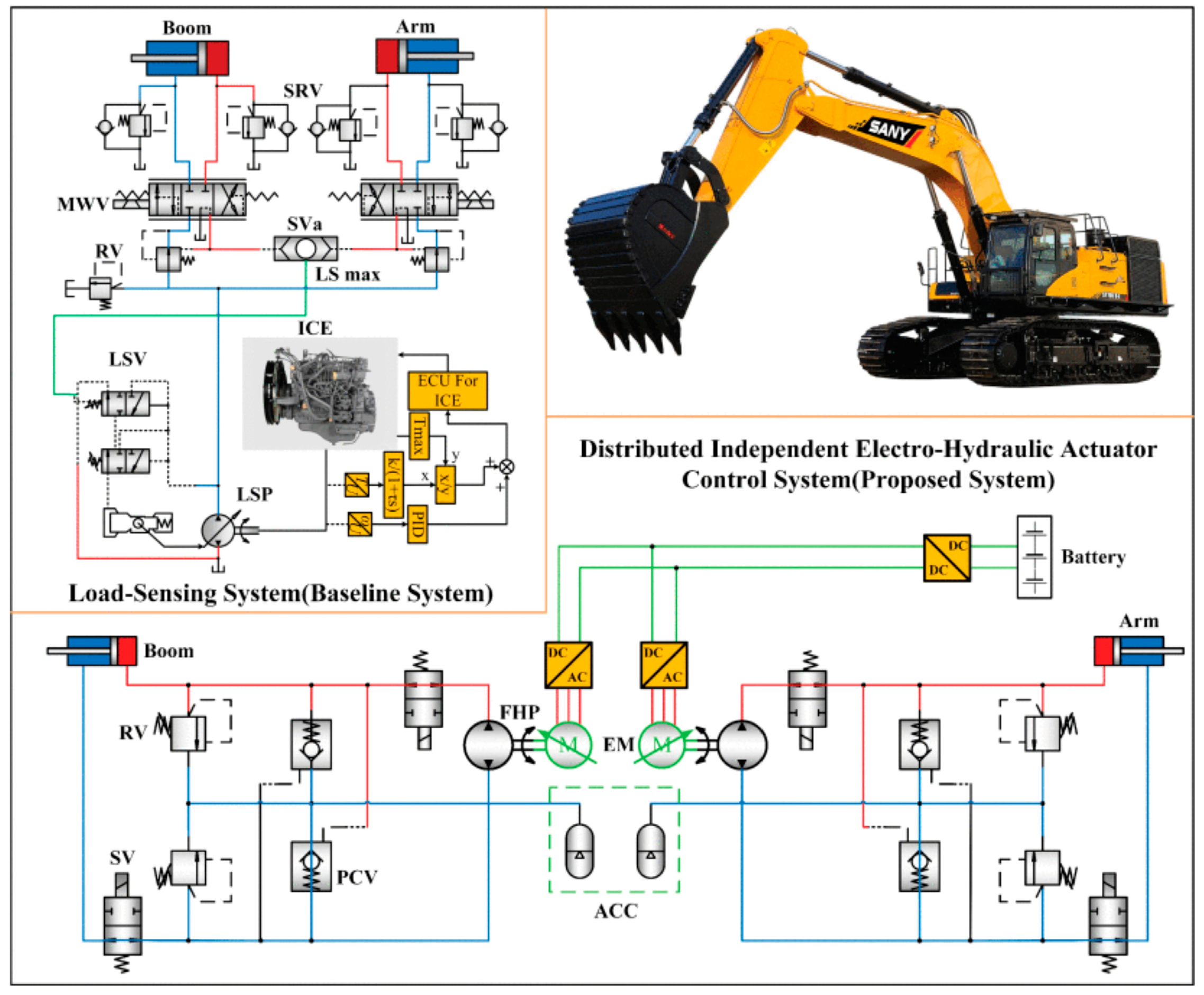
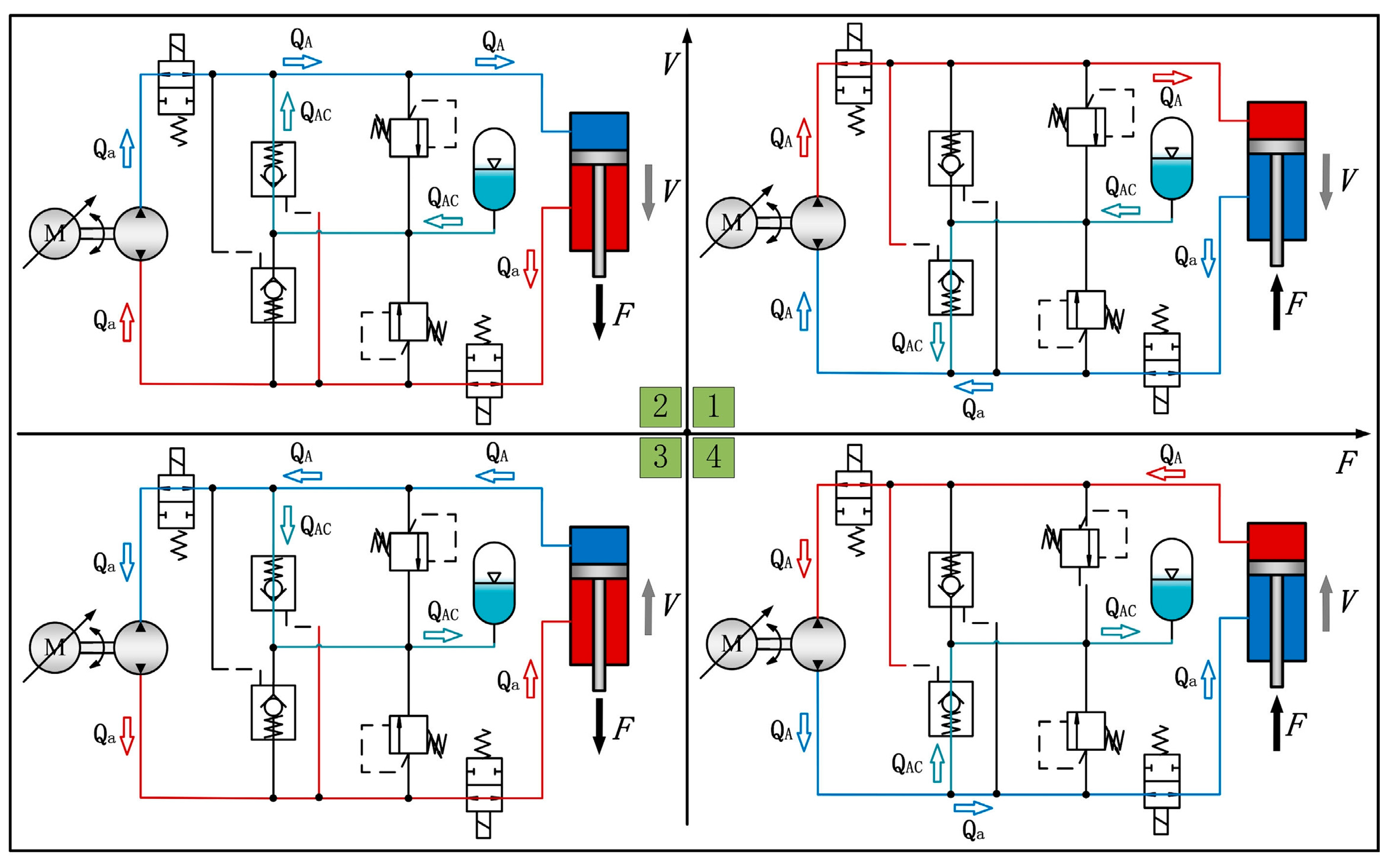
The principal structure of the electrical energy recovery system in a four-quadrant pump-controlled system is illustrated in Figure 1 [43]. The system consists of three key subsystems: the electro-hydraulic energy conversion unit, comprising a PMSM coupled with a hydraulic pump/motor; the power electronic conversion unit, comprising a bidirectional converter; and the energy storage unit, comprising a supercapacitor or lithium-ion battery pack [44,45,46,47]. Its fundamental operating principle is based on four-quadrant energy conversion [48]. As shown in Figure 2, under driving conditions in the first quadrant, electrical energy from the converter powers the motor, which drives the hydraulic pump to supply the cylinder and raise the boom. During energy recovery in the second quadrant, the descending boom drives the hydraulic cylinder, causing the pump/motor to rotate and operate as a generator. The regenerated electrical energy is then stored in the battery. Ji et al. [49] reported that this system achieved a potential energy regeneration efficiency of 40.72% and an energy-saving rate of 15.35%.
The primary advantage of this architecture is its capacity for precise energy management and efficient power allocation. Electrical energy can be accurately regulated and distributed through the power electronic system, making this architecture particularly suitable for integrated electric or hybrid powertrain platforms [50,51]. In experiments on a 22-ton hydraulic excavator, Qin et al. [52] demonstrated that, with an appropriate energy management strategy (EMS), the recovered electrical energy could directly power the swing motor, reducing overall energy consumption by 35.29%. Moreover, rapid advances in motor technology and power electronic control provide a strong technical foundation for such systems [53].
Despite these advantages, the electrical recovery architecture still faces three major challenges:
(1) low-speed generation efficiency remains a critical limitation. During low-speed boom lowering, the motor operates in a low-efficiency generation region, where efficiency may fall below 60%, resulting in substantial heat generation [54]. To address this issue, Xu et al. [55] proposed a dual-mode switching strategy that adjusts motor torque and speed in real time, thereby expanding the high-efficiency operating range by 47%.
(2) high cost remains a barrier to practical application. The use of high-performance servo motors, high-power converters, and battery systems substantially increases the initial investment [56]. An economic analysis by Gong et al. [57] showed that the initial investment required for an optimized electrical system is 1.2 times that of a hydraulic system. However, its recovery benefit, measured by annualized return on investment, reaches 125.7%, with a payback period of 0.5 years, indicating strong economic feasibility.
(3) electrical transients and thermal management present significant engineering challenges. Current fluctuations on the DC bus can cause electrical transients, while system heat dissipation further complicates thermal management [58,59,60]. Recently, Huang et al. [61] implemented a model predictive control strategy with linear weighted fusion. This approach achieved a maximum energy recovery efficiency of 54.6%, reduced actuator temperature by 2.5 °C, and effectively suppressed current transients [62], thereby improving thermal management and electrical stability in space-constrained applications.
To clarify the verification maturity of the key numerical results reported in this section, Table 1 summarizes the performance metrics discussed above and their corresponding verification levels.
Despite its relatively high cost [63], this architecture offers superior energy management flexibility, making it a competitive solution for large excavators and high-end construction machinery [64]. Future research should prioritize cost-effective motor design, improved thermal management, and higher power density [65].

2.2. Hydraulic Recovery System

The hydraulic recovery architecture uses an accumulator as the primary energy storage component [66]. It directly stores and reuses the boom’s gravitational potential energy through the hydraulic circuit [67]. During boom descent, the system controls a valve assembly to direct high-pressure oil from the rodless chamber of the cylinder into the accumulator, thereby avoiding intermediate electromechanical energy conversion stages. Theoretically, this direct hydraulic recovery approach can achieve higher energy recovery efficiency [68].
Figure 3 and Figure 4 illustrate the hydraulic recovery system [69]. The system mainly consists of a hydraulic accumulator, a control valve assembly, a safety valve block, and pressure sensors [70]. It includes three primary hydraulic circuits: the main working circuit, the accumulator energy storage circuit, and the pressure compensation and safety protection circuit [71]. As shown in Figure 4, during boom lowering, pressurized oil from the cylinder is directed through the control valve and stored in the accumulator. Experimental tests on a 21.5-ton excavator prototype equipped with a three-chamber accumulator (TCA) demonstrated a boom potential energy recovery efficiency of 84.9% during controlled lowering operations and a corresponding overall energy-saving efficiency of 52.8% over a complete lowering–lifting cycle [Bench] [72].
The hydraulic recovery architecture offers three major advantages:
(1) High energy recovery efficiency can be achieved because the energy remains in hydraulic form, thereby avoiding losses associated with multiple energy conversion stages [73]. In tests on a 50-ton hybrid hydraulic excavator prototype, Zhu et al. [74] achieved a peak instantaneous energy recovery efficiency of 86.1% during boom lowering using a hydraulic-transformer-based boom potential energy regeneration system [Bench]. Over a complete lowering–lifting cycle, the measured overall energy-saving rate was 44.6% [Bench], whereas the corresponding simulation-predicted values were 79.1% for recovery efficiency and 54.6% for overall energy saving [Sim.].
(2) High power density and rapid response are enabled by hydraulic accumulators, which can instantaneously absorb and release high power [75]. Xu et al. [76] developed an accumulator-based system for high-power-density energy storage, ensuring rapid dynamic response during boom lifting, energy recovery, and auxiliary drive operation. The system achieved an energy recovery utilization rate of 86.7% and an overall energy-saving efficiency of 55.6%, making it particularly suitable for the frequent start–stop cycles of excavators and improving overall energy utilization and operating efficiency.
(3) High reliability and lower cost are achieved because hydraulic components generally exhibit robust performance in harsh environments and are relatively inexpensive [77]. An economic analysis by Wang [78] indicated that the initial investment required for an electrical recovery system can be 1.5 times that of a hydraulic system, such as in loader applications. Moreover, hydraulic solutions generally offer lower maintenance costs and greater reliability under demanding operating conditions.
Despite these advantages, the hydraulic energy recovery architecture still faces three primary challenges, for which corresponding solutions have been proposed in recent studies:
(1) Limited energy density remains a key limitation because accumulators have relatively low energy density and require substantial installation space [79]. Comparative studies by Li et al. [80] showed that a combined high-power recovery system achieved energy recovery efficiencies that were 29.23% and 9.06% higher than those of single 3 MPa and 5 MPa accumulators, respectively. Meanwhile, research on novel accumulator designs has advanced, achieving a 50% increase in energy density [81].
(2) Pressure fluctuation control remains challenging because significant pressure fluctuations occur during accumulator charging and discharging. Li et al. [82] proposed a double-bladder accumulator structure. Simulation results showed that this design reduced pressure fluctuations during the charge–discharge cycle by approximately 15%, thereby improving pressure stability and energy recovery efficiency. This approach provides a feasible solution for mitigating pressure shocks in hydraulic systems for construction machinery.
(3) Limited system flexibility restricts broader energy management because energy storage and release are typically confined to fixed locations [83,84]. Recent research has explored the integration of auxiliary hydraulic circuits with intelligent valve assemblies to enable multi-path energy distribution, thereby improving overall system flexibility [85].
Although this architecture has limited energy allocation flexibility, its high power density, rapid response, high reliability, and low cost make it a reliable option for small excavators, loaders, and other traditional hydraulic construction machinery operating under relatively fixed and cost-sensitive conditions [86,87,88,89]. Future research should prioritize improving accumulator energy density, optimizing pressure fluctuation control, and increasing the flexibility of system energy pathways [90].

2.3. Hybrid Recovery System

Hybrid recovery systems integrate the complementary advantages of electrical and hydraulic architectures to maximize overall energy efficiency through intelligent energy management [91]. These systems combine electrical and hydraulic circuits in either parallel or series configurations. Typically, the electrical circuit manages low-frequency, low-power fluctuations and enables precise control, whereas the hydraulic circuit recovers high-frequency, high-power impact energy [92].
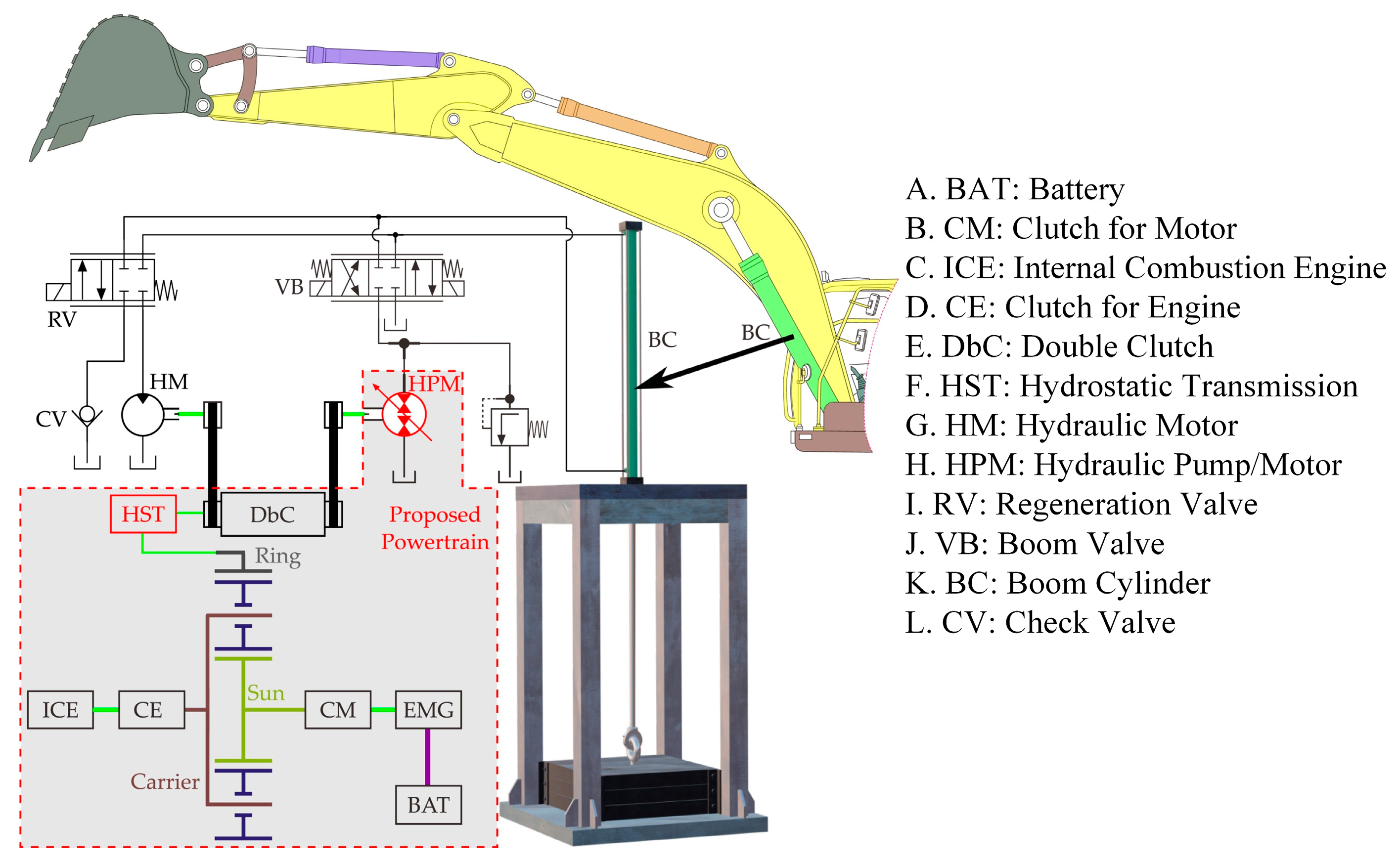
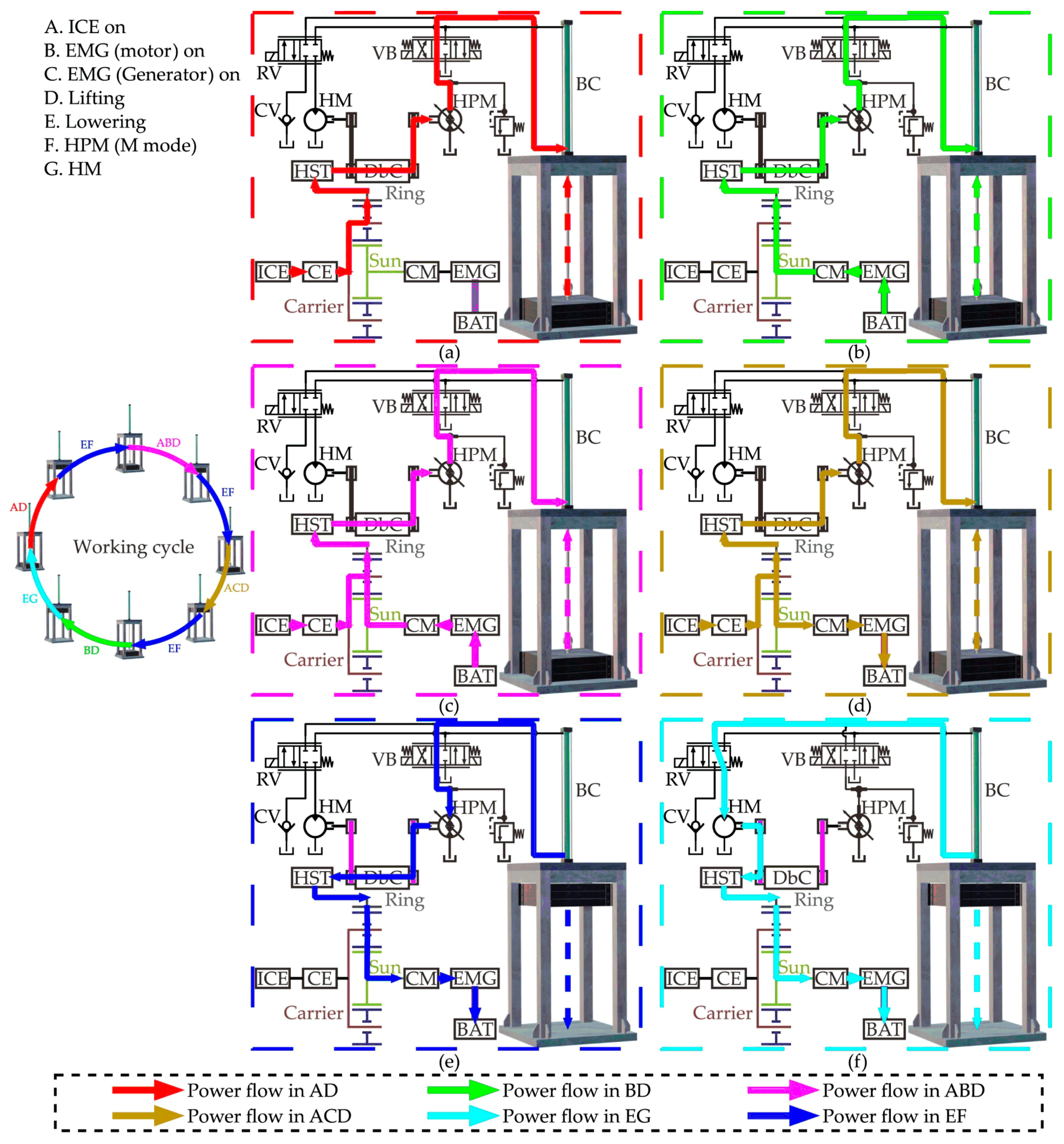
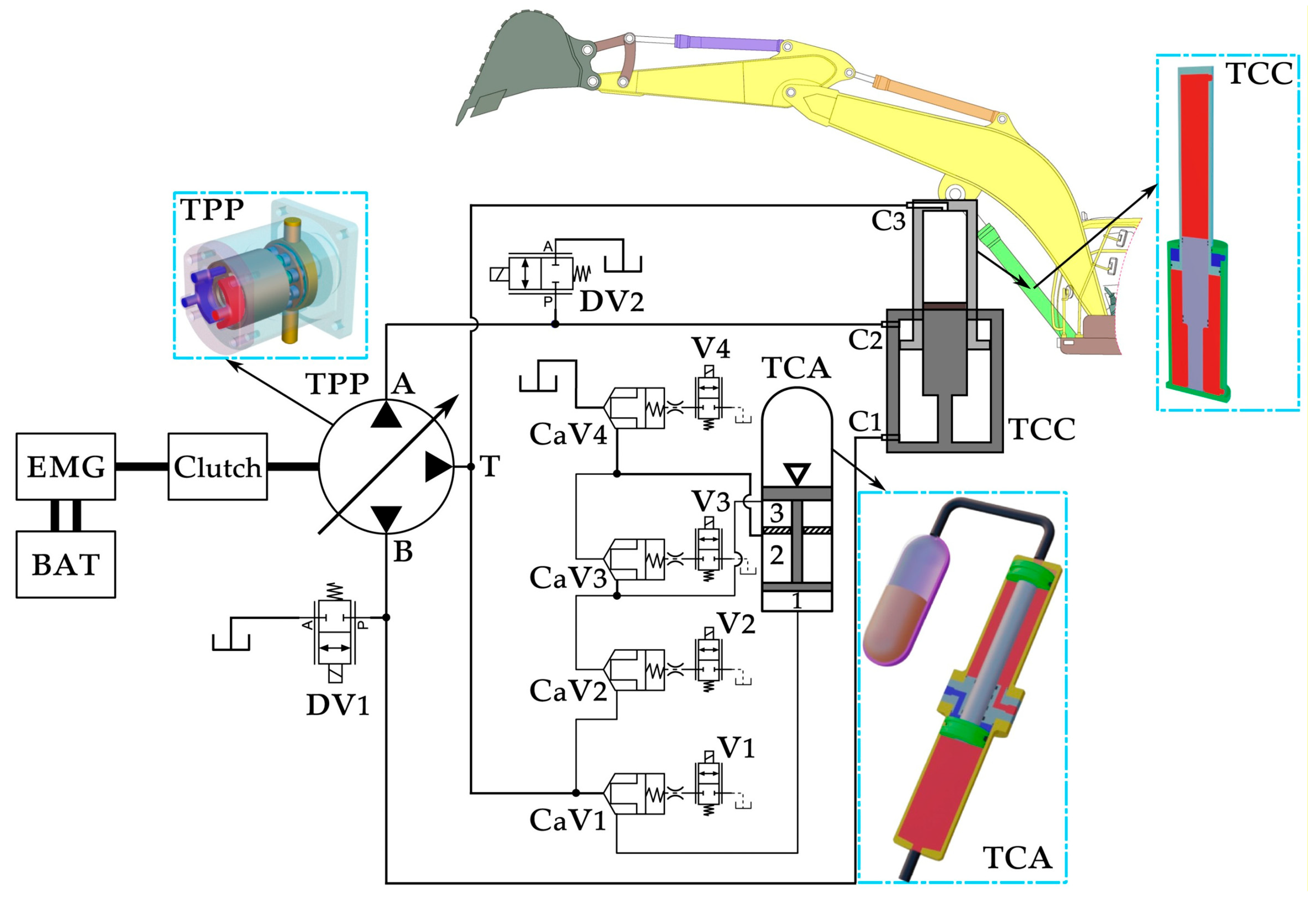
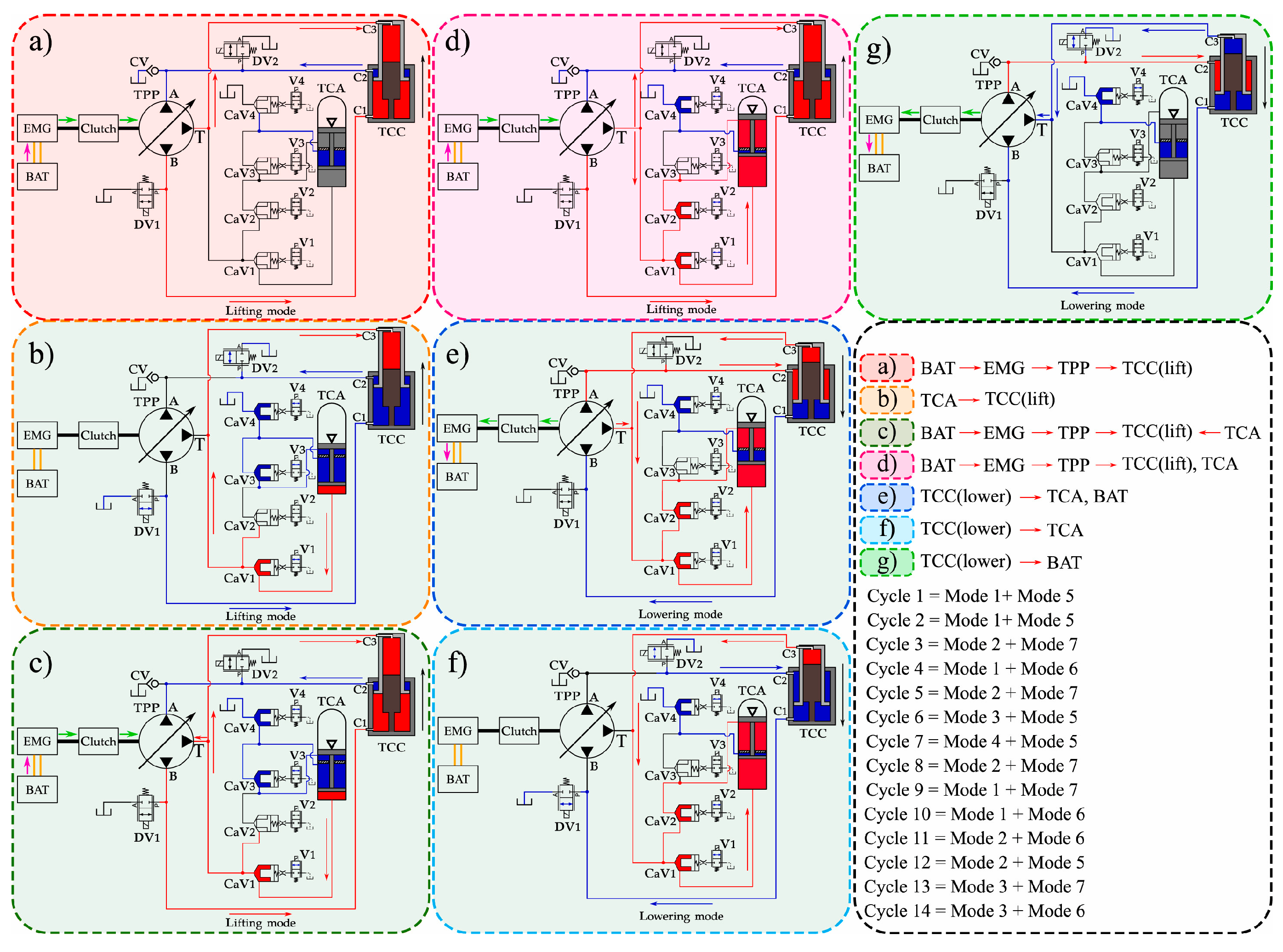
The system includes two primary energy pathways: an electrical pathway, comprising a PMSM, a converter, and a battery; and a hydraulic pathway, consisting of an accumulator and a control valve assembly [93,94]. As illustrated in Figure 5 [95], the hybrid recovery system integrates three core hydraulic components—a three-port pump (TPP), a three-chamber cylinder (TCC), and a TCA—into a consolidated architecture. The seven operating modes of the hybrid recovery system, shown in Figure 6, are systematically summarized in Table 2. This system enables zero-emission operation in fully electric hydraulic excavators while achieving 62.2% energy savings, millimeter-level motion control accuracy, and an energy recovery efficiency of 83–85%. These results provide a strong technical foundation for the development of next-generation automated and sustainable construction machinery.
Mode-switching logic of the system: The energy management unit continuously monitors the joystick signal, including lifting and lowering commands, cylinder chamber pressures, accumulator pressure, and battery state of charge (SOC). When a lifting command is issued, the system selects Modes 1–5 according to the required lifting force and the available energy in the battery and accumulator. Specifically, Mode 5, which provides accumulator assistance, is prioritized over Mode 2, which provides battery assistance, when the accumulator pressure exceeds the minimum discharge threshold, because direct hydraulic energy reuse avoids losses associated with multiple energy conversion stages. When a lowering command is issued, the system selects either Mode 6, corresponding to hydraulic energy storage, or Mode 7, corresponding to electrical energy storage, according to the relative states of the accumulator and battery. Mode 6 is preferred when the accumulator has sufficient available capacity because of its higher round-trip efficiency. Mode 7 is activated when the accumulator approaches saturation or when electrical energy is required by other subsystems, such as the swing motor. Mode transitions are managed by the intelligent distribution valve assembly using hysteresis control to prevent frequent mode switching.
The hybrid system is operationally complex and therefore requires an intelligent energy management unit to make real-time decisions regarding energy-flow distribution [96]. Tong et al. [97] developed a rule-based, adjustable hybridization EMS that dynamically optimizes the power split between the electrical and hydraulic pathways according to load characteristics, energy storage states, and component efficiency maps. Simulation results showed that this strategy reduced overall system energy consumption by 28–35% and achieved a combined energy recovery efficiency of 73–76%.
The primary advantage of the hybrid architecture lies in its ability to provide both high energy density and high power density:
(1) Global efficiency optimization can be achieved through the intelligent allocation of energy flows with different characteristics across the entire operating envelope [98]. Zhong et al. [99] reported that a closed-loop multi-source, multi-actuator hydraulic system using a global energy optimization strategy reduced fuel consumption by 35.5% compared with traditional local power matching under normal conditions, with an additional reduction of 7.39% under extreme conditions.
(2) Complementary power and energy density can be realized because the electrical pathway provides high energy density, whereas the hydraulic pathway provides high power density [100,101,102]. Mu et al. [103] showed through simulation that a hybrid system using electromechanical actuators achieved an energy recovery efficiency of 76.1% and reduced battery energy consumption by 13.6%. By comparison, a system using EHAs achieved a recovery efficiency of 60.9% and reduced battery energy consumption by 11.4%.
(3) Enhanced operational flexibility is enabled by the dual-path architecture, which provides greater flexibility in energy allocation [104]. The system can dynamically select appropriate energy recovery and release strategies according to real-time operating demands, thereby improving task adaptability [105].
Despite these advantages, the hybrid architecture faces three major challenges:
(1) System complexity remains a key limitation because the integration of two distinct subsystems increases the component count and complicates control design [106]. To address this issue, researchers have proposed simplified distributed architectures that use modular design to reduce overall system complexity [41].
(2) High initial cost remains a significant barrier to adoption. Economic analyses indicate that the cost of a hybrid system is 60–80% higher than that of a purely hydraulic system and 20–30% higher than that of a purely electrical system [78].
(3) Limited technical maturity restricts practical implementation. Most hybrid systems remain at the conceptual research or simulation stage, with few engineering applications [107]. Existing experimental platforms are mainly limited to bench tests and lack validation on full-scale machinery [108].
Despite its complexity and higher cost, this architecture effectively integrates the complementary advantages of electrical and hydraulic pathways, making it a competitive solution for large-scale mining excavators, high-end intelligent excavators, and future new-energy construction machinery requiring high overall performance [109]. Future research should prioritize system integration optimization, advanced intelligent energy management strategies, and comprehensive life-cycle cost management [110,111].

2.4. Four-Quadrant Operation Characteristics and Efficiency Asymmetry

The four-quadrant operating capability of the pump-controlled system is fundamental to boom potential energy recovery. However, the asymmetric area ratio of the single-rod cylinder, which is widely used in excavator booms because of space constraints and the need for greater extension force, complicates the definition of boundary conditions and efficiency characteristics for each operating quadrant.

2.4.1. Boundary Conditions for Four-Quadrant Operation

The four operating quadrants are defined by the direction of cylinder velocity, namely extension or retraction, and the sign of the net load force, namely resistive or overrunning, as illustrated in Figure 4. In a pump-controlled asymmetric cylinder system, the boundary conditions for each quadrant are governed by three interacting factors: the cylinder area ratio, α = A A / A B (where A A and A B are the rodless and rod chamber areas, respectively), the pump displacement, and the motor speed–torque characteristics.
Quadrant I (Extension, resistive load): The pump supplies flow to the rodless chamber A A , with the return flow from the rod chamber A B being smaller by a factor of 1 / α . This flow imbalance must be compensated by an auxiliary charge circuit or an asymmetric pump design. The motor operates in motoring mode, drawing power from the DC bus or engine.
Quadrant II (Extension, overrunning load): This quadrant occurs during boom lowering, where the gravitational load drives the cylinder in the extension direction. The pump/motor is back-driven and operates in generating mode. However, the flow entering the pump from the rod chamber is smaller than the flow returning from the rodless chamber, creating a regenerative flow imbalance. The generation efficiency is strongly speed-dependent, as discussed below.
Quadrant III (Retraction, resistive load): The pump supplies flow to the rod chamber A B , while a larger flow from the rodless chamber A A returns to the pump. This quadrant is rarely encountered in boom operation but occurs in stick and bucket actuation during digging.
Quadrant IV (Retraction, overrunning load): Similar to Quadrant II, the load aids the motion, but the cylinder retracts. The flow imbalance is reversed compared to Quadrant II. In boom applications, this quadrant occurs when an external load (e.g., the weight of a heavy attachment) assists the retraction motion.

2.4.2. Efficiency Asymmetry Between Quadrants

A critical but often overlooked engineering issue is the efficiency asymmetry between the motoring quadrants, namely Quadrants I and III, and the generating quadrants, namely Quadrants II and IV, as well as the asymmetry between Quadrants II and IV themselves.
In electrical recovery architectures, recovery efficiency is limited by cascaded electromechanical and power electronic losses, including copper, iron, and inverter losses. The motor–generator efficiency map shows a pronounced decrease in generation efficiency at low speeds. During boom lowering in Quadrant II, the cylinder velocity, and thus the pump/motor rotational speed, is governed by the operator’s joystick command and may be as low as 20–30% of the rated speed. In this low-speed region, generation efficiency can fall below 60% [54], indicating that more than 40% of the recoverable mechanical energy is dissipated as heat rather than converted into stored electrical energy. By contrast, during Quadrant IV operation, the retraction speed may differ because of the asymmetric cylinder area ratio, potentially shifting the operating point to a more favorable region of the efficiency map.
In hydraulic recovery architectures, efficiency asymmetry arises from the pressure-dependent behavior of the accumulator. The theoretical recovery limit is governed primarily by accumulator thermodynamic losses during charging and discharging, as well as by flow-dependent pressure losses across control valves, rather than by electromechanical conversion losses. In Quadrant II, charging efficiency is determined by the pressure ratio between the rodless chamber of the cylinder and the accumulator pre-charge pressure [74]. When the load pressure is low relative to the accumulator pressure, the charging flow rate decreases, thereby reducing the effective recovery efficiency. In Quadrant IV, the pressure conditions are governed by the rod-chamber area, which may produce a different pressure ratio and, consequently, a different charging efficiency.
In hybrid architectures, electrical and hydraulic efficiency asymmetries coexist and interact. The EMS must determine, in real time, whether the electrical or hydraulic recovery pathway provides higher instantaneous efficiency under a given quadrant and operating condition [95,97]. Thus, the two sets of loss mechanisms are coupled through the control strategy.
Comprehensive quantitative efficiency maps covering all four quadrants for the three architectures remain unavailable in the open literature, representing an important research gap.
In summary, no universally optimal technical pathway currently exists. Table 3 compares the core characteristics of the three architectures. Electrical and hydraulic systems have established distinct application niches, whereas hybrid architectures represent a promising future direction. However, widespread engineering adoption of hybrid systems will require substantial advances in system integration, intelligent control, and cost-effectiveness. Therefore, the selection of a technical pathway should comprehensively consider application-specific requirements, cost constraints, and technical risks. Future research should focus on overcoming the inherent limitations of individual technologies by advancing intelligent control and energy management strategies and incorporating new materials, thereby guiding FQ-PCBER development toward higher efficiency, reliability, and cost-effectiveness.

3. Key Technologies and Control Strategies

In FQ-PCBER systems, hardware architecture provides the physical foundation for energy recovery. However, system performance, including recovery efficiency, dynamic response, control precision, and stability, depends critically on advanced control strategies [113]. Given the complex and harsh operating conditions of construction machinery, as well as the specific challenges associated with energy recovery, traditional control methods are often insufficient [30]. This section systematically examines the core control challenges inherent in FQ-PCBER systems and reviews the advanced control strategies developed to address them. It further outlines the technological evolution from basic functional realization to overall performance optimization.

3.1. Core Control Challenges

Control design for FQ-PCBER systems must address three inherent challenges arising from their four-quadrant operating principle and the operating characteristics of construction machinery. These challenges directly affect system practicality, reliability, and market acceptance [114].
(I) Mode identification and smooth transition
FQ-PCBER systems operate with frequent transitions between driving and regenerative modes. Abrupt changes in flow rate and pressure during mode switching can induce severe hydraulic shocks, resulting in undesirable vibration and noise and substantially reducing component service life. Therefore, achieving smooth mode transitions without perceptible transient effects represents a primary control challenge [115]. Studies have shown that pressure peaks during mode switching can reach 1.5–2 times the nominal system pressure, posing serious safety risks [116]. Using high-speed imaging, Zhang et al. [117] captured oil cavitation during switching and clarified the physical mechanism underlying pressure transients.
(II) The controllability paradox
During energy recovery, the actuator is driven by external loads. Conventional position control may produce a perceived light or unresponsive operating feel, which conflicts with the force feedback expected by the operator through the joystick. This inconsistency directly compromises operating accuracy and degrades the operator experience. Therefore, a key challenge is to achieve high-efficiency energy recovery while maintaining a stable, predictable, and familiar control feel for the operator, which is critical for market acceptance [118]. Studies have indicated that most experienced operators are sensitive to, and often reject, substantial changes in control feel [119].
(III) Strong nonlinearities, time-varying parameters, and external disturbances
FQ-PCBER systems exhibit strong nonlinearities, such as the flow–pressure characteristics of hydraulic pumps/motors and Coulomb friction; time-varying parameters, such as oil viscosity, bulk modulus, and temperature-dependent variations; and external disturbances, such as changes in load mass and impact loads [120,121]. Therefore, the controller must exhibit strong robustness to mitigate the effects of these factors on control accuracy and system stability [122]. Under harsh operating conditions in particular, key system parameters may vary considerably within a single working cycle, imposing stringent requirements on the control algorithm [123].

3.2. Advanced Control Strategies

To address the challenges outlined above, recent studies have developed multi-level, integrated advanced control strategies. These strategies follow a clear evolutionary trajectory, progressing from basic operational stability to improved human–machine interaction and, ultimately, system-level energy efficiency optimization.
It is important to distinguish between control methods that have been directly validated on four-quadrant pump-controlled excavator boom systems and those that have thus far been demonstrated only on related electro-hydraulic platforms, such as general EHA test rigs, aircraft actuators, and robotic manipulators. Although the latter show promising transfer potential, their effectiveness under the specific conditions of boom energy recovery—characterized by large inertial loads, frequent mode switching, and harsh construction environments—remains to be verified. In the following review, methods directly verified on excavator boom systems are labeled as [Experimental Verification], whereas methods verified only on related platforms are labeled as [Related EHA] or [Transfer Potential].

3.2.1. Active Decoupling Control for Dynamic Impacts

Early control research primarily focused on achieving basic four-quadrant operation and system stability. A typical approach was to establish a nested three-loop control architecture comprising position, pressure, and speed control loops [124]. However, this approach mainly addressed steady-state control, whereas dynamic mismatches during mode transitions remained a key bottleneck. In four-quadrant pump-controlled systems, hydraulic shocks during mode switching arise primarily from strong dynamic coupling between the pressures in the two chambers of the hydraulic cylinder and the displacement or speed dynamics of the pump.
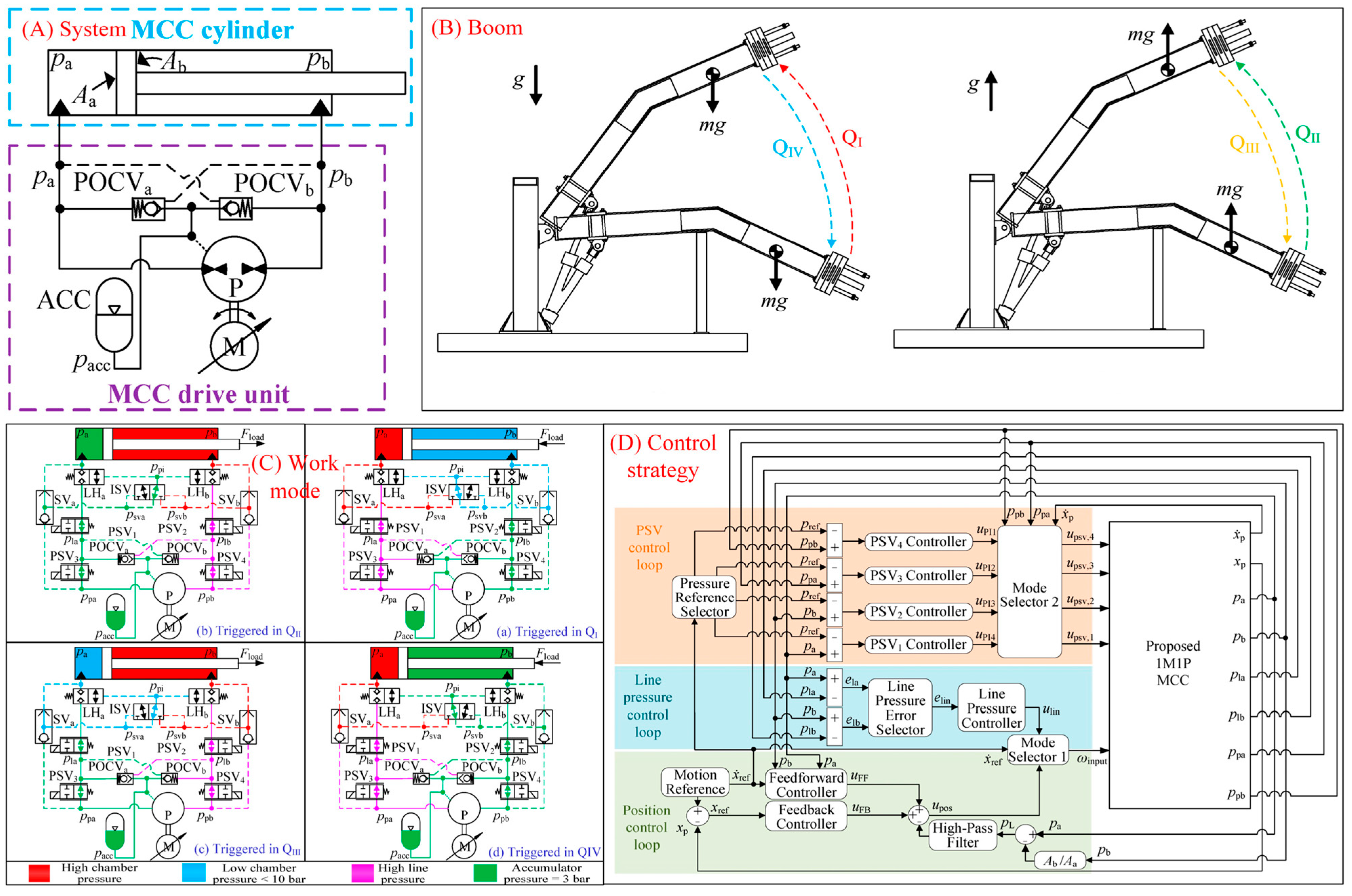
Recent studies have introduced active pressure feedback control to achieve and maintain system decoupling. Zhao et al. [125,126] proposed a progressive control solution for a single-motor single-pump hydraulic cylinder system, as illustrated in Figure 7 [Sim., Related Robotic Arm]. Ref. [125] established a basic control architecture by integrating position, pressure, and proportional-valve control. This system successfully enabled four-quadrant operation and passive load holding, allowing it to respond to emergencies such as power loss or hose rupture. However, the study also revealed the limitations of basic multi-loop control during mode-switching transients, during which hydraulic shocks and pressure oscillations occurred. Building on this work, Ref. [126] investigated these problems in depth and proposed corresponding solutions. It first identified the root cause of mode-switching oscillations as the inherent dynamic mismatch between the cylinder’s four-quadrant operation and the drive unit. It then used the system pressure control capability described in Ref. [125] to decouple the dynamic pressures on the cylinder and drive-unit sides. This improvement effectively suppressed mode-switching oscillations, strengthened the control framework proposed in Ref. [125], and demonstrated the strong potential of system pressure control for addressing dynamic stability problems. These findings provide a solid foundation for implementing more advanced and smoother control strategies, including impedance-control-based approaches.

3.2.2. Impedance/Admittance-Based Control for Reshaping System Dynamics

Impedance/admittance control is one of the most promising strategies for improving operating feel and comfort in FQ-PCBER systems. Unlike conventional direct position or force tracking, this approach regulates the dynamic interaction between the actuator and its environment [127]. Early impedance control methods used fixed parameters, which were insufficient for adapting to varying operating points and load conditions [128]. In essence, impedance/admittance control introduces a virtual and programmable mechanical impedance into the system to shape the actuator’s dynamic response, enabling it to exhibit desired and natural behavior in response to external inputs, such as operator commands or load variations.
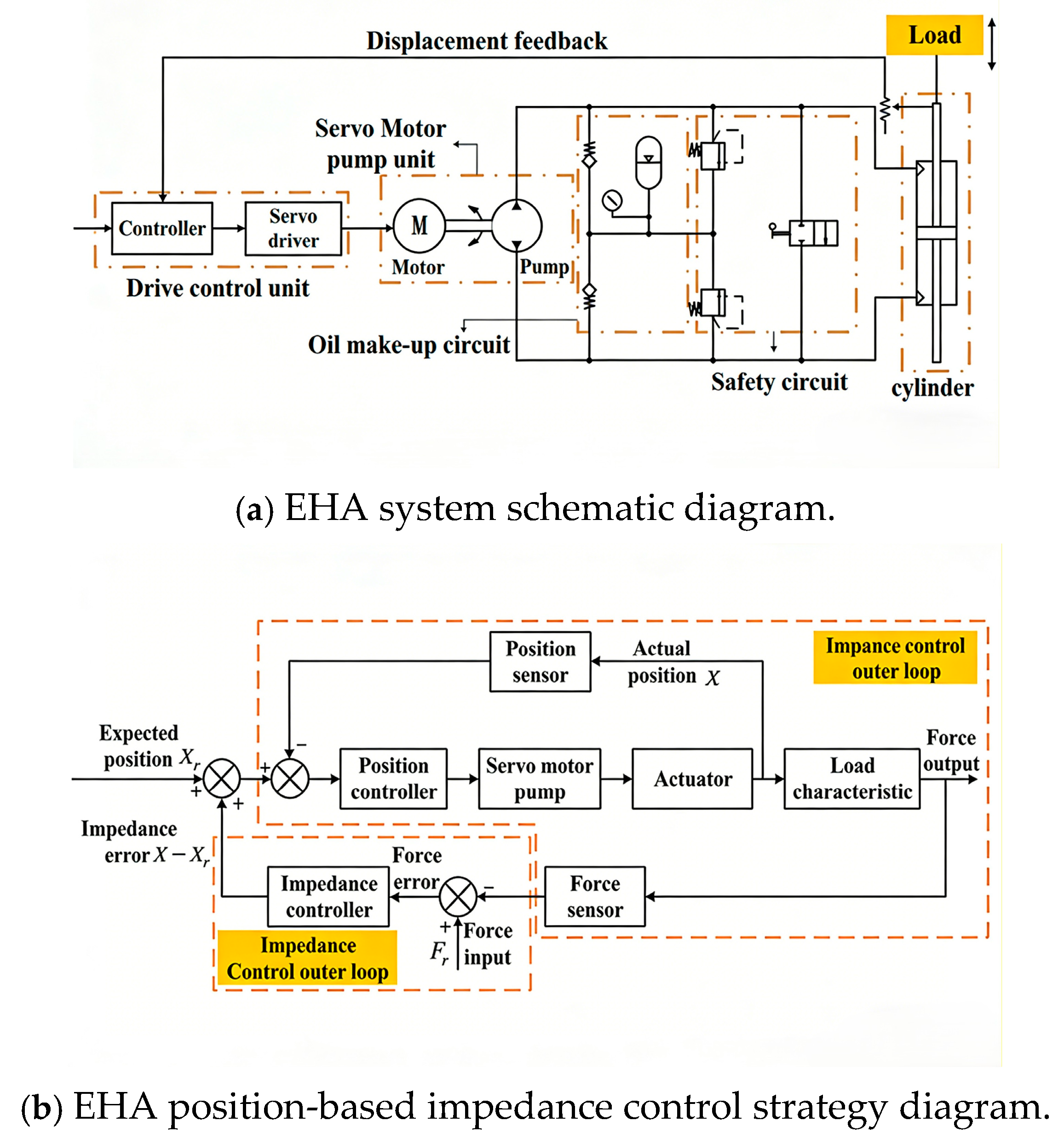
Recent studies have focused primarily on adaptive impedance control. For environments with unknown or time-varying parameters, such controllers combine adaptive laws with Kalman filtering to impose an optimizable virtual impedance characteristic on electro-hydraulic pump-controlled systems [129]. As shown in Figure 8, Yang et al. [130] developed an adaptive impedance controller for an EHA system [Sim., Transfer Potential] that can estimate environmental stiffness and position in real time. The controller uses a Kalman filter for optimal state estimation and correction, enabling accurate tracking of desired contact forces while suppressing contact shocks and oscillations. Simulation results showed that this strategy reduced the maximum force-tracking error by approximately 37.6% and increased the −45° phase bandwidth by approximately 70%.
However, the implementation of this strategy remains challenging. First, its performance depends critically on the accuracy and reliability of force/torque and position/velocity sensors [131]. Second, impedance parameter tuning typically requires substantial expertise and repeated experimental iteration, which is labor-intensive and has limited its widespread application in four-quadrant pump-controlled boom systems [132]. To address this limitation, He et al. [133] investigated a reinforcement-learning-based self-tuning framework for impedance parameters. This framework enables autonomous learning of optimal impedance strategies in simulation, followed by transfer to the physical system, thereby reducing reliance on expert knowledge.
Overall, impedance/admittance control provides an effective approach to addressing controllability challenges in FQ-PCBER systems [134]. Future research should focus on developing more robust and rapid adaptive algorithms for complex operating conditions, exploring sensor-reduced impedance control methods to reduce cost, and integrating impedance control with high-level energy management strategies, such as model predictive control, to achieve global optimization of both energy efficiency and operating controllability [135,136,137].

3.2.3. High-Performance Composite Control for Nonlinear Systems

To enhance the dynamic performance, tracking accuracy, and robustness of FQ-PCBER systems, a single control strategy is often insufficient. Compound control, which integrates the complementary advantages of multiple control approaches, provides an effective solution for addressing the multifaceted challenges of these systems. Its core principle is to combine the rapid response of feedforward control with the robustness of feedback control to manage inherent nonlinearities, time-varying parameters, and external disturbances [138].
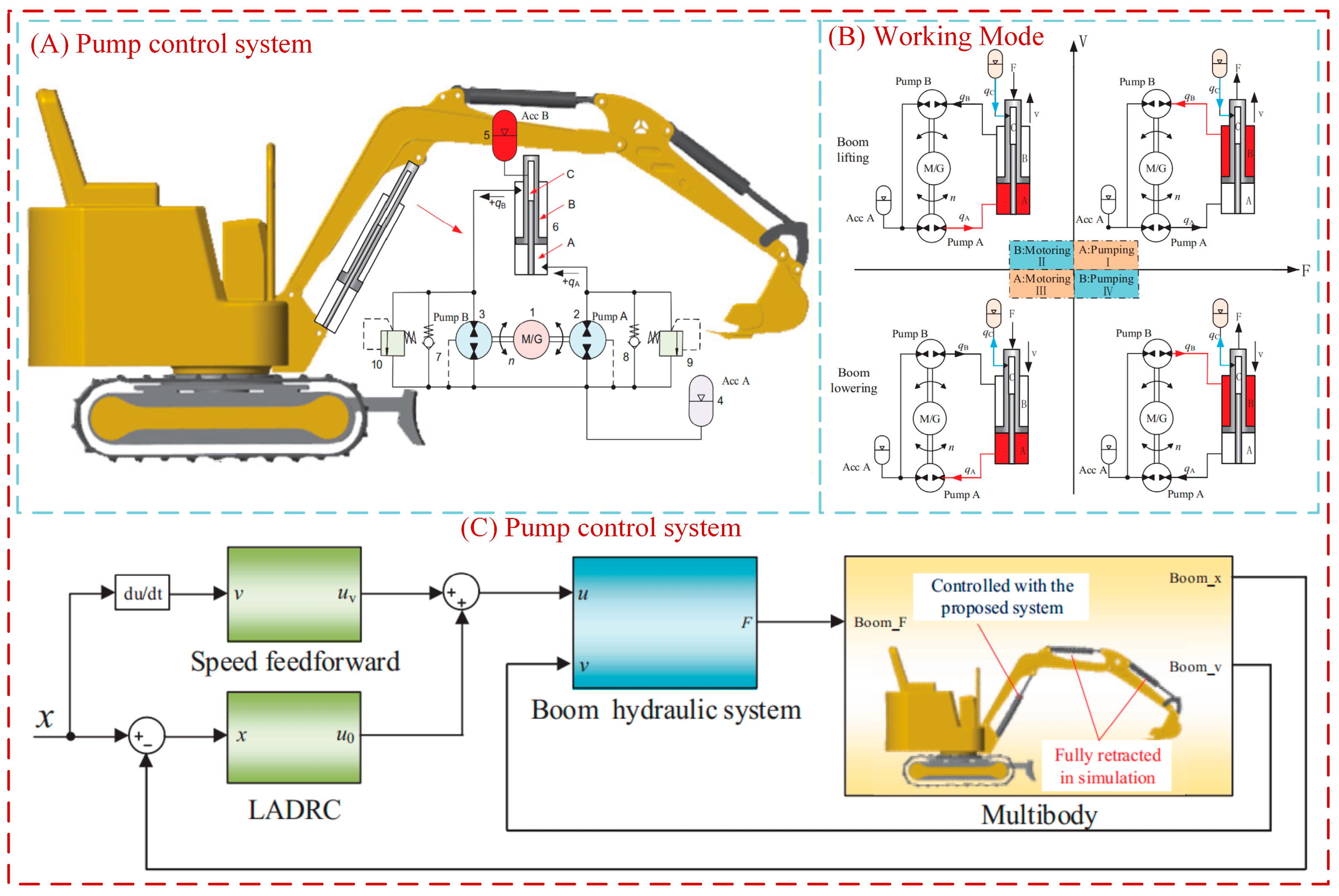
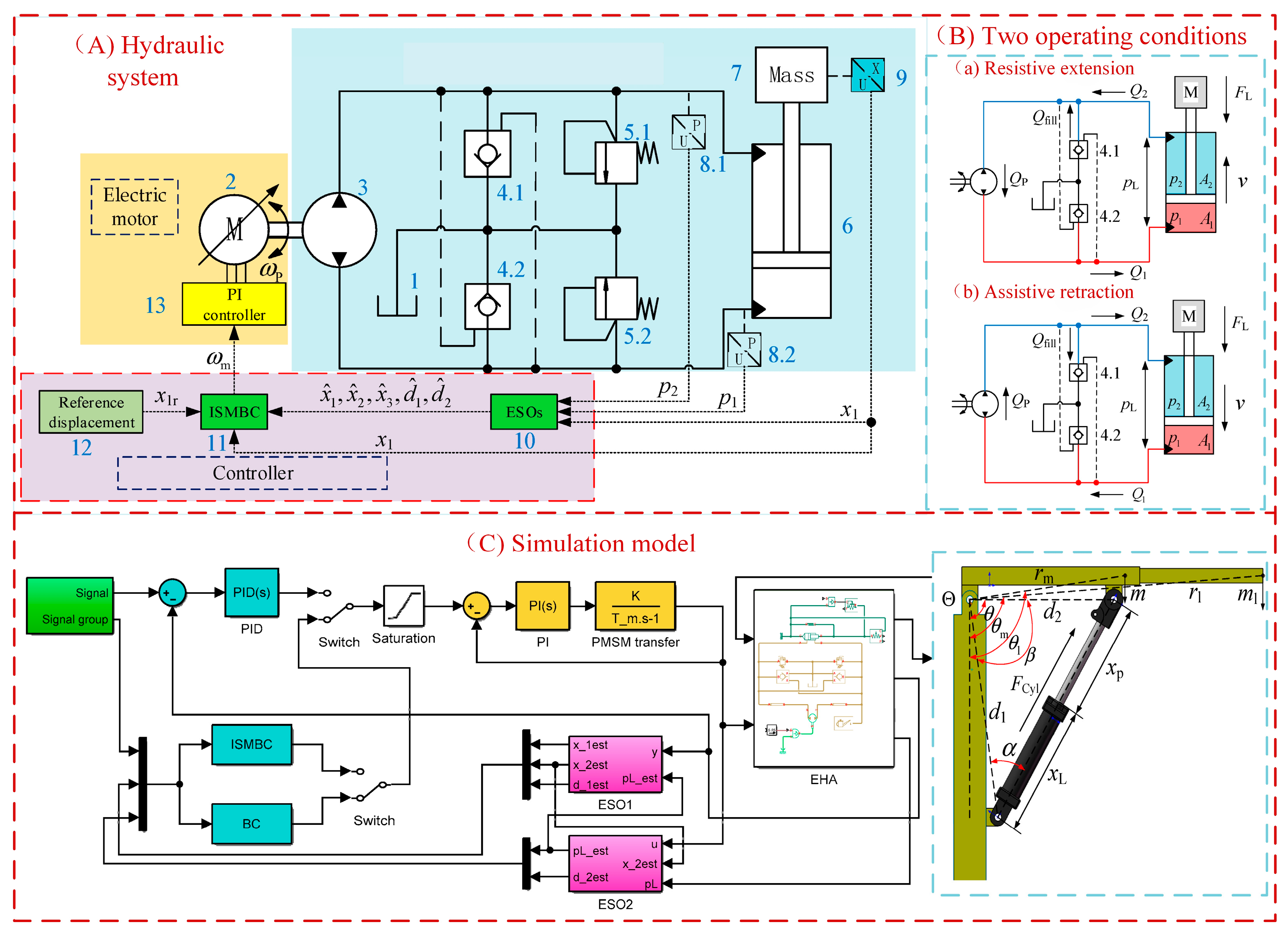
Feedforward control relies on an accurate inverse dynamic model of the plant. It directly calculates the required control input, such as motor torque or pump displacement, from the desired command, such as the joystick signal or target trajectory, to enable anticipatory control action [139]. Its main advantage lies in its ability to compensate proactively for system inertia, delays, and inherent dynamics, thereby improving response speed and reducing transient impacts during mode switching [140]. As illustrated in Figure 9, Guo et al. [141] proposed a variable-speed pump-controlled TCC system for hydraulic booms [Sim., Boom-validated] that incorporates feedforward linear active disturbance rejection control. The system uses two variable-speed fixed-displacement pumps to control chambers A and B of the cylinder, while chamber C is connected to a hydraulic accumulator to balance the boom weight and recover gravitational potential energy, as shown in Figure 9A. During boom lowering, potential energy is converted into hydraulic energy and stored in the accumulator; during boom lifting, the stored energy is released to assist the motion, as shown in Figure 9B. The controller combines speed feedforward compensation with linear active disturbance rejection control to improve disturbance rejection and position-tracking accuracy, as shown in Figure 9C. Simulation results showed that the proposed controller achieved a position-tracking error below 2.66%, outperforming both proportional–integral–derivative (PID) and feedforward PID control. Moreover, when energy recovery was incorporated, the system reduced energy consumption by 43.51% and peak power demand by 27.77% compared with a variable-speed pump-controlled differential cylinder system [142]. However, feedforward control performance is sensitive to the accuracy of system parameters, such as cylinder area and pump displacement, and cannot adequately address unmodeled dynamics or abrupt external load disturbances. Therefore, feedforward control should be combined with feedback control to achieve both high dynamic performance and robust operation [143].
Feedback control adjusts the control input in real time according to the error between the system output and the desired reference, thereby providing the basis for system stability, accuracy, and robustness [144]. In FQ-PCBER systems, the following advanced feedback control strategies are particularly important.
Adaptive robust control combines the advantages of adaptive control and robust control and represents a major approach for addressing time-varying parameters and nonlinear uncertainties in FQ-PCBER systems [145]. It estimates and compensates for slowly varying parameters online through adaptive laws while using robust feedback laws to suppress unmodeled dynamics, modeling errors, and external disturbances [146]. Hou et al. [147] designed an active–passive damping sliding mode controller. Under mixed wind–wave disturbances and sensor noise, this controller reduced load trajectory tracking error by more than 55% and substantially suppressed residual oscillations, demonstrating strong robust-adaptive and vibration-suppression performance.
Sliding mode control drives the system state to converge to and remain on a predefined sliding surface, thereby providing strong robustness against parameter variations and external disturbances [148]. However, its inherent high-frequency switching may induce chattering, which can excite mechanical vibration and noise [149]. To mitigate chattering, advanced methods such as higher-order sliding mode control and the super-twisting algorithm have been widely adopted [150,151]. As shown in Figure 10, Zhang et al. [152] applied integral sliding mode backstepping control with an extended state observer to crane boom position control [Sim., Transfer Potential]. This approach maintained strong robustness while reducing the position-tracking error to 0.0192 mm and effectively attenuating chattering amplitude.
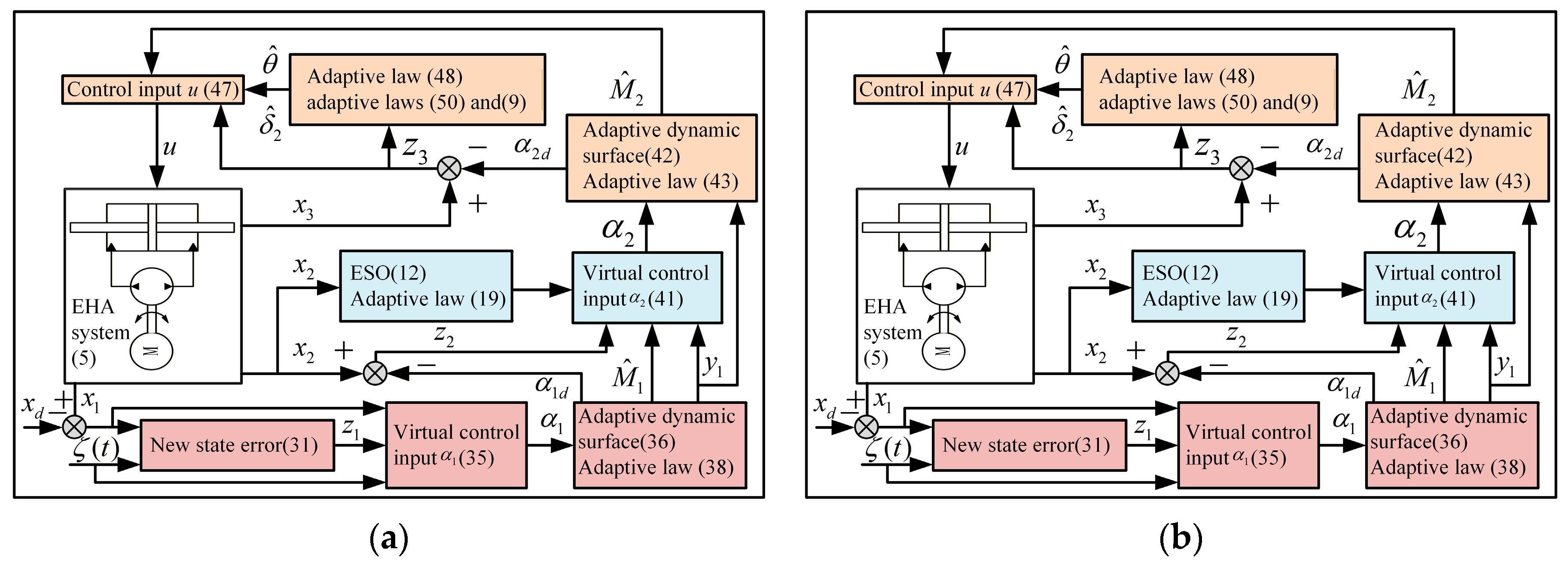
Disturbance observers provide an effective strategy for disturbance suppression in engineering applications [153]. They treat deviations from the nominal model, including external load disturbances, unmodeled friction, and parameter variations, as a lumped total disturbance that is estimated in real time [154]. The estimated disturbance is then fed forward to the controller for compensation, thereby attenuating its effect and substantially improving system disturbance rejection capability [155]. For pump-controlled systems, Liang et al. [156,157] developed adaptive dynamic surface control schemes for EHA systems [Sim. + Bench, Related EHA], integrating extended state observers to achieve asymptotic tracking under uncertainties, mismatched disturbances, and unmeasurable states, as shown in Figure 11. In Ref. [156], a prescribed-performance control framework combined with a novel extended state observer ensured both transient and steady-state accuracy under mismatched disturbances, as illustrated in Figure 11a. Simulation and experimental results showed that this method reduced tracking errors by approximately 60–75%. In Ref. [157], a state observer with adaptive robust terms was used to estimate unmeasurable velocity, enabling asymptotic tracking without velocity sensors. In addition, a desired-velocity-based friction model was introduced to improve feedforward compensation, as shown in Figure 11b. Experimental validation showed that, compared with conventional observers, the proposed method reduced maximum and average tracking errors by up to 79% and 85%, respectively. Together, these studies provide a comprehensive framework for high-precision motion control of EHA systems under practical constraints.
The development trend in high-performance compound control has shifted from the isolated improvement of individual algorithms toward deeper integration and strategic innovation [158]. On the one hand, the cross-fusion of model-driven methods has emerged as a practical approach for addressing highly complex operating conditions [159]. For example, integrating sliding mode control with an extended state observer has been recognized as a robust control framework for such demanding scenarios [160]. On the other hand, the integration of data-driven and model-driven approaches offers promising opportunities for further advancement [161]. Representative examples include using neural networks for online learning of unmodeled dynamics in feedforward models and applying reinforcement learning to optimize controller parameters [162]. As system architectures and control strategies evolve from single-path recovery schemes to electric, hydraulic, and hybrid multi-architecture systems, the central control challenge for FQ-PCBER systems lies in coordinating the recovery, storage, and reuse of different energy forms to optimize overall energy efficiency across the entire operating cycle.

3.3. Intelligent Energy Management

The intelligent EMS serves as the decision-making core of FQ-PCBER systems [163,164,165]. Its primary function is to determine, in real time, the optimal energy flow path and allocation ratio to maximize overall system energy efficiency [166,167,168]. In hybrid architectures, the EMS must also coordinate energy distribution between the electrical and hydraulic circuits [136,169]. EMS design is therefore a typical multi-objective optimization problem that must account for multiple constraints, including instantaneous recovery efficiency, the s SOC balance of the energy storage unit, component lifespan, such as battery state of health, and thermal management [170,171,172,173].

3.3.1. Local Optimization: Rule-Based Strategies

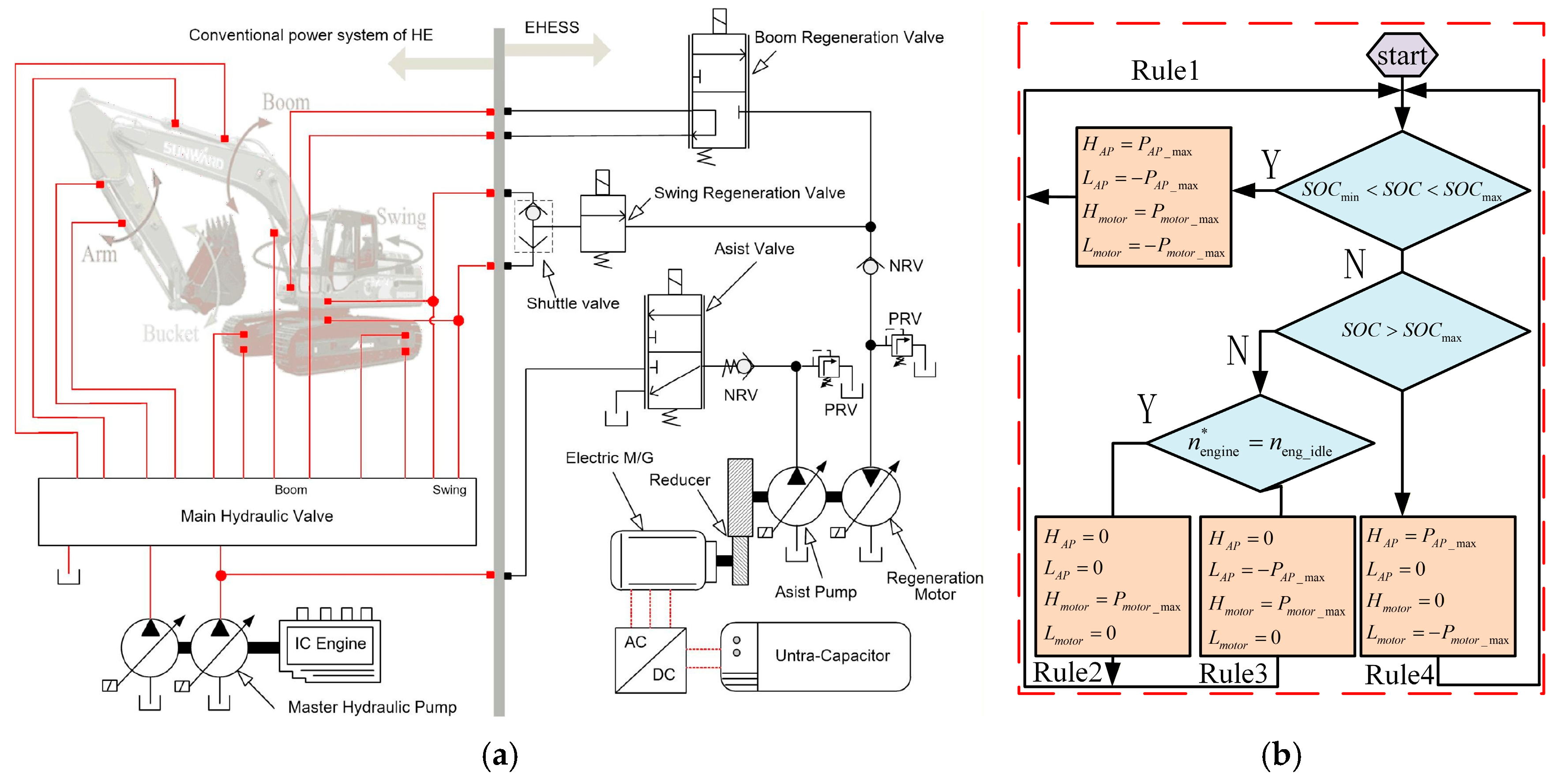
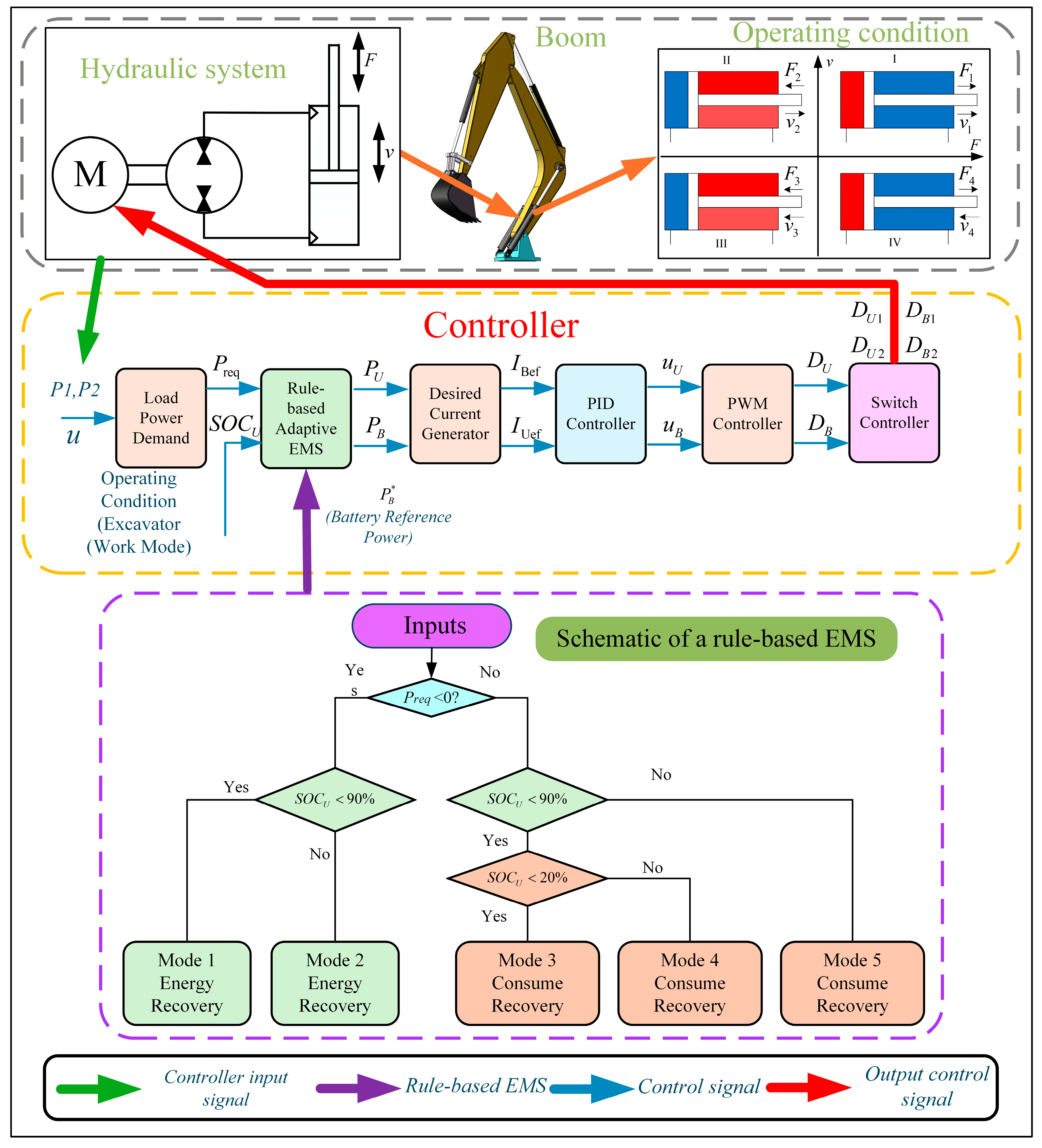
Rule-based control regulates energy flow through predefined if–then–else logic rules [174]. As illustrated in Figure 12, typical rules include switching to an electro-hydraulic hybrid recovery mode when the boom-lowering force exceeds a preset threshold, as shown in Figure 12a, or prioritizing the power regeneration pathway and terminating motor generation once the supercapacitor SOC exceeds a defined limit, as shown in Figure 12b [175] [Sim. + Bench]. These strategies are characterized by a simple structure, low computational cost, and high reliability, which facilitate implementation and verification in engineering practice [176]. Consequently, they have been widely adopted in early-stage research and prototype development [177].
However, Rule-based control is inherently empirical and greedy, and therefore generally produces only locally optimal decisions. It cannot anticipate future changes in operating conditions and typically fails to achieve globally optimal energy efficiency, making it a performance-limited and suboptimal solution. To overcome the global performance limitations of rule-based strategies, optimization-based energy management strategies have become a major research focus [178]. This approach formulates the energy management problem as a constrained optimization task that aims to determine a globally or instantaneously optimal energy allocation sequence [179].

3.3.2. Instantaneous Optimization: Equivalent Consumption Minimization Strategy

The equivalent consumption minimization strategy (ECMS), originally developed for hybrid electric vehicles, provides a unified framework for instantaneous energy management [180]. Its core principle is to use a penalty function to convert electrical energy consumption and recovery into an equivalent virtual fuel cost [181]. This formulation enables electric and fuel power sources to be optimized within a single objective function for real-time decision-making [182]. However, ECMS performance is highly dependent on the calibration of the penalty function. Because fixed penalty functions often fail to adapt to varying operating conditions, the adaptive equivalent consumption minimization strategy (A-ECMS) has been developed [183].
Cheng et al. [184] proposed a hybrid energy storage closed-loop pump-controlled system with a rule-based adaptive EMS, as shown in Figure 13 [Sim. + Bench]. A power controller was designed to regulate the real-time charging and discharging power and operating modes of the battery and supercapacitor. By exploiting the high power density of the supercapacitor, the battery can operate within a stable charge–discharge power range. A simulation model was developed for a 1-ton excavator. The results showed that the single-storage closed-loop pump-controlled system reduced energy consumption by 50.1% compared with a conventional load-sensing system [185]. The hybrid energy storage configuration achieved an additional 5.8% reduction in energy consumption while substantially extending battery life. These results demonstrate the significant advantages of the proposed system in improving overall energy efficiency and battery lifespan.

3.3.3. Global Optimization: Model Predictive Control

Model predictive control is a widely recognized method for achieving global energy efficiency optimization in FQ-PCBER systems [186]. Model predictive control uses a receding-horizon optimization framework [187]. At each control step, the current system state and a predictive model are used to forecast system behavior over a finite prediction horizon. A multi-objective optimization problem is then solved to generate an optimal control input sequence, of which only the first input is implemented. This process is repeated at each sampling instant [188]. This mechanism enables model predictive control to explicitly handle multiple objectives, such as maximizing efficiency, managing the SOC, and regulating temperature, as well as multiple constraints, such as motor torque limits, battery SOC bounds, and pump pressure limits [189]. Nguyen et al. [95] developed a hierarchical EMS integrating model predictive control with a deep deterministic policy gradient–proximal policy optimization algorithm. The objective function simultaneously minimizes EMG energy consumption and battery SOC fluctuations while constraining key variables, including accumulator pressure, battery SOC, and cylinder displacement, to ensure operation within safe ranges. Simulation results showed that this strategy achieved 62.2% energy savings in the test system, representing a substantial improvement over conventional approaches, while also achieving motion control accuracy within 1 mm. These results demonstrate its effectiveness in improving both energy efficiency and control precision.
The preceding sections have systematically reviewed advanced control strategies for FQ-PCBER systems, including active decoupling, impedance-based control, and compound disturbance suppression. Beyond theoretical advances, however, the technological maturity and engineering validation status of these strategies also warrant consideration, because they provide critical insight into the feasibility of transitioning from conceptual methods to industrial applications. Accordingly, Table 4 summarizes the validation status, typical validation platforms, and corresponding literature sources for the principal control strategies discussed in this review.
Future research on energy management strategies (EMSs) is shifting from purely model-based approaches toward integrated, data-driven paradigms [190,191]. Reinforcement learning has emerged as a promising direction because of its strong capacity for environmental interaction and autonomous learning [192]. For example, model-free reinforcement learning algorithms can learn optimal energy management strategies directly through trial-and-error interactions with the environment, without relying on accurate system models. Furthermore, frameworks that combine the predictive capability of model predictive control with the exploratory capability of reinforcement learning may provide a viable approach for solving global optimization problems in complex nonlinear systems [193].

4. Engineering Challenges and Future Development

4.1. Current Technical Challenges

Despite promising laboratory results, FQ-PCBER systems still face substantial technical challenges that limit performance improvement and hinder widespread adoption.
(1) Efficiency limitations
(a) Component efficiency-map matching: Motor and pump efficiencies peak within specific operating regions [194]. The actual boom operating point, which is characterized by low speed and high torque during lowering, often falls within the low-efficiency region of the motor efficiency map, thereby severely limiting energy recovery efficiency. Therefore, optimizing component matching or designing components with broader high-efficiency operating ranges is essential.
(b) Inherent recovery limits: FQ-PCBER systems are subject to inherent energy losses, including mechanical friction, fluid viscosity losses, copper and iron losses, and valve pressure drops, which impose a theoretical upper bound on recoverable energy [195]. Current research has yet to fully approach this limit. A key challenge, for example, is to ensure stable four-quadrant operation of the hydraulic pump while improving recovery efficiency at low cylinder speeds.
(2) Dynamic response and stability issues
(a) Pressure oscillations and vibration: The large inertia of the boom, combined with fluid compressibility and pipeline flexibility, can readily induce pressure shocks and severe vibration during mode switching or sudden unloading, thereby compromising system reliability and operator comfort [196].
(b) Nonlinearities and time-varying parameters: Oil properties, including bulk modulus, viscosity, friction characteristics, and leakage, vary substantially with temperature and operating conditions. These variations lead to highly uncertain system models and impose stringent robustness requirements on the controller [197].
(3) Defining and preserving controllability
Energy recovery in FQ-PCBER systems must not compromise controllability [198]. A critical factor for operator acceptance is the ability to quantify and reproduce the familiar operating feel of conventional valve-controlled systems, as well as to enable the control system to intelligently interpret operator intent, such as distinguishing fine positioning from rapid lowering [199].
(4) High cost
The requirement for high-performance servo motors, drives, high-precision sensors, and reliable four-quadrant hydraulic pumps substantially increases the added cost of FQ-PCBER systems [200]. This cost increase conflicts with the high cost sensitivity and intense price competition in the construction machinery market. Because customers typically require short investment payback periods, high initial cost remains a major barrier to adoption.
(5) Reliability concerns
Although control algorithms may perform well under ideal laboratory conditions, construction machinery operates in harsh environments characterized by continuous impacts, severe vibration, wide temperature variations, and hydraulic oil contamination [201]. The long-term reliability, service life, and mean time between failures of precision components, such as electronic control units, motor bearings, and position sensors, under such conditions have not been fully validated, posing a significant concern for manufacturers. Furthermore, the supply chain for high-power-density, impact-resistant, and cost-effective servo motors and drives suitable for construction machinery remains underdeveloped [202].

4.2. Future Developments

Although FQ-PCBER technology has demonstrated considerable energy-saving potential in laboratory settings, its transition from prototype development to mature industrial deployment remains challenging. Based on the research consensus summarized in Figure 14, Figure 15, Figure 16 and Figure 17, future development should focus on four core pillars: overcoming performance limitations, enhancing system intelligence, achieving multi-domain energy synergy, and ensuring long-term operational reliability [61,184,203,204,205,206,207,208,209,210,211,212,213].

4.2.1. Short-Term Goals (1–3 Years): Exploring and Pushing the Limits of Power Density
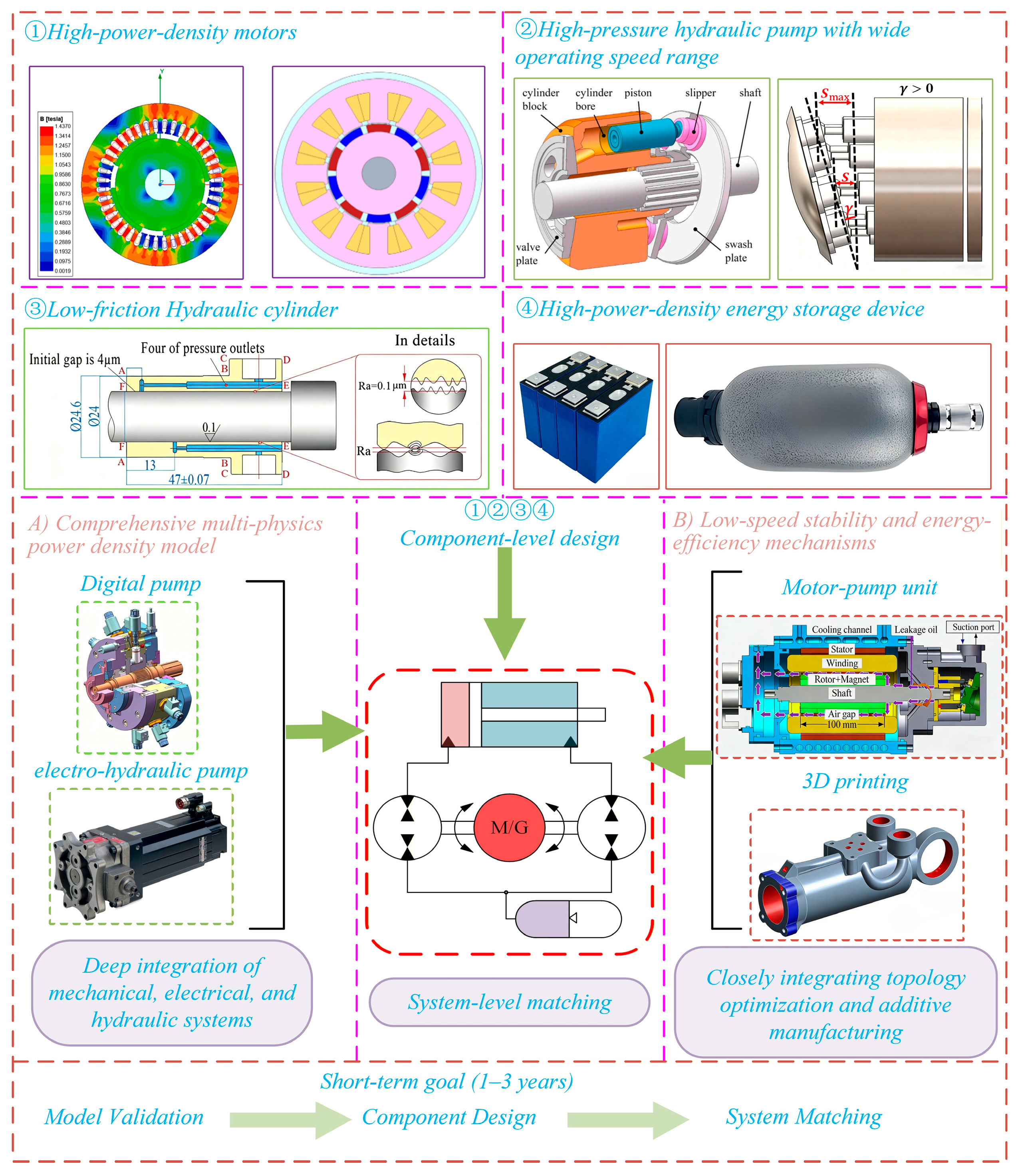
Improving the power density of FQ-PCBER systems remains a key bottleneck as these systems evolve toward miniaturized and lightweight designs. Future research should therefore pursue advances across theoretical analysis, system design, and manufacturing technologies in Figure 14.
Figure 14. Future component and system development architecture [203,204,205,206,207,208,209,210].
Machines 14 00548 g014
(1) Characterization of theoretical boundaries
(a) Component-level advancements: The performance bottlenecks of core components must be addressed to systematically improve the power density, energy efficiency, and reliability of four-quadrant pump-controlled boom energy recovery systems. Specifically, future research should focus on the following directions. First, novel high-power-density motors, such as permanent magnet motors and switched reluctance motors, should be developed to enable more compact structures, higher efficiency, and faster dynamic response. Second, hydraulic pumps should be advanced toward higher operating pressures, broader speed ranges covering both high- and low-speed operation, and lower noise. In parallel, challenges related to pressure shocks, component life, high-pressure sealing, cavitation, cylinder-block tilt, and high-speed power losses should be addressed. Third, friction in hydraulic cylinders should be substantially reduced through composite materials, advanced surface treatments, and optimized sealing technologies to achieve higher power-to-weight ratios and smoother force control. Fourth, high-power-density, long-life, and cost-effective energy storage devices, including solid-state batteries, advanced capacitors, and hydraulic accumulators based on novel materials, should be developed to support efficient energy storage and rapid release. Coordinated advances in these components are fundamental to the development of next-generation high-performance four-quadrant pump-controlled systems.
(b) System-level theoretical exploration: Research should advance toward in-depth theoretical modeling and the exploration of extreme performance limits to overcome existing bottlenecks. First, a comprehensive multi-physics model should be established to characterize the power density of FQ-PCBER systems by integrating electromagnetic, mechanical, fluid, and thermal domains. This model should account for constraints such as material strength limits, electromagnetic saturation, thermal dissipation boundaries, and hydraulic system dynamics, thereby clarifying the theoretical upper limit of the power-to-weight ratio. Such modeling can provide explicit theoretical boundaries and targeted guidance for the engineering design and parameter optimization of high-power-density FQ-PCBER systems. Second, the stability limits of four-quadrant pump-controlled systems under low-speed operation should be investigated. The output characteristics, friction nonlinearities, and efficiency evolution of motors, hydraulic pumps, and cylinders at very low rotational or linear speeds should be systematically examined. These studies can clarify the mechanisms of energy flow and loss in the low-speed regime, thereby establishing a theoretical basis for improving low-speed stability, expanding the high-efficiency operating range, and enabling effective low-speed energy recovery.
(2) Integrated and topology-optimized design
The design philosophy of four-quadrant pump-controlled systems should shift from conventional component assembly toward highly integrated system-level design. This shift involves two main directions. First, deep integration technologies should be developed, particularly highly integrated coaxial or shared-housing motor–pump units. Eliminating intermediate connections, such as couplings, can reduce mechanical losses, improve structural stiffness, and enhance system reliability. Second, topology optimization should be closely integrated with additive manufacturing, such as three-dimensional printing, to enable the integrated design and fabrication of hydraulic components, including monolithic valve blocks and cylinder bodies. This approach enables lightweight components with complex internal flow passages and optimized material distribution, thereby minimizing volume and weight without compromising performance and improving actuator power density and spatial adaptability.

4.2.2. Medium-Term Goals (3–7 Years): Innovations in Advanced Compliance Control

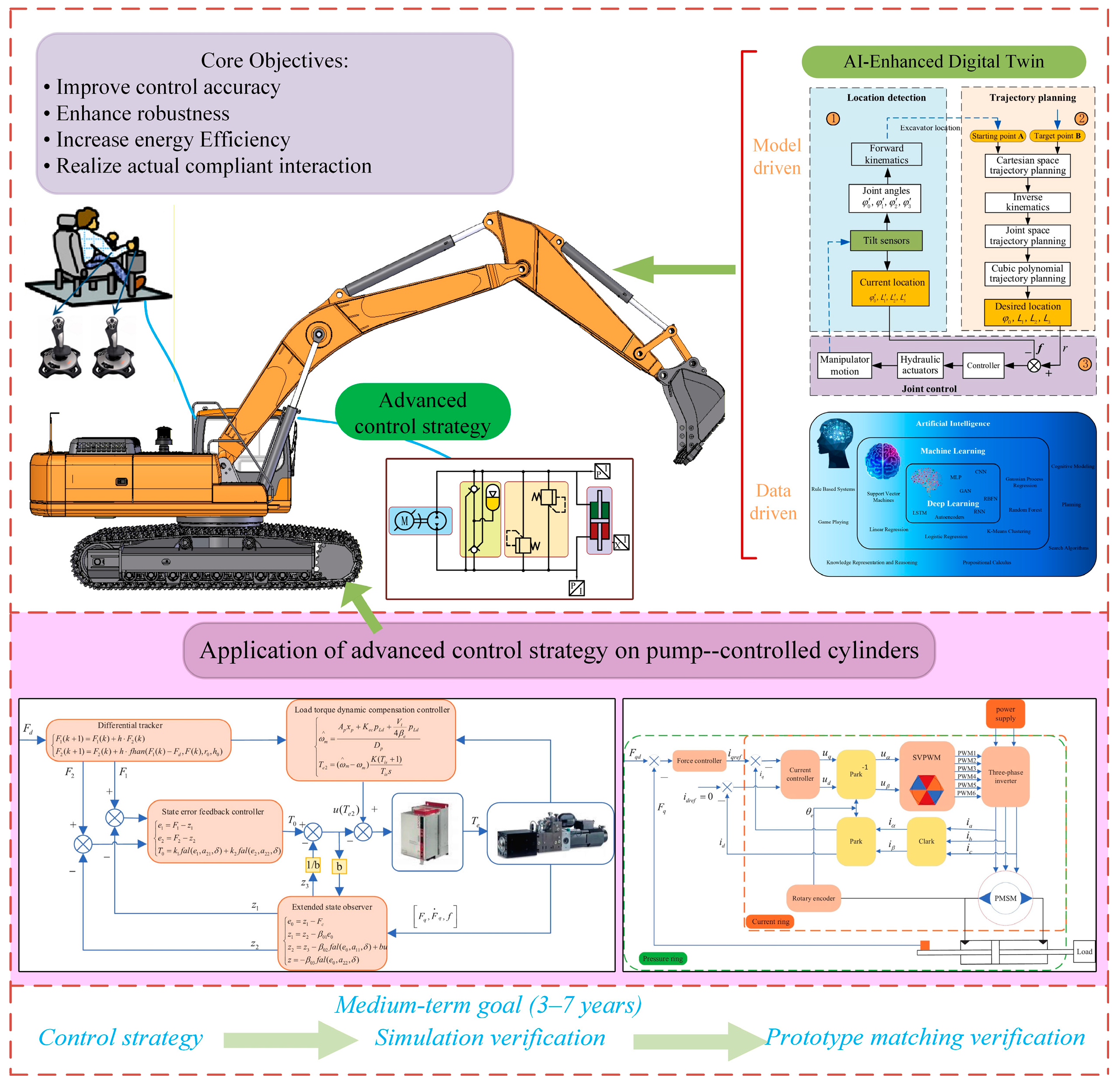
To address challenges related to operating feel during energy recovery and mode-switching transients, control strategies must evolve toward greater intelligence and adaptability in Figure 15.
(a) From model-driven to data- and intelligence-driven control: Future control strategies must move beyond the limitations of conventional model-based approaches and toward the deep integration of data-driven and intelligent methods to address the inherent nonlinearities, parameter variations, and external disturbances in FQ-PCBER systems. The application of artificial intelligence techniques, such as deep learning and reinforcement learning, to system perception, decision-making, and control should be actively explored. Upgrading the perception–decision–control closed loop through intelligent methods can substantially improve control accuracy, robustness, and energy efficiency under real-world operating conditions.
(b) Realizing practical compliant interaction: Beyond conventional position- or pressure-based control, advanced compliance strategies based on impedance/admittance shaping should be thoroughly investigated and implemented. This approach actively shapes the dynamic interaction between the actuator and its environment. It is essential for mitigating the light floating sensation, ensuring intuitive operator feedback and safe interaction, and supporting precise excavator operations.
(c) Digital-twin enablement: Digital-twin technology can provide efficient and reliable digital support for FQ-PCBER control development. By constructing a high-fidelity digital twin that closely replicates the physical system, control algorithms can be rapidly verified and parameters can be tuned in a virtual environment. This approach reduces prototyping time and cost while enabling the prediction and evaluation of system dynamics and energy consumption under complex operating conditions, thereby shortening the development cycle. Furthermore, it provides a technical foundation for predictive maintenance and enhances overall system reliability and life-cycle management.
Figure 15. Future component and system development architecture [211,212,213].
Machines 14 00548 g015

4.2.3. Long-Term Goals (7–10 Years): Synergistic Solution for Energy Recovery and Thermal Management

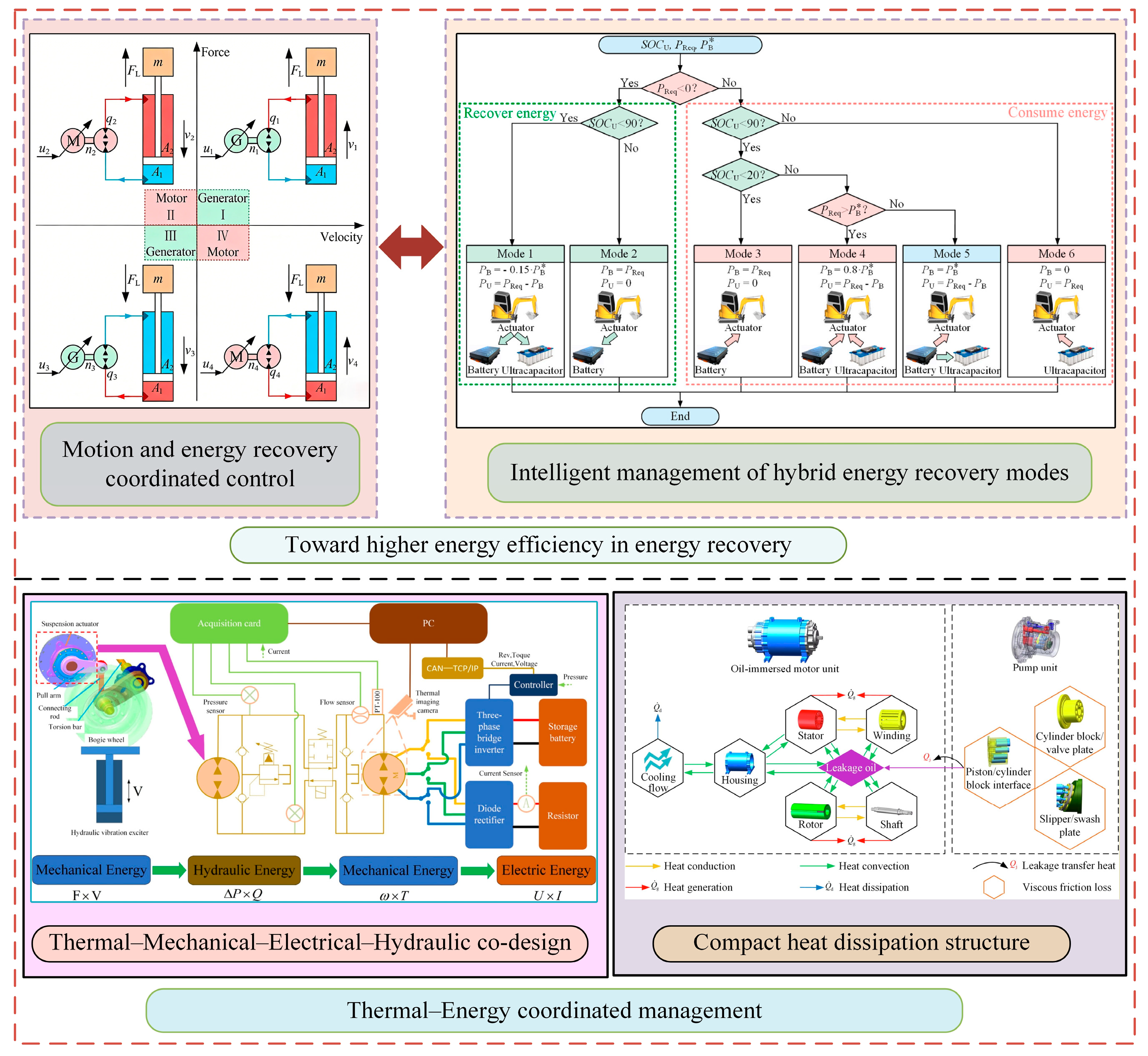
Energy recovery and thermal management are interdependent and therefore require integrated design and optimization in Figure 16.
(1) Enhancing energy recovery efficiency
(a) Cooperative control strategy: To achieve comprehensive performance optimization of FQ-PCBER systems under dynamic operating conditions, cooperative control strategies should be developed. These strategies should integrate motion-tracking accuracy and energy recovery objectives within a unified control framework. By implementing multi-objective optimization algorithms, the system can determine, in real time, the timing and magnitude of energy recovery during operation. This approach enables coordinated energy recovery and storage, maintains motion stability and tracking precision during the recovery phase, and fully exploits system-level energy-saving potential, thereby improving overall efficiency and cost-effectiveness.
(b) Intelligent management of hybrid recovery systems: The inherent limitations of electrical and hydraulic recovery pathways necessitate intelligent cooperative management strategies to improve overall hybrid system performance. These limitations include the narrow high-efficiency operating range, low generation efficiency at low speeds, and insufficient low-speed stability of electrical recovery systems, as well as the low energy density and high-speed efficiency degradation of hydraulic recovery systems. Future research should focus on dynamic allocation and collaborative mechanisms between the two recovery modes. Specifically, the system should intelligently switch between or combine the two modes according to real-time operating conditions, such as load speed, system pressure, and energy demand. Such coordination can exploit complementary advantages, approach the theoretical optimum recovery efficiency across the entire operating envelope, and substantially improve the practicality and energy-saving potential of FQ-PCBER systems.
Figure 16. Future component and system development architecture [61,184,205].
Machines 14 00548 g016

4.2.4. Long-Term Goals (7–10 Years): Development of Condition Monitoring and Fault Diagnosis Methods
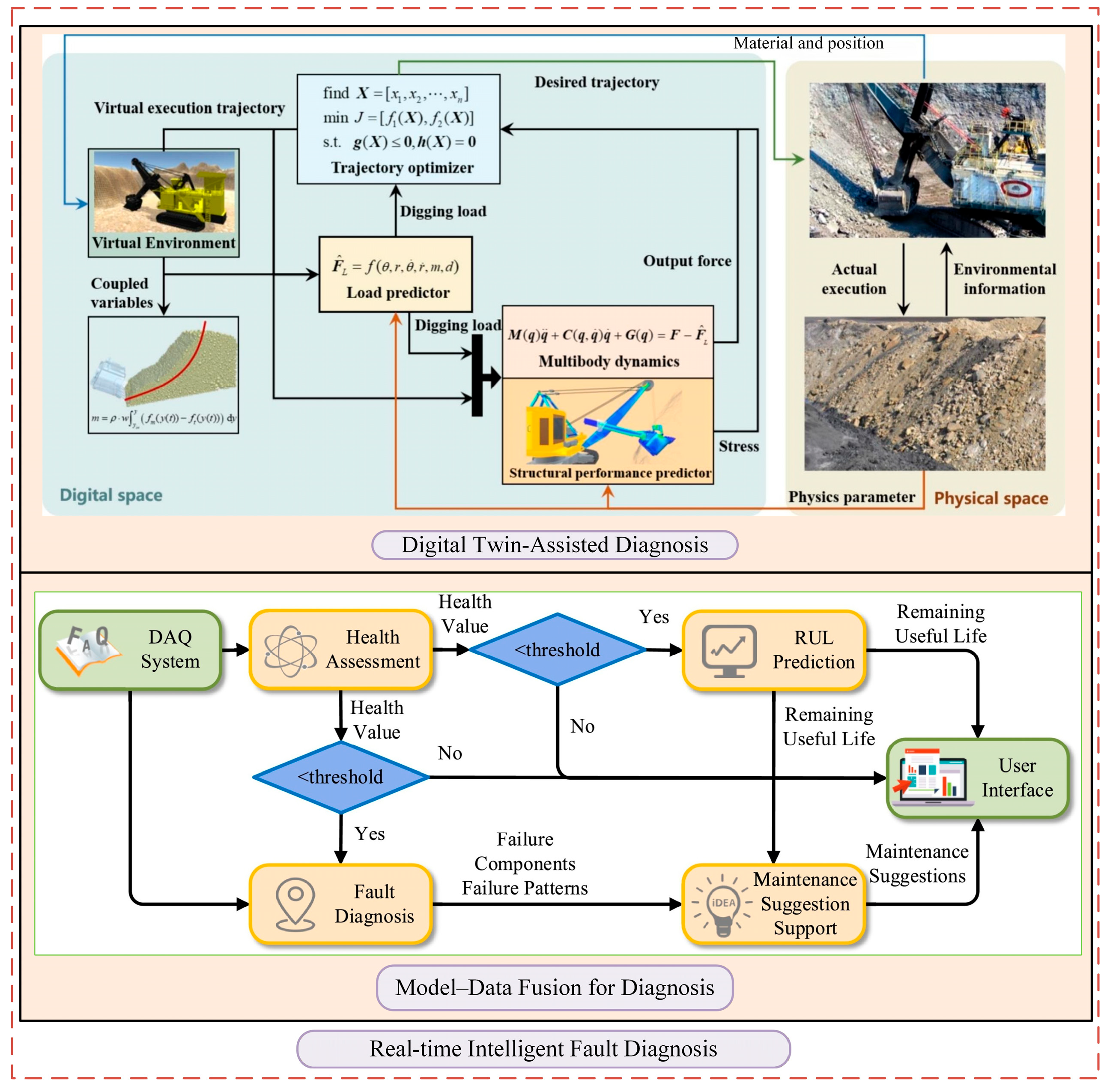
To ensure high reliability throughout the life cycle of FQ-PCBER systems, advanced health management technologies must be developed in Figure 17.
(a) High-performance condition monitoring: To achieve high reliability and intelligent operation and maintenance in electro-hydraulic actuation systems, a high-performance condition monitoring system that integrates direct sensing and indirect estimation is required. Conventional approaches rely on built-in, multi-source, high-precision sensors to monitor key parameters comprehensively in real time. In addition, sensorless monitoring technologies should be further advanced by inferring signals such as motor current, motor speed, and pump pressure through advanced estimation algorithms. A condition monitoring system that combines multi-source sensing with sensorless information is essential for enabling predictive maintenance, ensuring long-term reliable operation, and optimizing maintenance schedules.
(b) Real-time intelligent fault diagnosis: When system abnormalities occur, the fault source must be identified rapidly and accurately. An intelligent diagnostic system should be developed by integrating model-based methods, such as state observers, with data-driven methods, such as deep learning. By comparing virtual and real data through digital twins, the accuracy and real-time performance of fault diagnosis can be improved, thereby supporting fault-tolerant control and ensuring operational safety.
Figure 17. Future component and system development architecture [211,214].
Machines 14 00548 g017

5. Conclusions

This review has systematically examined the current status, key challenges, and future prospects of FQ-PCBER technology. Based on a comprehensive analysis of the existing literature, the main conclusions are summarized as follows:
The development pathways of FQ-PCBER architectures have diversified, providing distinct solutions for different application scenarios. A comparative analysis of the three main technical pathways—electric, hydraulic, and hybrid recovery systems—shows that each has well-defined technical boundaries. The electric architecture, characterized by high energy management flexibility, is suitable for high-end equipment and electric platforms. The hydraulic architecture offers high power density and reliability, making it advantageous for cost-sensitive applications. Although still at an early stage of development, the hybrid architecture has the theoretical potential to achieve global optimization and represents an important future direction. This diversified technological landscape provides a clear basis for selecting energy-saving solutions for excavators with different tonnages and operating requirements.
The advancement of sophisticated control strategies is a key driver of overall system performance improvement. Existing studies indicate that impedance/admittance control can effectively address the inherent trade-off between energy recovery and operating feel. In addition, compound control architectures that integrate feedforward control with multiple feedback strategies can substantially improve dynamic response and robustness. The development of intelligent energy management strategies, particularly model predictive control for multi-objective constrained optimization, provides a pathway toward global energy efficiency optimization. Continued innovation in control technology is advancing FQ-PCBER systems from basic functional realization toward performance optimization.
Engineering applications still face multiple challenges, and cross-disciplinary collaboration is required to achieve technological breakthroughs. Although laboratory studies have confirmed the considerable energy-saving potential of FQ-PCBER technology, its industrialization remains constrained by core engineering trade-offs, such as those between cost and performance and between power density and reliability. Overcoming these bottlenecks requires advances in new materials, integrated design, and intelligent algorithms. Meanwhile, nontechnical factors, including the lack of standardized system architectures and inconsistent testing protocols, also require urgent attention.
FQ-PCBER technology is at a critical stage in its transition from laboratory research to engineering application. Future progress will require close collaboration between academia and industry, as well as interdisciplinary innovation in core components, system architectures, and intelligent control. With the continued global pursuit of carbon neutrality, FQ-PCBER technology is expected to become an important enabler of the green transformation of the construction machinery industry and to provide essential technical support for its sustainable development.

Author Contributions

Methodology, L.-K.L.; conceptualization, L.-K.L.; investigation, L.-K.L. and G.-C.A.; resources, L.-K.L., H.-Q.D. and Z.L.; software, L.-K.L. and B.-Y.L.; validation, L.-F.M.; data curation, L.-K.L. and B.-Y.L.; writing—original draft preparation, L.-K.L.; writing—review and editing, H.-Q.D. and G.-C.A.; supervision, L.-F.M.; project administration, Z.L. and H.-Q.D. All authors have read and agreed to the published version of the manuscript.

Funding

This work was supported by Xinjiang Intelligent Equipment Research Institute, Aksu 842008, China, and the Key Technology R&D for Hydrogen Energy Storage and Application (Grant No. XJYJY2025005).

Data Availability Statement

No new data were created or analyzed in this study.

Acknowledgments

The authors are very grateful for the support received from Taiyuan University of Science and Technology for this research.

Conflicts of Interest

The author declares no conflicts of interest.

References

  1. Ge, L.; Quan, L.; Li, Y.; Zhang, X.; Yang, J. A novel hydraulic excavator boom driving system with high efficiency and potential energy regeneration capability. Energy Convers. Manag. 2018, 166, 308–317. [Google Scholar] [CrossRef]
  2. Cai, T.; Wang, Y.; Wang, Y.; Zhang, Y.; Zheng, X. Energy consumption and carbon emissions of residential buildings with phase-change panels and geopolymer envelopes in China’s cold region. Energy Build. 2026, 352, 116782. [Google Scholar] [CrossRef]
  3. Huang, X.; Huang, Q.; Cao, H.; Yan, W.; Cao, L.; Zhang, Q. Optimal design for improving operation performance of electric construction machinery collaborative system: Method and application. Energy 2022, 263, 125629. [Google Scholar] [CrossRef]
  4. Fresia, P.; Rundo, M.; Padovani, D.; Altare, G. Combined speed control and centralized power supply for hybrid energy-efficient mobile hydraulics. Autom. Constr. 2022, 140, 104337. [Google Scholar] [CrossRef]
  5. Shang, Y.; Li, R.; Li, Y.; Chen, H.; Liu, F. Simulation analysis of temperature rise and thermal deformation of the core of the new U-shaped throttle groove slide valve. Flow Meas. Instrum. 2026, 108, 103161. [Google Scholar] [CrossRef]
  6. Peng, Z.; Wang, L.; Zhou, R.; Gong, G.; Yang, H.; Han, D. Structural design of a large flow pressure compensation valve based on flow force compensation and optimization. Flow Meas. Instrum. 2026, 107, 103079. [Google Scholar] [CrossRef]
  7. Meng, D.; Sun, X.; Zhai, Y.; Wang, L.; Song, P.; Wei, M.; Tian, R.; Shen, L. Flow Loss and Transient Hydrodynamic Analysis of a Multi-Way Valve for Thermal Management Systems in New Energy Vehicles. Energies 2026, 19, 287. [Google Scholar] [CrossRef]
  8. Xia, L.; Quan, L.; Ge, L.; Hao, Y. Energy efficiency analysis of integrated drive and energy recuperation system for hydraulic excavator boom. Energy Convers. Manag. 2018, 156, 680–687. [Google Scholar] [CrossRef]
  9. Masyhur, R.T.; Alias, A.H.; Haron, N.A.; Zulkafli, Z. A systematic review on green practices in the Malaysian construction industry: Status, challenges, key motivations, rating systems and technology evolution. Energy Build. 2024, 320, 114550. [Google Scholar] [CrossRef]
  10. Yang, X.; Jiachen, J.I.; Liu, Y. Stakeholder-associated impact factors in the promotion of electric construction machinery for plateau tunnels: A social network analysis. Sustain. Futures 2025, 10, 101224. [Google Scholar] [CrossRef]
  11. Li, D.; Zhang, X.; Liang, R. Simulation and experimental verification of negative flow control hydraulic excavator slewing system. Chin. J. Constr. Mach. 2021, 19, 477–481. [Google Scholar] [CrossRef]
  12. Jiao, Z.; Wang, Z.; Liu, X.; Wang, H.; Qi, P.; Qiao, W. Multi-parameter load sensing pump model simulation and flow rate characteristics research. Chin. J. Aeronaut. 2022, 35, 296–308. [Google Scholar] [CrossRef]
  13. Shi, X.; Gao, C.; Chen, J.; Wang, D.; Ai, C. Research on start-up pressure shock of a fully electronically controlled positive-flow hydraulic excavator. Chin. Hydraul. Pneum. 2023, 47, 138–145. [Google Scholar] [CrossRef]
  14. Wang, F.; Qiao, Y.; Zhou, H.; Wu, J.; Xu, B. An independent electro-hydraulic variable speed drive to improve energy efficiency of electric wheel loader working system. IEEE Trans. Veh. Technol. 2024, 73, 18250–18265. [Google Scholar] [CrossRef]
  15. Trinh, H.; Truong, H.V.A.; Do, T.; Nguyen, H.; Phan, V.; Ahn, K. Optimization-based energy management strategies for hybrid construction machinery: A review. Energy Rep. 2022, 8, 6035–6057. [Google Scholar] [CrossRef]
  16. Lin, T.; Wang, Q.; Hu, B.; Gong, W. Development of hybrid powered hydraulic construction machinery. Autom. Constr. 2010, 19, 11–19. [Google Scholar] [CrossRef]
  17. Yang, J.; Liu, B.; Zhang, T.; Hong, J.; Zhang, H. Application of energy conversion and integration technologies based on electro-hydraulic hybrid power systems: A review. Energy Convers. Manag. 2022, 272, 116372. [Google Scholar] [CrossRef]
  18. Lin, T.; Huang, W.; Ren, H.; Fu, S.; Liu, Q. New compound energy regeneration system and control strategy for hybrid hydraulic excavators. Autom. Constr. 2016, 68, 11–20. [Google Scholar] [CrossRef]
  19. Minav, T.A.; Heikkinen, J.E.; Pietola, M. Direct driven hydraulic drive for new powertrain topologies for non-road mobile machinery. Electr. Power Syst. Res. 2017, 152, 390–400. [Google Scholar] [CrossRef]
  20. Ghoshal, S.K.; Pandey, A.K.; Dasgupta, K.; Bhola, M. A segmental pump-motor control scheme to attain targeted speed under varying load demand of a hydraulic drive used in heavy earth movers. Mechatronics 2021, 80, 102681. [Google Scholar] [CrossRef]
  21. Quan, Z.; Quan, L.; Zhang, J. Review of energy efficient direct pump controlled cylinder electro-hydraulic technology. Renew. Sustain. Energy Rev. 2014, 35, 336–346. [Google Scholar] [CrossRef]
  22. Ho, T.H.; Ahn, K.K. Design and control of a closed-loop hydraulic energy-regenerative system. Autom. Constr. 2012, 22, 444–458. [Google Scholar] [CrossRef]
  23. Ren, G.; Costa, G.K.; Sepehri, N. Position control of an electro-hydrostatic asymmetric actuator operating in all quadrants. Mechatronics 2020, 67, 102344. [Google Scholar] [CrossRef]
  24. Qu, S.; Fassbender, D.; Vacca, A.; Busquets, E. A high-efficient solution for electro-hydraulic actuators with energy regeneration capability. Energy 2021, 216, 119291. [Google Scholar] [CrossRef]
  25. Ge, L.; Zhang, X.; Wang, C.; Wang, C.; Wu, L. Experiment study on the characteristics of speed-variable asymmetric pump driven excavator arm. J. Mech. Eng. 2017, 53, 210–216. [Google Scholar] [CrossRef]
  26. Wang, B.; Li, Y.-H.; Zhao, B.; Ge, L.; Quan, L. Comparative study on energy efficiency characteristics of pump-controlled asymmetric hydraulic cylinder systems. Chin. Hydraul. Pneum. 2018, 10, 8–14. [Google Scholar] [CrossRef]
  27. Do, T.C.; Dang, T.D.; Dinh, T.Q.; Ahn, K. Developments in energy regeneration technologies for hydraulic excavators: A review. Renew. Sustain. Energy Rev. 2021, 145, 111076. [Google Scholar] [CrossRef]
  28. Singh, S.; Kumar, A.; Thakur, S. Sustainable energy solutions for hydraulic excavators: A comprehensive review and novel energy regeneration approach. Proc. Inst. Mech. Eng. Part E J. Process Mech. Eng. 2025. [Google Scholar] [CrossRef]
  29. Huang, X.; Yan, W.; Cao, H.; Chen, S.; Tao, G.; Zhang, J. Prospects for purely electric construction machinery: Mechanical components, control strategies and typical machines. Autom. Constr. 2024, 164, 105477. [Google Scholar] [CrossRef]
  30. Nguyen, T.H.; Do, T.C.; Nguyen, M.H.; Ahn, J.; Ahn, K. Energy consumption reduction technologies in hybrid hydraulic construction machine: A review. Renew. Sustain. Energy Rev. 2026, 225, 116150. [Google Scholar] [CrossRef]
  31. Hao, Y.; Xia, L.; Quan, L.; Zhao, B.; Chen, H.; Xiong, X. Research on characteristics of heavy-load lifting machinery based on hydraulic-gas energy storage and closed displacement controlled system. J. Mech. Eng. 2019, 55, 213–219. [Google Scholar] [CrossRef]
  32. Pedersen, H.C.; Schmidt, L.; Andersen, T.O.; Brask, M. Investigation of new servo drive concept utilizing two fixed displacement units. JFPS Int. J. Fluid Power Syst. 2014, 8, 1–9. [Google Scholar] [CrossRef]
  33. Wang, X.; Wang, H.; Zou, H. Design and analysis of EHA special flow matching valve for asymmetric hydraulic cylinder. Mach. Tool Hydraul. 2022, 50, 65–70. [Google Scholar] [CrossRef]
  34. Hu, P.; Zhu, J.; Liu, C.; Zhang, D. Characteristics of boom potential energy alternate recovery and utilization system of hydraulic excavator. J. Jilin Univ. (Eng. Technol. Ed.) 2022, 52, 2256–2264. [Google Scholar] [CrossRef]
  35. Zhang, S.; Minav, T.; Pietola, M.; Huang, H. Performance comparison between single and double pump controlled asymmetric cylinder under four-quadrant operation. Trans. Chin. Soc. Agric. Mach. 2018, 49, 409–419. [Google Scholar] [CrossRef]
  36. Tyni, T.; Vepsäläinen, J. Hydraulic hybrid system coupling traction motor and working hydraulics of electric wheel loader. Energy 2025, 332, 137217. [Google Scholar] [CrossRef]
  37. Kosiara, A. Mathematical models of gas in hydropneumatic accumulators used in numerical tests of drive systems with energy recovery. Energies 2025, 18, 178. [Google Scholar] [CrossRef]
  38. Ding, R.; Jiang, Y.; Yang, F.; Peng, L.; Liu, Z.; Ma, W. Design and energy consumption analysis of a decentralized independent electro-hydraulic control system. Ain Shams Eng. J. 2025, 16, 103759. [Google Scholar] [CrossRef]
  39. Mao, F.; Du, F.; Jin, B.; Li, J.; Jia, B. An overview of research on the modeling of hybrid tracked vehicles for virtual testing of mobility performance. Acta Armamentarii 2026, 47, 250669. [Google Scholar] [CrossRef]
  40. Liu, C.; He, Q.; Tang, Q.; Ren, K.; Gong, J.; Zhang, D. Novel control strategy for the energy recovery system of a hydraulic excavator. Int. J. Agric. Biol. Eng. 2024, 17, 94–101. [Google Scholar] [CrossRef]
  41. Tessari, F.; Galluzzi, R.; Tonoli, A.; Amati, N.; Michieli, L.; Laffranchi, M. Knee prosthesis powered by a fully integrated and highly back-drivable electro-hydrostatic actuator. Mechatronics 2023, 91, 102972. [Google Scholar] [CrossRef]
  42. Liem, D.T. Trajectory control of a hydraulic system using intelligent control approach based on adaptive prediction model. IFAC J. Syst. Control 2023, 26, 100228. [Google Scholar] [CrossRef]
  43. Nguyen, V.H.; Do, T.C.; Ahn, K.K. Hybrid powertrain with dual energy regeneration for boom cylinder movement in a hydraulic excavator. Autom. Constr. 2025, 171, 105974. [Google Scholar] [CrossRef]
  44. Wang, Y.; Guo, S.; Dong, H. Modeling and control of a novel electro-hydrostatic actuator with adaptive pump displacement. Chin. J. Aeronaut. 2020, 33, 369–375. [Google Scholar] [CrossRef]
  45. Liu, L.; Ge, L.; Xia, L.; Quan, L.; Wang, J. Comparison of operating characteristics between symmetrical/asymmetric pump-controlled asymmetric cylinder systems under four-quadrant conditions. Chin. Hydraul. Pneum. 2024, 48, 163–170. [Google Scholar] [CrossRef]
  46. Shi, C.; Wang, S.; Wang, X.; Zhang, Y. Variable load failure mechanism for high-speed load sensing electro-hydrostatic actuator pump of aircraft. Chin. J. Aeronaut. 2018, 31, 949–964. [Google Scholar] [CrossRef]
  47. Navatha, A.; Bellad, K.; Hiremath, S.S.; Karunanidhi, S. Dynamic analysis of electro hydrostatic actuation system. Procedia Technol. 2016, 25, 1289–1296. [Google Scholar] [CrossRef]
  48. Yang, X.; Sun, B.; Quan, L. Comparative study on energy efficiency characteristics of open/closed pump-controlled asymmetric cylinder system. Mach. Tool Hydraul. 2025, 53, 187–191+230. [Google Scholar] [CrossRef]
  49. Ji, C.; Zhang, J.; Zhang, L. Design and control of the prototype electro-hydraulic energy regeneration actuation system for electric construction machinery. In Proceedings of the 2025 9th International Conference on Robotics, Control and Automation (ICRCA), Shanghai, China, 7–9 March 2025. [Google Scholar] [CrossRef]
  50. Lin, T.; Wang, L.; Huang, W.; Ren, H.; Fu, S.; Chen, Q. Performance analysis of an automatic idle speed control system with a hydraulic accumulator for pure electric construction machinery. Autom. Constr. 2017, 84, 184–194. [Google Scholar] [CrossRef]
  51. Chen, Q.; Lin, T.; Ren, H. Parameters optimization and control strategy of power train systems in hybrid hydraulic excavators. Mechatronics 2018, 56, 16–25. [Google Scholar] [CrossRef]
  52. Qin, T.; Ma, Y.; Li, Y.; Quan, L. Torque equilibrium position closed-loop control of dual electric motors swing system for large mining excavator. Mechatronics 2023, 95, 103035. [Google Scholar] [CrossRef]
  53. Gao, S.; Wang, Q.; Li, G.; Li, Z.; Qian, Z.; Diao, K. A review of multi-motor coordinated control technologies: Advanced strategies, intelligent algorithms, and future trends. Renew. Sustain. Energy Rev. 2026, 225, 116188. [Google Scholar] [CrossRef]
  54. Ali, Q.S.; Kim, M.H. Power conversion performance of airborne wind turbine under unsteady loads. Renew. Sustain. Energy Rev. 2022, 153, 111798. [Google Scholar] [CrossRef]
  55. Xu, R.; Yang, Y.; Jin, J.; Wang, L. A dual-mode transducer in the traveling wave rotary ultrasonic motor to extend the high-efficiency speed range. Ultrasonics 2010, 155, 107723. [Google Scholar] [CrossRef]
  56. Mattetti, M.; Annesi, G.; Intrevado, F.P.; Alberti, L. Investigating the efficiency of hybrid architectures for agricultural tractors using real-world farming data. Appl. Energy 2025, 377, 124499. [Google Scholar] [CrossRef]
  57. Gong, J.; Zhang, D.; Liu, C.; Zhao, Y.; Hu, P.; Quan, W. Optimization of electro-hydraulic energy-savings in mobile machinery. Autom. Constr. 2019, 98, 132–145. [Google Scholar] [CrossRef]
  58. Verbe, S.C.; Hasan, A.; Shigenobu, R.; Takahashi, A.; Ito, M.; Taoka, H.; Matsuda, A.; Nakamura, W. DC bus-controlled grid-forming inverters for enhanced stability and fuel efficiency in hybrid microgrids. Energy Convers. Manag. X 2025, 28, 101243. [Google Scholar] [CrossRef]
  59. Zafar, K.; Kamaludeen, M.K.; Esa, Y.; Mohamed, A.; Odie, S. Fault analysis for DC Bus-integrated energy storage system, electric vehicle supply equipment, and photo voltaic systems. Electr. Power Syst. Res. 2024, 234, 110837. [Google Scholar] [CrossRef]
  60. Kalaikkanal, K.; Gobinath, N. A review on Lithium-ion battery failure risks and mitigation indices for electric vehicle applications. Appl. Energy 2025, 393, 126139. [Google Scholar] [CrossRef]
  61. Huang, A.; Guo, Y.; Wang, G.; Ling, Q.; Peng, Y.; Zhang, W.; Peng, W. Energy harvesting from radial electro-hydraulic actuators in tracked armored vehicle sus-pensions under thermal constraints. Energy Convers. Manag. X 2025, 27, 101129. [Google Scholar] [CrossRef]
  62. Zakharov, A.N.; Oskirko, V.O.; Grenadyorov, A.S.; Solovyev, A.A. The influence of peak current and pulse duration on the ion-to-atom ratio in high-power impulse magnetron sputtering. Vacuum 2026, 244, 114853. [Google Scholar] [CrossRef]
  63. He, X.; Jiang, Y. Review of hybrid electric systems for construction machinery. Autom. Constr. 2018, 92, 286–296. [Google Scholar] [CrossRef]
  64. Wang, H.; Wang, Q.; Hu, B. A review of developments in energy storage systems for hybrid excavators. Autom. Constr. 2017, 80, 1–10. [Google Scholar] [CrossRef]
  65. Walker, A.; Zou, T.; Mifsud, L.P.; Connor, P.; Huang, H.; Ren, X.; Batho, G.; Tweedy, O.; Gerada, C.; Kaloun, A. High pole number outer-rotor SPM machine for sustainable 150kW high-speed EV Traction. In Proceedings of the 2024 IEEE Vehicle Power and Propulsion Conference (VPPC), Washington, DC, USA, 7–10 October 2024. [Google Scholar] [CrossRef]
  66. Rudzki, C.; Bartnicki, A.; Rubiec, A. Experiment driven co-simulation model of wheel loader attachment hydraulics system for influence assessment of hydraulic accumulator parameters on energy recuperation efficiency. Energies 2025, 18, 4208. [Google Scholar] [CrossRef]
  67. Chen, Y.; Zhou, L.; Fan, L. Study on the impact of AMESim-based bladder hydraulic accumulator parameters on the performance of heavy-duty vehicle hybrid power system. Discov. Appl. Sci. 2025, 7, 1312. [Google Scholar] [CrossRef]
  68. Meng, Z.; Hong, J.; Zhang, H.; Zhang, H.; Xu, X.; Zhao, Q.; Yang, J. Composite braking control strategy of a novel electromechanical-hydraulic coupling driving electric vehicle. CSEE J. Power Energy Syst. 2024, 10, 1722–1732. [Google Scholar] [CrossRef]
  69. Yuan, Z.; Ma, W.; Yin, C.; Ma, S.; Cao, D. Research on control and energy consumption characteristics of distributed independent electrical-hydraulic actuator control system used on excavators. IEEE Sens. J. 2024, 24, 34070–34082. [Google Scholar] [CrossRef]
  70. Hao, Y.; Quan, L.; Qiao, S.; Ge, l.; Li, Z.; Zhao, B. Energy and operation characteristics of electric excavator with innovative hydraulic-electric dual power drive boom system. IEEE Access 2023, 11, 107265–107275. [Google Scholar] [CrossRef]
  71. Li, C.; Hemhirun, S.; Tanpradit, D.; Kumnorkaew, T. Energy-saving optimization of the hydraulic system for battery-powered underground loaders based on boom potential energy recovery. Int. J. Mechatron. Appl. Mech. 2025, 1, 72–83. [Google Scholar] [CrossRef]
  72. Wang, J.; Zhou, L.; Jiang, H.; Yang, C.; Xu, T. Measurement and control system of hydraulic excavator energy recovery and reuse energy-saving device. Chin. Hydraul. Pneum. 2024, 48, 100–107. [Google Scholar] [CrossRef]
  73. Li, L.; Li, D.; Wu, Z.; Hua, L.; Wang, Y. Research on the characteristics of the stability module of loading mobile arm. Mach. Tool Hydraul. 2026, 54, 225–228. [Google Scholar]
  74. Zhu, J.; Shen, C.; He, Q.; Li, S.; Dai, P.; Li, X. Boom potential energy regeneration method for hybrid hydraulic excavators. IEEE Access 2024, 12, 51450–51462. [Google Scholar] [CrossRef]
  75. Wang, L.; Tang, H.; Chu, Y.; Zhao, Z. Influence of accumulator parameters on the dynamic characteristics of dynamic stabilization device. Chin. J. Constr. Mach. 2025, 23, 818–822, 827. [Google Scholar] [CrossRef]
  76. Xu, T.; Zhou, L.; Yang, C.; Yang, C.; Zhao, Y. Energy-saving device for potential energy recovery and reuse of hydraulic excavator boom with hydraulic winch and accumulator. Chin. Hydraul. Pneum. 2025, 49, 85–97. [Google Scholar] [CrossRef]
  77. Du, R.; Liu, Z.; Quan, L. Parametric characterisation of energy regenerative electro-hydraulic hybrid drive system. Chin. Hydraul. Pneum. 2024, 48, 63–71. [Google Scholar] [CrossRef]
  78. Wang, X. Bottlenecks and countermeasures of power system in XCMG XC968-EV electric loader. Automot. Knowl. 2025, 25, 39–41. [Google Scholar]
  79. Li, J.; Li, S.; Zhuo, Z.; Sun, J. Discussion on application of flywheel energy storage energy recovery system in excavators. Chin. Hydraul. Pneum. 2024, 48, 169–175. [Google Scholar] [CrossRef]
  80. Li, J.; Wu, H.; Quan, L.; Ning, Z.; Gao, Y.; Wang, A.; Wei, L. Asymmetric pump potential energy recovery system based on double accumulator switching. Mach. Tool Hydraul. 2024, 52, 147–152. [Google Scholar] [CrossRef]
  81. Liu, Y.; Xu, Z.; Hua, L.; Zhao, X. Analysis of energy characteristic and working performance of novel controllable hydraulic accumulator with simulation and experimental methods. Energy Convers. Manag. 2020, 221, 113196. [Google Scholar] [CrossRef]
  82. Li, L.; Wang, A.; Yu, W.; Gao, Y.; Sun, H. Potential energy recovery of excavator boom based on bag type accumulator. Hoisting Conveying Mach. 2025, 20, 66–72. [Google Scholar]
  83. Thura, L.; Bideaux, É.; Sesmat, S. Sizing of a new switched inertance hydraulic system: Hydraulic buck-boost converter. IFAC-Pap. Online 2025, 59, 191–196. [Google Scholar] [CrossRef]
  84. Ansari, F.A.; Ranjan, R.; Korade, D.N.; Jagtap, K.R. Characterization of hydraulic suspension system, on the basis of accumulator pressure values for a special purpose vehicle. Mater. Today Proc. 2017, 4, 709–716. [Google Scholar] [CrossRef]
  85. Ding, H.; Chengcheng, Y.; Su, J.; Chen, S.; Zuo, Q. A novel loading-sensing flow division principle against large load deviation and flow variation for high precision hydraulic synchronous drive. Flow Meas. Instrum. 2025, 104, 1002891. [Google Scholar] [CrossRef]
  86. Liu, P.; Kou, F.; Chen, Y.; Wang, G.; Lv, W.; Xing, L. A novel hybrid electromagnetic-hydraulically interconnected actuator suspension: Dynamic modeling, bench test and ride analysis. Mech. Syst. Signal Process. 2010, 236, 113028. [Google Scholar] [CrossRef]
  87. Taaghi, A.; Yoon, Y. Optimal co-design of energy management and energy storage systems for series electric-hydraulic hybrid vehicles. IFAC-Pap. Online 2024, 58, 174–179. [Google Scholar] [CrossRef]
  88. Khajvand, F.; Zareinejad, M.; Rezaei, S.M.; Baghestan, K. Design and implementation of a series hydraulic hybrid propulsion system to increase regenerative braking energy saving range. Energy Convers. Manag. 2023, 279, 116754. [Google Scholar] [CrossRef]
  89. Yan, X.; Nie, S.; Chen, B.; Yin, F.; Ji, H.; Ma, Z. Strategies to improve the energy efficiency of hydraulic power unit with flywheel energy storage system. J. Energy Storage 2023, 59, 106515. [Google Scholar] [CrossRef]
  90. Liu, B.; Cheng, M.; Li, D. Research on the variable-speed pump control system with hybrid hydraulic-electric energy regeneration. Mach. Tool Hydraul. 2025, 53, 35–43. [Google Scholar] [CrossRef]
  91. Xu, X.; Lin, T.; Ren, H.; Guo, T.; Li, Z.; Miao, C. Research on electro-hydraulic composite drive winch and energy recovery system for mobile crane. Front. Energy Res. 2023, 11, 1187558. [Google Scholar] [CrossRef]
  92. Wang, X.; Wang, L. Characteristics of energy-saving drive system for electric excavator boom based on electro-hydraulic hybrid energy storage. Mach. Tool Hydraul. 2023, 51, 60–65. [Google Scholar] [CrossRef]
  93. Wang, Z.; Jiao, X.; Pu, Z.; Han, L. Energy recovery and reuse management for fuel-electric-hydraulic hybrid powertrain of a construction vehicle. IFAC-Pap. Online 2018, 51, 390–393. [Google Scholar] [CrossRef]
  94. Hui, S.; Junqing, J. Research on the system configuration and energy control strategy for parallel hydraulic hybrid loader. Autom. Constr. 2010, 19, 213–220. [Google Scholar] [CrossRef]
  95. Nguyen, V.H.; Ahn, K.K. Triad of three system: AI-driven hydraulics for autonomous electric excavators with sustainable energy savings. Autom. Constr. 2025, 180, 106543. [Google Scholar] [CrossRef]
  96. You, G.; Lu, J.; Zhang, G.; Su, J.; CAI, Z. Review of research on energy management strategy for plug-in hybrid electric vehicles. J. Mech. Eng. 2025, 61, 195–218. [Google Scholar] [CrossRef]
  97. Tong, Z.M.; Jiang, Y.; Tong, S.; Zhang, Q.; Wu, J. Hybrid drivetrain with dual energy regeneration and collaborative control of driving and lifting for construction machinery. Autom. Constr. 2023, 150, 104806. [Google Scholar] [CrossRef]
  98. Yu, Q.; He, X.; Chen, Y.; Jiang, Z.; Tan, Y.; Liu, L.; Xie, B.; Wen, C. Multi-objective optimization for energy-efficient management of electric Tractors via hybrid energy storage systems and scenario recognition. Appl. Energy 2025, 391, 125898. [Google Scholar] [CrossRef]
  99. Zhong, Y.; Chen, W.; Chen, Z.; Zhai, G.; Ai, C.; Chen, G. Research on the global energy optimization of multi-source and multi-actuator hydraulic systems based on dynamic programming and improved adaptive genetic algorithm. ISA Trans. 2025, 165, 450–473. [Google Scholar] [CrossRef]
  100. Zhang, W.; Wang, J.; Liu, Y.; Gao, G.; Liang, S.; Ma, H. Reinforcement learning-based intelligent energy management architecture for hybrid construction machinery. Appl. Energy 2020, 275, 115401. [Google Scholar] [CrossRef]
  101. Miraglia, M.; Tannous, M.; Inglese, F.; Brämer, B.; Milazzo, M.; Stefanini, C. Energy recovery from shock absorbers through a novel compact electro-hydraulic system architecture. Mechatronics 2022, 81, 102701. [Google Scholar] [CrossRef]
  102. Cao, H. Kinetic energy recovery and reuse of traveling drive system of hybrid hydraulic electric loader. Adv. Mech. Eng. 2025, 17, 16878132251322027. [Google Scholar] [CrossRef]
  103. Mu, H.; Cheng, M.; Tang, X.; Ding, R.; Ma, W. A hybrid distributed-centralized load sensing system for efficiency improvement of electrified construction machinery. Energy 2025, 314, 134123. [Google Scholar] [CrossRef]
  104. Chen, J.; Gao, C.; Li, Z.; WU; X. AI, C. Multi-index comprehensive evaluation method of excavator action coordination. Chin. Hydraul. Pneum. 2022, 46, 1–8. [Google Scholar] [CrossRef]
  105. Guo, B.; Li, J.; Chen, H.; Wang, Y.; Wu, Z.; Zeng, X. Energy management strategy of hydraulic hub-motor hybrid system based on improved global optimization algorithm. China J. Highw. Transp. 2020, 33, 23–30. [Google Scholar] [CrossRef]
  106. Cheng, J.; Wang, H.; Quan, L.; Huang, J.; Huang, W.; Xia, L.; Hao, H.; Yang, F. Energy-saving characteristics of the swing system in a large electric excavator driven by an electro-hydraulic hybrid system. J. Mech. Eng. 2025, 61, 306–316. [Google Scholar] [CrossRef]
  107. Liu, J.; Shi, A.; Chen, Y.; Wu, Y.; Yi, H.; Hu, X.; Wang, X.; Xue, Y. Comparative analysis of life-cycle carbon footprints and economic costs of diesel and electric loaders. Res. Environ. Sci. 2026, 39, 544–553. [Google Scholar] [CrossRef]
  108. Wu, C. Study of energy recovery of hybrid electro-hydraulic actuator. Chin. J. Constr. Mach. 2025, 23, 979–984. [Google Scholar] [CrossRef]
  109. Wang, X.; Xia, L.; Ge, L.; Quan, L.; Huang, J.; Cui, J. Electro-hydraulic active-passive hybrid drive slewing system for electric shovel. IEEE Access 2024, 12, 55292–55301. [Google Scholar] [CrossRef]
  110. Wu, H.; Wang, X.; Quan, L. Characteristic analysis of walking system of high energy efficiency electro-hydraulic hybrid drive loader. Mach. Tool Hydraul. 2024, 52, 77–82. [Google Scholar] [CrossRef]
  111. Sun, M.; Fu, J.; Wang, C.; Wu, H.; Zhao, Z.; Wang, W.; Bai, L. System-level modeling and preliminary experiment study of a redundant EHA for more electric helicopter flight control. Chin. J. Aeronaut. 2025; in press. [CrossRef]
  112. Qu, W.; Zhou, L.; Zhanh, C.; Bo, X. Research Status and Prospect of Hydraulic Energy Storage Technology. Chin. Hydraul. Pneum. 2022, 46, 93–100. [Google Scholar] [CrossRef]
  113. Yu, Y.-X.; Ahn, K.K. Optimization of energy regeneration of hybrid hydraulic excavator boom system. Energy Convers. Manag. 2019, 183, 26–34. [Google Scholar] [CrossRef]
  114. Ge, L.; Dong, Z.; Quan, L.; Li, Y. Potential energy regeneration method and its engineering applications in large-scale excavators. Energy Convers. Manag. 2019, 195, 1309–1318. [Google Scholar] [CrossRef]
  115. Yan, Z.; Yang, J. Research on motion coordination of a closed pump-controlled three-cavity cylinder boom system based on pump leakage. Mach. Tool Hydraul. 2025, 53, 205–212. [Google Scholar] [CrossRef]
  116. Zhang, C.; Zhang, D.; Lu, Y.; Lu, S.; Ruan, J. Research on flow and pressure pulsation optimization of roller piston pump with triangular damping groove. Flow Meas. Instrum. 2025, 106, 103000. [Google Scholar] [CrossRef]
  117. Zhang, J.; Yan, Q.; Ke, Z.; Wang, H.; Khoo, B.; Liu, C.; Guo, M.; Wei, W. Stress-blended eddy simulation and visualization validation of unsteady viscous oil cavitation in hydrodynamic torque converter. Alex. Eng. J. 2025, 114, 663–680. [Google Scholar] [CrossRef]
  118. Lee, D.; Jang, B.; Han, M.; Kim, K. A new controller design method for an electric power steering system based on a target steering torque feedback controller. Control Eng. Pract. 2021, 106, 104658. [Google Scholar] [CrossRef]
  119. Fu, W.; Lu, W.; Liu, H.; Yuan, X.; Zeng, D. Smooth braking control of excavator hydraulic load based on command reshaping. ISA Trans. 2025, 158, 674–685. [Google Scholar] [CrossRef]
  120. Fassbender, D.; Zakharov, V.; Minav, T. Utilization of electric prime movers in hydraulic heavy-duty-mobile-machine implement systems. Autom. Constr. 2021, 132, 103964. [Google Scholar] [CrossRef]
  121. Wang, L.; Shen, E.; Zhao, D.; Liu, F.; Jia, T. Error-based active disturbance rejection velocity control for the electro-hydraulic servo system with variable-supply-pressure. Appl. Math. Model. 2026, 153, 116609. [Google Scholar] [CrossRef]
  122. Lúa, C.A.; Gennaro, S.D.; Jiménez, A.B.F.; Vera Vaca, C.V. Robust dynamic nonlinear control using adaptive gain estimation for ground vehicles under parametric uncertainties and external disturbances. ISA Trans. 2025, 167, 1506–1519. [Google Scholar] [CrossRef]
  123. Lai, B.W.; Li, L.J.; Rong, Z.S.; Yuan, H.K.; Zhang, H.B. Research on the performance optimization of a hydraulic pto system for a “dolphin 1” oscillating-body wave energy converter. China Ocean Eng. 2025, 39, 166–178. [Google Scholar] [CrossRef]
  124. Gu, D.; Liu, K.; Yang, J.; Zhang, H.; Gu, X.; Tao, X. Design and simulation of pump-valve coordinated control EHA based on independent load ports. Mach. Tool Hydraul. 2025, 53, 127–133. [Google Scholar] [CrossRef]
  125. Zhao, W.; Ebbesen, M.K.; Hansen, M.R.; Andersen, T.O. Mitigating mode switching oscillation in a one-motor-one-pump motor-controlled hydraulic cylinder via system pressure control: Simulation study. Energies 2024, 17, 6334. [Google Scholar] [CrossRef]
  126. Zhao, W.; Ebbesen, M.K.; Hansen, M.R.; Andersen, T.O. Enabling passive load-holding function and system pressures control in a one-motor-one-pump motor-controlled hydraulic cylinder: Simulation study. Energies 2024, 17, 2484. [Google Scholar] [CrossRef]
  127. Hogan, N. Impedance control: An approach to manipulation: Part iii—Applications. J. Dyn. Syst. Meas. Control 1985, 107, 17–28. [Google Scholar] [CrossRef]
  128. Zhou, G.; Lv, X.; Feng, T.; Gan, L. Position based impedance control of electro-hydrostatic actuator. J. Phys. Conf. Ser. 2020, 1601, 62050. [Google Scholar] [CrossRef]
  129. Lu, L.; Zhou, S.; Cheng, M.; Ding, R.; Chen, Z.; Xu, B. Review of precision operation and control technology of hydraulic manipulators. Mach. Tool Hydraul. 2025, 53, 1–16. [Google Scholar] [CrossRef]
  130. Yang, Y.; Zhang, P.; Feng, W.; Zhang, L.; Tuo, X.; Ning, Z. Kalman filter-based adaptive impedance control strategy for electro-hydrostatic actuator. IET Conf. Proc. 2025, 2024, 691–698. [Google Scholar] [CrossRef]
  131. Ding, R.Q.; Wang, J.H.; Wang, X.Z. Adaptive impedance control for the hydraulic manipulator under the uncertain environment. J. Braz. Soc. Mech. Sci. Eng. 2023, 45, 437. [Google Scholar] [CrossRef]
  132. Shen, J.; Fang, L.; Zhang, K.; Zong, H.; Cheng, M.; Ding, R.; Zhang, J.; Xu, B. Passivity-constrained variable impedance control based on hierarchical decoupling controller for hydraulic manipulators. Mechatronics 2010, 109, 103340. [Google Scholar] [CrossRef]
  133. He, L.; Peng, Z.; Liu, Y.; Luo, R.; Kuang, Y.; Cheng, H. Dynamic event-driven composite optimal impedance control for lower limb exoskeletons using finite-time reinforcement learning. Expert Syst. Appl. 2025, 288, 128181. [Google Scholar] [CrossRef]
  134. Feng, H.; Song, Q.; Yin, C.; Cao, D. Adaptive impedance control method for dynamic contact force tracking of robotic excavators. J. Constr. Eng. Manag. 2022, 148, 4022124. [Google Scholar] [CrossRef]
  135. Zhang, Y.; Zhang, Y.; Lu, X.; Zhu, M.; Liu, P.; Sun, H.; Li, R.; Chen, Z. Research on energy management of hybrid power scraper based on depth reinforcement learning. Met. Mine 2024, 10, 152–159. [Google Scholar] [CrossRef]
  136. Li, L.; Zhang, T.; Hong, J.; Zhang, H.; Yang, J.; Zhang, Z.; Wu, K. Energy management strategy of a novel mechanical–electro–hydraulic power coupling electric vehicle under smooth switching conditions. Energy Rep. 2022, 8, 8002–8016. [Google Scholar] [CrossRef]
  137. Zha, M.; Wang, H.; Tian, Y. Compensation function observer based model-free adaptive boundary layer sliding mode control for hydraulic manipulators with dead-zone compensation. ISA Trans. 2026, 168, 211–224. [Google Scholar] [CrossRef]
  138. Yuan, J.; Deng, Q.; Chen, W.; Wang, X.; Lin, S.; Zhang, B.; Yang, T.; Chen, B. Wavelet transform-integrated rule-based energy management strategy for PEMFC hybrid vehicles: Fuel cell stacks lifetime enhancement. Energy Convers. Manag. 2010, 344, 120280. [Google Scholar] [CrossRef]
  139. Huang, W.-W.; Guo, P.; Hu, C.; Zhu, L. High-performance control of fast tool servos with robust disturbance observer and modified H∞ control. Mechatronics 2022, 84, 102781. [Google Scholar] [CrossRef]
  140. Taheri, A.; Gustafsson, P.; Rosth, M.; Ghabcheloo, R.; Pajarinen, J. Nonlinear model learning for compensation and feedforward control of real-world hydraulic actuators using gaussian processes. IEEE Robot. Autom. Lett. 2022, 7, 9525–9532. [Google Scholar] [CrossRef]
  141. Guo, X.; He, X.; Wang, H.; Liu, H.; Sun, X. Model feedforward compensation active disturbance rejection control for a heavy-duty hydraulic manipulator arm. J. South China Univ. Technol. (Nat. Sci. Ed.) 2024, 52, 59–67. [Google Scholar] [CrossRef]
  142. Zhang, S.; Wang, B.; Minav, T.; Tang, Y.; Guo, Y. Variable-speed pump-controlled three-chamber cylinder system for hydraulic boom with feed-forward ladrc. Int. J. Fluid Power 2024, 25, 349–374. [Google Scholar] [CrossRef]
  143. Ge, L.; Ni, H.; Hao, Y.; Zhao, B.; Yuan, Y.; Quan, L. Dead zone compensation control of new hydraulic motor-mechanical linear actuator. J. Mech. Eng. 2024, 60, 337–347. [Google Scholar] [CrossRef]
  144. Ba, K.; She, J.; Xu, B.; He, X.; Wang, Y.; Liu, N.; Chen, L.; Ma, G.; Yu, B. Matrix sensitivity-based adaptive iterative feedback control of leg hydraulic drive system of legged robot. Control Eng. Pract. 2025, 165, 106557. [Google Scholar] [CrossRef]
  145. Liang, X.; Yao, Z.; Yao, J. Adaptive learning control for hydraulic manipulators with the unification of model-based and model-free approaches. IEEE Trans. Ind. Electron. 2026, 73, 4319–4329. [Google Scholar] [CrossRef]
  146. Zhu, Q.X.; Zhang, J.; Li, X.; Zong, H.; Yu, B.; Ba, K.; Kong, X. An adaptive composite control for a hydraulic actuator impedance system of legged robots. Mechatron. Sci. Intell. Mach. 2023, 91, 102951. [Google Scholar] [CrossRef]
  147. Hou, Z.; Sui, R.; Chen, Y. Passivity-based variable damped sliding mode control for cable-driven wave motion compensation device under hybrid disturbances. Inf. Sci. 2026, 726, 122742. [Google Scholar] [CrossRef]
  148. Li, J.; Du, X.; Li, W.; Li, D. Research on sliding mode backstepping control of electro-hydraulic servo active suspension flexible system based on state observer. J. Vib. Control 2025, 1–15. [Google Scholar] [CrossRef]
  149. Tao, X.; Liu, K.; Yang, J. Neural network and generalized extended state observer sliding mode control of hydraulic cylinder position in the independent metering control system with digital valves. Actuators 2025, 14, 221. [Google Scholar] [CrossRef]
  150. Sen, D.K. A hardware-in-the-loop simulation case study of high-order sliding mode control for a flexible-link robotic arm. Appl. Sci. 2025, 15, 10484. [Google Scholar] [CrossRef]
  151. Estrada, M.A.; Ruderman, M.; Fridman, L. Super-twisting based sliding mode control of hydraulic actuator without velocity state. Control Eng. Pract. 2024, 142, 105739. [Google Scholar] [CrossRef]
  152. Zhang, S.; Li, S.; Dai, F. Integral sliding mode backstepping control of an asymmetric electro-hydrostatic actuator based on extended state observer. Proceedings 2020, 64, 13. [Google Scholar] [CrossRef]
  153. Gao, Y.C.; Shen, G.; Li, X.; Zhu, Z.C.; Wang, Q.G. An improved nonlinear extended disturbance observer for sliding mode control in electro-hydraulic servo system. IEEE/ASME Trans. Mechatron. 2025, 30, 2155–2164. [Google Scholar] [CrossRef]
  154. Dao, H.V.; Tran, D.T.; Ahn, K.K. Active fault tolerant control system design for hydraulic manipulator with internal leakage faults based on disturbance observer and online adaptive identification. IEEE Access 2021, 9, 23850–23862. [Google Scholar] [CrossRef]
  155. Liu, L.; Liu, M.; Wang, L.; Li, Q. Design and implementation of a reference model-based disturbance observer for position control of electro-hydraulic servo systems. IEEE Access 2025, 13, 100530–100545. [Google Scholar] [CrossRef]
  156. Liang, Q.K.; Cai, Y.; Song, J.C.; Wang, B.L. Extended state observer-based adaptive dynamic surface prescribed performance control for electro-hydraulic actuators with uncertainties. ISA Trans. 2025, 157, 603–619. [Google Scholar] [CrossRef]
  157. Liang, Q.K.; Cai, Y.; Xi, R.P.; Wang, B.L.; Song, J.C. State-observer-based asymptotic tracking control for electro-hydraulic actuator systems with uncertainties and unmeasurable velocity. J. Frankl. Inst. 2023, 360, 14660–14675. [Google Scholar] [CrossRef]
  158. Greiser, L.; Demir, O.; Hartmann, B.; Hose, H.; Trimpe, J. Feedforward controllers from learned dynamic local model networks with application to excavator assistance functions. In Proceedings of the 2024 IEEE 63rd Conference on Decision and Control (CDC), Milan, Italy, 16–19 December 2024. [Google Scholar] [CrossRef]
  159. Kong, X.; Cai, B.; Zou, Z.; Wu, Q.; Wang, C.; Yang, J.; Wang, B.; Liu, Y. Three-model-driven fault diagnosis method for complex hydraulic control system: Subsea blowout preventer system as a case study. Expert Syst. Appl. 2024, 247, 123297. [Google Scholar] [CrossRef]
  160. Du, S.; Zhao, H.; Ma, S.; Zhao, H.; Ma, S. Application and progress of high-efficiency electro-hydrostatic actuator technology with energy recovery: A comprehensive review. Energy Convers. Manag. 2024, 321, 119041. [Google Scholar] [CrossRef]
  161. Yan, S.; Zhang, F.; Pei, A.; Guo, X.; Wu, H. Research on intelligent prediction model of hydraulic support load based on digital twin and multi-agent framework. Results Eng. 2025, 28, 107182. [Google Scholar] [CrossRef]
  162. Chen, J.; Yang, S.; Kong, X.; Ai, C. High-precision motion control and accurate load estimation of a hydraulic excavator. Appl. Math. Model. 2026, 150, 116352. [Google Scholar] [CrossRef]
  163. Liu, H.; Yao, Y.; Li, T.; Du, M.; Wang, X.; Li, H.; Li, M. Dyna algorithm-based reinforcement learning energy management for fuel cell hybrid engineering vehicles. J. Energy Storage 2024, 94, 112526. [Google Scholar] [CrossRef]
  164. Wang, F.; Xie, W.; Zhu, X.; Cai, Y. Novel energy management strategy based on expert-guidance DDPG for hybrid electric combine harvester. Comput. Electron. Agric. 2025, 236, 110475. [Google Scholar] [CrossRef]
  165. Li, L.; Chen, H.; Jin, R.; Xu, Y.; Liu, Q.; Li, G.; Huang, H. Independent metering-based leveling system with multi-actuator for energy saving: Modeling, control, and application on large-size forming equipment. Energy Convers. Manag. 2024, 302, 118119. [Google Scholar] [CrossRef]
  166. Truong, H.V.A.; Dao, H.V.; Do, T.C.; Ho, C.M.; To, X.D.; Dang, T.D.; Ahn, K.K. Mapping fuzzy energy management strategy for pem fuel cell-battery-supercapacitor hybrid excavator. Energies 2020, 13, 3387. [Google Scholar] [CrossRef]
  167. Yi, H.S.; Jeong, J.B.; Cha, S.W.; Zheng, C.H. Optimal component sizing of fuel cell-battery excavator based on workload. Int. J. Precis. Eng. Manuf.-Green Technol. 2018, 5, 103–110. [Google Scholar] [CrossRef]
  168. Li, T.; Liu, H.; Zhao, D.; Wang, L. Design and analysis of a fuel cell supercapacitor hybrid construction vehicle. Int. J. Hydrogen Energy 2016, 41, 12307–12319. [Google Scholar] [CrossRef]
  169. Wang, F.; Zhang, Q.; Wen, Q.; Xu, B. Improving productivity of a battery powered electric wheel loader with electric-hydraulic hybrid drive solution. J. Clean. Prod. 2024, 440, 140776. [Google Scholar] [CrossRef]
  170. Wang, B.; Cheng, F.-R.; Tang, X.-Z. Research on the complete vehicle control strategy of the composite accumulator hydraulic hybrid power system. J. Energy Storage 2023, 74, 109384. [Google Scholar] [CrossRef]
  171. Nie, C.; Shao, Y.; Mechefske, C.; Peng, D.; Yang, X. Pipe architecture optimization of the parallel Hydraulic-pneumatic hybrid system using a hydraulic transformer. Energy Convers. Manag. 2022, 266, 115858. [Google Scholar] [CrossRef]
  172. Dwivedi, A.; Kumar, R.; Goel, V.; Rana, S.; Kumar, R.; Kumar, A. A comprehensive review on heat pipe-assisted hybrid battery thermal management strategies: Opportunities, challenges and its future aspects. J. Energy Storage 2025, 112, 115475. [Google Scholar] [CrossRef]
  173. Qin, T.; Li, Y.; Quan, L.; Yao, Y.; Yang, L. A novel integrated energy management strategy of energy storage system for a pure electric-driven mining hydraulic excavator. Chin. J. Mech. Eng. 2025, 38, 58. [Google Scholar] [CrossRef]
  174. Luo, X.; Chung, S.H. EMS for hydrogen fuel cell electric vehicles based on improved fuzzy control. Energy Convers. Manag. X 2025, 27, 101093. [Google Scholar] [CrossRef]
  175. Gong, J.; Zhang, D.; Guo, Y.; Liu, C.; Zhao, Y.; Hu, P.; Quan, W. Power control strategy and performance evaluation of a novel electro-hydraulic energy-saving system. Appl. Energy 2019, 233–234, 724–734. [Google Scholar] [CrossRef]
  176. Cui, H.; Gao, L. Energy management strategy of diesel-electric hybrid ships based on deep reinforcement learning. Ship Eng. 2025, 47, 8–17, 166. [Google Scholar] [CrossRef]
  177. Kumar, S.; Bhattacharjee, A. Development and experimental validation of a novel rule-based energy management strategy for fuel cell-battery hybrid electric vehicle under dynamic drive-cycle. Int. J. Hydrogen Energy 2025, 162, 150695. [Google Scholar] [CrossRef]
  178. Wang, Z.; Luo, W.; Xu, S.; Zhu, Z.L. A review of energy management strategy for fuel cell vehicle. Battery Bimon. 2022, 52, 328–332. [Google Scholar] [CrossRef]
  179. Xie, H. Research on energy management strategy of new energy vehicles based on intelligent optimization. Design studies and intelligence engineering. In Proceedings of Design Studies and Intelligence Engineering (DSIE) 2024, Hangzhou, China, 21–22 December 2024; IOS Press: Amsterdam, The Netherlands, 2025; Volume 405, pp. 1511–1520. [Google Scholar] [CrossRef]
  180. Sahwal, C.P.; Sengupta, S.; Dinh, T.Q. Advanced equivalent consumption minimization strategy for fuel cell hybrid electric vehicles. J. Clean. Prod. 2024, 437, 140366. [Google Scholar] [CrossRef]
  181. Löffler, C.; Geertsma, R.; Polinder, H.; Coraddu, A. Energy management for hybrid and fully electric vessels via a multi-objective Equivalent Consumption Minimization Strategy. Energy Convers. Manag. 2025, 343, 120150. [Google Scholar] [CrossRef]
  182. Li, H.; Ravey, A.; N'Diaye, A.; Djerdir, A. A novel equivalent consumption minimization strategy for hybrid electric vehicle powered by fuel cell, battery and supercapacitor. J. Power Sources 2018, 395, 262–270. [Google Scholar] [CrossRef]
  183. Li, J.; Xia, Z.; Jiang, Z.; Dai, W. Adaptive equivalent consumption minimization strategy with enhanced battery life for hybrid trucks using constraint of near-optimal equivalent factor bounds. Electronics 2025, 14, 953. [Google Scholar] [CrossRef]
  184. Cheng, M.; Mu, H.; Ding, R.; Liu, Z.; Jiang, Z. Research on energy management of hybrid energy storage closed-circuit pump-controlled electro-hydraulic system. Energy 2025, 338, 138775. [Google Scholar] [CrossRef]
  185. Casoli, P.; Scolari, F.; Vescovini, C.M.; Rundo, M. Energy comparison between a load sensing system and electro-hydraulic solutions applied to a 9-ton excavator. Energies 2022, 15, 2583. [Google Scholar] [CrossRef]
  186. Wang, X.; Huang, Y.; Wang, J.; Hui, J.; Liang, S. Infinite horizon model predictive control with terminal cost learning for hybrid electric vehicle energy management. IEEE Trans. Power Electron. 2025, 40, 3710–3725. [Google Scholar] [CrossRef]
  187. Lü, X.; Li, S.; He, X.; Xie, C.; He, S.; Xu, Y.; Fang, J.; Zhang, M.; Yang, X. Hybrid electric vehicles: A review of energy management strategies based on model predictive control. J. Energy Storage 2022, 56, 106112. [Google Scholar] [CrossRef]
  188. Li, D.; Lu, K.; Cheng, Y.; Wu, H.; Handroos, H.; Yang, S.; Zhang, Y.; Pan, H. Nonlinear model predictive control-Cross-coupling control with deep neural network feedforward for multi-hydraulic system synchronization control. ISA Trans. 2024, 150, 30–43. [Google Scholar] [CrossRef]
  189. Li, L.; Du, C.; Gongye, X.; Wang, J. ECMS-Based MPC strategy for multi-mode hybrid electric trucks. IEEE Access 2025, 13, 53241–53253. [Google Scholar] [CrossRef]
  190. Shan, M.; Liu, S.; Wang, Y.; Wang, X.; Zeng, X.; Liu, Y.; Chen, H.; Huang, C.; Yu, L. Intelligent energy management strategy for fuel cell hybrid vehicles utilizing deep reinforcement learning and driving condition recognition. Int. J. Hydrogen Energy 2025, 180, 151769. [Google Scholar] [CrossRef]
  191. Lin, X.; Zhou, K.; Mo, L.; Li, H. Intelligent energy management strategy based on an improved reinforcement learning algorithm with exploration factor for a plug-in PHEV. IEEE Trans. Intell. Transp. Syst. 2021, 23, 8725–8735. [Google Scholar] [CrossRef]
  192. Kumaresan, N.; Rammohan, A. Fuzzy reinforcement learning-based energy management strategy for the integration of hybrid energy storage system of electric vehicle. Results Eng. 2025, 28, 107875. [Google Scholar] [CrossRef]
  193. Yuan, S.; Hua, Q.; Shuai, Q.; Sun, L. Energy management and performance improvement for fuel cell hybrid electric vehicle with reinforcement learning-based dual model predictive control. Int. J. Hydrogen Energy 2025, 185, 151770. [Google Scholar] [CrossRef]
  194. Lin, Y.; Lin, T.; Li, Z.; Ren, H.; Chen, Q.; Chen, J. Throttling loss energy-regeneration system based on pressure difference pump control for electric forklifts. Processes 2023, 11, 2459. [Google Scholar] [CrossRef]
  195. Zhang, J.; Ni, X.; Zong, H.; Guo, Y.; Yang, M.; Zhu, Q.; Xu, B. Research status and development trend of electro-hydrostatic actuators for robots. J. Mech. Eng. 2025, 61, 273–289. [Google Scholar] [CrossRef]
  196. Jose, J.T.; Wrat, G.; Ranjan, P.; Das, J. Fuzzy PD-based control for excavator boom stabilization using work port pressure feedback. Actuators 2025, 14, 336. [Google Scholar] [CrossRef]
  197. Zhang, W.; Wang, B.; Wu, Z.; Zhang, F.; Zhang, J.; Zhang, S.; Zhang, J.; Zhang, J.; Sun, H.; Waters, K.E.; et al. High-precision electro-hydraulic position servo system for machine tools utilizing mathematical model identification and control techniques. Precis. Eng. 2025, 96, 563–586. [Google Scholar] [CrossRef]
  198. Liang, J.; Guan, Z.G.; Lv, Z.Q. Research on profiling electro-hydraulic control system of hydraulic excavator. Appl. Mech. Mater. 2013, 401–403, 1707–1710. [Google Scholar] [CrossRef]
  199. Fu, W.; Zhang, L.; Meng, Z.; Yuan, X. Research on maneuverability optimization of negative control excavator. IEEE Access 2022, 10, 52043–52051. [Google Scholar] [CrossRef]
  200. Sakaino, S.; Tsuji, T. Resonance suppression of electro-hydrostatic actuator by full state feedback controller using load-side information and relative velocity. IFAC-Pap. Online 2017, 50, 12065–12070. [Google Scholar] [CrossRef]
  201. Liu, W.; Zeng, Q.; Qin, W.; Wan, L.; Liu, J. Lifetime reliability of hydraulic excavators’ actuator. IEEE Access 2023, 11, 117670–117684. [Google Scholar] [CrossRef]
  202. Padovani, D.; Dimitriou, P.; Minav, T. Challenges and solutions for designing Energy-Efficient and Low-Pollutant Machines in Off-Road hydraulics. Energy Convers. Manag. X 2024, 21, 100526. [Google Scholar] [CrossRef]
  203. Sabna, M.; Mini, V.P.; Ushakumari, S.; Mayadevi, N. Harikumar, R. A combined fault detection and diagnoses algorithm for open circuit faults and magnetic faults in a five-phase PMSM drive. e-Prime-Adv. Electr. Eng. Electron. Energy 2025, 12, 100992. [Google Scholar] [CrossRef]
  204. Zong, H.; Zhang, J.; Jiang, L.; Zhang, K.; Shen, J.; Lu, Z.; Wang, K.; Wang, Y.; Xu, B. Bionic lightweight design of limb leg units for hydraulic quadruped robots by additive manufacturing and topology optimization. Bio-Des. Manuf. 2024, 7, 1–13. [Google Scholar] [CrossRef]
  205. Fan, S.; Wang, S.; Wang, Q.; Wang, X.; Liu, D.; Wu, X. Cumulative thermal coupling modeling and analysis of oil-immersed motor-pump assembly for electro–hydrostatic actuator. Chin. J. Aeronaut. 2025, 38, 103250. [Google Scholar] [CrossRef]
  206. Richard, S.P.; Titus, S. Efficient energy management using Red Tailed Hawk optimized ANN for PV, battery & super capacitor driven electric vehicle. J. Energy Storage 2025, 117, 116126. [Google Scholar] [CrossRef]
  207. Lou, Y.; Hu, M.; Zeng, Y.; Wang, L.; Yin, C. Suppression and experimentation of flow distribution cavitation of digital variable displacement pump. Flow Meas. Instrum. 2026, 107, 103105. [Google Scholar] [CrossRef]
  208. Li, Y.; Xu, W. Stator core loss reduction strategy for PMSM based on transformation quasi-static electromagnetic. J. Magn. Magn. Mater. 2025, 614, 172744. [Google Scholar] [CrossRef]
  209. Wang, H.; Lin, N.; Yuan, S.; Liu, Z.; Yu, Y.; Zeng, Q.; Fan, J.; Li, D.; Wu, Y. Structural improvement, material selection and surface treatment for improved tribological performance of friction pairs in axial piston pumps: A review. Tribol. Int. 2024, 198, 109838. [Google Scholar] [CrossRef]
  210. Yin, T.; Sun, D.; Miao, K.; Liu, H.; Tong, X.; Xie, Z. Tangential contact modeling to seal considering elastic-plastic for lubrication transition mechanism. Tribol. Int. 2025, 201, 110161. [Google Scholar] [CrossRef]
  211. Liang, K.; Zhao, J.; Zhang, Z.; Guan, W.; Pan, M.; Li, M. Data-driven AI algorithms for construction machinery. Autom. Constr. 2024, 167, 105648. [Google Scholar] [CrossRef]
  212. Yan, G.; Zhang, T.; Liu, X.; Yao, C.; Ai, C. The ADRC strategy research of electro-hydraulic servo pump control system based on dynamic load torque compensation for high-performance force control. Int. J. Electr. Power Energy Syst. 2025, 171, 110991. [Google Scholar] [CrossRef]
  213. Ding, H.; Sang, Z.; Li, Z.; Shi, J.; Wang, Y.; Meng, D. Trajectory planning and control of large robotic excavators based on inclination-displacement mapping. Autom. Constr. 2024, 158, 105209. [Google Scholar] [CrossRef]
  214. Zhang, T.; Zhou, Z.; Yan, C.; Yao, J.; Song, X.; Li, K. Digital twin-driven excavation trajectory planning of unmanned excavator based on multidisciplinary co-simulation. Autom. Constr. 2025, 178, 106404. [Google Scholar] [CrossRef]
Figure 1. Structure of the electrical recovery system [43].
Machines 14 00548 g001
Figure 2. (af) Electrical recovery system power distribution in a working cycle [43].
Machines 14 00548 g002
Figure 3. Load-sensing system and distributed independent electrohydraulic actuator control system [69].
Machines 14 00548 g003
Figure 4. Four working modes of the hydraulic recovery system [69].
Machines 14 00548 g004
Figure 5. Circuit diagram of the hybrid recovery system [95].
Machines 14 00548 g005
Figure 6. Seven working modes of the hybrid recovery system [95].
Machines 14 00548 g006
Figure 7. The working principle and control strategy of the hydraulic pump control system for the robotic arm [125,126].
Machines 14 00548 g007
Figure 8. EHA system and control strategy [130].
Machines 14 00548 g008
Figure 9. Hydraulic excavator boom four-quadrant pump control system and its control method [141].
Machines 14 00548 g009
Figure 10. Principle of the robotic arm pump control system and its control method [152].
Machines 14 00548 g010
Figure 11. Principle and control method of pump control system. (a) Schematic control diagram Ref. [156]. (b) Schematic control diagram Ref. [157].
Machines 14 00548 g011
Figure 12. The working principle and control logic of excavators based on rule-based control [175]. (a) The working principle of a hydraulic excavator. (b) Rule-based control for excavators.
Machines 14 00548 g012
Figure 13. Controller schematic of the single energy storage closed-circuit pump-controlled system [184].
Machines 14 00548 g013
Table 1. Summary of reported performance results for electrical Recovery systems and their verification levels.
ReferenceVerification LevelKey Result
Ji et al. [49]Bench40.72% regeneration efficiency; 15.35% energy-saving rate
Qin et al. [52]Sim. + Bench35.29% energy consumption reduction
Xu et al. [55]Sim. + Bench47% expansion of high-efficiency operating range
Gong et al. [57]Sim.Payback period of 0.5 years
Huang et al. [61]Bench54.6% maximum recovery efficiency; 2.5 °C temperature reduction
Table 2. Operating modes of the hybrid recovery system (corresponding to Figure 6).
ModePhaseMode DesignationTriggering Condition (Decision Basis)Energy Flow Path and Component StatusApplicable Working Condition
Mode 1LiftingEMG-driven liftingInsufficient TCA pressure or sufficient battery SOC; TCA inactiveBattery → EMG → TPP (Port B) → TCC (C1); TPP (Port T) → TCC (C3) as auxiliary flow; TPP (Port A) ← TCC (C2) suction, excess flow returns to tank via check valveCold start or initial lifting when TCA energy is depleted
Mode 2LiftingTCA-driven liftingAdequate TCA pressure; preference for pure hydraulic actuation to conserve electrical energyTCA → TCC (C3); TCC (C1, C2) drain passively to tank; EMG inactive or freewheelingLight-load lifting or energy-saving precision positioning
Mode 3LiftingEMG + TCA combined liftingHeavy load where single-source power is insufficient to meet force or velocity demandBattery → EMG → TPP (Port B) → TCC (C1) + TCA discharge → TCC (C3); TCC (C2) return flow supplemented by check valveHeavy excavation or high-power composite lifting
Mode 4LiftingEMG-driven lifting with TCA chargingTCA pressure drops during lifting and load permits flow splittingBattery → EMG → TPP (Port B) → TCC (C1) for lifting; simultaneously TPP (Port T) → TCA for charging; TCC (C2) suctionLifting phase with surplus power diverted to pre-charge TCA
Mode 5LoweringHybrid recovery (Battery + TCA)Substantial gravitational energy available; both battery and TCA not saturatedTCC (C3) potential energy → TPP (Port T) → split to TCA (hydraulic storage) and EMG (generation to battery); TCC (C1, C2) suction from tankHeavy-load lowering with optimal energy harvesting
Mode 6LoweringTCA-priority recoveryHigh battery SOC; prioritize replenishing hydraulic accumulatorTCC (C3) potential energy → TCA for gas compression; TCC (C1, C2) drain to tankFrequent cyclic operations requiring ready hydraulic energy for next lift
Mode 7LoweringBattery-priority recoveryTCA pressure saturated or electrical recharging prioritizedTCC (C3) potential energy → TPP (Port T) → EMG (generation) → Battery; TCC (C2) replenished via TPP (Port A), excess flow to tankLong-distance lowering or pure electrical regenerative braking
Table 3. Comparative analysis of FQ-PCBER [43,69,95,112].
FeatureElectrical Recovery ArchitectureHydraulic Recovery ArchitectureHybrid Recovery Architecture
Energy formElectrical energyHydraulic energyElectrical + Hydraulic energy
Core componentsPump/motor, converter, supercapacitor/batteryHydraulic accumulator, control valve assemblyAll of the above
Recovery efficiency50% (Hydraulic Motor mode)
73% (Hydraulic Pump/Motor mode)
86%83–85%
Power density1~20 kW/kg (Supercapacitor)0.9~19 kW/kg-
Energy density0.5~1.5 W × h/kg (Supercapacitor)1.94~7.8 W × h/kg-
Control flexibilityVery high (energy can be flexibly dispatched)Low (energy storage/release location fixed)Very high (but increased control complexity)
CostHigh (initial investment ~1.2 times that of hydraulic; payback period ~0.5 years) [57]Low (baseline; lowest component cost) [78]Very high (60–80% higher than purely hydraulic; 20–30% higher than purely electrical) [78]
Technology maturityRelatively high (current mainstream research focus)High (conventional, well established)Low (predominantly conceptual/prototype stage)
Typical application scenariosMedium to large size excavators; electric/hybrid platformsCost-sensitive applications with relatively fixed duty cyclesFuture high-performance machinery with stringent overall requirements
Note: The cost data in this table are indicative estimates based on prototype and early-stage system designs. Actual costs vary with machine tonnage, production volume, and supply chain maturity. The electrical and hybrid architectures have not yet reached economies of scale; their costs are expected to decrease with industrial mass production.
Table 4. Summary of validation status for advanced control strategies in the context of FQ-PCBER systems.
Control StrategyValidation StatusTypical Validation PlatformReferences
Active Pressure Decoupling ControlSimulationOne-Motor-One-Pump Motor-Controlled Hydraulic Cylinder[125,126]
Impedance/Admittance ControlSimulationEHA [133], Hydraulic Manipulator [135][130,132]
Feedforward Linear Active Disturbance Rejection Control SimulationVariable-Speed Pump-Controlled TCC System (1-ton Excavator Boom)[145]
Sliding Mode Control SimulationAsymmetric EHA [152]
Extended State Observer/Disturbance ObserverSimulation/ExperimentElectro-Hydraulic Actuator System Test Rig[156,157]
Rule-Based Energy ManagementSimulation/ExperimentHybrid Energy Storage Closed-Circuit Pump-Controlled System (1-ton Excavator)[175]
A-ECMSSimulation/ExperimentSingle Energy Storage Closed-circuit Pump-controlled System[184]
Model Predictive Control SimulationTPP–TCC–TCA (T3) Hybrid System[95]
Disclaimer/Publisher’s Note: The statements, opinions and data contained in all publications are solely those of the individual author(s) and contributor(s) and not of MDPI and/or the editor(s). MDPI and/or the editor(s) disclaim responsibility for any injury to people or property resulting from any ideas, methods, instructions or products referred to in the content.