Article

Dual-Mode Manhole Cover Alarm Based on Triboelectric Nanogenerators for Smart City Infrastructure Monitoring

1
School of Mechatronic Engineering and Automation, Shanghai University, Shanghai 200444, China
2
State Key Laboratory of Mechanical Transmission, College of Mechanical and Vehicle Engineering, Chongqing University, Chongqing 400044, China
3
Wenzhou Institute of Shanghai University, Wenzhou 325000, China
*
Authors to whom correspondence should be addressed.
Machines 2026, 14(5), 510; https://doi.org/10.3390/machines14050510
Submission received: 16 March 2026 / Revised: 10 April 2026 / Accepted: 29 April 2026 / Published: 3 May 2026
(This article belongs to the Section Electrical Machines and Drives)

Abstract

Triboelectric nanogenerators (TENGs) exhibit great application potential in the fields of intelligent sensing and Internet of Things terminal devices due to their advantages of self-powering, simple structure, and high sensitivity. A self-powered alarm sensor for smart manhole covers is proposed to realize real-time monitoring of water immersion and abnormal displacement without external power supply. Experimental results show that the sensor can generate distinguishable voltage signals under water immersion and different displacement states, enabling rapid recognition of potential hazards such as manhole cover offset and accumulated water. On this basis, a reliable intelligent alarm system is constructed, which can receive, analyze, and warn of abnormal signals in real time. Therefore, it can even directly replace commercial manhole covers, demonstrating the broad application prospects of TENG in the field of intelligent monitoring. With the continuous advancement of TENG technology, the functions of this manhole cover alarm will be further expanded and optimized in the future, providing stronger support for the construction of smart cities.

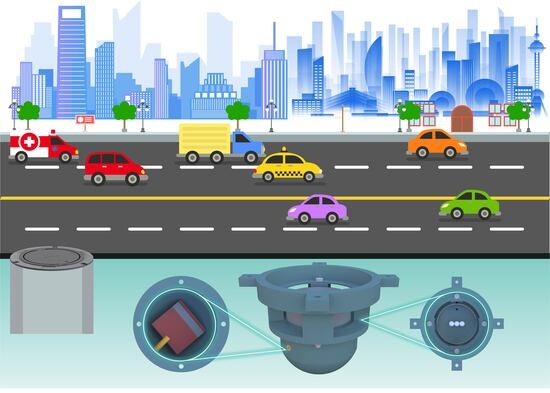
Graphical Abstract

1. Introduction

Manhole covers are essential structures installed on urban roads, highways and streets to prevent pedestrians and vehicles from falling into underground facilities, thereby safeguarding public safety and traffic integrity. Driven by rapid urbanization and the continuous improvement of supporting infrastructure including communication, water supply, drainage and transportation systems, manhole covers have become extensively distributed across urban areas with a huge quantity. Conventional manual inspection relies primarily on on-site visual checks one by one, which fails to achieve continuous real-time monitoring of manhole cover conditions and often leads to significant information delays [1,2,3,4,5]. In addition, factors such as scattered layout, complex environment and inefficient maintenance also contribute to the frequent loss of manhole covers, which undoubtedly poses a threat to the safety of pedestrians and vehicles [6,7,8]. In recent years, various regions have vigorously promoted the construction of smart cities. More and more public infrastructure has begun to move towards intelligence, digitization, and technological advancement. As a component of smart cities, smart manhole covers play an important role [9,10,11,12]. Commercially available manhole cover alarm sensors are typically developed by integrating existing mature sensor modules tailored to specific application requirements. These commonly include diffuse-reflection infrared sensors, water immersion sensors, and gravity sensors, which enable the detection of parameters such as light intensity, water flow distance, water overflow, and manhole cover tilt [13,14,15,16,17]. However, these approaches typically feature high power consumption and demand continuous external energy supply, leading to a heavy energy budget and frequent battery replacement. Meanwhile, their inherent structural complexity and substantial cost implications also impede their large-scale deployment and further advancement. In contrast, TENG-based technologies offer distinct advantages, including lightweight construction, facile fabrication, cost-effectiveness, versatile operational modes, diverse material compatibility, and structural simplicity. These inherent merits thus provide a novel strategy for the development of manhole cover alarm systems.
Solid-state TENGs operate on the core mechanism of coupling triboelectrification with electrostatic induction, enabling the conversion of mechanical energy into electrical energy through contact-separation or relative sliding between solid materials. Endowed with inherent advantages including structural simplicity, high responsiveness, and self-powered capability, these devices have garnered extensive research attention and found widespread applications across multiple fields [18,19]. In the realm of wearable electronics, solid–solid TENGs based on textile materials and flexible polymers exhibit exceptional efficacy in harvesting mechanical energy from human motion. Their inherent flexibility, lightweight nature, and biocompatibility render them well-suited for complex motion scenarios [20,21]. Within the biomedical field, such devices facilitate self-powered physiological sensing and drug delivery systems, where the collection of weak mechanical energy enables precise detection of physiological signals and controlled responsive behaviors [22,23,24]. Furthermore, solid–solid TENGs can be integrated onto the surfaces of bridges, buildings, and industrial machinery, where they transduce vibrations and deformations into electrical signals to achieve real-time monitoring of structural health status [25,26].
Solid–liquid-mode TENGs (L-S TENGs) achieve energy conversion and signal sensing by leveraging interfacial charge transfer and the electric double layer effect between the surface of solid dielectrics and liquids. A prominent advantage of these devices lies in their ability to efficiently harvest mechanical energy from liquid–solid interactions, coupled with high-sensitivity responses to the physical properties and chemical compositions of liquids [27,28,29]. In environmental monitoring, droplet-based L-S TENGs enable real-time detection of raindrop size, impact velocity, and rainfall intensity through variations in electrical signals [30,31,32]. For flow-based L-S TENGs, applications extend to pipelines, rivers, and analogous scenarios, where they not only scavenge energy from water flows but also retrieve key parameters including flow velocity, flow rate, and liquid level. Concurrently, these devices can sense salinity, pH value, and pollutant concentrations, thereby providing self-powered solutions for water quality monitoring and fluid control [33,34,35]. In the field of marine energy harvesting and monitoring, wave-based L-S TENGs are capable of capturing low-frequency mechanical energy from waves and tides for marine energy collection, while simultaneously monitoring wave height, frequency, and velocity. Such multifunctional capabilities offer technical support for marine environmental early warning and resource exploitation [36,37,38]. Currently, ongoing research is expanding the applications of L-S TENGs in environmental engineering, smart water management, marine engineering, and related fields, further underscoring their unique value in liquid-associated energy harvesting and sensing.
In this work, we designed a manhole cover alarm based on two different TENG modes, which is used to detect whether the water level exceeds the critical point and identify different postures of the manhole cover. Aluminum (Al) electrodes, fluorinated ethylene propylene (FEP) films, and FEP balls feature easy fabrication, a simple structure, and wide material selectivity, and are thus selected as the materials for implementing these different working modes. A displacement sensor module can stably output an open-circuit voltage of about 30 V and a short-circuit current of about 250 nA under the simulated abnormal working conditions of the manhole cover tilted at 45° and a motion frequency of 2 Hz. The alarm water immersion module can generate an open-circuit voltage of about 30 V and a short-circuit current of about 15 μA under the working conditions of a water level height of 5 cm, a device tilt angle of 45°, and a water flow rate of 20 RPM. On this basis, this study constructs an intelligent manhole cover monitoring system integrated with solid–liquid TENG. Experimental tests simulating the displacement and water immersion states of the manhole cover verify that the sensor system enables real-time signal monitoring. The smart manhole cover proposed in this work achieves strong environmental adaptability, high sensitivity, and low cost for detecting abnormal displacement and water immersion. It breaks through the bottleneck of high operation and maintenance costs in traditional manhole cover monitoring, providing a novel technical solution for the intelligent upgrading of urban underground infrastructure and showing important practical application value for promoting the construction of smart cities.

2. Results and Discussion

2.1. Structural Design

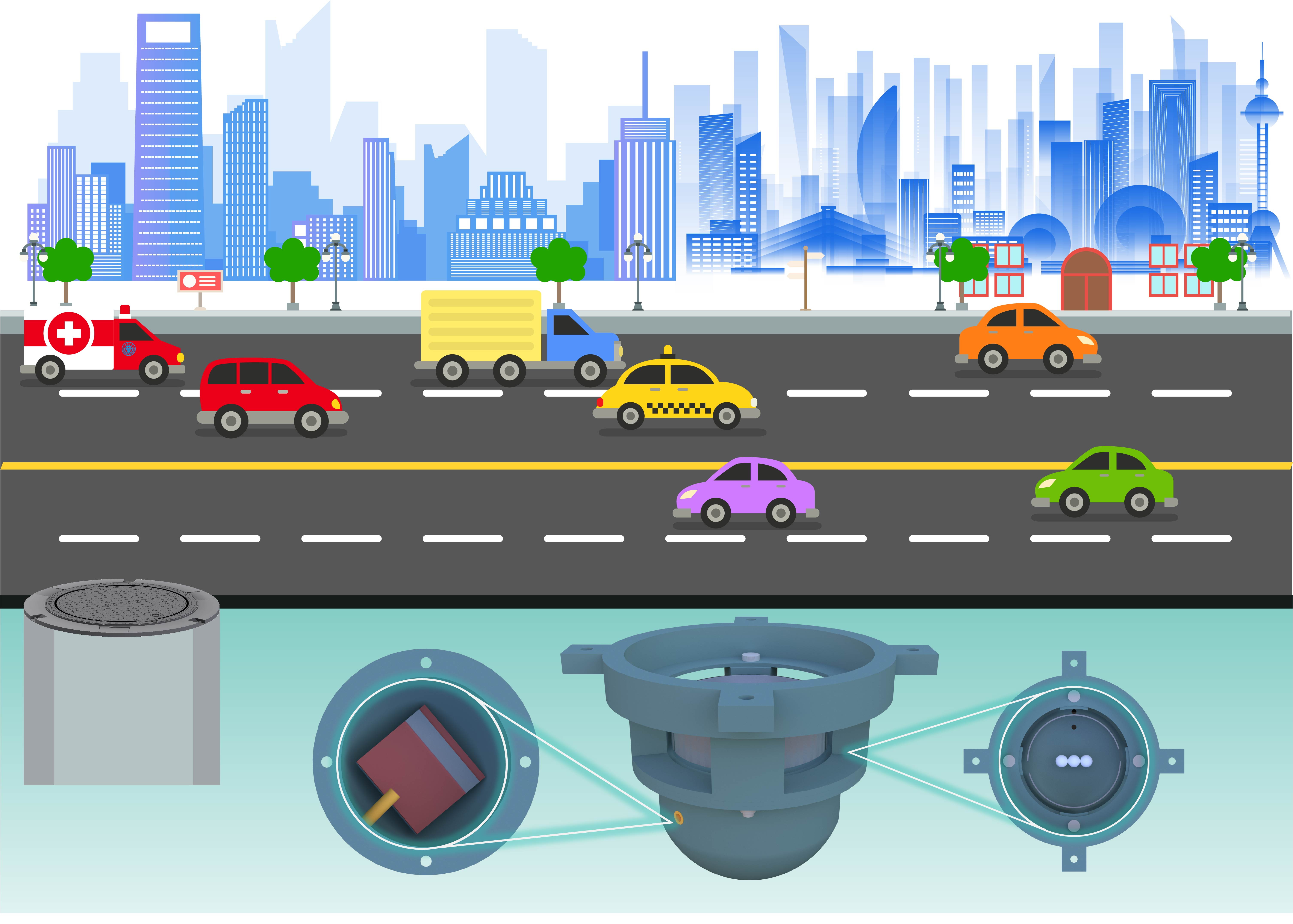
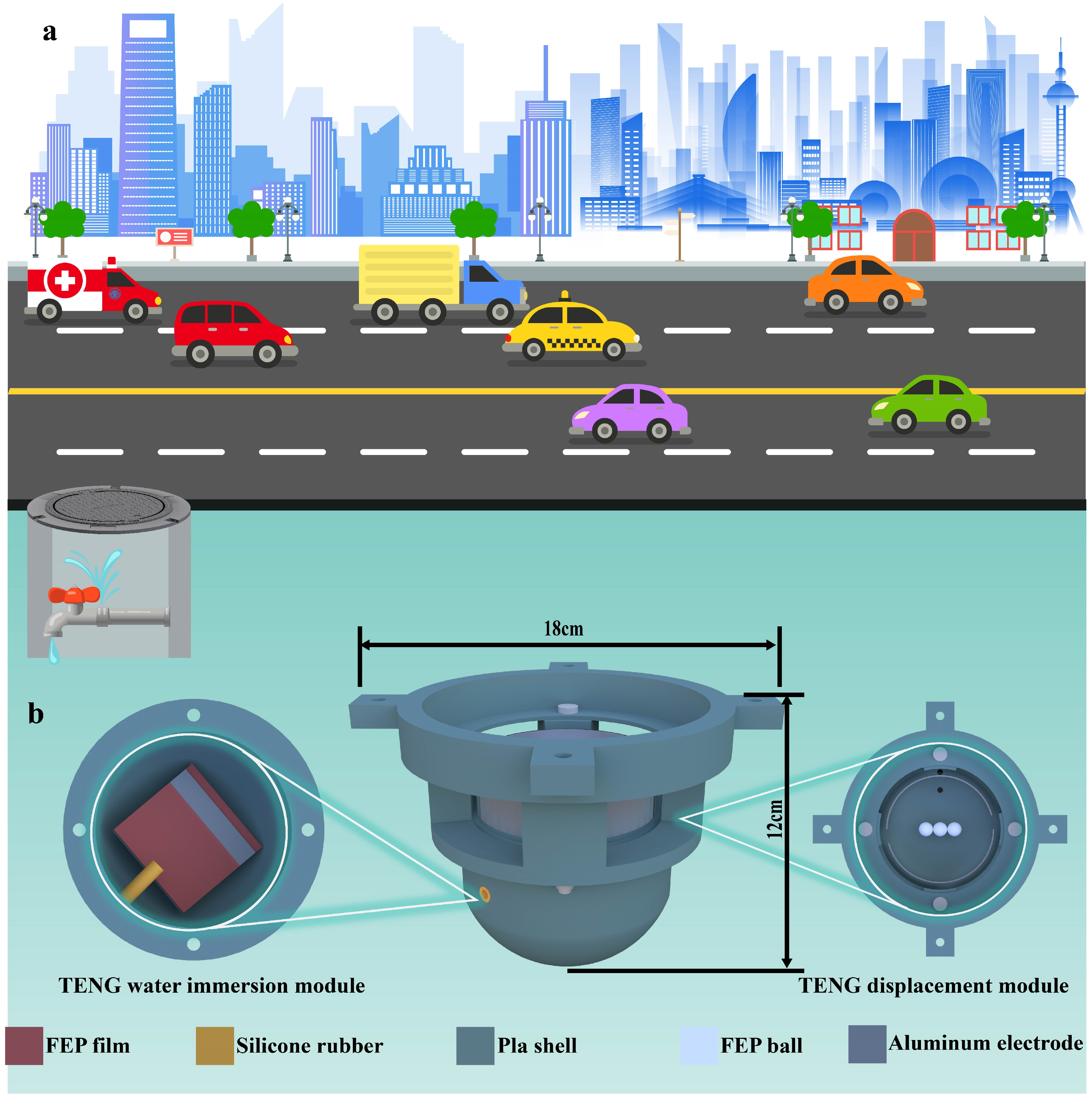
Figure 1a intuitively illustrates the core application positioning of smart manhole covers in the urban infrastructure system for smart city construction. The core innovative value of the smart manhole cover lies in overcoming the drawbacks of conventional manhole covers, which only provide passive protection and require manual inspection, by upgrading them into intelligent terminals with active sensing and real-time feedback capabilities. By integrating sensing modules to continuously monitor the operating status of manhole covers and transmit abnormal events to the urban intelligent management platform in real time, timely detection and rapid response to risks including manhole cover theft, illegal displacement, and water immersion can be realized, offering reliable underlying sensing data support for the refined operation and maintenance of smart cities.
Figure 1b displays the overall structural schematic of the manhole cover alarm, which mainly includes an internal abnormal sensor module and an external water immersion sensor module. The water immersion sensor is enclosed by a circular hemisphere, and the displacement sensor is enclosed by a cylinder. The sensors are responsible for real-time monitoring of the manhole cover status, and their position and structural design enable accurate perception of any displacement or water immersion of the manhole cover. Figures S1 and S2 show the physical image and cross-sectional view of the manhole cover sensor. The displacement detection module is designed and fabricated based on the coupling principle of triboelectrification and electrostatic induction of a TENG. Its shell is a cylindrical transparent acrylic material with a diameter of 8 cm, and four Al electrodes are attached to the inner wall of the shell at equal circumferential intervals. Several FEP balls are placed inside the shell cavity as triboelectric dielectrics. Under external force, the FEP balls roll with the mechanical response of the shell, generating periodic frictional contact and separation with the Al electrodes and the acrylic shell, thereby forming alternating electrical signals through electrode induction to realize the conversion and detection of external force excitation into electrical signals. Once an abnormality is detected by the sensor, the alarm device is activated immediately, and the abnormal signal is transmitted to the core processing system. The corresponding displacement sensor module is shown in Figure S3. The water immersion detection module is designed based on the solid–liquid triboelectric coupling effect, and its core sensitive unit consists of an FEP film and Al electrodes (Figure S4a,b). A square FEP film of 5 cm × 5 cm is selected as the substrate, with its back covered by an Al electrode as the back electrode, and its front selectively covered by a strip Al electrode of 1 cm in width and 5 cm in length as the working electrode. Leads from the two electrodes are led out to the signal processing module through a waterproof connector. This design realizes water immersion sensing by changing the charge distribution between electrodes through liquid–solid contact.
The TENG sensors are attached to the protective shell of the manhole cover alarm. Considering that the manhole cover alarm is exposed outdoors all year round, the shell must be waterproof, dustproof, and weather-resistant to protect the internal sensors and electronic circuit modules from harsh environments. Therefore, it is designed to be circular and fully enclosed. The shell is fabricated by 3D printing, which provides sufficient hardness and convenient fabrication. The structural design of the manhole cover alarm also needs to consider easy installation. Brackets and fasteners are designed here for quick installation above the manhole cover. The structural design of the manhole cover alarm is targeted and integrated structural design, requiring a balance between functional requirements, durability, ease of installation, and aesthetics.

2.2. Dynamic Characteristics of Displacement Module

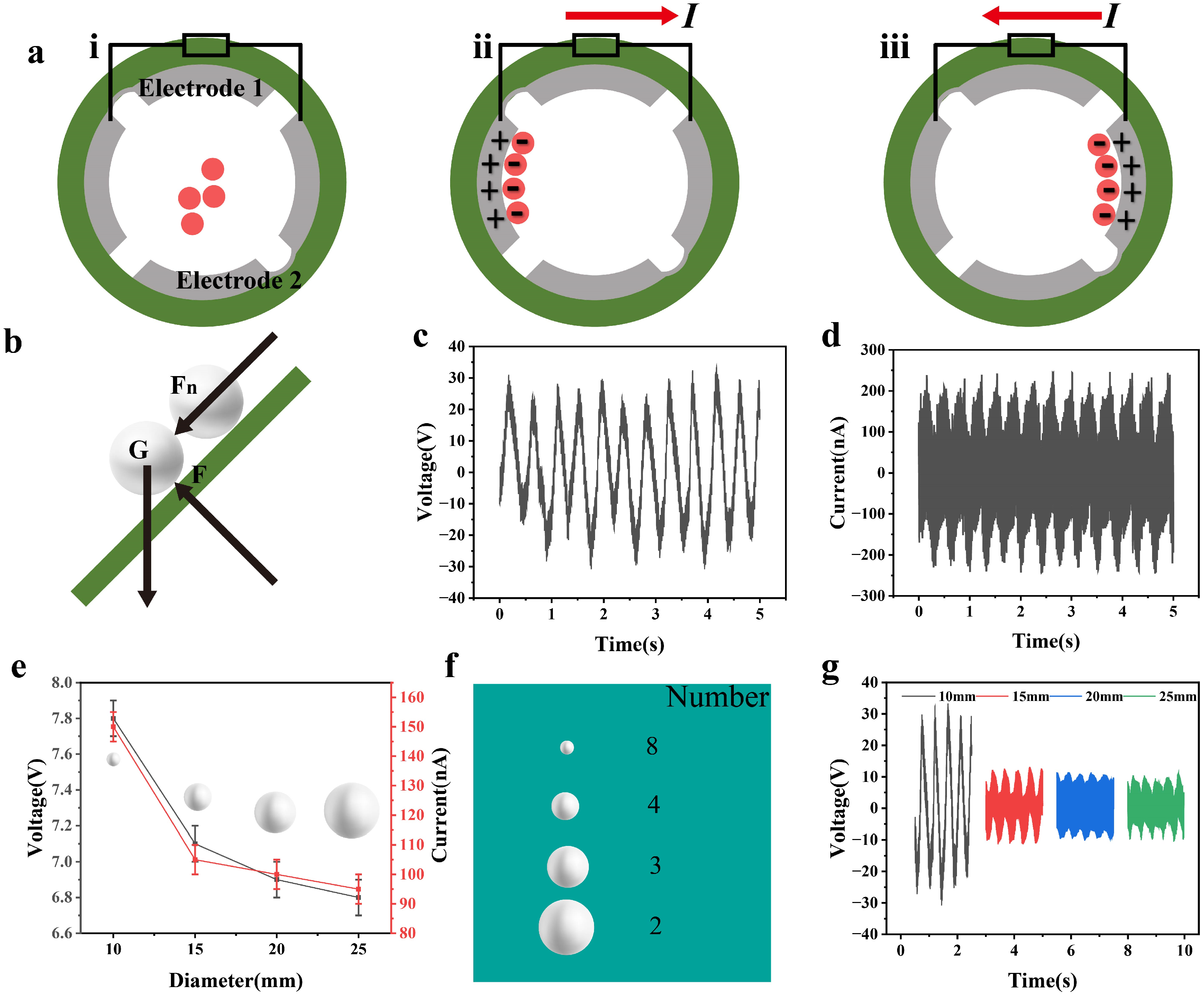
Figure 2a clearly illustrates the core working mechanism of the abnormal movement detection unit based on the freestanding layer-mode TENG. The current generation process can be divided into three key stages according to the motion state of the FEP balls: the initial static state, the transitional rolling state from Electrode 1 to Electrode 2, and the transitional rolling state from Electrode 2 to Electrode 1. The electric field changes and current flow rules in each stage are as follows.
When the manhole cover is in a horizontally closed state, the FEP balls are stationary at the center of the bottom of the detection unit, without contacting any Al electrodes around. At this time, there is no charge transfer in the system, no clear potential difference between Electrode 1 and Electrode 2, and no current generated in the external circuit, and the whole system is in an electrostatic equilibrium state (Figure 2(ai)). Although physical contact occurs between the FEP balls and the acrylic bottom surface during rolling, such surface interaction does not contribute to triboelectric charge generation or affect the electrical output of the TENG. The dominant charge transfer and signal generation only occur between the FEP balls and the Al electrodes. When the manhole cover is lifted at a certain angle, the detection unit tilts with the manhole cover, and the FEP balls roll in the tilting direction under the action of gravity, making contact and friction with Electrode 1. Due to the difference in electron affinity between FEP and Al, the surface of the FEP balls captures electrons and becomes negatively charged, while Electrode 1 loses electrons and becomes positively charged, forming a stable interface charge distribution. As the lifting angle of the manhole cover decreases, the FEP balls detach from the surface of Electrode 1 and roll toward the middle area inside the detection unit. At this time, the negative charges on the surface of the FEP balls exert electrostatic induction on the two electrodes. Electrons flow from Electrode 2 to Electrode 1 in the external circuit, generating a reverse current pulse (Figure 2(aii)). The surface of the FEP balls remains negatively charged, and after contacting Electrode 2, it further induces Electrode 2 to be positively charged, while Electrode 1 becomes negatively charged due to electrostatic induction. Under the action of rebound force and gravity, the FEP balls roll back to the center of the bottom and detach from contact with Electrode 2. The direction of the electric field between the two electrodes reverses, and electrons flow from Electrode 1 to Electrode 2 in the external circuit, generating a reverse current pulse (Figure 2(aiii)). The entire process utilizes the triboelectrification effect and electrostatic induction principle between the FEP balls and the Al electrodes, converting the mechanical abnormal movement of the manhole cover lifting into identifiable bidirectional current pulse signals, thus realizing accurate perception of the opening and closing state of the manhole cover.
The force analysis of the spherical structure inside the cylindrical box is illustrated in Figure 2b. When the manhole cover is tilted or lifted, a single ball is mainly subjected to the supporting force F from the inner wall and the gravitational force G. For the case with multiple balls, the interaction force Fn between adjacent spheres should also be taken into account. The combined effect of these forces drives the movement of the balls, thereby triggering the signal output of the triboelectric nanogenerator-based manhole cover alarm. Figure 2c shows the open-circuit voltage output characteristic curve of the detection unit, and the peak voltage reaches approximately 30 V during both the lifting stage and the falling stage of the manhole cover. Figure 2d presents the short-circuit current output characteristic curve of the detection unit, and the peak current is about 250 nA. This intuitively verifies the scientificity of the aforementioned working mechanism. Multiple cycle tests show that the peak fluctuation ranges of both voltage and current signals are less than 5%, indicating that the detection unit has good stability and repeatability, and can reliably capture every abnormal movement process of the manhole cover, providing a stable sensing output for subsequent signal recognition and state determination.
To explore the influence law of FEP ball diameter and driving conditions on the output performance of the freestanding layer-mode TENG, this experiment took the FEP ball diameter as the core variable and designed multiple sets of controlled variable comparison experiments. Four different diameters of FEP balls were selected as the variable groups in the experiment, with specific specifications of 10 mm, 15 mm, 20 mm, and 25 mm. During the experiment, a motor was used to drive the circular cavity loaded with FEP balls of different diameters to shake regularly at a fixed inclination angle of 45°, ensuring that all other experimental conditions except the ball diameter remained consistent to eliminate the interference of irrelevant variables. In this experiment, the output electrical performance of the freestanding layer mode TENG matched with FEP balls of different diameters was detected in real time, and the variation laws of its open-circuit voltage and short-circuit current are displayed in Figure 2e. It can be seen from the experimental results that under the set driving condition of shaking at a 45° inclination angle, there was no significant difference in the output electrical performance of the device corresponding to the four different diameters of FEP balls. The average open-circuit voltage was stably around 7 V, and the short-circuit current fluctuated between 90 and 150 nA, indicating that within the range of this experimental parameter, the FEP ball diameter had no clear regulatory effect on the output voltage and current of the freestanding layer-mode TENG.
To systematically explore the influence of combined FEP ball diameter and driving parameters on the output performance of the freestanding layer TENG, multiple sets of comparison tests were designed with the combined FEP ball diameter as the core variable, aiming to screen out the optimal ball combination scheme suitable for the manhole cover abnormal movement monitoring scenario. The TENG device adopted in the experiment used the circular cavity structure described earlier. As depicted in Figure 2f, four different specifications of combined FEP balls were selected as the variable groups in the experiment, with specific configurations as follows: a combination of eight FEP balls with a diameter of 10 mm, a combination of four FEP balls with a diameter of 15 mm, a combination of three FEP balls with a diameter of 20 mm, and a combination of two FEP balls with a diameter of 25 mm. The balls in each group were arranged closely. By adjusting the number and diameter specifications of the balls, it was ensured that the total length of the ball combination in different groups was basically matched with the width of the Al electrode in the cavity, so as to ensure the consistency of the effective contact area between the FEP balls and the electrodes in each group of experiments and improve the reliability of the experimental data. Figure 2g and Figure S5 respectively show the comparison results of TENG output electrical performance corresponding to combined FEP balls of different diameters under the condition of a 45° manhole cover flip angle. It can be seen from the experimental data that within the range of the set test parameters, the output performance of the devices in each group showed significant differences, and the output performance of the combination of eight FEP balls with a diameter of 10 mm was much better than the other three diameter combinations, showing the optimal energy conversion efficiency. Among them, the average open-circuit voltage of this combination was stably around 30 V, and the average short-circuit current was about 250 nA; while the output performance of the combinations of four 15 mm, three 20 mm, and two 25 mm FEP balls was relatively flat, the average open-circuit voltage was generally maintained at around 10 V, and the average short-circuit current was about 130 nA, whose output amplitude was significantly lower than that of the 10 mm ball combination.
Based on the above experimental results, the combination of eight FEP balls with a diameter of 10 mm performed optimally in terms of electrode width adaptation, rolling flexibility, and energy conversion efficiency. It could stably output electrical signals with higher amplitude in the scenario of low-frequency abnormal movement of the manhole cover, providing sufficient signal strength support for the subsequent accurate detection of abnormal manhole cover states. Therefore, this study determined to select eight FEP balls with a diameter of 10 mm as the core triboelectric layer structure of the TENG device.

2.3. Research on the Output Law of Displacement Module

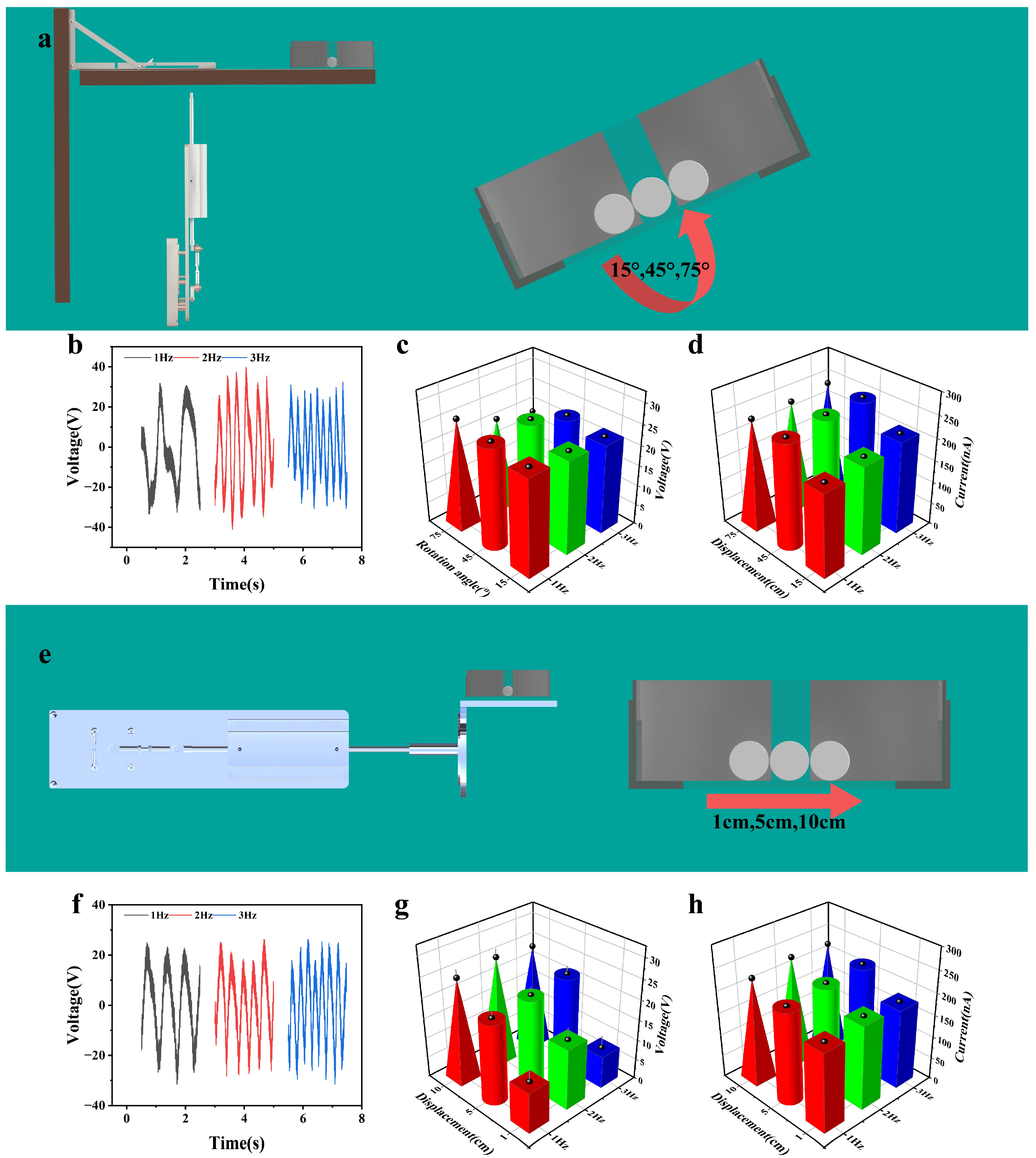
Based on the screening results mentioned earlier, this experiment adopted eight FEP balls with a diameter of 10 mm as the core triboelectric layer of the TENG device, which were uniformly placed into the circular cavity structure described above to construct a freestanding layer-mode TENG experimental device suitable for manhole cover abnormal movement monitoring. To systematically explore the influence of manhole cover flip angle and low-frequency driving frequency on the output performance of the device, and clarify its stability in practical application scenarios, this experiment took the flat plate tilt angle and low-frequency driving frequency as dual variables, designed multiple sets of cross-comparison tests, and kept the FEP ball specifications, electrode parameters and other conditions consistent throughout the process to ensure that the experimental variables were single and controllable. As exhibited in Figure 3a, the assembled TENG device was fixed on an adjustable inclination flat plate, and the flat plate was maintained at three tilt angles of 15°, 45°, and 75° through mechanical adjustment to simulate the flip state of the manhole cover under different abnormal movement amplitudes; for each tilt angle, three low-frequency driving gears of 1 Hz, 2 Hz, and 3 Hz were set respectively, covering the typical low-frequency disturbance range, such as daily slight prying and displacement of the manhole cover. The flat plate was driven by a motor to drive the TENG device to shake regularly, so that the FEP balls in the cavity formed a stable contact-separation cycle with the Al electrodes, and the output electrical performance data of the device under each working condition was collected synchronously. Figure 3b and Figure S6 present the open-circuit voltage and short-circuit current output characteristic curves of the TENG corresponding to different low-frequency driving frequencies (1 Hz, 2 Hz, 3 Hz) when the flat plate tilt angle was fixed at 45°, respectively. It can be seen from the experimental results that under the condition of 45° inclination angle, regardless of the driving frequency being 1 Hz, 2 Hz or 3 Hz, the output performance of the device remained stable, the average open-circuit voltage was always maintained around 30 V, the average short-circuit current was stably around 250 nA, and there was no clear fluctuation in the output amplitude. This result indicates that in the low-frequency range of 1–3 Hz, the driving frequency has a weak influence on the energy conversion efficiency of the TENG device, and it can maintain a stable electrical signal output in the scenario of low-frequency abnormal movement of the manhole cover. Figure 3c,d present the comprehensive comparison results of the output voltage and current of the TENG device under three different tilt angles of 15°, 45°, and 75° and corresponding driving frequencies of 1 Hz, 2 Hz, and 3 Hz with the combination of eight FEP balls. It can be seen from the data distribution that regardless of the change in tilt angle and under each frequency gear, the output voltage and current of the device did not reveal clear attenuation. The average voltage under each working condition was maintained around 30 V, and the current was around 250 nA, with good consistency in output performance. The above experimental results fully verify the excellent stability of the TENG sensor: on the one hand, within the typical low-frequency abnormal movement frequency range of the manhole cover (1~3 Hz), the frequency change has no significant impact on the output performance, and the device can adapt to the monitoring of manhole cover abnormal movement at different speeds; on the other hand, within the flip angle range of 15°~75°, the output electrical signal of the device remains stable all the time, not affected by the amplitude of manhole cover abnormal movement, and can continuously and stably convert mechanical abnormal movement signals into electrical signals in complex and variable practical application scenarios, providing a reliable performance guarantee for the accurate detection of abnormal manhole cover states.
In practical application scenarios, manhole cover abnormal movement is not only manifested as a change in flip angle but may also produce horizontal translation due to sudden situations such as underground gas explosion and external impact. To comprehensively evaluate the adaptability of the designed TENG sensor to the manhole cover translation working condition, especially its response ability to translation signals of different amplitudes, this experiment took eight FEP balls with a diameter of 10 mm as the core triboelectric layer, placed them into the circular cavity TENG device, and carried out three groups of control experiments for different horizontal translation amplitudes and low-frequency driving frequencies to explore the output performance law of the device under translation working conditions, providing data support for covering complex abnormal movement scenarios of manhole covers. The experimental device was set up as exhibited in Figure 3e, and the assembled TENG device was fixed on an adjustable translation platform to accurately simulate the horizontal translation process of the manhole cover through the platform. The experiment set three translation amplitude gradients, namely 1 cm, 5 cm, and 10 cm, corresponding to three scenarios of manhole cover micro-movement, moderate translation, and severe translation; for each translation amplitude, three driving frequencies of 1 Hz, 2 Hz, and 3 Hz were set. The FEP ball specifications, electrode parameters, ambient temperature and humidity, and platform motion stability were kept consistent throughout the process, and the single variable was strictly controlled to ensure the reliability and repeatability of the experimental data. During the experiment, the TENG device was driven by the translation platform to perform horizontal reciprocating motion, so that the FEP balls in the cavity were in contact separation with the electrodes along with the platform motion, and the open-circuit voltage and short-circuit current data of the device under each working condition were collected synchronously. Figure 3f and Figure S7 display the voltage and current output characteristic curves corresponding to different driving frequencies (1 Hz, 2 Hz, 3 Hz) when the translation amplitude was 5 cm. Figure S8 illustrates the output performance curves corresponding to the three frequencies when the translation amplitude was fixed at 1 cm, respectively. When comparing the two groups of data, it can be found that when the translation amplitude was only 1 cm, the voltage and current signals output by the device were extremely weak and almost difficult to effectively identify. Combined with the analysis of the device structure, this phenomenon is due to the limited movement space of the balls in the circular cavity: the micro-translation of 1 cm is not enough to drive the FEP balls to produce sufficient rolling and displacement, resulting in the balls being unable to form a complete and cyclic contact separation cycle with the Al electrodes on the inner wall of the cavity, and thus it is difficult to achieve effective mechanical energy–electric energy conversion. Figure 3g,h exhibit the comprehensive comparison results of the output voltage and current of the TENG device under translation amplitudes of 1 cm, 5 cm, and 10 cm and the corresponding three driving frequencies. It can be seen from the data that when the translation amplitude was increased to 5 cm and 10 cm, the output performance of the device was significantly improved and remained stable. Regardless of the driving frequency being 1 Hz, 2 Hz or 3 Hz, the output amplitudes of voltage and current were maintained in a stable range without clear fluctuation, indicating that the FEP balls could roll fully in the cavity under this amplitude, form efficient contact separation with the electrodes, and achieve stable energy conversion.
Based on the comprehensive experimental results, the designed TENG sensor has a clear response difference to the manhole cover translation amplitude: under the translation amplitude of about 5 cm, the device can stably output electrical signals, adapting to the monitoring needs of moderate and severe translation of the manhole cover; however, under the micro-translation condition of about 1 cm, the output signal is weak and the response performance is poor. This conclusion provides a direction for the subsequent optimization of the device structure. It is necessary to improve the ability of the sensor to capture the micro-movement signals of the manhole cover by improving the cavity structure, adjusting the ball arrangement mode and other means, so as to further expand the coverage of its application scenarios.

2.4. Dynamic Characteristics of Water Immersion Module

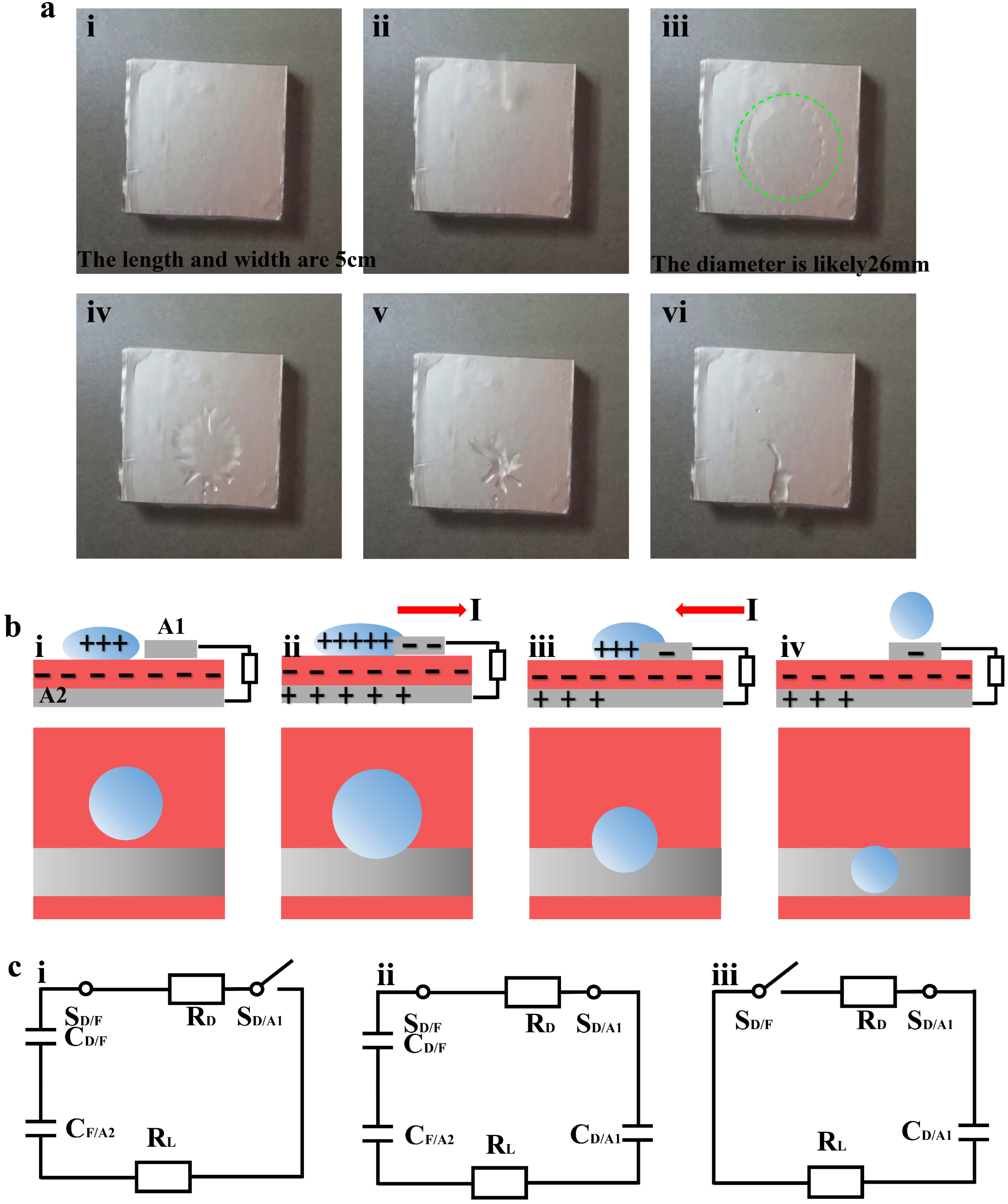
When a single water droplet falls freely from a height of 25 cm and impacts the surface of a flat plate, its dynamic behavior and the evolution of interface characteristics are synergistically regulated by impact inertial force, surface tension, and solid–liquid interface adhesion. The entire process can be divided into continuous stages such as high-speed impact and spreading, surface tension-dominated retraction, and sliding. The water droplet falls from a height of 25 cm, and its gravitational potential energy is converted into kinetic energy. At the moment of contact with the flat plate, surface contact impact is formed, and the impact pressure rapidly flattens the bottom of the water droplet. Driven by inertial force, the water droplet spreads radially and isotropically around, and the liquid film area expands rapidly (Figure 4(ai,aii)). When the inertial force decays to balance with surface tension and interface adhesion, the water droplet stops spreading, and the liquid film area reaches its maximum. At this time, the liquid film morphology is stable, presenting a disc shape with a thick center and thin edges, the solid–liquid contact area reaches the peak, the interface charge distribution tends to be stable, and the triboelectrification effect is temporarily stagnant (Figure 4(aiii)). The duration of this stage is extremely short, mainly determined by the initial kinetic energy of the water droplet. The water droplet falling from a height of 25 cm has moderate kinetic energy, and then enters the retraction stage. After the spreading stagnates, surface tension becomes the dominant force, driving the liquid film to retract radially toward the center. During the retraction process, the contraction speed of the liquid film edge is faster than that of the central area, the liquid film thickness gradually increases, and the originally flat liquid film is gradually reconstructed into a “hemispherical” shape (Figure 4(aiv,av)). The water droplet will remain on the plate surface in the form of a hemispherical droplet; at this time, the contact angle between the water droplet and the flat plate is stable at the static hydrophobic contact angle, and slides downward under the action of a certain inclination angle of the flat plate (Figure 4(avi)). In summary, the entire process shows the typical hydrodynamic behavior of “spreading–retraction” of water droplets on the surface of a hydrophobic flat plate, and the detailed process can be seen in Supplementary Video S1.
When a water droplet falls freely from a height of 25 cm and impacts the surface of a flat plate coated with FEP film, dynamic charge separation and electron migration processes occur in the system based on the coupling effect of triboelectrification and electrostatic induction, ultimately forming a detectable electrical signal output [39,40]. The core mechanism of this process stems from the strong electronegative characteristics of FEP material and the evolution of water droplet morphology under the constraint of the flat plate surface. As a typical strong electronegative polymer material, the surface of FEP has a significant tendency to gain electrons during the solid–liquid contact process. In this study, a core sensing structure of “FEP film-dual Al electrodes” was constructed by fully covering the back of the FEP film with a layer of Al electrode (A2) and arranging another Al electrode (A1) on the front of the FEP film. When the water droplet impacts the surface of the FEP film, a triboelectrification effect occurs at the solid–liquid interface: the surface of the FEP film acquires and stably retains negative charges through electron transfer, while the water droplet in contact with it is positively charged due to the loss of electrons, thereby forming a stable double-layer distribution of “negative charges on FEP surface-positive charges on water droplet” at the solid–liquid interface. This charge separation process excites an equivalent electric field inside the system, which becomes the core driving force for electron migration between A1 and A2.
The entire charge transfer and electron migration process can be divided into the following core stages with reference to Figure 4b (dynamic morphology evolution) and Figure 4c (equivalent circuit change). After the water droplet impacts the surface of the FEP film, driven by impact inertia, it spreads uniformly in all directions on the flat plate to form a circular liquid film. This expansion process rapidly increases the contact area between the water droplet and the FEP film, significantly enhancing the triboelectrification effect at the solid–liquid interface: more electrons transfer from the water droplet to the surface of the FEP film, greatly increasing the negative charge density on the FEP surface, and the total amount of positive charge carried by the corresponding water droplet increases synchronously (Figure 4(bi,ci)). With the uniform expansion of the liquid film, when the water droplet contacts the Al electrode A1 on the front of the FEP, the equivalent electric field inside the system starts to drive electron migration: since the positive charges carried by the water droplet will induce electrostatic induction on A1, electrons will flow directionally from A2 to A1 through the external circuit, forming a transient reverse current output (Figure 4(bii,cii)). At this time, the equivalent circuit changes from open to closed, and the double electric layer of “negative charges on FEP surface-positive charges on water droplet” formed at the interface can be equivalent to a capacitor C D / F (D is the water droplet, F is the FEP film), and the positive charges of the water droplet stored in this capacitor begin to be released through the circuit; at the same time, equivalent capacitors ( C D / A 1 , C F / A 2 ) are formed between A1 and the water droplet, and between A2 and the FEP film, respectively, and are charged synchronously under the action of the electric field to complete the initial storage and distribution of charges. When the expansion inertia of the water droplet decays, it starts to shrink uniformly toward the center under the dominance of surface tension, the liquid film area gradually decreases, and the contact area between the water droplet and the FEP film gradually shrinks. The voltage rapidly drops to zero, and electrons flow rapidly from A1 to A2 (Figure 4(biii,cii)). When the contracted water droplet stands on the Al electrode A1, C F / A 2 and C D / F disappear accordingly, and the switch S D / F is turned off. As the water droplet further shrinks and finally detaches from the surface of the FEP film, the charge separation state at the solid–liquid interface disappears, the equivalent circuit is opened again, the electron migration process terminates, and the current output returns to zero (Figure 4(biv,ciii)). In summary, the morphological evolution of the water droplet during the impact process is the core inducement driving charge transfer and electron migration. The strong electronegative characteristics of the FEP film provide a material basis for charge separation, and the structural design of the dual Al electrodes realizes the effective collection of charge transfer. The synergistic effect of the three constitutes the core working principle of the sensing system. According to Kirchhoff’s laws of voltage and current, the entire process of continuous contact between water droplets, FEP film, and electrodes can be described by the following differential equation. The detailed derivation process can be found in the supporting data (Note S1, Supporting Information).
Q 0 q t C D / F t d q t d t R D q t C D / A 1 t U R L t q t C F / A 2 t = 0
d q t d t U R L t R L = 0
C D / F t = ε D S F E P t d E D L
C D / A 1 t = ε D S A 1 t d E D L
C F / A 2 t = ε F S F E P t d F E P
where Q 0 represents the accumulated positive charge of C D / F when the droplet contacts Al1, q t   represents the amount of charge transferred in the circuit, U R L represents the voltage across the load, and ε D and ε F represent the capacitance of the droplet and FEP, respectively. In addition, S F E P t and S A l t represent the contact area between the droplet and the surfaces of FEP and Al1. d E D L represents the thickness of the double layer, and d F E P represents the thickness of FEP.

2.5. Research on the Output Law of Water Immersion Module

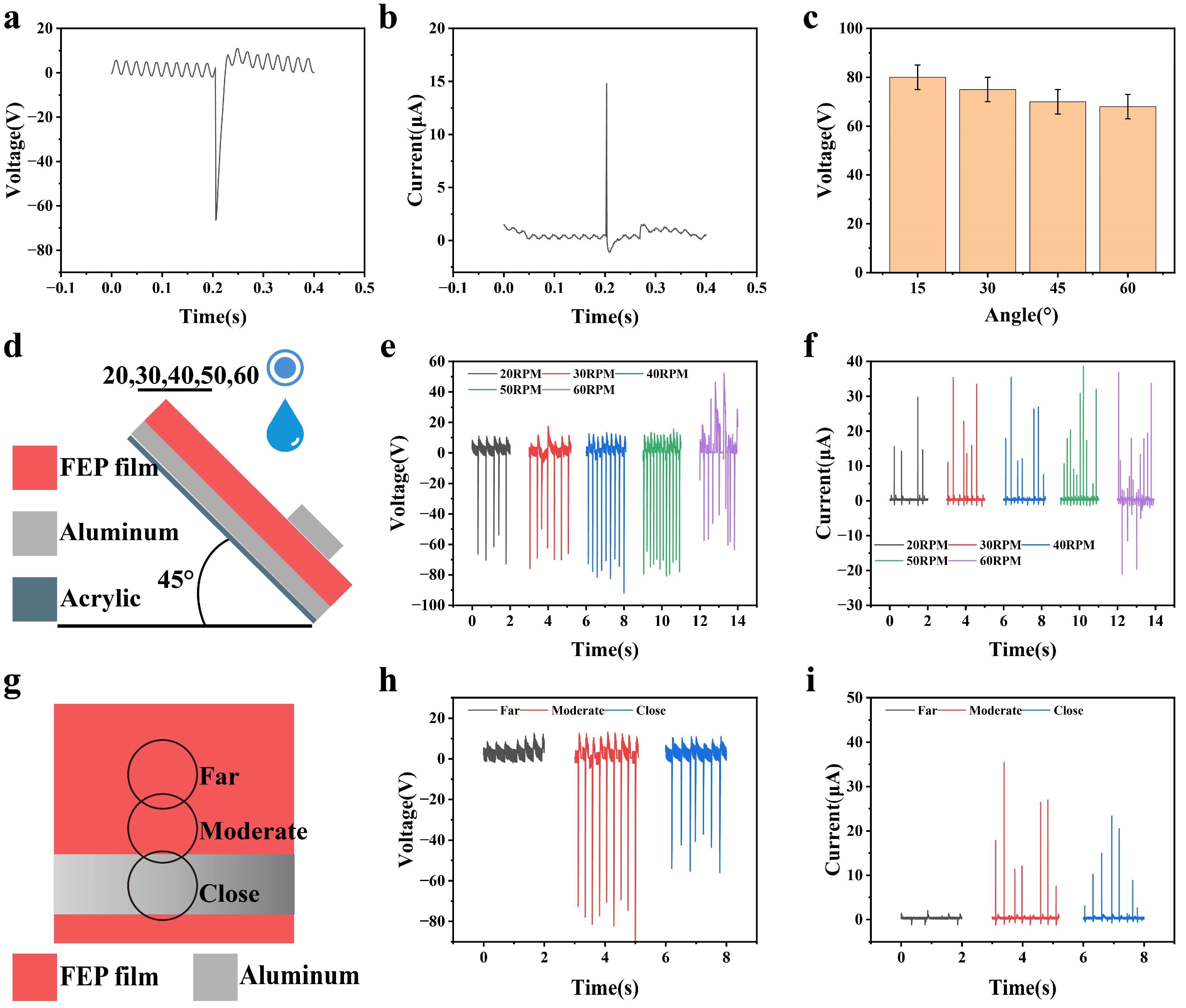
Figure 5a,b clearly reproduce the full-cycle dynamic process of a single water droplet falling freely from a height of 25 cm, impacting the surface of the cylinder coated with FEP film, and finally detaching from the FEP substrate (Figure 5c). The error bar here represents the range of continuous signal fluctuations.
To further explore the regulation law of external working condition parameters on the output performance of the device and clarify its adaptability in different practical application scenarios, we carried out a systematic variable experiment with water droplet speed as the variable. The experimental scheme and test equipment are shown in Figure 5d and Figure S9. The test results in Figure 5e,f clearly present the relevant experimental laws: as the water droplet flow rate increases from 20 RPM to 30 RPM, both the output voltage and current of the device present a slight upward trend—the open-circuit voltage increases from about 70 V to 82 V, and the short-circuit current increases from about 15 μA to 25 μA. The core mechanism of this phenomenon is that the increase in water droplet flow rate directly increases the number of water droplets impacting the FEP surface per unit time, that is, increases the contact separation cycle frequency between water droplets and the FEP film; the number of charge transfers and releases per unit time increases synchronously, the charge accumulation efficiency is significantly improved, and thus the output voltage and current are promoted to increase slightly. However, when the water droplet flow rate continues to increase to 50 RPM, the output voltage and current do not continue the upward trend, but instead decrease significantly: the open-circuit voltage drops back to about 50 V, and the short-circuit current becomes disordered. This is mainly because a large number of water droplets overlap, fuse and splash on the cylinder surface at high flow rates, destroying the stable contact separation process between a single water droplet and the FEP film: the mutual interference between water droplets leads to insufficient charge separation at the solid–liquid interface, part of the charges are neutralized during the water droplet fusion process, and the disordered liquid film flow intensifies the randomness of charge transfer, ultimately resulting in the decrease in output performance.
When further exploring the energy conversion characteristics of the droplet–FEP film–Al electrode composite structure, the sizes of the FEP film and Al electrode were kept unchanged to systematically study the output behavior of the droplet when it contacts the electrode during the expansion and contraction process. The experimental results show that there are significant differences between the three typical cases. As shown in Figure 5g, when water droplets fall on the FEP film, they only contact the front Al electrode after completing the full widening and contraction process. This state is referred to as “far”. As depicted in Figure 5h,i, the output voltage in this case is only about 3 V, and the current is also very weak. This phenomenon may be due to the extremely short charge storage time generated during the diffusion stage of the droplet separation from the FEP interface. When the droplet finally contacts the Al electrode, the interface charge has been greatly reduced, leading to a significant weakening of the charge induction effect and almost disappearance of the output signal. Secondly, when the water droplet contacts the front Al electrode during the expansion process, this state is referred to as moderate. The voltage and current are much higher than those in other modes. At this time, the droplet is still in the high-speed distribution stage, the contact area increases rapidly, the interface charge concentration is high, and the transient potential difference is large, which enables the most sufficient electron transfer between the rear electrode and the front electrode, thereby achieving the maximum energy conversion efficiency. The third case is that the water droplet directly falls on the FEP film and the front electrode, which is referred to as “close”, with an output voltage of about 45 V and a current of about 17 μA. Compared with the second mode, the interface charge induction effect is partially weakened, resulting in an output amplitude lower than that of the contact during the expansion process.

2.6. Universal Demonstration of Water Immersion Module

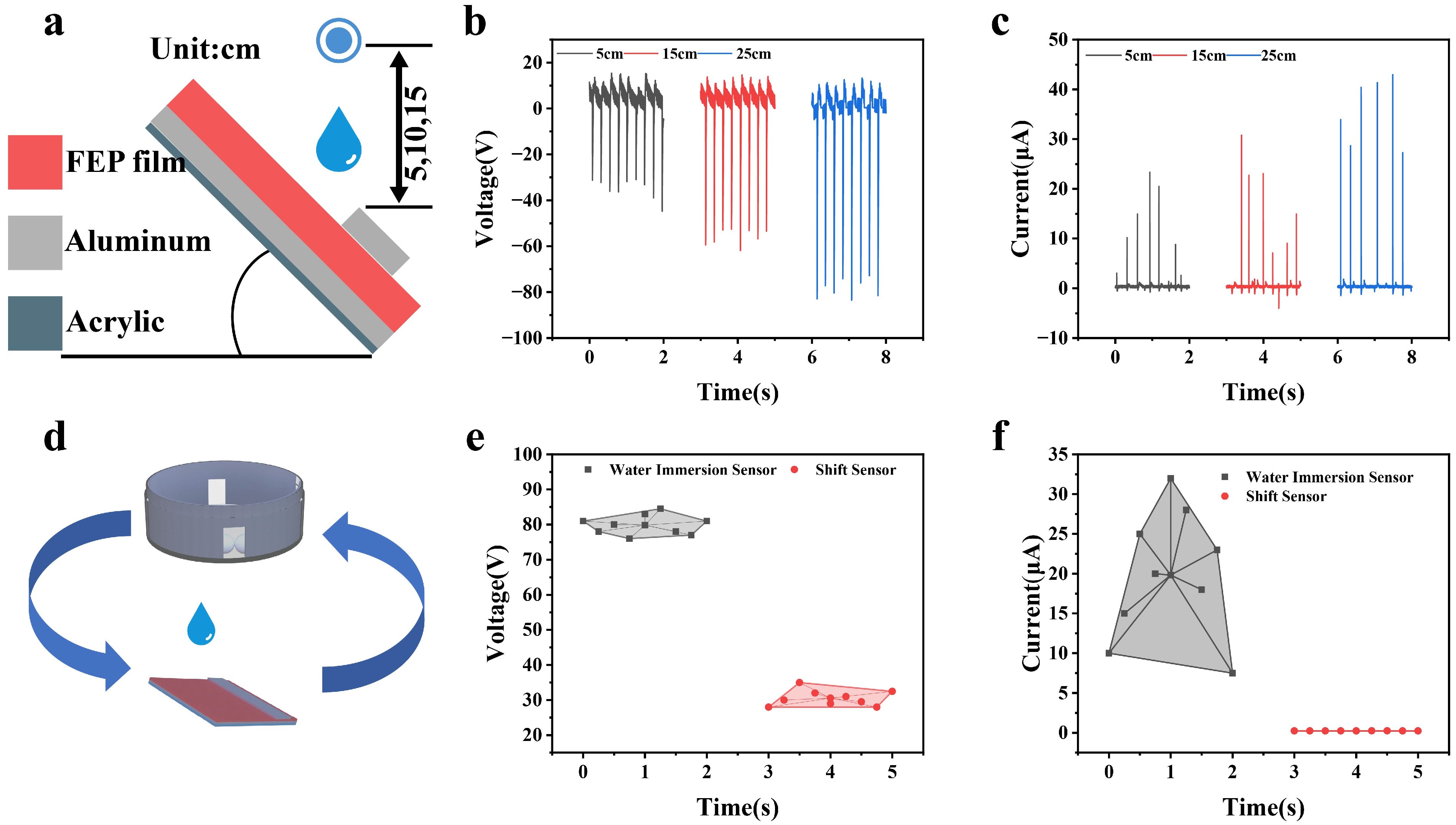
To systematically reveal the intrinsic correlation between water droplet falling height and the electrical output performance of the device, this study constructed a stable and controllable experimental test system and carried out targeted experiments using the controlled variable method. During the experiment, the width of the front electrode was fixed at 1 cm, and the core parameters such as the material and geometric dimensions of the FEP film and the electrode spacing were kept consistent. Only the water droplet falling height was taken as the only variable, with three gradients of 5 cm, 10 cm, and 15 cm set respectively to explore the output laws of the open-circuit voltage and short-circuit current of the device under different falling heights. The test scenario is exhibited in Figure 6a. The test results in Figure 6b,c intuitively present a significant positive correlation: as the water droplet falling height increases from 5 cm to 15 cm, the peak open-circuit voltage of the device steadily increases from about 30 V to about 80 V; the peak short-circuit current significantly rises from about 15 μA to about 40 μA. The core mechanism of this performance evolution trend is that the stronger impact pressure drives the droplets to spread rapidly and fully along the film surface, significantly enhancing the contact separation dynamic behavior at the solid–liquid interface, greatly expanding the transient contact area, and providing a broader interface for the generation of triboelectric charges. It is worth emphasizing that even under the test condition of the lowest falling height of 5 cm, the device can still achieve an open-circuit voltage of about 30 V and a short-circuit current of about 15 μA. This result not only verifies the high-sensitivity response characteristics of the device to low-height water droplet impact but also highlights the reliability of its practical application in the scenario where a small amount of accumulated water drips at the bottom of the manhole cover, where the device can still generate electrical signals of sufficient intensity to trigger the subsequent circuit, providing key performance support for the real-time and accurate early warning of water immersion status.
To verify the mutual coupling influence between the displacement module and the water immersion module, the test scenario is exhibited in Figure 6d. The test results in Figure 6e,f clearly reveal that when the FEP balls of the abnormal movement detection module roll along the electrodes, there is no clear abnormality in the electrical output signal of the water immersion sensor. The baseline of voltage and current signals remains stable at all times, without additional disturbance caused by the rolling of FEP balls. At the same time, when water droplets drip normally around the displacement sensor, the output of the displacement sensor does not show any clear abnormality. The experimental results fully confirm that the signal coupling effect between the abnormal movement detection module and the water immersion detection module is close to zero. The core reason is that the working mechanisms and energy conversion paths of the two modules have significant independence: the water immersion sensor is based on the solid–liquid triboelectrification effect, and its electrical signal generation originates from the charge separation and transfer process at the interface between water droplets and the FEP-Al electrode, with the energy carrier being the impact kinetic energy of water droplets; the abnormal movement sensor is based on the solid–solid contact separation triboelectrification effect, and signal generation depends on the rolling contact separation behavior between FEP balls and Al electrodes, with the energy carrier being the rolling kinetic energy of the balls. The energy sources and charge generation mechanisms of the two are completely independent, and there is no cross-energy transfer phenomenon, thus avoiding signal coupling interference from the root cause.

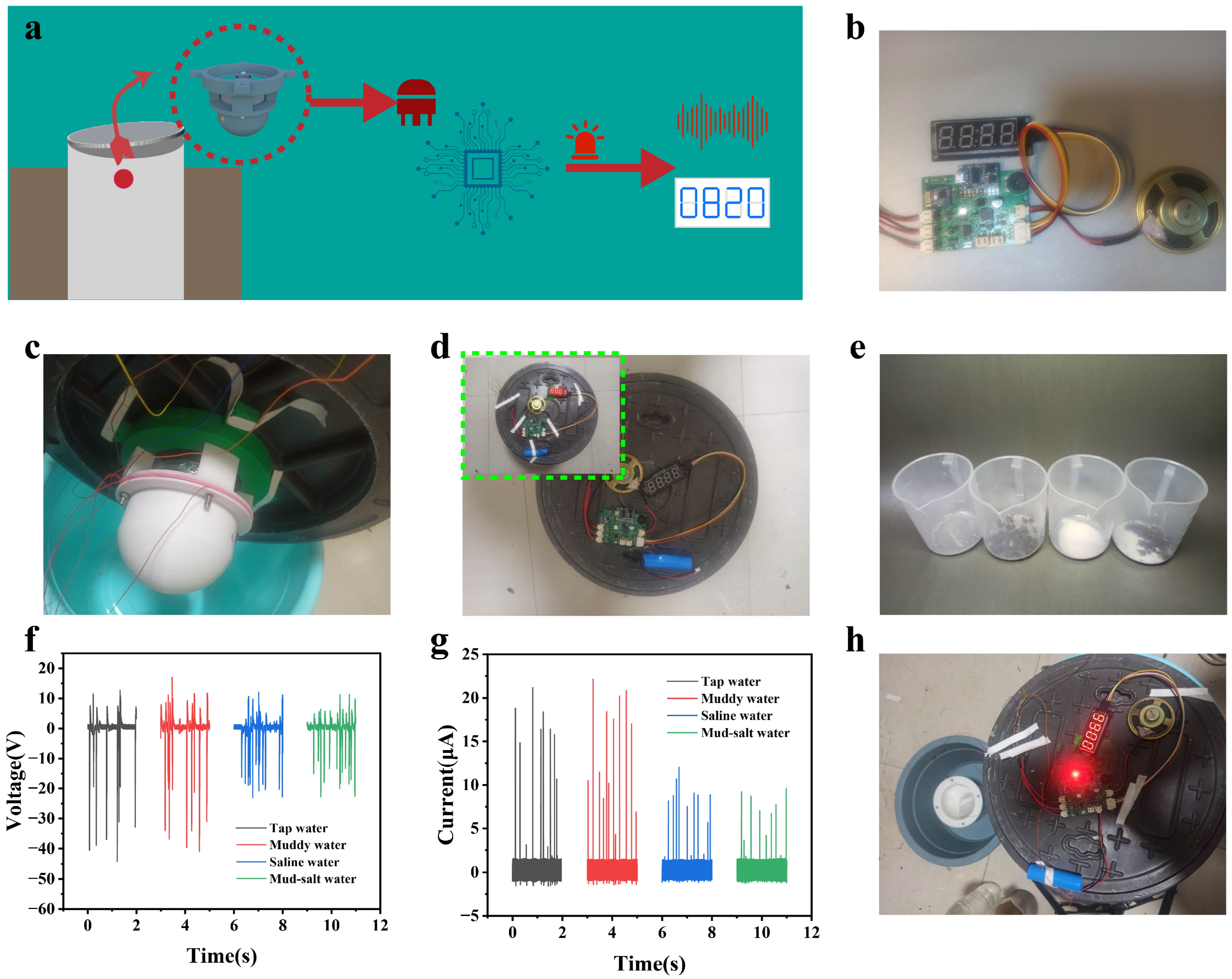
2.7. Application of Smart Manhole Covers

A small system can be integrated into the manhole cover alarm, which realizes the intelligent perception, identification and management of a beautiful city through devices such as water immersion sensors and displacement sensors. Figure 7a presents the schematic diagram of the experimental verification system for the smart manhole cover alarm, clearly showing the overall layout of the setup and the connections among components. Figure 7b depicts the core architecture of the alarm system, which mainly consists of a triode driving circuit, a microcontroller unit, a voice alarm module, and a digital display module. These modules work cooperatively to realize a complete closed loop of signal reception, processing, and alarm actuation.
As displayed in Figure 7c, in the initial experimental state, the TENG sensing module is installed beneath the manhole cover to capture mechanical displacement and water immersion signals, while the circuit control system is fixed above the manhole cover for convenient signal monitoring. As illustrated in Figure 7d, the operating status of the alarm system was observed and recorded in real time. When the manhole cover was lifted manually to simulate abnormal displacement, the internal FEP ball rolled with the tilting motion, underwent contact electrification with the electrodes, and generated electrical output to trigger the alarm. At this moment, as also shown in Figure 7d, the count on the digital display automatically increased by 1, enabling quantitative recording of the manhole cover displacement. Meanwhile, as observed in Supplementary Video S2, the displacement sensing module generated stable alarm signals, whereas the water immersion module showed no clear fluctuations. This result fully confirms that the smart manhole cover alarm exhibits excellent anti-interference ability and can effectively avoid false alarms caused by non-target stimuli.
The TENG-based water immersion detection module is designed for practical application in underground pipe networks, where the environment is complex and highly interferential. On the one hand, water sources in underground networks are diverse, and significant differences in water quality may affect the stability and detection accuracy of the module. On the other hand, during heavy rainstorms, rainwater carries large amounts of sediment into the space below the manhole cover, forming highly turbid muddy water that further disturbs sensing signals. To verify the applicability and stability of the module under realistic complex conditions, a series of comparative experiments were conducted by simulating typical underground environmental interferences. The experimental configuration is illustrated in Figure 7e. Four types of simulated solutions were prepared to represent different environmental conditions, with detailed compositions as follows: (1) Control group: 400 mL of tap water without any additives; (2) Simulated muddy water: 10 g of soil mixed into 400 mL of tap water, corresponding to a soil content of 25 g per 400 mL; (3) Simulated saline wastewater: 10 g of salt dissolved in 400 mL of tap water, yielding a salt concentration of 25 g/L; (4) Simulated harsh environment: 10 g of soil and 10 g of salt added to 400 mL of tap water, corresponding to 25 g/L soil content and 25 g/L salt concentration to mimic turbid and saline underground water. These four prepared solutions are provided in Figure S11. Figure 7f,g show the voltage and current output characteristics of the water immersion module under different solution conditions, respectively. According to the experimental data in Figure 7f,g, saline solutions exert a significant negative effect on the electrical output of the module, strongly suppressing voltage and current generation. In comparison, sediment alone has a relatively mild influence. To further validate the stability of the alarm under extreme real-world conditions, additional tests were performed using the simulated harsh mud–salt water and natural river water. The exact sampling location and GPS coordinates of the river water are displayed in Figure S12, ensuring the authenticity and representativeness of the sample. During testing, the water immersion detection device was first calibrated to its normal working state, and the initial alarm parameters were recorded (Figure S13). The simulated harsh mud–salt water and natural river water were then separately dropped onto the FEP film of the TENG module, and the system response was monitored in real time. As clearly demonstrated in Supplementary Video S3 and Figure 7h, the alarm system responded rapidly and triggered accurate alerts in both the harsh simulated environment and real river water. These results verify that the TENG-based smart manhole cover alarm possesses outstanding environmental adaptability and operational stability, meeting the requirements of practical monitoring in complex underground environments.
Regardless of whether the manhole cover is illegally moved, misaligned, or subjected to water overflow and immersion, the proposed alarm can rapidly detect such abnormal events and provide reliable data support for timely response and management. Once an abnormal state is identified, the system immediately activates the built-in alarm program and issues distinct audible prompts. These alarms not only warn nearby pedestrians and vehicles to avoid potential dangers but also quickly attract the attention of administrators, enabling on-site inspection, hazard elimination, and timely countermeasures to ensure the safety of urban infrastructure operation.

3. Conclusions

In this study, we designed and systematically investigated a TENG-based manhole cover alarm based on different triboelectric modes. This device has significant advantages such as simple structure, convenient preparation, low cost, and high sensitivity, which can effectively meet the actual needs of municipal facility monitoring in smart cities. For the manhole cover anti-damage monitoring function, its built-in TENG displacement sensor module can stably output an open-circuit voltage of about 30 V and a short-circuit current of about 250 nA under the simulated abnormal working conditions of the manhole cover tilted at 45° and a motion frequency of 2 Hz, which can accurately capture the abnormal movement state of the manhole cover and achieve self-energy supply; for the water immersion monitoring function, the alarm water immersion module can generate an open-circuit voltage of about 30 V and a short-circuit current of about 15 μA under the working conditions of a water level height of 5 cm, a device tilt angle of 45°, and a water flow rate of 20 PRM, realizing rapid response and signal output to water immersion hazards around the manhole cover. It is worth noting that the TENG-based displacement sensor module and the water immersion monitoring module in this device are independent of each other and do not interfere with each other. The two modules realize the corresponding monitoring functions based on different triboelectric induction mechanisms, which not only avoids signal crosstalk between modules but also ensures the accuracy and reliability of monitoring data of the device in complex municipal environments, further improving the practical application value of the device. In addition, based on this TENG manhole cover alarm, we successfully constructed a full-process real-time sensing system integrating sensing detection, signal conditioning, data processing, and alarm reminders. This system judges the signal feedback of the monitoring module by detecting the conduction state of the triode, completes signal analysis and identification through the core data processing chip, and then quickly transmits the abnormal signal to the alarm module, realizing real-time early warning of manhole cover abnormal movement and water immersion hazards, forming a complete working closed loop of perception–processing–alarm and reducing the system operation and maintenance cost. In summary, the TENG-based manhole cover alarm designed in this study exhibits stable working performance and excellent monitoring effect under simulated practical application conditions, effectively solving the pain points of traditional manhole cover monitoring devices such as high reliance cost, complex installation, and susceptibility to interference. With the in-depth integration of TENG technology and smart city construction, the functional boundary of this manhole cover alarm will be further expanded in the future, the miniaturization and integration level of the device will be optimized, the multi-scenario adaptability will be improved, and its large-scale application in the field of intelligent monitoring of municipal facilities will be promoted, contributing technical support to the construction of the safe operation and maintenance system of smart city infrastructure.

4. Experimental Section

Construction of the TENG-based dual-mode manhole cover alarm structure: FEP films with strong electron-trapping ability are adopted. These films have a thickness of 0.1 mm and are commercially available without further surface modification prior to use. Commercially available FEP spheres were also employed without additional surface modification before use. Aluminum electrodes with a thickness of 0.06 mm were utilized, which are commercially available and require no extra surface modification before use. The entire shell was manufactured by 3D printing with polylactic acid. Polylactic acid is a commercially available material used to encapsulate the various TENG modules. Preparation of the water immersion module: An inductive Al electrode of the same size was attached to the back of a 5 cm × 5 cm FEP film. Another Al electrode with dimensions of 5 cm in length and 1 cm in width was attached to the upper surface of the FEP film. The size of the acrylic flat plate is 5 cm in length and 1mm in width. Finally, this module was installed in the lower hemisphere of the manhole cover alarm.
Preparation of the displacement module: Four Al electrodes were attached inside a cylindrical acrylic shell with an outer diameter of 8 cm, outer height of 3 cm, inner diameter of 7.5 cm, inner height of 2.6 cm, and wall thickness of 1.8 mm. Two of the four electrodes were connected together. FEP composite spheres with different diameters were then placed inside the shell. This module was finally embedded in the upper part of the manhole cover alarm. The overall size of the manhole cover is 12cm high and 18cm wide.
Preparation of the smart manhole cover intelligent system: A triode conversion circuit was used to convert the analog signals generated by TENG into digital signals. These signals correspond to manhole cover displacement, water immersion and other working states. The digital signals were then detected and processed by a 51-series single-chip microcontroller. Subsequently, the microcontroller sent instructions to the alarm module according to the detected signals and controlled the digital tube to display the count of abnormal events, including manhole cover displacement and water immersion.
Characterization and electrical measurements: The short-circuit current and open-circuit voltage were examined through a Keithley 6514 electrometer (Tektronix, Beaverton, OR, USA). The instrument provides a current resolution of 0.1 fA (10−16 A), voltage resolution of 10 µV, and charge resolution of 10 fC, with a maximum sampling rate of 1200 readings per second.

Supplementary Materials

The following supporting information can be downloaded at https://www.mdpi.com/article/10.3390/machines14050510/s1, Table S1: The descriptions of circuit elements used in this work. Figure S1: The corresponding photographs of the TENG device. Figure S2: Sectional diagram of manhole cover sensor. Figure S3: Schematic diagram of the structure of the manhole cover displacement sensor module. Figure S4: Schematic diagram of water immersion sensing module structure based on solid–liquid friction coupling effect. Figure S5: Comparative curves of TENG short-circuit current output characteristics corresponding to FEP balls with different diameters in a combined arrangement. Figure S6: TENG short-circuit current characteristic curves corresponding to different low-frequency driving frequencies at a 45° tilt angle. Figure S7: TENG short-circuit current output characteristic curves corresponding to different low-frequency driving frequencies under a translational amplitude of 5 cm. Figure S8: TENG output performance curves corresponding to different low-frequency driving frequencies at a translational amplitude of 1 cm. Figure S9: Variable speed peristaltic pump in the experiment. Figure S10: The corresponding photographs of the TENG device. Figure S11: Photographs of the four prepared simulated environmental solutions. Figure S12: Sampling location and GPS coordinates of the collected natural river water. Figure S13: Initial working state of the water immersion detection device (PDF). Video S1. Motion characteristics of droplets on fluorinated ethylene propylene (FEP). (MP4). Video S2. Manhole cover displacement sensing performance test. (MP4). Video S3. Manhole cover water immersion sensing performance test. (MP4). Supporting Note S1. The derivation process of circuit equations.

Author Contributions

B.C. was responsible for conceptualization, methodology, investigation, visualization, formal analysis, writing—original draft and writing—review and editing. J.L. was responsible for funding acquisition and supervision. B.X. was responsible for funding acquisition and supervision. Z.G. was responsible for visualization and writing—review and editing. All authors have read and agreed to the published version of the manuscript.

Funding

This research received no external funding.

Data Availability Statement

The data that support the findings of this study are available within the article and its Supplementary Materials.

Conflicts of Interest

The authors declare no conflict of interest.

References

  1. Gandi, N.; Karri, J.S.; Nune, S.S.S.; Ravada, L.; Darapu, D. Enhanced Urban Infrastructure: IoT-based Sewer Vault Monitoring and Cautioning System. In Proceedings of the 2nd International Conference on Inventive Computing and Informatics (ICICI), Bangalore, India, 11–12 June 2024; pp. 552–555. [Google Scholar]
  2. Hussin, Z.M.; Saaddin, S.S.; Mohammad, S.; Azmi, N.A.M.; Salim, S. Development of Automated Drainage System. In Proceedings of the 2022 International Conference on Automatic Control and Intelligent Systems, Shah Alam, Malaysia, 25 June 2022; pp. 72–77. [Google Scholar]
  3. Utepov, Y.; Neftissov, A.; Mkilima, T.; Shakhmov, Z.; Akhazhanov, S.; Kazkeyev, A.; Mukhamejanova, A.T.; Kozhas, A.K. Advancing sanitary surveillance: Innovating a live-feed sewer monitoring framework for effective water level and chamber cover detections. Heliyon 2024, 10, e27395. [Google Scholar] [CrossRef]
  4. Zhang, K.Y.; Wang, B.H.; Chen, H.Y.; Peng, H.J.; Xue, L.; Han, B.J.; Tang, Z.L.; Liu, Y.Z. Inspection Cover Damage Warning System Using Deep Learning Based on Data Fusion and Channel Attention. Electronics 2025, 14, 2383. [Google Scholar] [CrossRef]
  5. Bukharin, A.; Han, S.B.; Chen, Y.H.; Huang, M.F.; Huang, Y.K.; Xie, Y.; Wang, T. Ambient noise-based weakly supervised manhole localization methods over deployed fiber networks. Opt. Express 2023, 31, 9591–9607. [Google Scholar] [CrossRef] [PubMed]
  6. Utepov, Y.; Yeleussinova, A.; Tleubayeva, A.; Abilmazhenov, T.; Tulebekova, A. Potential Application of an Automatic Sewer Monitoring System Based on Sensors. Int. J. Geomate 2023, 25, 45–52. [Google Scholar] [CrossRef]
  7. Zhou, B.D.; Zhao, W.J.; Guo, W.H.; Li, L.C.; Zhang, D.J.; Mao, Q.Z.; Li, Q.Q. Smartphone-based road manhole cover detection and classification. Autom. Constr. 2022, 140, 104344. [Google Scholar] [CrossRef]
  8. Guo, J.H.; Wang, K.; Sun, J.Q.; Jia, Y.C. Research and Implementation of Low-Power Anomaly Recognition Method for Intelligent Manhole Covers. Electronics 2023, 12, 1926. [Google Scholar] [CrossRef]
  9. Han, S.B.; Huang, M.F.; Li, Y.W.; Wellbrock, G.A.; Xia, T.J.; Kotria, S.; Mundt, J.A.; Moore, J.M.; Ji, P.; Li, T.F.; et al. Manhole Localization and Condition Diagnostics in Telecom Networks Using Distributed Acoustic and Temperature Sensing. J. Light. Technol. 2026, 44, 1086–1093. [Google Scholar] [CrossRef]
  10. Assemlali, H.; Bouhsissin, S.; Sael, N. Computer Vision-Based Detection and Classification of Road Obstacles: Systematic Literature Review. IEEE Access 2025, 13, 128603–128638. [Google Scholar] [CrossRef]
  11. Tateishi, E.; Yi, Y.T.; Kai, N.; Kumagae, T.; Yamaguchi, T.; Kanaya, H. Development of Cast Iron Manhole Cover With Broadband-Radio-Transmission Characteristics Applying Spiral Structure. IEEE Antennas Wirel. Propag. Lett. 2025, 24, 612–615. [Google Scholar] [CrossRef]
  12. Yu, L.; Zhang, Z.K.; Lai, Y.B.; Zhao, Y.; Mo, F. Edge computing-based intelligent monitoring system for manhole cover. Math. Biosci. Eng. 2023, 20, 18792–18819. [Google Scholar] [CrossRef]
  13. Lin, R.Z.; Tian, W.C.; Qiu, R.H.; Hu, L.H.; Yuan, Z.G. Low-cost, data-efficient, on-device soft sensors for sewer flow monitoring-learning from adjacent water level sensors. Water Res. X 2025, 29, 100415. [Google Scholar] [CrossRef]
  14. Lin, R.Z.; Qiu, R.H.; Hu, L.H.; Ding, Y.X.; Yuan, Z.G. A low-cost soft sensor for sewer flow monitoring—Learning from water level measurements in manholes. Water Res. 2025, 274, 123135. [Google Scholar] [CrossRef] [PubMed]
  15. Tomperi, J.; Rossi, P.M.; Ruusunen, M. Estimation of wastewater flowrate in a gravitational sewer line based on a low-cost distance sensor. Water Pract. Technol. 2023, 18, 40–52. [Google Scholar] [CrossRef]
  16. Huang, Y.T.; Jahanshahi, M.R.; Sankar, N.V.; Shen, F.J. Affordable, Autonomous, and Comprehensive Road Condition Assessment Using RGB-D Sensors: Enhancing Pavement Condition Evaluation. IEEE Trans. Intell. Transp. Syst. 2025, 26, 13094–13108. [Google Scholar] [CrossRef]
  17. Gawali, V.; Pande, M.; Sayyad, M.; Bhadade, R. Automatic Block Removal and Anticlogging in a Drainage Management System via a Hybrid Fuzzy Deep Learning Approach. Irrig. Drain. 2026, 75, 188–197. [Google Scholar] [CrossRef]
  18. Cheng, G.G.; Zhang, T.H.; Fu, X.P.; Hua, J.; Dai, W.; Cao, J.; Sun, W.; Ding, J.N. A Comprehensive Review of Advancements and Challenges from Solid-Solid to Liquid-Solid Triboelectric Nanogenerators. Adv. Mater. Technol. 2024, 9, 2301588. [Google Scholar] [CrossRef]
  19. Choi, D.; Lee, Y.; Lin, Z.-H.; Cho, S.; Kim, M.; Ao, C.K.; Soh, S.; Sohn, C.; Jeong, C.K.; Lee, J.; et al. Recent Advances in Triboelectric Nanogenerators: From Technological Progress to Commercial Applications. ACS Nano 2023, 17, 11087–11219. [Google Scholar] [CrossRef]
  20. Zhao, X.J.; Zhao, Z.H.; Wang, Z.L.; Zhu, G.; Wang, J. High Tribo-Charge Density Composite Nanofiber Membrane for Motion Sensing and Water Wave Energy Harvesting. Small 2025, 21, e2408929. [Google Scholar] [CrossRef]
  21. Huang, T.C.; Long, Y.; Dong, Z.L.; Hua, Q.L.; Niu, J.A.; Dai, X.H.; Wang, J.W.; Xiao, J.F.; Zhai, J.Y.; Hu, W.G. Ultralight, Elastic, Hybrid Aerogel for Flexible/Wearable Piezoresistive Sensor and Solid-Solid/Gas-Solid Coupled Triboelectric Nanogenerator. Adv. Sci. 2022, 9, e2204519. [Google Scholar] [CrossRef]
  22. Jiang, D.W.; Lian, M.Y.; Xu, M.J.; Sun, Q.; Xu, B.B.; Thabet, H.K.; El-Bahy, S.M.; Ibrahim, M.M.; Huang, M.A.; Guo, Z.H. Advances in triboelectric nanogenerator technology-applications in self-powered sensors, Internet of things, biomedicine, and blue energy. Adv. Compos. Hybrid Mater. 2023, 6, 57. [Google Scholar] [CrossRef]
  23. Wang, Y.; Zhang, J.S.; Jia, X.X.; Chen, M.M.; Wang, H.R.; Ji, G.N.; Zhou, H.Y.; Fang, Z.Z.; Gao, Z.X. TENG-based self-powered device- the heart of life. Nano Energy 2024, 119, 109080. [Google Scholar] [CrossRef]
  24. Wei, X.L.; Wang, Y.H.; Tan, B.T.; Zhang, E.Y.; Wang, B.C.; Su, H.; Yu, L.H.; Yin, Y.; Wang, Z.L.; Wu, Z.Y. Triboelectric nanogenerators stimulated electroacupuncture (EA) treatment for promoting the functional recovery after spinal cord injury. Mater. Today 2022, 60, 41–51. [Google Scholar] [CrossRef]
  25. Ruan, S.H.; Gao, S.; Feng, J.G.; Kong, Y.; Han, Q.K.; Chu, F.L. Intelligent triboelectric V-belts with condition monitoring capability. Mech. Syst. Signal Process. 2024, 209, 111132. [Google Scholar] [CrossRef]
  26. Zhang, K.J.; Yang, B.Q.; Zhu, Z.S.; Fu, J.T.; Han, X.Y.; Zhang, W.L.; Dai, K.R. Structural optimized mechanical metamaterial for multi transient high-g impact suppression and self-monitoring. Mater. Des. 2025, 253, 113884. [Google Scholar] [CrossRef]
  27. Wang, K.; Li, J. Electricity generation from the interaction of liquid–solid interface: A review. J. Mater. Chem. A 2021, 9, 8870–8895. [Google Scholar] [CrossRef]
  28. Suh, I.Y.; Jeon, J.; Park, M.J.; Ryu, H.; Park, Y.J.; Kim, S.W. Recent Studies on Solid-Liquid Contact Electrification. ACS Appl. Electron. Mater. 2024, 6, 4826–4842. [Google Scholar] [CrossRef]
  29. Kaja, K.R.; Hajra, S.; Panda, S.; Belal, M.A.; Pharino, U.; Khanbareh, H.; Vittayakorn, N.; Vivekananthan, V.; Bowen, C.; Kim, H.J. Exploring liquid-solid interface based triboelectrification, structures, and applications. Nano Energy 2024, 131, 110319. [Google Scholar] [CrossRef]
  30. Hu, Y.L.; Hu, Y.; Li, J.P.; Wang, Z.K.; Ma, J.J.; Cheng, T.H.; Wen, J.M. Self-powered siphon rain gauge based on triboelectric nanogenerators. Mech. Syst. Signal Process. 2023, 201, 110649. [Google Scholar] [CrossRef]
  31. Pan, Y.T.; Li, M.; Lu, Y.X.; Lu, M.L.; Guo, B.; Liu, X.M.; Zhang, K.Y.; Wang, Y.; Feng, L.; Qin, A.M. Hydrophobic sisal cellulose paper-based TENG for collecting rain energy and raindrop-based sensor. Chem. Eng. J. 2024, 490, 151590. [Google Scholar] [CrossRef]
  32. Hu, Y.L.; Zhou, J.T.; Li, J.P.; Ma, J.J.; Hu, Y.; Lu, F.; He, X.S.; Wen, J.M.; Cheng, T.H. Tipping-bucket self-powered rain gauge based on triboelectric nanogenerators for rainfall measurement. Nano Energy 2022, 98, 107234. [Google Scholar] [CrossRef]
  33. Chen, G.B.; Chen, Q.R.; Jia, S.C.; Wu, L.B.; Feng, W.Z.; Zheng, P.D.; Li, S.H.; Yang, X.Y. Scotch Yoke-Based Self-Powered Triboelectric Buoy for Wastewater Discharge Quality Monitoring. Energy Technol. 2025, 13, 2500586. [Google Scholar] [CrossRef]
  34. Gao, S.H.; Chen, Y.D.; Feng, S.X.; Chen, X.L.; Zhang, J.J.; Wang, R.; Wei, H.; Luo, X.T.; Zeng, X.S. Triple-mode hybridized generator for efficient water flow energy harvesting and water quality monitoring applications. Nano Energy 2023, 113, 108530. [Google Scholar] [CrossRef]
  35. Hu, Z.; Gong, S.; Chen, J.; Guo, H. Energy harvesting of droplet-based triboelectric nanogenerators: From mechanisms toward performance optimizations. DeCarbon 2024, 5, 100053. [Google Scholar] [CrossRef]
  36. Jiang, D.; Xu, M.; Dong, M.; Guo, F.; Liu, X.; Chen, G.; Wang, Z.L. Water-solid triboelectric nanogenerators: An alternative means for harvesting hydropower. Renew. Sustain. Energy Rev. 2019, 115, 109366. [Google Scholar] [CrossRef]
  37. Nguyen, Q.T.; Vu, D.L.; Le, C.D.; Ahn, K.K. Recent Progress in Self-Powered Sensors Based on Liquid-Solid Triboelectric Nanogenerators. Sensors 2023, 23, 5888. [Google Scholar] [CrossRef] [PubMed]
  38. Liang, X.; Liu, S.J.; Lin, S.Q.; Yang, H.B.; Jiang, T.; Wang, Z.L. Liquid-Solid Triboelectric Nanogenerator Arrays Based on Dynamic Electric-Double-Layer for Harvesting Water Wave Energy. Adv. Energy Mater. 2023, 13, 2300571. [Google Scholar] [CrossRef]
  39. Zhang, Q.; Li, Y.H.; Cai, H.; Yao, M.F.; Zhang, H.D.; Guo, L.Q.; Lv, Z.J.; Li, M.Q.; Lu, X.C.; Ren, C.; et al. A Single-Droplet Electricity Generator Achieves an Ultrahigh Output Over 100 V Without Pre-Charging. Adv. Mater. 2021, 33, 2105761. [Google Scholar] [CrossRef]
  40. Xu, W.H.; Zheng, H.X.; Liu, Y.; Zhou, X.F.; Zhang, C.; Song, Y.X.; Deng, X.; Leung, M.; Yang, Z.B.; Xu, R.X.; et al. A droplet-based electricity generator with high instantaneous power density. Nature 2020, 578, 392–396. [Google Scholar] [CrossRef]
Figure 1. Application positioning and overall structure of the TENG-based smart manhole cover monitoring system. (a) Schematic diagram of the core application positioning of smart manhole covers in the smart city infrastructure system. (b) Schematic diagram of the overall structure of the TENG-based manhole cover alarm system.
Machines 14 00510 g001
Figure 2. The influence of FEP ball diameter and arrangement mode on the output performance of independent-layer TENG. (a) Schematic diagram of the core working mechanism of the motion detection unit based on the independent-layer mode TENG. (i) Initial state; (ii) The state of the ball contacting electrode 1; (iii) The state of the ball contacting electrode 2. (b) Force analysis diagram of the ball. (c,d) Output voltage and current of the motion detection unit. (e) Comparison of TENG open-circuit voltage and short-circuit current output characteristics corresponding to single FEP balls with different diameters. (f) Schematic diagram of the experimental configuration for FEP balls with different diameters in a combined arrangement. (g) Comparative curves of TENG open-circuit voltage output characteristics corresponding to FEP balls with different diameters in a combined arrangement.
Machines 14 00510 g002
Figure 3. The influence of tilt angle, translational amplitude, and driving frequency of manhole cover on the output performance of independent layer TENG. (a) Schematic diagram of TENG experimental setup based on adjustable tilt angle flat plate. (b) TENG open-circuit voltage output characteristic curves corresponding to different low-frequency driving frequencies at a 45° tilt angle. (c,d) Comprehensive comparison chart of TENG open-circuit voltage and short-circuit current output performance under different flip angles and driving frequencies. (e) Schematic diagram of TENG experimental setup based on adjustable translation platform. (f) TENG open-circuit voltage output characteristic curves corresponding to different low-frequency driving frequencies under a translational amplitude of 5 cm. (g,h) Comprehensive comparison chart of TENG open-circuit voltage and short-circuit current output performance under different translational amplitudes and driving frequencies.
Machines 14 00510 g003
Figure 4. Verification of TENG universality. (a) The motion trajectory and dynamic modeling of water droplet in solid–liquid TENG. (i) Initial stationary stage; (ii) Water droplet free falling stage; (iii) Water droplet in a diffusion state; (iv) Water droplet in a shrinking state; (v) Water droplet in a contracted state; (vi) Water droplet in a sliding state. (b) Working mechanism of the TENG. (i) The state where water droplet do not come into contact with the aluminum electrode on the FEP film; (ii) The state where the water droplet contacts the aluminum electrode in an expanded state; (iii) The state where the water droplet contacts the aluminum electrode in a contracted state; (iv) The state where water droplet start to slide off the electrodes of FEP. (c) Establishment of solid–liquid TENG equivalent circuit. (i) Circuit shutdown status; (ii) Circuit conductivity status; (iii) Circuit cutoff state.
Machines 14 00510 g004
Figure 5. The influence of water droplet parameters on TENG output performance. (a,b) The output characteristic curves of TENG open-circuit voltage and short-circuit current during the impact process of a single water droplet. (c) Comparison of TENG open-circuit voltage output under different FEP plate angles. (d) TENG experimental plan and test scenario diagram with water droplet velocity as a variable. (e,f) Output characteristic curves of TENG open-circuit voltage and short-circuit current under different water droplet flow velocities. (g) Schematic diagram of the contact between the droplet and the front Al electrode after the complete widening process. (h,i) The output characteristic curves of TENG open-circuit voltage and short-circuit current under different contact states of droplets.
Machines 14 00510 g005
Figure 6. The impact of droplet drop height and dual module compatibility on TENG output performance. (a) Schematic diagram of the test scenario for the influence of water droplet drop height on TENG output performance. (b,c) TENG open-circuit voltage and short-circuit current output characteristic curves corresponding to different water droplet falling heights. (d) Schematic diagram of the cross-validation experimental scenario for the collaborative work of anomaly detection and water immersion detection dual modules. (e,f) Output of open-circuit voltage and short-circuit current for dual module collaborative operation.
Machines 14 00510 g006
Figure 7. Application and related components of the smart manhole covers. (a) Schematic diagram of the experimental verification system for the smart manhole cover alarm. The red dots, curved red arrows, and dashed boxes represent the installation position of the smart manhole cover. (b) Core control system of the smart manhole covers. (c) Installation layout of the TENG sensing module and circuit control system. (d) Working state recording and quantitative displacement alarm demonstration. (e) Preparation of four simulated environmental solutions for water immersion tests. (f,g) Voltage and current output characteristics of the water immersion module under different solution conditions. (h) Real-environment verification and alarm response under river water and harsh solution conditions.
Machines 14 00510 g007
Disclaimer/Publisher’s Note: The statements, opinions and data contained in all publications are solely those of the individual author(s) and contributor(s) and not of MDPI and/or the editor(s). MDPI and/or the editor(s) disclaim responsibility for any injury to people or property resulting from any ideas, methods, instructions or products referred to in the content.