1. Introduction
Agriculture 4.0 is based on the synergy between smart agriculture—aimed at optimizing yield and operational efficiency through data analytics—and precision agriculture, which focuses on the strategic and localized management of resources to mitigate environmental impact. In a context shaped by labor shortages and the transition toward corporate farming, the concept of the “autonomous farm” has emerged: a robotic ecosystem whose technical viability depends on integrating high-precision navigation data with agronomic variables for decision-making under uncertain conditions [
1,
2,
3].
The agricultural sector currently faces a dual challenge: meeting the surging global food demand—requiring a 110% production increase to sustain a projected population of 9.7 billion by 2050—while simultaneously reducing its environmental footprint [
4]. With over 570 million farms worldwide, agriculture remains the cornerstone of global food security [
5]. However, this necessity is constrained by finite land, water, and energy resources [
6]. Furthermore, agriculture is a primary driver of climate change, contributing approximately 15% of global greenhouse gas (GHG) emissions [
7], much of which stems from the heavy reliance on fossil fuels to power machinery, particularly tractors [
8,
9]. Consequently, a sector-wide transformation is imperative. Implementing modern maintenance technologies to optimize machinery performance can significantly reduce fuel consumption, thereby enhancing operational efficiency and fostering environmental conservation.
While the automotive and industrial sectors have heavily invested in advanced maintenance systems to prevent downtime, predictive maintenance approaches specifically tailored for agricultural tractors remain an underexplored research area. The rise in smart machinery has catalyzed the development of autonomous navigation systems to optimize productivity and reduce labor costs [
10]. Nevertheless, these advancements face a critical hurdle: the need for real-time condition monitoring and predictive maintenance to ensure vehicle reliability.
As the primary power unit in farming, tractors operate under demanding conditions such as plowing, tillage, and harvesting [
11]. While the demand for food rises, the agricultural workforce continues to decline [
12], driving the adoption of Sustainable Intensification (SI) to balance productivity with environmental integrity [
13]. A key factor in this sustainability is maintaining machinery in peak condition to avoid costly, unplanned downtime [
14]. However, a significant challenge in the transition to Agriculture 4.0 is that many legacy tractors and mechanical attachments lack native digital interfaces, remaining “invisible” to modern maintenance ecosystems [
15]. Consequently, equipping these components with external sensors for predictive maintenance has become urgent. Recent studies have demonstrated the viability of this integration; for instance, Prateek [
16] validated a real-time data acquisition system with a high correlation between variables, while Mahore [
17] developed a low-cost IoT system using Raspberry Pi
® for cloud-based analysis. Furthermore, while hybrid models offer promising energy conservation, challenges in power allocation and the cost of complex transmissions like CVTs [
18] ensure a continued reliance on internal combustion engines in the medium term. This reality makes it imperative to optimize their efficiency and monitor vulnerable subsystems—specifically diesel injection pumps—which are highly susceptible to wear and frequent failure.
The primary objective of this research is to develop and validate a machine learning model for identifying faults in mechanical diesel injection pumps. By analyzing vibration signals, this system aims to maintain vehicles in optimal condition, preventing unexpected failures that compromise productivity. Injection pump failures are particularly critical, as they disrupt fuel pressure and metering, potentially causing secondary damage to engine components. This tool is designed to be accessible to operators without specialized mechanical expertise, utilizing vibration—often the only external indicator of imminent failure—as the primary diagnostic input. The core novelty of this work lies in the development of a non-invasive, low-cost diagnostic system based on vibration analysis and Support Vector Machines (SVMs), specifically designed for legacy mechanical injection pumps, thereby integrating older machinery into the Agriculture 4.0 paradigm.
1.1. Agricultural Tractors: Maintenance and Life Cycle
In [
19], Galiev developed a methodology to justify the resource consumption of agricultural tractors using a systematic approach. This framework focuses on three pivotal principles of the machinery life cycle: design characteristics, resource consumption, and fluctuations in operating conditions. Design characteristics encompass the technological and structural properties of the tractor, while resource consumption is determined by the deviation of geometric and diagnostic parameters from nominal values toward established critical limits. Finally, operating conditions pertain to the dynamic variations in reliability and mechanical integrity during field operations [
19].
Finally, accelerating the development and adoption of unmanned agricultural tractors is essential for maximizing land-use efficiency and global food security. Autonomous platforms enable standardized, information-driven operations that reduce labor dependency and eliminate the variability associated with operator skill levels. Such autonomous navigation technologies significantly enhance the precision and efficiency of field operations while alleviating the cognitive and physical workload of the operator [
20].
1.2. Fuel Injection Pumps
The fuel injection system is critical to internal combustion engine performance, as it regulates the precise timing, quantity, and pressure of fuel delivery. This synchronization optimizes combustion, directly improving fuel efficiency while reducing pollutant emissions and noise levels [
21]. From a reliability perspective, the system represents a significant mechanical vulnerability, accounting for over 27% of total engine failures. Therefore, monitoring the injection pump through predictive diagnostics is a vital strategy; these measures ensure operational safety and offer a substantial economic advantage by preventing catastrophic breakdowns [
22].
Mechanical injection pumps in agricultural engines utilize an engine-driven camshaft to pressurize fuel through dedicated cylinders and plungers for each piston. The injection cycle is governed by the plunger’s upward stroke, with the timing (Start of Injection—SOI) determined by the cam profile and engine speed (RPM). The process concludes when fuel pressure drops through regulated outlet ports and the action of the governor. Although diesel engines are vital for agriculture due to high thermal efficiency, reducing emissions remains a persistent challenge. To meet increasingly stringent standards from regulatory bodies like the US EPA and EU, manufacturers have developed sophisticated combustion techniques. Consequently, injection pressures in modern heavy-duty engines have now reached ranges between 200 and 250 MPa [
23].
Research by Huang [
24] indicates that injection failures or low-quality fuel can trigger ignition delays, significantly impacting performance even at a constant injection angle. Simulations show that this delay increases exhaust temperatures and turbocharger velocity while decreasing peak cylinder pressure. This trend, consistent across all engine loads, generates excessive thermal stress and “hot spots” [
25], making real-time monitoring imperative for the system’s operational integrity. A frequent issue is injection pump degradation, which often leads to injector malfunctions such as leaks or poor atomization. These failures are the primary cause of lubricating oil dilution; while minor dilution is expected, exceeding safe fuel-to-oil thresholds poses a critical risk to engine longevity. Since determining these limits is complex due to varying loads and lubricant properties [
26], monitoring the injection pump—the “heart” of the system—is essential for comprehensive engine protection.
The diesel combustion process comprises several stages, with the ignition delay period being the most critical factor for engineering optimization. This interval spans from the initial fuel spray to self-ignition, during which the diesel is atomized, heated, and mixed with air. A prolonged ignition delay is detrimental, as it leads to an excessive accumulation of unburned fuel, resulting in increased dynamic loads, noise, and structural vibrations [
27]. Given this sensitivity, maintaining the injection system in optimal condition is paramount for efficient combustion [
28]. Consequently, agricultural tractors, frequently exposed to adverse environmental factors, require rigorous diagnostic routines to prevent unexpected operational downtime.
1.3. Failure Prediction
The traditional machine learning algorithms most used in the field of predictive maintenance (PdM), especially in automotive applications and mechanical systems, are listed in
Table 1 [
29]:
These methodologies are fundamental for failure prediction, estimating Remaining Useful Life (RUL), and monitoring the State of Health (SOH) of components within complex systems, particularly in the automotive and heavy machinery sectors [
30]. Algorithms such as Linear Regression (LR) and Gaussian Process Regression (GPR) are typically employed for regression tasks, such as RUL estimation; however, they may exhibit limitations in predictive accuracy under non-linear conditions. To address these constraints, more sophisticated architectures like Artificial Neural Networks (ANNs) are utilized, which excel in performance forecasting and design optimization. For diagnostic classification, Support Vector Machines (SVMs) and Decision Tree (DT)-based ensembles, including Random Forest (RF), have demonstrated high precision in identifying anomalies in sensors and complex mechanical systems [
31]. Additionally, the k-Nearest Neighbors (k-NN) algorithm remains a versatile technique for pattern recognition and supervised classification. Overall, Predictive Maintenance (PdM) integrated with these algorithms enhances system reliability, reduces operational costs, and enables early fault detection [
32].
To effectively predict injection pump failures, it is essential to recognize their critical role in engine performance; precise fuel delivery control optimizes combustion, thereby improving thermal efficiency while reducing noise, emissions, and fuel consumption. Consequently, condition monitoring of the pump is paramount. This study presents an innovative methodology that bridges physical monitoring with artificial intelligence to efficiently assess the integrity of diesel engines. Although this is an evolving field, recent research has highlighted the potential of advanced deep learning architectures, such as Long Short-Term Memory (LSTM), Gated Recurrent Units (GRUs), and hybrid CNN-LSTM models, to predict key parameters—including vibration signatures, temperature gradients, and performance degradation—offering a robust and high-speed alternative to traditional experimental methods [
31].
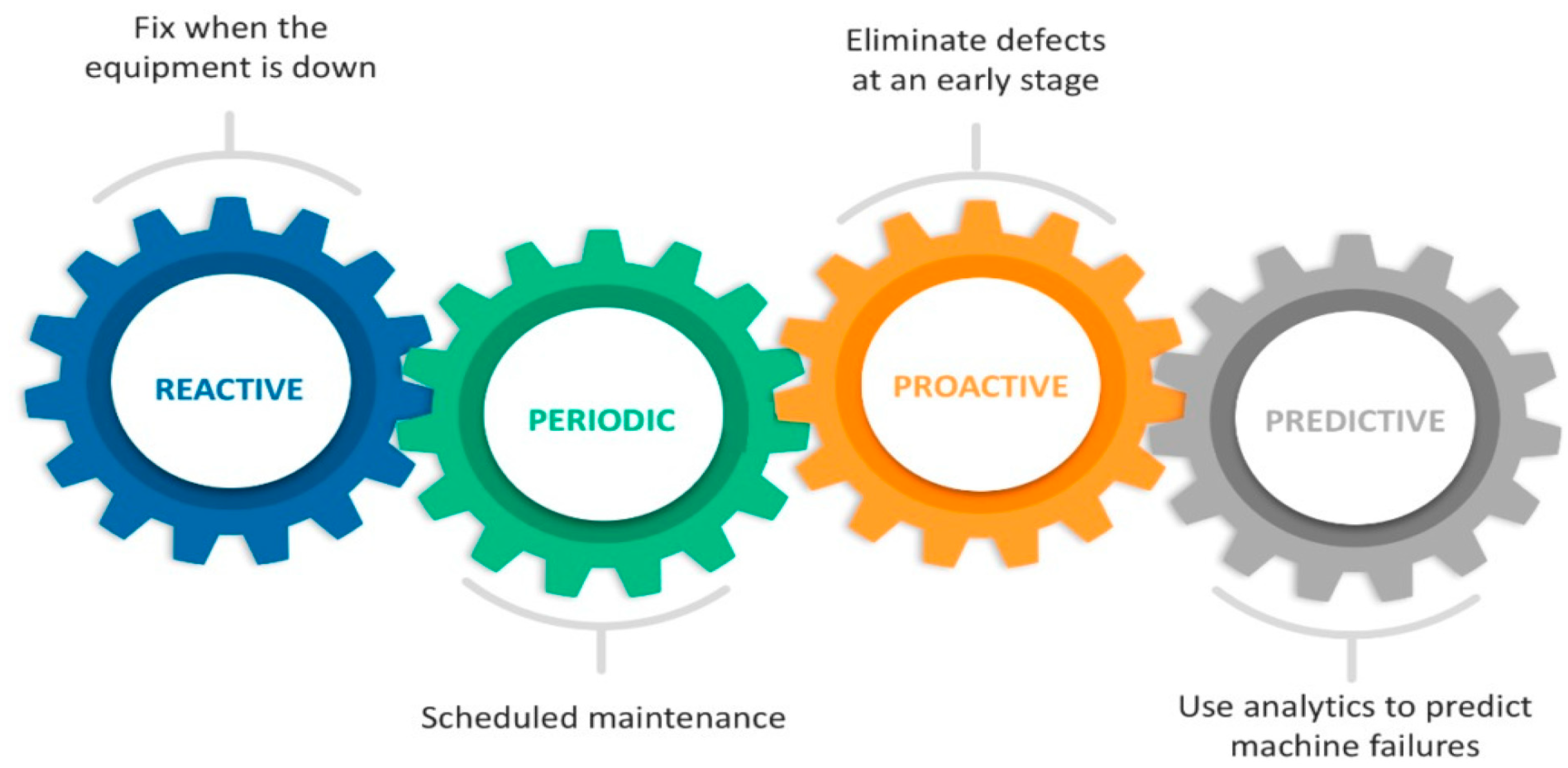
Predictive maintenance is a data-driven process that leverages historical information to forecast the timing and location of failures within an asset’s sub-components. Technicians can remotely acquire accurate data points, which are then processed by predictive algorithms to determine the failure probability of specific parts. This intelligence is communicated to maintenance teams through collaboration and data visualization tools, allowing for targeted interventions only on components that require service. By implementing this framework (
Figure 1), organizations can precisely schedule component replacements and receive early warnings regarding degradation cycles triggered by faulty hardware [
33].
1.4. Modernizing Mechanical Equipment Through Monitoring Systems
The use of agricultural machinery is indispensable for the development of modern production. In many countries, entirely mechanical machines that lack electronic management are still in operation; however, real-time monitoring is now a technical necessity to optimize precision and working times. Consequently, it is vital to adapt legacy equipment using sensors that allow for their current status to be monitored without interfering with their original operation. This integration into Industry 4.0 enables the modernization of operations without incurring the high costs of acquiring new machinery [
34]. Such a technological transition humanizes the field by reducing the physical burden and facilitating less arduous employment, significantly improving agricultural well-being [
35].
Specifically, the implementation of sensors in older tractors allows for real-time condition monitoring and fault prediction using algorithms such as SVM. By anticipating breakdowns, this technology reduces the labor workload and operational costs, ensuring the economic stability and productivity of the farmer [
36,
37].
2. Materials and Methods
This section describes the experimental setup employed for data acquisition and the associated measurement instrumentation. Furthermore, the methodological framework and testing protocols adopted for this research are detailed.
2.1. Vibration Testing
2.1.1. Test Bench
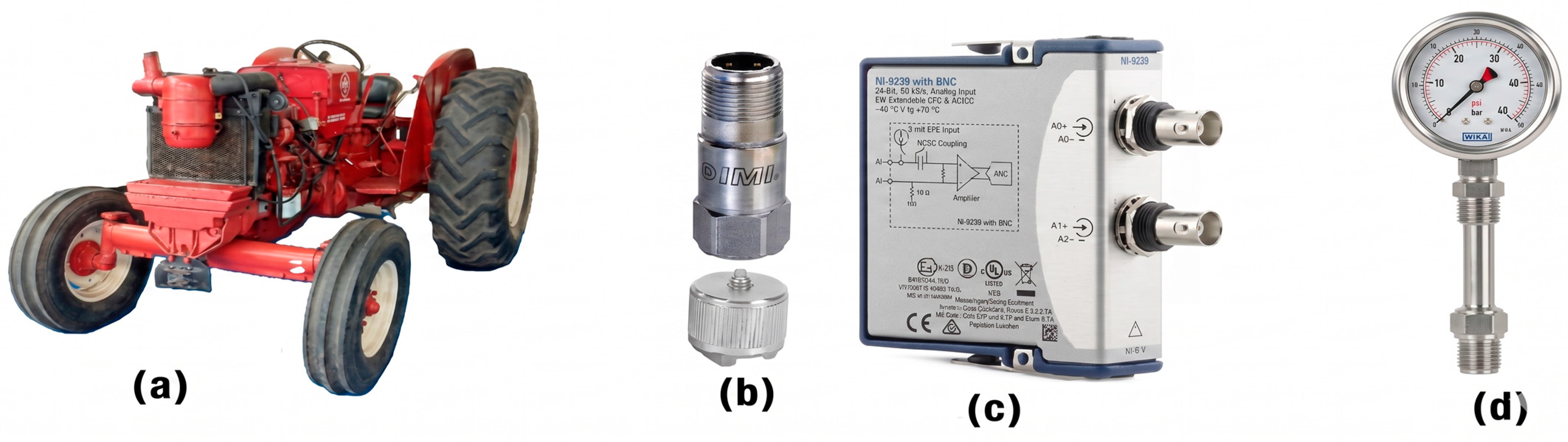
To validate the proposed methodology, an International 523 agricultural tractor was employed as the experimental platform (
Figure 2a). This specific model was selected due to its widespread use in diverse agricultural operations, such as harrowing, plowing, and loading, making it a representative unit for reliability analysis in the productive sector. Ensuring the operational integrity of this machinery is critical for maintaining field productivity.
The technical specifications of the tractor are summarized in
Table 2. The International 523 is powered by a 2.9 L, 3-cylinder diesel engine, delivering a maximum power output of 51.2 HP. Its fuel system is characterized by a nominal flow rate of 7.5 gallons per minute (GPM).
2.1.2. Vibration Diagnostic Equipment
Vibration Sensor (Accelerometer)
A model 603C01 Piezoelectric Accelerometer (IMI Sensors, PCB Piezotronics, Depew, NY, USA, EE. UU.) was employed to measure engine vibrations. The sensor was strategically mounted on the engine block (
Figure 2b) to acquire high-fidelity vibration data, which is essential for short-term fault diagnosis and predictive maintenance. This industrial-grade accelerometer is a standard instrument for condition monitoring in dynamic mechanical systems, such as internal combustion engines, compressors, and turbines. Key technical specifications include a sensitivity of 100 mV/g (±10%) and a dynamic measurement range of ±50 g. Featuring a ceramic sensing element, it operates across a frequency range of 0.5 Hz to 10 kHz (30 to 600,000 cpm) at ±3 dB and sustains operating temperatures from −54 °C to 121 °C.
Data Acquisition System (DAQ)
The analog signals captured by the accelerometer were digitized using an NI 9250 Data Acquisition (DAQ) card (National Instruments, Austin, TX, EE. UU.). This module converts the sensor’s analog output into digital data, enabling the characterization of engine vibrations under various operating conditions. The DAQ setup, located at the Universidad Técnica del Norte (
Figure 2c), ensures high-precision data collection for evaluating dynamic engine behavior. The NI 9250 features two analog input channels with 24-bit resolution and simultaneous sampling capabilities. While its internal master time base operates at 13.1072 MHz, it provides integrated signal conditioning for ±5 Vpk inputs. The module remains operational within an ambient temperature range of −40 °C to 70 °C (operating) and includes advanced digital filtering and overvoltage protection to maintain signal integrity during high-frequency sampling.
2.1.3. Pressure Measurement Manometer
To facilitate controlled measurement of the internal pressure within the injection pump, a bespoke diagnostic tool was designed and fabricated (
Figure 2d). The assembly comprises a glycerin-filled pressure gauge—selected for its vibration-dampening properties in closed hydraulic systems—coupled with a high-pressure hose and a set of precision fittings to ensure a leak-proof connection. Additionally, a custom-machined adapter ring was incorporated to facilitate seamless integration with the engine’s fuel pump housing.
The pressure gauge was integrated directly into the fuel return line, enabling continuous monitoring of the system’s back pressure during engine operation. This configuration allows for real-time observation of pressure fluctuations, which are critical for characterizing the pump’s performance across the experimental pressure range (1 to 4 bar).
2.1.4. Accelerometer Location
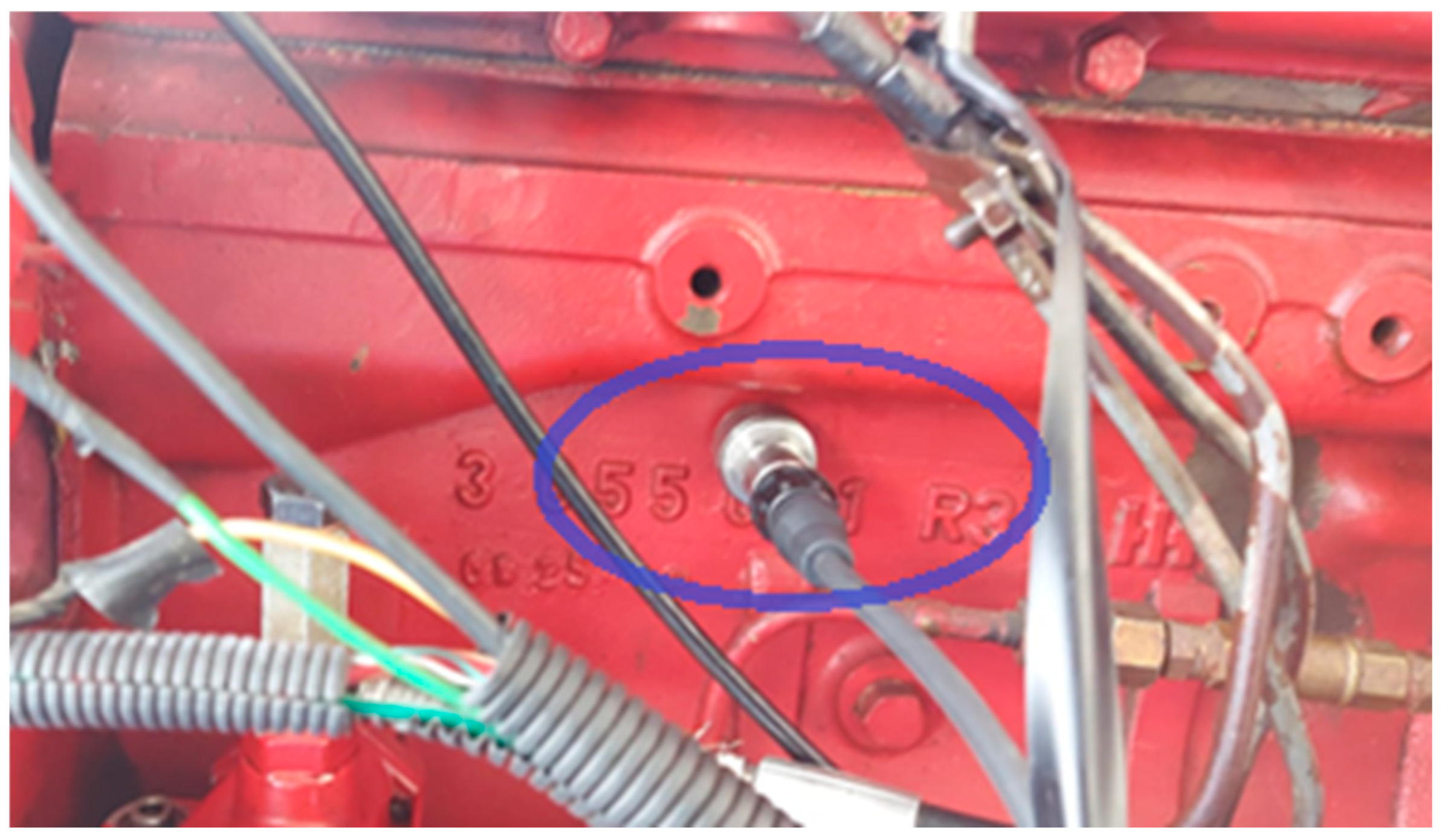
The accelerometer was mounted on the engine block, specifically at the mid-section corresponding to the second cylinder (
Figure 3). This measurement point was maintained with spatial consistency across all experimental phases, including both nominal and simulated fault conditions. This location was strategically selected due to its equidistant positioning, which minimizes signal attenuation and facilitates the capture of the peak vibration amplitudes generated by the engine’s internal dynamics.
2.1.5. Experimental Protocol
The methodology focused on the systematic acquisition of engine vibration data to characterize its dynamic behavior, operational condition, and performance. LabVIEW™ software was utilized for real-time signal visualization and high-fidelity recording. The experimental protocol was designed to analyze variables such as injection pump pressure, conducting 200 discrete tests for each specific condition. The acquisition parameters for each trial were strictly defined: an active sampling window of 8 s, during which the sensor continuously recorded vibration data, followed by a 4 s dwell time (dead time) prior to the subsequent measurement.
Data acquisition was managed via a custom control interface, enabling the operator to initiate, pause, or terminate the recording process. A visual status indicator was integrated to distinguish between active acquisition periods and dwell intervals. The raw data from each test was automatically exported and stored in structured files within a designated directory. Through this standardized procedure, a total of 60,000 data points were acquired for each analyzed pressure variable across the 200-test set. From this comprehensive dataset, a representative subset of 100 tests was selected for further feature extraction and advanced signal analysis.
2.2. Feature Selection and Data Processing
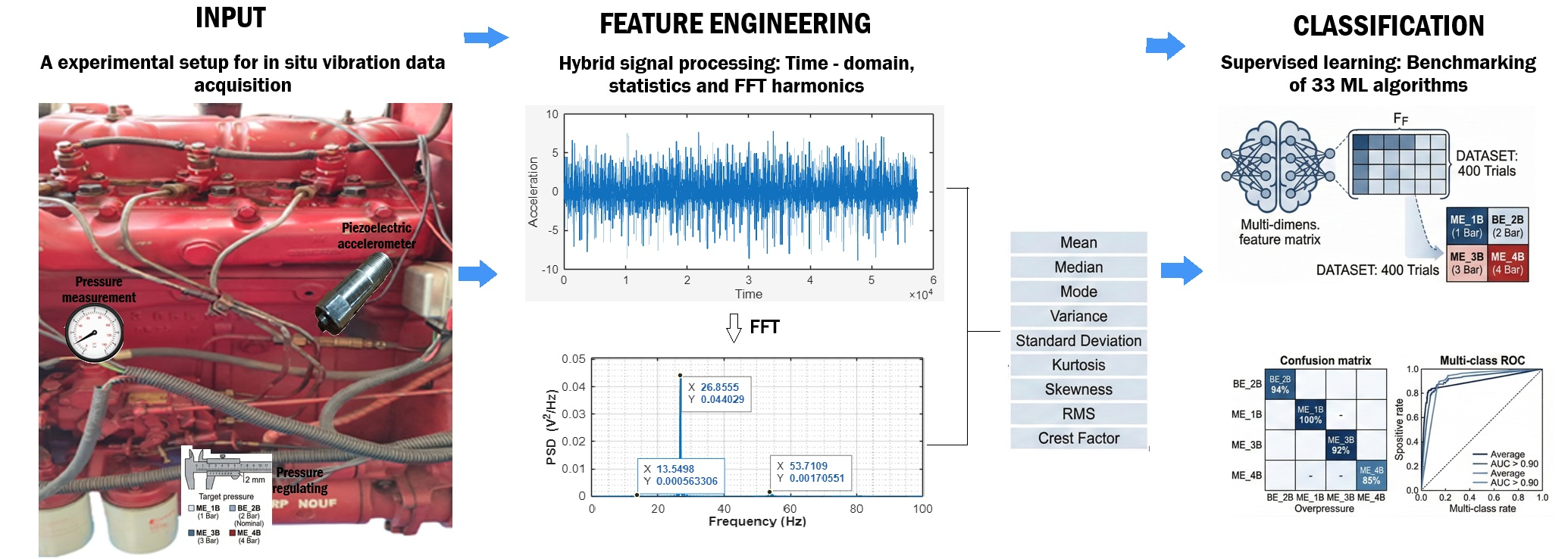
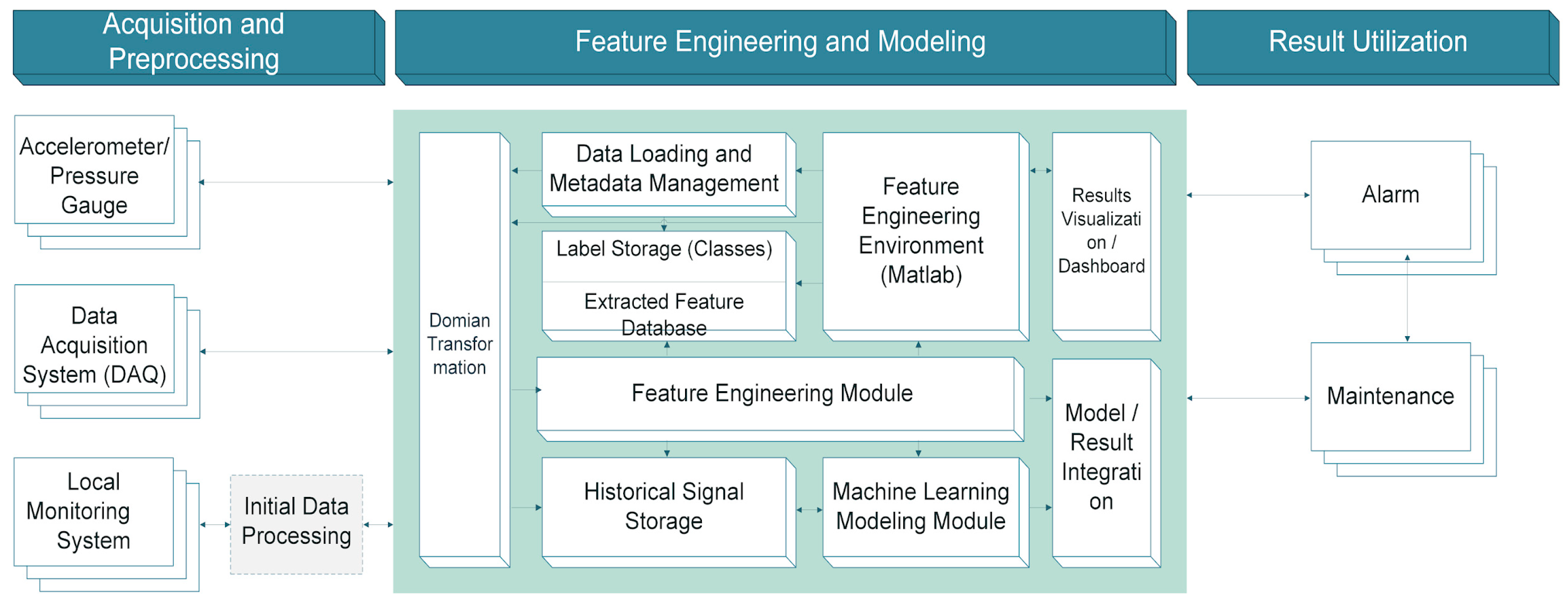
The flow chart (
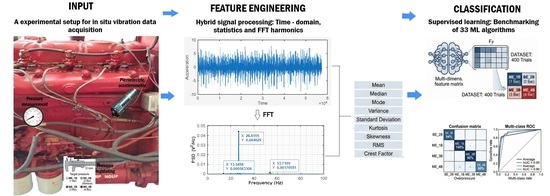
Figure 4) outlines the methodological architecture implemented for this research, which centers on Condition Monitoring and Predictive Maintenance (PdM) of a mechanical diesel injection pump.
The methodology is structured into three primary phases:
Data Acquisition and Pre-processing: Focusing on high-frequency vibration signal capture and noise reduction.
Feature Engineering and Modeling: Involving the extraction of statistical and spectral descriptors followed by the training of machine learning classifiers.
Deployment and Interpretation of Results: Validating the model’s diagnostic accuracy for real-world application.
2.2.1. Data Acquisition and Pre-Processing
This phase initiates with the characterization of the pump’s nominal operating condition, established at a baseline pressure of 2 bar. To generate a comprehensive dataset of anomalous behavior, failure conditions were simulated by modulating the system pressure to 1 bar, 3 bar, and 4 bar.
Raw data acquisition was performed using a high-speed Data Acquisition System (DAQ) coupled with pressure and vibration sensors within the LabVIEW™ 2020 SP1 (National instruments, Austin, TX, USA) environment. A total of 200 experimental trials were recorded per condition, each yielding a high-density dataset of 60,000 samples.
2.2.2. Feature Engineering and Modeling
Following the initial data acquisition, a representative subset was curated by selecting 100 randomized samples per class to ensure statistical balance. A Domain Transformation was then applied using the Fast Fourier Transform (FFT) to migrate the time-series data into the frequency domain. This transformation is widely recognized for providing critical insights into the spectral signatures and dynamic behavior of rotating machinery.
The frequency-domain representation facilitates feature extraction focused on identifying high-amplitude harmonics, which serve as indicators of pump dynamics and potential mechanical anomalies. Both the statistical analysis and feature definition were executed within the MATLAB® version R2025a (The MathWorks, Inc., Natick, MA, EE. UU.).
2.2.3. Use of Results
The final phase leverages the trained model to generate proactive diagnostic alerts, providing robust decision support for condition-based maintenance scheduling. Ultimately, the optimized feature set was utilized for the training and cross-validation of the Machine Learning (ML) model, culminating in the successful integration of diagnostic results into the predictive maintenance framework.
2.3. Injection Pump Performance Evaluation
The injection pump is a critical subsystem in diesel fuel architectures, responsible for high-precision fuel metering and the pressurization of the diesel delivered to the cylinders. Its primary function is to facilitate efficient combustion, which directly translates into optimized engine performance and the mitigation of pollutant emissions. This component, which has evolved from purely mechanical assemblies to sophisticated Electronic Diesel Control (EDC) systems, works in conjunction with the injectors to optimize injection timing, a parameter that fundamentally determines engine power density and structural durability.
In the framework of this research, the focus is centered on the controlled modulation of the pump’s operating pressures, as injection pressure is a decisive factor for optimal fuel atomization and subsequent combustion efficiency. Fluctuations in injection pressure directly impact the Start of Injection (SOI) and the mass of fuel supplied, consequently affecting brake-specific fuel consumption (BSFC), power output, and the concentration of exhaust gas emissions. Therefore, monitoring and characterizing the influence of these pressure variances is critical for both performance optimization and compliance with increasingly stringent environmental regulations.
2.3.1. Nominal Operating Condition (Good Condition)
According to the established literature [
37], the optimal nominal operating pressure for the mechanical injection pump is defined at 2 bar. This baseline pressure represents the state of ideal operational integrity and provides the following technical advantages:
Optimal Fuel Atomization: A 2-bar pressure differential ensures that the diesel fuel is atomized into fine, uniform droplets. This facilitates a highly homogeneous air–fuel mixture, promoting complete and efficient combustion within the chamber.
Enhanced Engine Performance: Precise and synchronized fuel delivery is guaranteed at this setpoint, resulting in maximized power output, improved transient response, and stable, vibration-attenuated engine operation.
High Volumetric and Fuel Efficiency: Stringent pressure control minimizes fuel bypass and waste, thereby maximizing the engine’s overall volumetric efficiency and thermal conversion.
Emission Mitigation: High combustion efficiency at the nominal pressure leads to a substantial reduction in polluting by-products, such as particulate matter and unburned hydrocarbons.
System Longevity and Durability: Maintaining the hydraulic pressure within this calibrated range prevents premature mechanical wear of both the pump assembly and the injection nozzles, significantly extending the system’s mean time between failures (MTBF).
2.3.2. Simulation of Failures Due to Pressure Variation
Uncontrolled fluctuations in injection pressure—whether exceeding or falling below nominal thresholds—are primary drivers of combustion anomalies. Such faults typically manifest as insufficient or excessive fuel delivery, leading to significant power loss, increased specific consumption, and potential structural damage to engine components. For this study, three distinct fault conditions were simulated:
Abnormally Low Pressure (1 Bar)
Operating the injection pump at 1 bar (50% below nominal) severely compromises engine performance due to inadequate fuel atomization and incomplete combustion. This condition represents one of the most critical operational failures:
Cold Start Impediment: Reduced hydraulic pressure hinders the initial fuel spray required to achieve self-ignition, particularly under cold-start conditions.
Incomplete Combustion: Fuel is injected in large droplets, resulting in poor air–fuel mixing and heterogeneous combustion, which significantly reduces thermal efficiency.
Loss of Brake Horsepower (BHP): An insufficient fuel mass flow rate within the injection window results in a sharp decline in effective power, particularly under high-load or acceleration transients.
Abnormally Medium-High Pressure (3 Bar)
Increasing the pressure to 3 bar induces specific combustion pathologies that degrade both emission quality and mechanical smoothness:
Particulate Matter (PM) Emissions: Delayed or incomplete combustion cycles result in the formation of soot particles, manifested as visible black smoke in the exhaust stream.
Combustion Instability (Knocking): Non-optimal ignition timing can trigger knocking (detonation or pre-ignition) due to the altered chemistry of the over-pressurized fuel spray.
Increased Specific Fuel Consumption (SFC): The engine management often attempts to compensate for perceived power deficits by increasing the injection duration, leading to over-injection and decreased efficiency.
Abnormally High Pressure (4 Bar)
Operating at excessively high pressures (4 bar) presents latent risks that are difficult to detect via conventional means but lead to catastrophic structural failure:
Accelerated Injector Wear: Excessive pressure induces cavitation and internal erosion, altering the nozzle’s spray pattern and degrading long-term atomization quality.
Cylinder Wall Scuffing (Scoring): Over-penetration of the fuel spray can impinge directly on the cylinder walls, washing away the protective lubricating film. This leads to cylinder scoring and accelerated wear of the piston rings.
Aggressive Heat Release Rates: Excessively fine atomization can trigger near-instantaneous detonation, increasing the peak cylinder pressure and shortening the engine’s fatigue life.
Thermal Overloading: Rapid, intense combustion cycles elevate the maximum in-cylinder temperature, placing excessive strain on the cooling system and risking thermal fatigue in the cylinder head and valves.
2.3.3. Assignment of State Variables
For modeling and classification purposes, a state variable (
Table 3) is assigned to each pressure condition analyzed, categorizing the operation:
2.4. D Signal Processing and Spectral Analysis
The Fast Fourier Transform (FFT) algorithm was utilized to analyze the acquired vibration signals. Given that the captured data consist of digitally sampled discrete sequences, the Discrete Fourier Transform (DFT) is the appropriate mathematical framework for this analysis. This tool transforms a finite sequence of time-domain data—representing the recorded mechanical vibrations—into its equivalent representation in the frequency domain.
The DFT decomposes the complex, non-stationary vibration signal into its constituent sinusoids, enabling a detailed examination of its spectral density. This decomposition is critical for identifying dominant frequency components and harmonic patterns associated with specific injection pump states. Mathematically, the DFT of a discrete signal
x[
n] is defined as:
where
X[k]: Discrete Fourier Transform (DFT) coefficients representing the signal in the frequency domain.
x[n]: Is your original vibration signal in the time domain, as captured by the NI 9250 DAQ.
n: The sample index in time.
k: The frequency index (the “frequency bin“).
N: The total number of samples you took.
e −j2πkn/N: It is the kernel of the transform (based on Euler’s identity).
The analysis was implemented using the Fast Fourier Transform (FFT), a computationally optimized algorithm designed to efficiently calculate the DFT. The developed script processed the selected data files, incorporating metadata such as test type and operating pressure for each variable analyzed.
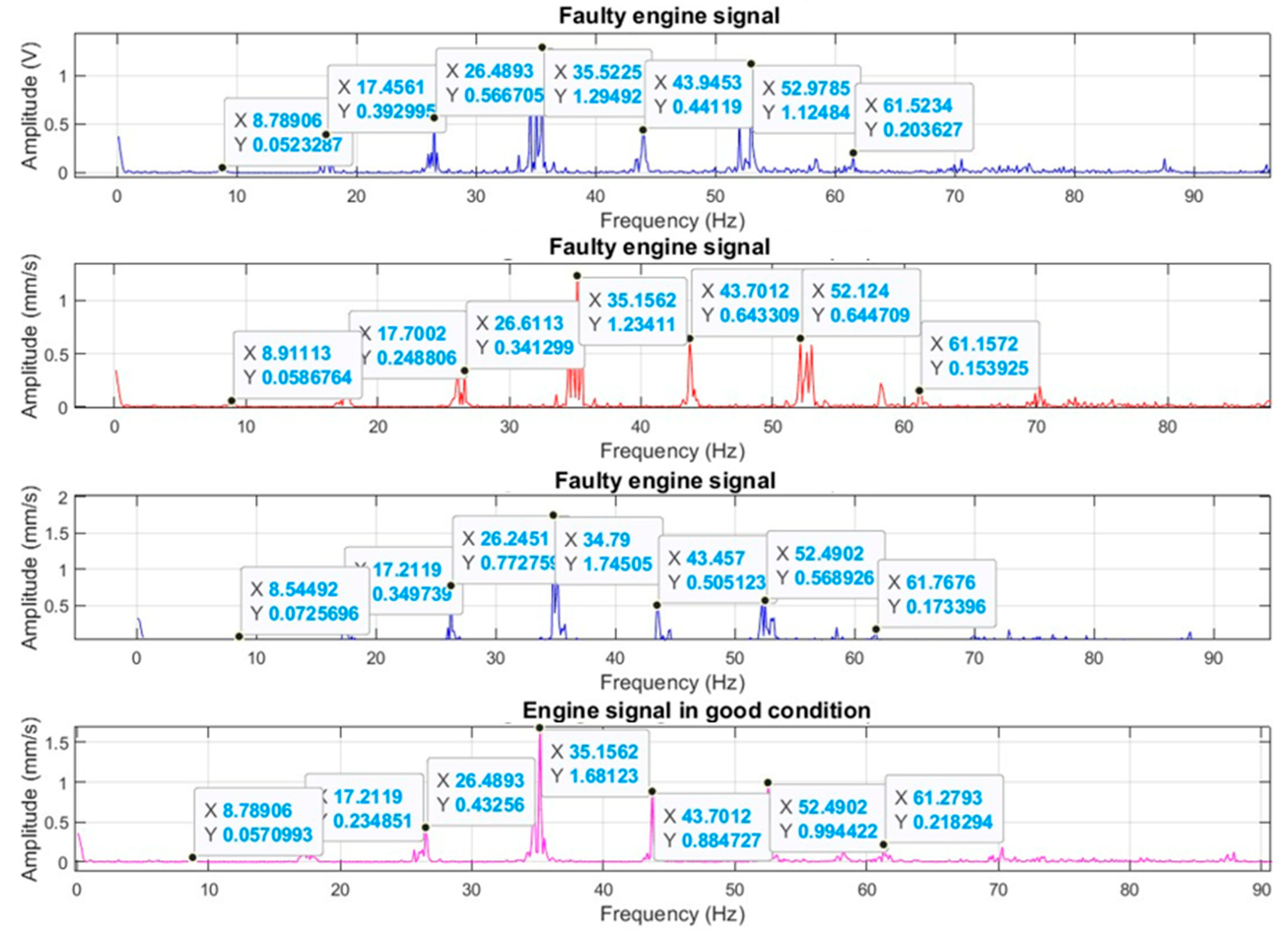
The data processing pipeline consisted of computing the FFT for each of the 100 selected trials per condition. Subsequently, each resulting signal was transformed into the frequency domain to characterize its spectral signature. Within this domain, the dominant harmonics (those with the highest magnitudes) were identified and extracted. These peak amplitudes were recorded to construct a structured dataset for grouped analysis.
Figure 5 illustrates the resulting spectral density for each analyzed operating condition.
2.5. Vibration Characterization
Vibration pattern analysis is a fundamental technique employed in this study to characterize the dynamic behavior of the agricultural tractor’s engine. This approach enables the identification of vibration distribution and propagation throughout the mechanical system, which is essential for diagnosing anomalies such as mass imbalance, misalignment, mechanical wear, resonance, and structural fatigue.
Specifically, within the tractor’s diesel engine, vibration characterization facilitates the detection of faults in critical subsystems. This includes the valve train (camshaft and valve timing), the reciprocating assembly (distinguishing between combustion-induced transients and purely mechanical impact), and the crankshaft (identifying mass imbalances or bearing wear). Each of these mechanical conditions generates distinct vibration signatures associated with fundamental frequencies or specific harmonic orders within the signal spectrum, thereby enabling precise fault identification and isolation.
2.6. Machine Learning Methodology
The methodological approach leverages Machine Learning (ML) for the analysis and classification of vibration datasets acquired from the agricultural tractor’s diesel engine. The computational workflow is structured into four critical stages: signal pre-processing via Fast Fourier Transform (FFT), vibration feature extraction and selection, supervised model training, and rigorous performance evaluation through standardized metrics.
2.6.1. Machine Learning-Based Data Processing
The algorithm used to extract representative harmonics from vibration signals in the frequency domain was based on the theoretical kinematic frequencies of the test bench’s internal components. Key physical domain features—specifically those related to the crankshaft, camshaft, and pistons—were applied uniformly and individually to each signal. By processing 8 s vibration signals independently, this methodology avoids optimization processes that depend on the overall data distribution, thereby preventing data leakage.
The central tendency of the experimental data was determined by calculating the arithmetic mean for each variable. This provided a statistical dispersion measure that optimized the vibration signature prior to training. Consequently, the efficiency of the engine’s spectral components is represented with high precision and remains free from dataset-driven biases.
2.6.2. Statistical Analysis of Vibration Data
A total of nine statistical features were extracted from each vibration signal in the time domain to serve as response variables for the classification model. This set—comprising the mean, median, mode, variance, standard deviation, kurtosis, skewness, Root Mean Square (RMS), and crest factor—was selected to characterize the signal’s configuration and energy distribution. It is important to emphasize that each descriptor was calculated independently for every 8 s time interval, ensuring sample autonomy.
By processing these independently, the use of global normalization or scaling techniques—which rely on statistical parameters from the entire dataset prior to partitioning—was avoided. This methodology prevents any data leakage from the test set into the training set, ensuring the model remains generalizable and robust. The descriptors were organized into a feature matrix that serves as the input for the learning phase, where the relationships between vibration signatures and the four pump pressure states (1, 2, 3, and 4 bar) are modeled.
2.6.3. Is Methodology for Model Training and Validation
To evaluate the accuracy of the predictive diagnostic system, a data partitioning strategy was implemented. The dataset, comprising 400 experimental trials (100 per variable), was divided into two independent blocks. A hold-out test set—consisting of 25 samples per variable—was reserved and excluded from the training phase. The remaining data were subjected to a 5-fold cross-validation procedure, which partitioned the training set into five random subsets; four were used for learning and one for validation in each iteration. This ensured that every data point contributed to the training process, thereby verifying the efficiency of the Fine Gaussian SVM model. The robustness of the training was further validated using the previously reserved hold-out test set, achieving an accuracy exceeding 95% on unseen data.
To prevent data leakage and maintain model integrity, the initial dataset of 400 samples was partitioned into 75% for training and validation, and 25% (100 samples) as a hold-out set. This hold-out set was excluded from the feature extraction process and was used exclusively for final validation.
Two distinct training sessions were conducted using the spectral harmonic features and the time-domain statistical descriptors. For each session, thirty-three different machine learning algorithms were evaluated. Classification accuracy served as the primary metric for model selection, identifying the most robust classifier based on its ability to correctly categorize the simulated pressure states.
The following diagnostic tools were utilized for a comprehensive evaluation of the selected model’s performance:
Confusion Matrix: This was employed to quantify the model’s predictive accuracy and misclassification rates, specifically analyzing the distribution of True Positives (TP), False Positives (FP), and False Negatives (FN) across all classes.
Receiver Operating Characteristic (ROC) Curve: The ROC curve (True Positive Rate vs. False Positive Rate) was generated to assess the model’s sensitivity across various decision thresholds. The Area Under the Curve (AUC) was utilized as a quantitative measure of the classifier’s discriminative capability.
Multivariate Data Visualization: Scatter plots and parallel coordinate plots were implemented for visual analysis, enabling the interpretation of the multidimensional relationships between statistical features (e.g., RMS, variance) and the resulting diagnostic classes.
3. Results
As a preliminary phase of the results, and to ensure the precision of the pressure measurements required for this study, comprehensive maintenance was performed on the fuel injection system. These activities were essential to guarantee operational reliability and the integrity of the acquired data. The procedure involved the disassembly of the injection pump and injectors to ensure optimal start-up conditions.
The injection pump was overhauled and calibrated to maintain a stable nominal pressure of 2 bar, verified through rigorous test bench validation. Regarding the injectors, the nozzles were replaced due to insufficient internal pressure, which previously resulted in inadequate fuel atomization and “dripping” (post-injection) within the combustion chamber. Following the nozzle replacement, the injectors were validated using a manual test pump to ensure a uniform spray pattern and regular atomization. Finally, the fuel tank underwent a thorough cleaning to remove contaminants from its internal cavities that could compromise injector performance, and the fuel filters were replaced to prevent hydraulic blockages during the experimental trials.
3.1. Results of Fuel Pressure Variation on Engine Vibration Response
Following the maintenance and reassembly phases, the system was configured for data acquisition. A piezoelectric accelerometer was positioned at the engine’s geometric center to ensure optimal vibration capture, while a pressure gauge was integrated into the fuel pump return line to monitor operational pressure in real time.
To simulate the various experimental conditions (ranging from 1 to 4 bar), a pressure-regulating valve was modified. The internal spring of the valve was compressed through a series of calibrated adjustment strokes. A vernier caliper was utilized to measure the incremental displacement of the adjustment mechanism (in 2 mm steps), thereby establishing a repeatable correlation between spring compression and the target hydraulic pressure for each experimental trial.
Data and Qualitative Observations of the Engine Under Simulated Failure Conditions
The pressure-regulating valve was adjusted to establish the four pre-defined experimental states. The qualitative observations regarding engine behavior and operational stability for each condition are detailed below:
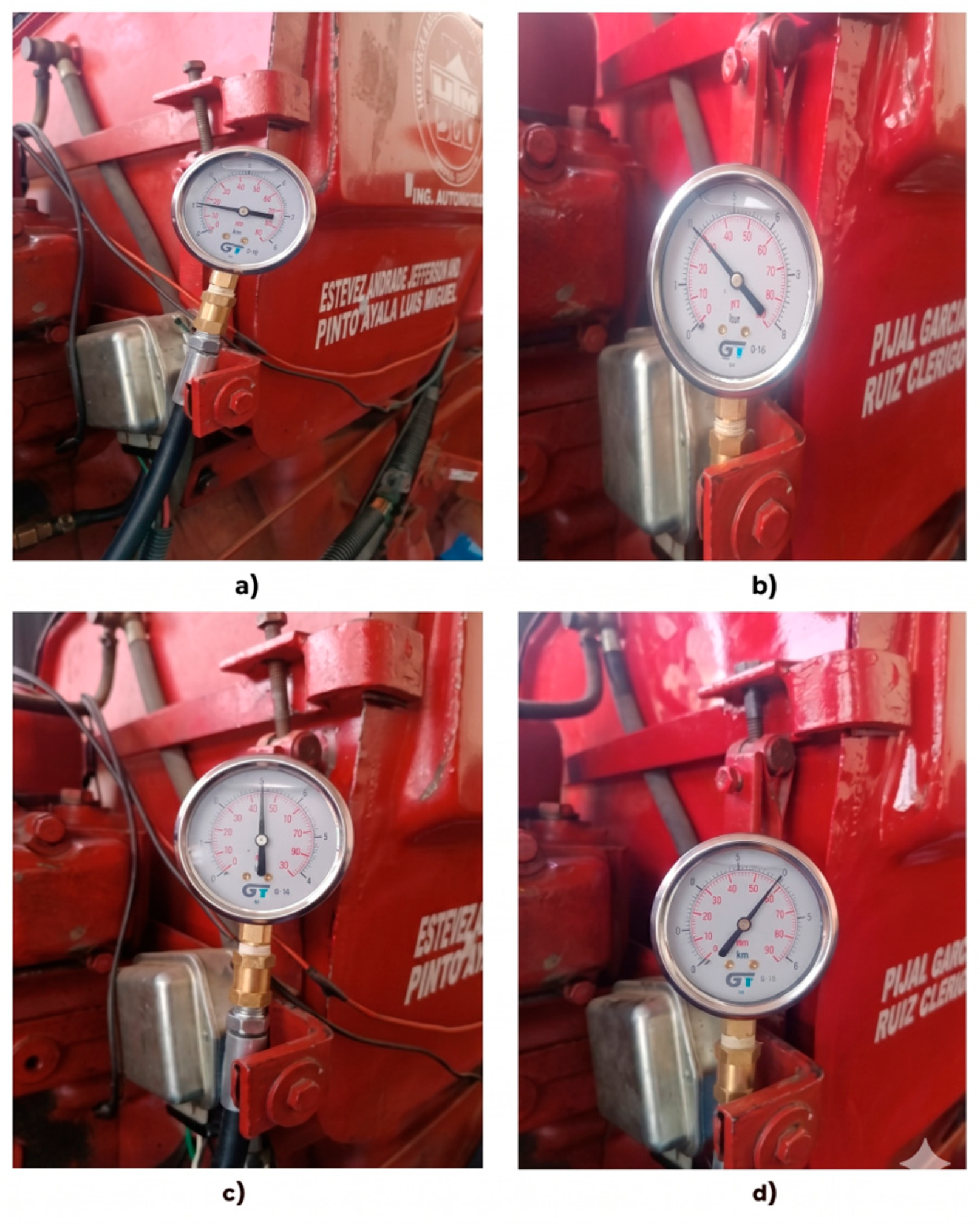
Test 1
: 1 bar (Condition ME1B): Upon system activation (
Figure 6a), the abnormally low fuel pressure resulted in severe operational instability. Critical issues included delayed ignition, erratic idling, and constant RPM fluctuations. Manual throttle intervention was required to maintain combustion and prevent engine stalling.
Test 2: 2 bar (Condition BE2B): Defined as the nominal operating setpoint following maintenance, this condition exhibited optimal performance (
Figure 6b). The engine demonstrated rapid starting, highly stable idling, and a lack of excessive acoustic or mechanical noise. Operational consistency was maintained throughout the data acquisition window.
Test 3: 3 bar (Condition ME3B): While the engine started effortlessly (
Figure 6c), the pressure increase led to elevated idling speeds and higher RPM levels. This state was characterized by visible soot emissions (black smoke) and a noticeable increase in thermal loading during the test cycle.
Test 4: 4 bar (Condition ME4B): At the maximum experimental pressure, the engine exhibited aggressive acceleration and excessively high RPM levels, leading to rapid thermal saturation (
Figure 6d). This condition produced the highest concentration of black smoke, serving as a primary indicator of inefficient combustion, excessive fuel consumption, and elevated exhaust emissions.
3.2. Harmonic Signal Analysis via FFT Spectrometry
3.2.1. Harmonic Analysis Using the Fourier Transform
For data interpretation and signal processing, a custom algorithm was developed to implement the Fast Fourier Transform (FFT). This computational tool enables the extraction of representative harmonics by transforming the vibration signals from the time domain into the frequency domain.
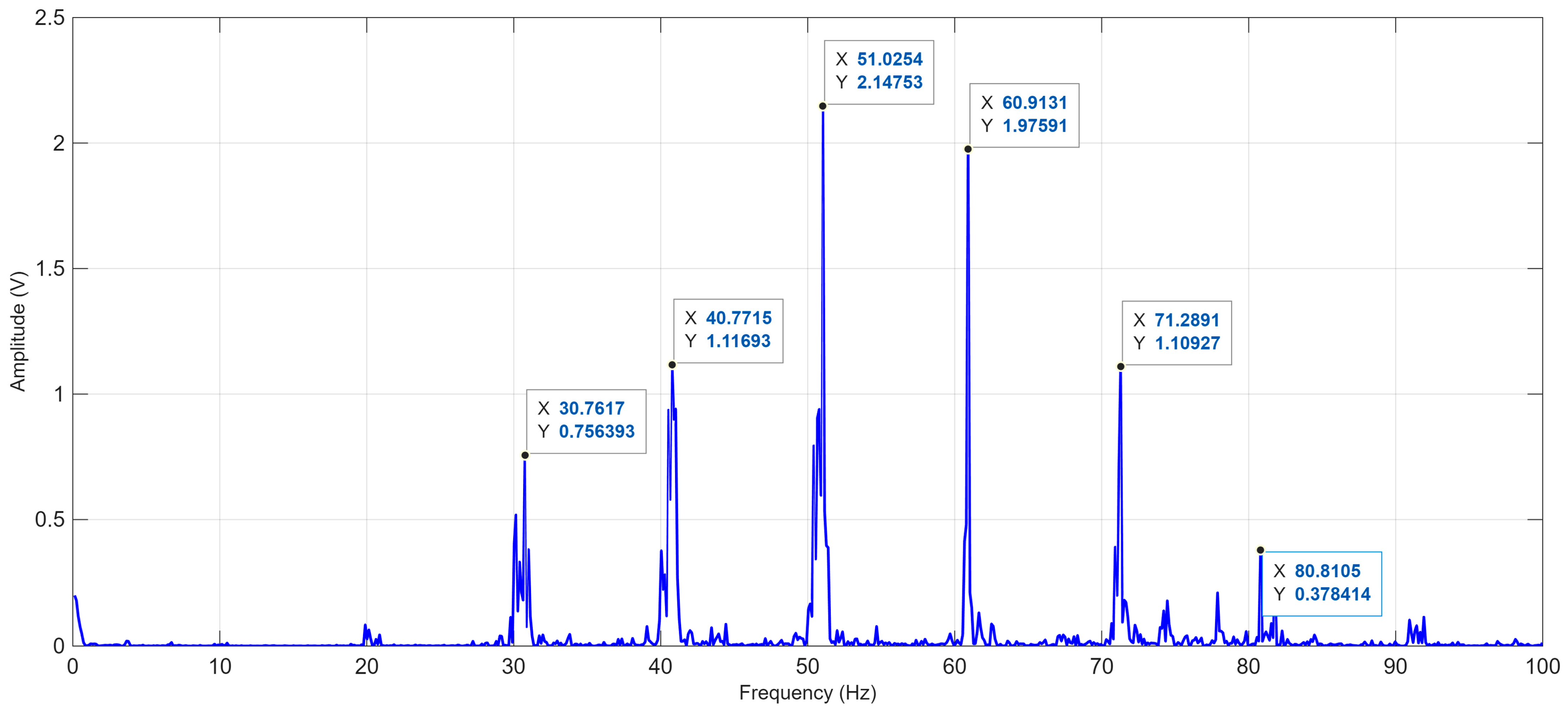
Figure 7 illustrates the identification of the peak amplitude and its corresponding fundamental frequency for the most representative vibration signal within the experimental set.
The vibration signal processing was executed by calculating the arithmetic mean and standard deviation, thereby validating the motor’s vibratory characterization previously detailed in the methodology. The six harmonics with the highest amplitudes were selected as primary reference features. Each harmonic was mapped to a specific engine component based on their respective kinematic frequencies, as summarized in
Table 4.
Each mechanical element is characterized by a fundamental frequency, which was recorded alongside the amplitude and frequency of the extracted harmonics for every trial. This systematic process resulted in the consolidation of a comprehensive feature database (in Excel format) for subsequent multivariate analysis and model training.
3.2.2. Statistical Analysis
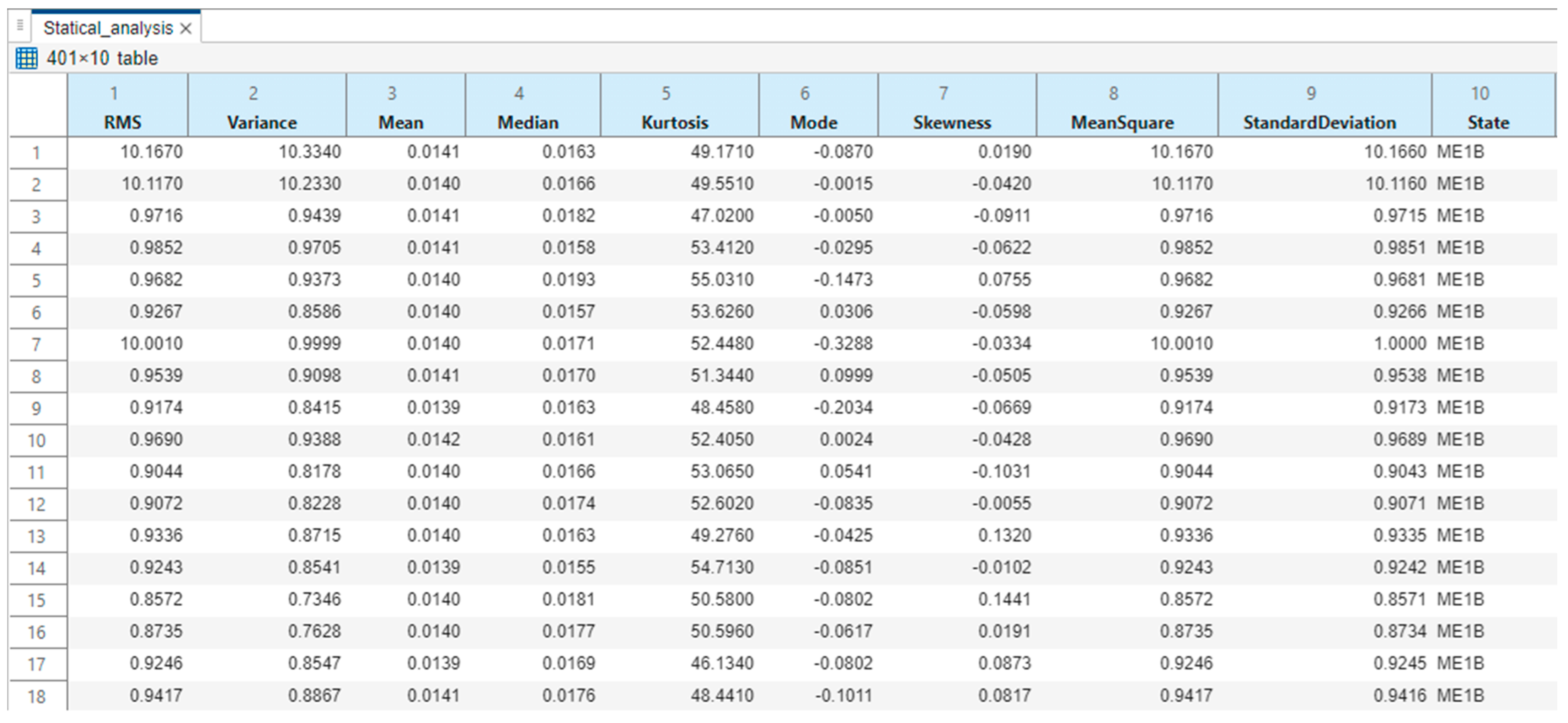
To ensure dual-track validation within the autonomous learning framework, a comprehensive statistical analysis was performed on the extracted parameters, as illustrated in
Figure 8. A total of 400 experimental trials (100 per pressure condition) were utilized to construct the input feature matrix for the training and validation phases.
This robust dataset serves as the foundation for the learning process, where the statistical descriptors provide the necessary variance and class separation required for the classification algorithms to distinguish between nominal and induced fault states with high precision.
The datasets derived from both the spectral vibration characterization and the multivariate statistical analysis served as the primary input for the machine learning framework. These variables, representing the extracted signal descriptors, were utilized to model the various operational states of the injection pump, specifically targeting the identification and classification of induced pressure-related faults (1, 3, and 4 bar) against the nominal baseline (2 bar).
3.3. Machine Learning
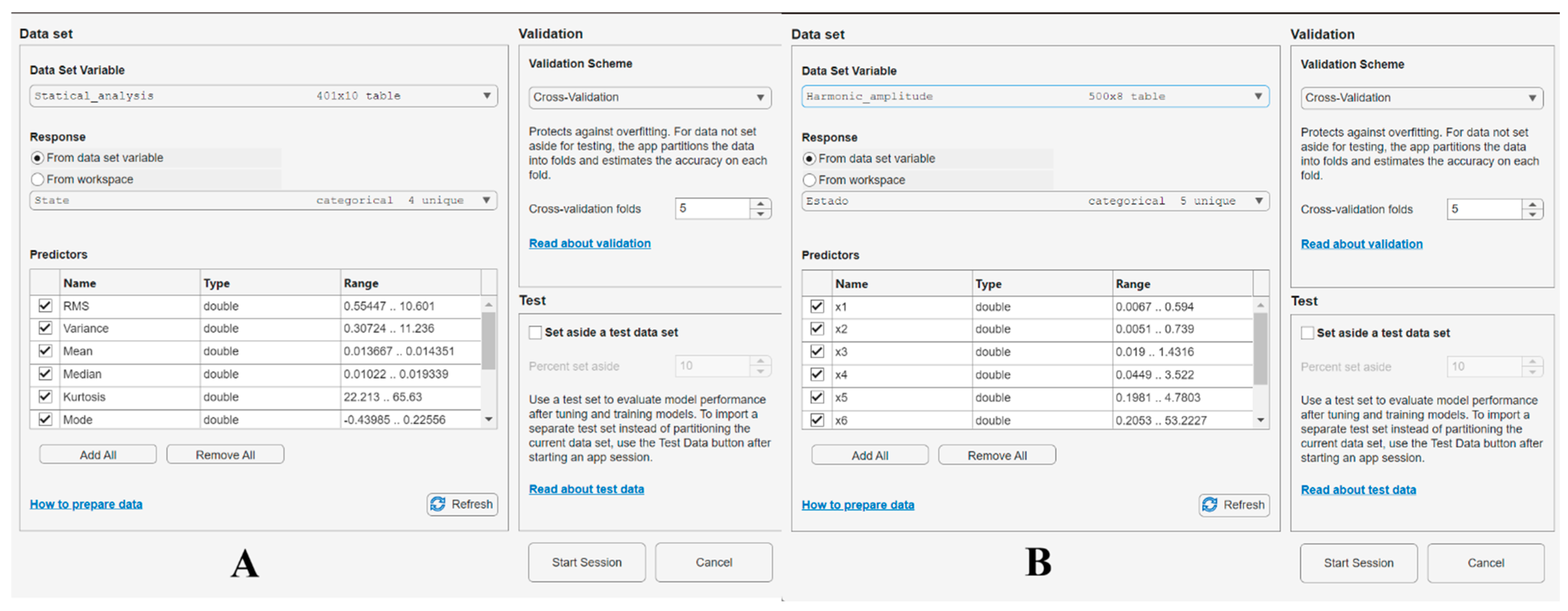
Once the feature matrices corresponding to both the frequency-domain spectral characterization and the time-domain statistical analysis were structured—each categorized by their specific fault labels—the Classification Learner application was utilized to evaluate the two learning scenarios. As illustrated in
Figure 9, this environment enabled the simultaneous training and comparative analysis of the multiple algorithms to identify the most robust diagnostic model for injection pump pressure states.
A comprehensive benchmarking process was conducted by training all 33 classification algorithms available within the environment to identify the optimal diagnostic model. The evaluation revealed that the multivariate statistical analysis provided a significantly more robust and efficient feature set compared to the spectral harmonic data. Consequently, the final learning process was executed using the time-domain statistical descriptors as the primary input.
Table 5 reviews the working of these algorithm families, highlighting the superior accuracy of the Fine Gaussian SVM compared to other approaches such as k-NN or Decision Trees.
Upon execution of the classification trials, the results demonstrated that the Support Vector Machine (SVM) utilizing a Fine Gaussian Kernel (scale 2.3) achieved a validation accuracy of 96.8%. This peak performance was attained using the structured dataset of 400 experimental trials, encompassing both the nominal baseline (2 bar) and the induced fault conditions (1, 3, and 4 bar). In contrast, the models trained exclusively on spectral vibration characterization yielded an accuracy of less than 50%, indicating that time-domain statistical features offer superior discriminative power for this specific mechanical diagnosis.
3.3.1. Dispersion
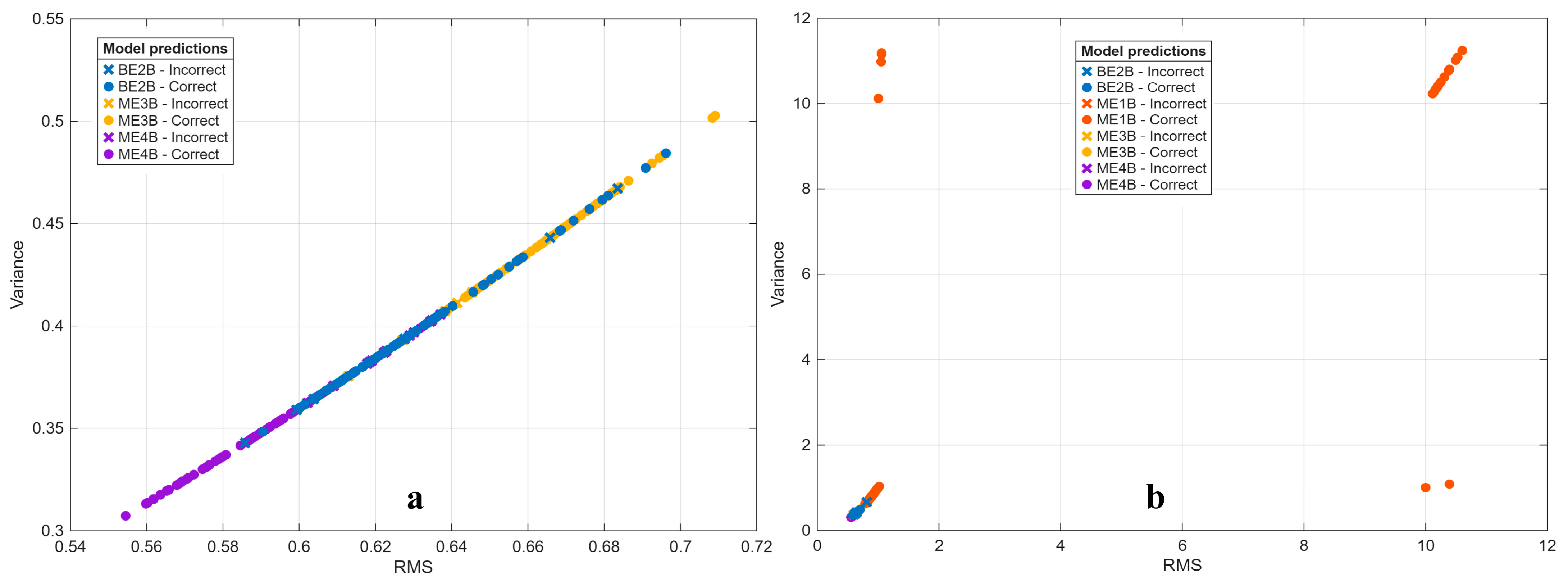
As established in the performance evaluation, the Fine Gaussian SVM model (scale 2.3) achieved the highest validation accuracy. A detailed analysis of the feature distribution reveals that the statistical dispersion for the 1-bar fault condition (
Figure 10b) is significantly higher than that of the other operational states. This increased variance is attributed to the erratic engine behavior and combustion instability induced by abnormally low fuel pressure, which compromises the uniformity of the vibration signatures.
When this specific fault condition is isolated, the remaining variables (2, 3, and 4 bar) exhibit a more uniform and concentrated dispersion (
Figure 10a). The data maintain a high degree of spatial consistency and sequence stability when the pump operates under nominal or over-pressurized conditions. This characteristic clustering is highly advantageous for the classifier, as it facilitates the definition of robust decision boundaries, thereby enhancing the system’s reliability for predictive failure diagnosis.
3.3.2. Confusion Matrix
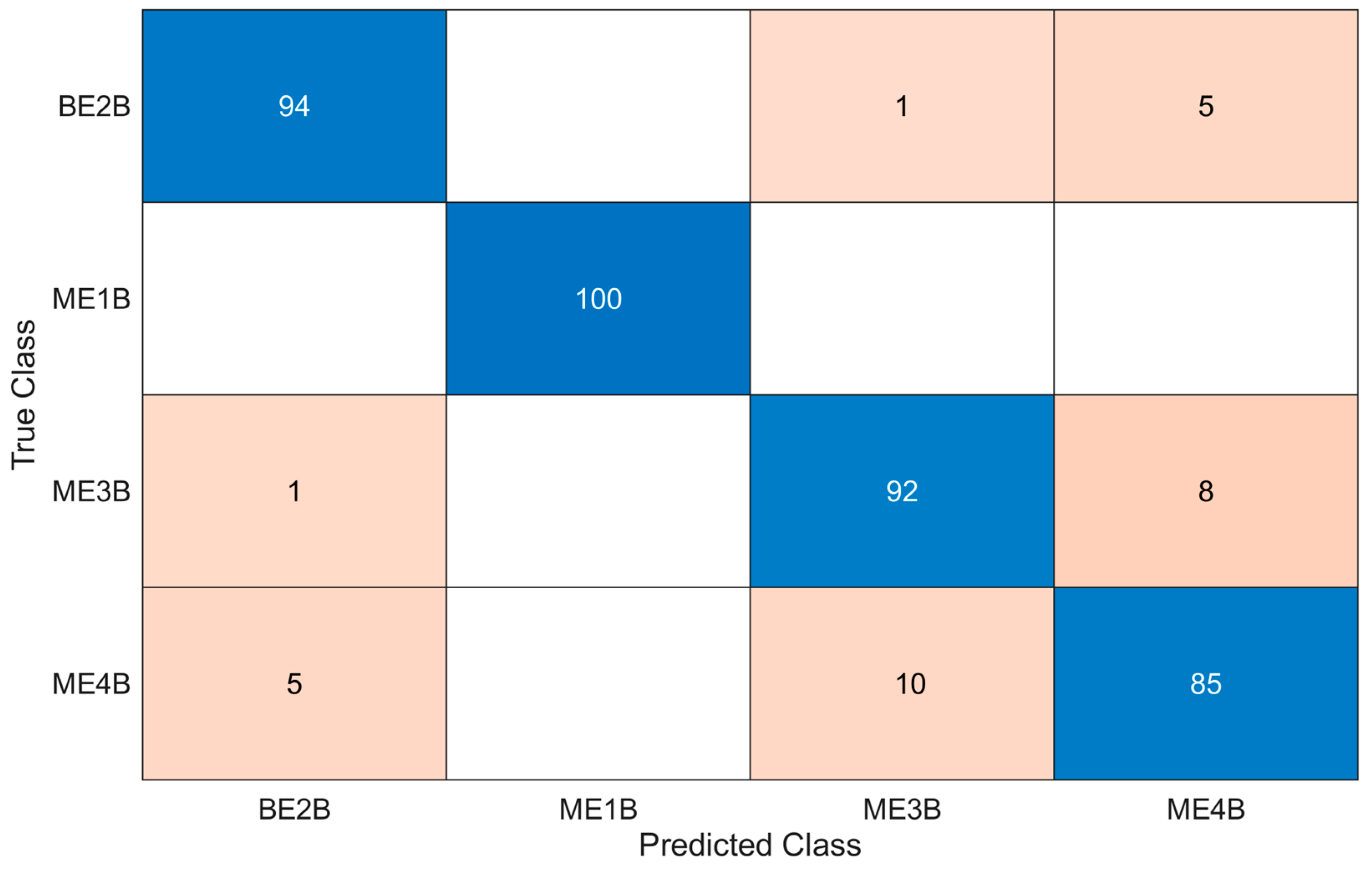
The confusion matrix (
Figure 11) demonstrates the high diagnostic performance of the model using vibration-derived statistical features across all operational states. Minor classification errors were observed between conditions ME3B and ME4B, which are primarily attributed to the spectral and statistical similarity of their feature sets. The specific classification accuracies per class are as follows: BE2B (94%), ME1B (100%), ME3B (92%), and ME4B (85%).
The 100% accuracy for the ME1B (1 bar) condition confirms that the erratic vibration signature of low-pressure faults is highly distinct, allowing for perfect class separation. Conversely, the model occasionally misidentifies adjacent classes—specifically between 3 bar and 4 bar—due to a significant feature overlap in their parameters. This behavior is considered physically consistent, as the mechanical response of the engine under high-pressure and excessively high-pressure conditions varies minimally, resulting in near-identical statistical descriptors.
To validate the performance of the SVM model, additional metrics were derived from the confusion matrix. This approach allows for an individual assessment of the algorithm’s effectiveness for each specific injection pump variable (BE2B, ME1B, ME3B, and ME4B). Consequently, an efficient model is obtained that remains free from bias toward any particular condition or variable, as demonstrated in
Table 6.
3.3.3. ROC Curve
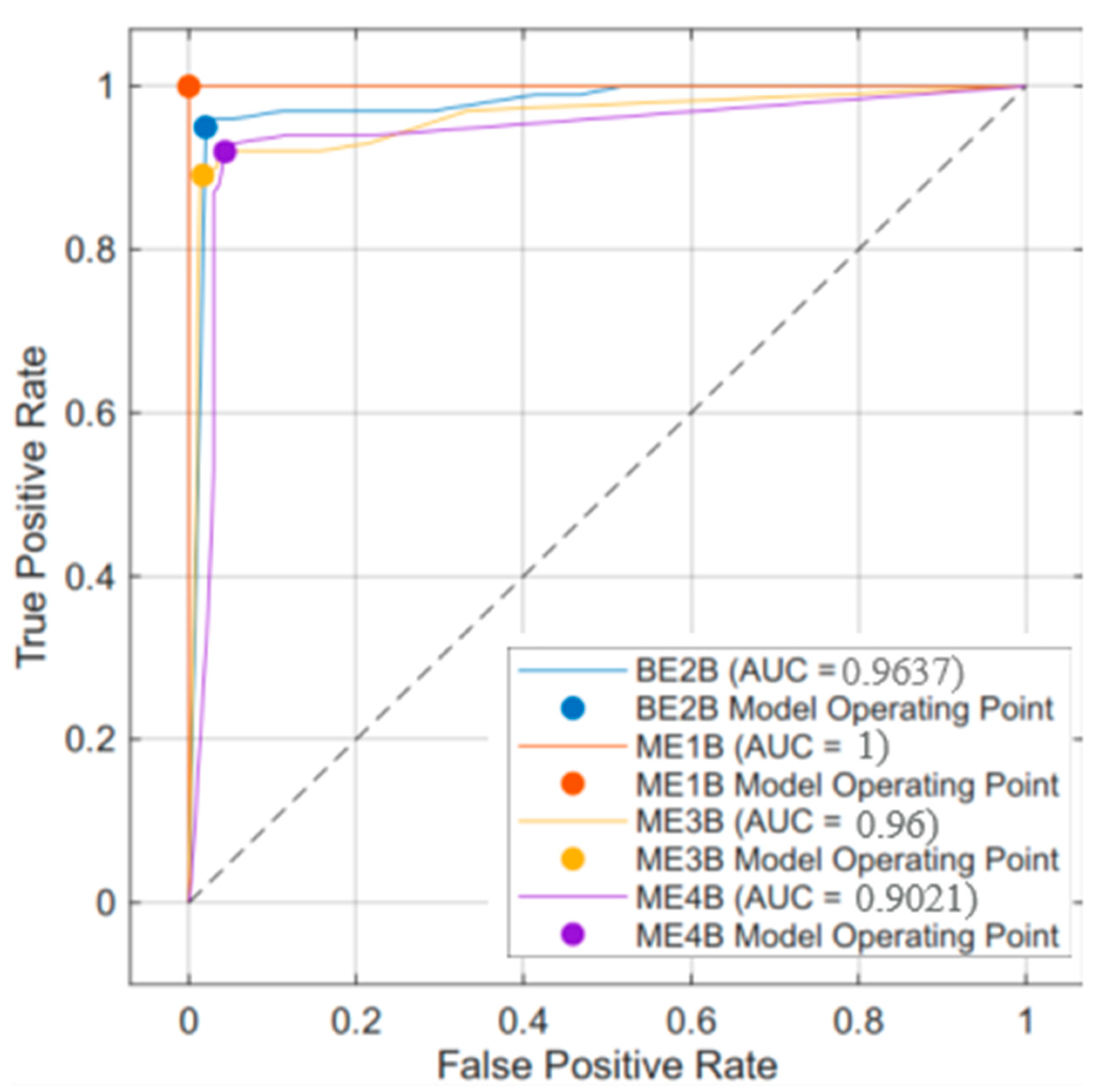
The performance validation results confirm that the model accurately categorizes all operational states with high precision. Specifically, the ME1B condition exhibited superior classification performance, whereas the ME4B condition recorded the lowest Area Under the Curve (AUC) at 0.90. This slightly lower value is consistent with the feature overlap previously identified in the confusion matrix analysis.
As illustrated in
Figure 12, the majority of the ROC curves are positioned toward the upper-left quadrant of the plot. This trajectory indicates a high degree of sensitivity (True Positive Rate) coupled with a minimal false positive rate, statistically validating the model’s discriminative ability. An AUC of 0.90 even for the most challenging class (4 bar) underscores the reliability of using time-domain statistical descriptors for the predictive maintenance of diesel injection systems.
3.3.4. Parallel Coordinates
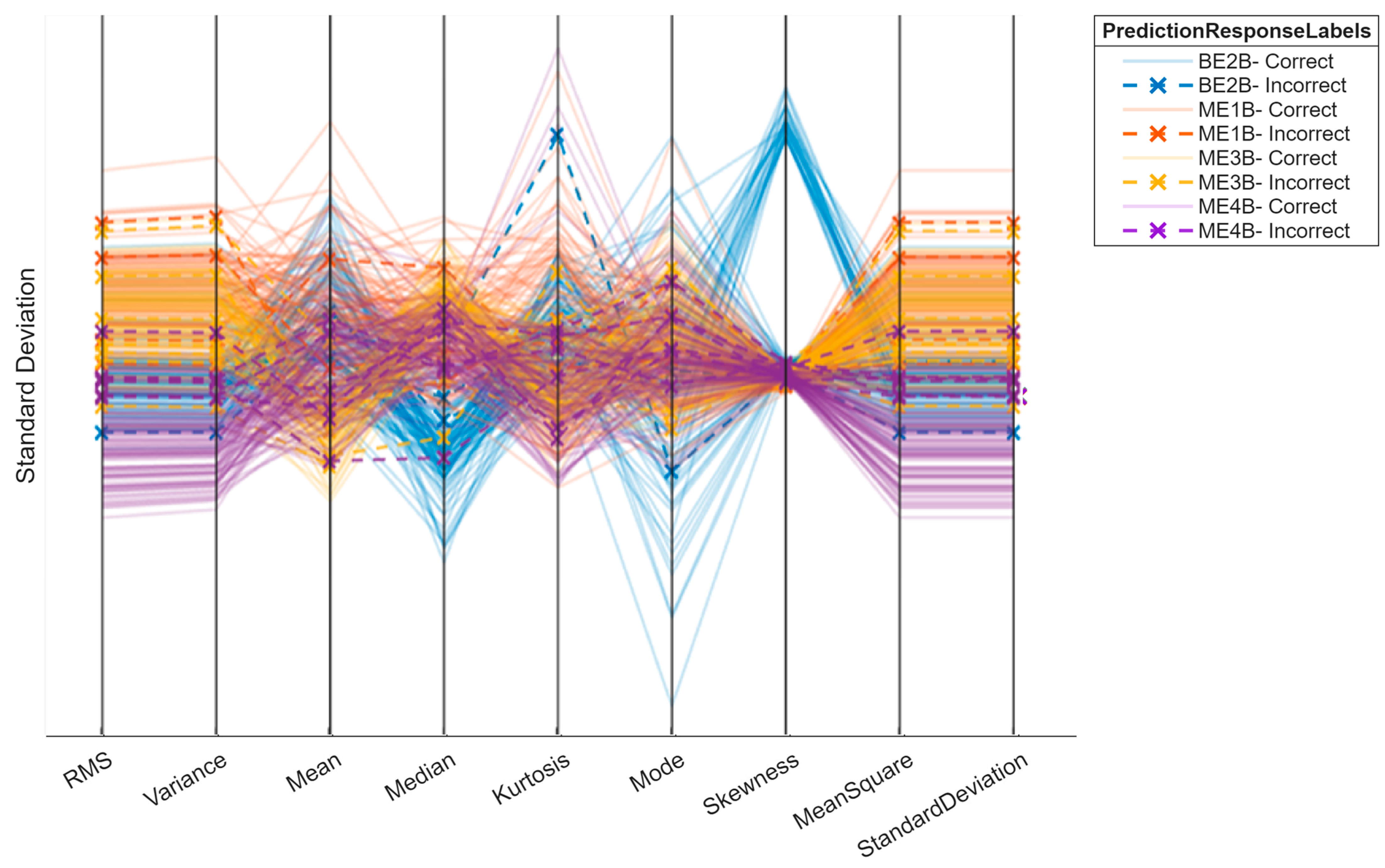
The results illustrated in the parallel coordinates plot (
Figure 13) reveal distinct patterns of interaction between the statistical descriptors. The nominal condition, BE2B (represented by blue lines), exhibits higher dispersion across several variables; however, it demonstrates significant clustering within specific ranges of Kurtosis and Mode.
Conversely, the fault conditions—ME1B, ME3B, and ME4B—display a higher degree of feature overlap. This mutual interference in the multidimensional space confirms the findings from the confusion matrix, where the proximity of statistical parameters between over-pressurized states (3 bar and 4 bar) challenges class separation. Despite this overlap, the identification of these localized clusters in the feature space justifies the high accuracy achieved by the Support Vector Machine, as it successfully defines non-linear decision boundaries to isolate each operational state.
3.4. Generation of the Predictive Mathematical Model
The trained Classifier function serves as the exported structure containing the optimized classification model, enabling its integration into the experimental validation environment for real-time predictions. This autonomous learning framework is designed to process diverse case studies, categorizing them based on the pre-defined injection pump conditions.
To rigorously validate the model’s predictive power, a hold-out dataset consisting of the remaining 100 trials from the primary database was utilized. The results, as detailed in
Table 7, demonstrate a classification efficiency exceeding 95% for each class. This high level of performance across the validation subset confirms the robustness and reliability of the proposed diagnostic model for detecting pressure-related anomalies in agricultural diesel engines.
3.5. Training and Evaluation of Predictive Models
Following the optimization process, the SVM model utilizing a Fine Gaussian kernel achieved superior class separation and, consequently, an accurate characterization of the vibration signatures. The kernel scale was adjusted to a specific value that enabled the model to capture subtle non-linear variations within the statistical descriptors. This adjustment was fundamental to achieving a validation accuracy of 96.8%. As a result, the model demonstrates the capacity to distinguish decision boundaries in scenarios where pressure levels are nearly identical, such as those observed in the 3 and 4 bar variables.
4. Discussion of Results and Significance in Fault Diagnosis
The implementation of the kernel-based Support Vector Machine (SVM) demonstrated a robust capacity for fault diagnosis in the fuel injection system. These results validate the hypothesis that vibration signatures encapsulate sufficient information to effectively discriminate between varying pressure regimes. An overall accuracy of 96.8% suggests that the integration of time-domain statistical descriptors and harmonic amplitudes constitutes a highly representative feature vector of the engine’s non-linear dynamic behavior.
A critical finding was the unambiguous identification of the 1-bar fault condition, which achieved 100% separability (AUC = 1.0). From a mechanical perspective, this is directly correlated with the severe combustion instability induced by insufficient injection pressure. The high dispersion observed in the scatter plots for this class reflects significant variance across combustion cycles, generating impulsive and stochastic vibrations that differ fundamentally from nominal operation. The model’s ability to detect this state without error is vital for predictive maintenance, as low injection pressure leads to immediate power deficits and elevated pollutant emissions.
Conversely, the confusion matrix analysis revealed a marginal overlap between the over-pressurization classes (3 and 4 bar). This phenomenon is physically consistent with diesel engine dynamics: as pressure exceeds the nominal threshold (2 bar), the structural rigidity and acoustic response of the engine block approach a saturation point. Consequently, variations in the vibration signature become increasingly subtle between adjacent high-pressure increments. However, the model successfully avoided misclassifying these “high-pressure” states as “nominal” or “low-pressure.” From a maintenance perspective, this distinction is sufficient, as both 3 and 4 bar conditions necessitate similar corrective actions to protect the system’s integrity.
Finally, the parallel coordinates analysis validated the feature selection process, highlighting Kurtosis and Mode as highly sensitive indicators for isolating nominal operation. This suggests that while signal energy (RMS) may fluctuate, the morphology of the vibration distribution—quantified by Kurtosis—remains stable under optimal conditions and deforms predictably during injection anomalies. This confirms its suitability as a robust mechanical biomarker for the health monitoring of internal combustion engines.
This methodology aims to extend the service life of the tractor rather than seeking its replacement, thereby promoting economic sustainability for small and medium-sized farmers who lack access to new machinery. By ensuring the efficient operation of the injection pump, fuel consumption is optimized, consequently reducing exhaust emissions and meeting operational performance parameters. Furthermore, utilizing the vibration signature as a diagnostic tool bypasses the need for internal vehicle sensors; this allows for a non-intrusive diagnosis without modifying engine components, which would otherwise be risky and costly.
4.1. Model Implementation and Validation with Test Set
Once the optimal classifier was selected, the trained model was exported to the production environment for the implementation and inference phase. To rigorously evaluate the system’s generalization capacity and ensure the absence of overfitting, a new input feature matrix was structured, maintaining the exact statistical and spectral descriptors utilized during the training phase.
The external validation process was conducted using an unseen test dataset (hold-out set), comprising 100 reserved experimental samples that were excluded from both the initial training and the cross-validation procedures. This dataset provided a balanced representation of the four injection pump states (1, 2, 3, and 4 bar).
When these novel data were processed by the classification algorithm, the system demonstrated significant predictive robustness. The final validation results corroborated the effectiveness of the proposed methodology, achieving a classification accuracy exceeding 95% for each operating condition. These findings confirm the viability of the model for automated diagnostic applications in real-world agricultural environments, where reliable and rapid fault detection is critical.
4.2. Machine Learning vs. Deep Learning Approaches
While the Support Vector Machine (SVM) algorithm achieved an accuracy of 96.8%, it is essential to consider other Deep Learning models, such as Neural Networks (NNs) and Long Short-Term Memory (LSTM) networks. NNs possess the capability to extract complex patterns directly from vibration signals, eliminating the need for manual feature engineering. Similarly, LSTM networks are highly effective for time-series processing by capturing sequential dependencies. However, these deep learning models require substantial datasets to prevent overfitting and involve high computational demands. For legacy tractors with limited hardware resources, the Gaussian Kernel SVM approach offers significant advantages; not only does it provide robust predictive diagnostics, but it also facilitates implementation in low-cost embedded systems without the need for extensive computational infrastructure.
4.3. Consideration of the Trained Model
The SVM model achieved high training efficiency; however, certain limitations must be considered when contextualizing the results. The experimental data were collected from a single International 523 tractor, a model representing common characteristics among similar tractor vehicles. Since vibration data can vary based on engine parameters—particularly technology—it is important to note that the data were obtained from a purely mechanical engine and may not be directly comparable to the electronic engines currently entering the region.
The faults were simulated by modulating the injection pump’s internal pressure through its pressure valve, achieving levels from 1 to 4 bar to represent different operational states. Nonetheless, this approach may not fully capture the stochastic nature of component wear within the injection pump or the engine itself. Furthermore, the vehicle’s maintenance history directly influences its dynamic behavior. While high-fidelity NI 9250 DAQ equipment was used for data acquisition and model training, large-scale implementation would favor the use of low-cost accelerometers and microcontrollers (e.g., MEMS and Raspberry Pi), aiming for comparable results in real-world agricultural environments.
5. Conclusions
A low-cost vibration data acquisition architecture, capable of real-time operation, was successfully designed and implemented. Experimental validation demonstrated that sensor placement is a critical parameter; the optimal capture of harmonics associated with injection pressure (ranging from 1 to 4 bar) depends directly on rigid coupling at engine block locations with high structural transmissibility. Furthermore, establishing a nominal baseline under controlled conditions—following comprehensive fuel system maintenance—ensured the high-fidelity integrity of the training dataset.
The hybrid signal processing methodology, which integrated time-domain statistical descriptors (such as RMS, standard deviation, and kurtosis) with spectral analysis (FFT), proved robust for characterizing the engine’s non-linear dynamic behavior. This feature engineering approach effectively reduced the dimensionality of the feature space while retaining the critical information required to discriminate between subtle operational pressure variances.
Following an exhaustive benchmarking of 33 machine learning algorithms, the Fine Gaussian SVM model (Kernel scale 2.3) demonstrated superior performance, achieving a validation accuracy of 96.8%. ROC curve analysis confirmed the model’s robust discriminatory capacity, yielding an Area Under the Curve (AUC) greater than 0.90 for all classes. Notably, the model achieved perfect detection (AUC = 1.0) for the critical low-pressure fault (1 bar), an essential capability for ensuring engine operational safety.
External validation using an independent hold-out dataset (100 samples per class) reported an accuracy exceeding 95%, aligning consistently with the training phase results. This success confirms that the model avoids overfitting and is highly viable for implementation within Condition-Based Maintenance (CBM) strategies. The proposed framework enables the non-invasive prediction of injection system anomalies, providing a reliable diagnostic tool to mitigate the risk of catastrophic engine failure.
In conclusion, predictive diagnostics based on vibration signals—driven by machine learning—establish an efficient solution for legacy tractors operating under normal conditions. This approach effectively integrates conventional vehicles (mechanical engines without electronic management) into smart agriculture through the low-cost implementation of diagnostic platforms. Consequently, this methodology enhances food security by ensuring the reliability of existing agricultural machinery.
Author Contributions
Conceptualization, C.M.-Y. and C.C.; methodology, C.M.-Y., C.C. and P.H.; software, C.M.-Y. and J.M.; validation, D.T.-P., C.M.-Y. and J.M.; formal analysis, C.M.-Y.; investigation, C.M.-Y., P.H., J.M. and C.C.; resources, C.M.-Y.; data curation, D.T.-P.; writing—original draft preparation, C.M.-Y. and C.C.; writing—review and editing, C.C.; visualization, D.T.-P.; supervision, C.C.; project administration, C.M.-Y.; funding acquisition. All authors have read and agreed to the published version of the manuscript.
Funding
This research was funded by the Universidad Técnica del Norte (Grant No. InvestigaUTN-2025-1466).
Data Availability Statement
Dataset available on request from the authors.
Acknowledgments
During the preparation of this study, the authors used Gemini 1.5 Pro for the purposes of improving writing. The authors have reviewed and edited the output and take full responsibility for the content of this publication.
Conflicts of Interest
The authors declare no conflicts of interest.
References
- Ateya, S.F.; Alghamdi, A.S.; Mousa, A.A.A. Future Failure Time Prediction Based on a Unified Hybrid Censoring Scheme for the Burr-X Model with Engineering Applications. Mathematics 2022, 10, 1450. [Google Scholar] [CrossRef]
- Pan, H.; Chen, C.; Gu, M. A Method for Predicting the Remaining Useful Life of Lithium Batteries Considering Capacity Regeneration and Random Fluctuations. Energies 2022, 15, 2498. [Google Scholar] [CrossRef]
- Aye, S.A.; Heyns, P.S. An Integrated Gaussian Process Regression for Prediction of Remaining Useful Life of Slow Speed Bearings Based on Acoustic Emission. Mech. Syst. Signal Process. 2017, 84, 485–498. [Google Scholar] [CrossRef]
- Khoshkangini, R.; Mashhadi, P.S.; Berck, P.; Shahbandi, S.G.; Pashami, S.; Nowaczyk, S.; Niklasson, T. Early Prediction of Quality Issues in Automotive Modern Industry. Information 2020, 11, 354. [Google Scholar] [CrossRef]
- Chen, F.; Jia, H.; Zhou, W. Vehicle Maintenance Demand Prediction: A Survey. Appl. Sci. 2025, 15, 11095. [Google Scholar] [CrossRef]
- Thangavelu, S.K.; Arthanarisamy, M. Experimental Investigation on Engine Performance, Emission, and Combustion Characteristics of a DI CI Engine Using Tire Pyrolysis Oil and Diesel Blends Doped with Nanoparticles. Environ. Prog. Sustain. Energy 2020, 39, e13321. [Google Scholar] [CrossRef]
- Osipowicz, T.; Koniuszy, A.; Taustyka, V.; Abramek, K.F.; Mozga, Ł. Evaluation of Ecological Parameters of a Compression Ignition Engine Fueled by Diesel Oil with an Eco Fuel Shot Liquid Catalyst. Catalysts 2023, 13, 1513. [Google Scholar] [CrossRef]
- Kaminski, P. Investigation Lubricity Performance of Lubricating Oil Used in Marine Diesel Engine—Fuel Injection Pump. Appl. Sci. 2024, 14, 6148. [Google Scholar] [CrossRef]
- Ebolembang, J.F.; Nang Nkol, F.P.; Anague Tabejieu, L.M.; Toukap Nono, F.; Abbe, C.V.N. Prediction of Combustion Parameters and Pollutant Emissions of a Dual-Fuel Engine Based on Recurrent Neural Networks. Appl. Sci. 2025, 15, 9868. [Google Scholar] [CrossRef]
- Vargün, M.; Yılmaz, I.T.; Özsezen, A.N.; Sayın, C. A Study on Combustion Parameters and Exhaust Characteristics in a Diesel Engine Using Alternative Fuels at Different SOI and GPP. Processes 2025, 13, 3024. [Google Scholar] [CrossRef]
- Cheng, Z.; Lu, Z. Research on HMCVT Parameter Design Optimization Based on the Service Characteristics of Agricultural Machinery in the Whole Life Cycle. Machines 2023, 11, 596. [Google Scholar] [CrossRef]
- Li, Y.; Liu, K.; Chen, X.; Zhai, K.; Liu, Y.; Zhao, Y.; Wang, G. Feature Extraction and Diagnosis of Power-Shift System Faults in Unmanned Hydro-Mechanical Transmission Tractors. Machines 2025, 13, 586. [Google Scholar] [CrossRef]
- Min, Y.-S.; Kim, Y.-J.; Baek, S.-Y.; Baek, S.-M.; Kim, W.-S. Development of Electrohydraulic Proportional Valve Model for Precise Steering Control in Autonomous Tractors. Machines 2025, 13, 138. [Google Scholar] [CrossRef]
- He, Z.; Song, Z.; Wang, L.; Zhou, X.; Gao, J.; Wang, K.; Yang, M.; Li, Z. Fastening the Stabilization Response for Prevention of Tractor Rollover Using Active Steering: Controller Parameter Optimization and Real-Vehicle Dynamic Tests. Comput. Electron. Agric. 2023, 204, 107525. [Google Scholar] [CrossRef]
- Didmanidze, O.N.; Parlyuk, E.P.; Fedotkin, R.S.; Kryuchkov, V.A.; Antonov, D.V. Problems and Prospects of Agricultural Tractors with Hybrid and Electric Drivetrain Creating. In Proceedings of the 2022 Intelligent Technologies and Electronic Devices in Vehicle and Road Transport Complex (TIRVED); IEEE: New York, NY, USA, 2022; pp. 1–5. [Google Scholar]
- Mahore, V.; Patidar, P.; Soni, P.; Nagar, H.; Chouriya, A.; Paul, A. An IoT-Enabled Tractor Data Sensing System for Precision Agriculture. In Proceedings of the 2023 2nd International Conference on Futuristic Technologies (INCOFT); IEEE: New York, NY, USA, 2023; pp. 1–4. [Google Scholar]
- Shrivastava, P.; Tewari, V.K.; Gupta, C.; Chouriya, A. HMI-Assisted Visual Interface-Cum-Embedded System for Measurement of Tractor–Implement Performance Parameters. J. Field Robot. 2024, 41, 2147–2168. [Google Scholar] [CrossRef]
- Regler, F.; Hausmann, F.; Krüger, M.; Bernhardt, H. Potential and Improvement of Maintenance Efficiency of Agricultural PTO Shafts by a New Digital Maintenance Assistant. Agriculture 2023, 13, 227. [Google Scholar] [CrossRef]
- Galiev, I.G.; Ziganshin, B.G.; Kalimullin, M.N.; Valeeva, Y.S. Theoretical Prerequisites for Improving the Efficiency of Tractor Operation in Agriculture. In Proceedings of the 2024 9th International Conference on Energy Efficiency and Agricultural Engineering (EE&AE); IEEE: New York, NY, USA, 2024; pp. 1–4. [Google Scholar]
- Rakhra, M.; Singh, R. Economic and Social Survey on Renting and Hiring Of Agricultural Equipment of Farmers in Punjab. In Proceedings of the 2021 9th International Conference on Reliability, Infocom Technologies and Optimization (Trends and Future Directions) (ICRITO); IEEE: New York, NY, USA, 2021; pp. 1–5. [Google Scholar]
- Dou, H.; Wei, H.; Zhang, Y.; Ai, Q. Configuration Design and Optimal Energy Management for Coupled-Split Powertrain Tractor. Machines 2022, 10, 1175. [Google Scholar] [CrossRef]
- Qu, J.; Zhang, Z.; Qin, Z.; Guo, K.; Li, D. Applications of Autonomous Navigation Technologies for Unmanned Agricultural Tractors: A Review. Machines 2024, 12, 218. [Google Scholar] [CrossRef]
- Baldoni, E.; Coderoni, S.; Esposti, R. The Complex Farm-Level Relationship between Environmental Performance and Productivity: The Case of Carbon Footprint of Lombardy Farms. Environ. Sci. Policy 2018, 89, 73–82. [Google Scholar] [CrossRef]
- Angelucci, L.; Mattetti, M. The Development of Reference Working Cycles for Agricultural Tractors. Biosyst. Eng. 2024, 242, 29–37. [Google Scholar] [CrossRef]
- Yadav, P.S.; Ahmed, S.F.A.; Gautam, R.; Caliskan, H.; Caliskan, N.; Hong, H. Nozzle Effects on Spray Combustion and Emissions in Compression Ignition Engines Using Waste Cooking Oil Biodiesel: A Computational Fluid Dynamics Analysis at Varying Injection Pressures. IET Renew. Power Gener. 2024, 18, 2340–2359. [Google Scholar] [CrossRef]
- Eaton, R.; Katupitiya, J.; Siew, K.W.; Howarth, B. Autonomous Farming: Modeling and Control of Agricultural Machinery in a Unified Framework. Int. J. Intell. Syst. Technol. Appl. 2010, 8, 444. [Google Scholar] [CrossRef]
- Wang, D.; Yuan, H. Data-Driven Tube Model Predictive Control of Autonomous Agricultural Tractors for Cross-Slope Navigation. Smart Agric. Technol. 2025, 10, 100844. [Google Scholar] [CrossRef]
- Kivekäs, K.; Lajunen, A. Energy Efficiency and Carbon Dioxide Emissions of Agricultural Tractors Using Different Powertrains. Energy Rep. 2025, 14, 2755–2767. [Google Scholar] [CrossRef]
- Murawska, A.; Goryńska-Goldmann, E. Greenhouse Gas Emissions in the Agricultural and Industrial Sectors—Change Trends, Economic Conditions, and Country Classification: Evidence from the European Union. Agriculture 2023, 13, 1354. [Google Scholar] [CrossRef]
- Senkondo, E.; Chimba, D.; Madalo, M.; Yeboah, A.; Blue, S. Comparative Analysis of Machine Learning and Statistical Models for Railroad–Highway Grade Crossing Safety. Vehicles 2025, 7, 163. [Google Scholar] [CrossRef]
- Febbraro, A.; Dutto, M.; Bascetta, L.; Ferretti, G. Object-Oriented Modeling of a Tracked Vehicle for Agricultural Applications. Comput. Electron. Agric. 2025, 230, 109921. [Google Scholar] [CrossRef]
- Liu, Y.; Ma, X.; Shu, L.; Hanke, G.P.; Abu-Mahfouz, A.M. From Industry 4.0 to Agriculture 4.0: Current Status, Enabling Technologies, and Research Challenges. IEEE Trans. Ind. Inform. 2021, 17, 4322–4334. [Google Scholar] [CrossRef]
- Mahiyudin, G.; Hussain, M.; Dewi, D.D. A Comprehensive Study on Predicting the Need for Vehicle Maintenance Using Machine Learning. Eng. Proc. 2025, 107, 89. [Google Scholar] [CrossRef]
- Maja, M.M.; Ayano, S.F. The Impact of Population Growth on Natural Resources and Farmers’ Capacity to Adapt to Climate Change in Low-Income Countries. Earth Syst. Environ. 2021, 5, 271–283. [Google Scholar] [CrossRef]
- Aguilar-Toalá, J.E.; Hall, F.G.; Urbizo-Reyes, U.; Liceaga, A.M. Sustainable, Alternative Sources of Bioactive Peptides. In Biologically Active Peptides: From Basic Science to Applications for Human Health; Academic Press: Cambridge, MA, USA, 2021; pp. 427–453. [Google Scholar] [CrossRef]
- Guasumba-Maila, J.; Garay-Cisneros, V.; Solís-Santamaria, J.; Jima-Matailo, J. Analysis of the Electronic Fuel Injection System for Internal Combustion Engine Regarding Its Failures and Maintenance. Polo Del Conoc. 2021, 6, 603–621. Available online: https://polodelconocimiento.com/ojs/index.php/es/article/view/2167 (accessed on 1 March 2026).
- Mafla-Yépez, C.; Castejon, C.; Rubio, H.; Morales, C. A Vibration Analysis for the Evaluation of Fuel Rail Pressure and Mass Air Flow Sensors on a Diesel Engine: Strategies for Predictive Maintenance. Sensors 2024, 24, 1551. [Google Scholar] [CrossRef] [PubMed]
Figure 1.
Four-Stage Maintenance Cycle: Reactive, Periodic, Proactive, and Predictive [
33].
Figure 1.
Four-Stage Maintenance Cycle: Reactive, Periodic, Proactive, and Predictive [
33].
Figure 2.
Components of the experiment test bench: (a) Agricultural tractor, (b) accelerometer, (c) acquisition card, and (d) pressure gauge.
Figure 2.
Components of the experiment test bench: (a) Agricultural tractor, (b) accelerometer, (c) acquisition card, and (d) pressure gauge.
Figure 3.
Accelerometer location on the cylinder block, secured by a magnet in the central area.
Figure 3.
Accelerometer location on the cylinder block, secured by a magnet in the central area.
Figure 4.
Proposed methodological diagram for vibration data analysis and fault prediction.
Figure 4.
Proposed methodological diagram for vibration data analysis and fault prediction.
Figure 5.
Spectral analysis of the vibration characterization of an agricultural tractor, considering the dominant frequency with the injection pump in normal and failure states.
Figure 5.
Spectral analysis of the vibration characterization of an agricultural tractor, considering the dominant frequency with the injection pump in normal and failure states.
Figure 6.
Experimental measurement of internal pressures of the injection pump, (a) 1 bar (ME1B), (b) 2 bar (BE2B), (c) 3 bar (ME3B) and (d) 4 bar (ME4B).
Figure 6.
Experimental measurement of internal pressures of the injection pump, (a) 1 bar (ME1B), (b) 2 bar (BE2B), (c) 3 bar (ME3B) and (d) 4 bar (ME4B).
Figure 7.
Vibrational signal processing in the frequency domain represents harmonics.
Figure 7.
Vibrational signal processing in the frequency domain represents harmonics.
Figure 8.
Statistical data matrix of the vibration signals.
Figure 8.
Statistical data matrix of the vibration signals.
Figure 9.
Learning input data: (A) Statistical analysis. (B) Vibration characterization. Note: Ellipses (...) in the Range column indicate that the numeric values have been truncated for display purposes; the full data ranges were utilized for model training.
Figure 9.
Learning input data: (A) Statistical analysis. (B) Vibration characterization. Note: Ellipses (...) in the Range column indicate that the numeric values have been truncated for display purposes; the full data ranges were utilized for model training.
Figure 10.
Dispersion of vibration characteristics: (a) Complete visualization highlighting the critical dispersion of 1 bar. (b) Sequential grouping of faults.
Figure 10.
Dispersion of vibration characteristics: (a) Complete visualization highlighting the critical dispersion of 1 bar. (b) Sequential grouping of faults.
Figure 11.
Confusion matrix for the classification of classes BE2B, ME1B, ME3b, and ME4B.
Figure 11.
Confusion matrix for the classification of classes BE2B, ME1B, ME3b, and ME4B.
Figure 12.
Receiver operating characteristic (ROC) curves for multi-class classification. The dashed line represents the baseline performance of a random classifier.
Figure 12.
Receiver operating characteristic (ROC) curves for multi-class classification. The dashed line represents the baseline performance of a random classifier.
Figure 13.
Parallel coordinates for model prediction, indicating the distribution of classes BE2B, ME1B, ME3B and ME4B.
Figure 13.
Parallel coordinates for model prediction, indicating the distribution of classes BE2B, ME1B, ME3B and ME4B.
Table 1.
Traditional machine learning algorithms in predictive maintenance PdM.
Table 1.
Traditional machine learning algorithms in predictive maintenance PdM.
| Algorithm | Applications and Examples in PdM |
|---|
| Linear Regression (LR) | Forecasting energy needs in manufacturing plants. Estimating the remaining useful life (RUL) of components such as coil springs (using Multiple Linear Regression—MLR). Predicting the RUL of lithium-ion batteries. |
| Gaussian Process Regression (GPR) | Estimation of remaining useful life (RUL) of low-speed bearings. Modeling capacity regeneration in lithium-ion battery degradation. |
| Artificial Neural Networks (ANNs) | Superior prediction of diesel engine performance and emissions where LR failed. Optimization of the structural design of electric vehicle (EV) battery casings. Prediction of condition and maintenance alerts in lubrication systems. |
| Support Vector Machine (SVM) | Fault classification: fault detection in vehicle suspension system sensors and heavy vehicle air brake systems (using G-SVM). Estimation of time to sensor failure in autonomous vehicles. Prediction of lithium-ion battery state of health (SOH) through feature selection (SVM-RFE). |
| k-Nearest Neighbours (k-NN) | Vibration classification for predictive maintenance of electric motors. Real-time vehicle condition monitoring (hybrid approach with ANN). |
| Decision Trees (DTs) | Classification of five different failure modes in bearings (C4.5 algorithm). Random Forest (RF), an ensemble method, outperformed others for suspension system fault detection. |
Table 2.
Technical characteristics of the International 523 tractor.
Table 2.
Technical characteristics of the International 523 tractor.
| Feature | Specification |
|---|
| Production | International Harvester 523 |
| Factory | Neuss, Germany |
| Power | 51.2 HP |
| Torque | 173.5 Nm |
| Engine model | 2.9 L 3-cylinder diesel |
| Cylinders | 3 |
| Displacement | 2900 cc [2.9 L] |
| Bore/Stroke | 98 × 129 mm |
| RPM | 2100 |
| Injection pump | Rotary |
| Injectors | Nipple type |
| Fuel capacity | 18.5 gal |
Table 3.
Engine operating variables (injection pump failures).
Table 3.
Engine operating variables (injection pump failures).
Operating
Pressure | Assigned State Variable | Main Characteristic |
|---|
| 1 Bar | Poor Condition (Failure) | Difficult Start-up/Incomplete Combustion |
| 2 bars | Good Condition (Nominal) | Normal/Optimal Operation |
| 3 bars | Poor Condition (Failure) | Black Smoke Generation/Irregular Operation |
| 4 bars | Poor Condition
(Critical Failure) | Damage to Injectors and Components/Thermal Overload |
Table 4.
Generation of the Harmonic Database.
Table 4.
Generation of the Harmonic Database.
| Vibrations Characteristics | Engine Component | Frequency (Hz) | Harmonics |
|---|
| Average | Deviation Standard | Average | Deviation Standard |
|---|
| x | Camshaft | 8.6 | 0.66 | 0.06 | 0.03 |
| 2x | Crankshaft | 17.4 | 0.43 | 0.2 | 0.12 |
| 3x | Combustion pistons | 26.1 | 0.57 | 0.47 | 0.22 |
| 4x | Camshafts | 34.8 | 0.75 | 1.4 | 0.55 |
| 5x | Pistons without
combustion | 43.6 | 1 | 0.65 | 0.28 |
| 6x | Valves | 52.5 | 1.54 | 1.5 | 3.74 |
Table 5.
Comparative analysis of 33 machine learning models grouped by family.
Table 5.
Comparative analysis of 33 machine learning models grouped by family.
| Algorithm Family | Evaluated Models | Best Accuracy (%) | Observation |
|---|
| Support Vector Machines (SVMs) | Linear, Quadratic, Cubic, Fine Gaussian, Medium Gaussian, Coarse Gaussian | 96.8 | Margen de datos superior y mapeo no lineal excelente. |
| Decision Trees | Fine, Medium, Coarse Trees | 89.4 | Propenso al sobreajuste con datos de alta varianza. |
| Ensemble Classifiers | Boosted, Bagged, Subspace Discriminant, RUSBoost | 92.1 | Alto consumo de datos computacionales |
| K-Nearest Neighbors (k-NN) | Fine, Medium, Coarse, Cosine, Cubic, Weighted | 84.5 | Dispersión estadística de falla 1 alta. |
| Naive Bayes | Gaussian, Kernel Naive Bayes | 78.2 | Hipótesis de independencia de características estadísticas. |
| Neural Networks | Narrow, Medium, Wide, Bilayered, Trilayered | 91.3 | Requiere conjunto de datos más extensos. |
| Discriminant Analysis | Linear, Quadratic Discriminant | 75.6 | Dificultad en aprendizaje de 3 y 4 bar. |
Table 6.
Performance metrics per variable for the SVM model.
Table 6.
Performance metrics per variable for the SVM model.
| Variable | Pressure (Bar) | Precision | Recall |
|---|
| BE2B | 2 (nominal) | 2 | 0.94 |
| ME1B | 1 (Critical Failure) | 1 | 1 |
| ME3B | 3 (Failure) | 0.89 | 0.92 |
| ME4B | 4 (Critical Failure) | 0.87 | 0.85 |
Table 7.
Model validation.
Table 7.
Model validation.
| State | Efficiency (%) |
|---|
| Good condition, 2 bar | 96.5 |
| Poor condition 1 bar | 95 |
| Poor condition 3 bar | 96 |
| Poor condition, 4 bar | 95.5 |
| Disclaimer/Publisher’s Note: The statements, opinions and data contained in all publications are solely those of the individual author(s) and contributor(s) and not of MDPI and/or the editor(s). MDPI and/or the editor(s) disclaim responsibility for any injury to people or property resulting from any ideas, methods, instructions or products referred to in the content. |




 ,
,