Article

The Concept of the Virtual Pose Instruction Plane (VPIP) for Controlling Rod-Driven Spherical Robots

1
Computer Science XVII: Robotics, University of Wuerzburg, 97074 Wuerzburg, Germany
2
Faculty of Electrical Engineering, Technical University of Applied Sciences Würzburg-Schweinfurt, 97421 Schweinfurt, Germany
3
Biomorphic Intelligence Lab, Faculty of Aerospace Engineering, 2629 HS Delft, The Netherlands
*
Author to whom correspondence should be addressed.
Machines 2026, 14(5), 486; https://doi.org/10.3390/machines14050486
Submission received: 14 March 2026 / Revised: 19 April 2026 / Accepted: 22 April 2026 / Published: 26 April 2026

Abstract

The exploration of lunar caves is a critical aspect of the space exploration program of the European Space Agency (ESA). To facilitate this mission, the DAEDALUS study investigated a novel spherical robot design in 2021. The proposed robot uses a unique telescopic linear rod mechanism to generate rotation and hence locomotion. This drive mechanism requires a dedicated control scheme to ensure both locomotion and simultaneously stabilization of the robot. The overall task of following a curved trajectory is also a problem that cannot be solved by simple algorithms. In this work, we introduce, calculate, and simulate a solution for these tasks, the Virtual Pose Instruction Plane (VPIP). The VPIP breaks the problem of multiple independent controllable rods down to two controllable parameters (roll and pitch of the plane), which control the linear motion velocity, balance and ultimately curvature motion of the robot. Initial simulations show that both speed and cornering can be controlled by the VPIP.

1. Introduction

Despite the large variety of shapes and locomotion systems of robots, only four types are used as a baseline for extraterrestrial ground exploration: robots having mobility based on wheels, tracks, legs, and combinations of them [1].
Through ESA’s SysNova assessment scheme [2], a spherical robot for lunar cave exploration was developed: the “Descent And Exploration in Deep Autonomy of Lava Underground Structures (DAEDALUS)” [3]. Designed for such a lunar cave exploration, the shape of the robot [4], locomotion system, and all other aspects are built to suit the requirements for exploring lunar caves and the restrictions associated with the use of optical cameras and laser scanners. The robot (cf. Figure 1) has its spherical shape due to environmental reasons and mechanisms to account for the payload requirements.
It was from this project that the Telescopic Linear-Driven Rotation (TLDR) locomotion concept emerged, which we introduced in [5]. We stated a more dedicated controller for locomotion and balancing as future work, as this is a challenging control problem. In this work, we provide a solution to this control problem. The VPIP concept also applies to other linear driver rotation formats, such as distributed telescopic linear actuated motion [6], polyhedral linear induced rotation [7], or linearly driven extendable shell wedges [8], thereby simplifying a multi-linear actuator system to a two-component control system. The mathematics we present is for symmetrically arranged telescopic linear actuators such as DAEDALUS, but the principle can be easily transferred to all linearly activated spherical robots.

2. Background

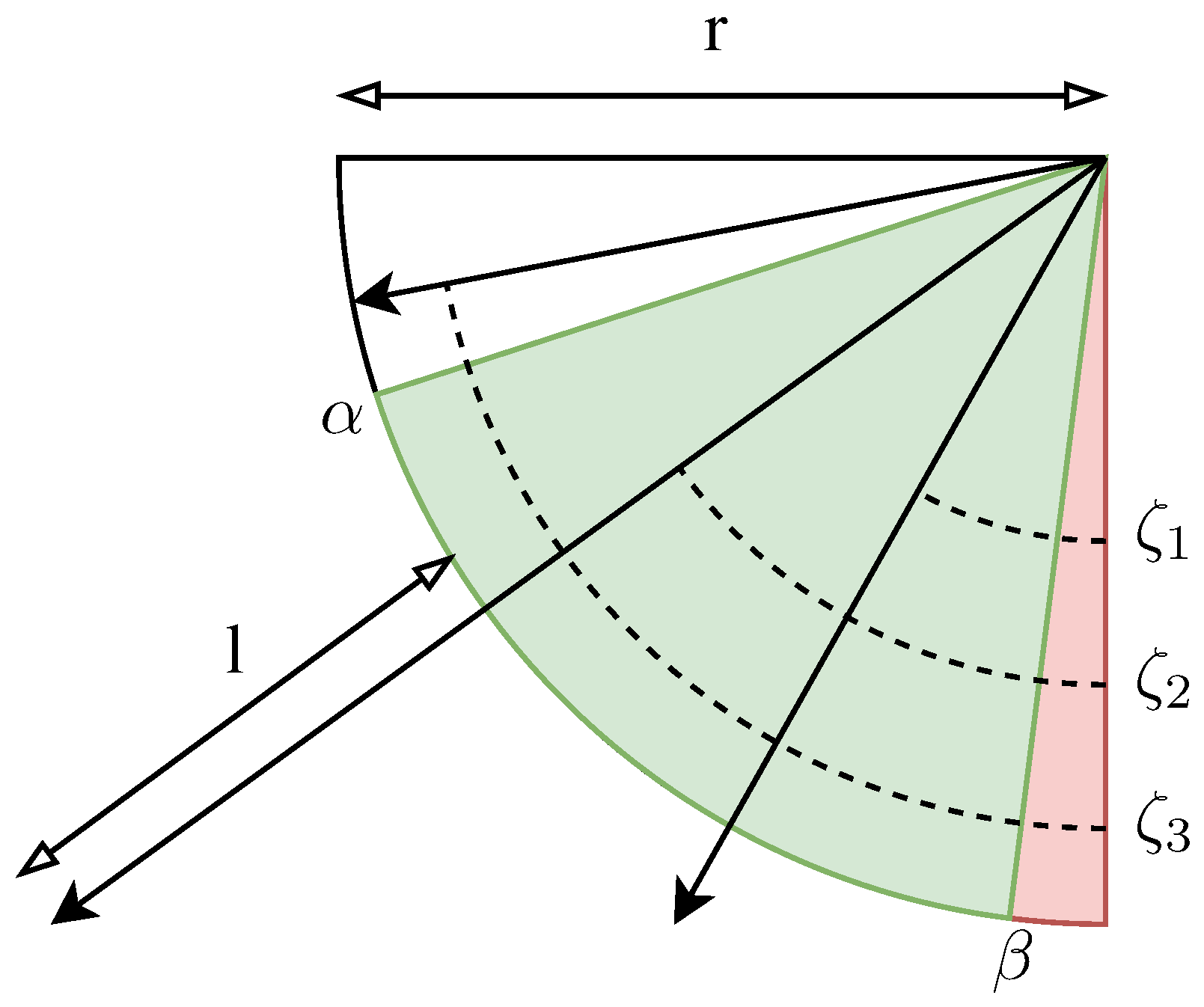
Telescopic Linear-Driven Locomotion uses protruding rods that extend from a spherical robot to set the system in motion. In general, there are two ways in which these rods can contribute to locomotion: by pushing on the ground behind the robot and by leveraging their weight in front. The latter requires the rods to have substantial weight to be effective, reducing the overall efficiency. Thus, it will be disregarded for the rest of this work. For a spherical robot of radius r, pushing is only possible with rods within a suitable range of angles to the ground. Figure 2 indicates the variables used in the following. To illustrate the necessity of the VPIP, we will briefly introduce the direct drive approach and the balancing approach.

2.1. Pushing

Let us consider the angle ζ x of a rod x to be zero when the rod is perpendicular to the ground in the forward direction of the robot. The angle then increases counterclockwise until the wraparound at 2 π . The rod can propel the robot forward by pushing as soon as the robot rolls over the rod and as long as the rod can reach the ground. Given the maximal extension length of the rods l m a x , the suitable range is defined by the angles
α < min arccos r r + l m a x , π 2 , β > 0 .
At any angle between α and β , the length of the rod must be extended to
l x = r cos ζ x r ,
to establish contact with the ground.
By taking the derivative of (2) and solving for the derivative of the angle of the rod with respect to the ground (which is equivalent to the rotational velocity of the sphere), it can be shown that rods with a constant extension velocity ( l ˙ x = c o n s t ) cannot sustain a constant rotational velocity of the sphere. For details, please refer to [5].

2.2. Balancing

Since the spherical robot can rotate freely in all directions, the lateral motion must be carefully controlled to keep the rods aligned with the direction of travel. Since the rods can only provide a constant extension and retraction velocity and do not have feedback on their extension length, the control takes the form of a two-point controller with hysteresis. We choose a hysteresis band of ± 3 ° in which the controller maintains its current state. Outside this band, the rods extend on the side the robot tilts towards and retract on the opposing side. In our past work, this has proven sufficient to maintain an upright position [5].

2.3. Related Work

Control strategies for spherical robots are well established for the dominant drive classes. Pendulum- and inertial drive unit (IDU)-driven robots have benefited from decades of research on nonlinear dynamics, feedback linearisation, linear quadratic regulator (LQR), and model-predictive control, as comprehensively surveyed by Diouf et al. [9]. Recent studies continue to refine these methods, including omniwheel-platform control [10], closed-loop stabilization for eccentric-pendulum designs [11], and high-speed trajectory tracking [12]. In contrast, the control landscape for linearly driven spherical robots remains less developed. PodRacle [8] derives kinematic equations for shell-wedge actuation but employs an open-loop, inertial measurement unit (IMU)-referenced sequence of preprogrammed leg movements without closed-loop stabilization of the rolling direction. The Sea Urchin robot [6] similarly supports only semi-autonomous preprogrammed motion patterns and lacks a feedback controller. Mochibot [13] introduces an imaginary-contact-surface concept to compute leg lengths for trajectory following; however, the robot functions as a continuous crawler rather than a dynamically stabilized rolling sphere, resulting in a fundamentally different control problem. Most recently, Xu et al. [14] explicitly state that their polyhedral linear-driven robot supports only manual remote control and identify closed-loop control as an outstanding area for future research. In summary, although the mechanics of linear rod actuation have been investigated in several prototypes, no dedicated control strategy for simultaneous locomotion and lateral stabilization of a rolling TLDR robot has been published. This work addresses this specific gap.

3. Virtual Pose Instruction Plane (VPIP)

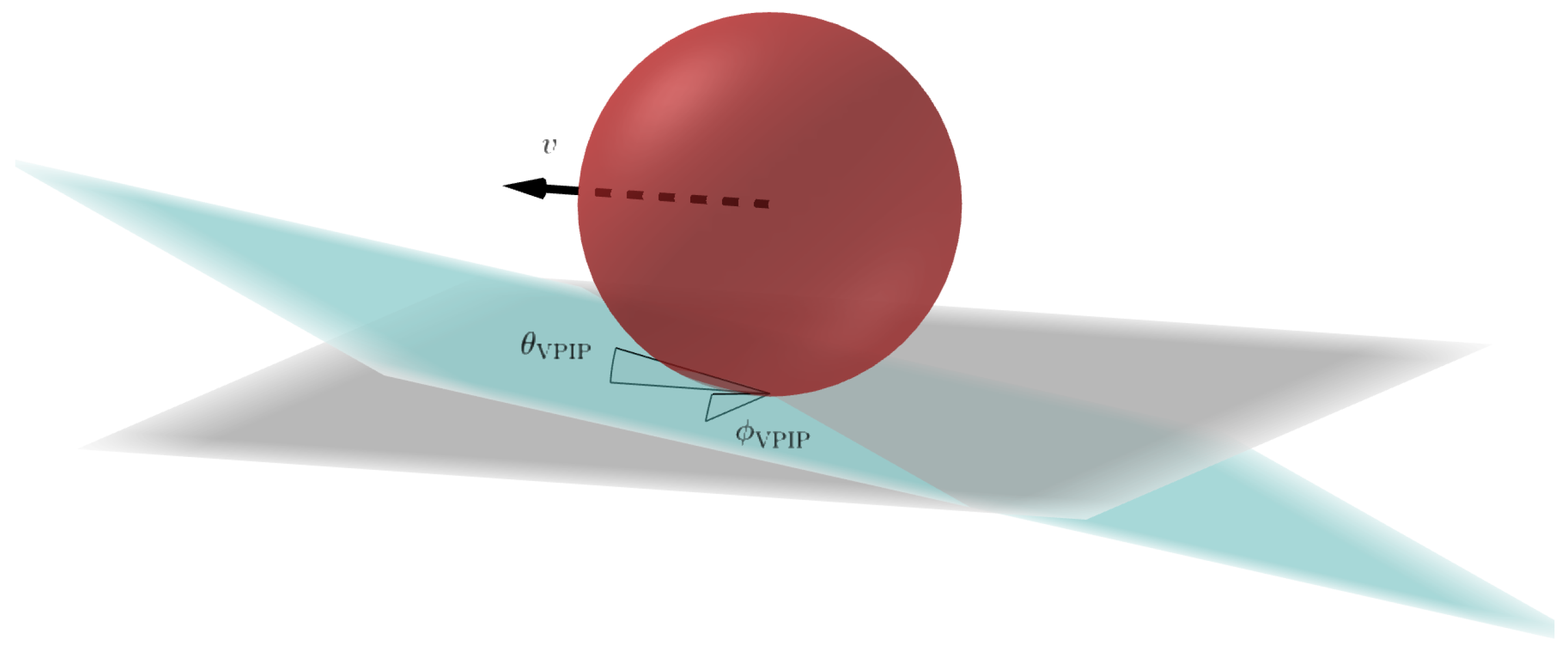
We now introduce a more detailed algorithm. Rather than combining the separately evaluated instructions of locomotion and balancing, we want to evaluate the state of the poles based on the need for both of them. We therefore control the poles by absolute length. This brings us from the evaluation in 2D, as was done separately for balance and locomotion, to an evaluation in three dimensions. We therefore introduce the Virtual Pose Instruction Plane (VPIP). The VPIP is a theoretical plane that determines the lengths of poles. It is fixed to the robot at the same point where the robot touches the ground. The poles extend and retract to the length needed to reach the VPIP. Two angles describe the relevant orientation of the plane: ϕ VPIP and θ VPIP . They have the same direction as the internal ϕ and θ of the robot. Figure 3 illustrates the VPIP.
We define the y-axis in rolling direction, the z-axis perpendicular to the flat ground passing the midpoint of the robot, and the x-axis to complete the right-hand system. Note that this formulation assumes a flat ground surface as a reference. Through the closed-loop nature of the VPIP, moderate terrain variations are handled implicitly via reactive correction, though at the cost of the disturbance having to manifest before it can be compensated. We discuss a proactive extension using terrain estimation in the conclusion, called VPIM. Let the contact point of the robot r 0 to the ground be always at ( 0 , 0 , 0 ) , and n VPIP be the normal vector on the plane, and r any point on the plane; then, the VPIP Π VPIP is defined by
Π VPIP : n VPIP · ( r r 0 ) = n VPIP | | n VPIP | | · r = 0
tan ( ϕ VPIP ) tan ( θ VPIP ) 1 · 1 tan ( ϕ VPIP ) 2 + tan ( θ VPIP ) 2 + 1 · x y z = 0
tan ( ϕ VPIP ) · x + tan ( θ VPIP ) · y + z = 0 .
The idea is to adjust the pole length such that it does not touch the ground but the VPIP. Therefore, if we tilt the VPIP, as shown in Figure 3, the poles on the left front side (seen in the direction of velocity) retract and the poles on the rear right side extend. For the other directions (front right, rear left), we cannot state general actions for every pole, as it depends on their ζ . For every linear-driven rotation spherical robot, the steps for setting up are as follows:
  • Find the equation for each linear pushing rod/pole with respect to the bottom point of the sphere.
  • Set this equation equal to Equation (4).
  • Solve for the length l.
The control itself then takes place as follows:
  • The two angles of the VPIP are controlled using a controller of choice (we use PID) based on the speed and desired lateral tilt angle (perspective curve angle) as input.
  • The two output angles are used in the intersection equation which was solved for l.
  • The rods are then attempted to be extended to the length l (this does not necessarily have to be achieved).
This process is then repeated at the desired control frequency.

4. Implementation for TLDR Robots

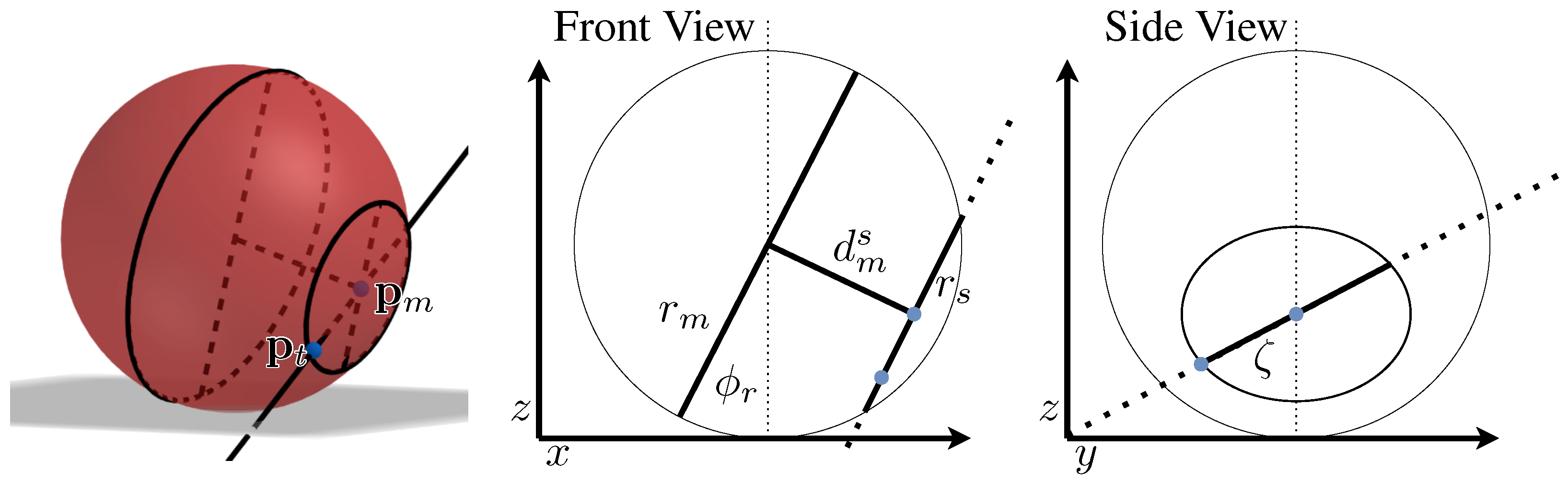
We will now derive the equations for the Setup of the type of TLDR robot DAEDALUS is based on, so there will be two parallel Discs with eight rods each (refer to Figure 1 for visualization). To find the needed length of a pole to touch the VPIP, we first need to find the equation of a line of a pole in this representation. Therefore, we define the point p m in the middle of the side disc and the point p t as the tip of the fully retracted pole. Figure 4 shows the two points in the three-dimensional view as well as the two two-dimensional views for easier calculation.
We derive from this figure that
p m = cos ( ϕ r ) · d m s 0 r m sin ( ϕ r ) · d m s ,
and with that, we can derive p t as a combination of the point p m and the vector d m t from p m to p t :
p t = p m + d m t = p m + cos ( ζ ) · r s · sin ( ϕ r ) sin ( ζ ) · r s cos ( ζ ) · r s · cos ( ϕ r ) .
d m s is not variable in the case of a sphere but defined by
d m s = sin arccos r s r m · r m .
For both sides of the pole discs, there needs to be an adaption. We do this by mirroring p m at the main disc plane. Therefore, we define p m l as the p m for the middle of the left disc and p m r of the right (seen in the rolling direction). This leads to
p m l = cos ( ϕ r ) · d m s 0 r m ( 1 ) · sin ( ϕ r ) · d m s .
To work out an overall solution, we assign the side factor s f = 1 to the left side and s f = 1 to the right side and write the general p m as
p m = s f · cos ( ϕ r ) · d m s 0 r m s f · sin ( ϕ r ) · d m s .
Now, we calculate the line of a specific pole, which goes through the point p m with the direction d m s . Let ζ be the angle of the pole, ϕ r the actual roll angle of the robot, r s the radius of the disc inside the spherical robot wherein the poles lie, r m the radius of the sphere, d m s the distance between the midpoint of the sphere and the midpoint side disc of the poles and s f the side factor; then, the line of this pole L p ( ζ , ϕ r , s f ) is defined by
L p ( ζ , ϕ r , s f ) = x y z | x y z = p m x p m y p m z + λ d m t x d m t y d m t z | λ R = x y z | x y z = s f · cos ( ϕ r ) · d m s 0 r m s f · sin ( ϕ r ) · d m s
+ λ cos ( ζ ) · r s · sin ( ϕ r ) sin ( ζ ) · r s cos ( ζ ) · r s · cos ( ϕ r ) | λ R .
We use λ as an indication of the extended length as we have the midpoint of the pole disc as a fixed point for the line and then λ multiplied by the gradient of the pole. So, if we normalize the vector of the gradient, λ represents the actual length of the pole but including r s . Therefore, let us write λ as r s + l . Mathematically, this leads to the possibility of l becoming negative or l larger than l m a x . In these cases, we need to incorporate the practical limitations of the pole. Negative extensions stop at full retraction, whereas larger extensions than possible are just full extensions. For this representation of λ , the vector that it scales needs to be normalized. For the normalization we divide d m t by its length | | d m t | | . Per definition | | d m t | | = r s as d m t is the vector from p m to p t . This leads to the definition of the line
L p ( ζ , ϕ r , s f ) = x y z | x y z = p m x p m y p m z + λ d m t | | d m t | | | λ R = x y z | x y z = s f · cos ( ϕ r ) · d m s 0 r m s f · sin ( ϕ r ) · d m s
+ r s + l r s · cos ( ζ ) · r s · sin ( ϕ r ) sin ( ζ ) · r s cos ( ζ ) · r s · cos ( ϕ r ) | l R
= x y z | x y z = s f · cos ( ϕ r ) · d m s 0 r m s f · sin ( ϕ r ) · d m s
+ ( r s + l ) · cos ( ζ ) · sin ( ϕ r ) sin ( ζ ) cos ( ζ ) · cos ( ϕ r ) | l R .
Note that we set l R despite the physical limitation of 0 l l m a x , as there may exist an intersection of the line of the rod with the VPIP, but for an l > l m a x . In this case, full extension is required. For negative values, a full retraction is required. For the extreme scenario that there is no solution, which is only the case with exactly identical angles of the VPIP and the rod, the last state of expansion or retraction is held.
Now, we evaluate the intersection of L p ( ζ , ϕ r , s f ) and Π VPIP . This is the point where the poles need to extend to. Therefore, we set the components of Equation (12) into Equation (4), abbreviating sin x with S ( x ) , cos x with C ( x ) , and tan x with T ( x ) , we get
T ( ϕ VPIP ) · L p ( ζ , ϕ r , s f ) x
+ T ( θ VPIP ) · L p ( ζ , ϕ r , s f ) y
+ L p ( ζ , ϕ r , s f ) z = 0 .
Substituting the components of L p ( ζ , ϕ r , s f ) into Equation (15) yields:
T ( ϕ VPIP ) · s f · C ( ϕ r ) · d m s ( r s + l ) · C ( ζ ) · S ( ϕ r ) + T ( θ VPIP ) · ( r s + l ) · S ( ζ ) + r m s f · S ( ϕ r ) · d m s ( r s + l ) · C ( ζ ) · C ( ϕ r ) = 0 .
Factoring out ( r s + l ) :
T ( ϕ VPIP ) · s f · C ( ϕ r ) · d m s + r m s f · S ( ϕ r ) · d m s = : N ( r s + l ) T ( ϕ VPIP ) · C ( ζ ) · S ( ϕ r ) + T ( θ VPIP ) · S ( ζ ) + C ( ζ ) · C ( ϕ r ) = : D = 0 .
Solving for ( r s + l ) and subtracting r s yields l = r s + N D , which, substituting back N and D, leads to
l = r s + T ( ϕ VPIP ) · s f · C ( ϕ r ) · d m s + r m s f · S ( ϕ r ) · d m s T ( ϕ VPIP ) · C ( ζ ) · S ( ϕ r ) + T ( θ VPIP ) · S ( ζ ) + C ( ζ ) · C ( ϕ r ) .
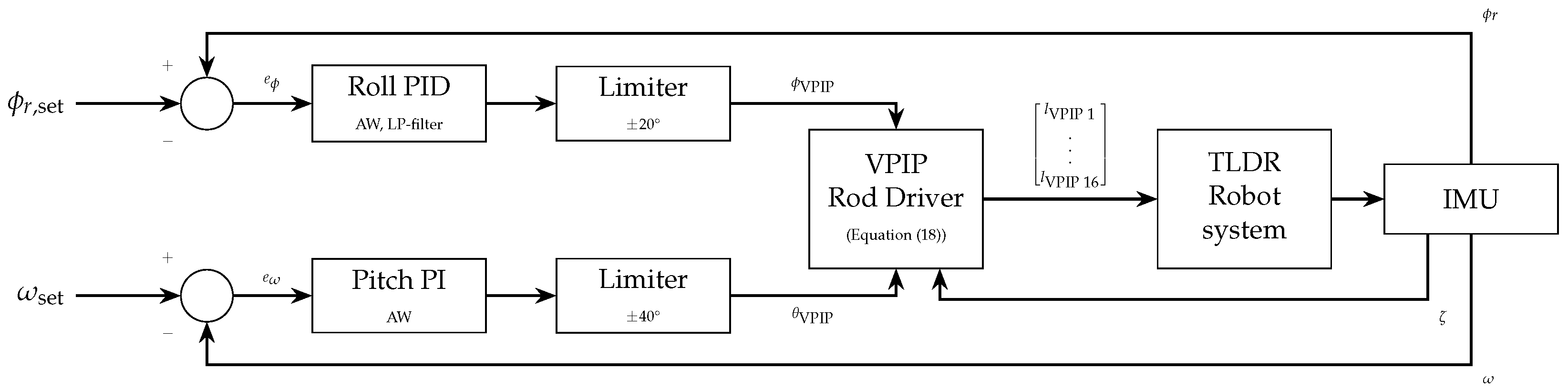
With l, one could find the corresponding ( x , y , z ) of the intersection by putting l into Equation (12). However, for our evaluation, l is the wanted variable for controlling the poles to touch the VPIP; therefore, we refer to this as l VPIP . This computation needs to be done for all poles in each control cycle. During regular motion we reduce the computational effort by ignoring all poles between 0.5 π rad and 1.5 π rad, as they need particular, extreme cases for them to interact. The overall control mechanism always controls θ VPIP and ϕ VPIP and sets the computed l VPIP as reference value for the l of each pole. For the angles of the VPIP, we will not derive a full control system as this exceeds the scope of this paper and will be addressed in further research, but we give a short overview of the expected behavior. ϕ VPIP needs to compensate for the error ϵ ϕ between the roll angle of the robot ϕ r and the desired ϕ r , and therefore is in the same direction as the roll of the robot ϕ . So, if the robot rotates to the right, the VPIP will lower the right and raise the left side. This leads to an extension of the poles on the right side and a lowering of the poles on the left, which is the correct action for countering tipping to the right. The idea is to control ϕ VPIP in a closed-loop manner on the basis of ϵ ϕ . The desired ϕ r is 0 for pure balancing. Other values lead to a curvature in combination with a forward locomotion. In the same manner as roll, the pitch θ VPIP is controlled by the commanded rotation speed c ω and the resulting error ϵ ω . Lowering the VPIP on the back and raising it on the front side of the robot will lead to retraction of poles to the front and extension of poles to the back, leading to forward motion. As the ζ change during this process, l VPIP changes for specific poles, with the actual VPIP staying the same. Therefore, a θ VPIP 0 r a d leads to a continuous motion. With increasing c ω , θ VPIP needs to be chosen steeper. This is also done using a closed-loop controller. Figure 5 depicts the resulting controller architecture.

5. Simulation and Results

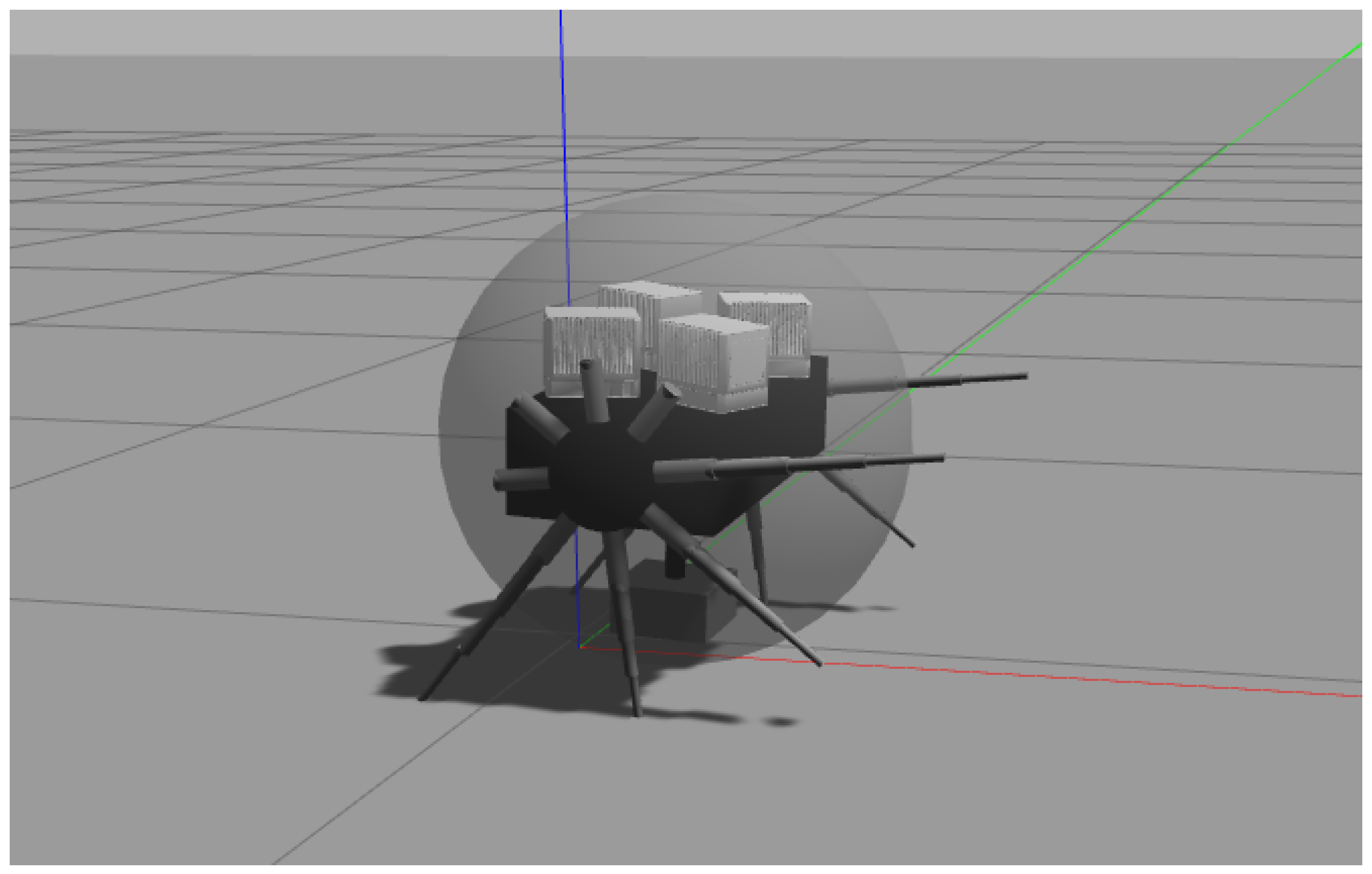
To validate the principle of the VPIP, we simulate the spherical robot with 16 rods in Gazebo (see Figure 6).
All data of the simulated robot matches the dimensions of the concept of the original DAEDALUS robot. Table 1 shows the used paramteres. To better understand the underlying dynamics for interpreting results and behaviors, please refer to our work on the dynamics of TLDR robots [15].
In these initial simulations, we want to show that it is possible to control both speed and lateral tilt angle via the VPIP. We also want to conduct a brief initial test to demonstrate that this lateral tilt allows for variable cornering. More specific movements for precise path tracking and exact cornering control must be part of future research.
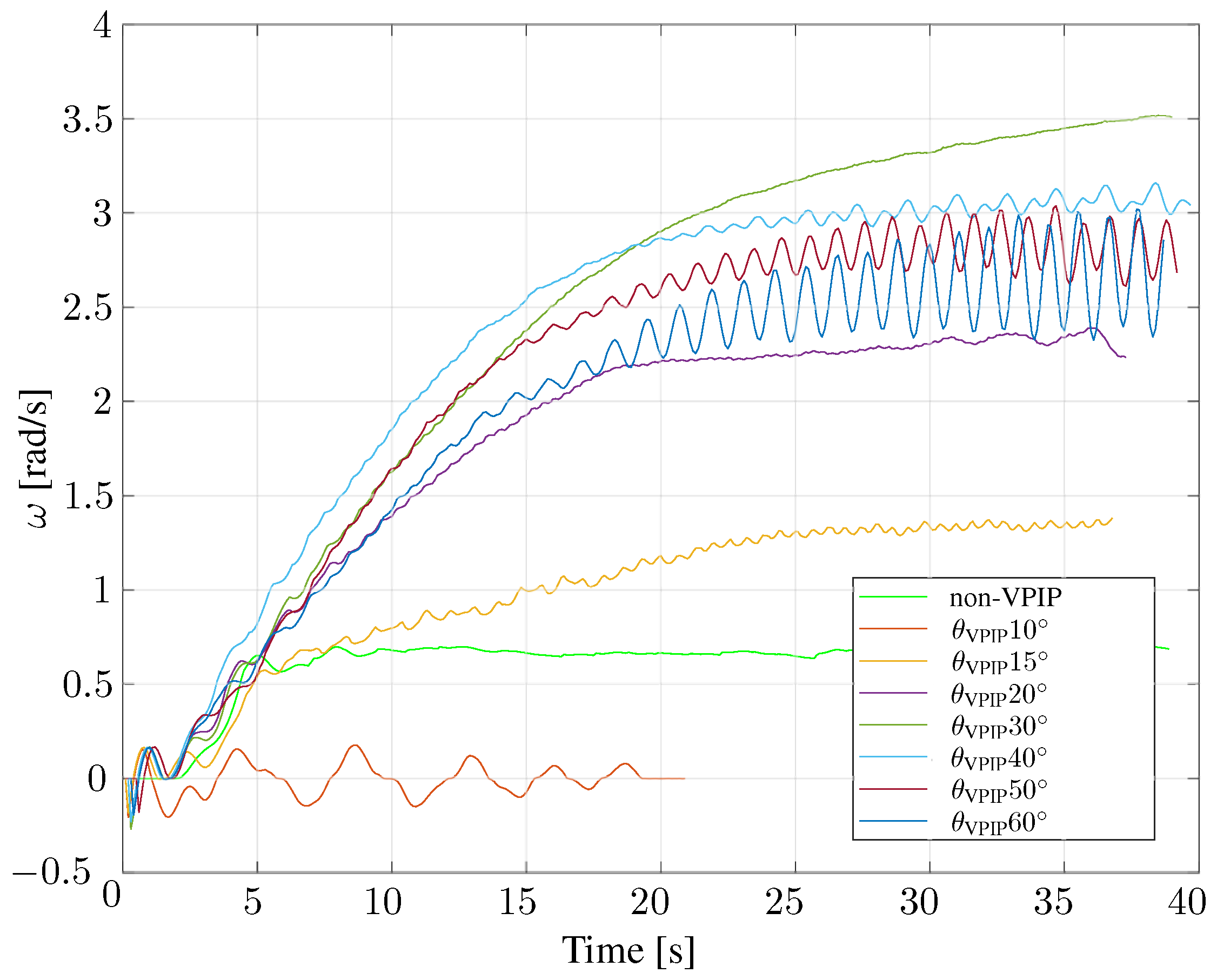
Figure 7 shows the resulting rotational velocity ω of the robot for different static pitch angles of the VPIP, as well as the simple Algorithm from [5] which does not use VPIP. There are multiple key findings. First, the VPIP approach does yield higher accelerations as well as a higher maximum ω compared the simple algorithm. Second, we see that there is a minimum VPIP angle for movement, as a θ VPIP of 10 ° does not lead to acceleration but oscillation. Third, a θ VPIP of 30 ° leads to the maximum possible ω . Steeper θ VPIP also cause oscillations. And fourth, a θ VPIP of 40 ° , which does not lead to a maximum ω , does lead to the highest acceleration. Especially the third and fourth findings show the potential of a closed-loop controller. The results correspond to the expected behavior, as the maximum ω is highly dependent on a well-timed sequence of all used rods, as they easily can contradict each other if the timing is sub-optimal [5]. Also, too high pitches lead to oscillation in the roll direction, which has a negative effect on locomotion.
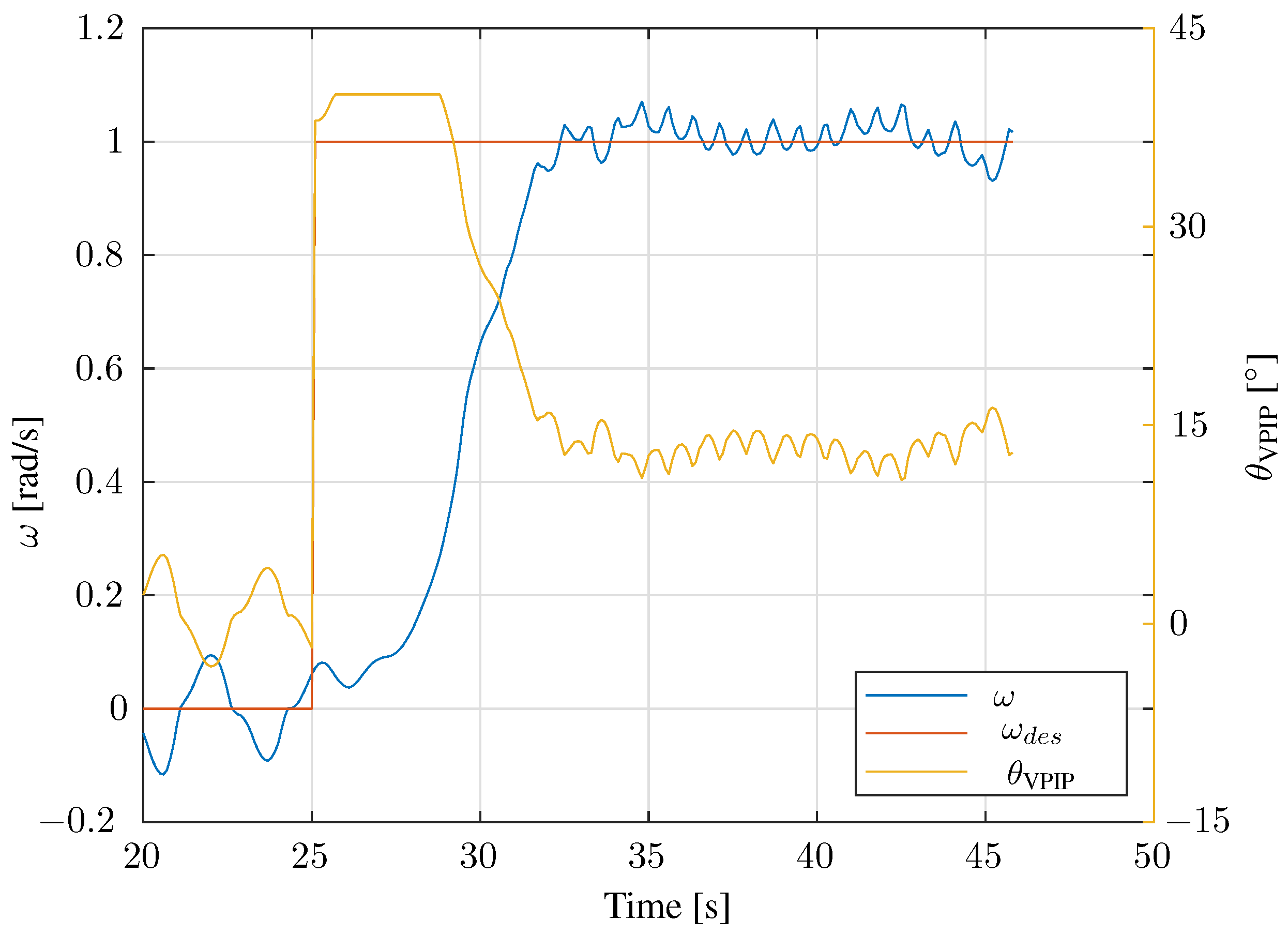
Therefore, we now use a simple PI-controller to control the pitch of VPIP ( θ VPIP ) and use the resulting ω as return to create a closed-loop control. Figure 8 shows the first result of the step response of a PI-controlled VPIP pitch angle. This leaves room for improvement and will be refined in future research, but it shows the basic capability of the closed-loop control approach of the VPIP. The standstill in particular still holds oscillations, which we intend to reduce by tuning the controller.
The observed behavior in Figure 8 is due to the interplay between rod extension velocity and the rotational dynamics of the sphere. At θ VPIP = 30 , the changes in the commanded extension lengths roughly match the maximum achievable extension velocity of the rods, resulting in the optimal number of rods contributing constructively to forward motion. Crucially, at this angle not only do more rods contact the ground simultaneously, but each maintains contact for a longer duration, allowing each to transfer more force/energy to the sphere. This combination of well-timed contact and sustained force transfer yields the highest ω . For steeper angles like ( θ VPIP = 40 ), rods contact the ground with higher instantaneous force, leading to higher acceleration, but the contact duration itself decreases as immediately the rod needs to extend faster than its maximum speed to stay in contact with the ground and fewer rods therefore reach the required extension length in time (in our example only one or none rods touched the ground at any time at commanded VPIPs with θ VPIP > 30 , limiting the achievable maximum ω .
The oscillation at θ VPIP = 10 stems from the same fundamental limitation, but on the retraction side. At shallow commanded VPIP angles, forward-facing rods are geometrically closer to the ground and must retract further and therefore faster to clear it. Just as a rod at a steep angle cannot extend fast enough to maintain ground contact, a rod at a shallow angle cannot retract fast enough to avoid the sphere rolling onto it, causing a bounce, leading to an oscillation back and forth (as the pushing rods will again push). This small oscillation again excites the internal pendulum mass (DAEDALUS holds a second locomotion mechanism, as its battery functions as Pendulum) and leads to higher persistent oscillation. This minimum angle threshold is therefore a direct consequence of the finite rod actuation speed, which represents a fundamental mechanical constraint of the TLDR concept first discussed in [5]. While higher control frequencies and refined retraction strategies will reduce this threshold considerably, a nonzero minimum angle is expected to persist under any realistic actuation speed. Observing and therefore confirming this boundary behavior (minimal and maximum) is one of the intended contributions of this work. Creating and improving strategies to improve both maximum and minimum speed, is up to future work.
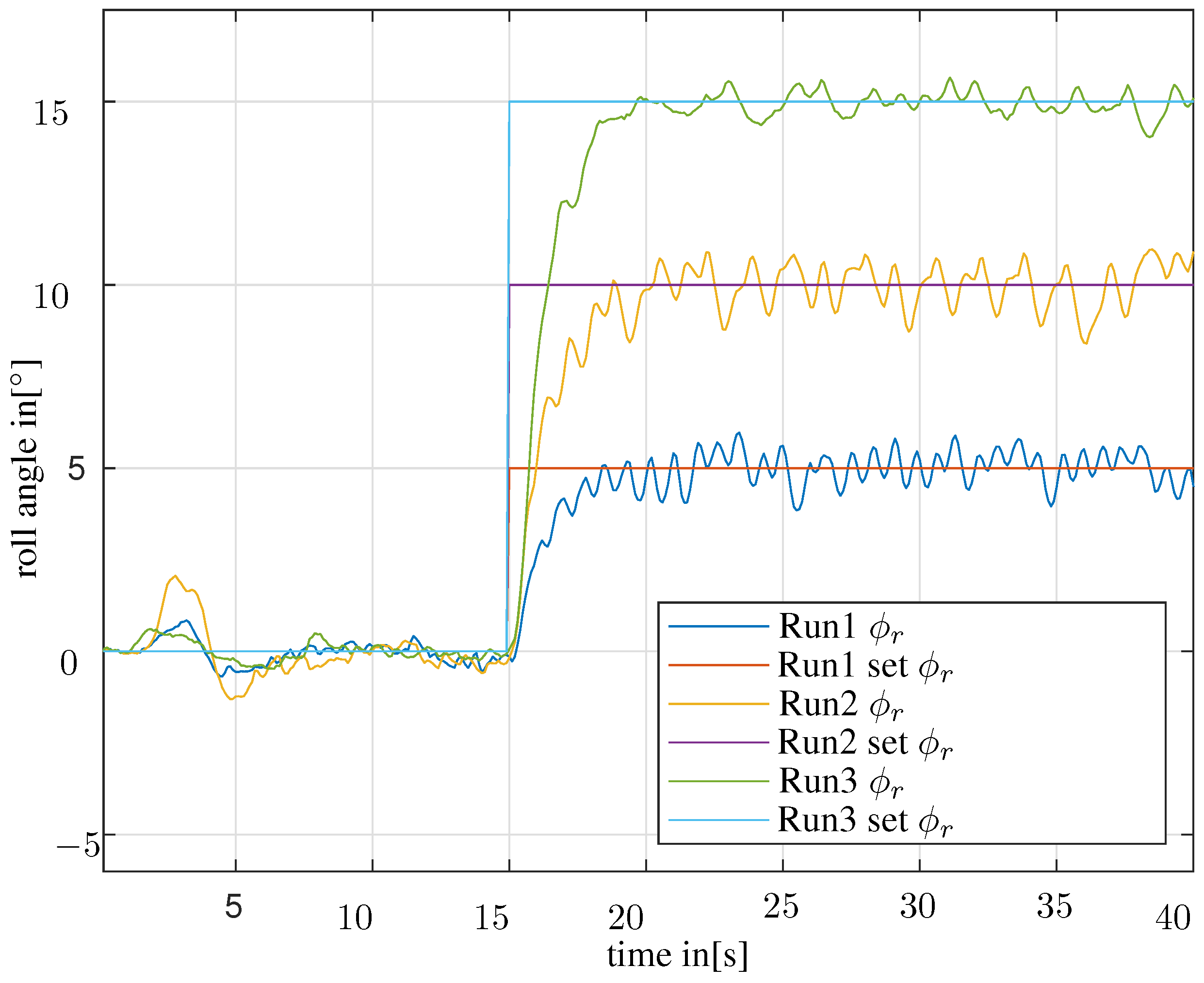
Next, we add the control of the roll angle of the VPIP ( ϕ VPIP ) . The pure balancing of the robot, i.e., holding the roll of the robot ϕ r at 0 ° , was already achieved in the original simple algorithm. But creating and holding ϕ r 0 ° was not achieved. Controlling ϕ VPIP in a closed-loop manner with ϕ r as feedback leads to robust control of the roll angle of the robot. Initial experiments showed that both a PID and an LQR are viable approaches for roll angle control. As a PID with a filtered derivative term represents a simpler and more accessible baseline, we adopt this as the controller of choice for the present work. Since the PID output was limited to prevent unwanted VPIP behavior (steeper angles lead to fewer poles touching the ground), a Conditional Integration Anti-Windup (AW) was added to prevent the integral term from accumulating excessively during saturation, which otherwise causes large overshoots and instability. Additionally, a low-pass filter was integrated into the derivative term to suppress high-frequency noise observed in the derivative output, improving the controller’s stability and making it more robust for potential real-world applications where sensor noise is unavoidable. We explicitly make no statement about an optimal controller for the two angles of the VPIP, and a detailed comparison of several controller structures and their respective fine-tuning is left for future research. Figure 9 shows the establishment of three different angles of the robot by controlling the roll angle of the VPIP.
Testing different values for the PI controller shows that the controller of the ϕ VPIP is much more robust and quicker to tune than the PID for θ VPIP . The reasons for this needs to be investigated in further research.
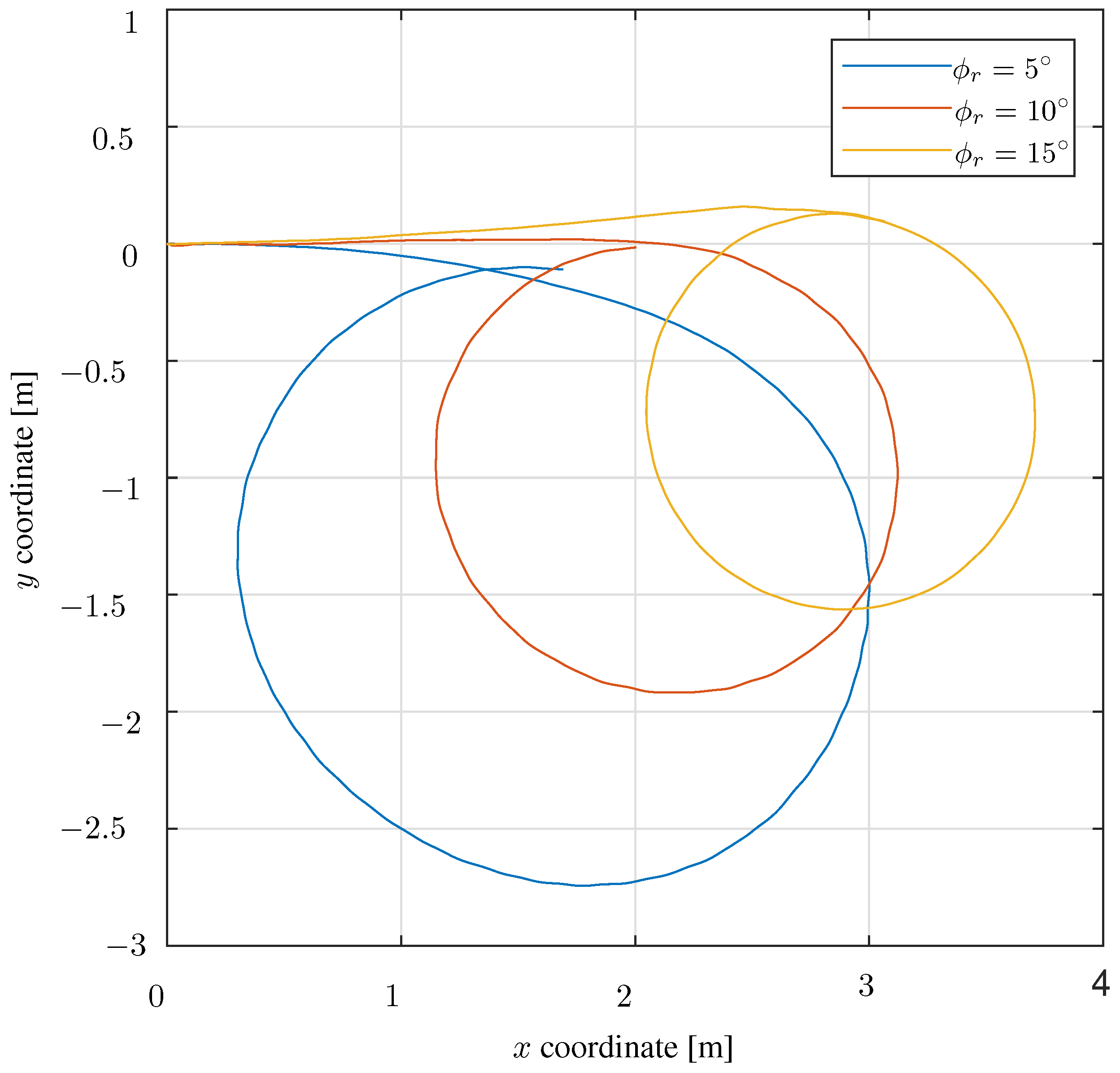
The last step is to combine balancing and forward motion by simultaneously controlling roll and pitch of the VPIP. First tests show the feasibility of complete control, as it is possible to roll smooth curves with the spherical robot. We want to show, that the curve radius is dependent on ϕ r . Figure 10 shows the x-y-plotting of three test runs with different VPIP-controlled ϕ r and a VPIP-controlled ω . In the presented runs (each 30 s long), desired roll angles of 5 , 10 , and 15 resulted in circle diameters of approximately 2.6 m, 2.0 m, and 1.7 m respectively, indicating the expected inverse relationship between roll angle and curve radius. A systematic quantitative characterization of this relationship across a wider range of parameters is left for future work.
This paves the way for complete path following and simultaneous stabilization with VPIP. A further step is to have a cascaded control loop and control the desired ϕ r of the robot over a desired curve radius. This will enable full path following for a TLDR robot. Even with the potential for improvement of the ω control with the help of a more fine-tuned PI controller, or even with other control concepts, we state the VPIP to be a working control strategy for a TLDR robot.

6. Conclusions

For combining the balancing and locomotion of spherical robots using rod-driven locomotion, we introduced the idea of a virtual plane controlling the robot, the virtual pose instruction plane (VPIP), and established a mathematical solution. The concept introduces two controllable parameters (roll and pitch of the plane) to control the balance and movement velocity of a spherical robot. We tested the first implementation successfully in simulation and showed the feasibility of a full-VPIP control strategy for the TLDR robot. All in all, the VPIP seems to be a promising approach for the TLDR to become a robust locomotion approach.
Needless to say, a lot of work remains to be done. The tuning of the controllers for the angles of VPIP is suboptimal and leaves room for improvement, either with fine-tuning or with the use of other control concepts. Also, a further step is to evaluate the VPIP approach on a real prototype. Once the VPIP itself is sufficiently robust, we plan to extend the concept beyond a single plane. Rather than assuming a flat reference surface, we aim to generalise the VPIP to incorporate a map of the immediate surroundings od the robot—leading to the Virtual Pose Instruction Map (VPIM). Whilst the VPIP already reacts to terrain disturbances reactively due to its control-loop structure, the VPIM will enable proactive adaptation by directly incorporating terrain fluctuations via the point cloud obtained by the LiDAR before they manifest as control errors. This extension will then be seamlessly integrated with the LiDAR sensors planned for the DAEDALUS mission: Beyond their role as scientific instruments for cave mapping, these sensors will simultaneously serve as terrain estimators for the control mechanism—a fruitful symbiosis that would make spherical TLDR robots significantly more capable in the harsh, unknown terrains of lunar caves. This work provides the conceptual as well as mathematical foundation for this idea. We are currently working on this VPIM approach and look forward to presenting the results in the future.
Overall, the VPIP concept holds potential for advancing the field of spherical robot locomotion, and we look forward to further exploring its capabilities and applications in future research.

Author Contributions

Conceptualization, J.Z.; methodology, J.Z.; software, J.Z., J.B., M.H. and K.M.; validation, J.Z., J.B. and M.H.; formal analysis, J.Z.; investigation, J.Z.; data curation, J.Z., J.B. and M.H.; writing—original draft preparation, J.Z.; writing—review and editing, J.Z., A.B. and D.B.; visualization, J.Z., J.B. and M.H.; supervision, D.B. and A.N.; project administration, A.N.; funding acquisition, A.N. All authors have read and agreed to the published version of the manuscript.

Funding

This research was funded by the European Space Agency (ESA) Contract No. 4000130925 /20/NL/GLC for the “DAEDALUS—Descent And Exploration in Deep Autonomy of Lava Underground Structures” Open Space Innovation Platform (OSIP) lunar cave-system study and the Elite Network Bavaria (ENB) for providing funds for the academic program “Satellite Technology”.

Data Availability Statement

The raw data supporting the conclusions of this article will be made available by the authors on request.

Conflicts of Interest

The authors declare no conflicts of interest. The funders had no role in the design of the study; in the collection, analyses, or interpretation of data; in the writing of the manuscript; or in the decision to publish the results.

References

  1. Seeni, A.; Schafer, B.; Rebele, B.; Tolyarenko, N. Robot mobility concepts for extraterrestrial surface exploration. In Proceedings of the 2008 IEEE Aerospace Conference; IEEE: Piscataway, NJ, USA, 2008; pp. 1–14. [Google Scholar]
  2. European Space Agency. SysNova. Available online: http://www.esa.int/Enabling_Support/Preparing_for_the_Future/Discovery_and_Preparation/SysNova2 (accessed on 9 March 2026).
  3. Rossi, A.P.; Maurelli, F.; Unnithan, V.; Dreger, H.; Mathewos, K.; Pradhan, N.; Corbeanu, D.A.; Pozzobon, R.; Massironi, M.; Ferrari, S.; et al. DAEDALUS-Descent And Exploration in Deep Autonomy of Lava Underground Structures: Open Space Innovation Platform (OSIP) Lunar Caves-System Study. 2021. Available online: https://opus.bibliothek.uni-wuerzburg.de/frontdoor/index/index/docId/22791 (accessed on 21 April 2026).
  4. Kesner, S.B.; Plante, J.S.; Boston, P.J.; Fabian, T.; Dubowsky, S. Mobility and power feasibility of a microbot team system for extraterrestrial cave exploration. In Proceedings 2007 IEEE International Conference on Robotics and Automation; IEEE: Piscataway, NJ, USA, 2007; pp. 4893–4898. [Google Scholar]
  5. Zevering, J.; Borrmann, D.; Bredenbeck, A.; Nüchter, A. The concept of rod-driven locomotion for spherical lunar exploration robots. In Proceedings of the 2022 IEEE/RSJ International Conference on Intelligent Robots and Systems (IROS); IEEE: Piscataway, NJ, USA, 2022; pp. 5656–5663. [Google Scholar]
  6. Mateos, L.A. Bionic sea urchin robot with foldable telescopic actuator. In Proceedings of the 2020 IEEE/ASME International Conference on Advanced Intelligent Mechatronics (AIM); IEEE: Piscataway, NJ, USA, 2020; pp. 1063–1068. [Google Scholar]
  7. Yang, D.; Liu, Y.; Yu, Y. A General Locomotion Approach for a Novel Multi-legged Spherical Robot. In Proceedings of the 2023 IEEE International Conference on Robotics and Automation (ICRA); IEEE: Piscataway, NJ, USA, 2023; pp. 10146–10152. [Google Scholar]
  8. Ningrum, E.S.; Brata, S.W.; Fauziah, K.P.; Binugroho, E.H. Introducing the PodRacle, spherical mode rolling locomotion on flat surface. In Proceedings of the 2016 International Conference on Knowledge Creation and Intelligent Computing (KCIC); IEEE: Piscataway, NJ, USA, 2016; pp. 8–13. [Google Scholar]
  9. Diouf, A.; Belzile, B.; Saad, M.; St-Onge, D. Spherical Rolling Robots—Design, Modeling, and Control: A Systematic Literature Review. Robot. Auton. Syst. 2024, 175, 104657. [Google Scholar] [CrossRef]
  10. Bu, S.; Yan, L.; Gao, X.; Wang, G.; Zhao, P.; Chen, I.M. Design and Motion Control of Spherical Robot with Built-in Four-Wheel Omnidirectional Mobile Platform. IEEE Trans. Instrum. Meas. 2023, 72, 1–10. [Google Scholar] [CrossRef]
  11. Pravecek, D.J.; Oevermann, M.J.; Thomas, G.C.; Ambrose, R.O. Empirically Compensated Setpoint Tracking for Spherical Robots with Pressurized Soft-Shells. IEEE Robot. Autom. Lett. 2025, 10, 2136–2143. [Google Scholar] [CrossRef]
  12. Zhang, B.; Zhang, F.; Chen, H.; Wang, Y.; Hao, J.; Luo, Z.; Li, G. A High-Speed Capable Spherical Robot. arXiv 2025, arXiv:2511.01288. [Google Scholar] [CrossRef]
  13. Nozaki, H.; Kujirai, Y.; Niiyama, R.; Kawahara, Y.; Yonezawa, T.; Nakazawa, J. Continuous Shape Changing Locomotion of 32-Legged Spherical Robot. In Proceedings of the 2018 IEEE/RSJ International Conference on Intelligent Robots and Systems (IROS); IEEE: Piscataway, NJ, USA, 2018; pp. 2721–2726. [Google Scholar] [CrossRef]
  14. Xu, L.; Ren, R.; Wei, X.; Lee, H.; Zhang, H.; Yu, K.; Li, Y.; Liu, C.; Gao, S.; Lu, L. Design and Development of a Deformable Spherical Robot for Amphibious Applications. In Proceedings of the 2025 IEEE/RSJ International Conference on Intelligent Robots and Systems (IROS); IEEE: Piscataway, NJ, USA, 2025; pp. 6933–6938. [Google Scholar] [CrossRef]
  15. Zevering, J.; Borrmann, D.; Bredenbeck, A.; Nüchter, A. Dynamics of Spherical Telescopic Linear Driven Rotation Robots. In Proceedings of the 16th Symposium on Advanced Space Technologies in Robotics and Automation (ASTRA 2023), European Space Agency (ESA), Leiden, The Netherlands, 18–20 October 2023. [Google Scholar]
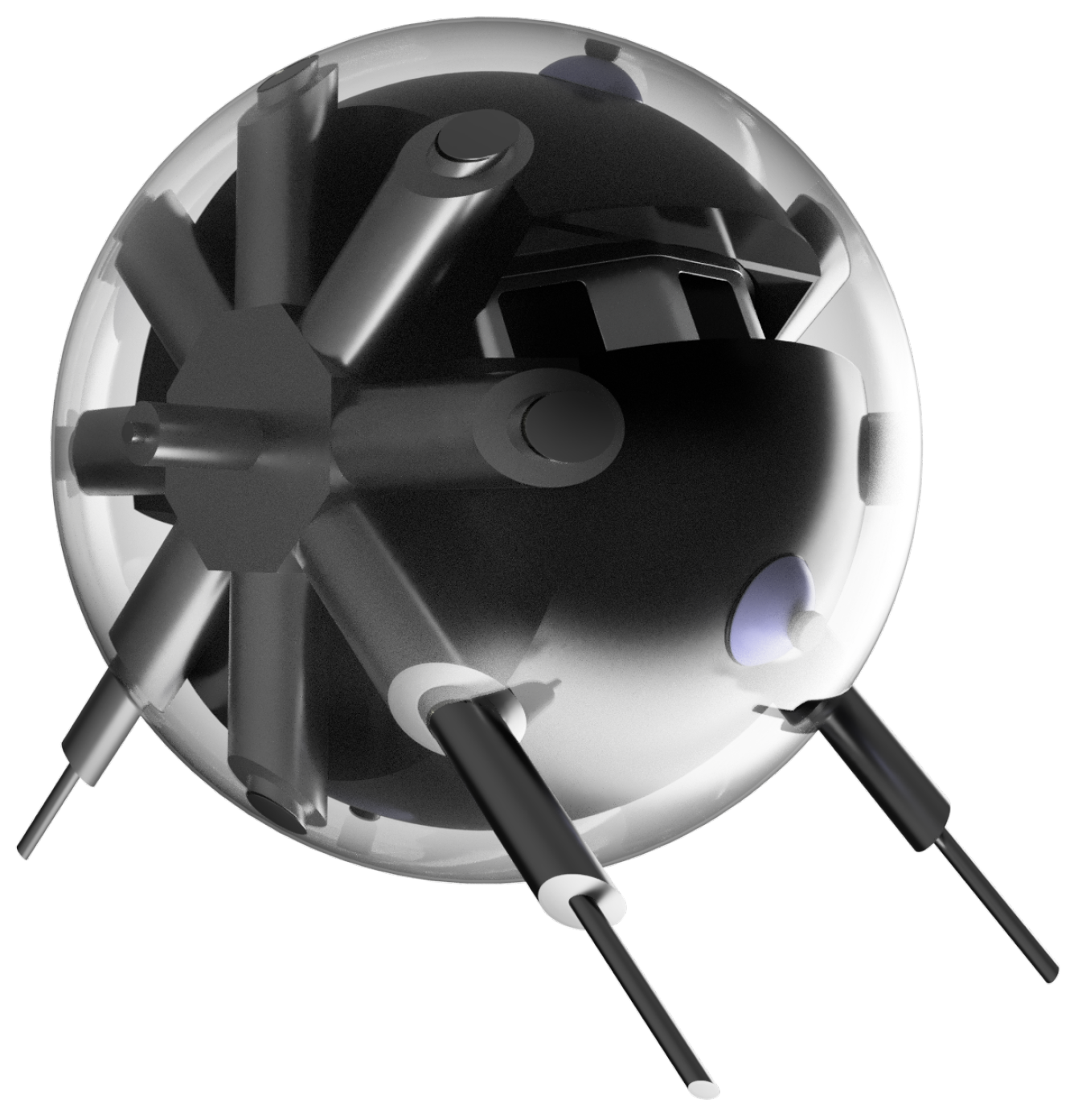
Figure 1. Rendering of the DAEDALUS robot concept. The spherical robot holds 2 rings with eight rods each on both sides. Apart from locomotion those rods are also used for tasks such as heat radiation, stabilization, and climbing. The main structure in the center holds laser scanners, optical sensors, a battery, a board computer and other payloads.
Machines 14 00486 g001
Figure 2. Three rods and their respective angle with respect to the ground ( ζ 1 , ζ 2 , ζ 3 ) as well as the other angles ( α , β ) describing the minimum and maximum angles during which pushing is possible. r represents the radius of the sphere and l the current length of the extended rod. The red area marks the non-extension area due to not reaching past β , and the green area marks the extension area between α and β .
Machines 14 00486 g002
Figure 3. Visualization of VPIP (blue) and the describing angles ϕ VPIP and θ VPIP . The robot (red sphere) rolls into the v direction. The grey plane shows the actual ground.
Machines 14 00486 g003
Figure 4. Illustration of pole line for VPIP evaluation. The blue dots ( p t and p m ) are used to calculate the line.
Machines 14 00486 g004
Figure 5. Control architecture of the VPIP system. The roll PID (with Anti-Windup (AW) and low-pass filter) and pitch PI (with Anti-Winddup) controller command the VPIP angles ϕ VPIP and θ VPIP , from which the VPIP rod driver computes the required extension lengths l VPIP for all 16 rods via Equation (18). Feedback is provided by the onboard IMU.
Machines 14 00486 g005
Figure 6. Gazebo simulation of a TLDR robot. The 16 rods extend and lead to rotation, hence translation of the spherical robot.
Machines 14 00486 g006
Figure 7. Rotational velocity of the robot using a simple push algorithm introduced in [5] and different static pitch angles for the VPIP ( θ VPIP ) angles, using the Gazebo simulation. These are all open-loop control strategies without a set end- θ .
Machines 14 00486 g007
Figure 8. The resulting rotational velocity of the robot and θ VPIP using a PI controller for the VPIP.
Machines 14 00486 g008
Figure 9. Resulting ϕ r when controlling the roll of the VPIP with an PID controller. There were three test runs with different desired ϕ r .
Machines 14 00486 g009
Figure 10. Top view of the rolled path of the TLDR robot, controlling both its ω , as well as two different ϕ r via VPIP (PID for ϕ r , PI for ω = 1 rad / s ). Time duration each 30 s.
Machines 14 00486 g010
Table 1. Simulation parameters of the DAEDALUS robot model in Gazebo.
ParameterValue
Sphere
Radius r m 0.232 m
Mass3 kg
Inertia (all axes) 2 3 m r 2 = 0.108  kg m2
Contact friction * μ 1 / μ 2 200.0/100.0
Inner structure
Baseplate mass **15 kg
Battery mass7 kg
Rods (per rod, 3 telescopic segments)
Number of rods16 (8 per side)
Segment length0.07 m
Max. extension l max 0.21 m
Extension velocity0.1 m/s
Mass per rod1.4 kg
VPIP Controllers
Pitch PI ( k p / k i )10.1/2.1
Roll PID ( k p / k i / k d , f c )3.0/2.0/3.5, 50 Hz
Max. θ VPIP / ϕ VPIP 40°/20°
Anti-windup *** pitch/roll10°/5°
Environment & Control
Simulation environmentGazebo, flat ground ****
Overall Control frequency100 Hz
* High friction values are chosen to prevent numerical slipping artifacts in Gazebo. ** The baseplate is simulated with the weight of all non-included Subsystems of the final robot. *** Anti-Windup limits the Integral Part of the PID. **** Flat surfaces are used for the tests shown in this work. However, the functionality has also been successfully tested on uneven ground.
Disclaimer/Publisher’s Note: The statements, opinions and data contained in all publications are solely those of the individual author(s) and contributor(s) and not of MDPI and/or the editor(s). MDPI and/or the editor(s) disclaim responsibility for any injury to people or property resulting from any ideas, methods, instructions or products referred to in the content.