1. Introduction
Ensuring the safe and reliable operation of industrial systems has become increasingly important with the rapid development of automation and intelligent technologies. Traction drive systems serve a key role by transforming electrical energy into mechanical motion in industrial applications. The reliability of the systems is therefore of great importance, which has motivated extensive research on fault detection (FD) techniques for traction drive systems [
1,
2,
3]. Advances in modern control theory have contributed to the design and implementation of model-based FD approaches in traction drive systems [
4,
5,
6].
Model-based FD methods are attractive because of their high sensitivity and capability for early detection of system anomalies [
7]. Depending on the structure of the residual generator, model-based FD methods for traction drive systems are typically classified into fault detection filter-based approaches and diagnostic observer-based approaches [
8]. In parallel with these developments, recent studies, such as those by Cheng et al. [
9], Sun et al. [
10], and Xia et al. [
11], have explored data-driven and model–data fusion approaches for FD in traction drive systems. Despite the diversity of these methodologies, accurate characterization of system dynamics and fault-induced residual variations remains crucial for reliable monitoring. In this context, fault detection filters are particularly appealing, as they explicitly account for state evolution and measurement updates in the residual generation. Among them, Kalman filter (KF)-based approaches are especially attractive due to the recursive estimation structure, which is well suited for dynamic systems operating under stochastic noises.
In recent years, KF-based FD methods and their variants have emerged as the dominant approach among fault detection filter-based techniques for traction drive systems [
12,
13,
14]. Cheng et al. [
12] developed a sigma-mixed unscented KF-based FD algorithm for addressing performance degradation. The approach constructs a mixture distribution using sigma points in the unscented KF framework and incorporates a Lévy process with jump characteristics to model degradation dynamics. A moving average interstate standard deviation index is finally developed for FD purposes. Foo et al. [
13] introduced an extended KF-based approach for sensor FD and isolation, which ensures fault-resilient control when sensor faults occur. For stator inter-turn faults, Namdar et al. [
14] proposed a KF-based FD method. In this approach, the KF is employed to extract signal features, and the standard deviation of the extracted signatures is subsequently used as an indicator for FD. Miniach et al. [
15] developed a current sensor fault-tolerant control scheme based on an extended KF to achieve detection and compensation of current sensor faults in induction motor drives.
It should be noted that the practical deployment of aforementioned methods still faces several challenges. First, most of these methods rely on prior knowledge of system matrices. However, due to the complex internal structure of traction drive systems, constructing an accurate mathematical model is often difficult in practice, and the required system matrices are typically unavailable. As a result, the applicability of KF-based FD methods in real monitoring scenarios is limited. Second, the process and measurement noise covariance matrices in most existing KF and its variant-based FD approaches are usually specified based on prior knowledge or engineering experience. In practical operating environments, however, the actual noise statistics are generally unknown, which may lead to a mismatch between the assumed and actual noise characteristics during the iterative estimation process, thereby degrading the FD performance. Therefore, a key challenge lies not only in implementing KF-based FD for traction drive systems, but also in ensuring its effectiveness when both the system matrices and noise statistics are not accurately known a priori.
Although traction drive systems can be modeled in a state-space model form [
8], the system matrices are often unavailable in practice. To address this issue, a subspace identification approach [
16,
17] is employed to construct the state-space model directly from measured input–output (I/O) data. The observability matrix is estimated via QR decomposition and singular value decomposition (SVD), from which the system matrices are identified. This enables KF and variant-based FD approaches to be implemented in a fully data-driven manner while retaining its capability for dynamic modeling and recursive estimation, without relying on prior model knowledge. Furthermore, to address the case where the process and measurement noise covariance matrices are unknown in traction drive systems, the proposed approach is inspired by the principle of iterative generalized least squares estimation [
18]. The noise statistics are learned through iterative interactions between the estimator and the measurements, enabling reliable estimation of the noise covariance matrices. This mitigates the adverse impact on detection performance caused by relying on the priori noise covariance matrices that deviate from the true noise characteristics. The main contributions of this work are outlined as follows.
- 1.
A data-driven KF-based approach is developed for FD of traction drive systems, which does not require a first-principles system model.
- 2.
An iterative scheme is proposed to estimate the covariance matrices of noises from measured and estimated data, mitigating the adverse effects caused by mismatches between a priori covariance assumptions and the true noise statistics.
- 3.
The proposed method accounts for the dynamic characteristics of the systems while maintaining satisfactory monitoring results.
The remainder of this study is organized as follows:
Section 2 presents preliminaries, including a brief introduction to traction drive systems, the KF, and the problem formulation. A detailed description of the proposed FD approach is provided in
Section 3.
Section 4 presents the corresponding experimental study on a traction drive system. The study concludes with a summary in
Section 5.
Notations: All notations used in this paper follow standard conventions. represents the k-dimensional Euclidean space. The symbol denotes the pseudo-inverse of the matrix . For a vector , , , , where N and s are positive integers. The symbol denotes the estimate of . The operator denotes the vectorization of the matrix . ⊗ denotes the Kronecker product.
3. Proposed FD Method
Since the state vector
is typically unavailable in practice, the I/O data model (
2) cannot be identified and employed directly for generating residual signals. Consequently, the reliance on the state variable
needs to be eliminated. Considering the innovation sequence
and the gain matrix
K, the I/O relationship of the process can alternatively be described by [
20]
According to (
8), the following can be obtained
Given that all eigenvalues of
lie strictly within the unit circle, it follows that
for a sufficiently large positive integer
. This leads to
This implies that the state vector
can be inferred from historical I/O data. Therefore, in the absence of faults, the model (
2) can be equivalently reformulated as
where
Applying a QR decomposition of the form
Specially, the I/O data model (
11) can be further expressed as
From (
13)–(
15), the following equivalent form can be obtained
In line with subspace identification methods [
21], and without loss of generality, the following result can be obtained
Therefore, one can obtain
where
With the identified matrix
, the matrices
A,
B,
C, and
D can be reliably estimated. To extract
A and
C from the observability matrix, an estimation
is obtained by applying SVD to
Based on the decomposition, the estimation
is given by
. The matrix
C is estimated by
Concurrently, the matrix
A can be estimated through the following calculation
Furthermore,
B and
D can be estimated based on the Toeplitz matrix
. Specifically, the estimations of
B and
D are obtained as follows:
Although the measurement noise and process noise are commonly modeled as zero-mean Gaussian vectors, their covariance matrices and are generally unavailable in practice. This uncertainty may limit the monitoring performance when the KF-based residual generation is applied. To mitigate this difficulty, the covariance matrices and are estimated within the KF framework using the identified matrices. The estimation is achieved through iterative interactions between the estimator and the measurement data.
Remark 1. For notational simplicity, the matrices A, B, C, and D used in the subsequent derivations denote their estimated counterparts , , , and , respectively.
Based on the KF formulation in (
3)–(
6), the following expression can be derived:
Within the KF framework, the following formulation is obtained based on the idea of iterative interaction:
Applying the vectorization operation to (
24)–(
25) yields
From (
26), the following equivalent form can be derived
It is worth noting that
and
are diagonal matrices. Therefore, they contain
and
independent elements, respectively. These independent elements are denoted by
and
. Accordingly, there exists a matrix
such that
where
and
represents the
i-th diagonal element of
,
, and
denotes the
j-th diagonal element of
,
.
Substituting (
28) into (
27) yields
It should be noted that (
29) provides a general formulation for estimating the structured parameters of
and
. Based on (
29), the estimations of
and
can be iteratively updated by solving the following expression:
where
i represents the iteration index in the covariance update procedure and
Accordingly, the estimations of
and
are given by
To enable FD, a residual vector is required for the construction of the test statistic. Using the identified matrices
A,
B,
C, and
D, together with the estimated covariance matrices
and
, the residual vector
is derived from the KF algorithm (
3)–(
6). Based on this residual signal, the test statistic for FD is formulated as
where
denotes the covariance matrix of the residual vector under fault-free conditions. According to the statistic in (
32), the threshold
is given by
where
is a user-selected significance level that sets the upper limit of the acceptable false alarm rate (FAR).
Based on (
32) and (
33), the following detection logic is proposed for FD; that is,
To construct a reliable FD scheme for traction drive systems, the matrices
A,
B,
C, and
D are identified, and covariance matrices
and
are estimated in an offline procedure. During online operation, process measurements are utilized to compute the residual signals, which serve as the basis for FD. The overall design of the developed FD system is summarized in Algorithms 1 and 2.
| Algorithm 1 Design of the proposed FD scheme: Off-line Learning |
Input: Fault-free process I/O data. Output: , , , , , and . - 1:
begin - 2:
Load process data and construct matrices , , and ; - 3:
Execute ( 12)–( 17) to obtain and ; - 4:
Identify , , , and using ( 19)–( 23); - 5:
Obtain and using ( 30) and ( 31). - 6:
end
|
| Algorithm 2 Design of the proposed FD scheme: Online FD |
Input: Online I/O data and offline-estimated parameters. Output: Online FD results. - 1:
begin - 2:
Load process I/O data; - 3:
Execute ( 3)–( 6) to obtain the residual signal; - 4:
Design the residual evaluation unit using ( 32) and ( 33); - 5:
Execute FD based on the detection logic ( 34). - 6:
end
|
4. Experiment and Discussion
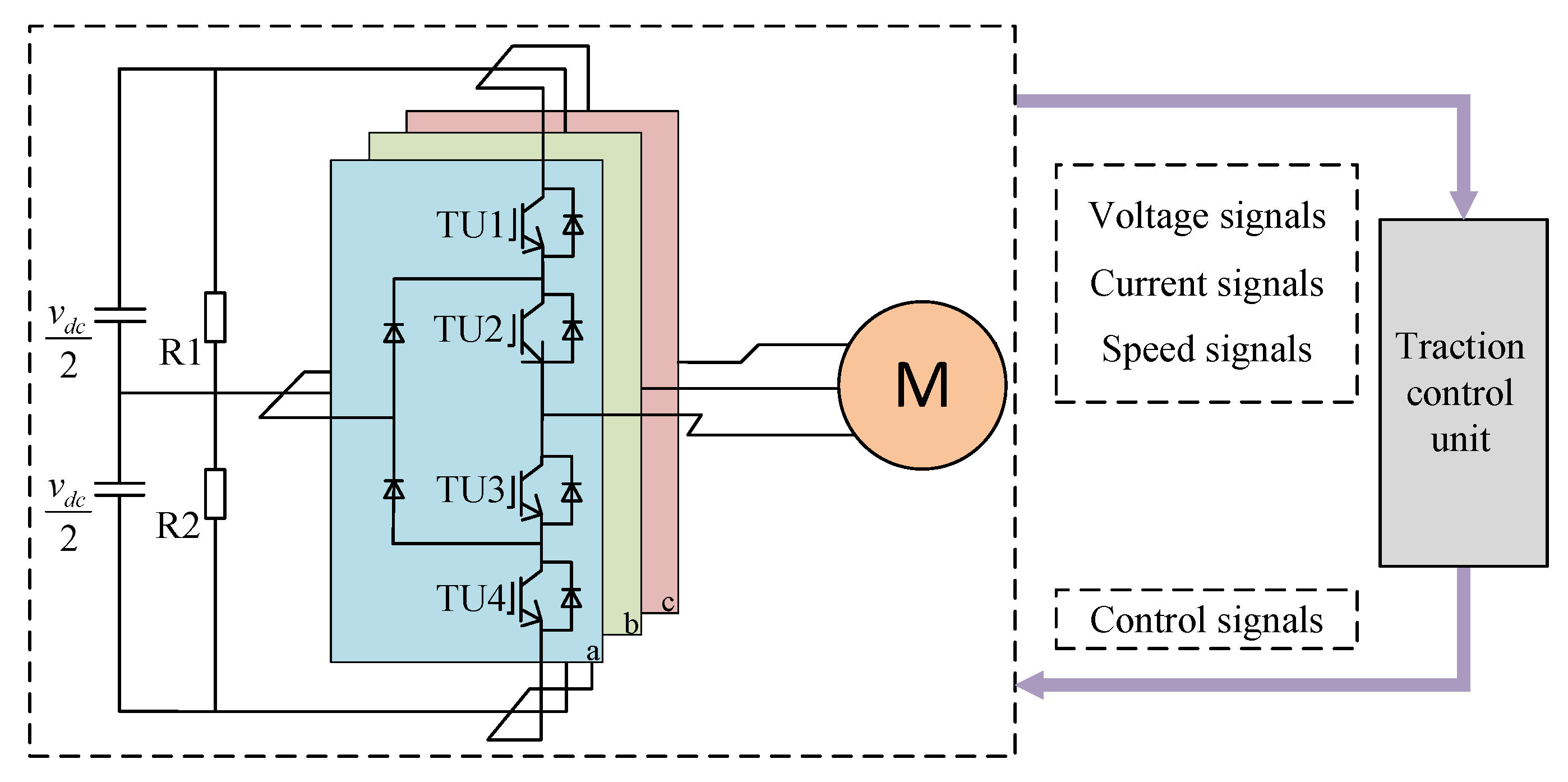
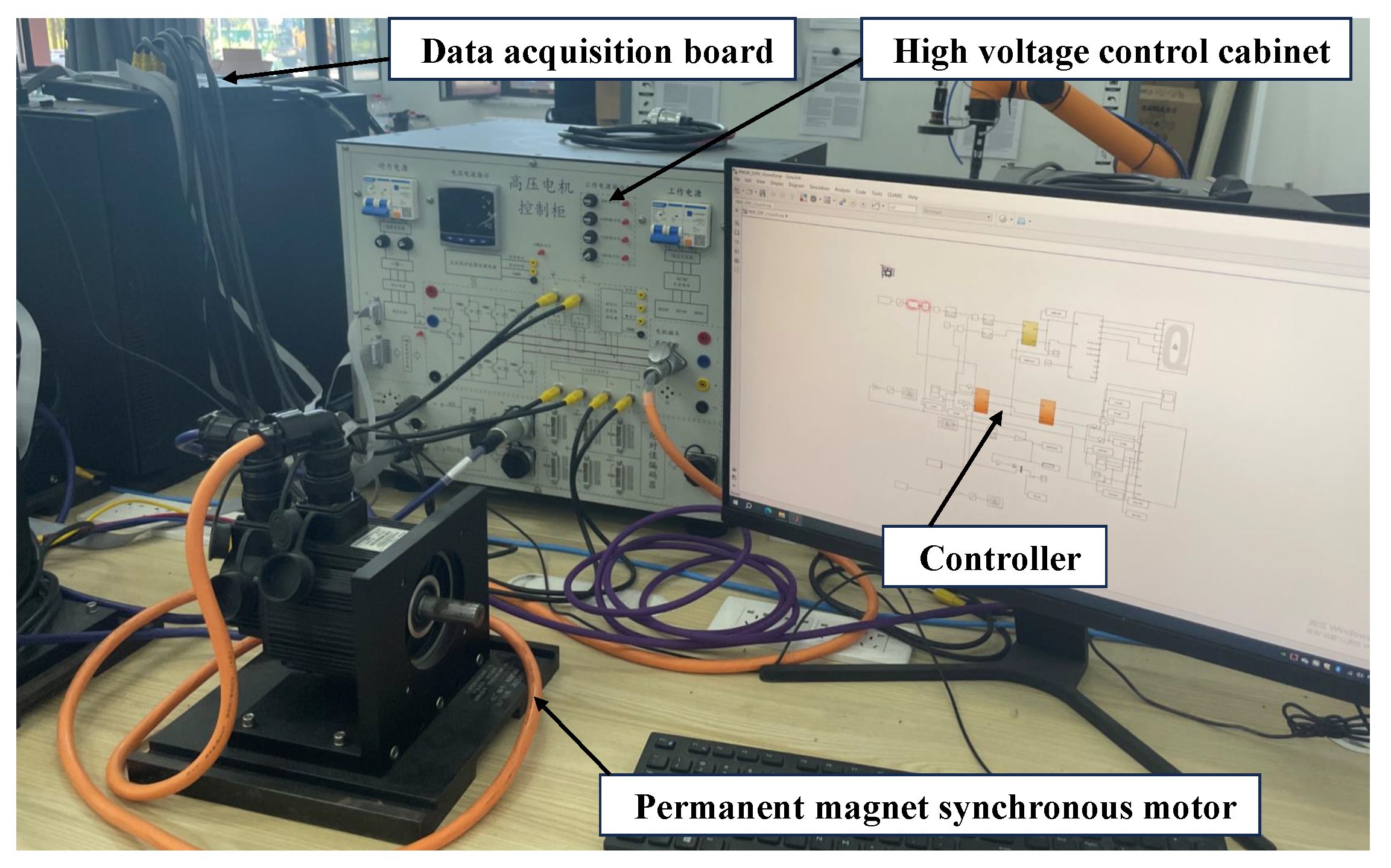
Experimental validation is conducted on a practical traction drive system to evaluate the proposed approach. The test bench consists of a high-voltage control cabinet, a data acquisition board, a computer for the program implementation, and a permanent magnet synchronous motor, as depicted in
Figure 2. The main parameters of the traction motor are listed in
Table 2. It should be noted that this work focuses on algorithm validation rather than sensor metrology; therefore, no separate study on sensor uncertainty was conducted. Prior to the experiments, routine checks confirmed that the sensor outputs were stable and within the expected operating ranges under normal conditions. Consequently, remaining sensor inaccuracies are treated as part of the measurement noise in collected data.
In the experimental setup, the voltage measurements are used as input variables, while the speed and current measurements are considered as output variables; that is,
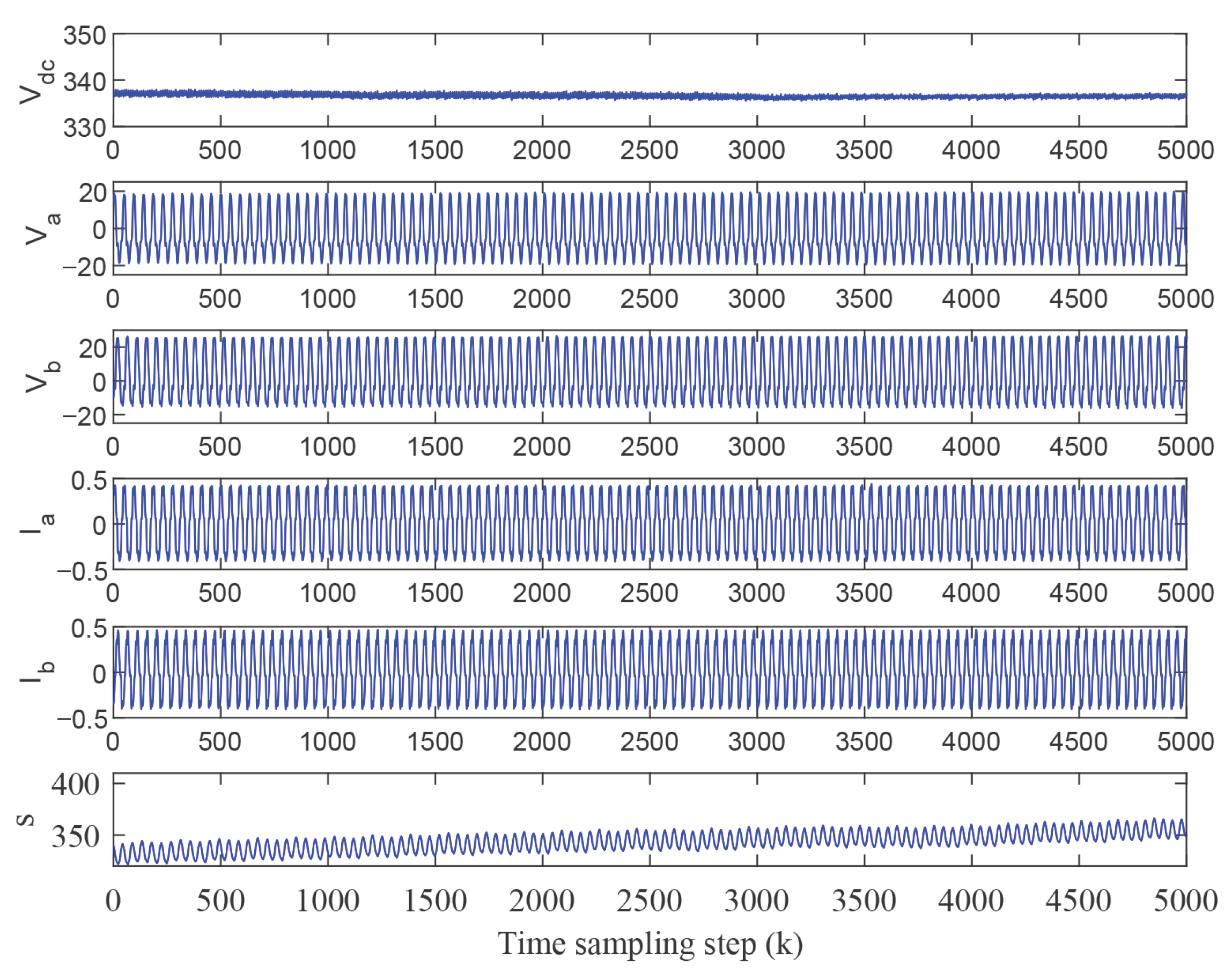
I/O data for the parameter estimation are collected from monitoring nodes of the traction drive system, with representative samples shown in
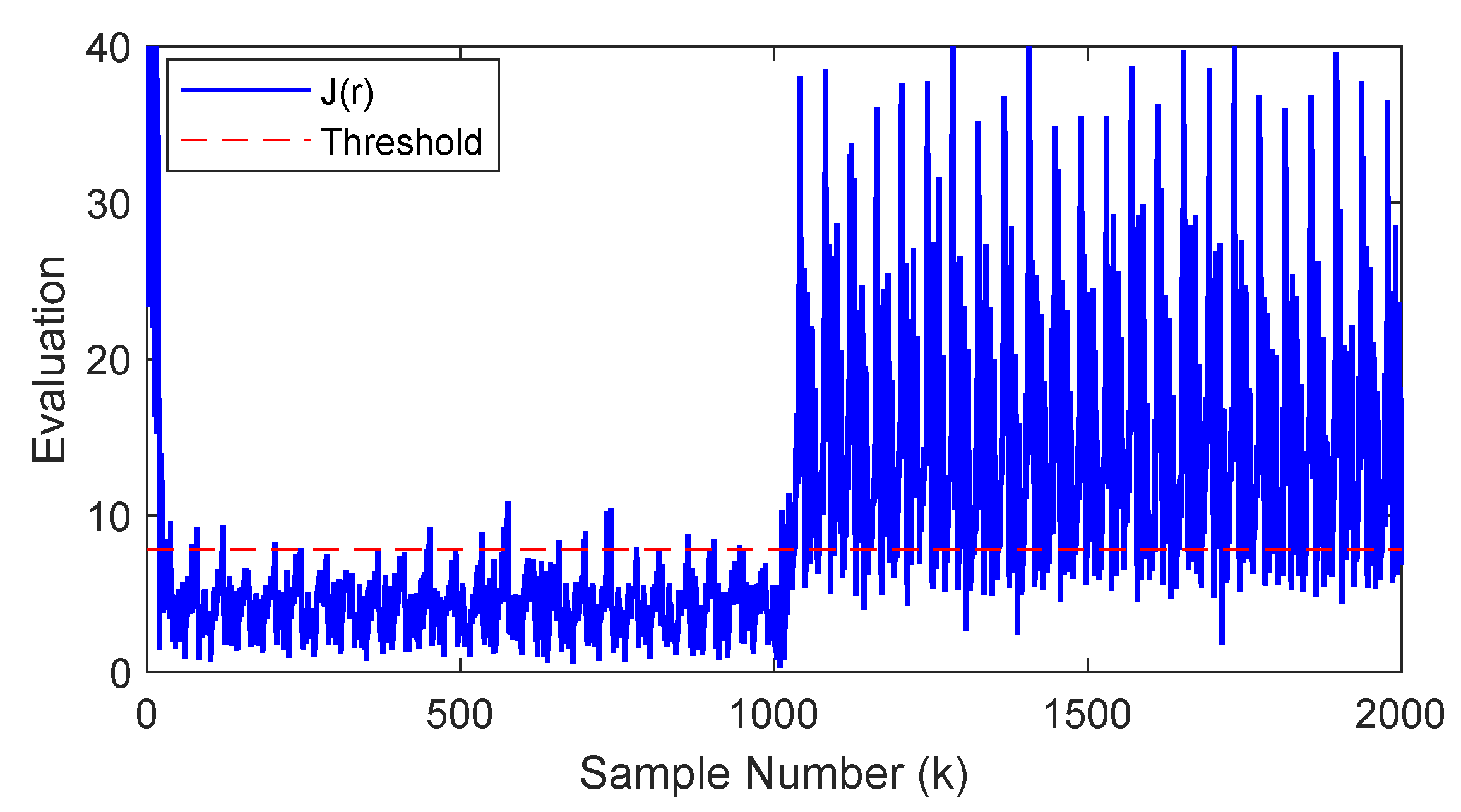
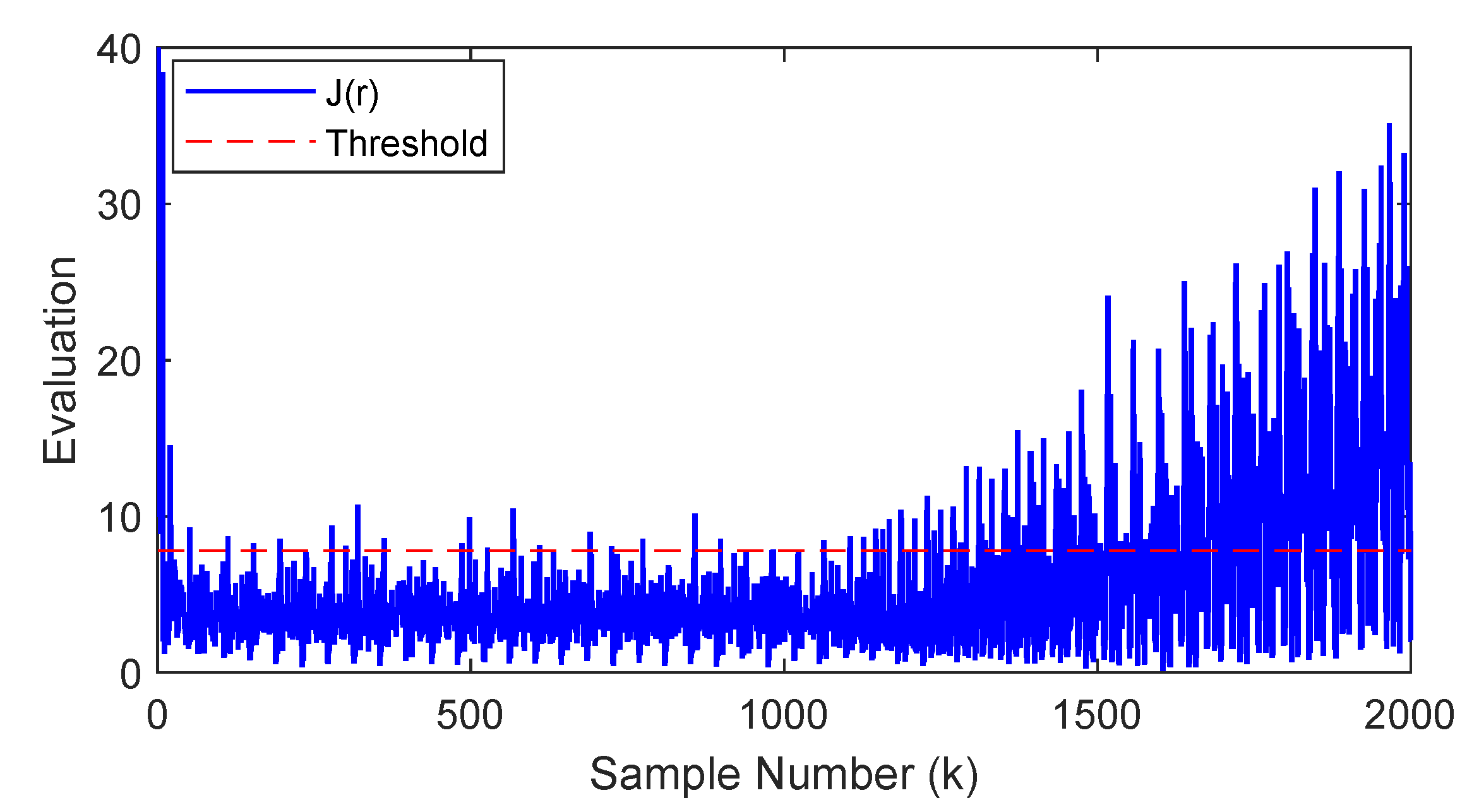
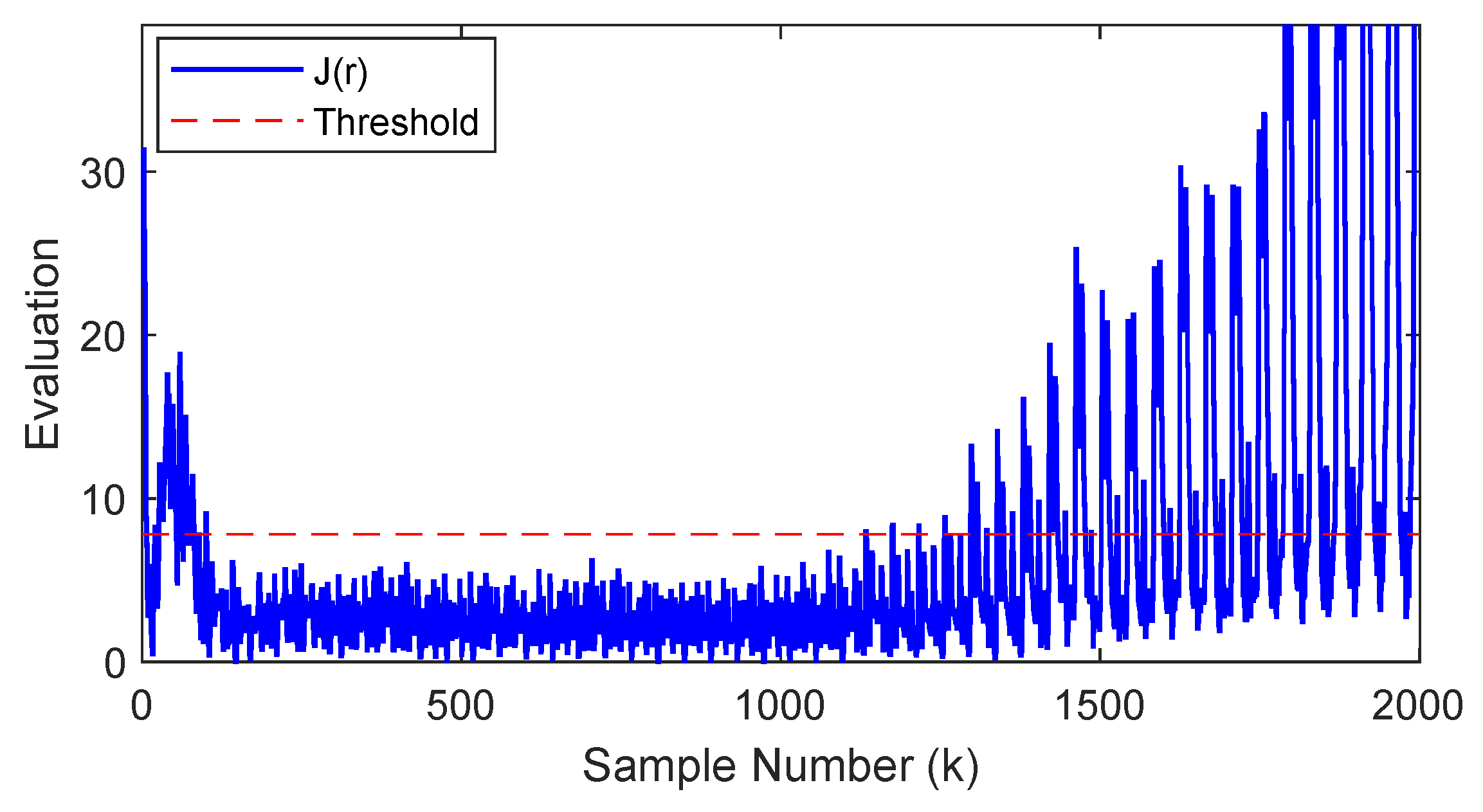
Figure 3. To assess the performance of the proposed approach, two distinct fault conditions are introduced in the traction drive system for analysis. These scenarios capture different operational challenges that may arise in practical applications.
- 1.
An offset fault with a magnitude of 0.1 A is injected into at k = 1001st.
- 2.
A drift fault, defined as = 0.15 (k − 1001) A, is applied to starting from k = 1001st.
To verify the effectiveness of the developed method, a conventional KF-based FD approach [
7], a unscented KF-based FD approach [
12], and an extended KF-based FD approach [
15] are selected as benchmark methods for comparison, with the system matrices considered to be known.
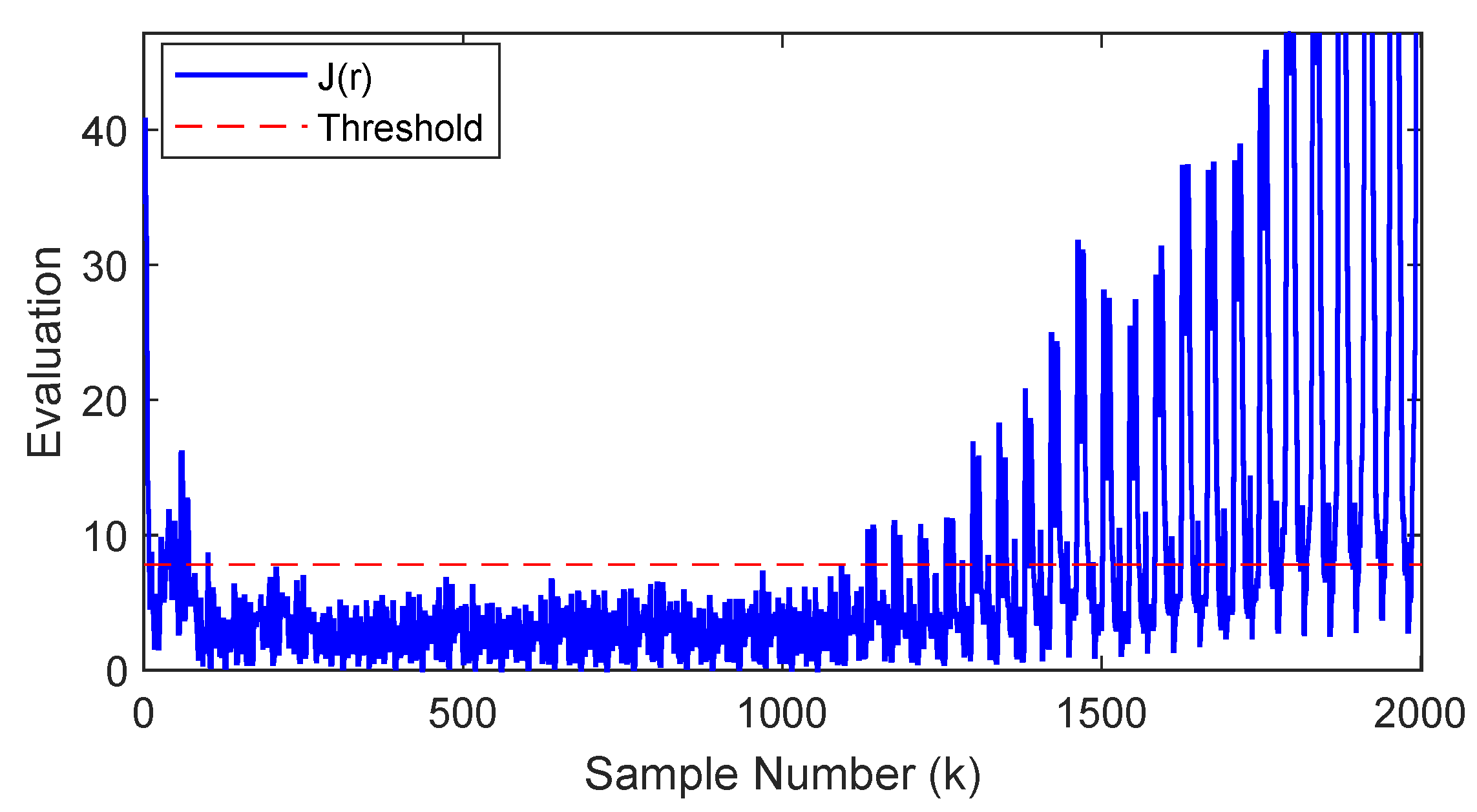
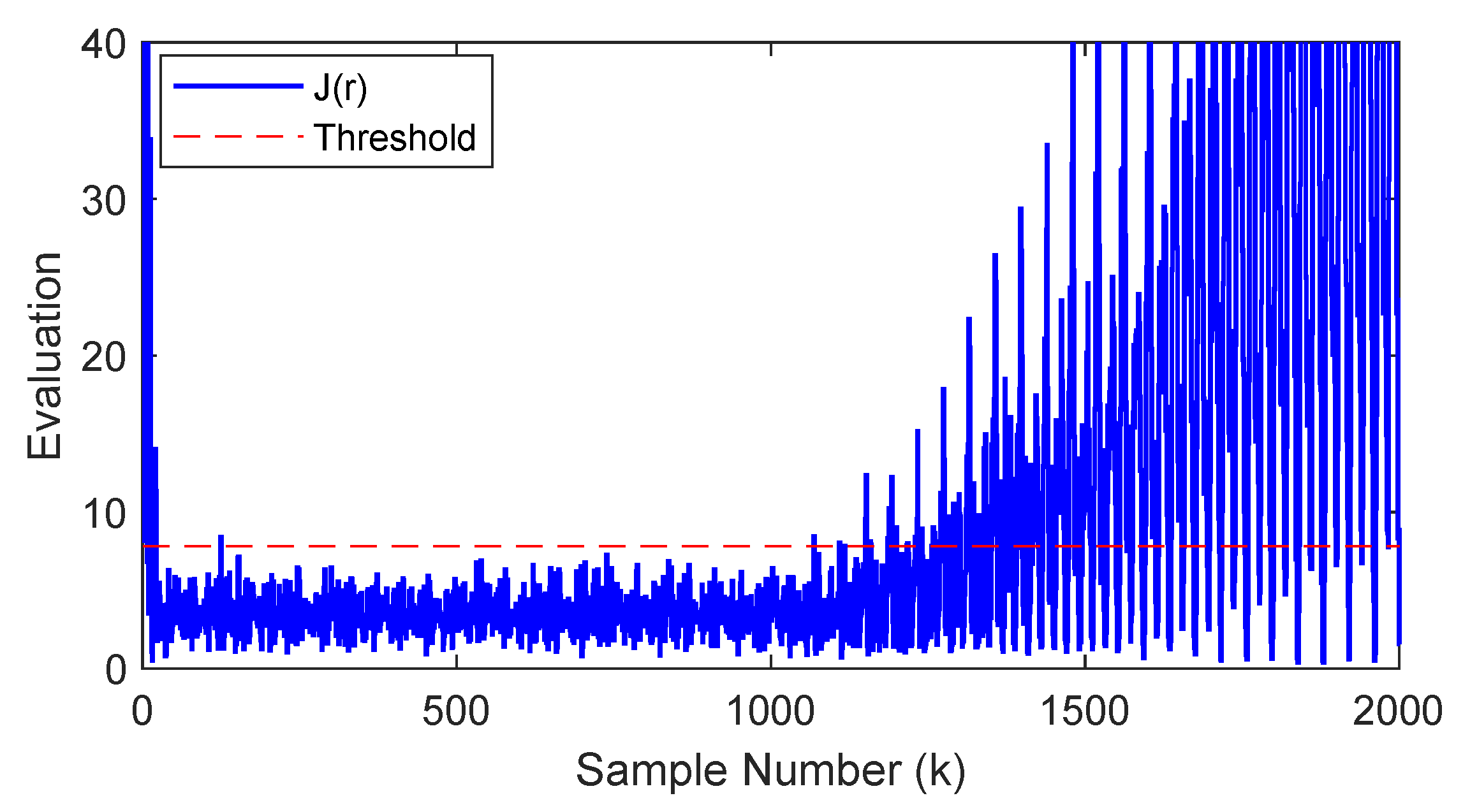
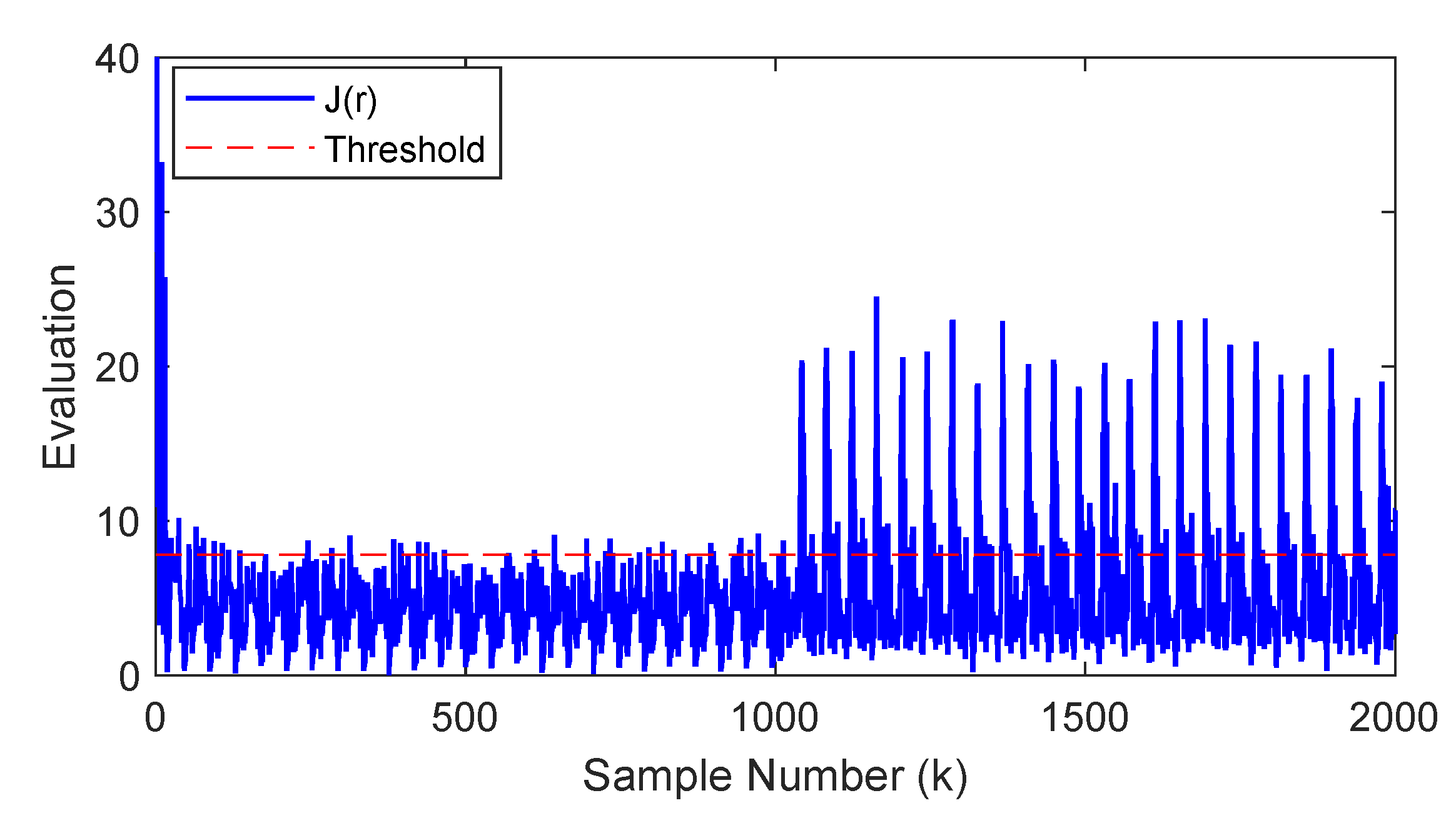
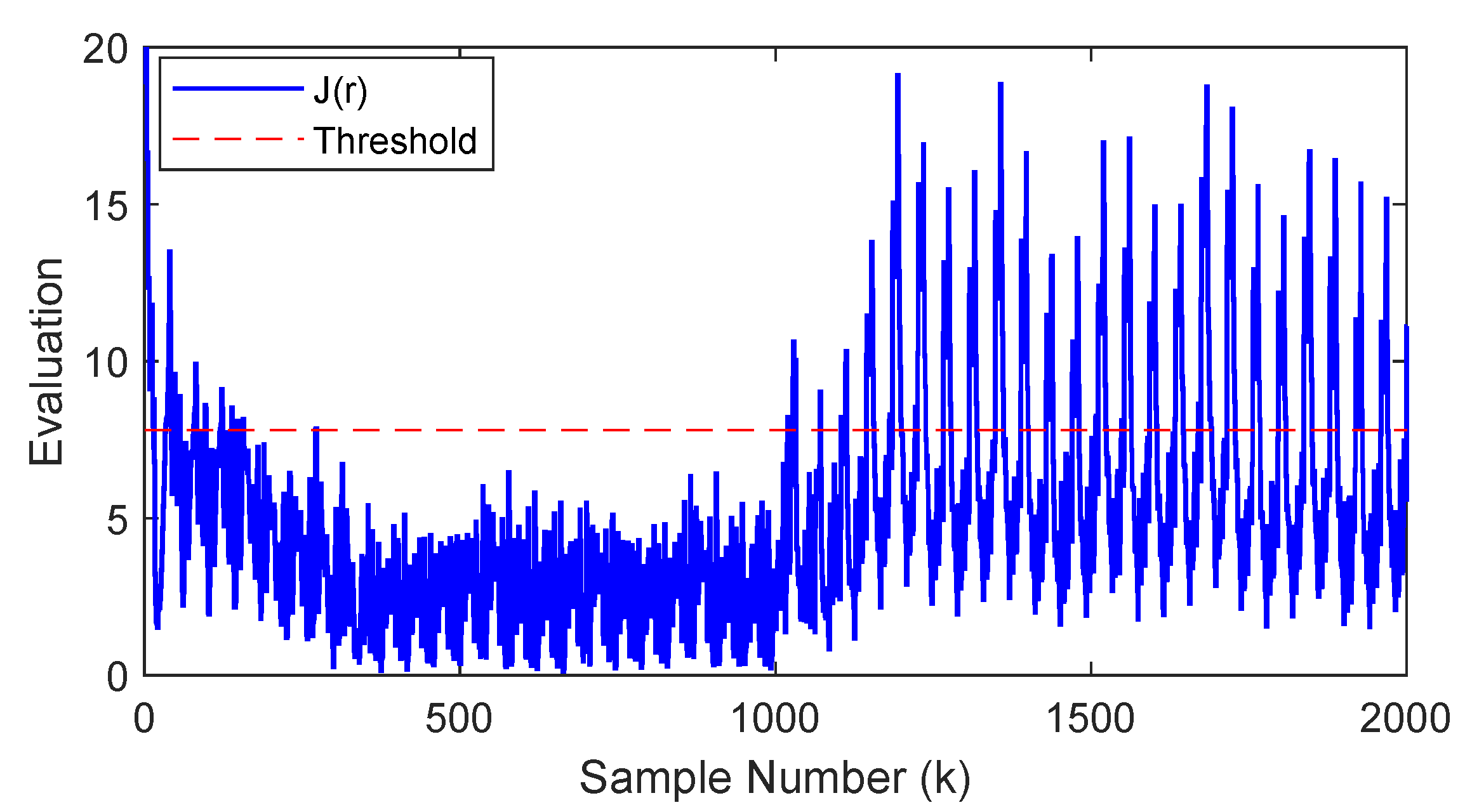
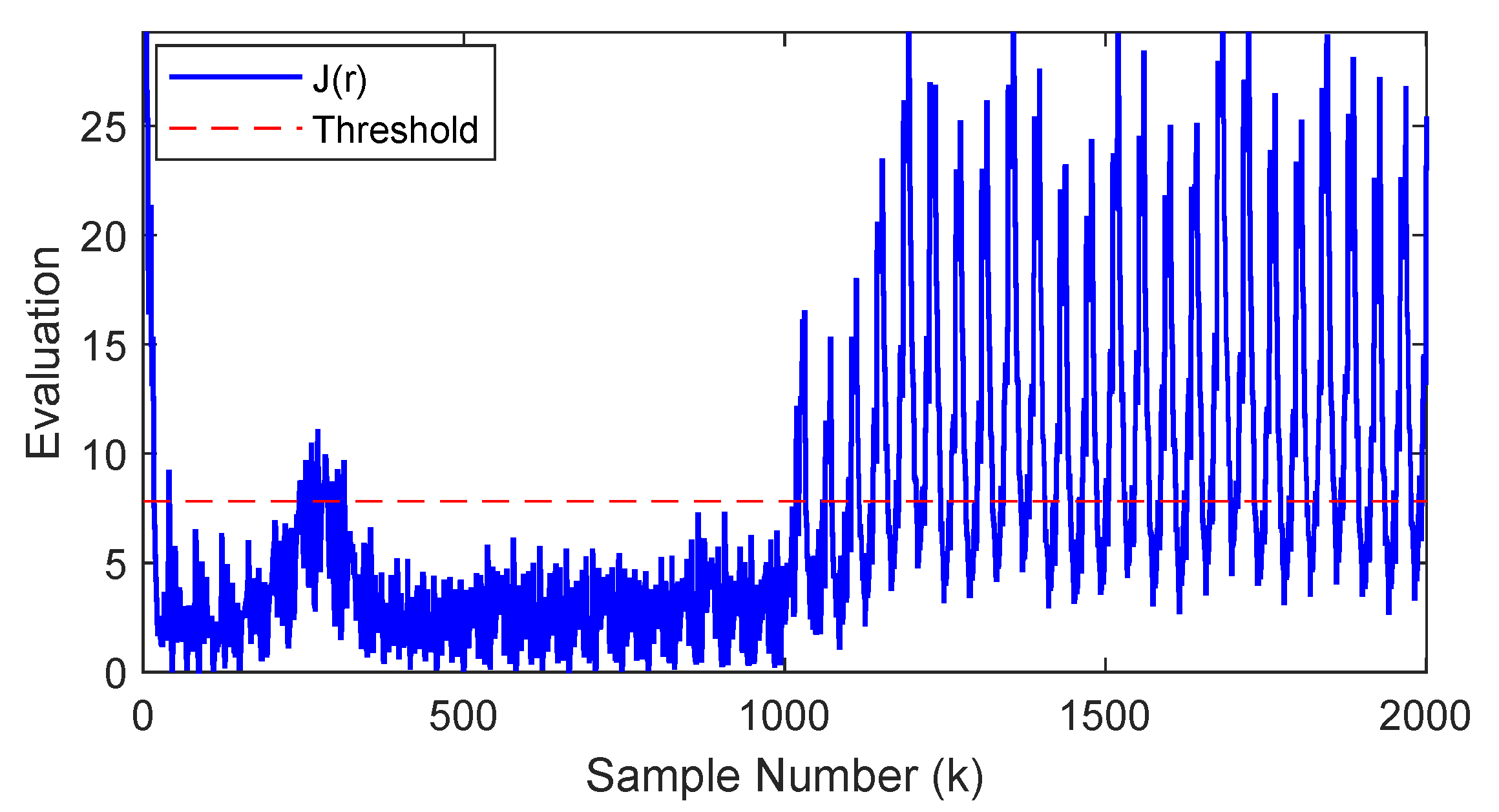
Figure 4,
Figure 5,
Figure 6 and
Figure 7 present the FD results for the offset fault scenario obtained using the three benchmark methods and the proposed data-driven approach, respectively.
Figure 4,
Figure 5 and
Figure 6 indicate that deviations between the prior-assumed noise statistics and the true system noise statistics can impair the FD performance. Although the conventional KF-based, unscented KF-based, and extended KF-based FD methods, as well as the proposed method, exhibit comparable FAR, the three benchmark methods suffer from limited fault detection rates (FDR), resulting in unbalanced detection performance. It is worth noting that the abrupt increase in the test statistic at the beginning mainly results from the initialization transient of the KF rather than the fault itself. The discrepancy between the initial state estimate and the true system state produces large innovations during the initial sampling instants. Because the residual sequence has not yet converged to its steady-state distribution, the test statistic is temporarily amplified, which leads to the observed initial spike. For the proposed method, the FAR remains within the acceptable limit, while the desired detection performance is effectively maintained.
Figure 8,
Figure 9,
Figure 10 and
Figure 11 show the detection results for the drift fault scenario using the three benchmark methods and the proposed approach, respectively. A similar initial spike of the test statistic can also be observed. This phenomenon mainly results from the transient behavior of the iterative algorithm during its initialization stage. Since the parameter estimates have not yet converged in the early iterations, the corresponding test statistic may be temporarily amplified. As observed from the figures, the proposed method exhibits a relatively low FDR for the drift fault scenario. This is mainly attributed to the gradual nature of the drift fault, where the short-term variation in system outputs may still remain within the normal fluctuation range, making early identification difficult. Nevertheless, compared with the conventional KF-based, unscented KF-based, and extended KF-based FD methods, the proposed data-driven method achieves more reliable FD, leading to improved detection performance.
To further demonstrate the effectiveness of the proposed method,
Table 3 provides a quantitative comparison of the performance achieved by the benchmark FD methods and the proposed method. Although using the same identified system matrices as the proposed method, the conventional KF-based, unscented KF-based, and extended KF-based FD methods neglect the mismatch between assumed and actual noise statistics, resulting in degraded monitoring performance. In contrast, the proposed method effectively balances the FAR and FDR. Moreover, it does not rely on precise system modeling, thereby avoiding complex model construction while still achieving the desired detection performance. The results in
Figure 4,
Figure 5,
Figure 6,
Figure 7,
Figure 8,
Figure 9,
Figure 10 and
Figure 11 and
Table 3 demonstrate that, despite using the same identified system matrices, the conventional KF-based, unscented KF-based, and extended KF-based FD methods neglect the mismatch between assumed and actual noise statistics, resulting in degraded detection performance. In contrast, the proposed approach alleviates this limitation through iterative interaction and learning, effectively suppressing the adverse effects caused by noise statistics mismatch.
Although the proposed method achieves satisfactory FD performance, several limitations still remain. First, the current framework is developed based on a linear state-space model, which is derived by linearizing the traction drive system around a stable operating point. Its applicability may be limited under strongly nonlinear conditions when the operating state of the traction drive system varies significantly. On the other hand, the proposed method focuses on FD and does not explicitly address fault-tolerant control. In practical traction drive systems, reliable monitoring should be further integrated with control reconfiguration to ensure safe operation under complex conditions.