1. Introduction
Thin-walled structures have become common components in industrial products, which conforms to the trend of lightweight structures. Thin-walled structures with stiffeners have many advantages such as high strength, high stability, easy processing and a light weight. They have been widely used, such as in automobile bodies, railway rolling stock, ship and underwater vehicles, aircraft, and various important people’s livelihood defense industrial products. However, thin-walled-stiffener coupled structures are often used as shells (such as spacecraft skins [
1], ship bulkheads [
2], high-speed rail bodies [
3], etc.), which have complex stress conditions. While ensuring structural safety, the lightweight design of such structures leads to an increase in structural vibrations and produces a series of vibration and noise problems. In this context, scholars have carried out a lot of research on the vibration response of [
4,
5] and noise control technologies for [
6,
7,
8] thin-walled-stiffener coupled structures. However, traditional noise control technology [
9,
10,
11] (including passive control technology, active control technology and semi-active control technology) often has the defects of large weight increment or high cost, making them difficult to apply to the vibration control of thin-walled-stiffener coupled structures. Ma H A [
12] established a bandgap analysis model for arbitrarily curved stiffened plates considering the fluid–structure interaction effect, revealing the regulation laws of stiffener amplitude and wavelength and the structural parameters of the bandgap characteristics, confirming that the fluid environment has a significant impact on the bandgap behavior of the system. Li [
13] proposed an analytical model based on periodic orthogonal stiffened meta-plates and verified the validity of the model through numerical simulation and experiments; the results showed that the established theoretical model can effectively predict the low-frequency flexural wave bandgaps and vibration isolation performance within a specific frequency range. Tang [
14] proposed a semi-analytical method for analyzing the bandgap characteristics of stiffened plates, and the parametric study indicated that targeted regulation of bandgaps can be achieved by reasonably adjusting the geometric and material parameters; vibration experiments on orthogonal stiffened plates confirmed that significant vibration suppression occurs in the predicted bandgap intervals.
Under the mechanism of Bragg scattering [
15] or local resonance [
16], periodic structures produce vibrational bandgaps (among them, a complete bandgap refers to a frequency interval that exists simultaneously for all wavevector directions on the boundary of the irreducible Brillouin zone, within which elastic waves cannot propagate in any direction. A directional bandgap refers to a frequency interval that exists only along a specific wavevector scanning direction (e.g., Γ-Χ or Χ-Μ direction), within which elastic wave propagation along that direction is suppressed, although wave propagation channels may still exist in other directions.), resulting in the inability of elastic waves within a specific frequency range to propagate through the structure. Such a periodic structure is called a phononic crystal. Because such structures can utilize their inherent characteristics to control elastic waves, this characteristic has made them a research hotspot in the engineering field [
17,
18,
19,
20,
21]. The study of the vibration bandgap characteristics of phononic crystals can guide the design of structural elastic wave control, which is applied to vibration and noise reduction, vibration filtering, and energy recovery, and has broad application prospects [
22]. Thin-walled-stiffener coupled structures are often arranged periodically in engineering applications. By utilizing the inherent bandgap characteristics of these structures, we can achieve efficient passive control of complex loads while meeting lightweight design requirements.
In recent years, scholars have regarded thin-walled stiffened structures as periodic structures, and have adopted a variety of research methods to establish thin-walled stiffened structure models, calculate the bandgap characteristics of the structures, and obtain structural optimization design strategies by setting different key parameters. The methods used include the plane wave expansion method (PWEM) [
13], transfer matrix method (TMM) [
23], central finite-difference method (CFDM) [
24], finite element method (FEM) [
25,
26] and energy method [
14,
27]. The plane wave expansion method solves the characteristic equation by bringing the periodic structure conditions into the structural wave equation, which requires a lot of operations and is difficult to use when dealing with complex coupled structures. The transfer matrix method has high practicability only when dealing with one-dimensional structures, but it faces challenges when dealing with complex three-dimensional coupled structures. The central finite-difference method applies periodic boundary conditions to the structure based on the Bloch theorem and solves the structural differential equations through numerical methods. This method has significant advantages in solving time-domain problems, but it requires repeated calculations when computing entire band structures, resulting in high computational cost when calculating entire bandgap structures. FEM can calculate the bandgaps of various complex coupled structures and is a very comprehensive analysis method. However, when using FEM to analyze the influence of structural parameters on the band structure, remeshing and recalculation are required every time a structural parameter is changed, leading to limited efficiency in geometric parameter analysis and bandgap optimization calculations. Although the aforementioned bandgap calculation methods perform well in specific applications, they often suffer from high modeling complexity, massive repetitive computations and rising computational costs when applied to bandgap optimization of complex coupled structures. These limits the efficiency of optimal design to a certain extent and can hardly fully meet the requirements of high-efficiency analysis.
The energy method can transform the boundary value of the differential equation into the extreme value of the energy functional in dealing with the coupling problem of the structural boundary. It can greatly reduce the complexity of the operation and has higher computational efficiency. It is the most widely used method for calculating the bandgap characteristics of stiffened plates. However, the traditional energy method, such as the Rayleigh–Ritz method [
28], requires recalculation of the mass and stiffness matrices in each calculation iteration, resulting in long computation times. Some studies have proposed to use the virtual spring method to simulate the periodic boundary [
29,
30], which is used to separate the periodic boundary condition from the shape function coupling and improve the computational efficiency. However, the stiffness value selection of the virtual spring is empirical. An inappropriate value may lead to non-convergence of results in the worst case. Meanwhile, there is a certain difference in the appropriate stiffness value of the virtual spring when calculating the high-frequency band and low-frequency band. Therefore, this method also has certain limitations when calculating the broad bandgaps.
The null-space method(NSM) can directly calculate the bandgaps of coupled structures via the interface force balance and displacement compatibility relationships [
31,
32]. It can not only separate periodic boundary conditions from shape functions, but also is not restricted by the stiffness value of the virtual spring, which can greatly improve the computational efficiency of the model while maintaining accuracy. Therefore, the NSM has significant advantages over other computational methods when it comes to bandgap optimization calculations for structural parameter analysis.
Against the backdrop of rapid development in materials science and structural design, advanced lightweight structures such as honeycomb structures, lattice structures, and mechanical metamaterials have exhibited great potential in the field of vibration and acoustic regulation. Through the precise design of topological configurations and microstructures, such structures can achieve special physical properties not possessed by natural materials, providing new approaches for vibration and noise reduction. Song [
33] systematically investigated the free vibration characteristics of bionic sandwich structures, revealing the significant influence of structural configuration and boundary conditions on the distribution of vibration modes, and discussed the effects of parameters such as boundary conditions on the natural frequencies and mode shapes of the structure. Xu [
34] designed a dumbbell-shaped chiral metamaterial, revealing the synergistic mechanism of the inertial amplification effect and compression–torsion coupling on the formation of ultra-wide bandgaps, and further explored the influence of structural configurations and their torsional variants on multi-polarized vibration attenuation. Hasan M [
35] systematically studied the vibration reduction performance and structural stability of honeycomb structures under dynamic loads and elaborated on various forms of honeycomb structures and their evolutionary trends in modern engineering vibration reduction applications. The above studies indicate that the combination of periodic design concepts with advanced lightweight structures has become an important development direction in the field of structural vibration and acoustic control. Given the outstanding efficiency of the NSM in the parametric analysis of complex three-dimensional periodic coupled structures, it possesses broad application prospects in the efficient theoretical modeling and optimization of advanced lightweight periodic structures.
In this paper, the NSM is adopted to establish a model of a typical periodic rectangular thin-walled stiffened structure based on the Kirchhoff thin-plate theory. The vibration bandgap characteristics are calculated and compared with the results obtained by the finite element method to verify the accuracy and efficiency of the proposed method. On this basis, the influences of key geometric parameters on the position and width of bandgaps are further analyzed, and the optimal design strategies for specific frequency bands are discussed. In the conclusion and outlook, the application potential of the NSM in the efficient theoretical modeling and optimization of periodic advanced lightweight structures is explored. The modeling and analysis of periodic coupled structures using the NSM can effectively improve the computational efficiency of bandgap optimization for conventional structures. Future work will further focus on advanced lightweight complex three-dimensional periodic coupled structures to carry out research on more efficient theoretical modeling and optimization calculations.
2. Theoretical Analysis
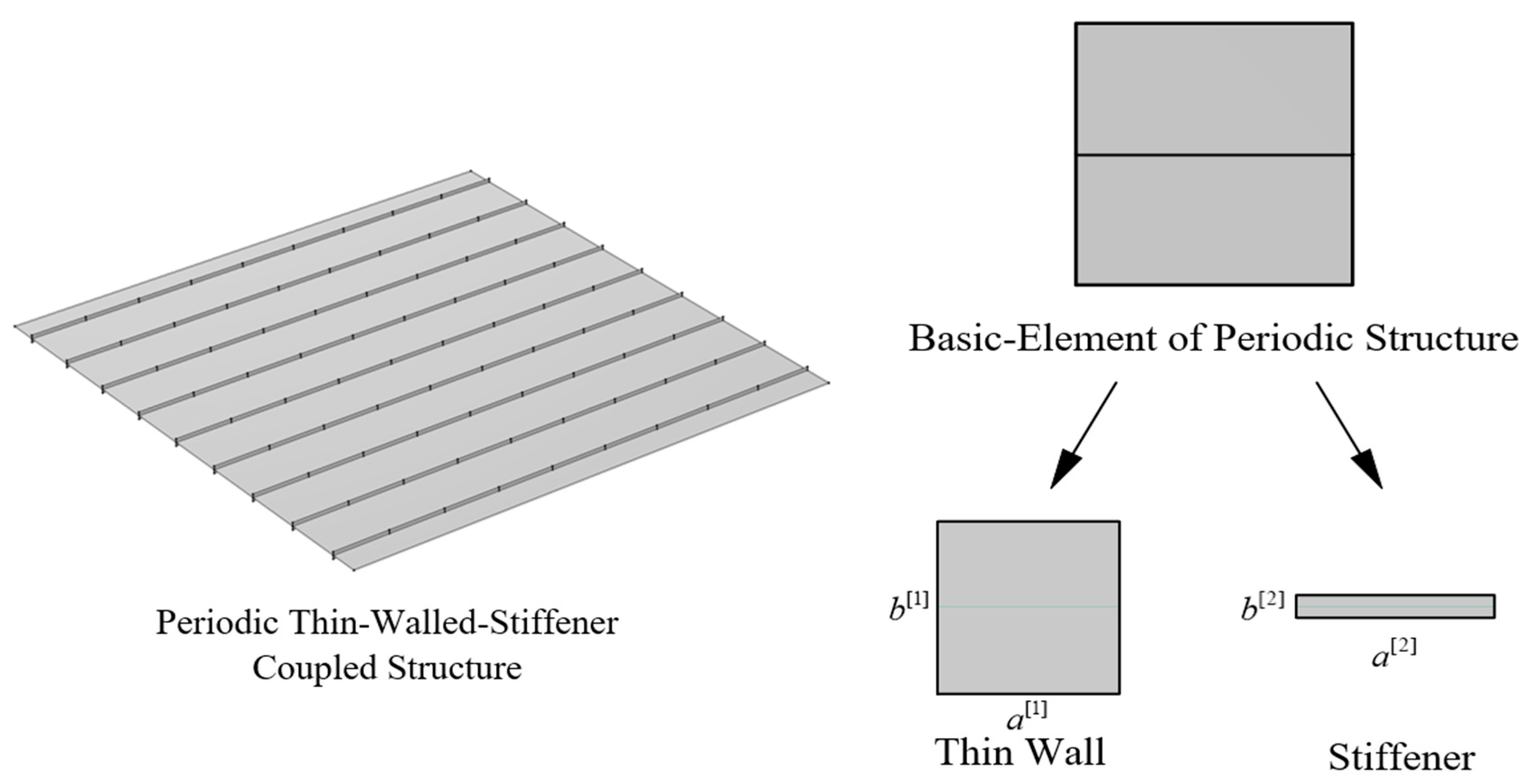
The typical periodic rectangular thin-walled-stiffener coupled structure is regarded as a two-dimensional periodic structure, and its primitives are shown in
Figure 1. The element is regarded as the coupling structure of thin wall and stiffener. Both plates are considered Kirchhoff–Love plates, and the Cartesian coordinates of the thin-wall plate and stiffener plate are independent of each other.
The vertical displacements of the plates can be expressed as
In the formula,
j = 1, 2, the superscript (
j) is used to represent different plate parameters; the superscript (1) indicates the quantities associated only with the thin wall, and the superscript (2) indicates the quantities associated only with the stiffener;
ϕ and
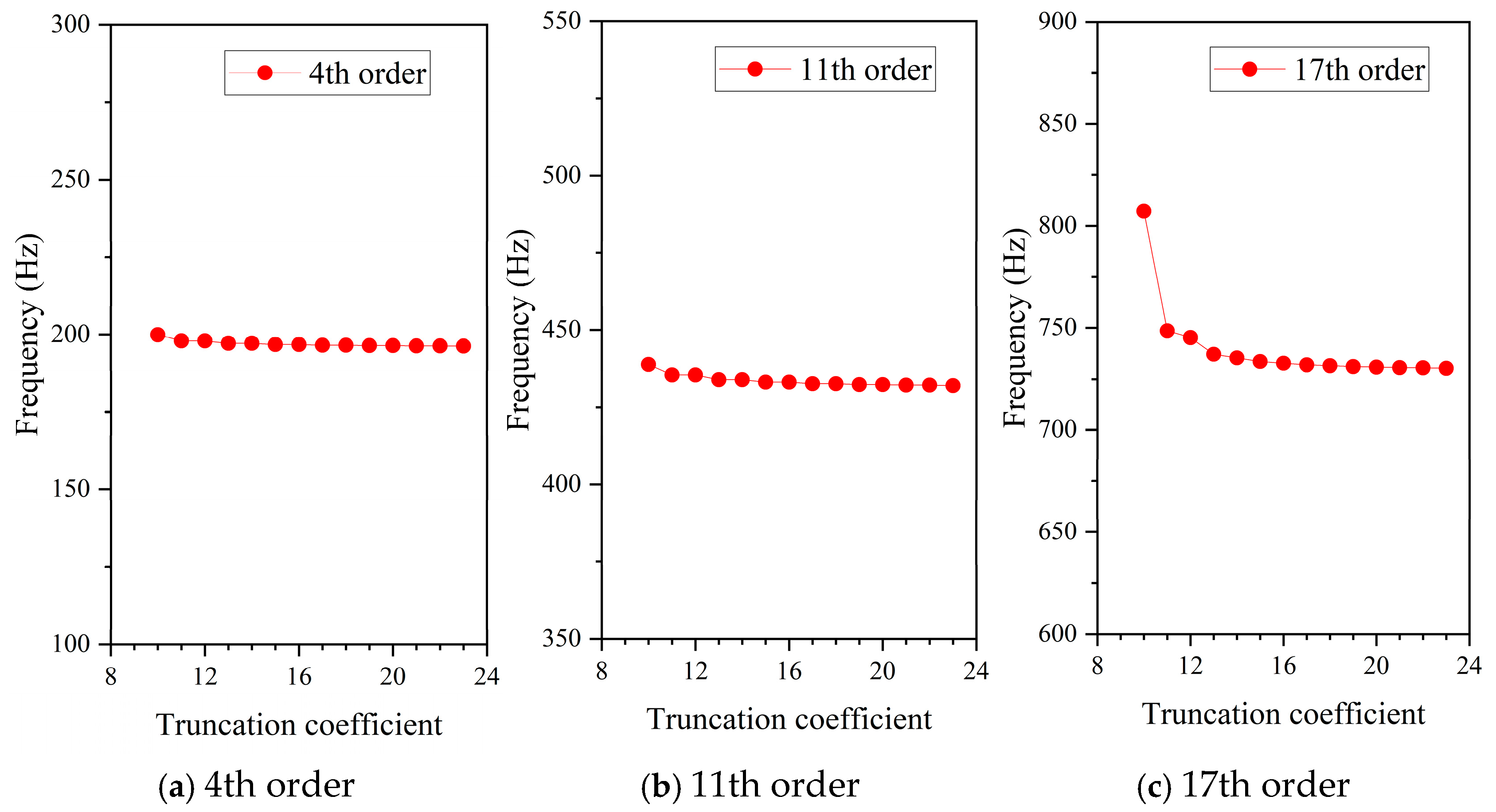
φ are the shape functions of the plates in the x and y directions, respectively, which are composed of multi-row basis functions; M and N are the truncation coefficients of the shape functions in the x-direction and y-direction, respectively; The symbol ⊗ is Kronecker product. The Chebyshev series is selected as the basis function of the plate:
The value range of x in the formula is , and the value range of y is .
According to the Kirchhoff-Love theory, the kinetic energy and strain energy of the plate can be written as:
In the formula,
and
represent the material density and Poisson‘s ratio, respectively. Because the material parameters of the thin wall and the stiffener are consistent, the superscript is not distinguished;
is the bending stiffness of the plate;
is the elastic modulus of the material; when no boundary conditions are considered, the total energy functional of the two plates can be expressed as
The boundary conditions of the coupled structure are composed of coupling boundary conditions and periodic boundary conditions. Due to the coupling of in-plane and out-of-plane vibrations in the spatial coupled plate model, it is necessary to further consider the out-of-plane vibration displacement fields of each plate in the spatially coupled plate model, which is expressed as
Among them,
and
are the out-of-plane vibration displacement functions of the plate along the x-direction and the y-direction, respectively, and the basis functions also use the Chebyshev series. In order to ensure that the dimension of the in-plane vibration mass stiffness matrix is the same as that of the out-of-plane vibration, the energy functional of the plate without considering the boundary is expressed as
where
is the total undetermined coefficient matrix.
According to the displacement compatibility relationships between the displacements and rotation angles of the thin wall and stiffener, the expression of the coupling boundary condition is
The unknown variable
x is discretized into Q points
x1,
x2, …,
xQ to solve the boundary. After discretization, the coupled boundary conditions can be expressed as
For two-dimensional structures, according to the Bloch theorem, wavevector
. The periodic boundary conditions of the thin-walled-stiffener coupled structure can be written as (only considering the Z-direction displacement):
Taking the basis functions as weighted integral functions and using the Galerkin method to deal with the periodic boundary conditions, the following can be obtained:
When Equations (9), (12) and (13) are expressed in matrix form, the boundary condition equations of the coupled plates can be obtained as follows:
In the formula,
is a
matrix, which contains all the boundary conditions of the coupled plate. Using the NSM, by solving the fundamental solution sets of the boundary condition matrices
, the expression of the unknown coefficient matrix
is obtained. The expression is
where
is the unknown coefficient column vector of the basic solution system of Equation (14), and
is the matrix of the basic solution system arranged in rows. Bringing Equation (15) into Equation (7) can get
According to the Lagrange equation
, the total energy functional Π is varied:
Since is related to time, it can be seen that is also related to time. Thus, can be expressed as ; is the circular frequency; is a column vector of unknown coefficients, e is a natural constant, and i is an imaginary unit. The characteristic equation can be written according to Equation (17):
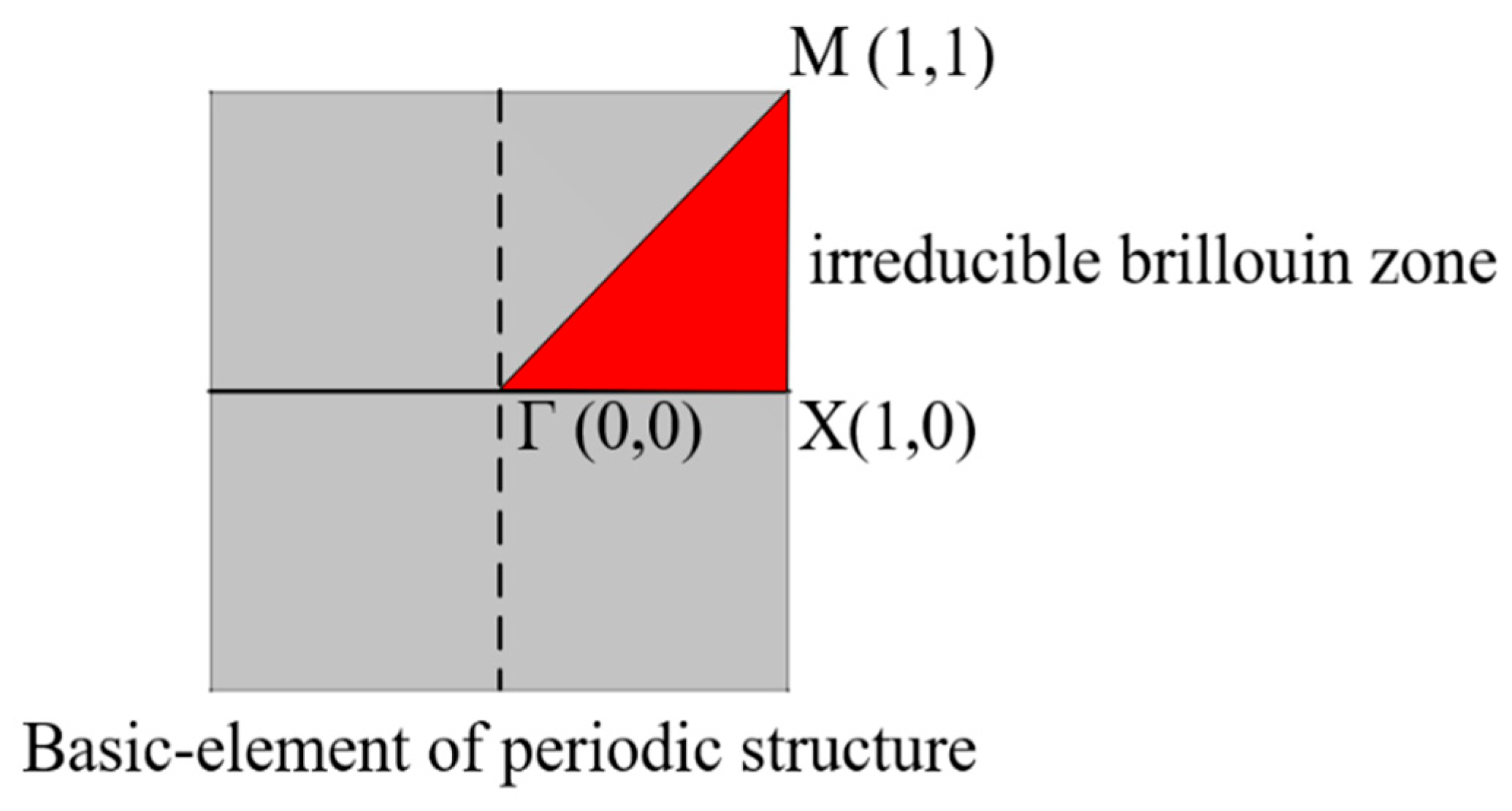
As shown in
Figure 2, by sweeping the irreducible Brillouin zone boundary of the wavevector
and decomposing the eigenvalues, the energy-band diagram of the periodic rectangular thin-walled-stiffener coupled structure can be derived.
The NSM can directly calculate the bandgaps of coupled structures through the interfacial force balance and displacement compatibility relations. By uniformly assembling the coupled boundary conditions and periodic boundary conditions into a boundary constraint matrix and directly solving the null-space basis vectors of this matrix, the method analytically separates the boundary conditions from the energy functional via null-space transformation, thus realizing the decoupling of boundary conditions and displacement shape functions. For periodic stiffened plates with more complex coupling forms such as T-shaped stiffening, L-shaped stiffening, curved stiffening or combined stiffening of multiple types, the NSM only needs to redefine the displacement compatibility relations of the coupled boundaries to construct the coupled periodic structural model, which demonstrates great potential for popularization and application in more complex engineering structures.
4. Analysis of Key Structural Parameters
In this section, by analyzing the band structure of periodic thin-walled stiffened structures from 0 to 400 Hz under different key parameters, the influence of this parameter on the bandgap characteristics of the structure is summarized. The key parameters include thin-wall thickness , stiffened thickness , stiffened width and adjacent stiffener spacing . The default values of the parameters used in this example are the same as those in the previous section without declaration.
4.1. The Influence of Thin-Wall Thickness on the Band Structure
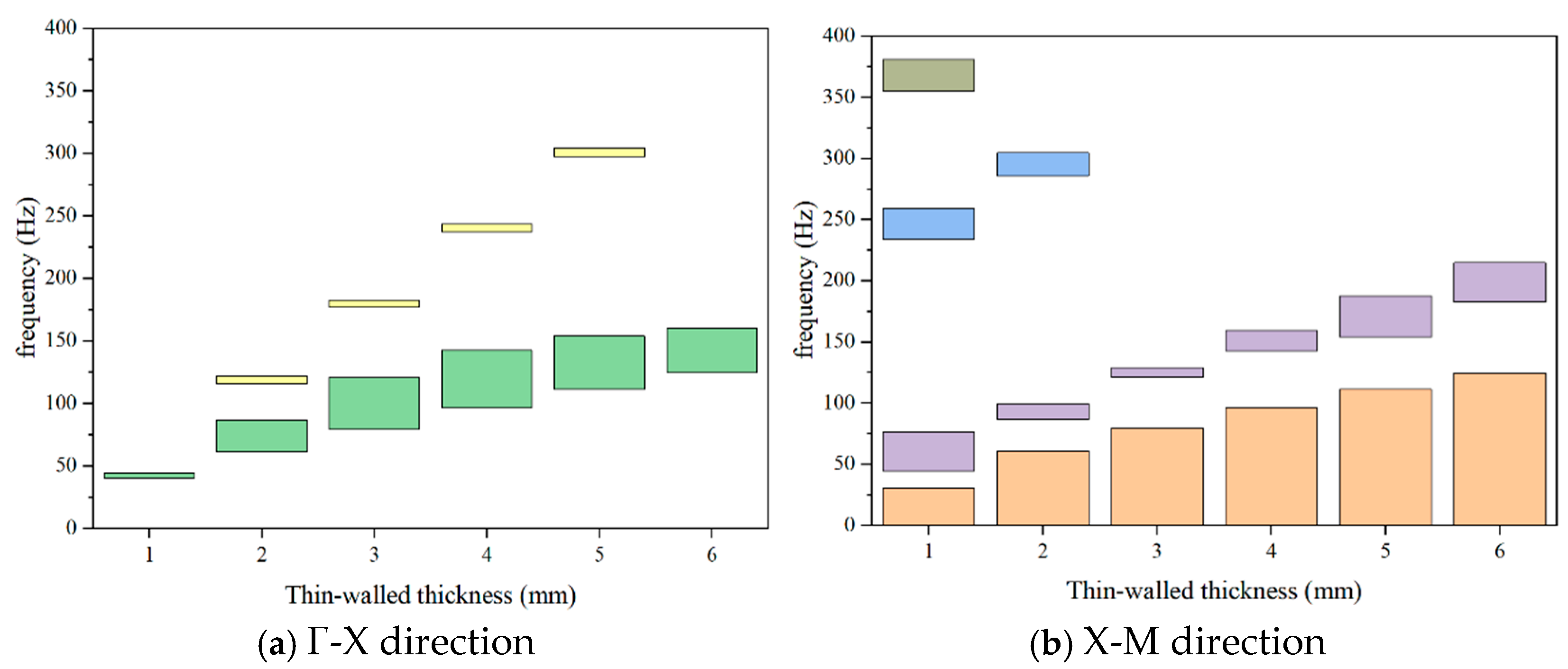
First, the influence of thin-wall thickness on the band structure is calculated. The band structures for different thin-wall thicknesses
are computed, all bandgaps are extracted, and the bandgap characteristics for different wavevector scanning directions are plotted as shown in
Figure 5. In the figure, the
x-axis represents different thin-wall thicknesses, which increase from 1 mm to 6 mm; the
y-axis represents frequency in Hz. The bottom of each bar corresponds to the starting frequency of the bandgap, and the top corresponds to the cutoff frequency of the bandgap.
Figure 5a shows the bandgap characteristics for six different thin-wall thicknesses when the wavevector scanning direction is Γ–X, i.e., the wavevector scans from (0, 0) to (1, 0).
Figure 5b shows the bandgap characteristics for six different thin-wall thicknesses when the wavevector scanning direction is X–M, i.e., the wavevector scans from (1, 0) to (1, 1).
By comparing the bandgap calculation results for different thin-wall thicknesses, it can be found that the typical periodic thin-wall structure exhibits no complete bandgap in the 0–400 Hz frequency range, only directional bandgaps. As the thin-wall thickness increases from 1 mm to 6 mm, the number of directional bandgaps within 0–400 Hz decreases from 5 to 3, the average width of a single bandgap widens from 23.3 Hz to 64 Hz, and the lowest-frequency bandgap along the Χ-Μ direction expands from 0 to 30.4 Hz to 0–124.4 Hz. This is because the bending stiffness of a thin plate is proportional to the cube of its thickness. As the thin-wall thickness increases, the equivalent bending stiffness of the structure is significantly improved, shifting its overall energy-band characteristics toward higher frequencies. The enhanced overall structural stiffness strengthens the wave impedance in the low-frequency range and intensifies the Bragg scattering effect, thereby significantly broadening the low-frequency directional bandgaps.
The significant broadening effect of thin-wall thickness on low-frequency bandgaps makes it an optimal control parameter for engineering structures targeting low-frequency vibration control, such as ship bulkheads. On the premise of considering economy, appropriately increasing the thin-wall thickness can effectively broaden the directional bandgaps in the 0–200 Hz frequency band, thereby suppressing the propagation of low-frequency elastic waves and reducing underwater radiated noise.
4.2. The Effect of Stiffened Thickness on Band Structure
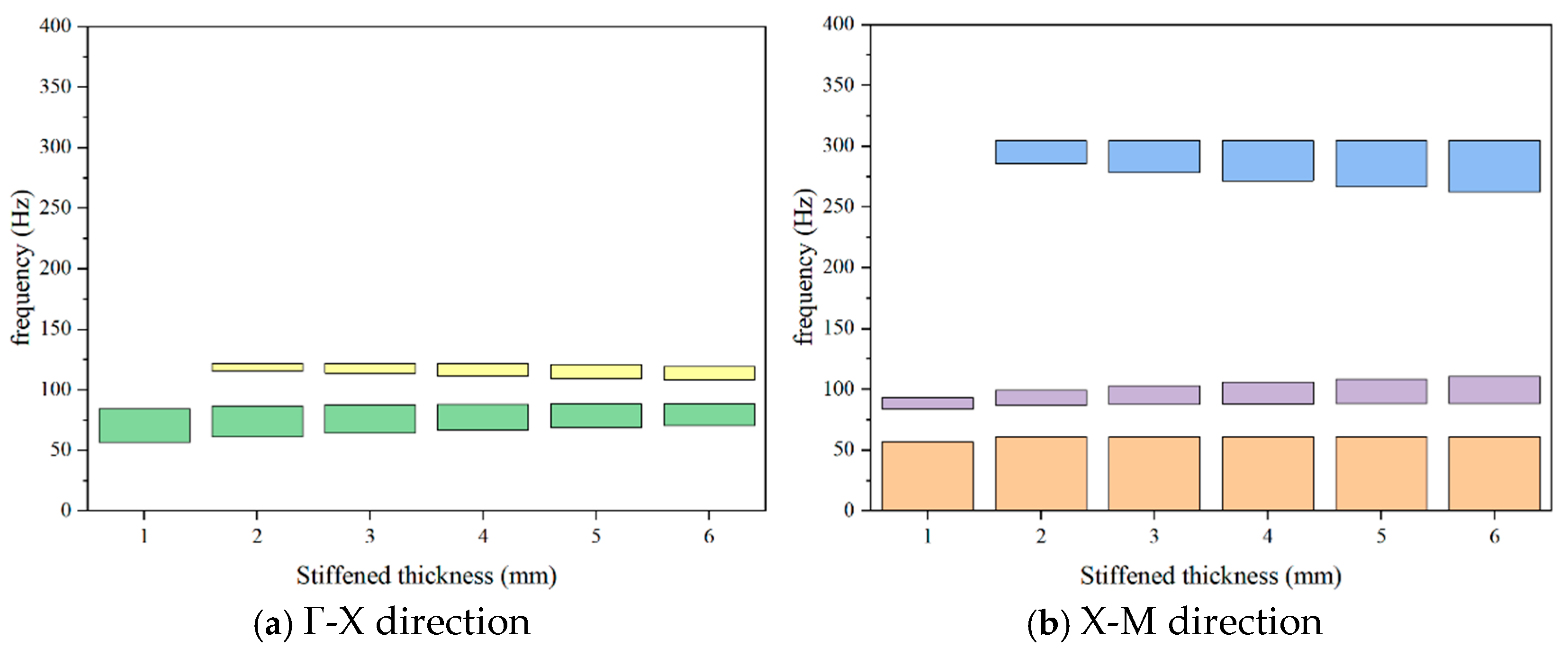
The influence of stiffened thickness on the band structure is investigated. Band structures for different stiffened thicknesses are calculated and all bandgaps are extracted. The bandgap characteristics for different wavevector scanning directions are plotted in
Figure 6. In the figure, the x-axis represents different stiffened thicknesses
ranging from 1 mm to 6 mm. The bottom of each bar corresponds to the starting frequency of the bandgap, while the top corresponds to the cutoff frequency of the bandgap.
By comparing the bandgap calculation results for different stiffened thicknesses, the following conclusions can be drawn. The stiffened thickness exerts a dual optimization effect on the bandgap characteristics. As the thickness increases from 1 mm to 6 mm, the number of directional bandgaps within 0–400 Hz rises from 3 to 5, while the average bandgap width remains relatively stable, ranging from 30 Hz to 35 Hz. However, the bandgap in the medium-high frequency range (200–400 Hz) expands from 0 to 42 Hz, with an average increase of 7 Hz per 1 mm increment in thickness. In contrast, the broadening effect on bandgaps in the medium-low frequency range (0–200 Hz) is negligible, less than 1 Hz. This is because the increase in stiffened thickness significantly enhances the bending stiffness of the stiffeners themselves, enlarging the impedance difference between the stiffeners and the thin plate, and strengthening the Bragg scattering effect induced by the stiffeners. As a result, more frequency bands satisfy the Bragg scattering condition with increasing stiffened thickness, leading to an increase in the number of directional bandgaps. Since the wavelength of elastic waves is shorter in the medium-high frequency range, the broadening of high-frequency bandgaps is particularly pronounced.
The dual optimization effect of stiffened thickness on both the quantity and width of high-frequency bandgaps renders it highly valuable for engineering applications where stringent control over mid-to-high frequency vibration and noise is required, such as aircraft skins and high-speed train car bodies. Such structures are typically subjected to mid-to-high frequency loads (e.g., aerodynamic noise), with vibration energy concentrated in the mid-to-high frequency range. Increasing stiffened thickness enables the development of mid-to-high frequency bandgaps from scratch and an increase in bandgap quantity—all without a notable rise in structural weight—thereby achieving effective regulation of elastic waves in the mid-to-high frequency band.
4.3. The Effect of Stiffened Width on Band Structure
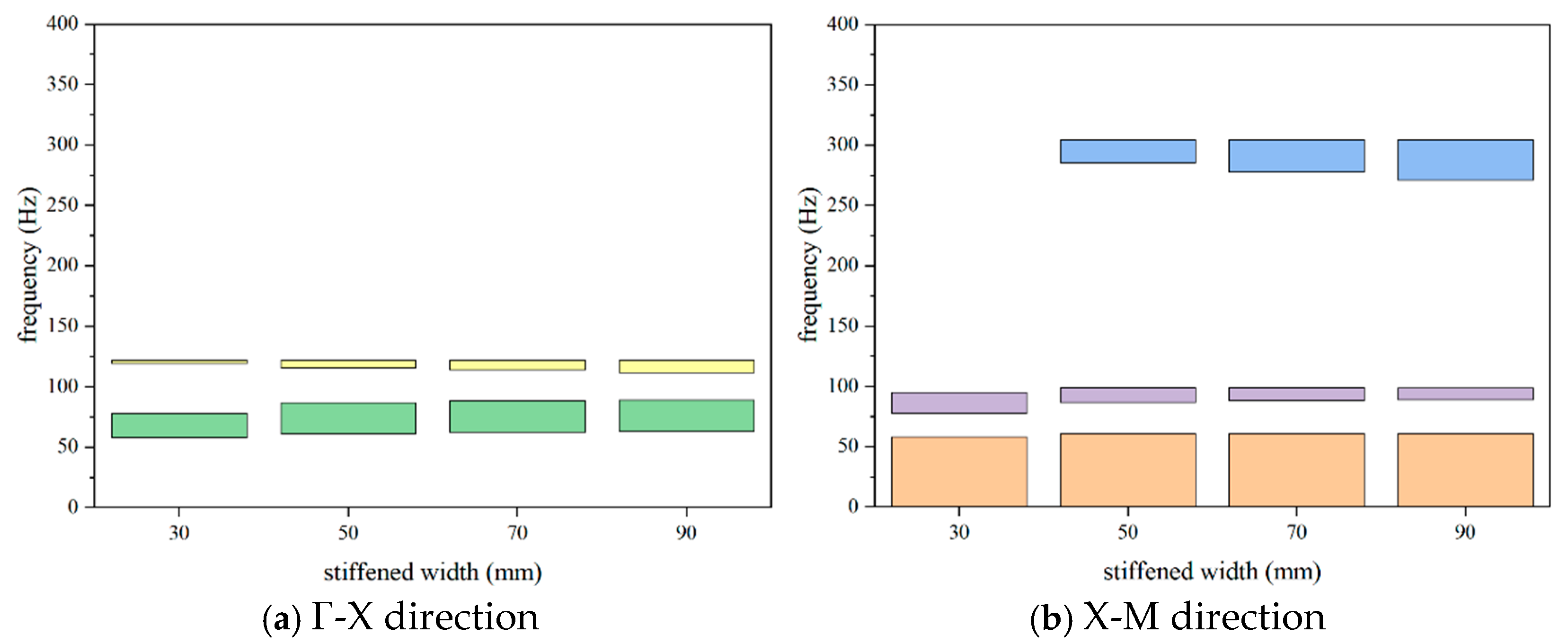
Next, the influence of stiffened width on the bandgap results is observed. Band structures for different stiffened widths are calculated and all bandgaps are extracted. The bandgap characteristics for different wavevector scanning directions are plotted in
Figure 7. In the figure, the x-axis represents different stiffened widths
, which increase from 30 mm to 90 mm. The bottom of each bar corresponds to the starting frequency of the bandgap, and the top corresponds to the cutoff frequency of the bandgap.
By comparing the energy-band results for different stiffened widths, it can be concluded that the stiffened width only regulates the width of directional bandgaps and has no significant effect on the number of bandgaps. As the height increases from 30 mm to 90 mm, the average width of a single bandgap widens from 21.6 Hz to 27.9 Hz, with a relatively small overall broadening amplitude, and the effect in the high-frequency range is slightly stronger than that in the low-frequency range. This is because the increase in stiffened width strengthens the rotational constraint of the stiffeners on the thin plate. Nevertheless, since the stiffened width does not change the material properties or thickness ratio between the stiffeners and the thin plate, the variation in their impedance ratio is limited, and the enhancement of periodic modulation intensity is insignificant. Therefore, the number of bandgaps remains basically unchanged, and the width broadening amplitude is also relatively modest.
The limited regulatory effect of stiffened width on bandgap width indicates that this parameter should be used as an auxiliary optimization variable in engineering applications. Moreover, in scenarios with extremely strict weight requirements, increasing the stiffened width may have an adverse impact on the overall dynamic characteristics of the structure. Therefore, the stiffened width can be moderately increased to fine-tune the bandgaps only when a small adjustment of the bandgap width is needed and the weight requirements are relatively loose.
4.4. The Effect of Adjacent Stiffener Spacing on the Band Structure
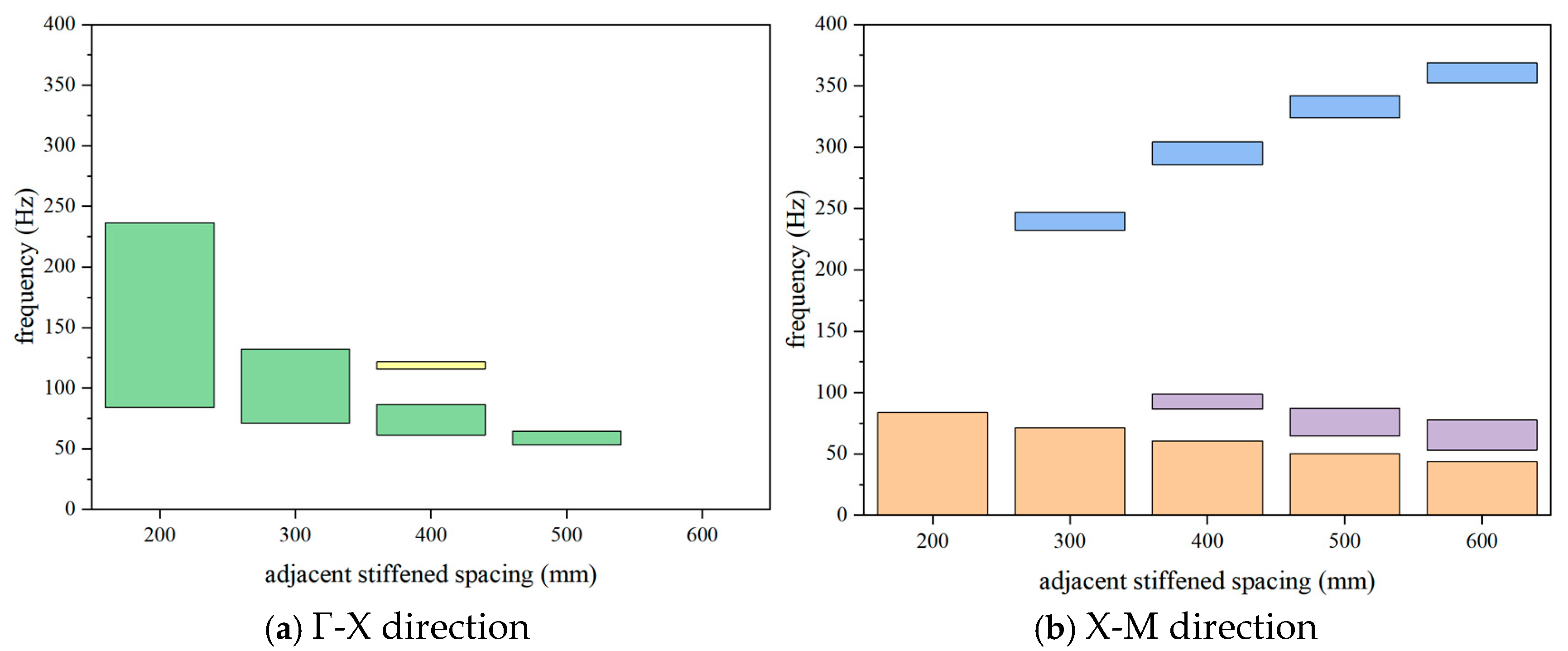
Finally, we compare the influence of adjacent stiffener spacing on the bandgap results. Band structures with different adjacent stiffener spacing values are calculated and all bandgaps are extracted. The bandgap characteristics for different wavevector scanning directions are plotted in
Figure 8. In the figure, the x-axis represents different adjacent stiffener spacing
values, which increase from 200 mm to 600 mm. The bottom of each bar corresponds to the starting frequency of the bandgap, and the top corresponds to the cutoff frequency of the bandgap.
By comparing the bandgap calculation results for different adjacent stiffener spacings, it can be seen that the adjacent stiffener spacings are significantly negatively correlated with the bandgap width. As the spacing increases from 200 mm to 400 mm, the number of directional bandgaps in the 0–400 Hz range rises from 2 to 5, and the average width of a single bandgap narrows from 66 Hz to 24.7 Hz. When the spacing further increases from 400 mm to 600 mm, the number of directional bandgaps in the 0–400 Hz range decreases from 5 to 3, and the average width of a single bandgap narrows from 24.7 Hz to 22.8 Hz. The reason for this phenomenon is that the smaller the spacing between stiffeners, the more frequent the impedance changes per unit length and the stronger the Bragg scattering effect, leading to a significant increase in bandgap width. However, when the spacing is excessively large, the stiffener coverage ratio becomes too low and the structure tends to be homogeneous, making it difficult to satisfy the Bragg scattering condition. This results in the simultaneous degradation of both the number and width of bandgaps. Therefore, the bandgap characteristics deteriorate when the spacing exceeds 400 mm.
The influence law of adjacent stiffener spacing on the bandgap characteristics of stiffened plate structures provides design guidance for structures that are required to be both structurally lightweight and compliant with strict vibration and noise standards, such as high-speed rail car floors and automobile bodies. Due to the usual constraints of weight and space on such structures, the number of stiffeners should not be excessive. However, if the spacing exceeds the critical value for the structure to produce the Bragg scattering effect, there will be a risk of a “double decline” in the number and width of bandgaps, leading to a significant deterioration of vibration reduction performance. Therefore, the adjacent stiffener spacing should be regarded as a key constraint parameter in bandgap optimization, and the balance between weight and vibration control performance can be achieved through the reasonable arrangement of stiffener density.
5. Conclusions and Foresight
To address the issues of cumbersome parameter adjustment and low computational efficiency associated with traditional methods in bandgap optimization modeling for periodic thin-walled stiffened coupled structures, this study integrates the NSM with Kirchhoff thin-plate theory to develop an efficient analytical model for characterizing bandgap properties. The validity of the proposed method is verified, and a systematic analysis of the key structural parameters is conducted. Furthermore, targeted optimization design strategies for bandgaps are formulated in combination with practical engineering application scenarios. The main research conclusions are as follows:
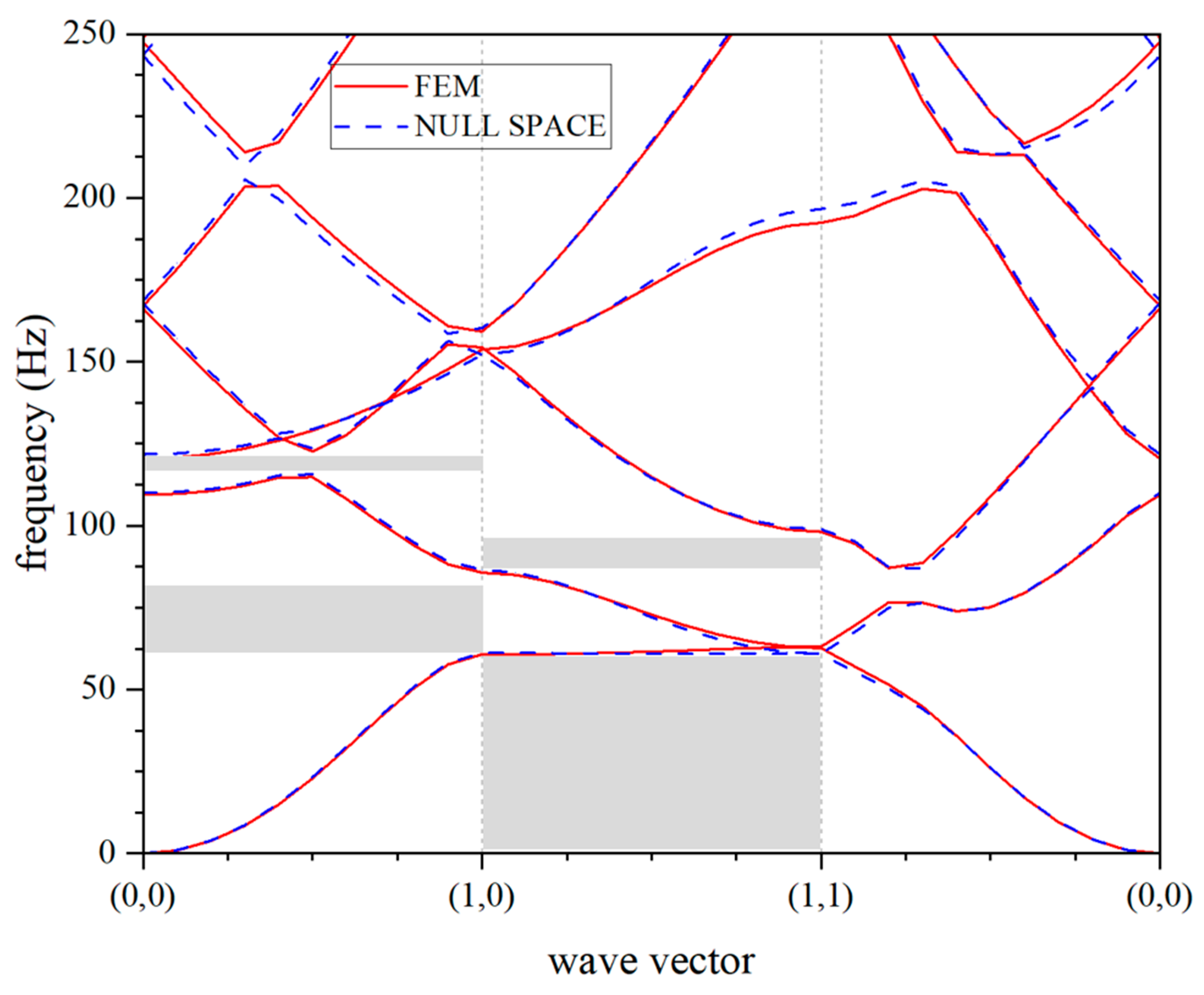
(1) The NSM enables the unified matrix-based formulation of coupled and periodic boundary conditions, and decouples boundary conditions from displacement shape functions. It eliminates the empirical constraints on the selection of virtual spring stiffness values and requires no remeshing during parameter adjustment. The results obtained by this method are in excellent agreement with those of the FEM, with an average bandgap width deviation of only 0.37 Hz within the 0–250 Hz frequency range, and its computational efficiency is approximately 2.5 times that of the FEM. This method thus exhibits superior performance in terms of convergence, accuracy and computational efficiency.
(2) Typical periodic rectangular thin-walled stiffened structures exhibit only directional bandgaps (no complete bandgaps) in the 0–400 Hz frequency band, and the four key structural parameters show distinct regulatory effects on the bandgap properties. Specifically, an increase in thin-wall thickness reduces the number of directional bandgaps in certain frequency ranges while significantly broadening the bandgap width in the low-frequency band; this phenomenon is attributed to the enhanced equivalent bending stiffness and strengthened low-frequency Bragg scattering effect. An increase in stiffened thickness simultaneously raises the number of directional bandgaps and widens the high-frequency bandgaps, as the enlarged impedance difference between the stiffener and thin plate intensifies the structural Bragg scattering effect. Stiffened width exerts only a slight influence on bandgap width with no notable effect on the number of bandgaps, since this parameter induces a limited change in their impedance ratio and thus has no significant impact on the bandgap properties of typical periodic rectangular thin-walled stiffened structures. An excessively small adjacent stiffener spacing reduces the number of bandgaps but broadens the bandwidth in specific frequency bands; in contrast, when the spacing exceeds the critical value for the onset of the Bragg scattering effect, both the number and width of bandgaps decrease due to the homogenization tendency of the structure.
(3) The regulatory characteristics of different structural parameters are tailored to diverse engineering vibration control requirements: thin-wall thickness is suitable for low-frequency vibration control scenarios (e.g., ship bulkheads); stiffened thickness is applicable to mid-to-high frequency vibration suppression cases such as aircraft skins and high-speed train car bodies; stiffened width can serve as an auxiliary optimization parameter for the fine-tuning of bandgap width; the adjacent stiffener spacing acts as a key constraint parameter for the balanced design of a lightweight structure and vibration reduction. This research thus provides guidance for parameter optimization in the vibration and noise reduction design of periodic thin-walled stiffened structures in practical engineering applications.
This study verifies that the NSM possesses significant advantages in both efficiency and accuracy for the bandgap analysis of complex periodic coupled structures. It demonstrates promising application prospects in the bandgap modeling and optimization of advanced lightweight periodic structures, including honeycomb structures and chiral metamaterials. Based on the technical merits of the method, future work can further extend the theoretical modeling dimension of the NSM by addressing the unique characteristics of advanced lightweight structures, such as cell coupling and anisotropy in honeycombs, inertial amplification in chiral structures, and multi-mode motion coupling. Boundary constraint matrices compatible with the topological features of various advanced lightweight structures can be established, incorporating key influencing factors including cell topology, chiral unit parameters, and material combinations. A multi-parameter collaborative optimization algorithm can be developed to construct an integrated modeling and optimization framework that achieves a synergistic balance among lightweight design, structural strength, and bandgap performance. Combined with experimental measurements and model validation, a closed-loop system of “theoretical modeling–numerical optimization–experimental verification” can be established to realize the precise design and efficient optimization of bandgaps for such structures. This will promote the transformation of the NSM from theoretical analysis to engineering implementation, providing a novel and efficient approach for the development of lightweight, high-performance vibration-suppression structures in aerospace, marine engineering, rail transit, and other engineering fields.