
Article

A Reproducible Evaluation Method for Intelligent-Driving Longitudinal Control Under Complex Weather Through Operational Design Domain Parameter Perturbation

1
School of Engineering, Ocean University of China, Tsingtao 266100, China
2
Suzhou Automotive Research Institute, Tsinghua University, Suzhou 215200, China
3
School of Vehicle and Mobility, Tsinghua University, Beijing 100084, China
4
Hubei Zhongcheng Industrial Technology Research Institute Co., Ltd., Shiyan 442000, China
5
School of Mechanical Engineering, Hubei University of Technology, Wuhan 430068, China
6
Bosen RuiJie New Energy Technology (Hubei) Co., Ltd., Huanggang 438000, China
*
Author to whom correspondence should be addressed.
Machines 2026, 14(4), 454; https://doi.org/10.3390/machines14040454
Submission received: 9 March 2026 / Revised: 12 April 2026 / Accepted: 15 April 2026 / Published: 20 April 2026
(This article belongs to the Special Issue Control and Path Planning for Autonomous Vehicles)

Abstract

Complex weather degrades both perception reliability and tire–road adhesion, thereby reducing the safety margin and responsiveness of intelligent driving longitudinal control. This study proposes a reproducible evaluation method for adverse weather operational design domains based on parameter perturbation testing and comprehensive assessment. Snow, fog, and rain are graded using standard quantitative thresholds and are coupled with road slipperiness to construct a weather–road state set. A mechanism-oriented indicator system, a combined subjective–objective weighting strategy, and a multi-level fuzzy comprehensive evaluation model are then used to generate quantitative capability scores. The method is validated on a co-simulation framework integrating vehicle–sensor simulation, a driving simulator, and a digital-twin testing environment using representative autonomous emergency braking scenarios. Results show that increasing weather severity, decreasing road adhesion, and higher initial speed reduce the post-braking safety margin and prolong collision-response time. The proposed method differentiates performance across weather–road states and provides quantitative support for test-coverage planning and capability boundary calibration in adverse weather operational design domains.

1. Introduction

1.1. Related Research on Adverse Weather Testing and Operational Design Domains

Autonomous driving and advanced driver-assistance systems (ADASs) are transitioning from demonstration-oriented development to broader engineering deployment. In this process, safety, availability, and functional robustness are increasingly constrained by the operational design domain (ODD), which describes the boundary conditions under which an automated-driving function is intended to operate. Existing standards have established an important conceptual and engineering basis for ODD-oriented development and validation. SAE J3016 provides the terminology and taxonomy for driving automation and clarifies the relationship between automation levels and operating conditions [1], while ISO 34503 further specifies structured description requirements for ODDs and supports hierarchical and traceable representations of environmental and traffic conditions [2]. And ISO 16787 provides performance requirements and test procedures for assisted parking systems [3]. Within scenario-based verification frameworks, ASAM OpenSCENARIO provides a basis for portability, reusability, and comparability of simulation tests [4], and the PEGASUS methodology emphasizes systematic validation through scenario coverage, quality criteria, and closed-loop evaluation workflows [5]. Open simulation platforms such as CARLA also support scenario construction and virtual validation for automated-driving research [6].
Among ODD factors, complex weather and associated low-adhesion road conditions are particularly important because they simultaneously affect perception reliability and longitudinal braking capability. Rain, snow, and fog may degrade the sensing quality of cameras, LiDAR, and radar through scattering, attenuation, occlusion, and signal distortion, thereby reducing the reliability of environmental perception [7,8,9,10,11,12]. Recent studies have also emphasized the role of ODD-based safety evaluation in mixed traffic environments [13]. At the same time, reduced tire–road friction under wet, snowy, or icy conditions directly weakens braking effectiveness and compresses the safety margin of longitudinal control. This issue is especially critical in lead-vehicle sudden-braking scenarios, where the triggering timing and braking effectiveness of active-safety functions such as autonomous emergency braking (AEB) and forward collision warning (FCW) directly influence collision-mitigation performance [14,15,16,17]. Existing regulations and assessment protocols, such as UN R152 and the Euro NCAP AEB Car-to-Car test protocol, specify representative test conditions for AEB-type functions [14,18]. However, these protocols usually focus on a limited set of typical risk scenarios and do not directly provide a graded and reproducible parameter perturbation representation for adverse weather ODD testing.
In addition, the present study is related to the broader field of robust longitudinal control. Under uncertain sensing quality, changing adhesion, and fluctuating environmental loads, the longitudinal motion of intelligent vehicles must remain safe, stable, and responsive. This concern is closely connected not only to emergency braking, but also to car-following and coordinated vehicle-motion problems such as platooning. Recent studies on robust and adaptive longitudinal control under uncertainty therefore provide a useful background for understanding how environmental disturbances may affect control performance and capability boundaries [19,20,21,22]. Meanwhile, research on tire–road interaction and braking-related dynamics under varying load and environmental conditions offer important physical grounding for interpreting the influence of friction-coefficient changes on stopping performance [23]. At the system level, the robustness of intelligent driving functions also depends on the coupled reliability of sensing, actuation, and control subsystems rather than on any single module in isolation [24,25].

1.2. Problem Statement and Research Gap

Although substantial progress has been made in studying the degradation of intelligent driving performance under adverse weather, three limitations remain. First, weather conditions are often incorporated into test design in the form of categorical labels or empirical descriptions, such as “rainy”, “foggy”, or “snowy”, without sufficiently graded parameterization. As a result, weather severity cannot be used as a reproducible perturbation input, and the coupling between meteorological factors and low-adhesion road conditions is often underspecified, making results difficult to benchmark and extend across studies [2,26].
Second, longitudinal control evaluation under complex weather is still frequently based on a small number of indicators or limited condition comparisons. Although safety surrogate metrics such as time-to-collision (TTC) and time headway are interpretable and widely used, they are not sufficient to fully characterize system capability across responsiveness, stopping safety margin, and behavior-level performance under coupled environmental degradation [17]. In particular, when weather severity, road slipperiness, and initial speed interact, single-indicator evaluation may fail to reveal the overall shrinkage of the capability boundary.
Third, although comprehensive evaluation methods such as entropy weighting and fuzzy comprehensive evaluation are suitable for uncertainty handling and multi-indicator aggregation [27,28], it remains an open challenge to establish a unified framework for longitudinal control assessment that both preserves engineering interpretability and incorporates objective information from sample data. In other words, a practical method is still needed to connect graded ODD perturbation inputs, key safety metrics, and comprehensive capability evaluation within a consistent testing workflow that can support ODD boundary identification in a systematic manner [29,30,31].

1.3. Study Scope, Preliminaries, Assumptions, and Automation-Level Positioning

This study focuses on longitudinal collision-mitigation performance in a lead-vehicle sudden-braking scenario under complex weather conditions. Accordingly, the selected perturbation factors are precipitation- and fog-related visibility degradation together with road adhesion reduction, because these two classes of factors directly affect the perception–decision–braking chain and thus the stopping safety margin of longitudinal control.
In this work, SAE J3016 [1] is used as the terminology basis for describing driving-automation levels and the relation between function scope and operating conditions [32]. ISO 34503 [2] is adopted as the conceptual basis for structured operational-design-domain description, while ASAM OpenSCENARIO [4] is referenced as a scenario-description framework supporting portability, reusability, and comparability of simulation-based tests. ISO 8348 [33] is used only as a reference for grading tire–road adhesion ranges in the present weather–road state construction and is not intended to replace standardized physical adhesion measurement.
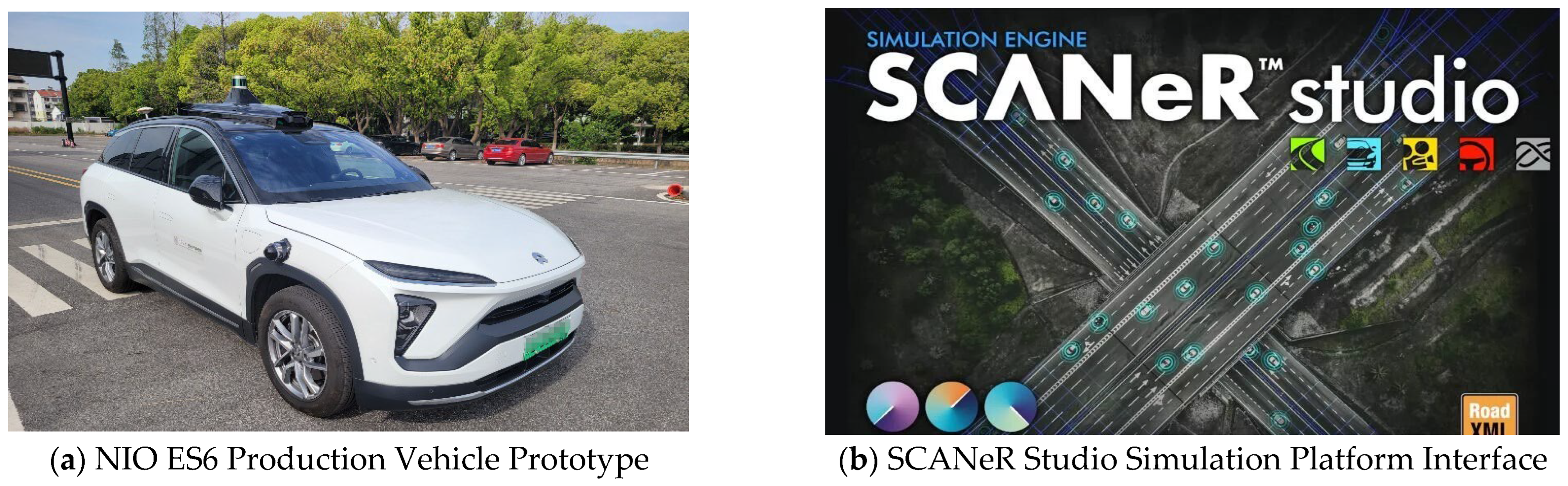
The simulated vehicle platform is parameterized from the NIO ES6 (NIO Inc., Shanghai, China) as a representative mid-size sport-utility vehicle. Because the detailed calibrations of proprietary production controllers, perception pipelines, and sensor-fusion strategies are not fully publicly available, the present model should be interpreted as a representative simulation baseline rather than a one-to-one digital replica of the commercial vehicle. Likewise, the TTC threshold-based controller used in this study is a transparent comparative controller designed for reproducible evaluation rather than a production-grade implementation.
According to SAE J3016, driving automation spans Levels 0 to 5. The function studied here is best interpreted as a supervised longitudinal collision-mitigation function centered on emergency braking under defined operating conditions, and therefore relates most directly to Level 1–2 driver-assistance functionality. At the same time, the proposed evaluation framework may also support the assessment of longitudinal safety subfunctions embedded in higher-level automated-driving systems, because higher-level systems still rely on comparable sensing, decision, and braking chains under adverse weather.
The main assumptions of the study are as follows. First, the lead-vehicle sudden-braking scenario is taken as a representative longitudinal conflict scenario. Second, weather severity and road adhesion are treated as the dominant perturbation factors in the present validation stage. Third, control logic and sensor configuration are kept fixed across test states so that the influence of environmental perturbations can be compared consistently. Accordingly, the results should be interpreted as reproducible capability-benchmarking evidence within a controlled virtual test framework, rather than as regulatory certification results or direct performance claims for a specific commercial vehicle.

1.4. Contributions and Paper Organization

To address the above issues, this paper proposes an integrated framework of parameter perturbation testing and comprehensive evaluation for intelligent driving longitudinal control under complex weather conditions. The main contributions are summarized as follows.
(1)
Meteorological factors including snow, fog, and rain are parameterized into graded levels using standard quantitative thresholds and are coupled with road slipperiness represented by friction-coefficient grading. On this basis, a reproducible weather–road coupled state set is established for adverse weather ODD perturbation testing [2,18].
(2)
A mechanism-oriented evaluation indicator system for longitudinal speed control capability is developed. Subjective and objective weighting are combined at the weighting stage, and fuzzy comprehensive evaluation is adopted at the aggregation stage to represent uncertainty in grade boundaries and to generate comprehensive scores for cross-state benchmarking [27,28].
(3)
The proposed method is validated on a co-simulation framework integrating vehicle–sensor simulation, a driving simulator, and a cloud-controlled digital-twin environment. Representative AEB risk scenarios are used to combine key safety indicators with comprehensive evaluation outputs, thereby providing structured evidence for capability benchmarking and boundary identification under coupled complex weather states [14,18,29,31].
The remainder of this paper is organized as follows. Section 2 presents the parameterization of complex weather and road conditions, the coupled state-set construction, risk grading, and the comprehensive evaluation model. Section 3 describes the co-simulation framework, vehicle and controller setup, and the weather perturbation test design. Section 4 reports the post-braking gap results, TTC response time results, and comprehensive evaluation outputs. Section 5 discusses the engineering implications, assumptions, and limitations of the proposed method.

2. Method

2.1. Parameterization of Complex Weather and Coupled State-Set Construction

Performance degradation of intelligent driving systems under complex weather conditions exhibits pronounced environmental coupling characteristics. On the one hand, meteorological factors such as precipitation and fog reduce the reliability of sensors in detecting and recognizing objects, lane markings, and other traffic participants. On the other hand, slippery road surfaces directly weaken braking capability and longitudinal stability control through a reduced friction coefficient, thereby compressing the system’s safety margin. From a physical perspective, the friction coefficient is not merely an environmental descriptor, but also a key bridge variable linking adverse weather disturbances to braking performance degradation. To transform the ODD from descriptive labels into reproducible test inputs, this study parameterizes complex weather ODD perturbation variables using a combined scheme of “meteorological-level parameterization + road slipperiness-level parameterization” and further constructs a coupled state set to support perturbation testing.

2.1.1. Graded Parameterization of Meteorological Factors

This study selects three types of complex weather—snow, fog, and rain—as key influencing factors within the ODD, and adopts the meteorological classification criteria specified in the industry standard Weather Risk Warning Levels for Expressway Traffic Safety Management and Control (QXT 729-2024) [34] as the basis for grading. Specifically, snowfall is characterized by accumulated snowfall over 1 h and 12 h, fog is characterized by visibility, and rainfall is characterized by accumulated precipitation over 1 h and 12 h. For the grading scheme, nine weather states are defined (light/moderate/heavy snow; light/dense/thick fog; light/moderate/heavy rain), with threshold definitions specified as follows. For snow, light snow corresponds to 0.1 < S1 < 0.5 or 0.1 < S12 < 2.4, while moderate snow and heavy snow are likewise defined by intervals of S1 and S12. For fog, visibility Vvis (in meters) is used to classify light fog (500–1000), dense fog (200–500), and thick fog (50–200). For rain, rainfall amounts R1 and R12 (in millimeters) are used to classify light, moderate, and heavy rain. The detailed thresholds are summarized in Table 1.
Note: The grading thresholds for snow, fog, and rain were adapted from the industry meteorological standard Weather Risk Warning Levels for Expressway Traffic Safety Management and Control (QXT 729-2024) [34].
The purpose of the above weather treatment is not to pursue meteorological completeness, but rather to transform the weather classification criteria defined in QXT 729-2024 [34] into reproducible and quantitative perturbation inputs for subsequent testing. In this way, any complex weather scenario can be described by explicit parameter intervals rather than vague ODD labels such as “snowy”, “foggy”, or “rainy”, thereby improving the comparability and repeatability of adverse weather ODD tests.

2.1.2. Grading of Road Slipperiness and Friction-Coefficient Ranges

Considering that the three types of complex weather are often accompanied by slippery road surfaces, and that the slipperiness level can significantly affect braking distance and vehicle stability, this study incorporates road condition as an ODD dimension of equal importance to weather. With reference to ISO 8348 on the measurement and representation of tire–road adhesion, slippery roads are classified into three levels—mild, moderate, and severe—and parameterized by friction-coefficient ranges: 0.41–0.50 for mild slipperiness, 0.21–0.40 for moderate slipperiness, and 0.10–0.20 for severe slipperiness. Details are summarized in Table 2.
This treatment is physically meaningful because the available longitudinal tire force is strongly dependent on tire–road adhesion. Under low-friction conditions, the achievable braking deceleration decreases and the stopping process becomes more sensitive to both speed and control-response delay. Therefore, introducing friction-coefficient grading into the ODD representation not only enriches environmental description, but also strengthens the physical interpretability of longitudinal control degradation under complex weather.

2.1.3. Weather–Road Coupled State Set and Coding Scheme

Based on the nine weather levels and three slipperiness levels, this study constructs a weather–road coupled state set comprising 27 combined states, which is used to cover typical variations in the intelligent driving ODD under complex weather conditions. The nine weather-condition categories and the three road-condition levels are defined by indices p and q, respectively. Their specific values and meanings are provided in Table 3.
In the coding scheme, the first index p identifies the weather category and severity level, and the second index q identifies the road slipperiness level. For example, K 31 represents light snow with a mildly slippery road surface, K 62 represents light fog with a moderately slippery road surface, and K 73 represents heavy rain with a severely slippery road surface. This coding is introduced as a compact identifier for the 27 coupled states and is used consistently in the subsequent risk grading, test-matrix design, and interpretation of results.
The construction of the coupled state set has three engineering implications. First, the discrete combinations enable systematic coverage of common degradation patterns under complex weather conditions. Second, each state is jointly determined by explicit threshold intervals for meteorological parameters and specified friction-coefficient ranges, thereby ensuring reproducibility. Third, the state set provides a unified environmental index and benchmarking framework for subsequent risk grading, test-priority planning, and evaluation outputs.

2.2. Risk Grading and Test-Priority Planning

In engineering testing, “coverage” of environmental states is not equivalent to “effective stressing” of system boundaries. Without distinguishing risk severity, test resources may be consumed by low-risk conditions, making it difficult to reveal performance degradation and failure boundaries under high-risk scenarios. Therefore, this study introduces risk grading on top of the 27 coupled states to guide test prioritization and scenario library construction.
In the present study, a preliminary risk grading step based on expert elicitation is introduced to organize the weather–road coupled states according to their expected operational severity. Rather than serving as a standalone statistical validation procedure, this step is used as an engineering prioritization tool to distinguish relatively low-risk, medium-risk, and high-risk coupled states before the subsequent metric-based and comprehensive evaluation stages. On this basis, the 27 coupled states are categorized into three levels—safe, moderate, and hazardous—and the resulting classification is summarized in Table 4.
Methodologically, this grading serves as a test-priority calibration mechanism in two main aspects: (1) hazardous states and their neighboring states are treated as priority test targets, thereby improving the sensitivity of boundary identification under a limited number of trials; (2) when abrupt changes occur in the comprehensive evaluation outputs or key safety metrics, the risk grading is used to interpret their engineering implications and to present the results in a stratified manner, thereby avoiding conclusions drawn solely from single-trial phenomena.
It should be noted that this preliminary risk grading does not replace the subsequent metric- and data-driven performance evaluation. Instead, it provides an operational organizing principle for “what to test, what to test first, and what to emphasize”, enabling ODD perturbation testing to more effectively support functional boundary calibration and robustness verification.

2.3. Comprehensive Evaluation Framework for Longitudinal Control Performance

To provide a unified evaluation of longitudinal control capability under complex weather ODD perturbations, this study develops a comprehensive evaluation framework integrating a hierarchical indicator system, combined weight determination, and fuzzy comprehensive evaluation. The purpose of this framework is not only to examine the variation in key safety indicators under different weather–road coupled states, but also to aggregate multi-dimensional performance information into a structured quantitative result. In this way, the framework supports cross-state benchmarking and complements single-indicator analysis of braking performance and response delay.

2.3.1. Indicator System

For evaluating vehicle speed control capability under complex weather ODDs, this study develops a hierarchical indicator system using a target–function–factor–indicator structure. The target layer represents the overall speed control capability of intelligent driving under weather conditions. The function layer distinguishes between basic intelligent behaviors and advanced intelligent behaviors. The factor layer further refines these functions into behavior categories, and the indicator layer identifies representative observable behaviors for evaluation. A five-grade evaluation scale—excellent, good, fair, poor, and very poor—is adopted as the rating set for the subsequent fuzzy comprehensive evaluation, as shown in Table 5.
This hierarchical design improves the interpretability of the evaluation process and provides a clear basis for subsequent weight determination and fuzzy aggregation.

2.3.2. Determination of Combined Weights

Weight determination is introduced to address a practical difficulty in comprehensive longitudinal control evaluation under complex weather: not all indicators contribute equally to system-level capability, and their relative importance cannot be represented adequately by either expert judgment or sample dispersion alone. Therefore, this study adopts a combined weighting strategy in which subjective and objective information are integrated before fuzzy aggregation.
First, the subjective weight vector is defined by Equation (1):
w ( s ) = ( w 1 ( s ) , , w m ( s ) ) ,
where w s = ( w 1 s , w 2 s , , w m s ) denotes the subjective weight vector obtained by ordinal relation analysis, m is the total number of evaluation indicators, and w i s is the subjective importance assigned to the i -th indicator based on expert judgment.
Second, the objective weight vector is defined by Equation (2):
w ( o ) = ( w 1 ( o ) , , w m ( o ) ) ,
where w o = ( w 1 o , w 2 o , , w m o ) denotes the objective weight vector derived from the entropy weight method, and w i o reflects the amount of discriminative information provided by the i -th indicator in the sample data.
Finally, the combined weights are obtained by multiplicative synthesis and normalization, as given in Equation (3):
w ˜ i = w i ( s ) · w i ( o ) , w i = w ˜ i k = 1 m w ˜ k , i = 1 , , m . ,
where w ˜ i = w i s w i o is the unnormalized fused weight, w i is the normalized combined weight, and i = 1,2 , , m . After normalization, the weights satisfy i = 1 m w i = 1 . In this way, the weighting scheme integrates expert knowledge and data-driven objectivity while preserving engineering interpretability.

2.3.3. Fuzzy Comprehensive Evaluation Modeling and Outputs

Under complex weather conditions, performance levels typically exhibit continuous transitions with blurred boundaries. To maintain continuity and robustness under multi-indicator conditions, this study adopts a fuzzy comprehensive evaluation approach.
The factor set is defined by Equation (4):
U = { u 1 , u 2 , , u m } ,
where U = { u 1 , u 2 , , u m } denotes the factor set, and u i is the i -th evaluation indicator.
The evaluation grade set is defined by Equation (5):
V = { v 1 , v 2 , , v n } ,
where V = { v 1 , v 2 , , v n } denotes the evaluation grade set, and v j is the j -th evaluation grade. In this study, the grades are excellent, good, fair, poor, and very poor.
The fuzzy evaluation matrix is constructed according to Equation (6):
R = ( r i j ) m × n = r 11 r 12 r 1 n r 21 r 22 r 2 n r m 1 r m 2 r m n ,
where R = ( r i j ) m × n denotes the fuzzy evaluation matrix, and r i j [ 0 ,   1 ] is the membership degree of indicator u i to grade v j .
The combined weight vector used for weighted aggregation is given by Equation (7):
A = ( w 1 , w 2 , , w m ) ,
where A = ( w 1 , w 2 , , w m ) denotes the combined weight vector obtained from Equation (3). The comprehensive evaluation result is then calculated as B = A · R = ( b 1 , b 2 , , b n ) , where b j represents the overall membership degree of the evaluated object to grade v j .

3. Experimental Platform and Test Design

3.1. Co-Simulation Test Framework and Overall Workflow

To evaluate the impact of complex weather perturbations on longitudinal control performance under controlled conditions, this study establishes a three-part co-simulation framework comprising SCANeR Studio (version 2023, AVSimulation, Boulogne-Billancourt, France) for vehicle dynamics, virtual sensors, and scenario execution; a driving simulator for driver-in-the-loop input; and a cloud-controlled digital-twin platform for co-validation and data management. The research object is the autonomous emergency braking function. First, the baseline vehicle model and multi-sensor perception configuration are built in SCANeR. Second, driver operations are injected through the driving simulator to reproduce closed-loop human–machine interaction. Third, the generated data are synchronized with the cloud platform, where environmental attributes are parameterized to create the coupled weather–road states defined in Section 2. This workflow is adopted because real-vehicle experiments under adverse weather are difficult to control, repeat, and quantify consistently.
Driving simulation and virtual testing are adopted because weather conditions are difficult to precisely control and quantitatively record in real-vehicle experiments, and on-road testing may raise safety concerns. Therefore, the driving simulator-based virtual simulation is employed to reproduce real-world driving scenarios as faithfully as possible and to conduct comparative analyses of complex weather perturbations within a controllable environment.

3.2. Vehicle Dynamics Modeling Based on SCANeR Studio

Within the above framework, SCANeR Studio is specifically used for high-fidelity vehicle and sensor modeling rather than as a second independent test platform. A baseline vehicle model parameterized from the NIO ES6 is constructed to provide representative dimensions, mass, wheelbase, chassis layout, tire, and aerodynamic characteristics for comparative testing. The choice of the NIO ES6 is intended to provide a realistic reference platform; however, because proprietary production calibrations are not fully public, the present model should be interpreted as a representative simulation baseline rather than a one-to-one digital replica of the commercial vehicle.
The simulated vehicle is modeled based on the NIO ES6. The modeling scope includes the vehicle body system (e.g., dimensions, wheelbase, track width, mass, and related parameter configurations), the suspension system (front and rear independent suspension architectures with corresponding parameter settings), and key modules such as aerodynamics and tires. This configuration is intended to reproduce the target vehicle’s dynamic response characteristics as closely as possible, providing a consistent baseline vehicle model for subsequent AEB control development and complex weather ODD perturbation testing.
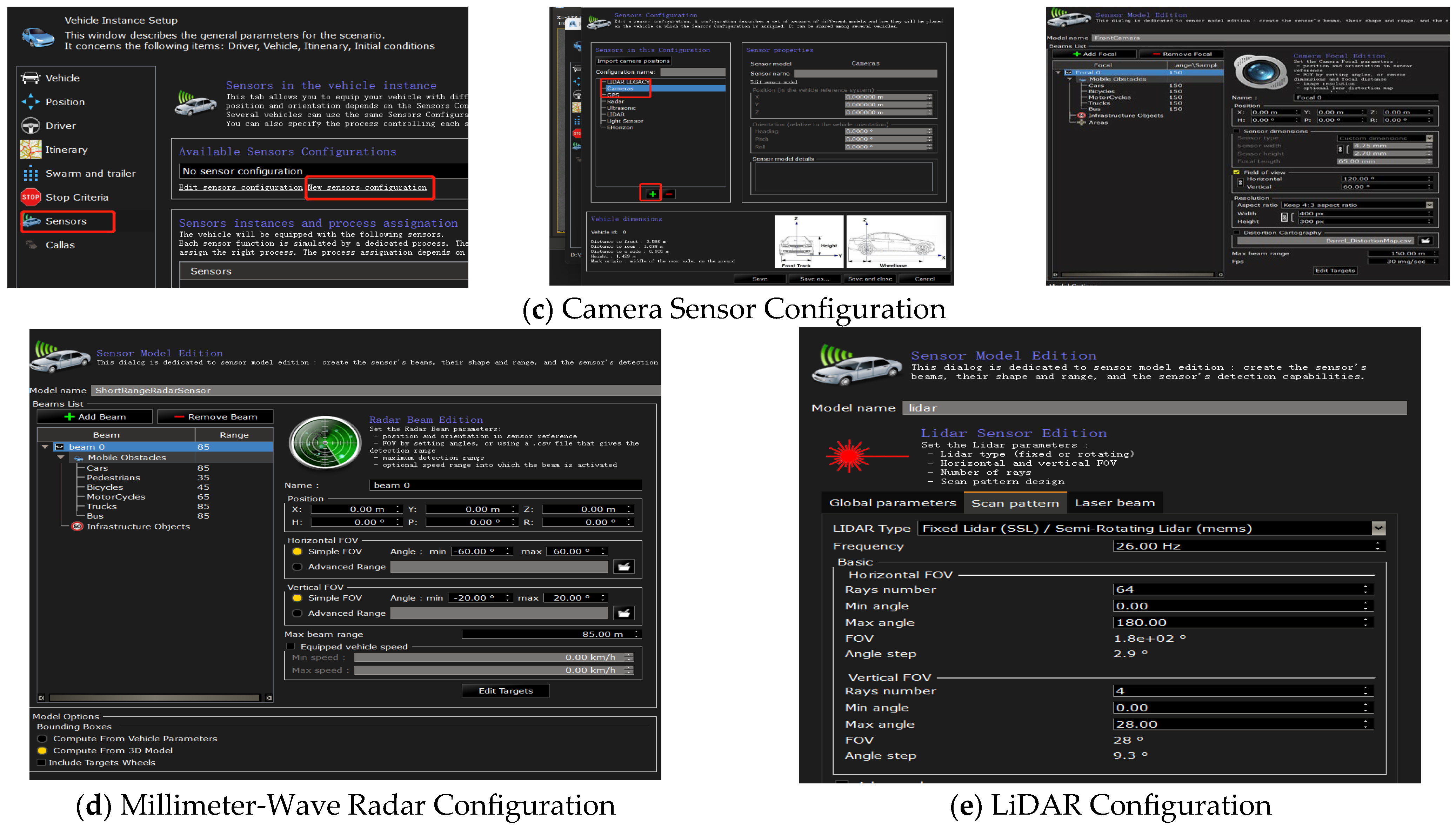
The automated-driving perception module comprises on-board sensors—including cameras, millimeter-wave radar, and LiDAR—which acquire driving environment information and provide data support for decision-making and control. In this study, the parameterized configuration of multi-source sensors is implemented using SCANeR’s sensor modeling library, as shown in Figure 1. These sensor modules provide the perception inputs for the subsequent comparative evaluation of TTC-based braking response under different coupled weather–road states.

3.3. Time-to-Collision Threshold-Based Emergency Braking Control Model

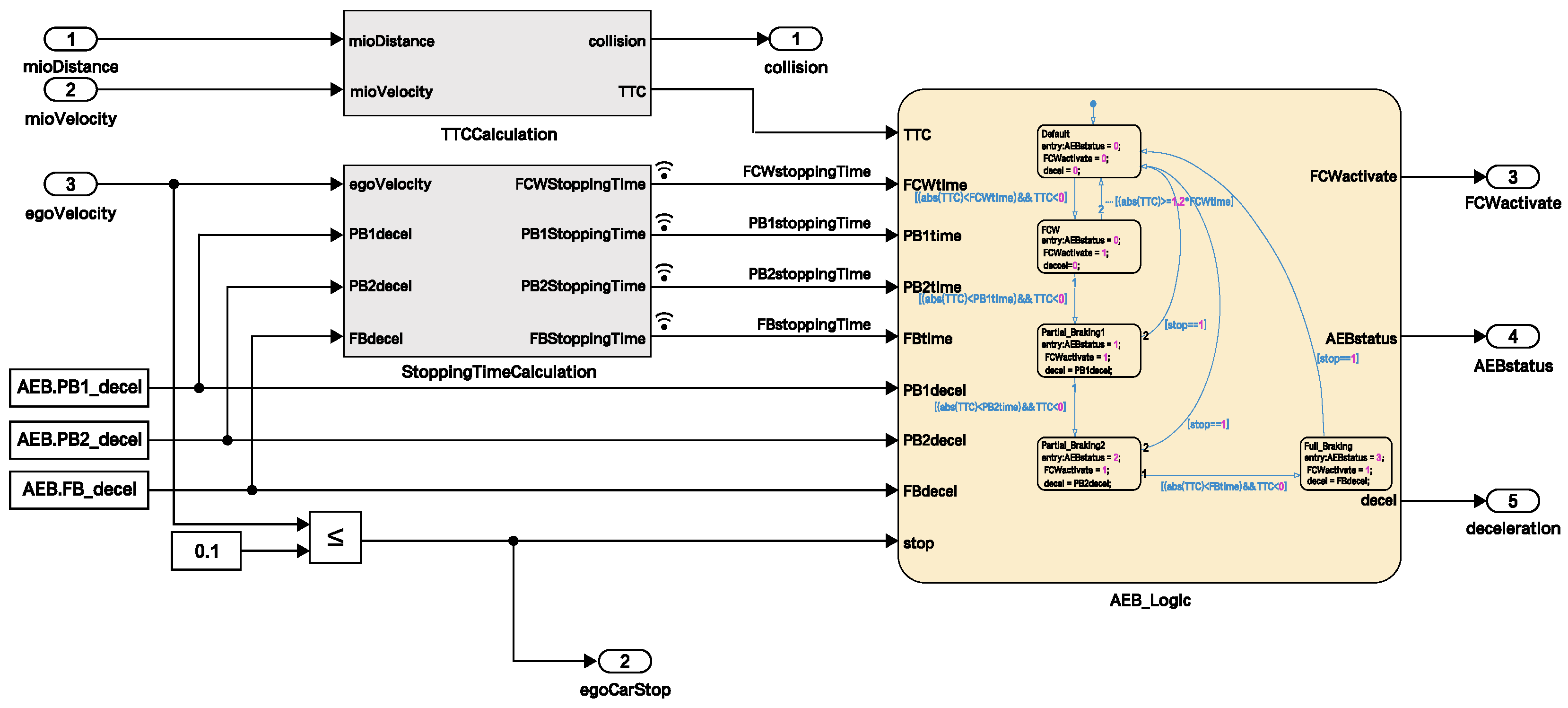
Although implemented within the simulation environment, the TTC threshold-based AEB logic constitutes part of the methodological setup of the proposed evaluation framework, because it defines how environmental perturbations are translated into trigger-response behavior and braking performance outcomes. This study adopts an AEB collision-avoidance strategy that uses time-to-collision (TTC) as the triggering condition. Such TTC-based strategies require relatively few input variables that are readily available, and their thresholds are relatively easy to tune, making them suitable for reproducible comparative testing. In the present work, the controller is used as a simplified comparative AEB model rather than a full production-grade braking system. The TTC model computes the remaining time-to-collision using the relative distance d r and relative speed v r , and performs risk assessment based on a predefined collision threshold H : when the computed TTC t is smaller than H , a collision risk is assumed and AEB intervention is triggered; when t > H , the situation is regarded as safe. Accordingly, a TTC-based AEB control model is developed in Simulink (version 2024b, MathWorks, Natick, MA, USA), as shown in Figure 2.
Considering that TTC may approach infinity when the speeds of the lead and following vehicles become nearly identical, this study further introduces a second-order TTC formulation that incorporates relative acceleration to improve the model’s applicability under specific relative-motion conditions. The second-order TTC used in this study is calculated by Equation (8).
T T C = d r ν r , ν r < 0 , a r = 0 ν r ν r 2 2 a r d r a r , ν r < 0 , a r 0 ν r + ν r 2 2 a r d r a r , ν r 0 , a r < 0 ,
where d r is the relative longitudinal distance between the ego vehicle and the lead vehicle, v r is the relative speed, and a r is the relative acceleration. Equation (8) is used to estimate the remaining collision time under different relative-motion conditions and to support the triggering logic of the AEB controller.
In this study, the TTC-based controller is intended to provide a transparent and stable comparative control structure for evaluating the effects of weather severity, road adhesion, and initial speed on braking trigger timing and stopping performance. Its purpose is not to reproduce all functional details of a production-grade AEB system, but to ensure that the influence of environmental perturbations on longitudinal collision-mitigation behavior can be analyzed under controlled and repeatable conditions.

3.4. Driving Simulator Integration and Weather Perturbation Test Design

3.4.1. Driving Simulator Hardware Setup and Control Integration

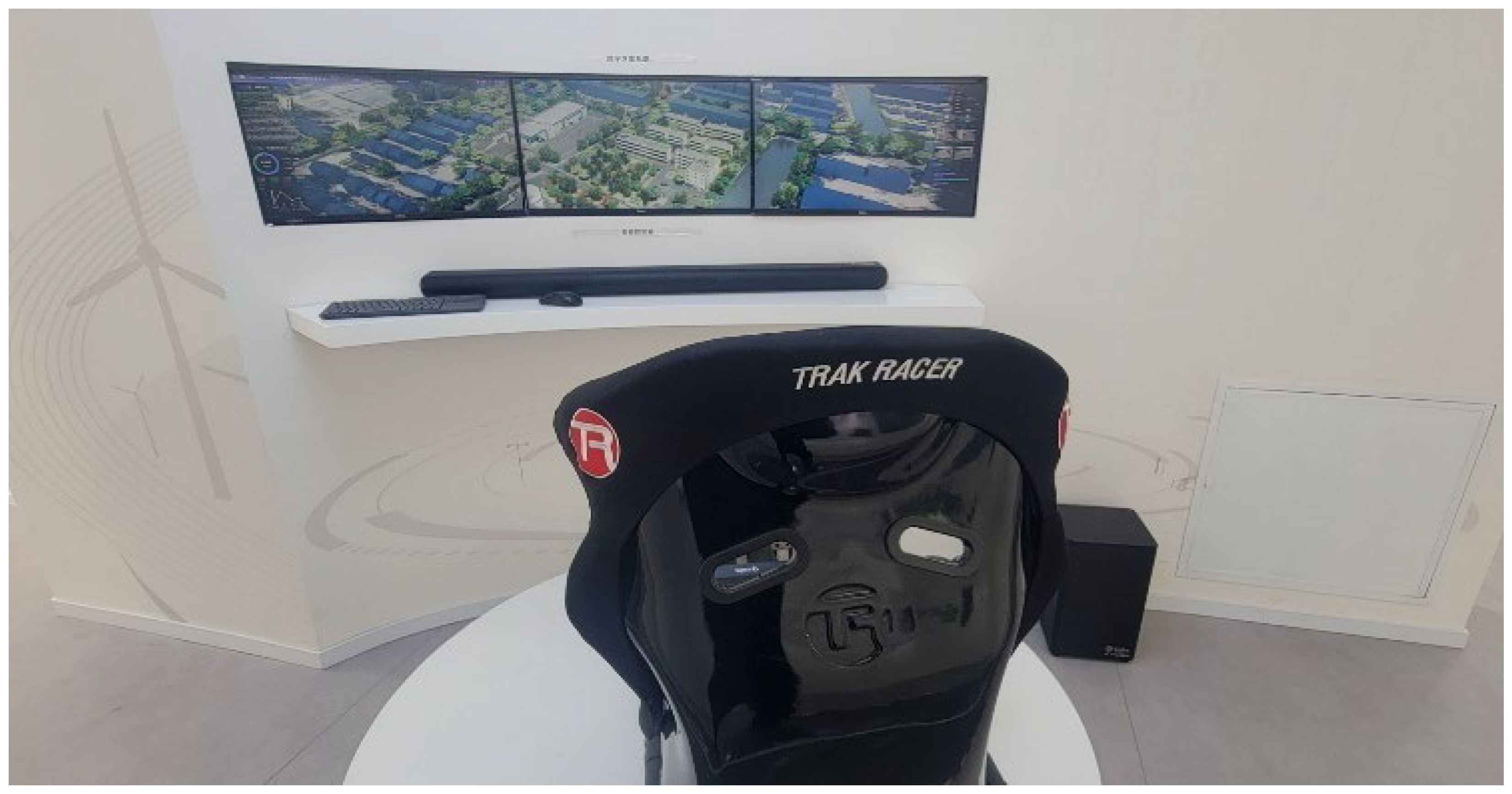
A driving simulator control rig was built using a Logitech G29 (Logitech, Lausanne, Switzerland) steering wheel, pedals, and gear shifter. The G29 wheel provides force feedback, a 900° steering range, and updates its state at a high rate to reproduce steering feel as realistically as possible. For visual output, three high-definition displays were arranged in a multi-screen setup to emulate the driver’s field of view, and a seat was incorporated to complete the hardware platform, as shown in Figure 3.
In terms of control integration, the driving simulator was built on a Windows (Microsoft, Redmond, WA, USA) system. By installing the G29 driver and configuring the ego vehicle and data acquisition modules in SCANeR, the G29 control module was integrated into the simulation workflow. Finally, button mapping and parameter saving were completed to enable closed-loop coupling between driver inputs and simulated vehicle control. This arrangement enables driver operation, vehicle-state evolution, and controller response to be coupled within a unified simulation loop, thereby improving the realism of the comparative tests.

3.4.2. Cloud-Controlled Digital-Twin Simulation Platform and Co-Testing Capabilities

The co-testing experiments were conducted on an intelligent connected vehicle cloud-control simulation platform developed in-house by the Suzhou Automotive Research Institute of Tsinghua University. The platform integrates digital-twin technology, edge computing, and distributed simulation, and is used in the present study as the co-validation environment for weather–road perturbation testing. It is deployed as a containerized cluster and employs DDS middleware to enable low-latency data exchange, supporting parallel simulation task scheduling and joint verification of vehicle dynamics models, control modules, and V2X communication outcomes. The platform consists of an intelligent vehicle driving module, a road supervision module, and a simulation testing module.
The intelligent vehicle driving module provides a digital-twin pipeline from perception and decision-making to execution control. It supports importing real-vehicle dynamics parameters and controller logic, and reproduces complex operating conditions such as low-adhesion road surfaces in a virtual environment. By dynamically coupling sensor simulation data with decision algorithms, it can be used to evaluate system robustness under extreme scenarios, including perception misdetections and control delays. Moreover, the platform supports bidirectional data flow between virtual and real domains, thereby reducing the risk and cost of on-road testing. The simulation testing module further supports the conversion and automated generation of regulatory-standard scenarios and real-road collected data, as well as enabling virtual–physical co-testing to emulate failure modes such as sensor malfunctions and control-signal delays.

3.5. Weather Attribute Perturbation Test Design and Operating Condition Settings

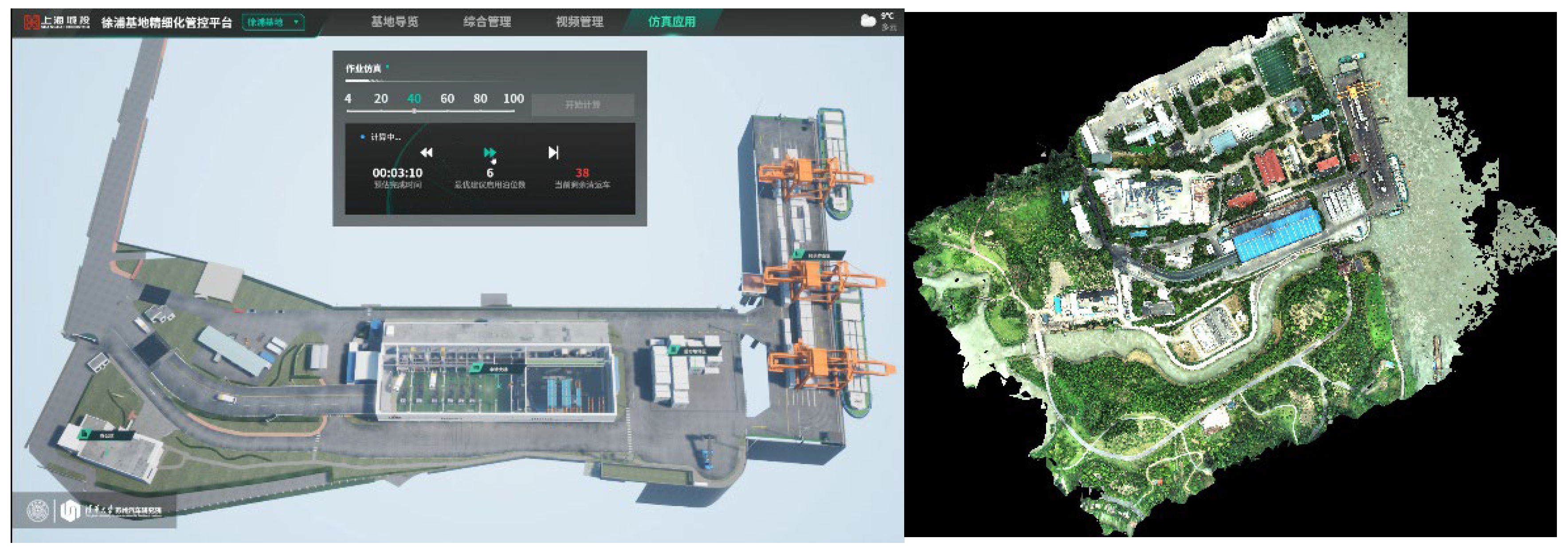
The test object is the longitudinal control performance of the AEB function under complex weather perturbations. A driver-in-the-loop protocol was adopted, and 10 drivers were randomly recruited to participate in the experiments (three females and seven males), with an average driving experience of 3 years. Driver operations on the simulator were used to generate behavioral and control-related outputs, which were then imported into the cloud-control simulation platform for comparative co-testing. Different weather environment ODD attributes were configured using the platform’s built-in environmental attribute control module to evaluate AEB speed control performance under coupled weather–road states. The test site was selected as the Shanghai Xupu Base scenario provided within the cloud-control simulation platform. As shown in Figure 4.
The test matrix was specified according to the weather–road coupled state set constructed in Section 2.1.3, and two test speed settings were considered: 25 km/h and 50 km/h. The detailed test matrix is listed in Table 6.
By repeatedly executing the same representative risk scenario under different combinations of weather and road conditions, while keeping the scenario geometry and lead-vehicle braking event consistent, the effects of ODD weather attribute perturbations on AEB triggering response and braking effectiveness can be comparatively analyzed in a controlled manner.
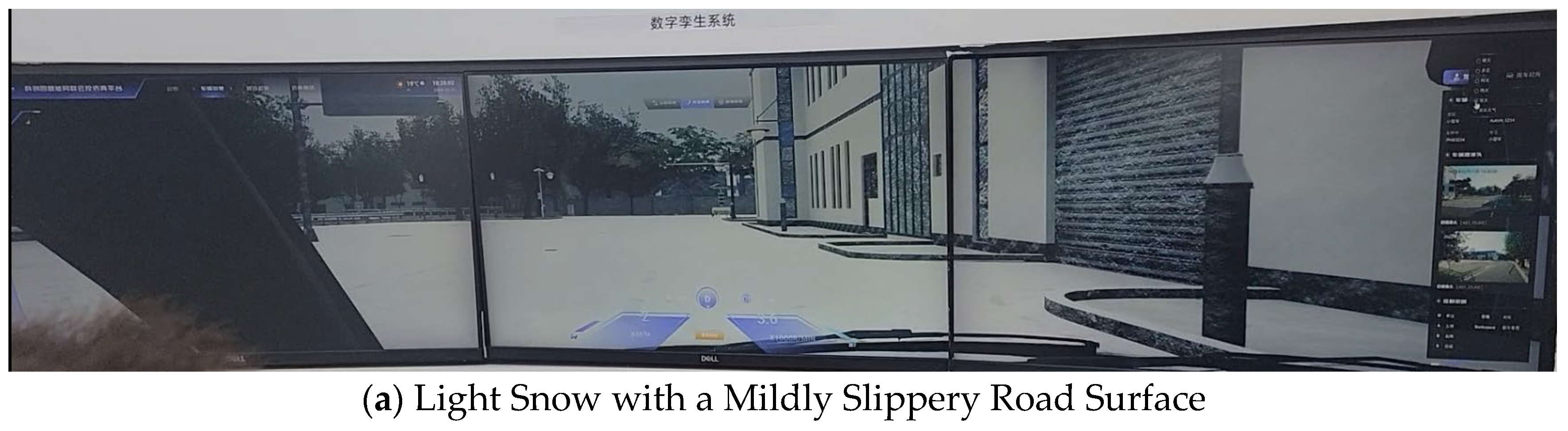
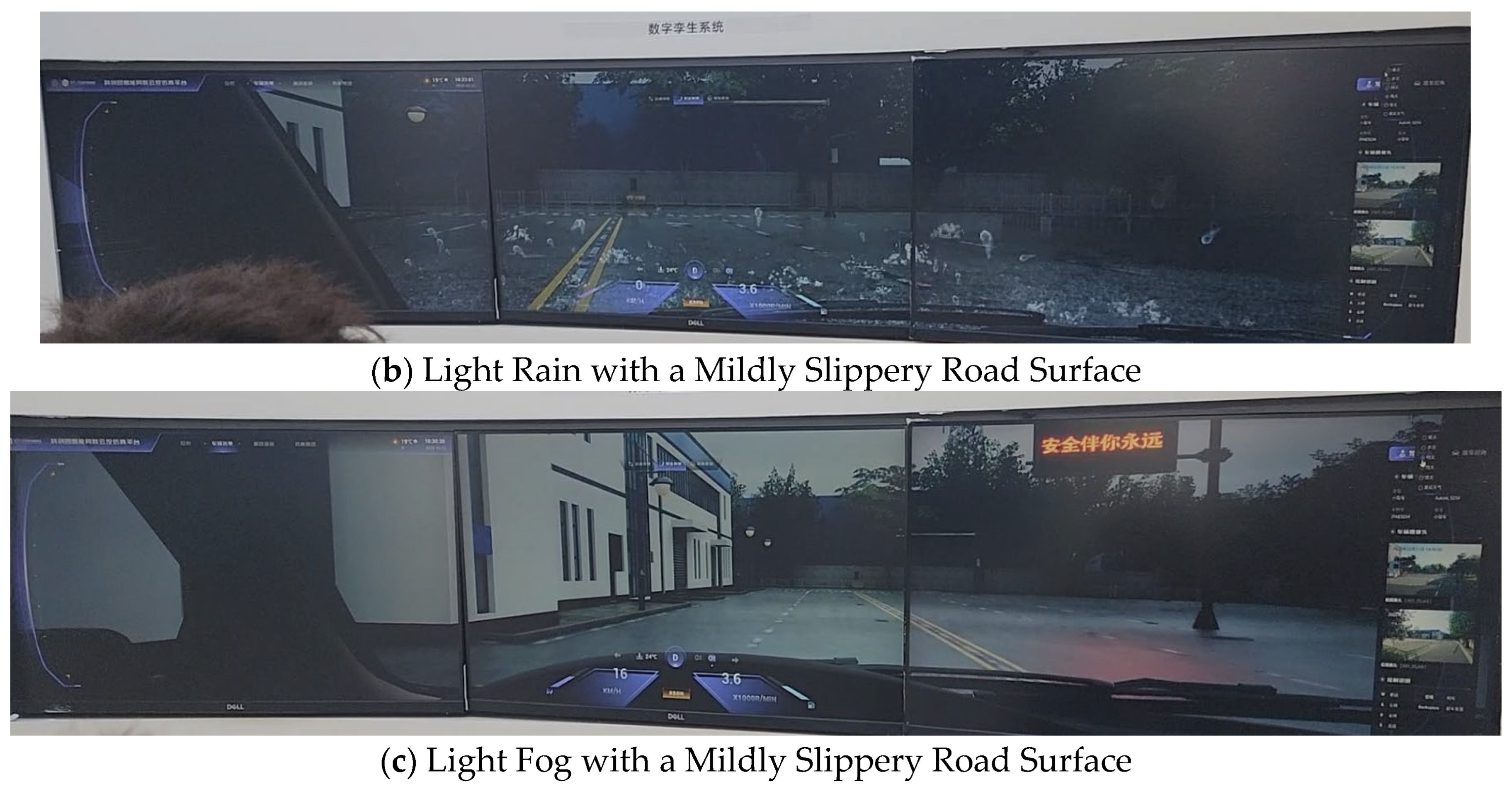
Weather attributes and road slipperiness were varied using the built-in environmental module. Taking complex weather environmental states K31, K61, and K91 as examples, K31 corresponds to light snow with a mildly slippery road surface, K61 corresponds to light fog with a mildly slippery road surface, and K91 corresponds to light rain with a mildly slippery road surface. As shown in Figure 5.

4. Results

4.1. Post-Braking Gap Test Results

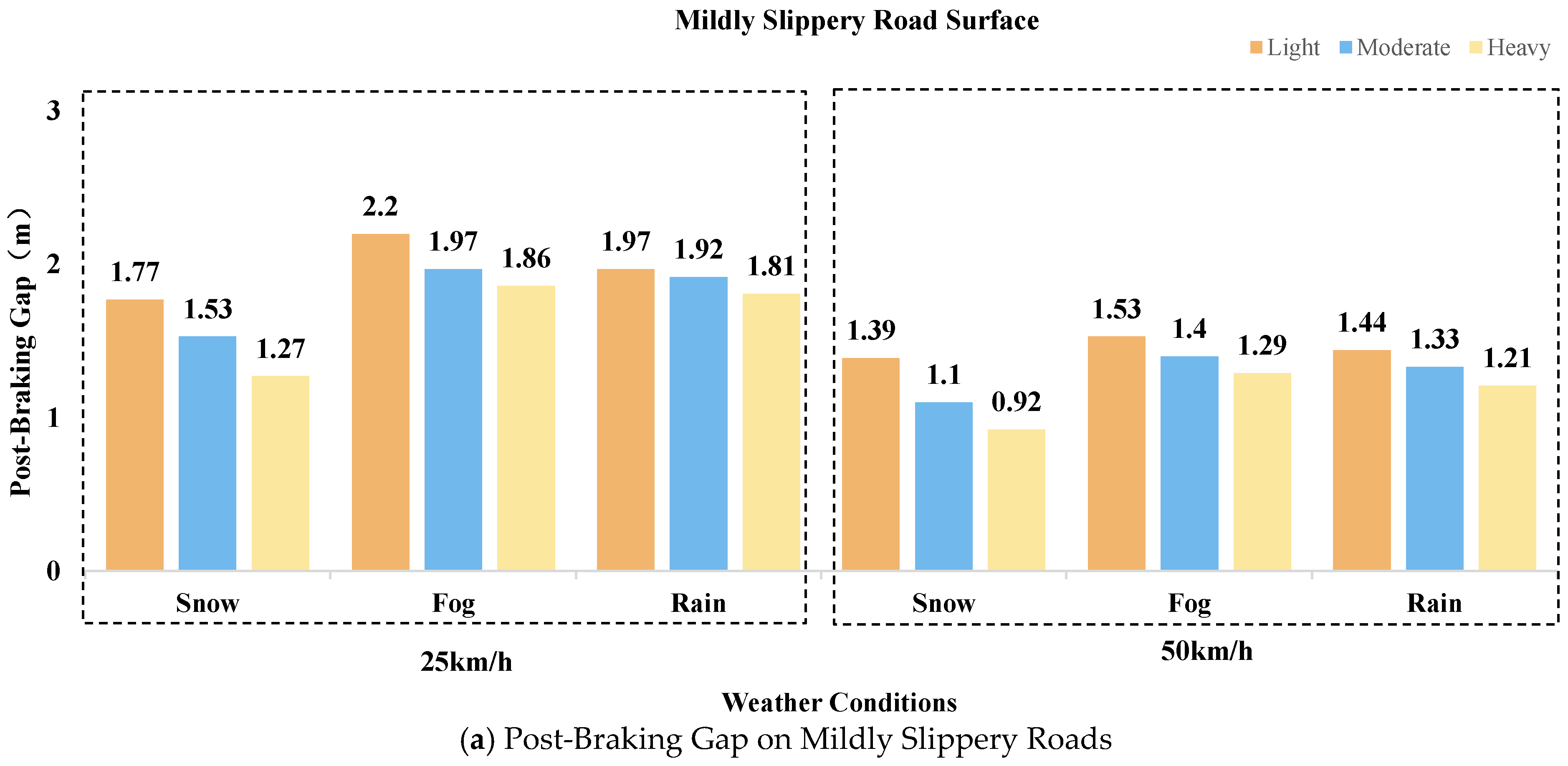
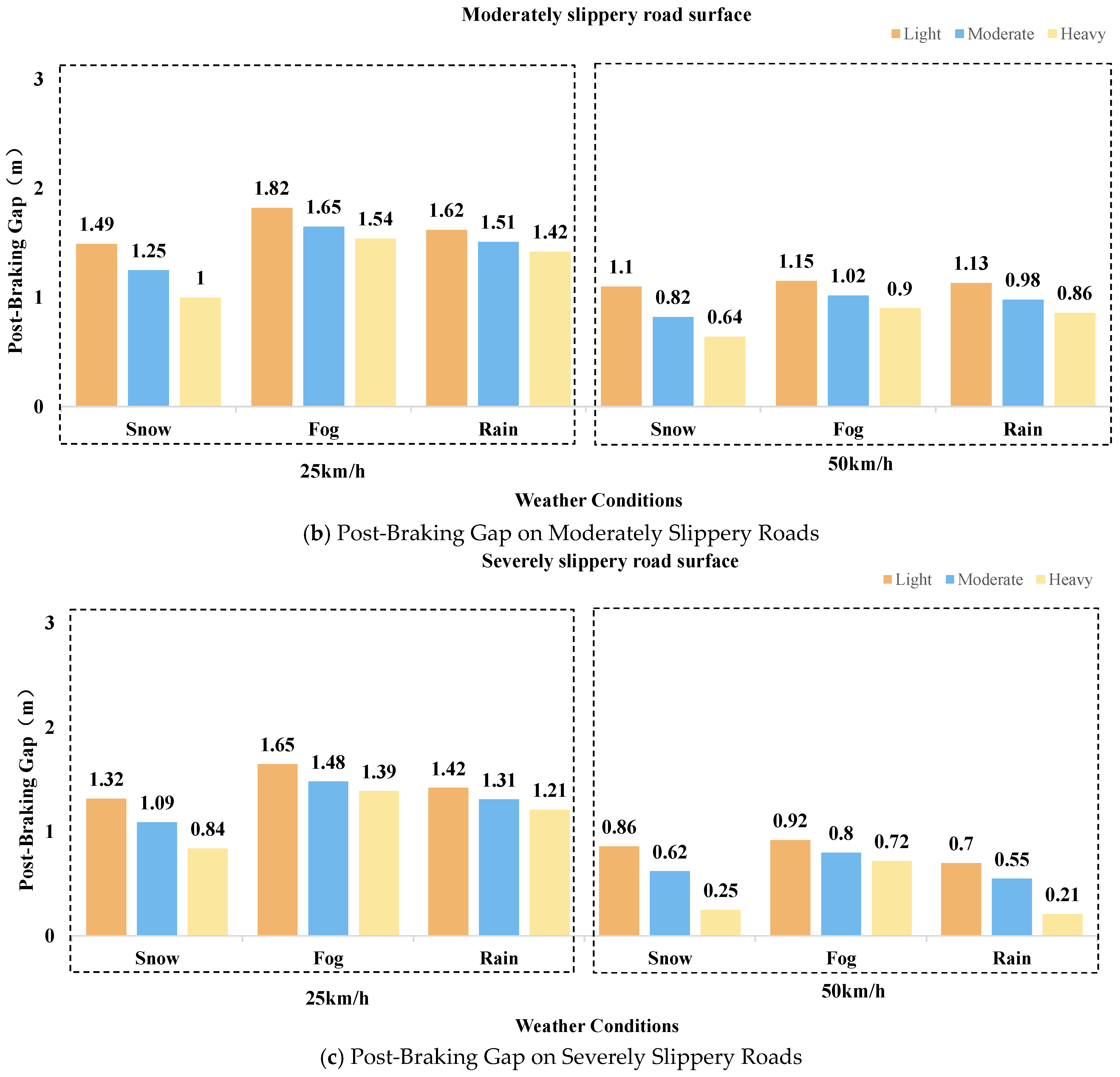
To characterize the impact of complex weather ODD perturbations on AEB effectiveness, this study uses the post-braking gap to the lead vehicle as a direct measure of the stopping safety margin, and comparatively examines the simulation results across different combinations of weather severity and road slipperiness levels. The post-braking gap results under different weather conditions are summarized in Figure 6.
The results show that, as weather conditions and road states progressively deteriorate, the post-braking gap to the lead vehicle exhibits a sustained decreasing trend, indicating a strong association between complex weather and AEB effectiveness. Under snow, fog, and rain conditions, this gap decreases markedly with increasing weather severity and higher vehicle speed, implying a rapid shrinkage of the safety margin and a corresponding rise in collision risk.
In a representative condition comparison, when heavy snow is combined with a mildly slippery road surface, increasing the vehicle speed from 25 km/h to 50 km/h reduces the post-braking gap to below 1 m, suggesting an early warning sign of insufficient safety margin. Under more adverse coupled states—i.e., severe road slipperiness combined with heavy rain or heavy snow—the post-braking gap further drops to 0.25 m and 0.21 m, respectively, representing an extreme level of high risk.
Mechanistically, these observations can be attributed to two factors. First, adverse weather and slippery roads reduce the friction coefficient and tire–road adhesion, directly degrading braking capability. Second, weather-induced degradation in sensor detection accuracy may delay AEB triggering, thereby further compressing the stopping safety margin.
The stronger reduction in post-braking gap at higher initial speed can be explained more explicitly by the combined effect of kinetic energy growth, limited longitudinal tire force, and trigger delay. As the initial speed increases, the braking system must dissipate a larger amount of kinetic energy within the same conflict scenario. Under reduced adhesion, the available longitudinal tire force decreases, which lowers the achievable deceleration and prolongs the stopping process. If weather-induced sensing degradation simultaneously delays AEB activation, the remaining braking distance is further shortened. Therefore, when vehicle speed increases from 25 km/h to 50 km/h, the stopping safety margin decreases more rapidly, especially under coupled states involving severe weather and severely slippery roads.
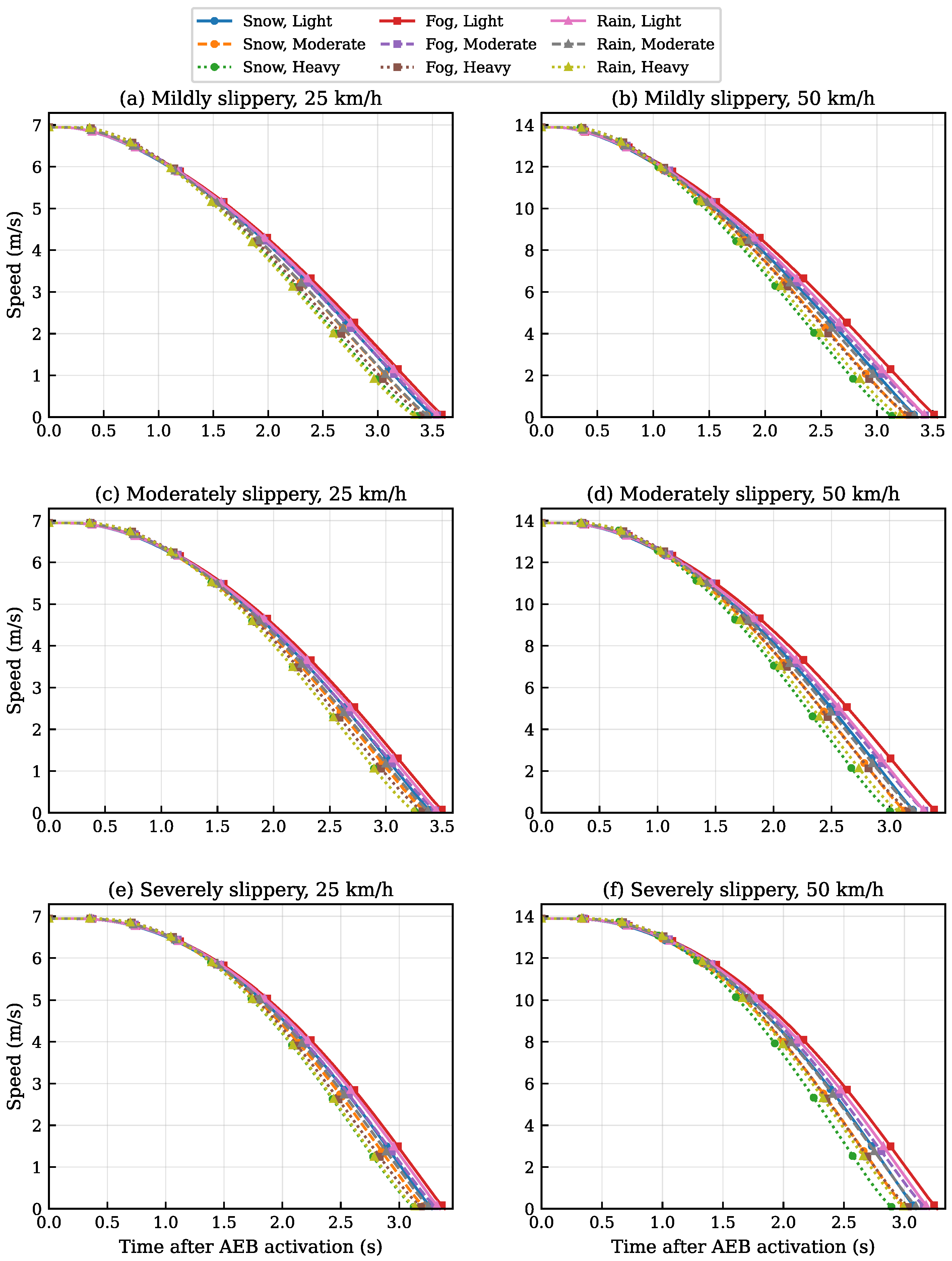
In addition, this study analyzes the speed–time evolution of the ego vehicle after AEB intervention under different combinations of road slipperiness levels and weather conditions. Overall, the vehicle speed in all test cases gradually decreases to 0 as time progresses; however, as the road condition deteriorates from mildly to severely slippery, the speed decay process becomes noticeably slower and the stopping time increases accordingly. Meanwhile, under the same road condition, increasing weather severity from Light to Heavy leads to a general reduction in the post-braking residual gap, indicating that adverse environments further weaken the longitudinal braking effectiveness of AEB. Compared with the 25 km/h cases, the 50 km/h initial speed cases exhibit a longer deceleration phase and a smaller final safety margin, with the differences being most pronounced on severely slippery roads. These results demonstrate that reduced road adhesion, worsened environmental conditions, and higher initial speed all significantly affect AEB performance, and that the coupled condition of high speed and severe road slipperiness constitutes the most unfavorable scenario. The vehicle speed–time profiles after AEB intervention under different weather conditions are summarized in Figure 7.

4.2. Time-to-Collision Response Time

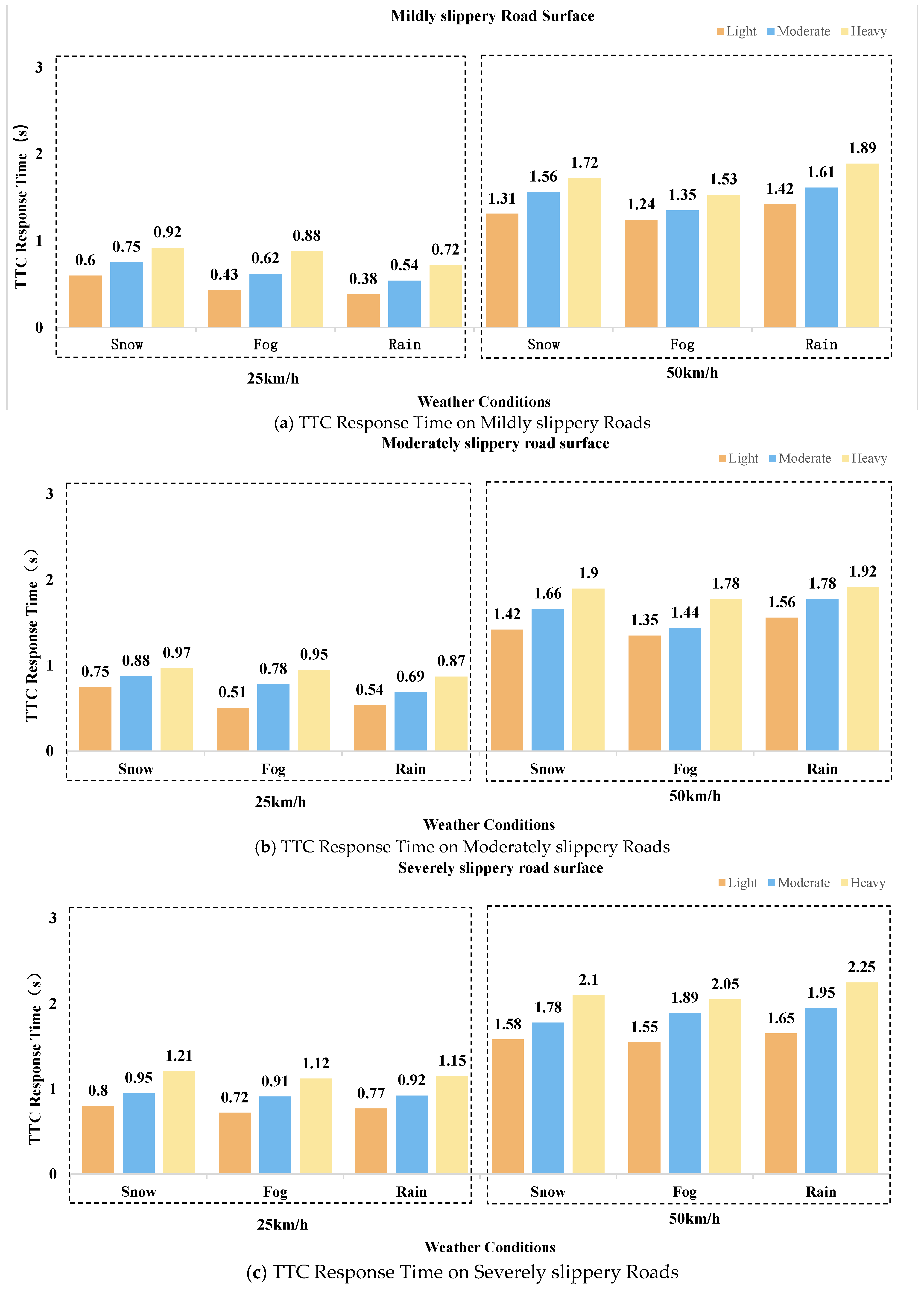
In addition to the stopping safety margin, this study further uses TTC response time to characterize the risk perception and triggering responsiveness of AEB under complex weather perturbations. For the complex weather environmental state set, TTC response times are comparatively analyzed under two speed conditions (25 km/h and 50 km/h), and the variation patterns across different road slipperiness levels and weather severity levels are examined. The TTC response time results under different weather conditions are summarized in Figure 8.
The results indicate that the AEB TTC response time exhibits an overall increasing trend as the test speed rises from 25 km/h to 50 km/h, the road condition evolves from mildly to severely slippery, and the weather environment progressively deteriorates.
Under a mildly slippery road surface at 50 km/h, when the weather changes from light rain to heavy rain, the TTC response time increases from 1.42 s to 1.89 s. Under a severely slippery road surface at 50 km/h, when the weather changes from light snow to heavy snow, the TTC response time increases from 1.58 s to 2.10 s. A longer TTC response time implies a more pronounced delay in the system’s decision–execution chain from “approaching danger” to “braking activation”. Under the same initial speed and relative-motion conditions, this delay reduces the available braking distance and increases the risk of a frontal impact of the ego vehicle with the rear of the lead vehicle, i.e., a rear-end collision scenario. Taken together, the TTC response time results and the post-braking gap results indicate that weather severity, adhesion reduction, and higher speed jointly compress both the temporal and spatial safety margins of longitudinal collision mitigation.

4.3. Combined Weight Fuzzy Comprehensive Evaluation Results

To provide a unified quantitative characterization of “overall speed control capability” beyond key safety indicators, this study further applies the combined weight and multi-level fuzzy comprehensive evaluation model established in Section 2.3.2 to comprehensively score the test performance under different weather–road coupled states. The evaluation adopts a five-grade rating set (excellent, good, fair, poor, and very poor). Based on the evaluation settings defined in Section 2.3, the membership degrees of each indicator to each grade are used to construct the evaluation matrix, which is then aggregated hierarchically under the combined weights to obtain comprehensive evaluation results at both the criterion level and the target level.

4.3.1. Multi-Level Aggregation Results

Taking the “advanced traffic behavior” factor layer as an example, its indicator set is U22 = {u221, u222, u223}, and the corresponding evaluation matrix is specified in the form of membership degrees. The weight vector for this layer is calculated as B22 = (0.4142, 0.3116, 0.2742, 0). Similarly, comprehensive evaluation result vectors for the remaining factor layers (e.g., B11, B12, B13, B21, etc.) can be obtained and then aggregated upward to derive the comprehensive evaluation results for the criterion layers’ “advanced intelligent behaviors” and “basic intelligent behaviors”, given by B2 = (0.4125896, 0.2563014, 0.331109, 0, 0) and B1 = (0.4354578, 0.1356254, 0.2156324, 0.2132844, 0), respectively.
Under the criterion-layer weight vector A = (0.421, 0.579), the target layer comprehensive evaluation result vector for “intelligent driving speed control under weather conditions” is further obtained as B = (0.325678941, 0.135264782, 0.256458791, 0.282597486, 0). The final scores of the two criterion layers are then computed as S1 = 92.54 and S2 = 95.86. These results indicate that the proposed framework can complete multi-level aggregation from indicator-level performance to criterion-level and target-level evaluation outputs, thereby providing a unified quantitative basis for cross-state capability comparison.

4.3.2. Comparison of Comprehensive Scores Across Different Weather States

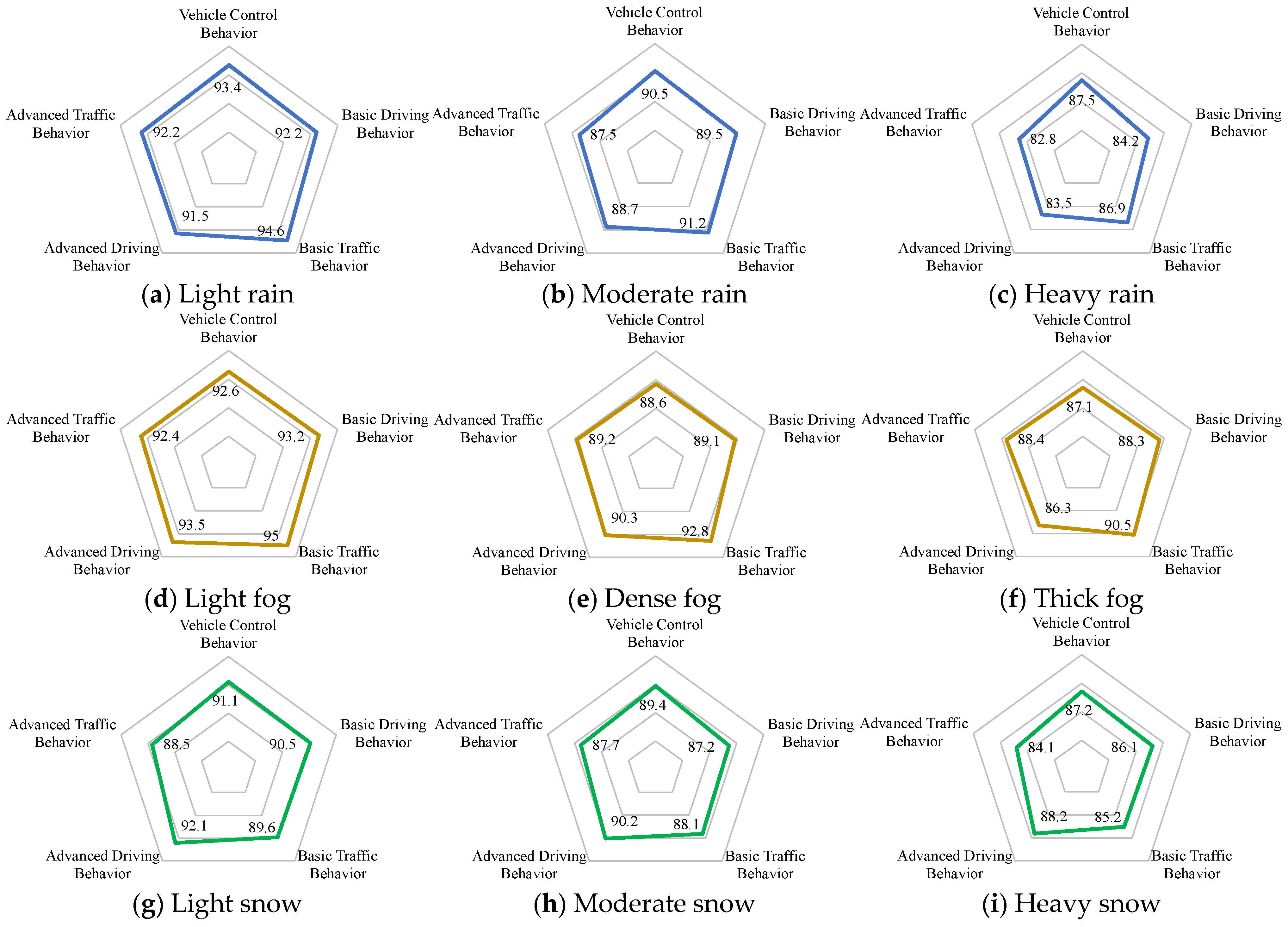
To verify the discriminative capability of the proposed comprehensive evaluation framework across different weather conditions, this study considers moderately slippery road conditions and configures three severity levels for each of the three weather types (rain, fog, and snow)—light/moderate/heavy (or light/dense/thick for fog). Comprehensive speed control scores are then obtained across five behavioral dimensions (vehicle control behavior, basic driving behavior, basic traffic behavior, advanced driving behavior, and advanced traffic behavior), thereby completing the overall quantitative evaluation. The resulting score distributions are reported as follows, The resulting score distributions are shown in Figure 9.
Under moderately slippery road conditions, increasing the severity of each weather type (rain, fog, and snow) from light to severe leads to an overall downward shift in speed control performance across the five behavioral dimensions (vehicle control, basic driving, basic traffic, advanced driving, and advanced traffic). This indicates that, even with a fixed adhesion level, meteorological perturbations can significantly compress the overall capability boundary of the system. Rain induces the most pronounced degradation: from light rain to heavy rain, the five-dimensional scores decrease from 93.4/92.2/94.6/91.5/92.2 to 87.5/84.2/86.9/83.5/82.8. The largest drop occurs in advanced traffic behavior (9.4 points), while both basic driving and advanced driving decrease by 8.0 points, suggesting that increased rainfall intensity is more sensitive to “traffic interaction and task-level speed management” and concurrently undermines driving stability. Fog exhibits relatively higher overall performance but reveals a structural weakness: from light fog to thick fog, the reductions in vehicle control, basic driving, basic traffic, and advanced traffic fall within 4.0–5.5 points, whereas advanced driving drops by 7.2 points (from 93.5 to 86.3), implying that reduced visibility is more likely to expose capability shrinkage in complex driving task execution. Snow, by contrast, shows a more balanced and synchronous attenuation, with the five-dimensional reductions from light snow to heavy snow all within 3.9–4.4 points, reflecting a degradation pattern of “uniform downward shifting” across dimensions.
A cross-weather comparison at the most adverse severity levels further shows that heavy rain yields the lowest scores in basic driving (84.2) and advanced traffic (82.8), representing the harshest combination under moderately slippery conditions. Heavy snow also produces relatively low values in basic traffic (85.2) and advanced traffic (84.1), indicating a pronounced impact on speed management capability in traffic contexts. Thick fog maintains a relative advantage in basic traffic (90.5) but exhibits a clear decline in advanced driving (86.3). These findings suggest that ODD boundary identification under moderately slippery roads should prioritize heavy rain conditions and focus on degradation in advanced traffic and advanced driving behaviors, while using the drop in advanced driving under thick fog and the synchronous shrinkage of traffic-related dimensions under heavy snow as complementary high-sensitivity validation directions, thereby improving the detectability of capability shrinkage and risk transitions under coupled complex weather states. More broadly, these results suggest that different weather types do not merely reduce capability to different extents, but may also produce distinct degradation patterns across behavioral dimensions, which is important for targeted ODD boundary identification and test-priority planning.

4.4. Discussion

4.4.1. Systematic Shrinkage of Safety Margin Induced by Coupled Complex Weather and Low Adhesion

The experimental results indicate a sustained shrinkage of the stopping safety margin in AEB longitudinal control under coupled conditions of complex weather and moderately/severely slippery roads. As weather severity increases, road slipperiness intensifies, and as vehicle speed rises, the post-stop gap to the lead vehicle decreases significantly. In particular, under severe road slipperiness combined with heavy rain or heavy snow, the post-stop gap drops to 0.25 m and 0.21 m, respectively, exhibiting high-risk characteristics close to the functional boundary. Meanwhile, the speed decay process becomes noticeably slower under low-adhesion conditions, and the differences are more pronounced at higher speeds, indicating that the coupled condition of “high speed–low adhesion–severe weather” is a more sensitive operating regime that should be prioritized for longitudinal control boundary verification and stress testing.
From a system perspective, this degradation should not be interpreted only as a braking capability issue; it is also related to the functional reliability of the perception–decision–control chain. Under precipitation, fog, and surface contamination, the effective sensing quality of cameras, LiDAR, and radar may deteriorate because of scattering, attenuation, occlusion, and signal distortion, which can increase target detection uncertainty and trigger delay. Therefore, the observed reduction in the post-stop safety margin reflects not only lower tire–road adhesion, but also the coupled effect of environmental perception degradation and control-response compression under adverse weather perturbations.

4.4.2. TTC Response Time Reveals Trigger-to-Execution Latency and Consistently Indicates Elevated Risk Together with Safety Margin Shrinkage

Beyond the post-stop gap, TTC response time increases overall with higher speed, lower adhesion, and deteriorating weather. Under mildly slippery roads at 50 km/h, increasing rainfall intensity from light to heavy increases the TTC response time from 1.42 s to 1.89 s; under severely slippery roads at 50 km/h, increasing snowfall intensity from light to heavy increases the TTC response time from 1.58 s to 2.10 s. A longer response time implies an aggravated delay in the trigger-to-execution chain from “approaching danger” to “braking intervention”, which reduces the available braking distance and increases the risk of a frontal impact of the ego vehicle with the rear of the lead vehicle, i.e., a rear-end collision scenario. This interpretation is consistent, in terms of risk implication, with the observed reduction in the stopping safety margin. Consequently, for ODD boundary identification and performance assessment, jointly using “post-stop safety margin” and “TTC response time” provides a more stable characterization of longitudinal control degradation patterns and risk transitions than relying on a single indicator. From a control design perspective, this result also suggests that adverse weather longitudinal safety assessments should jointly consider spatial safety margins and temporal response degradation, rather than evaluating trigger performance or braking outcome in isolation.

4.4.3. Comprehensive Evaluation Provides a Structured Capability Profile to Support Test Prioritization and Boundary Localization

Beyond key safety metrics, the combined weight and multi-level fuzzy comprehensive evaluation can output a structured capability profile of speed control across ODD states. Under moderately slippery road conditions, rain produces the most pronounced five-dimensional capability decline as severity increases, and advanced traffic behavior is the most sensitive to rainfall intensity. Fog exhibits relatively high overall performance but a prominent decline in the advanced driving dimension, while snow is closer to a “synchronous degradation across dimensions” pattern. These findings complement hard safety measures: the post-stop gap and TTC response time characterize the immediate risk boundary, whereas the comprehensive evaluation localizes which capability dimensions primarily degrade. Together, they provide an actionable evidence chain for “which ODD combinations to prioritize”, “which capability dimensions to focus on”, and “what targeted improvements to pursue”. These differentiated degradation patterns also have implications for evaluation and control tuning. Rain-dominant states appear to be more sensitive to traffic interaction and task-level speed management capability, fog-dominant states more strongly expose shrinkage in advanced driving execution, and snow-related states tend to produce a more synchronous reduction across dimensions. This suggests that different weather categories should not be treated simply as stronger or weaker disturbances of the same type; rather, they may affect different capability dimensions with different sensitivities. Accordingly, targeted ODD boundary identification and test-priority planning should pay attention not only to the magnitude of performance decline, but also to the structural pattern of degradation across behavioral layers.
It should also be noted that the present findings are derived from co-simulation and digital-twin validation rather than direct real-vehicle experiments. Although this testing architecture provides controllability, repeatability, and safety for adverse weather perturbation analysis, extrapolation to real-vehicle performance still requires subsequent calibration and back-to-back validation. In addition, the TTC-based controller used in this study is intentionally simplified to support structured comparative testing, and the membership construction in the comprehensive evaluation still relies partly on expert knowledge. Therefore, the present framework should be interpreted as an engineering evaluation method for capability comparison and boundary characterization, rather than as a complete substitute for production-system certification or full real-world validation.

5. Conclusions

This study addresses the degradation of intelligent driving longitudinal control under complex weather ODDs and proposes an integrated evaluation framework that combines ODD parameter perturbation testing with a “combined weight + multi-level fuzzy comprehensive evaluation” approach. The framework is validated using representative AEB risk scenarios on a joint platform integrating SCANeR simulation and a cloud-controlled digital-twin system.
The main findings are as follows:
(1)
The coupling of complex weather and road slipperiness significantly compresses the longitudinal braking safety margin of AEB. As weather severity, slipperiness, and initial speed increase, the post-stop gap continuously decreases. Under severe road slipperiness combined with heavy rain or heavy snow, the post-stop gap drops to 0.25 m and 0.21 m, respectively. High-speed cases exhibit a longer deceleration phase and a smaller final margin, representing the most unfavorable coupled operating conditions.
(2)
The TTC response time increases overall with higher speed, lower adhesion, and deteriorating weather. Under mildly slippery roads at 50 km/h, increasing rainfall intensity from light to heavy increases the TTC response time from 1.42 s to 1.89 s; under severely slippery roads at 50 km/h, increasing snowfall intensity from light to heavy increases the TTC response time from 1.58 s to 2.10 s. Degraded responsiveness reduces the available braking distance, which is consistent—regarding risk implication—with the observed shrinkage of the stopping safety margin.
(3)
The comprehensive evaluation differentiates speed control capability under different weather perturbations and provides a structured capability profile. Under moderately slippery conditions, rain yields the most pronounced degradation, with the advanced traffic dimension being particularly sensitive; fog shows a prominent decline in the advanced driving dimension; and snow exhibits a balanced, synchronous attenuation. Together with key safety indicators, these results form complementary evidence of “hard risk boundary + capability profile localization”, supporting ODD state ranking, test-priority planning, and boundary identification.
It should be noted that the present conclusions are based on validation using co-simulation and a digital-twin platform; extrapolation to real-vehicle performance still requires subsequent calibration and back-to-back validation. Moreover, membership construction in the comprehensive evaluation relies partly on expert knowledge; while suitable for representing fuzzy grade boundaries, its stability and transferability should be further examined with larger samples and broader scenario families. Several open research questions therefore remain. First, how can richer ODD factors, such as crosswinds, illumination transitions, and road geometry, be incorporated into the coupled state representation without causing excessive scenario expansion? Second, how can the current evaluation inputs and membership construction be constrained more strongly by experimental data so as to improve robustness and transferability? Third, how can virtual test results be calibrated more tightly against real-vehicle or hardware-in-the-loop validation so as to enhance external validity and engineering applicability? Future work will address these directions to further improve capability boundary characterization accuracy under complex weather conditions.

Author Contributions

Y.X.: Conceptualization, drafting methodology design, original draft preparation, research coordination; S.X.: Data curation and analysis, algorithm visualization, literature validation; H.S.: Scenario case compilation, language editing; Y.C.: Visualization and validation, reference formatting; J.Y.: Data curation and analysis, reference formatting; C.S. and Z.L.: Supervision, project administration, critical revision, final approval. All authors have read and agreed to the published version of the manuscript.

Funding

This research was funded by the Hubei Science and Technology Project, grant number 2025CDB015; the Science and Technology Program of Suzhou, grant number SYG2025116; Huanggang Technical Breakthrough General Project, grant number JGYB20250014; and the Natural Science Foundation of Jiangsu Province, grant numbers BK20231197 and BK20230892. The APC was covered by an MDPI voucher.

Data Availability Statement

The raw data supporting the conclusions of this article can be made available by the corresponding author.

Acknowledgments

A generative AI tool was used only for limited language polishing after the scientific content, analysis, and conclusions had been completed by the authors. All generated outputs were carefully reviewed, revised, and verified by the authors, who take full responsibility for the final content of the manuscript.

Conflicts of Interest

Author Haiming Sun was employed by the company Hubei Zhongcheng Industrial Technology Research Institute Co., Ltd. Authors Yicheng Cao and Junru Yang were employed by the company Bosen RuiJie New Energy Technology (Hubei) Co., Ltd. The remaining authors declare that the research was conducted in the absence of any commercial or financial relationships that could be construed as a potential conflict of interest.

References

  1. SAE J3016-2021; Taxonomy and Definitions for Terms Related to Driving Automation Systems for On-Road Motor Vehicles. SAE International: Warrendale, PA, USA, 2021. Available online: https://www.sae.org/standards/j3016_202104-taxonomy-definitions-terms-related-driving-automation-systems-road-motor-vehicles (accessed on 16 April 2022).
  2. ISO 34503:2023; Road Vehicles—Test Scenarios for Automated Driving Systems—Specification for Operational Design Domain. ISO: Geneva, Switzerland, 2023. Available online: https://www.iso.org/standard/78952.html (accessed on 5 February 2024).
  3. ISO 16787:2017; Intelligent Transport Systems—Assisted Parking System (APS)—Performance Requirements and Test Procedures. ISO: Geneva, Switzerland, 2017. Available online: https://www.iso.org/standard/73768.html (accessed on 18 February 2026).
  4. ASAM e.V. ASAM OpenSCENARIO: User Guide (V1.2.0). 2022. Available online: https://www.asam.net/standards/detail/openscenario/ (accessed on 21 January 2023).
  5. PEGASUS Projekt Consortium. PEGASUS-Gesamtmethode (Method for the Assessment of Highly Automated Driving Functions). Available online: https://en.sip-adus.go.jp/evt/workshop2018/file/PEGASUS_SIP-adus_Thomas_Form.pdf (accessed on 13 January 2020).
  6. Dosovitskiy, A.; Ros, G.; Codevilla, F.; Lopez, A.; Koltun, V. CARLA: An Open Urban Driving Simulator. In Proceedings of the 1st Annual Conference on Robot Learning, Mountain View, CA, USA, 13–15 November 2017; Proceedings of Machine Learning Research: Cambridge, MA, USA, 2017; Volume 78, pp. 1–16. Available online: https://proceedings.mlr.press/v78/dosovitskiy17a.html (accessed on 27 January 2026).
  7. Wang, J.; Wu, Z.; Liang, Y.; Tang, J.; Chen, H. Perception Methods for Adverse Weather Based on Vehicle Infrastructure Cooperation System: A Review. Sensors 2024, 24, 374. [Google Scholar] [CrossRef]
  8. Zhang, B.; Simsek, M.; Kulhandjian, M.; Kantarci, B. Enhancing the Safety of Autonomous Vehicles in Adverse Weather by Deep Learning-Based Object Detection. Electronics 2024, 13, 1765. [Google Scholar] [CrossRef]
  9. Xu, C.; Sankar, R. A Comprehensive Review of Autonomous Driving Algorithms: Tackling Adverse Weather Conditions, Unpredictable Traffic Violations, Blind Spot Monitoring, and Emergency Maneuvers. Algorithms 2024, 17, 526. [Google Scholar] [CrossRef]
  10. Zhang, Y.; Carballo, A.; Yang, H.; Takeda, K. Perception and sensing for autonomous vehicles under adverse weather conditions: A survey. ISPRS J. Photogramm. Remote Sens. 2023, 196, 146–177. [Google Scholar] [CrossRef]
  11. Yan, C.; Xu, W.; Liu, J. Can You Trust Autonomous Vehicles: Contactless Attacks against Sensors of Self-Driving Vehicle. In Proceedings of the DEF CON 24, Las Vegas, NV, USA, 4–7 August 2016. [Google Scholar]
  12. Askari, H.; Khajepour, A.; Khamesee, M.B.; Wang, Z.L. Embedded Self-Powered Sensing Systems for Smart Vehicles and Intelligent Transportation. Nano Energy 2019, 66, 104103. [Google Scholar] [CrossRef]
  13. Kim, H.; Ko, J.; Oh, C.; Kim, S. Evaluation of Autonomous Driving Safety by Operational Design Domains (ODD) in Mixed Traffic. Sustainability 2024, 16, 9672. [Google Scholar] [CrossRef]
  14. Euro NCAP. TEST PROTOCOL—AEB Car-to-Car Systems (Implementation 2023, Version 4.2, June 2023). 2023. Available online: https://cdn.euroncap.com/cars/assets/euro_ncap_aeb_c2c_test_protocol_v42_af2bd7186c.pdf (accessed on 22 August 2023).
  15. Lai, F.; Liu, J.; Hu, Y. An Automatic Emergency Braking Control Method for Improving Ride Comfort. World Electr. Veh. J. 2024, 15, 259. [Google Scholar] [CrossRef]
  16. Jamson, A.H.; Lai, F.C.H.; Carsten, O.M.J. Potential benefits of an adaptive forward collision warning system. Transp. Res. Part C Emerg. Technol. 2008, 16, 471–484. [Google Scholar] [CrossRef]
  17. Vogel, K. A Comparison of Headway and Time to Collision as Safety Indicators. Accid. Anal. Prev. 2003, 35, 427–433. [Google Scholar] [CrossRef]
  18. UNECE. UN Regulation No. 152; Uniform Provisions Concerning the Approval of Motor Vehicles with Regard to the Advanced Emergency Braking System (AEBS) for M1 and N1 Vehicles. 2024. Available online: https://unece.org/sites/default/files/2024-04/R152r2E.pdf (accessed on 27 January 2026).
  19. Tak, S.; Kim, S.; Yeo, H. A Study on the Traffic Predictive Cruise Control Strategy With Downstream Traffic Information. IEEE Trans. Intell. Transp. Syst. 2016, 17, 1932–1943. [Google Scholar] [CrossRef]
  20. Moser, D.; Schmied, R.; Waschl, H.S.; del Re, L. Flexible Spacing Adaptive Cruise Control Using Stochastic Model Predictive Control. IEEE Trans. Control. Syst. Technol. 2018, 26, 114–127. [Google Scholar] [CrossRef]
  21. Viadero-Monasterio, F.; Meléndez-Useros, M.; Jiménez-Salas, M.; Boada, B.L. Robust Adaptive Control of Heterogeneous Vehicle Platoons in the Presence of Network Disconnections With a Novel String Stability Guarantee. IEEE Trans. Intell. Veh. 2026, 11, 63–75. [Google Scholar] [CrossRef]
  22. Viadero-Monasterio, F.; Gutiérrez-Moizant, R.; Meléndez-Useros, M.; Boada, M.J.L. Static Output Feedback Control for Vehicle Platoons with Robustness to Mass Uncertainty. Electronics 2025, 14, 139. [Google Scholar] [CrossRef]
  23. Karpenko, M.; Prentkovskis, O.; Skačkauskas, P. Numerical Simulation of Vehicle Tyre under Various Load Conditions and Its Effect on Road Traffic Safety. Promet-Traffic Transp. 2024, 36, 1–11. [Google Scholar] [CrossRef]
  24. Loganathan, M.K.; Goswami, P.; Bhagawati, B. Failure Evaluation and Analysis of Mechatronics-Based Production Systems during Design Stage Using Structural Modeling. Appl. Mech. Mater. 2016, 852, 799–805. [Google Scholar] [CrossRef]
  25. Habchi, G.; Barthod, C. An Overall Methodology for Reliability Prediction of Mechatronic Systems Design with Industrial Application. Reliab. Eng. Syst. Saf. 2016, 155, 236–254. [Google Scholar] [CrossRef]
  26. Aguirre Mehlhorn, M.; Richter, A.; Shardt, Y.A.W. Ruling the Operational Boundaries: A Survey on Operational Design Domains of Autonomous Driving Systems. IFAC-PapersOnLine 2023, 56, 2202–2213. [Google Scholar] [CrossRef]
  27. Xu, X.; Yu, F.; Pedrycz, W.; Du, X. Multi-source Fuzzy Comprehensive Evaluation. Appl. Soft Comput. 2023, 135, 110042. [Google Scholar] [CrossRef]
  28. Zhong, C.; Yang, Q.; Liang, J.; Ma, H. Fuzzy comprehensive evaluation with AHP and entropy methods and health risk assessment of groundwater in Yinchuan Basin, northwest China. Environ. Res. 2022, 204, 111956. [Google Scholar] [CrossRef]
  29. Feng, S.; Feng, Y.; Yan, X.; Shen, S.; Xu, S.; Liu, H.X. Safety assessment of highly automated driving systems in test tracks: A new framework. Accid. Anal. Prev. 2020, 144, 105664. [Google Scholar] [CrossRef]
  30. Li, Y.; Tao, J.; Wotawa, F. Ontology-based test generation for automated and autonomous driving functions. Inf. Softw. Technol. 2020, 117, 106200. [Google Scholar] [CrossRef]
  31. Feng, S.; Feng, Y.; Yu, C.; Zhang, Y.; Liu, H.X. Testing Scenario Library Generation for Connected and Automated Vehicles, Part I: Methodology. IEEE Trans. Intell. Transp. Syst. 2021, 22, 1573–1582. [Google Scholar] [CrossRef]
  32. Inagaki, T.; Sheridan, T.B. A critique of the SAE conditional driving automation definition, and analyses of options for improvement. Cogn. Technol. Work. 2019, 21, 569–578. [Google Scholar] [CrossRef]
  33. ISO 8348; Road Vehicles—Measurement and Representation of Tyre-to-Road Adhesion. ISO: Geneva, Switzerland, 2002.
  34. QXT 729-2024; Weather Risk Warning Levels for Expressway Traffic Safety Management and Control. Meteorological Industry Standard of the People’s Republic of China: Beijing, China, 2024.
Figure 1. Schematic of Vehicle Perception System Modeling.
Machines 14 00454 g001aMachines 14 00454 g001b
Figure 2. TTC-Based AEB Control Model.
Machines 14 00454 g002
Figure 3. Driving Simulator Hardware Platform.
Machines 14 00454 g003
Figure 4. Digital-Twin Environment of the Test Site.
Machines 14 00454 g004
Figure 5. Test Scenarios under Different Weather Attributes.
Machines 14 00454 g005aMachines 14 00454 g005b
Figure 6. Summary of Post-Braking Gap Test Results under Different Weather Conditions.
Machines 14 00454 g006aMachines 14 00454 g006b
Figure 7. Summary Plot of Vehicle Speed–Time Profiles after AEB Intervention under Different Weather Conditions.
Machines 14 00454 g007
Figure 8. Summary of TTC Response Time Test Results under Different Weather Conditions.
Machines 14 00454 g008
Figure 9. Speed Control Behavior Scores under Different Weather Conditions.
Machines 14 00454 g009
Table 1. Classification of Complex Weather Severity Levels.
CategorySeverity LevelCriterionNotes
SnowLight snow0.1 < S1 < 0.5 or 0.1 < S12 < 2.4S1: 1 h snowfall; S12: 12 h snowfall; unit: mm
SnowModerate snow0.6 < S1 < 1.4 or 2.5 < S12 < 4.9S1: 1 h snowfall; S12: 12 h snowfall; unit: mm
SnowHeavy snow1.5 < S1 < 3.0 or 5.0 < S12 < 9.9S1: 1 h snowfall; S12: 12 h snowfall; unit: mm
FogLight fog500 < Vvis < 1000Vvis: visibility; unit: m
FogDense fog200 < Vvis < 500Vvis: visibility; unit: m
FogThick fog50 < Vvis < 200Vvis: visibility; unit: m
RainLight rain0.1 < R1 < 2.5 or 0.1 < R12 < 5R1: 1 h rainfall; R12: 12 h rainfall; unit: mm
RainModerate rain2.6 < R1 < 7.9 or 6.0 < R12 < 15R1: 1 h rainfall; R12: 12 h rainfall; unit: mm
RainHeavy rain8.0 < R1 < 15.0 or 15.0 < R12 < 30R1: 1 h rainfall; R12: 12 h rainfall; unit: mm
Table 2. Tire–Road Friction Coefficients under Complex Weather Conditions.
Road ConditionFriction-Coefficient Range
Mildly slippery road surface0.41–0.50
Moderately slippery road surface0.21–0.40
Severely slippery road surface0.10–0.20
Note: Friction-coefficient grading was defined with reference to ISO 8348 [33].
Table 3. Values and Definitions of Indices for Complex Weather Environmental Factors.
IndexDefinition
p = 1Heavy snow
p = 2Moderate snow
p = 3Light snow
p = 4Thick fog
p = 5Dense fog
p = 6Light fog
p = 7Heavy rain
p = 8Moderate rain
p = 9Light rain
q = 1Mildly slippery road surface
q = 2Moderately slippery road surface
q = 3Severely slippery road surface
Table 4. Risk-Severity Classification of Weather–Road Coupled States.
Complex Weather Environmental StateRisk Severity
K61, K91Safe
K11, K21, K31, K41, K51, K71, K81, K12, K22, K32, K42, K52, K62, K72, K82, K92, K23, K33, K43, K53, K63, K83, K93Moderate
K13, K73Hazardous
Note: The coding of each state follows the definition in Section 2.1.3, where the first index denotes weather category/severity and the second index denotes road slipperiness level.
Table 5. Evaluation Indicator System for Intelligent Driving Speed Control under Weather Conditions.
Target Layer (A)Function Layer (B)Factor Layer (C)Indicator Layer (D)
Intelligent driving speed control under weather conditionsBasic intelligent behaviorsVehicle control behaviorSmooth start-up; decelerated stop
Intelligent driving speed control under weather conditionsBasic intelligent behaviorsBasic driving behaviorLane keeping; go straight through an intersection; U-turn on the road; low-speed car-following
Intelligent driving speed control under weather conditionsBasic intelligent behaviorsBasic traffic behaviorDecelerate when encountering obstacles; car-following while turning
Intelligent driving speed control under weather conditionsAdvanced intelligent behaviorsAdvanced driving behaviorEmergency braking; automated parking
Intelligent driving speed control under weather conditionsAdvanced intelligent behaviorsAdvanced traffic behaviorContinuous lane changing; evasion of an accident-involved vehicle; intelligent navigation
Table 6. Test Matrix Details.
Complex WeatherCategoryRoad ConditionTest Speed (km/h)Complex Weather Environmental States
SnowLight snowMildly slippery road surface25, 50K31, K32, K33
Moderate snowModerately slippery road surface25, 50K21, K22, K23
Heavy snowSeverely slippery road surface25, 50K11, K12, K13
FogLight fogMildly slippery road surface25, 50K61, K62, K63
Dense fogModerately slippery road surface25, 50K51, K52, K53
Thick fogSeverely slippery road surface25, 50K41, K42, K43
RainLight rainMildly slippery road surface25, 50K91, K92, K93
Moderate rainModerately slippery road surface25, 50K81, K82, K83
Heavy rainSeverely slippery road surface25, 50K71, K72, K73
Disclaimer/Publisher’s Note: The statements, opinions and data contained in all publications are solely those of the individual author(s) and contributor(s) and not of MDPI and/or the editor(s). MDPI and/or the editor(s) disclaim responsibility for any injury to people or property resulting from any ideas, methods, instructions or products referred to in the content.