Article

Effect of Nozzle Parameters and Spindle Speed on the Oil Mist Penetration Mechanism in MQL High-Speed Milling of a GH4169 Alloy


1
College of Mechanical Engineering, Suzhou University of Science and Technology, Suzhou 215009, China
2
Suzhou Electric Processing Machine Tools Research Institute Ltd., Co., Suzhou 215011, China
*
Author to whom correspondence should be addressed.
Machines 2026, 14(4), 420; https://doi.org/10.3390/machines14040420
Submission received: 8 March 2026 / Revised: 1 April 2026 / Accepted: 8 April 2026 / Published: 9 April 2026
(This article belongs to the Special Issue Sustainable Manufacturing and Green Processing Methods, 2nd Edition)

Abstract

Minimum quantity lubrication (MQL) is a promising green technology for high-speed milling of GH4169. However, the full-chain oil mist penetration mechanism remains unclear, limiting precise parameter regulation. Based on a cross-scale mechanism, this study develops a semi-empirical oil mist penetration efficiency model coupling four key parameters and conducts single-factor and orthogonal high-speed milling experiments to validate the model and analyze the regulation mechanism using milling force and surface roughness. The experimental results show relative deviations below 6%, demonstrating good model validity and robustness. The influence hierarchy is spindle speed > nozzle orientation > nozzle angle > nozzle distance. Spindle speed and nozzle orientation are strongly coupled dominant parameters with a “drive-adaptation” mechanism, while nozzle distance and nozzle angle are weakly coupled, only notable under extreme conditions. The optimal parameters obtained via BP neural network and NSGA-II are nozzle orientation −X, angle 22.43°, distance 14.96 mm, and spindle speed 16,581 rpm. Under this combination, minimum Surface Roughness Ra of 0.17 μm and milling force of 24.27 N are achieved, reducing surface roughness by 85.32% and milling force by 53.52% versus the worst condition and reducing roughness by 28.57% versus the baseline while maintaining milling force within a reasonable range. This study clarifies the physical mechanism of MQL oil mist penetration, extending conventional macroscopic parameter optimization. The proposed cross-scale framework offers theoretical and engineering guidance for MQL parameter design in green precision machining of nickel-based superalloys.

1. Introduction

The continuous advancement of aerospace equipment toward higher thrust-to-weight ratios, longer service lives, and enhanced reliability imposes stringent requirements on the high-temperature creep resistance, fatigue resistance, and wide-temperature-range stability of materials for key hot-end components. The GH4169 alloy, with its excellent stability at temperatures ranging from −253 °C to 650 °C, has become the preferred material for critical load-bearing and hot-end components (e.g., compressor disks and combustion chamber casings) in aero-engines. Its machining quality directly determines the assembly accuracy and service safety of aerospace equipment [1,2,3,4]. However, the GH4169 alloy has a room temperature tensile strength exceeding 1300 MPa and a thermal conductivity merely one-fourth that of AISI 1045 steel, rendering it difficult to machine. It is prone to issues such as cutting heat accumulation, severe tool wear, and surface quality deterioration during high-speed milling [5,6,7,8]. At the same time, traditional flood lubrication risks environmental pollution and occupational health hazards. Against this background, minimum quantity lubrication (MQL) technology—characterized by low consumption and low pollution—has emerged as a core technical approach to overcome the machining bottlenecks of the GH4169 alloy and meet the development requirements of green manufacturing [9,10,11,12,13].
Extensive research has been conducted on the application of MQL technology to difficult-to-machine materials. For nickel-based superalloy machining, Gao et al. [14] analyzed the cooling and lubrication effects of combined supercritical carbon dioxide and MQL, confirming that this hybrid method reduces milling force and temperature. Şap et al. [15] compared MQL and cryogenic cooling in the milling of Inconel 800, clarifying MQL’s advantages in mitigating tool wear. Recent studies have further expanded the potential applications of MQL technology, with topics including artificial intelligence-based process optimization for the sustainable machining of nickel-based superalloys [16] and the systematic techno-economic and environmental assessment of MQL-assisted machining of difficult-to-machine alloys [17]. In the field of MQL-assisted high-speed milling, Liu [18] optimized cryogenic MQL parameters via orthogonal experiments and genetic algorithms, while Xiang [19] investigated MQL’s effects on milling force and residual stress in the high-speed milling of titanium alloys.
Despite these advances, the existing literature has generally concentrated on the macroscopic correlation between MQL input parameters, such as oil flow rate and air source pressure, and output performance, such as milling force and surface roughness. Relatively less attention has been paid to the microphysical process by which oil mist, after being ejected from the nozzle, traverses the complex airflow field in the cutting zone and ultimately reaches and penetrates the tool–chip contact interface [20,21,22]. CFD-based spray characteristic simulations [23] have primarily addressed droplet velocity and diameter evolution at the macro-mesoscale, while the capillary penetration process at the tool–chip interface has received comparatively less emphasis. This means that the full-chain penetration mechanism remains not yet fully clarified. Furthermore, existing oil mist penetration models have often been based on the analysis of individual machining parameters, such as nozzle distance or air pressure [22,24]. Relatively few studies have systematically investigated the coupling effects between key parameters that dominate the cutting zone airflow field and oil mist penetration mechanism, such as spindle speed and nozzle pose [25].
To do so, this study pursues two objectives: (1) develop a semi-empirical model of oil mist penetration efficiency incorporating nozzle orientation, nozzle angle, nozzle distance, and spindle speed; (2) validate the model through single-factor and four-factor orthogonal milling experiments, using milling force and surface roughness as penetration indicators.
To achieve these objectives, a systematic parameter design is adopted to isolate and focus on the core mechanism of interest, namely the coupling effect of spindle speed and nozzle pose parameters on the cutting zone airflow field and how this coupling modulates oil mist penetration mechanism. In the present experiments, spindle speed and nozzle pose, including orientation, distance, and nozzle angle, are selected as the core variables, while other key parameters such as feed per tooth, air supply pressure, and oil flow rate are kept constant. Spindle speed is linearly coupled with cutting speed, which directly governs the intensity of the rotating airflow field around the end mill. Higher speeds induce more vigorous turbulence that thickens the air barrier, inhibiting oil mist penetration to the tool–chip contact interface [26,27]. Nozzle pose, in turn, determines the jet–airflow matching behavior that critically influences whether the oil mist can effectively traverse this barrier. Keeping feed rate, air pressure, and oil flow rate constant helps ensure that material removal dynamics, atomization quality, and lubricant supply stability do not introduce confounding effects that could mask the coupling between spindle speed and nozzle pose [28,29,30]. This experimental design aligns with both the physical requirements for isolating the core coupling mechanism and the industrial practice of precision finishing for GH4169 components and is consistent with established methodologies in MQL machining studies [31,32].
This rigorous experimental design and the derived oil mist penetration efficiency model are expected to fill the theoretical gap in the precise regulation of MQL process parameters for GH4169 alloy high-speed milling and provide a practical methodological reference for the optimization of MQL jet parameters in the green precision machining of nickel-based superalloys and other difficult-to-machine materials. Meanwhile, the in-depth analysis of the coupling effect between spindle speed and nozzle pose on the cutting zone airflow field can also offer new insights into the physical mechanism of oil mist penetration under high-speed milling conditions, laying a solid foundation for the further development and application of high-efficiency MQL technology in aerospace component manufacturing.

2. Materials and Methods

This section develops a semi-empirical model of the oil mist penetration mechanism based on cross-scale transport physics and describes the validation experiment.

2.1. Theoretical Model of Oil Mist Penetration Mechanism

The oil mist penetration efficiency can be defined as the mass ratio of the oil mist that effectively reaches the tool–chip contact zone to the total oil mist ejected from the nozzle, serving as a key evaluation index that links the microscopic penetration mechanism with macroscopic machining performance. The oil mist penetration efficiency model in this section is established based on the classical cross-scale transport theory of MQL proposed by Pei [33], which systematically reveals the physical mechanism of MQL oil mist transport spanning macroscopic jet transmission, mesoscopic airflow coordination, and microscopic capillary penetration.
To clarify the theoretical framework and reduce the ambiguity of physical boundaries, the spatial scale ranges, core physical regions, and corresponding physical processes of the three scales can be explicitly defined in a manner that corresponds to the full-chain oil mist penetration process from nozzle ejection to tool–chip contact interface lubrication. The macroscopic scale is characterized by a size greater than 1 mm and a physical scope covering the full path from the nozzle outlet to the outer edge of the cutting zone, where the core physical process is the macroscopic transmission and diffusion of the oil mist jet primarily governed by the jet inertial force and ambient airflow resistance, and this scale defines the initial motion state of the oil mist before it enters the complex cutting flow field. The mesoscopic scale spans a characteristic size from 1 μm to 1 mm and covers the near-field area of the cutting zone around the rotating end mill, where the core physical process involves the synergistic interaction between the oil mist droplets and the spindle-induced rotating airflow field as well as the penetration of the oil mist through the air barrier around the cutting tool, and the mesoscopic airflow coordination mechanism described in this study is fully concentrated within this scale range. The microscopic scale corresponds to a characteristic size of less than 1 μm and a physical scope covering the capillary gap at the tool–chip contact interface, where the core physical process consists of the capillary infiltration of oil mist droplets and the formation of a boundary lubrication film on the friction interface, which ultimately contributes to the effective lubrication effect of MQL technology.
Four core variables are considered in the model, with their physical meanings clearly defined as follows.
Nozzle orientation (α): This represents the spatial direction of the jet in the XY plane, with four levels set to characterize the spatial matching characteristics between the jet and the surrounding airflow field.
Nozzle angle (θ): This refers to the angle between the jet and the workpiece surface, which directly affects the normal penetration momentum and tangential anti-interference capability of the jet.
Nozzle distance (L): This is defined as the linear distance from the nozzle outlet to the tool tip and affects the path length and diffusion loss of oil mist during transport.
Spindle speed (n): This is used to characterize the intensity variation in the airflow field and further affects the ability of oil mist to penetrate the air barrier.
To simplify the analysis, the model is established based on the following assumptions: (1) Oil mist droplets are considered to form a dilute suspension system in which droplet collision is generally negligible, a premise supported by the findings of Zhu et al. [34] and Pei [33]. Zhu et al. [34] observed that under moderate nozzle distance and relatively low oil flow rate, the influence of droplet collision and coalescence remains limited, while Pei [33] further noted that such effects may become non-negligible only when the nozzle distance is excessively short or the oil flow rate is markedly high. In this study, the oil flow rate is fixed at a relatively low level of 2 mL/min, the air supply pressure is maintained at 0.6 MPa, and the nozzle distance is varied within the range of 4–16 mm. Based on the spray breakup characteristics of the present nozzle configuration, the dilute suspension assumption is considered reasonably valid for nozzle distances where d is greater than or equal to 5 mm, where the oil mist has undergone substantial atomization and the droplet concentration decays to a sufficiently low level. For the near-field condition at d = 4 mm, where droplet concentration is higher and collision effects may become non-negligible, a preliminary estimation based on the trend observed in the pre-experimental data suggests that the potential error remains within an acceptable range; this condition is retained to explore the model’s behavior under near-field injection, and the corresponding results are interpreted with appropriate caution in the subsequent analysis. (2) The motion of oil mist droplets is dominated only by jet inertial force, airflow drag force, and suction force in the wedge zone, while secondary forces such as gravity are neglected. (3) The total penetration efficiency can be decomposed into the product of the efficiency of each stage, corresponding to the cross-scale serial process of “macroscopic jet transport–mesoscopic airflow synergy–microscopic capillary penetration”, with each stage following an independent physical mechanism.
The applicable scope and reliable parameter range of the established model will be clarified subsequently based on the experimental validation results and quantitative analysis of the experimental design conclusions.
The model is not applicable to the following working conditions: (1) intermittent cutting processes accompanied by strong impact; (2) MQL processes using special media such as nanofluids, cryogenic fluids, or supercritical CO2; (3) working conditions where the nozzle distance is excessively short and the oil flow rate is markedly high, under which droplet collision and coalescence effects become significantly enhanced and the dilute suspension system assumption is no longer valid; (4) direct application to the machining of other materials without re-calibration of the model’s key coefficients.
Nevertheless, the cross-scale modeling framework of “macroscopic jet transport–mesoscopic airflow synergy–microscopic capillary penetration” proposed in this study has good universality for MQL-assisted milling processes. For working conditions beyond the above application scope, this framework can still be used for theoretical analysis and trend prediction of related processes by re-calibrating the key coefficients through single-factor experiments.

2.1.1. Establishment of the Semi-Empirical Formula for Oil Mist Penetration Efficiency

Based on the cross-scale serial hypothesis and incorporating established theoretical frameworks and experimental observations, the independent influence factors of the four core parameters were decomposed to develop semi-empirical formulas for each sub-efficiency. The total penetration efficiency model was then integrated as follows:
η = η θ η α η L η n η c a p
The physical meanings and expressions of each sub-factor are as follows.
Injection angle-related penetration efficiency ( η θ ): Quantifies the synergistic effect of the nozzle angle θ (the angle between the jet and the horizontal plane of the workpiece surface) on jet momentum transfer and negative pressure suction. The expression is derived based on the jet momentum theory and negative pressure penetration experiments [34,35,36]:
η θ = ( k n θ sin 2 θ + k t θ cos 2 θ ) ( 1 + k v a c Δ P * ) ξ c a p
where k n θ is the normal momentum coefficient, k t θ is the tangential anti-interference coefficient, k v a c is the negative pressure sensitivity coefficient, Δ P * is the relative pressure difference in the tool–chip zone, and ξ c a p is the capillary matching factor.
Nozzle orientation-related penetration efficiency ( η α ): Quantifies the effect of the nozzle orientation α (the horizontal azimuth angle of the jet relative to the −X direction) on jet–airflow synergy. The expression is obtained by fitting experimental data with the Gaussian–linear hybrid model [37,38]:
η α = ω 1 exp ( d α 2 2 σ 2 ) + ω 2 ( 1 k α d α 180 ° )
where ω 1 and ω 2 are weight coefficients, σ is the jet diffusion coefficient, d α = min (|α|, 360° − |α|) is the directional periodic distance function, and k α is the jet attenuation coefficient.
Nozzle distance-related penetration efficiency ( η L ): Quantifies the effect of the nozzle distance L (the distance from the nozzle outlet to the bottom edge of the cutting tool) on jet diffusion and air barrier penetration. The expression is derived based on the free jet theory and air barrier resistance experiments [35,37]:
η L = exp ( L L 0 ) ( 1 L L max ) η bar ( 1 0.15 h c h )
where L 0 is the characteristic distance of jet diffusion, L max is the maximum effective jet distance, η bar is the air barrier penetration efficiency, and h c h is the chip thickness.
Spindle speed-related penetration efficiency ( η n ): Quantifies the effect of spindle speed n on oil mist penetration through airflow interference. The expression is derived based on the rotational induced flow theory and airflow drag experiments [33,37]:
η n = 1   v g v g 1 1 0.2 v g v g 1 v g 2 v g 1   v g 1 < v g < v g 2 0.3 exp ( v g v g 2 v g 2 ) v g v g 2
where v g = k r o t π D n / 60 + ( v i n v o u t ) is the comprehensive airflow velocity in the cutting zone, k r o t is the rotation induction coefficient, v i n is the inflow velocity, v o u t is the outflow velocity, and v g 1 and v g 2 are the critical wind speeds for airflow interference.
Capillary penetration efficiency ( η c a p ): Quantifies the microscopic penetration effect of oil mist after reaching the capillary. The expression is derived based on capillary fluid mechanics and molecular dynamics simulations [39]:
η c a p = ξ s i z e ξ d i r
where ξ s i z e is the size matching factor between oil mist particles and capillaries, and ξ d i r is the scale factor for correcting the effect of nozzle orientation on the capillary effect.

2.1.2. Specification of Key Parameter Values and Sources

To guarantee the reliability and reproducibility of key parameters in the semi-empirical model, their physical meanings, value ranges, and sources are systematically clarified in Table 1, which is established based on published research and fully aligned with the experimental design and working conditions of this study. The parameters in the model are broadly divided into three categories according to their sources and determination rules, which helps to reduce ambiguity in parameter origins. The first category consists of literature-derived basic parameters, which are adopted from classic published studies in the MQL machining field and come with well-established physical meanings and value ranges; these parameters serve as the fundamental prior assumptions of the theoretical model and do not require additional calibration in the present study. The second category comprises fitting parameters calibrated through a combination of pre-experiments and formal experiments, for which a reasonable value range is first determined based on a series of boundary-condition pre-experiments, combined with the boundary conditions reported in the literature and the experimental system used in this study; the final values are then fitted and calibrated using data from the single-factor formal experiments. This two-step calibration process helps to ensure the reasonableness of the parameter boundaries and the accuracy of the final values, allowing the model to be well adapted to the MQL high-speed milling conditions of GH4169 alloy investigated in this work. The third category includes experimental design matching parameters, which are the primary control variables in this study; their value ranges are established based on pre-test verification, the engineering practice of GH4169 alloy machining, and the design requirements of the single-factor and orthogonal experiments employed in this paper.

2.2. Experimental Design and Conditions

This section details the equipment, materials, and experimental design to ensure reproducibility. The experiments aim to validate the semi-empirical oil mist penetration model (Section 2.1) and reveal regulatory effects of nozzle parameters and spindle speed on the penetration mechanism. The content is organized into two parts: experimental materials and cutting tools, and experimental scheme design.

2.2.1. Experimental Materials and Cutting Tools

(1)
Workpiece material
GH4169 alloy specimens (20 mm × 20 mm × 3.5 mm) were used. Room temperature physical and mechanical properties are listed in Table 2, consistent with the theoretical model parameters in Section 2.1.
(2)
Lubricating Medium and Cutting Tools
The plant synthetic lipid MQL oil offers excellent lubricity and biodegradability (Table 3). A YG8 tungsten carbide end mill was used (Table 4). Both match the theoretical model parameters.

2.2.2. Experimental Scheme Design

The layout of the MQL milling system is shown in Figure 1. All experiments were conducted on a Haas high-precision vertical machining center (Oxnard, CA, USA), which offers a maximum spindle speed of 30,000 rpm, X/Y/Z travels of 305 × 254 × 205 mm, and a positioning accuracy of 1 μm, providing a stable and precise platform for the milling tests. The MQL unit, a BENSHEN LTL 2-1 SU model manufactured by Benshen Machinery Technology (Shanghai) Co., Ltd. in Shanghai, China, was set to deliver an oil feed rate ranging from 1 to 200 mL/h under an air supply pressure of 0.3–0.7 MPa. Throughout the experiments, the ambient temperature was maintained at 10 °C, and each test condition was repeated at least twice, with the corresponding results averaged to enhance reliability.
For milling force measurements, a Kistler 9257B three-component piezoelectric dynamometer (Kistler Group, Winterthur, Switzerland) was used together with a 5070A charge amplifier (Kistler Group, Winterthur, Switzerland) and a high-speed data acquisition system. The dynamometer has a measurement range of 0–50 kN in each of the three orthogonal directions with a linearity error of no more than ±0.5%, ensuring a high level of measurement accuracy and stability. During the experiments, the sampling frequency was set to 10 kHz to adequately capture the dynamic milling force signals, and a second-order Butterworth low-pass filter with a cutoff frequency of 2 kHz was applied to the acquired data to suppress high-frequency noise and machine vibration. At least two repeated tests were performed for each experimental condition, and the milling force value was determined by averaging the signals obtained during the stable cutting stage.
Surface roughness was evaluated using a Bruker Contour GT-K0 white light interferometer (Bruker Corporation, Billerica, MA, USA), which provides a vertical scanning range of 0.1 nm to 10 mm and a vertical resolution better than 0.1 nm. For each machined workpiece, at least two uniformly distributed regions were selected for measurement, and the average of the measured values was taken as the Surface Roughness Ra of that specimen, thereby helping to ensure that the measurement results are representative and repeatable.
To investigate the effects of nozzle spatial parameters and spindle speed on oil mist penetration efficiency, single-factor and orthogonal experiments were combined, with a new tool of the same model and specification from the same manufacturer used for each test to ensure consistent cutting conditions. Single-factor tests isolated individual parameter effects to verify the theoretical model; orthogonal tests were used to examine multi-parameter coupling mechanisms. The single-factor and orthogonal experiments in this study use the fixed parameters listed in Table 5 and the core variable levels in Table 6, with these parameters comprehensively determined based on the engineering practice of MQL high-speed milling of GH4169 alloy, the adaptability of experimental equipment, and the verification of boundary-condition pre-tests.
Table 5 lists the values of all fixed cutting parameters used in this study. Specifically, the feed per tooth is fixed at 60 μm/z. On the one hand, this helps isolate the influence of feed rate on milling force and surface roughness, thereby allowing the study to focus on the coupling effects between nozzle parameters and spindle speed. On the other hand, this value falls within the commonly used range for precision finishing of GH4169 alloy in industrial practice [15], and a similar fixed-strategy approach has also been adopted in related studies [21] to ensure experimental comparability, thus providing practical industrial reference value. The air supply pressure is set to 0.6 MPa, which falls within the conventional application range of MQL technology [26] and is also within the adjustable range (0.3–0.8 MPa) of the BENSHEN LTL21SU minimum quantity lubrication system used in this study, ensuring compatibility with equipment performance. In addition, this pressure setting not only supports stable atomization of the oil mist but also helps avoid droplet coalescence caused by excessive jet impact force. The oil flow rate is maintained at 2 mL/min, which complies with the low-consumption requirement of green manufacturing. Boundary-condition pre-tests confirm that at this flow rate, a continuous boundary lubrication film can form at the tool–chip contact interface without leaving excessive oil residue on the workpiece or in the cutting zone. The experimental temperature is controlled at 10 °C, which is the constant-temperature environment of the laboratory. Boundary-condition pre-tests verify that under this temperature, the cutting process remains stable, the tool wear rate stays within a controllable range, and the interference of temperature fluctuations on the experimental results is effectively avoided. The axial depth of cut is set to 0.1 mm, which generally corresponds to the precision finishing processes used in the industrial production of critical components such as compressor disks and combustion chambers made of GH4169 alloy. The oil mist penetration efficiency model developed in this work is primarily oriented toward such precision finishing scenarios, which can also be regarded as typical application conditions for MQL technology in the high-precision manufacturing of nickel-based superalloys. Finally, based on the fixed parameters listed in Table 5, preliminary testing was conducted using the boundary conditions selected from the core parameter levels in Table 6 to verify experimental stability. The verification results indicate that no significant chatter or tool breakage was observed during the machining process under these conditions, thereby supporting the stability requirements of all experimental conditions in this study.
The horizontal ranges of the core parameters in Table 6 are primarily determined based on engineering practices involving MQL high-speed milling of GH4169 alloy, equipment performance limitations, and existing research foundations. The aim is to ensure experimental feasibility while providing research conclusions with certain industrial reference value. The spindle speed is set at 10,000–22,000 rpm, which basically covers the common high-speed milling speed range of GH4169 alloy in the processing of aerospace precision components [18] and is also within the stable operating range of the Haas VF2SS vertical machining center used in this study.
The range of nozzle parameters is relatively limited, primarily due to its geometric boundaries and physical constraints. The nozzle directions are selected from four orientations: −X, +X, −Y, and +Y. This selection primarily considers the spatial positional relationship between the nozzle, feed direction, and rotating tool, aiming to reflect the matching characteristics between the jet direction and the rotating airflow field in the cutting zone while also taking into account the engineering constraints of avoiding physical interference [37]. The nozzle angle is set to range from 10° to 80°, which is basically consistent with the commonly used jet angle range in MQL milling research [38]. The nozzle distance is set to range from 4 to 16 mm, which is within the effective delivery distance of the MQL system used in this study and is also close to the parameter range in some classic oil mist penetration studies [34].
Overall, the selection of a relatively wide range for spindle speed is primarily aimed at systematically investigating its impact on oil mist penetration efficiency and machining quality and providing a better parameter gradient for the prediction model. The range of nozzle parameters is more constrained by their respective effective physical intervals, covering typical operating conditions while also considering the simplicity and feasibility of experimental design. The settings of these two types of parameters differ in approach but both serve the research objectives and engineering practice.
For single-factor experiments, a fixed reference baseline condition was adopted to isolate the independent effect of each core parameter, which was set as follows: nozzle orientation of −X, nozzle angle of 30°, nozzle distance of 12 mm, and spindle speed of 14,000 rpm. This baseline combination corresponds to the Level 2 value of each individual core parameter in Table 6 (the level setting table for core variables), rather than the complete Level 2 row in Table 6. The selection of this baseline is based on pre-experimental results and established research foundations, which can ensure a stable cutting state, sufficient oil mist atomization, and good matching between the jet and the airflow field in the cutting zone. During the single-factor experiments, only one parameter was varied at a time within the level ranges specified in Table 6 (including spindle speed, nozzle distance, nozzle angle, and nozzle orientation), with a total of 13 experimental groups. The orthogonal experiments included 16 groups detailed in Table 7.

3. Results and Discussion

This section analyzes the oil mist penetration mechanism using milling force and surface roughness as macroscopic indicators—an indirect characterization method widely adopted in MQL machining research [40,41]. This method is rooted in the significant negative correlation between oil mist penetration efficiency and milling force as well as surface roughness: higher penetration efficiency facilitates superior lubrication at the tool–chip interface, thereby reducing milling force and improving surface finish. For quantitative characterization, the experimental oil mist penetration efficiency is simply calculated as the ratio of the reference group’s surface roughness to the measured surface roughness under each test condition. This calculation effectively converts macroscopic machining performance indicators into a quantitative reflection of microscopic oil mist penetration mechanism, while also avoiding the complex operations, high costs, and stringent environmental requirements associated with direct measurement methods under high-speed rotational cutting conditions.
Based on the established oil mist penetration efficiency coupling model and the physical mechanisms of the four core parameters, the theoretical influence trends of each parameter were preliminarily deduced before experiments, so as to form a closed loop of theoretical prediction and experimental verification. The theoretical trends may be summarized as follows: The −X nozzle orientation may achieve optimal synergy with the cutting-zone airflow field, tending to produce the highest penetration efficiency, while the +X orientation shows a countercurrent state that may lead to the lowest efficiency, with a difference of more than 60%. A nozzle angle near 30° could realize an optimal balance between normal penetration momentum and tangential anti-interference, appearing to yield high efficiency, whereas extreme angles of 10° and 80° may be hindered by the air barrier, thus significantly weakening the penetration efficiency. At approximately 12 mm nozzle distance, the oil mist lies in the dense atomization zone where jet kinetic energy and coverage are well matched, tending to maximize efficiency; distances below 8 mm or above 16 mm may cause a reduction in efficiency. The spindle speed range of 14,000–18,000 rpm may support optimal synergistic coupling with the rotating airflow field, maintaining stable high efficiency; speeds below 12,000 rpm may result in insufficient negative pressure suction, and those above 20,000 rpm may thicken the air barrier layer, both of which could lower the penetration efficiency.

3.1. Single-Factor Experimental Results and Penetration Mechanism Analysis

Single-factor experiments were conducted using the control variable method, with baseline parameters set as follows: nozzle orientation: −X; nozzle angle: 30°; nozzle distance: 12 mm; and spindle speed 14,000 rpm. By varying one parameter at a time, the change in oil mist penetration efficiency was deduced from the measured trends of milling force and surface roughness to confirm the single-factor validity of the established semi-empirical model and reveal the independent regulatory mechanism of each core parameter on oil mist penetration.

3.1.1. Nozzle Orientation

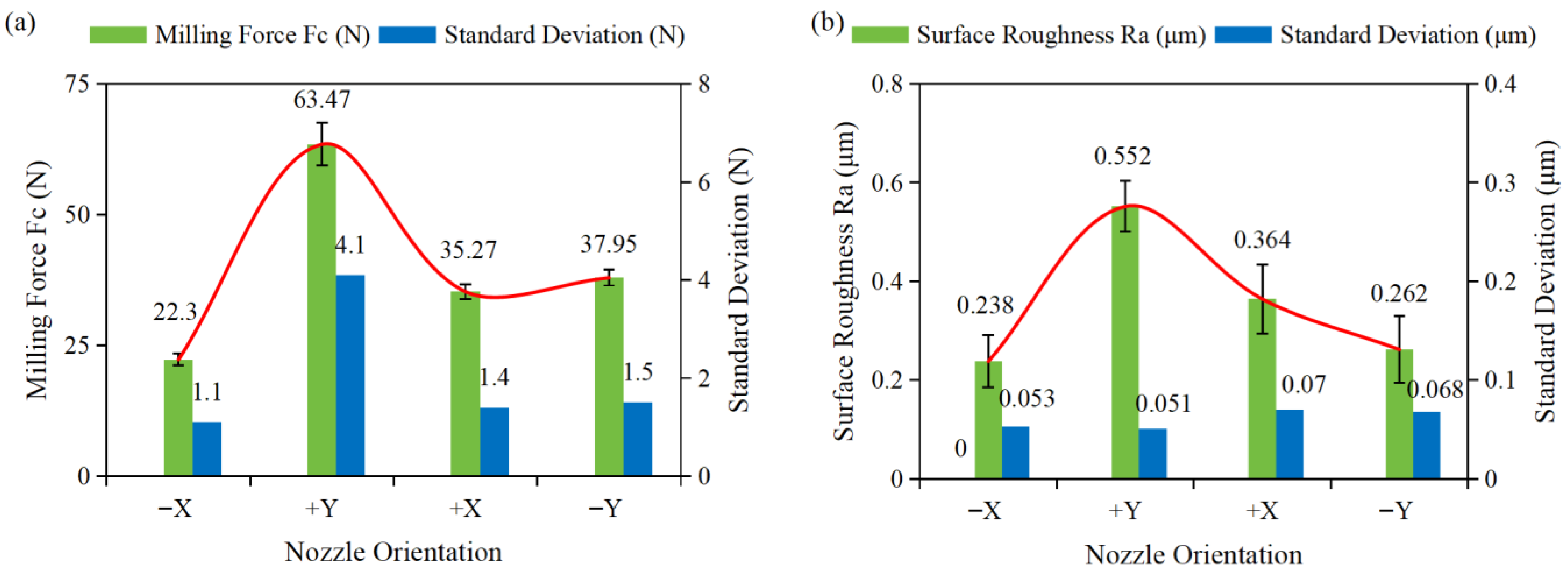
Figure 2a,b illustrate the effects of nozzle orientation on milling force and Surface Roughness Ra, respectively. The results are presented as mean values ± standard deviation, where short error bars indicate good data stability across different measurement repetitions. The experimental results show that the −X orientation yields the minimum milling force (22.3 ± 1.1 N) and Surface Roughness Ra (0.238 ± 0.053 μm), representing the optimal machining performance. In contrast, the +Y orientation results in the worst performance, with the maximum milling force reaching 63.47 ± 4.1 N and Ra reaching 0.552 ± 0.051 μm. The +X and −Y orientations exhibit intermediate performance levels.
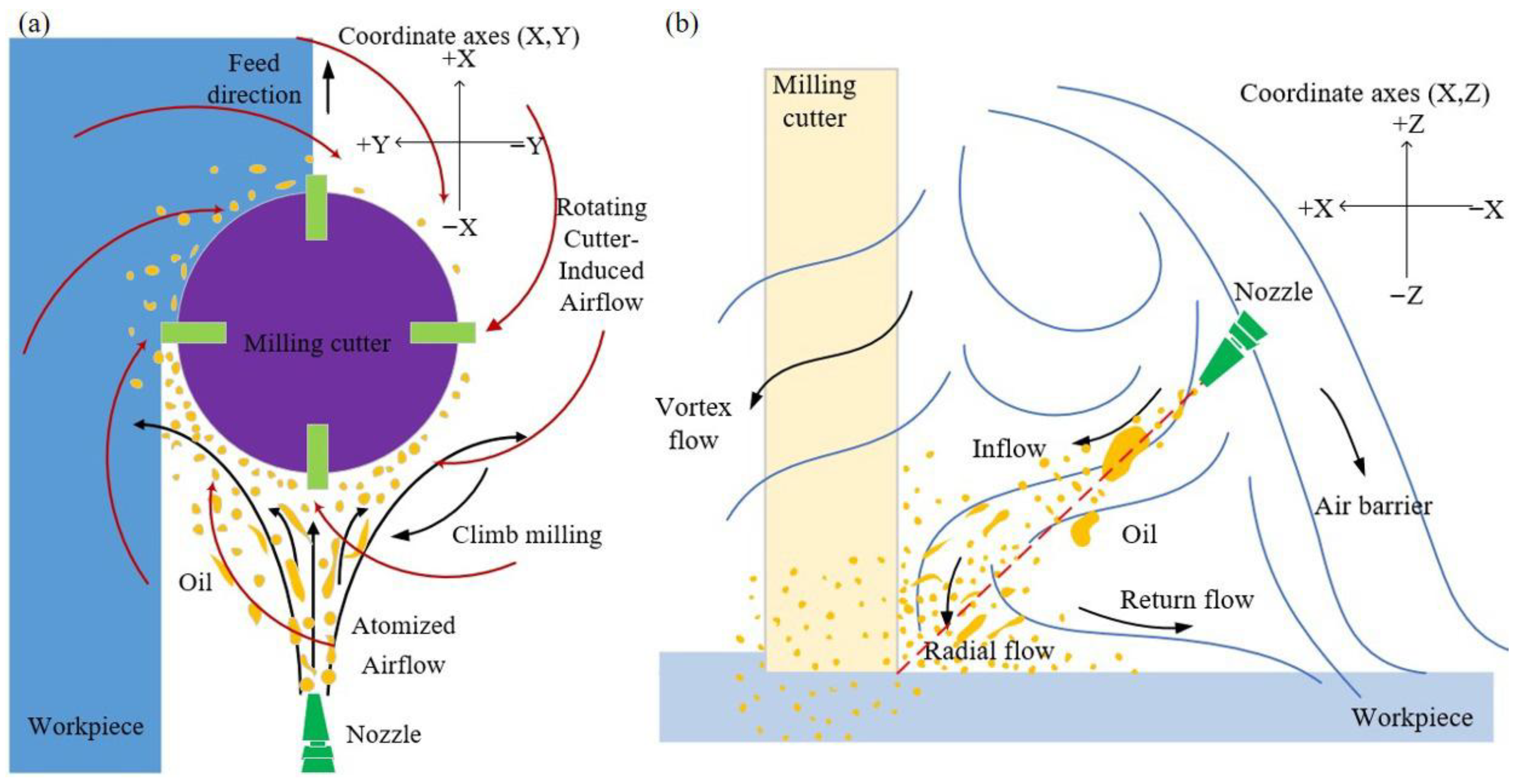
To further interpret these trends, a tentative mechanistic inference is conducted using Figure 3 (simplified schematic for the −X nozzle orientation) to elaborate on the physical mechanisms implied by the single-factor experimental results. As shown in Figure 3, the schematic illustrates the MQL jet–airflow field interaction during climb milling: (a) the top view (XY plane) shows oil mist transport driven by cutter-induced rotating airflow, and (b) the side view (XZ plane) presents the air barrier structure and oil mist penetration behavior.
Under this climb milling condition, the rotating cutter-induced airflow field transports the oil mist ejected from the −X orientation directly toward the cutting inlet, enabling effective penetration through the air barrier and sufficient lubrication at the tool–chip interface, thus minimizing milling force and surface roughness. In contrast, oil mist from other nozzle orientations is deflected by the return flow and vortex flow toward the cutting outlet or non-cutting zone, failing to reach the tool–chip interface and resulting in insufficient lubrication and deteriorated machining performance.
The Pearson correlation coefficient between experimentally calculated and theoretically derived oil mist penetration efficiency values exceeds 0.97, with relative deviations less than 5%, fully validating the model’s accuracy in predicting the influence of nozzle orientation on oil mist penetration.

3.1.2. Spindle Speed

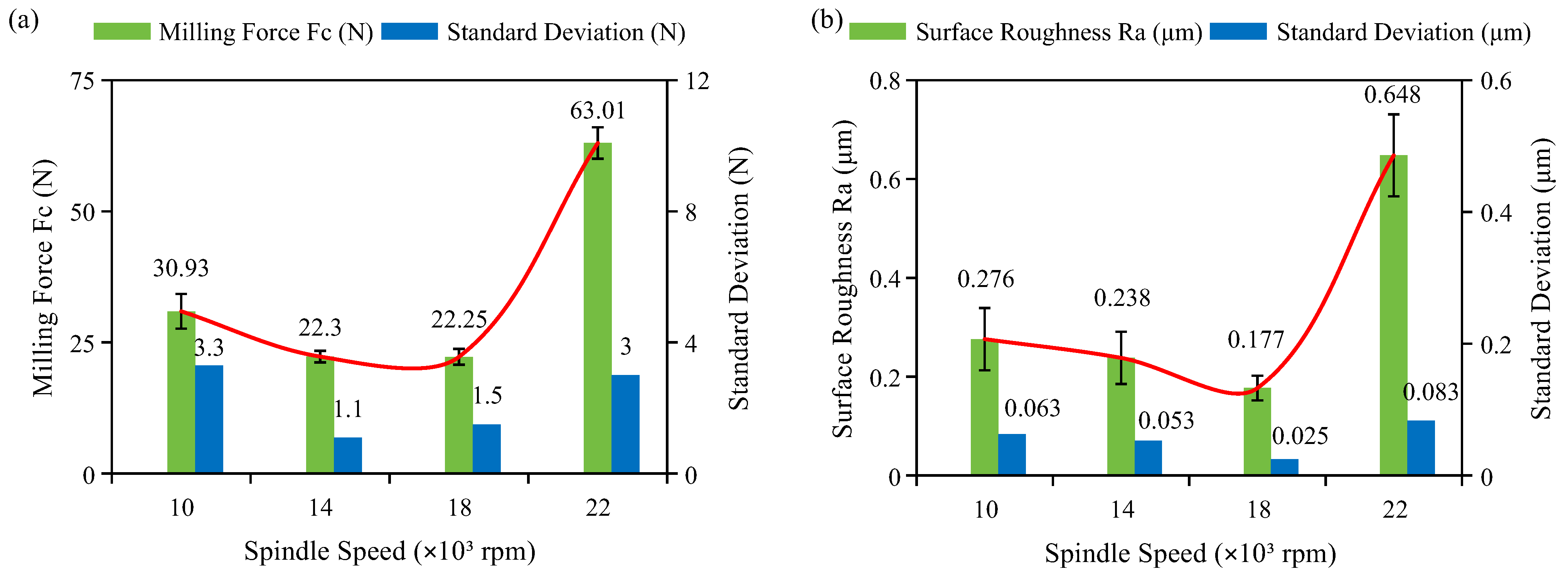
Figure 4a,b illustrate the effects of spindle speed on milling force and Surface Roughness Ra, respectively. Milling force and Ra both exhibit a clear nonlinear trend of decreasing first and then increasing with rising spindle speed: milling force drops from 30.93 ± 3.3 N at 10,000 rpm to 22.3 ± 1.1 N at 14,000 rpm (a 27.9% reduction) and remains stable at 22.25 ± 1.5 N at 18,000 rpm, before surging sharply to 63.01 ± 3 N at 22,000 rpm (183.2% higher than the minimum value at 18,000 rpm); correspondingly, Ra decreases from 0.276 ± 0.063 μm at 10,000 rpm to 0.238 ± 0.053 μm at 14,000 rpm (a 13.8% reduction) and reaches a minimum of 0.177 ± 0.025 μm at 18,000 rpm, then rises dramatically to 0.648 ± 0.083 μm at 22,000 rpm (266.7% higher than the optimal value), with short error bars in the 14,000–18,000 rpm range indicating highly stable measurements and the minimal error bar at 18,000 rpm confirming the highest data reliability at this optimal speed point.
To interpret these experimental trends, a tentative mechanistic inference is conducted based on Figure 3 to elaborate on the physical mechanisms implied by the single-factor experimental results. These experimental trends are highly consistent with model predictions, where the 14,000–18,000 rpm range enables optimal synergistic coupling between the MQL jet and rotating airflow field for stable high penetration efficiency, while excessively low speeds lead to insufficient negative pressure suction and excessively high speeds thicken the tool’s air barrier layer, both impeding oil mist penetration to the tool–chip interface. The Pearson correlation coefficient between experimentally calculated and theoretically derived oil mist penetration efficiency values exceeds 0.96, with relative deviations less than 4.5%, fully validating the model’s accuracy in predicting the influence of spindle speed on oil mist penetration.

3.1.3. Nozzle Distance

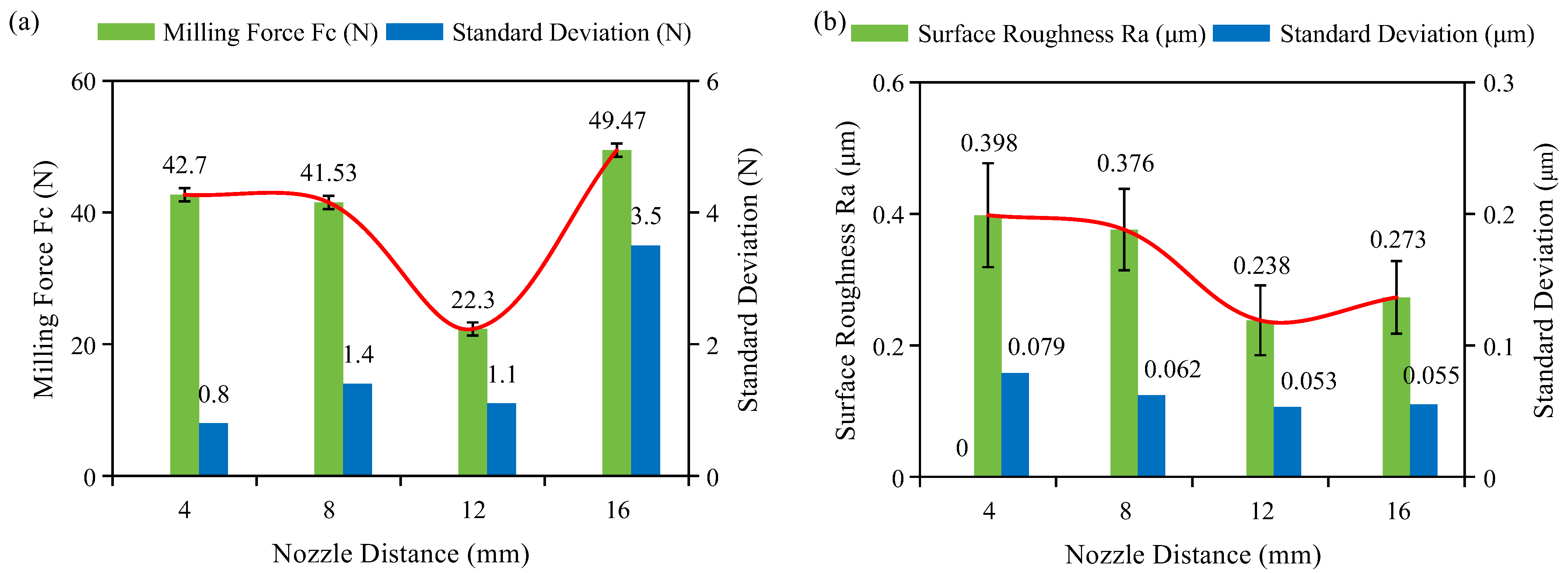
Figure 5a,b illustrate the effects of nozzle distance on milling force and Surface Roughness Ra, respectively. Milling force and Ra both exhibit a clear V-shaped nonlinear trend of decreasing first and then increasing with rising nozzle distance: milling force is 42.7 ± 0.8 N at 4 mm, slightly decreases to 41.53 ± 1.4 N at 8 mm, drops to the minimum of 22.3 ± 1.1 N at 12 mm (a 47.8% reduction compared to the value at 4 mm), and then surges to 49.47 ± 3.5 N at 16 mm (121.8% higher than the minimum value at 12 mm); correspondingly, Ra decreases from 0.398 ± 0.079 μm at 4 mm to 0.376 ± 0.062 μm at 8 mm, reaches the minimum of 0.238 ± 0.053 μm at 12 mm (a 40.2% reduction compared to the value at 4 mm), and slightly rebounds to 0.273 ± 0.055 μm at 16 mm (14.7% higher than the optimal value at 12 mm), with the shortest error bar at 12 mm confirming the highest data reliability at this optimal distance point.
To interpret these experimental trends, a tentative mechanistic inference is conducted based on Figure 3 to elaborate on the physical mechanisms implied by the single-factor experimental results. These experimental trends are highly consistent with model predictions, where a nozzle distance of approximately 12 mm locates the oil mist in the dense atomization zone with optimal matching between jet kinetic energy and coverage, leading to peak penetration efficiency; distances that are too small or too large cause diffusion loss and energy imbalance, thus reducing penetration efficiency. The Pearson correlation coefficient between experimentally calculated and theoretically derived oil mist penetration efficiency values exceeds 0.98, with relative deviations less than 3.8%, fully validating the model’s accuracy in predicting the influence of nozzle distance on oil mist penetration.

3.1.4. Nozzle Angle

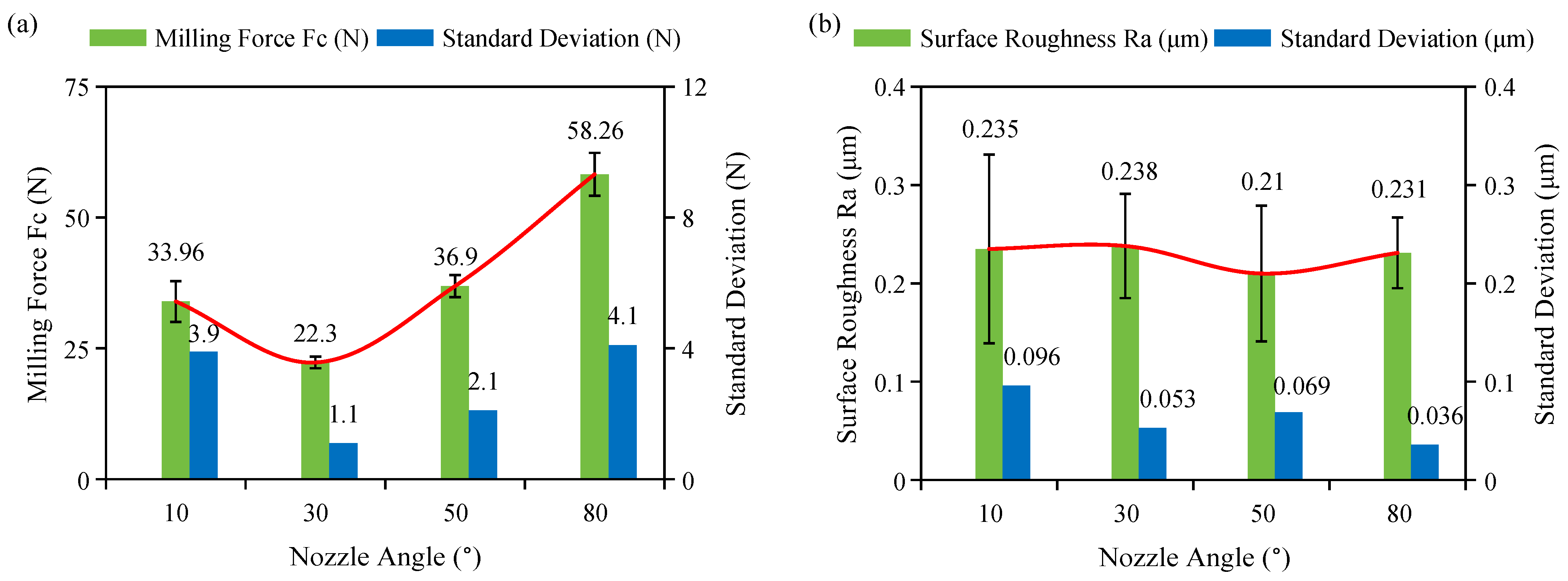
Figure 6a,b illustrate the effects of nozzle angle on milling force and Surface Roughness Ra, respectively. Milling force exhibits a clear nonlinear trend of decreasing first and then increasing with rising nozzle angle: it is 33.96 ± 3.9 N at 10°, drops to the minimum of 22.3 ± 1.1 N at 30° (a 34.3% reduction compared to the value at 10°), rises to 36.9 ± 2.1 N at 50°, and surges sharply to 58.26 ± 4.1 N at 80° (161.3% higher than the minimum value at 30°). Correspondingly, Ra shows a gentle three-stage nonlinear trend: it is 0.235 ± 0.096 μm at 10°, slightly increases to 0.238 ± 0.053 μm at 30°, reaches the minimum of 0.21 ± 0.069 μm at 50°, and rebounds to 0.231 ± 0.036 μm at 80°, with short error bars in the 30–50° range indicating stable measurement results under these optimal angle conditions.
To interpret these experimental trends, a tentative mechanistic inference is conducted based on Figure 3 to elaborate on the physical mechanisms implied by the single-factor experimental results. These experimental trends are highly consistent with model predictions, where a nozzle angle near 30° achieves an optimal balance between normal penetration momentum and tangential anti-interference capability, leading to peak oil mist penetration efficiency; extreme angles (10° and 80°) cause the oil mist to be hindered by the air barrier, significantly attenuating penetration efficiency. The Pearson correlation coefficient between experimentally calculated and theoretically derived oil mist penetration efficiency values exceeds 0.95, with relative deviations less than 4.2%, fully validating the model’s accuracy in predicting the influence of nozzle angle on oil mist penetration.

3.1.5. Summary

Single-factor results align closely with the semi-empirical model predictions. Relative deviations < 5% and Pearson correlation coefficients > 0.95 across all parameters fully validate the model’s single-factor validity. Mechanism analysis clarifies the coupling properties of the four core parameters: nozzle orientation and spindle speed are strongly coupled dominant parameters, governing oil mist penetration by regulating jet–airflow matching and air barrier intensity; nozzle distance and nozzle angle are weakly coupled stable parameters, affecting penetration efficiency only under extreme conditions with limited influence within conventional ranges.

3.2. Orthogonal Experimental Results and Analysis of Penetration Coupling Mechanism

The four-factor four-level orthogonal experiments systematically revealed multi-parameter coupling effects on oil mist penetration, verified model robustness under interactive conditions, and established the significance hierarchy of parameter influences.

3.2.1. Parameter Influence Hierarchy and Model Validation

Using milling force and surface roughness as macroscopic indicators of oil mist penetration efficiency (Table 8), range analysis and one-way ANOVA were conducted to assess the influence weight and statistical significance of each core parameter. One-way ANOVA was adopted for its suitability in quantifying the independent effect of a single factor on a continuous response variable; surface roughness was designated as the primary response variable due to its stronger correlation with penetration efficiency and lower experimental variability relative to milling force. The significance level (α) was set to 0.05 for all tests, where p < 0.05 indicated a statistically significant effect and p < 0.01 a highly significant one. As the objective was to identify dominant parameters and quantify their hierarchical influence rather than explore pairwise differences between levels, post hoc tests were not required.
(1)
Range Analysis and Orthogonal ANOVA for Parameter Significance Verification
To systematically evaluate the influence of core parameters (nozzle orientation, nozzle angle, nozzle distance, spindle speed) on oil mist penetration efficiency, range analysis and orthogonal analysis of variance (ANOVA) were sequentially performed. The range analysis quantifies the relative influence intensity of each parameter, while orthogonal ANOVA verifies the statistical significance of these effects.
Range analysis was performed to assess the relative influence of the four core process parameters on oil mist penetration efficiency. Results are summarized in Table 9. For milling force, the order of parameter influence, ranked by range value R, was found to be spindle speed > nozzle distance > nozzle angle > nozzle orientation. For Surface Roughness Ra, which serves as the core macroscopic indicator of penetration efficiency, the influence order ranked by R was determined as spindle speed > nozzle orientation > nozzle angle > nozzle distance. This influence hierarchy derived from Surface Roughness Ra aligns well with the theoretical framework established in Section 2. Specifically, spindle speed and nozzle orientation appear to act as strongly coupled dominant parameters. Nozzle distance and nozzle angle behave as weakly coupled, relatively stable parameters. Minor discrepancies in the range order observed for milling force may be attributed to local fluctuations in experimental conditions. These minor differences do not compromise the overall consistency of the parameter classification. They also further support the reliability of the distinction between dominant and stable parameters.
Orthogonal analysis of variance (ANOVA) was subsequently performed to further evaluate the statistical significance of each parameter’s observed effect. Results are presented in Table 10 and Table 11, respectively. For the L16(44) orthogonal design adopted in this work, the limited error degrees of freedom may slightly reduce the sensitivity of the F-test. This may account for the observation that dominant parameters show marginal significance, rather than highly significant effects at the p < 0.01 threshold. For milling force, spindle speed presents the largest F-value and smallest p-value, suggesting marginal significance at the α = 0.10 level. Nozzle orientation, nozzle angle and nozzle distance show no statistically significant effects under this threshold (p > 0.05). For Surface Roughness Ra, spindle speed again shows the most pronounced effect, with the largest F-value and smallest p-value, further supporting marginal significance at the α = 0.10 level. Nozzle orientation, nozzle angle and nozzle distance show no statistically significant effects in this analysis (p > 0.10). Spindle speed accounts for 67.3% of the total variation in Surface Roughness Ra, a value notably higher than that of all other parameters. This quantitative evidence, combined with its largest R value from range analysis, strongly supports spindle speed as the core dominant parameter governing oil mist penetration efficiency. Nozzle orientation ranks second in terms of influence and accounts for 14.4% of the variation in Surface Roughness Ra, which is consistent with its proposed status as a strongly coupled dominant parameter. Nozzle angle and nozzle distance present small range values and negligible contribution rates. They appear to behave as weakly coupled stable parameters, whose effects are only likely to become apparent under extreme operating conditions.
These combined range analysis and orthogonal ANOVA results have effectively validated the theoretical model’s parameter classification. Despite the limited error degrees of freedom affecting F-test sensitivity, the consistent ranking of dominant parameters and their relatively higher contribution rates provide reliable statistical support for the subsequent analysis of multi-parameter coupling mechanisms.
(2)
Robustness Validation of the Theoretical Penetration Efficiency Model
To construct the parity plot of predicted versus experimental values, Surface Roughness Ra was selected as the sole evaluation indicator in this work. This selection is informed by two core considerations. First, Ra is generally regarded as a key acceptance indicator for the high-precision milling of difficult-to-machine alloys such as GH4169 in the aerospace and high-end equipment manufacturing fields. It has the potential to directly influence the service performance of machined parts, including fatigue life, friction and wear characteristics, and assembly accuracy. It may also serve as a core evaluation criterion for the engineering application of MQL processes. Therefore, the Ra-based parity plot can serve to intuitively illustrate the prediction accuracy and practical engineering value of the established model. Second, compared with Ra, milling force signals tend to be more susceptible to transient interference from thermo-mechanical coupling factors unrelated to lubrication penetration. These factors include material plastic deformation, cutting system vibration, and minor tool wear during high-speed milling. In contrast, Ra may act as a more stable end-state characterization of the overall lubrication effect throughout the entire cutting process. It is generally less affected by irrelevant interference and can more reliably reflect the real influence of oil mist penetration efficiency.
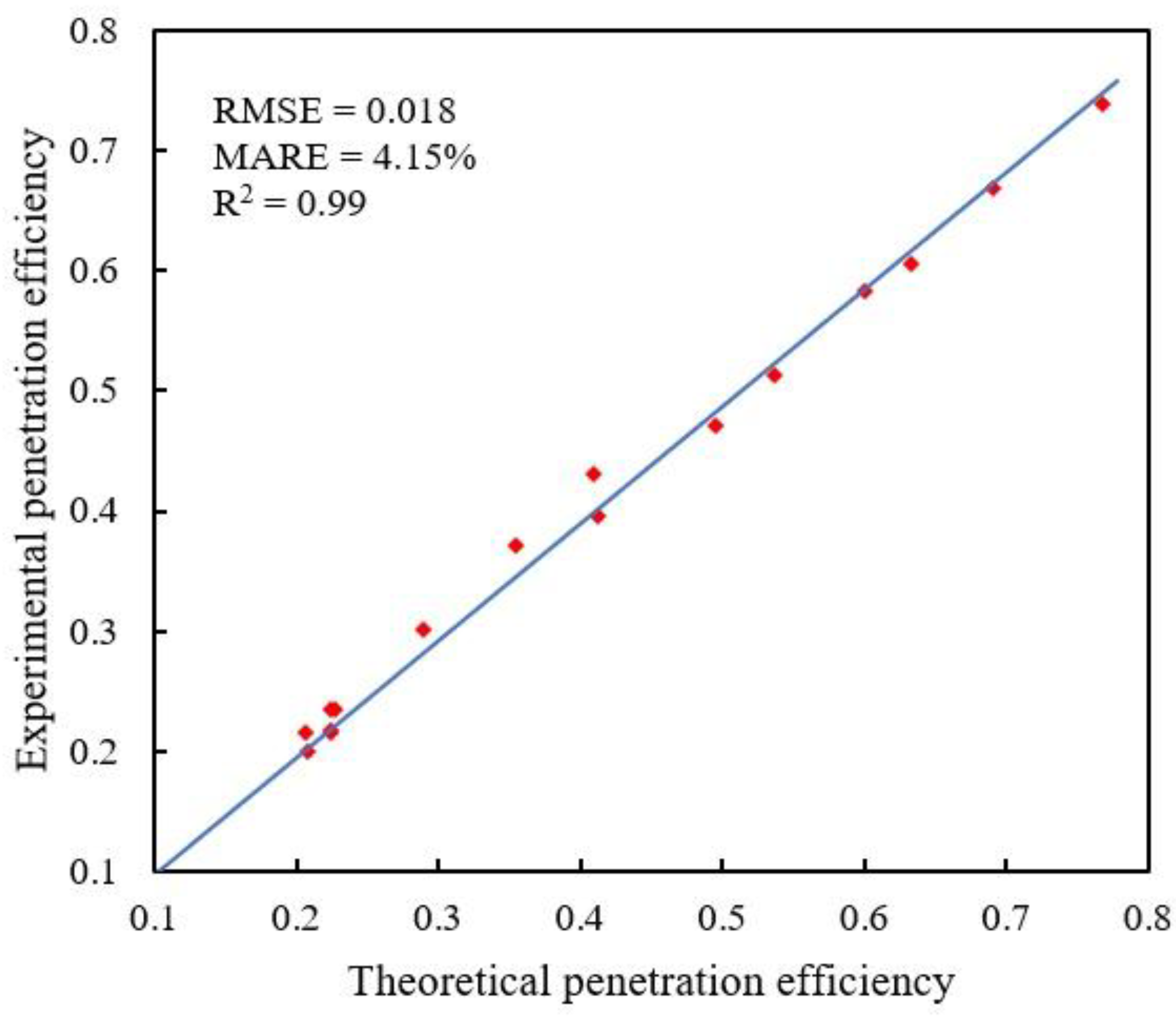
Correlation analysis was first performed to assess the physical consistency between the theoretical penetration efficiency and experimental results. The results suggest that the theoretical penetration efficiency exhibits a strong negative correlation with both core experimental indicators. The Pearson correlation coefficient is −0.93 for milling force and −0.95 for Surface Roughness Ra. This negative correlation is consistent with the expected lubrication mechanism of MQL milling. Sufficient oil mist penetration may help form a stable lubricating oil film at the tool–chip and tool–workpiece interfaces. This oil film can effectively reduce the friction coefficient and adhesive wear during the cutting process. It may further reduce milling force, suppress the generation of surface defects, and ultimately contribute to a lower surface roughness value. The high absolute value of the Pearson coefficient supports that the established theoretical model reasonably captures the core physical trend of oil mist penetration and its influence on the milling process. The parity plot of theoretical versus experimental oil mist penetration efficiency is presented in Figure 7. All 16 groups of experimental data points are closely distributed along the ideal 45° diagonal line. No obvious outliers or systematic deviations were observed across the full range of test conditions. Quantitative statistical indicators further support the good agreement between predictions and experiments. The coefficient of determination R2 is 0.99, suggesting that the model accounts for 99% of the observed variation in experimental penetration efficiency. The root mean square error, RMSE, is only 0.018, and the mean absolute relative error, MARE, of all 16 groups is 4.15%. The relative deviation between model predictions and experimental results remained below 6% across all test conditions. This level of accuracy aligns with the typical requirements of engineering applications for process prediction models.
To further explore whether prediction error increases significantly under extreme working conditions, a stratified error analysis was conducted across all test conditions. Extreme working conditions were defined as the ultra-high spindle speed level of 22,000 rpm, which represents one of the most severe airflow disturbance scenarios and the most challenging oil mist penetration environment in the test matrix. The analysis results suggest that the average relative deviation of the four extreme condition groups is 4.30%, and the maximum single-group deviation is 4.50%. For the remaining 12 conventional working condition groups, the average relative deviation is 4.10%, and the maximum single-group deviation is 5.12%. No significant increase in prediction error was observed under the defined extreme conditions, and all deviations remain below the 6% engineering accuracy threshold. To further quantify the statistical reliability of the model, the 95% confidence interval of the predicted relative deviation was calculated using the t-distribution appropriate for small sample sizes. The 95% confidence interval ranges from 3.80% to 4.50%, which is entirely within the allowable engineering error range. This provides further support for the stable prediction performance of the model across the tested working conditions. The failure boundary of the model was further defined as the working condition where the relative deviation between prediction and experiment exceeds 6%. Within the full test matrix, no working condition exceeded this defined failure threshold. Within the tested parameter range, the model maintains acceptable prediction accuracy across spindle speeds from 10,000 rpm to 22,000 rpm, nozzle orientations from −X to +Y, nozzle angles from 10° to 80°, and nozzle distances from 4 mm to 16 mm. This range covers most conventional working conditions of MQL high-speed milling of GH4169 alloy in practical engineering applications. The definition of the confidence interval and failure boundary may further enhance the engineering reference value of this study. Overall, the established model appears to offer a reasonable theoretical basis for the rapid optimization of MQL milling process parameters for GH4169 alloy and may help reduce the number of trial cutting experiments and associated process development costs in practical engineering applications.

3.2.2. Potential Multi-Parameter Coupling Regulatory Mechanism of Oil Mist Penetration Efficiency

Based on the range analysis and ANOVA results, combined with the theoretical model established in Section 2 and single-factor mechanism analysis, the potential regulatory mechanism of oil mist penetration under multi-parameter coupling conditions can be inferred and discussed in two parts. It should be noted that the L16(44) orthogonal experimental design adopted in this study does not set dedicated interaction columns for parameters, and the limited error degrees of freedom also cannot support the formal statistical test of interaction effects between parameters. Therefore, the following discussion on the coupling effect between parameters is based on observed experimental phenomena and theoretical mechanism derivation, rather than strict statistical proof.
(1)
Inferred Synergistic and Antagonistic Interaction between Nozzle Orientation and Spindle Speed
Experimental observations suggest a potential synergistic or antagonistic interaction between nozzle orientation and spindle speed. The matching between the spatial position of the nozzle and the dynamic airflow field induced by spindle rotation may be a key factor influencing oil mist penetration efficiency. This potential interaction is mainly reflected in two distinct working condition regimes. Within the widely recognized preferred cutting speed range (14,000–18,000 rpm) for high-speed milling of GH4169 alloy, the −X nozzle orientation aligns well with the stable inflow field around the spindle. This alignment may enhance oil mist penetration via the negative pressure suction effect at the cutting zone. In the single-factor test matrix, the global minimum surface roughness of 0.177 μm is obtained under the condition of −X nozzle orientation, 30° nozzle angle, 12 mm nozzle distance, and 18,000 rpm spindle speed. This condition corresponds to a relatively superior synergistic matching between the jet direction and the rotation-induced airflow field and is not included in the multi-factor combination matrix of the orthogonal test. In contrast, at the ultra-high spindle speed of 22,000 rpm, the +Y nozzle orientation impinges against the rotation-induced airflow, which may markedly reduce penetration efficiency. The observed surface roughness rises to 0.822 μm under this orthogonal test condition (Test No.15: +Y orientation, 50° nozzle angle, 8 mm nozzle distance, 22,000 rpm spindle speed), accompanied by aggravated tool–chip interface wear caused by accumulated cutting heat. These contrasting observations imply that the variation in penetration efficiency may not be fully explained by the independent effect of spindle speed or nozzle orientation alone and may be related to the synergistic or antagonistic interaction between the two parameters.
Spindle speed, as the macroscopic machining parameter, may modulate the air barrier environment by regulating the turbulence intensity of rotation-induced airflow. Higher spindle speed may thicken the air barrier around the cutting zone, increasing the resistance of oil mist penetration and raising the requirement for precise spatial matching between the MQL jet and the airflow field. Nozzle orientation, as the core spatial parameter of the MQL jet, determines whether the jet enters the cutting zone in synergy with or in opposition to the rotation-induced airflow field. The potential interaction between these two parameters may thus constitute the core regulatory factor of oil mist penetration efficiency. This inferred mechanism perspective complements and extends the findings of prior studies. Du et al. [20] confirmed the negative correlation between infiltration efficiency and machining performance but treated spindle speed only as a macroscopic input parameter without quantifying its role in shaping the airflow field, and they overlooked the spatial matching between the nozzle and the airflow field. Ji [21] identified cutting speed as an influencing factor of lubrication performance, yet the analysis remained at the level of macroscopic correlation, without revealing how spindle-speed-induced airflow evolution governs the transport resistance of oil mist. By clarifying the potential interaction between spindle speed and nozzle orientation and its possible influence on penetration efficiency, the present study not only provides a plausible explanation for the observed performance variations but also identifies a multi-parameter matching failure mode (e.g., +Y orientation at 22,000 rpm) not explicitly discussed in prior studies [20,21]. This finding may provide a reference for industrial MQL parameter optimization.
(2)
Observed Stable Characteristics of Weakly Influencing Parameters
No statistically significant effect on penetration efficiency was observed for nozzle distance and nozzle angle in the present ANOVA results. These two parameters show relatively stable performance across all tested spindle speeds and nozzle orientations. The observed stable performance may be attributed to the following mechanism: the parameter range of 30–50° nozzle angle and 8–12 mm nozzle distance achieves a relatively favorable balance of oil mist atomization quality, jet momentum, and diffusion characteristics. This balance can avoid the deficiencies of extreme conditions, such as insufficient normal momentum of the jet at small angles or short distances, and excessive energy dissipation at large angles or long distances. This parameter range shows good adaptability to varying airflow fields and jet incidence conditions, with no drastic fluctuation of penetration efficiency caused by the change in dominant parameters. This finding may provide theoretical guidance for the benchmark setting of MQL parameters in engineering applications.
Despite the insightful inferences on oil mist penetration mechanisms and multi-parameter regulation drawn from this study, several limitations should be acknowledged. First, this study characterizes penetration efficiency indirectly via milling force and surface roughness, without direct visualization of oil mist transport, diffusion, and infiltration in the cutting zone, which limits the fine-grained mechanistic understanding of the lubrication process. Second, the orthogonal experiments are confined to steady-state climb milling of small GH4169 specimens, using a single vegetable oil-based MQL medium and a limited parameter range. The effects of dynamic cutting conditions (e.g., intermittent cutting, progressive tool wear), alternative milling modes, and other MQL media remain unexplored. Third, the semi-empirical model is calibrated based on specific experimental conditions, and its generalizability to other difficult-to-machine alloys or large-scale components needs further verification. In addition, the orthogonal experimental design adopted in this study does not include dedicated interaction columns, so a formal statistical test for the interaction effect between process parameters cannot be carried out. The inferred coupling mechanism between nozzle orientation and spindle speed still needs to be verified by further targeted interactive experiments.

3.3. Process Parameter Optimization Based on Neural Network and Multi-Objective Optimization Method

Based on the measured data of the orthogonal experiment and the mechanism research conclusion of the semi-empirical model of oil mist penetration efficiency in the previous paper, this section constructs the quantitative mapping relationship between process parameters and machining performance, takes minimizing surface roughness as the core objective and reasonable control of milling force as the auxiliary requirement, and carries out process parameter optimization combined with BP neural network prediction and multi-objective optimization algorithm, forming a complementary relationship with the mechanism analysis of the theoretical model in the previous paper, which provides a process scheme with both theoretical basis and engineering feasibility for MQL high-speed milling of GH4169 alloy.

3.3.1. Construction of BP Neural Network Prediction Model

Nozzle orientation, nozzle angle, nozzle distance, and spindle speed were taken as input variables, where nozzle orientation was quantified via dummy variable encoding. Surface Roughness Ra (core response indicator) and milling force (auxiliary response indicator) were set as output variables. A BP neural network surrogate model was constructed based on the measured data from 16 groups of orthogonal experiments. The dataset was divided into a training set and a test set at a ratio of 87.5%/12.5%. After normalization preprocessing and overfitting prevention via the early stopping method, the model converged stably during the training process.
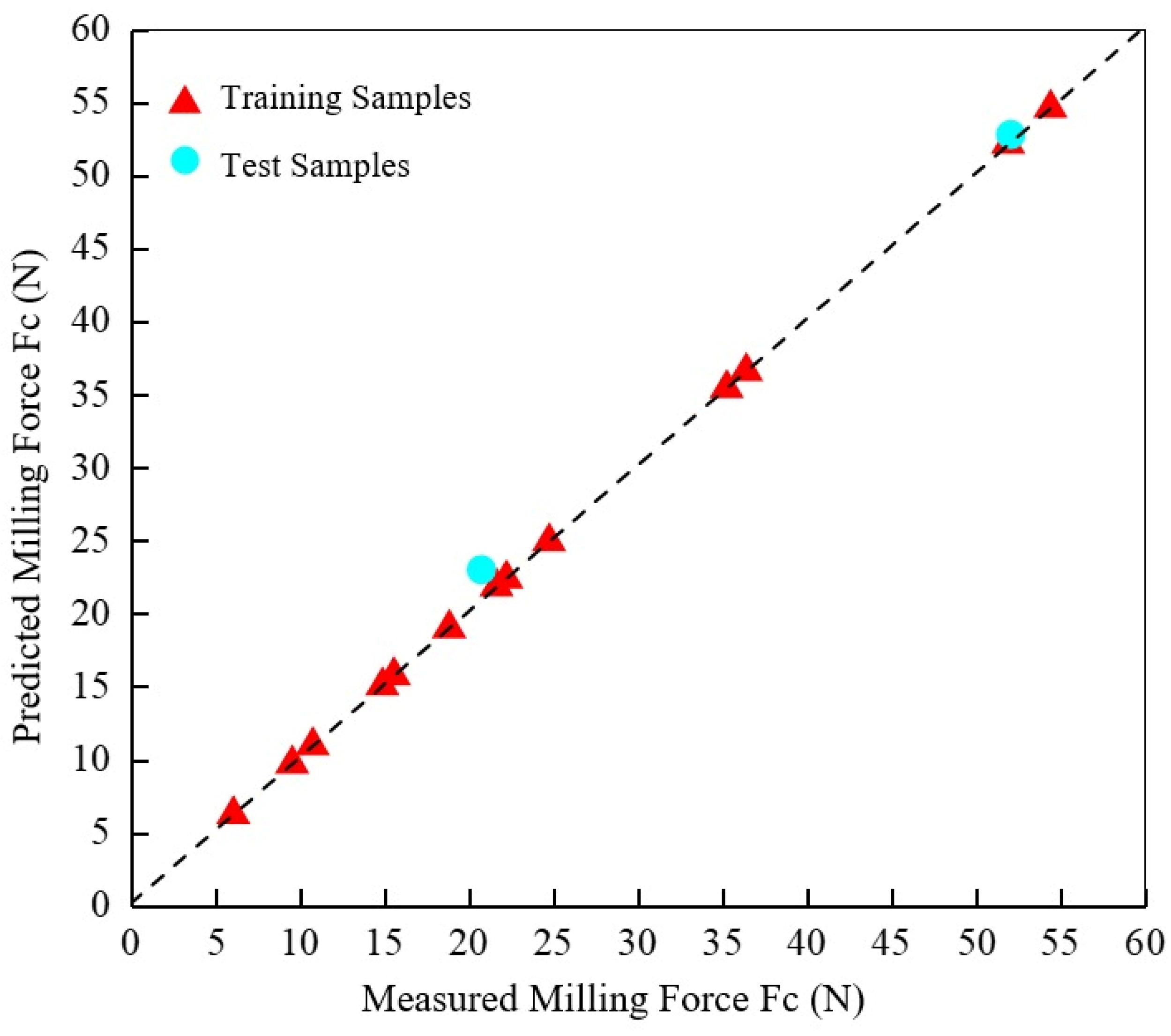
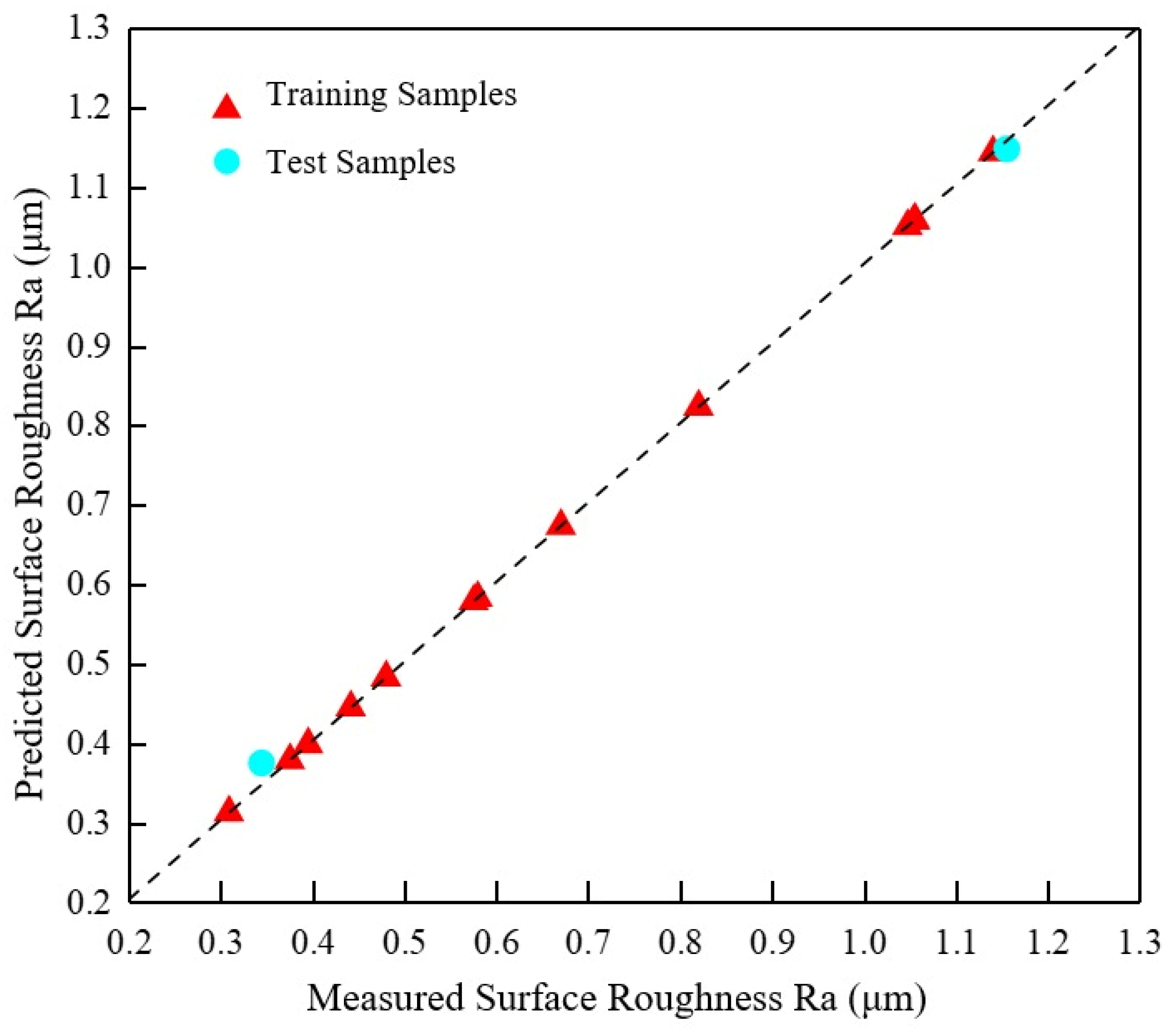
The validation results indicate that the model achieves a coefficient of determination R2 of 0.99 for surface roughness prediction, with an average relative error of 4.50% for the test set. For milling force prediction, the model also reaches a coefficient of determination R2 of 0.99, with an average relative error of 5.59% for the test set. The maximum relative error of both indicators is less than 11%, which meets the accuracy requirements for engineering prediction. The comparison between predicted and measured values is presented in Figure 8 and Figure 9, respectively.

3.3.2. Process Parameter Optimization Prioritizing Minimum Surface Roughness

The non-dominated sorting genetic algorithm II (NSGA-II) was adopted to construct the optimization model, with the well-trained BP neural network model serving as the fitness evaluation function. The optimization model was established with the core objective of minimizing Surface Roughness Ra and the auxiliary constraint of controlling milling force Fc within the conventional engineering range of 5–30 N for GH4169 alloy precision finishing. The value range of decision variables was consistent with the parameter boundaries of the orthogonal experiments to ensure the engineering feasibility of the optimization results. A Pareto optimal solution set was obtained after 100 iterations, which presents a clear negative correlation between Surface Roughness Ra and milling force Fc, conforming to the objective trade-off law of machining performance under the surface roughness priority orientation.
The technique for order preference by similarity to an ideal solution (TOPSIS) method is applied, and the optimal process parameter combination is finally determined as follows: nozzle orientation of −X, nozzle angle of 22.43°, nozzle distance of 14.96 mm, and spindle speed of 16,581 rpm. The predicted values corresponding to this TOPSIS comprehensive optimal solution are milling force Fc = 29.29 N and Surface Roughness Ra = 0.19 μm. Physical validation experiments show that the measured Surface Roughness Ra = 0.17 μm (meeting the core optimization objective) and measured milling force Fc = 24.27 N (satisfying the auxiliary engineering constraint) are obtained for this optimal scheme; the relative errors between the measured and predicted values are less than 11% for Surface Roughness Ra and less than 18% for milling force Fc, both of which meet the engineering prediction accuracy requirements. Compared with the worst working condition in the orthogonal experiments (nozzle orientation of −Y, nozzle angle of 30°, nozzle distance of 4 mm, spindle speed of 22,000 rpm, with a measured milling force of 52.22 N and Surface Roughness Ra of 1.158 μm), the optimized scheme realizes a substantial reduction in both key machining indicators: the Surface Roughness Ra is reduced by 85.32% and the milling force Fc is reduced by 53.52%. Meanwhile, compared with the conventional single-factor benchmark condition (nozzle orientation of −X, nozzle angle of 30°, nozzle distance of 12 mm, spindle speed of 14,000 rpm, with a measured milling force of 22.30 N and Surface Roughness Ra of 0.238 μm), the optimized scheme achieves a 28.57% decrease in Surface Roughness Ra while keeping the milling force Fc within the acceptable engineering range. This fully demonstrates the remarkable optimization effect of the proposed parameter optimization method on the machining performance of MQL high-speed milling of GH4169 alloy and verifies the engineering practicability of the optimized process parameters under the priority of minimum surface roughness.

4. Conclusions

This study addresses the unclear oil mist penetration mechanism and insufficient theoretical basis for precise process parameter regulation in minimum quantity lubrication (MQL) high-speed milling of GH4169 alloy. Starting from the physical essence of cross-scale oil mist transport, this study constructs a semi-empirical model of MQL oil mist penetration efficiency coupling four core parameters: nozzle orientation, nozzle angle, nozzle distance and spindle speed. The model is established based on the full-chain transport mechanism of macroscopic jet transmission, mesoscopic airflow coordination and microscopic capillary penetration. It is applicable to steady-state climb milling of GH4169 alloy with a vegetable oil-based MQL system, along with a reliable parameter range of spindle speed of 10,000–22,000 rpm, nozzle orientation of 0–360°, nozzle angle of 10–80°, and nozzle distance of 4–16 mm.
On this basis, the coupling properties of the four parameters are preliminarily analyzed via single-factor experiments. Nozzle orientation and spindle speed are strongly coupled dominant parameters, which respectively dominate the spatial matching between the jet and cutting zone airflow, regulate the air barrier thickness and turbulence intensity, and jointly shape the core environment for oil mist penetration. Nozzle distance and nozzle angle are weakly coupled parameters, which perform stably under conventional conditions of nozzle angle 30–50° and nozzle distance 8–12 mm and only have a relatively significant impact on penetration efficiency under extreme parameter conditions. Combined with range analysis and variance analysis (ANOVA) of orthogonal experiments, this study further identifies the influence hierarchy of parameters on oil mist penetration efficiency as spindle speed > nozzle orientation > nozzle angle > nozzle distance. A drive-adaptation coupling regulation mechanism between spindle speed and nozzle orientation is also observed, which synergistically affects oil mist penetration efficiency. Within the above parameter range, the relative deviations between model-predicted values and experimental data are all lower than 6%, with a coefficient of determination R2 of 0.99 and a root mean square error of 0.018. The validity and robustness of the model are well verified, and it can basically meet the accuracy requirements of general industrial process prediction.
Taking surface roughness minimization as the main optimization objective and milling force control within the reasonable range for industrial precision machining as the auxiliary constraint, an optimal combination of process parameters for MQL high-speed milling of GH4169 alloy is finally obtained: nozzle orientation −X, nozzle angle 22.43°, nozzle distance 14.96 mm, and spindle speed 16,581 rpm. Physical verification experiments show that the machining performance under this combination is significantly improved compared with the worst working condition in the experiment, with surface roughness reduced by 85.32% and milling force reduced by 53.52%. Compared with the conventional single-factor baseline condition, surface roughness is reduced by 28.57%, while the milling force is maintained within the conventional range for industrial precision machining of GH4169 alloy. The relative deviation between measured and model-predicted values generally meets the engineering accuracy requirements and can serve as a reference for on-site industrial process debugging.
In addition, the model has certain expansion and adaptation potential for processing scenarios with different tool geometries, lubricant types and workpiece materials. Tools with different edge radii or helix angles may change the cutting zone flow field distribution and tool–chip interface capillary gap characteristics, leading to corresponding changes in model coefficients related to flow field matching and interface adsorption, while the model’s core cross-scale transport analysis framework remains applicable. Different lubricating media have different effects on the transmission and penetration performance of oil mist jets due to differences in surface tension, viscosity and atomization characteristics. Among them, low-viscosity media can more easily achieve airflow coordination and capillary penetration. Media with functional additives require re-calibration of relevant physical property parameters. For different workpiece materials such as titanium alloys and other grades of nickel-based superalloys, differences in thermophysical properties and tool–chip contact states will affect the strength of interfacial capillary action, while the overall prediction trend of the model is expected to remain consistent. Adaptation to different processing scenarios can be achieved only by calibrating material-related empirical coefficients through a small number of single-factor experiments.
In summary, the research results provide some practical guidance for the industrial production of MQL high-speed milling of difficult-to-machine materials such as GH4169 alloy in the aerospace field. In the process design stage, the spindle speed can be preferentially controlled within the optimal range of 14,000–18,000 rpm, and a nozzle with −X orientation can be adopted to improve oil mist penetration efficiency and lubrication effect. In the on-site debugging stage, a nozzle distance of 12–15 mm and a nozzle angle of 20–30° can be set as baseline values, with only appropriate fine-tuning according to equipment spatial geometric constraints, which helps reduce the number of trial cutting experiments and process development costs. Meanwhile, the cross-scale modeling framework established in this study can be used as a reference template for MQL processing of other difficult-to-machine materials. It breaks through the limitation of traditional research relying only on empirical optimization of macroscopic parameters to a certain extent and provides a theoretical reference for MQL parameter design in green precision machining.

5. Future Prospects

Although this study has obtained phased research findings related to the oil mist penetration mechanism and parameter regulation in MQL high-speed milling of GH4169 alloy, a number of limitations should be acknowledged in this work. In this study, oil mist penetration efficiency is characterized indirectly via milling force and surface roughness, while in situ visualization techniques have not been adopted to capture the dynamic transmission, diffusion and capillary penetration processes of oil mist within the cutting zone, which means the understanding of the mesoscopic physical mechanism underlying the lubrication process may need to be further deepened. The developed model has only been validated under steady-state conditions for GH4169 alloy machining with a vegetable oil-based MQL system and YG8 cemented carbide end mills, and dynamic factors in actual industrial processing, including tool wear, intermittent cutting and variable cutting depth, have not been taken into account, suggesting that the working condition adaptability of the model could be further expanded. The orthogonal experiment adopted in this study uses an L16(44) design without dedicated parameter interaction columns, and the degrees of freedom for experimental error are relatively limited, which means it is not currently feasible to conduct rigorous statistical verification of the coupling effect between spindle speed and nozzle orientation; the analysis of the relevant coupling mechanism is only supported by experimental observations and theoretical derivation. The experimental objects used in this work are small-sized GH4169 alloy specimens, and validation has not been performed for large and complex components commonly used in the aerospace field, indicating that the engineering adaptability of the research findings may require further testing. Given the above limitations and the development needs of MQL technology for high-end manufacturing, future research could integrate in situ visualization and flow field simulation to capture the dynamic transmission behavior of oil mist and refine the mesoscopic capillary model, expand experimental conditions to include tool wear and intermittent cutting with validation on large aerospace components, design targeted interaction experiments to verify the spindle speed–nozzle orientation coupling mechanism, systematically explore model adaptation across tool geometries, lubricants, and workpiece materials, and integrate the model with CNC systems to develop an intelligent MQL parameter regulation module for real-time optimization, thereby supporting the engineering application and industrial promotion of MQL technology in aerospace manufacturing.

Author Contributions

Conceptualization, W.M. and Z.C.; methodology, Z.C. and W.M.; software, W.M.; validation, W.M., X.Z. and Z.C.; formal analysis, W.M.; investigation, W.M. and X.Z.; resources, Z.C. and Q.W.; data curation, W.M.; writing—original draft preparation, W.M.; writing—review and editing, Z.C., X.Z. and Q.W.; visualization, W.M.; supervision, Z.C. and Q.W.; project administration, Z.C.; funding acquisition, Z.C. All authors have read and agreed to the published version of the manuscript.

Funding

The authors would like to acknowledge the support from the First Batch of the Sino-foreign cooperative education platform joint research project in Jiangsu Province, entitled “Key technology and equipment for high-efficiency and high-finishing of complex surfaces of difficult-to-process material molds” (2019–21), as well as the support from the Postgraduate Research & Practice Innovation Program of Jiangsu Province (SJCX25_1841).

Informed Consent Statement

It is confirmed that all the authors are aware of and satisfied with the authorship order and correspondence of the paper. The publisher has the permission of the authors to publish the given article.

Data Availability Statement

All data supporting the findings of this study are included within the article. Further inquiries can be directed to the corresponding author.

Acknowledgments

The authors gratefully acknowledge the experimental instruments and research platform provided by Suzhou University of Science and Technology. Thanks to all authors for their contributions to the conception and design of this study.

Conflicts of Interest

Author Qiang Wu was employed by the company Suzhou Electric Processing Machine Tools Research Institute Ltd., Co. The remaining authors declare that the research was conducted in the absence of any commercial or financial relationships that could be construed as a potential conflict of interest.

References

  1. Tang, Z.J.; Guo, T.M.; Fu, Y.; Hui, Z.; Han, C.S. Research status and development prospects of nickel-based superalloys. Met. World 2014, 2014, 36–40. [Google Scholar]
  2. Rahman, M.; Seah, W.K.H.; Teo, T.T. The machinability of Inconel 718. J. Mater. Process. Technol. 1997, 63, 199–204. [Google Scholar] [CrossRef]
  3. Palmert, F.; Almroth, P.; Gustafsson, D.; Loureiro-Homs, J.; Saxena, A.; Moverare, J. Modelling the crack growth behaviour of a single crystal nickel base superalloy under TMF loading with long dwell times. Int. J. Fatigue 2021, 144, 106074. [Google Scholar] [CrossRef]
  4. Wang, X.; He, Q.; Zhao, B.; Ding, W.F.; Su, H.H.; Chen, Y.R.; Zhuang, B.L.; Wang, M.Q. Material removal and surface texture in the longitudinal ultrasonic vibration-assisted milling of GH4169D superalloy. Front. Mech. Eng. 2025, 20, 13. [Google Scholar] [CrossRef]
  5. Fan, Y.H.; Hao, Z.P.; Zheng, M.L.; Sun, F.L.; Yang, S.C. Study of surface quality in machining nickel-based alloy Inconel 718. Int. J. Adv. Manuf. Technol. 2013, 69, 2659–2667. [Google Scholar] [CrossRef]
  6. Yao, C.F.; Li, X.Y.; Cao, Y.L.; Tan, J. Effect of milling process parameters on surface integrity of GH4169D superalloy. Harden Alloys 2024, 24, 477–486. [Google Scholar]
  7. Duan, C.Z.; Lü, Q.D.; Han, S.K. Surface morphology of nickel-based superalloy GH4169 in end milling. Aerosp. Manuf. Technol. 2024, 67, 102–108. [Google Scholar]
  8. Hadi, M.A.; Lajis, M.A.; Amin, A.K.M.N.; Aziz, M.S.A. Hybrid cryogenic/MQL helical milling for hole-making of Inconel 718. Int. J. Adv. Manuf. Technol. 2025, 132, 547–564. [Google Scholar]
  9. Yin, Q.A.; Li, C.H.; Dong, L.; Bai, X.F.; Zhang, Y.B.; Yang, M.; Jia, D.Z.; Li, R.Z.; Liu, Z.Q. Effects of Physicochemical Properties of Different Base Oils on Friction Coefficient and Surface Roughness in MQL Milling AISI 1045. Int. J. Precis. Eng. Manuf.-Green Technol. 2021, 8, 1629–1647. [Google Scholar] [CrossRef]
  10. Won, J.J.; Lee, Y.J.; Hur, Y.J.; Kim, S.W.; Yoon, H.S. Modeling and Assessment of Power Consumption for Green Machining Strategy. Int. J. Precis. Eng. Manuf.-Green Technol. 2023, 10, 659–674. [Google Scholar] [CrossRef]
  11. Sen, B.; Mia, M.; Krolczyk, G.M.; Mandal, U.K.; Mondal, S.P. Eco-Friendly Cutting Fluids in Minimum Quantity Lubrication Assisted Machining: A Review on the Perception of Sustainable Manufacturing. Int. J. Precis. Eng. Manuf.-Green Technol. 2021, 8, 249–280. [Google Scholar] [CrossRef]
  12. Yazid, M.Z.A.; CheHaron, C.H.; Ghani, J.A.; Ibrahim, G.A.; Said, A.Y.M. Surface integrity of Inconel 718 when finish turning with PVD coated carbide tool under MQL. Procedia Eng. 2011, 19, 396–401. [Google Scholar] [CrossRef]
  13. Pervaiz, S.; Anwar, S.; Qureshi, I.; Ahmed, N. Recent Advances in the Machining of Titanium Alloys using Minimum Quantity Lubrication (MQL) Based Techniques. Int. J. Precis. Eng. Manuf.-Green Technol. 2019, 6, 133–145. [Google Scholar] [CrossRef]
  14. Gao, Z.J.; Zhang, H.; Ji, M.; Zuo, C.L.; Zhang, J.S. Influence of Various Cooling and Lubrication Conditions on Tool Wear and Machining Quality in Milling Inconel 718. Int. J. Precis. Eng. Manuf.-Green Technol. 2024, 11, 391–406. [Google Scholar] [CrossRef]
  15. Şap, E.; Usca, Ü.A.; Şap, S. Impacts of Environmentally Friendly Milling of Inconel-800 Superalloy on Machinability Parameters and Energy Consumption. Int. J. Precis. Eng. Manuf.-Green Technol. 2024, 11, 781–797. [Google Scholar] [CrossRef]
  16. El-Sonbaty, A.M.; El-Tamimi, M.A.; El-Ghareeb, A.H.; Khanna, N. Sustainable machining of Inconel 718 using minimum quantity lubrication: Artificial intelligence-based process modelling. Heliyon 2024, 10, e33547. [Google Scholar] [CrossRef]
  17. Sen, B.; Murali Krishnam Raju, V.V.; Kumar, R.; Ramachandran, T.; Jacob, A.; Nanda, J.; Singh, G.; Bhowmik, A.; Panda, J.K. Technoeconomic and environmental analysis of cryogenic and MQL-assisted machining of Hastelloy X. Sci. Rep. 2025, 15, 21816. [Google Scholar] [CrossRef]
  18. Liu, R.H. Optimization of Process Parameters for High-Speed Milling of 300M Steel with Cryogenic Minimum Quantity Lubrication. Master’s Thesis, Harbin University of Science and Technology, Harbin, China, 2018. [Google Scholar]
  19. Xiang, D.L. Simulation Research on High-Speed Milling of Titanium Alloy Under Minimum Quantity Lubrication. Master’s Thesis, Northeastern University, Shenyang, China, 2020. [Google Scholar]
  20. Du, F.; Zhou, T.; Tian, P.; Li, L.; Zhang, X. Cutting performance and cutting fluid infiltration characteristics into tool-chip interface during MQL milling. Measurement 2024, 225, 113989. [Google Scholar] [CrossRef]
  21. Ji, X. Minimum Quantity Lubrication Machining: Process Analysis and Analytical Modeling; Springer Nature: Singapore, 2023. [Google Scholar]
  22. Abd Rahim, E.; Dorairaju, H. Evaluation of mist flow characteristic and performance in minimum quantity lubrication (MQL) machining. Measurement 2018, 123, 213–225. [Google Scholar] [CrossRef]
  23. Mia, M. Mathematical modeling and optimization of MQL assisted end milling characteristics based on RSM and Taguchi method. Measurement 2018, 121, 249–260. [Google Scholar] [CrossRef]
  24. Cheng, Q.S.; Tang, Z.C. Optimization of surface quality in milling of aluminum alloy 6030 under minimum-quantity lubrication using response surface methodology and genetic algorithm. Lubricants 2026, 14, 96. [Google Scholar] [CrossRef]
  25. Balamurugan, M.; Subramani, S.; Murugesan, V.; Ethiraj, S.; Dhairiyasamy, R.; Gabiriel, D. Spray characteristics of non-edible oils in MQL systems for improved material machining. Mater.-Rio Jan. 2025, 30, e20240598. [Google Scholar] [CrossRef]
  26. Pei, S.H.; Xue, F.; Zhou, Y.F.; Pan, C.; Jia, K. Effects of cryogenic gas jet cooling on milling surface roughness and tool life for GH4169 alloy additive manufacturing parts. J. Manuf. Process. 2023, 86, 266–281. [Google Scholar] [CrossRef]
  27. Liu, M.Z.; Li, C.H.; Jia, D.Z.; Liu, X.; Zhang, Y.B.; Yang, M.; Cui, X.; Gao, T.; Dambatta, Y.S.; Li, R.Z. Model of atomized droplets average particle size and verification of eco-friendly hybrid lubrication (CAMQL). Friction 2025, 13, 9440960. [Google Scholar] [CrossRef]
  28. Khatai, S.; Sahoo, A.K.; Kumar, R.; Panda, A. Performance Assessment of Single- and Dual-Jet Enriched MQL-Assisted Machining of Hardened Steel toward Environmental Sustainability. J. Mater. Eng. Perform. 2026, 35, 258–281. [Google Scholar] [CrossRef]
  29. Passari, É.S.; Souza, A.J.; Aita, C.A.G.; Schirmer, G.V.; Barros, L.Y. Comparative assessment of castor oil-based MQL and nanofluid-based MQL in finishing end milling of super austenitic stainless steel. J. Braz. Soc. Mech. Sci. Eng. 2026, 48, 255. [Google Scholar] [CrossRef]
  30. Makhesana, M.; Patel, K.; Khanna, N. Effect of combined cryogenic cooling and minimum quantity lubrication on machining characteristics of SS 316L. Proc. Inst. Mech. Eng. Part E J. Process Mech. Eng. 2025, 239, 09544089251339517. [Google Scholar] [CrossRef]
  31. Li, D.H.; Zhang, T.; Zheng, T.; Zhao, N.; Li, Z. A comprehensive review of minimum quantity lubrication (MQL) machining technology and cutting performance. Int. J. Adv. Manuf. Technol. 2024, 133, 2681–2707. [Google Scholar] [CrossRef]
  32. Wang, X.; Zhao, B.; Ding, W.F.; Ventura, C.E.H. Effects of MQL on tool wear mechanisms in side milling of Ti2AlNb intermetallic alloys. J. Mater. Res. Technol. 2025, 39, 4577–4590. [Google Scholar] [CrossRef]
  33. Pei, H.J. Research on Spray Atomization Characteristics and Penetration Lubrication Mechanism in Minimum Quantity Lubrication Cutting. Ph.D. Thesis, Tianjin University, Tianjin, China, 2019. [Google Scholar]
  34. Zhu, G.; Yuan, S.; Kong, X.Y.; Zhang, C.; Chen, B. Experimental observation of oil mist penetration ability in minimum quantity lubrication (MQL) spray. J. Mech. Sci. Technol. 2020, 34, 3217–3225. [Google Scholar] [CrossRef]
  35. Liu, P. Cooling/Lubrication Performance and Machining Characteristics of Water- and Oil-Based Nanofluids via Electrostatic Atomization in Cutting. Master’s Thesis, Jiangsu University of Science and Technology, Zhenjiang, China, 2024. [Google Scholar]
  36. Qiao, G.C.; Xiong, X.Y.; Yang, J.; Zhen, D.; Zhang, F.J.; Wei, Y.J. Numerical and experimental analysis for the effect of oil mist flow characteristics on the penetration and lubrication performance in MQL milling. J. Manuf. Process. 2025, 134, 603–618. [Google Scholar] [CrossRef]
  37. Yin, Q.A. Experimental Research on Tribological Properties of Tool/Workpiece Interface in End Milling with Nanofluid Minimum Quantity Lubrication. Master’s Thesis, Qingdao University of Technology, Qingdao, China, 2018. [Google Scholar]
  38. Ramesh, A.; Senthil Kumar, A.; Prabhu, N. Experimental investigation on jet angle optimization for MQL-assisted machining. J. Manuf. Process. 2018, 35, 412–420. [Google Scholar]
  39. Wang, D.X.; Liu, J.Y.; Zhang, M. Molecular dynamics simulation of capillary penetration in ionic liquid MQL grinding. J. Mech. Eng. 2023, 59, 187–195. [Google Scholar]
  40. Selvakumar, J.; Raj, S. Influence of lubricant penetration on milling forces, tool wear, and chip morphology in machining Inconel 625 across different machining environments. Mater. Manuf. Process. 2025, 40, 1487–1501. [Google Scholar] [CrossRef]
  41. Gülen, H.; Usca, Ü.A.; Şap, E. Enhancing machining efficiency and sustainability of Ti-6Al-4V through minimum quantity lubrication with ester-based oils. Adv. Mater. Process. Technol. 2025, 11, 3361–3378. [Google Scholar]
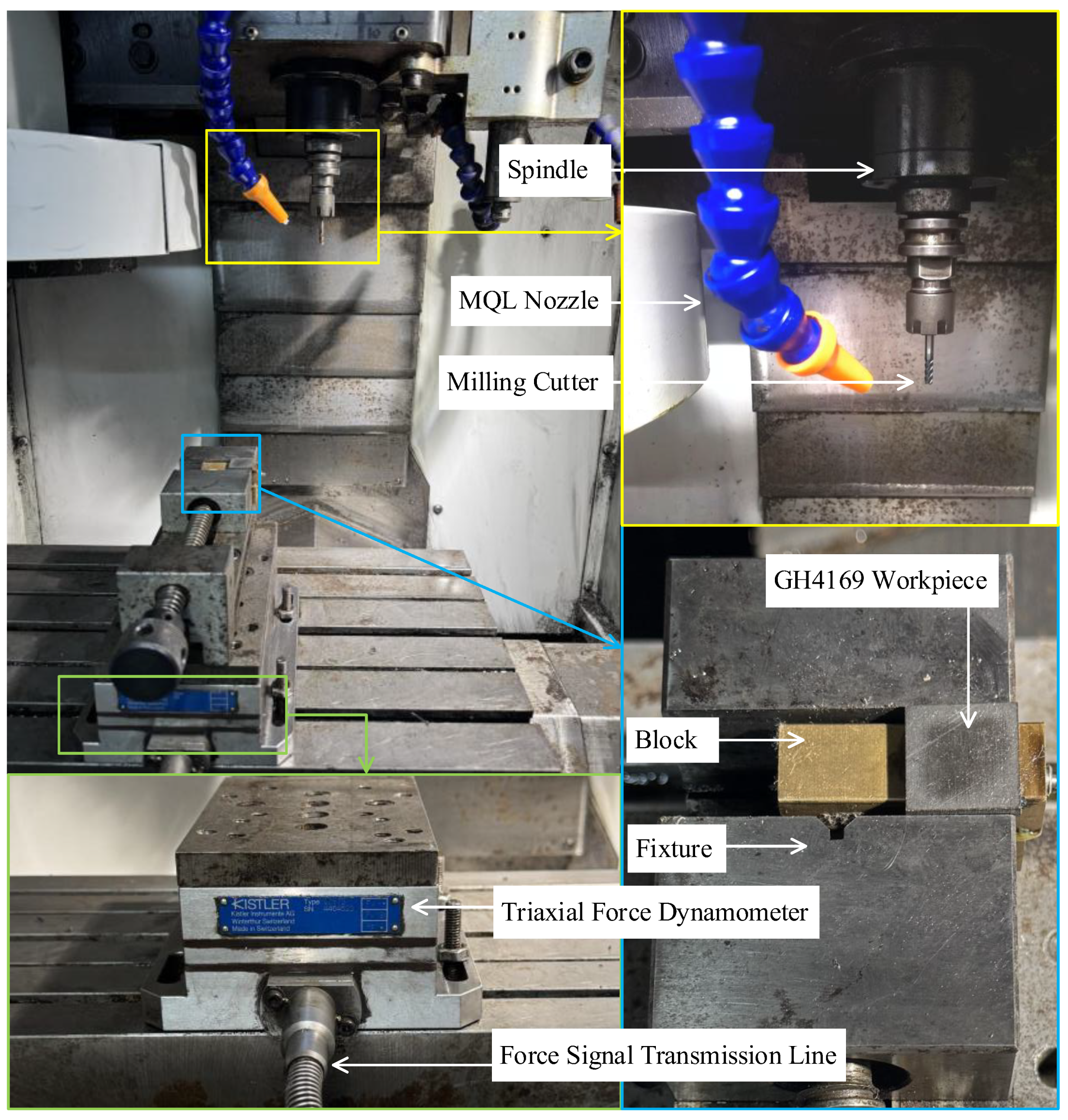
Figure 1. MQL milling system design and layout.
Machines 14 00420 g001
Figure 2. Effects of nozzle orientation on milling force (a) and surface roughness (b). The red lines represent the trend lines for the respective parameters.
Machines 14 00420 g002
Figure 3. MQL jet–airflow interaction: (a) XY-plane view and (b) XZ-plane view. (a) Green: nozzle; purple: cutter; blue: workpiece; yellow dots: oil droplets. Red arrows: cutter-induced airflow; black arrows: MQL jet and local flow fields. (b) Green: nozzle; light yellow: cutter; light blue: workpiece; yellow dots: oil droplets. Blue lines: streamlines (including air barrier); black arrows: flow directions (MQL jet, inflow, return flow, radial flow, vortex flow); red dashed line: MQL jet axis.
Machines 14 00420 g003
Figure 4. Effects of spindle speed on milling force (a) and surface roughness (b). The red lines represent the trend lines for the respective parameters.
Machines 14 00420 g004
Figure 5. Effects of nozzle distance on milling force (a) and surface roughness (b). The red lines represent the trend lines for the respective parameters.
Machines 14 00420 g005
Figure 6. Effects of nozzle angle on milling force (a) and surface roughness (b). The red lines represent the trend lines for the respective parameters.
Machines 14 00420 g006
Figure 7. Parity plot of theoretical vs. experimental oil mist penetration efficiency. The blue line represents the 1:1 ideal agreement line, red diamonds represent the theoretical-experimental paired data points, and the values in the upper left corner are the model validation metrics: root mean square error (RMSE), mean absolute relative error (MARE), and coefficient of determination (R2).
Machines 14 00420 g007
Figure 8. Comparison of predicted and measured milling force. The black dashed line represents the 1:1 ideal agreement line.
Machines 14 00420 g008
Figure 9. Comparison of predicted and measured surface roughness. The black dashed line represents the 1:1 ideal agreement line.
Machines 14 00420 g009
Table 1. Key parameters in the penetration efficiency formula: value ranges and sources.
CategoryParameter
Symbol
Value RangeSource of Value
Literature-derived basic parametersdp5–10 μmZhu et al. [34]; MQL oil mist atomization experiment, matched with the experimental parameters of MQL oil properties
k0.5–0.7Ramesh et al. [38]; jet normal momentum experiment
k0.3–0.5Zhu et al. [34]; outflow anti-interference experiment
kvac1.5–2.0Zhu et al. [34]; negative pressure penetration experiment
∆P0.1–0.3Zhu et al. [34]; negative pressure measurement experiment in the tool–chip zone
ξcap0.8–1.0Wang et al. [39]; capillary matching experiment
σ60°Ramesh et al. [38]; jet diffusion experiment
vg0.3–4.0 m/sPei [33]; calculation by rotational induced flow model, matched with the experimental parameters of end mill geometry
L010–14 mmLiu [35]; free jet experiment
Lmax25–30 mmYin [37]; air barrier penetration experiment
ηbar1.0 (L < 12 mm)
krot0.04–0.06 m/sPei [33]; rotational induced flow experiment
vin0.3–1.2 m/sYin [37]; flow field measurement experiment in the cutting zone
vout0.3–0.8 m/s
vg11 m/sYin [37]; airflow interference experiment
vg24 m/s
ξsize0.9–1.0 (dp < 0.6 dc)Wang et al. [39]; capillary penetration experiment; Yin [37], CFD flow field symmetry analysis
Experiment calibrated fitting parametersω10.6Yin [37]; CFD flow field simulation; the final value is calibrated by baseline condition pre-experiments of this study
ω20.4
kα0.9Yin [37]; outflow impingement experiment; the final value is calibrated by baseline condition pre-experiments of this study
ξdir0.3 (α = +X),
0.98 (α = −X)
Calibrated by the baseline condition pre-experiments of this study, with the reasonable range determined by published literature
Experimental design matching parametersθ10–80°Ramesh et al. [38]; jet angle optimization experiment, matched with the experimental parameters of core variable levels
α0–360°Yin [37]; CFD flow field simulation, matched with the experimental parameters of core variable levels
L4–16 mmYin [37]; air barrier penetration experiment, matched with the experimental parameters of core variable levels
n10,000–22,000 rpmSelected according to the speed range of high-speed milling, matched with the experimental parameters of core variable levels
Table 2. Physical and mechanical properties of GH4169 alloy (at room temperature).
Density (kg/m3)Yield Strength
(MPa)
Tensile Strength
(MPa)
Elongation
(%)
Thermal Conductivity λw (W/(m·K))Specific Heat Capacity cw (J/(kg·K))
8280126014302414.7 (20 °C) 430 (20 °C)
Table 3. Properties of MQL oil.
Oil TypeViscosity (40 °C, mm2/s)Flash Point (°C)Pour Point (°C)
Plant synthetic lipid10230−3
Table 4. Geometry of YG8 end mill.
Diameter (mm)Flute Length (mm)Overall Length (mm)Shank
Diameter (mm)
Helix Angle (°)No. of FlutesThermal
Conductivity λt (W/(m·K))
Density ρt (kg/m3)
4125045547514,500
Table 5. Fixed milling parameters.
Milling ParameterValue/Mode
Milling modeFace climb milling
Feed per tooth fz (μm/z)60
Axial depth of cut ap (mm)0.1
Milling width (mm)2
Oil flow rate (mL/min)2
Air supply pressure (MPa)0.6
Temperature (°C)10
Table 6. Level settings of core variables.
LevelNozzle OrientationNozzle Angle (°)Nozzle Distance (mm)Spindle Speed (rpm)
1−X10410,000
2+Y30814,000
3+X501218,000
4−Y801622,000
Table 7. Orthogonal experimental groups.
Experiment No.Nozzle OrientationNozzle Angle (°)Nozzle Distance (mm)Spindle Speed (rpm)
1−X10410,000
2−X30814,000
3−X501218,000
4−X801622,000
5−Y10818,000
6−Y30422,000
7−Y501610,000
8−Y801214,000
9+X101222,000
10+X301618,000
11+X50414,000
12+X80810,000
13+Y101614,000
14+Y301210,000
15+Y50822,000
16+Y80418,000
Table 8. Orthogonal experimental scheme and results.
Orthogonal Test TableNozzle OrientationNozzle Angle (°)Nozzle Distance (mm)Spindle Speed (rpm)Milling Force Fc (N)Surface Roughness Ra (μm)
1−X10410,00020.840.345
2−X30814,00021.750.376
3−X501218,00024.850.396
4−X801622,00036.531.050
5−Y10818,00052.091.057
6−Y30422,00052.221.158
7−Y501610,00018.920.581
8−Y801214,00014.980.672
9+X101222,00015.661.143
10+X301618,00054.571.058
11+X50414,0009.620.577
12+X80810,0009.610.310
13+Y101614,00035.370.443
14+Y301210,0006.140.481
15+Y50822,00010.850.822
16+Y80418,00022.301.057
Table 9. Combined range analysis results for milling force and Surface Roughness Ra.
FactorRange R (Milling Force, N)Range R (Surface Roughness Ra, μm)
Nozzle Orientation37.580.325
Nozzle Angle42.600.178
Nozzle Distance44.610.143
Spindle Speed45.990.614
Table 10. Orthogonal ANOVA results for milling force.
Source of VariationSum of Squares (SS)Degrees of Freedom (df)Mean Square (MS)F-Valuep-Value Range
Nozzle Orientation554.763184.922.330.257
Nozzle Angle830.133276.713.480.172
Nozzle Distance894.973298.323.750.159
Spindle Speed1357.993452.665.700.093
Table 11. Orthogonal ANOVA results for Surface Roughness Ra.
Source of VariationSum of Squares (SS)Degrees of Freedom (df)Mean Square (MS)F-Valuep-Value Range
Nozzle Orientation0.222230.07411.730.326
Nozzle Angle0.086730.02890.680.612
Nozzle Distance0.065830.02190.510.695
Spindle Speed1.036030.34538.070.068
Disclaimer/Publisher’s Note: The statements, opinions and data contained in all publications are solely those of the individual author(s) and contributor(s) and not of MDPI and/or the editor(s). MDPI and/or the editor(s) disclaim responsibility for any injury to people or property resulting from any ideas, methods, instructions or products referred to in the content.