Article

Analysis of Power Regulation Characteristics for Pumped Storage Plants Containing a Variable-Speed Unit with a Full-Size Converter and a Fixed-Speed Unit Considering Hydraulic Disturbances Under Turbine Mode


1
State Key Laboratory of Water Resources Engineering and Management, Wuhan University, Wuhan 430072, China
2
School of Environment and Energy, City University of Hong Kong, Hong Kong SAR 999077, China
3
State Grid Sichuan Electric Power Research Institute, Chengdu 610041, China
*
Author to whom correspondence should be addressed.
Machines 2026, 14(1), 63; https://doi.org/10.3390/machines14010063
Submission received: 9 November 2025 / Revised: 30 December 2025 / Accepted: 31 December 2025 / Published: 4 January 2026
(This article belongs to the Special Issue Unsteady Flow Phenomena in Fluid Machinery Systems)

Abstract

The rapid and frequent power regulation of variable-speed pumped storage units with a full-size converter (VSPSU with FSC) causes strong hydraulic disturbances in fixed-speed units (FSU) within shared pipelines. The influence of power command rates on the system has not been sufficiently quantified. Therefore, a model of pumped storage plant (PSP) containing VSPSU with FSC and FSU is constructed and validated against internationally used software SIMSEN. Influences of rates on dynamic characteristics are analyzed under turbine power reduction condition. An evaluation method is proposed to quantify power regulation performance for selecting optimal rates. Results indicate the following: (1) Advantage: the VSPSU-FSU demonstrates a superior power response compared to FSU-FSU under fast power control strategy. (2) Influence: overshoots of parameters show positive correlations with rates, while regulation time generally exhibits negative correlations. (3) Evaluation: Power regulation performance has a non-monotonic relationship with rates of VSPSU. Considering rapidity, safety, and stability comprehensively, the performance initially raises to a peak and then declines. Under 50% power reduction, the optimal power command rate is 0.1 p.u./s. The VSPSU–FSU active power regulation time is 4.9 s, significantly lower compared to FSU–FSU (45.17 s). This paper offers crucial insights for optimizing operation of PSPs with VSPSU and FSU.

1. Introduction

1.1. Background

With the increasing development of renewables such as wind and solar in power systems [1,2,3], the intermittency and instability cause mismatches on both the generation and network sides, leading to power quality deterioration, voltage fluctuations, and frequency deviations that challenge the safety and stability of power systems [4,5,6]. Developing energy storage for peak shaving, valley filling, and load smoothing during power fluctuations is an effective approach to balance supply and demand and enhance system flexibility and stability [7,8,9].
Pumped storage plants (PSPs) offer flexible and reliable operation with fast mode switching, enabling power regulation according to the load demand. PSPs are the largest-capacity and most reliable storage technology worldwide, and their flexible control and large capacity support the stable and efficient operation of the system [10,11,12]. Compared with conventional fixed-speed units (FSUs), the speed of variable-speed units (VSUs) can be regulated. Therefore, VSUs can provide more flexible and efficient power control in both turbine and pump modes, responding faster to grids demands [13,14,15].
As one of the variable-speed unit technologies, the variable-speed pumped storage unit with full-size converter (VSPSU with FSC) connects the synchronous machine to the grid through an AC–DC–AC converter, decoupling the rotational speed from the grid. It can widen the speed range, facilitate flexible mode transitions, and improve responsiveness compared with FSUs [16,17,18]. With advances in power electronics, the capacity of converters is expected to increase, which leads to more applications in higher-capacity plants and indicates the strong prospects and significance for this technology [19]. In practice, multiple units sharing common pipelines are widely deployed; hydraulic coupling in shared pipelines causes hydraulic disturbances among units during power regulation [13,20]. Under an arrangement of two units sharing common pipelines, frequent power regulation by the VSPSU can disturb the FSU. Accordingly, the influence of the VSPSU power command rates on the system dynamic characteristics needs to be analyzed. Command selection needs to be optimized with joint consideration of the stability, safety, and rapidity. It is of great significance for the efficient and stable operation of a PSP containing a VSU with an FSC and FSU and is worth further research.
In engineering practices, the development of VSPSUs with an FSC is progressing rapidly worldwide. The Z’Mutt 5 unit in Switzerland, utilizing a 5 MW VSPSU with an FSC, is operational. Furthermore, the Grimsel 2 PSP employs this technology with the unit capacity reaching 100 MW [21,22]. Austria’s Malta Oberstufe PSP was retrofitted with a VSPSU with an FSC, achieving a unit capacity of 80 MW [23]. In China, the first domestically developed VSPSU with an FSC successfully commenced operation at the Sichuan Chun Chang Ba PSP, demonstrating excellent performance across various operating conditions [24,25]. The global development and operation of VSPSUs with an FSC have seen substantial progress. The future development of this technology is highly promising.

1.2. Literature Review

The research on VSPSUs with an FSC primarily focuses on modeling, control strategies, and system stability. In terms of modeling research, Reigstad et al. [26] established a detailed model of a VSPSP with an FSC and emphasized the need to consider hydraulic side constraints in control system design. Borkowski [27] developed refined models for key components like power electronic converters (PECs) in small-scale VSPSPs. Dong et al. [28] built a detailed VSPSU with an FSC model within the IEEE 14-bus system using the General Electric PSLF platform. Belhadji et al. [29] developed a system based on a permanent magnet synchronous machine in micro-hydropower plants and proposed using a Maximum Power Point Tracking (MPPT) strategy for efficient operation. Aziz et al. [30] elaborated on modeling methods for the full-size converter and synchronous machine. Shao et al. [31] built a detailed hydro–mechanical–electrical coupled numerical simulation model to analyze the dynamic characteristics of power regulation in pumping mode.
In terms of control strategies research, Alligné et al. [32] analyzed different start-up strategies for VSPSUs with an FSC in turbine mode. Wang et al. [33] showed that a fast power control strategy significantly enhances the power response capability of VSPSUs with an FSC, effectively smoothing the photovoltaic power fluctuations. Zhao et al. [34] optimized control system parameters by comparing fast power and fast speed control strategies. In coordination control research, Yao et al. [35] calculated the optimal speed for different head and power combinations based on complete turbine characteristics, improving the generation efficiency in turbine mode. Borkowski et al. [36] introduced three methods to obtain the optimal speed: indirect, direct, and hybrid.
In terms of stability research: Dong et al. [37] compared the frequency regulation performance of conventional FSPSUs and VSPSUs under frequency disturbances, finding that VSPSUs provide faster frequency response and superior frequency stability. Mercier et al. [38] compared the stability of VSPSUs with FSC under different control strategies, noting that direct active power control via electromagnetic torque can lead to rotational speed instability. Guo et al. [39] used auto disturbance rejection control for variable-speed micro hydropower plants, which can achieve higher robustness.

1.3. Gaps and This Work

Previous studies have established numerical simulation models for a VSPSP with an FSC using various methodologies. Multiple control strategies have been proposed to analyze and compare the dynamic characteristics of VSPSP with FSC systems under different operating conditions, thereby enhancing system operational stability and efficiency. However, these studies exhibit the following limitations: (1) Previous modeling efforts have primarily focused on detailed electrical system components, with limited reporting on detailed hydraulic modeling. (2) The models mainly investigate unit dynamic characteristics in a single-pipe single-unit system, ignoring the hydraulic disturbances between different units in practical PSPs. (3) Analyses of system dynamic characteristics in the previous research often address the stability, safety, or rapidity, respectively, lacking a comprehensive evaluation method for power regulation performance.
To address these gaps, this paper makes the following contributions: (1) Modeling: detailed models of the pipelines and the pump–turbine in the hydraulic subsystem are built, and a model of a PSP containing a VSU with an FSC and FSU is constructed based on previous works. (2) Characteristics: this paper analyzes the dynamic characteristics of a VSU with an FSC in the fast power control mode and an FSU, under the turbine power reduction condition, considering hydraulic disturbances in PSP. (3) Evaluation: an evaluation method incorporating the power regulation’s rapidity, safety, and stability is proposed to analyze the dynamic characteristics and evaluate the power regulation performance of the system.
The structure of this paper is organized as follows: (1) Section 2 establishes the model of a PSP containing a VSU with an FSC and FSU based on Matlab 2024b/Simulink, with its accuracy verified against simulation results from the SIMSEN software. (2) Section 3 performs a dynamic analysis of power regulation, discusses the advantages of the VSU–FSU, and investigates the influence of different power command rates from the VSU on system dynamic characteristics. (3) Section 4 proposes a comprehensive evaluation method considering the power regulation’s rapidity, safety, and stability, which is applied to quantitatively evaluate the simulation results under different power command rates and optimize the power regulation commands. (4) Section 5 presents the analysis and discussion of the simulation results. (5) Finally, Section 6 presents the conclusions.

2. Modeling

A variable-speed pumped storage plant with a full-size converter (VSPSP with a FSC) is a hydraulic–mechanical–electrical coupled system. The hydraulic–mechanical subsystem includes a pump–turbine, waterway, and governor system, while the electrical subsystem consists of a synchronous machine, full-size converter, and power grids [31]. In this section, the subsystem models are established using the transfer function method, with a detailed description of the complex pipeline model under the scheme of two units sharing a common pipeline and the pump–turbine model [40,41]. Since there are few VSPSPs with an FSC in actual operation, and historical operational data are scarce, the model parameters in this paper are modified and determined based on real operating data from a pumped storage plant. In this study, the pumped storage plant contains a variable-speed unit with a full-size converter and a fixed-speed unit, with the main parameters of both units being identical. The main parameters are shown in Table 1.

2.1. Subsystem

(1) 
Governor system
A PI controller is adopted. The rotational speed signal is fed through the controller to the actuator device to control the guide vane opening. The transfer function is
G 1 ( s ) = y ( s ) w ( s ) = K p + K i s 1 + b p ( K p + K i s ) ( T y s + 1 ) .
(2) 
Waterway system
Based on the one-dimensional continuity and momentum equations for pipeline flow, the transfer-matrix equation describing transient behavior in the waterway is derived as Equation (2):
H U Q U = cosh ( γ l ) a g A sinh ( γ l ) g A a sinh ( γ l ) cosh ( γ l ) H D Q D .
In addition,
T e = l a F = f Q l 2 D A a f = 8 g n R 2 R 1 / 3 .
As the hyperbolic transfer-function matrix in Equation (2) is not directly amenable to implementation, a Taylor expansion is performed to obtain Equation (4). Under the improved transfer function method (TFM), setting the coefficient α = π 2/4 affords enhanced modeling accuracy [40].
H U Q U = 1 + ( T e s + F ) 2 α a g A ( T e s + F ) g A a ( T e s + F ) 1 + ( T e s + F ) 2 α H D Q D
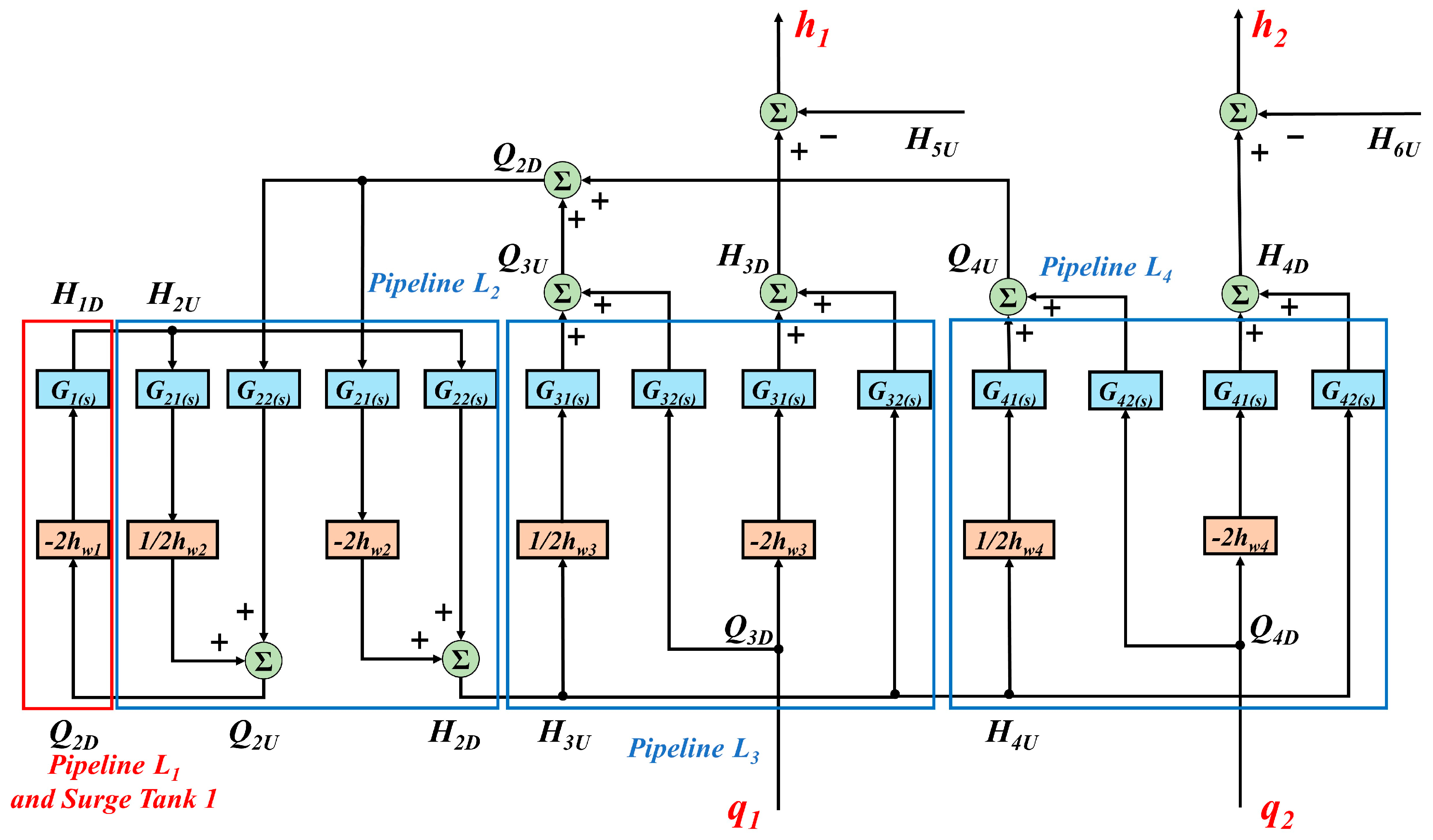
In accordance with Equation (4), waterway systems comprising multiple interconnected sections are represented. The parameters of the present waterway model are calibrated with reference to the measurements from an actual pumped storage plant. The system layout is presented in Figure 1, and the corresponding parameters are provided in Table 2.
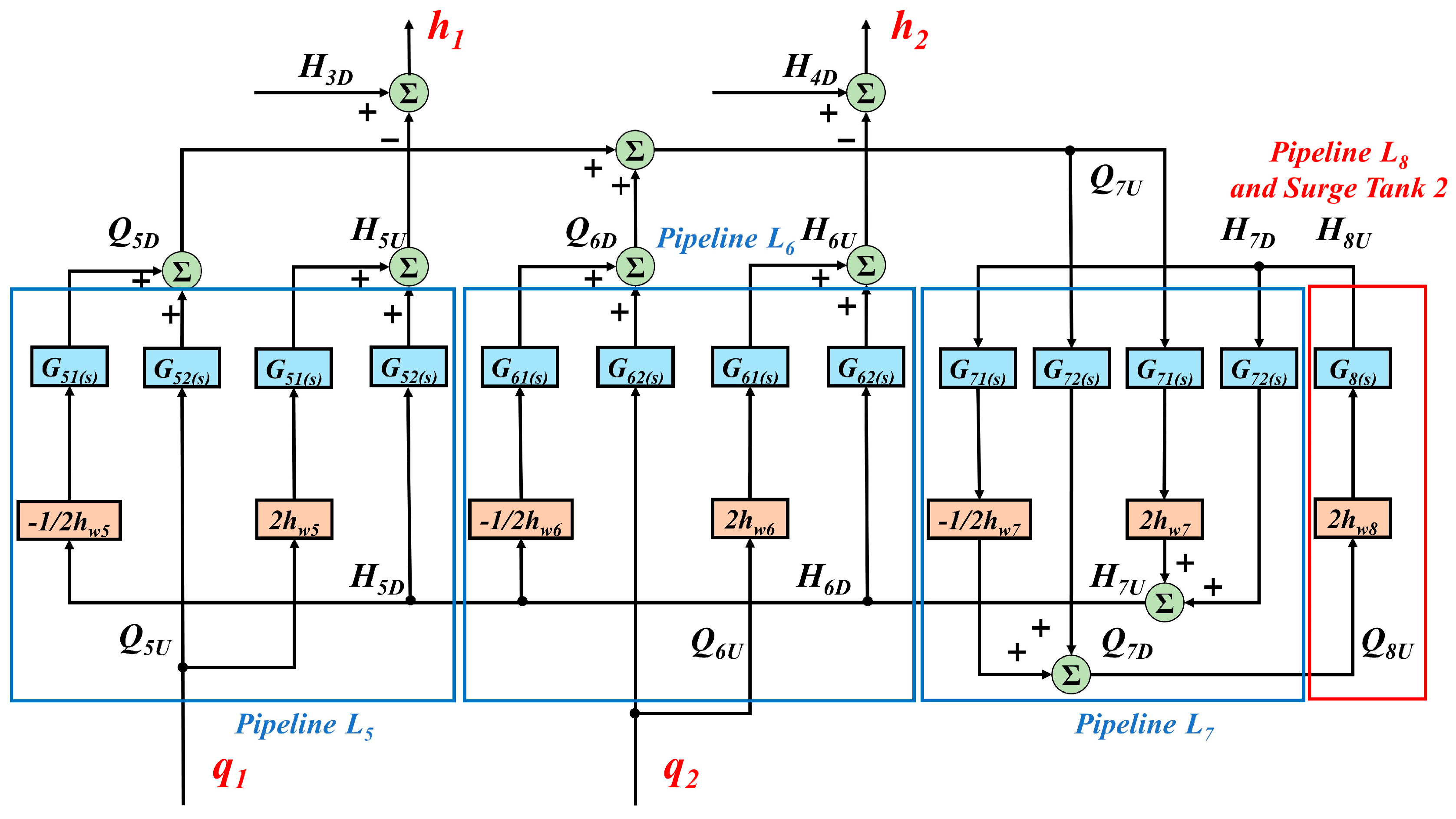
The waterway is divided into eight sections. According to the layout, the transfer matrix in Equation (4) is converted into transfer functions, upon which the waterway-system model is constructed, as depicted in Figure 2 and Figure 3.
The influence of the surge-chamber restricted orifice is accounted for via Ts = FsH/Q, Tq = εTs, hw = a/2gA; the transfer functions used in the figures are as follows.
G 1 ( s ) = α T q 1 T e 1 s 2 + ( α T e 1 + α F 1 T q 1 ) s + α F 1 T q 1 T e 1 2 s 3 + ( T e 1 2 + 2 F 1 T q 1 T e 1 + 2 α T e 1 T s 1 h w 1 ) s 2 + ( α T q 1 + F 1 2 T q 1 + 2 F 1 T e 1 + 2 α F 1 T s 1 h w 1 ) s + F 1 2 + α G i 1 ( s ) = T e i s + F i T e i 2 α s 2 + 2 T e i F i α s + F 1 2 α + 1 ; i = 2 ~ 7 G i 2 ( s ) = 1 T e 1 2 α s 2 + 2 T e i F i α s + F 1 2 α + 1 ; i = 2 ~ 7 G 8 ( s ) = α T q 2 T e 8 s 2 + ( α T e 8 + α F 8 T q 2 ) s + α F 8 T q 2 T e 8 2 s 3 + ( T e 8 2 + 2 F 8 T q 2 T e 8 + 2 α T e 8 T s 2 h w 8 ) s 2 + ( α T q 2 + F 8 2 T q 2 + 2 F 8 T e 8 + 2 α F 8 T s 2 h w 8 ) s + F 8 2 + α
(3) 
Pump–turbine
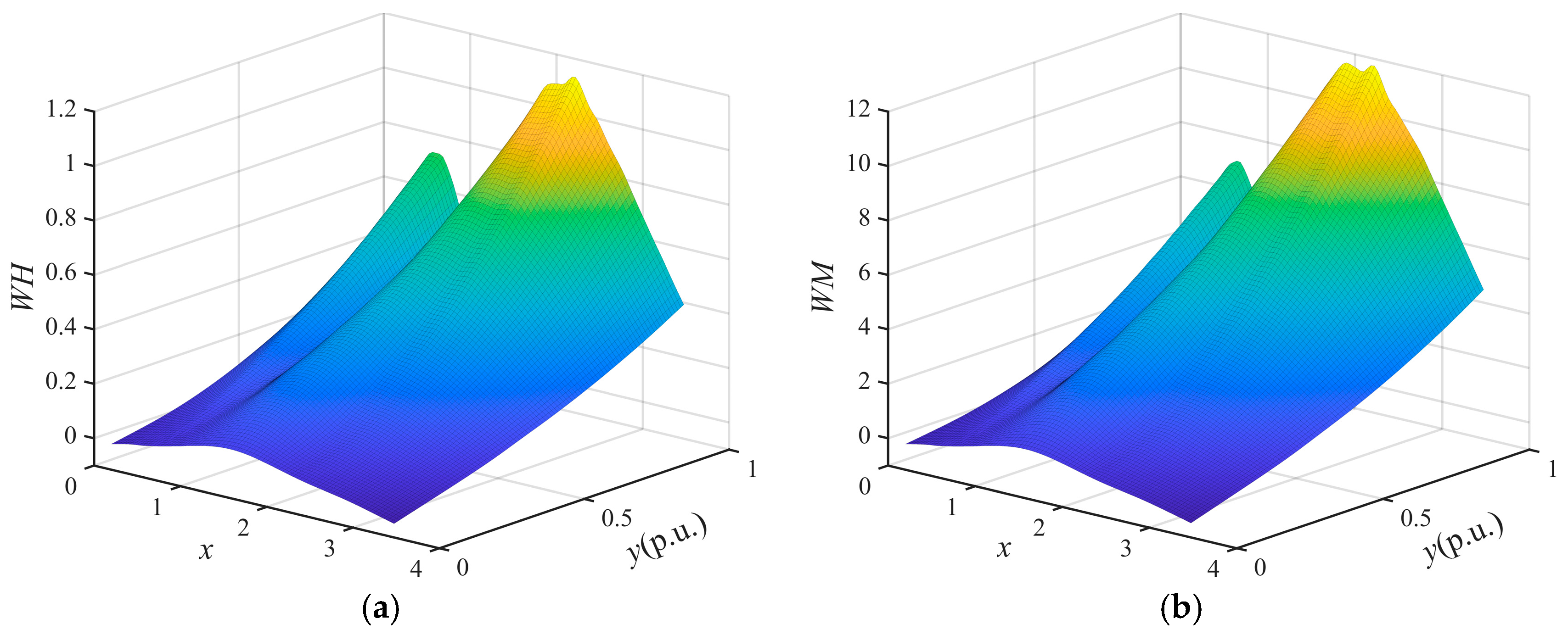
A nonlinear pump–turbine model is established through interpolation of the full characteristic curves. In view of the multivalued behavior of the full characteristic map in the “S” region, an improved Suter-curve transformation is adopted following prior work [41]. After transformation, the abscissa is x together with the guide-vane opening y, whereas the ordinates are transformed from the unit flow and unit torque to WH and WM, respectively. The WH and WM curves are shown in Figure 4. The expressions for the transformed coordinates are provided in Equations (6) and (7).
W H ( x , y ) = h α 2 + q 2 + C h h ( y + C y ) 2 W M ( x , y ) = ( m + k 1 h α 2 + q 2 + C h h ) ( y + C y ) 2
x = arctan [ ( q + k 2 h ) / α ] , α > 0 x = π + arctan [ ( q + k 2 h ) / α ] , α < 0
The parameter requirements are as follows: k1 > |M11max|/M11r, k2 = 0.5~1.2, Cy = 0.1~0.3, Ch = 0.4~0.6. For the case study, k1 = 10, k2 = 0.9, Cy = 0.2, and Ch = 0.5. Here, α = n/nr, q = Q/Qr, m = M/Mr, h = H/Hr, and y denotes the guide-vane opening; the subscript r indicates the rated value.
(4) 
Synchronous machine, Coordination controller, and Converter
Based on previous studies [31], the synchronous machine is modeled by a sixth-order set of differential equations. The first two describe the rotor motion, and the remaining four describe the transient operation and the sub-transient operation. The equations are given by
T a d Δ w = P m P e d δ = Δ w T d 0 d E q d t = E f E q I s g , d ( X d X d ) T q 0 d E d d t = E d + I s g , q ( X q X q ) T d 0 d E q d t = E q E q I s g , d ( X d X d ) T q 0 d E d d t = E d E d + I s g , q ( X q X q ) .
The coordination controller evaluates the efficiency over the pump–turbine full characteristics curve [31]. In a VSPSU equipped with an FSC, the optimal speed corresponding to the specified head and active power is obtained through it.
The converter model is divided into the machine-side converter and the grid-side converter. The machine-side converter employs a dual-loop structure with an outer voltage loop and an inner current loop, achieving reference tracking through d–q decoupling in the current loop. The grid-side converter employs a dual-loop structure with an outer power loop and an inner current loop, where the outer loop regulates active and reactive power, and the inner loop tracks current references through d–q decoupling [31].

2.2. Verification of the Model

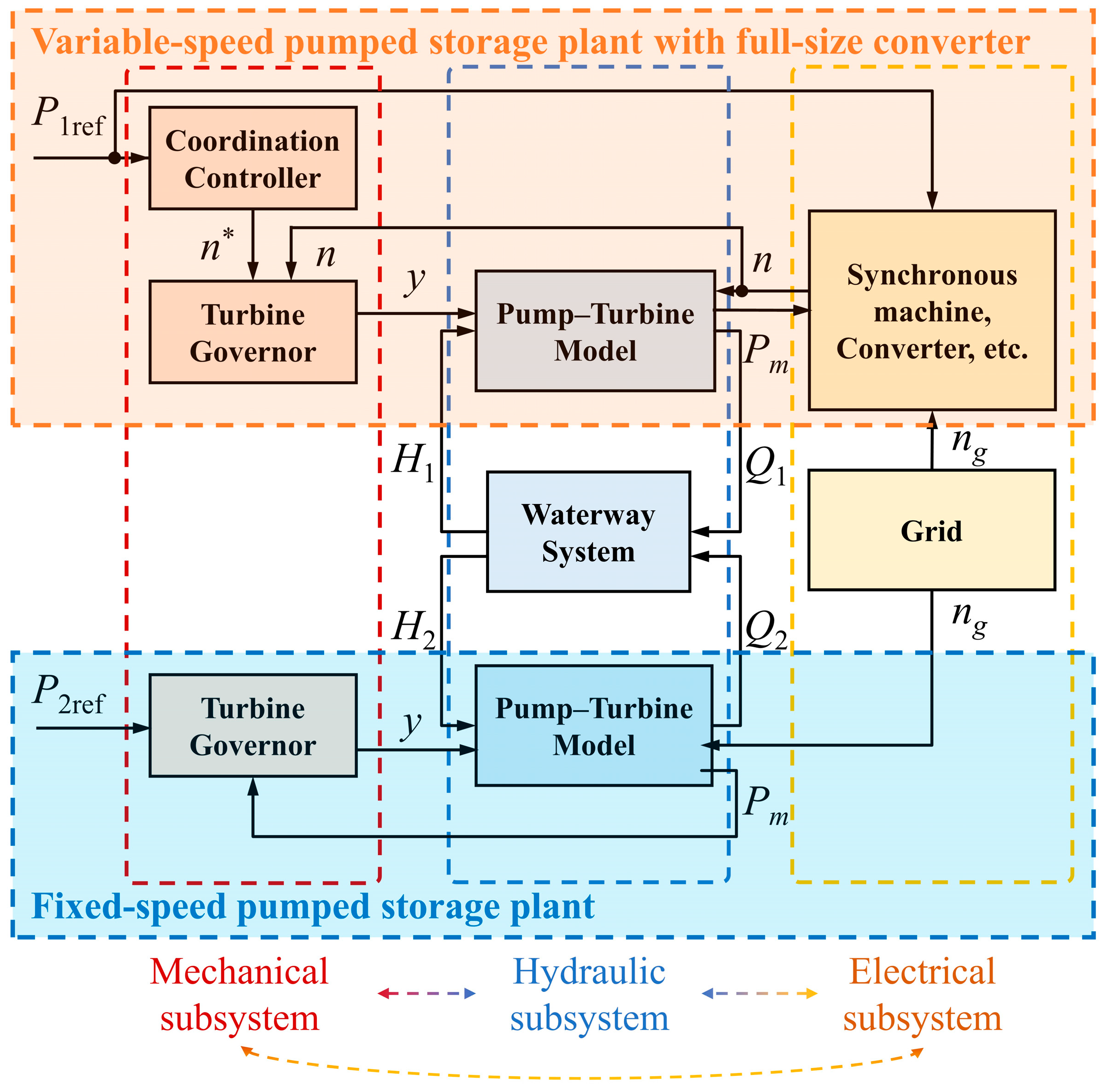
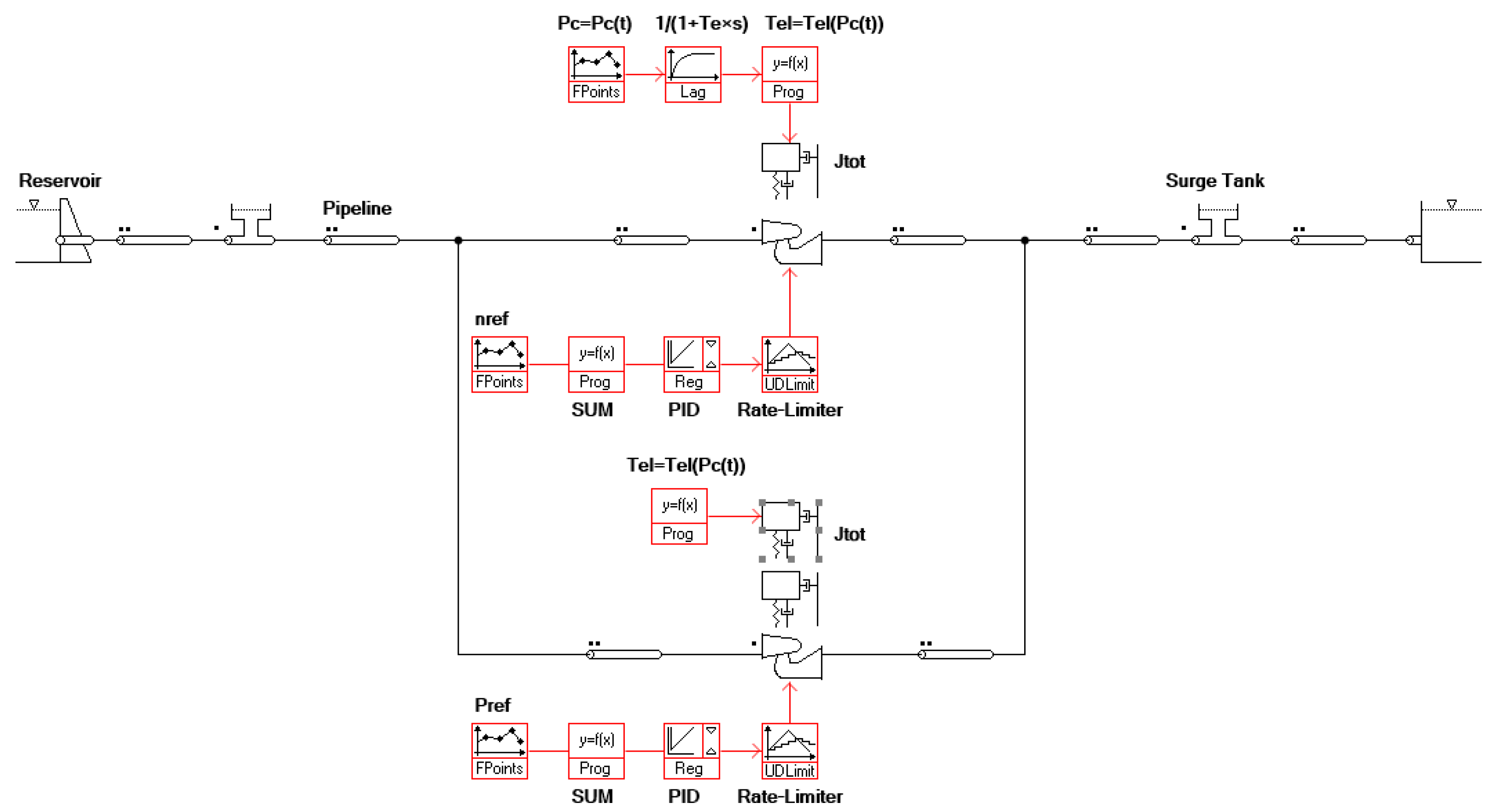
The VSPSU with an FSC and FSU is coupled through the waterway system to establish a model of a PSP containing a VSU with an FSC and FSU. The fast power control strategy is adopted in the VSPSU with an FSC, where the active power is regulated through the converter, and the rotational speed is adjusted by the governor system. The FSU is connected with power grids and adopts a power regulation mode. The schematic block diagram of the entire model is provided in Figure 5.
Due to the lack of historical operational data for VSPSPs in China, to verify the accuracy of the proposed model, a model of a PSP containing a VSU with an FSC and FSU is also established in SIMSEN, and the dynamic responses of the corresponding physical quantities are compared to demonstrate the correctness of the model.
SIMSEN, mature commercial software, has been widely adopted by industrial users and research institutions because of its advanced capabilities and high simulation accuracy, and it has been validated in many European plants [42]. Consequently, with the same model parameters, simulation models are constructed in both SIMSEN and Simulink. A comparison of the simulation results is conducted to verify the accuracy of the model in terms of the hydraulic–mechanical–electrical characteristics. The block diagram of the SIMSEN model is shown in Figure 6.
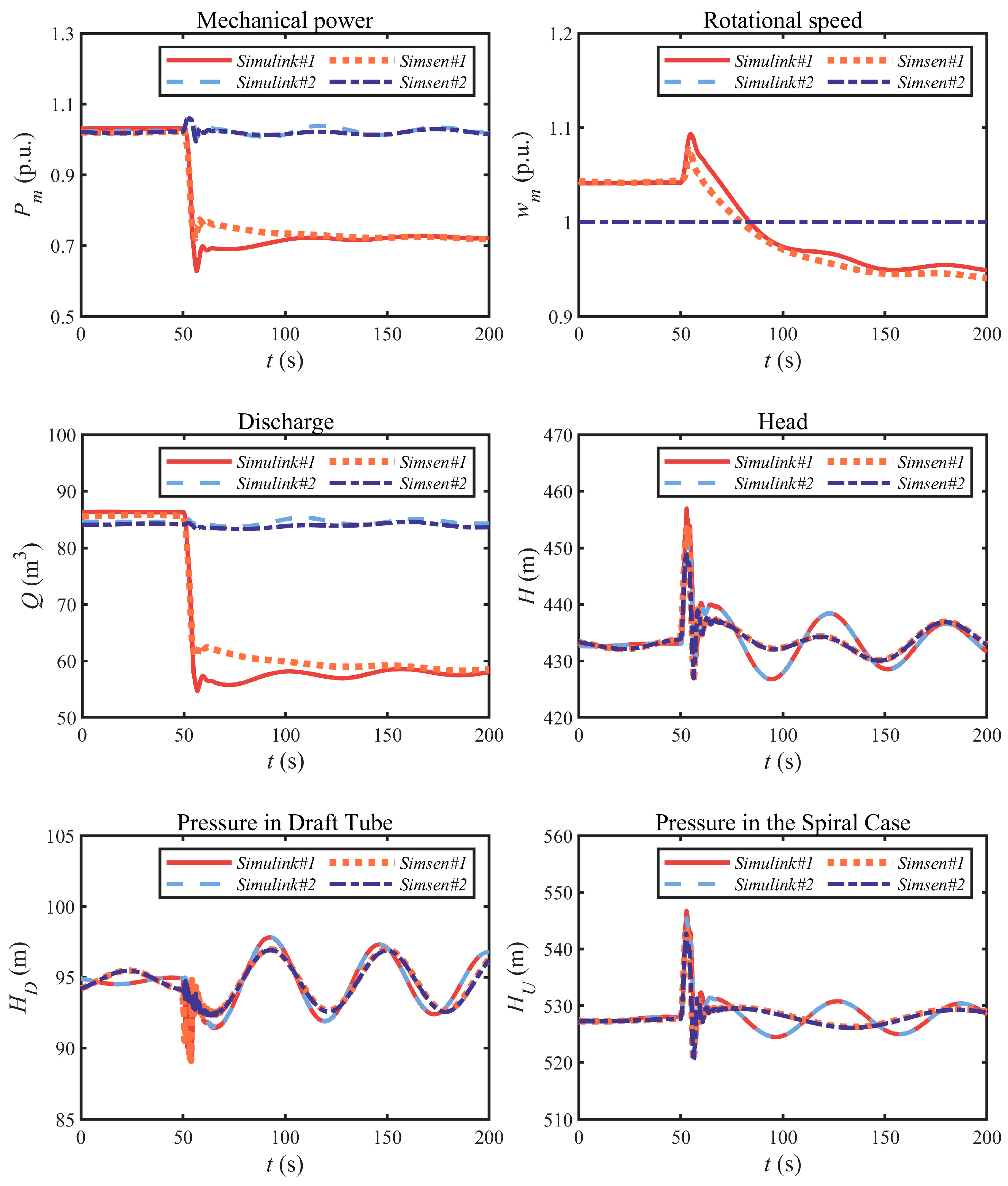
For the VSPSU–FSU configuration, the active power, rotational speed, head, discharge, and the pressures in the spiral case and draft tube are selected as indicators representing the hydraulic–mechanical–electrical characteristics. The dynamic responses from the two software models are compared in Figure 7.
“#1” represents the VSU, and “#2” represents the FSU under hydraulic disturbances.
From the simulation results, all indicators exhibit consistent trends and eventually become stable. The maximum deviations and the stability values of each indicator are shown in Table 3.
According to Table 3, from the perspective of static characteristics, the stability values after power regulation differ only slightly between the model in this paper and SIMSEN, with the maximum relative deviation not exceeding 1.5%. In terms of the dynamic characteristics, during the transition, the indicators of the physical quantities in the Simulink and SIMSEN models exhibit consistent trends, while some differences occur in overshoot. The average relative deviation of the maximum deviation in overshoot is 2.06%, mainly resulting from differences in modeling approaches. The relative deviations are small, which verifies the effectiveness and accuracy of the proposed numerical model for the PSP containing a VSU with an FSC and FSU.

3. Dynamic Characteristics Analysis Under Power Regulation

Because of flexible regulation capability, the VSPSU with an FSC can be used for power regulation, smoothing the power fluctuations caused by the unstable output of renewable energy and providing rapid responses to power command changes from the grids. However, in a VSPSU–FSU sharing common pipeline system, when power is regulated through the VSPSU with an FSC, the dynamic response characteristics of both units are affected by hydraulic coupling interactions.
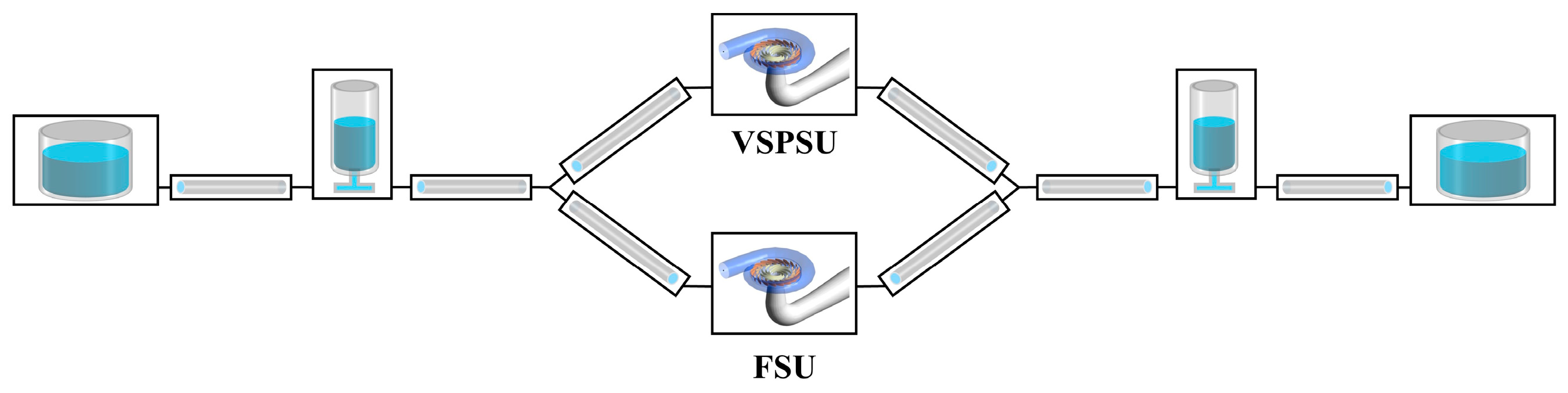
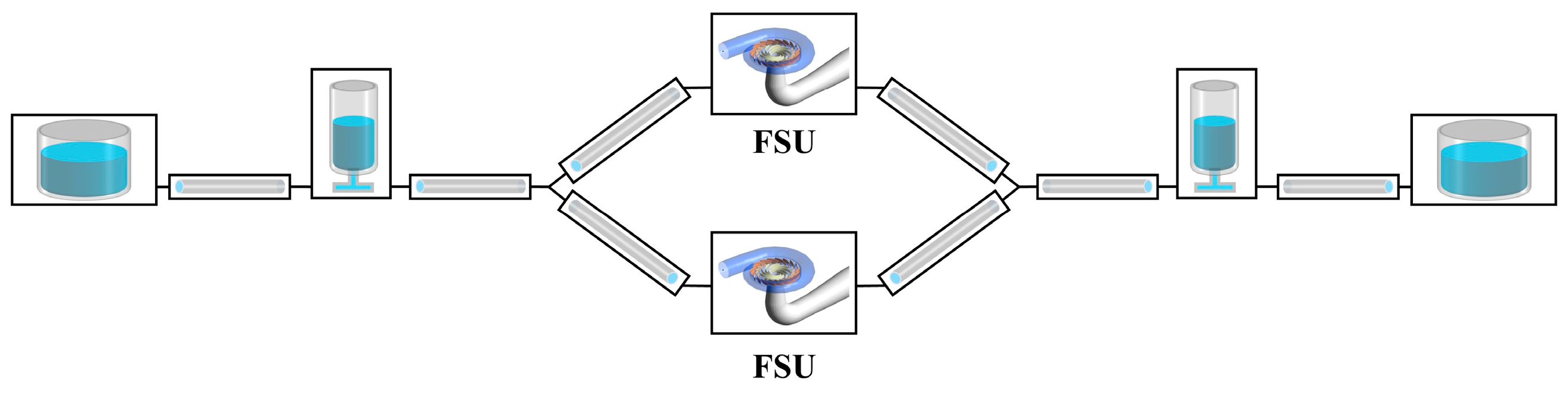
Therefore, this section investigates the influence of the power regulation command rate of a VSU on the dynamic characteristics of the system under a turbine power reduction condition. A comparative analysis is conducted between the VSPSU–FSU and FSU–FSU, to indicate the advantages of power regulation in the PSP containing a VSU with an FSC and FSU. Then, power regulation commands with different rates are set for the VSPSU with an FSC to analyze the influence on the dynamic characteristics of the system. The configuration of the VSPSU–FSU and FSU–FSU are shown in Figure 8 and Figure 9.

3.1. Comparison of the Dynamic Response Between the VSPSU–FSU and FSU–FSU

To compare the dynamic characteristics of power regulation between the VSPSU–FSU and the FSU–FSU, a numerical simulation is carried out with a 50% power reduction as an example. All parameters of the two models are kept the same.
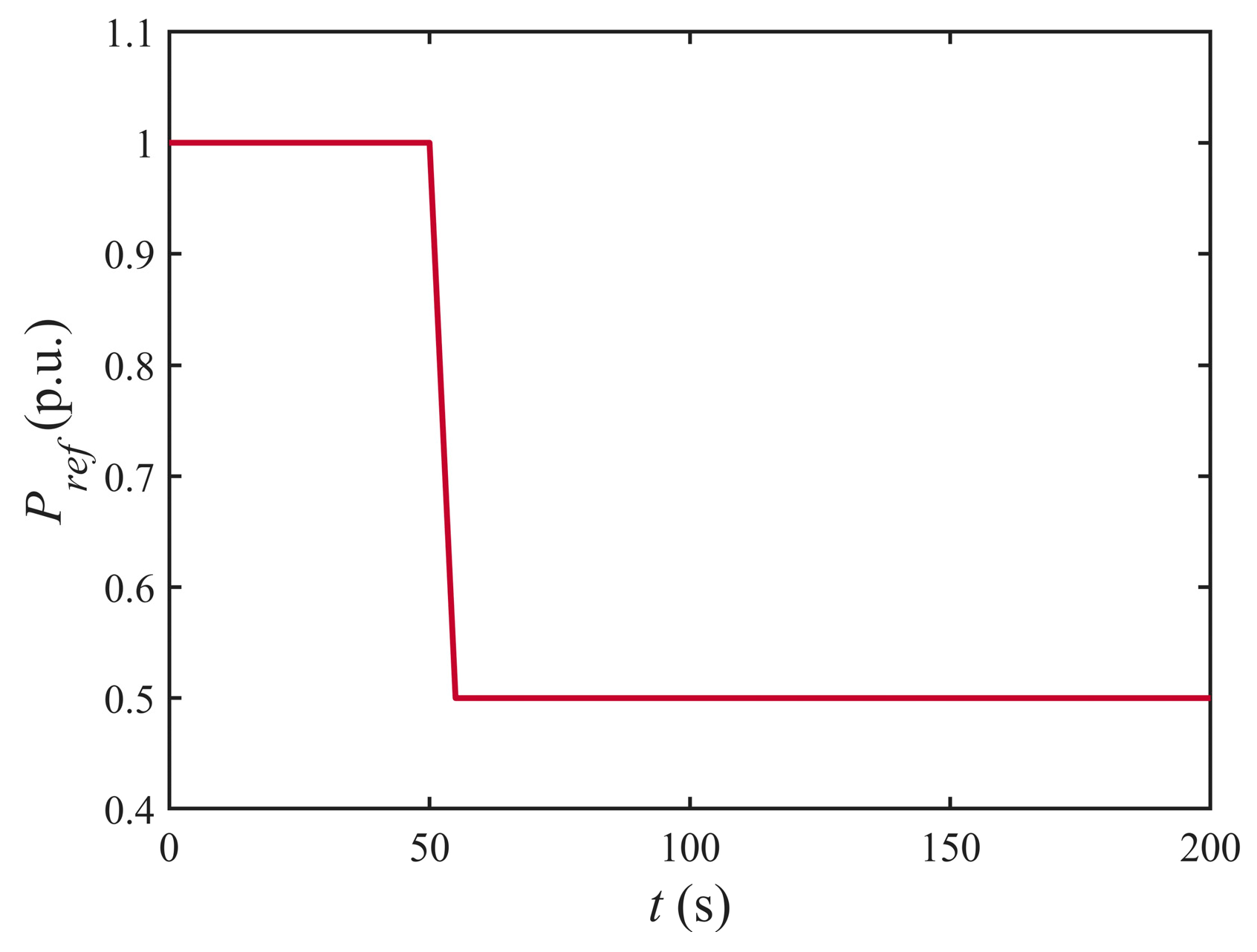
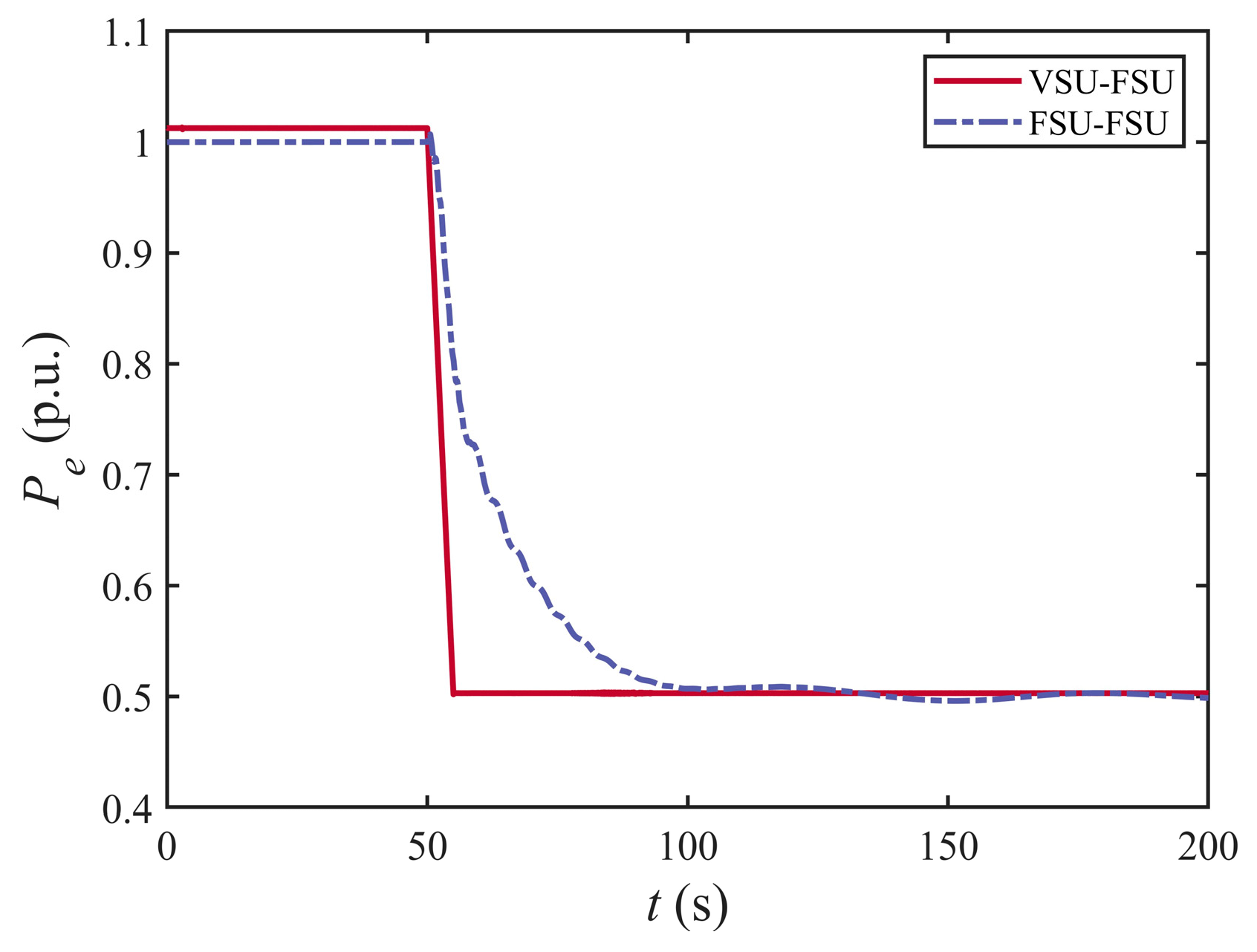
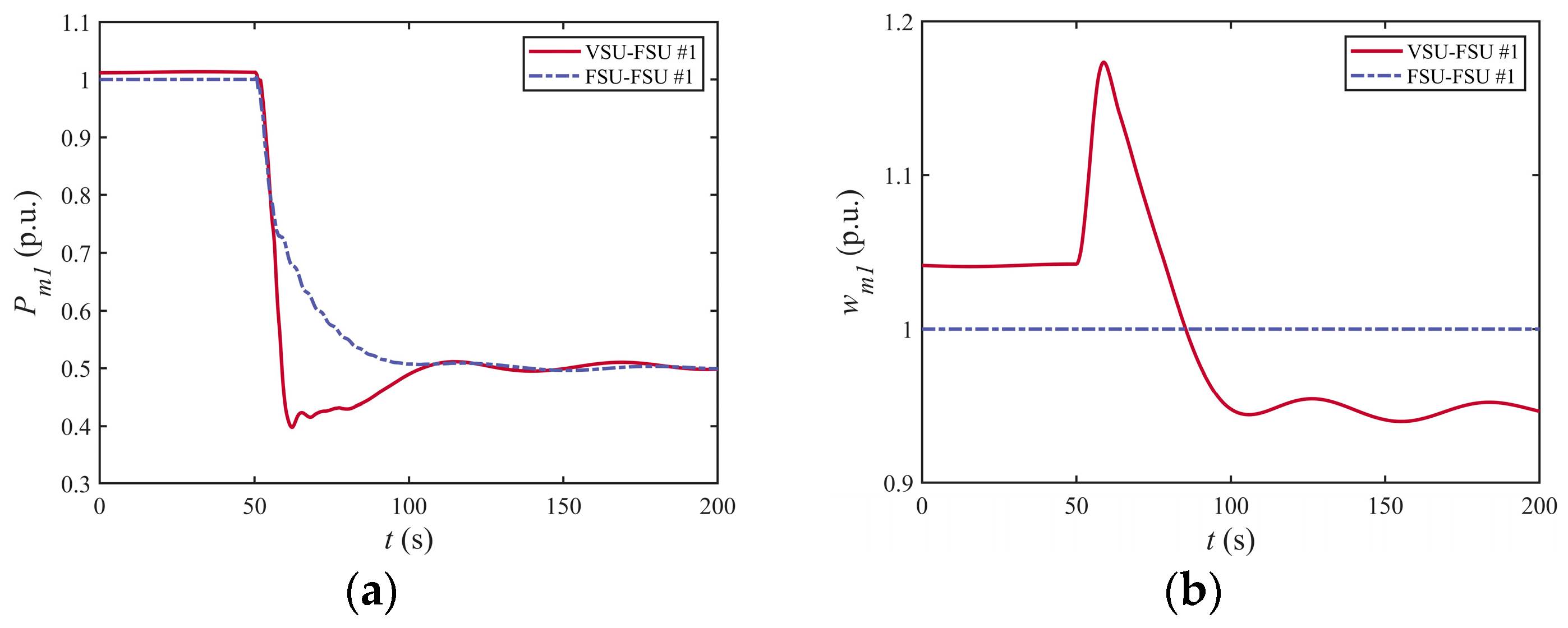
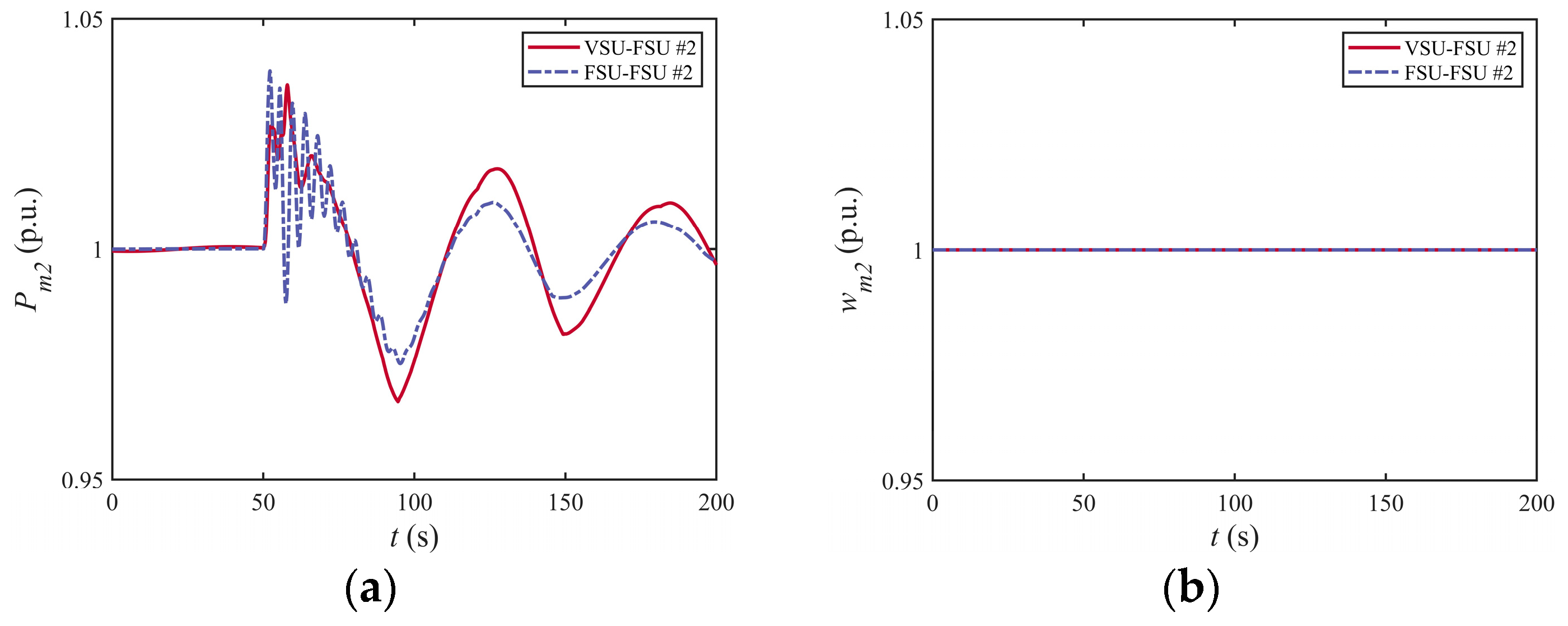
All units start at the rated conditions. At t = 50 s, the power command of the variable-speed unit in the VSPSU–FSU is reduced by 50%, while the power command of a fixed-speed unit in the FSU–FSU is reduced by 50%. The command rate is 0.1 p.u./s. The power command of the other units remains unchanged, and all fixed-speed units are connected to the grids. The power command is shown in Figure 10. The active power dynamic responses are compared in Figure 11. The dynamic response of the rotational speed and mechanical power for the variable-speed unit and the fixed-speed unit under power regulation is shown in Figure 12. The rotational speed and mechanical power responses of the fixed-speed unit under hydraulic disturbances are shown in Figure 13.
“#1” represents the unit under power regulation: the VSPSU with an FSC in the VSPSU–FSU, and the FSU in the FSU–FSU. “#2” represents the fixed-speed unit under hydraulic disturbances. Due to the slow power command rate, the variations in active power and rotational speed per unit time are reduced. As a result, the regulation amplitude and rate of the guide vanes, controlled by the pump–turbine governor system, are also reduced. Consequently, the water hammer effect is weak, and the amplitude of the mechanical power reverse regulation is small. The system can rapidly restore stability. The VSPSU with an FSC achieves a rapid response to power commands through rotor rotation and energy storage. During power regulation in turbine mode, the rotor power from rotational kinetic energy storage and the power loss exists between the mechanical power, machine-side active power, and grid-side active power. Therefore, to meet the grid power demand, both the mechanical power and the machine-side active power exceed 1.0 p.u [31]. The maximum deviations and regulation times of the mechanical power, rotational speed, and active power are shown in Table 4.
From Figure 11 and Table 4, the following observations are made.
(1) Compared with the FSU–FSU, when power regulation is performed by the VSPSU with an FSC in the VSPSU–FSU, the active power regulated through the converter can rapidly track the grid power command. The regulation time is 4.90 s, which is far less than the 45.17 s of the FSU–FSU, and the active-power overshoot is smaller at 0.001 p.u.
(2) However, the rapid response of active power regulated by the converter causes the rotational speed of the VSPSU with an FSC, controlled through the pump–turbine governor system, to increase suddenly, and the mechanical power exhibits an overshoot, as shown in Figure 12. According to Table 4, the mechanical-power regulation time for the VSPSU with FSC is 51.26 s, which is close to the 45.17 s observed when an FSU performs power regulation.
(3) Figure 13 shows the hydraulic disturbances imposed on the other FSU when power is regulated by the VSPSU with an FSC or by an FSU. Considering Table 4, it can be found that the hydraulic disturbance on the other FSU differs little between the two cases; the overshoot magnitude and regulation time of the disturbed FSU’s mechanical power are close, with an overshoot difference of 0.021 p.u. and a regulation-time difference of 0.91 s.
In summary, for a PSP with VSPSU–FSU sharing common pipelines, compared with the FSU–FSU, adopting the VSPSU–FSU for power regulation leverages the flexible power-regulation capability of the VSPSU, enabling a rapid response to grid power commands. Although some overshoot appears in mechanical power and in the rotational speed of the VSPSU, the overshoot magnitude is relatively small. Overall, the combination of a VSPSU with an FSC and an FSU is more suitable for power regulation in power systems.

3.2. Influence of Power Command Rate on the Dynamic Characteristics of VSPSU–FSU

The hydraulic disturbances affect the FSU when the power is regulated under the VSPSU with FSC. The effect of different power command rates of the VSPSU on the dynamic responses of the PSP containing a VSU with an FSC and FSU is worth studying.
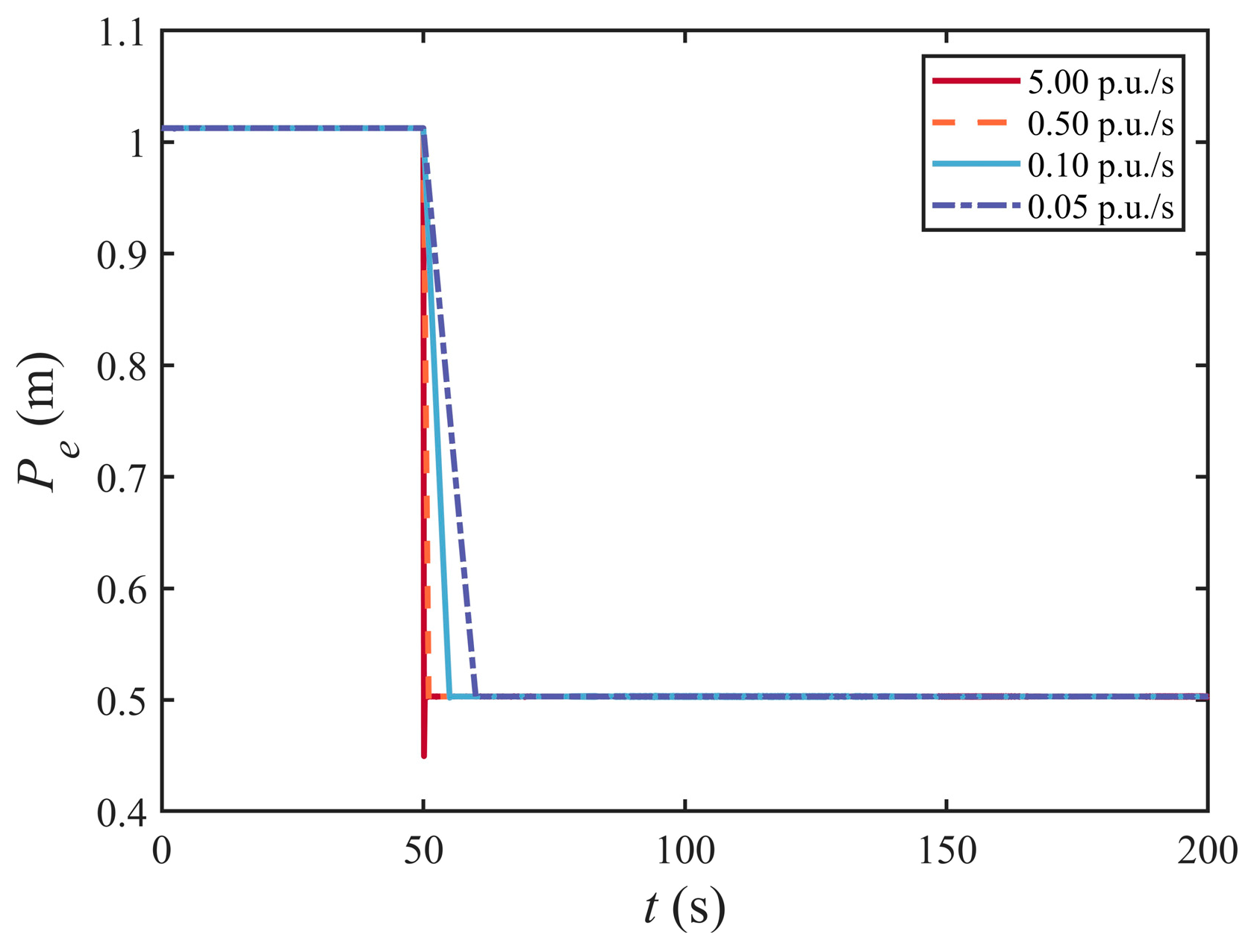
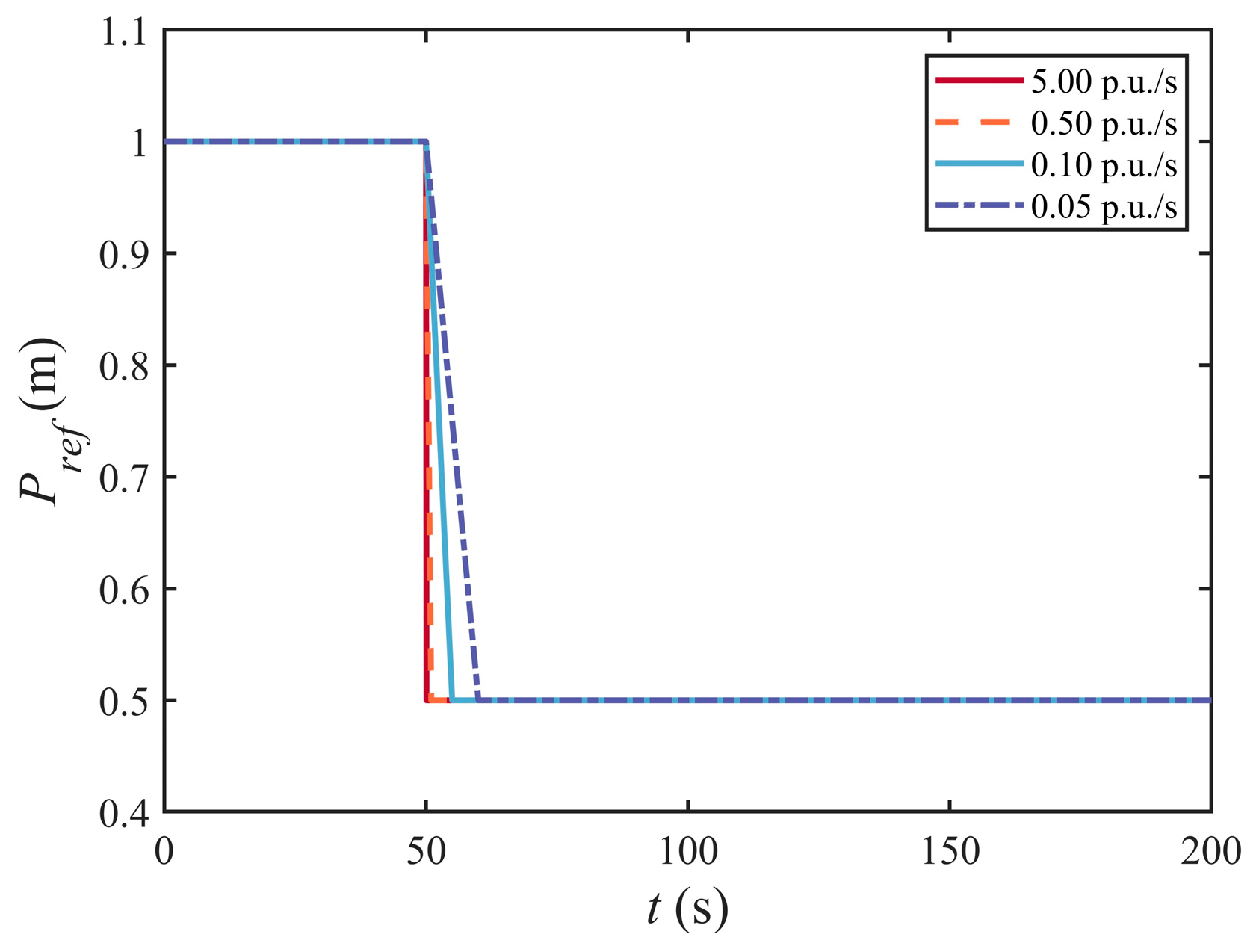
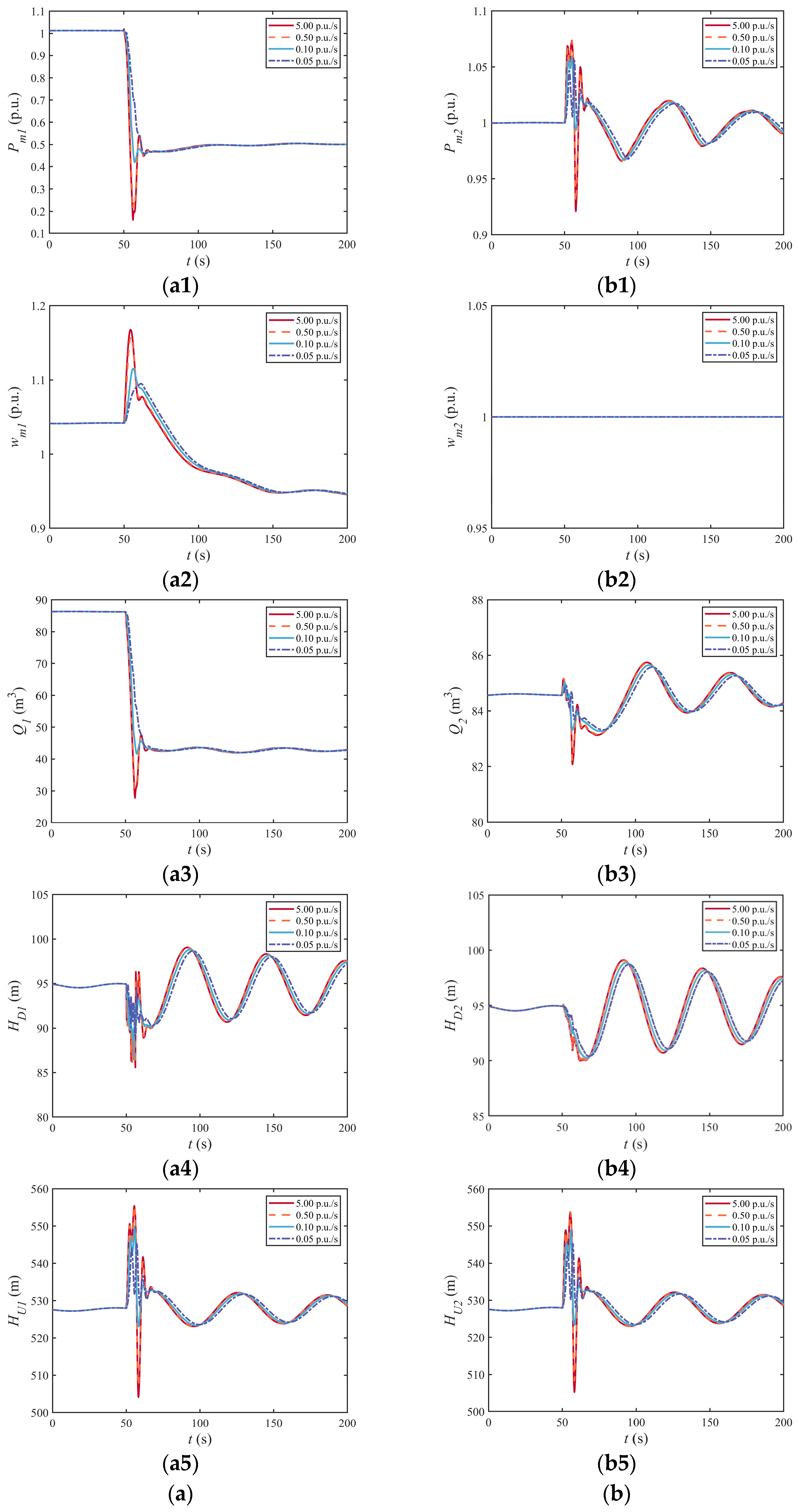
Therefore, the same initial condition as in Section 3.1 is used. The power command rates for the VSPSU are set to 0.05 p.u./s, 0.1 p.u./s, 0.5 p.u./s, and 5 p.u./s, as shown in Figure 14. Power regulation commands with significantly different regulation rates are set to analyze the dynamic response characteristics of the system under both rapid and slow power regulation commands. Key indicators such as overshoot during the transient process and regulation time are examined to reflect their variation trends. A wider range of regulation rate commands makes the result analysis more comprehensive. During the simulation, the guide vane closing speed shall not exceed 0.1 p.u./s, with the maximum pressure not exceeding 30% of the unit rated head [43]. Numerical simulations are carried out to analyze the influence of rates on the dynamic responses of the systems. The dynamic responses of the mechanical power and rotational speed are shown in Figure 15, and the active power response is shown in Figure 16.
When the power of the VSU decreases, the following can be observed:
  • From Figure 15(a1,b1): the mechanical power of the VSU decreases, while the mechanical power of the FSU shows a sudden change and then becomes stable, with the power maintained.
  • From Figure 15(a2,b2): the rotational speed of the VSU first increases and then decreases to the optimal speed and becomes stable; the FSU is grid-connected and its speed remains unchanged.
  • From Figure 15(a3,b3): the discharge of the VSU decreases; due to hydraulic disturbances, the discharge of the FSU fluctuates and decays slowly to a stable level.
  • From Figure 15(a4,a5,b4,b5): the draft tube and spiral case pressures of the VSPSU–FSU both experience large fluctuations; the draft tube pressure decreases first and then decays with oscillations to a stable level, while the spiral case pressure increases first and then gradually decays and converges.
The maximum deviations of the mechanical power, rotational speed, discharge, draft tube pressure, spiral case pressure, and active power, as well as the regulation times of the mechanical power, rotational speed, and active power for the system, are shown in Table 5.
From Table 5, the following can be seen.
  • Regarding the impact on maximum deviation: (1) Apart from the fact that the FSU is grid-connected, and its rotational speed remains unchanged, the maximum deviations of the key indicators for the VSU–FSU, the mechanical power, rotational speed, discharge, spiral case pressure, and draft tube pressure, are positively correlated with the power command rate. However, as the rate increases, the increase in these maximum deviations becomes smaller. (2) The maximum deviation of the VSU’s grid-side active power increases with the power command rate, and its growth shows almost no attenuation as the rate rises. As the rate becomes faster, the active power response regulated by the converter accelerates, causing a larger sudden increase in the VSU’s rotational speed and thereby enlarging the maximum deviations of other parameters.
  • Regarding the impact on regulation time: (1) The regulation times of the VSU’s mechanical power and rotational speed are negatively correlated with the power command rate. However, an increase in the power regulation rate can lead to higher overshoot during the regulation process, causing oscillatory fluctuations in the rotational speed and mechanical power, which in turn prolongs the regulation time. Consequently, the influence of the power command rate on the regulation time is diminished. (2) The regulation time of the FSU’s mechanical power does not change monotonically with the rate. Due to hydraulic disturbances affecting the decay of oscillations in the FSU’s mechanical power, the regulation time first decreases, then suddenly increases, and then increases slowly as the VSU’s power command rate increases. (3) Taking the active power response as the core indicator, a faster power command rate leads to a more rapid response and a shorter regulation time, while the effect of the power command rate on the response rapidity reduces. In this case study, the fastest active power regulation time is 0.17 s. When the power command rate exceeds 0.5 p.u./s, the increase has a smaller impact on the active power response rapidity.

4. Quantitative Evaluation of Power Regulation Performance

Based on the simulations in Section 3, it is observed that when the VSU power command rate increases, the power response rapidity becomes faster, but the overshoot of power and rotational speed will be larger, and the maximum deviations of spiral case pressure, draft tube pressure, and discharge increase, which reduces the stability and safety of system. Therefore, from the aspects of stability, safety, and rapidity in power regulation, a quantitative evaluation of the power regulation performance under different power command rates is important for selecting appropriate power regulation commands to ensure efficient and stable operation.
In this section, for the power regulation performance of the PSP containing a VSU with an FSC and FSU, suitable indicators are selected from three aspects: stability, safety, and rapidity. The Analytic Hierarchy Process (AHP) and Entropy Weight Method (EWM) are used to assign weights to the indicator. The performance evaluation method for power regulation is built, and the simulation results are quantitatively evaluated to select an appropriate power command rate.

4.1. Evaluation Method of Power Regulation Performance

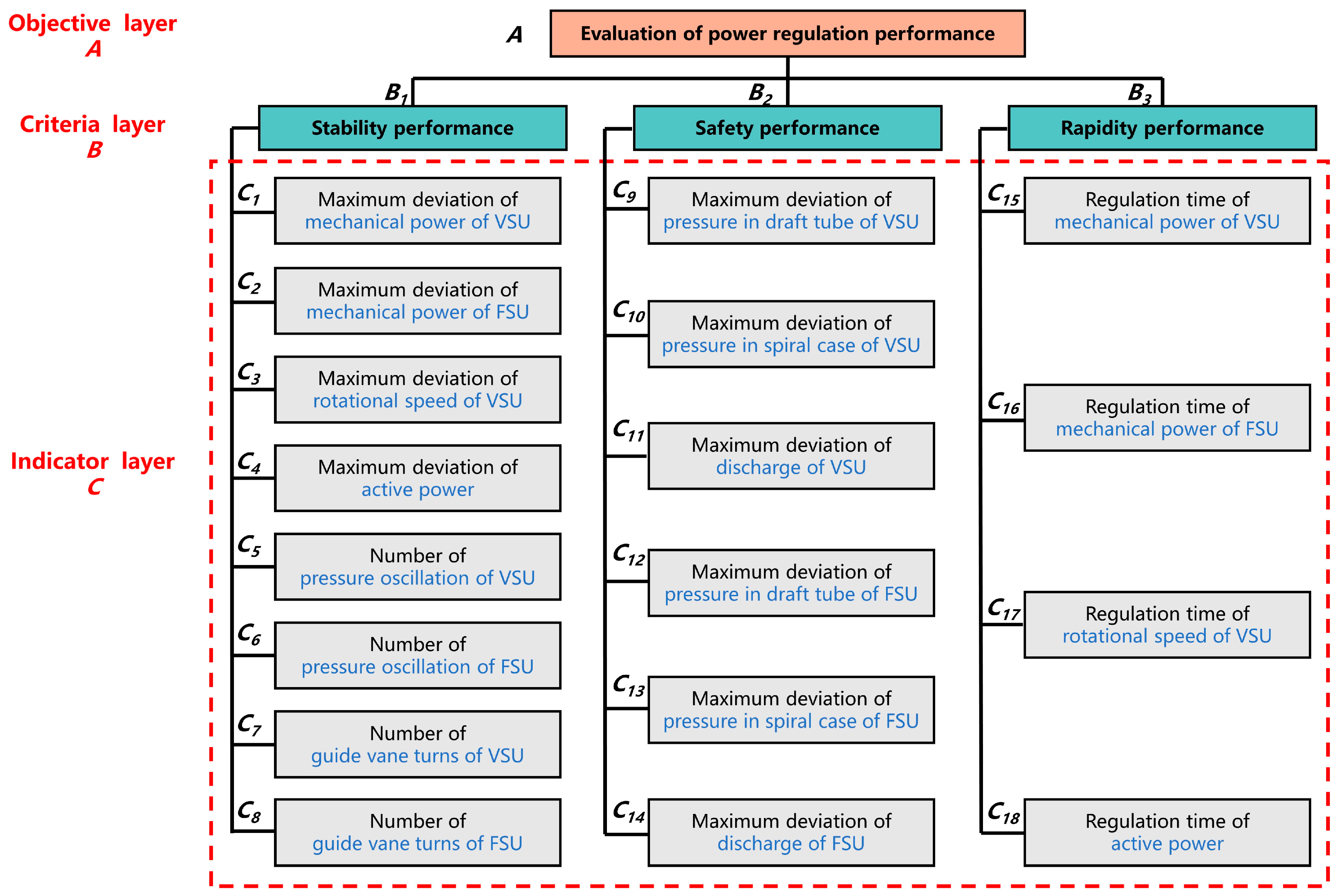
To evaluate the power regulation performance of the system, this section analyzes three aspects: stability, safety, and rapidity [44,45]. A total of 18 evaluation indicators are selected. The method is shown in Figure 17.
The indicators are introduced as follows:
(1)
Stability indicators:
Maximum deviation of mechanical power of VSU (C1): this indicator represents the maximum deviation of VSU mechanical power relative to the stability value during regulation; a smaller value indicates better power tracking ability.
Maximum deviation of mechanical power of FSU (C2): this indicator represents the maximum deviation of FSU mechanical power relative to the stability value.
Maximum deviation of rotational speed of VSU (C3): this indicator represents the maximum deviation of rotor speed relative to the final stability value during regulation; the smaller the maximum deviation, the better the stability performance.
Maximum deviation of active power (C4): this indicator represents the maximum deviation of active power during regulation; a smaller overshoot indicates better stability.
Number of pressure oscillations of VSU (C5): this indicator represents the number of impact loads on the waterway system caused by the VSU guide vane direction change; repeated pressure oscillations can affect system stability.
Number of pressure oscillations of FSU (C6): this indicator represents the number of impact loads on the waterway system caused by the FSU.
Number of guide vane turns of VSU (C7): this indicator represents the number of direction changes of the VSU guide vane actuator; excessive turns may cause actuator fatigue damage and affect system stability.
Number of guide vane turns of FSU (C8): this indicator represents the number of direction changes of the FSU guide vane actuator.
(2)
Safety indicators:
Maximum deviation of draft tube pressure of VSU (C9): this indicator represents the maximum deviation of the draft tube pressure of a VSU relative to the stable value; it should be as small as possible to ensure unit safety.
Maximum deviation of spiral case pressure of VSU (C10): this indicator represents the maximum deviation of the spiral case pressure of a VSU relative to the stable value; a smaller value indicates higher safety capability.
Maximum deviation of discharge of VSU (C11): This indicator represents the maximum deviation of the discharge through a VSU relative to the stable value. The discharge fluctuation reflects the changes in fluid velocity. It should be as small as possible to keep the flow smooth.
Maximum deviation of draft tube pressure of FSU (C12): this indicator represents the maximum deviation of the draft tube pressure of the FSU relative to the stable value.
Maximum deviation of spiral case pressure of FSU (C13): this indicator represents maximum deviation of the spiral case pressure of the FSU relative to the stable value.
Maximum deviation of discharge of FSU (C14): this indicator represents the maximum deviation of the discharge through the FSU relative to the stable value.
(3)
Rapidity indicators:
Regulation time of mechanical power of VSU (C15): this indicator represents the time for the VSU mechanical power to settle within ±2% of the final value; a shorter time indicates a faster response capability.
Regulation time of mechanical power of FSU (C16): this indicator represents the time for the FSU mechanical power to settle within ±2% of the final value.
Regulation time of rotational speed of VSU (C17): this indicator represents the time for the VSU rotational speed to settle within ±2% of the final value.
Regulation time of active power (C18): this indicator represents the time for the active power to settle within ±2% of the final value; a shorter time indicates a faster response to the power commands of the grids.
The following should be noted: (1) The selection of indicators in this paper is primarily based on an analysis from the perspective of the dynamic regulation process. Therefore, “Maximum deviation” is adopted instead of the maximum/minimum peak values. For example, among the safety indicators, “Maximum deviation of draft tube pressure” and “Maximum deviation of spiral case pressure” are chosen, rather than the maximum and minimum pressure values. In physical terms, the maximum/minimum pressure deviation values essentially represent the difference between the pressure peak/trough and the steady-state value. This approach has also been used in previous studies as an indicator for safety assessment. (2) This research mainly focuses on the analysis of dynamic characteristics at the system control level. The study is based on system modeling using MATLAB/Simulink software, conducting simulations of macroscopic characteristics such as pressure and discharge. Detailed 3D simulation studies on the specific pressure magnitudes at locations such as the spiral case and draft tube are not considered in this study [44].
In this paper, the AHP and the EWM are used to assign weights to the stability, safety, and rapidity indicators. The weights are then combined to obtain more reasonable indicator weights.
Analytic Hierarchy Process (AHP):
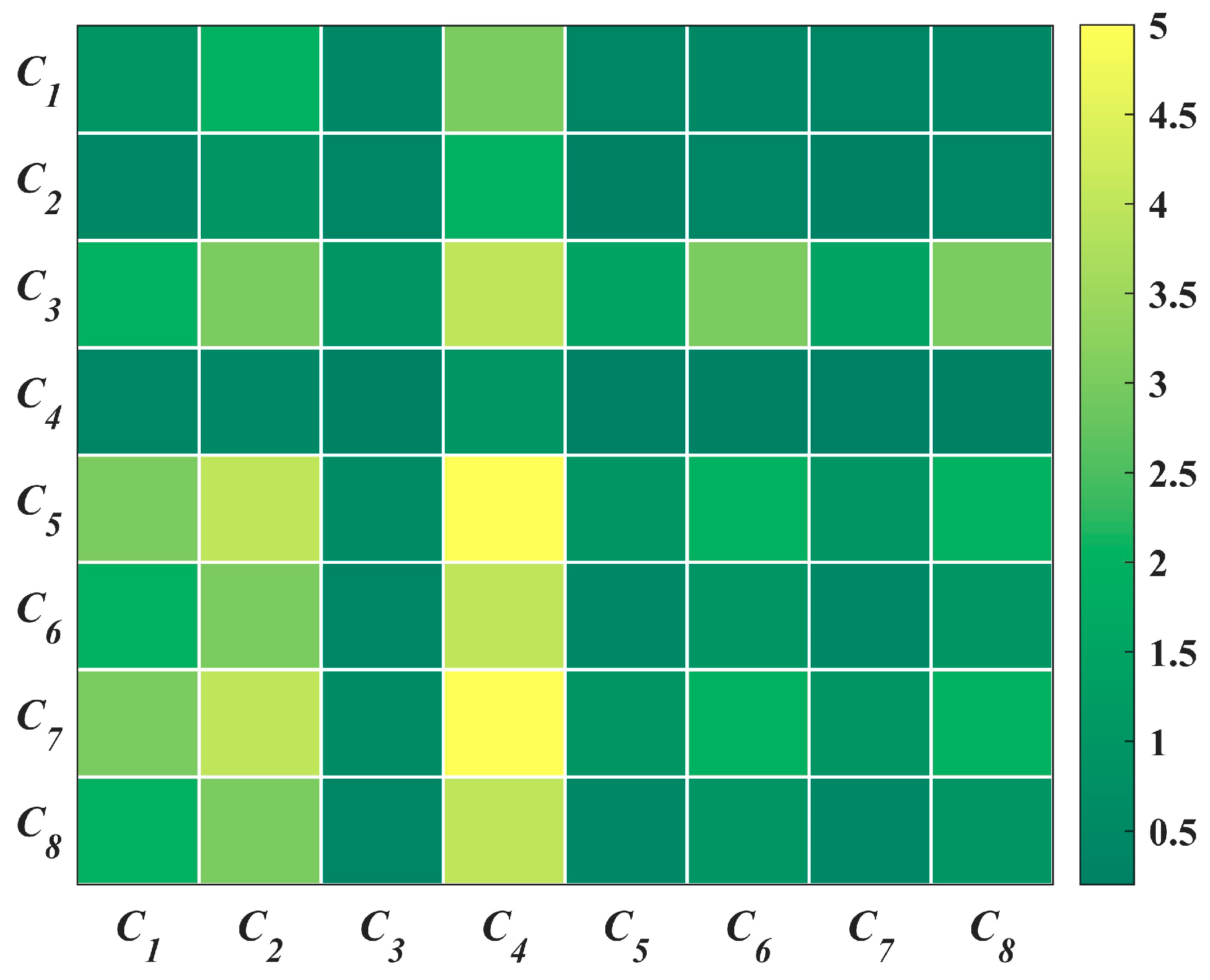
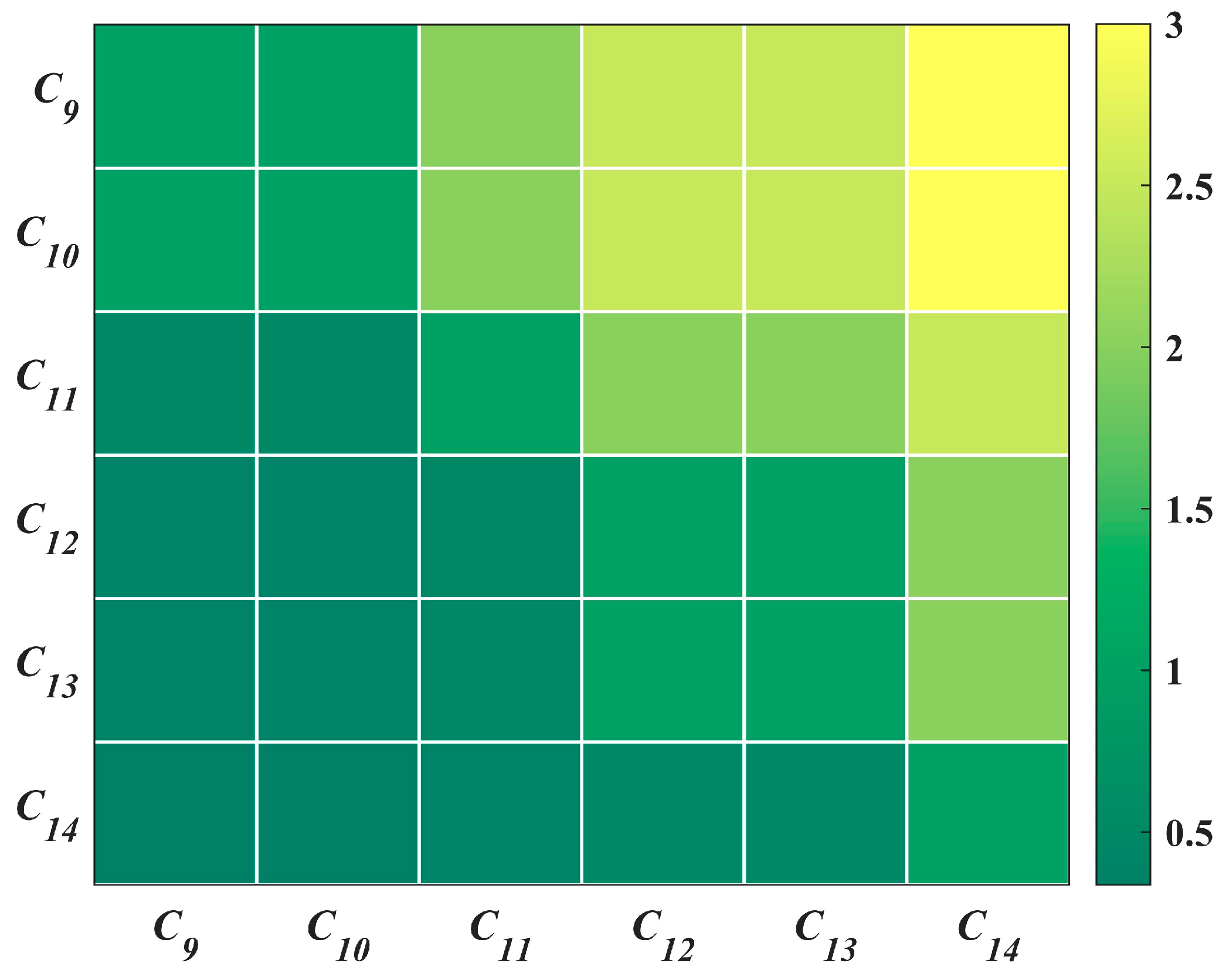
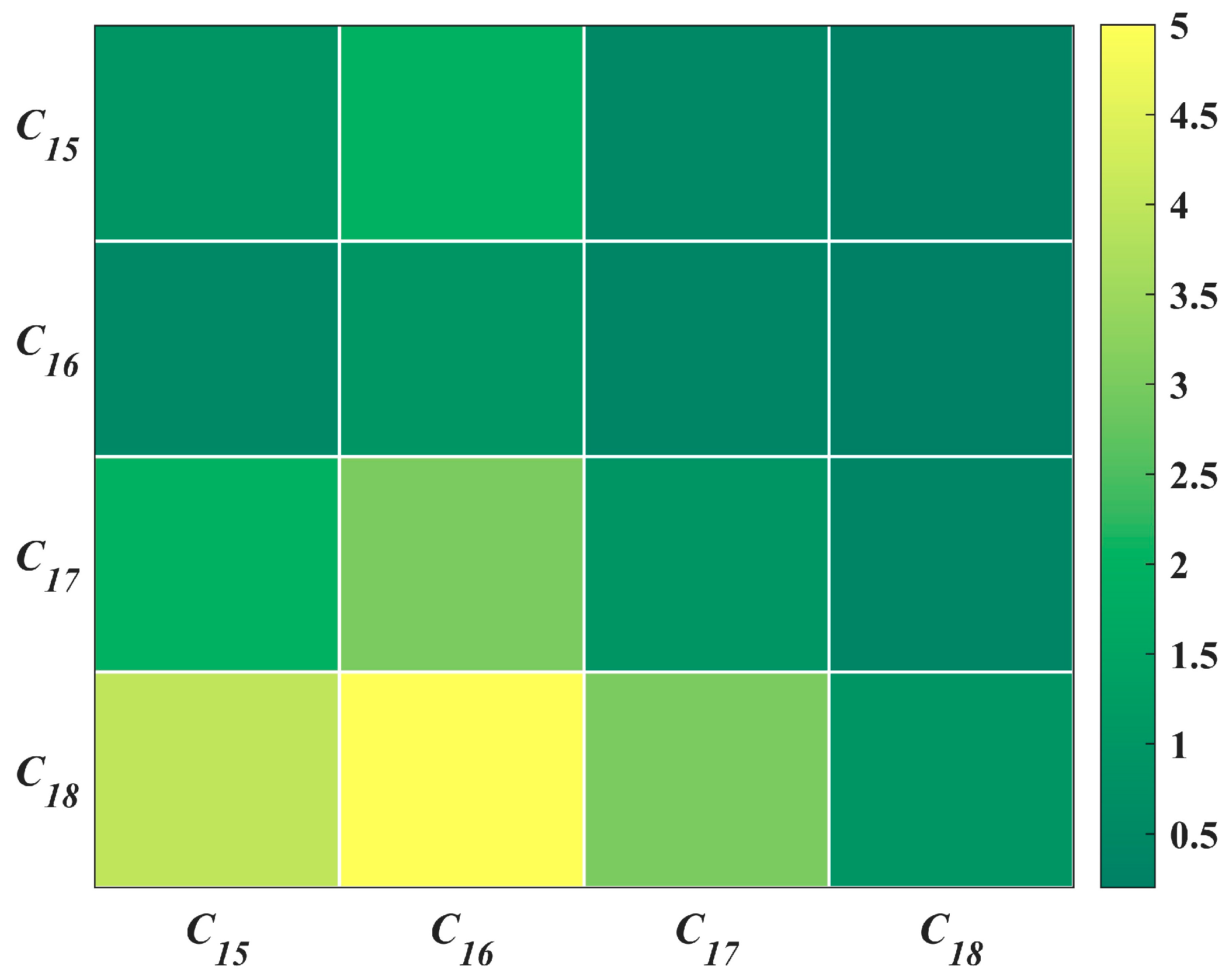
Based on experience, the importance of indicators at the same level is assigned, and a judgment matrix is constructed. Rapid response, system safety, and regulation stability are three important aspects during the transient process of a PSP. In the power regulation process, rapidity, safety, and stability have relative independence. Therefore, at the criteria layer, equal weights are assigned to rapidity, safety, and stability, forming a 1:1:1 structure. The indicator layer is then valued, and the judgment matrix is constructed. The matrix consistency is verified, and the indicator weights are calculated. The judgment matrices are shown in Figure 18, Figure 19 and Figure 20, where the values denote the importance of the vertical-axis indicators relative to the horizontal-axis indicators.
Entropy Weight Method (EWM):
At t = 50 s, a VSU power command is given, and the power decreases from 1.0 p.u. to 0.5 p.u. The power command decrease rate increases by equal steps of 0.2 p.u./s. Numerical simulations are conducted under different power command rates to collect the rapidity, safety, and stability indicators. Based on the data in Section 3 and Section 4, the indicators are normalized. Since all the selected indicators are negative indicators, to avoid negative results in calculation, the data are normalized according to Equation (9), where xij represents the value of the jth indicator for the ith evaluation object.
y i j = max ( x i j ) x i j max ( x i j ) min ( x i j ) + 0.01
The proportion of the jth indicator for the ith evaluation object is calculated as
p i j = y i j / i = 1 n y i j .
The relative importance Ej of the jth indicator is calculated as
E j = 1 ln ( n ) i = 1 n ( p i j × ln ( p i j ) ) .
The weight lj of the jth indicator is calculated as
l j = ( 1 E j ) / ( n j = 1 n E j ) .
Combined Weighting Method:
The weights from the AHP and the EWM are combined by a linear weighted method. The two methods are considered equally important. The combined weighting formula is given below, where mj, lj, and wj are the indicator weights from the AHP, the EWM, and the combined method, respectively. The final indicator weights for power regulation performance are listed in Appendix A Table A1.
w j = m j + l j 2

4.2. Evaluation of the Simulation Results

According to Equation (14), the indicators are normalized, where an denotes the result of a negative indicator, an, max denotes the maximum value of the corresponding indicator, and an* denotes the result after positive normalization. The normalized results of the indicators under different VSU power command rates are collected. Each indicator is multiplied by its weight to obtain the final power regulation performance score. The normalized results are shown in Appendix A Table A2.
a n * = 1 a n a n , max
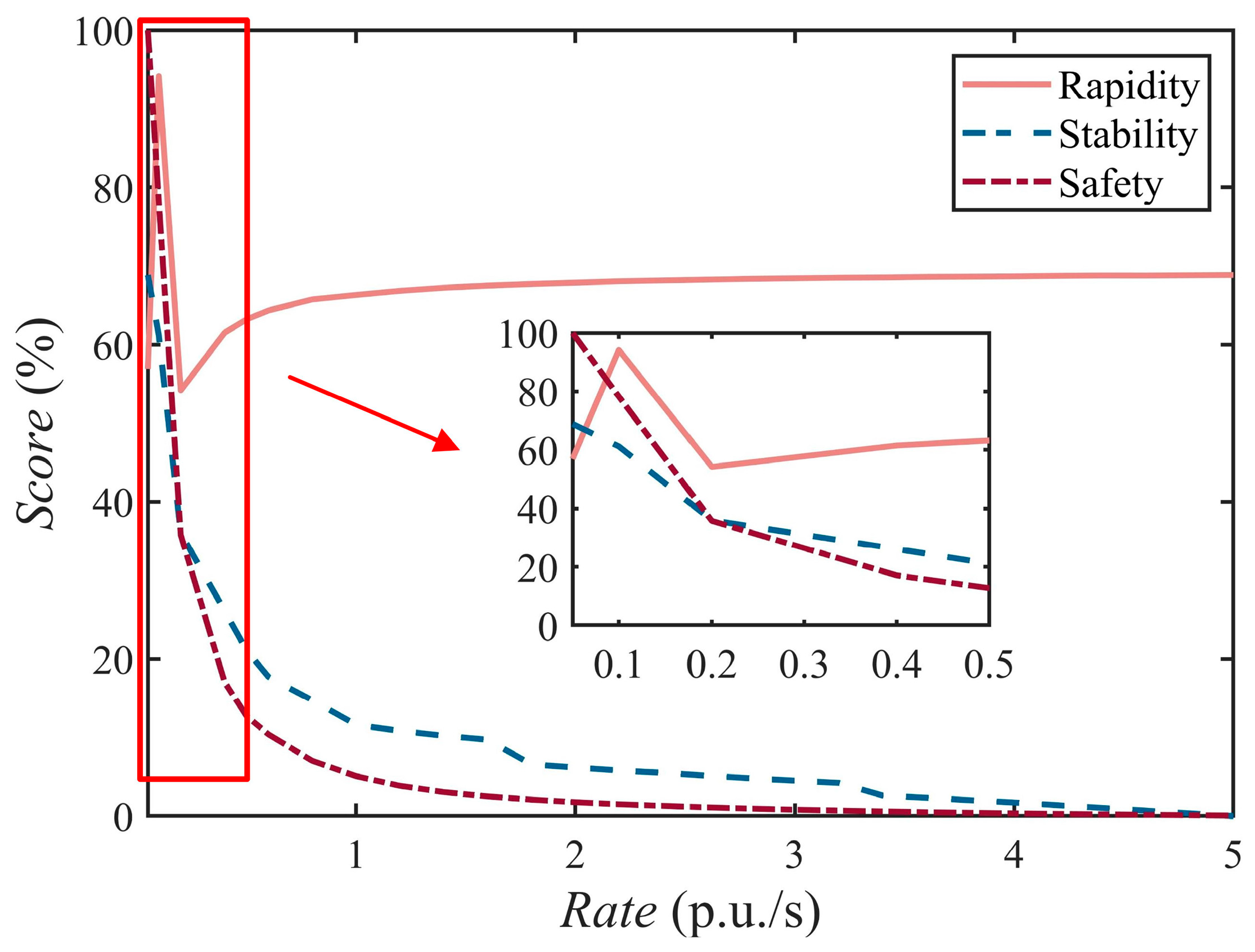
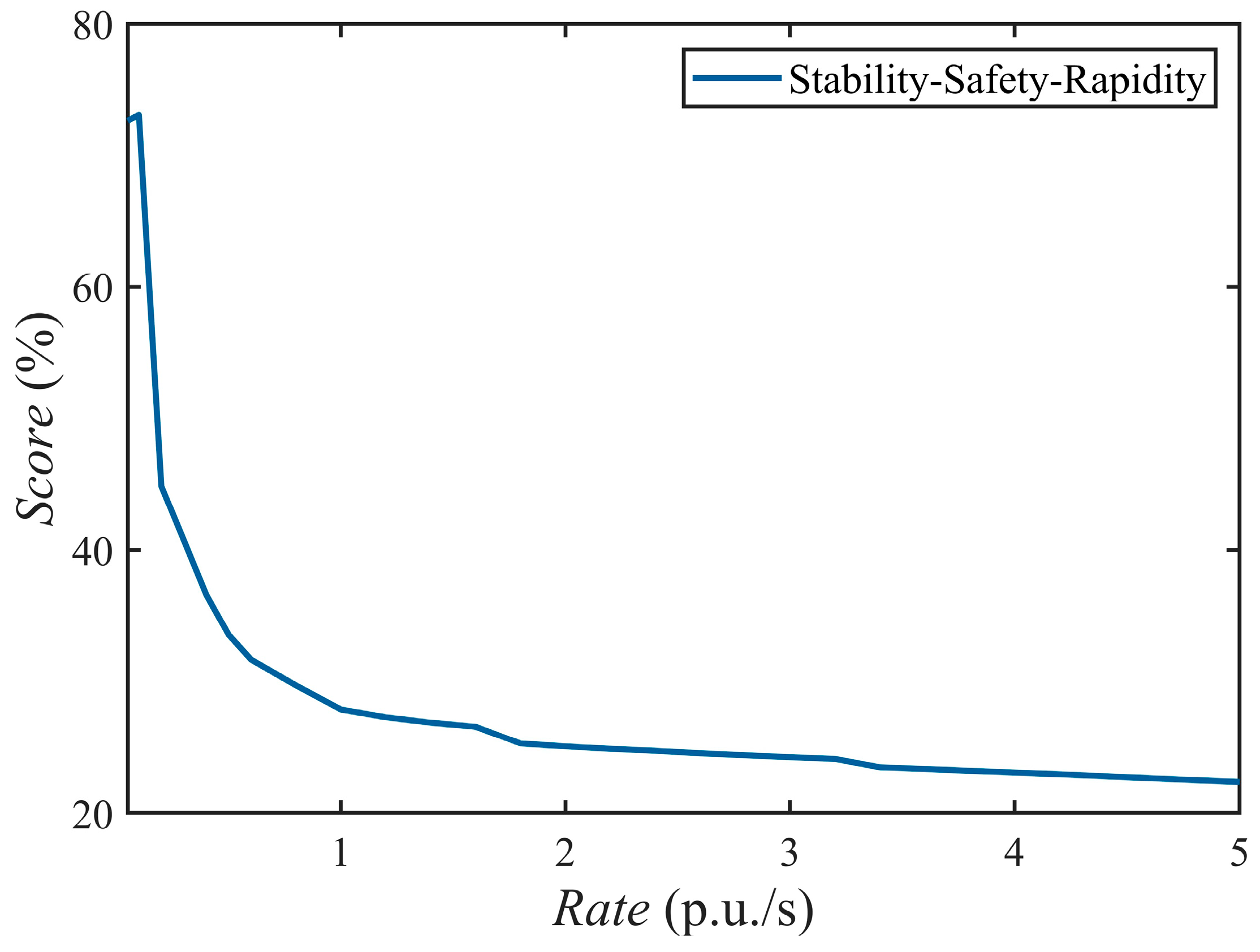
Meanwhile, the scores considering only rapidity, only safety, and only stability are calculated, and then the final score considering all three aspects is obtained. The scores under different power command rates are shown in Figure 21 and Figure 22.
From Figure 21, the simulation results indicate the following:
  • Considering stability, as the VSU power command rate increases, the overshoot of each physical quantity increases, and the number of pressure oscillations and guide vane turns increases. As the power command rate increases, the overshoot of the system increases, and the stability score decreases.
  • Considering safety, the safety score follows the same trend as stability. As the VSU power command rate increases, the safety score decreases.
  • Considering rapidity: (1) when the power command rate is low at the beginning, as the rate increases, the regulation rapidity of the mechanical power, active power, and rotational speed increase rapidly, the regulation time is significantly reduced, and the rapidity score increases quickly. When the power command rate is 0.1 p.u./s, the rapidity score is the highest. (2) However, when the power command rate further exceeds 0.1 p.u./s, the rapidity score suddenly decreases. The reason is that accelerating the power regulation process of the VSU causes a larger overshoot in the dynamic response, which causes significant hydraulic disturbances to the FSU. The amplitude of the periodically decaying oscillation of the FSU mechanical power increases. When the rate exceeds 0.1 p.u./s, the increased oscillation amplitude significantly prolongs the FSU regulation time, leading to a sharp drop in the rapidity score. (3) When the power command rate reaches 0.2 p.u./s, the rapidity score is the lowest. As the rate continues to increase, the influence of the oscillation amplitude on the regulation time of the FSU decreases significantly. The rapidity improves as the rate increases, but the effect of the power command rates on the regulation time gradually weakens; so, the rise in the rapidity score slows and eventually stabilizes.
From Figure 22, considering stability, safety, and rapidity: (1) Based on the proposed evaluation method, the relationship between the power regulation performance and the power command rate is not monotonic. When the rate is low, increasing the rate significantly improves the rapidity of the system, resulting in a higher overall performance score. When the power command rate is 0.1 p.u./s, the performance score is the highest. (2) As the rate continues to increase, its positive impact on rapidity diminishes, while the faster regulation process causes a larger overshoot, causing a decrease in stability and safety and leading to a reduction in the overall score. Therefore, under this operating condition, the most appropriate power command rate is 0.1 p.u./s, and the power regulation performance is the best under this power command rate.

5. Discussion

Compared with the previous research, this paper primarily analyzes the influence of the power command rate on the dynamic characteristics of PSPs containing a VSU with an FSC and an FSU. Furthermore, it proposes an evaluation method to guide the selection of the optimal power command rate. The outcomes are discussed as follows.
(1) Advantages: When the VSPSU is used for power regulation, the active power will rapidly respond to power commands through the converter and excitation systems. The active power response time is 4.90 s, which is obviously shorter than the 45.17 s of the FSU–FSU sharing common pipelines. Although the VSPSU exhibits certain overshoot in mechanical power (0.084 p.u.) and rotational speed (0.156 p.u.) during regulation, the magnitudes are relatively small. The VSPSU–FSU is more suitable for power regulation.
(2) Characteristics: This study examines the influence of the VSU power command rates on the system dynamic characteristics under turbine power reduction condition, primarily from the perspectives of overshoot and regulation time. The selected physical indicators include the mechanical power, discharge, spiral case pressure, and draft tube pressure of both the FSU and VSU, as well as the rotational speed of the VSU and active power.
Regarding the effect on overshoot, with the increase in the power command rate, all indicators show an increase in overshoot. However, as the rate continues to rise, the increase in the magnitude of overshoot gradually diminishes.
Regarding the effect on regulation time, the regulation time of the FSU’s mechanical power exhibits a non-monotonic relationship with the rate. Due to the influence of hydraulic disturbances on the damping of oscillations in the FSU’s mechanical power, its regulation time first decreases, then increases abruptly, and finally rises slowly as the power command rate of the VSU increases. The regulation times of mechanical power, rotational speed, and active power of the VSPSU are negatively correlated with the rate. This is because, for the VSU, although an increase in the command rate leads to higher overshoot and even induces oscillations, the shortening of the command execution process significantly reduces its regulation time. Especially under the fast power control strategy, the active power of the VSU can rapidly track the command and maintain stability, resulting in an overall shorter regulation time.
(3) Evaluation: When stability, safety, and rapidity are comprehensively considered, the relationship between the overall regulation performance and the power command rate of the VSPSU is non-monotonic. Taking the 50% power reduction condition as an example. At lower rates, increasing the rate significantly improves the rapidity and thus increases the overall performance. The highest comprehensive score occurs at 0.1 p.u./s. As the rate continues to increase, the improvement in rapidity diminishes, while an overly fast regulation process causes larger overshoot, leading to decreases in stability and safety, and the overall performance decreases. Therefore, under this operating condition, the most appropriate power command rate is 0.1 p.u./s, and the power regulation performance is the best under this rate. Based on the evaluation method, an overall assessment and analysis of the dynamic power regulation performance under different power command rates can be conducted across all operating conditions of the power plants. This enables the selection of the optimal power command rate for each specific operating condition, thereby providing theoretical support for the stable and efficient operation of the system.

6. Conclusions

This paper investigates the power regulation characteristics of a VSPSU and an FSU in the system of two units sharing common pipelines under hydraulic disturbances. A nonlinear simulation model of a PSP containing a VSU with an FSC and FSU is established, and the model correctness is validated. The dynamic response advantages of the PSP containing a VSU with an FSC under power regulation are revealed; the effects of different power command rates of the VSPSU with an FSC on the dynamic response of the PSP containing a VSU with an FSC and FSU are studied; and an evaluation method is proposed that comprehensively considers the stability, safety, and rapidity. The method is used to assess the power regulation performance under different power command rates of the VSPSU with an FSC and to select an appropriate rate. A 50% power reduction condition is analyzed, and the main insights and conclusions are as follows.
(1) Dynamic response advantages: under the fast power control strategy, the combination of the VSPSU–FSU sharing common pipelines exhibits excellent power response performance, which is more appropriate for smoothing load fluctuations in power system regulation.
(2) Influence on dynamic characteristics: For overshoot, the magnitudes of the key physical quantities are positively correlated with the power command rate; however, beyond a threshold, the influence gradually weakens. For regulation time, the regulation time of mechanical power of the FSU shows a non-monotonic relationship with the power command rate. The regulation times of the mechanical power, rotational speed, and active power of the VSPSU are negatively correlated with the rate, however, since an increased power regulation rate can lead to significant system fluctuations and a prolonged regulation time, the negative correlation gradually weakens.
(3) Evaluation of power regulation characteristics: Considering the stability, safety, and rapidity comprehensively, the relationship between the overall regulation performance and the power command rate of the VSPSU is non-monotonic, showing an initial increase followed by a decrease. Under the 50% power reduction condition, the optimal regulation rate is 0.1 p.u./s.
By comprehensively considering the system stability, safety, and rapidity, this paper provides important guidance and theoretical support, from the perspective of power command rate, for a PSP containing a VSU with an FSC and FSU. Nevertheless, several limitations remain and should be solved in future work.
(1) Operating conditions: The present analysis focuses on the turbine mode of a PSP containing a VSU with an FSC and FSU. Future work should extend to pumped conditions.
(2) Control strategies: The fast power control strategy is adopted for a VSPSU with an FSC. The dynamic characteristics under different control strategies of the variable-speed unit, considering hydraulic interference, require further investigation.
(3) Experimental validation: Due to the lack of measured data, the results are primarily obtained from numerical simulation and cannot fully reflect the complexity of an actual plant. To improve the model accuracy and increase the credibility of the results, future studies should combine experimental data for in-depth research.

Author Contributions

P.W.: Methodology, Validation, Writing—Original Draft, Writing—Editing. W.Y.: Conceptualization, Supervision, Resources, Methodology, Writing—Review. Y.L.: Validation, Methodology, Writing—Review. Y.T.: Analysis, Writing—Review. G.C.: Analysis, Writing—Review. All authors have read and agreed to the published version of the manuscript.

Funding

This research was funded by The Smart Grid-National Science and Technology Major Project, grant number No. 2024ZD0801600 and The Natural Science Foundation of Hubei Province of China, grant number No. 2024AFA058.

Data Availability Statement

The original contributions presented in this study are included in the article. Further inquiries can be directed to the corresponding author(s).

Acknowledgments

The authors are thankful for the support from the Smart Grid-National Science and Technology Major Project (No. 2024ZD0801600) and the Natural Science Foundation of Hubei Province of China (No. 2024AFA058).

Conflicts of Interest

The authors declare no conflict of interest.

Nomenclature

AbbreviationsFsCross sectional area of a surge tank
PmMechanical power
VSPSPVariable-speed pumped storage plantPeElectric active power
VSPSUVariable-speed pumped storage unithwPipeline characteristic coefficient
FSCFull-size converterαVarying coefficient of transfer function for elastic water hammer
VSUVariable-speed unit
FSUFixed-speed unitξLocal head loss coefficient of surge tank throttle
PSPPumped storage plant
PIProportional-integralPrefReference value of power output
AHPAnalytic hierarchy processγComplex wave number
EWMEntropy-weight methodssLaplace operator
Parameters and VariablesT′do, T″doOpen-circuit d-axis transient and sub-transient time constants, [s]
aVelocity of pressure waveACross section area of pipeline
bpTurbine governor parameter: for droopTeWater elastic time constant
DDiameter of pump–turbine runnerTqDischarge constant of a surge tank
hWater headTaUnit inertia time constant
h1Derivative of water head for time, [s−1]TsWave period constant of a surge tank
KpDifferential coefficient in the governorTyServo time constant
KiIntegral coefficient in the governorHU, HDWater head at both ends of a pipe
gGravitational accelerationQU, QDDischarge at both ends of a pipe
lLength of pipelinewRotational speed of VSU
FFrictional head loss coefficientIg,d, Ig,qGrid side d-axis and q-axis component of the current
fFrictional drag coefficient
nRotational speedIsg,d, Isg,qSynchronous machine side d-axis and q-axis component of the current
nRRoughness coefficient of pipeline
RWet perimeter of a penstockEfExcitation electromotive force
ngpower frequencyXd, X′d, X″dThe d-axis synchronous, transient, and sub-transient reactance
E′d, E″dThe d-axis component of transient and sub-transient electromotive forceXq, X′q, X″qThe q-axis synchronous, transient, and sub-transient reactance
E′q, E″qThe q-axis component of transient and sub-transient electromotive forceδRotor angle
T′qo, T″qoOpen-circuit q-axis transient and sub-transient time constants
Deviation from the initial value
HD_Pressure in draft tubeHU_Pressure in spiral case

Appendix A

1. The weights of the power regulation performance indicators are shown in Table A1.
Table A1. Weights of power regulation performance indicators.
Objective
Layer
Criteria
Layer
IndicatorsAHP (mj)EWM (lj)Weight (wj)
AB1C10.026 0.061 0.0432
C20.016 0.096 0.0561
C30.078 0.062 0.0699
C40.011 0.010 0.0105
C50.064 0.093 0.0786
C60.038 0.072 0.0548
C70.064 0.050 0.0572
C80.038 0.025 0.0314
B2C90.090 0.081 0.0855
C100.090 0.089 0.0896
C110.058 0.058 0.0577
C120.036 0.039 0.0376
C130.036 0.090 0.0629
C140.023 0.056 0.0398
B3C150.046 0.002 0.0242
C160.028 0.110 0.0688
C170.077 0.003 0.0400
C180.182 0.002 0.0922
2. The normalized simulation results of the indicators are shown in Table A2.
Table A2. Normalized simulation results of indicators.
Rate
(p.u./s)
C1C2C3C4C5C6C7C8C9C10C11C12C13C14C15C16C17C18
0.050.8668 0.2430 0.3425 0.9917 0.1333 0.1333 0.1538 0.2000 0.4041 0.3756 0.9518 0.1037 0.3407 0.2456 0.0000 0.4745 0.0000 0.0000
0.10.7549 0.1891 0.2667 0.9817 0.1333 0.1333 0.1538 0.2000 0.2235 0.2488 0.9499 0.0599 0.2548 0.2356 0.0423 0.4954 0.0240 0.5003
0.20.3536 0.0161 0.1303 0.9621 0.0667 0.1333 0.1538 0.1333 0.1116 0.0193 0.5607 0.0362 0.0320 0.2428 0.0671 0.0155 0.0393 0.7501
0.40.2012 0.0076 0.0606 0.9214 0.0667 0.1333 0.0769 0.1333 0.0468 0.0125 0.2795 0.0197 0.0160 0.1003 0.0802 0.0031 0.0480 0.8751
0.50.1523 0.0059 0.0473 0.9008 0.0000 0.1333 0.0769 0.1333 0.0267 0.0117 0.2120 0.0217 0.0122 0.0744 0.0829 0.0024 0.0499 0.9001
0.60.1206 0.0047 0.0384 0.8807 0.0000 0.0667 0.0769 0.1333 0.0220 0.0113 0.1689 0.0230 0.0097 0.0579 0.0842 0.0020 0.0512 0.9169
0.80.0823 0.0032 0.0274 0.8430 0.0000 0.0667 0.0769 0.0667 0.0120 0.0080 0.1163 0.0186 0.0067 0.0383 0.0865 0.0014 0.0528 0.9378
1.00.0606 0.0024 0.0209 0.8060 0.0000 0.0000 0.0769 0.0667 0.0055 0.0064 0.0865 0.0151 0.0051 0.0276 0.0883 0.0010 0.0537 0.9459
1.20.0467 0.0019 0.0165 0.7687 0.0000 0.0000 0.0769 0.0667 0.0016 0.0055 0.0675 0.0126 0.0040 0.0212 0.0897 0.0008 0.0544 0.9536
1.40.0372 0.0016 0.0134 0.7317 0.0000 0.0000 0.0769 0.0667 0.0003 0.0043 0.0544 0.0108 0.0032 0.0169 0.0903 0.0007 0.0549 0.9592
1.60.0302 0.0013 0.0111 0.6969 0.0000 0.0000 0.0769 0.0667 0.0000 0.0035 0.0447 0.0093 0.0026 0.0138 0.0907 0.0005 0.0553 0.9633
1.80.0248 0.0010 0.0093 0.6620 0.0000 0.0000 0.0000 0.0667 0.0000 0.0029 0.0372 0.0081 0.0022 0.0115 0.0911 0.0005 0.0555 0.9663
2.00.0207 0.0008 0.0078 0.6263 0.0000 0.0000 0.0000 0.0667 0.0001 0.0024 0.0312 0.0072 0.0018 0.0097 0.0914 0.0004 0.0557 0.9689
2.20.0175 0.0007 0.0066 0.5879 0.0000 0.0000 0.0000 0.0667 0.0001 0.0020 0.0263 0.0064 0.0015 0.0082 0.0915 0.0003 0.0559 0.9714
2.40.0175 0.0006 0.0057 0.5514 0.0000 0.0000 0.0000 0.0667 0.0001 0.0020 0.0224 0.0058 0.0013 0.0069 0.0917 0.0003 0.0561 0.9730
2.60.0127 0.0005 0.0048 0.5146 0.0000 0.0000 0.0000 0.0667 0.0003 0.0014 0.0191 0.0051 0.0011 0.0059 0.0919 0.0002 0.0562 0.9745
2.80.0108 0.0004 0.0041 0.4769 0.0000 0.0000 0.0000 0.0667 0.0004 0.0012 0.0162 0.0043 0.0009 0.0050 0.0920 0.0002 0.0563 0.9760
3.00.0091 0.0003 0.0035 0.4411 0.0000 0.0000 0.0000 0.0667 0.0005 0.0010 0.0137 0.0036 0.0008 0.0042 0.0921 0.0002 0.0564 0.9771
3.20.0077 0.0003 0.0030 0.4059 0.0000 0.0000 0.0000 0.0667 0.0006 0.0008 0.0117 0.0031 0.0007 0.0036 0.0923 0.0002 0.0565 0.9781
3.40.0064 0.0002 0.0024 0.3675 0.0000 0.0000 0.0000 0.0000 0.0007 0.0007 0.0097 0.0025 0.0006 0.0030 0.0924 0.0001 0.0565 0.9786
3.60.0052 0.0002 0.0020 0.3296 0.0000 0.0000 0.0000 0.0000 0.0008 0.0006 0.0079 0.0021 0.0005 0.0024 0.0924 0.0001 0.0567 0.9796
3.80.0043 0.0001 0.0016 0.2873 0.0000 0.0000 0.0000 0.0000 0.0008 0.0005 0.0064 0.0017 0.0004 0.0020 0.0925 0.0001 0.0567 0.9801
4.00.0034 0.0001 0.0013 0.2471 0.0000 0.0000 0.0000 0.0000 0.0009 0.0004 0.0051 0.0013 0.0003 0.0016 0.0926 0.0001 0.0567 0.9806
4.20.0025 0.0001 0.0010 0.1989 0.0000 0.0000 0.0000 0.0000 0.0009 0.0003 0.0039 0.0010 0.0002 0.0012 0.0926 0.0001 0.0568 0.9816
4.40.0019 0.0001 0.0007 0.1497 0.0000 0.0000 0.0000 0.0000 0.0010 0.0002 0.0029 0.0008 0.0002 0.0009 0.0927 0.0001 0.0569 0.9822
4.60.0012 0.0000 0.0005 0.0998 0.0000 0.0000 0.0000 0.0000 0.0011 0.0001 0.0019 0.0005 0.0001 0.0006 0.0927 0.0000 0.0569 0.9822
4.80.0006 0.0000 0.0002 0.0494 0.0000 0.0000 0.0000 0.0000 0.0011 0.0001 0.0009 0.0002 0.0001 0.0003 0.0928 0.0000 0.0569 0.9827
5.00.0000 0.0000 0.0000 0.0000 0.0000 0.0000 0.0000 0.0000 0.0012 0.0000 0.0000 0.0000 0.0000 0.0000 0.0928 0.0000 0.0569 0.9832

References

  1. Lin, Y.; Anser, M.K.; Peng, M.Y.-P.; Irfan, M. Assessment of renewable energy, financial growth and in accomplishing targets of China’s cities carbon neutrality. Renew. Energy 2023, 205, 1082–1091. [Google Scholar] [CrossRef]
  2. Yang, W.; Zhao, Z.; Pérez-Díaz, J.; Hunt, J.D.; Vagnoni, E.; Nøland, J.K.; Quaranta, E.; Wang, R.; Li, X.; Cheng, Y. Pumped storage hydropower operation for supporting clean energy systems. Nat. Rev. Clean Technol. 2025, 1, 454–473. [Google Scholar] [CrossRef]
  3. Siddiqui, A.; Asim, M. Advancement, challenges and solutions of PV integrated battery energy storage systems: A review. J. Energy Storage 2025, 132, 117996. [Google Scholar] [CrossRef]
  4. Khalid, M. Smart grids and renewable energy systems: Perspectives and grid integration challenges. Energy Strat. Rev. 2024, 51, 101299. [Google Scholar] [CrossRef]
  5. Pratiwi, S.; Juerges, N. Review of the impact of renewable energy development on the environment and nature conservation in Southeast Asia. Energy Ecol. Environ. 2020, 5, 221–239. [Google Scholar] [CrossRef]
  6. Al-Shetwi, A.Q.; Hannan, M.A.; Jern, K.P.; Mansur, M.; Mahlia, T.M.I. Grid-connected renewable energy sources: Review of the recent integration requirements and control methods. J. Clean. Prod. 2020, 253, 119831. [Google Scholar] [CrossRef]
  7. Argyrou, M.C.; Christodoulides, P.; Kalogirou, S.A. Energy storage for electricity generation and related processes: Technologies appraisal and grid scale applications. Renew. Sustain. Energy Rev. 2018, 94, 804–821. [Google Scholar] [CrossRef]
  8. Wang, M.; Ni, X.; Chen, J.; Li, X.; Meng, F.; Yang, Y.; Gu, Y. Energy performance improvement of mixed flow pump based on coupling of geometric and hydrodynamic parameters. Energy 2025, 332, 137243. [Google Scholar] [CrossRef]
  9. Wang, M.C.; Li, X.Y.; Chen, J.Q.; Zhang, P.R.; Meng, F.; Chen, K.L.; Yang, Y.; Wang, C. Energy conversion efficiency improvement of mixed-flow pump based on a new full-velocity moment method. Phys. Fluids 2025, 37, 077143. [Google Scholar] [CrossRef]
  10. Rehman, S.; Al-Hadhrami, L.M.; Alam, M.M. Pumped hydro energy storage system: A technological review. Renew. Sustain. Energy Rev. 2015, 44, 586–598. [Google Scholar] [CrossRef]
  11. Li, X.; Yang, W.; Liao, Y.; Zhang, S.; Zheng, Y.; Zhao, Z.; Tang, M.; Cheng, Y.; Liu, P. Short-term risk-management for hydro-wind-solar hybrid energy system considering hydropower part-load operating characteristics. Appl. Energy 2024, 360, 122818. [Google Scholar] [CrossRef]
  12. Li, X.; Wu, P.; Shi, W.; Ding, Y.; Liao, Y.; Sun, X.; Huang, S.; Zhao, Z.; Yang, W.; Xu, Z. Hydraulic transient-aware day-ahead dispatch of hydro-wind-solar hybrid energy system. Energy 2025, 340, 139217. [Google Scholar] [CrossRef]
  13. Cao, R.; Guo, W.; Qu, F. Hydraulic disturbance characteristics and power control of pumped storage power plant with fixed and variable speed units under generating mode. J. Energy Storage 2023, 72, 108298. [Google Scholar] [CrossRef]
  14. Christe, A.; Faulstich, A.; Vasiladiotis, M.; Steinmann, P. World’s First Fully Rated Direct ac/ac MMC for Variable-Speed Pumped-Storage Hydropower Plants. IEEE Trans. Ind. Electron. 2023, 70, 6898–6907. [Google Scholar] [CrossRef]
  15. Wang, H.; Li, C.; Tan, X.; Lu, X.; Zhu, Z.; Xu, R.; Liu, X.; Wang, Z. Multi-timescale analysis and quantification of dynamic regulation characteristics of DFIM-based variable-speed pumped storage units in alleviating wind power fluctuations. J. Energy Storage 2024, 88, 111482. [Google Scholar] [CrossRef]
  16. Borkowski, D.; Wegiel, T. Small Hydropower Plant with Integrated Turbine-Generators Working at Variable Speed. IEEE Trans. Energy Convers. 2013, 28, 452–459. [Google Scholar] [CrossRef]
  17. Valavi, M.; Nysveen, A. Variable-speed operation of hydropower plants: Past, present, and future. In Proceedings of the 22nd IEEE International Conference on Electrical Machines (ICEM), Lausanne, Switzerland, 4–7 September 2016; pp. 640–646. [Google Scholar] [CrossRef]
  18. Béguin, A.; Nicolet, C.; Hell, J.; Moreira, C. Assessment of power step performances of variable speed pump-turbine unit by means of hydro-electrical system simulation. J. Phys. Conf. Ser. 2017, 813, 012001. [Google Scholar] [CrossRef]
  19. Steimer, P.K.; Senturk, O.; Aubert, S.; Linder, S. Converter-fed synchronous machine for pumped hydro storage plants. In Proceedings of the 2014 IEEE Energy Conversion Congress and Exposition (ECCE), Pittsburgh, PA, USA, 14–18 September 2014; pp. 4561–4567. [Google Scholar] [CrossRef]
  20. Liu, G.; Deng, Y.; Liu, Z.; Zhang, Y.; Ma, C.; Chen, D.; Zhao, Z. Potential risks in balancing flexibility and investment of pumped storage plants: Hydraulic disturbances during transient processes in parallel operation of fixed-speed and variable-speed units sharing a diversion tunnel. J. Energy Storage 2024, 88, 111483. [Google Scholar] [CrossRef]
  21. Nicolet, C.; Alligné, S.; Dreyer, M.; Schmid, J.; Biner, D.; Münch-Alligné, C.; Lugon, J.; Hugo, N. Experimental investigation of a FSFC variable speed pump-turbine prototype—Part1: Penstock fatigue reduction and fast active power regulation. IOP Conf. Ser. Earth Environ. Sci. 2024, 1411, 012027. [Google Scholar] [CrossRef]
  22. Schlunegger, H. Pumping efficiency: A 100 MW converter for the Grimsel 2 pumped storage plant. ABB Rev. 2014, 2, 42–47. Available online: https://api.semanticscholar.org/CorpusID:201536968 (accessed on 9 November 2025).
  23. Polster, S.; Aubert, S.; Häderli, C.; Ladreiter-Knauss, C.; Steinmann, P. Malta Oberstufe Overhaul Project Variable Speed Operation with MMC Full Converter. In Proceedings of the Vienna Hydro 2022–21st International Seminar on Hydropower Plants, Vienna, Austria, 9–11 November 2022. [Google Scholar]
  24. Yang, S. Chunchangba Pumped Storage Power Station feasibility analysis of applying full power varia-ble speed constant frequency reversible units. Mech. Electr. Tech. Hydropower Stn. 2023, 46, 1–4+46+161. (In Chinese) [Google Scholar] [CrossRef]
  25. Zhou, W.; Shi, H.; Chen, G. Protection Configuration and Setting Method of Variable-speed Pumped Storage Unit with Full-size Converter. Sichuan Electr. Power Technol. 2023, 46, 28–31. (In Chinese) [Google Scholar] [CrossRef]
  26. Reigstad, T.I.; Uhlen, K. Variable Speed Hydropower Conversion and Control. IEEE Trans. Energy Convers. 2020, 35, 386–393. [Google Scholar] [CrossRef]
  27. Borkowski, D. Analytical Model of Small Hydropower Plant Working at Variable Speed. IEEE Trans. Energy Convers. 2018, 33, 1886–1894. [Google Scholar] [CrossRef]
  28. Dong, Z.; Muljadi, E.; Kim, J.; Nelms, R.M. Dynamic Modeling of Full Converter Adjustable-speed Pumped Storage Hydropower (FC AS-PSH). In Proceedings of the 2020 IEEE Power & Energy Society General Meeting (PESGM), Montreal, QC, Canada, 3–6 August 2020; pp. 1–8. [Google Scholar] [CrossRef]
  29. Belhadji, L.; Bacha, S.; Munteanu, I.; Rumeau, A.; Roye, D. Adaptive MPPT Applied to Variable-Speed Microhydropower Plant. IEEE Trans. Energy Convers. 2013, 28, 34–43. [Google Scholar] [CrossRef]
  30. Aziz, A.; Mto, A.; Stojcevski, A. Full converter based wind turbine generator system generic modelling: Variations and applicability. Sustain. Energy Technol. Assess. 2016, 14, 46–62. [Google Scholar] [CrossRef]
  31. Shao, Z.; Yang, W.; Liao, Y.; Huang, Y. Power regulation characteristics of variable-speed pumped storage unit with full-size converter in pump mode. J. Hydroelectr. Eng. 2023, 42, 46–56. (In Chinese) [Google Scholar] [CrossRef]
  32. Alligné, S.; Béguin, A.; Biner, D.; Münch-Alligné, C.; Hasmatuchi, V.; Hugo, N.; Avellan, F.; Dujic, D.; Nicolet, C. Turbine mode start-up simulation of a FSFC variable speed pump-turbine prototype—Part I: 1D simulation. IOP Conf. Ser. Earth Environ. Sci. 2021, 774, 012052. [Google Scholar] [CrossRef]
  33. Wang, W.; Wang, Z.; Yang, Z.; Ma, W.; Tang, F.; Wu, X.; Xiao, M. Methods of smoothing active power fluctuations of photovoltaic plants using the full size converter based variable speed pumped storage unit. In Proceedings of the 2020 IEEE Power & Energy Society General Meeting (PESGM), Montreal, QC, Canada, 2–6 August 2020; pp. 1–5. [Google Scholar] [CrossRef]
  34. Zhao, G.; Zhang, Y.; Li, Z.; Ren, J. Research on control strategy of full-ize converter-based variable speed pumped storage unit in power generation condition. Int. Trans. Electr. Energy Syst. 2021, 31, e13114. [Google Scholar] [CrossRef]
  35. Yao, W.; Deng, C.; Peng, P. Optimization Method and Reduced-Order Steady-State Model for Variable-Speed Pump-Turbine Unit. IEEE Access 2021, 9, 31130–31142. [Google Scholar] [CrossRef]
  36. Borkowski, D.; Majdak, M. Small Hydropower Plants with Variable Speed Operation—An Optimal Operation Curve Determination. Energies 2020, 13, 6230. [Google Scholar] [CrossRef]
  37. Dong, Z.; Tan, J.; Muljadi, E.; Nelms, R.M.; St-Hilaire, A.; Pevarnik, M.; Jacobson, M.D. Developing of Quaternary Pumped Storage Hydropower for Dynamic Studies. IEEE Trans. Sustain. Energy 2020, 11, 2870–2878. [Google Scholar] [CrossRef]
  38. Mercier, T.; Hardy, C.; Van Tichelen, P.; Olivier, M.; De Jaeger, E. Control of variable-speed pumps used as turbines for flexible grid-connected power generation. Electr. Power Syst. Res. 2019, 176, 105962. [Google Scholar] [CrossRef]
  39. Guo, B.; Bacha, S.; Alamir, M.; Mohamed, A.; Boudinet, C. LADRC applied to variable speed micro-hydro plants: Experimental validation. Control. Eng. Pract. 2019, 85, 290–298. [Google Scholar] [CrossRef]
  40. Huang, Y.; Yang, W.; Liao, Y.; Zhao, Z.; Ma, W.; Yang, J.; Yang, J. Improved transfer function method for flexible simulation of hydraulic-mechanical-electrical transient processes of hydro-power plants. Renew. Energy 2022, 196, 390–404. [Google Scholar] [CrossRef]
  41. Li, C.; Mao, Y.; Yang, J.; Wang, Z.; Xu, Y. A nonlinear generalized predictive control for pumped storage unit. Renew. Energy 2017, 114, 945–959. [Google Scholar] [CrossRef]
  42. Power Vision Engineering. Simsen. 2021. Available online: https://powervision-eng.ch/simsen-software/ (accessed on 19 December 2021).
  43. Yang, J.; Xiao, M.; Wu, H.; Cheng, Y. Hydropower Plant, 3rd ed.; China Water & Power Press: Beijing, China, 2017. (In Chinese) [Google Scholar]
  44. Deng, Y. Transient Operation Stability Analysis and Regulation Performance Evaluation of Variable Speed Pumped-Storage Units. Ph.D. Thesis, College of Water Resources and Architectural Engineering Northwest A&F University, Yangling, China, 2023. [Google Scholar]
  45. Wang, Z.; Yang, W.; Wu, P.; Song, K.; Li, G. Power regulation stability of variable-speed pumped-storage units: Influence law, deviation recognition, and performance quantification. J. Energy Storage 2025, 132, 117972. [Google Scholar] [CrossRef]
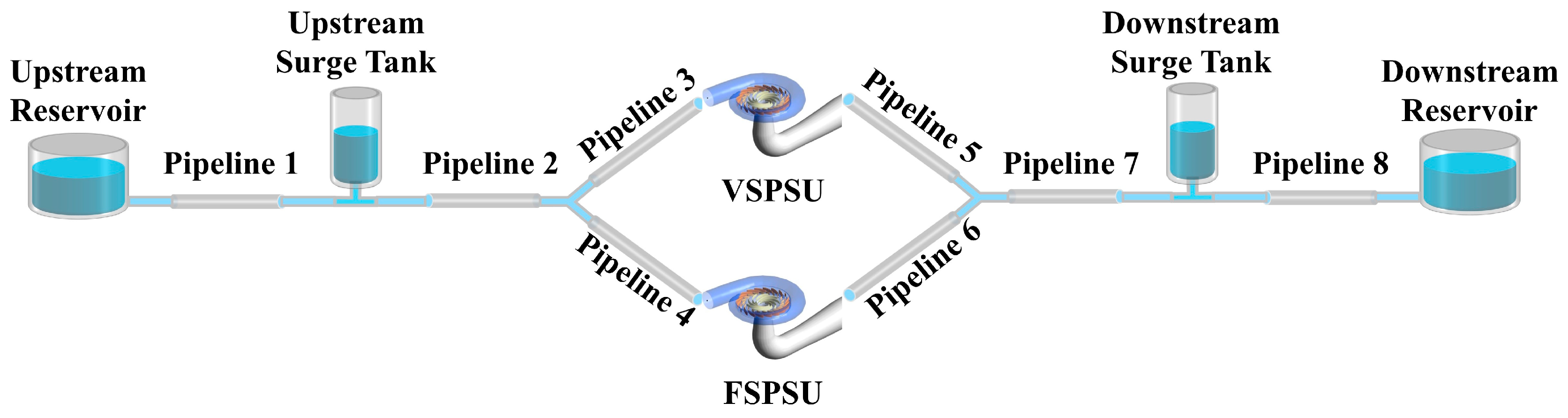
Figure 1. Schematic diagram of piping layout.
Machines 14 00063 g001
Figure 2. The block diagram of the upstream pipeline model.
Machines 14 00063 g002
Figure 3. The block diagram of the downstream pipeline model.
Machines 14 00063 g003
Figure 4. The characteristic curve processed by the improved Suter method. (a) The curve of WH; (b) the curve of WM.
Machines 14 00063 g004
Figure 5. The schematic block diagram of the entire model. (* represents the optimal value).
Machines 14 00063 g005
Figure 6. The block diagram of the SIMSEN model.
Machines 14 00063 g006
Figure 7. The comparison of the dynamic response of indicators.
Machines 14 00063 g007
Figure 8. The configuration of VSPSU–FSU.
Machines 14 00063 g008
Figure 9. The configuration of FSU–FSU.
Machines 14 00063 g009
Figure 10. The power command.
Machines 14 00063 g010
Figure 11. The active power dynamic responses.
Machines 14 00063 g011
Figure 12. The dynamic response of rotational speed and mechanical power for the VSU and FSU. (a) The mechanical power; (b) the rotational speed.
Machines 14 00063 g012
Figure 13. The dynamic response of rotational speed and mechanical power for FSUs under hydraulic disturbances. (a) The mechanical power; (b) the rotational speed.
Machines 14 00063 g013
Figure 14. The different power commands.
Machines 14 00063 g014
Figure 15. The dynamic responses of the system. (a) The response of the VSU; (b) The response of the FSU. (a1) The mechanical power of the VSU; (a2) The rotational speed of the VSU; (a3) The discharge of the VSU; (a4) The pressure in draft tube of the VSU; (a5) The pressure in spiral case of the VSU; (b1) The mechanical power of the FSU; (b2) The rotational speed of the FSU; (b3) The discharge of the FSU; (b4) The pressure in draft tube of the FSU; (b5) The pressure in spiral case of the FSU.
Machines 14 00063 g015
Figure 16. The response of the active power.
Machines 14 00063 g016
Figure 17. The evaluation indicators of power regulation performance.
Machines 14 00063 g017
Figure 18. The judgement matrix of the stability indicators.
Machines 14 00063 g018
Figure 19. The judgement matrix of the safety indicators.
Machines 14 00063 g019
Figure 20. The judgement matrix of the rapidity indicators.
Machines 14 00063 g020
Figure 21. The scores of rapidity, stability, and safety under different power command rates.
Machines 14 00063 g021
Figure 22. The scores of the power regulation performance under different power command rates.
Machines 14 00063 g022
Table 1. The main parameters of the pumped storage plant.
ParameterValue
Upstream reservoir water level1486 m
Downstream reservoir water level1061 m
Rated output power306 MW
Rated discharge79.8 m3/s
Rated rotational speed428.6 r/min
Diameter of pump–turbine2.155 m
Table 2. The parameters of the waterway system.
Numberl (m)D (m)A (m2)a (m/s)nR
L11068.3211.095.3011000.014
L21062.779.063.6212000.014
L364.717.038.4812000.014
L480.217.038.4812000.014
L5181.417.038.4812000.014
L6163.787.038.4812000.014
L715.009.063.6212000.014
L8826.2811.095.3011000.014
Table 3. The comparison of the maximum and stability values of indicators.
Maximum
deviation
IndicatorsSimulink
(p.u./m3/m)
SIMSEN
(p.u./m3/m)
A
(p.u./m3/m)
R
(%)
RA
(%)
Pm_#10.089 p.u.0.002 p.u.0.087 p.u.8.7%2.06%
wm_#1−0.172 p.u.−0.135 p.u.0.037 p.u.3.7%
Q_#13.67 m3−1.55 m35.22 m36.1%
H_#1−23.99 m−20.44 m3.55 m0.8%
HD_#16.09 m7.59 m1.5 m1.6%
HU_#1−20.81 m−16.70 m4.11 m0.8%
Pm_#20.048 p.u.0.043 p.u.0.005 p.u.0.5%
wm_#20 p.u.0 p.u.0 p.u.0%
Q_#2−1.45 m3−0.85 m30.6 m30.7%
H_#2−18.48 m−16.45 m2.03 m0.5%
HD_#23.70 m4.36 m0.66 m0.6%
HU_#2−19.45 m−15.77 m3.68 m0.7%
Stability
value
IndicatorsSimulink
(p.u./m3/m)
SIMSEN
(p.u./m3/m)
A
(p.u./m3/m)
R
(%)
RA
(%)
Pm_#10.719 p.u.0.719 p.u.0 p.u.0%0.36%
wm_#10.950 p.u.0.941 p.u.0.009 p.u.0.9%
Q_#158.45 m358.45 m30 m30%
H_#1432.91 m432.99 m0.08 m0.01%
HD_#195.19 m96.70 m1.51 m1.5%
HU_#1525.92 m527.05 m1.13 m0.2%
Pm_#21.021 p.u.1.021 p.u.0 p.u.0%
wm_#21.000 p.u.1.000 p.u.0 p.u.0%
Q_#283.58 m383.58 m30 m30%
H_#2432.86 m432.90 m0.04 m0.01%
HD_#295.19 m96.62 m1.43 m1.5%
HU_#2525.92 m526.90 m0.98 m0.18%
A represents the absolute deviation between two software simulation results, R represents the relative deviation, and RA represents the average relative deviation.
Table 4. The maximum deviation and regulation time.
Maximum
deviation
IndicatorsVSU-FSU
(p.u.)
FSU-FSU
(p.u.)
Pm_#10.0840.004
wm_#10.1560
Pm_#20.0600.039
wm_#200
Pe0.0010.004
Regulation
time
IndicatorsVSU-FSU
(s)
FSU-FSU
(s)
Pm_#151.2645.17
wm_#176.910
Pm_#248.6449.55
wm_#200
Pe4.9045.17
Table 5. The maximum deviation and regulation time of the indicators.
Rate
(p.u./s)
UnitMaximum Deviation (%)Regulation Time (s)
PmwmQHDHUPePmwmPe
0.05VSU4.5213.370.0896.003.230.0453.5378.809.81
0.18.3214.900.927.823.880.1051.2676.914.90
0.528.7919.3714.469.805.110.5249.0974.860.98
533.9620.3318.3510.065.175.2848.5674.320.17
0.05FSU5.570.002.584.393.21/50.650.00/
0.15.970.002.614.603.63/48.640.00/
0.57.310.003.174.794.82/96.150.00/
57.360.003.424.904.88/96.390.00/
Disclaimer/Publisher’s Note: The statements, opinions and data contained in all publications are solely those of the individual author(s) and contributor(s) and not of MDPI and/or the editor(s). MDPI and/or the editor(s) disclaim responsibility for any injury to people or property resulting from any ideas, methods, instructions or products referred to in the content.