Review

A Protocol-Oriented Scoping Review for Map-First, Auditable Targeting of Orogenic Gold in the West African Craton (WAC): Deferred, Out-of-Sample Evaluation


1
Polytech Diamniadio, Amadou Mahtar Mbow University, Dakar 45927, Senegal
2
National School of Mines and Geology, Cheikh Anta Diop University of Dakar, Dakar 10700, Senegal
3
Department of Geosciences, Pennsylvania State University, University Park, PA 16803, USA
*
Author to whom correspondence should be addressed.
Minerals 2025, 15(12), 1282; https://doi.org/10.3390/min15121282
Submission received: 25 October 2025 / Revised: 29 November 2025 / Accepted: 2 December 2025 / Published: 5 December 2025
(This article belongs to the Special Issue Gold Deposits: From Primary to Placers and Tailings After Mining)

Abstract

Focusing on the West African Craton (WAC) as a test bed, this protocol-oriented scoping review synthesizes indicators for orogenic gold and translates them into an auditable, map-first checklist that separates Fertility and Preservation, while deliberately deferring any performance estimation to a blinded, out-of-sample evaluation. There is a need for a transparent, auditable, and field-ready framework that integrates geological, structural, geophysical, and geochemical evidence. We (i) synthesize the state of knowledge into a map-first, reproducible targeting checklist, (ii) formalize an indicator decision matrix that separates Fertility from Preservation factors, and (iii) specify a deferred, out-of-sample evaluation protocol to quantify performance. We conduct a Preferred Reporting Items for Systematic Reviews and Meta-Analyses extension for Scoping Reviews (PRISMA-ScR)-style scoping review (2010–2025) and codify commonly used indicators (e.g., transpressional jogs, lineament density, proximity to tonalite-trondhjemite-granodiorite (TTG)/tonalite contacts, Sr/Y proxies). Indicators are operationalized as auditable pass/fail rules and assembled into a decision matrix with explicit uncertainty handling and risk logging. We further define a deferred evaluation protocol using classification and ranking metrics (receiver operating characteristic (ROC) and precision–recall (PR) curves, odds ratios), ablation/sensitivity tests, and district-level threshold calibration. We deliver (1) a unified, auditable checklist with default (tunable) thresholds; (2) an indicator decision matrix that disentangles Fertility vs. Preservation signals; and (3) a deferred evaluation protocol enabling a reproducible, out-of-sample assessment without inflating apparent performance. All numerical thresholds reported here are explicit placeholders that facilitate transparency and auditability; they are not optimized. A properly blocked train/validation/test scheme, operating-point selection criteria, null models, and uncertainty procedures are prespecified for future evaluation. By publishing the checklist, data lineage, and audit-log schema now—without performance claims—we enable reproducible adoption and stress-test the framework ahead of calibration.

1. Introduction

Orogenic gold systems in the West African Craton (WAC) are spatially organized by first-order lithospheric segmentation and by long, shear-dominated corridors that localize second-order dilation and fluid focusing [1]. Decades of mapping, geophysics, and geochronology have clarified many building blocks of this mineral system across the Reguibat and Leo–Man shields, yet exploration practice still lacks a compact, auditable framework that links 3D architecture to map-scale go/hold/no-go decisions [2,3,4,5].
Scope statement: This is a protocol-oriented scoping review that introduces no new datasets. Any numerical thresholds mentioned elsewhere in the manuscript are auditable placeholders to be calibrated in future work using training/blind splits and effect-size metrics.
Our central premise is that lithospheric segmentation sets the first-order template for mineral systems: contrasts in Moho/lithosphere–asthenosphere boundary (LAB) depth and crustal thickness provide an objective scaffold that coincides with gravity-gradient lineaments and magnetic fabrics, which in turn guide corridor backbones and second-order dilation loci at belt scale [4,6,7,8,9,10,11,12].
Within this view, targeting becomes a problem of reproducibly extracting corridor backbones, qualifying their support from deep structures, and documenting where dilation processes most plausibly generate traps and permeability architectures. We therefore couple Moho/LAB structure, gravity gradients, and magnetic lineaments with a mapped hierarchy of first-order corridors and second-order dilation sites (bends, relays, step-overs) to produce map-testable predictions for where corridors nucleate, where dilation focuses permeability, and which host packages maximize trap efficiency and preserved tonnage [4,10,11,13].
Because Preservation can decouple from Fertility at belt to district scales, we explicitly separate Fertility (capacity to form deposits) from Preservation (capacity to retain and expose them) in go/hold decisions. To avoid premature quantification in the Introduction, we keep the narrative qualitative and reserve operational cut-offs for later sections where they are positioned as provisional defaults.
We formulate three qualitative working hypotheses:
H1 (Corridor backbones).
First-order shear corridors coincide with high-magnitude gravity-gradient ridges, and orogenic gold camps preferentially cluster within corridor buffers [4,11].
H2 (Thickness support).
Corridor robustness increases where crustal thickness and LAB depth indicate strong segmentation relative to adjoining, thinner domains [4,7,8,9,14].
H3 (Petrogenetic/isotopic context).
Segments adjoining high-pressure TTG and juvenile zircon fingerprints show broader alteration halos and more continuous vein arrays than segments dominated by recycled signatures [15,16,17,18,19,20,21].
The present study yields multiple, consequential contributions:
(i)
A mineral-systems perspective that links lithospheric segmentation to a corridor–dilation hierarchy at map scale [4,5,6,9].
(ii)
A staged tectonic–metallogenic model reconciling Archean inheritance with Paleoproterozoic assembly across the Birimian/Eburnean evolution [3,21,22,23,24,25,26,27,28,29,30].
(iii)
A reproducible checklist of thresholds and decision rules for exploration targeting [11,13,31].
(iv)
An evidentiary chain that is auditable for data quality, representativeness, and cross-disciplinary consilience, with processing and uncertainty fully logged [4,5].
We use the shorthand “go/hold/no go” for triage decisions throughout the paper. The evidence base, inclusion criteria, and deferred evaluation protocol are detailed in Section 2 (especially Section 2.7), while Section 3 synthesizes state-of-knowledge with a critical appraisal of uncertainties and competing interpretations. Section 4 develops the map-first workflow from craton-scale segmentation to corridor backbones and second-order dilation, and Section 5 concludes with practical implications for exploration targeting and future quantitative calibration [4,5,11,13].
Beyond synthesizing prior knowledge of the West African Craton, this study introduces the following: (i) an auditable, map-first checklist that separates Fertility (source–maturation–transport) from Preservation (trap integrity/overprint) and yields reproducible, spatially explicit scores; (ii) a deferred evaluation framework with blinded, out-of-sample assessment and spatial blocking; (iii) decision rules and arbitration when structural and geophysical evidence diverge; and (iv) transparent null models (Complete Spatial Randomness (CSR) and structure-aware) plus an audit-log schema enabling independent replication.

2. Review Method

2.1. Scope and Sources

This protocol-oriented scoping review synthesizes peer-reviewed studies that document the structural, geophysical, geochemical, and geochronological contexts of orogenic gold systems at craton to belt scales, with a focus on the West African Craton. The goal is to identify map-testable indicators that can be used to populate Fertility and Preservation scores, while keeping the evaluation of exploration performance strictly deferred to a later, out-of-sample protocol.
The scoping review was conducted and is reported in accordance with PRISMA-ScR recommendations for scoping reviews. We explicitly document information sources, search strategies, screening criteria, the size of the corpus at each stage, and the properties of the 32 included studies that form the evidentiary base for the Fertility vs. Preservation checklist.

2.2. Inclusion and Exclusion Criteria

A study is included if it satisfies at least one of the following criteria:
  • Quantified parameters: Reports dated or measured values (e.g., U-Pb/Sm-Nd/Pb-Pb ages; crustal thickness; LAB depth; strain/kinematic indicators with uncertainties).
  • Regional extent: Resolves patterns at belt to craton scale, beyond a single deposit or camp.
  • Architecture/kinematics: Constrains three-dimensional architecture or first-order shear-system kinematics relevant to corridor continuity.
Studies are excluded when methods are insufficiently documented, spatial coverage is purely local without regional context, or results are non-peer-reviewed compilations lacking calibration or uncertainty reporting.
Domain-Specific Coverage (WAC)
To ensure representativeness across the WAC, at least one of the following spatial conditions must be met:
  • Shield-scale coverage: Results spanning ≥ 1 major shield (Reguibat or Leo–Man) and its nearest craton-margin/basin boundary segment.
  • Corridor continuity: Structural or potential-field evidence for ≥100 km along-strike continuity of a corridor-scale shear system.
  • Cross-domain transect: A geophysical section (receiver functions/tomography or joint gravity–magnetics) that crosses a domain boundary used later in the synthesis.

2.3. Search Strategy and PRISMA-ScR Reporting

We conducted a protocol-oriented scoping review following PRISMA-ScR recommendations. The objective was to identify published studies that (i) document craton- to belt-scale structural, geophysical, geochemical, and geochronological constraints on orogenic gold systems, and/or (ii) provide map-based datasets that can be used to populate Fertility and Preservation scores in the West African Craton.

2.3.1. Information Sources and Time Window

Electronic searches were performed in Scopus, Web of Science Core Collection, and GeoRef. We focused primarily on peer-reviewed literature published between 2010 and 2025; pre-2010 studies were retained only when they still provided the principal quantitative or map-based constraints for a given domain of the West African Craton and are treated as exceptions rather than part of the core evidentiary base. We complemented these database searches with targeted cross-referencing from key review papers and with contextual material from national geological survey reports, treated here as gray literature, i.e., non-peer-reviewed but citable technical reports and maps produced by geological surveys. The main database searches were first run on 15 January 2024 and updated on 15 January 2025 to capture recent publications. All records were exported with full bibliographic information and abstracts where available.

2.3.2. Search Strings

Search strings combined controlled vocabulary and free-text terms related to orogenic gold, greenstone belts, and craton-scale architecture. A representative example of the query used in Scopus is the following: “orogenic gold” AND (“greenstone belt” OR “greenstone belts” OR Birimi* OR “West African Craton” OR WAC) AND (structure OR structural OR “shear zone” OR “shear corridor” OR tomography OR “lithosphere-asthenosphere boundary” OR LAB OR “gravity gradient” OR “total horizontal gradient” OR THG OR “tonalite-trondhjemite-granodiorite” OR TTG).
Equivalent strings were used in Web of Science and GeoRef with database-specific field codes (e.g., TITLE-ABS-KEY in Scopus, TS in Web of Science). Additional focused searches were run on combinations such as (“Ashanti belt” OR “Sefwi belt” OR “Kédougou-Kéniéba inlier” OR “Mako belt” OR “Baoulé-Mossi”) AND (“orogenic gold” OR “gold mineralization”) to ensure coverage of key case study belts. The exact database-specific queries are listed in Supplementary Table S6 (PRISMA-ScR checklist).

2.3.3. Screening and Eligibility

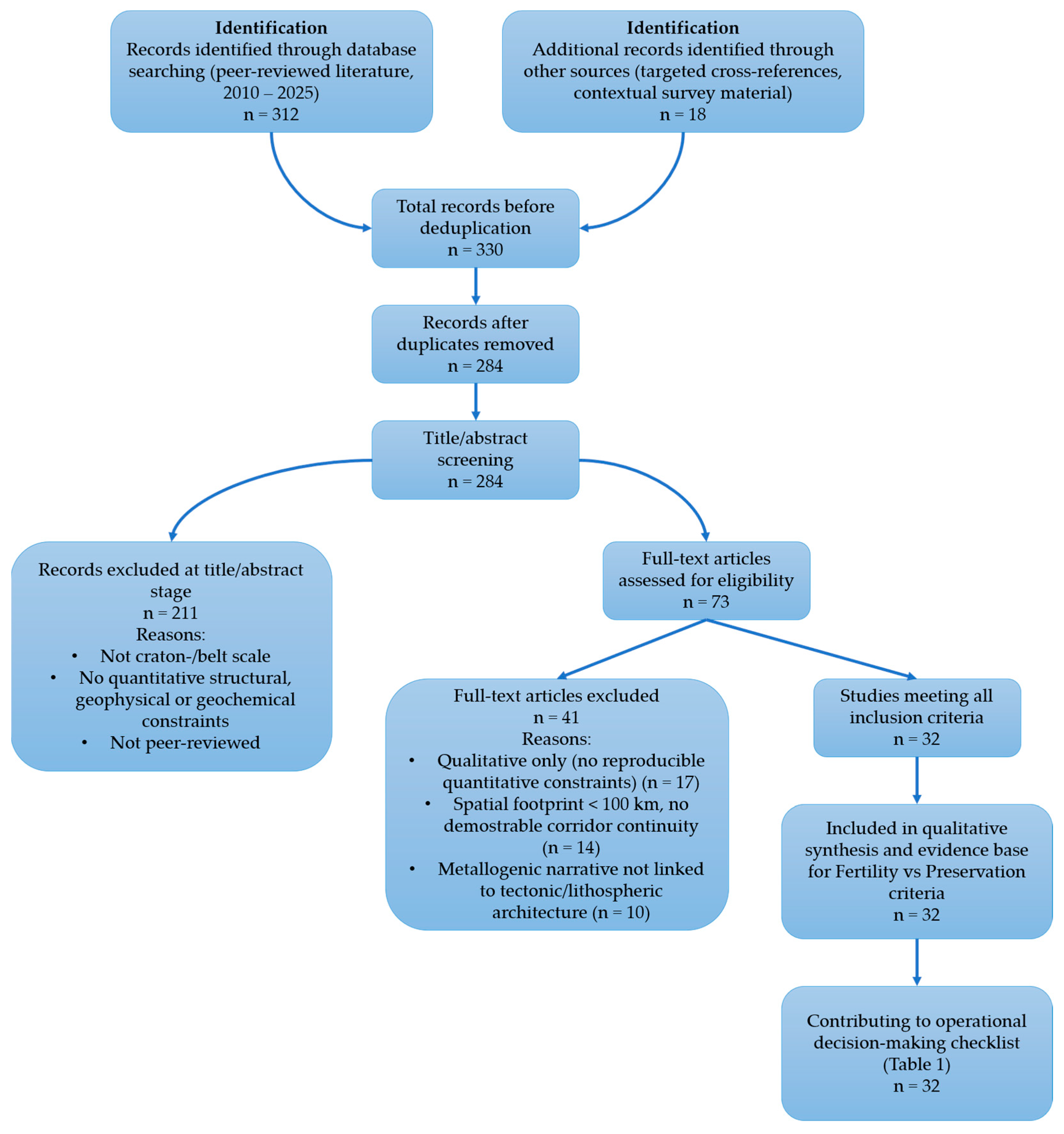
In total, 312 records were identified through database searching and 18 additional records through other sources (targeted cross-references and contextual survey material), for a total of 330 records before de-duplication. After removing duplicates, 284 unique records were retained for title–abstract screening (Figure 1). Duplicates were identified primarily via exact DOI matches and, where DOIs were absent, by matching combinations of title, first author, and publication year. At this stage, 211 records were excluded for at least one of the following reasons: (i) not craton- or belt-scale; (ii) no quantitative structural, geophysical or geochemical constraints; or (iii) not peer-reviewed.
The full text of the remaining 73 articles was assessed for eligibility. Forty-one full-text articles were excluded for one or more of the following reasons: (i) qualitative narrative only, with no reproducible quantitative constraints (n = 17); (ii) spatial footprint < 100 km with no demonstrable corridor continuity (n = 14); or (iii) metallogenic narrative not explicitly linked to tectonic and lithospheric architecture (n = 10). The remaining 32 studies met all inclusion criteria and form the final corpus of the scoping review. These numbers are summarized in the PRISMA-ScR flow diagram (Figure 1).

2.3.4. Data Charting and Evidence Classes

For each of the 32 included studies, we charted, in a structured spreadsheet, the following fields: geographic domain (global, craton, shield, belt), spatial scale, primary dataset type(s) (e.g., gravity, magnetics, seismic tomography, geological/structural mapping, TTG geochemistry, zircon geochronology, whole-rock geochemistry, alteration footprints), uncertainty reporting (quantitative, qualitative or none) and relevance to Fertility and/or Preservation dimensions. Based on spatial coverage, methodological transparency, and uncertainty handling, we assigned each study to an evidence class (A, B or C) as described in Section 2.3.4. The full list of included studies and extracted fields is provided in Supplementary Table S7, which forms the evidentiary base for the Fertility vs. Preservation checklist used in Section 4.

2.4. Spatial Scale and Resolution (Verifiability)

To render the analysis auditable, minimum resolvable scales are specified as follows:
  • Gravity and magnetics: Effective grid spacing ≤ 10 km after processing; filters (e.g., reduction-to-pole, upward continuation, tilt/total horizontal gradient) must be stated.
  • Seismic/RF and tomography: Moho and LAB estimates must include uncertainty bounds; lateral sampling dense enough to resolve domain-scale contrasts referenced in the text.
  • Structural mapping: Map scale ≤ 1:500,000 or lineament products derived from national/regional surveys, sufficient to link first-order corridors to second-order dilational sites (bends, step-overs, relays).

2.5. Evidence Weighting

This protocol specifies how provisional thresholds will be calibrated once suitable datasets become available, without altering the exploration framework.
B1.
Datasets and splits. Assemble (i) a training set of belts/segments with vetted orogenic gold positives and negatives; (ii) a blind, inter-belt test set at country scale; and (iii) the map layers used here (total horizontal gradient (THG) ridges, reduced-to-pole (RTP)/tilt products, Moho/LAB surfaces, lineament fields) at the resolutions stated in Section 2.3. No datasets are distributed or curated in this paper.
B2.
Null models. Adopt two baselines: (a) Complete Spatial Randomness (CSR) within surveyed corridors; and (b) structure-aware nulls that preserve first-order corridor geometry while randomizing second-order features (e.g., jogs/relays). These define the expected by-chance enrichment near long linear features.
B3.
Performance metrics. For each criterion and their combinations, compute odds ratios (with Wald intervals), receiver operating characteristic (ROC) and precision–recall (PR) curves, and report area under the ROC curve (AUC) and area under the precision–recall curve (AUPRC) with bootstrap uncertainty. The blind set is reserved strictly for evaluation.
B4.
Threshold optimization. Using training data only, derive operational cut-offs via Youden’s J (ROC) and F1 (PR). Freeze these cut-offs and report performance on the blind set. Present provisional (this paper) and calibrated (future) values side-by-side.
B5.
Sensitivity and ablation. Vary grid spacing, filters (RTP/tilt/upward continuation), and corridor extraction to assess threshold stability. Apply ablation (removing one criterion at a time) to quantify each indicator’s marginal contribution.
B6.
Uncertainty propagation. Propagate Moho/LAB and corridor-mapping uncertainties using Monte Carlo perturbations and document any go/hold or ESG-based no-go decision flips induced by threshold jitter.
Evidence is weighted along three axes: (i) analytical/survey quality—covering instrumentation, processing workflows, and explicit uncertainty reporting; (ii) spatial representativeness—the extent to which conclusions generalize at belt to craton scale; and (iii) cross-disciplinary consilience—agreement among structural, geophysical, geochemical, and geochronological proxies. Weights are assigned at the dataset level and propagated to tables via an evidence-class label (A/B/C), where A denotes high-quality, multi-proxy, regionally representative constraints.

2.6. Conflict Resolution and Traceability

Competing interpretations are not forced into a single view. Instead, alternative models are retained and arbitrated through explicit rules, while preserving a full audit trail.
Arbitration rules (examples):
  • LAB depth vs. corridor geometry: When tomography and receiver function estimates of LAB differ by >20 km along a mapped first-order corridor, both surfaces are retained. Preference is given to the surface that better predicts (i) maxima in gravity-gradient magnitude and (ii) corridor-parallel lineament density evaluated in subsequent sections.
  • Through-going shear vs. segmented step-overs: Where structural mapping infers a continuous strike-slip corridor, but potential-field data indicate segmentation, both kinematic options are carried forward. The preferred scenario is the one that best matches deposit clustering and independently mapped dilational sites.
  • Chronology mismatches: When age populations defining deformation stages (e.g., D1–D3) overlap within analytical uncertainty, the most conservative interpretation is adopted (broader time window), and stage assignment is tied to kinematic indicators rather than ages alone.
Traceability: For each dataset, we record source, version/DOI, processing steps (including filters and grid spacing), uncertainty metrics, spatial footprint, evidence class, and any arbitration decisions. This information is consolidated in a machine-readable dataset inventory (Supplementary Table S8) aligned with the audit fields used in the example decision log (Supplementary Table S9) so that all thresholds and figures used in this paper can be traced back to the underlying data layers via the audit inventory.

2.7. Workflow

This review proceeds in three stages: (i) we segment the domain by integrating crustal and lithosphere–asthenosphere architecture with gravity-gradient and magnetic-lineament frameworks to delineate first-order corridors and domain boundaries; (ii) we establish the hierarchy of strain localization by linking first-order corridors to second-order dilational sites and characterizing their kinematics and map-testable geometries; and (iii) we conduct a metallogenic evaluation, assessing deposit clustering, fluid sources, and trap efficiency within the structural hierarchy and formulating predictions and thresholds amenable to map-based and data-driven testing.

2.8. Deferred Evaluation Protocol (No New Data Used)

This study does not generate or analyze new datasets. Instead, we specify a deferred, a posteriori evaluation protocol that any team can execute on public or proprietary data to assess the operational value of the framework. All quantitative performance estimates are intentionally deferred. No performance metrics are reported at this stage; any evaluation (e.g., receiver operating characteristic (ROC) and precision–recall (PR) analyses) will be conducted separately according to the pre-registered protocol. A toy, uncalibrated mini-demonstration of this checklist-to-ROC pipeline is provided in Appendix A. We pre-specify a blinded, out-of-sample scheme with (i) stratified, spatially blocked splits (train/validation/test); (ii) hyperparameter and threshold selection on validation only; (iii) a single locked test used once for final reporting; and (iv) uncertainty quantification via block bootstrap. We will report ROC/PR curves, odds ratios, ablations separating Fertility vs. Preservation, and comparisons against null models (CSR and structure-aware). Until such evaluation is executed, all thresholds herein must be interpreted as placeholders that ensure auditability rather than performance.
This review protocol was not prospectively registered in an external registry such as PROSPERO; however, the a priori methodology including the predefined inclusion and exclusion criteria, the evidence-weighting and auditability framework, and the deferred blind evaluation procedure, is fully specified in Section 2.7 of this manuscript. The completed PRISMA-ScR reporting checklist for this review is provided in Supplementary Table S6 (PRISMA-ScR checklist for this scoping review).

2.8.1. Test-Area Selection (A Priori)

Choose one West African belt-scale domain that was not used to tune thresholds. Justify the choice by data availability (regional gravity–magnetics, basic geology, and any public lithosphere models). Freeze the test polygon and random seeds before any scoring.

2.8.2. Minimal Compilation (Suggested Public Sources)

Assemble only the layers needed to compute the checklist: Bouguer/RTP + THG derivatives; first-order lineaments; corridor backbones; simple crust and LAB depth grids; and regional geology for TTG and metasedimentary buffers. Document grid spacing, filters, and map scale. Do not curate deposit points beyond what is already public; use camp-scale clusters if exact coordinates are uncertain.

2.8.3. Analysis Steps

(i) Delineate corridor backbones and provisional ± 15 km buffers (as in P1, Section 4.1.1); (ii) compute second-order dilation metrics (lineament density, jog angle, relay length) in fixed windows; (iii) sample crust/LAB ranges along corridors; (iv) flag petrogenetic proxies (TTG Sr/Y-La/Yb, zircon εHf-δ18O if available); (v) score Preservation indicators (halo breadth, redox buffers, camp clustering); (vi) apply the decision matrices (see Supplementary Table S2) with default thresholds and prudence intervals; and (vii) record pass/fail per cell/segment.

2.8.4. Sensitivity and Uncertainty

Vary one threshold at a time within the prudence interval. Re-run steps (i)–(vii) and log changes in pass/fail counts. Propagate crust/LAB uncertainty by sampling ± the published 2σ ranges and recomputing corridor support.

2.8.5. Success/Failure Criteria and Reporting

Success is not discovery-forecast accuracy. Report the number and length of segments reaching “Fertile-Preserved” vs. “Fertile-At Risk”; how many decisions flip under threshold/uncertainty perturbations; and qualitative error modes (e.g., survey edge effects; ambiguous lineaments) (see Supplementary Table S4 for the risk/sensitivity workbook). Provide a one-page audit log summarizing inputs, grid spacings, filters, and any deviations from defaults (template in Supplementary Material).

2.9. Methodological Contributions

This study advances a rigorously auditable, map-first workflow that integrates LAB/Moho architecture with total horizontal gradient (THG) ridges to structure a corridor–dilation hierarchy. It formalizes a go/hold/no-go decision pathway that explicitly distinguishes Fertility from Preservation at both regional and belt scales. It specifies provisional, map-testable thresholds—for example, corridors focused along THG ridges in the upper few percentiles of the THG distribution (typically around the 95th percentile) and continuous over ≥100 km, jog angles with modes near 15–25° but empirical tails of ~10–30°, and lineament densities on the order of 1.5–2.0 km km−2. These windows are drawn from Ashanti, Sefwi, and other Birimian case studies where deposit clustering tracks high-THG ridges and optimally oriented jogs and relay zones [11,13,28,29]. They are treated as non-calibrated defaults with belt-specific uncertainty ranges: Section 4.2.3 summarizes the observed variability between belts, and Section 2.7 outlines how these thresholds will be tuned on training belts (c and ablation tests) before being fixed for blind-belt applications. Finally, it establishes a deferred validation protocol (training/blind splits, CSR and structure-aware null models, ROC/PR analysis, odds ratios, sensitivity analyses, and ablation studies) to lock operational cut-offs in subsequent data-driven work.

2.10. Reproducibility and Audit Log

Each processing step emits a machine-readable audit log (CSV/JSON) recording: input sources and version hashes; CRS and spatial masks; preprocessing parameters; indicator-level scores with units; threshold values and whether they were placeholders or calibrated; random seeds; and export paths for GeoTIFF/GeoPackage map layers. This log enables third-party replication, facilitates compliance-grade review, and allows re-scoring with updated thresholds without reprocessing raw data. To make the checklist decisions auditable and machine-readable, each (segment, step, criterion) combination is recorded in a tabular audit log with one row per decision. The log stores the belt, corridor, and segment identifiers, the step and criterion names, the decision (Go/Hold/No-go), the version of the threshold set applied, the operator ID, a UTC timestamp, and an optional free-text comment. An example CSV file illustrating this schema and a few representative entries is provided in Supplementary Table S9.

3. State of Knowledge and Evidence Synthesis for the West African Craton

3.1. Geological and Structural Overview of the West African Craton (WAC)

3.1.1. Aim and Framework

Rather than providing a descriptive tour of shields and belts, this section establishes a predictive hierarchy linking (i) first-order shear corridors that partition the craton at belt scale, to (ii) second-order dilation structures (bends, step-overs, relays) that localize strain and permeability, and ultimately to (iii) ore-trap architectures (fault jogs, splays, and host-controlled traps). We anchor this hierarchy in the regional architecture of the West African Craton (WAC) and its Birimian terranes, integrating structural mapping with geophysical constraints on crust–lithosphere structures [4,6,9,10]. The study selection process, including screening, eligibility assessment, and reasons for exclusion, is summarized in the PRISMA-ScR flow diagram (Figure 1)

3.1.2. Craton-Scale Architecture: Domains, Boundaries, and Segmentation

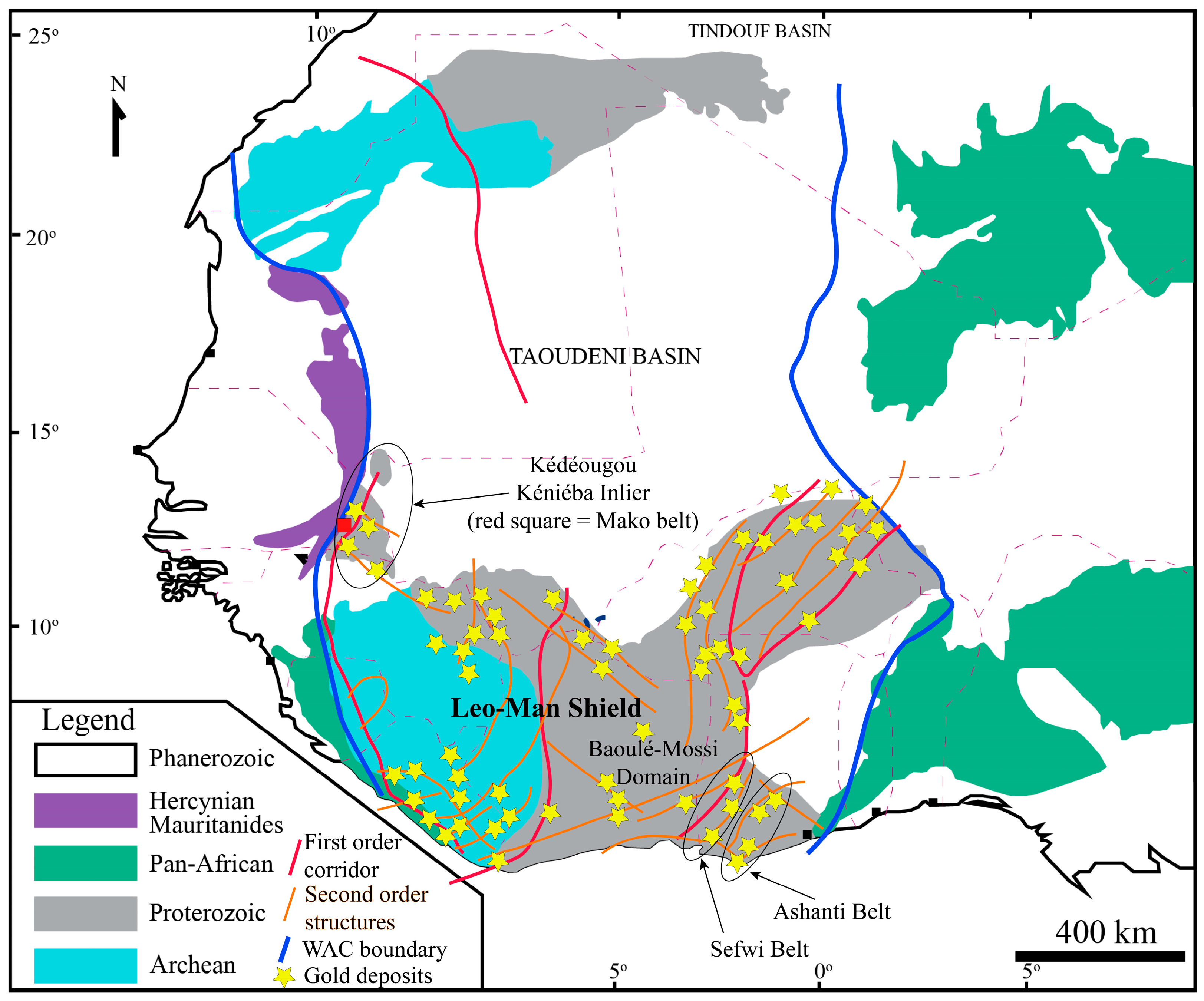
The WAC comprises the Reguibat and Leo–Man shields and intervening basins, segmented by long-wavelength lithospheric and crustal heterogeneities that are resolvable in potential-field and seismic models [2,6,9,11,32]. A simplified geological map of the West African Craton (WAC) showing shields, basins, and first-order structural boundaries is provided in Figure 2. Tomographic and receiver function studies delineate domain-scale contrasts in crustal thickness and LAB depth that coincide with gravity-gradient lineaments and magnetic fabrics, providing an objective scaffold for mapping first-order corridors [4,7,8,10,33,34].
In the Birimian province, this segmentation reflects an accretionary to collisional orogenic system active between ca. 2.27–1.96 Ga, with juvenile crustal growth and polyphase deformation [17,21,22,23,24,26,27,37,38].

3.1.3. Hierarchy of Shear Systems: First-Order Corridors Vs. Second-Order Dilation Sites

First-order corridors are through-going, belt-scale zones of strain localization with ≥100 km along-strike continuity, commonly coincident with steep gravity-gradient belts and high-coherence magnetic lineaments. These corridors bound structural domains, focus transpressional to transtensional partitioning, and record the main D1–D3 kinematic evolution of the Eburnean system [4,28,29,30].
Second-order structures are local geometrical irregularities within or adjacent to first-order corridors—jogs, bends, relays and step-overs—that generate transient dilation, enhance fluid flux, and produce crack-seal vein arrays at deposit to district scale [31,39,40]. For clarity, we treat corridor-scale architecture (traceable at 1:500,000 and co-located with regional geophysical gradients) separately from site-scale dilation loci (mapped at 1:50,000–1:100,000 with measurable jog angles, relay lengths, and spacing). This separation allows consistent up- and down-scaling between geophysical segmentation, mapped kinematics, and ore-system permeability architecture [3,4,11].
Operational metrics include the following: (i) corridor continuity length (km) and straightness; (ii) maximum total horizontal gravity gradient (mGal km−1) along corridor flanks; (iii) lineament density (km km−2) and preferred azimuth from aeromagnetics; and (iv) dilation index at second order (jog angle, relay overlap/spacing, % extensional shear band frequency) [4,10,13].

3.1.4. Belt-Scale Case Studies: Ashanti vs. Sefwi

We formalize contrasts between the southern Ashanti Belt and the Sefwi Belt to illustrate how first-/second-order hierarchy translates to map-testable predictions.
Host and structural style: Ashanti is dominated by composite shear zones with well-developed transpressional flower geometries and abundant second-order jogs and relays; Sefwi exhibits more segmented, strike-slip-dominated corridors with fewer, narrower jogs [13,28,31].
Alteration halos and widths (measurable): District-scale carbonate–sulfide–albite alteration halos in Ashanti commonly reach >500–1000 m cumulative width across stacked vein arrays, whereas Sefwi alteration is typically ≤200–400 m and spatially restricted around jog-bounded lenses [3,13,31,41,42].
Lineament density and jog metrics (map-testable): Ashanti shows higher magnetic-lineament density (≥1.5–2.5 km km−2 in corridor cores) and larger jog angles (15–25°) with relay lengths commonly reaching 2–8 km; Sefwi displays lower densities (≤1.0–1.5 km km−2) and smaller jogs (5–15°) with shorter relays (≤3–5 km) [10,13].
Fluid-flow indicators: Ashanti belts preserve more pervasive vein swarms and crack-seal microstructures consistent with high-flux, overpressured fault-valve behavior; Sefwi records fewer but sharply localized high-grade shoots [31,39,40,43,44].
These distinctions are consistent with an Ashanti architecture that maximizes second-order dilation frequency within robust first-order corridors vs. a more segmented, structurally selective Sefwi system. Both fit within the broader Eburnean transpressional to transcurrent evolution and the globally recognized orogenic gold paradigm [11,45,46].

3.1.5. Synthesis and Implications

In summary, the WAC’s craton-scale segmentation provides the first-order corridor framework, while belt-scale geometrical irregularities generate second-order dilation traps that focus hydrothermal flow and veining. The explicit separation—and quantitative linking—of these scales allows us to derive map-testable predictions for deposit clustering and halo dimensions that are articulated and operationalized in the Discussion and Metallogenic Implications sections [4,11,13].

3.2. Geochronology

3.2.1. Overview and Datasets

We synthesize U-Pb zircon (magmatic and detrital), Pb-Pb whole-rock, Sm-Nd (including depleted-mantle model ages), and selected metamorphic chronometers to constrain Archean inheritance, Paleoproterozoic crustal growth, and the timing of Eburnean deformation across the West African Craton (WAC). At craton scale, these datasets indicate rapid Paleoproterozoic addition of juvenile crust superposed on locally older Archean nuclei, subsequently reworked during the Eburnean orogeny [4,21,22,23,24].

3.2.2. Archean Inheritance and Early Foundations

Archean TTG and high-grade gneiss complexes form a heterogeneous substrate within both the Reguibat and Leo–Man shields. Detrital-zircon populations in Birimian successions include minor Archean grains alongside dominant Paleoproterozoic modes, documenting recycling of pre-existing crust into later basins and orogenic belts; Nd model ages nevertheless attest to substantial juvenile input during Paleoproterozoic growth pulses [22,23,24].

3.2.3. Birimian Crustal Growth (ca. 2.30–2.10 Ga)

Birimian magmatic–sedimentary systems record rapid crustal growth and terrane assembly between ca. 2.30 and 2.10 Ga, with widespread volcanism and TTG emplacement across the Baoulé-Mossi domain. Regionally compiled U-Pb zircon geochronology—supported by Sm-Nd and Pb-Pb constraints—underpins this time window and is consistent with arc-related accretion accompanied by variable incorporation of older sources [4,17,21,24].

3.2.4. Eburnean Windows and Reactivations: Timing, Bounds, and Uncertainties

We distinguish discrete, map-testable time windows within the Eburnean orogeny and its aftermath, emphasizing uncertainties and cross-checks among chronometers:
  • Onset and peak deformation-metamorphism (ca. 2.10–1.98 Ga). U-Pb zircon/monazite ages from amphibolite-granulite facies rocks and syn-kinematic granitoids cluster shortly after 2.10 Ga, with many belts registering peak metamorphic conditions near or just below 2.00 Ga [28,29,30]. Typical analytical uncertainties (2σ) are ±3–10 Ma for zircon/monazite and larger for whole-rock systems.
  • Sustained high-T residence and late plutonism (ca. 1.98–1.90 Ga). High-temperature residence and post-collisional granitoid emplacement persist into the 1.98–1.90 Ga interval, reflecting thermal relaxation and local anatexis following crustal thickening [4].
  • Localized reactivations (≤1.90 Ga). Later brittle–ductile reworking is locally recorded and best constrained where structural–metamorphic observations are paired with new U-Pb datasets at belt scale; we carry such “reactivation flags” into the structural synthesis to test linkages with corridor segmentation [4,29,30].

3.2.5. Juvenile vs. Recycled Contributions: Coupled Isotopic and Trace-Element Diagnostics

Discriminating juvenile mantle addition from crustal recycling requires paired detrital–zircon and whole-rock tests. We adopt two complementary diagnostics used later in the Discussion and Metallogenic Implications sections:
  • Zircon εHf-δ18O coupling (detrital and magmatic). Positive εHf(t) combined with mantle-like δ18O values indicates dominantly mantle-derived melts, whereas sub-mantle δ18O or subdued εHf trends suggest variable crustal re-melting or assimilation [18]. We compile available Birimian detrital–zircon datasets and propagate their uncertainties into belt-level summaries [4].
  • Arc-affinity pressure proxies in TTG and andesitic suites (Sr/Y-La/Yb). Elevated Sr/Y at given La/Yb ratios is interpreted to reflect residual garnet and/or amphibole (deep crustal thickening), whereas lower Sr/Y at comparable La/Yb is consistent with shallower melting and/or greater plagioclase stability; in combination with εHf-δ18O, these trends help separate juvenile thickened-arc additions from crustal reworking [18,21].
Operationalization. Table 1 summarizes thresholds and error propagation for εHf-δ18O and Sr/Y-La/Yb for each belt [4,13].

3.2.6. Synthesis

In aggregate, Birimian age populations (ca. 2.30–2.10 Ga) and Eburnean windows (ca. 2.10–1.90 Ga) define a short, pulsed growth-and-reworking trajectory for the WAC, dominated by juvenile addition but variably overprinted by localized recycling. This temporal framework underpins the structural hierarchy discussed in Section 3.1 and anchors the predictive tests developed later (deposit clustering, halo breadth, and fluid-flow efficiency as functions of corridor architecture and reactivation history) [4,13,18,21].

3.3. Geophysical Data Synthesis

3.3.1. Overview of Geophysical Techniques Applied to the WAC

The geophysical characterization of the WAC employs a range of methods to probe its crustal and lithospheric structure. The most commonly applied techniques include seismic tomography, gravity and magnetic anomaly mapping, and lithosphere–asthenosphere boundary (LAB) models. Each method provides unique insights into the composition, density, and thickness variations in the craton’s lithosphere, as well as tectonic features such as shear zones, crustal boundaries, and mantle characteristics.
Seismic tomography and receiver function analyses offer critical information on the thickness and heterogeneity of the WAC’s lithosphere and crust. These methods reveal significant variations in crustal and lithospheric depths across the craton, enabling a better understanding of its tectonic segmentation. Gravity and magnetic data, on the other hand, identify subsurface density variations and provide clues on lithological and structural differences between tectonic units, helping to map major faults, shear zones, and buried geological formations [3,4,6,48].

3.3.2. Crust and LAB Structure (Thickness Ranges, Domain Contrasts, Uncertainties)

Receiver function (RF), surface-wave tomography, and integrated lithosphere models resolve systematic contrasts in crustal and lithosphere–asthenosphere boundary (LAB) thickness across the WAC. Crustal thickness is typically 32–42 km in large parts of the Leo–Man Shield, locally ≥45 km beneath thickened Birimian domains, and generally 28–36 km toward basin margins; corresponding LAB depths are ~100–140 km beneath most belts and locally ≥160–180 km beneath craton cores [4,5,6,7,8,9]. Method-dependent uncertainties are explicitly tracked here: RF-derived Moho depths typically carry ±3–6 km (2σ) depending on station spacing and crustal velocity assumptions, while LAB estimates from surface-wave tomography and joint inversions are commonly uncertain by ±10–20 km, increasing in regions of sparse path coverage [7,8,9]. These thickness trends coincide with long-wavelength gravity gradients and domain-bounding magnetic fabrics, providing an objective scaffold for mapping first-order corridors later used in the structural hierarchy [4,10,11].

3.3.3. Gravity Anomalies and Domain/Corridor Boundaries

We use reduced-to-pole, upward-continued Bouguer fields and their total horizontal gradient (THG) to delineate domain boundaries and first-order shear corridors. In the WAC, craton-margin and shield-internal boundaries manifest as steep, laterally continuous THG belts that parallel mapped crustal discontinuities and the edges of thickened lithosphere inferred from RF/tomography [4,6,9,11]. Along the southern Leo–Man Shield (Ghana-Burkina Faso), THG maxima track the Ashanti structural backbone for >300 km, with corridor-parallel gradients that coincide with mapped strike-slip zones and deposit clustering [4,13]. In the Kedougou-Kéniéba inlier (Senegal-Mali), THG belts bound the Mako belt and highlight jog-bearing segments of the main shear system that host quartz-carbonate vein camps [4,43]. We report threshold values (e.g., 95th-percentile THG to outline corridor cores) so that corridor picks are reproducible and auditable.

3.3.4. Magnetic Lineaments, Relays, and Jogs (Map-Scale Kinematic Proxies)

Aeromagnetic lineament stacks—interpreted from RTP, tilt-derivative, and analytic-signal products—are used to extract corridor-parallel fabrics and second-order dilation loci (bends, step-overs, relays). In Ashanti, high lineament density and frequent relay/jog geometries (relay lengths ~2–8 km; jog angles 15–25°) correlate with transpressional shear architecture and wide alteration envelopes [13,31,41]. In Sefwi, lineament density is lower and jog angles smaller (5–15°), consistent with a more segmented, strike-slip-dominated corridor where alteration is spatially narrower [10,13]. In the Mako belt, magnetic fabrics and mapped shear splays coincide with vein swarms and crack-seal textures indicative of episodic overpressure and fault-valve behavior [39,40,43]. Throughout, we quantify (i) lineament density (km km−2), (ii) preferred azimuth dispersion, and (iii) relay/jog metrics (angle, overlap, spacing), enabling direct comparison to gravity-defined corridors and thickness contrasts [4,10].

3.3.5. Integrated 3D Framework (Crust-LAB-∇G-Lineaments-Corridors)

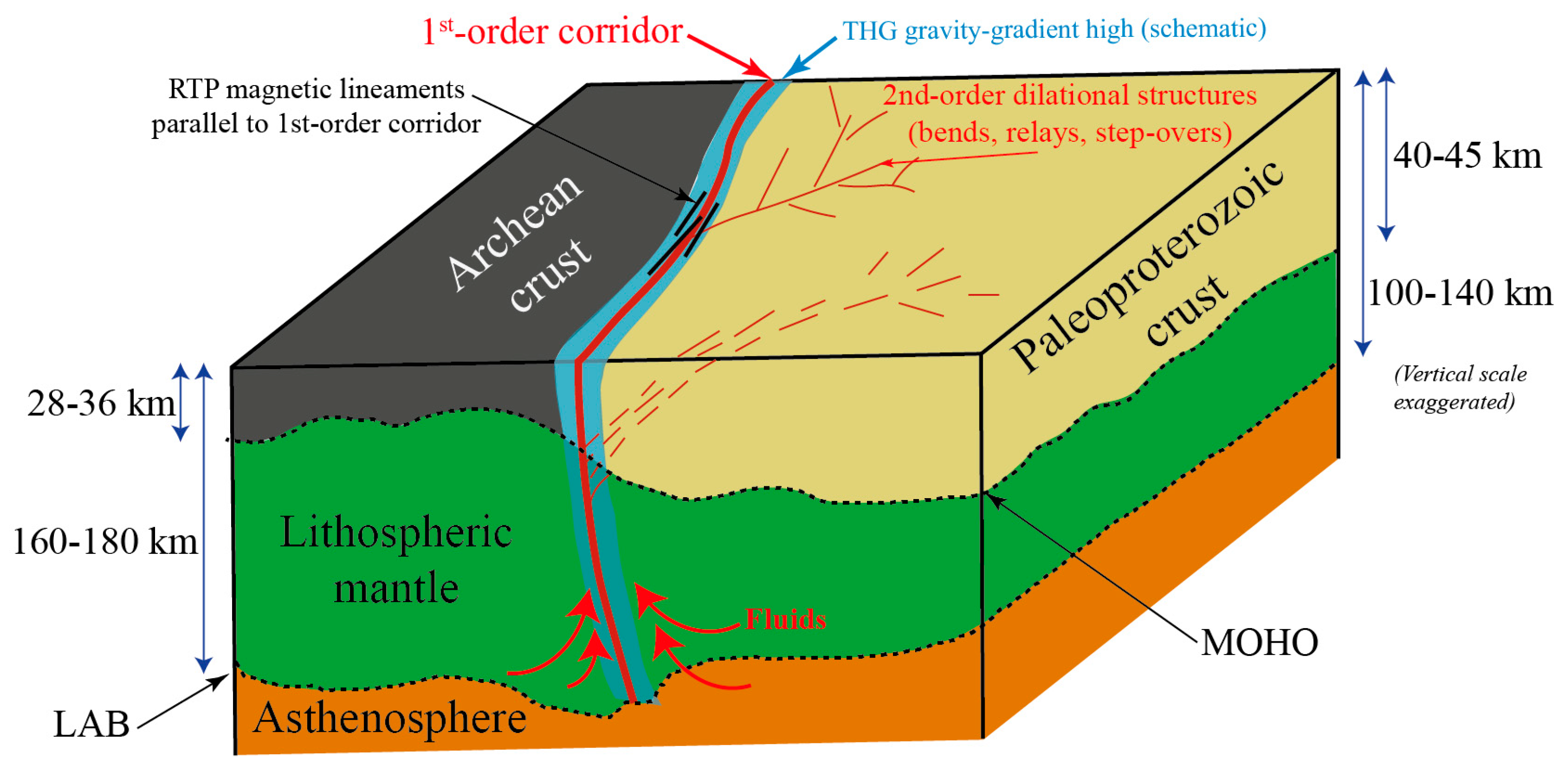
To couple deep architecture to map-scale kinematics, we assemble an integrated 3D model that superposes (i) Moho and LAB surfaces from RF/tomography (with depth uncertainty bands), (ii) THG envelopes outlining domain boundaries and corridor cores, and (iii) aeromagnetic lineament networks highlighting second-order dilation loci (Figure 3). Candidate first-order corridors are defined where THG ridges track along-strike for ≥100 km and coincide with corridor-parallel magnetic fabrics; second-order sites are flagged where lineament geometry predicts dilation (jogs/relays) adjacent to those corridors. The composite volume allows us to (a) test whether thicker crust/keels focus corridor development, (b) quantify how gradient maxima localize strain, and (c) evaluate the spatial association of dilation sites with known deposit clusters [4,5,6,7,8,9,13].

3.4. Geochemical and Petrological Characteristics

3.4.1. TTG Diagnostics and Tectonic Inference

We use tonalite-trondhjemite-granodiorite (TTG) geochemistry to discriminate melting depths and residual assemblages, thereby constraining tectonic settings. In our compilation, high-pressure TTG/adakitic-like signatures are characterized by Sr/Y ≥ 40–60 at La/YbN ≥ 20–30, Y ≤ 18 ppm, and commonly Eu/Eu* ≥ 1.05–1.15, consistent with residual garnet ± amphibole and suppressed plagioclase (deep crustal thickening and/or hot subduction channel); by contrast, lower-pressure TTG show Sr/Y ≤ 20–30, La/YbN ≤ 10–15, and Eu/Eu* ≈ 0.9–1.05, implying significant plagioclase in the residue and shallower melting [15,16]. Across the Baoulé-Mossi domain, juvenile granitoids with elevated Sr/Y and depleted heavy rare earth elements (HREE) are widespread and temporally overlap with the main Eburnean deformation, supporting thickened-arc to collisional crustal reworking [17,21]. We apply these thresholds belt-by-belt and, where available, integrate Sr/Y-La/Yb with zircon εHf-δ18O to separate juvenile additions from recycled crustal sources [20,49].

3.4.2. Greenstones: Arc Vs. Back-Arc Discrimination and Fertility Implications

Birimian greenstones exhibit systematics in HFSE/LILE ratios and immobile-element discrimination diagrams that distinguish arc-related tholeiitic-to-calc-alkaline suites from more back-arc/within-plate components [47,50]. Arc-affinity lavas typically display LILE enrichment (Rb, Ba, K) at near-to-subchondritic Nb-Ta (negative Nb anomalies on N-MORB-normalized plots), moderate Th/Yb-Nb/Yb consistent with slab-modified sources, and variable but generally subdued Ti [47]. In contrast, back-arc or plume-influenced components may show flatter REE patterns with diminished Nb depletion and locally elevated Ti, reflecting greater asthenospheric input [22,51]. Regionally, the prevalence of arc-like signatures—together with TTG criteria above—supports an accretionary to collisional evolution, while local back-arc/plume overprints help explain spatial heterogeneity in magma redox, sulfur saturation, and ultimately prospectivity [4,23,52]. From an exploration standpoint, belts where arc signatures coincide with first-order corridors and abundant second-order dilation loci tend to show broader alteration footprints and more extensive vein networks—patterns documented in Ashanti and parts of Mako [13,31,41].

3.4.3. Metasediments, Fluid–Rock Interaction, and Redox Buffering

Metasedimentary packages (carbonaceous shales, greywackes, iron-rich units) are key buffers for fluid composition and metal transport. Whole-rock and alteration-halo geochemistry commonly show LREE flattening to mild enrichment, variable Eu anomalies, and mobility in Ba-Sr-Rb tied to alkali-carbonate metasomatism; these trends are consistent with pressure-solution, episodic fault-valve fluid pulses, and crack-seal veining that redistribute alkalis and carbonates along dilation sites [39,40,41]. In Ashanti-style districts, broad carbonate–sulfide–albite halos (hundreds of meters cumulative) reflect high fluid flux and repeated overpressure cycling, whereas in more segmented belts (e.g., Sefwi) alteration is narrower and focused near jog-bounded lenses [3,13,31]. Thermodynamic arguments and empirical studies further indicate that sulfur speciation and fluid redox—buffered by carbonaceous metasediments and Fe-rich lithologies—govern gold solubility and precipitation efficiency in orogenic systems [53,54]. In the Mako belt, fluid inclusion and cathodoluminescence work on quartz veins corroborate episodic, overpressured, CO2-bearing fluids and repeated sealing/opening of fracture arrays, directly linking observed Ba-Sr-Rb mobility and REE signatures to the structural pump envisaged in Section 3.1 [39,42,55].
Implications: By coupling TTG thresholds (Sr/Y-La/Yb-Eu/Eu*) with HFSE/LILE diagnostics in greenstones and alteration-halo systematics in metasedimentary sequences, we obtain a coherent petrogenetic–tectonic–hydrothermal narrative that (i) identifies deep crustal melting and thickened-arc conditions during crustal growth [15,16,17,21]; (ii) maps arc dominance with localized back-arc/plume overprints at belt scale [23,47,50,51]; and (iii) links fluid–rock processes—pressure-solution, fault-valve cycling, redox buffering—to the second-order dilation architecture that controls ore shoots [3,39,40,41,53,54].

3.5. Critical Appraisal of Prior Work

Prior syntheses established WAC architecture and the orogenic gold paradigm but remained largely qualitative at map-scale. Key uncertainties persist: (i) LAB depth variability between tomography and RF models along first-order corridors; (ii) degree of corridor through-going continuity vs. segmented step-overs in potential-field interpretations; and (iii) transferability of Ashanti-derived dilation thresholds to more segmented belts (e.g., Sefwi, Mako). We explicitly carry forward competing models and arbitrate them using independent predictors (deposit clustering, corridor-parallel lineament density, mapped dilation sites), logging all choices in the audit trail.

4. Discussion

4.1. Tectonic-Metallogenic Synthesis

We translate the structural–geophysical framework into map-testable predictions that couple first-order corridor architecture to second-order dilation loci and hydrothermal processes. Each prediction specifies observable metrics and thresholds, enabling falsification with existing maps and datasets.

4.1.1. Predictive Rules (with Measurable Thresholds)

In keeping with the “protocol” nature of this paper, we do not present calibrated discovery-forecast performance. Any apparent gains from the provisional thresholds should be interpreted as hypotheses to be tested, not as validated effects, until Section 2.7 has been executed on independent, blind-split datasets.
  • P1—Corridor-focused clustering along gravity-gradient ridges.
Gold deposit density should peak within ±15 km of first-order corridor backbones where the total horizontal gravity gradient (THG) lies in the ≥95th percentile of the regional distribution and persists ≥100 km along-strike. Rationale: THG ridges mark long-wavelength domain boundaries and crust/LAB steps that focus strain partitioning and fluid pathways [4,6,9,11]. Empirically, the ±15 km buffer approximates the half-width of deposit-clustering halos observed around high-THG ridges in Ashanti, Baoulé-Mossi, and Mako segments of the WAC once the 10–20 km footprint of potential-field smoothing is taken into account [3,5,8,10]. It is therefore a provisional operational window that will be re-estimated during checklist calibration (Section 2.7) and may contract or expand for specific belts. Testing: compare deposit kernels and camp centroids to THG envelopes at WAC and belt scales.
  • P2—Magnetic-lineament density and jog frequency as proxies for second-order dilation.
District-scale endowment increases where corridor-parallel lineament density ≥ 1.5–2.0 km km−2 and jog angles = 15–25° with relay lengths = 2–8 km (Ashanti-like) vs. reduced footprints in belts with ≤1.5 km km−2 and jog angles = 5–15° (Sefwi-like) [10,13,31,41]. Testing: compute density/geometry metrics from RTP/tilt products and correlate with alteration-halo widths and vein-swarm intensity.
  • P3—Thickness contrasts (Moho/LAB) predict corridor robustness.
Corridors are more persistent (strike continuity, strain localization) where crustal thickness = 40–45 and LAB depths are ~100–140 km beneath thickened Paleoproterozoic belts, relative to adjacent Archean margins with crust = 28–36 km and LAB depths ≥160–180 km. Uncertainty bands are ±3–6 km (RF Moho) and ±10–20 km (tomographic LAB) [4,7,8,9]. Testing: relate corridor straightness/segmentation indices to thickness contrasts and their uncertainty envelopes.
  • P4—TTG pressure proxies forecast “Fertility corridors.”
Corridor segments adjacent to granitoids with Sr/Y ≥ 40–60, La/YbN ≥ 20–30, and Eu/Eu* ≥ 1.05–1.15 (residual garnet ± amphibole) are predicted to host broader alteration footprints and more pervasive vein networks than segments dominated by Sr/Y ≤ 20–30, La/YbN ≤ 10–15 (plagioclase-stable, shallower melting) [15,16,17,21]. Testing: cross-tabulate TTG fields against halo width (m) and vein-array density along the same corridor.
  • P5—Juvenile vs. recycled source fingerprints modulate trap efficiency.
Segments with mantle-like δ18O and positive εHf(t) in detrital/magmatic zircon, combined with arc-like HFSE/LILE in greenstones, are expected to show higher fluid flux and wider carbonate–sulfide–albite halos (hundreds of meters cumulatively) than segments with subdued εHf(t) and crustal δ18O signals [4,18,19,23,47]. Testing: compare εHf-δ18O flags and Th/Yb-Nb/Yb fields to alteration metrics and shoot continuity.

4.1.2. Mechanistic Integration

The above predictions are mechanistically grounded in fault-valve, crack-seal behavior and redox-buffered precipitation within second-order dilation sites:
  • Strain-driven permeability cycling. Jog/relay geometries within corridor cores promote transient dilation and episodic overpressure, producing crack-seal vein arrays that scale with lineament density and jog angles [31,39,40]. This explains the P2 association between high-density lineament fields and broader alteration footprints.
  • Redox and sulfur speciation controls. Where corridors intersect carbonaceous/Fe-rich metasediments, fluids experience redox buffering and sulfur-speciation shifts that trigger efficient gold precipitation; broader halos in Ashanti relative to Sefwi reflect stronger buffering and sustained fluid throughput [3,13,41,53,54]. This ties P1–P2 spatial predictors to the chemical efficiency of traps.
  • Source-pathway coupling. High-pressure TTG fields (P4) and juvenile isotopic fingerprints (P5) are consistent with thickened-arc melting and elevated fluid budgets, respectively; their co-location with THG-defined backbones enhances both pathway robustness and precipitation efficiency, reconciling structural predictors with geochemical outcomes [4,15,16,17,18,19].
Implementation note: Rather than reporting effect sizes in this paper, we defer all quantitative evaluation to the a posteriori protocol in Section 2.7, which standardizes pass/fail reporting, threshold sensitivity, and qualitative error analysis for independent replication.
The proposed thresholds are not claims of effect size; they are auditable defaults designed to standardize implementation across maps pending calibration. Where structural mapping suggests through-going corridors, but THG/magnetic products imply segmentation, we retain both hypotheses and prioritize the scenario that best explains district-scale clustering and independently mapped dilation loci. This conservative stance minimizes spurious precision while preserving falsifiability.

4.2. Tectonic Evolution and Geodynamic Model

We depict the Paleoproterozoic evolution of the southern West African Craton (WAC) as a four-stage, accretionary-to-collisional to transcurrent system, explicitly linking time windows, belt-scale geometries, and map-testable predictions (Figure 3). The staging integrates structural syntheses with geochronology, geochemistry, and geophysics [2,3,4,5,6,7,8,9,17,22,23,24,25,26,27,28,47].

4.2.1. Stage I—Juvenile Arc Assembly and Early Basin Formation (ca. 2.30–2.20 Ga)

Process and geometry: Arc-related magmatism, TTG emplacement, and deposition in arc/back-arc basins establish longitudinal belts and proto-domain boundaries [17,22,23,47]. Seismic/potential-field data indicate emerging long-wavelength segmentation that prefigures first-order corridors [4,6,9].
Map-testable predictions (P-I):
  • Geochemistry: TTG with Sr/Y ≥ 40–60 and La/YbN ≥ 20–30 adjacent to arc-like greenstones (negative Nb anomalies), indicating deep melting and thickening [15,16,17,47].
  • Geophysics: Incipient THG (total horizontal gravity gradient) belts parallel to early structural grain; continuity ≥ 100 km [6,9].
  • Depositional architecture: Alignment of syn-volcanic basins/back-arc successions along proto-corridors [4,24].

4.2.2. Stage II—Thickening, Transpression, and Collision (ca. 2.20–2.05 Ga)

Process and geometry: Progressive terrane accretion culminates in crustal thickening and transpressional partitioning; first-order shear corridors become through-going, while crust and LAB thicken beneath shield cores [3,4,28,30].
Receiver functions and tomography indicate crust = 40–45 km with LAB ~100–140 km beneath thickened Paleoproterozoic corridors, adjacent to Archean domains with crust 28–36 km and LAB ≥ 160–180 km [7,8,9].
Map-testable predictions (P-II):
  • Corridor robustness: Deposit clusters within ±15 km of corridor backbones where THG ≥ 95th percentile over ≥100 km strike [4,11]. These thresholds must be empirically calibrated and reported with effect sizes and uncertainty; without this, the checklist risks encoding expert priors rather than a demonstrable predictive signal.
  • Thickness contrast: Segments with (40–45 km crust, 140–180 km LAB) show straighter, more persistent corridors than margin segments (28–36 km, 100–120 km) [7,8].
  • Magnetic fabrics: Corridor-parallel lineaments rise to ≥1.5–2.0 km km−2 in cores [10,13].

4.2.3. Stage III—Strain Localization, Transcurrent Partitioning, and Peak Metamorphism (ca. 2.05–1.98 Ga)

Process and geometry: Transpressional corridors evolve to strike-slip-dominated systems with abundant second-order dilation loci (jogs, relays, step-overs); peak amphibolite-granulite conditions and syn-kinematic intrusions are widespread [4,21,28,29,30].
Map-testable predictions (P-III):
  • Jog/relay metrics: Fertile districts exhibit jog angles = 15–25°, relay lengths = 2–8 km, and lineament density ≥ 1.5–2.5 km km−2 [10,13,31].
  • Halo breadth: Carbonate–sulfide–albite alteration envelopes broaden to ≥500–1000 m cumulative width in Ashanti-style architectures vs. ≤200–400 m in more segmented belts [3,13,41].
  • Hydrothermal textures: Crack-seal vein swarms and evidence for fault-valve cycling correlate with dilation loci mapped from aeromagnetics [39,40,43].

4.2.4. Stage IV—Thermal Relaxation, Late Plutonism, and Localized Reactivation (ca. 1.98–1.90 Ga)

Process and geometry: Post-collisional thermal relaxation, late granitoid emplacement, and localized brittle–ductile reactivation segment corridors focus residual fluid flow [4,21,26,27].
Map-testable predictions (P-IV):
  • Corridor segmentation: THG continuity weakens; second-order sites persist near jog-bounded lenses where late intrusions and reactivation overlap [4,13].
  • Isotopic–petrologic fingerprints: Segments adjacent to high-pressure TTG (Sr/Y-La/Yb) and juvenile εHf-mantle-like δ18O display wider late halos and greater shoot continuity than recycled-signature segments [15,16,17,18,19].
  • Redox buffering: Where reactivation intersects carbonaceous/Fe-rich metasediments, redox-controlled precipitation remains efficient despite waning flux [3,41,53,54].

4.2.5. Synthesis and Usage

The staged model predicts that first-order corridors rooted in craton-scale segmentation (Moho/LAB, THG ridges) provide long-range pathways, while second-order structures modulate permeability and precipitation efficiency through dilation, pressure cycling, and redox buffering [6,7,8,9,11,13,39,40,53,54]. A checklist is provided in Supplementary files (thresholds for THG percentile, lineament density, jog angle/length, crust/LAB ranges, isotopic and TTG proxies) for auditable testing at WAC and belt scales [4,5,11].

4.3. Metallogenic Implications of the Tectonic Model

4.3.1. Distinguishing Fertility from Preservation (Operational Criteria and Thresholds)

We classify belts and corridor segments using two orthogonal dimensions: (i) Fertility (capacity to generate and focus auriferous fluids and efficient traps) and (ii) Preservation (probability of retaining deposits after deformation/erosion). Each dimension is scored from 0 to 5 using auditable, map-testable metrics. A provisional “High” classification requires a summed score ≥ 4 (Medium = 2–3; Low ≤ 1), i.e., a majority of criteria passed; this conservative majority-rule threshold will later be tuned quantitatively rather than treated as fixed a priori (Section 2.7).
Fertility (score 0–5):
  • F1. Corridor intensity (THG): Corridor core within the ≥95th percentile THG and continuous for ≥100 km (1 point). Rationale: long-wavelength density/lithospheric steps focus strain and fluid pathways [4,6,9,11].
  • F2. Second-order dilation density: Lineament density ≥ 1.5–2.0 km km−2 with jog angles 15–25° and relay lengths 2–8 km (1 point). These kinematics correlate with district-scale endowment [10,13,31].
  • F3. Deep-crustal petrogenesis (TTG proxies): Adjoining granitoids show Sr/Y ≥ 40–60, La/YbN ≥ 20–30, and Eu/Eu* ≥ 1.05–1.15 (1 point), consistent with residual garnet ± amphibole and thickened arc crust [15,16,17,21].
  • F4. Juvenile isotopic fingerprint: εHf(t) > 0 with mantle-like δ18O in magmatic/detrital zircon (1 point), indicating robust mantle addition and higher fluid budgets [18,19].
  • F5. Greenstone arc affinity: Negative Nb anomaly and arc-like Th/Yb-Nb/Yb fields (1 point), favoring oxidized, S-bearing sources [23,47].
Preservation (score 0–5):
  • P1. Structural reworking: Limited late segmentation; corridor straightness high where crust = 40–45 km and LAB = 140–180 km (1 point). Strong reactivation lowers score [4,7,8].
  • P2. Erosional level: Presence of broad alteration envelopes (≥500–1000 m) and intact vein swarms (1 point), implying modest denudation [3,13,41].
  • P3. Redox buffers retained: Carbonaceous/Fe-rich metasediments preserved within the corridor (1 point), maintaining precipitation efficiency [53,54].
  • P4. Camp clustering vs. backbone: ≥70% of camps within ±15 km of THG core (1 point) [4,11].
  • P5. Intrusion timing: Late/post-collisional intrusions do not extensively thermal-reset or mechanically disrupt ore systems (1 point) [21,26,27].
Decision rule (provisional default, to be calibrated as in Section 2.7: Rank a segment Fertile–Preserved when F-score ≥ 4 and P-score ≥ 4; Fertile–At Risk when F ≥ 4 but P ≤ 3 (prioritize Preservation tests); and Underperforming when F ≤ 3 (structural/petrogenetic weaknesses). These cut-offs are intended as conservative majority-rule defaults and will be re-tuned using ROC/PR analyses and ablation tests on training belts before being fixed for blind-belt applications (Section 2.7).

4.3.2. A Six-Step, Go/Hold/No-Go Workflow

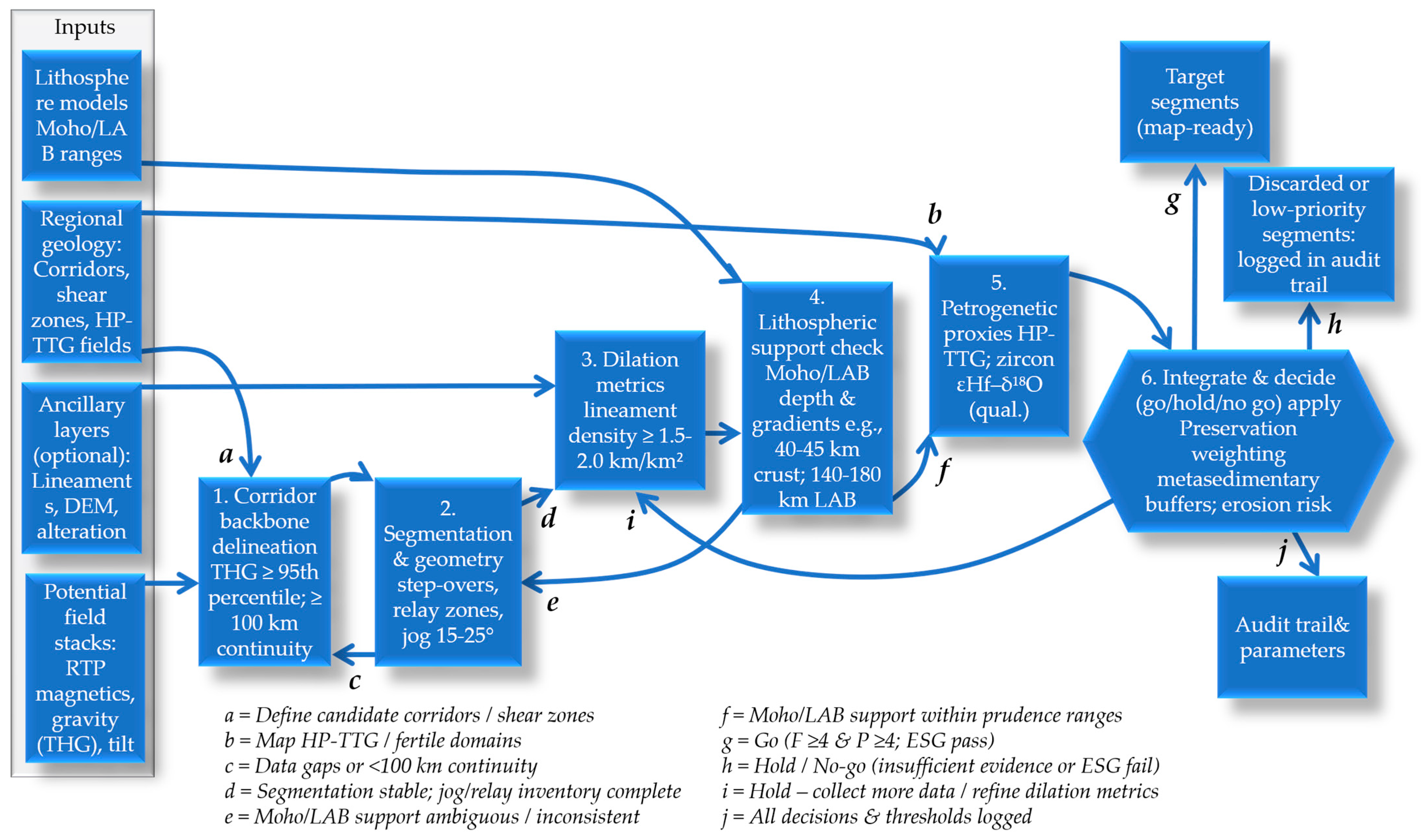
Figure 4 summarizes the six-step, map-first workflow used in this study—from inputs through steps 1–5 to the integrated go/hold/no-go decision in step 6—separating Fertility inference (steps 1–5) from Preservation weighting (step 6) and yielding map-ready target segments with a complete audit trail.
In Figure 4, all branches with multiple outgoing arrows are governed by explicit decision rules. Regional structural compilations feed both Step 1 (Corridor backbone delineation) and Step 5 (Petrogenetic proxies) where HP-TTG fields and zircon datasets are already available. After Step 2 (Segmentation and geometry), segments that fail the default dilation criteria (fewer than two “hits” among lineament density, jog angle, and relay length, or inconsistent mapping of jogs/relays) loop back to Step 1 for backbone revision, whereas segments that satisfy ≥ 2 dilation indicators proceed to Step 3 (Dilation metrics, lineament density ≥ 1.5–2.0 km km−2). In Step 4 (Lithospheric support check), segments for which crust/LAB contrasts are incompatible with the mapped backbone are sent back to Step 2 for segmentation refinement; segments that pass the Moho/LAB support test advance to Step 5. Step 6 (Integrate and decide) combines Fertility (F) and Preservation (P) scores using the default decision rule in Section 4.3.1: segments with F ≥ 4 and P ≥ 4 and that pass the ESG/Permitting Gate follow the “Go” path to Target segments; segments with F ≥ 4 but P ≤ 3 or borderline evidence follow the Hold/Re-scope path and are logged as lower-priority; segments with F ≤ 3 or that fail ESG/Permitting follow the No-go path and are discarded or parked; and “Collect more data” decisions loop back to Step 3 to reflect additional mapping, geophysics or geochemistry before re-scoring.
  • Step 1—Delineate first-order corridors (go if ≥1 hit). Map THG ≥ 95th percentile ridges continuous for ≥100 km and quantify distance buffers (±15 km). The ≥95th-percentile, ±15 km buffer, and ≥100 km continuity values are placeholders to standardize auditing across maps. They must be calibrated with the protocol described in Section 2.7 (ROC/PR, OR vs. CSR) before being treated as performance-backed cut-offs. Until then, use them strictly as triage heuristics and report decisions with their associated uncertainty. Example: Ashanti backbone meets both criteria; parts of Sefwi fall below continuity thresholds [4,9,11].
  • Step 2—Extract second-order dilation metrics (go if ≥2 hits). Compute lineament density, jog angle, and relay length from RTP/tilt stacks; flag cells with ≥1.5–2.0 km km−2, 15–25°, 2–8 km. The 1.5–2.0 km km−2, 15–25°, and 2–8 km ranges are non-calibrated default bands drawn from prior case studies and are intended only to make the workflow auditable. Their eventual operational values should be selected using Section 2.7 (threshold optimization on training belts, locked, and then reported on blind belts), with sensitivity to grid size and filter set. Ashanti commonly passes; Sefwi passes sporadically [10,13,31].
  • Step 3—Verify crust/LAB support (go if ≥1 hit). Intersect corridors with thickness contrasts: 40–45 km crust and 140–180 km LAB adjacent to cores. Robust segments in Ghana–Burkina Faso meet this; margin segments in Senegal–Mali are thinner and require caution [4,7,8,56,57].
  • Step 4—Screen petrogenetic proxies (go if ≥1 hit). Compile granitoid Sr/Y-La/Yb-Eu/Eu* and zircon εHf-δ18O. Segments adjoining high-pressure TTG and juvenile zircon fields advance; recycled-signature segments are downgraded [15,16,17,18,19,21,58].
  • Step 5—Evaluate fluid–rock and redox context (go if ≥2 hits). Confirm preserved metasedimentary buffers (carbonaceous/Fe-rich units), broad halos (≥500–1000 m), and crack-seal/fault-valve textures near dilation sites. Ashanti commonly meets all; Sefwi tends to show ≤200–400 m halos with localized high-grade shoots [3,13,39,40,41,53,54].
  • Step 6—Integrate and decide (go if total ≥ 4 criteria across Steps 1–5). Sum hits across the checklist; segments with ≥4 proceed to detailed targeting (orientation analyses, prospect-scale mapping) (see Supplementary Table S1). Segments with <4 criteria are classified as hold (deferred or dropped pending low-cost confirmation). As for the other numeric thresholds in this paper, the “≥4 criteria” cut-off is a non-calibrated default used here only to standardize auditing and reporting; its eventual operational value must be optimized using the protocol in Section 2.7 before being treated as a performance-backed decision rule. Apply Preservation weighting where late reactivation or denudation is evident [4,11].
Applied to WAC belts, the framework rates Ashanti as Fertile–Preserved and Sefwi as Fertile–At Risk/Medium, consistent with their contrasting corridor robustness, dilation metrics, alteration-halo breadths, and Preservation scores.
  • Ashanti (southern Ghana): F = 5 (THG backbone, high dilation metrics, HP-TTG, juvenile isotopes, arc affinity); P = 4–5 (broad halos, preserved buffers, camp clustering) → Fertile-Preserved [4,13,41].
  • Sefwi (western Ghana): F = 3–4 (corridor present but lower jog angles/lineament density; mixed petrogenetic signals); P = 2–3 (narrow halos, stronger segmentation) → Fertile–At Risk or Medium depending on local metrics [10,13,31].
This framework separates where the system had the capacity to form large orogenic gold systems (Fertility) from where that endowment is likely to be preserved (Preservation), grounding decisions in quantitative thresholds and reproducible workflows applicable across the WAC [4,5,11].

4.3.3. Operational Impact for Mining: Exploration Decision Support

  • Rationale and scope
This subsection summarizes, in operational terms, how the auditable, map-first Fertility–Preservation checklist and the ESG/Permitting Gate can support exploration decisions at program scale. The intent is not to claim realized performance gains in terms of discovery rates, CO2e, land disturbance or capital efficiency. Rather, the aim is to show how a transparent, auditable rule set can help move from scientific screening to decisions that are material at the level of a multi-year exploration program.
  • Decision rule and sequencing
At the scale of a program, structural corridor segments are first evaluated against the Fertility–Preservation checklist using only pre-drill, map-based information. Segments that meet or exceed the default checklist threshold (Section 4.3.2) are flagged as “geologically preferred”, while segments that fall below the threshold are placed on “hold” pending new information or model revision. In parallel, each segment is screened against basic Permitting and ESG constraints (e.g., protected areas, exclusion zones, major social constraints). Only segments that are both geologically preferred and pass ESG/Permitting are considered eligible for scout drilling. Drilling is sequenced exclusively on this intersection set (go ∩ ESG-pass), whereas segments that fail either geological or ESG criteria are not advanced without explicit, documented override.
  • Qualitative program-scale implications
Although this paper deliberately defers any quantitative evaluation of performance, the structure of the workflow has clear qualitative implications. By concentrating drilling on segments that simultaneously (i) satisfy a multi-criterion Fertility–Preservation checklist and (ii) are already compatible with Permitting constraints, the decision logic encourages the following:
  • A more focused scout-drilling program (fewer low-prospectivity segments advanced simply because they are logistically easy);
  • Atendency towards a smaller surface footprint than for a naïve grid- or traverse-based drilling strategy with similar budgets; and
  • A more explicit linkage between geological arguments and ESG/Permitting considerations.
These qualitative tendencies follow directly from the decision rule: segments that are weakly supported geologically and/or hard to permit to remain on hold unless a documented decision is made to override the default rules.
  • Environmental and capital expenditure (CAPEX) considerations (qualitative only)
In practice, exploration teams often track per-platform unit factors (land disturbed, diesel consumption, CO2e, water use, and all-in scout-drilling cost) for internal planning purposes. The present framework can be linked to such program-management metrics, but only in a qualitative, prospective way at this stage. The checklist and ESG Gate do not guarantee any specific percentage reduction in platforms, emissions, water use or CAPEX. Instead, they provide an auditable mechanism to perform the following:
  • Identify where drilling is most justifiable per unit of disturbance and investment; and
  • Make explicit, recorded trade-offs when programs choose to drill segments that underperform on Fertility–Preservation or ESG criteria (for example, to test a new concept or secure tenure).
Any future quantification of environmental or financial impacts (e.g., changes in platforms deployed, tons CO2e, or dollars spent per kilometer of Go drilling) requires implementation of the deferred evaluation protocol on independent data and lies beyond the scope of this scoping review.
  • Implementation guidance:
To make the decision process reproducible and auditable in practice, we recommend that exploration teams:
  • Preserve the checklist threshold and criteria as written at the time of program design and document any subsequent changes;
  • Maintain a machine-readable audit log of all scoring decisions, including which segments were advanced, held, or rejected at each step of the workflow;
  • Record, for each drill-tested segment, whether it belonged to the go ∩ ESG-pass set or required an explicit override; and
  • Keep exploration cost and disturbance metrics (e.g., platforms deployed, meters drilled, internal CO2e estimates where available) separate from the scientific checklist until a blinded, out-of-sample evaluation is performed.
This separation helps to avoid conflating exploratory checking of the framework with claims of proven performance.
  • Conclusion
The combined Fertility–Preservation checklist and ESG/Permitting Gate thus act as an auditable decision-support layer between geological synthesis and operational planning. At this stage, they yield structured, traceable exploration decisions but do not constitute a validated forecasting tool. Quantitative impacts on discovery efficiency, surface footprint, CO2e or CAPEX can only be assessed once the deferred evaluation protocol has been executed on independent datasets and are intentionally left outside the scope of this scoping review.

4.4. Gaps and Future Research Directions

We prioritize three discriminant tests that can falsify or reinforce the tectonic–metallogenic model and convert qualitative patterns into auditable predictions at WAC scale.

4.4.1. Joint RF-Gravity–Magnetics Inversions

  • Objective: Resolve whether first-order shear corridors are systematically rooted on crust/LAB steps or only coincide with them.
  • Approach: Conduct joint inversions integrating receiver functions (Moho), surface-wave tomography (LAB), and potential fields (Bouguer + total horizontal gradient, magnetic RTP/tilt) to co-estimate density/velocity contrasts and their uncertainties. This extends existing craton-scale models to corridor-resolving grids (≤10 km), with standardized processing logs (filters, upward continuation, reduction-to-pole).
  • Sampling plan (WAC): Three transects per shield: (i) southern Leo–Man across Ashanti and Sefwi; (ii) Kedougou-Kéniéba (Mako belt) into the craton margin; and (iii) western Reguibat margin.
  • Key outputs: Probability maps that the THG ≥ 95th-percentile ridges coincide with Moho/LAB gradients exceeding set thresholds; effect sizes linking thickness contrasts to corridor straightness/segmentation.
  • Rationale and anchors: Prior continent-scale architectures and tomographic constraints [4,5,6,7,8,9,59].

4.4.2. Coupled Zircon εHf-δ18O Transects: Juvenile vs. Recycled Sources

  • Objective. Test whether corridor segments flagged as “fertile” by structural–geophysical criteria also record juvenile mantle addition (positive εHf(t), mantle-like δ18O) vs. segments dominated by crustal recycling.
  • Approach: Acquire detrital and magmatic zircon from granitoids and volcano sedimentary units along and across corridors; analyze εHf(t) and δ18O on the same grains, propagate 2σ uncertainties, and compare with TTG Sr/Y-La/Yb-Eu/Eu* proxies.
  • Sampling plan (WAC): Paired corridors and off-corridor controls in Ashanti, Sefwi, Mako, and Baoulé-Mossi interiors; ≥50–100 zircon spots per site to stabilize kernel estimates.
  • Key outputs. Spatial covariation of εHf-δ18O classes with alteration-halo breadth and camp density; odds ratios quantifying predictive gain beyond structure alone.
  • Rationale and anchors. Global and Birimian applications of Hf-O to crustal growth and magma sources [17,18,21,55,60].

4.4.3. Paleostress and Dilation Geometry Calibration

  • Objective: Discriminate between through-going strike-slip vs. segmented step-over kinematics and quantify the fault-valve/crack-seal cycle that links second-order dilation to ore shoots.
  • Approach: Compile oriented vein/cleavage/σ1-σ3 indicators, jog angles, relay lengths, and vein-swarm statistics; integrate microstructural evidence for crack-seal and episodic overpressure with mapped magnetic lineaments and THG ridges.
  • Sampling plan (WAC): High-resolution structural datasets in Ashanti (broad halos, dense jogs) and Sefwi (narrow halos, fewer jogs), plus targeted districts in Mako where dilation loci are well expressed.
  • Key outputs: Calibrated ranges for jog angle (15–25° fertile vs. 5–15° less fertile) and relay length (2–8 km vs. ≤3–5 km) tied to vein intensity, alteration width, and deposit continuity.
  • Rationale and anchors: Belt-scale kinematics and orogenic gold mechanics [13,28,29,30,31,39,40].

4.5. Limitations and Outlook

This protocol intentionally reports no discovery-forecast performance. All thresholds are placeholders and may shift after calibration on like-for-like training and blind test sets. Potential biases include survey edge effects, corridor extraction choices, and LAB/Moho depth uncertainties. The accompanying validation roadmap specifies null models, effect-size metrics, and threshold optimization to quantify robustness and prevent over-fitting before any operational use.

5. Conclusions

We recast WAC orogenic gold targeting as an auditable, map-driven protocol that connects lithospheric segmentation, corridor backbone strength, and second-order dilation to practical go/hold decisions. By separating Fertility from Preservation and by pre-committing to blind, effect-size-based validation, the framework is immediately adoptable while remaining quantitatively testable in subsequent data-driven studies (Box 1).
This study links craton- to belt-scale architecture with district-scale ore controls through a three-level hierarchy: (i) first-order corridors rooted in crust/LAB segmentation and expressed by steep gravity-gradient ridges, (ii) second-order dilation structures (jogs, relays, step-overs) that modulate transient permeability and fluid flux, and (iii) geochemical–petrological conditions (TTG pressure proxies; zircon εHf-δ18O; arc-affinity HFSE/LILE) that govern fluid budgets and trap efficiency. The spatial correspondence among these levels yields map-testable predictions for deposit clustering and alteration-halo breadth and is operationalized in the reproducible checklist of thresholds summarized in Table 2 (see Supplementary Table S3 for the spreadsheet version).
Box 1. Placeholder thresholds and what changes after calibration.
 Status in this paper. Numerical thresholds (e.g., ≥95th-percentile THG, jog angles, minimum corridor continuity) are explicit placeholders chosen for transparency and auditability; they were not optimized.
 After calibration (future work). Thresholds will be tuned using a strict train/validation/test split with spatial blocking. Operating points will be selected by (i) Youden’s J, (ii) cost-sensitive utility, and (iii) prevalence-aware criteria.
 Why placeholders now. To publish a traceable, map-first protocol, others can implement and audit before any optimization, minimizing overfitting and post hoc thresholding.
 What remains constant. Data lineage, feature definitions, mask handling, and the audit-log schema.
Temporally, the data define a short, pulsed Paleoproterozoic trajectory: juvenile crustal addition and arc/back-arc development (ca. 2.30–2.20 Ga), crustal thickening and transpression (ca. 2.20–2.05 Ga), peak transcurrent partitioning with dilation-controlled veining (ca. 2.05–1.98 Ga), and thermal relaxation with localized reactivation (ca. 1.98–1.90 Ga). This staging constrains when corridors formed, how they localized strain, and why certain segments accumulated broader halos and more continuous ore shoots.
A central outcome is the explicit separation of Fertility (capacity to generate and focus auriferous fluids and efficient traps) from Preservation (likelihood of retention against reworking and denudation). Fertility rises with THG-defined backbone strength, dilation metrics, and juvenile/HP-TTG signatures; Preservation improves where late segmentation is limited and redox buffers (carbonaceous/Fe-rich metasediments) remain in place. The resulting, auditable scoring clarifies why Ashanti-style architectures exhibit wider halos and stronger camp clustering than more segmented belts and how Preservation bias can mute otherwise fertile segments.
Practically, the framework enables go/no-go decisions at WAC and belt scales: target corridor segments that meet ≥4 checklist criteria, focusing prospect-scale work where THG backbones, high lineament density, and favorable petrogenetic/isotopic fingerprints coincide. Where Preservation metrics lag, we prioritize tests of erosional level, late reactivation, and redox buffering before committing to intensive drilling.
Finally, we highlight three priority tests to strengthen or falsify the model without re-developing them here: (1) joint RF–gravity–magnetics inversions to confirm corridor rooting on crust/LAB steps, (2) coupled zircon εHf-δ18O transects to resolve juvenile vs. recycled sources along corridors, and (3) paleostress–dilation calibration tying jog/relay geometry to crack-seal/fault-valve cycles and halo widths. Together with the thresholds in Table 1, these tests provide a clear path to independent replication and incremental refinement of the tectonic–metallogenic model presented here.

Supplementary Materials

The following supporting information can be downloaded at: https://www.mdpi.com/article/10.3390/min15121282/s1, Table S1. Orogenic Gold Targeting Checklist; Table S2. Indicator decision matrix; Table S3. Decision Checklist; Table S4. Risk analysis; Table S5. Toy Belt Segment—Checklist Pass-Fail and Scores; Table S6. PRISMA-ScR checklist for this scoping review; Table S7. Corpus of 32 peer-reviewed studies included in the PRISMA-ScR scoping review; Table S8. dataset id, version or DOI; Table S9. Example machine-readable audit log.csv.

Author Contributions

Conceptualization, I.D., C.I.F. and B.S.; Methodology, I.D., C.I.F. and B.S.; Data Curation, I.D.; Writing—Original Draft Preparation, I.D., C.I.F. and B.S.; Writing—Review and Editing, I.D., C.I.F., B.S., M.G. and T.F.; Supervision, I.D.; Validation, M.G. and T.F. All authors have read and agreed to the published version of the manuscript.

Funding

This research received no external funding.

Data Availability Statement

No new data were created or analyzed in this study. All materials necessary to audit and reproduce the review process are provided in the Supplementary Information: (i) the targeting checklist (Table S1), (ii) the indicator decision matrix (Table S2), (iii) the decision checklist (Table S3), (iv) the risk analysis sheet (Table S4), and (v) the pass/fail scoring example for the toy belt segment (Table S5). All third-party sources used in this scoping review are cited within the manuscript. Any additional audit sheets, blank templates, and protocol notes are included as Supplementary Files. Further clarifications can be obtained from the corresponding author upon reasonable request.

Conflicts of Interest

As the corresponding author, I declare on behalf of all co-authors that there are no conflicts of interest related to the publication of this manuscript. All authors have contributed to the work, approved the final version, and have no financial, personal, or professional relationships that could be construed to influence the content of the article.

Abbreviations

The following abbreviations are used in this manuscript:
AUCArea Under the ROC Curve
AUPRCArea Under the Precision–Recall Curve
CSRComplete Spatial Randomness
LABLithosphere–Asthenosphere Boundary
MPCMafic Proto-Crust
RFReceiver Functions
RTPReduction-to-the-Pole
THGTotal Horizontal Gravity Gradient
WACWest African Craton

Appendix A

Reproducible Mini-Demonstration of the Targeting Checklist (Toy Belt Segment)

  • Objective
This appendix provides a didactic, uncalibrated illustration of the scoring pipeline. It is not a model evaluation and should not be used to infer predictive performance. The objective is to demonstrate, on a compact toy dataset representing one orogenic belt segment, how to apply the targeting checklist and produce (i) a pass/fail table per criterion, (ii) a simple composite score, and (iii) a ROC curve showing ranking capability. This is a proof-of-usefulness demonstration (not a calibration exercise).
2.
Data and Test Area
  • Sites: 12 synthetic locations (S01–S12) along a stylized belt segment.
  • Ground-truth: Known occurrence/prospect (1) vs. unknown/negative (0).
  • Variables (typical for orogenic gold):
    THG_percentile (0–100) as a proxy for tectono-hydrothermal intensity;
    Lineament density (km/km2);
    Jog angle (degrees; compressional/transpressional “sweet spot”);
    Distance to TTG/tonalite contact (km);
    Sr/Y (Fertility proxy).
* Source: synthetic (“toy”) data for method illustration. No claim about real-world thresholds.
3.
Method (Checklist → Score)
  • Pass/fail rules (default placeholders; replace during real calibration):
    THG_percentile ≥ 95 → Pass
    Lineament density ≥ 1.8 km/km2 → Pass
    Jog angle 15–25° → Pass
    Distance to TTG ≤ 5 km → Pass
    Sr/Y ≥ 30 → Pass
  • Composite score: Unweighted sum of passes (0–5), normalized to [0, 1] for ranking.
  • Evaluation (toy): Compute the ROC curve (TPR vs. FPR) using the normalized score against the ground-truth labels.
  • Good practice (real use): Sensitivity checks, ablations, and district-specific threshold calibration.
4.
Interpretation
  • Even with default, uncalibrated thresholds, the checklist partly separates positives from negatives (toy AUC > 0.5).
  • The composite score provides a practical ranking for follow-up.
  • Compensation among criteria (e.g., excellent proximity to TTG vs. sub-optimal jog angle) motivates ablation tests and interaction checks during calibration.
5.
Reproducibility
  • What to include: See Supplementary Tables.
  • Minimal workflow (for a real belt segment): Populate the table with public layers (lineaments, lithological contacts, Sr/Y or proxies), apply default or district-specific thresholds, compare against known occurrences, then compute ROC/PR and run small sensitivity analyses (±10–20% on thresholds).
6.
Limitations and Intended Use
  • This is a demonstration, not a claim of calibrated discovery probability.
  • Thresholds are initial values and must be calibrated by district.
  • Performance (AUC) is a ranking utility, not a discovery forecast.
  • Main text should discuss uncertainties (e.g., Moho/LAB geometry, lineament quality, grid resolution) and provide a source-audit grid.

References

  1. Celli, N.L.; Lebedev, S.; Schaeffer, A.J.; Gaina, C. African cratonic lithosphere carved by mantle plumes. Nat. Commun. 2020, 11, 92. [Google Scholar] [CrossRef]
  2. Bessoles, B. Géologie de l’Afrique. Vol 1: Le Craton Ouest Africain. Bureau de Recherches Géologiques et Minières. Mémoire 1977, 88, 402. [Google Scholar]
  3. Milési, J.P.; Ledru, P.; Feybesse, J.L.; Dommanget, A.; Marcoux, E. Early Proterozoic ore deposits and tectonics of the Birimian orogenic belt, West Africa. Precambrian Res. 1992, 58, 305–344. [Google Scholar] [CrossRef]
  4. Jessell, M.W.; Begg, G.C.; Miller, M.S. The geophysical signatures of the West African Craton. Precambrian Res. 2016, 274, 3–24. [Google Scholar] [CrossRef]
  5. Le Pape, F.; Jones, A.G.; Jessell, M.W.; Hogg, C.; Siebenaller, L.; Perrouty, S.; Touré, A.; Ouiya, P.; Boren, G. The nature of the southern West African craton lithosphere inferred from its electrical resistivity. Precambrian Res. 2021, 358, 106190. [Google Scholar] [CrossRef]
  6. Begg, G.C.; Griffin, W.L.; Natapov, L.M.; O’Reilly, S.Y.; Grand, S.P.; Ryan, C.G.; Hronsky, J.M.A. The Lithospheric Architecture of Africa: Seismic Tomography, Mantle Petrology, and Tectonic Evolution. Geosphere 2009, 5, 23–50. [Google Scholar] [CrossRef]
  7. Fishwick, S.; Bastow, I.D. Towards a better understanding of African topography: A review of passive-source seismic studies of the African crust and upper mantle. Geol. Soc. Lond. Spec. Publ. 2011, 357, 343–371. [Google Scholar] [CrossRef]
  8. Schaeffer, A.J.; Lebedev, S. Global shear speed structure of the upper mantle and transition zone. Geophys. J. Int. 2013, 194, 417–449. [Google Scholar] [CrossRef]
  9. Pasyanos, M.E.; Masters, T.G.; Laske, G.; Ma, Z. LITHO1.0: An updated crust and lithospheric model of the Earth. J. Geophys. Res. Solid Earth 2014, 119, 2153–2173. [Google Scholar] [CrossRef]
  10. Lesur, V.; Hamoudi, M.; Choi, Y.; Dyment, J.; Thébault, E. Building the second version of the world digital magnetic anomaly map (WDMAM). Earth Planets Space 2016, 68, 27. [Google Scholar] [CrossRef]
  11. Goldfarb, R.J.; André-Mayer, A.S.; Jowitt, S.M.; Mudd, G.M. West Africa: The world’s premier Paleoproterozoic gold province. Econ. Geol. 2017, 112, 123–143. [Google Scholar] [CrossRef]
  12. Haas, P.; Ebbing, J.; Celli, N.L.; Rey, P.F. Two-step gravity inversion reveals variable architecture of African cratons. Front. Earth Sci. 2021, 9, 696674. [Google Scholar] [CrossRef]
  13. Perrouty, S.; Aillères, L.; Jessell, M.W.; Baratoux, L.; Bourassa, Y.; Crawford, B. Revised Eburnean geodynamic evolution of the gold-rich southern Ashanti Belt, Ghana, with new field and geophysical evidence of pre-Tarkwaian deformations. Precambrian Res. 2012, 204, 12–39. [Google Scholar] [CrossRef]
  14. van Herwaarden, D.-P.; Thrastarson, S.; Hapla, V.; Afanasiev, M.; Trampert, J.; Fichtner, A. Full-waveform tomography of the African Plate using dynamic mini-batches. J. Geophys. Res. Solid Earth 2023, 128, e2022JB026023. [Google Scholar] [CrossRef]
  15. Martin, H. The Archean grey gneisses and the genesis of continental crust. In Developments in Precambrian Geology; Elsevier: Amsterdam, The Netherlands, 1994; Volume 11, pp. 205–259. [Google Scholar]
  16. Foley, S.; Tiepolo, M.; Vannucci, R. Growth of early continental crust controlled by melting of amphibolite in subduction zones. Nature 2002, 417, 837–840. [Google Scholar] [CrossRef]
  17. Doumbia, S.; Pouclet, A.; Kouamelan, A.; Peucat, J.J.; Vidal, M.; Delor, C. Petrogenesis of juvenile-type Birimian (Paleoproterozoic) granitoids in Central Côte-d’Ivoire, West Africa: Geochemistry and geochronology. Precambrian Res. 1998, 87, 33–63. [Google Scholar] [CrossRef]
  18. Roberts, N.M.W.; Spencer, C.J. The zircon archive of continent formation through time. In Continent Formation Through Time; Roberts, N.M.W., van Kranendonk, M.J., Parman, S.W., Shirey, S.B., Clift, P.D., Eds.; Geological Society, London, Special Publications: London, UK, 2015; Volume 389, pp. 197–225. [Google Scholar]
  19. Payne, J.L.; McInerney, D.J.; Barovich, K.M.; Kirkland, C.L.; Pearson, N.J.; Hand, M. Strengths and limitations of zircon Lu-Hf and O isotopes in modelling crustal growth. Lithos 2016, 248–251, 175–192. [Google Scholar] [CrossRef]
  20. Parra-Avila, L.A.; Belousova, E.; Fiorentini, M.L.; Eglinger, A.; Block, S.; Miller, J. Zircon Hf and O-isotope constraints on the evolution of the Paleoproterozoic Baoulé-Mossi domain of the southern West African Craton. Precambrian Res. 2018, 306, 174–188. [Google Scholar] [CrossRef]
  21. Baratoux, L.; Metelka, V.; Naba, S.; Jessell, M.W.; Grégoire, M.; Ganne, J. Juvenile Paleoproterozoic crust evolution during the Eburnean orogeny (~2.2–2.0 Ga), western Burkina Faso. Precambrian Res. 2011, 191, 18–45. [Google Scholar] [CrossRef]
  22. Abouchami, W.; Boher, M.; Michard, A.; Albarede, F. A Major 2.1 Ga Event of Mafic Magmatism in West Africa: An Early Stage of Crustal Accretion. J. Geophys. Res. 1990, 95, 17605–17629. [Google Scholar] [CrossRef]
  23. Boher, M.; Abouchami, W.; Michard, A.; Albarede, F.; Arndt, N.T. Crustal Growth in West Africa at 2.1 Ga. J. Geophys. Res. 1992, 97, 345–369. [Google Scholar] [CrossRef]
  24. Hirdes, W.; Davis, D.W. U-Pb geochronology of Paleoproterozoic rocks in the southern part of the Kedougou-Kenieba Inlier, Senegal, West Africa: Evidence for diachronous accretionary development of the Eburnean province. Precambrian Res. 2002, 118, 83–99. [Google Scholar] [CrossRef]
  25. Grenholm, M. The global tectonic context of the ca. 2.27–1.96 Ga Birimian Orogen-Insights from comparative studies, with implications for supercontinent cycles. Earth-Sci. Rev. 2019, 193, 260–298. [Google Scholar] [CrossRef]
  26. Parra-Avila, L.A.; Kemp, A.I.; Fiorentini, M.L.; Belousova, E.; Baratoux, L.; Block, S.; Jessell, M.; Bruguier, O.; Begg, G.C.; Miller, J.; et al. The geochronological evolution of the Paleoproterozoic Baoulé-Mossi domain of the southern West African Craton. Precambrian Res. 2017, 300, 1–27. [Google Scholar] [CrossRef]
  27. Parra-Avila, L.A.; Baratoux, L.; Eglinger, A.; Fiorentini, M.L.; Block, S. The Eburnean magmatic evolution across the Baoulé-Mossi domain: Geodynamic implications for the West African Craton. Precambrian Res. 2019, 332, 105392. [Google Scholar] [CrossRef]
  28. Ledru, P.; Pons, J.; Milési, J.P.; Feybesse, J.L.; Johan, V. Transcurrent tectonics and polycyclic evolution in the Lower Proterozoic of Senegal-Mali. Precambrian Res. 1991, 50, 337–354. [Google Scholar] [CrossRef]
  29. Hein, K.A. Succession of structural events in the Goren greenstone belt (Burkina Faso): Implications for West African tectonics. J. Afr. Earth Sci. 2010, 56, 83–94. [Google Scholar] [CrossRef]
  30. Lompo, M. Paleoproterozoic structural evolution of the Man-Leo Shield (West Africa). Key structures for vertical to transcurrent tectonics. J. Afr. Earth Sci. 2010, 58, 19–36. [Google Scholar] [CrossRef]
  31. Tunks, A.J.; Selley, D.; Rogers, J.R.; Brabham, G. Vein mineralization at the Damang Gold Mine, Ghana: Controls on mineralization. J. Struct. Geol. 2004, 26, 1257–1273. [Google Scholar] [CrossRef]
  32. Finger, N.-P.; Kaban, M.K.; Tesauro, M.; Mooney, W.D.; Thomas, M. A thermo-compositional model of the African cratonic lithosphere. Geochem. Geophys. Geosyst. 2022, 23, e2021GC010296. [Google Scholar] [CrossRef]
  33. Olugboji, T.; Xue, S.; Legre, J.-J.; Tamama, Y. Africa’s crustal architecture inferred from probabilistic and perturbational inversion of ambient noise: ADAMA. Geochem. Geophys. Geosyst. 2024, 25, e2023GC011086. [Google Scholar] [CrossRef]
  34. Fosso Téguia Moussé, E.E.; Ebbing, J.; Haas, P.; Szwillus, W. Integrated geophysical-petrological 3D-modeling of the West and Central African Rift System and its adjoining areas. J. Geophys. Res. Solid Earth 2024, 129, e2024JB029226. [Google Scholar] [CrossRef]
  35. Jessell, M.; Liégeois, J.-P. 100 years of research on the West African Craton. J. Afr. Earth Sci. 2015, 112 Pt B, 377–381. [Google Scholar] [CrossRef]
  36. Markwitz, V.; Hein, K.A.A.; Jessell, M.W.; Miller, J. Metallogenic portfolio of the West Africa craton. Ore Geol. Rev. 2016, 78, 558–563. [Google Scholar] [CrossRef]
  37. Grenholm, M.; Jessell, M.; Thébaud, N. A geodynamic model for the Paleoproterozoic (ca. 2.27–1.96 Ga) Birimian Orogen of the southern West African Craton-Insights into an evolving accretionary-collisional orogenic system. Earth-Sci. Rev. 2019, 192, 138–193. [Google Scholar] [CrossRef]
  38. Chardon, D.; Berger, J.; Martellozzo, F. Archean craton assembly and Paleoproterozoic accretion-collision tectonics in the Reguibat Shield, West African Craton. Precambrian Res. 2024, 413, 107570. [Google Scholar] [CrossRef]
  39. Bons, P.D.; Elburg, M.A.; Gomez-Rivas, E. A review of the formation of tectonic veins and their microstructures. J. Struct. Geol. 2012, 43, 33–62. [Google Scholar] [CrossRef]
  40. Cox, S.F. Injection-driven swarm seismicity and permeability enhancement: Implications for the dynamics of hydrothermal ore systems in high fluid-flux, overpressured faulting regimes-An invited paper. Econ. Geol. 2016, 111, 559–587. [Google Scholar] [CrossRef]
  41. Béziat, D.; Dubois, M.; Debat, P.; Nikiéma, S.; Salvi, S.; Tollon, F. Gold metallogeny in the birimian craton of Burkina Faso (West Africa). J. Afr. Earth Sci. 2008, 50, 215–233. [Google Scholar] [CrossRef]
  42. Dao, R.A.I.; Ilboudo, H.; Baratoux, D. Structural controls of the expansion of small-scale artisanal gold of Bouda area (Kaya-Goren Green Belt, Burkina Faso) from remote sensing. Earth Space Sci. 2024, 11, e2023EA003217. [Google Scholar]
  43. Guéye, M.; van den Kerkhof, A.M.; Hein, U.F.; Diène, M.; Muecke, A.; Siegesmund, S. Structural control, fluid inclusions and cathodoluminescence studies of Birimian gold-bearing quartz vein systems in the Paleoproterozoic Mako belt, southeastern Senegal. S. Afr. J. Geol. 2013, 116, 199–218. [Google Scholar] [CrossRef]
  44. Baranov, A.; Tenzer, R.; Eitel Kemgang Ghomsi, F. A new Moho map of the African continent from seismic, topographic, and tectonic data. Gondwana Res. 2023, 124, 218–245. [Google Scholar] [CrossRef]
  45. Groves, D.I.; Goldfarb, R.J.; Gebre-Mariam, M.; Hagemann, S.G.; Robert, F. Orogenic gold deposits: A proposed classification in the context of their crustal distribution and relationship to other gold deposit types. Ore Geol. Rev. 1998, 13, 7–27. [Google Scholar] [CrossRef]
  46. Groves, D.I.; Goldfarb, R.J.; Robert, F.; Hart, C.J. Gold deposits in metamorphic belts: Overview of current understanding, outstanding problems, future research, and exploration significance. Econ. Geol. 2003, 98, 1–29. [Google Scholar]
  47. Blichert-Toft, J.; Arndt, N.T.; Ludden, J.N. Precambrian alkaline magmatism. Lithos 1996, 37, 97–111. [Google Scholar] [CrossRef]
  48. Parra-Avila, L.A.; Belousova, E.; Fiorentini, M.L.; Baratoux, L.; Davis, J.; Miller, J.; McCuaig, T.C. Crustal evolution of the Paleoproterozoic Birimian terranes of the Baoulé-Mossi domain, southern West African Craton: U-Pb and Hf-isotope studies of detrital zircons. Precambrian Res. 2016, 274, 25–60. [Google Scholar] [CrossRef]
  49. de Wit, M.; Ashwal, L.D. Greenstone Belts; Oxford University Press: Oxford, UK, 1997; pp. 608–619. [Google Scholar]
  50. Sylvester, P.J.; Attoh, K. Lithostratigraphy and composition of 2.1 Ga greenstone belts of the West African Craton and their bearing on crustal evolution and the Archean-Proterozoic boundary. J. Geol. 1992, 100, 377–393. [Google Scholar] [CrossRef]
  51. Feybesse, J.L.; Milési, J.P. The Archaean/Proterozoic contact zone in West Africa: A mountain belt of décollement thrusting and folding on a continental margin related to 2.1 Ga convergence of Archaean cratons? Precambrian Res. 1994, 69, 199–227. [Google Scholar] [CrossRef]
  52. Tomkins, A.G. On the source of orogenic gold. Geology 2013, 41, 1255–1256. [Google Scholar] [CrossRef]
  53. Gaboury, D. Parameters for the formation of orogenic gold deposits. Appl. Earth Sci. 2019, 128, 124–133. [Google Scholar] [CrossRef]
  54. Tedla, G.E.; van der Meijde, M.; Nyblade, A.A.; van der Meer, F.D. A crustal thickness map of Africa derived from a global gravity field model using Euler deconvolution. Geophys. J. Int. 2011, 187, 1–9. [Google Scholar] [CrossRef]
  55. Villeneuve, M.; Rossignol, C. Linking the Neoproterozoic to Early Paleozoic belts bordering the West African and Amazonian cratons: Review and new hypothesis. Minerals 2024, 14, 48. [Google Scholar] [CrossRef]
  56. Sakyi, P.A.; Addae, R.A.; Su, B.X.; Dampare, S.B.; Abitty, E.; Su, B.C.; Liu, B.; Asiedu, D.K. Petrology and geochemistry of TTG and K-rich Paleoproterozoic Birimian granitoids of the West African Craton (Ghana): Petrogenesis and tectonic implications. Precambrian Res. 2020, 336, 105492. [Google Scholar] [CrossRef]
  57. Petersson, A.; Scherstén, A.; Kemp, A.I.S.; Kristinsdóttir, B.; Kalvig, P.; Anum, S. Zircon U-Pb-Hf evidence for subduction related crustal growth and reworking of Archaean crust within the Palaeoproterozoic Birimian terrane, West African Craton, SE Ghana. Precambrian Res. 2016, 275, 286–309. [Google Scholar] [CrossRef]
  58. Traoré, K.; Chardon, D.; Naba, S.; Wane, O.; Bouaré, M.L. Paleoproterozoic collision tectonics in West Africa: Insights into the geodynamics of continental growth. Precambrian Res. 2022, 376, 106692. [Google Scholar] [CrossRef]
  59. Petersson, A.; Scherstén, A.; Kristinsdóttir, B.; Kemp, A.I.S.; Whitehouse, M.J. Birimian crustal growth in the West African Craton: U-Pb, O and Lu-Hf isotope constraints from detrital zircon in major rivers. Chem. Geol. 2018, 479, 259–271. [Google Scholar] [CrossRef]
  60. Block, S.; Baratoux, L.; Zeh, A.; Laurent, O.; Bruguier, O.; Jessell, M.; Ailleres, L.; Sagna, R.; Parra-Avila, L.A.; Bosch, D. Paleoproterozoic juvenile crust formation and stabilisation in the south-eastern West African Craton (Ghana): New insights from U-Pb-Hf zircon data and geochemistry. Precambrian Res. 2016, 287, 1–30. [Google Scholar] [CrossRef]
Figure 1. PRISMA-ScR flow diagram for this scoping review. A total of 312 records were identified through database searching (peer-reviewed literature, 2010–2025) and 18 additional records through other sources (targeted cross-references and contextual survey material) for 330 records before de-duplication. After removal of duplicates, 284 records were screened at the title–abstract stage, of which 211 were excluded. Seventy-three full-text articles were assessed for eligibility; forty-one were excluded because they were qualitative only, had a spatial footprint < 100 km with no demonstrable corridor continuity, or did not link metallogenic interpretations to tectonic/lithospheric architecture. The remaining 32 studies met all inclusion criteria and form the evidentiary base for the Fertility vs. Preservation checklist.
Minerals 15 01282 g001
Figure 2. Craton-scale structural framework of the West African Craton (WAC) and spatial distribution of selected orogenic gold deposits. Archean, Paleoproterozoic (Birimian), Pan-African, and Phanerozoic domains are shown after [35] and regional geological mapping. The modern WAC margin and major domain boundaries are adapted from [12] and the same geological compilations. First-order corridors were digitized where long-wavelength gravity gradients and crust–lithosphere contrasts [12], and related LAB/Moho models coincide with coherent families of Birimian lineaments from structural and aeromagnetic interpretations [4] and with trains of orogenic gold deposits [36]. Second-order structures correspond to releasing bends, relays, and step-overs within these corridors, mapped from the geometry of clustered Birimian lineaments and magnetic fabrics. Selected major orogenic gold deposits compiled mainly from [36] and national survey datasets, illustrating the clustering of deposits along first- and second-order structures. Key units discussed in the text, including the Leo–Man Shield, Baoulé-Mossi domain, Kédougou-Kéniéba Inlier, Ashanti Belt, and Sefwi Belt, are labeled [2,4,5,11,25]. Dotted lines = country boundaries.
Minerals 15 01282 g002
Figure 3. Schematic 3D lithospheric architecture across an Archean–Paleoproterozoic interface in the southern West African Craton (WAC). Block diagram showing an Archean crustal block with a thick cratonic lithospheric root (Moho depths ~28–36 km; LAB depths ~160–180 km) juxtaposed against a Paleoproterozoic Birimian orogenic domain with a thickened crust (Moho depths ~40–45 km) overlying a comparatively thinner lithospheric mantle (LAB depths ~100–140 km). A first-order, transcrustal corridor (red) follows the Archean–Paleoproterozoic boundary and is aligned with a THG gravity-gradient high (blue halo) and a fabric of RTP magnetic lineaments parallel to the corridor. Within the Paleoproterozoic crust, second-order dilational structures (bends, relays, step-overs) form a network of 2nd-order corridors that localize camp-scale mineral systems. Fluids (red arrows) are schematically shown ascending along the corridor from the lithospheric–asthenospheric boundary. Depth ranges are indicative rather than site-specific, and the vertical scale is exaggerated.
Minerals 15 01282 g003
Figure 4. End-to-end workflow for orogenic gold targeting (six-step, go/hold/no-go protocol). Corridor segments that accumulate ≥4 criteria across Steps 1–5 are provisionally classified as Go (majority-rule default; see Section 4.3.1 and calibration plan in Section 2.7); segments with <4 criteria are classified as Hold (deferred or dropped pending low-cost confirmation). Segments that fail the ESG/Permitting Gate are classified as No-go; only Go ∩ ESG-pass segments proceed to drilling.
Minerals 15 01282 g004
Table 1. Predictive checklist (WAC and belt scales).
PredictorMetricThreshold (Pass/Fail)ScalePrimary Dataset/MethodUncertainty/NotesKey Refs.
Gravity-defined corridorsTotal horizontal gravity gradient (THG) percentile≥95th percentile (corridor cores); ridge continuity ≥ 100 kmCraton/BeltRTP Bouguer + THG (upward continuation, consistent filters)Document filters and grid spacing (≤10 km). Edge effects near survey boundaries.[4,5]
Gravity-defined corridorsDistance to corridor backboneDeposit clusters within ±15 kmBelt/DistrictTHG ridges vs. camp centroidsUse great-circle distances; report kernel bandwidths.[4]
Magnetic lineamentsLineament density (km/km2)Fertile: ≥1.5–2.0 (Ashanti-like); less fertile: ≤1.0–1.5 (Sefwi-like)Belt/DistrictRTP/tilt/analytic signal lineament stacksNormalize by map window; exclude cultural noise.[10,13]
Magnetic lineamentsPreferred azimuth dispersionCorridor-parallel fabric dominant (low circular variance)BeltRose diagrams from lineament vectorsState bin size and smoothing.[13]
Geometric dilation lociJog angle (°)Fertile: 15–25°; less fertile: 5–15°DistrictMapped jogs from magnetics + geologyMeasure at consistent scale (1:50–100 k).[4,31]
Geometric dilation lociRelay length (km)Fertile: 2–8 km; less fertile: ≤3–5 kmDistrictRelay analysis along corridorReport overlap/spacing with uncertainties.[31]
Crustal structureCrustal thickness (Moho)Corridor-adjacent: 40–45 km vs. margins: 28–36 kmCraton/BeltReceiver functions/joint inversionsMoho uncertainty ± 3–6 km (2σ); report station spacing.[7,8]
Lithospheric structureLAB depthCorridor-adjacent: 140–180 km vs. margins: 100–120 kmCraton/BeltSurface-wave tomography/joint modelsLAB uncertainty ± 10–20 km; path coverage limits.[8,9]
TTG pressure proxiesSr/Y; La/YbN; Eu/Eu*Deep melting: Sr/Y ≥ 40–60; La/YbN ≥ 20–30; Eu/Eu* ≥ 1.05–1.15BeltWhole-rock geochemistry of granitoidsUse consistent normalization; screen alteration.[15,16,17]
Isotopic fingerprintsZircon εHf(t) & δ18OJuvenile: εHf(t) > 0 and mantle-like δ18O (~5.3 ± 0.3‰); recycled: subdued εHf(t) and/or sub-/supra-mantle δ18OBeltLA-ICP-MS/MC-ICP-MS + SIMSPropagate 2σ; avoid mixed-age spot averaging.[18,19]
Greenstone affinitiesHFSE/LILE (e.g., Nb anomaly; Th/Yb-Nb/Yb)Arc-like: negative Nb anomaly, moderate Th/Yb-Nb/Yb; back-arc/plume: diminished Nb anomaly, elevated TiBeltImmobile-element diagramsUse chondrite/MORB normalization consistently.[23,47]
Alteration footprintCarbonate–sulfide–albite halo widthAshanti-like: ≥500–1000 m cumulative; Sefwi-like: ≤200–400 mDistrictField mapping + multi-sensor imagerySum stacked envelopes; note structural repeats.[3,13,41]
Hydrothermal texturesCrack-seal/fault-valve indicatorsPresence correlates with mapped dilation lociDistrictMicrostructures, vein-swarm statisticsQualitative → semi-quantitative scoring.[39,40,43]
Proximity testCamp centroid to corridor core≥70% of camps within ±15 km (target benchmark)BeltSpatial join (camp → THG core)Report sensitivity to buffer size.[4,11]
Model reproducibilityData processing transparencyGrid spacing ≤ 10 km; filters documented; versions/DOIs loggedAll ScalesProcessing audit log (supplement)Provide script and parameter file.[5]
Table 2. Decision checklist (go/hold) for first-pass orogenic gold targeting (craton → belt → segment → site).
LevelGate IDDecision GateGo (Pass) RuleStop/Revise RuleRequired Output
CratonC1Tectonic context: Birimian orogenic gold province?Region includes Birimian terranes with known transcurrent shear belts (orogenic gold model applicable).Outside Birimian provinces or deposit model mismatch (e.g., IOCG/porphyry-dominated context).1:5 M context map + short rationale memo
CratonC2Gold endowment precedent within 500 km≥1 Moz cumulative historic/modern endowment within ~500 km (or multiple operating/historic mines).No significant endowment known → proceed only if other gates are strong; treat as lower priority.Endowment overlay map (buffered radius)
CratonC3Data sufficiency baselineAt least two core datasets available at regional coverage (geology + airborne magnetics).Fewer than two core datasets → STOP and compile minimum inputs first.Data inventory table (coverage, vintage, resolution)
BeltB1Trans-lithospheric corridor (THG) presenceContinuous, linear/high-gradient corridor 10–50 km wide and ≥150 km long with coherent strike.Corridor discontinuous, short, or dominated by artifacts → REVISE/hold.Corridor map with buffers (RTP/gradients)
BeltB2Crustal architecture inheritance (Moho/LAB steps)Target corridor aligns with Moho/LAB step or deep-root anisotropy (supportive evidence).No architectural support; treat as surface-only feature (downgrade).Architecture overlay figure
BeltB3Belt-scale data qualityMagnetic line spacing ≤200 m (or best available) and geology ≤1:200k with coherent leveling/metadata.Patchy, undocumented, mixed vintages controlling targets → STOP and improve inputs.QA/QC checklist + metadata memo
SegmentS1Releasing jogs/step-oversDilational jog consistent with shear sense; 2–20 km wavelength implying opening.Purely compressional bends or ambiguous kinematics.Jog inventory map + kinematics note
SegmentS2Relay ramps and linkage zonesOverlapping shear segments with relay ramp width ~1–5 km; damage zones expected.Isolated single shear with no overlap or linkage.Relay/overlap sketch and target polygons
SegmentS3Vertical pathway continuityAligned multi-scale features from site to belt corridor (stacked lineaments, continuous lows/highs).Disconnected local lineaments without belt-scale plumbing.Pathway continuity diagram
SiteT1Historical showings/occurrencesDocumented Au-sulfide quartz-carbonate showings within ~10–20 km of segment hot spots.No occurrences and poor exposure → lower priority or HOLD.Occurrence pins + brief notes
SiteT2Intersection density (structure network)Multiple structure intersections within ~1–2 km2 (splays, R-R’ shears, subsidiary faults).Single, isolated fracture with no network connectivity.Intersection count sheet and target box
SiteT3ESG and Permitting GateNo red-flag ESG constraints for early reconnaissance work.Critical ESG red flags (communities, protected areas, heritage) → STOP until resolved.ESG gate form and constraint map
Disclaimer/Publisher’s Note: The statements, opinions and data contained in all publications are solely those of the individual author(s) and contributor(s) and not of MDPI and/or the editor(s). MDPI and/or the editor(s) disclaim responsibility for any injury to people or property resulting from any ideas, methods, instructions or products referred to in the content.