Article

Silicate Nanotubules in the Crystal Structure of K6(Na4Ca)(Y8Ca3Mn)[Si28O68(OH)2](CO3)8F2·9H2O, a Mineral Phase from the Khibiny Alkaline Massif (Kola Peninsula, Russia), and the Problem of Ashcroftine-(Y)


by
Sergey V. Krivovichev
1,2,*,
Victor N. Yakovenchuk
1,3,
Olga F. Goychuk
1,
Anatoly V. Kasatkin
4,
Yakov A. Pakhomovsky
1,3,
Atali A. Agakhanov
4 and
Alexey V. Chernyavsky
3
1
Nanomaterials Research Center, Kola Science Center, Russian Academy of Sciences, Fersmana Str. 14, 184209 Apatity, Russia
2
Department of Crystallography, Institute of Earth Sciences, St. Petersburg State University, University Emb. 7/9, 199034 St. Petersburg, Russia
3
Geological Institute, Kola Science Center, Russian Academy of Sciences, Fersmana Str. 14, 184209 Apatity, Russia
4
Fersman Mineralogical Museum, Russian Academy of Sciences, Leninskiy Pr. 18, 2, 119071 Apatity, Russia
*
Author to whom correspondence should be addressed.
Minerals 2026, 16(5), 492; https://doi.org/10.3390/min16050492
Submission received: 3 April 2026 / Revised: 5 May 2026 / Accepted: 6 May 2026 / Published: 7 May 2026

Abstract

The Lovozero and Khibiny alkaline massifs (Kola Peninsula, Russian Arctic) are the prominent sources of REE minerals, with the Lovozero loparite deposit being the only currently active REE mine in Russia. A new ashcroftine-related mineral phase KA with the idealized chemical formula K6(Na4Ca)(Y8Ca3Mn)[Si28O68(OH)2](CO3)8F2·9H2O was found in the Khibiny alkaline massif. Its empirical formula determined by electron microprobe analysis is Na4.14K6.11Ca3.89Mn0.59Y6.10Ce0.08 Gd0.32Tb0.15Dy0.78Ho0.19Er0.35Tm0.15Yb0.12Lu0.06Si28C8O93.02F2.08·9H2O. The crystal structure was determined and refined by means of single-crystal X-ray diffraction analysis. The KA phase is tetragonal, I4/mmm, a = 24.1661(3), c = 17.5914(4) Å, V = 10,273.4(3) Å3. The crystal structure contains two Y sites. The Y1 site is [8]-coordinated and hosts more heavy REEs, whereas the Y2 site is predominantly [7]-coordinated and accumulates lighter REEs and Mn. The crystal structure is based upon the [Si28X70] nanotubes (X = O,OH) elongated along the c-axis and composed of corner-sharing SiX4 tetrahedra. The external diameter of the tubules is equal to ~19.54 Å, i.e., slightly less than 2 nm. The silicate nanotubes are running parallel to the c-axis and centered along the (00z) and (½½z) directions. The tubules are linked by walls of YOn polyhedra that also involve triangular CO3 groups. The K+, Na+, and Ca2+ cations, as well as H2O molecules, are located either inside or outside the tubules. The crystal-chemical formula of the KA phase can be written as {K6.14Na4.30Ca0.81}[Y5.88Ca3.12Dy0.88Mn2+0.60Gd0.32 Ho0.24Er0.24Tb0.16Tm0.16Er0.12Yb0.12Ce0.08Lu0.08](Mn3+0.09) [Si28O68.36(OH)1.65](CO3)8F2·8.97H2O, which agrees well with the idealized formula. According to the information-based complexity analysis, the KA phase has a very complex structure and belongs to less than 3.5% of the very complex minerals known today. The presence of silicate tubules is the key reason for the exceptional structural complexity of the phase. It is impossible to establish exact relations between the KA phase and ashcroftine-(Y) on the basis of the currently available data, since the last chemical analysis of the latter mineral was done in 1924. Therefore, the mineralogical identity of ashcroftine-(Y) is currently an unresolved problem. The silicate tubule in the KA phase is topologically related to the Linde zeolite A (the LTA zeolite framework) and can be produced from the latter by a series of topological operations. The KA phase forms a homological row with caysichite-(Y) and miyawakiite-(Y), along which the Si content is increasing, and silicate chains in caysichite-(Y) transform into silicate tubules in miyawakiite-(Y) and into silicate nanotubules in the KA phase. Indeed, the M:Si:C ratio (where M = Y, REEs, Ca, Mn, Fe) changes from 1:1:0.75 for caysichite-(Y) through 0.75:1:0.5 for miyawakiite-(Y) to 0.43:1:0.29 for ashcroftine-(Y) (and KA). The increasing role of silica along the row results in the formation of zeolite-derived porous one-dimensional units. The KA phase possesses two important crystal chemical properties that distinguish it from other minerals known to date: it hosts a variety of REEs and is based upon nanoscale zeolite-like silicate units. The KA phase, ashcroftine-(Y), caysichite-(Y), and miyawakiite-(Y) have never been prepared under laboratory conditions. The mineralogical occurrence of the KA phase in the Khibiny massif points out to its secondary origin, i.e., its formation under relatively soft, low-temperature hydrothermal conditions. Thus, the discovery of the KA phase in nature may provide important hints toward its synthesis in the laboratory by means of a soft-chemistry approach.

1. Introduction

Rare earth elements (REE) are important constituents of materials needed for the fabrication of modern high-technology devices and therefore are of great industrial and geopolitical importance [1,2,3,4]. Their prominent role in today’s world determines the high demand for their natural sources, i.e., REE minerals. Among more than 400 REE minerals known and approved by the International Mineralogical Association (IMA), about half (more than 200) are silicates, which is the result of a strongly lithophile character of rare earth metal ions. Since 2021, a number of new REE silicate mineral species have been discovered and re-investigated [5,6,7,8,9,10,11,12,13,14,15,16,17,18,19,20,21,22,23,24].
Massifs of alkaline rocks are counted among the richest sources of REE minerals [25]. In the Russian Federation, the only active REE mine is associated with the Lovozero alkaline massif located above the Polar Circle in the Kola Peninsula [26]. Both Lovozero and the nearby Khibiny massifs are well-known for their rich and unique mineralogy with prominent REE mineral diversity. A number of REE silicate mineral species have been described from the Kola peninsula for the first time since 2000 [27,28,29,30,31,32]. Of special interest are REE silicate-carbonates that contain both silicate and carbonate anions present in the same structure. In general, there are only 18 such mineral species described in the literature, among which only three (caysichite-(Y) [18,33,34], miyawakiite-(Y) [17], and ashcroftine-(Y)) are chain silicates based upon one-dimensional units of corner-sharing SiO4 tetrahedra.
In the course of our systematic investigations of REE mineralogy of Kola peninsula mineral deposits [18,19], a mineral phase was discovered, which appears to be chemically and structurally very close to ashcroftine-(Y). The latter mineral was first described by Gordon [35] in 1924 as ‘kalithomsonite’ and was assigned the chemical formula KNa(Ca,Mg,Mn)[Al4Si5O18]·10H2O (the chemical analyses were done by J.E. Whitfield). The name was chosen by analogy with thomsonite (now thomsonite–Ca), NaCa2[Al5Si5O20]·6H2O, a mineral from the zeolite family known since 1820 [36]. ‘Kalithomsonite’ was found in cavities of augite-syenite at Narsarsuk, Greenland, and was initially characterized as orthorhombic. Hey and Bannister [37] re-examined the sample of the mineral deposited by Gordon at the British Museum and found out that the species has no relation to thomsonite and therefore deserves a separate name, ashcroftine, in honor of Mr. Frederick Noel Ashcroft, British mineral collector (the mineral was renamed as ashcroftine-(Y) following the Levinson nomenclature of REE minerals [38]). On the basis of chemical analyses by Gordon [35] and their own X-ray diffraction studies, Hey and Bannister [37] defined ashcroftine as tetragonal, space group P42/mnm, a = 34.04, c = 17.49 Å, with the chemical formula NaK(Ca,Mg,Mn)[Al4Si5O18]·8H2O. The status of ashcroftine-(Y) as a zeolite was not questioned until Moore et al. [39] collected a set of single-crystal X-ray diffraction data and found out that ‘…only trace quantities of aluminum were present and that the reported alumina is actually yttria with minor amounts of other rare-earth oxides. The other elements qualitatively agree with the analyses of Whitfield in Gordon, and accordingly, we accepted this analysis, but with yttria in place of alumina [39]. Following this assumption, Moore et al. [39] proposed for ashcroftine-(Y) the chemical formula KNaCa[Y(OH)2]2[Si6O12(OH)10]·4H2O and concluded that the mineral is not a zeolite. The symmetry and unit-cell parameters were redefined as tetragonal, with possible space groups I4/mmm, I4mm, I422, or I 4 ¯ m2, a = 24.044(4), c = 17.553(8) Å, Z = 16. It was suggested that ashcroftine-(Y) is related to lovozerite, Na3CaZr[Si6O15(OH)3], after which ‘…enthusiasm for the difficult structure problem at hand was lost, and further study was abandoned’ [40].
In 1987, a joint paper of U.S. and Italian groups was published that reported results of two independent crystal-structure determinations of ashcroftine-(Y) done on the Greenland samples deposited at the U.S. National Museum of Natural History and the British Museum of Natural History, respectively (both samples ‘came from the same batch collected by Gordon’) [40]. On the basis of the structural study, the crystal-chemical formula of the mineral was defined as K10Na10(Y,Ca)24(OH)4(CO3)16(Si56O140)·16H2O or K5Na5(Y,Ca)12(OH)2(CO3)8(Si28O70)·8H2O. It was rather amazing that Moore et al. [40] determined this formula on the basis of structure investigation and did not report results of any independent chemical analyses, using the 1924 analyses by Gordon [35] as basic chemical data. However, the electroneutrality of the formula requires that no Ca is present in the structure, and the current formula approved by the IMA is K5Na5Y12(OH)2(CO3)8 (Si28O70)·8H2O. However, the analyses by Gordon [35] indicated 5.72 wt.% of CaO, whereas site-occupancy refinements by Moore et al. [40] resulted in the CaO content ranging from 2.28 to 2.53 wt.%. The structure solutions were done in the space group I4/mmm, a = 23.994–24.039, c = 17.512–17.538 Å, Z = 2 for the formula K10Na10(Y,Ca)24(OH)4(CO3)16(Si56O140)·16H2O.
Later, ashcroftine-(Y) was reported from several localities worldwide, including Canada [41], Italy [42], South Africa [43], and Morocco [44]. The mineral was reported as an accessory and rare species, again with no chemical data. Therefore, it turns out that the latest and only chemical analyses provided for ashcroftine-(Y) are those given by Gordon [35] in 1924. More than one hundred years later, in 2025, we found in the Khibiny alkaline massif (Russian Arctic) a mineral phase, which seems to be closely related or probably identical to ashcroftine-(Y). However, the chemical composition determined by electron-microprobe analysis (see below) appears to be different from that reported by Gordon [35], which, however, does not mean that our mineral is, in fact, not ashcroftine-(Y). In view of this uncertainty, we provide here the results of our crystal-chemical investigation of the Kola material (hereafter denoted as KA (‘Kola ashcroftine’)) and discuss its possible structural and compositional relations to ashcroftine-(Y).

2. Materials and Methods

2.1. Materials

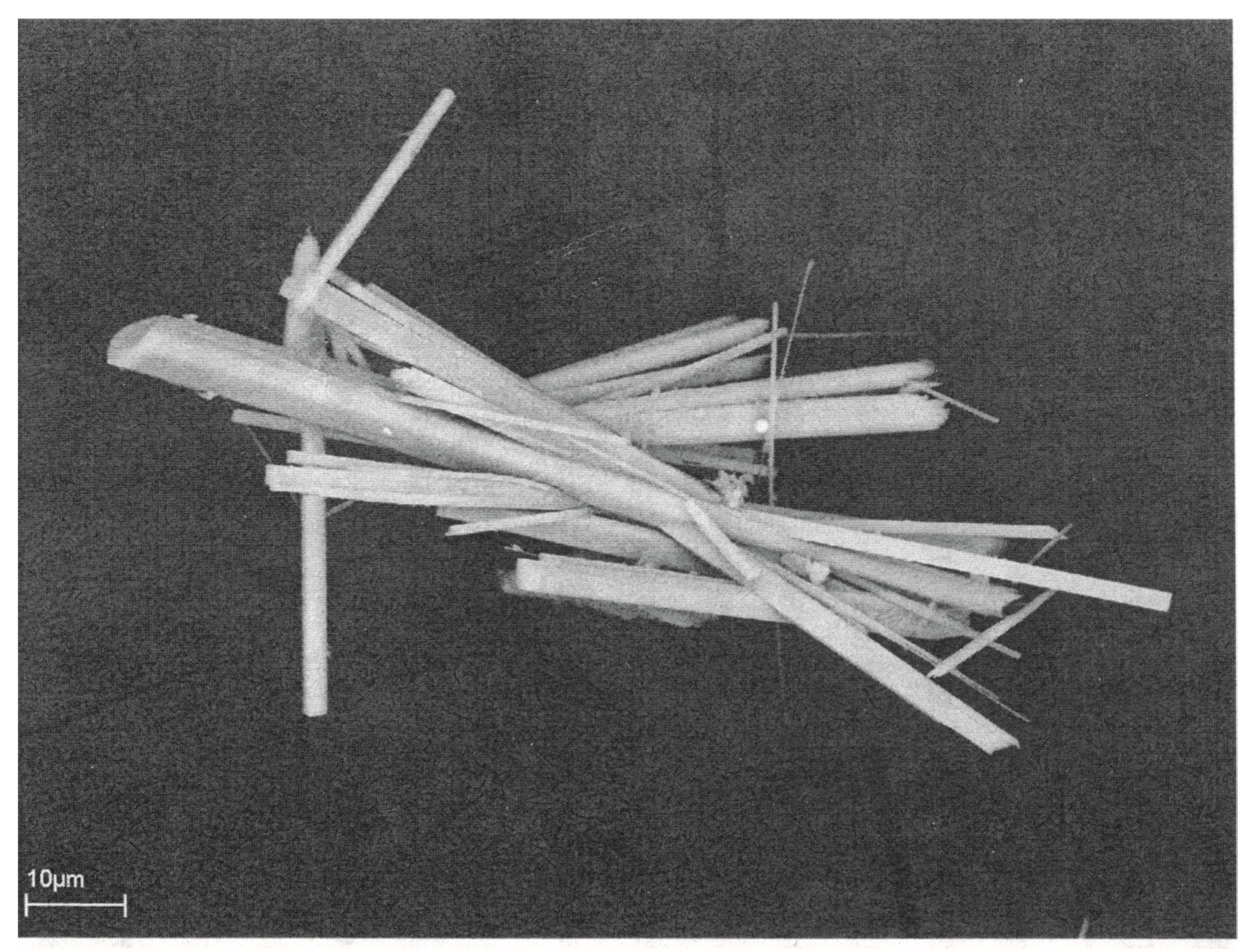
The crystals of the KA mineral phase have been found in the Kirovsky mine, Khibiny alkaline massif, Kola Peninsula, Russian Arctic. The mineral forms thin needles up to 0.2 mm long (Figure 1) and occurs in association with nenadkevichite, (Na,☐)8Nb4(Si4O12)2(O,OH)4·8H2O, and altered fersmanite, Ca4(Na,Ca)4(Ti,Nb)4(Si2O7)2O8F3.

2.2. Chemical Composition

The chemical composition of the KA mineral phase was determined using a JEOL 773 (JEOL Ltd, Tokyo, Japan) electron microprobe (EDS mode, an accelerating voltage of 20 kV, a specimen current of 2 nA, and a beam diameter of 3 μm). The data were reduced and corrected by the PAP method. The chemical composition of the KA mineral phase (mean of 5 analytical spots), range, standard deviation, and probe standards are given in Table 1. Contents of other elements with atomic numbers higher than that of carbon are below detection limits. The average empirical chemical formula calculated on the basis of Si = 28 and OH + F = 4 can be written as Na4.14K6.11Ca3.89Mn0.59Y6.10Ce0.08Gd0.32Tb0.15Dy0.78Ho0.19Er0.35Tm0.15Yb0.12Lu0.06Si28 C8O92.06(OH)1.92F2.08·9H2O; the idealized formula written in accord with the results of crystal-structure analysis (see below) is K6(Na4Ca)(Y8Ca3Mn)[Si28O68(OH)2](CO3)8F2·9H2O.

2.3. Single-Crystal X-Ray Diffraction Analysis

The crystal-structure analysis of the KA phase was performed by means of the Synergy S single-crystal diffractometer equipped with the Hypix detector using monochromatic MoKα radiation (λ = 0.71069 Å) at room temperature. More than half of the diffraction sphere was collected with a scanning step of 1° and an exposure time of 90 s. The data were integrated and corrected by means of the CrysAlis program package, which was also used to apply empirical absorption correction using spherical harmonics, implemented in the SCALE3 ABSPACK scaling algorithm [45]. The structure was refined using the SHELXL2015 software package [46].
The crystal structure of KA was solved by direct methods in the tetragonal space group I4/mmm, in agreement with the study by Moore et al. [40]. The occupancies of the Y sites were refined using mixed Y-Gd and Y-Ca scattering curves. Crystal data, data collection information, and structure refinement details are given in Table 2; atom coordinates, bond-valence sums (the bond-valence parameters for the cation-oxygen and cation-fluorine bonds have been taken from [47] and [48], respectively), refined occupancies, and equivalent displacement parameters are in Table 3, and selected interatomic distances are in Table 4. Table 5 provides site-scattering factors and modeled site occupancies for the key cation sites in the crystal structure.

3. Results

3.1. REE Coordination and Site Assignment

By analogy with ashcroftine-(Y), the crystal structure of the KA phase contains two Y sites with site occupancies assigned according to the data in Table 5. The Y1 site contains more heavy elements than the Y2 site, whereas the average <Y–O> distance calculated on the basis of eight X ligands (X = O, F) is considerably shorter for the Y2 site. This agrees well with the assignment of all Mn2+ to the Y2 site, since the ionic radius of Mn2+ for [8]-coordination is smaller than that of most of the REEs [49].
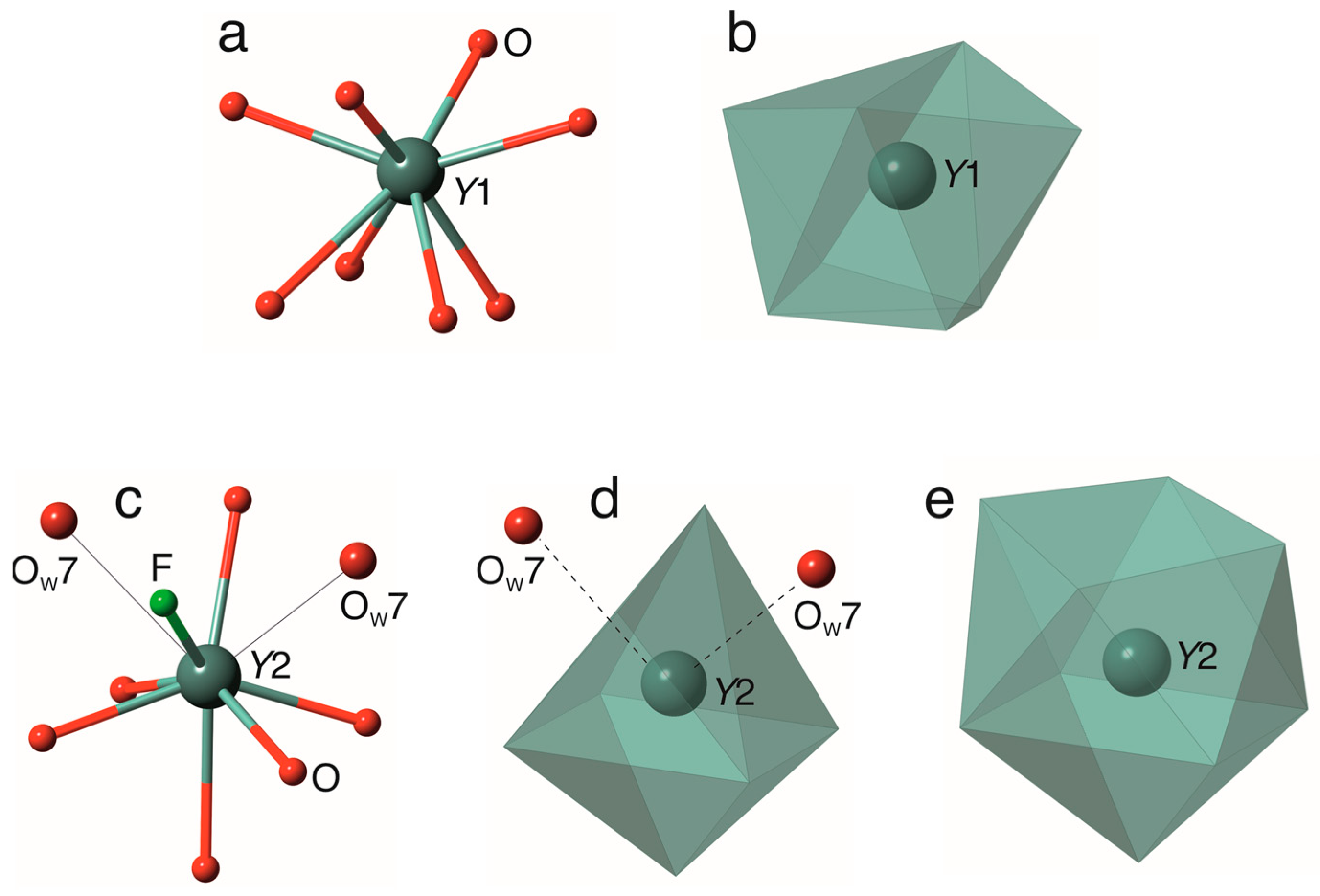
The Y1O8 coordination polyhedron contains only fully occupied sites and can be characterized as a bicapped trigonal prism (Figure 2a,b). In contrast, the Y2 coordination polyhedron contains nine X atoms in total, from which the O16 site has a 50% occupancy (there are two O16 sites located at 0.82 Å from each other), whereas two OW7 sites are occupied at only 18%. The overall Y2O9 configuration (Figure 2c) can be described as a monocapped square antiprism (Figure 2e), which is not uncommon in REE minerals. Without two OW7 sites, the Y2O7 polyhedron can be described as a monocapped trigonal prism (Figure 2d) with the average <Y2–O> distance of 2.342 Å.
Therefore, the two Y sites in the crystal structure of KA show clear distinction in terms of their coordination geometries and occupancies. The Y1 site is [8]-coordinated and hosts more heavy elements, whereas the Y2 site is predominantly [7]-coordinated and accumulates lighter elements, in particular, Mn. According to the modeled site occupancies (Table 5), REEs are preferentially concentrated in the Y1 site with the higher coordination number. The selective fractionation of REEs over different crystallographic sites is frequently observed for REE minerals (e.g., in kuliokite-(Y) [10]).

3.2. Structure Description: Basic Principles

The overall structural architecture of the KA phase is identical to that of ashcroftine-(Y). Moore et al. [40] called the latter mineral a balosilicate, due to the presence in its crystal structure of a giant [Si48O128] ball with the form of a truncated cuboctahedron (tco). Together with the [Na(CO3)4] clusters (see below), the ordered part of the structure was identified as a curd. The incrustation of the silicate ball with Y-O, Na-O, and K-O bonds was identified as a limbus, whereas the disordered region that contains partially occupied Si, Na, and K sites was described as a whey. The quality of our structure refinement done on the KA crystal is much higher than that reported for ashcroftine-(Y) [40], which reduces the number of low-occupied sites and provides a much better understanding of the topology and geometry of the structure. For instance, the number of measured intensities for ashcroftine-(Y) was 2535, whereas we have been able to collect 144,287 reflections, i.e., almost two orders of magnitude higher. The number of unique observed reflections for ashcroftine-(Y) was between 1774 and 2276 [40], whereas our refinement is based upon 5873 independent reflections with F0 > 4σF0. As a consequence, the higher precision of our data allows us to reconsider the structure description on the basis of finer structural details.
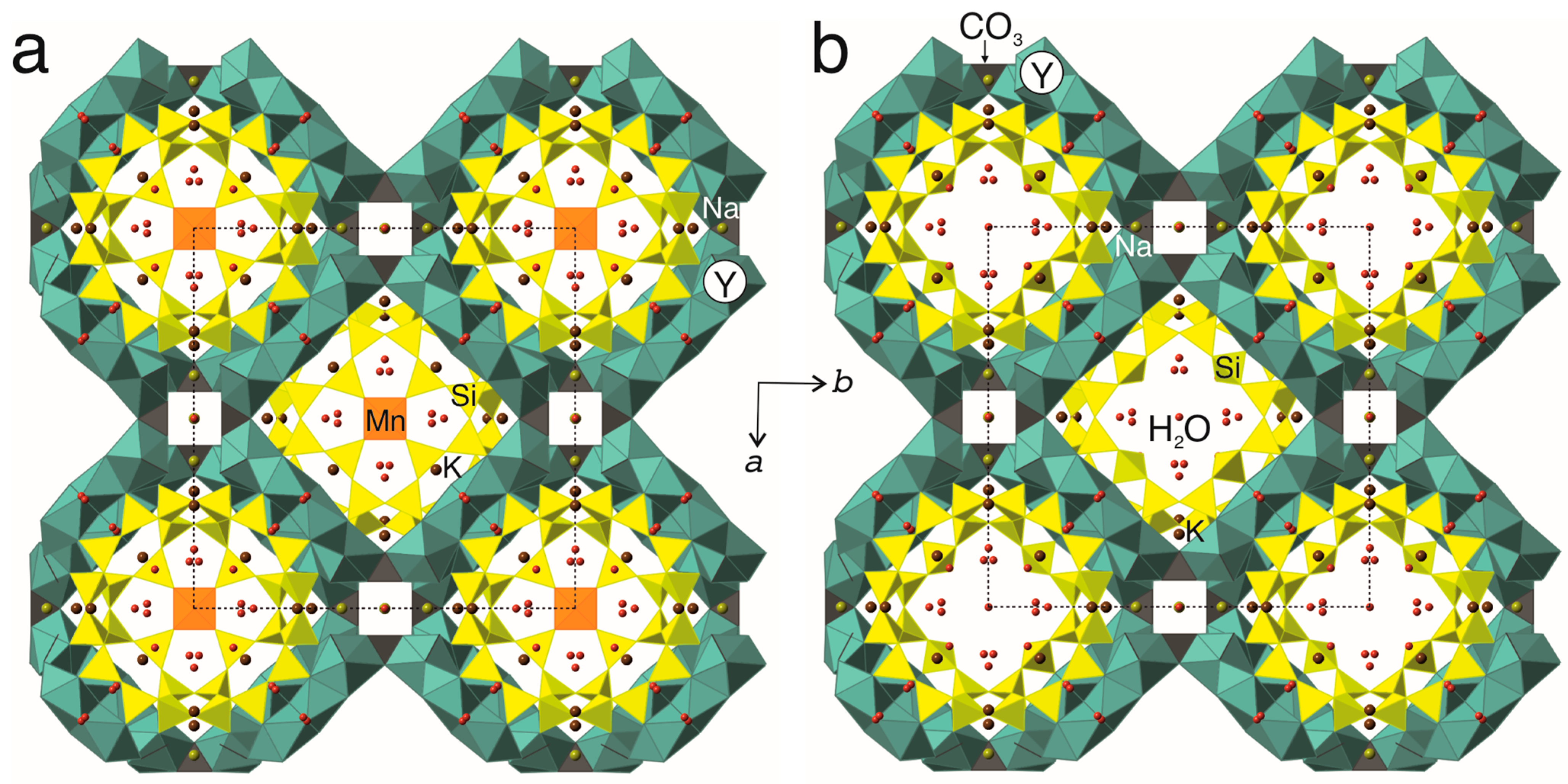
The crystal structure of the KA phase is shown in Figure 3. The crystal structure contains two half-occupied Si sites, Si4 and Si4A, located at 1.258 Å from each other. The simultaneous occupancy of these two sites is prohibited, which results in different views of the structure projected along the c-axis with occupied Si4 (Figure 3a) and Si4A (Figure 3b) sites.
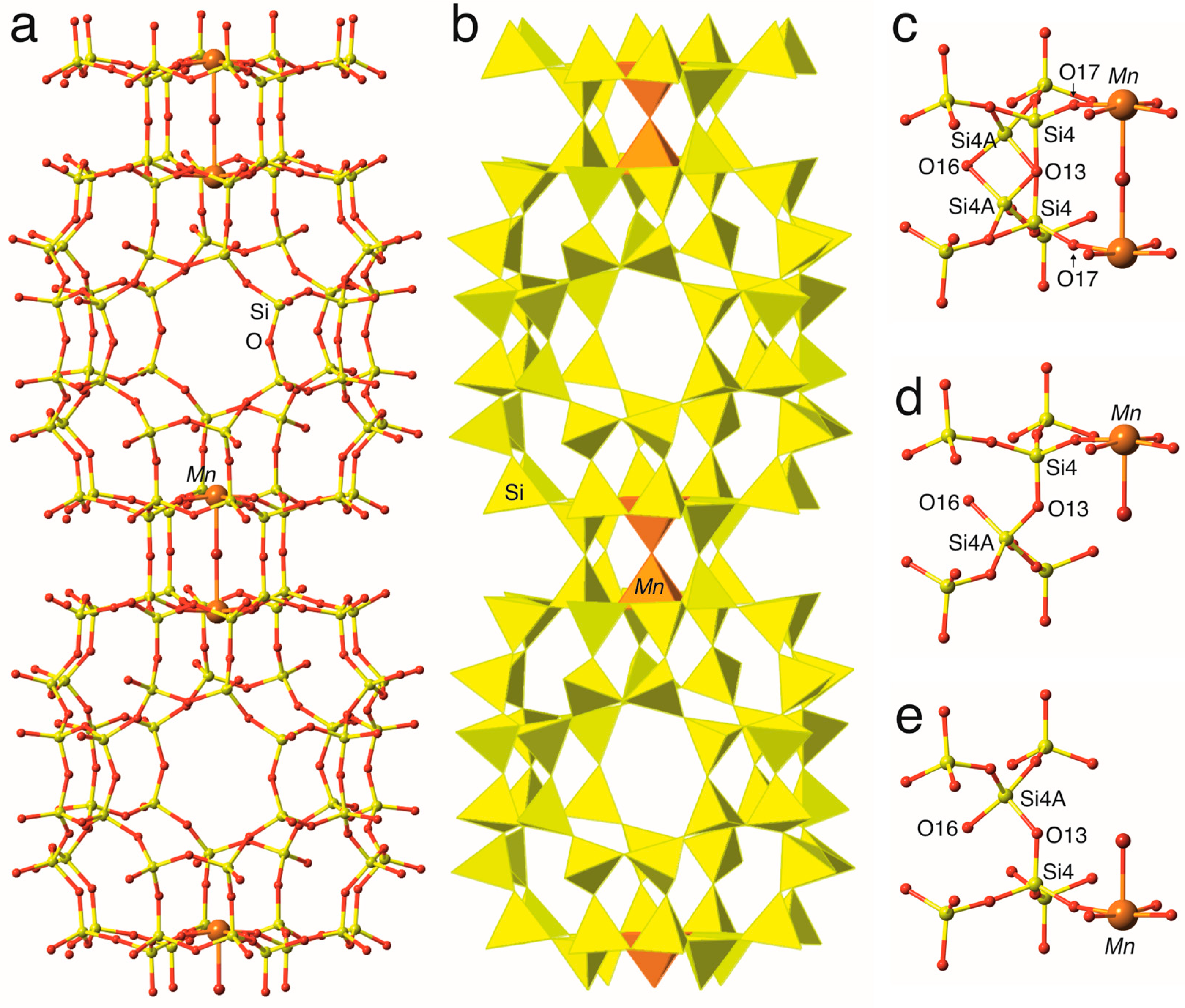
The crystal structure is based upon the [Si28X70] nanotubes (X = O,OH) elongated along the c-axis and composed of corner-sharing SiX4 tetrahedra (Figure 4). The external diameter of the tubules is equal to ~19.54 Å, i.e., slightly less than 2 nm. Therefore, the KA phase and related ashcroftine-(Y) belong to the group of minerals based upon tubular silicate-based units that include charoite [50,51,52], denisovite [53] yuksporite [54], and recently described miyawakiite [12] (see [55,56] for reviews). The tubules in the crystal structures of KA and ashcroftine-(Y) are distinct from the tubules observed in other minerals in that they contain large [Si48O128] cages linked by a disordered region consisting of Si4 and Si4A sites and related O atoms (Figure 4c–e). There is also an additional low-occupied Mn site (s.o.f. = 0.087(11)) that has a square-pyramidal coordination. Whereas tubules in charoite, denisovite, and miyawakiite-(Y) have no such sites in their interiors, similar site is present inside titanosilicate nanotubules in yuksporite, K4(Ca,Na)14(Sr,Ba)2(□,Mn,Fe)(Ti,Nb)4 (O,OH)4(Si6O17)2(Si2O7)3(H2O,OH)3 [54].
In the crystal structure, the silicate nanotubes run parallel to the c-axis and are centered along the (00z) and (½½z) directions (Figure 3). The tubules are linked by walls of YOn polyhedra that also involve triangular CO3 groups. It is worthy to note that, by analogy with other Y silicate carbonate minerals with tubular units (caysichite-(Y) and miyawakiite-(Y); see below), CO3 groups are located between the tubes, providing additional linkages for the Y sites.

3.3. Structure Topology

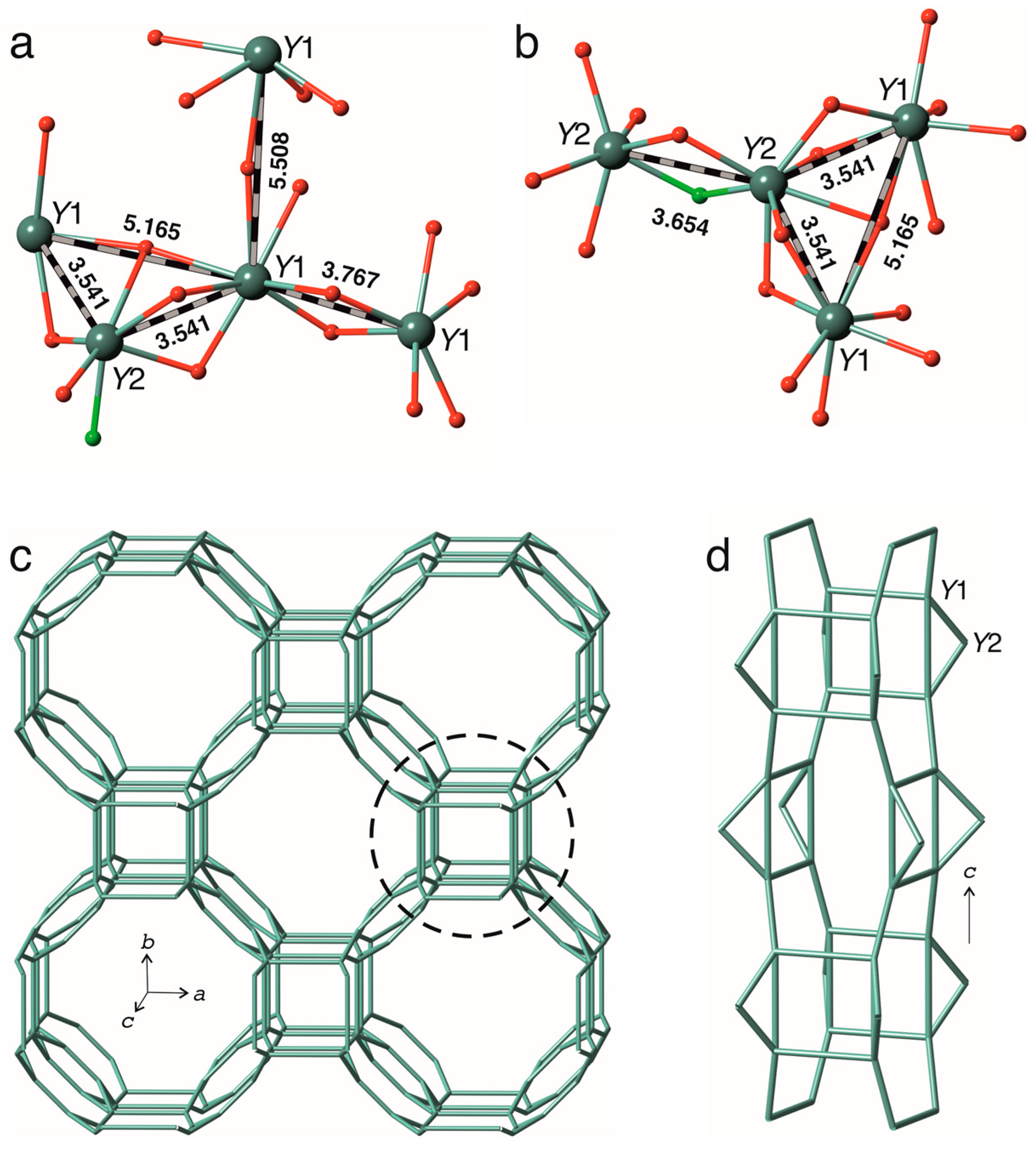
In order to describe the topology of the interpolyhedral linkage in the KA phase, the nodal representation can be adopted, which has a widespread use in structural mineralogy and crystal chemistry [57,58]. The recent application of this approach to Y silicate minerals allowed the establishment of topological relationships of some of these minerals to 3D and 2D nets known in coordination chemistry [59]. Figure 5 shows how this methodology can be applied to the description of the Y network in the KA phase. First, coordination spheres around Y sites are considered, and second-neighbor coordination numbers of Y sites are determined (Figure 5a,b). Only those Y sites adjacent to the central Y site are identified that have at least one common X ligand (X = O,F) with the latter. For instance, the second-neighbor coordination numbers for the Y1 and Y2 sites in the KA phase are equal to four and three, respectively, with the YY distances in the range of 3.541–5.508 Å. The respective Y sites are linked by edges; the resulting Y network in KA is three-dimensional and is depicted in Figure 5c. The network can be considered as based upon tubular Y units composed of 3-, 4-, and 8-membered rings (Figure 5d).
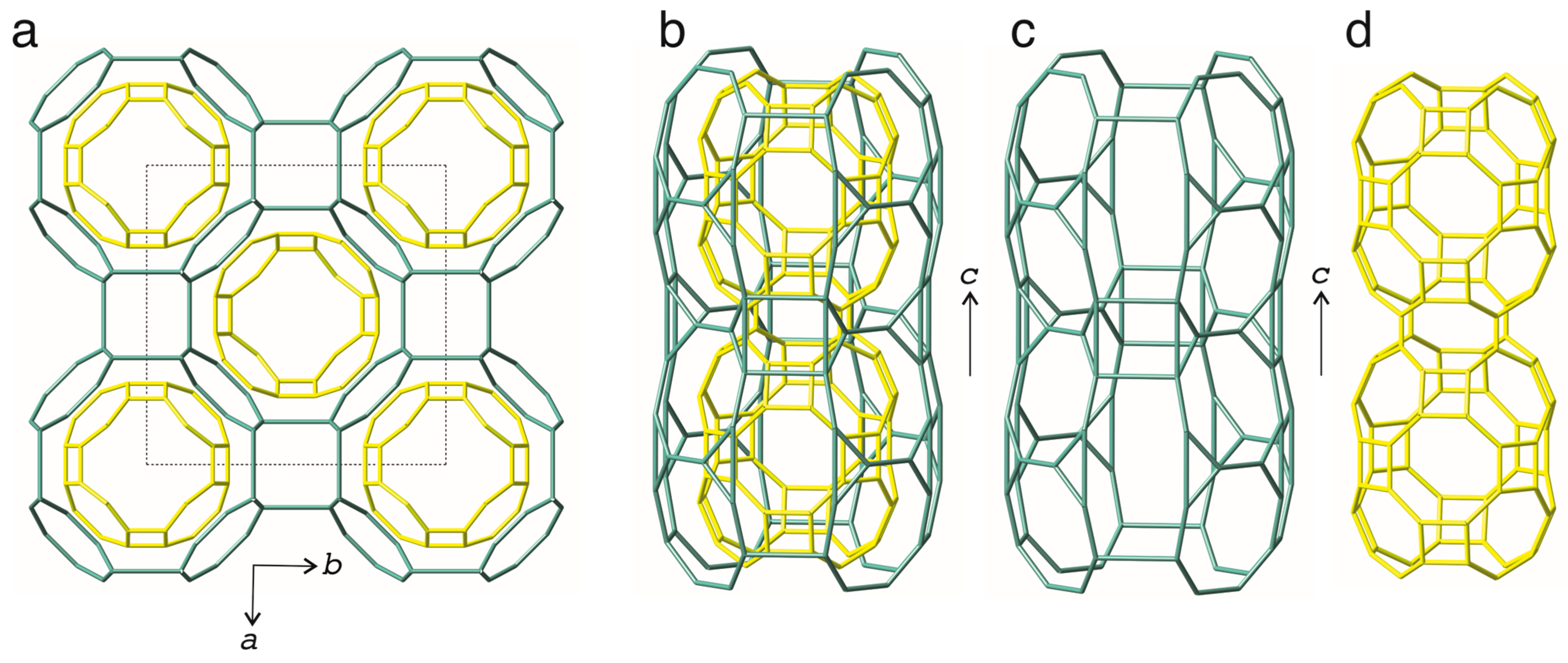
Figure 6a shows the overall topological description of the crystal structure of the KA phase as silicate tubules inserted into channels of the Y network. A single channel with and without the Si tube inside is shown in Figure 6b and Figure 6c, respectively. It can be seen that the Y channel consists of 3-, 4-, and 8-membered rings, whereas the Si tubule (Figure 6d) possesses 4-, 7-, and 8-membered rings.

3.4. Alkali and Alkaline Earth Cations: Coordination and Structural Environment

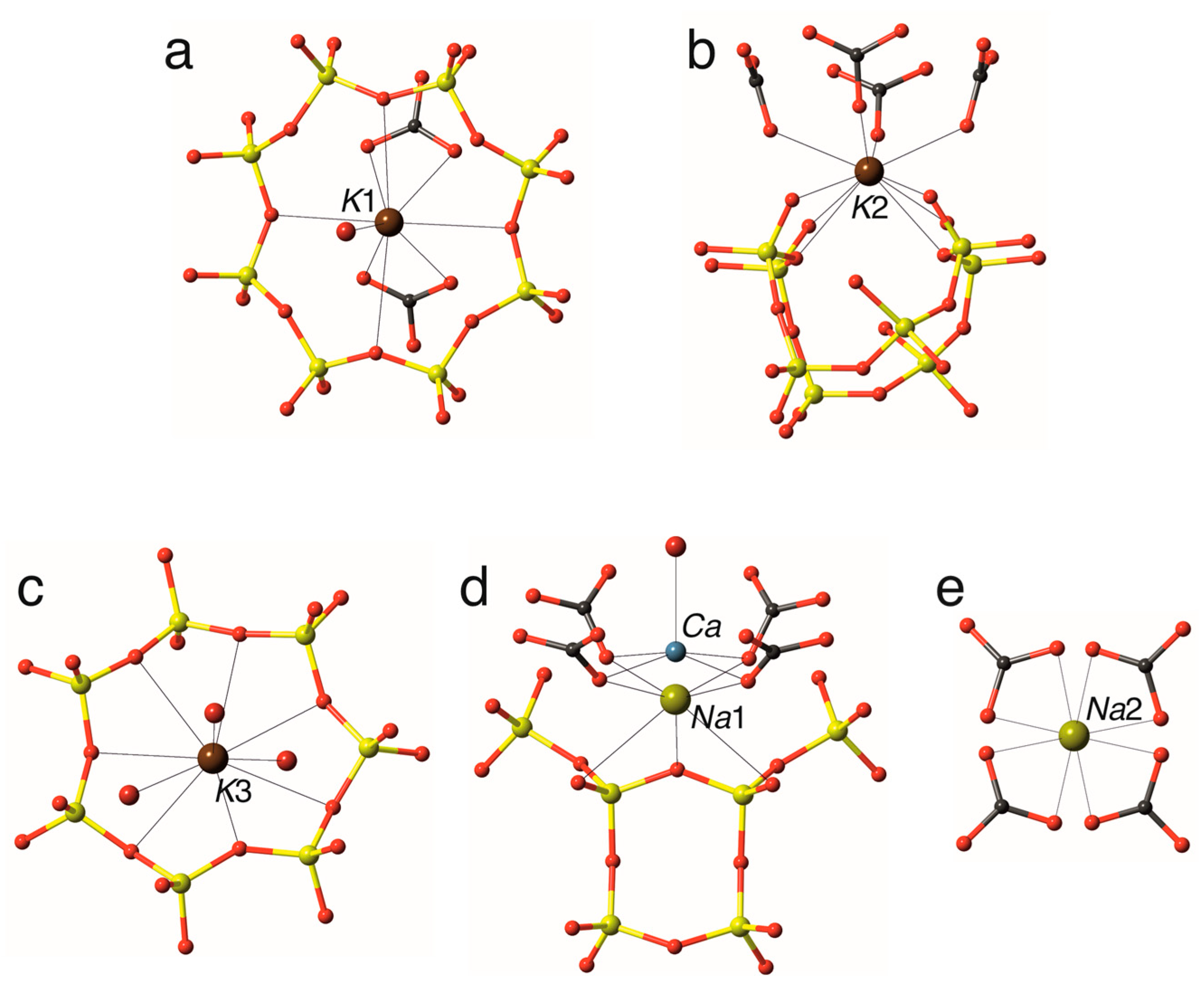
There are six alkali (Na, K) and alkaline (Ca) sites in the crystal structure of the KA phase (Figure 7).
As can be seen from Figure 2b, the K+ ions are located inside the silicate tubules and are attached to their walls. The K1 site is located approximately at the center of the 8-membered silicate ring (Figure 7a) and has a ninefold coordination, from which four O atoms belong to the ring, four to two adjacent CO3 groups, and one to an H2O molecule. The K2 site is attached to the disordered region between adjacent [Si48O128] cages (Figure 7b); its coordination sphere, consisting of ten O atoms, can be split into a carbonate hemisphere (four K2-O bonds) and a silicate hemisphere (six K2-O bonds). The K3 site centers the 7-membered silicate ring with seven K3-O bonds to the O atoms bridging between adjacent Si atoms and three K3-H2O bonds (Figure 7c).
The local environments of the Na and Ca sites in the crystal structure of KA are shown in Figure 7d,e. The Na1 and Ca sites are located at 1.139 Å from each other and therefore cannot be occupied simultaneously. In addition, their coordination environments are drastically different. The Na1 site is coordinated by seven O atoms, three belonging to the silicate tetrahedra and the rest to four carbonate groups. In contrast, the Ca site is associated with four carbonate groups and one H2O molecule and has no bonding to the silicate substructure. The remarkable coordination is observed for the Na2 site (already mentioned by Moore et al. [40] for ashcroftine-(Y)), which is surrounded by four symmetrically equivalent CO3 groups to form a distorted Na2O8 cube (Figure 7e).
The crystal structure contains seven symmetrically independent H2O molecules with different site-occupation factors (Table 3); their identification as H2O is well supported by their relatively low bond-valence sums.

3.5. Crystal Chemical Formula

The crystal-chemical formula of the KA phase based upon crystal-structure refinement and site assignments given in Table 3 and Table 5 can be written as {K6.14Na4.30Ca0.81} [Y5.88Ca3.12Dy0.88Mn2+0.60Gd0.32Ho0.24Er0.24Tb0.16Tm0.16Er0.12Yb0.12Ce0.08Lu0.08](Mn3+0.09)[Si28O68.36 (OH)1.65](CO3)8F2·8.97H2O, which is remarkably similar to the empirical chemical formula given above and agrees well with the idealized formula K6(Na4Ca)(Y8Ca3Mn2+)[Si28O68(OH)2](CO3)8F2·9H2O. The simultaneous presence of Mn2+ and Mn3+ in the same mineral is not untypical for the Khibiny minerals and was observed, e.g., in armbrusterite, K5Na6Mn3+Mn142+[Si9O22]4(OH)10·4H2O [60].

3.6. Structural Complexity

The information-based structural complexity parameters [61,62,63] calculated by means of the ToposPro 5.4.1.0 software [64] are 5.052 bit/atom and 1793.445 bit/cell. These values make it possible to identify the KA phase as a very complex structure. Less than 300 mineral species out of >6000 species (i.e., less than 3.5%) known today belong to the class of very complex minerals. Krivovichev et al. [63] identified complexity-generating mechanisms in minerals, which include, among others, the presence of nanoscale units such as polyoxometalate clusters [65] and nanotubes [50,51,52,53,54]. There is no doubt that the presence of silicate tubules in the KA phase is the key reason for its exceptional structural complexity.

4. Discussion

4.1. The Problem of Ashcroftine-(Y)

As it was already noted in the Introduction, the only known chemical analysis of ashcroftine-(Y) was done in 1924, i.e., more than a hundred years ago, when yttrium was mixed up with aluminum. All subsequent studies of this unique mineral [37,39,40] were done on the basis of the 1924 analysis. According to Anthony et al. [66], the type material of ashcroftine-(Y) from Greenland is stored in the collections of the Natural History Museum, London, England; the University of Copenhagen, Denmark; Harvard University, Cambridge, Massachusetts; and the National Museum of Natural History, Washington D.C. Unfortunately, the type samples are not available to us, which makes us impossible to decide whether the KA phase is identical to ashcroftine-(Y) or represents an independent mineral species. The most recent idealized chemical formula of ashcroftine-(Y) approved by the International Mineralogical Association is K5Na5Y12(OH)2(CO3)8(Si28O70)·8H2O, which is principally different from the formula of the KA phase defined herein as K6(Na4Ca)(Y8Ca3Mn2+)[Si28O68(OH)2](CO3)8F2·9H2O. The basic differences can be summarized as follows: (1) the amounts of K and Na are different; (2) the Y sites in the KA phase contain considerable amount of Ca and non-negligible amount of Mn, though it is not completely clear, whether the latter should be considered as a mineral-forming component; (3) two out of 70 O atoms of the silicate substructure in the KA phase are protonated; (4) two (OH) groups apfu in ashcroftine-(Y) are replaced by two F anions in the KA phase.
It might be noted that the chemical analysis of the sample from the private systematic collection of one of the authors (AVK) obtained as ashcroftine-(Y) from its type locality, Narssârssuk pegmatite, Greenland, provided the following empirical formula: K5.91Na3.99Ca4.01Mn0.84Y6.73Gd0.21Dy0.65Ho0.19Er0.42Yb0.11Si28C8O92.28(OH)1.21F2.28Cl0.52·9H2O. As one can see, this formula is remarkably close to the formula of the KA mineral phase studied here.
In order to establish the relations between ashcroftine-(Y) and the KA phase, the reinvestigation of the type material of the former is highly warranted. It cannot be excluded that the current IMA formula of ashcroftine-(Y) is incorrect, and that it is, in fact, identical to that of the KA phase. Further studies of the original material will hopefully resolve what we call the ‘ashcroftine problem’.

4.2. Topological Relations to the LTA Zeolite

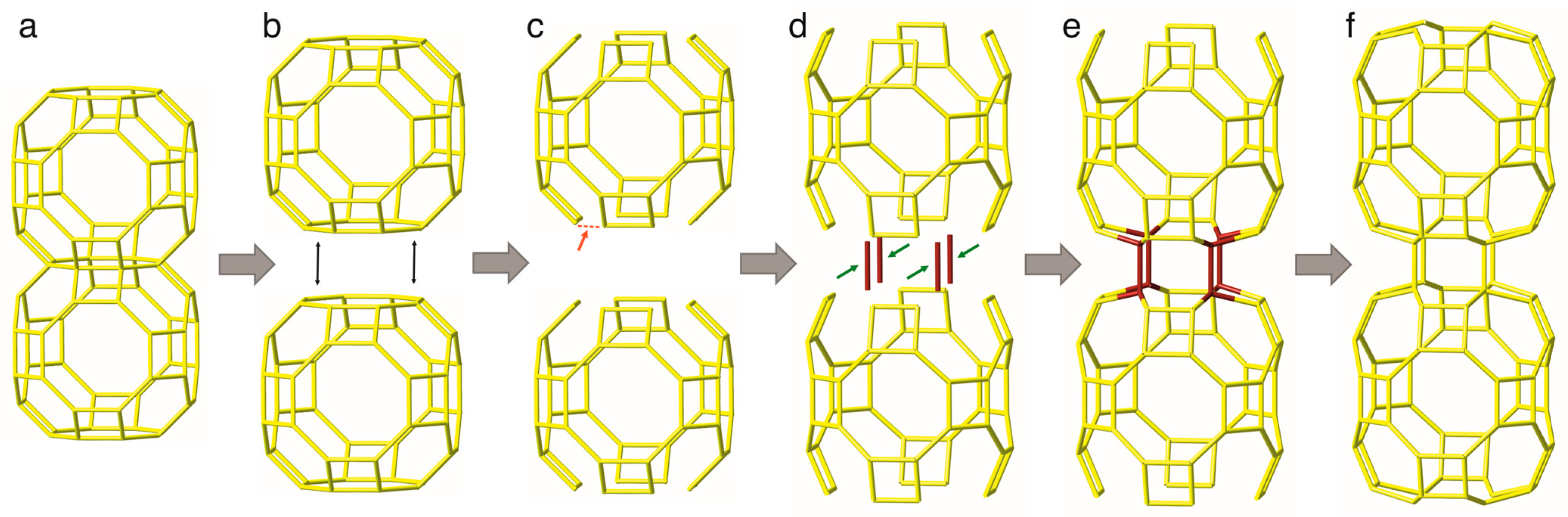
Based on their structural data, Moore et al. [40] noted that the [Si48O128] cage observed in ashcroftine-(Y) (truncated cubooctahedron) is known in a number of zeolite structures and, in particular, in Linde zeolite A [67]. However, it should be noted that the cage observed in ashcroftine-(Y) and KA is not a truncated cuboctahedron sensu stricto, since the Si-Si links on two opposite eight-membered rings are broken. The unbroken cage has a face symbol [4126886] and the lta notation according to the International Zeolite Association [68]. There are ten zeolite framework types that contain the lta cage, but only in the LTA framework (type material: Linde zeolite A) do the adjacent lta cages contact with each other through a common eight-membered ring (Figure 8a). In order to transform the column of face-sharing lta cages in the LTA zeolite framework into the silicate nanotubule in ashcroftine-(Y) and the KA phase, the following imaginary topological operations have to be done: (i) the adjacent lta cages should be separated from each other (Figure 8b); (ii) the Si-Si links are deleted between four-membered rings on the opposite sides of each cage (Figure 8c); (iii) four additional Si-Si links are inserted in between the cages (shown in dark red in Figure 8d); (iv) the additional Si-Si elements are joined to the cages so that eight seven-membered rings are formed for each cage (Figure 8e,f).

4.3. Comparison to Caysichite-(Y) and Miyawakiite-(Y)

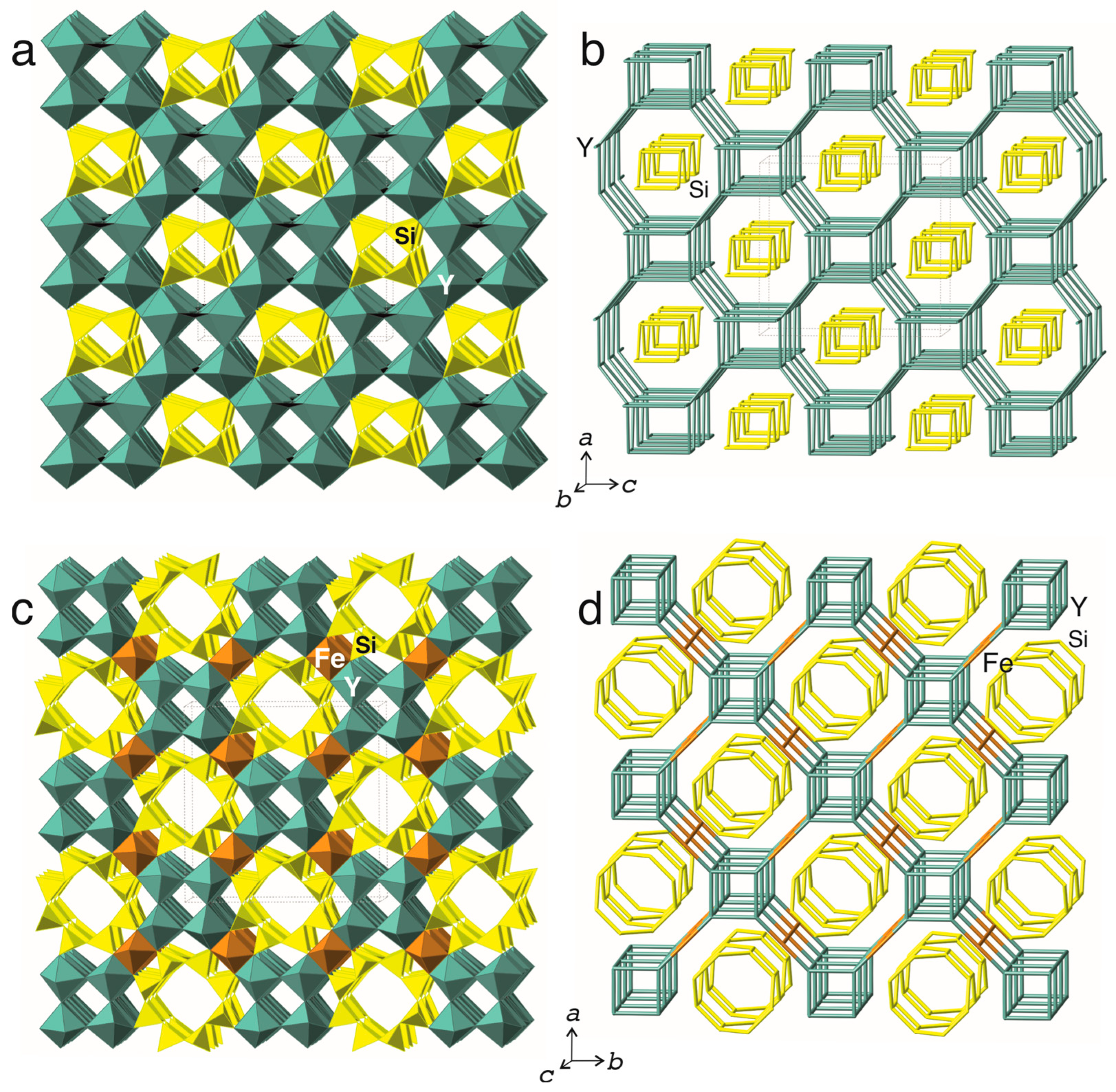
The crystal structure analysis of the KA phase and its description as of an array of silicate tubules interlinked by Y coordination polyhedral allows to establish its relation with such Y silicate carbonates as caysichite-(Y), (Y2Ca2)[Si4O10](CO3)3·4H2O [11], and miyawakiite-Y, ☐Y4Fe2(Si8O20)(CO3)4(H2O)3 [12]. The projections of both crystal structures and their topological descriptions are provided in Figure 9.
The backbones of the crystal structure of caysichite-(Y) are the double crankshaft silicate chains [Si4O10] running parallel to the b-axis (Figure 9a). The Y-dominant coordination polyhedra and CO3 groups are in between the chains, providing their linkage into a three-dimensional heteropolyhedral framework. The Y network (Figure 9b) has a paracelsian (pcl) topology and consists of double crankshaft chains. The arrangement of the silicate chains relative to the Y chains is in a chessboard fashion. The outer dimension of the silicate chains is about 9.8 Å.
The structural architecture of miyawakiite-(Y), ☐Y4Fe2(Si8O20)(CO3)4(H2O)3 [12], is very similar, but the silicate chains are porous and therefore can be described as tubules with the outer diameter of ca. 13.0 Å (Figure 9c). Y coordination polyhedra form double chains with a square cross-section and are interlinked by chains of FeO6 octahedra into a porous framework hosting silicate tubules (Figure 9d). The arrangement of the silicate tubules and Y-based chains is again that of a chessboard. The Si tubules in miyawakiite-(Y) consist of four- and eight-membered tetrahedral rings.
As it was mentioned above, the outer diameter of silicate nanotubes in the KA phase is about 19.5 Å. However, the relations between the Si and Y substructures are very similar and correspond to those of a chessboard (Figure 2). Therefore, the crystal structures of caysichite-(Y), miyawakiite-(Y), and ashcroftine-(Y) (and its analog KA) form a kind of homological row with increasing Si content and enlarging diameter of silicate chains (tubules). Indeed, the M:Si:C ratio (where M = Y, REEs, Ca, Mn, Fe) changes from 1:1:0.75 for caysichite-(Y) through 0.75:1:0.5 for miyawakiite-(Y) to 0.43:1:0.29 for ashcroftine-(Y) (and KA). The increasing role of silica along the row results in the formation of zeolite-derived porous one-dimensional units.

5. Conclusions

It had long been argued that, over the history of science, minerals provided enormous inspiration for the creation of innovative materials with exceptional structural features that sometimes combine functionalities of different kinds [69,70,71]. The KA phase studied here and its close analog ashcroftine-(Y) possess two important crystal-chemical properties that distinguish them from other minerals known to date: they host a variety of REEs and are based upon nanoscale zeolite-like silicate units. Both KA phase and ashcroftine-(Y) are related to caysichite-(Y) and miyawakiite-(Y), though the latter two minerals contain silicate units with no large cavities that may be prone to ion-exchange reactions. However, it is remarkable that all four phases (KA, ashcroftine-(Y), caysichite-(Y), and miyawakiite-(Y)) have no synthetic analogs and have never been prepared under laboratory conditions. The mineralogical occurrence of the KA phase in the Khibiny massif points out to its secondary origin, i.e., its formation under relatively soft, low-temperature hydrothermal conditions. The exceptional structural complexity of the KA phase supports its low-temperature origin, since complex phases rarely or almost never form at high temperatures [72,73,74]. Thus, the discovery of the KA phase in nature may provide important hints toward its synthesis in the laboratory by means of a soft-chemistry approach.

Author Contributions

Conceptualization, S.V.K. and V.N.Y.; methodology, S.V.K., A.V.K., O.F.G., Y.A.P.; validation, S.V.K.; formal analysis, S.V.K., A.V.K., O.F.G. and Y.A.P.; investigation, S.V.K., V.N.Y., A.V.K., A.A.A., O.F.G., Y.A.P., A.V.C.; data curation, S.V.K.; writing—original draft preparation, S.V.K.; writing—review and editing, S.V.K., A.V.K.; visualization, S.V.K., Y.A.P., A.V.C.; supervision, S.V.K.; project administration, S.V.K.; funding acquisition, S.V.K. All authors have read and agreed to the published version of the manuscript.

Funding

This research was funded in the framework of the state task FMEZ-2025-0070 of the Kola Science Centre, Russian Academy of Sciences, regarding the chemical and mineralogical study, and by the Russian Science Foundation regarding the crystal chemical and complexity analysis (grant 24-17-00083 to S.V.K.).

Data Availability Statement

The crystal structure data for the KA phase are available as a CIF file from the CCDC/FIZ Karlsruhe database (CSD # 2543048) at https://www.ccdc.cam.ac.uk.

Acknowledgments

The X-ray diffraction and chemical analytical studies were performed in the FRC KSC RAS Centre for Collective Use of Equipment.

Conflicts of Interest

The authors declare no conflicts of interest.

References

  1. Goodenough, K.M.; Wall, F.; Merriman, D. The Rare Earth Elements: Demand, Global Resources, and Challenges for Resourcing Future Generations. Nat. Res. Res. 2018, 27, 201–216. [Google Scholar] [CrossRef]
  2. Foley, N.K.; Ayuso, R.A. Conventional Rare Earth Element Mineral Deposits—The Global Landscape. In Rare Earth Metals and Minerals Industries: Status and Prospects; Murty, Y.V., Alvin, M.A., Lifton, J.P., Eds.; Springer International Publishing: Cham, Switzerland, 2024; pp. 17–56. [Google Scholar]
  3. Chen, P.; Ilton, E.S.; Wang, Z.; Rosso, K.M.; Zhang, X. Global Rare Earth Element Resources: A Concise Review. Appl. Geochem. 2024, 175, 106158. [Google Scholar] [CrossRef]
  4. Shuai, Z.; Zhu, Y.; Gao, P.; Han, Y. Rare Earth Elements Resources and Beneficiation: A Review. Miner. Eng. 2024, 218, 109011. [Google Scholar] [CrossRef]
  5. Taddei, A.; Holtstam, D.; Jonsson, E.; Förster, H.-J.; Andersson, S.S.; Appelt, O.; Bindi, L. Exploring the Unusual Occurrence, Chemistry, and Structural Topology of Åsgruvanite-(Ce), Ce16Ca5Al(SiO4)6(AsO3)8(CO3)2Cl3(ClF3)(OH)2, a New Rare Earth Element (REE) Mineral from Västmanland, Sweden. Eur. J. Mineral. 2025, 37, 937–951. [Google Scholar] [CrossRef]
  6. Skřápková, L.; Cempírek, J.; Škoda, R.; Filip, J.; Friis, H.; Bosi, F. First Crystal Structure Description of Allanite-(Y) from the Type Locality Åskagen, Värmland, Sweden: EPMA, Mössbauer, Raman and SC-XRD Data. Mineral. Mag. 2025, 89, 172–182. [Google Scholar] [CrossRef]
  7. Plášil, J.; Steciuk, G.; Sejkora, J.; Kampf, A.R.; Uher, P.; Ondrejka, M.; Škoda, R.; Dolníček, Z.; Philippo, S.; Guennou, M.; et al. Extending the Mineralogy of U6+ (I): Crystal Structure of Lepersonnite-(Gd) and a Description of the New Mineral Lepersonnite-(Nd). Mineral. Mag. 2025, 89, 549–565. [Google Scholar] [CrossRef]
  8. Pieczka, A.; Gołębiowska, B.; Włodek, A.; Stachowicz, M.; Jokubauskas, P.; Kotowski, J.; Nejbert, K.; Szuszkiewicz, A.; Woźniak, K. Allanite-(Sm), CaSm(Al2Fe2+)(Si2O7)(SiO4)O(OH), the Third Samarium Mineral from Jordanów Śląski, Lower Silesia, Poland. Amer. Miner. 2025, 110, 808–819. [Google Scholar] [CrossRef]
  9. Malcherek, T.; Schlüter, J.; Husdal, T. Anorthoyttrialite-(Y), Y4(SiO4)(Si3O10), a Natural Representative of B-Type Rare Earth Disilicates. Mineral. Mag. 2025, 89, 428–442. [Google Scholar] [CrossRef]
  10. Krivovichev, S.V.; Yakovenchuk, V.N.; Goychuk, O.F.; Pakhomovsky, Y.A. Coordination-Driven Rare Earth Fractionation in Kuliokite-(Y), (Y,HREE)4Al(SiO4)2(OH)2F5: A Crystal–Chemical Study. Minerals 2025, 15, 1064. [Google Scholar] [CrossRef]
  11. Krivovichev, S.V.; Yakovenchuk, V.N.; Goychuk, O.F.; Pakhomovsky, Y.A. Caysichite-(Y) from the Ploskaya Mountain (Kola Peninsula, Russia): Crystal-Structure Refinement and the Chemical Formula. Crystals 2025, 15, 799. [Google Scholar] [CrossRef]
  12. Nishio-Hamane, D.; Momma, K.; Shimobayashi, N.; Ohnishi, M.; Kobayashi, T. Miyawakiite-(Y), □Y4Fe2(Si8O20)(CO3)4(H2O)3, a New Mineral from Suishoyama, Kawamata Town, Fukushima Prefecture, Japan. J. Mineral. Petrol. Sci. 2024, 119, 240722. [Google Scholar] [CrossRef]
  13. Kasatkin, A.V.; Zubkova, N.V.; Škoda, R.; Pekov, I.V.; Agakhanov, A.A.; Gurzhiy, V.V.; Ksenofontov, D.A.; Belakovskiy, D.I.; Kuznetsov, A.M. The Mineralogy of the Historical Mochalin Log REE Deposit, South Urals, Russia. Part V. Zilbermintsite-(La), (CaLa5)(Fe3+Al3Fe2+)[Si2O7][SiO4]5O(OH)3, a New Mineral with ET2 Type Structure and a Definition of the Radekškodaite Group. Mineral. Mag. 2024, 88, 302–311. [Google Scholar] [CrossRef]
  14. Chukanov, N.V.; Zolotarev, A.A.; Schäfer, C.; Varlamov, D.A.; Pekov, I.V.; Vigasina, M.F.; Belakovskiy, D.I.; Aksenov, S.M.; Vozchikova, S.A.; Britvin, S.N. Amableite-(Ce), Na15[(Ce1.5Na1.5)Mn3]Mn2Zr3□Si[Si24O69(OH)3](OH)2⋅H2O, a New Eudialyte-Group Mineral from Saint-Amable Sill, Québec, Canada. Mineral. Mag. 2024, 88, 369–379. [Google Scholar] [CrossRef]
  15. Agakhanov, A.A.; Day, M.C.; Sokolova, E.; Karpenko, V.Y.; Hawthorne, F.C.; Pautov, L.A.; Kasatkin, A.V.; Pekov, I.V.; Agakhanova, V.A. Rundqvistite-(Ce), Na3(Sr3Ce)(Zn2Si8O24), a New Mineral from the Darai-Pioz Alkaline Massif, Tien-Shan Mountains, Tajikistan: Mineral Description and Crystal Structure. Mineral. Mag. 2024, 88, 594–601. [Google Scholar] [CrossRef]
  16. Števko, M.; Myšľan, P.; Biagioni, C.; Mauro, D.; Mikuš, T. Ferriandrosite-(Ce), a New Member of the Epidote Supergroup from Betliar, Slovakia. Mineral. Mag. 2023, 87, 887–895. [Google Scholar] [CrossRef]
  17. Liu, P.; Gu, X.; Zhang, W.; Hu, H.; Chen, X.; Wang, X.; Song, W.; Yu, M.; Cook, N.J. Jingwenite-(Y) from the Yushui Cu Deposit, South China: The First Occurrence of a V-HREE-Bearing Silicate Mineral. Am. Mineral. 2023, 108, 192–196. [Google Scholar] [CrossRef]
  18. Holtstam, D.; Casey, P.; Bindi, L.; Förster, H.-J.; Karlsson, A.; Appelt, O. Fluorbritholite-(Nd), Ca2Nd3(SiO4)3F, a New and Key Mineral for Neodymium Sequestration in REE Skarns. Mineral. Mag. 2023, 87, 731–737. [Google Scholar] [CrossRef]
  19. Campostrini, I.; Demartin, F.; Finello, G.; Vignola, P. Aluminotaipingite-(CeCa), (Ce6Ca3)Al(SiO4)3[SiO3(OH)]4F3, a New Member of the Cerite-Supergroup Minerals. Mineral. Mag. 2023, 87, 741–747. [Google Scholar] [CrossRef]
  20. Agakhanov, A.A.; Sokolova, E.; Cámara, F.; Karpenko, V.Y.; Hawthorne, F.C.; Pautov, L.A.; Kasatkin, A.V.; Pekov, I.V.; Agakhanova, V.A. Letnikovite-(Ce), (Na□)Ca2Ce2[Si7O17(OH)]F4(H2O)4, a New Mineral from the Darai-Pioz Alkaline Massif, Tajikistan: Mineral Description, Crystal Structure and a New Single [Si7O17(OH)] Sheet. Mineral. Mag. 2023, 87, 807–818. [Google Scholar] [CrossRef]
  21. Agakhanov, A.A.; Day, M.C.; Sokolova, E.; Karpenko, V.Y.; Hawthorne, F.C.; Pautov, L.A.; Pekov, I.V.; Kasatkin, A.V.; Agakhanova, V.A. Two Rinkite-Group (Seidozerite-Supergroup) Minerals: Nacareniobsite-(Y), a New Mineral from the Darai-Pioz Alkaline Massif, Tajikistan, and Crystal-Structure Refinement of Nacareniobsite-(Ce). Can. J. Mineral. Petrol. 2023, 61, 1123–1136. [Google Scholar] [CrossRef]
  22. Gulbransen, E.H.; Friis, H.; Dal Bo, F.; Erambert, M. Illoqite-(Ce), Na2NaBaCeZnSi6O17, a New Member of the Nordite Supergroup from Ilímaussaq Alkaline Complex, South Greenland. Mineral. Mag. 2022, 86, 141–149. [Google Scholar] [CrossRef]
  23. Kasatkin, A.V.; Zubkova, N.V.; Pekov, I.V.; Chukanov, N.V.; Škoda, R.; Agakhanov, A.A.; Belakovskiy, D.I.; Britvin, S.N.; Yu. Pushcharovsky, D. The Mineralogy of the Historical Mochalin Log REE Deposit, South Urals, Russia. Part IV. Alexkuznetsovite-(La), La2Mn(CO3)(Si2O7), Alexkuznetsovite-(Ce), Ce2Mn(CO3)(Si2O7) and Biraite-(La), La2Fe2+(CO3)(Si2O7), Three New Isostructural Minerals and a Definition of the Biraite Group. Mineral. Mag. 2021, 85, 772–783. [Google Scholar] [CrossRef]
  24. Holtstam, D.; Bindi, L.; Bonazzi, P.; Förster, H.-J.; Andersson, U.B. Arrheniusite-(Ce), CaMg[(Ce7Y3)Ca5](SiO4)3(Si3B3O18)(AsO4)(BO3)F11, a New Member of the Vicanite Group, from the Östanmossa Mine, Norberg, Sweden. Can. Mineral. 2021, 59, 177–189. [Google Scholar] [CrossRef]
  25. Balaram, V. Rare earth elements: A review of applications, occurrence, exploration, analysis, recycling, and environmental impact. Geosci. Front. 2019, 10, 1285–1303. [Google Scholar] [CrossRef]
  26. Kalashnikov, A.O.; Konopleva, N.G.; Pakhomovsky, Y.A.; Ivanyuk, G.Y. Rare Earth Deposits of the Murmansk Region, Russia—A Review. Econ. Geol. 2016, 111, 1529–1559. [Google Scholar] [CrossRef]
  27. Khomyakov, A.P.; Nechelyustov, G.N.; Rastsvetaeva, R.K.; Ma, Z. Diversilite-(Ce), Na2(Ba,K)6Ce2Fe2+Ti3[Si3O9]3[SiO3OH]3(OH,H2O)9, a new silicate with heterogeneous tetrahedral complexes from the Khibina alkaline massif, Kola Peninsula, Russia. Zap. Vseross. Miner. Obsh. 2003, 132, 34–39. [Google Scholar]
  28. Pekov, I.V.; Chukanov, N.V.; Turchkova, A.G.; Grishin, V.G. Ferronordite-(La), Na3Sr(La,Ce)FeSi6O17, a new mineral of the nordite group from Lovozero Massif, Kola Peninsula. Zap. Vseross. Miner. Obsh. 2001, 130, 53–58. [Google Scholar]
  29. Pakhomovsky, Y.A.; Men’shikov, Y.P.; Yakovenchuk, V.N.; Ivanyuk, G.Y.; Krivovichev, S.V.; Burns, P.C. Cerite-(La), (La,Ce,Ca)9(Fe,Ca,Mg)(SiO4)3[SiO3(OH)]4(OH)3, a new mineral species from the Khibina alkaline massif: Occurrence and crystal structure. Can. Miner. 2002, 40, 1177–1184. [Google Scholar] [CrossRef]
  30. Pekov, I.V.; Zubkova, N.V.; Chukanov, N.V.; Husdal, T.A.; Zadov, A.E.; Pushcharovsky, D.Y. Fluorbritholite-(Y), (Y,Ca,Ln)5[(Si,P)O4]3F, a New Mineral of the Britholite Group. N. Jb. Miner. Abh. 2011, 188, 191–197. [Google Scholar] [CrossRef]
  31. Yakovenchuk, V.N.; Krivovichev, S.V.; Ivanyuk, G.Y.; Pakhomovsky, Y.A.; Selivanova, E.A.; Zhitova, E.A.; Kalashnikova, G.O.; Zolotarev, A.A.; Mikhailova, J.A.; Kadyrova, G.I. Kihlmanite-(Ce), Ce2TiO2[SiO4](HCO3)2(H2O), a New Rare-Earth Mineral from the Pegmatites of the Khibiny Alkaline Massif, Kola Peninsula, Russia. Miner. Mag. 2014, 78, 483–496. [Google Scholar] [CrossRef]
  32. Krivovichev, S.V.; Pakhomovsky, Y.A.; Ivanyuk, G.Y.; Mikhailova, J.A.; Men’shikov, Y.P.; Armbruster, T.; Selivanova, E.A.; Meisser, N. Yakovenchukite-(Y), K3NaCaY2(Si12O30)(H2O)4, a New Mineral from the Khibiny Massif, Kola Peninsula, Russia: A Novel Type of Octahedral-Tetrahedral Open-Framework Structure. Amer. Miner. 2007, 92, 1525–1530. [Google Scholar] [CrossRef]
  33. Hogarth, D.D.; Chao, G.Y.; Plant, A.G.; Steacy, H.R. Caysichite, a new silico-carbonate of yttrium and calcium. Can. Mineral. 1974, 12, 293–298. [Google Scholar]
  34. Mellini, M.; Merlino, S. Caysichite: A double crankshaft chain structure. Can. Mineral. 1978, 16, 81–88. [Google Scholar]
  35. Gordon, S.G. Minerals obtained in Greenland on the second Academy-Vaux expedition, 1923. Proc. Acad. Nat. Sci. Philadelph. 1924, 76, 249–268. [Google Scholar]
  36. Brooke, H.J. On mesotype, needlestone, and thomsonite. Ann. Philos. 1820, 16, 193–194. [Google Scholar]
  37. Hey, M.H.; Bannister, F.A. Studies on the zeolites. Part IV. Ashcroftine (kalithomsonite of S.G. Gordon). Mineral. Mag. 1933, 23, 305–308. [Google Scholar] [CrossRef]
  38. Bayliss, P.; Levinson, A.A. A system of nomenclature for rare-earth mineral species: Revision and extension. Amer. Miner. 1988, 73, 422–423. [Google Scholar]
  39. Moore, P.B.; Bennett, J.M.; Louisnathan, S.J. Ashcroftine is not a zeolite! Mineral. Mag. 1969, 37, 515–517. [Google Scholar] [CrossRef]
  40. Moore, P.B.; Sen Gupta, P.K.; Schlemper, E.O.; Merlino, S. Ashcroftine, ca. K10Na10(Y,Ca)24(OH)4(CO3)16(Si56O140)·16H2O, a Structure with Enormous Polyanions. Amer. Miner. 1987, 72, 1176–1189. [Google Scholar]
  41. Horváth, L.; Gault, R.A. The Mineralogy of Mont Saint-Hilaire, Quebec. Mineral. Rec. 1990, 21, 281–359. [Google Scholar]
  42. Carlini, R.; Signoretti, E. Il Lazio classico: Le cave di leucitite della provincia di Roma (Vallerano, Laghetto e Osa). Foss. Miner. 2018, 4, 24–53. [Google Scholar]
  43. Saggerson, E.P.; Bristow, J.W. The Geology and Structural Relationships of the Southern Lebombo Volcanic and Intrusive Rocks, South Africa. Bull. Volcanol. 1983, 46, 161–181. [Google Scholar] [CrossRef]
  44. Agharabi, A.; Har, N.; Gourari, L. Clay Mineral Associations of the Quaternary Fluvial Deposits in Fez Area. In Recent Research on Environmental Earth Sciences, Geomorphology, Soil Science and Paleoenvironments; Çiner, A., Barbieri, M., Khan, M.F., Ugulu, I., Turan, V., Knight, J., Rodrigo-Comino, J., Chencouni, H., Radwan, A.E., Kallel, A., et al., Eds.; MedGU 2022, Advances in Science, Technology & Innovation; Springer: Cham, Switzerland, 2024; pp. 31–34. [Google Scholar]
  45. Agilent Technologies. CrysAlisPro, Version 1.171.36.20; Agilent Technologies: Santa Clara, CA, USA, 2012.
  46. Sheldrick, G.M. A short history of SHELX. Acta Crystallogr. 2008, A64, 112–116. [Google Scholar] [CrossRef]
  47. Gagné, O.C.; Hawthorne, F.C. Comprehensive Derivation of Bond-Valence Parameters for Ion Pairs Involving Oxygen. Acta Crystallogr. B 2015, 71, 562–578. [Google Scholar] [CrossRef]
  48. Brese, N.E.; O’Keeffe, M. Bond-Valence Parameters for Solids. Acta Crystallogr. B 1991, 47, 192–197. [Google Scholar] [CrossRef]
  49. Hawthorne, F.C.; Gagné, O.C. New Ion Radii for Oxides and Oxysalts, Fluorides, Chlorides and Nitrides. Acta Crystallogr. B 2024, 80, 326–339. [Google Scholar] [CrossRef]
  50. Rozhdestvenskaya, I.V.; Kogure, T.; Abe, E.; Drits, V.A. A Structural Model for Charoite. Miner. Mag. 2009, 73, 883–890. [Google Scholar] [CrossRef]
  51. Rozhdestvenskaya, I.; Mugnaioli, E.; Czank, M.; Depmeier, W.; Kolb, U.; Reinholdt, A.; Weirich, T. The Structure of Charoite, (K,Sr,Ba,Mn)15–16(Ca,Na)32[(Si70(O,OH)180)](OH,F)4.0·nH2O, Solved by Conventional and Automated Electron Diffraction. Miner. Mag. 2010, 74, 159–177. [Google Scholar] [CrossRef]
  52. Rozhdestvenskaya, I.V.; Mugnaioli, E.; Czank, M.; Depmeier, W.; Kolb, U.; Merlino, S. Essential Features of the Polytypic Charoite-96 Structure Compared to Charoite-90. Mineral. Mag. 2011, 75, 2833–2846. [Google Scholar] [CrossRef]
  53. Rozhdestvenskaya, I.V.; Mugnaioli, E.; Schowalter, M.; Schmidt, M.U.; Czank, M.; Depmeier, W.; Rosenauer, A. The Structure of Denisovite, a Fibrous Nanocrystalline Polytypic Disordered `very Complex’ Silicate, Studied by a Synergistic Multi-Disciplinary Approach Employing Methods of Electron Crystallography and X-Ray Powder Diffraction. IUCrJ 2017, 4, 223–242. [Google Scholar] [CrossRef] [PubMed]
  54. Krivovichev, S.V.; Yakovenchuk, V.N.; Armbruster, T.; Döbelin, N.; Pattison, P.; Weber, H.-P.; Depmeier, W. Porous Titanosilicate Nanorods in the Structure of Yuksporite, (Sr,Ba)2K4(Ca,Na)14(□,Mn,Fe) {(Ti,Nb)4(O,OH)4[Si6O17]2[Si2O7]3}(H2O,OH)n, Resolved Using Synchrotron Radiation. Amer. Miner. 2004, 89, 1561–1565. [Google Scholar] [CrossRef][Green Version]
  55. Rozhdestvenskaya, I.V.; Krivovichev, S.V. Tubular Chains in the Structures of Natural and Synthetic Silicates. Crystallogr. Rep. 2011, 56, 1007–1018. [Google Scholar] [CrossRef]
  56. Day, M.C.; Hawthorne, F.C. A Structure Hierarchy for Silicate Minerals: Chain, Ribbon, and Tube Silicates. Miner. Mag. 2020, 84, 165–244. [Google Scholar] [CrossRef]
  57. Krivovichev, S. Topology of Microporous Structures. Rev. Miner. Geochem. 2005, 57, 17–68. [Google Scholar] [CrossRef]
  58. Krivovichev, S.V. Structure Description, Interpretation and Classification in Mineralogical Crystallography. Crystallogr. Rev. 2017, 23, 2–71. [Google Scholar] [CrossRef]
  59. O’Keeffe, M.; Peskov, M.A.; Ramsden, S.J.; Yaghi, O.M. The Reticular Chemistry Structure Resource (RCSR) Database of, and Symbols for, Crystal Nets. Acc. Chem. Res. 2008, 41, 1782–1789. [Google Scholar] [CrossRef]
  60. Yakovenchuk, V.N.; Krivovichev, S.V.; Pakhomovsky, Y.A.; Ivanyuk, G.Y.; Selivanova, E.A. Armbrusterite, K5Na6Mn3+Mn142+[Si9O22]4(OH)10·4H2O, a New Mn Hydrous Heterophyllosilicate from the Khibiny Alkaline Massif, Kola Peninsula, Russia (Vol 92, Pg 416, 2007). Amer. Miner. 2007, 92, 416–423. [Google Scholar] [CrossRef]
  61. Krivovichev, S.V. Structural and Topological Complexity of Zeolites: An Information-Theoretic Analysis. Micropor. Mesopor. Mater. 2013, 171, 223–229. [Google Scholar] [CrossRef]
  62. Krivovichev, S.V. Structural Complexity of Minerals: Information Storage and Processing in the Mineral World. Miner. Mag. 2013, 77, 275–326. [Google Scholar] [CrossRef]
  63. Krivovichev, S.V.; Krivovichev, V.G.; Hazen, R.M.; Aksenov, S.M.; Avdontceva, M.S.; Banaru, A.M.; Gorelova, L.A.; Ismagilova, R.M.; Kornyakov, I.V.; Kuporev, I.V.; et al. Structural and Chemical Complexity of Minerals: An Update. Miner. Mag. 2022, 86, 183–204. [Google Scholar] [CrossRef]
  64. Blatov, V.A.; Shevchenko, A.P.; Proserpio, D.M. Applied Topological Analysis of Crystal Structures with the Program Package Topospro. Cryst. Growth Des. 2014, 14, 3576–3586. [Google Scholar] [CrossRef]
  65. Krivovichev, S.V. Polyoxometalate Clusters in Minerals: Review and Complexity Analysis. Acta Crystallogr. 2020, B76, 618–629. [Google Scholar] [CrossRef] [PubMed]
  66. Anthony, J.W.; Bideaux, R.A.; Bladh, K.W.; Nichols, M.C. (Eds.) Handbook of Mineralogy; Mineralogical Society of America: Chantilly, VA, USA, 2000. [Google Scholar]
  67. Reed, T.B.; Breck, D.W. Crystalline Zeolites. II. Crystal Structure of Synthetic Zeolite, Type A. J. Am. Chem. Soc. 1956, 78, 5972–5977. [Google Scholar] [CrossRef]
  68. International Zeolite Association Database of Zeolite Structures. Available online: https://www.iza-structure.org/databases/ (accessed on 1 April 2026).
  69. Bindi, L.; Nespolo, M.; Krivovichev, S.V.; Chapuis, G.; Biagioni, C. Producing Highly Complicated Materials. Nature Does It Better. Rep. Progr. Phys. 2020, 83, 106501. [Google Scholar] [CrossRef] [PubMed]
  70. Zolotarev, A.A.; Avdontceva, M.S.; Krivovichev, S.V.; Sokol, E.V.; Zhitova, E.S.; Chen, J.; Li, Y.; Zolotarev, A.A.; Vlasenko, N.S.; Rassomakhin, M.A. Burned Coal Dumps as a Source of New Compounds: The Novel Mixed-Valent Iron Oxysulfide Ca4Fe2+3Fe3+2O6S4 from the Chelyabinsk Coal Basin, South Ural. ACS Earth Space Chem. 2024, 8, 1429–1439. [Google Scholar] [CrossRef]
  71. Bindi, L.; Zhou, X.; Deng, T.; Li, Z.; Wolverton, C. Kanatzidisite: A Natural Compound with Distinctive van der Waals Heterolayered Architecture. J. Am. Chem. Soc. 2023, 145, 18227–18232. [Google Scholar] [CrossRef]
  72. Hazen, R.M.; Morrison, S.M.; Prabhu, A.; Williams, J.R.; Wong, M.L.; Krivovichev, S.V.; Bermanec, M. On the Attributes of Mineral Paragenetic Modes. Can. J. Miner. Petrol. 2023, 61, 653–673. [Google Scholar] [CrossRef] [PubMed]
  73. Hong, Q.-J.; Ushakov, S.V.; van de Walle, A.; Navrotsky, A. Melting Temperature Prediction Using a Graph Neural Network Model: From Ancient Minerals to New Materials. Proc. Natl. Acad. Sci. USA 2022, 119, e2209630119. [Google Scholar] [CrossRef]
  74. Krivovichev, S.V. Temperature-Induced Structural Phase Transitions in Inorganic Compounds: Symmetry and Information-Entropy Analysis. Progr. Solid State Chem. 2025, 80, 100547. [Google Scholar] [CrossRef]
Figure 1. Scanning electron microscopy image of needle-like crystals of KA from Kirovsky mine, Khibiny alkaline massif, Kola peninsula, Russian Arctic.
Minerals 16 00492 g001
Figure 2. Coordination polyhedra of Y atoms in the crystal structure of the KA phase: Y1O8 polyhedron in ball-and-stick (a) and polyhedral (b) representations; Y2 coordination environment in ball-and-stick (c), mixed (d) and polyhedral (e) representations. See text for details. Legend: Y, O, and F atoms are shown as gray, red, and green spheres, respectively.
Minerals 16 00492 g002
Figure 3. The crystal structure of the KA phase in projections along the c-axis is shown with occupied Si4O4 (a) and Si4AO4 (b) tetrahedra. Legend: Y, Si, C, and Mn polyhedra are shown in grayish–green, yellow, dark-gray, and orange colors, respectively; K, Na, and H2O groups are shown as dark-brown, dark-green, and red spheres, respectively.
Minerals 16 00492 g003
Figure 4. The silicate [Si28X70] nanotubes (X = O,OH) in the crystal structure of the KA phase are shown in ball-and-stick (a) and polyhedral (b) representations. The tubule contains Si4-Si4A disordered part (c), which can be considered as an overlap of the two configurations shown in (d,e). Legend: Si, O, and Mn atoms are shown as yellow, red, and orange spheres, respectively; Si and Mn polyhedra are shown in yellow and orange colors, respectively.
Minerals 16 00492 g004
Figure 5. The construction procedure and topology of the Y network in the KA phase: each Y node is linked only to those adjacent Y nodes, with which it has at least one common O atom (environments of the Y1 and Y2 sites are shown in (a) and (b), respectively); the total Y network (c) and its basic columnar chain ((d); outlined by dashed line in (c)). Legend: Y and O atoms are shown as grayish–green and red spheres, respectively.
Minerals 16 00492 g005
Figure 6. The topological representation of the crystal structure of the KA phase consists of a Y network (dark-green) and Si nanotubes (yellow) (a); the channel in the Y network hosting a Si tubule (b); and separate pictures of the Y channel (c) and Si tubule (d).
Minerals 16 00492 g006
Figure 7. The local coordination environments for the K1 (a), K2 (b), K3 (c), Na1 (d), and Na2 (e) sites in the crystal structure of the KA phase. Legend: K, Na, Ca, Si, C, and O atoms are shown as dark-brown, greenish–yellow, light-blue, yellow, gray, and red spheres, respectively.
Minerals 16 00492 g007
Figure 8. The construction procedure of the silicate nanotubule topology in the KA phase (f) from the column of the lta cages in the crystal structure of the LTA zeolite (a) through the range of topological operations (be). See text for details.
Minerals 16 00492 g008
Figure 9. The crystal structures of caysichite-(Y), (Y2Ca2)[Si4O10](CO3)3·4H2O (a), and miyawakiite-Y, ☐Y4Fe2(Si8O20)(CO3)4·3H2O (c) and their topological descriptions ((b) and (d), respectively).
Minerals 16 00492 g009
Table 1. Chemical composition of the KA mineral phase (in wt.%).
Constituentwt.%RangeSDProbe Standard
Na2O3.153.01–3.220.08Albite 105
K2O7.066.79–7.260.17Microcline 107
CaO5.365.25–5.470.09Wollastonite
MnO1.021.00–1.040.02MnTiO3
Y2O316.9116.79–17.420.32Y2O3
Ce2O30.340.26–0.380.05CePO4
Gd2O31.430.62–2.040.53GdPO4
Tb2O30.690.60–0.760.07TbPO4
Dy2O33.553.03–3.950.38Dy2O3
Ho2O30.900.45–1.260.33HoPO4
Er2O31.661.60–1.700.04Er2O3
Tm2O30.690.58–0.760.07TmPO4
Yb2O30.590.23–1.100.45YbPO4
Lu2O30.300.25–0.380.06LuPO4
CO2 *8.64
SiO241.3141.18–41.670.20SiO2
F0.970.90–1.010.05Fluor-phlogopite
H2O **4.41
O=F−0.41
Total98.57
SD = standard deviation. * based on crystal-structure data. ** calculated from stoichiometry.
Table 2. Crystal data and structure refinement for the KA mineral phase.
Temperature (K)293(2)
Crystal systemtetragonal
Space groupI4/mmm
a (Å)24.1661(3)
c (Å)17.5914(4)
Volume (Å3)10,273.4(3)
Z4
ρcalc * (g/cm3)2.584
Crystal size (mm3)0.17 × 0.03 × 0.02
RadiationMoKα (λ = 0.71073)
2Θ range for data collection/°6.503–74.726
Index ranges−40 ≤ h ≤ 38, −40 ≤ k ≤ 40, −28 ≤ l ≤ 29
Reflections collected144,287
Independent reflections7076 [Rint = 0.1147, Rsigma = 0.0495]
Data/restraints/parameters7076/0/255
Goodness-of-fit (S) on F21.234
Weighting schemeW = 1/[S2(Fo2) + (0.0348P)2 + 103.7882P],
where P = (Fo2 + 2Fc2)/3
Final R indexes [I ≥ 4σ(I)]R1 = 0.090, wR2 = 0.116
Final R indexes [all data]R1 = 0.067, wR2 = 0.087
Largest diff. peak/hole/e Å−31.508/−1.199
* based upon the empirical chemical formula.
Table 3. Atomic coordinates, site occupancies, bond-valence sums (in valence units, v.u.) and displacement parameters (Å2) for the KA mineral phase.
SiteWyckoff SiteRefined
Occupancy
BVS xyzUeq
Y132oY0.962(3)Gd0.038(3)2.630.38604(2)0.14336(2)0.14680(2)0.00845(9)
Y216lY0.858(6)Ca0.142(6)3.230.33860(2)0.23168(2)00.00797(13)
K18iK1.000.890.27051(10)000.0325(4)
K28jK0.92Na0.08 *1.38½ 0.19100(7)00.0160(3)
K316mK0.56(H2O)0.400.960.13520(10)=x−0.22885(14)0.0446(9)
Na116nNa0.80 *1.030.38694(17)00.1463(3)0.0326(8)
Ca16nCa0.20 *1.770.4182(6)00.0982(9)0.067(3)
Na24dNa0.93(4)Ca0.07(4)1.08½ 0¾ 0.026(2)
Si132oSi1.004.000.24240(4)0.15188(4)−0.08714(5)0.0064(2)
Si232oSi1.004.030.27053(4)0.06359(4)−0.20433(5)0.0067(2)
Si332oSi1.004.210.22056(4)0.06243(4)−0.36491(5)0.0074(2)
Si416mSi0.504.210.09752(8)=x−0.40886(15)0.0100(4)
Si4A16mSi0.504.050.13129(8)=x−0.43735(15)0.0101(5)
Mn4eMn3+0.087(11)3.6400−0.367(3)0.066(18)
C116nC1.004.00½ −0.0965(2)−0.1555(3)0.0193(10)
C216lC1.003.950.3696(2)0.0909(2)00.0119(8)
O132oO1.002.110.23710(10)0.09463(10)−0.13671(14)0.0113(4)
O216mO1.002.120.19105(11)=x−0.11445(19)0.0105(6)
O332oO1.002.310.30222(10)0.17857(11)−0.09870(15)0.0134(5)
O416nO1.002.380.22216(18)0−0.3971(2)0.0160(7)
O516lO1.001.980.23081(17)0.13225(15)00.0143(7)
O616nO1.002.180.28168(15)0−0.1760(2)0.0111(6)
O716lO1.002.160.39411(17)0.13941(16)00.0183(8)
O832oO1.002.120.35745(12)0.06871(11)0.06370(15)0.0175(5)
O932oO1.002.220.22567(11)0.06175(11)−0.27317(14)0.0128(5)
O1032oO1.001.930.32671(10)0.09363(11)−0.22902(14)0.0133(5)
O1132oO1.002.060.26812(11)0.09744(11)−0.40408(16)0.0158(5)
O1232oO1.002.110.15979(12)0.08617(13)−0.38122(18)0.0229(6)
O138hO1.002.010.09574(17)=x½ 0.0227(13)
O1432oO1.002.100.45351(14)−0.07154(14)0.1662(2)0.0294(7)
O1516nO1.001.91½ −0.1472(2)−0.1362(3)0.0512(18)
O1616mO0.501.890.1731(2)=x−0.4768(4)0.0182(15)
Oh1716m(OH)0.413O0.0871.06/1.940.0542(3)=x−0.3744(5)0.0269(19)
F8hF1.000.900.24911(14)=x00.0166(8)
OW12bH2O1.000.1200½ 0.114(12)
OW216mH2O0.84 *0.090.2855(3)=x−0.1963(6)0.085(3)
OW34cH2O0.40 *0.17½ 000.058(9)
OW416nH2O0.28 *0.140.1552(11)0−0.0238(15)0.069(8)
OW58hH2O0.24 *0.000.1030(14)=x00.064(12)
OW632oH2O0.10 *0.080.1241(17)−0.0130(18)−0.192(2)0.051(12)
OW716mH2O0.18 *0.140.2960(11)=x−0.118(2)0.048(8)
* fixed during refinement.
Table 4. Selected interatomic distances (Å) for the crystal structure of the KA mineral phase.
Y1–O102.353(2)Na2–O142.535(4) 8×
Y1–O112.353(3)<Na2–O>2.535
Y1–O32.354(2)
Y1–O102.365(3)Mn–O171.855(9) 4×
Y1–O142.406(3)Mn–OW12.34(5)
Y1–O82.422(3)<Mn–O>1.952
Y1–O72.5915(5)
Y1–O152.7618(5)Si1–O31.596(3)
<Y1–O>2.451Si1–O51.6288(16)
Si1–O21.6331(14)
Y2–F2.203(3)Si1–O11.640(3)
Y2–O112.288(3) 2×<Si1–O>1.625
Y2–O32.331(2) 2×
Y2–O162.353(5)
Y2–O72.602(4)Si2–O101.600(3)
Y2–OW72.79(3) 2×Si2–O11.622(2)
<Y2–X *>2.342/2.442Si2–O91.626(3)
Si2–O61.6378(15)
K1–OW42.82(3) 2×<Si2–O>1.622
K1–O82.903(3) 4×
K1–O63.108(4) 2×Si3–O111.585(3)
K1–O63.108(4)Si3–O121.603(3)
<K1–O>2.934Si3–O41.6123(16)
Si3–O91.619(3)
K2–O152.620(5) 2×<Si3–O>1.605
K2–O42.771(4) 2×
K2–O72.846(4)Si4–O171.601(9)
K2–O72.847(4)Si4–O131.604(3)
K2–O113.061(3) 4×Si4–O121.605(3) 2×
<K2–O>2.872<Si4–O>1.604
K3–O22.774(4)Si4A–O161.590(8)
K3–O92.922(3) 2×Si4A–O121.624(3) 2×
K3–O122.990(4) 2×Si4A–O131.640(5)
K3–OW23.012(12)<Si4A–O>1.620
K3–OW63.04(4) 2×
K3–O13.107(3) 2×C1–O151.271(7)
<K3–O>2.990C1–O141.289(4) 2×
<C1–O>1.283
Na1–O82.319(4) 2×
Na1–O142.387(4) 2×C2–O81.277(3) 2×
Na1–O62.597(6)C2–O71.313(6)
Na1–O103.059(4) 2×<C2–O>1.289
<Na1–O>2.590
Ca–O142.269(9) 2×
Ca–O82.298(9) 2×
Ca–OW32.626(17)
<Ca–O>2.352
* X = O,F.
Table 5. Experimental and calculated site-scattering factors (SSF, e) and modeled site occupancies for key cation sites in the crystal structure of the KA phase.
SiteSSFexpModeled Site OccupancySSFcalc
Y140.00Y0.48Ca0.28Dy0.11Gd0.04Ho0.03Er0.03Tb0.02Ce0.0140.07
Y236.34Y0.51Ca0.22Mn0.15Tm0.04Er0.03Yb0.03Lu0.0236.36
K119.00K1.0019.00
K218.36K0.92Na0.0818.36
K313.84K0.56(H2O)0.4013.84
Na18.80Na0.808.80
Ca4.00Ca0.204.00
Na211.63Na0.93(4)Ca0.07(4)11.63
Disclaimer/Publisher’s Note: The statements, opinions and data contained in all publications are solely those of the individual author(s) and contributor(s) and not of MDPI and/or the editor(s). MDPI and/or the editor(s) disclaim responsibility for any injury to people or property resulting from any ideas, methods, instructions or products referred to in the content.