Article

Geochemical and Mineralogical Analyses of Karst-Type Bauxites from the Akseki–Kuyucak Region (Antalya, Turkey): A Comprehensive Statistical Method Utilizing REEs and Major Element Data


1
SRG Engineering and Consultancy Ltd., Şti., ADÜ Teknokent, 09010 Aydın, Türkiye
2
Department of Geological Engineering, Fırat University, 23119 Elazığ, Türkiye
*
Author to whom correspondence should be addressed.
Minerals 2026, 16(5), 462; https://doi.org/10.3390/min16050462
Submission received: 24 March 2026 / Revised: 24 April 2026 / Accepted: 27 April 2026 / Published: 29 April 2026

Abstract

The Akseki–Kuyucak bauxite deposits, located in the Western Taurus Belt in southwestern Türkiye, represent karst-type bauxite mineralization derived from carbonate platform phases. This work integrates field observations, X-ray diffraction (XRD) analysis, and extensive geochemical data, including major, trace, and rare earth elements (REEs), to clarify the mineralogical characteristics, geochemical processes, and genetic implications of the deposits. Field and petrographic investigations indicate that the bauxite deposits occur as irregular fills and lens-shaped formations on paleokarstic surfaces of carbonate substrates. The XRD examination reveals that the major minerals in the bauxite samples are boehmite, hematite, and anatase, with some samples exhibiting a predominance of calcite, indicating a strong genetic relationship between the ore bodies and the carbonate host rocks. Major oxide analysis reveals a distinct compositional disparity between bauxitic and carbonate-dominated materials: bauxitic samples exhibit elevated Al2O3 and Fe2O3 levels, with reduced SiO2 and CaO concentrations. In contrast, carbonate-rich samples show higher CaO and loss-on-ignition values. Ternary discrimination diagrams categorize most bauxitic samples into the ferritic bauxite and robust lateritization domains, indicating substantial weathering and residual enrichment processes. The trace element and REE studies reveal ΣLREE values ranging from 22.3 to 240.2 ppm, with a right-skewed distribution indicating heterogeneous enrichment. Correlation studies indicate that ΣLREE has a positive correlation with SiO2 and K2O, suggesting that the enrichment of REEs is more closely associated with silicate/clay minerals than with iron oxide phases. Furthermore, spider diagrams and the study of immobile components emphasize the significance of residual concentration processes in bauxitization. In contrast, modest TiO2 levels indicate a composite source derived from both insoluble carbonate remnants and detrital siliciclastic materials. In summary, the Akseki–Kuyucak deposits are categorized as intricate karst bauxite systems, characterized by significant lateritization, regulated accumulation governed by paleokarst characteristics, and a complex geochemical evolution. The results demonstrate that integrating mineralogical, geochemical, and statistical methods provides a thorough framework for evaluating REE behaviors and the effects of source-related factors in karst bauxite deposits.

1. Introduction

Bauxite is the major raw material for aluminum production and a vital natural resource that significantly contributes to the advancement of contemporary industry, transportation, energy technologies, and defense systems. The increasing global demand for aluminum requires a thorough examination of the formation mechanisms, mineralogical properties, and geochemical compositions of bauxite deposits [1,2]. Bauxite deposits are typically categorized into two primary genetic types: lateritic and karstic. Lateritic bauxites form through in situ weathering of host rocks in tropical and subtropical climates, while karstic bauxites arise from the filling of paleokarstic voids on carbonate platforms with lateritic material [3,4,5]. Karstic bauxite deposits are prevalent along the Mediterranean–Tethys metallogenic belt and represent significant economic resources in Southern Europe, the Balkans, Turkey, Iran, and China [6,7,8,9,10].
The genesis of karstic bauxites results from intricate geological processes influenced by tectonic uplift, karstification, and warm, humid climatic conditions [1,2,3]. These deposits often arise from paleokarstic holes on Upper Cretaceous carbonate platforms that are subsequently filled with lateritic material [5]. Karstic bauxites are mostly composed of aluminum oxyhydroxide minerals, including diaspore, boehmite, and gibbsite, with accessory minerals such as hematite, goethite, kaolinite, and anatase often present [6,11,12]. The distribution and geochemical properties of these minerals provide significant insights into the formation environment, paleoclimatic conditions, and weathering processes of the bauxites [1,3,6].
Karstic bauxite deposits have formed across an extensive geographic region, particularly within the Mediterranean–Tethys metallogenic belt. Several commercially important bauxite deposits in Southern Europe, the Balkans, Turkey, Iran, and China are found within this belt [6,7,8,9,10,13]. These deposits mostly originated on Upper Cretaceous carbonate platforms, resulting from the interplay of tectonic uplift, paleokarst formation, and tropical climatic conditions [1,3]. Research on Mediterranean-type karstic bauxites indicates that these deposits possess considerable potential for both aluminum and rare earth elements (REEs) [6,8,14,15].
Rare earth elements are essential raw materials extensively used in contemporary high-tech goods, electric automobiles, renewable energy systems, and military technology. The evaluation of the rare earth element potential of bauxite resources has emerged as a significant research focus in recent years [8,14]. Research on karstic bauxites in the Mediterranean area indicates that total REEs concentrations may reach hundreds of ppm [6,8,16]. Reportedly, total rare earth element concentrations in the Parnassos–Ghiona bauxites of Greece may reach levels of up to 1000 ppm [8]. Likewise, significant enrichments of rare earth elements have been observed in karstic bauxite deposits in Iran and China [14,15,17]. These investigations demonstrate that rare earth element enrichment is often correlated with iron oxides, clay minerals, and phosphate phases [7,8,17].
Turkey is situated within the Alp–Himalayan metallogenic region and has substantial bauxite resources of several varieties. The major bauxite reserves in Turkey are situated in the Seydişehir–Akseki bauxite area inside the Western Taurus Mountains [18,19,20,21,22,23,24]. The extensive karstic bauxite resources in this area contribute substantially to Turkey’s aluminum output [25,26,27,28,29,30]. Initial investigations into the geological properties of the region’s bauxites were undertaken by Göksu [18] and Özlü [19], followed by more comprehensive analyses of the mineralogical and geochemical attributes of these deposits [9,25]. Hanilçi [9] observed that overall rare earth element (REE) concentrations in Turkish bauxite deposits can reach several hundred parts per million (ppm), with these elements primarily associated with iron oxides and clay particles.
In recent years, multivariate statistical techniques and machine learning algorithms have been widely used to analyze geochemical data. Specifically, algorithms such as Random Forest, Decision Tree, and Gradient Boosting serve as efficient tools for forecasting elemental distributions [13,24,31,32]. These approaches provide robust tools for analyzing geochemical datasets with multiple variables and help clarify the relationships between major oxides and rare earth elements. Research by Buccione et al. [33] on karstic bauxites in Southern Italy used machine learning models to forecast the distribution of heavy rare earth elements, revealing that Fe2O3 concentration significantly influences HREE enrichment. Tahar-Belkacem et al. [34] similarly showed that the main oxides are critical factors influencing the distribution of REEs. Nevertheless, while a considerable amount of contemporary research emphasizes data-driven methodologies, investigations that integrate microscale mineralogical data with statistical analysis remain few.
The present study meticulously analyzed the mineralogical and geochemical properties of karstic bauxite deposits in the Akseki–Kuyucak area of Antalya Province. The geochemical characteristics of the bauxites were assessed through field observations, major-element assays, and rare earth element data, and the data were analyzed using multivariate statistical techniques. The objective is for the findings to enhance understanding of the formation processes of Mediterranean-type karstic bauxites and to provide new geochemical data on the REEs potential of bauxite deposits in Turkey.

2. Geological Setting

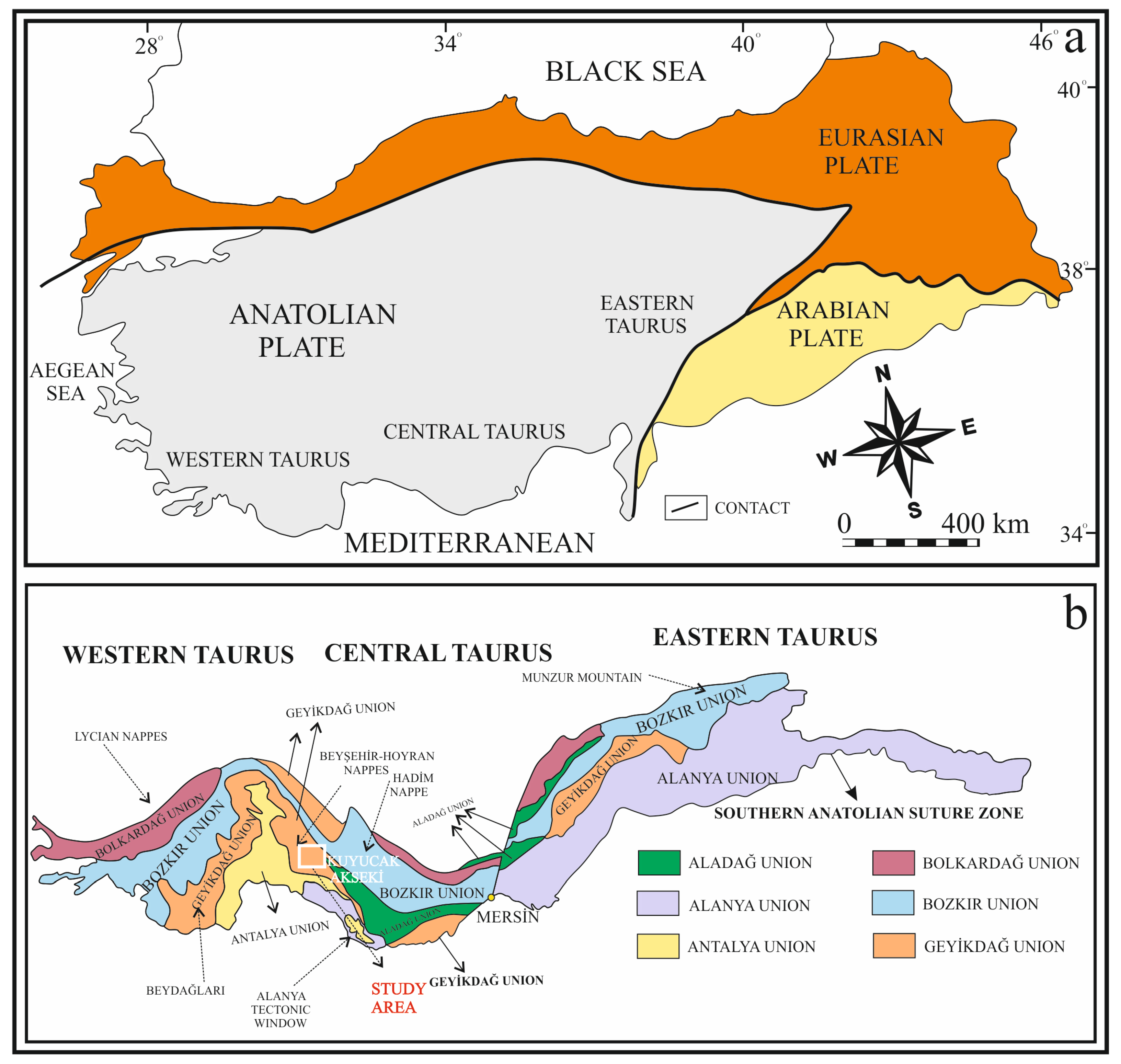
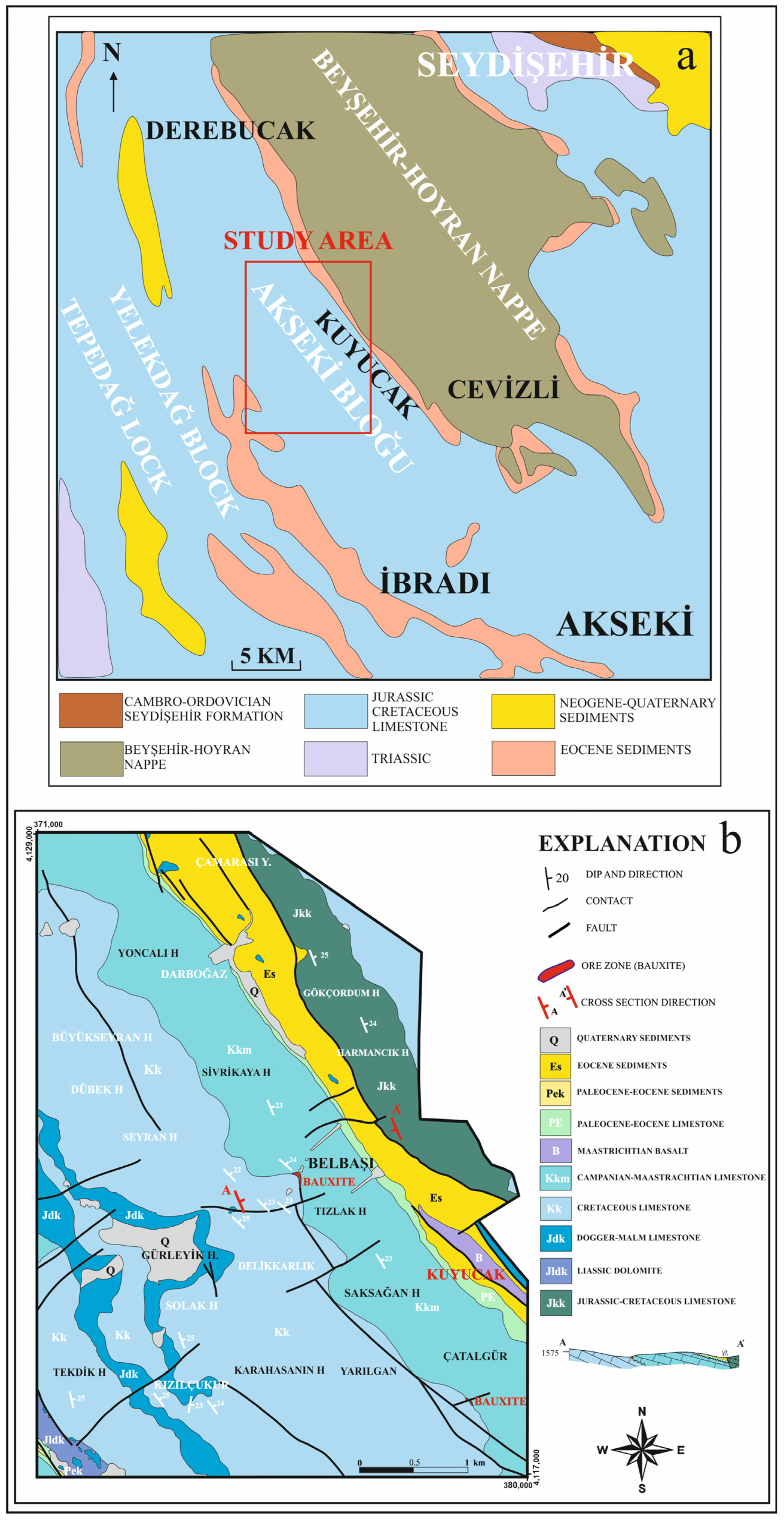
The study area is situated in the Akseki–Kuyucak region of Antalya Province in southern Turkey and is one of the notable karstic bauxite deposits within the Western Taurus tectonic band (Figure 1). The Taurus Belt is a significant component of the Alpine–Himalayan orogenic system, formed through intricate tectonic processes resulting from the convergence of the African and Arabian plates with the Eurasian plate [35,36,37,38]. The tectonic development pertains to the westward displacement of the Anatolian Plate and the occlusion of the Neotethys Ocean [36,37,38].
The Taurus Belt has three primary tectonic segments: the Western Taurus, Central Taurus, and Eastern Taurus [39,40] (Figure 1a). Different nappe units and tectonic units have been recognized throughout this belt. In the Western Taurus, the Bolkardağ, Bozkır, Geyikdağ, Aladağ, and Antalya units constitute the major tectonostratigraphic units [41] (Figure 1b). These units are defined by nap sequences that emerged after the closure of the Neotethys oceanic crust and the collision of continental blocks [36,37,38].
The Akseki–Kuyucak study region is situated within the Geyikdağ Group, characterized by substantial carbonate platform sequences (Figure 2a). The Geyikdağ Group is characterized by carbonate platform deposits spanning an extensive stratigraphic sequence from the Paleozoic to the Mesozoic [39]. The primary lithological units in the region comprise the Cambrian–Ordovician Seydişehir Formation, Triassic carbonates, Jurassic–Cretaceous thick carbonate platform sequences, and younger Eocene sedimentary units [41,42].
The carbonate formations seen in the research region are mostly composed of Jurassic–Cretaceous large limestones (Figure 2b). The intensive karstification processes on this carbonate platform created paleokarstic voids, which were later filled with lateritic weathering products, thereby promoting the formation of karstic bauxite deposits. Karstic bauxite deposits arise from the exposure of carbonate platforms, lateritic weathering in tropical-subtropical climates, and the infilling of karstic voids [1,2,3].
Figure 1. (a) Tectonic position of the research region (adapted from Isik et al. [43]). (b) Geographic location of the research area in the Central Taurus (adapted from Isik et al. [43]).
Minerals 16 00462 g001
Bauxite mineralization in the Akseki–Kuyucak region often occurs as lenses or veins that occupy karstic voids within carbonate formations. Geological map data indicate that bauxite zones have formed specifically at the interfaces between Cretaceous carbonates and Paleocene–Eocene sedimentary strata (Figure 2b). These zones are governed by the tectonic fault and fracture systems present in the area. The bauxite deposits identified at Belbaşı and Kuyucak often attain thicknesses of several meters and manifest as uneven lenses within carbonate formations.
Figure 2. (a) The association between the Beyşehir–Hoyran nappe and the Akseki Block/Tepe Dağı Block in the İbradı–Akseki region; Jurassic–Cretaceous carbonates, Triassic and Eocene flysch, and Neogene–Quaternary rocks [39]. (b) Geology map of the study area (Modified from MTA [44]).
Minerals 16 00462 g002

3. Analytical Methods

Bauxite specimens and host rock samples were gathered during comprehensive research undertaken in the Akseki–Kuyucak area of Antalya Province. The sampling program especially targeted bauxite deposits formed on karstic surfaces, and the lithological properties and stratigraphic positions of each sample were documented. Before laboratory examination, the materials were cleaned, dried, and crushed into a uniform powder using a jaw crusher and an agate mortar. The ground samples were processed to a particle size of roughly <75 µm, rendering them acceptable for geochemical and mineralogical examination.
The contents of major element oxides were ascertained using the X-ray fluorescence (XRF) technique. Before XRF analysis, all samples were desiccated at 80 °C as part of the laboratory preparation protocol, and thereafter crushed and pulverized. The elevated LOI values observed in some samples are primarily attributed to carbonate breakdown and structurally bound volatiles, rather than to moisture adsorbed on the surface.
The examinations were performed at the ARGETEST Analytical Testing and Analysis Laboratory in Ankara. The ARGETEST laboratory is a certified analytical institute that adheres to international standards and employs several geochemical analysis methods. Before XRF analysis, the materials were fused into glass disks via the lithium tetraborate fusion technique. This approach is recognized as a standard sample preparation technique that ensures high precision, especially for measuring key elements in lateritic and bauxitic rocks. The tests used a wavelength-dispersive X-ray fluorescence spectrometer (WD-XRF) to ascertain the major oxide concentrations. The major oxide constituents examined were Al2O3, Fe2O3, SiO2, TiO2, CaO, MgO, Na2O, K2O, MnO, and P2O5. The findings of the main element analysis are shown in Table 1. Total iron is represented as Fe2O3T, indicating the total iron content expressed in terms of Fe2O3 equivalent.
Analyses of rare earth elements (REEs) and trace elements were conducted using the inductively coupled plasma mass spectrometry (ICP-MS) technique. In ICP-MS studies, samples were completely dissolved with a combination of HF, HNO3, and HCl, and elemental concentrations were quantified by plasma ionization. The studied rare earth elements were La, Ce, Pr, Nd, Sm, Eu, Gd, Tb, Dy, Ho, Er, Tm, Yb, and Lu. Furthermore, other trace elements, including Y, Th, U, Nb, Ga, and Sc, were investigated. Element concentrations were expressed in ppm, and all findings are shown in Table 1 with the major element data.
X-ray diffraction (XRD) investigations were conducted at ARGETEST Analytical Testing and Analysis Laboratory (Ankara, Türkiye) using the XRD QN package to ascertain the mineralogical composition of the bauxite samples. Measurements were conducted on powdered substances using Cu-Kα radiation (λ = 1.5406 Å), and diffraction patterns were acquired throughout the 5–70° 2θ range. Phase identification was accomplished by comparing the recorded diffraction peaks with worldwide reference diffraction databases, while relative phase abundances were assessed using laboratory-reported weight ratios of crystalline phases. Due to the absence of an internal standard during the analysis, X-ray amorphous material was not quantified directly; consequently, the reported phase proportions pertain solely to crystalline phases and should be considered semi-quantitative, particularly in samples that may include amorphous or poorly crystalline constituents. The XRD results reveal that the bauxite samples primarily consist of boehmite and hematite, accompanied by accessory minerals such as anatase, goethite, kaolinite, and quartz, reflecting the typical mineralogical traits of karst-type bauxite deposits formed on carbonate platforms.
The statistical analysis of geochemical datasets and data visualization were conducted in Python (version 3.10). During the data processing phase, the pandas (v1.5.3) and numpy (v1.23.5) libraries were used to structure the datasets and execute numerical computations. XRF and REEs data files were imported as pandas DataFrames, followed by data cleaning. Values indicated as ND (not detected) or below the detection limit (<) in the analysis reports were assigned a value of zero for the purpose of statistical analysis. This method is a widely used data-cleansing technique for analyzing geochemical distributions in limited datasets. The Python code used for data processing and correlation analysis is included in the Supplementary Materials of this work.
Descriptive statistical analysis was performed to elucidate the overarching properties of the geochemical data. The mean, minimum, maximum, first quartile (Q1), median, and third quartile (Q3) values were computed, and the findings are shown in Table 2. The statistical parameters were used to elucidate overarching patterns in the main-element oxide compositions and rare earth element distributions of the bauxite samples.
A Spearman rank correlation analysis was conducted to assess the links between main element oxides and rare earth elements. This method is regarded as a dependable statistical technique, especially for tiny datasets and geochemical data that deviate from normal distribution. Spearman correlation coefficients were computed with the ‘spearmanr’ function from the ‘scipy.stats’ package (SciPy v1.10.1), and the results were represented as a color-coded correlation matrix.
The distribution characteristics of rare earth elements were assessed using the total light rare earth element concentration (ΣLREE). In this work, ΣLREE was determined as the aggregate of La, Ce, Pr, Nd, Sm, and Eu. The frequency distribution of ΣLREE was analyzed by a histogram, and the dataset’s distribution was juxtaposed with a fitted normal distribution curve. All statistical computations and visualizations were conducted using the pandas, numpy, matplotlib (version 3.7.1), and scipy libraries in Python. The algorithmic methodology and associated Python scripts used in the statistical analysis are included in the Supplementary Materials (File S1).

4. Results

4.1. Field Observations and the Geological Location of the Bauxite Zone

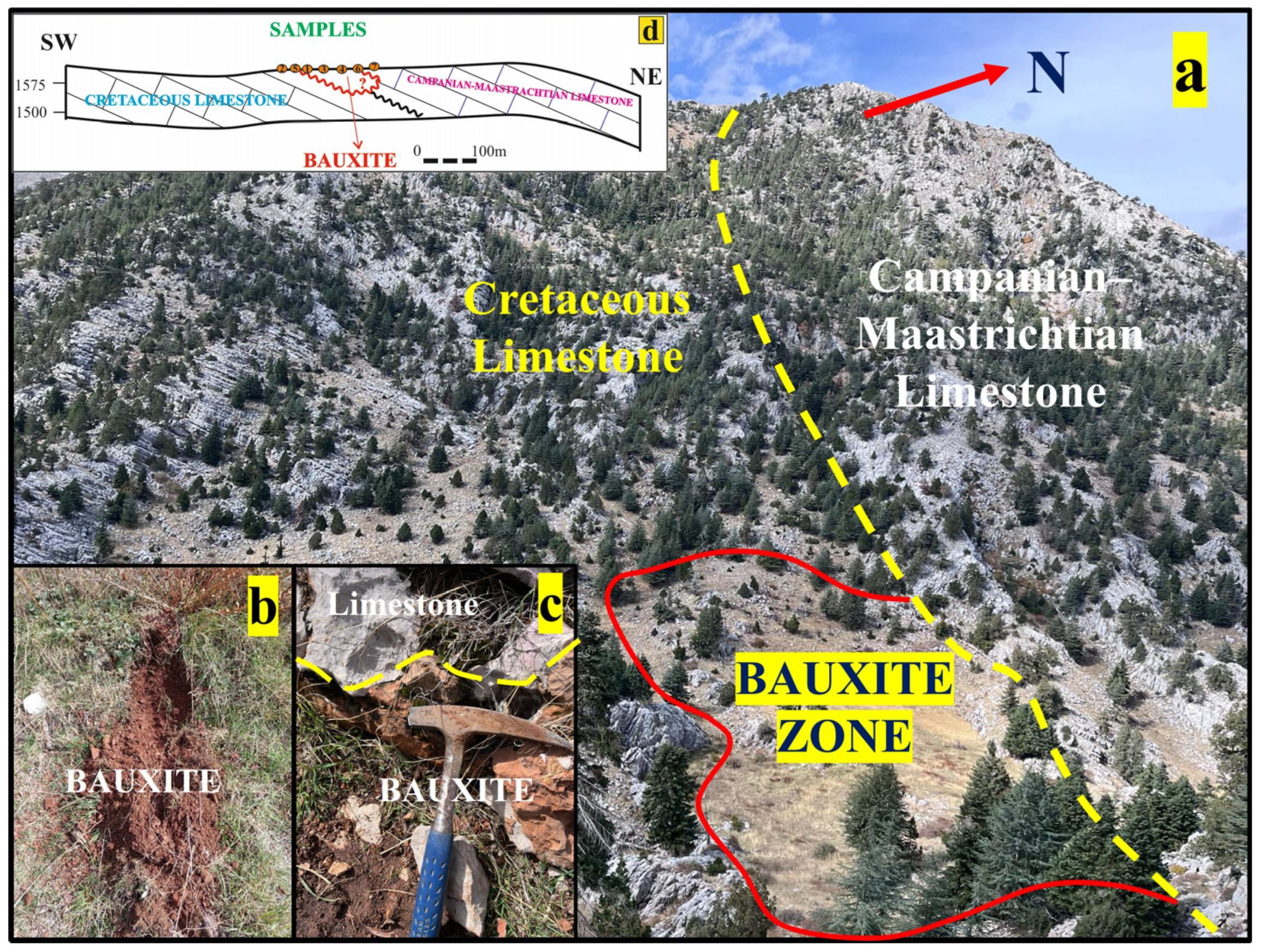
Fieldwork in the Akseki–Kuyucak area reveals that bauxite deposits are associated with paleokarst surfaces on a carbonate substrate. Aerial imagery clearly illustrates the morphological features of the carbonate units within the study region and the location of the bauxite zone (Figure 3a). The figure vividly depicts the interface between Cretaceous limestones and Campanian–Maastrichtian carbonates, with bauxite mineralization occurring over karstic surfaces formed between these two carbonate groups.
The bauxite zone is characterized by irregularly shaped, fill-like deposits inside the carbonate rocks. These zones are often marked by reddish-brown weathering products on the surface, allowing for easy differentiation from the gray-hued texture of the carbonate rocks (Figure 3b,c). Figure 3d demonstrates the ore zone and sample locations. Field observations suggest that bauxites originated from karstic cavities on the carbonate substrate that were subsequently filled with lateritic weathering processes.

4.2. Characteristics of Samples and Macroscopic Structures

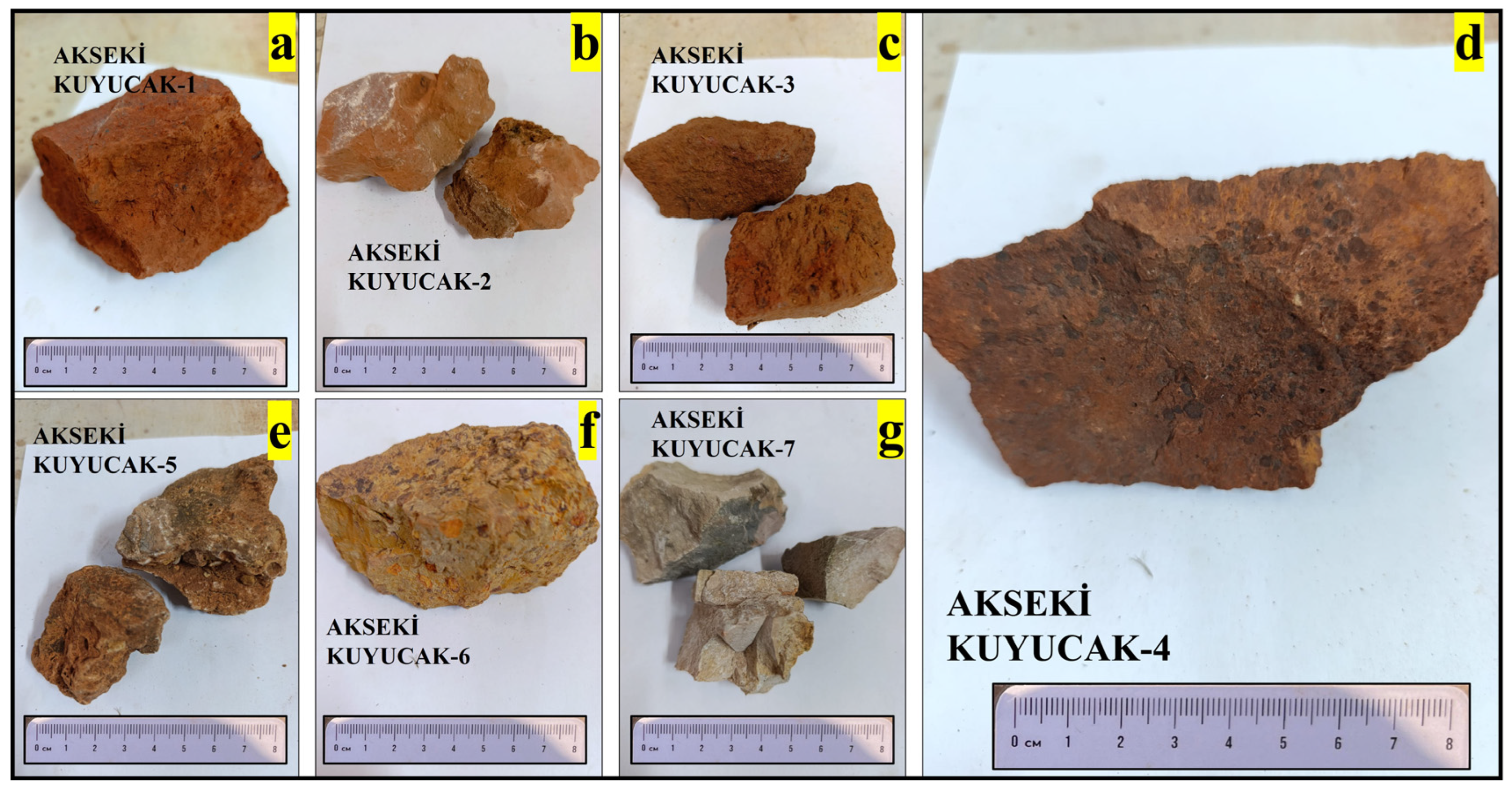
Figure 4 illustrates the macroscopic features of the samples gathered for this investigation. The samples mostly display hues of red, brown, and yellow, indicative of the distinctive coloration associated with lateritic weathering processes. The AKSEKİ–KUYUCAK-1 and AKSEKİ–KUYUCAK-3 samples include thick, red-hued bauxite minerals exhibiting a huge texture (Figure 4a,c). These samples have a pronounced ferruginous quality and evidence of significant oxidation. The AKSEKİ–KUYUCAK-4 sample has a denser, more compact structure, displaying a bauxite texture rich in iron oxide (Figure 4d). The AKSEKİ–KUYUCAK-5 and AKSEKİ–KUYUCAK-6 samples have varied textures. These samples include iron oxide pieces inside a matrix of clay minerals (Figure 4e,f). These textures exhibit varying degrees of weathering and reprecipitation that occurred during bauxite production. The AKSEKİ–KUYUCAK-7 sample has light-hued carbonate pieces and signifies the host limestone (Figure 4g). This sample serves as a reference for the mineralogical and geochemical properties of the carbonate host rock in the research region.

4.3. Mineralogical Composition (XRD Results)

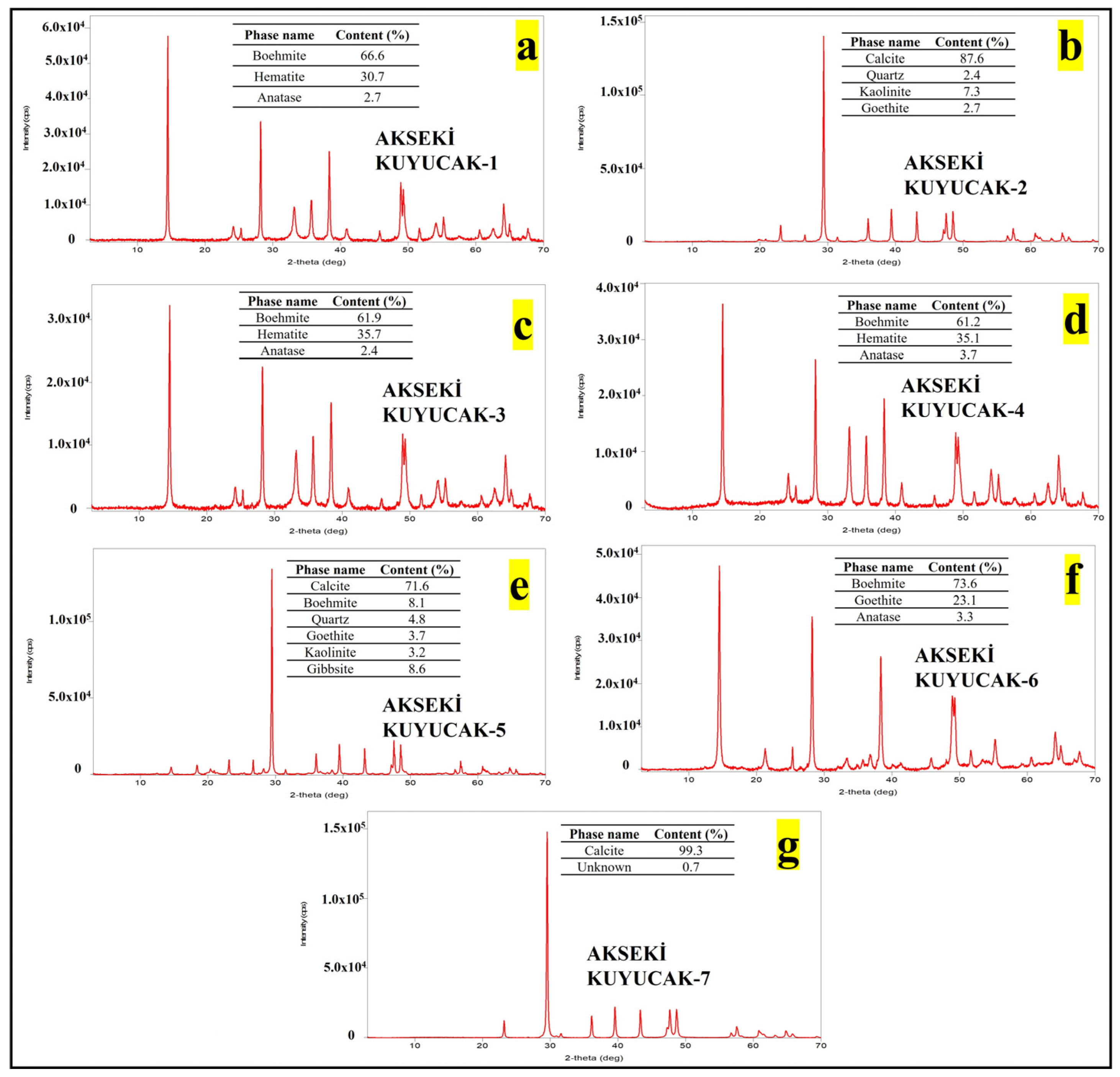
XRD measurements indicate that the mineralogical composition of the Akseki–Kuyucak samples varies notably between the bauxitic and carbonate strata (Figure 5). In the AKSEKİ–KUYUCAK-1 sample, boehmite (66.6%) is the predominant mineral phase, followed by hematite (30.7%) and anatase (2.7%) (Figure 5a). The AKSEKİ–KUYUCAK-2 sample is notably rich in carbonate, mostly including calcite (87.6%), with quartz (2.4%), kaolinite (7.3%), and goethite (2.7%) present (Figure 5b). The AKSEKİ–KUYUCAK-3 sample again displays a bauxite-type mineral assemblage, with boehmite (61.9%), hematite (35.7%), and anatase (2.4%) as the major phases (Figure 5c). The AKSEKİ–KUYUCAK-4 sample contains significant amounts of boehmite (61.2%) and hematite (35.1%), with anatase found at 3.7% (Figure 5d). In the AKSEKİ–KUYUCAK-5 sample, calcite (71.6%) predominates, while supplementary phases including boehmite (8.1%), quartz (4.8%), goethite (3.7%), kaolinite (3.2%), and gibbsite (8.6%) have also been detected (Figure 5e). The AKSEKİ–KUYUCAK-6 sample contains boehmite (73.6%) as the predominant mineral, followed by goethite (23.1%) and anatase (3.3%); this sample exemplifies highly lateritized bauxitic material (Figure 5f). The mineralogical composition of the AKSEKİ–KUYUCAK-7 sample is mostly calcite (99.3%), with a negligible presence of an unidentified phase (0.7%) (Figure 5g). This signifies that the material in issue constitutes carbonate bedrock.

4.4. Geochemical Composition and Statistical Approach

The major oxide compositions of the bauxite samples from the research region are shown in Table 1. Quantitative XRD findings, shown as weight ratios of crystalline phases, are provided in Supplementary Table S1. The Al2O3 concentrations in the bauxite samples vary from 14.57% to 55.24%. The mean Al2O3 value is 31.64%, whereas the median value is 46.88%. Elevated aluminum concentrations are associated with the leaching of mobile elements from carbonate rocks and subsequent enrichment of aluminum during lateritic weathering (Table 1). The Fe2O3 concentration varies from 2.06% to 36.60%, with a mean value of 18.74%. Elevated iron concentrations correlate with the presence of hematite and goethite in the bauxite samples. The SiO2 concentration is typically low, ranging from 0.66% to 7.22%, with a mean value of 3.20%. The low silica levels indicate intense lateritic weathering conditions. The TiO2 concentration varies from 0.01% to 2.91%, with a mean value of 1.56%. Titanium content is associated with the mineral anatase, which is often found in bauxite deposits. Conversely, CaO concentrations reach significantly elevated levels in samples indicative of the carbonate host rock. The CaO concentration in the KUYUCAK-7 sample attains a maximum of 55.16%.
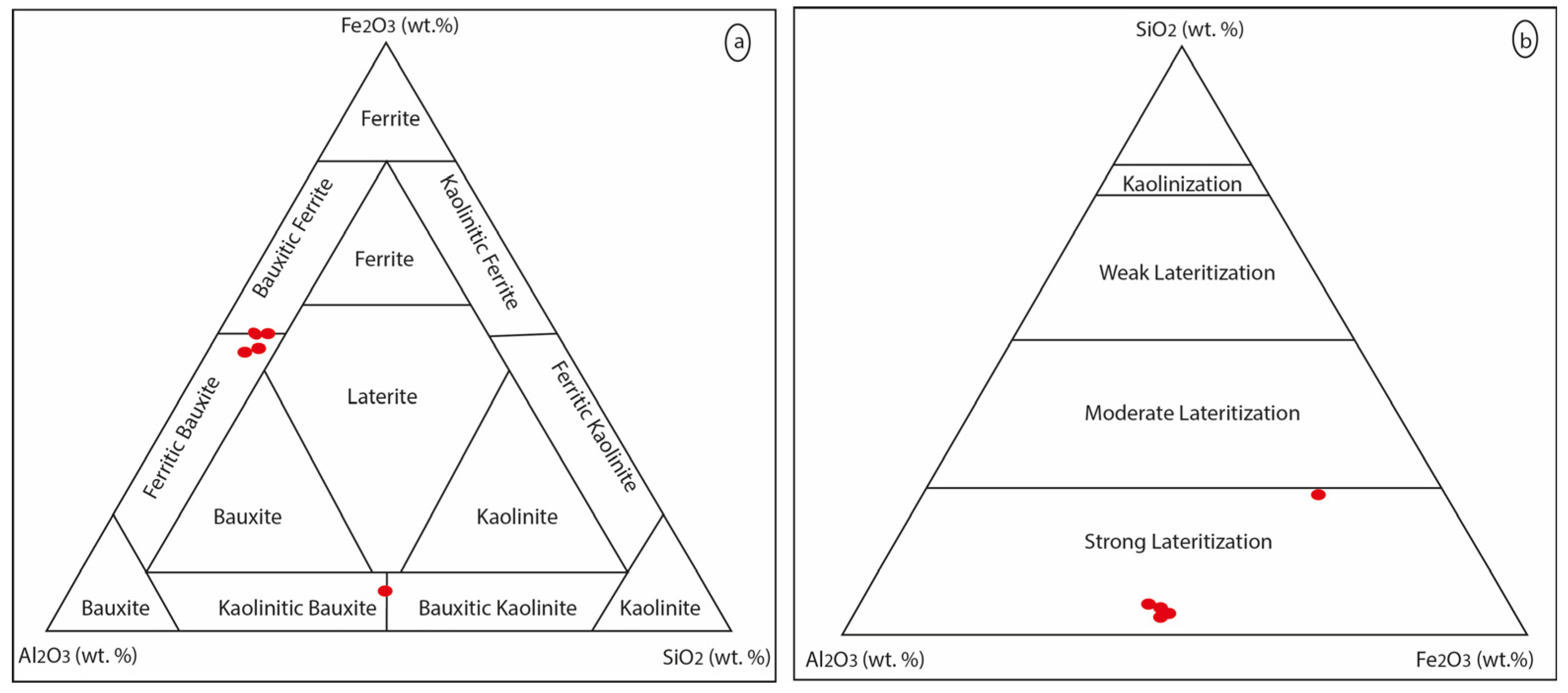
The Al2O3–Fe2O3–SiO2 ternary diagram was used to assess the ratios of main elements (Figure 6a). The bulk of the samples are situated in the bauxite and ferritic bauxite areas. One specimen, however, is located in the kaolinitic bauxite area. This distribution indicates that the rocks in the studied region have undergone significant lateritic weathering.
The secondary triangle diagram, derived from SiO2–Al2O3–Fe2O3 ratios, illustrates the extent of lateritization (Figure 6b). In this picture, most samples are located in the significantly lateritized zone, with a single sample in the moderately lateritized zone. This indicates that bauxite production occurred under severe chemical weathering conditions.
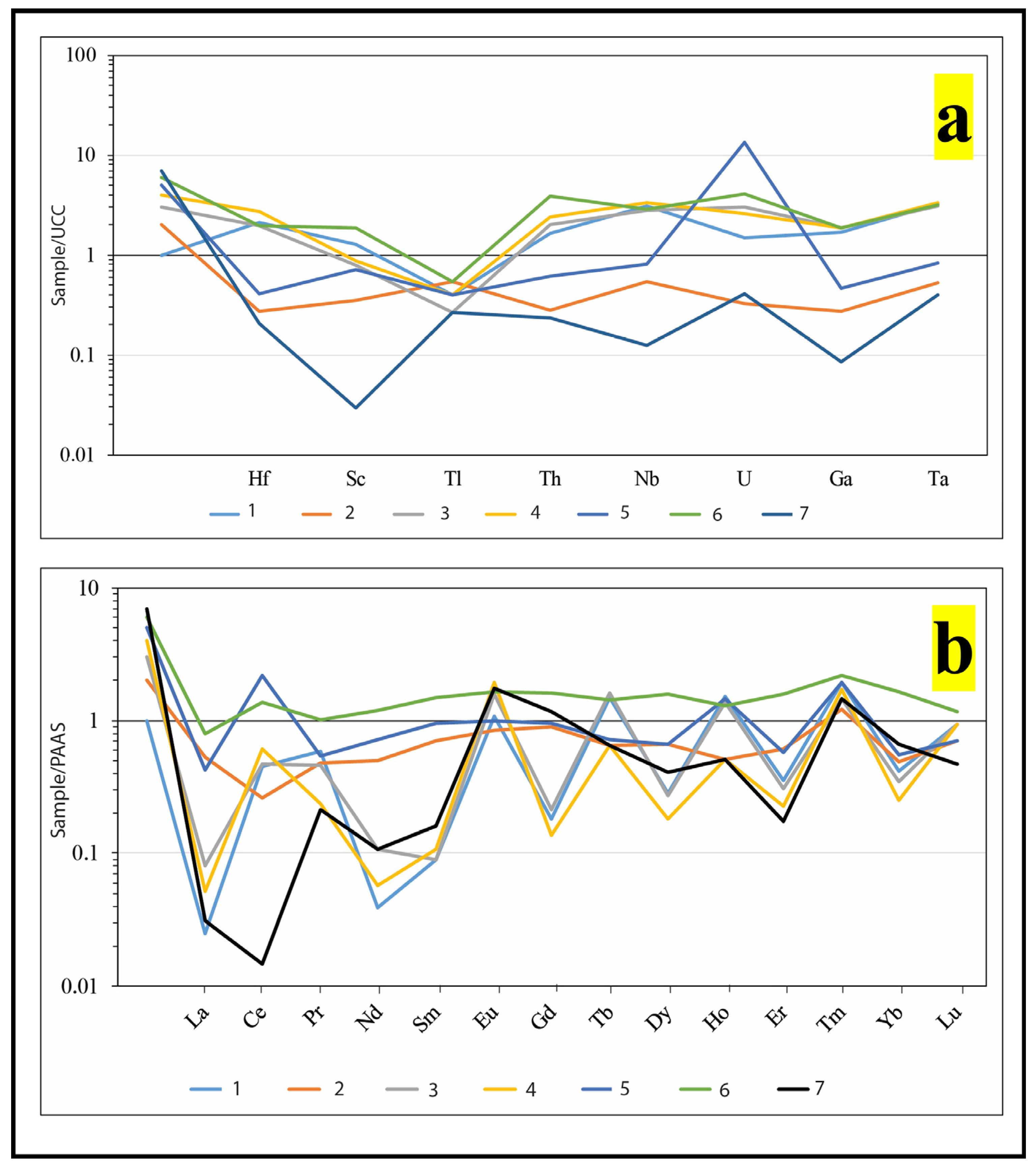
The REE measurements (Table 1) demonstrate significant enrichment of LREEs (La–Sm) compared to HREEs (Gd–Lu), producing a fractionated REE pattern marked by LREE enrichment and relative HREE depletion. Conversely, high-field-strength elements (e.g., Nb, Ta, and Ti) exhibit negative anomalies when normalized to primitive mantle values. Multi-element diagrams created using UCC and PAAS normalizations (Figure 7a,b) clearly exhibit the distinctive geochemical fingerprints of bauxite and related lateritic products.
Figure 7a presents the UCC-normalized trace-element diagram, showing the relative distributions of Hf, Sc, Tl, Th, Nb, U, Ga, and Ta across the samples. The picture clearly illustrates a diverse but organized enrichment trend among the HFSE parts. Uranium is significantly enriched in just a select few samples and does not establish a consistent geochemical pattern across the collection. This enrichment cannot be attributed solely to residual concentration after bauxitization, since uranium may act as a mobile element under weathering conditions. In contrast, Sc shows a more uniform reduction than UCC values. This trend aligns with the elimination of mobile materials from the environment during lateritic weathering.
The elements Nb, Ta, and Ga have very similar behavior among the HFSEs. These elements often exhibit residual enrichment and tend to accumulate with aluminum minerals during lateritic weathering. The notable concentration of Ga in some samples is often observed in bauxite deposits and stems from its geochemical similarity to aluminum oxide crystals.
The PAAS-normalized REE diagram (Figure 7b) indicates that the samples have a distinctive distribution of rare earth elements. The graphic indicates a predominance of LREEs and a little decline towards HREEs. La and Ce are enriched in most samples relative to PAAS. Despite Ce’s deviation from adjacent REEs in several samples, the overall REE spectra exhibits significant irregularity; hence, this characteristic is regarded as varied Ce behavior rather than a distinct Ce anomaly. The comparatively diminished concentrations of Ce in relation to other LREEs may be elucidated by fractionation caused by the oxidation of Ce3+ to Ce4+ under oxidative circumstances. Such anomalies are regarded as significant geochemical markers indicating the redox conditions in lateritic settings.
An Eu anomaly is also seen in some samples within the REE range. The distinct behavior of the Eu element, in contrast to other medium-rare-earth elements, may be ascribed to the mineralogy of the parent rock or the weathering of plagioclase during weathering processes. Upon examining the total distribution of REEs, it is apparent that the samples have a pronounced concentration in LREEs, a geochemical trait often associated with lateritic weathering processes
Descriptive statistics were first used to summarize the central tendency and dispersion of the geochemical dataset, then followed by Spearman rank correlation analysis to assess inter-element interactions.
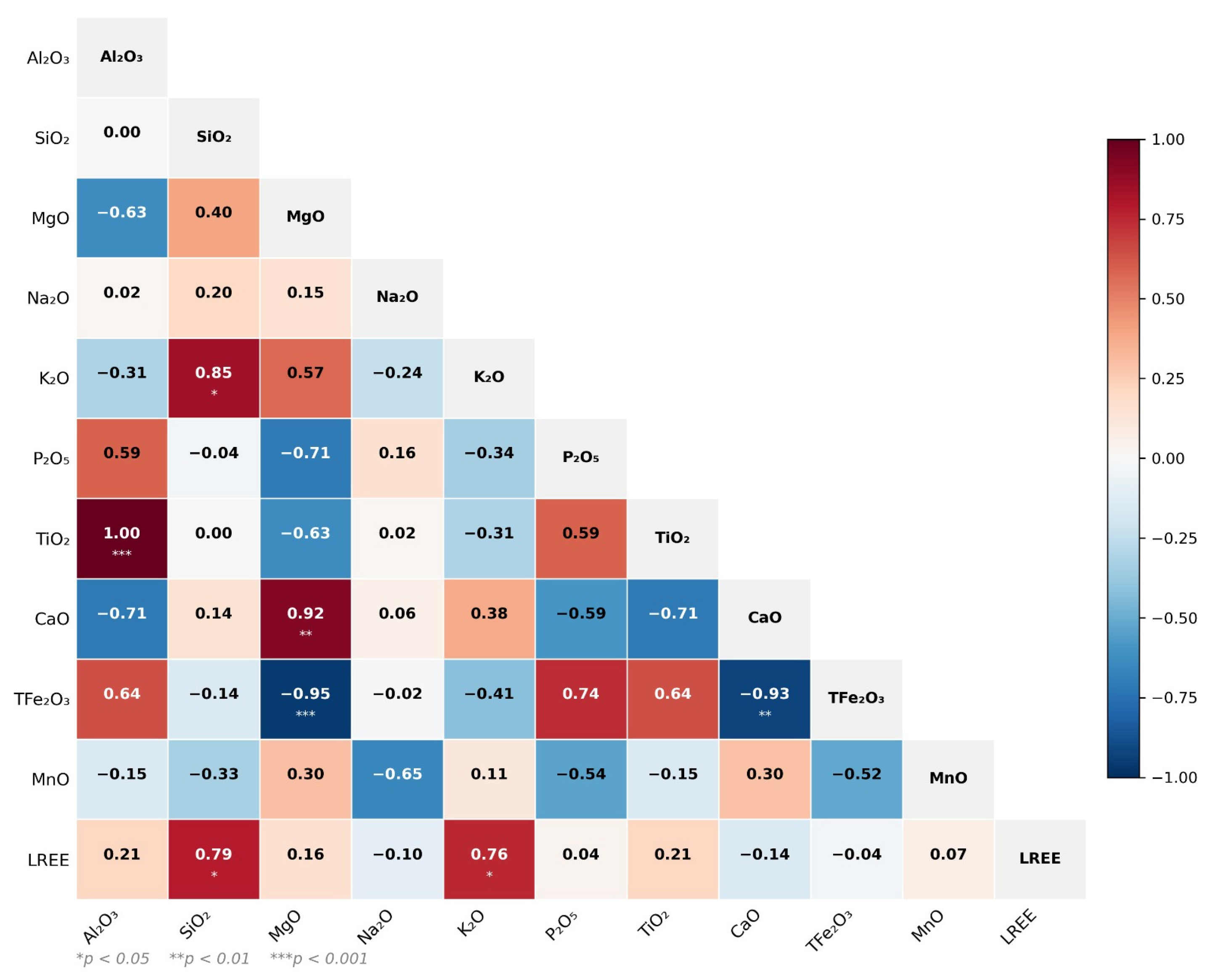
Figure 8 displays the Spearman correlation coefficients computed to assess the links between main oxides and trace elements. An analysis of the correlation matrix indicates robust positive and negative associations among certain pairs of elements. The importance of the Spearman correlation coefficients was evaluated using p-values, since there is no generally applicable critical r value; it varies with sample size. Correlations with p < 0.05 were deemed statistically significant.
A notably robust positive connection (r = 1.00) exists between Al2O3 and TiO2. This phenomenon may be explained by titanium’s immobility during lateritic weathering, resulting in its residual accumulation alongside aluminum-rich phases. The significant association between Al2O3 and TFe2O3 suggests that iron and aluminum oxides co-accumulate during bauxite production.
The inverse association between basic oxides like MgO and CaO and Al2O3 indicates that these elements are extracted from the system during the weathering of carbonate parent rocks. The notable negative connection between CaO and TFe2O3 suggests that iron oxides accumulate in the residue owing to the breakdown of carbonate minerals.
The robust positive correlation between SiO2 and K2O (r = 0.85) suggests that these elements are primarily associated with clay minerals or detrital silicate phases. The negative connection between MgO and P2O5 suggests that phosphate phases have distinct geochemical behavior during lateritic weathering.
A significant association between total rare earth elements (LREEs) and SiO2 and K2O indicates that rare earth elements may be maintained by clay minerals or detrital silicate phases. These connections indicate mineralogical variables that govern the distribution of rare earth elements in lateritic systems.
The quantities of light rare earth elements (LREEs) in the samples vary from 22.3 ppm to 240.2 ppm (Table 2). The mean value is nearly 106 ppm, whereas the median is 62.5 ppm. This signifies that the dataset has a right-skewed distribution. The first quartile (Q25) is roughly 55.5 ppm, while the third quartile (Q75) is 153.2 ppm. This distribution indicates that REE concentrations differ significantly among the samples. The inclusion of many samples with elevated LREE values skews the data distribution, resulting in an upward bias in the average value. This scenario aligns with the diverse REE distribution often seen in bauxite sources. The concentration of rare earth elements in specific mineral phases or clay minerals during lateritic weathering might lead to notable differences among samples. Furthermore, the observed REE enrichment may reflect variable detrital contribution and differential retention in clay-bearing components within the karst bauxite system.

5. Discussion

5.1. The Geological Context and Formation Model of the Akseki–Kuyucak Bauxite Deposits

The Akseki–Kuyucak bauxites are characteristic karst-type bauxite deposits linked to paleokarstic cavities formed on carbonate platforms in the Western Taurus Mountains. Field observations suggest that mineralization is influenced by uneven karst topography and sedimentary voids formed within Cretaceous limestones and the Campanian–Maastrichtian carbonate sequence. This aligns with traditional models suggesting that karst bauxites in the Taurus belt originated from regional tectonic uplift, exposure of the carbonate platform, dissolution-karstification, and the subsequent transport and deposition of aluminum-rich weathering products into voids [1,3,9,49]. The region’s position within the Tethys belt corroborates this interpretation, as numerous karstic bauxite deposits in the Mediterranean–Tethys metallogenic area have formed similarly on carbonate platforms, linked to regional unconformity surfaces and paleokarst voids [13,36,50,51,52].
The bauxite mineralization in Akseki–Kuyucak is most accurately understood within the broader metallogenic context of the Taurus Belt. Prior research has shown the significant genetic correlation between bauxite formation and carbonate platform successions in the Akseki area (Blumenthal [53]; Göksu [18]; Özlü [19,54]; Toker et al. [55]; Sağaltıcı and Koç [56]; Koç and Sağaltıcı [57]). The mineralogical and geochemical results of this study corroborate previous findings and further illustrate that the Akseki–Kuyucak occurrence constitutes a karst-type bauxite system formed within paleokarst-controlled cavities in carbonate rocks, rather than a mere lateritic surface accumulation. This deposit exhibits a robust genetic relationship with other carbonate-hosted bauxite deposits within the Taurus Belt, including Seydişehir, Mortaş, Doğankuzu, Bolkardağı, Payas, Sütleğen, and Çatköy, thereby reinforcing a shared karst-controlled metallogenic development across the region [58,59,60].
Anatolia has a variety of karst-associated bauxite deposits from many geological epochs, suggesting that bauxitization is a broad and intricate process rather than being limited to a particular temporal context. Comprehensive evaluations of Turkish bauxite localities reveal significant deposits dating to the Permian–Triassic era, extending through the Jurassic and into the Late Cretaceous, primarily within the Tauride carbonate platforms, as shown by Hanilçi [9]. Bauxites from the Alanya area are linked to Permian–Triassic unconformities, whereas deposits from Bolkardağı correspond to Middle Jurassic palaeokarst surfaces, indicating that prior bauxitization predates the notable Late Cretaceous occurrences. Furthermore, in Çatköy, karstic bauxites developed on Upper Permian carbonates from the Late Triassic to Early Jurassic, further signifying the occurrence of the first bauxitization phases in southern Türkiye, as emphasized by Yalcin et al. [29]. Meta-bauxites from the Milas area have a complex evolutionary history, formed from the Late Maastrichtian to the Eocene and thereafter undergoing metamorphic changes, indicative of both temporal and genetic variation within Anatolian deposits [30]. The Akseki–Kuyucak bauxite, a relatively new, non-metamorphosed karst-type deposit originating from Upper Cretaceous carbonate platforms, stands in stark contrast to older, sometimes metamorphosed deposits across Anatolia. This approach highlights that bauxite formation in Anatolia is shaped by repeated episodes of subaerial exposure, karstification, and subsequent infilling, rather than by a single depositional event.

5.2. Mineralogical Differentiation and Ore-Carbonate Segregation

The presence of calcite-dominated samples indicates varying degrees of bauxitization; some directly reflect the ore zone, whilst others include carbonate country rock or less bauxitized transition zones. This divergence is abundantly apparent in the geochemical data. Consequently, it is more precise to describe the Akseki–Kuyucak region not as a uniform ore body, but as a heterogeneous system consisting of karst void fill, residual ore zones, and carbonate transition zones. Comparable heterogeneity has been documented in karst bauxites in Italy, Iran, Greece, and China [8,15,17,61,62,63].

5.3. Geochemistry of Major Oxides and Extent of Lateritization

The findings of the triangle diagram further corroborate this perspective. In the Al2O3–Fe2O3–SiO2 categorization, most samples are categorized inside the ferritic bauxite/ferritic bauxitic ferrite area, although one sample is positioned on the kaolinitic bauxite border. In the alternative triangle figure, most samples are concentrated in the “strong lateritization” area. This distribution indicates extremely advanced weathering conditions characterized by substantial removal of silica, with concentration of Al and Fe in residual phases. Retallack [7] highlighted that lateritization and bauxitization are interconnected but separate processes; Bárdossy [1] and Bárdossy and Aleva [2] showed that the geochemical signature of lateritic weathering may be retained even within karstic systems. The distribution of the Akseki–Kuyucak samples in these diagrams aligns with the previously established classical framework.
Nonetheless, not all samples show the same extent of lateritization. The elevated CaO and LOI values of Kuyucak-2, Kuyucak-5, and Kuyucak-7 indicate that these samples include both the ore inside the karst hole and the carbonate bedrock or little weathered transition zones. This suggests that lateritization in the area exhibits a geographically heterogeneous, selective enrichment pattern rather than a uniform, singular process. Comparable selectivity has been seen in the Huri and Kolijan bauxites in Iran, the Parnassos–Ghiona bauxites in Greece, and the Apulian/Abruzzi bauxites in Italy [10,12,64,65,66].

5.4. Distribution of Trace Elements and Rare Earth Elements: Origins, Movement, and Enrichment

In the Akseki–Kuyucak samples, ΣLREE levels vary from 22.2 to 240.2 ppm, while ΣREE values range from 24.4 to 248.1 ppm; the median ΣLREE is 62.48 ppm, and the mean is 106.05 ppm. The numbers suggest that the dataset has both low-REE carbonate/gangue samples and more affluent bauxitic samples. The right-skewed histogram, together with the meaning being much greater than the median, suggests that REE buildup is concentrated in a limited number of samples, indicating a lack of homogeneity in the system. Right-skewed distributions are prevalent in karstic bauxites owing to the selective preservation and secondary redistribution of rare earth elements [67].
The spider diagram illustrates that LREEs are more enriched than HREEs, with more pronounced disparities across samples, especially for Ce, Nd, Sm, and, to a lesser degree, Eu. This indicates that rare earth elements are governed by several mineral phases and fluctuating weather conditions rather than by a single homogeneous source. LREE enrichment in karstic bauxites is often linked to phosphate phases, clay minerals, and the adsorption of Fe-oxide/oxihydroxide on surfaces [9,15,21,65,67]. Despite the absence of mineral phases directly containing REEs in the Akseki–Kuyucak samples, the notable positive association between LREEs and SiO2 and K2O indicates that REEs may be at least partly linked to silicate/clay phases.
The Spearman correlation matrix is significant in this context. A robust and substantial positive association exists between ΣLREE and SiO2 (r = 0.79, p < 0.05), as well as between ΣLREE and K2O (r = 0.76, p < 0.05). The correlation analysis reveals no statistically significant relationships between ΣLREE and CaO (r = −0.14), Fe2O3 (r = −0.04), or TiO2 (r = 0.21), as these coefficients indicate associations that are negligible to very weak. The findings indicate that REE accumulation in the Akseki–Kuyucak samples is not directly associated with the carbonate host rock; instead, it is mostly influenced by siliciclastic or clay-rich components. In other terms, samples that are more abundant in REEs are likewise more siliceous and comparably enriched in K. This tendency aligns with systems in which rare earth elements are linked to kaolinitic/illite-rich clay phases, fine-grained detrital inputs, or clay-rich alteration zones [21,67].
This outcome diverges somewhat from certain traditional karst bauxite models. In certain deposits in Italy and Greece, the enrichment of rare earth elements (REEs) has been more closely linked to iron oxides or phosphate minerals [6,8,65]. Nonetheless, in some instances, the significance of clay minerals and detrital contributions has been underscored [15,64]. The tenuous association between LREEs and Fe2O3 at Akseki–Kuyucak indicates that REE availability is constrained by hematite/goethite, whereas silicate-bearing constituents may have a more substantial influence. Consequently, this region should be seen not as a system “exclusively governed by Fe-oxides” for REE-bearing phases, but as a mixed-controlled system in which clay and silicate contributions are substantial.

5.5. The Use of Statistical Approaches in Geological Interpretation

This study’s statistical analysis included not only descriptive analyses but also facilitated the understanding of data distribution, correlation patterns, and multivariate linkages alongside geological processes. Despite the limited sample size (n = 7), the dataset adequately delineates the primary geochemical variability in the examined materials and facilitates exploration of first-order interelement correlations.
The ΣLREE pattern indicates a heterogeneous enrichment regime within the Akseki–Kuyucak bauxite system, suggesting that REE accumulation occurred non-uniformly over the deposit. The observed variability aligns more closely with selective retention, local remobilization, and secondary concentration in microenvironmentally regulated settings. Similar behavior has been documented in other karst bauxite systems, where the redistribution of rare earth elements (REEs) reflects the cumulative effects of weathering intensity, fluid-mediated mobility, and fixation in appropriate mineral hosts [67,68]. Chen et al. [67] specifically highlighted that the enrichment of rare earth elements (REEs) is governed by localized geochemical micro-niches and multi-stage processes, resulting in data distributions that mostly display log-normal or skewed features.
Spearman’s correlation analysis clearly illustrates the geochemical characteristics related to the distribution of rare earth elements (REEs). Robust positive correlations between ΣLREE and SiO2 (r = 0.79, p < 0.05) and K2O (r = 0.76, p < 0.05) suggest that rare earth elements are linked to silicate and clay components. The lack of a substantial association with Fe2O3 indicates that iron oxides are not the principal repository for rare earth elements in this deposit. This result, while differing from studies indicating that REE is associated with Fe-oxides/oxihydroxides in certain Tethys bauxites [65,66], aligns with research highlighting clay and silicate-mediated REE accumulation [67,68].
The correlations among principal oxides also provide statistical evidence of geological processes. The robust positive correlation between CaO and MgO (r = 0.92, p < 0.01) distinctly indicates the impact of the carbonate host rock, whereas the significant negative correlation between Fe2O3 and CaO (r = −0.93, p < 0.01) aligns with the dissolution of carbonate and the accumulation of Fe in residual phases during bauxitization. The robust positive association between Al2O3 and TiO2 (r = 1.00, p < 0.001) suggests that immobile components exhibit collective behavior and accumulate in residual phases. These connections correspond with the traditional concept that delineates the separation of mobile and immobile components during lateritic weathering processes [1,68].
The statistical analysis of multivariate geochemical datasets has gained significance for elucidating intricate interelement connections, especially in systems where the behavior of rare earth elements is influenced by many geological and mineralogical variables. Recent studies indicate that these techniques significantly enhance the understanding of origin, tectonic context, and elemental distribution patterns in bauxite-bearing systems [13,34]. The statistical analysis of the Akseki–Kuyucak samples reveals that REE enrichment is unevenly distributed, reflecting a heterogeneous geochemical regime influenced by selective enrichment and varying mineralogical composition. The favorable correlations of ΣLREE with SiO2 and K2O indicate a stronger linkage of rare earth elements with silicate- and clay-rich components, whereas the robust correlations among major oxides highlight the compositional disparity between bauxitic materials and carbonate-rich transitional or host-rock facies. The Akseki–Kuyucak deposit exemplifies a mineralogically and geochemically diverse karst bauxite system, in which the distribution of rare earth elements (REEs) was influenced by multiphase and spatially variable enrichment processes. The statistical findings provide a valuable foundation for enhancing the geological interpretation of element mobility, residual concentration, and facies-controlled geochemical variability within the deposit.

6. Conclusions

The Akseki–Kuyucak deposit is characterized as a karst-type bauxite system resulting from paleokarst-controlled buildup on carbonate platform rocks within the Western Taurus Belt. XRD and geochemical analyses indicate a heterogeneous ore–host rock system consisting of boehmite-rich bauxitic zones and calcite-rich transitional or host-rock facies. Principal oxides indicate pronounced lateritization and residual aluminum-iron enrichment, whereas rare earth element data suggest heterogeneous enrichment of light rare earth elements mostly linked to silicate and clay-bearing constituents. The findings indicate that the deposit exemplifies a complex yet characteristic Mediterranean-type karst bauxite development influenced by karst topography, selective enrichment, and a diverse mineralogical composition.
Consequently, statistical analyses were used in this study not just as an ancillary tool but as a fundamental component of direct geological interpretation. Upon assessing the correlation of rare earth elements (REEs) with silicate/clay phases, the dilutive effect of the carbonate component, the collective behavior of immobile elements, and the heterogeneous distribution of data, it is clear that the Akseki–Kuyucak bauxites represent a multi-phase, multi-process, and spatially variable enrichment system. This result provides a comprehensive elucidation consistent with established bauxite formation theories and supported by modern data analytics techniques.

Supplementary Materials

The following supporting information can be downloaded at: https://www.mdpi.com/article/10.3390/min16050462/s1. Table S1: Proportions of crystalline phases in the Akseki–Kuyucak samples derived from XRD QN reports; File S1: Python scripts used for Spearman correlation analysis, visualization of the correlation matrix, and statistical assessment of ΣLREE.

Author Contributions

Conceptualization, C.Y. and M.A.; methodology, C.Y.; software, C.Y.; validation, M.A. and C.Y.; formal analysis, M.A.; investigation, C.Y.; resources, M.A.; data curation, C.Y.; writing—original draft preparation, M.A. and C.Y.; writing—review and editing, M.A. and C.Y.; visualization, M.A.; supervision, C.Y.; project administration, C.Y.; funding acquisition, C.Y. All authors have read and agreed to the published version of the manuscript.

Funding

The present study was funded with assistance from SRG Engineering and Consultancy Ltd., Şti. for the internal project “GeoMLVis: AI-Assisted 3D Visualization and Reserve Estimation Software for Geological and Geophysical Data” (Project No. SRG01).

Data Availability Statement

The data are included in the paper and additional resources. The analytical data from XRF, ICP-MS, and XRD that underpin this study’s conclusions are detailed in the paper, while Supplementary Table S1 presents the QXRD crystalline phase proportions, and File S1 contains the Python programs used for statistical analysis and visualization.

Acknowledgments

We are grateful for the critical reviews, constructive comments, and suggestions by anonymous reviewers and editors.

Conflicts of Interest

Author Cihan Yalçın was employed by the company SRG Engineering and Consultancy Ltd., Şti., 09100 Aydın, Türkiye. The remaining author declares that the research was conducted without any commercial or financial relationships that could be construed as a potential conflict of interest.

References

  1. Bárdossy, G. Karst Bauxites: Bauxite Deposits on Carbonate Rocks; Elsevier: Amsterdam, The Netherlands, 1982. [Google Scholar]
  2. Bárdossy, G.; Aleva, G.J.J. Lateritic Bauxites; Elsevier: Amsterdam, The Netherlands, 1990. [Google Scholar]
  3. D’Argenio, B.; Mindszenty, A. Bauxites and related paleokarst: Tectonic and climatic event markers at regional unconformities. Eclogae Geol. Helv. 1995, 88, 453–499. [Google Scholar]
  4. Gow, N.N.; Lozej, G.P. Bauxite. Geosci. Can. 1993, 20, 9–16. [Google Scholar]
  5. Mindszenty, A. Bauxites: Feedbacks of system Earth at greenhouse times. Geol. Croat. 2016, 69, 79–87. [Google Scholar] [CrossRef]
  6. Mongelli, G.; Boni, M.; Oggiano, G.; Mameli, P.; Sinisi, R.; Buccione, R.; Mondillo, N. Critical metals distribution in Tethyan karst bauxite: The Cretaceous Italian ores. Ore Geol. Rev. 2017, 86, 526–536. [Google Scholar] [CrossRef]
  7. Retallack, G.J. Lateritization and bauxitization events. Econ. Geol. 2010, 105, 655–667. [Google Scholar] [CrossRef]
  8. Gamaletsos, P.N.; Godelitsas, A.; Filippidis, A.; Pontikes, Y. The rare earth elements potential of Greek bauxite active mines in the light of a sustainable REE demand. J. Sustain. Met. 2019, 5, 20–47. [Google Scholar] [CrossRef]
  9. Hanilçi, N. Bauxite deposits of Turkey. In Mineral Resources of Turkey; Springer: Cham, Switzerland, 2019; pp. 681–730. [Google Scholar]
  10. Abedini, A.; Khosravi, M. Geochemical characteristics of aluminum-bearing iron ores: A case study from the Kolijan karst-type bauxite deposit, northwestern Iran. Minerals 2024, 14, 151. [Google Scholar] [CrossRef]
  11. Boni, M.; Rollinson, G.; Mondillo, N.; Balassone, G.; Santoro, L. Quantitative mineralogical characterization of karst bauxite deposits in the southern Apennines, Italy. Econ. Geol. 2013, 108, 813–833. [Google Scholar] [CrossRef]
  12. Mongelli, G.; Buccione, R.; Sinisi, R. Genesis of autochthonous and allochthonous Apulian karst bauxites (southern Italy): Climate constraints. Sediment. Geol. 2015, 325, 168–176. [Google Scholar] [CrossRef]
  13. Zhou, J.; Yu, W.; Wei, W.; Yang, M.; Du, Y. Provenance and tectonic evolution of bauxite deposits in the Tethys: Perspective from random forest and logistic regression analyses. Geochem. Geophys. Geosyst. 2023, 24, e2022GC010745. [Google Scholar] [CrossRef]
  14. Liu, X.; Wang, Q.; Feng, Y.; Li, Z.; Cai, S. Genesis of the Guangou karstic bauxite deposit in western Henan, China. Ore Geol. Rev. 2013, 55, 162–175. [Google Scholar] [CrossRef]
  15. Luo, C.; Liang, P.; Yang, R.; Gao, J.; Chen, Q.; Mo, H. Mineralogical and geochemical constraints on the occurrence forms of REEs in Carboniferous karst bauxite, central Guizhou Province, southwest China: A Case Study of Lindai Bauxite. Minerals 2023, 13, 320. [Google Scholar] [CrossRef]
  16. Laskou, M.; Economou-Eliopoulos, M. Bio-mineralization and potential biogeochemical processes in bauxite deposits: Genetic and ore quality significance. Miner. Pet. 2013, 107, 471–486. [Google Scholar] [CrossRef]
  17. Abedini, A. The Tamouqeh karst bauxite deposit, northwestern Iran: Constraints on REE geochemical characteristics. J. Afr. Earth Sci. 2026, 237, 106026. [Google Scholar] [CrossRef]
  18. Göksu, E. Akseki (Antalya) boksit yataklarının jeoloji, jenez ve maden bakımından etüdü. Türkiye Jeol. Bülteni 1953, 4, 79–140. [Google Scholar]
  19. Özlü, N. Étude Géologique, Minéralogique et Géochimique des Bauxites de la Région d’Akseki–Seydişehir (Taurus Occidental, Turquie). Ph.D. Thesis, Université Pierre et Marie Curie, Paris, France, 1978. [Google Scholar]
  20. Karadağ, M.M.; Arık, F.; Öztürk, A. Çatmakaya (Seydişehir-Türkiye) boksit yatağının kökenine jeoistatistiksel ve jeokimyasal bir yaklaşım. Yerbilimleri 2006, 27, 63–85. (In Turkish) [Google Scholar]
  21. Karadağ, M.M.; Küpeli, Ş.; Arık, F.; Ayhan, A.; Zedef, V.; Döyen, A. Rare earth element (REE) geochemistry and genetic implications of the Mortaş bauxite deposit (Seydişehir/Konya–Southern Turkey). Chem. Erde 2009, 69, 143–159. [Google Scholar] [CrossRef]
  22. Uyanik, C.; Kocak, K.; Doyen, A. The bauxite deposits of Seydişehir region (Mortaş and Doğankuzu deposits): Geological, mineralogical and geochemical characteristics. Acta Geobalcanica 2016, 2, 21–26. [Google Scholar] [CrossRef]
  23. Karakaya, M.Ç.; Karakaya, N. Mineralogical and chemical properties and REE content of bauxites in the Seydişehir (Konya, Türkiye) region. Minerals 2025, 15, 798. [Google Scholar] [CrossRef]
  24. Karakaya, M.Ç.; Karakaya, N.; Rüşen, A.; Saraç, C. Geochemical characteristics and REE potential of red soils in the Seydişehir–Akseki region (Türkiye). Turk. J. Earth Sci. 2026, 35, 1–19. [Google Scholar] [CrossRef]
  25. Hanilçi, N. Geological and geochemical evolution of the Bolkardağı bauxite deposits, Karaman, Turkey. J. Geochem. Explor. 2013, 133, 118–137. [Google Scholar] [CrossRef]
  26. Yalçın, M.G.; İlhan, S. Major and trace element geochemistry of bauxites of Ayrancı (Karaman), central Bolkardağ, Turkey. Asian J. Chem. 2013, 25, 2825–2834. [Google Scholar] [CrossRef]
  27. Yalçın, M.G.; Çopuroğlu, I. Geological characteristics of Bolkardağı bauxite deposits, Taurus Mountains, Ayrancı, Turkey. SDU J. Eng. Sci. Des. 2023, 11, 776–793. [Google Scholar]
  28. Yalçın, C.; Kara, H.; Ertürk, M.A.; Sar, A. The characteristics of Doğanşehir (Malatya, Turkey) bauxite mineralization using SEM. Int. J. Adv. Nat. Sci. Eng. Res. 2023, 7, 27–32. [Google Scholar]
  29. Yalçın, M.G.; Copuroglu, I.; Temur, S.; Shiderin, B. Geochemical and mineralogical properties of karst-type bauxite, Çatköy, Taurus Mountains, Turkey. Carbonates Evaporites 2025, 40, 72. [Google Scholar] [CrossRef]
  30. Gürsu, S.; Kiraz, E.; Bozkaya, G.; Bozkaya, Ö.; Yiğmatepe, M. Petrogenetic characteristics of karstic meta-bauxite deposits in Milas area, SW Türkiye. J. Afr. Earth Sci. 2026, 234, 105893. [Google Scholar] [CrossRef]
  31. Yalçın, C. Monitoring fluid characteristics in barite mineralisation: A multivariate statistical and thermodynamic investigation from the Dadağlı field, Kahramanmaraş. Ital. J. Geosci. 2025, 144, 264–282. [Google Scholar] [CrossRef]
  32. Yalçın, C.; Koçhan, P.; Uras, Y. Geochemical and statistical analysis of terra rossa clay minerals: A case study from Osmaniye Almanpınarı region, Türkiye. Lithol. Miner. Resour. 2026, 61, 94–113. [Google Scholar] [CrossRef]
  33. Buccione, R.; Ameur-Zaimeche, O.; Ouladmansour, A.; Kechiched, R.; Mongelli, G. Data-centric approach for predicting critical metals distribution: Heavy rare earth elements in Cretaceous Mediterranean-type karst bauxite deposits, southern Italy. Geochemistry 2024, 84, 126026. [Google Scholar] [CrossRef]
  34. Tahar-Belkacem, N.; Ameur-Zaimeche, O.; Kechiched, R.; Ouladmansour, A.; Heddam, S.; Wood, D.A.; Mongelli, G. Machine learning models to predict rare earth elements distribution in Tethyan phosphate ore deposits: Geochemical and depositional environment implications. Geochemistry 2024, 84, 126128. [Google Scholar] [CrossRef]
  35. Ketin, İ. Tectonic units of Anatolia (Asia Minor). Bull. Miner. Res. Explor. 1966, 66, 23–34. [Google Scholar]
  36. Şengör, A.M.C.; Yılmaz, Y. Tethyan evolution of Turkey: A plate tectonic approach. Tectonophysics 1981, 75, 181–241. [Google Scholar] [CrossRef]
  37. Okay, A.I.; Tuysuz, O. Tethyan sutures of northern Turkey. Geol. Soc. Lond. Spec. Publ. 1999, 156, 475–515. [Google Scholar] [CrossRef]
  38. Richards, J.P. Tectonic, magmatic, and metallogenic evolution of the Tethyan orogeny: From subduction to collision. Ore Geol. Rev. 2015, 70, 323–345. [Google Scholar] [CrossRef]
  39. Monod, O. Recherches Géologiques Dans le Taurus Occidental au sud de Beyşehir (Turquie). Ph.D. Thesis, Université Paris Sud, Orsay, France, 1977. [Google Scholar]
  40. Özgül, N.; Kozlu, H. Stratigraphy and findings related to structural location of Kozan-Feke (Doğu Toroslar) area. TPJD Bull. 2002, 14, 1–36. [Google Scholar]
  41. Özgül, N. Torosların bazı temel jeolojik özellikleri. Türkiye Jeol. Kur. Bülteni 1976, 19, 65–78. [Google Scholar]
  42. Öztürk, H.; Hanilçi, N.; Işık, A. The Geology and Sulfide Zones of the Doğankuzu and Mortaş Bauxite Deposits, Seydişehir, Turkey. In Proceedings of the 52nd Geological Congress of Turkey; TMMOB Jeoloji Mühendisleri Odası: Ankara, Turkey, 1998; p. 6. [Google Scholar]
  43. Isik, V.; Uysal, I.T.; Caglayan, A.; Seyitoglu, G. The evolution of intraplate fault systems in central Turkey: Structural evidence and Ar–Ar and Rb–Sr age constraints for the Savcili Fault Zone. Tectonics 2014, 33, 1875–1899. [Google Scholar] [CrossRef]
  44. MTA. N27D1 Sheet Geological Map, 1:25,000 Scale; General Directorate of Mineral Research and Exploration: Ankara, Türkiye, 2023. [Google Scholar]
  45. Aleva, G.J.J. Laterites: Concepts, Geology, Morphology and Chemistry; International Soil Reference and Information Centre: Wageningen, The Netherlands, 1994. [Google Scholar]
  46. Schellmann, W. A new definition of laterite. Mem. Geol. Surv. India 1986, 120, 1–7. [Google Scholar]
  47. Taylor, S.R.; McLennan, S.M. The Continental Crust: Its Composition and Evolution; Blackwell Scientific Publications: Oxford, UK, 1985. [Google Scholar]
  48. McLennan, S.M. Rare earth elements in sedimentary rocks: Influence of provenance and sedimentary processes. In Geochemistry and Mineralogy of Rare Earth Elements; Lipin, B.R., McKay, G.A., Eds.; De Gruyter: Berlin, Germany, 1989; pp. 169–200. [Google Scholar]
  49. Öztürk, H.; Hein, J.R.; Hanilçi, N. Genesis of the Doğankuzu and Mortaş bauxite deposits, Taurides, Turkey: Separation of Al, Fe and Mn and implications for passive-margin metallogeny. Econ. Geol. 2002, 97, 1063–1077. [Google Scholar] [CrossRef]
  50. Dercourt, J.; Zonenshain, L.P.; Ricou, L.E.; Kazmin, V.G.; Le Pichon, X.; Knipper, A.L.; Geyssant, J. Geological evolution of the Tethys belt from the Atlantic to the Pamirs since the Lias. Tectonophysics 1986, 123, 241–315. [Google Scholar] [CrossRef]
  51. Robertson, A.H.F. Overview of the genesis and emplacement of Mesozoic ophiolites in the eastern Mediterranean Tethyan region. Lithos 2002, 65, 1–67. [Google Scholar] [CrossRef]
  52. Robertson, A.H.F.; Ustaömer, T.; Parlak, O. Overview of the Paleozoic–Neogene evolution of Neotethys in the Eastern Mediterranean region (southern Turkey, Cyprus, Syria). Late Paleozoic. Petroleum Geosci. 2012, 18, 381–404. [Google Scholar] [CrossRef]
  53. Blumenthal, M.M. Les lambeux de recovrement du Taurus occidental. Bull. Geol. Soc. Turk. 1947, 2, 30–40. [Google Scholar]
  54. Özlü, N. New facts on the genesis of the Akseki–Seydişehir bauxite deposits. Türkiye Jeol. Kur. Bülteni 1979, 22, 215–226. [Google Scholar]
  55. Toker, V.; Sonel, N.; Ayyıldız, T.; Albayrak, M. Akseki kuzeyi–Üzümdere (Antalya) civarının stratigrafisi. Türkiye Jeol. Bülteni 1993, 36, 57–71. [Google Scholar]
  56. Sağaltıcı, Ö.; Koç, H. Akseki Formasyonu’nun (Kıraç Dağı, İbradı, KD Antalya) stratigrafisi, fasiyes özellikleri ve paleo-ortamsal yorumu. Geosound 2021, 54, 15–43. [Google Scholar]
  57. Koç, H.; Sağaltıcı, Ö. Stratigraphy and depositional history of the Middle–Upper Jurassic platform carbonate succession in Kıraç Mountain (Western Central Taurides, S Turkey). Strat. Geol. Correl. 2024, 32, 64–88. [Google Scholar] [CrossRef]
  58. Öztürk, H.; Hanilçi, N.; Cansu, Z.; Kasapçı, C. Formation of Ti-rich bauxite from alkali basalt in continental margin carbonates, Payas region, SE Turkey: Implications for sea level change in the Upper Cretaceous. Turk. J. Earth Sci. 2021, 30, 116–141. [Google Scholar] [CrossRef]
  59. Kara, H. Mineral signatures and trace and rare earth elements constraints on the sources of the Doğanşehir bauxite deposit (Malatya, Turkey). Geochem. Int. 2023, 61, 1394–1412. [Google Scholar] [CrossRef]
  60. Atakoglu, O.O.; Yalcin, M.G. Geochemical characterization of the Sutlegen bauxite deposit, SW Antalya. Min. Miner. Depos. 2021, 15, 108–121. [Google Scholar] [CrossRef]
  61. Zarasvandi, A.; Carranza, E.J.M.; Ellahi, S.S. Geological, geochemical, and mineralogical characteristics of the Mandan and Deh-now bauxite deposits, Zagros Fold Belt, Iran. Ore Geol. Rev. 2012, 48, 125–138. [Google Scholar] [CrossRef]
  62. Abedini, A.; Calagari, A.A. REE geochemical characteristics of titanium-rich bauxites: The Permian Kanigorgeh horizon, NW Iran. Turk. J. Earth Sci. 2014, 23, 513–532. [Google Scholar] [CrossRef]
  63. Putzolu, F.; Piccolo Papa, A.; Mondillo, N.; Boni, M.; Balassone, G.; Mormone, A. Geochemical characterization of bauxite deposits from the Abruzzi Mining District (Italy). Minerals 2018, 8, 298. [Google Scholar] [CrossRef]
  64. Abedini, A.; Khosravi, M. REE geochemical characteristics of the Huri karst-type bauxite deposit, Irano–Himalayan belt, northwestern Iran. Minerals 2023, 13, 926. [Google Scholar] [CrossRef]
  65. Reinhardt, N.; Proenza, J.A.; Villanova-de-Benavent, C.; Aiglsperger, T.; Bover-Arnal, T.; Torró, L.; Dziggel, A. Geochemistry and mineralogy of rare earth elements (REE) in bauxitic ores of the Catalan Coastal Range, NE Spain. Minerals 2018, 8, 562. [Google Scholar] [CrossRef]
  66. Sofis, N.; Ntouros, E.P.; Kalaitzidis, S. REE mineralogy and geochemistry of the lower karstic bauxite strata (b1) in the Parnassos–Ghiona Unit, Greece. Minerals 2025, 15, 804. [Google Scholar] [CrossRef]
  67. Chen, S.; Fu, Y.; Tian, F.; Guo, C.; Li, X.; Wei, S.; Wu, L. Enrichment mechanisms of rare earth elements associated with bauxite in northern Guizhou, China: An integrated study using microanalysis and machine learning. J. Asian Earth Sci. 2026, 303, 107039. [Google Scholar] [CrossRef]
  68. Nyamsari, D.G.; Yalcin, M.G. Statistical analysis and source rock of the Minim-Martap plateau bauxite, Cameroon. Arab. J. Geosci. 2017, 10, 415. [Google Scholar] [CrossRef]
Figure 3. Field observation of the Akseki–Kuyucak bauxite deposit situated among the carbonate platform strata of the Western Taurus Belt. (a) Overview of the interface between Cretaceous limestone and Campanian–Maastrichtian limestone, with the paleokarst-influenced bauxite zone shown in red; the dashed yellow line represents the approximate lithological border and structural contact. (b) Characteristic red bauxite material encountered in the field. (c) Close-up image of the bauxite-limestone interface, demonstrating uneven karstic infill morphology. (d) Cross-section of the ore zone and sample locations. The numbered dots signify the sampling sites and their respective sample numbers; the question mark indicates an ambiguous or interpreted contact, while the coloured lines delineate the lithological limits and the bauxite-bearing zone seen in the cross-section.
Minerals 16 00462 g003
Figure 4. Representative hand specimens retrieved from the Akseki–Kuyucak bauxite field: (ag) samples KUYUCAK-1 to KUYUCAK-7 illustrating the color, texture, and chemical diversity of bauxitic material.
Minerals 16 00462 g004
Figure 5. XRD patterns and quantitative phase compositions of Akseki–Kuyucak samples ((ag); KUYUCAK-1 to KUYUCAK-7), illustrating the diversity among bauxitic phases (boehmite, hematite, anatase, goethite) and carbonate-rich units (calcite-dominated samples).
Minerals 16 00462 g005
Figure 6. (a) triangle diagram of SiO2–Al2O3–Fe2O3 [45] for Kuyucak Akseki bauxite, (b) The Al2O3–SiO2–Fe2O3 triangle diagram of bauxite ores illustrating the degree of lateritization [46]. The Kuyucak Akseki bauxite data points are mostly located within well-defined lateritization zones. The red circles denote the analysed samples plotted based on their principal oxide compositions.
Minerals 16 00462 g006
Figure 7. (a) Distribution pattern of select trace elements in bauxite samples normalized to the Upper Continental Crust (UCC) as per Taylor and McLennan [47]. (b) PAAS-normalized rare earth element patterns of carbonate rocks (KC1 and KC2) and bauxites (1–7) in the analyzed study [48]. The numbers 1–7 correspond to the sample identifiers shown in Table 1.
Minerals 16 00462 g007
Figure 8. Spearman rank correlation matrix illustrating the associations between principal oxides and trace elements. The color scale denotes the magnitude and orientation of the correlation coefficients (r). Statistical significance levels are denoted as follows: * p < 0.05, ** p < 0.01, *** p < 0.001. Only correlations that are statistically significant are shown with asterisks.
Minerals 16 00462 g008
Table 1. Results of chemical analyses for major and rare earth elements of Akseki–Kuyucak bauxites and carbonate rocks in the study area (Antalya, Turkey).
Sample1234567
Wgt1.030.430.560.370.510.430.65
CaO (%)NDNDNDNDNDND55.16
Al2O350.694.4946.8849.4614.5755.240.19
BaO<0.01<0.01<0.010.55<0.01<0.01<0.01
CaO0.5146.360.220.2038.590.2655.16
Cr2O30.020.020.010.010.020.020.01
Fe2O3T31.702.0636.6033.484.0223.070.25
K2O0.010.380.070.010.390.080.06
MgO0.120.600.010.010.410.240.46
MnO0.010.010.010.020.030.040.05
Na2O0.390.740.010.160.010.010.01
P2O50.200.130.190.190.190.180.09
SO30.110.290.090.120.160.120.10
SiO21.637.221.721.516.702.980.66
SrO0.010.030.020.010.030.030.03
TiO22.690.302.092.490.422.910.01
V2O5<0.01<0.01<0.010.12<0.01<0.01<0.01
Zn0.010.010.010.010.010.010.01
Zr0.060.010.050.060.010.050.01
LOI11.9437.3612.0011.6434.3814.7942.92
Eu (ppm)1.160.911.702.101.081.771.90
Gd0.844.181.000.644.487.605.50
Yb1.181.400.990.711.574.741.90
Y3.2113.062.842.177.8820.332.20
Hf12.371.5911.3915.732.3911.401.20
Pr5.204.204.102.104.799.031.90
Dy1.333.111.270.843.117.371.90
La0.9620.233.111.9616.0930.501.20
Nd1.3216.773.661.9224.4040.043.60
Ce35.7220.9937.1248.86174.72109.471.18
Lu0.400.300.400.400.300.500.20
Sc17.324.7210.8311.739.5625.560.40
Tl0.300.400.200.300.300.400.20
Th17.332.9521.6825.586.5341.362.50
Er1.011.750.880.651.634.530.50
Nb37.296.4033.5739.489.6734.671.50
U4.140.918.517.1737.4011.291.14
Sm0.503.920.500.605.268.260.90
Ga28.474.6431.7831.907.7931.881.44
Ta3.280.533.083.340.823.130.40
Ho1.500.501.350.501.451.280.50
Tb1.150.501.250.500.551.110.50
Tm0.800.500.600.700.800.900.60
Table 2. Descriptive statistics of major element oxides and LREEs.
ElementsMeanMinFirst Quartile (Q1)MedianThird Quartile (Q3)Max
Major Element Oxides (wt%)
Al2O331.650.199.5346.8850.0855.24
SiO23.200.661.571.724.847.22
TiO21.560.010.362.092.592.91
Fe2O318.740.253.0423.0732.5936.60
MgO0.260.010.070.240.440.60
CaO20.190.200.240.5142.4855.16
Na2O0.190.010.010.010.280.74
K2O0.140.010.040.070.230.39
MnO0.020.010.010.020.040.05
P2O50.170.090.160.190.190.20
LOI23.5811.6411.9714.7935.8742.92
Trace Elements and REEs (ppm)
La10.580.961.583.1118.1630.50
Ce61.151.1828.3637.1279.17174.72
Nd13.101.322.763.6620.5940.04
Pr4.471.903.104.205.009.03
Sm2.850.500.550.904.598.26
Eu1.520.911.121.701.842.10
Gd3.460.640.924.184.997.60
Tb0.790.500.500.551.131.25
Dy2.700.841.301.903.117.37
Ho1.010.500.501.281.401.50
Er1.560.500.771.011.694.53
Tm0.700.500.600.700.800.90
Yb1.780.711.091.401.744.74
Lu0.360.200.300.400.400.50
Y7.382.172.523.2110.4720.33
Th16.852.504.7417.3323.6341.36
U10.080.912.647.179.9037.40
ΣLREE106.0522.2855.5062.48153.18240.23
ΣREE113.4324.4858.5364.65169.88248.11
Th/U2.800.172.373.243.624.19
La/Y1.130.300.721.101.522.04
Disclaimer/Publisher’s Note: The statements, opinions and data contained in all publications are solely those of the individual author(s) and contributor(s) and not of MDPI and/or the editor(s). MDPI and/or the editor(s) disclaim responsibility for any injury to people or property resulting from any ideas, methods, instructions or products referred to in the content.