Article

Floating Rafts from Coastal Hypersaline Environments in Brazil

1
Instituto de Microbiologia Paulo de Góes, Universidade Federal do Rio de Janeiro—UFRJ, Av. Carlos Chagas Filho, 373, Cidade Universitária, Rio de Janeiro 21941-902, RJ, Brazil
2
Department of Experimental Low Energy Physics, Brazilian Center for Research in Physics (CBPF), Rua Dr. Xavier Sigaud 150, Rio de Janeiro 22290-180, RJ, Brazil
3
Instituto de Ciências Biomédicas, Universidade Federal do Rio de Janeiro—UFRJ, Av. Carlos Chagas Filho, 373, Cidade Universitária, Rio de Janeiro 21941-590, RJ, Brazil
*
Author to whom correspondence should be addressed.
Minerals 2026, 16(5), 445; https://doi.org/10.3390/min16050445
Submission received: 11 March 2026 / Revised: 14 April 2026 / Accepted: 20 April 2026 / Published: 24 April 2026

Abstract

Floating rafts are thin, flat mineral layers that precipitate at still air–water interfaces. They are composed of calcite, aragonite, vaterite, gypsum, trona, carnallite, and/or halite. Floating rafts present a flat surface at the top in contact with air, and a rough surface at the bottom, which develops as they grow into the water. In this work, we describe floating rafts from hypersaline environments using imaging and analytical microscopy techniques. The four rafts studied consist of interconnected polycrystalline grains. Scanning electron microscopy (SEM) showed that the top surfaces were flat, whereas in the bottom surfaces, the grains protrude into the water. High magnification revealed nanoparticles arranged in stacks, suggesting growth through the organized agglutination of nanocrystals. Electron diffraction of two of the rafts indicates that they consist of aragonite. Accordingly, electron energy-loss spectroscopy (EELS) shows the C K-edges characteristic of carbonates, along with O and Ca edges. Energy-dispersive spectroscopy (EDS) in the SEM also revealed a few Ca sulfate crystals on the bottom surface. In addition, the presence of cubic shapes indicates the presence of halite. We hypothesize that the genesis of these rafts is driven by evaporation of still water, which increases supersaturation at the very surface, leading to mineral nucleation at the air–water interface, where the activation energy is lower.

1. Introduction

Floating rafts consist of thin, flat mineral layers that precipitate at the air–water interfaces of still water bodies [1,2,3,4,5,6,7,8,9,10,11]. They have also been called “calcite rafts” [4,6,9,12], “aragonite rafts” [12,13], “paper-thin rafts” [10], floes [8], “cave rafts” [14], “calcite ice” [1], or simply “rafts” [5,7,15,16]. They float at the air–water interface due to the surface tension until they grow too large and/or are disturbed by mechanical perturbation, causing them to sink to the bottom [1,2,5,7,8,9,11,12,15]. They exhibit a smooth surface facing the air, and a rough surface extending into the water [3,4,7,8,9,10,11,13]. They are composed by pure calcite (CaCO3) [9], low Mg-calcite (Ca1-xMgxCO3) [2,4], aragonite (CaCO3) [10,12], calcite and aragonite [3,8,11,13], calcite, aragonite and vaterite (CaCO3) [8], calcite and gypsum (CaSO4·2H2O) [14], gypsum [17,18], trona (NaH(CO3)·Na2CO3·2H2O) [17,18,19], carnallite (KMgCl3·6H2O) [17,18,19,20], or halite (NaCl) [5,7,15,16,17,18,20,21,22,23].
Crystals in floating rafts nucleate at the air–water interface and grow into the water [1,4,7,8,10,11]. Depending on environmental conditions, Ca carbonate supersaturation may be driven by (i) CO2 degassing, which increases pH and carbonate ion concentration [3,4,9,10,11], (ii) by the high pH, which promotes dissolution of atmospheric CO2 into the water and subsequent formation of carbonate ions that precipitate with Ca2+ [8], or (iii) by water evaporation, which concentrates ions such as Na+ and Cl, leading to halite precipitation [7,15].
Floating rafts are generally considered to originate from physical–chemical processes, with possible contributions from organic materials [2,8]. Some authors consider mineral nucleation in the rafts as homogeneous, whereas others propose heterogeneous nucleation involving dust particles or organic matter at the water surface. The air–water interface is negatively charged at a pH > 3–4.5 and this charge increases with pH [24,25,26], which may favor the concentration of cations for mineral precipitation.
Floating rafts have been described mainly in caves [1,2,4,6,11,12,13,14,23]. They have also been reported in ditches [9], springs [3,8,10], travertines, tropical streams, alkaline ponds, acid saline ponds [15], and evaporite systems [5,7,15,16,27]. Rafts from evaporite environments are composed of halite, gypsum, trona, and/or carnallite [5,7,15,16,17,18,19,20,21,22,23]. We have observed the development of rafts on still water surfaces of hypersaline coastal environments in Brazil; however, these are not composed of halite, gypsum, trona or carnallite.
In this work, we describe the structure and mineral composition of rafts formed in hypersaline waters using scanning electron microscopy (SEM), transmission electron microscopy (TEM), selected area electron diffraction (SAED), electron energy-loss spectroscopy (EELS) and energy-dispersive spectroscopy (EDS).

Field Description

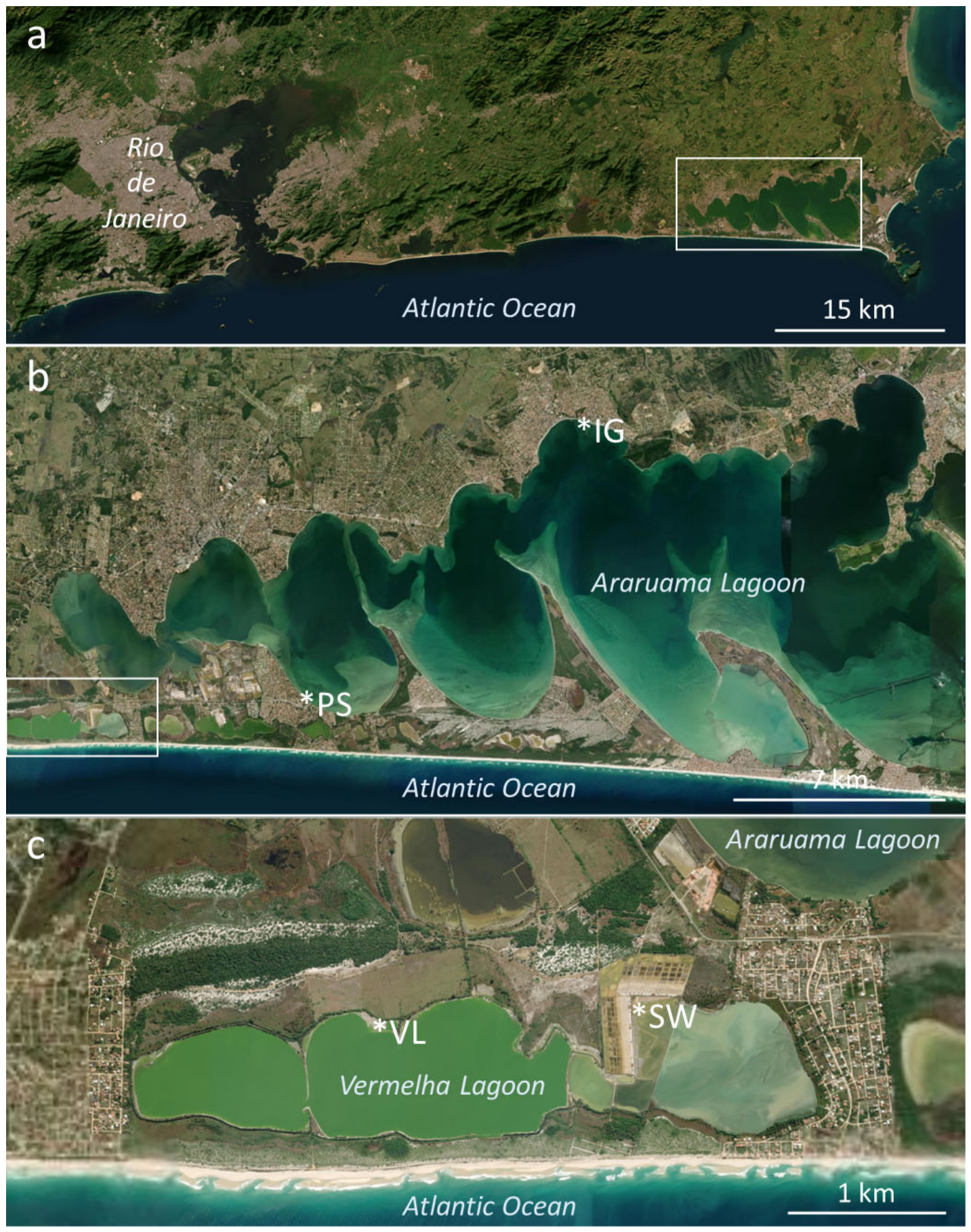
There are several lagoons along the coast of Rio de Janeiro State (Figure 1). About 100 km east of the city of Rio de Janeiro, most coastal lagoons are permanently hypersaline due to seawater inputs combined with semi-arid climate, in which evaporation exceeds precipitation [28,29]. Several saltworks are still active in the region. They pump lagoon water into salt-producing ponds for evaporation, leading to the precipitation of NaCl [30].
Araruama Lagoon is the largest hypersaline lagoon in Brazil (Figure 1a,b). It is 40 km long, up to 13 km wide, and has an average depth of 3 m. A permanent channel to the east allows seawater to enter the lagoon [29]. Salinity ranges from 36.7 to 64.3‰, pH from 7.6 to 8.9, water temperature from 19.0 to 32.7 °C, and dissolved inorganic carbon (DIC) from 1678 to 2269 μmol kg−1 [31,32]. Ca-Mg carbonates in the sediments account for 2%–83% [31,33].
Vermelha Lagoon (Figure 1c) is much smaller, about 4.4 km long and up to 850 m wide, covering an area of 2.4 km2. There is no surface drainage or runoff to the lagoon. Maximum water depth ranges from 1.0 to 1.70 m, depending on seasonal variations in precipitation and evaporation. Vermelha Lagoon is separated from both the Atlantic Ocean and Araruama Lagoon by sandbars [28]. Water salinity ranges from 43.5 to 97‰ [34,35], temperature 20 to 36.5 °C, and pH 7.3 to 9.4 [28,34,35,36,37,38]. Vermelha Lagoon has been extensively studied because it produces authigenic dolomite (CaMg(CO3)2) and contains Holocene stromatolites [28,35,36,37,38,39,40,41,42,43,44,45,46]. Sediments, microbial mats and stromatolites from Vermelha Lagoon produce abundant authigenic minerals characteristic of evaporitic environments, including calcite, Mg-calcites (Ca1−xMgxCO3; 0.07 < x < 0.46), dolomite, aragonite, gypsum, anhydrite (CaSO4), and halite [28,36,38,39,40,41,42,43,44,45,46]. Water in the lagoon is supersaturated with respect to calcite, aragonite and dolomite [38].
Water from these lagoons is pumped into artificial salt-producing ponds for evaporation (Figure 1c), leading to precipitation of halite [29]. Salt production is a traditional activity in the region. A saltwork located on the northern shore of Vermelha Lagoon has been operating since at least 1929. It covers an area of 0.87 km2 [30] and uses water from Vermelha Lagoon. There is also a small channel that conveys water from Araruama Lagoon into Vermelha Lagoon and the saltwork. During field work, we observed several piles of halite and a few piles of gypsum in this saltwork (personal observation). Shiraishi et al. [38] reported that brine from this saltwork had a pH of 7.95, Na+ and Cl concentrations about four times those of seawater, and was supersaturated with respect to calcite, aragonite, dolomite and gypsum. Microbial mats from this saltwork contain Mg-calcite, aragonite, gypsum and halite [38].

2. Materials and Methods

Floating rafts were collected from puddles located near the margin of Vermelha Lagoon (22°55′32″ S, 42°22′58″ W; Figure 1c). It was dry season, and the water level of the lagoon was low. Salinity was 69‰, and the pH was 8.6.
Water and sediment samples were collected for other purposes and left to stand in the laboratory. After a few weeks, some of them developed floating rafts at the water–air interface. The sample collected from a saltwork near Vermelha Lagoon (22°55′36″ S, 42°23′21″ W; Figure 1c) had a salinity of 110‰ and a pH of 7.6. It contained water and a piece of a microbial mat from a puddle. Samples collected from Araruama Lagoon included sites at Iguaba Grande (22°50′23″ S, 42°13′01″ W) and Praia Seca (22°55′13″ S, 42°18′25″ W) (Figure 1b). Water from Praia Seca had a salinity of 61‰ and a pH of 7.4. Both samples from Araruama Lagoon contained water and unconsolidated sediments.
The rafts were collected using glass slides, coverslips and/or plastic labware. They were observed under the light microscope Nikon Eclipse E200 equipped with a Nikon DS-Fi2 camera.
For scanning electron microscopy (SEM) and energy-dispersive spectroscopy (EDS), dry samples were washed in distilled water and mounted on aluminum stubs using carbon tape. Some samples were sputter-coated with gold using a Bal-Tec SCD 050 sputter coater to obtain high-resolution secondary electron images. Uncoated samples were observed using backscattered electrons and analyzed by EDS. Samples were examined using either a Jeol s125, a Jeol JSM-6490LV microscope equipped with a Noran EDS detector, or a Quattro S microscope equipped with an EDS detector (Thermo Fisher Scientific, Waltham, MA, USA).
For transmission electron microscopy (TEM), samples were embedded in Spurr resin and sectioned using an RMC PTX ultramicrotome (Boeckeler Instruments, Inc., Tucson, AZ, USA). Ultrathin sections were collected on lacey carbon-coated copper grids and observed in a JEOL 2100F instrument (JEOL, Tokyo, Japan) operating at an accelerating voltage of 200 kV and equipped with an electron energy-loss spectrometer (EELS-GIF Tridiem Gatan, Pleasanton, CA, USA). Images were acquired using a 16-megapixel CMOS One View digital camera (Gatan). Selected area electron diffraction (SAED) was used to investigate the crystalline phases of the samples. Line profiles of SAED patterns were obtained using the rotational averaging tool in the DigitalMicrograph v3 software, which averages radial intensity profiles from diffraction patterns. These profiles were then compared to the interplanar spacings of calcite, vaterite, and aragonite obtained from an X-ray diffraction database. EELS was acquired in scanning transmission electron microscopy (STEM) mode with a spot size of 0.7 nm and a spectrometer aperture of 5 mm. The energy resolution measured at the zero-loss peak was approximately 1.5 eV. The background was removed by fitting it to a power law. The EELS and SAED profiles were formatted using Origin 8 (OriginLab Corporation, Northampton, MA, USA).

3. Results

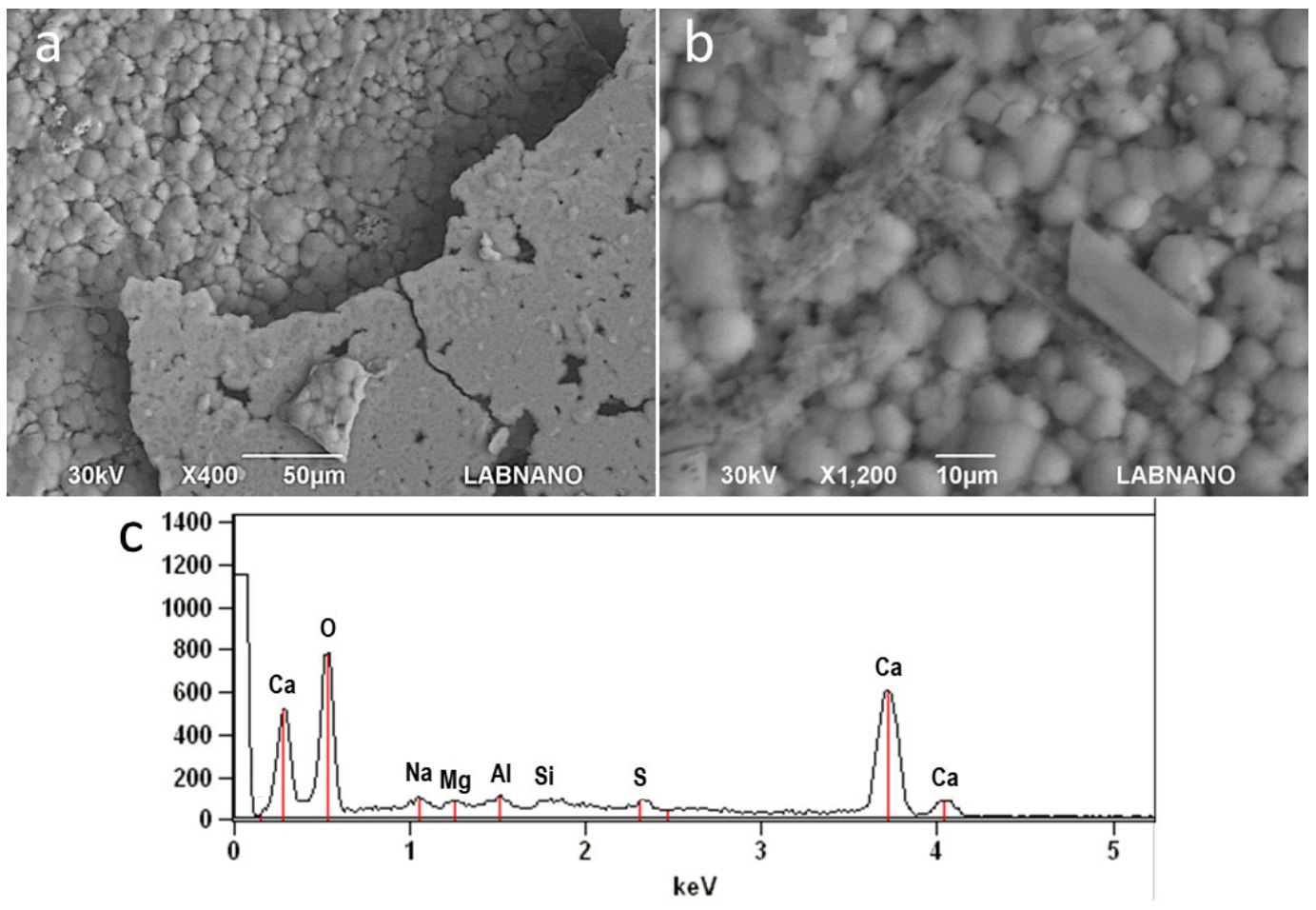
During fieldwork at the end of the dry season, it was observed that some puddles formed along the margin of Vermelha Lagoon contained white, floating rafts at the surface. Their surfaces appeared dry, and they were easily broken. Samples were brought to the laboratory and examined with scanning electron microscopy. They exhibited a flat surface at the top (the interface with the air) and a rough surface at the bottom (the interface with water) (Figure 2a). The bottom surface displayed interconnected globules 10.0 ± 2.4 µm in diameter (n = 54) (Figure 2b). There were some euhedral crystals, as well as diatom remains deposited at the bottom surface (Figure 2b). EDS analysis showed that the rafts consisted primarily of Ca, O and C, indicating a Ca carbonate (Figure 2c). Minor elements included Na, Mg, and S (Figure 2c).
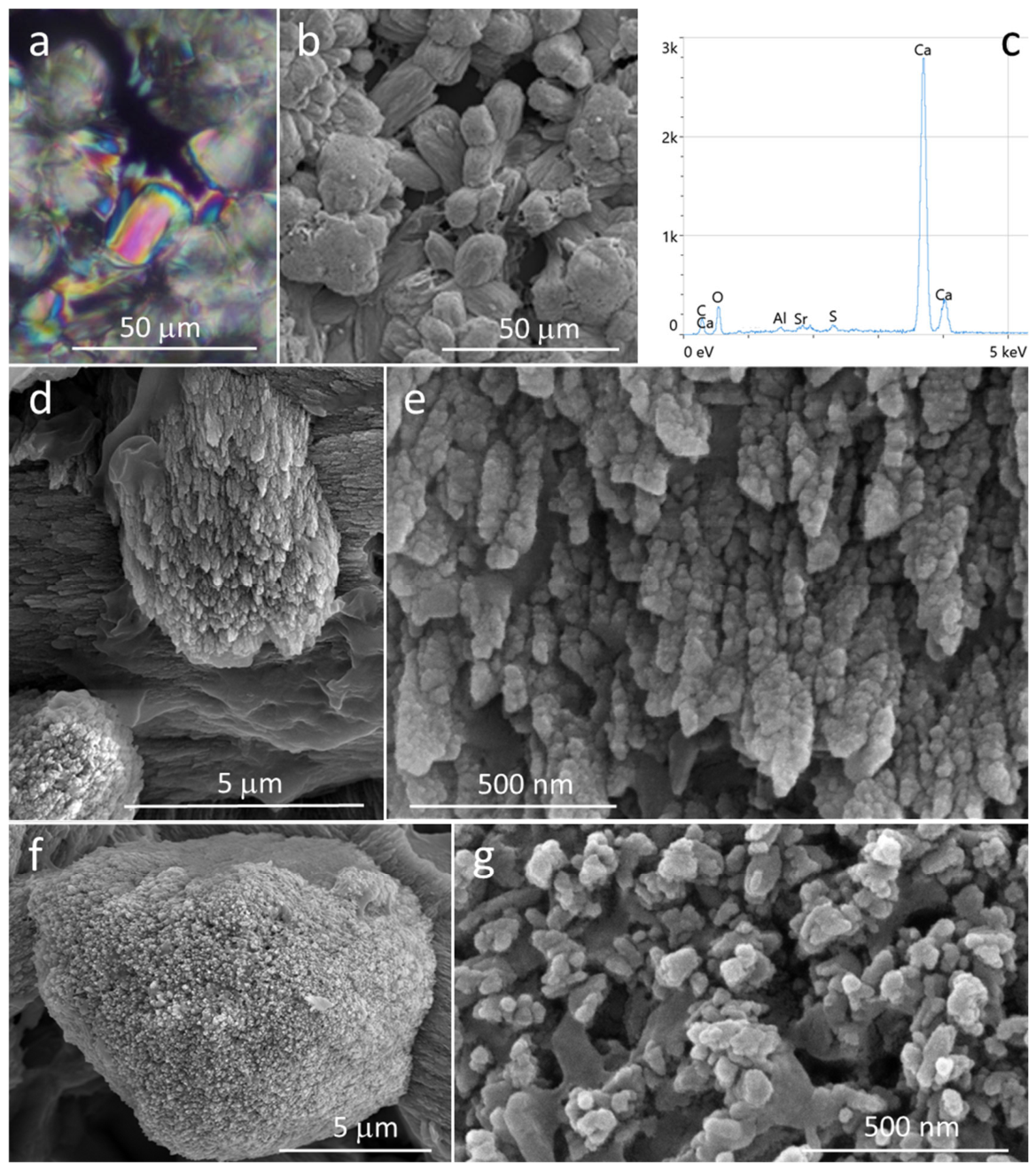
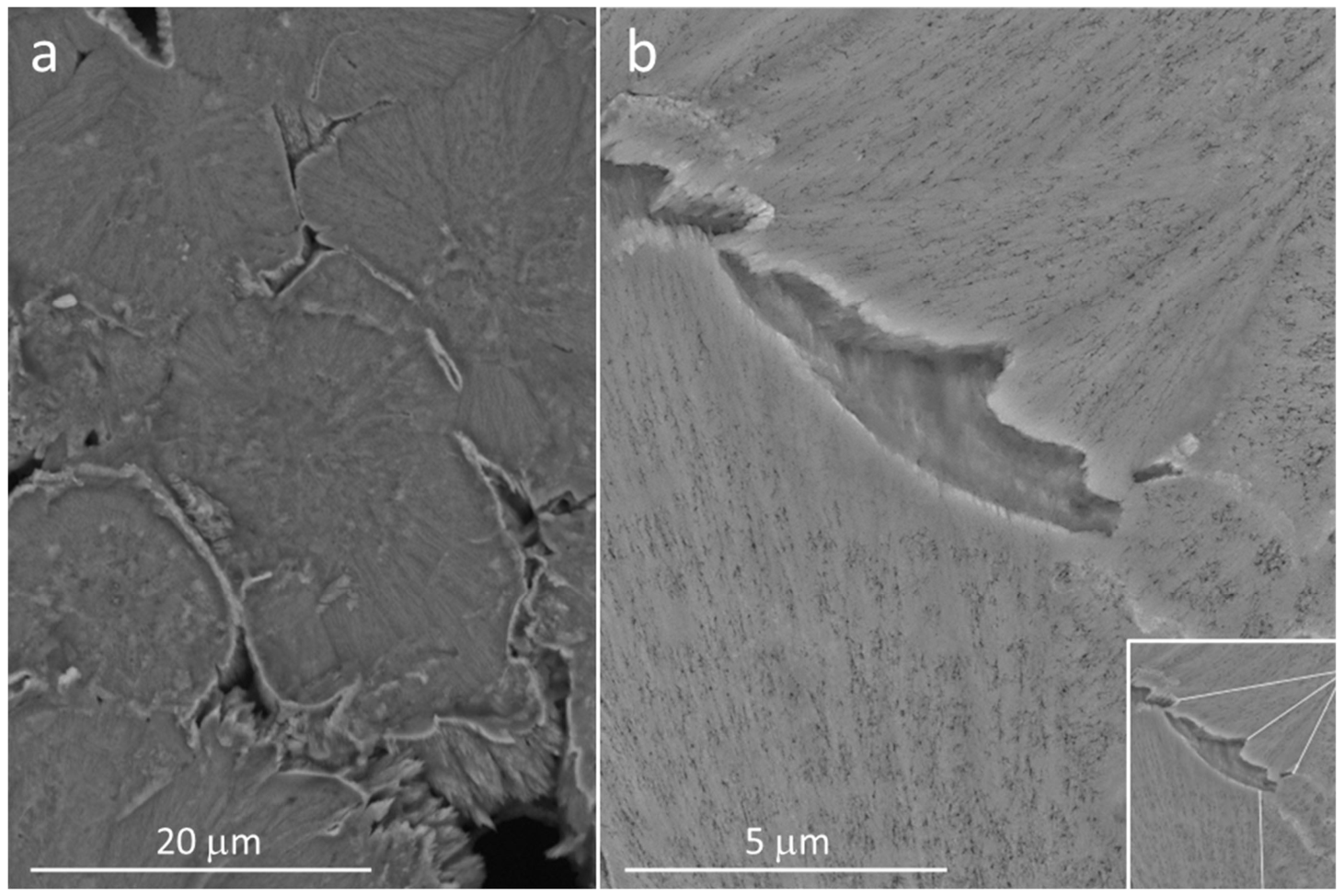
Rafts that formed at the air–water interface in samples from the saltwork maintained in the laboratory for other purposes were retrieved and analyzed. Polarized light microscopy and scanning electron microscopy (SEM) indicate that the rafts are composed of interconnected grains (Figure 3a,b). The grains were either rod-shaped or hemispherical (fan-shaped) (Figure 3a,b). They are 11.2 ± 3.2 µm in diameter (n = 35), based on SEM images. EDS spectra indicate that Ca, C and O are the predominant elements in the rafts (Figure 3c), indicating predominance of Ca carbonate. Strontium and S occur as minor elements. Strontium readily substitutes for Ca into the aragonite lattice due to its larger atomic radius [47] and is commonly found in natural aragonite (e.g., [48,49]). In contrast, S may be present in minor phases such as Ca sulfates (see below). Higher magnification revealed that both rod-shaped and hemispherical grains are composed of several strings of nanocrystals aligned parallel to each other (Figure 3d–g). In some cases, the nanoparticles are stacked in the helical pattern characteristic of aragonite twins. Organic materials occur both surrounding the grains (Figure 3d) and within them, among the nanoparticles (Figure 3g). Figure 4 shows the top surface of the raft from the saltwork sample, which is flat as expected. Backscattered electron images indicate that the grains grew radially, forming fans (Figure 4a). Higher magnification revealed stacks of nanocrystals extending parallel to each other over tens of micrometers (Figure 4b). Fans originate from discrete regions within these stacks and are responsible for the rounded morphologies of the grains (Figure 4b). Lateral growth ceased when adjacent grains came into contact (Figure 4a,b).
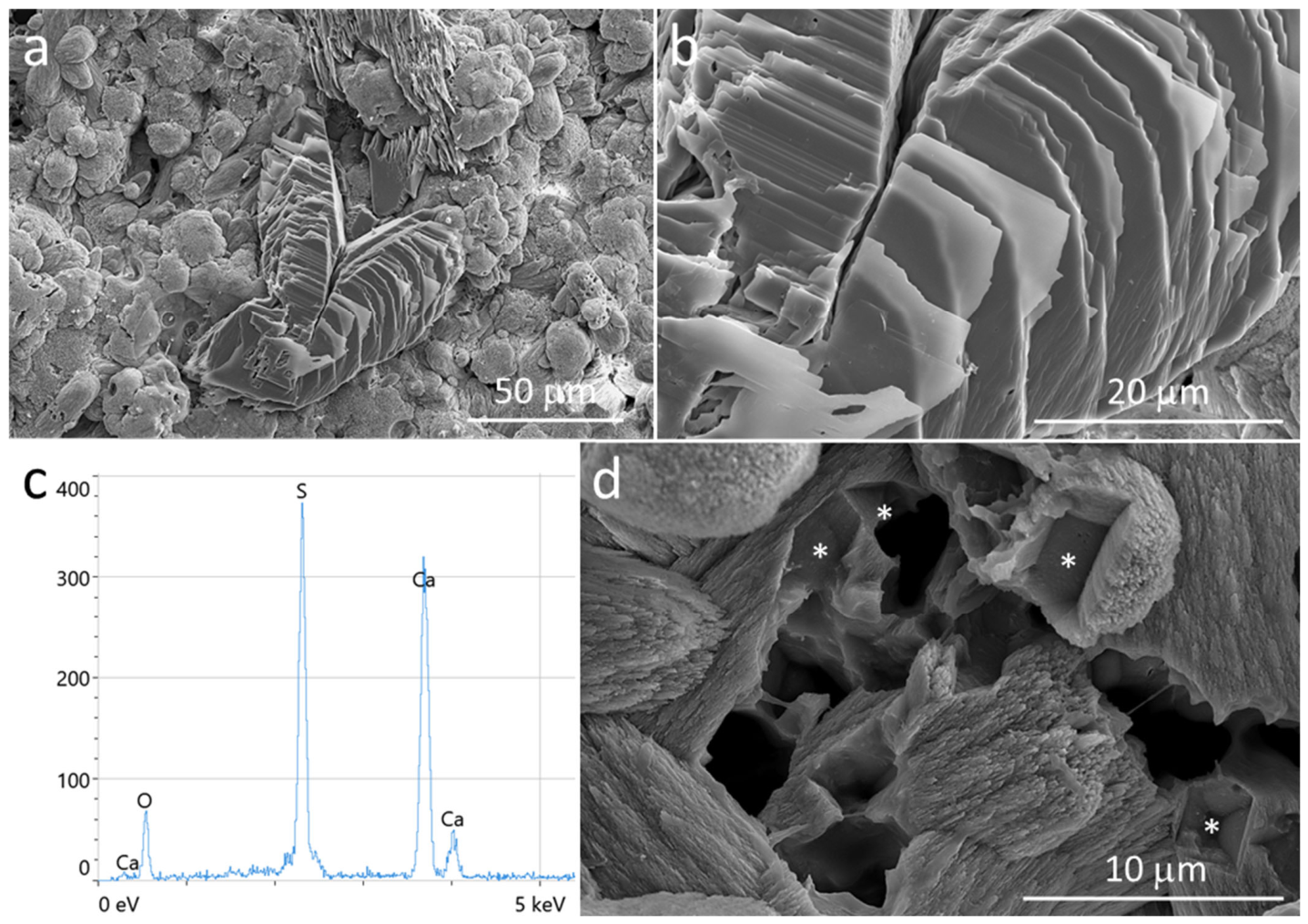
In some cases, additional minerals were observed on the bottom side of the rafts. In the sample collected from the saltwork, there were layered minerals that grew onto the Ca carbonates after their precipitation (Figure 5a,b). EDS spectra indicate that these minerals are composed mainly of Ca, S and O, consistent with a Ca sulfate (Figure 5c). Notably, the Ca sulfates gypsum and/or anhydrite have been reported in microbial mats from Vermelha Lagoon [46] and from the saltwork [38]. In addition, some Ca carbonate grains grew around cubic and chevron-shaped crystals (Figure 5d), which were subsequently dissolved, leaving voids with cubic, octahedral, and chevron morphologies. Similar features have been previously reported in halite rafts [5,7,16]. Given the high salinity of the water (110‰) and the occurrence of halite in microbial mats from the saltwork [38], it is likely that halite precipitated shortly after the onset of CaCO3 precipitation. Thus, the saltwork rafts are composed predominantly of CaCO3, with minor amounts of halite and Ca sulfate, although the halite was dissolved during washing with distilled water in the sample preparation process.
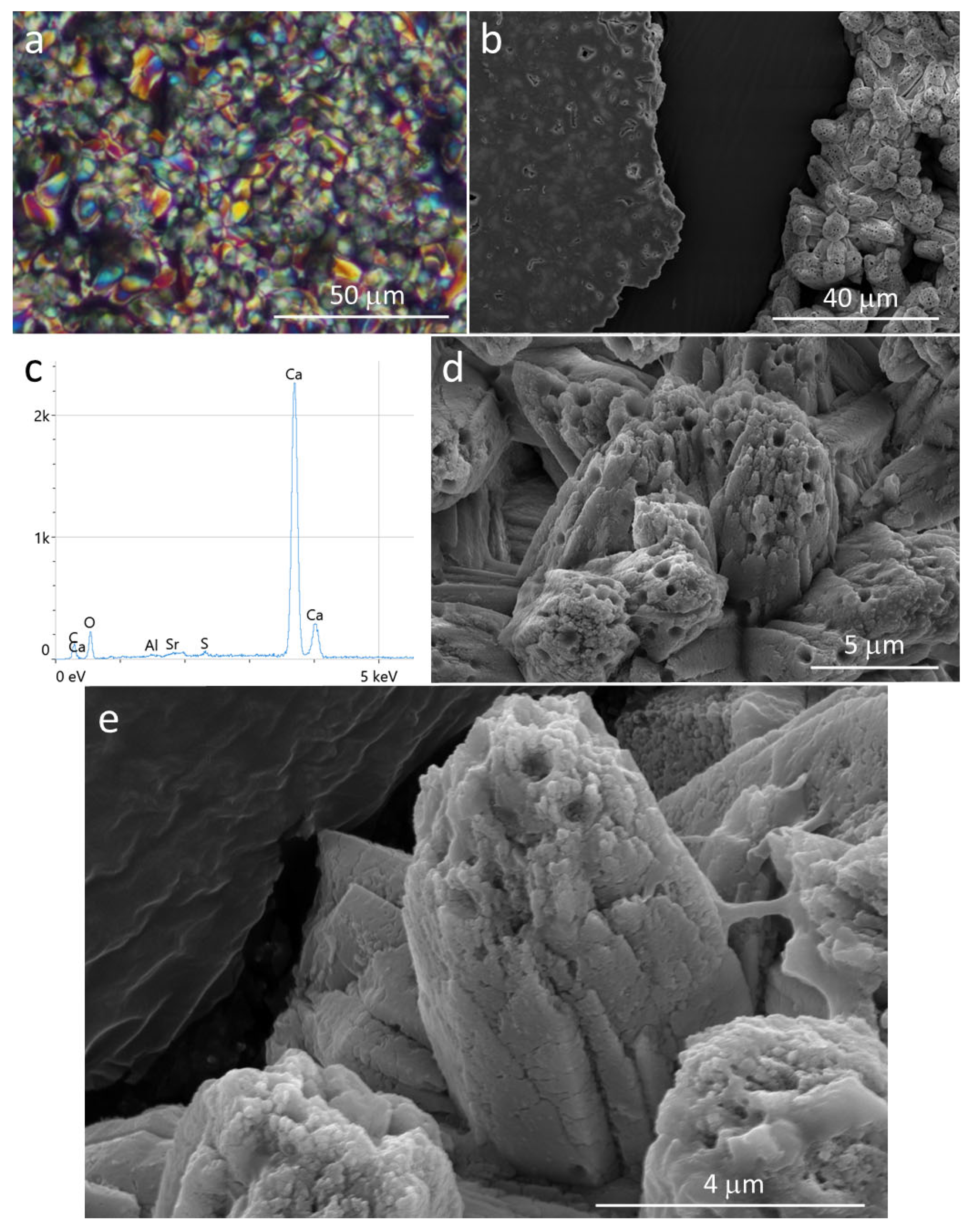
Rafts also appeared at the air–water interface of samples from Praia Seca. Polarized light microscopy showed that they were composed of elongated grains, smaller than those observed in the saltwork sample (Figure 6a). Scanning electron microscopy revealed that the upper surface was flat, whereas the bottom surface was rough (Figure 6b), as in the other rafts. Measurements from SEM images show that the grains are 4.7 ± 0,9 µm in diameter. EDS spectra showed predominantly Ca, C and O peaks, indicating a Ca carbonate (Figure 6c). Minor elements included Sr and S, as also observed in the saltwork rafts. At higher magnification, each grain was found to be composed of several euhedral prismatic crystals aligned parallel to one another (Figure 6d,e). Crystal size decreased progressively toward the tip of the grains (Figure 6e). The grains contained numerous submicrometric rounded holes (Figure 6b,d,e), which may have been produced by microboring cyanobacteria (e.g., [35,38]).
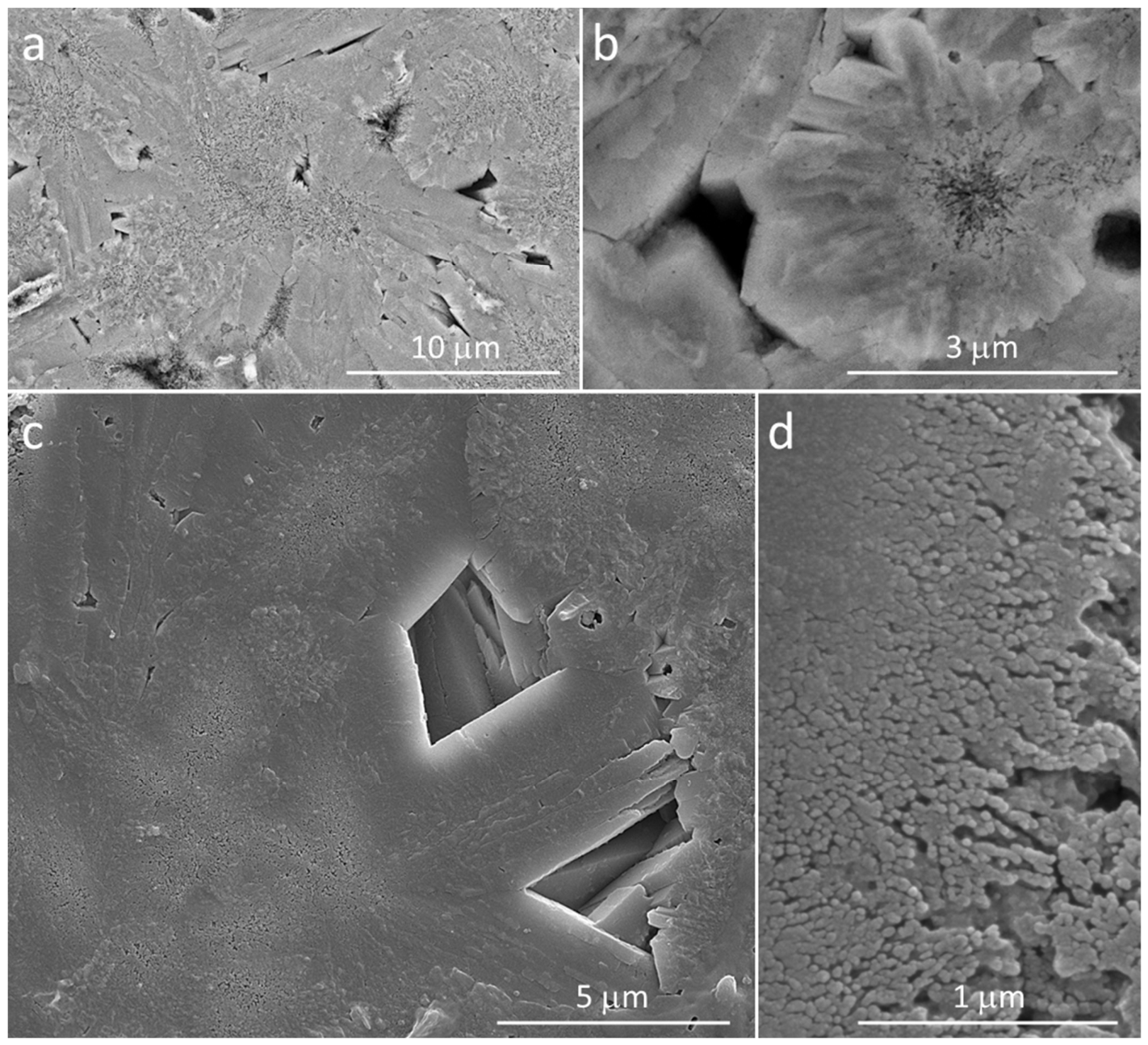
Figure 7 shows the upper surface of the Praia Seca rafts. Crystal arrangements included radial growth from multiple nucleation centers (Figure 7a), rosette-like structures (Figure 7b), and twinned crystals (Figure 7c). The nucleation centers were porous and contained columns of nanocrystals (Figure 7d), which presumably correspond to the mineralization front responsible for the growth of the larger euhedral crystals. A closer inspection indicates that the nanocrystals coalesced to form the euhedral crystals (Figure 7d).
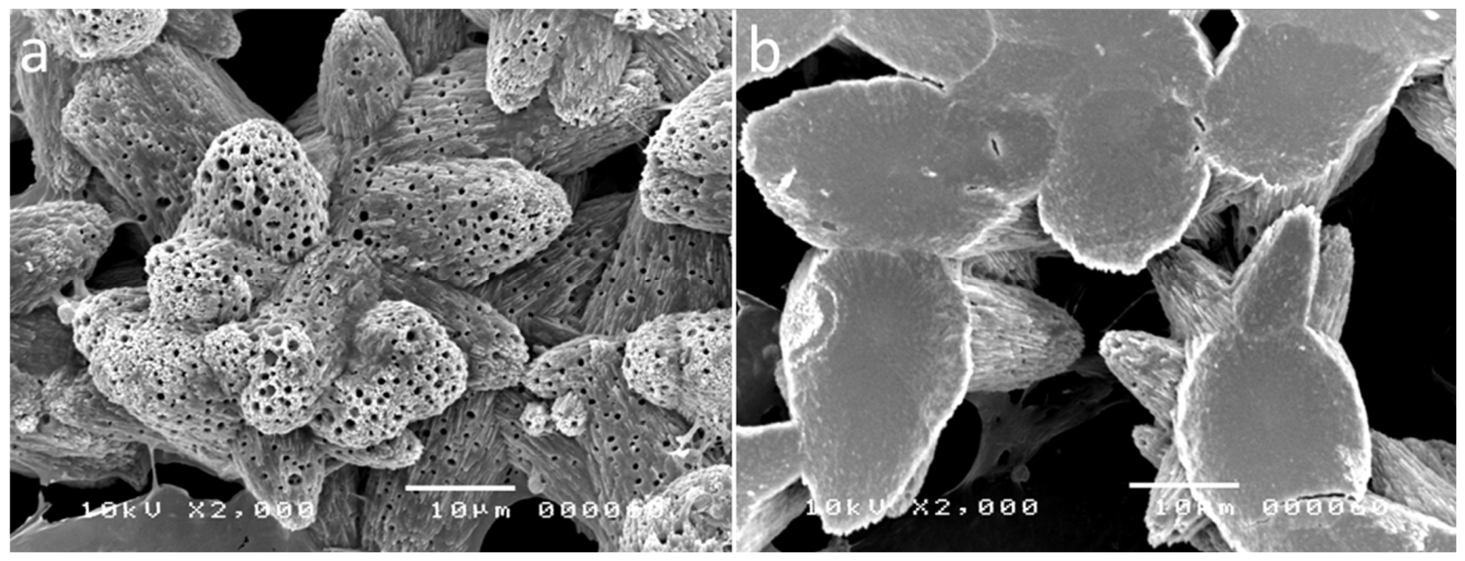
As observed for the other rafts, those from Iguaba Grande exhibited a rough bottom surface (Figure 8a) and a flat top surface (Figure 8b). Closer inspection shows that each grain consists of a pack of long, thin crystals (Figure 8a). The grains contain numerous rounded pores, especially at their tips (Figure 8a). These pores are similar to those observed in the Praia Seca rafts and likely were produced by microboring cyanobacteria. Each grain measured 9.7 ± 2.3 µm in diameter (n = 21).
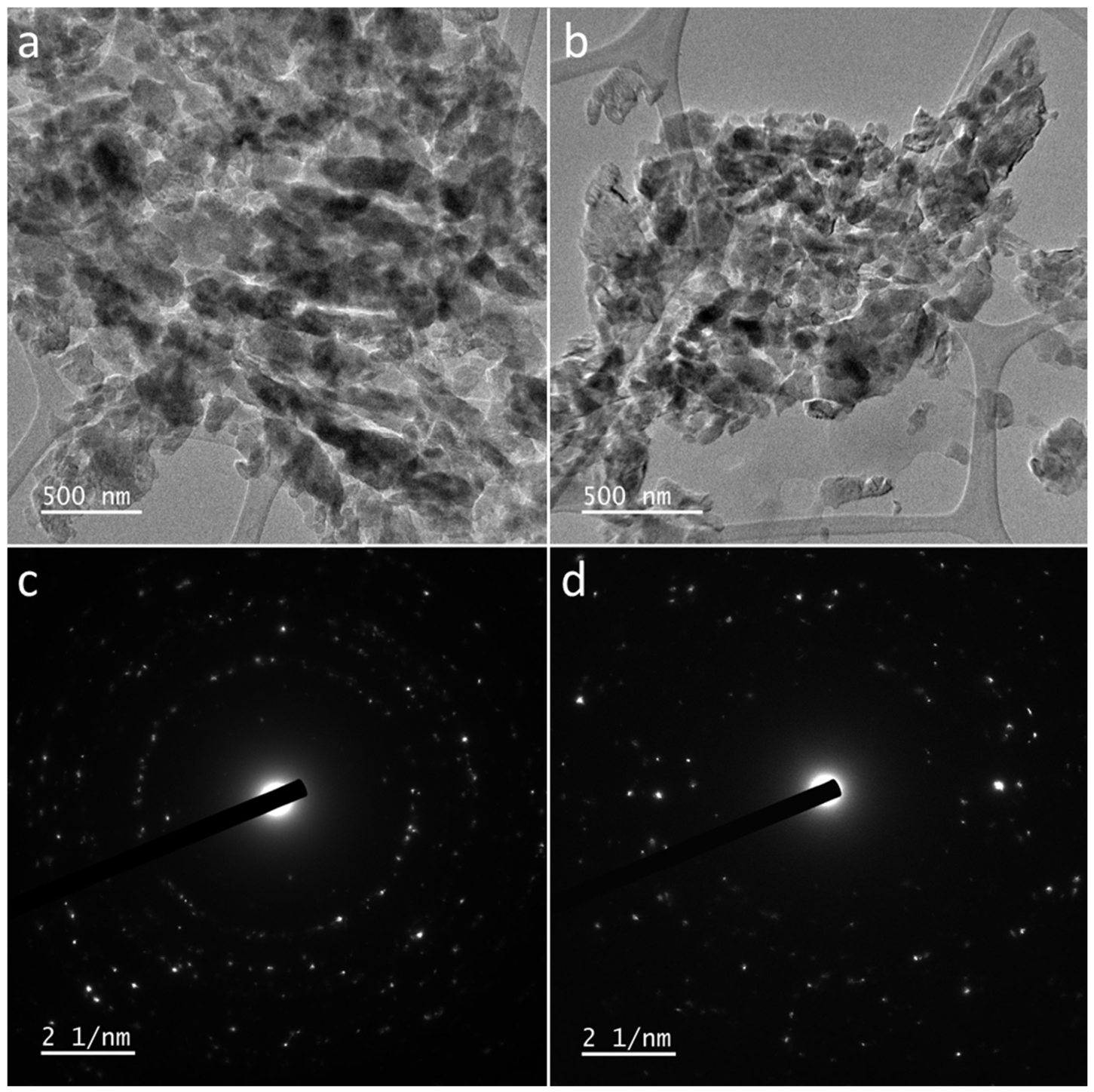
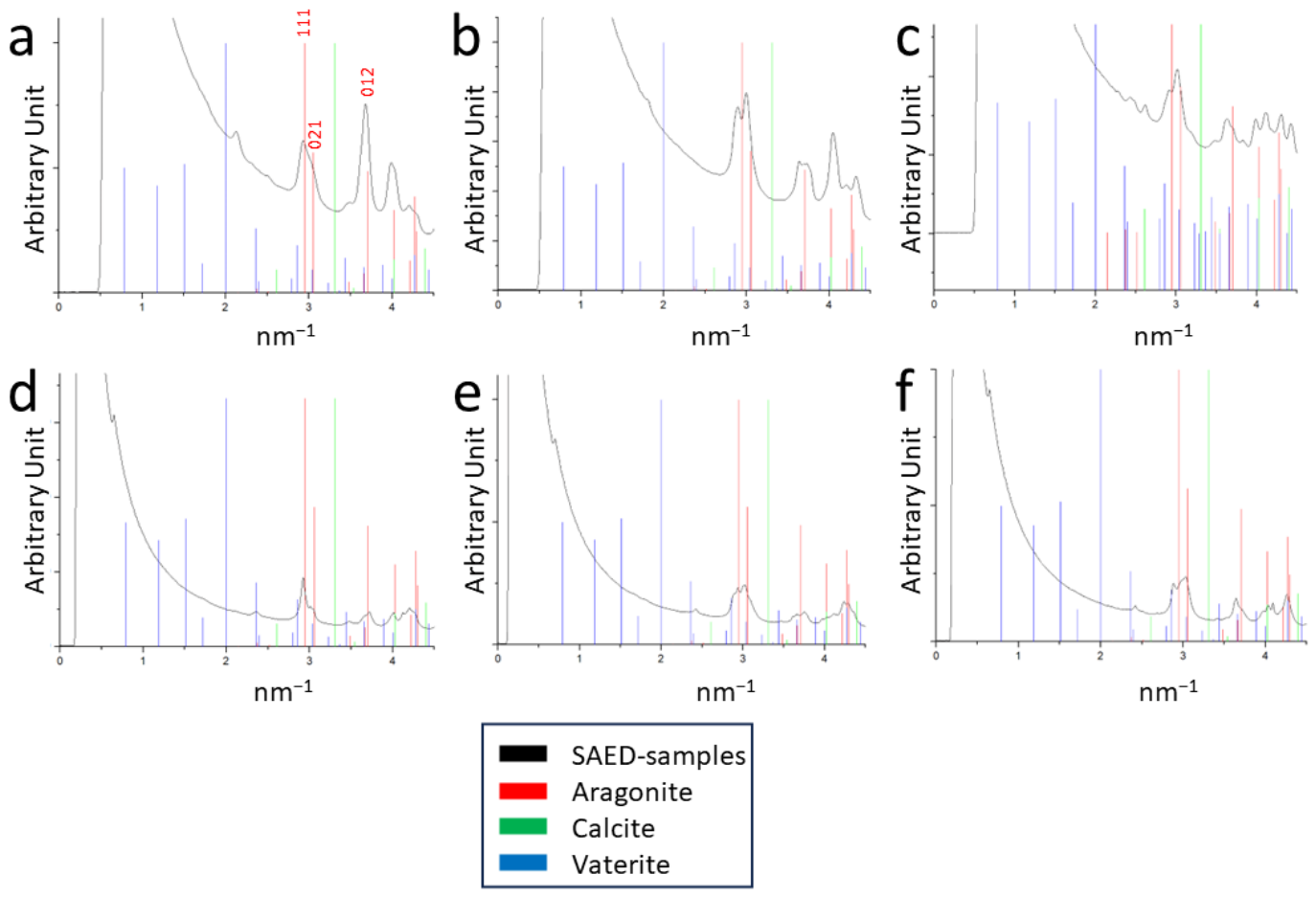
Transmission electron microscopy (TEM) images of the Praia Seca and Iguaba Grande samples show an agglomeration of crystalline particles approximately 150 nm wide (Figure 9a,b). No morphological differences were observed between the Praia Seca and Iguaba Grande samples. SAED patterns were obtained from different regions of both samples using the same diffraction aperture (Figure 9c,d). Figure 10 presents the average radial intensity profiles from three different regions of the Praia Seca and Iguaba Grande samples and compares them with the most intense reflections of aragonite (red vertical lines), calcite (green vertical lines), and vaterite (blue vertical lines). The length of the vertical lines in Figure 10 is proportional to the X-ray diffraction intensity (data obtained from the X-ray database). A peak at approximately 3 nm−1, observed in all diffractograms, coincides with the most intense peak of aragonite (111). A peak at approximately 3.7 nm−1, observed in all profiles, corresponds to the (012) plane of aragonite. The most intense reflections of calcite and vaterite were not identified in any SAED pattern. These results indicate a strong predominance of aragonite crystals in both samples. Indeed, EDS spectra of Praia Seca rafts showed small amounts of Sr (Figure 6c), a common impurity in natural aragonite [48,49].
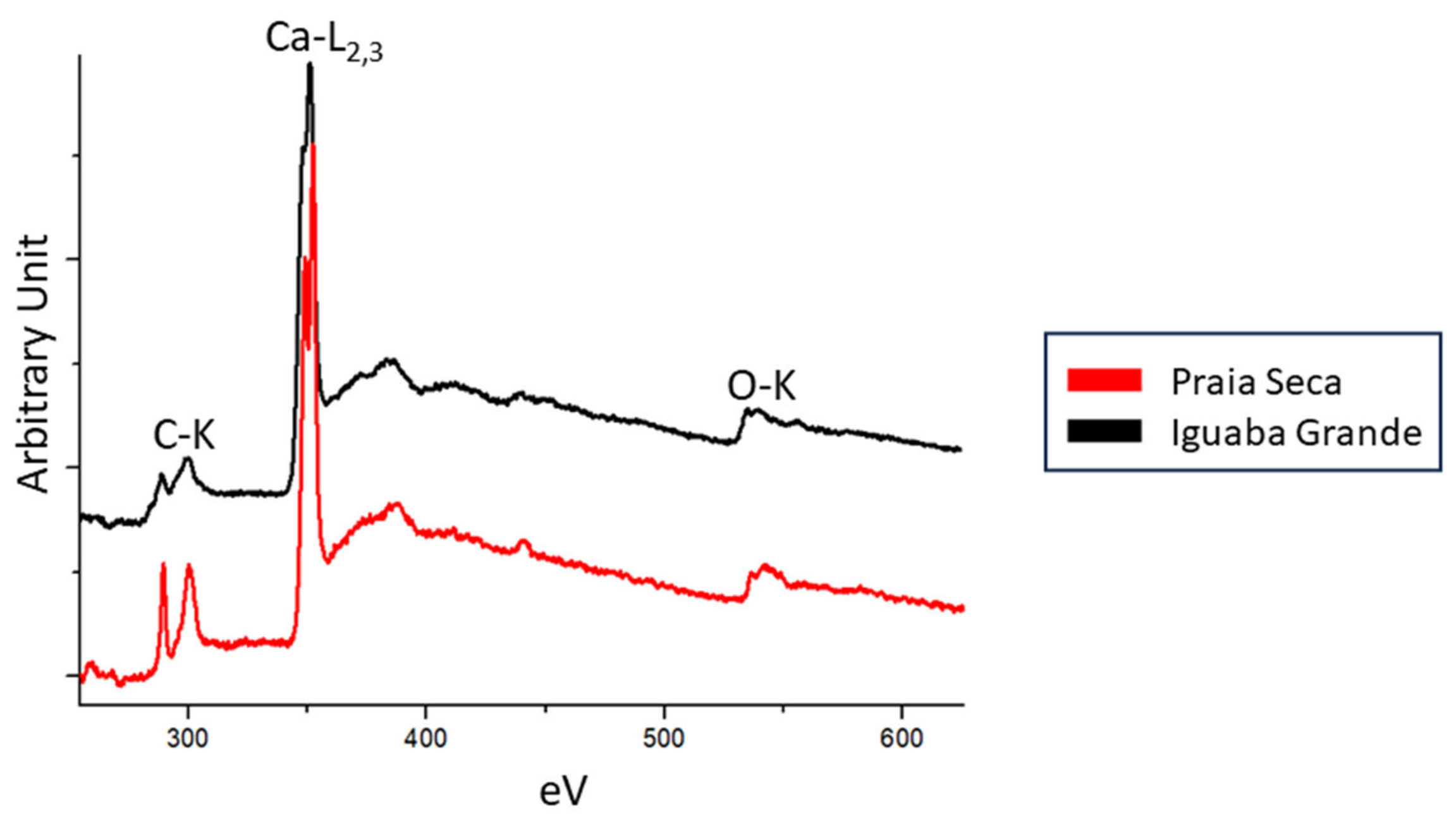
Figure 11 displays the EELS spectra of the Praia Seca and Iguaba Grande samples. The spectra are similar and exhibit edges corresponding to the C K-edge (289 eV and 299 eV), the Ca L2,3-edge (346 eV), and the O K-edge (526 eV). The C peaks at 289 and 299 eV are assigned to C=O (1s → π*) and C–O (1s → σ*) bonds, respectively, of the carbonate group.

4. Discussion

Aragonite was identified in the two floating raft samples from Araruama Lagoon (Praia Seca and Iguaba Grande) by electron diffraction (Figure 9c,d and Figure 10). No diffraction spots indicative of calcite or vaterite were observed (Figure 10). Aragonite rafts have previously been reported in freshwater environments [12,38].
In all rafts described here, the upper surface is flat and the bottom surface is rough, as previously reported [3,4,7,9,10,11,13,18,27]. The morphology of grains on the bottom surface varied from hemispherical to rod-shaped (Figure 2a,b, Figure 3b,d,f, Figure 5a, Figure 6b,d,e and Figure 8a). Morphologically similar aragonite hemispheres have been described in rafts from freshwater travertines rich in organic matter and phototrophs such as diatoms or cyanobacteria [3,10].
The polycrystalline grains are composed of micrometric euhedral aragonite crystals, similar to those reported in the aragonite rafts from brackish waters [11] and/or apparently isometric nanoparticles comparable to those described in early stages of aragonite precipitation in microbial mats [50], corals and sponges [51]. These nanocrystals are aligned parallel to each other (Figure 3d,e,g, Figure 5d, Figure 6d,e and Figure 7d), resulting in a birefringence similar to that of single crystals (Figure 3a and Figure 6a). Even in fan-shaped structures, the organization of the nanocrystals is maintained over several micrometers (Figure 4b). The alignment of nanocrystals to form larger composite units with different levels of crystallinity and purity is widespread among biominerals and synthetic minerals. This process results in faster growth, complex morphologies, and specific properties [52]. In this context, the similarity in shape and size of the grains within each sample, as well as among the four samples studied here, is remarkable. This suggests the presence of some kind of self-organization process in this system, possibly related to growth by aggregation of nanocrystals into mesocrystals, as proposed by Cölfen and Antonietti [52] and observed in synthetic aragonite [53].
It is important to note that the rafts studied here formed in natural waters spanning a range of salinities and pH values, and containing diverse microorganisms and complex organic matter (see Figure 2b, Figure 3d, Figure 3g and Figure 6e), which may influence mineral precipitation. The environments from which the samples were collected are rich in organic matter [31,32,34,37], as appears to be the case for environments where similar aragonite rafts have been reported [3,10]. In contrast, rafts from cave environments, which are typically poor in organic matter, exhibit larger crystals and distinct crystal organization [2,4,11,13]. This contrast suggests that organic matter plays a role in shaping raft morphology by reducing crystal size and influencing their organization, ultimately controlling grain morphology. Natural environments contain a wide variety of organic molecules that can interact with inorganic ions and minerals. In some cases, these molecules promote nucleation, whereas in others they act as poisons to mineral growth [54]. Indeed, soluble organic molecules have been shown to regulate the polymorph precipitated, as well as the elemental composition, morphology and size of Ca carbonates [55,56,57,58]. Furthermore, Cölfen and Antonietti [52] highlighted the role of organic molecules in nucleation, crystal growth, and their aggregation into mesocrystals, thereby controlling the shape, size and properties of the material.
In addition to Ca carbonates, a Ca sulfate was also identified in the saltwork sample. Mixed rafts of calcite and gypsum have been found in a gypsum cave [14], although the morphologies of the Ca sulfate phases were distinct. The saltwork samples also contained voids with cubic shapes, chevron structures, and truncated octahedra, all characterized by 90° angles and consistent with halite. Halite rafts have been described in evaporite systems [5,7,15,17,18,20,21,22,23], and the crystal morphologies in these rafts are very similar to those observed in this work (see Figure 5d). Relics of sunken rafts composed of halite or gypsum have been identified in the geologic record of evaporite systems [17]. A few cubic crystals and cubic voids were also observed on the bottom surface of Vermelha Lagoon rafts. Both the saltwork and Vermelha Lagoon are evaporite systems, where halite and Ca sulfates have been reported [38,46].
The lagoons and saltworks from which the samples were collected can be considered evaporite systems. As water evaporates, less soluble minerals such as Ca-Mg carbonates precipitate first, whereas more soluble phases such as Ca sulfates and halite precipitate later [17]. Authigenic Ca carbonates, including calcite, Mg-calcite and/or aragonite, have been reported in the sediments, stromatolites, and/or microbial mats of Vermelha Lagoon [28,38,39,40,43,44,45,46]. The relatively high abundance of these minerals in the sediments [28,39], together with supersaturation with respect to calcite, aragonite, and dolomite [38], indicates widespread precipitation of Ca-Mg carbonates in the lagoon. Indeed, Spadafora et al. [42] documented the precipitation of a Ca carbonate layer on stromatolite surfaces, later shown to consist of Mg-calcite, which also precipitates on shells [35,44]. Nucleation is likely the rate-limiting step for Ca-Mg carbonate precipitation in Vermelha Lagoon, and organic molecules may act as poisons to mineral precipitation directly from solution (e.g., [59]). In this context, the air–water interface may reduce the activation energy required for nucleation, similarly to solid surfaces. As proposed for halite rafts [7,15], evaporation from still water surfaces can increase supersaturation near the air–water interface and is likely the main driver of raft precipitation in Vermelha Lagoon and the other samples analyzed in this work.

5. Conclusions

The combined use of light and electron microscopy imaging, along with analytical techniques, was essential for generating data across multiple length scales, enabling the interpretation of the samples described in this work.
All rafts studied were composed of interconnected polycrystalline grains. The raft’s top surfaces were flat, whereas the bottom surfaces were rough as a result of grain growth into the water. Each grain consisted of multiple groups of stacked nanocrystals, indicating that they form through hierarchical particle aggregation, i.e., they are mesocrystals.
The two rafts from Araruama Lagoon (Praia Seca and Iguaba Grande) consist of aragonite. In addition to Ca carbonate, the rafts from the saltwork also contained a Ca sulfate and probably halite.
Evaporation is probably a major driver of raft precipitation in Vermelha Lagoon and other hypersaline environments.

Author Contributions

Conceptualization, C.N.K. and M.F.; methodology, C.N.K., A.R. and M.F.; validation, M.F.; formal analysis, A.R. and M.F.; investigation, C.N.K., A.R. and M.F.; resources, C.N.K., A.R. and M.F.; data curation, C.N.K. and A.R.; writing—original draft preparation, C.N.K.; writing—review and editing, A.R. and M.F.; visualization, C.N.K. and A.R.; supervision, M.F.; project administration, M.F.; funding acquisition, M.F. All authors have read and agreed to the published version of the manuscript.

Funding

This research was funded by CNPq (National Council for Scientific and Technological Development) and FAPERJ (Carlos Chagas Filho Foundation for Research Support of the State of Rio de Janeiro).

Data Availability Statement

The original contributions presented in this study are included in the article. Further inquiries can be directed to the corresponding author.

Acknowledgments

We thank Daniele Stillitani and Jean Pierre Fonseca for assistance with the SEM-EDS analyses. We also acknowledge CENABIO-UFRJ and LabNano-CBPF for providing electronic microscopy facilities.

Conflicts of Interest

The authors declare no conflicts of interest.

References

  1. Bretz, J.H. Deposits made at the air-water contact. In Caves of Missouri; Geological Survey and Water Resource: Rolla, MO, USA, 1956; 490p, Available online: https://books.google.com.br/books?id=f9lXwAEACAAJ&printsec=frontcover&hl=pt-BR&source=gbs_ge_summary_r&cad=0#v=onepage&q&f=false (accessed on 3 February 2026).
  2. Pomar, L.; Ginés, A.; Gines, J.; Moyá, G.; Ramón, G. Nota previa sobre la petrologia y mineralogia de la calcita flotante de algunas cavidades del Levante Mallorquin. Endins 1975, 2, 3–5. [Google Scholar]
  3. Chafetz, H.S.; Rush, P.F.; Utech, N.M. Microenvironmental controls on mineralogy and habit of CaCO3, precipitates: An example from an active travertine system. Sedimentology 1991, 38, 107–126. [Google Scholar] [CrossRef]
  4. Taylor, P.M.; Chafetz, H.S. Floating rafts of calcite crystals in cave pools, Central Texas, U.S.A.: Crystal habit vs. saturation state. J. Sediment. Res. 2004, 74, 328–341. [Google Scholar] [CrossRef]
  5. Taj, R.J.; Aref, M.A. Structural and textural characteristics of surface halite crusts of a supratidal, ephemeral halite pan, South Jeddah, Red Sea Coast, Saudi Arabia. Facies 2015, 61, 2. [Google Scholar] [CrossRef]
  6. Alonso-Zarza, A.M.; Martín-García, R.; Martín-Pérez, A.; Olmeda-Zafrilla, O.; Fernández-Amo, F.J. Origin and diagenesis of Cueva Masero speleothems, Monumento Natural Cuevas de Fuentes de León, Badajoz. Geogaceta 2018, 64, 119–122. [Google Scholar]
  7. Aref, M.A.; Taj, R.D.; Manaa, A.A. Sedimentological implications of microbial mats, gypsum, and halite in Dhahban solar saltwork, Red Sea coast, Saudi Arabia. Facies 2020, 66, 10. [Google Scholar] [CrossRef]
  8. Christensen, J.N.; Watkins, J.M.; Devriendt, L.S.; DePaolo, D.J.; Conrad, M.E.; Voltolini, M.; Yang, W.; Dong, W. Isotopic fractionation accompanying CO2 hydroxylation and carbonate precipitation from high pH waters at The Cedars, California, USA. Geochim. Cosmochim. Acta 2021, 301, 91–115. [Google Scholar] [CrossRef]
  9. Faimon, J.; Baldík, V.; Krystofová, E.; Stelcl, J.; Rez, J. Calcite raft formation in abandoned technical adit (Moravian Karst). Appl. Geochem. 2022, 141, 105282. [Google Scholar] [CrossRef]
  10. Shiraishi, F.; Akimoto, T.; Tomioka, N.; Motai, S.; Takahashi, T. Formation processes of paper-thin raft and coated bubble: Calcium carbonate deposition at gas-water interface. Sediment. Geol. 2023, 456, 106514. [Google Scholar] [CrossRef]
  11. Entrena, A.; Auqué, L.F.; Gimeno, M.J.; Fornós, J.J. Bimineralic calcite-aragonite rafts in the hypogeous lakes of Cova dets Ases (Mallorca): Controls on precipitation and polymorphism. Chem. Geol. 2025, 673, 122529. [Google Scholar] [CrossRef]
  12. Black, D.M. Aragonite rafts in Carlsbad Caverns, New Mexico. Science 1953, 117, 84–85. [Google Scholar] [CrossRef]
  13. Martini, J.E.J.; Moen, H.F.G. Blue Lagoon, Afrique du Sud: Une grotte à remplissage paléokarstique permien et à concretions d’aragonite. Karstologia 1998, 32, 27–38. [Google Scholar] [CrossRef]
  14. Calaforra, J.M.; Forti, P.; Fernandez-Cortes, A. Speleothems in gypsum caves and their paleoclimatological significance. Environ. Geol. 2008, 53, 1099–1105. [Google Scholar] [CrossRef]
  15. Benison, K.C.; Bowen, B.B.; Oboh-Ikuenobe, F.E.; Jagniecki, E.A.; LaClair, D.A.; Story, S.L.; Mormile, M.R.; Hong, B.Y. Sedimentology of acid saline lakes in Southern Western Australia: Newly described processes and products of an extreme environment. J. Sediment. Res. 2007, 77, 366–388. [Google Scholar] [CrossRef]
  16. Manaa, A.A.; Aref, M.A. Microbial mats and evaporite facies variation in a supralittoral, ephemeral lake, Red Sea coast, Saudi Arabia. Facies 2022, 68, 3. [Google Scholar] [CrossRef]
  17. Warren, J.K. Evaporites, brines and base metals: What is an evaporite? Defining the rock matrix. Austral. J. Earth Sci. 1996, 43, 115–132. [Google Scholar] [CrossRef]
  18. Bąbel, M.; Schreiber, B.C. Geochemistry of evaporites and evolution of seawater. In Treatise on Geochemistry, 2nd ed.; Holland, H.D., Turekian, K.K., Eds.; Elsevier: Amsterdam, The Netherlands, 2014; pp. 483–560. [Google Scholar] [CrossRef]
  19. Renault, R.W.; Owen, R.B.; Lowenstein, T.K.; Cort, G.; McNulty, E.; Scott, J.J.; Mbuthia, A. The role of hydrothermal fluids in sedimentation in saline alkaline lakes: Evidence from Nasikie Engida, Kenya Rift Valley. Sedimentology 2021, 68, 108–134. [Google Scholar] [CrossRef]
  20. Talbot, C.J.; Stanley, W.; Soub, R.; Al-Sadoun, N. Epitaxial salt reefs and mushrooms in the southern Dead Sea. Sedimentology 1996, 43, 1025–1047. [Google Scholar] [CrossRef]
  21. Lowenstein, T.K.; Hardie, L.A. Criteria for the recognition of salt-pan evaporites. Sedimentology 1985, 32, 627–644. [Google Scholar] [CrossRef]
  22. Hanford, C.R. Marginal marine halite: Sabkhas and salinas. In Evaporites, Petroleum and Mineral Resources; Melvin, J.L., Ed.; Developments in Sedimentology; Elsevier: Amsterdam, The Netherlands, 1991; Volume 50, pp. 1–66. [Google Scholar]
  23. Filippi, M.; Bruthans, J.; Palatinus, L.; Zare, M.; Asadi, N. Secondary halite deposits in the Iranian salt karst: General description and origin. Int. J. Speleol. 2011, 40, 141–162. [Google Scholar] [CrossRef]
  24. Takahashi, M. ζ-Potential of microbubbles in aqueous solutions: Electrical properties of the gas-water interface. J. Phys. Chem. B 2005, 109, 21858–21864. [Google Scholar] [CrossRef]
  25. Chaplin, M. Theory vs experiment: What is the surface charge of water? Water 2009, 1, 1–28. [Google Scholar]
  26. Meegoda, J.N.; Hewage, S.A.; Batagoda, J.H. Application of the diffused double layer theory to nanobubbles. Langmuir 2019, 35, 12100–12112. [Google Scholar] [CrossRef] [PubMed]
  27. Lowenstein, T.K.; Weldeghebriel, M.K.; Sirota, I.; Eyal, H.; Lensky, N.G. Criteria for the recognition of clastic halite: The modern Dead Sea shoreline. Sedimentology 2021, 68, 2253–2269. [Google Scholar] [CrossRef]
  28. Höhn, A.; Tobschall, H.J.; Maddock, J.E.L. Biogeochemistry of a hypersaline lagoon east of Rio de Janeiro, Brazil. Sci. Total Environ. 1986, 58, 175–185. [Google Scholar] [CrossRef]
  29. Kjerfve, B.; Schettini, C.A.F.; Knoppers, B.; Lessa, G.; Ferreira, H.O. Hydrology and salt balance in a large, hypersaline coastal lagoon: Lagoa de Araruama, Brazil. Estuar. Coast. Shelf Sci. 1996, 42, 701–725. [Google Scholar] [CrossRef]
  30. Costa, E.C.P.; Santos, M.O.; Silva, J.G.O.; Seabra, V.S. Mapeamento multitemporal e cadastral das salinas da Lagoa de Araruama—RJ. Geographia 2022, 24, e50112. [Google Scholar] [CrossRef]
  31. Laut, L.; Vilar, A.; Belart, P.; Clemente, I.; Fontana, L.; Pereira, E.; Ballalai, J. Organic matter compounds as a tool for trophic state characterization in a hypersaline environment: Araruama Lagoon, Brazil. J. S. Am. Earth Sci. 2020, 97, 102403. [Google Scholar] [CrossRef]
  32. Cotovicz, L.C., Jr.; Knoppers, B.A.; Régis, C.R.; Tremmel, D.; Costa-Santos, S.; Abril, G. Eutrophication overcoming carbonate precipitation in a tropical hypersaline coastal lagoon acting as a CO2 sink (Araruama Lagoon, SE Brazil). Biogeochemistry 2021, 156, 231–254. [Google Scholar] [CrossRef]
  33. Rodrigues, A.B.; Boardman, M.R. Características Sedimentológicas e Mineralógicas da Lagoa de Araruama, RJ. Atas do IV Simpósio do Quaternário no Brasil. 1982. Available online: https://inis.iaea.org/records/7qza7-tkt82/files/16009853.pdf (accessed on 5 February 2026).
  34. Laut, L.; Belart, P.; Carelli, T.; Martins, M.V.A.; Laut, V. Insights into the ecology of foraminifera from the most hypersaline lagoon in Brazil: Vermelha Lagoon. Estuar. Coasts 2022, 45, 2632–2649. [Google Scholar] [CrossRef]
  35. Keim, C.N.; Farina, M. Death and taphonomy of Holocene stromatolites from Lagoa Vermelha, Brazil. C. R. Géosci. 2023, 355, 259–277. [Google Scholar] [CrossRef]
  36. Vasconcelos, C.; McKenzie, J.A. Microbial mediation of modern dolomite precipitation and diagenesis under anoxic conditions (Lagoa Vermelha, Rio de Janeiro, Brazil). J. Sediment. Res. 1997, 67, 378–390. [Google Scholar] [CrossRef]
  37. Pennafirme, S.; Pereira, D.C.; Pedrosa, L.G.M.; Machado, A.S.; Silva, G.O.A.; Keim, C.N.; Lima, I.; Lopes, R.T.; Paixão, I.C.N.P.; Crapez, M.A.C. Characterization of microbial mats and halophilic virus-like particles in a eutrophic hypersaline lagoon (Vermelha Lagoon, RJ, Brazil). Reg. Stud. Mar. Sci. 2019, 31, 100769. [Google Scholar] [CrossRef]
  38. Shiraishi, F.; Hanzawa, Y.; Asada, J.; Cury, L.F.; Bahniuk, A.M. Decompositional processes of microbial carbonates in Lagoa Vermelha, Brazil. J. Sediment. Res. 2023, 93, 202–211. [Google Scholar] [CrossRef]
  39. Moreira, I.; Patchineelam, R.; de Luca Rebello, A. Preliminary investigations on the occurrence of diagenetic dolomite in surface sediments of Lagoa Vermelha, Brazil. GeoJournal 1987, 14, 357–360. [Google Scholar] [CrossRef]
  40. Santelli, R.L.; Wagener, A.L.R.; Wagener, K.; Patchineelam, S. Assessing past environmental changes through sediment records in a hypersaline lagoon. Croat. Chem. Acta 2006, 79, 129–141. [Google Scholar]
  41. Vasconcelos, C.; Warthmann, R.; McKenzie, J.A.; Visscher, P.T.; Bittermann, A.G.; Van Lith, Y. Lithifying microbial mats in Lagoa Vermelha, Brazil: Modern Precambrian relics? Sediment. Geol. 2006, 185, 175–183. [Google Scholar] [CrossRef]
  42. Spadafora, A.; Perri, E.; McKenzie, J.A.; Vasconcelos, C. Microbial biomineralization processes forming modern Ca:Mg carbonate stromatolites. Sedimentology 2010, 57, 27–40. [Google Scholar] [CrossRef]
  43. Nascimento, G.S.; Eglinton, T.I.; Haghipour, N.; Albuquerque, A.L.; Bahniuk, A.; McKenzie, J.A.; Vasconcelos, C. Oceanographic and sedimentological influences on carbonate geochemistry and mineralogy in hypersaline coastal lagoons, Rio de Janeiro state, Brazil. Limnol. Oceanog. 2019, 64, 2605–2620. [Google Scholar] [CrossRef]
  44. Keim, C.N.; Santos, H.N.; Santiago, C.S.; Pennafirme, S.; Neumann, R.; Schnellrath, J.; Lima, I.; Crapez, M.A.C.; Farina, M. Microstructure and mineral composition of Holocene stromatolites from Lagoa Vermelha, a hypersaline lagoon in Brazil: Insights into laminae genesis. J. Sediment. Res. 2020, 90, 887–905. [Google Scholar] [CrossRef]
  45. Areias, C.; Barbosa, C.F.; Cruz, A.P.S.; McKenzie, J.A.; Ariztegui, D.; Eglinton, T.; Haghipour, N.; Vasconcelos, C.; Sánchez-Román, M. Organic matter diagenesis and precipitation of Mg-rich carbonate and dolomite in modern hypersaline lagoons linked to climate changes. Geochim. Cosmochim. Acta 2022, 337, 14–32. [Google Scholar] [CrossRef]
  46. Guedes, C.B.; Arena, M.C.; Santos, H.N.; Valle, B.; Santos, J.A.; Favoreto, J.; Borghi, L. Sedimentological and geochemical characterization of microbial mats from Lagoa Vermelha (Rio de Janeiro, Brazil). J. Sediment. Res. 2022, 92, 591–600. [Google Scholar] [CrossRef]
  47. Borchardt-Ott, W. Crystallography—An Introduction; Springer-Verlag: Berlin/Heidelberg, Germany, 2011; pp. 267–268. [Google Scholar]
  48. Sunagawa, I.; Takahashi, Y.; Imai, H. Strontium and aragonite-calcite precipitation. J. Mineral. Petrol. Sci. 2007, 102, 174–181. [Google Scholar] [CrossRef]
  49. Doubleday, Z.A.; Harris, H.H.; Izzo, C.; Gillanders, B.M. Strontium randomly substituting for calcium in fish otolith aragonite. Anal. Chem. 2014, 86, 865–869. [Google Scholar] [CrossRef] [PubMed]
  50. Ge, Y.; Della Porta, G.; Pederson, C.L.; Lokier, S.W.; Hoffmann, R.; Immenhauser, A. Botryoidal and spherulitic aragonite in carbonates associated with microbial mats: Precipitation or diagenetic replacement product? Front. Earth Sci. 2021, 9, 698952. [Google Scholar] [CrossRef]
  51. Stolarski, J.; Mazur, M. Nanostructure of biogenic versus abiogenic calcium carbonate crystals. Acta Palaeontol. Polonica 2005, 50, 847–865. [Google Scholar]
  52. Cölfen, H.; Antonietti, M. Mesocrystals: Inorganic superstructures made by highly parallel crystallization and controlled alignment. Angew. Chem. Int. Ed. 2005, 44, 5576–5591. [Google Scholar] [CrossRef]
  53. Zhou, G.T.; Yao, Q.Z.; Ni, J.; Jin, G. Formation of aragonite mesocrystals and implication for biomineralization. Am. Mineral. 2009, 94, 293–302. [Google Scholar] [CrossRef]
  54. Morse, J.W.; Arvidson, R.S.; Lüttge, A. Calcium carbonate formation and dissolution. Chem. Rev. 2007, 107, 342–381. [Google Scholar] [CrossRef]
  55. Hoch, A.R.; Reddy, M.M.; Aiken, G.R. Calcite crystal growth inhibition by humic substances with emphasis on hydrophobic acids from the Florida Everglades. Geochim. Cosmochim. Acta 2000, 64, 61–72. [Google Scholar] [CrossRef]
  56. Miyashita, M.; Yamada, E.; Kawano, M. Influence of low–molecular–weight dicarboxylic acids on the formation of calcium carbonate minerals in solutions with Mg2+ ions. J. Mineral. Petrol. Sci. 2018, 113, 207–217. [Google Scholar] [CrossRef]
  57. Liu, D.; Xu, Y.; Yu, Q.; Yu, N.; Qiu, X.; Wang, H.; Papineau, D. Catalytic effect of microbially-derived carboxylic acids on the precipitation of Mg-calcite and disordered dolomite: Implications for sedimentary dolomite formation. J. Asian Earth Sci. 2020, 193, 104301. [Google Scholar] [CrossRef]
  58. Kawano, M.; Hwang, J. Effect of acidic microbial polysaccharides on calcium carbonate polymorph formation in hot water at 40–80 °C. J. Mineral. Petrol. Sci. 2023, 118, 221116. [Google Scholar] [CrossRef]
  59. Al-Gailani, A.; Taylor, M.J.; Zaheer, M.H.; Barker, R. Evaluation of natural organic additives as eco-friendly inhibitors for calcium and magnesium scale formation in water systems. ACS Environ. Au 2024, 4, 354–365. [Google Scholar] [CrossRef]
Figure 1. Satellite images of the sampling locations. (a) Portion of the coast of Rio de Janeiro State showing Rio de Janeiro City and the area enlarged in “b” (rectangle). (b) Araruama Lagoon and the two sites, “Praia Seca” (PS) and “Iguaba Grande” (IG) (asterisks). The rectangle indicates the area enlarged in “c”. (c) Vermelha Lagoon and the adjacent saltwork. Asterisks indicate the sampling sites for Vermelha Lagoon (VL) and saltwork (SW).
Minerals 16 00445 g001
Figure 2. Scanning electron microscopy (SEM) images and energy-dispersive spectroscopy (EDS) data of floating rafts collected from a puddle at the margin of Vermelha Lagoon. (a) The flat upper surface (right) is superimposed on the rough bottom face (left) of the raft. (b) Higher magnification image of the bottom surface showing its globular morphology, along with diatom remains and a flat euhedral crystal. (c) EDS spectrum acquired from the flat upper surface, showing Ca and O peaks predominantly, indicating that Ca carbonates constitute most of the raft. Sodium, Mg, and S occur as minor components, whereas Al likely originates from the holder and Si from the Si(Li) detector. Backscattered electron images were obtained at 30 kV, and EDS analysis at 10 kV.
Minerals 16 00445 g002
Figure 3. Microscopy images and EDS data of floating rafts that developed in a sample collected from the saltwork. (a) Polarized light microscopy image. Note the strong birefringence in the grain at the center, in the fan-shaped structure on the right, and at the margins of several other grains. (b) Low magnification SEM image of the rough bottom surface showing the intergrown grains that compose the raft. (c) EDS spectrum acquired in the SEM, showing Ca and O peaks predominantly, indicating a Ca carbonate. Minor elements in the sample include Sr and S, whereas the Al peak likely originates from the sample holder. (d) Side view of a grain that grew onto another grain. (e) Higher magnification image showing that it is composed of numerous stacks of nanocrystals. (f) Top view of a grain. (g) High magnification image showing in detail the packing of nanocrystals. Secondary electron images were obtained at 10 kV, and the EDS spectrum at 30 kV.
Minerals 16 00445 g003
Figure 4. Backscattered electron images of the flat upper surface of rafts from the saltwork. (a) Several grains that grew until they came into contact with each other. (b) Higher magnification image showing straight lines corresponding to the growth pattern of the grains at the air–water interface. Note the presence of fan-shaped structures (see the map in the inset) originating from discrete points. Images were obtained at 10 kV.
Minerals 16 00445 g004
Figure 5. Scanning electron microscopy (SEM) and EDS data of additional mineral components present in rafts from the saltwork sample. (a,b) Layered minerals deposited on the bottom surface of the raft. (c) EDS spectrum acquired from this mineral, showing Ca, S and O, indicating a Ca sulfate. (d) Cubic- and chevron-shaped voids imprinted in some grains (asterisks) indicate that halite crystals were present during raft growth. Images were obtained at 10 kV, and the EDS spectrum was obtained at 30 kV.
Minerals 16 00445 g005
Figure 6. Microscopy images and EDS spectrum of floating rafts that developed in a sample collected at Praia Seca. (a) Polarized light microscopy image showing that most grains are birefringent. (b) SEM image showing the flat upper surface (left) and the rough bottom surface (right). (c) EDS spectrum acquired from the flat surface, showing mainly Ca, C and O peaks, indicating a Ca carbonate. Minor Sr and S peaks indicate impurities in the Ca carbonate and/or the presence of minor mineral phases. (d,e) Higher magnification images showing that the grains are polycrystalline. Crystals at the base appear more compact, whereas those at the top appear more loosely arranged. SEM images were obtained at 10 kV, and EDS spectrum was obtained at 30 kV.
Minerals 16 00445 g006
Figure 7. Scanning electron microscopy (SEM) images of the flat upper surface of rafts from the Praia Seca sample showing crystals growing radially from nucleation centers. (a,b) Backscattered electron images showing that microcrystals are constrained by the growth of neighboring crystals. (c,d) Secondary electron images. (c) Larger crystals grew to form twins. (d) Nanocrystals at the nucleation centers are organized in linear chains and coalesce as they grow. Images were obtained at 10 kV.
Minerals 16 00445 g007
Figure 8. Scanning electron micrographs of rafts grown in samples from Iguaba Grande. (a) Rough bottom surface. Note that the interconnected grains are composed of fine crystals. Numerous pores are present, especially at the tips of the grains. (b) Flat upper surface. Note the outlines of the individual grains. Secondary electron images obtained at 10 kV.
Minerals 16 00445 g008
Figure 9. Transmission electron micrographs (a,b) and electron diffraction patterns (c,d) of samples from Praia Seca (a,c) and Iguaba Grande (b,d).
Minerals 16 00445 g009
Figure 10. Average radial intensity profiles compared with the main diffraction lines of the Ca carbonates aragonite, calcite and vaterite. The main diffraction lines of aragonite are illustrated in (a). (ac) Sample from Praia Seca. (df) Sample from Iguaba Grande.
Minerals 16 00445 g010
Figure 11. Electron energy-loss spectra of samples from Praia Seca and Iguaba Grande, showing the C and the O K-edges and the Ca L2,3-edge.
Minerals 16 00445 g011
Disclaimer/Publisher’s Note: The statements, opinions and data contained in all publications are solely those of the individual author(s) and contributor(s) and not of MDPI and/or the editor(s). MDPI and/or the editor(s) disclaim responsibility for any injury to people or property resulting from any ideas, methods, instructions or products referred to in the content.